A snapshot of the “voluntary” resignation letter Vitaly Blazhevich was forced to submit on February 17, 2023. Thanks for his kind permission to publish it here.
The firing was occasioned by a comment that Blazhevich had made to Radio Svoboda. He had said that the residents of Khabarovsk Territory who had supported its former governor, Sergei Furgal, had thus given a vote of no confidence to President Vladimir Putin. Blazhevich was forced to “voluntarily” resign from the institute.
Blazhevich’s comment concerned the plight of Furgal, in which connection he touched on the attitude of residents of Khabarovsk Territory toward Putin.
“Khabarovsk residents said quite clearly — also, by the way, in the midst of a crackdown by the authorities — that they had lost confidence in Putin specifically. When Putin withdrew his support from Furgal, Khabarovsk residents said loudly and clearly at one of the largest rallies that from now on, we have no confidence in Putin. That is the genuine law that people passed,” Blazhevich said at the time.
The lecturer was summoned to the office of Oleg Kulikov, the institute’s deputy director for organizational matters and digitization. It was Blazhevich’s remarks about Putin that had caused Kulikov’s concern. One of his arguments was that RANEPA had been established by the President of Russia. (The decree establishing the university was signed in 2010 by then President Dmitry Medvedev.)
Blazhevich was informed that the complaint about his comments to Radio Svoboda had come from the so-called Regional Management Center, which is engaged in “collecting, analyzing and processing complaints and reports from the populace.”
According to Blazhevich, he was threatened that if the complaint made it to the police, an administrative case against him could be opened. In addition to the police, Blazhevich was threatened with dismissal under labor law for “immoral behavior.”
“We are university lecturers: we have no right to speak badly about the president,” the institute’s deputy director told him.
“Their logic suggests it’s immoral to have an opinion,” remarked Blazhevich. He added that he had not discussed politics with colleagues or students during working hours, and that there had been no complaints about his academic performance. He thus does not believe that the denunciation originated within the university.
[…]
After Sergei Furgal, the former governor of Khabarovsk Territory, was arrested in the summer of 2020, numerous protest rallies took place in Khabarovsk in support of the politician over the course of the next several months. On February 10 of this year, the Moscow Regional Court sentenced Furgal to twenty-two years in a maximum security penal colony, finding him guilty of organizing assassination attempts on three business competitors.
If you didn’t get enough brains when they were handing them out, you can only learn to tell good from evil the hard way. The process is quite long and painful. It is very, very scary to stop being the consenting majority. It is very, very scary to discover you’re having the “wrong” thoughts without nipping them in the bud. It takes a lot of courage to go through withdrawal when your whole body wants another dose of what it’s used to: it’s like quitting smoking or drinking. When you get free of it you’re left one on one with the whole world until you get washed up on some other shore. I’m not making excuses for anyone. I’m just trying on someone else’s shoes.
A former governor from Russia’s Far East has been sentenced to 22 years in jail for murder and attempted murder in a controversial court case in Moscow.
Sergei Furgal insists he is innocent and says the trial against him was motivated by politics.
He was elected governor of Khabarovsk region in 2018, unexpectedly beating the Kremlin’s preferred candidate.
His detention in July 2020 caused widespread anger among locals.
The judge in Luberetsky Court near the capital ruled that Furgal, 52, must serve his sentence in a high-security prison after a jury found him guilty on two charges of murder and one of attempted murder.
The killings, said the prosecution, were linked to rivalry between Furgal and other businessmen in 2004 and 2005.
The ex-governor — who won office as a candidate for the ultranationalist Liberal Democratic Party of Russia (LDPR) — struggled to contain his emotions in the courtroom after the sentence was read out, shouting “Do you have no shame?” at the judge. His lawyers say they will appeal.
When he was first arrested, residents in the city of Khabarovsk took to the streets in huge numbers — some estimates put the figure as high as 50,000. Such demonstrations are rare in Russia and took the Kremlin by surprise.
Furgal’s supporters claimed that the criminal case against him was politically motivated — punishment for daring to beat the Kremlin’s candidate in elections.
Experts say his landslide victory was the result of a massive anti-Moscow vote. As governor, he was tough-talking, and some say more popular even than President Vladimir Putin.
Contract killings of business rivals were common in Russia, especially in the 1990s and the early 2000s, when Furgal was a successful businessman.
However, the case is more likely to be linked to his unique position — as a popular local politician who didn’t show absolute loyalty to the Kremlin.
“Furgal may well have been involved in shadowy business in the past, but so too were many of the other regional leaders whom Putin has been happy to support,” Russia expert Mark Galeotti told the BBC. “It seems clear that this was essentially a political move: once the Kremlin decided Furgal had to go, they looked for whatever excuse they could use.”
The Khabarovsk protest movement in 2020 was unusual for two reasons. Firstly, it was grassroots-based: meaning the authorities could not simply arrest the ringleaders.
Secondly, it was focused on a single local issue — the arrest of the governor — making it very difficult for the Kremlin to pin the blame on the West or on “foreign forces” — as is the usual tactic.
But in the weeks that followed, arrests were made, and the demonstrators were eventually silenced or pushed off the streets.
President Putin appointed a new governor, Mikhail Degtyaryov, who also represents the LDPR. Mr. Degtyarov, though, is a Kremlin loyalist and recently became a vocal supporter of Russia’s war in Ukraine.
I have been in police custody since April of last year. I was formally charged in early June, and since then I have been an “accused” man. I see this word in paperwork, I sign statements containing it, and that is how the prison authorities address me. “Accused” has been my new social status for the past nine months.
A criminal change can be a serious burden. I have met people in prison, albeit a few, who are plagued by a sense of guilt for what they have done. In this sense, though, my case is simple. All the accusations against me are ridiculous and absurd, and the article [in the criminal code] under which I am being tried should not exist, basically. I find it easy and pleasant to take a consistent stance and to tell the truth. I have always adhered to this principle both in public life and in personal matters.
The investigation, whilst trying to accuse me of spreading “fakes,” has constructed one giant fake. Literally the entire indictment, from the first word to the last, is at odds with reality. I subscribe to every word I wrote a year ago. All my emotional assessments have retained their force, and all factual claims have been borne out many times. So there can be no question of any sense of guilt on my part in terms of the present case.
Life, though, is much more complicated than a trumped-up criminal case. A year ago, events happened that shocked the world. In a matter of days, the foundations of life, which had seemed to us unshakable, were destroyed. The most terrible pictures stepped off the pages of history textbooks, reviving the nightmares of bygone years and wars whose fury had long ago been stilled. Unable to stop this ongoing tragedy, tens of millions of Russians have come face to face with an oppressive sense of guilt. It is a normal reaction to the monstrously abnormal situation in which all of us find ourselves.
If you feel guilty, it means that you have a conscience. It means that you cannot see the suffering of innocent people without feeling pain in your heart, that you are able to empathize with someone else’s grief. What is more, a sense of guilt for the actions of one’s country is impossible without a sense of belonging. It means that no matter where you are now, you maintain an emotional connection with your homeland, you realize that you are a citizen of Russia and worry about its fate. You — we — are real patriots of Russia in the true sense of the word! We love our country, and so we are especially hurt and ashamed that this inhuman war is waged on its behalf.
It is vital to remember that the guilt that we cannot help but feel is irrational per see. After all, we are not actually to blame for what is happening. The blame is on those who unleashed and wage this war, on those who issue and carry out criminal orders, on those who commit outrages on foreign soil, as well as on those who condone these crimes by cracking down on their own people and generating an atmosphere of fear and intolerance.
On the contrary, we want to live in a free and peaceful country. We want a better future for ourselves and our neighbors. In order for our hopes to come true, we must move away from a passive sense of guilt, focused on the past, and strive to realize our own civic responsibility. We must move away from regrets about what has happened to solving existing problems and making plans for the future. Yes, right now we are unable to stop the war, but this does not mean that we are powerless. I want each of you to think about what you can do personally. The answer “nothing” is not acceptable. First, if you are not on the side of the scoundrels, if you have remained true to yourself, have kept your wits about you, and have not fallen into despair, if you are listening to me now or reading this text, this is much more than nothing. And second, even I can do something and am doing something. I keep talking, communicating the truth about events to people. I have been using this trial as a platform for public anti-war statements. To the best of my ability, I have been helping those who, due to their civic stance, have found themselves on the same side of the bars as me. You have many more opportunities to act today for the sake of our common better tomorrow.
Our problem is the inability to take the initiative and find allies. We are used to following leaders and waiting for instructions. Don’t wait — act! Become volunteers, help refugees, support political prisoners, form horizontal ties. Get to know your neighbors, colleagues and classmates, set common goals and achieve them together. When someone needs your help, don’t ignore them. Make this world a better place for us and for our children.
We like to repeat, like a mantra, the words “Russia will be free!” But Russia is us, and what it will be depends only on us. The war will inevitably end, and then the regime that unleashed it will cease to exist. This is the law of history. We have a lot of work ahead of us, work which we must start now. This work of ours, I am sure, is bound to succeed. Russia will be free — because we will make it so.
Source: Darya Kornilova (Facebook), 1 March 2023. Thanks to Elena Zaharova for the heads-up. Originally published on the website of the movement For Human Rights. Translated by the Russian Reader. The verdict in Mr. Ivanov’s case is scheduled to be announced on March 7. The prosecutor has asked the court to find him guilty as charged and sentence him to nine years in prison. See my translation of Mediazona‘s detailed account of the case and trial against Mr. Ivanov, below.
Russian lawmakers on Thursday voted in favor of a bill that would make it a criminal offense to “discredit” anyone fighting on Russia’s side in the war in Ukraine, not just the Russian military.
The legislation aims to expand current laws criminalizing the discrediting of the Russian Armed Forces to include mercenaries serving in the ranks of Russia’s growing number of private military companies, such as the Wagner Group.
The bill was unexpectedly introduced by State Duma deputies Wednesday in the form of amendments to two largely unrelated bills that were already due to be voted on in the lower chamber of the Russian parliament.
If signed into law, the amendments would introduce sentences of up to seven years in prison for “public acts aimed at discrediting volunteer formations, organizations or individuals” that are aiding the work of the Russian Armed Forces.
The proposed amendments also increase the maximum punishment for violating the existing law against spreading “false” information about the army.
Those found guilty of “spreading fake information” about the army or a volunteer military formation would then face up to five years in prison instead of the three years outlined in the current law.
The new law would also raise the maximum fine from 700,000 rubles ($9,250) to 1.5 million rubles ($19,830).
In cases in which the dissemination of “false information” is deemed to have had “grave consequences,” violators could face up to 15 years in prison, under the new legislation.
The bill must now pass its third reading in the State Duma on March 14 before going to the upper house of parliament for approval and then finally to the president for his signature.
The trial of Dmitry Ivanov, a mathematics student and creator of the Telegram channel “MSU Protesting,” is nearing completion in Moscow’s Timiryazevsky District Court. Ivanov is accused of disseminating “fake news” about the army. (The investigators claim that reports of war crimes, the killing of civilians and the destruction of Ukraine’s civilian infrastructure are “fake news,” as well as Ivanov’s refusal to call the war a “special operation.”) Today, Prosecutor Yulia Pravosud asked the court to sentence Ivanov to nine years in prison. Mediazona examines the grounds for the case against the activist and how investigators have tried to prove his guilt.
Dmitry Ivanov in the “fish tank” at court. Photo: Alexandra Astakhova/Mediazona
“Don’t betray the Motherland, Dima” was the message painted on 16 March 2022 on the door of the Moscow flat in which the Moscow State University student Dmitry Ivanov had lived all twenty-two years of his life. The message was embellished with three huge Z’s. At the time, Ivanov joked: “We have already washed off the door — a simple Soviet acetone helped us make short work of the paint.” The Telegram channel “MSU Protesting,” which he had created and ran, continued to write about the war and anti-war protests inside Russia, until its author was detained on April 28 as he was leaving the university. He has not been released since.
On April 29, the Nikulinsky District Court jailed Ivanov for ten days for “organizing a rally” — this is how the security forces deemed one of the posts in his channel. He served his jail sentence in the Sakharovo Temporary Detention Center for Foreign Nationals outside of Moscow, but on May 9 he was detained as he was leaving the facility and sentenced again under the same article of the Administrative Offenses Code — this time for twenty-five days. The student missed the state exams and was unable to submit his honor’s thesis. After serving the new sentence, he was immediately detained again on June 2, this time on a criminal charges. He was taken from the detention center to the Investigative Committee for questioning.
Ivanov managed to transfer the admin of “MSU Protesting” to his friend Nikita Zaitsev. Ivanov’s friends later created a separate channel in his support, “Prison MSU.”
“From the very beginning of my imprisonment, I have lucked out in terms of symbolic dates. I was tried on Victory Day and on the day the mobilization began, and I was transferred to the pretrial detention center on Russia Day. Another hearing will be held on the anniversary of Navalny’s return to Russia. Back then it seemed that all the masks had been doffed and there was nothing more that could shock us. If only we had known what would happen a year later,” Ivanov wrote in a letter to our correspondent.
What Dmitry Ivanov is accused of
The case against Ivanov was handled by the Investigative Committee’s First Major Case Department. Like most cases investigated under the article on “fakes about the military,” it was launched on the basis of “law enforcement intelligence.” Еhe report on the student was written by Lieutenant Colonel A.L. Kapustin, a field officer in the FSB’s Moscow and Moscow Region directorate.
Kapustin copied several posts from “MSU Protesting,” and Captain K.A. Myagkov, a major case investigator, concluded that they were sufficient to launch a criminal case.
The prosecution argues that the activist, “motivated by political hatred” and “foreseeing the inevitability of socially dangerous consequences in the form of undermining and discrediting the current state authorities,” is alleged to have disseminated the following claims on Telegram between 4 March and 4 April 2022:
— the Russian army attacked the Zaporizhzhia nuclear power plant;
— The Russian armed forces have been destroying cities and civilian infrastructure and killing civilians in Ukraine;
— Russia is waging a real war, not a “special military operation”;
— Russian aviation has suffered significant losses in the war;
— Russian soldiers committed war crimes in the towns of Bucha and Irpen.
Most of the posts that investigators attributed to Ivanov were reposts of allegations made by other people, including politician Alexei Navalny, Ukrainian president Vladimir Zelensky, BBC journalist Ilya Barabanov, blogger Maxim Katz, and the writers on social media news page Lentach.
From a broken phone to a canceled thesis defense: how field officers and MSU officials persecuted an undesirable student
In 2018, Ivanov was a student majoring in computational mathematics and cybernetics. Along with dozens of other students and lecturers, he protested against construction of a World Cup fan zone outside Moscow State University’s main building. The inhabitants of the building complained that the construction work prevented them from working during the day and sleeping at night, and that the crowds of fans would make their lives unbearable.
It was then that Ivanov launched the initially anonymous Telegram channel “MSU Protesting,” in which he described in detail the struggle of students and lecturers against developers. He would go on to write about other protest actions. On 16 December 2018, Ivanov was detained at a rally outside the FSB building in Moscow: the infamous Center “E” officer Alexei Okopny did not like the fact that the student had photographed him.
The very next day, Ivanov’s channel ceased to be anonymous. “Hi, my name is Dima, I’m 19, I study at Moscow State University, and today I became a victim of torture,” the student wrote. He said that after his arrest the security forces had demanded that he give them the password to his phone; when he refused, they beat him and threatened to rape him with a police baton. Having failed to achieve their goal, they simply broke the phone, and access to “MSU Protesting” was lost. Ivanov created a new channel with the same name and recounted his experiences in detail in his inaugural post.
Ivanov thus became one of the well-known activists whom the security forces snatched from the crowd first during protests. On 2 February 2021, he was detained at a rally in support of Alexei Navalny, who had returned to Russia after recovering from poisoning. It was then that, for the first time, the Meshchansky District Court sent the student to the Temporary Detention Center for Foreign Nationals in Sakharovo for thirty days. At this center for migrants facing deportation, where Moscow opposition activists were taken to serve their administrative sentences that winter, a second charge sheet was drawn up against Ivanov because he argued with the guards. Ten more days were added to the thirty days he had got for attending the rally.
Ivanov’s friends estimated that he spent a total of 101 days under administrative arrest.
Ivanov was scheduled to defend his honor’s thesis on 1 June 2022. The student was supposed to be released from the detention center on the second of June. Ivanov’s defense team asked the court to shorten the term of arrest by at least one day and requested a postponement from the examination commission, but to no avail. In July, Ivanov was expelled from Moscow State University for not having passed the state final certification.
“I got out of the subway, saw a building with paddy wagons, and decided to give evidence”: the prosecution’s witnesses
The investigation into the Ivanov case was completed in two months. During this time, several witnesses were questioned at the Investigative Committee. Only one of them, Yuliaslava Korolevich, a school friend of the activist, testified in his defense. The security forces searched the home of Korolevich and her mother, and then brought the young woman in for questioning. She said only that she knows Dmitry “as a person who can listen and help out in difficult times, and who is intelligent, rational and logical by nature.”
The other witnesses in the case did not have their homes searched. All of them unfailingly identified themselves as “patriots” during questioning, and the wording of their testimony against Ivanov overlaps almost verbatim. All of them described the arrested student “negatively as an anti-Russian fascist,” and his posts in the Telegram channel as “not corresponding to the position of the Defense Ministry of the Russian Federation.”
The most verbose among the witnesses was the former dean of the Faculty of Fundamental Physical and Chemical Engineering at Moscow State University Lyudmila Grigorieva, infamous for her confrontation with student activists. In 2021, she was forced to resign after she called the Initiative Group at the university “western liberasts” who “grunt, crawl and shit constantly for scraps.”
During questioning, Grigorieva labeled herself “a patriot and a person who loves her country very much, and also stands for kindness, state power, unity, and public order.” She thus considered it her duty to testify against a student who, in her opinion, is a “fascist” and “belongs to a political sect.”
“Ivanov hates people who do not share his liberal views, and defends all the dregs of society,” she said.
Later, at the trial, Grigorieva voiced the hope that not only Ivanov, but also another opposition mathematician from Moscow State University, associate professor Mikhail Lobanov, would pay for “anti-Russian activities.”
Three more prosecution witnesses are Grigorieva’s former subordinates Alexander Krasilnikov, Daniil Afanasyev, and her former graduate student Kirill Borisevich. In court, none of them (like the ex-dean herself) could explain how they had ended up in the investigator’s office and had decided to testify against Ivanov.
“I was walking from the subway, I had got out of the subway. I saw a building with paddy wagons, and decided to give evidence,” Krasilnikov said uncertainly. Each of the three repeated verbatim Grigorieva’s epithets for the student, and in court they read their testimony from a phone or a piece of paper.
What connects the unemployed man Ivan Lyamin and Kolomna Philharmonic musician Mikhail Zhuravlev with the case of Ivanov is not at all clear. In court, Lyamin explained that he had “accidentally stumbled upon” the Telegram channel “MSU Protesting.” He would sometimes read it. He then told an acquaintance about it, who advised him to contact the Investigative Committee.
Zhuravlev claimed that he had decided to testify so that justice would prevail.
“Because freedom of speech has become too much,” he said.
During questioning, Zhuravlev said that Ivanov “is trying to disorient his readers about the events in Ukraine and impose a sense of guilt for the conduct of the special operation not only on Russian citizens, but on all ethnic Russians. He is also trying to shape public opinion among citizens of the Russian Federation about the need to stop the actions of the Armed Forces of the Russian Federation in Ukraine in order to preserve the power of the nationalists.”
The witness could not repeat such a long statement from memory, so in court the prosecutor had to read out his written testimony .
The evidence and witnesses for the defense
The prosecution argues that, since the posts on the Telegram channel “MSU Protesting” diverged from the official reports of the Defense Ministry, meaning that they were “deliberately false,” this is sufficient proof of Ivanov’s guilt. This conclusion was reached by linguists from the FSB, who testified in court.
Defense counsel Maria Eismont asked psychologist Veronika Konstantinova and linguist Igor Zharkov to prepare an independent expert analysis of the activist’s posts. They concluded that, at the time of their publication, the information in Ivanov’s posts was not “knowingly false” from his point of view. The prosecutor retorted that the experts were only “trying to discredit the actions of the investigation.”
In addition to the expert analysis, the defense presented the testimony of seven people in court. Unlike the prosecution witnesses, all of them were personally acquainted with Ivanov. Andrei Stroganov taught Ivanov computer science at school. Ivanov worked on his honor’s thesis with Alexei Borodin, a senior researcher at the Institute of System Programming. Ivan Shmatin, a fifth-year student at Moscow State University is not only friends with the defendant, but also knows Lyudmila Grigorieva, whom he called “a person hyper-concentrated on people who espouse democratic values.”
All of them described the accused as an honest individual and a talented mathematician. This was said by activists Irina Yakutenko and Konstantin Kotov, with whom Ivanov had been involved in solidarity campaigns for political prisoners — the mathematician Azat Miftakhov and the defendants in the New Greatness Case.
Mathematician and leftist politician Mikhail Lobanov, for whose election campaign to the State Duma Ivanov had worked, was also summoned to court. He talked about defendant’s involvement in the life of the university. According to Lobanov, “Uniquely, Dima was not embittered, even as he was being persecuted for his views.”
Grigory Mikhnov-Voytenko, a bishop of the Apostolic Orthodox Church and a human rights activist, helps Ukrainian refugees who find themselves in Russia. Their accounts fully confirm the veracity of Ivanov’s posts, the clergyman said in court.
A billy club and a dog in court, summonses to the Foreign Ministry and the Defense Ministry
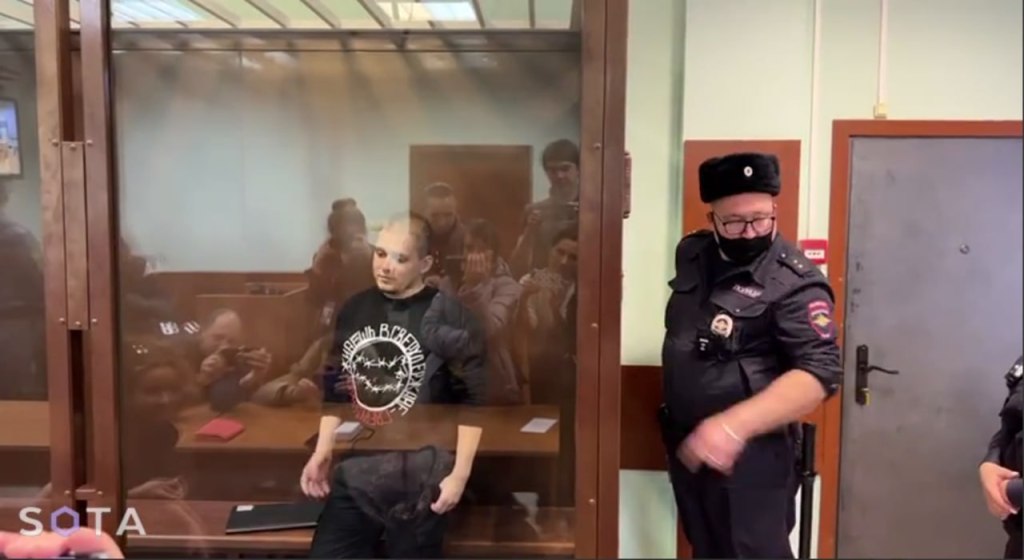
On January 19, Ivanov was beaten by a guard. The reason was that the defendant did not immediately exit the “fish tank” after the court hearing, but stayed to find out from Maria Eismont when she would visit him in the pretrial detention center. It later transpired that the escort guard’s name was Alexei Nikolayevich Zhalnin.
Without giving the defendant a chance to talk to his lawyer, Zhalnin dragged Ivanov into the escort guard room. The next day, Ivanov told Eismont that the escort had taken him downstairs, turned off his body cam, and kicked him in the head and ribs and beaten him with a billy club. Zhalnin tried to put Ivanov’s head into the toilet and threatened that he would “insert a stick in his anus.” The second escort guard “watched” this and “did nothing.” The bruises suffered by the activist were documented at the detention center’s medical unit.
Dmitry Ivanov and Alexei Zhalnin, the escort guard who beat him, allegedly, on 19 January 2023. Photo courtesy of SOTA via “Prison MSU” (Telegram)
The defense has filed complaints about Zhalnin’s actions to numerous authorities, but so far to no avail. At the subsequent hearings, however, Ivanov was escorted by emphatically polite guards, and Judge Daria Pugacheva asked whether he had any complaints about the escort. Meanwhile, bailiffs stopped letting members of the public who could not recall the judge’s surname into the courthouse. Previously it had been enough to name the defendant’s last name at the entrance. A continuously whining service dog appeared in the courtroom.
Coincidentally, all these security measures were introduced when Eismont persuaded the court to call as witnesses Defense Ministry spokesman Igor Konashenkov, Foreign Minister Sergei Lavrov, and Russia’s UN ambassador Vasily Nebenzya.
“Ivanov is charged with a serious crime based on a comparison of his texts with statements made by Nebenzya, Lavrov, and Konashenkov. This means that these people are essentially witnesses for the prosecution, and so he has the right to question them in court,” the lawyer argued.
Eismont had attempted to use this trick before, at the trial of the politician Ilya Yashin, but the court did not even issue summonses to the high-ranking officials then. In the Ivanov case, the summons reached their addressees, but the witnesses ignored them.
What else Ivanov was asked in court
Before oral arguments were made, Ivanov was himself put on the witness stand. While answering the questions posed by Prosecutor Yulia Pravosud, he explained why, as a student, he had written about pension reform, how he had checked his sources of information for reliability, and which media outlets he trusted. The prosecutor then tried to get Ivanov to talk about allegations that the Russian language has been banned in Ukraine.
“Do you know anything about Zelensky’s attitude toward the Russian language?” she asked.
“It’s his native language, basically. He’s completely fluent in it,” Ivanov replied.
“Is the Russian language banned or not banned [in Ukraine]?”
“I had not heard that the Russian language was banned in Ukraine. As far as I know, many regions used it as the primary one. The Mariupol City Hall maintained all its social media and websites in Russian even after 2014.”
“I see, and what about Zelensky’s position? Does he allow [Ukrainians] to communicate [in Russian]?”
“Probably, if he forbade communication in Russian, the mayor of Mariupol would not have spoken publicly in Russian, and would not have maintained online resources in Russian.”
Prosecutor Pravosud then read aloud a post from “MSU Protesting” in which Ivanov admitted that he could face criminal charges for his statements about the Russian army’s actions in Ukraine.
“Why did you, knowing of the criminal liability, still write on your Telegram channel?” she asked Ivanov.
“‘Freedom is the freedom to say that two plus two make four. If that is granted, all else follows.’ That’s a quote from George Orwell,” he said. “Should I explain it to you?”
An abundance of news — especially bad news — sometimes robs a person of empathy. They have no compassion for anyone and do not want to help. They pay no mind to important events such as the military operations in Ukraine or disasters around the world. If this happens to loved ones, they seem callous to us, as if they are hiding their heads in the sand and refusing to look at reality. But when it concerns someone personally, they may wonder whether everything is okay with them.
Contemplative practices teacher Viktor Shiryaev explained to 7×7 why feelings disappear, how to bring them back, and why.
Viktor Shiryaev is a teacher of modern contemplative and somatic practices, a mindfulness instructor [instruktor maindfulnes], and an expert in adult maturation. He runs the Telegram channel Act of Presence, where he discusses mindfulness and meditation techniques, and does consultations.
— Is it normal to read the news and not to feel anything? How can people not have an emotional response to photos from Mariupol, to stories about injustice or emergencies?
— I think it’s fine. Everything that happens to people is governed by certain mechanisms. There are several of them involved here.
First, things regarded as “close to home” are felt more acutely. Photos of an earthquake in Turkey or a tsunami in Haiti that causes thousands of deaths are very poorly registered by our minds. People who have no relatives or direct contacts in Mariupol may not feel anything — and not because they lack empathy, but because it is happening to someone else and is therefore abstract.
The second mechanism is numbness, withdrawal. This is also a normal stress reaction, a defense mechanism. If you worry all the time, it is impossible to live and work normally. During our lifetimes, there has not been a single day that there were no wars on the planet. If you feel all this and constantly suffer from it — after all, empathy is generally premised on the idea that “when you hurt, I hurt too” — life will be uncomfortable.
The third mechanism is rationalization — that is, persuading yourself that what is happening is normal. This reduces empathy and sensitivity. For example, you think, “They’re all Nazis, it’s okay.” The fact that they are human beings is obscured by this “rational” argument.
The fourth mechanism is hardening. We are going through a collective trauma. Russians [rossiyane, i.e., Russian citizens] throughout the post-Soviet space [sic] are the result of the negative selection that has occurred over the last one hundred years: dekulakization, the Stalinist purges, the Holodomor, the forcible transfer of populations, World War II, the Stalinist crackdowns, the anti-cosmopolitan campaign, the Doctors’ Plot, the Afghan and Chechen wars, and so on. All this leaves scars on the psyche and on people’s behavior. Scar tissue is qualitatively different from normal skin. And while the idea of self-care and letting go of the past is more clearly expressed in the west, people in Russia become callous because they just put up with things: “I can take it,” “I’m no weakling,” “Hit me harder.”
— Do people come to you and say, “I don’t feel anything and I want to fix it”?
— Sensitive people who are trying to live in the midst of all the horror and stress, without turning away from it and disengaging, come to me more often. The complaint “I don’t feel anything” is a more advanced case. A person should not only take note of this, but also understand that it causes them harm. There is this meme:
“Feeling nothing. Pluses: you don’t feel anything. Minuses: you don’t feel anything.”
Decreased sensitivity ultimately complicates life, because it affects both your emotions and your body. It makes your life poorer.
— What should I do if earlier I took a keen interest in the news but now I don’t feel anything — if numbness, as you call it, has set in? Is it worth deliberately reading even more news to make myself feel something?
— You should not specifically trigger [triggerit’] yourself by reading the news, looking at war photos or something like that. This is pointless, because if the “chill” arose due to our unwillingness and inability to see things, then by forcibly increasing the intensity of the stimulus we will only make ourselves feel worse.
What makes sense is gently restoring your sensitivity per se.
How to regain sensitivity Viktor Shiryaev’s advice
Observe the sensations in your body — name them: touching, warm, smooth.
Observe your state of mind — try to name it: tense, calm, flustered, pleased.
Ask yourself how you are doing now more often. Give a specific answer.
Deploy scenarios to wind down the stress cycle: bath/massage, shaking [sheiking], physiological sigh, time with no phone and TV in the company of loved ones and/or in nature, high-quality physical activity.
— So, freezing up is a normal reaction on the part of the psyche? Or is it an occasion to consult with a psychologist?
— Ideally, of course, it should not come to this. So-called preventive medicine is much better than treating a disorder that has already taken hold.
Regular psycho-emotional fitness training — all kinds of methods of skillful self-support, meditation, mindfulness practice, physical training, and therapy — help to ready us for higher psycho-emotional loads. It works the same way as physical exercise: a trained body copes with challenges more easily.
You definitely need to go to specialists when you can’t “ride it out.” They have ways to help you.
— There are situations when one person in a couple, a group of friends or a family avidly watches the news, reacts to it and wants to discuss it, while the others don’t want to delve into anything and go about their business, saying that it doesn’t concern them and they don’t want to get bogged down in other people’s troubles. What should one do when there are different levels of sensitivity and different needs, when it is important for one person to experience and feel, while the other person wants to remain neutral?
— Respect the other’s feelings and needs. Talk about your feelings without trying to convince the other person and prove that your way of doing things is “right.” It is possible that it is only right for you. It is possible that you’re right on principle. But when we feel that we are being attacked, we want to defend ourselves, not to open up to the other person.
Dialogue — the opportunity to be seen, heard and accepted — involves opening up towards each other, thawing out.
— If a person is worried whether everything is okay with them, how can they can validate [validirovat’] their “feeling of insensitivity”?
— Everything that happens to us is normal. Not in the sense of being “good,” but in the sense of that’s how things are. It is normal to “freeze up” in moments of acute stress or amidst prolonged stress, because this is how the self-preservation instinct works.
The self-preservation instinct is much bigger and older than us. Even relatively feeble emotions diminish access to the rational and adult parts of the psyche — we are “captured” by emotions, let alone by truly tragic events.
It is important to understand and accept this, to carefully and gently regain access to your emotions. Not through force, violence and “overriding,” but through a kind attitude, gentleness and love.
The little green van sped down the road, the Russian forces just across the river. Inside, Halyna Luhova, the mayor of Kherson, cradled a helmet in her lap and gazed out the bulletproof window.
When the first shell ripped open, directly in the path of the van, maybe 200 yards ahead, her driver locked his elbows and tightened his grip on the wheel and drove straight through the cloud of fresh black smoke.
“Oh my god,” Ms. Luhova said, as we raced with her through the city. “They’re hunting me.”
The second shell landed even closer.
She’s been almost killed six times. She sleeps on a cot in a hallway. She makes $375 a month, and her city in southern Ukraine has become one of the war’s most pummeled places, fired on by Russian artillery nearly every hour.
But Ms. Luhova, the only female mayor of a major city in Ukraine, remains determined to project a sense of normality even though Kherson is anything but normal. She holds regular meetings — in underground bunkers. She excoriates department heads — for taking too long to set up bomb shelters. She circulates in neighborhoods and chit-chats with residents — whose lives have been torn apart by explosions.
She chalks up any complaints about corruption or mismanagement — and there are plenty — to rumor-mongering by Russian-backed collaborators who are paid to frustrate her administration.
Kherson, a port city on the Dnipro River, was captured by Russian forces in March; liberated by Ukrainian forces in November; and now, three months later, lies nearly deserted. Packs of out-of-school children roam the empty boulevards lined with leafless trees and centuries-old buildings cracked in half.
The Order is a group narrative therapy service. Uncertainty, wars, stress, trauma, isolation — you don’t have to cope with these difficulties in life alone. We’ll help you keep from losing yourself and regain control over your life’s story.
What does group therapy offer?
1.
You reflect on and accept what you have experienced in a safe environment
2.
You sort out the mess of your attitudes and fears
3.
You get the support of professional psychologists and mentors [mentorov]
4.
You see yourself from a new angle — through the eyes and experience of others
5.
You find your own network of supportive people
6.
You improve your communication skills and escape social isolation
7.
You realize the value of your own life and relationships
8.
You gain the inner strength to go on living
Feedback from group members
Andrei Sotnikov
POET-MUSICIAN-PRODUCER-PEACEMAKER
These art therapy sessions are literally an experiment in collective self-healing using creative improvised means that release everyone’s creative impulses. It’s an incredible experience of uniting people, one so necessary in our strange time. Despite the extreme difficulty of attending online sessions due to the blackouts in Kyiv, I look forward to each one and get ready knowing that I’m going to touch a miracle. The amazing original technique and wonderful company keep my soul warm and light for a long time after. Thank you for being there!
Maria Vershinina
JOURNALIST, WRITER, TEACHER
It’s a very strange feeling doing group therapy on Zoom: it’s like watching a TV series. Kit Loring has so much sincerity and empathy — I couldn’t believe what was happening was real, because I hadn’t met such people before. And the careful way he uses words and his tone were alarming at first. I got used to it over time. I like watching how people open up inside [sic] the session. And if a connection is established with the members of the group, it becomes very easy to trust them and speak openly. You understand that everyone has their own pain, but it’s also familiar to you now or it was familiar in the past.
Hanna Shtyka
3D-ARTIST
After the initial sessions, I feel that I’ve started to undergo psychological metamorphoses. Thanks to correctly posed questions and images, I am able to get in touch with experiences and sensitive moments, to “unpack” my emotions. Everything is done as carefully as possible: Kit Loring and the curators create a safe space in which it’s not scary to open up and be heard. I recommend it to everyone who wants to look inside themselves through the prism of creativity and start working with deep experiences using the tools of words, colors and images.
Yefim Balakin
GRAPHIC DESIGNER
The group sessions with Kit Loring are incredibly fulfilling and healing. It’s like a healing touch. The warmth of understanding spreads throughout the body. It really is like magic. Pulling out your painful experiences, opening up to other people in the group, all of them so different, and helping them too, you become stronger and begin to understand what else you can do with all of it. Complicated events and memories are no longer so complicated and forbidden. And, it seems, I no longer want to cover my eyes with my hands, I want to look into someone else’s eyes.
Nastya Rogozhkina
ECOFEMINIST
Due to traumas, it had become difficult for me to create (and often function), but in The Order, unexpectedly, I was pleased to find an accepting online space and validation [validatsiia] of my opinions and experiences. The meetings create a trusting atmosphere and mutual understanding. After the sessions, I have a pleasant feeling of unity with people, albeit strangers. Every time this magic happens in my mind —”Oh, I’m not the only one who feels and thinks like this” — and it’s worth a lot. I recommend these groups if you’re lonely and you find it difficult to talk about your traumas and thoughts with others.
How does it work?
“Hi! Your involvement in The Order begins here. [The Order] is a platform for developing your talents in storytelling [storitellinge]. Our job is to help you became aware of your creative potential and realize it.”
PSYCHOMETRIC SCREENING
You go through testing that helps you formulate your goals and helps us place you in a mini-group
MINI-GROUPS
We break the cohort into small groups. You have your own separate chat and meetings once a week
CONTRACT WITH YOURSELF
Signing a contract with yourself and supporting each other’s efforts is a vital part of the healing
ONLINE SESSIONS EVERY WEEK
The cohort first meets with an expert on Zoom, and then the groups move on to intimate interaction — all this lasts two and a half to three hours
MATERIALS FOR HEALING
Regular exercises designed by our specialists enable you to rethink significant events and attitudes
REWRITING YOUR STORY
Practices and tools, songs, drawing, communication and poems help you process fears and anxieties
SUPPORT AND CARE
You are guided by psychologists and curators to whom you always turn for advice
TRANSFORMING EXPERIENCE
You rethink difficulties with the healing power of creativity and find your own bearings
“Sergey Gulyaev, relationship architect. I See-I Feel-I Hear Exercise. When dealing with alarming situations, news, and complications at work, we often stop perceiving the environment that surrounds us [literally: ‘the surrounding reality that surrounds us’]. There are a multitude of sounds, objects, scents, tastes, and touches around us, but we lose contact with them and the only thing going round and round in our head is a past event…”
Each cohort is led by experienced psychotherapists and psychologists, experts, lecturers and mentors who help you transform your experiences.
Kit Loring
PSYCHOLOGIST, PSYCHOTHERAPIST
Certified British clinical art therapist, clinical supervisor and trainer, member of the British Association of Drama Therapists, co-founder and co-director of the humanitarian art therapy organization Ragamuffin International (South Wales, UK).
Senior expert at Meta, a service for selecting proven psychotherapists. Over 12 years of experience in the field of psychotherapy. Over 8 years of experience as a therapist working with psychological trauma. Over 5 years of experience consulting and evaluating midlevel and senior managers.
Anastasia Semko
CLINICAL PSYCHOLOGIST FOR CREATIVE PEOPLE
Organizer and leader of art therapy groups and support groups. I use an integrative approach in my work, relying on both research and cultural aspects. Lecturer for several youth organizations, designer of psychological games. Over five years of experience working with trauma.
Alex Kotlowitz
JOURNALIST, REPORTER AND FILMMAKER
A star of American journalism who has worked for the world’s best publications — The New Yorker, The Wall Street Journal, and The New York Times Magazine. He has twice received the Peabody Award, one of the oldest and most prestigious awards in journalism, and his bestseller There Are No Children Here was included in a list of the 150 most influential books of the twentieth century.
Philip Gourevitch
JOURNALIST, REPORTER, WRITER
He became famous for his debut book about the aftermath of the genocide in Rwanda, one of the bloodiest in the history of mankind. For more than 30 years, he has been telling poignant stories from all over the world, has received dozens of professional awards and has written four books. He has been published in The New Yorker and edited the magazine The Paris Review.
Zhanna Bobrakova
ART MENTOR, CONTEMPORARY ARTIST, CURATOR
Lecturer at the Moscow School of Contemporary Art (MSCA) and the British Higher School of Art & Design (BHSAD). Did her master’s at Saint Martins. Collaborated with the Tate Museum in London. Zhanna’s projects have been exhibited at Saatchi, Tate Modern, Kochi Biennale, Moscow Biennale, Cube and many other venues. Her works are in the collection of the Russian Museum and private collections around the world.
We were discussing the connection between narrative and trauma, and a female colleague of mine asked why we reassemble our identity after traumatic events. Why do we give up our previous identity? I found the comments of the other participants very interesting.
Many of the responses focused on the fact that the reassembling one’s identity is necessary, because otherwise the unprocessed trauma would begin to burst out in unexpected places, and you would feel it pulling you down. Along with this, the question arose: Can an identity be false? Here, the answers focused on the fact that self-deception won’t help, because you know the truth. Many of the participants concluded that false identity = problems that (do not) express themselves in reality and that poison life.
I thought about this discussion for a long time (I don’t always manage to get involved in the moment), and the responses made me ask even more questions:
Do I know the truth about what has happened and is happening to me?
If for some reason I decide to create a “false” identity for myself, then maybe it functions after all? And if it does function, then how?
First: Do I know the truth about what has happened and is happening to me?
I can say with confidence that I am aware of what has happened to me in my life, when it happened, and how it happened like no one else. It is on this understanding that I string together my narrative about myself. But to be honest, some of the stories that I know about myself in detail I either relate to others and sometimes to myself in abridged form, or I change the conclusions that I had once come to.
Sometimes my conclusions change in the process of growing up, which means that the truth can also be flexible. And it doesn’t happen because I cannot or do no want to be honest with myself or with others. Everything I tell is my truth, what I know myself. But some of the events in my life are imprinted in my memory, as if I saw them from the outside, and some through the eyes of my parents, while still other stories I remember vaguely.
Is it possible in this case to talk about a division between true and false narratives, even if I am not sure myself where the boundaries of truth lie?
Second: If for some reason I create a “false” identity for myself, then maybe it functions after all?
I will give the stupidest example on the planet. It’s from the TV series Hunters, which I decided to watch to take my mind off things.
Attention: there will be a spoiler next, which will be highlighted in color in the newsletter.
TW: The Holocaust
The Hunters live in the US in the 1970s and catch Nazis who somehow escaped punishment and live new lives under assumed names. One of the central characters of the series is Meyer Offerman, a former concentration camp inmate and the leader of the Hunters. At the end of the first season, it transpires that Offerman has been impersonated by Wilhelm Zuchs, a Nazi doctor from Auschwitz. After Soviet troops liberated the camp, Zuchs was imprisoned, but was able to escape. He killed the real Offerman, had plastic surgery and started a “new life.” According to Zuchs-Offerman, he “lived like a Jew and became a Jew”: he went to synagogue, learned the language, and read the Torah. As he himself claims, he understands that he cannot atone for his crimes, but neither is he any longer the Nazi he once was.
End of spoiler
Can at least one of the identities we have be false? We might have been different one, two, three years ago, and this doesn’t limit our potential for change. How do we recognize when we’re lying to ourselves? Or not to ourselves, but to others, if this lie doesn’t reinforce the narrative we have already constructed? And why can’t a story that might seem untrue to someone be your story? Who has the last say in determining the veracity of someone’s identity?
I don’t have clear answers to this question. What’s more, I am sure that these questions should be regularly addressed and we should check whether the answers we’ve already given still work. I myself have delved into this discussion to set in motion the already nearly ossified answers in my head. I think checking whether our beliefs correspond to reality is a good exercise for each of us. And here as well an attempt to catch oneself out in a lie might become an artificial restriction on change.
Perhaps the trauma needs to be lived through, perhaps the identity may be false. And yet, I don’t believe that while traumatic events are still ongoing any of us can make definite judgments about our own or someone else’s identity and its truth.
Whether you do a “good job” of living throughh your personal and social traumatic events is up to you to decide, just as it’s up to you evaluate your narratives about yourself. But this doesn’t dissolve us of responsibility for the ethical choices (and their consequences) that I/we make every day.
Source: Dasha Manzhura, Anti-War Newsletter #347 (DOXA), 13 February 2023. Ms. Manzhura is an editor at DOXA. Translated by the Russian Reader
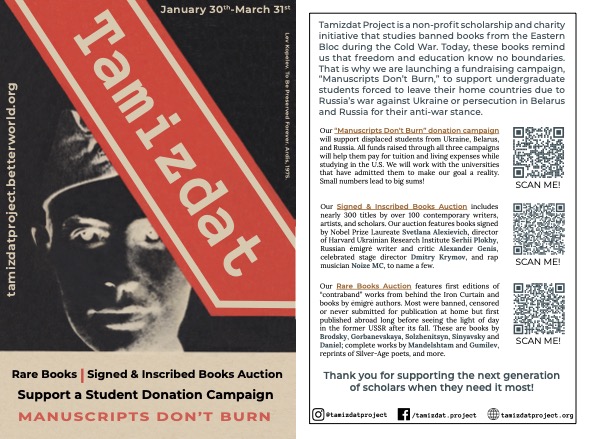
“MANUSCRIPTS DON’T BURN” FUNDRAISING CAMPAIGN TO SUPPORT STUDENTS FROM UKRAINE, BELARUS, AND RUSSIA AFFECTED BY WAR OR PERSECUTION
Tamizdat Project Inc. is launching a two-month campaign “Manuscripts Don’t Burn” to support undergraduate students forced to leave their home countries due to Russia’s full-scale war against Ukraine or persecution in Belarus and Russia for their anti-war stance.
On January 30, 2023, we are opening two online charity book auctions and a donation campaign to help these students pursue their academic careers in a safe environment. We are inviting the public to join our Rare Books Auction, which features a variety of first editions of “contraband” literature from behind the Iron Curtain and books by émigré authors, a Signed and Inscribed Books Auction with nearly 300 titles inscribed or signed for our cause by over 100 contemporary writers and scholars, and a “Manuscripts Don’t Burn” online fundraiser.
Since February 24, 2022, many initiatives have been launched across American campuses to support scholars at risk. Very few, however, have been set up for students, who have not yet established themselves in academia but have also been forced to leave home and need to continue their education elsewhere. Tamizdat Project Inc. has taken the initiative to help the next generation of scholars when they most need it.
The proceeds will be distributed to undergraduate students to help them pay for tuition and living expenses while studying in the U.S. (e.g., we will pay their dormitory bills or offer stipends to participate in Tamizdat Project). We will work with the colleges and universities that have admitted them to make this goal a reality. A breakdown of how the funds will be distributed will be provided at a later date. Our campaign brings together prominent writers and academics in the diaspora to help today’s refugees, much as we wish no such effort was ever necessary. We are joined by Nobel Prize Laureate Svetlana Alexievich, director of Harvard Ukrainian Research Institute Serhii Plokhy, émigré writer and critic Alexander Genis, rap singer Noize MC, to name but a few.
“On the last day of 2022, as we all were getting ready to celebrate the arrival of the new year the Russian missile attack hit Kyiv, causing serious damage to the buildings and properties of the Kyiv University. … It had become the worst year for the higher education since the end of World War II. Any assistance we can provide for students of Ukraine will be greatly appreciated by the students in the universities under fire and the students-refugees in Ukraine and abroad.” — Serhii Plokhy, professor of Ukrainian history, Harvard University
“I am glad to take part in this project. After all, the auction that Tamizdat Project has put together is not just about rare books that make any library more precious and interesting. It is also part of the living history of free literature and thought, uninterrupted even today. These books, as dissidents used to say, are relics of the struggle ‘for our freedom and yours.’ They unite authors and readers, turning even those unfamiliar with each other into allies.” — Alexander Genis, author
Tamizdat Project is a not-for-profit public scholarship and charity initiative devoted to the study of banned books from the former Soviet Union and the Eastern Bloc during the Cold War (“tamizdat” means literally “published over there,” that is, abroad). Today, these books remind us that freedom and education know no boundaries. We are a not-for-profit 501(c)3 organization with a tax-exempt status: donations and gifts are deductible to the extent allowable by the IRS.
A statue of Soviet dissident Andrei Sakharov was unveiled Monday in St. Petersburg, despite criticism from his widow who said today’s Russia has failed her husband.
The 10 1/2-foot bronze statue depicts the Nobel peace laureate, slightly stooped but with his head held high, standing with hands tied behind his back atop a stone pedestal on a square that was named after him in 1996.
The monument by sculptor Levon Lazarev’s was unveiled a few weeks after a city commission in Moscow gave the green light to a stalled plan for another statue of Sakharov in the capital.
Yelena Bonner was opposed to both statues, saying Russia has failed to live up to Sakharov’s ideals of freedom and democracy since the 1991 collapse of the Soviet Union.
“It is out of place to erect a monument to Sakharov in today’s Russia,″ the Interfax news agency quoted Bonner as saying. She said she was not consulted.
“There’s no money to publish his works widely, so that people would finally read them, but they can put up a monument,″ Bonner told Russia’s TVS television by phone from Boston, where she lives.
The unveiling drew about 100 people, among them intellectuals and former dissidents who supported a transition to democracy at the time of the Soviet collapse.
A physicist who helped design the Soviet hydrogen bomb, Sakharov became a staunch promoter of human rights and world peace, and spent seven years in internal exile for speaking out. He won the Nobel Peace Prize in 1975.
A Little Song about the Physicist Sakharov

The physicist Sakharov
Was one bad dude.
Oh, how he made us seethe!
Why do we suffer that fool?

It later suddenly transpired
That he was a real good cat.
We felt sorry for the poor man
And guiltily ate our hats.

Now it’s been ascertained
That he was bad news after all.
We’re seething once again.
Why did we suffer that fool?

If again it turns out
That he was, in fact, a good egg,
Ah, we'll regret it again,
And put on guilty mugs.

8 August 2022

Source: German Lukomnikov, “New Poems,” Volga 1 (2023). Thanks to ES for the suggestion. Translated by the Russian Reader
Russian prosecutors on Monday declared as “undesirable” the U.S.-based foundation that preserves the legacy of Nobel Peace Prize winner Andrei Sakharov as Moscow continues to crack down on dissent in the wake of Russia’s invasion of Ukraine.
The activities of the Andrei Sakharov Foundation (ASF) “constitute a threat to the foundation of Russia’s constitutional order and security,” the Prosecutor General’s Office said in a statement.
Under Russian law, individuals believed to have cooperated with an “undesirable” international NGO face steep fines and jail terms.
ASF, based in Springfield, Virginia outside Washington, says its goal is to promote Sakharov’s works to “support peace efforts and anti-war events.”
The organization chaired by mathematician Alexei Semyonov has not yet commented on Russia’s latest designation.
Russian authorities have declared more than 70 organizations — including media outlets focused on exposing fraud and corruption in Russia — “undesirable” between mid-2015 and early 2023.
Sakharov, once feted as a hero of the Soviet defense industry for his role in developing the Soviet nuclear bomb, became one of the U.S.S.R.’s most prominent dissidents from the late 1960s.
He received the Nobel Peace Prize in 1975 for his work against the nuclear arms race he had helped precipitate, though he was not permitted to leave the Soviet Union to accept the award.
Sakharov became one of the most distinctive personalities of the perestroika era, rising to the status of a national moral authority.
Arrested in 1980 after denouncing the Soviet war in Afghanistan, Sakharov was sent into internal exile in the city of Nizhny Novgorod, then closed to foreigners.
After six years in exile, during which he undertook several hunger strikes, Sakharov was released over a telephone call by reformist Soviet leader Mikhail Gorbachev.
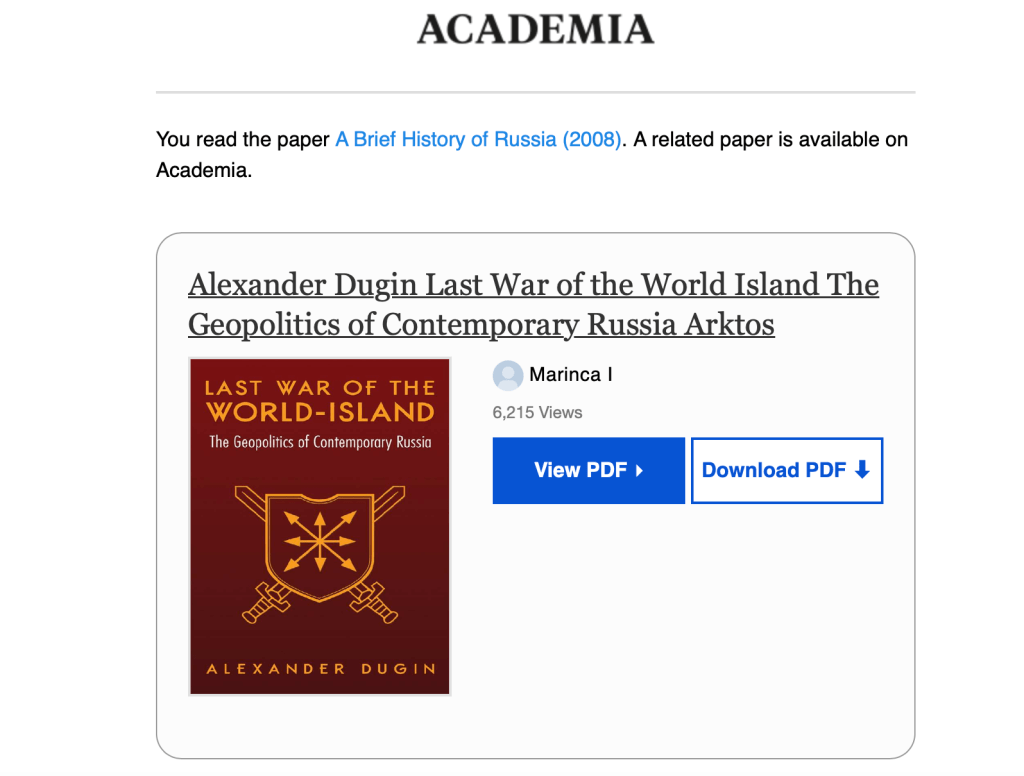
So much for the idea of not giving a platform to out-and-out fascists like Alexander Dugin, whose “academic” credentials are borne out by serious-sounding nonsense like the following, as found in Last War of the World-Island and translated by John Bryant:
In all the principal parameters, the Russian Federation is the geopolitical heir to the preceding historical, political, and social forms that took shape around the territory of the Russian plain: Kievan Rus, the Golden Horde, the Muscovite Czardom, the Russian Empire, and the Soviet Union. This continuity is not only territorial, but also historical, social, spiritual, political, and ethnic. From ancient times, the Russian government began to form in the Heartland, gradually expanding, until it occupied the entire Heartland and the zones adjoining it. The spatial expansion of Russian control over Eurasian territories was accompanied by a parallel sociological process: the strengthening in Russian society of “land-based” social arrangements, characteristic of a civilization of the continental type. The fundamental features of this civilization are:
• conservatism; • holism; • collective anthropology (the narod is more important than the individual);
• sacrifice; • an idealistic orientation; • the values of faithfulness, asceticism, honor, and loyalty.
Sociology, following Sombart, calls this a “heroic civilization.” According to the sociologist Pitirim Sorokin, it is the ideal sociocultural system. This sociological trait was expressed in various political forms, which had a common denominator: the constant reproduction of civilizational constants and basic values, historically expressed in different ways. The political system of Kievan Rus differs qualitatively from the politics of the Horde, and that, in turn, from the Muscovite Czardom. After Peter I, the political system sharply changed again, and the October Revolution of 1917 also led to the emergence of a radically new type of statehood. After the collapse of the USSR there arose on the territory of the Heartland another government, again differing from the previous ones: today’s Russian Federation.
But throughout Russian political history, all these political forms, which have qualitative differences and are founded on different and sometimes directly contradictory ideological principles, had a set of common traits. Everywhere, we see the political expression of the social arrangements characteristic of a society of the continental, “land-based,” heroic type. These sociological peculiarities emerged in politics through the phenomenon that the philosopher-Eurasianists of the 1920s called “ideocracy.” The ideational model in the sociocultural sphere, as a general trait of Russian society throughout its history, was expressed in politics as ideocracy, which also had different ideological forms, but preserved a vertical, hierarchical, “messianic” structure of government.
“Russian angel carrier, Artillery Museum, Saint Petersburg.” Source: Pavel Pryanikov, Facebook, 6 November 2022
Alexander Kharichev, head of the Presidential Department for Supporting the Work of the State Council, and three other experts have published a scholarly article entitled “Perception of basic values, factors, and structures of Russia’s socio-historical development, as based on research and testing.” As part of the study, seventy people from the student bodies of Moscow State University and the Higher School of Economics and the teaching staff of a conference in Sevastopol [sic] were interviewed. Among the metaphors of the future they proposed was the burnt second volume of Dead Souls; among the concepts of the modern state, “the Motherland with a laser sword”; among the concepts of the future, “Russia as the world’s ‘guardian of good” and “Pasty” [sic: “Pirozhok”]. The authors concluded that the dominant value for the Russian family is the people of Russia, which itself is a “family of families.”
Mr. Kharichev’s co-authors were Andrei Shutov, dean of the faculty of political science at Moscow State University; Andrei Polosin, doctor of political science and head of Rosatom’s regional interaction department; and Ekaterina Sokolova, deputy executive director for strategy and forecasting at the Expert Institute for Social Research. The article was published in October in the Journal of Political Studies.
The study was conducted by means of group discussions from March to May. The seventy participants answered questions about what Russian statehood is, what would happen to the country in ten years, what our future is, and a number of others.
Based on the discussions, the researchers formed a five-level “pentabasis”: person—family—society—state—country. Dominant values were formed for each level. For the country, [this dominant value] is patriotism; for the state, it is trust in the institutions of power; for the family, it is the people of Russia; for society, it is harmony; for the person, it is creativity. “The thesis was voiced that European society is individualistic, whereas our main value is family + family with friends, which leads to the emergence of the thesis ‘family as a level.’ The dominant value: the people of the Russian Federation as a family of families. Stimulating the birth rate and the concept of a ‘big family,’ the article says [just as incoherently in the original as in this translation].
Metaphors of Russia’s future. “The state as a novel” (written collectively by citizens, it has alternative endings); “the Russian future as the second part of Dead Souls, burned by Gogol,” “the state as the Firebird.”
Concepts of the modern state. “[The] Motherland with a laser sword” (a source of pride for the Russian spirit and a guide to the future), “the friendly service state.”
Messianic concepts of the future state. “Russia as a ‘prophet country’ (opposed to the Grand Inquisitor), “Russia as the world guardian, the ‘guardian of good.'”
Idealistic concepts of the future state. “Wondrous City” ([i.e., promoting] inclusivity, coexistence, acceptance of others as equals; “in no case to be confused with the term ‘tolerance'”), “Pasty” (harmoniously combines different things).
Mechanistic concepts of the future state. “Kaleidoscope” (a multifaceted future), “a medium-sized magnet state” (generates a field for a particular community).
The study participants concluded that the person in the “Russia of the Future” is “proud of his country, influential and highly employable, financially secure, [and] free within certain community rules.” According to the authors of the article, the ideas of self-realization in the Russian Federation are very different from those common in the Western world.
“In the Russian case, self-realization or mission means that an individual contributes to the country’s development. Capitalizing [on one’s] mission is an optional stage,” the authors write.
Almost a fifth of households in Moscow and St. Petersburg, even those with average incomes, regularly resort to the services of female domestic workers. Most often they need help around the house, as well as looking after the elderly and children. In most cases, Russians from the region where the employers reside are hired to do this work. A study by researchers at HSE and RANEPA shows that hired female household labor, which is considered a non-essential form of employment, is a vital part of urban economies.
Photo: Yevgeny Pavlenko/Kommersant
Almost one fifth of households in Moscow and St. Petersburg, having mainly an average income, employ female labor. This is the conclusion reached by Yulia Florinskaya, Nikita Mkrtchyan and Marina Kartseva (researchers at the Higher School of Economics and RANEPA) in the article “Women as hired workers in the households of Moscow and St. Petersburg,” published in the scholarly journal Woman in Russian Society (No. 2, 2022).
The first attempt in Russia to define the scale of wage labor in households in Russia’s megalopolises, the research study was based on a survey of residents of those cities who over the past three years have employed other people to do work usually performed by family members. Three thousand eight hundred people took part in the survey; their phone numbers were selected using systematic stratified random sampling. The results of the survey are unusual: although Russians generally believe that housekeepers, domestic help, and hired staff in a household involves a high family income and migrant labor and is a rare thing, it is, in reality, a fairly common practice among middle-income households in Moscow and St. Petersburg, and it is residents of the two capitals who are mainly hired to do such work.
First of all, hiring third parties to perform work in the household is a widespread practice in Russia’s two largest cities.
According to the survey results, female workers were employed by seventeen percent of households. Formally, men are employed by households much more. In fact, respondents were asking about paid employment in the household, including for such types of work as renovations and repairs, where men predominated. (Twenty-eight percent of the households surveyed had hired male hands.) Among “household chores,” “female” specializations were also discovered that would ordinarily not be thought of as “domestic help” — tutoring, primarily. In any case, seventeen percent of Moscow and Petersburg families employed female labor in households, a figure that dropped to around seven to eight percent when tutoring and repairs were factored out. Even with this proviso, however, the phenomenon goes beyond “elite consumption for the wealthy few.”
This also shows that, according to the survey data, most of the households (61%) who employed female workers estimated their incomes as average. When answering the standard question about their income (used, among others, by Rosstat in its questionnaires), they indicated that they had enough money for food, clothing, and household appliances. Twenty-three percent of respondents rated their incomes as high (in particular, as sufficient to buy a car or more) while sixteen percent rated them as low, since they were only enough to buy food. Thus, hired domestic workers are the preserve of the middle class rather than the income elite.
The prevalence of foreign nationals or, at least, migrant workers from other regions of Russia, among domestic workers has also been greatly exaggerated. According to the survey, almost two thirds (64%) of households that purchase women’s services [sic] in the household give jobs to women permanently residing in Moscow or St. Petersburg, where they themselves live.
Only in fourteen percent of households in the two cities was the employed woman a Russian national from another region, and in sixteen percent, a foreign national. (No breakdown by nationality is given.)
However, this fact is well known within the households and is clearly discussed by them. Only six percent of respondents who had dealings with female domestic workers were not aware whether she was a Muscovite [sic], a nonresident, or a foreign national.
Of course, households most often hired residents of their own region as tutors. Among domestic migrants this type of employment was two and a half times less common, while it was practically nonexistent among foreign women. At the same time, foreign women were twice as likely to be hired to do housework as Russian women, both local and migrant. However, domestic workers in the strict sense of the term — that is, those doing “housework” (cleaning, laundry, cooking, caring, and looking after children)— are still Muscovites and Petersburgers in most cases; residents of Krasnoyarsk and Samarkand [that is, domestic and foreign migrant workers, respectively] are in the minority. The authors of the study suggest that children are a “sensitive” area for households, and local women have in this instance an advantage over migrants: households are less likely to “trust” the latter. (The authors of the study avoid reaching an alternative conclusion: that this choice is a consequence of the phobias experienced by a significant part of the middle class towards migrants — phobias that are commonly denied in the middle-class milieu, as least in Moscow.)
Residents of other regions and countries are preferred only as caregivers, and the share of this type of employment among foreign women is three times higher than among women from the same region as their employers.
Florinskaya, Mkrtchyan and Kartseva describe a rather vital social phenomenon: migrant caregivers ask for their work, which is in demand among all strata of society, significantly less pay than do Russian nationals, and for most relatively poor households there is no alternative to hiring them, as they simply cannot afford a nurse from Moscow. But to carry out repair work, local women and migrants were hired with approximately the same frequency: the wallpaper pasted by a Ukrainian woman cannot be distinguished from the wallpaper pasted by a Petersburg woman, even by a specialist.
Finally, wage labor in households is extremely informal. Most often households hired female employees using recommendations from their acquaintances or relatives (63%), and more than two thirds of the households draw up written contracts when hiring female employees. The xenophobia of Muscovites has been exaggerated: female foreign workers lived in the household in a third of cases. (By contrast, 2.4% of households provided housing to residents of their own region, and 18.8% to migrants from within Russian Federation.)
The cautious attitude of Russians to hiring female employees to work in their households is, rather, a late Soviet legacy. After the tradition of employing “servants,” which was relatively common in large Soviet cities among the middle class, disappeared in the late 1940s and early 1950s, the term sounded somewhat insulting from the 1960s until today, and was replaced by euphemisms like “a woman who comes over.” The restoration of the practice is expected, and yet, as the study shows, this phenomenon (if only by virtue of its magnitude) is a vital albeit understated part of the modern urban economy of Russia’s megalopolises.
Up to two-thirds of Russians do not have any savings. Two-thirds of Russians can only afford food and clothes while buying durable consumer goods for them is extremely difficult. Russia is a very poor country, and now, on top of that, we have sanctions that will destroy the lives of ordinary people even further.
Olga Nazarenko: “I’m a Russian citizen who opposes the war. Send Putin to The Hague!”
Olga Nazarenko, a lecturer at medical university in Ivanovo, got involved in protests supporting Ukraine back in 2018. Since February 24 of this year, she has gone on an anti-war picket almost every week. Over this time, five cases have been opened against her for administrative offenses. Recently, Nazarenko was fined 150 thousand rubles [approx. 2,350 euros] for an anti-war picket. Only a few people in Ivanovo support the lecturer, so she usually stands alone with a placard. There are incomparably more people in her city who disagree with her position. Once, when Nazarenko was returning home, a passerby doused her face with spray paint on a dark street. People have written the Z symbol and the words “Ukrainian scum” on the associate professor’s mailbox. Nazarenko paints over the insults with yellow and blue flowers.
Nazarenko spoke to Radio Svoboda about her resistance to the war.
– What was February 24 like for you?
– I didn’t believe until the last moment that war was possible. I can describe my reaction to the news about the outbreak of war with Ukraine only with obscene language. That same day, I went on a solo picket with an anti-war placard, and the next day too. Since then, I have been going on pickets every week, sometimes once every two weeks.
– You have already been convicted once for “discrediting the armed forces.” Why do you risk being prosecuted?
– My conscience won’t let me do otherwise. In the twenty-first century, problems in interstate relations are not solved by war. It’s barbaric. This war is an injustice on Russia’s part, and I cannot remain silent when I see injustice. A [solo] picket is now the only way to voice one’s stance publicly. Yes, most passersby do not voice their opinion in any way while I am picketing. But at each picket I see that two or three people support me. I understand that it is vital for each of them to see that they are not alone. Also, I have friends and acquaintances living in Ukraine. I worry about them, of course, and I know that for them my support — at least in the sense that I am not silent — is also vital.
– What was the trial at which you were fined 150 thousand rubles like?
– On February 27, I went out with a placard that read, “I’m a Russian citizen who opposes the war. Send Putin to The Hague!” Half an hour later, I was detained after a disgruntled passerby denounced me to the police. In April, the court recognized that my right to a defense had been violated due to the fact that my lawyer was not given the charge sheet to sign. The police appealed this decision, and the court found me guilty under Article 20.2 of the Russian Federal Administrative Offenses Code for, allegedly, “organizing a public event” and fined me 150 thousand rubles. I told the court about my anti-war stance and that our courts are cemented into the power vertical, and so they make the rulings that the Russian authorities need them to make. I also told the court that Russia is waging an unjust war against Ukraine, that people are dying, and that I opposed it. In my opinion, the judge’s ruling had been made in advance.
– Do passersby often react aggressively to your anti-war pickets?
– Of course, there are people who react aggressively to my position. They drew the Z symbol and wrote “Ukrainian scum” on my mailbox. I painted over the inscription with yellow and blue flowers, making it beautiful. Once on the street late at night, a young man doused my face and clothes with spray paint. Fortunately, my glasses protected my eyes from injury, while my clothes turned a golden color. My down jacket even became beautiful, iridescent, but only on one side, sadly. Once, at a picket in support of the boys from the Network Case, a man came up and said that people like me should be shot. He tried to take my placard away and hurt my finger in the scuffle. But I kept him from getting my placard.
– At what point did you decide to go on pickets?
– I have been actively voicing my position since 2014. I was outraged that Russia, at a difficult moment for Ukraine, committed a treacherous act against it by annexing Crimea. This was the first thing that angered me, and the second was the lies that supported it. I realized that in such circumstances I could not remain silent. At first, I went to various protest rallies and marches. But they were held rarely and I wanted to voice my civic stance more often. At first, I was bashful about going out on solo pickets. But on social media I saw that people were doing solo pickets. At some point I decided to try to picket too and got sucked into it.
I have been going on pickets in support of Ukraine since 2018. A friend of mine and I protested for the release of the Ukrainian filmmaker Oleg Sentsov. After all, a hybrid war had essentially been waged since 2014, and I had always opposed it. I was brought up on the principle that you couldn’t take what doesn’t belong to you, which also applied to international relations. Crimea is Ukrainian by all international standards. I could not approve of Russia’s interference in the affairs of a sovereign state, and from that moment I took an unambiguous stance. On February 24, everything became completely transparent.
– In February of last year, you hung a large banner that read “The FSB is a disgrace to Russia” on a railway bridge. What made you decide to do this protest?
– I believe that the FSB now holds all the power in our country, because Putin is from the FSB. So, the FSB lets itself break any law and torture people with impunity — such as, for example, the defendants in the Network Case. I think it important to voice my negative attitude to this. The banner hung for about half an hour until police officers arrived and tore it down.
I was detained right there and taken to the police department, where they took my statement and released me. This is not the first time I have publicly condemned the actions of the FSB. For example, I picketed against the Network Case outside the FSB headquarters in Ivanovo.
Olga Nazarenko
– Aren’t you afraid to publicly criticize the FSB?
– Yes, that organization has a lot of power, but I have no respect for it.
– I know that you sued Center “E” last year. Please tell us how that happened.
– I was doing community service at the zoo for a video in which I had talked about the problems of our region and called for peaceful protest. I was charged with “organizing an unauthorized event” for these actions. Right when I was cleaning the bird cages, a Center “E” officer came and videotaped me without my permission. The video was posted on the Telegram channel “A Cop’s Life: Ivanovo,” along with what they imagined was a funny comment. I decided that the Center “E” officer had violated my right to privacy. I filed an administrative lawsuit against the Interior Ministry, but my suit was dismissed.
– Not long ago, you were accused of resisting the police because you tried to help a friend at an anti-war picket. What did you do then?
– A female acquaintance decided to go on a picket on February 24 and asked on a chat for support. I responded to this request and arrived at the picket site. As soon as the young woman held up her placard, a policeman approached her and tried to detain her. She was opposed to being detained, so I got between her and the policeman. Consequently, we were both detained. The next day, I was taken to the police department, charged with resisting the police, and sentenced to 80 hours of community service. I’ve already done them. But soon I will have to do another 180 hours for a fresh administrative offense related to publicly voicing my anti-war position.
– How do the heads of the medical school where you work look at your pickets and court hearings?
– They are still relatively friendly to me at work. The bosses said that I could do anything as long as it was not during working hours. I never engage in activism to the detriment of my work: I don’t lobby anyone in the classroom. So I have no problems at the university now. For the time being I can juggle work and activism.
– Does your family support your anti-war position?
– My loved ones worry about me, but they don’t try to dissuade me. My husband and I try not to talk about politics. His point of view runs counter to mine, and we don’t discuss politics to avoid spoiling our relationship. As it is, there are so many situations in which I have to get harsh to defend my position, but at home I want to live in peace and tranquility. My little son and adult daughter worry about me and support me emotionally.
Olga Nazarenko, holding a placard that reads, “Free political prisoners!!! While we drink tea, they’re in prison.” It features a long list of current Russian political prisoners, nearly of all whose cases have been covered on this website.
– How are you going to pay the 150 thousand ruble fine?
– Friends and friends of friends helped me to pay the previous fine of 75 thousand. I don’t know yet how I will raise this amount. I’ll probably have to turn to public organizations for help.
– Putin recently passed laws that give [law enforcement] even more possibilities to crack down on grassroots activists. Aren’t you afraid to continue going on pickets when this is the reality?
– It’s too late for me to be afraid. If the security forces want to sanction me, they have enough material against me. I have already passed the phase of being afraid.
– Do you think your numerous pickets have affected the attitude people in Ivanovo have toward the war with Ukraine?
– Everything in society has only gotten worse over the years. In the big scheme of things, such protests cannot change a thing. They matter only to the person who does them and to people who think the same way, as well as for those supported by them.
– Why are you taking such a big risk in this instance?
– I just act on the principle that you do what you have to do, come what may. This is how I was brought up as a child. I realize that there could be unpleasant consequences for me, but I don’t think about it.
– But many Russians have read those books. Aren’t you angry that so few Russians protest publicly?
– I am a little annoyed, rather, that people cannot act in keeping with their conscience. And I realize that if more Russians had openly voiced their position when it was not less dangerous, the situation would be slightly different now.
Most people let their personal interests outweigh [other things], and this is normal. My instinct for self-preservation is a little dull, and perhaps this is not entirely normal. I don’t condemn Russians, but still I think that, in the current situation, it is impossible to remain silent.
– Now, after almost five months of war in Ukraine, many Russian activists complain of burnout and fatigue. Do you have such problems?
– I don’t have burnout and depression, but nor do I have any hope that things will change quickly. Perhaps in a hundred years our great-grandchildren will be able to change something — if we manage to raise our children the right way, and then they raise their children the right way. At some point, there will be enough people to change things here. But my generation won’t live to see it.
– Are you not planning to leave the country if a criminal case is opened against you?
– I’m not going anywhere. Russia is my country: it doesn’t belong only to those in power and their supporters. I won’t let anyone kick me out of my own country. I’m ready for a possible prison sentence. If it happens, I will serve my time, and then I will get out and continue my pickets. I’m not too afraid of prison: people somehow live in there too. You can’t jail everyone, and you can’t shut everyone up.
Source: Darya Yegorova, “‘It’s too late for me to be afraid’: Olga Nazarenko’s solo pickets,” Radio Svoboda, 16 July 2022. All images courtesy of Ms. Nazarenko via Radio Svoboda. Thanks to Comrade Koganzon for the heads-up. Translated by the Russian Reader