Researchers at INION RAN analyzed depictions of Russia in the history textbooks of CIS and Middle Eastern countries. They found that these textbooks in post-Soviet countries mostly portray Russia as a colonial power.
Most of these textbooks portray Russia as a colonial state which has oppressed the peoples in the annexed territories and damaged their culture, Razil Guzayerov, one of the co-authors of the study and a junior researcher in INION’s Middle and Post-Soviet East Department, told RBC. He noted, however, that often much less attention is paid to Russia’s contribution to the growth of these countries.
According to the authors of the study, “the promotion of false and distorted events in history textbooks shapes a negative attitude towards Russia, and in the future may become the basis for the growth of xenophobia and Russophobia.”
What RAN researchers read about Russia in CIS textbooks
“Colonial politics” in Kazakhstan
According to INION’s analysis, the authors of Kazakh textbooks for eighth graders view the Russian Empire as a country which sought to use Kazakhstan as a platform for its military and economic interests. They note that the Russian Empire’s policy of “military and colonial expansion” was the key element of its relations with the hinterlands. It aimed at establishing control over the new territories, exploiting their resources, and managing their populations.
In a textbook for colleges and universities, the authors criticize the policies of the Soviet regime. They pay special attention to the famine of 1921 in Kazakhstan, brought on by crop failure and drought. The authors note that the prodrazverstka, which by late 1920 had extended to all agricultural products, was regarded by the local population as robbery, leading to growing discontent. The famine, the textbook authors point out, seriously impacted the population of Kazakhstan, triggering mass hunger riots and deaths. According to their data, the population of the region decreased by more than two million people compared to 1914.
In a history textbook for tenth graders, the Russian Empire’s policy towards Kazakhstan is described by the author [sic] with terms like “territorial expansion,” “protectorate,” and “colonial politics.” The textbook characterizes the policy of the Russian Empire in Kazakhstan as “aggressive and ineffective,” citing as an example Prime Minister Pyotr Stolypin’s resettlement policy, which, according to the authors [sic], led to social conflicts and popular uprisings.
“Invasion” of Azerbaijan with the aid of ”traitorous forces”
The establishment of Soviet power in Azerbaijan is referenced in that country’s textbooks as a “military invasion,” which was carried out with the support of “traitorous forces.” Uprisings against the Soviet regime and its “exploitative policy” are described in detail. The authors emphasize that the Azerbaijan SSR was established not by the Azerbaijani people but by Soviet Russia, and that the entire Soviet system was “aimed at satisfying Russia’s interests and ensuring its hegemony.”
“History textbooks for general education institutions in Azerbaijan imagine Russia as a colonial empire. The entire history of Russia is covered as the seizure and occupation of lands with subsequent exploitation of the local population. It is important to note that such anti-colonial discourse is especially exacerbated in new textbooks,” the authors of the collection [sic] write. “The current period of relations between Russia and Azerbaijan is presented in more neutral tones, although Moscow is occasionally accused of supporting Armenia and creating the Karabakh issue.”
Russia is identified in textbooks as the cause of the Karabakh conflict and other negative events in the nineteenth and twentieth centuries. Thus, the ninth-grade textbook The Hstory of Victory describes the coming to power of the “pro-Armenian” General Secretary Mikhail Gorbachev, under whom “the separatists ratcheted up their activities.” The authors of the textbook explain the success of “Armenian separatists” in terms of Moscow’s active support.
The INION researchers also note that the authors of some textbooks seek to introduce a divide between the central and local authorities in the Soviet Union. Thus, in these textbooks, life in the Azerbaijan SSR runs its normal course: while the local government carries out industrialization and raises the standard of living, the central government creates misfortunes for the republic.
The authors of the study detect a tendency towards a strengthening anti-colonial discourse around the Russian Empire and the Soviet Union, a negativization [sic] of the entire historical period which “will eventually cause Azerbaijani youth to reject our countries’ common past.”
“Identity damage” and despotism in Uzbekistan
In a basic history textbook for students at the Academy of the Uzbekistan Interior Ministry, the authors describe the annexation of Central Asia as a violent conquest. They also “refute the opinion of historians that the policies of Tsarist Russia in colonized Turkestan had progressive consequences.” The authors challenge arguments about the construction of railroads, telegraphs, and industrial enterprises in Central Asia.
The textbook argues that any imperialist state “attempts to justify its wars of conquest by various propaganda myths, such as that it brings progress and civilization to the conquered peoples and liberates them from despotism, and they voluntarily join the metropole.” The Russian Empire in this context appears to be just such an “imperialist” state.
The textbook offers a harshly negative characterization of the period when Central Asia was part of the Russian Empire and the Soviet Union. With a few exceptions, such as education, the textbook’s main thrust is that Russia damaged both Uzbekistan’s national identity and its economic prospects.
Eradicating the Basmachi and transiting to a settled way of life in textbooks in Kyrgyzstan and Tajikistan
According to INION’s analysis, textbooks in Kyrgyzstan and Tajikistan describe Russia’s influence more positively. Textbooks in Kyrgyzstan thus indicate that relations between Russia and Kyrgyz tribes evolved in different ways at different times — from moderately hostile attitudes to petitions by the Kyrgyz to join the Russian Empire. The authors positively assess Kyrgyzstan’s accession to the USSR, which enabled the Kyrgyz to grow their economy, education system, and industry, and marked the final transition to a settled way of life.
The Soviet period is generally not regarded and, most importantly, not depicted in a negative way by [the country’s] scholars, the researchers point out.
Tajik history textbooks positively assess the actions of Soviet Russia during the civil war in the country [sic]. They point out that Soviet troops were the main force protecting the local populace. The textbooks also note Russia’s contribution to the growth of science in Tajikistan.
In general, Tajik historians assess positively the rise of the Communists to power in Russia, which subsequently led to the attainment of independent statehood by the Tajik nation. And yet, Russia during the Tsarist period is assessed negatively as an imperialist power. Soviet policy is evaluated positively for “eradicating the Basmachi,” and for contributing to Tajikistan’s agriculture, industrialization, culture, and education. Although “individual problematic points” are also noted, they are described as inevitable parts of a complex historical process.
What RAN researchers read about Russia in Israeli and Iranian textbooks
Israeli textbooks describe the Russian Empire and the Soviet Union as anti-Semitic states, while many positive aspects of bilateral relations between Israel and the USSR, especially during the Jewish state’s emergence, are ignored, according to INION.
Russian policy in Iran is often associated with interference in the country’s internal affairs and support for regimes favorable to the empire. Iranian historians present Russia as an aggressor implementing a policy of “expansion” into territories formerly belonging to Persia. The authors also draw attention to the consequences of the Russo-Persian Wars for the mindset of the Iranian people. They see these wars as emblematic of colonial domination and loss of sovereignty.
A textbook for eleventh graders ambiguously assesses the founding of the Tudeh Party of Iran, whose purpose, according to the authors, was anti-government agitation and the forcible secession of Southern Azerbaijan and the country’s northern regions. The textbook notes that the party, which was supported by the Soviet Union, was a factor of destabilization in Iranian society, causing tension and threatening civil war.
Moscow’s provision of arms, military specialists and technical support to the Iraqi army, including Soviet military equipment and missiles, is seen as a factor that complicated the Iran-Iraq conflict and caused great harm to Iran.
According to Murad Sadygzade, president of the Center for Middle East Studies and guest lecturer at the Higher School of Economics, such descriptions of events in history textbooks are not distortions of events, but their interpretation from the position of the losing countries.
“In fact, there were three bordering empires — the Russian, Persian and Ottoman empires — which divided territories between them. Textbooks in these countries describe the events from their own point of view. Of course, they may present Russia as a conqueror. But we can say that this is their position as the losing party. This does not mean that these countries have a drastically negative attitude toward Russia and its people,” Sadygzade says.
Sadygzade argues that Russophobia in the countries of the post-Soviet space and the Middle East is not promoted through [the writing and teaching of] history. Rather, “there are only some figures who try to present it in such a way so as to drive a wedge between countries.”
Diplomatic disputes over textbooks
In August, the Russian Foreign Ministry criticized an Armenian history textbook for the eighth grade, saying that it “depicted events in the South Caucasus during the late eighteenth and early nineteenth centuries in a distorted manner.”
The Foreign Ministry detected an attempt to revise the outcome of the Russo-Persian War of 1826-1828. “The Treaty of Turkmenchay is labeled as nothing other than the ‘annexation’ of Eastern Armenia. Such a framing is capable of causing consternation for any historian,” the ministry said. It noted that the treaty, which ended the Russo-Persian War of 1826–1828, has so far been regarded as having “colossal significance for the future restoration of Armenian statehood.” Moscow viewed this interpretation as “another shameless attempt” to rewrite the common history “in the best traditions of Western propaganda and political engineering.”
As a result, the authors promised to make changes to this chapter of their textbook.
On September 26, Konstantin Zatulin, first deputy head of the State Duma Committee on CIS Affairs, Eurasian Integration and Relations with Compatriots Abroad, voiced concern about the way Russian history was portrayed in foreign textbooks. “I am certainly concerned, as we all are, about the interpretations that are permitted everywhere and anywhere outside of Russia, when it is depicted in a different way than we would like in the national versions of the history of the newly independent states,” he said during a discussion of a draft law on an agreement that would establish an international educational center for gifted children in Tajikistan. According to Zatulin, the Education Ministry and the Foreign Ministry were obliged to respond to all “unfriendly phenomena” in neighboring countries.
RBC sent a request to the Foreign Ministry and Rossotrudnichestvo to provide their own assessments of INION’s finding.
Impact of Discrimination on Integration of Emigrants From the Aggressor Country (with Ivetta Sergeeva)
Following the full-scale invasion of Ukraine in 2022, up to one million Russians fled their homeland, marking the most significant brain drain since the Soviet Union’s collapse. While some host countries view the highly educated and politically active migrants as an asset, integrating nationals of the aggressor state has presented challenges. Many migrants face institutional restrictions aimed at sanctioning Russia, alongside varied experiences of discrimination from local populations. This study delves into the effect of discrimination on the assimilation intentions of Russian migrants, focusing on language learning as a key indicator. Laitin’s model of identity building suggests that migrants’ willingness to assimilate depends on the perceived benefits, including acceptance by the host society. Following the model, Sergeeva assumes that discrimination signals to migrants that the host country’s society does not accept them, making learning the local language a less rational choice.
Utilizing a cross-sectional panel survey, the study establishes a link between discrimination and integration, differentiating between the effects of discrimination experienced from local citizens and local institutions on language acquisition. Findings reveal that societal discrimination significantly dampens migrants’ willingness to learn local languages and diminishes their trust in and attachment to host societies, unlike institutional discrimination, which shows no such effect on language learning. These insights contribute to an understanding of the impact of nationality-based discrimination, highlighting the role of societal acceptance in the successful integration of political migrants.
This event will be hosted in person and virtually on Zoom. Register for the Zoom meeting here. Non-NYU affiliates must RSVP for in-person campus access.
Ivetta Sergeeva is a PhD candidate at the European University Institute in Florence. She specializes in political behavior, civil society, and Russian emigration. She is a co-founder and co-principal investigator of OutRush and ViolenceMonitor (a series of surveys on intimate partner violence in Russia). She also has eight years of experience supervising projects in civil society and human rights organizations in Russia. Website: www.ivettasergeeva.com. Email: ivetta.sergeeva@eui.eu.
Date: 29 April 2024 4:00 PM – 5:30 PM
Speaker: Ivetta Sergeeva
Location: Jordan Center, 19 University Place, New York
Professoressa on the Pole* is the result of Polina Kanis’ investigation into the perceptual transformation of the female body in Russia following the onset of the full-scale invasion of Ukraine and subsequent ideological shift within Russian society. As part of this investigation the artist trained as a pole dancer and worked at a strip club.
The exhibit includes photographs documenting Kanis’ three-month stint at a strip club, the club’s rules of conduct for strippers, and a video re-enactment of the artist’s stage performance. The project marks the latest chapter in Kanis’ ongoing research into the changing role of a female teacher in Soviet and post-Soviet Russia, where limitations imposed by the state can only be counter-balanced by imagination.
*Professoressa (Italian: female teacher) refers to the 1967 manifesto Letter to a Teacher (Letters a una Professoressa), which harshly criticizes the power structure and classism of the educational system in 1960s Italy.
location: Expo
price: €5, tickets for a performance of the CARTA ’24 festival give free admission
duration: 5h
extra info: wed – sun: 14:00 – 19:00, evening performances until 22:00
Nadya Tolokonnikova, an artist who is founder of the feminist collective Pussy Riot, has long been persecuted in Russia for her conceptual performances and artistic protest against the Putin regime. Her performance Punk Prayer in the Christ the Savior Cathedral in Moscow, recognized by The Guardian as one of the most important artworks of the twenty-first century, ended for her and her colleagues with imprisonment for “hooliganism motivated by religious hatred.”
OK LINZ is bringing Nadya Tolokonnikova’s art to the museum, presenting her haunting works dealing with resistance, repression, and patriarchy for the first time to the European public.
Tolokonnikova’s oeuvre encompasses objects, installations, and performative works in which she processes her traumatic experiences during her life under Putin. Out of a state of repression, she has developed a visual language that rebels against aesthetical and political realities: anarchic and radical, yet also moving and witty.
“Being from Russia brings me pain. Most of my life, even after 2 years imprisonment following my art protest, I chose to stay in Russia, even though I had plenty of opportunities to immigrate, I tried to change Russia, make it a country that I would be proud of—peaceful, prosperous, friendly, democratic, loving, a country that values human life, art and happiness. First with Voina Group, later with Pussy Riot, I’ve been in performance art since 2007, for 17 long years—years filled with joy of protest and comradery, harassment, arrests. I watched my friends being murdered and revolutions suffocating under Putin’s boot.“ —Nadya Tolokonnikova
An oversized blade hangs like a sword of Damocles over visitors to the OK. “Shiv” is the title, American prison slang for an improvised knife. It stands for the precarious situation of artists and activists in Russia who, like Tolokonnikova herself, live in constant fear of persecution by the Russian judiciary. The exhibition will spotlight a selection of Situatioinist actions by Pussy Riot. At the center is Tolokonnikova’s 2022 performance Putin’s Ashes in which she joined forces with twelve women from Ukraine, Belarus, and Russia who experienced repression and aggression at the hands of the Russian president to burn a portrait of Vladimir Putin in a desert, collecting the ashes in small bottles.
“This art is a weapon,” says Tolokonnikova of her works, analyzing and exploring in this way the role that her art and she herself can play in the context of international power structures.
Curators: Michaela Seiser / Julia Staudach
Source: e-flux mailing list, 22 April 2024
Akhmatova’s Orphans International conference Princeton University 3-5 May 2024
May 3
4:00 pm–5:00 pm. Location: Firestone Library
The Anatoly Naiman Papers. Visit to the Special Collections
Presentation by Thomas Keenan-Dormany, Slavic Librarian
5:00 pm–6:30 pm. Location: McCosh 50
Rock. Paper. Scissors (2023)
Documentary film screening
Q&A with the co-author Anna Narinskaya
7:00 pm
Reception at the Levings’ residence (Shuttle provided)
May 4
Location for all talks: 245 East Pyne
9:30 am
Breakfast at East Pyne
Session 1
10:00 am–12:00 pm
Veniamin Gushchin, Columbia University
Late Akhmatova and Philology: Intertextuality, Interpretive Communities, and Effective History
Evgeny Soshkin, Free University / Brīvā Universitāte (Latvia)
Akhmatova’s Dead Orphans: Toward the History of a Paradox
Gleb Morev, Independent researcher
Akhmatova and Brodsky
12:00 pm–1:00 pm
Lunch
1:00 pm–1:40 pm
Keynote speech
Roman Timenchik, The Hebrew University of Jerusalem / PrincetonUniversity
Akhmatova’s Orphans and the Literary Orbit of the 1960s
Session 2
2:00 pm–4:00 pm
Dmitry Bobyshev, University of Illinois Urbana-Champaign [via Zoom]
On the so-called ‘Akhmatova’s Orphans’
Emily Lygo, University of Exeter
Dmitry Bobyshev’s Poetry of the Turn of the Century
Marco Sabbatini, University of Pisa
“Out of the Magic Choir”: Viktor Krivulin and the Leningrad Underground Poetry on Akhmatova and her Orphans
4:00 pm–4:30 pm
Coffee break
4:30–5:50 pm
Sofia Guerra, Princeton University
Anatoly Naiman’s Translations from Giacomo Leopardi
Benjamin Musachio, Princeton University
Estrada as a Fault Line: Akhmatova and Company vs. Evtushenko
6:00 pm–7:30 pm
Location: East Pyne 010
Akhmatova’s Orphans. Disassembly (2024)
Documentary film screening
Q&A with the director Yuri Leving
7:30 pm
Dinner
May 5
Location for all talks: 245 East Pyne
9:30 am
Breakfast at East Pyne
Session 1
10:00 am–12:00 pm
Maya Kucherskaya, Jordan Center, New York
Solo in a ‘Magic Choir’: The Case of Joseph Brodsky
Michael Meylac, StrasbourgUniversity [via Zoom]
An Enchanting (!) Chorus (?): Different Poets of Dissimilar Fortunes
Alexander Dolinin, University of Wisconsin-Madison
Brodsky’s Poem “Darling, I left the house today…” in the Context of Poetic Tradition
12–1 pm
Lunch
1:00 pm–1:40 pm
Leningrad Poetic Circles of the 1960s Through the Camera Viewfinder
Roundtable devoted to photography of Boris Shwartzman, Mikhail Lemkhin and Lev Poliakov
Session 2
2:00 pm–4:00 pm
Polina Barskova, Berkeley University [sic!]
Depiction of Links and Ruptures of Time in Evgeny Rein’s Poetry
Oleg Lekmanov, Princeton University
On Evgeny Rein’s Poem “In the Pavlovsky Park”
Anna Narinskaya, Independent researcher, Berlin
The Orphans and Jews
4:00 pm–4:30 pm
Coffee break
Session 3
4:30 pm–6:45 pm
Translating Poetry of “Akhmatova’s Orphans” into English
An Open Workshop: Kathleen Mitchell-Fox, Emma George and Ilya Kaminsky, Princeton University
Lev Oborin, Berkeley University
Anatoly Naiman’s “Vegetation”: Towards Poetology of Branching
Maria Rubins, University College London
Is Brodsky a Poet for Our Time?
6:45 pm
Dinner
Organizing Committee:
Yuri Leving, Chair
Ekaterina Pravilova, Ilya Vinitsky and Michael Wachtel
Sponsored by REEES, PIIRS, and Department of Slavic Languages and Literatures, Princeton University
Anarchist and mathematician Azat Miftakhov has been sentenced to four years in a maximum security facility on criminal charges of “condoning terrorism.” The young man will spend the first two and a half years of his sentence in a closed prison. Miftakhov was detained in September 2023 as he was leaving the penal colony from which he had been released after completing his sentence on charges related to the breaking of a window at a United Russia party office. The next day he was remanded in custody in a pretrial detention center. According to the security forces, while watching TV with other inmates Miftakhov had spoken approvingly of the actions of Mikhail Zhlobitsky, who bombed the FSB’s Arkhangelsk offices [in 2018].
Why do I need to know this? Miftakhov’s wife, Yelena Gorban, argues that this criminal case was launched by members of the security forces who wanted to “extend Azat’s sentence for his past political activity.” In her statement to the court, she said that her husband was aware of the dangers of wiretapping in the penal colony, and so he had avoided discussing political topics in the company of inmates. “The conspicuousness and brazenness with which they fake evidence doesn’t embarrass them. It even plays into their hands. It’s like they’re telling us, ‘It’s no trouble for us to put anyone away,'” the anarchist himself said in [his closing statement at the trial].
Source: It’s Been That Kind of Week newsletter (OVD Info), 30 March 2024. Translated by the Russian Reader
A video and audio recording of Azat Miftakhov’s closing statement at his trial and his sentencing, 28 March 2024, Yekaterinburg. Source: FreeAzat (Telegram), 31 March 2024
During the years I was imprisoned on the charges in previous criminal case, I failed to fall head over heels in love with the state, and now I again find myself in the dock. I am now on trial for what the security forces have deigned to call “condoning terrorism” by faking the evidence, as they did five years ago. The conspicuousness and brazenness with which they fake evidence doesn’t embarrass them. It even plays into their hands. It’s like they’re telling us, “It’s no trouble for us to put anyone away.”
We see the same brazenness in the numerous incidents of barbarous torture perpetrated by the regime’s guardians, the FSB. These guardians don’t care that their shameful deeds are made public. On the contrary, these deeds are flaunted as a source of pride. In this way, the state shows its terrorist nature, as anarchists pointed out before the previous presidential election by taking to the streets with the slogan “The FSB are the main terrorists.”
What we were saying back then has now become obvious not only in our country but all over the world. We how see how the [Russian] state’s entire foreign and domestic policy has become a conveyor belt of murder and intimidation. While fake witnesses attempt to prove the charges that I “condoned terrorism,” national TV channels broadcast calls for the mass murder of people who disagree with state policy. We see that the state, while paying lip service to combating terrorism, in fact seeks to maintain its monopoly on terror.
No matter how the Chekists try to intimidate civil society, we see even in these dark times people who find the courage to resist the terror that has spilled over the state’s borders. Risking their freedom and their lives, their actions awaken our society’s conscience, whose lack we now feel so acutely, and their steadfastness to the bitter end stands as an example for us all.
One such example for me was my friend and comrade Dmitry Petrov (aka Dima the Ecologist), who died defending Bakhmut from soldiers who had become tools of imperialism. I knew him as a fiery anarchist who, amidst a dictatorship, did everything he could to lead us to a society based on the principles of mutual aid and direct democracy.
As a graduate of the history program at Moscow State University and a PhD in history, he was well versed in the structure of society and was able to argue his position well, something I had always lacked. And yet he was not limited to theorizing but was also heavily involved in organizing the guerrilla movement, which did not escape the FSB’s notice. Because of this, he was forced to continue his work as an anarchist in Ukraine.
When the grim events of the last two years kicked off, he could not stay on the sidelines. An enterprising comrade, he sought to create an association of libertarian-minded people who would fight for the freedom of the peoples of Ukraine and Russia. Unfortunately, no war is without casualties, and Dima was one of them. It would be unjustifiably selfish of me to admire the selflessness of strangers alone and not to acknowledge the sacrifice of those who are personally dear to me. I am well aware of this, despite my regret that all my fellowship with him is now irrevocably a thing of the past.
And yet I find it hard to accept this loss. Knowing that he was one of the best of us, and wanting to do my best to ensure his sacrifice was not in vain, I have to recognize that my contribution will be insignificant compared to what he was capable of.
What I’ve just said was perhaps unexpected for some people. I cannot rule out that some of my supporters could be disappointed, as I find it difficult, to my own regret, to speak out publicly. Perhaps someone will disagree with my beliefs, which are at odds with pacifism.
Striving to be rational about everything, however, I reject a belief in things whose existence has not been proven. Among other things, I do not believe in the world’s justice. I do not believe that all evil will be punished as a matter of course. That’s why I support vigorously resisting evil and fighting for a better world for all of us.
But even if some of my supporters do not share all of my beliefs, I am still grateful for all of their help.
I am grateful to everyone who has written me letters full of warmth and good wishes. Even amidst the desolation of the penal colony, I received stacks of them almost every week. I am certain that such great attention to me was borne in mind by the people who set out to make me submissive. I find it quite pleasant and touching that people share a part of their lives with me, whether the experiences are joyful or sad. Every letter is very dear to my heart, and I read every single one of them.
Many thanks to all those who have supported me financially. Thanks to them I have never lacked anything during all the years of my imprisonment. There have been times when I have run out of money to support me, but as soon as I put out a call for help, within a few days people who cared about me brought my budget back to a comfortable level. This is very pleasant and impossible to forget. Special thanks to Vladimir Akimenkov, who for more than ten years has been organizing fundraisers to support political prisoners, including me.
I am extremely grateful to the activists in the FreeAzat and Solidarité FreeAzat collectives, who have organized campaigns and events in solidarity with me on a scale which boggles my mind. Your recent “1001 Letters” campaign was one of them. After reading all those letters, I was pleasantly surprised to find out that people in dozens of different countries are concerned about me. Thank you very much to everyone who was involved in this campaign, thus showing me how much you support me.
I am extremely grateful to mathematicians all over the world, and specifically to the Azat Miftakhov Committee, for supporting me on behalf of the mathematical community. I am very touched that people to whom I look up, whose scholarly prowess I dream of achieving someday, know about me and voice their solidarity.
Thank you very much to everyone who has spoken publicly about me. And special thanks to Mikhail Lobanov, who was forced to emigrate to France for vigorously supporting me. But even there, despite all the difficulties of exile, his solidarity with me has been as strong as ever.
Many thanks to the Russian activists, including those who don’t belong to collectives mentioned above, who have risked their comfort by showing solidarity with me while living under a dictatorship. I am very grateful to all who came to support me with their presence by attending the trial. Some of you traveled hundreds of kilometers for this purpose, and some of you did it more than once and more than twice. I was once again pleasantly surprised by such a huge attention to me.
Many thanks to all the honest members of the press who, through their work, have been helping the public to follow my trial.
I thank my defense counsel, Svetlana Sidorkina, for her dedication in defending me at my trials. I never cease to admire her professionalism and I am convinced that I am very lucky to have her. Finally, I would like to thank Lena, my main support in my tribulations. She has helped me through her dedication to overcoming all the difficulties of my imprisonment. On top of that, I am blessed to be in love with her.
As I finish my acknowledgements, I am left with the feeling that someone may have been overlooked. This is a consequence of the tremendous, steady support I have received since the moment of my arrest. I am pleased to see I am not the only one who has been the object of your support—that, despite the dark events of recent years, your solidarity knows no territorial boundaries. This is what gives me hope for a bright future for all of us.
Yekaterina Duntsova, who wants to run for president, said the Kremlin should end the conflict in Ukraine, free political prisoners and undertake major reform to halt the slide towards a new era of “barbed wire” division between Russia and the West.
Nearly 32 years since the 1991 fall of the Soviet Union stoked hopes that Russia would blossom into an open democracy, Duntsova, 40, said she was afraid as she spoke to Reuters in Moscow.
In opinion polls, Russians voice support for the Putin regime’s action in Ukraine. And yet, many Russia would like the war to end, and the dynamics of recruiting “contract” soldiers does not demonstrate that a large number of people are ready to rise up “to fight the West in Ukraine.” What are the real sentiments of Russians? What do they think about the war and how do they justify it?
Lev Gudkov, deputy director, research director, Levada Center, “The war and collective identity,” (online)
Andrei Kolesnikov, senior researcher at the Carnegie Russia Eurasia Center in Berlin, “A semi-mobilized society in a hybrid totalitarian regime” (online)
Svetlana Erpyleva, Humboldt Fellow, Research Center for Eastern European Studies at the University of Bremen; researcher, Public Sociology Lab and the Centre for Independent Sociological Research, “Accepting the inevitable: how Russians justify the war in Ukraine”
Source. Annotation translated by the Russian Reader
Viktor Filinkov, convicted in the Petersburg portion of the high-profile Network Case, turned twenty-nine in early November. It was his third birthday in the penal colony, and for the first time he was not given any special “gift” there. Previously, surprises had been waiting for him that were even hard to imagine—for example, a new uniform with a piece of razor inside it. Filinkov has been imprisoned for six years total. During this time, he has seen a lot, including being threatened with dispatch to a war zone, but he quickly put a stop to such “jokes.” Now he is housed in the high-security wing along with other “repeat offenders.” And he constantly files suits against the penal colony. We talked to his girlfriend and public defender Yevgenia Kulakova, who loves him with all her heart and helps defend his rights behind bars.
Source. Excerpt translated by the Russian Reader, who looks forward to the day when he can see his friend and heroine Jenya Kulakova again and meet his hero Viktor Filinkov in person.
Putin noted that visitors from Tajikistan can stay in Russia for an extended period—fifteen days—without registering with the immigration authorities. They can also apply for a work permit that is valid for up to three years.
In addition, Putin announced the expansion of the quota for university students and postgraduates from Tajikistan—from 900 to 1,000 individuals.
The head of the Russian Federation added that the state would allocate 200 million rubles annually from this year for purchasing textbooks for Russian-speaking schools in Tajikistan.
Various regions of Russia have recently imposed restrictions on migrant labor. There have also been proposals to introduce such bans everywhere for visitors from countries where the Russian language is not recognized at the state level. In Tajikistan, Russian is enshrined in the constitution as the language of interethnic communication.
Due to the unstable financial situation, migrant workers have been leaving Russia. Up to a third of Tajik and Uzbek nationals may leave the country.
As of February 24, 2022, Russian President Vladimir Putin declared the beginning of what he dubbed the “special military operation” and the Russian Armed Forces invaded Ukrainian territory. What the Russian authorities assumed would be a swift operation soon became a drawn-out, full-fledged war. Many events occurred over the course of the first year of war, keeping Russians in suspense, forcing them to detach themselves from the situation, giving them hope, and then driving them to despair. When we conducted our first interviews in spring 2022, many thought the war would not last long.
Since then, it has become clear that the war will be with us for a while. The daily life of Russian citizens has been invaded time and again by dramatic events. The Russian retreat from the occupied territories, the annexation of new regions, the bombing of Kiev, the first Crimean Bridge explosion, and the “partial mobilization”— to name just a few. Have these events changed the average Russian’s view of the war, and if so, how? How did residents of the Russian Federation perceive the “special military operation” more than half a year later? These questions are the focus of the report you see before you.
There are several research teams monitoring changes in Russian perceptions of the war through opinion polls (for example, Russian Field and Chronicles). The work they are doing is very important. However, like any research method, surveys have their drawbacks—there are some things they simply will not show. For example, surveys do not always allow us to understand a respondent’s attitude towards sensitive or hot-button topics, as sometimes people have a tendency to hide their true views. But more importantly, for Russians largely removed from the political process, perceptions of such politically-charged issues as the “special military operation,” war, and military conflict do not fit neatly into the standardized set of coherent positions that a survey is capable of capturing. These perceptions may be complex and contradictory, and in this case, in-depth interviews and long conversations with people allow us to better understand the idiosyncrasies of each viewpoint. To our knowledge, we are the only team that systematically monitors Russian perceptions of the war using qualitative (interview) rather than quantitative (survey) methods.
We released our first analytical report in September 2022. You can read it here (in Russian) and here (in English). In it, we presented the results of our qualitative study through interviews conducted over several months after the start of the war, in March, April, and May 2022. Our interviewees held a variety of opinions on the military conflict—there were those who supported the hostilities in one way or another (war supporters), those who condemned military aggression (war opposers), and those who tried to avoid giving any explicit assessment of the situation (undecided). We compared these three groups of respondents with each other: how they perceive the armed conflict, what emotions they associate with it, and how they consume information, assess the victims of the conflict, discuss the situation with loved ones, reflect on the consequences of the war, and so on. We have also published the results of this research in analytical media outlets, a few examples of which can be found here, here, and here, as well as in scientific journals, such as those found here (in Russian) and here.
The paper you are currently reading is the second analytical report we have published and a continuation of this research. It is based on qualitative sociological interviews with Russian citizens conducted in fall 2022, from 7 to 9 months after the outbreak of the war. We wanted to determine how Russian perceptions of the war had changed during this period. This time, we excluded subjects who consistently opposed the war from the sample and decided to focus our study on the specifics of perceptions held by Russian citizens who did not have an unambiguous anti-war stance.
In audio intercepts from the front lines in Ukraine, Russian soldiers speak in shorthand of 200s to mean dead, 300s to mean wounded. The urge to flee has become common enough that they also talk of 500s — people who refuse to fight.
As the war grinds into its second winter, a growing number of Russian soldiers want out, as suggested in secret recordings obtained by The Associated Press of Russian soldiers calling home from the battlefields of the Kharkiv, Luhansk and Donetsk regions in Ukraine.
The calls offer a rare glimpse of the war as it looked through Russian eyes — a point of view that seldom makes its way into Western media, largely because Russia has made it a crime to speak honestly about the conflict in Ukraine. They also show clearly how the war has progressed, from the professional soldiers who initially powered Vladimir Putin’s full-scale invasion to men from all walks of life compelled to serve in grueling conditions.
“There’s no f—— ‘dying the death of the brave’ here,” one soldier told his brother from the front in Ukraine’s Kharkiv region. “You just die like a f—— earthworm.”
The prospect of another wave of mobilization lingers, even as Moscow has been trying to lure people into signing contracts with the military. Russia’s annual autumn conscription draft kicked off in October, pulling in some 130,000 fresh young men. Though Moscow says conscripts won’t be sent to Ukraine, after a year of service they automatically become reservists — prime candidates for mobilization.
Twenty months ago, after Vladimir Putin had launched his full-scale invasion of Ukraine, many high-ranking Russians believed that the end was near. The economy faced disaster, as they saw it, and the Putin regime was on the brink of collapse.
Today, the mood has changed dramatically. Business leaders, officials and ordinary people tell me that the economy has stabilized, defying the Western sanctions that were once expected to have a devastating effect. Putin’s regime, they say, looks more stable than at any other time in the past two years.
Restaurants in Moscow are packed. “The restaurant market is growing, not only in Moscow, but throughout Russia, facilitated by the development of domestic tourism,” said a top Russian restaurateur. “And the quality of food is also changing for the better. Sure, panic struck the industry in early 2022, but it quickly passed.”
Due to Helsinki’s decision to temporarily close the border with Russia, Finnish resident Yevgeny doesn’t know when he will be able to see his father again. He and other Russian-speaking residents of Finland are trying to get through to the authorities to convince them to open at least one border crossing.
Source. Annotation translated by the Russian Reader
Unprecedented dragnets for conscripts have been taking place in Moscow. The capital’s military enlistment offices have launched a large-scale “single-day” conscription campaign, dispatching people with serious illnesses and visitors from other regions to the army. The Russian conscripts have not yet been sent to Ukraine for full-scaled combat. But the number of lawsuits against draft commissions has tripled compared to 2022 and is approaching a thousand cases. The BBC tells how conscription is taking place in the Russian capital, which lawyers describe as lawlessness.
Maria Andreeva, whose husband has been fighting in Ukraine for more than a year, is also waging a battle in Moscow: to get him home.
She is not alone.
A growing movement of Russian women is demanding the return from the front of their husbands, sons and brothers who were mobilised after a decree by President Vladimir Putin in September last year.
Initially, the movement pledged loyalty to what the Kremlin calls its “special military operation” (SVO) but what they regard as the perfunctory response they have received is hardening some of their opinions.
The Udege language is so phonetically rich that linguists have devised several Cyrillic-based alphabets for it in an attempt to capture this wealth. Udege has both an inclusive and exclusive first-person plural pronoun (“we”), and the terms describing spatial relationships have parallel meanings in the home and beyond its confines. The language of the Udege people reflects their idea of the equality of time and space, and the starting point for the speaker is either a river or a hearth. Linguist Elena Perekhvalskaya acquaints us with the Udege language.
Source. Excerpt translated by the Russian Reader, who was told the other day by a prominent Udege civil rights activist that the number of native speakers of Udege is now eleven.
In reality, as the testimony of numerous witnesses shows, the armed conflicts between the Russian state and the subjugated peoples of Siberia demonstrate that Russian colonization differs little from European colonialism in Africa, Asia, and the Americas. The only apparent difference was how the colonizers treated the people they conquered. While the Spanish Conquistadors committed large-scale massacres in their pursuit of gold, the Siberian Cossacks were more interested in extracting lucrative tributes from locals. These tributes, paid in the form of furs collected by the legendary hunters of the conquered peoples, became a major source of wealth for the tsars. The legend that indigenous peoples were such expert hunters they could “shoot a squirrel in the eye” persists to this day.
Irina Gurskaya, a human rights activist and volunteer, arrived in Cologne from Penza a year ago. More precisely, she did not come willingly but fled to Germany on a humanitarian visa. At the age of sixty, the pensioner had to leave her home, fearing for her life. The reason for Irina’s intimidation and harassment by the security forces in Penza was that she had helped Mariupol residents taken to Penza to return to their homeland or leave for safe countries.
We don’t know whether there will be a stalemate on the battlefield moving into 2024, or more dramatic changes in the frontline like we saw in May and November 2022. It remains to be seen whether a more ambitious mobilization campaign will be attempted after the presidential elections in March 2024. It would face the same problems as those I have described here. Utter lack of capacity and resources among the commissariat, informal institutionalized ways of avoiding or undoing the will of the centre to recruit. Massive labour shortages which make industry hostile. A counter-productive administrative system of coercive command. Active and passive agency of the vast majority to avoid the draft. There are various indirect signs that the authorities collectively fear the results of having to implement further mobilization.
The botched first mobilization created an atmosphere of bitterness, fear and hostility to the state’s conduct regarding the war. It would be a mistake to say that mobilization in 2022 broke the social contract between state and people, because there was none to begin with. If the war continues, Russian society will become ‘insurgent’. Not literally, but figuratively, people will become more actively resistant to recruitment to the meatgrinder. No monetary offers, nor spreadsheet autocracy will be effective.
Despite decades under Putin’s rule, it is too simplistic to assert that authoritarianism in Russia has eliminated activism, especially in relation to everyday life. Instead, we must build an awareness of diverse efforts to mobilize citizens to better understand how activism is shaped by and, in turn, shapes the regime.
Varieties of Russian Activism focuses on a broad range of collective actions addressing issues from labor organizing to housing renovation, religion, electoral politics, minority language rights, and urban planning. Contributors draw attention to significant forms of grassroots politics that have not received sufficient attention in scholarship or that deserve fresh examination. The volume shows that Russians find novel ways to redress everyday problems and demand new services. Together, these essays interrogate what kinds of practices can be defined as activism in a fast-changing, politically volatile society.
An engaging collection, Varieties of Russian Activism unites leading scholars in the common aim of approaching the embeddedness of civic activism in the conditions of everyday life, connectedness, and rising society-state expectations.
The Bolshoy Kinel River flows among the forests of the Orenburg Region. Its name derives from the Bulgar word kin, meaning “wide.” When the ancient Bulgars first encountered it, they saw a wide, full-flowing river and decided to settle there. But nowadays the river is gradually disappearing: the banks have shoaled, the bottom is silted up, and the springs that feed it are clogged. And yet, the Bolshoy Kinel is only source of water for several towns. Its tributaries are also drying up. In 2021, the Turkhanovka River, which flows through the entire length of the city of Buguruslan, completely disappeared. It was a tragedy for the townspeople. The local residents joined together and together cleared the river of debris—and the water returned. It transpired that there are many people living in the town who feel a great love for their land. I spoke with them. And, as I gathered their stories, I saw how everyone’s small deeds, like rivulets, combine into one big, important cause—just as the Turkhanovka River flows into the Bolshoy Kinel, the Bolshoy Kinel into the Samara, the Samara into the Volga, and the Volga into the Caspian Sea.
Source. Excerpt translated by the Russian Reader. Photo by Darya Aslanyan for Takie Dela
There’s an idea about how children learn to read that’s held sway in schools for more than a generation — even though it was proven wrong by cognitive scientists decades ago. Teaching methods based on this idea can make it harder for children to learn how to read. In this podcast, host Emily Hanford investigates the influential authors who promote this idea and the company that sells their work. It’s an exposé of how educators came to believe in something that isn’t true and are now reckoning with the consequences — children harmed, money wasted, an education system upended.
Both sides of the author’s family were remarkable. His maternal grandfather, Alfred Wiener, was a prominent German Jew who created the most extensive archives documenting the Holocaust; Alfred’s wife and daughters were deported to a concentration camp. The author’s paternal grandmother was transported to a gulag in Siberia. A tale of survival, eloquently told.
A lyrical excavation of trauma and healing in the midst of early motherhood – the debut work of an endlessly inventive poet whose work ‘fizzes with energy, physicality, and the levitating openness of song’.
It was snowing heavily when Yulia walked across the only open border between Ukraine and Russia last month, carrying her two cats and dragging a large suitcase behind her.
She had left her village on the edge of Russian-occupied Melitopol, a city in Ukraine’s Zaporizhzhia region, more than 24 hours earlier, paying a Russian ‘carrier’ with a minivan around $250 (nearly £200) to take her to the border-crossing in Ukraine’s northern Sumy region.
Walking across the two-kilometre no-man’s land was the final step in a long journey that is not without risk. Just two weeks earlier, a Russian volunteer who was transporting Ukrainians to the Sumy checkpoint was detained and tortured by Russian security personnel.
It was Yulia’s second attempt at the crossing. The first time, in early autumn, she was turned back at the border because she did not have a Russian passport and her name was flagged in a Russian state database as she had been questioned by the security services twice: once for tearing down Russian propaganda posters and then for arguing with a neighbour about life during the Soviet Union.
If you’d like to see any of the Russian-language articles excerpted here translated in full and published on this website, make a donation in any amount to me via PayPal, indicating which article you’d like me to translate, and I’ll make it happen. ||| TRR
The St. Petersburg State University Ethics Commission has ruled that a statement made by Alexandra Zaitseva, a first-year student and editor of the student media outlet Studen, was “incompatible with the prestige of a university student.” Another student media outlet, Lupa and Pupa, has publicized the incident.
The Details. Zaitseva was summoned to appear before the commission on July 7. Initially, the hearing was supposed to be held online, but the university subsequently changed the format to in-person and refused to change it back. According to Zaitseva, this was done so that she would be unable to record the hearing.
The Reasons. In June, an anonymous denunciation of Alexandra Zaitseva was posted in St. Petersburg State University’s virtual guestbook. The author of the denunciation did not like Zaitseva’s post on VKontakte about the expulsion of Mikhail Belousov’s students from the university’s history faculty.
“In this publication, she talks about the ‘vile and unjust expulsion,’ in her opinion, ‘of the students implicated in the sensational Belousov affair.’ In addition, she publicly insults other students (‘a bunch of bastards shouting goida on PUNK at night’) while obviously demeaning and voicing disdain for the patriotic citizens of our country,” the denunciation reads.
St. Petersburg State University replied that they had contacted “law enforcement agencies” and called a hearing of their ethics commission.
The Decision. “We consider A.N. Zaitseva’s behavior incompatible with the prestige of a St. Petersburg State University student,” the St. Petersburg State University Ethics Commission ruled.
Zaitseva told Bumaga that she believes she will be expelled. “I guess the outcome is pretty obvious. Although, I can’t say for sure—no order has been issued yet,” the student said.
The ethics commission members did not like the fact that Zaitseva had given a comment to TV Rain. According to them, in this way the young woman “once again displayed her openly negative attitude towards the university of which she is a student.”
Just prior to the hearing, St. Petersburg State University had banned university employees from giving comments and interviews to “foreign agent” media outlets.
The commission ruled that Zaitseva had violated the second and third paragraphs of the University Student’s Code, i.e., “To represent the university in extracurricular settings with dignity” and “To honor teachers, respect colleagues and students, maintain friendly relations both inside and outside the University, [and] contribute to the creation of an environment of mutual understanding and cooperation.”
“Apparently, the authors really don’t fancy the idea that someone might have principles: this is the only explanation why such a large piece of the text is devoted to them, and not to an analysis of my post,” Zaitseva said in reaction to the commission’s decision.
The leadership of St. Petersburg State University (SPBGU) has fired Mikhail Belousov, a professor at the university’s History Institute, for committing an “immoral act” by speaking out against Russia’s invasion of Ukraine. The university posted its decision on its website.
The university’s decision followed an investigation, during which university leadership confirmed that Belousov had circulated materials “discrediting” the Russian army, and “insulting the memory of those killed while fulfilling their military duty.”
“Belousov’s behavior violates the university’s moral traditions and generally accepted ethical norms, his actions are out of keeping with his and the university’s prestigious positions,” the document detailing the university’s decision says.
Petersburg publication Rotundasays the university began investigating Belousov and his students after Russian official and social media channels circulated screenshots of messages, allegedly written by the professor and his students, openly criticizing the war in Ukraine while the university was mourning one of its students, Fyodor Solomonov, who was killed in Ukraine.
Seven students of the previously dismissed associate professor Mikhail Belousov were expelled from the Faculty of History of St. Petersburg State University, Bumagareports, citing sources at the university. They were among the ten people who were previously called to the ethics commission. The remaining three will have “some kind of meeting with the vice-rector for educational work.”
One of the expelled students told the publication that he would challenge the decision of the university.
At the end of May, Z-channels circulated screenshots with messages in which Belousov allegedly condemned the “internal” symbolism and said that “a direct and open approval of rashism is disgusting.” It was alleged that the associate professor wrote all this in the context of discussing the death of St. Petersburg University student Fyodor Solomonov in the war in Ukraine.
On June 3, Belousov was fired, and a group of his students were summoned to the ethics committee, which ruled that they “considered it appropriate to make fun of” Solomonov’s death instead of “showing normal human feelings.” It was also decided that the students’ actions were “incompatible with the status of a student at St. Petersburg State University.”
In October last year, associate professor Denis Skopin was fired from the same university for participating in a rally against mobilization, calling it an “immoral act.”
The second explanation that also immediately arises is the persistent sense of victimhood, which is embedded in the language: “we are victims of the West”; “we are victims of the Horde“; “we are victims of the authorities and the regime”; “we are victims of immigrants”; “we are victims of the capitalists”; “we are victims of circumstance”; “we are victims of revolution and war”; “we are victims of the Soviet era”, “we are victims of the 1990s”; and so on and so on. Again, this wide range of culprits who have victimized us enables us to integrate the image of victim into any ideological matrix. But all of these versions of victimhood are united by a sense of resentment, a sense of mediocrity, a sense of lacking something, and these feelings are constantly reproduced and cultivated. This language has no room, of course, for a critique of our own history and culture’s imperialism. We are not to blame: we are victims ourselves, our history is a victim, our culture is a victim. How can our sense of victimhood be squared with the fact that we ourselves have victimized others? The perception of ourselves as victims is one of our privileges, one of our special rights; it is our manifest destiny. However, the criticism of imperialism, the emergence of voices who declare themselves our victims, who want to discern our history and culture’s violence, subjugation, and injustice towards them, undermines this language’s entire foundation and our image of ourselves as victims. It undermines the foundation on which we stand, our privilege of being unique. And this triggers pushback and resistance, of course.
The generation of scholars who started studying the Soviet Union in the late 1980s and early 1990s were also shaped by their firsthand experience of the country. When they travelled as foreign students to Moscow, they found impoverished people. Empty shelves and pervasive poverty made Russians look like victims of the Soviet regime, and financially, Soviet Moscow seemed more like a European periphery than an imperial metropole, which they associated with material affluence.
The wave of decolonisation in Africa, the Middle East, South and Southeast Asia, which started after World War II, was accompanied by rigorous academic discussions and scholarship of colonial legacies and tools of violence.
By contrast, the 1991 dissolution of the Soviet Union did not result in similar scrutiny of the Russian imperial legacy.
For metropolitan Western Europe and the United States, Europe stood for metropolitanism – a place from which the world was colonised, not a place of colonisation. Accepting colonial history within Europe made little sense, so the colonial nature of Russia remained unchallenged.
In Russia itself, the dominant narrative was one of victimhood. Russians learned to see themselves as a special nation that sacrificed its own wellbeing for the sake of non-Russians in the Soviet Union. “Let us stop feeding them” was the slogan Russians used to explain Moscow’s decision to let the colonies go in 1991.
A recent article from the American Political Science Association (APSA) examined how the words used to describe Central Asia sometimes reinforce the region’s image as being part of Russia or the Soviet Union. Amid growing awareness of Central Asia’s colonial history, some argue it is time to move beyond terms such as “post-Soviet,” “near abroad,” or “Russia’s backyard” when referring to Central Asia today. Join host Bruce Pannier for a thought-provoking conversation on decolonizing Central Asian discourse with the co-authors of the APSA article: Botakoz Kassymbekova, a lecturer and assistant professor of modern history at the University of Basel; and Erica Marat, a professor at the National Defense University’s College of International Security Affairs.
Putin’s propaganda builds on seeing Russia as both victimized by the West and entitled to regional dominance over Ukraine, Belarus, Central Asia, and the South Caucasus. Russia’s sense of its lost greatness in 1991 after the demise of the Soviet Union fuels a sense that it is the innocent victim of outside powers. Its shrunken geography and collapsing economy made post-Soviet Russia economically poor compared to the wealth accumulated by Western colonial metropoles. Soviet socialism as a global anti-capitalist force had failed to bring the same level of prosperity. Russian intellectuals became preoccupied with their own imagined marginal position vis-à-vis the West fueling the denial of the true colonial nature of the Soviet regime.
At the same time, Russian political elites expect loyalty from former Russian colonies that includes knowledge of the Russian language and political loyalty, and unity in opposition to Western influence. According to such an imperial view, Russian rule over non-Russian populations is not colonialism but a gift of modernity. It is a deeply altruistic act for the sake of backward people. Rejection of Russian cultural dominance, including building independent foreign policy and contesting the Russian view of Soviet history, is an act of political disloyalty. In Central Asia, for instance, Russian ambassadors routinely condemn states’ prioritization of indigenous languages as attempts to limit the rights of the ethnic Russian population. Such search for independence triggers a sense of victimhood in Russia, as if disagreement with the Russian imperial self-image is an attack on Russian cultural greatness.
Putin coupled Russia’s innocent victim narrative with a historical self-image of a civilizing power against former Soviet republics that sought closer ties with the West. The Russian imperial myth allows identity mobilization around militant patriotism while also helping the state keep the public passive and uncritical. Putin recently spoke about Russia’s imperial identity when announcing the military attack on Ukraine: “It was necessary to immediately stop this nightmare—the genocide against the millions of people living there, who rely only on Russia, hope only on us.” Western leaders’ naming atrocities in Bucha a genocide further deepened the Russian regime’s sense of victimhood. The Russian Defense Ministry stated that the West is collectively attacking Russia. Feeling humiliated by the West, the Russian public was simultaneously supporting Russian aggression in former Soviet territories. Economic hardships can be reframed as a burden unjustly borne by a victim-savior or as an imperial duty of those who humanely seek to liberate the world from evil.
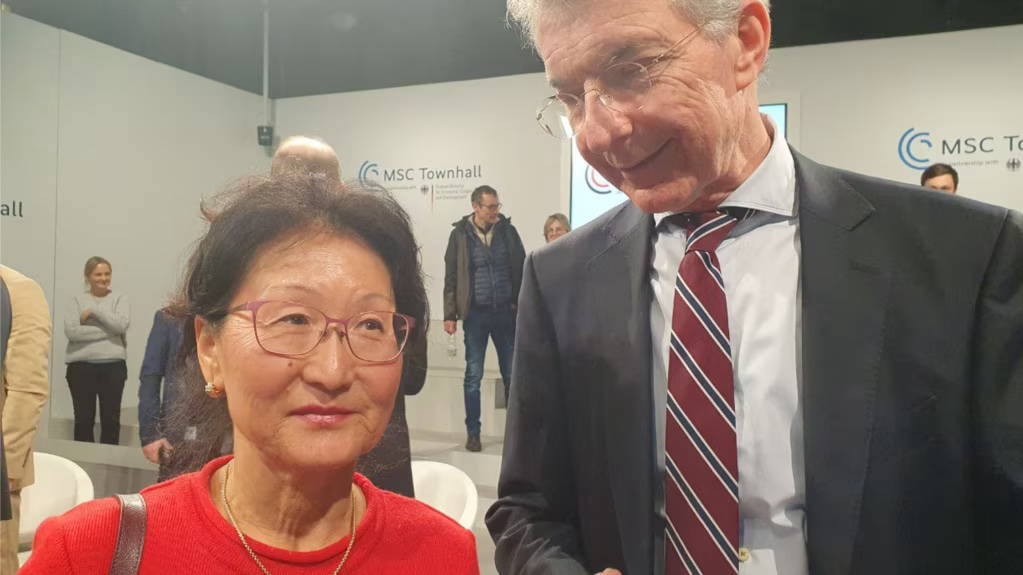
Maria Ochir-Goryaeva and Christoph Heusgen, chairman of the Munich Security Conference, February 2023. Courtesy of RFE/RL
When Russia invaded Ukraine, national movements in Russia’s regions advocating secession from Moscow were given a new impetus. A number of analysts have seriously argued that Russia could break up if there is a turning point in the war and noted the particular role of the Caucasus in this process. Kavkaz.Realii spoke with Maria Ochir-Goryaeva, Doctor of Historical Sciences, corresponding member of the German Archaeological Institute, and Distinguished Scholar of Kalmykia, about Kalmykia’s national movement, the Kremlin’s influence on the republic, and the republic’s current plight.
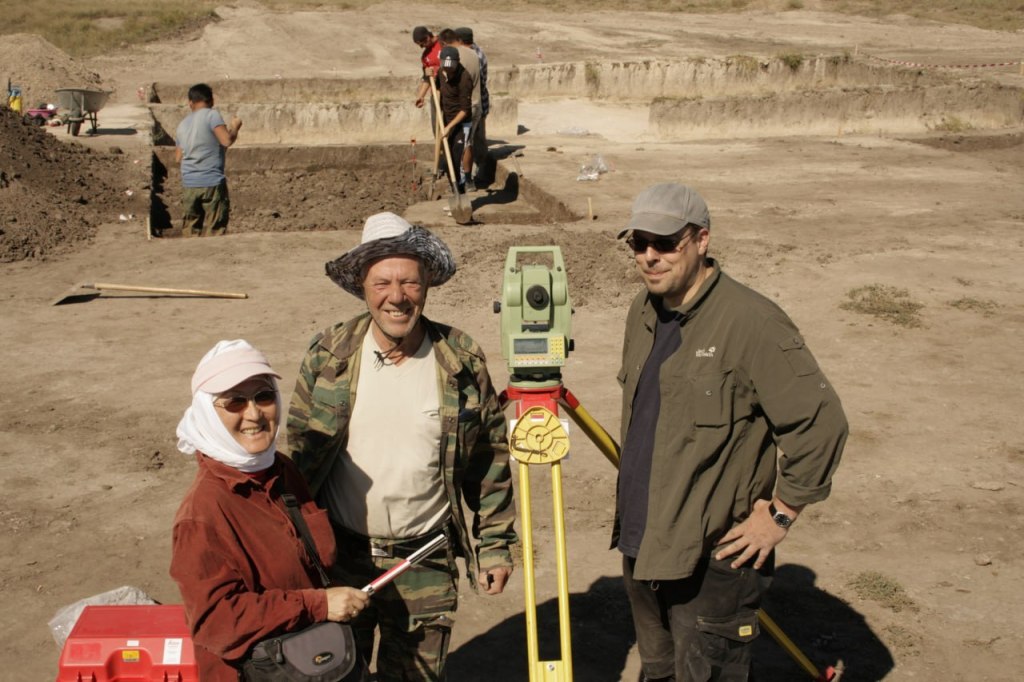
In 1999, Dr. Ochir-Goryaeva was awarded a competitive fellowship by Germany’s prestigious Alexander von Humboldt Foundation, and continued her research at the Eurasian Department of the German Archaeological Institute. She has published four scholarly monographs, the first of which was published in German. Every year, the archaeologist would return to Kalmykia to carry out archaeological digs in her homeland.
• • • • •
– It is the done thing in Russia to speak negatively about the support that western nonprofits and scholarly foundations provided in the 1990s to Russian academics and the Russian education system. Allegedly, it was through grants and training programs that the west inculcated its values in Russia. Tell us about your experience and what such programs did for Russian scholarship.
– Russian propaganda in general and on this issue in particular cannot be termed anything but xenophobic. In the 1990s, when many state-sector employees, including researchers at the Russian Academy of Sciences, were not paid their salaries for months on end, the grants allocated by western foundations literally saved them. In addition to the material aspect, they demonstrated the importance of researchers and their research. It was only thanks to the support of western and, later, Russian foundations that a number of academics, including me, remained in academia.
As for the “inculcation” of values, this is a distorted understanding of the purpose of such organizations. Each foundation has its own goals and values; if they are scholarly foundations, then their goals are scholarly. I have been living in Berlin for twenty-four years and I know that no one is subjected to “inculcation” here, but is given the opportunity to think and choose independently. Reality shows that people enjoy freedom of speech and the possibility of choice. These things work: everyone is eager to live in democratic countries, rather than in Iran, Afghanistan or Russia, which they leave at the first opportunity.
It is not western foundations that smack of “inculcation,” but Moscow’s imperial approach. Putin and his supporters are unable to adapt to a constantly changing world and are trying to adapt it to their needs by brute force and to make it conform to their outdated stereotypes.
– There is the opinion that this intellectual stagnation is displayed not only by country’s leadership, but also by many rank-and-file Russians, including those who disagree with Putin.
– I agree with this opinion. The wave of migrants from Russia, regardless of ethnicity, is no different from the populace who have stayed behind in Russia. Just as there, a small percentage of them are genuinely active in drawing attention to what is happening in Russia. Even here in Germany, many continue to fear for themselves, concealing their faces and names at protest rallies. The rest are either simply indifferent or they support Putin. Many have relocated in order to maintain their level of well-being and to be able to continue traveling around the world. They are, primarily, residents of Moscow who made good money.
Two things disappoint me about the new immigrants from Russia. The first thing is that few of them follow the news from the front and sincerely worry about Ukrainians. The topic never comes up in their conversations. Feelings of shame and guilt are probably unfamiliar to them. When I say something about bombing or war crimes, they immediately change the subject.
Maria Ochir-Goryaeva (left) at an anti-war protest in Berlin. Courtesy of RFE/RL
The second thing is xenophobia. Walking around Berlin, I have repeatedly heard indignation voiced by Russian speakers over why Germans tolerate the fact that Muslims here go about “in their headscarves.” Or, for example, Russians ask for help finding an apartment, but only in neighborhoods where “blacks,” as they say—meaning Arabs and Turks—do not live. This has shocked me as an Asian woman.
It seems to me that many immigrants do not assimilate the moral values of democracy and tolerance, but simply import Russia with all its stereotypes and ideology here. The problem is that Russians, with rare exceptions, are unable to understand the rationale and value of democracy. Otherwise, neither Putin, nor these decades of trampling on freedoms in Russia, nor the terrible war would have happened.
– At the same time, Putin and his entourage claim that the west has been trying to rewrite and distort history.
– We were all taught in school that in the early Middle Ages there was Kievan Rus’, a state centered around the city of Kyiv, that is, in present-day Ukraine. Then, three or four centuries later, the Grand Duchy of Moscow was formed, incorporating the lands in Moscow’s orbit. This name was the most accurate and reflects the essence of both the territory and its populace. Theoretically, it could be called Muscovite Rus’, but after its conquest of other peoples, it would be more correct to call this entity the Muscovite Empire. This state has its own history and traditions, like any other. The towns of the Golden Ring alone are worth so much! It is not that you mustn’t prize your own identity and your own statehood, but you should not appropriate someone else’s past.
Until a certain point, the Muscovites did not seek to appropriate Kievan Rus’ as part of their own history. This happened later, after Peter the Great declared himself Emperor of All the Russias. It was then that the temptation emerged to occupy not only the lands, but also the past of this foreign state.
Most of modern Russia consists of lands forcibly annexed to the Grand Duchy of Moscow and the Tsardom of Russia: the Volga region, Siberia, the Far East, and the North Caucasus have nothing to do with Kievan Rus’. They are colonies of the Russian empire. So it is the inhabitants of the Kremlin who are engaged in distorting history for the sake of political ambitions and propaganda.
– In 2022, representatives of national movements from different republics condemned the war and stressed that the conflict did not serve the interests of the Russia’s ethnic minorities. There were isolated protests in Kalmykia, but there were no large-scale protests here. Did you expect this reaction?
– Attitudes to the war in Kalmykia, according to my information, are similar to what you would find among an average sampling of opinions Russia-wide. Why should it be otherwise if the empire has been pursuing a policy of Russification and unification for centuries, thus leveling ethnic differences? There are critically minded people in every region, but there are only a few of them. And almost all of them have left the country, especially since 2022.
It is clear that if the Oirats had reached the shores of the Atlantic in the distant past and stayed here, they would probably have been part of a democratic Europe. Since our ancestors founded their Torghut Khanate on the banks of the Ijil-Idel-Edel-Volga River[these are different names for the Volga River—KR], they shared the fate of the rest of the peoples in the Evil Empire.
We could talk for a long time about the pros and cons of the arrival of the Oirats in Europe, the foundation of their khanate, the migration to Dzungaria, the peasant colonization of the khanate’s lands, the Russian Civil War… History, as you know, does not operate in the subjunctive mood. And Kalmyks have to live in those conditions, which means they are inevitably a cross-section of the society in which they find themselves today.
– How realistic are hopes for the independence of Kalmykia now? What are the decisive factors? Are Kalmyks themselves ready for it?
– Independence has ripened for a long time; it is a necessity. There are always leveling processes within large states. So, the regions of Russia, not only the republics, have to become independent, and then function like the European Union. This means that everyone has their own state, their own rules and system of governance, but when it comes to general issues—for example, environmental protection and projects aimed at the future—they would act in concert.
Disintegration into independent states is vital to all the peoples of Russia, including ethnic Russians. After all, the interests and problems of ethnic Russians living in Siberia or the Far East are clearly different from the interests and problems of Muscovites. The capital is robbing all the regions, and so the Kremlin has a huge amount of money with which to wage a large-scale war and seize foreign lands. If the money of the regions stayed in the regions themselves, the country’s leadership would not have such massive resources, and people in Russia’s hinterlands would live much better! All segments of society suffer from this centralized system.
– At the same time, the situation in the republics differs from the situation in the regions and territories.
– The ethnic republics are, constitutionally, members of the Russian Federation. Moscow not only fleeces them, like the other regions, but also pursues a frankly colonial policy toward them. For example, it redraws their borders, grabbing the best lands for itself. The lands of the Buryats were divided into three administrative regions, while two districts were confiscated from Kalmykia to create the Astrakhan Region. Industrial facilities are built everywhere, just not in the republics. Accordingly, the economy there does not grow, professionals emigrate due to lack of work, and the populace is burdened with debt.
The project to construct the Iki-Burul water pipeline from the Levokum reservoir was imposed by Moscow to increase Kalmykia’s dependence on the outside world and force it to pay the Stavropol Territory for water, although it would have been easier for the republic to extend a branch line from the village of Tsagan Aman and pump water for free from the Ijil-Volga. The longest stretch of the Tengiz-Novorossiysk oil pipeline runs through Kalmykia, but the Krasnodar Territory receives the money for the rent. People from the Kalmykian government complained that they could not change the terms of the contract and they traveled back and forth to Moscow, but the officials there were unmoved.
They do not see the economic side, but the policy of the empire also leads to the loss of identity, language, and traditional culture.
– In your opinion, why did the population of the republics, not only Kalmykia, so easily abandon the sovereignty and even independence they had obtained in the early 1990s?
– Easily abandoned: that’s a good way of putting it! But what about the two terrible wars against independent Chechnya? Moscow forcibly and harshly resurrected the imperial approach, severely cracking down on all protests. No one wanted to be deported to Siberia again, so Kalmyks actually had no choice.
What happened to Gorodovikov back in Soviet times in Kalmykia? [Basan Gorodovikov was first secretary of the Kalmyk Regional Committee of the CPSU from 1961 to 1978—KR.] He, an old general, a decorated Hero of the USSR, was escorted from the CPSU Congress hall by KGB men and immediately booted from office because he dared to suggest that the two districts taken from Kalmykia be returned. That is why, in his wake, until 1990, only envoys from were tapped to run the republic. The desire for independence among the concerned part of our people has never faded.
– Kalmykia ranks last among Russia’s regions in almost all socio-economic ratings. This has been going on for many years—it was the same under Kirsan Ilyumzhinov and Alexei Orlov as it has been now under Batu Hasikov. In your opinion, why have none of the heads of the republic been able to achieve a breakthrough in terms of its growth? Could they have done it?
– Because the colonial policy has never stopped, and it is impossible by definition to make a breakthrough in such conditions. A colony is a colony, and its construction industry, infrastructure, and social services will be worse than in the metropole. The only thing that happens in a colony is the siphoning off of resources and professionals, and total Russification is carried out in all areas, from language to the rewriting of history. This is also an imperial policy. Nations are not allowed to study their own past: Moscow imposes on them the interpretation of the past that is beneficial to Moscow.
By the way, the regional elites are also well aware of this. The governors of the regions and the heads of republics are forced to go to Moscow to bow and scrape, begging for the money which they themselves sent there in the form of taxes. So the issue of disintegration has matured not only at the grassroots, in the minds of national movement activists, but also among local elites. The ethnic Russian hinterland must understand that Moscow takes advantage of their political naivety and forces them to live in ignominious poverty. The consequences of the war with Ukraine might just be the match that ignites this inevitable process.
Maria Ochir-Goryaeva (left) at archaeological digs of a Bronze Age settlement with colleagues from the State Archaeology Department of Schleswig-Holstein (Germany), 2012. Courtesy of RFE/RL
– There is the opinion that Russian society massively supports this war. In your opinion, as a person observing from the outside, is this the case?
– Of course, they massively support it: people need to survive somehow, this is their priority. Everything is decided by the state system and what values it promotes. During the Third Reich, the Germans also massively supported the war. But when the system changed, the same people turned democratic. The same change can happen to Russian society, and for this to happen the system has to change. And the people as a whole easily change its opinions and habits.
I will give you an example. I spent eight years on the border of Kalmykia and the Rostov Region digging up two fortresses from the era of the Khazar Khaganate. We lived for months in a small village where the entire population is ethnically Russian. We hired the local men to do the digging. They don’t just swear there, they practically speak in obscenities. I forbade them to swear at the digging site and joke about gender issues, otherwise I would kick them out without paying them their day’s wages. And they worked for me all day for months without swearing!
What is more, nearly everyone in this village was a nationalist, in the sense that they did not like Kalmyks. But since I treated them with respect and paid them for their work every evening, they treated me and the other researchers quite cordially. People everywhere, whether they are Russians or Germans or whatever, are masters of survival. So, I don’t think you have to convince them verbally. When conditions change, ordinary people themselves figure out how it benefits them. You shouldn’t condemn ordinary people. You should cherish them and foster conditions for them to lead decent lives, whatever their ethnicity.
• • • • •
Earlier this month, Kavkaz.Realii published a report on life in Kalmykia and the impact of the war in neighboring Ukraine on it.
In October 2022, the Verkhovna Rada adopted a resolution recognizing Chechnya as a territory temporarily occupied by Russia, and also condemned the “genocide of the Chechen people.” All 287 MPs present voted in favor of the resolution. Oleksiy Goncharenko was one of the authors of the resolution.
In late October 2022, the Oirat-Kalmyk People’s Congress adopted a declaration entitled “On the State Independence of the Republic of Kalmykia.” This is not the first call for self-determination for the Russian Federation’s ethnic republics since the outbreak of the war in Ukraine. “Free Nations of Russia Forums” have been held in Warsaw, Prague and Gdansk, and representatives of ethnic groups “oppressed by the Kremlin regime” met in Kyiv.
On January 7, supporters of an independent Ingushetia met in Istanbul. The creation of the Ingush Independence Committee was announced at the meeting. The Committee’s goals include consolidating Ingush society around the idea of freedom and independence, preserving cultural and religious identity, creating the basis for building an independent Ingush state, and “preventing another deception of the people and another round of violence against them.”
Sasha Skochilenko (center) at her criminal trial in Petersburg, 25 May 2023. Photo: Nadezhda Skochilenko
At today’s hearing [in Sasha Skochilenko’s criminal trial on charges of disseminating knowingly false information about the Russian army], Sasha’s defense lawyers and Svetlana Drugoveyko-Dolzhanskaya, a linguist who conducted an independent forensic examination and found no knowingly false information in Sasha’s messages, were able to question one of the authors of the linguistic forensic examination [commissioned by the prosecution].
Olga Safonova, a specialist in political science (!), was enlisted to contribute to the linguistic forensic examination. But, as she was instructed to do by a staff member at the forensics expertise center, she evaluated whether what was written [on the anti-war “price tags” that Ms. Skochilenko is alleged to have posted in a Petersburg supermarket] was in line with the Russian Defense Ministry’s position, not whether it was truthful.
[Safonova] admitted that her analysis of one of the messages was “slightly misleading.” She was “at a loss” when asked to respond to the assertion that Sasha faces up to ten years in prison on the basis of such misleading conclusions, among other things.
After a recess (due to her heart problems, Sasha found it difficult to endure the stuffiness and lack of water), the examination of the witness was continued by Drugoveyko-Dolzhanskaya. Safonova was forced to admit that among the sources against which she checked Sasha’s messages, only the Defense Ministry’s website corresponded to her own definition of an official source — unlike the website Life.ru and anonymous Telegram channels. She also could not answer a school curriculum-level question about impersonal sentences, although their erroneous definition in the forensic examination is one of the “proofs” of Sasha’s guilt.
In addition to pointing out the errors in the forensic examination and its noncompliance with government standards, Drugoveyko-Dolzhanskaya recalled that, according to the Justice Ministry’s methodological recommendations, when an expert strays beyond their area of professional competence, it is a procedural error and is inadmissible [as evidence in court]. Safonova was forced to agree. Drugoveyko-Dolzhanskaya followed this up by asking a direct question: “Can you, as an expert, prove conclusively that Skochilenko knowingly falsified information?”
Safonova replied that she could not.
The new prosecutor abruptly interrupted her and requested that the hearing be postponed.
You can come out and support Sasha at 11:30 a.m on June 13. Many thanks to everyone who continues to attend the trial, shares information about the case, and donates money to pay the lawyers and buy food and medicine care packages! You can help Sasha financially here:
+79627117055
(Sofia S., Sberbank)
5469550065976075
(Sberbank)
Source: Nadezhda Skochilenko (Facebook), 25 May 2023. Translated by the Russian Reader. The details for donating money to Ms. Skochilenko’s defense fund are only for people based in Russia.
[…]
Olga Safonova. Photo courtesy of The Village
In the late 1990s, St. Petersburg State University, for reasons unknown, gave away one of its dormitories on Vasilievsky Island — 10 Bering Street — with a two-story attic built on. Later, one of the university’s vice-rectors regretfully claimed that if the building had not been given away, the university would have had room to house over 500 students. Today, the building houses apartments (a three-bedroom flat there will run you 20 million rubles) and offices. It is owned by the Bering-10 Condominium Association, whose chair is Olga Diomidovna Safonova. She has the exact same name as an associate professor in the Faculty of Political Science at St. Petersburg State University.
Safonova has been involved as an expert witness in the criminal cases against [Petersburg anti-war protesters]Victoria Petrova, Sasha Skochilenko, and Vsevolod Korolev. They face up to ten years in prison if convicted. These are quotations from the expert analysis in the case against Victoria Petrova:
“Objective facts indicate that the war crimes against the civilian population of Ukraine have not been committed by the Armed Forces of the Russian Federation, but by the Kiev regime and the armed formations controlled by it.”
“The practical intent and purpose of the statements under examination [i.e., Victoria Petrova’s posts] consists in generating false ideas among readers (listeners) that the actions of the Russian federal leadership are condemned by society, as manifested by the threat of the use of nuclear weapons against Ukraine and against European countries.[…]In the materials submitted for examination, the negative assessment of the policy of Russian federal state bodies vis-a-vis their deployment of Russian federal armed forces to protect the interests of the Russian Federation and its citizens and maintain international peace and security, is not supported by arguments and evidence.”
Safonova graduated first from St. Petersburg State University’s law faculty, then from its philology faculty. In 2005, she defended her dissertation in political science. Here is a quote from the abstract: “Social deprivation has become a characteristic feature of the lifestyle of a significant portion of the Russian populace. A drop in the level of real monetary income has entailed increased competition for survival, thereby generating an increase in the stratum of people whose intentions have become criminal, i.e., unlawful.”
At least until the mid-2010s, Safonova led an active social life. The Village found the academic’s picture in a dozen photo reportages from different parties, as published by Sobaka.ru and Geometria. Here she is at a presentation by the jewelry house Freywille; here, at the (now-closed) restaurant Gusto’s birthday party; and here, at the opening of XXXX Baltika Brew.
The Village spoke about Safonova with graduates of various faculties at St. Petersburg State University: their assessments of her were contradictory. Journalist Anastasia Romanova, who took Safonova’s lecture course on political science, remembered her as “the toughest teacher, whose pass-fail exam was very hard to pass.” “She honestly read the whole class the riot act,” said Romanova. “It was very scary to go to her.” Emile, a graduate of the political science faculty, where Safonova taught a course on law, recalls, on the contrary, that “the course was a formality,” and “at some point that woman just disappeared.” It was one of the easiest subjects to pass,” he said.
In 2012, commenting to Delovoi Peterburg on the newly adopted law on foreign agents, Safonova said, “There are many organizations that, under plausible pretexts, are engaged in near-subversive activities. We as a state should be concerned about this, and it’s good that this issue has been addressed.”
“I remember that Safonova gave what I thought were absurd descriptions of the political regimes in other countries. She said there was no democracy anywhere. It seems to me that most students found her unpleasant both as a teacher and as an apologist for the regime. A couple of days ago, a classmate sent me an article in Rotunda about her involvement in the expert analysis [in the case of Victoria Petrova]. I wasn’t surprised,” says Emile. Romanova adds, “She didn’t give the impression of being a stupid person. Arrogant, yes. I think she understands perfectly well what is happening now.”
The entrance to the European University at St. Petersburg, which I’ve walked through hundreds of times. Photo courtesy of VG from an unidentified source
Rosobrnadzor [the Russian federal education watchdog] and the prosecutor’s office have begun an unscheduled inspection of the European University at St. Petersburg, sources at the university and close to the university have told the BBC. The inspectors are examining publications by the university’s lecturers and the topics of students’ dissertations, especially in political science, history, and sociology, and they are also observing classes. [In December 2016], a similar inspection led to the university’s license being revoked.
That the inspection was underway was confirmed to the BBC on condition of anonymity by eight sources, both within the university itself and among those associated with it. One of the academics told the BBC that the EUSP’s leadership was warned about the unscheduled inspection last Thursday. The inspectors arrived at the university on Monday [May 15].
The university’s rector, Vadim Volkov, responded to our request for comment by writing that he could not speak [about the matter], “especially with the BBC.” Alla Samoletova, chief of staff in the rector’s office and responsible for media contacts, did not respond to the BBC’s calls and messages.
Two of the BBC’s sources claimed that the prosecutor’s office is checking the university “for extremism.” According to one of them, the inspection is part of a campaign to counter extremism and terrorism. The supervisory authorities are interested in the content of academic papers and programs. In particular, the inspectors are looking for extremism in publications by the university’s lecturers, they said. Rosobrnadzor and prosecutor’s office inspectors have been stationed in a computer classroom two days in a row reading documents, as well as sitting in on classes at the university.
A source told the BBC that the inspectors requested a packet of documents for 2020–2023 that included dissertation topics and personal files of the university’s master’s degree and PhD students (the EUSP has no bachelor’s degree program), as well as their individual research plans, as authorized by their academic advisers. Such documents were retrieved from at least four faculties—anthropology, history, sociology, and political science—the source claimed.
The topics of dissertations and their content were always discussed at the university in terms of their compliance with academic standards, but they were not censored, one of the scholars noted. Another said that in recent years, when approving topics, advisers took in account how risky writing and publishing the work would be for the author, their informants, and the university, and whether the thesis could be successfully defended in the current circumstances.
After the outbreak of the war with Ukraine, the EUSP said farewell to foreign teaching staff and [Russian nationals teaching at the university] who fled Russia, sources said. The current audit affects several dozen of the university’s lecturers, as well as several hundred graduate students.
The technique for attacking a university, according to the BBC’s source, is standard: officials usually recruit experts who are willing to detect evidence of “extremist propaganda” and similar violations in research. These experts include people who have themselves been guilty of plagiarizing academic works, as the BBC has reported.
It is almost impossible to challenge such examinations, said a source close to the EUSP. According to them, the results of a similar inspection had led, in the past, to a shakeup of the teaching staff and changes in the curricula at the Faculty of Liberal Arts and Sciences (Smolny College) of St. Petersburg State University.
In 2021, similar audits took place at the Shaninka (Moscow School for the Social and Economic Sciences), and at RANEPA’s Institute of Social Sciences (ION). The prosecutor’s office, as during its audit of Smolny College, asked to see scholarly articles by university staff and a “steering document on disciplinary activity” said a BBC source familiar with the audit.
The European University is a private university founded in St. Petersburg in 1994. It was initially funded by grants from American and European NGOs, including the Soros Foundation, the MacArthur Foundation, and the Ford Foundation. These organizations are now deemed “undesirable” by the Russian authorities, but the EUSP has not received financing from them for a long time.
The EUSP Board of Trustees is headed by Mikhail Piotrovsky, director of the Hermitage Museum, while former Russian presidential chief of staff Alexander Voloshin and ex-chairman of the Federal Audit Chamber Alexei Kudrin are among the trustees. Kudrin is also a member of the board of trustees at the Shaninka, and he previously served as the dean of Smolny College.
The BBC Russian Service and other independent media have repeatedly reported that the intense focus of the oversight authorities on private universities in Russia (especially the EUSP and the Shaninka) is fueled by the FSB, which is unhappy with their independence and academic contacts with the West.
In 2016, the EUSP was subjected to a similar inspection by the same supervisory authorities. Inspectors then questioned students as well, but it has not come to that yet during the current inspection. Inspectors also then audited academic works for extremism, but could find no evidence of it. The only irregularities that Rosobrnadzor found find at the EUSP had to do with number of practical teachers [sic] in the Faculty of Political Science. The latter led to the revocation of the university’s license, which was reinstated only a year later. The BBC’s sources could not rule out that, this time around, the inspection would lead to the EUSP’s closure or the shuttering of individual programs at the university.
According to the consolidated register of inspections, the EUSP was audited thirteen times between 2016 and 2022, including three times by Rosobrnadzor. In October, the government banned planned inspections in 2023 of legal entities that do not belong to high-risk categories.
The BBC sent a written request for comment to the EUSP’s press service, as well as to the New League of Universities, which includes the EUSP, the Shaninka, the New Economic School (NES), and Skolkovo Institute of Science and Technology (Skoltech). The League advertises itself as an association of new Russian universities established in accord with international education standards. The BBC has also contacted Rosobrnadzor and the St. Petersburg Prosecutor’s Office for comment and is awaiting a response.
It’s not the prices that are rising — it’s the ruble that is falling. The “special operation” is a war. You can’t force Ukraine to like you. We haven’t surrendered to NATO. The neighbors have no more Nazis than we do. Soldiers should be alive, healthy, and at home. The president has gone mad, and everyone is afraid to contradict him. Your children love you and want to live like human beings.
That’s it, thank you. So that’s how it is. Yeah, it’s time to end it. Wow. Thanks, I feel relieved. Oh, would that they would explain it that way on TV.
The war has made us take a look around. In whose midst do we live? Do our fellow citizens think the same way we do? Public Sociology Lab (PS Lab) is a research team that studies politics and society in Russia. In 2022, it launched a project to study the attitudes of Russians to the war.
How do people explain the conflict’s causes to themselves? How does their attitude to politics affect their personal interactions and self-perception? Do they have a political position at all? We talked about this with researchers at PS Lab. Svetlana Erpyleva works at the Center for Eastern European Studies at the University of Bremen, while Maxim Alyukov, a political sociologist, works at the Institute for Russian Studies at King’s College London.
How is your research on the attitude of Russians to the war with Ukraine set up?
Svetlana Erpyleva: Qualitative methods are the main difference between our team and the other teams doing systematic research on perceptions of the war. We have long conversations with our informants and try to find out not only their attitude to the war directly, but also many other things related to it — what sources of information they trust, how they interact with loved ones, their fears and hopes, and so on.
We searched for respondents using social networks, ads, and the “snowball” method (that is, when an informant helps us set up a conversation with their ow friends). It was a big help in contacting people who do not often reflect on politics.
Some people responded enthusiastically to the ads we placed about finding informants — they wanted to talk to us themselves. Moreover, these are not only people who have a clear stance for or against the war and are willing to share it, but also those who feel that their opinion is not represented in public discussion. Such people do not see other people who think like them on social networks or in the media and want to put themselves on the map.
For example, during the the second stage of our research, in the autumn of 2022, we realized that dividing people into “supporters of the war,” “opponents,” and “doubters” (as we had done in the spring) was no longer warranted. Our sources support some decisions by the authorities, but not others. They regard the war as necessary in some ways, but some things about it terrify them, while other things cause them to doubt. Our interviews, which last about an hour (sometimes longer), have in fact enabled us to understand the peculiarities of how the war is regarded by Russians, with all their contradictions and complications.
Our other goal is to study the dynamics of how the war is regarded. We conducted the first series of interviews in the spring of 2022. We did the second series between October and December 2022. It is important to note here that in the autumn we spoke only with “non-opponents of the war,” that is, with those whom in the spring we had provisionally labeled “supporters” and “doubters.”
Maxim Alyukov: I would also make another important clarification. When people talk about studying perceptions of the war, they often have in mind representative surveys. Using them, we can indeed more or less accurately describe the range of opinions around the country. But polls cannot show how opinions about the war are shaped, or what emotions people experience. We are going deep rather than wide. Yes, we cannot draw large-scale conclusions about public opinion in general, but, unlike the polling projects, it is easier for us to talk about specific mechanisms — what emotions tend to shape certain positions, how different types of media consumption affect perceptions of the war, and so on.
What is the difference between how people regarded the war in the spring and the autumn?
SE: On the one hand, we see from the autumn interviews that perceptions of the war had not changed radically. Almost none of the people with whom we had repeat conversations had changed their attitude to the war from “plus” to “minus” and vice versa. Of course, there have been small shifts in this regard. For example, some of the springtime convinced supporters remained “optimists,” while others had become “pessimists.” The former believe that the “special operation” is going in the right direction, despite all the shortcomings, while the latter criticize the chaos in the army, the chaos during the mobilization, retreats by Russian troops, and so on.
But we shouldn’t deceive ourselves: the pessimists have not stopped supporting the war. Rather, they want Russia to act tougher and more effectively, and ultimately win.
In the first series of interviews in the spring, we identified a group of so-called doubters. But it is clear that even back then different informants in this group were closer to one or the other pole of opinion. Some doubted, but were inclined to support the war, while others were against it. In the autumn, there were fewer informants who were completely unsure of their position. Those who had been closer to the supporters of the war had often begun to support the war a little more. The same thing happened to those who had been more against the war than not: many of them had become a little more strongly opposed to the war (without turning into unambiguous opponents).
On the other hand, the ways people have for justifying the war have changed. Some of the old methods are losing popularity, while others are emerging.
For example, one of the new justifications for war involves imagining it as a natural disaster. We feel sorry, of course, for those who perish in a flood. We cannot regard this other than negatively. But it is impossible for us to oppose it. The same thing has happened with the war.
From the viewpoint of the informants who have resorted to this excuse, the war just happened. It is a terrible reality that we can only accept.
Another new way of rationalizing the war involves turning its consequences into its alleged causes, as when our informants say, “Ukraine has been bombing our border cities, so we need to continue the war,” or, “The war has shown that we are fighting not with Ukraine, but with the collective West. We are fighting not with a fraternal people, but with our perennial enemy, so it is right that we started this war.” The second statement had also come up in the spring, but it has become much more popular. The rationale behind such justifications involves arguing that events that happened after the war started seemingly reveal the enemy’s true identity.
MA: Attitudes towards sources of information have also changed. There are two trends: polarization and stabilization. At the war’s outset, people tried to seek out information, including information from the “opposite camp.” For example, those who supported the war sometimes read opposition and Ukrainian media, because they understood that the Russian state media are propagandistic. Now, on the contrary, many people are so weary that they have not only reduced their consumption of information in general, but also have stopped following sources that reflect the opposite opinion.
At the beginning of the war, the following idea was often discussed: information about the destruction, civilian casualties, and losses among Russian soldiers would gradually undermine the effect of propaganda. Now we see that, over time, the simultaneous consumption of information from pro-government and opposition sources, which paint radically different pictures of the world, has had the opposite effect. It causes discomfort, which leads to the fact that people who are less involved try to shield themselves from information about the war in general, while more involved people consume propaganda and stop paying attention to alternative sources. This is a conscious choice: they realize that they are consuming propaganda. I remember the words of one informant: “There are different points of view, but the brain tends to stick to one theory. I’m inclined to choose the theory of my country, of the state media, so that my brain follows it.”
It transpires that the person understands perfectly well that they are consuming propaganda, and they consciously choose it amidst conflicting explanations that cause discomfort.
Do these changes produce any practical actions? Maybe people stop talking to certain people or get involved in charity?
SE: There are only a few volunteers among our informants.
People can have a positive view of charity, and worry about their country, but most of them do not take any action themselves.
And yet, volunteering that involves assistance to the mobilized is certainly seen positively by our informants (that is, by “non-opponents” with very different views of the war). Such volunteering is regarded not as involvement in the war, but as support for “our boys,” for “our country.” This is not surprising: there are always significantly fewer “activists” and volunteers than there are sympathizers. Only a few people are involved in protests, too.
Changes have also been taking place in the way people talk about the war with their loved ones. For example, many of our informants described the summer as a carefree time when the war had completely disappeared from their lives: they stopped discussing it. The mobilization was the “new February 24” for those informants (who were most often people remote from politics). The topic of war had returned to everyday conversations again. The informants were discussing the events even with strangers. For example, one of our sources told us that even at work meetings with her clients she had occasion to discuss the mobilization.
Do attitudes to specific events affect everyday practices? For example, the mobilization began and people decided to check whether their foreign travel passports were still valid.
SE: Unfortunately, we didn’t talk much about everyday practices in our interviews. Probably the most common reaction to the mobilization’s announcement was anxiety and, simultaneously, the absence of concrete action: “Whatever will be will be, but I hope that nothing bad happens.” Some of our informants who did not want to be sent to the front changed their places of work and residence, but we didn’t often encounter such people in our interviews. (It is important to understand that we were talking to “non-opponents” of the war.)
MA: It’s also worth recalling that a minority of Russians have the possibility of leaving the country. According to our research on social networks (this is another project that my colleagues and I are doing), the most common reaction to the mobilization has been evasion.
Is it possible, then, to talk about a desire for inneremigration among those who have remained in Russia? For example, a person says, “Actually, I have a lot more important and valuable things in my life [than the war], and I want to pursue them.”
SE: It was the presence of this desire among people in the spring of 2022 that made us single out the doubters as a separate group. All of them were typified by the notion that the “distant war” was secondary compared to more important values — work, loved ones, and family. But in the autumn, we saw that fewer and fewer of our informants were able to take a neutral stance, to completely distance themselves from assessing the war. Our informants talked about pressure: they seemed to feel that society demanded that they voice their opinion. In this sense, as Maxim has said, the polarization of views has been increasing.
But our informants assess [this polarization] in different ways. Many supporters of the war say that it is awesome because people are becoming more united, more interested in what is happening around them. The “anti-patriots” will leave the country, but patriotic Russians will remain. Others complain that it is hard for them to cope with the pressure. They would like to take a neutral position, but they cannot manage it. One of my sources described it this way (I’m quoting from memory, of course, but nearly verbatim): “I would like not to take a side, but my smart friends say that the war should be continued. And I understand that they are right, that one should support one’s country in such circumstances. I’m unable to take a back seat.” But a little later she said: “I’m afraid that time will pass and [people] will come and ask me, ‘Have you been reading Meduza? Have you been watching Channel One? Whose side are you on?’ And I won’t have any answer.” This situation even makes her think about emigrating. That is, on the one hand, she chooses to side with supporters of the war; on the other hand, she is afraid to make this choice.
MA: I would add that the desire for neutrality remains. One respondent put it this way: “There is war all round, but I try to maintain peace on my VKontakte page.” He moderates disputes there and shares links to articles about the importance of neutrality. For him, this is a way of creating a space for himself in which there is the possibility of remaining neutral, since he doesn’t have this possibility in other contexts. It is another matter that there are fewer and fewer opportunities for such neutrality.
You say that your respondents feel pressure. Where do they feel this pressure? In interactions with loved ones and colleagues, or somewhere else?
SE: It is often the pressure of their immediate environment. Many opponents of the war have left the country, and the doubters thus have fewer contacts with their viewpoint. They are surrounded, as a rule, more by supporters of the “special operation.” But the cause of such pressure may be an inner conflict. For example, our sources tell us that they were taught at school that when the country is in difficult straits, the worst stance is neutrality. But now they have found themselves in exactly this position. It is really difficult for them: they see the propaganda on both sides, but do not feel strong enough to resist it. This can be illustrated as follows: “Maybe Russia was right to attack, or maybe it was wrong to do so. Maybe Ukraine is the enemy, or maybe it isn’t the enemy. I don’t understand what’s going on at all. But how can I fail to take a stance?”
In such circumstances, people turn to what seems certain to them — for example, to their Russian identity. You may not know who is right, but you have a native country and it must be supported.
MA: This feeling of pressure consists of two parts. The first is personal interaction, about which we have said our piece. The second is the influence of the media, in which you can constantly see appeals and reminders of the war. This background encourages a person to clearly articulate their position.
Is the official newspeak (“special operation”, “line of contact,” etc.) incorporated into the explanations given by the “non-opponents” of the war? Is the state discourse generally used to justify it?
MA: Yes and no. It does happen that our sources literally quote propaganda narratives. For example, they start saying on TV that there are fakes everywhere, and a person repeats this idea. But at the same time, an absolute minority of our sources trust state broadcasts, although there are such people among them. They have doubts and come up with their own hypotheses. But it is important to take into account that our informants live in large cities, so it is likely that, for example, in smaller cities far from the capitals, the ratio is different, that there are fewer people there who are like the majority of our respondents, and more people who trust propaganda.
SE: You also have to understand that there are different types of support for the war, and therefore different explanations for it. There are people who accept the explanations given by the state media. Most often these people are elderly: they regularly watch TV, and then rehash the rhetoric of the propagandists. But there are other kinds of people — for example, those whom we call “committed supporters.” Their attitude to the Russian-Ukrainian conflict was shaped back in 2014, or even in 2004. They can be quite critical of propaganda narratives and are fond of saying, “We have bad propaganda. It is incapable of explaining anything.” Such people are able to explain the war’s causes on their own. And there are, for example, people who are remote from politics, who might watch TV sometimes, but it doesn’t convince them. They can even rehash propaganda cliches, but they do not adopt them, they do not present them as their own words. For example, they say, “We were told that…” or “We are told that…”
Is it possible then to say that, despite propaganda, polarization, and state pressure, even those who are not against the war are in a gray area? In other words, there are no views that could unite people, and accordingly, that is why they cannot unite and make demands.
SE: Yes, that’s right. Unless “convinced supporters” could try to create some kind of association. But I’m sure they’re a minority. Most people are busy with their daily affairs: they are not interested in political positions and movements. We are currently preparing a second analytical report on the results of the autumn stage of our study, and there we even try to avoid the word “position.”
Most of our informants have no “position.” Their attitude to the war is a bundle of fears, doubts, hopes, and other feelings. Such people may want Russia to win, but sincerely worry about the victims of the shelling in Ukraine.
One of our informants said, “If I had been subject to the mobilization I would have been out of Russia in three minutes.” And yet she, for example, wants Russia to win.
MA: Especially since propaganda does not just attempt to impose a certain point of view. It also generates a multitude of contradictory narratives that simply confuse people. This is a paradox of authoritarian propaganda: the state needs this vital demobilizing effect to maintain control, but it also prevents it from generating broad support for the war.
You mentioned sympathy for the victims of the shelling. In your spring report, some of your sources say that they would tolerate a decline in the material standard of living, because for them what matters are spiritual values. Since they are so clearly aware of losses, can we say that Russians perceive themselves as victims?
SE: We rarely see people regarding themselves as victims directly. They say, “The situation has become worse in Russia as a whole, but everything is fine with me. Yes, people are being mobilized, and that’s scary, but my loved ones aren’t being mobilized. Prices have gone up, but we’re coping.” Our sources often regard Russia as a whole as a victim. They are offended on Russia’s behalf: it was forced into the conflict, and it is humiliated everywhere and considered an aggressor. That is, they don’t think “[international] brands have abandoned me,” but those brands have abandoned “poor Russia.”
MA: Ukrainians are also regarded as victims. “The poor residents of Ukraine are being used by NATO. Would that it were over as soon as possible.” In many ways, this is part of the propaganda narrative that Ukraine has become a firing range on which NATO and Russia are fighting using Ukrainians as proxies. But this is, rather, a propaganda cliche that people simply repeat without thinking through their own position on this issue.
It follows that “non-opponents” of the war do not regard it as part of their personal lives?
SE: This is a generalization, of course, but I would say that it is basically true. For the opponents of the war, on the contrary, the war has become an existential challenge. Sometimes they even make themselves experience it as such: “I cannot live an ordinary life. I must remember that there is a war going on.”
But isn’t there a contradiction here? The “non-opponents” of the war do not regard it as a personal matter, but we are saying that they feel pressure from their loved ones, are trying to find their own identity, and are grasping for rationalizations.
SE: This is a difficult question, but let’s try thinking about it. Compared to opponents, supporters and doubters are more likely to try to rid themselves of negative thoughts, to distance themselves from the war. And yet it regularly makes its presence felt. The latter is a new trend, and many of [our respondents] do not like it: they would prefer to live their lives without being reminded about the war. But it has become more difficult to do this.
MA: In our research on how the war is seen by Russians, we have been observing what I had observed in my pre-war research. People, if they are not politicized, rarely hold consistent positions at all. I will give an example from my research on Russian perceptions of the conflict between Russia and Ukraine prior to February 24. A person has a smorgasbord of different political ideas. He supports all the decisions made by the authorities, including the annexation of Crimea and military backing for the so-called DPR and LPR. And yet half an hour later he says, “Basically, it would be a good idea to withdraw the troops and leave Ukraine alone. It’s bad for us.” It’s just that he hadn’t needed to make connections between his disparate views on this issue before. This necessity emerged during our conversation.
We have been observing the same thing now. People are trying to push the war out of their lives. They need arguments in favor of the war — not because it is their political position, but because it is safer to live that way. For many of our respondents, the interview was like an exam in which they were forced for the first time to think about logical chains and formulate at least some kind of a clear opinion about the war, which they had not tried to formulate before.
What goes on in your mind?
I think that I am falling down.
What goes on in your mind?
I think that I am upside down.
Lady, be good, and do what you should,
you know it'll work alright.
Lady, be good, do what you should,
you know it'll be alright.

I'm goin' up, and I'm goin' down.
I'm gonna fly from side to side.
See the bells, up in the sky,
Somebody's cut the string in two.
Lady, be good, and do what you should,
you know it'll work alright.
Lady, be good, do what you should,
you know it'll be alright.

One minute one, one minute two.
One minute up and one minute down.
What goes on here in your mind?
I think that I am falling down.
Lady, be good, and do what you should,
you know it'll work alright.
Lady, be good, do what you should,
you know it'll be alright.
Throughout Putin’s war on Ukraine, the attitudes of the Russian public toward the regime and the conflict have been the subject of much scrutiny. This talk addresses this question by analyzing data released by the Presidential Administration that summarizes monthly correspondence received from the public from January 2021 through December 2022. While the identity of these correspondents is not known, their decision to send non-anonymous appeals to the President suggests that they support or tolerate the Putin regime. The data demonstrate that after an initial period of uncertainty about the war’s economic impact, these concerns abated until the announcement of mobilization in September. Since then, the appeals depict a Russian public that is increasingly concerned about conditions of military service and the war’s impact on service members and their families. At the same time, the data indicate that the Kremlin’s strategy to shift the blame for mobilization from the President to regional authorities appears successful.
Pollsters argue over how many Russians support the Ukraine war
Since the Russian invasion of Ukraine, sociologists have grappled with the question of how many Russians support the Russian army in Ukraine. Both independent and state-run pollsters claim they are the majority, and these studies are frequently referenced in Western media. However, at the same time, a group of independent sociologists have pointed out that these polls may not be representative — many Russians are reluctant to speak freely about their thoughts on the conflict due to draconian wartime censorship laws.
Independent researchers from the Khroniki project recently presented the findings from their latest survey, which suggest using a percentage of how many Russians support the war may not be a very meaningful statistic. In their view, this figure comprises a misleadingly wide spectrum of people: from those who volunteered to fight in Ukraine to those afraid of repression. Moreover, at least half of those who are opposed to the war are afraid to speak out, the Khroniki sociologists said.
To identify the core pro- and anti-war groups in Russia, the pollsters devised a series of questions. The results of their survey suggests that the core support group represents 22% of the population, while the core opposition is 20.1%.
Separately, researchers stress that “the fridge counters the effects of the TV,” and this effect is felt more and more with each passing month. The level of support for the war among TV viewers who are encountering economic pressures is falling. Among TV viewers who have encountered at least one economic problem, support for the war was down 11 percentage points in February.
Other polls, however, show that a vast majority of Russians support the war. For example, according to state-run pollster VTsIOM, 68% of Russian residents welcomed the invasion of Ukraine and just 20% are opposed to it. And leading independent polling agency Levada Center published results in January that suggested 75% of Russians support the war — to varying degrees.
Why the world should care:
It’s not easy to work out exactly what proportion of the Russian population supports the war, but Khroniki is certain that the pro-war lobby is far smaller than polls from leading agencies would suggest. If that is true, it casts doubt on the widely-held belief in the west that the war in Ukraine is supported by most Russians who remain inside the country.
On 1 September 2022, I returned to Russia after almost a year away. The war that began six months ago had been present in my life daily: in the news, in conversations with friends and colleagues, and in the Ukrainian flags on the streets of the European city where I lived. But there was no trace of the war in the town near Moscow where I grew up, and where my parents still live. I did not see pro-war or anti-war graffiti or slogans; war was not mentioned in the streets or by my friends and acquaintances. As I sank into the familiar rhythm of my childhood town, I caught myself thinking that perhaps I was beginning to forget about it too. That all changed on September 21, the day ‘partial mobilisation’ was announced. Suddenly, the war was being mentioned all around me, or rather whispered about, in the cafe where I listened to Putin’s address, in the local library, in the street, on the train from Moscow to St. Petersburg. The war seemed to have reappeared in Russian society instantaneously, with the snap of a finger.
I had observed something similar before, not around me, but as a researcher: in the data my colleagues and I collected. Our Public Sociology Lab began conducting a qualitative study on Russians’ perceptions of the war on February 27, 2022, just three days after the full-scale invasion of Ukraine began. During the first months of the war, we conducted (link in Russian) over 200 interviews with supporters of the war, its opponents and doubters. At that moment, many of our informants, including those who were far from being exclusively anti-war, also said that they had been shocked by the news of the start of the ‘special military operation’ and had tried to make sense of events in their conversations with friends and relatives. But after a few weeks, the emotions of shock and confusion began to fade. The war became routine and faded into background noise.
So we knew that the ‘return of war to society’ following the announcement of mobilisation would also likely be temporary. We waited a few weeks and, on October 11th, conducted our first interview as part of the second stage of our research into Russians’ perceptions of war. Between October and December 2022, we conducted 88 interviews with ‘non-opponents’ of the war, deciding this time to focus the study on support for and disengagement from the war, rather than resistance to it. Forty of these interviews were repeated conversations with supporters of the war as well as its doubters doubters, with whom we had already spoken in the spring.
We were driven by the desire to understand how perceptions of, and predominantly support for, the war were evolving. From the interviews conducted in the spring of 2022, we roughly divided all ‘non-opponents’ of the war into supporters and doubters. Despite the fact that among supporters of the war, there were interviewees who were convinced to a greater or lesser extent, all of them found some means to justify the ‘special military operation’. Some were staunch supporters of ‘the Russian world’ and believed that the war would push the geopolitical threat away from Russia’s borders and strengthen the country’s position; some were worried about loved ones in Donbas and rejoiced at the prospect of an imminent resolution to the longstanding conflict; some, viewers of Russian TV channels, spoke of ‘combating fascism’ and ‘protecting the Russian-speaking population of Donbas’; many expressed confidence or, at the very least, hope: ‘if our government started the war, then it must have been necessary’. Although these people were worried about the casualties caused by the war and looked with apprehension at a future defined by isolation and sanctions, they remained supporters of the ‘special operation’.
It seemed to us, as it did to many others, that the announcement of mobilisation might fundamentally change something in the way Russians viewed the war. However, in addition to mobilisation, the war was marked by a series of other events, each of which could have left an impression on Russian society: the seizure of new territories and their subsequent annexation to Russia, the retreat of Russian troops, the bombing of the Crimean bridge, news of the bombing of Russian border regions. All this occurred against a backdrop of increasing Western sanctions, muddled explanations from the authorities as to why the country was at war, repression of dissenters, and increasing polarisation of views on the war in society. In such a state of affairs, we assumed that the views of the war held by ordinary Russians could not be sustained. In some ways, our assumptions were right, and in other ways, we were wrong.
It was not without reason that we waited a few weeks after the announcement of mobilisation and the swift ‘return of the war to society’ before we began the second stage of our research. The October interviews showed that the emotions associated with the announcement of mobilisation were as strong as they were fleeting. After a few weeks, they began to subside, and ‘partial mobilisation’ became normalised as a part of the new everyday reality. But, most interestingly, despite the negative attitudes towards mobilisation expressed by many of our informants who were not opposed to the war, their dissatisfaction with mobilisation rarely translated into dissatisfaction with the ‘special military operation’.