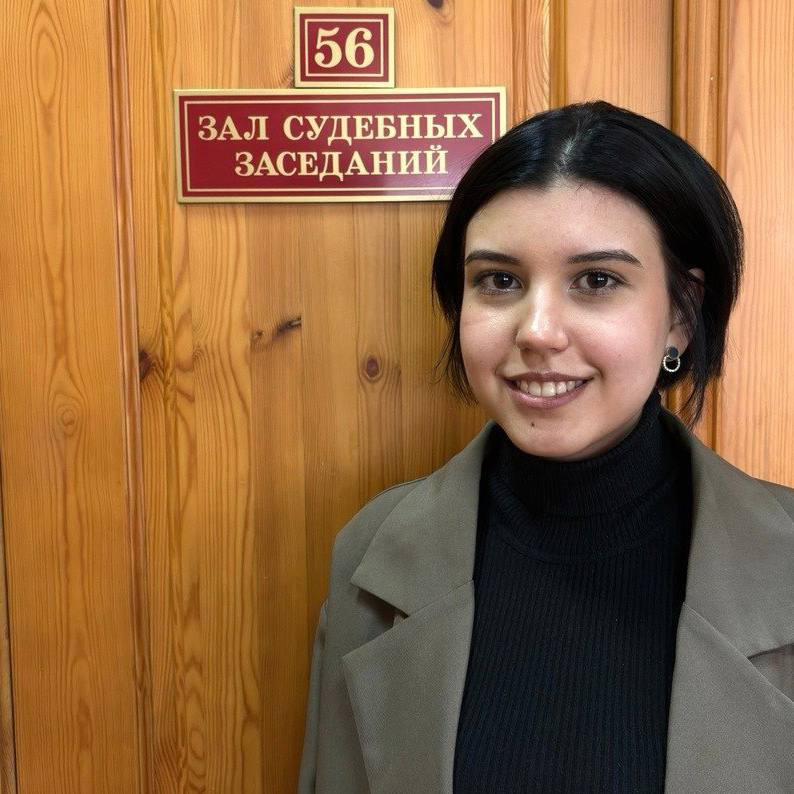
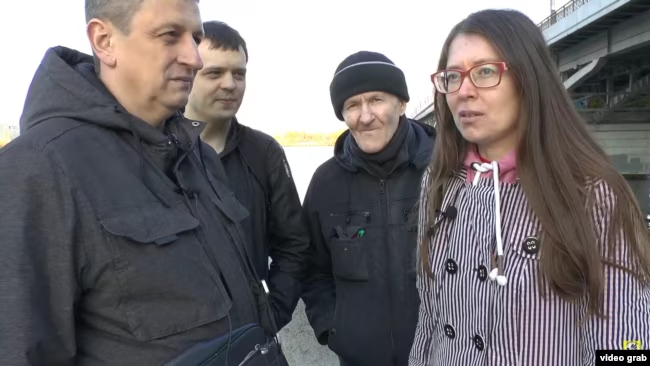
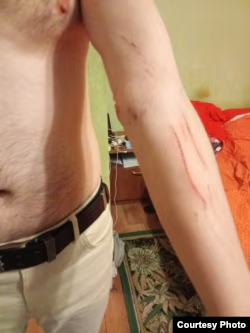
Convicted Russian anti-war activist Andrei Trofimov. Photo: Mr. Trofimov’s Vkontakte page, via Mediazona
In 2023, Andrey Trofimov, an anti-war activist from Tver, was sentenced to ten years in a maximum security penal colony on several charges [to wit, disseminating “fake news” about the Russian army, calling for “extremism,” and attempting to join the Free Russia Legion]. In his closing statement at trial, he called Vladimir Putin a “dickhead” [khuilo] and “heartily endorsed” Ukraine’s attacks on the Crimean Bridge and the Kremlin. This statement was the grounds for the second criminal case against Trofimov, this time on charges of “condoning terrorism” and “defaming the army.”
Today [6 May 2025], Judge Vadim Krasnov of the Second Western District Military Court lengthened Trofimov’s sentence to thirteen years. Prosecutor Andrei Lopata had petitioned the judge to impose a longer sentence of fifteen years.
Before the verdict in his first trial was read out, Trofimov had petitioned the court to impose the maximum penalty. Now he has suggested that he be charged with the more serious offense of high treason, claiming that he has been involved in the information war on the Ukrainian side.
Below, Mediazona has published a slightly abridged version of Trofimov’s statement during oral arguments at the [second] trial.
* * * * *
Your honor, the factual circumstances of my actions, which the investigation has categorized as crimes, are correctly stated in the indictment and have been fully investigated during the court hearing.
In my statement I would like to dwell on the reasons for these actions, on my goals, to review in detail, charge by charge, my response to the allegations—that is, to explain my motives for not pleading guilty. And, in my conclusion, I would like to petition the court as to what to do with me next.
I was living quietly at the dacha with my cats and was a bother to no one. My life changed drastically on 24 February 2022. The reason for both the first criminal case and the current criminal case [against me] was Russia’s invasion of Ukraine. I will further explain why I regarded this event in this way.
I am in prison for what I have said, after all. I took no action in either the first case or the second. But this has been my way of being involved in the events, because it was physically impossible for me to leave the country, and I had no desire to stay silent in this situation. I mean, it is my life.
Why have I done this? I must respond to your remarks yesterday to the effect that my statements, including in court, could harm my own interests. Your honor, I have no interest in a shorter sentence. I am already imprisoned.
What is the purpose of what I am doing? Writ large, it is a matter of self-preservation. It is just that I understand the instinct of self-preservation not as the preservation of the body per se, of its physical health, because I am not my body alone. I want to preserve my conscience in this difficult situation, my ability to tell black from white, and lies from truth, and, quite importantly, my ability to say out loud what I believe to be true.
This thing of mine did not start in 2022. I have always tried to live this way. It is just that my desire to preserve this ability in such situations—meaning, the ability to tell the truth, to maintain my conscience— is what causes such actions.
What actions have we observed? We have witnessed concrete evidence of crimes with which I have not been charged, evidence of the violation of Article 278 of the Russian Federal Criminal Code—that is, the forcible seizure or the forcible retention of power. I am referring to Vladimir Putin, who has held the highest official post in the Russian Federation for exactly a quarter of a century. During this entire time, the Constitution of the Russian Federation has contained the principle of succession of power, set out in the guise of the two-term rule [for Russian presidents]. We have witnessed a direct violation of this rule—that is, the forcible retention of power.
In what has occurred since 24 February, we see concrete evidence of a violation of Criminal Code Article 353—that is, the planning, preparation, unleashing, and waging of a war of aggression.
What have I done in this situation? Publicly, in the mode of a solo picket (just a protracteed one), I have demonstrated the Russian state’s insanity. Look, the prosecution is asking for fifteen years in total—the sentence given for murder, but even for murder, sentences are often shorter. And yet my deeds harmed no one nor caused any damage.
I am not just talking about the period covered by these criminal cases. I have never laid a finger on anyone, never stolen a penny, in my entire life. Nevertheless, [the prosecutor wants to send me down for] fifteen years. I believe that this is a demonstration of the state’s insanity. The state happily displays this quality using me as an example.
What have I done in response? I have shown fortitude. This is vital, because I hope that what I have been doing is seen by Ukrainians. Look at this: they arrested him. He was convicted and given a dozen years of maximum security. Judge the effect in terms of the second case. Did you do a good job of convincing me [of the error of my ways]? That is, have I stopped doing what I was doing? Has my voice become less audible? No, it has not.
We have witnessed the same thing on the military front. For four years running, the Russian state has been spilling blood in a neighboring country. Ukraine has not surrendered and will not surrender.
Among the things that I have not exactly been charged with, but which have been repeated in the indictments and in the evidence presented at trial is my insulting Vladimir Vladimirovich Putin by using the foul word “dickhead.” What have I done? It is called desacralization.
Because the sacredness of supreme power is one of the foundations of the Golden Horde method of governance. When I publicly, repeatedly, and daily, at the first trial, at the second trial, in the pretrial detention center, perform this trick, I am desacralizing Vladimir Putin. This is important, because this regime will end all the same, and I very much want to hasten its end. I hate this man. And what the prosecution says about the “motive of political hatred” is the sacred truth. I can confirm that.
The audience I am addressing by these actions is not in Russia, because Russian society is dead and it is useless to try and talk to it. Ukraine is my audience.
As for the charges against me, I do not plead guilty to either count of violating Criminal Code Article 205.2. At issue is one and the same text, simply posted on the internet and spoken aloud in the pretrial detention center. Because I do not consider the incidents which I chose to include in my closing statement at trial to be “terrorist acts.” I chose them on purpose.
What is at issue are the two attacks on the Crimean Bridge. The Crimean Bridge is a vital transport artery which supplies the Russian federal armed forces in Crimea. An attack on a military installation is an instance of armed hostilities. The attack was carried out by the armed forces of Ukraine.
Why was it categorized as a “terrorist attack”? I know perfectly well why. This was done in order, first, to use it in Russian propaganda to dehumanize the enemy. In other words, the Russian Federation is at war not with the armed forces of Ukraine, which are stipulated under Ukrainian law and are doing their constitutional duty, but with terrorist gangs of “Banderites” and “Ukronazis.” To support this agenda, decisions are made to launch criminal proceedings on charges of “terrorism” over instances of armed conflict.
As for the second incident I mentioned, the attack on the Kremlin on 3 May 2023, what do we know? The communique from the Investigative Committee, which the prosecutor quoted yesterday, states outright that the attack was carried out against the residence of the President of the Russian Federation, who is the commander-in-chief of the Russian federal armed forces. Moreover, the Ukrainians also hit the building of the Senate, which is in the section of the Kremlin closed to tourists and where one of Putin’s offices is actually located. Excuse me, but this was not a terrorist attack. It was a Ukrainian combat operation, and a failed one at that.
I must say loudly and out loud that I do not condone or support terrorism, and that I have never condoned terrorism, nor do I intend to condone terrorism. I have a categorically negative attitude to the ideology and practice of terrorism.
Let us move on to [the charges under] Article 280.3 of the Criminal Code. This article is brand-new: it was adopted after the start of what we call the “special operation.”
This is a pure example of persecution for telling the truth. Because a situation has arisen where it has been necessary to shut the mouths of the war’s opponents, but it is impossible to charge them with violating, say, my beloved Criminal Code Article 207.3. How can you charge a person with “disseminating fake news” if they simply voice their attitude to current events? This is how Article 280.3 and the notion of “defamation” emerged, which is quite poorly conceptualized legally.
I have been told that my phrase “Ukraine is a victim of aggression on the part of the country of Russia” defames the Russian federal armed forces. What do we have? We have the UN General Assembly’s 2014 resolution saying that Russia “annexed” Ukraine. Those are not my words. This is a General Assembly resolution: there is no veto power there [as there is on the UN Security Council], so it was passed by a decent majority [of member states]. This is the position of international law.
Similarly, we have a March 2022 UN General Assembly resolution, in which the events of February 24 are labeled an “aggression.” And we have a UN General Assembly resolution on Russia’s incorporation of the Ukrainian regions of Donetsk, Luhansk, Zaporizhzhya and Kherson which labels these actions “annexation.”
I should note that the statements of, say, Foreign Ministry spokesperson Masha Zakharova are not a source of international law. Statements by Russian Foreign Minister Lavrov are not a source of international law. UN General Assembly resolutions are, on the contrary, a source of international law, and so my assessments are based on international legal documents.
But my phrase about “Putin’s scumbags” is also part of the “defamation” charge against me, of course. First, from your viewpoint, “Putin’s” cannot be defamatory, because as you see it, Putin is good. As for the second word [in the phrase], yes, this is my personal opinion, and it does not apply solely to Russian servicemen who carry out unlawful orders. Yes, there are also people in the Russian armed forces who do not carry out unlawful orders, but they are not the only ones fighting there.
Excuse me for characterizing in this way people who murder the soldiers of a neighboring country for money. This is my personal judgment, and it is based on [their] actions.
I will summarize this part of my statement. The Russian federal constitution contains Article 29, [which guarantees] the right to free speech, including the right to gather and disseminate information. This is what I have actually been doing. That is, I have not overstepped Article 29 of the Constitution by a single millimeter. But at the same time I certainly have violated these two current articles of the Criminal Code.
How can this be the case? It can be the cacse because the articles under which I have been charged are unconstitutional. If Russia had a real Constitutional Court, these articles would have ceased to exist long ago.
I cannot fail to mention my report to Prosecutor Zhuk, which was not part of the charges against me, but nevertheless we heard witnesses talk about it yesterday. It does not contain the text of [my] closing statement [at the first trial]. It makes no mention of terrorism or any violent acts at all. I did not say a word about the armed forces either.
The point is that this second case is the result of my statement to the prosecutor’s commission. Because the case file contains two resolutions by FSB investigator Lieutenant Colonel Sergey Vyacheslavovich Yerofeev to dismiss the case—that is, by the investigator in my [first] case, with whom I have a very good level of mutual understanding and who understands exactly what I have been doing and what I have been trying to achieve. He tried to dismiss this case twice.
In the final part of my statement, I turn to the correct characterization of my actions. I am involved in the war on the Ukrainian side. It just that this involvement takes place without weapons, because war is such an extraordinarily multidimensional event. Apart from the fighting in the steppes of Donbas, in the Black Sea, and in the skies above Ukraine, it is fiercely fought in the information space by state entities, by Russian bodies. On the Ukrainian side, for example, interesting entities are also involved.
I am an information warrior. In what sense? On 9 October 2022, I wrote and sent an email to Ukrainian President Volodymyr Oleksandrovych Zelensky asking him to grant me Ukrainian citizenship. I am entitled to it because of my ancestry. All my grandparents hailed from Ukraine. Ukrainian law says that I have the right to [Ukrainian] citizenship.
I was able to enter a screenshot from Kasparov.ru into the record and have it examined in court. What does it confirm? The fact that, apart from publishing my closing statement at trial, Kasparov.ru has published me on a regular basis. What does this confirm? That what I am being tried for now was, in fact, just an instance of my work, which I have not ceased.
I will also mention, of course, Novaya Gazeta, whose website also published my letters. And my latest achievement in this wise is that I have been officially designated a political prisoner, because that is what I call myself at the pretrial detention center, and that is how I sign my petitions to this honorable court. But it was still a kind of self-designation as it were.
On 14 April of this year, the Council on Political Prisoners of the Memorial International Human Rights Defense Center published a decision[designating me a political prisoner]. As part of my work, I have used the criminal cases [against me], the first and the second case, as publicity opportunities.
The information war is a real thing. I am involved in it, and I am trying to prove this now. Informationally, I support Ukraine and the armed forces of Ukraine. In fact, I have defected to the enemy side in an armed conflict involving the Russian Federation. This is the essence of the crime defined in Article 275 of the Russian Federal Criminal Code—high treason.
I ask the court to send my criminal case back to the prosecutor, as the factual circumstances indicate that there are grounds for charging me with a more serious crime. Try me for treason: I betrayed your deranged state.
* * * * *
Address for letters:
Trofimov Andrei Nikolayevich (born 1966)
141 ul. Bagzhanova, FKU SIZO-1 UFSIN po Tverskoi oblasti
Tver,  Tver Oblast 127081 Russian Federation
You can send letters to Mr. Trofimov and other Russian political prisoners via ZT, F-Pismo, and PrisonMail.online. (The last of these services accepts payments made with non-Russian bank cards.)
As the sun rises on 21 May, marking the Day of Remembrance for the Circassian Genocide, we invite you to listen beyond the silence that often surrounds the wounds of colonialism. In the following article, Bulat Khalilov, co-founder of Ored Recordings – a label dedicated to traditional and post-traditional music from the North Caucasus – reflects on a paradox within Circassian music today: how a culture with rich vocal traditions has, in a sense, sidelined its most distinctive feature, the polyphonic vocal technique of zhiu?
In conjunction with today’s commemorations, Ored Recordings is releasing a compilation, Shopsh: Circassian Vocal Tradition of Zhiu, which highlights the vocal tradition of zhiu as both a form of remembrance and a possibility.
21 May is the Day of Remembrance for Circassians – or, more directly, the Day of the Circassian Genocide.
In 1864, the Russian Empire marked this day as the official end of the Russo-Caucasian War, which had begun over a century earlier in 1763. What Russia celebrated as victory, most Circassians – and many other peoples of the North Caucasus – remember as loss: a brutal war for independence that ended in exile, devastation and what many now call genocide.
That view isn’t fringe. It’s shared by most Circassian historians and civil society voices. To date, only Georgia and Ukraine have officially recognised this as genocide. But across the Circassian diaspora – from Türkiye and Syria to Jordan, the EU and the US – 21 May is marked with acts of remembrance. And yes, those memories echo back home, too – in Adygea, Kabardino-Balkaria and Karachay-Cherkessia.
However, most Circassians in the North Caucasus are suspicious of these gestures, considering them to be opportunistic and insincere. Their refusal to embrace recognition from other states usually stems from a desire to avoid becoming a pawn in a larger geopolitical game.
Officially, the Russian state doesn’t like to talk about any of this. The war itself is treated as taboo, its memory reframed as a tool of Western propaganda or a threat to national unity. And yet, every year, people still gather. From moderates to patriots, from Nalchik to Cherkessk to Maykop, Circassians take to the streets – sometimes quietly, sometimes defiantly.
At Ored Recordings, we return to this trauma again and again – not to dwell, but to listen. To ask how this wound still shapes the way we live, create and imagine. Every year on 21 May, we release a concept album. One year, it’s heroic songs from the war. Another, it’s diaspora voices from Türkiye. Or wartime songs of the 20th century. Each time, we try to trace how our people processed a colonial wound through music, or indeed failed to do so.
This year, we chose to focus on traditional vocal techniques in Circassian music. At first glance, this may seem unrelated. But in truth, every serious conversation about the state of Circassian culture circles back – if not to 1864 itself, then certainly to the long shadow it cast.
This release is a compilation of mostly unpublished recordings. Think of it as a teaser – a warm-up – for future albums. In those upcoming releases, we’ll dive deeper into each performer’s story and the recording context.
This essay – and this release – emerged from a simple question: what’s really going on in Circassian music today?
A big part of the tradition is group singing. Usually it’s men (sometimes women, sometimes mixed groups), gathering to sing. The lead voice carries the main melody, while the others hold a choral drone or a call-and-response. This choral technique is called zhiu or yezhiu.
Like in many cultures, group singing wasn’t just about music – it was a way to be together, to make a space for cultural and social connection.
Most Circassians today learned about this from the elders. From people who sang at weddings and late-night gatherings. Or from those who, as kids, would secretly listen to adults sing into the night. But our main source are still the archives – dusty tapes recorded by Soviet folklorists. Interestingly, the folklorists’ archives have ended up becoming tradition-bearers in their own right.
Academic work on Circassian vocal music – papers, dissertations, theoretical frameworks – has had almost no impact on today’s performers. Music theory and actual practice in Adyghe communities have mostly run on parallel tracks, rarely intersecting.
But the sound itself – those dusty Soviet-era recordings collected by ethnomusicologists – found a way through. Once digitised, they slipped into public circulation (sometimes semi-legally) and became a strange kind of bridge: not from scholar to scholar, but from singer to singer, across generations.
Those old recordings remind us that the song and its lyrics are guardians of language, poetic style and cultural memory. And yezhiu? That’s the secret ingredient. The thing that gives it punch. Soviet musicologists put it nicely: yezhiu helps the song “reach the hearts of the people”.
There’s even a sharp old proverb: “Ежьур уэрэдым и щIопщ” – yezhiu is the whip for the song. It keeps the rhythm. Holds the structure together. Gives the song its shape.
And yet – despite this deep knowledge and respect for vocal technique – modern Circassian music mostly revolves around instruments. Not voices.
So we asked ourselves: how did a whole new wave of Circassian music appear – something unthinkable even ten years ago – and why does almost all of it seem to avoid yezhiu, the central tool of our tradition?
Abkhazia is a country (some would argue an occupied region) with which it is impossible to work without ignoring the political context. It is an unrecognized state that in the 90s separated from Georgia, wanting to gain independence. Independence that came at the cost of war, brutality on both sides, historical trauma and nationalist myths. Most of the international community calls those events the Georgian-Abkhazian conflict, while Abkhazians themselves believe that it was the Patriotic War, singing about the victory in traditional music. Unrecognized, but actual separation from Georgia became possible due to participation of North Caucasian volunteers, and after that, assistance from Russia. Today there are Russian military bases in Abkhazia, so Georgia perceives Abkhazia as an occupied region, although similar thoughts can be voiced on the other side of the Georgian-Abkhazian border.
Given the painful past, ambiguous present and shaky future of Abkhazia, any project with its culture can be perceived as a political statement. Especially if the project is made by a North Caucasian label with residence in Germany and an independent nomadic director. That is why we are happy that we are releasing films 12 years after they were recorded: we had time to think and choose our words.
While filming on Gagra beach, a local TV station caught him for a story titled “Wow, a French filmmaker came in search of a unique culture,” quite typical of regional media in the Caucasus. The journalist then asked Vincent if Abkhazians have well preserved their musical heritage.
[Vincent laid it on thick.]
“It is very bad. You have the most beautiful music, but it is very difficult to talk about its preservation and development. If everything goes on like this, you will lose everything. You need more work.”
This was a very important and thoughtful reaction for us. European attention to Caucasian cultures sometimes perpetuates oriental clichés and deceptively reassures locals: “Europeans are coming to us in search of lost antiquity, so everything is fine. We are still ancient and unique.” In this sense, Vincent’s response was both sobering and provocative. And even total disagreement with the brash Frenchman is also a good option. It’s either work or don’t listen to those who learned about your culture yesterday.
In addition, in interviews, and in general during the course of the project, we said a lot that it was important to document the diversity of Abkhazian music. While we were trying to find the most ancient and ‘authentic’ forms of folklore, Vincent insisted on recording everything from state choirs to late patriotic songs.
Today it seems to us that this is the political and social meaning of the project: to start a living archive with different music from Abkhazia. Music that is not limited to the war for independence and the defense of political freedom before a new ally. Before the 90s, Abkhazians had bright moments in history and battles sung in songs.
Besides, in 2013 we could only meet folklorists, bearers of tradition and rare indifferent officials who were interested in working on the project. Today we are releasing this release with the support of the cultural center SKLAD in Sukhum. It is not enough for young curators and artists to preserve culture and revel in nostalgia. Instead, they are creating a new context. 12 years ago such initiatives were hard to find. Now they are a visible voice of contemporary Abkhazia. Our films and recordings are intended, among other things, to make such voices audible.
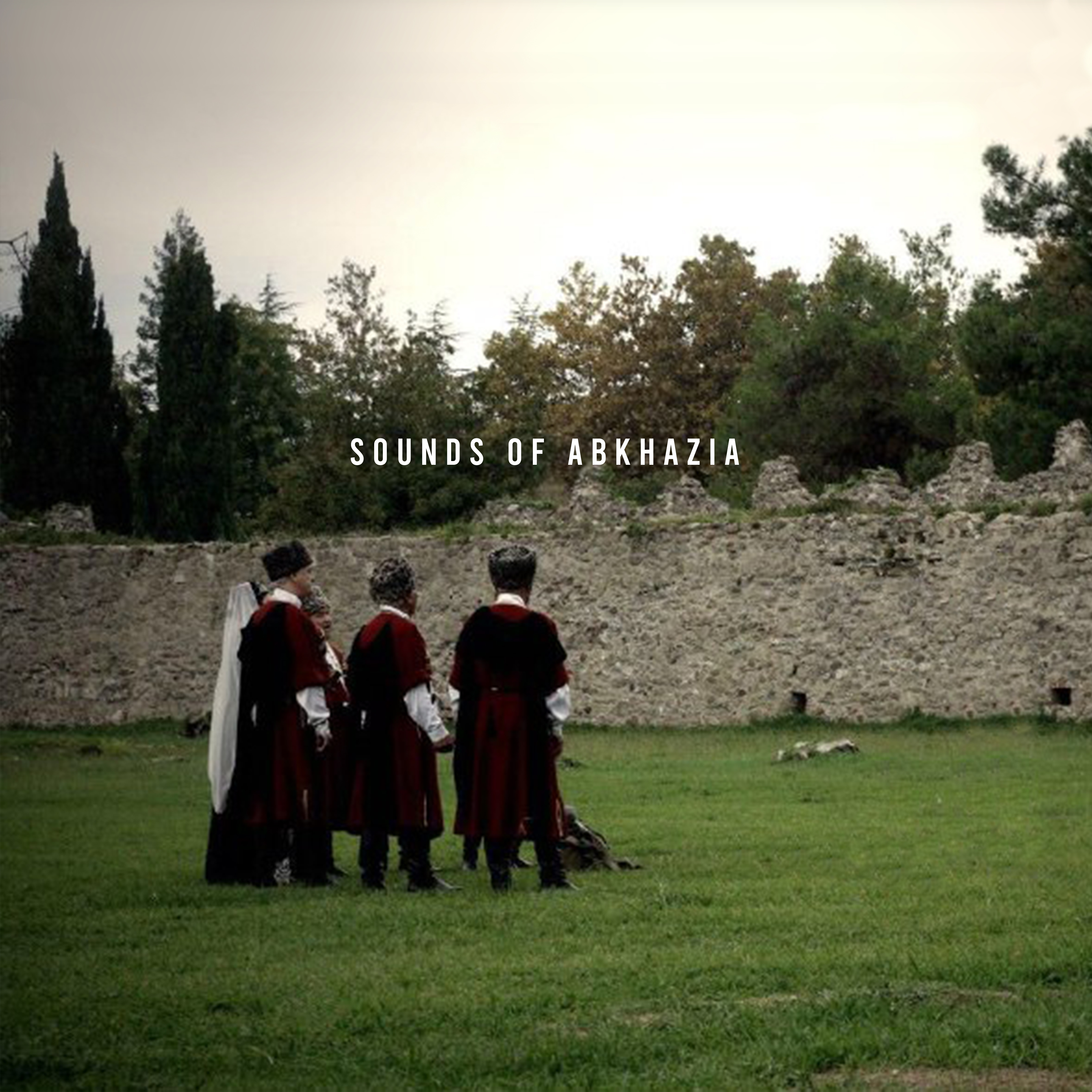
A collection of ten short films recorded in Abkhazia, an independent republic bordering the Black Sea. Filmed by Vincent Moon and produced by Petites Planètes in collaboration with Ored Recordings. Listen to the album on https://oredrecordings.bandcamp.com/album/sounds-of-abkhazia
“When an empire falls, does it make a sound? And who is there to hear it?” – so read the opening line of the call for papers for this issue in October 2021. Looking back at that text from the vantage point of 2025, that sounds far too optimistic and premature. Shortly after that call was published, the empire in question made a whole lot of noise about its unwillingness to stay fallen. The shadow of Russia’s brutal war of conquest in Ukraine hangs over this issue – as it has over any project that deals with the post-Soviet since February 2022 – determining both its shortcomings and, in a perverse way, its urgency.
That the full-scale invasion came to many of us as a shock is the result of complacency and unwillingness to listen to the comparatively quieter rumblings that have been shaking the region over the past two decades. To the fact that the invasion commenced already in 2014 with the occupation of Crimea and Russian military support for separatist forces in Donetsk and Lugansk. To the 2008 week-long war with Georgia that concluded with Russian occupation of the disputed territories of Abkhazia and South Ossetia. To the forceful integration of Belarus into Russia that began as soon as the Belarusian dictator Lukashenka came to power in 1994 and intensified with the establishing of the so-called “Union State” in 1999. Not even to mention the Russian imperial ventures in Africa and the Middle East.
The world refused to listen until the noise became impossible to ignore – the noise of bombs and artillery shells falling on Kyiv, Kharkiv, Mariupol, Odesa, Dnipro, Zaporizhzhia and many more. Yet even these sounds fall on deaf ears far too often: many among the anti-imperialist left, enamored by the platonic ideal of a multi-polar world, seem to prefer listening to Putin’s propaganda, just as many left-leaning intellectuals were similarly entranced by Soviet propaganda during the Cold War. And many across the political spectrum – including the sitting US president – who campaign against military aid to Ukraine seem to prefer the comfortable silence of subjugation to the noisy cacophony of resistance.
What, then, can a niche academic publication on sound(s) from the post-Soviet realm – in itself a controversial designation tinged with colonial history – hope to achieve? Especially one edited by a Russian-Jewish academic based in Western Europe, with all the problematic positionality this brings? Perhaps nothing. Or perhaps, the promise of a sonic epistemology long held as a keystone of sound studies – that of attuning and entangling oneself with the object of listening as opposed to holding it in a distancing gaze – could be fulfilled at least to some extent here, opening some ears and minds to the politics of the region.
In the video installation Repeat after Me by the Ukrainian artist collective Open Group – arguably the most important sound artwork of this decade and the centerpiece of the last Venice biennale – Ukrainian war refugees recount their experiences of the invasion while recreating its soundscape with their voices: the sounds of shelling, explosions, war planes and drones, air raid sirens, etc. A row of microphones in front of the screen and onomatopoeic subtitles in the video invite the public to join in and voice those sounds in karaoke fashion as a “gesture of togetherness” (Keylin 2023: 128). The playful format allows participants to empathize with the refugees’ traumatic experiences from the safe distance of Verfremdung (estrangement), while making them acutely aware of the very safety and distance that they enjoy. In this way, Repeat after Me attunes the audience both to the (sonic) reality of the war and to their own positionality.
Hence, the aspiration of this issue: to make the post-Soviet realm audible – not as a continuous, homogenous soundscape far too often conflated with Russia, but as a cacophony – decidedly not a symphony – of diverse cultures, identities, aesthetics, and political programs; to sound out both the connections that gave the Second World its identity against the First and Third ones and the contradictions that made it fall apart. In the hope that listening – from a safe distance – to the sounds of the post-Soviet realm can attune the reader’s ear to the voices coming from it.
A multitude of limitations – some fundamental, some situational – work against this aspiration. First, the diversity of sound cultures and the complexity of political relationships within the post-Soviet space are far too vast to address comprehensively in any single publication. Second, the discipline of sound studies has only begun to establish itself in the region over the past decade, often lacking institutional support and publication venues. Moreover, much of this emerging discourse, especially in Russia, orients itself more towards Western academic scholarship than towards the post-Soviet realm and its own sound practices (e.g., the History of Sound book series at the New Literary Observer press, which in large part consists of translations of key anglophone works). One important exception that has to be mentioned here is the 2018 multilingual special issue of the Topos journal, P.S. Soundscapes,edited by Benjamin Cope and Pavel Niakhayeuand dedicated to sound and music in contemporary Eastern Europe. All of this greatly limits the pool of potential authors for this issue, to the extent that half of the texts included here are written by Western scholars. Finally, the war itself had an obvious impact, delaying this issue by over two years and leading several prospective authors, particularly those hailing from the post-Soviet realm itself, to withdraw their texts. Not a perfect issue, then, but hopefully still capable of opening the space for a dialogue.
Listening to the Subaltern Empire
Despite recent post- and decolonial turns in sound studies that shift focus away from Eurocentrism and acknowledge the global diversity of sounding and listening practices, the post-Soviet space remains largely a sonic terra incognita. The few exceptions that prove the rule include the sound experiments of the Soviet avantgarde – owing to Andrey Smirnov’s monumental study Sound in Z (the title’s correspondence to the current Russian military symbol is an unfortunate prophetic coincidence) – and the overtone singing traditions of the Far East. However, the academic attention that both these phenomena received does not stem from any specific interest in the region, but from their attachment to more famous “brands”: the historical avantgarde and Tibetan spirituality respectively.
The post-Soviet world falls into the cracks between the Global North and the Global South, persistently absent from the sonic maps of either realm. It tests the limits of post- and decolonial frameworks, which were largely developed to address the relationships between European empires and their overseas colonies. Political scientist Viatcheslav Morozov describes Russia’s peculiar position in this coordinate system as a “subaltern empire” that, “while remaining a sovereign state,” has “colonized the country on behalf of the global capitalist core” (Morozov 2015: 32) into which it was integrated on unequal, subordinate terms. As a result, Russian political consciousness is built on an unsolvable paradox of holding in suspension Eurocentrism and Euroscepticism: the aspiration to be an equal part of the Global North and the resistance to its cultural influence. In a twist of fate that the academic community still struggles to wrap their heads around, Morozov was arrested in January 2024 in Estonia and later plead guilty to spying for Russia. Although this fact may cast a shadow on Morozov’s academic work, the notion of the subaltern empire has been crucial to the postcolonial discourse on the post-Soviet realm.
In his influential – if controversial – book Internal Colonization, cultural historian Alexander Etkind similarly approaches the Russian imperial project as one of self-colonization that inevitably results in self-othering. “The state was engaged in the colonization of foreign territories and it was also concerned with colonizing the heartlands,” he argues, leading “peoples of the Empire, including the Russians” to develop “anti-imperial, nationalist ideas in response” (Etkind 2011: 2). Etkind’s work was rightfully criticized (as I will discuss below) for sidestepping Russia’s actual colonial conquests – its subjugation of Siberia, Caucasus, East Asia, or Belarus and Ukraine – and its colonial subjects. It is, however, notable for pointing out the “reversed, internal orientalism” (Etkind 2011: 16) suffusing modern Russian culture – one that simultaneously construes Russia itself as a colonial other to the enlightened West and conceives a colonial other within Russia in the form of its uneducated and uncivilized narod (a word that literally means “people”, but more often than not is used to denote peasants and commoners).
Two articles in this issue demonstrate how this contradictory mentality unfolded in the experimental music and sound art scene in 1980s Saint Petersburg, a city originally designed as a flagship for the Europeanization of Russia, but which came to be known in the twenty-first century as a hub of Russian nationalism and fascism. Giada Dalla Bonta’s article “Sounding the dissolution from a Cosmic Space” introduces the universalist trend typified by the electronic music duo New Composers, Valeriy Alakhov and Igor Verichev. Bridging avantgarde legacies and rave culture, the pair’s work was informed, on the one hand, by the avantgarde concept of vsyochestvo (from the root vsyo – “all, everything” – and the suffix combination -chestvo that typically refers to “practice”), of an inter- and postmedia approach to art taken to extremes. On the other hand, their work was rooted, in the holistic worldview of Russian Cosmist philosophy, rhymed with the everyday mythology of the Soviet space program. Dalla Bonta’s article pursues two lines of inquiry: first, it reassesses the role and influence of sonic practices on the late Soviet underground art. Second, it examines the New Composers’ idiosyncratic blend of aesthetics and philosophies through the lens of Kodwo Eshun’s notion of sonic fiction (1999) and Jean-Luc Nancy’s relational theory of sound (2007), revealing how they expressed a politics of togetherness characteristic of late Soviet underground culture.
New Composers, “Exactly Today and Exactly Now” (1989)
Dalla Bonta acknowledges an ostensibly paradoxical ideological shift towards conservatism and nationalism in the underground art scene following the dissolution of the Soviet Union but purposefully limits the timeframe of her account to the 1980s to focus on liberatory impulses in the New Composers’ early work. Conversely, Sam Riley’s article “A Butterfly Akin to a Bird: Imagining New Jazz in Leningrad” examines how the roots of this shift can be found already in the late Soviet period. The text focuses on two other emblematic figures of underground sonic experimentalism: composer and pianist Sergey Kuryokhin and critic Efim Barban. Through a reading of Barban’s book Black Music, White Freedom, which initially circulated in Samizdat and laid the theoretical foundations for the late Soviet experimental music scene, Riley explicates the racism inherent in Barban’s theory and Kuryokhin’s practice as they strived to disentangle jazz from its Black American origins, formulating a purportedly superior Soviet-Eurocentric “new jazz” idiom. The late Soviet sonic underground thus aligned with progressive and conservative trends simultaneously: both emancipatory – in resisting the authoritarian state and its ideology – and reactionary – in reinforcing the Eurocentric cultural hegemony under the guise of Enlightenment-style universalism.
Belliphonic Relationalities
The principal critique of the theory of Russia’s self-colonization, as presented in Etkind’s work, addresses two fundamental issues. The first concerns how its focus on internal colonization obscures the external conquests of the Russian Empire. The second, more insidious issue relates to what exactly is construed as the internal territory being self-colonized. As literary scholar Vitaly Chernetsky points out, “in his argument about Russia’s internal colonization, […] Etkind’s frame of reference is constituted by the events that took place and the phenomena that existed in Ukrainian and Belarusian territory. Thereby Etkind perpetuates the aspects of Russian colonialist ideology that he apparently internalized to an extent that makes them invisible to him” (Chernetsky 2007: 43). Etkind’s blind spot is indicative of a key characteristic of the Russian imperialist mentality: an unselfconscious refusal to see Ukrainians and Belarusians as anything other than inferior Russians. The lack of racial difference between these peoples is weaponized to conceal the reality of colonial difference. This denial of self-determination undoubtedly drives much of Russia’s expansionist politics: the forceful integration of Belarus and the violent invasion in Ukraine – clear attempts to replay the history of the not-so-internal colonization. In this context, it would hardly be controversial to say that the three texts dedicated to the current political soundscapes of these two countries, as they are conditioned by Russian aggression, form the core of this special issue.
In “Warbound: Collective Audio Streaming from Ukraine,” Olya Zikrata directly addresses the sonic dimension of the ongoing Russian invasion in Ukraine and the Ukrainian resistance. Her article revolves around the 2022 project Listen Live consisting of five online broadcasts by sound artists from different parts of Ukraine that together weave a multifaceted soundscape of living in the middle of a violent invasion. Building on – but also challenging – J. Martin Daughtry’s notion of “belliphonic” as the agglomeration of war-related sounds (2015), Zikrata argues that the sonic experience of the war in Ukraine is not reducible to a catalogue of explosions and sirens but rather includes the totality of acoustic environments affected and effected by the invasion. In stark contrast to the sound design of war movies, the streams of Listen Live focus on the quieter aspects of war: the digging of trenches, the life in frontline cities in between bombings, the refugee experience in western Ukraine. Zikrata approaches them as acts of acoustic witnessing, a “collectively developed sonic intelligence,” revealing the situated relationalities that bind together the land and its human and non-human inhabitants living through the invasion.
The themes of witnessing, testimony, and acoustic relationality also suffuse my interview with Sashko Protyah, an independent filmmaker from war-torn Mariupol, as he reflects on the past 15 years of his career. His early influences, including experimental music and sound poetry, shaped his affinity for sound as compositional material rather than mere accompaniment to visuals, which has resulted in a number of collaborations with experimental musicians, sound artists, and beatboxers. The evolution of Protyah’s artistic trajectory took him from playful absurdism to politicized documentary storytelling, underscoring an approach to sound and cinema as tools for reflection and resistance, gaining a particular urgency under the condition of war.
Finally, Pavel Niakhayeu’s article (bordering on a short monograph in its breadth and detail) “Voices, Noises, and Silence in the Political Soundscape of Belarus” is a meticulous sonic ethnography of Belarusian political life, covering the period from 2020 to 2023. The 2020 election, in which the dictator Alyaxandr Lukashenka once again fraudulently declared himself the winner, catalyzed a peaceful protest movement. It quickly became the largest protest in modern Belarusian history before being violently quelled with Russian backing, forcing protesters into hiding or emigration. Combining field recordings and soundwalks, sociological interviews and media analysis, Niakhayeu’s article documents how these phases unfolded in the acoustic dimension: from the political soundscapes of the protest itself – suffused by poetry, folk songs, and the sound of Belarusian language – to the “sonic violence continuum” of the authoritarian state’s reaction and the silence(s) that followed. These soundscapes may also be called belliphonic – both in the sense of Putin using Belarus as a launching site for his attack on Ukraine, and in the sense of Belarus itself being the object of a hybrid warfare of sorts.
Soundscapes of the “South of the Poor North”
Whereas Russian imperialism in Ukraine and Belarus was (and is) driven by the ostensible non-distinction of their peoples, other forms of Russian colonial conquest relied on familiar constructions of the racialized colonial other. One of the critiques levied at Etkind by the decolonial theorist Madina Tlostanova is that, in his focus on the internal, self-othering Orientalism of the Russian elites, he fails to notice the more obvious, outward Orientalism “directed against Russia’s South – the Caucasus, and its Orient – Central Asia” (Tlostanova 2014: n.p.). A linguistic quirk that would be amusing if not for the oppression that it represents: While in English, the term “Caucasian” connotes “white,” in (post-)Soviet vernacular Russian, “Caucasian” (kavkazets – formed from the bureaucratese “person of Caucasian ethnicity”) is a term of racialization and othering, coding the members (or presumed members) of any of the diverse Caucasian nations as decidedly non-white.
Tlostanova’s own theory proposes that the post-Soviet realm neither fits within nor breaks off from the colonial North-South dichotomy, but rather mirrors and complicates it. She conceptualizes Russia as “the poor North,” separated from the global (rich) North by imperial difference, as well as from its own “South of the poor North,” by colonial difference (Tlostanova 2011). The “imperial difference […] refers to various losers that failed to succeed in or were prevented by different circumstances and powers from fulfilling their imperial mission in modernity. These losers took second-class places and became intellectually, epistemically or culturally colonized by the winners” (Tlostanova 2011: 71). Consequently,
Russia projected its own inferiority complexes onto its non-European colonies in the Caucasus and Central Asia through its self-proclaimed modernizer and civilizer role. The Russian colonies either felt the double dictate of coloniality of knowledge in its modern Western and Russian/Soviet versions, or, regarding themselves as standing higher on the human scale (within the same Western modern epistemic system, grounded in taxonomizing people into those who have the right and the ability to produce knowledge and those who are doomed to act as objects of study and consumers of theories produced in the West) than the Russian subaltern empire, have refused its dictate and negated its epistemic authority, choosing a direct European influence instead and dreaming to become at some point fully integrated. (Tlostanova 2015: 47)
Brian Fairley addresses the sonic experience of such a paradoxical positionality through the example of Georgian Orthodox chant in his article “Singing at Your Own Funeral: Overdubbed Intimacy and the Persistence of Tradition in Soviet Georgia.” Counted among the oldest Christian denominations in the world, the Georgian Orthodox Church was first subordinated to the Moscow Patriarchate following the integration of Georgia into the Russian Empire, then persecuted and all but banned (along with all other religious practices) under Soviet rule. Fairley discusses amateur tape recordings of Georgian requiem chants made in the 1960s by the singer Artem Erkomaishvili, which were later played at his own funeral. The article weaves together the sonic history of Georgian indigenous musical culture under colonial rule and the media history of anti-Soviet dissent. Fairley likens Erkomaishvili’s recordings to magnitizdat, a dissident practice by which censored music – most often rock music bootlegged from the West – found unofficial circulation in amateur tape recordings. This case study thus exemplifies the complex entanglement of contradictory indigenous, Soviet, and Western vectors characteristic of the sound cultures in “the South of the poor North.”
Tlostanova does not make a principal distinction between the imperial projects of tsarist Russia and the Soviet Union. This position, however, is not universally shared, particularly among historians of Central Asia. Adeeb Khalid, for example, argues that the Soviet project consisted in “homogeniz[ing] populations in order to attain universal goals” (Khalid 2006: 233), a strategy associated with the modern state rather than a colonial one, which would conventionally be built on perpetuating difference. Historian Botakoz Kassymbekova, on the other hand, points to the futility of classifying the USSR as either a modern state or a colonial empire, as its “cultural policies […] were contradictory and entailed elements of both modern(izing) and colonial rule […] Blurring boundaries between imperialism and socialism, colonialism and state building, the Soviet political design combined ideas and mechanisms of liberation and oppression, universalism and difference” (Kassymbekova 2016: 15, 17). Pointing out that most Central Asian societies have never thought of themselves as colonized or postcolonial, ethnographer Sergei Abashin similarly suggests that the culture and politics of the region are better described as a complex and site-specific entanglement of local and metropolitan forces that act at times in accord and at times in conflict with each other (Abashin 2015: 44).
In my interview with the Kazakhstani “imaginary art institution” Krëlex zentre, its members Ruthia Jenrbekova and Maria Vilkovisky discuss how such localities facilitate highly idiosyncratic sonic idioms that can be described as a kind of creole. The duo lists among their influences Soviet radio, Western classical and experimental music, punk, electronica and techno, and the soundscapes of Almaty’s industrial suburbs, all of which coalesce into an equally eclectic practice incorporating sound poetry, experimental theatre, and installation art, among many other things. They describe themselves as pirates, plundering the global cultural archive in order to challenge the ethnicization and genderization of artistic identities.
Finally, Phoebe Robertson’s article “The Chanting Flute: Uncovering Russian Orthodox and Shamanic Sounds in Sofia Gubaidulina’s …The Deceitful Face of Hope and of Despair (2005)” traces a similar creole-esque aesthetic in the works of the late Sofia Gubaidulina. Of Tatar ancestry and Russian Orthodox faith, working in the European New Music paradigm, and hailed as the most important Russian composer of the past century, Gubaidulina exemplifies the contradictions that permeate the sound cultures of the post-Soviet realm. Robertson examines how the composer brings together musical references from Russian Orthodox and Siberian shamanic chants within the European concerto genre – an act that in other contexts could amount to cultural appropriation. In the post-Soviet context, however, both the eastward and westward cultural vectors point to a shared history of repression and dissent, one that Gubaidulina’s work highlights.
The eight diverse texts collected in this special issue throw into sharp relief a point I made in passing in the opening section: that the (post-)Soviet is emphatically not a symphony. The region’s political and cultural history is one of contradictions, holding many familiar dichotomies – of the East and the West, the progressive and the reactionary, the colonial and the emancipatory – in a superposition, a dissonant cluster defying harmonic resolution. (Post-)Soviet sound thus demands a mode of listening that is attuned to these contradictions and that attends to the region not as a monolithic soundscape but as a collection of idiosyncratic localities, each resonating their own sets of frequencies.
References
Abashin, Sergey (2015). The Soviet Kishlak: Between Colonialism and Modernization [Советский кишлак: между колониализмом и модернизацией]. Moscow: New Literary Observer.
Chernetsky, Vitaly (2007). Mapping Postcommunist Cultures: Russia and Ukraine in the Context of Globalization. Montreal: McGill-Queen’s Press.
This is a single release of the song “Hand in the Air,” which is the first track on our forthcoming sixth album, Goodbye Work (2025).
This song is an ode to the nerdy child who raises their hand when the teacher asks a question in class. An impressionistic, autobiographical song about the awkward years in junior high.
The picture in the window Lights up from behind The richer is the meadow That we seek but fail to find
chorus: Was it you Was it you Was it you On the landing? (Too demanding?)
Was it you Was it you Was it you With your hand in the air?
The poster isn’t yellow Maybe orange, maybe green When a man starts to bellow One makes sure not to be seen
A chair in the corner To pretend to try to hide A face getting warmer So it turns to the other side ______________________
Rosie Harris: lead vocals Sumanth Gopinath: backing vocals, acoustic guitar, Hammond organ Beth Hartman: backing vocals, egg shaker Cody Johnson: bass guitar Nate Knutson: electric guitars Paul Hatlelid: drums
music by The Gated Community, lyrics by Sumanth Gopinath
Much beloved Minnesota Americana band The Gated Community celebrate the release of their sixth full-length studio album, Goodbye Work! Special guests acclaimed musicians Rich Mattson and Germaine Gemberling (aka “Rich and Germaine”) of Rich Mattson and the Northstars open the night.
The Gated Community is an Americana band with a nearly twenty-year history. Formed in 2006 in Minneapolis’s storied West Bank neighborhood, the band is known for its gripping original songs, beautiful vocal harmonies, and multiple lead singers. Led by South Asian American singer/songwriter Sumanth Gopinath (aka Sonny), the band’s music is eclectic in style, encompassing country, folk, bluegrass, and rock. Born in Chicago and raised in Louisiana, Gopinath relocated to the Twin Cities in 2005, after stints in Texas and Connecticut.
Current members have been in the band for a decade or more. Their lineup includes Sumanth Gopinath (acoustic guitar), Rosie Harris (banjo), Beth Hartman (percussion), Paul Hatlelid (drums), Cody Johnson (bass), and Nate Knutson (electric guitar). Everyone in the band sings lead and plays multiple instruments. They perform in a range of configurations, including as small as a duo or trio.
The Gated Community is thrilled to hold this album release show at The Parkway Theater. After placing in the venue’s first-ever “Battle of the Bluegrass Bands” in 2019, the band later headlined The Parkway that same year. Six years and a global pandemic later, the band returns again to the theater with renewed energy and purpose amid the chaos of the present.
The Holy Bible (1994) was a remarkably coherent and thoughtful, if violent and unreasonable protest against the ‘end of history’ that had been declared a couple of years earlier – theirs was the 1994 of Srebrenica and Rwanda, not of Fukuyama or Anthony Giddens. Musically, while hardly avantgarde, The Holy Bible had a newly acquired postpunk angularity and a disdain for the American marketplace. Subjects were political (‘Revol’, a bizarre song speculating on the sex lives of Soviet leaders), historical (two songs about the Holocaust, hugely ill-advised in theory but surprisingly tactful in practice), or concerned different forms of personal collapse, told in the first-person, as in the staccato, self-undermining assertions of ‘Faster’, or ventriloquised through female narrators, such as the depressive sex worker of ‘Yes’ and the anorexic teenager of the exceptionally disturbing ‘4st 7lb’.
Manic Street Preachers, The Holy Bible (1994)
These songs asserted physical and intellectual self-control to the point of psychosis, as a means of armouring the self against a terrifying and repugnant outside world. The Holy Bible is striking not just for Jones’s and, especially, Edwards’s punishingly moralistic and sometimes surreal lyrics, but for the fact that Bradfield and Moore were able to crowbar them into rock anthems, of a sort. The results can still send shivers up the spine, as when the brutal, unforgiving words of the disgust-filled, misanthropic ‘Of Walking Abortion’, or ‘Archives of Pain’, a Foucault-inverting paean to the guillotine, are bellowed as stadium rock choruses. In these songs Bradfield didn’t sing so much as ‘bark phonemes’, as Tom Ewing put it of the breathtaking ‘Faster’. Bradfield had managed to turn the amusicality of his two lyricists into a virtue, and ‘I am an architect; they call me a butcher’ into my personal favourite first line of a rock single.
It was an incredible performance, bearing no apparent resemblance to what the Manics had originally aimed to do – this wasn’t selling sixteen million copies in any lifetime – but there was no failure, now. The Manics had set out, to quote a Ballard interview sampled midway through the album, to ‘rub the human face in its own vomit, and then force it to look in the mirror’, and that’s what they did. There is still nothing in rock music quite like it, and it was practically impossible to follow.
Aotearoa singer/songwriter Marlon Williams (Kāi Tahu, Ngāi Tai) performs an intimate concert to a small group of fans at the RNZ studio to celebrating 20 years of NZ Live on RNZ National. Marlon performs five tracks and chats to RNZ’s Jesse Mulligan about making his fourth solo album, ‘Te Whare Tīwekaweka’ and the process of songwriting in te reo Māori. […] Tracks as they appear in the session:
Watch Ambika Mod read from Heart Lamp, the #InternationalBooker2025-shortlisted novel written by Banu Mushtaq and translated by Deepa Bhasthi. In twelve stories, Heart Lamp exquisitely captures the everyday lives of women and girls in Muslim communities in southern India. In the titular story, Mehrun, a young mother, despairs at the way her life has unfolded.
Filmación de los históricos conciertos en el Estadio Nacional que marcaron el retorno triunfal de Los Prisioneros después de casi 10 años de separación. Grabado los días 30 de noviembre y 1 de diciembre de 2001.
A recording of birdsong made in the late afternoon of 30 April 2025 at George Washington Park in Pacific Grove, California, by Comrade Koganzon using the Merlin Bird ID app. The following birds can be heard on this recording: Hutton’s vireo, oak titmouse, yellow-rumped warbler, American crow, lesser goldfinch, acorn woodpecker, bushtit, American robin, dark-eyed junco, California towhee, Anna’s hummingbird, chestnut-backed chickadee, house finch, spotted towhee, and song sparrow. ||| TRR
Future History of Earth’s Birds
Amie Whittemore
—after Alexander Lumans and Jennifer Ackerman
Among them, a common language of alarm.
Also, rapture.
Know that when zebra finches felt the first pinch of climate change, they chirped to their offspring, still shelled, to warn, to insist, they hatch smaller and fiercer. Dawn’s chorus is a peace-making operation. The birds with the biggest eyes sing first. Thus light is the first part of song.
Some birds create barriers of pinging notes—golden bells dangling
in the air, alarms and warnings. Does it matter
what kind of birds did this? They’re all dead now.
In bird language, there’s a call for mobbing, a call for fleeing.
To avoid danger, sometimes you must approach it.
In the shell, a bird recognizes its parents’ voices. In love, mates sing duets they invent together. On death, the survivor must learn a new tune.
There are such things as universal truths.
Some kites drop fire onto the earth to scare up dinner. Some kites,
dropping fire, taught humans their first warm meal.
Neither ice nor snow lived long enough to hear the last bird sing—just wind,
which carried those notes as far as it could before they slipped from its palms—
There is a common language of alarm.
Source: poets.org. Originally published in Poem-a-Day on May 11, 2025, by the Academy of American Poets.
On Friday, May ninth, Treptow Park was perhaps the most heavily guarded place in Berlin. Hundreds of police officers kept the peace at Germany’s most famous memorial to Soviet soldiers on the day Russia marked the eightieth anniversary of the end of the Second World War in Europe, known as the Great Patriotic War in the Soviet tradition. Because Russia has employed symbols of that earlier war in its current war against Ukraine, visitors were banned from displaying or wearing Soviet and Russian flags, military uniforms, and St George’s ribbons at the Berlin memorial this year. An exception was made for veterans and diplomats.
Soviet May ninth traditions and German pacifists
At about half past ten in the morning, a wreath was laid at the monument to the Soviet soldier by Russia’s ambassador to Germany, Sergei Nechayev. The day before, when Germany remembered the Wehrmacht’s surrender and the end of the war, Nechayev and the Belarusian ambassador were not invited to the memorial event at the Bundestag. In his speech, German President Frank-Walter Steinmeier thanked the Allies for liberating his country and recalled the Red Army’s sacrifices, but harshly criticized Russian attempts to justify the war in Ukraine in terms of the fight against the Nazis in the Second World War.
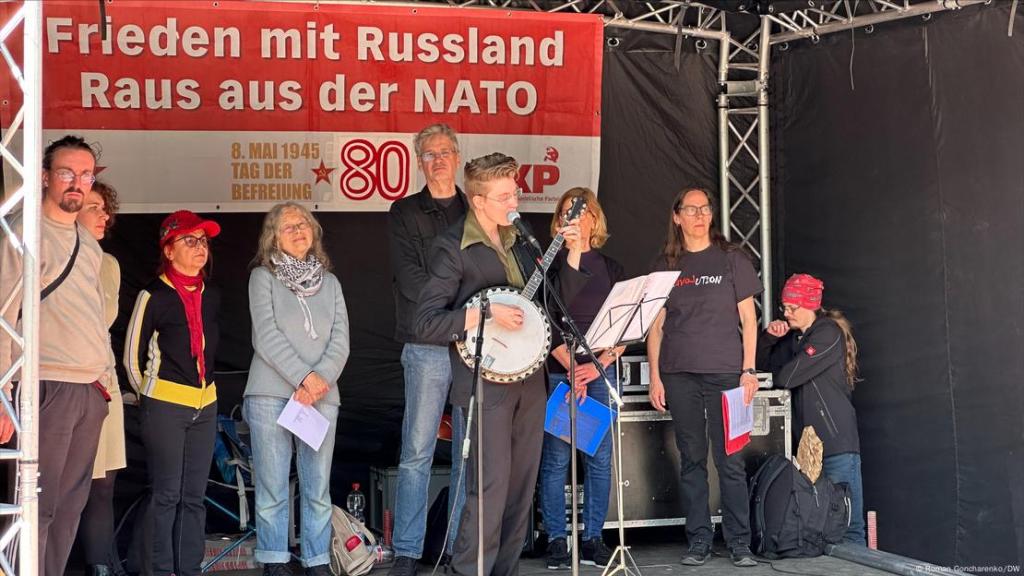
The flood of people in Treptow Park seemed endless: hundreds were there at any one time, and thousands came and went over the course of the day. Many brought scarlet carnations, while some bore wreaths. Russian and German were heard. Most of the visitors were elderly—immigrants from the former USSR living in Germany and Germans. There were also many leftist and ultra-leftist German political activists brandishing placards opposing NATO and calling for “peace with Russia.”
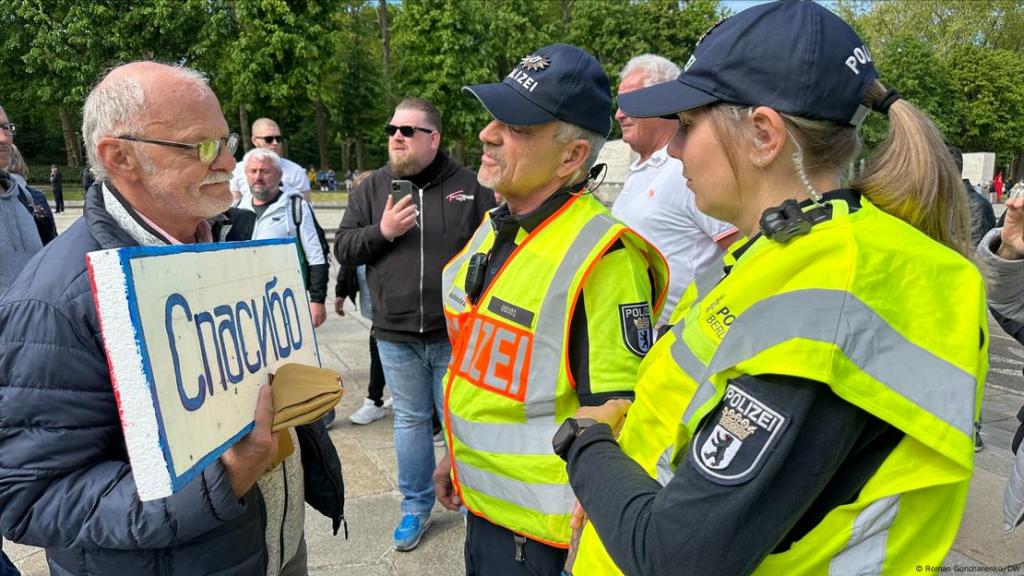
German ultra-leftists rally for “peace with Russia” and Germany’s exit from NATO, 9 May 2025. Photo: Roman Goncharenko/Deutsche Welle
Against this backdrop, the scene resembled a mixture of a traditional Russian May ninth celebration and a political protest by German pacifists, many of whom had clearly lived most of their lives in the GDR.
“I was a policeman in the GDR,” said a man in his sixties who held a placard that read “Thank you” in Russian. The policemen asked him to doff his Soviet cap, which sported a red star and a St. George’s ribbon.
“All people want peace, so the politicians should don their own military uniforms and crawl into the trenches,’ the man said.
Soviet wartime songs sounded from loudspeakers and were played live. One man, aged forty-five, climbed atop a mound to get a better view, but a policeman asked him to get off the lawn, explaining, “This is a grave.” The man cursed in Russian but climbed off the mound.
Another man played played “Arise, Great Country” on his clarinet. When he began quietly playing the melody of the Soviet and Russian national anthem, the police literally took him aside, after which he returned to the group of people who had gathered. They were outraged at the restrictions that had been adopted. From time to time, someone chanted “Russia, Russia!” and many other people would join in.
An ex-East German police office (holding a sign that says “Thanks!” in Russian): “All people want peace.” Photo: Roman Goncharenko/Deutsche Welle
Bikers in Treptow Park
Your correspondent saw men and a woman in leather jackets who looked like bikers from the Russian motorcycle gang Night Wolves. They were in small groups and were escorted by a large number of police officers. They posed for pictures in front of the wreaths and left. They could have been someone from a local “support group.” The Berlin press had written that only a small group of bikers made the trip to Berlin to visit the Soviet memorials this year. No incidents had been reported as this article went to press.
Treptow Park, 9 May 2025. The crimson and gold banners at the back of the crowd are inscribed with the names of the various “fronts” in the Red Army’s campaign against the Wehrmacht. Photo: Roman Goncharenko/Deutsche Welle
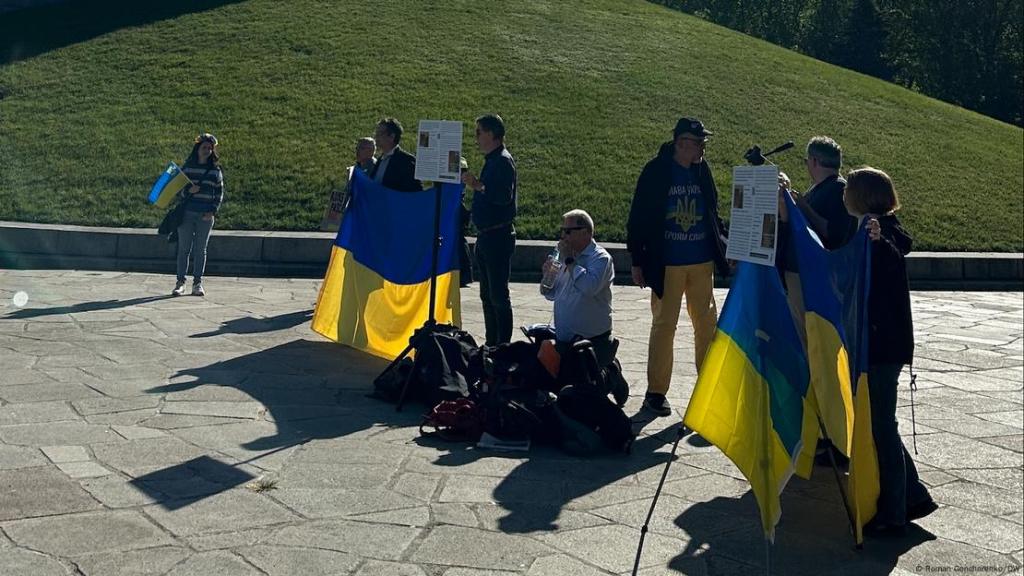
For the first half of the day, at least, things seemed relatively calm. Your correspondent had the impression that most people had come to Treptow Park not for political reasons, but to commemorate the war. And yet the atmosphere was tense. To the right and left of the monument to the Soviet warrior stood a dozen and a half activists holding placards and the flags of Ukraine and NATO.
Activists with placards and Ukrainian flags at the monument to Soviet soldiers in Treptow Park, 9 May 2025. Photo: Roman Goncharenko/Deutsche Welle
They said they wanted to draw attention to the Ukrainian Red Army soldiers who had perished in the Second World War, as well as to Russia’s war against Ukraine.
“I am here to prevent this event from being turned into a Russian propaganda stunt,” said a woman, aged thirty-five. According to her, insults had been hurled at her and the pro-Ukrainian activists.
“Some people regard our presence here as a provocation,” said the woman. “We are not here to change anyone’s mind, but to make Ukraine visible.”
One of their posters read: “Russia has usurped the memory of May eighth and ninth. But it was not Russia who liberated us from the yoke of National Socialism eighty years ago in Berlin. It was the Red Army, in whose ranks many Ukrainians served.”
The poster tells the story of Ukrainian soldier Fyodor Karpenko, who left his name on the walls of the destroyed Reichstag building in May 1945.
Since the Maidan uprising and Russia’s illegal annexation of Crimea in 2014, Kremlin propaganda has consistently portrayed Ukrainian leaders as Nazis or fascists. Russia also accused the Ukrainian authorities of “genocide” of the population of Donbass. On 24 February 2022, while announcing the full-scale invasion, the “denazification” of Ukraine was presented as the primary goal of the war, which is itself portrayed merely as a continuation of the Great Patriotic War: a conflict embedded in a cyclical conception of time in which Russia, eternally under threat from a Western enemy, fights for its very survival — on Ukrainian soil.
On the ground, there is no evidence to support Moscow’s accusations: nobody has ever documented a “genocide” against ethnic Russians or Russian speakers, whether in Ukraine or elsewhere. As for the Ukrainian far-right, its political influence remains minimal: in the 2019 parliamentary elections, the main ultra-nationalist parties, running together on a joint list, received just over 2% of the vote, well below the threshold required to enter Parliament. In short, the image of a “Nazi regime” in Kyiv is based on a glaring mismatch between rhetoric and reality.
So why do the Russian authorities repeatedly invoke references to the Second World War — or, in Russian parlance, the “Great Patriotic War” — when speaking about Ukraine? Understanding this memory dynamic is essential to grasp the power of a rhetoric that, despite lacking any factual basis, continues to shape the official Russian worldview.
The Soviet and Russian insistence on using the term “Great Patriotic War” to refer exclusively to the period from 1941 to 1945 erases the twenty-one months that preceded Nazi Germany’s invasion of the USSR. Between the Molotov–Ribbentrop Pact of August 23, 1939, and Operation Barbarossa on June 22, 1941, Moscow and Berlin were de facto allies: they engaged in extensive economic cooperation, diplomatic coordination, jointly invaded and partitioned Poland in September 1939, and the Soviet Union proceeded to annex the Baltic countries and wage war against Finland. By reducing the war to the period 1941–1945, the USSR and Russia could deny any responsibility in the outbreak of the Second World War and present itself solely as the victim of Nazi aggression and the primary liberator of Europe.
The Great Patriotic War — and especially the victory in 1945 — became the founding event of Soviet history and the cornerstone of collective memory. Yet this memory, often portrayed as monolithic and universally shared, is anything but uniform. A Ukrainian from the west, who endured two successive occupations between 1939 and 1944, remembers a war very different from that of an eastern Ukrainian, whose experience was shaped primarily by Nazi destruction. The memory of a Russian bears little resemblance to that of a Crimean Tatar, who was deported along with his entire community and denied the right of return for decades. As for Soviet Jews, whose families and communities were annihilated in the Holocaust, they were long forced to remain silent — official narratives left no room for the specificity of their suffering.
The collective experience of the war and the official discourse surrounding it deeply reshaped the Soviet population’s understanding of “fascism” and “antifascism.” Rather than referring to a specific political doctrine of the inter-war period, the term “fascism” had become a catch-all label for the ultimate enemy. Trotsky or the British Conservatives could just as easily be branded as “fascists,” as well as domestic and international opponents after 1945 — including even the Chinese Communists. The word “Nazi” itself was rarely used. In everyday life, calling someone a “fascist” served more as the gravest possible insult rather than as a statement of ideological substance.
Under Vladimir Putin, the cult of the Great Patriotic War has been revived. Following the pro-democracy protests of 2011 and Putin’s bid for a third presidential term in 2012, the regime instituted a deliberate policy of historical narrative construction, aimed at grounding its legitimacy in a vision of the nation as under siege. The glorification of the 1945 victory also allowed the regime to purge collective memory of its specifically socialist elements: by retaining only the narrative of national triumph, the Soviet period could be seamlessly integrated into a continuous national history without any revolutionary rupture. At the same time, the rehabilitation of Joseph Stalin as a legitimate victor served to validate autocracy. The mass repressions and genocidal policies that claimed millions of lives were reframed as a tragic but necessary step: they had made the USSR a global superpower, capable of defending civilization against the “brown plague.”
The Kremlin has multiplied its legal instruments to enforce this narrative. Since 2020, the Russian Constitution mandates “respect for the memory of the defenders of the Fatherland” and prohibits “diminishing the importance of the heroism” of the Soviet people. In April 2021, Putin signed a law increasing penalties for “insults” or “false claims” about the Second World War and its veterans. In December 2019, Putin himself gathered some leaders of post-Soviet states around a pile of archival documents that he said proved historical truths long ignored in the West — selectively quoting them to justify, in retrospect, the USSR’s annexation of Poland and the Baltic states. In this way, Putin has weaponized history, which has become inseparable from national interest. To challenge his interpretation is tantamount to treason.
Every year on May 9, Russians march in the Immortal Regiment carrying portraits of relatives who fought between 1941 and 1945. Increasingly, the faces of those who fought — or died — in the war against Ukraine are added to these ranks, as though both wars were part of a single, endless struggle. Past and present warfare are merged, and the victory of 1945 becomes the lens through which all events — past, present, and future — are interpreted in a continuous historical timeline. This symbolic fusion also explains the surreal images of Russian occupation forces who, in recent weeks, have placed propaganda banners in destroyed Ukrainian cities. An uninhabitable Bakhmut was transformed into a stage for celebrating the 80th anniversary of Russia’s victory in the “Great Patriotic War.”
The cult of victory is not only a central element of the Putinist imaginary — it functions as an operating system for both domestic governance and external aggression, with all of Russia’s actions on the international stage framed as part of an eternal war against fascism. A telling example of this is the installation of a giant screen on the Estonian border, broadcasting Victory Day celebrations in a loop — an attempt to remind Estonians, as well as Latvians and Lithuanians, that the Soviet victory represents an unassailable moral superiority. In the Russian collective imagination, the word “fascism” has lost all connection with a specific political ideology and now refers only to an abstract, absolute threat: the desire to destroy Russia. It has become synonymous with “enemy” or “Russophobe,” always denoting the Other, never a historically defined movement. This separation between word and meaning allows the regime to simultaneously glorify the antifascist victory and openly promote xenophobic, homophobic, or ultraconservative rhetoric, without any perceived contradiction.
The word “denazification,” used by Vladimir Putin on February 24, 2022, to justify the invasion, initially puzzled many Russians, most of whom were unfamiliar with the term in this context. Shortly afterwards, the state news agency RIA Novosti published an article by Timofey Sergeytsev — “What Russia Should Do with Ukraine”— aimed at clarifying its meaning: “denazification” was described as a “total cleansing,” targeting not only alleged Nazi leaders but also “the popular masses who are passive Nazis,” deemed guilty of having supported the “Nazi government.” According to Sergeytsev, modern Ukraine is able to hide its Nazism behind aspirations for “independence” and “European development.” To destroy this Nazism, he argues, is to “de-Europeanise” Ukraine. In this logic, denazification becomes synonymous with eliminating all Western influence from Ukraine and dismantling the country’s existence as a nation-state and a distinct society. Incubated on official state platforms, this narrative reveals the true scope of “denazification”: a large-scale project aimed at erasing any trace of Ukrainian singularity, a blueprint for the genocide.
The article recently published on the official website of the Russian Foreign Intelligence Service (SVR), entitled “Eurofascism, Today as 80 Years Ago, Is a Common Enemy of Moscow and Washington,” strikingly illustrates the expansion of the “denazification” discourse far beyond Ukraine. The accompanying image depicts a grotesque hybrid monster: its body is shaped like a black swastika with the EU’s circle of stars in the centre, while its head is a caricature of Ursula von der Leyen. The creature, with its blood-stained claws outstretched, is caught between two bayonets — one American, the other Russian/Soviet. This grotesque image is not merely a provocation: it reflects a narrative deeply entrenched in Russian state propaganda, where “Eurofascism” becomes an operational concept encompassing all European societies.
“Eurofascism, Today as 80 Years Ago, Is a Common Enemy of Moscow and Washington.” Screenshot courtesy of Meduza
The 2022 tipping point revealed these discourses for what they truly are: the ideological foundation of a large-scale invasion, long prepared within the informational sphere. Today, part of European society — particularly elements of the pacifist left — is falling into the same trap: underestimating or ignoring the ongoing propaganda dynamic. But the machine is already in motion. The language of fascism is being broadened daily to include new designated enemies, and the ideological war is shifting: it is no longer stopping at Ukraine — it is now targeting all of Europe. In the face of this brutal reconfiguration of the official Russian narrative, complacency or passivity have themselves become forms of strategic blindness.
Russia’s consolidated military registration registry website, Reestrpovestok.rf, is fully operational. On Friday, 9 May 2025, the human rights project Get Lost, which helps Russians avoid conscription into the army, reported that the notifications that it was operating in test mode had disappeared from the website, and the online resource appeared to have been fully launched.
Upon arrival on the website, users can log in to their personal accounts, check summonses, and obtain copies of records. Earlier, the website indicated that it was functioning in beta mode only in three regions—Sakhalin, Ryazan, and the Republic of Mari El. This notification has now disappeared.
“So far no one who has received a summons through this site or faced automatic restrictions has contacted us,” the human rights activists added. The registry’s launch has not been officially announced.
Recipients of summonses to face restrictions if they fail to report to military recruitment center
The law establishing a consolidated registry of persons subject to conscription and introducing electronic summonses was signed by Russian President Vladimir Putin in April 2023. The text of the document, in particular, states that conscripts who do not report to a military enlistment office within twenty days of receiving a summons may be prohibited from registering as an individual entrepreneur, registering vehicles and real estate, driving a vehicle, and getting a bank loan. In addition, they will not be able to leave Russia until they report to a military enlistment office.
A screenshot of the military enlistment summons website, outlining the penalties imposed on Russians who fail to respond.
The full-fledged launch of the electronic summonses registry was planned for last autumn, but was subsequently postponed.
The registry contains data on all Russian nationals who are already registered and are subject to military registration, as well as those who are not yet registered but are obliged to do so. Lawyers stress that the law and the decree apply to the delivery of any summonses, both for compulsory service and to clarify military registration status, and as part of the wartime mobilization, which Putin has not yet signed a decree to end.
This data will be collected from military enlistment offices. The decree digitizing their databases was signed by Putin back in November 2022. As Defense Ministry officials told the Federation Council, various databases are used for this purpose, including those of the Interior Ministry, the Federal Tax Service, civil registries, and pension funds.
Silly little fly was burning on a candle Burning the small fry, smoke that is so tender Little star has fallen into the puddle by the steps The squadron did not notice the fallen fighter
The dead one did not live, the sick’s not kicked the bucket The seer was not blind, the sleeper is still tucked in Merry beating brave hearts (in Morse code would tell) The squadron did not notice the fallen fighter
No-one was more dear, no-one was more pretty No-one was more pained, no-one was more happy There was no beginning and there was no end The squadron did not notice the fallen fighter
— Eric Boros, “The Squadron,” from Secondhand Guitar, released February 3, 2014 • Music and words: Yegor Letov • Translation by Szarapow
For months, Elvira Kaipova had not heard from her son Rafael, a Russian soldier deployed in Ukraine.
Military officials responded to her repeated questions about his whereabouts by saying he was on active duty and therefore incommunicado. Then, late last November, two days after they again made that assertion, she learned that he had gone missing on Nov. 1 — from a Telegram channel that helps military families.
“We lost your son,” Aleksandr Sokolov, the officer in Rafael’s unit in charge of family liaison, told her when she traveled to its headquarters in western Russia.
“Lost him how?” she says she responded, alarmed and angry, especially when the officer explained that after Rafael had failed to check in by radio, a search had proved impossible. “How do we search for him?” she says the officer told her.
Variations on that grim scenario have been repeated countless times since Russia invaded Ukraine in February 2022. The Russian Ministry of Defense lacks any formal, organized effort to track down legions of missing soldiers, according to bereaved families, private organizations that try to assist them and military analysts. Relatives, stuck in limbo, fend for themselves with scant government information.
The ministry itself declined to comment for this article. Mr. Sokolov, the liaison officer, said in a text message: “You do realize that I can’t comment on anything.”
Even if Russia and Ukraine reach a peace agreement, the hunt for missing soldiers is expected to endure for years, if not decades.
Last year was the deadliest for Russian forces since the start of the full-scale war in Ukraine: at least 45,287 people were killed.
This is almost three times more than in the first year of the invasion and significantly exceeds the losses of 2023, when the longest and deadliest battle of the war was taking place in Bakhmut.
At the start of the war, losses happened in waves during battles for key locations, but 2024 saw a month-on-month increase in the death toll as the front line slowly edged forward, enabling us to estimate that Russia lost at least 27 lives for every square kilometre of Ukrainian territory captured.
The BBC Russian Service, in collaboration with independent media outlet Mediazona and a team of volunteers, has processed open source data from Russian cemeteries, military memorials and obituaries.
So far, we have identified the names of 106,745 Russian soldiers killed during the full-scale invasion of Ukraine.
The true number is clearly much higher. Military experts estimate our number may cover between 45% and 65% of deaths, which would mean 164,223 to 237,211 people [have been killed].
20 February 2024 was the deadliest day for Russian forces that year.
Among the casualties were Aldar Bairov, Igor Babych and Okhunjon Rustamov, who were with the 36th Motorised Rifle Brigade when four Ukrainian long-range HIMARS missiles hit a training ground near the city of Volnovakha in occupied Donetsk.
They had been ordered to line up for a medal ceremony. Sixty-five servicemen were killed, including their commander Col Musaev. Dozens more were wounded.
Bairov, 22 and from Buryatia in eastern Siberia, had studied to be a food sanitation specialist but was drafted for mandatory military service and then signed a contract to become a professional soldier.
In February 2022 he went to fight in Ukraine and was part of the battle for Borodyanka during his brigade’s advance towards Kyiv in March 2022. The town was almost completely destroyed. Ukrainian sources say Russian soldiers were involved in the execution of civilians.
Aldar Bairov (left), Okhunjon Rustamov (C) and Igor Babych were all killed in a strike on 20 February last year
Okhunjon Rustamov, 31 and from Chita in Siberia, had worked as a welder after serving a mandatory term in special forces. He was mobilised during a partial draft in October 2022.
Unlike Rustamov, Igor Babych, 32, had volunteered to go to war. He had worked with adults and children diagnosed with cerebral palsy, helping them with physical therapy until April 2023.
In total, 201 Russian soldiers died on that day, according to our data.
A few hours after the strike on the training ground, then-Russian Defence Minister Sergei Shoigu met Vladimir Putin to bring him news of military success from the front line.
There was no mention of the training ground attack, nor was there any word from the Ministry of Defence in its daily reports.
A relative of Okhunjon Rustamov said she had already buried three close family members over the course of the war. “In December 2022, my husband died. On 10 February 2024, my godfather. And on 20 February my half-brother. From one funeral to the next.”
In our analysis, we prioritised exact dates of death for soldiers. If that wasn’t available, we used the date of the funeral or the date the death was reported.
In the first two years of the war, 2022 and 2023, Russian losses followed a wave-like pattern: heavy fighting with high casualties alternated with periods of relative calm.
In 2023, for example, most casualties occurred between January and March, when Russian forces attempted to capture the cities of Vuhledar and Bakhmut in Donetsk Oblast.
In the first year of the full-scale invasion, according to our calculations, Russia lost at least 17,890 soldiers. This number does not include losses from Russia’s two proxy forces in occupied eastern Ukraine.
In 2023, the number rose to 37,633.
In 2024, there was no period showing a significant fall in casualties. Bloody battles for Avdiivka and Robotyne were followed by intensified assaults towards Pokrovsk and Toretsk.
In August 2024, Russian conscripts were killed when Ukrainian forces stormed over the border into the Kursk region. From August 6 to 13 alone, an estimated 1,226 Russian soldiers died.
However, the heaviest overall losses occurred during a slow Russian advance in the east between September and November 2024, according to leading US military analyst Michael Kofman.
“Tactics emphasised repeated attacks with dispersed assault groups, using small infantry fire teams, which increased overall casualties relative to terrain gained,” he explained.
After almost two years of intense fighting, Russian forces seized the logistical hub of Vuhledar in Donetsk on 1 October 2024.
According to estimates by the American Institute for the Study of War (ISW), from September to November 2024, Russian forces captured 2,356 square kilometres of Ukraine.
Even then, Ukrainian forces at the front did not collapse.
The cost of this advance was at least 11,678 Russian military deaths.
Actual losses figures are likely higher. We have only accounted for soldiers and officers whose names appeared in publicly available obituaries and whose dates of death or funeral fell within this period.
Overall in 2024, according to ISW, Russia captured 4,168 square kilometres of land.
If we assume that our figure of 45,287 confirmed deaths in 2024 is about 40% of the full number, then the total number would be closer to 112,000 fatalities last year.
This means that for each square kilometre captured, 27 Russian soldiers were killed, and this does not include the wounded.
How losses are changing recruitment
Russia has found ways of replenishing its depleted forces.
“Russian recruitment also increased in the second half of 2024 and exceeded Russian casualties, allowing Moscow to generate additional formations,” says Michael Kofman.
We also class as volunteers those who signed up to avoid criminal prosecution, which was allowed by law in 2024.
Volunteers have become the fastest-growing category of casualties in our calculations, making up a quarter of those we have identified.
In 2023-2024, thousands of volunteers who signed contracts with the Ministry of Defence were sent to the front lines only 10–14 days later. Such minimal training will have dramatically reduced their chances of survival, experts say.
One Russian republic, Bashkortostan, has seen the highest numbers of casualties, with 4,836 confirmed deaths. Most were from rural areas and 38% had gone to fight with no military experience.
The one-time payment for signing a Russian army contract in Ufa is 34 times the region’s average salary of 67,575 rubles (£600).
Calculating deaths from open source data will always be incomplete.
This is because the bodies of a significant number of soldiers killed in the past months may still be on the battlefield and retrieving them presents a risk to serving soldiers.
The true death toll for Russian forces increases significantly if you include those who fought against Ukraine as part of the self-proclaimed Donetsk and Luhansk People’s Republics.
An assessment of obituaries and reports of searches for fighters who have lost contact suggests between 21,000 and 23,500 people may have been killed by September 2024.
That would bring the total number of fatalities to 185,000 to 260,700 military personnel.
CLARIFICATION 5 May 2025: This story has been updated to make it clear that the figure of 27 losses per sq km is based on an estimated number of deaths last year of about 112,000.
In the wee hours of Sunday, 4 May, Russian security forces raided concerts in St. Petersburg and Yekaterinburg, at which, among other things, they asked attendees about their attitude to the war, local media have reported.
In Yekaterinburg, law enforcement officers interrupted a concert at the club Syndrome. As the musicians were performing, people in uniform came on stage, halted the concert, and asked the concert organizers to turn on the lights, concertgoers told the Telegram channel Svet. Ekaterinburg.
“People were ordered to stand facing the walls and told that there would be a document check. [The police] checked everyone’s documents, tattoos, and elbows, asked about their attitudes to left-wing radical movements and to the SMO (the war in Ukraine—ed.), and they checked the messenger apps on their phones. After the check, people were taken outside and ordered to scram,” said one of the guests.
Another clubgoers told the news website E1.RU that police locked him in a paddy wagon, confiscated his phone, and checked his contents. Police insulted the detainee and refused to explain the reasons for the check. According to eyewitnesses, police and Russian National Guard officers took part in the raid. Those agencies declined to comment on this report.
Regular raids by law enforcers in Russia
In St. Petersburg, law enforcers raided a rave party at the [underground] club Kontrkult. A source close to the police told Ren TV that the reason for the raid was that the event had not been “sanctioned.” According to the news website 78.ru, partygoers had their documents checked and were searched for banned substances. The publication adds that the event’s organizers were detained. This has not been officially confirmed.
Footage of the raid on Kontrkult, as posted on the Telegram channel SHOT
Similar raids on various establishments have happened regularly in Russia in recent months. Law enforcers have carried out several raids on fitness centers, in which people were issued military conscription board summonses. Similar raids have been carried out against migrant workers, who also had their documents checked and summonses handed to them, along with members of the LGBT community, who have been declared “extremists” in Russia.
💬 Student from Nizhny Tagil fined 120,000₽ in criminal “defaming” case
In Nizhny Tagil, 21-year-old student Yekaterina Sergeyenko has been sentenced for “defaming” [the Russian army]: she was fined 120,000 roubles [approx. 1,280 euros]. According to the news agency Mezhdu Strok (“Between the Lines”), criminal charges were filed over the young woman’s comments in the “Incident Nizhny Tagil” group on the social network VKontakte.
Vechernye Vedomosti reports that at the time she posted the comments, Sergeyenko had a prior administrative conviction for painting sixteen pacifist slogans on buildings in the city. This fact influenced the decision to file criminal rather than administrative charges against her.
Judge Oksana Belkina of the Tagilstroy District Court found Sergeyenko guilty. Although the verdict has not yet entered into legal force, the fine, according to Mezhdu Strok, has already been paid.
On 22 April 2025, Voronezh police raided the homes of activists believed by Center “E” [Russia’s “anti-extremism” police] to be connected to the Telegram channel Free People of Voronezh. The searches also involved severe beatings and threats, and some of the activists were forced to record videos supporting Putin and the war in Ukraine. Almost all the activists had previously been prosecuted on political charges, but now they feel so intimidated that they are afraid to file a torture complaint against the police.
A 38-minute video was posted on the Free People of Voronezh channel on 16 April 2025. The video itself was viewed by less than three hundred people. In the video, four activists—Grigory Severin, Nadezhda Belova, Yuri Avsenyev, and Alexander Zheltukhin—discuss the news before jogging along an embankment of the Voronezh River. The genre is the “coffee klatch”: using the news as a springboard, the friends talk about the problem of alcoholism, apathy in society, increasing drug use, and the overall sense of doom and gloom.
Activists of the Telegram channel Free People of Voronezh: Grigory Severin, Alexander Zheltukhin, Yuri Avsenyev, and Nadezhda Belova
Nadezhda Belova sums up the video’s content at the very beginning.
“To cut it short, everything is bad, but it will get worse. To put it in a nutshell, the situation in this place is at the terminal stage,” she says.
She argues that Russia is inevitably moving in the direction “North Korea”—toward a mothballed, rotten dictatorship, because Russians “somehow still support it and want to live in it.” Belova has reason to be pessimistic: even before the war, the state had charged her with “condoning terrorism” for comments she had made on social media in the wake of Mikhail Zhlobitsky‘s [suicide] bombing of the Arkhangelsk FSB. in 2020, a military court sentenced Belova to pay a fine of 400,000 rubles. She was on Rosfinmonitoring’s list of “terrorists and extremists” for several years, and her family had to leave their home village and rent a flat in Voronezh, as their fellow villagers did not support Belova in her fight against the unjust charges.
The video posted on the Telegram channel Free People of Voronezh on 16 April 2025
“Again, the whole of Voronezh is covered with drug adverts. The law enforcement agencies run protection for [the illegal drug trade], and if they didn’t run protection for it, there wouldn’t be these adverts. At my neighborhood Pyaterka [convenience store], right at the entrance, there is a graffito painted in color on the doorstep: ‘Buying a stash is like going out for bread,'” says Alexander Zheltukhin. In previous years, Zheltukhin was fined for picketing against Belova’s persecution and arrested for protesting in support of Navalny. “And if it was not protected, I would argue, by the selfsame FSB, who probably take a percentage from it—”
“Watch out! You are discrediting the FSB,” Belova says, interrupting him. “I don’t agree! It cannot be!”
Caveats and omissions run through the entire conversation. The activists know that any free speech is potentially dangerous in today’s Russia, and they try to cover their bases whenever possible. (Spoiler: it didn’t work).
“They say it’s impossible not to confess”
A few days later, on 22 April, police raided the homes of all four people involved in the run, as well as those of other Voronezh activists. Searches were done at eight locations, allegedly connected with Free People of Voronezh. In most cases, the law enforcers acted extremely harshly. They used handcuffs and stun guns, beat people, intimidated the activists and their families, and emotionally abused them.
A photo posted by Nadezhda Belova
All the members of Belova’s family were shot with a stun gun. Belova later posted photos of her own bruises and the bloody marks on the bodies of her husband and son on Facebook. The police confiscated all their electronic devices and turned upside down their rented flat, which the landlady demanded that the Belovs vacate immediately after the search. The police threatened to send the son, a university student, to the war, and after the search, a policeman recorded a repentant video featuring Belova.
“Off camera, the [policeman beating Belova’s husband] says, ‘Do you support the [special military operation]?’ I say, ‘Yes.’ He says, ‘Do you support Putin?’ I say, ‘Yes.’ It’s light fare, but disgusting, especially when I saw a stun gun pressed against my son’s leg,” Belova told Okno.
The police recorded similar video “confessions” by several other people [caught up in the raids].
After the searches, Zheltukhin ended up in hospital with five broken ribs and several damaged vertebrae. He told OVD Info that he had tried to escape from the “punitive operation” and fell from the roof of a village house: “I broke my ribs when I fell, apparently, and they hit me [on those ribs]: it hurts a lot.” The police put a bag over his head and shocked him with a stun gun. His friends later photographed Zheltukin at hospital: his face was covered with bruises.
Fyodor Orlov, 36, was also beaten; after the experience, he says that he “did it all to himself.” He inflicted all the bruises and abrasions on himself, blindfolded himself with a scarf and sat like that for two hours, and fell into a briar bush on his own; there are photos of his back, entirely covered with flecks of blood. “Then someone—that is, I—drew a sex organ on my bald head just for fun,” he told OVD Info. The law enforcers also threatened to cut off one of his fingers, leaving behind telltale scratches.
Fyodor Orlov’s finger
“It was quite rough. As rough as possible, to the point that they say that now they understand why people confess to crimes they did not commit. Because, they say, it’s impossible not to confess. Orlov has several hundred stun gun marks [on his body]. Several hundred! They drove him into the woods. He thought they were taking him there to kill him,’” says Pavel Sychev, 38.
Sychev is a Voronezh activist and political consultant. He knows the administrators of the Free People of Voronezh channel from his past work as an activist: they crossed paths at pickets, but do not keep in close contact. Sychev’s home was also searched on 22 April, but there was no violence.
“[The police] search my home, as a rule, without breaking the law, and they never use force against me or my family. They have been coming to my home every year since 2022. These are just routine searches. I have always been searched as a witness in criminal cases to which I don’t even have an indirect connection,” says Sychev. “There is a federal case [for example, the case against Grigory Melkonyants and other activists of the Golos movement—Okno], and they do a series of searches all over the country, and they come and search my house for good measure.”
“Evil loves silence”
It is unlikely that the new series of searches was occasioned by the latest video posted on the Telegram channel. Our sources suggest, rather, that the reason for the raids was that Free People of Voronezh constantly writes and speaks about people convicted on charges of high treason and terrorism (for sabotaging railroad switch boxes, cell towers, etc.). The channel admins treat these people as anti-war resisters. For law enforcers, on the contrary, they are criminals convicted of violent crimes.
The formal pretext for the series of searches on 22 April was the criminal case, on charges of repeated discrediting of the army, brought against Grigory Severin. As follows from the indictment, while serving his sentence in a penal colony [he had been sentenced to two and half years in prison for “publicly calling for extremism”; he served his time and was released last autumn—Okno], Severin discredited the Russian armed forces. After the search, he was detained and placed under arrest.
Sychev believes that this criminal case was “canned.”
“You see, in Russia we have the practice of ‘desk drawer cases.’ Meaning you already have a criminal case against you: the entire case file is ready in advance, and it is lying in a desk drawer, waiting for its day to come. In the case of Severin, his first case was also ‘in a desk drawer.’ When he was arrested, it transpired that the entire case file had been readied a year earlier.”
It is not known what prompted the police to pull the case file from the drawer right now. But the fact that Severin faces prosecution does not surprise Sychev in itself.
“Everyone who knows Grigory, even in passing, realizes that he is a man who will not stay quiet. If anyone asks him directly how he feels about this or that situation, he will answer directly, even if the answer risks criminal charges. He is a man who will always try to prove to everyone the viewpoint which he espouses and defends. As far as I know, the first ‘discrediting of the armed forces’ case against him came from his explaining his philosophy of life to traffic police officers who had pulled him over. The second charge came from telling his cellmates about his stance. This in the order of things for him: he does not keep silent; he speaks openly, directly. So it was a matter of time. When a person speaks openly about a very dangerous and sensitive topic—and in our country the ‘special military operation’ is a sensitive topic—there are many chances that sooner or later they will be prosecuted.”
On the same day, a criminal case was opened against 65-year-old activist Yury Avsenyev, another person involved in the run along the Voronezh River embankment. His home was also searched on 22 April, but he was released on his own recognizance. Avsenyev is suspected of “publicly calling for extremism.”
Yuri Avsenyev
The Voronezh activists who fell victim to the police brutality have not yet worked up the courage to file complaints, and they fear excessive publicity.
“They are really spooked,” says Pavel Sychev. “The information I have now is that they will not file torture complaints, but I don’t know, maybe someone will persuade them to do it. They are very much afraid that if they do it, the law enforcers won’t be reprimanded in any way, but will just come and take revenge on them. They are all convinced that they will be killed. I told them that evil loves silence, and if you don’t react now, there is a greater chance of a repeat than if you do. But they said it’s very easy to judge from the outside when you haven’t been tortured. ‘We are afraid that they might do something to us,’ [they say].”
Our sources note that such official lawlessness had not previously occurred in Voronezh. Usually, searches at the homes of political activists and arrests were carried out by the book, without violence. The only widely known case of official lawlessness ended in criminal charges against the police officers involved and monetary compensation for the victims. In May 2018, criminal investigators Sergei Kosyanenko and Oleg Sokolovsky tortured university students Maxim Grebenyuk and Sergei Troyansky, hoping to force them to confess that they had stolen a mobile phone. The students were held at Police Station No. 4 in Voronezh’s Comintern District for six hours in handcuffs and strangled with a plastic bag. They refused to incriminate themselves, and afterwards they documented their injuries and filed a torture complaint with the Investigative Committee. In 2021, Grebenyuk was awarded one million rubles, and Troyansky, 500,000 rubles, in compensation for their suffering.
The Voronezh police’s current brutality may be due to the proximity of the front, suggests a source who requested anonymity. The fact is that, since the start of the full-scale invasion, Voronezh law enforcers have regularly been seconded to the so-called new territories, the occupied Donetsk and Luhansk regions.
“There are quite big problems with the law in those ‘new territories.’ And the practices that are used there are inhuman, I think. When they come back here, to their native land, they simply do not reconfigure themselves,” says our source, who is not connected with the Free People of Voronezh Telegram channel. “They consider themselves above the law. They think that they are involved in a good cause, and they can torture bad people for the sake of the good cause. When a person has tried their hand at it once, when they realize that they can get away with it absolutely scot-free, then it is quite difficult to put the brakes on, and it will grow.”
Vladimir Putin speaking with a group of Russian war widows. English subtitles by Julia Khazagaeva
Death as the national idea. Look at the faces of these women who lost their men in the war against Ukraine. They glow with newfound meaning. “I am a mom of four children and, recently, a widow…. Thank you, Vladimir Vladimirovich,” ”I lost my brother in the SVO [special military operation], but my three sons are growing up to be future defenders. Thank you,” they say to the killer of their kin. The Russian existential vacuum has finally been filled. Life has a purpose that redeems existence’s meaninglessness. Losing your life in war confers valor and honor. Nothing in the old life, in peacetime, guaranteed it. A contract [to serve in the army] turns a man into a hero. He is no longer a bastard in the eyes of the women who matter to him.
So the million lives taken by the war do not particularly faze anyone [in Russia]. All the sacrifices and victims are worthwhile as long as they are converted into national pride in the minds of Russians. They won’t spare three million people or more if it comes to it. And it doesn’t matter who they kill, whether they are Ukrainians, Estonians, or Poles. War is a drug. As long as war is underway, the harsh comedown is postponed. This is bad news for the world, especially for those who imagine that it is Putin who is waging the war, while Russians themselves want peace.
P.S. I made English subtitles for the video. You can download it from my Telegram channel. Show it to everyone seeking to understand l’âme russe mystérieuse.
“Tatiana Sokolova will never hear her son call her ‘mom’ again. He heroically fell in the special military operation zone,” began a news broadcast in the Chelyabinsk region about International Women’s Day celebrations for the mothers of Russian soldiers.
This event, which saw flowers handed to soldiers’ mothers, was organized by the United Russia Women’s Movement, a group affiliated with the ruling party.
It was just one of many celebrations focusing on the mothers and wives of soldiers fighting in Ukraine — as well as the widows and families of those killed — ahead of International Women’s Day this year.
International Women’s Day is one of Russia’s most significant holidays, celebrating women’s contributions to society, science and the workforce. It has deep roots in Soviet history, when it was promoted as a symbol of gender equality.
But since the full-scale invasion of Ukraine, Russian officials and state media have upheld a different ideal: being the wife or mother of a soldier.
“With the militarization of society, the education system and the economy, and with the ‘ideal citizen’ — the male soldier — being placed at the center, authorities are actively promoting the image of the soldier’s wife as his counterpart,” gender researcher Sasha Talaver told the Moscow Times.
“The portrayal of women in times of war and state crisis always emerges as a key point for political imagination,” Talaver said.
This Women’s Day, members of the United Russia party and pro-Kremlin activists have been delivering flowers, organizing literary events and visiting military families with gifts and food.
“We are proud of the women who raised the heroes of the special operation and the young men who have signed up as contract soldiers,” Senator Daria Lantratova, co-chair of the United Russia Women’s Movement, said this week.
The movement this week launched the “Flowers for the Mothers of Heroes” campaign to deliver presents and flowers to soldiers’ relatives, which has spread to 40 regions.
A resident of the Murmansk region who lost her son in the war was given a meat grinder for March 8 by the United Russia party. Photo: social media
In perhaps the most shocking Women’s Day event, mothers of fallen soldiers were gifted meat grinders from local United Russia officials in the Murmansk region.
The news sparked a wave of criticism, as the kitchen appliance has become a grim symbol of the Russian military’s high-casualty assaults in Ukraine.
After the story went viral in Russian and Ukrainian media, one mother of a deceased soldier recorded a video statement in which she said she had been planning to buy a meat grinder herself, but United Russia “gifted it to her just in time.”
“I actually asked you for it,” the elderly woman said.
In Cheboksary, a city in the republic of Chuvashia, officials organized an event exclusively for the widows and mothers of fallen soldiers.
“May grief soon turn into pride!” declared local deputy Yevgeny Kadyshev. The women were given bouquets and gift bags labeled “Happiness and Joy.”
Russian authorities, including the United Russia party, promote the image of a military wife or mother as the ideal of femininity, gender studies researcher Ella Rossman told the Moscow Times.
The United Russia Women’s Movement was founded in the months following the invasion of Ukraine in 2022 “as a clear response to feminist anti-war activism,” Rossman said, referring to groups like Feminist Anti-War Resistance and movements of mobilized soldiers’ wives and mothers.
“Right now, the most visible female archetype in the public sphere is the woman waiting for her soldier to return from the front,” Rossman said. “But this is not the only image. There are completely opposing narratives, like that of military women themselves.”
Rossman pointed to an article in a pro-Kremlin tabloid about a woman from Rostov who signed a military contract and went to war.
“She is a mother who left her daughter to fight, has already lost a leg in combat and tells journalists that as soon as she recovers, she will go back to the battlefield,” Rossman said.
Local television stations have been covering Women’s Day events for soldiers’ mothers and wives, while also highlighting women assisting the war effort or fighting on the front lines.
After these official celebrations, politicians sometimes invite the women for tea. In Stavropol, a table was set for the mothers and wives of soldiers following a concert at a veterans’ hospital.
“Some of them are waiting for their sons to return home. Others, unfortunately, have lost their defenders who gave their lives for the Motherland,” Senator Daria Lantratova, representing occupied Luhansk, wrote on social media.
United Russia activists also delivered flowers to soldiers’ mothers in occupied Donetsk.
“Your son is a hero. We congratulate you on this holiday and wish you well. We hope this war will end and peace will come,” a United Russia Women’s Movement activist told an elderly woman. After hearing the word “hero,” the woman teared up.
“Don’t cry,” the United Russia activist told the older woman as they parted.
Russian soldiers fighting in Ukraine also sent video messages to military mothers and widows ahead of the holiday.
“Heroes are born in families. Women give birth to us. Women raise us in kindergartens and schools. The making of any hero is thanks to the great women in his life,” Leonid Lapin, a soldier who fought as a sniper platoon commander in Ukraine, said in a video message.
Putin meets with Olga Chebnyova, widow of ‘Hero of Russia’ Sergei Chebnyov. Photo: kremlin.ru
United Russia has even involved children with disabilities in the celebrations. In the Yamalo-Nenets autonomous district, mothers from a center for parents of children with mental and physical disabilities — along with their children — made greeting cards for soldiers’ relatives.
“This is not just a good initiative. Seeing how children with special needs get involved, how their eyes light up, you realize we are on the right path,” said United Russia member Alexei Komarevtsev.
In an interview with a local news channel, he described the craft project as “socialization” for children with disabilities. Some of the cards, he added, will be sent to the front lines, “because there are also girls serving there.”
In some regions, such as Tula, soldiers’ wives and mothers received a one-time payment of 10,000 rubles (about $100) for Women’s Day. Elsewhere, gifts included makeup sets or tickets to the philharmonic.
In the Moscow region, United Russia organized a makeup seminar for soldiers’ wives, saying such initiatives “help strengthen family values and improve quality of life in society.”
“War disrupts social norms and the way of life,” Rossman said. “But war also imposes constraints on the very possibility of a rigid binary between male and female roles, even though war seems to fit that binary perfectly.”
That is likely why the authorities have been working overtime to reinforce the Kremlin’s idea of “traditional” values since the start of the war, she said.
“Russian authorities are forced to declare and reinforce traditional values [because] many families that were once intact before the war have now lost their fathers,” Rossman said. “There are also military women — doctors, for example — and women who have voluntarily gone to war. Ignoring these women is impossible. They, too, are a target audience from a propaganda standpoint.”
As the war drags on and Russia’s battlefield losses mount, authorities are forced to balance different ideals of femininity in their propaganda messaging, Rossman said.
“They are constantly having to create different female archetypes for different audiences,” she said.