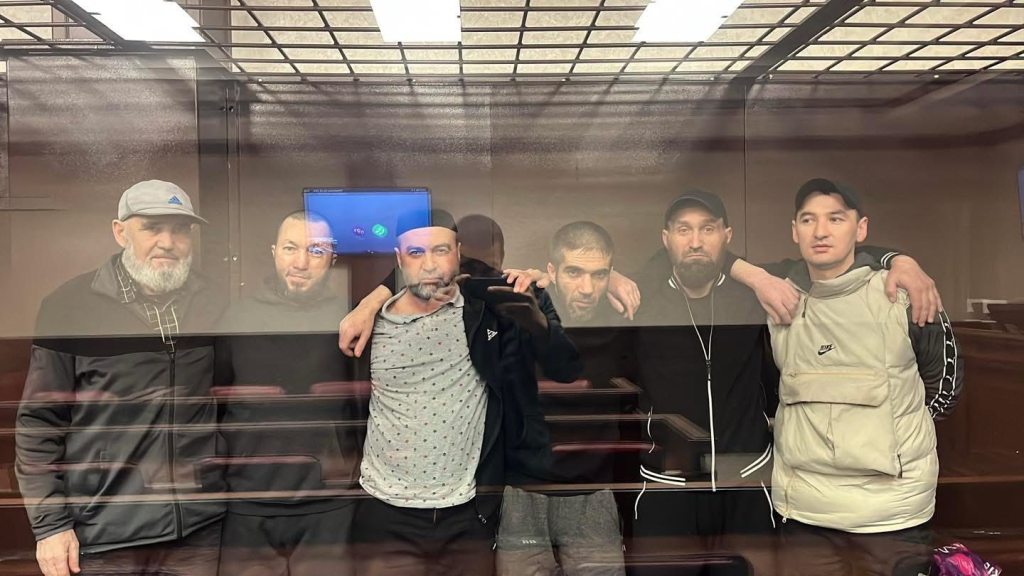
Today, a Russian military court sentenced six Crimean Tatars from the Dzhankoi District to terms in prison ranging from 11 to 14 years.
On the firing range of persecution, this is yet another sentence for Muslims in Crimea. For us, it means yet more broken lives, families separated for many years, and children who have also been sentenced to a life without their fathers. It is a river of grief.
I look at the grey-haired old man on the left of the photo, 69-year-old Khalil Mambetov, and in my mind’s eye I see the political prisoners Azamat Eyupov and Servet Gaziyev, who have already been sent into exile thousands of kilometers away from Crimea to serve their sentences. I look at Mambetov and think about his wife, Tata Lila, who is battling cancer. “We don’t know how to tell her that Agha Khalil has been sentenced to 14 years in prison,” say the wives of the other defendants.
Refat Seidametov, Leman Zekeryaev, Ekrem Krosh, and Osman Abdurazakov were also sentenced to 14 years’ imprisonment, with the first four years to be served in a closed prison and the remainder in a maximum security penal colony.
The court sentenced Aider Asanov to 11 years’ imprisonment, with the first three years to be served in a closed prison and the remainder in a maximum security penal colony, followed by one year’s custodial supervison.
Aider’s mother has a severe form of bronchial asthma. After her son’s arrest, her condition deteriorated further. Leman Zekeryaev’s mother has trouble walking. Ekrem Krosh’s brother Enver is also in the pretrial detention center in Rostov-on-Don, and the Almighty only knows how much pain their mothers are in.
When they will embrace their relatives on the outside, like hundreds of other women in Crimea, is also known to the Almighty alone. But we will continue to do everything in our power. And no matter how difficult it is, no matter how overcome we are by chronic fatigue, we continue to peacefully defend the supreme values of our people’s integrity. Because we cannot become inured to persecution.
Russia’s worst conveyor belt of repression in occupied Crimea has sunk to a new low with six recognized Crimean Tatar political prisoners from Dzhankoi facing sentences of 17 and 17.5 years. Not only are none of the men accused of any recognizable crime, but even the charges are those virtually copy-pasted from ‘trial’ to ‘trial’ since 2015, with the sole difference lying in the huge sentences demanded in this case against all the men. As well as in the fact that Khalil Mambetov is already 69, making this a near certain death sentence.
The ’trial’ of the six Crimean Tatars is coming to an end at the Southern District Military Court in Rostov-on-Don, with the prosecutor claiming, on 7 April 2025, that the men’s ‘guilt’ had been proven. He demanded 17.5-year sentences against Khalil Mamebetov (b. 1955) and Refat Seidametov (b. 1969) and 17-year sentences against Osman Abdurazakov (b. 1984); Aider Asanov (b. 1963); Ekrem Krosh (b. 1985); and Leman Zekeryaev (b. 1973). In each case, the sentence would be for maximum-security (or ‘harsh-regime’) imprisonment, with the prosecutor also seeking a one-year term of (seriously) restricted liberty should they survive the sentence in the appalling conditions of Russian penal institutions.
Lawyer Emil Kurbedinov told Crimean Solidarity that ‘each sentence in these cases is proof of political persecution. And with each sentence, the lawlessness takes on increasingly sophisticated and perverted forms.”
(From left) Leman Zekeryaev, Ekrem Krosh, Aider Asanov, Khalil Mambetov, Refat Seidametov, and Osman Abdurazakov. Photo: Crimean Solidarity
Although the sentences demanded are not necessarily those handed down, the fact that such horrifically long terms are demanded in all cases is unprecedented. It is especially worrying given that all of the men are accused of the lesser of two charges used in these conveyor belt trials.
Russia’s use of its legislation against any Ukrainian citizens on occupied territory is illegal, however these trials are especially cynical since the men are accused solely of unproven involvement in an organization which is legal in Ukraine. The pretext for bulk ‘trials’ of Crimean Tatar and other Ukrainian Muslims is a flawed and suspiciously secretive Russian Supreme Court ruling from 2003 declaring the peaceful, transnational Muslim organization Hizb ut-Tahrir ‘terrorist’. Since 2017, Russia has largely used such ‘trials’ as a means of trying to crush the Crimean Tatar human rights movement with civic journalists and activists, especially from Crimean Solidarity, increasingly targeted.
This was the second wave of such arrests in the Dzhankoi region of Crimea, with the first wave in August 2022 coming the day after a humiliating attack on a Russian military base in Crimea which Russia could not admit, but doubtless wanted to avenge. The link between these two ‘operations’ seemed clear given that the arrests on 24 January 2023 targeted the brothers of two of the men arrested in August 2022, with Ekrem Krosh the brother of civic activist Enver Krosh, seized in 2022, and Osman Abdurazakov the brother of Edem Bekirov. It also seemed likely because of the charges. In almost all such ‘trials’, one or more of the defendants is accused of ‘organizing’ a Hizb ut-Tahrir group under Article 205.5 § 1 of Russia’s criminal code. The others are accused of ‘involvement’ in such a ‘group’ (Article 205.5 § 2). Why one charge is laid, not the other, often seems arbitrary or about reprisals, but the difference in length of sentence has, up till now, been significant. All six defendants in the second Dzhankoi group are accused only of ‘involvement’, while the sentences demanded are those normally used against purported ‘organizers’. In occupied Crimea, it has become standard for all defendants to face the equally absurd charge of ‘planning to violently seize power’, under Article 278.
These ‘trials’ are not just a travesty because of the flawed charges. Essentially no evidence of actual involvement in Hizb ut-Tahrir is required. FSB-loyal ‘experts’ are used to provide ‘assessments’ of illicitly taped conversations about religion, politics, bringing up children, etc., with the supposed ‘experts’ providing the ‘conclusions’ demanded of them. The ‘trials’ also hinge on the so-called ‘testimony’ of anonymous witnesses who may well have never met the defendant. As reported, there have been absolutely glaring infringements in this case, with the FSB, for example, not even bothering to explain which part of a long conversation which they illicitly taped, proves the men’s ‘guilt’. The description given by one of the ‘secret witnesses’ did not match the photos used for the alleged identification parade.
Tragically none of this, nor the age of one of the defendants, will make a scrap of difference. The ‘case’ was passed to the court in Rostov in August 2023, and is being heard by a panel of judges, under presiding judge Viacheslav Alekseevich Korsakov, who has already demonstrated his willingness to provide the sentences demanded of him, however unwarranted.
The next hearing is scheduled for 15 April, with the defence beginning the final debate.
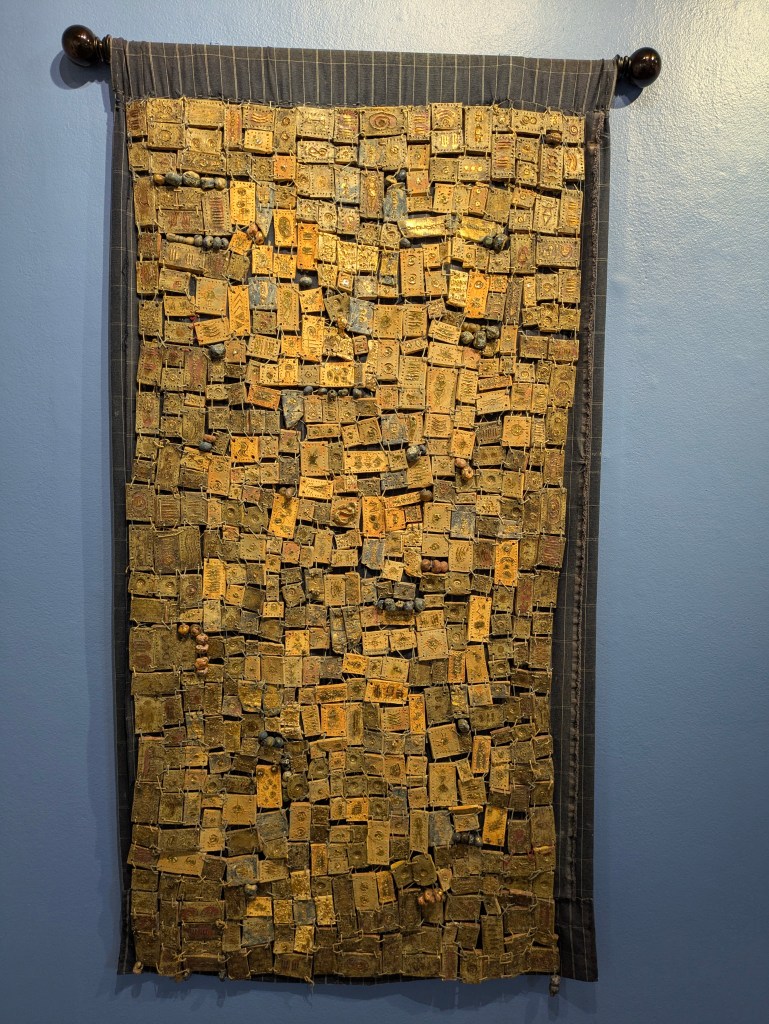
Coeleen Kiebert, Ode to the Women of Ukraine, May They Return to Quilt Their Beauty Again Soon, 2021. Ceramic, indigo linen. Pajaro Valley Arts, Watsonville, California, 26 April 2025. Photo by the Russian Reader
Donbas hostages savagely tortured for ‘confessions’ in 2019 sentenced in Russia to 24 years (Kharkiv Human Rights Protection Group, April 25th)
Huge sentences and videoed ‘repentance’ in Russia’s mounting terror in occupied Zaporizhzhia oblast (Kharkiv Human Rights Protection Group, April 24th)
“Relatives said: people like you should be killed.” The story of a woman who survived torture and fled occupied Mariupol twice (Ukrainska Pravda, April 24th)
‘Wiping out neighborhood after neighborhood’ Russia pounds Ukraine’s Pokrovsk, forcing civilians to flee under fire. For many, it’s not the first time. (Meduza, April 21st)
Darya Kozyreva gets real prison term for Taras Shevchenko poem and opposition to Russia’s war against Ukraine (Kharkiv Human Rights Protection Group, April 22nd)
The Lost Army: War veterans could pose a problem for Putin’s Russia, just like they did for interwar Germany (The Insider, April 21st)
Meeting with Representatives of Ukrainian Roma in Brussels (Kharkiv Human Rights Protection Group, April 25th)
Experts of the Committee on the Elimination of Racial Discrimination Commend Ukraine’s Presence Despite the Prevailing Circumstances, Raise Questions on the Treatment of Ukraine’s Indigenous Peoples and the Roma Population (UNHCR, April 24th)
KYIV, Ukraine (AP) — A peace proposal by the Trump administration that includes recognizing Russian authority over Crimea shocked Ukrainian officials, who say they will not accept any formal surrender of the peninsula, even though they expect to concede the territory to the Kremlin, at least temporarily.
Giving up the land that was illegally annexed by Russia in 2014 is also politically and legally impossible, according to experts. It would require a change to the Ukrainian constitution and a nationwide vote, and it could be considered treason. Lawmakers and the public are firmly opposed to the idea.
“It doesn’t mean anything,” said Oleksandr Merezkho, a lawmaker with Ukrainian President Volodymyr Zelenskyy’s party. “We will never recognize Crimea as part of Russia.”
Unlike a territorial concession, a formal surrender would permanently relinquish Crimea and abandon the hope that Ukraine could regain it in the future.
The Ukrainian public largely understands that land must be ceded as part of any armistice because there is no way to retake it militarily. Polls indicate a rising percentage of the population accepts such a trade-off.
But much of the public messaging about land concessions has suggested that they are not necessarily permanent, as when Kyiv Mayor Vitalii Klitschko told the BBC recently that Ukraine may need to temporarily give up land as part of a peace deal.
Saying otherwise would effectively admit defeat — a deeply unpopular move, especially for Ukrainians living under Russian occupation who hope to be liberated and reunited with their families one day. It also would call into question the sacrifices made by tens of thousands of Ukrainian service members who have been killed or wounded.
U.S. President Donald Trump underscored the Crimea proposal in an interview published Friday in Time magazine: “Crimea will stay with Russia. Zelenskyy understands that, and everybody understands that it’s been with them for a long time.”
Asked by reporters on Sunday if Zelenskyy was ready to give up Crimea, Trump said, “Oh, I think so. Crimea was 12 years ago. That was President Obama that gave it up without a shot being fired.”
His comments offered the latest example of the U.S. leader pressuring Ukraine to make concessions to end the war while it remains under siege. Trump has also accused Zelenskyy of prolonging the war by resisting negotiations with Russian President Vladimir Putin.
Crimea, a strategic peninsula along the Black Sea in southern Ukraine, was seized by Russia years before the full-scale invasion that began in 2022. The Russian takeover followed large protests that ousted former Ukrainian President Viktor Yanukovych, who had refused to sign an association agreement with the European Union.
In the lead-up to peace talks, Ukrainian officials told the Associated Press for months that they expect Crimea and other Ukrainian territory controlled by Russia to be among Kyiv’s concessions in the event of any deal. But Zelenskyy has said on multiple occasions that formally surrendering the land has always been a red line.
Elements of Trump’s peace proposal would see the U.S. formally recognizing Crimea as Russian and de facto accepting Moscow’s rule over occupied Ukrainian territories, according to a senior European official who spoke on condition of anonymity to discuss sensitive diplomatic discussions.
Whether the U.S. formally recognizes Crimea as Russian is out of Zelenskyy’s hands. But many obstacles prevent the Ukrainian president from doing so, even under immense pressure. He cannot unilaterally sign any such proposal, and he could be reprimanded by future governments for even attempting it, experts said.
Ukraine began to accept that it would not regain its lost territories after the failure of the country’s 2023 summer counteroffensive. From then on, the Ukrainian military concentrated on defending the territory it still held.
In return for territorial concessions, Ukraine wants robust security guarantees that ideally would include NATO membership or concrete plans to arm and train its forces against any future Russian invasion with the pledged support of allies. One scenario envisions European boots on the ground, which Russia rejects.
Zelenskyy has said negotiations over occupied Ukrainian territory will be drawn out and will not likely occur until a ceasefire is in place. In late March, he told reporters after a call with Trump that the U.S. president “clearly understands that legally we will not recognize any territories.”
He said giving up territory would be “the most difficult question” and “a big challenge for us.”
Formal recognition of Crimea would also amount to political suicide for Zelenskyy. It could expose him to legal action in the future, said Tymofiy Mylovanov, president of the Kyiv School of Economics and a former economics minister.
Signing a potentially unconstitutional document could be interpreted as high treason, Mylovanov said.
The Ukrainian government cannot act either. It has no constitutional means to accept a violation of its territorial integrity, and altering the territorial makeup of the country requires a nationwide referendum.
If Ukrainian lawmakers were even to entertain the idea of surrendering Crimea, it would trigger a long, drawn-out legal debate.
“That’s why Russia is pushing it, because they know it’s impossible to achieve,” Mylovanov said.
“Anything related to constitutional change gives so much policy and public communication space to Russia,” he added. “This is all they want.”
Soldiers on the front line say they will never stop fighting, no matter what the political leadership decides.
“We lost our best guys in this war,” said Oleksandr, a soldier in the Donetsk region, who spoke on the condition that only his first name be used in line with military protocols. “We won’t stop until all Ukrainian lands are free.”
Coeleen Kiebert, Ode to the Women of Ukraine, May They Return to Quilt Their Beauty Again Soon, 2021 (detail). Pajaro Valley Arts, Watsonville, California, 26 April 2025. Photo by the Russian Reader
Olga Menshikh. Photo: Alexandra Astakhova/Mediazona
A panel of three Moscow City Court judges, chaired by Irina Vasina, upheld the verdict in the criminal case against anesthesia nurse Olga Menshikh on charges of disseminating “fake news” about the Russian army: eight years in prison for two posts on the Russian social media network VKontakte, per Article 207.3.2.e of the Criminal Code. This is the longest sentence on these charges handed down to a woman. The following is an abridged version of Menshikh’s statement at today’s court hearing.
You and I understand everything quite well: we are all adults here. You shall say that this is not a frame-up, that it’s the norm. Nevertheless, we understand that there is a more serious organisation* which has ordered this [verdict], and they do things as they see fit regardless of these frame-ups.
Here, for example, is a quotation from my case file: “Olga Sergeyevna Menshikh causes her fellow citizens to feel anxious, afraid and worried, to feel undefended by the state’. I cause that!? I am an absolute loner with a mum who is eighty-six years old, and I have no other interests in life. What can I say? These words in no way apply to me. I completely deny them and consider them slander.
But these words perfectly describe the well-known organisation, known as the FSB, which I have just outlined for you. […] Back in the day, serious conclusions were not drawn about the architecture of the seventy-year utopia, which murdered millions of its own citizens and citizens of other countries and collapsed during an attempt to repair it, but then suddenly rose up and went at it again. Crush what was not crushed earlier! ‘Crush them!’ is the watchword of the day.
Who should be crushed, I want to ask you, your honours? The peasants, whom you destroyed long ago? The hegemon [i.e., the proletariat], whom you long ago turned into a drunkard? Do you want to crush the intelligentsia? Do you want to crush business? How do you plan to live? What have I been observing in Detention Centre No. 6 right now? I just sat for four hours with the nicest businesswoman. You have been clamping down on businesspeople of all stripes.
I have seen all kinds of people here. Lawyers and doctors serving long sentences, mothers with many children, with three or four children, incarcerated here without verdicts. And just now I came in from the corridor, where a disabled woman in a wheelchair was being sent off to a penal colony. Pensioners and young people are held here on completely trumped-up charges. Do you want to crush them, to trample on their lives so as to make others afraid? Is that what you want to do? You want to crush them so that everyone is afraid because you were ordered to do it? Have them be afraid, have them sit in prison.
Well, this is what I want to tell you calmly. A society sick with fear cannot create, cannot be happy, cannot live, cannot love to the fullest, cannot reproduce. You consider it quite necessary for us to reproduce. But [society] cannot reproduce amid this fear. A wild goose never laid a tame egg. This fig tree will die out, you shall kill it off.
This entire fear machine has only one aim: destroying all of us. So many people, so many civilised people were destroyed, that I cannot list their names. I will only quote a great novel. Having worked in the medical field myself, as someone who took patients quite seriously, I will quote the great novel Doctor Zhivago, about Doctor Yuri Andreyevich Zhivago. By the way, he dies before he reaches the age of forty.
Here is what the great diagnostician Yuri Zhivago says: “Microscopic forms of cardiac hemorrhages have become very frequent in recent years. […] It’s a typical modern disease. I think its causes are of a moral order. The great majority of us are required to live a life of constant, systematic duplicity. Your health is bound to be affected if, day after day, you say the opposite of what you feel, if you grovel before what you dislike and rejoice at what brings you nothing but misfortune.”**
Yuri Andreyevich uttered these words exactly a hundred years ago. And so, concerning this organisation, which we all know quite well: a dead man coming back to life cannot make anyone happy. Even when he was alive, he brought happiness to no one. He turned a lot of folk into dead people, and now he is raising another generation suffering from PTSD, post-traumatic stress disorder, which is quite hard to treat.
What can I say? I am sorry. I feel sorry for you, I feel sorry for me. I feel sorry for the people in this detention centre. I feel sorry for the women, for the children. Dear honourable judges and prosecutors, we are all in the same boat. I rest my case.
* In the first part of her statement, Menshikh talks about how she believes the FSB was behind her criminal case from the beginning — Mediazona.
** Translated by Max Hayward and Manya Harari — TRR.
A court in Moscow on Thursday sentenced a 59-year-old nurse to eight years in prison for social media posts opposing Russia’s invasion of Ukraine.
Olga Menshikh was accused of spreading “fake” information about the military with two VKontakte posts that condemned Russian strikes on Vinnytsia, Ukraine, that killed 28 people in July 2022 and Russian troops’ mass atrocities against civilians in the Kyiv suburb of Bucha.
Menshikh denied her guilt, with Mediazona reporting she had 15 followers and that her account may have been breached.
Moscow’s Dorogimolovsky District Court found Menshikh guilty of spreading “fake news” about the Russian military’s actions abroad and handed her an eight-year sentence in a prison colony.
Menshikh was an anesthetic nurse at the Pirogov National and Medical Surgical Center, where Mediazona said she had treated Russian soldiers wounded in Ukraine.
The outlet said Menshikh had faced several administrative arrests and fines for anti-war social media posts and her support for the late Kremlin critic Alexei Navalny.
Russia has cracked down on anti-war protests, the independent press and social media platforms since launching what it calls its “special military operation” in Ukraine in 2022.
The 45-year-old resident of the Tatarstan capital with the exotic first name and surname and the patronymic Petrovich has four prior criminal convictions
Holy Week has kicked off for a Kazan defendant with a quite uncommon name: Jesus Christ. The 45-year-old Kazan resident has been charged with falsely registering forty-five migrant workers at his address. Jesus Petrovich has prior repeat convictions for burglary and robbery, and in 2014 he underwent preventive care for substance abuse. Business Online reports on Christ’s failure to appear at his court hearing, and the “way of the cross” he has blazed through Kazan’s district courts.
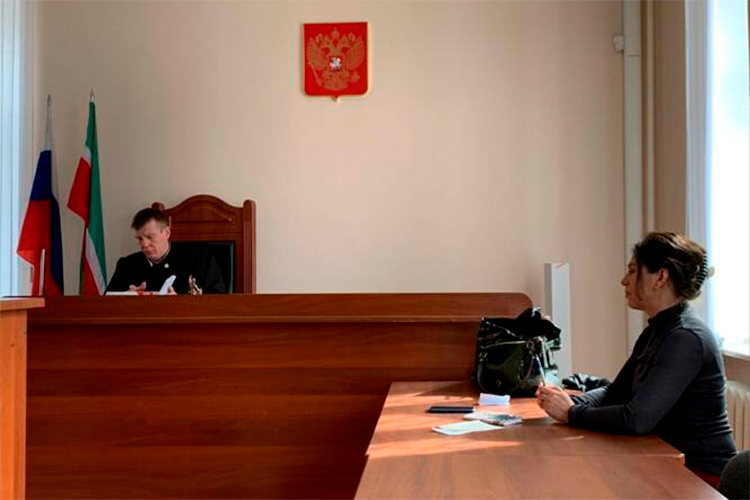
This photo by Business Online reporter Eva Malinovskaya appears in her original article, but it is impossible to say whether it was taken at Jesus Petrovich Christ’s abortive court hearing in Kazan on Good Friday 2025.
Jesus Petrovich’s “Good Friday”
The biography of Kazan’s latest criminal defendant would not be too different from the average person’s — the divorced and unemployed high school graduate will turn forty-six on the tenth of May — were it not for one catch. His name is Jesus Christ: that is the name listed in his [internal] passport.
The story of how he got the name remains a mystery: neither the court staff nor the state prosecutor know what Christ’s name at birth was. All that the people involved in the criminal proceedings know is that the defendant was “obsessed” with numerology, and this led, allegedly, to his decision to change his name and surname several years ago. He kept only his real patronymic: Petrovich.
Christ was scheduled to appear before the Moscow District Court (the Kizichevsky Vvedensky Monastery is situated right next door to the court building on Justice Street ). The current case against Jesus Petrovich is an anniversary of sorts: he has four prior criminal convictions, having blazed a trail through the city’s district courts on his own “way of the cross.”
Jesus was first convicted in 1994 by the Lenin District Court (now the Aviastroitelny District Court) of robbery, per Article 145.2 of the RSFSR Criminal Code. He was given a two-year suspended sentence. Since his next conviction, for theft, per Article 144.2 of the RSFSR Criminal Code, was handed down by the Novo-Savinovsky District Court, he was given the standard sentence: two and a half years in a medium-security correctional labor colony and confiscation of his property.
After serving his sentence, Christ did not enjoy his freedom for long. In 1999, he appeared before the Volga Regional Court, where he was sentenced to nine years in prison per Article 162.3.g of the Russian Federal Criminal Code, for “robbery committed by a person previously convicted two or more times of theft or extortion.” The convict was sent to a maximum security penal colony and was released in 2007. A little more than a year passed before Christ again came before the Lenin District Court, which by then had been redubbed the Aviastroitelny District Court. He was sentenced to another three years in prison per Article 158.3.a of the Russian Federal Criminal Code, for “theft involving home invasion.”
In addition to his criminal record, Christ had a penchant for illegal substances. From 2014, he was registered with a substance abuse therapist, but not for long, according to his personal file, as submitted to the court. In 2015, a forensic psychiatric expert commission found that Jesus had an organic personality disorder, and he was removed from the substance abuse registry. His mental illness had been triggered by a severe head trauma received in 2010. At the time, Christ did not complete his treatment, leaving the hospital on his own. He was also diagnosed with brain malfunction due to multiple organ dysfunction syndrome and was thus registered as a class III disabled person.
During his last clinical examination, psychiatrists noted the patient’s irritability, brashness, inflated self-esteem, pretentiousness, egotism, and mood swings. Although Jesus’ truculent personality was palpable, it was not significant enough to warrant hospitalization, so his diagnosis was not a factor in the criminal investigation.
The charges
What is Christ accused of this time round? According to police, whose account has been corroborated by the prosecutor’s office, between April and December 2024, Christ registered forty-five foreign nationals as residing in his 31.9-square-meter flat. With the consent of the foreigners, Jesus filled out foreign national residential arrival notices in which he identified himself as their host and provided the address of his flat. He then submitted arrival notices to the Moscow District office of the Tatarstan Multifunctional Public Services Center.
The prosecution is certain that the foreigners did not reside at their registered address. The false information about the arrival of forty-five individuals, as received by the migration department of the Russian Interior Ministry’s Kazan office, was registered and entered into the federal migration registration database. Christ faces up to five years in prison.
“The case is quite ordinary. [Police officers] examine the Multifunctional Public Services Center’s identification numbers and files and identify violators,” said assistant prosecutor Nadezhda Moshkova in a conversation with Business Online before the court hearing.
Common practice in such cases
Such cases are not uncommon. There were several such cases in a row in February alone. Six Tatarstan residents and a foreigner were charged with organizing the illegal immigration and falsified registration of more than three thousand foreigners. Later in the month, three more cases of unlawful employment agreements, involving two thousand migrant workers, were uncovered, and on February 26 it transpired that another resident of Kazan had aided almost three thousand immigrants in registering illegally. So the list of Christ’s “apostles” is not that long compared to those of others.
“Has Jesus Christ stopped by?” the assistant judge asked hopefully over the phone exactly one minute before the start of the trial.
“No, he hasn’t,” the bailiff replied with a grin.
The mood of the people in the courtroom was upbeat, despite the fact that the “appearance” of Christ before the Moscow District Court did not take place. Moshkova assured the court that the defendant had been notified in every possible way, but she herself, even before the hearing, had not actually believed that he would show up. “He’s a curious chap,” the assistant prosecutor said, adding that defendants themselves do not like to appear at such hearings, and jokingly condoned Christ by saying that Easter had not yet arrived.
The accused himself, as it turned out, had no clue about the hearing.“What case? And wait, if a court hearing has been scheduled, why the fuck was a notification and a summons not sent?!” said a perplexed Christ, whom Business Online was able to reach by telephone. After voicing his indignation, our source asked us to leave him alone. “I have done twenty years in prison. You’ve got the wrong number, good luck,” concluded Jesus.
Nevertheless, court-appointed defense lawyer Ksenia Matveeva told us that the defendant fully admits his guilt. He had even requested expedited consideration of the case, but because of his failure to appear, the process had to be postponed to the end of May.
“I order that the defendant be forcibly delivered to the next court hearing,” the presiding judge, Nikolai Zakharov said as he concluded the proceedings. “No one has ever walked away from the court yet,” he said, shrugging.
A 45-year-old Russian national named Jesus Petrovich Christ has gone on trial in Kazan for fictitiously registering foreigners in his apartment. Information on the upcoming court hearing was posted on the website of the city’s Moscow District Court.
The defendant fictitiously registered forty-four illegal immigrants in his one-room apartment, in violation of Article 322.3 of the Russian Federal Criminal Code. In fact, [none of the immigrants] lived in the apartment. Christ did not appear in court, so the hearing of his case did not take place.
According to law enforcers, Jesus Petrovich Christ has four previous convictions — for robbery, armed robbery, and theft.
According to local media, the defendant was given a different name at birth, but he changed his first name and surname after becoming interested in numerology. The man’s patronymic is real.
A Russian citizen named Jesus Petrovich Christ is being tried in Kazan on charges of fictitiously registering immigrants. A notice of the upcoming court hearing appeared on the website of Kazan’s Moscow District Court.
A screenshot of Jesus Petrovich Christ’s court hearing record on the website of Kazan’s Moscow District Court, courtesy of Sergey Abashin
Jesus Christ is suspected of fictitiously registering forty-five illegal immigrants in his one-room apartment, in violation of Russian Federal Criminal Code Article 322.3. Despite receiving a summons to appear in court, the 45-year-old Russian national did not show up for the proceedings, and therefore the hearing of the case did not take place.
It is also known that the man was previously convicted several times — in 1994 and 1996, for robbery; in 1999, for armed robbery; and in 2007, for theft.
“We love and miss Berlin so much that we decided not to wait until we find ourselves there again . . .” Samotechnaya Square, Moscow, April 2025. Photo: anatrrra (used with their permission)
Despite being hit with unprecedented Western sanctions, the war with Ukraine has been accompanied by a noticeable increase in the well-being of Russians. A new study has revealed the extent of the domestic feel-good factor, with economists at the Bank of Finland Institute for Emerging Economics (BOFIT) finding the level of Russians’ satisfaction with their household and personal circumstances has hit its highest in a decade.
To understand how the restructuring of Russia’s economy during wartime affected Russians, economists Sinikka Parviainen (BOFIT) and William Pyle (Middlebury College, USA) used data from the Russian Longitudinal Monitoring Service (RLMS), which has been conducted by the Higher School of Economics almost every year since the 1990s. This research tracks the economic well-being of Russian households and individuals with a sample size of around 6,000-8,000 households and 17,000-21,000 people.
The economists looked at RLMS data from 2013-2023, scrutinising responses to the questions: “how satisfied with life are you right now?” and “how satisfied with your financial circumstances are you right now?”. They also looked at whether households had made large purchases over the past year, how much they spent on cultural events and how long they could maintain their current lifestyle if they lost their main source of income.
They concluded that the first two years of Russia’s invasion — 2022 and 2023 — saw the highest levels of general satisfaction, and specific financial satisfaction had also returned to 2014 levels for the first time. That year is seen as a benchmark before Russia was plunged into an economic crisis following the annexation of Crimea, imposition of Western sanctions and an oil price crash.
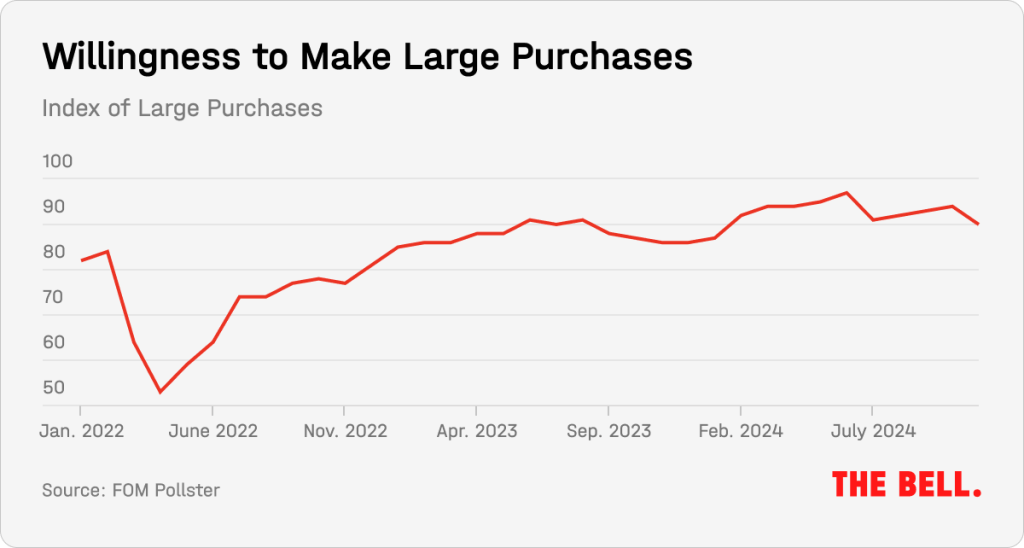
Large purchases fell to a minimum in 2022 but demand for non-food goods has since increased faster than inflation and wages, in line with The Bell’s earlier calculations. There was also a sharp rise in the proportion of households spending money on entertainment: in 2023 this reached 2018 levels, the researchers noted. The number of respondents who said they would be able to last more than a few months on their savings reached a 10-year high.
These findings correspond with Russia’s official statistics which also point to improved financial circumstances since the start of the war. In 2023, real incomes in Russia not only returned to 2013 levels after a decade of lost living standards, but surpassed the pre-Crimea level by 5%, the researchers highlighted.
There are no surprises as to the cause — a huge increase in state spending on the invasion and the military-industrial complex that has driven record labor shortages and pushed wages up across the economy. The high salaries offered by the state to people sent to work at the front, as well as those paid to soldiers (from 200,000 rubles a month) have played a big part, and the main winners have been residents of Russia’s poorest regions, which have recorded an unusually sudden increase in bank deposits.
Why the world should care
Putin’s regime is unlikely to face any internal threat as long as Russians’ well-being and overall happiness is on the rise.
KVS, “SouthTown: The Olympic Quarters” (YouTube, 8 June 2021)
Today’s developers pay no less attention to creating comfortable residential environments in their projects than they do to configuring apartments, for example, and sometimes they pay even more attention to this.
In recent years, the concept of beautifying the area around residential buildings has been transformed from elementary landscaping of yards and equipping playgrounds to creating theme parks within residential complexes, divided into different activity zones, as well as designing additional spaces where residents of the neighborhood can gather, get acquainted, relax, play sports, and organize their own or their children’s leisure activities.
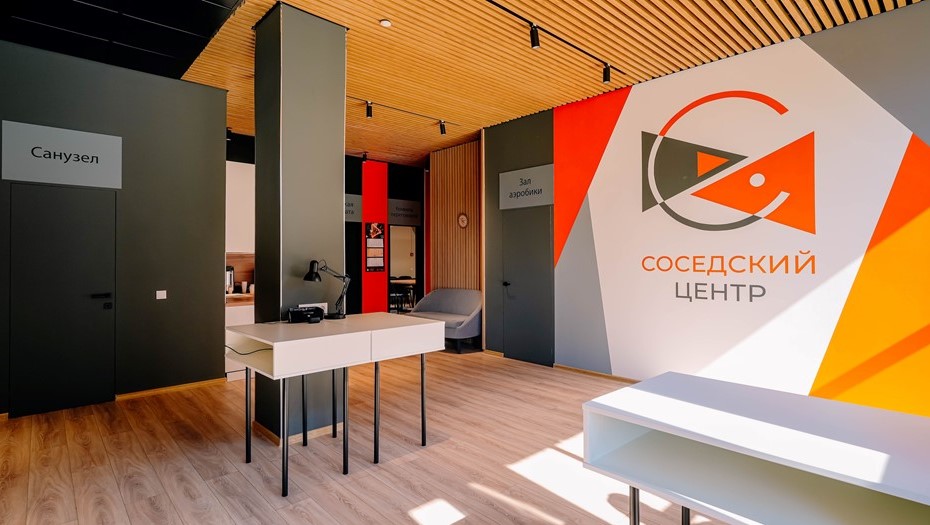
The role of such spaces is most often played by neighborhood centers, and planning these centers has recently become a real trend among developers.
The neighborhood center at the SouthTown development, designed by Anton Rudnik. Photo: KVS Group, via Delovoi Peterburg
The reasons
Residents of apartment buildings have always needed to socialize and spend time together. Back in Soviet times, people would often gather in courtyards to play dominoes, bingo, and table tennis. At some point the tradition was lost, but after the restrictions imposed during the Covid-19 pandemic were lifted, it literally sparkled with new colors.
In their article [sic: no link in the original] on communities, neighborhoods, and neighborliness, researchers from the Higher School of Economics noted that the first contemporary attempts to unite people living near each other into groups were especially noticeable after 2015, when people all over Russia began celebrating Neighbors Day. From a holiday in the classic sense of the word, Neighbors Day has quickly evolved into a multifaceted know-how for working with residents and getting them involved in such community work as spring cleanups and decorating yards for the New Year’s holidays.
With the emergence of urban agglomerations and the integrated development of new estates by developers, the need for communication among the people living there has increased. There is a logical explanation for this. In her time, Birgit Krantz, a Swedish sociologist, architect, and expert on neighborhood relations, argued that the ideal apartment complex contains between fifty to eighty apartments. If a complex has more apartments, it is difficult to manage it and maintain good neighborly relations.
There are many more apartments in new large residential projects, however, even if they are low-rise developments. This is where neighborhood centers come to the rescue. Consequently, they have become an integral part of people’s everyday lives in entire neighborhoods, functioning, per the American sociologist Ray Oldenburg, as “third places” (between home and work or school), as social anchors which facilitate creative interactions among individuals.
A clear demand
Today, the neighborhood centers running in new residential neighborhoods are literally bustling with life, and they are usually open seven days a week from early morning to late evening.
Delovoi Peterburg talked to residents at the KVS Group’s SouthTown development, where such a neighborhood center has been up and running for over six months. The center offers sports classes; clubs for children, including preschool prep; nanny services; rooms for business meetings and negotiations; and movie screenings. A puppet theater also periodically comes to the center on tour, and a planetarium was once even recreated in the space.
According to Anzhelika Alshayeva, director general of the KVS Real Estate Agency, all activities were free of charge for residents during the center’s first three months of operation; the tab was picked up by the developer. Now, the cost of classes is only 200 rubles, and the interest of residents continues to grow. With this in mind, the decision was made to launch the second stage of the neighborhood center — a teen club, which will be equipped with ping-pong and billiards tables, which will undoubtedly appeal to local youngsters.
The teen club at the neighborhood center in the SouthTown development, designed by Anton Rudnik. Photo: KVS Group, via Delovoi Peterburg
An important social role
Most importantly, such neighborhood centers, in addition to creating stable communities of around particular interests and hobbies, offer residents various opportunities for professional and personal growth. As practice shows, neighborhood residents themselves provide professional services, working as nannies, coaches, and teachers. Thus, another important issue for the neighborhood as a whole — job creation — is solved. And the concept of the 15-minute city is implemented in the particular housing complex: without leaving home, a person can comfortably take advantage of the full range of social services and work in the same place.
In this sense, co-working spaces can be an important component of neighborhood centers, serving not only as a pleasant but also as a useful feature for buyers and future residents. In addition, a co-working space can potentially generate revenue, thus covering the costs of its own upkeep.
And it does not necessarily have to be a classic room with computers and a coffee machine. For example, in the aforementioned neighborhood center, in the amphitheater of Olympic Hopes Park, the developer decided to create a beauty co-working space — a space with work areas which can be leased by beauty industry professionals. The project promises to be an important element of the neighborhood’s infrastructure, contributing to the growth of small business and strengthening the local community. This comprehensive approach to neighborhood development and neighborly relations was also recognized by Delovoi Peterburg, which awarded it the newspaper’s award for Residential Environment Project of the Year in Creating Versatile and Comfortable Neighborly Infrastructure.
The beauty co-working space at the neighborhood center in the SouthTown development, designed by Olga Fedotova. Photo: KVS Group, via Delovoi Peterburg
When speaking about the importance of neighborhood centers for residential developments, the experts interviewed by Delovoi Peterburg generally voiced confidence that adding such facilities to residential developments does not make projects much more expensive, but it can increase an an apartment’s per meter cost, as well as make a developer stand out from the competition. The experts recognized that the trend toward neighborliness, according to psychologists, will continue to grow, especially among residents of new neighborhoods.
The statements about the war made by Muscovite political exiles cause public indignation because what they say is at odds with the horror of the situation. Instead of taking to European podiums and demanding decisive action to defend Ukraine, they ask [European officials] to lift sanctions against Russians and mumble helplessly about “one nation.”
It is obvious that, for the fourth year running, Russia has been waging not just a war against Ukraine on the front lines, but a bloody, boundless campaign of terror. Nearly every day Russian missiles kill [Ukrainian] civilians, including children. Ukrainian soldiers who surrender unarmed are executed on the spot by the Russians, or are even ritually beheaded. But you continue to talk about Russia’s “democratic future,” ignoring the fact that the entire country, including schoolchildren, has been slaving away at destroying the Ukrainians.
I am not a politician, just a microblogger who cares about current events. But even I remember InformNapalm’s OSINT investigation which showed that the Russian fighter planes bombing Ukraine are still equipped with French avionics. Without this unique equipment, Russia’s Su-30SM fighter planes are blind and cannot fly. Russia obtains this equipment through Kazakhstan, thus bypassing sanctions. The report came out a year ago. I don’t know what the situation is like now, but warplanes are still taking off from Russian airfields.
Why couldn’t you have talked about that in the French Senate? Especially since, a week earlier, a Russian missile fired from a fighter plane and packed with shrapnel killed twenty people, including nine children, in Krivyi Rih. The photo of a young [boy] in a coffin, whose face had been riddled by the tiny metal shards, is impossible to forget.
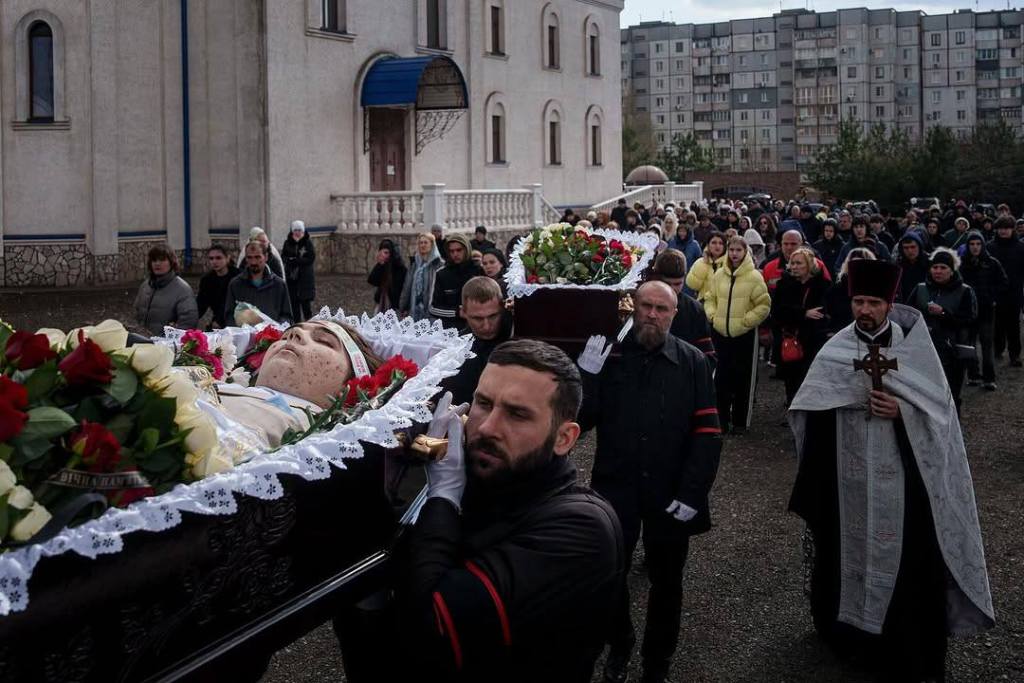
The coffins of 15-year-old Nikita Perekrest and his cousin, 16-year-old Kostiantyn Novik. Nikita’s father serves in the Ukrainian Armed Forces, and his mother took Kostiantyn in after his parents were killed. The two boys were outside in the yard when the Russian army struck Kryvyi Rih. Photo: Evgeniy Maloletka/AP/Scanpix/LETA, via Meduza
I realize that none of Moscow’s so-called opposition activists have the courage of political prisoner [Vladimir] Bukovsky and demand that Ukraine be given missiles to target Lubyanka. But you could launch investigations into the schemes by which Russia circumvents sanctions and obtains not only components for its fighter planes but also foreign chips for its missiles. You could demand that the Bosphorus be closed to Russia’s shadow fleet, which brings Putin the revenue to produce new missiles. Finally, you could show solidarity with Ukraine at least in word [if not in deed] and stop embarrassing yourself by repeating the impersonal and irrelevant slogan “No War.” You could do a lot of things in your safe havens. But instead you just wait for Putin to die and are not even ashamed to say so. Meanwhile, it is not so much the Ukrainians or the decolonizers who are waiting for you to act as it is your own fellow Russian citizens, who have not yet lost their minds and are basically living under occupation in Russia.
///
As for the ridiculous claim that it is easier for non-Russians to go to war and that is why they make up the majority [of soldiers] in the [Russian] army, according to the analytical resource buryatmemorial.org, a total of 2,425 people from Buryatia have been killed in the “special military operation” as of March 2025. And you’ll pardon me, but hardly half of them are ethnic Buryats (as you can see from the photos). This is due to the fact that ethnic Buryats constitute no more than 31% of the republic’s entire population. According to Ukrainian figures, Russian losses have already lost 933,000 men in the war. Even if we multiplied the figures for Buryatia by ten, its war dead would still roughly amount to two and a half percent of the total. I emphasize that the Buryats are an ethnic minority in their own land.
A screenshot of the website buryatmemorial.org, showing the names and faces of Buryatia’s war dead
According to Caucasian Knot, as of March 2025, 233 men from Chechnya, 121 from Ingushetia, 104 from Karachay-Cherkessia, and 112 from Kalmykia have been killed in the special military operation. Again, we can multiply this figure by ten for the sake of statistical rigor, but we still get hundredths of a percent of the total losses.
To put an end to the topic of Vladimir Kara-Murza’s ridiculous misinformation drop, yes, I saw yesterday’s post by the activist Anastasia Shevchenko, from which it follows that she was the mysterious “colleague” who shared with Kara-Murza the “observation” that it may be easier for non-Russians to go to war, while Russians find it psychologically difficult to kill Ukrainians due to their cultural affinity. Anastasia writes that the source of this hypothesis was not even her, but a third party who voiced this conjecture in a private conversation. Do you realize what has happened? This was not a scientific observation; no studies or surveys of Russian POWs were done that would indicate such a trend. This “information” came from the bush telegraph and was repeated by a [Russian] opposition politician in the French Senate, where decisions are made on the basis of the words people utter. And even after the ruckus that this delusional phrase caused among the public, no apology or explanation has been forthcoming from the politician.
Again, I am just a mom with three kids who left Russia to avoid supporting the war. In exile, I wash floors and clean other people’s houses so that I can send at least thirty dollars [a month] to the Ukrainians so they can buy drones. At night I write social media posts and read decolonial literature. I try to do anything I can to stop my former country from murdering innocent people. In my opinion, I have the right to demand that those who call themselves politicians, who have the bully pulpits and the opportunities, do something meaningful to ensure that Russia can no longer wage war.
There is another reason why the Russian Defense Ministry recruits so many members of ethnic minorities [to fight in the war against Ukraine]: as it turns out, because it is psychologically really difficult for [ethnic] Russians to kill Ukrainians. Because we are one people. We are very close peoples, as everybody knows. We have nearly the same language, the same religion, and centuries of history in common. But if it’s someone from another culture, allegedly it’s easier [for them to kill Ukrainians]. I hadn’t really thought about it before. I thought the reasons were primarily economic. But after what [a colleague who spoke about the Buryats] said, I started thinking about it too.
A screenshot of the video Ms. Khazagaeva cites in her Facebook post
You did get that, friends? It’s so difficult, so unbearable for ethnic Russians to kill you Ukrainians that Buryats and Chechens have been doing all the work for them — because [Buryats and Chechens] are beasts and savages. That makes sense, doesn’t it?
By the way, [Kara-Murza] refers to Buryats and Chechens as “those ethnic minorities.”
In other words, all eleven years [of Russia’s war against Ukraine], the Buryats, who number under four hundred and fifty thousand people, including children and the elderly, have been attempting to kill the forty million Ukrainians. It transpires, however, that the hundred million ethnic Russians have had it “psychologically difficult” all those eleven years. They are mere victims of this war, which is something “those [other] ethnic groups” want. Don’t get them wrong: ethnic Russians love you Ukrainians like brothers!
You have explained everything so clearly, Mr. Kara-Murza. I have literally just a couple of follow-up questions. Excuse me, has it also been the Buryats who have been launching missiles at Ukrainian cities? And the creatures who on Russian television rejoice at the deaths of Ukrainian children in Kryvyi Rih, are they also members of these same ethnic minorities?
I’m sorry, but I have another question. The whole world knows what the Pskov paratroopers did in Bucha. Do you have any ideas how to repaint them as Buryats? Although it would probably be a bit difficult, since “your lads” have already been testifying.
One more question. The other day, 7 April, was the thirtieth anniversary of the Samashki massacre. Eighty people, mostly children, women and old people, were burned alive in Samashki, and hundreds of people were killed in total. This is not to mention the forty thousand Chechen children killed in the two [Chechen] wars. Excuse me, did the Chechens shell themselves? Ethnic Russians are totally incapable of that, aren’t they? To hell with what Tolstoy wrote in Hadji Murat. Tolstoy was a renegade.
Oh, I’ve gotten a little carried away. Two million people were killed in the Soviet invasion of Afghanistan. They say that’s where the notorious practice of “mopping up” villages, leaving mass graves in their wake, originated. I’m sorry, who did the killing in Afghanistan? Was that the Buryats too?
Good Lord, where do you get so many of them?
The only thing I don’t understand is how the idea of the “Russian world” could have emerged, since you ethnic Russians live in love and friendship with all countries. It must have been the Chukchi who overdid it on that front.
I also don’t understand why it is the ethnic Russians who do ballet, but it is the non-Russians who make war.
Updated, 13 April. I have replaced the picture originally below the post with a video featuring the entire quotation by Kara-Murza. Thanks to the good people who provided the AI translation. It shows that Kara-Murza’s words, whether presented in expanded or abridged form, bear the same message: ethnic Russians don’t want to kill Ukrainians, and it’s easier for non-Russians to do it. Because we ethnic Russians and the Ukrainians are one and the same, but we’re not the same as those non-Russians. It matters not a whit that Kara-Murza referenced someone else’s observation. What matters is that he voiced this idea personally and voluntarily, and that he confirmed his commitment to it by saying that it has given him pause for thought too. Think about it. A Russian politician (as Kara-Murza fancies himself), while visiting the parliament of a major European country, says that it is mainly Buryats who want the war. He says this on the record in a place where every word uttered potentially has legal force. He said it not in a bar, not on a beach, but in the French Senate, where decisions on sanctions are made.
I have not emended the text of my original post, dated 12 April.
On 10 April 2025, the Senate Foreign Affairs Committee heard the testimony of Vladimir Kara-Murza, vice-president of the Free Russia Foundation and a former Russian political prisoner. A Russian politician and opponent of Vladimir Putin, Kara-Murza survived two poisoning attempts, in 2015 and 2017. In April 2023, he was sentenced to 25 years in a penal colony by the Russian justice system after criticizing Russia’s invasion of Ukraine. He was released on 1 August 2024 in a prisoner exchange. In his testimony to the senators, he stressed the autocratic and violent nature of Putin’s regime. He called on the European Union to maintain its sanctions against Russia, and to bring its weight to bear on peace negotiations in Ukraine. He maintains the hope that the country will soon become democratic.
As a Kyrgyz woman born in the last years of the Soviet Union, I never thought twice about whether my usage of the Russian language was problematic or not — until recently when I reached out to my Ukrainian friend in Russian, and she responded to me in Ukrainian.
I have been thinking about the political aspects of language since then.
Last week I was invited to a podcast to talk about de-colonial feminism in Central Asia by a research group that does memory studies in Kyrgyzstan. There we sat in a warmly lit Bishkek studio in comfortable canary-yellow armchairs — two women of clearly Central Asian descent, with names that mean ‘honey’ and ‘worship’ in our native language, discussing whether the Soviet Union was a colonial empire, and how a more than 100-years history of Russian presence in the region has disrupted and affected the lives of peoples of Central Asia. I am making smart jokes and incisive observations, we laugh, we debate, we lament — all in Russian.
Although this language was not the main subject of our discussion, we comment in passing on it — noting how intangible colonial legacies can sometimes have a constructive element to them.
It is, of course, possible for all of us to drop the language of the colonizer, whether it’s English, French, Spanish, Russian, or Chinese — and speak our own languages, but the ease and comfort of using these when trying to communicate with people outside our cultures is just so tempting! And so then the question is whether to take offense towards the language because it happens to have been “originated” by the ‘big bad’ or to ignore that and make it our own?
Russian was the language of books that took me on journeys across galaxies, of Soviet-era films that fanned the fire of idealism in me, of finding community with other post-Soviet teenagers that, like me, had traveled to the United States as exchange students. We spent the year yell-singing Kino’s songs, making the olivier salad for a New Year’s celebration, and rooting for Evgeni Plushenko in the 2001 Winter Olympic Games in Salt Lake City.
It was the language of the early science fiction stories I wrote when I was twelve, of expressing my first heartbreak in broken poetry form, and of clumsily flirting, building alliances, or of standing up to bullies.
It is also the language of differentiation — a tool of categorizing people into social strata, both inside Russia and in the non-Russian republics during Soviet times. My own mother had been ridiculed for not speaking Russian well, considered ‘dark’ and uneducated, uncultured. To this day she gets offended when my Russian-schooled siblings sometimes laugh at the little mistakes she makes when attempting to speak it because it reminds her of how she was treated when she was younger.
Not to worry though — this is a very rare occurrence, because our mom is so strong-minded that she’s bent everyone to her will, forcing everyone to speak Kyrgyz if they wanted to be understood by her. Even our dad, who was a Russian speaker with a beautifully reverberating voice, had mastered the Kyrgyz language for our mother’s sake. My siblings too, although their attempts at translating their jokes and anecdotes from Russian into Kyrgyz for our mom sometimes backfire because they do not take into account the semantic nuances of the two languages. And despite her lack of Russian, she made a successful career in the 90s as a kommersantka — just like thousands of other women who picked up the baton when the system that was oppressing them fell — traveling by bus and train to Moscow, Minsk, Tallinn, and later by plane to Meshhed, ensuring we were never hungry or dependent on anyone.
Maybe that’s a good example of how language does not have to be a cornerstone of someone’s lived experience. Some people choose to speak the oppressor’s language, some people choose not to. As long as there’s a way of making each other understood, even by mixing words or even using gestures, it’s all good.
My Ukrainian friend was so kind and gracious when I apologized for using Russian when I reached out to her, and she sent me a beautiful voice message back in Russian. I could hear she struggled a little speaking it because, as she explained, she had not spoken it in a while. She said she didn’t mind using it to communicate with me, and that she was sorry she hadn’t learned some Kyrgyz by now because she has other Kyrgyz friends too. And I was sorry I hadn’t learned Ukrainian by now. But eventually it was Russian we exchanged these lamentations in, and the question remains open to me — whose language is it anyway?
Syinat Sultanalieva is a human rights activist and researcher from Kyrgyzstan, who writes science fiction on the side when she’s not busy dissecting power structures and dynamics in the region and the world.
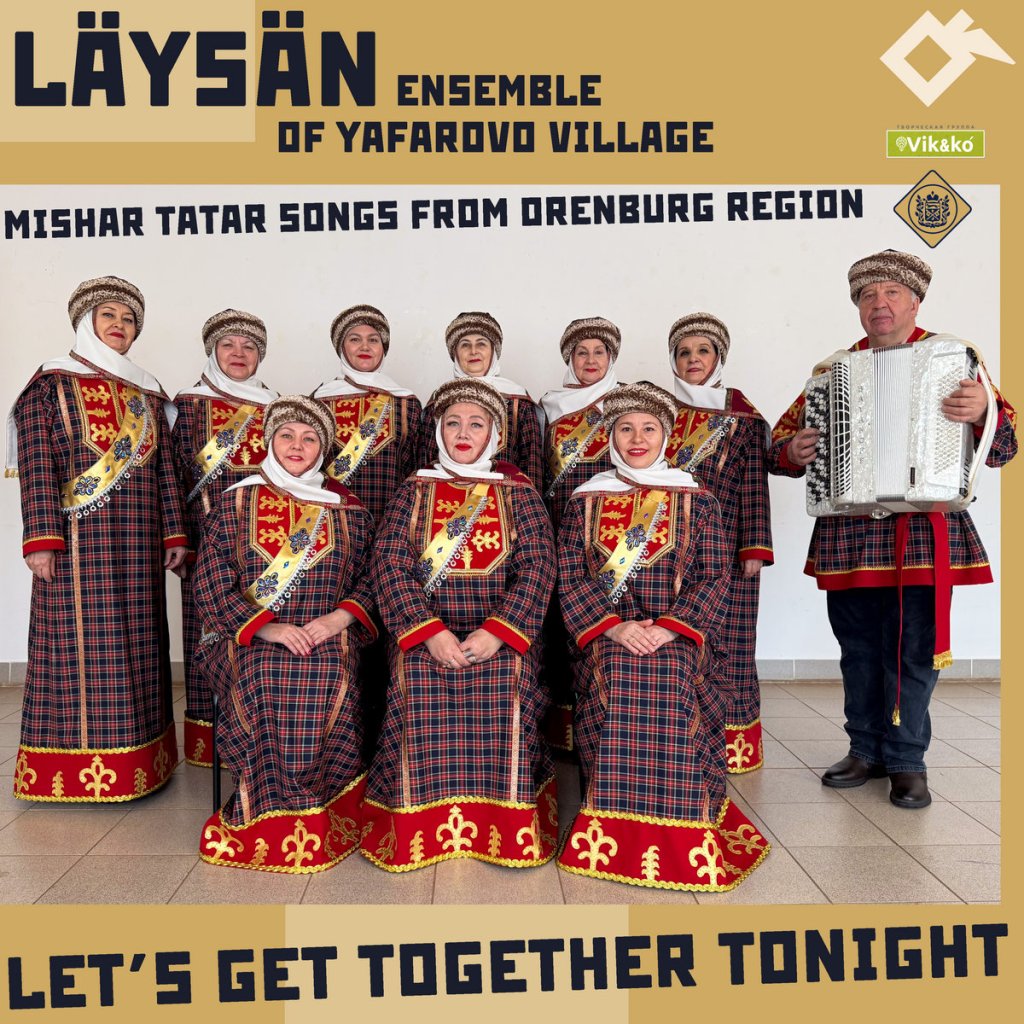
Lӓysӓn Ensemble of Yafarovo Village Let’s Get Together Tonight: Mishar Tatar Songs from Orenburg Region
The Mishars are an ethnic subgroup of Tatars. They have their own dialect and their own culture. The main part of the Mishars live in the Middle Volga region and the Urals.
Yafarovo is a Mishar village located in the Aleksandrovsky district of the Orenburg region.
Izhevsk long ago nabbed Tula’s de facto title as Russia’s arms manufacturing capital: the Kalashnikov Concern is headquartered there, producing shells, assembling drones, and making rifles. But in a seemingly parallel reality amid the rumble of the factories, young Izhevskers have opened an independent bookstore, and they have also been translating the Udmurt avant-garde of the twenties into Russian and publishing literary magazines. Who are these young people? And how was all of it possible?
“We’ll be having a children’s New Year’s party in there”
Five years ago, Albert Razin, an Udmurt activist and patriot, set himself on fire in the capital of Udmurtia, on the square outside the republic’s State Council building. Razin held a placard featuring a quotation from Rasul Gamzatov: “And if tomorrow my language disappears, I am willing to die today.”
In late 2024, I lived in Izhevsk a stone’s throw away from the spot where Razin had burned on behalf of the Udmurt language. It is the very heart of the city: the Eternal Flame, the republic’s government house, the opera house, a Rostic’s fast-food restaurant, the residence of the head of Udmurtia, and the Kuzebay Gerd National Museum are nearby.
Gerd (a pseudonym meaning “knot” in Udmurt; Gerd’s birth name was Kuzma Chaynikov) was a poet, folklorist, and probably the most important Udmurt of the twentieth century. In 1932, he was arrested along with other prominent members of Soviet Finno-Ugric ethnic groups as part of the fabricated SOFIN Case. [SOFIN was the acronym of the fictitious “Union for the Liberation of Finnish Peoples” — TRR.] The poet was accused of plotting to get Udmurtia and other autonomies to secede from the Soviet Union and establish a Finno-Ugric federation under the protectorate of Finland. Kuzebay was shot in 1937 at Sandarmokh in Karelia. He was exonerated in 1958.
The Gerd Museum’s website advertises a separate exhibition dedicated to the Udmurt national poet. The museum is located in the building of the former arsenal. The entrance to the main exhibit is on Kuzebay Gerd Square, where twenty years ago a monument to the poet was erected. Perched on a rock, a quite youthful Gerd gazes thoughtfully at the former military warehouse. He is writing a poem, apparently.
I am all alone at first, but schoolchildren wearing blue ties later come running into the museum. A museum worker, dressed in a traditional costume adorned with a monisto necklace, greets the children in Udmurt — Chyrtkemesi! — but she immediately switches to Russian and talks about the pre-Petrine history of Udmurtia, that is, before Izhevsksy Zavod (the name of the settlement which preceded city) arose in these parts. Count Peter Shuvalov built an ironworks there with the permission of the Empress Elizabeth. A little later, Izhevsk became the Russian Empire’s virtual arms capital (no offense to Tula).
The rooms I have visited recount this history as well as a little bit of Soviet history (artisanal carpets are intermingled with IZh motorcycles and cars — a total delight!), but I cannot go any further.
“But where is the Kuzebay Gerd section?” I wonder aloud.
“Ah, you wanted to see it?” responds the docent. “Unfortunately, it is impossible at the moment. It was in the room next to the ticket office, but it has been temporarily moved to the warehouse. We’ll be having a children’s New Year’s party in there.”
“Nobody the whole day”
Kuzebay Gerd is to Udmurtia what Pushkin is to Russia. One of the creators of the modern Udmurt language, Gerd also lived a very short life, thirty-nine years (five of them in Stalin’s camps). But over those years he wrote hundreds of articles, poems, plays, and prose works which became the foundation of the living Udmurt language.
The writer gained genuine recognition only during perestroika, and it is only recently that streets and museums have been named in Gerd’s honor and his legacy has been studied anew.
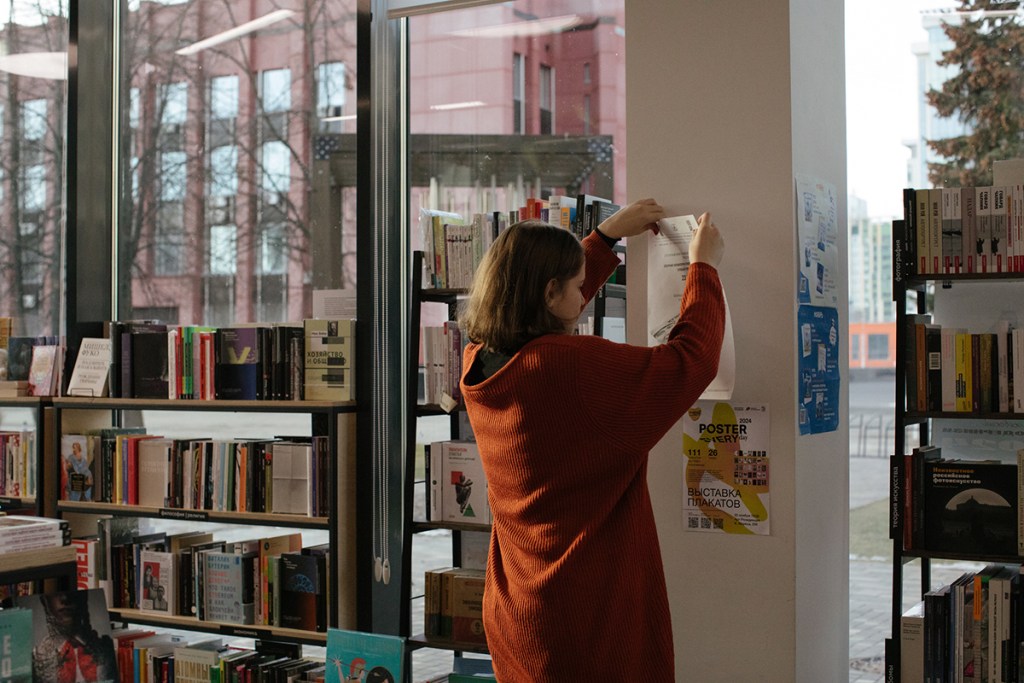
Sonya, a clerk at Kuzebay Bookstore, puts up an event flyer.
Kuzebay’s cheerful face can now be seen on posters, lapel pins, and even as an emoji on Telegram. The only independent bookstore in Izhevsk, and maybe in the whole of Udmurtia, bears his name — Kuzebay Bookstore.
Like its spiritual forebear, Kuzebay Bookstore thrives in spite of its circumstances. Today, it is an absolutely metropolitan store that is no shabbier than Vse Svobodny in Petersburg or Falanster in Moscow: Kuzebay stocks the same books on its shelves, and it has the same friendly vibe. But Kuzebay opened a year before the quarantine. Back then, it occupied a small corner at the Center for Contemporary Dramaturgy and Directing. Les Partisans Theater, in which the store’s co-founders, German and Ksenia Suslov acted, was also based there. Kuzebay achieve relative stability in early 2022, after moving to its current location.
The Kuzebay Gerd Museum in the village of Bolshaya Gurez-Pudga, Udmurtia. The museum is located in a hut next door to the local school.
“We were a quite small operation during the covid, so we didn’t give a shit whether we shut down or not,” recounts German Suslov. “We were open for deliveries. Back then, the state still paid me twelve thousand [rubles a month] for the fact that I was my own sole employee. I was like, Great, money’s coming in, cool beans. Things have somehow been growing ever since.”
German even now regularly works as a salesclerk and is awfully good at cleverly persuading people who stop by for the latest detective novel by Darya Dontsova to buy family sagas from House of Stories publishers. But the first person I meet in the store is Gosha, a tall thin salesclerk who looks like a Viking sporting a tiny cap. He sits in a cozy swing chair, playing chess on his phone. He is the only soul in the store.
German Suslov, co-owner of Kuzebay Bookstore and editor-in-chief of Luch magazine, at work.
“Is it so empty often?” I ask as I peruse Mushroom Kingdom, a wacky book by local artist Andrei Kostylev, better known as Bi-jo.
“Not nowadays, but it used to happen,” says Gosha. “This one [female salesclerk] and I even had a competition to see who had fewer people stop by the store in a day. It was a draw: zero.”
“No one at all for an entire day?”
“Yeah, it was winter, so not a single person came in. But there are always people coming in now. And even if there are no sales at the store, there are sales on Ozon almost every day.”
“The worst thing is poetry readings”
German shows up at Kuzebay about half an hour late for our interview. He is in a terrible rush, as always. The Moscow Non/Fiction Book Fair is coming up: Kuzebay is supposed to represent the publishing house and the store, and we have to send the books out in time. We pull a few boxes out of the car together, while Gosha sits down to check the books and put stickers on them. Like the many-armed Shiva, German simultaneously supervises the process, does the interview, eats a flatbread from the Tatar bazaar, pours tea for everyone, and chats with the customers who do come in.
German Suslov and Andrei Gogolev in the storage room of Kuzebay Bookstore
German has always been an energetic multi-tasker. Although he is not yet thirty, he has been a prominent figure in Izhevsk’s cultural scene for nearly ten years. He used to be an actor at the local independent theater Les Partisans, which exists to this day. But his restless nature needed something else besides theater and the history program at Udmurt State University.
“And so, I thought: the craving for theater, music, cinema was instilled in me by older comrades,” says German simply. “But what were my interests before the theater? I wrote poetry. So, I had to get into the business of poetry. And I quickly realized that no one here was doing poetry seriously.”
According to German, the literary scene in Izhevsk was rather fragmented ten years ago. There were no decent places for young people to publish and perform their work. After graduating from college, many people left for the big cities.
In St. Petersburg, a whole generation of young poets from Izhevsk emerged all at once in the early twenty-teens, including Tatiana Repina, Pyotr Bersh, Ilya Voznyakov, and Grigory Starovoitov, all of whom I know personally. Most of the members of that scene gave up writing poetry a long time ago, although Tanya Repina has achieved some fame, and my friend Petya Bersh continues to write and perform.
“When I left in the early teens, nothing was happening in Izhevsk at all. There were no prospects,” Petya, who returned to his homeland in 2022, told me. “Everything has changed now, of course, and Kuzebay has played no small role in that.”
There was no Kuzebay Bookstore at first, though. In 2016, five actors from Les Partisans dreamed up the PoetUP Contemporary Poetry HQ to consolidate Udmurtia’s most interesting poets, give them a venue, and relaunch the literary scene in Izhevsk.
“The worst thing you can imagine is an open mic poetry reading. It’s hell on earth,” says German, laughing. “And even worse is an open mic poetry reading in Izhevsk with no prescreening at all. So, what did we do in 2016? We started selecting and inviting people. Yes, we would have embarrassing events too, but far fewer. What mattered was what we were striving for. We did not want it to happen that one person would read and all his friends would get up and leave when he finished.”
[…]
Excerpted from: Ilya Semyonov (text) and Natalya Madilyan (photos), “Why does a star gurgle?” Takie Dela, 23 January 2025. Translated by the Russian Reader. I would like to finish translating this fascinating long article (this is the first quarter of it) and publish it in its entirety on this website, but that would take a lot of time and hard work. In the real world, where I have worked as professional freelance translator for nearly thirty years, I would charge 600 to 850 euros to translate this article if someone commissioned me to do it. If you would like to support my work in general and read this article in full, please donate to me via PayPal (avvakum@gmail.com) or Venmo (@avvakum). If you cannot afford to donate money right now, you can help my cause by sharing my work on social media and with friends. Thank you!
Three years ago, one man saved my family and me. He knew nothing about us except that I was a journalist, that I had left Russia because of the war, that I had children, and that we had nowhere to go. Kyle and his wife Katie decided to take us in and give us shelter. We finally had a dot on the map where we were welcome. That was how we ended up in the United States, after traveling through five or six countries in the first three months of the war.
We still live in the house into which Kyle and Katie welcomed us. All these three years, I have felt the kind of care and involvement from them which you don’t normally expect from strangers. A few days after we arrived, Katie’s mom sent us a dinner consisting of food to which we were accustomed. And Kyle was always trying to help. He paid our utilities for a long time, and he gave my husband odd jobs.
Yesterday, Elon Musk fired Kyle and two hundred other employees at the research institute where they work.
“DOGE struck like a thief in the night. Too cowardly to fire us in person, virtually everyone at NIOSH learned they were laying us off via a summary overnight email,” Kyle writes on his Facebook page.
NIOSH is the National Institute for Occupational Safety and Health, which was established by Congress over fifty years ago. It researched health and safety hazards, recommended essential standards for occupational safety and health, and investigated workplace disease outbreaks. For many years, the Institute also monitored the health of 9/11 first responders and tracked occupational illnesses among firefighters and miners.
Kyle himself worked as pulmonary toxicologist at NIOSH. He studied the effects of inhaled toxicants on the lungs and other organs.
“Since 2017, I’ve studied the effects of micronized copper-treated lumber sawdust, Corian/alumina trihydrate, various 3D printer emissions, and, most recently, engineered stone dust. That last material, engineered stone, is currently responsible for a global outbreak of silicosis, a progressive and ultimately fatal lung disease. Truly a public health crisis with profound impacts on exposed workers,” Kyle writes in his post.
DOGE sent the institute’s employees a mass layoff notice at five a.m. Tuesday morning. The brief letter announced that NIOSH was being eliminated “to improve efficiency.”
“To be clear, nothing about these firings was efficient,” Kyle retorts. “This was not trimming the fat, or even a decimation, but a wholesale execution of the institute. Only a skeleton crew now remains, presumably to help sell off instruments and other assets before being fired themselves. Is it efficient to stop millions of dollars’ worth of studies in their tracks, never to be completed? The breadth of institutional knowledge lost is hard to fathom (not speaking of myself here; I have been lucky to be trained by true giants in the field). Were there inefficiencies at NIOSH? Of course, the same as with any large organization, and I would have been happy to see improvements in those areas. Unfortunately, the costs of what happened today will compound over the next several decades, yielding sick and dying workers—husbands, mothers, sons, and daughters. I hope it was worth it. For what? A billionaires’ tax break?
“Ultimately, I think I will be okay, although the prospect of job hunting in a field saturated with thousands of newly jobless scientists is daunting—especially as the current sole breadwinner and with a child on the way. What I know for certain is that somewhere today, a worker is being exposed to something that will eventually kill him, and there will be no one there to figure out why he died.”
///
On April fifth, people all across the United States will take to the streets in protest. Despite Trump’s threats to deport all disloyal people “to their country of origin,” I will be there too. What is more, I will be at a protest rally helping the organizers as a volunteer. Americans have been good to me, so I cannot fade into the woodwork when their accomplishments are under attack and their world is crumbling. I will stand with those who are willing to defend their values.
Source: Julia Khazagaeva (Facebook), 2 April 2025. Translated by the Russian Reader, who thanks the author for her kind permission to publish her text in translation on this website.
“A Russia without profanity. The word mom is sacred! Speak without swearing.” Photo: Igor Stomakhin, Moscow, 2025
What can serve as the basis for new Russian post-war identity? What sort of patriotism can there be in a country which has lived through an aggressive war? Of what should the people of this country be proud? What should they associate themselves with? Republic Weekly presents a programmatic text by the sociologist Oleg Zhuravlev and the poet and activist Kirill Medvedev on how the so-called Russian nation came to 2022 and what its prospects are in 2025.
How can Russia get beyond being either an embryonic nation-state or a vestigial empire? People have been talking about this for three decades now. Does it require years and years of peaceful development? A national idea painstakingly formulated by spin doctors in political science labs? A bourgeois revolution? Or maybe just a small victorious war? The so-called special military operation in Ukraine, which has grown into a global military and political conflict, poses these questions in a new light.
In our view, large-scale social changes are happening inside Russia today, changes which could help shape a new national project.
These changes are not always so easy to spot.
According to the social critique prevalent in the independent media, wartime Russian society is organized roughly as follows. Its freedom-loving segment has been crushed and disoriented, while its loyalist segment is atomized and under the thumb of government propaganda, which preaches xenophobia, imperialism and cynicism. Society is fragmented and polarized, suspended somewhere between apathy and fascism. But these tendencies, which are certainly important — and therefore visible to the naked eye, as well as exaggerated by the liberal discourse — are nevertheless not absolute and probably are not even the most important. Society lives its own life, meaning that different groups within it live their own lives and move in their own directions. When you analyze the trajectories of that movement you get a better sense of the major pathways along which these groups might in the future coalesce into a new nation.
Despite the official rhetoric about unity during the war years, the regime has not managed to consolidate a nation, but it has laid the groundwork for its formation in the future. This has been significantly aided by the west’s anti-Putin policies and the information war waged by the new Russian emigration’s radical wing, which speaks of the collective guilt of all Russians, of their culture and language. Consequently, the only alternative to Putinism and war has seemed to be the disenfranchisement of all Russianness, and the only alternative to official government patriotism has been the “fall of the empire.” Meanwhile, there have been and continue to exist images of the country and modes of attachment to it which cannot be reduced to either of these two options.
THE NEW RUSSIAN PATRIOTISM
The idea of a new Russian identity was expressed succinctly by Boris Yeltsin on 22 August 1991, when he said that the attempted coup had targeted “Russia, her multi-ethnic people” and her “stance on democracy and reform.” The new modern Russian identity was supposed to be the result of choosing Europe, overcoming the archetypes of slavery and subjugation, and transcending the legacies of the October Revolution, interpreted as a criminal conspiracy and lumpenproletarian revolt, and of the Soviet nation as a grim community of “executioners and victims.”
Ultimately, though, it was the reforms themselves, along with the trauma of losing a powerful state, that generated Soviet nostalgia and a new version of Stalinism. [Yeltsin’s] shelling of the [Russian Supreme Soviet] in 1993 and the dubious 1996 presidential election, which many initially regarded as a triumph for the liberal project, proved to be its doom.
Despite the fact that advocates of the radical anti-liberal revanche were momentarily defeated and exited the scene, widespread disappointment and depoliticization was a barrier for further democratization through people’s involvement in politics. The story of 1991 spoke clearly about what the new Russians could take pride in: victory over the revanchists, for which they had taken to the streets and sacrificed the lives of three young men. Subsequently, amid the chaos and bloodshed of 1993, two ideological projects of Russian identity took shape which were mostly in competition with each other, splitting civil society in the period that followed.
LIBERALS VS. THE RED-BROWN COALITION
Vladimir Putin was nominated to strengthen the new capitalism and prevent a “Soviet revanche.” But his most successful project, as was quickly revealed, actually lay in the Soviet legacy’s partial rehabilitation. Putin managed to bridge the gap of 1993: he drew in part of the pro-Soviet audience (by using patriotic rhetoric, bringing back the Soviet national anthem, and taking control of the Communist Party) and drove the most intransigent liberals and democrats into the marginal opposition. The grassroots yearning for a revival of statism, which had taken shape in the early 1990s, was gradually incorporated into the mainstream. Many years later, this enabled things that would have been impossible to imagine even during the Brezhnev era, let alone during perestroika: the erecting of monuments to Stalin, the creeping de-rehabilitation of Stalinism’s victims, the normalization of political crackdowns as the state’s defense mechanism, and, consequently, a greater number of political prisoners than during the late-Soviet period.
Today’s ideal Russians, in Putin’s eyes, are those who identify themselves with all of Russian history from Rurik to the present, see that history as one of continuous statehood, and regard the periods of turmoil (the early sixteenth century, post-revolutionary Russia, the 1990s) as instances of outside meddling which should never be repeated.
The ideological struggle over Russia’s image during the Yeltsin and Putin years was thus rooted in the opposition between the liberal narrative (based on Yeltsin’s reforms) and the Stalinist great power narrative. Putinism, which is institutionally rooted in the Yeltsin legacy, acted as a kind of arbiter in the argument between the Shenderovich and Prokhanov factions, but gradually dissolved 1993’s great power Stalinist and White Russian imperial legacy into semi-official rhetoric.
But was this semi-official rhetoric part of the national identities of ordinary Russians? Or were their national identities not so thoroughly ideologized?
Did most of the country’s citizens even have national identities during early Putinism, which deliberately atomized and depoliticized society?
THE ESCALATION OF NORMALITY
Amid the relative prosperity, socio-economic progress, and apoliticality of the 2000s we see the emergence of a new, rather de-ideologized, “normal” everyday patriotism, involving a decent life, good wages, and an image of the country which made one proud rather than ashamed. Research by the sociologist Carine Clement has shown that this brand of patriotism could be socially critical and emerge from the lower classes (who criticized the authorities for the fact that far from everyone enjoyed good wages), but could also be more loyal to officialdom and come from the middle classes (who believed that the country had on the whole achieved a good standard of living, or had created conditions for those who actually wanted to achieve it).
In any case, early Putinism depoliticized and individualized society, neutralizing the civic conflict between the liberals and the “red-brown coalition,” but one outcome of this ideological neutralization was that it brought into focus something given to citizens by default: their connection to the motherland. This connection is not conceptualized through belonging to one ideological camp or another. It is grasped through one’s sense of the value possessed by a normal, decent life, a life which all the country’s citizens deserve individually and collectively.
This value was politicized after 2011. The Bolotnaya Square protests launched a peculiar mechanism: the escalation of normality. One author of this article recently decided to go back and re-analyze the interviews PS Lab did with people who protested in support of Navalny in 2021. The analysis showed something interesting: the most “radical” protesters, the people most willing to be detained and arrested, who wanted to go all the way and topple Putin, turned out to be the most “normal.” They were middle-class people whose demands were measured and respectable.
They did not dream of building utopias or radically restructuring society, but of a parliamentary republic and combating corruption. Both the Bolotnaya Square and post-Bolotnaya Square democratic movements, including the Navalny supporters, transformed the reasonable demand for a normal, bourgeois, prosperous country into the battle standard of a heroic revolutionary struggle against the Putin regime. Navalnyism, meanwhile, also integrated a measured social critique of inequality into its agenda.
The “normal patriotism” of the lower and middle classes thus became a stake in a fierce political struggle.
The new patriotic pride might have said something like this: “We can expose and vote out corrupt officials, push back against toxic waste dumps and insane development projects, vote in solidarity, and hit the streets to protest for the candidates we support whom Moscow doesn’t like. We have people who look to the west, people who miss the USSR, and people who defended the White House in 1991 and in 1993. We face Putin’s truncheons and paddy wagons together, and together we demand democratic freedoms and social justice.” This was how a civil society made up of Navalny fans, radical communists, and regional movements might have fought together for a “normal” country, how they might have shaped the political project of a vigorous nation pursuing solidarity. They might have done it, but they didn’t have time. They did manage to piss off the Kremlin, though.
In response, the regime launched its own escalation of normality. On the one hand, it responded to the protests with radically conservative counterrevolutionary propaganda and crackdowns. On the other hand, behind the façade of radical conservativism, Putinism erected its own edifice of “normality,” which would prove to be truly durable. Beginning in 2011, the Kremlin appropriated part of the Bolotnaya Square agenda not only in its slogans but also in practice by improving the quality of the bureaucracy, raising living standards, technocratically upgrading public amenities, and advancing technological progress. Sobyanin’s Moscow was the testing ground and façade of a new normalization which involved no democracy at all.
But the real escalation of normality on the Putin regime’s part occurred when the special military operation kicked off in 2022.
WAR, (AB)NORMALITY, AND PATRIOTISM
The war has been something profoundly abnormal for many people. It has meant a break with normal life and with any hopes for a normal country. This is what the war has meant for many people, but not for all of them.
PS Lab’s research has shown that a segment of the Russian populace, the middle-class economic beneficiaries of the new wartime economic policy, argue that Russia is now approaching the image of a normal country, even if they do not support the war. According to them, it is not the war per se but the concomitant economic progress (visible, for example, in the growth of wages and the creation of jobs) and the strengthening of national identity which have finally put paid to the period of crisis and launched a stage of growth.
Their argument goes like this. They do not know the reasons behind the tragic special military operation, which has taken tens of thousands, maybe hundreds of thousands of lives, but in trying to cope with this tragedy, they have strengthened the Russian economy and become more patriotic.
What matters is that the idea of growth is firmly separated, in the minds of such people, from the official “goals and objectives” of the special military operation and its ideological framework. It transpires that heavyweight official patriotism is digested by a significant part of society in a milder form. PS Lab’s respondents claim that they do not support violent methods of resolving foreign policy conflicts and are indifferent to the annexation of new territories, but that it has been a good thing that they have begun to think more about the motherland.
Wartime Putinism has two faces, in other words. On the one hand, we see war, increasing crackdowns, and spasms of neo-imperialist ideology. On the other, Russians are not overly fond of those things. They value other things more, such as economic growth and the strengthening of national identity, which unites the segment of society who feel alienated by the state’s ideological and foreign policy projects. When thinking about their own patriotism, many Russians underscore the fact that it is not defined by imperialist ideology. The country is going through a difficult moment, so would it not be better for Russia to take care of itself, rather than worry about acquiring new lands? This has been a leitmotif in many interviews done by PS Lab.
Economic nationalism in the guise of military Keynesianism and the sense of community experienced by citizens going through trials (in their everyday lives, not in terms of ideology) have thus laid the foundations less for an imperial project, and more for the formation of a “normal” nation-state.
Nor is the issue of democracy off the table: it has been missed not only by the opponents but also by the supporters of the special military operation. We welcome the growth of a sovereign economy, but if Putin strangles civil society and lowers the Iron Curtain, we will be opposed to it, say the quasi-pro-war volunteers. For them, however, Putin remains the only possible guarantor of a “normal” future. Many Russians who want an end to the war and a future life without upheaval have pinned their hopes on the president for years.
This focus on gradually developing and civilizing the country is nothing new. Since the 1990s, part of the intelligentsia and, later, the new middle class, pinned their hopes first on the reforms of the pro-market technocrats, then on the successes of a then-still-liberal Putinism, then on Kudrin’s systemic liberals, then on Sobyanin’s policies, and so on.
Something went wrong, and many of these people are now in exile, but it is quite natural that images of a normal life and a normal country, albeit in radically altered circumstances, continue to excite Russians. Normality can be politicized, however, as it was between 2011 and 2022.
The social movements and the independent opposition which emerged after the Bolotnaya Square uprising have been virtually destroyed by the regime: the last bright flashes of this tradition faded before our eyes at the 2022 anti-war rallies. Nevertheless, the tradition of democratic protest continues. As before the war, the latter can grow from the demand for normalcy.
Moreover, the demand for normalcy can sound particularly radical in wartime.
The hardships of war have given rise to movements such as The Way Home, whose activists, wives of mobilized military personnel, have evolved from human rights loyalism to collective protest as they have demanded a return to normal life. Starting with individual demands for the protection and return of their loved ones from the front, they then arrived at a national agenda of fighting for a “normal” and even “traditional” country in which every family should have the right to a dignified, happy and peaceful life.
After a period of struggle between the two versions of patriotism born in the 1990s, liberal and neo-Soviet, the time for everyday “normal” patriotism has thus dawned. Initially, it existed as a public mood which was not fully articulated, but subsequently we witnessed a mutual escalation of normality on the part of warring protesters and the Kremlin.
The “post-Bolotnaya” opposition, led by Navalny, launched a revolutionary struggle with the regime over the project for a “normal” bourgeois country, attempting to create a broad movement that would reach far beyond the former liberal crowd. In response, the Kremlin unveiled its neo-imperialist militarist project with one hand, while with the other hand it satisfied the public demand for normality on its own after the opposition had been defeated.
TWO SCENARIOS FOR A NORMAL RUSSIA
The above-mentioned contradictions of the Putinist discourse and the complex realities of wartime (and the postwar period?) allow us to imagine two scenarios for society’s growth, the realization of two images of Russian patriotism. In other words, we see two scenarios for a socio-political dynamic which could culminate in the creation of a new nation.
Military Putinism, contrary to its radically imperialist image, has in terms of realpolitik and public sentiment put down certain foundations for the formation of a nation-state in Russia.
If economic growth, redistributive policies, and the strengthening of everyday patriotism continue after the end of the war and captivate the majority or at least a significant segment of society, the project of turning Russia into a nation-state from above will have a chance.
Whether it materializes depends on many unknowns. Will the government be able to maintain economic dynamism after dismantling the wartime economy? Will everyday patriotism turn into a solid ideological edifice? Will the end of the war be followed by a liberalization of political life? (Is this possible at all?) Will the current pro-war and anti-war volunteerism serve as the basis for an industrious, widespread civil society? Will there be a change of elites?
Russia’s transformation into a nation-state under these circumstances would constitute a serious paradox. It would thus emerge not after a lost imperialist war or a war of national liberation, but in the wake of a partly successful war, which evolved from an imperialist war into a nationalist war. What would hold such a society together?
It is easiest to envision an identity based on Russia’s opposition to the west on the basis of geopolitical confrontation or economic and technological competition, especially if a fierce struggle between newly emerging geopolitical blocs lies ahead. This confrontation with the west, which we allegedly have pulled off with dignity (even if we are willing to recognize the special military operation itself as a dubious event), will be accompanied by various practices and emblems of cultural uniqueness.
But will this new nation be capable of producing a powerful culture, as in the nineteenth and twentieth centuries? Or will this future Russia be doomed to cultural and intellectual degradation as presaged by Dugin’s philosophy and pro-war poetry?
There are serious doubts that the grounds listed above would be sufficient for a multi-ethnic and multicultural entity like the Russian Federation to turn into a national community united by an understanding of a common destiny and values. The USSR as a community was based on the complex mix of the new Soviet individual and Russocentrism that took shape in the Stalinist period. The roles of this dynamic duo are currently played by the adjective rossiyskiy, which is a designation of civic membership in a multi-ethnic community, and the similar-sounding adjective russkiy, which is a grab bag of several easily manipulated meanings.
Putin is responsible for regular messages about multi-ethnicism, while numerous actors in the government and the loyalist media are charged with sending signals about Russian ethnicism. In this bizarre system, ethnic Russians, on the one hand, constitute a “single nation” with Belarusians and Ukrainians; on the other hand, they vouchsafe the coexistence of hundreds of other ethnic communities, supposedly united by “traditional values” (and, no matter how you look at it, the most important of these values is the rejection of homosexuality); while, on the third hand, they have a special message for the world either about their own humility, or about the fact that they will soon “fuck everyone over” again.
This complex edifice has been looking less and less persuasive. The zigzags and wobbles of the political top brass — Russia has swerved from alliances with North Korea and China to newfound friendship with the United States; from casting itself as a global hegemon to posing as an aggrieved victim — do nothing to help Russians understand who we are. They have, however, stimulated the growth of local, regional, ethnic narratives and identities which are much more reliable and comfortable. Ethnic brands, music and art projects involving folkloric reconstructions, the vogue for studying the languages of the peoples of the Russian Federation, and the plethora of Telegram channels about ethnic cultures and literatures are all outward signs of the new ethnic revival. Although they do not seem as provocative as the forums of radical decolonizers, they correspond less and less with a vision in which ethnic Russianness is accorded a formative role, while “multi-ethnicity” is relegated to a formal and ceremonial role.
When we draw parallels with the Soviet identity, we should remember that it was based not simply on a set of ideological apparatuses (as the current fans of censored patriotic cinema and literature imagine), but on a universal idea of the future, on the radical Enlightenment project of involving the masses and nations in history (including through “nativization” and the establishment of new territorial entities). The project had many weaknesses from the outset, and it was radically undermined by the deportation of whole ethnic groups and the anti-Semitic campaign (for which the current regime has less and less desire to apologize), but as the British historian Geoffrey Hosking has argued, the fundamental reason for the Soviet Union’s collapse was the lack of civil institutions in which the emerging inter-ethnic solidarity could find expression.
If an ethnic cultural and regional revival really awaits us amid war trauma, confusion, possible economic problems, and the deficit of a common identity, how would Moscow handle it? Would it try to control or guide the process? Or maybe it would focus on loyal nationalists and fundamentalists in a replay of the Chechen scenario? This may turn out to be a prologue to disintegration, or it may serve as the field for establishing new community. The radical democratic opposition, once it has a chance, would simply have to combine local, regional, and ethnic cultural demands with general social and democratic ones.
It is for the sake of this that we must rethink the imperial legacy, the Soviet project with its complex mix of colonialism, federalism and modernization, the way communities have lived together for centuries on this land, sometimes fighting and competing, sometimes suffering from each other and from Moscow, sometimes evolving, and sometimes coming together to fight the central government (as during the Pugachev Rebellion).
This combination of civil struggle and intellectual reflection can not only generate a fresh political counter-agenda but also reanimate the worn-out leitmotifs and narratives of Russian culture.
It can reintroduce the productive tension and contradiction, the universality inherent in a great culture, which the regime, while oppressing and exiling critical voices, has been trying to replace with an emasculated, captive patriotism.
***
We want a quiet private life without upheaval, the life which generations of Russians have dreamed of; we want to be independent, stick to our roots and remain who we are, says one group of our compatriots.
We want to overcome dictatorship, political oppression, inequality, corruption and war; we want to live in a society based on freedom and solidarity, says another group of our compatriots.
Interestingly, both of these scenarios are revolutionary. The first scenario, despite its adoration of technocracy and the petit bourgeois lifestyle, is the result of an anti-democratic revolution from above, during which the authoritarian regime has been transformed from a predominantly technocratic to a counter-revolutionary one and has challenged both the world order and the domestic political order. The abrupt transition to a redistributive military Keynesian macroeconomic policy, which was unthinkable ten years ago, and which fuels the current workaday patriotism, has emerged as part of the war. The war itself has been the decisive event of Putin’s counterrevolution, which, like any counterrevolution, always bears certain revolutionary traits.
But while the first scenario (albeit with a new, rather sinister twist) epitomizes the long-standing dream of a bourgeois life based on comfort and tradition, the second draws on a more grassroots and rebellious vision of social progress and related practices. It hearkens back to the defenders of the Russian White House in 1991 and 1993, the protesters against the monetization of benefits and the Marches of the Dissenters, the radical segment of the Bolotnaya Square movement, and the street movements in support of Navalny and Sergei Furgal. History, including Russian history, knows many such examples of new national communities emerging in radical joint struggles for democracy and justice.
Both scenarios could be generated by the current catastrophic reality, and both are fraught with fresh dangers: the first with the threat of a new descent into fascism, the second with violent civil conflicts. In our opinion, though, it is these two scenarios which shape the field for analyzing, discussing and imagining the country’s future.