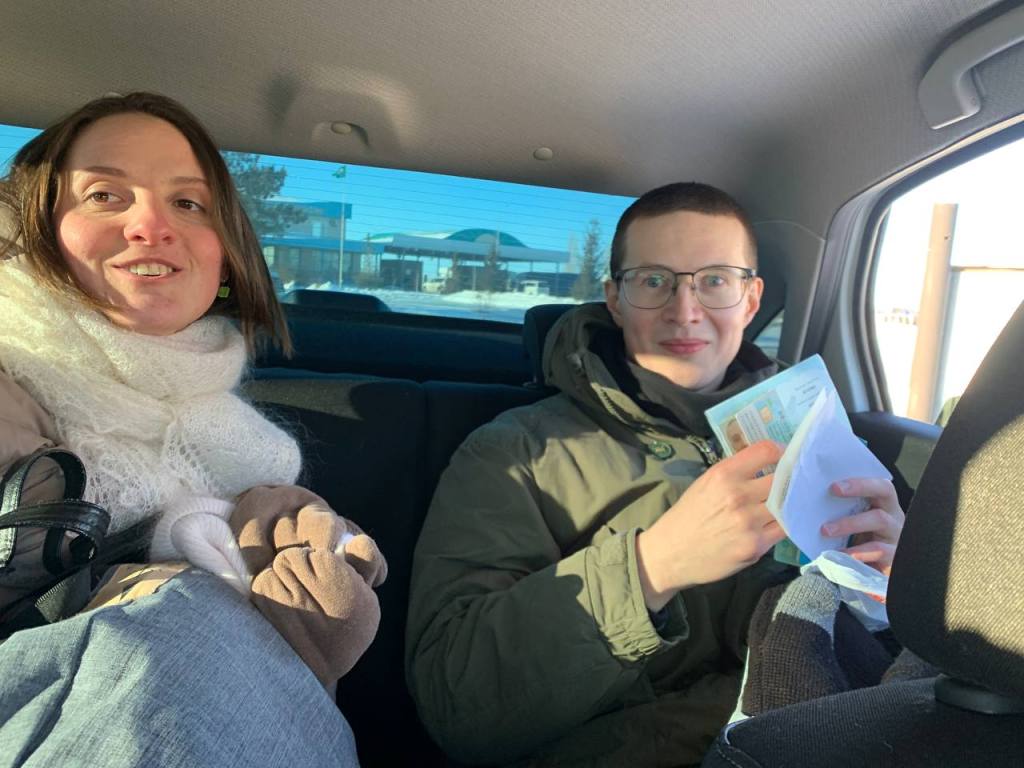
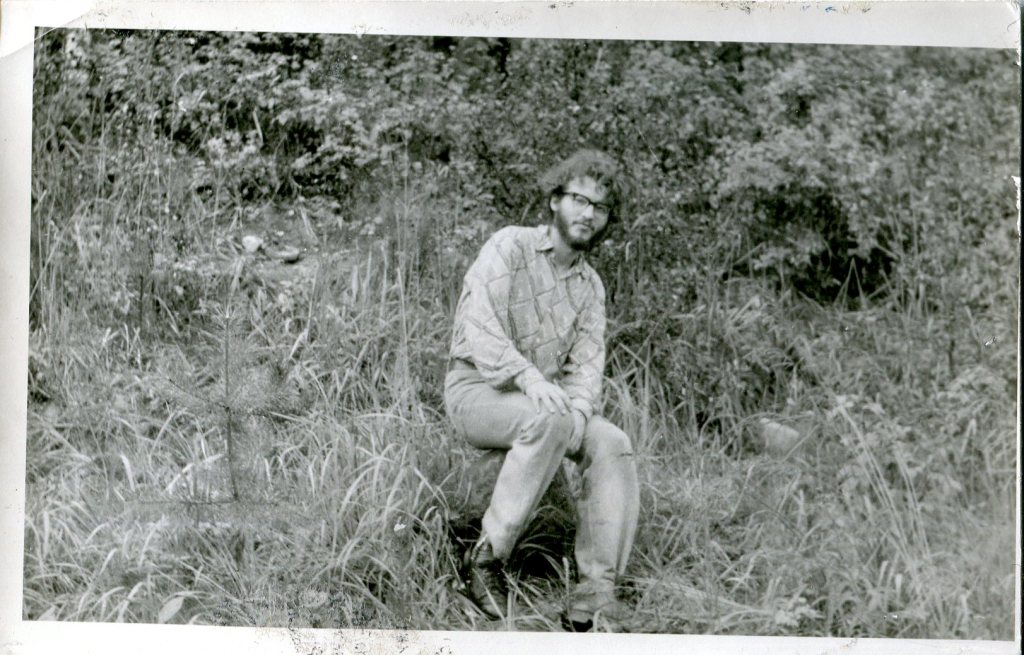
Jenya Kulakova y Viktor Filinkov después de cruzar la frontera de Kazajistán. Foto: Mediazona.
El programador Viktor Filinkov fue liberado después de siete años de permanecer en prisión bajo custodia policial como acusado y convicto por el caso Network. El mismo Filinkov contó a Mediazona que había sido liberado de la colonia penal n.º 1 de Oremburgo por la mañana, tras lo que fue conducido por oficiales de policía a la frontera con Kazajistán y entregado a agentes de frontera locales.
Antes de ser liberado, Filinkov fue entrevistado por oficiales del caso en la colonia penal, quienes le advirtieron que no volviese a Rusia tras su deportación. Los oficiales de policía le llevaron hasta la frontera engrilletado.
Filinkov es nacional de Kazajistán. En el 2021, mientras estaba encarcelado, el servicio federal penitenciario (FSIN) determinó que la presencia de Filinkov en Rusia era “indeseable” y le prohibió ingresar al país por ocho años, práctica común entre los convictos por cargos de terrorismo. Basada en este fallo, la oficina del ministerio del interior en Oremburgo ordenó la deportación de Filinkov.
Filinkov es nacional de Kazajistán. En el 2021, mientras estaba encarcelado, el servicio federal penitenciario (FSIN) determinó que la presencia de Filinkov en Rusia era “indeseable” y le prohibió ingresar al país por ocho años, práctica común entre los convictos por cargos de terrorismo. Basada en este fallo, la oficina del ministerio del interior en Oremburgo ordenó la deportación de Filinkov.
Filinkov y su esposa Yevgenia (también conocida como Jenya) Kulakoba están ahora en Kazajistán. Ellos se dirigen a Petropavl, al norte del país, en donde reside la madre de Filinkov.
Antes de ser liberado, oficiales del FSIN lavaron y entregaron a Filinkov la chaqueta verde que él vestía cuando, hace siete años, fue detenido y torturado con una pistola paralizante.
Viktor Filinkov, programador y antifascista, fue detenido en San Petersburgo el 23 de enero del 2018. En ese momento tenía veintitrés años. Tras su arresto, Filinkov describió en detalle como oficiales del FSB le llevaron al bosque y le torturaron con una pistola paralizante, obligándole a memorizar los testimonios que querían que él entregase. Otros acusados y testigos del caso describieron torturas similares.
Investigadores del FSB elevaron cargos contra once antifascistas y anarquistas en Penza y San Petersburgo, bajo el artículo 205.4 del código criminal que criminaliza “la organización de un grupo terrorista”. De acuerdo al FSB, los jóvenes se habían unido en la “red de una comunidad terrorista” y se preparaban para “derrocar al régimen por las armas”.
Las sentencias contra los convictos en Penza varían entre los seis y dieciocho años en prisión, mientras que los convictos de San Petersburgo recibieron condenas de entre tres y medio hasta siete años en prisión. Filinkov fue el último convicto en cumplir condena.
Desde el verano del 2021, Filinkov sufrió cárcel en la colonia penal n.º 1 de Oremburgo, en donde enfrentó la represión de los guardias: fue enviado repetidamente a confinamiento solitario y sus cartas fueron constantemente robadas y falsificadas. Aún así, Filinkov interpuso apelaciones contra los castigos de la colonia penal, con la asistencia de su abogado, Vitaly Cherkasov, y su defensora pública, Yevgenia Kulakova. Cuando Filinkov comenzó a ganar un caso tras otro contra la colonia penal, los guardias prefirieron dejarle tranquilo. En los últimos dos años no ha sido hostigado.
Fuente: Mediazona, 22 de enero del 2025. Traducción al español por Hugo Palomino para The Russian Reader. En las actualizaciones periódicas del Network Case dossier (en inglés) se encuentran enlaces a todo lo publicado por The Russian Reader acerca del caso Network en los últimos siete años.
Jenya Kulakova y Viktor Filinkov
Vitya y yo estamos juntos y libres finalmente. No había seguridad de que todo esto funcionaría hasta el último momento, así que lo de hoy es para mí un milagro y un alivio después de tanta tensión y esfuerzo.
¡Muchas gracias a todos por las felicitaciones que han llovido desde todos lados! Es genial saber que un evento feliz en mi vida ha traído tanta alegría a quienes me conocen. Gracias a los medios de comunicación y su cobertura de la liberación de Vitya (y con esto, sus peticiones de entrevistas).
Todo esto es precioso para mí, pero justo ahora ni Vitya ni yo podemos leer todo lo que ha llegado, ni mucho menos responder. Por favor entiendan que ambos (sobre todo Vitya) necesitamos tiempo para racionalizar y vivir estos momentos.
¡Gracias a Alina por la foto!
Fuente: Jenya Kulakova (Facebook), 22 January 2025. Traducción al español por Hugo Palomino para The Russian Reader, a partir de la nota de Thomas Campbell, amigo personal de Jenya.
Late Monday evening, President Donald Trump signed an executive order that effectively lays the groundwork for a sweeping ban on the 15,000 transgender troops currently serving in the United States military. The order, delegating much of its implementation to Defense Secretary Pete Hegseth, declares that being transgender is “incompatible with service.” It further mandates that all transgender personnel must be misgendered in official military communication and policy. Most notably, the order frames transgender identity as inherently at odds with “a soldier’s commitment to an honorable, truthful, and disciplined lifestyle, even in one’s personal life.”
The executive order, titled “Prioritizing Military Excellence and Readiness,” claims its purpose is to “protect unit cohesion” from “ideologies harmful” to it—explicitly targeting the service of transgender troops. It asserts that the medical needs of transgender individuals are incompatible with military service, despite evidence that treatments like hormone therapy result in no operational downtime. Aware of this contradiction, the order offers an additional justification for the ban, framing transgender individuals as inherently “selfish” and “false.”
See the rationale given by the order here:
Consistent with the military mission and longstanding DoD policy, expressing a false “gender identity” divergent from an individual’s sex cannot satisfy the rigorous standards necessary for military service. Beyond the hormonal and surgical medical interventions involved, adoption of a gender identity inconsistent with an individual’s sex conflicts with a soldier’s commitment to an honorable, truthful, and disciplined lifestyle, even in one’s personal life. A man’s assertion that he is a woman, and his requirement that others honor this falsehood, is not consistent with the humility and selflessness required of a service member.
While the order itself is vague on the specifics of implementation, its intent is clear: to serve as a ban on transgender service members. It declares that being transgender is “inconsistent with service” and mandates that pronouns used by the military must “accurately reflect an individual’s sex.” The order gives Defense Secretary Pete Hegseth 60 days to implement these directives, including ending “invented and identification-based pronoun usage” and prohibiting transgender service members from bunking with others of their gender.
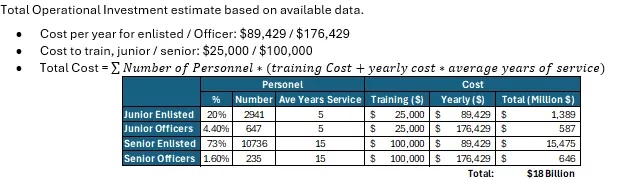
If implemented broadly, the ban will have immediate and damaging consequences for both transgender service members and military readiness across the United States. SPARTA, a leading transgender military advocacy organization, estimates that removing 15,000 transgender service members would result in the loss of an $18 billion capital investment, with the Palm Center projecting an additional $1 billion cost to recruit and train replacements. Notably, up to 73% of these service members are senior enlisted personnel with 12-21 years of experience—expertise that cannot be easily replaced by the U.S. government.
You can see SPARTA’s figures here:
When asked about the potential for a ban when it was first floated in November, Emily Shilling, President of SPARTA, stated, “The most immediate impact is that transgender people serve in every theater of the world. If it were a fairly fast-moving ban, you would be pulling these individuals out of their units, leaving critical gaps in skill sets, experience, and leadership positions that you’re just not going to be able to fill with equivalent people anytime soon, especially given the shortfalls in recruiting,”
A transgender officer with years of military experience, speaking anonymously about the rumors of an impending transgender military ban, shared that she had recently spoken with several transgender service members deeply concerned about the possibility. When asked about claims that transgender people are a liability to the military, she dismissed the notion outright, stating, “Every trans service member that I have observed performing their job excels at their job, and that’s because we have to… Every trans sailor, every trans soldier, every trans Marine, and airman that I have known has excelled at their job.”
It remains unclear how swiftly or extensively Defense Secretary Hegseth will implement these changes, how many transgender service members will face discharge, or whether the administration will revert to a “don’t ask, don’t tell” approach—forcing transgender personnel back into the closet or demanding their detransition. What is clear, however, is the administration’s framing of being transgender not as an inherent aspect of human diversity but as a dishonorable and incompatible choice. This rhetoric signals a chilling disregard for the thousands of transgender service members who have served with distinction for decades, suggesting the administration feels no obligation to temper its actions with respect or restraint.
Within hours of his inauguration, President Trump signed an executive order titled “Defending women from gender ideology extremism and restoring biological truth to the federal government”, following a whipping up of anti-trans feeling during the US election.
The order states that Trump’s administration will make it “the policy of the United States to recognise two sexes, male and female. These sexes are not changeable and are grounded in fundamental and incontrovertible reality.”
The response from LGBTQ+ groups was dismay and fear. Quoted in the Detroit Free Press, trans woman Rachel Crannell-Crocker remarked that Trump “wants to say we are not real,” while Bobbie Hirsch said “I’m scared, I’m really scared for my future.” Kimberly Frost, co-director of ILGA World, said Trump was “emboldened by anti-gender movements” to “use the lives of trans people as tools to sow divisions in society. Our communities deserve better.”
Trump’s move is not unexpected. During a fraught and divisive election campaign, Republicans spent nearly $215m alone on network TV ads that vilified transgender people, according to recent data from AdImpact. The past few years have seen a rush of anti-trans bills in red states, such as banning changes to birth certificates or defining sex as immutably set at birth. Books featuring LGBTQ+ content have been banned, and drag shows have faced protests and been subject to lurid conspiracy theories by Trump’s far right supporters.
Having spent nearly a decade reporting on far right threats to gender rights, the order’s purpose is clear to me: it sits squarely within the attack on so-called “gender ideology” with the ultimate aim to restore a “natural order” of white male supremacy. And while the target is trans people, the threat goes much wider, potentially laying the groundwork for further attacks on the US’s already degraded abortion rights.
What is gender ideology?
Originating in the mid-1990s in Catholic and other conservative Christian circles, the term “gender ideology” sprung up in response to feminists seeking to place “gender” into a United Nations report on its 1994 women’s conference. Initially the term focused on abortion rights, but quickly expanded to criticise any rights related to gender and sexuality, including LGBTQ+ and trans rights.
As the term gathered momentum, it became framed as a threat to ‘traditional’ – see conservative and Christian nationalist – values. LGBTQ+ activists and feminists were accused of imposing “gender ideology” on everything from schools to families and government, determined to “indoctrinate” children and young people with the “transgender agenda.”
Attacks on “gender ideology” were amplified by conservative writers such as Dale O’Leary who popularised the term in her book Gender Agenda, and picked up by the Vatican, as well as the anti-abortion, anti-LGBTQ+ ‘religious freedom’ organisations such as Alliance Defending Freedom and the Heritage Foundation. The right-wing think tank is behind the controversial Project 2025, with ADF on the project’s advisory board.
The project – which brings “together … over 100 respected organizations from across the conservative movement, to take down the Deep State and return the government to the people” – is key to understanding Trump’s move.
Project 2025 published a “Mandate for Leadership”, providing an anti-rights blueprint for the incoming administration. It offered policy ideas to demolish so-called “gender ideology”, demanding that “enforcement of civil rights should be based on a proper understanding of those laws, rejecting gender ideology.” It demanded that “gender ideology” be removed from school curricula and, in language echoed in Trump’s order, warned “radical gender ideology is having a devastating effect on … young girls.”
The project also called on the government to “reverse the DEI [diversity, equality, inclusion] revolution in Labor policy”. Trump’s order did so willingly, revoking previous executive orders that protected against discrimination and stating that government agencies must “take immediate steps to end Federal implementation of unlawful and radical DEI ideology.”
A threat to abortion?
While the executive order is first and foremost a frightening attack on trans people, its wording sets alarm bells ringing for abortion rights, too. It will be no surprise that curtailing abortion rights is a key focus of Project 2025 – the mandate mentions “abortion” 199 times.
Trump’s previous administration created a conservative-majority Supreme Court that overruled Roe vs Wade, opening the door for individual states to implement deadly and devastating abortion bans across the US. Now, the executive order’s wording suggests a wider attack on reproductive rights.
The order defines “female” as meaning “a person belonging, at conception, to the sex that produces the large reproductive cell”, while male is defined as “a person belonging, at conception, to the sex that produces the small reproductive cell.”
As well as being troubling for trans identity, the wording defines male and female foetal personhood from conception. If the foetus is recognised as a person at conception, then that foetus legally has the same rights as a born person, with catastrophic consequences for pregnant women and people. Foetal personhood means a woman can be prosecuted for murder if she has an abortion, as it violates the right to life. She can face manslaughter charges if she has a miscarriage for which she is blamed.
Bethany Van Kampen Saravia, senior legal and policy adviser at the gender rights NGO Ipas, told openDemocracy that “the language used in this cruel and dehumanising executive order is undoubtedly deliberate and deeply flawed on several counts. Simply put, it is outside of the executive authority to declare a fertilized egg a ‘person’ who has constitutionally protected rights.”
This is not a new threat. So far, 24 US states have included foetal personhood language in laws regulating or banning abortion, while 17 states have foetal personhood by law or judicial decision that applies to either criminal or civil law, or both. There have already been multiple cases where women in the States have been criminalised for miscarriage.
“Personhood arguments have long been used by anti-rights actors in attempts to fully ban and criminalize abortion and to punish pregnant people,” warned Van Kampen Saravia. “This language can also ban some forms of birth control and fertility treatments like IVF. This is a clear and deliberate signal of what is to come from this Administration.”
“It is outside of the executive authority of the President to instate a nationwide abortion ban, yet there is much that he can do to limit access to medication abortion and those threats need to be taken seriously,” she added. “Ipas US condemns these egregious acts of hate and bigotry. These executive orders are nothing shy of human rights violations and the world should be paying very close attention now to what is being feigned as ‘defending women’ and who is actually being targeted and criminalized.”
The ideology behind the ‘natural order’
The attacks on abortion and LGBTQ+ rights are often interlinked, as both pose a threat to the far right idea of a ‘natural order’ which has been undermined by feminism and human rights, and must be returned to through reversing social progress and protections.
The idea that there is a ‘natural order’ which needs to be re-established has its roots in fascist ideology, and its intent is found in almost all attacks on gender rights including from Trump, Putin, and anti-gender ideologues in Europe. It valorises male supremacy, female subordination, and declares the non-existence of LGBTQ+ people.
As I write in my book, the existence of trans people is a grave threat to the natural order and its advocates who want to reassert male supremacy and abolish the rights of LGBTQ+ people. The goal of male supremacist, anti-gender movements is to ‘naturalise’ gendered stereotypes about men’s and women’s behaviour and status: they want to naturalise male supremacy and female inferiority.
The far right wants to tie women’s inferiority to biology, and to claim that harmful gendered stereotypes are biologically innate in order to pin women to specific roles in society. These same stereotypes are used to justify women’s oppression: women are just more nurturing, or they are bad at leadership, for example, they should stay in the domestic sphere and leave the public sphere to the boys. The anti-gender movement wants to claim that women’s oppression is natural, rooted in women’s biology, and therefore cannot be challenged.
But biology is not destiny, as the famous feminist slogan states. The ‘natural order’ of female inferiority and male supremacy is disrupted by feminists saying women can have control over their fertility, or LGBTQ+ people saying one can express their gender identity as they choose. They therefore have to be stopped.
This order has nothing to do with “defending women” from “extreme gender ideology.” The extreme gender ideology is the one that tries to push women into oppressive boxes, ban abortion, and seek to abolish the existence of trans people and the LGBTQ+ community more widely.
The extreme gender ideology is the movement that elects a President after a judge in New York found a rape allegation made against him to be “substantially true”. It is the movement that celebrates his election with the slogan “your body, my choice.”
California State Education Resources California Department of Education: Chief Deputy Superintendent: David Schapira Reminder of Obligation to Protect Immigrant Families’ Rights to Access Public Education
The letter from the California Department of Education (CDE) reminds schools of their obligation to protect the rights of immigrant families to access free public education, regardless of immigration status. It highlights the U.S. Supreme Court’s Plyler v. Doe ruling and California laws ensuring non-discrimination and safe school environments. The letter includes resources for training staff, legal guidance, and mental health support.
CA Office of the Attorney General: Promoting a Safe and Secure Learning Environment for All: Guidance and Model Policies to Assist California’s K-12 Schools in Responding to Immigration Issues
With the inauguration of President Trump at hand, Monterey County officials and community stakeholders showed a united front in their support of all immigrants who live, work and attend school in the region at a press conference.
On Jan. 15, Salinas Mayor Dennis Donohue, Monterey County Sheriff Tina Nieto and Monterey County Supervisors Luis Alejo, Kate Daniels and Chris Lopez joined leaders in education, agriculture, hospitality, health and social services to announce the passage of a resolution on Tuesday affirming the county’s commitment to protecting immigrants’ rights and launch a public “Know Your Rights” campaign.
The resolution reestablished the county as a “Welcoming County” for immigrants and refugees, reaffirming key provisions of various state laws including the California Values Act (Senate Bill 54) and is the product of an Ad Hoc Committee formed by the board of supervisors in December.
Monterey County’s resolution came the same day the Salinas City Council, at their first meeting of 2025, issued a statement reminding residents the city has been a “Welcoming City” since June 2017.
The city “is steadfast in our dedication to serving the entire community, ensuring public safety and fostering trust regardless of immigration status, citizenship status or nationality, said Mayor Dennis Donohue at the Tuesday council meeting.
The majority of immigrants in California are documented residents, according to California’s Public Policy Institute, in 2022, 83% of immigrants were either citizens or had some other legal residency status.
While California has 1.8 million immigrants that were undocumented in 2022, according to Pew Research, it is down from 2.8 million in 2007.
Many undocumented individuals live in “mixed-status” households, which includes people with legal status.
According to the California Immigration Data Portal, in 2021, more than 3.3 million people in California and one in five children lived in such “mixed-status” households.
After recent immigration enforcement in Kern County spurred online rumors of similar activity occurring locally that turned out to be false, Sheriff Nieto told the crowd outside the Monterey County Government Center on Wednesday, that her office had been fielding phone calls from concerned residents.
“My family’s afraid to go to the store, my family’s afraid to send their children to school, my family’s afraid to go outside of the house,” said Nieto, describing some of the calls to law enforcement. “I want to assure you that here in Monterey County, the sheriff’s office and your chiefs of police know what the rules are and understand with the Trust Act is, and we’re going to follow those rules.”
Enacted in 2014, the Transparency and Responsibility Using State Tools (TRUST) Act (AB 4) defines the circumstances in which local law enforcement agencies may comply with immigration detainer requests.
Monterey County Office of Education Superintendent Deneen Guss said she wanted to reassure parents that schools are safe spaces for students.
“Our administrators, our educators, and our school staff are dedicated to creating welcoming environments where students and their families feel seen, heard and safe,” Guss said. “I want to assure parents that under current federal laws, schools are considered protected areas and are generally prohibited from voluntarily granting access to campus, by immigration officers, in the absence of a judicial warrant or a court order.”
“I urge you to please keep sending your children to school every day and to also create an emergency plan, including designating someone who can care for your child if needed,” she added.
During the pandemic, workers in agriculture and the service industry were lauded as “essential workers” as many continued to work onsite while workers in other industries got to work remotely and shelter-in-place.
Executive Director for the Monterey County Farm Bureau Norm Groot said local workers in the county’s $4.3 billion agriculture industry should still be considered essential.
“Our fresh food supply and local economy are fully dependent on this workforce and we consider this a national security priority in a time of agricultural labor shortages — farming depends on a stable and reliable workforce not one under threat,” Groot said. “[The county agriculture industry] depends on 55,000 farm workers to harvest our crops each year — primarily immigrants.”
“We appreciate the farmworkers’ vital contributions to the national food supply as essential workers,” he said.
The second largest industry in the county, hospitality, employs 25,000 people.
Rick Aldinger from the Monterey County Hospitality Association said the local immigrant workforce are “hardworking individuals” and “part of the fabric of our local communities” and thanked Supervisors Alejo and Lopez for spearheading the county’s Ad-Hoc Committee.
“Huge progress has been made in a very brief period of time,” Aldinger said. “Avenues of communication have been established among key players and industry leaders and a comprehensive portfolio of resources has been put together that will help our workforce navigate, whatever might lie ahead.”
Individual rights under state and federal law is also something employers with an immigrant workforce must also understand.
“We are trying to not only educate our immigrant workforce but also trying to educate the employers and what their rights are,” Groot said. “It’s a much larger circle than just saying we need to inform immigrants what their rights are.”
“We are trying to work through that and understand how much information we have to push out at this point — it really depends on what happens after next Monday,” Groot said, referring to President Trump’s inauguration, “and how many Executive Orders we’re going to start seeing.”
Olga Shcheglova asiste al juicio de su marido Aleksander Skobov por videoconferencia. Foto de SOTAvision/Grani.ru
Declaración final de Aleksander Skobov en el juicio en su contra:
Me he criado en la Unión Soviética con la creencia de que cuando un malicioso y cruel agresor ataca a civiles, tenemos que tomar las armas y combatirlo, y que quien no pueda usar armas, debe ayudar a los combatientes y alentar a otros a hacer lo mismo.
Todo mi trabajo como comentarista político ha consistido en invocar al pueblo a pelear contra el agresor que ha atacado a Ucrania, y asistir a Ucrania con armas y municiones.
Nadie ha atacado o amenazado a Rusia.
Fue el régimen nazi de Putin el que atacó a Ucrania, sólo por la megalomanía de los cabecillas del régimen, por su inhumana sed de poder sobre todo lo que ven.
Asesinando a cientos de miles de personas es como ellos refuerzan su autoestima. Son degenerados, escoria y gentuza nazi.
La responsabilidad de la dictadura de Putin de planear, desencadenar y llevar a cabo una guerra agresiva es obvia y no necesita ser probada. Tampoco necesitamos probar nuestro derecho a una resistencia armada contra esta agresión en el campo de batalla y en la retaguardia del agresor. Sería risible esperar el reconocimiento de este derecho por parte de un régimen que arroja gente a las prisiones por condenar moralmente y con fuerza esta agresión. Toda forma de protesta contra la agresión putinista ha sido eliminada.
Mi llamado a resistir al régimen agresor por la fuerza ha ocasionado que me acusen de terrorismo*. No me propongo discutir con los oficiales del agresor, aún si ellos afirman que mis acciones constituyen pedofilia. Las cortes rusas han demostrado hace tiempo que son apéndices de la tiranía nazi y que es inútil buscar justicia en ellas. Nunca me someteré a ellos, lacayos de asesinos y sinvergüenzas.
No veo razón para discutir con marionetas de la dictadura acerca de que tan concienzudamente cumplen sus propias leyes. De cualquier manera, esas leyes son las leyes de un estado totalitario cuyo objetivo es secuestrar la disidencia. No reconozco esas leyes y no las obedeceré.
Tampoco tengo intención de apelar ningún fallo ni a las acciones tomadas por los representantes del régimen nazi .
La dictadura putinista puede asesinarme pero no podrá detener mi lucha contra ella. Donde sea que esté, seguiré convocando a los rusos honestos a unirse a la fuerzas armadas ucranianas. Seguiré reclamando ataques aéreos en bases militares dentro del territorio ruso. Seguiré apelando al mundo civilizado a infligir una derrota estratégica a la Rusia nazi. Seguiré tratando de probar que el nuevo régimen hitleriano debe ser aplastado militarmente.
Putin es el nuevo Hitler, un vampiro al que la impunidad y el gusto de la sangre le vuelven loco. Nunca me cansaré de decir “¡Aplasten a la víbora!”
¡Muerte al asesino, tirano y ruin Putin!
¡Muerte a los invasores fascistas rusos!
¡Gloria a Ucrania!
[Grani.ru] Gracias a Olga Shcheglova (en la foto anterior), dedicada esposa de Aleksander Valerievich. Gracias a SotaVision por grabar el evento en la corte militar de San Petersburgo (Skobov toma parte en el juicio vía videollamada mediante Syktyvkar). Gracias a quienes no han cancelado su suscripción a Grani.ru después de que esta cerrara. Es como si Skobov hubiera hecho coincidir su valiente acción con el último colapso moral de numerosos medios de comunicación. Y aún así, será escuchado por un puñado de sus contemporáneos. Pero él ya es parte de la historia.
* Skobov ha sido acusado de “convocar públicamente al terrorismo”, “hacer apología del terrorismo o promocionar el terrorismo haciendo uso de medios de comunicación, incluso internet” y “organizar una comunidad terrorista y participar en ella”. Si Skobov es encontrado culpable de esos cargos, se enfrenta a una pena máxima de entre diez y quince años en prisión y multas de hasta un millón de rublos (9,500 euros aproximadamente) – TRR.
Aleksander Skobov, 67, está siendo juzgado por cargos relacionados a publicaciones en redes sociales, “invocar públicamente al terrorismo”, “hacer apología pública del terrorismo o promover el terrorismo haciendo uso de redes sociales, incluyendo internet” y “organizar una comunidad terrorista y ser partícipe de la misma”. Se enfrenta a entre 10 y 20 años de cárcel si es encontrado culpable.
En marzo del año pasado, Skobov fue declarado “agente extranjero” y fue detenido en abril, tras ignorar las peticiones de sus amistades para que deje Rusia. En su primera audiencia judicial se negó a responder preguntas, declarando que sólo deseaba “escupir al juez en la cara”. Ahora sufre prisión preliminar en Syktyvkar, república de Komi.
Aleksander Skobov inició su actividad política en los movimientos de izquierda de la disidencia soviética de los setenta. En 1976, junto a otros estudiantes de Leningrado (ahora San Petersburgo), formó la “oposición de izquierda”, grupo que reclamaba el fin de la represiva maquinaria estatal de la Unión Soviética, por los derechos humanos y el desarme nuclear.
El grupo coincidió con la escena contracultural y las bandas rockeras de Leningrado. En “Perspectivas”, el grupo publicó textos de León Trotski, los escritores anarquistas Mijaíl Bakunin y Piotr Kropotkin; y socialistas europeos contemporáneos, incluyendo a Daniel Cohn-Bendit y Herbert Marcuse.
En 1978 la “oposición izquierdista” contactó grupos en otras ciudades y planeó lanzar una “unión de juventud revolucionaria comunista”. Arrestado junto a otro organizador, Skobov fue enviado a un hospital psiquiátrico, una infame forma de castigar disidentes en la era soviética.
Tras su excarcelación, en 1981, Skobov se unió a la Unión de trabajadores libres interprofesionales, más conocida como SMOT, una de las primeras organizaciones de trabajadores independientes en la Unión Soviética. Cuando Lev Volokhonsky, uno de los promotores de la SMOT, fue arrestado, Skobov y otros pintaron grafitis para demandar su liberación, por lo que fue nuevamente detenido. Sirvió una segunda sentencia de tres años en un hospital psiquiátrico.
Al final de los ochenta, cuando la política del glásnot permitió la actividad política legalmente, Skobov se unió a la Unión Democrática. Consecuentemente, en 1988, se convirtió en uno de los últimos en ser acusado por “agitación antisoviética”, caso que fue cerrado en 1989.
En los noventa, los primeros años postsoviéticos, Skobov denunció vehementemente la guerra rusa contra Chechenia como “una guerra desencadenada por el imperialismo ruso, con el objetivo de aplastar las aspiraciones independentistas de quienes fueron alguna vez avasallados por la Rusia zarista”, guerra que se peleó con “los interminables métodos barbáricos de los colonizadores de todas las eras y pueblos”. Se unió al partido liberal Yábloko y al grupo Solidaridad, que tuvo actividad a inicios de la década de los diez.
Skobov denunció la intervención rusa en Ucrania en el 2014 y públicamente aplaudió a los rusos que se enlistaron en la resistencia ucraniana, tomando las armas. Simon Pirani.
En julio del año pasado, tras su arresto y detención, Skobov escribió a su esposa, Olga Shcheglova, pidiéndole que publicase dicha carta. Esta fue impresa por Novaya Gazeta Europa. Aquí la compartimos traducida.
Querida Olga:
Quería escribir esta carta a Lena (puedes imaginar fácilmente porque), pero no tengo ningún sobre con su dirección. De todas formas, esta misiva no es sólo para ella.
Tú y yo hablamos de esto cuando nos vimos por primera vez. Quiero explicar nuevamente porque les dije no a muchos queridos y cercanos amigos, quienes intentaron convencerme de aprovechar la oportunidad de salir de Rusia.
Pertenezco a una generación de disidentes soviéticos presos políticos. Aunque en números somos pocos, esa generación se convirtió en un fenómeno histórico significativo. Se convirtió en símbolo de la resistencia de la humanidad contra la violencia. Alcanzó un lugar a nivel internacional.
Y aunque siempre he sido una oveja negra para mi generación, por ser “rojo”, pertenecer a ella ha sido lo más importante en vida. Esa generación estaba hecha de gente diferente: algunos buenos, otros no tanto, algunos fuertes, otros débiles. Tuvo sus altas y bajas, como cualquier otra oposición en cualquier otro contexto y en cualquier otro tiempo. Siempre se mostró al mundo a través de sus míticas personalidades y los esplendorosos estándares morales y espirituales que estos establecieron.
Todos han muerto. Nunca fuimos muchos y sólo unos cuantos quedamos. Nuestra generación toma su sitial en la historia por razones completamente inherentes. Y en el nuevo drama histórico que ahora se extiende, sólo puede estar al margen.
Ellos no nos han puesto un dedo encima por mucho tiempo. El motivo: moriríamos en nuestra ley. O, en cambio, nos exhiliaríamos y pasaríamos el resto de nuestra existencia viviendo del capital político conseguido (merecidamente). Los golpes están cayendo sobre otros, muchos de ellos más jóvenes.
Programmer Viktor Filinkov was released after seven years in police custody and prison as a defendant and convict in the Network Case. Filinkov himself told Mediazona that he had been released in the morning from Penal Colony No. 1 in Orenburg, after which police officers drove him to the border with Kazakhstan and turned him over to local border guards.
Before his release, Filinkov was interviewed by the penal colony’s case officers, who warned him not to return to Russia after he was deported. Police officers transported him to the border in handcuffs.
Jenya Kulakova and Viktor Filinkov after crossing the border with Kazakhstan. Photo: Mediazona
Filinkov is a Kazakhstani national. In 2021, while he was still incarcerated, the Federal Penitentiary Service (FSIN) ruled that Filinkov’s presence in Russia was “undesirable” and banned him from entering Russia for eight years, a common practice for those convicted on terrorism charges. Based on this ruling, the Orenburg office of the Interior Ministry ordered Filinkov deported.
Filinkov and his wife Yevgenia [aka Jenya] Kulakova are now in Kazakhstan. They are headed to Petropavlovsk in the north of the country, where Filinkov’s mother resides.
Before his release, FSIN officers laundered and gave Filinkov the green jacket in which Filinkov was detained seven years ago and tortured with a stun gun by FSB officers.
Programmer and antifascist Viktor Filinkov was detained in St. Petersburg on 23 January 2018. He was twenty-three years old at the time. After his arrest, Filinkov described in detail how FSB officers had taken him to the woods and tortured him with a stun gun, forcing him to memorize the testimony they wanted him to give. Other defendants and even witnesses in the case described similar torture.
FSB investigators then charged eleven antifascists and anarchists in Penza and St. Petersburg under Article 205.4 of the Criminal Code (which criminalizes “organization of a terrorist group”). According to the FSB, the young men had banded together into “the Network terrorist community” and were preparing for an“armed overthrow of the regime.”
The sentences handed down to the Penza defendants ranged from six to eighteen years in prison, while the Petersburg defendants were handed sentences of between three and a half to seven years in prison. Filinkov was the final of the Petersburg activists to serve out his sentence.
Since the summer of 2021, Filinkov had been incarcerated at Orenburg Penal Colony No. 1, where at first he faced pressure from the prison wardens: he was repeatedly sent to solitary confinement, and his letters were constantly stolen and forged. Filinkov, however, consistently filed legal appeals against the penal colony’s punishments with the assistance of his lawyer Vitaly Cherkasov and his public defender Yevgenia Kulakova. When they began to win one court case after another against the penal colony, the wardens preferred to leave Filinkov alone. They had not harassed him during the last couple of years.
Vitya and I are finally together and free. There was no certainty until the last moment that everything would work out, so today’s event is a miracle to me and a relief after a lot of effort and tension.
Thank you all so much for the congratulations that have been pouring in from everywhere! It’s quite cool to know that a happy event in my life has brought so much joy to people who know me. And thanks to the media for their coverage of Vitya’s release (and, consequently, their requests for interviews).
All of this is quite precious to me, but right now neither Vitya nor I can even read everything that has come in, let alone reply. Please understand that both of us (Vitya especially) need time to come to our senses and experience these moments.
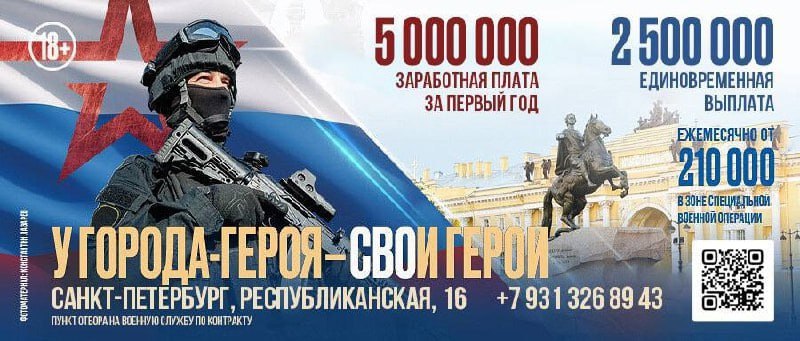
“A first-year salary of 5,000,000 rubles [approx. 48,000 euros]. A one-time [signing bonus] of 2,500,000 rubles. Monthly pay starting at 210,000 rubles [approx. 2,000 euros] in the special military operation zone. THE HERO CITY HAS ITS OWN HEROES. 16 Republican Street, Saint Petersburg, +7 931-326-8943.”
The signing bonus for volunteering for combat duty has been raised to 2.5 million rubles in Petersburg
The amount was increased by 400,000 rubles. Previously, those wishing to go to the front were paid a lump sum of 2.1 million rubles. On the poster, which was published in the Red Guards District administration’s chat group, the amount that can now be earned for a year of service in the war zone is listed as 5,000,000 rubles.
Judging by the information on the Smolny’s [Petersburg city hall’s]website, the signing bonus was increased three days ago, at the expense of the city budget. Rotunda was told the same thing at the military service recruiting center in the Central District.
Low-price chain store seeks a sales assistant-cashier.
Responsibilities: serving customers at the cash register; restocking products in the sales area; maintaining order and cleanliness. The candidate should be energetic, trainable, and ready for intensive work.
On-the-books employment. Schedule: two days on, two days off. Salary: 56,000 rubles[a month, i.e., approx. 540 euros a month].
The employer pays for training and a medical examination, offers corporate discounts at all stores in the chain, provides material assistance in difficult situations, and arranges for gifts for children.
In 2025, Russian authorities are continuing to increase payments for contract soldiers participating in the war in Ukraine.
From January, men who sign a military contract in the Samara region will receive a one-time payout of up to 4 million rubles ($38,900) — the highest of any region in the country.
In addition to these one-time payouts, which vary by region, military personnel also receive a monthly salary of at least 210,000 rubles ($2,000). In the event of a soldier’s death, their family is entitled to a “funeral allowance,” which can amount to up to 5 million rubles ($48,600), according to a presidential decree.
The substantial payouts to contract soldiers are part of the authorities’ efforts to turn the military into the country’s new elite, says historian Dmitry Dubrovsky.
“One of the key outcomes of the ongoing war is the attempt to construct a ‘Putin Elite 2.0’ to replace the original elite that emerged in the early 2000s, built on oil and gas revenues,” Dubrobsky said. “This process began as early as 2014, when the ‘heroes of the Russian Spring’ gradually started integrating into Putin’s regime. However, it became fully evident with the onset of the full-scale aggression [against Ukraine].”
In addition to million-ruble payouts, the state also provides military personnel with subsidized mortgages and free university education for their children, including at prestigious institutions such as Moscow State University and the Higher School of Economics.
Nearly 15,000 soldiers who fought in Ukraine, as well as their children, were admitted to Russian universities under this program in 2024 — almost double the number from 2023. And increasingly, Ukraine war veterans are being appointed to political roles, though not on a wide scale.
“The privileges of military personnel are evident in the growing practice of integrating ‘veterans’ into various political projects and regional administrations, often as deputy governors,” says historian Dubrovsky. “Overall, the families of military personnel see themselves as part of a superior class, a perception eagerly reinforced by Putin’s propaganda.”
Western free society is seriously sick too. The symptoms pop up here and there, but one of the most disgusting is the massive support for the alleged “people of Palestine”—that is, Hamas—in this whole monstrous story. I really don’t understand HOW it has been possible, after the atrocities of October 7, after the taking of hostages, including children, to pretend that this was a minor trifle? That the ruthless Jews suddenly out of the blue started tormenting the unfortunate residents of the Gaza Strip?
After all, bolstered by this wave of international support, Hamas thinks it has won. This will lead to fresh terrorist attacks, of course.
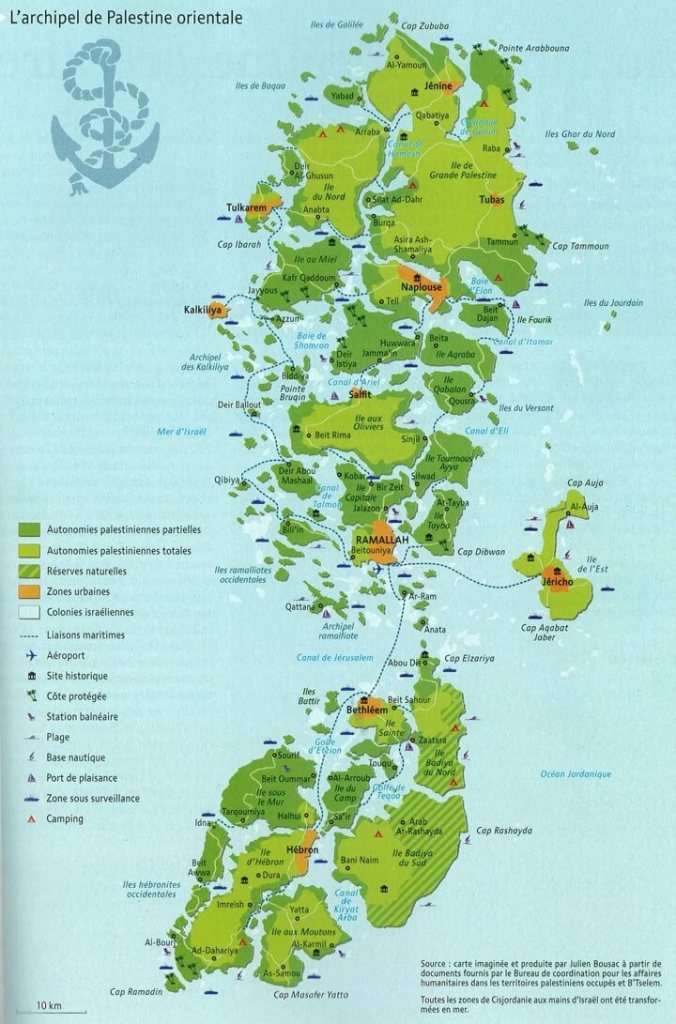
The map above shows what Palestine’s West Bank would look like if all non-Palestinian land suddenly turned into water.
All that would remain would be an archipelago of small islands with the sea of Israel to the west and the Jordanian ocean to the east.
The map is designed to show just how broken up Palestinian land in the West Bank really is. And while originally published in French, it is quite clear in the main point it’s trying to make.
Here are some key points about the map:
Regions of Palestinian Authority:
The map shows areas of partial and total Palestinian autonomy, marked in different shades of green. The darker green areas represent total autonomy, while the lighter green areas represent partial autonomy.
Israeli Settlements:
Areas in blue indicate Israeli settlements.
Urban Zones:
Orange areas represent urban zones.
Protected and Historical Sites:
Natural reserves and protected coasts are marked, along with historical sites.
Geographical Representation:
The map depicts the West Bank as a series of islands, which illustrates the fragmented nature of Palestinian territories due to the division created by Israeli settlements, roads, and checkpoints.
Symbols:
Various symbols denote airports, historical sites, protected coasts, beaches, and camping areas. There are also symbols indicating maritime connections, which, in the context of the map, seem to suggest metaphorical “water” crossings between different areas of Palestinian control.
Geographic Features:
Names of regions and cities such as Ramallah, Nablus, Hebron, Bethlehem, and Jericho are mentioned, providing a sense of the location and distribution of these areas.
The map’s creation by Julien Bousac aims to highlight the challenges faced by Palestinians due to the fragmentation of their territories. The fictional archipelago metaphorically represents how the West Bank is divided and isolated, illustrating the complex political and social landscape of the region.
Red America and Blue America have become two different and mutually antagonistic countries sharing the same geographic space. They barely talk to each other, don’t understand one another — and while Blue America happens to be aware that both itself and Red America exist in a larger, infinitely complex world that needs both of them to be one whole for its survival, just as both of them need that larger world for theirs, Red America is not interested in and indeed is hostile to anything and anyone that is not itself and, while generally tending to be poor and perennially gripped by bitterness and resentment, derives its existential satisfaction almost exclusively from making Blue America feel bad — “owning the libs,” as Red America calls it.
A really good series. I don’t know to what degree it straight up deserves а rating of eight, but it has interesting and fairly unique ideas, and the lead actress is pretty and acts well. We’ll see what the next episodes are like, but on the basis of the first one we can say [that the show] has fine potential. If it develops in a good direction, it could turn out to be decent.
Source: Ororo.TV. Translated by the Russian Reader
Le damos un vistazo al año viejo y la bienvenida al año nuevo con Igor Stomajin, Noise Cabaret, las grandes farmacéuticas rusas, el gobernador de San Petersburgo Alexander Beglov, Aaron Schuster, «Anora», el Laboratorio de Sociología Pública y Andrei Kolesnikov, de Kommersant. ||| TRR
“Devuelve el espíritu del año nuevo”: Igor Stomajin, Moscú, 2024
Fiel a su naturaleza vanguardista, el Noise Cabaret estrena, el 25 de diciembre, la serie inmersiva Diálogos, basada en la obra filosófica de Platón. Aleksander Judiakov transforma la antigua filosofía griega en una animada, ingeniosa y provocativa charla con la audiencia.
Junto a su compañero, Ivan Wahlberg, Judiakov, quien no sólo actúa sino que también dirige el proyecto, guiará a la audiencia a través del laberíntico pensamiento de Platón: ¿qué es la justicia?, ¿dónde está la línea entre lo existente y lo no existente?, ¿cuál es la naturaleza del amor? Estas y muchas otras fundamentales preguntas filosóficas servirán de punto de partida para reflexionar y debatir.
Diálogos es una serie de performances interactivas en la que cada espectador toma parte en discusiones filosóficas que consisten en textos de Platón adaptados e improvisados de forma histriónica, lo que significa que el desarrollo de la sesión depende de la participación de la audiencia. Cada nueva performance es un capítulo aparte que trata un problema filosófico específico, de forma que el espectador puede unirse a la serie en cualquier momento. El primer episodio está dedicado al concepto de la justicia.
El Noise Cabaret planea invitar a celebridades de San Petersburgo para enriquecer la conversación con la audiencia con sus propias opiniones y perspectivas.
Judiakov ha compartido la idea básica del proyecto:
“Quisimos crear una historia acerca de gente que conversa en un bar. Pero, gente que habla sólo entre ellos no es interesante, tiene que haber algo primordial. Cuando estudié a Platón, me interesé en muchos aspectos de su filosofía, sería un error limitarnos a un solo tópico. Así nació la idea de crear una serie: tomar a Platón, leerle y discutir los temas que él refiere en los diálogos socráticos.
Planeamos producir una nueva sesión cada dos o tres meses. No pretendemos ser estudiosos serios de la filosofía platónica, sino que esta es más bien una excusa para hablar con el público acerca de temas difíciles, exponer los Diálogos y reflexionar acerca de estos. Y un bar es un lugar donde podemos hablar de todo tipo de cosas, incluso de filosofía”.
Fuente: Fontanka.ru, 23 de diciembre del 2024. Traducción original The Russian Reader. Traducción al español por Hugo Palomino.
Los rusos han gastado casi 6 000 millones de rublos en Ozempic genéricos el 2024
Los medicamentos basados en semaglutida se usan habitualmente para perder peso.
En los primeros diez meses del 2024, los rusos gastaron 5,9 000 millones de rublos (aproximadamente 52 000 millones de euros) en más de un millón de envases de versiones genéricas del medicamento Ozempic (semaglutido), de acuerdo al DSM Group, según un reporte de Vedomosti.
Entre los genéricos más populares se encuentran el Semavic de Geropharm y el Quincenta de Promomed. El Ozempic original dejó de exportarse a Rusia en diciembre del 2023, abriendo el mercado a otros equivalentes locales.
2024 ha sido un año récord para medicamentos en esta categoría. En comparación, el 2023 los rusos gastaron sólo 297 millones de rublos en Ozempic al adquirir 20 mil dosis. El 2022 gastaron 1,9 mil millones de rublos (en 256 mil dosis); el 2021, 758 millones de rublos; y el 2020, 76 millones de rublos.
Los medicamentos basados en la semaglutida son usados en el tratamiento de diabetes, pero recientemente han ganado popularidad como fármacos adelgazantes, lo que ha contribuido a su crecimiento de ventas en Rusia.
Fuente: ASTV.ru, 21 de diciembre del 2024. Traducción original The Russian Reader. Traducción al español por Hugo Palomino.
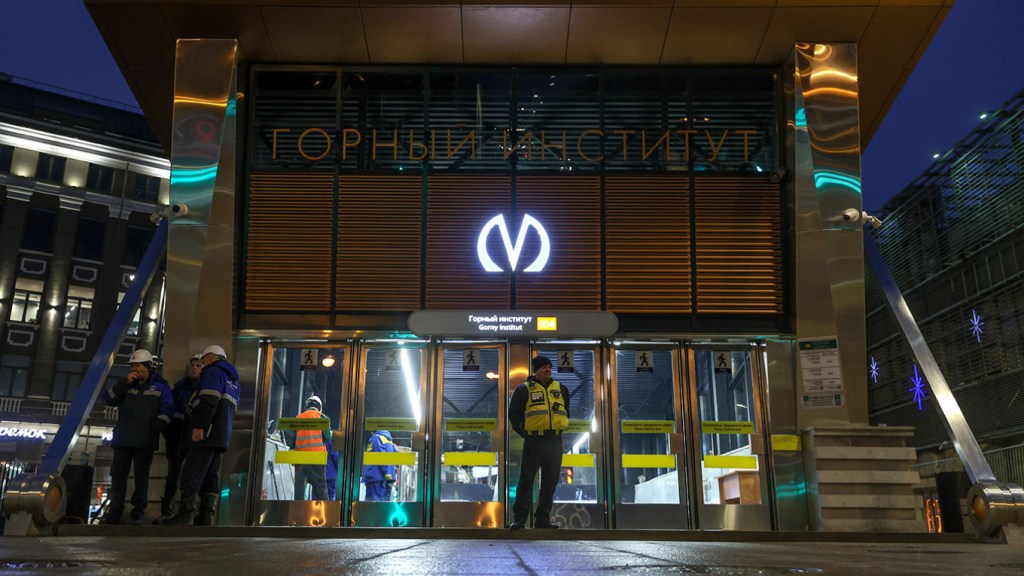
La ciudad de San Petersburgo inaugurará una nueva estación de metro esta semana. Así lo anunció, el jueves, el gobernador Alexander Beglov, en la que será la primera estación de metro en abrir en cinco años.
La estación Gorny Institute de la isla Vasílievski, extenderá la cuarta línea (naranja) hacia el oeste. Esta comenzará a operar el viernes (27 de diciembre) a las 9 de la mañana, cuando su vestíbulo se abra tanto al ingreso como a la salida, dijo Beglov.
“La apertura de la estación Gorny Institute es un hito”, escribió el gobernador en Telegram, haciendo notar que la ciudad ha superado “retos importantes” durante la construcción de la misma.
Beglov agradeció al presidente Vladimir Putin, a los constructores del metro, a ingenieros y residentes de San Petersburgo por su paciencia y apoyo, calificando la finalización de la estación el “primer resultado” de los constantes esfuerzos para mejorar el sistema de metro urbano.
La inauguración de la estación se produce tras años de retrasos. Inicialmente programada para el 2015, su apertura se pospuso primero al 2018 y luego al 2022. El trabajo de construcción fue empañado por la fatal caída de un andamio en junio del 2020, incidente en el que falleció un trabajador y otro resultó herido.
Gorny Institute es la primera estación en abrir desde el 2019, cuando otras tres estaciones, Prospect Slavy, Dunayskaya y Shushary fueron inauguradas.
El metro de San Petersburgo está compuesto en la actualidad por cinco líneas y 72 estaciones. Sin embargo, su expansión se ha ralentizado con el tiempo, en claro contraste con el pujante sistema de metro de Moscú, que este último año inauguró ocho nuevas estaciones.
Fuente: Moscow Times, 26 de diciembre del 2024. Traducción al español por Hugo Palomino para The Russian Reader.
Al tratar de comprender la tonalidad del film (Anora), se me viene a la memoria una frase de Francis Bacon: “Uno puede ser optimista y no tener esperanza alguna”. La situación en la que los protagonistas se ven envueltos, a merced de los ricos, es totalmente desesperanzadora. La versión optimista del guión mostraría a un Vanya que encararía a sus padres para huir con Ani, aún cuando así perdiera su fortuna –lo que constituye la trampa de la película. O quizás, la madre despiadada y capitalista podría sentir respeto a regañadientes por su tenaz nuera, como ocurrió en la última temporada de Fargo. Aún con su siniestro desenlace, la impresión que deja la película se aleja de lo penoso o pesimista. El optimismo desesperanzado del cine de Baker se sostiene en lo extraordinario de la vida que parece escapar de la pantalla y, especialmente, su cuidado por los personajes, incluso Vanya.
Fuente: Aaron Schuster, “The Ethical Dignity of Anora,” e-flux Notes, 20 de noviembre del 2024. Traducción al español por Hugo Palomino para The Russian Reader.
Durante el otoño del 2023, con el objeto de entender qué ocurre con la sociedad rusa en tiempos de guerra, el equipo del Laboratorio Sociológico Público (Public Sociology Laboratory en inglés) realizó una serie de viajes de investigación etnográfica a tres regiones rusas: Sverdlovsk, Krasnodar y Buriatia. En el transcurso de un mes los investigadores del Laboratorio observaron cómo la gente aborda el tema de la guerra y sus efectos en la vida diaria de pueblos y ciudades. Grabaron también entrevistas sociológicas con residentes locales. El Laboratorio ha compilado tres detallados diarios de observación (de más de 100 mil palabras cada uno) y ha conducido 75 entrevistas exhaustivas. Más importante aún, ha recolectado datos realmente invaluables que proporcionan una idea de lo que dice y piensa la gente acerca de la guerra en su vida cotidiana, más allá de sus respuestas a las interrogantes de los investigadores.
El texto completo del reporte es de la envergadura de un libro, escrito también como uno: en siete capítulos se introducen muchos personajes, permitiendo así a los lectores sumergirse por completo en los tiempos de la guerra contemporánea en Rusia. El siguiente sumario destaca las principales conclusiones del análisis.
● La sociedad rusa permanece políticamente desmovilizada y sin ideología. Aún cuando predomina la opinión de que es una sociedad estrictamente militarizada, vemos que la guerra se ha convertido en una rutina y por ende en una parte ignorada de la realidad. Por ejemplo, comparado con el primer año del conflicto, la cantidad de simbología a favor de la guerra en espacios públicos ha disminuido en las tres regiones. La guerra no se ha convertido ni en fuente de nuevas ideas en la vida cultural de pueblos y ciudades ni se ha integrado en el ámbito familiar o en el ámbito cultural establecido. La guerra no se discute en espacios públicos, incluso, salvo raras excepciones, en comunidades locales en línea.
● En conversaciones espontáneas, los rusos raramente discuten los objetivos generales, causas, criminalidad o justificaciones de la guerra. Están más preocupados por el impacto del conflicto en sus vidas cotidianas. Cuando hablan acerca de la guerra, usualmente vuelven sobre tópicos que ya discutían antes de la conflagración, por ejemplo, problemas cotidianos, dinero o ética. Los hombres discuten más a menudo temas que son considerados “masculinos” en la sociedad, como aspectos técnicos de la guerra; mientras las mujeres se dedican a temas más “femeninos” como el efecto destructor del conflicto en las familias.
● La participación de diversos tipos de voluntariado a favor de la guerra y asistencia organizada a la milicia, que generalmente es tomada como referencia y ejemplo de la movilización y militarización de la sociedad rusa, raramente está motivada por un firme aval del público a la “operación especial”. Está, más bien, asociada con la presión de la administración, las normas morales de la comunidad (sobre el apoyo mutuo) y/o por el deseo de ayudar a sus seres queridos, en lugar del deseo de propiciar una victoria rusa. La observación de actividades de voluntarios muestra que estos no discuten de guerra o política en el trabajo, sino que prefieren temas con los que pueden relacionarse personalmente: precios, pensiones, familias y/o historias vinculadas a centros voluntarios.
● A pesar de todas las similitudes, la guerra es percibida de forma diferente en diferentes regiones. Las peculiaridades de la perspectiva de cada región se debe a factores como el número de unidades militares y colonias penitenciarias desde donde se reclutan presos, la proximidad a la zona de combate, la prosperidad de la región y el acceso a puestos de trabajo decentes, la compenetración de los lazos sociales, la circulación de noticias que llegan de amistades en el frente de batalla, etc. En otras palabras, las diferencias en las percepciones de la guerra pueden atribuirse principalmente a las peculiaridades de la vida en las regiones previas a la invasión rusa de Ucrania.
● El conflicto entre opositores y simpatizantes de la guerra está perdiendo fuerza gradualmente, mientras el cisma entre aquellos que permanecen en Rusia y quienes se marcharon crece. Ambos casos se dan porque la experiencia compartida de vivir a través de una situación difícil dentro del país se está convirtiendo en algo más importante que cualquier diferencia de puntos de vista para muchos rusos y también porque la gente discute cada vez menos acerca de la guerra.
● Al mismo tiempo, el menguante conflicto entre opositores y simpatizantes de la guerra no siempre implica una mayor cohesión social. Ya que la sociedad está intentando vivir como si la guerra no estuviera ocurriendo y el gobierno no menciona ninguna pérdida o problema relacionado con la guerra, todas las consecuencias negativas del conflicto se han normalizado o han sido apartados al ámbito de los “problemas personales” que no son discutidos con otros y que todos deben lidiar por sí mismos.
● En general, muchos no se sienten capaces de influir en las decisiones políticas. Por consiguiente, se distancian cada vez más de la guerra. Ellos entienden que no pueden cambiar la política del gobierno pero retienen, al menos, algún control sobre sus vidas privadas, por lo que se refugian en estas. Con el tiempo, no solo los rusos apolíticos sino incluso opositores declarados de la invasión sienten esta impotencia y, como resultado, algunos de ellos aceptan la nueva realidad, mientras siguen condenando la guerra para sus adentros.
● Consecuentemente, muchos rusos desconfían cada vez más de noticias políticas provenientes de un rango diverso de fuentes. En cambio ponen su confianza en medios locales. Los problemas locales en las noticias les parecen más importantes y relevantes. Más aún, sienten que, a diferencia de la guerra, al menos tienen la capacidad de influenciar en asuntos locales.
● Al mismo tiempo, la guerra está influyendo en el estado emocional de la gente. Muchos de nuestros interlocutores admiten haber experimentado ansiedad, tensión, incertidumbre, miedo incluso cuando no hablan de estas emociones abiertamente. La partida de hijos y maridos a la guerra hace que las mujeres “griten a todo pulmón”. Sin embargo, raramente comparten estos sentimientos con otros y si lo hacen es en círculos de amistades cercanas.
● Muchos rusos sin interés en la política pueden justificar o condenar la guerra dependiendo del contexto comunicativo.
Tienden a justificar la guerra de forma no emocional a través de la normalización (“siempre ha habido guerras”) o la racionalización (“era necesario”) cuando se les pregunta directamente en contextos formales como en las entrevistas de investigación.
Tienden más a criticar la guerra cuando se les sugiere pensar en los efectos negativos de esta sobre la gente ordinaria. Este criticismo difiere del de los opositores al conflicto. Para los opositores, la guerra es un crimen moral contra Ucrania, mientras que para los rusos apolíticos, la guerra es vista como algo que destruye la sociedad rusa y daña a la gente común. Sin embargo, este criticismo no lleva a los rusos apolíticos a cuestionarse la necesidad o inevitabilidad de la guerra ni a extender sus críticas hacia el gobierno.
Tienden a justificar la guerra emocionalmente cuando son confrontados con narrativas tradicionales contrarias al conflicto. Cuando Rusia es acusada de cometer crímenes morales contra la gente de Ucrania, suelen tomar tales acusaciones de manera personal e intentan defender su propia dignidad.
Algunos experimentan un fortalecimiento del sentimiento de identidad nacional y, a veces, esto incrementa la demanda de una mayor solidaridad. Es importante dejar constancia que este incremento de la identidad nacional no guía a los rusos a adoptar el signo imperial del nacionalismo. A diferencia del Kremlin, la gente común y corriente vive en un mundo de estados-nación, no en un mundo de fantasías imperiales (según estas fantasías, Ucrania no es un estado real y los ucranianos son gente inferior).
Una sensación de duda es lo que realmente une a los rusos hoy en día. A pesar de que la gente usa diferentes estrategias para hacer frente a esa sensación, esta complica significativamente la habilidad de planificar sus vidas y hunde a los rusos en el pesimismo.
Así, por una parte, lo que antes era la naturaleza singular de la guerra, está dando paso a la normalización: gradualmente la guerra se está convirtiendo en algo ordinario, un elemento más del mundo que les rodea. De alguna manera, muchos rusos se resisten a los intentos del Kremlin de convertir ciudadanos ordinarios en partidarios ideológicos y a los intentos de la oposición liberal, que se manifiesta contra la guerra, de forzar a la sociedad a experimentar un sentimiento de culpa y participación activa. Por otra parte, la guerra constantemente nos recuerda su presencia al crear nuevas amenazas, nuevas ansiedades y nuevas razones para tener a los rusos descontentos.
Estos tiempos son difíciles, la clave en este caso es persistir en todo sentido.
Nadie dijo que fuese sencillo.
Pero no es tan duro tampoco.
El otro día le pregunté a Vladimir Putin si él esperaba algo más de sí mismo en el año que acababa.
Pero quiero preguntarte, lector, ¿esperas algo más de ti mismo el año que viene?
Necesitamos esperar algo. Necesitamos querer algo. Es una forma de aferrarnos a nosotros mismos. De cuidar de nosotros mismos. Incluso de encontrarnos a nosotros mismos.
¡Un signo duro (“Ъ”) nunca será un signo blando (“Ь”)!
¡Feliz nuevo año por llegar!
¡No nos quedemos a la defensiva!
Andrei Kolesnikov, Corresponsal especial, Editorial Kommersant.
Fuente: correo electrónico de Kommersant, 31 de diciembre del 2024. Traducción original The Russian Reader. Traducción al español por Hugo Palomino. El llamado signo duro, que los bolcheviques eliminaron del alfabeto cirílico ruso en 1918, ha sido el logotipo de Kommersant desde que el periódico fue relanzado en enero de 1990. Andrei Kolesnikov ha sido el corresponsal especial del medio en el Kremlin, es decir el jefe Putinversteher* del diario, por muchos años. Por supuesto, él lo negará cuando las cosas se pongan difíciles y Putin se marche, y dirá que ha sido siempre la forma cínica y jocosa, aunque siempre leal, en la que ha escrito acerca del dictador ruso y criminal de guerra durante todos estos años.
* Término derivado del alemán versteher, persona con conocimiento de un tema en particular, usado aquí de forma peyorativa, algo así como un “Putinologo” en el peor sentido de la palabra.
I was brought up in the Soviet Union to believe that when a malicious, cruel aggressor attacks civilians, you have to take up arms and go do battle with him, and that if you cannot bear arms, you help the people who are doing battle and call on others to do the same.
All my work as a political commentator has been about calling on people to go do battle with the aggressor which has attacked Ukraine, to assist Ukraine with weapons and ammunition.
No one had attacked or threatened Russia.
It was Putin’s Nazi regime which attacked Ukraine, only because of the megalomania of the regime’s ringleaders, because of their inhuman thirst for power over all they survey.
Murdering hundreds of thousands of people is their way of bolstering their self-esteem. They are degenerates, scum, and Nazi riffraff.
The guilt of Putin’s Nazi dictatorship in plotting, unleashing, and waging a war of aggression is obvious and does not need to be proven. We also do not need to prove our right to offer armed resistance to this aggression on the battlefield and in the aggressor’s rear. It would be laughable to expect this right to be acknowledged by a regime which tosses people in prison for morally condemning its aggression out loud. All legal means of protesting Putinist Russia’s aggression have been eliminated.
My calls to resist the aggressor’s regime with armed force have caused me to be charged with terrorism.* I won’t deign to argue with the aggressor’s officials even if they claim my actions constitute pedophilia. Russia’s courts have long ago shown themselves to be appendages of the Nazi tyranny and seeking justice from them is pointless. I will never stand up before these people, who are the lackeys of murderers and scoundrels.
I see no point in arguing with puppets of the dictatorship about how conscientiously they execute their own laws. In any case, these laws are the laws of a totalitarian state and their aim is to stifle dissent. I do not recognize these laws and I will not obey them.
I also have no intention of appealing any rulings made by or actions taken by representatives of the Nazi regime.
The Putinist dictatorship may murder me, but it cannot force me to stop fighting against it. Wherever I find myself, I will keep calling on honest Russians to join the Ukrainian Armed Forces. I will keep calling for airstrikes on military facilities deep in Russian territory. I will keep calling on the civilized world to inflict a strategic defeat on Nazi Russia. I will keep trying to prove that the new Hitler’s regime must be routed militarily.
Putin is the new Hitler, a vampire driven insane by impunity and drunk on blood. I shall never grow tired of saying, “Crush the viper!”
Death to the murder, tyrant and scoundrel Putin!
Death to the Russian fascist invaders!
Glory to Ukraine!
[Grani.Ru:] Thanks to Alexander Valeryevich’s dedicated wife Olga Shcheglova (pictured above). Thanks to SotaVision for filming at the Petersburg military court (Skobov is participating in the trial via video link from Syktyvkar). Thanks to those who didn’t unsubscribe from Grani.Ru after it closed. It’s as if Skobov timed his brave deed to coincide with the final moral collapse of numerous media brands. And yet he will be heard by a handful of his contemporaries. But he has already gone down in history.
* Skobov has been charged with “publicly calling for terrorism,” “publicly condoning terrorism or promoting terrorism using the mass media, including the internet” and “organizing a terrorist community and participating in it.” If Skobov is convicted on these charges, he faces a maximum penalty of ten to fifteen years in prison and fines of up to one million rubles (approx. 9,500 euros)— TRR.
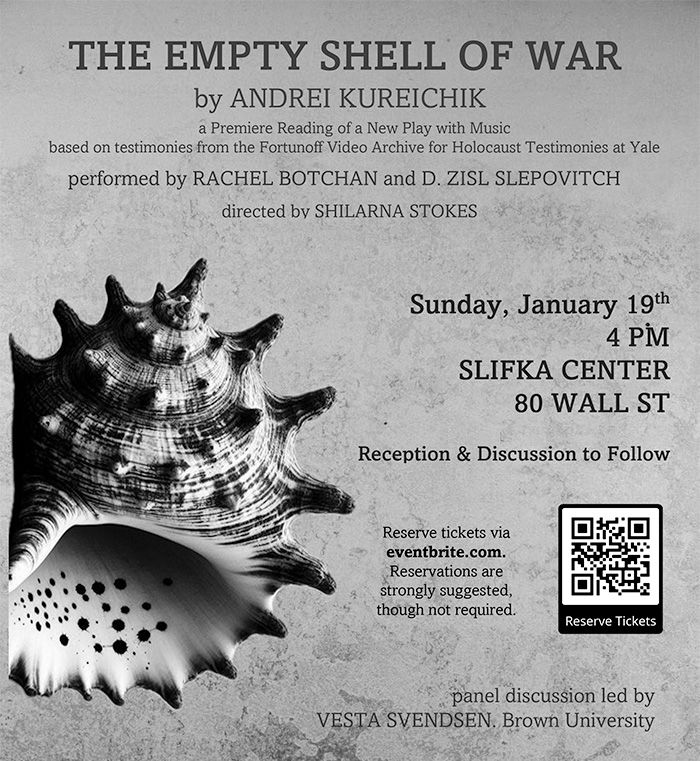
The Fortunoff Video Archive for Holocaust Testimonies, and Yale’s Program in Theater, Dance, and Performance Studies, invites you to the premiere reading of Andrei Kureichik’s new play The Empty Shell of War.
The play, featuring performance by Rachel Botchan and D. Zisl Slepovitch, is directed by Shilarna Stokes.
When: January 19, 2025 Time: 4:00 PM Location: Slifka Center, Yale University
The Empty Shell of War offers a gripping exploration of war’s psychological scars. This monodrama follows the journey of a young Jewish girl from a Belarusian shtetl, surviving unimaginable horrors during World War II. Grounded in authentic testimonies from Belarusian survivors of the Holocaust archived at the Fortunoff Video Archive, the play reveals stories of courage, compassion, and survival. The play is a response to the policy of Holocaust denial pursued by Lukashenko’s dictatorial regime in Belarus. This will be the world premiere of the play.
About the Playwright
Andrei Kureichik is a renowned Belarusian playwright, director, and publicist living in exile. Author of over 30 plays performed globally, his works include the groundbreaking Insulted.Belarus, a centerpiece of the global theater solidarity movement. His plays have been translated into 39 languages and honored with awards like the 2023 Best Foreign Play of the Season in Los Angeles and the European Parliament’s Sakharov Prize for Freedom of Speech. A Yale World Fellow, Fortunoff Fellow and Lecturer, Kureichik also teaches “Art and Resistance” at Yale University.
CREATIVE TEAM
D. ZISL SLEPOVITCH (composer, woodwinds, sound design) is a native of Minsk, Belarus, a New Yorker since 2008. He is a Jewish music scholar (Ph.D., Belarusian State Academy of Music), composer, a multi-instrumentalist klezmer, classical, and improvisational musician (woodwinds, keyboards, vocals); a music and Yiddish educator. Slepovitch is a founding member of the critically acclaimed groups Litvakus and Zisl Slepovitch Ensemble, a regular contributor to the National Yiddish Theatre Folksbiene, a Musician-in-Residence at Yale University’s Fortunoff Video Archive for Holocaust Testimonies, a pianist and music coordinator at Stephen Wise Free Synagogue in New York. Slepovitch’s credits include “Defiance” movie, “Eternal Echoes” album (Sony Classical), “Rejoice” with Itzhak Perlman and Cantor Yitzchak Meir Helfgot (PBS), and “Fiddler on the Roof in Yiddish” (off-Broadway).
SHILARNA STOKES is a Senior Lecturer and Associate Research Scholar in the program of Theater, Dance, and Performance Studies at Yale. She has directed over thirty plays and musicals in theaters throughout the United States, and has received numerous awards, residencies, and fellowships for her directing work. Her current book project, “Playing the Crowd: Mass Pageantry in Europe and the United States,” examines large-scale political pageants performed in England, the US, Russia, France, and Germany. She is a graduate of Yale (BA in Theater Studies and Comparative Literature), Columbia University School of the Arts (MFA in Directing), and the Columbia Graduate School of Arts and Sciences (PhD in Theatre).
RACHEL BOTCHAN is an award-winning performer with extensive Off-Broadway and regional theater experience and a variety of stage, TV and film credits, She is known for her dynamic range and transformative portrayals. She is an award-winning audio book narrator with many titles for Recorded Books and Audible. She is a graduate of NYU Tisch School of the Arts where she received the Seidman Award for excellence in Drama.
PANEL DISCUSSION
Following the performance, a Q&A and Panel Discussion exploring the play’s themes and historical context will be led by scholar of Holocaust and Genocide Studies, Vesta Svendsen (Brown University).
VESTA SVENDSEN is a PhD student in History at Brown under Dr. Omer Bartov, studying the role of trauma in Belarus ’post-Soviet national identity formation. She originates from Brest, Belarus and was raised between Belarus and New Orleans. Vesta holds a BA from Tulane University in Russian Studies and an MA from Yeshiva University in Holocaust and Genocide Studies. In 2023, Vesta was a Summer Graduate Student Research Fellow at the US Holocaust Memorial Museum, studying western Belarus. Throughout her MA studies, Vesta engaged in part-time psychoanalytic training to broaden her understanding of transgenerational trauma. As an interviewer for the USC Shoah Visual History Archive, she gathers testimony from Russian-speaking Holocaust survivors and is currently translating a Russian-language Holocaust memoir. Vesta is a member of the Coordination Council of the Belarusian democratic forces. She possesses language skills in Russian, Belarusian, Ukrainian, French, Polish, and Yiddish.