A Monterey Story: The Western Flyer

Elkhorn Slough, as seen from the Carneros Creek watershed. The Western Flyer is moored in the marina at Moss Landing, where the slough flows into Monterey Bay (near the smokestacks on the center right). Photo by the Russian Reader

I have never directly acknowledged the fact that, since May 2021, this weblog has come to you from Monterey-by-the-Sea, California, where I have happily found many things to do that have nothing to do with Russia and the heavy, steady flow of bad news from there. I want to share that happiness with you by way of saying goodbye to 2024 and thanking you for sticking with the Russian Reader this past year.

The distinctly Monterey story, told below in four short but fascinating videos, is a fascinating, inspiring, and happy one. I hope you enjoy it as much I did. See you next year! ||| The Russian Reader


Western Flyer Foundation Channel, “The Western Flyer with Nick Offerman”

The Western Flyer sails again! Come aboard with Emmy-award-winning actor and comedian Nick Offerman for a fun new look at the life, near-death, and resurrection of the famous old fishing boat in John Steinbeck’s The Log from the Sea of Cortez (1951). From the coast to the deep sea and from the tide pool to the stars, the nonprofit Western Flyer Foundation stirs curiosity using a blend of science and art inspired by John Steinbeck, Ed Ricketts, and their 1940 journey on the Western Flyer.

Learn more about the vessel’s history, adventures, and exciting future or marine science and education at http://www.westernflyer.org.

Source: Western Flyer Foundation Channel (YouTube), 27 February 2024


CBS Mornings, “John Steinbeck’s ‘Western Flyer’ gets brought back to life”

After writing “The Grapes of Wrath,” author John Steinbeck explored the Gulf of California in a famous boat called the Western Flyer. Since then, the boat has inspired adventurers and scientists for generations, but the original ship was nearly lost. CBS News’s Jeff Glor reports on the person determined to give it new life.

Source: CBS Mornings (YouTube), 23 December 2023


KBTC Public Television, “The Western Flyer”

Art and science come together in the restoration of a famous fishing boat.

Source: KBTC Public Television (YouTube), 8 January 2019


Western Flyer Foundation Channel, “The boat John Steinbeck and Ed Ricketts made famous. Western Flyer: The Next Chapter”

Almost lost forever, the iconic vessel that carried the acclaimed novelist John Steinbeck (who penned Of Mice and Men, Grapes of Wrath and more) and marine biologist Ed Ricketts to the Sea of Cortez on an epic scientific mission gets new life and a new mission.

Source: Western Flyer Foundation Channel (YouTube), 13 March 2018

Russia Shoots Down Santa Claus

“Happy New Year, Russians!”: Santa Claus Shot Down Over Moscow by Russia’s Ded Moroz (Grandfather Frost)

Source: Kolokol XXI (Telegram), 27 December 2024 + Yandex Video. Thanks to Sergey Abashin for the heads-up.


Pro-Kremlin Telegram channels on Friday circulated a New Year’s video depicting Russian air defense systems shooting down Santa Claus’ reindeer sleigh.

The video, first shared by the Pul N3 Telegram channel, begins with Santa flying over central Moscow to the tune of “We Wish You a Merry Christmas.”

“Hi, Russians! Here are your presents,” says Santa Claus, sipping a Coca-Cola as the camera zooms in on his sleigh, which is loaded with rockets bearing NATO logos.

“Happy New Year,” Santa says before a missile shoots into his sleigh, causing it to explode mid-air.

Ded Moroz and Russian airpower. Image courtesy of Moscow Times

The scene then shifts to a military control room where a Russian serviceman and Ded Moroz — Russia’s version of Santa Claus — monitor the action on a screen as a traditional Russian folk tune plays.

“Is it done?” Ded Moroz asks the headset-wearing serviceman.

“Yes, it’s done. The target was destroyed,” the serviceman replies.

“Good. We don’t need any kind of foreign stuff [in our skies],” Ded Moroz says, embracing the serviceman. “Happy New Year!”

The video’s release comes just days after an Azerbaijani passenger plane crashed in western Kazakhstan, with reports suggesting it was shot down by a Russian surface-to-air missile.

Source: Pro-Kremlin Media Share Video Showing Russian Missile Shooting Down Santa’s Sleigh,” Moscow Times, 27 December 2024

Serial Denouncer Denounced

Ivan Abaturov (social media image via RFE/RL)

Social anthropologist Alexandra Arkhipova conducted an investigation and concluded that Anna Korobkova, renowned for her numerous denunciations of people advocating anti-war stances, is probably a pseudonym of Ivan Abaturov, a journalist from Yekaterinburg. The BBC Russian Service has published the results of Arkhipova’s research.

Arkhipova assembled more than seventy letters, addressed to various institutions and agencies, in which Korobkova accused doctors, teachers, human rights activists, and journalists of “discrediting” the Russian army and called for them to be brought to justice. Among the denouncer’s victims are a doctor at a clinic who made a comment to [banned opposition channel] TV Rain, the mother of an enlisted soldier killed in the war, and Arkhipova herself. In one case, a student was expelled from a university after it received a denunciation alleging that he had been involved in “unauthorized protest rallies.”

In early December 2024, Arkhipova found a page about Korobkova on Wikipedia. With the assistance of linguists, she did a comparative analysis and found that the author of the Wikipedia article was probably the same person who had written the denunciations signed by Korobkova.

Arkhipova and the investigative journalists were able to identify the author of the Wikipedia article. It turned out to be a journalist from Yekaterinburg, Ivan Abaturov.

Abaturov, as the article points out, had already been at the center of a whistleblowing scandal. In the summer of 2022, Sergei Erlich, director of the publishing house Nestor History, said that Abaturov had allegedly detected “false information about the USSR’s actions during the Second World War” in one of his company’s books. Consequently, law enforcement officials visited Nestor History’s offices.

Abaturov himself has never concealed his attitude to denunciations. In 2019, he wrote on social media that “a journalist under Stalin was a walking prosecutor’s office” and that he wanted to be one too.

When asked by a BBC correspondent whether he had been writing denunciations under the name “Korobkova,” Abaturov replied on VKontakte: “Hello. You are mistaken.” Consequently, he stopped replying to messages, and the BBC was unable to reach him by phone.

Since the beginning of their country’s full-scale war with Ukraine, Russians have filed 2,623 complaints with law enforcement agencies about anti-war statements made by their fellow citizens, the investigative journalism website Important Stories (iStories) calculated in June on the basis of open source data. So-called LGBT propaganda (487 complaints) and Russophobia (250 complaints) ranked second and third, respectively, as grounds for denunciations.

According to Important Stories, seventy percent of the complaints were written by subscribers of the anonymous Telegram channel Mrakoborets, which specializes in tracking down anti-war activists. The channel’s daily norm is a minimum of three complaints on its pages on the social networks VKontakte and Odnoklassniki (“Classmates”). Yekaterina Mizulina, head of the Safe Internet League, had personally written 148 denunciations, while sixty were penned by pro-Kremlin activist Vitaly Borodin.

Source: “The serial denouncer ‘Korobkova’ turns out to be a male journalist from Yekaterinburg,” Radio Svoboda, 26 December 2024. Translated by the Russian Reader. Thanks to Darya Apahonchich and Comrade Koganzon for the heads-up.


[…]

In the autumn of 2022, executives at the Russian Academy of National Economy and Public Administration (RANEPA) received a letter signed “Anna Vasilievna Korobkova.” It began as follows: “I fully support the special operation of the Armed Forces of the Russian Federation on Ukrainian territory. I am against all violations of the law.”

The letter concerned an interview that Alexandra Arkhipova, who had worked for many years as a senior research fellow at RANEPA, had given to the channel TV Rain, which had been designated a “foreign agent” by Russian authorities. (At the time of the interview, the TV channel had not yet been designated an “undesirable organization.”)

In her denunciation, “Korobkova” asked the university to dismiss Arkhipova for “immoral misconduct,” which, in her opinion, consisted in the fact that in the interview with TV Rain she had “disseminated false information discrediting the Special Military Operation [sic] on Ukrainian territory.” Korobkova also suggested that the university send the evidence against Arkhipova to the prosecutor’s office.

“Korobkova” was outraged that Arkhipova did not interrupt TV Rain presenter Anna Nemzer when the latter had called the “special military operation” a “war” (“thus showing she agreed with Nemzer’s false opinion”), mentioned Facebook without mentioning that it had been designated an “extremist organization” in Russia, and uttered the phrase “before the war I would ask.”

“This is a lie, as there is no war,” the letter said.

Upon seeing the text of the denunciation, Arkhipova was surprised by how long and detailed it was. Korobkova’s letter took up two pages, and even the time codes for the points in the interview at which Arkhipova had said certain things that angered Korobkova were noted. As a folklorist and social anthropologist who works extensively with different texts, Arkhipova was struck by the structure of the denunciation and the specific language in which it was written.

“I was reading this denunciation to friends, discussing it as a phenomenon of contemporary political culture, when one of my colleagues looked at me sadly and took a crumpled piece of paper out of his pocket. He unfolded it and read aloud a denunciation. It had the same wording, and was also signed ‘Anna Vasilievna Korobkova,'” Arkhipova tells the BBC.

[…]

Source: Amalia Zataria, “‘I want to be a walking prosecutor’s office’: who hides behind the identity of serial denouncer ‘Anna Korobkova’?” BBC Russian Service, 26 December 2024. Translated by the Russian Reader

The White Helmets: Dispatch from Aleppo

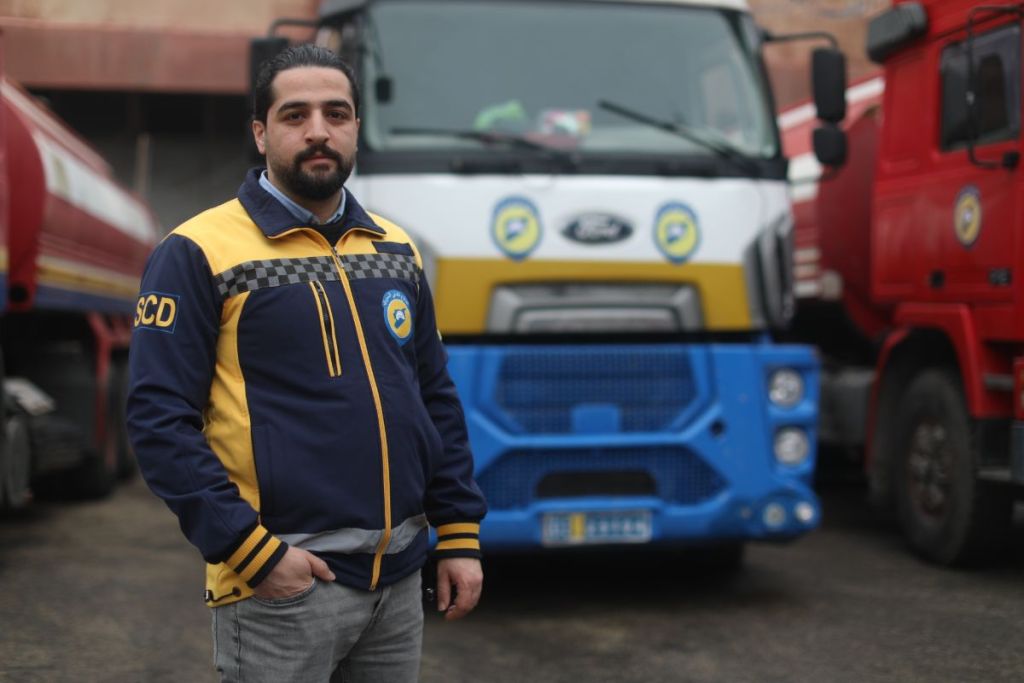
This is an update from Khaled Khatib from the White Helmets’ team in Aleppo.

I never thought I’d return to Aleppo. 

When I was forcibly displaced in 2015, it felt like I was losing everything: my home, my city, and the place where I grew up and became the person I am today. Like my teammates in the White Helmets, I had devoted myself to saving lives, documenting atrocities, and showing the world the truth about Syria. We risked everything, believing that if the world saw our pain, it would act. 

You might have seen part of that story in the Oscar-winning documentary The White Helmets, which I helped film. I hoped it would be a turning point, that it would compel action to protect civilians and stop the horrors we were living through. But no action came, and instead of protection, we were bombed and displaced. 

The years that followed were some of the hardest of my life. The grief was overwhelming. But my teammates from across Syria helped me find strength again. Together, we continued our work in northwest Syria, responding to emergencies and supporting communities. We leaned on each other and built a strong organization that has saved over 128,000 lives from the rubble of airstrikes. 

Now, after all these years, Syria is free of Assad, and I’m back home.  

Khaled in Aleppo

The city has changed. It’s strange to hear the quiet, with no sounds of bombs and planes overhead. People are trying to rebuild their lives, but the scars of war are everywhere. Entire neighborhoods remain in ruins, infrastructure is shattered, and essential services like water and electricity are barely functioning. 

The White Helmets have returned too. We’re here in Aleppo, working tirelessly to clear rubble, remove unexploded ordnance, and respond to emergencies.  

For me, this return is deeply personal. Aleppo is where I joined the White Helmets as an 18-year-old, where I grew into the person I am today, and where I learned that our humanity transcends everything else. I’ve carried with me the importance of saving lives without discrimination and the power of storytelling to preserve the truth, and these lessons are what kept me going.  

But the challenges we face are immense. Scaling up operations is critical to clear rubble, reopen roads, and ensure the safe return of displaced families. Not just in Aleppo, but also in places like Homs and Ghouta, where years of destruction have left communities struggling to recover. 

This work depends on people like you. 

Your support will help us expand our teams, secure lifesaving equipment, and rebuild the infrastructure that families need to return home safely. Together, we can restore Aleppo and all of Syria, paving the way for hope and recovery. 

Make a tax-deductible gift today to help us scale up our operations and rebuild the lives and futures of those scarred by war. Every contribution makes a difference.

Thank you for standing with us through it all. With your support, we can rebuild not just cities but hope for a better future. Syria’s recovery is only just beginning. 

With gratitude, 

Khaled Khatib

The White Helmets, officially known as the Syria Civil Defence, is a Syrian-led grassroots humanitarian organization working to save lives and uplift communities in areas most affected by conflict and disaster in Syria. We are registered in Türkiye as Beyaz Baretliler Derneği, the Netherlands as Stichting White Helmets Foundation, Canada as les Casques Blancs, and the United States as The White Helmets, Inc.

The White Helmets, Inc., is a registered 501(c)(3) non-profit organization and all donations in the United States are tax-deductible. Our EIN is: 93-4720959. 40 West 37th St., Suite 1000, New York, NY 10018

Source: Emailed appeal from the White Helmets, 24 December 2024

News from Ukraine Bulletin 127

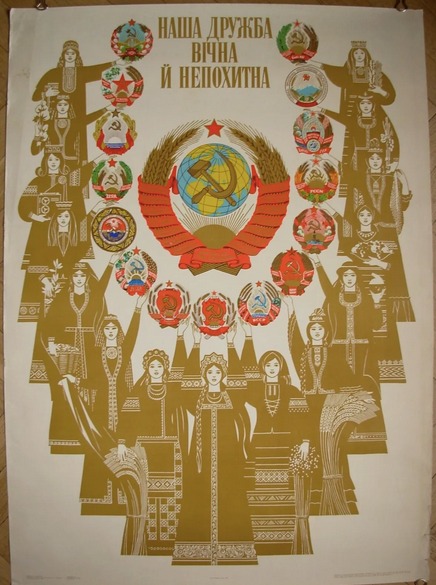
“Our friendship is eternal and unshakable” Ukrainian poster, 1983
Courtesy of Soviet Visuals

In this week’s bulletin: Ukraine labour relations under martial lawDemocracy uprising in the Caucasus/ ‘Swift peace deal’ questioned/ Ukraine: resisting arbitrariness from above/ Russian torture and denial of medical treatment

News from the territories occupied by Russia:  

Russia confirms revenge sentences against savagely tortured Crimean Tatar cousins, seized with Nariman Dzhelyal (Kharkiv Human Rights Protection Group, December 20th)

Abducted Kherson activist sentenced for ‘spying for Ukraine’ while in Russian captivity denied vital medical treatment (Kharkiv Human Rights Protection Group, December 19th)

Russia churns out surreal ‘terrorism’ sentences against Ukrainian POWs for defending Ukraine (Kharkiv Human Rights Protection Group, December 17th)

20-year-old from Mariupol sentenced to 11 years for argument opposing Russia’s war against Ukraine   (Kharkiv Human Rights Protection Group, December 16th)

Human rights defenders: Ukrainian citizens under occupation need support (Zmina, December 13th)

Forced reality (Alter Pravo, October 2024)

Life Under Occupation (Alter Pravo, October 2024) 

The situation at the front:

Battlefield developments: ‘Enter Pyongyang’ (Meduza, 19 December)

News from Ukraine – general:  

Joint appeal of representatives of the coalition “Ukraine. Five in the Morning” and the Initiative “Tribunal for Putin” (Tribunal for Putin, December 21st)

Legal regulation of labour relations in the conditions of martial law in Ukraine (Science Open, December 20th

When a Scalpel Becomes a Kitchen Knife: How Ukrainian Courts Skillfully Distort ECtHR Practice (Kharkiv Human Rights Protection Group, December 18th)

Ukraine: Inadmissible evidence in examinations (Kharkiv Human Rights Protection Group, 18 December)

Do today’s HACC decisions comply with European practice? (Kharkiv Human Rights Protection Group, December 18th)

Can a huge bail replace justice? (Kharkiv Human Rights Protection Group, December 18th)

Impact of War on Education and Neoliberal Reforms  (Ukraine Solidarity Campaign, December 17th)

“We cannot allow this to happen to our children.” Discussion on “No Child of Ukraine Should Be Left Alone with the Experience of War” (Center for Civil Liberties, December 16th)

Groups of Resistance: How Ukrainians Protect Their Interests from ‘Arbitrariness from Above’  (Commons.com, November 27th)

War-related news from Russia:

Russian anarchist jailed for arson commits suicide on first day of sentence (Novaya Gazeta Europe, 20 December)

St Petersburg: The Terror Scam Gig Economy (The Russian Reader, 20 December)

Duma broadens ‘treason’ charges against anybody opposing Russia’s aggression against Ukraine (Kharkiv Human Rights Protection Group, December 18th)

LGBT+ activism in Russia: “Rainbow extremism” (Posle.Media, 18 December)

Legislators equate criticism of Russia’s war against Ukraine with ‘terrorism and extremism’ (Kharkiv Human Rights Protection Group, December 16th)

Analysis and comment:

Uprising for democracy in the Caucasus (Tempest, December 21st) 

Those Demanding a Swift ‘Peace Deal’ for Ukraine Don’t Understand How Complex This War Really Is  (Byline Times, December 19th)

Russian Gas Giant Given Access to Global LNG Summit (DeSmog, December 13th)

Caucasus: Resisting local authoritarianism and multipolar imperialisms (CrimethInc, 11 December)

Research of human rights abuses:

Ukrainian children deported to Russia: ‘The development of Russian identity’ (Meduza, 20 Dec)

Kyrylo Budanov met with human rights defenders (Zmina, December 20th)

The European Parliament demands Russia immediately release ill Crimean political prisoners: resolution, proposed by ZMINA, was adopted (Zmina, December 19th)

Russia ignores the needs of Ukrainian political prisoners for medicines and medical care: ZMINA met with Henry Marsh  (Zmina, December 19th)

Human rights defenders call on parliamentarians not to adopt draft laws No. 11538 and No. 11539 (Zmina, December 19th)

ZMINA at the #IBelong forum: challenges on citizenship during the war (Zmina, December 17th)

Over 16,000 Ukrainian civilians held captive in Russia – Ukraine’s ombudsman (Ukrainska Pravda, December 16th)

Upcoming events:

Saturday 18 January 2025, 12:00 midday. National March for Palestine. Assemble BBC, Portland Place, London. Unite the Struggles, Ukraine Information Group and others will march with our banner, “From Ukraine to Palestine, Occupation is a Crime”. Details of assembly point in the new year on our web site or by email. 

Saturday 15 February 2025 11AM — 4PM, Conference: End the Russian invasion and occupation. National Education Union, Mabledon Place, London, WC1H 9BD. Register here.

This is the last News from Ukraine bulletin for 2022. The next one will appear on Monday 6 January. With best wishes for 2025 to our readers

This bulletin is put together by labour movement activists in solidarity with Ukrainian resistance. To receive it by email each Monday, email us at 2022ukrainesolidarity@gmail.com. To stop the bulletin, reply with the word “STOP” in the subject field. More information at https://ukraine-solidarity.org/. We are also on TwitterBlueskyFacebook and Substack, and the bulletin is stored online here

Yevgeny Zhumabekov: Returning the Names

“Yevgeny Zhumabekov, 96 kilograms” is how he introduces himself. Yevgeny is the person who came up with the idea of replacing Last Address plaques that had been torn down with homemade copies and who did this work incognito for almost a year. Now he can identify himself.

Bumaga has detailed the struggle that erupted over the plaques in December 2023. They began to disappear en masse, but copies subsequently appeared in place of the ones that had been torn down. These copies were also removed, after which a plaque appeared on the 14th Line on Vasilyevsky Island bearing the following message: “Plaques [memorializing] people who had been politically repressed in this place were repressed eight times.”

Here you can read Yevgeny’s own account of how the [Stalinist] crackdowns touched his family, what shaped his views, how his wife and children got involved in the fight for historical justice, why the Zhumabekovs had to leave the country, and who continues to install the plaques in their wake.

How the repressions touched Yevgeny’s family

I was born in the Sverdlovsk Region, in the town of Kushva, which has gradually been turning into a village. It’s a depressing place. Two of the industrial enterprises that supported the town have shut down. People have been leaving, while the old people are dying off.

It so happened that my history teacher at school was a good friend of my grandfather’s. He would come to my grandfather’s house, and they would drink hard alcohol together, play chess, and talk a lot. I often visited my grandmother and grandfather and heard these conversations. That’s how I learned that my grandfather came from a family of a person who had been politically repressed.

His parents had come from the Perm Region. My great-grandmother and great-grandfather were completely ordinary peasants. It was forbidden in their house to drink alcohol, [and because they were teetotalers] they harvested large crops. In 1931 or 1932, they were dekulakized and exiled far beyond the Arctic Circle, while their children were sent to orphanages. After a while great-grandmother and great-grandfather managed to escape, but great-grandmother had fallen ill in exile and died soon after returning home, while great-grandfather had to hide out in remote villages all the rest of his life.

I know that my grandfather also had a hard time as a member of a politically repressed family, but he never told me about it, although I tried to find out. It was such a profound trauma for him that he could discuss it only when he got drunk with his sole friend.

How the FSB visited Yevgeny’s workplace

In 2006, I moved to St. Petersburg, where I worked for a time in the car business. I held various positions: sales manager, head of the customer engagement department, manager of a car showroom. Then, before the war, I transferred to a construction company, where I sold real estate.

In 2021, I went to a rally in support of Alexei Navalny after he had returned from Germany. Then there was the protest action with flashlights and others. Not only did I attend these events but I also talked about them with my colleagues at work. I was just sharing my pain, not encouraging them to do anything.

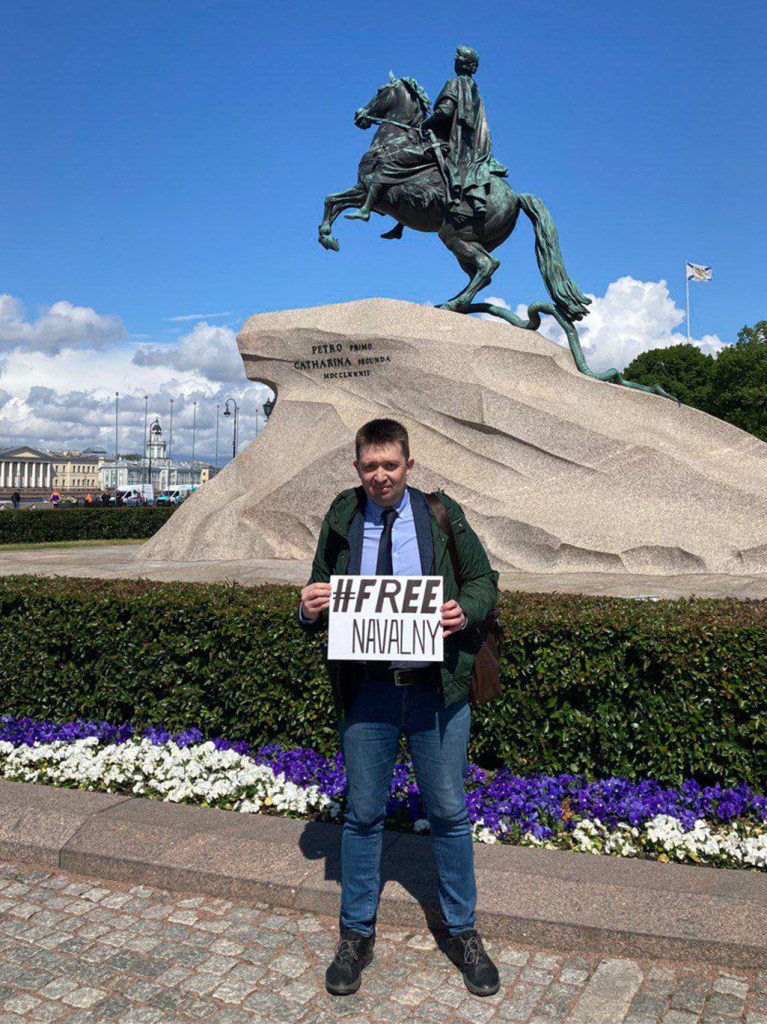
Zhumabekov protesting next to the Bronze Horseman in downtown Petersburg, date unknown.
Photo courtesy of Mr. Zhumabekov (via Bumaga)
Continue reading “Yevgeny Zhumabekov: Returning the Names”

Hronop: Nobody But You

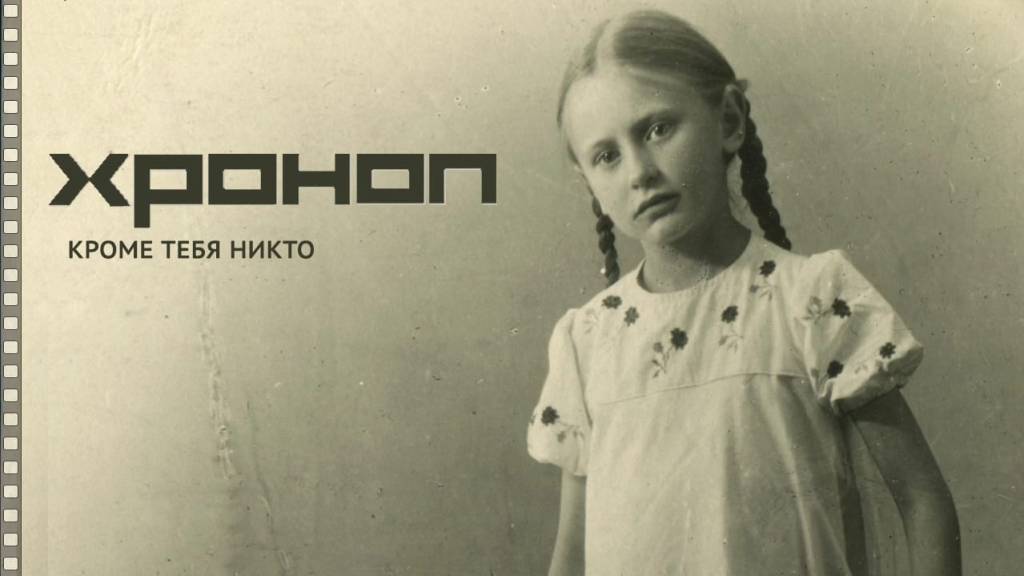
Hronop, “Nobody But You”

Here is Hronop‘s amazing music video “Nobody But You.” I had never heard such anti-war songs before. When Vadim, Hronop’s frontman, sent me the link, I didn’t even open it at first, to be honest, because I thought I already knew what it would be like. Vadim is an extraordinary musician and a complicated poet. I thought the song would be something tricky, in 13/7 time, with lyrics for fans of Borges.

It’s pointless, I thought. People are being killed, and we need something else.

But I opened the link. And there…

…was a sweet, flowing melody, intimate vocals, a flute playing, old family photos…. It’s a prayer to Mama is what it is.

“I’m glad you didn’t see it… Nobody but you can save the tattered world… Mom, shoot down the rocket… The enemy is innumerable, but you’re alone in the sky.”

Vadim has taken an angle which, in my opinion, no one had taken before. I didn’t ask him what the story behind the song was, but it was obviously a real story, since you don’t write songs like that just for the heck of it.

It doesn’t matter. What matters is that it’s touching and disturbing.

Source: Yan Shenkman (Facebook), 21 December 2024. Translated by the Russian Reader


Hronop, “Nobody But You” (2024)

Mama blue runs through the sky
Amid the Airbuses and flocks of ducks
As if she wants to catch the last tram
Mama blue is in tears of amber
And beneath her lie minefields
Kulikovo Field and Borodino
But her blood is like holy wine to me
Mama, your temple was burnt down by our rocket
I’m glad you didn’t see it
I’m now thirteen years older than you were
Nobody but you can save this tattered world
Mama blue, the sun between your legs
Mama blue, a stocking that’s slipped
Everything is runninbg through the sky, there’s no peace in my soul
Like Brienne of Tarth, like the Sugar Plum Fairy
Mama, shoot down the rocket that’s going round and round
Mama, shoot down the rocket with a wave of your hand
There’s a voice in the left heart and silence in the right.
The enemy is innumerable, but you’re alone in the sky

Vadim Demidov – voice, acoustic guitar, song
Andrei Malykh – flute
Alex Repyev – guitar, bass, keyboards, drums, backing vocals, recording, mixing, producing, video editing


Facebook: / 518596074824295
Instagram: / vadim_hronop

Source: Hronop (YouTube), 13 December 2024. Annotation translated by the Russian Reader

The Terror Scam Gig Economy

Petersburg police have arrested a 24-year-old freight handler who threw a Molotov cocktail at a military recruitment office (voenkomat). He had been hoodwinked by scammers whom he had contacted himself.

The Petrograd District Court remanded Daniil Pavlov in custody to a pretrial detention center, Rotunda’s correspondent reports. Pavlov faces ten to twenty years’ imprisonment on charges of “terrorism” (per Article 205 of the Russian Federal Criminal Code). The pretrial restrictions hearing took place in closed chambers.

Baza writes that in early December Pavlov had been unable to log onto the Gosuslugi (municipal and state services) app, and instead of the number for customer support he found the scammers’ number on the internet. They asked him to move the conversation to Telegram and told him that they had hacked the young man’s account. According to RIA Novosti, Pavlov then wired 800,000 rubles [approx. 7,400 euros] to these persons unknown.

“Customer service” told Pavlov that he had to throw a Molotov cocktail at the military recruitment office on Tchaikovsky Street* [in Petersburg’s Liteiny District]. He thus intended to assist in the apprehension of certain “bad guys,” journalists explain.

RIA Novosti writes that he was promised a payment of two million rubles [approx. 18,500 euros] for the job. As soon as the young man threw the flammable mixture, he was detained by police.

📌 Daniil Pavlov lived in [the Petersburg suburb of] Sestroretsk and was employed as a freight handler. Judging by his subscriptions on VKontakte, the young man enjoyed anime and computer games. His girlfriend told Rotunda that they had been planning to get married.

* Tchaikovsky Street in Petersburg is named after the Russian revolutionary Nikolai Tchaikovsky, not the Russian composer Pyotr Tchaikovsky.

Source: Rotunda (Telegram), 18 December 2024. Translated by the Russian Reader


“Just join in!”

🍍🍍🍍🍍 WOW News: the number of pineapples needed to enter prize drawings has dropped! Hurry up and hunt for pineapples and get closer to winning! You still have time to take part in drawings for a flat in Moscow, cars and tours abroad.

It’s simple:

√ Go to the promotion page.

√ Search for pineapples on the product pages in the Ozon app.* The products marked with pineapples change daily. You can also get pineapples for purchases of 500 rubles or more. Pineapples are awarded for redeemed items.

√ Double your pineapples when paying for purchases outside Ozon with the Ozon Bank card (more details in the terms and conditions of the promotion).

*The promotion is available only in app versions 17.40 and up.

Source: Email flyer from news@news.ozon.ru, 18 December 2024. Translated by the Russian Reader


Alleged video footage of the arson attack in Bolshoi Kamen, Maritime Territory, Russia

A resident of Bolshoy Kamen (Maritime Territory) attempted to torch a building after he fell prey to scammers, writes the Telegram channel Mash.

After the 23-year-old male was detained, he told police that telephone scammers from Ukraine had persuaded him to take out a bank loan. He later realized he had been conned.

Sometime later the con men again telephoned the local resident. Identifying themselves as members of the secret services, they asked the young man to torch town hall and a bank branch, saying these actions would allegedly repay the detained man’s [sic] debt.

“They sent him instructions on how to assemble a Molotov cocktail and gave him subsequent orders over the telephone,” Mash writes.

Heeding these recommendations [sic], the young man broke a window in the bank branch and set fire to it. According to Telegram channels, he also attempted to torch town hall. The flames also engulfed fire department vehicles.

The fire in the first building was extinguished quickly, but what happened at the other two locations [lokatsii] is not reported.

Earlier in Blagoveshchensk, four people attempted to torch a military recruitment office and were handed prison sentences of up to seventeen years.

Source: Ekaterina Vasilenko, “Bolshoy Kamen man torches bank branch and town hall on orders of con artists from Ukraine,” Gazeta.ru, 14 December 2024. Translated by the Russian Reader

[…]

Meanwhile, Russia’s Federal Security Services (FSB) published a video of the suspect’s interrogation.

In the footage, a dark-haired man wearing handcuffs with what appears to be a visible rip in his coat is seen speaking directly to the camera.

He is heard saying in Russian that he had been offered a reward of $100,000 and a European passport in exchange for killing Kirillov.

The FSB added that on Ukraine’s instructions, he arrived in Moscow and received a homemade explosive device.

It is unclear whether the suspect’s confession was made under duress.

[…]

Source: Amy Walker, “Russia detains Uzbek man over general’s killing in Moscow,” BBC News, 18 December 2024

Open Season

This just came in the mails.

REMEMBER RUSSIAN ‘GUN-RIGHTS ADVOCATE’ [ 😉 ] AND CONVICTED FELON MARIA BUTINA? Who doesn’t? Welp, here she is w/ your Daily Irony Supplement — and it’s a massive dose! See, as of Jan. 20 she’ll likely get a pardon and move back Stateside to improve on her spying career (hey, how could she do worse?); but in the meantime, she’s trying to get *Americans* (et al.) to go the *other* way, i.e. move to Moscow — y’know, like Our Guy Ed Snowden & his new roommate, Bashar al-Assad, who just *love* it there, right?
[WARNING: Do not watch this video immediately after a meal.]

Source: Mark H. Teeter (Facebook), 18 December 2024


The Gated Community, “Mariia” (from LP The Honor and Glory of The Gated Community, 2023)

No Russian, No School

My pupils at the St. Petersburg Jewish Community Center’s RFL/RSL (Russian as a Foreign Language/Russian as a Second Language) program for immigrant children), 2016. This was the day we let our hair down. \\\ TRR


Living in circumstances in which evil is consciously perpetrated every day, it is difficult to keep getting bent out of shape over stupidity and injustice. This is also true of the new law prohibiting migrant children without a proficient command of Russian from attending school — a completely outrageous law that has caused little public outrage. I feel the need to write about it, and yet I sense the utter futility of arguing against it.

When I was at art school, we had our own local confrontation with the authorities: they dreamed of banning coil water boilers and other heating devices because they were a fire hazard. We dreamed of keeping them because of the fact that we were working in our studios late at night, which is inevitable if you are studying to be an artist. The authorities shamed us, they threatened us with expulsion, and they confiscated our boilers, but the boilers inevitably reappeared. This is an example of how you can’t solve a problem through bans without providing a solution. If the director, for example, had identified some place on the floor where water could be boiled, it is likely that many people would have stopped boiling water in their studios.

This applies to the populist bill as well. Teaching children who do not speak Russian is an actual problem. Our country has a rather complicated curriculum even in elementary school, which, of course, cannot be successfully navigated by someone who does not understand everyday vocabulary. I’ve been told that some teachers just give children plasticine out of hopelessness: if they’re sitting and molding things from playdough, at least they won’t be a bother to anyone else.

So here is a simple answer to this problem: let’s ban these children from going to school. They can go to school only after they have learned Russian.

The question immediately arises: where will they learn Russian? Do we have an extensive network of educational organizations with readymade programs (even ones for which parents would have to pay) for teaching Russian to children and teenagers, where they can be sent immediately after failing the language proficiency exam? No, there is no such network. Perhaps it will emerge one day, but it doesn’t exist right now.

But we have the know-how of other countries which have been trying to solve similar problems for a long time. We can choose something suitable based on foreign know-how, such as allocating extra classes, hiring visiting teachers, and instituting adaptation classes. But a ban is not a solution.

Besides, bans hit the most vulnerable groups the hardest. Loving parents will find a way to help their children with adaptation by paying for courses or tutors. Those for whom no one cares, those for whom school is the only chance to change their lives, will be left out. And it is not necessarily a matter of their turning to crime, although the rule that if you don’t want to invest in schools you’ll have to invest in prisons is inexorable. It will affect girls, for example: if they can read and write a bit (so the story goes) that’s enough for when they’re married.

Most importantly, children don’t choose to move to or choose a foreign country. It’s not their fault that they don’t know a new language. So why are you punishing them?

In fact, they are being punished for being newcomers, for being strangers. A clear xenophobic message is packed inside this entire caper: these migrants shouldn’t come to Russia, and if they do come (someone after all has to work for cheap), they shouldn’t drag their families here. Legislators are not worried about schoolteachers (who really do have it tough), but about smoking out all the “aliens” from our country. That’s how the matter actually stands. And that’s why all reasonable arguments are more or less useless.

Source: Natalia Vvedenskaya (Facebook), 12 December 2024. Translated by Thomas Campbell


Russia has banned children who do not speak Russian from being admitted to schools. This is a completely inhumane decision which could have terrible consequences.

For two years I taught Russian at the Russian Red Cross, where I had two groups of children and one group of adults. The adults were mostly women from Syria, Afghanistan, and Yemen, and they were often learning Russian from scratch and were unable to study it elsewhere.

But the children whom I taught came from a nearby school. Our lessons were supplementary Russian lessons to speed up their integration. And after six months they were already speaking Russian perfectly well.

The usual situation for children whose parents have come to Russia to work is seeing their parents at home only at night, when they hardly communicate, because the parents have to work like crazy to earn the bare minimum for survival, to pay for housing, food, and a work permit.

If these children are not able to go to school, they stay at home and play on their phones or tablets all year long. At best they go for walks in the yard. (Often these children get into trouble, suffering burns and other injuries, because they are left to their own devices.) It is impossible to learn a language on your own at their age, nor do migrant workers have the money to pay tutors to come to their homes and teach their children Russian.

I don’t understand why the Russian government is doing this. Why are they now, in an apparent effort to save money, cancelling these children’s futures, their prospects, their opportunities?

So that in a few years we have a group of young people who can’t read and write? To reinforce racism? To reinforce the social divide — one set of occupations for locals, another set for migrant workers?

The very notion that there are certain others who are not supposed to study in mainstream classes unless they know the language is harmful to the locals as well. It is vital that children see other children with special needs, with immigrant backgrounds and other experiences of life.

At that age, language is easiest to learn at school, and ethnically mixed classes are a wonderful experience for children for later life. I know what I’m talking about: I live in emigration with my children. My youngest son has always been in multi-ethnic classes, and he has no concept of “us” and “them.” (It was funny: in the first grade he had a friend with whom he played all year long, but it was only at the end of the year that Rodion found out his friend’s ethnicity.)

Poor children, poor adults: what a mess our lawmakers have made of things. Recently it was Human Rights Day, and every time I think about it, I realize that migration is dangerous terrain where human rights lead a piecemeal existence.

Source: Daria Apahonchich (Facebook), 11 December 2024. Translated by Thomas Campbell


Russian lawmakers voted Wednesday to ban migrant children from attending school unless they pass a Russian language proficiency exam.

The lower-house State Duma passed the bill in a 409-1 vote.

“Before enrolling the children in school, there will be mandatory checks of their legal status in Russia and their Russian language proficiency,” Duma Speaker Vyacheslav Volodin said.

The new rules will take effect on April 1, 2025, after upper-house Federation Council senators vote for the bill and President Vladimir Putin signs it into law.

Volodin claimed 41% of migrant children experienced “difficulties” with Russian language skills at the start of this school year.

The latest ban comes amid renewed anti-migrant sentiment following the deadly Moscow concert hall attack in March, which was claimed by the Islamic State and allegedly carried out by citizens of Tajikistan.

The fallout from the attack included police raids and deportations of migrants, a majority of whom come from poor former Soviet Central Asian republics.

Volodin said the Duma had passed a total of 14 bills aimed at “improving” Russia’s migration policy and combating illegal immigration since the start of 2024.

Source: “Russia to Introduce Language Exams for Migrant Children to Enroll in School,” Moscow Times, 11 December 2024


The draft law banning the enrollment in school of immigrant children who do not speak Russian has caused a flurry of outrage, its critics claiming that the decision will establish an insurmountable barrier to the integration of immigrants in Russia. However, if we shift our perspective and look at the bill not in a normative but in a positivе light, it pursues a quite rational goal — to institutionalize the exclusion of immigrants from Russian society. Their integration is not only seen as needless by the authorities and a considerable number of citizens (and yes, not only Russian citizens, but also citizens in many other countries), but is seen as an extremely undesirable process. That is, the presence of migrant workers as such is generally regarded as an unavoidable evil, but at the same time the political preferences are such that migrant workers should not be granted any rights at all while all possible obligations (including military service) should be imposed on them. Thus, the goal of policy toward migrant workers is to hire them only for unattractive jobs and pay them the less the better, never grant them or their children citizenship, never provide them with any social benefits (such as pensions and insurance), and if they squeak, hit them the full range of possible penalties. From this point of view, educating the children of migrant workers only generates needless complexities toward achieving this goal.

Source: Vladimir G’elman (Facebook), 12 December 2024. Translated by the Russian Reader