Tankies vs. White Helmets

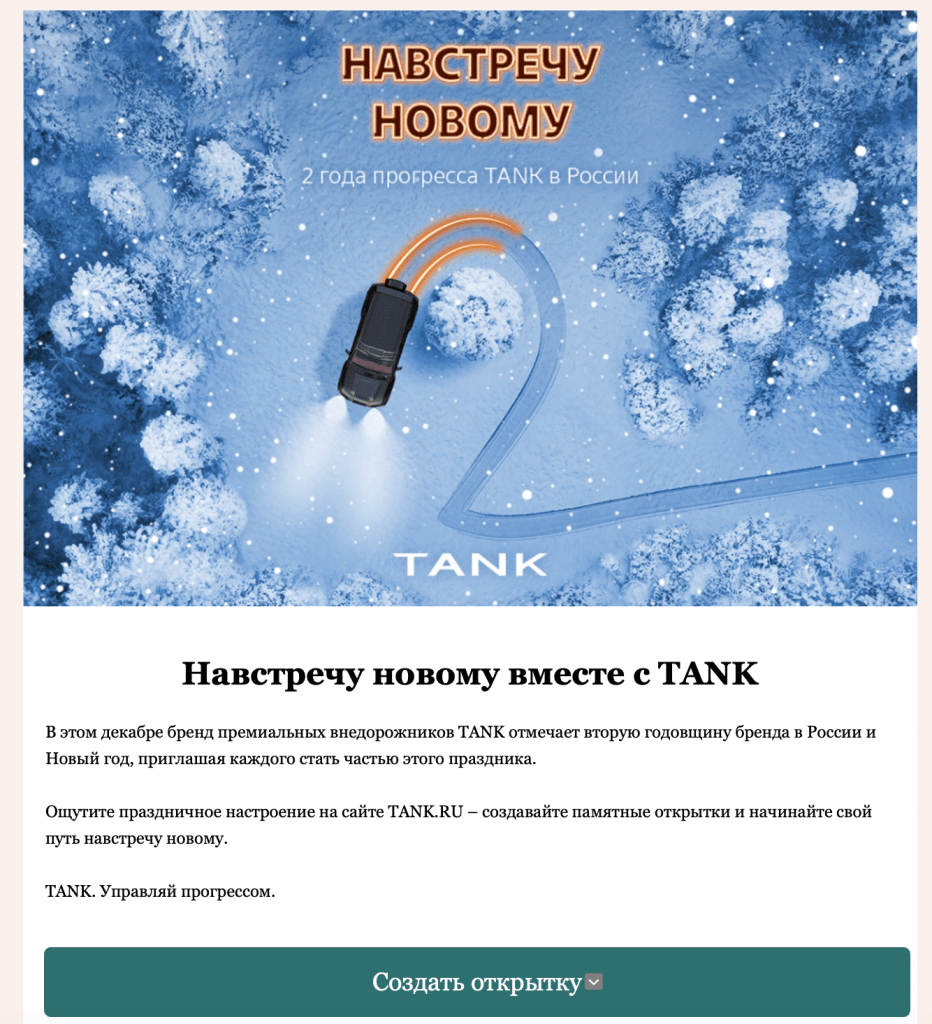
Greeting the New with TANK

This December, premium SUV brand TANK celebrates its second anniversary in Russia and the New Year, inviting everyone to be a part of the celebration.

Get into the festive mood on the TANK.RU website by creating commemorative cards and beginning your own journey towards the new.

TANK. Drive your own progress.

Source: Unsolicited email from Vedomosti, 10 December 2024


The fall of the Baath state in Syria is a serious defeat for Russia (and a disaster for Iran). It would however be a grave mistake to assume that this by necessity makes it a success for the United States.

Moscow and Washington may indeed now face similar challenges in Syria.

Three issues led Russia to intervene in the Syrian civil war to save the Assad regime. First was a general desire to preserve a partner state — one of the very few remaining to Russia after the U.S. overthrow of the regimes in Iraq and Libya, which helped to prop up Moscow’s international influence. Second was a desire to retain Russia’s only naval and air bases in the Mediterranean.

Third was a deep Russian fear that an Islamist victory would lead to Syria becoming a base for terrorism against Russia and its partners in Central Asia. That anxiety was increased by the presence of numerous fighters from Chechnya and other Muslim regions of Russia in the ranks of the Islamist forces in Syria and Iraq.

[…]

Thanks to our readers and supporters, Responsible Statecraft has had a tremendous year. A complete website overhaul made possible in part by generous contributions to RS, along with amazing writing by staff and outside contributors, has helped to increase our monthly page views by 133%! In continuing to provide independent and sharp analysis on the major conflicts in Ukraine and the Middle East, as well as the tumult of Washington politics, RS has become a go-to for readers looking for alternatives and change in the foreign policy conversation. 

We hope you will consider a tax-exempt donation to RS for your end-of-the-year giving, as we plan for new ways to expand our coverage and reach in 2025. Please enjoy your holidays, and here is to a dynamic year ahead!

Source: Anatol Lieven, “The fall of Assad is a defeat for Russia — and no ‘win’ for the US,” Responsible Statecraft, 10 December 2024, received this morning by email. Since Mr. Lieven was a member in good standing of the Valdai Discussion Club and a “programme council” member at Vladimir Yakunin’s Dialogue of Civilizations Research Institute, his “sharp and independent analysis,” above, naturally contains no mention of the war crimes and crimes against humanity committed against the Syrian people by the Assad regime and its Russian allies.


On Sunday, something extraordinary happened: the Syrian people overthrew the Assad regime. For years we have been waiting to share this news with you. We wanted to make sure you didn’t miss our message below.

Dear Thomas,

This is the message we have been waiting so long to write. Assad is gone. The Syrian people have toppled the Assad regime. Our hearts burst with hope today. A war criminal of the worst kind no longer has the power to torture, starve, bomb and detain people in Syria.

The regime that has caused indescribable suffering and trauma for decades no longer has the power to commit war crimes. Syrians in Syria and all over the world are singing, “Syria is for the people, it does not belong to the Assad family”. We are chanting along with them. Ragheed al-Tatari, Syria’s longest-held political prisoner, has been freed alongside many others.

We write these words thinking of so many of our friends and loved ones who we lost in the past years. Our hearts break that they’re not witnessing these moments with us.

There is much that is unknown. We have lost so much. Our dream for freedom and democracy declared almost 14 years ago was for a peaceful transition of power out of authoritarian hands into those of the Syrian people – all of us diverse and different but together in our vision for a new Syria.

At the Syria Campaign we commit to continuing to work with all those who stand with human rights, with you all, to ensure our vision for a free and democratic Syria is made real.

The hope we feel today feels something like those first weeks when we took to the streets and dared to call for freedom and dignity. We believed the world would join us to protect humanity and champion the values they claimed to hold dear.

As our committed and courageous supporters you all know the journey we have been on since then. You have been with us as we rallied loudly against the bombings of hospitals, whole communities massacred by chemical weapons, the systematic use of detention and disappearance, meant to crush our spirits. You, and hundreds of thousands of people around the world, have stood with us and made our demands for protection of civilians and justice for war crimes more powerful.

Our movement, alongside the heroes on the ground in Syria – the White Helmets, medics, women’s rights activists, journalists – and the vibrant Syrian civil society in refuge around the world – the lawyers, investigators, artists, campaigners, survivor groups and family associations, has kept the demands of the revolution loud and clear.

Today, those demands are all the more urgent. It is time for Syrians to lead a peaceful Syria. Free and democratic, vibrant and diverse.

Now is the moment for Syria and the international community to restart Syria’s stalled UN-led political process, with a clear timeline for political transition that leads to free elections, as outlined in UN Resolution 2254.

There is so much to be done. We are impatient for accountability and justice. So many people remain detained or disappeared and families across the world are now hoping to go back to their homes and cities and be reunited with their loved ones. Almost every Syrian carries pain and trauma into this new moment. It is a moment that holds such promise. It is the chance to create a new beautiful Syria.

In solidarity,

Ranim, Ola, Raya, Bayan, Afraa, Wafa, Soumaya, Anna, Sandro, Rebecca, Razan

P.S. The weeks ahead will be critical. Please consider donating to support our work towards our vision for a free, just and democratic Syria.

The Syria Campaign is a human rights organisation that supports Syria’s heroes in their struggle for freedom, justice and democracy. Read more about our work here.

To ensure our emails reach your inbox, please add info@thesyriacampaign.org to your address book.

Online donations by credit card are processed by Voices Project USA and are tax deductible in the United States to the full extent allowable under the law. Online donations by PayPal are processed by The Voices Project (UK) and are not currently tax deductible in the US or available for gift aid in the UK. Voices Project USA Federal Identification Number is 82-3505967. 

Follow us on FacebookTwitter, and Instagram.

Source: A very welcome email from the Syria Campaign, 10 December 2024


“GREETING THE NEW”: the “commemorative postcard” generated for me by TANK.RU, based on my answers to six leading questions and a photo of myself I uploaded to the website.

Since the beginning of 2023, Russians have bought more than 600 Chinese Tank SUVs. According to Autostat, from January to April, Tank dealers sold 632 cars, and the more affordable model with the 300 index is more popular than the Tank 500 — during the reporting period, the first sold 479 copies, and the second — 153 copies. Thus, the Tank 300 accounts for 76 percent of total sales, and the “five hundredth” — 24 percent. Tanks are in the greatest demand in Moscow — every fourth car of this brand (166 units) is registered in the capital. In second place in terms of sales is St. Petersburg with an indicator of 125 Chinese SUVs sold (every fifth), followed by the Moscow region – every 10th SUV is registered there. The top 5 regions also include Nizhny Novgorod and Kemerovo regions (45 and 37 copies, respectively). 

Tanks are in the greatest demand in Moscow — every fourth car of this brand (166 units) is registered in the capital. In second place in terms of sales is St. Petersburg with an indicator of 125 Chinese SUVs sold (every fifth), followed by the Moscow region – every 10th SUV is registered there. The top 5 regions also include Nizhny Novgorod and Kemerovo regions (45 and 37 copies, respectively).

Official sales of the Tank 300 began only in the early spring of this year. The “younger” Tank is supposed to have a two-liter “turbocharger” with a capacity of 220 horsepower in conjunction with an eight-band automatic, the drive is only full. The larger Tank 500 model appeared a month after the “three hundredth” — it is offered with a 3.0-liter V6 engine that develops 299 horsepower and works with a nine-band automatic. The drive is also full.
Source: “Since the beginning of 2023, Russians have bought more than 600 Chinese Tank SUVs,” Oreanda News, 24 May 2023

Language Lessons

More on grammatical gender.

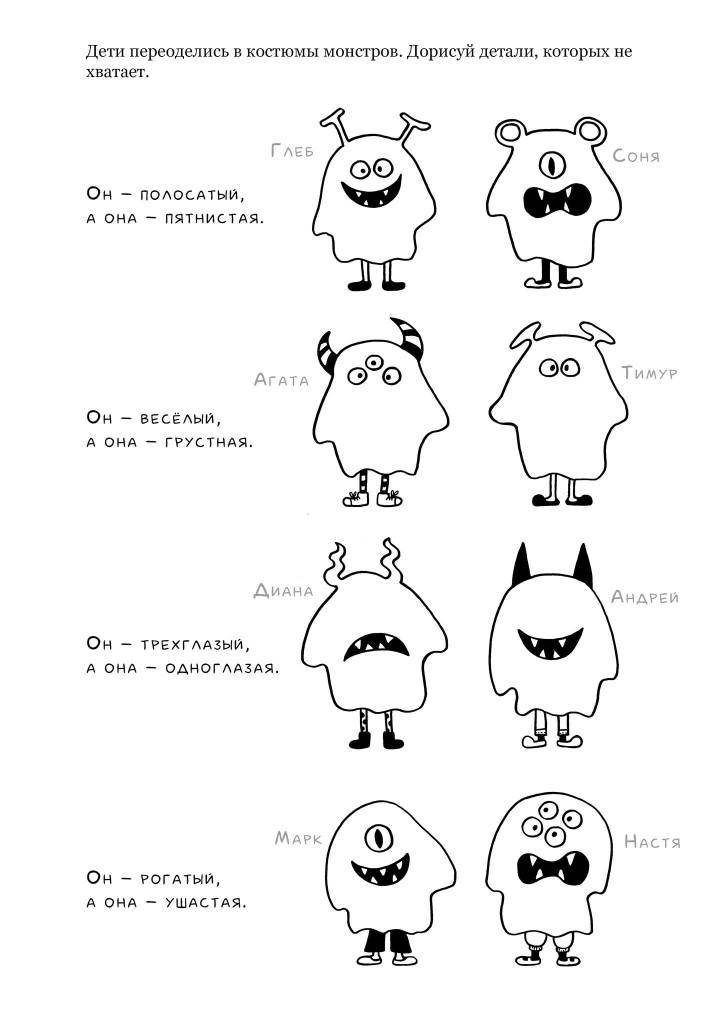
The kids dressed up in monster costumes. Draw in the details that are missing.

He’s striped and she’s spotted. (Gleb and Sonya)

He’s cheerful and she’s sad. (Agata and Timur)

He’s three-eyed and she’s one-eyed. (Diana and Andrei)

He’s horned and she’s big-eared. (Mark and Nastya)

Source: Natalia Vvedenskaya (Facebook), 20 August 2024


I’d like to say I was first drawn to Russia by a fascination with late Soviet politics under Gorbachev, or the great works of Russian literature. But for me the initial interest was the language itself, as taught by an eccentric but effective teacher called Mr Criddle. Short and bearded, even a little gnome-like, he usually dressed in sandals and socks and ran his classes at Worcester Sixth Form College with old-fashioned discipline. Before we started the course, he had handed out copies of the thirty-three character Cyrillic script at our college open day with instructions to learn it or not bother turning up for class.

Mr Criddle had learned his own Russian in the mid-sixties at the Liverpool College of Commerce, taught by a graduate of a Cold War creation known as the Joint Services School for Linguists (JSSL). The JSSL had taken around 5,000 conscripted men from military boot camps in the 1950s and produced a whole generation of Russianists. The kadety, as the students called themselves, were trained to be high-level interpreters, ready to interrogate Soviet prisoners, decipher classified documents and run counter-propaganda operations should the USSR ever invade. As it never did, many ended up teaching the language in UK universities and schools.

The JSSL method was fast, deep and tough, with heavy emphasis on repetition and rote-learning. Its students had a skukometer, a made-up word from the Russian for boredom, to measure how brain-numbing a class was, and I would come to know how they felt. Mr Criddle had picked up the JSSL military style from his own teacher. Ignoring any official syllabus, he had a giant library of homemade flash cards which he used to drill us relentlessly. He’d cut all the images out of magazines and glued them to one side of the cards, writing the correct adjective endings or verb declensions on the back. He kept them in recycled envelopes at the back of the room. It was the exact opposite of how I’d learned French and German, where we chose a ‘foreign’ name and then role-played trips to the bakery or camp-site shop. For Russian, Mr Criddle had us create our own carefully indexed grammar books and then he dictated every page. It was a whole year before we learned anything practical like how to introduce ourselves perhaps partly because no one was planning a summer holiday in the Soviet Union, but we could soon form the genitive plural in our sleep.

Source: Sarah Rainsford, Goodbye to Russia (2024)


The Booker Prize: “Nonso Anozie reads from ‘James’”

Watch Nonso Anozie read from Booker Prize 2024-shortlisted James, written by Percival Everett.

The story so far: It’s 1861 and Jim, a slave and soon-to-be companion of Huckleberry Finn on a dangerous journey along the Mississippi River, is a man driven by a fierce instinct to survive and to protect his family. This includes teaching his own and other children the behavioural and language skills needed to avoid antagonising the white people who have made their lives hell.

Source: The Booker Prizes (YouTube), 12 October 2024


All traces of Ukraine are being expunged. Schools have switched to the Russian curriculum, and Russian youth and paramilitary organisations work in the territories. Repression combined with Russification aims to transform the social and political fabric of the territories, says Nikolay Petrov, the author of a new report for the German Institute for International and Security Affairs.

Source: “Kremlin-occupied Ukraine is now a totalitarian hell,” The Economist, 10 November 2024


Source: Rotten Tomatoes Coming Soon (YouTube), 18 October 2024


“I dreamed that I was talking in my dream and to be safe was speaking Russian. (I don’t speak any Russian, and also I never talk in my sleep.) I was speaking Russian so that I wouldn’t understand myself and no one else would understand me either.”

Source: Charlotte Beradt, The Third Reich of Dreams: The Nightmares of a Nation, trans. Damion Searls (Princeton UP, 2025), quoted in Zadie Smith, “The Dream of the Raised Arm,” New York Review of Books, 5 December 2024

Dankhaiaa Khovalyg: Russia’s Asian Republics Speak

Dankhaiaa Khovalyg. Photo: Rinchinaaa/Baikal People

‘I was made from Russian anyway,’ 28-year-old Dankhaiaa Khovalyg writes in her story ‘Ayalga,’ published in early 2022. Its female protagonist tells a psychologist how she feels like a stranger in her own country. When Dankhaiaa was a teenager, she deliberately detached herself from her native culture. She was proud to speak Russian without an accent, and dreamt of leaving Kyzyl ‘to be with her own people’ in Moscow.

During her eight years in Moscow, Dankhaiaa was involved in decolonial activism, researched her own painful background, and launched a project about indigenous people from Russia’s six ethnic Asian regions —the podcast re.public_speaking.

Alina Golovina, a Baikal People correspondent based in Buryatia, spoke with Khovalyg about why it is important to talk about trauma, where decolonization begins, and whether Russia’s ethnic republics can unite for their own benefit. At Danhkaiaa’s suggestion, they spoke to each other using the informal second-person pronoun ty.

As soon as I would lеave home, the world would crash down on me with all its xenophobia

— Tell me about yourself, Dankhaiaa.

— I was born and raised in Kyzyl. After graduating from school, I went to study in Moscow and lived there for eight years. I worked as a client manager in an IT company and was involved in feminist activism. In 2021, I quit my job and realized my childhood dream: I enrolled in literature classes and took up writing. Since March 2022, I have been living in Berlin and doing podcasts and anti-war activism.

— You told me that up to ninety percent of the indigenous people in Tuva speak Tuvan and consider it their native tongue. Why have you prioritized Russian? Is it a problem?

— I’m a city girl: I grew up in Kyzyl. I was sent to a Russian-language kindergarten and, later, to a Russian-language class at school. That was how my mother showed that she cared about me: Russian-speaking classes were considered tonier. I was a bookworm and was engrossed in Russian literature. Unfortunately, I didn’t have access to a large amount of foreign literature at school, and at that moment, eighty percent of me certainly consisted of this great and beautiful Russian literature by the so-called Tolstoyevskys. I read all of that stuff and would dream of going to Moscow. I was a little proud that I spoke such beautiful Russian. Basically, I went through all that internalized colonial chauvinist crap that life was better there, that I was going to get out because I was more like them.

— Did it save you from ethnic discrimination? If not, when did you first encounter it?

— My experience of discrimination actually began long before I moved to Moscow. My mother found opportunities using travel vouchers to send me to summer camps in Krasnodar Territory, Khakassia, and other regions. I was eleven and twelve years old at the time. It didn’t matter whether I traveled five hundred kilometers from home or several thousand, because everywhere I went I encountered phenomenal bullying. I was labeled ‘China girl’ and ‘black.’ No one asked me to dance at dance parties. I was either totally ignored or talked to condescendingly and peppered with passive-aggressive insults. I had lived in my native Tuva in a groovy, comfortable bubble: most people spoke Tuvan, and we didn’t encounter any racism there. But as soon as I would leave home, the world would crash down on me with all its xenophobia. Whereas in Tuva I was considered pretty, smart, and cool, everything and everyone at those camps made it clear to me that I was second-rate.

— How did this affect you?

— These contrasts generated very unhealthy takeaways in my head: that Tuva’s overall level [of development] was much lower than the rest of Russia’s. This absolutely perverted assumption made me, as a teenager, condescend to Tuvan culture and my Tuvan side. It is quite painful for me to remember the instances when relatives addressed me in Tuvan, but I would reply in Russian, saying that I didn’t understand them, although that was a lie. Those memories now make me feel bitter. I feel sorry for that teenage girl.

— What happened later in life? How did Moscow welcome you?

— I often encountered micro-aggressions in public places. For example, I would be standing in the queue at a store, and a huge Russian guy would push me aside and go in front of me. There was no explicit verbal indication that this was because I was non-Russian, but I think this wouldn’t hae happened if I had been of Slavic appearance. I repeatedly had big problems finding a place to live because of my name and my appearance. Or, for example, I would be climbing the stairs to my floor, and neighbors descending the stairs would say, ‘The churkas have come and taken over the place’ when they would see me. They would not say it to my face, but under their breath as it were, and when they were already a flight below me, so I couldn’t even shout back at them as it happened. I would just stand there for a while, frozen on the steps. You always deal with this alone because when you are with your husband or a group of people, those very same neighbors keep their mouths shut. Every such episode of chauvinism really demoralized me, although I didn’t express it outwardly. Because no matter who I would tell, they would say, ‘Oh, don’t pay attention! Rise above it! We don’t stoop to their level.’ I swear that there has never been an instance when someone just shared my indignation for a second.

— Have you experienced physical violence? Have you been attacked?

— I didn’t encounter any actual boneheads (far-right skinheads): I moved to Moscow in 2013, by which time the most ardent supporters of that ideology had been jailed. The cases of physical violence that happened to me are difficult to categorize. The first time it happened was when I was in my first year at university. I was traveling from my part-time job in an empty train carriage to my dormitory. I had leaned my head against the window and fallen asleep with my legs stretched out. I woke up to an old man kicking me and saying, ‘Move your damn feet.’ I did and asked him what was the matter, and he said he wanted to sit down. I suggested he sit down in one of the other free seats, upon which he started kicking me again, saying that I was a churka and if I gave him any guff, he would beat the shit out of me. It was so horrible, because the old man spoke softly and looked like a harmless creature. I didn’t leave because I didn’t want to look weak. He stared at me point-blank the whole way and commented that I behaved very freely in Russia. It was forty minutes of violence.

The second incident happened on Leninsky Prospekt near the Oktyabrskaya subway station. It was summer, I was walking with headphones on in a crowd of people, listening to music. I noticed out of the corner of my eye that a man was walking in my direction and looking at me intently. Over the years, you develop something like a muscle that reacts to unwanted attention and makes you tense up and pull yourself together as if you’re getting ready to react. When the man walked by, he hit me over the head with a bottle. I fell down. He walked on. So there I was, lying propped up on my elbows, looking at the man walking away, and all the other people just passed me by. I thought at the time that it could have been a scene from a film, because only in a film can you get hit and nobody comes up and asks how you’re doing or tries to help you. And there were a lot of little situations — elbowing, pushing, kicking. Several times when I was putting away my dirty tray at a food court, I was told, ‘Hey, clean this up.’

Continue reading “Dankhaiaa Khovalyg: Russia’s Asian Republics Speak”

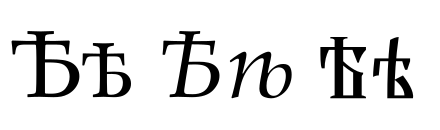
Tautology (2)

Gartenstadt Falkenberg and Preussensiedlung

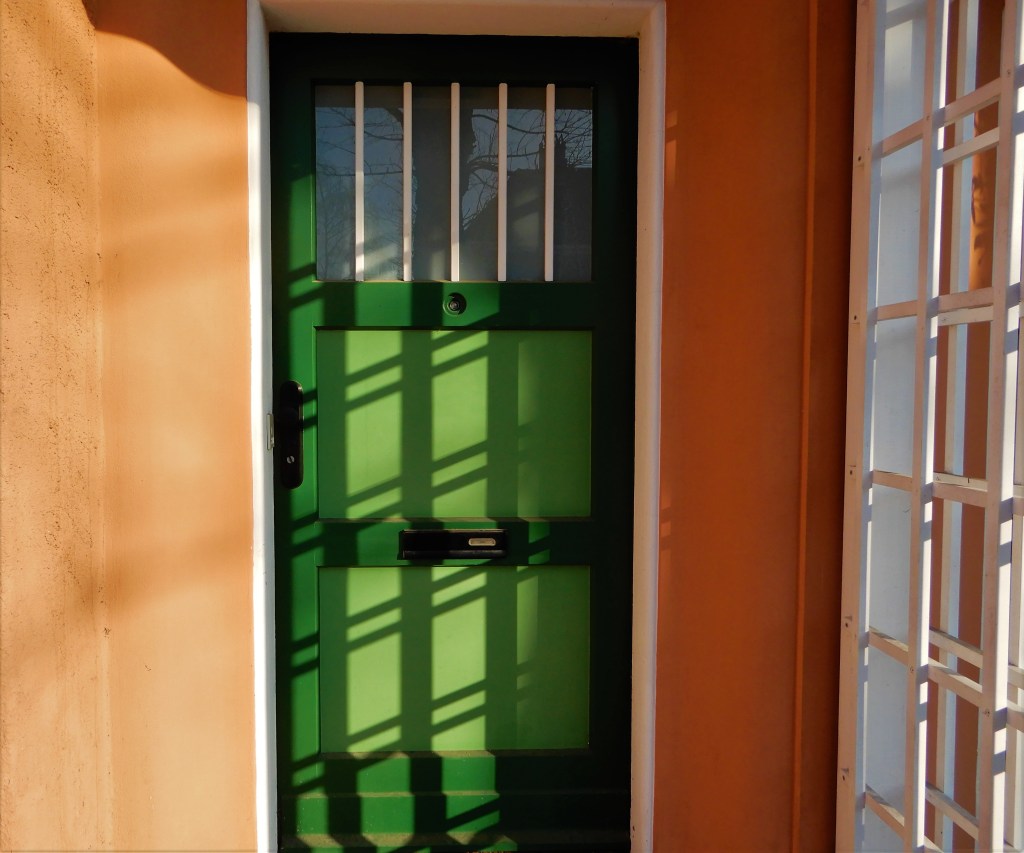
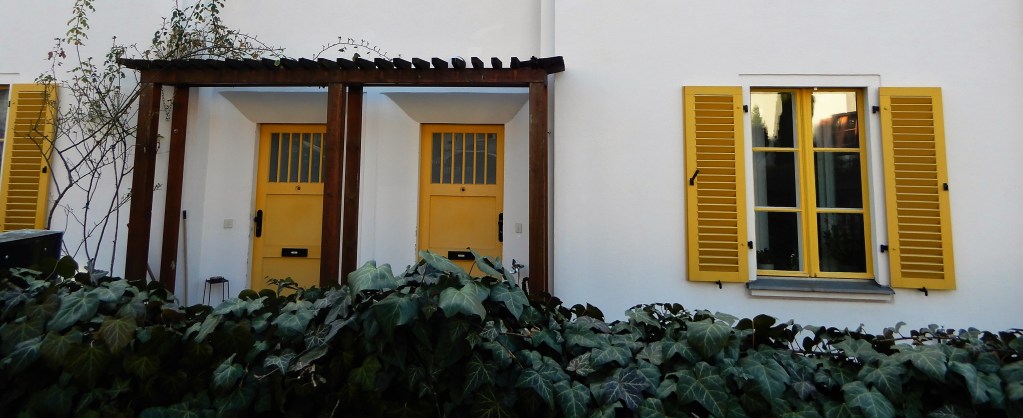
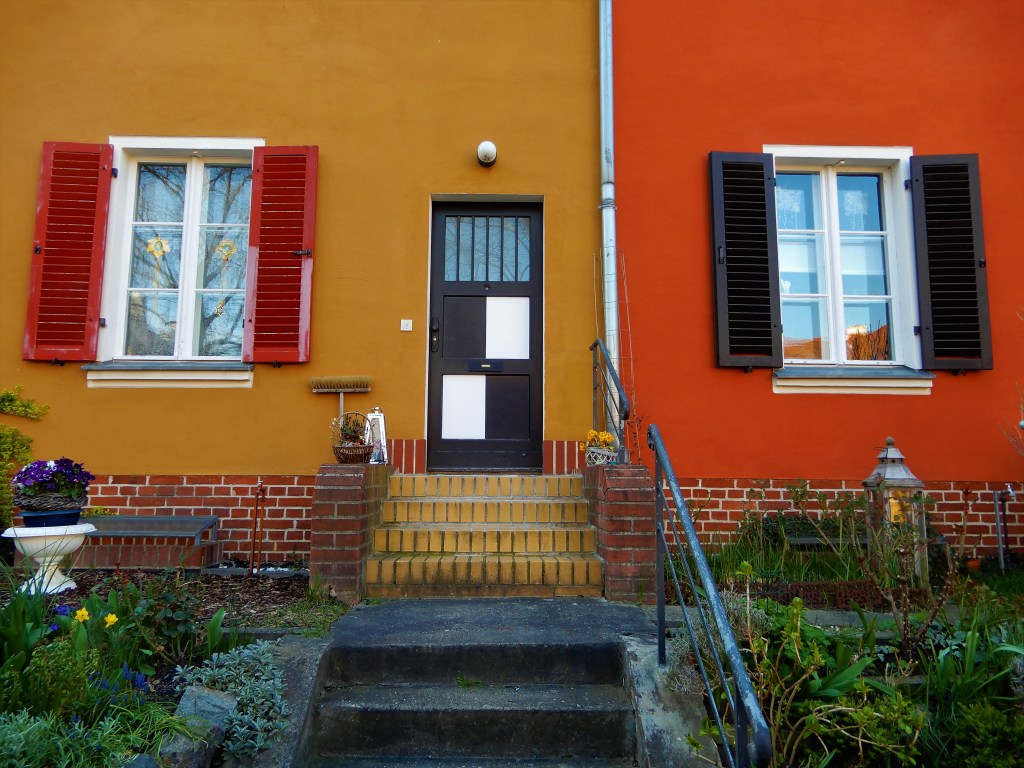
Yesterday was a rare sunny, warm day, so my boon companion and I traveled to the city’s far southeast to walk through Bruno Taut’s Falkenberg Garden City in Berlin-Bohnsdorf. It was like a tiny vision of heaven.

As it happened, it was also a short walk from Max Bel, Franz Clement, and Hermann Muthesius’s Prussian Street Estate, which was also quite handsome and built to a properly human scale.

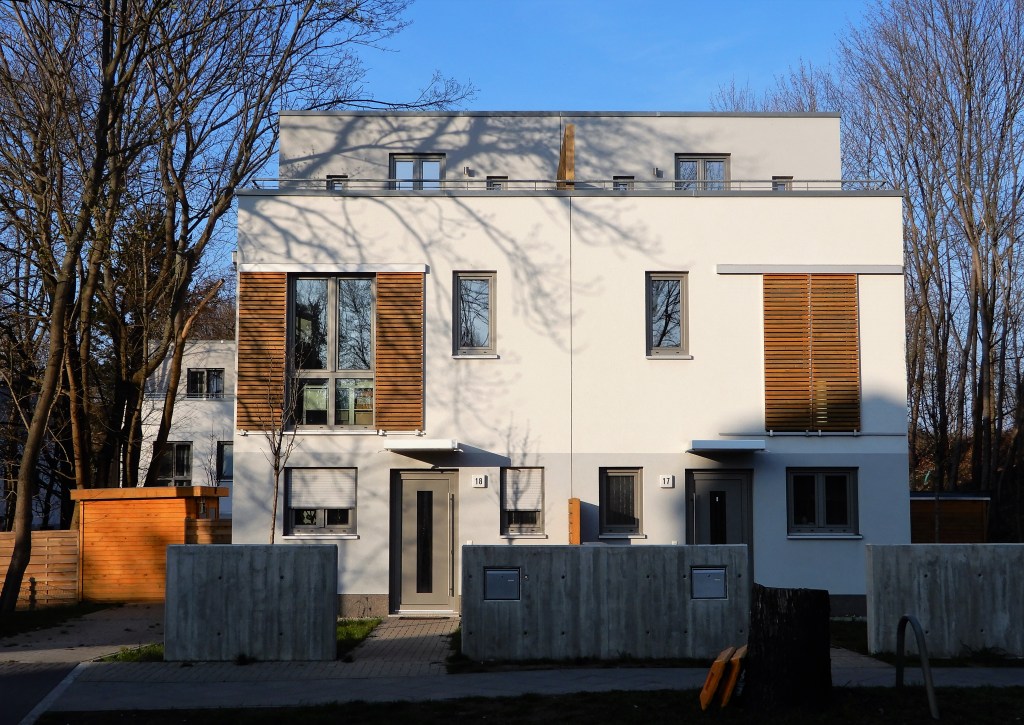
I’ve noticed Berlin’s modernist housing estates seem to have had a beneficent effect on their neighborhoods, so that even current architects designing new houses and developments there try to get into the Tautian spirit, as it were. The overwhelming impression, however, is that you’re looking at a future we have lost forever.

The Russian Reader, Berlin-Friedrichshain, 30 March 2019


And now we come to this verb “see.” Within fifteen lines it’s been used six times. Every experienced poet knows how risky it is to use the same word several times within a short space. The risk is that of tautology. So what is it that Frost is after here? I think he is after precisely that tautology. More accurately, non-semantic utterance. Which you get, for instance, in “’Oh,’ and again, ‘Oh.’” Frost had a theory about what he called “sentence-sounds.” It had to do with his observation that the sound, the tonality, of human locution is as semantic as actual words. For instance, you overhear two people conversing behind a closed door, in a room. You don’t hear the words, yet you know the general drift of their dialogue; in fact, you may pretty accurately figure out its substance. In other words, the tune matters more than the lyrics, which are, so to speak, replaceable or redundant. Anyway, the repetition of this or that word liberates the tune, makes it more audible. By the same token, such repetition liberates the mind—rids you of the notion presented by the word. (This is the old Zen technique, of course, but, come to think of it, finding it in an American poem makes you wonder whether philosophical principles don’t spring from texts rather than the other way around.)

Source: “Joseph Brodsky: On ‘Home Burial'”