Yle, the Finnish public broadcaster, asked four recent immigrants to Finland, people who are still in the process of studying Finnish and integrating into the society, to interview representatives of the country’s main political parties in the run-up to parliamentary elections, which will take place there on April 19.
The catch was that Yle also asked the parties to send as interviewees party members who were immigrants and had themselves learned Finnish as adults or teenagers. Among other things, the interviewees were asked to explain how they had come to join the particular parties they now represented.
Interestingly and unsurprisingly, the Finns Party (Perussuomalaiset), notorious for its anti-immigrant views, was unable to provide an interviewee for the program.
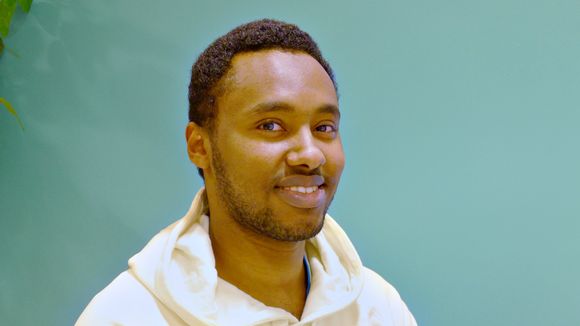
The Left Alliance (Vasemmistoliitto) sent as its representative Suldan Said Ahmed, a young entrepreneur and politician originally from Somaliland. (Somaliland is an autonomous region of Somalia that seeks recognition as an independent country from the rest of the world, but as yet hasn’t got it.)
According to Said Ahmed, solidarity, community, and internationalism are the three words that best sum up the Left Alliance for him.
If like me, you are someone studying Finnish, you should love listening to Said Ahmed, because his Finnish is much easier to understand and “correct” than that spoken by “real” Finns, what with their variety of local dialects and reliance on puhekieli (conversational language), which is often shockingly at variance from the “proper” textbook Finnish we foreigners and immigrants learn on courses.
It seems Said Ahmed has political ambitions in his native Somaliland as well. He would like to become the youngest MP there and is planning to stand, apparently, in this year’s upcoming parliamentary elections there.
Said Ahmed would also like sometime in the future to be president of Finland, but that job, alas, is constitutionally only open to native-born Finns. (So far, I would like to think for his sake.)
I find all of this so fascinating in part because, just last week, I had to go verbally postal on a few of my classmates in the advanced Finnish course I have been taking here in the former capital of All the Russias. For the second or third time this semester, they regaled the rest of us with dark tales of how Somalians like Said Ahmed are ruining the fair country of Finland by moving there in droves to become—yes—welfare scroungers. Meanwhile, the government has decided, allegedly, not to let more Russians to move to Finland, even though generally it wants to encourage more immigration to the country to help care for its aging population, etc.
You get the drift.
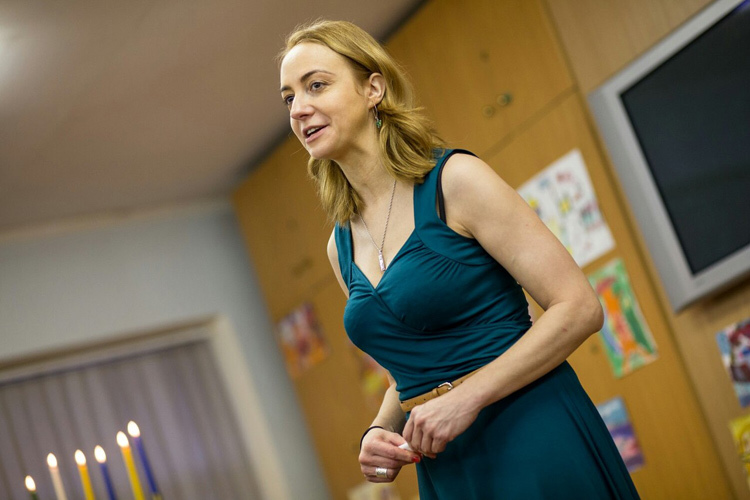
It might rock my classmates’ world to find out that one of the interviewers in the “Let’s Meet the Parties” program (along with a man from the Philippines, a woman from Lithuania, and a woman from South Korea) is Svetlana Siltanen, who emigrated to Finland from Russia last year.
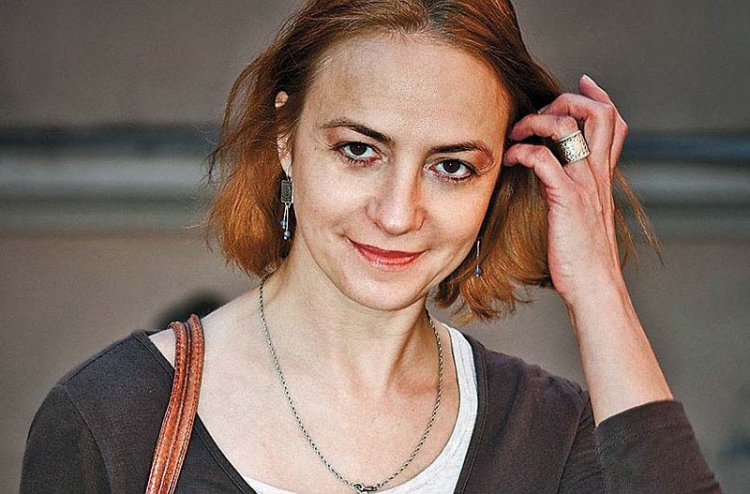
Svetlana Siltanen. Photo: Mikko Kuusisalo / Yle
My “dream a little dream” today would be to put Yle in charge of public broadcasting for a year in Russia. What a difference that could make to people’s outlooks here.
“Anyone who tries to defend their rights is a fifth columnist and agent of the State Department” A trade union leader talks about pressure from the security forces and badgering from the National Liberation Movement
Darina Shevchenko
March 24, 2015 Yod
The automotive industry has been laying off employees around the country. Since the beginning of the year, the demand for cars has fallen 20-30%. Management has forced workers to quit, shift to part-time work or agree to significant pay cuts. The Interregional Trade Union Workers Association (ITUWA) has countered with strikes and pickets. Center “E” (Center for Extremism Prevention) has responded by taking measures against union members. Last weekend, Center “E” officers detained members of the ITUWA Kaluga local. They demanded that the activists confess to working for western secret services and acting to destabilize the situation in Russia. Dmitry Kozhnev, leader of the ITUWA Kaluga local, told Yod that the trade union has long had a difficult relationship with the local security forces, and more recently, members of the National Liberation Movement (NOD) have targeted workers for persecution.
The ITUWA was founded in 2006 by members of trade union organizations from the Ford plant in the Petersburg suburb of Vsevolozhsk and the AvtoVAZ plant in Togliatti.*** The trade union unites workers from more than fifteen companies. Its chair, Alexei Etmanov, was elected to the legislative assembly of Leningrad Region in 2011. The ITUWA’s motto is “Don’t cry, organize!”
On what grounds were trade union members taken in by Center “E” over the weekend?
Under the pretext that a robber who had hit a passerby with a bottle and stolen something had dashed into the room where we had gathered for a routine meeting. About forty security forces officers arrived. They detained fifteen of us, took us to a police station, and asked us about our activities, what protests we were planning. They told us that, under the guise of defending workers’ rights, we were spying for the US, destabilizing the regime, and engaging in provocations. We hear this song from Center “E” constantly. Apparently, law enforcement officers find it difficult to believe that an organization can be independent and act on its own.
Have Center “E” and the FSB showed interest in your activity before?
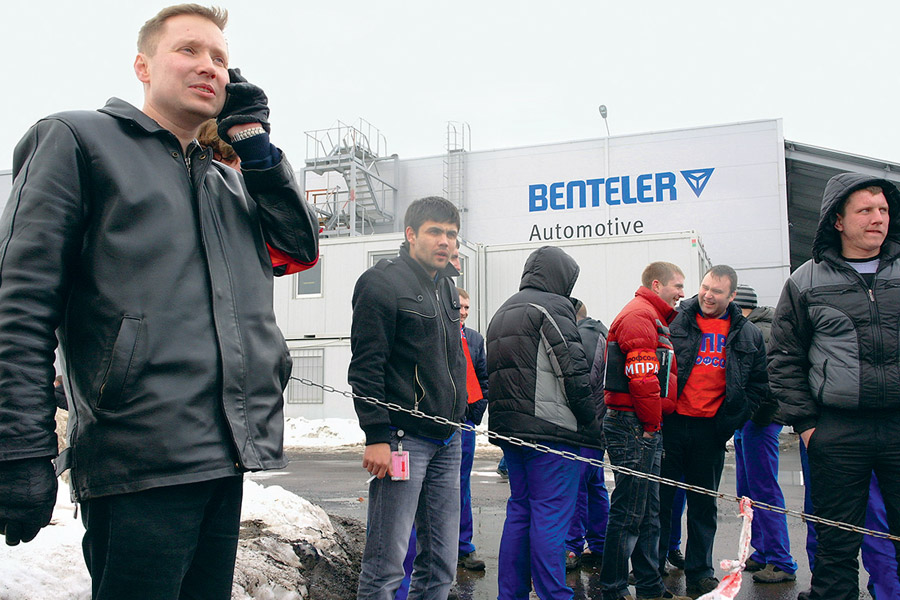
Our union emerged in 2008. During this time we have become stronger and our actions have gotten results. In [2012], a strike at the Benteler Automotive plant led to the workers signing a collective agreement that we drafted. We got the bonus included in the salary and a ban on duties other than those stipulated in the contract. At the Volkswagen plant we forced management to increase salaries by almost four times, from seven to thirty thousand rubles a month.
Dmitry Kozhnev (left) on the picket line during the 2012 strike at Benteler Automotive
In the summer of 2013, Volkswagen management was changing equipment. They wanted to let the workers go for a week, and then have them work off the missed days on weekends. By law, management has a right to do this, but plant workers opposed it. They were furious at the prospect of working weekends in the summer, when every day off is worth its weight in gold. We told management they should pay the missed week as down time, while the workers would go to work voluntarily and at double the pay. Management stood their ground, and then we began to prepare for a strike. By the way, according to Russian law, it is almost impossible to strike. Management must be notified seven days in advance. During this time, management can succeed in appealing the strike in court and then the strike cannot start on time. So we start the strike and notify management simultaneously. That is what we did back then at Volkswagen. We also picketed dealerships and informed consumers that we could not vouch for the quality of the cars assembled during the strike. We got what wanted.
Now our trade union has influence at different plants and can exercise control over the situation. After the number of union members went over four hundred at Volkswagen in 2009, and we began doing street protests, Center “E” got on our case.
And as soon as relations between workers and management would heat up, Center “E” would show up and put pressure on us, including arrests, harassment, and surveillance. But pressure and persecution have only strengthened the organization.
Give an example of persecution by Center “E”.
As soon as our work started to produce results, we began getting summons to Center “E” and were threatened with criminal prosecution. Once they blocked my car on the street and took me down to the station. They tried to catch several comrades with allegedly faked sick leave forms, threaten to take them to court, and force them to inform on trade union leaders. One worker and trade union member had a weapon planted on him. He got into a car with security officials. They handed him a bundle, said it contained a gun used to commit a crime, and now he would either rat on his colleagues or be convicted for the crime. The comrade refused to be an informant and took the story public big time, and they left him alone. Another comrade of ours was press-ganged into the army. Because of a serious leg injury, the guy had been declared unfit for military service. During a routine medical exam at the draft board, he was suddenly declared healthy. He insisted on an independent medical examination. The guy was then abducted on the street and sent to the army. He served his term, and came back angry and able to use weapons. And he is working in the trade union again. The ranks of our trade union’s foes continue to swell. Recently, the National Liberation Movement (NOD) joined them.
How come? You don’t participate in opposition rallies, do you?
NOD considers us Banderites because anarchists carrying flags with anarchist symbols attend our rallies. They think that since the Banderites have black-and-red flags, and anarchists use the same colors, they are in cahoots. It is ridiculous, of course. It is useless to ask the NODites questions; it is better not to talk with these cartoon characters. Anatoly Artamonov, governor of Kaluga Region, has also called us agents of the West. And this is a guy who has built his region’s economy on cooperation with companies from NATO countries and has awards from NATO countries! This is the trend now. Anyone who defends their rights is a fifth columnist and agent of the State Department.
The security forces’ interest in you has to do with the crisis in the automotive industry and presumed activism on the part of trade unions. At what plants is the situation the most tense?
It is easier to say which plants have no problems: the plants that produce luxury-class cars. They are the only ones where everything is all right. All the other plants are undergoing layoffs, which are hidden for the time being. Workers are being persuaded to quit voluntarily, to accept part-time schedules and pay cuts. But I think the crisis will continue, and the actions of management will become harsher. But we will vigorously defend the interests of workers.
Translated by the Russian Reader. Photo courtesy ofRussian Reporter
*** Editor’s Note. The ITUWA was originally known as the Interregional Trade Union of Autoworkers (ITUA). It changed its name in 2013, although the union’s well-known abbreviation in Russian (MPRA) has remained the same.
Smash the Kikes and Save Russia (2015) Hard on the heels of migrants and gays, another minority has begun to fear for its safety: Jews. Svetlana Reiter spoke with two women who feel directly threatened
Svetlana Reiter
March 2, 2015 Colta.ru
Leokadia Frenkel Program Coordinator, St. Petersburg Jewish Community Center
I set up a volunteer program to help the children of migrants three years ago, in May. Basically, we teach Russian to children of migrants from Central Asia, primarily from Uzbekistan, but there are children from Kyrgyzstan and a few from Georgia. Twice a week, they have Russian lessons, and every Sunday in the summer we go to a museum, take a trip to Pavlovsk or Peterhof, or just walk around the city. The younger group, preschoolers and first graders, we teach conversational language through games. We teach the older children, who already know how to read and write, Russian as foreign language. There are fourteen children in the younger group, and eight in the older group. I cannot say that they attend constantly. Some get ill, while others leave the country.
I myself am a philologist by training. Previously, I taught Russian language and literature in schools. I am Jewish.
Leokadia Frenkel
When we opened, practically no one was working with migrant children. There were no classes: it had occurred to no one that something needed to be done with them. Naturally, when we opened, various media visited us to shoot segments and write articles. When I read the comments to these articles, I often felt uneasy: people wrote very harshly about migrants and their children. But I could scarcely have foreseen what has happened now.
I posted an ad for volunteers in Facebook and VKontakte. We cannot take just anyone: we need professional philologists, people able to work with children. We cannot take the average person who just feels sorry for migrants, and real teachers are few and far between. So I am constantly posting ads in social networks: look at what wonderful children we have, come and help us.
Not long ago I posted two more ads. A group on VKontakte calling itself Morality reposted one. I had a look. Morality’s moderator, Mikhail Kuzmin, put together an album containing 161 photos of me and published a post in which he wrote that the kike-liberal public goes to protest rallies and teaches Russian to “black” (chernye) children. This group is absolutely fascistic and anti-Semitic. They are constantly writing that migrants commit the majority of crimes in Russia. That “black” children attend our schools and spoil our children, the migrant children are wild animals who are uneducable. And those are the mildest things they write.
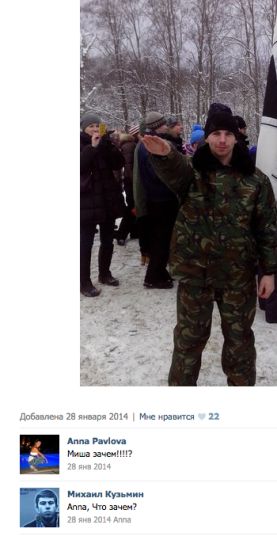
When this community was informed that a Jewish woman was teaching migrants, they were faced with what they understood as pure evil. Three and a half thousand people gladly lashed out at me. Kuzmin posted information about my son and my husband, and published an additional post about my family. He was outraged: how could it happen that kikes were teaching savages?! There is no place for either group in our society. Down with the kike-liberal opposition! Moreover, judging by his photographs, Kuzmin himself goes to LGBT rallies and beats up gay activists. He has an athletic physique: he practices boxing and fisticuffs at Sosnovka Park. In one photo, he is wearing a police uniform and sporting a badge. I don’t know whether he is really a policeman, but the photograph exists, just like snapshots where he is giving the Hitler salute or standing next to Deputy [Vitaly] Milonov [author of Petersburg’s infamous homophobic law].
The worst thing, of course, is that he not only haunts the social networks but that he walks the streets. I complained to the administration of VKontakte. They replied that if I didn’t like this group, I shouldn’t look at their postings, and that they close only those groups that directly threaten someone’s life.
I have said nothing to the migrant children. I am a good teacher; I know how to work with children. Ultimately, my job is to help those who have it worse than I do, not to make their lives even more unbearable. You see, in the schools these children accumulate hatred: teachers don’t like them and classmates fear them. These things give rise to reciprocal aggression.
It is hard to say whether the folks from Morality are threatening my life. If they practice fisticuffs at Sosnovka Park, what prevents them from visiting our Jewish center? Maybe one of their three and a half thousand subscribers will decide to harm me directly. And you know, I am less afraid to read things like “the black-assed bastards are uneducable, ask any teacher” and “the kike lady is out of her mind for black-assed goys” than to read what Kuzmin wrote about my son and my husband. I’m really afraid for my family.
The level of aggression is now completely crazy. Some moron could show up when I am teaching the children. We have no security guard armed with a machine gun at our center. The only thing I can do to protect myself somehow is talk about it publicly.
I always remember that the migrants have it worse off than I do. Their children have no beds. They sleep on the floor, and they are lucky if they have a mattress. And yet they go to school and study as much they can until they leave for home.
I have noticed that if I really come to like a pupil, he or she leaves immediately. Rarely do they study with us longer than two years. There were two lovely girls, half Kyrgyz, half Uzbek. They drew beautifully and sang beautifully. They were here for three years, now they have gone back home. I still correspond with one girl from Uzbekistan, Sitora, who is now seventeen years old. I remember she once told me she had never been to the theater in her life. Not once, can you imagine? But we take the children to the theater when we get free or discounted tickets.
During the winter break, we went to the Kunstkamera. Some Uzbek girls later asked why the Chinese have such strange, narrow eyes. And I told them, “Well, I have a big nose. What’s strange about that? All people are different.”
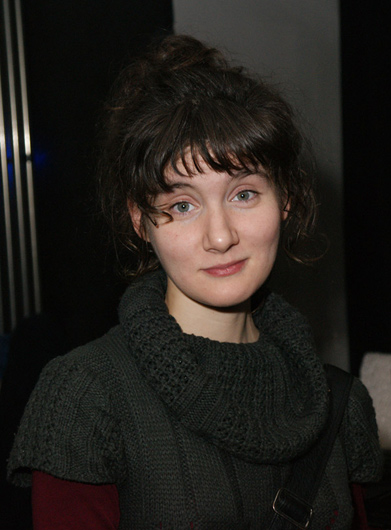
Tamriko Apakidze Former lecturer at the Petersburg Institute of Jewish Studies
I moved to Germany this fall. I am trained as an Orientalist and religious scholar, and I taught at the Institute of Jewish Studies in Saint Petersburg. I encountered the Morality group quite by accident. A year ago, on March 14, I went to a demonstration at Kazan Cathedral. I had two small placards with me: “Crimea is Ukraine” and “Make love, not war.” Despite the warnings, I took the placards out periodically, not realizing that they turned my actions into a solo picket, especially because there were other people with placards.
Tamriko Apakidze. Photo by Nikolai Simonovsky
The police nabbed me fairly quickly, at first along with my husband, but he was soon kicked out of the paddy wagon, and I spent four hours in the company of seven rather rude, in my opinion, police officers. It was they who took me to the station.
I had never been to a police station before, so at first I thought it was fun. But when they confiscated my internal passport and did not let me make a phone call, I was not amused. Aside from the rude cops, there was a nondescript young man who was quite polite. He listened courteously and attentively to the questions the police were asking me. He got quite excited when he heard I worked at the Institute of Jewish Studies. He asked what I taught there and whether I had worked there long. Then this guy was released, and I was given an arrest report and told to wait for a summons to court.
I left the police station late at night, believing I had got off very lightly. The next day, acquaintances sent me a link to the group Morality. It turned out that my companion at the cop shop had been Mikhail Kuzmin, the group’s moderator. He had posted his report, where he wrote something to the effect that he had being going to God’s temple to pray, but the police took him for a liberast and arrested him. The report was entitled correspondingly: “Who attends liberast rallies.” My entire biography was there. What surprised me most was that there were details there that he could not have found out from our conversation. He quite obviously had access to other sources.
Naturally, it said there that I worked at the Institute of Jewish Studies but that I pass myself off as a Georgian, although it is not clear who I am. There was this phrase: “The young woman herself is not involved in homopiggery, but she supports homos.” And the best part was an album of photos of me, twenty-five of them: one from the protest rally, and the rest pilfered from Facebook. This was so that the comrades would know their enemy by sight. The album’s crowning touch was a screenshot from the Institute of Jewish Studies website containing my schedule. I felt sick.
I looked at the pictures of Kuzmin himself: he was giving the Nazi salute and wearing a Nazi uniform. My husband wrote, “You shitty Nazi, remove the photographs of my wife immediately.” “I’m not a Nazi, because all Nazis are kikes,” Kuzmin eagerly replied. There was no more discussion with him, but his comrades in the struggle wrote comments under the photographs of me: how many Banderites had fucked me, and stuff like that. I never thought that I would encounter something like this in life. We sent a complaint to the management of VKontakte, but the group was not shut down.
For a while, I was very afraid. Of course, this was not the reason we left for Germany, but when I saw that screenshot of my schedule at the institute, I was quite scared to go to work. I became paranoid that I would be assaulted on the street or that our dog would be poisoned. I suspect that Kuzmin works in tandem with the police. First, I think he was with me at the police station as a provocateur. Second, when I was in the paddy wagon, the cops uttered his surname several times.
We moved to Germany at the end of August. We had been planning to do this for a long time, but had kept delaying and putting it off. After last March, my husband immediately found a job and we left Russia. I haven’t heard anything more about Kuzmin.
The community Morality has been active on the VKontakte social network for a year and a half. At present, the group numbers around four thousand subscribers. The group’s founder and moderator, Mikhail Kuzmin, was born April 12, 1986. He is married, a graduate of the Northwest Branch of the Russian Academy of Justice, and a member of the Petersburg branch of the Great Russia party.
______________________________
VKontakte group close for inciting hatred Ethnic strife flares up on the social network. Petersburg woman with Jewish surname fears for her life
Polina Khodanovich
March 4, 2015 Metro
Petersburger Leokadia Frenkel, who teaches Russian to migrant children, has been victimized by the social network group Morality and its administrator Mikhail Kuzmin.
Mikhail Kuzmin. Screenshot courtesy of Metro newspaper
“He reposted 161 photographs of me and wrote a text to accompany them entitled ‘The Kike-Liberal Opposition,” Frenkel told Metro. “That Jews were teaching migrants was the ultimate source of indignation for him.”
According to Frenkel, openly threatening comments appeared under photographs of her, and she seriously feared for her life.
“But when my friends complained to VKontakte management, they got evasive replies to the effect that if you don’t like this group, don’t look at it.”
Mikhail Kuzmin himself likes to do the Nazi salute and have his picture taken in Nazi uniform. He invariably refers to Jews as “kikes,” and conducts surveys on topics such as “Should migrants be sterilized?” The group consists of about 3,500 active participants. Unfortunately, we were unable to reach Mikhail Kuzmin for comment.
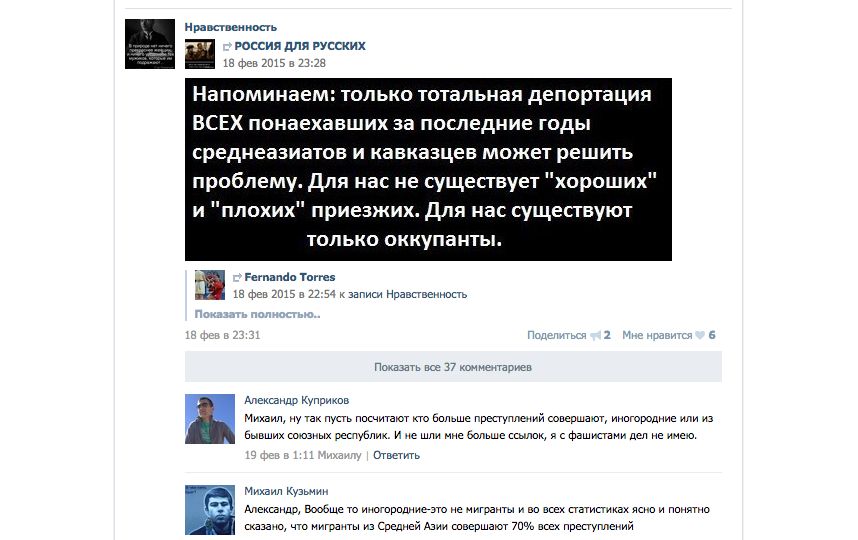
“Morality” group page on the VKontakte social network. The highlighted passage reads, “Reminder: only the total deportation of ALL the Central Asians and Сaucasians who have overrun the country in recent years can solve the problem. For us there is no such thing as ‘good’ and ‘bad’ immigrants. For us there are only occupiers.” Screenshot courtesy of Metro newspaper
Metro asked the Saint Petersburg office of the Investigative Committee’s Investigative Department to comment on the situation. Sergei Kapitonov, head of their press service, was terse.
“Anything is possible anywhere. I don’t understand what the matter is. I suggest you send an official inquiry addressed to our general and explain what you want to him.”
Roskomnadzor told Metro that they could do nothing themselves.
“The law on extremism in the Internet is administered by the Prosecutor General’s Office,” press secretary Vadim Ampelonsky said. “Only they can send us a request to block the group.”
Ultimately, Metro had no choice but to personally ask VKontakte’s press secretary Georgy Lobushkin to pay close attention to the controversial group Morality. And soon the newspaper received the following reply: “Good day. Our moderators are now checking this group for violations of website rules and Russian federal laws.”
On the evening of March 3, the group was temporarily blocked “for incitement to acts of violence.”
Vera Alperovich, expert on nationalism and xenophobia, SOVA Center for Information and Analysis:
“Any incitement to ethnic violence is covered by Article 282 of the Criminal Code. The activities of this group and its administrator should definitely be investigated. That the Investigative Committee is paying no attention to this group means they are waiting until someone is killed. In addition to a criminal complaint, one could start with a warning, which can facilitate getting the offending content deleted. Aside from the Criminal Code, there are also ethical norms. Such groups should cause a wave of public outrage.”
______________________
The Fall of “Morality” A neo-Nazi group on VKontakte that has bullied a Jewish woman was closed only after public pressure
Veronika Vorontsova
March 5, 2015 Novye Izvestia
Yesterday, after repeated requests by users, administrators at the social network VKontakte blocked the group Morality. The community had positioned itself as a platform for instilling “Slavic values,” but in fact it contained a lot of material prohibited by law, including neo-Nazi material. The group’s closure had long been sought by a female Saint Petersburg resident against whom group members had organized a genuine hate campaign. For a long while, administrators at the social network had turned a blind eye to her complaints, and she succeeded in having the group blocked only after broad publicity and intervention by the media.
The group Morality, which allegedly promotes “moral education based on historical Slavic values,” has been closed for a month for calls to unlawful actions, VKontakte spokesman Georgy Lobushkin informed Novye Izvestia. If the community’s creators do not remove the illegal content within thirty days, the group will be blocked in perpetuity.
The cause of the group’s closure was the campaign of persecution its members organized two week ago against Leokadia Frenkel, program coordinator at the Saint Petersburg Jewish Community Center, whose activities include teaching migrant children and helping socially adapt.
Leokadia Frenkel
It all started when Frenkel placed an ad on the social network recruiting volunteers to work with the children at the center. The call was copied to the Morality group, where it was commented in an abusive and illegal manner. As Frenkel told Novye Izvestia, a genuine campaign of persecution was unleashed in comments to the post: group members insulted her ethnicity, and some threatened her with violence. Later, the group’s moderators made a selection of photographs featuring not only Frankel but also her husband and her son, placing it in open public access.
Frenkel decided to send a written request to VKontakte to close the group. Many of her friends followed suit. They soon received a rejection letter. The social network’s administrators explained there was nothing illegal in the information contained in the community. “If you do not like the group, do not look at their materials. We close only those groups which directly threaten someone’s life.” This was the response from VKontakte management.
This explanation did not hold water, says Frenkel. She notes that VKontakte’s published rules contain a list of actions prohibited by company management. Paragraph “e” disallows the “incitement of racial, religious, and ethnic hatred, as well as the promotion of fascism or racial supremacist ideology.” In the group Morality, which was completely open to the public, one could see many images of swastikas and direct calls for violence. Examining group moderator Mikhail Kuzmin’s personal page, Novye Izvestia also found many images of Nazi symbols. In some photos, he was posed in a Wehrmacht uniform; in others, in front of a Russian imperial tricolor.
Initially, VKontakte administrators really did see nothing illegal about the group, the social network’s press secretary Georgy Lobushkin explained to Novye Izvestia.
“There are many discussion communities where users discuss various issues. We do not block them, even if some comments are outside the scope of the Constitution,” he said in conversation with Novye Izvestia. However, “after a more thorough study of this group, experts nevertheless concluded that it contains incitements to violence.”
Two weeks passed between the time of Frenkel’s complaint and the group’s closure. She believes the reason for a more thorough review of her complaint was several reports in the media and the broad publicity they generated.
Although the group Morality has been closed, Novye Izvestia has found a number of similar communities where Frenkel’s identity and ethnicity continue to be discussed to the hilt.
As Novye Izvestia reported yesterday, early in the week, a court ordered Smolensk journalist Polina Petruseva to pay a fine of 1,000 rubles for “promoting Nazi symbols.” The court case was occasioned by Petruseva’s publishing a photograph of her own building’s backyard during World War Two on her social network page. The photograph shows German soldiers standing in formation next to the flag of the Third Reich. On Tuesday, the Russian Constitutional Court confirmed the ban on displaying any Nazi paraphernalia or symbols.
But law enforcement agencies have not yet responded to the controversy involving Leokadia Frenkel. The police are reluctant to accept such complaints, because there is almost no mechanism for working with such cases, Mikhail Pashkin, chair of the Moscow Police Union’s coordinating council, told Novye Izvestia. According to him, criminal charges are filed in such instances only to make an example of someone, “which is probably what happened in the case of the journalist from Smolensk.”
“If the growth of anti-Americanism testifies to anything, then only to the success of Russian propaganda”
Olga Serebryanaya
February 19, 2015 online812.ru
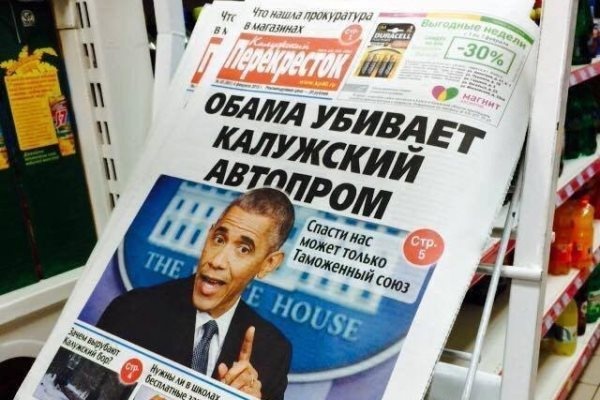
There is a new trend on Facebook: folks complain to President Obama about the mess and collapse in Russia. Exemplary in this sense is a post written by Oleg Bulgak.
“Why the fuck, Mr. President, is there no seat on the toilet and no toilet paper in the only bathroom for younger visitors at Children’s Clinic No. 133 in northern Moscow? Have you shed your last shred of conscience back there in America? You are personally to blame for the fact the children have to climb onto the toilet bowl, although they could fall off it! Why are you taking such ingenious revenge on us? You make me mad, Barak Obama! Stop playing your little tricks!”
There are many such posts on Facebook, and yes, they are parodies, parodies by sane “outsiders” on the majority opinion, announced last week by Levada Center. According to the pollsters, 81% of Russians have a negative view of the US. Do I need to spell out the fact that if the growth of anti-Americanism testifies to anything, then only to the success of Russian propaganda?
The aim is clear: to shift attention from domestic to foreign issues. At first, this was done by means of a news agenda consisting wholly of events in Ukraine. Now, on the contrary, Russian events are served up only with a foreign connection.
“Environment Minister Sergei Donskoitold RIA Novosti that the insects destroying boxwoods and palms in Sochi could have been brought into the resort city deliberately on the eve of the Olympics. ‘We have asked the prosecutor general’s office to establish who introduced the pests. I would like law enforcement agencies to get to the bottom of it,’ said the minister.”
“[The project] is called ‘legalizing repression.’ The idea is inure the public to arrests ‘for treason.’ The arrestees will be weirdos, people around whom there is no consensus in society, and with whom the ‘majority’ finds it hard to identify. The guidelines suggest that the number of arrests that go public should be between twenty and thirty. Then the chief executive will come out and say that the excesses trouble him. […] After this statement, which will be widely publicized, within a month, approximately, the intensity of the arrests will increase tenfold.”
Rogov’s hypothesis is confirmed by the fact that the spy mania has already been substantiated historically. Literaturnaya gazeta made a breakthrough on this front last week. Responding to a question posed by a reader from Stavropol, Nikita Chaldymov, Ph.D., explained that Russia’s woes had begun with Peter the Great’s modernization. Peter badly tarnished the country’s mores, сaused the subsequent persecution of Russian scientist Mikhail Lomonosov, and cut out that very same window through which “crowds of foreign adventurers began infiltrating” Russia. How could it have happened? The answer is clear: the sovereign was switched with someone else during the Grand Embassy.
“Could the tsar, being an Orthodox man, have so quickly turned into an alcoholic and libertine who dispatched his wife to a convent and married a Baltic washerwoman?” Chaldymov asks readers.
It stands to reason the real Peter could not have done these things. Foreigners had planted a spy on the throne.
There is only one hitch with this spy strategy. Another question might occur to the reader from Stavropol. Who occupies the Kremlin now? The real president? Or, God forbid, a changeling?
You always want to avoid drinking with somebody during the holiday season. Maybe it’s that politically incorrect uncle of yours. Or maybe it’s a nagging in-law.
The well-known host of a health show on Russian state-run First Channel has another suggestion: shun those whom she calls “people of the Mongoloid race.” But it’s for their own protection, of course.
The segment, titled “whom not to drink with on New Year’s” begins with Yelena Malysheva, host of the program “Live Healthfully,” inviting an audience member up on stage.
A man named Shukrat, who identifies himself as an Uzbekistan native, is met with hearty laughter when he explains that he “wouldn’t want to drink with the police or the Federal Migration Service.”
Then Malysheva gets into the meat of her presentation, noting that Russians are “a white race, a Slavic one ” and “now we will talk about what race not to drink with on New Year’s.”
And just so there are no misunderstandings, she adds, “There is no discrimination here, just an understanding of the physiology that makes every race different.”
Shukrat then cuts in, noting that he “grew up in the Soviet Union, so I’m not a nationalist” and “can drink with black people and all people, to be honest.”
Malysheva reiterates that “when we talk about who not to drink with this New Year’s, we do not mean to cast scorn on anyone. We’re talking about the threat to their own health.”
She then turns to Dmitry Shubin, a “doctor” on her team and asks him to explain who not to drink with.
“In the interests of safety, one shouldn’t drink — no, not shouldn’t but mustn’t — drink with people who come from the Mongoloid race,” Shubin says, using a term to describe Asians that can be seen as derogatory. This group, he explains, includes Chinese, Koreans, Japanese, and others in the Russian Far North.
Perhaps worried there may be confusion, Malysheva, using her fingers to press her own eyes together, explains that these “Mongoloids” can be identified by their narrow eyes and round facial features.
Just in case it still isn’t clear, she exhibits a slideshow of Asian-looking faces to avoid when in the presence of alcohol.
Shubin then explains the reasoning: Asians have a “genetic defect” that prevents them from properly metabolizing alcohol.
To demonstrate, he gives Shukrat and Malysheva liver-shaped containers, which are each apparently filled with black liquid (they don’t actually show what’s in Maysheva’s container before the experiment). As they both pour alcohol into their respective livers, Shukrat’s remains black. Malysheva’s becomes clear.
“Mongoloid: people with narrow eyes and crescent-shaped faces — [for them] alcohol is toxic,” Malysheva says, pointing to the fake liver a perplexed-looking Shukrat is holding. “And so the first people you should never drink with on New Year’s are representatives of the Mongoloid race. It is bad for them”
Research has shown that some people of East Asian descent — about one-third according to one expert — have a gene that causes difficulty in breaking down alcohol that could lead to long-term health consequences.
But doctors don’t generally recommend that non-Asians take the matter into their own hands by excluding people of Asian ethnicity from social drinking.
In Russia itself, according to a recent study in The Lancet medical journal, a quarter of Russian men die before the age of 55 — a rate far higher than the rest of Europe. And one of the chief causes is excessive alcohol consumption.
_________
“WHETHER OR NOT YOU WANT TO, YOU HAVE TO GO”
December 12, 2014 adcmemorial.org
From Tajikistan to Russia: Vulnerability and abuse of migrant workers and their families
Paris, St Petersburg, 10 December– The situation of Tajik migrants in Russia is deteriorating, said FIDH and ADC Memorial in a report released today. Increasingly restrictive migration laws are pushing migrants into irregular situations and increasing their vulnerability, while exploitation goes unchecked.
The dire economic situation in Tajikistan, where around 40% of the population of working age is unemployed, continues to push hundreds of thousands of men and women to leave for Russia every year. According to official statistics, in 2014 there were over a million Tajik citizens in Russia. The remittances sent back represent 47% of Tajikistan’s GDP, the highest percentage of any country worldwide. For most families, they are the main source of income. This trend looks set to continue.
Despite recent measures announced by the Tajik authorities, migrants remain highly vulnerable to abuse. As a result of increased restrictions on entry and stay in Russia, deportations have multiplied and tens of thousands of migrants have been subjected to re-entry bans. Migrant workers interviewed by FIDH and ADC Memorial reported extortion by Russian police and border guards, arbitrary arrests and police violence. Fuelled by xenophobic political discourse and media reports, vigilante attacks on migrants are on the rise. Those responsible for attacks benefit from almost complete impunity. The report also documents non-payment of wages, poor living conditions, and lack of access to medical treatment.
“The multiplication of legal restrictions, raids on migrants like Operation Migrant 2014, launched this November, and rising xenophobia are resulting in serious violations of migrants’ human rights. We are deeply concerned about recent acts of violence against migrants, on the part of the police and civilians, which have gone unpunished”, said Karim Lahidji, FIDH President. “In December, it became clear that Operation Migrant 2014 would be ongoing. Mass arrests and detention of migrants in Moscow and St. Petersburg continue.“
The report addresses the human rights impact of migration on women in particular. Hundreds of thousands of women are left behind in Tajikistan to bring up children, working in the fields and markets, and depending on their in-laws for support. Those whose husbands stop sending money or disappear completely can find themselves destitute. Over the past several years, there has also been a sharp increase in numbers of Tajik women migrating to seek work. It is estimated that today around 15% of migrants are women. Women migrants, especially those who leave the country alone, are seen as challenging traditional roles and often suffer stigmatisation from their families and communities in Tajikistan, while in Russia they are particularly vulnerable to exploitation and violence.
In 2012, Tajikistan was examined by the United Nations Committee on the Rights of All Migrant Workers and Members of their Families. The Committee raised particular concerns about corruption among border guards and some consular staff and the lack of effective complaint mechanisms for victims of abuse.
“Consular protection for Tajik migrants in difficulty in Russia remains inadequate and the Tajik Migration Service has not established an effective complaints procedure. Cases of exploitation by employers and intermediaries, including forced labour, are not properly investigated by the authorities of either country,” said Stefania Koulaeva, head of ADC Memorial.
Since 2011, FIDH and ADC Memorial have undertaken a series of joint investigations to document the situation of Tajik migrant workers in Russia and the violence, xenophobia and serious violations of economic and social rights they face there.
*****
Interview with Stephania Koulaeva, head of the Memorial Anti-Discrimination Centre, on the situation of migrants in Russia
At the end of October the Russian government launched a huge operation called Migrant 2014 to crack down on migrants in an irregular situation in Russia. FIDH and ADC Memorial reported 7,000 arrests during the operation. What happened to those migrants and their families? Where are they now?
When we first reported on the 7,000 arrests, Migrant 2014 had only just begun. According to official figures published by the Moscow police and Moscow department of the Federal Migration Service (FMS, by the end of the operation on 4 November, over 50,000 migrants had been arrested by the police. Almost 2,000 expulsions were conducted and hundreds of migrants were detained. Simultaneously, the FMS in Moscow carried out a wave of inspections that resulted in the expulsion of 1,500 people. Another 3,000 people were barred from re-entry. The total revenue from penalties imposed on these migrants was almost 50,000,000 rubles (approximately 1 million Euros.)
Repression of migrants in Moscow alone during the week-long operation resulted in more than 3,500 expulsions and tens of thousands of cases of administrative punishment.
As to the current whereabouts of the arrested migrants, we can assume that many of them had to leave the country, often with a ban on coming back for a number of years. Although others could continue their life and work in Russia, they have had to pay a high price for permission to do so.
What does this operation say about the Russian government’s approach to migration? How does the Russian migration policy impact other countries in the region?
The Russian government policy on migration is controversial. On the one hand, it has close ties to the main business structures that employ migrant workers, in such fields as construction, communal services, and sales. This system allows Russia to benefit from a cheap labour force without spending on social needs. On the other hand, the very people who profit from the hard work and low wages of migrants are the ones who organised the operations against them, and use xenophobic rhetoric in the government-controlled media in order to pander to nationalist sentiments of the population. Migrants have become scapegoats for the immense problems that Russia now faces on the political and economic level, despite the fact that the country cannot function without migrant work.
The Russian government plays a complicated strategic game in the region on migration issues. For example, Russia allows Tajik migrant workers to work in Russia in exchange for military and geopolitical support from Tajikistan. Tajikistan meanwhile benefits from the remittances that working migrants send back to their families.
What are the main problem faced by migrants in Russia?
Migrants in Russia face a multitude of problems, including widespread discrimination, the stigma of illegality, the risk of detention and deportation, and xenophobia, in particular towards migrants from the Caucasus and Central Asia. Those who are not formally employed face a prohibition on staying in Russia longer than three months, which, in practice, forces almost all children of migrants into illegal status.
Migrant workers receive lower wages for the very same work done by Russian nationals and suffer from the absence of social security in case of illness, injury or death.
Conditions of detention are another major problem. There is an absence of judicial control over the duration of detention of migrants accused of violating migration laws, which can last up to two years on purely administrative grounds.
These problems are compounded by the lack of support demonstrated by the migrants’ countries of origin. In some cases, such as in Uzbekistan, migrants even face repression from their government for working abroad.
Editor’s Note. I have lightly edited this article to make it more readable.
__________
Migrant workers are leaving Petersburg: soon there won’t be anyone to work in construction and communal services
Elena Rotkevich
December 17, 2014 Gorod 812
On January 1, new rules for migrant workers, allowing them to work almost anywhere without restrictions, will be introduced in Russia. The authorities hope this will increase the flow of cheap labor from the CIS. In fact, the opposite is happening.
The Russian Federal Migration Service, which initiated the new rules, has said they fundamentally change the approach to labor migration. As of January 1, 2015, quotas will be abolished on the numbers of migrant workers from the CIS and other visa-free countries who can be employed in Russia.
The need to obtain a work permit will also be abolished. Instead of this document, migrants will need to buy a license. Its price will be different in each region, as set by the local authorities. In Petersburg and Leningrad Oblast, it will cost 3,000 rubles; in Moscow, 4,000 rubles. As of January 1, each legally employed migrant worker, except for those who still have valid, previously issued documents, must have this license, no matter where they work.
The abolition of quotas means that any number of migrant workers can be employed at any enterprise. When there were quotas, the number of migrant workers in each sector of municipal services and industry were strictly regulated. For example, in 2014, only 164,000 migrants could legally work in Petersburg within the quotas. [Although the actual number of migrants working in the city is undoubtedly much higher.]
As of 2015, this ceiling will not be limited in any way. It would seem that the city should be flooded with migrants, but it isn’t, and the reason is the economy.
“The quotas are abolished, but there won’t be more migrants. They are already leaving the city. If the exchange rate of the ruble does not grow, they will stop coming here altogether, because it is not worth it. Salaries paid in rubles are not increasing in value. For example, if a person working at a construction site used to get 25,000 rubles a month, and that was roughly equivalent to 750–800 dollars, now it is worth 400–450 dollars. That does not even cover the person’s expenses. It is easier to make money at home,” says Suratbek Abdurahimov, chair of Uzbegim, the Uzbek National Cultural Autonomy of Saint Petersburg.
According to him, it makes no difference to migrants whether they have to get a license or a work permit. It is expensive and troublesome all the same. There is, however, an obvious drawback: after the new rules are adopted, the official price of a license in Petersburg will increase from two to three thousand rubles. But the real price of the document cannot be predicted at all. Given the cost of medical certificates, insurance, and everything else, migrants now pay between twelve and fourteen thousand rubles for a license, while getting a work permit costs around twenty thousand rubles. Abdurahimov believes that under the new rules a license will also cost at least twenty thousand. It is cheaper to stay at home.
Mahmut Mamatmuminov, board chair of the Assistance Fund for Migrant Workers from Central Asia, agrees with him.
“Of course, soon it will make more sense economically to stay at home. First, because of the exchange rate. Second, because migrants have to take exams in Russian, history, and law. It is hard: even an educated person finds these tests confusing. I have heard that exam certificates are already selling on the black market. Also, the number of migrants is dropping because the Federal Migration Service in Petersburg has banned many people from entering the country for different violations. According to Federal Migrant Service statistics, more than a million migrants have been banned from entering Russia over the past year,” says Mamatmuminov.
The major sectors in Petersburg where guest workers are employed are construction, retail, street cleaning and housing maintenance, services, and transportation. According to experts, if migrant workers pull up stakes and fly home en masse, there will soon be no one to do this work in Petersburg.
Staunton, December 20 – The collapse of the ruble and the test of Russian language knowledge they will soon be required to take are prompting gastarbeiters in the Russian Federation to leave in massive numbers, with the leader of the Federation of Migrants now predicting that more than a quarter of them will depart by early next year.
While some Russians may be glad to see them go, their departure will make it more difficult for the Russian economy to escape the looming recession. But even more seriously, their return to their homelands in such numbers will create problems there, given that none of those economies can easily absorb them.
The returning migrants are thus likely to become a source of additional instability in places that in many cases already are far from stable, and to the extent they are not absorbed into the economies, some of them may become recruits for radical Islamist groups that want to overthrow the existing order.
Mukhammed Amin, the head of the Federation of Migrants of Russia, told Newsru.com yesterday that “more than 25 percent” of the more than 10 million immigrant workers in Russia plan to return home or move to other countries in the coming months (newsru.com/russia/19dec2014/ishod.html).
He suggested that the main reasons for that are two: the collapse of the ruble exchange rate means they have less money to send home – most of their transfer payments have been in dollars – and concerns about the impact and cost of the test of Russian language knowledge they will be forced to take as of January 1.
Karomat Sharipov, the head of the Tajik Labor Migrants organization, confirmed that this is the case and said that many of his co-nations intend to leave Russia. He added that because jobs at home are scarce, at least some of them might join the ranks of extremist groups as mercenaries in order to support their families.
Russia’s Federal Migration Service had already reported that with the decline in the value of the ruble, the size of transfer payments by gastarbeiters in Russia to their homelands had sharply fallen (newsru.com/finance/12dec2014/migrants.html). That too will harm the economies of countries like Tajikistan, Kyrgyzstan, and Azerbaijan from which most migrants have come.
Some Russians are pleased by the departure of the gastarbeiters, either because they view such people as culturally alien or because they think that such foreigners are taking jobs that Russians should get. But Russian officials are more concerned by the possibility that those leaving will join radical Islamist groups or become part of “so-called ‘Jihad tourism.’”
That term refers to Muslims from one country who travel to another to take part in and make money from radical Islamist groups fighting elsewhere. According to the Russian government, there are at least 1500 such people from CIS countries now fighting for the Islamic State; the departure of the gastarbeiters will likely boost that number further.
Russian officials fear that these people will not only destabilize neighboring countries but also in some cases return to push their causes within the borders of the Russian Federation, yet another frightening consequence of Vladimir Putin’s policies in Ukraine.
Since I was surprised myself, I intend to surprise you as well. Good evening, friends. Did you know that there are areas to which Europe’s sanctions against Russia do not apply? On the contrary, our western partners—who no longer conceal their dislike of Russia and [ethnic] Russians, who call the leader of our country a “führer,” who are pounding whole sectors of the economy and finance with sanctions, actually causing a rise in prices here—on certain issues these same people are ready at the drop of a hat to come here to Russia, to Petersburg, in particular, and send convoy after convoy with humanitarian missions.
And whom, do you think, the West continues to passionately love in Russia amid total sanctions? You’ll never guess. I myself was amazed by this fact, because the West, so I imagined, was now more than ever principled in its hatred of all things Russian. From Barak Obama to, dare I say this surname, [President of Lithuania Dalia] Grybauskaite, we hear insults directed towards Russia and [ethnic] Russians, and people have felt this on their skin. I mean the sanctions. A photo of men [with the slogan] “Sanctions against Russia are sanctions against me” [painted on their backs] has been making the rounds of the Internet.
So, just think, at the same time as hundreds of artists have been banned from traveling to Europe—in England, for example, the local “bodybuilders” have called for a boycott of Gergiev’s concerts—signs reading “No Russians allowed” are hung at cafes in Eastern Europe, Norway has left the “evil empire,” as it deems Russia, without the famous Norwegian salmon, Holland [has left Russia], without the famous Dutch cheese, and Sweden [has left Russia], without the ensemble ABBA, humanitarian assistance and close contacts continue in the area of . . . sexual partnership. And not traditional [sexual partnership] of some kind, but namely extremely perverted, gayropean [sexual partnership].
[Olufsen, in Russian:] “People should learn to respect and accept a person for who they are.”
Аs did Deputy Consul General of Sweden Björn Kavalkov-Halvarsson.
[Kavalkov-Halvarsson, in Russian:] “To eliminate prejudices what is needed are bold politicians who stand up for human rights and make laws that do not lead to the emergence of second-class citizens.”
A whole group of English-speaking western comrades decided to personally show solidarity and love for those they consider humiliated and subject to repression in Russia. Meaning—and this is important—officials who approve of repressions against Russia single out perverts as a special group of people who need special love and pity.
You remember the obscene anecdote about the sparrow that warmed itself in winter—I really apologize for this—in cow dung and was dragged out of the dung by a cat. [The moral of the story was that] the one who pulls you out of the shit is not your friend, and the one who covers you in it is not your foe. If there have to be three or four percent of the population with this abnormality of loving the same sex, then we will tolerate them and even feel sorry for them, but we will not let them into schools and kindergartens.
There used to be Doctors without Borders and Peace in Exchange for Food [sic], and now there is Sex instead of Food and Homosexualism [sic] without Borders. And most importantly, it is all so out of place, so ill timed. In the Ukraine, people are perishing. Everyone knows that at the forefront of the misanthropes are an outted faggot,* Supreme Rada deputy Oleg Lyashko, and a closet faggot, interior minister Arsen Avakov. Their sexual orientation really wouldn’t bother anyone if they hadn’t declared their fierce hatred of Russia and the friendship between Ukrainians and [ethnic] Russians. But it is just these “comrades” who are behaving heinously in Donbass.
And if one of those people who are sympathetic to the sexual “Mensheviks” would give them some good advice [and tell them that] at such a difficult time for the country not to show off in the company of Russia’s official enemies from Western Europe, but, on the contrary, protest against the actions of Lyashko and Avakov, which discredit the honest name of, so to speak, internationalist faggots. But no, instead they are also trying to convert them into fighters against the traditions of their own motherland.
In this context, the pass made to the faggots and lesbians by Petersburg [human rights] ombudsman Alexander Shishlov, who essentially greeted them in a special communiqué, appears completely dubious and politically mistaken. You know, back in the old days, the Soviet Communist Party general secretary would greet gatherings of student work teams in Siberia. So anyway, Mr. Shishlov—I quote BaltInfo—“sent greetings to the organizers of [Queerfest], a festival of gay culture taking place […] in Saint Petersburg.”
So, “among the stated objectives [of Queerfest] is the creation of an effective public space devoid of homophobia, xenophobia, and other forms of discrimination, and the promotion of dialogue”—this is very important—“between members of different groups, organizations, minorities, and communities. These objectives are dear to all [‘of us,’ Tatarov adds] who consider human rights supreme values.”
Do you really want dialogue? Well, what kind of dialogue can there be here? Some get sanctions and hatred from the West, others—the ones in Donbass—get mass graves of civilians, and still others get touchy-feely. Will this actually make things better for the perverts? I am not worried about them: it’s a question. I don’t think it will make things better for them. So, friends, I will finish the anecdote about the sparrow eaten by the cat, which is obscene, like this whole topic of sexual perverts. The one who shits on you is not your foe, and the one who pulled you out of the manure is not your friend. But if you wind up in [shit], just sit there and don’t tweet!
Take care!
*Translator’s Note. Here and throughout, the word in the original Russian is pederast (педераст), which despite its obvious origins and appearance is simply an offensive term for “homosexual,” although perhaps it has, as friends have noted, a slightly “pseudo-scientific” or “old-fashioned” ring to it that its popular and commonly used derivatives pidoras and pedik do not. (They are wholly offensive and thus, apparently, “not fit for TV,” especially after passage of the new law on swearing.) But as one of my friends writes, “He [Tatarov] says pederast so that everyone will hear will pidoras. His intention is to insult, and everyone understands it that way. Otherwise, he would have said sodomit [sodomite] or muzhelozhets [ditto]. […] But when the linguistic expertise is conducted [in connection with a possible criminal investigation, see below], it will turn out that he did not offend anyone.” This is a long way of saying there is no one perfectly good way of translating the word, especially in this context.
__________
Queerfest Demands Apology from TV Channel
October 29, 2014 comingoutspb.com
Organizers of the human rights LGBT festival Queerfest have demanded that Saint Petersburg TV publicly condemn statements containing hate speech and hostility towards gays, lesbians, bisexuals, and transgenders (LGBT). These statements were made in the program “Reaction,” presented by Valery Tatarov, which the channel broadcast on September 29, 2014. The program, which dealt with Queerfest 2014, is still available on the channel’s official web site: http://topspb.tv/programs/v10655.
According to the activists, the program contained utterances (“perverts,” “faggots,” “if you wind up in manure, sit there and don’t tweet”) that were not only humiliating but could also be deemed incitements of hatred and enmity against a social group (LGBT).
The organizers and participants of Queerfest sent Saint Petersburg TV’s editor-in-chief a written request to make an official comment containing the editorial staff’s position on the program aired on September 29.
If it transpires that the humiliation of LGBT people and instigation of hatred and enmity against them was done intentionally and with the knowledge of the channel’s editorial staff, the organizers and participants of Queerfest intend to request that the Investigative Committee open a criminal case under Article 282 of the Russian Federal Criminal Code, as well as contact the Press Complaints Board, which is the journalistic community’s body for reviewing complaints of ethical violations by journalists.
__________
Editor’s Note. Wholly owned and financed by the city administration of Saint Petersburg, Saint Petersburg TV, which began broadcasting in October 2010, is available on cable, satellite, and the Internet. In 2011, it was reported to have a potential audience of 1.7 million people, a figure that has probably risen considerably as the wholesale digitalization of TV broadcasting and reception in the city has continued.
In an August 2012 interview, Sergei Boyarsky, the channel’s then-new general manager, described Saint Petersburg TV’s editorial philosophy as follows:
I don’t agree that the only way to get ratings is by criticizing. I think all this talk about free media only benefits the poor [sic]. Our country is rife with freedom of speech. If you turn on Echo of Moscow [radio station], you can sometimes feel sick, so tactlessly and harshly do the guests and some of the presenters sound off about the political system, about the government, and personally about the country’s leader. If you think that is healthy, I don’t think so. We will present information objectively, but I won’t allow flagrant rudeness and showing favor to a particular side.
Boyarsky is the son of popular Soviet singer and movie actor Mikhail Boyarsky, who is well known for his demonstrative support of the current regime.
Curiously, in September 2013, the channel launched a section on its web site featuring selected news stories overdubbed in English, with accompanying English-language transcripts. The channel abruptly ceased posting these reports in August 2014.
A State of Mind in Windy Weather
Galina Mursaliyeva
October 1, 2014 Novaya Gazeta
A conversation with psychologists about hatred, aggression, the Russian mentality, cognitive breakdown, the loss of social sensitivity, and society’s lack of self-confidence
The side mirror showed that the cars in the next lane were a safe distance from me. I switched on my turn signal and merged. I realized right away the mirror had deceived me. My car was almost a millimeter away from the front bumper of a black jeep: I had rudely cut off this “stealth” car. It was clear in a situation like this that no one would try and figure out whether this had been done purposely or accidentally. I was ready, or so I thought, for anything. I knew the other driver might deliberately overtake me and brake abruptly right in front of me. And yet, I wasn’t expecting what happened next. When the person in the car I had cut off drove his jeep in front of me for the second time, I deftly avoided a collision by moving into the far left lane, meaning he simply had no way to pursue me. But he found a way: he drove down the oncoming lane and once again put his jeep in front of me. This time I turned on the emergency lights and stopped. He walked up to my car.
“Well?”
“Well what? Yes, I made a mistake. Yes, I could have caused an accident. But do you realize that after this you did something that could have got us killed?”
“So what? Maybe I would have kicked the bucket, but I would have taken you down with me.”
There was not a shadow of doubt in his eyes, whitened with anger: one could “kick the bucket” for the sake of punishing one’s offender.
It is not that I recall this incident often, but that I have never forgotten it. Because I saw in a highly condensed form what has been happening with people everywhere—on roads, in supermarkets, on social networks.
“She was the godmother of my son, who is now twenty years old. I was very fond of her, and we were very close, but now that she supports all these Makareviches, I am forced to unfriend her. She has turned into a reptile,” writes a woman on a social network.
Those who call themselves liberals are no better. There is a new photo of a famous person who has more or less spoken out in favor of “Crimea is ours” posted several times a day on Facebook. People batter and pelt the photo with words like stones. “Another one has caved in.” “Creep.” “He used to be my favorite actor. Burn in hell.”
There is an amazing trait that unites everyone these days—their means of expressing hatred. “Fascists,” “traitors”: that is what everyone calls each other. And the verbs are also the same: everyone has “sold out,” either to the Americans or Putin.
You have to kill someone and eat them to take their power. Well, or poison yourself.
Dmitry Leontiev (head of the International Laboratory of Positive Psychology of Motivation and Personality at the Higher School of Economics, doctor of psychology, professor in the psychology department at Moscow State University, and Viktor Frankl Prize winner): It reminds me of an essay by Hegel, published two hundred years ago, “Who Thinks Abstractly?” He gives an example: you go to the market, and a market woman tries to sell you apples. You try them and say, No, I won’t buy them; they’re a bit sour. The market woman says something like the following to you. It is my apples that are sour? You are sour yourself, and you have a sour mug. And who the hell are you to give my apples a bum rap? I remember your parents: they were layabouts! So she begins to generalize: you were only talking about the taste of the apples, but in response she—
Attacks you personally?
Leontiev: The personal attack is only a detail. But here everything is brought into play, the broadest contexts. Hegel calls this generalization “abstract thinking.” According to him, it is the market woman, rather than the philosopher or scientist, who thinks the most abstractly, because she cannot focus on anything specific and generalizes everything. From my point of view, this is what is happening in our society. The great philosopher Merab Mamardashvili, who for me is quite comparable with Hegel, said, “The devil plays with us when we do not think precisely.”
And the devil is playing with us now: we have stopped thinking precisely. Say, neither the Ukrainians themselves nor we understand clearly what is really happening in Ukraine. But the huge number of people who never for a moment doubt they know exactly not only what is happening now but also what will happen next horrifies me. The number of clairvoyants and seers has gone off the scales. And the farther they are from the scene of events, the more accurately they know everything.
What is the cause of this epidemic?
Leontiev: It is a symptom of cognitive breakdown. Criticalness—the ability to filter incoming information, separate fact from fiction, and soberly assess the limits of one’s own knowledge—is considered one of the main mechanisms of the mature mind. Now it would appear that all the natural filters have come undone. The mind ceases to function: it just swallows readymade packaged texts and spits them back out. As soon as you try in a debate to clarify or specify something, your opponent, like Hegel’s market woman, responds by expanding the topic of the conversation to infinity, entwining anything whatsoever into it. This is the most important method of the usually unconscious manipulation now being used: lumping everything together. The topic of the conversation becomes fuzzy, and a lot of details irrelevant to it are entwined in the conversation.
The meaning of the word “opinion” has been devalued in our country. Any nonsense that occurs to someone is labeled an opinion. This assumption that all opinions are equal is a product of so-called postmodernism. Earlier, when experts were asked for their opinions, it was assumed they were the products of intellectual work in the fields in which the experts were professionally employed. It is then that real discussion can unfold, and we can find someone who can be trusted.”
Nowadays, on the contrary, there is often no trace of analytical and intellectual work in what are commonly referred to as opinions. A person gets some “kind of, like” bit of information from somewhere in left field. These “opinions” are not rooted: they can easily switch to their direct opposites. So I am very skeptical about the figure of eighty-five percent of the population who, according to pollsters, now support everything the Russian president does in Ukraine. This is largely a weather phenomenon. The wind has inflated this degree of support, but when it blows in the other direction, it will fall below zero.
You mean the majority of Russians have a heightened psychological “meteodependency” on the political climate? On the stance of the authorities?
Leontiev: What is the “Russian mentality”? Everything said about the peculiarities of the Russian psychology wholly conforms to the psychology of a normal child. This includes a rich mental and emotional life, but a spontaneous one. Hence the inability to control oneself, to keep promises. Small children can be quite cruel: they do not know what pain is, and do not value life. Our country has had a prolonged childhood; we have not succeeded in growing up. Life, both one’s own and that of others, has a low value.
Many things are caused by the inability to link cause and effect. There is no sense of time, of the dynamics of change: Russia is worried about territories, about not giving an inch. We have virtually no social institutions. The State Duma is like a kindergarten during naptime, when the minder has left the room. Everyone is bawling about his or her own thing.
Maybe it is time to replace the concept of “state of mind” with the concept of an “instinctual state”?”
Leontiev: I would rather speak about a state of mind in windy weather. Thinking is energy consuming, and people who have failed to grow up find it easier to throw words around. The fundamentals of humanity’s survival are simple and sound. They unite rather than divide people, despite all their differences. For example, it is good when people live, and bad when they die and kill, even under the most plausible pretexts. But we have a divided society, and in this situation it is important not to contribute to the polarization. It is a virus that has infected the country
Olga Makhovskaya (fellow at the Institute of Psychology of the Russian Academy of Sciences, Ph.D. in psychology, and writer): I would say that what is happening today is a reflection of the country’s biggest fault: we have frittered away our values. When they answer any question—whether to fight or not fight with Ukraine or the whole world, whether they are for or against Putin—people are guided by their fears rather than values. And I can say that there, at Maidan, even before the war the protest was not as encapsulated as it is in our country. Encapsulation is when everything happens in cliques: I go to a protest rally with my friends, but as for everyone else, I do not really know or understand how they live. When there is no overall consolidation, you are among a circle of friends but in a society of strangers. It is extremely difficult to get past the bouncers at the door. In Ukraine, there is definitely not this stark opposition between the intelligentsia and people of the land, for example. There, the latter are in fact the most respected, because the land will always feed you, whatever the regime. And these are grounds for personal dignity. They have greater reserves of values there than we do. There is a Russian proverb that says money cannot buy you love. But there is no comprehension that money cannot buy you anything valuable at all—neither freedom, life, talent nor friendship. It is these things that have failed in Russia today.
I think it is not just a matter of events in Ukraine. This segment of people who think alike, a whopping eighty-five percent, is also encapsulated. A person who is willing to kill someone else and himself in the process is not trying to clarify your stances on these issues. He is just ready to kill.
Makhovskaya: From my point of view, the figure of eighty-five percent is rather an indicator of society’s extreme lack of self-confidence than of public opinion. When a survey on happiness, for example, is conducted, and the vast majority says it is insanely happy, politicians see this as a lovely figure. But any psychologist will tell you that such uniformity indicates a state of helplessness. This is a society of old people and little children—of old people, who suffer from diminished intellect and have no future, and of children, who because of their age cannot be independent.
What is happening in our country today—the intolerance and hatred—is directly linked to the state of being in an axiological and normative vacuum. The social psychologist Durkheim called this condition “anomie.” It happens when old institutions, functions, and norms have been destroyed, and new ones have not yet formed. The main conditions for the emergence of a new set of values are the consolidation of society and an optimistic view of the future. But in Russia, values are promoted that divide people and narrow their horizons: money, power, and pleasure. Transient values camouflage the lack of eternal values—“Thou shalt not kill,” for example—of the old conservative attitudes to work, education, patience, love, and mercy.
Perhaps the Soviet legacy could also be making itself felt in this case. At school, we were made to memorize Nekrasov’s lines “The heart grown weary of hating / Will never learn to love.” But no one told us about the saying of Confucius: “If you hate, it means you have been defeated.”
Makhovskaya: What we remember in childhood is quite important, because we pass it on to our own children as a cultural code. If you cannot love because you cannot hate, it means you must hate: it is a terrible thing, of course, to send this message to schoolchildren. But nowadays there are no less alarming signals, first and foremost, the loss of sensitivity among most citizens. Social sensitivity is a sympathetic attitude to the problems of groups of people to which the individual himself or herself does not belong. Television has “scorched” its viewers by constantly raising the sensitivity threshold.
Why does everyone call each other fascists nowadays? What is the cause of this?
Makhovskaya: It is similar to the children’s game of good guys and fascists [i.e., something like the Anglophone games cowboys and Indians or cops and robbers]. Psychologists believe that the unbearable fear of death is overcome in such children’s games. Given the depth of the trauma caused by World War Two, a trauma passed from generation to generation in Russia, the power of post-traumatic stress syndrome and the relief a small victorious war gives to “inflamed” consciousness are understandable. Despite the fact we won World War Two, psychologically we have been left unappeased, inconsolable, and uncertain that it will never happen again. On the contrary, we have always been reminded that the enemy never slumbers, that we have to be prepared. We live with the convulsive readiness to attack or flee. Sooner or later, individuals cannot contain themselves and enter into conflict; an insignificant occasion can serve as the trigger. The abusive fascist phraseology comes from this same source.
There is another factor that affects how events are perceived—group favoritism. Members of one’s own group are perceived as better, more educated, smarter, prettier, and broader-shouldered.
I will illustrate what you are talking about with a quotation from writer Zakhar Prilepin: “[U]krainian POWs and Russian POWs differ even physiognomically. The Russians are whiter; their eyes are more bewildered and kinder. [The Ukrainians] are darker. They do not look you in the eye; there is something hunted and angry about them at the same time. Almost all of them are shorter than me.”
Makhovskaya: It is a classic example. When we at the Institute of Psychology of the Russian Academy of Sciences studied how Soviet viewers perceived Americans during the first spacebridges with the US, we discovered that a couple weeks after the programs people could not recall either the faces of the “enemies” or what they had said. But as they tried to recall what they had seen, they confidently insisted the Americans were “reptiles.” They recalled the “good guys” in detail, with a tendency to add height, texture, and beauty: the people who had gone out to do battle with the ugly dwarfs from the US were simply cartoonish epic heroes.
Sadly, the level of our psychological culture is such that we do not cope with these cognitive distortions. Even more frightening is that this is the level of the politicians and their servants who induce hatred and broadcast negative stereotypes to the whole country.
__________
Editor’s Note. I usually do not have much truck with psychologistic explanations of political and social phenomenon, especially when it comes to Russia, where even before the onset of Putinism 3.0, the popular, public and academic discourses, both liberal and nationalist, were lousy with all-encompassing exegeses of Russian society’s ills (or virtues) based on a supposedly unique, perennial or horribly mutated (as a result of Stalinism, serfdom or perestroika—take your pick) mindset or mentality shared by most Russians or certain classes in Russia. The article translated above certainly possesses many of this approach’s defects, but in its own clumsy way it gives some insights into the zeitgeist in the country right now, details usually ignored or dismissed by, say, local leftist commentators, eager to inscribe everything going on into a more palatable, boilerplate “anti-capitalist” narrative. Whether we like it or not, the sheer hysteria of recent months and its effects on people’s sense of their possibilities, responsibilities, and limitations becomes a factor in political and public life every bit as material and potent as the Putin oligarchy’s need to bolster its financial fortunes or generate new venues for state-sponsored highway robbery.
A bill against fictitious residential registration has been approved by parliament and is likely to come into force before the end of 2013. MPs who voted for the law insisted it targeted “rubber apartments” where hundreds of people are fictitiously registered and, more broadly, illegal immigration. Lenta.Ru has read the text of the bill along with lawyers from the Public Verdict Foundation and concluded that the tightening of controls over registration and movement will directly impact Russian citizens as well.
Introduced by Russian President Vladimir Putin, the bill, which has the neutral-sounding title “On Amendments to Certain Legislative Acts of the Russian Federation,” contains several subsections. Amendments have been made to the law on the freedom of movement of Russian citizens, the Administrative and Criminal Codes, and the law on the registration of foreign nationals by migration authorities. The preamble to the newly revised third article of the law on freedom of movement states residential registration is for informational purposes only, rather than a compulsory action. Whether someone is registered or not “cannot serve as grounds for restricting or a condition for exercising the rights and freedoms of citizens” as stipulated by the Constitution and other regulations.
This is consistent with the style in which new Russian laws are drafted: all attempts to prohibit something by law are based, allegedly, on a concern for protecting rights and freedoms. So it is in this case: a direct quotation from the Constitutional Court’s 1998 ruling that residential registration should not restrict the rights of citizens is followed by a list of the ways in which citizens will be restricted.
Thus, Russian citizens who have traveled outside their home regions must be registered within ninety days. If this does not happen, people renting housing and landlords may be held administratively or, in some cases, criminally liable. For living in an apartment without registering, tenants will be fined two to three thousand rubles [approx. 45 to 65 euros]; apartment owners, two to five thousand rubles [approx. 45 to 110 euros] and legal entities, 250 to 750 thousand rubles [approx. 5,500 to 16,500 euros]. Fictitious registration will be punishable by a fine of 100 to 250 thousand rubles, up to three years of hard labor or a similar term of imprisonment under Article 322 of the Russian Federal Criminal Code.
— Andrei Kozenko, “Who’s no longer a tenant here: how the ‘rubber apartments’ law will impact Russians,” Lenta.Ru, December 18, 2013
__________
There is a stark political economy to the illegalization of migrant labour that goes unremarked in much of the election-season hand-wringing over the city’s growing population of nelegaly (“illegals” in derogatory officialese). For one thing, demand for labour that is low-paid, verbally contracted, un-unionised, and flexible far exceeds the city’s (deliberately minimalist) quota of work permits. Perhaps as many as four fifths of the city’s migrant workers are therefore employed without an official work permit, or individual patent permitting private employment. There is an open market for official work permits, as well as a (near indistinguishable) market for fakes. As I have explored in my research on the difficulty of creating documented selves in Russia, the degrees of intermediation for obtaining a work permit means that “cleans” and “fakes” are often distinguishable only at the point that they are checked by the police.
At the same time, the gulf between average wages and average rental costs in the city mean that many migrant workers live in conditions that violate administrative regulations: in multi-tenant “rubber apartments” (rezinovye kvartiry) without corresponding residential registration, in container-dormitories on building sites, or in the unventilated basement of a multi-storey apartment building entirely unrecorded within city housing stock. The choices here are stark: for those on a typical migrant wage in the catering sector of 15-17,000 roubles (around £300-£330 per month) the only way to make ends meet in a context where the rental costs exceed average wages three or four-fold is to share an apartment illegally with 15 or 20 other tenants, paying money to a notional “landlord” (another migrant who takes a cut) and paying off the local policeman to ensure that the apartment is protected from raids. In a city where the 2010 census identified over 92% of the city’s registered population to be ethnically Russian (russkii), the economic constraints upon legal migrant labour have made for an easy popular conflation between being visibly non-Russian, being a “guest worker” (gastarbaiter), and being an illegal.
Xenophobia is not new in Moscow. But the combination of a laissez-faire wage policy (with a race to the bottom for undocumented labour), together with excessive restrictions on legally documented labour, and the widespread use of bribes to circumvent administrative regulations has allowed for the normalisation of a casual racism in which discrimination on the basis of ethnicity is justified through concerns for security and comfort—or protection against “illegals”. One commercial website offering temporary accommodation to non-Muscovites, for instance, cites its own policy of ethnic selection in the following terms:
[W]e don’t have racist prejudices, but today the situation has developed such that the largest demand for a place to stay in Moscow comes from Russians, Belorussians and Ukrainians. In accordance with the existing demand for inexpensive hostel accommodation in Moscow, we attempt only to house people of Slavic appearance (litsa slavianskoi vneshnosti), for the comfortable living conditions of all residents, and in so doing avoid any conflictual situations.
— Madeleine Reeves, “Mayoral politics and the migrant economy: talking elections and ‘illegals’ in Moscow,” cities@manchester, September 5, 2013
Not is only Georgy Poltavchenko, Petersburg’s unelected governor, a capable administrator and a pious Orthodox Christian, he is also, as he revealed last week during a passionate speech delivered at a special powwow with law enforcement officials and “representatives of ethnic diasporas,” a psychic, a mind reader or remote viewer capable of hearing what migrant workers in Tajikistan and Uzbekistan are saying as they depart for the former capital of All the Russias (apparently, to wreak mayhem, judging by further remarks made the governor and others at the high-level confab):
“So your countrymen travel to our country, to our city, in particular. They travel from distant villages there and so on. And just as they’re about to board the plane or the train going to Russia, they say, ‘We’re going there because the Russians don’t know how to work! They’re all drunkards. They’re all loafers!’ But members of the nation to which I myself belong, the Russian people, over the course of a thousand years created an enormous state along with other peoples. And if those loafers and drunkards hadn’t built the Russian state, who knows what the people who come to our country thinking such thoughts would be doing nowadays. I want everyone to remember what I’m about to say: the Russian people are a people that I won’t permit anyone to walk all over!”*
* As quoted in: Maria Gordyakova, “Make yourselves at home, but don’t forget you’re just visiting,” Gorod 812, December 2, 2013, p. 12; the online version of the article (which has a different title) can be accessed here.
To my pleasant surprise, I discovered, a couple hours ago, that on the web site of TriMet, the public transport authority for the Portland, Oregon, region, there’s a whole big page in Russian, where speakers of that fabulous tongue can find out everything they might think to ask about using the area’s terrific and ever-expanding public transport system. The TriMet web site also has special pages for speakers of Spanish, Vietnamese, Korean, and Chinese.
Out of curiosity, I then checked whether there were foreign-language pages, for example, on the website of the Petersburg subway system.
I don’t know why I’m still asking myself such silly questions.