Following the shooting that claimed the life of a National Guard member last Wednesday in Washington, the Trump administration has announced it will be halting all asylum decisions and paused issuing visas for people travelling on Afghan passports. The suspect in Wednesday’s shooting that killed Specialist Sarah Beckstrom, 20, and critically wounded Staff Sgt. Andrew Wolfe, 24, is Rahmanullah Lakanwal, a 29-year-old Afghan national who worked with the CIA during the Afghanistan War and had been living in the U.S. since 2021. He applied for asylum during the Biden administration under a program that resettled Afghans after the U.S. withdrawal from the country, and was granted it this year under President Trump.
As seen in our infographic, based on data released by the U.S. Department of Justice, Afghanistan was not one of the 10 most common countries of origin for people who received asylum in the U.S. in the fiscal year 2024. Only 508 Afghans were granted asylum in the country that year, while 61 were refused. By comparison, the U.S. granted asylum to 3,605 Russian nationals, making Russia the most common nationality to get asylum in the country during that time period. This was followed by China, with 2,998 Chinese nationals receiving asylum, and Venezuela, with 2,656 successful asylum applications.
School of Rock performs System of a Down’s “Toxicity” (2022)
Actors Martin and Janet Sheen, John Cusack and Slovenian philosopher Slavoj Žižek have signed an open letter urging Russian prison officials to end the solitary confinement of jailed activist Mikhail Kriger, who has been on a dry hunger strike for more than a week.
They join Garbage frontwoman Shirley Manson, who earlier this week called on the local prison chief to end Kriger’s isolation.
Kriger, 65, first launched a hunger strike in late September. He started a dry hunger strike — meaning abstention from both food and water — last Friday after a planned visit with his daughter was canceled.
Kriger has accused prison authorities of deliberately trying to isolate him to prevent contact with other inmates.
The latest signatories of the letter to the head of Correctional Colony No. 5 in Russia’s Oryol region claimed Kriger’s condition “has now become critical,” according to the letter published by the exiled news website Mediazona.
“[Kriger’s] speech has slowed, his gaze is unfocused and he is extremely weak. Dry hunger strikes cause organ failure and quickly lead to shock and death,” the Sheens, Cusack and Žižek wrote.
Kriger was in 2023 sentenced to seven years in prison for “justifying terrorism” and “inciting hatred” over anti-Kremlin social media posts. The activist said during trial that he was being persecuted for his anti-war views and open pro-Ukrainian position.
The Nobel Peace Prize-winning human rights group Memorial designated Kriger a political prisoner.
The anti-Kremlin activist group Pussy Riot raised alarm over Kriger’s hunger strike earlier this week, calling on followers to write letters to him and the prison administration.
It was not immediately clear whether authorities in the Oryol region prison colony intended to respond to the international appeals.
It was also not clear when Kriger was expected to be moved out of solitary confinement and whether his medical condition was being properly monitored.
Kriger’s support group said the activist was taken to a regional hospital on Wednesday for tests, the results of which have not been shared.
Kriger’s lawyer said he was “cheerful, wrote poems and even offered to hop on one leg to show his strength,” the support group said in an update Thursday.
“Forced feeding will only begin if he loses consciousness or doctors deem his condition critical,” Kriger’s support group wrote on Telegram.
Yegor Shramko holding a placard that reads “No to the war with Ukraine” in Petersburg’s Palace Square
Our correspondent reports that activist Yegor Shramko did an anti-war picket in Palace Square and was detained.
The Petersburg man held a blue-and-yellow placard bearing the slogan “No to the war in Ukraine” and stood this way for around an hour. Shramko told our correspondent that although passersby supported him, the police were summoned by animateurs dressed as Russian emperors and empresses who offer to take photos with them for money on the square.
“I cannot keep silent. A life in which you have to fear everything, keep quiet, and be afraid of every little noise has no value for me,” Shramko explained to Bumaga.
He told RusNews that he had been wanting to stage the protest for four months but only worked up the nerve today.
This past summer, Shramko was jailed for twenty-four hours on charges of “displaying extremist symbols.” The “extremist symbol” in this case was the portrait of Alexei Navalny which Shramko brought to the Solovetsky Stone on the murdered politician’s birthday. At the time, Shramko told Bumaga that Navalny’s own words—”I’m not afraid, and you shouldn’t be afraid either”—had encouraged him to take the plunge and risk arrest by carrying out the proteest.
The activist held a solo picket for about an hour. St. Petersburg residents approached him—some offered words of support, while others began arguing with him. More than 50 minutes after the picket began, security forces in full uniform arrived and detained Yegor.
As you have probably heard, recently, on a Swiss train, a Russian man (with Latvian citizenship) attacked a family. The family was speaking Ukrainian among themselves. He started threatening to kill them and their baby.
It’s easy to dismiss this as just another “fait divers” (which, in a sense, it is), but I think it says something larger. To understand his actions, you have to understand where it comes from.
For centuries, the inhabitants of the Russian state lived in a situation where order depended on fear and extreme forms of violence. This was true in much of the world, but while many countries began to change over the last century (let’s put aside the reasons behind the change), in the Russian/Soviet empire the situation actually became worse. Much worse.
The rules were never something people agreed to follow together (after all, you need to feel a part of a society and thus to share common imaginary to do it, and it is impossible to do it if you live in the empire, however much some contemporary researchers might wish it). It is something they were imposed from above, by the state, or by whoever had power over you at the moment. People learned that laws only mattered when someone strong was watching. So when a person raised in that kind of world finds themselves in a place like Switzerland, where rules work because the majority respects them voluntarily, they see the absence of fear and coercion as a sign that anything goes.
The man in that train was in a setting where no one was looking as capable to physically stop him and he took that as permission to dominate others, those people that he hates for the mere fact of their existence.
This same pattern plays out on a global scale. The Russian state elites see Europe much like that man saw the train: as a place without explicit “real” (military) force. It looks fake, easy to break, like a house of cards, because it relies on trust, and thus, in their view, on NOTHING.
People and societies shaped by fear and domination can’t imagine relationships built on any agreements (that require trust). They assume that if no one is dominating explicitly, it’s an invitation to act.
The man on the train and Putin’s crew are two versions of the same story. Both come from a social setting that sees respect as submission, peace as weakness, agreements as empty shells and absence of explicit force as an invitation to unlimited violence.
Donald Trump told Ukrainian President Volodymyr Zelensky on Friday to make a deal with Russia, pouring cold water on Kyiv’s push for Tomahawk missiles as the U.S. leader pursues a diplomatic solution to the war.
Trump said as recently as last month that he believed Ukraine could take back all its territory — but a day after agreeing to meet Russian President Vladimir Putin for a new summit the American had changed his tune.
After meeting with Zelensky at the White House, Trump said on social media that their talks were “very interesting, and cordial, but I told him, as I likewise strongly suggested to President Putin, that it is time to stop the killing, and make a DEAL!”
Trump also appeared to suggest both sides should accept their current front lines. “They should stop where they are. Let both claim Victory, let History decide!” he said.
Zelensky said after the meeting that Russia was “afraid” of the U.S.-made long-range Tomahawk cruise missiles, but that he was “realistic” about receiving the weapons from Washington.
He told reporters that while he and Trump talked about long-range weapons they “decided that we don’t speak about it because… the United States doesn’t want escalation.”
‘Get the war over’
Zelensky came to Washington after weeks of calls for Tomahawks, hoping to capitalize on Trump’s growing frustration with Putin after a summit in Alaska failed to produce a breakthrough.
But the Ukrainian left empty-handed as Trump eyes a fresh diplomatic breakthrough on the back of last week’s Gaza peace deal.
Trump has appeared far more upbeat about the prospects of a deal since his two-and-a-half hour call with Putin on Thursday, in which they agreed to meet in Budapest.
“Hopefully we’ll be able to get the war over with without thinking about Tomahawks,” Trump told journalists including an AFP reporter as he hosted Zelensky at the White House.
Trump added that he believed Putin “wants to end the war.”
Zelensky, who came to the White House to push for the long-range U.S.-made weapons, said however that he would be ready to swap “thousands” of Ukrainian drones in exchange for Tomahawks.
Zelensky congratulated Trump on his recent Middle East peace deal in Gaza and said he hoped he would do the same for Ukraine. “I hope that President Trump can manage it,” he said.
‘Many questions’
Diplomatic talks on ending Russia’s invasion have stalled since the Alaska summit.
The Kremlin said Friday that “many questions” needed resolving before Putin and Trump could meet, including who would be on each negotiating team.
But it brushed off suggestions Putin would have difficulty flying over European airspace.
Hungary said it would ensure Putin could enter and “hold successful talks” with the United States despite an International Criminal Court arrest warrant against him for alleged war crimes.
Since the start of his second term, Trump’s position on the Ukraine war has shifted dramatically back and forth.
Initially Trump and Putin reached out to each other as the U.S. leader derided Zelensky as a “dictator without elections.”
Tensions came to a head in February, when Trump accused his Ukrainian counterpart of “not having the cards” in a rancorous televised meeting at the Oval Office.
Relations between the two have since warmed as Trump has expressed growing frustration with Putin.
But Trump has kept a channel of dialogue open with Putin, saying that they “get along.”
The U.S. leader has repeatedly changed his position on sanctions and other steps against Moscow following calls with the Russian president.
Putin ordered a full-scale invasion of Ukraine in February 2022, describing it as a “special military operation” to demilitarize the country and prevent the expansion of NATO.
Russia now occupies around a fifth of Ukrainian territory — much of it ravaged by fighting.
On Friday the Russian Defense Ministry announced it had captured three villages in Ukraine’s Dnipropetrovsk and Kharkiv regions.
All last week, Republican leaders tried to portray the No Kings protests scheduled for Saturday, October 18, as “Hate America” rallies. G. Elliott Morris of Strength in Numbers partnered with Atlanta-based science newsroom The Xylom to estimate that as many as 8.2 million people turned out yesterday to oppose the Trump administration. The mood at the protests was joyful and peaceful, with protesters holding signs that championed American principles of democracy, free speech, equality, and the rule of law. As the Grand Junction, Colorado, Daily Sentinel put it in a front-page headline: “‘This is America’ ‘No Kings’ protests against Trump bring a street party vibe to cities nationwide.”
Then last night, after the protests, the president’s social media account posted an AI-generated video showing Trump in a fighter jet with “KING TRUMP” painted on the side. The president sits in the airplane in front of something round that could be seen as a halo. He is wearing a gold crown; weirdly, the oxygen mask is over his mouth and chin, rather than mouth and nose.
Once in the air, the plane drops excrement on American cities, including what seems to be New York City. The excrement drenches protesters, one of whom is 23-year-old liberal political commentator and influencer Harry Sisson. Journalist Aaron Rupar of Public Notice, who shares media clips that reflect politics, commented: “Trump posts AI video showing him literally dumping sh*t on America.” Historian Larry Glickman noted that media outlets make much of alleged Democratic disdain for ordinary Americans, but have had little to say about the disdain for Americans embodied by Trump’s video.
Several administration videos and images have responded to Americans saying “No Kings” by taking the position “Yes, We Want Kings,” an open embrace of the end of democracy. But they are more than simple trolling. Led by Trump, MAGA Republicans have abandoned the idea of politics, which is the process of engaging in debate and negotiation to attract support and win power. What is left when a system loses the give and take of politics is force.
The idea that leaders must attract voters with reasoned arguments to win power and must concede power when their opponents win has been the central premise of American government since 1800. In that year, after a charged election in which each side accused the other of trying to destroy the country, Federalist John Adams turned the reins of government over to the leader of the opposition, Thomas Jefferson. That peaceful transfer of power not only protected the people, it protected leaders who had lost the support of voters, giving them a way to leave office safely and either retire or regroup to make another run at power.
The peaceful transfer of power symbolized the nation’s political system and became the hallmark of the United States of America. It lasted until January 6, 2021, when sitting president Trump refused to accept the voters’ election of Democrat Joe Biden, the leader of the opposition.
Now back in power, Trump and his loyalists are continuing to undermine the idea of politics, policies, and debate, trying instead to delegitimize the Democratic opposition altogether. Yesterday, during the protests, President Donald Trump, Vice President J.D Vance, and the official White House social media account posted a video of Trump placing a royal crown on his head, draping a royal robe around his shoulders, and unsheathing and brandishing a sword (an image that raises questions about why Trump wanted one of General Dwight D. Eisenhower’s swords so badly that he had the museum director who refused to hand it over fired). In the video, Democratic leaders including former House speaker Nancy Pelosi (D-CA) and what appears to be Senate minority leader Chuck Schumer (D-NY) first kneel and then bow to Trump.
Administration imagery doesn’t simply insult opposition leaders; it undermines the idea of politics by suggesting that Democrats are un-American. Last night the White House continued its racist crusade against Democratic leaders by posted an AI-generated image of Trump and Vance wearing jewel-encrusted crowns positioned above an image of House minority leader Hakeem Jeffries (D-NY) and Senate minority leader Chuck Schumer (D-NY) wearing Mexican sombreros. The caption reads: “We’re built different.”
The administration’s hostility to loyal opposition is translating into direct assaults on our government. House speaker Mike Johnson is refusing to seat a member of the opposition. Voters chose representative-elect Adelita Grijalva (D-AZ) on September 23 to fill a vacant House seat, but Johnson has come up with one reason after another not to seat her. Until she is sworn in, she has no access to government resources and cannot represent her constituents. She also cannot be the 218th signature on a discharge petition that would force a vote on whether to demand the release of the Epstein files, the final signature needed.
Grijalva recorded a video reinforcing the political system, saying: “We need to get to work, get on the floor, and negotiate so we can reopen the government.”
But Republican congressional leaders are refusing even to talk with Democrats to reopen the government, let alone to negotiate with them. They are trying to force Democrats simply to do as they say, despite the fact that 78% of Americans, including 59% of Republicans, support the Democrats’ demand for an extension of the tax credit that lowers the cost of healthcare premiums on the Affordable Care Act markets. Lindsay Wise, Anna Wilde Mathews, and Katy Stech Ferek of the Wall Street Journal reported today that more than three quarters of those who are insured through the ACA markets live in states that voted for Trump.
A video of Trump in a bomber attacking American cities carries an implied threat that the disdain of throwing excrement doesn’t erase. This morning, Trump reinforced that threat when he reminded Fox News Channel host Maria Bartiromo: “Don’t forget I can use the Insurrection Act. Fifty percent of the presidents almost have used that. And that’s unquestioned power. I choose not to, I’d rather do this, but I’m met constantly by fake politicians, politicians that think that, that you know they it’s not like a part of the radical left movement to have safety. These cities have to be safe.”
That “safety” apparently involves detaining U.S. citizens without due process. On Thursday, Nicole Foy of ProPublica reported that more than 170 U.S. citizens have been detained by immigration agents. She reports they “have been dragged, tackled, beaten, tased and shot by immigration agents. They’ve had their necks kneeled on. They’ve been held outside in the rain while in their underwear. At least three citizens were pregnant when agents detained them. One of those women had already had the door of her home blown off while Department of Homeland Security Secretary Kristi Noem watched.”
On Friday, the Trump administration pushed its attempt to use the military in Democratic-led cities, asking the Supreme Court to let it deploy troops in Chicago immediately. Chris Geidner of Law Dork notes that four judges, two appointed by Democrats and two appointed by Republicans, have rejected the administration’s arguments for why they must send in troops. Now the Department of Justice has appealed to the Supreme Court, asking for a decision on the so-called shadow docket, which would provide a fast response, but one without any hearings or explanation.
The administration’s appeal to the Supreme Court warned that there was “pressing risk of violence” in Chicago—a premise the judges rejected—and said preventing Trump from going into the city “improperly impinges on the President’s authority.”
How much difference will the No Kings Day protests, even as big as they were, make in the face of the administration’s attempt to get rid of our democratic political system and replace it with authoritarianism? What good is an inflatable frog against federal agents?
Scholar of social movements Lisa Corrigan noted that large, fun marches full of art and music expand connections and make people more willing to take risks against growing state power. They build larger communities by creating new images that bring together recognizable images from the past in new ways, helping more people see themselves in such an opposition. The community and good feelings those gatherings develop help carry opposition through hard moments. Corrigan notes, too, that yesterday “every single rally (including in the small towns) was bigger than the surrounding police force available. That kind of image event is VERY IMPORTANT if you’re…demonstrating social coherence AGAINST a fascist government and its makeshift gestapo.”
Such rallies “bring together multigenerational groups and the playfulness can help create enthusiasm for big tent politics against the monoculture of fascism,” Corrigan writes. “The frogs (and unicorns and dinosaurs) will be defining ideographs of this period of struggle.”
Jade Bird, “American Pie” (Don McLean cover). Thanks to the amazing Dick Gregory for the heads-up.
Nearly 3 million Americans identify as transgender, including one in 30 of those aged 13 to 17, according to a new report. But data on the country’s trans community may soon be hard to come by, its authors warned, as the Trump Administration and a number of GOP-led states seek to limit the recognition, and rights, of transgender people.
The UCLA Williams Institute has been publishing reports about transgender Americans since 2011, tracking information such as the race, ethnicity, age, regional location, and mental health of transgender individuals.
Trans adults and youth make up 1% of Americans aged 13 and older and 3.3% of 13-to 17-year-olds, according to the institute’s Wednesday report. Researchers found that younger adults, those aged 18 to 34, were more likely to identify as transgender than their older counterparts, making up more than 50% of the country’s transgender population.
For its initial 2011 report, the institute relied on just two state-level population surveys. Researchers noted that they have since been able to access broader and higher-quality data through the Centers of Disease Control and Prevention (CDC): To generate the most recent findings, they used data from the CDC 2021-2023 Behavior Risk Factor Surveillance System and 2021 and 2023 Youth Risk Behavior Survey. The report authors noted that the Youth Risk Behavior Survey in particular “currently provides the best available data for our estimates of the size and characteristics of youth who identify as transgender in the U.S.”
But the agency will no longer collect information on transgender people in compliance with President Donald Trump’s Executive Order calling for federal recognition of only two biological sexes.
Since Trump returned to office in January, information regarding trans people and health resources for LGBTQ+ people has been quietly removed or modified on federal websites. And the Department of Health and Human Services (HHS) has stepped away from its previous practice of supporting gender-affirming-care, in spite of numerous statements from all major medical associations in the U.S., including the American Medical Association and the American Academy of Pediatrics, declaring the care as best practice. In May, HHS called for “exploratory therapy” or psychotherapy to treat individuals with gender dysphoria instead of the medically recommended care.
Multiple states have also sought to restrict access to gender-affirming care, particularly for minors, amid broader global efforts to target such care for trans youth. A June Supreme Court decision upholding a Tennessee state-level ban on gender-affirming-care for youth delivered a heavy blow to the U.S. LGBTQ+ community, permitting similar bans that have been enacted across the country and presenting a significant obstacle to future efforts to challenge restrictions in the courts.
Amid the current political climate, the authors of Wednesday’s Williams Institute report say they are unsure whether survey respondents will accurately respond to questions regarding their gender identity moving forward. In addition to the uncertain future of data on the U.S. transgender population, they wrote, “It is also unclear whether individuals’ willingness to disclose on surveys that they identify as transgender will remain unchanged in the years to come.”
Despite those looming challenges in gathering information, however, the authors noted it is already clear that younger people are more likely to identify as transgender and they anticipate that to continue being true.
“This has implications for institutions in our society, including educational institutions, the U.S. Armed Forces, civilian workplaces, health care settings, and other areas, regarding how to meet the needs of and provide opportunities for current youth and future generations,” they said.
Jade Bird, “I’ve Been Everywhere” (Johnny Cash cover)
In the Central Coast, where my father farmed strawberries, the land is mostly flat for miles in every direction so it was easy to spot the green vans and trucks of the Immigration and Naturalization Service heading our way in the distance, kicking up a cloud of dust in their wake. It was the late ‘70s and raids were an occasional part of working in the ag industry.
When the trucks were spotted — most often by a worker — a loud call would go out: “La Migra, la migra.” That’s when immigrant workers without legal status would drop what they were doing and sprint away, either for a nearby riverbed or over a set of raised railroad tracks adjacent to the fields. The immigration raids on my father’s strawberry fields fascinated me when I was a boy. It wasn’t until I was older that I understood the impact on the workers who were rounded up and deported, as well as the effects on the families left behind. I now recall them in a more somber light.
My father worked as a sharecropper in the Central Coast. He oversaw several acres of strawberries and managed up to a dozen workers for Driscoll Inc., the berry company headquartered in my hometown of Watsonville.
From the time I was about 6 or 7 years old until I was 16, I spent my summers and most weekends in the fall in my dad’s strawberry fields. It was backbreaking work. I have the chiropractor invoices to prove it.
Immigration raid methods have changed. The toll they take has not
The ICE raids of the past few months across Southern California reignited my boyhood memories of the strawberry field raids.
What has not changed is the impact on the immigrant families, especially the children. Children of immigrants sustain deep emotional scars from immigration raids.
A study published last month on Psychiatry News said immigrant children or children of mixed-status parents endure serious trauma when their parents are deported.
“Forced family separations, particularly those resulting from immigration enforcement (e.g., detention, deportation), introduce acute psychological risks,” according to the study, which list the results as an “elevated risk of suicidal ideation, externalizing behavior and alcohol use.”
Even living under the threat of having a parent deported is traumatizing to children.
“These fears have been shown to lead to school absenteeism, academic disengagement, and heightened emotional distress,” the study says.
Even as a boy, the fear and desperation were palpable
When I worked in the fields, the raids came about once or twice a summer. I didn’t witness this myself, but the family lore includes the story of a worker who was so desperate to escape the INS that he jumped into a nearby port-a-potty — hiding among the feces and urine in the holding tanks — until the INS agents departed.
Each summer, two or three of my father’s workers would be deported, only to return the following season. That was more common back in the ‘70s than it is today. My dad tried to help his workers without green cards by connecting them with legal aid groups or lawyers so they could straighten out their legal status. Not all of them did and some who had green cards ran at the sight of INS trucks anyway.
In a recent conversation with my younger brother, Peter, he recalled panicking during the first raids he witnessed. He said he asked my older siblings if he should run from the agents, too.
“No, you’re an American. Just shut up,” they told him.
Jade Bird, “Grinnin’ in Your Face” (Son House cover)
[…]
A lost white race of Bible giants—literally bigger, stronger, and whiter than everyone else—fashioned as a symbol of everything conservatives wanted to remake America into, is an all-too-convenient bit of lore for the conspiracy-besotted right. (Never mind that the Nephilim were technically the villains in Genesis!) And the Smithsonian was, if anything, a useful foil for a fringe movement looking for an enemy to accuse of suppressing the truth.
Soon enough, claims that the Smithsonian intentionally hid the bones of Bible giants went mainstream, presaging the country’s own rightward shift. By the 2010s, the Smithsonian’s secret giants appeared in popular paranormal books, on late-night radio shows, in multiple cable TV documentaries (including at least two separate History Channel shows), and across a network of evangelical and far-right media outlets.
Among the most popular of these were the Christian DVDs and later podcasts produced by Steve Quayle and his Nephilim-hunting partner, Timothy Alberino. Quayle, an archconservative, blamed Bible giants for “teaching” men to be gay. He and Alberino were regulars on the right-wing podcast circuit in the 2010s, often appearing with figures like Alex Jones and Jim Bakker so Quayle could hawk their merch, attack Democratic politicians as demonic, and advocate for a targeted genocide of Nephilim-controlled liberals.
Burlinson told Blaze TV that he had been radicalized against the Smithsonian through Alberino’s podcasts and videos. In his podcasts, Alberino has described Bible giants as a “superior race society.”
In recent years, Alberino has made moves to go more mainstream. He has appeared on Ancient Aliens, the History Channel show advocating historical conspiracies, where David Childress is a featured star. That same show also hosted Tucker Carlson, Tennessee Republican Representative Tim Burchett, and others to peddle conspiracies about government cover-ups of space aliens, interdimensional beings, demons, and more.
For the far right, the E.T.s of Ancient Aliens—the same ones Congress is currently hunting in various UFO hearings—are actually angels and demons, and those demons are the souls of the giants who died in the Flood, according to a nonbiblical text Alberino endorses. Burlinson said in 2023 that he thinks UFOs could be angels, and more recently he promised that a congressional UFO hearing to be held on September 9 would feature witnesses who “handled the bodies” of these beings.
Conspiracies about Bible giants are basically the Christian version of UFOs and aliens, and it’s no wonder there is significant cross-pollination between believers in the two camps, even in Congress, where several representatives like Burlinson and Burchett have publicly discussed their belief in both. In fact, both conspiracies give pride of place to the Nephilim narrative from Genesis 6:4 as proof of either fallen angels or alien intervention.
It would be laughable if the Smithsonian conspiracy theory and tales of Bible giants now being spread on Blaze TV, on Joe Rogan’spodcast, and across right-wing media, were not a kind of Trojan horse to soften up the public to accept political propaganda in place of history and complete the assault on America’s museums that failed in the 1990s. But the conspiracists continue to spread their lore, and mainstream conservative politicians continue to escalate their attacks on the Smithsonian—a far-right pincer movement directed at an institution that is both the nation’s premier repository of historical fact and a potent bolsterer of America’s civic fabric. And that is no laughing matter.
THE BIZARRE TWISTS AND TURNS of Donald Trump’s Ukraine peacemaking project continue: Just three days after the president announced in a triumphant Truth Social post that Vladimir Putin was willing to meet with Volodymyr Zelensky—either one on one or in a trilateral summit with Trump—and to accept an arrangement in which NATO countries would provide postwar security guarantees for Ukraine, the Putin regime has unequivocally shot down both proposals. Russian foreign minister Sergei Lavrov (last seen sporting a “USSR” sweatshirt on his trip to Alaska) has made it clear that there won’t be a meeting with Zelensky until “all the issues” have been resolved—including the question of Zelensky’s legitimacy as president, given that Ukrainian elections have been put on hold on account of the war—and that Russia will not accept the presence of foreign troops, presumably other than its own, on Ukrainian soil.
Trump’s stormy bromance with Putin seems to be off again, too: in social media posts on Thursday, he criticized “crooked and grossly incompetent” Joe Biden for not allowing Ukraine to strike back at Russia and (speciously) compared his chummy-seeming interaction with Putin in Alaska with Richard Nixon’s confrontation with Nikita Khrushchev in Moscow in 1959.
It’s impossible to tell whether Trump’s social-media posturing will translate into action. There is still no word, for instance, on whether the administration is greenlighting Ukraine’s proposal, unveiled after the Monday White House meeting, for $100 billion in U.S. arms shipments to Ukraine (with the Europeans footing the bill) and an additional $50 billion project for joint U.S.-Ukrainian drone production. Nor is there any word on whether or when new sanctions will kick in.
WHILE THE CIRCUS PLAYS ON in Washington and Moscow, the war on the ground—and in the air—continues in Ukraine, and sometimes in Russia. Ukraine is in an undeniably tough position, though nowhere near the desperate predicament imagined both by haters and by worriers who keep predicting an imminent “collapse” of its defenses. On August 12, just before the Alaska summit, many thought they saw a sign of such collapse in a Russian “breakthrough” not far from the long-contested city of Pokrovsk (Donetsk region), near the former coal-mining town of Dobropillia, where Russian forces managed to make rapid advances past severely undermanned Ukrainian lines, move about nine miles forward, seize three villages (now mostly deserted, though some residents who have not been able to get out still remain there), and cut off a vital supply route for Ukrainian troops. These gains appeared to augur the fall of Pokrovsk itself, a prospect that has been discussed since late last year.
But a few days later, the supposed catastrophic defeat turned into an impressive Ukrainian victory thanks to the quick deployment of new units from the Armed Forces of Ukraine and the National Guard, which retook two of the captured villages as well as four previously occupied settlements and cleared the area of Russian troops, reportedly inflicting significant losses. As for Pokrovsk itself, there have been some clashes inside the city, with incursions by small Russian units; but observers such as expatriate Russian military expert Yuri Fedorov think it’s extremely unlikely that the city will fall before inclement weather forces the Russian offensive to wind down.
It is true that momentum is on Russia’s side, in the sense that only Russia is currently conducting offensive operations. But Russian forces’ progress is snail-paced and intermittent, with the Ukrainians often successful in pushing them back (and using drones to make up for manpower and ammunition shortages). The result, more often than not, is a ghastly tug-of-war over small patches of devastated land—contests in which a “win” may consist of planting a flag in a ghost settlement.
Overall, analysts agree that Russia has no chance of capturing the entirety of the Donetsk region—as it has tried to do since the start of Putin’s covert war in Eastern Ukraine in 2014—anytime in the foreseeable future; doing so would require taking heavily fortified urban areas, and even the most cavalier willingness to sacrifice men may not accomplish that goal without several more years of costly fighting. Hence Russian demands for Ukraine to surrender the remainder of the region without a fight.
Ukraine also continues to score successes in its aerial war on strategic Russian targets such as oil refineries, arms and ammunition depots and factories, and trains carrying weapons and fuel to the frontlines. (Russian troops aren’t the only ones feeling the effects: there are reported miles-long lineups for gasoline in parts of Russia.) And, Western arms deliveries aside, Ukraine is making strides in developing its own weaponry, like the new Flamingo long-range cruise missile capable of hitting targets more than 1,800 miles away; Zelensky has said that it could be mass-produced by February.
In other words: Ukraine is still not losing. But there is no question that it is exhausted—and that the enemy’s continuing terrorism against its civilian population is taking its toll. On Wednesday night, Russia launched one of its heaviest assault waves yet: 574 drones and 40 missiles, with targets located as far away from the frontlines as Lviv and Transcarpathia. Most were intercepted by Ukrainian defenses, but one person was killed and over a dozen wounded.
Was this a deliberate middle finger to Trump over his supposed peace effort? It sure looks like it, especially considering the bombing of an American factory in the Transcarpathian city of Mukachevo—the premises of Flex Ltd., a manufacturer of civilian electronic goods. At the very least, it shows that Russia is not de-escalating. Likewise, it’s unclear whether the incursion of a Russian drone that crashed and burned in a rural area in eastern Poland during the overnight attack on Ukraine was a deliberate provocation, as the Polish government charged. But it certainly doesn’t tell us that Putin wants peace.
He can still be forced into it, however. A scenario in which Ukraine drives Russian troops and occupation forces out of its territory is as impossible as one in which Russia makes major territorial gains in Ukraine; but there may come a point, perhaps soon, when the war’s economic and political burdens for the Putin regime become too heavy. Even with rigged elections and a thoroughly owned population, Putin still cannot afford too much discontent among the Russian middle class—or among the elites. There is a reason he has not undertaken another round of mobilization since 2022. But right now, recruitment is dropping, soldiers recovering from wounds or suffering from serious physical and mental health problems are being forced into combat, and mobilization may be the only way to keep the war going. The war will end when Putin starts to see its costs as too high and the chances of achieving his aims, stated and unstated, as too low.
U.S. policy could be instrumental in making that happen. But for that, the Trump administration would have to commit to a firm and consistent pro-Ukraine policy. For starters, the president’s promises of “very severe consequences” if Putin stands in the way of peace should mean something more than memes and empty talk. (And the vice president shouldn’t keep fawning about the “soft-spoken” Kremlin dictator who “looks out for the interests, as he sees it, of Russia.” Sorry, JD, but you sound like a jackass.)
Yet here we are, with Putin doing everything to sabotage any meaningful peace talks but put up an “I ♥ WAR” neon sign on the Kremlin walls—and what is Trump’s response? Another deadline: this time, he says, we’ll know whether a deal can be made “within two weeks”—famously, Trump’s “placeholder” unit of time. No doubt they’re quaking in their boots in the Kremlin.
The Trump administration has quietly rescinded long-standing guidance that directed schools to accommodate students who are learning English, alarming advocates who fear that schools will stop offering assistance if the federal government quits enforcing the laws that require it.
The rescission, confirmed by the Education Department on Tuesday, is one of several moves by the administration to scale back support for approximately 5 million schoolchildren not fluent in English, many of them born in the United States. It is also among the first steps in a broader push by the Trump administration to remove multilingual services from federal agencies across the board, an effort the Justice Department has ramped up in recent weeks.
The moves are an acceleration of President Donald Trump’s March 1 order declaring English the country’s “official language,” and they come as the administration is broadly targeting immigrants through its deportation campaign and other policy changes. The Justice Department sent a memorandum to all federal agencies last month directing them to follow Trump’s executive order, including by rescinding guidance related to rules about English-language learners.
Since March, the Education Department has also laid off nearly all workers in its Office of English Language Acquisition and has asked Congress to terminate funding for the federal program that helps pay for educating English-language learners. Last week, education advocates noticed that the guidance document related to English learning had a new label indicating it was rescinded and remains online “for historical purposes only.”
On Tuesday, Education Department spokeswoman Madi Biedermann said that the guidance for teaching English learners, which was originally set forth in 2015, was rescinded because it “is not in line with Administration policy.” A Justice Department spokesman responded to questions by sending a link to the July memorandum and said he had no comment when asked whether the guidance would be replaced.
For decades, the federal government has held that failing to provide resources for people not proficient in English constitutes discrimination based on national original under Title VI of the Civil Rights Act.
In rescinding the guidance, the Trump administration is signaling that it may stop enforcing the law under that long-standing interpretation. The Education and Justice departments have been responsible for enforcing the law.
In the July memorandum, Attorney General Pam Bondi cited case law that says treating people, including students, who aren’t proficient in English differently does not on its face amount to discrimination based on national origin.
Other guidance related to language access for people using services across the federal government is also being suspended, according to the memo, and the Justice Department will create new guidance by mid-January to “help agencies prioritize English while explaining precisely when and how multilingual assistance remains necessary.” The aim of the effort, Bondi said in a statement published alongside the memo, is to “promote assimilation over division.”
The consequences for school districts were not immediately clear, but advocates worry that rescinding the 2015 guidance could open the door for weaker instruction for English learners and upend decades of direction from the federal government to provide English-language services to students who need them.
“The Department of Education and the Department of Justice are walking away from 55 years of legal understanding and enforcement. I don’t think we can understate how important that is,” said Michael Pillera, an attorney who worked at the Office for Civil Rights for 10 years and now directs the Educational Opportunities Project at the Lawyers Committee for Civil Rights.
Without pressure from the federal government to comply with the law, it is possible that some school districts will drop services, Pillera said, particularly as many districts struggle with financial pressures.
“It’s going to ripple quickly,” he predicted. “Schools were doing this because the Office for Civil Rights told them they had to.”
Many districts will probably not change their services, but rescinding the guidance opens the door, said Leslie Villegas, an education policy analyst at New America, a think tank. Advocates may watch for changes in districts that previously had compliance problems or those that had open cases with the Office for Civil Rights related to English-language instruction, she noted.
“The rescission of this guidance may create the mentality that no one’s watching,” Villegas said.
In recent months, the Justice Department notified at least three school districts — in Boston; Newark; and Worcester, Massachusetts — that the government was releasing them from government monitoring that had been in place to ensure they offered services to English-language learners.
Officials in Worcester said they expected the action even before Trump took office. But in Boston, some parent advocates questioned why the monitoring had ended, the Boston Globe reported.
Supporters of immigration restrictions argued that relieving pressure on schools to provide these services might be helpful, especially given the costs to districts.
“If you devote all these resources to these kids coming in [to school] completely unprepared, inevitably it will diminish the quality of education others are getting,” said Ira Mehlman, spokesman for the Federation for American Immigration Reform.
Todd DuBois, communications director for U.S. English, a group that advocates for English as the official and common language, said some education is needed to help “bridge the gap” for students who do not speak English, but the group is concerned that multilingualism “gets in the way of teaching English literacy earlier in life.”
The requirement to serve English-language learners in school is based on two federal statutes. The first is Title VI of the Civil Rights Act, which bars discrimination based on national origin, among other traits. Alandmark 1974 Supreme Court case, Lau v. Nichols, interpreted this law to include a mandate for English-language services in schools.
The second federal law at issue is the 1974 Equal Educational Opportunities Act, which requires public schools to provide for students who do not speak English. A 1981 case decided in federal appeals court, Castañeda v. Pickard, laid out a test to determine whether schools were properly providing services to English learners in school.
In 2015, the Justice and Education departments published their 40-page guidance document, explaining how schools can properly comply with these laws and avoid potential federal investigations and penalties.
“For a teacher, it was kind of like the Bible,” said Montserrat Garibay, who headed the Office of English Language Acquisition under the Biden administration. “If, in fact, we want our students to learn English, this needs to be in place.”
In her memorandum, Bondi said that in addition to cutting back on multilingual services the administration deems “nonessential,” federal agencies would be tasked with boosting English education and assimilation.
“Instead of providing this office with more capacity and more resources to do exactly what the executive order says — to make sure that everybody speaks English — they are doing the total opposite,” Garibay said.
Mark Krikorian, executive director of the Center for Immigration Studies, which supports immigration enforcement measures, suggested the federal government should not direct how school districts offer services. But he also said that teaching children English is consistent with efforts to make sure people living in the United States speak English.
“I’m all for English-language education. We probably need to do even more of that,” he said. “If you’re going to let people in who don’t speak English, then you want them to be acquiring English as soon as possible.”
Vladimir Putin habla con un grupo de viudas rusas de la invasión a Ucrania. Subtitulado en inglés por Julia Khazagaeva.
La muerte como ideal nacional. Observen los rostros de estas mujeres que perdieron a sus hombres en la guerra contra Ucrania. Resplandecen con un nuevo significado. “Soy madre de cuatro hijos y, recientemente, enviudé… Gracias, Vladimir Vladimirovich”, “Perdí a mi hermano en la SVO [operación militar especial], pero mis tres hijos están creciendo para ser futuros defensores. Gracias”, le dicen a quien asesinó a sus familiares. El vacío existencial ruso finalmente se ha llenado. La vida tiene un propósito que redime la falta de sentido de la existencia. Perder la vida en la guerra significa valor y honor. Nada en la vida anterior, en tiempos de paz, garantizaba esto. Un contrato [para servir en el ejército] convierte a un hombre en un héroe. Ya no es un bastardo a los ojos de las mujeres que le estiman.
Así que el millón de vidas que se ha cobrado la guerra no inquieta particularmente a nadie [en Rusia]. Todos los sacrificios y las víctimas valen la pena si se convierten en motivo de orgullo nacional ruso. No escatimarán en personas, tres millones o más si llega el caso. Y no importará a quién asesinen: ucranianos, estonios o polacos. La guerra es una droga. Mientras la guerra siga en curso, la dura humillación se pospone. Estas son malas noticias para el mundo, especialmente para quienes imaginan que mientras Putin libra la guerra, los rusos desean la paz.
P.D.: Subtitulé el video en inglés. Puedes descargarlo de mi canal de Telegram. Compártelo con quienes quieran entender el misterio de “El alma rusa”.
“Tatiana Sokolova no volverá a oír a su hijo llamarla ‘mamá’ nunca más. Él murió heroicamente en la zona de operaciones militares especiales”, decía el titular de un noticiero de la región de Cheliábinsk durante las celebraciones del Día Internacional de la Mujer, en honor a las madres de los soldados rusos.
Ese evento, en el que se entregaron flores a las madres de los soldados, fue organizado por el Movimiento de Mujeres Rusia Unida, grupo afiliado al partido de gobierno.
Esta fue sólo una de las muchas celebraciones de este año, previas al Día Internacional de la Mujer, alrededor de las figuras de madres y esposas de los soldados que toman parte en la invasión a Ucrania, así como de viudas y familias de los caídos.
El Día Internacional de la Mujer, una de las festividades más importantes en Rusia, celebra la contribución de las mujeres en la sociedad, la ciencia y el mundo laboral. Tiene profundas raíces en la historia soviética, cuando se promovió como símbolo de la igualdad de género.
Pero desde la invasión a gran escala a Ucrania, los funcionarios rusos y los medios estatales han defendido un ideal diferente: ser la esposa o la madre de un soldado.
“Con la militarización de la sociedad, el sistema educativo y la economía, y con el ‘ciudadano ideal’ —el soldado varón— al centro de esta, las autoridades están promoviendo activamente la imagen de la esposa del soldado como su complemento”, dice la investigadora de género Sasha Talaver al Moscow Times.
“La representación de las mujeres en tiempos de guerra y de crisis estatal emerge siempre como cuestión fundamental para la imaginación política”, afirma Talaver.
En este Día de la Mujer, miembros del partido Rusia Unida y activistas pro-Kremlin han entregado flores, organizado eventos literarios y visitado a las familias de la milicia con regalos y comida.
“Estamos orgullosos de las mujeres que criaron a los héroes de la operación especial y a los jóvenes que se han alistado como soldados contratados”, dijo esta semana la senadora Daria Lantratova, copresidenta del Movimiento de Mujeres Rusia Unida.
El movimiento lanzó esta semana la campaña “Flores para las Madres de los Héroes” que se ha extendido a 40 regiones para repartir regalos y flores a los familiares de los soldados.
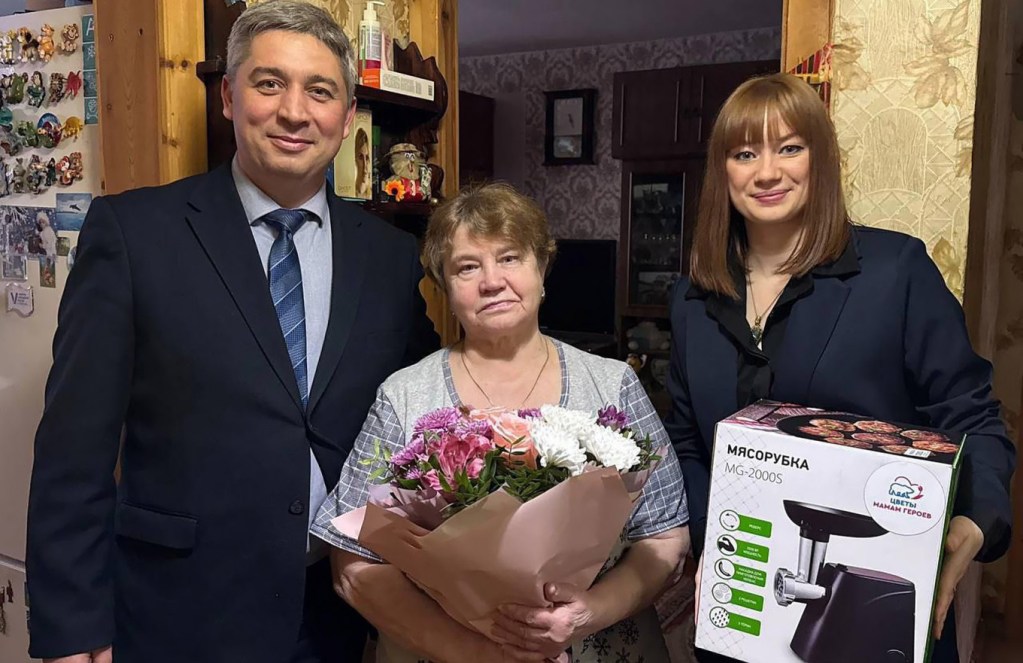
Una residente de la región de Múrmansk, que perdió a su hijo en la guerra, recibió del partido Rusia Unida una picadora de carne el 8 de marzo. Foto: redes sociales.
En lo que quizás sea el evento más desconcertante de este Día de la Mujer, las madres de los soldados caídos recibieron picadoras de carne como obsequio de funcionarios locales de Rusia Unida en la región de Murmansk.
La noticia provocó una ola de críticas y el electrodoméstico de cocina se ha convertido en un símbolo sombrío del gran número de bajas en los ataques del ejército ruso en Ucrania.
Después de que la historia se hiciese viral en medios rusos y ucranianos, la madre de un soldado fallecido grabó en video una declaración en la que decía que estaba planeando comprarse una picadora de carne, pero Rusia Unida “se la había regalado justo a tiempo”.
“Era justo lo que te pedía”, dijo la anciana.
En Cheboksary, una ciudad de la República de Chuvashia, los funcionarios organizaron un evento exclusivo para viudas y madres de los soldados caídos.
“¡Que el dolor se convierta pronto en orgullo!”, declaró el diputado local Yevgeny Kadyshev. Las mujeres recibieron ramos y bolsas de regalo etiquetados con el mensaje “Felicidad y Alegría”.
Las autoridades rusas, el partido Rusia Unida incluso, promueven la imagen de una esposa o madre militar como el ideal de feminidad, dice la investigadora de estudios de género Ella Rossman al Moscow Times.
El Movimiento de Mujeres Rusia Unida se fundó en los meses posteriores a la invasión de Ucrania en 2022 “como una clara respuesta al activismo feminista contra la guerra”, dijo Rossman, refiriéndose a grupos como la Resistencia Feminista Antibélica y los movimientos de esposas y madres de soldados movilizados.
“Actualmente, el arquetipo femenino más visible en la esfera pública es el de la mujer que espera a que su soldado regrese del frente”, dijo Rossman. “Pero esta no es la única imagen. Hay narrativas completamente opuestas, como la de las mujeres militares propiamente”.
Rossman señaló un artículo de un tabloide pro-Kremlin sobre una mujer de Rostov que firmó un contrato militar y fue a la guerra.
“Es una madre que dejó luchar a su hija, perdió una pierna en combate y le dice a los periodistas que tan pronto como se recupere, volverá al campo de batalla”, dijo Rossman.
Las estaciones de televisión locales han estado cubriendo los eventos del Día de la Mujer para las madres y esposas de los soldados, mientras que también resaltan a las mujeres que ayudan o luchan en el frente.
Tras estas celebraciones oficiales, los políticos, a veces, invitan a estas mujeres a tomar el té. En Stavropol, se preparó una mesa para las madres y esposas de los soldados tras un concierto en un hospital de veteranos.
“Algunos esperan el regreso de sus hijos. Otros, lamentablemente, han perdido a sus defensores, quienes dieron la vida por la Patria”, escribió en redes sociales la senadora Daria Lantratova, representante de Luhansk ocupado.
Los activistas de Rusia Unida también entregaron flores a las madres de los soldados en el Donetsk ocupado.
“Su hijo es un héroe. La felicitamos por estas fiestas y le deseamos lo mejor. Esperamos que esta guerra termine y que llegue la paz”, le dijo una activista del Movimiento de Mujeres Rusia Unida a una anciana. Al escuchar la palabra “héroe”, la mujer rompió en llanto.
“No llores”, le dijo la activista de Rusia Unida a la anciana al despedirse.
Los soldados rusos que combaten en Ucrania también enviaron mensajes en vídeo a las madres y viudas de la milicia antes de la festividad.
“Los héroes nacen en familia. Las mujeres nos dan a luz. Las mujeres nos crían en jardines de infancia y escuelas. La formación de un héroe se debe a las grandes mujeres de su vida”, declaró Leonid Lapin, soldado que luchó como comandante de pelotón de francotiradores en Ucrania, en un mensaje de video.
Putin recibe a Olga Chebyova, viuda de Sergei Chebnyov, “héroe de Rusia”. Foto: kremlin.ru
Rusia Unida incluso ha involucrado a niños con discapacidad en las celebraciones. En el distrito autónomo de Yamalo-Nenets, madres e hijos de un centro para progenitores de niños con discapacidad mental y física, elaboraron tarjetas de felicitación para familiares de soldados.
“Esta no es solo una buena iniciativa. Al ver cómo se involucran los niños con necesidades especiales, cómo les brillan los ojos, uno se da cuenta de que vamos por buen camino”, dijo Alexei Komarevtsev, miembro de Rusia Unida.
En una entrevista en un canal de noticias local, describió el proyecto de manualidades como una forma de socialización para niños con discapacidad. Algunas de las tarjetas, añadió, se enviarán al frente de batalla, “porque también hay niñas sirviendo allí”.
En algunas regiones, como Tula, las esposas y madres de los soldados recibieron un pago único de 10.000 rublos (unos 100 dólares) por el Día de la Mujer. En otros lugares, los regalos incluyeron sets de maquillaje o entradas para la filarmónica.
En la región de Moscú, Rusia Unida organizó un seminario de maquillaje para esposas de soldados, afirmando que este tipo de iniciativas “ayudan a fortalecer los valores familiares y a mejorar la calidad de vida en la sociedad”.
“La guerra altera las normas sociales y el estilo de vida”, dijo Rossman. “Pero también impone restricciones a la posibilidad misma de una dicotomía rígida entre los roles masculinos y femeninos, aunque la guerra parezca encajar perfectamente en esa dicotomía”.
Es probable que esa sea la razón por la que las autoridades han estado trabajando horas extra para reforzar el ideal de valores “tradicionales”del Kremlin desde el inicio de la guerra, dijo.
“Las autoridades rusas se ven obligadas a declarar y reforzar los valores tradicionales [porque] muchas familias que antes de la guerra estaban intactas ahora han perdido a sus padres”, dijo Rossman. “También hay mujeres militares —médicas, por ejemplo— y mujeres que han ido voluntariamente a la guerra. Ignorar a estas mujeres es imposible. Ellas también son un objetivo desde el punto de vista de la propaganda”.
A medida que la guerra se alarga y las pérdidas rusas aumentan en el campo de batalla, las autoridades se ven obligadas a equilibrar diferentes ideales de feminidad en sus mensajes de propaganda, dice Rossman.
“Tienen que crear constantemente diferentes arquetipos femeninos para diferentes públicos”, dijo.
Andrei Trofimov, condenado activista pacifista ruso. Foto: Página Vkontakte de Andréi Trofimov, vía Mediazona.
El 2023, el activista pacifista Andrei Trofimov, de Tver, fue condenado por diversos cargos (entre ellos, difundir noticias falsas sobre el ejército ruso, incitar al extremismo e intentar unirse a la legión Libertad de Rusia) a diez años de cárcel en una prisión de máxima seguridad. En su declaración final del juicio, llamó a Vladimir Putin “estúpido” (khuilo) y apoyó vehementemente los ataques ucranianos al Puente de Crimea y al Kremlin. Esta declaración se usó como fundamento para una segunda causa penal contra él, esta vez con cargos de “apología al terrorismo” y “difamación del ejército”.
Hoy (6 de mayo del 2025), el juez Vadim Krasnov del Segundo Tribunal Militar del Distrito Occidental extendió la condena de Trofimov a trece años. El fiscal Andrei Lopata había solicitado al juez una pena mayor a quince años.
Antes de la lectura del veredicto de su primer juicio, Trofimov había solicitado al tribunal la imposición de la pena máxima. Ahora, también ha pedido que se le acuse por alta traición, un delito más grave, alegando su participación del lado ucraniano en la guerra informativa.
A continuación, la publicación de Mediazona, un tanto abreviada, de la declaración de Trofimov durante los argumentos orales del [segundo] juicio.
* * * * *
Su Señoría, las circunstancias objetivas de mis acciones, que la investigación ha calificado como delitos, están correctamente expuestas en la acusación y han sido investigadas a fondo durante la audiencia judicial.
En mi declaración, quisiera profundizar en las razones de estas acciones, en mis objetivos, y analizando en detalle las imputaciones una a una, brindar mi respuesta a las acusaciones; es decir, explicar mis motivos para no declararme culpable. Y, en conclusión, quisiera solicitar al tribunal lo que debe hacerse conmigo a continuación.
Yo vivía tranquilamente en mi casa de campo, con mis gatos, sin molestar a nadie. Mi vida cambió drásticamente el 24 de febrero del 2022. El motivo, tanto del primer proceso penal como del actual [en mi contra], ha sido la invasión a Ucrania por parte de Rusia. Explicaré luego y con más detalle por qué considero así ese evento.
De hecho, estoy en prisión por lo que he dicho. No hice nada ni en el primer caso ni en el segundo. Pero esta ha sido mi forma de involucrarme en tales eventos, porque me era físicamente imposible salir del país y no tenía ningún deseo de permanecer en silencio en ese trance. Porque, claro, es mi vida.
¿Por qué he hecho esto? Debo responder a sus comentarios de ayer en el sentido de que mis declaraciones, incluso en el tribunal, podrían perjudicar mis propios intereses. Su Señoría, no me interesa una sentencia más corta. Yo ya estoy en prisión.
¿Cuál es el propósito de lo que hago? En general, es una cuestión de supervivencia. Simplemente entiendo el instinto de supervivencia no como la preservación del cuerpo en sí, de su salud física, porque no soy solo mi cuerpo. Quiero preservar mi conciencia en esta difícil situación, mi capacidad para distinguir entre blanco y negro, entre la falsedad y la verdad, y, aún más importante, mi capacidad para decir en voz alta lo que creo que es cierto.
Esta cuestión mía no comenzó el 2022. Siempre he intentado vivir así. Es solo que mi deseo de mantener esta capacidad en tales momentos —es decir, la capacidad de decir la verdad, de mantener mi conciencia— es lo que me lleva a actuar así.
¿Qué hechos hemos observado? Hemos presenciado pruebas concretas de delitos de los que no se me acusa, evidencias de la violación del artículo 278 del Código Penal Federal Ruso, es decir, la toma o retención forzosa del poder. Me refiero a Vladímir Putin, quien ha ocupado el cargo oficial más alto de la Federación Rusa durante exactamente un cuarto de siglo. En todo este tiempo, la Constitución de la Federación Rusa ha mantenido el principio de sucesión de poderes, establecido en la forma del gobierno de dos mandatos [para la presidencia rusa]. Hemos presenciado una violación directa de esta norma, es decir, la retención forzosa del poder.
En cuanto a lo ocurrido desde el 24 de febrero, vemos pruebas concretas de la violación del artículo 353 del Código Penal, es decir, la planificación, preparación, desencadenamiento y ejecución de una guerra ofensiva.
¿Qué he hecho al respecto? Públicamente, en un piquete solitario [aunque prolongado], he demostrado la insanía del Estado ruso. Vea, la fiscalía pide quince años en total: una pena por asesinato, pero incluso por asesinatos, las sentencias suelen ser más cortas. Y, sin embargo, mis actos no perjudicaron a nadie ni causaron daño alguno.
No me refiero sólo al período cubierto por estos casos penales. Nunca he tocado a nadie ni robado un céntimo en mi vida. Sin embargo, [el fiscal quiere condenarme a] quince años. Creo que esto demuestra la demencia del Estado. El Estado exhibe con gusto esta cualidad al ponerme como ejemplo.
¿Cómo respondo? Demostrando fortaleza. Esto es vital, porque espero que los ucranianos vean lo que he estado haciendo. Miren: lo arrestaron. Lo condenaron y le dieron doce años de pena máxima. Juzguen el efecto en relación con el segundo caso. ¿Hicieron un buen trabajo convenciéndome [de mi error]? Es decir, ¿he dejado de hacer lo que hacía? ¿Se ha apagado mi voz? No, no se ha apagado.
Hemos presenciado lo mismo en el frente militar. Por cuatro años seguidos el estado ruso ha ensangrentado a un país vecino. Ucrania no se ha rendido ni se rendirá.
Entre las cosas de las que no se me ha acusado exactamente, pero que se han repetido en los autos de acusación y entre las pruebas presentadas en el juicio, está mi insulto a Vladimir Vladimirovich Putin con la palabra grosera «estúpido». ¿Qué he hecho? A esto le llaman desacralización.
Porque la sacralidad del poder supremo es uno de los fundamentos de la forma de gobernar de la Horda de Oro. Cuando pública, repetida y diariamente; en el primer juicio, en el segundo, o en el medio de la detención preventiva, he hecho este truco, he desacralizado a Vladimir Putin. Esto es importante porque este régimen terminará de todas formas y deseo con todas mis fuerzas apurar tal fin. Odio a ese hombre. Y lo que dice la fiscalía sobre el “motivo del odio político” es la pura verdad. Puedo confirmarlo.
El público al que me dirijo con estas acciones no vive en Rusia, porque la sociedad rusa está muerta y es inútil intentar hablar con ella. Mi público es Ucrania.
En cuanto a los cargos contra mí, no me declaro culpable de ninguno de los cargos de violación del artículo 205.2 del Código Penal. El caso es el el texto mismo, simplemente publicado en internet y leído en voz alta en el centro de prisión preventiva, porque no considero que los incidentes que he decidido incluir en mi alegato final del juicio sean “actos terroristas”. Los he elegido a propósito.
Lo que está en juego son los dos ataques al Puente de Crimea. Este puente es una arteria de transporte vital que abastece a las fuerzas armadas federales rusas en Crimea. Un ataque a una instalación militar constituye un caso de violencia armada. El ataque fue llevado a cabo por las fuerzas armadas de Ucrania.
¿Por qué se catalogó como “ataque terrorista”? Sé perfectamente por qué. Esto se hizo, primero, para poder usarlo en la propaganda rusa y así deshumanizar al enemigo. En otras palabras, la Federación Rusa no está en guerra con las fuerzas armadas de Ucrania, que están estipuladas por la ley ucraniana y cumplen con su deber constitucional, sino con bandas terroristas de “banderistas” y “ukronazis“. Para apoyar esta agenda es que se toman decisiones y se inician procesos penales por cargos de “terrorismo” en casos de conflicto armado.
En cuanto al segundo incidente que he mencionado, el ataque al Kremlin el 3 del mayo del 2023, ¿qué sabemos? El comunicado del Comité de Investigación, citado ayer por la fiscalía afirma categóricamente que el ataque se llevó a cabo contra la residencia del presidente de la Federación Rusa, comandante en jefe de las fuerzas armadas federales rusas. Además, los ucranianos también atacaron el edificio del Senado, ubicado en una zona del Kremlin cerrada al turismo y donde se encuentra una de las oficinas de Putin. Disculpenme, pero esto no fue un ataque terrorista. Fue una operación de combate ucraniana, además fallida.
Debo decir, fuerte y claro, que no apruebo ni apoyo el terrorismo, que nunca lo he aprobado ni tengo intención de hacerlo. Mantengo una actitud categóricamente negativa hacia la ideología y la práctica del terrorismo.
Pasemos al [los cargos del] artículo 280.3 del Código Penal. Este artículo es completamente nuevo: se adoptó tras el inicio de lo que llamamos la «operación especial».
Esto es un claro ejemplo de persecución por decir la verdad. Porque ha ocurrido algo que ha hecho necesario silenciar a los opositores a la guerra. Pero es imposible acusarlos de violar, por ejemplo, mi querido artículo 207.3 del Código Penal. ¿Cómo se puede acusar a alguien de “difundir noticias falsas” si simplemente expresa su opinión sobre la actualidad? Así surgió el artículo 280.3 y el concepto de “difamación”, que, legalmente, ha sido muy mal concebido.
Me han dicho que mi frase «Ucrania es víctima de una agresión por parte de Rusia» difama a las fuerzas armadas federales rusas. Pero ¿qué hay? Tenemos la resolución de la Asamblea General de la ONU de 2014 que dice que Rusia se «anexionó» Ucrania. Esas no son mis palabras. Esta es una resolución de la Asamblea General: no tiene poder de veto [como sí lo tiene el Consejo de Seguridad de la ONU], por lo que fue aprobada por una mayoría considerable [de Estados miembros]. Esta es la posición del derecho internacional.
De igual manera, contamos con una resolución de la Asamblea General de la ONU de marzo del 2022 que califica los sucesos del 24 de febrero como «agresión». Y tenemos una resolución de la Asamblea General de la ONU sobre la incorporación, por parte de Rusia, de las regiones ucranianas de Donetsk, Luhansk, Zaporizhia y Jersón, que califica estas acciones de «anexión».
Debo señalar que las declaraciones de, por ejemplo, la portavoz del Ministerio de Asuntos Exteriores, Masha Zakharova, no constituyen una fuente de derecho internacional. Las declaraciones del ministro de Asuntos Exteriores ruso, Lavrov, tampoco lo son. En cambio las resoluciones de la Asamblea General de la ONU sí lo son, y por lo tanto, mis apreciaciones se basan en documentos jurídicos internacionales.
Pero, claro, mi frase sobre los “escorias de Putin” también forma parte de la acusación de “difamación” en mi contra. En primer lugar, desde su punto de vista, “Putin” no puede ser difamatorio, porque, según usted, Putin es bueno. En cuanto a la segunda palabra [de la frase], sí, es mi opinión personal, y no se aplica sólo a militares rusos que siguen órdenes ilegales. Sí, hay también gente en las fuerzas armadas rusas que incumplen órdenes ilegales, pero no son los únicos que luchan allí.
Disculpeme por describir así a quienes asesinan a soldados de un país vecino por dinero. Es mi opinión personal, basada en [sus] acciones.
Resumiré esta parte de mi declaración. La Constitución Federal Rusa contiene el Artículo 29, [que garantiza] el derecho a la libertad de expresión, incluyendo el derecho a recopilar y difundir información. Esto es lo que he estado haciendo. Es decir, no he salido ni un milímetro del Artículo 29 de la Constitución. Sin embargo y al mismo tiempo, ciertamente he violado estos dos artículos vigentes del Código Penal.
¿Cómo es esto posible? Puede que sea porque los artículos por los que se me acusa son inconstitucionales. Si Rusia tuviera un Tribunal Constitucional real, estos artículos habrían dejado de existir hace mucho tiempo.
No puedo dejar de mencionar mi informe al fiscal Zhuk, que no formaba parte de los cargos en mi contra, pero aún así escuchamos a testigos que lo mencionaron ayer . No contiene el texto de [mi] declaración final [del primer juicio]. No hay mención de terrorismo ni ningún acto violento. Tampoco mencioné a las fuerzas armadas.
El caso es que este segundo proceso es el resultado de mi declaración ante la comisión del fiscal. Porque el expediente contiene dos resoluciones del investigador del FSB, el teniente coronel Serguéi Vyacheslavovich Yerofeev, para desestimar el caso; es decir, del investigador de mi [primer] caso, con quien tengo una excelente relación y que comprende perfectamente lo que he estado haciendo y lo que he intentado lograr. Él intentó desestimar este caso dos veces.
En la parte final de mi declaración, me referiré a la adecuada descripción de mis acciones. Estoy involucrado del lado ucraniano en la guerra. Simplemente que esta participación se lleva a cabo sin armas, porque una guerra es un evento extraordinariamente multidimensional. Además de los combates en las estepas del Donbás, en el Mar Negro y en los cielos de Ucrania, se libran ferozmente en el espacio informativo por entidades estatales y organismos rusos. Del lado ucraniano, por ejemplo, también participan entidades interesantes.
Soy un guerrero de la información. ¿En qué sentido? El 9 de octubre del 2022, escribí y envié un correo electrónico al presidente ucraniano, Volodymyr Oleksandrovych Zelensky, pidiéndole que me concediera la ciudadanía ucraniana. Tengo derecho a ella por mi ascendencia. Todos mis abuelos eran ucranianos. La ley ucraniana dice que tengo derecho a la ciudadanía [ucraniana].
Pude incluir una captura de pantalla de Kasparov.ru en el expediente para hacer que la examinaran en el tribunal. ¿Qué confirma esto? Que, además de publicar mi alegato final en el juicio, Kasparov.ru me ha publicado regularmente. ¿Qué confirma esto? Que lo que se me está juzgando ahora es, de hecho, solo un ejemplo de mi trabajo, que no he cesado.
También debo mencionar, por supuesto, a Novaya Gazeta, cuyo sitio web también publicó mis cartas. Y mi último logro en este sentido es que me han declarado oficialmente preso político, porque es así como me he denominado en el centro de detención preventiva y así firmo mis peticiones ante este honorable tribunal. Pero, por así decirlo, fue una especie de autodenominación.
El 14 de abril de este año, el Consejo de Presos Políticos del Centro Internacional de Defensa de los Derechos Humanos Memorial publicó una decisión[que me declara como preso político]. Como parte de mi trabajo, he tomado los casos penales [en mi contra], tanto el primero como el segundo, como oportunidades de difusión.
La guerra de la información es real. Estoy involucrado en ella y ahora intento demostrarlo. En el terreno informativo, apoyo a Ucrania y a sus fuerzas armadas. De hecho, me he unido al bando enemigo en un conflicto armado que involucra a la Federación Rusa. Esta es la esencia del delito tipificado en el artículo 275 del Código Penal Federal ruso: alta traición.
Solicito al tribunal que devuelva mi caso penal a la fiscalía, ya que las circunstancias indican que existen motivos para acusarme de un delito más grave. Que me juzguen por traición: he traicionado su demente país.
* * * * *
Dirección para correo postal:
Trofimov Andrei Nikolayevich (nacido en 1966)
141 ul. Bagzhanova, FKU SIZO-1 UFSIN po Tverskoi oblasti
Tver, Tver Oblast 127081 Federación Rusa
Puede enviar cartas al sr. Trofimov y a otros prisioneros políticos rusos via ZT, F-Pismo, y PrisonMail.online. (Este último acepta pagos con tarjetas de bancos fuera de Rusia.)
Crimeo condenado a 17 años “por planear la explosión de un helicóptero militar ruso” (Grupo de Protección de los Derechos Humanos de Járkov, 20 de junio).
Un tribunal ruso ignora secuestro y tortura al incrementar una larga pena contra un ucraniano que intentó rescatar a su madre (Grupo de Protección de los Derechos Humanos de Járkov, 19 de junio).
Una nueva legislación formaliza el brutal aislamiento ruso de los presos políticos tártaros de Crimea y otros ucranianos (Grupo de Protección de los Derechos Humanos de Járkov, 17 de junio)
Cómo gobierna Putin en la Ucrania ocupada (Workers Liberty, 16 de junio)
Vida bajo la ocupación (Alter Pravo, mayo de 2025)
Vida bajo la ocupación (Alter Pravo, abril de 2025)
Observadores de la ONU informan del aumento masivo de ataques rusos contra civiles en toda Ucrania (Grupo de Protección de los Derechos Humanos de Járkov, 16 de junio)
Más de 1900 toneladas de sustancias nocivas emitidas en el aire de la ciudad y la provincia de Kiev en dos días de ataques rusos (Ukrainska Pravda, 16 de junio)
La postura de los defensores de los derechos humanos: el proyecto de ley de ciudadanía múltiple crea amenazas para los residentes de los territorios ocupados (Zmina, 17 de junio)
ZMINA destaca la necesidad de responsabilidad en el Foro de Seguridad de Europa Central y Oriental en Varsovia (Zmina, 17 de junio).
ZMINA participó en el desarrollo de la Hoja de Ruta para la investigación de crímenes de lesa humanidad cometidos por las fuerzas rusas en Ucrania (Zmina, 16 de junio).
Exportaciones rusas de combustibles fósiles: alto a la campaña Seapeak (Campaña de Solidaridad con Ucrania en Escocia, 16 de junio)
Próximo evento:
Jueves 26 de junio, de 19:30 a 21:00 GMT, en línea. Informe de las visitas de solidaridad a Ucrania. Ponentes: Mike Kearney (NEU Ukraine Solidarity Network); Rui Palma (Ukraine Solidarity Campaign Steering Committee). Regístro con enlace Zoom.
Este boletín es elaborado por activistas del movimiento obrero en solidaridad con la resistencia ucraniana. Para recibirlo por correo electrónico cada lunes escriba a 2022ukrainesolidarity@gmail.com. Para dejar de recibirlo responda con la palabra “STOP” en el asunto. Más información en https://ukraine-solidarity.org/. También en Twitter, Bluesky, Facebook y Substack. El boletín se archiva en línea aquí.
Si es usted uno de los pocos que aún creen que el dictador ruso Vladimir Putin está interesado en la paz, observe por favor algunos de los videos de su actuación en el Foro Económico Internacional de San Petersburgo la semana pasada.
Vladimir Putin en el Foro Económico Internacional de San Petersburgo 2025. Con subtítulos en inglés. Fuente: Michael Rossi
Así sabrá la verdad.
Aquí está la esencia de Vladimir Putin en seis mentiras, todas lanzadas en 48 horas la semana pasada.
MENTIRA 1: “Toda Ucrania le pertenece a Rusia”.
REALIDAD: Basta el derecho internacional. Es realmente así de simple. O pregunte a los ucranianos. Fin de la discusión.
Las palabras de Putin, las risas y los aplausos del público, la admiración en la sonrisa del “entrevistador” —tres años y medio después de la invasión—, todo grita “¡alerta roja, dictador al ataque!”. Sobre todo porque las palabras de Putin esta semana no son más que una continuación de su “tesis histórica”, publicada en el verano de 2021, seis meses antes de invadir Ucrania, en la que afirma que rusos y ucranianos son un solo pueblo y que deberían vivir juntos como un solo Estado: Rusia.
Como ahora sabemos, en febrero del 2022, Putin demostró su “amor” hacia los ucranianos de una manera más bien abusiva: “estén de acuerdo conmigo, mis queridos hermanos y hermanas, de que somos uno, o los invadiré, los asesinaré, los torturaré, los violaré y los mataré, y entonces entederán que somos uno”.
Esto es, como se dice en Rusia, alguien que va ‘va-bank’ –a toda máquina (‘ва-банк’).
MENTIRA 2: Putin dice que desea terminar la guerra lo antes posible.
“Créanme, nosotros también queremos terminar la guerra, y cuanto antes. Y si pacíficamente mejor, si podemos llegar a un acuerdo”, declaró Putin en San Petersburgo.
REALIDAD: Esta es simple. El dictador ruso ha roto nada menos que 26 altos al fuego desde que invadió Ucrania por primera vez en 2014. Esto es cada uno de los que se acordaron en 11 años.
En San Petersburgo, se le preguntó directamente a Putin sobre la ofensiva rusa a gran escala en la ciudad de Sumy, al noreste de Ucrania. Ucrania afirma que Rusia ha concentrado 60.000 soldados a menos de 30 km de la ciudad y que en mayo y junio, aldea tras aldea al norte de la ciudad han caído bajo el ejército ruso, que se acerca cada vez más a Sumy.
“No es nuestro objetivo tomar Sumy”, respondió Putin, “pero, en principio, no lo descarto…” ¿Parece este un hombre que desea poner fin a la guerra?
La semana pasada se cumplieron 100 días desde que Ucrania aceptó la propuesta de un alto el fuego incondicional de Trump. Putin aún no la ha aceptado. 100 días. En cambio, el dictador ruso ha aprovechado esos 100 días para intensificar los bombardeos sobre zonas residenciales de ciudades ucranianas, enviando a menudo entre 400 y 500 drones cada noche. La mayoría de las veces, esto significa 6 u 8 muertes, pero cada tanto, como el pasado martes en Kiev, el coste humano es aún mayor: un ataque con drones y bombas en la madrugada dejó 30 muertos mientras dormían y 170 heridos.
Eso es todo lo que se necesita saber acerca de si Putin quiere terminar la guerra. O no.
MENTIRA 3: Putin dice que Rusia no bombardea zonas residenciales sino objetivos del sector defensa.
“Los ataques no fueron contra zonas residenciales, sino contra instalaciones militares e industriales”, explicó Putin esta semana sobre el bombardeo de Kiev que mató a 30 personas e hirió a 170. Ha repetido estas “explicaciones” decenas de veces tras otros atroces atentados terroristas.
REALIDAD: Sólo basta con mirar este vídeo.
No hace falta ser un experto militar para ver que el dron/bomba ruso se dirige directamente a un bloque de pisos residenciales y no a una instalación industrial-militar.
Hay que ser muy tonto para creer que esto no es intencional. De hecho, la única persona a la que he oído explicar este tipo de ataques como no intencionales es, como podrán adivinar, el presidente de los Estados Unidos. El Domingo de Pascua, Rusia bombardeó la plaza del mercado central de la ciudad de Sumy, al noreste de Ucrania, usando munición en racimo y alcanzando a feligreses y personas que se dirigían, con sus familias, a celebrar la Pascua. 31 personas fueron asesinadas. Pero Donald Trump manifestó que se le había informado que Rusia había, simplemente, cometido un “error“.
Todos los expertos independientes coinciden en que, en los últimos meses, Rusia ha atacado cada vez más parques infantiles, mercados, hospitales y barrios residenciales. Basta con ver los vídeos de ucranianos muertos y heridos rescatados de los escombros en pijama y camisón que se publican cada mañana .
En cambio, el propio enviado de Trump a Ucrania, el general retirado Keith Kellogg, tuiteó que no tenía dudas de que este era un ataque deliberado.
MENTIRA 4: Putin dice que está listo para reunirse con Zelenski
“Estamos listos para reunirnos… Estoy listo para reunirme con todos, incluso con Zelenski”, dijo Putin en San Petersburgo.
REALIDAD: Putin ha evitado reunirse con el presidente ucraniano en repetidas oportunidades. La más reciente, en Estambul, en mayo, donde Zelenski lo retó a una reunión cara a cara: “No tiene sentido prolongar las matanzas. Y esperaré a Putin en Turquía el jueves. Personalmente”.
Pero Putin decidió no ir a la reunión con su homólogo, quien es mucho más joven, tiene más cabello, no tiene barriga, no usa bótox, es dinámico y cuenta con gran simpatía de la prensa internacional.
MENTIRA 5: Putin cuestiona la legitimidad de Zelenski
“¿Por qué digo esto?”, se preguntaba en voz alta Putin, en San Petersburgo. “No nos interesa quién esté negociando, aún si es el líder del actual régimen. Estoy dispuesto a reunirme con él, pero sólo en la etapa final. La firma debe provenir de un gobierno legítimo. De lo contrario, el próximo gobierno simplemente tirará el acuerdo a la basura”.
REALIDAD: ¿Por dónde empezar con esto? Un dictador brutal y corrupto que ha estado en el poder en Rusia desde 1999 y que durante ese período ha destruido todo signo de democracia, libertad de expresión y medios de comunicación, ni que decir de la mayoría de sus oponentes políticos… acusa a un presidente elegido popularmente de ser ilegítimo (Zelenski obtuvo el 73% de los votos en 2019). Si Zelenski pospuso las elecciones que debían celebrarse en 2024 fue porque el mencionado dictador había invadido su país.
En otras palabras: Putin negociará con Zelensky, según afirma, pero se reservará el derecho a negar el acuerdo por considerarlo ilegítimo.
Alternativamente, Putin quiere forzar elecciones en Ucrania, lo que generaría inestabilidad. Claro, precisamente por eso Putin desea elecciones. Los desafíos logísticos y de seguridad serían insuperables: este es un país y un pueblo que se encuentran en medio del período más traumático de su historia, con un tercio de su población (entre 12 y 14 millones de personas) obligada a huir de sus hogares, el 20 % del país ocupado y cientos de miles de personas muertas y heridas. Imagine llevar a cabo una campaña política y elecciones en tales circunstancias, forzados por su vecino invasor, el país que los ucranianos consideraban su principal aliado.
No es sorprendente que un veterano de la KGB como Putin intente esto; no tiene nada que perder. Lo sorprendente es que Trump y varios miembros de su administración coincidan con el dictador ruso en que Zelenski es ilegítimo y que debe convocar elecciones antes de firmar un acuerdo de paz. ¿Por qué, por qué dirías algo así, Donald, si de verdad quieres ver la paz en Ucrania?
MENTIRA 6: Putin califica la revolución ucraniana del 2014 de “golpe de Estado”
REALIDAD: Lo siento, Vova, estuve en la plaza el 2013-14, prácticamente a diario durante varios meses. No hay forma educada de decirlo: eres un puto mentiroso. ¡Deja de mentir, Vova!
Aquel fue un verdadero levantamiento popular, que involucró a millones de ucranianos en todo el país. Los hechos lo prueban: 11 años después, es fácil encontrar ucranianos que participaron en el Maidán durante meses y que hoy están decepcionados con el resultado de la revolución. Demasiados de los antiguos peces gordos permanecieron en el poder; la lucha contra la corrupción ha sido demasiado lenta. Pero ninguna de estas personas —millones— que presenciaron lo sucedido, que realmente participaron, lo llama “golpe de Estado”.
Ellos estuvieron allí. Ellos hicieron la revolución. Ellos lo saben.
Lo cierto es que hoy, 11 años después de que Putin invadiera Ucrania por primera vez, y tres años y cuatro meses después de que lo hiciera por segunda vez, es difícil encontrar a alguien que crea en sus mentiras. Salvo que estén pagados por el Kremlin.
Funcionarios ucranianos reaccionaron con indignación a los comentarios de Vladimir Putin del viernes, en los que aseguró a los delegados del Foro Económico Internacional de San Petersburgo que “toda Ucrania es nuestra”.
En su discurso, durante el evento anual de desarrollo económico de San Petersburgo, Putin amenazó con una respuesta nuclear si Kiev desplegara una “bomba sucia” (a pesar de admitir que no había pruebas de que Ucrania estuviera considerando hacerlo) y describió la actual invasión de Ucrania como una necesidad defensiva.
Al negar rotundamente la soberanía de Ucrania, Putin repitió la vieja narrativa del Kremlin de que ucranianos y rusos son “un solo pueblo”, una afirmación que ha sido rechazada una y otra vez tanto por Ucrania como por la comunidad internacional.
Putin confirmó que las fuerzas rusas estaban creando una zona de contención de 10 a 15 kilómetros dentro de la región ucraniana de Sumy, tras una incursión de siete meses por parte del ejército ucraniano en la vecina región rusa de Kursk. Aunque negó que Rusia planeara ocupar la ciudad de Sumy, Putin añadió, categóricamente, que no lo descartaba.
Putin amenazó con una escalada nuclear y advirtió de una devastadora respuesta rusa si Ucrania despliega una “bomba sucia”, combinación de explosivos convencionales y material radiactivo, a pesar de que no hay noticia de que Ucrania posea tal dispositivo, hecho que el propio Putin reconoció.
Un ataque así “sería un error colosal por parte de aquellos a quienes llamamos neonazis en la Ucrania actual”, dijo, añadiendo que “podría ser su último error”.
“Nuestra doctrina nuclear establece que siempre respondemos a las amenazas con la misma moneda. Por tanto, nuestra represalia sería extremadamente severa y, muy probablemente, catastrófica tanto para el régimen neonazi como para la propia Ucrania”, continuó Putin.
En respuesta a los comentarios sobre su nocturno discurso del viernes a la nación, el presidente ucraniano Volodymyr Zelenski dijo que esto demostraba que Putin no tenía intención de negociar un alto el fuego y que “Rusia quiere continuar la guerra”, y agregó que las fuerzas ucranianas estaban repeliendo con éxito los ataques rusos en la región de Sumy.
Otros funcionarios ucranianos también condenaron las declaraciones de Putin. El ministro de Asuntos Exteriores, Andrii Sybiha, calificó estas declaraciones de “desquiciadas” y afirmó que el líder ruso había mostrado “un total desdén por los esfuerzos de paz estadounidenses”.
“Mientras que los Estados Unidos y el resto del mundo han pedido el fin inmediato de la matanza, el principal criminal de guerra de Rusia habla de planes para apoderarse de más territorio ucraniano y asesinar a más ucranianos”, escribió Sybiha en X.
A pesar del continuo aislamiento internacional de Rusia, Putin afirmó también que la economía del país seguía fuerte y señaló que el PIB había crecido más del 4% anual en los últimos dos años, que la pobreza había caído al 7,2% y que el desempleo había bajado a un mínimo histórico del 2,3%.
Russian court ignores abduction and torture, increasing huge sentence against Ukrainian for trying to rescue his mother (Kharkiv Human Rights Protection Group,June 19th)
Russia sentences 19-year-old Ukrainian to 8 years for ‘spying for Ukraine’ as a young boy (Kharkiv Human Rights Protection Group,June 19th)
New legislation formalizes Russia’s brutal isolation of Crimean Tatar and other Ukrainian political prisoners (Kharkiv Human Rights Protection Group,June 17th)
How Putin rules in occupied Ukraine (Workers Liberty, June 16th)
Thursday, June 26th, from 7:30 to 9:00 PM GMT, online. Report back from solidarity visits to Ukraine. Speakers: Mike Kearney (NEU Ukraine Solidarity Network); Rui Palma (Ukraine Solidarity Campaign Steering Committee). Register for Zoom link.
If you are one of the few who still believe that the Russian dictator Vladimir Putin is interested in peace, please watch a few of the video clips from his performance at the St. Petersburg International Economic Forum last week.
Vladimir Putin at the 2025 St. Petersburg International Economic Forum. With English subtitles. Source: Michael Rossi
And then you will know the truth.
Here is Vladimir Putin summed up in 6 lies, all delivered within 48 hours last week.
LIE 1: “All of Ukraine belongs to Russia.”
FACT: Just go read international law, please. It really is that simple. Or ask the Ukrainians. End of discussion.
Putin’s words, the laughing and applause in the audience, the admiring smile of the ‘interviewer’ — three and a half years into the invasion — everything screams ‘red flag, attacking dictator!’ Not least because Putin’s words this week are simply a continuation of his ‘history thesis’ published in the Summer of 2021, six months before he invaded Ukraine; claiming that Russians and Ukrainians are one, and should live together within one state. Russia.
As we now know, in February 2022, Putin went on to show his ‘love’ for Ukrainians in a rather abusive way: something a la ‘you agree with me, my dear brothers and sisters, that we are one – or I will invade, murder, torture, rape and kill you, and then you will realize that we are one.’
This is, as they say in Russian, a man who is going ‘va-bank’ – for broke (‘ва-банк’).
LIE 2: Putin says that he wants to end the war as soon as possible.
“Believe me, we also want to end the war, and as soon as possible. And better – peacefully, if we could agree,” Putin said in St Petersburg.
FACT: This one is simple. The Russian dictator has broken no less than 26 ceasefires since he first invaded Ukraine in 2014. That’s every single one that has ever been agreed in 11 years.
In St. Petersburg, Putin was asked directly about the large-scale Russian offensive towards the city of Sumy in North-Eastern Ukraine. Ukraine says that Russia has amassed 60,000 troops less than 30 km from the city and all through May and June, village after village north of the city has fallen to the Russian army, edging still closer to Sumy itself.
“We have no objective to take Sumy,” Putin answered, “but in principle I do not rule it out…” Does that sound to you like a man who is keen on ending the war?
As it happens, last week marked 100 days since Ukraine accepted Trump’s proposal of an unconditional ceasefire. Putin still has not. 100 days. Instead, the Russian dictator has used those 100 days to increase the bombardment of residential areas in Ukrainian cities, often sending 4-500 drones with bombs per night. Most nights that kills 6 or 8 people, but every so often, like this past Tuesday in Kyiv, the human toll is even bigger: a drone and bomb onslaught in the early hours of Tuesday, 30 people died in their beds and 170 were injured.
That is all you need to know about Putin wanting to end the war. Or not.
LIE 3: Putin says that the Russian strikes are not on residential areas but on defense industry targets.
“The strikes were not on residential areas but precision strikes on military-industrial facilities,” Putin explained this week about the bombing of Kyiv that killed 30 people and injured 170. He has repeated such ‘explanations’ dozens and dozens of times after other horrific terror bombings.
FACT: All you need to do is watch the video.
You do not need to be a military expert to see that the Russian drone/bomb goes straight into a residential block of flats, not a military-industrial facility.
You do need to be an idiot to believe that this is not on purpose. In fact, the only person I have heard explaining such attacks as not being on purpose is — you guessed it — the U.S. President. On Easter Sunday, Russia bombed the central market square in the town of Sumy, in north-eastern Ukraine — using cluster ammunition and hitting church-goers and people on their way to celebrate Easter with their families. As a result, 31 people died. But Donald Trump explained that he had been informed that Russia had simply made a “a mistake”.
All independent experts agree that over the past months, Russia has increasingly targeted playgrounds, market squares, hospitals and residential neighborhoods. Hell, all you need to do is watch the videos being published every single morning of killed and injured Ukrainians being carried out from the rubble in their pajamas and nightgowns.
Trump’s own envoy to Ukraine, retired general Keith Kellogg tweeted is in no doubt.
LIE 4: Putin says that he is ready to meet Zelensky
“We are ready to meet… I am ready to meet with everyone, including Zelensky,” Putin said in St. Petersburg.
FACT: Putin has several times shied away from meeting the Ukrainian President, most recently in Istanbul in May where Zelensky challenged Putin to a face-to-face meeting: “There is no point in prolonging the killings. And I will be waiting for Putin in Türkiye on Thursday. Personally.”
But Putin decided not to meet his much younger counterpart — who has lots of hair, no belly, no botox, dynamic, and great international press and sympathy.
LIE 5: Putin questions Zelensky’s legitimacy
“Why am I saying this?” Putin wondered aloud in St. Petersburg. “We don’t care who is negotiating, even if it’s the current head of the regime. I’m ready to meet – but only if it’s the final stage. The signature must come from a legitimate government. Otherwise, the next government will just throw it all in the trash.”
FACT: Where does one start on this one? A brutal, corrupt dictator who has been in power in Russia since 1999, and during that period has killed all signs of democracy, free expression and media, not to say most of his political opponents … accuses a popularly-elected president (Zelensky got 73% of the vote in 2019) of being illegitimate. Because he postponed elections that were supposed to have taken place in 2024, but couldn’t – because said dictator had invaded his country.
In other words, Putin will negotiate with Zelensky, he claims, but then retain the right afterwards to negate the agreement as illegitimate.
Alternatively, Putin wants to force elections in Ukraine — which would lead to instability. Of course. That is exactly why Putin wants elections. The logistics and security challenges would be insurmountable: This is a country and population in the middle of the most traumatic period in its history, with one-third of the population (12–14 million people) having been forced to flee their homes, 20% of their country occupied and hundreds of thousands of people killed and injured. Imagine running a political campaign and elections under such circumstances. Forced upon them by their invading neighbor and the country the Ukrainians thought was their main ally.
There is nothing surprising in an old KGB-hand like Putin trying this one, he has nothing to lose. The surprising thing is that Trump and several members of his administration agree with the Russian dictator that Zelensky is illegitimate and must hold elections before a peace deal can be signed. Why, oh why would you say something like that, Donald, if you really wanted to see peace in Ukraine?
LIE 6: Putin calls the Ukrainian revolution 2014 “a coup”
FACT: Sorry, Vova, I was there on the square in 2013–14, pretty much every single day for several months. There is no polite way of saying this – you are full of shit. Не пизди, Вова!
This was a true, popular uprising, involving millions of Ukrainians all over the country. The proof is in the pudding: 11 years later, it is easy to find Ukrainians who were on the Maidan during those months who today are disappointed with the outcome of the revolution. Too many of the old fat cats stayed in power, the fight against corruption has been too slow. But none of these people – millions – who saw what happened, who actually participated, call it “a coup”.
They were there. They did it. They know.
The fact is that today, 11 years after Putin invaded Ukraine for the first time, and three years and four months after he invaded Ukraine for the second time, it is difficult to find anybody who believes in his lies. Unless they are paid by the Kremlin.
Ukrainian officials have reacted with outrage to comments made by Vladimir Putin on Friday in which he told delegates to the St Petersburg International Economic Forum that “all of Ukraine is ours”.
Addressing the annual showcase for Russia’s economic development in St. Petersburg, Putin threatened a Russian nuclear response should Kyiv deploy a so-called “dirty bomb” — despite admitting that there was no evidence it was considering doing so — and portrayed the ongoing invasion of Ukraine as a defensive necessity.
Bluntly denying Ukraine’s sovereignty, Putin repeated the long-standing Kremlin narrative that Ukrainians and Russians were “one people,” a claim that has been repeatedly rejected both by Ukraine and the international community.
Putin went on to confirm that Russian forces were carving out a 10–15 kilometre buffer zone inside Ukraine’s Sumy region, following a seven-month-long incursion into Russia’s neighbouring Kursk region by the Armed Forces of Ukraine. Though he denied that Russia planned to occupy the city of Sumy itself, Putin added pointedly that he didn’t “rule it out”.
Raising the spectre of nuclear escalation, Putin warned of a devastating Russian response should Ukraine deploy a so-called “dirty bomb”, which combines conventional explosives with radioactive material, despite the fact that Ukraine is not known to possess such a device — a fact Putin himself acknowledged.
Such an attack “would be a colossal mistake on the part of those we call neo-Nazis in today’s Ukraine,” he said, adding that it “might be their last mistake”.
“Our nuclear doctrine states that we always respond to threats in kind. Therefore, our retaliation would be extremely harsh — and most likely catastrophic for both the neo-Nazi regime and Ukraine itself,” Putin continued.
Responding to the comments in his nightly address to the nation on Friday, Ukrainian President Volodymyr Zelensky said that they proved Putin had no intention of negotiating a ceasefire and that “Russia wants to continue the war,” adding that Ukrainian forces were successfully repelling Russian attacks in the Sumy region
Other Ukrainian officials also condemned Putin’s remarks, with Foreign Minister Andrii Sybiha describing his statement as “deranged” and saying that the Russian leader had shown “complete disdain for US peace efforts.”
“While the United States and the rest of the world have called for an immediate end to the killing, Russia’s top war criminal discusses plans to seize more Ukrainian territory and kill more Ukrainians,” Sybiha wrote on X.
Despite Russia’s continuing international isolation, Putin also claimed that the country’s economy remained strong, noting that GDP had grown by more than 4% annually over the past two years, poverty had dropped to 7.2%, and that unemployment had fallen to a historic low of 2.3%.
Convicted Russian anti-war activist Andrei Trofimov. Photo: Mr. Trofimov’s Vkontakte page, via Mediazona
In 2023, Andrey Trofimov, an anti-war activist from Tver, was sentenced to ten years in a maximum security penal colony on several charges [to wit, disseminating “fake news” about the Russian army, calling for “extremism,” and attempting to join the Free Russia Legion]. In his closing statement at trial, he called Vladimir Putin a “dickhead” [khuilo] and “heartily endorsed” Ukraine’s attacks on the Crimean Bridge and the Kremlin. This statement was the grounds for the second criminal case against Trofimov, this time on charges of “condoning terrorism” and “defaming the army.”
Today [6 May 2025], Judge Vadim Krasnov of the Second Western District Military Court lengthened Trofimov’s sentence to thirteen years. Prosecutor Andrei Lopata had petitioned the judge to impose a longer sentence of fifteen years.
Before the verdict in his first trial was read out, Trofimov had petitioned the court to impose the maximum penalty. Now he has suggested that he be charged with the more serious offense of high treason, claiming that he has been involved in the information war on the Ukrainian side.
Below, Mediazona has published a slightly abridged version of Trofimov’s statement during oral arguments at the [second] trial.
* * * * *
Your honor, the factual circumstances of my actions, which the investigation has categorized as crimes, are correctly stated in the indictment and have been fully investigated during the court hearing.
In my statement I would like to dwell on the reasons for these actions, on my goals, to review in detail, charge by charge, my response to the allegations—that is, to explain my motives for not pleading guilty. And, in my conclusion, I would like to petition the court as to what to do with me next.
I was living quietly at the dacha with my cats and was a bother to no one. My life changed drastically on 24 February 2022. The reason for both the first criminal case and the current criminal case [against me] was Russia’s invasion of Ukraine. I will further explain why I regarded this event in this way.
I am in prison for what I have said, after all. I took no action in either the first case or the second. But this has been my way of being involved in the events, because it was physically impossible for me to leave the country, and I had no desire to stay silent in this situation. I mean, it is my life.
Why have I done this? I must respond to your remarks yesterday to the effect that my statements, including in court, could harm my own interests. Your honor, I have no interest in a shorter sentence. I am already imprisoned.
What is the purpose of what I am doing? Writ large, it is a matter of self-preservation. It is just that I understand the instinct of self-preservation not as the preservation of the body per se, of its physical health, because I am not my body alone. I want to preserve my conscience in this difficult situation, my ability to tell black from white, and lies from truth, and, quite importantly, my ability to say out loud what I believe to be true.
This thing of mine did not start in 2022. I have always tried to live this way. It is just that my desire to preserve this ability in such situations—meaning, the ability to tell the truth, to maintain my conscience— is what causes such actions.
What actions have we observed? We have witnessed concrete evidence of crimes with which I have not been charged, evidence of the violation of Article 278 of the Russian Federal Criminal Code—that is, the forcible seizure or the forcible retention of power. I am referring to Vladimir Putin, who has held the highest official post in the Russian Federation for exactly a quarter of a century. During this entire time, the Constitution of the Russian Federation has contained the principle of succession of power, set out in the guise of the two-term rule [for Russian presidents]. We have witnessed a direct violation of this rule—that is, the forcible retention of power.
In what has occurred since 24 February, we see concrete evidence of a violation of Criminal Code Article 353—that is, the planning, preparation, unleashing, and waging of a war of aggression.
What have I done in this situation? Publicly, in the mode of a solo picket (just a protracteed one), I have demonstrated the Russian state’s insanity. Look, the prosecution is asking for fifteen years in total—the sentence given for murder, but even for murder, sentences are often shorter. And yet my deeds harmed no one nor caused any damage.
I am not just talking about the period covered by these criminal cases. I have never laid a finger on anyone, never stolen a penny, in my entire life. Nevertheless, [the prosecutor wants to send me down for] fifteen years. I believe that this is a demonstration of the state’s insanity. The state happily displays this quality using me as an example.
What have I done in response? I have shown fortitude. This is vital, because I hope that what I have been doing is seen by Ukrainians. Look at this: they arrested him. He was convicted and given a dozen years of maximum security. Judge the effect in terms of the second case. Did you do a good job of convincing me [of the error of my ways]? That is, have I stopped doing what I was doing? Has my voice become less audible? No, it has not.
We have witnessed the same thing on the military front. For four years running, the Russian state has been spilling blood in a neighboring country. Ukraine has not surrendered and will not surrender.
Among the things that I have not exactly been charged with, but which have been repeated in the indictments and in the evidence presented at trial is my insulting Vladimir Vladimirovich Putin by using the foul word “dickhead.” What have I done? It is called desacralization.
Because the sacredness of supreme power is one of the foundations of the Golden Horde method of governance. When I publicly, repeatedly, and daily, at the first trial, at the second trial, in the pretrial detention center, perform this trick, I am desacralizing Vladimir Putin. This is important, because this regime will end all the same, and I very much want to hasten its end. I hate this man. And what the prosecution says about the “motive of political hatred” is the sacred truth. I can confirm that.
The audience I am addressing by these actions is not in Russia, because Russian society is dead and it is useless to try and talk to it. Ukraine is my audience.
As for the charges against me, I do not plead guilty to either count of violating Criminal Code Article 205.2. At issue is one and the same text, simply posted on the internet and spoken aloud in the pretrial detention center. Because I do not consider the incidents which I chose to include in my closing statement at trial to be “terrorist acts.” I chose them on purpose.
What is at issue are the two attacks on the Crimean Bridge. The Crimean Bridge is a vital transport artery which supplies the Russian federal armed forces in Crimea. An attack on a military installation is an instance of armed hostilities. The attack was carried out by the armed forces of Ukraine.
Why was it categorized as a “terrorist attack”? I know perfectly well why. This was done in order, first, to use it in Russian propaganda to dehumanize the enemy. In other words, the Russian Federation is at war not with the armed forces of Ukraine, which are stipulated under Ukrainian law and are doing their constitutional duty, but with terrorist gangs of “Banderites” and “Ukronazis.” To support this agenda, decisions are made to launch criminal proceedings on charges of “terrorism” over instances of armed conflict.
As for the second incident I mentioned, the attack on the Kremlin on 3 May 2023, what do we know? The communique from the Investigative Committee, which the prosecutor quoted yesterday, states outright that the attack was carried out against the residence of the President of the Russian Federation, who is the commander-in-chief of the Russian federal armed forces. Moreover, the Ukrainians also hit the building of the Senate, which is in the section of the Kremlin closed to tourists and where one of Putin’s offices is actually located. Excuse me, but this was not a terrorist attack. It was a Ukrainian combat operation, and a failed one at that.
I must say loudly and out loud that I do not condone or support terrorism, and that I have never condoned terrorism, nor do I intend to condone terrorism. I have a categorically negative attitude to the ideology and practice of terrorism.
Let us move on to [the charges under] Article 280.3 of the Criminal Code. This article is brand-new: it was adopted after the start of what we call the “special operation.”
This is a pure example of persecution for telling the truth. Because a situation has arisen where it has been necessary to shut the mouths of the war’s opponents, but it is impossible to charge them with violating, say, my beloved Criminal Code Article 207.3. How can you charge a person with “disseminating fake news” if they simply voice their attitude to current events? This is how Article 280.3 and the notion of “defamation” emerged, which is quite poorly conceptualized legally.
I have been told that my phrase “Ukraine is a victim of aggression on the part of the country of Russia” defames the Russian federal armed forces. What do we have? We have the UN General Assembly’s 2014 resolution saying that Russia “annexed” Ukraine. Those are not my words. This is a General Assembly resolution: there is no veto power there [as there is on the UN Security Council], so it was passed by a decent majority [of member states]. This is the position of international law.
Similarly, we have a March 2022 UN General Assembly resolution, in which the events of February 24 are labeled an “aggression.” And we have a UN General Assembly resolution on Russia’s incorporation of the Ukrainian regions of Donetsk, Luhansk, Zaporizhzhya and Kherson which labels these actions “annexation.”
I should note that the statements of, say, Foreign Ministry spokesperson Masha Zakharova are not a source of international law. Statements by Russian Foreign Minister Lavrov are not a source of international law. UN General Assembly resolutions are, on the contrary, a source of international law, and so my assessments are based on international legal documents.
But my phrase about “Putin’s scumbags” is also part of the “defamation” charge against me, of course. First, from your viewpoint, “Putin’s” cannot be defamatory, because as you see it, Putin is good. As for the second word [in the phrase], yes, this is my personal opinion, and it does not apply solely to Russian servicemen who carry out unlawful orders. Yes, there are also people in the Russian armed forces who do not carry out unlawful orders, but they are not the only ones fighting there.
Excuse me for characterizing in this way people who murder the soldiers of a neighboring country for money. This is my personal judgment, and it is based on [their] actions.
I will summarize this part of my statement. The Russian federal constitution contains Article 29, [which guarantees] the right to free speech, including the right to gather and disseminate information. This is what I have actually been doing. That is, I have not overstepped Article 29 of the Constitution by a single millimeter. But at the same time I certainly have violated these two current articles of the Criminal Code.
How can this be the case? It can be the cacse because the articles under which I have been charged are unconstitutional. If Russia had a real Constitutional Court, these articles would have ceased to exist long ago.
I cannot fail to mention my report to Prosecutor Zhuk, which was not part of the charges against me, but nevertheless we heard witnesses talk about it yesterday. It does not contain the text of [my] closing statement [at the first trial]. It makes no mention of terrorism or any violent acts at all. I did not say a word about the armed forces either.
The point is that this second case is the result of my statement to the prosecutor’s commission. Because the case file contains two resolutions by FSB investigator Lieutenant Colonel Sergey Vyacheslavovich Yerofeev to dismiss the case—that is, by the investigator in my [first] case, with whom I have a very good level of mutual understanding and who understands exactly what I have been doing and what I have been trying to achieve. He tried to dismiss this case twice.
In the final part of my statement, I turn to the correct characterization of my actions. I am involved in the war on the Ukrainian side. It just that this involvement takes place without weapons, because war is such an extraordinarily multidimensional event. Apart from the fighting in the steppes of Donbas, in the Black Sea, and in the skies above Ukraine, it is fiercely fought in the information space by state entities, by Russian bodies. On the Ukrainian side, for example, interesting entities are also involved.
I am an information warrior. In what sense? On 9 October 2022, I wrote and sent an email to Ukrainian President Volodymyr Oleksandrovych Zelensky asking him to grant me Ukrainian citizenship. I am entitled to it because of my ancestry. All my grandparents hailed from Ukraine. Ukrainian law says that I have the right to [Ukrainian] citizenship.
I was able to enter a screenshot from Kasparov.ru into the record and have it examined in court. What does it confirm? The fact that, apart from publishing my closing statement at trial, Kasparov.ru has published me on a regular basis. What does this confirm? That what I am being tried for now was, in fact, just an instance of my work, which I have not ceased.
I will also mention, of course, Novaya Gazeta, whose website also published my letters. And my latest achievement in this wise is that I have been officially designated a political prisoner, because that is what I call myself at the pretrial detention center, and that is how I sign my petitions to this honorable court. But it was still a kind of self-designation as it were.
On 14 April of this year, the Council on Political Prisoners of the Memorial International Human Rights Defense Center published a decision[designating me a political prisoner]. As part of my work, I have used the criminal cases [against me], the first and the second case, as publicity opportunities.
The information war is a real thing. I am involved in it, and I am trying to prove this now. Informationally, I support Ukraine and the armed forces of Ukraine. In fact, I have defected to the enemy side in an armed conflict involving the Russian Federation. This is the essence of the crime defined in Article 275 of the Russian Federal Criminal Code—high treason.
I ask the court to send my criminal case back to the prosecutor, as the factual circumstances indicate that there are grounds for charging me with a more serious crime. Try me for treason: I betrayed your deranged state.
* * * * *
Address for letters:
Trofimov Andrei Nikolayevich (born 1966)
141 ul. Bagzhanova, FKU SIZO-1 UFSIN po Tverskoi oblasti
Tver,  Tver Oblast 127081 Russian Federation
You can send letters to Mr. Trofimov and other Russian political prisoners via ZT, F-Pismo, and PrisonMail.online. (The last of these services accepts payments made with non-Russian bank cards.)
Vladimir Putin speaking with a group of Russian war widows. English subtitles by Julia Khazagaeva
Death as the national idea. Look at the faces of these women who lost their men in the war against Ukraine. They glow with newfound meaning. “I am a mom of four children and, recently, a widow…. Thank you, Vladimir Vladimirovich,” ”I lost my brother in the SVO [special military operation], but my three sons are growing up to be future defenders. Thank you,” they say to the killer of their kin. The Russian existential vacuum has finally been filled. Life has a purpose that redeems existence’s meaninglessness. Losing your life in war confers valor and honor. Nothing in the old life, in peacetime, guaranteed it. A contract [to serve in the army] turns a man into a hero. He is no longer a bastard in the eyes of the women who matter to him.
So the million lives taken by the war do not particularly faze anyone [in Russia]. All the sacrifices and victims are worthwhile as long as they are converted into national pride in the minds of Russians. They won’t spare three million people or more if it comes to it. And it doesn’t matter who they kill, whether they are Ukrainians, Estonians, or Poles. War is a drug. As long as war is underway, the harsh comedown is postponed. This is bad news for the world, especially for those who imagine that it is Putin who is waging the war, while Russians themselves want peace.
P.S. I made English subtitles for the video. You can download it from my Telegram channel. Show it to everyone seeking to understand l’âme russe mystérieuse.
“Tatiana Sokolova will never hear her son call her ‘mom’ again. He heroically fell in the special military operation zone,” began a news broadcast in the Chelyabinsk region about International Women’s Day celebrations for the mothers of Russian soldiers.
This event, which saw flowers handed to soldiers’ mothers, was organized by the United Russia Women’s Movement, a group affiliated with the ruling party.
It was just one of many celebrations focusing on the mothers and wives of soldiers fighting in Ukraine — as well as the widows and families of those killed — ahead of International Women’s Day this year.
International Women’s Day is one of Russia’s most significant holidays, celebrating women’s contributions to society, science and the workforce. It has deep roots in Soviet history, when it was promoted as a symbol of gender equality.
But since the full-scale invasion of Ukraine, Russian officials and state media have upheld a different ideal: being the wife or mother of a soldier.
“With the militarization of society, the education system and the economy, and with the ‘ideal citizen’ — the male soldier — being placed at the center, authorities are actively promoting the image of the soldier’s wife as his counterpart,” gender researcher Sasha Talaver told the Moscow Times.
“The portrayal of women in times of war and state crisis always emerges as a key point for political imagination,” Talaver said.
This Women’s Day, members of the United Russia party and pro-Kremlin activists have been delivering flowers, organizing literary events and visiting military families with gifts and food.
“We are proud of the women who raised the heroes of the special operation and the young men who have signed up as contract soldiers,” Senator Daria Lantratova, co-chair of the United Russia Women’s Movement, said this week.
The movement this week launched the “Flowers for the Mothers of Heroes” campaign to deliver presents and flowers to soldiers’ relatives, which has spread to 40 regions.
A resident of the Murmansk region who lost her son in the war was given a meat grinder for March 8 by the United Russia party. Photo: social media
In perhaps the most shocking Women’s Day event, mothers of fallen soldiers were gifted meat grinders from local United Russia officials in the Murmansk region.
The news sparked a wave of criticism, as the kitchen appliance has become a grim symbol of the Russian military’s high-casualty assaults in Ukraine.
After the story went viral in Russian and Ukrainian media, one mother of a deceased soldier recorded a video statement in which she said she had been planning to buy a meat grinder herself, but United Russia “gifted it to her just in time.”
“I actually asked you for it,” the elderly woman said.
In Cheboksary, a city in the republic of Chuvashia, officials organized an event exclusively for the widows and mothers of fallen soldiers.
“May grief soon turn into pride!” declared local deputy Yevgeny Kadyshev. The women were given bouquets and gift bags labeled “Happiness and Joy.”
Russian authorities, including the United Russia party, promote the image of a military wife or mother as the ideal of femininity, gender studies researcher Ella Rossman told the Moscow Times.
The United Russia Women’s Movement was founded in the months following the invasion of Ukraine in 2022 “as a clear response to feminist anti-war activism,” Rossman said, referring to groups like Feminist Anti-War Resistance and movements of mobilized soldiers’ wives and mothers.
“Right now, the most visible female archetype in the public sphere is the woman waiting for her soldier to return from the front,” Rossman said. “But this is not the only image. There are completely opposing narratives, like that of military women themselves.”
Rossman pointed to an article in a pro-Kremlin tabloid about a woman from Rostov who signed a military contract and went to war.
“She is a mother who left her daughter to fight, has already lost a leg in combat and tells journalists that as soon as she recovers, she will go back to the battlefield,” Rossman said.
Local television stations have been covering Women’s Day events for soldiers’ mothers and wives, while also highlighting women assisting the war effort or fighting on the front lines.
After these official celebrations, politicians sometimes invite the women for tea. In Stavropol, a table was set for the mothers and wives of soldiers following a concert at a veterans’ hospital.
“Some of them are waiting for their sons to return home. Others, unfortunately, have lost their defenders who gave their lives for the Motherland,” Senator Daria Lantratova, representing occupied Luhansk, wrote on social media.
United Russia activists also delivered flowers to soldiers’ mothers in occupied Donetsk.
“Your son is a hero. We congratulate you on this holiday and wish you well. We hope this war will end and peace will come,” a United Russia Women’s Movement activist told an elderly woman. After hearing the word “hero,” the woman teared up.
“Don’t cry,” the United Russia activist told the older woman as they parted.
Russian soldiers fighting in Ukraine also sent video messages to military mothers and widows ahead of the holiday.
“Heroes are born in families. Women give birth to us. Women raise us in kindergartens and schools. The making of any hero is thanks to the great women in his life,” Leonid Lapin, a soldier who fought as a sniper platoon commander in Ukraine, said in a video message.
Putin meets with Olga Chebnyova, widow of ‘Hero of Russia’ Sergei Chebnyov. Photo: kremlin.ru
United Russia has even involved children with disabilities in the celebrations. In the Yamalo-Nenets autonomous district, mothers from a center for parents of children with mental and physical disabilities — along with their children — made greeting cards for soldiers’ relatives.
“This is not just a good initiative. Seeing how children with special needs get involved, how their eyes light up, you realize we are on the right path,” said United Russia member Alexei Komarevtsev.
In an interview with a local news channel, he described the craft project as “socialization” for children with disabilities. Some of the cards, he added, will be sent to the front lines, “because there are also girls serving there.”
In some regions, such as Tula, soldiers’ wives and mothers received a one-time payment of 10,000 rubles (about $100) for Women’s Day. Elsewhere, gifts included makeup sets or tickets to the philharmonic.
In the Moscow region, United Russia organized a makeup seminar for soldiers’ wives, saying such initiatives “help strengthen family values and improve quality of life in society.”
“War disrupts social norms and the way of life,” Rossman said. “But war also imposes constraints on the very possibility of a rigid binary between male and female roles, even though war seems to fit that binary perfectly.”
That is likely why the authorities have been working overtime to reinforce the Kremlin’s idea of “traditional” values since the start of the war, she said.
“Russian authorities are forced to declare and reinforce traditional values [because] many families that were once intact before the war have now lost their fathers,” Rossman said. “There are also military women — doctors, for example — and women who have voluntarily gone to war. Ignoring these women is impossible. They, too, are a target audience from a propaganda standpoint.”
As the war drags on and Russia’s battlefield losses mount, authorities are forced to balance different ideals of femininity in their propaganda messaging, Rossman said.
“They are constantly having to create different female archetypes for different audiences,” she said.
25 years ago, on March 26, 2000, Vladimir Putin won the Russian presidential election, making him the official successor of Boris Yeltsin, who had resigned three months earlier. Putin, who was prime minister at the time and had served as acting president after Yeltsin’s resignation, won 53.4 percent of the vote in what is widely considered the last truly competitive presidential election in Russia to date. Over the next 25 years, Putin would only tighten his grip on power. To comply with the constitutional limit of two consecutive terms, he switched to the role of prime minister in 2008 while his ally Dmitry Medvedev occupied the presidency. After amending the constitution to extend presidential terms from four to six years starting in 2012, Medvedev made way for Putin to run in the 2012 presidential election. Putin won 63.6 percent of the vote, securing a third term in Russia’s highest office.
After winning re-election again in March 2018, Putin once again faced hitting the constitutional term limit in 2024. To address what became widely known as “the 2024 problem”, Putin proposed wide-ranging amendmen[t]s to the constitution in January 2020, which included a change to presidential term limits. While making the rules stricter on paper by limiting Russian citizens to two presidential terms in their lifetime — disallowing the shuffling between positions that Putin had employed in 2008 and 2012 — the amendmen[t] was designed to disregard past or current terms, effectively erasing Putin’s first four terms. The new rule paved the way for Putin to run again in 2024 and to seek re-election in 2028 if he so chooses, which could keep him in power until 2036.
If Putin remains in power beyond 2030, he would become Russia’s longest-serving leader, surpassing Joseph Stalin, who led the Soviet Union for 29 years between 1922 and his death in 1953.
Tequilajazzz frontman Evgeny Fedorov explains to Konstantin Eggert, the presenter of DW’s #Trendy, why Putin is a genuinely grassroots president, what Fedorov’s wealthy fans asked him to play at company parties, and how Russian chanson masqueraded as Russian rock.
Konstantin Eggert: You and I are speaking in Vilnius, where your manager had to look for quite a long while for a venue for your gig because many people turned him down. Does this bother you?
Evgeny Fedorov: Of course it makes me sad. We realize that, in our case, it is unfair. There are artists playing both sides of the fence who are traveling around the world to make money. We are vocal opponents of the war and everything that has been happening in Russia. So it’s a little bit offensive to us, but we realize that this is the price the times make us pay and nothing can be done about it.
— It’s gotten harder. I can’t say that we were a big box-office band. Our music is specific: we’ve always had a fairly modest audience, and we’re used to it. Business wise, we are now cut off from the Russian market and can’t tour Siberia and the Far East. It’s not a big deal, because on 25 February 2022 I personally announced on social media that we would stop doing concerts in the Russian Federation. It was a deliberate (not hysterical) step on our part. We have been coping with these difficulties. We have a small but very loyal, attentive, smart fan base. As it turned out, a significant number of them left the country with us, and so I see in the audience the same people who used to come out for our concerts in St. Petersburg and Moscow.
— In one interview, you spoke about the muteness that overcame you when the full-scale invasion began. Is that muteness completely gone now?
— No, it’s not gone. It has become obvious that I have to reinvent myself, to devise a new language, both creatively and literally. It’s just inappropriate even to remember now some of the things I wrote songs about. I have to change a lot, and this applies to all areas of my life.
Konstantin Eggert interviews musician Evgeny Fedorov, Deutsche Welle Russian Service, 26 March 2025 (in Russian)
— What do you mean that you have to change? You once said that writing protest songs wasn’t your thing.
— I’m not good at it. I tried to voice my rage and grief, all the emotions that were overwhelming me, but it sounded stupid and unnatural. Despite the fact that they were my emotions, I couldn’t express them adequately in songs. We wrote only one [protest] song, “A Machine Full of Evil.” These were the first lines I wrote down in a notebook after the war started. I was watching a war newsreel from Ukraine, and this line came to my mind: “A machine full of evil was crawling.” It’s the only song on the subject where it’s quite obvious to everyone what it’s about. We don’t use any Aesopian language in it.
— Do you think that most people in Russia are just running this “evil machine”?
— No, of course not. I see a huge number of people who were not able to leave [Russia] for various reasons. Some of them deliberately stayed behind to try and destroy the system and to help each other survive. But I’m still horrified to see what a humungous number of people wholeheartedly support this crap.
Tequilajazzz, “A Machine Full of Evil” (2023)
— Among them are people with whom you have collaborated — [Vyacheslav] Butusov, [Konstantin] Kinchev, and a considerable portion of today’s Z-patriots from the cultural realm. Did you already feel at that time that this could happen? Or are those people just interested in the money?
— Almost none of them was a surprise to me. They had obviously been drifting in that direction. You could see that they were going over to that side, they had got their own personal confessors. […] The guys were fusing with the regime, it was out in the open for everyone to see, and nobody surprised me. You know, I had a dream a couple of times that Putin and I were in an office. He says, “Zhenka, sit down, I’m going to take care of business and then we’ll go fishing.” Something like that. I remember the nasty delight I felt in the dream. How cool, I’m hanging out with Putin himself! That courtier’s joy of being near power. I woke up, horrified to discover that I had it in me too, that no one was immune.
The more popular an artist is, the more often they are in the regime’s domain. I have friends who played at ex-President Medvedev’s dacha. I realize that if my music had suddenly appealed to Putin and I had been invited, I cannot rule out that a metamorphosis would have happened to me, and that I would suddenly have been possessed by this despicable joy of being around powerful people. I thank God and our firmness, which we have maintained all these years, and our aesthetic commitments and our ethical commitments, too, that we escaped the danger.
We played company parties three times in our lives. Each time it was a former fan of ours who, as a university student, used to pogo at our gigs, but then had struck it very rich, and so for his birthday or for his company’s birthday he had engaged our band and asked us to play our most hardcore alternative songs. It was always quite funny, because it was obviously the wrong music for a company party. It was just that the guy had bought himself the kind of hardcore show which he couldn’t permit himself to attend now, because he was a “big man,” surrounded by security guards, and so on. But God spared us from all those parties organized by the presidential administration and all those people who were trying to craft the new imperialist mindset.
— Is Putin a people’s president?
— I wish I could joke about it, but I look at people, how they relate to him, and everything that is happening now, and it seems that he is in fact a people’s president, because this type of president did not “go viral” for nothing and enjoys such popularity. It means that he resonates with the people, so that means he is a people’s president.
— What resonates?
— The jokes, the quips, the anecdotes. The man thinks in memes from Soviet movies. He knows how to speak this language and this appeals to people. I remember that my normal, sane friends, when Putin started making all those jokes, squealed with delight: “What a great joke he made!” I said, Guys, what’s wrong with you, it’s a purely cop joke, filled with contempt for people and the belief that no one is without sin, that “everyone shits somewhere,” that everyone is dirty, and if they aren’t, they should be made dirty. I think his practice is based on that.
— And even the war, all the Cargo 200s coming home, doesn’t change that?
— Those people are certain they are fighting for a just cause, they have been convinced of it. We all grew up completely convinced we were the kindest and most generous [people in the world], that we couldn’t be wrong. It’s a very cozy room from which it’s hard to escape and realize that we [do not do] the most magnanimous things. And when we save nations, we are just saving a lane for business.
— In January 2000, when Radio Liberty journalist Andrei Babitsky was abducted in Chechnya, I realized the new regime were the enemies of the media, and therefore the enemies of everything else that was decent. Did you have a moment when you realized that this was a catastrophe?
— September 1999, the apartment building bombings. It was quite obvious this was regime change, that [the bombings] had been necessary to bring that person to power. I lived with that horror for twenty years, trying to resist, not allowing myself to flirt with Russian chanson, with underworld things, with what Russian rock later turned into — this fusion of the guitars, the image, and the courtyard songs of Russian chanson with all the paraphernalia of chthonic values — with vodka, herring, the banya, and so on.
— You once said that the need for protest songs ended in the 90s and the bourgeois era of just being creative dawned. Was it a good time for you?
— It’s generally normal for people to do creative work and sing love songs. The need to write protest songs is not normal. We liked the fact that rock and roll was no longer a genre persecuted by the KGB and that it was safe to play. We sang about ugly things, often without delving into lofty matters. Our music is about different aspects of human life, both lofty and absolutely ordinary, even shameful. That’s normal. What is happening now is not normal.
— If you look at the last thirty years, what Russian music, literature or cinema has stuck with you?
— A few Boris Grebenshchikov albums for sure. Now I’m just cut off. I can’t listen to anything that I liked three years ago. I turn on my favorite album and realize I can’t listen to it because it takes me back to a life which no longer exists. I’ve become an “anti-old fart.” Because old farts listen to the music of their youth and choose to stay in their time bubble. My bubble has burst. I’m listening to the stuff teenagers and young adults listen to, to weird experimental stuff that doesn’t sound like what I used to enjoy.
I’m reading a lot of hundred-year-old émigré prose right now, which has suddenly become timely. It’s interesting to compare [my experiences with] the experiences of people who left [Russia] between 1918 and 1920. There is this sense of horror at the darkness that surfaced and deluged everything, the mundane details, the executions, the horror at this outbreak of self-righteous darkness, spewing saliva, blood, and shit… The horror is quite comparable.
— Let’s imagine that tomorrow Putin falls, we make peace with Ukraine and give them back the occupied territories, and the political prisoners are released. Would you be willing to go home?
— I don’t want to see those mugs. Where will all these cops, FSO officers, and the people who are in league with them go? A huge number of my friends in Russia are in a terrible situation. What is it like for those people who are on our side, but who are [in Russia]? How do they survive? How do they each struggle in their own way, often just on an aesthetic level? I have a quite pessimistic view of the future. I don’t believe that any of this will change quickly, if it didn’t change in the few years of freedom that Russia had, which people didn’t savor, but decided to go back to the Brezhnev-era twilight.
Tequilajazz, One Hundred Fifty Billion Steps (LP, 1999)
Evgeny Fedorov is a Russian musician, composer, and producer. Having played and composed music from a young age, he is a well-known and highly regarded figure in the Russian alternative rock scene. Since late August 2024, he has been in ICORN residence in Stockholm after openly criticising Russia’s war in Ukraine.
Evgeny Fedorov joined his first band Объект Насмешек (‘Object of Ridicule’) in 1986 and became very popular in the final years of communism, touring and performing across the USSR until the band broke up in 1991.
In 1993, Fedorov formed another band Tequilajazzz for which he continues to be the lead singer and bass player. The band has recorded and released numerous critically acclaimed albums and has toured all over the world.
In addition to Tequilajazzz, Fedorov has been involved in several other music projects, including Optimystica Orchestra and Zorge, and has composed music for Russian films and TV series.
After openly criticising Russia’s full-scale invasion of Ukraine in February 2022, Fedorov was harassed and threatened with legal action by the Russian government. He was publicly condemned on state-controlled Russian television.
At the end of August 2024, Evgeny Fedorov began an ICORN residency in Stockholm. He continues his work from Kulturhuset Stadsteatern.
Stockholm ICORN City of Refuge
Stockholm has hosted writers and artists at risk since 1998 and has been an ICORN City of Refuge since the network was established in 2006. Since 2012, Kulturhuset Stadsteatern has been managing Stockholm’s ICORN programme, so far hosting 12 ICORN residents, including Faraj Bayrakdar, Arya Aramnejad, and Zahra Hussaini.
Currently, Stockholm offers three ICORN residences simultaneously. Alongside Evgeny Fedorov, music artist Mun Mun from Myanmar and poet and short story writer Raafat Hekmat from Syria are also continuing their work from Stockholm and Kulturhuset Stadsteatern.
Russia ranks poorly in transparency, corruption, and democracy in many international indexes. Researchers at The Economist ranked it 150th out of 167 countries in its Democracy Index last year, highlighting the country’s lack of political diversity and frequent election manipulation. Russia also received a worrying score for corruption in NGO Transparency International’s most recent annual report, where it ranked 154th out of 180.
The Kremlin regime’s repression and journalistic censorship are also reflected in a ranking on global press freedom, with Reporters Without Borders placing the country 183rd out of 208 last year—a score that is hardly surprising, considering that Russia still regularly imprisons journalists, including on the grounds of “espionage.” The government also restricts access to the internet and critical content online.