Blessed Are the (Un)Happy

I was at an interview on TV Rain last week. We were supposedly going to discuss the Oscars, but suddenly we touched on what is an important topic, I think — how to behave appropriately during the war and amid everything else that is happening now.

I often read comments about how I smile all the time, but there is a war going on. About how I joke on the air, but now is not the time for jokes — Navalny is in prison. Why did I post this or that photo? It’s too glamorous and frivolous. Now is not the time for such things.

The complaints are understandable, but I totally reject the point they’re trying to make. It seems to me that the most destructive, the most incorrect thing we can do now is to don dark clothes, wring our hands and publicly suffer in front of our audience. By no means am I saying that there is no point in suffering in this situation. There is. The war is the most terrible event that has ever happened to us. It is absolutely incomprehensible how to go on living when your country has attacked and is destroying innocent people and destroying their lives forever as the scumbags on Russian national TV hoot and holler for joy. Everyone who is reading this post has experienced all this, I am sure, and of course you have been suffering. And those whom Putin came up with the idea of bombing with missiles and killing have been suffering even more.

Only one thing remains to us: to take all these terrible emotions, all these experiences, and turn them into concrete actions. Not cry on camera, not get hysterical, but to try and stop this horror as soon as possible. Today is better than tomorrow. Tomorrow is better than the day after tomorrow, etc. Each of us knows best of all what we ourselves are capable of doing and how to do it. The main thing is not to give in to despair. Despondency, despair and indifference are exactly what Putin wants from us. Don’t give him that.

I’ve attached a bit of the interview. And a frivolous photo to boot.

Source: Maria Pevchikh, Instagram, 31 January 2023. Translated by the Russian Reader


[…]

And where you find a hero, you always find tragedy. The hero is always a vehicle for suffering, pain, rupture and tragedy. There are no happy heroes: all heroes are necessarily unhappy. The hero equals misfortune.

Why? Because being both eternal and temporary, dispassionate and suffering, heavenly and earthly is the most unbearable experience for any being. It is a condition that you wouldn’t wish on your enemy.

Ascetics, martyrs, and saints took the place of heroes in Christianity. There are likewise no happy monks or happy saints. All of them are profoundly unhappy as individuals. But according to another heavenly account, they are blessed. Just as those who weep, those who are exiled, those who suffer slander, and those who hunger and thirst are blessed in the Sermon on the Mount. Blessed are the unhappy.

A person is made a hero made by an idea aimed skyward that crashes to the ground. A person is made a hero by suffering and misfortune, which tear him apart, which torment, torture, and harden him, and it has always been thus. This can happen during war or an agonizing death, but it can also happen without war, and without death.

The hero looks for his own war, and if he does not find it, he goes into a monk’s cell, to live as a hermit, and fights there with the real enemy. Because true warfare is spiritual warfare. Arthur Rimbaud wrote about this in Illuminations: “Spiritual combat is as brutal as battle between men.” (Le combat spirituel est aussi brutal que la bataille d’hommes.) He knew what he was talking about.

One hero, as the Neoplatonist Proclus says, is equal to a hundred or even thousands of ordinary souls. He is greater than a human soul because he makes every soul live vertically. This is the heroic dimension to the origins of the theater and, in fact, the ethics of our faith. It is the most important thing, which we should not lose, which we should cherish in others and nurture in ourselves.

Our job is to become deeply, fundamentally and irreversibly unhappy, no matter how scary that sounds. It is the only way we can find salvation.

Source: Alexander Dugin, “The Hero: The Metaphysics of Unhappiness,” Katehon, 3 February 2023. Translated by An Unhappy Translator. Thanks to Pavel Pryanikov for the heads-up
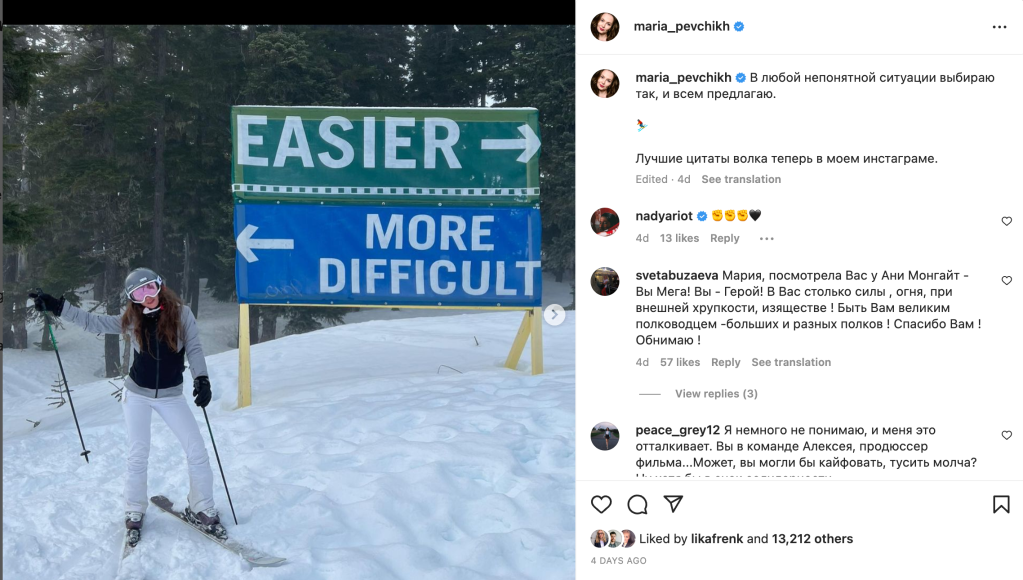

Maria Pevchikh: “In any puzzling situation this is what I choose and suggest that everyone else choose.” Source: Instagram

Now every employee of the Russian embassy in Germany has to think about Navalny on their way to work because they will see a replica of the solitary confinement cell where Alexei has been confined for the eleventh time.
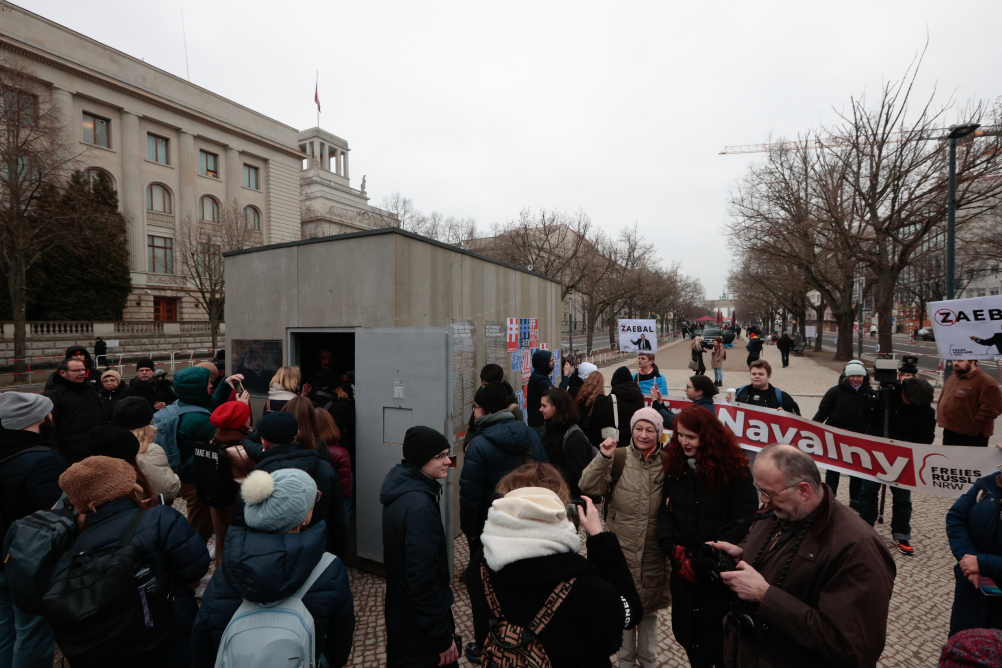
Not only embassy employees see this solitary confinement cell. It is seen by Berlin residents, tourists and journalists. It is seen by readers of the world’s major media outlets. Millions of people see it — and thus learn about the torture chamber in which Navalny is being held. Some will tell their friends about the project, others will join the Free Navalny campaign, while still others will put pressure on local politicians contemplating compromise with Putin. Circles radiate all over the world from this one site.

It is in your power to make these circles spread even wider. Help us achieve freedom for Navalny and for the whole of Russia — support our campaign at acf.international/#donate.

Free Navalny!

Thank you for being on our side! 

The Navalny Team

“Navalny has now been in prison for 745 days.”

Source: FBK (Anti-Corruption Foundation) email newsletter, 2 February 2023. Translated by the Russian Reader


Pevchikh: What Corruption Has Done to Russia / vDud
6,370,703 views • Feb 5, 2023
(In Russian, without subtitles in English — for the time being, I imagine)

Maria Pevchikh is an investigator and associate of Alexei Navalny.

0:00 Let’s go! 0:37 Why we met in London 5:13 How the film Navalny is saving Navalny’s life 9:36 Dud in the Internet’s homeland 13:03 How to turn a photo of a hallway into an investigation 16:17 What is going on with Navalny now? 20:26 The second largest house in the UK is owned by a Russian oligarch 25:30 But why can’t a Russian oligarch buy a house in London? 29:48 The UK is fighting Putin but harboring thieves: is that normal? 37:22 Who are you and where are you from? 42:31 Where did you get the money to study in London? 44:02 What’s wrong with Moscow State University’s sociology faculty 47:19 What did your father do for a living? 48:41 A crash course about British universities (eight lectures a week) 53:16 Alexander Dugin was Maria’s thesis advisor: how did that come about? 1:00:03 Does Putin listen to Dugin? 1:03:05 What Medvedev was like thirteen years ago 1:05:20 “My cat was hit by a car, please sort it out”: what British MPs do 1:08:22 Gadaffi’s son was at university with you 1:14:35 Where did you work before becoming an investigator? 1:16:32 Do you have a flat in London? 1:17:47 How did you meet Navalny? 1:22:50 Why didn’t you mention Skabeyeva and Popov’s mortgage? 1:27:28 How are drones able to fly over Putin’s and Medvedev’s residences? (A question from Nikolai Solodnikov) 1:33:14 Where did you get the conductor Gergiev’s bank statements? 1:36:32 Is it okay to pay a bribe to avoid mobilization? 1:40:54 What is your beef with Fridman? 1:48:13 Is Galitsky an accomplice of the regime? 1:57:18 Can we detest someone for being afraid? 1:58:26 Why does Popular Politics have such sensational headlines? 2:04:08 Is it okay to call a program guest a “fat beast”? 2:08:21 The rude tweet about Durov 2:10:21 Does radicalism prevent the Anti-Corruption Foundation from becoming popular? 2:16:09 Roman Abramovich is a master of reinventing himself 2:24:13 How soft power works 2:29:52 If Abramovich had ended the war would you have forgiven him? 2:31:38 The “List of the 6,000” 2:33:59 Why have you called for sanctions against Sobchak? 2:35:35 Why have you called for sanctions against Venediktov? 2:44:00 What did Oleg Kashin do wrong? 2:46:34 Why were the designers of a facial recognition system removed from the “List of the 6,000”? 2:51:01 Is your father an accomplice of the regime? 2:55:49 How do you do your work without Navalny? 2:57:18 Why were your supporters’ data hacked? 3:05:38 “Carry out a mission in the fight against Putin and get points”: what is that about?! 3:07:53 How do people who work for the regime change sides? 3:15:51 Do you see yourself as a politician? 3:19:44 Do you have a plan for Russia’s future? 3:25:09 Won’t the dictatorship in Russia survive without Putin? 3:30:20 Do you have a UK passport? 3:35:51 What exactly have you done over the past year to overthrow Putin? 3:41:21 “Compromisers” 3:52:07 Russia without Putin 3:56:58 What does it mean to be strong?

Source: vDud (YouTube). Annotation translated by the Russian Reader. Thanks to Tiina Pasanen for bringing this remarkable video to my attention and persuading me to watch it despite my initial misgivings. When I assembled the first part of this mash-up, a few days ago, I had no idea that Pevchikh and Dugin were so closely connected in real life. For another perspective on the sociology faculty at Moscow State University during roughly the same period as Pevchikh describes, see Oleg Zhuravlyov and Danail Kondov, “Towards a History of the Conflict in the Moscow State University Sociology Department” (2008). ||| TRR
Network Case Suspects Go on Hunger Strike

Network Case Suspects Go on Hunger Strike
OVD Info
December 2, 2018

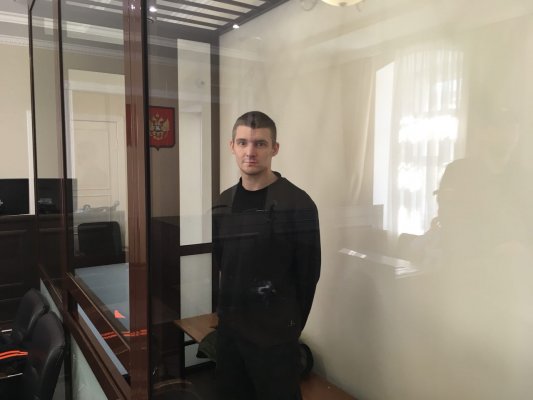
andrei chernovAndrei Chernov in court. Photo courtesy of Mediazona and OVD Info
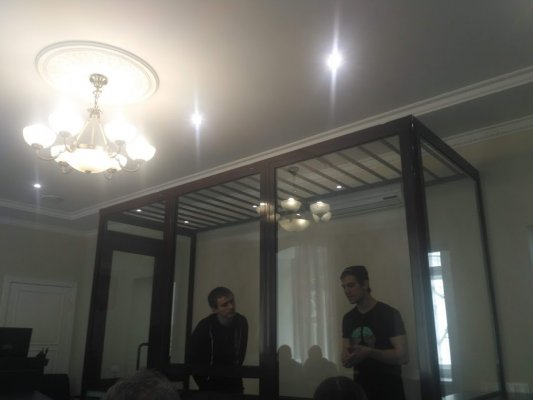
Dmitry Pchelintsev and Andrei Chernov, residents of Penza and suspects in the so-called Network case, have gone on hunger strike, claiming remand prison officials and FSB officers have intimidated them during their review of their criminal case file, something to which they are entitled by Russian law. Several Penza suspects in the case have claimed they have been put in solitary confinement, handcuffed to radiators, and threatened with violance.

Pchelintsev and Chernov went on hunger strike on November 29, as reported by the Parents Network, a support group established by the mothers and fathers of the young men, who have been accused of involvement in a “terrorist community” that, allegedly, was planning an armed uprising during the March 2018 presidential election and 2018 FIFA World Cup, held in Russia this past summer.

It was on November 29 that wardens put Pchelintsev in solitary, demanding he admit to breaking the rules by talking with other inmates during yard time. He responded by going on hunger strike, and Chernov joined him as a token of support and solidarity. On November 30, wardens again tried to bargain with Pchelintsev and threaten him.

The Parents Network notes that the pressure on their sons has increased now that the suspects are officially reviewing the case file.

Lawyer Anatoly Vakhterov told the group that Network case suspect Ilya Shakursky had been been visited by Penza Remand Prison Warden Oleg Iskhanov, who asked him how quickly he was reviewing the file. On November 20, immediately after the incident, Shakursky was reprimanded for greeting other inmates during yard time. The alleged violation was written up, and the same day Shakursky was issued a special uniform for his upcoming stint in solitary confinement. He managed to avoid going there by filing a complaint with Penza Regional Prosecutor Natalya Kantserova.

Earlier, Maxim Ivankin spent five days in solitary. This was proceeded by a visit from Warden Iskhanov, who likewise asked Ivankin how quickly he was reviewing the case file.

As the defense lawyers explained to the Parents Network, the suspects had been reviewing the case file not only at the remand prison but also at the local FSB office. Under Russian law, suspects may review case files for up to eight hours a day. Allegedly, the Network suspects were handcuffed to radiators and stairway railings the entire time. Vasily Kuksov and Arman Sagynbayev were handcuffed to each other. As the Parents Network has noted, the suspects not only experienced physical discomfort but were also unable to examine the case file freely and take notes.

Shakursky and Pchelintsev refused to go through the procedure in such conditions. In turn, they were threatened with violence. According to them, the man who threatened them was a certain A. Pyatachkov, who had been involved in torturing them when they were initially detained in the autumn of 2017.

Mikhail Kulkov said that after handcuffing him to the staircase, FSB officers videotaped him. As they filmed him, they said, “Look at Network terrorists reviewing the case file.”

The suspects requested their lawyers be present during the review. Consequently, the authorities stopped taking them to the FSB office. Currently, all case file materials are brought directly to the remand prison.

kuksov and pchelintsevVasily Kuksov and Dmitry Pchelintsev in court. Photo courtesy of Rupression and OVD Info

“Obviously, all these measures are methods of mental and physical violence,” argues Vakterov. “There are signs that the group of FSB investigators, led by Senior Investigator Valery Tokarev, have been putting pressure on the suspects. Why? To speed up the review process and make it impossible to verify the complaints of torture made by the suspects. They want to intimidate the lads, who are fighting back any way they can under the circumstances.”

These events have spurred the Parents Network to issue a communique, which we publish here in an abridged version.

We, the parents of the suspects in the Penza Case, bear witness to the numerous violations suffered by our children during their review of the case file.

To avoid allowing the time necessary to investigate the claims made by our sons that they were tortured by FSB officers, the group of investigators, led by Valery Tokarev, has done everything possible to speed up the process of reviewing the Network case file. To this end, the investigators have engaged in daily acts of emotional and physical violence against the suspects, to wit:

  1. Our sons have been prevented from reviewing the case file with their lawyers present. When they have attempted to refuse lawfully to review the case file, they have been subjected to physical preventive measures: they have been handcuffed to whatever metal structures came to hand and handcuffed to each other. During the review of the case file, at least one hand of each suspect has been handcuffed. These actions have prevented them from concentrating on reading the file and thoughtfully preparing to defend their rights in court. This testifies to the fact that investigators have doubts about the case, and so they would like to hand it over to the court as quickly as possible. 
  2. FSB field officers who were involved in torturing our sons have been among the people allowed to be present during the investigative case file review. They have been brought to the review to exert pressure on our children. The FSB officers in question have threatened them with physical violence if they refuse to continue with the case file review. The point of their actions is to speed up the review process, intimidate the suspects, and interfere with a potential investigation of the acts of torture they perpetrated. 
  3. Our demands that a lawyer be present during the proceedings and that the act of reviewing the case file not be hindered by handcuffing the hands of the suspects to tables, chairs, radiators, and stairways have led to our children being placed in solitary confinement, where they have once again been visited by FSB officers and investigators, who have tried to speed up the review process by threatening them. 

We speak constantly of incidents of torture. They say there is no smoke without fire. We are unfamiliar with the contents of the criminal investigative case file due to the nondisclosure agreement signed by all the defense lawyers. If our children have violated the law, they will answer to society to the full extent of the law. In the present circumstances, however, they are unable to answer to society. They answer to people who believe that physical violence, beatings, and electric shock torture can be legally used to make other people’s lives conform to the canons and stories that will get them new assignments and promotions.

It is impossible to defend the rights of our sons in the current circumstances. We cannot prove they were tortured. We have exhausted all the legal resources we have in Russia. But we, our sons, the Public Monitoring Commissions, reporters, civil rights activists, and politicians must and will go on fighting for the sake of one big goal: making the Russian legal and justice system more humane.

We call on Russian Federal Human Rights Ombusdman Tatyana Moskalkova, Mikhail Fedotov, chair of the Presidential Council for Civil Society and Human  Rights, and Yevgeny Myslovsky, a member of the council, to visit the Penza Case suspects. You are our last hope for help in combating torture in Russia. This joint task is our primary responsibility to society.

As we face the inevitability of double-digit sentences for our sons, we hope that all of us will have someone whose example will inspire us. It will be not the people who tortured our sons. Then none of this would make any sense at all.

The lawyers of the Penza suspects in the Network case say their clients have reached out to Tatyana Moskalkova and Mikhail Fedotov, asking them to visit and requesting their help in investigating the incidents of torture. Moskalkova and Fedotov have not yet replied to their appeals, although in November a member of the Presidential Council for Civil Society and Human Rights did visit the Petersburg suspects in the Network case.

[…]

Translated by the Russian Reader

***************

What can you do to support the Penza and Petersburg antifascists and anarchists tortured and imprisoned by the FSB?

  • Donate money to the Anarchist Black Cross via PayPal (abc-msk@riseup.net). Make sure to specify your donation is earmarked for “Rupression.”
  • Spread the word about the Network Case aka the Penza-Petersburg “terrorism” case. You can find more information about the case and in-depth articles translated into English on this website (see below), rupression.com, and openDemocracyRussia.
  • Organize solidarity events where you live to raise money and publicize the plight of the tortured Penza and Petersburg antifascists. Go to the website It’s Going Down to find printable posters and flyers you can download. You can also read more about the case there.
  • If you have the time and means to design, produce, and sell solidarity merchandise, please write to rupression@protonmail.com.
  • Write letters and postcards to the prisoners. Letters and postcards must be written in Russian or translated into Russian. You can find the addresses of the prisoners here.
  • Design a solidarity postcard that can be printed and used by others to send messages of support to the prisoners. Send your ideas to rupression@protonmail.com.
  • Write letters of support to the prisoners’ loved ones via rupression@protonmail.com.
  • Translate the articles and information at rupression.com and this website into languages other than Russian and English, and publish your translations on social media and your own websites and blogs.
  • If you know someone famous, ask them to record a solidarity video, write an op-ed piece for a mainstream newspaper or write letters to the prisoners.
  • If you know someone who is a print, internet, TV or radio journalist, encourage them to write an article or broadcast a report about the case. Write to rupression@protonmail.com or the email listed on this website, and we will be happy to arrange interviews and provide additional information.
  • It is extremely important this case break into the mainstream media both in Russia and abroad. Despite their apparent brashness, the FSB and their ilk do not like publicity. The more publicity the case receives, the safer our comrades will be in remand prison from violence at the hands of prison stooges and torture at the hands of the FSB, and the more likely the Russian authorities will be to drop the case altogether or release the defendants for time served if the case ever does go to trial.
  • Why? Because the case is a complete frame-up, based on testimony obtained under torture and mental duress. When the complaints filed by the accused reach the European Court of Human Rights in Strasbourg and are examined by actual judges, the Russian government will again be forced to pay heavy fines for its cruel mockery of justice.

***************

If you have not been following the Penza-Petersburg “terrorism” case and other recent cases involving frame-ups, torture, and violent intimidation by the Russian Federal Security Service (FSB) and other arms of the Russian police state, read and disseminate recent articles the Russian Reader has posted on these subjects.

Crimean Farmer and Political Prisoner Vladimir Balukh Has Been on Hunger Strike for 104 Days

Vladimir Balukh’s 100 Days: The Crimean Euromaidan Supporter Has Been on Hunger Strike in Remand Prison for Over Three Months
Anna Kozkina
Mediazona
June 27, 2018


Vladimir Balukh. Photo by Anton Naumlyuk. Courtesy of RFE/RL

Today [July 1, 2018] is the [104th] day of a hunger strike by Vladimir Balukh, who awaits a verdict in his third criminal trial in Simferopol Remand Prison. In 2014, he refused to accept Russian citizenship, raising the Ukrainian flag over his house in solidarity with the Euromaidan protests. The first criminal case against Balukh was opened in 2015. It would be followed by two more case. In the article below, Mediazona catalogues the persecution the Crimean activist has endured and describes his hunger strike, during which he has lost at least thirty kilos.

On June 22, 2018, Balukh, who is imprisoned in Simferopol Remand Prison, said he was returning to the harsher form of hunger strike and would now only be drinking water. Balukh had been drinking fruit drink for some time.

Olga Dinze, Balukh’s defense attorney, said the cause was increased pressure from prison wardens. In court, Balukh had spoken of regular searches of his cell, including at night. According to him, prison wardens and guard have hinted it was time for him to “go down in the hole,” i.e., be sent to solitary confinement.

The following day, Ukrainian human rights ombudsman Lyudmila Denisova requested Pierre-Emmanuel Ducruet, head of the International Red Cross’s Simferopol office, visit Balukh at the remand prison and secure professional medical care for him.

The Flag, Heaven’s Hundred Heroes Street, and the Insulted FSB Agent
In late 2013, Crimean farmer Vladimir Balukh raised a Ukrainian flag over his house in the village of Serebryanka in solidarity with the Euromaidan demonstrators. The flag stayed there after the March 2014 referendum. Balukh did not recognize Crimea’s annexation by Russia and refused to apply for a Russian passport.

Police and Russian Federal Security Service (FSB) agents first paid him a visit in the spring of 2015. Balukh was not home when they arrived. When he heard about the visit to his home by the security services, he stayed with friends for several days. The police and FSB searched Balukh’s house and also paid his mother a call.

The security services visited Balukh for the second time in November 2015. Claiming he was suspected of auto theft, they searched his house again. After the search, the farmer was charged with insulting a government official, a violation under Article 319 of the Russian Criminal Code. Allegedly, Balukh had used “foul, insulting language when addressing field agent Yevgeny Baranov, which the latter found unpleasant.” Balukh did not deny he could have sworn at the field agent, since FSB officers had punched him in the kidneys and stepped on his head after throwing him on the ground.

In February 2016, the Razdolnoye District Court found Balukh guilty, sentencing him to 320 hours of community service. Subsequently, the Crimean Supreme Court sent the case back to the lower court for review, but in June the district court reaffirmed its original guilty verdict, again sentencing Balukh to 320 hours of community service.

The Ukrainian flag was torn down from the farmer’s house again and again, but he put it back up every time. On November 29, 2016, the third anniversary of the Euromaidan protests, Balukh hung a sign on his house, identifying the address as “Heaven’s Hundred Heroes Street, 18.” Two weeks later, police and FSB carried out yet another search of his house. This time, they allegedly found eighty-nine rounds of ammunition and several TNT blocks in the attic. After the search, the flag and the street sign were removed from Balukh’s house. Balukh was detained and later remanded to police custody.

Balukh was charged with illegal possession of weapons and explosives (Article 222 Part 1 and Article 222.1 Part 1 of the Russian Criminal Code). The farmer claimed his innocence and said his political stance was the reason for the criminal prosecution. He claimed the rounds of ammo and explosives were planted during the search. Police allegedly found them in the presence of a single official witness.

The Memorial Human Rights Center designated Balukh a political prisoner. It noted that he had received clear threats after hanging the street sign on his home memorializing the murdered Maidan protesters.

“It was after this that the chair of the village council and his deputies visited Balukh’s home and threatened that his independent behavior would have unpleasant consequences, including the ‘discovery’ in Balukh’s house of weapons or narcotics. He demanded  Balukh take the sign down,” wrote Memorial.

Memorial argued that the prosecution had not proven the ammunition actually belonged to Balukh, since his fingerprints were not found on the items.

Vladimir Balukh’s House. Photo courtesy of hromadske.ua

“Go to Ukraine and Treat Your Back There”
On August 4, 2017, the Raznodolnoye District Court sentenced Balukh to three years and seven months in a medium security penal colony and a fine of ₽10,000 [approx. €136] for possession of the ammunition and TNT.

A week after Balukh was sentenced, he had a run-in with Valery Tkachenko, warden of the Razdolnoye Temporary Detention Facility. According to Balukh, Tkachenko punched him in the shoulder and tried to kick him as well. He also, allegedly, made insulting remarks about the ethnicity of Balukh and his parents. Balukh’s attorney filed a complaint with the police.

Two weeks later, the Investigative Committee opened a case against Balukh himself, claiming he had violated Article 318 Part 1 of the Criminal Code (violence against a state official). Subsequently, Balukh’s alleged actions were reclassified as a violation of Article 321 Part 2 (disrupting the operations of penitentiary facilities). According to police investigators, on the morning of August 11, 2017, Balukh had elbowed the warden in the stomach while his cell was being inspected. He then, allegedly, entered his cell and struck Tkachenko’s arm.

In November 2017, the district court commenced its review of the ammunition possession case, and in December Balukh was transferred from the remand prison to house arrest.  After complaining of pain in his back and groin, Balukh was soon taken to hospital straight from the courtroom.

At the district hospital, medical staff merely measured his blood pressure and gave him a cardiogram. After listening to Balukh’s complaints, the local doctor said, “My back hurts, too. Should I not go to work or what?”

Balukh asked the court permission to travel to Simferopol or Feodosia for a medical examination, but his request was turned down. During his December 27 court hearing, the ambulance was called several times due to Balukh’s temperature, high blood pressure, and back pain. According to the news website Krym.Realii, the head physician of the local hospital’s emergency department, Nadezhda Drozdenko, told Balukh, “Go to Ukraine and treat your back there.” When the hearing went on for ten hours, Balukh lay down on the floor due to the severe pain.

In early 2018, the court again found Balukh guilty on the ammunition possession charge and sentenced him to three years and seven months in a work-release penal colony. The verdict was upheld on appeal, although the sentence was reduced by two months.

Balukh was again sent to the remand prison. He has continued to complain of back pain, whose cause doctors have never been able to diagnose.

“He Has Adopted a Stance of Hopelessness”
After the Crimean Supreme Court upheld the verdict in the ammunition possession case, Balukh went on an indefinite hunger strike as of March 19, 2018. He gave up all food, only drinking water and tea, protesting what he regarded as the illegal verdict against him.

In late March, Balukh was assaulted in the remand prison and hospitalized in the infirmary, as reported by Aktivatika, who quoted defense attorney Olga Dinze.

“The hunger strike has been difficult for him. Besides, the prison wardens have engaged in constant provocations. They have brought him delicious food, enticing him to eat. It destabilizes him a bit, but he has hung and kept his word,” said the lawyer.

Vladimir Balukh on June 22, 2018. Photo by Zair Semedlyaev. Courtesy of crimeahrg.rog

In mid April, his social defender, Archbishop Kliment of Simferopol and Crimea, reported Balukh had been assaulted by guards.

A month later, Vladimir Chekrygin, an expert with the Crimean Human Rights Group, told Krim.Realii Balukh was under pressure in the remand prison.

“We know the guards at the remand prison have periodically threatened Balukh for his actions. They have told him that sooner or latter he would be punished for his willfulness. They have been doing searches in his cell night and mornings. Searches are permitted, but at certain hours and under extraordinary circumstances. They are not letting him rest,” Chekrygin explained.

On May 18, Russian human rights ombudsman Tatyana Moskalkova visited the Simferopol Remand Prison. She wrote to her Ukrainian colleague, Lyudmila Denisova, that Balukh had no complaints either about the conditions of his incarceration or cruel treatment.

In May, the Raznodolnoye District Court began hearing the third criminal case against Balukh, involving his run-in with the temporary detention facility warden. During the trial, even the prosecution’s witnesses, guards at the facility, testified Balukh did not assault the wardeb. During the investigation, the alleged victim refused to take part in a face-to-face confrontation with Balukh, who described his behavior in great detail to the judge.

“He would come to my cell and try to insult me, to humiliate me for being Ukrainian and thus, as he thought, for being a member of Right Sector. He would say us Ukrainians should be murdered as a species, and so on,” said Balukh.

On June 10, Balukh was again transferred from Razdolnoye to the Simferopol Remand Prison. There he was put in the “glass,” a narrow cell in which one can only stand or sit, for two hours, Crimean human rights defenders reported.

The following day, it transpired the remand prison wardens no longer believed Balukh was on hunger strike. The guards had learned Balukh was drinking not only water but also oatmeal kissel. Archbishop Kliment had persuaded Balukh to make the compromise a month after he started his hunger strike.

“Vladimir agreed. We know  he began consuming only kissel. Sometimes, he has honey and bread crumbs at most. At some point, the prison wardens found out about the kissel and decided not to recognize his actions as a hunger strike. There are special rules when wardens decide a prisoner has gone on hunger strike. They have stopped following these rules when it comes to Balukh, since they believe he is no longer on hunger strike. But Vladimir has continued his protest. He has lost thirty kilos of weight. The doctor from the remand prison infirmary has stopped making regular checkups of Balukh, although he is obliged to do so when inmates go on hunger strike,” explained Olga Skripnik, head of the Crimean Human Rights Group.

Protesting constant inspections in the remand prison, Balukh returned on June 22, 2018, to the original form of his hunger strike. He has again been only drinking water. Olga Dinze explained the frequent searches of Balukh’s cell as a consequence of Balukh’s having filed a motion to be paroled for his first criminal conviction.

On June 25, Dinze told Mediazona her client’s condition had taken a turn for the worse.

“I think Balukh has suffered a pinched nerve. It is a quite serious case. He has been experiencing severe pain in his chest, neck, and shoulder blades. He feels unwell all the time,” Dinze said, adding the new symptoms were probably due to long-term back pain.

According to Dinze, Balukh was not receiving medical care.

“He refuses cares from the doctors in the remand prison. They cannot give him the medical care he needs, diagnose him, and prescribe him appropriate treatment. He has requested doctors from the Red Cross,” said Dinze.

The defense attorney added that, after Balukh stopped drinking oat kissel, he was transferred to a cell in the general population, but the conditions there were decent. He currently has no complaints against the wardens.

Earlier, Dinze told Krym.Realii Balukh had been hoping for a prisoner exchange.

“Vladimir is quite weary. He is emotionally exhausted. He has adopted a stance of hopelessness. He says no one will ever release him from prison. If they cannot keep him in prison on the current convictions, there will be new charges. So now he is finally talking. For the last few months we have been talking about how, if there is a prisoner exchange and everything goes well, he would really, really like to go to mainland Ukraine,” said Dinze.

The Ukrainian authorities have recently repeatedly stated their readiness to exchange Russian convicts for the sixty-four Ukrainian nationals imprisoned in Russian remand prisons and penal colonies, including Balukh and filmmaker Oleg Sentsov, who has been on hunger strike since mid May.

Closing arguments in Warden Tkachenko’s case against Balukh have been scheduled for July 2.

Thanks to Yegor Skovoroda for the heads-up. Translated by the Russian Reader

The Continuation War

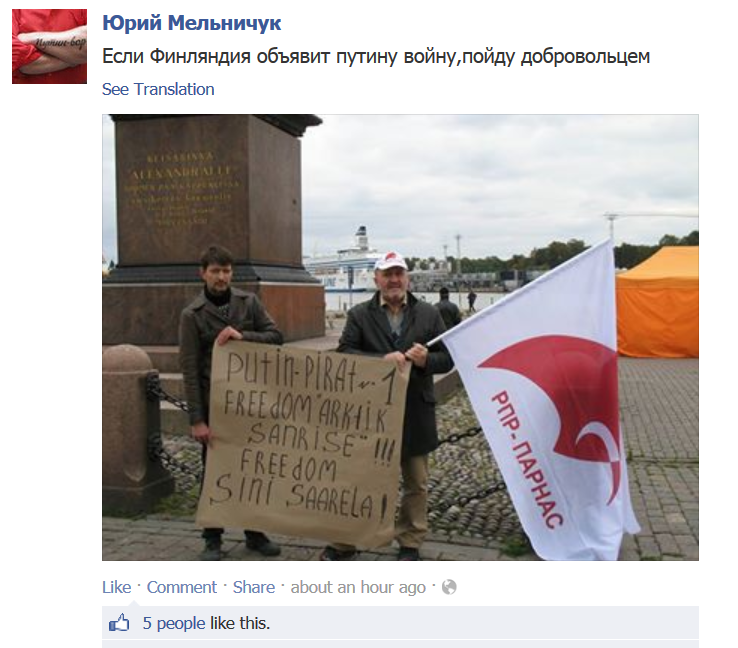
-1Yuri Melnichuk: “If Finland declares war on Putin, I’ll volunteer.”

Things don’t look good on that front, Yuri:

Finnish President Greets Russian President in Russian
Jun 26, 2013

The presidents of Finland and Russia, Sauli Niinistö and Vladimir Putin, met at the residence of the Finnish leader in Turku, RIA Novosti reports. “Very beautiful and pleasant weather. That is a good signal for Moscow,” Niinistö said in Russian when greeting Putin.

“We recently recalled out previous meeting and it became clear that certain results and progress is apparent in the achievement of what we agreed upon then,” the Finnish president continued. Vladimir Putin in turn admitted that since childhood he has known a handful of Finnish words, albeit not enough for conversation. He also pointed out the St. Petersburg and Turku have been closely connected for many years.

Vladimir Putin participated in events honoring the 60th anniversary of the sister city relationship between St Petersburg and Turku, the Kremlin press service reports. In addition, a ceremony was held at one of Turku’s central squares, where a plate with. Mr Putin’s name was laid in recognition of his efforts to protect the Baltic Sea environment.

The President of Russia was also presented with a Turku city medal. The medal is given to political and public figures for their services to the city, as well as the heads of foreign nations who make a major input into developing relations between their nation and Finland on arrival to Turku.

Russkiy Mir Foundation Information Service

Source

_____

The Lentua Nature Reserve is part of the Friendship Park, which consists of five separate nature reserves. The Friendship Park is the Finnish part of the Finno-Russian Friendship Nature Reserve. The emblem of the Friendship Nature Reserve features two wild forest reindeer, reflecting the friendship between the two countries and their cooperation for the benefit of nature conservation. One of the fundamental goals of the Friendship Nature Reserve is to protect the wild forest reindeer (Rangifer tarandus fennicus) and its habitats, which makes this animal a natural choice for the emblem.

Source

Thanks to Sergey for the whole thing (or most of it).

Nadezhda Tolokonnikova: Day Two of the Hunger Strike

PC-14, Day Two of the Hunger Strike

Thank you to everyone who did not remain indifferent to the slave-like living and working conditions in this penal colony and who spoke out in support of me and my demands.

Yesterday, at 9:30 in the evening, I was transferred to a solitary confinement cell, which PC-14’s warden, Colonel Kulagin, calls a “safe place.” I opposed the transfer because I do not consider my being put in a “safe place” an adequate solution to the problem. My relations with my fellow inmates are fine when the administration isn’t attempting to artificially turn them against me. Problems arise for me when the administration uses certain inmates to intimidate me and try and force me to keep my mouth shut, for instance, by threatening to “fuck [me] up and kill [me].”

The greatest threat to my welfare comes from the prison administration. Especially now, when I am breaking through the informational blockade, writing about the illegal conditions in the prison that no other PC-14 inmate has dared to speak openly about for fear of finding herself under incredible duress for the remainder of her time in prison.

In solitary confinement, I am alone against the administration. To me, this does not seem like a safe place.

It is incredibly cold in solitary confinement. It’s an old method, well known to camp administrations since Soviet times. They make the solitary confinement cells so cold that punishment turns into torture. The only difference between myself and someone who is forced into solitary as punishment is that I do not have to wear a special orange uniform. I can keep my regular prison clothes. But even five layers of sweaters do not protect me from the piercing cold.

I am writing on a cold, narrow bench. I am not allowed to sit on the bed, and especially forbidden from lying on it. It is very hard to sit in the cold all day while on hunger strike. My body temperature is low and I’m dizzy. The light is cold and dim, and the water in the faucet is cold, too. This is what solitary confinement is like.

I believe that in order to avoid further persecution from the PC-14 administration, I need to be transferred to another prison colony. It’s clear to me that the camp administration here will spend the remaining five months of my incarceration taking revenge on me for creating problems for them.

Nadezhda Tolokonnikova
Solitary Confinement Cell, PC-14
September 24

Translated by Bela Shayevich