One day, I hope, someone will explain to me why “progressive” Russians find the English words speak, speaker, speech, etc., so sexy and exciting that they have to incorporate them needlessly into Russian every chance they get.
Do they know that, in English, these words are less evocative than three-day-old bread, duller than dishwater?
In this case, hilariously (and awkwardly, too: “speak” appears after chas, generating an awkward phrase that translates as “hour of speak” or “speak hour,” although it’s supposed to be a play on the idiomatic phrase chas pik, meaning “rush hour”), the word “speak” adorns Sergei Medvedev’s reflections on the “imperialist mindset.”
Indeed.
Thanks to TP for this gem of Rusglish.
Below, you can watch the actual interview (in Russian, not Rusglish — well, almost), which, if for no other reason, is interesting because it was posted almost three months before Russia invaded Ukraine. ||| TRR
Historian and writer Sergei Medvedev is the program’s guest.
In an interview with Nikita Rudakov, he explained:
Why the idea of Russia’s “civilizational superiority” is so popular
Why propaganda encourages the ideological complexes of Russians
How the elite of the 2000s is trying to turn back history.
00:00 Chas Speak: Sergei Medvedev 01:40 The imperialist mindset and the idea of Russia’s greatness 06:10 Is there no place for nationalism in the imperialist mindset? 08:05 “Russia colonized itself” 14:03 The superiority of big ideas: why didn’t the USA become an empire? 21:02 The ideological complexes of Russians 25:41 “We rise from our knees via military achievements and parades on Red Square” 26:50 “Lukashenko does with us what he will”: Russia and Belarus 30:56 “Russia wants to live in the myth of 1945” 34:40 “We were unable to create a nation state”
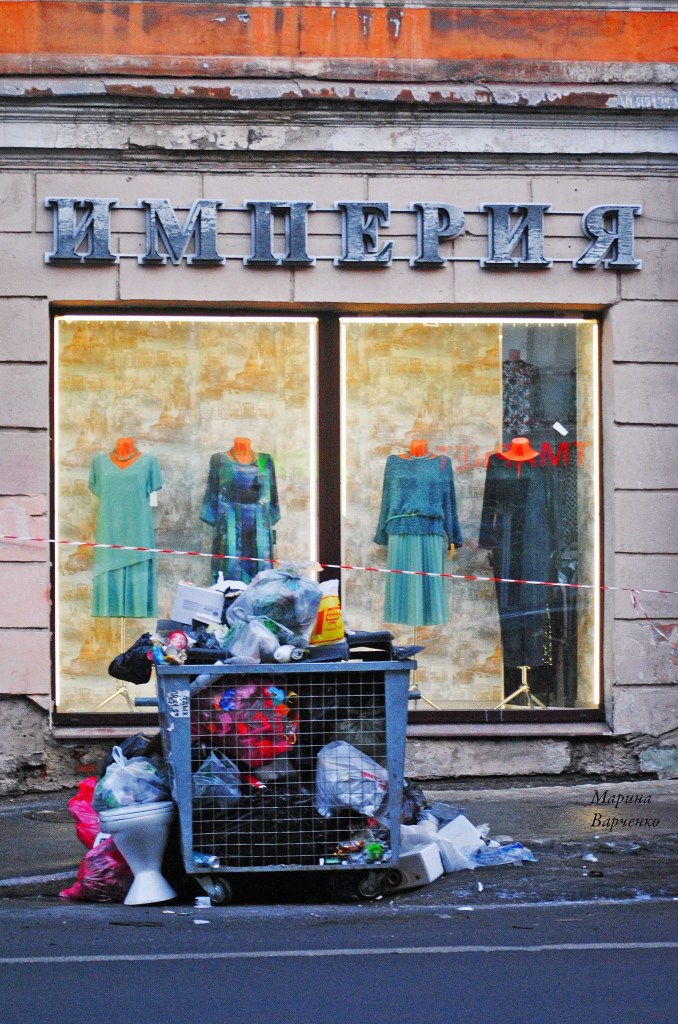
Today, on Razyezhaya, I came across a simply perfect illustration of what we’re living through.
Source: Marina Varchenko, Facebook, 25 December 2022. Razyezhaya is a street in central Petersburg that I know like the back of my hand since I lived nearby for many years. ||| TRR
These comments by Mira Tai were published by Doxa, the Russian online student magazine that has become a prominent voice against the war.
Hello! It’s Mira.
The full-scale Russian invasion of Ukraine has compelled many people, who live in Russia but are not ethnic Russians [russkie], to think about how we actually became the “small peoples of Russia” [a widely used term for the non-Russian nationalities that make up about one fifth of Russia’s population]. We saw many parallels between the way that the “Russian world” is trying to swallow up independent Ukraine, and the way that the ethnic republics “voluntarily became part of Russia” previously.
We have seen how the state, in which openly-declared nationalists hold leading posts in government bodies, justifies the massacre of citizens of a neighbouring country as “denazification”. We have seen how the propaganda machine is speaking openly about the renaissance of a gigantic centralised empire, in which there is no identity except Russian, and no other language than Russian.
These months have made all of us pose a mass of difficult questions, to ourselves and to each other. And no matter how hard the Russian propaganda machine tries to ridicule or denigrate this process, it will not be stopped and not be turned back – because we have changed. The surge of anger among non-Russian people has gone too far. The genie will not be put back in the bottle.
And the further it goes, the more astonishing it becomes that the majority of prominent Russian liberals and representatives of the “anti-Putin resistance”, continue to ignore what is happening. A great example is the new educational project, “Renaissance” [“Vozrozhdenie”], which opened today [23 December] and which has been loudly advertised on Ekaterina Schulmann’s Youtube channel over the last few months.
For the project, nine men and Ekaterina Schulmann invite people to take courses on the theory of democracy, capitalism and protest, the history of Christianity, and so on. They promise that in future this knowledge will facilitate the working-out of “a strategy for the Russian state, rebuilt and reborn as the inheritor of Russian, European and world culture”. Judging by the visual images chosen – golden-haired young women in Monomakh caps [the crown symbol of the pre-1917 Russian autocracy], gold leaf and portraits of monarchs – the school’s founders are especially inspired by the aesthetics of the Russian empire.
In a video in the section “About Us”, the word “civilisation” appears together with a picture of a young, rouged Ekaterina the Second [usually Catherine the Great in English-language history books] – the empress who first seized Crimea and began the process of genocide against the Crimean Tatars. That same Ekaterina, whose army slaughtered the population of whole towns in the name of the country’s “growth”.
And so in the tenth month of the full-scale Russian attack on Ukraine, we continue to witness how Russian liberals ignore any consideration of decolonisation. They do not even pose questions about the ideas and interests of those who have not been, and do not want to be, “inheritors of Russian culture”. They have not been troubled by doubts about the abstract liberal ideals of “democracy, freedom and peace”; they have no hesitation in proposing “Europe” as the source of progress, as opposed to the east. One of the courses offered by “Renaissance” is titled, in the best traditions of orientalism: “The East: a delicate matter”. …
People who can today link the word “civilisation” with portraits of Ekaterina the Second and festive, gold-trimmed panoramas of Moscow and St Petersburg, and who can promise the “renaissance of Russia”, must be blind and deaf to the suffering, and the hatred, of the Chechen people, who were subjected to genocide by the nearly-democratic Moscow of the 1990s. Blind and deaf to the hatred, and suffering, of the Ukrainian people, subjected to genocide by the authoritarian Moscow of 2022. Blind and deaf to the hatred, and suffering, of everyone whose first language definitely should not have to be Russian. And this lack of feeling is monstrous.
□ These comments appeared in Doxa’s Anti-War Digest on 23 December. I have translated them, because I think they offer useful starting-points for discussion about “decolonisation” of Russia that has begun not only among anti-war Russians, but also among those elsewhere who take the side of Ukrainian resistance. With Mira Tai, we witness “how Russian liberals ignore any consideration of decolonisation” – and, I would add, some self-proclaimed socialists do the same. One such is the writer and publicist Boris Kagarlitsky, who is to teach courses for “Renaissance,” and appears in its introduction video. He expressed opposition to this year’s invasion, but only after years of support for Russia’s imperial adventure in Ukraine since 2014 (for which he was criticised on this blog and elsewhere). SP.
□ To read more about Doxa in English, see an interview with Doxa activists just published by the Ukrainian socialist journal Spil’ne (Commons), and these speeches from the dock by Doxa editors Armen Aramyan, Volodya Metelkin, and Natasha Tyshkevich. They were tried on criminal charges last year, after publishing a video that discussed whether teachers should discourage students from attending demonstrations to support Alexei Navalny, the anti-corruption campaigner. (Doxa’s new website is in Russian.)
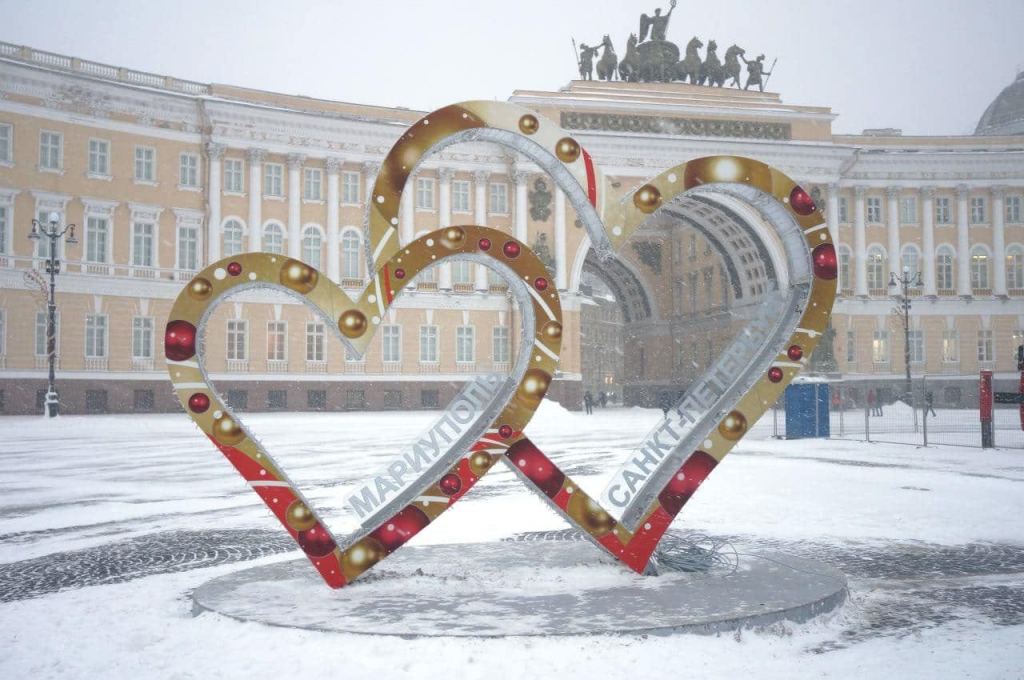
“Mariupol. Saint Petersburg.” A snapshot purportedly taken earlier today by Tatyana Razumovskaya (see her Facebook post, below).
The LED composition “Double Hearts” has been installed on Palace Square in honor of the sister city relationship between Petersburg and Mariupol, as reported on the city’s VK page.
The “Double Hearts” project was approved by Governor Alexander Beglov. Earlier, the installation was on display in a Mariupol city park. It symbolizes the unity, friendship, and love between people living in the sister cities.
Earlier, 78.ru reported that Petersburg authorities would hold a “Wish Tree” event for children from Mariupol.
Palace Square right now. It’s a three-minute walk from here to the house where I grew up and the school where I studied. Right there is the Hermitage, where I used to work.
I wish this were a dream and I could wake up.
Source: Tatyana Razumovskaya, Facebook, 13 December 2022. Thanks to VG for the heads-up. Translated by the Russian Reader
Alexander Andreyev from St. Petersburg has been killed in the military operations in Ukraine. In 2020, he graduated from School No. 368 in the city’s Frunzensky District. The school administration reported the news on its VK page.
During his school years, Andreyev was the captain of the 368 Superheroes volunteer group, and “from the very beginning he was eager to defend his Motherland,” reports the school’s VK page. In the summer, the young man went to serve and was enlisted in the 76th Pskov Airborne Division, the page reports. Later, he signed a contact, and in early October he was sent to the war zone, the post says.
Alexander was killed on October 18, according to the school administration, when the observation post where the soldier was located came under mortar attack. Andreyev was awarded the Order of Courage and buried in the Avenue of Heroes at Babigon Cemetery, the message says.
This is at least the fourth known death of a Petersburger in the war in Ukraine. Earlier, a school teacher from Petersburg, physical education teacher Vadim Sedov, was killed there. In addition, in the first week of October, Andrei Nikiforov, a member of the Nevsky Bar Association, was killed near Lisichansk. In mid-November, news arrived of the death in Mariupol of Konstantin Simonov, a Petersburger who volunteered to fight in March.
The Smolny [Petersburg city hall] is considering three options for special parking permits for residents of the Admiralty District [rayon], Fontanka.ruwrites. On November 1, paid parking was introduced there, and locals were given the option to park their cars in their municipal precinct [okrug] for 1,800 rubles a year, the online media outlet reported.
Petersburgers recalled that residents of the Central District use similar permits throughout its territory, and not only in their own [smaller] municipal precincts, Fontanka.rureports.
As the media outlet’s journalists have written without specifying their source, there are now three possible options for how paid parking will work for Admiralty District residents:
— everything will remain as it is: supporters of this proposal say that permits are needed so that a person can park outside their house for free, while trips around the district only increase traffic, which is what the reform is meant to combat
— the validity of permits will extend to the entire district: proponents of this idea believe that such innovations will soften the public outcry
— residents of the Admiralty District will be able to choose another district in which their permits are valid, giving them the opportunity to travel around nearby districts without worrying about paying for parking.
According to the media outlet, the Smolny will make a choice in the coming days.
Paid parking was introduced in the Admiralty District on November 1. Now those who want to park their car here have to pay 39 or 100 rubles per hour, depending on the type of vehicle, or buy an expensive monthly or annual pass.
But for those who live in the district, the authorities have introduced special annual parking permits that cost 1,800 rubles a year, but are valid only in the municipal precinct in which the motorist owns property or is registered to live. To park a car in any other municipal precinct, one has to pay the standard fare.
On December 9, our country celebrates Day of Heroes of the Fatherland. On this day, Heroes of the Soviet Union, Heroes of the Russian Federation, and recipients of the Order of St. George and the Order of Glory are honored.
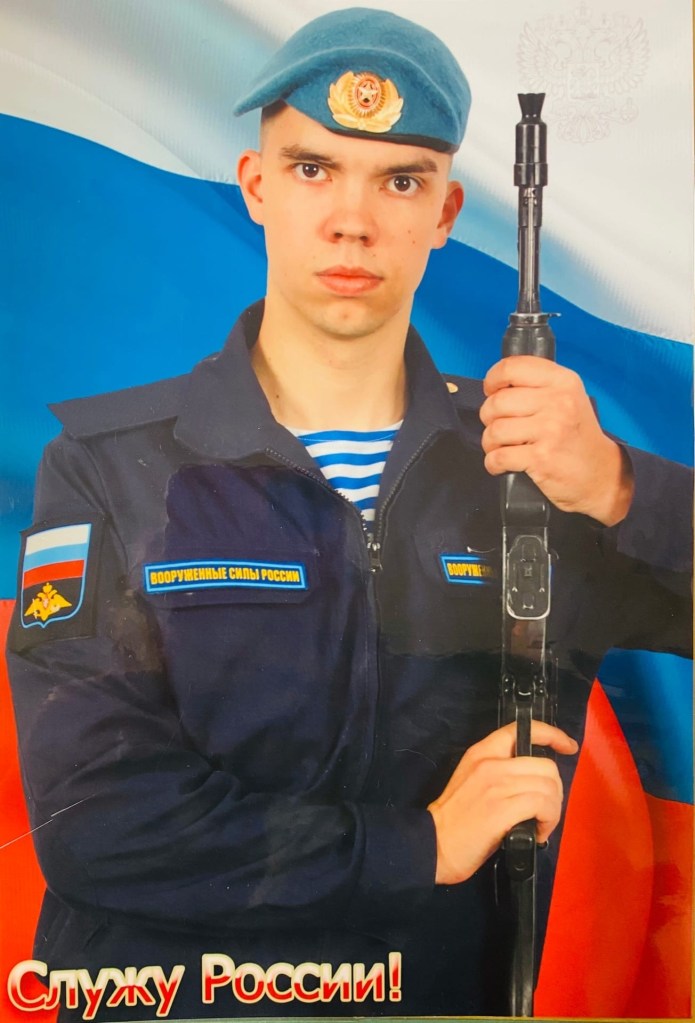
And on this day we want to tell you about a hero of our time, Alexander Igorevich Andreyev, a graduate of our school.
ALEXANDER IGOREVICH ANDREYEV
During his school years, Sasha was the team captain of the 368 Superheroes volunteer movement.
From the very beginning of the SMO, he sought to defend the Motherland. In the summer he went to serve and was able to enlist in the legendary Pskov 76th Airborne Division.
He signed a contract [as a volunteer] and just recently, in early October, was deployed in the special military operation.
On October 17, his unit was involved in heavy combat. When a comrade’s machine gun jammed, Alexander covered him before he himself attacked the enemy’s positions, thus contributing to the further advance of the paratroopers. By the end of the day, an enemy fortification had been captured. The next day, October 18, Alexander was at an observation post when the enemy opened fire with a mortar. He was hit by a shell and fatally wounded.
He died at his combat post. He was twenty years old.
By decree of the President of the Russian Federation, Alexander Andreyev has been awarded the Order of Courage.
Alexander is buried at the Babigon Cemetery on the Avenue of Heroes.
May the memory of this Russian Hero, friend and faithful comrade live forever.
We will never forget you!
Source: Secondary School No. 368 Frunzensky District of St. Petersburg, VK, 9 December 2022. Image of Alexander Andreyev courtesy of School No. 368. Translated by the Russian Reader
Petersburg is all gussied up in sparkling joyful lights. The holiday is coming to our town.
I have just read a letter from an acquaintance in a neighboring country:
“There has been no electricity in my city for almost a month. Previously, it was on for four hours a day, then for two, and then for one to two hours every few days. The last time the electricity was on was Friday for two hours. There are no schedules: it can be turned on at three a.m. when everyone is asleep and you just miss it. Along with electricity, there is also no water and heating, although it’s winter outside. Since electricity is provided for one to two hours every few days, it is only at this time that the cellphone tower begins to send out a signal. The rest of the time there is no mobile connection or internet. We have been plunged into the nineteenth century and life has come to a grinding halt.”
Source: Sergey Abashin, Facebook, 13 December 2022. Photo, above, by the author. Translated by the Russian Reader
The main problem with TV Rain is that neither its staffers nor its defenders really understand what the problem with it is.
It is especially funny when people who have been stumping for years for “situational cooperation with the regime in the Kremlin for good ends” are outraged by the revocation of TV Rain’s license.
Sooner or later, they’ll get round to you, too.
“Moderate law-abiding protest” in Russia isn’t worth anything at all, basically. Its value is negative, rather. It does not give one the moral high ground and does not empower one to write off errors. On the contrary. And those who want to continue the policy of compromise shouldn’t be offended that no one regards them as a real opposition and sees no value in them.
[TV Rain’s broadcast was revoked] not because “there are such laws in Latvia”, or because “they are traumatized due to the occupation,” or because [the Latvians] suffer from “Russophobia.”
[It happened] because the real value of “moderate” oppositionists who even in exile remain loyal to the pro-regime “silent majority” is close to nil.
Since they do nothing to bring Russia’s defeat closer even by a second, they perform no important political, humanitarian or military function.
They are thus useless.
Source: Aleksandr Fukson, Facebook, 6 December 2022. Translation and photo by the Russian Reader
The “[TV] Rain Case” has wound up sadly, at the end of the day. After the revocation of its license, the channel’s editorial team had a good opportunity to apologize once again to the audience, to the large group of Russian opposition media located in Latvia, and to the Latvian government and the European Union as a whole, which have been supporting Russian media in exile, and to announce that the editorial team hopes that the license would be restored.
But that’s not what happened. What did happen was much, much worse. Moscow imperial haughtiness came pouring out of all the cracks. For Moscow journalists are “citizens of the world,: and so they are empowered teach other peoples to respect human rights, including “freedom of opinion.” [TV Rain editor-in-chief] Tikhon [Dzyadko] shot off his mouth about the “absurd decision” for some reason. It’s just a mystery: Tikhon is smart, after all, and all of them are quite sensible there, and TV Rain is an essential media institution and does its job well. Why do they have to talk arrogantly to the government of Latvia?
Over the last twenty-four hours, TV Rain’s liberal well-wishers have written tons of disparaging, mocking posts about Latvia, which “is trampling” [on the rights of Russians], etc. They say that it is impossible to relocate there, that the folks in the former outskirts of our empire don’t like us. Well, no fucking wonder, eh?! No, we shall never get over this haughtiness. You knock yourself out trying to argue that it is possible to “recycle experience” and stop this haughtiness, when — oops! —all your work is nullified. Apparently, those who say that we just have to raze the whole MSK down to the foundations are right. Otherwise, there will be no life for anyone.
Source: Alexander Morozov, Facebook, 6 December 2022. Translated by the Russian Reader
It’s impossible, of course, to look at all the Russian chutzpah about “Latvia helped Putin today.”
In the summer, Latvia transferred 200 million euros worth of weapons and uniforms to Ukraine. This is just from what I remember offhand. They also sent six self-propelled howitzers and six helicopters. For Latvia’s small military budget, this is a lot, in relative terms.
What has the Russian opposition sent to Ukraine? Their fervent greetings? The demand not to offend them on the internet? Maxim Katz’s program?
Latvia has already done much more for [a Ukrainian] victory than all the TV Rains and Katzes combined, just millions of times more.
Source: Dmytro Raevsky, Facebook, 6 December 2022. Translated by the Russian Reader
Latvia’s decision Tuesday to withdraw the broadcast license of independent Russian television channel Dozhd caused disbelief and anger among the media outlet’s journalists and soul-searching among other Russian journalists in exile.
The Baltic country’s media watchdog said in a statement announcing the revocation that Dozhd posed “threats to national security and social order” following a series of fines issued over the outlet’s coverage of the war in Ukraine.
“I’ve been fighting for all these years to remain human in any situation… [but] I feel like a disgusting scoundrel,” Dozhd co-founder Natalia Sindeeva said between sobs in a video posted to her Telegram channel after the announcement.
“The entire TV channel is at stake.”
While Dozhd has yet to announce its response, the Latvian decision poses difficult questions for other independent Russian media outlets forced into exile in the wake of Moscow’s invasion of Ukraine.
Dozhd was one of a group of independent Russian media outlets that re-established themselves abroad after the passage of repressive wartime censorship laws earlier this year, with many congregating in the Latvian capital.
Other independent Russian media outlets based in Riga include Meduza, the BBC Russian Service, and Novaya Gazeta Europe.
“It’s a very bad sign for journalists,” said one reporter from a Russian-language media outlet that moved to Riga after the start of the war who requested anonymity as he had been told not to comment on the Dozhd situation.
“Journalists obviously cannot go back to Russia where they are threatened with criminal prosecution. But they are also unlikely to be able to work quietly in Latvia.”
Many would “think of moving to another country as soon as they have the opportunity,” said another Russian journalist in Latvia who also requested anonymity.
Dozhd first came under fire when anchor Alexei Korostelev last week asked TV viewers to send information on Russia’s drafted soldiers and mistakes during the mobilization. The channel was subsequently fined for displaying a map showing annexed Crimea as part of Russia and for calling the Russian Armed Forces “our army.”
Some Ukrainian and Latvian commentators interpreted Korostelev’s words as an expression of support for Russian troops in Ukraine.
The Latvian authorities opened an investigation into Dozhd on Friday, saying that “the statements made in the program are directed against the interests of Latvia’s national security.” The Latvian National Electronic Mass Media Council (NEPLP) on Tuesday also called for a ban of Dozhd’s YouTube channel in Latvia.
Latvia’s State Security Service urged the authorities on Tuesday to bar Korostelev from entering the country, adding that it also warned Dozhd editor-in-chief Tikhon Dzyadko of possible “criminal liability in case of committing criminal offenses.”
“Today’s decision is absurd and it has nothing to do with common sense,” said Dzyadko during Tuesday’s live news show.
“When you are switched off the air for far-fetched reasons for the first time — it is perceived as a tragedy,” Dzyadko said, referring to the channel’s removal from Russian cable packages in 2014.
“When eight years later you are called a threat to the national security of Latvia — it is perceived as a farce,” he said.
Dozhd — which started broadcasting from Latvia in June after its staff fled Russia — said it would continue to broadcast on its YouTube channel. The channel also has offices in Tbilisi and Amsterdam.
Korostelev, who was fired by Dozhd for his words, said on Friday that they had been no more than “a slip of the tongue.”
Despite his protestations, his words have caused widespread anger, however.
“When ‘good Russians’ are helping ‘bad Russians’ — can the world finally understand that they are all the same?” Ukrainian Culture Minister Oleksandr Tkachenko wrote on Telegram on Friday.
Over the weekend, at least three journalists resigned from Dozhd to show their solidarity with Korostelev, while others told The Moscow Times that the current situation reminded them of the crackdown on opposition media in Russia and would ultimately only help Moscow push its pro-war narrative.
“It was the worst thing we could do in that situation… I want to say sorry,” Sindeeva said in an emotional video statement on Tuesday after the revocation of the license, in which she also asked the fired journalists, including Korostelev, to return.
International media watchdog Reporters Without Borders (RSF) urged Latvia on Tuesday to rethink its decision.
“Dozhd is one of the few independent channels with Russian journalists broadcasting to the Russian-speaking public,” Jeanne Cavelier, the head of RSF’s Eastern Europe and Central Asia desk, said in a statement.
“The withdrawal of its license would be a serious blow to journalistic freedom, independence and pluralism.”
Some Ukrainian officials also expressed their support for Dozhd.
“They explained their position absolutely clearly, that their position is anti-war and pro-Ukrainian,” Ukrainian President Volodymyr Zelensky’s adviser Mykhaylo Podolyak said on Tuesday.
Latvia’s decision to revoke Dozhd’s license would make it harder to report “truthful and objective information for Russian-speaking audiences,” a Russian journalist in Latvia, who requested anonymity, told The Moscow Times.
“That is exactly what the Kremlin is trying to achieve.”
Source: “Latvian Decision to Revoke Russian TV Station’s License Sparks Fear, Disbelief,” Moscow Times, 6 December 2022
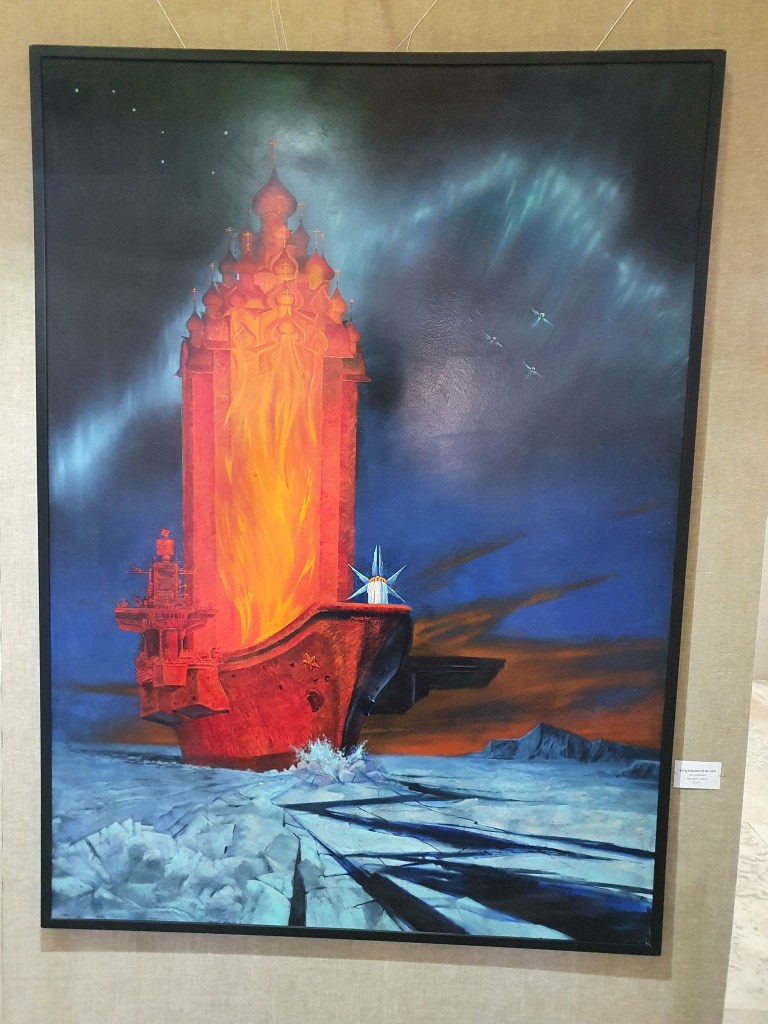
“Russian angel carrier, Artillery Museum, Saint Petersburg.” Source: Pavel Pryanikov, Facebook, 6 November 2022
Alexander Kharichev, head of the Presidential Department for Supporting the Work of the State Council, and three other experts have published a scholarly article entitled “Perception of basic values, factors, and structures of Russia’s socio-historical development, as based on research and testing.” As part of the study, seventy people from the student bodies of Moscow State University and the Higher School of Economics and the teaching staff of a conference in Sevastopol [sic] were interviewed. Among the metaphors of the future they proposed was the burnt second volume of Dead Souls; among the concepts of the modern state, “the Motherland with a laser sword”; among the concepts of the future, “Russia as the world’s ‘guardian of good” and “Pasty” [sic: “Pirozhok”]. The authors concluded that the dominant value for the Russian family is the people of Russia, which itself is a “family of families.”
Mr. Kharichev’s co-authors were Andrei Shutov, dean of the faculty of political science at Moscow State University; Andrei Polosin, doctor of political science and head of Rosatom’s regional interaction department; and Ekaterina Sokolova, deputy executive director for strategy and forecasting at the Expert Institute for Social Research. The article was published in October in the Journal of Political Studies.
The study was conducted by means of group discussions from March to May. The seventy participants answered questions about what Russian statehood is, what would happen to the country in ten years, what our future is, and a number of others.
Based on the discussions, the researchers formed a five-level “pentabasis”: person—family—society—state—country. Dominant values were formed for each level. For the country, [this dominant value] is patriotism; for the state, it is trust in the institutions of power; for the family, it is the people of Russia; for society, it is harmony; for the person, it is creativity. “The thesis was voiced that European society is individualistic, whereas our main value is family + family with friends, which leads to the emergence of the thesis ‘family as a level.’ The dominant value: the people of the Russian Federation as a family of families. Stimulating the birth rate and the concept of a ‘big family,’ the article says [just as incoherently in the original as in this translation].
Metaphors of Russia’s future. “The state as a novel” (written collectively by citizens, it has alternative endings); “the Russian future as the second part of Dead Souls, burned by Gogol,” “the state as the Firebird.”
Concepts of the modern state. “[The] Motherland with a laser sword” (a source of pride for the Russian spirit and a guide to the future), “the friendly service state.”
Messianic concepts of the future state. “Russia as a ‘prophet country’ (opposed to the Grand Inquisitor), “Russia as the world guardian, the ‘guardian of good.'”
Idealistic concepts of the future state. “Wondrous City” ([i.e., promoting] inclusivity, coexistence, acceptance of others as equals; “in no case to be confused with the term ‘tolerance'”), “Pasty” (harmoniously combines different things).
Mechanistic concepts of the future state. “Kaleidoscope” (a multifaceted future), “a medium-sized magnet state” (generates a field for a particular community).
The study participants concluded that the person in the “Russia of the Future” is “proud of his country, influential and highly employable, financially secure, [and] free within certain community rules.” According to the authors of the article, the ideas of self-realization in the Russian Federation are very different from those common in the Western world.
“In the Russian case, self-realization or mission means that an individual contributes to the country’s development. Capitalizing [on one’s] mission is an optional stage,” the authors write.
What are we fighting for? Russia is a huge, rich country. We don’t need foreign territories; we have plenty of everything. But there is our land, which is sacred to us, on which our ancestors lived and on which our people live today. And which we will not surrender to anyone. We are defending our people. We are fighting for all of our own people, for our land, for our thousand-year history.
Who is fighting against us? We are fighting against those who hate us, who ban our language, our values, and even our faith, who spread hatred towards the history of our Fatherland.
A part of the dying world is against us today. It consists of a bunch of crazy Nazi drug addicts, the common people they have drugged and intimidated, and a large pack of barking dogs from the western kennel. They are joined by motley pack of grunting piggies and narrow-minded philistines from the disintegrated western empire with saliva running down their chins due to degeneration. They have no faith and ideals, except for the harmful vices they have contrived and the standards of doublethink they impose, which deny the morality bestowed on normal people. Therefore, by rising up against them, we have gained sacred power.
Where are our former friends? We have been abandoned by some frightened partners — and I could not give a flying crap about them. That means they were not our friends, but just random fellow travelers, clingers, and hangers-on.
Cowardly traitors and greedy defectors have bugged out for the back of beyond — may their bones rot in a foreign land. They are not among us, but we have become stronger and purer.
Why were we silent for a long time? We were weak and devastated by hard times. And now we have shaken off the sticky sleep and dreary gloom of the last decades, into which the death of the former Fatherland had plunged us. Other countries have been waiting for our awakening, countries raped by the lords of darkness, slaveholders and oppressors who dream of their monstrous colonial past and long to preserve their power over the world. Many countries have long disbelieved their nonsense but are still afraid of them. Soon they will wake up once and for all. And when the rotten world order collapses, it will bury all its arrogant priests, bloodthirsty adepts, mocking henchmen, and tongue-tied mankurts under the multi-ton pile of its own debris.
What is our weapon? There are various weapons. We have the capacity to dispatch all our enemies to a fiery hell, but that is not our mission. We listen to the Creator’s words in our hearts and obey them. These words give us a sacred purpose. The goal is to stop the supreme ruler of hell, no matter what name he uses – Satan, Lucifer, or Iblis. For his goal is destruction. Our goal is life.
His weapon is an elaborate lie.
But our weapon is the Truth.
That is why our cause is just.
That is why the victory will be ours!
Happy Holidays!
Source: Dmitry Medvedev, Telegram, 4 November 2022. Mr. Medvedev, the former Russian president, has 910,612 subscribers on Telegram. For reactions to his National Unity Day post, see Asya Rudina, “‘Iblis crept up unnoticed’: Bloggers on Dmitry Medvedev’s creative work,” Radio Svoboda, 7 November 2022 (in Russian). Translated by Your Answer Needs Demented Examples Xavier, with a little assistance from the Russian Reader. For an alternative vision of Russian patriotism, also prompted by the November 4 National Unity Day holiday, see Kirill Medvedev (no relation), “‘If There Is No People, There Is No Left Either’: Progressive History and Patriotism from Below,”Posle, 2 November 2022. I can endorse neither of these visions, alas. ||| TRR
Regarding the Convocation of a Congress of People’s Deputies of the Russian Federation in Poland
From open sources, we have learned about an undertaking to convene a Congress of People’s Deputies in the town of Jabłonna, Poland (November 4–7, 2022). The delegates to the Congress are parliamentary deputies of different years and different levels who were elected in internationally recognized elections. Rejection of the war between Russia and Ukraine that began in 2014 and a willingness to change the socio-political system established in the Russian Federation are their common platform. The event’s organizers have announced that they will adopt a “Declaration on the Constitutional Principles of a Free Russia after the Putin regime’s overthrow,” a “list of priority decisions by the post-Putin Russian government,” etc.
In the light of this news:
We cannot but note the fact that [free and fair] elections in the Russian Federation disappeared long before 2014. Ethno-national political parties were banned thirteen years before Ukrainian region of Crimea was annexed. Thus, despite the fact that the Russian Federation, according to its own constitution, is a federation, and most of the ethno-national republics within the Russian Federation are nation-states with their own constitutions, parliaments, and governments, we have been deprived of the opportunity to represent and defend our interests in representative bodies for decades.
We acknowledge that the Russian Federation as a state has gone too far both in its ethno-national policy (extolling the Russian nation as chosen and endowing it with a special status in the Russian Federal Constitution) and in its foreign policy, thus completely destroying the legal space of the federation. The Russian Federation currently has no clear and legitimate borders, nor does it have legitimate representative bodies, since there are “deputies” and “senators” seated in the Federal Assembly who were, allegedly, delegated by illegally annexed foreign territories.
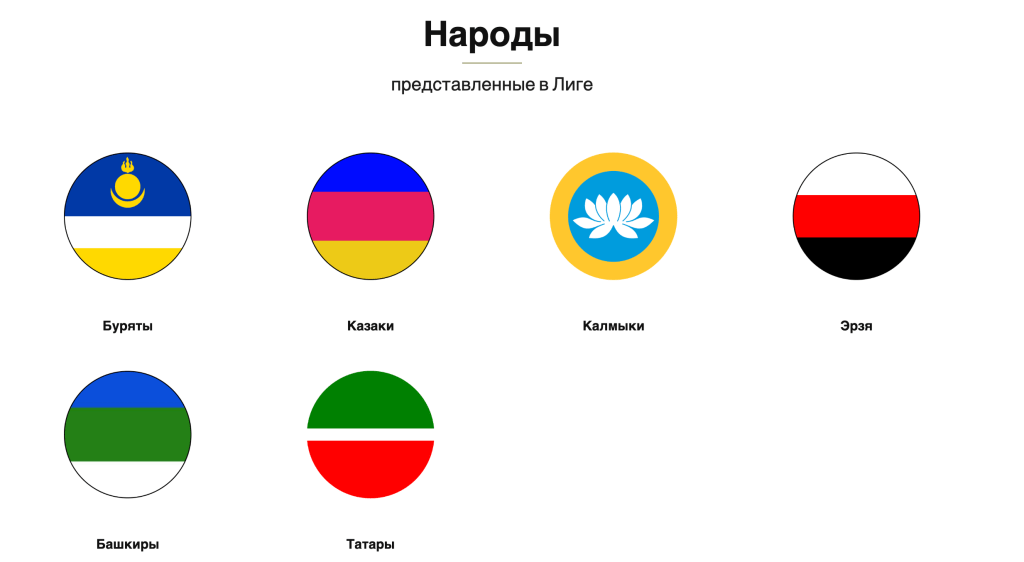
In light of the above considerations, we, representatives of the ethno-national and regionalist movements united in the Free Nations League, declare the following:
1. We do not recognize any political forces and hubs that would justify maintaining the Russian Federation in its current form. We have no need of arbitrators from Moscow, neither from the authorities nor from the opposition. We are open to dialogue and contact only with those who publicly support the right of enslaved peoples to establish independent States.
2. The Russian Federation cannot be re-established by cutting off what was seized by force and holding new elections. It is not elections that are at issue, but the very nature of Russian statehood: it is imperialist and exudes aggression towards its neighbors. This means that we, representatives of ethno-national republics and regions, have the right to shape our own destiny. If there is a discussion of independence for certain lands, let the people themselves hold this discussion, let them decide which confederations or unions to join, free from the intervention of federal forces, be they the government or the opposition. Any attempts at “peacekeeping,” attempts to teach us how to exercise our right to self-determination, will be rejected by us, and if they are intrusive, they will be met with a forceful response.
3. The process of forming a new Russian state should be voluntary and undertaken exclusively by those federal subjects whose legislative bodies vote to join a new federation. All federal parties currently represented among the federal authorities should be banned since they profess a misanthropic ideology that has produced thousands of victims and millions of refugees. The legislative bodies of the former federal subjects must be re-elected democratically, by open and secret ballot, with the involvement of ethno-national and regional political parties. There can be no automatic entry into the “renewed” Russia, no joining it “by inheritance.”
This appeal has been signed by representatives of the following national movements:
Bashkir
Ruslan Gabbasov, head of the Bashkir National Political Center (BNPC)
Ilshat Kinzyabayev, member of the BNPC
Buryat
Radjana Dugar-DePonte, representative of the Erhatan Buryat Democratic Movement in the USA
Cossack
Vyacheslav Demin, elder of the Cossack National Liberation Movement
Source: Free Nations League, Facebook, 31 October 2022. Thanks to Sergey Ogurtsov for the heads-up. Translated by the Russian Reader
“Nations represented in the League: Buryats, Cossacks, Kalmyks, Erzya, Bashkirs, Tatars”
The FNL’s Principles
1
The Russian Federation is an empire that keeps its colonies in servitude by force. It is impossible to liberate them by holding a referendum, just as a referendum on the observance of human rights is impossible under conditions of state terror.
2
The peoples of the Russian Federation should be able to exercise their right to self-determination. Further federations or confederations can be established only a voluntary basis, not by diktat of the former federal center.
3
We declare the principle of the presumption of identity and agency [sub’ektnost’]. Accordingly, with the collapse of the current political regime in the Russian Federation, the regions have no need to appeal to anything to endow themselves with sovereignty. By definition, all regions acquire complete sovereignty and full independence from Moscow, and only then, as free territories, do they decide their future: whether they want to maintain independence, unite with other regions and republics, or create a confederation of states.
4
All subjects of the Russian Federation have the right to independently determine their future.
Source: “About Us,” Free Nations League. Translated by the Russian Reader
Since Masha Gessen quite literally believes that the Russian “liberal” intelligentsia is God’s gift to humankind, she writes the following nationalist nonsense with a completely straight face:
In the seven and a half months since Russia launched its full-scale invasion, hundreds of thousands of Russians have left their country. Many of them are journalists, writers, poets, or artists, and they, along with some who are still in Russia, have been producing essays, poems, Facebook posts, and podcasts trying to grapple with the condition of being citizens of a country waging a genocidal colonial war. Some of their Ukrainian counterparts have scoffed at their soul-searching. Ukrainians, indeed, have bigger and more immediate problems. But they also have certainty—they know who they are in the world, while for Russians nothing is as it once seemed to be.
[…]
The last time people were writing in Russian so urgently was in the late nineteen-eighties. Soviet citizens back then had been confronted with their past—the Stalinist terror. That moment gave Russia, among other things, Memorial, the human-rights organization that, along with Ukrainian and Belarusian activists, won the Nobel Peace Prize last week. Now Russian citizens are being confronted with their present. The writers in exile have physically fled their country (as has much of Memorial’s leadership) and are trying to write their way to a new Russia. Their imagination extends far beyond the Russian constitution to a world that’s radically different, and better than not only Putin’s revanchist Russian World but the world we currently inhabit.
“Yoga for your health.” Central Petersburg, 6 July 2017. Photo by the Russian Reader
The queue for the ferry. There are Russian tourists behind me. (If you thought there were none of them [in Europe anymore], think again.) The boat arrives, but there’s not room enough for everyone and the guard closes the barrier just in front of us. Everyone stands there meekly, except my compatriots. As soon as the guard turns around, they dive under the barrier and run onto the crowded ship. They look like Moscow hipsters.
When did these people decide that everything is permitted them and that there are no prohibitions and rules? I missed this moment because the Soviet Untermenschen among whom I grew up considered themselves worse than everyone and were afraid of making a peep. Who instilled this hubris in them? How did they get it into their heads that they could go to war with the whole world and win?
(A spare boat was brought in five minutes later, of course, and it took us all away without any fuss or crush.)
Source: Dmitry Volchek, Facebook, 15 October 2022. Translated by the Russian Reader
I gave a talk at an online event on the war in Ukraine, arranged by the Future of the Left group on Monday. The meeting was shorter than planned, due to technical problems. Only two of the advertised speakers made it: Richard Sakwa, emeritus professor of Russian and European politics at Kent university, and me. Sakwa focused on the western powers’ failure to uphold principles of sovereign internationalism in the post-cold-war period, and concluded by opposing military aid to Ukraine. Against that, I put the case for supporting Ukrainian resistance as a matter of internationalist principle. I said that I think such discussions should continue. Here’s a recording of the session. Simon Pirani.
Here is a text, based on my talk. It is aimed mainly at the bogus “anti imperialism” widespread in the left, and among Future of the Left’s supporters, rather than at anything Sakwa said.
Thanks for inviting me to join the panel. It’s worth reflecting on what good panels like this, or gatherings like this, can possibly do. As a socialist, I believe that effective change is caused by the labour movement and social movements acting independently of the state. So I will say what I think the labour movement could or should do, and what people here could or should do, rather than declaiming principles with no reference to implementation.
My main point is that we should build solidarity with Ukrainian resistance to Russian aggression. That is rejected by some people in the labour movement, and I think we have to find ways of discussing these differences on life and death issues.
Character of the Russian war
Russia is a weakened empire desperately trying to restore its imperial status. It emerged from the break-up of the Soviet Union as an economically subordinate power, supplying the world capitalist economy with raw materials and pumping oligarchs’ wealth into the world financial system. Under Putin, since 2000, it has sought to make up for economic weakness by military means.
In the second Chechen war, Russia pulverised Chechnya and its population, rather than allow aspirations for national autonomy or independence to take root. Russia invaded Georgia in 2008, and intervened in Syria in 2015, to support a dictator who drowned citizens in blood rather than allow them any democratic freedoms.
The strongest imperialist powers tolerated all of this. Despite all their denials, they essentially had Russia act as the gendarme of capital in its sphere of influence.
Russia’s pretensions to imperial status have been most evident in its interventions in Ukraine. Ukraine is one of Russia’s oldest colonies; denying Ukrainian national rights was always integral to Russian imperial thinking; and of course before the invasion in February Putin made a speech claiming that historically Ukraine is not a nation.
The imperialist character of Russia’s war on Ukraine is evident from the military methods used. This is an imperialist force seeking to subjugate an enemy population.
Putin said Russian soldiers would be greeted with flowers, and there is not a single recorded case of that. There are plenty of examples of Ukrainians trying to resist the Russian army with their bare hands.
There have been massacres of civilians; rape used as a weapon; torture; forcible conscription; forcible deportation – all methods perfected by the British empire in the 18th and 19th centuries. As was the method of forcing into the army men from the poorest regions, disproportionately from ethnic minorities.
The targeting of politicians, journalists and activists in occupied areas seems more like the US empire in the 20th century.
I recommend the two reports on violations of international human rights law by the Organisation for Security and Cooperation in Europe (here and here). They spare no detail on alleged war crimes by Ukrainian soldiers, particularly against Ukrainians accused of collaborating with Russia. But they also conclude that the vast majority of war crimes have been committed by the Russian side. The vast majority.
An investigation team set up by the UN last week gave an initial report to the Human Rights Council that reached similar conclusions.
All this makes nonsense of the claims made by some people in the labour movement, that it is a war between two equal sides.
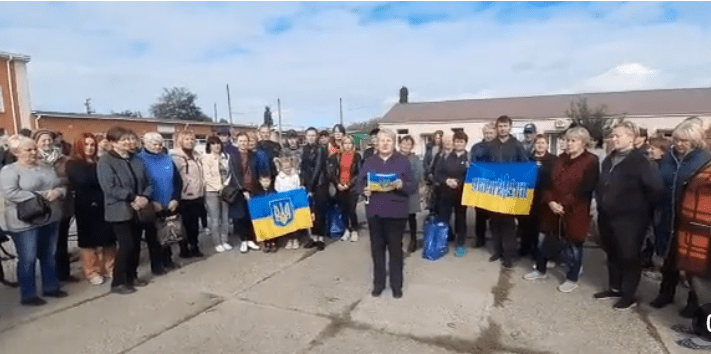
A rally on Friday in Snihurivka, which is occupied by Russian forces. See “About the photos” below
Why in February did Ukrainians, whatever their dissatisfaction with their own government – and I can assure you, there was plenty of that – volunteer in huge numbers? Why the contrast between that, and the situation in Russia, where last week’s mobilisation announcement is ripping at the social fabric?
Ukrainians are resisting an imperialist assault, and so the labour movement should provide practical, material solidarity to the working class communities bearing the brunt of this invasion.
Trade unionists from the UK, from France and from Austria, have organised convoys of aid to workers in the front line areas. My question to people here is: do you support such initiatives?
Do you agree that Ukrainians have the right to defend themselves with arms? I do, in the same way as I believe that Palestinians faced with the apartheid Israeli occupation have that right.
Role of NATO
Obviously, NATO has supplied Ukraine with substantial quantities of weapons in the last six months and this will surely continue. In their view, their gendarme has gone rogue and needs to be brought back under control.
But these arms supplies, like the applications by Sweden and Finland to join NATO, are more results of the invasion of Ukraine than causes.
To conclude from this that NATO expansion was the cause of the invasion is one-sided, false logic.
An honest assessment of Russia’s relationship with the NATO powers would show that NATO expansion into eastern Europe belongs to the 1990s. Russia was weak, and was being economically integrated into the world capitalist economy. The last big group of eastern European countries applied to join NATO in 1999 and actually joined in 2004.
What has happened since then? The Russian state, buoyed by the oil boom of the 2000s, has sought to control its sphere of influence with little interference by the NATO powers.
Just look at their limited reaction to Russia’s intervention in Ukraine in 2014. There were economic sanctions, which were very painful for Russian businesses. But these were linked only to the annexation of Crimea, not to Russian support for the separatists in the Donbas.
Clearly Germany and France, which both had substantial investments in, and trade with, Russia, were anxious to find a compromise. NATO continued after 2014, as it had before, to refuse to start a membership action plan for Ukraine. Germany only changed its Russia policy in February, a day before the invasion, with the cancellation of the Nord Stream 2 gas pipeline.
Analytically, I would define Putin’s Russia as a creature of those powers, a creature of world capitalism, not an opposite to them.
“Proxy war”
The false claim that NATO expansion caused Russia to invade Ukraine is linked to the false political proposition that Ukrainians are fighting a “proxy war” for NATO, and that the labour movement can not therefore support Ukrainian resistance.
The Future of the Left web site says: “Putin is no friend of the working class – but neither are Zelensky or NATO. […] Although the direct fighting in Ukraine is between the Russian and Ukrainian states, [no mention here of Ukrainian people, only the state, SP …] many see this war, in effect, as a proxy war between Putin and the US.”
This false logic could be applied to any number of situations.
Spain in 1936. Here’s how the argument looks: “Franco is no friend of the working class – but neither are the Republican government or the Allied powers. […] Although the direct fighting is between nationalists and Republicans, many see this war as one between the Axis and the Allies.” No room for the International Brigades there.
Vietnam in 1972. Here’s how the argument looks: “The US is no friend of the working class – but neither are the Soviet and Chinese leaders. […] Although the direct fighting is by the Vietnamese people, many see this as a proxy war between Moscow and Washington.” Not much room there for supporting Vietnamese resistance. (Both quotes are invented by me, to make my point.)
In my view, many wars – all these included – have combined elements of resistance to imperialism or fascism, and clashes between imperialist powers. The only difference in Ukraine in 2022 is that we are dealing with Russian imperialism, not German, American or British imperialism.
And in the labour movement we now see a bogus, western-centred form of “anti imperialism”: people who believe, crudely, that the main enemy is US imperialism and my enemy’s enemy is my friend.
This thinking just serves the Kremlin. It is ruinous to international solidarity, just as ruinous as the support given by elements in the labour movement to Tony Blair’s imperialist adventure in Iraq.
The so-called “republics” in the Donbass
A key claim of Kremlin propaganda is that the invasion in February was motivated by a desire to defend Russian-speaking Ukrainians from Ukrainian nationalism.
Just how sincere the Kremlin is about this can be judged by the number of Russian-speaking Ukrainians who the Russian army have killed, raped and driven from their homes.
Nevertheless, the claim is still made, and we hear echoes of it in the labour movement.
We need to look back at least to 2014. The Maidan uprising, a truly mass movement, was politically confused and complex but was directed above all against the government of Viktor Yanukovich, and the Party of Regions that represented eastern Ukrainian capital – the owners of mines, steelworks and other industries.
That party spared no effort to sow division between Ukrainians on the basis of language.
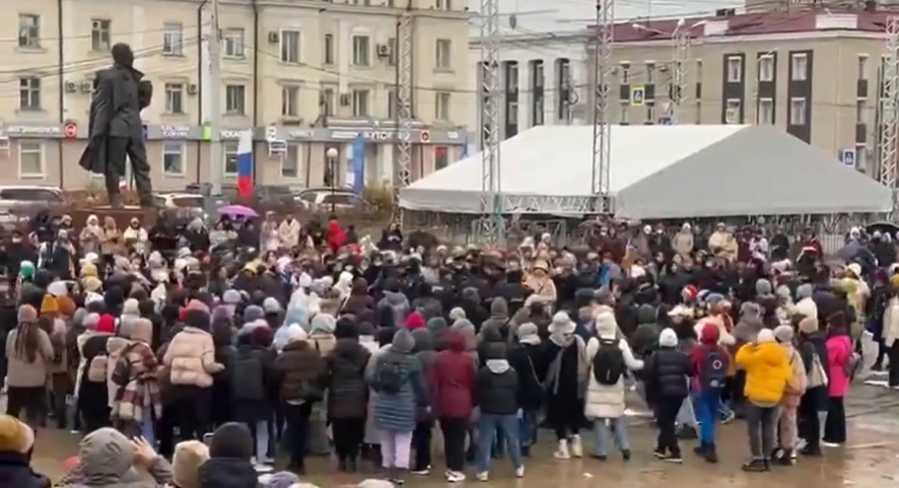
An anti-mobilisation rally in Yakutia, Russia. See “about the photos”, below
In response to the Maidan uprising, that party encouraged the anti-Maidan movement that sought autonomy for eastern regions, and that had support from substantial numbers of working class people. Note that at that time, when sociologists could still make reasonable guesses about what people in Donbas wanted, it was autonomy, not separation, that was supported by a significant minority.
Right-wing Ukrainian nationalism stoked up these divisions from the other side.
But these tensions were turned into military conflict by the Russian army, fighting alongside extreme Russian nationalist and fascist volunteers. They put in place the two “republics”, under which the economy of those areas was trashed and half the population left. Tinpot dictatorships were established without the most elementary observance of civil, democratic or labour rights.
To select from this complexity the fact that working-class people supported the anti-Maidan movement, and offer this as a reason to deny Ukrainians the right to resist aggression, is beyond absurd.
There is an analogy with Ireland. Working-class Protestants long formed the support base not only for Orange political parties but for armed loyalist paramilitaries. Traditionally, socialists understood that the power underpinning all this was British imperialism. We did not parrot calls for a Unionist six-county state, or pretend that working-class attitudes to that state weakened the case for a united Ireland. We called for the withdrawal of British troops.
Conclusion
As things stand, in the labour movement, bogus “anti imperialism” is undermining the internationalist principles on which the Chartists supported Irish liberation in the 1840s and which many of us here supported Vietnamese liberation in the 1970s. These principles should guide our actions now with regard to Ukraine.
More about Ukraine
□ The Ukraine Information Group, set up by a small group of labour movement activists in the UK (including me), is now distributing a weekly email bulletin, with links to sources of reliable information and informed comment on Ukraine in English. Please subscribe!
The first photo is of a rally at the weekend in Snihurivka, Mykolaiv region, that was occupied by Russian forces in March. A declaration was read out condemning the occupation. It stated that those present would not take part in the fake “referendum”, did not want to accede to the Russian Federation, and considered themselves Ukrainians. This is a still from a short film broadcast on the Telegram channel of Denis Kazansky, a journalist based in the area. He commented: “That’s the real position of residents of the occupied areas of Ukraine. Just compare that video with the disgraceful methods used by the occupiers to try to get people to vote.”
The second photo is of a demonstration in Yakutia, in Siberia, against the Kremlin’s mobilisation order. Women performed a traditional round dance, the Osuohai, surrounding a group of policemen and shouting “no to genocide!” and “no to war”. The police were repeatedly obstructed but in the end left and made several arrests. The Public Chamber of Yakutia, in a 1984-style revision of reality, stated that there had been no anti-war protest, only a “blessing by mothers for the return of their husbands and sons alive”. This is a still from a film shared by Feminist Antiwar Resistance.
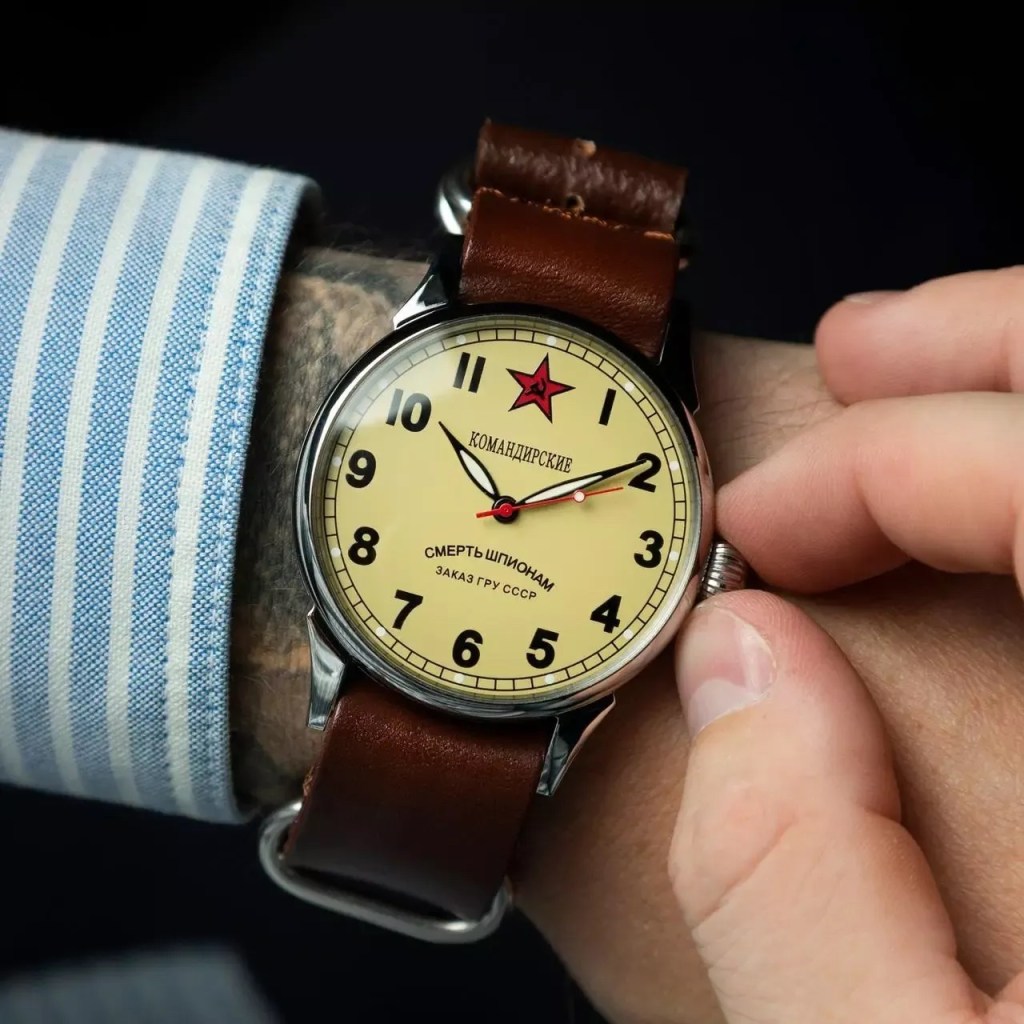
“Commander [watch]. Death to spies: commissioned by the GRU of the USSR.” Source: Kitenhome, where the watch is identified as a “vintage men’s wrist watch” from 1990. It is priced to sell at $29.99.
Only the blind can claim that Vladimir Putin wants to revive the Soviet Union. On the contrary, he has built one of the most Darwinian and irresponsible capitalist systems on the planet. Only its imperial ambitions and the normalization of permanent theft bear any relation to the late Soviet state. Only the fear of the return of a totalitarian regime, which struck several generations in Russia, has delayed a left turn among the young. But the war has finally started it.
After February 24, the protest against the Putin regime, amplified by antiwar sentiment, was embodied in a digital resistance movement. The global media has been largely silent about this fact, but military commissariats in Russia burn down every few days, freight trains with weapons or raw materials for military factories derail, and the walls of houses and fences are covered with huge pro-Ukrainian graffiti at night. Volunteers take care of Ukrainians forcibly displaced to Russia and help them flow to Europe. This resistance is horizontal and egalitarian, and it is mainly engaged in by twenty- to thirty-year-olds. What values drive them?
[…]
The range of the views of this new left is wide — from anarcho-federalism to social liberalism — but at its heart is a clear demand for equality and a restart of the state with an economy focused on personal self-realization, the satisfaction of basic needs, and the protection of rights. As Russians come to accept responsibility for the terror inflicted on Ukraine, we can expect turbulence to last for decades. But one reason for optimism is the likely fact that any new Russia — or several Russias — will be leftist.
Source: Nikolay V. Kononov, “The Russian Left Is Standing Against Putin’s War in Ukraine,” Jacobin, 4 September 2022. Thanks to Charles Keener and Marxmail for the heads-up. This same article was published in Tribune on 29 August 2022.
Mr. Kononov is identified by Tribune as the “editor-in-chief of Teplitsa Journal, a Russian-language media outlet about activism.” I had trouble finding this “journal” online until my boon companion suggested it might have something to do with the so-called Teplitsa sotsial’nykh teknologii (“Greenhouse of Social Technologies”), an organization that describes itself as a “support system for NGOs and activists.” Teplitsa Journal is only referred to as such in Mr. Kononov’s Anglophonic ventures outside the “hothouse” of Russia’s overhyped (and in fact mostly nonexistent) “anti-war movement.” Teplitsa Journal is not a “Russian-language media outlet,” but a section on Teplitsa’s website.
Among other things, Mr. Kononov recently published an interview there with the philosopher Artemy Magun. This passage in particular struck me as another “bill of goods,” this one intended not for wobbly-kneed western leftists, but for Russian “dissidents” eager to blame anyone else but the Russian regime and an overwhelmingly compliant Russian society for the brutal, utterly unprovoked invasion of Ukraine.
— What is the source of the war?
— A mutual misunderstanding among three countries and cultures: Ukraine, Russia, or rather its leadership, and the West, by which I mean Europe and the US plus Japan and South Korea. Imperial chauvinism comes from Russia, nationalism comes from Ukraine. And on the third hand, there is the as it were universal imperialism of the United States, infused with their special version of civic nationalism.
US relations with other countries are based on soft power, hegemony. This involves not only the dominance of the dollar and financial institutions, not only technological innovations, but also the assertion of national democratic and humanistic values.
As for Russia, it is not only the collapse of one ideology and the misunderstanding of another, but also economic dependence. Russia does not have high-tech products, not only due to backwardness and corruption, but also because many markets have not been opened to it. The free trade space turned out to be not entirely free. For example, Russia was not admitted into the European Union, by and large, except for its energy resources. Do you remember the conversation with Ukraine in 2013–2014 about the common customs zone? Ukraine then refused to join the Russian-Belarusian customs union and was going to sign an association agreement with the European Union, and the Russian elites argued that the loss of its partners in production chains would be economically painful — and it really would have been. Why am I saying this? Imperialism as political economic rivalry among capitalist powers — this situation exists, it is not contrived. And until 2022, everything really did resemble the beginning of the twentieth century, before the First World War. But that’s why it seems to me that the economic factors that led to the war cannot be considered the main ones. Ideological and political [factors], in my opinion, were more important.
— And what are these factors?
— [After the collapse of the USSR and a sharp decline in its influence in the world], the rejection of communism or socialism as a kind of humanistic perspective became a framework factor. Instead, a liberal democratic ideology was proposed that is contradictory. It asserts a universal order of human rights, and at the same time electoral democracy, which is based on national sovereignty. Plus neoliberalism, which asserts the autonomy of economic entities and total competition among [them].
Now there is pressure from the West under the auspices of the universalist empire, aimed at building global liberal democratic institutions. The trick is that this global program and policy is not entirely global. The West, arriving [in the former Soviet bloc] with the universal idea of democracy, did not fully implement its program. They entered undemocratic countries, tried to build democracies there, but they were in no hurry to spend money — nothing like the Marshall Plan was offered anywhere else. Instead of strong support for these countries, a neoliberal political economy was devised, which played a disastrous role by turning their populace away from America.
The most discussed session at the congress was the session featuring spokespeople from grassroots anti-war initiatives, who were allotted the standard hour and a half for six presentations. Vika Fas of Feminist Anti-War Resistance (FAS) boasted that the movement, founded by activists on February 25, already had sixty cells in Russia and thirty abroad.
“If you don’t know about FAS yet, you should read about us on Wikipedia. I think it’s interesting to observe a grassroots initiative that has become so popular in six months… Feminism was not taken seriously until we gained media weight, but we need international support for our communities and assistance in the form of grants,” she said in a passive-aggressive manner.
Alexander Belik, a spokesperson for the Movement of Conscientious Objectors to Military Service, said that after February 24, they had fielded a good number of requests for assistance from military personnel already deployed in Ukraine.
“Everything is happening quite successfully: you can still refuse conscription and even from serving if you’re already serving there. Everything is possible with due perseverance,” he said.
The recorded live stream of the Congress of Free Russia (Vilnius, 31 August 2022). The panel discussed by Ilya Azar begins at the 2:54:00 mark.
Maria Novikova thanked [the organizers] for maintaining gender balance at the session and explained that the NITKA project had tried out different formats, but had settled on an “unusual and creative” TikTok account.
“Our audience is not intellectuals who get everything as it is, but ordinary people who need enlightenment. Not only cringeworthy videos about Putin’s battalions are popular [on our account], but also serious videos about various aspects of the war in Ukraine and the crackdown in Russia,” she said.
NITKA, Novikova says, has already garnered more than nine thousand subscribers, and one video has been clicked more than two million times.
The project Media Partisans, according to Olga Demidova, arose when it became clear that due to the fact that large numbers of protesters were being detained by police during protests, “it [was] pointless to take to the streets in Russia.”
“At first, everyone [sic] wanted to stop the war and Putin, but it takes time.”
“Many saw that their protest did not bring results, and they were disappointed, so you need to choose small goals and set realistic tasks,” she explained.
Media Partisans has seven projects: for example, a Telegram channel featuring anti-war artwork and instructions on how to safely distribute leaflets and stickers, as well as the Brave Partisans bot (@bravepartizanbot), where you can get an assignment for a performance or posting leaflets.
Timofey Martynenko of the Vesna Movement boasted that the anti-war rallies and marches in late February and early March were held at the behest of his movement, and talked about other projects, in particular a service for sending appeals to State Duma deputies.
“The same people are seated in the State Duma, and it is vital to show them that a huge number of people oppose the war,” said the activist.
At the end of his talk, Martynenko said that Vesna does not believe that Russians have a “slave mentality” or that there is a “bloodthirsty ‘deep folk’ who love Putin.”
“It is vital to talk about the depoliticization of Russian society, about civic involvement, about how democratic institutions and the media have been destroyed.”
“The problem is not that we are monstrous imperialists at the genetic level, but the monstrous centralization of Russia and the destruction of local self-government,” Martynenko tried to persuade the audience.
Against the backdrop of the war in Ukraine, conversations about TikTok and a service for sending appeals to Russian MPs seemed frankly lightweight, but the young people were clearly pleased with themselves. After the session, I asked the chairman of the Mejlis of the Crimean Tatar People, Refat Chubarov, who had traveled [to the congress] from Kyiv, what he thought about the anti-war movement in Russia.
“I would thank them for what they are doing, and it would be sincere. But it’s all very childish. And they also have to be very careful, because an incorrect diagnosis can lead to incorrect treatment,” Chubarov replied.
The head of the Mejlis said that he had gone up and talked to Martynenko because he strongly disagreed with his “pompous claims that Russians do not suffer from imperialism and servility.”
“About a million Russian nationals [sic] pulled up stakes and settled in occupied Crimea without any remorse. What the fuck? That’s what imperialism is. When we [Crimean Tatars] returned [to Crimea] in the late [19]80s, we didn’t evict a single [Russian] family. I personally purchased the rooms where my mom had been born. When we return to Crimea again, none of those who settled there after 2014 will [be allowed to] live in Crimea. No servility? But what is it when a mother says that her son is being held [as a POW in Ukraine], but immediately adds that he is defending Russian interests? What Russian interests?” said Chubarov.
Source: Ilya Azar, “On the threshold of great achievements: a congress of the Russian emigration took place in Vilnius,” Novaya Gazeta Europe, 4 September 2022. Translated by the Russian Reader
[…]
The ballrooms of the Grand Vilnius Resort, set on a golf course on the outskirts of the Lithuanian capital, were a universe away from the front lines in the Ukrainian regions of Kherson and Donbas. And while the motto of the Congress of Free Russia was “Be Brave Like Ukraine,” this was a gathering of Russians who have fled their country out of fear of what Mr. Putin’s regime might do to them.
Hanging over the three-day gathering was the knowledge that — while Ukrainian President Volodymyr Zelensky has been hailed as a hero for refusing to flee Kyiv — many Russian dissidents who have stood their ground are either dead, or jailed by their government.


 On December 9, our country celebrates Day of Heroes of the Fatherland. On this day, Heroes of the Soviet Union, Heroes of the Russian Federation, and recipients of the Order of St. George and the Order of Glory are honored.
 May the memory of this Russian Hero, friend and faithful comrade live forever.

 We cannot but note the fact that [free and fair] elections in the Russian Federation disappeared long before 2014. Ethno-national political parties were banned thirteen years before Ukrainian region of Crimea was annexed. Thus, despite the fact that the Russian Federation, according to its own constitution, is a federation, and most of the ethno-national republics within the Russian Federation are nation-states with their own constitutions, parliaments, and governments, we have been deprived of the opportunity to represent and defend our interests in representative bodies for decades.