I think that most of us have not yet understood that the world of Russia has once again, like a century ago, split in two, like an iceberg, and its two halves, the bigger and the smaller, are rapidly drifting apart. It’s just that the split happened less dramatically, without the crowding onto the last steamship, without the “we departed from Crimea amidst smoke and fire” [lines from a poem by White émigré Nikolai Turoverov]. The split has been dragged out in time, and the crack wasn’t so wide at the beginning. Some people are still hopping from one iceberg to the other.
“Endless War”
And yet—that’s it. There are two Russias again. Many people—in both halves—cannot or are afraid to recognize this. It’s time to stop hopping, otherwise you’ll leap to one side and won’t be able to hop back again.
Hopes for the swift fall of the rotten regime (also just like one hundred years ago) have been disappointed. It’s plenty rotten but rot, as everyone knows, spreads.
Last time it took seventy years to root it out. This time it probably won’t take as much time; time moves more quickly in the twenty-first century, but you still have to unpack the suitcases and settle in for a long wait.
“Anticipation of White Nights”
What will happen with the ‘little’ Russia, scattered across different countries, is pretty clear. [Russians] who are younger or more active or more professionally cosmopolitan will assimilate with varying degrees of success. [Russians] who are older and professionally tied to the language and culture will sadly sing “while the light has not gone out, while the candle burns” [a line from a famous Mashina vremeni song] and will support that little flame as long as they have the life and strength for it. This work of theirs is not pointless or in vain, because in ‘big’ Russia there are still a great many people for whom that light will be precious and necessary.
In the mother country—goddamn déjà-vu—things will soon be utterly unbearable. In the longstanding two-hundred-year struggle between the Asiatic state and European culture the Horde has triumphed once again, now zealously working to asiatize the culture. (There is nothing malign about Asia and its culture, which of all people I, a specialist in Asian studies, should know; I am talking about political Asia, in which the state is everything and the individual is nothing.)
The culture of the mother country will be censored, hollowed out, thrust onto all fours and taught to wag its tail. We’ve seen it, we remember. Later, of course, a counterculture will take shape, [yielding] virtuosos of Aesopian language and furtive rude gestures. We remember that too: we had plenty of it. The emigres will coo condescendingly over any vivid manifestations of censored culture—like Nabokov did over Okudzhava. Those in Russia will secretly pass around tamizdat editions. And publish in the West using pseudonyms.
How dreadful and boring this all is, ladies and gentlemen. Russia’s national anthem: “We sowed and sowed the grain, we will stomp and stomp the grain” [lines from a Russian folk song].
For some the price will be their profession, for others poverty or emigration. The most noble will give up their freedom. And even their lives. The higher quality the person, the greater the cost.
And it is all worth it. This is what I’ve been thinking and why I wrote this text, not at all because I wanted to drive you into even greater despondency.
More so than all of us together, each of us individually is facing a big test. We can’t flunk.
Stop referring to “Asia” and “the Horde.” Why insult millions of people in the world and in Russia itself? You are not helping the “little” Russia” in any way.
I see that Akunin has again written something about Asia (where “the state is everything and the individual is nothing”) defeating European values in one particular country.
The point is that Russian intellectuals are, historically, not so fond of anything as repeating German vulgarities. And “Asian” metaphors are the favorites of Germans, and there is no degree of blatant idiocy at which they would stop.
For example, Adenauer explicitly claimed that the “Asian steppes” begin east of the Elbe. (He considered Prussia to be Asian, and so Bismarck’s triumph was an Asian conquest of Germany. Adenauer added the steppe by association.)
No matter how many decades have passed, the pre-war German spirit cannot be taken out of the Russian pamphleteer, and the fear of appearing ridiculous is as alien to them as it was to their mentors.
Quite correct thoughts in general, but there is one big catch.
How does Akunin (Chkhartishvili) differ from those Sieg Heiling in Russia when he starts using “Asia” in such a context, in such a comparison, even with a caveat? Maybe someone will say that I am wrong to try and compare him with the Sieg Heilers. Let me put it another way, then. How does a very good writer differ from those who are called white supremacists in the west?
I recently listened to a very interesting lecture on racism. The lecturer made a rather loose, but interesting ranking, singling out the racism of Soviet people as a separate species.
For some reason, some Europeans, when speaking about Asianness, “forget” about the Inquisition, concentration camps, and many other terrible events in history. Or are these also manifestations of Asianness?
We should also not forget that the current world order is also largely a product of European civilization with all its pros and cons.
One last thing, about why I decided to react in this way to Akunin’s statement, which are quite congenial to my own thoughts. It seems to me that a respected public figure should always think about the consequences of their words and deeds.
[…]
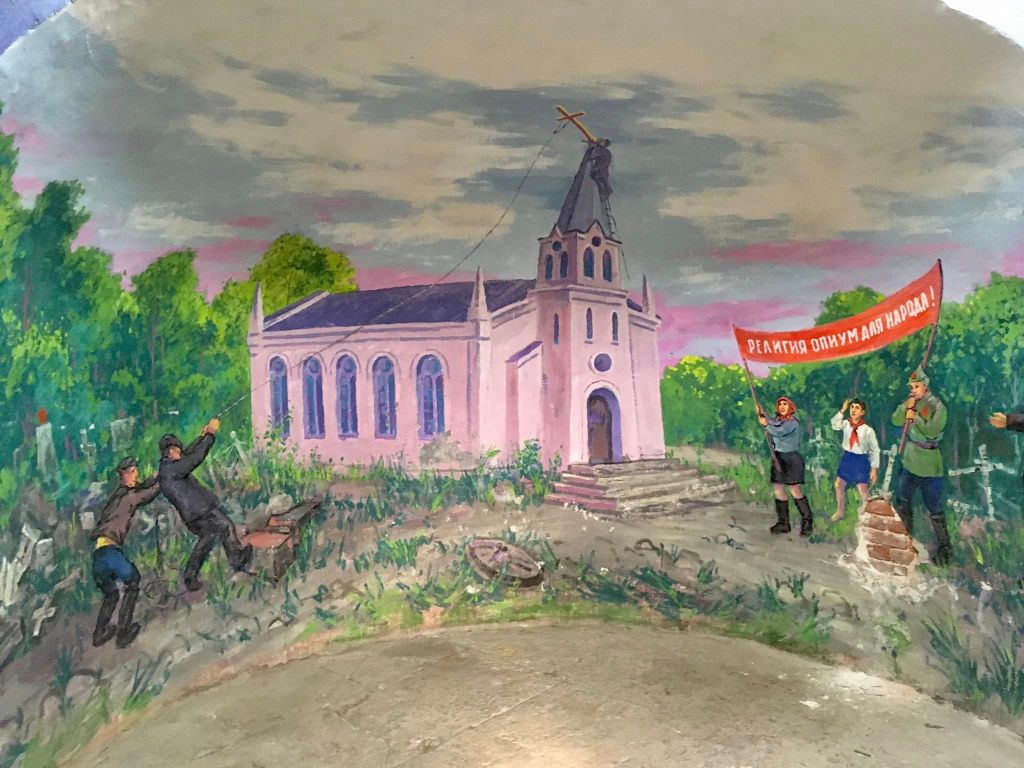
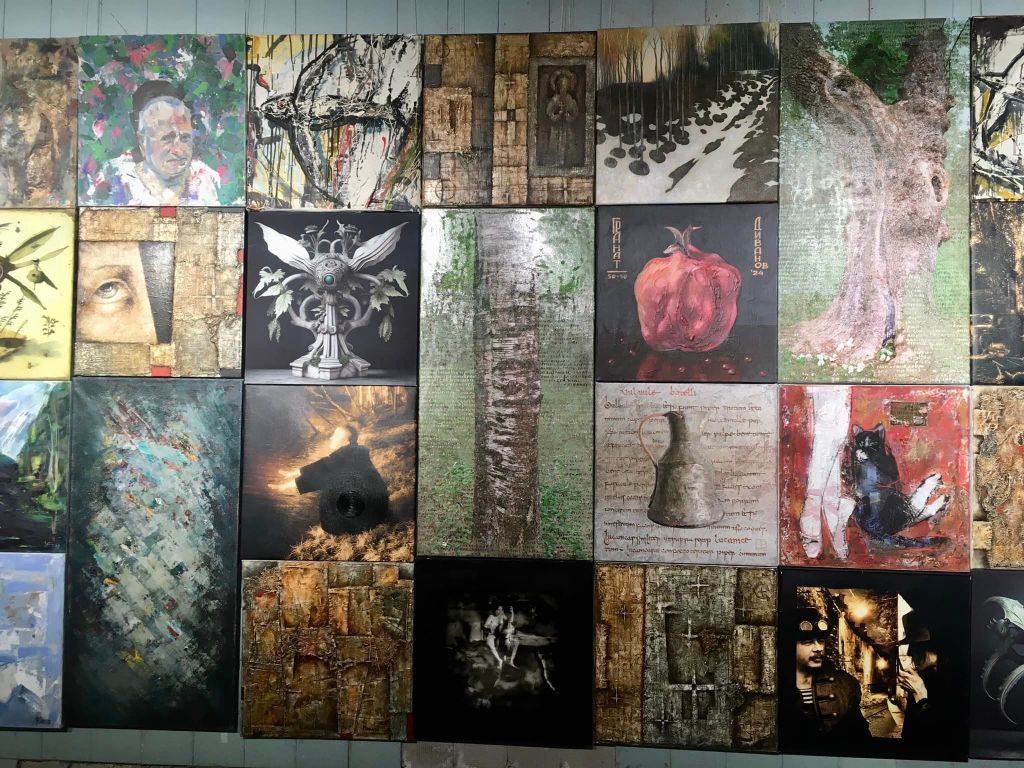
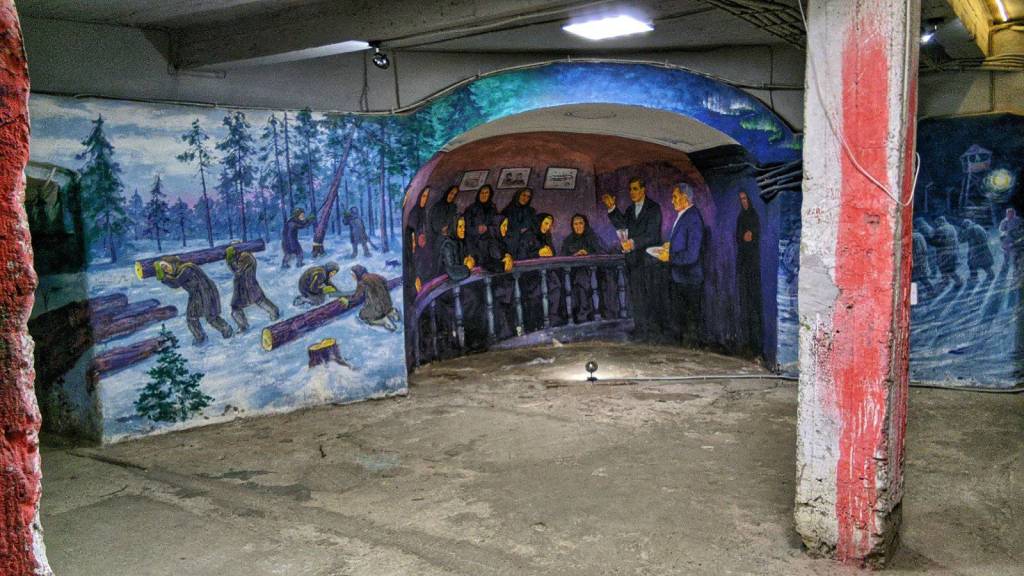
Source: Asya Rudina, “‘The world has split in two:’ the Runet discusses Akunin’s post about the two Russias,” Radio Svoboda, 1 April 2024. Translated by the Fabulous AM and the Russian Reader. The reactions, above, to Akunin’s outburst were not typical. Most of the best-selling author’s fans echoed his sentiments. The photos, above, by our friends V and M, were taken today at an exhibition currently on view in the former swimming pool and catacombs in the so-called Petrikirche on Nevsky Prospekt in downtown Petersburg. They suggest, I think, that the reality on the ground in “big Russia” (and “little Russia” as well) is slightly more complicated than Akunin would have us believe.||| TRR
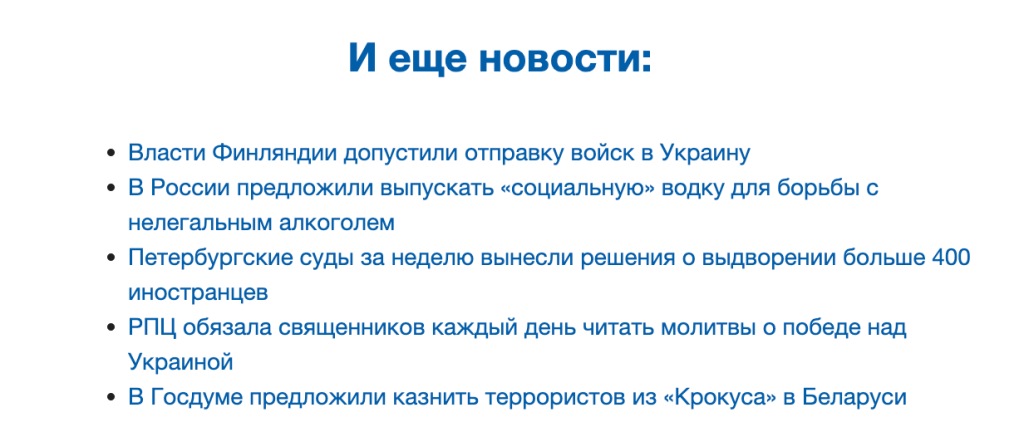
Source: Moscow Times Russian Service daily newsletter, 1 April 2024. Translated by the Russian Reader. Unfortunately, none of these headlines is a joke.
State Duma (Russia’s lower chamber of parliament) Maria Butina has proposed an option that would allow the Russian authorities to implement the previously voiced threat to execute those involved in the Crocus City Hall terrorist attack. Agenstvo news agency says she has proposed to extradite the Crocus City Hall terror attack suspects to Belarus, which maintains the death penalty.
“Unfortunately, the tragedy has become common to us, because citizens of Belarus also died there. I am quite knowledgeable about your legislation, including the death penalty, which is maintained [in Belarus]. In this case, it is the murder of two or more persons, therefore you have exactly the same right to try these people as the Russian Federation,” MP Butina was quoted as saying.
“I think that discussions are already underway among the competent authorities. If they count on the fact that, since Russia has imposed moratorium on the death penalty they will be able to escape this type of punishment, then let’s wait and see, because negotiations are underway,” Butina was cited as saying in an interview with Belarus 1 TV Channel.
Pervy Otdel (First Department) lawyer Yevgeny Smirnov told Agenstvo that “indeed, the Russian legislation allows, on the basis of an international agreement, to extradite people who committed a crime in the territory of Russia to another country.”
According to him, “if a request arises from Belarus, the agreement with it will have priority over Russian norms.”
“However, in the case of at least one accused — Alisher Kasimov, who rented out the apartment to other defendants – it is impossible, because he has Russian citizenship,” Smirnov noted.
Belarus still maintains the death penalty.
Capital punishment is a legal penalty in Belarus. At least one execution was carried out in the country in 2022. Also known as an Exceptional Measure of Punishment it has been a part of the country’s legal system since gaining independence from the Soviet Union on August 25, 1991. The current national constitution prescribes this punishment for “grave crimes.” Later laws have clarified the specific crimes for which capital punishment can be used. The death penalty can be imposed for crimes that occur against the state or against individuals. As of 2021, Belarus is the only country in Europe that continues to carry out the death penalty.
Maria Butina (born November 10, 1988) is a Russian politician, political activist, journalist, and former entrepreneur who was convicted in 2018 of acting as an unregistered foreign agent of Russia within the United States.[
While residing in Washington, D.C., Butina was arrested by the FBI in July 2018 and charged with acting as an agent of the Russian Federation “without prior notification to the Attorney General.” In December 2018, she pleaded guilty to felony charges of conspiracy to act as an unregistered foreign agent of Russia. In April 2019, a federal judge sentenced her to 18 months in prison. She served around five months at Tallahassee Federal Correctional Institution. Her 9-month pretrial prison term was counted towards her sentence. She was released and deported back to Russia in October 2019. She publicly denied being a Russian spy. In 2021, she was elected to the State Duma as a member of United Russia.
Each Wednesday we tell you what material has been the most interesting for one of the residents [sic] of the Delovoi Peterburg Experts Club, a reader, or one of our employees.
Today, Zurab Pliyev, first deputy director general of Northern Capital LLC, shared an article with us.
“Putin’s final result in the presidential election was 87.28%”
During the recent Russian presidential election, we were honored to be part of the team that ensured the smooth operation of 248 polling stations in St. Petersburg. Our company was responsible for their catering for all three days.
We catered hot meals for all polling station employees, election commission members, observers, and representatives of law enforcement agencies free of charge.
And we read this article in Delovoi Peterburg with a sense of pride that we had also made a contribution to the way those three days came off.
Article of the week:
Putin’s final result in the presidential election was 87.28%
Source: Delovoi Peterburg “Article of the Week” email newsletter, 27 March 2024. Translated by the Russian Reader
Vladimir Putin won the Russian presidential election with 87.28% of the vote. The final vote count was announced by the head of the Central Election Commission, Ella Pamfilova.
76,277,708 people voted for Putin.
After all the votes were tabulated, the candidate from the Communist Party Nikolai Kharitonov garnered 4.31%, the leader of the LDPR Leonid Slutsky received 3.2%, and the candidate from New People, Vladislav Davankov, got 3.85%, Pamfilova said.
Earlier, the CEC had announced a record-high turnout in the history of presidential elections in [post-Soviet] Russia.
The 2024 presidential election also was the first multi-day campaign in the history of [post-Soviet] Russia. It was possible to vote for the new [sic] head of state on March 15, 16 and 17.
The regions of the Northwestern Federal District were among the worst in terms of turnout in the Russian Federation. The lowest turnout for the presidential election was in the Komi Republic, at 58.52%. Karelia, where 60.08% voted in the election, was also among the five regions with the lowest turnout.
Northern Capital LLC’s cabbage pasties are only 75 rubles a pop. Photo courtesy of Delovoi Peterburg
The presidential election was held, a decisive event not only for the future of the country, but also for every Russian citizen. Over the course of three days, Russian citizens chose a worthy candidate for the post of the head of state, and, according to experts, the turnout at polling stations was the highest in the history of [post-Soviet] Russia.
The catering service Northern Capital LLC also compiled its own statistics for the three days of elections. The snack bars at the 248 polling stations were supplied with the most relevant and necessary items. Current and future voters enjoyed pancakes, pastries, pies, and drinks. For the Central District alone, Northern Capital produced 23,679 baked goods. Polling station workers, election commissioners, law enforcers, and election observers did not go hungry either. At the behest of Zurab Pliyev, first deputy director general of Northern Capital LLC, they were provided with free hot lunches and beverages.
“We consider it our duty to continue and support the tradition of snack bars at polling stations, which has passed from generation to generation. We want to maintain that special election atmosphere that makes the celebration a family affair. The snack bar is the second largest component of the process. That is why we made sure that there was a wide variety of high-quality and tasty food not only for voters, but also for those who directly implement the electoral process,” said Zurab Izrailovich Pliyev, first deputy director general of Northern Capital LLC.
This is not the first time the editors of our local newspaper have “platformed” the lies of the mendacious and violent fascist butcher Vladimir Putin.
1. US warns that Russia will invade Ukraine. General disbelief, daily Russian mockery. (December 3 2021-February 24 2022)
2. Russia invades Ukraine, kills tens of thousands of people, kidnaps tens of thousands of children, commits other ongoing war crimes (February 24 2022-present)
3. Russia blames US for Russia’s invasion of Ukraine (March 2022-present)
4. US warns of terror attack in Moscow. Putin denies any risk and mocks the United States. (March 7 and March 19 2024).
5. Terror attack near Moscow, ISIS takes responsibility, Russia meanwhile kills Ukrainian citizens with drones and missiles as it has for more than two years. (today, March 22 2024)
6. Russia’s security apparatus, focused on bringing carnage to Ukraine, has failed in Moscow. Russia’s leaders, focused on demonizing the US, did not protect Russians. What next? Where to direct the blame?
7. It would not be very surprising if the Kremlin blames Ukraine and the United States for terror in Moscow and uses the Moscow attack to justify continuing and future atrocities in Ukraine.
This past Friday, 22 March, a horrifying terrorist attack took place in Crocus City Hall in the outskirts of Moscow. Islamic State plausibly claimed responsibility.
Earlier that day, Russian authorities had designated international LGBT organizations as “terrorist.” Also earlier that day, Russia had carried out massive terror attacks on Ukrainian cities. Those actions reveal the enemies Putin has chosen. As the attack on Crocus City Hall demonstrated, his choices have nothing to do with actual threats facing Russians.
Russia and the Islamic State have long been engaged in conflict. Russia has been bombing Syria since 2015. Russia and the Islamic State compete for territory and resources in Africa. Islamic State attacked the Russian embassy in Kabul. This is the relevant context for the attack outside Moscow. The horror at Crocus City Hall obviously has nothing to do with gays or Ukrainians or any other of Putin’s enemies of choice.
Putin had publicly dismissed the real threat. The United States had warned Russia of a coming attack by Islamic State. The United States operates under a “duty to warn,” which means that summaries of intelligence about coming terrorist attacks are passed on, even to states considered hostile, including (to take recent examples) Iran and Russia. Putin chose to mock the United States in public three days before the attack.
People reasonably ask how a terror attack could succeed in Russia, which is a police state. Regimes like Russia’s devote their energy to defining and combating fake threats. When a real threat emerges, the fake threats must be emphasized. Predictably (and as predicted), Putin sought to blame Ukraine for Crocus City Hall.
What if Russians realize that Putin’s designations of threats are self-serving and dangerous? What if they understand that there are real threats to Russians ignored by Putin? He has devoted the security apparatus to the project [of] destroying the Ukrainian nation and state. What if Putin’s obsession with Ukraine has only made life worse for Russians, including by opening [t]he way to actors who are in fact threats to Russian life, such as Islamic State?
These are the questions Putin must head off. It is not easy, however, to blame Ukraine for Islamic State terrorism. Putin’s first media appearance, nearly a day after the attack, was far from convincing. The specifics he offered were nonsensical. He claimed that the suspects in the terrorist act were heading for an open “window” on the Russian-Ukrainian border.
The term “window” is KGB jargon for a spot where the border has been cleared for a covert crossing. That the leader of the Russian Federation uses this term in a public address is a reminder of his own career inside the KGB. Yet Putin had obviously not thought this claim through, since a “window” must involve a clear space on both sides of the border. For escaping terrorists, it would be the Russian side that opened the window. By speaking of a “window” Putin indicated that the terrorists had Russian confederates preparing their exit, which he presumably did not mean. It seems that Putin was hastily making things up.
Setting aside the “window” business, though, the whole idea that escaping terrorists would head for Ukraine is daft. Russia has 20,000 miles of border. The Russian-Ukrainian part of it is covered with Russian soldiers and security forces. On the Ukrainian side it is heavily mined. It is a site of active combat. It is the last place an escaping terrorist would choose.
And there is no evidence that this is what happened. Russia claims that it has apprehended suspects in Bryansk, and claimed that this means that they were headed for Ukraine. (Western media have unfortunately repeated this part of the claim.) Regardless of whether anything about these claims is true, Bryansk would suggest flight in the direction of Belarus. Indeed, the first version of the story involved Belarus, before someone had a “better” idea.
In moments of stress, Russian propaganda tries out various ways to spin the story in the direction preferred by the Kremlin. The reputed suspects are being tortured, presumably with the goal of “finding” some connection to Ukraine. The Kremlin has instructed Russian media to emphasize any possible Ukrainian elements in the story. Russian television propaganda published a fake video implicating a Ukrainian official. The idea is to release a junk into the media, including the international media, and to see if anything works.
Amidst the flotsam and jetsam are those who spread Russian propaganda abroad, who try out versions more extreme than Putin’s. Putin does not directly deny that Islamic State was the perpetrator — he simply wants to direct attention towards Ukraine. But actors outside Russia can simply claim that Ukraine was at fault. Such actors push the discussion further than the Kremlin, and thereby allow Russia to test what might work abroad.
As a result, we have a bizarre discussion that leads to a harmful place. Islamic State claims responsibility for Crocus City Hall. The Islamic State publishes dreadful video footage. Russia cannot directly deny this but seeks help anyway in somehow pushing Ukraine into the picture. Those providing that help open a “debate” by denying that Islamic State was involved and making far more direct claims about Ukraine than the Kremlin does. (This brazen lying leads others to share [a] Islamic State perpetration video (don’t share it; don’t watch it). So the senseless “debate” helps Islamic State, since the reason it publishes perpetration videos is to recruit future killers.)
Meanwhile, Russia’s senseless war of aggression against Ukraine continues. In its occupied zones, Russia continues to kidnap Ukrainian children for assimilation and continues to torture Ukrainians and place them in concentration camps. It continues to send glider bombs, drones, cruise missiles and rockets at Ukrainian towns and cities.
On the same day as the attack at Crocus City Hall, Russia carried out its single largest attack to date on the Ukrainian energy grid, leaving more than a million people without power. Among other things it fired eight cruise missiles at the largest Ukrainian dam. Russia attacked the city of Zaporizhzhia (the consequences are in the four photos) and other cities throughout Ukraine.
On Friday Russia fired, in all, eighty-eight missiles and sixty-three explosive drones into Ukraine. And that represents just a single day (if an unusually bad one) of a Russian war of terror in Ukraine that has gone on for more than two years.
Putin is responsible for his mistakes inside Russia. And he is at fault for the war in Ukraine. He is trying to turn two wrongs into a right: into his own right to define reality however he likes, which means his right to kill whomever he chooses.
It is obvious that the terrorist attack at Crocus City Hall on the evening of 22 March 2024, during which 133 people were killed, according to the official count, has clear goals and objectives. A week before Putin’s “election” I wrote that, after receiving a “mandate from the people,” Putin would unleash a mass terror campaign. But for this, of course, he needs a decent and obvious excuse. The exemplary terrorist attack in broad daylight in politically unreliable Moscow is intended to convince society that “decisive action” is what it needs now.
Why would Putin do that? It’s simple logic. Come hell or high water he has to win the war he has unleashed. This is obvious, for it is a matter of self-preservation. If Putin does not win, he is a weakling, a lowlife, and at the same time the person to blame for hundreds of thousands of deaths not only of Ukrainians, but also of Russians. It is clear that he will not last long in this state. Not to mention such a trifle as his sick, wounded ego, repeatedly insulted by Ukraine. But victory would wipe everything out, because victors are not judged, Putin is convinced, taking his cue from his idol Catherine the Great.
So, Putin has to have victory at any cost. But two things have long prevented him from achieving it: 1) his numerous domestic enemies, and 2) a lack of “manpower” in the ranks of the army.
Putin intends to solve problem number one by means of a mass terror campaign against malcontents, especially since he has long been urged to do so by a well-rehearsed chorus of heralds, from Dmitry Medvedev and General Gurulyov to a host of other, lower-ranking epigones of contemporary Russian fascism. Guessing the mood of their Führer, they demand that, at very least, he restore the death penalty; at most, that he carry out “total executions of the terrorists and crackdowns against their families” (per the latest quotable quote from Medvedev).
We can only guess at this point whether Putin’s forthcoming terror will exceed Stalin’s body count or whether the current ruler in the Kremlin will limit himself to “merely” increasing the number of prison sentences meted out to dissidents by a factor of two and carrying out demonstrative executions of dozens or hundreds of his fellow citizens. But there is no doubt that a serious expansion of such tactics is on his agenda.
Putin will solve problem number two through a mass mobilization. This is nothing new either. Piling hundreds of thousands of soldiers into the enemy’s trenches is a time-honored tactic practiced by both the Russian and Soviet military, and, as Putin has seen, it has worked well in the “meat assaults” on Avdiivka, Bakhmut, Severodonetsk, and many other small Ukrainian towns. But these towns are nothing compared to the million-strong cities of Kharkiv, Dnipro, Zaporizhzhia, and Odesa, not to mention the three-million-strong Kyiv. So there must be massively more cannon fodder. The second problem is directly related to the first.
Combined with large-scale crackdowns, the mobilization is sure to proceed more vigorously this time round.
As a bonus for the Kremlin, this terrorist attack diverts public attention (at least for a while) from such things as Russia’s largest-ever strike on Ukraine, involving a hundred and fifty missiles and drones, which happened just a day before the events at Crocus City Hall.
I’d now like to talk about other explanations of this terrorist attack. Looking through the news related to it, I honestly could not help but marvel at the comments of certain respected colleagues, opposition Russian analysts, who easily took the bait about IS, Islamist terrorists, and the other nonsense that the FSB obligingly leaked to the public in the first hours after the attack through the Russian media and Telegram channels.
To clarify, certain people of “non-Slavic ethnicity” were chosen to directly perpetrate this heinous crime. There are hundreds of thousands of Tajik, Uzbek, and Kyrgyz migrant workers in Russia, EVERY ONE of whom is literally turned inside out by the Russian Interior Ministry upon arriving in Russia, including with regard to their attitudes to radical Islam and similar things. The Russian secret services thus have the broadest selection of perpetrators available for such a terrorist attack.
Let us ask ourselves an elementary question: how could Islamist radicals purchase not only assault rifles and pistols but also the flamethrower with which the terrorists torched the unfortunate audience members at Crocus City Hall without the knowledge and support of Russian “law enforcement”? Is such a thing possible in today’s Russia, and in Moscow to boot? If someone thinks that it is possible, I would simply remind them that when members of Eduard Limonov’s National Bolshevik Party tried to buy weapons somewhere in the Altai Territory back in the 2000s, their plan was instantly exposed. The idea of Tajiks buying assault rifles and flamethrowers in today’s militarized Russia, which is chockablock with surveillance cameras and special services, is a bad joke.
Let me also remind you that the initial semi-official Russian explanation was that the terrorist attack at Crocus City Hall was revenge on Russia for its actions in Syria and Chechnya. Seriously? So, it matters not a whit that the Russian army and its air force have not conducted any active operations in Syria for two years now? If you have not been paying attention during this time, let me just remind you that the Kremlin is certainly not concerned with Syria right now. For the last two years all Russian armed forces, including those operating from military bases in Syria and in Armenia, have been deployed in destroying Ukraine. There have been no large-scale military operations in Chechnya for almost twenty years.
However, as it turned out, all this argumentation was completely superfluous, because my gullible colleagues were made to eat their lunch by Putin himself and his favorite propagandist, Margarita Simonyan. As a shadow of her “boss” (as she herself dubs Putin), Simonyan naturally cannot afford to indulge in improvisations not vetted by him, and especially at such a crucial moment. On her Telegram channel, she bluntly pointed out who, in her (and therefore her boss’s) opinion, had organized and perpetrated the terrorist attack: “It wasn’t IS. It was the Khokhols.”
The “boss” himself, who was supposed to address the nation in the early hours after the terrorist attack, unexpectedly postponed his address by twenty-four hours. The delay appears to have been caused by technical blunders. Obviously, organizing the details of a terrorist attack is not Putin’s pay grade. It is clear that in such cases the relevant special services are simply given the go-ahead from the top brass. They are told to do their job. The operation was entrusted, of course, to professional hatchet men. As usual, they made a miserable mess of it. You need a large-scale terrorist attack? The Russian security services always have two or three dozen Tajiks on hand for this purpose, who can be hastily given their marching orders, paid, and… And that’s basically it. The Tajik passport found in a car allegedly belonging to the terrorists is, of course, a masterpiece. It is clear that no terrorist, as he sets off to carry out an attack, ever forgets to take his passport with him. It was meant as a helpful hint to law enforcers, and also so decent folk would know whom to hate. It is strange that the business card of the already half-forgotten Dmytro Yarosh was not found in the car as well.
But the point is that this special operation were certainly not meant to spoil relations with the Islamic world. Russia’s allies—Iran, Hezbollah, Hamas—might take offense.
In addition to the domestic agenda we mentioned above, the terrorist attack was meant to firmly link the globally condemned villains of IS with Ukraine in world public opinion.
This was why Putin’s speech on the terrorist attack was postponed for almost twenty-four hours. The dictator’s dodgy mind was deciding how to clean up the mess made by his numbskulls and tie up the loose ends. That is, to tie IS (or any other Islamists) to Ukraine. And he probably thinks he has figured out how to do it. As he put it, [the terrorists were trying to escape through] “a window prepared for them on the Ukrainian side of the border.”
All these tricks of Putin’s are painfully obvious to people capable of thinking, but he doesn’t care about that. Moreover, having sensed a change in the mood of his American “partners” (remember the reports that the U.S. has been pressuring Ukraine to stop hitting Russian oil refineries, and the fact that for almost two months no American aid has arrived in Ukraine and it is not known whether it will arrive in the future), Putin makes a high-pitched appeal to all countries to unite against this inhuman evil—that is, against Ukraine + Daesh.
Another very important point from Putin’s speech, indicating that he is paving the way for a mass terror campaign at home, is that he called the shooting of civilians at Crocus City Hall nothing more or less than “a blow to Russia, to our people.” He, his propagandists, and the Russian media have already established the link between Islamist terrorists and Ukraine. The next logical step is to claim that those Russians who support Ukraine are direct and immediate supporters of the terrorists who struck “a blow to Russia, to our people”—that is, that they are enemies of the people.
To be honest, all of this is as monstrous as it is predictable. I will repeat what I have said many times before: as long as Putin is alive and in power, things will get even worse and even scarier.
This security footage of apparent ballot stuffing at a polling station in Petersburg was released by the Petersburg [Elections] Observers movement on their Telegram channel on 20 March. The polling station was later identified as No. 5, housed in School No. 260 in the city’s Admiralty District. The women shown doing their patriotic duty to prolong Russia’s current fascist regime were identified by another source as school teachers.
Vladimir Putin was re-elected as Russian president. Officially it’s his fifth term in the Kremlin — although in practice it’s six if we include his stint pulling the strings as prime minister. The official results have Putin polling even higher than predicted, taking 87% of the vote. That figure looks utterly implausible and places Putin among the likes of Asian, Middle Eastern and Central Asian autocrats. The election itself went ahead against a tense background, with Ukrainian shelling and attempted incursions into Russia’s border regions along with on-going drone attacks on Russian oil refineries.
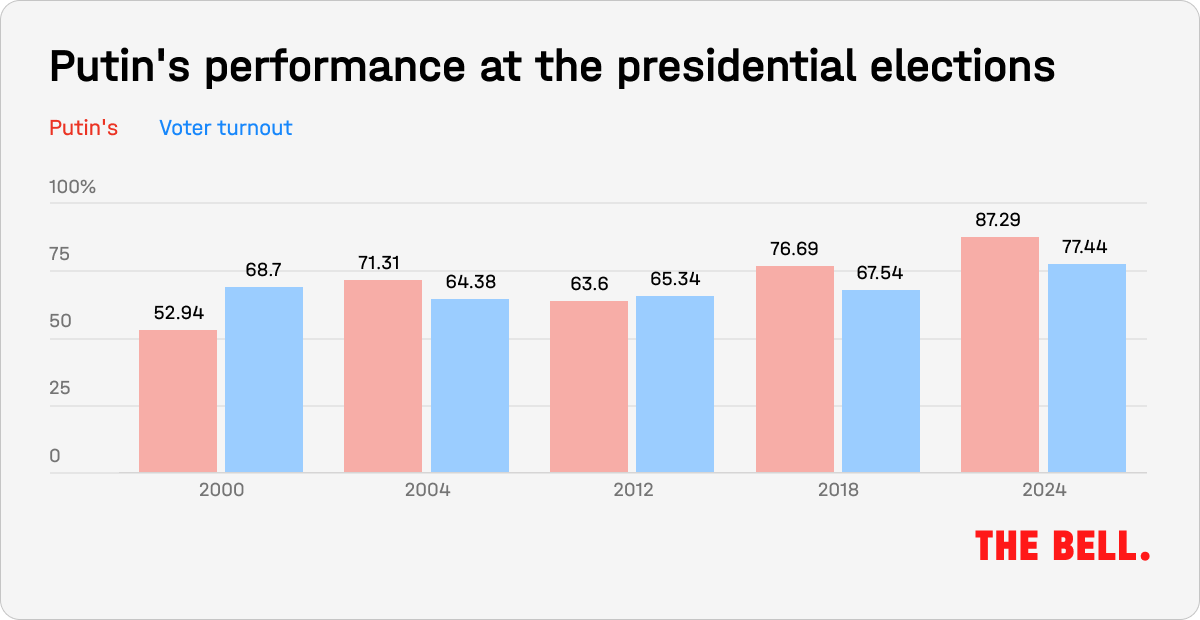
The official election result is already out — Vladimir Putin secured 87.28% on a turnout of 77.44%. Both those numbers are record highs since the collapse of the Soviet Union. And both are about 10 percentage points up on 2018 (when Putin polled 76.8% on a 67% turnout). This suggests that the Kremlin’s political managers were tasked with delivering a significant increase in Putin’s popularity. That in itself is not surprising: in the current circumstances an autocrat needs to demonstrate how his people have rallied around the flag.
Initial research by journalists and independent experts suggests the vote could have been the most heavily falsified in the history of post-Soviet Russia. Analysis by IStories and Ivan Shukshin, a researcher and activist with the Golos vote monitoring NGO, estimated that around 22 million of the 76.3 million votes cast for Putin were “anomalous.” In other words, almost a third of Putin’s official tally could have been false.
Their methodology is based on analyzing the turnout and vote shares at individual polling stations, using the central election commission’s official data. Districts with higher turnouts also have larger vote shares for Putin — a fact which suggests ballot-stuffing since the two shouldn’t be strongly correlated. IStories and Shukshin didn’t include results in Moscow, where online voting makes the analysis trickier. A third report by Novaya Gazeta Europe said as many as 31.6 million votes — almost half of Putin’s total — could have been fake.
Many experienced observers of Russian politics (1,2) believe that election organizers in provincial Russia “overdid it” this time round. Most pre-election leaks of the Kremlin’s vote strategy featured more modest targets. In spring 2023, for instance, RBC wrote that the Kremlin wanted to secure 75% of the vote on a 70% turnout. A few months later, Meduza wrote that regional authorities were advised that they should secure at least 80% of the vote for Putin. The final pre-election opinion polls conducted by state pollster VTsIOM (which also represent indirect instructions to regional election officials for polling day) showed Putin’s result was at the initial target level of 75%.
The record result places Putin firmly among his fellow autocrats. In free democratic elections, it’s a rare anomaly for a candidate to poll even at 60-70%. Only once, in extreme circumstances, have we seen more than 80% in a democratic country — a huge protest vote that gave France’s Jacques Chirac 82% in a presidential run-off against Jean-Marie le Pen in 2002, the BBC reported. In Russian history, Putin still has something to aim for if we look back to Soviet times. The turnout in 2024 was slightly higher than when Boris Yeltsin was voted president of the Russian Soviet Federative Socialist Republic in 1991, but there is still some way to go to match the Stalin era of 100% turnout in votes to appoint new deputies.
Since Putin was re-elected in 2018, voting in Russia has become even less transparent, and offered greater opportunities for fraud. Remote electronic voting was conducted in 29 Russian regions. Some 70% of the 4.7 million voters registered to vote online apparently cast their votes on the first of the three-day poll. Monitoring violations at physical polling stations is an almost impossible task. The Central Electoral Commission stopped broadcasting live footage from monitoring cameras in polling stations after the pictures from 2018 had depicted numerous violations and led observers to conclude that the scale of ballot stuffing was so great that the real result could not be determined in at least 11 regions.
The 2024 poll also differed from Putin’s two most recent victories in the selection of candidates who ran against the Kremlin leader. In 2012, political strategists allowed businessman Mikhail Prokhorov to stand, proposing that Russia’s marginal liberal opposition would consolidate around him. And in 2018, that same role went to TV presenter Ksenia Sobchak. But this time round there was no acceptable liberal candidate. Even the little-known politician Boris Nadezhdin, who timidly spoke out against the war in Ukraine, was denied registration. On the ballot were only Putin’s “rivals” from the systemic opposition parties. All of them have been equally supportive of Russia’s repressive turn, backing various crackdown measures that have come before the State Duma in recent years.
The extras in the 2024 race — Communist Nikolai Kharitonov, Vladislav Davankov of New People, and Leonid Slutsky of the LDPR — polled less than 12% combined. That’s slightly less than communist candidate Pavel Grudinin managed on his own in 2018. The 75-year-old Kharitonov’s 4.3% was better than the youthful Davankov’s 3.8%, while Slutsky, the unsuccessful heir to charismatic populist Vladimir Zhirinovsky, trailed in last with 3.2%.
Despite intimidation by the authorities, many Russians went to polling stations across the country and abroad at noon on 17 March as part of the Noon Against Putin protest, which was conceived as one of the few safe ways for Russians to voice their dissent. After all, it is hard to punish people for going to a polling station on election day and queueing.
The protest was the brainchild of Maxim Reznik, a former member of St. Petersburg’s legislative assembly, and it was endorsed by Alexei Navalny. After the opposition politician was murdered in a Russian penal colony, his supporters and other Kremlin opponents urged Russians to take part in Midday Against Putin.
This time round the last day of the election fell on the end of Shrovetide, and the powers that be tried to take advantage of it. For example, in Tomsk, they organized Shrovetide festivities at one of the polling stations to generate “hustle and bustle.” In Arkhangelsk, local restaurants were forced to cook pancakes for free distribution at the polling stations. Festivities were also organized, for example, in Moscow Region, Perm, Chuvashia, Murmansk Region, and Kamchatka.
Investigative journalist Andrei Zakharov quoted an anonymous agitator who, along with his colleagues, was tasked with “inviting people to a Shrovetide party in a park while also suggesting they take their [internal] passports with them in order to vote. It’s not far to the polling station.”
Those who decided to take part in the noonday protest were intimidated by fake mailings. As early as 13 March, some users in Russia received messages purporting to be from Navalny supporters postponing the Noon Against Putin protest to late Sunday. On Saturday, some Muscovites got messages accusing them of supporting “extremist ideas” and demands to vote “without waiting in line.”
There was also intimidation from actual law enforcers. The Moscow Prosecutor’s Office issued three warnings about the danger of the protest and possible criminal chargers against the protesters.
In spite of this, people in Russia and around the world came to the polling stations at noon on 17 March.
The huge queues abroad attracted a lot of media attention. Just look at the number of people at [Russia’s] diplomatic missions in Almaty and Bishkek. In European countries, people stood in line for many hours.
The long waits at polling stations abroad were sometimes caused by the deliberately slow work of the election commissions. For example, in Riga, voters were let in two at a time, although there were six voting booths and four polling station officials available. Voting was also delayed because many embassies and consulates banned cell phones, searched voters as they entered, and made them temporarily surrender their belongings.
In Russia, people were also searched in many polling places after dozens of incidents of attempted arson and spoiling ballot boxes with paint (the handiwork of phone scammers) took place. “First, two policemen search the bags [of voters] very thoroughly outside. I even had to show them my deodorant stick,” a reader of Dmitry Kolezev’s Telegram channel from Moscow wrote.
Due to the [long] queues in Riga, Vienna and Yerevan, for example, the polls were kept open for at least another hour [after they were to have been closed]. But in Berlin, the embassy was immediately closed, prompting the people gathered there to stage an impromptu protest. One of the staffers at the diplomatic mission danced a little jig as they shouted “Shame!”
The queues were de facto protest rallies. People lined up outside polling stations in Moscow, St. Petersburg, Arkhangelsk, and Sochi. Officials tried to persuade them to cast their votes on electronic terminals — it is easier to rig the vote that way — but people took paper ballots and either voted for someone other than Putin or defaced them by writing on them such things as “Love is stronger than hate,” or “You have the blood of Ukrainians on your hands, scumbag” (the latter remark was addressed to Vladimir Putin).
As it turned out, nobody interfered with the queues; the police were not violent and did not detain anyone. Most of the detentions that did occur were of independent observers and members of elections commissions who had tried to prevent violations. According to OVD Info, 17 March was “relatively calm.”
The election’s outcome surprised no one in a country where wartime censorship has virtually been introduced. Vladimir Putin took more than 87% of the vote according to the official count — a result almost like that of Central Asian dictators, and greater than that of [Belarusian dictator Alexander] Lukashenko.
The main outcome was that many Russians took advantage of the procedure as one of the few remaining opportunities to safely speak out against Putin and his policies. And they saw that they were not alone.
In a third video, another man detained by law enforcement agents identified himself as Rajab Alizadeh.
A man off camera asked him: “When you fled from Moscow, you had weapons. Where did you throw them? There or here?”
Alizadeh, whose face and shirt were covered in blood and whose head was wrapped in medical gauze, said “somewhere along the road,” but could not recall exactly where he and his accomplices left their weapons.
An unverified graphic video shared online showed what was said to be Alizadeh lying face down on the ground as Russian law enforcement agents cut off his ear, which, if confirmed, could explain why the man’s head was wrapped in bandages in the interrogation video.
In the wake of Alexei Navalny’s murder by the Russian fascist state, his message to the Russian people, at the end of the award-winning documentary film Navalny, has been quoted ten thousand times and turned into a meme on social media, to wit:
“If they decide to kill me, we are incredibly strong,” he said, addressing Russian citizens. “The only thing necessary for the triumph of evil, is for good people to do nothing. So don’t be inactive.”
[…]
“You’re not allowed to give up,” Navalny said in the Daniel Rohr film, adding that “we need to utilize this power to not give up, to remember we are a huge power that is being oppressed by these bad dudes.”
Based on what I’ve witnessed firsthand and secondhand over the past twenty-five years, Navalny’s assessment of Russian society’s incredible strength was wishful thinking on his part. Or, to put it more charitably, it was an incredibly hopeful political project.
To my mind, this Facebook post by longtime TRR contributor Sergey Abashin gets closer to truth about the state of affairs in Russian society, although it’s emphatically not a political project. Nor will it be righteously memed to death by Russia and the world’s well-meaning liberal masses.
Today is the day when [Boris] Nemtsov, a politician who united everyone, was despicably murdered for dissenting. And today is the day when Oleg Orlov, a man of impeccable integrity, was “awarded” two and a half years in prison for dissenting. I hate myself for being powerless. I hate society for being submissive. I hate the authorities for their fascism.
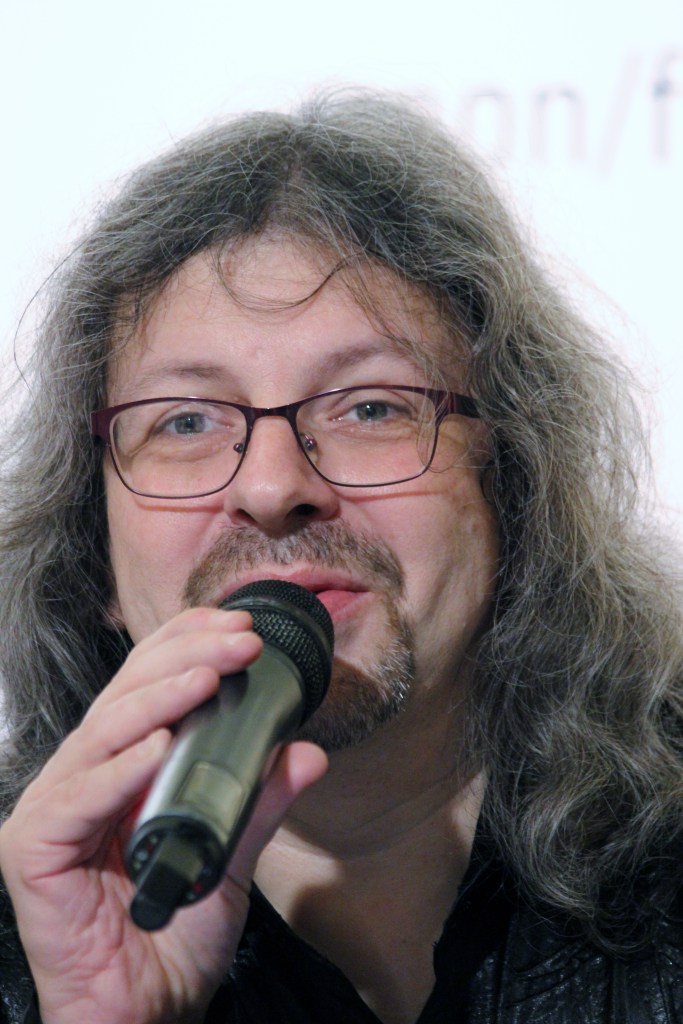
Dmitry Kuzmin in 2019. Photo courtesy of Wikipedia
“It is probably too late for the world, but for the individual man there always remains a chance.” This formulation from Joseph Brodsky’s Nobel Prize speech grew out of the two-hundred-year Russian liberal tradition of tiny, good deeds accomplished in the maw of Leviathan, and over the past two years it has inspired many. Each refugee rescued from the occupied Ukrainian territories via the Rubikus volunteer network is the best evidence of this inspiration. But we of course know that this is not true. There is not always a chance to save the individual. And the death of Alexei Navalny has reminded us of this with irrefutable clarity. Although with no greater clarity than the death a few days earlier of three children, burned alive with their parents at their home in Kharkiv as a result of a Russian rocket strike.
But empathy is only ever individual: in your head you may be on the side of all the Ukrainians and all the political prisoners, but your heart responds to concrete stories, names, and faces. And the media reality of today brings them to us. By following a couple of links, you can look into the eyes of every victim of a rocket attack. You can read the last text messages sent by Ukrainian women to their loved ones killed in this war. You can see the frontline dugout where the phenomenal poet Maksym Kryvtsov, the hope of Ukraine’s rising literary generation, slept alongside his tabby cat—just a few days before they were both killed there.
It’s a little more complicated with the victims on the other side of the frontlines, the ones whom the Kremlin regime is trying to exterminate on its own soil. Navalny’s singularity and even exceptionalism lies in the fact that even in a prison camp literally at the ends of the earth he was still able to turn his story into a gripping, if agonizing, show. Others do not have this opportunity. Where is Nikita Uvarov, the teenager sentenced to five years for talking with his friends about anarchism and for constructing an FSB building in Minecraft and planning to blow it up? Where are Salekh Magamadov and Ismail Isayev, the Chechen youths who dared to start a chat group for atheists and received eight- and six-year prison sentences, respectively? Or this thing that didn’t even get picked up in the news: where is the “transgender LGBT activist and OVD Info volunteer” who sent money to the Ukrainian army? Their name is unknown but their prison sentence, they say, is twelve years. And this is not to mention Belarus, which has practically disappeared from the Russian news, and where one of the main opposition figures, Maria Kolesnikova, is in prison and has not been heard from for over a year. Navalny, who even from the Yamal Peninsula was able to maintain Russian society’s focus and interest, was also doing this for all the above-named individuals and many more unnamed ones, even if it didn’t actually help them at all. Along with Navalny’s murder, the topic of internal crackdowns, the domestic frontline in the Putinist walking dead’s war against all the living, will inevitably exit the field of daily scrutiny. It is entirely likely that this was indeed the motivation for finishing off a reprisal that had lasted for years, and now we can expect an abrupt post-election uptick in those selfsame crackdowns.
In theory, there are people working on the other side. But they are, in typical fashion, incapable of drawing attention to themselves—and they intentionally avoid it. The prosecutors advocating for the prosecution, the judges issuing the sentences, the prison wardens carrying out their dirty work (even if we don’t take straight-up murder into account)—they all have names and faces, but no one worries about them: it seems that only the extremely scrupulous Gabriel Superfin remembered today who is nominally responsible for the tragedy on the Yamal Peninsula. After all, every rocket dropped onto Ukrainian targets was designed by someone, assembled, shipped by someone, and someone pressed the button. You can fantasize about how each of these people will eventually pay for their involvement, but we know from historical experience that at best their grandchildren and great-grandchildren will feel ashamed of them. In the stand-off between individuals and the system it is immaterial who personally represents the system. In the recent story of the rock group Bi-2’s lucky liberation from imprisonment in Thailand it was openly discussed how the Russian consul was pulling the strings in the devilish machinations—but where is this consul, who has seen him? He is probably an inventive paper-pusher—a “first-rate pupil,” in Yevgeny Schwartz’s words—but he is not meant to have any personal qualities.
Safe to say we won’t get anything out of Thailand: this country, so beloved by Russian tourists, where the king can kick his former wife out to a dilapidated shack, having first ordered his minions to destroy the shack’s toilet and to hang a sign over the waste pit saying, “I hope you are as comfortable here as in the palace,” should easily find common cause with a country where the president’s main opponent had his underpants smeared with poison. Yet a month earlier, for example, Russian national Yevgeny Gerasimenko was arrested at Russia’s request in Prague, at Vaclav Havel Airport (you can imagine what Havel would have said about this). It seems that no one had to lobby for this arrest, the system worked on its own: some Russian agency put in a request to Interpol, some international bureaucratic authority received the request, some Czech law enforcement officials carried out their routine duty. What does it matter that Gerasimenko’s application for political asylum was already being reviewed by the authorities of a different EU country: they were looking for him, the former manager of a computer school in Norilsk, a city built on the bones of political prisoners, allegedly for dangerous financial crimes… Wait, and of what crimes had Alexei Navalny been convicted, sent to a village built on the bones of political prisoners, and murdered there? Does no one remember anymore?
A long time ago there was a Soviet film about a group of teenagers who got lost in caves: they ran out of food and water, they lost their sense of time, all the underground passages led them again and again to a bunker built by the Germans in WWII, with the word Tod (“death”) written in huge letters on the wall. When they’re on their last legs one of the boys has the thought that Death, in fact, is fascist, that everything that’s bad for the Nazis has to be good, everything that the Nazis prohibit should be allowed—and he pulls the lever below the word. The wall collapses and they’re set free. And that’s what the story by Magsud Ibrahimbeyov, on which the film is based, is called: “Death to All That’s Good.”
You might think that something which was clear to Soviet teens has become unclear to many people in today’s democratic world: when you are up against an inhuman system, the whole system is inhumane. Its criminal sentences for discrediting the army and its legitimation of Nazism are legal to the same extent as its fines for traffic violations. Its special services aim to root out good and inculcate evil to exactly the same extent as its therapists who have developed “acceptance and responsibility” therapy for Russian LGBT people, or its preschool teachers who dress the little ones in camouflage and line them up to make the letter “Z.” There are no such scales that could determine which of the system’s nodes and mechanisms are more harmful or more guilty: the rabid steamroller that has decided to crush you moves all the more efficiently because its rollers, hydraulics, and electric starter are working in perfect unison.
This unison starts to fall apart when one single individual drops out of the system.
Among the various individual people scattered across the icy wasteland of Russia, for the past six months I’ve been steadily observing two perfectly ordinary schoolchildren (albeit in snatches since it’s not entirely up to me). They have no father, their wingnut mother unfailingly supports the authorities, and every week at their very average school on the outskirts of Moscow they get to listen to the “Important Conversations” lesson—a repulsive propagandist mishmash that make the Brezhnev-era political-information sessions of my youth look like ambrosia. You might think that the fate of these kids in the foreseeable future is predetermined. But here we have an interesting result. The older brother is studying Ukrainian on his own. The young one, who isn’t yet up to that task, is diligently drawing Ukrainian flags in all of his school notebooks. It seems that they haven’t even discussed this with each other.
I don’t know how to convey to these kids that they’re playing with fire. I am not sure it will be possible to save them if it comes to that. But I see in them what Daniil Kharms once promised: “Life has defeated death by means unknown to me.” And if Brodsky was wrong about the possibility of saving the individual person, then maybe he was wrong about the world as well. Although from today’s perspective how the world can be saved is entirely unclear.
I never met Alexei Navalny, although we have (or had) a number of mutual friends, as you’d expect. And while his death was not a surprise — this regime had tried to kill him before, but he survived, literally miraculously — it was still a shock when news of it came yesterday morning.
You may have heard AN referred to as “Russia’s Nelson Mandela.” Commentators here have also been invoking Martin Luther King and several other Americans (on a list to which I would add RFK) in an effort to give U.S. listeners/readers a sense of how this loss may affect several generations of Russians.
What those comparisons cannot convey is how much the shock and loss register on a personal level. I am sure that millions of Russians today feel as though they’ve lost a family member — for some immediate, for others more distant — but in any case a relative, someone who was “one of ours” …and who they can’t quite believe is really gone, never to show up again at their homes, at a peace rally or in some live link on their laptops/phones/etc. And doubtless many Russianists abroad, like me, are experiencing a version of that same feeling: an almost palpable sense of personal loss.
Over recent years I have described AN more than once as the only person who, if the nation proved very lucky, might just be able to bring the place to its senses following the prolonged and self-inflicted disaster that has defined Russia in the first quarter-century of the new millennium. But here we are: the nation has not been very lucky (it seldom is), and all of us — Russians, Russianists and the rest of the world — can only mourn the passing of a genuine Russian праведник (PRA-ved-neek; a righteous man) and regret that the country has missed the slim yet credible “Navalny chance” that he represented.
I am discouraged about the near-term future — meaning the country’s prospects overall as well as my own chances of returning to Moscow and our little family there (both wife and grandson continue OK, thanks) as long as the current President for Life remains either above ground or unincarcerated. But I am also trying to stay focused on AN’s injunction, which figures near the end of last year’s Oscar-winning Navalny documentary and is now being cited widely in various media. It goes, in paraphrase, “If they do kill me, it will be a sign of weakness, not strength. So don’t despair — that’s not allowed! — and keep up the good fight.”
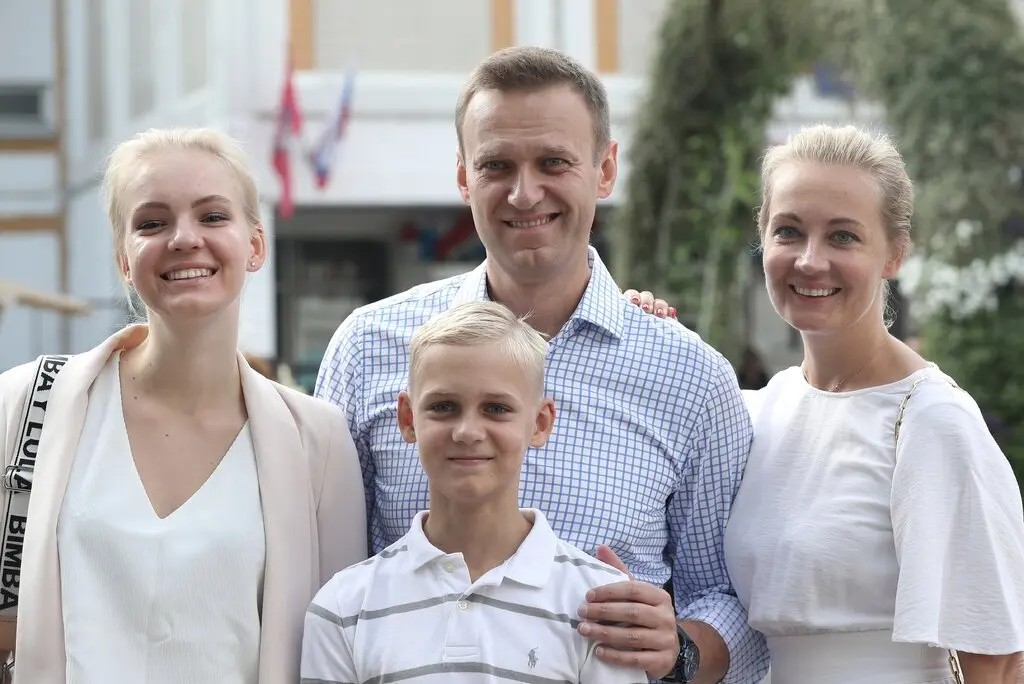
AN’s daughter Dasha is, as you may know, an undergrad at Stanford. Somehow this picture cheers me up a little today.
Source: Mark Teeter, email newsletter to family and friends, 17 February 2024. Thanks to Mark for his kind permission to reproduce it here. Mark is not only a proud alumnus of Stanford University, but he also played a role in welcoming me to Russia for the first time, in 1994. He describes my own feelings about Navalny’s death to a tee. ||| TRR
ALEXEI NAVALNY (1976-2024): Покойся с миром / R.I.P.
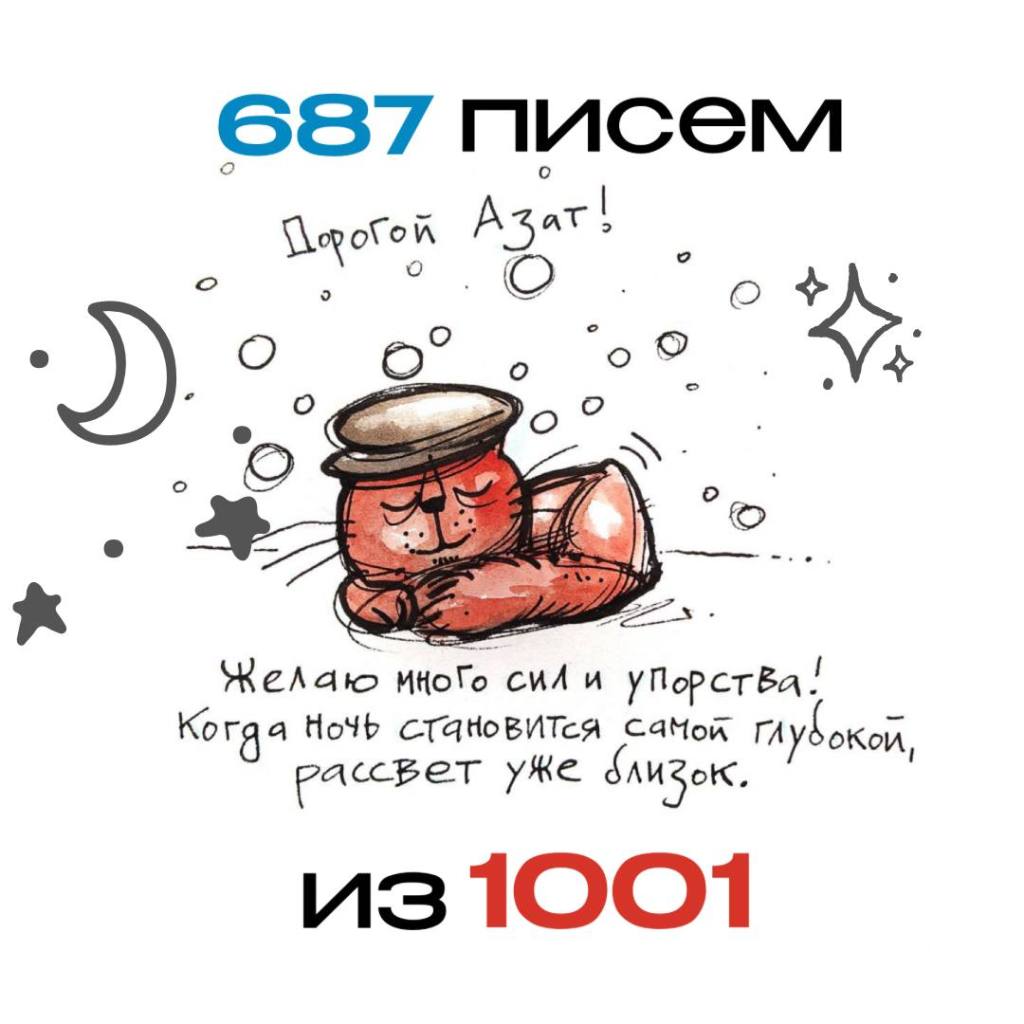
🔥 Since the last appeal to write to Azat, the Solidarité FreeAzat Association has received 687 letters out of its goal of 1,001 letters!
✈️ We received letters from a huge number of countries. Azat is supported by people in France, Russia, Belgium, Nicaragua, Mexico, Germany, Lithuania, the UK, Switzerland, Italy, Poland, Canada, Finland, Australia, Brazil, Côte d’Ivoire, Mali, Georgia, South Korea, Armenia, New Zealand….
Fifty countries in all!
🫠Today we learned that the military court’s first hearing in Azat’s case has been scheduled for February 12 in Yekaterinburg. We have even less time than we thought. There is one week left to get all the letters.
🫶 We urge everyone who hasn’t written yet to write a letter to Azat Miftakhov before February 12, to show solidarity with and verbal support for a person who has been imprisoned for no particular reason.
😳We would like to remind you that Solidarité FreeAzat Association is going to send the letters via Zonatelecom, an electronic service for dispatching letters to Russian inmates, and therefore we need your full support.
😳You can make a donation to offset the cost of sending the letters.
🤮 If you have a Russian bank card, send money to:
Mastercard 5469 3800 5929 3380 (Sberbank) Elena Gorban
🤮 If you want to donate using a non-Russian bank card you can use this payment service:
Please note that the service will charge a commission on the payment, and you need to manually lower the amount of the commission to 0 euros.
Write letters to those who need them so much now!
❣️*The postcard [above] was drawn by Hans, an artist from Germany.
Source: FreeAzat! (Telegram), 5 February 2024. Translated by the Russian Reader. Thanks to Posle for the heads-up. Please note that the Google letter-writing form, linked to above, is in Russian not least because the correspondence received by Russian inmates must be in Russian in order to pass censorship. If you need help negotiating this, don’t hesitate to write to me at avvakum@protonmail.com.
Azat Miftakhov
We’re launching a fundraiser to pay for mathematician Azat Miftakhov’s lawyer
Azat Miftakhov is a political prisoner, anarchist and mathematician convicted in 2019 on charges of disorderly conduct for allegedly breaking a window at a United Russia party office. In 2023, Azat was detained when he was released from prson and charged with “condoning terrorism.” According to police investigators, Miftakhov “deliberately in the presence of two convicts publicly condoned terrorism” while serving his sentence for disorderly conduct in Penal Colony No. 17.
According to the testimony of the other inmates, while watching the evening news on TV in May 2023, Miftakhov said that he would “avenge” a friend who had been killed while fighting for the Ukrainian army. The principal testimony in Azat’s new case was given by a identity-protected witness. He claimed that Miftakhov had condoned the actions of Mikhail Zhlobitsky, who carried out a suicide bombing at the Arkhangelsk offices of the Federal Security Service (FSB).
You can send a transfer in Russian rubles to Tinkoff card 5536 9140 9963 7302, tied to phone number +7 (991) 938-0181, Roman Vyacheslavovich P. (Mark the reason for payment as “mathematics.”)
Bohdan Ziza, a Ukrainian artist, poet and activist, is serving a 15-year sentence for “terrorism” after pouring blue and yellow paint – the colours of the Ukrainian flag – on to a municipal administration building in Evpatoria, Crimea, his home town. He made and circulated a video of the action – on 16 May 2022, shortly after the all-out Russian invasion of Ukraine – and for that was also charged with “incitement to terrorism”.
Bohdan Ziza. From his instagram channel
This is Bohdan’s speech from the dock, before being sentenced by a Russian military court on 5 June last year.
Do I regret what I have done?
I am sorry that I over-reached, and that my action resulted in charges under the Article [of the Russian criminal code] on terrorism. I am sorry that my grandmother is now without the care and support that she needs. Apart from me, she has nobody. And I am sorry that I can not now help others who are close to me, who need that help now.
As for the rest: I acted according to my conscience.
And also, according to my conscience, I do not deny or disavow what I did. I behaved stupidly, and could have expressed my opinion in some other way. But did I deserve, for what I did, to be deprived of my freedom for ten years or more?
I would like to appeal to the court: do not follow the regime’s script, do not participate in these awful repressions. But obviously that would have no effect. The judges and other similar political actors are just doing what they are told.
For these reasons, I will continue to protest, even in prison. And I am well aware of the sentence I may receive, and how it may affect my health and even my life.
But am I worthy of the life that I live? Is each one of us worthy of a carefree life, when we stay silent at a time when, every day, innocent people’s lives are being taken?
This was the worst night of my life. I never experienced anything like it. I thought we would die. There were three Kinzhal rockets, and loads of Kalibrs. They fell very close, they were right above our building. The building shook – several explosions, one after the other. For the first time in the war there was a white glow, the sky was white from the explosions. It was as though we were in a trench, not in our own home. At one moment I thought that it was all flying towards us. There was the very clear sound of a rocket, and then a very powerful explosion. But we have been lucky, again, and we are still alive.
That was a message from my sister, in Kyiv, who had to live through another night of bombardment of the city by the Russian armed forces.
When she went out in the morning, she learned that one of the rockets had hit the next-door building.
For many people, this war that is going on now is happening over there somewhere, far away.
One of the staff at the pre-trial detention centre said to me: “Bloody hell, I am sick of this war. Whenever you turn on the TV, it’s more of the same.” I answered that the war is not over and so you can not get away from it. And then he said: “Yeah, yeah, I know. It’s just that everything is getting more expensive. The cost of running a car now!”
And that’s the problem, here in Russia. For you, this war is an inconvenience, an irritation. You try to wait it out, living your usual life, trying to avoid bad news, and in that way simply not valuing simple things, not valuing the fact that you can wake up in a warm bed, in a warm flat, and say to someone who is dear to you, “good morning”. At a time when in the country next door, millions of people are losing their homes, losing their loved ones, when whole cities are being destroyed. Every day. That’s the everyday reality for Ukrainian citizens now.
In theory, Russian people’s failure to act could be explained, if only what is happening was not being done by Russian hands. The hands of those who bear arms, and those who don’t do anything to stop them. Every day that an ordinary Russian person carries on, reasoning that this is all politics and doesn’t concern him, and living his normal life, he adds money to the Russian Federation budget and in that way sponsors this criminal war.
Of course there are those who do not support what is happening, who take action, who are not silent participants: journalists, various activists – those who refuse to keep quiet.
My action was a cry from the heart, from my conscience, to those who were and are afraid – just as I was afraid – but who also did not want, and do not want, this war. Each of us separately are small, unnoticed people – but people whose loud actions can be heard. Yes, it is frightening. Yes, you can end up behind bars – where I, for sure, did not plan to be. Even for these words I could face a new criminal case. But it is better to be in prison with a clear conscience, than to be a wretched, dumb beast on the outside.
I am also an ordinary citizen of my country – Ukraine – who is not used to keeping quiet when confronted with lawlessness. I am not alone here today in this “goldfish bowl” [slang for the glass cage in which the accused appears in Russian courts]. There are more than 200 people with me: Ukrainian political prisoners, serving time in Russian prisons on fabricated charges. Many of them are Crimean Tatars, who are once again faced with repression by Russia. I am myself half Crimean Tatar, and angry at our people’s suffering.
Many Ukrainians are serving time in Russian prisons simply because they are Ukrainians, and were somewhere that the Russian state thought they should not be. In Russian prisons people are beaten up for speaking in Ukrainian. Or not even for speaking it, but simply for understanding it. Bastards among the guards at pre-trial detention centres or other places where people are imprisoned address prisoners in Ukrainian, to see if they get a reaction, to see if they provoke an answer or a response. If a person reacts, they beat him up.
Those who so passionately seek “Nazis” in Ukraine have not opened their eyes to the Nazism that has emerged in Russia, with its ephemeral “Russian world”, with which armed forces have come to us, to try to extirpate Ukrainian identity.
People in prison suffer in the most terrible conditions. Many of them are elderly. More than 40 people [in the pre-trial detention centre] have critical health problems, and can not access the medical treatment that they need. People die in prison. They are not criminals. Deport them from the country! Why do you keep them here?
I am no kind of terrorist. It sounds ridiculous to even say that. I am a person with morals and principles, who would rather give his own life than take the life of another person. But I am not ready to give my life to the Federal Penal Enforcement Service of the Russian Federation.
I declare a hunger strike, and demand that I be stripped of my Russian citizenship. I demand that all Ukrainian political prisoners be freed. If anything happens to me in prison, I want the world to know that it happened only because I am a Ukrainian, who took a stand against the war in his country.
And if this is my last word, let it be my last word in the Russian language. The last thing I will say publicly in Russian in this country, as long as this regime lasts. The reddish regime.
[Ziza then switched from Russian to Ukrainian, and recited this poem. Explanation of names mentioned below.]
I am not Red, I am Crimson!
I am not playing to the gallery!
These are not rhymes, they are wounds!
And I am not Melnik, I am Bandera!
The weather: it’s snowing in my summer,
From Symonenko’s motherland
I go to the end, like Teliha!
And I believe in wings, like Kostenko!
□ Note. The Ukrainian for “crimson” (“bahrianyi”), was also the pseudonym of Ivan Lozoviaha, a dissident writer and political exile from 1932 to his death in 1963. Andriy Melnik and Stepan Bandera were leaders of Ukrainian nationalist partisan military formations in the 1940s. Vasyl Symonenko was a Ukrainian poet, active in dissident circles until his death in 1963. Olena Teliha was a feminist poet, member of a nationalist underground cell in Nazi-occupied Kyiv, killed by the Nazis in 1942. Lina Kostenko is a Soviet-era dissident who has continued working as a poet and writer in post-Soviet Ukraine.
□ This is translated from the Russian text on the Graty news site, with reference to the Crimea Human Rights Group report.Thanks to M for help with translation.
□ What happened next. After Bohdan Ziza made this speech to the Southern District Military Court in Rostov, Russia, on 5 June 2023, he was sentenced by the judge, Roman Plisko, to 15 years in a high-security penal colony. Shortly after that, Ziza wrote to Zmina, the Ukrainian human rights organisation. He ended his hunger strike and then wrote to Uznik on-line, which coordinates correspondence with anti-war prisoners in Russia, to thank them and the many supporters who had written to him.
Bohdan, who marked his 29th birthday on 23 November, was moved to Vladimir prison. On 5 December, the Kharkiv Human Rights Protection Group reported that he had been visited by his lawyer and is in good spirits. He is sharing a cell with Appaz Kurtamet, another Crimean Tatar political prisoner, and was serving time in a punishment cell after stating that he is not a criminal and refusing to wear prison clothing.
□ What we can do. Advice to non-Russian speakers who wish to write to Bohdan and Appaz is included in this article on the Kharkiv Human Rights Protection Group site. The group also appeals to other countries’ diplomats to help Ukrainian citizens in Russian prisons (although this does not include Bohdan, since he was compelled, as a teenager, to take Russian citizenship after Crimea was annexed by Russia in 2014).
□ More information. Solidarity Zone (see facebook, telegram and twitter) supports anti-war activists jailed in Russia. The Kharkiv Human Rights Protection Group, Crimea SOS and Zmina are among the Ukrainian human rights organisation that publicise the fate of more than 180 Crimean political prisoners in Russian jails. SP, 17 January 2024.