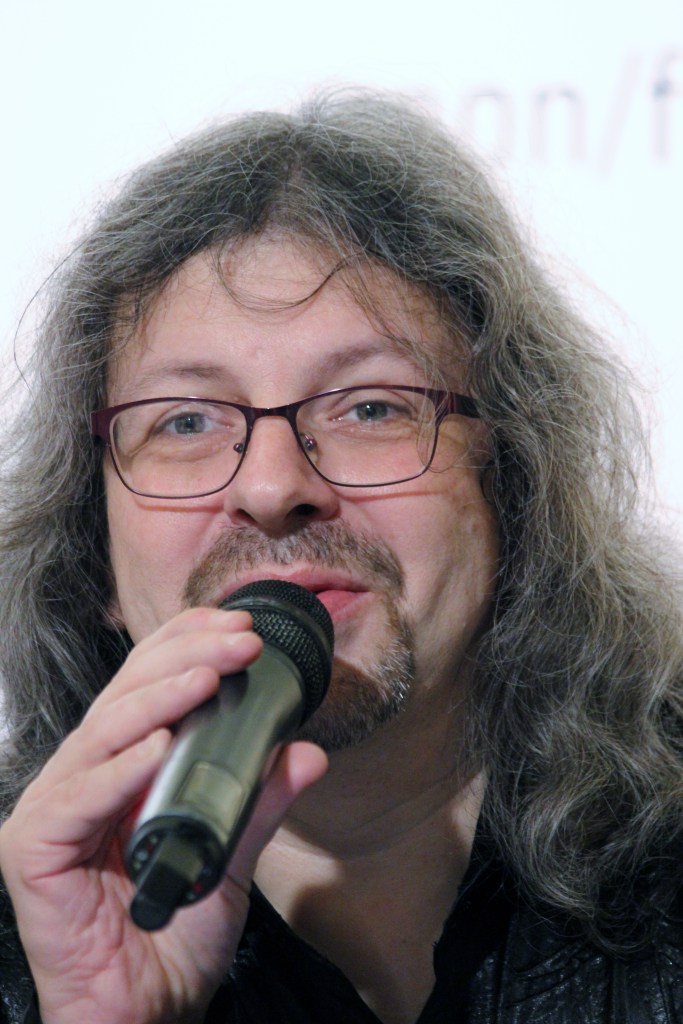
Dmitry Kuzmin: To Save One Person

Dmitry Kuzmin in 2019. Photo courtesy of Wikipedia

“It is probably too late for the world, but for the individual man there always remains a chance.” This formulation from Joseph Brodsky’s Nobel Prize speech grew out of the two-hundred-year Russian liberal tradition of tiny, good deeds accomplished in the maw of Leviathan, and over the past two years it has inspired many. Each refugee rescued from the occupied Ukrainian territories via the Rubikus volunteer network is the best evidence of this inspiration. But we of course know that this is not true. There is not always a chance to save the individual. And the death of Alexei Navalny has reminded us of this with irrefutable clarity. Although with no greater clarity than the death a few days earlier of three children, burned alive with their parents at their home in Kharkiv as a result of a Russian rocket strike.

But empathy is only ever individual: in your head you may be on the side of all the Ukrainians and all the political prisoners, but your heart responds to concrete stories, names, and faces. And the media reality of today brings them to us. By following a couple of links, you can look into the eyes of every victim of a rocket attack. You can read the last text messages sent by Ukrainian women to their loved ones killed in this war. You can see the frontline dugout where the phenomenal poet Maksym Kryvtsov, the hope of Ukraine’s rising literary generation, slept alongside his tabby cat—just a few days before they were both killed there.

It’s a little more complicated with the victims on the other side of the frontlines, the ones whom the Kremlin regime is trying to exterminate on its own soil. Navalny’s singularity and even exceptionalism lies in the fact that even in a prison camp literally at the ends of the earth he was still able to turn his story into a gripping, if agonizing, show. Others do not have this opportunity. Where is Nikita Uvarov, the teenager sentenced to five years for talking with his friends about anarchism and for constructing an FSB building in Minecraft and planning to blow it up? Where are Salekh Magamadov and Ismail Isayev, the Chechen youths who dared to start a chat group for atheists and received eight- and six-year prison sentences, respectively? Or this thing that didn’t even get picked up in the news: where is the “transgender LGBT activist and OVD Info volunteer” who sent money to the Ukrainian army? Their name is unknown but their prison sentence, they say, is twelve years. And this is not to mention Belarus, which has practically disappeared from the Russian news, and where one of the main opposition figures, Maria Kolesnikova, is in prison and has not been heard from for over a year. Navalny, who even from the Yamal Peninsula was able to maintain Russian society’s focus and interest, was also doing this for all the above-named individuals and many more unnamed ones, even if it didn’t actually help them at all. Along with Navalny’s murder, the topic of internal crackdowns, the domestic frontline in the Putinist walking dead’s war against all the living, will inevitably exit the field of daily scrutiny. It is entirely likely that this was indeed the motivation for finishing off a reprisal that had lasted for years, and now we can expect an abrupt post-election uptick in those selfsame crackdowns.

In theory, there are people working on the other side. But they are, in typical fashion, incapable of drawing attention to themselves—and they intentionally avoid it. The prosecutors advocating for the prosecution, the judges issuing the sentences, the prison wardens carrying out their dirty work (even if we don’t take straight-up murder into account)—they all have names and faces, but no one worries about them: it seems that only the extremely scrupulous Gabriel Superfin remembered today who is nominally responsible for the tragedy on the Yamal Peninsula. After all, every rocket dropped onto Ukrainian targets was designed by someone, assembled, shipped by someone, and someone pressed the button. You can fantasize about how each of these people will eventually pay for their involvement, but we know from historical experience that at best their grandchildren and great-grandchildren will feel ashamed of them. In the stand-off between individuals and the system it is immaterial who personally represents the system. In the recent story of the rock group Bi-2’s lucky liberation from imprisonment in Thailand it was openly discussed how the Russian consul was pulling the strings in the devilish machinations—but where is this consul, who has seen him? He is probably an inventive paper-pusher—a “first-rate pupil,” in Yevgeny Schwartz’s words—but he is not meant to have any personal qualities. 

Safe to say we won’t get anything out of Thailand: this country, so beloved by Russian tourists, where the king can kick his former wife out to a dilapidated shack, having first ordered his minions to destroy the shack’s toilet and to hang a sign over the waste pit saying, “I hope you are as comfortable here as in the palace,” should easily find common cause with a country where the president’s main opponent had his underpants smeared with poison. Yet a month earlier, for example, Russian national Yevgeny Gerasimenko was arrested at Russia’s request in Prague, at Vaclav Havel Airport (you can imagine what Havel would have said about this). It seems that no one had to lobby for this arrest, the system worked on its own: some Russian agency put in a request to Interpol, some international bureaucratic authority received the request, some Czech law enforcement officials carried out their routine duty. What does it matter that Gerasimenko’s application for political asylum was already being reviewed by the authorities of a different EU country: they were looking for him, the former manager of a computer school in Norilsk, a city built on the bones of political prisoners, allegedly for dangerous financial crimes… Wait, and of what crimes had Alexei Navalny been convicted, sent to a village built on the bones of political prisoners, and murdered there? Does no one remember anymore?

A long time ago there was a Soviet film about a group of teenagers who got lost in caves: they ran out of food and water, they lost their sense of time, all the underground passages led them again and again to a bunker built by the Germans in WWII, with the word Tod (“death”) written in huge letters on the wall. When they’re on their last legs one of the boys has the thought that Death, in fact, is fascist, that everything that’s bad for the Nazis has to be good, everything that the Nazis prohibit should be allowed—and he pulls the lever below the word. The wall collapses and they’re set free. And that’s what the story by Magsud Ibrahimbeyov, on which the film is based, is called: “Death to All That’s Good.”

You might think that something which was clear to Soviet teens has become unclear to many people in today’s democratic world: when you are up against an inhuman system, the whole system is inhumane. Its criminal sentences for discrediting the army and its legitimation of Nazism are legal to the same extent as its fines for traffic violations. Its special services aim to root out good and inculcate evil to exactly the same extent as its therapists who have developed “acceptance and responsibility” therapy for Russian LGBT people, or its preschool teachers who dress the little ones in camouflage and line them up to make the letter “Z.” There are no such scales that could determine which of the system’s nodes and mechanisms are more harmful or more guilty: the rabid steamroller that has decided to crush you moves all the more efficiently because its rollers, hydraulics, and electric starter are working in perfect unison.

This unison starts to fall apart when one single individual drops out of the system.

Among the various individual people scattered across the icy wasteland of Russia, for the past six months I’ve been steadily observing two perfectly ordinary schoolchildren (albeit in snatches since it’s not entirely up to me). They have no father, their wingnut mother unfailingly supports the authorities, and every week at their very average school on the outskirts of Moscow they get to listen to the “Important Conversations” lesson—a repulsive propagandist mishmash that make the Brezhnev-era political-information sessions of my youth look like ambrosia. You might think that the fate of these kids in the foreseeable future is predetermined. But here we have an interesting result. The older brother is studying Ukrainian on his own. The young one, who isn’t yet up to that task, is diligently drawing Ukrainian flags in all of his school notebooks. It seems that they haven’t even discussed this with each other.

I don’t know how to convey to these kids that they’re playing with fire. I am not sure it will be possible to save them if it comes to that. But I see in them what Daniil Kharms once promised: “Life has defeated death by means unknown to me.” And if Brodsky was wrong about the possibility of saving the individual person, then maybe he was wrong about the world as well. Although from today’s perspective how the world can be saved is entirely unclear.

Source: Dmitry Kuzmin, “To Save One Person: On the Victims and the Executioners,” Radio Svoboda, 18 February 2024. Translated by the Fabulous AM. Mr. Kuzmin is a poet, translator, and editor-in-chief of the poetry journal Vozdukh.

“One Person and God Are Already a Majority”: The Petersburg Teacher Fired for Reading Kharms and Vvedensky to High-Schoolers

“She had never read Vvedensky. It was so disgusting that I still feel physically sick.”Teacher Serafima Saprykina recounts how Kharms and Vvedensky were put on trial during an emergency meeting at a Petersburg high school • Venera Galeyeva • Fontanka.ru • February 6, 2022

The class in which tenth graders listened to poems written by “fascist accomplices” and “enemies of the people” was guest-taught by the young teacher-organizer, who had been invited by the social studies teacher. Everything started because the school’s “literary sector was lagging” and they had been having a hard time finding a library director.

Serafima Saprykina, whose Facebook post detailing the unusual approach of the 168th Gymnasium’s principal to the avant-garde OBERIU poets has gone viral, spoke to us about what exactly the director didn’t like about the work of [poets Daniil] Kharms and [Alexander] Vvedensky, why she decided to make the story public only now, and what she hopes will come about as a result.

Serafima Saprykina

Serafima, why did you decide to tell the story of your departure from Gymnasium No. 168 just now?

I watched the latest film from [journalist] Katerina Gordeyeva, about the children of people who were persecuted [under Stalin]: Mama Won’t Come Back: Women of the Gulag. I became terribly ashamed, I even started crying. I realized that I was doing the wrong thing. I had a chance to stand up for the repressed and I didn’t do it. I don’t hold a personal grudge against the person who fired me, otherwise I would have made the situation public right away. I just want evil to be called by name.

So why did you keep mum back in December?

I figured that I would go on working in the school, or maybe in a different one. And if I told the story no school would ever hire me. But after working in various schools for seven years I have seen all kinds of things and I understand that school, the system that schools are part of, is not going to change. When I was in school in Volgograd I was subjected to bullying. I was different, I read a lot and my classmates disliked me. I would never have thought that I would become a teacher myself but at a certain point I found my calling there.

How did you come to teach the OBERIU poets?

I wrote a dissertation about religious imagery in the work of the OBERIU poets for my master’s at the St. Petersburg State University philosophy department. I’ve been into this topic for a long time and wanted to tell the kids about it. But this wasn’t a one-off lecture, it was part of a series of lessons. The first one was about the [classical modernist] Silver Age poets, then the OBERIU poets, then a lesson about the stadium poets [of the late 1950s—Yevgeny Yevtushenko, Bella Akhmadulina, and others—trans.] and [Joseph] Brodsky, with contemporary literature at the end. Unfortunately, I only got to the second lesson. The series had been officially approved and accepted by my immediate supervisor, head teacher Tatyana Nikolayevna Golerbakh.

The lesson on the OBERIU poets came after the students’ regular classes?

No, I taught it in place of their social studies class—the teacher had invited me to take over that hour. This is standard procedure at the school, the librarian must ask the other teachers for permission to run a “library hour” during their classes. But I didn’t talk to the kids about the precise circumstances in which Kharms and Vvedensky died after their arrests in 1941, or about the arrests either. What’s the point in scaring the kids like that, anyway? I told them about the OBERIU group.

OBERIU (the Association of Real Art—Obedinenie realnogo iskusstva) was a group of writers and cultural figures that existed between 1927 and the early 1930s in Leningrad (now Petersburg).

When we got to Vvedensky, I gave the kids his poem “I regret that I’m not a beast” [Mne zhalko, chto ia ne zver’]. And that really sparked the whole situation that followed. All the people who participated in the emergency meeting called by the principal, including the director of the school museum, had been working with me for half a year and had nothing but praise for me. If the principal had said that I needed to quit because she didn’t approve of my work, I would have understood. But she said, “What a filthy title: he regrets, you know, that he’s not a beast.” She had never read Vvedensky. It was so disgusting that I still feel physically sick.

Actor Boris Dragilev reading Alexander Vvedensky’s poem “I regret that I’m not a beast” at the Anna Akhmatova Museum at Fountain House in Petersburg in 2013. Courtesy of Fontanka.ru

Your Facebook post went viral within three hours, it’s all over social networks and the media. What has changed in your life since then?

Absolutely everything in my world has changed. When I was writing the post, I thought that I’d get like five likes and three comments, with two of those claiming I was making it all up. I didn’t think that my post would elicit such a response and that people would start calling me a hero. What kind of hero am I? I haven’t even read all the messages and comments yet. But I am sure that the homeroom teacher for the tenth-grade class where I taught the Kharms/Vvedensky class will confirm that I didn’t tell the kids anything horrible during the lesson.

How long did you work at the 168th?

I was hired there in late August of 2021. The school was looking for a library director, and they saw my resume on a recruiting site and liked it. The principal called me and said that the school was very interested in me. At the interview she explained that their literary curriculum was lagging, and they really needed lessons on extracurricular reading, which I as library director could teach. When I came in to get registered for employment, it turned out that they couldn’t hire me as director without my having librarian experience or education, so they hired me as a teacher-organizer and tacked on 25% of the librarian salary.

Surely that is no grounds for firing someone?

Within this system it’s enough for there to be even a hint that they don’t want you around anymore. And whatever you do after that, however hard you try, you just have to leave. I’ve never had a serious conflict with anyone in my life, that’s just not who I am. This is just the systematic stigmatization of teachers with initiative. It’s happening everywhere.  

What exactly were your duties at the 168th?

What does the school library director do? There are two options. Either she just sits there and doesn’t let anyone into the library, and if a pupil comes and asks for a book, silently hands it over. Or she doesn’t [hand it over], if the book isn’t in the library. Or the director runs classes on extracurricular reading, reading competitions, talks about what’s going on in contemporary literature. For instance, I invited Kira Anatolyevna Groznaya, head editor of [youth journal] Aurora, and she talked to the kids about literary journals and how to publish in them. They really liked it.

And how much were you paid for this work?

Schools pay well, I never had any problems with how I was paid. But I won’t tell you exactly how much. Even if I never have work ever again, it won’t turn me into a person who thinks the wrong way. I really want to do research, to do graduate study. And more than anything I would like to work for Memorial (an organization declared to be an “NGO-foreign agent” by the Russian Justice Ministry and liquidated in December 2021 by order of the Russian Supreme Court—Fontanka.ru), to help keep alive the memory of repressed people. But Memorial is gone. I really love my country and don’t want to emigrate. Everyone is ruled by fear right now. You asked what I experienced in the three hours after publishing my post. It would be better to ask what I experienced during the month and a half since getting fired. And what I experienced was, probably, everything that a person in the 1930s experienced.

Why? No one’s being lined up for the firing squad and there’s no Gulag, right?

It seems like that, yeah. But meanwhile I’m being fired for reading poems by “enemies of the people.” And I’m afraid that no one will hire me again if I speak up. But what does it mean for me to speak up? My voice is the voice of one little person who wants to live her little life. I’m not a hero. I’m a coward who was brave enough to speak up one time. But the worst thing already happened — I got fired, because the principal thinks that Kharms and Vvedensky are “German accomplices” and “enemies of the people.” There is plenty of work out there, I’ll find something. And if I can’t, I’ll just live with my husband. But maybe with my silly little voice I can inspire others to speak up as well. And then we definitely won’t find ourselves back in 1937.  

Are you not afraid that the school will accuse you of making everything up? You don’t have a recording of that meeting, after all.

No, I’m not afraid. I know I’m telling the truth. One person and God are already a majority. Now I’m not afraid of anything. And you shouldn’t be either.

Translated by the Fabulous AM. Photo courtesy of Fontanka.ru via Serafima Saprykina

Daniil Kharms, “A Man Left Home”

1-255.jpgFirst publication of Daniil Kharms’s poem “A Man Left Home,” Chizh 3 (1937). Illustrated by Ivan Shabanov. Image courtesy of d.harms-ru. Inspired by togdazine.ru

Daniil Kharms
A Man Left Home (A Ditty)

A man left home
Bearing sack and stick.
He set out by foot,
He set out by foot
On a long, long trip.

He went straight ahead,
Eyes glued to the road.
Neither drank nor slept,
Neither slept nor drank,
Didn’t sleep, drink or eat food.

Then one day at dawn
He walked into a dark wood.
Since that day,
Since that day,
Since that day he’s been gone for good.

But if someday your paths
Should happen to cross,
Then, quick as you can,
Quick as you can,
Quick as you can, please tell us.

Translated by the Russian Reader

P.S. It transpires that the Berne-based quintet Olgas Bagasch has recorded an enchanting vocal-instrumental rendition of this poem in the original Russian. Thanks to Comrade Katrin for the heads-up.