Nearly Half of All Russians Have Switched to Subsistence Farming
Natalya Novopashina RBC
October 21, 2016
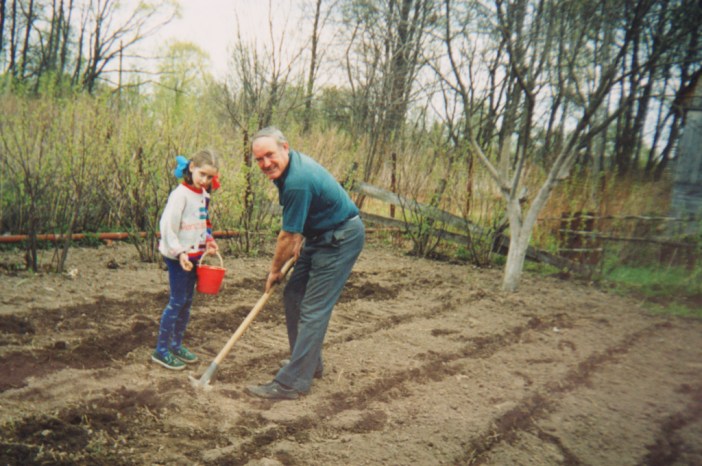
The percentage of Russians who grow food in their gardens has increased to 46%. At the same, food sales in stores have decreased, according to GfK Russia.
In two years, the percentage of Russians growing vegetables and fruits in their own gardens has increased from 39% to 46%. Moreover, production of their own vegetables is the main source of nutrition for the 15% of “active” gardeners, GfK Russia CEO Alexander Demidov told RBC.
“We have noticed a fairly big burst. People have been switching to growing their own produce. It is definitely a crisis,” he said, adding that the percentage of Russians engaged in subsistence farm not as a hobby, but to feed themselves, will only grow.
Irina Koziy, general director of industry news website FruitNews, confirms the trend, noting that it is most visible in medium-sized towns for now.
“Besides, there are a number of programs in the regions under which needy and large families are supplied with seed potatoes for planting in the spring. Such programs operate in Buryatia, Kuzbass, and a number of other regions,” said Koziy.
In April 2016, 53% of respondents reported the crisis had had a direct impact on their lives. In July 2016, this figure was 46%.
And yet, in reality, the actual financial circumstances of Russians have not improved. They have simply adapted to the crisis and regard the current economic reality more calmly.
“The effect of adjusting to the situation has kicked in, because people don’t believe the crisis will be resolved soon,” said Demidov. “So crisis consumerist strategies are still in effect.”
According to GfK, the vast majority of respondents (75%) said they were willing to give up purchasing certain goods. In particular, according to the company, the greatness number of Russians (17% of respondents) have been saving money by cutting out trips to beauty salons. Other expenditures that had been cut included purchases of household appliances (16%) and cosmetics (15%).
The sales of most foods have also decreased. According to GfK, during the year beginning July 2015 and ending July 2016, sales of dairy products and meat decreased in physical terms by 0.5% and 0.8%, respectively. Most of all, consumers scrimped on sweets and snacks (a 3% decrease), bread products (a 7% decrease), and fish and seafood (a 7.4% decrease). A slight increase occurred in sales of frozen products (1.1%), eggs (1.4%), fresh fruits and vegetables (1.5%), and baby food (2.2%).
During the same period, the volume in terms of price of goods purchased through promotions grew by 45%. And the share of promotions throughout the fast-moving consumer goods sector increased from 12.2% to 14.1%, according to GfK’s calculations.
Translated by the Russian Reader. Photo courtesy of russiannotes.com
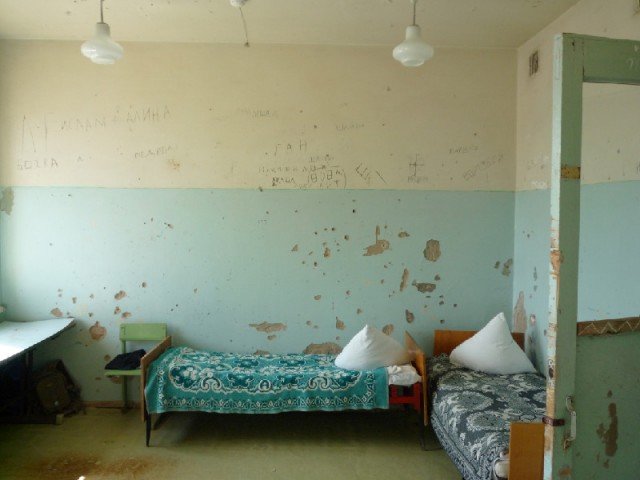
Room in Children’s Tuberculosis Hospital, Astrakhan, 2011. Photo courtesy of uglich_jj
One of the conclusions of a report by the Health Foundation was that the elimination of 41,000 beds in Russian hospitals had led to an increase in mortality of 24,000 people in 2015, RBC reports today. The Health Ministry acknowledged the increase in mortality, but said it was not due to a reduction in hospital admissions.
“Public Charity Organization The New life. We Are Ready to Help People in Life’s Difficult Situations.” One of the literally thousands of dubious business cards, offering help or employment to the unemployed, penniless, and otherwise unfortunate, stuck, crammed, and scotch-taped in every nook and cranny in central Petersburg in recent weeks.
More good news from the Supah Powah, as reported by RBC earlier today. Russian companies owe their employees 3.66 billion rubles [approx. 5.2 million euros]. By the beginning of October, wage arrears had increased by 3.6% compared to the previous month. This has not happened since April. 66,000 people are waiting for their money.
“The Shining Path. Aid to people who have ended up in difficult circumstances in life.”
Chuvash Pensioner Receives Two Years Probation for Repost on VKontakte
Artyom Filipyonok RBC
October 14, 2016
A court in Chuvashia has sentenced a local pensioner to a two-year suspended sentence for reposting printed matter earlier ruled extremist. In May of this year, Andrei Bubeyev, a mechanical engineer from Tver, was convicted of reposting an article by Boris Stomakhin.
Tsivilsk District Court in Chuvashia has sentenced 62-year-old pensioner Nikolai Yegorov, who works as a security guard at a cement factory, to a two-year suspended sentence. He was found guilty of “inciting ethnic hatred” (as punishable under Russian Federal Criminal Code Article 282.1), reports Interfax.
Police investigators claimed that, on May 8, 2014, Yegorov posted an open letter by journalist Boris Stomakhin, which had been ruled extremist, on his page on the VKontakte social network. Lawyer Yevgeny Gubin had previously reported that prosecutors had asked the pensioner be sentenced to 360 hours of compulsory labor.
Yegorov himself claimed he had not posted anything. According to his lawyer, his client’s personal page was accessible to anyone “due to his poor knowledge of the specific features of the Internet.”
Journalist Boris Stomakhin, who supported Chechen separatists, has been convicted of inciting hatred and publicly calling for extremism on three occasions. He is currently serving a sentence for justifying terrorism. In April 2014, he was sentenced to six and a half years in prison.
In May of this year, Andrei Bubeyev, a mechanical engineer from Tver, was convicted for reposting an article by Stomakhin. The sentence was harsher: Bubeyev was sentenced to two years and three months in a work-release prison colony. The Tver man was convicted of “publicly calling for extremism” (as punishable under Russian Federal Criminal Code Article 280.2) and “publicly calling for actions aimed at violating the territorial integrity of the Russian Federation” (as punishable under Russian Federal Criminal Code 280.1.2).
In 2002, the law “On Combating Extremism” beefed up the definition of extremism. Extremism includes such acts as “violent change of the constitutional system and violation of the Russian Federation’s integrity,” “public justification of terrorism and other terrorist activity,” and “incitement of social, racial, ethnic or religious enmity.” Nikolay Mironov, director of the Center for Economic and Political Reform, told RBC that over half of extremism convictions have to do with publications in the Internet and, in particular, on social networks.
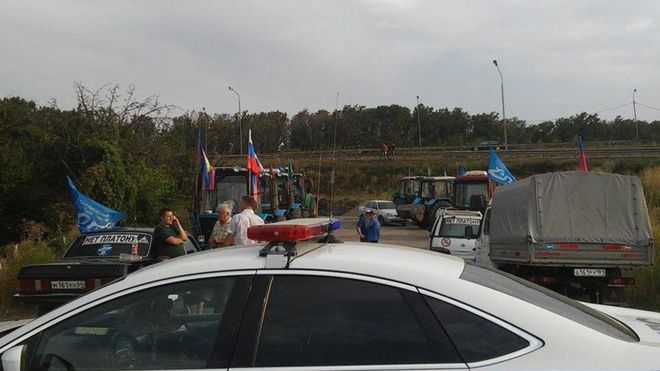
Police stop protesting Krasnodar farmers near Rostov-on-Don. Photo courtesy of BBC Russian Service
Krasnodar Farmers Say Convoy to Moscow Blocked
Grigory Naberezhnov and Dmitry Nosonov RBC
August 22, 2016
The Farmers told RBC that over a hundred police had blocked the tractor convoy from Kuban to Moscow near Rostov-on-Don. The farmers had complained of “large agricultural holdings taking away land from farmers.”
Police have halted a tractor convoy of Krasnodar farmers headed for Moscow, according to rally organizer Alexei Volchenko.
According to Volchenko, the farmers “were blocked every which way,” and “probably half the Rostov police force had been sent out.”
A total of seventeen tractors, two heavy truckers, and a number of passenger vehicles have been trapped in the road block. According to Volchenko, twenty patrol cars and 150 police officers were involved in the road block.
“The officers did not inform us of the reason for the stop,” Volchenko added. “I tried to figure out why a tractor cannot travel freely through the Russian Federation. They couldn’t give us an explanation.”
Ekaterina Vasiltsova, duty officer at the press service of the Interior Ministry’s Rostov office, told RBC they were “verifying information” about the incident.
The tractor drivers had been stopped in the village of Dorozhny near Rostov-on-Don, Volchenko told the BBC.
The farmers now plan “to travel to Krasnodar and have a chat with our governor,” he told RBC.
According to Volchenko, the president’s envoy to the region had promised them that if authorities were unable to reach an agreement with the farmers, “the road to Moscow would be open to them.”
If the road is not opened, “then I will publicly declare him a liar,” said Volchenko.
“In Krasnodar Territory alone, they stopped us seven or eight times for long stretches of between forty and fifty minutes. They would sometimes take two hours to check our papers and write up tickets,” he said.
Volchenko has told the Peasant Gazette (Krestyanski Vedomosti) that a “vicious practice” had taken root in Krasnodar Territory in recent years.
“Local authorities have refused to allocate their legal [land] shares to land owners, illegally leased them to third parties, usually large agricultural holding companies or they have violated their property rights altogether,” he told the paper.
“The large agricultural holding companies take land away from farmers and shareholders, and basically bring [the rural areas] to their knees, because the villages live on the money farmers spend, while the agricultural holdings are all registered as offshore companies in Cyprus and so on,” Volchenko told RBC in an interview.
The principal demand of the protesters was to “restore order through the courts.”
“She persuaded us to abandon the protest,” Volchenko told the Peasant Gazette. “[She] promised to speak with regional leaders about restoring order in land relations. [However,] six months have gone by, and basically nothing has changed.”
Translated by the Russian Reader
More proof, as if more proof were needed, that President Putin could care less about his wholly fictitious “base” in the wholly fictitious “Russian heartlands.” These tropes have been used by journalists and “experts” too willfully blind (?) to see the Putin regime was in fact an authoritarian smash-and-grab police state junta that was quickly switching to autopilot. It had no need then of real popular support, and it has much less need now. It does, however, generate the illusion of popular support through sham elections, self-fulfilling opinions polls, wars, and relentless mainstream and social media propaganda. But my experience in talking to lots of different people and my intuition tell me it is actually deeply unpopular among the folk who are supposedly its biggest supporters, like these farmers from the Kuban region. The regime’s real support comes from the officials and businessmen who have made out like bandits these past 17 years. They are its real base. TRR
Krasnodar Farmers Head to Moscow in Tractor Convoy
Olga Nadykto RBC
August 21, 2018
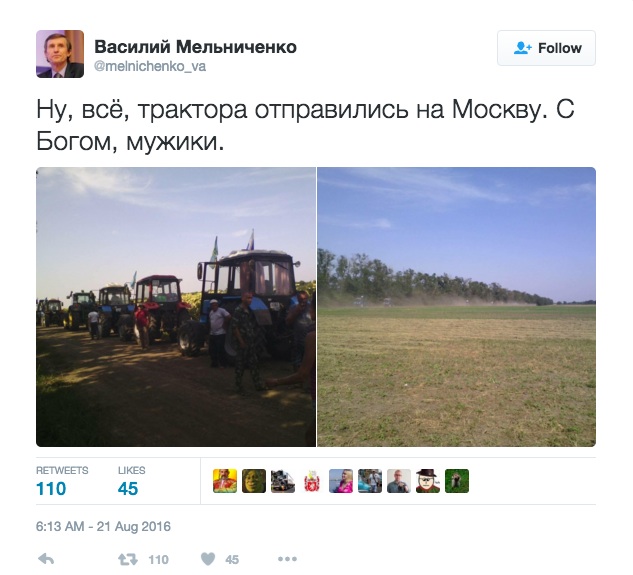
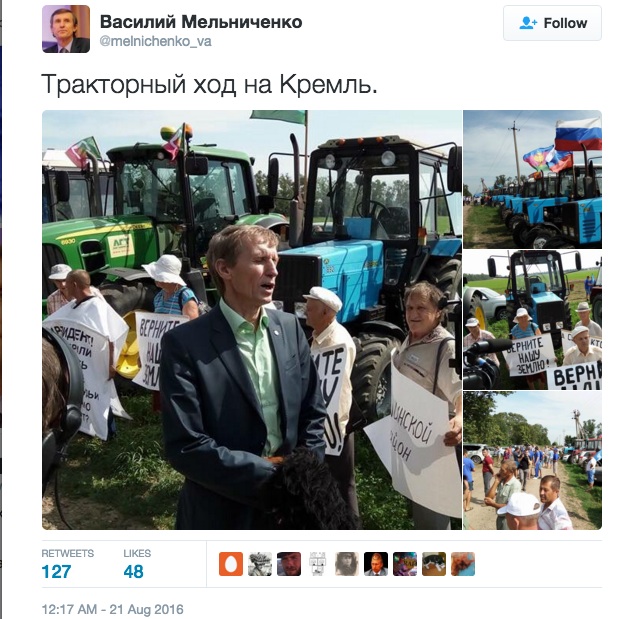
Farmers from Krasnodar Territory have set off on tractors to Moscow. The total number of tractors in the convoy is seventeen. This is the second attempt by the farmers of Kuban to organize a “tractor march” on Moscow
The Krasnodar farmers’ tractor convoy has left for Moscow, Vasily Melnichenko, one of the protesters, reported on his Twitter account.
Before the convoy set off, the farmers held a rally in the village of Kazanskaya in the Kavkazsky District of Krasnodar Territory. As reported by Novaya Gazeta, after the rally was over, a convoy of seventeen tractors and a few dozen cars headed for the neighboring Rostov Region on the federal highway. The newspaper reported that protesters intend to meet with federal authorities in Moscow.
As a co-organizer of the tractor convoy, Alexei Volchenko, earlier toldKrestyanskie Vedomosti (Peasant Gazette), the protest has been coordinated with the traffic police.
“There was moaning and groaning, and nerves were on edge, but we got the traffic police to sign off on the tractor convoy. They promised an escort, as the rules says they should,” said Volchenko.
According to Volchenko, the farmers are protesting the violation of their property rights and transfer of land to major agricultural holding companies.
The farmers of Kuban had initially tried to carry out a tractor convoy to Moscow in March of this year. Around a hundred farmers from nine districts in Krasnodar Territory announced plans to drive their tractors to Moscow, where they intended to deliver a petition to Russian President Vladimir Putin. However, the farmers later declined to carry out the protest.
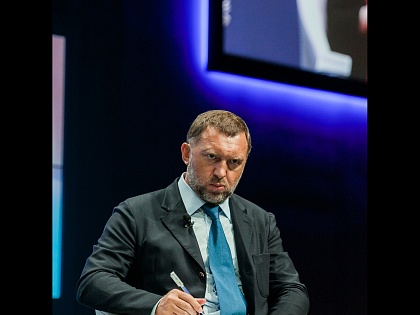
“I believe that it takes just 100 people to change a country for the better provided that these people are driven professionals capable of creating something new. I am sure that in Russia there are far more than 100 such people, so let’s join forces and work together.”
—Oleg Deripaska
_________
Deripaska’s Company Releases Sales Figures for “Olympic” Apartments
Natalya Derbysheva RBC
May 27, 2016
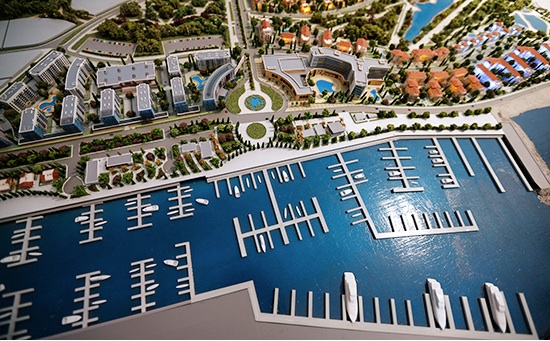
Mockup of the Sochi Olympic Village’s Coastal Cluster. Photo: Andrei Golovanov and Sergei Kivrin/TASS
Oleg Deripaska’s company RogSibAl has sold 20% of the luxury apartments it built on the Black Sea coast in Sochi for the Winter Olympics. The company believes this is a good result.
RogSibAl, a subsidiary of Oleg Deripaska’s Basic Element, built 2,700 luxury apartments on the Black Sea coast for the 2014 Winter Olympics in Sochi. Athletes lived in the apartments during the competition. According to Vnesheconombank, the project’s budget was 25.3 billion rubles, 22.3 billion rubles of which RogSibAl borrowed from Vnesheconombank.
The coastal Olympic Village is now known as the Imereti Resort District. It consists of four quarters, the Coastal Quarter, the Maritime Quarter, the Park Quarter, and the Reserve Quarter. Apartments are available for purchase in all four quarters. The price per square meter ranges from 152,000 rubles to 195,00 rubles [approx. 2,070 euro to 2,650 euros per square meter—TRR].
Since the apartments went on sale in 2013, 20% of them have been sold, a Basic Element spokesman told RBC, meaning that over 500 apartments in all have been sold. Basic Element’s spokesman added that the company had sold 118 apartments from January to May 2016. The company plans to have sold 350 apartments for a total area of 25,000 square meters on the year.
Basic Element has been renting out the unsold apartments. According to the company’s spokesperson, the rental demand for the 2016 summer season is 97–100%.
The sales figures are worse than what Basic Element had planned in 2011. Igor Yevtushevsky, RogSibAl’s general director, had then toldVedomosti that the company was planning to sell 50% of the apartments before the start of the Olympics, and the other half in 2014–2015.
Basic Element’s spokesman said it would be unfair to compare current sales figures with projections made in 2011.
“The project has undergone big changes,” he explained.
The company cites data from the MACON Realty Group, according to which 387 business- and luxury-class real estate transactions were concluded in Sochi from January to May 2016, meaning that the Imereti District’s share of this business was 23%.
The government has discussed the conditions of restructuring the loans issued by Vnesheconombank for building Olympic sites, RBC’s sources told it earlier this week. A federal official explained that Deripaska’s companies were in the most complicated circumstances in terms of loans, since the demand for apartments was not great.
Basic Element has not disclosed the figures of the income from its sales of the properties. Its spokesman did say, however, that all the proceeds were being wholly turned over to Vnesheconombank in repayment of the loan and that RogSibAl had been fulfilling all its obligations to the bank.
Given that sales usually begin at the design and construction stage of a property, 20% sales in the second year after a property has been operation is hardly satisfactory, argues Marina Udachina, director of the Institute for Innovations, Infrastructure and Investments. According to her, the situation is partly due to a slowdown in economic growth and a reduction in the demand for luxury properties.
Only 20% of the apartments in the Olympic Village have been sold in two years.
Here is what we wrote about this a month before the Games:
“The site is being built by oligarch Oleg Deripaska, one of the few private investors in the Olympics. Only he is building with public money. Twenty-two of the twenty-five billion rubles in the project’s budget has been secured with a loan from state-owned Vnesheconombank. Derispaska’s company is planning to pay back this money by selling the village as a residential complex after the Games. It will be hard for them to find buyers. A single bed in the village costs as much as a two-room flat in Moscow.”
Of course, the crisis, sanctions, and being “surrounded by enemies” have inevitably led to a drop in demand for fairly pricey holiday apartments. On the other hand, this was offset by the fact that demand was supposed to shift to the domestic market from Greece, Cyprus, Turkey, and other countries where housing had become almost twice as expensive for Russians.
As a result, sales did not take off, which is a pity. I know that after the Games a good person, familiar to a lot of my people on my wall, worked on the project.
We can also add to this news the latest about Sberbank, which after agonizing for a long time has today finally sold the Mountain Carousel ski resort on the installment plan to the former governor and current minister Tkachyov* and his young but quite talented son-in-law. The joke there is that Sberbank invested 25 billion rubles into Mountain Carousel, while Vnesheconombank loaned it 55 billion rubles. Vnesheconombank fiercely resisted the sale, because it is one thing when Sberbank is in hock to you to the tune of 55 billion rubles, and quite another when it is Tkachyov and family. Apparently, Gref is tougher and stronger than the moribund Vnesheconombank, although it does not make our lives any easier.
Since for some reason business has not been booming at nearly all the former Olympic sites, the government has authorized the repayment of Olympic loans over a period of 25 years at a reduced 5% interest rate. And to keep Vnesheconombank from kicking the bucket altogether, the Finance Ministry will give it another 150 billion rubles straight from our pockets.
P.S. I’m going to do a little populism practice. Anyone in Russia want a twenty-five-year mortgage at five-percent interest? Ask Tkachyov, Potanin, Deripaska, and Vekselberg “how.” )))
* On August 2, 2012, Tkachyov announced plans to deploy a paramilitary force of Cossacks in Krasnodar Krai, beginning September 2012, as vigilantes to discourage internal immigration by Muslim Russians. In a speech to police, he stated, “What you can’t do, the Cossacks can. We have no other way—we shall stamp it out, instill order; we shall demand paperwork and enforce migration policies.”
Silhouette figures trying to keep a ten-ruble coin in the air next to a stenciled inscription (left) that reads, “Not everything is in our hands.” Petersburg, May 23, 2016. Photo by the Russian Reader
Russia Level with Kazakhstan in Wages
Maria Leiva RBC
May 24, 2016
In 2015, the average Russian salary, in terms of US dollars, was equal to the level of wages in Kazahkstan, according to data from the Higher School of Economics (HSE). Compared to 2014, the salaries of Russians dropped by almost a third last year.
The observed decline in wages in Russia has led to their drawing level, late last year, with average wages in Belarus and Kazakhstan in previous years, experts at the HSE have calculated in their May monitoring of the populace’s socio-economic status and social well-being. Computed on the basis of exchange rates, the average wage in Russia last year was $558 a month, which is lower than the 2014 level by 34% or more than a third. By way of comparison, in Kazakhstan and Belarus, the average monthly wage, calculated using the same method, was $549 and $415, respectively.
From 2011 to 2015, Russia had the highest level of wages in the CIS, but in 2014, compared with 2013, it dropped by nearly 10%, from $936 to $847. The experts at the HSE note that the gap in economic performance indicators between Russia and certain CIS countries has been constantly contracting. For example, the average salary in Armenia in 2008 was around 52% of the 2015 Russian wage, but by the end of the period in question, it had grown to 60%. During the same period, Belarus has gone from 61% to 75%, and Tajikistan, from 17% to 26%. However, over the same period, the relative positions of Azerbaijan, Moldova, Ukraine, and Kazakhstan have declined.
If we compare the average wage in Russia and Central and Eastern Europe, the wage in those countries has exceeded the average in Russia for the past five years. Thus, last year, the average Russian wage came to 60% of the average wage in Hungary, and 50% of the average wage in the Czech Republic. However, in 2015, Russia came close to the level of wages in Bulgaria during 2013–2014.
Trends in the average monthly wage in Russia, Brazil, and China over the past five years show that wages in Brazil were higher than in Russia last year. Despite the fact that data on wages in China for 2015 have not yet been published, the figures for Russia in 2015 were lower than for China in 2012, 2013, and 2014, indicating the gradual reduction of the gap between the two countries in terms of this indicator.
Last week, Sberbank also reported a fall in the average monthly Russian wage below China’s average wage. The bank’s principal analyst, Mikhail Matovnikov, cited data that the average monthly wage of Russians had fallen below $450 a month, lower than that in China, Poland, Serbia, and Romania.
Translated by the Russian Reader. Thanks to Valentin Urusov for the heads-up.
Vasily Gatov Canary in a Coal Mine: RBC and the Public Interest in the Counterintelligence State Carnegie Moscow Center
May 14, 2016
Authoritarian regimes have seemingly learned how not to stifle freedom of speech completely, using censorship or administrative strictures to send signals about the acceptability or unacceptability of criticism on specific topics. In the peculiar circumstances of the counterintelligence state, however, an interest in how the state functions can itself be regarded as dissent.
Over the past few years, it has become popular among political scientists, analysts, and the military to dub any complicated and complex process “hybrid.” Complex military operations are now “hybrid wars,” electoral authoritarian countries, “hybrid regimes,” and mass media distributed on multiple platforms, “hybrid media organizations.”
The news for Friday, May 13, fully reflected the clash between different hybrids in the Russian public space. The dismissal of the top editors at RBC, a hybrid mass media organization that had become the main public affairs outlet under a hybrid regime engaged in a hybrid war with the western world, was a practical manifestation of the strange realm that has taken shape in our country and a continuation of its logical evolution or degradation.
Common Sense as a Measurement
RBC’s top editors, Elizaveta Osetinskaya, Roman Badanin, and Maxim Solyus, who left the company “by mutual agreement,” had done the impossible in the space of two years. Along with the team they assembled, they turned an important, major media outlet with serious image problems into an exemplar of high-quality, ethically motivated, high-impact journalism.
Moreover, writers and editors with different views peacefully coexisted at RBC. I never once heard the term “liberal terrorism,” which conservatives and patriots love to mention, applied to RBC. High-quality editorial work means just this: maintaining high standards in news production while fulfilling one’s mission to the community by supporting investigative reporting and representing a spectrum of opinions through individualized public affairs, op-ed journalism and personalized, presenter-driven TV programs.
It is difficult to maintain academic objectivity when the latest round of “personnel changes” has put an end to yet another media outlet that was faithful to its professional mission. It is difficult but necessary: the emotional or partisan mode of reacting inevitably exaggerates the weight of momentary, politically motivated explanations of events. Yes, the easiest way of interpreting the firing of RBC’s editors (and, apparently, the exodus of its editorial staff) is as the consequence of their having published articles and investigative reports that directly violated Putin’s strictures on the privacy of his family life. However, this explanation, even if the editors themselves proudly accept it, is neither exhaustive nor sufficient for understanding the full complexity of hybridity.
Over the past sixteen years, journalists and their workplaces, media outlets, have been the key enemy of the system of political power emerging in Russia: not only “opposition” and “liberal” journalists but basically all journalists who approached their work with at least a minimum of regard for professional and ethical standards. Media organizations are the only segment of business (and politics) towards which the Putin administration has applied, with varying intensity, a scorched earth policy from day one to the present day.
Since the days when Walter Lippman wrote his treatise Public Opinion, the bible of ethical journalism, we know that the basis of the journalist’s profession is serving the public interest through the opportunities provided to journalists by the specific status accorded to them by law. In all societies, except totalitarian dictatorships, the public interest is always diverse and multifaceted. Some people need confirmation that the course set by their leaders is the right one. Others find it vital to take a critical, analytical approach to current policy. Still others want the salacious details and shabbiness that enables them to affirm their overall contempt for the authorities. And this is not the full range of interests. The public interest and the work of media to satisfy it are, in a way, a means of measuring reality against common sense. It is this simple principle that explains the presence of freedom of speech and self-expression among the basic civil and political rights.
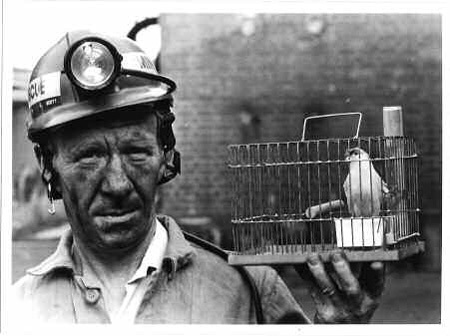
The greater the discrepancies between political and economic reality and common sense, the more critically and meticulously journalists and the media should treat such aberrations. This is a means of subjecting societies (true, only democratic societies) to self-reflection and self-cleansing. (I have in mind the term “self-questioning,” which is hard to translate into Russian). Although, in recent decades, even authoritarian regimes have learned from the mistakes of their predecessors not to stifle free speech entirely. The growing criticality of the media has become a signal to them that they need to correct, mitigate or change policy; it has been a kind of canary in a coal mine. In turn, as Haifeng Huang, a professor at University of California, Merced, has argued in his paper “Propaganda as Signaling,” authoritarian regimes make vigorous use of censorship or administrative strictures (such as firing editors) as a tool to signal society about the acceptability or unacceptability of criticism on certain topics.
It is now utterly clear the Russian regime that took shape between 1999 and 2015 has no need of any “canaries.” Vladimir Putin, who, ironically, was speaking at the anniversary of VGTRK (All-Russia State Television and Radio Broadcasting Company) literally when the news of the firing of RBC’s editors was reported, expressed his basic expectations for the media. He spoke of the media’s role of “communicating our […] work” several times. Moreover, the current Russian state has nothing to signal anymore. It really is tired of the fact that journalists have the desire to explore and investigate something other than the alleged treason of opposition figures.
Independence Is Worse than Opposition
The fate of RBC (as well as all the other onshore Russian media that have attempted to have an editorial policy independent of the need to “communicate our work”) was preordained not in 2011, when Vladimir Putin, concerned about the weakness of his handpicked successor, decided to return to the presidency, nor even in 2002, when the Law on Media, which until then had been preserved in its original 1991 redaction, was opened up for amendments on direct orders from the president.
The expulsion of dissent in any shape and size from the public mind was preordained when Vladimir Putin was appointed head of the Russian Federal Security Service (FSB) [in 1998] and the restoration of Andropov’s counterintelligence state was launched. The difference is that dissent, in this concept of the state, does not consist in criticizing the regime’s political practices, as Soviet dissidents did. Dissent now consists in the selfsame public interest in why and how the state functions, as described above. Dissent now consists in shaping an interest in the personal lives and personal businesses of state officials, including those of the head of state.
Robert Pringle, a professor at the University of Kentucky and one of the CIA’s principal specialists on the late Soviet Union, described this model in two significant articles (Robert W. Pringle, “Andropov’s Counterintelligence State,” International Journal of Intelligence and CounterIntelligence 13.2 (2000): 193–203; Robert W. Pringle, “Putin: The New Andropov?” International Journal of Intelligence and CounterIntelligence 14.4 (2001): 545–558). Andropov was himself an ascetic and an opponent of corruption, but he consistently and quite harshly took on anyone who had the courage to focus on the late Soviet regime’s corruption and moral decay.
Yuri Andropov’s construction of the counterintelligence state between 1967 and 1984 was dictated by the need for total control over all “mass information processes.” The KGB’s Fifth Directorate saw no difference between a single copy of a seditious text and an attempt to mimeograph a dubious work. Both were regarded as unambiguous challenges to the CPSU’s monopoly on power. Perhaps what lay at the heart of the counterintelligence state was the animal fear experienced by Andropov in Budapest in 1956, when the future KGB chief and Soviet leader watched from the Soviet Embassy as the Rákosi regime collapsed.
Reinforced by the Arab Spring, “orange revolutions” took the place of Budapest 1956 in Putin’s worldview, while dissidents were replaced by journalists, who did not swear allegiance to the regime and did not take its money. (The Fifth Directorate saw the former as voluntary assistants, and the latter as paid agents, who could always be blackmailed by producing signed receipts for their “fees.”). Even the political opposition, whose size and and impact, except for the brief period from 2011 to 2012, the Kremlin has always understood and monitored, has not been such an unambiguous, despised target as independent, mission-driven journalism.
The mystical “Revision Number Six” (2000) describes journalists and the media as equal, if not greater, enemies of a regime that would turn Putin into the permanent and irremovable “leader of the country, thus enabling a long-term policy for consolidating and strengthening the state.” Among the possible secret areas of operations to be pursued by the Russian Presidential Administration, “Revision Number Six” lists not only gathering information on all journalists who cover Russian domestic and foreign policy but also subjecting them and the media to direct and indirect pressure, including forcing bankruptcies, generating organizational difficulties, and issuing threats to owners unable to control the editorial process.
Step by step, consistently and steadily, the Putin administration has squashed all more or less large-circulation, mass-audience media, not even because they were in opposition to it, but because they were independent of the Kremlin’s direct and indirect guidance on what could and could not be brought up for public discussion. Alternatives remain, of course, from Vedomosti to Slon, from TV Rain to Meduza. But looking back at yesterday, literally and figuratively, we can say with certainty that journalism, as an organized process based on editorial independence and a sense of public mission, is politically doomed in today’s Russia.
The regime’s hybridity is rapidly short-circuiting, a process described by Hannah Arendt.
“Totalitarian propaganda can outrageously insult common sense only where common sense has lost its validity. Before the alternative of facing the anarchic growth and total arbitrariness of decay or bowing down before the most rigid, fantastically fictitious consistency of an ideology, the masses probably will always choose the latter and be ready to pay for it with individual sacrifices—and this not because they are stupid or wicked, but because in the general disaster this escape grants them a minimum of self-respect.”*
Until yesterday, RBC’s editorials boldly and recklessly challenged (at least, outwardly) this circle of silence and emptiness around common sense. RBC’s investigative reports, analytical articles, and expert publications were the quintessence of common sense, not acts of information warfare or the intrusion of a “flu-stricken nose” into healthy public space. They manifested the quixotic desire to be the agent of public, civic interest in how the state is organized, and why and where it must change.
It is really pointless for the counterintelligence state to fight suspicion and thievery, official lawlessness and the use of power for personal gain, not because it does not want to improve, but because when someone points out where things must be improved, the counterintelligence state regards it as an act of aggression, as something more dangerous than current shortcomings.
“Peace, Labor, Putin.” The Federation of Independent Trade Unions of Russia (FNPR) has 22.7 million members, who annually pay out almost 68 billion rubles to fund their trade union associations. (The FNPR has 122 such affiliated organizations nationwide). At best, only 140 million rubles make it to Moscow. The rest stays at the local level. Photo courtesy of vestnikburi.com
An RBC Investigative Report: How Russian Trade Unions Make Money
Vyacheslav Kozlov RBC
April 29, 2016
The Federation of Independent Trade Unions of Russia (FNPR) will celebrate May Day with a march in support of workers. As RBC has found out, the budget of the country’s largest trade union organization runs in the billions of rubles, much of it earned from real estate it freely inherited from the Soviet Union.
In February 2016, Crimea’s most famous resort got a new owner. The Foros Spa, right down the road from the residence where Soviet President Mikhail Gorbachev was held captive during the 1991 coup attempt, was purchased for 1.4 billion rubles by the Federation of Trade Unions of Tatarstan.
Even their bosses in Moscow could not understand where a little-known noncommercial organization from Kazan had got its hands on that kind of money.
“When we saw the news, we didn’t even reprint it at first. We called and checked whether it was true,” an employee at the FNPR’s central office told RBC. (The Federation of Trade Unions of Tatarstan is an affiliated member of FNPR.)
The folks in Kazan reassured the trade union bosses in Moscow. The organization, which is mainly funded by membership dues paid by workers, really did not have that kind of money. It had acted as a middleman in the purchase of Foros, getting the money from major regional companies.
“There are such companies there: KamAZ, Tatneft, petrochemical plants [part of the TAIF Group — RBC],” said FNPR leader Mikhail Shmakov, bending his fingers back as he listed off the companies.
Shmakov spoke with RBC in his office on Leninsky Prospekt, 42, in Moscow. In keeping with Soviet tradition, the building is even nowadays called the Trade Unions Palace of Labor.
Ukrainian billionaire Igor Kolomoisky, who owned the property before the peninsula was annexed by Russia, could have insisted on imposing sanctions on the buyers of the famous Crimean spa Foros. The scheme for buying Foros, involving the Tatarstan trade unions, made the deal less risky, sources told RBC. The view, above, is of the government dacha Zarya (Dawn), where the coup plotters held Mikhail Gorbachev in 1991. Courtesy of Mikhail Pavlishak/TASS
Shmakov could not conceal his satisfaction with the deal, calling it “brilliant.” RBC’s source in the FNPR executive committee and another source, close to the Tatarstan government, said the scheme for buying Foros, involving trade union bosses, was employed so the real buyer would not end up on the sanctions lists of the European Union and the US.
“To act as a middleman in such deals you have to have good connections with the authorities and big business. They have to consider you one of their own. You have to be a loyal organization,” a source close to the FNPR leadership explained to RBC.
The FNPR has long been cooperating with the authorities and business. Heir to the All-Union Central Council of Trade Unions (VTsSPS), the federation is proud of the fact it is the largest labor union in Russia, with 122 affiliates and over 20 million members.
How does the country’s largest trade union organization make its money?
Budget
Despite its federal scale, the FNPR is an extremely closed organization. It does not publish financial statements.
“This information is available only to members of the executive committee, and even then documents containing specific figures are not distributed to everyone. Some are given documents without any figures,” said an employee in the central office.
RBC has obtained a document describing the FNPR’s budget in terms of percentages. From this document it follows that the federation has only two sources of income, membership dues and “other income,” a phrase that mainly conceals revenue from commercial operations.
FNPR chair Mikhail Shmakov (pictured above) has remained at the helm of the country’s largest trade union organization for all 25 years of its existence. Photo courtesy of Oleg Yakovlev/RBC
The document reveals that membership dues make up 70% of the FNPR’s revenues, while “other income” amounts to 30%.
Expenses are more complicated. 40.5% is spent on organizational and business operations, and 46.6%, on subsidizing FNPR institutions. Six percent goes to the so-called solidarity fund (for holding protests, paying wages of workers during downtime on the job, and making one-time payments to members involved in work-related accidents), while another 6.3% pays for dues in the international organizations of which the FNPR is a member, and 0.4% is spent on maintaing the auditing commission. In other words, nearly 90% of expenses go towards maintaining the organization itself.
Shmakov confirmed the income percentages in conversation with RBC. (He said nothing about expenses.) In 2016, the FNPR’s budget was 200 million rubles, according to Shmakov. An RBC source close to the Kremlin, who was well acquainted with the operations of the trade unions, confirmed that the FNPR’s annual budget was comparatively small.
“A few years ago, it did not exceed one million dollars,” he said.
The amount looks strange when you consider the number of people paying membership dues nationwide. The income of FNPR’s various affiliated trade unions, from factory locals to central committees, is incomparably greater than the parent organization’s budget.
Membership dues in most Russian trade unions are one percent of wages. If we take the official membership figures (according to Shmakov, the FNPR has around 20.7 million dues-paying members, plus another three to four million students and pensioners who do not pay dues) and the national average monthly wage (according to Rosstat, it was 33,900 rubles in February 2016), the dues paid by all FNPR-affilated trade unions should come to approximately 5.7 billion rubles monthly or 67.9 billion rubles a year.
But not all that money makes it to Moscow.
“The money is spread around the entire organization,” said an employee in the central office.
Locals keep from fifty to ninety-five percent of collected dues, explained our source. The rest is split among central and regional organizations.
How are these billions of rubles spent?
Expenditures
“Exempt trade unionists” is the Soviet-era legal term for trade union employees, from executives to secretaries, who are exempt from working directly at a particular enterprise. Their salaries are usually paid by the trade union itself. Trade union association executives surveyed by RBC confirmed that up to half of an organization’s budget can go to paying exempted workers. For example, the Pskov Federation of Trade Unions spent nearly 30 million rubles of its 2015 budget of 66 million rubles on the salaries and bonuses of over sixty exempt employees, says the federation’s head, Ulyana Mikhailova.
RBC asked the FNPR to provide it with the number of exempt employees nationwide but our request was turned down. Open sources mention the number of elected trade union officials. According to a 2011 FNPR executive committee decision, there were 13,500 such officials.
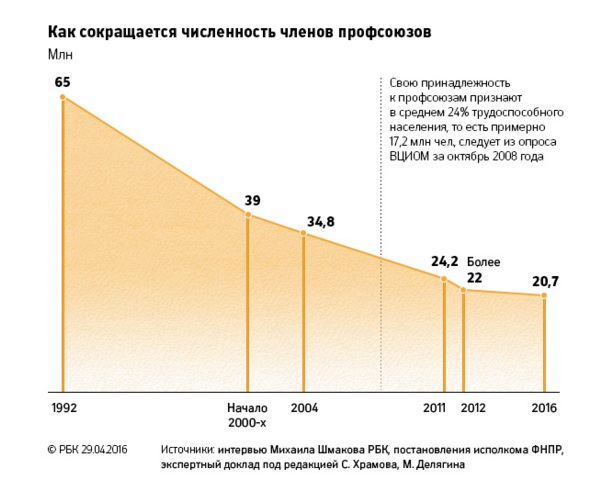
How Union Membership Has Declined. [According to the graph, union membership in Russia has declined from 65 million in 1992 (the first full year of independence) to 20.7 million in 2016. – TRR.] Sources: RBC interview with Mikhail Shmakov; decisions of the FNPR executive committee; white paper edited by Sergei Khramov and Mikhail Delyagin. Inserted text reads: “On average, 24% of the able-bodied population, i.e., approximately 17.2 million people, admit they are trade union members, according to an October 2008 poll conducted by the Russian Public Opinion Research Center (VTsIOM).” Courtesy RBC
But this is only a small part of the trade union army. According to figures for 2011, there were 191,000 trade union locals in Russia.
“At least one exempt worker emerges in a local with no less than three hundred members,” said Yuri Milovidov, director of Proftsentr, which assists trade union activists. “By my calculations, at least a quarter of these locals have at least one trade union worker. Some have several. There are fifty to seventy thousand such workers countrywide.”
A source in the FNPR executive committee said there were fewer trade union employees, around forty thousand. But even if we take this figure at face value, it turns out that the FNPR is one of the country’s major employers. (By way of comparison, AvtoVAZ, Russia’s largest auto manufacturer, employed around fifty thousand people as of late 2015.)
According to the FNPR employees surveyed by RBC, the average monthly salary among trade union employees is around 25,000 rubles, a little lower than the national average. The payroll bill for professional trade unionists across the country thus might be as much as one billion rubles a month.
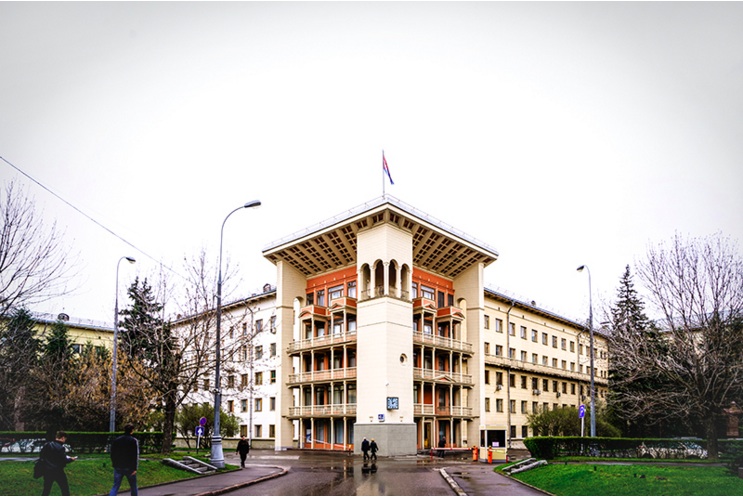
Known as the Trade Unions Palace of Labor since Soviet times, the FNPR’s headquarters on Leninsky Prospekt in Moscow is of the most well-known pieces of real estate managed by the federation. Photo courtesy of Oleg Yakovlev/RBC
The exact number of employees in the FNPR central office is unknown. The federation declined to answer this question when asked by RBC. A source in the central office said there were no more than 120 employees. Another source said their salary was small but higher than the national average: around 60,000 to 70,000 rubles a month.
Shmakov declined to disclose his salary.
28 Kilometers from Moscow
In the village of Chigasovo, in an elite neighborhood on the Rublyovskoye Highway in the Moscow suburbs, there is a house and plot of land (516.2 square meters and 1,798 square meters large, respectively) owned by a Viktor Shmakov, which is the exact same name as that of Mikhail Shmakov’s son. The FNPR chair’s son does business. According to SPARK, he is the director of Art Mix LLC, which organizes celebrations and events. As ads on the real estate and property rentals website CIAN.ru indicate, several five-hundred-square-meter cottages sited on fifteen-acre plots in Chigasovo are valued at around 36 million rubles. Mikhail Shmakov forwarded our questions about the house and land’s ownership to the proprietor, as listed in the Unified State Register of Real Estates Rights and Transactions (EGPR).
The Russian Federation of Spas
The FNPR acquired property amid the turmoil of the early 1990s, when familiar institutions of Soviet power crumbled. It was then that the young trade union leader Mikhail Shmakov, previously employed as a rocket engineer, managed to gain standing among Russian leaders and head the new organization, which immediately declared itself the VTsSPS’s legal successor. In legal terms, its property was transferred to the FNPR in 1992 through a special agreement. This property is now the source of the “other income,” mentioned above, the revenues the trade unions generate from commercial operations.
The exact number of real estate properties and land plots that were donated to the FNPR is contained in the appendices to the 1992 agreement, which the federation keeps secret. During the twenty-five years of its existence, the agreement has never been published. (The FNPR also refused to provide a copy to RBC.)
Milovidov, who worked for the FNPR for many years, claimed that 2,582 properties were transferred to the federation: 678 health spas, 131 hotels, 568 stadiums, and over 500 Young Pioneer camps. It is unclear how many of these properties are still managed by the federation, but informally, sources there said the trade unions had lost around sixty percent of the property belonging to the VTsSPS when the Soviet Union collapsed.
According to Profkurort, the main trade union tourist agency, the trade unions now run exactly 374 resorts (health spas, boarding houses, vacation retreats, and children’s summer camps) in sixty-five regions from the Russian Far East to Kaliningrad.
The FNPR’s most profitable properties are in the southern Russia and Moscow. The trade unions particularly cherish their properties in the Caucasian Mineral Waters area. Their health spas account for over a quarter of so-called bed capacity among all the resorts in the area. Annually, they can take in 160,000 guests.
“Shmakov personally handles the Caucasian Mineral Waters. It’s his project,” RBC’s source in the federation’s central office explained.
To manage all its properties in the Caucasian Mineral Waters area, the federation founded Spa Management (Holding) LLC in 2005, which runs twenty-two health spas, including balneo baths and mud baths, mineral water drinking rooms, three boiler plant companies, a kindergarten, a library, a repair and construction company, and a car and truck pool. The federation’s share in the holding is nearly 85%, while over 15% belongs to the Stavropol Territory Association of Trade Unions, also affiliated with the FNPR. In 2015, the holding’s total revenue was 5.4 billion rubles, and its net profit was 294 millions rubles, Yulia Korogodova, Spa Management’s director, told RBC.
The FNPR’s other claim to fame are its hotels and health spas in Sochi. (According to RBC’s calculations, the FNPR and its subsidiaries own twenty-six buildings and seven lots there.) Sochi was the site of the FNPR’s biggest project in recent years, the reconstruction of three hotels for the Winter Olympics.
“Everyone was surprised that Shmakov had decided to get involved in the reconstruction of Sochi along with billionaires Vladimir Potanin and Oleg Deripaska, and other big businessmen. The authorities set them the harsh task of finishing in time for the Olympics at all costs, and this led to the fact that the poor FNPR was almost among the first to deliver its sites,” a source close to the federation’s central office told RBC.
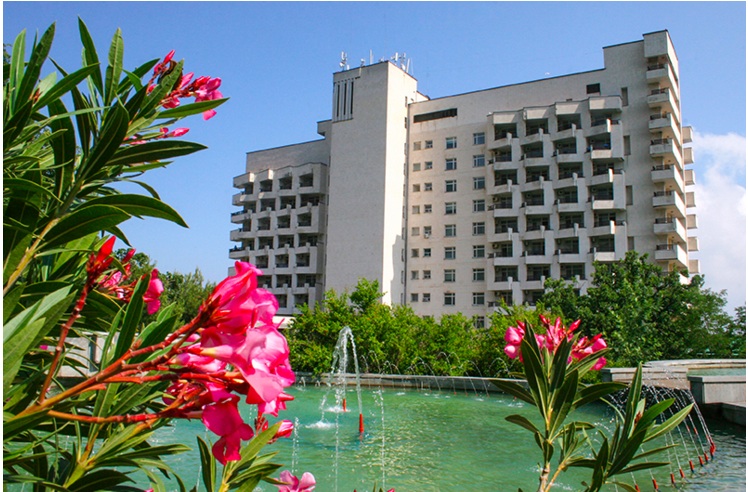
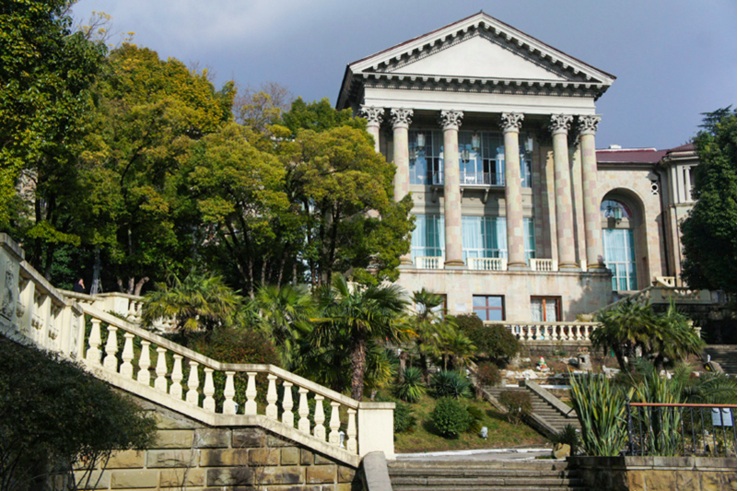
Steelworker Spa in Sochi is one of three properties reconstructed by the FNPR for the 2014 Sochi Winter Olympics. The federation borrowed two billion rubles from Vnesheconombank to finance the work. The trade unions are now attempting to restructure their debt. Photo courtesy of PhotoXPress
The trade unions had no money of their own, said our source, so they took out a loan from state-owned Vnesheconombank, which was the main source of funding for the Olympic projects, another source close to the FNPR told RBC. Shmakov confirmed that there was a loan. RBC found out from Vnesheconombank that the funds had been allocated to three joint-stock companies: Adler Spa, Steelworker Clinical Spa, and Trade Union Spas (Svetlana Spa). These companies all manage trade union properties in Sochi.
According to Shmakov, the loan amounted to 1.5 billion rubles. Spa Management, however, clarified that 2 billion rubles had been borrowed. The total investment in the Olympic hotels was 2.7 billion rubles, according to Spa Management, although they did not explain the source of the additional 700 million rubles. Shmakov said the FNPR was forced to put up Adler Spa as collateral for the loan. He confirmed that all revenues from the reconstructed hotels now have to go towards paying off the loan. In the current circumstances, however, the FNPR would rather not have to pay. According to sources at Vnesheconombank, the FNPR has sent them a request to restructure the loan.
Vnesheconombank’s money was used to rebuild the Svetlana Health Resort as the Sea Galaxy Hotel Congress & Spa and renovate the Steelworker Spa and one wing of the Adler Spa. There are 690 beds in the 18-story Sea Galaxy. In high season, a standard single room, according to the hotel’s price list, costs 5,300 rubles a night. In 2014, Profkurorty (Svetlana Spa) JSC, which manages the reconstructed hotel, recorded revenues of nearly 197.3 million rubles and a net profit of over 178.6 million rubles.
The ownership of trade union real estate is extremely confusing and opaque. Without engaging in commercial operations itself, the FNPR has founded dozens of companies to manage its properties nationwide. (The Krasnodar Territory Trade Unions Council alone has registered 74 subsidiaries at various times.) However, as analysis shows, many of the spa companies in the Caucasian Mineral Waters areas and Kuban are closed organizations: over thirty of them are closed joint-stock companies, while the rest are private legal entities. From 2010 to 2014, these companies earned nearly 45 billion rubles.
From One Funeral to the Next
In late June 2015, the latest memorial service took place in the House of the Unions on Bolshaya Dmitrovka in Moscow, a building that belongs to the trade unions. People came to pay their last respects to former Russian Prime Minister Yevgeny Primakov. Even President Putin attended the ceremony. Almost three weeks later, Alexander Bulgakov, perennial director of the House of Unions, was arrested by police investigators right in his office, next door to the State Duma.
The Investigative Committee reported that Bulgakov had been detained as he was receiving 308,000 rubles from the director of another commercial entity, House of the Unions Refreshments LLC. Allegedly, Bulgakov had extorted the money, which was ten percent of the cost of the banquets and receptions catered by House of the Unions Refreshments. A year later, Bulgakov was sentenced to four years in prison.
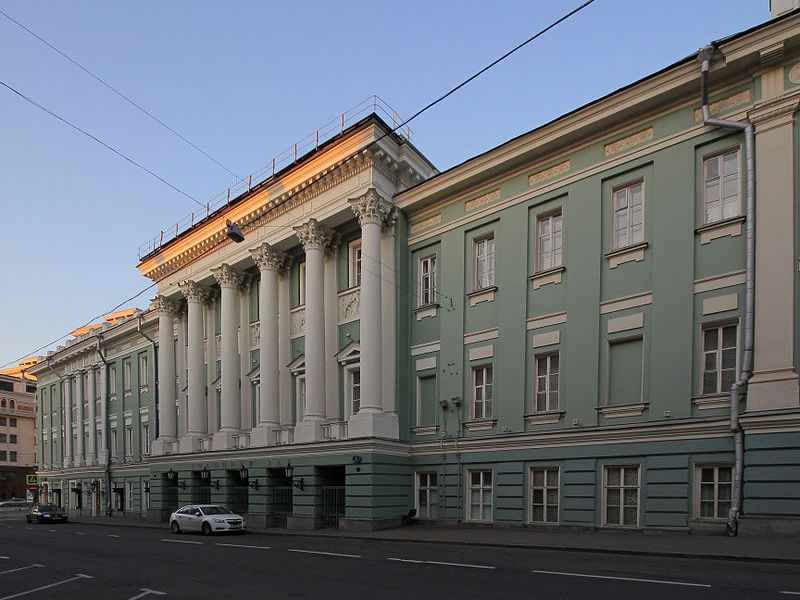
The House of the Unions, adjacent to the State Duma building in Moscow, has long been considered the country’s primary venue for paying last respects to famous politicians and public figures. Along with the Trade Unions Palace of Labor, it is the most popular architectural landmark belonging to the trade unions. Photo courtesy of Wikipedia
An RBC source, close to the FNPR, did not rule out a link between the two events, the memorial service for Primakov and Bulgakov’s arrest.
The service’s organizer, the Presidential Property Management Directorate, was, allegedly, displeased with the original fee Bulgakov had asked for holding the ceremony, said the source. (According to the state procurements site, the event’s final cost was 1.222 million rubles.) Complaints against Bulgakov were made to law enforcement authorities. RBC’s source in the FNPR’s central office confirmed he had heard this hypothesis.
Shmakov also acknowledged he had heard the story about dissatisfaction with the price of the memorial service, but he said it was not confirmed in the end. According to him, when negotiating the arrangements for Primakov’s service, Bulgakov had quoted the usual rate for such an event.
“It all started with the memorial service for Shvetsova [former State Duma deputy and former Moscow deputy mayor Ludmila Shvetsova — RBC]. It cost four million rubles. Moscow city hall paid this money, because that is how much such events cost. It was this price that he [Bulgakov] offered,” Shmakov said now.
Like most of the trade union properties in the capital, the House of the Unions belongs to the Moscow Federation of Trade Unions (MFP), which is part of the FNPR. The MFP also owns the Izmailovo Hotel Complex, Krylatskoye Velodrome, Znamensky Brothers Olympic Center, Trud Swimming Pool, Sokolniki and Peredelkino Spas, and Planernaya Olympic Center in Khimki.
The Izmailovo Commercial and Hotel Complex in Moscow is trade union property like, for example, the Sputnik Hotel on Leninsky Prospekt. In contrast to the Sputnik, however, which is owned directly by the FNPR, the Moscow Federation of Trade Unions holds the controlling stake in the Izmailovo complex. Photo courtesy of top10hm.net
The most profitable asset in Moscow is the Izmailovo Hotel Complex. The Moscow Trade Unions Property Fund owns 75% of the shares in Izmailovo Commercial and Hotel Complex JSC, which manages the Gamma, Beta, Delta, and Vega buildings, while the FNPR holds a seven-percent share. (The remaining shares are owned by members of the board of directors.)
In 2014, the total revenue generated by the hotels in the Izmailovo holding was over 3.25 billion rubles, with a net profit of over 240 million rubles. The MFP wholly owns the Alpha Commercial and Hotel Complex, which manages one more of the Izmailovo hotels, which is not part of eponymous joint-stock company. In 2014, Alpha’s gross profits were over 770 million rubles; its net profits, over 33 million rubles.
The FNPR does not own so much property directly in Moscow. It owns the Trade Unions Palace of Labor on Leninsky Prospekt, where the organization has its central office; the nearby Sputnik Hotel; a motorpool near Kaluzhskaya subway station; the building of the Academy of Labor and Social Relations, in western Moscow; and its own tailor’s shop and primary care clinic.
At Public Expense
People who began their careers in Soviet times know the terrifying sounding word sotsstrakh (“social insurance”). These were payments made by the Social Insurance Fund (FSS), which was managed by the trade unions until the early 2000s. Sotsstrakh paid for children’s trips to Young Pioneer summer camps, and for workers and pensioners to go to health spas. Then the FSS was taken over by the state, but the health spas were left to the trade unions, providing them with yet another way of making money.
“When the state lacks enough of its own health spas to provide treatment for everyone who has a legal right to it, it refers people to trade union spas,” explained Nikolai Murashko, director of the FNPR’s Spa Directorate.
Judging by public procurement records, government contracts are a serious source of revenue for the trade unions. Over a period of six years, from 2010 to 2016, FNPR’s Resort Holding implemented government contracts worth more than 4.8 billion rubles. During the same period, the spas owned by the Krasnodar Territory Trade Unions Council sold holiday packages worth a total of approximately four billion rubles.
The FNPR’s affiliated trade unions also make money on government contracts. The MFP and its member organizations, for example, were awarded government contracts worth more than 617 million rubles during the same six-year period. The Federation of Trade Unions of Saint Petersburg and Leningrad Region earned 242 million rubles, while the FNPR earned 32 million rubles itself.
What does the FNPR give the state in return?
A Necessary Organization
Shmakov had no doubt the federation fulfilled its main functions: protecting labor rights and controlling the propertied classes. For sixteen years, the government has convened a special tripartite commission for regulating social and labor relations. Government ministers, employers (e.g., the Russian Union of Industrialists and Entrepreneurs and Opora Russia), and trade unions officials sit at the same table. A Kremlin official, however, warned against exaggerating the commission’s role.
“The minutes from some of the meetings are long, but that is where it ends: in the minutes. The state conducts its own policy,” he said.
He was echoed by someone who had been involved in the meetings.
“A trade union that, for example, is capable of getting people onto the streets can have a real impact on social and economic policy. Because of this, when it comes to the FNPR’s bread-and-butter issues, pensions, for example, the federation finds it quite hard to pound its fist on the table and say things will be the way it says.”
Rosstat’s data suggests that while in the 1990s there were several hundred or even thousands of labor strikes recorded annually, the numbers slumped to several strikes a year in the 2000s. One of the causes was the tightening of procedures for striking, as described in the new Labor Code, which took effect in 2002. One of the authors of the new Labor Code was current State Duma deputy speaker Andrei Isayev, formerly a secretary of the FNPR.
“The law on strikes is prohibitive,” said Boris Kravchenko, chair of the Confederation of Labor of Russia (KTR).
The KTR, like a number of other independent trade unions, such as the locals at AvtoVAZ and the Ford plant outside Petersburg, emerged in the late 2000s as a counterweight to the the FNPR, which cooperates with the authorities.
The Kremlin appreciates the fact that the FNPR does not go on strike and cooperates with the United Russia Party. [Isayev is a member of the party’s general council — RBC.]
“The FNPR are constructive critics. The goal of certain other organizations is to get people protesting on the streets. The FNPR has a different stance: solving a problem before people take to the streets,” says an official in the presidential administration.
* * *
In May 2011, the FNPR was one of several organizations that joined together to establish the Russian People’s Front (ONF), headed by Vladimir Putin. The ONF is now the only public organization in Russia comparable to the FNPR in terms of numbers of regional offices. And, like the FNPR, the ONF does not disclose its budget.
With additional reporting by Mikhail Rybin, Anastasia Napalkova, Maria Zholobova, and Yevgenia Glazova.
Translated by the Russian Reader. Thanks to Sean Guillory for the heads-up. NB. Because of the sheer quantity of figures given in rubles in this article, I have foregone my usual practice of converting them into euros for ease of comprehension. Current and historical currency rate conversion tables, however, are eminently accessible on the web, so knock yourselves out. TRR