Diabetics in Saratov Deemed Threat to Russian National Security

insulincPatriotic Russian diabetics treat their disease only with domestically produced insulin, such as Rosinsulin, pictured here. Photo courtesy of Medsintez Pharmaceutical Plant

For Insufficient Enthusiasm
Court Rules Saratov Regional Organization of Chronic Diabetes Sufferers “Foreign Agents.” Activists “Undermined the State’s Authority” by Questioning  Insulin Produced in Russia
Nadezhda Andreyeva
Novaya Gazeta
March 28, 2018

Saratov’s Frunza District Court today concluded its hearing of administrative charges against the Saratov Regional Organization of Chronic Diabetes Sufferers. Judge Maria Agisheva ruled the diabetics had violated the law on “foreign agents.”

The defense had asked for a postponement of the hearing, since Moscow human rights lawyer Nikolai Dronov, who had been representing the diabetics in court the past five months, was unable to travel to Saratov today. In addition, the organization’s president, Larisa Saygina, had not been able to read the findings of a forensic examination of the case, submitted to the court on Friday, May 25. Judge Agisheva rejected the defense’s motion, but announced a half-hour recess so the diabetics could read the findings of court-appointed experts.

The forensis examination was carried out by faculty members at the Saratov State Legal Academy (SGYuA). The court had attempted to engage specialists from RANEPA and the Kazan Interregional Expertise Center, but they had turned down the court’s request on various pretexts. SGYuA had also rendered its expert opinion last year, when the administrative case was in the process of being filed. As we reported earlier, Professor Ivan Konovalov saw signs of the work of “foreign agents” in the activities of the diabetics organization. The forensic examination was performed by his SGYuA colleagues Associate Professor Elena Koloyartseva and Professor Viktor Kupin.

According to SGYuA’s experts, the Saratov Regional Organization of Chronic Diabetes Sufferers was awarded a grant of 712,000 rubles [approx. €9,800] from foreign pharmaceutical companies. The authors of the forensic examination thus concluded the organization had engaged in political activity, namely, it had submitted critical remarks about the work of officials to the authorities. According to the political scientists, the organization’s former head, Yekaterina Rogatkina, had publicly expressed doubts about the quality of insulin produced in Russia, thus undermining the Russian state’s authority. [The emphasis here and elsewhere is in the original article—TRR.]

The experts found it noteworthy the media reported on the filing of administrative charges against the diabetics organization. In particular, the commentary of the organization’s current president, Larisa Saygin, filmed for the Saratov TV program “Open Channel” on a city street, was regarded by the experts as a solo picket. According to SGYuA’s faculty members, the news report had been deliberately aired three months before the presidential election in order to discredit presidential candidate Vladimir Putin.

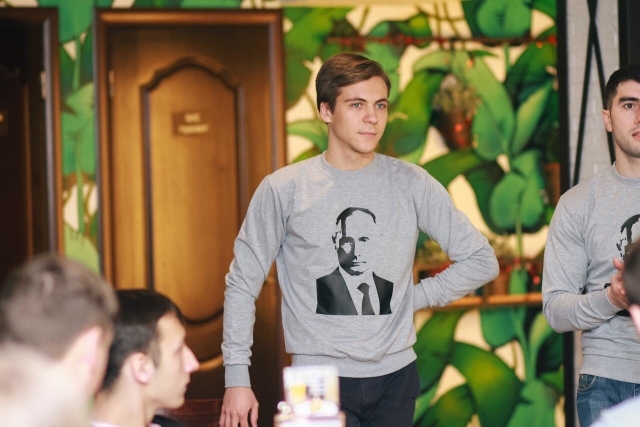
We should recall at this point it was Nikita Smirnov, the head of Putin’s student campaign headquarters in Saratov, who had filed the complaint against the diabetics with the the local prosecutor’s office.

As the experts emphasized in their findings, opposition leader Mikhail Khodorkovsky offered the Saratov diabetics legal assistance, which likewise testified to the organization’s guilt.

As indicated on SGYuA’s website, Professor Koloyartseva studied in the 1980s at the Saratov State Pedagogical Institute. In 2001, she was awarded a kandidat degree in political science. She serves on the public council of the Saratov Regional Duma. She is also a member of Civic Dignity, a grassroots organization that supports social and civic activism among young people and has been heavily involved in forums on moral and spiritual growth sponsored by the authorities.

According to the website Legal Russia, Viktor Kupin graduated from the Lenin Military Political Academy in 1978, while Saratov media outlets earlier reported he studied at the Engels Air Defense Academy.

Until 2007, Professor Kupin taught a course entitled “Philosophical and Political Problems of National Security” at military academies in Petersburg.

In 2004, Professor Kupin defended his doktor dissertation, entitled “The Geopolitical Imperatives of Global Security.”

In 2014, Kupin was an expert in the trial of Partnership for Development, an environmental organization that had operated in Saratov Region since 1995. The NGO received $42,000 from the US government to encourage civic involvement in the region’s villages and small towns. An anonymous complaint against Partnership for Development was filed with the prosecutor’s office on July 10, 2014. On July 22, an administrative case was opened against the organization under Article 19.34 of the Administrative Offenses Code (“Absence of registration in the relevant registry on the part of an organization performing the work of a foreign agent”).

Professor Kupin’s expert finding was ready the very same day. As he explained in court, he wrote the five pages of text in several hours, since he had been asked to do it “as soon as possible.” According to Professor Kupin, Partnership for Development showed clear signs of carrying out the “political orders of a foreign state, orders meant to undermine social stability, generate political tension in the region, expand the base of political influence on public opinion [sic], and  implement US geopolitical interests.”

“The interest in Saratov Region was occasioned by its special place and exceptional geopolitical position in Russia as a lynch pin in the emergent Eurasian Union of Russia, Belarus, and Kazakhstan,” wrote  Professor Kupin. “[Partnership for Development’s] activity runs counter to the security interests of Russia, which opposes the uni-polar dictatorship of the world, headed by the US.”

Less than a month after the prosecutor received the anonymous complaint, a court ruled Partnership for Development was a “foreign agent.” It was fined 300,000 rubles. Its chair, Olga Pitsunova, was also personally fined 100,000 rubles. Partnership for Development closed up shop.

At today’s hearing, Judge Agisheva denied the defense’s motion to summon its own expert witnesses to the trial. The diabetics were fined 300,000 rubles [approx. 4,100 euros]. The organization’s ex-president, Ms. Rogatkina, told us the diabetics would appeal the ruling.

“We are discouraged. This case was absurd from the outset.  We consider it a miscarriage a justice.”

Putinist youth activist Nikita Smirnov. Photo courtesy of Novaya Gazeta

Last year, Mr. Smirnov, a student at the Saratov Medical University and head of Vladimir Putin’s student campaign headquarters, asked the Frunza District Prosecutor’s Office to verify whether the work of the diabetic organizations was covered by the law on “foreign agents.”

As the future physician told us, he had “read on the internet that the organization was financed by foreign companies, I don’t remember which.” He had felt it was his “civic duty” to “send a signal.”

Translated by the Russian Reader

Brazil

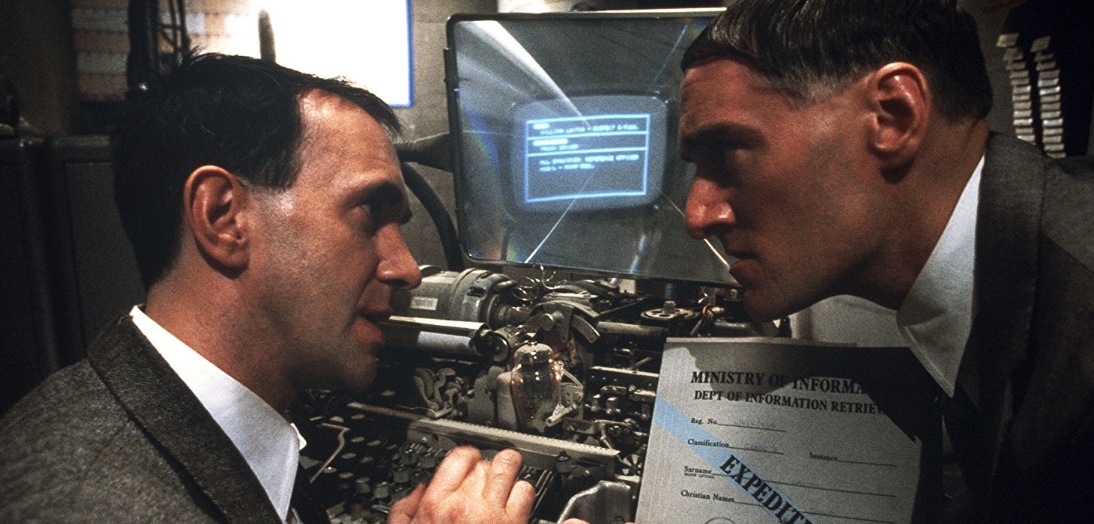
brazil.jpegJonathan Pryce and Terry McKeown in Brazil (1985). Courtesy of imdb.com

Authorized to Remain Silent
Why We Know Nothing about the Outcome of Most Criminal Cases and Verdicts against People Who, According to the Russian Secret Services, Planned or Attempted to Carry Out Terrorist Attacks 
Alexandra Taranova
Novaya Gazeta
April 27, 2018

High-ranking officials from the Russian Federal Security Service (FSB), the Russian Interior Ministry (MVD), and the Russian National Anti-Terrorist Committee (NAK) regularly report on the effective measures against terrorism undertaken by their agencies. If we add reports of constant counter-terrorist operations in the North Caucasus, especially in Dagestan and Chechnya, operations involving shootouts and the storming of houses, we might get the impression the level of terrorism in Russia is close to critical, resembling the circumstances somewhere in Afghanistan, the only difference being that Afghanistan does not have the FSB, the MVD, and the NAK to protect it.

Over the past two weeks, there were at least two such stories in the news.

A few days ago, the FSB reported it had “impeded the criminal activity of supporters of the international terrorist organization Islamic State, who […] had begun planning high-profile terrorist attacks using firearms and improvised explosive devices.”

The FSB’s Public Relations Office specified the terrorist attacks were to be carried out in goverment buildings in Stavropol Territory.

Earlier, TASS, citing the FSB’s Public Relations Office, reported that, since the beginning of the 2018, six terrorist attacks had been prevented (including attacks in Ufa, Saratov, and Ingushetia), while three crimes of a terrorist nature had been committed (in Khabarovsk Territory, Dagestan, and Sakhalin Region), and this had been discussed at a meeting of the NAK. Other media outlets quoted FSB director Alexander Bortnikov, who claimed that last year the security services had prevented twenty-five terrorist attacks, but four attacks, alas, had gone ahead.

For the most part, however, it is impossible to verify these reports, because, with rare exceptions, the terrorists, either potential terrorists or those who, allegedly, carried out terrorist attacks, are identified by name. Neither the Russian Investigative Committee (SKR) nor the FSB informs Russians about subsequent investigations, about whether all the terrorists and their accomplices have been rounded up. Likewise, with rare exceptions, we know nothing either about court trials or verdicts handed down in those trials.

Novaya Gazeta monitored reports about prevented terrorist attacks from November 2015 to November 2017. We analyzed all the media publications on this score: the outcome of our analysis has been summarized in the table, below. The veil of secrecy makes it extremely hard to figure out what reports merely repeat each other, that is, what reports relate to one and the same events, and we have thus arrived at an overall figure for the number of such reports. Subsequently, by using media reports and court sentencing databases, we have counted the number of cases that officially resulted in court sentences.

Most news reports about prevented terrorist attacks in Russia are not followed up. For example, at one point it was reported (see below) that five people with ties to Islamic State had been apprehended in Moscow and Ingushetia for planning terrorist attacks, and this same news report mentioned that a criminal case had been launched. But only the surname of the alleged band’s leader was identified, and he was supposedly killed while he was apprehended. There is no more information about the case. Over a year later, we have no idea how the investigation ended, whether the case went to trial, and whether the trial resulted in convictions and verdicts.

Other trends also emerged.

During the two-year period we monitored, reports about prevented terrorist attacks and apprehended terrorists encompassed a particular group of Russian regions: Moscow, Crimea, Petersburg, Kazan, Rostov, Baskortostan, Volgograd, Yekaterinburg, and Krasnoyarsk. When we turn to verdicts handed down in such cases, this list narrows even further. Rostov leads the country, followed by Crimea. There are two reports each from Krasnoyarsk and Kazan, and several isolated incidents. The largest number of news reports about terrorist attacks and acts of sabotage, i.e., 30% of all the reports we compiled and analyzed, originated in Crimea.

  FSB MVD NAK Russian Security Council (Sovbez)
Number of reports of prevented terrorists, November 2015–November 2017 3,505 reports (18,560 identical reports in the media) 1,702 reports

(3,571 identical reports in the media)

492 reports

(852 identical reports in the media)

236 reports

(1,122 identical reports in the media)

Outcomes: arrests, criminal charges, verdicts, etc. 13 verdicts,

14 arrests

3 verdicts,

2 arrests

2 incidents: in one case, it was reported that all the detainees had been killed; in the other, that the detainees awaited trial, but were not identified by name. It is impossible to find out what happened to any detainees, since no information was provided about them. The exception is Lenur Islyamov, who is currently at large and vigorously pursuing his objectives.

The Triumps of the Special Services with No Follow-Up
Here are the most revealing examples.

On November 12, 2016, RBC reported the security services had apprehended a group of ten terrorists, migrants from Central Asia. According to the FSB, they planned “high-profile terrorist attacks” in heavily congested areas of Moscow and Petersburg. Officials confiscated four homemade bombs, firearms, ammunition, and communications devices from the militants. The FSB claimed all the detainees had confessed to their crimes.

In the same news report, the FSB was quoted as having reported that on October 23, 2016 “there occurred an attack on police officers, during which two alleged terrorists were shot dead” in Nizhny Novgorod. The report stressed that, three days later, the banned group ISIL claimed responsibility for the attack, just as it had taken responsibility for an attack on a traffic police post in Moscow Region on August 18, 2016.

There were no names and no details. The outcomes of the investigations, the plight of the detainees, and judicial rulings were never made public, nor did state investigators or defense counsel share any information.

This same RBC article mentions that, four days before the alleged incident in Nizhny Novgorod, the SKR had reported the apprehension of an ISIL supporter who had been planning a terrorist attack at a factory in Kazan, while Interfax‘s sources reported the apprehension of a man who had been planning a terrorist attack in Samara.  It was also reported that in early May 2016 the FSB had reported the apprehension of Russian nationals in Krasnoyarsk who were “linked to international terrorist organizations and had planned a terrorist attack during the May holidays.”

No names were mentioned at the time. Later, however, details of the case were made public.

Thus, on April 7, 2017, Tatar Inform News Agency reported that the Volga District Military Court in Kazan had handed down a verdict in the case of Robert Sakhiyev. He was found guilty of attempting to establish a terrorist cell in Kazan. The first report that a terrorist attack had been planned at an aviation plant in Kazan was supplied by Artyom Khokhorin, Interior Minister of Tatarstan, during a meeting of MVD heads. According to police investigators, Sakhiyev had been in close contact with a certain Sukhrob Baltabayev, who was allegedly on the international wanted list for involvement in an illegal armed group. Using a smartphone, Sakhiyev had supposedly studied the plant’s layout via a satellite image.

On August 2, 2017, RIA Novosti reported that a visting collegium of judges from the Far East District Military Court in Krasnoyarsk had sentenced Zh.Zh. Mirzayev, M.M. Abdullayev, and Zh.A. Abdusamatov for planning a terrorist attack in Krasnoyarsk in May 2016 during Victory Day celebrations. Mirzayev was sentenced to 18 years in prison; Abdullayev, to 11 years in prison; and Abdusamatov, to 11 years in a maximum security penal colony. According to investigators, Mirzayev worked as a shuttle bus driver in Krasnoyarsk and maintained contact with Islamic State via the internet. Mirzayev decided to carry out a terrorist attack by blowing up a shuttle bus.

On January 26, 2017, TASS reported the police and FSB had identified a group of eight people planning terrorist attacks in Moscow in the run-up to State Duma elections. Oleg Baranov, chief of the Moscow police, had reported on the incident at an expanded collegium of the MVD’s Main Moscow Directorate.

We know nothing more about what happened to the “identified” would-be terrorists.

On January 31, 2017, RBC issued a bulletin that the Russian secret services had prevented an attempt to carry out terrorist attacks in Moscow during the 2016 Ice Hockey World Championships. The source of the news was Igor Kulyagin, deputy head of staff at the NAK. The militants were allegedly detained on May 2.

“We succeed in catching them as a result of a vigorous investigative and search operation in the city of Moscow,” the FSB added.

The names of the militants were not reported nor was there any news about an investigation and trial.

In the same news item, Mr. Kulyagin is quoted as saying, “In total, Russian special services prevented around [sic] 40 terrorist attacks, liquidated [sic] about [sic] 140 militants and 24 underground leaders, and apprehended about [sic] 900 people in 2016.”

According to Mr. Kulyagin, in Ingushetia on November 14, 2016, the authorities uncovered five militants who “had been planning terrorist attacks in crowded places during the New Year’s holidays, including near the French Embassy in Moscow.”

Again, the reading public was not provided with any names or information about the progress of the investigation. The only alleged terrorist who was identified was Rustam Aselderov, who had been murdered.

“According to the special services, [Aselderov] was involved in terrorist attacks in Volgograd in 2013 and Makhachkala in 2011.”

We have no idea whether an official investigation of his murder was ever carried out.

Lenta.Ru reported on February 1, 2017, that FSB officers in Krasnodar Territory had prevented a terrorist attack. The supposed terrorists had planned an explosion at New Year’s celebrations. A possible perpetrator of the terrorist attack, a 38-year-old native of a Northern Caucasus republic, was apprehended. No other particulars of the incident were reported, and they still have not been made public to this day.

On October 2, 2017, Russia Today, citing the FSB, reported an IS cell had been apprehended in Moscow Region. Its members has allegedly planned to carry out “high-profile terrorist attacks” in crowded places, including public transport. The FSB added that foreign emissaries had led the cell, whose members had included Russian nationals.

No names or details were subsequently provided to the public.

The same article reported that, on August 31, 2017, the FSB had apprehended two migrants from Central Asia, who had been planning terrorist attacks in congested places in Moscow and Moscow Region on September 1. RIA Novosti reported the same “news” in August 2017. The detainees were, allegedly, members of IS.

According to the FSB, one of the men had “planned to attack people with knives.” His comrade had planned to become a suicide bomber and blow himself up in a crowd. Supposedly, he had made a confession.

We know nothing about what happened to the two men and the criminal case against them.

On November 7, 2017, Izvestia reported MVD head Vladimir Kolokoltsev’s claim that a Kyrgyzstani national had been apprehended in the Moscow Region town of Khimki. The man had, allegedly, been planning to carry out a terrorist attack outside a subway station using a KamAZ truck. The detained man was not identified. We know nothing about what has happened to him or whether the investigation of the case has been completed.

Trials of Terrorists
On July 19, 2016, RIA Novosti reported the Russian Supreme Court had reduced the sentence (from 16 years to 15.5 years) of one of two radical Islamists convicted of plotting a terrorist attack in the mosque in the town of Pyt-Yakh in the Khanty-Mansi Autonomous Okrug. 

“The panel of judges has decided the verdict of the court, which sentenced Rizvan Agashirinov and Abdul Magomedaliyev to prison terms of 16 and 20 years, respectively, should be mitigated in the case of Agashirinov, and left in force in the case Magomedaliyev.”

On August 31, 2016, TASS reported the North Caucasus District Military Court had sentenced Russian national Rashid Yevloyev, a militant with the so-called Caucasus Emirate, to six years in a penal colony for planning terrorist attacks.

On February 15, 2017, Moskovsky Komsomolets reported the Moscow District Military Court had sentenced Aslan Baysultanov, Mokhmad Mezhidov, and Elman Ashayev. According to investigators, after returning in 2015 from Syria, where they had fought on the side of ISIL, Baysultanov and his accomplices had manufactured a homemade explosive device in order to carry out a terrorist attack on public transport in Moscow.

Baysultanov was sentenced to 14 years in prison; Ashayev, to 12 years, and Mezhidov, to 3 years.

On May 10, 2017, Interfax reported the North Caucasus District Military Court in Rostov-on-Don had sentenced ISIL recruiters who had been apprehended in Volgograd Region. The alleged ringleader, Raman Radzhabov, was sentenced to 4 years in prison after being found guilty of recruiting residents of Volgograd Region. His accomplices—Azamat Kurkumgaliyev, Gayrat Abdurasulov, Nurken Akhetov, and Idris Umarov—were found guilty of aiding and abetting Radzhabov, and given sentences of of 2 to 2.5 years in prison.

On May 30, 2017, RIA Novosti reported the ringleader of a failed terrorist attack in Kabardino-Balkaria, Adam Berezgov, had been sentenced to 7 years in prison. The defendant was found guilty of “planning a terrorist attack, illegally acquiring and carrying explosive substances or devices, and illegally manufacturing an explosive device.”

On July 27, 2017, TV Rain reported the Russian Supreme Court had increased by three years the sentence handed down to Ruslan Zeytullayev, who had been convicted and sentenced to 12 years for organizing in Crimea a cell of Hizb ut-Tahrir, an Islamist group banned in Russia. Zeytullayev’s sentence is now 15 years in prison.

On July 31, 2017, RIA Novosti reported the North Caucasus District Military Court had sentenced Ukrainian national Alexei Sizonovich to 12 years in a penal colony for involvement in planning a terrorist attack that was to have taken place in September 2016. The court ruled the 61-year-old defendant and an “unidentifed person” had, allegedly, established a group in Kyiv “for the commission of bombings and terrorist attacks in Ukraine and the Russian Federation.” It was reported the defendant “repented.”

On August 11, 2017, Lenta.Ru reported the North Caucasus District Military Court had sentenced 19-year-old Ukrainian national Artur Panov to 8 years in a medium-security penal colony for terrorism. Panov was found guilty of facilitating terrorism, planning a terrorist attack, and illegally manufacturing explosive substances. His accomplice, Maxim Smyshlayev, was sentenced to 10 years in a maximum-security penal colony.

At the trial, Panov pled guilty to calling for terrorism, and manufacturing and possessing explosives, but pled innocent to inducement to terrorism. Smyshlayev pled innocent to all charges.

On September 18, 2017, RIA Novosti reported a court in Rostov-on-Don had convicted defendants Tatyana Karpenko and Natalya Grishina, who were found guilty of planning a terrorist attack in a shopping mall. Karpenko was sentenced to 14.5 years in prison, while Grishina was sentenced to 9 years.

“The investigation and the court established Karpenko and Grishina were supporters of radical Islamist movements. […] From October 2015 to January 2016, the defendants planned to commit a terrorist attack in the guise of a religious suicide,” the Investigative Directorate of the SKR reported.

Fakes
On April 17, 2017, Memorial Human Rights Center issued a press release stating the case of the planned terrorist attack in the Moscow movie theater Kirghizia had been a frame-up. The human rights activists declared the 15 people convicted in the case political prisoners. It was a high-profile case. Novaya Gazeta wrote at the time that the MVD and FSB had insisted on pursuing terrorism charges, while the SKR had avoided charging the suspects with planning a terrorist attacking, accusing them only of possession of weapons in a multi-room apartment inhabited by several people who barely knew each other. It was then the case was taken away from the SKR.

Whatever the explanation for the trends we have identified, it is vital to note that Russian society is exceedingly poorly informed about the progress of the war on terrorism conducted by Russia’s special services, despite the huge number of reports about planned terrorist attacks. Due to the fact the names of the accused are hidden for some reason, and the court sentences that have been handed down are not made public in due form (even on specially designated official websites), it is impossible to evaluate the scale of the threat and the effectiveness of the special services, and to separate actual criminal cases from those that never went to court because the charges were trumped-up. Meanwhile, using media reports on prevented terrorist attacks for propaganda purposes contributes to an increase in aggressiveness and anxiety among the populace, who has no way of knowing whether all the apprehended terrorists have been punished, and whether this punishment was deserved.

Thanks to George Losev for the heads-up. Translated by the Russian Reader

Valery Pshenichny: Tortured, Then Murdered

ByEkK6EZL1H45U3VA1r3Businessman Valery Pshenichny did not kill himself in his cell in a Petersburg remand prison, as the Russian Federal Penitentiary Service has claimed. 

Tortured, Then Murdered
Irina Tumakova
Novaya Gazeta Sankt-Petersburg
April 16, 2018

Valery Pshenichny, a defendant in the case of embezzlement at the Defense Ministry in connection with the building of a submarine at the Admiralty Shipyards in Petersburg, did not die from a lack of medical care. He did not take his own life. He was not tormented by abominable living conditions, something the wardens arrange for other inmates. He was simply tortured and then murdered, and his murderers did not even try to hide their tracks. This was the unambiguous verdict reached by the Petersburg Bureau of Forensic Medical Examiners, thus ruling out the possibility of suicide.

Novaya Gazeta wrote in February about the businessman’s strange death at Petersburg Remand Prison No. 4. Valery Pshenichny stood accused of embezzling money from a Defense Ministry contract for construction of the submarine Varshavyanka. His company, NovIT Pro, was developing a 3D computer model of the submarine for servicing the craft after it was sold. In 2016, Pshenichny, who owns the company, suspected his partner and company director Andrei Petrov had stolen millions in funds from the firm’s accounts and persuaded police to open a criminal investigation. Petrov was arrested. After several months in police custody, Petrov testified the embezzlers were Pshenichny himself and Gleb Yemelchenkov, a deputy head engineer at Admiralty Shipyards. Allegedly, they had colluded and deliberately overstated the cost of the contract. Investigators determined how much the contract should actually be worth, based on their own calculations.

Petrov was released while the new suspects were arrested. Three weeks later, Pshenichny was found hanged in his cell. Before the incident, his cellmates had been removed simultaneously from the cell under various pretexts. The Russian Federal Penitentiary Service insisted Pshenichny had committed suicide, while his loved ones accused prison wardens of not giving him medical care after he had suffered a stroke.

The forensic examination was completed last week. Now we can establish what happened.

Don’t Pay Anyone Anything
Pshenichny shared a cell with three other inmates. At around two in the afternoon on February 5, 2018, two of the inmates were taken to talk to police investigators, while the third was taken to a meeting with his lawyer. CCTV footage shows Pshenichny was removed from the cell fifteen minutes later. He did not leave the remand prison. We do not know how long he was gone from his cell, where he was during this time, what condition he was in when he returned to his cell, and who was with him.  But after four o’clock in the afternoon a guard escorted his cellmate back to the cell and found Pshenichny hanged. An electrical cord torn from a water boiler and the destroyed sneakers of a cellmate lay near his body. Prison wardens explained Pshenichny had tried to slash his wrists with the arch support from the sneakers, but had failed. He then tore the cord from the water boiler, hoping to electrocute himself. Finally, he pulled the lace from his hooded sweatshirt and hanged himself.

A graduate of the Leningrad Electrotechnical Institute, Valery Pshenichny was an engineer. He would hardly have attempted to use a 220-volt current to kill himself. The lace from his hooded sweatshirt was forty centimeters long. It would have been impossible to hang himself with this length of lace. And everyone who knew Pshenichny is unanimous. The last thing this strong, cheerful man used to winning would have done was given up and taken his own life.

“My husband and I were together for forty years, since our first year at the Leningrad Electrotechnical Institute,” says Natalya Pshenichnya. “I’d never met such an intelligent, striking, strong positive person before. I’m not exaggerating. He was confident in himself and the stance he took. He knew he was innocent, and he was not afraid of anything.”

An incitement to suicide investigation was opened. But then rumors flew around the remand prison that all staff members had been made to submit sperm samples for analysis.

Cuts and stab wounds were found on Pshenichny’s body. His spine was broken. Simply put, he was tortured. Forensic experts have identified blunt trauma to the neck and asphyxiation as the causes of death. Translated into Russian, this means Pshenichny was strangled with the forty-centimeter-long lace from his own hood. Tests showed it was not remand prison staff who raped him. Most likely, someone from the outside was sicced on Pshenichny to have his way with him.

None of the businessman’s intimates can imagine what the cause of this stupid brutality could be. However, before his death, Pshenichny managed to pass a note to his wife in which he asked three times not to give money to anyone.

“Don’t pay anyone anything,” he wrote.

A Russian Elon Musk
The work for which, according to investigators, Pshenichny artificially inflated the price, was completely unique. Nobody in the world had done anything like it before. In the future, it could have generated new opportunities not only in shipbuilding, but also for oil and gas companies. NovIT Pro had been negotiating with Gazprom and Rosneft to produce similar designs.

Friends dubbed Pshenichny a Russian Elon Musk. The talk was that he was not only a brilliant engineer but also a maverick genius whose risks paid off sooner or later.

“He arrived in Leningrad to enroll at the institute carrying a tiny suitcase,” Natalya Pshenichnaya continues. “He had nothing. No one helped him, he was a self-made man. At the institute, he was the most talented student in our year. Things came easily for him, but he was a hard worker. Intelligent, cultured, well-read, he could talk with you about any subject. He would immediately pick it up. Sometimes, I would ask him how he knew something. He would laugh and say, ‘It’s obvious.'”

The student with the tiny suitcase eventually became the owner of a major IT company. NovIT Pro occupies two floors in a building on a corner of the Moika River Embankment and Palace Square in downtown Petersburg, and it has worked on defense procurement orders for many years. Staff say that when investigators arrived to search NovIT Pro’s offices in January, they laughed at first. It was clear this was a fly-by-night firm, they said, joking the place had three desks and one and a half diggers. Then they went down to the floor below and were shocked when they saw a large engineering center.


Admiralty Shipyards

One of Pshenichny’s breathtaking ideas was the selfsame 3D digital model of the submarine. He came up with idea back in 2011 after attending the Naval Salon. NovIT Pro had previously worked on orders from the Defense Ministry for seperate units and parts of ships. But nobody had ever produced a virtual model of an entire ship. Technical specs are attached to each part of the computer model, and mechanics can have access to repair documentation and blueprints wherever the ship is deployed. But it was not this design Pshenichny had planned to patent.

As Novaya Gazeta reported, the contract was signed in 2015. But then Pshenichny went even further in his thinking. What if he could make it possible to carry out repairs of the boat remotely as well? After all, no one knows how far from the shipyards where it was built the submarine will be when it needs servicing, and the specialists capable of doing the repairs all work in Petersburg at the Admiralty Shipyards. The idea of mobile repair centers thus arose.

The mobile data center for the Varshavyanka is a room the size of two railway container cars put together. It can be quickly delivered to anywhere the ship is deployed. The technician from the nearest shipyard enters the room and finds himself inside the submarine as it were. He сan produce a cross section of the ship at any point and peer into any compartment of the ship. He communicates in real time with specialists at the Admiralty Shipyards, who see the same picture as he does in the stationary center in Petersburg. This idea had no impact on the cost of the contract. Pshenichny decided to implement it using the funds approved for the contract. He was curious.

Pshenichny was planning to patent the idea for the mobile center, but he did not have the time. On January 16, investigators came to search his company and his home, and he was arrested. All documentation, including the documentation needed to apply for the patent, was confiscated and entered into evidence. It is currently in the hands of investigators.

All You Need Now Is a Grave Two Meters Deep
“When they came to search our home, those men looked at my husband’s suits in the closet and immediately said, ‘Well, you won’t be needing any of that anymore,'” Natalya Pshenichnaya says. “The investigator said that now all he needed was a grave two meters deep.”

Pshenichnaya had suffered a stroke a few years ago. The doctor had told him a second stroke would be his last. Since then, Natalya had been afraid to worry her husband unnecessarily. During the search of their home, his blood pressure jumped to 250 over 140. She begged the investigator to call an ambulance, but he refused. The police asked her only to confirm whether her husband was really in danger of a stroke. Natalya found her husband’s medical records and handed them over to the investigator. Both she and Pshenichny’s lawyer Larisa Fon-Arev say these medical records were not listed in the search inventory. Moreover, during Pschenichny’s custody hearing, the defense asked the court to order house arrest for Pshenichny or release him on his own recognizance, citing the accused man’s  health, but it transpired that the medical records, confiscated during the search, had not been entered into evidence.


The submarine Varshavyanka

It is unclear what happened to Pshenichny at the remand prison. It is clear he was tortured, that is. A wealthy man who was visited by his lawyer nearly every day was tortured. But then he was killed, and his killers did not even bother to hide their tracks, attempting to get off by making up a lie about his suicide.

What did they want from Pshenichny? Perhaps they were trying to extort money from him, because, as we have already mentioned, he wrote to this wife that she should not pay anyone. Maybe they wanted to force Pshenichny to testify, but in that case it is unclear against whom. As Novaya Gazeta has reported, Pshenichny could not have turned on anyone because he was confident the contract was clean, and to this day no new defendants have been named in the embezzlement case.

Gleb Yemelchenkov, the deputy chief engineer at the Admiralty Shipyards, was Pshenichny’s co-defendant in the case. Yemelchenkov had no financial authority and could not have unduly influenced the contract. He was arrested and charged in the case only due to Petrov’s testimony: he and Petrov had fallen out over Yemelchenkov’s wife. Yemelchenkov is still jailed in the remand prison. The term of his detention was extended to May.

Thanks to Julia Galkina et al. for the heads-up. Translated by the Russian Reader

Solidarity? (The Case of the Penza and Petersburg Antifascists)

fil_0Viktor Filinkov, Petersburg antifascist, torture victim and political prisoner

Solidarity? No, They Haven’t Heard about It
The Security Services Are Using the Case of the Antifascists to Test Society: If We Keep Silent, the Torture and Arrests Will Continue
Yan Shenkman
Novaya Gazeta
March 22, 2018

On Election Day, March 18, which was simultaneously Paris Commune Day and Political Prisoner Day, Theater.Doc in Moscow staged a performance entitled Torture 2018, a reading of the interrogation transcripts and diaries from the Penza-Petersburg “terrorism” case.

The case has disappeared amid the flood of political and election campaign news, so I should briefly summarize it.

In October 2017, a group of young antifascists was detained by the Russian Federal Security Service (FSB) in Penza. They were accused of organizing a terrorist community code-named The Network. They were allegedly tortured. Nearly all of them confessed to the charges, telling the FSB what the FSB wanted them to say.

Recently, for the first time in history, FSB officers admitted they used electric shockers when interrogating Petersburg antifascist Viktor Filinkov. In their telling, however, it was not torture, but a necessity: the detainee allegedly tried to escape.

The arrestees are kindred souls of Stanislav Markelov and Anastasia Baburova, murdered by neo-Nazis in downtown Moscow in January 2009. A march to honor their memory has been held on the Boulevard Ring every year since then.

Less than ten years have passed since their deaths and we are confronted by a relapse, an attack on antifascists by the Russian state.

The harsh language of the interrogation protocol is more expressive than any op-ed column. Dmitry Pchenlintsev was tortured day after day: he was hung upside down and different parts of his body were shocked with electrical current. Vasily Kuksov was badly beaten: his face was a bloody pulp, his clothes torn and blood stained. Doctors in Petersburg discovered a fracture to the lower wall of Igor Shiskin’s eye socket, as well as multiple abrasions and bruises. They noted numerous injuries, including burns from an electric shocker. FSB officers took Ilya Kapustin to the woods, tortured him with an electric shocker, and threatened to break his legs.

We heard similar reports from Chechnya and Donbass, but this is the first time something like this has occurred in the middle of Russia and on such a scale.

The young arrestees in Penza, none of whom is over thirty (the oldest is twenty-nine) played airsoft, listened to independent music, and read anarchist books, like thousands of other young people. Now, given the will, any of them can be arrested on terrorism charges.

Alexei Polikhovich, who spent three years in prison as part of the Bolotnaya Square case, and produced the performance at Theater.Doc, did not have to make up anything, no monologues or dialogues. What has happened in reality is not something you would make up.

“I was panicking,” leftist activist and former political prisoner Alexei Sutuga says, reading Viktor Filinkov’s statement aloud. “I said I didn’t understand anything, and that is when they shocked me the first time. It was unbearably painful. I screamed and my body went straight as a board. The man in the mask ordered me to shut up and stop twitching. He alternated shocks to my leg with shocks to my handcuffs. Sometimes, he shocked me in the back or the nape of the neck. It felt as if I was being slapped upside the head. When I screamed, they would clamp my mouth shut or threaten to gag me. I didn’t want to be gagged, so I tried not to scream, which wasn’t always possible.”

“It’s probably the worst thing happening now in Russia,” Polikhovich told me after the performance. “But we have no means of putting pressure on them. Complaints filed against the FSB are redirected to the FSB, meaning they are supposed to keep tabs on themselves. Naturally, they are not about to do this. The only thing that can save the guys is public pressure.”

“But for several months there were no attempts to pressure the FSB. Why?” I asked.

“Location is vital in this case,” replied Polikhovich. “There are tried and tested support methods in Petersburg and Moscow. There are independent journalists and human rights activists. There is nothing of the sort in Penza. The environment also makes a difference. The Bolotnaya Square case, in which many leftists were sent to prison, meant something to the entire liberal democratic opposition. It was a story the average Moscow reporter could understand.”

“In this case, however,” Polikhovich continued, “the accused have been charged with very serious crimes. They are not liberals. They are not Moscow activists. We have to break through the prejudice towards them.”

While Moscow was silent, brushing the case aside by mentioning it in a few lines of column inches, the case, which originated in Penza, had spread to Petersburg, then to Chelyabinsk, and finally, in March, to the capital itself. Several people were detained after a protest action in support of the Penza antifascists. (OVD Info reports that nine people were detained.)

“They put a bag over my head. Then they shocked me, constantly increasing the intensity and duration of the electric charge, and demanding I make a confession,” Moscow anarchist Svyatoslav Rechkalov, released on his own recognizance, told Novaya Gazeta.

The protests against the FSB’s use of torture in this case have mainly followed ideological lines: anarchists and antifascists have been doing the protesting. Solidarity protests have been held in Copenhagen, Toronto, Berlin, and New York. Finnish anarchists and antifascists held a demo outside the Russian embassy in Helsinki. In Stockholm, the way from the subway to the Russian embassy was hung with Filinkov’s diary and posters bearing the hashtag #stopFSBtorture.

A concert in support of the arrested antifascists was held at a small bar in Petersburg. The organizers were able to collect 42,500 rubles in donations. By way of comparison, a year ago, at a similar concert in support of Ildar Dadin, who was tortured in a Karelian penal colony, organizers collected 29,000 rubles in donations. But there no incidents at that event, while there was an incident at the Petersburg concert. Ultra-rightwing thugs burst into the bar and started a brawl.

In Moscow, the riot police or the security services would have telephoned the club’s owner and insisted he cancel the event, as happened with the anti-war Deserter Fest. In Petersburg, however, the rightists showed up.

“The situation has come to resemble the mid-noughties,” said Maxim Dinkevich, editor of the music website Sadwave, “when every other punk rock show was attacked.”

Pickets in support of the antifascists have been held both in Moscow and Petersburg, and there will probably be more pickets to come. But this story has not yet made a big splash. The public is more interested in discussing the falling out between Sobchak and Navalny, while anarchists draw a blank.

This case is not about anarchism or antifascism, however. It is about the fact that tomorrow they could come for you for any reason. Electric shockers do not discriminate.

The regime has been testing us, probing the limits of what is possible and what is not. If we keep silent now, if we do not stand up for each other, it will mean they can continue in the same vein. It is clear already that the case of the antifascists will expand. The arrests will stop being local, becoming large scale. We have no methods for pressuring law enforcement agencies that torture people, no authorities that could slap them on the wrists. The only methods we have are maximum publicity and public pressure. They are the only ways to deter the security service from making more arrests and keeping up the torture.

There is a group page on Facebook entitled Project No. 117, named for the article in the Russian Criminal Code that outlaws the use of torture. It is a clearinghouse for news about the Penza case and other anti-antifascist cases. It also features six videtaped messages in support of the arrested men, as recorded by the well-known Russian cultural figures Dmitry Bykov, Andrei Makarevich, Dmitry Shagin, Kirill Medvedev, Artyom Loskutov, and Artemy Troitsky.

I would like to believe that, in the very near future, there will be six thousand such messages, not six. Otherwise, we will be crushed one by one.

Dmitry Bykov (writer)

“Absolutely Gulag-like scenes of strangulation, beating, and abduction. Stories like this have become frighteningly more frequent. The return to the practice of torture is a relapse into the roughest, darkest period of Russian history.”

Andrei Makarevich (musician)

“If the authorities are trying to pass young antifascists off as terrorists, it begs the question of who the authorities are themselves. Have you lost your minds, guys?”

Dmitry Shagin (artist)

“I experience this as torture myself. By torturing these young men, they are torturing all of us.”

Kirill Medvedev (poet, political activist, musician)

“The Russian authorities have been posing as the most antifascist regime in the world for several years now, and yet they are cracking down on antifascists. Is this not hypocrisy?”

Artyom Loskutov (artist, political activist)

“If you arrested me and tortured me with an electric shocker, I would confession to terrorism, satansim, and anything whatsoever. And if the FSB officers were tortured, they would also confess to anything. Antifascism is not a crime, nor is anarchism a crime. But torture is a crime, a very serious crime indeed.”

Artemy Troitsky (writer, music critic and promoter)

“Torture is a sure sign the case doesn’t hold water. If they have evidence, they wouldn’t torture the suspects.”

Translated by the Russian Reader. Photo courtesy of Autonomous Action. Videos courtesy of Project No. 117 and Novaya Gazeta. If you have not heard about the Penza-Petersburg “terrorism” case, you can read the following articles and spread the word to friends, comrades, and journalists.

Xenophobia and Corruption Making Russia Less Attractive to Central Asian Migrant Workers

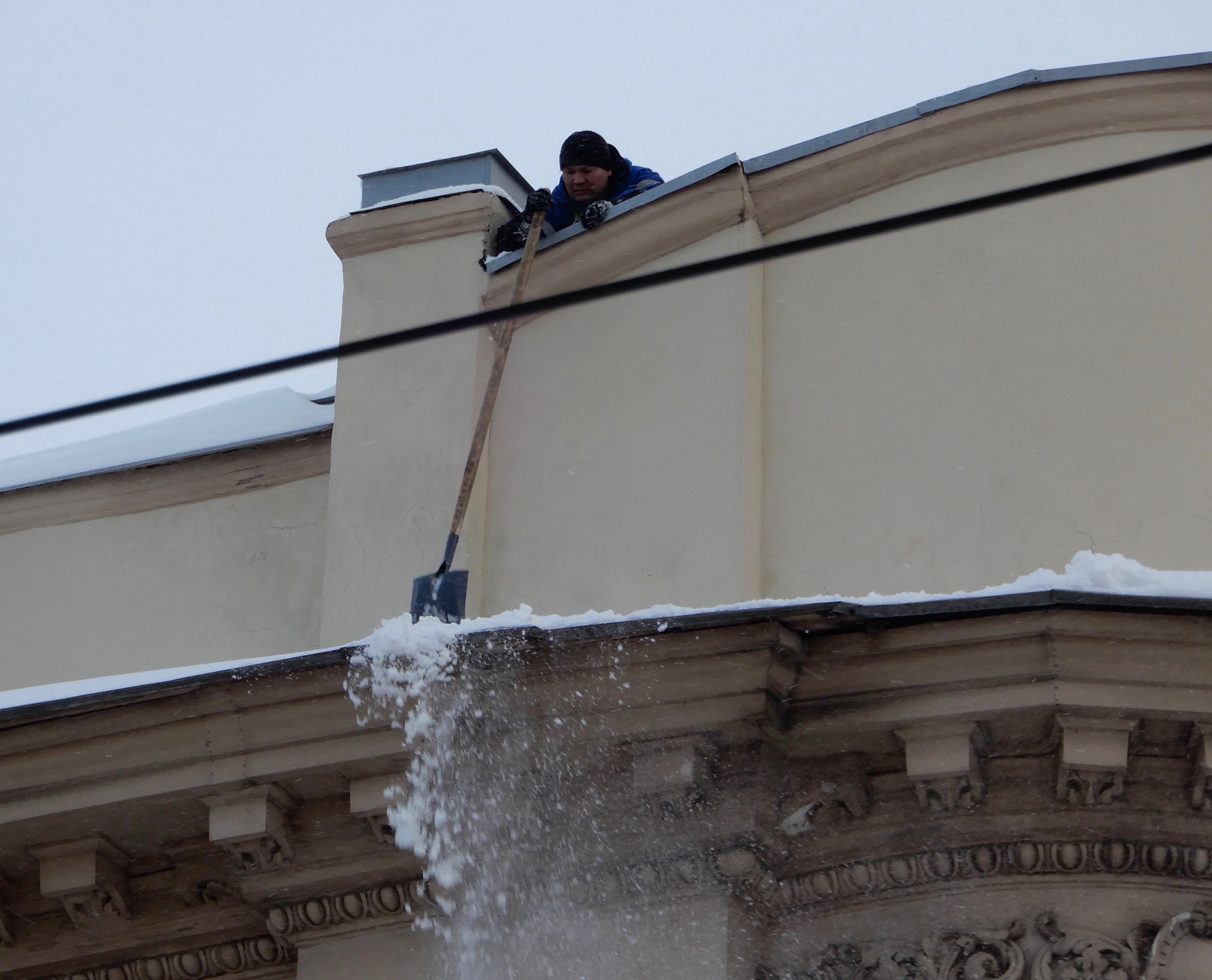
DSCN3525To give only one of a thousand examples, without Central Asian migrant workers, there would be almost no one left to do the heavy and, sometimes, dangerous work of clearing freshly fallen snow from rooftops and pavements during the winter. February 5, 2018, Petersburg. Photo by the Russian Reader

Fists and Epaulettes: Xenophobia and Corruption Making Russia Less Attractive to Central Asian Migrant Workers
Vyacheslav Polovinko and Yulia Reprintseva, with Madina Kuanova
Novaya Gazeta
February 5, 2018

Novaya Gazeta continues to investigate the lives of migrant laborers in Russia. In our last issue, we discussed the magnitude of the corruption faced by immigrants when they apply for resident permits and work permits (“Luck and Labor,” February 2, 2018). However, even when migrant workers finally obtain these papers, their lives in Russia are not made any easier.

Police, Open Up!
In the run-up to New Year’s 2018, detectives from the Perovo and Kuntsevo police precincts in Moscow detained 520 migrant workers. All of them were taken to a police station, where they were forced to stand outside in the cold from six in the evening to two in the morning. According to Valentina Chupik, head of the human rights organization Tong Jahoni (Morning of the World), only those who gave the police 10,000 rubles [approx. 140 euros] each were released. The police said they were collecting money “for celebrating the holiday.”

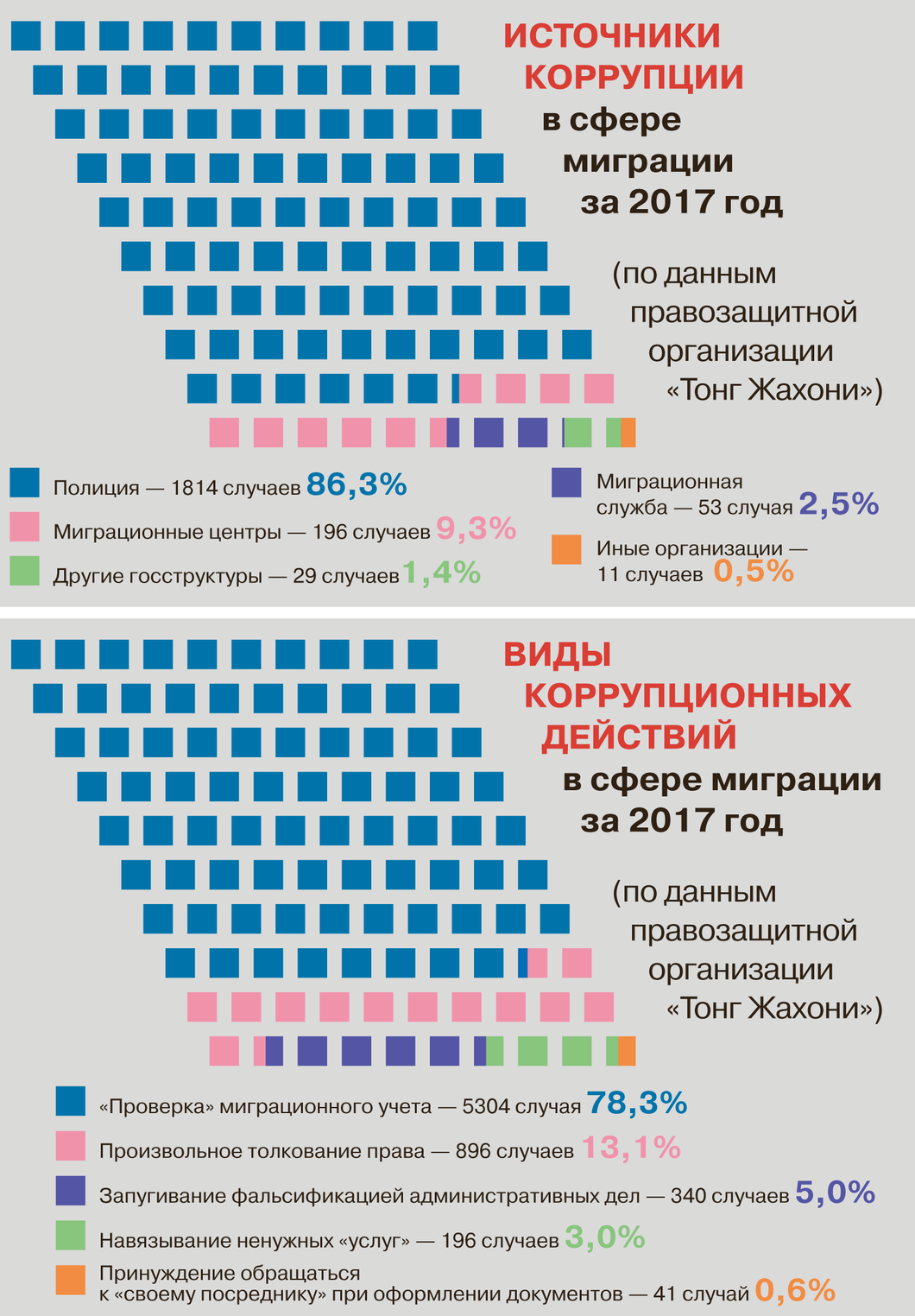
The police regularly hold such “celebrations” for migrant workers. In a ranking of offenses against immigrants, the police take first place with a large margin (86% of all complaints). Most often, the police extort money during groundless document checks.

“In Russia, the attitude is he is an Asian, so he’ll give us money,” claims Chupik.

In police stations, up to twelve migrant workers are held in seven-meter-square cells for forty-eight hours and not allowed to go to the toilet. Police sometimes assault them. In October 2017, according to human rights activists, the officers at Perovo and Novogireevo precincts in Moscow beat up 39 people.  It was a tough month, apparently.

“Volunteer work days” are another police practice. According to human rights activists, migrant workers were forced to repair a police station in the Moscow suburb of Mytishchi on April 21, 2017.

The migrant workers complain, but to little effect. In 2016, Valentina Chupik filed 6,232 complaints with various police internal affairs departments in Moscow and Moscow Region, but only four of them were passed up the command chain for further review. Meanwhile, the system for expelling migrants on the basis of police complaints operates without fail. In 2016 (there is no data for 2017), Moscow courts expelled over 14,000 migrant workers from Russia for living somewhere other than their registered domicile. They expelled almost 12,000 migrant workers for being in public without their papers on them.

“The main problem is the right the police have accorded themselves to check the papers of migrant workers for any reason,” says Chupik.

“Yes, they do have this obligation, but only when a migrant worker is involved in a criminal case,” she says.

According the Interior Ministry’s latest orders, even a neighborhood police inspector can check someone’s immigration status. He can write the person up for a nonexistent violation, which is immediately entered into a special data base. Two violations are sufficient cause for deportation from hospitable Russia, explains Chupik.

Curiously, at the same time, migrant workers are far from the most dangerous social group in Russia, formally speaking. Moreover, the number of crimes committed by migrant workers has been steadily declining, which has been noted even by the Russian Prosecutor General’s Office. As reported by Kommersant, according to the Prosecutor General, foreign nationals and stateless persons committed 41,047 crimes in Russia in 2017, which was 6.6% fewer than in 2016. In November of last year, Interior Minister Vladimir Kolokoltsev mentioned an even earlier nine-percent drop in crimes committed by migrant workers when presenting the new immigration policy. But what the top brass has said is not digested fully and immediately by rank-and-file police officers.

Commentary
Valentina Chupik, head of Tong Jahoni
State agencies and the police do not hate migrant workers because they are so despicable. The authorities pretend to hate them so it is less shameful when they rob them for their own profit. When you talk to on-duty cops, they claim eighty percent of crimes are committed by migrant workers. When you ask them to go to the Interior Ministry’s own website and take a gander at the stats, they switch to saying most crimes are committed by North Caucasians. Then they say, “Well, it’s just our policy.” When you tell them they should not implement a criminal policy because they are law enforcement officers, they get it. But they complain they have arrest quotas to fill. 
content_09
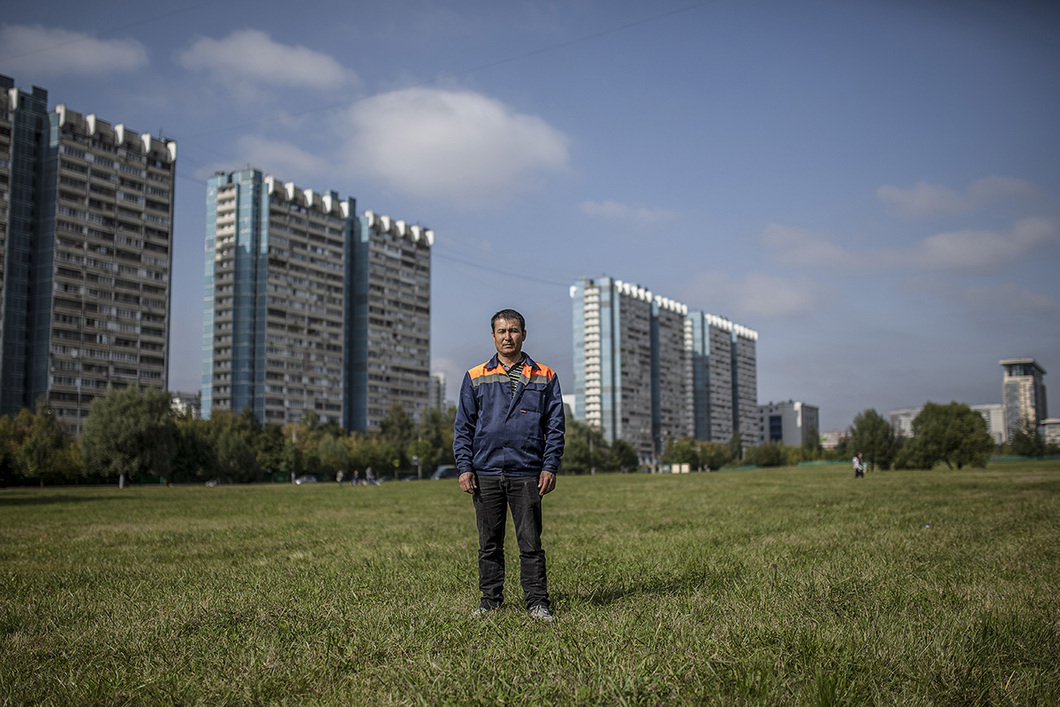
Muhiddin, a janitor. Photo by Vlad Dokshin. See Muhiddin’s story in Novaya Gazeta′s special project Muscovites

Xenophobia Has Momentum
On January 12, the body of 41-year-old Tahirjan Hamrayev was found in Noginsk, Moscow Region. Hamrayev had been stabbed over twenty times. Hamrayev left Kyrgyzstan as a migrant worker in May 2017 and got a job on the construction site of a multi-storey residential building. As reported by Kyrgyzstani media, the dead man’s mother, Hairins Hamrayeva, said her son was supposed to have come home for the New Year’s holidays, but decided to stay in Noginsk since his employers, impressed by his work, had offered him extra jobs. On the fateful day, Hamrayev went into a shop and fell into the hands of at least ten neo-Nazis, local law enforcement official claim, citing an eyewitness’s testimony.

In the various ultra-right groups on social media where the incident is discussed, commentators occasionally write languidly that Hamrayev got what was coming to him. Generally, after the security services were pressured by the Kremlin into mopping up the sector, nationalism and neo-Nazism have died out as phenomena [sic], and nowadays assaults on migrant workers have gradually become something out of the ordinary,although in Petersburg on January 31, for example, a Tajikistani national was attacked with a knife in the subway.

No one, however, has abolished xenophobia, which, although it has displayed a downward trend [sic], is still firmly entrenched in the minds of Russians.

In early 2017, Tong Jahoni published the findings of a study on nearly 50,000 housing rental ads in Russian media. Only one out of every twelve ads was free of xenophobic  insinuations. Most of the people who placed the ads wanted to rent their flats or rooms to “Russian citizens” (50%), “Slavs” (28%), and “ethnic Russians” (7%). The picture presented by help wanted ads was even more distressing. Only one in twenty ads among the 20,000 vacancies examined did not contain xenophobic allusions. Fifty-six percent of employers were seeking “Slavs” to fill the jobs, while 35% were eager to see “Russian citizens” in the positions.

Human rights activists say the situation is typical, and no one wants to change it for the most part. In turn, the media fuel the fire. In 2016, there were approximately 120,000 news reports involving migrant workers. News search websites focused mostly on crime reports, which constituted nearly 98,000 of the news reports filed.

However, the attitude to migrant workers on the part of the rank-and-file population is often quite neutral when they encounter each other face to face. Moreover, human rights activists can cite instances in which the police have helped migrant workers. But in terms of society at large, although xenophobia decreased by 10% last year, according to the official estimates produced by the Russian Federal Public Chamber, it still remains a serious problem. According to pollsters VTsIOM [sic], two thirds of the people they surveyed believed migrant workers took jobs away from Russian citizens.

Commentary
Alexander Verkhovsky, director, Sova Center for Information and Analysis 
There is xenophobia as a mass phenomenon: people’s attitudes and emotions. In this case, we can track changes through public opinon polls [sic]. I am quite glad that there is a growing number of people who, when asked about the feelings they have towards migrant workers (e.g., fear, apprehension, hatred, love), respond that they feel nothing, that they could not care less. The perfect relationship is precisely this, when people do not see a group as something that provokes emotions. They are just other people.

There is xenophobia as discrimination, when seeking employment, for example. Unfortunately, practical discrimination has been underresearched. What matters most is that people do not even perceive some forms of it as discrimination. For example, people are not ashamed to write in an ad that they will rent a flat only to a Slavic family. It is useless to fight this. It is a matter of the social atmosphere [sic].

Finally, the most aggressive form of xenophobia is physical violence. In recent years, the figures have been steadily declining. Just the other day, Sova Center published a new report based on the figures for last year. I would note there is not necessarily a meaningful connection with the decline of popular xenophobia, because assaults are not committed by the masses, but by ideologically motivated young people, who might have completely different opinions from the masses. This is more likely the consequence of a depression amongst radically minded young people. They are scared. They don’t really want to commit assaults [sic]. In the previous decade, they did not know the fear of God at all, as the saying goes, but then Center “E” [Russia’s “anti-extremism” police, established from disbanded anti-organized crime squads during Dmitry Medvedev’s presidency] went after them. Many street fighters went to prison, and this changed the situation.
content_Krasavchik_01
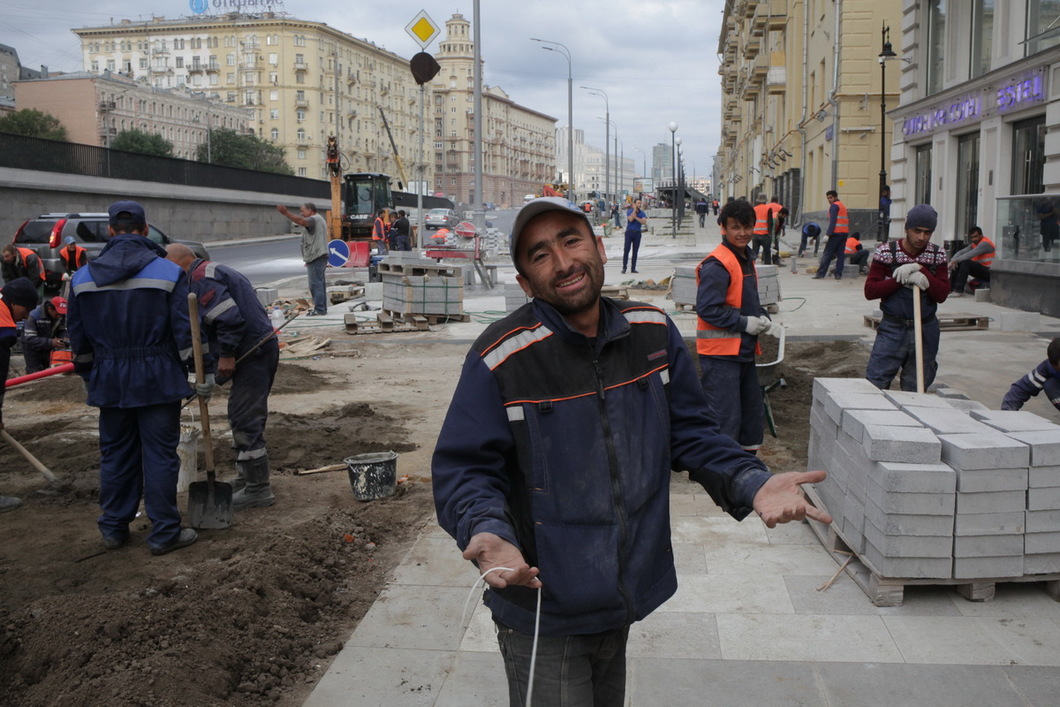
Shirinsho “Handsome” Vohidov, from Tajikistan. Photo by Anna Artemieva. See Shirinsho’s story in Novaya Gazeta′s special project Muscovites

Medical Disenfranchisement
When migrant workers take ill in Russia, it is no simple matter for them to recover.

“To enroll at a district outpatient clinic, you need to have a temporary residence permit or residence permit, permanent registration,” says Daniil Kashnitsky, a junior researcher at the Higher School of Economics. “However, a poor command of information and the Russian language, as well as a lack of legal knowledge, means that when migrant workers are yelled at by employees at the intake desk, they leave and do not come back. There are many such instances.”

There is the option of going to a private clinic, but sometimes only a state clinic can help, for example, when tuberculosis is diagnosed. It can help, but it is not obliged.

“Tuberculosis has a dangerous phase when it is communicable through airborne droplets. Patients must be hospitalized during this phase. They should stay in hospital until the tuberculosis bacterium goes away, and they are no longer a danger to others. This usually takes two or three months,” explains Kashnitsky.

If migrant workers are hospitalized due to an accident, the treatment is free, of course, but the attitude towards them will be correspondingly shabby. Last year, when a busload of migrant workers was hit by a train near Vladimir, killing seventeen people, the local hospitals treated several severely injured people.

“I asked that an injured child be sent to Moscow. Two days later, he died in our regional hospital. I remember the child. He was a year and a half old, from an Uzbek family. I said, ‘Why did you send him to our hospital? Call a helicopter and take him to Moscow: he’ll get better help there.’ I was told the decision had been made by the health department,” recounts Alla Boyarova, director of an employment agency for migrant workers. On the morning of the tragedy, her husband had rushed to help the affected immigrants.

Zoyir Karimov, Boyarova’s husband, is deputy chair of the Tajik diaspora in Vladimir. He recalls that the adult victims had huge problems.

“Two of them did not make full recoveries in hospital. They were not operated on and were sent back in this shape to Uzbekistan. They were told they could buy special plates, but they had no money. One broke his shoulder, the other, his leg,” says Karimov.
content_4
Infographic No. 1: Sources of corruption in the migrant labor sector, 2017, per information gathered by the human rights organization Tong Jahoni. Police — 1,814 incidents (86.3%); immigration centers — 196 incidents (9.3%); migration service — 53 incidents (2.5%); other state agencies — 29 incidents (1.4%); other organizations — 11 incidents (0.5%). Infographic No. 2: Forms of corruption in the migrant labor sector, 2017, according to the human rights organization Tong Jahoni. “Verification” of registration status — 5,304 incidents (78.3%); arbitrary interpretation of the law — 896 incidents (13.1%); threats by police to file trumped-up administrative charges — 340 incidents (5.0%); high-pressure selling of unnecessary “services” — 196 incidents (3.0%); forcing migrant workers to use a particular middleman when filing papers — 41 incidents (0.6%). Infographics courtesy of Veronika Tsotsko and Novaya Gazeta

Blockchain to the Rescue
It is tempting to dub what is happening in the Russian migrant labor sector a mess. In fact, however, it is more likely a restructuring of the system after the Federal Migration Service (FMS) was incorporated into the Interior Ministry in 2016. The relationship with migrant workers has changed because what the Interior Ministry does most of all is punish people. Many of the organizations that dealt with drawing up papers for migrant workers have been turned into limited liability companies, meaning it has become nearly impossible to monitor their policies, and human rights activists have huge gripes with the new state-run immigration centers. New law bills that have been tabled will only aggravate the circumstances, reducing migrant workers to semi-slave status in Russia.

The question is simple: what to do? At a January 29 meeting of human rights activists to discuss the issue of immigration (a meeting not attended by diaspora leaders) various proposals were voiced. Vladimir Khomyakov, co-chair of the grassroots movement People’s Assembly (Narodnyi Sobor), made the most radical and regressive proposal at the round table.

“We need the strictest possible oversight of each person’s stay in Russia, not just this buying a work permit and hanging out wherever you want,” said Khomyakov. “We need a system of mutual obligations. We need a single government agency that would deal with immigration and use a single database.”

People who intend to travel to Russia should obtain all the papers they need at Russian consulates in their own countries, and each migrant worker should be assigned an ID number under which all information about him or her would stored, argued Khomyakov.

Totalitarian oversight in return for peace and quiet.

But Khomyakov’s idea was not met with unanimous approval by round table participants, just like the proposal, made Vyacheslav Postavnin, former deputy head of the FMS and president of the 21st Century Immigration Foundation [sic], to move immigration registration online or, at least, make it obligatory for immigrants to check in with the migration service by telephone. Some human rights activists were outraged by the fact this would make it easier for terrorists to hide [sic].

“Terrorists never violate immigration laws. Terrorist acts are complicated operations. What, they are going to put themselves at risk of being stopped by police for failing to reregister on time?” Postavnin countered crossly.

He was told that hackers could erase or damage the entiere online database, to which the former deputy head of the FMS showed off his knowledge of the word “blockchain.”

“Even if you wanted to, you couldn’t erase it,” he said.

Tatyana Dmitrieva, deputy head of the Department for Coordinating Local Immigration Offices and Accountable Forms in the Immigration Directorate of the Russian Interior Ministry’s Moscow Office, did not like any of these proposals. She only remarked that the ministry wholly supported a new law bill that would punish legal entities for providing fictitious registration, and that a consensua had to be reached with regard to thorny issues.

The discussion’s moderator, Fyodor Dragoi, chair of the Committee for Safety, Public Diplomacy and Public Oversight at the Council for Ethnic Affairs in the Moscow City Govermnent, suggested drawing up a list of proposals after the discusssion, since “this tumor [could] burst any minute,” and the problem had to be solved.

Another, autonomous proposal has been made by the Center for Strategic Research (CSR), which has published its report on immigration. Recognizing a decline in migration flows from the CIS countries in recent years—2017 saw an increase the numbers of migrant workers from many countries, but the numbers have not returned to pre-crisis levels—the report’s authors propose their own measures for maintaining a migration flow of 250,000 people to 300,000 people annually, which they claim is a necessary number for modern Russia. In particular, they propose introducing something like a green card for highly qualified immigrants in order to stimulate the influx, as well as work cards that would make it easier to obtain a residence permit.

Something has to be done, since Russia will have lost thirteen million able-bodied people by 2030, but internal resources for population growth have been exhausted.

content_4
Viorel, a Moldovan, on a lunchbreak with his workmates. Photo by Viktoria Odissonova. See Viorel’s story in Novaya Gazeta′s special project Muscovites

The problem is that there are not unlimited numbers of highly qualified immigrants, and the ones there are drift in other directions. To take one example, the number of migrant workers from Moldova has decreased over the last two years by more than one and a half times, from 250,000 to 157,000. They have begun looking towards the European Union.  The number of migrant workers from the Eurasian Union has been growing, but their numbers are also limited, especially because Kazakhstani workers, for example, are needed in Kazakhstan itself, a country that, due to geographical proximity, grabs Kyrgyzstani workers away from Russia. The number of immigrants from Tajikistan have been growing steadily. On the other hand, while the number of Uzbekistanis coming to Moscow has grown over the past year, to a million and a half registered nationals, it would seem the numbers will eventually decline, since more convenient job markets have opened up to them.

“Turkey and the Emirates are currently very interesting and attractive to migrant workers from Asia,” says attorney Yulduz Ataniyazova. “The economy there is civilized, and there is a niche in the economy for unskilled workers. At the same time, the workers are provided with normal working conditions. For example, I know that in the Emirates migrant workers who clean houses and work in restaurants note that the cleaning liquids there are less harsh [sic]. This has now become important to them.”

However, the wages there are less than in Moscow, generally, but it depends on how you look at it.

“Uzbeks start doing the maths, and it turns out that here they will pay out more in bribes, whereas in Turkey a policeman would never approach them for no reason at all,” explains Chupik.

Workers from the CIS will keep coming to Russia for some time, of course. But if Russia toughens the rules for migrant workers, even the most desperate adventurers from the CIS countries will prefer, in time, to go somewhere else, to a place where they can work without risking their lives, health, and human dignity, not to mention their wallets.

Translated by the Russian Reader

NB. Perhaps I should have a three [sic]s and you’re out rule on this website, but despite the number of dubious or simply odd claims made by the article’s authors and the experts they quote, I thought there was enough important information and nontrivial viewpoints in the article to make it worth my while to translate and your while to read.

However, on one point—the claim that nationalists and neo-Nazis have come to naught in Russia, and hence the number of assaults on migrant workers has precipitously decreased—I was so bothered I turned to my friend W., a person who has been involved with immigrant rights in Russia both professionally and personally for many years. Here is their response.

“They are engaging in wishful thinking. Nationalism and neo-Nazism have not gone away. It has become very difficult to keep track of attacks. Officially, such reports are not welcome and are rarely discussed in the media. This is the current trend. None of this exists anymore in Russia, allegedly, while in Ukraine, for example, there has been a serious increase in anti-Semitism. According to the official interpretation, there is almost no anti-Semitism in Russia, although there were several egregious incidents in January. Basically, nobody cares about this business, and Jewish organizations mainly smooth over the potentially negative consequences of vociferous discussions.” 

I should also point out the folly of relying on public opinion polling data in an authoritarian country like Russia, where respondents can be expected to give what they think is the “right” answer out of a fear bred into the society in Soviet times.

Nevertheless, in the absence of free elections and other real political freedoms, the Putin years have been a boom time for the country’s main pollsters, VTsIOM (mentioned in this article), FOM, and the supposedly independent Levada Center. They have polled away with merry abandon, and Russian and international journalists, many of them too lazy or lacking the time to do real reporting, have become increasingly dependent on the utterly falsified portrait of “average Russians” the country’s troika of loyalist pollsters has been painting over the last eighteen years. I have dubbed the phenomenon “pollocracy” and discussed it many times on this website. TRR
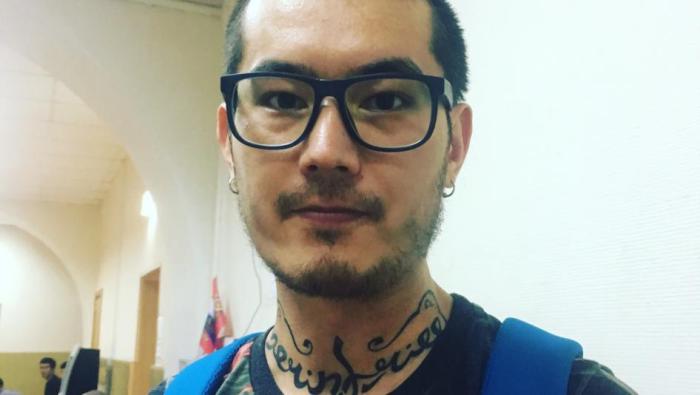
Historian Yuri Dmitriev Released on His Own Recognizance

Historian Yuri Dmitriev Released from Police Custody
Nikita Girin
Novaya Gazeta
January 27, 2018

Historian Yuri Dmitriev has been released from the pretrial detention center in Petrozavodsk on his own recognizance, Dmitriev’s defense attorney Viktor Anufriyev has informed Novaya Gazeta.

“Yuri Alexeyevich was already home at eight in the morning. Everything is fine, his mood is good,” said Anufriyev.

On the eve of the release, the historian’s eldest daughter Yekaterina had been told by officials in the pretrial detention center that Dmitriev would be released only on Sunday, January 28.

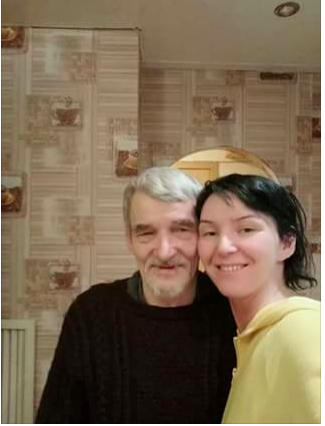
Yuri Dmitriev with his daughter Yekaterina Klodt. Courtesy of the Delo Dmitrieva (Dmitriev Case) Facebook page
Dmitriev has been accused of using his underage foster daughter to produce pornography. The case against him is based on nine photographs, found on his computer, in which his foster daughter is depicted without clothes. Dmitriev claimed he photographed the girl naked to monitor her development and report to children’s services. (There are hundreds of similar photographs on Dmitriev’s computer, but police investigators have no complaints with them). Novaya Gazeta has published the explanation that Dmitriev provided to investigators and psychiatrists.

On December 27, 2017, the court turned down the prosecutor’s request to extend Dmitriev’s term in police custody and ordered Dmitriev released on his own recognizance on January 28.

Translated by the Russian Reader 

I Can’t Get No Satisfaction

Ali Feruz, a gay Moscow-based journalist threatened with deportation to Uzbekistan, where he faces possible torture and death. Photo courtesy of Human Rights Watch 

Memes of Solidarity
Silly and Serious Acts of Civic Solidarity Will Be Needed for a Long Time to Come
Maria Eismont
Vedomosti
January 25, 2018

The Satisfaction Challenge, a internet flash mob in support of cadets at the Ulyanovsk Civil Aviation Institute, who filmed and uploaded a parody of Benny Benassi’s music video “Satisfaction,” has entered its second week. The institute’s administrators accused the cadets, who are shown dancing in briefs and pilot caps, of “mocking the sacred” and “humiliating the industry,” declaring they had no place in aviation.

Since then, scores of videos supporting the cadets have been posted daily. The latest was filmed by the Novosibirsk hockey club Sibir. Before an auditorium packed to the gills with fans, the club’s mascot, Snowman, dances to “Satisfaction” along with security guards and cleaners. Before Snowman, there were videos by female pensioners in a Petersburg communal flat, costumed theater students in the Russian Far East, horsemen, swimmers, cadets at the Academy of the Emergency Situations Ministry, construction workers, doctors, students at an agriculture college, schoolchildren, housewives, and the presenters of the TV show Evening Urgant. Consequently, a talk show on the TV channel Rossiya 1 and US magazine The New Yorker have identified the Satisfaction Challenge flash mob as a significant event in Russia public life.

“Welders from the Urals Filmed a Satisfaction Challenge Video.” Published January 24, 2018

Obviously, the flash mob has touched some important strings. It is not so much a matter of discussing the boundaries of free self-expression, the clash of different views on what is permitted and appropriate, which, judging by the varying degrees of frankness on the part of the flash mobbers, are also quite different. The key here is solidarity, which has proven the best weapon against bureaucratic stupidity and official hypocrisy. Solidarity with the persecuted is a vital tool for upholding freedom and withstanding crackdowns, for maintaining and reinforcing social connections in an atomized society.

The flash mob in support of the Ulyanovsk cadets is probably the most vivid and funny solidarity campaign in today’s Russia, but it is hardly the only or most important solidarity campaign. The cadets were threatened with explusion, but Novaya Gazeta journalist Hudoberdi Nurmatov aka Ali Feruz, who has already spent five months in a temporary detention center for foreigners awaiting a review of his appeal to the European Court of Human Rights, is threatened with torture and even death in connection with false charges of cooperating with terrorists if he is deported to Uzbekistan, say his relatives, colleagues, and human rights activists.

The solidarity campaign in support of Ali Feruz kicked off this past August, when the Moscow City Court decided to deport him. His colleagues rightly believe that the longer they bring up the case and the more loudly they discuss it, the better are the chances for a positive outcome. So, last week, Theater.doc held another reading of Feruz’s diary, written in the temporary detention center for foreigners. The first reading, entitled “My Friend Ali Feruz,” was held as a sign of solidarity by journalists in late October. During last week’s antifacist march in memory of attorney Stanislav Markelov and journalist Anastasia Baburova, slain by neo-Nazis nine years ago in downtown Moscow, some of the marchers bore placards demanding Ali Feruz’s release. On Wednesday came the news the Russian Supreme Court had overturned the Moscow City Court’s decision to deport Feruz to Uzbekistan and remanded the matter for a new hearing.

The solidarity campaign in support of Karelian historian Yuri Dmitriev, which has ranged from petitions and videos in his defense to organized trips to his trial in Petrozavodsk, has been underway since society learned of his arrest on charges of taking pornographic photographs, charges that carry no weight with anyone who knows him well. If it had not been for the public outcry, there might not have been a second forensic examination, which ruled the photographs in question were not pornographic, nor would there have been a court decision to release Dmitriev from police custody, where he has spent the last year, on his own recognizance.

Currently, Oyub Titiev, head of the Grozny branch of Memorial, is in bad need of solidarity and support. Arrested on drugs possession charges, Titiev managed to warn society any confession he made would only mean he had been tortured into giving it.

“We regard Oyub Titiev’s circumstances as extremely dangerous,” the board of the International Memorial Society said in an appeal to Russian society and the international community. “The only thing we can do under the circumstances is ask Russian society and the international community to monitor Titiev’s case with the same acute interest as has occured in the Dmitriev case.”

Solidarity is one of the few effective tools left in Russian civil society’s arsenal for confronting official coercion. We will have recourse to it again and again for a long time to come. It’s a good thing that sometimes, as in the case of the cadets, it’s also fun.

Translated by the Russian Reader

Evgeny Shtorn: How the FSB Tried to Recruit Me

“I Had a Night to Say Goodbye to My Whole Life”
Sociologist Evgeny Shtorn Left Russia Because the FSB Tried to Recruit Him
Elena Racheva
Novaya Gazeta
January 20, 2018

On January 5, sociologist Evgeny Shtorn, an employee at the Centre for Independent Sociological Research (CISR) in St. Petersburg, left Russia for Ireland. In December, his application for Russian citizenship was rejected, and immediately afterwards he was summoned to the Russian Federal Security Service (FSB), according to Shtorn, where he was interrogated about CISR’s financing and the foreign organizations it collaborates with. (Since 2015, the CISR has been classified as a “foreign agent.”) According to CISR director Viktor Voronkov, Shtorn is at least the fourth CISR employee whom the FSB has attempted to recruit.

Shtorn was born in the Kazakh Soviet Socialist Republic, but in 2000 he left the country to study in Petersburg. In 2004, he was granted Russian citizenship at a Russian consulate in Kazakhstan. He lived for eight years on his Russian passport, but in 2011 he was told by authorities the passport had been issued groundlessly, and he was not a Russian citizen.

Shtorn’s Kazakhstani citizenship had been annulled long before, but he found himself a stateless person after living in Russia for eleven years. The only paper the authorities would issue him was a residence permit for a stateless person, which allowed him to live and work in Russia. After five years, one can apply for Russian citizenship on this basis. This was what Shtorn did in July 2017, after passing the obligatory Russian language exam, assembling a whole dossier of paperwork, and standing in endless queues.

During this time, Shtorn, who is thirty-five, enrolled in the Higher School of Economics MA program and continued working as manager for development at CISR, one of the oldest and most respected independent sociological research institutes in Russia.

“I went to the local Federal Migration Service (FMS) office in late November to pick up my passport,” Shtorn recounts. “I was told my citizenship application had been rejected because I had provided false information about myself. The FMS had decided I did not lived at my registered address, because they had come checking in the afternoon, when I was not home, and I had not listed all the addresses where I had lived in Russia, although in the application I filled out there was a footnote saying I was not obliged to list all of them.”

The rejection meant Shtorn could resubmit his application for citizenship only in a year. Two weeks after his application was rejected, Shtorn was telephoned by a person who identified himself as an FMS employee. He said he was handling Shtorn’s application and asked him to stop by their office.

On December 7, Shtorn went to the FMS office that handles the registration of statelesss persons.

“I was met by a person my age. We went up to the second floor and walked into an office with no plaque on the door,” Shtorn recounts. “I caught sight of a picture of Andropov on the wall, an old-fashioned, insipid, Soviet-era portrait. I immediately understood everything.”

The man showed Shtorn a FSB officer’s ID. Shtorn did not remember his rank, but he did memorize his name and surname, but he is afraid of identifying him publicly.

“He quickly got down to business,” recalls Shtorn. “He said when the FSB reviewed my application, they were quite surprised I worked for a ‘foreign agent’ and at the Higher School of Economics, although I am actually a student there. He asked me what I did at CISR. He was polite, but his vocabulary was bizarre. ‘Who is your patron?’ he asked. I explained we did not have patrons, that researchers operate differently. There are things a person wants to research, and he or she tries to research them. To have something to say, I told him about Max Weber, and the difference between quantitative and qualitative sociology.”

Evgeny Shtorn. Photo from his personal archives

Then, according to Shtorn, the FSB officer asked him where the “foreign agent” got its money and what western foundations CISR worked with.

“I said, ‘What, do foreign agents have money? The American foundations you declared undesirables are gone, and we have big problems with financing.’

“‘So people transport cash from abroad, right?’ he asked.

“I explained I didn’t have a passport, I hadn’t been abroad for many years, and I didn’t have access to those realms, but I didn’t think anyone was transporting cash in their underwear. Then he asked whether I had met with foreign intelligence officers as part of my job.”

According to Shtorn, the FSB officer was well informed about the work of Shtorn, CISR, and related organizations. He knew about academic conferences and listed the surnames of foreign foundation directors, asking whether Shtorn was acquainted with them. He asked what Shtorn was researching at the Higher School of Economics, although he clearly knew Shtorn was researching hate crimes against LGBT. He asked what foreign languages Shtorn spoke.

“Is English your working language?” he asked.

According to Shtorn, the FSB officer was not aggressive, but twice during their ninety-minute conversation he quoted the articles in the Russian Criminal Code covering espionage and treason, commenting they applied to everyone who flirted with foreign special services and foreign organizations.

In the middle of the conversation, the FSB officer asked him whether he had read Zbigniew Brzezinski’s book The Grand Chessboard.

“He said that, way back in the nineties, Brzezinki had written Ukraine would go over to the US in 2012, and this was what had happened. He advised me to read the book.

“At the end of the conversation, he said, ‘How unlucky you were with your citizenship application.’ He explained he was unable to help me in any way. ‘Many believe we are an all-seeing eye, but it’s not like that at all. We also have a tough time obtaining information.’

“He insisted I tell no one about our conversation. When I was getting ready to leave, he said, ‘If I call you again, you won’t be scared? Because some people get scared and change their telephone numbers.’ I said, ‘Of course not. You’re a polite person. What do I have be afraid of?’

“‘And you are such an interesting person, and educated. It’s interesting to chat with you. Thank you for your time,’ he said.

“We left the office, and that was when I caught sight of a bust of Felix Dzerzhinsky behind the coat rack, a life-sized bust.

“‘And here is Felix,’ the FSB officer said.

“I left.”

The FSB officer telephoned Shtorn the very next day. According to him, the FSB officer suggested meeting for coffee.

“I realized that was that. They were going to try and recruit me,” says Shtorn.

He believes if he had refused to work for the FSB, as a stateless person he would have been sent to the Temporary Detention Center for Migrants.

“I felt paranoid,” says Shtorn. “I imagined the FSB had access to all my channels of communication, that they could see all my emails. They realized I had nowhere to go, that without papers I was caged. I realized I had to make a run for it, so I turned to Team 29, LGBT Network, and Civic Control. I got a lot of help from human rights activist Jennifer Gaspar. In 2014, she was also invited to have a chat with the FSB, who stripped her of her residence permit and expelled her from Russia. Jennifer put me in touch with Front Line Defenders, who asked the German, Lithuanian, French, and US governments to issue me a visa. They all turned us down, saying they could not put a visa in a residence permit.”

On the evening of December 21, Front Line Defenders informed Shtorn Ireland was willing to issue him a visa. The next morning he had to fly to Moscow, apply for the visa at the Irish Embassy, and fly to Ireland without any hope of ever returning to Russia.

“I had a night to say goodbye to my whole life,” recalls Shtorn. “It felt like I was standing on the edge of an abyss and jumped off.”

In Moscow, it transpired that, due to the short working day, the Irish consular officials would not have time to draw up his visa, and he flew back to Petersburg. He obtained the visa only on January 4. The next day, he tried to board a Lufthansa flight to Dublin, but the airline refused to let him board the plane. The German Federal Police had informed the airline it would refuse to let a person with a residence permit enter the transit zone. It was clear Shtorn would not be allowed to fly via any of the EU countries. The next flight from Domodedovo Airport to Dublin had a stopover in Moldova.

“I went to the check-in counter,” recounts Shtorn. “The folks there were reasonable. They realized a person with an Irish visa would not want to stay in Chișinău. I bought a ticket. There was 45 minutes until boarding, and the whole time I sat waiting for them to come for me. When the plane took off, I started shaking.”

Shtorn is now in Dublin on a three-month short-term visa.

“Thanks to Front Line Defenders I have a place to live and money for food,” he says. “I don’t know what will happen next. I cannot go back to Russia. If my situation was bad, now I have made it worse. Initially, I wanted to keep mum, but I decided I had to warn the employees of other NGOs. When the law on ‘foreign agents’ was enacted, it stated the penalties did not apply to people who worked for such organizations. My story shows this is not the case.”

•••••

Фото: «Новая газета»

Viktor Voronkov, director, Centre for Independent Social Research (CISR), Petersburg 

Of course, the FSB is interested in CISR. Four of our employees have approached me and said, “They’re trying to recruit me. What should I do?” I think they have tried to recruit nearly everyone at CISR. Some have told me, others have turned them down and not told me, and still others, perhaps, did not turn them down. In conversation with the people they were trying to recruit, FSB officers have mentioned numerous facts they could have learned only from our employees.

It is normal. I know the practice well from the Soviet Union. When they tried to recruit me in 1981, they also asked questions that came out of left field. “Maybe you could describe your critical view of things at the institute? Maybe we could work together? You want to help the Motherland, don’t you?” They always associate themselves with the Motherland. They offered me help traveling abroad via the Soviet-East German Friendship Society. They blackmailed me.

I met with them three or four times. One time, a KGB officer tried to take me into a cubbyhole under the stairs at the institute to work me over. He looked in there, said, “Excuse me,” and closed the door. Another officer was already working someone over in the cubbyhole.

You can get rid of them. They have the right to recruit, and we have the right to turn them down. When they tried to recruit a pal of mine, he simply opened the door of his officer and shouted, “Get the hell outta here!” The KGB guy left. But I do not advise anyone to start talking with them. You cannot win against them. Nowadays, I advise my employees to give FSB guys the bum’s rush.

They tried to blackmail our other employees over trifles, but they were not as vulnerable as Evgeny was. I told him him to pay no mind to the blackmail, but it was not worth taking risks in his position. When a person is guided by fear, it is better to give into that fear.

I think we have to talk about such stories publicly. We could do a flash mob hashtagged #HowTheyTriedToRecruitMe. If there is no public oversight of the KGB, it means the KGB oversees society.

I realize this story could affect CISR, but we have been taking different measures to soften the blow. CISR is currently split. The majority of our employees argues we should disband the center and establish a new one. The minority argues we should not surrender. I have taken the most radical position. Everyone wants to find the means to survive. I want to show there is way to fight we can fight to the end. I hope to their end, not ours.

Translated by the Russian Reader

Impotent

DSCN1619

And [Putin] just stands there and watches them destroy each other, and doesn’t interfere. Because then, on the one hand, he gets to maintain his position above the fray and watch all these ministries mutually weaken each other and become incapable of monopolizing power (which he’s afraid of). But on the other hand, he’s afraid even to give an order, because he senses that his orders have no weight anymore, that he can’t do anything. It’s a hideous situation, and as a result everyone turns into these trembling slaves who have no idea what will befall them, because there’s no one to appeal to, there’s no ordering principle to appeal to anymore. There’s no law, Putin is absolutely impotent, he can’t do anything.

I am sorry for writing what I am about to write, because I have a decent amount of admiration for the man who wrote the passage I have quoted, above, but if there is anything nuttier than thinking that Putin (or any other dictator) is absolutely powerful, it is thinking that Putin has no power at all.

The “impotency” heresy seems to be all the rage these days, because Putin was, allegedly, persuaded by his ex-finance minister and ex-Petersburg city hall colleague Alexei Kudrin to write not one but three official letters telling whoever has been hassling the European University at St. Petersburg to back off and leave it alone, and all three times these sinister forces (whom no one has yet properly identified, because no one believes federal education watchdog Rosobrnadzor and the courts could arrange this sick nine-ring circus on their own) willfully ignored Putin’s instructions.

The explanation, given by Fontanka.ru investigative reporter Irina Tumakova in the latest edition of Novaya Gazeta v Petersburge—that the mess kicked off due to four complaints filed with the prosecutor’s office against the university by non-entities who now cannot even remember why they filed the complaints and have lost all the paperwork—may be factually true, but it will have the effect of reinforcing the “impotency” camp’s convictions.

In reality, there are as many ways to exercise power as there are ways to be impotent, and so it is easy to confuse the two, especially if you are naive enough to believe that when Vladimir Putin says or writes something, he always means what he says or writes.

Let’s suppose Putin really is not averse to handing over the two mansions on the corner of Gagarin Street and the Kutuzov Embankment to his arch-crony Gennady Timchenko or whomever else Tumakova mentions in her article, and, in the process, getting rid of the European University, towards which he, plausibly, only feels antipathy, since in the past it was involved in using European Union funds to study election monitoring, something Putin, who has stayed in power this long only by rigging elections on a massive scale, would hardly approve.

(Putin even publicly said as much at the time, in late 2007 or early 2008, and soon afterwards, fire inspectors showed up at the European University and shut it down for two months.  It was reopened after a loud, noisy, vigorous public campaign by its faculty, its students, and its numerous supporters in the local and international community. I took part in that campaign.)

More generally, the Putin regime has been engaged in a long-term, deliberate program of clamping down on any and all independent forces and entities in Russia, from small and medium businesses and NGOs of all stripes (even ones not mixed up in politics and without financial or other connections to foreign partners) to independent religious groups (e.g., the Jehovah’s Witnesses) and independent educational institutions such as the European University. Unsurprisingly for a regime chockablock with “former KGB officers” at all levels and led by another “former KGB officer,” it has increasingly come to regard everyone trying to operate beyond the Russian government’s overweening oversight as extremely suspicious at best, “national traitors,” at worst.

Putin could make large numbers of people loathe him more than they already do by openly issuing a decree closing the European University and turning over its building and the neighboring building to his buddy Timchenko. Or he could play it smart and make clear through all the hundreds of channels he has at his disposal that he wants to shut down the university and hand over the building to Timchenko, all the while feigning to Kudrin and his liberal fans that he is worried enough about that fine little university to write the “back off” letters Kudrin asked him to write.

But the fix is already in, because Rosobrnadzor, the courts, Timchenko, and everyone else who needs to know, know that Putin’s letters of “support” for the university are meant to be roundly ignored. They know this because he has somehow indicated they should ignore them. How he did this exactly is immaterial and, ultimately, uninteresting.

So, in reality, this is yet another example of Putin’s exercising his rather considerable power, not evidence of his impotence. Of course, like any reasonably smart dictator or just plain leader, he wants to appear to be above the fray, but that does not mean he really is above the fray. He is right in the midst of it, whatever “it” is: making peace among the made men in his mafia empire, awarding them for their loyalty, slapping them on the wrists for their lapses, and adjudicating their conflicts between each other as they arise.

A real example of impotence are tenured and celebrated academics who persuade themselves, after being suckered by one of the oldest cons and mythologemes in Russian history (the powerless tsar surrounded by perfidious boyars), that since the allegedly powerful Putin is, in fact, impotent, they can be excused from empowering themselves and their students, and mobilizing them and the rather large community of people in Petersburg and around the world who are sympathetic to the European University to fight the power and get the university’s full rights as a research and teaching institution reinstated, while also forcing the powers that be to have the university’s grand old building restored to it and let it go ahead with renovating the building, as the university had carefully been preparing to do for several years.

That would be a real cause to rally round, but instead we have been treated, in turn, to long bouts of radio silence, various implausible conspiracy theories, and self-defeating disempowerment sessions, disguised as the worldly-wise acceptance of defeat and the lowly station of academics in Russian life.

But we have not seen the slightest hint of a coherent, militant public campaign to save the university, most of whose seemingly feeble supporters have the temerity to call it the “best in Russia.”

If it is really the best, it should be worth fighting tooth and nail for, no? Even and especially if you think the emperor has no clothes. ||| TRR

Photo by the Russian Reader

Remembering Beslan

The Memory of Beslan
Takie Dela
September 1, 2017

On the anniversary of the tragedy, Takie Dela remembers the principal witnesses to the events in School No. 1.

On September 1, 2004, terrorists seized School No. 1 in Beslan. The gunmen herded over a thousand hostages, including small children, into the school’s gym. For three days, the hostages were forcibly held in the building without food and water. The security services assaulted the school to free the hostages.

A total of 334 people were killed in the terrorist attack, including 186 children. 126 of the former hostages were crippled. During the assault, the FSB killed 28 terrorists. The only terrorist taken alive, Nurpashi Kalayev, was arrested. A court later sentenced him to life in prison.

Many articles, investigative reports, and special projects have been written about the Beslan tragedy, and several documentary films and books have been released. Takie Dela recalls the primary witnesses to the events in School No. 1.

Novaya Gazeta

Novaya Gazeta reporter Elena Milashina was in Beslan during the terrorist attack. The first article she filed about the tragedy, “Lies Provoked Terrorists’ Aggression,” was published in the newspaper’s September 6, 2004, issue.

“According to the police officers and special forces soldiers with whom we have spoken, the preparations for the assault were vigorous. That the authorities were learning toward this option is borne out by one other fact. They did not, in fact, negotiate with the gunmen. No one intended to meet even their formal demands. They explained to us, ‘It’s not clear what they want.'”

In 2014, on the tenth anniversary of the tragedy, Milashina recalled how events had unfolded before and after the terrorist attack .

“The Beslan terrorist attack will go down in Russian history as an instance when the populace was disinformed on an unprecendented level. Up until the assault of the school, officials concealed the scale of the tragedy (the number of hostages). They also concealed negotiations with Chechen separatist leader Aslan Maskhadov, who was ready to ask the gunmen to put down their weapons. Akhmed Zakayev, Maskhadov’s emissary, was ready to fly straight to Beslan and take part in negotiations with the terrorists.”

In 2006, Novaya Gazeta published a special issue on the outcome of its investigation, featuring forensic evidence, annotated maps, official reports, and eyewitness testimony. The newspaper came to several conclusions. Reliable information about the upcoming terrorist attack was known to the authorities at least three hours before the school was seized, and Alexander Dzasokhov, president of North Ossetia, offered to replace the children with 800 officials and local MPs, but Moscow forbade him under pain of arrest from entering into negotiations. The biggest public outcry was caused by the newspaper’s claims that the school was fired upon by grenade launchers, flamethrowers, tanks, and helicopters on several occasions when the hostages were still in the building. According to the newspaper, the official inquiry, while it was in full possession of these facts, found no wrongdgoing in the actions of those in charge of the operation to free the hostages.

Twelve years later, Novaya Gazeta special correspondent Elena Kostyuchenko wrote down the dreams of surviving hostages.

“Vladimir’s dream: “I want to pick a plum. “Now,” I say, “I want a ladder to the plum and to pick the plum.” A young girl below me says, “I’m not your little girl.” I say, “And where is my little girl?” She says, “She is not here. I am another girl here.” After all, she was lying with my wife in the grave. “I’m not your daughter,” she says, “Don’t pick me plums.” I say, “Where is my little girl?” She says, “I don’t know. Look for her.”‘”

Kommersant

Kommersant reporter Olga Allenova was returning from Grozny, when her editors called her and told her about the terrorist attack in Beslan. She went to North Ossetia to write a story.

“‘Don’t let the hostages’ relatives on the air. Don’t cite any number of hostages except the official figure. Don’t use the word “storm.” The terrorists should not be called gunmen, only criminals, because terrorists are people you negotiate with.’ This was what several national TV channel reporters, located in Beslan, heard immediately from the top brass. We were all side by side, and I saw how hard it was for those guys to carry out the orders of the top brass. And I saw one of them crying in the evening after the school had been stormed.”

On October 17, 2004, the newspaper published an article entitled “How Did We Help Them?” The story dealt with the fortieth day after the terrorist attack. [In Orthodox culture, the fortieth day after a person’s death is usually remembered and marked by a ritual.]

“In Moscow, we say that forty days have passed since the school in Beslan was seized. Here those days did not exist. In their place is a black hole, like the hole made by a grenade in the floor of the assembly hall. And every day is a day of mourning.

“The entire city of Beslan is dressed in black. There are houses here in which not a single child is left, and entryways through which three caskets a day are carried out.”

In 2011, an infographic was posted on the newspaper’s website: it features a map of the school on which the main locations where the events took place are illustrated by short excerpts from archival video footage.

Esquire

In 2006, the Russian edition of Esquire published an article [in Russian] by New York Times reporter C.J. Chivers, in which he retraced the events in Beslan School No. 1 hour by hour: from the beginning of the ceremonial, first-day-of-school lineup at nine in the morning of September 1 to the medical care administered to the victims in the Vladikavkaz Hospital on September 4. Chivers had written the article [in English] o understand who the hostages had felt the whole time.

“Like many people who have been to Beslan, I subsequently thought a lot about what had happened. Like the people of Beslan, I was infuriated by the endless contradictory statements, the lack of information about many important episodes in the hostage crisis and the actions of the Russian authorities.”

Radio Svoboda

Ten years after the tragedy, Tom Balmforth and Diana Markosian published a story on the Radio Svoboda website about the lives of the surviving schoolchildren. The former hostages talked about their memories, features, and thoughts of the future.

“The children behaved heroically. We all grew up immediately. We really supported each other. In fact, we came together like a family there. Even many of the adults did not behave with as much dignity as the children. Apparently, the adults understand everything in terms of their being grown-up and wise, while we children saw it all through rose-tinted glasses, maybe. I know for a fact that, after those three days, we became completely different people,” recalls Zarina Tsirikhova. She was fourteen when the terrorist attack occurred.

Takie Dela

Takie Dela published Diana Khachatrian’s story about how, in September 2016, the memorial events in Beslan ended in arrests. During the ceremonial school lineup at School No. 1, five women staged a protest. They removed their jackets, under which they were wearing t-shirts that bore accusations against the regime.

Voice of Beslan activists in the gym of School No. 1. Their t-shirts are emblazoned with the slogan, “Putin is the execution of Beslan.” Photo courtesy of Diana Khachartian and Takie Dela

“The female activists of Voice of Beslan stand apart in the gym. The five women are wearing handmade t-shirts on which the inscription “Putin is the executioner of Beslan” has been written in marker pen. This is not a hysterical slogan. Based on their own impressions and evidence from the investigations, the women argue that on September 3, 2004, Vladimir Putin or a member of his entourage gave the orders to storm the school in order to expedite events and prevent negotiations with Aslan Maskhadov. They argue the hostages could have been saved.”

Photography

Photographer Oksana Yushko has for many years produced unique photograph projects on the aftermath of the Beslan tragedy. Yushko takes pictures of the children who were taken hostage in September 2004 at different stages in their school careers, both in everyday life and during graduation from school.

Amina Kachmazova, left, and Fariza Mitdzieva hugging each other in the old school No. 1 in Beslan. Fariza, 18: ‘Here we are, such heroes, living after the attack. And somehow we are able to find happiness in life. Life just goes on and we cannot change what already happened to us. Just the opposite: now it is more pleasant to look at how we laugh, have fun and enjoy life.’ Beslan, North Ossetia, 2013. Photo courtesy of Oksana Yushko

Documentary Films

In 2005, some of the relatives of those who were killed during the terrorist attack established the grassroots organization Mothers of Beslan. That same year, due to friction within the group, a number of committee members left the group and founded another organization, Voice of Beslan.

Rodion Chepel’s The Committee, released on the tenth anniversary of the tragedy, focuses on Beslan’s female activists.

Chepel discussed how the film was made in an interview with Rusbase.

“We have never met such people. They are such uncompromisingly honest people, it was if they would be shot for lying. From a distance it seems that Beslan is god knows what, part of Moscow’s war with terrorism. But when you go there, you understand it is just human grief that has made them so tough and very honest. It’s not a matter of politics. They’re in touch with their humanity. You talk to them and you realize you simply have not met such people. This was what we wanted to show in the film: what these ten years have done with these people is incredible. They just want someone to explain to them what happened, for someone to say, “Forgive me. It was my fault.” Instead, they have been threatened and slandered. People have tried to sick them on each other, drive a wedge through them, and present them as insane.”

Filmmaker Vadim Tsalikov has shot four documentary films about the terrorist attack in Beslan. One of them is Beslan: Memory.

Foreign filmmakers have also shot films about the tragedy in North Ossetia. For example, Joe Halderman shot the film Beslan: Three Days in September for Showtime. The picture was screened at the Tribeca Film Festival in 2006.

Personal Diary

In 2012, one of the hostages, 14-year-old Agunda Vatayeva, decided to publish her memoir of the terrorist attack. The young woman launched a diary on LiveJournal and wrote three posts in which told from beginning to end the story of the three days she spent in captivity.

“If you deliberately searched for my diary, you probably want to read my memoir of the terrorist attack in Beslan: Day One, Day Two, and Day Three. It is unlikely that you will find my LiveJournal exciting or at least positive reading. It was started once upon a time for quite different purposes. It was a kind of psychotherapy for me.”

***

In April 2017, the European Court of Human Rights award three million euros to the relatives of the victims. There were over 400 plaintiffs in the case. The court ruled that the Russian authorities had not taken sufficient measures to prevent the terrorist attack and had violated Article 2 of the European Convention for the Protection of Human Rights and Fundamental Freedoms: the right to life. In addition, Russia had not prevented a threat to people’s lives and had not planned the assault on the school properly. The European Court of Human Rights likewise deemed that the Russian authorities had not properly investigated all circumstances of the terrorist attack and the causes of the hostages’ deaths.

The Kremlin reacted to the ECtHR’s ruling by saying that “an emotional assessment is hardly appropriate.”

“Of course, we cannot agree with this formulation. In a country that has been repeatedly attacked by terrorists, and the list of such countries has been growing, unfortunately, these formulations and purely hypothetic arguments are hardly acceptable. An emotional assessment is hardly appropriate.

“All the necessary legal actions related to this decision will be taken,” said Dmitry Peskov, the president’s spokesman.

Translated by the Russian Reader