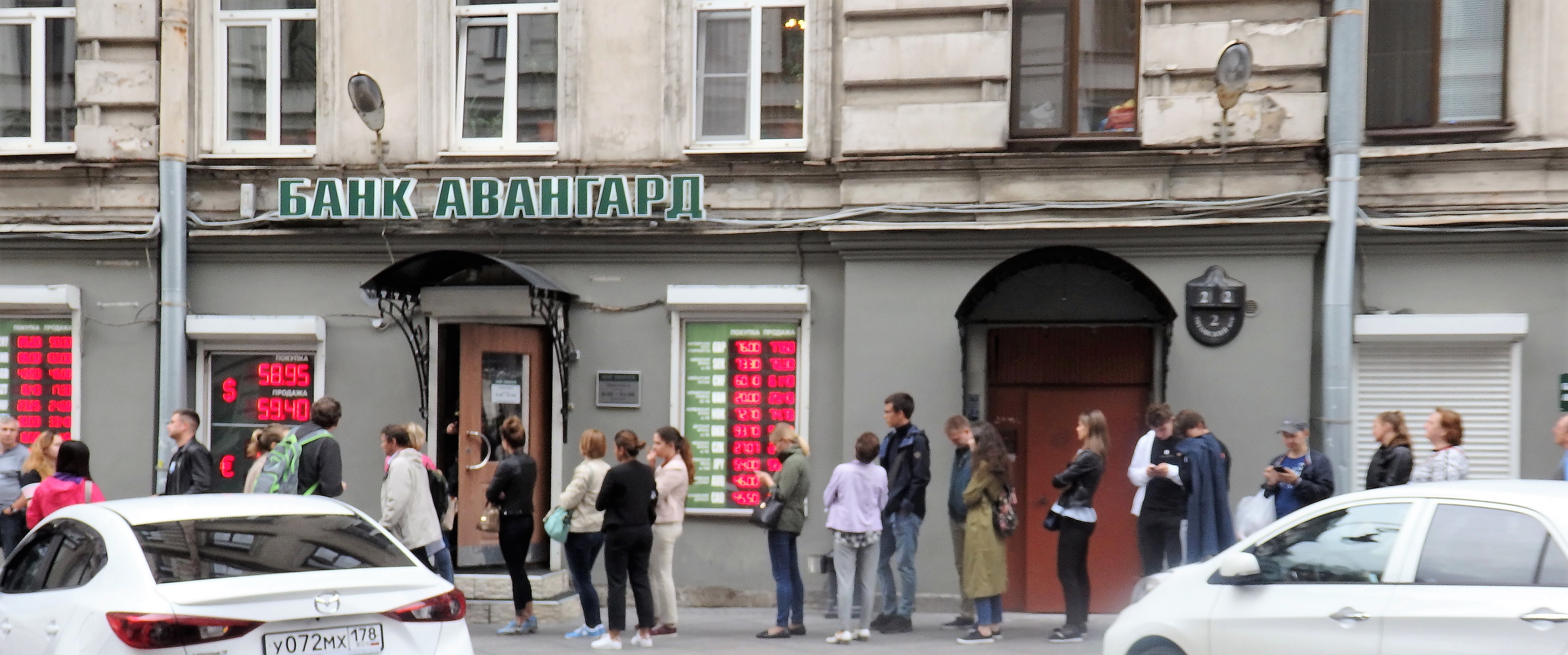
Petersburgers queue at a money exchange point in the downtown as the euro again rises in value against the ruble, August 22, 2017. Photo by the Russian Reader
Half the Kingdom for an Offshore Since the early 1990s, Russians have exported as much money as is left in the country
Arnold Khachaturov Novaya Gazeta
August 24, 2017
Research into the scale of the transfer of money from Russia to preferential tax jurisdictions has confirmed the darkest fears of economists and politicians. The offshore capital of Russian companies amounts to 62 trillion rubles [approx. 888 billion euros], which is comparable to 72% of Russia’s annual GDP and three times larger than the country’s gold and foreign exchange reserves. A handful of hyper-wealthy Russians and major companies have deposited in accounts in Panama (read our special investigation “Offshores: An Autopsy”), Cyprus, and other offshore zones about the same amount of money as the rest of Russia’s populace has left at home. Or, to invoke another comparison, the elites have exported the monetary equivalent of the entire Russian economy during the mid-2000s.
You won’t find this information in the official statistics, of course. These are the calculations reached by three of the world’s leading specialists on inequality—Thomas Piketty, Gabriel Zucman, and Filip Novokmet. (Piketty and Novokmet work at the Paris School of Economics, while Zucman works at UC Berkeley and the National Bureau of Economic Research.) The economists have authored a report entitled From Soviets to Oligarchs: Inequality and Property in Russia, 1905–2016. The report has been published by the NBER, a private research organization based in Cambridge, Massachusetts.
Piketty and his colleagues most often assemble and analyze globe-spanning data sets, but this time they have written a detailed article on a single country. It deals with a particular trajectory in Russia’s progress after the Soviet Union’s collapse: the economy has been sent offshore, and the income gap between the wealthy and the poor has reached critical levels not typical either of the developed countries nor of other post-communist regimes. The report’s authors see this as an example of an extreme form of oligarchic capitalism, which confirms their central hypothesis that a high level of inequality is incompatible a country’s sustainable development.
Although Piketty’s methodology has been constantly criticized due to the insufficient reliability of his data (the use of official Soviet statistics provokes the biggest questions in this instance), the conclusions reached by the world’s biggest star in academic economics and author of the international bestseller Capital in the Twenty-First Century cannot be ignored.
In any country in the world, the major capitalists are engaged in devising different ways to minimize tax payments: economic incentives function the same everywhere. In his previous works, Zucman calculated there is $7.6 trillion tucked away in the world’s offshore zones. In 2014, according to Oxfam, the fifty biggest US companies kept $1.4 trillion in tax havens.
In relative terms, however, this is only 8% of the US economy. The European elites keep approximately the same percentage of their wealth abroad. Returning these assets to their original jurisdictions and adding them to the tax base would certainly be a powerful impetus in the fight against inequality, but the quality of life of the average American or European would probably not change too drastically.
Can the same be said of Russia? Offshores have played a fundamentally different role here.
Due to corruption and the lack of legal protections for business, the Russian economy has been deprived not just of a small part of corporate super-profits, but of almost half of its potential assets. The failure of the deoffshorization campaign has shown the problem in Russia lies much deeper than in western countries. Russian businessmen are trying not so much to evade the practically preferential income tax rate of 13%; on the contrary, in other jurisdictions they are willing to pay twice as much so as not face the Russian tax inspectorate and the Russian courts.
Even if we ignore the origins of the offshore fortunes of the Russian rich, the possible public gain from returning these funds to Russia appears extremely significant. The most conservative estimates predict 400 to 500 billion rubles in additional tax revenues for the budget annually. This was the same amount the federal government spent on healthcare in 2016.
If at least part of this money were invested in the Russian economy, the effect could be much stronger. For example, the Stolypin Club’s strategy argues that, in order to grow, the Russian economy lacks 1.5 trillion rubles annually in the form of business loans. Economist Mikhail Dmitriev proposes allocating the same amount to finance infrastructure projects.
These are conversations in a vacuum, however. Having made their fortunes both in the private sector and government service, wealthy Russians imagine Russia’s “national interests” quite differently.
Translated by the Russian Reader
____________________________________
This paper combines national accounts, survey, wealth and fiscal data (including recently released tax data on high-income taxpayers) in order to provide consistent series on the accumulation and distribution of income and wealth in Russia from the Soviet period until the present day. We find that official survey-based measures vastly underestimate the rise of inequality since 1990. According to our benchmark estimates, top income shares are now similar to (or higher than) the levels observed in the United States. We also find that inequality has increased substantially more in Russia than in China and other ex-communist countries in Eastern Europe. We relate this finding to the specific transition strategy followed in Russia. According to our benchmark estimates, the wealth held offshore by rich Russians is about three times larger than official net foreign reserves, and is comparable in magnitude to total household financial assets held in Russia.
—Abstract to Filip Novokmet, Thomas Piketty & Gabriel Zucman, From Soviets to Oligarchs: Inequality and Property in Russia, 1905-2016, NBER Working Paper No. 23712, August 2017
It Was an Execution: Dozens of People Were Shot in Grozny on the Night of Janunary 25 Elena Milashina Novaya Gazeta
July 9, 2017
Over the years, Novaya Gazeta has regularly published information about massacres and reprisals in Chechnya. The motives for persecuting the people who live in the repubic have been quite varied. In early April, Novaya Gazeta published evidence testifying to the widespread persecution, torture, and killings of gay Chechens. Due to enormous international pressure, Russia’s law enforcement agencies for first time conducted, much against their will, a pre-investigation of evidence of extrajudiciary killings in Chechnya. This was in itself an incredible achievement.
On April 20, we handed over to police investigators information about two men who, we had concluded, had been killed during the anti-gay campaign in Chechnya. Our journalistic investigation, in fact, began with attempting to clarify what had happened to these two men.
We sent all information about the murdered men to investigators for their review as soon as we received it. We also gave the Russian Investigative Committee the anonymous testimony of the surviving victims, who had been kept in secret prisons and gone through terrible torture. This testimony aided investigators in independently and successfully establishing the identities of the victims, according to our information.
Igor Sobol, deputy head of the major case squad in the Central Investigations Department at the Russian Investigative Committee’s North Caucasus Federal District office, who conducted the pre-investigation, had planned to meet with the victims to try and convince them to make statements. However, Sobol had worked on the pre-investigation for a mere two weeks when he was suddenly appointed to a new post. The pre-investigation was assigned to another investigator. After this reshuffle, the official investigation ceased to be robust and adopted a predictable stance. Since the victims had not filed complaints themselves, no crime had taken place.
Moskalkova’s Stance
We guessed this would be the outcome. It is the silence of living victims, scared to death by the unlimited capacities of Chechnya’s security forces, that is the main argument used by police investigators in response to all complaints about human right violations in Chechnya.
Therefore, in addition to the names of the slain gays, we gave investigators a list of twenty some Chechens, arrested starting late December 2016 and, according to our information, murdered in January of this year. These people were arrested during several special raids conducted in Chechnya after December 17, 2016. These people were not formally charged with any crimes. As in the case of the gays, a decision was most likely made to exterminate these people, and the order was carried out.
FYI
On December 17, 2016, a group of young men assaulted and murdered a policeman’s acquaintance. The assailants stole the policeman’s car. During the chase, they ran over a traffic police officer in this car. All the assailants were destroyed [sic], including three detainees.
According to the Memorial Rights Center, they were shot in a hospital in Grozny.
The incident triggered massive arrests throughout Chechnya, and two preventive, proactive counter-terrorist operations were conducted.
All the information about what we have assumed were murdered Chechens was passed on not only to police investigators but also to high-ranking officials, including Tatyana Moskalkova, Russia’s federal human rights ombudsman.
In our letters to these officials, we made a special point of distinguishing between the people we assumed had been killed on suspicion of homosexuality, and the people killed for another reason. (Most likely, they were killed on suspicion of extremism, although we cannot corroborate this: no formal charges were filed, and the Chechen police did not have sufficient information to file charges.)
“No one can be subjected to violence, humiliation and, especially, the loss of life under any circumstances,” Moskalkova announced publicly before sending our petition to the Russian Investigative Committee for review.
On June 6, the preliminary outcome of the review, which the Russian Investigative Committee had been conducting for over two months, was made public. Ombudsman Moskalkova reported on the Investigative Committee’s reaction to her request.
“The reply I received says they have not ascertained evidence confirming violent actions, because they had no specific information on these citizens.”
Moskalkova had every reason to put the matter to rest, as many high-ranking officials had done before her. But she adopted a principled stance under the circumstances.
“Since my request and the letter from Novaya Gazeta I sent contain the names of the people who have, allegedly, perished, the review cannot be deemed completed at this point, and I ask you to clarify what happened to the people whose names are listed in the letter,” wrote Moskalkova.
In an interview with TASS News Agency, Moskalkova likewise remarked that the list given to her by Novaya Gazeta “contains only surnames and names, and nothing else.” She expressed her hope that the “investigative authorities would be able to talk with the article’s author and obtain additional information about years of birth, places of burial, relatives, and former places of residence.”
The fact is that, during our communications with the investigator conducting the review, we passed on more complete information that would make it possible to identify people from the list and establish what had happened to them. At the time, we had information about the places where these people had resided and their dates of birth.
One January Night
After sending the list to the official investigators, we did not halt our own investigation. We kept on trying to explain what had happened to these people.
Since we no longer have any confidence that the new investigator conducting the review will want to talk with our reporters, we have decided to publish everything we know about the circumstances of how these people disappeared.
Large-scale arrests of people kicked off in Chechnya after December 17 of last year. In early January, special raids were carried out the Grozny, Kurchaloy, and Shali districts of Chechnya, during which many people were arrested. The arrestees, however, were not formally registered or charged with crimes. Instead, they were put in the cellars and outbuilding of police departments. The arrests continued until late January. According to what we have learned, around two hundred people were arrested.
Novaya Gazeta carefully monitored these events and has written on several occasions about the plight of the arrestees. Thus, on January 12, we published the names of those arrested after a special raid in the Kurchaloy District. Some of the people on this list were “legalized” only on February 20. This means they were formally arrested only a month and a half after they had in fact been detained. These people were formally charged with illegal arms trafficking (Article 222 of the Russian Federal Criminal Code), and a handful were also charged with violating Article 208 (involvement in an illegal armed formation).
We believe that, during a month and a half of illegal detention, these people were coerced into confessing their guilt, which is often the only evidence of guilt in Chechnya. This can be easily seen if we examine the criminal cases currently under investigation by the Chechen Investigative Committee. The names of twenty-two men, detained on January 9 and 10, 2017, and published on Novaya Gazeta‘s website on January 12, is evidence of the illegal one-and-a-half-month detentions, which, in fact, from the legal point of view, render null and void all thhe so-called confessions of guilt.
When comparing this information, we discovered that six people, detained on January 9 and 10, are on the list of those presumably murdered, which we passed on to the Russian Investigative Committee.
The Marked List
During our journalistic investigation, we were able to obtain a list of the people detained in January from a source in the Chechen Interior Ministry. We were also able to match the detainees with the following towns and villages in Chechnya.
Shali: 28 people
Kurchaloy: 9 people
Tsotsi-Yurt: 11 people
Mayrtup: 6 people
Germenchuk: 3 people
Komsomolskoye: 1 person
Avtury: 2 people
Old Sunzha: 4 people
Serzhen-Yurt: 2 people
Belgatoy: 1 person
Comparing this document with the list of allegedly murdered people that Novaya Gazeta sent to the Russian Investigative Committee, we found out what had happend to another 21 people who had been arrested and subsequently killed, according to our information. The great number of arrests took place in Shali, and we have ascertained the addresses of the people on our list from Shali. But all our attempts to find out anything about the plight of these people have been met with incredible fear on the part of our sources. One of them, an employee in Shali city hall, panickedly refused to look over the names of the Shali residents we had ascertained.
“Everyone who was detained in Shali in Janury is gone. Don’t look for them,” he said.
Currently, we know about 27 people who were presumably killed (see the list at the end of this article), although we have reason to believe that 56 Chechens may have been killed. These people were detained at different times. (We have managed to ascertain the dates when thirty of the detainees were arrested: January 9, January 10, January 21, and January 24.) However, the date and time of death, according to our information, is the same for all these people: the night of January 25.
That night, all the detainees were held at the base of the Police Patrol Service’s Hero of Russia Akhmat-Hadji Kadyrov Regiment, headed by police colonel Aslan Iraskhanov. The relative of one victim, an influential Chechen official who has managed to uncover the circumstances of the detainees’ disappearance, has testified that, on the night in question, the following people were located at the Kadyrov Regiment’s base: Apti Alaudinov, First Deputy Interior Minister of the Chechen Republic; Abuzeyd Vismuradov aka The Patriot, commander of the Terek Rapid Deployment Task Force and head of Ramzan Kadyrov’s personal security detail; Colonel Iraskhanov of the Kadyrov Regiment; and the police chiefs of the districts where the detainees were registered.
According to the information we have, the detainees were shot that night. Their bodies were transported to various cemeteries, including Christian cemeteries, and buried in hastily dug graves. (Novaya Gazeta knows the locations of some burial sites).
Careful study of the lists of detainees has led us to conclude that the decision to carry out the extrajudicial executions was taken centrally [sic] and, oddly enough, spontaneously. However, this is how key decisions are made in today’s Chechnya.
This follows, at least, from an analysis of a document given to us by our source in the Chechen Republic Interior Ministry. It consists of the typical photo charts that are used by all police officers and are compiled, apparently, according to a single template. (We can assume that Chechen police officers keep records of their “unofficial” actions according to the generally accepted practices of the Russian Interior Ministry.) The photographs were obviously taken immediately after the arrests; moroever, they were not taken in official police departments. Many of the detainees are handcuffed to gym wall bars or radiators, which are more typically found in basements. Marks have been made next to certain photographs, apparently, at different times. If there are no marks, it means the detainee was released. Marks containing the numbers of criminal code articles mean the detainee was later charged with a criminal offense. These marks were made in the same column of the photo chart, right after each detainee’s personal information.
That is, up until a certain point, the police had two options as to what to do with the detainees: release them or bring them up on criminal charges. Later, however, marks that have nothing to do with police expediency emerged on the margins of the list: plus and minus signs. The plus signs most often match detainees charged with criminal offenses. The minus signs can mean only one thing: extermination.
The Dead Speak
We would like to underscore the fact that despite its having been confirmed by two sources (the first source works in the Investigative Department of the Chechen Investigative Committee, and the second in the administration of the head of Chechnya), we cannot affirm that, on the night of January 25, an extrajudicial execution took place in Chechnya, unprecedented in its scale even for that republic.
But we can insist on instituting a criminal case, during which it would not be particularly hard to check this evidence. First, we have given the Russian Investigative Committee more than enough evidence about the victims. Second, the exhumation and postmortem forensic examination of corpses is quite capable of revealing traces of bullet wounds: they stay on bone remains forever. Ascertaining the identities of the presumed murder victims is also easy: DNA samples would need to be taken from the relatives of the victims for comparative analysis. Unlike the persecution of the gays, in which the victims’ families, albeit under duress, were involved in the crackdown, the relatives of people arrested on suspicion of extremism will assist investigators in this case. In addition, far from all of them know what really happened to their loved ones. Many still hope the detainees will come home alive. People are still looking for their loved ones who disappeared in January. They visit police stations and ask questions.
In response, they have heard the same excuses for months on end. “Maybe they are already somewhere in Syria.” “You should have kept track of your relatives yourselves. What do you want from us?” At best, the police tell these people, “You’ll find out when the time comes.”
Our recurrent and now public appeals to the Russian Investigative Committee are our attempt to bring to the country’s leadership and the country’s head investigators evidence that leaves little doubt that extrajudiciary executions have been actively pursued in Chechnya. We are sure it was long-term connivance of this practice that made possible the widespread persecution of gays in Chechnya. If this practice is not harshly eliminated, next time we will face an even more brazen crime than killing people only because somebody considered their sexual orientation unacceptable.
We have published this evidence because the state, as represented by the authorized law enforcement agencies, has left us no choice. For two months, we had hoped for cooperation, which was effective at the very outset. Today,it is obvious that the Russian Investigative Committee is giving ground on this case just as it gave ground in the Boris Nemtsov murder case. That is why we are publishing a list of those people who, according to our information, were victims of possibly the most terrible extrajudicial execution in Grozny. And now police investigators, who refer to the lack of living complainants, will have to deal with special witnesses.
Because in Chechnya only the dead have nothing to fear.
Novaya Gazeta‘s List
1. Abdulmezhidov, Adam Isayevich, born May 27, 1987
2. Abumuslimov, Apti Hasanovich, born June 2, 1989, resided at Shkolnaya Street, 16, Shali
3. Abdulkerimov, Said-Ramzan Ramzanovich, born March 25, 1990, registered at Dokhtukayev Street, 18, Kurchaloy
4. Alimkhanov, Islam Aliyevich, born July 6, 1998
5. Abubakarov, Adam Dzhabrailovich, born May 5, 1995
6. Bergayev, Ismail Shadidovich, born August 19, 1998
7. Dasayev, Adam Ilyasovich, born June 16, 1988, Shali
8. Jabayev, Zelimkhan Khizirovich, born December 18, 1993
9. Ilyasov, Adam Khuseinovich, born September 22, 1997
10. Lugayev, Rizvan Said-Khamzatovich, born September 13, 1987, Shali
11. Malikov, Rizvan Agdanovich, born June 1, 1990
12. Muskiyev, Mohma Turpalovich, born July 17, 1988, registered at Novaya Street, 10, Tsotsi-Yurt
13. Mussanov, Temirlan Ahmadovich, born April 28, 1986, Chicherin Street, 2, Shali
14. Ozdiyev, Usman Vakhayevich, born December 24, 1989, registered at Grozny Street, 39, Shali
15. Rashidov, Doku Ibrahimovich, born May 30, 1995
16. Syriyev, Magomed Musayevich, born February 23, 1993
17. Soltamanov, Ismail Ezer-Aliyevich, born March 30, 1994, registered at Nuradilov Street, Mayrtup
18. Suleimanov, Magomed Arbeyevich, born January 3, 1987, Caucasus Village, 8/4, Shali
19. Tuchayev, Ahmed Ramzanovich, born February 23, 1987, Shkolnaya Street, 30, Shali
20. Khabuyev, Khamzat Slaudinovich, born February 14, 1993
21. Hakimov, Alvi Aslambekovich, born November 16, 1992
22. Khamidov, Shamil Ahmedovich, born November 14, 1986
23. Tsikmayev, Ayub Sultanovich, born April 2, 1984, Molodezhnaya Street, Germenchuk
24. Shapiyev, Muslim Isayevich, born November 28, 1989, registered at Kutuzov Street, 12, Shali
25. Eskarbiyev, Saikhan Vahamsoltovich, born May 23, 1992
26. Yusupov, Sakhab Isayevich, born January 19, 1990
27. Yusupov, Shamkhan Shaykhovich, born June 17, 1988, registered at Soviet Street, 11, Kurchaloy
Translated by the Russian Reader. Photo courtesy of Wikipedia
Andrei Bazhutin: “More than a Million Trucks Have Stopped Running Nationwide”
Nina Petlyanova Novaya Gazeta
April 7, 2017
The nationwide strike by Russian truckers continues. The regime’s main weapon against the strikers has been strong-arm police tactics.
Andrei Bazhutin, chair of the Association of Russian Carriers (OPR) and thus the duly elected leader of the long-haul truckers opposed to the Plato road tolls payment system, was subject to the harshest crackdown. On March 27, he was put under arrest for 14 days. He spent five of them in a jail before he was released, but during that time the authorities nearly removed his four children from their home and almost caused his pregnant wife to have a miscarriage. But none of this has forced Bazhutin and his colleagues to give up their fight.
Is 14 days of arrest a fair move in your circumstances? What were you being punished for?
The objective is clear. This was not done at the behest of the traffic police, the police or the other security services. It was a deliberate action on the part of the regime to isolate me. The only thing was that the judge got carried away when she sentenced me to 14 days of arrest. It was cruel and unusual punishment. I didn’t do such a terrible thing to warrant isolating me for 14 days.
What did you do? Had you violated any laws?
All three cases that made it to court were about revoking my driving license. Two of the cases were heard by Judge Marina Afanasieva, who ordered me put under arrest. But in two of the three cases I wasn’t even behind the wheel. It was recorded on video: there is evidence. However, despite that, my license was revoked.
When did you find out you’d been driving with a revoked license?
On March 27, when I was detained. I knew the accusations had been made. We were challenging them, and I was certain we’d challenge them successfully. But what happened, happened. Yet the traffic cops told me I coudn’t have been unaware of driving with a revoked license. Two days before I was detained, however, I drove to Moscow and back in my own car, and no one stopped me. Am so I insane that I would drive a thousand kilometers to another city and back knowing my license had been revoked?
When I was detained, I was driving my son back from practice. He was wearing his wet uniform. We were literally a hundred meters from the house. The 25th Police Precinct, where I was eventually taken, is located in the courtyard of my building. I asked the traffic cop either get behind the wheel himself or let me drive my son to the house, but he categorically refused. Moreover, he sent a message to children’s protective services, after which they decided to take the children into their custody.
What did you do when you found out about this?
While I still had a mobile phone, I telephoned my eldest son, and he ran home. But children’s protective services explained that he was not a guardian and could not stay with the children. Right at that moment, I had been hauled to the 25th Police Precinct. The people from children’s protective services and my son entered our apartment, and they inspected everything, including the refrigerator. Then Artyom called his mom, my wife, and told her everything. She left the hospital, where she had been hospitalized to avoid a miscarriage. [Natalya Bazhutina is seven months pregnant—Novaya Gazeta.] She came home and told the children’s protective services officials that her eldest son and his grandmother were in charge of the children in her absence. But they told her they needed a power of attorney. Natalya hurried to a notary’s office, where she was told the power of attorney could have been made out in the presence of the children’s protective services employees. But they hadn’t told a pregnant woman this. On the other hand, they warned her that if my eldest son or his grandmother took the children outside for a walk, the children would be immediately removed, since they had no legal proof of guardianship.
Did you know what was happening at home when you were in court and in jail?
Not for the first two days. I was isolated. Then someone gave me a SIM card and I called home. By that time, our guys from the OPR were standing constant watch in the courtyard and not letting any outsiders get into the apartment, because there was constant surveillance in the courtyard. A car with some strange young people in it was cruising there round the clock. They vanished only after I had been under arrest for four days.
Andre Bazhutin (center) and comrades. Photo courtesy of Anna Artemieva/Novaya Gazeta
This was all done to intimidate you?
You can’t intimidate me with such methods. Although recently, who hasn’t been knocking on my door: the police, the tax inspectors, the prosecutors, the FSB. Space aliens haven’t come knocking yet.
Russian officials don’t understand they can’t intimidate us with such actions: I mean truckers in general. These are guys who are used to doing everything themselves. They’ve spent a million nights alone in the woods, in parking lots, on the side of the road. They’ve fixed their own trucks, rustled up food, and defended themselves. They are used to sticking up for themselves. You can’t derail them. That stuff doesn’t work on them.
Do they listen to you?
They do, but not the way they should. We have heard that people in power have been having nervous breakdowns due to us, due to this situation. But that’s not what we want. We aren’t professional protesters. We want to sit down at the negotiating table and solve our problems. What’s happening in the industry is abnormal. More and more truckers are involved in the strike. Some might not park their rigs, but they are riding empty: they’re not hauling cargo. They don’t park on the roadsides, they aren’t involved in our protest rallies directly, but they support us.
Your arrest and the story with your children have not altered your plans?
No way. Of course, I was worried about the children when I wasn’t sure whether the authorities would leave them at home or not. I was worried about my wife and her condition. But I was immediately bombarded with text messages from all over the country. People were willing to help. They were willing to take my family into hiding. I will be cautious in the future. But we’re not going to stop what we’re doing until we achieve something.
What is the mood of the truckers at the moment? How long do they want to strike? How far are they willing to go with their protest?
We won’t end the strike until the authorities make a decision. Whereas at the beginning of the protest, many colleagues said we wouldn’t hold out for more than a week, now everyone is unanimous that we’re holding out till the end.
The main objective is negotiations with Transport Minister Sokolov and Prime Minister Medvedev, who, I imagine, don’t have a clue about our problems. We want them at least to try and figure them out.
In addition, all members of the trucking community should sit down at the negotiating table, even those who don’t share our point of view, because the problem is vast, this is a real sector of the economy, and everyone’s opinions have to to be considered.
Until such a meeting takes place, the strike will continue. We will stay on the road until there is a real solution.
On April 5, Rustam Mallamagomedov, leader of the Dagestani truckers, was detained in Moscow. Have you figure out what happened? How are you going to react?
This is lawlessness. For the longest time, we couldn’t understand who the people who detained Rustam were. Were they from the Moscow Criminal Investigation Department or the FSB? We still don’t know what their beef with Rustam is. But we sent in the lawyers and human rights activists immediately. It worked, and Rustam is now free. We’re going to Makhachkala together. On April 7, truckers from Dagestan, Kabardino-Balkariya, and Chechnya will be meeting there with reporters. On the way back to Moscow, we’ll be holding similar meetings in Ossetia, Kransodar, and Rostov-on-Don, because there is a deficit of information in the media about the strike.
Why has Dagestan become the hottest spot?
In Dagestan, 90% of the drivers are private carriers. The republic is small, and so the strike is in everyone’s face. We have strikers spread across the entire country, but Russia is so vast that it’s not so noticeable, although a huge number of people are on strike. We’re going to summarize the numbers by April 10. We want to count the number of regions in which there are protest camps, and the number of people in these camps, as well as where the camps are, and where they were until the police dispersed them.
We will try and give an overall picture for every city in Russia. It’s complicated. In Petersburg alone, there are more than 200 parking lots, and we have to make the rounds of all of them. There are also people not involved openly in the protest, but who support it and have parked their trucks. We have to take them into account, too. Currently, not even the traffic cops and the police have those stats. But I can say for sure that at least half of all truckers have now stopped working as of today. In terms of numbers, that’s more than a million trucks.
Translated by the Russian Reader
Andrei Bazhutin. Photo courtesy of Anna Artemieva/Novaya Gazeta
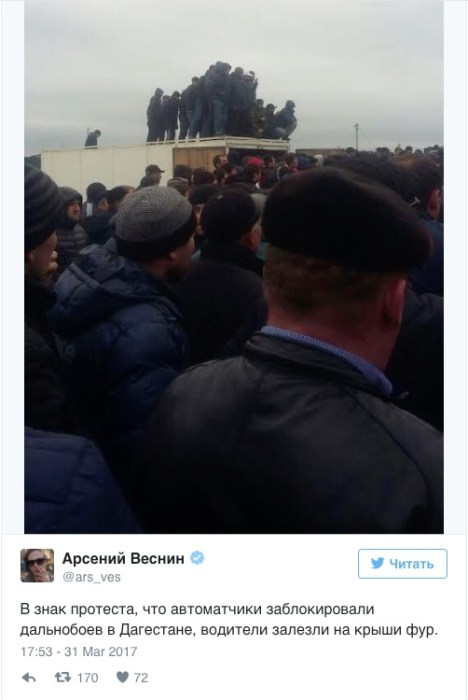
“To protest the fact that submachine gunners have blockaded them in Dagestan, the truckers have climbed onto the roofs of their semis.” Twitter post by Echo of Moscow correspondent Arseny Vesnin, posoted at 5:53 p.m. on March 31, 2017. Image courtesy of Meduza
National Guard and Riot Cops Face Protesting Truckers in Dagestan
Andrei Dubrovsky and Yulia Reprintseva Novaya Gazeta
March 31, 2017
Russian National Guardsmen and riot police (OMON) have surrounded truckers protesting the Plato freight haulage road tolls system in the city of Manas in Dagestan, according to Mikhail Kurbatov, a member of the Association of Russian Carriers (OPR).
Anatoly Shilov, coordinator of the OPR’s St. Petersburg branch, said the troops had surrounded the truck drivers on the morning of March 31, and they have been kettled for several hours. No one has been allowed in or out.
According to an eyewitness, around 600 truck drivers are involved in the protest. Their trucks are stretched along the roadside of the Makhachkala-Baku Highway in Manas.
“About 200 law enforcement officers and riot police arrived on the scene. The troops deployed their vehicles along a one-kilometer stretch of the highway, completely surrounding us. They have blocked our way out, and we have been stuck here for about four hours. The riot are wearing masks with shields, but they have been behaving calmly. There have been no provocations against the truckers,” said the activist.
He added that one of the policemen had suggested to the truckers to peacefully settle the situation.
“We have been promised that lawmakers would come here tomorrow, and that we would talk with them. We will definitely be here until tomorrow,” he said.
Our source also emphasized the fact the trucker drivers had parked strictly on the roadside and were not interfering with traffic on the highway.
Earlier, the OPR announced a nationwide protest by truckers would take place on March 27. Protests were scheduled for at least nine Russian cities, according to the OPR’s website.
Organizers did not cancel the protest despite the fact that on March 24 Prime Minister Dmitry Medvedev signed a decree raising rates under the Plato system only by 25%, whereas earlier the rate was to have been doubled. Thus, as of April 15, the toll for trucks will be 1.91 rubles a kilometer, not 3.06 rubles a kilometer, as had been planned previously.
Translated by the Russian Reader. Thanks to Comrade Alexei for the heads-up. See my previous post in this series on the ongoing struggle of independent Russian truckers to abolish the draconian Plato tolls system.
Literary scholar Dmitry Kalugin picketing the entrance to the Russian National Library (“Publichka”), February 9, 2017, Petersburg. Photo courtesy of Serafim Romanova/Novaya Gazeta
“Have you heard they want to merge the Russian National Library with the Lenin Library in Moscow?” Boris Kolonitsky, a senior researcher at the St. Petersburg Institute of History (Russian Academy of Sciences) asked passerby.
On February 9, a “professors’ picket” took place outside the Russian National Library’s main building on Ostrovsky Square. Lecturers from the European University, the Higher School of Economics, and other institutions rallied to preserve the so-called Publichka and defend its former head bibliographer Tatyana Shumilova [who was summarily dismissed from her post last week for speaking publicly about the negative consequences of the merger.]
Most bystanders heard about these developments for the first time. But after a short briefing, passersby agreed it would be wrong to merge one of the country’s most important academic and cultural institutions.
“It is not so much the library, St. Isaac’s or anything else that causes people to protest, as it is the fact that no one reckons with them,” Viktor Voronkov, director of the Centre for Independent Social Reseach, explained to Novaya Gazeta. “Why is everything being centralized? To make it was easier to control. The entire country is being formed up into a [power] vertical, and it is the same way in every field.”
“It matters that people from the outside, people who don’t work at the library but understand its value, speak out,” said journalist Daniil Kotsiubinsky, who organized the rally.
“The people who came here today are not random, but one of a kind. Petersburgers should listen to them.”
As the rally was drawing to a close, the overall enthusiasm was disturbed by a police officer.
“We’ve got a solo picket here,” the guardian of order reported on his cell phone, asking the picketers to show him their papers.
“It’s an A4-sized placard,” the policeman reported. “What does it say? ‘A great city deserves a great library.'”
Historian Boris Kolonitsky shows the group’s placard to a policeman. February 9, 2017, Petersburg. Photo courtesy of Serafim Romanov/Novaya Gazeta
Protesting Truckers Make Political Demands On Anniversary of Anti-Plato Protests, Police Were Lying in Wait for Activists at Famous Parking Lot in Khimki and Quickly Detained Them; Ambulance Summoned to Courtroom
Dmitry Rebrov Novaya Gazeta
November 12, 2016
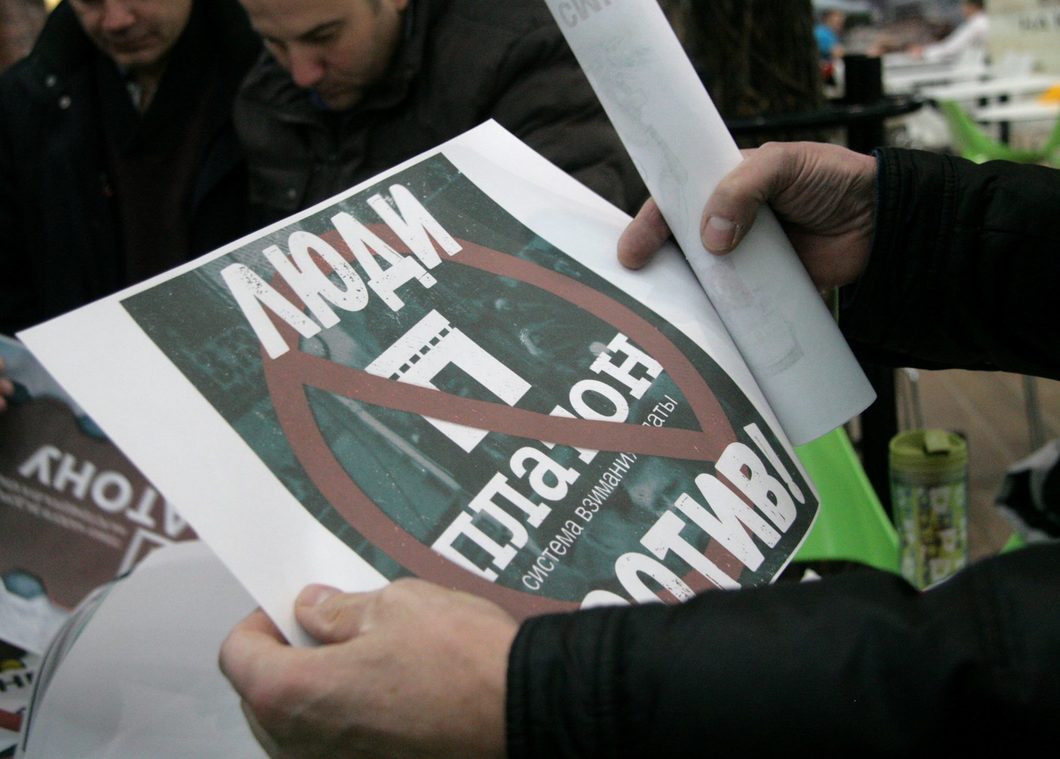
The problems with the “anniversary”—it was exactly a year ago, on November 11, 2015, that Russian truckers kicked off their protest against the newly introduced Plato road tolls system—started long before the D-Day designated by the Association of Russian Carriers (OPR). On November 9, it transpired that the Khimki mayor’s office would not permit them to gather at their old spot under the MEGA sign, the place where trucks had stood parked for nearly six months.
The truckers responded by decided to replace the rally with a series of solo pickets, but problems arose in this case as well. First, the truckers, who had been going to the parking lot and checking it out over the course of the year, were not admitted to the site of their former camp. Arriving twenty-four hours before the start of the pickets, Mikhail Kurbatov, one of the movement’s leaders, discovered signs saying, “Truck traffic prohibited,” and a police squad who forcibly removed him from the parking lot. A video showing the police twisting his arms has already been posted on the web. And on the morning of the eleventh, it was discovered that maintenance services had managed to pile the spot itself with snow, given that the weather was forthcoming.
However, a genuinely cold reception lay in store for the activists.
“People versus Plato!” Photo courtesy of Dmitry Rebrov/Novaya Gazeta
“There will be protest rallies today in twenty-two regions, so there aren’t so many people here. All the activists have gone to their home regions to rock the boat. But Muscovites have bitten the bullet and installed Plato, because it costs to protest, and we are not a united group,” said activist Igor Melnikov, standing next to a blue truck emblazoned with the OPR logo.
He was trying to explain why no more than a dozen people had assembled for the rally.
Melnikov is a Muscovite himself, just like the five regular volunteers who have been helping the Khimki protesters since last winter.
“Not everyone would choose to travel to Khimki in this weather,” Melnikov continued. “That is partly why, in place of the banned rally, it was decided to hold a big rally on Suvorov Square in Moscow on November 12, and restrict ourselves to a small detachment here in Khimki.”
The rally in Moscow has been supported by the Communists.
“What of it? I know who the Communists are, that they destroyed my country. I grew up under them. But that is okay. They can hold the microphone. We’ll live through it!” Yekaterina Bolotova, a perky brunette, put in her five kopecks.
Bolotova, a private entrepreneur, lives in Lyubertsy. She has been in business since the 1990s.
While we were chatting, a grader kept shoveling dirty snow towards the MEGA sign as freezing rain fell.
“There is already more than three of you. What are you doing here?”
A delegation from the Moscow Regional Criminal Investigative Department had arrived to test the waters. Two gloomy figures, both dressed in black, approached us, obviously reluctantly. The larger of the two men showed us his ID: “Oleg Nikolayevich Kuznetsov.” The second man did not show us his badge, but explained the reason for the visit.
“The bosses sent us.”
“Speaking frankly, we’re expecting certain people,” the cops said in a roundabout way. “The people who are going to protest Plato.”
“We are those people. What else do you want?” the truckers unceremoniously informed them.
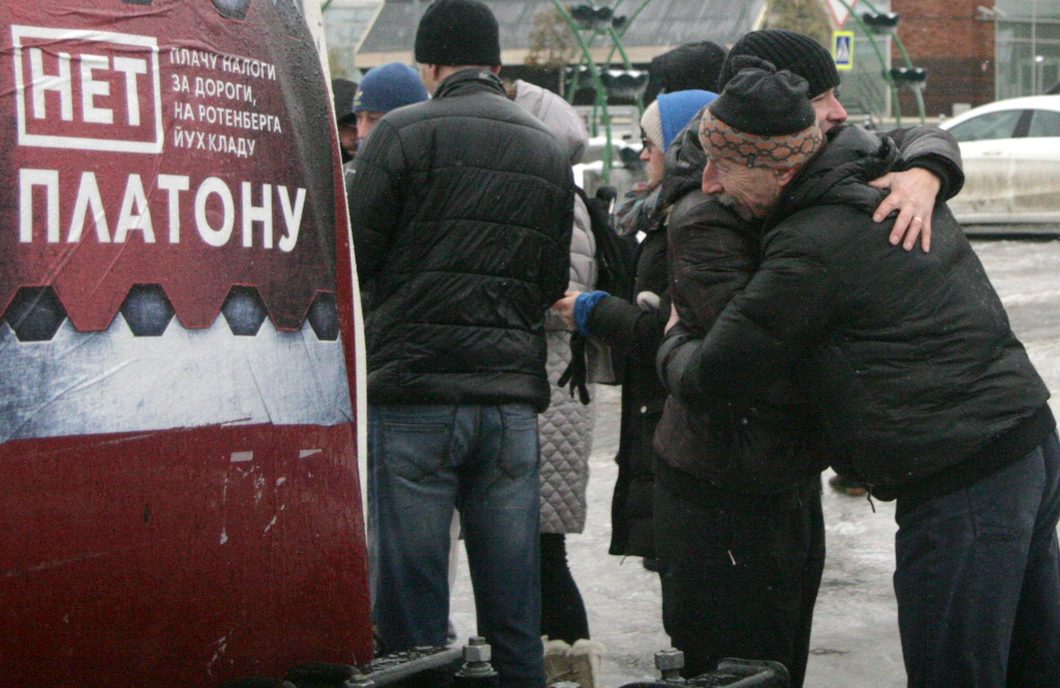
“No to Plato. I pay taxes for roads. I could give a flying fuck about Rotenberg.” Photo courtesy of Dmitry Rebrov/Novaya Gazeta
The police then withdrew, asking us not to photograph their faces.
“I’m a secret agent. My face cannot be published!” said “Oleg Nikolayevich Kuznetsov” self-importantly.
“Well, if you’re so secret, why don’t you stay at home, since we can’t look at you?” a trucker retorted.
Meanwhile, a paddy wagon and reinforcements were pulling up at the impromptu checkpoint behind them.
“We now have political demands. In addition to abolishing the Plato system, we want transport minister Maxim Sokolov to resign, Prime Minister Medvedev to resign, and the repeal of Article 20.2 of the Russian Federal Administrative Offenses Code, which covers violations at political rallies, because it is insanity. People are no longer able to voice their opinions,” said Kurbatov.
According to the OPR’s official website, the truckers propose leaving only the fuel excise tax intact and scrapping the transport tax. They support judicial reform, including the recertification of all judges. And they want “all embezzlers to face criminal charges.”
Some of these demands are a natural response to the endless jail terms and arrests the once apolitical truckers have faced. Other demands have emerged in the aftermath of discussions with political activists who regularly visited the protest camp last winter.
Looking for the “Core” Activists
“Are they making arrests?”
“He raised flags on his trucks!”
We dashed through the snowdrifts to the other end of the parking lot, where a dozen cops were packing Sergei Einbinder, an activist with the Interregional Trade Union of Professional Drivers, into a car.
Led by Alexander Kotov, the Khimki protesters had managed to come to an agreement with police spokespeople about joint actions for the first time in a long time. Kotov had once led the resistance, but quickly surrendered, as the Khimki protesters explained, causing general annoyance among the striking truckers. Instead of blocking the Moscow Ring Road and driving a convoy into downtown Moscow, under Kotov’s leadership the protest had bogged down in attempts to slow down the “radicals” and in endless negotiations with federal MPs. Now, apparently, the irritation with Kotov had passed.
“The security forces had pressured Kotov back then,” explained Bolotova, a Kotov supporter.
She had come to Khimki to establish contacts, but unlike Eibinder, she had immediately gone over to her colleagues.
Bolotova had also been dragged in for interrogations by the Lyubertsy police and Center “E.”
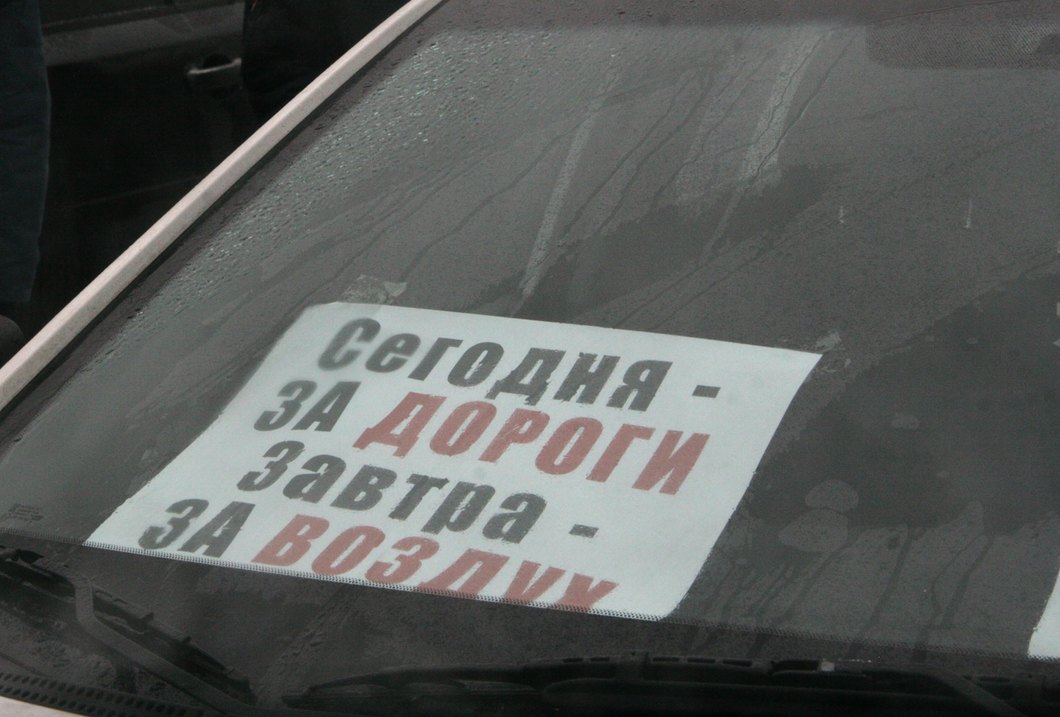
“Today [they’re making us pay] for the roads. Tomorrow, it will be for the air.” Photo courtesy of Dmitry Rebrov/Novaya Gazeta
Similar coercion had led to a break with the group of activists who had fought the Rotenbergs most fiercely, the Dagestanis. None of their members was present at Friday’s rally.
“At the moment, we have lost contact with Dagestan,” admitted Kurbatov. “All our work there was tied to Rustam Mallamagomedov, but after he was beaten up while we were waiting for the [Krasnodar] farmers in a camp near Rostov and then sentenced to administrative arrest in absentia, he was basically forced to give up the cause and go to ground. Currently, we are not even in contact with him.”
Kurbatov added that security forces coerced and terrorized the Dagestani truckers the most harshly.
“Are You Freezing?”
When, an hour later, the truckers emerged from the MEGA mall, where they had gone to get out harm’s way and discuss strategy, to take up their solo pickets, the police amassed in the parking lot reacted almost instantly.
The first to be sent to the precinct were Yekaterina Bolotova and Igor Melnikov. By midday, the security forces had managed to cram all the truckers, all their volunteer helpers from Khimki, and even the journalists, including a crew from TV Rain, into the paddy wagon.
“What we predicted last year has happened. As soon as [parliamentary] elections had taken place, the moratorium on raising rates was lifted. In fact, the government did not even keep its own promise of freezing prices until July 2017. So we decided there was no time to lose, and we have hit the streets, although we were not very well prepared,” said Kurbatov.
By six in the evening on Friday, all the detainees had been delivered to Police Precinct No. 1 in Khimki. But it proved difficult to find out what the truckers had been charged with.
In the morning, the truckers’ attorneys informed us that Sergei Einbinder, who had been detained first, had cut his hands and face to protest the police’s actions.
“After twenty hours at the precinct, they hadn’t even allowed me to see a lawyer or explain what I was being charged with, so I decided to take extreme measures,” Einbinder told Novaya Gazeta by phone.
Earlier, Einbinder had tried to leave the police station on his own after surrendering his internal passport, but police responded by detaining two lawyers that had been provided for him by the Anti-Corruption Foundation (FBK). The two lawyers, Vitaly Serukanov and Artyom Khemelevsky, have already been released. The journalists taken down to the precinct with the truckers were released the same day. No arrest reports were filed against them nor were they subjected to additional questioning.
By Saturday, it had transpired the truckers involved in the protest had been charged with disobeying the police (Article 19.3 of the Administrative Offenses Code) rather than for violating the rules of public rallies (Article 20.2).
Elena Filippova, press secretary for the truckers, who was detained along with them, related what conditions have been like for the activists at the police station. According to her, the female activists who have been helping the truckers and the truckers themselves slept in separate cells.
“In the women’s cells, the three of us were given one dry mattress, which we could sleep on, and two wet mattresses. We have now just thrown out the wet mattresses. Apparently, they had long been waiting their turn, and such an occasion had presented itself. Girls had shown up at the station: why not torment them a bit? In the morning, one of the cops gleefully asked, ‘Are you freezing?’ We have been allowed to use the toilet only twice in twenty hours, and we had to demand to be given food, which was brought only six hours later.”
Court hearings commenced only at two in the afternoon, and they looked likely to run until Saturday evening.
After numerous requests, Sergei Einbinder was transported from the courthouse by an ambulance crew.
Currently, truckers Mikhail Kurbatov, Vladimir Sinitsyn, Dmitry Lazar, and Igor Melnikov, their assistants Ivan Gushchin and OPR press secretary Elena Filippova, and activist Olga Reznikova, who also was involved in Friday’s protest, are still in police custody.
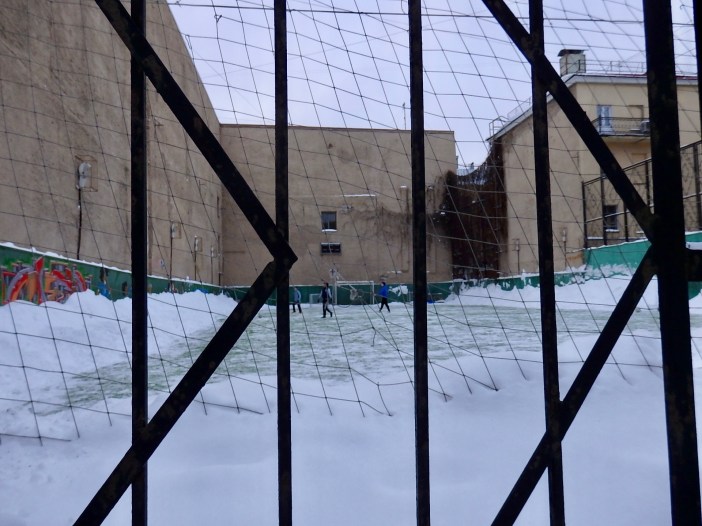
Petersburg teens playing football on a snowy day, November 11, 2016. Photo by the Russian Reader
Investigative Committee Asks Health Ministry to Report on Minors Who Lose Their Virginity Novaya Gazeta
November 11, 2016
The Investigative Committee has proposed that the Health Ministry inform law enforcement agencies when they come across cases of minors who have lost their virginity before the age of sixteen, reports Lenta.ru, quoting Yevgenia Minayeva, head of the special investigations procedural control directorate.
Law enforcement officers are thus hoping to prevent sexual offenses. Ms. Minyaeva insisted communication of this information “protects the rights and legitimate interests of minors.” According to her, it would be wrong to consider this cooperation a violation of doctor-patient confidentiality, because “the confidentiality of the preliminary investigation is protected by law to no lesser extent.”
Minayeva explained that it is a criminal offense in Russia to have “sexual intercourse and other sexual acts with a person under the age of sixteen.” However, such crimes are usually concealed by those involved in the intercourse “by virtue of natural shyness or at the instigation of relative and friends.”
“At the same time, teenaged victims of such crimes acquire victimized behavioral patterns and in the future become victims of more serious crimes or eventually become perpetrators of sexual crimes themselves,” said Minayev.
Sexologist Alexander Poleyev called the proposal “incredibly strange.”
“Science has long known that sex steers teenagers with high hormonal levels away from crime, delinquency, vandalism, and aggression,” he said.
Poleyev also noted that doctors can disclose information about their patients only by court order. If doctors disclose this information on an extrajudicial basis, “there will be terrible distrust of physicians,” argued Poleyev.
The Health Ministry will consider the Investigative Committee’s proposal “in the prescribed manner, involving a large number of experts on the given topic,” Govorit Moskva radio station was told by the Health Ministry’s press service.
Translated by the Russian Reader. Thanks to Dmitri Dinze for the heads-up. See my previous posts in this occasional series on young people in Russia today and the moral panics generated around them by media, politicians, and the public.
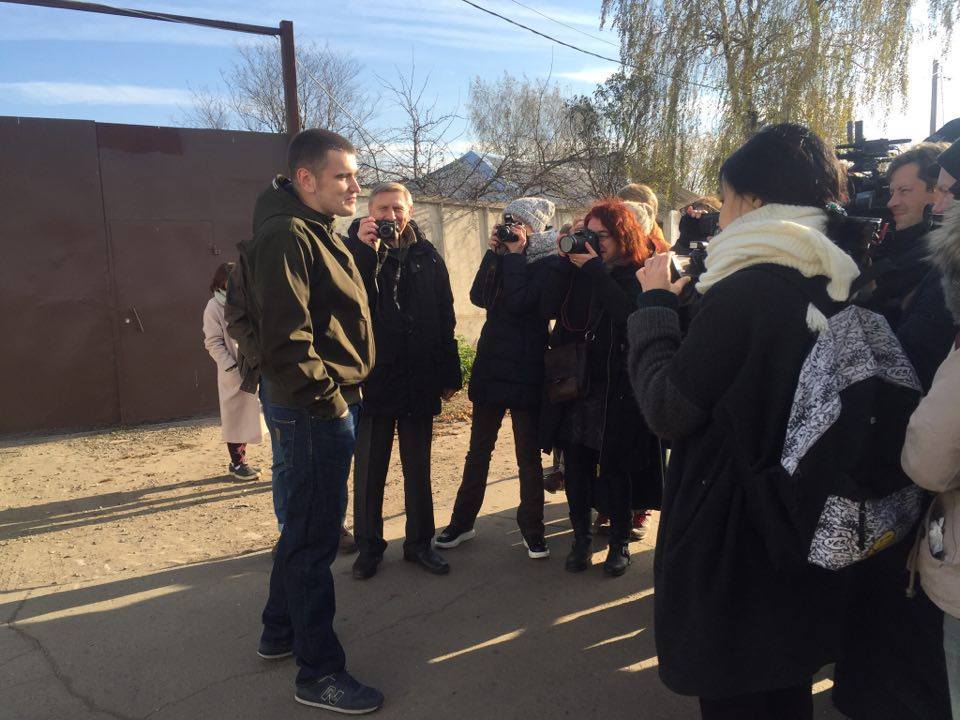
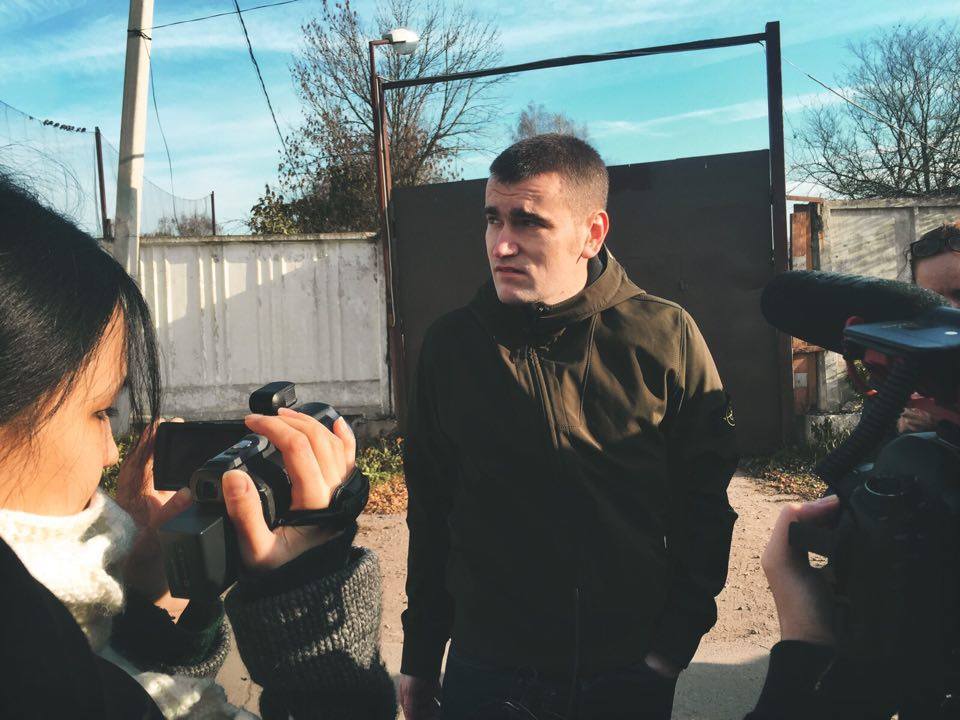
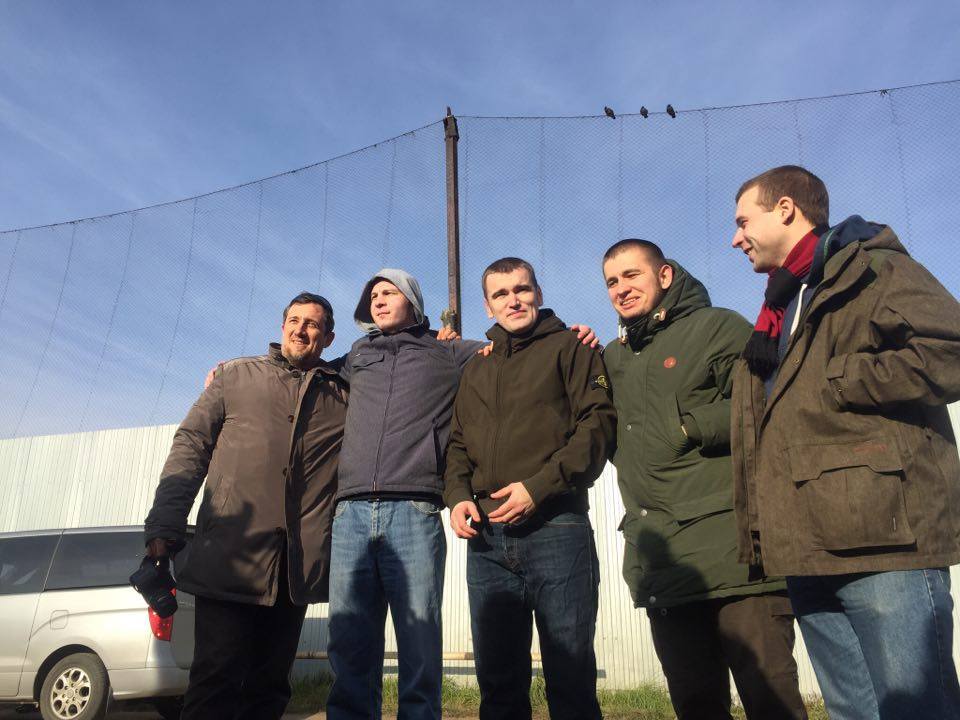
Alexei Gaskarov and his wife Anna Gaskarova, October 27, 2016. Photo by Anatrrra
Bolotnaya Square Defendant Alexei Gaskarov Released from Prison
Ekaterina Fomina Novaya Gazeta
October 27, 2016
Alexei Gaskarov was released from Penal Colony No. 6 in Novomoskovsk today. He had served his entire sentence: three and a half years in a medium-security penal colony. Gaskarov was twice denied parole.
“I don’t think it was possible to change anything under these circumstances. I said at the trial that if our way runs through prison, we have to go. Personally, everyone who went to prison lost a lot. But if you compare that with the public interest, someone had to go through it, someone had to have this piece of ‘good’ luck,” Gaskarov said after his release.
Alexei Gaskarov (left). Photo courtesy Ekaterina Fomina/Novaya Gazeta
“The risks are clear, but I don’t think there is an alternative. I don’t think that the path, the values that were professed on Bolotnaya Square can be put on the back burner. Yes, these are complicated times, and we have to wait them out somewhere, but I don’t think you can impact this vector by intimidating people. When I was in prison I read about a hundred history books. Everyone had to go through this. We are just at this stage,” he added.
Alexei Gaskarov. Photo courtesy Ekaterina Fomina/Novaya Gazeta
“The point of my attitude is this: don’t be afraid, guys. Our little undertakings will merge into a river that will lead us to the right path. Prison is not the end of life,” Gaskarov concluded.
Prisoners of Bolotnaya: Alexander Margolin, Vladimir Akimenkov, Alexei Gaskarov, Alexei Polikhovich, and Ilya Gushchin. Photo courtesy of Ekaterina Fomina/Novaya Gazeta
Gaskarov was accused of involvement in “rioting” and being violent towards police officers. However, Gaskarov claimed he had himself been assaulted on Bolotnaya Square. During the mass arrests, an unidentified policeman pushed him to the ground, beat him with his truncheon, and kicked him.
In October, citing a judgment by the European Court of Human Rights, the Russian Supreme Court ruled that the arrest and imprisonment of Bolotnaya Square defendants Ilya Gushchin and Artyom Savyolov had been illegal. Earlier, in June, after a complaint had been filed with the European Court of Human Rights, the Supreme Court declared the arrest of Leonid Kovyazin, a defendant in the same case, illegal.
Anarchist Dmitry Buchenkov awaits trial in a pre-trial detention facility. According to police investigators, he was violient toward lawful authorities and “tried to destroy a portapotty.” Buchenkov himself claims he was not in Moscow during the so-called March of the Millions.
Maxim Panfilov is also awaiting trial. He was charged four years after the opposition rally on Bolotnaya Square in Moscow—in April 2016. He is the thirty-sixth defendant in the Bolotnaya Square case. In October, Panfilov was declared mentally incompetent.
Amendment from “Yarovaya Package” Applied for First Time in Tyumen FSB Asks Reporters to Help Prove Blogger Kungurov’s Guilt
Georgy Borodyansky Novaya Gazeta
October 13, 2016
The FSB’s Tyumen Regional Office has asked a number of Urals region media to help it find evidence against blogger Alexei Kungurov, in particular, “to provide the investigation with articles of his that contain public insults to the authorities and other information worthy of the attention of law enforcement and regulatory authorities.”
The request could also be considered a demand. As Anton Yulayev, a reporter for Znak.com and one of the people who received the letter from the FSB, told Novaya Gazeta, the letter contains a reference to the legal norm obliging recipients to respond to it.
“Our lawyers are now trying to solve this dilemma: how to respond without harming Alexei, and in such a way that the FSB has no beef with us,” explained Yulayev.
The appeal made by the FSB’s Tyumen Region Office is a new legal norm [sic] introduced by the so-called Yarovaya package. Alexei Zyryanov, Kungurov’s attorney, explained the implications to Novaya Gazeta.
“Previously, you could ignore a letter like this, but now you can’t. Basically, the law has introduced criminal liability for the failure to inform,” said Zyryanov.
The liability is spelled out in Russian Federal Criminal Code Article 206.6, which entered into force on July 20, 2016. It says that “non-reporting of terrorist crimes” is punishable by a fine of 100,000 rubles or by up to one year in prison. If individuals know something about another individual who is planning to commit such a crime or has committed such a crime, but do not report their information to law enforcement agencies, they can be found guilty.
Blogger Alexei Kungurov has been held for five months in pre-trial detention facility on charges of “public justification of terrorism.” Investigators found evidence of such a crime in a post the blogger published on his LiveJournal page in October of last years. Entitled “Who Putin’s falcons are really bombing,” the post is still in the public domain.
On October 11, 2016, Tyumen’s Central District Court extended Kungurov’s arrest another two months, until December 15. Investigators motivated their request for the extension on the grounds that they had not managed “to carry all necessary [investigative] actions” over the previous four months. According to Zyryanov, they had not carried out any actions at all. They had been waiting the whole time for the outcome of the linguistic forensic investigation.
Why has the linguistic forensic investigation taken so long? Zyryanov surmises that the forensic experts were faced with a tough job: proving that Kungurov’s argument that Islamic State (an organization banned in Russia) “is hardly the most terrible and crazy [organization]” somehow justifies terrorism.
On October 13, the lead investigator informed the lawyer that the findings from the forensic examination had finally arrived.
“I haven’t examined them in detail yet,” said Zyryanov, “but the conclusion is predictable: there is evidence of a crime in Alexei’s article.”
It would have been difficult to hope for another outcome, because the forensic examination was performed by a bureau of the very same agency that has charged the blogger, the FSB’s Sverdlovsk Regional Office, rather than its Tyumen Regional Office.
The results of another forensic examination are still pending. It will determine the originality of Kungurov’s article that, allegedly, “justifies terrorism,” whether it was written wholly by Kungurov, or whether he borrowed it, wholly or partly, from someone else. Then the case will be sent to trial, apparently.
Why do the secret services need the media’s help? According to Zyryanov, investigators do not have conclusive proof of Kungurov’s guilt, and they are attempting the shore up their case. But it is also possible the FSB has decided to test the new law out on the journalistic community by forcing independent periodicals, which can be counted on one hand in the Urals (the others simply could not afford to publish Kungurov’s articles), into giving “testimony.”
Translated by the Russian Reader. Thanks to Alexander Verkhovsky for the heads-up
Kuban Farmer Shoots Himself over Illegal Seizure of Land
Gella Litvintseva Proved.rf
October 1, 2016
A farmer in Krasnodar Territory has committed suicide because he was unable to get back a thousand hectares of land that had been illegally seized from him, according to Alexei Volchenko, organizer of the August 2016 tractor convoy and a farmer from the Kalininskaya Distrist.
“Nikolai Gorban, a farmer in the Timashyovsk District, shot himself. It happened three days ago. A thousand hectares of land were confiscated from him by court order. The man wrote a suicide note in which he named the people he blamed for his death. Prior to this, gangsters came to his place, threatening him and promising to do away with his family. His loved ones are now preparing for the funeral,” says Volchenko, head of the Kalininskaya District Peasant Farm Enterprise.
According to Volchenko, the victim received the land plot after buying the shares from the land’s owners. After the court ruled the land confiscated, he tried to get it back, but failed.
“The farmer had his own land. He had bought it from other shareholders, like himself, and had it marked off and registered. But later the meeting of shareholders [at which they had decided to sell the land to Gorban — TRR] was declared null and void by the courts, and the land was returned to the collective farm, which Oleg Makarevich has been trying to get his hands on. The farmer went to see Natalya Kostenko, of the Russian People’s Front [a pro-Putin astroturfed “civil society” organization — TRR], to ask for help. He went personally to see her twice, and he called her. He went to see Andrei Korobka, deputy governor of Krasnodar Territory, and asked him for help. He met with me. He said, ‘I’ve lost everything. I’m going to put a bullet in my head.’ I told him not to do anything, that all was not lost, that in the end it wasn’t worth his life. I told him we would tough it out, we would beat them come what may. But he said, ‘I don’t want to live.’ I tried to dissuade him, but now we’ve found out it’s all over,” recounts Volchenko.
On September 23, convoy participants were in Moscow. Scheduled meetings with the president and the agriculture minister did not take place. They only managed to have a small get-together with Kuban officials. At the beginning of the week, Volchenko announced the farmers would be meeting with a presidential envoy in Yeysk on September 28, but ultimately this meeting did not take place, either.
“We got ready and went to Yeysk. I went into the hotel where the event was going to take place. They looked at me like I was an idiot. ‘Young man, are you smoking something or popping pills? What presidential envoy? What journalists? We have nothing scheduled.’ I went outside and saw cars with tinted windows, FSB officers walking around, and Vyacheslav Legkodukh (the Krasnodar governor’s envoy for farmer relations) sitting in a cafe and eating. I got the picture. I went to the farmers and said, ‘This is a setup. Let’s leave for home on the sly.’ They wanted us to gather outside the hotel so they could arrest us again for holding an unauthorized assembly,” recounts Volchenko.
Earlier, the protesting farmers met with Alexander Chernov, chair of the Krasnodar Territorial Court, who promised he would review all the cases the farmers requested. For now, he is their only hope.
“All the judges say Chernov is a very decent man, and keeps his word. Currently, farmers have won some of the cases that were before the courts. There are positive results, but it’s not clear whether this will be enough, because right now several farmers are under tremendous pressure, Nikolai Maslov, for example. Certain media outlets have been writing that he is a raider, that he has been trying to grab land from Shestopalov and his honest Dmitriyevskoye Agricultural Enterprise. But people just want to mark off and purchase their own land, 200 bloody hectares. Tremendous pressure has been exerted through the press. Andrei Koshik, a Kuban journalist, went to Novaya Gazeta newspaper in Moscow and tried to get the journalists to publish this garbage. They refused and wrote about it on Facebook,” says Volchenko.
The problems of Kuban’s farmers became widely known in the spring, when they decided to travel to Moscow by tractor to tell the president about illegal land seizures in Krasnodar Territory and about corruption in the local courts and district councils. To capture the president’s attention, over the course of seven months the farmers released doves with messages for him, held several rallies in a field, set off for Moscow in tractors, and wrote to the president’s public relations office. Their tractor convoy in August ended on day two in Rostov-on-Don, when the farmers were jailed and fined. Subsequently, convoy participants have been subjected to continual pressure from local authorities and law enforcement agencies.
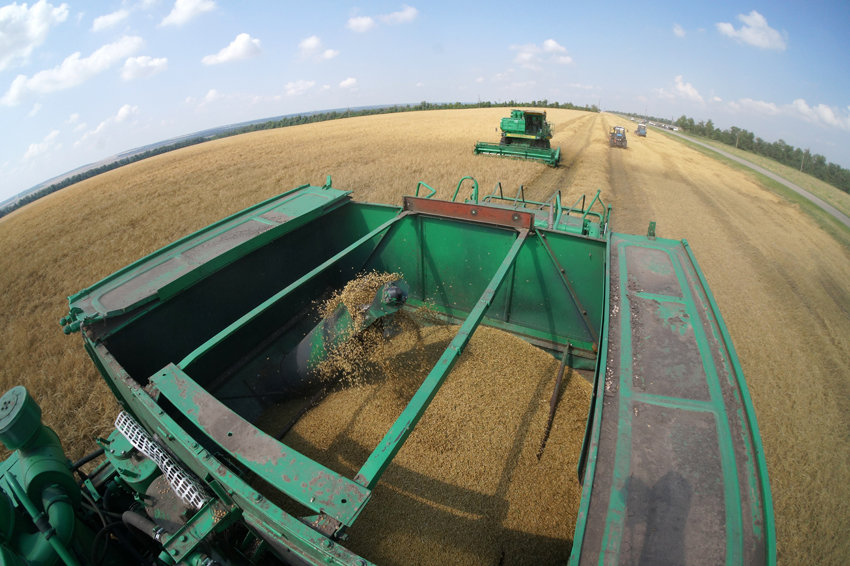
Translated by the Russian Reader. Thanks to Comrade Anatrrra for the heads-up. Photo courtesy of Viktor Pogontsev and Rossiyskaya Gazeta, where the caption to the photo reads, tellingly, “Record grain harvests in the Kuban region in recent years have bothered certain local farmers. They have been demanding a new redivision of the land.” Rossiyskaya Gazeta is the Russian government’s daily newspaper of record.