Ukraine: Resistance and Solidarity

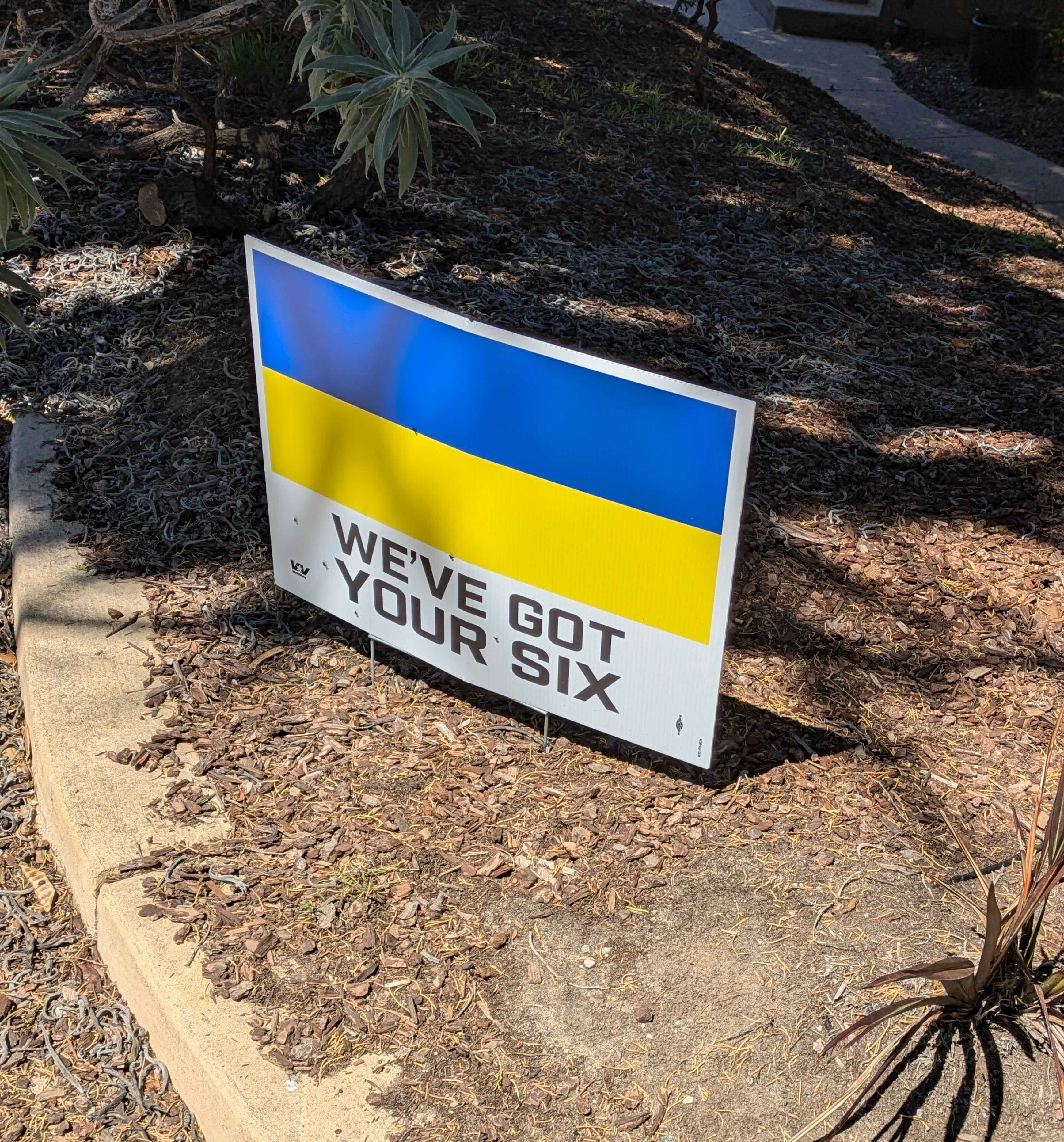
Polk Street, Monterey, California, 20 March 2026. Photo by the Russian Reader

In this week’s bulletin: 

Ukraine union leader interviewed/ Dnipro minersUN defines Russian crimes against humanity/ Militarism and defence of Ukraine/ Sanctions-busters identified/ Russian journalists & propagandists/ Civilians tortured to death/  

News from the territories occupied by Russia:  

29 civilians abducted from Kherson oblast were tortured to death or died from lack of treatment in Russian captivity (Kharkiv Human Rights Protection Group, March 13th)

Russia sentences Crimean to 15 years for sharing information available on Google Maps (Kharkiv Human Rights Protection Group, March 13th)

The Face of Resistance: Crimean Tatar Activist Eskender Suleimanov (Crimea PlatformMarch 13th)

I repeated it like a prayer: ‘Donbas is Ukraine! ’ (Kharkiv Human Rights Protection Group, March 12th)

Russia’s deportation and enforced disappearances of Ukrainian children are crimes against humanity – UN Commission (Kharkiv Human Rights Protection Group, March 12th).  

Ukrainian political prisoner faces new ‘trial’ and life sentence for opposing Russia’s occupation of Crimea (Kharkiv Human Rights Protection Group, March 11th)

Weekly Update on the Situation in Occupied Crimea (Crimea PlatformMarch 10th)

Occupiers are blackmailing the families of prisoners of war by demanding they register Starlink terminals in their names (Kharkiv Human Rights Protection Group, March 10th)

10-year sentence for love of Ukraine against 71-year-old pensioner under Russian occupation (Kharkiv Human Rights Protection Group, March 10th)

Crimean Tatar political prisoner with a malignant brain tumour forced to sign a fake ‘clean bill of health’  (Kharkiv Human Rights Protection Group, March 9th)

Russia sentences 69-year-old Ukrainian pensioner to 11 years for sending money to Ukraine (Kharkiv Human Rights Protection Group, March 9th)

Ukrainian PoW fined for “discrediting” Russian army during 18-year sentence (Mediazona, 3 March)

News from Ukraine:

Train as a Witness  (Tribunal for Putin, March 13th)

Russian Forces Attack Trade Union Office and Bus Carrying Miners in Dnipropetrovsk Region (Confederation of Free Trade Unions of Ukraine, March 11th)

3,000 women march in wartime Kyiv demanding rights the state is rewriting (Euromaidan, March 9th)

“Change is inevitable” and Free Iryna Danylovych: the ZMINA team joined the Women’s March to become the voice of women prisoners held by the Kremlin (Zmina, March 8th)

‘We work to gather coal’: Ukraine’s mines are war’s second frontline (Sianushka writes, March 7th)

Dispatch from Ukraine (Krytyka, March 2026)

‘The part of our work – and truly of my life – which is connected with war is never ending’ (Unison magazine, February 26th)

Saving Putin from justice. Who in Europe is stalling the trial and who is helping Ukraine (European Pravda, February 26th)

War-related news from Russia:

The War on Poverty (Russian Reader, March 14th)

“Join the elite drone forces, and you’ll come home famous!”: Russian universities are luring students into paid military service (The Insider, March 13th)

Lost in translation: How Russia’s new elite hit squad was compromised by an idiotic lapse in tradecraft (The Insider, March 13th)

Polina Yevtushenko: 14 years behind bars for nothing (The Russian Reader, 12 March)

The Insider identifies 6,000 exporters trading with sanctioned Russian firms or defense industry suppliers, 4,000 of them based in China (The Insider, March 11th)

Pro-war bloggers welcome arrest of Sergey Shoigu’s top deputy as Russia’s Defense Ministry purge continues (Meduza, March 9th)

A phantom refinery: How Georgia helps Putin bypass oil sanctions (The Insider, March 9th)

Our Dear Friends in Moscow: from journalists to propagandists (Posle.Media, 4 March)

Analysis and comment:

Sultana Is Right About Zelensky. Now What? (Red Mole, March 13th)

Trump’s US temporarily lifts sanctions on Russian oil (Meduza, 13 March)

European socialism, imperial militarism and defence of Ukraine (People and Nature, March 12th)

Russia’s war: stop trying to delegitimise resistance (People and Nature, March 12th)

The US-Russia-Ukraine negotiations: Architecture of tactical theatre and strategic deception (New Eastern Europe, March 9th)

Interview with Andriy Movchan: “If the Occupation of Ukraine Is an Acceptable Price, What Else Is Acceptable? (Europe Solidaire, March 8th)

Presentation of the Research “Words that Kill: How Russian Propaganda Shapes Mobilization and Combat Motivation” (Lingva Lexa, February 27th)

Putin’s Four Antifascist Myths (Rosa Luxemburg Stiftung, May 2025)

Research of human rights abuses:

UN concludes that forcible transfer of children and enforced disappearances are crimes against humanity (UN Commissioner for Human Rights, 12 March)

International Criminal Justice: Beautiful Myth or Imperfect Reality? (Tribunal for Putin, March 10th)

International solidarity:

“That’s How We Founded the Ukraine Solidarity Campaign”: An Interview with Chris Ford (Commons.com, March 12th)

Art Exhibition on Crimea Opens in Warsaw (Crimea PlatformMarch 11th)

Upcoming events:

Saturday 28 March: Together March in London – Eastern European bloc against the far right, meeting 12:00 midday at Deanery Street, off Park Lane.

Wednesday 15 April, 6.0-7:30 pm. Try Me for Treason: Voices Against Putin’s War – Part of the Think Human Festival 2026  Actors will perform extracts from speeches made from the dock by Russian oppositionists who have been tried for sabotage for actions taken against the Russo-Ukrainian war  Clerici Building, Clerici Learning Studio, Oxford Brookes University, Headington Campus, Oxford.


This bulletin is put together by labour movement activists in solidarity with Ukrainian resistance. To receive it by email each Monday, email us at 2022ukrainesolidarity@gmail.com. More information at https://ukraine-solidarity.org/. We are also on TwitterBlueskyFacebook and Substack, and the bulletin is stored online here.

Source: News from Ukraine Bulletin 187, Ukraine Information Group, 16 March 2026


The second of two linked articles. The first is here: European socialism, imperial militarism and the defence of Ukraine

In the labour movement and civil society organisations in the UK, support for Ukrainian resistance to Russian imperialism is countered by those who argued that Ukraine is only a proxy of western powers.

The underlying idea, that the only “real” imperialism is western – and that resistance to Russian or Chinese imperialism, or their puppets in e.g. Syria or Iran, is therefore illegitimate – has its roots in twentieth-century Stalinism. But it retains its hold, in part, because the western empire’s crimes are so horrific. It is Gaza, and climate change, that angers young people in the UK above all.

This “campism” (division of the world into a US-centred “camp” and other, not-so-bad camps) transmits itself, in part, through activists who seek simple principles on which to build social movements.

It has reared its ugly head again during the US-Israeli war on Iran this month, treating the theocratic, authoritarian regime as the victim rather than the Iranian people caught between that regime and the murderous US-Israeli onslaught.

This article is a plea to avoid such simplicity. It has grown out of an email, written last year to one such activist, who told me I was wrong to support the provision of arms to Ukrainians resisting Russian aggression. I asked him these five questions, and I still hope he will reply.

1. What is the character of Russian imperialism, and what is its relationship to Ukraine?

We often hear, or read, on the “left” that the war in Ukraine is an “inter-imperialist war”. I don’t agree. There’s certainly an inter-imperialist conflict that forms the context, but the actual war is between Russia (an essentially imperialist country) and Ukraine (clearly not an imperialist country). I’ll come back to the character of the war below (question 2). But I think we agree that Russia is essentially imperialist. What sort of imperialism?

For all socialists in the 19th and early 20th centuries, Russia was the most fearsome empire and Ukraine was its oldest, and largest, colony. Throughout the Soviet period, as far as I know, none of the versions of socialism or communism, however exotic, argued that Ukraine and the other 13 non-Russian republics had somehow disappeared or lost their right to self-determination.

As far as extreme Stalinists were concerned, that right was guaranteed by the Soviet constitution and all was fine. There were plenty of arguments about the extent to which the speaking of Ukrainian in Ukraine, Kazakh in Kazakhstan, Azeri in Azerbaijan etc should be implemented. But as far as I’m aware, not even when Stalinist nationalities policy zig-zagged into extreme insanities, did anyone suggest that these were not nations with their own language and culture.

Russia emerged from the Soviet period as a severely weakened empire, or a would-be empire, but still an empire. The large stock of nukes and gigantic army made up for what Russia lacked in terms of its economy.

A large part of Putin’s project is to strengthen the Russian empire. That was what the incredibly brutal wars in Chechnya in the 1990s and early 2000s were about, and a large part of what the Russian intervention in Syria was about. In my view, this is essentially what the war in Ukraine is about too.

What about Ukraine? The friend I was arguing with wrote to me: “we’re not talking about an ‘oppressed people’ in the sense we may talk of resistance in Palestine, we’re talking about an advanced capitalist state’s army, which is supported by NATO powers and in a war with another state’s army, with all the consequences that brings”.

Let’s unpack this. Of course there’s no comparison, in Ukraine or anywhere else, to the long-running history of violent ethnic cleansing in Palestine, let alone the genocide now being carried out. It would be analytically meaningless, and I’d say morally dubious, to try to make a comparison. So let’s not try.

I would not compare Ireland’s situation to Palestine either, but I would say that Ireland – which also has an “advanced capitalist state”, right? – and Ukraine are both examples of countries that have historically been subject, by Britain and Russia respectively, to long-term forms of imperial domination.  

Some people think that in the post-Soviet period, Russian domination of Ukraine has been fading away. I myself thought that in the early 2000s, and how wrong I turned out to be.

Certainly the Ukrainian bourgeoisie tried to carve out for itself an independent economic path (or rather, a path towards closer economic integration with Europe), with some success.  Other republics took distance, economically, from Russia: Azerbaijan towards Turkey, some of the central Asian states towards China. But Ukraine’s aspirations took a crushing blow from the 2008-09 financial crisis. Russia attempted to reassert control through local politicians, but found itself in a cul-de-sac in 2014. The Kremlin then opted for military subversion.

2. What caused the war (which is relevant to how it might be stopped)?

The standard explanation of the 2014 invasion by campists and “realists” is that Putin’s hand was forced by NATO. To my mind (i) that’s a heap of happy horse manure, and (ii) while there was strand of thinking (albeit not consistent or dominant) in the NATO powers that Putin should be more tightly controlled, it is just deceptive to present this as the cause of the invasion. Actually, Yanukovich was forced out by a popular movement – extremely politically heterogenous, but a movement all the same – and Putin felt forced to act.

I remember going to Kyiv literally the day after Yanukovich left. I met a friend. She said: “the Russians are going to invade”. I said: “no they won’t. That would be madness, it would ruin all they have been trying to do with the economy for years”. It was madness, it did ruin Russia’s economic strategy, but they did it anyway.

Why? I was then working at the Oxford Institute for Energy Studies, in which context I had to interact with Russian business people and researchers. I spent several years asking them: why did they think the Kremlin did it? The best answer I got was: “Because they could, given the confusion in Ukraine at that moment. And because if they had not taken the opportunity, they would have had to answer to the military, and to the nationalists, as to why they had not done it.” (A forthcoming book by Alexandra Prokopenko answers a slightly different question, i.e. why didn’t the Russian elite, most of whom saw the war as a disaster, do more in 2022 to stop it.)

What was the social reality of the initial invasion in 2014? What were Russian troops and the Russian-supported forces in Donetsk and Luhansk up to in 2014-21? The “campists” and “realists” have little or nothing to say about this. The answer is that they were terrorising people who disputed their right to set up tinpot dictatorships, jailing trade unionists, putting in place an arbitrary, dictatorial legal system, attempting to stop people speaking or teaching kids the Ukrainian language, and so on.

It’s estimated that as well as wrecking the economy, these bastards managed to reduce the population by half between 2014 and 2018 or so. Many people who were young and able to leave, left.

Surely this was not an inter-imperialist war? And without understanding this, it’s impossible to claim seriously that the conflict post-2022 is an inter-imperialist war. Militarily, it’s a war between Russia and Ukraine, and grew out of the 2014-21 war. No matter how much support is being given to Ukraine by the western powers – and it’s actually pretty small scale by historical standards – this is not a conflict between two imperialist armies.

3. Are there circumstances in which, against a background of inter-imperialist conflict, socialists would take the side of one state against another?

Of course there are – which is another hole, or a crater, more like – in “campist” and “realist” arguments.

Sure, there’s an inter-imperialist conflict going on. But I would say socialists are justified in supporting Ukraine because we stand for nations’ right to self-determination, free of imperialist bullying.

An example of this is Iran, which is surely as much an “advanced capitalist state” as Ukraine, and also surely close geopolitically to Russia and China. Does that mean that as socialists we are indifferent to the attack on Iran by the US and Israel? Of course not. Neither were we indifferent to the attack on Iraq in 2003.

In fact I can think of examples of socialists actually supporting a capitalist, perhaps would-be imperialist, power invading another country. One such is the Indian invasion of Bangladesh in 1971, when Pakistan was threatening to crush the Bangladeshi independence movement militarily. I wrote to an Indian socialist friend to ask about this, and she replied:

I am not sure if it’s correct to refer to India at that time as a “would-be imperialist power”, although it certainly was the dominant power in South Asia. But you are right in thinking that Indian socialists, including the Communist Party of India and the Communist Party of India (Marxist), with the exception of the Maoists, supported the Indian intervention to halt what I would subsequently call a genocidal assault on East Bengal, with an especially horrifying number of rapes. No doubt [the Indian prime minister] Indira Gandhi was being opportunistic, and, as I found later when I visited Bangladesh, workers there had no illusions in her or in India. But the rapes and killings had to be stopped, and she did it.

If we go back to the 1930s and 40s there are numerous examples of socialists supporting the supply of weapons to states, and quasi-state formations, by imperialist countries. Socialists in the UK and across Europe supported the supply of weapons by British and American imperialism to the French resistance, which was led by a bunch of reactionary bourgeois politicians, who after the war led reactionary bourgeois governments. I do not know what Irish socialists thought of the supply of weapons to the IRA by Nazi Germany, but certainly they made no vocal demands that the arms be sent back.

Of course there are political reasons to be cautious about focusing on the supply of weapons, to do with our larger attitude to militarism and our attitude to the state. (I have mentioned these in this related article.)

But let’s again consider Ukraine specifically. In his email, my friend contrasted Palestinians (an “oppressed people”) to Ukrainians (who have “an advanced capitalist state’s army”). What difference does this make?

In my view, the absence of a Palestinian capitalist state with weapons is a key factor that has allowed the genocide to proceed in Gaza. It’s no accident that the Israeli right has spent the last quarter of a century making sure that no steps are taken in the direction of the formation of such a state (the “two state solution”).

If only Palestinians had had that advanced state with an army, that Ukrainians have!

To see what happens to people attacked by Russia without a fully-fledged state and army to protect them, we have only to look to Chechnya, which was subject to a war of mass extermination as a result.

4. Is there a difference between the manner of social control in Russia on one side, and Ukraine, Poland and other eastern European countries on the other? And does this make any difference?

Last year, I picked a polemical argument with people who talk about the war in Ukraine being a confrontation between authoritarianism and democracy, because I think that that folds too easily into the western imperialist powers’ narratives. But the issue of bourgeois democracy is not irrelevant.

In Ukraine, however dire the situation, it is still possible – as we saw, dramatically, with the “anti-corruption” demonstrations last summer – for people to demonstrate, to criticise the government in the media, etc, in other words to exercise the rights of free speech and assembly – with a risk of repression that I suppose is comparable to the UK, i.e. low.

In Russia, this is obviously not the case. We have seen no movements involving street demos since 2022, and the standard punishment for criticising the war on social media is seven or eight years in prison. Numerous people have been killed for opposing the government. Our socialist and anarchist friends and comrades are either in jail, or have left the country, or, if they can not do so, have stopped doing any public political activity or organising.

Does this difference matter? Does it mean that some of the considerations that were discussed in the 1940s – that the axis powers, i.e. not only Germany which was fully Nazi but also fascist Italy and fascist Spain – represented a threat to democracy that was qualitatively different from the threat posed by the British, French and American bourgeoisies? I think it matters, and I think that again has implications for whether socialists favour the Ukrainian side in the war.

5. Can we make clear that we favour the use of weapons by the capitalist state for one thing (defending Ukrainian people) but not another (general rearmament)?

In his email, my friend said he would find it difficult to justifying arms deliveries to working-class Brits who are faced with monstrous spending cuts. We need to discuss this seriously, analytically.

I think it’s obvious that there are some uses of force by the state that we favour, and some we don’t. If we were on a counter-demo against a bunch of fascists outside a hotel being used to house migrants, and were significantly outnumbered, and all that was protecting the hotel was a line of cops, we would not be urging the cops to go away, would we? We would not lambast their defence of the hotel in the same terms that we lambast many other things that police officers do, would we?

Obviously we would hope not to be in that situation, and we would put all the emphasis on mobilising to ensure that the counter-demos were bigger.

But working-class Ukrainians never hoped to be in the situation they are in either.

This argument can easily be extended to examples of military force. I asked some Argentine comrades about the Malvinas war of 1982. Many in the largely-underground labour movement urged the military dictatorship, which had killed, tortured and imprisoned many thousands of their friends and comrades, to divert its resources to fight the armed forces sent by Margaret Thatcher to the islands. One comrade wrote to me that the Argentine Trotskyist organisations

held a critical position, differentiating the Malvinas cause (which they supported) from the military leadership of the military junta, which they considered a genocidal dictatorship that used the war to remain in power.

Sections of the left proposed the nationalisation of British-owned properties, the confiscation of British assets, and the non-payment of the external debt to Great Britain, seeking to make the war “popular” and not directed by the military junta.

The Argentine left maintained a position of national sovereignty over the islands, denouncing the British occupation since 1833. It criticised the dictatorship’s handling of the war, viewing the conflict as a way in which the military junta sought to perpetuate its power. The general approach is sovereigntist and anti-imperialist, differentiating it from the positions of the center-right or liberal sectors.

Were the Argentine socialists right to support the war, and to call for it to be “made popular”, even in the face of a brutal, inhuman dictatorship?  

Why, now, should we not put demands on the racist, anti-working-class, genocide-supporting Starmer government to step up UK arms shipments to Ukraine?

My friend said in his email that he “simply could not face [working class people in dire circumstances], or the people I work with around [climate impacts] and defend the absurd amount of money which has gone to continuing this bloody stalemate”.

I would suggest to him that he could say to his comrades: the state can fund this stuff if it has the will to do so. The state can tax the rich, or whatever. It’s not an either/or. It’s a matter of principle.

Conclusion

The damage done by western “leftists”’ cynical attempts to delegitimise Ukrainian resistance has already been done. At least since 2014, and rising to a crescendo in 2022. Always wrapped up in earnest-sounding, empty words about “anti imperialism”. The damage is not to Ukrainian people – that is done by Russian bombs, and by the gangsters and torturers that the Kremlin has put in charge of Donbas – but rather damage to socialism, damage to its development as a movement.

Simon Pirani, 12 March 2026.

□ A linked article: European socialism, imperial militarism and the defence of Ukraine

□ There are detailed discussions of UK “left” groups’ attitude to Russia’s war on the Red Mole substack, e.g. hereherehere and here.

Source: Simon Pirani, “Russia’s war: stop trying to delegitimise resistance,” People and Nature, 12 March 2026

(Anti)Fascism Today

Brandon Siguenza (center) and his wife, Julia Rose (left) in happier times. Source: Facebook

Good morning,

My name is Brandon Siguenza, and I am a US citizen from Minneapolis. Yesterday, while doing legal observation, ICE stopped their cars to harass my friend and me. They sprayed pepper spray into the vent of our vehicle. We held our hands in the air and told them we were not obstructing, that the car was in park and they were free to drive forward and away. There was no active immigration raid. They returned to their cars, and drove forward a bit, then decided to stop again. They surrounded us, smashed the windows of our car, opened the doors (they were unlocked), ripped my friend and I out of the car and arrested us on charges of obstruction.

I was put in an unmarked SUV, separated from my friend. As I was put in the back seat an ICE agent tore the whistle off my neck and said “I’ll be taking this, I might need it later.” My phone was knocked out of my hand while being arrested. As we drove away I asked the driver and the passenger if they wouldn’t mind buckling my seatbelt, as they were driving erratically. I was ignored. I asked them if I could have the handcuffs loosened, as I was losing circulation, and was told no. At one point the passenger realized his own driver’s license was in the backseat next to mine, and tried to surreptitiously grab it without me seeing it.

We were taken to the Whipple federal building, where I saw dozens of brown people being processed in an unheated garage. I was frisked, told of my charges, and saw buses and vans being prepped. I later learned that these were being filled with detainees and driven to the airport for deportation. As we were led in, I noticed that the building was very busy. I got the impression that one of the 2 agents bringing me around was being trained. At multiple points throughout my stay, government agents were unable to open doors, not sure where they were meant to be going, and overall confused and overwhelmed. They couldn’t figure out how to use the building phones, or complained about a lack of cell service preventing them from checking the internet or making calls.

The people in the cells were extremely scared. We heard people screaming “let me out!”, crying, wailing and terrified screams. There were cells with as many as 8 people. I have no way of knowing how long they have been there, if they were allowed any contact with the outside world, or if they were being brought food or water. Most people were staring at the ground with almost no energy. I was not allowed to talk to anyone imprisoned. I distinctly remember seeing a desperate woman. She was staring at the ground with her head in her hands crying, hopeless, while her friend or family member sat on a bathroom seat observed by 3 men.

My friend and I were put in an area for “USCs,” which we eventually learned meant US citizens, separated by gender. We were imprisoned for 8 hours, during which my friend was never allowed a phone call. I was allowed to call my wife and tell her where I was. During my interview with Special Agent William and Special Agent Garcia, they asked me to empty my pockets. When I pulled out gloves, Agent William said those were meant to be taken when I was processed, and complained about having to fill out the form again. He frisked me once more, where he found glass in my pocket from when our car window was shattered. He filled out the form listing my personal items again, but put the wrong date. I was read my rights, I pleaded the fifth and was led back to my cell.

Food, water, and bathroom breaks were extremely difficult to acquire. I would ask over the intercom provided in the cell for a bathroom break, be told someone was on their way, then ask again 20 minutes later, be told someone was on their way, wait another 20 minutes, etc. Eventually they either turned off the intercom or it stopped working, because no one would respond. I could get water and bathroom breaks by pounding on the glass when someone happened to walk by and beg them directly. Hours would go by without anyone checking on us. I am vegan and the only food they offered were turkey sandwiches, fruit snacks with gelatin, and granola bars with honey. I eventually ate a granola bar out of hunger.

I was in the cell alone for between 1 and 2 hours, then another man was put into my cell, whose shirt was ripped open from his arrest, and an injured toe, who was carried aggressively into an unmarked car during his arrest. After about 4-5 hours, another man was brought in who had a cut on his head from his arrest. He told me he was tackled by 4 or 5 agents during his arrest. At no point was he offered medical assistance.

Later I was told that a lawyer was here to see me, and I was able to speak with him in a visitation room. The special agent told me that the door could not be closed all the way, so it was cracked during my interaction with my lawyer. I got the impression that they were not used to having lawyers present, and were trying to follow procedure as best they could. I asked an agent if the other detainees were allowed lawyers and was not answered.

At one point, 3 men from the department of Homeland Security Investigations brought me into a cell. They insinuated that they could help me out. After inquiring several times what exactly they meant they finally told me that they could offer undocumented family members of mine legal protection if I have any (I don’t), or money, in exchange for giving them the names of protest organizers, or undocumented persons. I was shocked, and told them no.

Finally, after hours of detention, I was told to follow an agent. At no point was I told whether or not I was being charged, or where I was going, but I was led out of the building. I asked if I could use a phone to call my wife to pick me up, and was told I could not. After pleading for several minutes eventually Special Agent William let me use his phone to call my wife. As I was escorted off the property by government agents, I was told to turn right. I was escorted to the protest area, where 5 minutes later, tear gas was deployed and I was struck by a paint ball gun. I was not protesting, I was simply being released without charges after an 8 hour detention. I was on the other side of the street, as instructed by the agents that released me and the agents shouting orders over a bullhorn. A passerby who was tear gassed was panicking and having an asthma attack, so I helped her find a medic to get her an inhaler. I used a stranger’s phone to co-ordinate pickup, and was picked up by my wife.

During my detention I knew that I was being released. I knew that as a citizen of the United States I have legal protection. The hundred or so other people being detained had no such protection. At this time I don’t need your help, it is the families that are being separated, abused, terrorized, harassed and killed that need your help. If this is happening to me, an American citizen born in the United States, then what is happening to the people in here that have no one calling lawyers on their behalf? That have no constitutional rights to due process? What is happening to the people that they will never be released to see their families, go to their jobs, or walk through their city ever again?

Please take care of yourselves, your family, and your community. I am safe and healthy, if you feel compelled to help, please offer your help to the Immigrant Defense Network at https://immigrantdefensenetwork.org/. If you know someone detained by ICE, call or text CAIR-MN at 612-206-3360 for 24/7 legal intake.

Source: Brandon Siguenza (Facebook), 12 January 2025. Thanks to KFK for the heads-up.


KARE 11, “Taken by ICE & Detained | Breaking the News Plus”

What is it like in the Minneapolis ICE Detention Center? Patty O’Keefe & Brandon Siguenza join Jana to discuss their experience being detained for over 9 hours.

Source: KARE 11 (YouTube), 12 January 2026


In this week’s bulletin: Trade Union Confederation statement after January 9th Russian attacks; statement by Ukraine Social Movement on Venezuela; captivity and oppression in the Russian-occupied territories; problems  of the Russian economy; anti-war messages in Russian cities.

News from the territories occupied by Russia:  

Ukrainian, abducted as a teenager from occupied Donbas in 2019, sentenced by Russian court to 22 years (Kharkiv Human Rights Protection Group, January 9th)

Ex-military and Ukrainian: No more needed for Russian ‘treason trials’ and massive sentences (Kharkiv Human Rights Protection Group, January 9th)

The Face of Resistance: The Story of Crimean Tatar Political Prisoner Ismet Ibrahimov (Crimea Platform, January 9th)

‘Russian world’ in occupied Luhansk oblast: no heating and deliberately cut off from mobile telephones and Internet (Kharkiv Human Rights Protection Group, January 8th)

Desperate plea from Russian prison: Ukrainian political prisoners need to be freed now, not after ‘peace deal’ (Kharkiv Human Rights Protection Group, January 7th)

Crimean Political Prisoner Tofik Abdulgaziev in Critical Condition (Crimea Platform, January 7th)

The Woman Who Didn’t Break. Part Two (Kharkiv Human Rights Protection Group, January 6th)

Monstrous 27-year sentence against Ukrainian civilian abducted from Russian-occupied Melitopol (Kharkiv Human Rights Protection Group, January 6th)

Weekly update on the situation in occupied Crimea on January 6,  2026 (Crimea Platform, January 6th)

Even Putin supporter debunks Russia’s lies about a ‘Ukrainian drone attack on civilians’ in occupied Khorly (Kharkiv Human Rights Protection Group, January 5th)

No answers & questions to Red Cross after Russia holds 64-year-old Melitopol journalist prisoner for third year (Kharkiv Human Rights Protection Group, January 5th)

“You must not show that you are afraid”: Tales of captivity in the Kremlin-controlled “People’s Republics” (The Insider, January 5th)

News from Ukraine:

Fire Point’s large missiles and contracts: the story of Ukraine’s most enigmatic defence company (Ukrainska Pravda, January 9th)

More artists killed in Ukraine (The Artist, January 9th)

Statement of the KVPU on the critical situation in Ukraine after January 9 Russian attacks  (Ukraine Solidarity EU, January 9th)

‘Bro-wolfieʼ: The story of a soldier who survived in Mariupol and rebuilt his life (Kharkiv Human Rights Protection Group, January 8th)

All change: why Zelensky needs to reshuffle Budanov, Fedorov, Shmyhal, Maliuk and other top officials (Ukrainska Pravda, January 5th)

Engineers, missile strikes and high technology: can Ukraine produce more weapons in 2026? (Ukrainska Pravda, January 4th)

Denys, a unionised railway worker on the front line (International Labour Network of Solidarity and Struggle, January 1st)  

War-related news from Russia:

Alexander Krichevsky of Izhevsk: Six Years in Prison for a Comment (Russian Reader, January 8th)

The rise and fall of the “Heroes of the Surgut Land”. How the Russian state works with memory of soldiers who died in the war with Ukraine (Mediazona, January 7th)

The streets speak. Anti-war messages in Russian cities (Mediazona, January 6th)

Timofey Anufriev Dies Fighting for Ukraine (Russian Reader, January 6th)

On thinning ice: After almost four years of war, Russia’s central bankers are running out of tricks to keep the economy afloat (The Insider, January 6th)

The Story of Gordey Nikitin: 17 Years for “High Treason”  (Russian Reader, December 31st)

Analysis and comment:

Cedos held a discussion on the impact of research on policy change (Cedos, January 9th)

Behind the Contact Line: How would the 20-point peace plan impact the millions of Ukrainians living under Russian occupation? (Meduza, January 9th)

When Information Starts Working on Its Own (Kharkiv Human Rights Protection Group, January 8th)

From master spy to lead negotiator: what does Zelensky’s new chief of staff, Kyrylo Budanov, bring to the peace talks? (Meduza, January 8th)

Women’s Careers in STEM: Barriers and Motivations  (Cedos, January 7th)

The Non-Peaceful Atom (Posle Media, January 7th)

Key challenges related to possible holding of an all-Ukrainian referendum on changes to Ukraine’s territory (Opora, January 5th)

Social Movement: What’s wrong with US aggression against Venezuela? (Ukraine Solidarity EU, January 3rd)

International solidarity:

Ukrainian leaders in UK call for Kemi Badenoch to sack David Wolfson, Russian assets to be used to aid Ukraine (USC, January 8th)

Upcoming events:

Thursday 15th January, at 7pm, Russia’s War On Ukraine, Us Strategy Review – Stopping The Authoritarians, organised by Ukraine Solidarity Campaign Scotland, register here.

Thursday 5th February, at 6.30pm. Try Me For Treason reading and discussion event at Clore Lecture Theatre, Birkbeck College Clore Management Centre, Torrington Square, London WC1E 7JL. Details here.

This bulletin is put together by labour movement activists in solidarity with Ukrainian resistance. To receive it by email each Monday, email us at 2022ukrainesolidarity@gmail.com.

Source: News from Ukraine Bulletin no. 178, 11 January 2026


Beginning in 1943, the War Department published a series of pamphlets for U.S. Army personnel in the European theater of World War II. Titled Army Talks, the series was designed “to help [the personnel] become better-informed men and women and therefore better soldiers.”

On March 24, 1945, the topic for the week was “FASCISM!”

“You are away from home, separated from your families, no longer at a civilian job or at school and many of you are risking your very lives,” the pamphlet explained, “because of a thing called fascism.” But, the publication asked, what is fascism? “Fascism is not the easiest thing to identify and analyze,” it said, “nor, once in power, is it easy to destroy. It is important for our future and that of the world that as many of us as possible understand the causes and practices of fascism, in order to combat it.”

Fascism, the U.S. government document explained, “is government by the few and for the few. The objective is seizure and control of the economic, political, social, and cultural life of the state.” “The people run democratic governments, but fascist governments run the people.”

“The basic principles of democracy stand in the way of their desires; hence—democracy must go! Anyone who is not a member of their inner gang has to do what he’s told. They permit no civil liberties, no equality before the law.” “Fascism treats women as mere breeders. ‘Children, kitchen, and the church,’ was the Nazi slogan for women,” the pamphlet said.

Fascists “make their own rules and change them when they choose…. They maintain themselves in power by use of force combined with propaganda based on primitive ideas of ‘blood’ and ‘race,’ by skillful manipulation of fear and hate, and by false promise of security. The propaganda glorifies war and insists it is smart and ‘realistic’ to be pitiless and violent.”

Fascists understood that “the fundamental principle of democracy—faith in the common sense of the common people—was the direct opposite of the fascist principle of rule by the elite few,” it explained, “[s]o they fought democracy…. They played political, religious, social, and economic groups against each other and seized power while these groups struggled.”

Americans should not be fooled into thinking that fascism could not come to America, the pamphlet warned; after all, “[w]e once laughed Hitler off as a harmless little clown with a funny mustache.” And indeed, the U.S. had experienced “sorry instances of mob sadism, lynchings, vigilantism, terror, and suppression of civil liberties. We have had our hooded gangs, Black Legions, Silver Shirts, and racial and religious bigots. All of them, in the name of Americanism, have used undemocratic methods and doctrines which…can be properly identified as ‘fascist.’”

The War Department thought it was important for Americans to understand the tactics fascists would use to take power in the United States. They would try to gain power “under the guise of ‘super-patriotism’ and ‘super-Americanism.’” And they would use three techniques:

First, they would pit religious, racial, and economic groups against one another to break down national unity. Part of that effort to divide and conquer would be a “well-planned ‘hate campaign’ against minority races, religions, and other groups.”

Second, they would deny any need for international cooperation, because that would fly in the face of their insistence that their supporters were better than everyone else. “In place of international cooperation, the fascists seek to substitute a perverted sort of ultra-nationalism which tells their people that they are the only people in the world who count. With this goes hatred and suspicion toward the people of all other nations.”

Third, fascists would insist that “the world has but two choices—either fascism or communism, and they label as ‘communists’ everyone who refuses to support them.”

It is “vitally important” to learn to spot native fascists, the government said, “even though they adopt names and slogans with popular appeal, drape themselves with the American flag, and attempt to carry out their program in the name of the democracy they are trying to destroy.”

The only way to stop the rise of fascism in the United States, the document said, “is by making our democracy work and by actively cooperating to preserve world peace and security.” In the midst of the insecurity of the modern world, the hatred at the root of fascism “fulfills a triple mission.” By dividing people, it weakens democracy. “By getting men to hate rather than to think,” it prevents them “from seeking the real cause and a democratic solution to the problem.” By falsely promising prosperity, it lures people to embrace its security.

“Fascism thrives on indifference and ignorance,” it warned. Freedom requires “being alert and on guard against the infringement not only of our own freedom but the freedom of every American. If we permit discrimination, prejudice, or hate to rob anyone of his democratic rights, our own freedom and all democracy is threatened.”

Notes:

https://onlinebooks.library.upenn.edu/webbin/serial?id=armytalks

War Department, “Army Talk 64: FASCISM!” March 24, 1945, at https://archive.org/details/ArmyTalkOrientationFactSheet64-Fascism/mode/2up

Source: Heather Cox Richardson, Letters from an American, 9 January 2026

603,628 Kilometers Square (Solidarity with Ukraine)


Dear Kyiv Independent readers,

Thank you for your continued support.

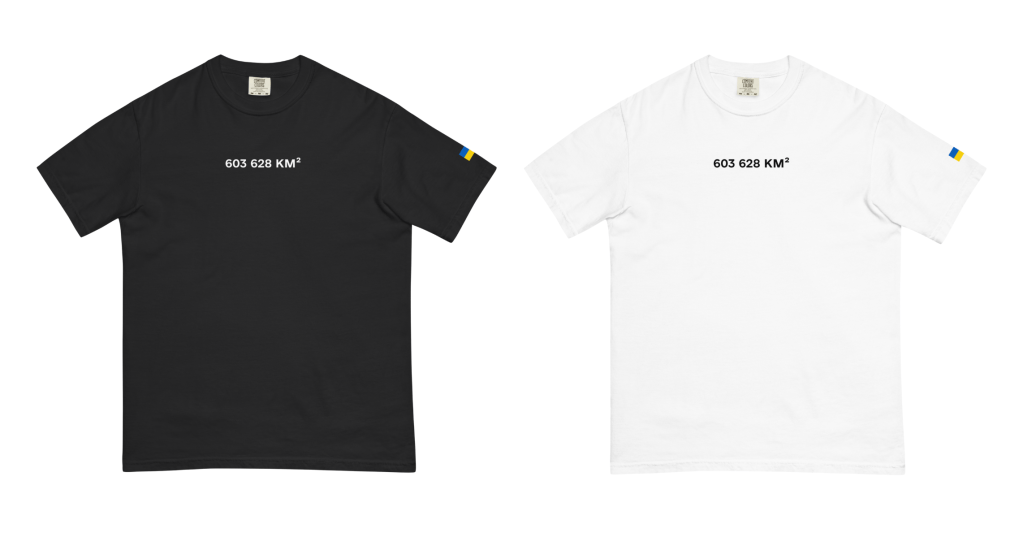
In case you missed it, we recently added a new T-shirt to our online store to help the charitable organization East SOS, continuing our commitment to support important Ukrainian initiatives through your purchases.

After Russia demanded that Ukraine cede five of its regions as a condition for a ceasefire, we designed a shirt to show solidarity with Ukraine — all 603,628 square kilometers of it.

In June, we introduced the “603,628 km²” T-shirt and are donating the profits to the Ukrainian charity East SOS. Thanks to readers like you, we’ve already raised more than $5,000 to help them rebuild homes in war-torn eastern Ukraine.

We’ll collect donations until Aug. 10, so you have six days left to grab your shirt and support the cause.

We also want to give you a closer look at East SOS. The organization provides comprehensive assistance to Ukrainians in front-line regions and internally displaced persons (IDPs) that were forced to flee the war. The charity was launched in 2015, focusing on providing essential supplies and humanitarian aid for those living in the front-line areas.

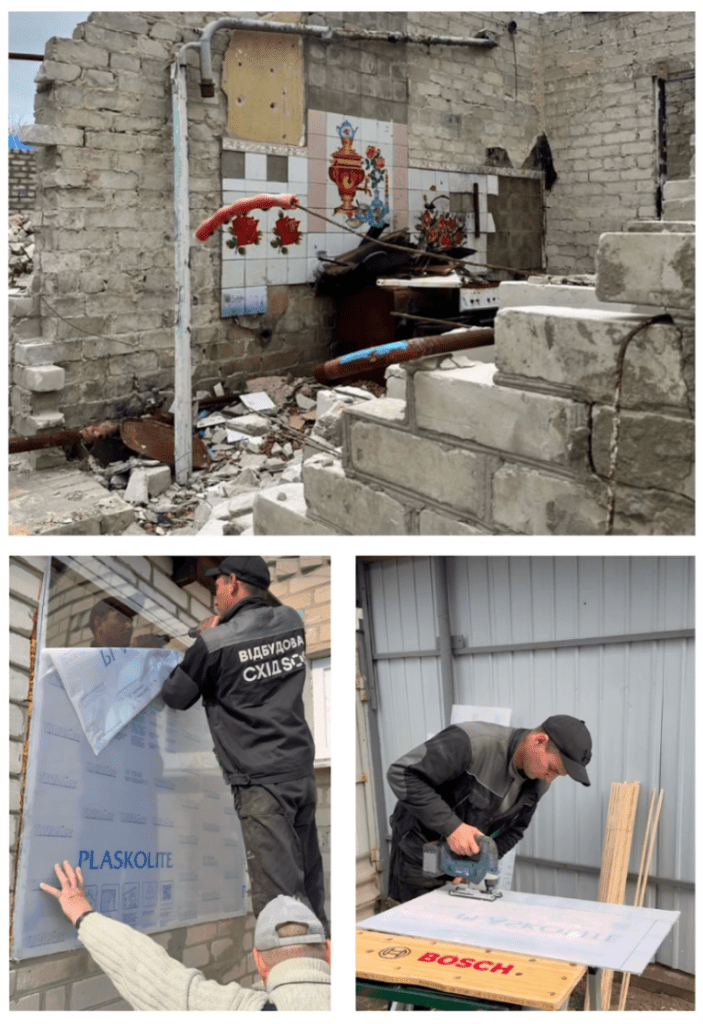
One project East SOS is currently raising money for is to repair houses in eastern Ukraine that have been damaged by Russia — this is the project that the Kyiv Independent will support. So far, East SOS has helped repair nearly 1,500 homes in Kharkiv and Donetsk oblasts, with another 300 households waiting for assistance. The charity works to repair private homes, prioritizing requests from elderly people living alone or individuals with disabilities — essentially those who are unable to carry out the work themselves.

East SOS employees restoring houses, damaged by Russian attacks.

The East SOS team steps in immediately after a house is damaged, fixing roofs and windows, preventing further damage from rain or snow. After an emergency response, the team returns in order to restore homes severely damaged by the Russian attacks.

It costs around $1,500 for East SOS to repair one house — thanks to your help, we have already raised funds to cover the repair of about three houses.

You can buy the “603,628 km²” T-shirt in white here or in black here.

Members of the Kyiv Independent community are also eligible for a 15% discount on everything sold in our online store. Join our community and find out more about membership benefits here.

You can also learn more about East SOS here or donate directly to them here.

Thank you for your support. If you have any questions regarding the T-shirt, please feel free to contact us store@kyivindependent.com.

Best,

The Kyiv Independent team

Source: Kyiv Independent newsletter, 4 August 2025. I ordered one of these new t-shirts today (as a gift to myself for my upcoming birthday), and would urge you to buy one too. ||| TRR


News from Ukraine Bulletin No. 157 (3 August 2025)

In this week’s bulletin: Russia’s mistreatment and disappearance of prisoners; politically motivated persecution in the occupied territories.

News from the territories occupied by Russia:  

Solidarity in grief: KVPU calls for support after deadly Russian attacks (KVPU August1st)

Melitopol journalist Iryna Levchenko abducted in 2023 ‘found’ imprisoned in Russian-occupied Donetsk (Kharkiv Human Rights Protection Group August 1st)

The Face of Resistance: The story of Crimean Tatar activist Ruslan Zeitullaiev (Crimea Platform August 1st)

Young Crimean couple could face life sentences for resistance to Russia’s war against Ukraine (Kharkiv Human Rights Protection Group July 29th)

Russia resettles ‘veterans’ and their families in occupied Ukraine, while deporting Ukrainians (Kharkiv Human Rights Protection Group July 28th)

 Russian invaders abduct young Ukrainian, sentence her to 12.5 years for helping Ukraine (Kharkiv Human Rights Protection Group July 28th)

CEPA published an article on the preservation of the Crimean Tatar language (Crimea Platform July 28th)

News from Ukraine:

Ukraine uncovers major bribery scheme in electronic warfare systems procurement: MP and officials involved (Ukrainska Pravda August 2nd)

Rebel, Love, fight corruption! Statement of student union Priama Diia (European Network for Solidarity with Ukraine August 2nd)

“Aren’t you tired of feeding people garbage?” Ukrainian parliament reverses anti-corruption law after street protests (Euromaidan Press July 31st)

`Fighting for our Future’: Kyiv protesters cheer return of anti-corruption safeguards (Kyiv Post July31st)

“More and more people don’t want to speak Russian”: How Ukrainians’ attitudes toward the Russian language changed during the war (The Insider, July 28th)

Aerial Terror in Kherson – A City Under Drone Siege (Byline Times, July 28th)

How the controversial Law No. 4555-IX undermines anti-corruption and reintegration — Alena Lunova on the JustTalk Context podcast (Zmina July 25th)

War-related news from Russia:

Recruiting for units with anti-authoritarians (Solidarity Collectives August 1st)

Denys Matsola: Updates from capitivity (Solidarity Collectives August 1st)

Ukrainian political prisoner vanishes after being abducted by FSB instead of released from Russian prison (Kharkiv Human Rights Protection Group July 31st)

Yulia Moskovskaya, Terrorist (Russian Reader, July 29th)

Cars for Ukraine (Russian Reader, July 27th)

News from the Front: 

A City Destroyed: Russia says it controls Ukraine’s Chasiv Yar after 16 months of fighting. But the battle grinds on, and only ruins remain (Meduza August 1st)

A fortress under threat: A year after reaching Pokrovsk, Russian forces appear ready to launch a full assault (Meduza July 30th)

Analysis and comment:

2000 Meters to Andriivka – the Ukrainian working class in war (Liam record, August 3rd)

Capital, Power and War: The crisis of Russia’s peripheral accumulation regime (Links August 1st)

Take back control of your gadgets: right to repair and the opportunity it presents for Ukraine (Commons.com, August 1st)

Wartime protest across Russia’s internal borders (Posle Media July 30th)

A political crisis that could weaken the war effort itself: What Zelensky’s anti-corruption U-turn means at a `precarious moment’ for Ukraine (Meduza July 30th)

Dying embers: Russia’s coal crisis triggers bankruptcies and mass layoffs (The Insider July 30th)

Ukraine between empire and revolution: Lev Yurkevych’s anti-colonial Marxism (Links July 29th)

Why the current wave of nationalization in Russia is more than just a redistribution of assets (IStories July 29th)

Ukraine’s New Cabinet: Neoliberal Reforms Threaten Wartime Solidarity (International Viewpoint, July 26th)

Research of human rights abuses:

ZMINA highlighted politically motivated persecution in the occupied territories at Helsinki+50 Conference side event (Zmina August1st)

Prisoners beaten, threatened with new sentences to force them to fight Russia’s war against Ukraine (Kharkiv Human Rights Protection Group August 1st)

OSCE and Participating States must act now to free its staff members from Russia’s captivity and prosecution (Zmina July 31st)

Abductions of Ukrainian Women and Girls (Kharkiv Human Rights Protection Group July 31st)

Silence—as a form of torture (Kharkiv Human Rights Protection Group July 31st)

A civil society manifesto on the 50th anniversary of the Helsinki Final Act (Zmina July 30th)

Do not legitimise the occupation: Mexican and Brazilian museums urged to refrain from collaborating with institutions in occupied territories (Crimea Human Rights Group July 30th)

Side event at the Helsinki+50 conference: “Crimea: 11 years of occupation – restoring justice, restoring OSCE commitments” (Crimea Human Rights Group July 30th)

Important Note: We will not be publishing a bulletin next week. The next bulletin, no. 158, will appear in two week’s time on 17 August 2025. 

==

This bulletin is put together by labour movement activists in solidarity with Ukrainian resistance. To receive it by email each Monday, email us at 2022ukrainesolidarity@gmail.com. To stop the bulletin, reply with the word “STOP” in the subject field. More information at https://ukraine-solidarity.org/. We are also on twitterBlueskyFacebook and Substack, and the bulletin is stored online here.

Source: Ukraine Information Group

All of Ukraine Belongs to Ukraine

Prescott Avenue, Monterey, California, 23 June 2025. Photo by the Russian Reader

In this week’s bulletin: Risks in Ukraine’s citizenship lawTrade union house grab/ Life under occupationStop Seapeak campaign/ War & dependent state formation in Ukraine/ More evidence of Russia’s indoctrination of small children/ Massive increase in Russian attacks on civilians

News from the territories occupied by Russia:  

Political prisoner Rustam Sheikhaliev turns 46, his sixth birthday behind bars (Crimea Platform, 22 June)

Banned from home for 40 years: deportations are Russia’s latest move to ‘cleanse’ Ukraine (The Guardian, June 21st)

7-year-olds in occupied Ukraine taught how to become part of Russia’s war machine (Kharkiv Human Rights Protection Group, June 20th)

Crimean sentenced to 17 years ‘for planning to blow up a Russian military helicopter’ (Kharkiv Human Rights Protection Group, June 20th)

Russian threat to co-founder of Crimea Human Rights Group (Crimea Human Rights Group, 19 June)

Russian court ignores abduction and torture, increasing huge sentence against Ukrainian for trying to rescue his mother (Kharkiv Human Rights Protection Group, June 19th)

Russia sentences 19-year-old Ukrainian to 8 years for ‘spying for Ukraine’ as a young boy  (Kharkiv Human Rights Protection Group, June 19th)

New legislation formalizes Russia’s brutal isolation of Crimean Tatar and other Ukrainian political prisoners (Kharkiv Human Rights Protection Group, June 17th)

How Putin rules in occupied Ukraine (Workers Liberty, June 16th)

Life Under Occupation (Alter Pravo, May 2025)

Life Under Occupation (Alter Pravo, April 2025)

News from the front:

Sumy defences stabilised: weekly war report (The Insider, 21 June)

News from Ukraine:

Speeches in the Verkhovna Rada: Expropriation of the trade union house (European Network for Solidarity with Ukraine, 20 June)

Kyiv Mayor Vitali Klitschko: The President’s Rival (Meduza, 17 June)

UN monitors report massive increase in Russian attacks on civilians throughout Ukraine (Kharkiv Human Rights Protection Group, June 16th)

Over 1,900 tonnes of harmful substances released into air over Kyiv and oblast in two days of Russian attacks (Ukrainska Pravda, June 16th)

Ukraine bracing for ‘painful’ reduction in US military aid after Hegseth announces cuts (Kyiv Independent, June 11th)

War-related news from Russia:

St Petersburg Economic Forum: an economic reality check (Meduza, 20 June)

Russian anti-war volunteer sentenced to 22 years (Novaya Gazeta Europe, 20 June)

How a network for selling sex with teenagers to the rich and powerful was built in Russia (iStories, 19 June)

Court claims show Russian casualties: The wave of the missing (Mediazona, 5 June) 

Analysis and comment:

Migration Policy of Ukraine: Legal Regulation and European Integration (Opora, June 20th)

Risks in Ukraine’s draft law on multiple citizenship (Crimea Human Rights Group, 17 June)

Position of human rights defenders: the draft law on multiple citizenship creates threats for residents of the occupied territories (Zmina, June 17th)

Volodymyr Artiukh and Taras Fedirko: War and dependent state formation in Ukraine (Berghahn Journals, 2025)

Housing Needs and Prospects for Social Housing in the Kalush Hromada (Cedos, June 19th)

Research of human rights abuses:

ZMINA highlights the need for accountability at Central and Eastern Europe Security Forum in Warsaw (Zmina, June 17th)

ZMINA joined the development of the Roadmap for the investigation of crimes against humanity committed by Russian forces in Ukraine (Zmina, June 16th)

International solidarity:

Australia sanctions on Russian “shadow fleet” (Crimea Platform, 17 June)

Russian fossil fuel exports: Stop Seapeak campaign (Ukraine Solidarity Campaign Scotland, 16 June)

Upcoming event:

Thursday, June 26th, from 7:30 to 9:00 PM GMT, online. Report back from solidarity visits to Ukraine. Speakers: Mike Kearney (NEU Ukraine Solidarity Network); Rui Palma (Ukraine Solidarity Campaign Steering Committee). Register for Zoom link.

==

This bulletin is put together by labour movement activists in solidarity with Ukrainian resistance. To receive it by email each Monday, email us at 2022ukrainesolidarity@gmail.com. To stop the bulletin, reply with the word “STOP” in the subject field. More information at https://ukraine-solidarity.org/. We are also on TwitterBlueskyFacebook and Substack, and the bulletin is stored online here

Source: News from Ukraine Bulletin 151 (23 June 2025)


If you are one of the few who still believe that the Russian dictator Vladimir Putin is interested in peace, please watch a few of the video clips from his performance at the St. Petersburg International Economic Forum last week.

Vladimir Putin at the 2025 St. Petersburg International Economic Forum. With English subtitles. Source: Michael Rossi

And then you will know the truth.

Here is Vladimir Putin summed up in 6 lies, all delivered within 48 hours last week.

LIE 1: “All of Ukraine belongs to Russia.”

FACT: Just go read international law, please. It really is that simple. Or ask the Ukrainians. End of discussion.

Putin’s words, the laughing and applause in the audience, the admiring smile of the ‘interviewer’ — three and a half years into the invasion — everything screams ‘red flag, attacking dictator!’ Not least because Putin’s words this week are simply a continuation of his ‘history thesis’ published in the Summer of 2021, six months before he invaded Ukraine; claiming that Russians and Ukrainians are one, and should live together within one state. Russia.

As we now know, in February 2022, Putin went on to show his ‘love’ for Ukrainians in a rather abusive way: something a la ‘you agree with me, my dear brothers and sisters, that we are one – or I will invade, murder, torture, rape and kill you, and then you will realize that we are one.’

This is, as they say in Russian, a man who is going ‘va-bank’ – for broke (‘ва-банк’).

LIE 2: Putin says that he wants to end the war as soon as possible.

“Believe me, we also want to end the war, and as soon as possible. And better – peacefully, if we could agree,” Putin said in St Petersburg.

FACT: This one is simple. The Russian dictator has broken no less than 26 ceasefires since he first invaded Ukraine in 2014. That’s every single one that has ever been agreed in 11 years.

In St. Petersburg, Putin was asked directly about the large-scale Russian offensive towards the city of Sumy in North-Eastern Ukraine. Ukraine says that Russia has amassed 60,000 troops less than 30 km from the city and all through May and June, village after village north of the city has fallen to the Russian army, edging still closer to Sumy itself.

“We have no objective to take Sumy,” Putin answered, “but in principle I do not rule it out…” Does that sound to you like a man who is keen on ending the war?

As it happens, last week marked 100 days since Ukraine accepted Trump’s proposal of an unconditional ceasefire. Putin still has not. 100 days. Instead, the Russian dictator has used those 100 days to increase the bombardment of residential areas in Ukrainian cities, often sending 4-500 drones with bombs per night. Most nights that kills 6 or 8 people, but every so often, like this past Tuesday in Kyiv, the human toll is even bigger: a drone and bomb onslaught in the early hours of Tuesday, 30 people died in their beds and 170 were injured.

That is all you need to know about Putin wanting to end the war. Or not.

LIE 3: Putin says that the Russian strikes are not on residential areas but on defense industry targets.

“The strikes were not on residential areas but precision strikes on military-industrial facilities,” Putin explained this week about the bombing of Kyiv that killed 30 people and injured 170. He has repeated such ‘explanations’ dozens and dozens of times after other horrific terror bombings.

FACT: All you need to do is watch the video.

You do not need to be a military expert to see that the Russian drone/bomb goes straight into a residential block of flats, not a military-industrial facility.

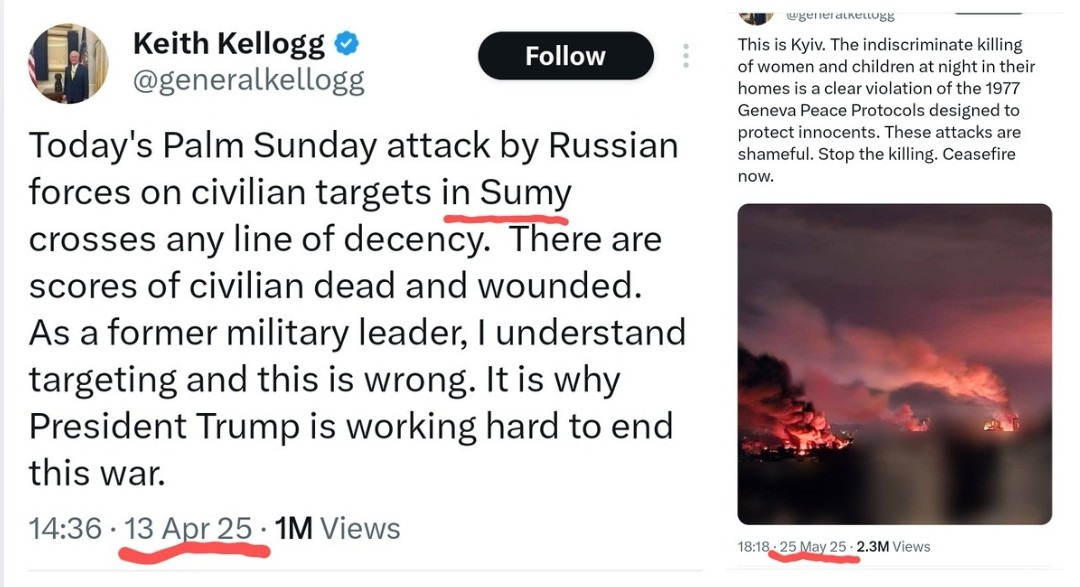
You do need to be an idiot to believe that this is not on purpose. In fact, the only person I have heard explaining such attacks as not being on purpose is — you guessed it — the U.S. President. On Easter Sunday, Russia bombed the central market square in the town of Sumy, in north-eastern Ukraine — using cluster ammunition and hitting church-goers and people on their way to celebrate Easter with their families. As a result, 31 people died. But Donald Trump explained that he had been informed that Russia had simply made a “a mistake”.

All independent experts agree that over the past months, Russia has increasingly targeted playgrounds, market squares, hospitals and residential neighborhoods. Hell, all you need to do is watch the videos being published every single morning of killed and injured Ukrainians being carried out from the rubble in their pajamas and nightgowns.

Trump’s own envoy to Ukraine, retired general Keith Kellogg tweeted is in no doubt.

LIE 4: Putin says that he is ready to meet Zelensky

“We are ready to meet… I am ready to meet with everyone, including Zelensky,” Putin said in St. Petersburg.

FACT: Putin has several times shied away from meeting the Ukrainian President, most recently in Istanbul in May where Zelensky challenged Putin to a face-to-face meeting: “There is no point in prolonging the killings. And I will be waiting for Putin in Türkiye on Thursday. Personally.

But Putin decided not to meet his much younger counterpart — who has lots of hair, no belly, no botox, dynamic, and great international press and sympathy.

LIE 5: Putin questions Zelensky’s legitimacy

“Why am I saying this?” Putin wondered aloud in St. Petersburg. “We don’t care who is negotiating, even if it’s the current head of the regime. I’m ready to meet – but only if it’s the final stage. The signature must come from a legitimate government. Otherwise, the next government will just throw it all in the trash.”

FACT: Where does one start on this one? A brutal, corrupt dictator who has been in power in Russia since 1999, and during that period has killed all signs of democracy, free expression and media, not to say most of his political opponents … accuses a popularly-elected president (Zelensky got 73% of the vote in 2019) of being illegitimate. Because he postponed elections that were supposed to have taken place in 2024, but couldn’t – because said dictator had invaded his country.

In other words, Putin will negotiate with Zelensky, he claims, but then retain the right afterwards to negate the agreement as illegitimate.

Alternatively, Putin wants to force elections in Ukraine — which would lead to instability. Of course. That is exactly why Putin wants elections. The logistics and security challenges would be insurmountable: This is a country and population in the middle of the most traumatic period in its history, with one-third of the population (12–14 million people) having been forced to flee their homes, 20% of their country occupied and hundreds of thousands of people killed and injured. Imagine running a political campaign and elections under such circumstances. Forced upon them by their invading neighbor and the country the Ukrainians thought was their main ally.

There is nothing surprising in an old KGB-hand like Putin trying this one, he has nothing to lose. The surprising thing is that Trump and several members of his administration agree with the Russian dictator that Zelensky is illegitimate and must hold elections before a peace deal can be signed. Why, oh why would you say something like that, Donald, if you really wanted to see peace in Ukraine?

LIE 6: Putin calls the Ukrainian revolution 2014 “a coup”

FACT: Sorry, Vova, I was there on the square in 2013–14, pretty much every single day for several months. There is no polite way of saying this – you are full of shit. Не пизди, Вова!

This was a true, popular uprising, involving millions of Ukrainians all over the country. The proof is in the pudding: 11 years later, it is easy to find Ukrainians who were on the Maidan during those months who today are disappointed with the outcome of the revolution. Too many of the old fat cats stayed in power, the fight against corruption has been too slow. But none of these people – millions – who saw what happened, who actually participated, call it “a coup”.

They were there. They did it. They know.

The fact is that today, 11 years after Putin invaded Ukraine for the first time, and three years and four months after he invaded Ukraine for the second time, it is difficult to find anybody who believes in his lies. Unless they are paid by the Kremlin.

Source: Michael Andersen, “Only a fool would believe that Putin wants peace,” Two Grumpy Old Men on Ukraine, 23 June 2025


Ukrainian officials have reacted with outrage to comments made by Vladimir Putin on Friday in which he told delegates to the St Petersburg International Economic Forum that “all of Ukraine is ours”.

Addressing the annual showcase for Russia’s economic development in St. Petersburg, Putin threatened a Russian nuclear response should Kyiv deploy a so-called “dirty bomb” — despite admitting that there was no evidence it was considering doing so — and portrayed the ongoing invasion of Ukraine as a defensive necessity.

Bluntly denying Ukraine’s sovereignty, Putin repeated the long-standing Kremlin narrative that Ukrainians and Russians were “one people,” a claim that has been repeatedly rejected both by Ukraine and the international community.

Putin went on to confirm that Russian forces were carving out a 10–15 kilometre buffer zone inside Ukraine’s Sumy region, following a seven-month-long incursion into Russia’s neighbouring Kursk region by the Armed Forces of Ukraine. Though he denied that Russia planned to occupy the city of Sumy itself, Putin added pointedly that he didn’t “rule it out”.

Raising the spectre of nuclear escalation, Putin warned of a devastating Russian response should Ukraine deploy a so-called “dirty bomb”, which combines conventional explosives with radioactive material, despite the fact that Ukraine is not known to possess such a device — a fact Putin himself acknowledged.

Such an attack “would be a colossal mistake on the part of those we call neo-Nazis in today’s Ukraine,” he said, adding that it “might be their last mistake”.

“Our nuclear doctrine states that we always respond to threats in kind. Therefore, our retaliation would be extremely harsh — and most likely catastrophic for both the neo-Nazi regime and Ukraine itself,” Putin continued.

Responding to the comments in his nightly address to the nation on Friday, Ukrainian President Volodymyr Zelensky said that they proved Putin had no intention of negotiating a ceasefire and that “Russia wants to continue the war,” adding that Ukrainian forces were successfully repelling Russian attacks in the Sumy region

Other Ukrainian officials also condemned Putin’s remarks, with Foreign Minister Andrii Sybiha describing his statement as “deranged” and saying that the Russian leader had shown “complete disdain for US peace efforts.”

“While the United States and the rest of the world have called for an immediate end to the killing, Russia’s top war criminal discusses plans to seize more Ukrainian territory and kill more Ukrainians,” Sybiha wrote on X.

Despite Russia’s continuing international isolation, Putin also claimed that the country’s economy remained strong, noting that GDP had grown by more than 4% annually over the past two years, poverty had dropped to 7.2%, and that unemployment had fallen to a historic low of 2.3%.

Source: Emilia Kurilova, “Outrage in Kyiv as Putin tells St. Petersburg International Economic Forum ‘all of Ukraine is ours,’” Novaya Gazeta Europe, 21 June 2025

Solidarity with Ukraine (and Its Opposite)

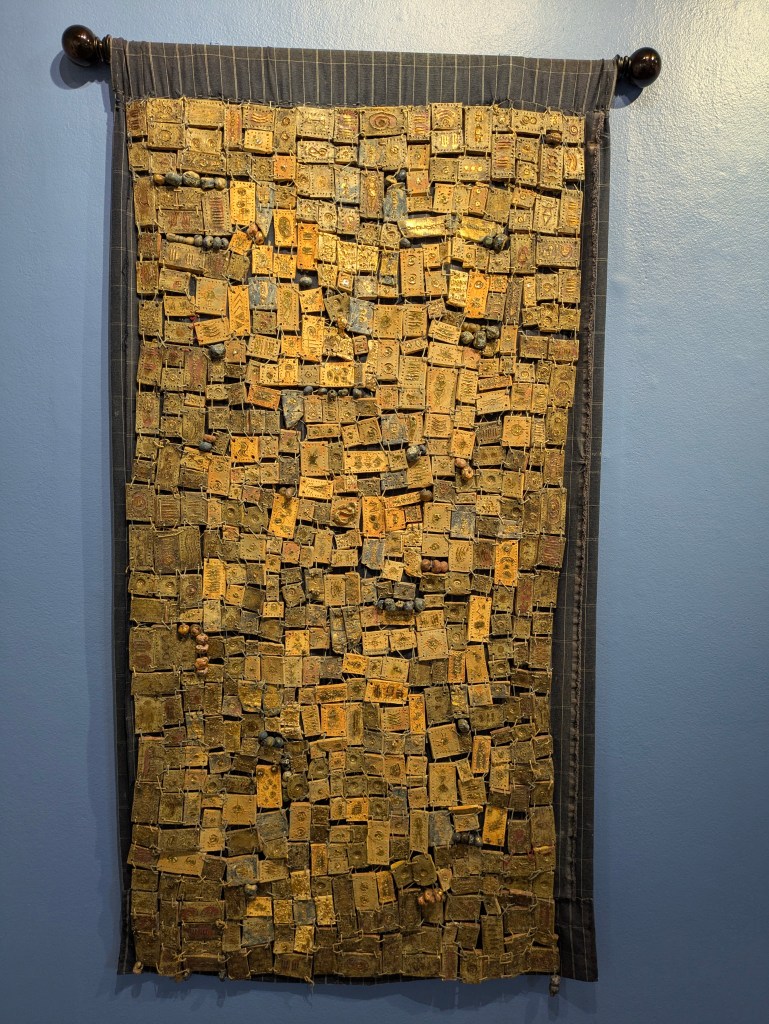
Coeleen Kiebert, Ode to the Women of Ukraine, May They Return to Quilt Their Beauty Again Soon, 2021. Ceramic, indigo linen. Pajaro Valley Arts, Watsonville, California, 26 April 2025. Photo by the Russian Reader


News from Ukraine Bulletin 144 (28 April 2025)

In this week’s bulletin: Solidarity With Ukraine conference speechesreports and draft declarationMobilise to free abducted children/ More evidence of Russian torturetargeting of civiliansabduction of children/ Putin’s foreign mercenaries

News from the territories occupied by Russia:  

Donbas hostages savagely tortured for ‘confessions’ in 2019 sentenced in Russia to 24 years (Kharkiv Human Rights Protection Group, April 25th)

Huge sentences and videoed ‘repentance’ in Russia’s mounting terror in occupied Zaporizhzhia oblast (Kharkiv Human Rights Protection Group, April 24th)

“Relatives said: people like you should be killed.” The story of a woman who survived torture and fled occupied Mariupol twice (Ukrainska Pravda, April 24th)

Crimean resident jailed for “discrediting the Russian army” is freed (Crimea Human Rights Group, 23 April)

Crimean Tatar Mejlis rejects any international recognition of Crimea as Russian, chairman says (Kyiv Independent, April 22nd)

Horrific sentences demanded against five Ukrainians abducted from Russian-occupied Melitopol (Kharkiv Human Rights Protection Group, April 22nd)

The situation at the front:

The weekly war summary (The Insider, 26 April)

‘Wiping out neighborhood after neighborhood’ Russia pounds Ukraine’s Pokrovsk, forcing civilians to flee under fire. For many, it’s not the first time. (Meduza, April 21st)

News from Ukraine:

Russia returns body of abducted Ukrainian journalist Victoria Roshchyna with scars from torture (Kharkiv Human Rights Protection Group, April 25th)

Nine people killed and 42 injured in Russian drone attack on bus in Marhanets, Dnipropetrovsk Oblast – photos (Ukrainska Pravda, April 23rd)

‘Please don’t use my name’ A report by journalist Shura Burtin on the growing war weariness among Ukrainians (Meduza, March 27th)

War-related news from Russia:

Russia’s deserters: “A raging meat grinder” (Meduza, 24 April)

Despite Putin’s denials, Russia’s military has welcomed foreign mercenaries from at least 48 nations — (iStories, April 23rd)

Darya Kozyreva gets real prison term for Taras Shevchenko poem and opposition to Russia’s war against Ukraine (Kharkiv Human Rights Protection Group, April 22nd)

The Lost Army: War veterans could pose a problem for Putin’s Russia, just like they did for interwar Germany (The Insider, April 21st)

Olga Menshikh: “A Society Sick with Fear Cannot Be Happy” (Russian Reader, April 20th)

Analysis and comment:

What Trump’s plan might look like, in maps (Meduza, 24 April)

Russia’s selective ‘terrorism’ in war against Ukraine and in fraternizing with the Taliban (Kharkiv Human Rights Protection Group, April 23rd)

In memory of Cooper Andrews, Finbarr Cafferkey and Dmitry Petrov (Solidarity Collectives, 19 April)

Research of war crimes and human rights abuses:

Meeting with Representatives of Ukrainian Roma in Brussels (Kharkiv Human Rights Protection Group, April 25th)

Experts of the Committee on the Elimination of Racial Discrimination Commend Ukraine’s Presence Despite the Prevailing Circumstances, Raise Questions on the Treatment of Ukraine’s Indigenous Peoples and the Roma Population (UNHCR, April 24th)

A reliable tool in the hands of human rights defenders: how the KHPG database works (Kharkiv Human Rights Protection Group, April 23rd)

International solidarity:

Mobilise to free the Ukrainian children abducted by Russia (Labour Hub, April 27th)

“My soul is in this project of ours” (Solidarity Zone, 24 April)

Building Global Solidarity with Ukraine (Ukraine Solidarity Campaign, April 23rd)

Justice without borders: the ZMINA and TDC advocacy trip to Chile (Zmina, April 18th)

Free Denys Matsola and Vladyslav Iskra Zhuravlov (Solidarity Collectives, 16 April)

Solidarity With Ukraine conference in Brussels, 26-27 March. Contributions heremedia coverage heredraft conference declaration here, with call for amendments

Upcoming events:

Wednesday 7 May, 3 – 5pm, War and Peace in UkraineClerici Building G.21, Headington Campus, Oxford Brookes University, Oxford.

Sunday 1 June, 1.0pm, Marble Arch, London, March for the children of Ukraine  


This bulletin is put together by labour movement activists in solidarity with Ukrainian resistance. To receive it by email each Monday, email us at 2022ukrainesolidarity@gmail.com. To stop the bulletin, reply with the word “STOP” in the subject field. More information at https://ukraine-solidarity.org/. We are also on TwitterBlueskyFacebook and Substack, and the bulletin is stored online here

Source: Ukraine Information Group


KYIV, Ukraine (AP) — A peace proposal by the Trump administration that includes recognizing Russian authority over Crimea shocked Ukrainian officials, who say they will not accept any formal surrender of the peninsula, even though they expect to concede the territory to the Kremlin, at least temporarily.

Giving up the land that was illegally annexed by Russia in 2014 is also politically and legally impossible, according to experts. It would require a change to the Ukrainian constitution and a nationwide vote, and it could be considered treason. Lawmakers and the public are firmly opposed to the idea.

“It doesn’t mean anything,” said Oleksandr Merezkho, a lawmaker with Ukrainian President Volodymyr Zelenskyy’s party. “We will never recognize Crimea as part of Russia.”

Unlike a territorial concession, a formal surrender would permanently relinquish Crimea and abandon the hope that Ukraine could regain it in the future.

The Ukrainian public largely understands that land must be ceded as part of any armistice because there is no way to retake it militarily. Polls indicate a rising percentage of the population accepts such a trade-off.

But much of the public messaging about land concessions has suggested that they are not necessarily permanent, as when Kyiv Mayor Vitalii Klitschko told the BBC recently that Ukraine may need to temporarily give up land as part of a peace deal.

Saying otherwise would effectively admit defeat — a deeply unpopular move, especially for Ukrainians living under Russian occupation who hope to be liberated and reunited with their families one day. It also would call into question the sacrifices made by tens of thousands of Ukrainian service members who have been killed or wounded.

U.S. President Donald Trump underscored the Crimea proposal in an interview published Friday in Time magazine: “Crimea will stay with Russia. Zelenskyy understands that, and everybody understands that it’s been with them for a long time.”

Asked by reporters on Sunday if Zelenskyy was ready to give up Crimea, Trump said, “Oh, I think so. Crimea was 12 years ago. That was President Obama that gave it up without a shot being fired.

His comments offered the latest example of the U.S. leader pressuring Ukraine to make concessions to end the war while it remains under siege. Trump has also accused Zelenskyy of prolonging the war by resisting negotiations with Russian President Vladimir Putin.

Crimea, a strategic peninsula along the Black Sea in southern Ukraine, was seized by Russia years before the full-scale invasion that began in 2022. The Russian takeover followed large protests that ousted former Ukrainian President Viktor Yanukovych, who had refused to sign an association agreement with the European Union.

In the lead-up to peace talks, Ukrainian officials told the Associated Press for months that they expect Crimea and other Ukrainian territory controlled by Russia to be among Kyiv’s concessions in the event of any deal. But Zelenskyy has said on multiple occasions that formally surrendering the land has always been a red line.

Elements of Trump’s peace proposal would see the U.S. formally recognizing Crimea as Russian and de facto accepting Moscow’s rule over occupied Ukrainian territories, according to a senior European official who spoke on condition of anonymity to discuss sensitive diplomatic discussions.

Whether the U.S. formally recognizes Crimea as Russian is out of Zelenskyy’s hands. But many obstacles prevent the Ukrainian president from doing so, even under immense pressure. He cannot unilaterally sign any such proposal, and he could be reprimanded by future governments for even attempting it, experts said.

Ukraine began to accept that it would not regain its lost territories after the failure of the country’s 2023 summer counteroffensive. From then on, the Ukrainian military concentrated on defending the territory it still held.

In return for territorial concessions, Ukraine wants robust security guarantees that ideally would include NATO membership or concrete plans to arm and train its forces against any future Russian invasion with the pledged support of allies. One scenario envisions European boots on the ground, which Russia rejects.

Zelenskyy has said negotiations over occupied Ukrainian territory will be drawn out and will not likely occur until a ceasefire is in place. In late March, he told reporters after a call with Trump that the U.S. president “clearly understands that legally we will not recognize any territories.”

He said giving up territory would be “the most difficult question” and “a big challenge for us.”

Formal recognition of Crimea would also amount to political suicide for Zelenskyy. It could expose him to legal action in the future, said Tymofiy Mylovanov, president of the Kyiv School of Economics and a former economics minister.

Signing a potentially unconstitutional document could be interpreted as high treason, Mylovanov said.

The Ukrainian government cannot act either. It has no constitutional means to accept a violation of its territorial integrity, and altering the territorial makeup of the country requires a nationwide referendum.

If Ukrainian lawmakers were even to entertain the idea of surrendering Crimea, it would trigger a long, drawn-out legal debate.

“That’s why Russia is pushing it, because they know it’s impossible to achieve,” Mylovanov said.

“Anything related to constitutional change gives so much policy and public communication space to Russia,” he added. “This is all they want.”

Soldiers on the front line say they will never stop fighting, no matter what the political leadership decides.

“We lost our best guys in this war,” said Oleksandr, a soldier in the Donetsk region, who spoke on the condition that only his first name be used in line with military protocols. “We won’t stop until all Ukrainian lands are free.”

Source: Samya Kullab, “Shocked by US peace proposal, Ukrainians say they will not accept any formal surrender of Crimea,” Associated Press, 27 April 2025. The emphasis is mine — TRR.


Coeleen Kiebert, Ode to the Women of Ukraine, May They Return to Quilt Their Beauty Again Soon, 2021 (detail). Pajaro Valley Arts, Watsonville, California, 26 April 2025. Photo by the Russian Reader

Three Years Later: Standing with Ukraine Against International Fascism

How bad can it get? When we strip away US president Donald Trump’s insults and temper fits, what can he actually do?

First, he can withdraw US military aid to Ukraine – which he has been talking about doing since long before the US presidential election. If the European states got their act together, which is possible, the effects of this would be constrained.

At the “Russian troops out” march in London, 22 February 2025

US diplomats have reportedly threatened to block Ukraine’s access to the Starlink communication system on which its drones rely, potentially giving asymmetrical advantage to Russia.

Second, Trump can cancel sanctions. The latter would bring him into conflict with the Countering America’s Adversaries Through Sanctions Act of 2017, which was specifically designed to compel the president to lift sanctions only with Congress approval. Of course Trump could play fast and loose with the law, which he has done and is doing in other respects, and/or Congress could go along with him.

The cancellation of sanctions would be bad. But let’s not lose sight of the fact that the sanctions were never very effective, in large part because previous US governments, under both Trump and Biden, sought to limit their effect on the oil market and the world economy.

Third, Trump can shift narratives. I broadly agree with people who say we should judge Trump and his cohorts by their actions, not by the constant stream of often incoherent words. Yes, but. Nazi salutes normalise Nazism; speculation about expelling the Palestinian population from Gaza normalises ethnic cleansing; and slandering the Ukrainian president as a “dictator” who started the war in his country reinforces Russian propaganda.

On the third anniversary of Russia’s all-out invasion – and the eleventh year of its military attack on Ukraine, and the long chains of suffering it has caused – these are real dangers. It’s not clear how they will play out.

Continue reading “Three Years Later: Standing with Ukraine Against International Fascism”

The Betrayal of Ukraine: Week 2

No, we don’t.

Tomorrow in Ukraine, Russian soldiers will attack Ukrainians. Russian drones and bombs and rockets will target Ukrainian homes. A criminal war of aggression will continue.

Tomorrow in Saudi Arabia, Russian officials will discuss the future of Ukraine with a handful of Americans, delegated by a president who sympathizes with the Russian view of the war. The Russians will have the luxury of talking about Ukraine without the presence of Ukrainians.

The headlines are about “peace negotiations.” But what is really going on? How should we think about this unusual encounter in Saudi Arabia?

Here are ten suggestions, drawn from years on working on relations among the three countries, and from some recent personal observations at the Munich Security Conference.

1. Be critical of the words on offer. Question the word “peace.” The term used in the media is “peace negotiations.” The United States and Russia are not at war. Russia is at war with Ukraine, but Ukraine is not invited to these talks. Russian authorities, for their part, do not generally speak of peace. They present the talks with the United States as a geopolitical coup, which is not the same thing. The highest Russian officials have repeatedly stated that their war aims in Ukraine are maximalist, including the destruction of the country. Informed observers generally take for granted that Russia would use a ceasefire to distract the United States and Europe, demobilize Ukraine, and attack again. This is not a plan that the Russians are working very hard to disguise. It is a simple point, but always worth making: there could indeed be peace tomorrow in Ukraine, if Russia simply removed its invasion force.

Continue reading “The Betrayal of Ukraine: Week 2”

Ukraine (The Betrayal)

Source: “The World in Brief,” The Economist, 15 February 2025


Today, there was one happy man in the Kremlin. Vladimir Putin banked his legacy on an all-out war that, at one point, looked all but lost for him. But he waited long enough to see the tides change in his favor.

Three years in and hundreds of thousands of deaths after, the U.S. president is calling Putin, offering peace talks on Russia’s terms.

Hi, my name is Oleksiy Sorokin, I’m the deputy chief editor of the Kyiv Independent, and this is the latest issue of our Russia-themed newsletter.

Today we will talk about how Russia is about to win the war.

It’s a topic of debate when authoritarian Russia began morphing into a totalitarian state, but Feb. 24, 2022, is a point that finalized this transformation. A point of no return.

The all-out war was supposed to be quick. It was supposed to be a victory of a new world order and of a new Russia, once again a force that would decide the fate of the world, a force that people would fear.

Taking Kyiv, installing a new Russian-controlled government, and forcing Ukraine to recognize Crimea, Donetsk, and Luhansk as Russian was to be achieved within months, if not days.

The country Putin attempted to subjugate, however, was fiercely resisting. Something that Russian political and military leadership didn’t expect and didn’t prepare for.

Yet, over and over, Russian President Putin was bailed out by the West.

In 2022, Russia was making fortunes on selling off its energy resources to the West. When Russian troops were murdering civilians of Mariupol and nearing Kyiv, Moscow’s war chest was being replenished by Europeans.

The slow phasing out of Russian energy resources in the West allowed Russia to iron out its pivot to the East, building a formidable shadow fleet to transport its energy resources to anyone willing to buy.

When Russia began to lose ground and prepare for a Ukrainian counteroffensive, the U.S. was slowing down military shipments, giving Moscow further breathing room.

Seeing that the West was unwilling to support Ukraine to the fullest and was willing to allow Russia to continue, Russia, well, continued.

Russian leadership doubled down, increasing attacks on Ukraine, making committing war crimes a state policy, and simultaneously choking all forms of dissent at home.

Ukrainian civilians and prisoners of war were tortured and often murdered, and children from occupied territories were abducted.

Domestically, Russia outlawed speaking against the war, with people receiving hefty prison terms for criticising the invasion.

For the majority, however, the state made sure their economic well-being and daily routines remained unchanged, allowing ignorance to flourish. The Russian economy was doing fine.

All this made Putin confident. He knew that time played in his favor. The U.S. would surrender, and Europe would be in no position to object. He was right.

While on the campaign trail, Donald Trump had made it clear that he has little interest in continuing to support Ukraine’s fight against Russia.

His comments of ending the war in “24 hours” were a figure of speech, but it was clear that some sort of peace plan would be presented by the incoming administration.

Russia listed its demands, Ukraine listed theirs. Both waited. The fighting went on along the front line.

Russia was in a better position to negotiate. The West’s unwillingness to truly stop Russia, especially if it meant causing any sort of inconvenience at home, allowed it to regroup and begin a major offensive, ongoing to this day.

What came next was too good to be true… for Russia.

On Feb. 11, U.S. Defense Secretary Pete Hegseth began his European tour. Off the bat, he made public the U.S. position concerning the upcoming peace talks.

Hegseth said, “Returning to Ukraine’s pre-2014 borders is an unrealistic objective,” and that NATO membership for Ukraine is not an option, effectively agreeing with Russia’s demands.

Then, Trump called Putin.

“We both reflected on the great history of our nations and the fact that we fought so successfully together in World War II, remembering that Russia lost tens of millions of people,” said Trump following the call, parroting the Kremlin’s favorite line of the huge sacrifice Russia undertook in a war that ended 80 years ago, and how it is for whatever reason relevant today.

“As we both agreed, we want to stop the millions of deaths taking place in the war with Russia/Ukraine. President Putin even used my very strong campaign motto of ‘common sense’,” Trump added.

“We agreed to work together, very closely, including visiting each other’s nations. We have also agreed to have our respective teams start negotiations immediately, and we will begin by calling President Zelensky of Ukraine, to inform him of the conversation,” he went on.

The next day, Trump proposed to return Russia to G7, the intergovernmental political forum of the most developed democratic countries from which Moscow was kicked out following the start of its war in 2014.

Russian officials and pro-war public figures were openly excited about Trump’s moves.

“The movement that has begun is the result of the heroic work of our fighters and the principled position of Vladimir Putin, who speaks of openness to negotiations but firmly defends Russia’s national interests,” said lawmaker Evgeniy Revenko, deputy head of Putin’s United Russia party.

“Zelensky’s days are numbered, and Trump’s arrival at the Victory Parade in Moscow no longer seems like a fantasy,” he added.

“The phone call between Putin and Trump will go down in the history of world politics and diplomacy. It is not a breakthrough yet, but perhaps the first step towards one. I am sure that in Kyiv, Brussels, Paris, and London, they read Trump’s lengthy commentary on his conversation with Putin with horror and cannot believe their eyes,” said Russian Senator Aleksey Pushkov.

I can’t believe I’m saying this, but I agree with Mr. Pushkov.

Following the call, the Kremlin said, “We, of course, understand that our main counterpart in this process is Washington.”

And here we are today. It took three years, but Russia is where it wanted to be from the start — at a table with the U.S. deciding the fate of the world without the world’s consent.

Putin will push for more, seeking to squeeze the most out of Washington, and give nothing in return.

Russia would demand to keep the territories it controls, and most likely try to take the ones it doesn’t. According to Russia’s new constitution, Russia sees Ukrainian Crimea, and four oblasts — Donetsk, Luhansk, Zaporizhzhia and Kherson — as its own. Russia doesn’t have full control of any of the four.

With NATO off the table, other demands might be thrown at Trump, reducing Kyiv’s army or legalizing Russian language and influence in Ukraine.

Whether the U.S. will agree, and most importantly, whether Kyiv and the EU will go by the agreements that Moscow and Washington are set to achieve behind their backs, remains to be seen. There’s a strong chance that they won’t.

But overall, the sun is now much brighter for Putin than it was just a few days ago.

Eleven years of fighting against Ukraine, three years of all-out war and thousands of war crimes committed, Putin isn’t a pariah anymore. His worldview is on track to become mainstream, and it’s the leader of the free world who is leading him back to the table.

Source: Oleksiy Sorokin, “WTF is wrong with Russia” (newsletter), Kyiv Independent, 13 February 2025


In this week’s bulletin: Russia used US banks to dodge sanctions/ Private military companies at war/ Crimean 2024 human rights report/ Further evidence of Russian tortureexecution of prisoners, fabrication of evidence and withholding of medical aid in occupied areas/ New wave of detentions in Crimea

News from the territories occupied by Russia:  

Young people who have quit the occupied areas: “It’s like being freed from a horrible stench” (Ukrainska Pravda, 9 February)

Stadiums under occupation: sports facilities in Donbas today (Ukrainska Pravda, 7 February)

Russia uses medical torture to fabricate its ‘trial’ of disabled 74-year-old Volodymyr Ananiev (Kharkiv Human Rights Protection Group, February 7th)

Russians refuse to sell insulin and other vital medicines to Ukrainians without Russian passports, reports Ukrainian intelligence (Ukrainska Pravda, February 7th)

How can Ukraine solve the problem of documents from the occupied territories? Human rights defenders share their vision with international partners (Zmina, February 7th)

A janitor, a cook, an informer — who is being tried for collaborating with the enemy? (Kharkiv Human Rights Protection Group, February 6th)

Russian FSB carry out new terror raids and arrests by quota in occupied Crimea (Kharkiv Human Rights Protection Group, February 6th)

Human rights and humanitarian legal norms: 2024 review (Crimea Human Rights Group, 5 February)

Viktor Dzytsiuk was almost tortured to death in occupied Donbas. Now Russia is continuing his torment (Kharkiv Human Rights Protection Group, February 5th)

ZMINA took part in a discussion on the cultural decolonisation of Crimea (Zmina, February 4th)

Russian FSB uses shoddily faked video to charge 63-year-old woman abducted from occupied Ukraine with ‘terrorism’ (Kharkiv Human Rights Protection Group, February 3rd)

First prosecution in Crimea for “childfree propaganda” (Crimea Human Rights Group, 2 February)

The situation at the front:

Russian forces advance on Pokrovsk (Meduza, 5 February)

News from Ukraine – general:  

Support for war victims: human rights defenders presented new roadmap of draft laws (Zmina, February 5th)

Defying Odds In Ukraine  (They Said So, February 4th)

Ukrainian Holocaust survivor: Hitler wanted to kill me as a Jew. Putin is trying to kill me because I’m Ukrainian (Kharkiv Human Rights Protection Group, February 3rd)

How Ukraine lost faith in the Red Cross and UN (Kyiv Independent, January 22nd)

Ukraine: Bikis, our feminist year (Europe Solidaire Sans Frontières, January 20th)

Ukraine: And yet he remained a human  (Europe Solidaire Sans Frontières, January 4th)

War-related news from Russia:

Draft exemptions as Russians know them are ending (Meduza, 6 February)

Rebranding private military companies for the war in Ukraine (Posle.media, 5 February)

Support fundraisers for Solidarity Zone’s recipients in court (Solidarity Zone, 5 February)

Russia used US banks to send billions to Turkey, dodging sanctions (Kyiv Independent, February 3rd)

The Russian far right: “an affinity for violence brings them together” (Posle.media, 29 January)

Analysis and comment:

US Aid, Russia and Ukraine (The Russian Reader, 4 February)

A girl from the burnt village: the story of Maria Nevmerzhytska (Commons.com.ua, 3 February) 

Statement by human rights organisations: another wave of searches and detentions of Crimean Tatars (Crimean Human Rights Group, 2 February) 

Research of human rights abuses:

Prison medicine: ways to humanize it (Kharkiv Human Rights Protection Group, February 7th)

UN monitors report sharp increase in executions of Ukrainian POWs, and point to Russian officials’ effective incitement to kill (Kharkiv Human Rights Protection Group, February 7th)

The Centre for Civil Liberties Participated in the First World Congress on Enforced Disappearances  (Centre for Civil Liberties, February 6th)

“I Urge You to Make Every Effort to Release Ukrainian Prisoners of War And Unlawfully Detained Civilians ” Maksym Butkevych at the UN Security Council (Centre for Civil Liberties, February 6th)

“Crimes Against Peaceful Civilians Warrant Your Action” The Center for Civil Liberties Appealed to PACE Members  (Centre for Civil Liberties, February 6th)

Upcoming events:

Saturday 15 February, 11.0 am — 4.0 pm, Conference: End the Russian invasion and occupation. National Education Union, Mabledon Place, London, WC1H 9BD. Register here.

Saturday 15 February, 11.0 am – Palestine solidarity demo. To join the Ukraine-Palestine solidarity contingent, with our banner, “From Ukraine to Palestine – Occupation is a crime”, meet outside Banqueting Hall, corner of Whitehall and Horseguard Avenue, London SW1A

Saturday 22 February, 12.00 , Demonstrate at the Russian embassyAssemble 12 noon – St Volodymyr statue, W11 3QY Rally 1pm – Russian embassy, W8 4QP. Flyers are available for distribution – email info@ukrainesolidaritycampaign.org and ask for them.

==

This bulletin is put together by labour movement activists in solidarity with Ukrainian resistance. To receive it by email each Monday, email us at 2022ukrainesolidarity@gmail.com. To stop the bulletin, reply with the word “STOP” in the subject field. More information at https://ukraine-solidarity.org/. We are also on twitterBlueskyFacebook and Substack, and the bulletin is stored online here

Source: News from Ukraine Bulletin 133 (10 February 2025)


Europeans still like cheap Russian LNG

France, Spain and Belgium are the biggest buyers

Source: FT

Source: Adam Tooze, “Why Europe and India are still buying Russian energy. Friedman and Schwartz disaggregated. Cuba in Africa and the decline of the all-nighter,” Chartbook, 15 February 2025


Russia’s full-scale invasion of Ukraine in 2022 prompted a refugee crisis in Europe. News footage showed people piling onto trains and into cars, desperate to escape the threat of bombs and Russian occupation. In Kharkiv, a taxi driver named Sergii told me how in those chaotic early days of war, he had helped evacuate people as Russian missiles turned his bustling neighbourhood of Saltivka into a ghost town.

“I survived by praying to God,” Sergii said, pointing to the icon of the Virgin Mary dangling from his cab’s rearview mirror. “I helped people with no money get out of Saltivka, because people with money had already left.” He narrowly avoided death himself, he added, explaining a rocket had destroyed his apartment as he went out to his cab to retrieve the mobile phone he’d left on the front seat.

Nearly seven million people have now fled Ukraine. The majority have settled in European countries, many of which responded to the war by waiving visa requirements for Ukrainian refugees. Around 250,000 came to the UK, which decided not to fully lift restrictions but to instead introduce two emergency visas: the Ukraine Family Scheme and the Homes for Ukraine scheme.

At their outset, both visas granted Ukrainian nations the right to live, work and study in the UK for up to three years. Now, as the third anniversary of Russia’s invasion rolls around, anybody who arrived in the early days of the war is about to see their right to remain expire.

Yet this week, many Ukrainians faced the prospect that they may never be able to return to their homes. US President Trump announced he had spoken to his Russian counterpart, Vladimir Putin, to begin peace negotiations that risk handing over occupied regions of Ukraine to Russian control.

Residents of Ukrainian towns and cities previously liberated from Russian control, such as Bucha and Izium, have spoken about the reign of terror and cruelty they endured under occupation, including torture, rape, summary executions and false imprisonment. Should the peace deal go ahead on Putin’s terms, Ukrainian refugees in the UK face an increasingly uncertain future, with those whose homes are in the occupied territories potentially unable to return.

But even before the announcements from the White House and the Kremlin, the UK’s visa schemes have long presented problems for the vulnerable Ukrainians they are supposed to support.

“Before the full-scale invasion, I had a normal life,” Nastya*, aged 24, told openDemocracy “I worked in a supermarket and a fabric factory. Everything was absolutely good. And then on 22 February 2022, the war started.”

At the time, Nastya lived in Uzhorod, a city near the Slovakian border. As missiles battered the country’s major cities and the Russian forces occupied cities such as Izium and Mariupol, committing war crimes in Bucha and Irpin, she decided to flee with her husband.

“It was a stressful time,” she admitted. “I did not know what the future would be and my family were scattered around the world, some in England, some in Germany and some in Ukraine.”

Nastya and her then-husband travelled to Germany, where her mother was living, before coming to the UK on the Ukraine Family Scheme in August 2022. “It was hard to get a job in Germany, especially as I don’t speak German,” she explained. “I didn’t want to live on benefits, I wanted to support myself and live independently. I had heard in the UK there were opportunities for work, so I relocated.”

Nastya and her husband’s visas took only a few days to be approved, and the pair moved in with her sister-in-law in Leeds, where Nastya found a job in a local factory. “The work was hard and physical with lots of heavy lifting but I was earning some money which is good,” she said.

After three months in the UK, Nastya discovered she was pregnant with her first child. It was happy news, but it came as her marriage was falling apart. “It was quite difficult,” she said. ‘My husband was very sad and there were a lot of horrible moments. I decided to separate from him and go to Germany to be with my mother to have the baby.”

Nastya gave birth to a beautiful baby girl, who shares her bright brown eyes and dark hair. While she had wanted to be with her own mother during the birth, as a newly single mum Nastya was keen to return to the UK, where her father and grandmother were living, to get a job, support her daughter, and start a new life.

She had assumed that as she had the right to live and work in the UK, her daughter would be able to join her on the same family visa scheme.

But what Nastya did not realise is that while she was caring for her newborn in Germany, the Conservative government had been quietly restricting Ukrainians’ right to enter the UK. The family visa scheme had been closed and Ukrainians were no longer allowed to sponsor fellow refugees to arrive on the Homes for Ukraine visa.

Now, if Nastya wanted to come to the UK, she would have to leave her daughter behind.

War in Europe

When the Homes for Ukraine scheme was launched in 2022, members of the British public could open their homes to Ukrainian refugees in exchange for an initial monthly payment of £350 from their local council, while Ukrainians who successfully applied for the scheme were granted the right to live, study and work in the UK for three years.

But in February 2024, the then-Tory government brought in a series of changes. It halved the length of time a new Ukrainian applicant would be able to stay in the UK to 18 months, and amended the rules so that only people with British citizenship can sign up to become hosts. At the same time, it cancelled the family visa scheme, meaning Ukrainian nationals living in the UK can no longer sponsor family members to join them.

These changes have effectively made it impossible for Ukrainian nationals in the UK to help loved ones to settle here to escape the war. Now, Ukrainians wanting to come to the UK are reliant on there being an available British citizen who will take them in. But this, too, has suffered changes that have made it a less appealing prospect for many hosts.

In November, the Labour government announced all British citizens signed up to the Homes for Ukraine scheme will be paid £350 a month, regardless of how long they have been hosting. Households who have been hosting for more than a year are currently paid £500 a month.

Even before this announcement, the number of hosts was in decline, according to openDemocracy’s analysis of government data. In the third quarter of 2023, 100,061 households in England received the monthly ‘thank you’ payment, but by the third quarter of Q3 2024, this had fallen to 48,533 households, the lowest number since the full-scale war began.

This decrease in hosts was also apparent in our review of Homes for Ukraine Facebook pages. While at the start of the war, posts from Ukrainians looking for sponsors received multiple comments from potential hosts, these days they often garner no responses or are met with ‘jokes’, with one commenter saying: “I’d rather be in Mykolaiv than London”. Others respond telling those who wish to relocate to the UK from another European country, like Nastya, that the scheme is not for them: “People in the UK would prefer to sponsor people who are in Ukraine and need to be saved from war.”

“Instead of putting more and more administrative barriers in front of people fleeing war, the UK government must show it can match the solidarity and empathy shown by the people of the UK,” said Alena Ivanova, committee member of the Ukraine Solidarity Campaign, which is organising a march to the Russian embassy in London to mark the third anniversary of the full-scale invasion.

“We know that the vast majority of Ukrainians in the UK are vulnerable women, small children and elderly people who carry significant trauma as a result of Russia’s brutal war. The least we as a country can do is not put them further at risk and increase their anxiety but help them settle and rebuild their lives,” Ivanova added.

Those who arrived in the UK through either the Homes for Ukraine or Ukraine Family Visa scheme in the early days of the war are about to see their right to remain expire. But with the conflict ongoing, they can extend their visas via the Ukraine Permission Extension Scheme.

While this extension is undoubtedly needed, the process for obtaining it is fraught – and may put vulnerable people at risk of falling out of the system.

People needing an extension can apply only when they have 28 days or less left on their right to remain, which may impact their ability to work or be housed, with landlords and employers nervous about accepting Ukrainians who may not have the legal right to be in the country. Those who miss the extension window are at risk of becoming undocumented and therefore will be considered to be in the UK illegally. Although the war means it is unlikely these people will be deported, they would be unable to work or access housing, and are at risk of being removed in the future.

And applications for extensions can only be made from within the UK – a problem for women like Nastya in Germany, or for anyone visiting family in Ukraine.

Polling by the Office for National Statistics found that while the majority of Ukrainians are aware of the visa changes and the need to apply for an extension, a small minority of mainly vulnerable refugees, such as the elderly or young, are not.

Uncertainty is also built into the extension scheme. People will be able to extend their right to stay in the UK by only 18 months, half the three years they were initially granted. If they stay for the full term, a Ukrainian refugee’s total residency in the UK will have been four and a half years – six months short of the five years that a person must have continuously lived here to be eligible for the right to settle permanently.

There is also uncertainty for those British nationals hosting Ukrainians. If their guest is granted an extension, their host will need to reapply for thank you payments.

openDemocracy asked the UK government how it plans to deal with the temporary nature of the visas should the conflict continue for another 18 months. We also asked what plans they have in place should a peace deal cede Ukrainian territory to Russia, with those fleeing the occupied regions unable to return home. They did not respond.

‘I feel loneliness’

Nastya had always planned to return from Germany to the UK with her daughter. Here, she could work and have her own home where she, her daughter and her new partner, who is also Ukrainian, could live as a family.

Now, the changes to the visa schemes have cut her and her daughter off, leaving her living in limbo. She and her daughter face a choice: living in Germany where she struggles to find work and faces eviction from her refugee accommodation in the coming year, or returning to Ukraine which endures daily bombardment by Russian bombs and drones.

“In Germany, I face going into a refugee camp, which is no place to raise a child,” Nastya warned. “My mother lives in a separate city and so we cannot see each other regularly.”

Worse, the heartbreak of being separated from her father and grandmother has been devastating.

“They have never had the chance to meet their granddaughter and great-granddaughter,” she said, the pain of separation clear in her voice. “I have not been in touch with them face to face, and they would really like to meet. I want to see my father and grandmother and it is impossible.”

The changes to the visa schemes have left women like Nastya experiencing a double displacement. First, the full-scale invasion forced them from their homes in Ukraine. Now, changing government policy has separated them from family members in the UK.

“I have cried a lot,” said Nastya. “I feel loneliness, it is so hard that I can’t put it into words. I am crying a lot but I don’t want to blame anyone. If I would receive a visa for my daughter it would be really nice and I would be able to meet my family.”

Nastya has some hope. Last month, the Labour government partially reversed the changes made by the previous administration, allowing Ukrainians to bring their children to join them in the UK, a change described as a “welcome step in the right direction,” by Mubeen Bhutta, British Red Cross director of policy, research and advocacy. The charity has supported Nastya and her family.

“Our teams have supported people who had been unable to reunite with young children,” she said. “We’ve seen their pain and suffering and know this will mean a lot to families who have been torn apart. However, even with these changes many family members will remain separated.

“It is still very difficult for displaced Ukrainians to help elderly parents or partners find safety in the UK. It is vital that the government addresses these obstacles and helps more Ukrainians reunite with their loved ones.”

Nastya, who has a legal right to be in the UK, can now apply for an extension and for her daughter to join her. Her partner, however, must find a British national to sponsor him.

“It is really hard to be a refugee,” she said. “It is impossible to see a future for Ukraine. It would be really nice to go to the UK to work, to rent a flat, to pay taxes. This is what I need, simple things to be satisfied. I want my daughter to be happy, to have a good education.”

*Names have been changed to protect identity

Source: Sian Norris, “Harsh UK visa schemes leave Ukrainian families in limbo and torn apart,” openDemocracy, 14 February 2025

News from Ukraine Bulletin 127

“Our friendship is eternal and unshakable” Ukrainian poster, 1983
Courtesy of Soviet Visuals

In this week’s bulletin: Ukraine labour relations under martial lawDemocracy uprising in the Caucasus/ ‘Swift peace deal’ questioned/ Ukraine: resisting arbitrariness from above/ Russian torture and denial of medical treatment

News from the territories occupied by Russia:  

Russia confirms revenge sentences against savagely tortured Crimean Tatar cousins, seized with Nariman Dzhelyal (Kharkiv Human Rights Protection Group, December 20th)

Abducted Kherson activist sentenced for ‘spying for Ukraine’ while in Russian captivity denied vital medical treatment (Kharkiv Human Rights Protection Group, December 19th)

Russia churns out surreal ‘terrorism’ sentences against Ukrainian POWs for defending Ukraine (Kharkiv Human Rights Protection Group, December 17th)

20-year-old from Mariupol sentenced to 11 years for argument opposing Russia’s war against Ukraine   (Kharkiv Human Rights Protection Group, December 16th)

Human rights defenders: Ukrainian citizens under occupation need support (Zmina, December 13th)

Forced reality (Alter Pravo, October 2024)

Life Under Occupation (Alter Pravo, October 2024) 

The situation at the front:

Battlefield developments: ‘Enter Pyongyang’ (Meduza, 19 December)

News from Ukraine – general:  

Joint appeal of representatives of the coalition “Ukraine. Five in the Morning” and the Initiative “Tribunal for Putin” (Tribunal for Putin, December 21st)

Legal regulation of labour relations in the conditions of martial law in Ukraine (Science Open, December 20th

When a Scalpel Becomes a Kitchen Knife: How Ukrainian Courts Skillfully Distort ECtHR Practice (Kharkiv Human Rights Protection Group, December 18th)

Ukraine: Inadmissible evidence in examinations (Kharkiv Human Rights Protection Group, 18 December)

Do today’s HACC decisions comply with European practice? (Kharkiv Human Rights Protection Group, December 18th)

Can a huge bail replace justice? (Kharkiv Human Rights Protection Group, December 18th)

Impact of War on Education and Neoliberal Reforms  (Ukraine Solidarity Campaign, December 17th)

“We cannot allow this to happen to our children.” Discussion on “No Child of Ukraine Should Be Left Alone with the Experience of War” (Center for Civil Liberties, December 16th)

Groups of Resistance: How Ukrainians Protect Their Interests from ‘Arbitrariness from Above’  (Commons.com, November 27th)

War-related news from Russia:

Russian anarchist jailed for arson commits suicide on first day of sentence (Novaya Gazeta Europe, 20 December)

St Petersburg: The Terror Scam Gig Economy (The Russian Reader, 20 December)

Duma broadens ‘treason’ charges against anybody opposing Russia’s aggression against Ukraine (Kharkiv Human Rights Protection Group, December 18th)

LGBT+ activism in Russia: “Rainbow extremism” (Posle.Media, 18 December)

Legislators equate criticism of Russia’s war against Ukraine with ‘terrorism and extremism’ (Kharkiv Human Rights Protection Group, December 16th)

Analysis and comment:

Uprising for democracy in the Caucasus (Tempest, December 21st) 

Those Demanding a Swift ‘Peace Deal’ for Ukraine Don’t Understand How Complex This War Really Is  (Byline Times, December 19th)

Russian Gas Giant Given Access to Global LNG Summit (DeSmog, December 13th)

Caucasus: Resisting local authoritarianism and multipolar imperialisms (CrimethInc, 11 December)

Research of human rights abuses:

Ukrainian children deported to Russia: ‘The development of Russian identity’ (Meduza, 20 Dec)

Kyrylo Budanov met with human rights defenders (Zmina, December 20th)

The European Parliament demands Russia immediately release ill Crimean political prisoners: resolution, proposed by ZMINA, was adopted (Zmina, December 19th)

Russia ignores the needs of Ukrainian political prisoners for medicines and medical care: ZMINA met with Henry Marsh  (Zmina, December 19th)

Human rights defenders call on parliamentarians not to adopt draft laws No. 11538 and No. 11539 (Zmina, December 19th)

ZMINA at the #IBelong forum: challenges on citizenship during the war (Zmina, December 17th)

Over 16,000 Ukrainian civilians held captive in Russia – Ukraine’s ombudsman (Ukrainska Pravda, December 16th)

Upcoming events:

Saturday 18 January 2025, 12:00 midday. National March for Palestine. Assemble BBC, Portland Place, London. Unite the Struggles, Ukraine Information Group and others will march with our banner, “From Ukraine to Palestine, Occupation is a Crime”. Details of assembly point in the new year on our web site or by email. 

Saturday 15 February 2025 11AM — 4PM, Conference: End the Russian invasion and occupation. National Education Union, Mabledon Place, London, WC1H 9BD. Register here.

This is the last News from Ukraine bulletin for 2022. The next one will appear on Monday 6 January. With best wishes for 2025 to our readers

This bulletin is put together by labour movement activists in solidarity with Ukrainian resistance. To receive it by email each Monday, email us at 2022ukrainesolidarity@gmail.com. To stop the bulletin, reply with the word “STOP” in the subject field. More information at https://ukraine-solidarity.org/. We are also on TwitterBlueskyFacebook and Substack, and the bulletin is stored online here

National Unity Day

Monterey, California, 4 November 2024. Photo: The Russian Reader

I’m worried about the left’s demonization of America’s origins and the future of Western civilization, as many conservatives feel that the basic tenets of society as we’ve known it are under attack.

Source: Scott Jennings, “Opinion: Why I’m voting for Donald Trump,” Los Angeles Times, 1 November 2024


Carolina Performing Arts, “Omar the Opera: Behind the Scenes”

Rhiannon Giddens’ opera Omar was presented at Carolina Performing Arts in February 2023. In this video, take a deep dive into the opera’s creation and hear from cast members about their experiences. To learn more, visit: https://southernfuturescpa.org/projects/omar/ Omar was co-commissioned and co-produced by Spoleto Festival USA and Carolina Performing Arts at the University of North Carolina at Chapel Hill. Additional co-commissioners include LA Opera, Boston Lyric Opera, San Francisco Opera, and Lyric Opera of Chicago.

Source: Carolina Performing Arts (YouTube), 2 October 2023


“Video has come out from Bucks County, Pennsylvania showing a ballot counter destroying ballots for Donald Trump and keeping Kamala Harris’s ballots for counting,” an account called “Dan from Ohio” wrote in the comment section of the far-right website Gateway Pundit. “Why hasn’t this man been arrested?”

But Dan is not from Ohio, and the video he mentioned is fake. He is in fact one of hundreds of inauthentic accounts posting in the unmoderated spaces of right-wing news site comment sections as part of a Russian disinformation campaign. These accounts were discovered by researchers at media watchdog NewsGuard, who shared their findings with WIRED.

“NewsGuard identified 194 users that all target the same articles, push the same pro-Russian talking points and disinformation narratives, while masquerading as disgruntled Western citizens,” the report states. The researchers found these fake accounts posting comments in four pro-Trump US publications: the Gateway Pundit, the New York Post, Breitbart, and Fox News. They were also posting similar comments in the Daily Mail, a UK tabloid, and French website Le Figaro.

“FOX News Digital’s comment sections are monitored continuously in real time by the outside company OpenWeb which services multiple media organizations,” a spokesperson for the company tells WIRED. “Comments made by fake personas and professional trolls are removed as soon as issues are brought to our attention by both OpenWeb and the additional internal oversight mechanisms we have in place.”

Breitbart replied to WIRED’s request for comment in Russian: “Пожалуйста, скажите Newsguard, чтобы они пошли на хуй.” In English, this means “please tell Newsguard to go fuck themselves.”

The Gateway Pundit and the New York Post did not respond to a request for comment from WIRED.

“The actors behind this campaign appear to be exploiting a particularly vulnerable part of the media landscape,” McKenzie Sadeghi, the AI and foreign influence editor at NewsGuard, tells WIRED. “Comment sections designed to foster reader engagement lack robust security measures, allowing bad actors to post freely, change identities, and create the illusion of genuine grassroots campaigns rather than orchestrated propaganda.”

The disinformation narratives being pushed by these accounts are linked to Storm-1516, according to Newsguard. Storm-1516 is a Russian disinformation campaign with a history of posting fake videos to push Kremlin talking points to the West that was also connected to the release of deepfake video falsely claiming to show a whistlelbower making allegations of sexual assault against vice presidential candidate and Minnesota governor Tim Walz. (WIRED first reported that the Walz video was part of a campaign by Storm-1516. A day later, the US government confirmed WIRED’s reporting.)

Links to the video were posted by multiple accounts with names like “Disobedient Truth” and “Private Patriot” in the comment section of outlets like Breitbart and the Gateway Pundit.

“More bad news for the Dems: Breaking: Tim Walz’s former student, Matthew Metro, drops a shocking allegation- claims Walz s*xually assaulted him in 1997 while Walz was his teacher at Mankato West High School,” the comments read.

The links posted in the comments came hours before the video was shared on social media platforms like X, where it racked up millions of views.

After the Bucks County video went viral, researchers quickly traced it back to Storm 1516US intelligence agencies then confirmed Russia was behind the fake video.

Russian influence operations have, in the past, made use of comment sections to boost their narratives, including during their campaign to disrupt the 2016 elections. This is the first time this tactic has been reported as part of Russia’s efforts to disrupt the 2024 presidential election.

“Replying in threads is a tactic that can have an impact with very little investment,” Darren Linvill, codirector at Clemson University’s Media Forensics Hub, tells WIRED. “By inserting disinformation into an unrelated conversation it might be seen, even if the account being used has no followers and was just created yesterday. It also doesn’t matter if the account you are using is caught and shut down because you haven’t lost an investment, you can just create another account five minutes later.”

The fake comments, Newsguard found, are also then used in reports from Russian state-backed media outlets to bolster claims about how Western audiences are responding to a particular incident.

After the Trump assassination attempt in July, Tsargrad TV published an article titled “Biden’s Trace in Trump’s Assassination Attempt. Americans Agree with the Kremlin’s Version: ‘Russians Are Right.’” The article outlined how Americans believe that the Biden administration played a part in the shooting, citing “comments to articles in Western media” as evidence.

NewsGuard’s researchers identified 104 articles in Russian state media that cited comments from Western news outlets as evidence to back up their claims between January and August of this year.

“This tactic allows bad actors to reduce the risk of detection and embed propaganda in a subtle, seemingly organic way, blending it into the casual commentary of supposed everyday Western readers,” Sadeghi said. “The repetition of the same claim across multiple formats and contexts can create a sense of familiarity that may lend the narratives an appearance of credibility.”

The network of accounts has also been used to seed other narratives, including one earlier this month where dozens of comments in the New York Post and Breitbart claimed, without evidence, that Ukrainian president Volodmyr Zelensky had used Western military aid to purchase a car that once belonged to Adolf Hitler.

That claim has been spread by the network of inauthentic websites controlled by former Florida cop John Dougan, who now lives in Moscow and runs a network of pro-Kremlin websites. Dougan’s network of websites have previously shared disinformation narratives from Storm-1516.

Source: David Gilbert, “A Russian Disinfo Campaign Is Using Comment Sections to Seed Pro-Trump Conspiracy Theories,” Wired, 1 November 2024. The emphasis is mine. ||| TRR


Carolina Performing Arts, “Omar the Opera: A Scholar’s Perspective”

Learn about Rhiannon Giddens’s opera Omar from the perspective of North Carolina scholars.

Source: Carolina Performing Arts (YouTube), 8 April 2024


This very disturbing story about Russian grassroots lucre in wartime was published on the front page of yesterday’s print edition of the New York Times. I’m quoting it in full here for the benefit of non-subscribers.

On the other hand, as perhaps only I am in a position to know, there is something disturbing about how certain of the sources for this story boldly claim eyewitness-like knowledge of events in the Russians provinces which they couldn’t possibly have witnessed, while also cashing in on the chaos unleashed by Russia’s vicious war against Ukraine, only from the opposite side of the world.

I’m also troubled that PS Lab, which was founded long before the war, is portrayed here as an outgrowth and brainchild of those selfsame academic entrepreneurs at George Washington University. ||| TRR


Expensive new cars and motorcycles crowd the streets. Apartment prices have more than doubled. And once-strapped residents are suddenly seen wearing fur coats and carrying ostentatiously overflowing grocery bags.

That is how one resident of a small, long-impoverished industrial city in Siberia describes her hometown these days. The explanation for the burst in prosperity lies in the isolated cemetery, with rows of Russian flags marking the new graves of soldiers killed in Ukraine, and also downtown, where a billboard lists the scores of local men who went to fight.

“I was stunned by how many,” said the resident, the wife of a middle-aged firefighter who enlisted last summer without telling her beforehand. “Money from the war has clearly affected our city.”

The Kremlin has been showering cash on men who enlist. It wants to avoid an unpopular draft, while also addressing the lack of men with sufficient patriotic zeal to join up. There are large signing bonuses, fat monthly salaries and what Russians call “coffin money,” a substantial payment to the families of the tens of thousands of soldiers killed in battle.

The money is changing the face of countless Russian backwaters like the Siberian city. “The allure of extremely high salaries and other benefits has been a major factor in attracting voluntary recruits, especially from relatively poor regions,” said a report issued this year by the Bank of Finland’s Institute for Emerging Economies.

By improving the standard of living among Russia’s poor, the payments have spurred support for President Vladimir V. Putin and the war, researchers noted, while also changing the perception of fighters from patriots to “soldiers of fortune.”

The names and hometowns of the people living inside Russia who agreed to discuss these war payments are not being published to avoid possible legal problems for speaking publicly about the conflict.

Russia has stopped publishing various economic statistics, leaving only a patchwork of indicators about the effects of the war payments. Some studies have documented the influx, however.

For example, the Bank of Finland researchers found that the number of bank accounts in Russia’s poorer areas surged over the past year. Nationwide data was too uneven to establish a concrete correlation with signing bonuses and enlistment data, the study said, but general estimates of casualties by region coincided with the areas experiencing high growth in bank depositors.

Also, in recent months, recruitment posters across Russia changed noticeably, replacing patriotic themes with financial offers. State TV and advertisements on social media carried the same messages.

“Pride of Russia,” some ads used to say, naming the soldier pictured, or “Homeland Begins with Family,” showing a soldier silhouetted with a mother and child. There were comparisons to heroic feats during The Great Patriotic War, as World War II is known in Russia.

Now, a ruble sign dominates the posters, which display the large sums on offer for signing a military contract. Payments vary by region.

“The people who wanted to join out of patriotic sentiment have mostly already been recruited and died or were wounded,” said Oleg Jouravlev, one of the founders of PS Lab, a group of mainly sociologists organized under the Russia Program at George Washington University to study attitudes toward the war. “There are not many like that left in Russia.”

On July 31, Mr. Putin issued a decree more than doubling the contract signing bonus from the federal government to 400,000 rubles, or more than $4,000, from 195,000 rubles. At least 47 regional governments followed suit after he encouraged them to match the reward, according to a survey by the independent media outlet iStories, with the average signing bonus nationwide quadrupling in the past eight months.

U.S. officials estimate that Russia is recruiting 25,000 to 30,000 new soldiers a month, roughly equal to the number of dead and wounded. As soon as local governments see interest lagging, they jack up the financial incentives, experts say.

This past month, the frontline Belgorod region broke all records with a signing bonus amounting to more than $30,000, well above the previous leader, Moscow, at about $20,000. The lowest bonuses are around $500.

The larger sums constitute a small fortune in many of the less developed towns and villages of Russia — where the average salary is a few hundred dollars per month — especially when combined with a frontline fighter’s monthly salary starting at 210,000 rubles, or about $2,100.

A study of the payments for Re: Russia, an online platform for political and economic analysis, found that the signing bonus equals roughly the average annual per capita income in Russia, and the monthly salary is three times the average wage. Rural wages are significantly lower than those in big cities.

“The money is a social elevator for those who went to war,” said Ayan, a resident of Buryatia, a Siberian region with a considerable proportion of people living below the poverty line and high levels of personal debt.

Coffin money payments amount to almost $150,000 per family, enough to buy an apartment in all but the most expensive Russian cities. While an apartment is often the main goal, recipients say they buy all kinds of things, including new teeth, breast implants and vacations.

The war payments are especially attractive to impoverished, middle-aged men who see them as their last chance to escape a lifetime of debt, said Ivan Grek, the director of the Russian Program at George Washington University. Beyond that, people getting the money are eating in restaurants, and buying cars, electronics, clothes and property.

Government statistics from early 2024 show a 74 percent growth in ordinary Russians across the country purchasing cars compared with the same time period last year, Mr. Grek noted, while those paying off consumer debts jumped to 21 percent, up from about 9 percent before the war.

“There is the spirit of a party out there,” he said, even if the source of the money limits the euphoria. His program recently sent three researchers to live for a month in small Russian communities to gauge perceptions of the war. “Now they have a car, they can drink and eat, it is a whole new life for them,” he said.

Artem, a soldier who fled Russia, estimated that 60 percent of the men in his unit signed up because they had unpaid loans. “Almost all of them had problems with alcohol and debt,” he said.

Some experts question whether the spiraling payouts are sustainable and expect that the draw, like patriotism, will eventually fade. Overall, war payments to Russian soldiers — whether for signing, injury or death — will amount to at least 7.5 percent of federal spending for the year, according to Re: Russia.

The sister of a dead officer from Makhachkala said that while he was alive he kept telling her that the death payment would take care of her, their mother and his daughter: “‘Buy an apartment,’ he said, and I told him, ‘You are a moron! Don’t even say such things.’”

Despite the shattering grief after his death, the sister said, the money makes it feel as if her brother is watching over them posthumously. “He did everything he wanted for us,” she said.

The money often has a trickledown effect. A resident of North Ossetia said that a couple of years ago his local plumber had applied to emigrate due to the lack of work. But recently, he said, the plumber told him, “I’ve never had so much work in my life,” with war widows buying new apartments or refurbishing old ones.

The firefighter from Siberia, aged 46, had gone heavily into debt over failed foreign exchange trades, according to his son. After losing several fingers in an industrial accident, he had burned through a $25,000 settlement and a considerable chunk of his disability pension. The father sold the family car to raise money, but ultimately the man filed for bankruptcy before enlisting.

A few days after the first interview for this article, the firefighter’s wife, who had not heard from him in a month, received a military report saying that he had been shot in the chest and killed on July 30, just four days after he deployed in Ukraine. Two younger soldiers trying to rescue him also died, but no bodies have been recovered.

“You are signing your death warrant,” his son said of his father’s decision to enlist. “It was a foolish decision to abandon my mother and my sister and cause everyone so much pain. Money is irrelevant in this situation.”

Source: Neil MacFarquhar and Milena Mazaeva, “Russia Showers Cash on Men Enlisting in Ukraine War, Bringing Prosperity to Some Towns,” New York Times, 2 November 2024. The emphasis is mine. ||| TRR


News from Ukraine Bulletin no. 120 (4 November 2024)

DOWNLOAD THE BULLETIN AS A PDF HERE

In this week’s bulletin: An Arab-Ukrainian perspective/ A Lithuanian view on Russian aggression/Evidence of Russian war crimes/ persecution of Crimean Tatars/ forced abductionsmiscarriages of justiceCultural genocide in Kharkiv/ UN report on torture as a war crime.

News from the territories occupied by Russia:  

Reporters without Borders demand Russia ends torment of Crimean Tatar journalist sentenced to 14 years for defending human rights (Kharkiv Human Rights Protection Group, 1 November)

Russian FSB abduct Ukrainian from her mother’s funeral in occupied Crimea (Kharkiv Human Rights Protection Group, 31 October)

Ukrainian POW sentenced to 18 years as Russia mass produces legally nonsensical ‘terrorism trials’ (Kharkiv Human Rights Protection Group, 30 October)

Horrific sentences where any Ukrainian will do in Russian-occupied Crimea (Kharkiv Human Rights Protection Group, 29 October)

Russia secretly buries the bodies of the Ukrainian teenagers it murdered in occupied Berdiansk (Kharkiv Human Rights Protection Group, 28 October)

The situation at the front:

Russia deploys 7,000 North Korean soldiers to areas bordering Ukraine (Ukrainska Pravda, 2 November)

Russia’s cultural genocide in Kharkiv (Ukraine Solidarity Campaign, 29 October)

News from Ukraine – general: 

Over 1,700 children missing due to war in Ukraine – Interior Ministry (Ukrainska Pravda, 29 October)

ZMINA took part in the presentation of the Shadow Report to the European Commission’s report on Ukraine (Zmina, October 29th)

Humanitarian deminers’ union join independent union confederation (Confederation of Free Trade Unions, 28 October)

Absence of extrajudicial procedure hinders access to Ukrainian documents for TOT residents – Alena Lunova (Zmina, 26 October)

Ukraine: Love+War, a Review (Turning Point, 16 October)

War-related news from Russia:

Verkhneuralsk political prison (Solidarity Zone, 2 November)

“For 72 days I was electrocuted, beaten, not allowed to eat or sleep”: how Russian convicts are driven to “meat-grinder assaults” (The Insider, 31 October)

The story of Roman Nasryev and Alexei Nuriev (Solidarity Zone, 31 October)

Special Demographic Operation: how Russian authorities are restricting women’s reproductive rights (Posle.Media, 30 October)

“Human safaris” and havoc on the “home front”: How Russian soldiers kill Ukrainian civilians, fellow Russians — and even each other (The Insider, 30 October)

Analysis and comment:

Serhii Guz: civil society and labour in Ukraine in the third winter of all-out war (Ukraine Information Group, 3 November)

Hanna Perekhoda: ‘Russian political elites are openly promoting a global project’ (Links, 1 November)

In the Shadow of Empires: From a ‘Hezbollah Stronghold’ to ‘Denazified’ Ukraine, the Experience of an Arab-Ukrainian (Turning Point, 30 October)

New Law Raises Religious Freedom Concerns (Human Rights Watch, 30 October)

Lithuania: ‘for us, the fear of being occupied is more real’ (People & Nature, 29 October)

Research of human rights abuses:

Finland to try Russian neo-Nazi Rusich mercenary for war crimes in Ukraine (Kharkiv Human Rights Protection Group, 1 November)

Torture by Russian authorities amounts to crimes against humanity, says UN Commission of Inquiry (UNHCR, 29 October)

Ukrainian POWs tortured for ‘confessions’ to Russia’s war crimes and for show trials (Kharkiv Human Rights Protection Group, October 28th)

International solidarity:

We have completed fundraisers for €7680 (Solidarity Zone, 2 November)

Fundraiser for scary drones (Solidarity Collectives, 30 October)

Upcoming events:

Thursday, 7 November, 19.00. On Zoom. Emergency Forum on the US presidential election with Tanya Vyhovsky (Vermont State Senator), Bohdan Ferens (SD Platform Ukraine) and Alex Sobel MP. Ukraine Solidarity Campaign.Information and registration here.

Monday, 18 November, 18.00. “Political prisoners in Russia and the Occupied Territories of Ukraine”.  Panel discussion with speakers from Memorial, Kharkhiv Human Rights Protection Group and others. Queen Mary University, London, Centre for Eurasian, Russian and East European Studies. This is a hybrid event with in-person and on-line attendance. Register on eventbrite here


This bulletin is put together by labour movement activists in solidarity with Ukrainian resistance. To receive it by email each Monday, email us at 2022ukrainesolidarity@gmail.com. To stop the bulletin, reply with the word “STOP” in the subject field. More information at https://ukraine-solidarity.org/. We are also on XFacebook and Substack, and the bulletin is stored online here.

Source: Ukraine Information Group


John Oliver’s compelling but soberly made case for voting for Kamala Harris was pointed out to me by my fellow exile from fascist Russia, Mark Teeter. ||| TRR


Expo of war materiel captured in SMO opens in Petersburg on National Unity Day; visitors handed volunteer army service recruiting brochures

Visitors to the Russia Is My History Park were shown equipment from the Kharkiv and Sumy fronts, including an American Abrams tank and a Bradley IFV. The city hall media outlet Petersburg Diary reports that the exhibition was organized at the behest of Governor Alexander Beglov.

Beglov himself attended the opening. In his speech, Beglov said that, in the SMO [special military operation], the enemy’s vehicles “burn just like they burned during the Great Patriotic War.”

“Only three of the twenty-two ‘death machines’ [on display] are Ukrainian-made. All the rest were made in America, Canada, Europe and even by our neighbors in Finland, who basically have always lived at our expense,” Fontanka quotes the head of the city as saying.

Fontanka reports that there were so many visitors in the park that it was difficult to get close to the [captured] equipment. Those who came to the expo were handed propaganda booklets about volunteering for the army. Volunteers who are sent to the SMO zone are now promised 2.1 million rubles [approx. 19,500 euros] in a lump sum and 210 thousand rubles [approx. 1,950 euros] monthly.

Source: Rotunda (Telegram), 4 November 2024. Translated by the Russian Reader. The emphasis, above, is Rotunda’s.