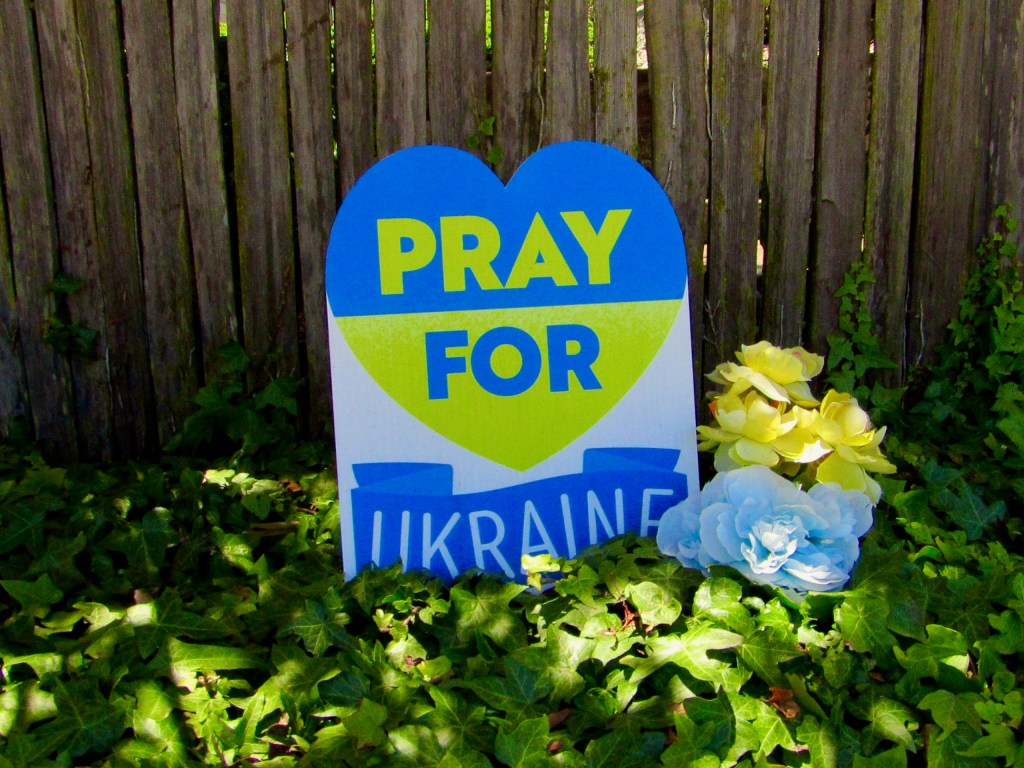
National Unity Day

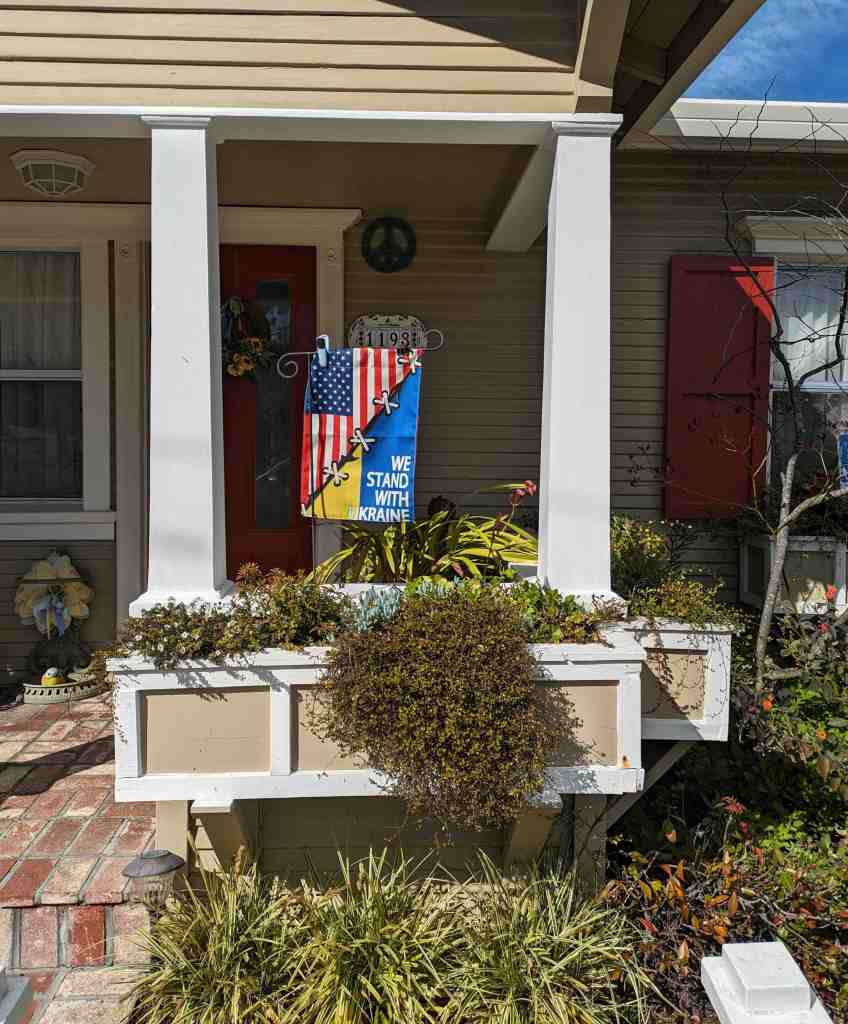
Monterey, California, 4 November 2024. Photo: The Russian Reader

I’m worried about the left’s demonization of America’s origins and the future of Western civilization, as many conservatives feel that the basic tenets of society as we’ve known it are under attack.

Source: Scott Jennings, “Opinion: Why I’m voting for Donald Trump,” Los Angeles Times, 1 November 2024


Carolina Performing Arts, “Omar the Opera: Behind the Scenes”

Rhiannon Giddens’ opera Omar was presented at Carolina Performing Arts in February 2023. In this video, take a deep dive into the opera’s creation and hear from cast members about their experiences. To learn more, visit: https://southernfuturescpa.org/projects/omar/ Omar was co-commissioned and co-produced by Spoleto Festival USA and Carolina Performing Arts at the University of North Carolina at Chapel Hill. Additional co-commissioners include LA Opera, Boston Lyric Opera, San Francisco Opera, and Lyric Opera of Chicago.

Source: Carolina Performing Arts (YouTube), 2 October 2023


“Video has come out from Bucks County, Pennsylvania showing a ballot counter destroying ballots for Donald Trump and keeping Kamala Harris’s ballots for counting,” an account called “Dan from Ohio” wrote in the comment section of the far-right website Gateway Pundit. “Why hasn’t this man been arrested?”

But Dan is not from Ohio, and the video he mentioned is fake. He is in fact one of hundreds of inauthentic accounts posting in the unmoderated spaces of right-wing news site comment sections as part of a Russian disinformation campaign. These accounts were discovered by researchers at media watchdog NewsGuard, who shared their findings with WIRED.

“NewsGuard identified 194 users that all target the same articles, push the same pro-Russian talking points and disinformation narratives, while masquerading as disgruntled Western citizens,” the report states. The researchers found these fake accounts posting comments in four pro-Trump US publications: the Gateway Pundit, the New York Post, Breitbart, and Fox News. They were also posting similar comments in the Daily Mail, a UK tabloid, and French website Le Figaro.

“FOX News Digital’s comment sections are monitored continuously in real time by the outside company OpenWeb which services multiple media organizations,” a spokesperson for the company tells WIRED. “Comments made by fake personas and professional trolls are removed as soon as issues are brought to our attention by both OpenWeb and the additional internal oversight mechanisms we have in place.”

Breitbart replied to WIRED’s request for comment in Russian: “Пожалуйста, скажите Newsguard, чтобы они пошли на хуй.” In English, this means “please tell Newsguard to go fuck themselves.”

The Gateway Pundit and the New York Post did not respond to a request for comment from WIRED.

“The actors behind this campaign appear to be exploiting a particularly vulnerable part of the media landscape,” McKenzie Sadeghi, the AI and foreign influence editor at NewsGuard, tells WIRED. “Comment sections designed to foster reader engagement lack robust security measures, allowing bad actors to post freely, change identities, and create the illusion of genuine grassroots campaigns rather than orchestrated propaganda.”

The disinformation narratives being pushed by these accounts are linked to Storm-1516, according to Newsguard. Storm-1516 is a Russian disinformation campaign with a history of posting fake videos to push Kremlin talking points to the West that was also connected to the release of deepfake video falsely claiming to show a whistlelbower making allegations of sexual assault against vice presidential candidate and Minnesota governor Tim Walz. (WIRED first reported that the Walz video was part of a campaign by Storm-1516. A day later, the US government confirmed WIRED’s reporting.)

Links to the video were posted by multiple accounts with names like “Disobedient Truth” and “Private Patriot” in the comment section of outlets like Breitbart and the Gateway Pundit.

“More bad news for the Dems: Breaking: Tim Walz’s former student, Matthew Metro, drops a shocking allegation- claims Walz s*xually assaulted him in 1997 while Walz was his teacher at Mankato West High School,” the comments read.

The links posted in the comments came hours before the video was shared on social media platforms like X, where it racked up millions of views.

After the Bucks County video went viral, researchers quickly traced it back to Storm 1516US intelligence agencies then confirmed Russia was behind the fake video.

Russian influence operations have, in the past, made use of comment sections to boost their narratives, including during their campaign to disrupt the 2016 elections. This is the first time this tactic has been reported as part of Russia’s efforts to disrupt the 2024 presidential election.

“Replying in threads is a tactic that can have an impact with very little investment,” Darren Linvill, codirector at Clemson University’s Media Forensics Hub, tells WIRED. “By inserting disinformation into an unrelated conversation it might be seen, even if the account being used has no followers and was just created yesterday. It also doesn’t matter if the account you are using is caught and shut down because you haven’t lost an investment, you can just create another account five minutes later.”

The fake comments, Newsguard found, are also then used in reports from Russian state-backed media outlets to bolster claims about how Western audiences are responding to a particular incident.

After the Trump assassination attempt in July, Tsargrad TV published an article titled “Biden’s Trace in Trump’s Assassination Attempt. Americans Agree with the Kremlin’s Version: ‘Russians Are Right.’” The article outlined how Americans believe that the Biden administration played a part in the shooting, citing “comments to articles in Western media” as evidence.

NewsGuard’s researchers identified 104 articles in Russian state media that cited comments from Western news outlets as evidence to back up their claims between January and August of this year.

“This tactic allows bad actors to reduce the risk of detection and embed propaganda in a subtle, seemingly organic way, blending it into the casual commentary of supposed everyday Western readers,” Sadeghi said. “The repetition of the same claim across multiple formats and contexts can create a sense of familiarity that may lend the narratives an appearance of credibility.”

The network of accounts has also been used to seed other narratives, including one earlier this month where dozens of comments in the New York Post and Breitbart claimed, without evidence, that Ukrainian president Volodmyr Zelensky had used Western military aid to purchase a car that once belonged to Adolf Hitler.

That claim has been spread by the network of inauthentic websites controlled by former Florida cop John Dougan, who now lives in Moscow and runs a network of pro-Kremlin websites. Dougan’s network of websites have previously shared disinformation narratives from Storm-1516.

Source: David Gilbert, “A Russian Disinfo Campaign Is Using Comment Sections to Seed Pro-Trump Conspiracy Theories,” Wired, 1 November 2024. The emphasis is mine. ||| TRR


Carolina Performing Arts, “Omar the Opera: A Scholar’s Perspective”

Learn about Rhiannon Giddens’s opera Omar from the perspective of North Carolina scholars.

Source: Carolina Performing Arts (YouTube), 8 April 2024


This very disturbing story about Russian grassroots lucre in wartime was published on the front page of yesterday’s print edition of the New York Times. I’m quoting it in full here for the benefit of non-subscribers.

On the other hand, as perhaps only I am in a position to know, there is something disturbing about how certain of the sources for this story boldly claim eyewitness-like knowledge of events in the Russians provinces which they couldn’t possibly have witnessed, while also cashing in on the chaos unleashed by Russia’s vicious war against Ukraine, only from the opposite side of the world.

I’m also troubled that PS Lab, which was founded long before the war, is portrayed here as an outgrowth and brainchild of those selfsame academic entrepreneurs at George Washington University. ||| TRR


Expensive new cars and motorcycles crowd the streets. Apartment prices have more than doubled. And once-strapped residents are suddenly seen wearing fur coats and carrying ostentatiously overflowing grocery bags.

That is how one resident of a small, long-impoverished industrial city in Siberia describes her hometown these days. The explanation for the burst in prosperity lies in the isolated cemetery, with rows of Russian flags marking the new graves of soldiers killed in Ukraine, and also downtown, where a billboard lists the scores of local men who went to fight.

“I was stunned by how many,” said the resident, the wife of a middle-aged firefighter who enlisted last summer without telling her beforehand. “Money from the war has clearly affected our city.”

The Kremlin has been showering cash on men who enlist. It wants to avoid an unpopular draft, while also addressing the lack of men with sufficient patriotic zeal to join up. There are large signing bonuses, fat monthly salaries and what Russians call “coffin money,” a substantial payment to the families of the tens of thousands of soldiers killed in battle.

The money is changing the face of countless Russian backwaters like the Siberian city. “The allure of extremely high salaries and other benefits has been a major factor in attracting voluntary recruits, especially from relatively poor regions,” said a report issued this year by the Bank of Finland’s Institute for Emerging Economies.

By improving the standard of living among Russia’s poor, the payments have spurred support for President Vladimir V. Putin and the war, researchers noted, while also changing the perception of fighters from patriots to “soldiers of fortune.”

The names and hometowns of the people living inside Russia who agreed to discuss these war payments are not being published to avoid possible legal problems for speaking publicly about the conflict.

Russia has stopped publishing various economic statistics, leaving only a patchwork of indicators about the effects of the war payments. Some studies have documented the influx, however.

For example, the Bank of Finland researchers found that the number of bank accounts in Russia’s poorer areas surged over the past year. Nationwide data was too uneven to establish a concrete correlation with signing bonuses and enlistment data, the study said, but general estimates of casualties by region coincided with the areas experiencing high growth in bank depositors.

Also, in recent months, recruitment posters across Russia changed noticeably, replacing patriotic themes with financial offers. State TV and advertisements on social media carried the same messages.

“Pride of Russia,” some ads used to say, naming the soldier pictured, or “Homeland Begins with Family,” showing a soldier silhouetted with a mother and child. There were comparisons to heroic feats during The Great Patriotic War, as World War II is known in Russia.

Now, a ruble sign dominates the posters, which display the large sums on offer for signing a military contract. Payments vary by region.

“The people who wanted to join out of patriotic sentiment have mostly already been recruited and died or were wounded,” said Oleg Jouravlev, one of the founders of PS Lab, a group of mainly sociologists organized under the Russia Program at George Washington University to study attitudes toward the war. “There are not many like that left in Russia.”

On July 31, Mr. Putin issued a decree more than doubling the contract signing bonus from the federal government to 400,000 rubles, or more than $4,000, from 195,000 rubles. At least 47 regional governments followed suit after he encouraged them to match the reward, according to a survey by the independent media outlet iStories, with the average signing bonus nationwide quadrupling in the past eight months.

U.S. officials estimate that Russia is recruiting 25,000 to 30,000 new soldiers a month, roughly equal to the number of dead and wounded. As soon as local governments see interest lagging, they jack up the financial incentives, experts say.

This past month, the frontline Belgorod region broke all records with a signing bonus amounting to more than $30,000, well above the previous leader, Moscow, at about $20,000. The lowest bonuses are around $500.

The larger sums constitute a small fortune in many of the less developed towns and villages of Russia — where the average salary is a few hundred dollars per month — especially when combined with a frontline fighter’s monthly salary starting at 210,000 rubles, or about $2,100.

A study of the payments for Re: Russia, an online platform for political and economic analysis, found that the signing bonus equals roughly the average annual per capita income in Russia, and the monthly salary is three times the average wage. Rural wages are significantly lower than those in big cities.

“The money is a social elevator for those who went to war,” said Ayan, a resident of Buryatia, a Siberian region with a considerable proportion of people living below the poverty line and high levels of personal debt.

Coffin money payments amount to almost $150,000 per family, enough to buy an apartment in all but the most expensive Russian cities. While an apartment is often the main goal, recipients say they buy all kinds of things, including new teeth, breast implants and vacations.

The war payments are especially attractive to impoverished, middle-aged men who see them as their last chance to escape a lifetime of debt, said Ivan Grek, the director of the Russian Program at George Washington University. Beyond that, people getting the money are eating in restaurants, and buying cars, electronics, clothes and property.

Government statistics from early 2024 show a 74 percent growth in ordinary Russians across the country purchasing cars compared with the same time period last year, Mr. Grek noted, while those paying off consumer debts jumped to 21 percent, up from about 9 percent before the war.

“There is the spirit of a party out there,” he said, even if the source of the money limits the euphoria. His program recently sent three researchers to live for a month in small Russian communities to gauge perceptions of the war. “Now they have a car, they can drink and eat, it is a whole new life for them,” he said.

Artem, a soldier who fled Russia, estimated that 60 percent of the men in his unit signed up because they had unpaid loans. “Almost all of them had problems with alcohol and debt,” he said.

Some experts question whether the spiraling payouts are sustainable and expect that the draw, like patriotism, will eventually fade. Overall, war payments to Russian soldiers — whether for signing, injury or death — will amount to at least 7.5 percent of federal spending for the year, according to Re: Russia.

The sister of a dead officer from Makhachkala said that while he was alive he kept telling her that the death payment would take care of her, their mother and his daughter: “‘Buy an apartment,’ he said, and I told him, ‘You are a moron! Don’t even say such things.’”

Despite the shattering grief after his death, the sister said, the money makes it feel as if her brother is watching over them posthumously. “He did everything he wanted for us,” she said.

The money often has a trickledown effect. A resident of North Ossetia said that a couple of years ago his local plumber had applied to emigrate due to the lack of work. But recently, he said, the plumber told him, “I’ve never had so much work in my life,” with war widows buying new apartments or refurbishing old ones.

The firefighter from Siberia, aged 46, had gone heavily into debt over failed foreign exchange trades, according to his son. After losing several fingers in an industrial accident, he had burned through a $25,000 settlement and a considerable chunk of his disability pension. The father sold the family car to raise money, but ultimately the man filed for bankruptcy before enlisting.

A few days after the first interview for this article, the firefighter’s wife, who had not heard from him in a month, received a military report saying that he had been shot in the chest and killed on July 30, just four days after he deployed in Ukraine. Two younger soldiers trying to rescue him also died, but no bodies have been recovered.

“You are signing your death warrant,” his son said of his father’s decision to enlist. “It was a foolish decision to abandon my mother and my sister and cause everyone so much pain. Money is irrelevant in this situation.”

Source: Neil MacFarquhar and Milena Mazaeva, “Russia Showers Cash on Men Enlisting in Ukraine War, Bringing Prosperity to Some Towns,” New York Times, 2 November 2024. The emphasis is mine. ||| TRR


News from Ukraine Bulletin no. 120 (4 November 2024)

DOWNLOAD THE BULLETIN AS A PDF HERE

In this week’s bulletin: An Arab-Ukrainian perspective/ A Lithuanian view on Russian aggression/Evidence of Russian war crimes/ persecution of Crimean Tatars/ forced abductionsmiscarriages of justiceCultural genocide in Kharkiv/ UN report on torture as a war crime.

News from the territories occupied by Russia:  

Reporters without Borders demand Russia ends torment of Crimean Tatar journalist sentenced to 14 years for defending human rights (Kharkiv Human Rights Protection Group, 1 November)

Russian FSB abduct Ukrainian from her mother’s funeral in occupied Crimea (Kharkiv Human Rights Protection Group, 31 October)

Ukrainian POW sentenced to 18 years as Russia mass produces legally nonsensical ‘terrorism trials’ (Kharkiv Human Rights Protection Group, 30 October)

Horrific sentences where any Ukrainian will do in Russian-occupied Crimea (Kharkiv Human Rights Protection Group, 29 October)

Russia secretly buries the bodies of the Ukrainian teenagers it murdered in occupied Berdiansk (Kharkiv Human Rights Protection Group, 28 October)

The situation at the front:

Russia deploys 7,000 North Korean soldiers to areas bordering Ukraine (Ukrainska Pravda, 2 November)

Russia’s cultural genocide in Kharkiv (Ukraine Solidarity Campaign, 29 October)

News from Ukraine – general: 

Over 1,700 children missing due to war in Ukraine – Interior Ministry (Ukrainska Pravda, 29 October)

ZMINA took part in the presentation of the Shadow Report to the European Commission’s report on Ukraine (Zmina, October 29th)

Humanitarian deminers’ union join independent union confederation (Confederation of Free Trade Unions, 28 October)

Absence of extrajudicial procedure hinders access to Ukrainian documents for TOT residents – Alena Lunova (Zmina, 26 October)

Ukraine: Love+War, a Review (Turning Point, 16 October)

War-related news from Russia:

Verkhneuralsk political prison (Solidarity Zone, 2 November)

“For 72 days I was electrocuted, beaten, not allowed to eat or sleep”: how Russian convicts are driven to “meat-grinder assaults” (The Insider, 31 October)

The story of Roman Nasryev and Alexei Nuriev (Solidarity Zone, 31 October)

Special Demographic Operation: how Russian authorities are restricting women’s reproductive rights (Posle.Media, 30 October)

“Human safaris” and havoc on the “home front”: How Russian soldiers kill Ukrainian civilians, fellow Russians — and even each other (The Insider, 30 October)

Analysis and comment:

Serhii Guz: civil society and labour in Ukraine in the third winter of all-out war (Ukraine Information Group, 3 November)

Hanna Perekhoda: ‘Russian political elites are openly promoting a global project’ (Links, 1 November)

In the Shadow of Empires: From a ‘Hezbollah Stronghold’ to ‘Denazified’ Ukraine, the Experience of an Arab-Ukrainian (Turning Point, 30 October)

New Law Raises Religious Freedom Concerns (Human Rights Watch, 30 October)

Lithuania: ‘for us, the fear of being occupied is more real’ (People & Nature, 29 October)

Research of human rights abuses:

Finland to try Russian neo-Nazi Rusich mercenary for war crimes in Ukraine (Kharkiv Human Rights Protection Group, 1 November)

Torture by Russian authorities amounts to crimes against humanity, says UN Commission of Inquiry (UNHCR, 29 October)

Ukrainian POWs tortured for ‘confessions’ to Russia’s war crimes and for show trials (Kharkiv Human Rights Protection Group, October 28th)

International solidarity:

We have completed fundraisers for €7680 (Solidarity Zone, 2 November)

Fundraiser for scary drones (Solidarity Collectives, 30 October)

Upcoming events:

Thursday, 7 November, 19.00. On Zoom. Emergency Forum on the US presidential election with Tanya Vyhovsky (Vermont State Senator), Bohdan Ferens (SD Platform Ukraine) and Alex Sobel MP. Ukraine Solidarity Campaign.Information and registration here.

Monday, 18 November, 18.00. “Political prisoners in Russia and the Occupied Territories of Ukraine”.  Panel discussion with speakers from Memorial, Kharkhiv Human Rights Protection Group and others. Queen Mary University, London, Centre for Eurasian, Russian and East European Studies. This is a hybrid event with in-person and on-line attendance. Register on eventbrite here


This bulletin is put together by labour movement activists in solidarity with Ukrainian resistance. To receive it by email each Monday, email us at 2022ukrainesolidarity@gmail.com. To stop the bulletin, reply with the word “STOP” in the subject field. More information at https://ukraine-solidarity.org/. We are also on XFacebook and Substack, and the bulletin is stored online here.

Source: Ukraine Information Group


John Oliver’s compelling but soberly made case for voting for Kamala Harris was pointed out to me by my fellow exile from fascist Russia, Mark Teeter. ||| TRR


Expo of war materiel captured in SMO opens in Petersburg on National Unity Day; visitors handed volunteer army service recruiting brochures

Visitors to the Russia Is My History Park were shown equipment from the Kharkiv and Sumy fronts, including an American Abrams tank and a Bradley IFV. The city hall media outlet Petersburg Diary reports that the exhibition was organized at the behest of Governor Alexander Beglov.

Beglov himself attended the opening. In his speech, Beglov said that, in the SMO [special military operation], the enemy’s vehicles “burn just like they burned during the Great Patriotic War.”

“Only three of the twenty-two ‘death machines’ [on display] are Ukrainian-made. All the rest were made in America, Canada, Europe and even by our neighbors in Finland, who basically have always lived at our expense,” Fontanka quotes the head of the city as saying.

Fontanka reports that there were so many visitors in the park that it was difficult to get close to the [captured] equipment. Those who came to the expo were handed propaganda booklets about volunteering for the army. Volunteers who are sent to the SMO zone are now promised 2.1 million rubles [approx. 19,500 euros] in a lump sum and 210 thousand rubles [approx. 1,950 euros] monthly.

Source: Rotunda (Telegram), 4 November 2024. Translated by the Russian Reader. The emphasis, above, is Rotunda’s.

News from Ukraine Bulletin 112

Monterey, California, 5 September 2024. Photo by the Russian Reader

In this week’s bulletin: Kursk offensive as seen by Ukrainian servicemen; plus “occupied education” in Kherson and secret Ukrainian schools in occupied territories; plus Basurka (comments by Russians on the war); plus more evidence of Russian war crimes

News from the territories occupied by Russia:  

Telegram’s muddy money (iStories, 6 September)

Russia fabricates insane charges against Ukrainian partisan first seized in Donetsk 8 years ago (Kharkiv Human Rights Protection Group, September 5th)

“It’s getting harder to hide.” Children living under Russian occupation secretly attend Ukrainian schools (Meduza/iStories, 5 September)

Occupied education. How Russia distorts the minds of Ukrainian children in Kherson (Ukrainska Pravda, 4 September)

Russian propagandist and soldiers openly boast of looting homes in occupied Ukraine (Kharkiv Human Rights Protection Group, September 3rd)

Rustem Osmanov: unlawful, barbaric detention conditions (Crimea Human Rights Group, 2 September)

Russian FSB come for 70-year-old mother of imprisoned Crimean Tatar civic journalist Seiran Saliyev (Kharkiv Human Rights Protection Group, September 2nd)

Court in Russia rules that 20-year sentence against Ukrainian POW for defending Mariupol is not long enough (Kharkiv Human Rights Protection Group, September 2nd)

News from the front:

“We will meet the most resistance in Kursk.” The Kursk offensive through the eyes of three Ukrainian servicemen (Ukrainska Pravda, August 27th)

Ukraine’s Kursk offensive blitzed Russia with electronic warfare and drones (Forbes, 9 August)     

News from Ukraine – general:  

What draft laws for the protection of war victims should be adopted during the new session of the Verkhovna Rada – road map (Zmina, September 3rd)

The team of the film “Songs of Slow Burning Earth” organized an event at the Venice Film Festival to support Ukrainians in captivity (Center for Civil Liberties, September 6th)

“Degradation. Torture. Degradation”. A poetical video project in Kyiv talks about Russian captivity (Center for Civil Liberties, September 3rd)

Our friend Taras Bilous has been awarded the Daniel Singer Prize (Solidarity Collectives, September 3rd)

The historical branch of the Russian Orthodox Church in Ukraine on the path to be banned (European Times, August 25th)

War-related news from Russia:

Rouslan Sidiki talks about his torture (Solidarity Zone, 6 September)

“I wanted to fight this horror.” The growing number of Russian teenagers going to prison on sabotage charges (Meduza, 6 September)

Kaliningrad: the situation before the elections (Posle.Media, 6 September)

Sasha Skochilenko: I just happened to be the winner of the ‘Hunger Games’ (The Art Newspaper, September  4th)

Basurka (some comments by Russians on the war) (The Russian Reader, 4 September)

Fundraiser for parcels – supporting prisoners in Russia who took direct action against the war (Solidarity Zone, 3 September)

Research of human rights abuses:

Savage torture and 11-year sentence for opposing Russia’s occupation of Kherson (Kharkiv Human Rights Protection Group, September 6th)

Cultural genocide is hard to prove, says US professor (Tribunal for Putin, September 6th)

Ukraine lodges war crimes probe after Russians shoot unarmed Ukrainian POWs in the back (Kharkiv Human Rights Protection Group, September 4th)

International solidarity:

On 7 September, our banner, “From Ukraine to Palestine, occupation is a crime”, was on the national march for a ceasefire in Gaza, carried by supporters of the Ukraine Information Group and Unite the Struggles (Ukraine Information Group, 8 September).  

Source: Facebook

This bulletin is put together by labour movement activists in solidarity with Ukrainian resistance. To receive it by email each Monday, email us at 2022ukrainesolidarity@gmail.com. To stop the bulletin, reply with the word “STOP” in the subject field. 

More information at https://ukraine-solidarity.org/. We are also on XFacebook and Substack, and the bulletin is stored online here

News from Ukraine Bulletin 101

Monterey, California, 7 June 2024. Photo by the Russian Reader

In this week’s bulletin: Ukraine and Palestine – Public discussion meeting on 11 Juneplus Life Under Occupation report; plus Russian assault on power stationsplus how Swiss peace summit could hurt Ukraine; discussion on Ukrainian punishment of ‘collaborators’plus Solidarity Zone’s support for Russian anti-war protesters.

News from the territories occupied by Russia:  

Kupiansk mayor who betrayed Ukraine injured in assassination attempt (Ukrainska Pravda, 8 June)

In occupied areas, Ukrainians refuse to give up their language (Kharkiv Human Rights Protection Group, 7 June)

Fake ‘trial’ incriminates Russia in abduction and torture of Ukrainian patriot Serhiy Kuris (Kharkiv Human Rights Protection Group, 7 June)

Crimean students’ grades lowered for not writing ‘thank you letters’ to Russian soldiers (Kharkiv Human Rights Protection Group, 4 June)

Occupied territories: Russian citizenship and propaganda (Zmina, 5 June)

‘Hero of Russia’ status for war crimes against Ukrainian civilians in Yahidne and Mariupol (Kharkiv Human Rights Protection Group, 3 June)

Life Under Occupation report (Alternative Human Rights Centre, May 2024)

The situation at the front:  

Weekly Ukraine war summary (The Insider, 8 June)

Overview from the front: Holding out for reinforcements (Meduza, 4 June)

Russian soldiers post video showing mock execution and other torment of Ukrainian PoWs (Kharkiv Human Rights Protection Group, 4 June)

News from Ukraine – general: 

Ukraine recovery could be a lifeline for children (Human Rights Watch, 7 June)

Human rights in Ukraine: punishment of businesses working under occupation: discussion (Zmina, 5 June)

Marianna Checheliuk emaciated and frail, but back in Ukraine after two years of torture in Russian captivity (Kharkiv Human Rights Protection Group, 3 June)

War-related news from Russia:

Support the fundraiser for Ilya Baburin (Solidarity Zone, 7 June)

To Not Die as Slaves: Solidarity Zone’s Mission to Aid Russia’s Radical Anti-War Protesters (The Russian Reader, 2 June)

Analysis and comment:

Oil finances Putin’s war and Trump’s political ambitions (Svitlana Romanko and Oleh Savitsky, Euromaidan press, 8 June)

Georgia: Resisting authoritarianism (Posle Media, 6 June)

Swiss peace summit could end up harming Ukraine (Ukrainska Pravda, 5 June)

Power station bombing redoubles pressure on Ukraine (Foreign Policy in Focus, 5 June)

International solidarity:

Thanks from the front line for a car (Mick Antoniw, twitter, 8 June)

UK General Election 2024: help Ukraine win (Ukraine Solidarity Campaign, 31 May)

Upcoming solidarity events:

Tuesday 11 June, 7.0pm: Discussion meeting: “From Ukraine to Palestine, occupation is a crime” – Tuesday 11 June, 7.00 pm. Marchmont Community Centre, 62 Marchmont Street, London WC1N 1AB, and on line. Register to attend on eventbrite here or register to participate on line here. Organised by the Ukraine Information Group.

This bulletin is put together by labour movement activists in solidarity with Ukrainian resistance. Please subscribe and tell friends. If people email us at 2022ukrainesolidarity@gmail.com, we’ll send them the bulletin direct every Monday. More information at https://ukraine-solidarity.org/We are also on twitterFacebook and Substackand the bulletin is stored on line here. To stop the bulletin, reply with the word “STOP” in the subject field. 

Time of Heroes

In his state of the nation speech, President Vladimir Putin announced the launch of the national project “Time of Heroes” for veterans and current participants of the special operation by Russian troops in Ukraine.

Статья на медиа «Просто работа»
Photo: Pixabay courtesy of Rabota.ru

Servicemen with university degrees, managerial experience, and no criminal records can apply to the personnel program. The head of state called such people the country’s “true elite” and argued that they should “lead regions, enterprises, and the largest public projects.”

The program will kick off on March 1. Veterans will be trained per the standards of the School of Governors and the Leaders of Russia competition, and ministers and heads of enterprises will act as their mentors.

Currently, all participants of the special military operation also enjoy priority hiring, and their employers also receive benefits.

Source: Andrei Gorelikov, “SMO veterans will participate in the Time of Heroes’ personnel programme: According to the President, they should take up ‘elite’ positions,” Just Work (Rabota.ru), 29 February 2024. Translated by the Russian Reader


News from the territories occupied by Russia:  

Ukrainian journalist and former editor abducted from Russian-occupied Henichesk  (Kharkiv Human Rights Protection GroupMarch 8th)

Russia sentences Ukrainian marine to 20 years for defending Mariupol  (Kharkiv Human Rights Protection GroupMarch 8th)

‘It wasn’t like this before Russia came’ The state of healthcare in Ukraine’s occupied territories after two years of war (Meduza, March 7th)

‘When I was evacuated, I only had a pair of trousers, shoes, a jacket and my documents’ (Kharkiv Human Rights Protection GroupMarch 6th)

Another wave of searches and detentions of Crimean Tatars (Crimea SOS and others, 6 March)

Crimean Solidarity journalist and activists arrested, their families terrorized, in new Russian offensive against Crimean Tatars  (Kharkiv Human Rights Protection GroupMarch 6th)

Ominous denials a month after Crimean Tatar father abducted by Russian FSB  (Kharkiv Human Rights Protection GroupMarch 6th)

Russia’s abuses against civilians in the occupied territories of Ukraine: event during the UN Human Rights Council  (ZminaMarch 6th)

Absence of law and international control (Kharkiv Human Rights Protection GroupMarch 6th)

UN records 104 cases of pro-Ukrainian Crimeans abducted in past 10 years  (Ukrainska Pravda, March 5th)

Reshat Ametov and 10 years of Russia’s systematic torture, abductions and killings of civilians for supporting Ukraine  (Kharkiv Human Rights Protection GroupMarch 4th)

Russia passes huge conveyor belt sentences against Ukrainians tortured for propaganda videos (Kharkiv Human Rights Protection GroupMarch 4th)

All’s fair in art and war: Russia’s plunder of Ukrainian museums (The Insider, February 29th)

Source: News from Ukraine Bulletin no. 88, 11 March 2024

News from Ukraine Bulletin 84

Monterey, California, 13 February 2024. Photo by the Russian Reader

News from Ukraine Bulletin 84 (12 February 2024)

A Digest of News from Ukrainian sources

In this week’s bulletin: War, fascisisation and resistance in Russia; two years of war by a Ukrainian feminist; more evidence of Russian torture and secret trials and theft of property.

News from the territories occupied by Russia:  

Russian FSB tortures three Ukrainians for ‘saboteur plot’ arrests in occupied Crimea  (Kharkiv Human Rights Protection Group, February 9th)

Russian propaganda turns the elimination of its officials in occupied Lysychansk into ‘a monstrous attack on a bakery’  (Kharkiv Human Rights Protection Group, February 9th)

‘I live in a modular town and weave nets,’ — a resident of Borodianka (Kharkiv Human Rights Protection Group, February 8th)

Huge mass ‘sentences’ after fake trial of Ukrainian POWs whom Russia accused of its own war crimes (Kharkiv Human Rights Protection Group, February 8th)

Seven years of hell for supporting Ukraine in Russian-controlled ‘Donetsk republic’ (Kharkiv Human Rights Protection Group, February 6th)

Russians plan to teach schoolchildren in temporarily occupied territories to assemble UAVs (Ukrainska Pravda, February 5th)

‘I realised that it’s a kilometre to run through unexploded shells to get to the well…’ — Chronicles of occupied Izium  (Kharkiv Human Rights Protection Group, February 5th)

Russian invaders move to strip Ukrainians forced to flee occupied Berdiansk of their homes (Kharkiv Human Rights Protection Group, February 6th)

Russia has turned Crimea into a huge prison for political prisoners and hostages from Kherson and Zaporizhzhia oblasts  (Kharkiv Human Rights Protection Group, February 5th)

News from Ukraine – general:  

To the President of Ukraine V.O. Zelenskyi, about the change of army command (Kharkiv Human Rights Protection Group, February 9th)

Beyond Greener Grass: Strategies Towards Ukrainian Transnational Cultural Reconstruction  (Cedos, February 9th)

Our people are at home: 207 Ukrainians were returned from captivity (Kharkiv Human Rights Protection Group, February 6th)

The Housing Leadership Lab  (Cedos, February 6th)

“Ukraine is a left-wing, anti-authoritarian project”  (Ukraine Solidarity EU, February 4th)

“Tensions are building in Ukrainian society as a result of neoliberal policies imposed by the government”   (Ukraine Solidarity EU, February 3rd)

2 years of war, a Ukrainian feminist point of view  (Ukraine Solidarity EU, February 1st)

Analysis and comment:

Suspicious secrecy over crash of military transport plane which Russia claims was carrying Ukrainian POWs  (Kharkiv Human Rights Protection Group, February 7th)

Ukrainian Parliament should become more open to the media and the public  (Zmina, February 6th)

International Court of Justice rules that Russia must answer over Ukraine’s Genocide case (Kharkiv Human Rights Protection Group, February 5th)

War, fascization, and resistance: Perspectives on Russian imperialism (Links, January 23rd)

Research of human rights abuses:

Lisne from the air: damage and destruction (Tribunal for Putin, February 9th)

The Butchers of Vovchansk: Suspects named  (Kharkiv Human Rights Protection Group, February 8th)

“Before sharing your own story, it is crucial to hear first the story of those with whom you are talking” — Oleksandra Romantsova (Centre for Civil Liberties, February 8th)

Justice for War Crimes  (Ukraine Solidarity Campaign, February 7th)

War-related news from Russia:

(Hopeless) Nadezhdin. The Kremlin did not allow a loyal “oppositional” and Ukrainophobic candidate to participate in the election  (Opora, February 9th)

Russian election: “Nothing happens in social life without human effort” (Posle Media, 7 February)

Campaign for political prisoner Azat Miftakhov (January 29th)

Upcoming solidarity actions in the UK:

The future of Ukraine.  Thursday 15 February, 2024, 18:30 – 20:00 Location: Europe House, 32 Smith Square, London. 

Saturday 24 February, 2pm. Two years resisting Russia’s invasion. Assemble Marble Arch and march to Trafalgar Square. Called by Support Ukraine / London Euromaidan, supported by Ukraine Solidarity Campaign.

Saturday 24 February, 4.0pm UK time. An online “assembly against the war and its logic”. Organised by Permanent Assembly Against the War.

Thursday 7 March – Evening –  Fundraiser Showing of 20 Days in Mariupol – for medical aid appeal for at Novovlynysnk Central Hospital at The Garden Cinema, London.

==

We are now on Facebook and Substack! Please subscribe and tell friends. Better still, people can email us at 2022ukrainesolidarity@gmail.com, and we’ll send them the bulletin direct every Monday. The full-scale Russian assault on Ukraine is going into its third year: we’ll keep information and analysis coming, for as long as it takes.

This bulletin is put together by labour movement activists in solidarity with Ukrainian resistance. More information at https://ukraine-solidarity.org/. We are also on twitter, and the bulletin is also stored on line here.

News from Ukraine Bulletin 70

Pacific Grove, California, 2 July 2023. Photo by the Russian Reader

News from Ukraine Bulletin 70 (30 October 2023)

A Digest of News from Ukrainian sources

In this week’s bulletin: More evidence of Russian torture; plus UN documentation of Russian rape, torture, indiscriminate bombing of civilians and other war crimes. And much more

News from the territories occupied by Russia:  

Russia drops all pretence in ‘trial’ of Ukrainian hostages imprisoned since 2018 in occupied Donbas  (Kharkiv Human Rights Protection Group, October 27th)

Massive increase in Russian spending on its war against Ukraine and indoctrination on occupied territory  (Kharkiv Human Rights Protection Group, October 27th)

Russia stages new ‘trial’ to increase sentence against 64-year-old Ukrainian imprisoned for affirming that Crimea is Ukraine (Kharkiv Human Rights Protection Group, October 26th)

Zaporizhzhia nuclear plant engineer held and tortured by Russian invaders for over a year  (Kharkiv Human Rights Protection Group,October 25th)

Fake ‘secret witness’ exposed in Russia’s politically timed persecution of Crimean Solidarity journalist and other Crimean Tatars  (Kharkiv Human Rights Protection Group, October 24th)

‘More than 20 bullets were fired into my car’ (Kharkiv Human Rights Protection Group, October 23)

Russia stages illegal raids against Ukrainians as supposed ‘foreigners’ in occupied Ukraine (Kharkiv Human Rights Protection Group,October 24th)

Crimean artist Bohdan Ziza’s 15-year ‘terrorism’ sentence for opposing Russia’s war against Ukraine (Kharkiv Human Rights Protection Group, October 23rd)

News from Ukraine – general:  

Miners’ solidarity mission – Confederation of Free Trade Unions of Ukraine 26 October

Ukraine’s desperate search for war funding hits local budgets (Open Democracy, October 26th)

At least 508 Ukrainian children killed by Russia (Ukrainska Pravda, October 23rd)

Analysis and comment: 

How the Karabakh conflict might impact Moldova, Georgia, Ukraine – The Insider, 18 October

Research of human rights abuses: 

‘I see no path to reconciliation until evil is called evil’  (Kharkiv Human Rights Protection Group, October 27th)

As long as there is any hope, we should look for missing persons  (Tribunal for Putin, October 27th)

The destruction of Cherkaski Tyshky viewed from the air (Tribunal for Putin, October 26th)

Dreams turned to ashes  (Kharkiv Human Rights Protection Group, October 26th)

Life is like a horror movie (Kharkiv Human Rights Protection Group, October 25th)

‘A whole family died in a neighbouring house’ — resident of Sievierodonetsk  (Tribunal for Putin, October 25th)

Center for Civil Liberties took part in the conference “Justice and Accountability – New Ways of Thinking”, dedicated to war crimes in Ukraine and Syria  (Centre for Civil Liberties, October 24th)

‘We were bombed every day’  (Kharkiv Human Rights Protection Group, October 24th)

UN documents Russian rape, torture, indiscriminate bombing of civilians and other war crimes in Ukraine  (Kharkiv Human Rights Protection Group, October 23rd)

ZMINA discusses rescue of Crimean political prisoners in Brussels (Zmina, October20th)

How migration was affected by Russia’s targeted shelling of Kyiv in May 2023 – Opora, 17 October

War-related news from Russia and Belarus:

How residents of southern Siberia show support for a war thousands of miles away – Meduza, 26 October 

International solidarity: upcoming events

Commons Conference – Dialogues of the Peripheries – November 4th-5th

Eating in crisis: food sovereignty, war and environment – November 4th, 10.00. Registration here 

International (in)security: building solidarity in a rupturing world? – November 4th, 13.00. Registration here 

Women during the war: between defense of the country and lack of social security – November 4th, 16.00. Registration here.  

Labour rights in conditions of war and mass migration: how to work under attack?  November 5th, 10.00. Registration here.  

Approved or refused: how the international refugee system has to work? – November 5th, 13.00. Registration here.  

Authoritarian regimes and imperialist aggression – November 5th. Registration here.  

Ukrainian Feminist Kitchen #4

October 30th at 18.00. REGISTRATION HERE 

Art show fundraiser for Ukraine

29th October – 10th November. Details here.

From Ukraine to Palestine, Occupation is a Crime

2nd November, 18.00.  Sponsored by the Ukraine Solidarity Network. Details here.

==

This bulletin is put together by labour movement activists in solidarity with Ukrainian resistance. More information at https://ukraine-solidarity.org/. We are also on Twitter. We aim to circulate information in English that to the best of our knowledge is reliable. Send items for inclusion to 2022ukrainesolidarity@gmail.com. The bulletin is also stored online here

To receive the bulletin regularly, send your email to 2022ukrainesolidarity@gmail.com. To stop it, please reply with the word “STOP” in the subject field.  

Elections Wrap-Up

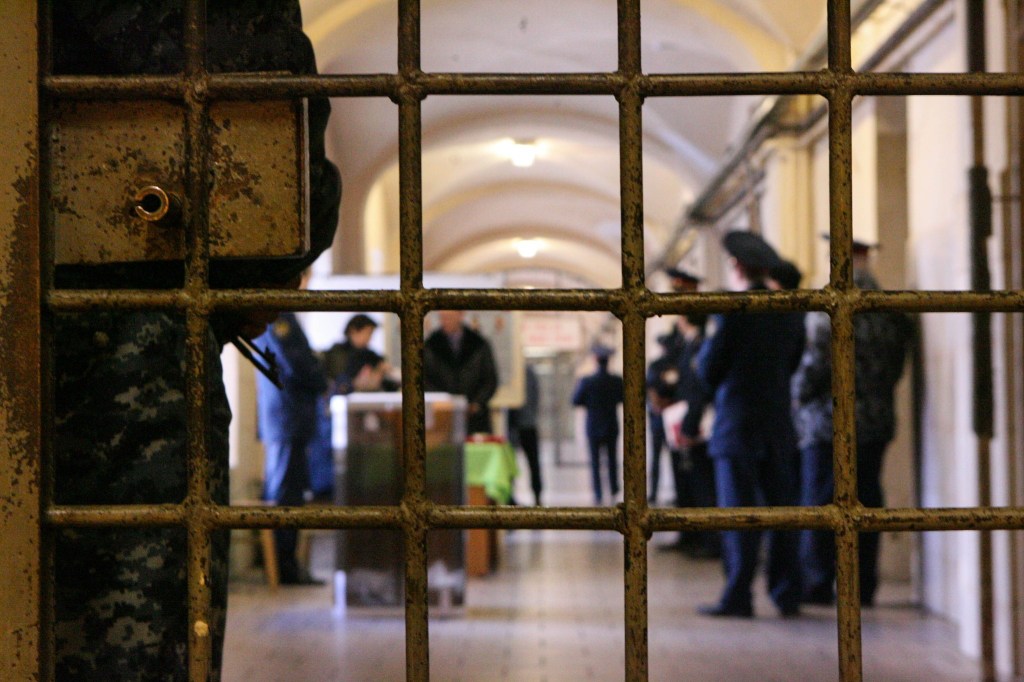
Photo by Alexandra Astakhova

Voting in prison is not a bad form of entertainment. Dozens of prisoners are escorted to the ballot boxes simultaneously, providing a rare opportunity to chat and exchange news with your neighbors.

We were assembled in the “gully” and launched in pairs into a room equipped for a polling station. The convicts had fun arguing who to vote for. Mostly, of course, there were juicy quotes from Leningrad’s song about elections….

“Elections! Elections! The Candidates Are Buggers!” The song, written by Alexei Kortnev for the theater production Election Day (2003), was performed in the eponymous film (2007) by Sergei Shnurov and Leningrad

With a clear conscience, I wrote “FOR RUSSIA WITHOUT PUTIN” on my ballot paper. After that, I conducted a spontaneous exit poll at the prison polling station, thanks to which it transpired that most of the inmates had voted for anyone, just not for [ruling party] United Russia. Only one of them admitted that he had ticked the box for [incumbent Moscow mayor Sergei] Sobyanin. The guy, however, is a United Russia activist himself: he embezzled a factory and is now serving a sentence for fraud. So it all makes sense.

And I also saw and hugged Sergei Klokov (Vedel) for the first time in several months. For a year and a half, the man has been doing time for a telephone conversation with relatives, bugged by the security services, during which the murders in Bucha were discussed. He looks tired and misses his family, including his two young children. But he is slightly encouraged by the news that Ukraine is willing to exchange its collaborators for Russian political prisoners. I hope Sergei will be released soon. He’s a good guy.

Source: Ilya Yashin (Facebook), 11 September 2023. Translated by the Russian Reader


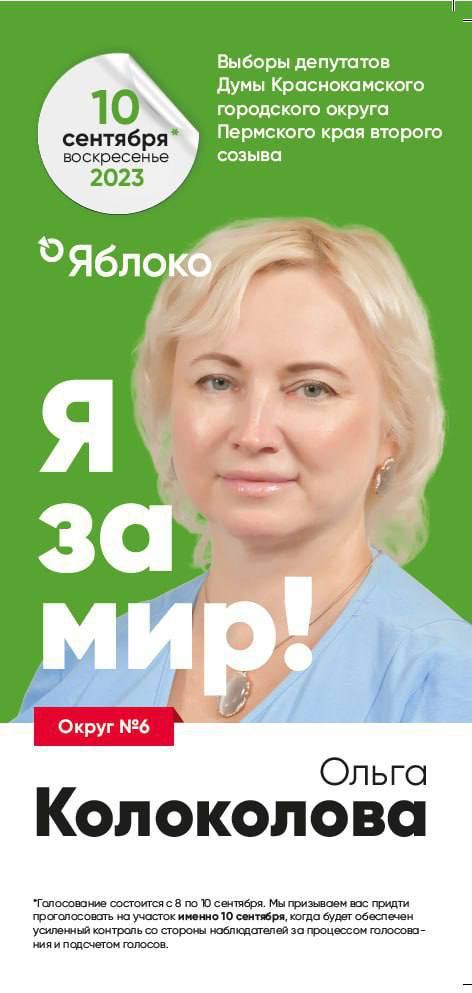
Olga Kolokolova’s campaign poster in the 10 September 2023 elections in Krasnokamensk (Perm Territory): “I’m for peace!” Image courtesy of Igor Averkiev

Olga Kolokolova, the head of the Perm regional branch of the Yabloko Party for many years, won the elections to the City Duma in Krasnokamsk (a satellite city of Perm). Moreover, she won running on the slogan “I’m for peace!”

Having received 55.2% of the votes cast, Olga Arkadyevna was returned to the Krasnokamsk City Duma, of which she was a deputy from 2005 to 2018.

Kolokolova is a veteran of the Perm loyal democratic opposition. (I say this without the slightest hint of judgment: the loyal opposition has its own positive mission, especially during periods when the regime relaxes the rules.) She is one of the most well-known politicians in Krasnokamsk, and the most consistent and most well-known Yabloko Party activist in the region.

Despite her status as a member of the loyal opposition, the election of Olga Kolokolova as a deputy in our time, and running on such a slogan, is really an unusual event, a kind of relic or vestige of the Putin regime’s bygone hybridity. In any case, it is impossible not to be happy for Olga Arkadyevna.

Source: Igor Averkiev (Facebook), 11 September 2023. Translated by the Russian Reader


A screenshot of the front page of the Moscow Times website, 11 September 2023

Inside Russia’s sham ‘election’ in occupied Ukrainian territories (Open Democracy, September 6th)

Ukrainians in occupied territory forced at gunpoint to vote for fake candidates in Russia’s pseudo-election (Kharkiv Human Rights Protection Group, September 4th)

Source: News from Ukraine Bulletin 63 (11 September 2023)

News from Ukraine Bulletin 58

Monterey, California, 6 August 2023. Photo by the Russian Reader

News from Ukraine Bulletin 58 (7 August 2023)

A Digest of News from Ukrainian Sources

In this week’s bulletin: An eyewitness account of the battle for Dmytrivka; plus how Russia is targeting Ukraine’s healthcare systemplus Russia’s indoctrination of Ukrainian schoolchildrenplus Russia’s use of sexual violence in the conflict.

News from the territories occupied by Russia:  

The Russians hunting for cheap flats in occupied Mariupol  (BBC, August 6th)

Russians brought into occupied Mariupol in hordes, with Ukrainians treated as second-class citizens  (Kharkiv Human Rights Protection Group, August 4th)

Savagely tortured Ukrainian political prisoner has spent nine years in Russian captivity  (Kharkiv Human Rights Protection Group, August 4th)

Armed terror and threats of imprisonment, or worse, if Crimean Solidarity journalist doesn’t stop reporting repression in Russian-occupied Crimea  (Kharkiv Human Rights Protection Group, August 3rd)

Kherson doctor killed in latest of almost one thousand Russian attacks on Ukraine’s healthcare system (Kharkiv Human Rights Protection Group, August 2nd)

Ukrainian children in occupied Crimea will be forced to learn how to ‘defend’ Russia in its war against Ukraine  (Kharkiv Human Rights Protection Group, August 1st)

Russia is illegally imprisoning over 500 Ukrainian medics in horrific conditions (Kharkiv Human Rights Protection Group, August 1st)

Statement of human rights organisations regarding the unlawful detention by Russian security forces of free listeners and Crimean journalists Lutfiye Zudiyeva and Kulamet Ibraimov (Centre for Civil Liberties, July 28th)

News from Ukraine – general:  

Every Field, Every Yard  (London Review of Books, August 10th)

Ukraine’s medics are calling for change – but nobody is listening (Open Democracy, August 3rd)

Ukraine’s NABU violates the rule of law  (Kharkiv Human Rights Protection Group, August 3rd)

The case against Georgiy Logvynskyi must be closed. An open statement  (Kharkiv Human Rights Protection Group, August 3rd)

Authorities should not persecute volunteers as the state relies on them during war – Danyil Popkov  (Zmina, July 26th)

Ukraine Workers’ Medical Aid  (Ukraine Solidarity Campaign, August 2023)

Analysis and comment: 

Russification in the Soviet Union after Stalin (Ukraine Solidarity Campaign, 6 August)

Russia has turned grain into a weapon: how Putin is exploiting hunger and deceiving Africa  (Ukrainska Pravda, August 4th)

I’m a Ukrainian leftist. This is why I support Boris Kagarlitsky  (Open Democracy, August 1st)

How Russian colonialism took the Western anti-imperialist Left for a ride (Salon, July 31st)

Research of human rights abuses: 

Apparent Russian Cluster Munition Attack (Human Rights Watch, August 4th)

Russian forces have used sexual violence as a weapon against Ukraine  (Tribunal for Putin, August 3rd)

When the sky is blacker than the Earth — the battle for Dmytrivka  (Kharkiv Human Rights Protection Group, August 3rd)

Over 24, 000 civilians killed, wounded, or missing, during 14 months of war  (Tribunal for Putin, August 2nd)

He dreamed of building a superhouse (Kharkiv Human Rights Protection Group, August 2nd)

‘Couple of men were sitting drinking tea in the kitchenette. A shell fell there and they were just torn apart’ (Tribunal for Putin, August 1st)

‘When Freedom Square was hit by a rocket, our house shook’  (Kharkiv Human Rights Protection Group, August 1st)

International solidarity: 

Confessions of Chechen fighters for Ukraine (The Insider, 4 August)

Building International Solidarity for Ukraine: Three Perspectives  (Posle, August 1st)

Welsh unions are supporting Ukrainian workers. We need more of this solidarity  (Open Democracy, July 31st)

==

This bulletin is put together by labour movement activists in solidarity with Ukrainian resistance. More information at https://ukraine-solidarity.org/. We are also on Twitter. Our aim is to circulate information in English that to the best of our knowledge is reliable. If you have something you think we should include, please send it to 2022ukrainesolidarity@gmail.com.

The bulletin is also stored on line here

To receive the bulletin regularly, send your email to 2022ukrainesolidarity@gmail.com. To stop it, please reply with the word “STOP” in the subject field.  

Juneteenth

A view of the fire watch tower on Snively’s Ridge, Garland Ranch Regional Park, Carmel Valley, California, 19 June 2023.
Photo by the Russian Reader

The supposed ‘trial’ has begun in Rostov[-on-Don] (Russia) of 22 Ukrainian prisoners of war, many of whom, though not all, are members of the Azov Battalion who were seized while defending Mariupol against the Russian invaders in 2022. Moscow is using a baseless, and post-dated, ruling claiming the Azov Battalion to be a ‘terrorist organization’ as its excuse for violating international law and trying men and women for defending their own country against an invading enemy. The photos from the first hearing on 14 June suggest that at least the Ukrainian men are being held without enough to eat and probably in conditions which are, in themselves, a breach of the Geneva Conventions.

This legal travesty is to take place at the same Southern District Military Court which has been passing politically motivated sentences against Crimean Tatar and other Ukrainian political prisoners since 2014.  That, however, is not the only similarity, since Russia is effectively using identical charges as those used to pass sentences of up to 19 years’ imprisonment against political prisoners from occupied Crimea, most of them Crimean Tatar civic journalists and activists.

The charges against the Ukrainian POWs are, firstly, of involvement in an organization recognized in Russia (and nowhere else) as ‘terrorist, under Article 205.5 of Russia’s criminal code.  All of the men and women, however, were taken prisoner before Russia’s Supreme Court declared Azov to be ‘terrorist’ on 2 August 2022, making the charges illegal even according to Russian law.  The second charge is more incredible.  All are accused of ‘actions aimed at violent seizure of power or violent retention of power and violation of Russia’s constitution’.  Even if, as is possible, the Russian Investigative Committee is claiming that the Ukrainians were seeking ‘to overthrow’ Russia’s proxy ‘Donetsk people’s republic’, this could still not begin to justify such a charge since Mariupol was not within this pseudo formation until Russia bombed and destroyed around 90% of Mariupol’s infrastructure in order to gain control of it.  Those convicted, and the ‘court’ in question invariably passes only those sentences demanded of it, face sentences of from 15 years to life imprisonment. 

It was originally reported that 24 men and women were to go on trial, however on 14 June, it was learned that two POWs — David Kasatkin and Dmytro Lablinsky — had been released in an exchange of prisoners.

Most reports call all of the 22 remaining members of the Azov Battalion, however the Russian newspaper Kommersant has indicated that several were either members of Ukraine’s National Guard or were seized in Mariupol, but had served in the Azov Battalion long before Russia’s full-scale invasion.  The eight (perhaps nine) women were, Kommersant asserts, cooks for the Azov Battalion and, purportedly, all signed ‘confessions’.  It is possible that those ‘confessions’, making it possible for claims that some ‘admit guilt’, are the reason why Russia has included them in the ‘trial’, as well as their assertion that they were only there because they needed a job, etc.

From the reports available, it would seem that many of those whom Russia has put on ‘trial’ should, in fact, be treated as civilians. Those who were defending Mariupol and the Azovstal Steelworks are prisoners of war who are protected, under the relevant Geneva Convention, from prosecution merely for taking part in hostilities.  The only exception is if they are found guilty of war crimes.  It is telling that Russia has thus far used its proxy ‘Donetsk and Luhansk people’s republics’ to stage any supposed ‘trials’ on war crimes charges.  These illegal entities are not recognized by the international community and one of the many reasons why Freedom House earlier rated the two entities together as almost on a par with North Korea was the total lack of rule of law and mechanisms for a fair trial.  There are absolutely no grounds for believing that the men sentenced to terms from 12 to 25 years by these quasi ‘republics’ were guilty of the crimes alleged, or indeed, that the supposed war crimes even took place.  Among these ‘sentences’ was the 13-year term of imprisonment against well-known human rights activist and journalist Maksym Butkevych.  He is known to have been denied access to a lawyer, and there is evidence that he was not even in Donbas when the ‘war crime’ was alleged to have taken place.

The farcical nature of such ‘court’ stunts was, in fact, seen and condemned by the international community when the so-called ‘Donetsk people’s republic’ ‘sentenced’ two Britons (Shaun Pinner and Aiden Aslin) and Moroccan Brahim Saadoun to death, claiming them to have been ‘mercenaries’ although all were contract soldiers in Ukraine’s Armed Forces and, unequivocally, prisoners of war.

Russia first showed its contempt for the lives of Ukrainian and other prisoners of war, and for international law, when, on 29 July 2022, as many as 50 Azovstal defenders and other Ukrainian POWs were killed in an unexplained explosion at the Russian-controlled Olenivka Prison.  While Russia followed its usual policy and blamed Ukraine, it also actively blocked investigations by the UN and International Red Cross which made sense only if they were behind this effective mass murder of men protected under international law.

The ’trial’ now underway is presumably for internal consumption as the images of emaciated Ukrainian prisoners of war are shocking, as is the cynical lawlessness of the charges against the Ukrainian men and women.

Source: Halya Coynash, “Russia begins illegal show ‘trial’ of Ukrainian POWs for defending Ukraine in besieged Mariupol,” Human Rights in Ukraine, 16 June 2023. Thanks to News from Ukraine Bulletin No. 51 for the heads-up.


This story starts — but certainly doesn’t end — in 19th century Maryland, when John Townshend updated his will.

Townshend grew convinced at the end of his life that God would punish him if he did not free the enslaved people he owned and give them all of his property. But Townshend’s relatives challenged his final wishes in court, arguing that his decision had been the result of a delusion.

That 1848 case was the first U.S. appearance of what became known as the “insane delusion rule,” which remains grounds for contesting wills to this day. And Townshend v. Townshend itself has been cited in at least 70 other cases across the country — from New Hampshire to California — over the years, as recently as 2007.

It’s one of thousands of cases involving enslaved people that lawyers and judges continue to cite as good precedent, more than a century after the 13th Amendment abolished slavery in the U.S.

Justin Simard, an assistant professor at Michigan State University’s College of Law, estimates there are about 11,000 such cases out there — and about one million more that use them to back up their arguments.

“I’ve done some analysis just with a sample of cases and concluded that 18% of all published American cases are within two steps of a slave case, so they either cite the slave case or cite a case that cites a slave case,” Simard tells NPR. “The influence is really, really extensive.”

Simard has spent years documenting them, with the help of some two dozen law students.

The result is the Citing Slavery Project, a comprehensive online database (and map) of slave cases and the modern cases that cite them as precedent. They expect to add the last of their nearly 9,000 collected cases to the website this summer.

The project aims to push the legal profession to grapple with its links to slavery, an overdue reckoning that Simard hopes will start with lawyers and judges acknowledging their use of the troubling precedents.

He says 80% of the time judges don’t mention that these cases involve slavery at all, either because they’re unaware or uncomfortable.

“We’re not saying don’t cite them,” he explains. “All I’m asking people to do is just don’t cite them without acknowledgement, without thinking through whether it actually makes sense to cite them, which I think is a pretty reasonable thing to ask.”

[…]

Source: Rachel Treisman, “Slave cases are still cited as good law across the U.S. This team aims to change that,” NPR, 14 June 2023

News from Ukraine Bulletin 27

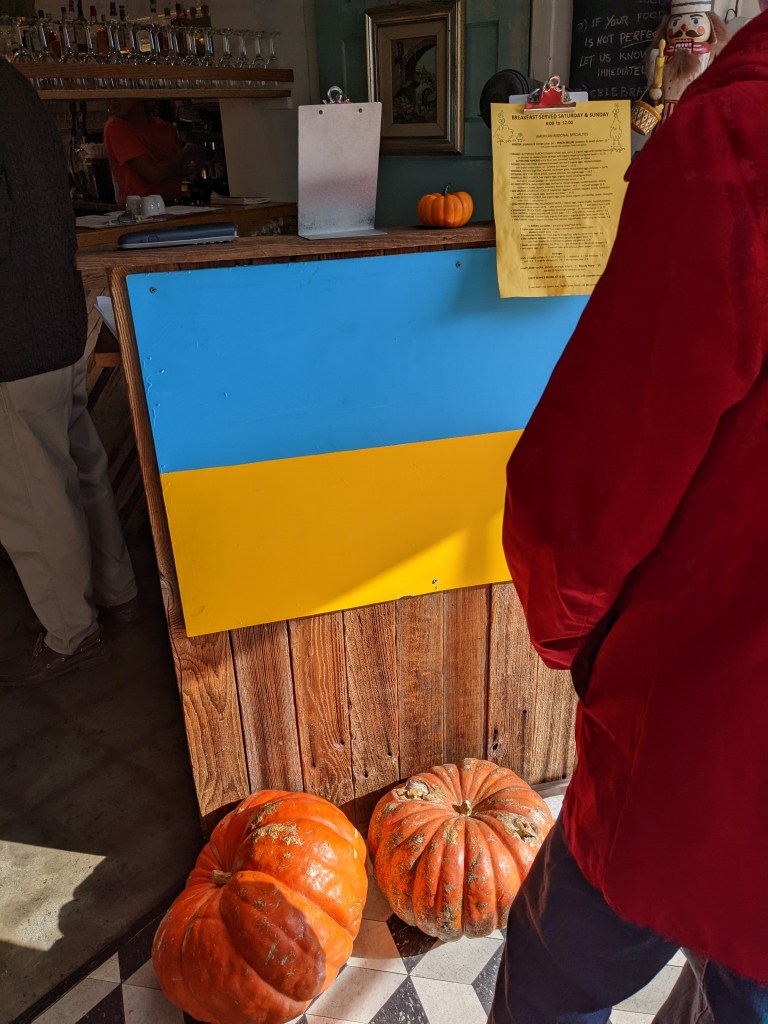
A Ukrainian flag at Il Vecchio Italian restaurant in Pacific Grove, California, October 2022. Photo by the Russian Reader

News from Ukraine Bulletin 27 (3 January 2023)

A Digest of News from Ukrainian Sources

News from the territories occupied by Russia:

Russia moves to legislate ‘impunity’ for all war crimes committed in occupied Ukraine  (Kharkiv Human Rights Protection Group, December 30th)

Crimean Tatar civic journalist sentenced to 11 years for refusing to collaborate with Russia’s FSB  (Kharkiv Human Rights Protection Group, December 30th)

Russians kidnapped 30 mayors, 7 of them went missing – Kyiv Mayor  (Ukrainska Pravda, December 30th)

Detention centre employee who helped torture Ukrainians found in Kherson  (Ukrainska Pravda, December 30th)

Abducted Ukrainian civic journalist sentenced to 7 years in brazen show of lawlessness in Russian-occupied Crimea   (Kharkiv Human Rights Protection Group, December 29th)

Russia plans to imprison soldier who admitted to murder and plunder in Ukraine – for ‘circulating fake news’  (Kharkiv Human Rights Protection Group, December 28th)

“She did everything so that Ukraine could see: Crimeans are still waiting for liberation”: human rights activists called Iryna Danylovych’s sentence fabricated (Zmina, December 28th)

Russians threatened to kill abducted Crimean Tatar’s family if he didn’t sign fake ‘confession’  (Kharkiv Human Rights Protection Group, December 28th)

News from Ukraine – general:

Life during wartime (Alice Zhuravel on Twitter, January 2nd)

Ukraine prepares to give free rein to property developers  (Open Democracy, December 28th)

14 tons of humanitarian aid delivered to Donetsk (Confederation of Free Trade Unions of Ukraine, 26 December)

Film about the working conditions of Ukrainian railway workers  (Spil’ne / Solidarity Collectives, December 27th)

Trapped in the Trenches in Ukraine  (New Yorker, December 26th)

Analysis and comment:

Special Issue on Ukraine  (Insurgent Notes, January)

“There is nothing cheaper in Russia than human life”  (Der Standard, December 31st)

Russia. Renaissance is not going to happen  (People & Nature, December 28th)

TikTok in service of FSB. How a social network for funny videos turned into a Kremlin propaganda mouthpiece  (The Insider, December 28th)

How Kremlin organizes pro-Putin rallies in Germany and why neo-Nazis participate  (The Insider, December 27th)

Multipolarity, the Mantra of Authoritarianism  (The India Forum, December 20th)

Making Sense of a Senseless Conflict in Ukraine? (Europe Solidaire, December 23rd)

Research of human rights abuses:

Homes and lives destroyed in northern Ukraine (Tribunal for Putin, 28 December)

Ukraine must ratify the Rome Statute now (Tribunal for Putin, 28 December)

“They put him in the basement, tortured him, and tore his tendons.” How Russia terrorizes ZNPP staff to keep a tight grip on the plant  (The Insider, December 22nd)

International solidarity:

Thanks to you  (Solidarity Collectives, December 29th)

==

This bulletin is put together by labour movement activists in solidarity with Ukrainian resistance. More information at https://ukraine-solidarity.org/. We are also on Twitter. Our aim is to circulate information in English that to the best of our knowledge is reliable. If you have something you think we should include, please send it to 2022ukrainesolidarity@gmail.com.

To receive the bulletin regularly, send your email to 2022ukrainesolidarity@gmail.com. To stop it, please reply with the word “STOP” in the subject field.