The Grateful Dead

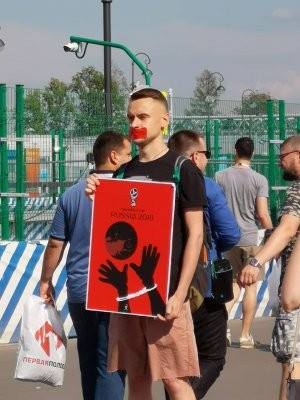
stropov-1Max Stropov on his way to September 9, 2018, anti-pension reform demonstration in Petersburg. His placard reads, “Life is hard, but happily it’s short.” Photo courtesy of his Facebook page

Max Stropov
Facebook
September 10, 2018

Today [September 9], I was detained at a protest rally for the first time. I had lucked out at previous demos. The protest rally was against the pension reform, and it took place at Lenin Square [in Petersburg]. The event had been authorized by the authorities, but by a happy coincidence, a pipe near the square had burst a couple of days before the rally. Who knows whether it burst under its own power in such a timely fashion or not.

Whatever the case, it would have been a waste not take advantage of it, and so the entire square was cordoned off. The rally on the square was thus still authorized, but it was now impossible to hold it on the square. Antinomy is the modus operandi of the current Russian regime. What is permitted is impossible, and vice versa.

As I rode the escalator up from the subway, I met a colleague from my previous, academic life, Georgy Chernavin. We stood for a while and had a nice chat.

I was one of the first protesters detained since I was made up like a dead man and holding a placard that read, “Life is hard, but happily it’s short.” That is a title of a song by the band Communism, by the way, but the title is also a quotation, attributed to Varlam Shalamov and Yuri Nikolayev. Basically, the quotation is communist. It belongs to everyone.

Communism, “Life Is Hard, But Happily It’s Short”

I did not see the rest of the rally. There were a total of seventeen people in the first group of detainees, including one dead man (ho-ho-ho). We were put on a large articulated bus. It was spacious inside.

In the paddy wagon, a forgettable looking Center “E” or NKVD officer was in our faces the whole time filming us with a video camera. It was hard to say what secret service he was from. The police could not tell us who he was, and the forgettable looking guy pretended he was not there. When we spoke to him directly, he kept on filming us.

There was also a rather burly major, who never did tell us his name. We later learned from our administrative offense reports that his surname was Golodnyi [“Hungry”].

We cruised around town for a long time. Finally, we were delivered to Dybenko Street. First, the women and children who had been detained were left at one police precinct, and then six of us were taken to another precinct. The rest of the detainees were taken somewhere else, but I don’t know anything about them.

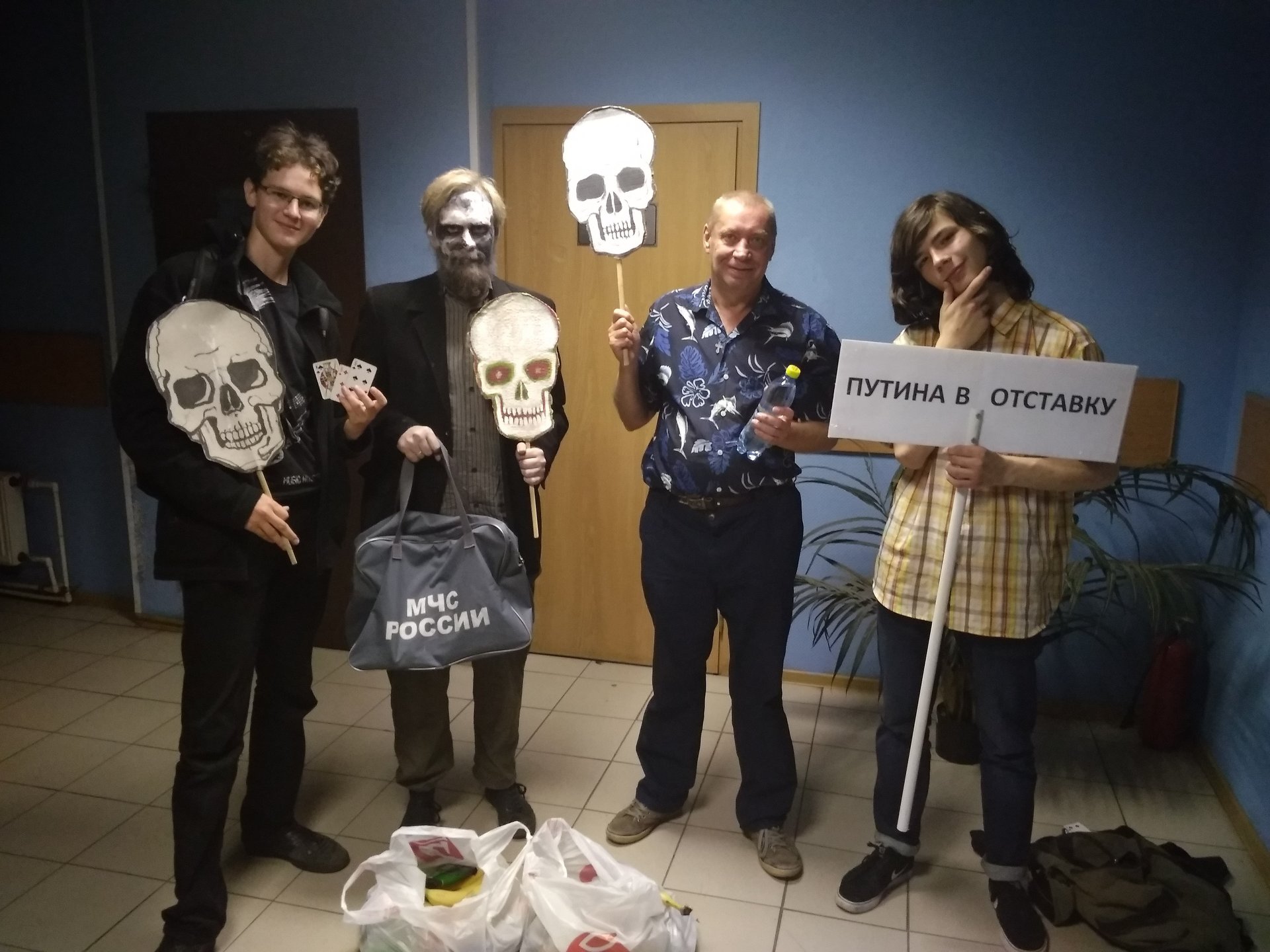
Our group included three young men from the Navalny Team, an older dude carrying a “Putin, resign!” placard, and an elderly man who had lost his telephone and glasses at the rally.

At the police precinct, we hung out in the hallway the whole time. The police told us that we had not been arrested, as it were, but at the same time, they would not let us go.

Antinomy is the modus operandi of the current Russian regime.

Varya Mikhaylova came to the precinct bearing care packages for vegans. At first, the police did not want to take any of the things she had brought for us, arguing we were not locked up in cells. She chewed them out, and they threatened to charge her with disobeying police officers, but finally and suddenly they took all the packages she had brought.

It was a really joyous moment. Everyone wanted to join the Party of the Dead. The old dude drank Agusha fruit puree, saying it was “Agusha from the next life.”

stropov-2Max Stropov and his fellow detainees. The young man on the right holds a placard that reads, “Putin, resign!” Photo courtesy of Max Stropov’s Facebook page

We had hung out in the hallway for around three hours when the police set about writing us up for our alleged offenses. Everyone’s arrest report was worded exactly the same. It was apparently a boilerplate arrest report issued by police brass. In particular, there was a bit claiming the crowd had yelled, “Putin, skis, Magadan,” as if the boilerplate report had been drafted back in 2012.

The police threatened to keep me at the precinct until my court hearing because I would not sign a paper obliging me to appear in court at ten in the morning, but then I signed it, noting in writing I had done it “under threat of continued detention.” In fact, I had read the form is innocuous and does not oblige anyone to do anything.

The court hearing is tomorrow. The Nevsky District Court is located on Olga Bergholz Street.

Translated by the Russian Reader. According to Mediazona, more than five hundred protesters were detained by police at yesterday’s anti-pension reform rally in Petersburg. At the link, above, you will find a stunning photo reportage of the showdown between protesters and police, produced by photographer David Frenkel.

UPDATE. Petersburg news website Fontanka.ru, which can often be believed when it comes to these things because it is published and edited by former cops, reports that 603 protesters were detained by police during an anti-pension reform protest rally in the vicinity of the Finland Station and Lenin Square in Petersburg yesterday afternoon. Today, many or all of these protesters will be tried in the city’s district courts for their alleged administrative offenses. The calls for help coming over social media from members of the Aid to Detainees Group suggest that many of these people will have no legal representation, neither lawyers nor so-called social defenders, so they will have to fend for themselves. In any case, whether they get the book thrown at them or not will most likely have already been decided elsewhere.

Russia, Great and Beautiful


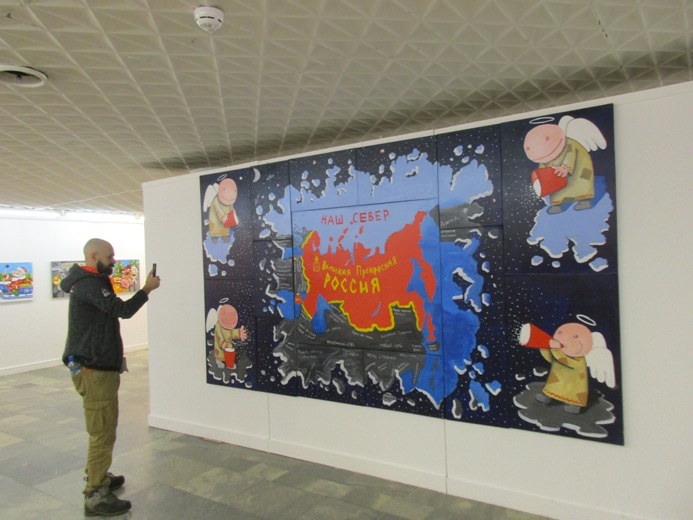
velikaa-prekrasnaa-rossia_med_hrExhibition view of Vasya Lozhkin, Russia, Great and Beautiful (2010). Photo courtesy of Ekho Moskvy

The Case of the Repost Following a Picket: The Story of an Activist Who Has Sought Asylum in the US
OVD Info
August 28, 2018

Vladimir resident Victoria Lobova was involved in two events in the Don’t Call Him Dimon campaign, and now she has been forced to ask for political asylum in the US. The placard the activist took to the events caught the eye of law enforcement. Lobova faces criminal charges for posting images of it on the social media website VK. OVD Info asked Lobova to tell her own story.

I was involved in an anti-corruption rally on March 26, 2017. I was not punished in any way at the time. Then, on June 12, 2017, the country was swept by a wave of anti-corruption rallies, and I held a solo picket. I was approached by two policemen who asked me to identify myself. I told them my name, and they said I had to go with them. I refused, since I had not violated any laws. They telephoned somebody, asked him what to do, and read him the text of my placard over the phone.

I stood with the placard in downtown Vladimir. The slogan on the placard read, “I’m a young woman. I don’t want to decide anything. I want lace panties, and I want [Prime Minister Dmitry] Medvedev to respond to the country about yachts, vineyards, nonsense, malarkey, and hodgepodge.”

In the evening, I had a visit from the security services, who said I had to report to the police. When I arrived there I was written up for committing an administrative offense: violating the rules for public rallies. I won the court case. Later, in July, a policeman came to my home and said “extremist” matter had been spotted on my VK page.

I had told the police my address and my name during my solo picket. Subsequently, they staked out my social media page. That was how it all kicked off. If I had not carried out a solo picket and mixed with the crowd at the protest rally instead, othing would have come of it. Before I was involved in protest rally, I had a page on VK where I covered political news, but the authorities paid me no mind.

I was cited for a picture that drew a parallel between Putin’s politics and Hitler’s politics. There were Nazi symbols in the photo. Two weeks later, four police officers came and drove me to a temporary detention facility.

I didn’t know till the last minute I would be spending the night there. They took my fingerprints, catalogued the entire contents of my bag, and photographed me. I was told that an ethnic Russian would never publicly display Nazi symbols and that children could have seen them. I replied that the picture had a completely different message. If you read the text, you would easily conclude Nazism was condemned by the authors. I also said that children hardly became Nazis the second they saw a swastika somewhere. Then I was taken to a cell and locked up till morning.

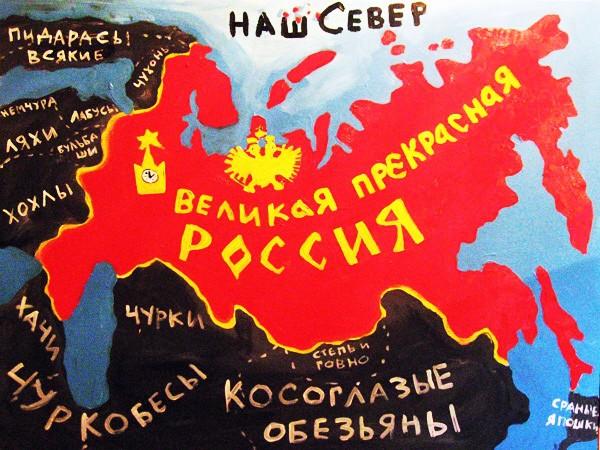
Lozhkin-1Detail of Vasya Lozhkin’s Russia, Great and Beautiful. Russia is shown as surrounded by countries inhabited by “slant-eyed monkeys,” “wogs,” and other peoples identified by equally offensive terms for non-Russian peoples and ethnic groups. Image courtesy of New Chronicle of Current Events

There was a court hearing in the morning. I was sentenced to three days in jail. Then, in January 2018, the FSB filed criminal charges against me under Article 282 of the Russian Criminal Code (“incitement of hatred or enmity”) for Vasya Lozhkin’s picture Russia, Great and Beautiful, which they had also found reposted on my VK page. (In August 2018, a court ruled the picture could not be considered “extremist.”)

The FSB investigator was unable to get me to confess, and the case seemingly died down. But then the police again paid visits to my house. I would not open the door, which they photographed, probably by way of reporting to their superiors. When they left they would first make the rounds of the neighbors. That was when I realized they would not leave me alone and would send me to prison come what may.

I left Russia in May. I just bought tickets and flew away. There are opportunities for obtaining political asylum. In this sense, I think everything will be fine. I have lots of evidence that I was persecuted.

VK handed over all the information needed to the FSB, so my case was no exception to established practice. I continue to use VK, but now I am somewhere safe. I advise people in Russia to be more careful.

Translated by the Russian Reader

Hot Water

A Female Pensioner in the Nizhny Tagil Area Invited Neighbors to Tell a National TV Channel about Their Village’s Problems: Now She Will Be Tried for Holding an Unauthorized Protest Rally
Mezhdu strok
22 August 2018

A 63-year-old resident of the village of Pokrovskoye in the Gornouralsky Urban District warned neighbors a TV news crew would be coming to cover utilities problems in the village. She now faces a court hearing, charged with holding a public event without the consent of the authorities.

ms-72790-8Irina Kutsenok. Photo courtesy of Mezhdu strok

Due to a hot water outage in the village that had lasted two months, pensioner Irina Kutsenok turned to the news program Vesti Ural for help. When she found out a news crew would be coming to the village on August 1, she posted announcements about their visit in the entryways of residential buildings, asking villagers to come and speak to the news crew. Subsequently, the head of the village council filed a complaint against Kutsenok with the prosecutor’s office, accusing her of “organizing a public event  without filing a notification in the prescribed manner,” a violation of Article 20.2 Part 2 of the Russian Federal Administrative Offenses Code.

“The water was turned off on June 1. The council said it would be off for a mere two weeks, but two months had passed since then. I then contacted Vesti Ural. They had helped us last year with garbage removal. After a segment aired on their program, the council started picking up the garbage. The people at Vesti Ural said they would send a news crew on August 1, and on July 31 I posted flyers in the entryways of residential buildings saying regional reporters were coming to cover the hot water outage so residents would know about it. At the bottom of the flyer, I wrote, ‘Residents should meet outside the club.’ But the editors at Vesti Ural told me the crew would not be coming, because the council had promised them that on August 3 our hot water would be turned on,” Kutsenok told Mezhdu strok.

N2GyFNIq8Bw

Irina Kutsenok’s flyer, announcing an upcoming visit by a news crew from the program Vesti Ural and asking village residents to gather outside the village club at twelve noon on August 1 to speak with the reporters about ongoing problems with the village’s hot water supply. Courtesy of Mezhdu strok

According to Kutsenok, the flyers were taken down almost immediately, on August 1. They were replaced with leaflets claiming water pressure tests would be conducted in the village on August 3.

Nevertheless, Kutsenok went to the village club on August 1 in case residents of Pokrovskoye had questions about the hot water outage. She was met there by Marina Selskaya, head of the Pokrovskoye village council, and Alla Semyonova, a member of the Gornouralsky City Duma.

“They yelled at me, accusing me of holding an unauthorized meeting. Later, it transpired Selskaya had also filed charges against me with the prosecutor’s office, accusing me of organizing and holding  a public event without notifying the council, of organizing protest rallies. Subsequently, the neighborhood beat cop came to my house and informed me I had to go to court. But I hadn’t made any speeches anywhere, nor had the TV reporters shown up. This means I am going to court for turning to the media, to a TV news program for help. What, now we don’t have the right to turn to the media, either, and we should be fined if we do turn to them? I just wanted to give our council a little nudge. I cannot get them to do anything about the water, preventive medical exams or metering devices for utilities. How much can a person take?” asked an outraged Kutsenok.

The magistrate of Sverdlovsk Region’s Suburban District will hear the charges against Kutsenok on August 30. Article 20.2 Part 2 of the Administrative Offenses Codes stipulates a fine of up to 30,000 rubles [approx. 380 euros] or up to fifty hours of community service.

UPDATE. After this article was published, the press service of the Sverdlovsk Region Prosecutor’s Office informed Mezhdu strok the charges against Kutsenok had not been filed with them, but with the police.

Thanks to OVD Info for the heads-up. Translated by the Russian Reader

“A Truly Great Competition”: Yegor Yekimov Jailed in Petersburg for Picketing in Solidarity with Oleg Sentsov

37117187_528244187619896_1623487471700410368_n

St. Petersburg Group for Assistance to Detainees
Facebook
July 15, 2018

On Saturday, Yegor Yekimov was detained in the Petersburg 2018 FIFA World Cup Fan Zone for holding a solo picket in solidarity with Oleg Sentsov and handing out leaflets.

The activist spent the night at the 71st Police Precinct.

Today, the Petrograd District Court sentenced him to five days in jail.

Mr. Yekimov has an illness that requires constant maintenance therapy. He must strictly avoid catching any infection whatsoever.

This fact, however, did not stop Judge Irina Grechishko, who sentenced Mr. Yekimov to jail.

Additionally, Mr. Yekimov is a voting member of an election commission, and the court had no right to try him without authorization from a prosecutor.

Mr. Yekimov has been taken to the detention facility on Zakharyevskaya Street in central Petersburg. Attorney Daniil Semyonov will file an appeal of the verdict tomorrow.

Translated by the Russian Reader

#SaveSentsov

Plato Re-Elaborated

rus yachts.jpg

That city would not lack a yacht club, would not lack

a soccer club. Noting the absence of smoke from the brick

factory chimneys, I’d know it was Sunday,

and would lurch in a bus across town, clutching a couple of bucks.


I’d twine my voice into the common animal hoot-

ing on that field where what the head begins is finished by the foot.

Of the myriad laws laid down by Hammurabi

the most important deal with corner kicks, and penalty kicks to boot.


—Joseph Brodsky, “Plato Elaborated,” trans. George L. Kline, New Yorker, March 12, 1979, p. 40


***********************

It would be nice, wouldn’t it, to be a regular guy, to immerse oneself in enjoying life, in a pleasant job, and forget that a dictatorship for life has taken root in our country? It would be nice, wouldn’t it, to forget the dictatorship wages war against neighboring countries? It would be nice, wouldn’t it, to forget it has destroyed all constitutional rights, the freedom of speech, secularism, the right to a pension, the right to one’s native language, and the right to forget things and be happy?

—Sergey Abashin, Facebook, June 24, 2018

Photo and translation by the Russian Reader

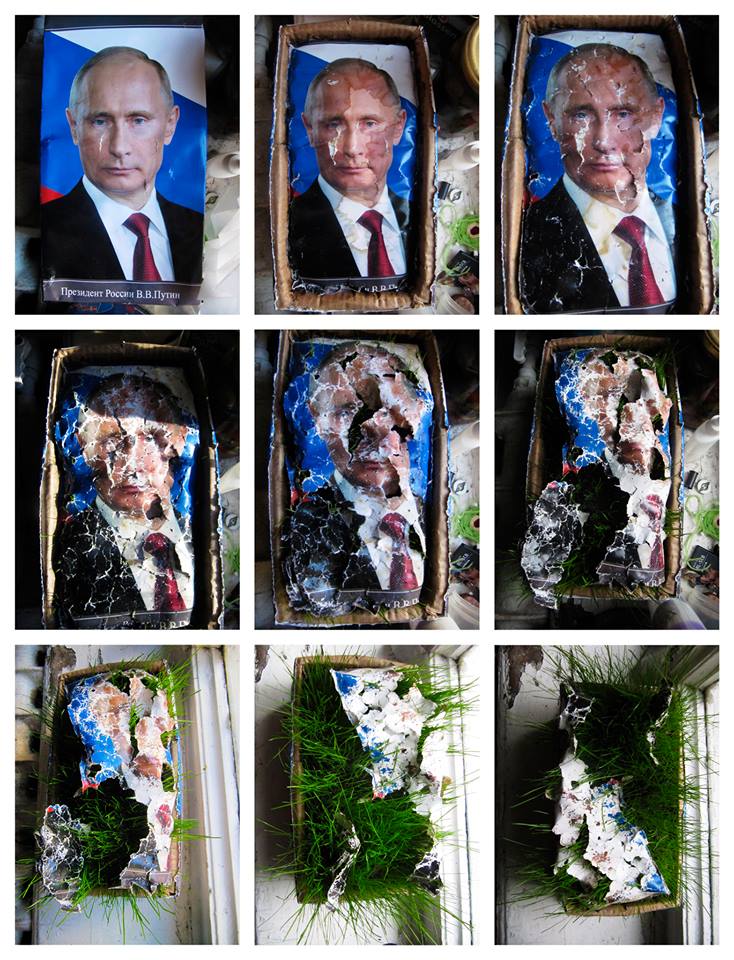
“9 Stages of the Supreme Leader’s Decomposition” (Solidarity Fundraising Campaign Update)

varya

Varya Mikhaylova (center, with megaphone), carrying {rodina}’s 9 Stages of the Supreme Leader’s Decomposition as she marched with the Party of the Dead bloc in this year’s May Day demo in Petersburg. Photo by Elena Lukyanova. Courtesy of Novaya Gazeta

On Friday, June 8, 2018, a Petersburg district court sentenced local feminist and democratic activist Varya Mikhaylova to a fine of 160,000 rubles (approx. 2,180 euros) for carrying a picture at this year’s May Day demonstration, during which she was detained by police.

The court also ordered the picture in question, 9 Stages of the Supreme Leader’s Decomposition, by the Petersburg art group {rodina} (“motherland”), burned.

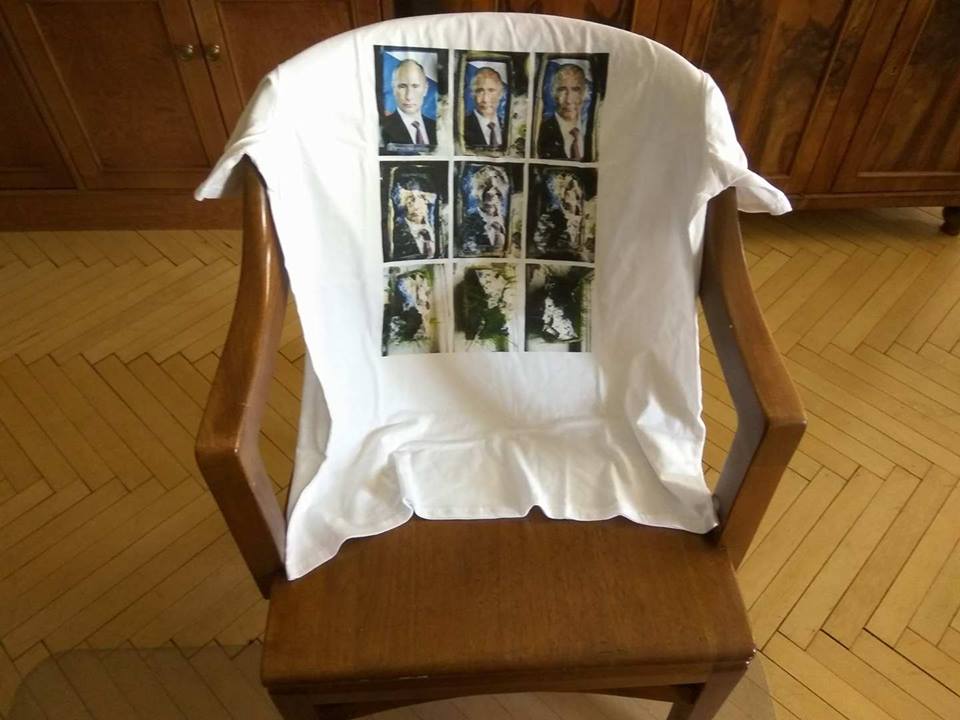
stages-4{rodina}, 9 Stages of the Supreme Leader’s Decomposition. A Petersburg judge has ordered this artwork torched.

How can you show your solidarity with Varya Mikhaylova? By helping her pay the hefty fine. It would be exorbitant anywhere, but it is purposely burdensome (that is, designed to discourage people from protesting by impoverishing them) in a city where the average monthly salary is around 500 euros.

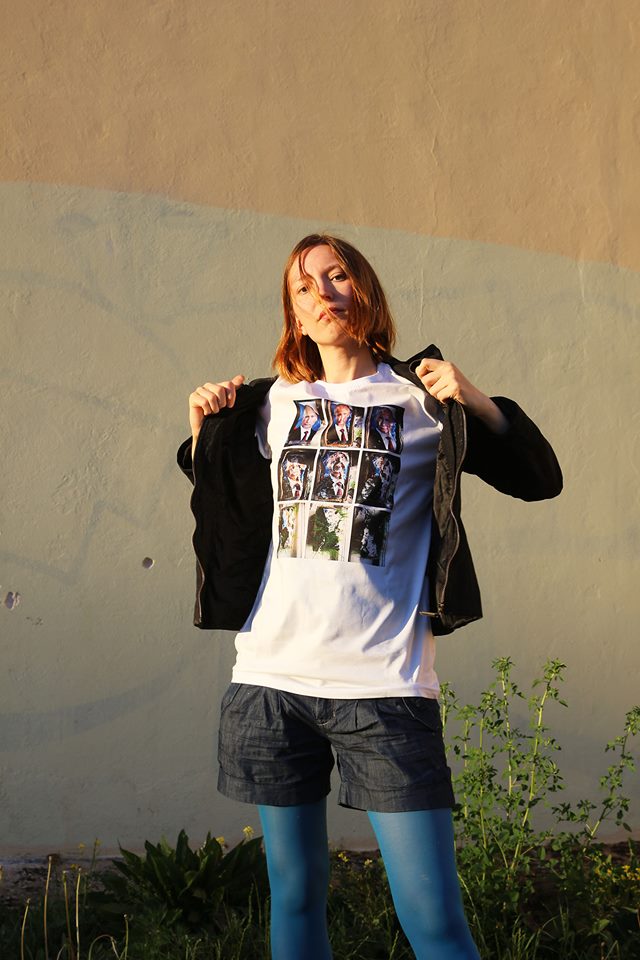
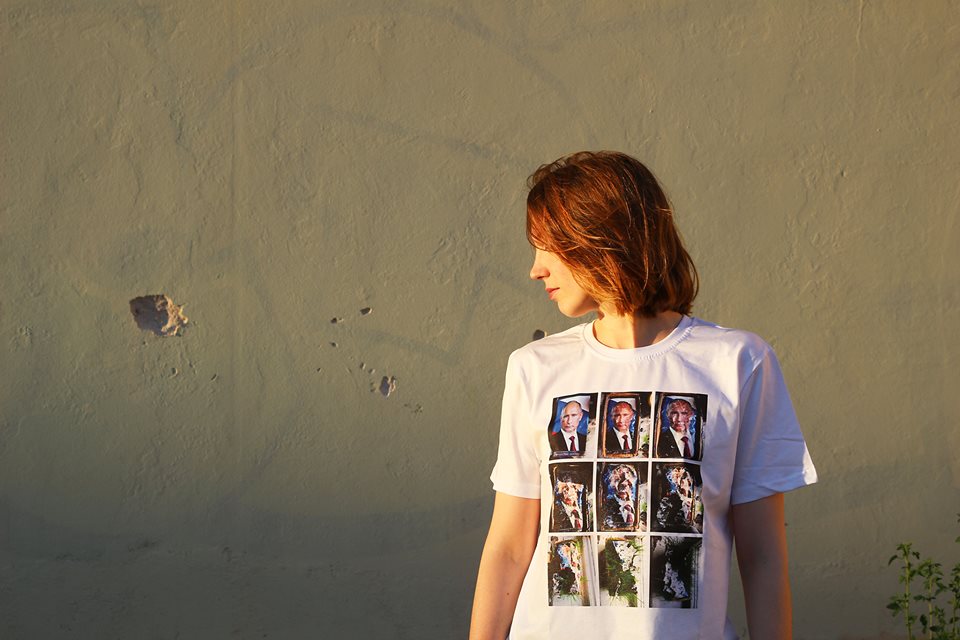
How can you show your solidarity with {rodina}, whose artwork faces the fiery flames of censorship? By ordering a t-shirt, poster or postcard embossed with 9 Stages of the Supreme Leader’s Decomposition. Proceeds from the sales of these mementos will go towards paying Varya’s fine. Any money left over will be used to make more revolutionary art.

You can order a postcard for 100 rubles (approx. 1.30 euros), an A3-sized poster for 500 rubles (approx. 6.80 euros), and a t-shirt for 1,500 rubles (approx. 20.40 euros).

The cost of shipping your order anywhere in the world via Russian Post is 500 rubles.

Place your orders on {rodina}’s merch page. When you go there you will need to click on the “Message” button and chat with someone who can help you with your order.

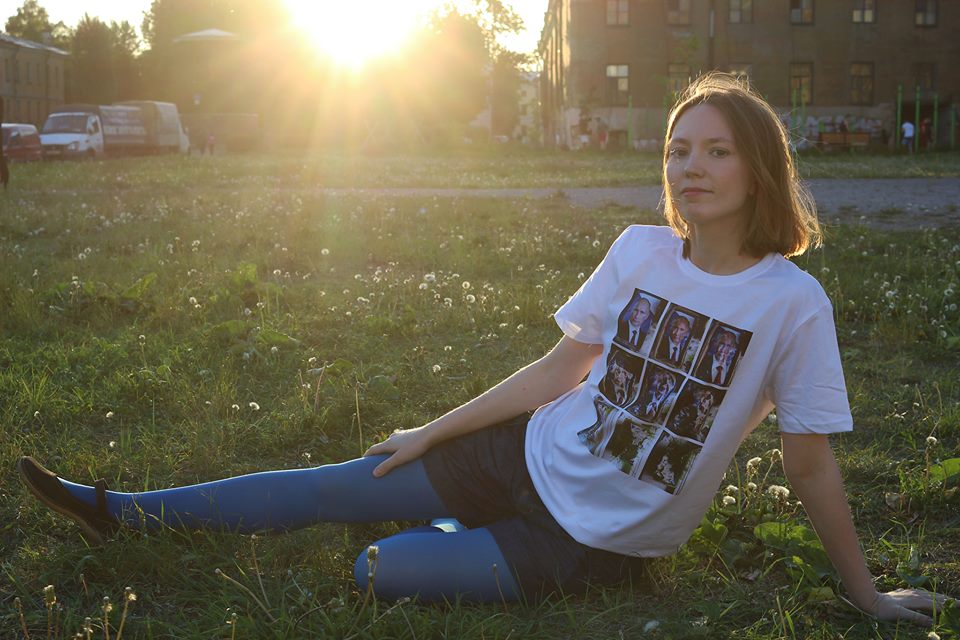
{rodina} stalwart Darya Apahonchich modeled the t-shirt recently.

stages-3

stages-2

stages-1

I was so taken with the 9 Stages t-shirt I already ordered and took receipt of mine. Now I’ll have to wear it on the mean streets of Petrograd while also avoiding sudden arrest.

the shirt

You can also send money directly to Varya via her PayPal account (bukvace@ya.ru). The proceeds will also go towards paying her fine. // TRR

Thanks to Comrade KB for the final photograph and taking delivery of my t-shirt.

The Policemen’s Ball

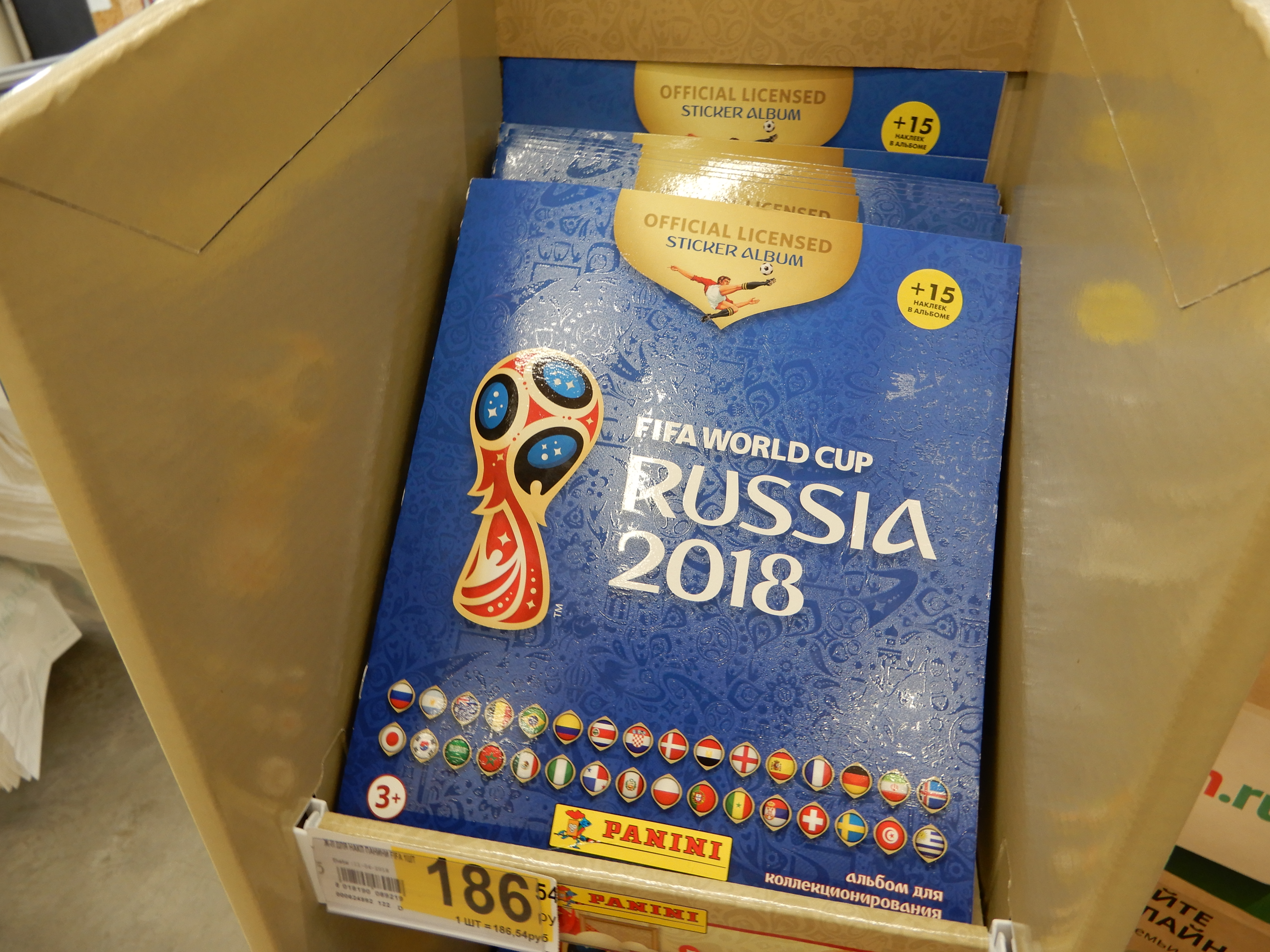
DSCN6837At €2.50, the official licensed sticker album of the 2018 World Cup is a steal. Russian officials also plan to steal the civil rights of their own citizens during the month-long tournament. Photo by the Russian Reader

Restrictions on Movement and Freedom of Assembly during the 2018 FIFA World Cup
Denis Shedov and Natalya Kovylyayeva
OVD Info
May 25, 2018

Russia welcomes the 2018 FIFA World Cup with Presidential Decree No. 202, which places restrictions on the movements of people and the staging of public rallies in cities hosting the matches. According to the decree, “enhanced safety measures” will be enforced from May 25 until July 25 (although the first match, between Russia and Saudi Arabia, will not be played until June 14). Denis Shedov and Natalya Kovylyayeva studied the decree specially for OVD Info.*

The restrictions will be introduced on May 25, 2018. They will be enforced in the cities and regions hosting 2018 World Cup matches: Moscow, Petersburg, Volgograd Region, Sverdlovsk Region, Nizhny Novgorod Region, Samara Region, Rostov Region, Kaliningrad Region, Krasnodar Territory, the Republic of Tatarstan, and the Republic of Mordovia.  Additionally, the decree also applies to certain neighboring regions where, in particular,  competing teams will be accommodated: Moscow Region, Leningrad Region, Kaluga Region, Voronezh Region, Stavropol Territory, and the Republic of Chechnya.

It is worth noting Decree No. 202 applies absolutely to everyone who is located in the regions listed during the period the decree is in force. In this light, OVD Info felt it was vital to discuss these changes.

Monitored and Restricted Areas
The decree introduces “monitored and restricted areas,” which will either be entirely off limits to people or will have restricted access. These areas include training grounds (including at other stadiums), team headquarters, hotels where teams and referees are staying, cargo inspection points, the broadcast center at Crocus Expo in Moscow, fan festival venues, press centers, and parking lots for special transport. You will be able to enter these “monitored areas” only after security guards have conducted a thorough inspection of all your belongings.

In addition, there will be special pedestrian security zones, so-called last miles, consisting of areas of one to two kilometers in radius around the stadiums where the matches will be held. Aside from World Cup transport, only residents of nearby buildings, equipped with special passes, will have access to these zones. To obtain the passes you need your internal passport and the papers for your car and your flat. Information about these zones has been posted on the official municipal websites of the cities hosting matches and published in local periodicals.

  • During the 2014 Winter Olympics in Sochi, the city was off limits to cars from other cities, i.e., cars not registered in Sochi, with the exception of vehicles owned by the secret services and vehicles that had received accreditation as municipal maintenance and 2014 Winter Olympics support vehicles. Vehicles registered in Sochi were restricted from traveling in “monitored areas.” 

Mandatory Registration for Everyone
Upon arrival in a city, you must register with the local immigration authorities within three days. This rules applies to everyone except those who are registered to live permanently in the particular city. Additionally, special rules for registering domiciles and temporary stays will be introduced in the cities where World Cup matches are scheduled.

Russian nationals and foreign nationals must register with the police within 72 hours of arriving. Usually, during “normal” times, Russian nationals have the right to spend up to 90 days in another Russian region without registering, while foreign nationals have seven days to register. Decree No. 202 specifies that the party hosting the visitor, i.e., the hotel, spa, holiday home, etc., must notify the proper authorities of the arrival of foreign nationals within 24 hours, as stipulated by Russian federal law.

Immigration authorities in the regions mentioned in the decree will be open for business daily during the World Cup, including weekends and holidays. There are several ways of registering your stay in another city:

  • Submitting an application to the management of the hotel, hostel, camping ground or youth hostel where you are staying, or the management company, proprietor or landlord, if you are staying in a private flat.
  • Reporting to the local immigration authorities yourself.

Foreign nationals must personally present their papers to the regional office of the Interior Ministry (i.e., the police) or a multi-service center, or their official hosts must do it for them. It is forbidden to register via the post office or a government services website.

Arriving foreign nationals are obliged to provide notification of their arrival, a copy of their identity card (e.g., passport or either ID), a copy of their Russian visa, and a copy of their migration card. This rule applies to all foreign nationals, regardless of their nationality and status in Russia. If the host party is a legal entity, this organization must supply the authorities with a complete set of documents.

Private individuals who act as hosts need only present their Russian internal passports, proving they are permanent residents, a copy of their passports, and a copy of their ownership deed to the dwellings where they will house foreign nationals.

If these rules are violated, Russian nationals will be obliged to pay an administrative fine. In Moscow and Petersburg, the fine will range from three to five thousand rubles, while in the regions it will range from two to three thousand rubles. Foreign nationals who violate these rules can be expelled from Russia.

Restrictions on Freedom of Assembly
According to the decree, from May 25 to July 25, 2018, assemblies, rallies, demonstrations, marches, and pickets that have nothing to do with the 2018 FIFA World Cup can be held only in places, along routes, and at times approved by the authorities. The authorities can also determine the number of attendees and the duration of the event.

Decree No. 202 was first enforced during last year’s Confederations Cup, also hosted by Russia. A large number of activists involved in group protests and solo pickets were apprehended at that time. Some of the people detained during solo pickets were subjected to “explanatory discussions” by the police, while others were written up for violating the rules for holding public events and fined as much as 20,000 rubles.

  • In May 2017, five activists from the local headquarters of opposition leader Alexei Navalny were detained for setting up a campaign booth on the main square in Kazan. Law enforcement said the action had not been authorized by the authorities. All the detainees were sentenced to ten to twelve days in jail, as well as 35 hours of community service.
  • During the Navalny-inspired anti-corruption rallies that took place in a number of cities on June 12, 2017, including Petersburg, Moscow, and Sochi, police detained protesters on the basis of Paragraph 11 of the decree, as paraphrased above. Although in Krasnodar, where the rally against corruption had been authorized, no one was apprehended, despite the special security regime.
  • During the protest rally “Farewell to the Communications Ministry,” in Moscow in June 2017, a teenager was detained when he tried to leave flowers outside the ministry due to restrictions on freedom of speech in Russia, including the possible blockage of the Telegram messenger service. The arresting officer cited the presidential decree restricting rallies during the Confederations Cup and the 2018 World Cup when he detained the boy. The teenager was taken into a police station for questioning before being released.
  • In mid-June 2017, fifteen people holding solo pickets against Moscow’s massive “renovation” program were detained outside the entrance to the State Duma.
  • Several activists who held solo pickets in support of mathematician Dmitry Bogatov and demanded an end to the prosecution of nationalist Dmitry Demushkin were detained on June 24, 2017, in Moscow.
  • Solidarity Party activist Mikhail Lashkevich was detained on July 4, 2017, while holding a solo picket demanding the people behind opposition leader Boris Nemtsov’s assassination be found. The police admitted he had a right to carry out a solo picket and released him from Basmanny Police Precinct in Moscow without writing him up. Subsequently, Roman Petrishchev, another Solidarity Party activist, was detained for a solo picket.
  • In early July 2017, five activists of Protest Moscow were detained in different parts of the city while they held solo pickets against censorship. All of them were charged with violating the rules for holding public events, punishable under Article 20.2 Part 5 of the Administrative Offenses Code.
  • On July 5, 2017, the well-known democracy activist Ildar Dadin was detained during a solo picket outside FSB headquarters in Moscow, since his protest had not been authorized by law enforcement. On July 7, 2017, the Meshchansky District Court found him guilty of violating the “rules of solo pickets” and fined him 20,000 rubles.

In May 2017, Alexander Pomazuyev, a lawyer with Navalny’s Anti-Corruption Foundation (FBK) asked that Paragraph 11 of the decree be declared null and void in a suit he filed with the Russian Supreme Court. Pomazuyev claimed he had been denied the right to hold a solo picket. He also argued the presidential decree infringed on civil liberties guaranteed by the Russian Constitution, including the right to free speech and freedom of assembly. The court threw out Pomazuyev’s suit, thus rubber-stamping the restrictions on rallies and pickets during the Confederations Cup and the 2018 FIFA World Cup.

In February 2018, organizers of the Boris Nemtsov Memorial March in Nizhny Novgorod wrote an open letter to FIFA president Gianni Infantino asking him to protect freedom of assembly in Russia in the run-up to the World Cup. The football functionary did not react to the letter, apparently.

“Although the decree restricts certain rights only from May 25 to July 25, 2018, even the smallest pickets have been turned down by the authorities on the grounds of the terrorist threat,” the march organizers wrote on their Facebook page.

Commentary by Lawyer and Human Rights Activist Alexander Peredruk
Yes, Presidential Decree No. 202, dated May 9, 2017, definitely violates people’s constitutionally guaranteed rights to freedom of assembly in Russia.

If you want to hold a public rally from May 25 to July 25, 2018, at a venue of your choosing, there is no guarantee you will pull it off. The authorities could turn you down on the grounds the venue you have chosen was not vetted by the Interior Ministry and the FSB. 

As last year showed, when several applications to hold rallies were filed simultaneously, the authorities would reject all the applications. However, when the applications were filed, the authorities had not yet determined what venues could be used. They drew up a list of permissible venues only after looking over the first applications. It was thus a “complete coincidence” that the venues indicated in the applications that were submitted to the local authorities were not on the list of permissible venues. 

In other words, the rejections were perfunctory and practically groundless. The authorities were not interested in conducting a proportionality test, in striking a balance between public and private interests.

In addition, questions are raised about the legitimacy of the division between public sporting events, which are permitted during this period, and public political events, which are virtually banned. Russian citizens are thus subject to discrimination.

During the 2014 Winter Olympics in Sochi, a local man, David Hakim, was detained while holding a solo picket in defense of the convicted environmentalist Yevgeny Vitishko. (Hakim was jailed for four days for his “crime.”) Agora used his case to challenge the president’s Olympic decree in the Russian Constitutional Court. However, the court refused to examine whether the decree complied with the Constitution, since it had expired by the time the complaint was examined. 

* If you are worried about how Presidential Decree No. 202 will affect foreign fans traveling to Russia for the World Cup, you shouldn’t be. They are required to purchase special “fan IDs” that will exempt them from most if not all of the decree’s strictures. // TRR

Denis Shedov is a lawyer with the Memorial Human Rights Center in Moscow. Natalya Kovylyayeva is a journalist. Translated by the Russian Reader

The Poster Maker

“I’ll Go All Out to Ensure Putin Loses”
Yelizaveta Mayetnaya
Radio Svoboda
December 5, 2017

“Citizen Putin! If there is a clampdown on public liberties under the pretext of terrorists attacks, it will be clear to everyone who is behind them!”

“Putin is war. Say no to war!”

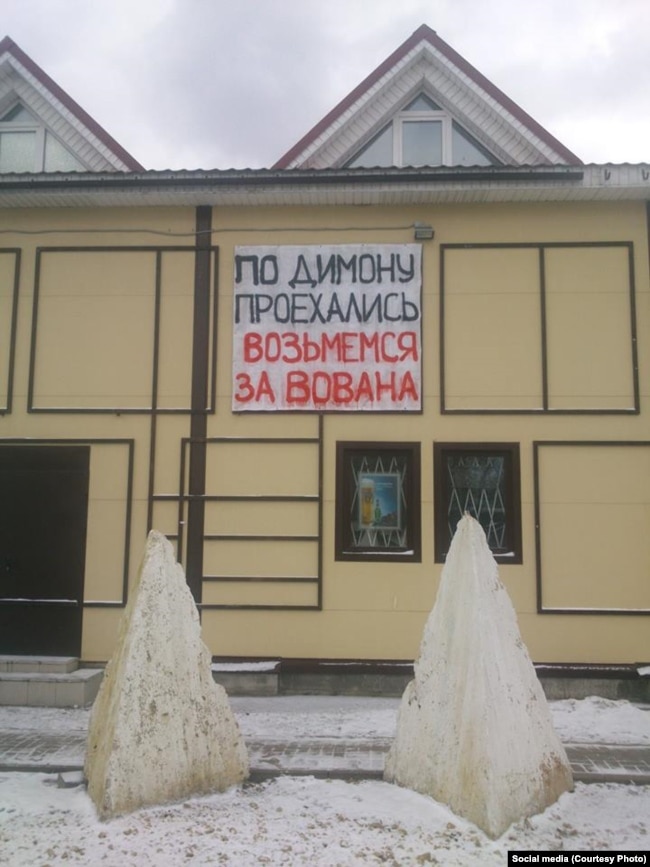
“Dimon got what was coming to him. Let’s go after Vovan.”

“We live the way we vote.”

Dmitry Skurikhin, owner of a store in the village of Russko-Vysotskoye, near Petersburg, reacts immediately and visually to every political event in Russia.

Skurikhin immediately hangs each new poster on the front of the store, a small, two-storey building, so it is readily visible from the nearby bus stop. They usually do not stay up for long, however. The record is held by the slogan “Peace to Ukraine,” which stayed up for two weeks.

На митинге Навального

Skurikhin at a pro-Navalvy rally on the Field of Mars in Petersburg

43-year-old Dmitry Skurikhin is a local businessman, whose family owns three village shops. By local standards, he is well off. His family owns several cars, and they have everything they need. However, Skurikhin says the incomes of villagers have taken a nosedive in the past year: “They buy almost nothing, because they barely have enough for food.” Around six thousand people live in Russko-Vysotskoye. Very few of them are holiday cottage dwellers. The majority commute to work in Petersburg. Skirukhin was the first businessman in the village to open self-service stores, but “then the Pyatyorochka and Magnit chains moved in, and we croaked, of course.” He now sells toys, newspapers, clothings, and sundries.

He has been hanging political posters on his store, situated along a road, for almost four years. Before that, he pasted homemade bumper stickers on his car. Skirukhin recalls that the first bumper sticker read, “No new taxes!” The year was 2005.

Skurikhin: They had decided to raise taxes on us local businessmen then. It was one of those taxes you couldn’t avoid paying. Either you worked and paid the tax or you didn’t work and didn’t pay the tax. We businessmen realized they were clamping down on us. We joined forces and beat back the tax. It made such an impression on me that since then I haven’t been able to stop going. There are at least some improvements in our lives, specifically in our village. I’m a local grassroots activist, not even a region-wide activist, but a village-level activist. I was born here, and I live and work here. My kids go to school and kindergarten here. I think I have helped improve life in our village.

Radio Svoboda: How exactly have you improved life in the village?

Skurikhin: As they call it now, I was a municipal district council member from 2009 to 2014. At the time, our district authorities were running this interesting scam. They were “milking” the villages. They would buy heat from the producer and sell it to residents. They marked up the price one hundred percent. When the situation had reached a deadlock, it transpired they were charging residents, but not paying the producer anything. They were getting heat for free. The chair of the district council was mixed up in the scam. Thanks in part to my efforts, the gentleman was conveyed directly from the district chairman’s office to prison. That was in May 2012. Since then we haven’t had any disasters with our supply of heat and water.

We still have problems sometimes, but we are now longer in that disastrous state when a group of people affiliated with district officials were just robbing people by latching onto the flow of payments for housing and utilities. Then we had problems with the road. I organized a decent protest rally. A lot of folks turned out for it: 165 people, which is a huge number for our village. We demanded the road be repaired. The road was repaired. So, by starting with small changes like that, stirring people up, I have been trying to bring them round to the idea that fair elections, free speech, and democracy mean improving the welfare of society. On May 1, we had a rally that wasn’t about the roads (we’ve had the roads fixed), but was about healthcare, fair elections, and responsible authorities. Those were the topics of our rally. 45 people showed up. The rally was authorized. I always try and authorize events with the authorities, but we rallied at the skating rink on the edge of the forest.

Кто будет следующим

“Dimon got run over. Let’s go after Vovan.” This is a reference to Alexei Navalny’s film documentary exposé of Prime Minister Dmitry Medvedev and his untold riches, Don’t Call Him Dimon. “Vovan” is a humorous reference to Vladimir Putin.

In 2014, my time as district council member ended for a simple reason: our team doesn’t pay for votes. If you don’t buy yourself votes, meaning if you don’t pay off the right people during early voting, then you’re out of the race, because your opponents do pay for votes. United Russia paid 1,500 rubles per vote! All the other candidates lost.

Radio Svoboda: Did you prove in court they paid for votes?

Skurikhin: It’s impossible to prove in court, because the scam is quite competently organized. They don’t buy votes, but pay for the services of fake campaign workers, meaning they contract out their campaign. United Russia has a team of between ten and fifteen people, depending on the number of seats that are up for grabs in a specific municipal district, and they hire canvassers. But the canvassers don’t have to canvass. They just need to show up and vote ahead of time, for which they are paid 1,500 rubles a pop. That’s it. It’s perfectly legal. All the evidence is circumstantial. When I tried to get hired as a canvasser in a neighboring village, I was told I would not do, because I wasn’t registered in that precinct.

“How’s that?!” I said. “I’m a local resident. I have a store here. I know everyone in the village, and they all know me. I’ll canvass for you like nobody’s business.”

“No, no, you don’t fit us.”

“What’s the deal?”

“You’re registered somewhere else.”

It’s all clear, guys! You don’t need canvassers: you need voters, whom you buy off for 1,500 rubles apiece. I dubbed the technique “bribing a voter under the guise of paying a canvasser.” It works like a charm in all the villages, where the populace is not too savvy. The populace in general is not very savvy, but in the countryside it’s just unbelievable. The salary in these places is commonly 1,000 rubles a day [approx. 14 euros a day]. People who get a 1,000 rubles a day don’t suffer. I ran a counter-campaign against this.

When the villagers were going to vote, I would say to them, “Guys, are you really unaware that when they get seats on the council, they’ll shake a hundred times more out of your pockets?”

“I toss manure on a farm with a pitchfork for a 1,000 rubles a day. But here I’m getting 1,500 rubles for five minutes of my time. Maybe you’d like to go and pitch manure for me?” one guy told me.

That’s their whole rationale! There’s nothing more to say.

Radio Svoboda: When did you hang the first political banner on your store? How long did it stay up?

Skurikhin: It was the spring of 2014. My fifth daugther was born then. I decided to give my wife a present by building a politicized bus stop opposite the store. I fashioned the frame and the foundation. We didn’t have a stop there. People would always stand outside there, and the buses would stop to pick them up. I built a bus stop and draped it with posters. This was when the annexation of Crimea was happening. We had a couple of posters about Crimea: I demanded an end to the disgrace. Then there were posters demaning pay rises for ordinary doctors and school teachers. I was still a council member. I gathered information on how much doctors were paid in Russia. President Putin had literally just claimed that there were no doctors in Russia who were paid less than the average monthly salary in their regions. That was an outright lie. I wrote it on my poster, because I knew how much our doctors were paid. I had gathered the information in my capacity as a municipal district council member.

Radio Svoboda: How much did doctors really make then?

Skurikhin: The ophthalmologist in our village was paid 14,000 rubles, while the average monthly wage in Leningrad Region was 35,000 rubles. I think this as an absolutely proven lie. I hung it up on the bus stop. The local authorities were completely shocked by it. The stop had been turned into a shelter and was hung with banners and pasted with posters. They didn’t know what to do, so the posters stayed up for three weeks or so, I think. Then a major from Center “E” [the so-called anti-extremism police] in Petersburg came and had a long chat with me. That was April 1, 2014. I remembered the date, because it was the day the Russian State Duma issued a resolution condemning restrictions on freedom of speech in Ukraine. And I was sitting there chatting with this little vampire who was directly threatening me and my business.

“We will shut you down if you don’t stop it!” he told me.

The bus stop stood for a month, and then it had to be demolished. All that’s left is the concrete slab, where locals still wait to catch the bus.

Radio Svoboda: Who demolished it?

Skurikhin: I did, on orders from the local authorities. They told me either I had to demolish it and haul it away or they would do it themselves. Since then I have been hanging posters on the store.

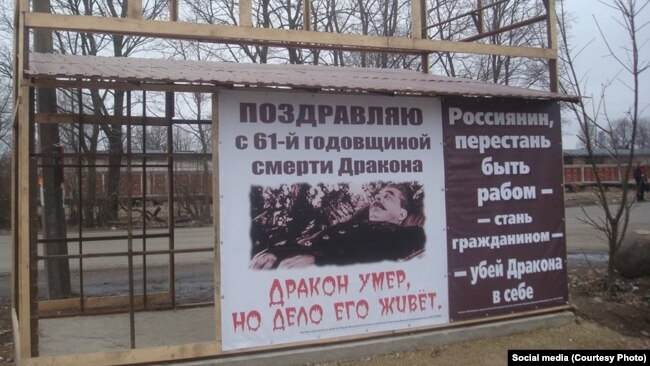
I hung up the poster “I congratulate you on the 61st anniversary of the Dragon’s death. The Dragon is dead, but his cause lives on. // Russian citizens, stop being slaves. Become citizens. Kill the dragon inside you.” The poster, which showed Stalin in his casket, used to be coupled with the second part, about citizens, which was swiped by the polizei. The poster “Peace to Ukraine” broke all the records: it hung for two weeks.

Вторую часть плаката

The second part of this poster, featuring a dead Stalin and a call to “kill the dragon inside you” and “become citizens” was “swiped by the polizei.”

The local authorities, by the way, didn’t know how to react. The poster was hanging on my building. It’s my property and my land, and the poster belongs to me. It hung there for quite a long time. Other events took place, for example, the 2014 elections. I hung my campaign posters there. As a municipal district council member, I was competing for votes. I would hang up a poster. It would become stale, and I would hang up a new one. And then, when I clearly campaigned against Putin. . . For example, I had posted a banner reading, “Putin should resign.” It was 9.4 meters by 2 meters. The banner caught everyone’s eye: my store stands next to the road. Well, they just came and swiped the banner. I decided to hang up another banner. Since it was forbidden to demand Putin’s resignation, I demanded Putin be freed. Since he considered himself a galley slave, I wrote, “Free Vladimir Putin! Let’s free this galley slave. Otherwise, he and his pals will row [rake in] too much.” This banner was also 9.4 meters by 2 meters.

Radio Svoboda: It was probably removed immediately, no? 

Skurikhin: I don’t know why, but it stayed up for nearly two weeks. I saw policemen come and look at it. Maybe they didn’t get it? I can’t say how the authorities make decisions. But then they removed it anyway. I have been doing this on purpose. My goal is to ensure President Putin loses this election. During the last election, in 2012, I printed flyers and ensured that Putin got the least number of votes in our district in our precincts, although he won anyway, of course. Our precinct was among the ten worst precincts in Leningrad Region. Numbers decide everything in a democracy. I worked on the electorate the best I could.

Radio Svoboda: Do the security services often summon your for talks and try to reason with you?

Skurikhin: Earlier they did, but recently they have left me alone for some reason. I think they just realized, probably, that they should be talking to me in handcuffs, whereas talking to me just for the heck of it, what’s the point? Besides my chat with the major from Center “E,” a major from the FSB, a colonel from the FSO (Federal Protective Service), and the Investigative Committee summoned me. Each of my posters has been sent off for a forensic examination. Policemen photograph them, and the photos are sent to Center “E” and Saint Petersburg State University for analysis: they have this forensics examination center there. Their forensics experts study my posters and render their findings. If the findings are neutral, the posters are returned to me, accompanied by an official ruling refusing to file criminal charges against me. I’ve had around a hundred such posters. Each one is also accompanied by a description. The police also try to do everything by the book. In Nazi Germany, they incinerated Jews by the book. Here in Russia, they have been trying to shut me up by the book, to put it crudely.

Radio Svoboda: What grounds do the police have for removing posters from private property? How does it usually happen?

Skurikhin: First, they get a complaint either from the local council or from a resident: someone is unhappy with the poster hanging on my store. The police arrive and write me up for violating the regional law that all posters must be vetted with the local council. This little law was invented in Leningrad Region. I disagree with it, so I simply say it wasn’t so. They write me up, then they bring a slave from the local housing authority, whom they force to climb up and remove my poster. Then they leave. After which the situation proceeds as I’ve described it. Unfortunately, the forensics experts have concluded that two of my posters insulted the honor and dignity of the president and incited social discord. I try not to insult anyone. I think through all my posters and make sure that they are worded as properly as possible, because you don’t help things by insulting people. I want to persuade people to vote against Putin, persuade them we need democratic values, freedom, and liberalism. Yet two of my posters have been deemed insulting to Putin. They were the reason I was summoned to the Investigative Committee to talk with an investigator.

Radio Svoboda: Have criminal charges been filed in connection with the two posters?

Skurikhin: You know, I haven’t asked the police about it. But they did get me summoned to the Investigative Committee, where I was asked for an explanation. I was shown the findings of the forensics experts. The poster in question was “Putin is war. Say no to war.” As you remember, it was Anna Politkovskaya who said, “Putin is war.” The slogan was written with bloody smudges, so there was nothing in particular to interpret. It was clear as clear could be. The poster was deemed to have insulted Putin’s honor and dignity. I don’t think I insulted him, but the Investigative Committee does.

Radio Svoboda: What war did you have in mind when when you wrote the slogan?

Skurikhin: Any war. Because Putin is, in fact, war. We were flattening Ukraine at the time.

Radio Svoboda: Have they threatened to close your business?

Skurikhin: The major from Center “E” threatened me, but no one else has. It’s just I’ve been in business for twenty-one years, and all the agencies they could sick on me, I’ve been working with them for a long time. I have a good relationship with them. Most important, all of them are on my side. As they’re tearing down the posters, the policemen say to me, “Damn, what you write is true.” But they’ve taken an oath, they have their orders, they would immediately get hell from their commander, so they can’t say it that way. I can because I don’t have a commander. Firefighters, the guys at Health Inspection Services, they all understand what is happening in Russia. Most of them are smart people.

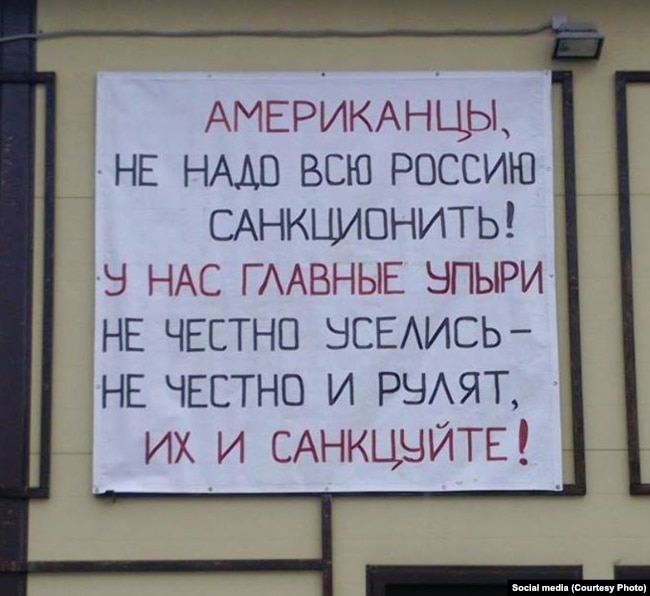
Против кого на самом деле надо сакции вводить

“Americans, don’t sanction all of Russia. Our head vampires got their jobs dishonestly and run things dishonestly. Sanction them!”

Radio Svoboda: Does your family support you?

Skurikhin: Yes, of course. Sure, they worry about me. The situation in Russia is such that the most active dissenters are shot down. My kids are aged nineteen, fourteen, seven, and four. All of them are girls: I live in a flower garden. If I’m arrested, my wife will feed the family: she’ll be like Vassa Zheleznova. I hope it doesn’t come to that, but we’ve talked it all throgh, of course. So that’s why I try and write slogans that are legal. I have studied a ton of material on the subject. What is an insult? It’s when you compare someone with an animal. The rest can be offensive and unpleasant, but it is not insulting in the criminal sense. You can say, “Skurikhin, you’re an idiot.” Yes, it’s possible for you to have this opinion. But I think differently. But if you say, “Skurikhin, you’re a jackass,” that is an insult.

Radio Svoboda: Have other businessmen put up similar posters?

Skurikhin: There were elections to the State Duma in 2016. As a member of Parnas (People’s Freedom Party), I ran in them in my own electoral district, the southwest  district of Leningrad Region. Sergey Naryshkin, now our top spy, ran in the same district. I made the rounds of all my businessmen friends and asked them to support me. I made banners that read, “Skurikhin and Parnas are your only worthy choice.” In our part of the world, most of the shops are village shops, and they are on private property, so I was able to hang them up for free. No other candidate got that kind of support. The rest had to pay for billboards. I spent 150,000 rubles on my election campaign. My wife later gave me a piece of her mind about that. I took second place in the elections in my own village. Only Naryshkin got more votes. I got support for my posters and ideas, for saying “Putin should resign.” My fellow villagers gave me the number two spot. In my native Lomonosov District, I took sixth place, and I took eighth place in the entire electoral district, which has a population of 500,000. What does that tell you? I would argue the outcome shows that liberal and democratic ideas are popular in society, but they simply never get conveyed to the voters, since the media are totally blocked. I have no other way of telling people Putin should have been dismissed from the Kremlin long ago. I only have my posters. But, generally speaking, it’s very hard for a Parnas member to get around United Russia on the first try.

Radio Svoboda: Do you attend all protest rallies?

Skurikhin: Yes, I try to go to all of them. At the last pro-Navalny rally, in June, I was wearing a “Sick of Him” t-shirt and carrying a flag. I was taken to a police station, but I escaped. This year there were also primary elections—Naryshkin gave up his seat in the Duma when he was appointed head of the SVR (Foreign Intelligence Service) in October 2016—and this year there were reelections. We also held events that, in my opinion, were meaningful to our district. I couldn’t let my people down, so I had to hightail it from the police station.

Radio Svoboda: Are you following the presidential campaign?

Skurikhin: Yes, of course. I’ll go all out to ensure Mr. Putin loses the election, at least in my precinct. I support Navalny’s registration as a candidate and Ksenia Sobchak’s candidacy, because we need as many candidates as possible in the first round just to take votes away from Putin and get a second round. If there is a second round, that will be a significant victory in itself.

Thanks to Comrade Uvarova for the heads-up. Translated by the Russian Reader

Freedom’s Just Another Word for Criminal Hysteria the TV Should Ignore and the Police Should Quash

Russian riot police paddy wagon parked in downtown Petersburg, 11 November 2016. Photo by the Russian Reader

Putin Calls for Assessing Police Actions at Protest Rallies
Natalya Demchenko and Pavel Kazarnovsky
RBC
October 30, 2017

The president argued that instead of organizing protests, critics of the authorities should ensure their presence [sic] on the internet and in the media. He also said that “disrupting life in big cities” was wrong, but that freedom [sic] must be guaranteed.

During a meeting of the Presidential Human Rights Council, Vladimir Putin suggested analyzing the actions of law enforcement agencies vis-à-vis protesters, noting that freedom must be guaranteed. The president’s address was broadcast live by TV channel Rossiya 24.

“Freedom must be guaranteed. I completely agree with you. We must always analyze established practices in our country,” he said in reply to a question from council member Nikolai Svanidze.

According to Putin, however, “some groups of protesters” and rally organizers deliberately aggravate the situation “in order to attract attention,” whereas in order to “state their position and criticize the authorities” it suffices to secure a presence on the internet and in the media [sic].

“I can imagine that the authorities drive these protests over the hill since they have no desire whatsoever to show them up and close. But deliberately interfering with life in the big cities, deliberately triggering aggression, is also wrong. We must work with both parties to this process,” said Putin.

According to him, hysterical outbursts occur from time to time in Russia due to protest rallies.

“Outbursts happen. Look at what has been going on in the US. There are hysterics there,” noted the president.

According to him, these outbursts are a natural phenomenon. There is no need to expect complete calm.

“There never was such a thing and there never will be.”

It is necessary, however, to minimize the negative aftermath of the outbursts.

A series of anti-corruption rallies, organized by Alexei Navalny’s Anti-Corruption Foundation, were held this past March in Russia. The events were authorized [sic] by the authorities in 24 cities, although organizers advertised events in a hundred cities across Russia. The best attended rallies took place in Moscow, St. Petersburg, Novosibirsk, Yekaterinburg, Chelyabinsk, and Vladivostok.

In Moscow, a protest on Tverskaya was not agreed by the authorities, who did not propose an alternative venue to the organizers [as required by law]. Navalny thus announced that, in according with a Constitutional Court ruling, he considered the protest rally authorized and encouraged his supporters to come to Tverskaya. Consequently, according to OVD Info, over a thousand people were detained by police. (According to official police figures, the number was around 500.)

Presidential spokesman Dmitry Peskov later said the Kremlin respected people’s civic stances and the right of Russians to voice them in a manner agreed with the authorities, but the March protest rally on Tverskaya had been a provocation.

When asked why the national TV channels did not cover the anti-corruption rallies in Moscow and other Russian cities, Peskov said the TV channels showed what they considered “important and meaningful.”

Translated by the Russian Reader

There is actually no evidence the Russian authorities have any respect for such basic human freedoms as freedom of speech and freedom of assembly, as guaranteed by the Russian Constitution and the international conventions to which Russia is a signatory.

Here are the highlights of my coverage of the recent clashes between Russian protesters, many of them young people, and Russia’s “lawlessness” enforcers, encouraged by the “legal anarchy” on display once again in President Putin’s remarks earlier today, as quoted above. TRR


Ekaterina Prokopovich: Independence Day

19030354_10209358320303527_3194052814088911328_n
Vadim F. Lurie, from the series “Russia Day in Petersburg,” June 12, 2017

Ekaterina Prokopovich
July 4, 2017
Saint Petersburg, Russia
Facebook

I finally must tell you about the events of June 12. Otherwise, I will lose their thread altogether.

Navalny announced another round of anti-corruption rallies nationwide. The first rallies were on March 26. I wrote about it. I was detained at the rally [in Petersburg]. I was also detained during a rally on April 29. I wrote about that as well. You all know I have a ton of gripes against Navalny, but I think it’s important to demonstrate publicly.

On June 12, my son and I arrived at the Field of Mars. We walked several meters. There were a lot fewer people than in March. Somewhere, people were shouting, “Russia will be free!” and stuff like that. I saw the Russian National Guard lining up. I said to my son, “Let’s get the heck out of here.” I really did not want to get arrested again. We turned around and were leaving. I suddenly saw that the Russian National Guard had kettled us. That was all she wrote.

People next to me asked what was happening. I told them I’d been through it before. I said we would be taken to different police precincts, charged with violating Article 20.2 of the Administrative Offenses Code (“violating the rules for holding a public event”), and go home late in the evening. I said that, by law, the police had three hours to do this, but they violate the law. What I didn’t realize then was that our arrest would last not three hours, but several days.

Now I understand we should have broken out of the kettle and left. We cannot let them treat us like sheep and illegally detain us. I had already talked to people who had managed to break through another kettle and with a man who had given the slip to a Russian National Guardsman who had grabbed him. That’s the way to do it.

Skipping ahead, I’ll say that a young man who interrogated me about what would happen to us, a young man who had come to the Field of Mars simply to hang out, was sentenced to fourteen days in jail. Everyone got the same sentence, no matter why they were there.

We were thrown onto buses and taken to police precincts. Once there, we were initially charged with violating Article 20.2, but in the evening, the police got orders to charge us with violating Article 19.3 (“disobeying a police officer’s lawful request”) as well. We know this, because the police dicussed it in front of us. One female officer was even outraged. “Why charge them with 19.3?” she wondered. The precinct deputy commander replied, “Do I need to explain why? Let’s go and I’ll explain it to you!” So we spent the night in a cell. We were taken to court only in the evening of the next day. Personally, I was convicted and sentenced in the dead of the night, around two in the morning. The women generally got five days in the slammer. For some reason, I got seven. On the other hand, I’m a recidivist. My son got a lighter sentence: his defender, Yevgeny Pirozhkov, argued his case for several hours, trying to get him off. In short, the district courts were operating round the clock. Around six hundred people were detained. Around two hundred or so were sent to the slammer. The temporary detention center could not have handled any more. Everyone’s charge sheets were identical down to the last comma. The police faked the charge sheets, and the judges had gotten word from up top that people should be sent to jail for several days based on the trumped-up charge sheets.

We were taken to the temporary detention center twice. The first time was on June 14 at six in the morning. We waited, but they had run out of mattresses. We were shipped back to the precinct. They brought us back in the afternoon and put us in our cells in the evening.

In short, they tormented us for two days, but everything was decent at the detention center, both in terms of the staff and the conditions. I have no gripes against the detention center. I’ll write about it separately, because this text is too long as it is.

Translated by the Russian Reader. Thanks to Alexei Kouprianov for the heads-up. Please read my other postings on the events of June 12 and their horrendous (il)legal aftermath: