Coming Out: A Lesson in Solidarity from Petersburg

“The Regime Is Making New Enemies with These Arrests”
Irina Tumakova
Fontanka.ru
June 22, 2017

The arrestees who served ten days in jail after Russia Day shared their plans for the future. They once again included the Field of Mars, and Navalny, and the special detention center on Zakharyevskaya Street they had just left. 

«Этими арестами власть готовит себе врагов»
Ksenia Morozova, holding a placard that reads, “Freedom is within.” Photo courtesy of Sergei Mikhailechenko/Fontanka.ru

A new group of prisoners, who had finished serving the jail sentences they were given after Russia Day, was released on Thursday, June 22, from the Interior Ministry’s special detention center on Zakharyevskaya Street in central Petersburg. They had been sentenced to ten days in police custody, meaning they had committed violations of “moderate severity.” The die-hard violators, who were sentenced to fifteen days in jail, will not be released until next week. The least malicious violators, who had already been released, greeted their recent cellmates with soda pop, flowers, and rounds of applause. The former prisoners were cheerful and praised the prison food. They came out of jail with the same clear conscience they had when they left the Field of Mars in paddy wagons.

The Interior Ministry’s special detention center on Zakharyevskaya is a historical landmark. Vladimir Ulyanov (Lenin) and Felix Dzerzhinsky had done time there prior to 1917. In June 2017, people who attended an anti-corruption rally on Russian Independence Day were jailed there.

Around 10,000 people had gone to the Field of Mars on the national holiday. Some people celebrated, while others were arrested. Nearly six hundred hundred left the celebrations in paddy wagons, headed to police precincts round the city. From June 13 on, the city’s district courts worked like a conveyor belt for meting out punishment. The arrestees were sentenced for going to the anti-corruption rally and for failing to obey police orders to leave the rally, i.e., they had violated two articles in the Administrative Offenses Code. The majority of those detained at the event got off with 10,500-ruble fines [approx. 158 euros], but a hundred and fifty people were sent to jail, sentenced to terms of three to fifteen days.

The release of the prisoners whose time in jail ended on June 22 was due to start at two o’clock in the afternoon, when the lunch break ends on Zakharyevskaya. At the very same time, as recorded in their arrest records, exactly 240 hours had passed since the first of the “ten-dayers” had been detained. In fact, they had been detained and hauled to the courts wholesale. But the law enforcement machine was carefully counting off the minutes. One prisoner could be released at 2:30 p.m., but another had to be released at 4:00 p.m.

The Support Group
At a quarter to two, people holding plastic bags form a semi-circle at the exit from the detention center. Two vehicles are cruising nearby. One, emblazoned with Open Russia’s logo, is ready to give the released detainees a lift to the courts, where lawyers are waiting to appeal their fines. The other, emblazoned with the police’s logo, is also ready to take them somewhere.

“I’m going to detain you for jaywalking,” a policeman standing on the sidewalk warns me.

“Please arrest me for jaywalking,” I smile back at him, standing on the same sidewalk. The policeman goes back to his car.

The bags of the people waiting outside the detention center are stuffed with bottles of soda pop. There is also a bunch of pink chrysanthemums. Later, the chrysanthemums will be divided and given to the liberated comrades. Everybody knows who nice it is when people are waiting for you with chrysanthemums when you get out of jail. And you are also really thirsty when you get out. The greeters know all of this from personal experience.

“I was in for five days and got out last week,” says a man standing near the gates of the detention center.  “And today the guy I shared a cell with is getting out.”

The man’s name is Oleg Maksakov. He is forty-three. He doesn’t know why he was sentenced to five days, while his young cellmate got ten days. They didn’t know each other before they were jailed, but they made friends in the cell.

“The propaganda has no effect on the people aged eighteen to twenty-five who came to the Field of Mars,” Maksakov says of his “accomplice.” “What matters even more is that they’re not afraid. They’re not downtrodden. They have no experience of the Soviet repression machine. I mean, now they are finding out, of course. But it doesn’t scare them. It only makes them mad.”

Another person who celebrated Russia Day at the Field of Mars approaches us. In terms of age, Pavel Ilatovsky is one of the “non-downtrodden.” You could say he lucked out. He got off with a 10,500-ruble fine and spent two days at police precinct while he waited for his court hearing.

“Yeah, I was lucky,” Ilatovsky agrees. “I had my hearing at the Krasnoye Selo District Court, and the judges were okay. They said right off the bat there was no room in the cells, and so they were going fine us.”

The figures assembled by volunteers back up what Ilatovsky says. The Krasnoye Selo District Court heard 59 cases, and no one was sentenced to time in jail. The Kalinin District Court proved to be the most cruel and greediest. Among the 44 cases it heard, around three fourths (the volunteers don’t know for certain) resulted in fines alone, while the rest resulted in fines and jail time. The same court handed down the harshest sentence: fifteen days in jail plus a 20,000-ruble fine.

Ilatovsky volunteers with the detainees assistance group. The group brought care packages to Zakharyevskaya all ten days and raised money to pay the fines. And now they have brought a vehicle, soda pop, and chrysanthemums. This system of assistance improves with every series of arrests. It has started working like a well-oiled machine.

“There are lots of us,” says Ilatovsky. “And we know that if someone wasn’t detained this time round, he or she could be detained next time. When I was at the police precinct, they brought us water and helped out with food. They even brought us shawarmas.”

We are chatting next to the prison’s entrance. Everyone’s mood is upbeat, even joyful. Finally, the iron door opens and a young man exits holding his passport. He is carrying a backpack, and a container of liquid soap pokes out from the pocket. A yellow-and-blue ribbon is pinned to his jacket.

“Oh!” says Oleg Maksakov, rushing towards him. “I spent five days in a cell with that guy!”

“I Hung Out with Interesting People”
Denis Uvarov went to the Field of Mars with a purpose. He wasn’t celebrating the holiday, but combating corruption.

“This dude was walking around with a bullhorn and ordering everyone to disperse, but no one dispersed. Therefore, they did not obey [the police’s orders],” he says by way of explaining why he was convicted of disobeying the police.

Besides, Uvarov chanted slogans offensive to our president, and what is worse, waved the flag of Ukraine, with which he sympathizes. He caught flak for it: ten days in the slammer. He admits it could have been worse. He twice received care packages of food from complete strangers, and that amazed him most of all.

“Of course, we didn’t really need anything in the cell, but it’s nice knowing that you’re in there, and somebody cares,” says Uvarov.

In the two-person cells in which the June 12 arrestees were held, they really did not need anything. Uvarov compared it to a hospital, adding, only, that he couldn’t go into the hallway. But they were taken out for walks every day.

“The biggest problem was not being able to wash up,” he says. “They let us take a shower only once over the ten days. Well and, excuse me for mentioning it, but going to the toilet when you’re not alone in the cell, is, you know . . . Otherwise, it was okay. There was nothing to do, so I read a pile of books, slept in, studied English a bit, and hung out with interesting people.”

The interesting people were other prisoners sentenced to jail for June 12. Uvarov says it was the first protest many of them had attended. Some of them ended up there by accident and were not interested in politics.

“Now they say they’re going to be more active and angrier,” Uvarov continues. “So the regime is deliberately making new enemies with these arrests, as it were. You can do fifteen days in jail, after all. As long as there is a point.”

“What about twenty?” I ask. “That’s nearly a month.”

“Twenty?” says the young man thoughtfully. “Yes, I could probably do it.”

Then I remind him that, in Russia, it is a criminal offense to attend unauthorized rallies repeatedly.

“Yeah, but don’t you need to be arrested twice in six months,” Uvarov asks uncertainly. “I’ll probably need to take that into account. I’ll think it over.”

“I’ll Go to Jail Again”
Ivan Gerasimyuk is one of the young people who collided head on with politics at the special detention center. He looks about twenty years old.

“I was just hanging out on the Field of Mars,” says the young man. “There was a celebration of four eras taking place there. I looked at pre-revolutionary tanks, and then I went to eat kasha in the field kitchen. That’s where the police grabbed me. In court, I said I wasn’t interested in politics, but the judge didn’t believe me and gave me ten days in jail. It turns out you cannot attend celebrations in our country.”

Gerasimyuk thought jail was awful, especially the fact the prisoners were fed not according to schedule, but whenever. And his cell was very dirty.

“I don’t want to go back there,” Gerasimyuk frowns. “But I’ll definitely go to a protest rally now. We have to combat this lawlessness. Well, so I’ll go to jail again. But then other people won’t have to go.”

Alexander, who refuses to tell me his surname, works in a school. He won’t say what he does there, but he deals with young people like Gerasimyuk, only a bit younger.

He shakes his head.

“I don’t talk with the kids about politics at all. I don’t need to. They know it all anyway. They read about Navalny and Putin in the internet. Although what gets them hot and bothered is memes and all, not politics. But their teachers propagandize them, and they see it doesn’t synch with what is happening around them. That generates distrust in them.”

Alexander went to the Field of Mars knowing a rally was supposed to take place there, but he had no plans of taking part in the protest. He only wanted to watch.

“The numbers of true believers who were arrested were small, in fact,” he grins. “It was the rubberneckers like me who got caught. After doing time in jail, some of them are now true believers. But I’ve also spoken with other people, who say they would never do it again. As for me, I’m definitely going next time.”

Vladimir Drofa, who is released right after Alexander, has become a true believer. Or, at least, he says so.

“Until my arrest I was a sympathizer,” he says, looking at my dictaphone. “But now I’m a convinced revolutionary. I will devote the rest of my life to making sure I change places with the people who put me in here.”

“You want to sentence them to ten days in jail?” I ask.

“I’d start with ten at least.”

Drofa knows that, before him, his namesake Vladimir Ulyanov was imprisoned in a nearby cell.

“I need to read ‘The April Theses,’” he adds.

“Let Them Bust Me!”
The convicts opened the iron door one after another. The young women who were released were mobbed by other young women, who gave them bouquets and squealed in delight, as if they were greeting movie stars. The female arrestees who were the last to be released wearily thanked the public and refused to talk to the press, because they wanted to go home. Ksenia Morozova, a social media marketing manager for Sobaka.ru who had become famous over the last ten days, set her bags on the pavement. She held up a placard reading, “Freedom is within.” She did not hold it up very high, only as high as her own neck

“This is my first picket on the outside!” she yelled. “Let them bust me if they want!”

She was not busted. Her girlfriend grabbed her bags, and the flock of young women ran off towards the subway.

The young people were applauded as they left the jail. They were also given flowers, the very same pink chrysanthemums, until the entire bunch had been divvied up and was gone. The press drifted away. The bus emblazoned with Open Russia’s logo left, taking with it those who wanted to appeal their sentences to meet with lawyers. The last of the dozen and a half “ten-dayers” emerged from the jail after four o’clock, saying almost exactly the same things their special detention center cellmates said. None of them broke their toothbrushes at the doors of the prison.

Translated by the Russian Reader. Thanks to Comrade Uvarova for the heads-up
Petersburg’s Kangaroo Courts

890x675_T8nxqwOE8jPpy4x4RTAY
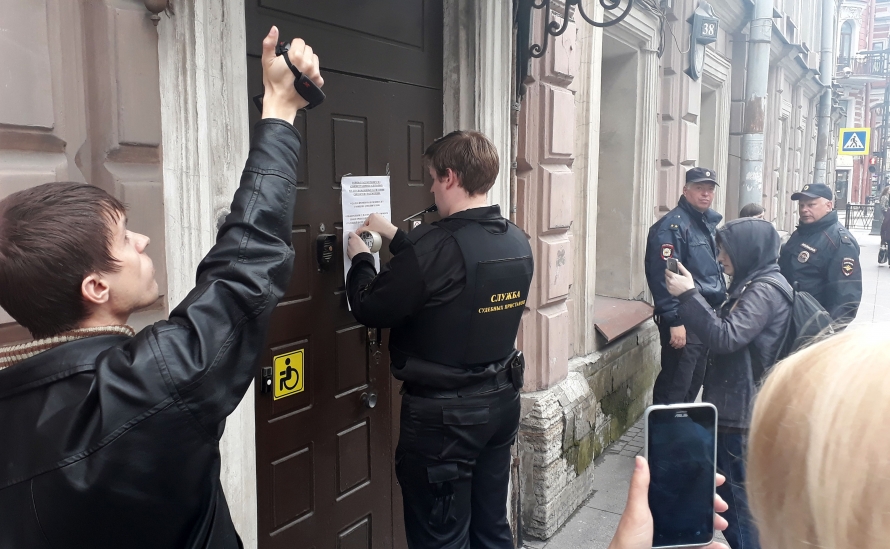
Court bailiff posting a notice outside courthouse in downtown Petersburg. Courtesy of Novaya Gazeta

Petersburg Observers
Facebook
June 20, 2017

On June 13 and 14, 2017, emergency courts, expressly forbidden by the Russian Constitution, were set in motion in St. Petersburg.

What were the peculiarities of the court hearings that took place on June 13–14, 2017, in St. Petersburg?

The unprecedented scale. On June 13 and 14, 2017, 943 administrative cases were heard by 123 judges in sixteen of St. Petersburg’s twenty-two district courts. The defendants had been charged with violating Article 19.3, Part 1 (“Disobeying the lawful order or demand of a policeman, military serviceman, penal system officer or Russian National Guard member in connection with the performance of their duties to protect public order and ensure public safety, as well as obstructing the performance of their official duties”) and Article 20.2, Part 5 (“Violation, by a participant of a public event, of the established procedure for holding a meeting, rally, demonstration, procession or picket”) of the Russian Federal Administrative Offenses Code (KoAP). The overwhelming majority of those detained on the Field of Mars on June 12, 2017, were simultaneously charged with both offenses, regardless of the circumstances of their arrests.

The unprecedented speed with which cases were heard: zero minutes (eleven district courts), one minute (seven district courts),  etc.

The unprecedented numbers of cases heard by individual courts in a single twenty-four-hour period: 95 (Kalinin District Court), 106 (Krasnoye Selo District Court), 110 (Frunze District Court).

Violation of territorial jurisdiction. All the administrative cases should have been heard by the Dzerzhinsky District Court, in whose jurisdiction the Field of Mars is located. At the request of the persons charged with administrative offenses, their cases could also have been transferred to the courts in the districts where they are registered as residebts. In the event, the detainees were bused from police precincts to sixteen district courts. Their cases were assigned to judges regardless of territorial jurisdiction.

Violation of the right to a defense. No more than a quarter of the defendants enjoyed the services of a lawyer or public defender. Some judges rejected appeals for adjournment so that defendants would be able to secure defense counsel. Some judges gave defendants a ridiculously short amount of time to secure defense counsel. Defense attorneys and public defenders were physically unable to get into the majority of the courthouses, especially after six o’clock in the evening.

Violation of the right to a public trial. Information about the court hearings on June 13–14, 2017, was posted on the courts’ official websites only several days after the hearings themselves.  People who might have wanted to attend the hearings had no way of finding out what cases were being heard, nor when or where they were being heard. Judges’ rulings have not been published in full. Currently, only 26 of the 943 rulings, which have already taken force, have been published on the courts’ websites.

Violation of the principle of adversarial proceedings. There were no prosecutors or police officers present at any of the hearings, and the judges essentially acted as prosecutors.

Night courts are forbidden. But even on official court websites the starting times of hearings are listed well past midnight, e.g., 12:23 a.m. (Krasnoye Selo District Court), 12:45 a.m. (Kalinin District Court), 5:00 a.m. (Kolpino District Court), 5:20 a.m. (Frunze District Court).

Despite the violations, listed above, the St. Petersburg City Court has rejected all appeals filed, moreover, in the very same fashion as the district courts. This means the people who organized and launched the conveyor belt of emergency justice in St. Petersburg have direct control not only of the police and the Russian National Guard but also the of district and city courts.

P.S. The mass trials that occurred on June 13–14, 2017, in St. Petersburg, differed from extreme justice only in the sense that they were executed by regular judicial entities, rather than by specially instituted extraordinary courts with distinct powers.

Translated by the Russian Reader

____________________

Are you wondering how you might react to this nastiness, especially if you live far from Petersburg? Here’s one simple suggestion. FIFA’s Confederations Cup is currently underway at four venues in Russia (Kazan, Moscow, Sochi, and St. Petersburg). Take a gander at the match schedule and the list of corporate sponsors (which includes Adidas, Coca-Cola, Visa, McDonalds, and Bud). Give them a call or send them an email saying that, because of the way the Russian leadership treats its own people when it comes to the freedoms of speech and assembly, and the right to a fair trial, you won’t be buying their products anymore, since they make common cause with flagrant tyrants.

You can also get in touch with the TV channels broadcasting the Confederations Cup matches in your city or country and tell them you won’t be watching the matches and why you won’t be watching them.

These are simple ways to show your solidarity with the six hundred and sixty some people who were arrested on Petersburg’s Field of Mars for no good reason on Russia Day, a national holiday celebrating the country’s independence from the Sovet Union, and then put through the kangaroo courts, as described above and elsewhere.

These are also effective ways of showing the Russian leadership, who set great store by their power to win bids to host major global sporting events like the Winter Olympics and the Football World Cup that we are not impressed by their prowess, especially when our Russian sisters and brothers live in conditions of such rampant unfreedom and poverty. TRR

No Protest Is Illegal

taubinskaya-moscow protest
Anti-corruption protester detained on Tverskaya Street in Moscow, June 12, 2017. Photo courtesy of Mayorova.net and Irina Taubinskaya

Below, you will find a brief, eyewitness account of the rough custom to which people detained at the anti-corruption protest rally on the Field of Mars in Petersburg on June 12, 2017, have been subjected by police as the have been slowly “processed,” sometimes with no legal representation and in gross violation of their rights as detainees, by the police and courts.

The Russian “legal and law enforcement” systems are shambles, for the simple reason they don’t exist at all. They are fictions.

What does exist is the supreme will of the blood monkey who answered questions all day yesterday on TV or something like that, and the lesser wills of his cronies and satraps.

Those exist.

So when asking the question of who exactly ordered the arrests of the six hundred and fifty some arrestees of June 12, 2017, and the harsh sentences of five to fifteen days in the hoosegow and fines of up to 15,000 rubles most of them were handed by the city’s district courts (again, in conditions where many of them were dehumanized constantly, despite the best efforts of Petersburg’s wonderful Aid to Detainees Group and other volunteers and well-wishers to support them) you need look no farther than the head blood monkey in the Kremlin and his precious “power vertical.” They are the ones who gave the orders to treat the protesters this way, not anyone on the ground.

I was irked to hear the BBC’s Moscow correspondent refer, the other day, to the concurrent protests on Tverskaya, in Moscow, where a similarly large number of people were arrested, as “illegal.” Setting aside for a second the rights to free assembly and free speech enjoyed by all Russian citizens, as enshrined in the 1993 Russian Federal Constitution, the Petersburg authorities several years ago designated the Field of Mars as the city’s “Hyde Park,” the place where city dwellers could go, supposedly, to air their grievances without making a special application to the authorities. (This need to apply for permits is itself a mostly unconstitutional practice, backed, of course, by the country’s kangaroo higher courts, who are also a part of its so-called telephone justice system).

In reality, Petersburg authorities have let their so-called Hyde Park be used the way it was intended only when the numbers of protesters or their particular grievances have not been threatening enough, although, of course, police are still always on hand to photograph, videotape, and ID the protesters, and even copy down the slogans on their placards, which they immediately radio to their superiors. Just in case, you know, and to make sure the protesters know the state is monitoring them

When, on the other hand, the topics raised and/or numbers of protesters have not been to the liking of the powers that be, local or otherwise, Petersburg’s “Hyde Park” has instantly been deemed yet another no-go zone, the protests declared “illegal,” and the protesters and, sometimes, the counter-protesters, dragged off into paddy wagons and taken to police precincs.

Sometimes, the protesters are merely held in police custody for a few hours or overnight, and then released scot-free. But when the regime wants to teach them a lesson about how much freedom they really have in the world’s largest “sovereign democracy,” they get the book thrown at them, as we have seen over the past several days in Petersburg. That is, for one and the same legal/illegal act, either nothing will happen to you or your life will be scuttled for two weeks or a month (as in the case of “ringleaders” like Alexei Navalny, who was arrested at the door to his block of flats before he could get to the “illegal” protest and sentenced to thirty days in the slammer), and your already meager finances will have a nice dent put into them.

So, if I were a BBC or other foreign correspondent, I wouldn’t be so quick to dub any protest in Putinist Russia “illegal.” That’s tantamount to saying that the police and courts have the right to do with Russians detained for real or imaginary offenses what they will.

It’s also an admission on the part of these foreign correspondents that, in the case of the protesters, they don’t understand the offenses are wholly imaginary, i.e., trumped-up, that they are, in fact, a little bit of the ultra-violence, meted out in smallish doses to discourage the kids from coming out again. TRR

* * * * *

16% of the St. Petersburg Public Monitoring Commission
Facebook
June 15, 2017

I am deciphering my conversations with arrestees:

“We were driven to the courthouse in handcuffs, and tied to each other. We arrived, they untied us, and took us upstairs to the courtroom. We had no defense counsel. The court sentenced us to five days in jail and a fine. We were driven back to the police precinct, where we cuffed to chairs and each other. (The cuffs immediately caused pain to the second person.) The guy with the keys to the handcuffs went off somewhere. We were cuffed for two and a half hours. We asked to go to the toilet, to uncuff us, but our requests were ignored. This happened next to the cells. The cells were not locked.

“Then they uncuffed us from the chair, cuffed us to each other, put us in a van, and took us to [the temporary detention center at] Zakharyevskaya Street, 6.”

This incident occurred on June 13, at the 78th Police Precinct, in St. Petersburg’s Central District

Translated by the Russian Reader. Thanks to Jenya Kulakova for the heads-up on the link and Sasha Feldberg for the photo.

The Singer Not the Song

Yakovlev
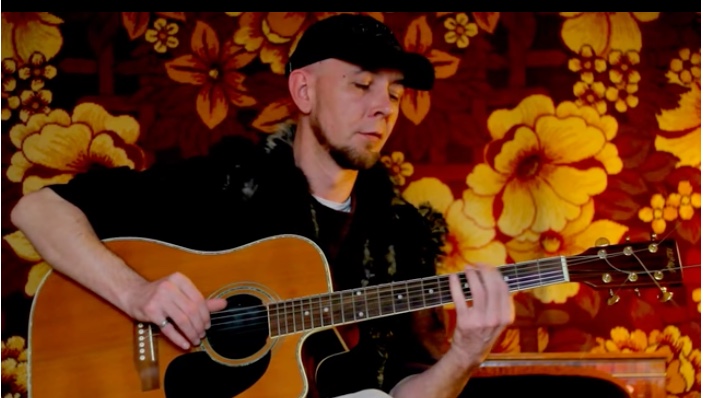
Boris Yakovlev. Screenshot from YouTube video

Pskov Region Singer-Songwriter Boris Yakovlev Charged with Calls for Extremism
Grani.ru
April 20, 2017

The FSB’s Pskov Region office has charged Boris Yakovlev, a 44-year-old resident of Dno, under Article 280.2 of the Russian Federal Criminal Code (public calls for extremism using the internet). Grani.ru was informed about the case by lawyer Dmitry Dinze, who is representing the musician.

Yakovlev is known for his original songs, which he posts on his YouTube channel.

“Yakovlev has denied his guilt and refused to testify, since the defense needs to analyze the evidence on which the charges are based,” said Dinze. “In addition, a forensic examination of the digital media seized from Yakovlev’s home has now been ordered, and in the near future, the court will order and perform a linguistic forensic examination. The forensic experts are being chosen. The defendant has been released on his own recognizance.”

Besides the recorded songs posted on YouTube, the FSB alleges that between June 20 and June 29, 2016, Yakovlev posted on his personal page on the social network Vkontakte five pieces of writing in which he outlined his ideas about the situation and events in Russia. The texts in question begin with the words “About elections,” “We have already gone over our limit on revolutions,” “Above the dwarf’s head,” “I find it curious,” and “Reading the newswire.”

On March 20, 2017, Senior Lieutenant A. Filippov, a detective in the First Branch of the Department for Protecting the Constitutional Order and Combating Terrorism in the FSB’s Pskov Region office, filed a crime report. He claimed there was evidence of a crime in Yakovlev’s published texts: public calls for extremism on the internet.

In a specially conducted study, Andrei Pominov, an associate professor in education and psychology at Bashkir State University’s Sibai Institute, wrote that Yakovlev’s texts “contain psychological and linguistic means aimed at inducing an unspecified group of persons to carry out extremist actions aimed at forcibly changing the existing state system or seizing power.”

Consequently, Captain of Justice I. Karpenkov, senior investigator in the Investigative Department of the FSB’s Pskov Region office, filed criminal charges against Yakovlev.

Boris Yakovlev, “Confession of an Enemy of the People”

On March 16, Judge Yevgeny Naydenov of Moscow’s Presna District Court fined rapper David Nuriyev (aka Ptakha) 200,000 rubles [approx. 3,300 euros] in an extremism case. Ptakha was found guilty of violating Article 282.1 of the Criminal Code  (inciting hatred or enmity toward a group of people united on the grounds that they “assisted law enforcement agencies in locating and apprehending criminals”). The “social group” in the case was the Anti-Dealer Movement, founded by Dmitry Nosov, an ex-LDPR MP and former professional judoka.

The prosecutor had asked the defendant be given a suspended sentence of one and a half years. The musician fully acknowledged his guilt and apologized to Anti-Dealer. The case was tried under a special procedure. The trial consisted of a single hearing.

_______________________________

Boris Yakovlev, “I Want to Be There at the Hour”

I want to be there at the hour
When the millions of nationalist riffraff
Howl as one:
We were opposed! We knew everything!

We pretended deliberately.
You understand: work and kids.
But deep down we resisted.
We don’t want Crimea, please note.

We realized he was a murderer.
We don’t want war and death.
We really love Ukrainians.
We’re innocent, believe us!

We don’t want Lugansk and Donbass.
It’s the first we’ve heard about the “Russian world.”
Standing in line for rotten meat,
That’s what the mouse people will whisper.

I want to look in the eyes of the followers,
Those Pharisees of the mob,
In whom honor and conscience are vestiges,
And who have an ass instead of a head.

Translated by the Russian Reader. A huge thanks to Comrade Koganzon for the heads-up

Gleb Astafiev: Trampled by the Madding Herd

Gleb Astafiev
Gleb Astafiev

Trampled by the Madding Herd
Darina Shevchenko
16-year-old Gleb Astafiev is being tortured in a psychiatric hospital because of his picket in support of Pyotr Pavlensky
Radio Svoboda
June 11, 2016

In late May, Gleb Astafiev, a 16-year-old resident of the village of Ketovo in Kurgan Region, held a solo picket in defense of artist Pyotr Pavlensky,  then on trial in Moscow for setting fire to the doors of FSB headquarters. The young man sewed his mouth shut, grabbed a placard on which he had written the inscription “Pyotr Pavlensky’s action was a replay of Varg Vikernes‘s famous gesture,” and stood next to a store in downtown Kurgan. This was a reference to Pyotr Pavlensky’s first action, Seam (July 23, 2012), in which the artist sewed his mouth shut and took to the streets of Petersburg with a placard that read, “Pussy Riot’s action was a replay of the famous action by Jesus Christ.”

Astafiev was taken to a police station, and then sent to the Kurgan Regional Neuropsychiatric Hospital.

On the day Pavlensky was released, Astafiev was able to access the Internet for the first time during the thirteen days of his incarceration at the mental hospital and contact the outside world. He told Radio Svoboda how he had wound up in the hospital and what was happening to him.

Gleb, who sent you to the psychiatric hospital?

After the police detained me when the picket was over, my mother talked for two hours with them. I think they did a number on Mom, because she came back for me accompanied by an ambulance crew, and I was hauled off to the looney bin. My mom thinks I am crazy. She is convinced that normal people don’t sew their mouths shut and take to the streets bearing placards. Mom is a simple woman, and she doesn’t understand my action was an artistic metaphor. The closed mouth is a symbol of the absence of freedom of speech in Russia. My mom watches TV too much, so her mind has been warped by propaganda. It’s very hard to explain the message of my action to her. Mother did not support my creative experiments, but after the action she got angry at me. She doesn’t even bring food to the hospital. Grandmother, on the contrary, has been treating me better since the action. Now she sympathizes with me. The relatives are not planning to spring me from the nuthouse for the time being. The doctors have not said anything to me about the subject.

You sound very calm and confident. How do you feel? Have you been forced to take meds?

They tried to vegetate me with pills, but I spit them out. The first five days I was held in the special supervision ward. They tossed me in with the worst crazies, but I was forbidden to leave the ward. I was in there with eight oldsters. Three of them rarely showed any signs of life. The other five screamed at night, beat the floor with their fists, and raved. They tried to force me to kowtow: to wash the floor and clean up. I refused. I am currently under routine supervision, but I cannot leave the wing.

Do you know that Pyotr Pavlensky has been released? Do you regret you wound up in the mental hospital because of your action in support of the artist?

Of course not. I am very glad for Pavlensky! Maybe it was thanks to the support of different people, including me, that he was released. The regime really doesn’t like people like Pavlensky, because a real actionist is a free spirit and openly declares it. I think I did my bit for free speech with my action, which was, of course, a reference to Pavlensky’s actions.

What were your feelings when you were standing there alone holding a placard, surrounded by strangers who were probably aggressive to you? Did anyone support you during the action?

I thought up and did the whole thing myself. My action was entitled F.P.P. (an abbreviation for “Free Peter Pavlensky”). Passersby reacted differently. Mainly, people were surprised. There were lots of riffraff there. One creep swore at me at the top of his lungs for twenty minutes. Some people came up to me and had their pictures taken. There was an old couple who stood next to me the whole time. Once, the old woman came up to me and said, “You’re a fool. One man does not make an army.” The old man periodically yelled loudly, “Look, people! He is holding opposition placards!” I ignored all of it.

Around thirty minutes after I started the action, two grown louts in black vests (security guards, apparently) came out of the Pushkin Shopping and Entertainment Center. One of them jumped me and tried to grab the placard. I wouldn’t give it up. A dude who was around twenty saw the scene from the window of his car. The fellow jumped out of his ride and told the guard to leave me alone. It’s a pity that many people don’t understand the difference between art and hooliganism and madness. Actionism is lovely! I really love actionism, especially Viennese actionism.

Why are you able to see the difference?

Hard to say. I’m an ordinary schoolboy from a simple family. I read a lot, especially science fiction. I think a lot about what’s going on with my own head. I want to have a vivid, interesting life, not a life like the majority’s: home, work, and television. I can’t talk anymore. I see the medical staff coming.

Gleb Astafiev standing next to the door at FSB headquarters that Pyotr Pavlensky set on fire

Gleb Astafiev’s action has sparked a fierce debate among Kurgan Region residents on social media. Some Internet users have admired the young actionist’s audacity and honesty. Others have written that Astafiev is as abnormal as Pavlensky. Astafiev has said he is uninterested in the negative feedback of philistines. He is suffering from a lack of communication most of all now. A girlfriend has been visiting Gleb at the hospital. She asked that her name not be printed, because she did not want to attract any public attention.

“That hospital is a hellish place: closed, stuffy, and miserable. Gleb is now all alone there. He is very depressed: almost no one comes to visit him. He doesn’t even have anything to read. Gleb asked me to buy him science fiction books. Gleb’s pupils are dilated: apparently, they are medicating him. I don’t know Gleb that well. Before his incarceration in the hospital, we had seen each other only five times. We met by chance at a concert by a local band. He wanted to have his picture taken with me and my ex-boyfriend. Then Gleb seemed like a cheerful, carefree, very dear and open boy, a young idealist with a dream. He and my ex-boyfriend then traveled to a Krovostok concert. A bit later, I realized that Gleb was very independent and intelligent, and had a very strong spirit for his age. Even today at the hospital he didn’t complain and didn’t ask for anything special except a couple of books and a bit of food. I know nothing about Pavlensky, but Gleb had the right to support him. I am surprised his mother sent Gleb to the hospital, but he is definitely not a whacko, as the majority thinks. The opinion of the herd is often wrong.”

Pyotr Pavlensky is not the only artist whom Astafiev has tried to support. In November of last year, the team at the news website Mediazona shot a documentary film about Astafiev. The reporters there were touched by the story of a young man who had borrowed money to travel from his village to the trial of the band Krovostok. In November 2015, Yaroslavl Regional Court considered rescinding a district court’s decision to ban the group’s songs and block its website. The trial resembled a comedy with a happy ending: the court took the side of the musicians. The members of Krovostok liked Astafiev so much that when the trial was over they took him along with them to Moscow for a big concert.

Margarita Filippova, photo and video editor, Mediazona:

“We were making a series of documentaries about the Krovostok trial. I noticed a long commentary by Gleb on Instagram. He wanted to know when the next hearing was and whether he could come to Yaroslavl to get the autographs of the guys in Krovostok. The photographs in Instagram initially made him look too eccentric. But when we saw him at the train station, we realized he was a very modest, friendly guy. That was when it occurred to me to show this absurd trial through the eyes of a touching 16-year-old boy who made the long trip from Kurgan to support his idols. Gleb is like a kid from another world, a world distant from our reality where we lazily follow insane trials on our iPhones, sighing and voicing our dissent, at best, on Twitter.

“Gleb sees the world like an artist, but at the same time he has a very rational attitude to reality. He has a good sense of the country in which he lives, and he really wants to change his life. I’m sure it will work out for him. Gleb feels responsible and concerned about other people. When I was sixteen I wasn’t worried about protesting artists, and I sure didn’t know what a court trial was.”

Zarina Kodzayeva, camera woman, Mediazona:

“Gleb is a very independent and open person. It seemed to me that Gleb didn’t have a drop of the infantilism you would expect from a teenager. He argues things sensibly and behaves like an adult. He and I chatted a lot when we were shooting the film. I found it very interesting to listen to him. Gleb writes things himself. When he speaks, you can tell he loves the Russian language. I got the sense this kid believed in the power of deeds. It really was important to him to support Krovostok and Pavlensky. One of the most important questions in documentary filmmaking is who can be a main character, the hero, and who cannot. Aside from the context, which might turn into a story, there is always an intuitive understanding that probably has to do with a person’s energy. I think Gleb is an absolute hero. And now he continues to prove it with his actions.”

Translated by the Russian Reader. Thanks to Comrade AM for the heads-up. Photos courtesy of Radio Svoboda

The 501st: Russian Death

russian death
“Russian Death”

‘Sociologist Denis Volkov from Moscow’s independent Levada Center pollster, on the other hand, says the bill is unlikely to make Russians more wary about what they post on the Internet. “Most people are not aware of these laws,” he says.’

Ha-ha. It’s good that reporters are forced to turn to “sociologists” and “pollsters” for quotable quotes, and that the Putinist state decided at some point long ago it would pollocratize everyone and their cousin into submission, because otherwise the “independent” Levada Center would have had to pull up stakes long ago and move to Nevada to start calling odds on the trifecta at Santa Anita racetrack.

I have already seen the chilling effect that the bill and the generally malignant, soul-destroying climate of the last year or so have had on what people talk about politically (or not) in daily life, much more dare to post on the Internet, e.g., Russia’s role in Syria, which absolutely no one I know has discussed, publicly or otherwise, under any circumstances for a very, very long time now. And that is just the top of the list.

A fair number of Russians, young and old, know very well how to read signals coming from on high and when to keep their mouths shut. Or how to substitute abstract, self-important chatter or furious trivial pursuits for meaningful conversations about what is happening in their country and what to do about it. Now is one of those times, and it is absolutely depressing.

All it will take is a few more “light touches,” and the country will essentially be dead, that is, waiting for its Supreme Leader to kick the bucket (when? twenty years from now?) so it can rejoin the rest of the world and resume building “democracy,” “capitalism” or whatever it has been pretending to do the last twenty-five years.

Photo courtesy of the Facebook page of Russkaia smert’ (Russian Death)

The Crime of Speaking Up in Russia: Solidarity with Dadin and Polyudova

Vadim F. Lurie
Facebook
March 23, 2016

The people’s assembly [to publicize an appeals hearing in the case of Ildar Dadin, sentenced in December 2015 to three years in prison for the heretofore unknown offense of “repeat unauthorized protesting”] did not come off. [Nor did Dadin’s appeals hearing in Moscow City Court: it was postponed to a later date.] There were fewer people in attendance than the day before yesterday, the day Nadiya Savchenko was sentenced. But the picketers decided to spread out along the Nevsky, and members of the National Liberation Movement (NOD) wandered around searching for them, trying to pester and troll them.

The most successful at this was a bearded specimen, who yelled, “Look, a real live national traitor! A Maidanite, a Banderite, funded by the State Department!

The passerbys, who usually do not pay much attention to people standing holding placards, mostly regarded them sympathetically thanks to this spiel.

lurie-skhod-1
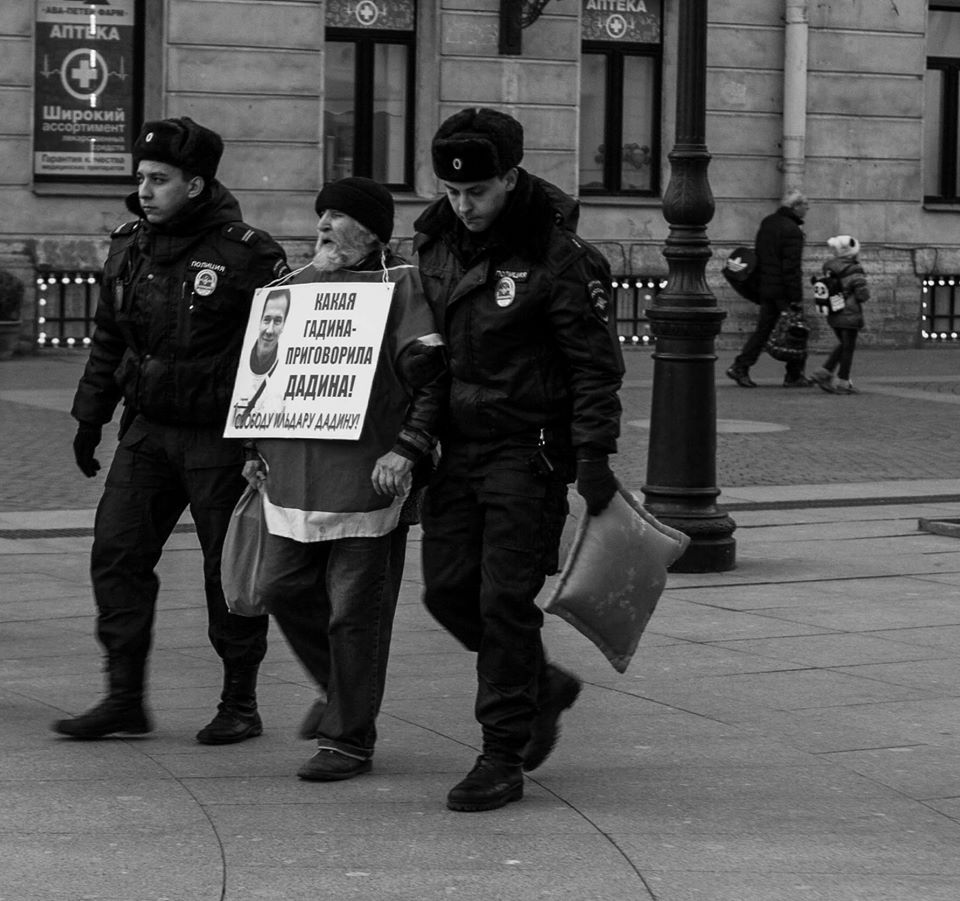
“What a viper sentenced Dadin! Free Ildar Dadin!” Local police detain veteran democratic activist Igor “Stepanych” Andreyev. Petrograd, March 23, 2016. Photo by Vadim F. Lurie
lurie-skhod-2
Petersburg police surround a picketer, demanding he produce his documents. Petrograd, March 23, 2016. Photo by Vadim F. Lurie
lurie-skhod-3
A member of the so-called National Liberation Movement (NODS) scans the Nevsky for “national traitors.” Petrograd, March 23, 2016. Photo by Vadim F. Lurie
lurie-skhod-4
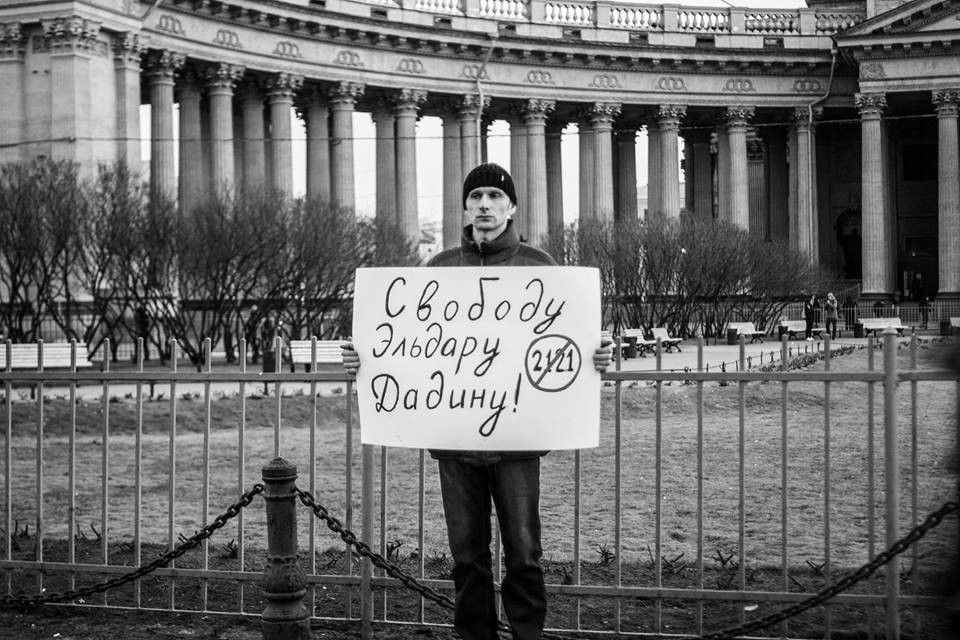
“Free [Ildar Dadin! No to Article 212.1!” A picketer stands in front of Our Lady of Kazan Cathedral. Petrograd, March 23, 2016. Photo by Vadim F. Lurie
lurie-skhod-5
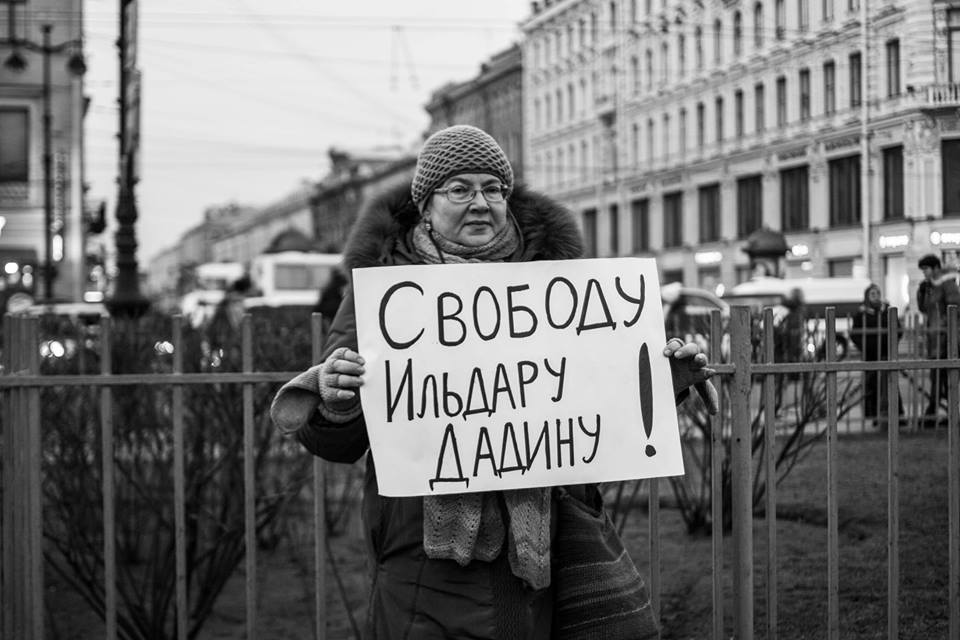
“Free Ildar Dadin!” Petrograd, March 23, 2016. Photo by Vadim F. Lurie
lurie-skhod-7
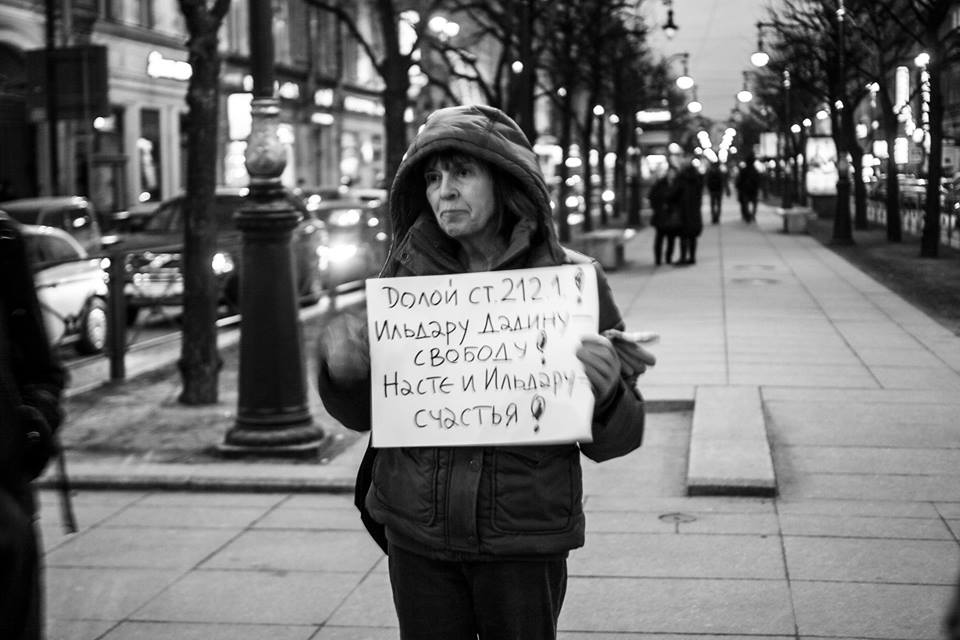
“Down with Article 212.1!* Free Ildar Dadin! Congratulations, Nastya and Ildar!” Petrograd, March 23, 2016. Photo by Vadim F. Lurie
lurie-skhod-8
“Free Darya Polyudova,** sentenced to two years in a work-release prison as an extremist for a repost on Vkontakte.” Image of Polyudova with placard: “Ukraine, we are with you.” Petrograd, March 23, 2016. Photo by Vadim F. Lurie

Translated by the Russian Reader. Thanks to Vadim F. Lurie for his kind permission to republish his photos here.

*Despite the obstacles, Russia’s opposition continued to organize protests. So last summer in 2014, the Kremlin effectively criminalized all peaceful protests and assemblies. Article 212.1, which went into effect in January 2015, amends the previous law in a considerably more punitive manner, carrying up to 5-year criminal prison terms for repeated protests. This law has a “3 strikes” feature, stating that anyone who has been convicted 3 times for the administrative offense of ‘violating the regulations governing public rallies,’ within a six month period is subject to criminal liability. With these laws and their particular application against political critics, the Putin regime is sending a powerful message heard throughout Russia of a repressive new reality unseen in decades: If you dare to speak out against government policies or leadership, the authorities will ruthlessly treat you as a common criminal and send you away for years in penal colonies. [] A young protester named Ildar Dadin became the first person to be convicted under Article 212.1 for having protested 3 times within a 6-month span. Ildar Dadin engaged in a completely benign peaceful protest, mostly standing alone holding a sign expressing his opinions, specifically about releasing political prisoners, the need to change power in the Kremlin, and to end the war in Ukraine. Until his trial in December, Dadin had been confined to house arrest. But on December 7, Dadin was sentenced to 3 years of actual prison time in a penal colony for simply exercising his constitutional right to express his opinion. Yes, Russia’s Constitution under Articles 29, 30 and 31 guarantees freedom of expression and freedom of assembly. But the new laws make those guarantees not worth the paper they’re written on. (Paula Chertok, “New Normal in Russia: Putin Critics Punished with Harsh Prison Terms,” Euromaidan Press, January 6, 2015)

**Dispatches: The Crime of Speaking Up in Russia
Tanya Lokshina, Russian Program Director
Human Rights Watch
December 22, 2015

A left-wing political activist has been convicted of inciting separatism and extremist activities, the latest in a series of criminal prosecutions in Russia against people who dare speak their minds online.

Unless the December 21 ruling by a court in Krasnodar in southern Russia is quashed on appeal, the accused, Darya Polyudova, 26, will spend the next two years behind bars. The charges against her derived from three posts she published on her page in VKontakte (VK), Russia’s most popular social network.

All three posts had to do with Ukraine. The one that triggered the incitement to separatism charge – in Russian law, making “public, online calls aimed at violating the territorial integrity of the Russian Federation” – was not even written by her. It was a flippant comment by another user, which Polyudova shared on her page, about supposed demands by local ethnic Ukrainians of the Krasnodar region to be incorporated into Ukraine.

The second post, deemed by authorities as “public calls to extremist activities,” was a photo of Polyudova with a poster that said, “No war in Ukraine but a revolution in Russia!” The slogan did not include any advocacy of violence.

The third one was a commentary about how the situation in Russia was intolerable and Russians needed to follow the example of Ukraine’s Maidan activists, take to the streets, and bring down the government. These are strong words, but didn’t include any specific action plan.

Polyudova’s VK page has all of 38 followers, and most of her posts draw very few comments. Her words can’t be taken as inciting violence, and they certainly didn’t pose a “danger to the public,” as Russian law requires for criminal prosecution.

Polyudova’s prosecution is one in a growing number of cases where Russians are being punished for speaking their mind. This autumn, a court in Tatarstan sentenced an activistto three years in prison on very similar charges. Since the return of Vladimir Putin to the Kremlin in 2012, the Russian government has instituted an unprecedented and sweeping crackdown on critics of the government, and one of its tools has been overbroad and vague anti-extremism legislation. As the space for freedom of speech in the traditional media narrows, the government is now going after the Internet and targeting individuals who try to stir public debate about sensitive issues, especially Ukraine.

Until her trial, Polyudova was relatively unknown. But by criminally prosecuting her, the government is sending a chilling signal to Internet users across country – if you think you can speak your mind online, think again.

Ildar Dadin: “When I Get Out, We Will Change the Country for the Better”

The Prison Blog of Ildar Dadin’s Fiancée: First Visit, January 14
Zekovnet.ru

Nastya Zotova and Ildar Dadin had agreed to get married in January 2015, when Ildar was detained. Imprisoned Russia continues its publication of his fiancée’s blog.

nastya & ildar
Nastya Zotova & Ildar Dadin. Photo courtesy of openrussia.org

I got permission to meet with Ildar from Judge Natalya Dudar on December 30, and I went for my first short visit on January 13. A short visit is not like a date at a cafe or the movies. There is no hugging and kissing. You see each other only through the glass, and there is also a metal grille on top of the glass.

Getting a “date” was not as difficult as I thought. I went to the pretrial detention facility at nine in the morning and handed over the authorization from the judge and the application form, which was printed on the same piece of paper. Then I waited until eleven for one of facility’s wardens to come. He collected everyone’s internal passports and took us to the fifth floor, where there were about fifteen cubbyholes with glass in the middle.

The visit lasted two hours. You can discuss a lot in that time, both life in prison and personal affairs. Apart from me, nine other people had come for visits. Most were women, some of them with children in tow.

Before the visit, a little boy showed me a drawing.

“I drew this for Dad. This is me, this is Mom, and this is Dad. And this is our home.”

Ildar was finally led in. The feelings provoked by such visits are mixed. On the one hand, there he was, my beloved one, whom I had not seen for five weeks. He was safe and sound, without a bruise on his face. The first few minutes we stared at each through the glass and smiled like fools. On the other hand, it was hard. I wanted to hug and kiss him. But talking with him through the glass was still better than nothing.

I quizzed him about prison life. It turned out that the inmates were often worried about the simplest problems, which were hard to solve imprison. For example, your socks are torn. If you were at home, you would grab a needle and thread and darn them. But there are needles and thread in the detention facility. You might be able to borrow a needle, but thread is totally inaccessible and is not allowed in care packages.

Or you have run out of toilet paper. You will have to wait until someone buys it in bulk through the Federal Penitentiary Service store. Toilet paper is not allowed in care packages. According to Ildar, the wardens should issue toilet paper to inmates, but in Pretrial Detention Facility No. 4 it is “not done.”

Or you need to write complaints and appeals in triplicate or quintuplicate. There is no printer, so you have to write everything by hand. You could use carbon paper, but for some reason it is also not allowed in care packages.

The inmates entertain themselves in peculiar ways. Whereas Oleg Navalny caught pigeons, Ildar and his cellmates catch mice. They are ordinary gray mice that run under the bunks at night.

To catch a mouse you need an empty milk carton. You cut a little hole and plant the bait inside. When the mouse enters the cartoon, you close the hole with your hand and then transfer the little beast to a plastic ice cream pail.

They managed to catch two mice in this simple way. Ildar’s cellmates decided to put them on trial and “sentenced” them to four days in prison. They were to serve their sentence in the plastic ice cream pail. Afterwards, they planned to “release” the rodents by throwing them out a third-floor window. But the prisoners escaped by gnawing a hole in their cell.

Smoking is another serious issue. There are eleven men in Ildar’s cell. Five of them are smokers, and they smoke right in bed. The others, who are nonsmokers, are not happy, to put it mildly.

There are only eight beds for the eleven inmates. They take turns sleeping. According to Ildar, however, this is even a good thing, because you can borrow a second blanket from someone. Otherwise, it is too cold to sleep. It got cold in the cell on January 1, so the thermal underwear that I bought on the advice of Alexei Polikhovich, who was convicted in the Bolotnaya Square case, was a real godsend. But Ildar is warm in it only if he sleeps under two blankets. And he still has to survive the transfer to the penal colony where he will serve his sentence—in winter in a cold train car!

After sleep, the second most important issue is food. Ildar admits the food is better than at the special detention center. However, the portions per inmate are not very big. It is not that he is completely hungry, but he would like more. He says that some cellmates eschew the prison food, and so the other prisons divvy up their helping among themselves. They can even warm the food up. A boiler is placed in a pot with water, and a plate with the food on it is place over the pot. The food is thus heated over a water bath.

I have been trying to figure how best to fatten up my inmate through care packages. Ildar already rejected hot meals ordered through the FPS website, and then canned buckwheat kasha with meat. I don’t feel like sending him instant mashed potatoes and noodles (which in prison are called “steamers”).

“Maybe you’d like more cheese? More sausage?”

Ildar frowned.

“I look at the prices in the FPS store and feel offended at how these thugs prey on us. I would rather eat the regulation hundred grams of soup, then shop there,” he said.

This is especially because, according to Ildar, all the care packages are put in the “kitty,” to which everyone has access, so Ildar himself does not end up with so much.

Ultimately, we agreed that I would cooperate with the relatives of other inmates, and that together we would buy food in bulk at ordinary stores and then pass it on to the lads in the cell, since there was a common pot there anyway. Regard the FPS store, Ildar nevertheless admitted that sometimes he wanted something sweet: chocolate, sweetened condensed milk or soda. He was very grateful to Olga Romanova for the garlic she sent him. Garlic was the best thing for you, he said, because it was full of vitamins! All his cellmates were ill, but he wasn’t.

There is no shower in the cell. The inmates are taken once a week to the shower room. But there is a sink, so they can wash up and launder their clothes. As Ildar put it, the toilet is “luxurious”: there are walls on two sides, and a door on the third up to the waist.

I asked Ildar how he spent his time at the detention facility, whether he had been writing complaints. Ildar admitted that he had stopped for the time being. The wardens had hinted to him as it were that if he continued, they could take it on his cellmates.

“However, maybe I’ll soon have to make an important decision: to be a living scoundrel or die,” he said.

Ildar did not explain what was the matter: our conversation was bugged. But he did promise in any case to send a letter, written in his own hand, indicating that under no circumstances was he planning to commit suicide. He believed this would protect him from the “accidents” that happen in Pretrial Detention Facility No. 4.

Despite this eerie message, Ildar was more or less optimistic and was planning to read books.

“I have a lot to learn: political science, economics . . . When I get out, we will change the country for the better,” he said hopefully.

Before his arrest, Ildar said he wanted to be a lawyer and specialize in human rights.

UPDATE
On the night of January 14, it transpired that immediately after our visit, Ildar was removed from his cell along with his things. According to the tentative information we have, he has been transferred to another cell in the same pretrial detention facility.

UPDATE: January 15
As it turned out, Ildar has been transferred to a special cellblock in the same facility. (Meaning greater scrutiny from the wardens and better living conditions.) Meanwhile, our marriage application is ready to submit to the registrar.

Ildar Dadin and Nastya Zotova's marriage application. Image courtesy of Imprisoned Russia
Ildar Dadin and Nastya Zotova’s marriage application. Image courtesy of Imprisoned Russia

Translated by the Russian Reader

__________

Russia: Peaceful activist sentenced under repressive new law must be released
Amnesty International
December 7, 2015

Russia’s jailing of a peaceful opposition activist for violating the country’s new law on public assemblies is a shocking and cynical attack on freedom of expression, Amnesty International said today.

Ildar Dadin was sentenced to three years in jail by a Moscow court for repeated anti-government street protests. He is the first person to be jailed using the law, which was introduced in 2014 and punishes repeated breaches of public assembly rules.

“The shocking sentencing of Ildar Dadin shows that the Russian authorities are using the law on public assemblies to fast-track peaceful protesters to prison,” said John Dalhuisen, Europe and Central Asia Director at Amnesty International.

“This cynical move shows that compared to the drawn out criminal proceedings against peaceful protesters in the past, the authorities have now created a shortcut for imprisoning activists. It is more dangerous to be a peaceful activist in Russia than at any time in recent years.”

The “Gay Terrorist Underground” in Khabarovsk: The Case of Andrei Marchenko

Prosecutor Requests Two Years in Open Penal Settlement for Khabarovsk Blogger Marchenko
September 28, 2015
Grani.Ru

Prosecutor Olesya Demina has asked Khabarovsk’s Industrial District Court to sentence blogger and LGBT activist Andrei Marchenko to two years in an open penal settlement, as reported by Grani.Ru’s correspondent from the courtroom. Marchenko has been accused of extremism for posts he made on Facebook.

andrei marchenko
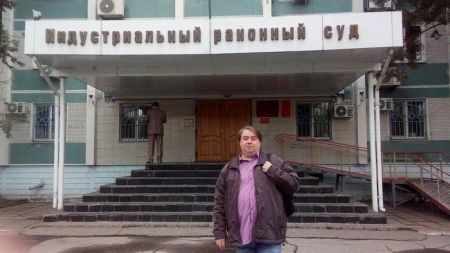
Andrei Marchenko outside of Industrial District Court in Khabarovsk. Photo by Alla Viktorova. Courtesy of Grani.Ru

During closing arguments, defense attorney Natalya Gladych drew the court’s attention to Marchenko’s positive character references, as well as the findings of a psychologist, who concluded that the defendant’s only purpose had been to draw attention to himself and to his position on the war in the east of Ukraine.

“Two years in an open penal settlement is an excessively severe punishment given that the evidence presented by the prosecution is insufficient. The prosecutor speaks of Marchenko as an out-and-out extremist, although the man was simply expressing his opinion. The harsh form in which he delivered it was due only to heightened emotionality,” said Gladych.

On Monday, the defendant was to make his closing statement, but Judge Galina Nikolayeva unexpectedly adjourned until Wednesday, September 30, when Marchenko will deliver his closing statement and the judge will return a verdict.

“I did not expect that the prosecution would request real prison time. There is not a single injured party in the case. There is only the one sentence on Facebook, which did not lead to any real consequences. And for this the representative of the state machine asks the court to sentence me to real prison time,” Marchenko commented to Grani.ru after the hearing.

Marchenko has pleaded not guilty and hopes for an acquittal.

On June 8, 2014, Trinity Sunday, Marchenko published a post on Facebook dealing with the events in the east of Ukraine.

“Impale all the terrorists!!!!!!!!” he wrote. “Kill all of them!! Blood Sunday! Free Ukraine from the fascist Russian terrorists on Trinity Sunday!”

The post was made visible only to Marchenko’s friends in the social network. Nevertheless, it was this publication that led to the blogger’s prosecution.

On August 28, 2014, FSB officers carried out a search at Marchenko’s home during which they seized all his office equipment and mobile phones. The following day, the blogger was charged at regional FSB headquarters under Article 280, Part 1 of the Criminal Code (public incitement to extremism)

andrei marchenko-2
Andrei Marchenko. Photo courtesy of amurburg.ru

A week before the raid, the blogger had also been summoned to regional FSB headquarters. There he was shown screenshots of a certain site according to which Marchenko and another Khabarovsk LGBT activist, Alexander Yermoshkin, were the founders and masterminds of a “gay terrorist underground” that were pursuing the goal of organizing an “orange revolution” in Khabarovsk. As Marchenko noted, the FSB investigator was “utterly serious.” Marchenko was then asked why he did not like “Novorossiya.” He was told that his numerous posts in support of Ukraine and criticizing the Kremlin were the reason for the FSB’s concern.

On September 11, 2014, another five phrases from Marchenko’s summertime posts were sent off for forensic examination.

“Including phrases in support of Poroshenko and phrases about the fact that prices are higher but Crimea is ours,” wrote the blogger.

Two weeks later, it transpired that Rosfinmonitoring had placed Marchenko on its list of terrorists and extremists. However, the blogger kept his bank accounts only for withdrawing money he earned through official freelance bureaus from the WebMoney system. For many years, these earnings had been Marchenko’s only source of income. Thus, Rosfinmonitoring’s decision left the activist penniless.

“Now I don’t even have money for groceries,” wrote Marchenko.

The blogger expressed bewilderment at his inclusion in the list, noting that the court had not yet deemed him either a terrorist or an extremist.

On December 30, 2014, final charges were filed against Marchenko.

Translated by the Russian Reader

NB. Grani.Ru, the opposition news and commentary website that published this article about Andrei Marchenko’s plight is itself banned in Russia as “extremist” and can only be viewed there through VPNs, anonymizers, and mirror sites.

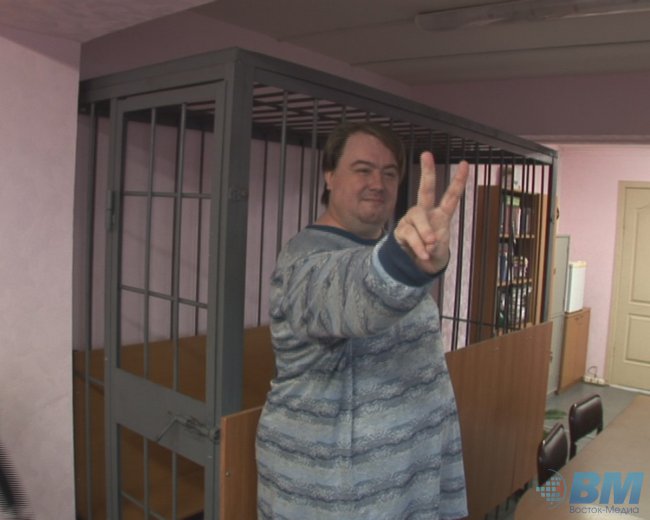
Update. According to an article on the news website Vostok-Media, on October 1, 2015, the Industrial District Court in Khabarovsk found Andrei Marchenko guilty as charged and sentenced him to a fine of 100,000 rubles, but immediately amnestied him as part of a general amnesty celebrating the seventieth anniversary of victory in the Second World War.

Andrei Marchenko celebrating his virtual victory in court. Photo courtesy of Vostok-Media