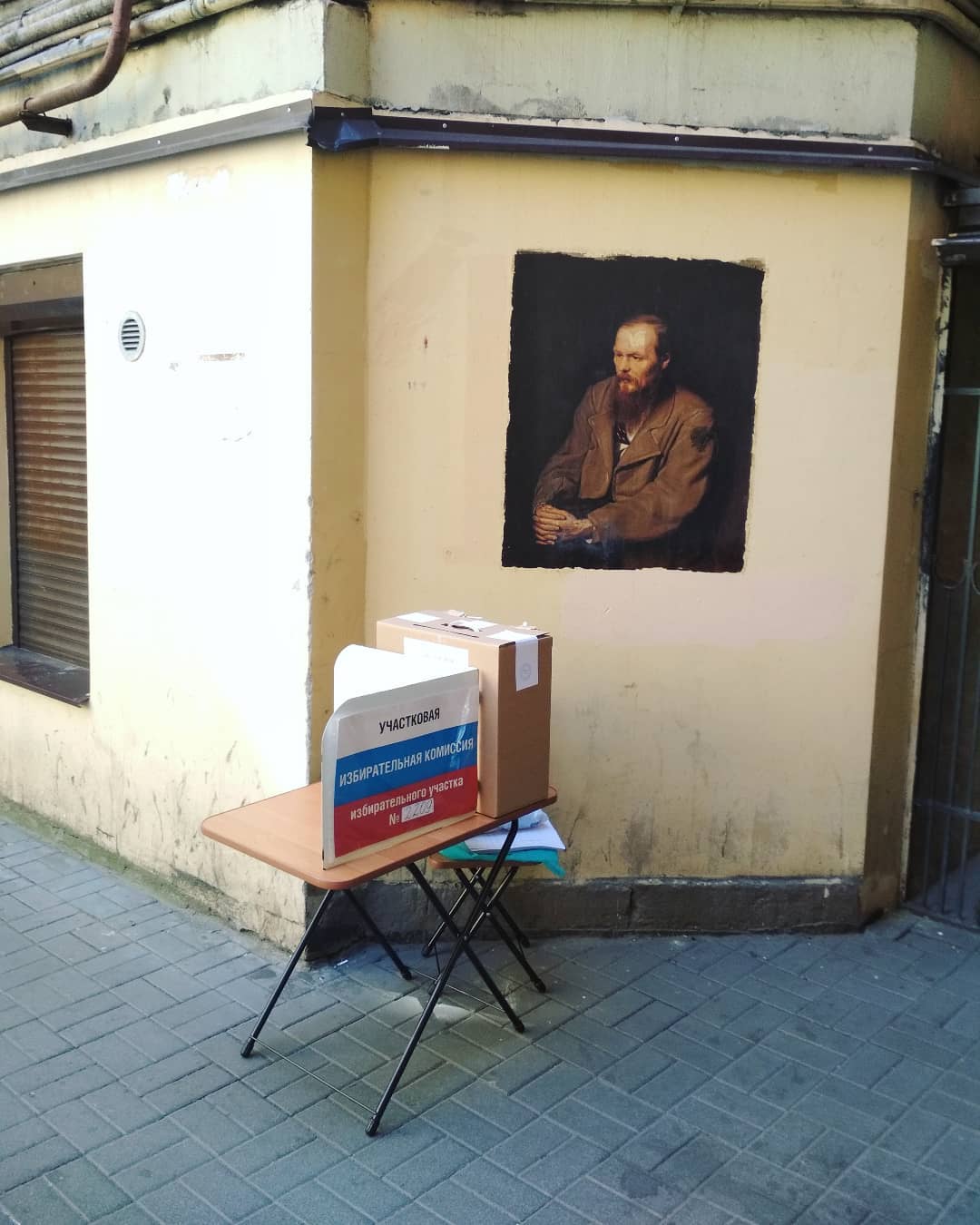
Artist, activist and teacher Darya Apahonchich found this “polling place” in the courtyard of her building in downtown Petersburg, across the street from the city’s Dostoevsky Museum. Early voting is under way in a nationwide referendum on 206 proposed amendments to the Russian Constitution. Courtesy of Darya Apahonich’s Facebook page
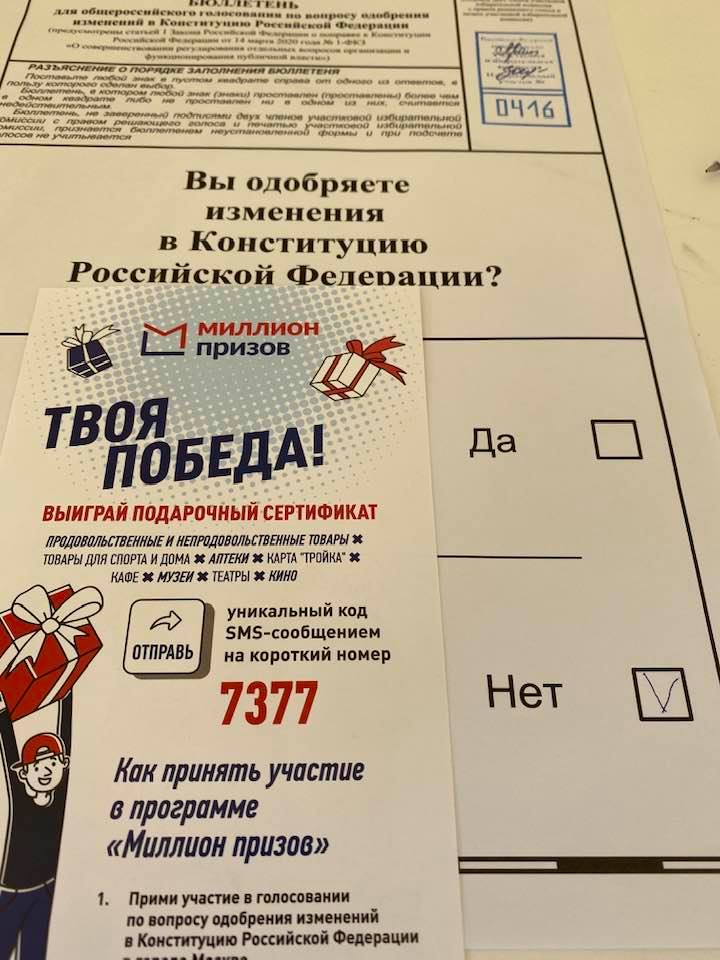
Filmmaker Andrey Silvestrov took this selfie with his ballot paper at his polling place in Moscow. The question reads, “Do you approve [the] changes to the Russian Constitution?” Silvestrov voted no, of course. Note the fact that none of the amendments in question is listed on the ballot paper. Photo courtesy of his Facebook page
Fortunately, Silvestrov’s “no” vote will not, one hopes, disqualify him from entering the “Million Prizes” program, as outlined on a flyer he was given by polling place officials along with his ballot paper. Voters are asked to send a “unique code” in a text message to the number 7377. Winners are promised “gift certificates” redeemable for groceries, sporting goods, and household goods, and for unspecified goods at pharmacies, cafes, museums, theaters, and cinemas. I am going to go out on a limb and predict that the “gift certificates” (if any Russian voters actually receive them) will prove worthless. Photo courtesy of Silvestrov’s Facebook page
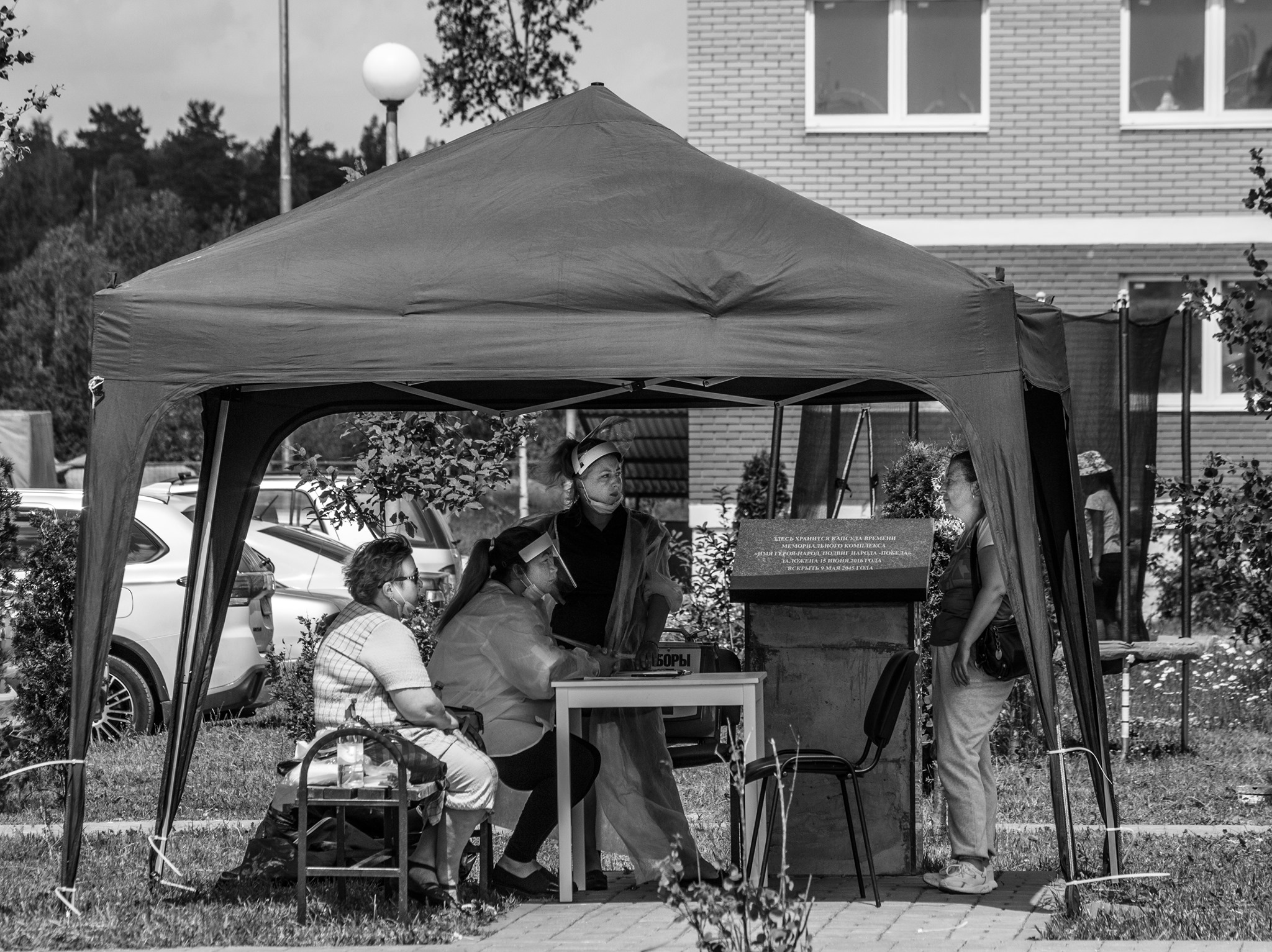
Photographer Vadim F. Lurie took a snapshot of the referendum polling place in the courtyard in a town in the Moscow Region. Courtesy of his Facebook page. While the purported reason for such bizarre ad hoc polling places is ensuring health of voters during the coronavirus pandemic, still raging in many parts of Russia, they provide the added benefit of making it much harder for election observers to ascertain whether the referendum was conducted freely and fairly. Needless to say, “free and fair” is a meaningless concept to the Putin regime.
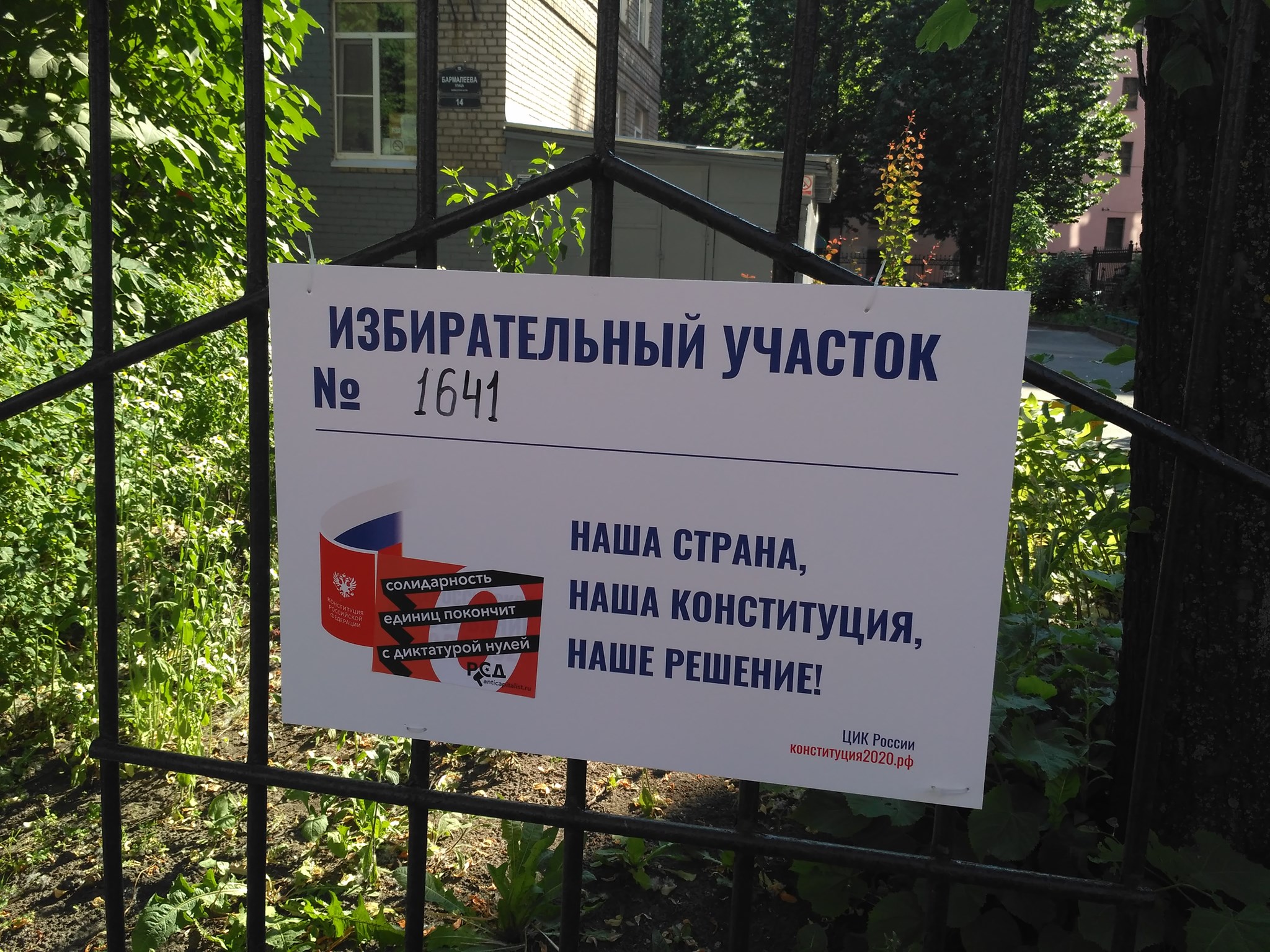
Journalist and political activist Ivan Ovsyannikov took this snapshot outside Polling Station No. 1641, located on the Petrograd Side in Petersburg. The placard reads, “Our country, our constitution, our decision.” Someone has pasted a sticker on the placard, which reads, “The solidarity of ones will end the dictatorship of zeroes.” This is reference to the fact that one of the proposed amendments, if ratified, will “zero out” Vladimir Putin’s previous terms as Russian president, thus allowing him to run for two more consecutive terms of six years. If this scenario comes to pass, Putin would be able to rule until 2036. His current presidential term ends in 2024.
Konstantin Yankauskas and Alexander Zamyatin, popularly elected municipal councilors in the Zyuzino District of Moscow, discuss what their constituents can do to oppose the referendum under near impossible circumstances (the coronavirus pandemic, a ban on public campaigning against the amendments, evidence that thousands of state sector employees are either being forced to vote yes or hand over their passwords for electronic voting to their supervisors, etc.) They also reflect on why the Russian opposition has been unable to run a nationwide “no” campaign despite the fact that formal and informal barometers of public opinion have shown that Putin’s popularity has been falling and that many Russians are opposed to the constitutional amendments. The discussion was broadcast live on YouTube on June 24, 2020.
Leokadia Frenkel talks to local residents protesting vote rigging. Photo by David Frenkel
“I Realized They Were Getting Ready to Throw the Election”: A Petersburg Woman Talks About How She Fought Three Days to Have the Real Vote Tally Confirmed Leokadia Frenkel is a member of the election commission in Petersburg’s Vladimirsky Municipal District, where not a single United Russia candidate was elected Sofia Volyanova TJournal September 12, 2019
Three days after Russia’s nationwide election day on September 8, the results of the municipal district council races in Petersburg had not been officially announced. In four districts where ruling United Russia party candidates did not win a majority of seats on the councils, the election commissions postponed their final meetings. In the Vladimirsky Municipal District, all the ruling party’s candidates had lost, according to preliminary vote tallies. The Yabloko Party had won twelve seats, while five seats had gone to independent candidates, and three seats to A Just Russia.
At some of the polling stations where opposition candidates were leading, election officials decided to recount the votes. As a consequence, United Russia candidates suddenly took the lead, while independent candidates were robbed of critical votes.
Leokadia Frenkel, a voting member of the Vladimirsky Municipal District Election Commission, told TJournal how she and the winning candidates prevented such vote rigging in her own district. She was forced to sleep in the district council building and was assaulted by the election commission’s deputy chairwoman, who attempted to lock Frenkel in an office.
On election day, I arrived at the Central District administration building, where our municipal district election commission is located, at seven in the morning. We invalidated ballots, then I got the papers I had to take to the different polling stations and I delivered them. I communicated with the polling station election commissions and monitored what was happening. At eight in the evening, I returned to the Central District building, where we invalidated the rest of the ballots that needed invalidating.
We did not receive a single complaint during the voting and the vote counts. Everything was completely fair and square. I had no complaints with the commission chair.
“The polling station election commission chairs will go with me, and we will enter the results into GAS [automated state elections system],” she said.
But then, during the night, someone told us all the election commission chairs had been sent home and no one had entered their vote tallies into GAS because it was down. We learned this completely by accident. I asked the secretary of the municipal district election commission what had happened, why the vote tallies had not been entered into GAS, and why the commission chairs had been sent home. She said something was broken, but we checked and nothing was broken. They were playing for time: they needed an excuse to do a recount. That was when we realized the fix was in and we spent the night in the administration building.
Why did I stay there? I was afraid they would convene the municipal district election commission without me. I wanted to be there and register my dissenting opinion if there was a recount.
The winning candidates slept there, too, because the ballots had been packed up and stored in the basement. They were making sure the ballots were not stolen. There were advisory and voting members of the polling station commissions who had done their jobs honestly and wanted to prevent electoral fraud.
The commission had left in the wee hours of September 9, saying it would reconvene at four in the afternoon. But it did not show up at four in the afternoon. We kept waiting, finally filing complaints with the Territorial Election Commission and the Central Election Commission.
We spent the whole day in the building. The very nice, hospital head of the Central District talked to us and gave us chairs so we would not have to lie on the floor. Our friends supplied us with food and water.
We spent over twenty fours in that building.
The head of the district communicated the City Election Commission’s decision to us and said all the chairs of the polling station election commissions would be gathering and all the final vote tallies would be entered into GAS.
When the chair of the commission showed up, she summoned all the polling station chairs. At nine in the evening, they started entering the vote tallies into GAS. The results were entered correctly: there was no vote rigging.
But the fact is that the chair of our municipal district election commission did not come and pick up the results. First, she said they were not ready, although they were ready. She was supposed to collect them and hold a final meeting of the commission to confirm the vote tally and the list of winning candidates. Many independent candidates and new people won seats on the Vladimirsky Municipal District Council. No one from United Russia was among the victors, so maybe they were angry or somehow affiliated with the municipal district council.
Leokadia Frenkel sleeping outside the office of the deputy head of the Central District
After the vote tallies were entered into the GAS, I went home and the next day I was busy with my own affairs. But the final sitting of the commission had not been held nor had the documents been collected. I telephoned the chair and asked what the matter was. So I would not worry, she said the meeting would be held and everything would be fair and square.
At nine in the morning on September 11, the candidates telephoned me and said that certain polling station commission chairs had shown up at the municipal council for some unknown purpose. So I also went to the municipal district election commission, once again asking when our final session would be held and why the paperwork, which had long been ready, had not been picked up.
The deputy chair was the only one in the office, so I asked her. I saw a paper on her desk with no date or registry number. It was a complaint, filed by United Russia candidate Igor Kartsev, who requested a recount. I realized they were getting ready to throw the election. Instead of getting ready for the final meeting, they were grooming people affiliated with them to file complaints requesting a recount, as was happening in other municipal districts, in order to steal the victory from the independent candidates.
I took the complaint in order to photograph it when the deputy chair attacked me from behind. She tried to snatch the letter from me and destroy it. There were many people present, including the candidates and voting members of our commission. One of them grabbed the complaint, which the deputy chair tried to snatch from me, in order to save it from destruction. He photographed it and posted it on social media.
Зампред икмо Владимирский напала на чпрг от яблока @likafrenk, чтобы та не смогла увидеть документы и жалобы с целью пересчёта. Чпрг удалось все же сбежать, хотя ее не выпускали, но зампред теперь утверждает, что это напали на нее, уехала на скорой. pic.twitter.com/GJr3Lv8xC0
Vladimirsky Municipal District Election Commission deputy chair attacked @likafrenk, a voting member of the commission from Yabloko, to stop her from seeing documents and complaints that would trigger a recount. The voting member managed to escape despite the fact that the deputy chair tried not to let her out, but now the deputy chair claims it was she who was attacked. She was taken away in an ambulance.
The deputy chair tried to lock me in the office and prevent from getting out by holding the door shut. There was a slight tussle: I wedged my foot in the doorway, but she tried to hit me with the door so I could not get out. When she let go of the door, I escaped. I filed a complaint with the City Election Commission, explaining that I had found a strange document. I also wrote that I was afraid, since the final commission meeting had not been held, that they were planning to throw the election.
I filed a complaint with the police about the attack and the fact that the municipal district election commission had tried to destroy the documents I had turned up. And I went to the emergency room and had the doctors there document the injury I suffered when the deputy chair hit me with the door to keep me looked in her office. I ended up with a bruise on my leg, of course.
The commission is located in the building where the municipal council has its offices. The police and an ambulance were summoned. Allegedly, either someone hit someone else or I hit someone. But I could not have hit anyone because I was on the other side of the door, in an office where there was nowhere else. Complaints were filed to the effect that I had, allegedly, absconded with certain documents, but I had not stolen them. I was in the commission office and the deputy chair would not let me out. I could not have stolen the documents.
Also, the deputy chairwoman filed a complaint that someone had hit her in the hallway or something to that effect. She also had her alleged injuries documented at the emergency room, and she was taken to hospital.
I don’t know what is going on here, but it all began when the incumbent council members got a look at the vote tallies. When they realized they had lost in all the districts, they postponed the final commission meetings and the announcements of the results. First, they put off entering the results into GAS, but when the actual, correct results were entered into the system, they tried to put off holding the final commission meetings.
Holding a recount is one way of switching out ballots and substituting them with fake ballots. But they still have to be signed by two commission members, at least. They want to switch the ballots and recount the votes. What are they fighting for? They want a majority on the council. They want to prevent the independent candidates for gaining a majority on the council and then electing their own chair.
Tomorrow is the last day when they can hold the final, wrap-up session, and now social media are reporting that, allegedly, the municipal district election commissions are going to be meeting at the Central District administration building and, allegedly, the election results will be confirmed in keeping with the vote tallies that the polling station election commissions arrived at fair and square.
Leokadia Frenkel. Photo by David Frenkel
It is now the evening of September 11, and a rather large number of people have gathered outside the offices of the Vladimirsky Municipal District Council, including the winning independent candidates, commission members outraged by the fact that the authorities have been trying to throw the election. These people have said they will not go home because the authorities are trying to throw the election.
The winning candidates spent the whole day picketing the municipal district election commission and demanding the immediate confirmation of the results. But just now the police detained someone here. [It later transpired that a young woman conducting a solo picket protesting vote rigging had been detained. She did not have a local residence permit, so she was put into a police car, but she was released after the police checked her return tickets — TJournal.]
I came here to see what was going on. Everything is closed, but people have gathered here all the same. The candidates called local residents who signed petitions to get them on the ballot and told them the authorities were trying to steal their votes, and so these residents have also come.
The candidates are going to stand guard at the Central District administration building. As soon as they see that the chair has shown up, I will also run over there. If a recount is demanded, a report will be issued. I will send a dissenting opinion to the City Election Commission and the Central Election Commission and tell them there was vote rigging and a recount.
All the rough stuff lies ahead of us. Now, however, I don’t see anything rough happening. I see lots of young people who are determined to fight. They are proactive and positive. Of course, it would be a blow to me if everything into which we have put so much effort is declared null and void, if there is a recount and they steal the victory. But we plan to fight.
I have only positive thoughts. I did not expect the opposition to win, but win they did in all the districts. This is the first time when people who deserve to win have won. In this sense, it was fair and square. There was nothing like this in past elections. Nobody wanted to vote. Suddenly young people— the candidates, their friends and their aides—appeared on the scene, and it’s great. I have seen another world, a world of young people.
Moscow’s streets are, apparently, reserved for planet-killing traffic jams and idiotic displays of state power, like this parade of trucks by the Moscow Highway Service. Yesterday, another of the city’s municipal agencies, which are run as profit-making “state enterprises,” Moscow City Transport, won a 1.2 million-ruble lawsuit against opposition leaders and independent city council candidates for the losses it incurred, allegedly, during the July 27 protest rally in support of independent candidates barred from running in the September 8 elections. A raft of other frivolous lawsuits against the opposition is coming down the pike by way of punishing them for their persistence and their tactical victory this past Sunday. Photo courtesy of the Moscow Highway Service
Hand It Over: Court Awards Moscow City Transport 1.2 Million Rubles in Suit Against Opposition Politicians
Maria Litvinova Kommersant
September 11, 2019
Alexei Navalny, Lyubov Sobol, Ivan Zhdanov, Yulia Galyamina, Ilya Yashin, Alexander Solovyov, Oleg Stepanov, and Vladimir Milov must jointly pay Moscow City Transport (Mosgortrans) 1.2 million rubles [approx. $18,000] for the losses it incurred due to traffic stoppages during the “unauthorized” protest rally on July 27 in Moscow. Such was the ruling made on Tuesday by the Koptevo District Court on the lawsuit brought by Moscow City Transport. The defendants were unsuccessful in their attempt to demand financial documents showing the losses. They argued that public transport was poorly organized and also pointed out the large-scaled public events held by the mayor’s office in the downtown area.
Moscow City Transport filed a suit against Alexei Navalny, Lyubov Sobol, Ivan Zhdanov, Yulia Galyamina, Ilya Yashin, Alexander Solovyov, Oleg Stepanov, Georgy Alburov, and Vladimir Milov, who were involved, allegedly, in organizing the July 27 protest rally dedicated to the course of the Moscow City Duma election campaign [sic]. The plaintiff claimed that public transport ground to a halt on several streets due to the blocking of roads by people who took part in the “unauthorized” event and the company incurred losses. Moscow City Transport sought 1.2 million rubles in damages from the members of the opposition.
The hearing at the Koptevo District Court was attended by legal counsel for the defendants, including Alexander Pomazuyev (Sobol and Stepanov), Oksana Oparenko and Sergei Badamshin (Solovyov), Vadim Prokhorov (Yashin), and Andrei Tamurka (Galyamina), as well as Vladimir Milov, who was barred from running in the elections, and his lawyer Valentina Frolova. Navalny and Zhdanov neither attended the hearing nor sent their lawyers. Moscow City Transport’s lawyers refused to give their names to reporters.
Judge Vera Petrova opened the hearing by rejecting a number of motions made by the defendants. In particular, the opposition politicians had asked for a financial report from Moscow City Transport for July 2019 showing the losses, as well as the logbooks of its bus drivers. According to Pomazuyev, it was impossible to substantiate Moscow City Transport’s calculations and corroborate the alleged losses.
The defendants had also moved to have officers of the Russian National Guard and the Interior Ministry, who, they claimed, had blocked roads, named as co-defendants, but the court turned them down.
The defense argued that when it refused to examine key documents the court had taken the plaintiff’s side. Its subsequent motion, asking for the judge to recuse herself, was also denied.
During the trial, one of the plaintiff’s lawyers admitted there had been traffic congestion in different parts of Moscow on July 27 but was unable to explain why the protest rally was the reason for the lawsuit.
Moscow City Transport had identified the persons liable for its losses on the grounds that they had already been convicted on administrative charges for their involvement in the “unauthorized” rally and they had published posts on social media encouraged people to turn out for the event.
The defendants and their lawyers wondered why they had been singled out given the fact that numerous people had either been detained at the protest rally or posted about it on social media.
“There were endless numbers of people on the internet who encouraged people to come out for the event,” a lawyer for the plaintiff conceded, “but we chose to sue these people.”
The lawyers for the defense rejected the claim their clients had encouraged people to block streets. They presented the court with a list of the streets traveled by the buses that, allegedly, got stuck in traffic due to the protest rally in downtown Moscow. For example, Bus No. 137 travels from Belovezhskaya Street to Kyiv Station without going through downtown.
Milov told the court that the documents presented by the plaintiff pointed to “traffic congestion,” not the “blocking of roads.”
“Because of traffic jams, it took me two and a half hours to get here today. Moscow City Transport should sue the Moscow mayor’s office for its poor job of regulating traffic,” he said.
“Moscow City Transport handles the sale of transport tickets in ticket offices around the city,” he said. “Passengers put down their money and decide for themselves when to use the tickets they buy. So, you do not incur losses when buses are stuck in traffic but make money hand over fist.”
The defense argued that the Moscow mayor’s office regularly blocked roads in order to hold city-sponsored events, but Moscow City Transport had never once sued the mayor’s office for losses.
Moscow City Transport’s lawyers countered that the mayor’s office always compensated them for losses.
“If you had compensated us, we would have no claim against you,” one of them said.
Frolova reminded the court of the “burden of responsibility” borne by the public authorities.
“How are the rights of people who enjoy dumplings and pancakes [a reference to the festivals regularly organized downtown by the mayor’s office—Kommersant] any different from the rights of people who are voicing their civic stance?” she asked.
The defendants insisted on the political nature of the court case, arguing it had to do with the elections to the Moscow City Duma.
“The elections are over, people voiced their opinion, let’s get back to the law,” Badamshin said to the judge.
“The court has ruled in favor of the plaintiff,” said Judge Vera Petrova, putting an end to the arguments.
The court rejected the suit in relation to one of the co-defendants, Georgy Alburov. The money will be recovered from all the other co-defendants jointly and severally.
Several other private firms, state-owned companies, and state agencies plan to seek compensation from the opposition, in particular, the Moscow Highway Service, the Moscow subway, the taxi service, the staffing company Ancor, the car rental company Fly Auto and, as transpired yesterday, the Moscow Prosecutor’s Office.
Yet another guilty verdict and yet another hefty prison sentence.
A court has found Danila Beglets guilty and sentenced him to two years in a medium-security penal colony. Beglets was accused of grabbing a policeman by the arm when the latter was detaining protesters.
Beglets has two small children. He is a businessman and the only breadwinner in his family.
P.S. Ivan Podkopayev, another defendant in the Article 2012 case, was found guilty earlier today. He was sentenced to three years in a penal colony for, allegedly, spraying pepper spray in the direction of police officers.
P.P.S. Not all the news from the Article 212 Case was bad. Criminal charges against defendants Daniil Konon, Sergei Abanichev, Vladislav Barabanov, and Valery Kostenok were dropped today.
Campaign poster for Vladimir Bortko in downtown Petersburg: “Bortko: The City Has a Choice. September 8. CPRF.” Photo by Gleb Morev
Bortko Withdraws from Petersburg Gubernatorial Election, Ensuring Beglov Victory in First Round: Northern Capital’s Acting Governor Now Faces Only Two Opponents Yelena Mukhametshina Vedomosti
September 2, 2019
Filmmaker and Communist Party MP Vladimir Bortko has withdrawn from the governor’s race in Saint Petersburg. He announced this on Friday during a televised debate. Experts said his departure was necessary to secure a victory for acting governor Alexander Beglov in the first round of voting, scheduled for September 8.
At a press conference, Bortko said he asked the other candidates to withdraw due to possible vote-rigging after it transpired polling stations would be opened in Leningrad Region and Pskov Region.
“If I had not withdrawn, the methods for rigging the vote would have been employed to the hilt and we would have been looking at 200,000 to 250,000 extra votes. But I don’t want to get seventeen or eighteen percent and an honorable mention for second place.”
Admitting the Smolny [Petersburg city hall] had helped get him through the so-called municipal filter, Bortko said his withdrawal had been his own spontaneous decision and that the president’s first deputy chief of staff, Sergei Kiriyenko, had tried to talk him out of it.
Meanwhile, last week, Culture Minister Vladimir Medinsky wrote on Instagram that he and Bortko had discussed the idea for a new TV film about the 1812 war against Napoleon.
Bortko is the second parliamentary party candidate to withdraw from the Petersburg elections. Earlier, Oleg Kapitanov, an LDPR member of the Petersburg Legislative Assembly, accepted Beglov’s offer to take up a post in the city government. The acting governor now faces only two opponents: Mikhail Amosov (Civic Platform) and Nadezhda Tikhonova (A Just Russia).
Bortko said the Communist Party did not know about his decision. But our source inside the part said Bortko had informed party chair Gennady Zyuganov about his intentions early last week. The Communists had talked Bortko out of withdrawing but he changed his mind.
Our source admitted it was possible that Bortko had been used “without his knowledge” as “an emotional person,” but thought it was unlikely that Beglov could not have won in the first round without his help. He did not believe Kiriyenko had tried to talk Beglov out of it.
Zyuganov said the party would evaluate Bortko’s actions after the elections.
Earlier, a source close to the Kremlin told Vedomosti that Bortko’s support rating had climbed to nearly thirty percent and thus increased the likelihood of a second round.
Another source close to the Kremlin said Beglov did not have enough support to win in the first round: fewer than fifty percent of Petersburgers who were polled said they would vote for him.
Two other sources close to the Kremlin told us about the danger of a second round.
“The expectation is some older voters who supported Bortko could switch their support to Beglov,” one of them said.
Bortko’s name will now be manually stricken from the ballots. Dmitry Krasnyansky, a member of the Petersburg City Elections Commission, said the electronic ballot boxes set up at a quarter of polling stations provided for this option.
“However, this has to be done with maximum precision. If it’s a little crooked, it won’t read. It’s a real problem. In such cases, the electronic ballot box would simply be turned off,” Krasnyansky said.
One of our sources argued that, in this case, there would be “great opportunities for adjusting the final vote tallies.”
Political consultant Grigory Kazankov argued Bortkov’s withdrawal would not help Beglov in any way since Beglov was his own worst enemy.
“Beglov has no strong opponents. The situation is similar to the one faced by Governor Svetlana Orlova in the Vladimir Region in 2018. She lost to the LDPR candidate. Whether the election is legitimate or not will depend on whether it is run properly. So the question is whether the votes will be counted honestly or, as is usually the case in Petersburg, there are controversies,” Kazankov said.
Bortko’s withdrawal suits the powers that be since it will lower voter turnout. If the turnout was around thirty percent, the majority of Petersburgers who come to the polls would be pro-government voters, argued political consultant Valentin Bianchi.
“No matter what anyone says now, everyone will assume the government got Bortko to withdraw. This is a minus sign for the authorities, and for Beglov in particular. Although Bortko is a creative type, he’s a rational man. His meeting with Medinsky could be the piece of the puzzle that explains what happened,” Bianchi said.
Yabloko Candidate in Pskov Region Barred from Election for Not Crediting Composer in Campaign Videos Novaya Gazeta
August 30, 2019
A court in the Pskov Region has disqualified Yabloko Party candidate Sofia Pugachova from standing in the election for the post of head of the Novorzhev District due to the fact that the composer of the music used in her campaign videos was not credited, according to Lev Schlosberg, a member of the Pskov Regional Assembly.
“There was no copyright violation since the composer had consented to use of his piece. The original agreements, in English and Russian, were submitted to the court. The court, however, failed to react to this evidence, not even mentioning it in its ruling,” explained Schlosberg, adding there was a danger similar lawsuits would be filed in the Pustoshka District and Pushkin Hills District.
Schlosberg said the videos did not credit the composer, but when the error was caught, the videos were removed from the web and replaced with new ones.
The music in question was the Italian composer Daniele Dinaro’s Lux.
Pugachova said that Alexei Ivanov, the Growth Party’s rival candidate for the same post, had petitioned the court to disqualify her.
“They could not find fault with anything else, so they found this way of barring me from the election. The court even questioned whether the composer’s signature on the agreement was genuine. That was why we also entered into evidence a video showing Dinaro signing the agreement with us,” Pugachova said.
She argues that the court’s ruling was completely illegal and is currently preparing to appeal it.
Artplay to Hold “Posh Gubernatorial Election After Party”
Sergei Feofanov The Village
August 30, 2019
Artplay Design Center in Petersburg (Red Guard Square, 3) will hold Election Night 2019 in the wee hours of September 9, the event’s organizers have informed us. They have dubbed the event a “posh invitation-only after-party” to celebrate the city’s gubernatorial election [on September 8].
Political operatives, politicians, and celebrities [selebriti] will take part in the event. Guests will be treated to projection mapping [sic] and musical sets by Markschneider Kunst and Junkyard Storytellaz, as well as an immersive show [immersivnoe shou] involving actors “made up to look like the eye-catching residents of a communal apartment.” In addition, organizers plan to release an “electoral iguana,” which will crawl to one of four bowels representing the candidates.
Last year, Election Night was held in Moscow, and this autumn the main event will also take place in the capital, including video links with the regions. Organizers include the Russian Public Chamber, National Public Monitoring, the Russian Public Relations Association (RASO), RASO’s Political Strategists Committee, and the Russian Political Consultants Association.
Znak.com reporter Ksenia Klochkova, who writes on the Telegram channel Rotunda, told us that spin doctors working for the campaign of [acting governor and gubernatorial candidate] Alexander Beglov have their headquarters at Artplay. Activist and public figure Krasmir Vranski said that “all normal people” would be up all night contesting the elections.
The organizers claim there will be no campaigning and support for any candidate at the event. Artplay simply met certain criteria as a venue, they explained.
“22 versts to Tsarskoye Selo. 673 versts to Moscow.” An 18th-century milepost in Petersburg. Photo by the Russian Reader
Moscow Trumps Russia: How Urban Renewal Has Thrown Society Backwards Combating Russia’s “Maidan” Has Shaped the Moscow Style of Governance
Maxim Trudolyubov Republic
November 29, 2018
The events of 2011–2014—protests against rigged elections in Russia, revolutions and civil wars in the Arab world, and the EuroMaidan in Kyiv—have had a profound effect on the discussion of what constitutes desirable social change, politicizing the debate. Society and state in Russia have each reached their own conclusions.
The attitude to the steps needed to change state and society for the better has taken different shapes in the grassroots and within the elite. The grassroots have been disillusioned and disenchanted, while the elite has identified a threat. The liberal community’s heightened interest in institutional reforms in Georgia in the noughties and the prospects for similar reforms in post-revolutionary Ukraine in the aftermath of 2014 has turned the Kremlin’s attitude towards them from mistrust to outright rejection.
Talk about how make the state work for society rather than for the elite, about what a state that would be focused on ordinary citizens might be like, quietly came to naught, yielding to talk of Russian political spinning techniques, China’s big data state, urbanism, and comfortable urban environments. In other words, the talk turned to the tools the state had at its disposal rather than to the meaningful questions asked by the general public.
Sidelining Institutions
Russia is still a place where the rules for elections change from one election to the next, laws are written as if they were political lampoons, the conditions of doing business are as unpredictable as the weather, and no one can quickly tell you what the right of private property means. You cannot say the right does not exist, but nor can you say it does exist. In 2018, the Kremlin is even personally involved in permitting and banning pop music concerts.
It is hard to say how the Kremlin measures stability in Russia, but apparently it believes the level of stability is still high. Nearly all the regional elections went as planned. Putin’s approval rating is still above fifty percent. The oligarchs are obedient. Everything is cool. But stability of the rule of law, and the rules of the game generally, are much more important in the long run than approval ratings and managed elections. As it has pursued official so-called stability, the Kremlin has in recent years continued its demolition of institutions and the rules of the game, the things that make long-term relations in society possible, meaning that the Kremlin has tried to score short-term victories by sacrificing a stable, certain future.
Stable institutions, such as protection of property rights, enforceability of contracts, and the rules of the game, would seemingly benefit the Russian elite itself. The Kremlin publicly calls for the repatriation of Russian capital, but it is hard to believe in its sincerty. How can money be repatriated when the rulers themselves (who also often double as capitalist moguls) are always busy redrafting the laws and regulations? It is simply impossible to make plans under this regime, and this applies to the people running the regime.
Fortifying the regime in the face of a possible homegrown “Maidan” has, in fact, sidelined and archaized institutions. This is not entirely accurate, however. Simply holding identical “elections” and tightening the screws would be too negative a program. Moscow also has a positive program. It does not involve internal structural transformations, but the top-down imposition of a new “civilizational” lifestyle. In reality, this new lifestyle is rife with restrictions on movement, freedom of speech, and even freedom of music. The city of Moscow is a successful example of the new approach, which is simultaneously an old approach because it is a traditional Muscovite approach.
The Politics of Municipal Improvement
In Moscow, municipal improvement is a rejoinder in the debate about institutional change. By repairing roads, constructing a new transit system, and achieving significant improvements in municipal beautification projects and the provision of amenities, which are often regarded positively by their users, the inhabitants of Moscow, the city has ultimately been tackling several problems at the same time. On the one hand, it tackled economic problems by employing Moscow’s huge construction sector at a time when the market was saturated and property values (a considerable source of the Russian elite’s wealth) threatened to collapse. It tackled political problems: the regime had to be strengthened. Recalling its experiment with the 2013 mayoral election, Moscow rejected even competition for show when the 2018 mayoral election rolled around. Candidates who could compete with Mayor Sergei Sobyanin in terms of media interest, if not in political terms, were kept off the ballot.
The city also tackled civic problems. Moscow has built new public spaces, whose architecture and landscaping encourages people to spend more time outside and in each other’s company. Meanwhile, the federal government has passed laws and regulations that have restricted the ways these beautiful spaces can be used by the public. It was once enough to notify the authorities of a protest rally, but now they must issue permits for such events. The powers of law enforcement agencies have been beefed up. Consequently, using these public spaces for their intended purpose, as venues for spontaneous discussions of politics and life, has been rendered nearly impossible. Whether this was the plan or not, the upshot has been that one arm of the state has emancipated and complicated public space while another arm of the state has restricted people’s ability to move freely around in public space, thus institutionally archaizing public life.
Zaryadye Park in Moscow, opened in 2017. Photo courtesy of Wikimedia Commons
Most people get their information about Moscow from the municipal government. One has to look long and hard for independent perspectives. Moscow city hall has the Active Citizen social network and numerous local news media outlets in its pocket, which mirror each other, generating a constant atmosphere of approval. The Moscow press operates like the laugh track on TV sitcoms. Viewers realize it is a sound effect, but they laugh and applaud anyway. While urban renewal proceeds apace, the news media are impoverished.
Muscovites enjoy high-quality municipal services. Sometimes, the services are of such a high quality that they anticipate people’s needs, demonstrating city hall’s technocratic sophistication. Muscovites, who used to be dissatisfied subjects, have been transformed into happy clients while bypassing the stage of citizenship and grassroots civic involvement. The effect is the same. Urban renewal simplifies and archaizes civic behavior.
Moscow’s urban renewal program was meant not only to improve municipal services and show foreign tourists the beauty of the Russian capital but also to supply an alternative to grassroots activism aimed at the changing the rules of the game. The idea was to prove everything could also be done from the top down, and everyone would be happy. New public spaces could be fashioned, but so too could new laws that would make certain uses of them illegal, and everyone would be happy. While pursuing a program of urban renewal, you could also produce a rigidly authoritarian political regime, and everyone would be happy.
The conversation about social transformation in Russia has been conducted not only with word but also with physical actions as incarnated in bricks, stones, and tiles. Moscow’s parks, streets, and squares have been used as venues for modernizing urban space while strengthening the authoritarian civic order.
Two Poles: Moscow and the Maritime Territory
Providing friendly, efficient services and amenities for the people of Moscow is a considerable, genuine achievement, but it establishes a clear decision-making hierarchy in which ordinary people occupy the bottom rungs. Now the city has been giving them gifts that would be stupid and practically impossible to refuse, but later people will have to swallow something less desirable than wide sidewalks and convenient bus service.
Moscow has made a point of the putting social rights of its residents above their individual rights. The beautification of the city and the housing renovation program (i.e., the wholesale demolition of five-storey Soviet blocks of flats and the construction of new residential buildings) have proven that individual property rights are insignificant. The vast majority (around ninety percent) of the residents of the old five-storey houses predictably and understandably decided to exercise their right to more modern living space rather than their right to private property. The proprietors of the kiosks and shopping pavilions, demolished by the Sobyanin administration, tried to defend their rights in different ways. They challenged the city’s demolition order in the courts. They agreed to demolish their pavilions themselves in exchange for minimal compensation. They filed complaints with the European Court of Human Rights. Moscow, however, fully implemented its plan to rid its streets of the ugly, “uncivilized” shops on schedule.
Sobyanin’s Moscow is the Kremlin’s most successful political project, and it would be odd not to try and transfer this know-how to the whole of Russia. The Comfortable Urban Environment program is already underway. Federal authorities have allocated 85 billion rubles [approx. $1.3 billion] over three years (less than was spent on Moscow alone), and the regions have to match these funds.
But these efforts will be mere window dressing if each of the regional capitals fails to turn itself into “Moscow” in the civic sense, into a city of satisfied consumers who never think hard about where their “comfortable environment” comes from, a place where the trains run on time, but the lives and property of its people are administered by officials guided by constantly changing rules, rules only they know.
From the Kremlin’s perspective, it would be ideal to turn every major Russian city into a “Moscow.” But how do you reproduce Moscow? Moscow attracts over half the total flow of migration within Russia. Moscow is a region that grows due to an overabundance of people, resources, and tax revenues. Obviously, officials are betting on the fact that the capital of each economic macro-region will become a miniature Moscow, i.e., it will transform the dissatisfied residents of the outlands into satisfied users of what the new, improved capitals will have to offer. This, by the way, wholly jibes with Alexei Kudrin’s idea that Russia should focus on developing twenty urban agglomerations, and with the notion that there are millions of “superfluous” people scattered around the country.
This plan for concentrating Russia’s population in particular metropolitan areas, implemented naturally and spurred by the authorities, could be described as the desire to replace Russia with Moscow, meaning with a certain number of cities that reprise Moscow’s civic functions and could superficially come to resemble Moscow as well. The city halls of the selected major cities renovate their public spaces while the federal authorities draft laws on how to use these spaces in a civilized way.
The question of the plan’s effectiveness boils down to the independence and individual “modernization” of Russians. Everyone has their own individual, professional, and social benchmarks, just as they have their own means of communication. Moscow can continue seeing itself as the sole source of enlightenment and progress, but Russia is home to many economically and civically dynamic people capable of thinking for themselves.
A recent reminder of this has been the unwillingness of people in the Maritime Territory, Khabarovsk Territory, and other regions to behave at the polls according to the schemes imposed by Moscow. The Maritime Territory, where the rigged elections model will be tested again, symbolizes a different political realm, a place that is not Moscow, an independent region with a propensity for grassroots economic activity. On one pole is Moscow with its civilizational approach to the rest of the country; on the other is the country itself, with its own spontaneous rules. Top-down Moscow-style modernization still has competitors nowadays.
Maxim Trudolyubov is a columnist for Vedomosti and The New York Times International Edition and an editor at InLiberty. Translated by the Russian Reader
Protest rally in Abakan against plans to raise the retirement age. Photo by Alexander Kryazhev. Courtesy of RIA Novosti and Republic
The Russian Protest Federation: How Moscow Has Stopped Shaping the Political Agenda. Will Ordinary Russians Realize Pension Reform and Geopolitical Triumphs Are Linked?
Ivan Davydov Republic
September 27, 2018
The people who took to the streets long ago on Moscow’s Bolotnaya Square and Sakharov Avenue deserve the credit for the reinstatement of gubernatorial elections in Russia. It was a time that would be unimaginable now. There was no war with Ukraine. Crimea had not been annexed. No one had given Syria a second thought. It still makes you wonder why the Kremlin took fright then, albeit briefly. Instead of guessing, we should note it was the capital that led the national protest movement then, confirming yet again the centripetal nature of life in Russia. Over a 100,000 people attended the first two protest rallies in Moscow, on December 10, 2011, and February 4, 2012. Petersburg took second place, sending 25,000 people onto the streets for its February 2012 rally, but no one other city was even close. Protests took place in dozens of cities, including all the major ones, but the best the regions achieved was something on the order of 5,000 people in attendance. In most places, the average crowd numbered around a thousand people.
The opposition failed just like the regime. It transpired the national agenda and the agenda of Muscovites were the same thing. The farther you went from Moscow, the less people were worried about the issues exercising newspaper reporters. Least of all were they worried about their own real problems, about local issues, and thus there was no chance of changing things in Russia.
But the credit for transforming gubernatorial elections into something really resembling elections, albeit quite remotely, must go to the regions. The takeaway message is that the regime’s electoral fiasco in the regions on September 9 is a nationally significant event. The rank-and-file voters there, who cast their ballots for sham candidates from parties other than United Russia as a way of registering their disgust with the local political bosses, have turned circumstances inside out. The regions are now dictating their agenda to Moscow, as governors who seemed invulnerable only recently look shaky, and even Putin himself has been forced to break a sweat.
Airbag
As befits a myth, the Moscow myth that, putting it as succinctly as possible, Moscow is not the real Russia, is not true at all. But, like any good myth with life in it, it is based on real things. As I write this column, water is gurgling in the radiators of the standard Moscow high-rise where I live, because the heating season has kicked off. It is ten degrees Celsius outside, and Moscow’s tender inhabitants would freeze otherwise. Meanwhile, all the news agencies are reporting as their top news item that a place in the queue to buy the new iPhone at Moscow stores will set you back 130,000 rubles [approx. 1,700 euros]. That is expensive, of course, but you would let yourself be seen as an outdated loser at your own peril.
Muscovites protest often, although in fewer numbers than during the fair elections movement. To outsiders, however, protesting Muscovites almost always look like whimsical people who are too well off for their own good. Everyone knows Moscow has wide pavements, new subway stations, the Moscow Central Ring, and perpetual jam festivals and nonstop carnivals on Nikolskaya Street. People who live in places where even today anti-tank trenches pass for roads, and the mayor nicked the benches from the only pedestrian street (urbanism is ubiquitous nowadays, no longer a Moscow specialty) and hauled them to his summer cottage, find it really hard to take seriously people who are up in arms over a new parks whose birches were imported from Germany, and holiday lighting whose cost is roughly the same as the annual budget of an entire provice somewhere outside the Black Earth Region. The residents of “construction trailer accretions” (you will remember that during one of President Putin’s Direct Lines, the residents of a “construction trailer accretion” in Nyagan came on the air to complain) find it hard to understood people protesting so-called renovation, as in Moscow, that is, people who protest the demolition of their old residential buildings and being resettled in new buildings. For that is how it appears when geographical distance obscures the particulars.
The regime has skillfully manipulated this gap. Remember the role played by the “real guys” from the Uralvagonzavod factory during the fair elections movement, or the out-of-towners bussed into the capital for pro-Putin rallies on Poklonnaya Hill and Luzhniki Stadium. But the gap functions as yet another airbag for the Kremlin even when it makes no special effort to manipulate it. Moscow is part of Russia when we are talking about national issues and the fact those issues are debated in Moscow as well, but since any sane non-resident of Moscow believes Moscow is no part of Russia, the big issues end up being issues that exercise Muscovites, but do not interest people beyond Moscow.
The Main Political Issue
Alexei Navalny has bridged the gap slightly. His attempt to set up regional presidential campaign offices seemed absurd since everyone, including Navalny, realized he would not be allowed on the ballot and there would be no reason to campaign. He ran a campaign anyway, and his campaign offices turned into local pockets of resistance, into needles that hit a nerve with the regime while simulatneously stitching Russia together and removing Moscow’s monopoly on national politics. His campaign offices are manned by bold young people willing to take risks and good at organizing protest rallies. Of course, even now more people in Moscow attend Navalny’s protest rallies than in other cities, but people have still been taking to the streets in dozens of cities for the first time since the fair elections protests of 2011–2012. Navalny’s campaign offices splice issues that the locals get with national issues, thus producing the fabric of real politics. When I discussed the subject of this column with the editors of Republic, one of them joked Navalny was a “franchise.” The joke has a point, but the point is not offensive.
It was Vladimir Putin, however, who really turned the tide or, rather, the federal authorities, of which Putin is the living embodiment. The pension reform has made it abundantly clear the Russian authoritarian state no longer intends to be paternalist. The state has suddenly discovered what people actually liked about it was the paternalism. Or they put up with the paternalism. It is hard to say what word would be more precise. But they did not put up with it due to its victories on the geopolitical front.
The pension reform has erased the line between the big issues, debated by well-fed people in Moscow, and the real issues that constitute the lives of real people. This is quite natural, since being able to claim Russia’s miserly pensions a bit earlier in life is more important in places where life is harder. Moscow is definitely not the worse place in Russia to live. Despite the myth, Moscow is no heaven on earth, either, but the central heating has already been turned on, for example.
So, even a dull, boring, well-rehearsed formality like gubernatorial elections has become an effective tool of protest. The regime made a single mistake, a mistake to which no one would have paid attention to a year ago. (Since when has vote rigging seriously outraged people in Russia? Since days of yore? Since 2011?) The mistake set off a chain reaction. The new single nationwide election day had been a boon to the Kremlin, its young technocrats, and its not-so-young handpicked “businesslike” governors. If the elections had not taken place simultaneously everywhere, and the fiasco in the Maritime Territory had occurred at the outset of the elections season, it is not clear how powerful a victory the no-name candidates from the loyal opposition would have scored.
Maybe Zyuganov and Zhirinovsky would have had to disband their parties for fear of reprisals from the regime, since, the way they have long seen things, there is nothing more terrifying than success, and nothing more dangerous than real politics.
A Moscow municipal district council member from the opposition can easily make a coherent, meaningful speech about how the war in Syria has impacted the clumsiness of Mayor Sobyanin’s hired hands, relaying the tile in some unhappy, quiet alley for the third time in a single year. The council member’s speech would elicit laughter, and the laughter would be appropriate. But amidst the customary laughter we need to be able to discern the main question of a reemergent Russian politics.
The issue is this. Will ordinary Russians understand—and, if so, how quickly—that the pension reform (the first but not the last gift to the common folk from their beloved leaders) is part and parcel of the mighty Putin’s geopolitical triumphs, their inevitable consequence, rather than a betrayal and a rupture of the social compact, as certain confused patriotic columnists have been writing lately?
Ultimately, it is a matter of survival for Russia and for Putin. One of the two must survive. As in the films about the immortal Highlander, only one will be left standing at the end of the day.
Ivan Davydov is a liberal columnist. Translated by the Russian Reader
Landfills Become a Problem for the Kremlin Environmental Protests Move from Local to Federal Level
Yelena Mukhametshina and Yekaterina Bryzgalova Vedomosti
April 1, 2018
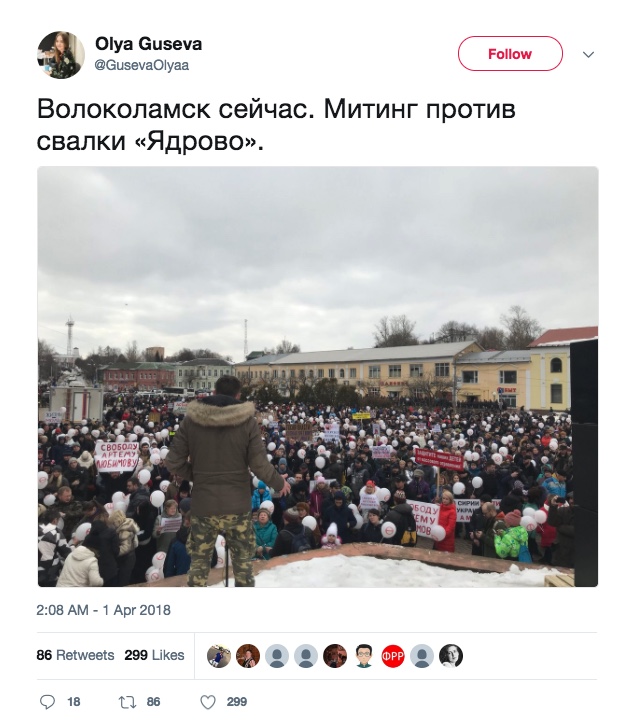
“Volokolamsk right now. Protest rally against the Yadrovo Landfill.” Screenshot of Olya Guseva’s Twitter page. Courtesy of Meduza
According to various estimates, 6,500 to 7,000 people attended this past Sunday’s protest rally in Volokololamsk against the Yadrovo Landfill. This was more than the number of people who attended the rallies on March 3 (approx. 5,000) and March 29 (6,000). (Volokolamsk’s official population is less than 21,000.)
Among the demands made at Sunday’s rally were the closure of the Yadrovo Landfill, the declaration of an emergency, the resignations of Moscow Region Governor Andrei Vorobyov and Andrei Vikharev, acting head of Volokolamsk District, and the release of activist Artyom Lyubimov, who was detained by police a day before the rally.
Protesters at the rally held up placards addressed to President Putin, including ones bearing the message, “Putin, Help!”
On March 21, a strong release of landfill gas took place in Volokolamsk, causing schoolchildren to say they felt sick. Fifty-seven children were hospitalized in the Volokolamsk Central Hospital. Subsequently, Governor Vorobyov fired the head of Volokolamsk District.
Volokolamsk has not been the only town in Moscow Region protesting landfills. During the past year, people have taken to the streets in such towns as Balashikha (after the local Kupchino Landfill was closed there on direct orders from the president, the garbage that used to be transported to the landfill was redirected to Yadrovo), Kolomna, Klin, Sergiev Posad, Tuchkov, and Serpukhov.
A former federal official explained why garbage has recently become a hot-button issue.
“New laws were passed obliging the regions to adopt local waste handling schemes and select regional contractors. A market is emerging. There are different disposal strategies: incineration versus separate collection of recyclables. Different strategies require building different processing facilities, and the stakeholders backing the different strategies are also different, from the federal to the municipal level,” he said.
The stakeholders are in conflict with each other and with the regions. This is especially true of Moscow and Russia’s other major cities, he claimed.
Last week, it transpired that Tver Region Governor Igor Rudenya had warned all heads of municipalities in his region that if the regional authorities found garbage from other regions in local landfills, the municipal heads responsible for this would have problems with law enforcement and Governor Rudenya’s administration.
“You will not import garbage from other Russian regions for any amount of money at all,” said Governor Rudenya, as quoted by Tverigrad.ru.
The president’s retinue is to blame for the flare-up in Volokolamsk. When they were getting ready for his annual Direct Line program, they insisted on underscoring the subject of landfills by way of speeding up the construction of processing facilities. It was then the president ordered the closure of the landfill in Balashikha, argues a source close to the Kremlin.
“The landfill was closed. The garbage from there was shipped to nearby landfills, and the flow of garbage to these landfills increased manifold. First it was necessary to put the infrastructure in place, and then close the landfills,” he said.
Environmental protests by people concerned with specific issues are a considerable risk to the system’s stability, and the regime is very concerned about them, saif another source close to the Kremlin.
“The president pays great attention to the environment. Last year, he personally telephoned activists in Chelyabinsk to show he supported them. This is quite important, especially in circumstances when environmental measures are given short shrift to save money.”
Last year was officially the Year of the Environment in Russia. During the presidential campaign, Putin held meetings in Krasnoyarsk on improving the ecological situation and reducing the emission of pollutants into the atmosphere.
Political scientist Andrei Kolyadin argues the issue of landfills cannot be solved quickly. Several years would be needed to do that.
“This abscess has long been ripening, and now it threatens people’s lives. As the risks to people’s live increase, the risks to the regime increase as well.”
A final decision on the future of Governor Vorobyov, who faces elections in the autumn, has not yet been made, said Kolyadin.
“If the protests balloon, he could be made their scapegoat. He has been doing his best to wiggle his way out of the subject politically, but he has not been able to do this economically. If the elections are handled by the authorities, he will not have complications, but if they are run more or less honestly, the districts in which anti-landfill protests have been taking place will not turn out to vote for him.”
Political scientist Mikhail Vinogradov argues such protests ordinarily wane quickly. In this case, however, the boiling point has not yet been reached. Various grievances, such as Governor Vorobyov’s less-than-happy appointment of a new head of Volokolamsk District, have been building up.
“I get the feeling there will be a new wave [of protests] that will help solve the problems that have accumulated. People feel they are in the right, and it gives them a strong impetus to protest,” he said.
Given current conditions, in which protests have been de facto banned, any socio-economic protest takes on political overtones, Vinogradov concludes.

 Artist, activist and teacher Darya Apahonchich found this “polling place” in the courtyard of her building in downtown Petersburg, across the street from the city’s Dostoevsky Museum. Early voting is under way in a nationwide referendum on 206 proposed amendments to the Russian Constitution. Courtesy of Darya Apahonich’s Facebook page
 Filmmaker Andrey Silvestrov took this selfie with his ballot paper at his polling place in Moscow. The question reads, “Do you approve [the] changes to the Russian Constitution?” Silvestrov voted no, of course. Note the fact that none of the amendments in question is listed on the ballot paper. Photo courtesy of his Facebook page
 Fortunately, Silvestrov’s “no” vote will not, one hopes, disqualify him from entering the “Million Prizes” program, as outlined on a flyer he was given by polling place officials along with his ballot paper. Voters are asked to send a “unique code” in a text message to the number 7377. Winners are promised “gift certificates” redeemable for groceries, sporting goods, and household goods, and for unspecified goods at pharmacies, cafes, museums, theaters, and cinemas. I am going to go out on a limb and predict that the “gift certificates” (if any Russian voters actually receive them) will prove worthless. Photo courtesy of Silvestrov’s Facebook page
 Photographer Vadim F. Lurie took a snapshot of the referendum polling place in the courtyard in a town in the Moscow Region. Courtesy of his Facebook page. While the purported reason for such bizarre ad hoc polling places is ensuring health of voters during the coronavirus pandemic, still raging in many parts of Russia, they provide the added benefit of making it much harder for election observers to ascertain whether the referendum was conducted freely and fairly. Needless to say, “free and fair” is a meaningless concept to the Putin regime.
 Journalist and political activist Ivan Ovsyannikov took this snapshot outside Polling Station No. 1641, located on the Petrograd Side in Petersburg. The placard reads, “Our country, our constitution, our decision.” Someone has pasted a sticker on the placard, which reads, “The solidarity of ones will end the dictatorship of zeroes.” This is reference to the fact that one of the proposed amendments, if ratified, will “zero out” Vladimir Putin’s previous terms as Russian president, thus allowing him to run for two more consecutive terms of six years. If this scenario comes to pass, Putin would be able to rule until 2036. His current presidential term ends in 2024.
 Leokadia Frenkel talks to local residents protesting vote rigging. Photo by David Frenkel

 Moscow’s streets are, apparently, reserved for planet-killing traffic jams and idiotic displays of state power, like this parade of trucks by the Moscow Highway Service. Yesterday, another of the city’s municipal agencies, which are run as profit-making “state enterprises,” Moscow City Transport, won a 1.2 million-ruble lawsuit against opposition leaders and independent city council candidates for the losses it incurred, allegedly, during the
 Campaign poster for Vladimir Bortko in downtown Petersburg: “Bortko: The City Has a Choice. September 8. CPRF.” Photo by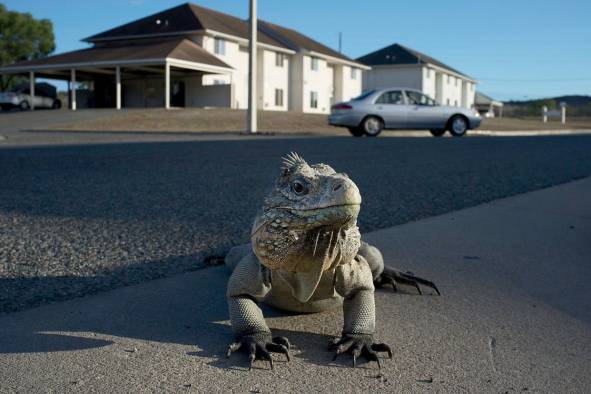
 “22 versts to Tsarskoye Selo. 673 versts to Moscow.” An 18th-century milepost in Petersburg. Photo by the Russian Reader
 Zaryadye Park in Moscow, opened in 2017. Photo courtesy of
  Protest rally in Abakan against plans to raise the retirement age. Photo by Alexander Kryazhev. Courtesy of RIA Novosti and Republic
 “Volokolamsk right now. Protest rally against the Yadrovo Landfill.” Screenshot of