Putin’s Alleged Popularity

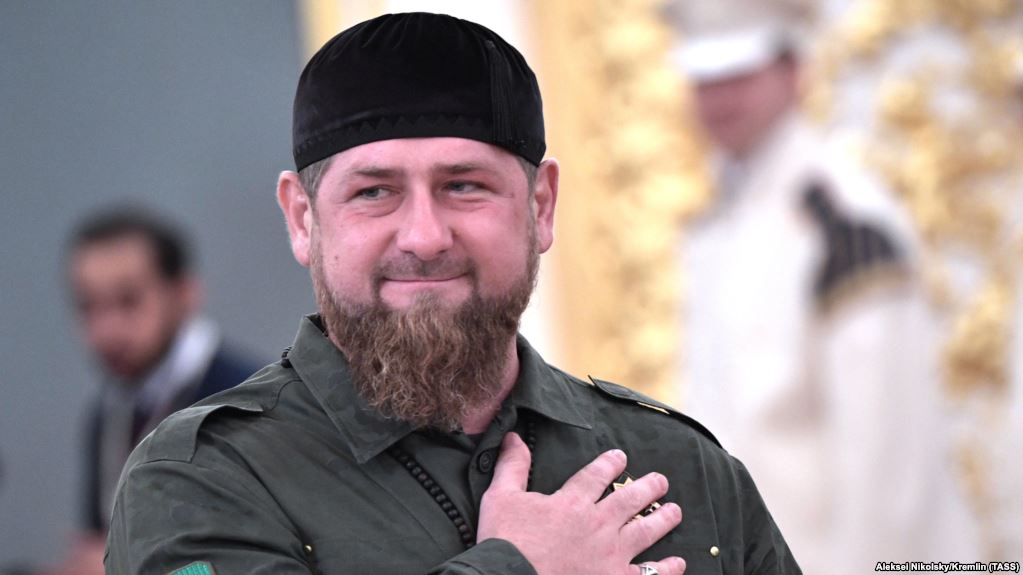
FE9FD947-5946-4532-AB21-04C649F35EC1_w1023_r1_s.jpgIf you’re a sucker for rigged elections and skewed opinion polls, like most western journalists, you would have to admit that Chechen strongman Ramzan Kadyrov is Russia’s most popular politician, not Vladimir Putin. Photo courtesy of RFE/RL

Putin’s Unique Popularity (Spoiler: It Doesn’t Exist)
Alexei Navalny
April 5, 2018

This special video is for you, dear whingers. I find it impossible to read, three weeks running, articles discussing the unique way Putin picked up 76% of the total vote at the March 18 presidential election and see the mobs of people agonizing in the commentaries to these articles.

“Lord, how terrible! 76%. What horrible people Russians are! 76% voted for their own poverty and slavery. The only way out is emigration. It’s time to make a run for it,” etc.

Here is what I have to say about Putin’s alleged “largest percentage of votes ever” and his status as the “most popular politician.”

We simply have to get one thing through our heads. At this stage in our authoritarian country’s evolution, any moron who stands for election on behalf of the regime gets 80% of the vote. Literally. But this percentage means nothing at all.

Are you horrified by Putin’s huge vote total? Then why aren’t you groaning and moaning about the vote totals the regional governors have won in elections? Did you know you would have to try very hard to find a governor who got a smaller percentage of the vote the last time he was elected than Putin did this time round?

You don’t believe me? Here is a chart showing the percentage of votes the country’s regional leaders got the last time each of them stood for election. See whether you can find our so-called national leader, allegedly, the country’s champion when it comes to popular support.

Ranking Name Region Total Votes (%)
1 Ramzan Kadyrov Chechnya 97.9
2 Aman Tuleyev Kemerovo 96.7
3 Rustam Minnikhanov Tatarstan 94.4
4 Nikolai Merkushkin Samara 91.4
5 Vladimir Volkov Mordovia 89.2
6 Vadim Potomsky Oryol 89.2
7 Alexei Gordeyev Voronezh 88.8
8 Andrei Bocharov Volgograd 88.5
9 Alexander Yevstifeyev Mari El 88.3
10 Alexander Tsydenkov Buryatia 87.4
11 Valery Shantsev Nizhny Novgorod 86.9
12 Vladimur Yakushev Tyumen 86.6
13 Boris Dubrovsky Chelyabinsk 86.4
14 Ivan Belozertsev Penza 86
15 Sholban Kara-ool Tyva (Tuva) 85.7
16 Alexander Nikitin Tambov 85.5
17 Alexander Kokorin Kurgan 84.9
18 Vladimir Vladimirov Stavropol 84.2
19 Alexei Dyumin Tula 84.2
20 Veniamin Kondratiev Krasnodar 83.6
21 Alexei Orlov Kalmykia 82.9
22 Alexander Drozdenko Leningrad Region 82.1
23 Maxim Reshetnikov Perm 82.1
24 Oleg Korolyov Lipetsk 81.8
25 Rustem Khamitov Bashkortostan 81.7
26 Anton Alikhanov Kaliningrad 81.1
27 Pavel Konkov Ivanovo 80.3
28 Yuri Berg Orenburg 80.3
29 Nikolai Lyubimov Ryazan 80.2
30 Roman Kopin Chukotka 79.8
31 Georgy Poltavchenko St. Petersburg 79.3
32 Dmitry Mironov Yaroslavl 79.3
33 Andrei Vorobyov Moscow Region 78.9
34 Andrei Turchak Pskov 78.4
35 Alexander Brechalov Udmurtia 78.2
36 Vasily Golubev Rostov 78.2
37 Alexander Bogomaz Bryansk 78
38 Vladimir Miklushevsky Maritime Territory 77.4
39 Vladimir Putin Russian Federation 76.7
40 Igor Koshin Nenetsk 76.7
41 Vladimir Ilyukhin Kamchatka 75.5
42 Alexander Levintal Jewish Autonomous Region 75.4
43 Alexander Zhilkin Astrakhan 75.3
44 Valery Radayev Saratov 74.6
45 Svetlana Orlova Vladimir 74.3
46 Vladimir Pechony Magadan 73.1
47 Alexander Karlin Altai 72.9
48 Igor Rudenya Tver 72.1
49 Anatoly Artamonov Kaluga 71.3
50 Dmitry Ovsyannikov Sevastopol 71.1

If I asked you what the 89% vote tally for Vadim Potomsky, ex-governor of Oryol Region (who claimed Ivan the Terrible had visited St. Petersburg), meant, you would replay without hesitating, “Nothing. It doesn’t mean a thing.”

“He had no support,” you would say, laughing.

Then why does the alleged support for Putin scare you? Do you think that, in his case, the powers that be have employed other methods for generating support?

Of course, they haven’t. They have used the very same methods. Real rivals are not allowed to stand for elections. The public is smothered with lies and propaganda. Officials rig the vote, stuff the ballot boxes, and falsify the final tallies.

These are the three factors for turning political bosses in Russia into wildly popular politicians. Remove any of them from office and they will end up in the same place where all the former champions of the ballot boxes have now ended up, whether we are talking about Shantsev, Merkushkin or Tuleyev. As soon as they are removed from office, a wave of the magic wand turns their popularity into a pumpkin.

Tuleyev had almost unanimous “support” the last time he was elected: nearly 97% of all votes cast. How many of those people took to the streets to support him when he resigned? No one did.

The new governor of Kemerovo Region, Sergei Tsivilyov, is the new proprietor of that 97%.

Under this system, if Putin were placed tomorrow with his most unpopular underling—say, Dmitry Medevedev or Dmitry Rogozin—his replacement would get the same “record-breaking” 76% of the vote if an election were called.

So, there is no reason to worry and snivel.

Dig in your heels. Get involved in political debates. Expose official lies. Tell and disseminate the truth. Fight for your country and your future.

Translated by the Russian Reader


Igor Averkiev: Elections That Kill Democracy

photoIgor Averkiev

There Are Elections That Build Democracy, and Elections That Kill It: The Tricks Is Not to Confuse Them
Igor Averkiev
igor-averkiev.com
March 13, 2018

1. If you relate to elections solely as a value, you will never grasp their essence. You will never tame them.

2. In the modern world, the presence of elections per se in a particular country is neither an achievement nor a value, except for liberal democratic fundamentalists. In the modern world, it is the political outcome of elections that is an achievement and value. In some countries, elections build democracy, while in other countries they kill democracy. In Russia, they kill democracy.

3. There are about two hundred countries in the modern world. The vast majority of them (around one hundred and eighty) hold elections more or less regularly. Around fifty countries in this vast majority are more or less classic democracies. There are another forty countries that hold elections and are more or less classic authoritarian regimes. The other hundredsome countries that hold elections are ruled by a variety of transitional, semi-authoritarian, and hybrid regimes. Meaning that elections per se do not vouchsafe democracy at all. Morever, in most of the world’s countries, people voting in elections does not produce democracy.

4. Elections are merely a social know-how that can be used by anyone for any purpose.  Know-how is a simple thing: if you wield it, you can profit from it in keeping with your interests. An axe is similar in this respect. It matters who wields it: a carpenter or a killer. In the hands of some people, elections produce a democratic regime, while in the hands of others they produce an authoritarian regime. Democracy is not programmed into electoral know-how itself. Democratic elections thus coexist on our planet with authoritarian elections: everything is decided by the person who presides over the elections. If you want elections in Russia to produce democracy, first you have to gain control of them. Elections serve democracy only when they are monitored at all phases by political forces with a stake in democracy. Nor is it only a matter of monitoring the tallying of votes.

5. Elections serve democracy only when the question of power has already been resolved to the benefit of pro-democratic forces or during an unstable transition period in which an authoritarian regime is still in power, but can longer dismiss pro-democratic forces out of hand. Therefore, in order to use elections to advance democratic interests, they must first be taken away from the old authoritarian boss. Or he must be so scared he has to take the interests of pro-democratic forces into account when elections are held. There is no other way. This is how things are done the world over, but millions of freedom-loving Russians for some reason still believe that regularly going to vote in elections presided over by someone else will in itself hasten democracy’s victory in Russia.

6. What is democracy? I won’t go into high-flown arguments, but the democracy that freedom-loving Russians like so much gels only when the country is run by politicians who have no desire to restrict political competition. They are willing, if push comes to shove, to lose elections; moreover, they are willing to accept defeat until the next elections. That’s all there is to it. That is why there is no democracy in Russia: because the people in power restrict political competition and have no intention of losing elections under any circumstances, much less accepting defeat. They are assisted in their restriction of political competition by the selfsame democratic know-how and institutions. It is just that without democratic politicians inhabiting them, this know-how and these institutions are only formally democratic, not democratic in fact.

7. The pro-democratic forces include not only the liberal democratic parties but also all political and civic organizations—leftist, nationalist, imperialist, religious, environmentalist, alternative leftist, alternative rightist, etc.—whose political interests are not bound up with Vladimir Putin’s personalist regime, who have no plans to limit political competition in Russia, and are willing, depending on the outcomes of elections, not only to come to power but also to cede power. Putin’s authoritarian regime can be opposed only by a broad pro-democracy coalition, without necessarily becoming a formal coalition. The trial version of this broad pro-democracy coalition presented itself to the country during the nationwide protest movement that kicked off in December 2011. We should not expect extremely well-coordinated joint actions from a broad pro-democracy coalition. (The “Decembrists” overplayed their hand in this respect.) It is enough to head in the same direction along more or less parallel routes, coordinating actions at certain critical points.

8. An electoral authoritarian regime, such as Russia’s, is organized quite simply. All the democratic know-how a modern country is supposed to have—elections, representation, separation of powers—functions smoothly, but not all comers have access to it. It is even simpler than that. An authoritarian regime simply does not allow potential competitors, that is, leaders and organizations, to get on their feet politically and grow organizationally to the extent they would be able to surpass the two- or three-percent minimumthreshold of votes needed for admission to the political arena. It does this by refusing to register parties, intimidating leaders, limiting freedom of speech and freedom of assembly in a pinpoint fashion, etc. If, despite everything, they nevertheless grow and thrive, they are simply not admitted to elections, as I have mentioned. In Russia, therefore, democratic procedures do not serve democracy. The soul of democracy is not know-how, procedures, and institutions, but people willing to use them in a particular way. In Russia, politicians interested in democracy simply do not make it into formal democratic politics. Thanks to the political regime built by Vladimir Putin, year after year only pro-authoritarian political forces make it into Russia’s formally democratic politics, and year after year they limit the involvement of pro-democratic forces in democratic procedures. It is a vicious circle. There is democracy, and there is no democracy at the same. Putin’s authoritarian regime is even elegant after a fashion.

9. Elections in authoritarian countries do not increase the supply of democracy, nor do they prepare the way for it, since they do not facilitate competition, do not put the opposition through its paces, and do not put rank-and-file voters in circumstances where the country’s fortunes depend on the choices they make. In authoritarian countries, elections function as a full-fledged authoritarian institution for legitimizing the regime. In authoritarian countries, elections are required only as a source of power, nothing more. Everyone involved in these elections is involved solely in legitimizing the regime. They are doing nothing else.

10. In authoritarian and hybrid countries, including modern Russia, elections have another vital political function. Elections are also an outlet for the liberal public, a valve, installed by the regime, for releasing oppositional steam and keeping opposition politicians busy somehow. The Putin regime has used elections to satisfy the need many freedom-loving Russians have to “fight for democracy” in a safe, comfortable way, a way that lets them feel like decent dissidents honestly doing their duty. Everyone comes out on top. The liberal public engages in self-actualization, and the regime does not find it frightening.

11. If the liberal democratic opposition’s sole aim is symbolic involvement in election campaigns within the authoritarian regime, but year after year the regime does not permit it to grow politically and organizationally, and does not allow it to run in elections, the opposition will gradually wither and become marginalized. This, in fact, is the kind of opposition we have nowadays. If we realize, however, that elections serve democracy only after the question of power has been decided to the benefit of pro-democratic forces, it means we need a different opposition altogether, one radically different from the opposition that has filled the niche the past fifteen years. We need a liberal democratic opposition that is not hung up on being involved in meaningless elections governed by someone else’s hostile rules. We need an opposition focused on vigorous, direct political action and a propaganda duel (a fight over values) with the regime in order to command the attention and respect of the so-called Putinist majority, those very same “ordinary people” who, when a window of opportunity opens, would at least not oppose the new, free-minded political alternative. There is a big problem with the word “new,” however.

12. The creation of a new, free-minded opposition is encumbered by the liberal democratic fundamentalism that holds sway in the minds of Russia’s freedom-loving public. One manifestation of this fundamentalism is, in fact, the irrational cult of elections: all elections are good, regardless of their political essence and their consequences. Two other burdens are the extreme political impracticality and even archaicism of today’s liberal democratic platform. Currently, we have nothing to offer people from the standpoint of a future regime. Here is a simple question. What can we offer the average Russian family, something they would really need and value, that the Putin regime either cannot give them or promise them? The keywords in this case are “really need and value.” Moreover, in the obviously adverse conditions of a post-Putin Russia, the current liberal democratic prescriptions would necessarily lead the country into new crises the very first year they were implemented and, consequently, to new outbursts of the conservative revolution. It is ridiculous to discuss this with educated people, but thinking outside the box is now more important than doing things. At very least, it is more important than running off to vote in Putin’s elections.

13. For free-minded Russians and Russian politicians, the issue today is not how to win Putin’s authoritarian elections, but how to behave and build a reputation in society today in order to win future democratic elections in which the former so-called Putinist majority would be among the voters. If you want to facilitate the collapse of the Putin regime, you need to work less with the Putinist state and more with the Putinist majority.

14. The main problem freedom-loving Russians face in the impending presidential election is not what choice to make, whether to vote or not, and certainly not who they should vote for. The main problem is that whatever choice each of us makes—to vote or not vote, to vote for Yavlinsky or Sobchak—it will have no impact whatsoever on the fortunes of Vladimir Putin and his political regime. Any electoral action we take will change nothing about the election or the regime. Judging by various opinion polls [sic], there are between ten and fifteen million of us in Russia. Even if we assume the incredible—that all of us would act in concert in this election, and thanks to our monitoring the elections themselves would be extraordinarily fair—we cannot have a significant impact on the outcome of the election, even if each of us to the last man boycotted it or we all voted for Ksenia Sobchak or Grigory Yavlinsky.

15. Everything is seemingly quite simple. In Putin’s Russia, elections have nothing to do with building democracy and vanquishing the Putin regime. Why, however, does something so evident not get through to many advocates of liberty and diversity in Russia? How did the perverted cult of mandatory involvement in all elections take hold among such a considerable segment of the Russian liberal public? There are explanations. First, many opposition politicians, speakers, opinion leader, and experts have a professional stake in Putin’s elections. Some of them try and run in these elections (the simplest way of being an opposition politician in an authoritarian regimes), while others assist the elections professionally, serve as polling station monitors, analyze the whole megillah or write about it. This entire mob would simply be out of a job, in the broad sense of the word, if the opposition-minded public did not vote in authoritarian elections. Thus, in the opposition milieu, they are the principal propagandists and agitators for the idea of voting in these demonstrative non-elections. Since, as a rule, they are the most intelligent, energetic, and authoritative people in opposition-minded communities, their opinion is quite important. Second, as I have mentioned, above, involvement in authoritarian elections (“but they are elections all the same”) has served a considerable segment of the liberal public as a safe, comfortable way to “fight for democracy,” a way that lets them feel like decent dissidents honestly doing their duty. The notion that it is foolish and nasty for an advocate of democracy to vote in authoritarian elections immediately nullifies the opposition’s semantic space, the space of election enthusiasts, plunging them into the “desert of the real.” Everything is so painful and disturbing in that desert. You have to acquire a new civic faithfulness to yourself, redefine yourself in terms of the meanings and tools of your opposition, what normal risks are, who your supporters and opponents are within the opposition, and so on. “No, it’s better to vote in Putin’s elections.”

16. On the other hand, if nothing really depends on us in Putin’s elections, is it worth persuading our allies not to vote in them? Why hassle people? Why prevent them from doing what they deem important? Because things won’t get any worse for us if they do vote in the election anyway, right? I think it is still worth pestering them. Politics, after all, depends on political sentiments and emotions, and thoughts are tangible things even when they are not true. If millions of people who hunger so much for freedom and diversity in Russia think, “How can I vote in authoritarian elections the right way, so that it benefits the opposition’s cause?” that is one kind of opposition. But if millions of people who hunger so much for freedom and diversity in Russia think, “What else, besides voting in authoritarian elections, can I do to dismantle the Putin regime and bring about the victory of freedom and democracy in Russia?” that is a completely different opposition.

Igor Averkiev is the chair of the Perm Civic Chamber. Photo courtesy of Igor Averkiev. Thanks to Comrade Koganzon for the heads-up. Translated by the Russian Reader
For Sobchak

sobchak poster

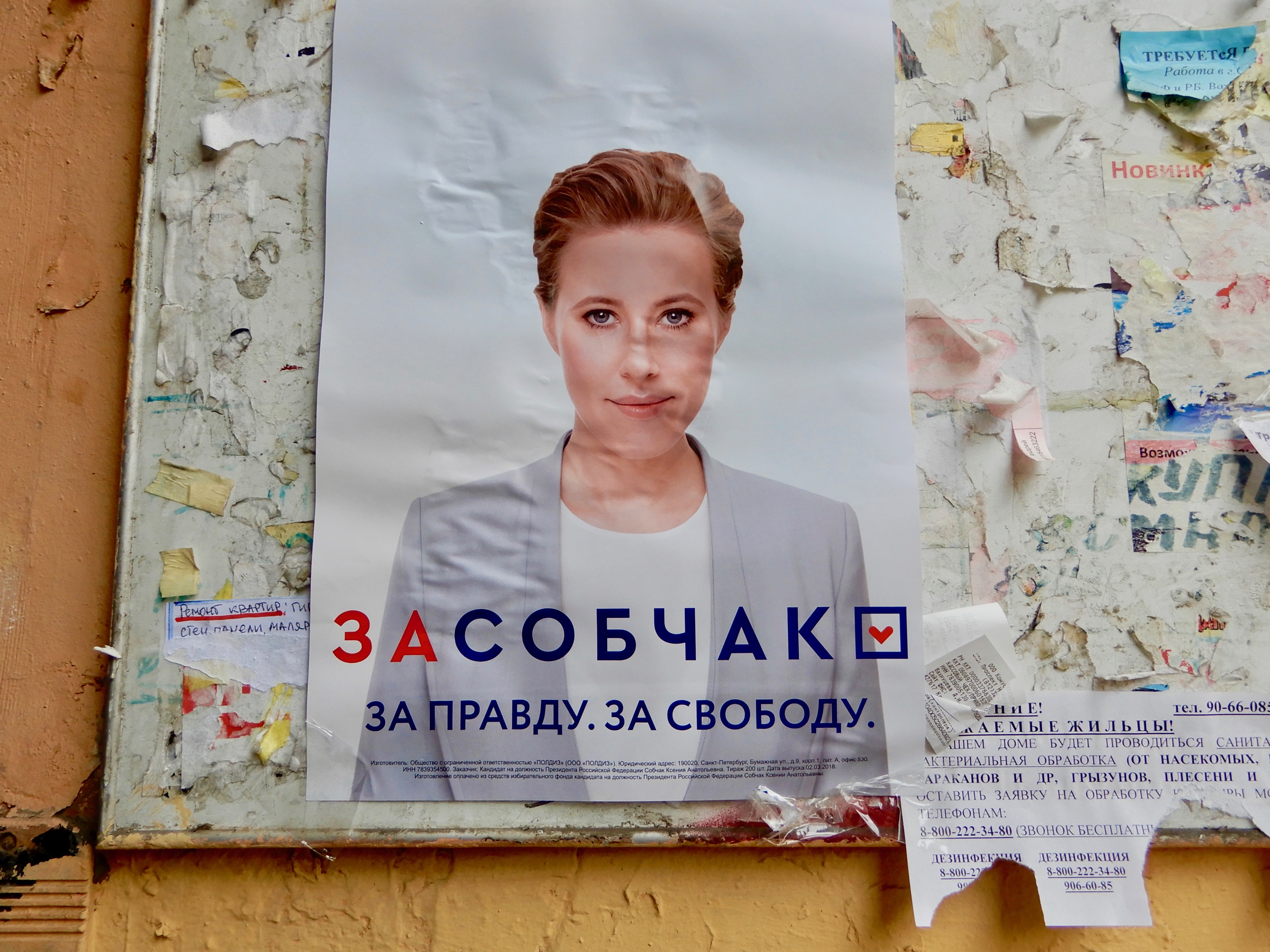
This is literally the only Ksenia Sobchak campaign poster I have seen in Petersburg since the Russian presidential campaign officially kicked off.

The poster, which reads, “For Sobchak. For Truth. For Freedom,” was half hidden in the gateway of a residential building on a street in my neighborhood when I photographed it a week ago today.

I imagine the people working in the city’s housing maintenance and street cleaning services have standing orders to tear down any and all “visual agitation” on behalf of the other so-called candidates (each and every one of them vetted and approved by the Kremlin) running in the so-called Russian presidential election, an utterly rigged farce scheduled for this Sunday, March 18.

The world’s largest country should be ashamed to conduct important national business in such a creepy, petty fashion, but until the self-declared heir apparent to the Romanov throne and his gang of crooks and thieves are chased out of town, there can be no movement on that front, alas.

Or any other front, for their matter, even though I have lots of friends on the left here who think the country is pullulating with “social movements” unfairly ignored by the general populace. To their mind, the rank-and-file Ivans and Natashas currently gumming up the future socialist works should magically learn about these nearly invisible social movements and just as magically support them, without my friends the leftists having to build and deploy anything that resembles even the shadow of an effective grassroots political organization that could reach out to the allegedly benighted Russian rank and file, enlighten it, and give it a doable road map to a better future.

One of the few people in Russia who understands something about political organization and tactics, Alexei Navalny, has been leading a boycott of the presidential election or what he calls a Voters Strike. For their pains, the election boycott activists, most of them young Russians, have been increasingly targeted in a crackdown by Russian security services and police. The plan seems to be to put as many of them as possible in jail on trumped-up charges and keep them there until after March 18, at the least.

My friends on the left, who claim not to like Navalny for his nationalist views, but really resent him because he knows a thing or two about national grassroots political organizing, while they seemingly know next to nothing about it, although they talk about it incessantly, are in no hurry to express their solidarity with the mostly “liberal” activists who have been mowed down by the Kremlin’s dragnet. (In Russia, “liberal” is a powerful swear word employed by leftists and rightists alike.) Their sense of solidarity extends only to those people who more or less share their political views and their lifestyles.

The most shameful thing is how many seemingly intelligent Russians are sanguine about this desperate state of affairs and think talking seriously about domestic politics (although they are often, on the contrary, extraordinarly keen to talk about politics in other countries) is like holding forth in great detail at a swanky dinner party about your daily bowel movements. TRR

Free and Fair, or, The All-Russian University of Justice

Tests on Protest Rallies and Compulsory Voting in Workplaces: What Is Happening in Petersburg’s Public Sector Institutions as the Election Nears
Vladislav Chirin and Sofia Volyanova
Bumaga
March 7, 2018

In early March, a test about the law on protest rallies was distributed to lecturers in Petersburg’s tertiary educational institutions. Pupils at Petersburg schools have been forced to take the same test, while employees of schools and hospitals report they have been forced to apply for absentee ballots and vote at different polling stations under threat of punishment.

Bumaga has been monitoring the goings-on in Petersburg’s public sector institutions in the run-up to the March 18 presidential ballot. In the following article, we discuss what violations have already surfaced.

Schoolchildren Required to Pass Test about Law on Protest Rallies 
Pupils at a school in the Vyborg District told Bumaga that on March 6 all groups had been excused from classes in order to take a test on protest rallies. In particular, the pupils were quizzed on whether participants of public events had the right to bear arms and under what circumstances demonstrations could be held on Palace Square and Nevsky Prospect.

test“Tests like this have been handed out in Petersburg schools. This is only the second page of the test, featuring questions about the Field of Mars, invitations to protest rallies via the internet from persons unknown, etc.” Post courtesy of Telegram channel Somebody Else
According to senior pupils at the school, teachers removed them from their second period classes and made them stay during the break to familiarize them with the test. In the event, the teachers explained to the pupils what the right answers were.

When the pupils asked whether the test was connected with protest rallies organized by opposition politican Alexei Navalny, the teahers replied the test was being administered since a pupil at the school had been detained at one such rally and fined.

Central District School Headmaster and Vocational School Employee Talk about Compulsory Test
Svetlana Lebedeva, headmaster of Gymnasium No. 168 in Petersburg, also talked about the test. According to her, the prosecutor’s office had sent them the test, demanding it be administered to upperclassmen.

“It was by order of the district prosecutor’s office. The order was sent to Nelly Simakova, head of the Central District education department. They sent it to us. All the schools did it. The test was on Saturday, and today the pupils who were absent on Saturday took the test,” Ms. Lebedeva told MR7.ru.

On March 6, the same test was administered to students at all the city’s vocational schools, an employee at one of them told Bumaga.

MR7.ru also published a screenshot of the letter sent to educational institutions.  The letter makes it clear the testing had been administered at the behest of the city’s education committee after an urgent request from the Petersburg prosecutor’s office.

A pupil at Lyceum No. 126 has also told Bumaga that, during an event for war veterans on March 6, one of the guests took to the stage and urged attendees to vote for Vladimir Putin.

The prosecutor’s office and the education committee did not return our telephone calls.

Council of Rectors Sent Test on Protest Rallies to Lecturers at Tertiary Educational Institutions
Lecturers at Petersburg’s tertiary educational institutions allegedly received the same test about the law on protest rallies, only electronically.

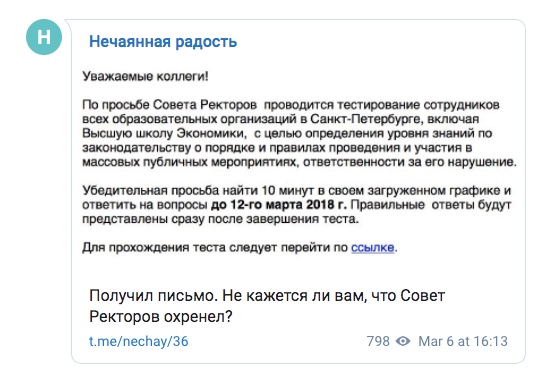
Echo of Moscow reporter and Higher School of Economics graduate student Valery Nechay published a letter allegedly sent to Petersburg’s tertiary educational institutions. The letter asks university employees to take the test online “at the request of the Council of Rectors.”

letter“Dear colleagues! At the request of the Council of Rectors, staff at all educational organizations in St. Petersburg, including the Higher School of Economics, are being tested in order to determine the level of their knowledge of the laws on rules for holding and attending large-scale public events and the penalties for violating them. We strongly encourage to take ten minutes from your busy schedules and answer the questions before March 12, 2018. The correct answers will be provided immediately after you complete the test. To take the test, follow this link.” Post courtesy of Telegram channel Unexpected Joy.

The test, a link to which Nechay has published, features questions about the rights of people attending protest rallies and punishment for extremism. Some of the questions describe particular circumstances, for example, “You have been invited on the internet to attend a protest rally on the Field of Mars. The rally in question has not been authorized by the relevant executive authorities for the exact time or day listed. You are curious, however, and so you go to the rally. Have you violated the law?”

Students at Petersburg University Say They Have Been Forced to Monitor Elections 
First-year students at the Petersburg campus of the All-Russian State University of Justice have been assigned “compulsory on-the-job training” on March 18: they must attend the presidental election as grassroots monitors. They told the organization Petersburg Observers about their plight.

The correspondence published by Petersburg Observers makes it clear that if the students fail to report for duty they have been threatened with administrative punishments and bad marks in their permanent record. But if they show up for duty, they allegedly will have a day off on Monday, March 19, and be sent official thank-you letters.

observerss“Where do the fake election observers come from? On March 4, 2012 [the date of the previous presidential election] grassroots oversight was usually portrayed by pensioners and state employees. Over the past six years, however, the fake election observers movement has mastered the streams of financing, gone large scale, and become much younger. For example, first-year students at the Petersburg campus of the All-Russian University of Justice received this message from their class leader: ‘March 18 is a school day, compulsory on-the-job training, meaning that everyone will be a grassroots election observer at the polls. Sponsored by the Association of Lawyers, our university is officially taking part in the Observers Corps for Clean Elections event, so if you do not show up you face administrative penalties and a bad mark in your permanent record.’ In addition to free food and transportation on voting day, letters of gratitude and a day off from classes on March 19 have been promised to the students. Basically, this is how correct public opinion is forged: in return for a day off, free grub, and a certificate of [political] trustworthiness.” Screenshot of a post on the VK community page of Petersburg Observers for Fair Elections 

A student at the Petersburg campus of the Russian Presidential Academy of National Economy and Public Administration (RANEPA) has told Bumaga that out-of-town students at the academy are going to be forced to vote in the presidential election. However, he was unaware of whether the students would be encouraged for turning out or punished for failing to vote.

ranepa“Very Important Information! In the next 30 minutes ALL out-of-two students need to shoot back the following information: what resources you will use to vote in the March 18 Russian presidential election; where you will vote (at what polling station); how you will register to vote. Send it to https://vk.com/%5Bdeleted]. […] Basically, we have been asked by [illegible] to register as many people living in each section as possible to vote. Meaning that each manager is responsible for his section and, subsequently, for sending everyone off to vote. The section in which the most people vote will get the Prize Sector [a reference to the “prize” section on the spinning wheel in the Russian version of Wheel of Fortune]. Ideally, you could assemble your entire section and all go together to the district voting commission. This is a mandatory request that concerns everyone. I think it is in our interest to give our vote . . .” Screenshoots of correspondence among RANEPA students. Courtesy of Bumaga

Schoolteachers and State Employees in Petersburg Say They Are Being Forced to Apply for Absentee Ballots and Vote Somewhere Other than Their Own Polling Stations
A teacher at a school in the Central District has told Bumaga that the school’s headmaster has obliged the entire teaching staff to report to the polling station in School No. 183 [an English-language magnet school on Kirochnaya Street in downtown Petersburg] on voting day. According to her, the teachers in all Central District schools have been given the same orders.

According to the teacher, if staff fail to vote as instructed, they will be given extra work during the spring holidays, from March 26 to April 1. When the voting is over, the headmasters of the Central District’s schools will receive lists of teachers who reported to the polling station in School No. 183, the teacher said. Her headmaster added, however, the orders were “not his whim,” but that all school headmeasters had received the same orders from the “top brass.”

Instances in which the heads of state-sector institutions have tried to force staff and students to apply for absentee ballots and vote at other polling stations have been reported by Petersburgers claiming to be employed at the Center for the Social Rehabilitation of Disabled People and Disabled Children in the Krasnoye Selo District, the Center for Social Assistance to Families and Children in the Central District, the Alexander Hospital, Children’s Health Clinic No. 68, Children’s Health Clinic No. 71, the Leningrad Regional School for Culture and Art, School No. 684 [a kindergarten and grammar school in the Kirov District in the city’s south], and the Municipal Monitoring Center.

Violations Reported by Members of Several Petersburg Election Commissions 
Member of Precinct Election Commission No. 1164, located in City Hospital No. 15, have reported that Irina Nikolich, the polling station’s deputy chair, had drawn up absentee ballot declarations, based on photocopies of four voters’ internal passports, although the voters themselves were not present at the polling station, and Nikolich came to the polling station when it was not her shift.

The polling station was visited by police officers, who interviewed witnesses and submitted the evidence to the Investigative Committee.

Members of Territorial Election Commissions No. 1 and No. 14 have reported to Bumaga that in their electoral districts, precinct commissions had in several instances approved four ballot boxes for at-home voting, although only three ballot boxes are legally required. The extra ballot boxes could lead to vote rigging and ballot box stuffing.

UPDATE
On the evening of March 7, Territorial Election Commission No. 1 reduced the number of mobile ballot boxes in its district to three.

Students at St. Petersburg State University of Film and Television Complain They Have Been Forced to Vote (Updated March 10, 2018) 
A student at the University of Film and Television told Bumaga he and his classmates in the Screen Arts Department had received a message from the student leader of second-year students.

The message made it clear that the master of the filmmaking course had informed the student leader that students who did not vote would be threatened with explusion, said the source. The dean’s office had allegedly issued the orders, and all students were required to register to vote at the same polling station.

Another student at the university told Bumaga she and her classmates had received messages containing a list of five polling stations at which they had to register to vote. Information about whether a student had registered to vote or not would allegedly be reported to their department. The students were promised they would be given postcards at the polling stations that could be used to get into a private screening of the film Dovlatov, the young woman told us.

Translated by the Russian Reader

Getting Out the Vote in Arkhangelsk

Archangel LifePhoto published March 10, 2018, on the Archangelsk Life community page on the VK social network. “Photo of the Day. ‘We’re Going to Vote.’ *The common law wife of regional MP Alexander Dyatlov, chair of the regional committee of United Russia Party supporters, is in the middle.”

Darya Goloschapova
Facebook
March 11, 2018

A good illustration. Society has left women without pants and, apparently, taken the shirts off their backs. It has reduced them to sexualized objects whose sexual function is emphaized even in the civic act of voting, as remote from the bedrom as could be. But it’s cool: they are going to vote. Why are they naked? Are they going straight from the shower to vote? Then where did those ridiculous high heels come from? Did they just come down from the pole in a strip club? Why is this generally routine and uninteresting act decked out in Russia like a wedding in an archaic society? Men show off their power (see the campaign ads of “rich and successful” men supporting Putin), while women show off their naked bodies, sexual desire, submissiveness, and vulnerability.

Thanks to Bella Rappoport for the heads up. Translated by the Russian Reader

Leviathan

DSCN4214“Precinct Election Commission for Polling Station No. 2218.” This is the innocent-looking sign the leviathan that has strangled democracy, including free elections, in Russia puts out to signal its presence. It achieves victory over earnest voters and honest election observers, some of whom valiantly serve on such commissions, by killing them with a hundred thousand cuts. Writ large, the flagrant tricks and shady practices used by neighborhood and local election officials add up to national elections that are rigged from top to bottom. Although this trickery has been well documented by independent observers, Russian reporters, and researchers, the sheer weight of it somehow has never made an impression on western journalists, who continue to write as if Putin’s popularity were a scientifically proven fact instead of carefully crafted mixture of massive coercion and hoodwinking. Photo by the Russian Reader

Central Election Commission Does Not Accredit 4,500 Presidential Election Observers Affiliated with Navalny 
Mediazona
March 7, 2018

The Russian Central Election Commission (CEC) has refused to accredit 4,500 presidential election observers affiliated with the news website Leviathan, created by Alexei Navalny’s Anti-Corruption Foundation. Navalny has written about the incident on his Telegram channel.

“We were suddenly told today that [Leviathan] had been shut down by the court, and the CEC would not accredit it. Earlier we have received accreditation for 4,500 observers affiliated with Leviathan. Now they are left without accreditation. Even [Vladimir] Churov [the previous CEC chair, replaced in 2016 by Ella Pamfilova] didn’t do such things,” wrote Navalny.

In addition, the CEC has refused accrediate observers affiliated with the online publication Molniya (“Lightning”), which sponsors election observers from the Golos Movement for the Defense of Voters’ Rights.

Golos co-chair Grigory Melkonyants confirmed to Mediazona there were problems with accrediting election observers registered by Molniya. He said that 850 people who had signed contracts with Molniya in October 2017 were at issue.

Molniya submitted accreditation applications to the CEC two weeks ago. The CEC informed them that it had sent them a written reply by post. Melkonyants said that in the the past the CEC would always simply invite Golos to come to its offices and pick up the accreditation papers. Now, on the contrary, the commission’s decision is unknown: they would have to wait for the letter to arrive. Melkonyants believes this testifies to the likelihood the Molniya observers will have their accreditation requests rejected.

However, he noted it was still possible to register as an observer affiliated with a particular candidate, and Golos was now working on this.

Translated by the Russian Reader. Thanks to Comrade GMV for the heads-up

No Contest

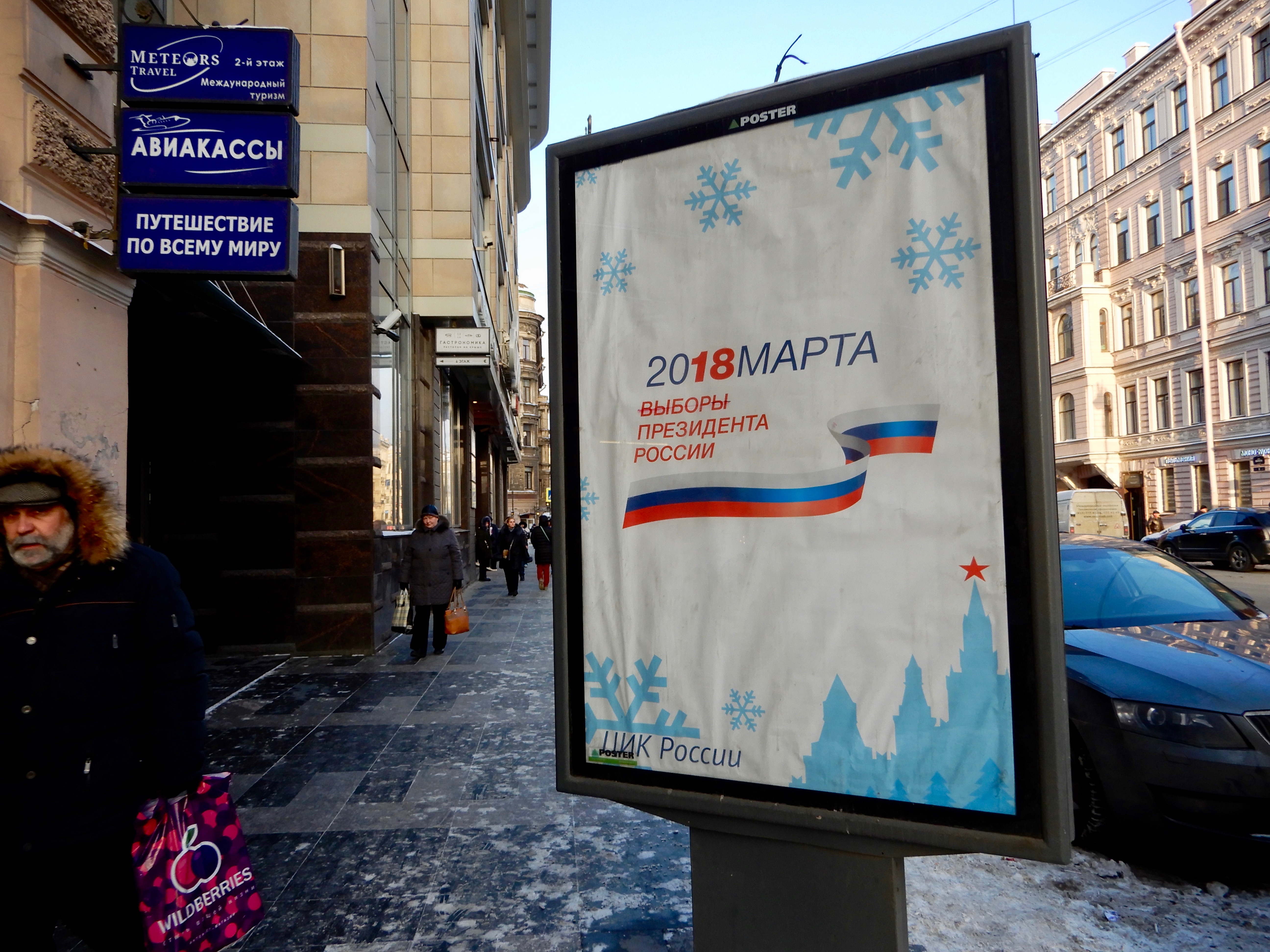
DSCN4290“March 18, 2018. Russian Presidential Election. Our Country, Our President, Our Choice! Russian Central Election Commission.” February 19, 2018, Ligovsky Prospect, Central Petersburg. Photo by the Russian Reader
Valery Dymshits
Facebook
March 4, 2018

I am somewhat surprised to see the ongoing discussion on whether to vote in the [Russian presidential] election or not. Some people write that if you don’t vote, your ballot will be used, and so on. Meaning it is assumed in advance the election commission is a band of brigands. If this is so, however, they can do whatever they want and, most important, at any level they can enter any figure they like in their official count. What difference does it make, then, if they use your ballot or not?

Actually, there is no election. Why be involved in something that does not exist? I think it is important not only to avoid attending this strange event oneself but also to explain to everyone why they should not attend, either.

DSCN2984On this “get out the vote” billboard, recently photographed somewhere in central Petersburg, a “vandal” has lightly crossed out the word “election.” Photo by the Russian Reader

Cities with populations over a million will have voter turnouts just over 50%, says a person close to the presidential administration.

All polling is a tool for actively shaping reality. Figures are used to try and suggest a particular interpretation of events, notes another source close to the administration. In his opinion, the downturn in Putin’s support rating can be explained by a lack of activity and mistakes during the campaign.

“In reality, the figure are much lower. The actual turnout is expected to be between 55% and 60%. Putin’s result will range, depending on the region, from 50% to 65%. It will be an accomplishment if the turnout in Moscow is over 50%.”

The difference between the turnout in major cities and the provinces could be as much as 20%. Usually, on the contrary, the turnout in the provinces is between 10% and 12% greater, says another person close to the presidential administration.

What happens next depends on the whether the mechanism for penciling in votes gets turned on or not. If the election is staged with the full use of the administrative resource, something I do not rule out, it does not matter who gets what in reality. If the elections are staged fairly, Putin’s result in cities with populations over a million will be lower, while his opponents’ will be slightly higher.”

The turnout in cities with populations over a million will be between 45% and 55%, the source believes.

Source: Yelena Mukhametshina and Olga Churakova, “Putin’s Rating Has Dropped Abruptly in the Major Cities,” Vedomosti, March 7, 2018

Translated by the Russian Reader. The emphasis, above, is mine.

Grigorii Golosov: An Anti-American Dictatorship

An Anti-American Dictatorship: The Russian Concept of Sovereignty
The regime is sovereign, not the people, and only if it does not seek to benefit from cooperating with the US
Grigorii Golosov
Republic
November 9, 2017

4f1d12efea4954e40cedcc6cf03e3d2bVladislav Surkov. Photo courtesy of Dmitry Azarov/Kommersant

Recently, after a long silence, Vladislav Surkov made another public appearance in print. The article itself, entitled “A Crisis of Hypocrisy” and written in a style typical of intellectually pretentious picture magazines, is not very interesting. It is not that Surkov rebukes the west for insincerity. That would be like the pot calling the kettle black. He does claim, however, that the effectiveness of hypocrisy as a means of control has been forfeited in modern democracies. Surkov thus finds himself agreeing with “prophetic comics” and other authoritative sources that a king of the west might appear to forcibly lead the world out of chaos. A good example, perhaps, of how such a king might act is Surkov’s own work in the Donetsk People’s Republic and the Luhansk People’s Republic.

As many of you will remember, until his forced immersion in the affairs of a neighboring country, Surkov laid claim, albeit not very successfully, to the role of the current Russian regime’s ideologue. It was Surkov who back in the day coined the controversial term “sovereign democracy,” which was supposed to be either an alternative to western democracy or a variation on it. In this case, Surkov messed up royally, as was pointed out to him with appropriate severity by his more senior comrades. The point of Russian electoral authoritarianism, like electoral authoritarianism anywhere else, is to feign being a democracy without actually being a democracy. Since everyone realizes there really is true democracy in the west, any juxtaposition is invidious. Russia has democracy, and that is that. It is no worse than other democracies. It is just like them. There is thus no need to qualify it with any adjectives.

Now Surkov, being a person who is, on the one hand, quick on the uptake and, on the other, not averse to particular flights of fancy, has adopted the politically correct stance while creatively elaborating on it in the sense that democracy in the west is on its last legs, even as Russia still cherishes the ideal of people power. Naturally, there is no point in debating the nature of democracy when the issue is put this way, and sovereignty comes to the fore as in Surkov’s original take on the matter. Sovereignty is the central concept of modern Russian ideology.

Sovereignty is now the talk of the talk of the town, the favorite topic not only of the media but even of those people who speak from the highest bully pulpits. The Russian concept of sovereignty includes two axioms that we should examine thoroughly. I should note in advance that neither of these aspects is unique. Each of them is ordinarily found in any logically consistent concept of sovereignty. The whole trick is how they are applied specifically to modern day-to-day circumstances.

The first axiom states that all decisions about power in a given country are taken at a purely national level.  The point is incontestable. It suffices to have a look at how acutely the Americans react to any outward attempts to shape their own politics to be convinced that they, too, operate in full accordance with the axiom. The specific nature of the Russian interpretation, however, is nevertheless apparent. To detach it from its basic content we should look at the events in Syria.

The cause of the events was the crisis generated by the extremely brutal, truly barbarous dictatorship established in Syria by the Assad family. Only an intellectually unscrupulous person could publicly state the Assad regime had been the choice of the Syrian people, at least at some point in time. The Assads came to power in a military coup and were elected to the country’s presidency solely on an uncontested basis, under circumstances in which all opposition was quashed. An uprising took place in 2011. The regime survived it, but was unable to crush it completely. A civil war broke out. It is characteristic of modern civil wars in more or less important countries that they involve outside actors.

The last point has been at the heart of the Russian concept of sovereignty. Frightened out of their wits at one time by the specter of “color” revolutions, the Russian authorities, first, regard any regime in any country, except Ukraine, as legitimate, and any attempt to overthrow it, however bloody and tyrannical it may be, as solely the result of outside interference. I would again underscore that outside interference is a perpetual occurrence, but nor does Russia miss its own chance to catch fish in troubled waters. This aspect is always secondary, however. Western political thought has traditionally argued the people’s sovereignty consists, in particular, in its ability to put down tyrannies. Since elections in such circumstances are not a tool for doing this, all that remains is civil disobedience and insurrection. If we approach the matter differently, the notion of sovereignty has been replaced by the notion of the regime’s sovereignty. This is exactly how sovereignty is treated in modern Russian ideology.

Second, the Russian concept of sovereignty consists in the notion that all decisions on foreign policy must be taken at the national level. When expressed in such concise form, the claim is also indisputable. However, when it is applied in Russian public discourse, the claim is more controversial: since most national governments take the interests of the US (or, alternately, the EU) into account when making foreign policy decisions, their sovereignty is limited.

The problem with this interpretation is that it is advantageous to pay attention to the interests of the United States or the European Union, or both. This coincides with the preferences of most governments. They themselves limit their freedom to maneuver when it comes to foreign policy. Take one of Russia’s biggest grievances against the west: Nato’s eastward expansion. It is true that when the Eastern European countries joined Nato, they limited their freedom to operate, but they did this not merely voluntarily, but with colossal enthusiasm. They applied to join Nato and celebrated their joining the alliance as if it were a national holiday. Ask Donald Trump why they wanted to get in. He would tell you what percentage of the alliance’s expenditures are footed by American taxpayers. It is not even worth enlarging on the fact that the new European Union members received certain perks. Actually, back in the old days, even Vladimir Putin was given to saying it would not be a bad idea for Russia to join the western alliances. It follows that he saw the benefits.

For it would be wrong to say no one takes Russia’s interests into account. Even some of the Eastern European countries, which the Russian media arrogantly disparages as satellites of the western powers, occasionally express a dissenting opinion on issues sensitive to Russia, such as sanctions. When they do this, are they limiting their own sovereignty in favor of our country? No, they are just taking care of their own business. The general rule, however, is that most countries regard the interests of the US as more important than Russia’s interests. There are exceptions: Iran, North Korea, Syria, and five or six other countries. By a coincidence that is hardly strange there is not a single democracy amongst them. All of these countries are small or medium sized. It is naive to believe China is one of these countries. China regards the US as more important.

We no longer speak of sovereign democracy. The idea has not vanished, however, but has merely acquired a more appropriate guise as an anti-American dictatorship. It is this guise that has become Russia’s own political pole star. And why not? It is a matter of choice. We should be aware, however, that how you define yourself defines how people treat you, taking this into account when assessing the prospects for improving relations with the rest of the world.

Grigorii Golosov is a professor of political science at the European University in St. Petersburg. Translated by the Russian Reader 

Why Bother Reporting the News When It Reports Itself?

DSCN2206

If I were an MP in the Commons or a peer in the Lords, I would ask for a formal inquiry into how the BBC is wildly and, apparently, deliberately misreporting the so-called Russian presidential election campaign by constantly asserting that Vladimir Putin is incredibly popular, that his message of “strength and stability should be enough to persuade voters to give him another term” (I heard that gem on the late late news on Radio 4 last night) and that Alexei Navalny was not admitted to the race because of “previous corruption convictions.”

Only in every third or fourth report do BBC reporters and presenters even bother to hint vaguely that Navalny’s so-called corruption convictions were on trumped-up charges and explicitly meant to hobble and disable him at moments like this, when he is literally the only person in Russia with a political organization and campaign strategy capable of putting a serious dent in the myth of Putin’s popularity.

And it is a myth. A free and fair election—after a campaign run without assistance from the so-called law enforcement agencies (who now, apparently, are gearing up to go after Navalny for calling a boycott) and the other assorted thugs who have been routinely arresting and assaulting Navalny’s campaign workers and volunteers in large numbers all over Russia during the past year, and without a giant leg up from a mainstream media, especially the national TV channels, whose general demeanor gives you a sense of what television would have looked like had the Nazis had it in their agitprop arsenal—would return results that would surprise all the lazy reporters and “Russia experts” who have been aping the discredited pollsters at Levada-VTsIOM-FOM by perpetuating the Putin popularity myth these past seventeen years.

The fix was in from the moment the Family chose Petersburg’s incredibly corrupt ex-deputy mayor to succeed Yeltsin, and truly awful things for which lots of people should be serving life sentences were done to cement the succession in blood.

It’s only been downhill from here, including the period when oil prices were high, because they only discouraged whatever impulses for reform Putin may have had (although I see no evidence he had any such impulses).

There’s no reason to like Putin unless you’re a member of his inner circle, because the real economy has tanked long ago, rampant corruption has become the supreme governing principle, and the security services have launched a selective, targeted Great Terror Lite to remind anyone with a brain what “stability” really means: Putin and his criminal clique are determined to remain in power until they die of natural causes.

This stunning plan will have terrible consequences for Russia and the world. The very least honest news reporting organizations, supposedly devoted to balanced, objective journalism, can do is report the whole story I have just told in brief, instead of repeating the dangerous truisms and outright lies generated by the Kremlin and its minions. TRR

Valery Brinikh: The News from Adygea


07_brinikh
Valery Brinikh

Valery Brinikh
Facebook
September 9, 2017

Hello!

I wrote a report on this Sunday’s elections. Don’t be lazy and read it to the end. You’ll learn a lot of new things.

Who Elects the Head of Adygea: A Political Portrait of the Republic’s Parliament

As you know, on Sunday, September 10, the State Council of the Republic of Adygea (in Adyghe, the Khase) will elect a new head for the republic. There are three candidates, but the outcome is predetermined. Who would doubt it? Correct me if I’m mistaken, but in the history of modern Russia this was probably the first instance when the outgoing head of a Russian region brought his own kinsman to Moscow so that Putin could view the bride, i.e. his chosen successor. Nor, we must note, were he and his kinsman immediately shown the door. This was probably taken by the petitioners from Adygea as a favorable sign.

Everything kicked off when, in March of last year, as it was about to give up the ghost, the members of the Adgyean parliament’s fifth convocation nearly unanimously voted (fifty yeas, four nays) to abolish direct, popular elections of the republic’s head, adopting a special law and making the relevant amendments to the Adygean Constitution. Having denied Adygeans the right to vote directly for head of the region, the “people’s” elected representatives formally explained their decision as a means of making the electoral process less expensive. However, no one abolished another law, a law of everyday life: cheaper doesn’t mean better.

So elections to the sixth convocation of the Adygean Khase, in 2016, took place with the understanding that it would be the new parliament, not the people, that would be picking the republic’s new head. So, the requirements for sifting out the winners were tougher than usuaul. It was boom or bust, literally, all or nothing. The powers that be backstopped its chosen candidates to the hilt, and the elections took place in a stifling climate of lawlessness, generated by the acting executive branch and the local office of the United Russia party. Functionaries of the Rodina (Motherland) party did everything they could to force the Adygean Central Elections Commission to remove the opposition party’s entire regional list of candidates from the ballot, although the party had a good chance of taking several seats in parliament. The billboards, posters, and flyers of all candidates and parties except United Russia and LDPR were destroyed hours, if not minutes, after they were posted. The vote tallies at the polling stations were skewed, and the votes received by candidates and parties that are not part of the so-called parliamentary grouping (United Russia, CPRF, A Just Russia, and LDPR) were totally nullified. The latter parties divvied up their shares of the vote totals in keeping with quotas that had been agreed in advance in Moscow. So, the current Adygean Khase consists of 38 MPs from United Russia, four MPS each from the CPRF and LDPR, and two MPs from A Just Russia. Two more MPs have to be elected in by-elections on September 10. There is no doubt that one of the two will be a United Russia member. Thus, MPs from United Russia make up 80% of the republic’s parliament, while the CPRF and LDPR have 8% of MPs each, and A Just Russia has 4% of MPs. Now let’s compare these proportion with the spread of MP mandates in the Russian State Duma. United Russia’s MPs occupy 76% of the seats; the CPRF, 9.5%; the LDPR, 8.7%; and A Just Russia, 5.8%. The Duma also has two MPs who are not members of these parties. One of them is a member of the Rodina party, the party that was successfully sent packing in Adygea. The outcomes are quite similiar, don’t you think? It’s as if the same templates had been used.

The lineup of MPs running in the 2017 elections has been thoroughly purged. Anyone who provoked the slightest doubts has been removed from the lists. Only five people who have been MPs for more than three convocations are left, and only nine MPS from the last three convocations are still in the running. Two of them are from the CPRF’s faction (Adam Bogus and Yevgeny Salov), while the rest are from United Russia. The other thirty-four MPs (out of a total of forty-eight) were elected during Aslan Tkhakushinov’s last two terms as head of the republic [he resigned in January 2017, after ten years in office], under the watchful eye of his team. In fact, they are part of his team.

Clearly, they express not the will of the people, but the will of their true masters, the men who got them elected. Thus, the clearly unelectable United Russian candidates Sergei Belokrys (District No. 16) and Rustam Kalashov (District No. 21) got the cherished mandates. During their party’s so-called primaries [the English word is used in Russian], they both took an honorable third place in their districts with 7% and 27% of the vote, respectively. Even more unelectable pawns were kinged after winning spots on United Russia’s party list.

They hardly all have the right to be called people’s representatives, if only because not all the MPs in the Khase’s sixth convocation were elected by the people on the new single voting day. Thus, seven of the winning candidates from United Russia list soon resigned for different reasons, and their mandates were automatically handed over to five new MPs from the party list (Yuri Gorokhov, Yevgenia Dyachkova, Zurab Zekhov, Azamat Mamkhegov, and Murat Shkhalakov). Two more MPs will be selected on September in single-mandate constituencies. LDPR’s list of of winners included party leader Vladimir Zhirinovsky and the party’s regional leader Denis Ogiyenko, neither of whom took their seats in the Adygean parliament. Why Zhirinovsky did this is clear enough, but Ogiyenko works as an aide to an MP in the State Duma, where everything is grown-up and they feed you caviar sandwiches. The two LDPR leaders were replaced as Khase MPs by Valentina Chugunova and Tembot Shovgenov, thus technically bypassing the will of voters.

It is interesting to compare how much the majoritarian MP mandates in the republic’s urban districts and rural districts are worth in terms of votes cast by voters. Thus, Maykop, the capital city, is divided into nine electoral districts, inhabited by a total of 132,890 voters. One majoritarian mandate is thus worth, on average, 14,776 potential votes.  The Maykop Municipal District [not to be confused with Maykop per se] has three electoral districts and 46,111 voters, so an MP’s mandate is worth slightly more there: 15,370 votes. The Teuchezh District has only one majoritarian mandate, worth 13,549 votes. The Takhtamukay District is home to 51,840 votes, and so its four majoritarian mandates are worth an average of 12,960 votes. In the Giaginskaya District, the mandates are worth a bit less (12,563 votes on average), while in the neighboring Shovgenovsky District, it is worth 12,482 votes. Adygeysk’s single majoritarian mandate is worth 12,029 votes, while the Koshekhabl District’s two mandates are worth 11,407 votes apiece. The Krasnogvardeyskoye District has the “cheapest” mandates: two at 11,013 votes apiece. But strangers do not roam the homeland of the sweet couple of Aslan Tkhakushinov and Murat Kumpilov [Adygea’s acting head and Tkhakushinov’s chosen successor]. They elect only their own people and only on the advice of their superiors.

It was not entirely accurate to distribute MP mandates generally (whether from majoritarian single-mandate constituencies or party lists) in terms of the number of voters in the districts. The largest number of voters lives in Maykop (39% of all voters in Adygea), and its goes down from there. The Takhtamukay District has 15% of voters; the Maykop District, 13.6%; the Giaginskaya District, 7.4%; the Koshekhabl District, 7%; the Krasnogvardeyskoye District, 6.5%; the Teuchezh District, 4%; the Shovgenovsky District, 3.7%, and the town of Adygeysk, 3.5%. Meanwhile, the MPs from Maykop have only 30% of the mandates in the Khase; Takhtamukay District, 20%; Maykop District, 14%; Giaginskaya District, 6%; Koshekhabl District, 10%; Krasnogvardeyskoye District, 8%; Teuchezh District, 6%; Shovgenovsky District, 4%; and the town of Adygeysk, 2%.  The imbalance is obvious.

The sixth convocation of the Adygean Khase has only eight MPs (16.7% of the total number) employed in the state sector. Six MPs (12.5%) are party officials. The remaining MPs (over 70%) run businesses in different sectors of the economy. The largest number of them (21 MPs out of a total of 48) earn their money in construction, commerce (including wholesale commerce), and services. Four MPs (8.3%) get their income from agriculture. Three MPs (6.3%) work in banking and investing, while two MPs each (4.2% each) are involved, respectively, in the hotel and tourism business, logging and extractive industries, and industrial manufacturing. Yet the CRPF and A Just Russia factions are dominated by party officials (four out of six), while members of United Russia have a clear advantage in all other lines of work.

The sixth convocation of the Khase includes two high-profile businessmen with criminal pasts (according to the media): United Russia member Gissa Baste (aka Voloskevich) and non-partisan MP Adam Bogus (aka Mazai), who blocks with the CRPF faction. Several well-known businessmen from United Russia have close ties with different dubious firms and people with criminal pasts. In particular, nine deputies (six from United Russia, two from the LDPR, and one from the CPRF) are involved in the construction business in the Takhtamukay District, run by Azmet Skhalyakho aka the Foreman. According to the media, he earned the nickname not on the fields of his native Takhtumukay District, but by shaking down market traders in Krasnodar during the “wild” 1990s. The notorious prosecutor Murat Tkhakushinov, son of ex-republic head Aslan Tkhakushinov, worked in the same district until recently. The Takhtamukay District’s proximity to Krasnodar, the much lower prices for land in the district than in Krasnodar, and the total control over the black market for land plots by criminal gangs, who have fused with Adygea’s government agencies, have made the construction business in the district quite profitable. Especially if you are not bothered by the legality of particular transactions, do not waste money on pollution treatment facilities, and pay no mind to the quite costly environnmental requirements.

Questions also arise when you take a closer look at the life and times of Vladimir Narozhny, head of the United Russia faction and chair of the republic’s parliament. There are strange blanks in his CV from 1981 to 1991, which for some reason he does not particularly advertise. Judging by occasional references, he ran various agricultural businesses during this period. Currently, he is associated with a number of firms, also involved in agrobusiness, in Adygea and Krasnodar Territory. They have different names and legal addresses, and yet they have the very same Primary State Registration Number and Taxpayer Identification Number. Obsessive thoughts of criminal money laundering schemes come to mind, but I have probably read too many detective novels.

As a final touch to my sketch of the current Adygean Khase, I want to focus on yet another imbalance, which testifies to a deeply embedded problem, if not a chronic disease, that affects the regional authorities in Adygea. I have in mind the distortions in personnel policy that favor the so-called titular ethnic group, the Adyghe. This phenomenon, which I would dub the Adyghization of power in the republic, was especially rampant during Aslan Tkhakushinov’s second term and has kept evolving in the present. I would not argue it has anything to do with ethnic conflicts between two great peoples, the Russians and the Adyghe, but has been caused only by attempts by specific members of the so-called Ulyap clan, who have ruled the republic for the last ten years, to ensure they will stay in power for the indefinite future. This is done both by depriving the Adygean populace of the right to elect the republic’s leaders and local government officials in direct elections, and through a deliberate personnel policy of giving preference to members of the titular ethnic group when filling vacancies in state and municipal agencies—if possible, to members of one’s own clan and numerous kinsmen. This cup has also touched the republic’s legislative branch. Whereas the republic’s population consists of approximately 63% Slavs, 25% Adyghe, 3.5% Armenians, and 8.5% other ethnic groups, the Khase is dominated by members of the titular ethnic group, who hold 28 seats (or 58.33%), while the Slavs are represented by 19 MPs (or 39.58% of seats). There is also one Armenian MP in the parliament, and no one else. I do not insist on introducing ethnic quotas. (God forbid, we have already been through such attempts at achieving parity.) I merely want to draw attention to this obviously non-random outcome as the inevitable side effect of dishonest elections.

Valery Brinikh, Chair of the Adygean Regional Branch of the Greens Russian Ecological Party, September 8, 2017

Translated by the Russian Reader. Photo courtesy of Bellona