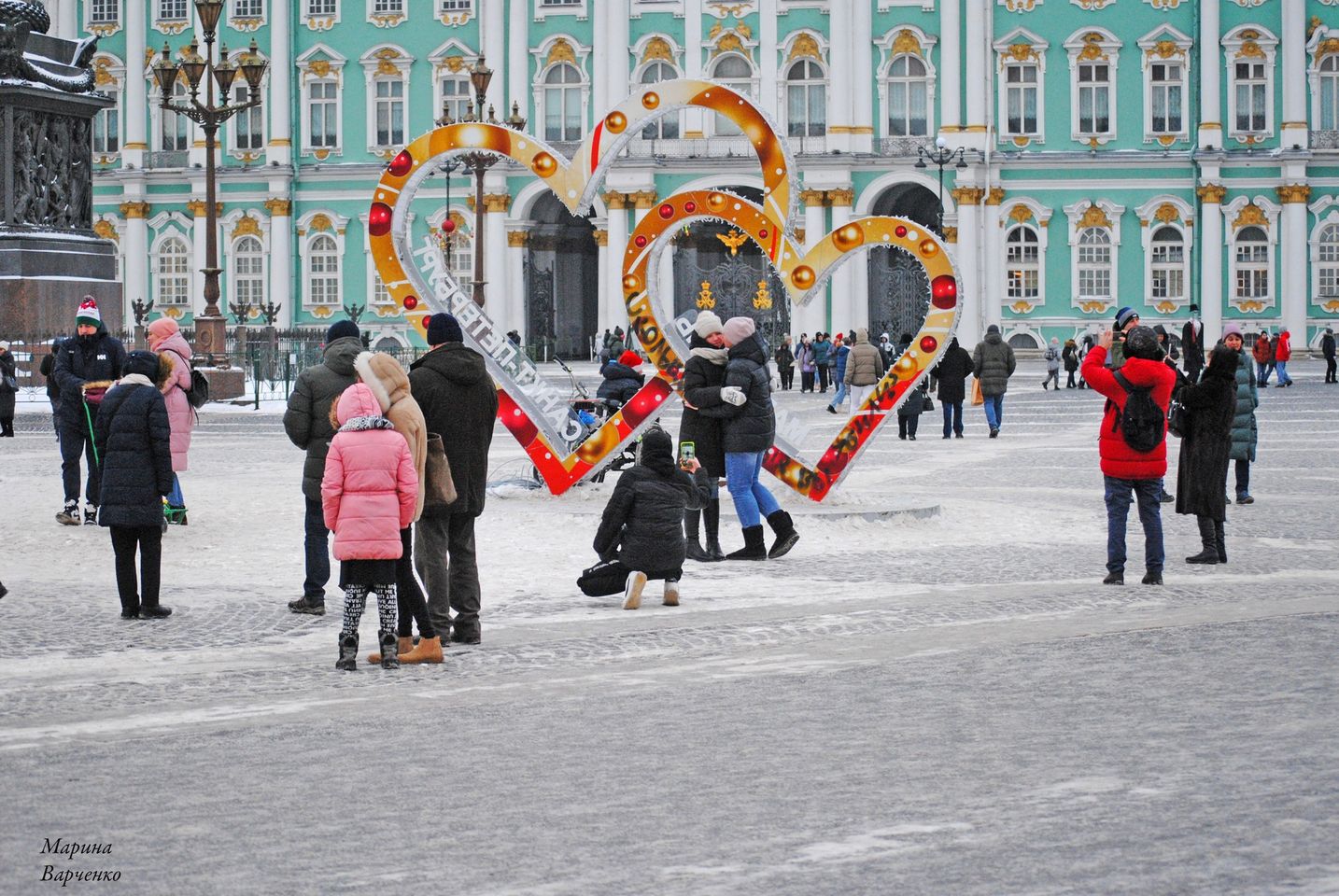
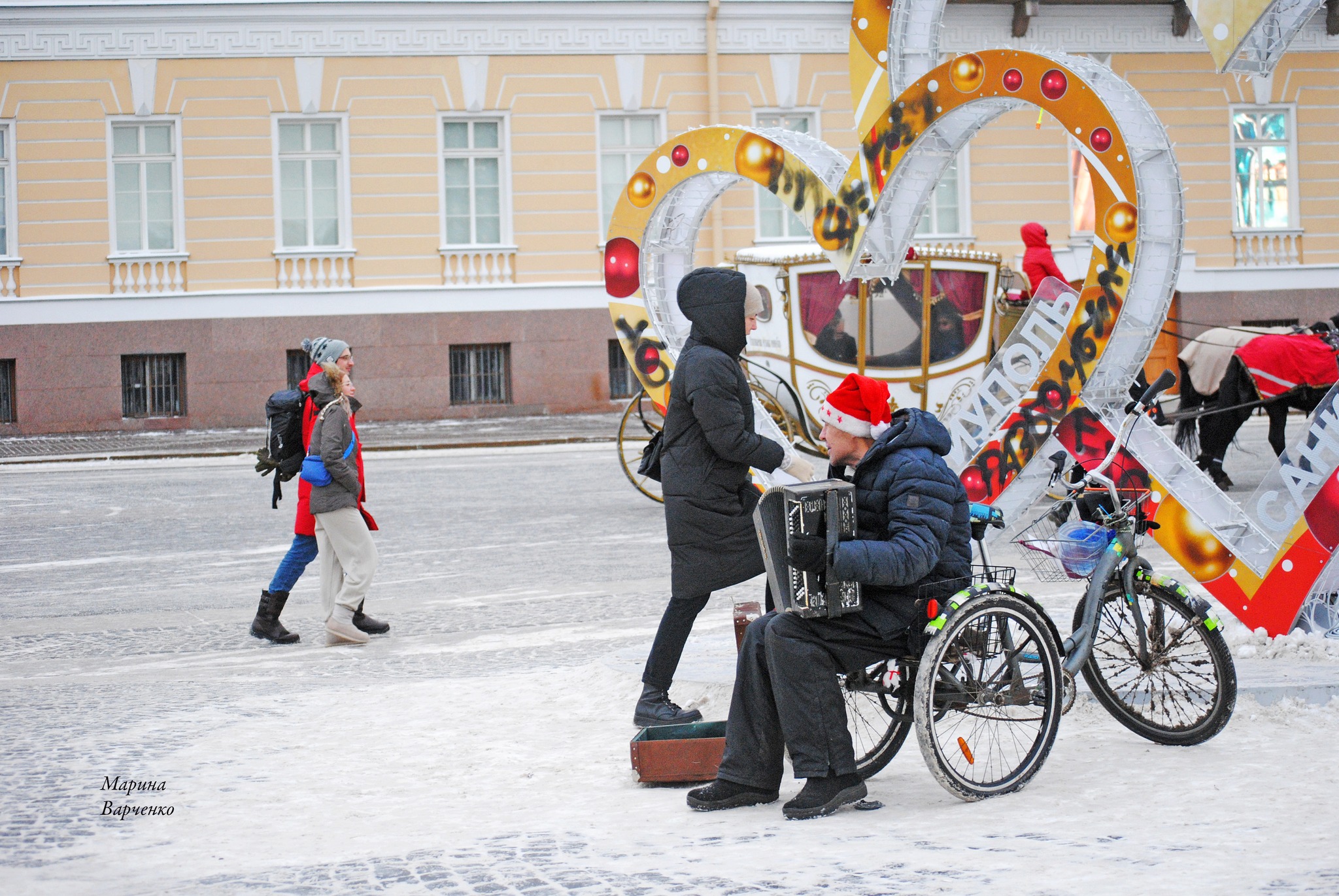
Of course, as a true masochist, I went to Palace Square to look at those hearts, small and large, supposedly symbolizing the sister cities of Petersburg and Mariupol. It is clear whose heart is the small one, and whose the big one, in the imperial capital. My thoughts about this are unprintable, so I’ll omit them.
But I went for curiosity’s sake: how many people would be getting their pictures taken in front of the hearts? As I’d supposed, it was a lot of people.
I saw much more than I’d expected. It was a total trash fest. There were the hearts, people taking fotochki, as they say now, frozen Peter the Greats walking around, carriages circling the square, and a drunk-looking little dude playing the accordion right there.
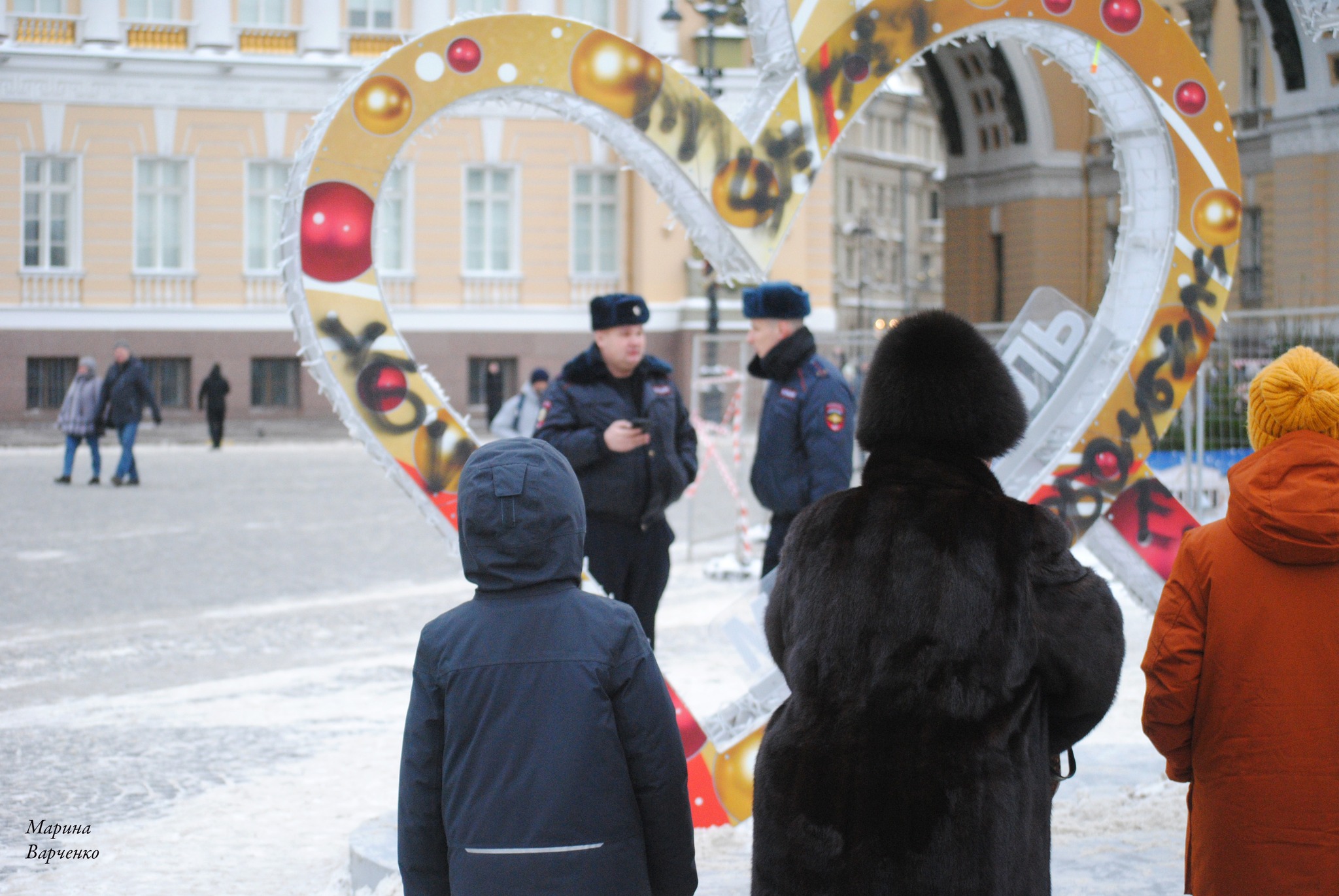
But no one seemed to be paying attention to the unauthorized inscription on the heart — black and large and truthful. (See the last two photos.)
While I was standing there, however, both citizens and law enforcement agencies finally noticed it. And they will call it vandalism, of course.
Source: Marina Varchenko, Facebook, 18 December 2022. Translated by TRR
A Petersburg woman detained on Palace Square has been charged with “discrediting” the army, the press service of the Interior Ministry’s Petersburg office has informed Bumaga.
Earlier, city media reported that the inscription “Murderers, you bombed it to smithereens. Traitors” had appeared on an installation dedicated to the sister-city relationship between Mariupol and Petersburg, and that a juvenile female had been detained.
When Bumaga asked it whether these reports were true, the press service of the Interior Ministry’s Petersburg office replied that on the afternoon of December 18, the police had detained seventeen-year-old girl on Palace Square “for committing illegal actions.” She was charged with an administrative offense for public actions aimed at “discrediting” the Armed Forces of the Russian Federation (per Article 20.3.3 of the Russian Federal Administrative Offenses Code).
The installation appeared on Palace Square on December 12. Rotundareported that the Petersburg authorities ordered it back in September. According to the contract, the city spent 1.05 million rubles on the installation.
On December 18, an inscription appeared on the installation, after which the structure was partially disassembled. Workers told our correspondent that the installation would remain on the square, but would spend the next few days without cladding until the inscription was removed from it.
Source: Bumaga, 19 December 2022. Translated by TRR
Dec 19 (Reuters) – President Vladimir Putin on Monday ordered the Federal Security Services to step up surveillance of Russian society and the country’s borders to prevent risks from abroad and traitors at home.
Speaking ahead of Tuesday’s Security Services Day — widely celebrated in Russia [sic] — Putin said the “emergence of new threats” increases the need for greater intelligence activity.
“Work must be intensified through the border services and the Federal Security Service (FSB),” Putin said.
“Any attempts to violate it (the border) must be thwarted quickly and effectively using whatever forces and means we have at our disposal, including mobile action units and special forces.”
Putin instructed the FSB to maximise their “use of the operational, technical and personnel potential” to tighten control of the society.
The FSB, the main successor to the Soviet-era KGB, has already been operating in Russia as an expansive surveillance and censorship apparatus and Moscow’s invasion in Ukraine has involved a large swathe of the security services.
“Maximum composure, concentration of forces is now required from counterintelligence agencies, including military intelligence,” Putin said, according to transcript of his speech provided by the Kremlin and translated by Reuters.
“It is necessary to severely suppress the actions of foreign special services, quickly identify traitors, spies and saboteurs.”
The FSB, headed by Putin ally Alexander Bortnikov, will also increase oversight of mass gatherings, strategic facilities and energy infrastructure.
Since the start of the war, demonstrations and dissent have been swiftly quelled in Russia, with more than 1,300 detained in September at protests denouncing Putin’s military mobilisation of 300,000.
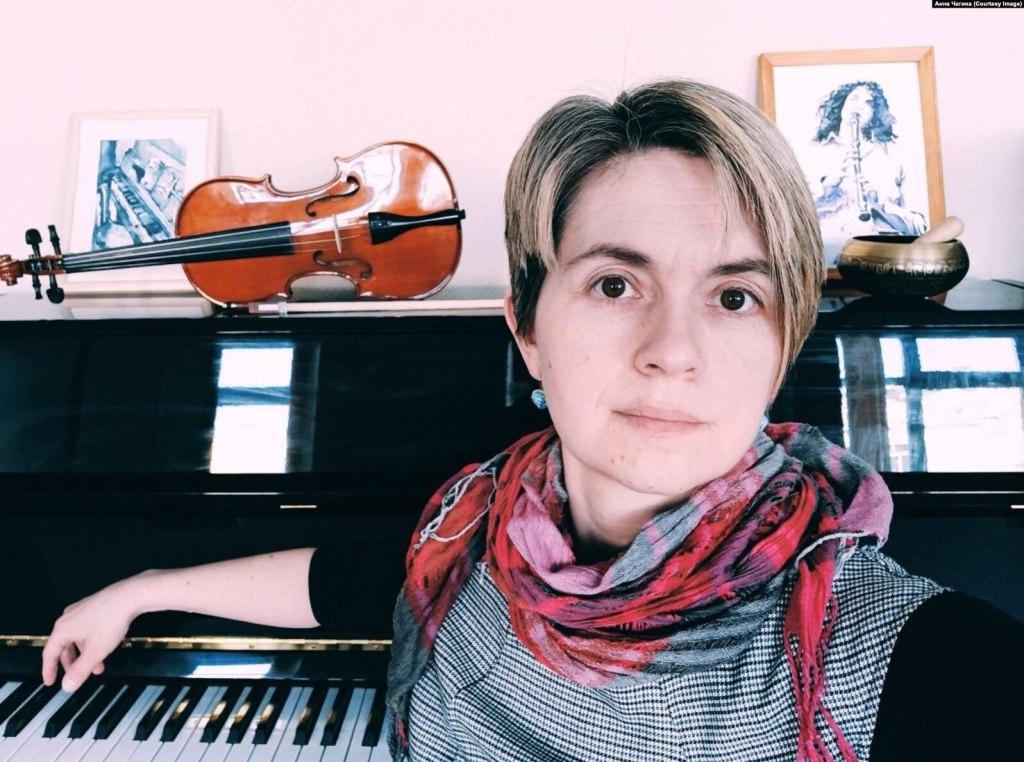
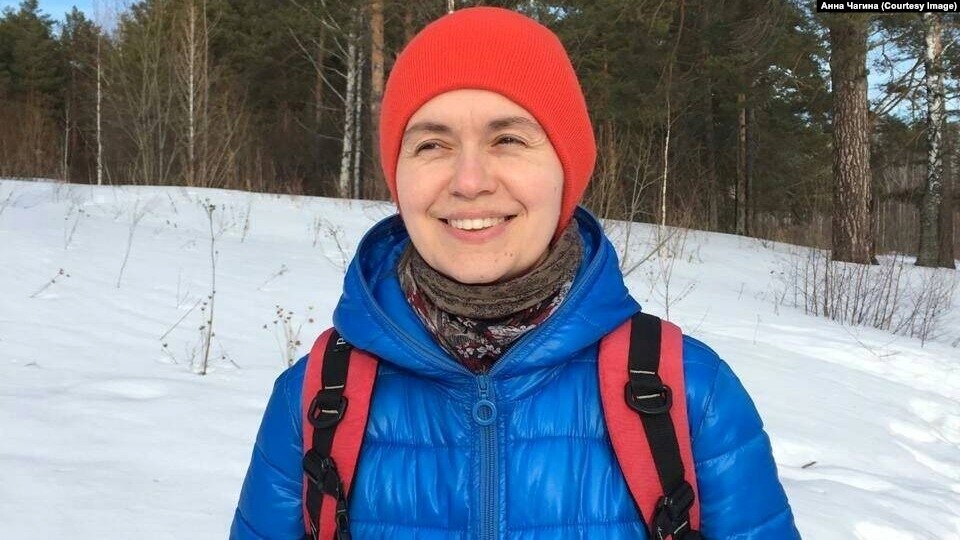
Anna Chagina at an anti-war protest in Tomsk, 6 March 2022. Photo: Dmitry Kandinsky/vtomske.ru
On the early morning of November 30, the security forces came to the home of Tomsk musician and teacher Anna Chagina: this was how she found out that she been charged with the criminal offense of “discrediting the army.” Chagina had been detained at an anti-war rally on March 6. In September, the Prosecutor General’s Office blocked Chagina’s page on VK over anti-war posts, which have now served as the grounds for the criminal charges against her under Article 280.3.1 of the Criminal Code. The maximum penalty is up to three years in prison.
On December 1, the court imposed pretrial restrictions on Chagina: she was banned from using the internet and mail, leaving home after ten o’clock in the evening, and attending mass events. On the evening of December 1, after the court hearing, Chagina talked to Sibir.Realii’s correspondent about her criminal case and her scenarios for how and when the war would end.
“Gentlemen, this is my house and my rules”
On the eve of the visit from the security forces, Chagina celebrated her birthday, and her guests had left late. She hadn’t sleep half the night because her nineteen-year-old daughter had a fever, and at six a.m. the doorbell rang. Anna opened it and saw an entire brigade: “There were two witnesses, two field officers from the FSB, an investigator, a special forces soldier, and a lawyer.” Only after returning from the temporary detention center, where she had spent the night, did she discover that the peephole in her door had been prudently sealed with a sticker on the stairwell side. At the time, Chagina had been too busy to notice it: she says that fear had made it hard for her to breathe and she was constantly thirsty. The second feeling she had was indignation.
– As soon as they came, I said, “Gentlemen, this is my house and my rules.” I insisted that they take off their shoes. They rifled through all my books and looked through all the folders. I have a lot of papers — printouts, sheet music, archives. They confiscated computer equipment and a bunch of flash drives and phones, including ones that didn’t work.
To calm her nerves, Anna picked up a guitar and put on a concert. She sang children’s songs and Okudzhava.
– Actually, I rarely give concerts, but then and there I realized that there would be no such opportunity anymore. I was trying not to pay attention to them.
– Did you have a lawyer present?
– They brought a lawyer with them. The court-appointed lawyer was both theirs and mine. At my request, she telephoned my friend Igor, but during the search she didn’t tell me, for example, that I could write in the report that I was against their videotaping during the search. We added that when I was already at the Investigative Committee. My daughter had also wanted to film the search on camera, but her smartphone was taken away. I was scared that I would first be locked up in a temporary detention facility for forty-eight hours, and then immediately sent to a pretrial detention center for two months.
The police search of Anna’s house lasted about three hours, after which she and her daughter were taken to the Investigative Committee.
– My daughter had a temperature of 39 [degrees Centigrade — 36.6 degrees Centigrade is considered normal body temperature]. I asked that she be questioned first as a witness and released, and after that they could talk to me. But first I was interrogated for four hours, and my daughter waited ll that time. The court-appointed lawyer told me that with such a temperature she could have refused to go in for questioning, but for some reason she told me that after the fact. Today, my daughter was taken away by ambulance with pneumonia.
– I verbally said that I did not admit any guilt, but, in my opinion, this was not included in the arrest report. They gave me some document about cooperating with the investigation and asked me to read it carefully. But I refused to cooperate, and I wrote on this document that I did not consider it necessary to read it. Copies of the search and arrest reports were not given to me because, they said, the the court-appointed lawyer had photographed them.
– And then you were taken to the pretrial detention center?
– Yes. To have something to do there, I took a pocket Bible with me from home. I was in solitary confinement. It was cold, and the sink and toilet stank. By law, I could be kept there for forty-eight hours, so I asked for cleaning liquid or power to wash the sink and toilet. They brought it in the morning.
The light does not go off at night. Radio Vanya, a pop station, was playing in the cell until ten p.m. I am a musician, and have other musical preferences. To keep this music from seeping into my mind, I meditated. I read the Bible. I spent the time well.
Anna Chagina. Photo courtesy of Ms. Chagina via RFE/RL
– How did the court hearing go?
– I had petitioned for a change of counsel, and the attorney I had retained was already at the hearing. We were able to keep the hearing open to the public. The investigator asked the court to impose pretrial restrictions that would prohibit me from using all means of communication. The lawyer asked for a mitigation, and I was still permitted to use the telephone.
Chagina is now forbidden to use the internet and mail, leave home after ten o’clock in the evening, or attend mass events.
– They put a Federal Penitentiary Service tracking bracelet on you. How do you like it?
– When I would see such a bracelet on others, I would think, Those are the fetters of Satan! It’s fine so far. I haven’t tried doing yoga in this bracelet yet. I’ll work out, and it’ll be clear how it feels… I’m talking calmly and even joking, but in fact I’m in shock. Once I saw a man who, after an accident, was standing there with a split skull – his brain was clearly visible, but he was talking calmly. He was in shock from the pain. Something similar is happening to me now.
– How much will the court-imposed pretrial restrictions, the ban on using the internet and leaving the house in the evening, complicate your life?
– Things couldn’t have been worse even before the criminal case came along. In September, the Prosecutor General’s Office blocked my VK page, which had a very strong impact on me, because I used this page to advertise private lessons and find music students. I have a very low income. I was selling my apartment to buy a smaller dwelling and pay off my debts, but due to the fact that I am now a criminal defendant, I cannot wrap up the deal.
“Blessed are the peacemakers”
Chagina recalls how she gave a concert on the eve of the March anti-war rally.
– There were about a hundred people there. Before playing, I openly spoke out against the war. I played one of my favorite Ukrainian carols on the violin. It was very warmly received. After the concert, a woman from the audience approached me: “My son is going to the [anti-war] rally on March 6th. I don’t know what to do. I’m afraid.” There were others. They were surprised: “You say that war is always bad. That it was Russia who attacked.” But even these people did not condemn me, but shared their misgivings with me.
My daughter went to a solo anti-war picket on March 3 and was immediately taken away. This was even before the laws were tightened, which occurred on March 5. I was afraid to go out on March 6, but I couldn’t stay away. My friend, who is seriously ill, went to the rally with her family. I can’t tell you her name, because I’m afraid that they will start pulling in everyone again. Her husband was detained. I thought hat she would be detained next. She had come out with a placard that read, “Blessed are the peacemakers.” I took the placard from her and held it up. I stood there holding it for ten minutes before they put me in a traffic police car and took me to the Soviet District police department. I was later fined on administrative charges of “discrediting the army.”
– How long have you been in the protest movement?
– Protest rallies are not the most important thing in my life, but I’m used to openly voicing my opinion. I went out to protest for Navalny and for TV2 [the Tomsk independent TV channel shut down by the authorities in 2014 — SR]. In 2014, when Crimea began, I went to a protest rally carrying a placard that read, “Don’t shoot your brothers.”
– Why are you personally against this war?
– I am against any war. Violence cannot solve any conflict. I sincerely admire the martial arts, if it is an honest one-on-one duel without weapons. But you can achieve only universal death through wholesale slaughter.
I rethought a lot of things after February 24. The war enabled me to separate what I love from what I hate. I had wanted to leave Russia for many years before the war. I hate it when a person endlessly tolerates what cannot be tolerated — humiliation, filth, an unseemly life — and does nothing about it. War is an attempt by such people to resolve the logjam of problems through violence and hysteria.
– What do you like about Russia?
– I love the nature. I love a certain kind of simplicity. Not the the kind of simplicity that is worse than thievery, but the kind of simplicity that can be called openness. The war made it possible to find out that there are many honest and decent people among Russians. Before the war, I was little interested in politics, and I didn’t closely follow the events in Donbas. I was busy with my family, my art, and my work.
When the war began, Tomsk showed a new side to me. I have reached a different level of social connection and communication here. Despite the fact that we don’t agree about everything, we still manage to keep in touch. This is very important to me. It is for the sake of this that it is worth going to protest rallies. Love will save the world.
Anna Chagina. Photo courtesy of Ms. Chagina via RFE/RL
– You had already been found guilty on administrative charges of “discrediting the army” for your posts on VK, which eventually served as the pretext for the criminal charges. Did you understand what the consequences could be?
– I understood. But it was important for me to convey my position to people. I am mentally ready for the fact that the state will punish me for this. I haven’t yet talked in detail to the lawyer who is defending me. But, as far as I understand, I face either a prison sentence or a huge fine. I’m not afraid of either.
I felt like I was being watched, but I couldn’t quite believe it. I saw some people outside, standing below my apartment. The FSB field officer who escorted me today said that he had personally shadowed me. And the investigator said that all the investigators at the Soviet District police department know me. Apparently, they were all here pulling shifts. By Tomsk standards, I have a rather large social media following — more than a thousand people on VK. And I have a lot of acquaintances from very different circles that do not intersect in any way.
– Which posts on VK did they deem “discrediting”?
– I have only read the arrest reports so far, not the stuff in the criminal case file. As far as I understand, the incriminating posts are the ones featuring texts by the Christian thinker Pavel Levushkan and the philosopher Nikolai Karpitsky, as copied from Facebook and posted on my VK page, with the authorship of the texts indicated. Karpitsky is a philosopher who lived in Tomsk and headed the Tomsk Anti-Fascist Committee, but now lives in Ukraine. He talks about necrophilic imperialism and about why Russians behave this way, both in war and in peacetime. Plus the comment “No war!” which I wrote below someone else’s post on VK.
“I am also to blame”
– Anna, why do you think there is no mass anti-war movement in Russia nine months after the start of the war and even in the wake of the mobilization?
– Because no one wants to go to prison. But when mobilization began, the war affected even those who had hoped to remain observer. I am acquainted with a Tomsk family in which the husband works at Gazprom and the wife teaches at a university. The husband earned good money, and the family traveled a lot around the world. But when the war began, they did not object to its officially stated aims, nor were they surprised by the claims of the propagandists that Putin was fighting NATO and gay parades in the west. But then the husband received a conscription summons, and their point of view changed immediately. The husband fled abroad.
– Speaking of emigration. You’d already had an admin. You saw that you were being followed. Why didn’t you leave?
– I had obligations. I didn’t emigrate due to my family. My daughter has health problems. My mom is here. I have a grandmother and a grandfather who are already ninety years old. Finally, my romantic partner is here.
– And you don’t even consider such a possibility for yourself in the future?
– I consider it, of course. More precisely, I would like to travel around the world, immerse myself for a long while in a different culture, in a different linguistic environment, and live in a different climate. I am a very curious person. Before the war, I had such plans: when the children grow up, I’m off! But I wasn’t thinking about the kind of emigration in which you leave and burn all your bridges.
– In your opinion, who is to blame for the fact that this war began?
– Putin, first of all. He signs off on all the decisions. But he’s not the only one to blame. I am also to blame. I voted for Putin the first time he was elected. It was the only time I voted for him. He seemed like a man who could do something good for the country. I was very naive, and I didn’t know anything about Putin’s past. The epiphany came when I noticed that Russian reality had begun to resemble C.S. Lewis’s science fiction novel That Hideous Strength. There is this character, the Grey Shadow, in the novel. He is nowhere and everywhere. His henchmen on the ground resemble him and poison the atmosphere. And there, as in Putin’s Russia, they endlessly repair what doesn’t need to be repaired and generate the semblance of busyness.
The “castling move” and even the “nullification” seemed mere absurdities. But I didn’t expect the scale of demonism that we see now. Like Stalin or Hitler, Putin is a demon who stole my country.
– How long can this war last, and how will it end?
– I have three scenarios: reasonable, mystical, and punk/optimistic. Which one would you like to hear?
– Let’s hear all three in turn.
– Reason says that this is going to go on for a long time, for many years. Even if the fighting against Ukraine ends in the foreseeable future — within two years — it is unlikely that everything will end quickly in Russia itself. But I don’t want to talk about a civil war.
The mystical point of view says that the war is part of an ongoing struggle between Good and Evil, which just touched us personally now.
And the punk scenario says that “We will leave the zoo,” as Yegor Letov sang. Lately, before the criminal case, I wanted to forget everything, and just believe that sooner or later we would stop being monkeys who piss on each other. That we would exit our individual cages and become human beings.
– Do you see any rudiments that give you hope that an epiphany, a kind of purification, is possible in Russia?
– I see them. Many of my friends say, “I’m not going anywhere. I’m going to build something here. This is my homeland, and I won’t surrender it to anyone.” Among them are calm optimists who believe that “this too shall pass,” and determined folks who are ready to fight.
An acquaintance of mine supported Navalny and left for California forever to avoid criminal charges. But his friend, an American, on the contrary, moved to Altai from California ten years ago, became a Russian farmer, and has no plans to leave Russia. I love the Russian language and Russian culture, but I’m not a nationalist — I’m a globalist. I am for a world without borders, and I hope Russia will one day become a part of this world.
– You took a Bible with you to the temporary detention center. Do you consider yourself Orthodox? How do you feel about the fact that the ROC has been stumping for the war?
– I practice integral spirituality, but I still seek guidance in the Orthodox Church and consider myself a Christian. The ROC’s official position [on the war] is a disgrace, and all [other] Orthodox churches have condemned it. Real Russian Orthodoxy and what it is associated with today are heaven and earth. What is the Christian conclusion here? God is merciful. And He is merciful to those who labor under delusions, too. Another thing is that everyone suffers for their delusions, including the deluded themselves.
Anna Chagina (left) in concert with other musicians. Photo courtesy of Ms. Chagina via RFE/RL
– All the independent media that reported your arrest wrote that you are a musician. What kind of music do you play?
– I graduated from music college as a violist and I play the viola. I teach violin. I’ve had a bunch of musical groups in the past. I’ve played rock, punk, folk, and Celtic. In addition, I’ve played with an ensemble of violinists. I worked in a symphony orchestra for a year.
– Is there a particular kind of music that serves as a lifeline for you nowadays?
– I’ve been listening to very little music lately — I’ve been overloaded. But Bach is always a lifeline. One of my relatively recent discoveries is the Petersburg singer Sasha Sokolova, who, unfortunately, died of cancer. I can say of her music that it’s about our time.
– Do you imagine that the court could acquit you?
– I’m not counting on it… When I was dozing in the cell at the temporary detention center, I thought it would be cool to open my eyes in the morning and see the ocean, clean and transparent. In exactly the same way I believe that the court could hand down a fair verdict — as in a pipe dream, as in a miracle. I believe this war will end. I admit that a miracle is possible.
Since the new articles of the Criminal Code and the Administrative Offenses Code on discrediting the Russian army and disseminating “fake news” about it came into force, more than 100 criminal cases have been launched in Russia and around 4,500 reports of administrative offenses have been filed, according to Interior Minister Vladimir Kolokoltsev, speaking at a session of the State Duma on October 19.
According to OVD Info, a total of 352 people are under suspicion or facing charges in so-called anti-war criminal cases launched in Russia between February 24 and November 24. As of 23 November 2022, 5,159 administrative offenses cases have been instituted in Russia under Article 20.3.3 of the Administrative Offenses Code (i.e., for “discrediting the Armed Forces of the Russian Federation”).
On March 4, Russian President Vladimir Putin signed a law criminalizing “fake news” about the actions of the Russian Armed Forces. Russians can be fined up to 1.5 million rubles or imprisoned for up to three years for violating the new Article 207.3 of the Criminal Code, defined as “Public dissemination of deliberately false information about the deployment of the Armed Forces of the Russian Federation.” Article 280.3 of the Criminal Code, which criminalizes “discrediting” the Russian army, stipulates a sentence of up to five years in prison or a fine of up to a million rubles.
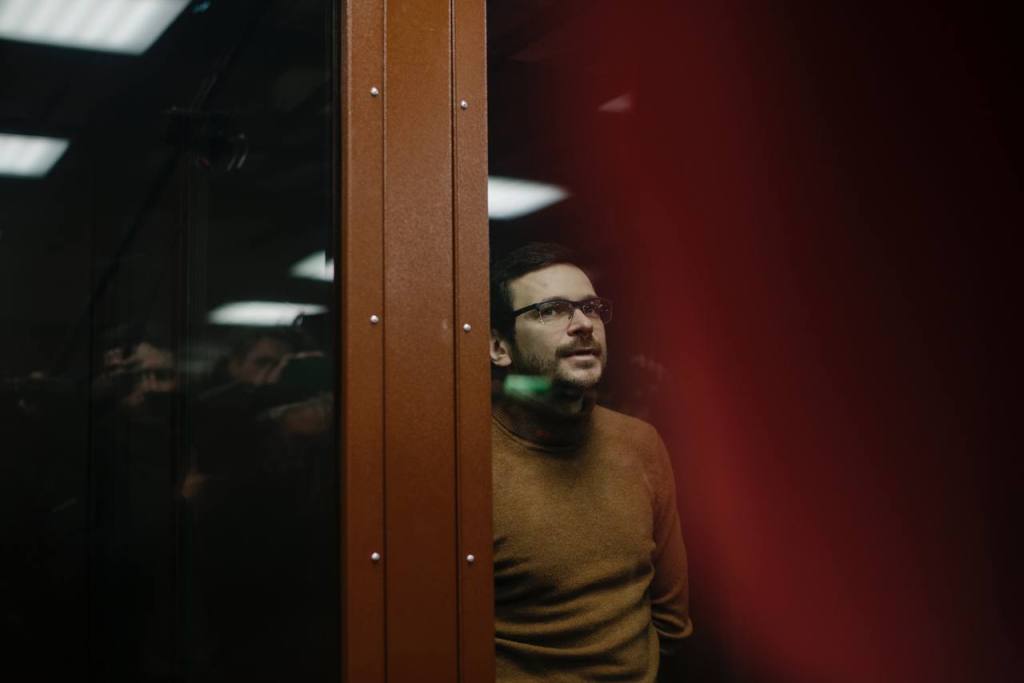
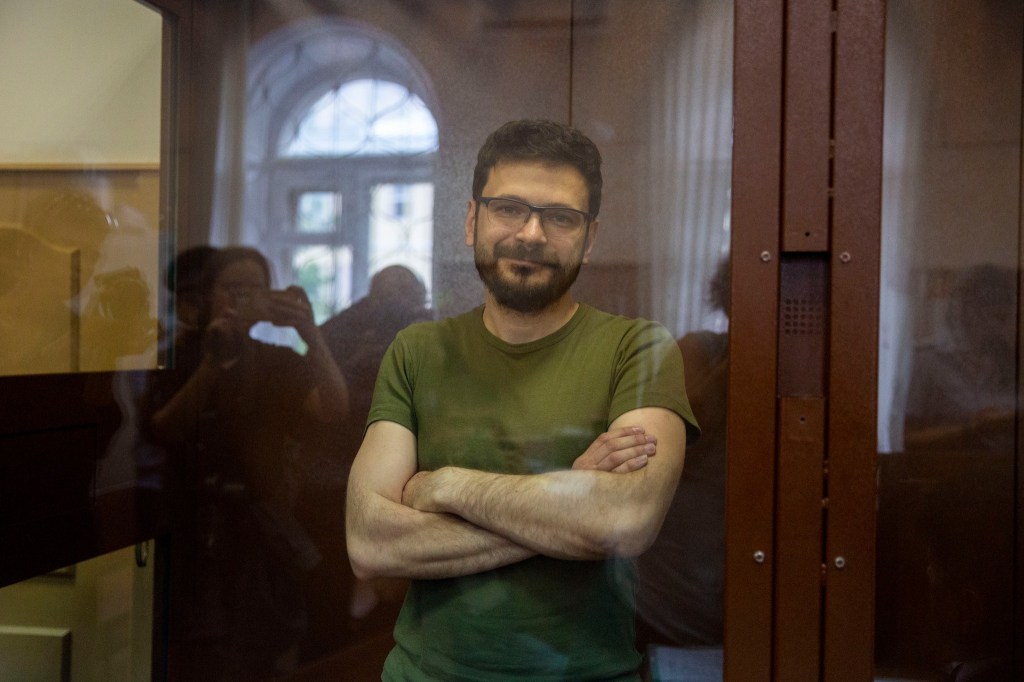
This is a translated excerpt from Russian opposition politician Ilya Yashin’s closing statement, which he delivered at his show trial in Moscow earlier today. Charged with “spreading false information about the Russian military,” Yashin faces up to ten years in prison if convicted, which he almost certainly will be. ||| TRR
Ilya Yashin
Taking advantage of this podium, I would also like to address Russian President Vladimir Putin, the person who is responsible for this massacre, who signed the law on military censorship, and by whose will I am in prison.
Vladimir Vladimirovich!
Seeing the consequences of this monstrous war, you have probably already understand yourself what a grave mistake you made on February 24. Our army has not been greeted with flowers. We are called executioners and occupiers.
The words “death” and “destruction” are now firmly associated with your name.
You have brought terrible misfortune to the Ukrainian people, who will probably never forgive us. But you are waging war not only against Ukrainians, but also against your compatriots.
You have sent hundreds of thousands of Russians into the inferno of battle. Many of them will never return home, turned into dust. Many will be crippled and go crazy from what they have seen and experienced. For you, they are just casualty statistics, numbers in columns. But many families the face unbearable pain of losing husbands, fathers and sons.
You have deprived Russians of their home.
Hundreds of thousands of our fellow citizens have left their homeland because they do not want to kill and be killed. People are running away from you, Mr. President. Haven’t you noticed that?
You have undermined the foundations of our economic security. By putting industry on a war footing, you have sent our country back in the wrong direction. Tanks and guns are again a priority, and poverty and disenfranchisement are again our realities. Have you forgotten that such a policy has already led our country to collapse before?
Although my words might sound like a voice crying in the wilderness, I urge you, Vladimir Vladimirovich, to stop this madness immediately. You must acknowledge that the policy towards Ukraine has been mistaken, withdraw troops from its territory, and proceed to settle the conflict diplomatically.
Remember that every new day of war means new victims. Enough is enough.
Source: Ilya Yashin, Facebook, 5 December 2022. Photo by Zlata Milyavskaya. Translated by the Russian Reader
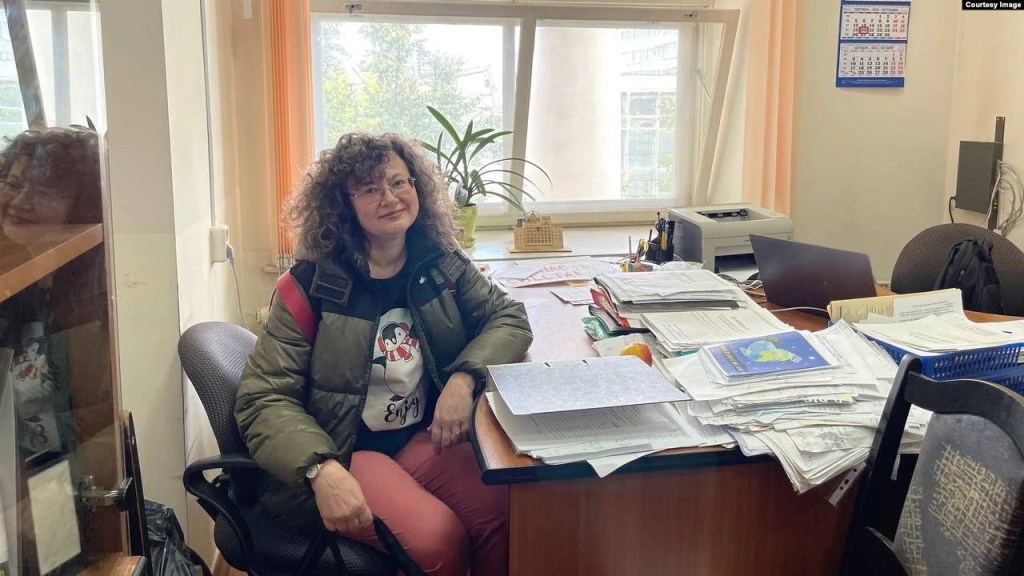
Olga Nazarenko, a university lecturer in Ivanovo, risks going to prison for simply hanging the Ukrainian flag in the window of her own flat. Neighbors from the building opposite regularly complain about her. Nazarenko goes on anti-war pickets, where aggressive fellow citizens attack her. And the pickets have already triggered a criminal case against her. Repeated visits and searches by police officers at night and early in the morning have become routine for her children. Nazarenko sees the situation in Russia as nearly hopeless. She is amazed at how the country’s maternal instinct has even been destroyed: Russians dutifully send their children off to die for nothing. Despite all this, she considers it her duty to talk to people. She remains in Russia, and has no plans to emigrate.
Recently, the police rang at Nazarenko’s door at three o’clock in the morning. They demanded to be let in so that they could remove the Ukrainian flag. It has been hanging for six months on the balcony of the activist’s flat in an ordinary multi-storey residential building in the city of Ivanovo. Nazarenko refused to let the police in without a search warrant. Through the door, the night visitors informed her that neighbors had filed another complaint about the Ukrainian flag. The law enforcement officers left, only to return at seven in the morning and knock on the door for a long time. Nazarenko did not unlock the door, but wrote a complaint against the police to the prosecutor’s office.
Over the past two months, the police have visited the well-known anti-war protester at least four times. In the autumn, two criminal cases were opened against Nazarenko, one of them under the so-called Dadin article of the Russian criminal code. The medical school at which the activist has worked for almost twenty-four years has suspended her employment. The university lecturer is currently listed as a “suspect” by the authorities. Despite the fact that term of her undertaking not to leave the country, which went into effect after the criminal case was launched, has recently expired, she has no plans to leave Russia. She talked to Radio Svoboda about her principled choice.
Olga Nazarenko, holding a placard that reads: “If those who oppose the war are imprisoned, fascism has won. Alexandra Skochilenko face five to ten years in prison for anti-war stickers…” Photo courtesy of Radio Svoboda
— How did you find out that you had been identified as a suspect in a criminal case?
— I learned that a criminal case had been launched against me under Article 280.3 of the Russian Federal Criminal Code (“Public actions aimed at discrediting the deployment of the Armed Forces of the Russian Federation”) from the Center “E” officers who came to my workplace at around eleven a.m. on September 20. They obliged my colleagues to to serve as witnesses, searched my desk, and found two placards. Before that, my laptop was seized without my knowledge. The bigwigs at the medical school wanted to conceal it at first, but I made a fuss. It transpired that the Center “E” officers did not even give our management rep a copy of the report for the seizure of the laptop, nor did he demand one from them. Then we went to my house; fortunately, there were no handcuffs on me. There they carefully rummaged for a long time: they took our phones (even the phone of my young son), a computer, old leaflets, our personal money, and the savings of our daughter, who is a university student. The money was returned to her, but the police kept our funds for themselves, and they are not planning to give them back to us, apparently.
— How did your children react to the search of your home?
— My son was in a little shock, especially since they took something that belonged to him. My daughter behaved calmly. She talked to the police a little. She asked whether their “assistant” was an adult: the computer technician they brought with them looked quite young. A Center “E” officer replied tersely that they were all adults and all officers. My daughter is already an adult, and she understands everything and supports me. My family took the search well, because this was not my first encounter with the relevant authorities due to politics. In the spring, at seven a.m., the riot police came to search the flat since I had been identified as a witness in a vandalism cased launched against another activist. Then they tried to prevent me from calling a lawyer, seized my phone, my computer, 138 posters, and the Ukrainian flag from the window. The law enforcement agencies’ interest in me had already become something routine.
Оlga Nazarenko in her office at the medical school. Photo by Oskar Cherdzhiyev. Courtesy of Radio Svoboda
— How long has the Ukrainian flag been hanging in the window of your flat?
— Every year since 2014, I had hung up the flag of Ukraine on the country’s Independence Day. Last year, I put it in the window and decided not to take it down. Police officers visited me after complaints were made, and they demanded explanations about the flag. I refused to explain anything to them. In the spring, after my apartment was searched, and they took the Ukrainian flag with them. I sewed a new one and hung it in the window again. I did the same thing after the search in the autumn.
— Why did you do that?
— For reasons of principle: if I support Ukraine, then I support it. And most importantly: no one in uniform and flashing a badge gets to decide what hangs in my window.
— What was the first criminal case brought against you for?
— They think that I posted anti-war leaflets in Ivanovo. I refused to give evidence by citing Article 51 of the Constitution.
— Were you not intimidated when they launched a criminal case and searched your flat?
— All this was to be expected. And no, it didn’t intimidate me. I continued going to anti-war pickets and rallies in support of those who have been persecuted for making anti-war statements, and I talked to people on the streets. A second criminal case was soon launched against me under the so-called Dadin article (i.e., Article 212.1 of the Russian Federal Criminal Code: “repeated violation of the established procedure for organizing or holding a meeting, rally, demonstration, march, or picket”). In October, Center “E” officers and the investigator who was running the first criminal case against me came again to search my flat. They were accompanied by several people in black masks and bulletproof vests. It’s hot in our flat, and I saw sweat on their faces, probably from overexertion. I even felt sorry for them. The search was superficial; they didn’t see anything new, apparently. They again seized our phones and a couple of posters. Once they got into the flat, they immediately rushed to the balcony and again pulled down the Ukrainian flag. I told them that I hadn’t violated the law when I hung up the flag, since I wasn’t infringing on the building’s communal property. The Center “E” guys replied that I should understand how turbulent the situation was now. They asked me why I was hanging the flag up. I said that it reflected my position and my aesthetic tastes.
— Do you like the colors yellow and blue?
— Yes, they are my favorite colors: the sky and the sun. The next day I sewed another Ukrainian flag and hung it out.
— Do you usually sew Ukrainian flags on a sewing machine?
— Yes. There are many shops in Ivanovo where you can buy fabric. I found a good one and bought three sets at once. It will last for a long time.
— Why do you think that it is the neighbors who filed complaints against over the flag?
— Only residents of the house located opposite mine can see the flag all the time. The denunciations are probably written by neighbors and residents of the neighboring house. I saw one complaint. The poor lady wrote: “I see the Ukrainian flag every morning and I consider it unacceptable in such a situation as we have now.” I even felt sorry for her. After I hung out the Ukrainian flag, the neighbors living in the apartments below and above mine hung out Russian flags. After the search, a “Z” was again written on my apartment’s mailbox and a note was tossed in it that said, “Ukraine is no more. Take down your rag and dry yourself with it.”
– How did the medical school react to the criminal cases against you?
– The management suspended me on the grounds that the articles of the Criminal Code brought against me hinder my work as a lecturer. My colleagues were upset. We have worked together for many years. Besides, now they have to do my duties. My colleagues do not talk about politics. Most of my colleagues are apolitical. But they have voiced their support to me and hope that everything will be resolved somehow. I studied at the medical school for six years, and after graduation I stayed on there to work. That is, my entire adult life, almost thirty years, has been connected with the medical school.
— Have you been able to get another job?
— Due to the criminal cases, I cannot tell an employer how long I would be able to work for them. So, I will look for something temporary, and then my professional career will depend on the court’s decision.
— How many pickets did you hold in the autumn?
— In September and October, I held four or five pickets. Since the second criminal case was launched, I have not yet gone out to protest, but I’m going to continue to voice my civic stance.
— Why are you going to continue to hold anti-war pickets, despite the serious risks of ending up in a Russian prison?
– I have beliefs, and I will act in keeping with them. As long as I can talk, I’ll keep doing it. What is the point of having principles if you don’t act on them, regardless of the risks?
— Do you have the support of friends, family, and associates?
— I have moral support from friends, and there are also simple acquaintances who support me and help me raise the money for fines. I am being defended by attorney Oskar Cherdzhiyev.
— Aren’t you annoyed by like-minded people who emigrated instead of getting involved in anti-war protests with you?
— If the question is about ordinary Russian citizens, and not about protest leaders, then I’m not annoyed. I understand that nothing will change in the near future. People in difficult circumstances choose the best option for themselves. We have one life, and everyone has the right to live it as they please. Besides, emigration is now a rational, appropriate solution. Many of those who have gone abroad continue their protest activities: they go to anti-war protests at Russian embassies, help refugees from Ukraine and Russia, and work on publicity.
— But why is it the best option for you to stay in Russia and go to anti-war pickets, rather than worry about your own safety?
— My choice is based on the fact that I can do more in terms of working with people in Russia than I could in emigration. I’m rubbish at information technology. It’s easier for me to talk to passersby at street protests in the hope of getting my message to them. Russia is my country, and I won’t let them kick me out. I have the right to my own country and I don’t want to leave Russia for anywhere else. I will stay here and do what I think is necessary, voice my position. If I left, I would feel bad because I got scared and ran away.
— Do you think your long-term street activism has produced any results?
— If we’re talking about changing people’s minds, I don’t see any particular results. The war is so propagandized that a few people who publicly voice a different viewpoint cannot shift the minds of the majority in the other direction. My protests are meant to have an effect on the people who are having doubts. I have succeeded in making such people think. But the main purpose of my protests is to support like-minded people among Russians and Ukrainians. Thanks to my actions, among other things, friends in Ukraine know that not everyone in Russia is an “orc.”
— How has the reaction of passersby to your pickets changed since the war with Ukraine began?
— I’ve observed that people have become more guarded and scared. They usually dash past me quickly, averting their eyes. The reactions of those who do not hide them have become quite polarized. Either passersby are emotionally grateful, or they almost pounce on me, fists flying, and call me a Banderite. At the last picket, a man grabbed my placard and tore it up. There have been more negative reactions to my pickets than friendly ones, but this is not surprising. It is amazing how, with such propaganda, one hundred percent of people don’t react negatively to anti-war protests.
— How do you manage to be so tolerant towards people whose views differ from yours?
— I would not call my attitude towards them tolerant. I just understand what motivates their behavior: a lack of critical thinking skills, plus the fear and the reverence for the authorities that is inscribed in their subcortex. Powerful state propaganda combines with excessive loyalty to those in power. Thus, Russian citizens support all decisions by high-ranking officials.
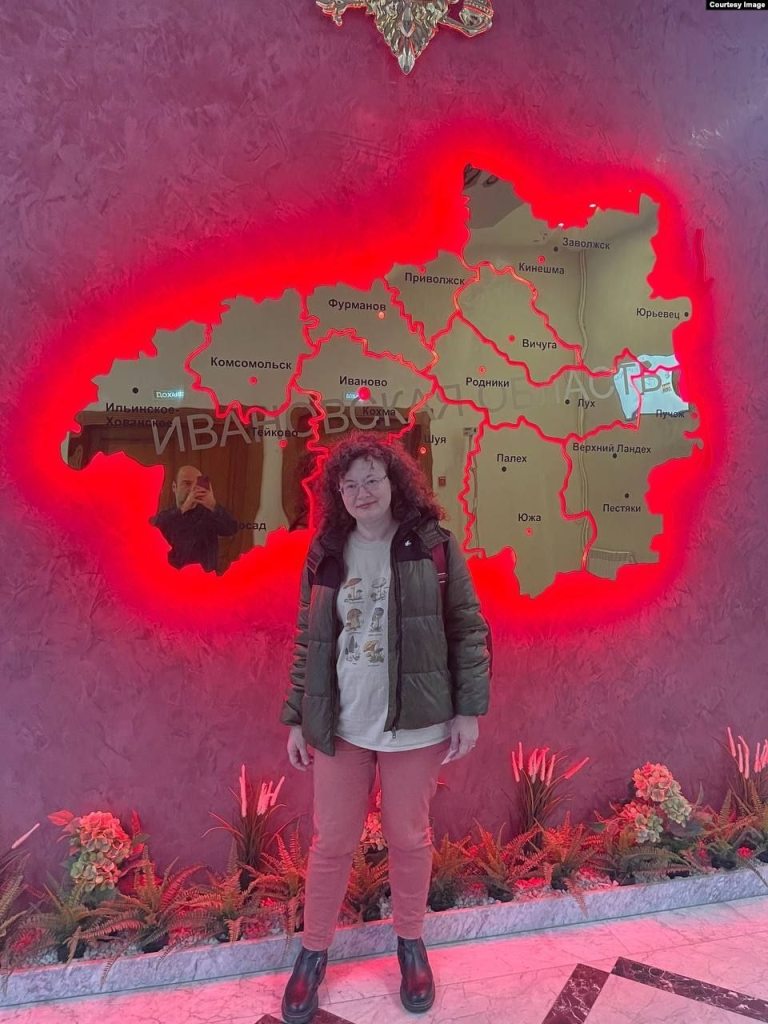
Olga Nazarenko in the lobby of the Ivanovo Regional Office of the Interior Ministry. Photo by Oskar Cherdzhiyev. Courtesy of Radio Svoboda
– Are you able to understand why the parents of conscripts did not come out in droves to protests after the mobilization was announced?
— It’s beyond my comprehension. The maternal instinct is a powerful biological mechanism. As conceived by nature, it should be stronger than any propaganda. Apparently, there has been a real degradation in our society over the past twenty years. Total state propaganda, which includes not only the media, but also the education system, has aimed to completely distort values. Fear and reverence for power, submission to it, which never disappeared in many Russians, have now resurfaced especially strongly. Unfortunately, learned helplessness has overcome the maternal instinct. I do not know if such people can change anything.
— This is not the first year that you have been constantly going out to protest. Perhaps you have a hope that Russia will become a free country?
— It’s hard to say. Historically, Russia has been going in circles all the time, rather than developing in a spiral. But I still want to hope that Russia will become a developed and free country. However, this won’t happen soon, perhaps in one hundred years.
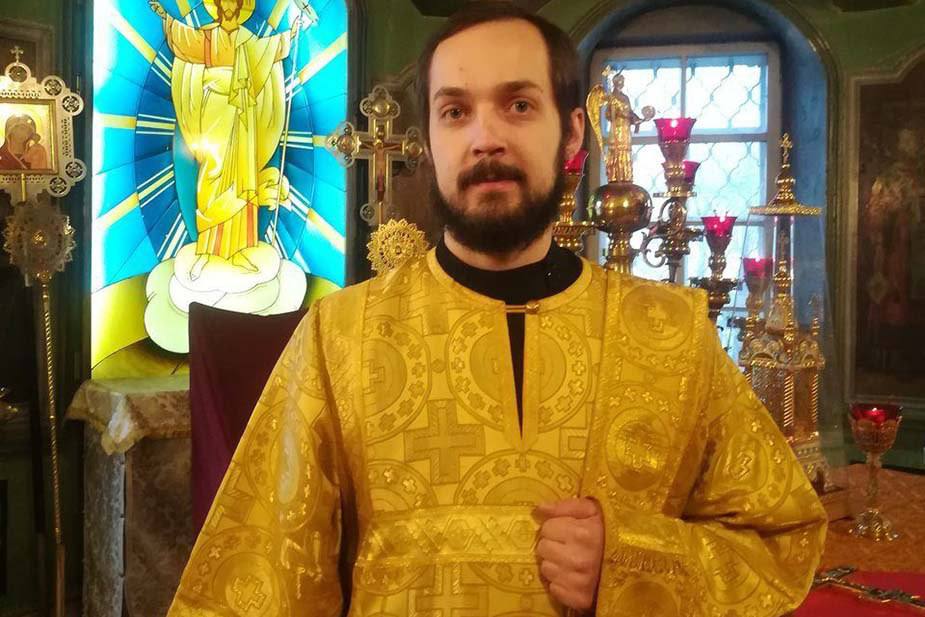
Another criminal case has been opened against the Orthodox church deacon from Kirov who opposed the war, and he has been put on the federal wanted list.
On September 7, a new criminal case was opened against Deacon Dmitry Bayev, this time on charges of “exonerating Nazism” (per Article 207.3.4 of the Russian Federal Criminal Code). The charges were occasioned by a video entitled “Thank you grandfather for the victory” and the comment to it (“The last parade in the Russian Federation is a parade of samovars”) which the deacon posted on the VK group page Kirov Online on May 9.
The investigators argued that these publications “offend[ed] the honor and dignity of veterans.” Bayev was placed on the federal wanted list.
The 33-year-old deacon of the Church of St. John the Baptist in Kirov left Russia after he was charged with disseminating “fake news” about the Russian army due to his anti-war posts on VKontakte. On March 17, by decree of the Diocesan Bishop, Metropolitan Mark of Vyatka and Sloboda, Deacon Dmitry Bayev was banned from the ROC clergy.
Source: Andrey Churakov, Facebook, 10 September 2022, who cites “@ASTRA” as his source, which I have been unable to locate. Translated by the Russian Reader
Citing sources in the agency, Newslerreports that the Investigative Committee has opened a criminal case into disseminating “fake news” about the Russian military (as defined by Article 207.3.d.2 of the Criminal Code) against Dmitry Bayev, a 33-year-old priest in the Orthodox parish of the Church of John the Baptist in Kirov.
The criminal case was opened on March 23. According to the investigation, Bayev published posts in support of Ukraine and its army on his VKontakte page. In his posts, Deacon Bayev claimed that the Ukrainian military had “dispatched 17 thousand 500 orcs to the next world.” According to him, the Russian armed forces — he called them “Russian occupiers” — have suffered significant losses of equipment every day. Bayev’s page was blocked at the request of the Prosecutor General’s Office on March 24.
After the charges were filed, the deacon did not delete the entries against the war in Ukraine from his social media page.
“The purpose of the posts is the hope that before my page is blocked, at least one person will have been able to escape the intoxication of propaganda or at least doubt it, begin to understand the real state of affairs, and put things in order in their head after reach the right conclusions,” Bayev said in a comment to Idel.Realii.
If the deacon’s guilt is proven, he faces a fine of three to five million rubles, five years of community service, and five to ten years of imprisonment.
On Forgiveness Sunday, Priest Ioann Burdin delivered an anti-war sermon in the Orthodox church in the village of Karabanovo, Kostroma Region. After one of the parishioners filed a complaint, Burdin was summoned to the police. The Krasnoselsky District Court found Burdin guilty of “discrediting” the Russian army (per Article 20.3.3 of the Administrative Code of the Russian Federation) and fined him 35 thousand rubles [approx. 560 euros]. At the very outset of the war, about 300 members of the Russian clergy published an open letter condemning the war in Ukraine.
Tomorrow, September 7, the court will consider the complaint filed by my lawyers in accordance with Article 125 of the Russian Federal Criminal Procedures Code. We demand that the decision to launch a criminal case itself be ruled unlawful due to the fact that there is no evidence that a crime was committed..
The hearing will take place at 2:00 p.m. in [Moscow’s] Basmanny District Court (11 Kalanchevskaya Street, Room 24). I will be plugged into the meeting via a video link from the pre-trial detention center.
Of course, I have no illusions about “Basmanny justice.” But I want to note the excellent work of my defense team of Maria Eismont, Vadim Prokhorov, and Mikhail Biryukov, as well as lawyers Natalia Sekretaryova and Natalia Morozova, who have simply torn apart the state’s “evidence” in this shameful case.
If you want to see for yourself how clumsily and unprofessionally the indictment has been concocted, I strongly advise you (especially the law students among you) to peruse the text of the complaint.
Victoria “Vika” Petrova. Photo courtesy of Ms. Petrova and The Village
“I demand an immediate cessation of all hostilities and an international investigation of all crimes committed. […] I call on all Russians to fight for their rights and against the dictatorship, and do everything to stop this monstrous [war],” a young woman named Victoria Petrova says confidently and clearly on the screen in courtroom 36 at the St. Petersburg City Court. The members of the public attending the hearing — they are thirty-three of them — applaud.
A month ago, Petrova was an “ordinary person,” a manager in a small family-owned company. Now she is a defendant in a criminal case, charged with disseminating “fake news about the army,” and has been remanded in custody in the so-called Arsenalka, the women’s pretrial detention center on Arsenalnaya Street in Petersburg. The case against her was launched after she posted an anti-war message on the Russian social media network VKontakte. If convicted, she could face up to ten years in prison. In the following article, The Village explains how, thanks to Petrova’s lawyer, the case of this unknown “ordinary person” has resonated with the public, why Petrova’s mother is not allowed to visit her, and what the prisoner herself has to say.
The Case
On the sixth of May, at seven in the morning, Center “E” and SOBR officers came to Petrova’s rented apartment on Butlerov Street with a search warrant. They seized phones, laptops, and seven placards on the spot. The next day, the Kalinin District Court remanded Petrova in custody in Pretrial Detention Center No. 5 for a month and twenty-five days.
“The investigator said that, if he had his way, he would have released Vika on his own recognizance. But he was instructed to petition the court to place her under arrest,” Anastasia Pilipenko, Petrova’s lawyer, told The Village.
A case was opened against Petrova under the new criminal article on “public dissemination of deliberately false information about the deployment of the Armed Forces of the Russian Federation.” According to the new law, any information on the so-called special operation in Ukraine that does not come from official Russian sources can be deemed “fake.” In Petrova’s case, the grounds for the criminal charges were a post on VKontakte, dated 23 March 2022, and the nine videos that she attached to it, featuring journalists Dmitry Gordon and Alexander Nevzorov, and grassroots activist and blogger Maxim Katz.
Who else has been arrested in Petersburg on criminal charges of spreading “fake news” about the Russian army?
Nearly 32,000 Victoria Petrovas are registered on VKontakte, and more than 1,800 of them live in Petersburg. The Victoria Petrova in question is depicted on her VKontakte pages as a woman wearing a light beanie, glasses, and makeup in the colors of the Ukrainian flag. She has 247 friends and eighty-nine followers.
Her post dated March 23 was deleted by VKontakte at the request of Roskomnadzor two days after it was published. But she made other anti-war posts, in which, among other things, Petrova recounts how she was jailed for ten days for taking part in a protest at Gostiny Dvor. In total, since the start of the “special operation,” she was detained twice on administrative charges.
When Center “E” [Center for Extremism Prevention] and SOBR [Special Rapid Deployment Force] came for Petrova on May 6, she thought at first that she would be charged once more under the Administrative Offenses Code. Realizing that now it was a matter for the Criminal Code, Petrova wrote her mother a detailed note explaining what to do with her apartment and her cat, and what things to send to the pretrial detention center, said Petrova’s attorney Pilipenko.
Pilipenko is now the only link between Petrova and the world: no one is allowed to see the prisoner except the lawyer.
The Lawyer
Pilipenko’s mother has her birthday on February 24. On the evening of the 24th this year, she and her daughter were going to drink tea and eat cake. But [the war] started early that morning.
“People who are also opposed to [the war] are taking to the streets. The police are putting them in paddy wagons. They face fines and arrests. Cake is canceled — I have work to do […] I am spending the night at a police station,” the lawyer wrote in her Telegram channel. She spent a month and a half working this way.
Pilipenko is thirty-five years old. She graduated from the Northwestern Branch of the Russian State University of Justice. For a year she worked as a clerk in the Leningrad Regional Court. “It was like going into the army,” she says. Usually clerks eventually become judges, but Pilipenko first became a lecturer, then a barrister. “I would never have become a judge, I would not have been able to make decisions that changed people’s lives,” she says.
“But it happens that you can get a case dropped at the investigation stage. Or get the charges reduced to less serious ones. By today’s standards, that is tantamount to success for a defense lawyer,” says Pilipenko.
Pilipenko was not acquainted with Petrova until May 6, when the woman’s apartment was searched. The lawyer was asked to take the case by the Net Freedoms Project. The case is being handled by the Russian Investigative Committee’s central office.
“This means that there is no one investigator, that the entire investigative department is working on the case,” Pilipenko explains.
It was the lawyer who drew public attention to Petrova’s case by writing the following on May 11 on social media:
“Vika is an ordinary young woman. […] She has an ordinary life, goes to an ordinary gym, and has an ordinary cat. She has an ordinary job in an unremarkable company. […] Perhaps the only unusual thing about Vika’s case so far is just her ordinariness. She’s just like us. She’s not an activist, not a journalist, and not the voice of a generation.”
Victoria “Vika” Petrova. Photo courtesy of Ms. Petrova and The Village
Vika
Victoria Petrova is twenty-eight years old. She was born in Petersburg, where she graduated from St. Petersburg State University’s Higher School of Management.
“Vika had a long braid, was very serious, gave the impression of an intelligent person, and got good grades. Intuitively, I feel that Vika is childish in a good sense, unspoiled,” Sofia, a classmate of Victoria Petrova’s, told The Village.
Another friend from school, Daria, in a comment to Mediazona, described Vika as a “born A student,” a “battler in life,” and a person who “was the most organized of all.”
“And her heart always aches over any injustice,” Daria said.
Pilipenko says that Petrova is “a very calm and organized person.”
“I was amazed by this at [the May 7 bail] hearing. People behave differently when they are arrested for the first time. Vika behaved with great dignity,” Pilipenko says.
Before her arrest, Petrova lived alone with her cat Marusya. The animal is now living with the heroine’s mother, while Maruysa’s owner is now at Pretrial Detention Center No. 5.
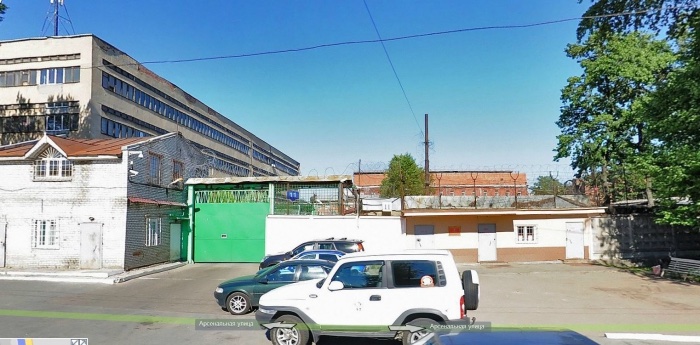
Pretrial Detention Center No. 5 is located on Arsenalnaya Street, which is a deserted place dotted with small manufacturing facilities and the premises of the shuttered Krasnyi Vyborzhets plant, which was going to be redeveloped as a housing estate. A banner sporting the prison’s name and an image of the Bronze Horseman is stretched above the entrance to the Arsenalka. From the street side, the complex consists of a typical rhombus-shaped concrete fence, reinforced with mesh and barbed wire. A tower sheathed in corrugated iron juts out above it. On the right, behind an old brick wall, there is a a building in the shape of a cross — a psychiatric hospital “for persons who have committed socially dangerous acts in a state of insanity.” The old Crosses Prison itself, a remand prison for men, is about a kilometer away. Five years ago, all the prisoners were transferred from there to a new facility in Kolpino. The women remained in the pre-revolutionary red-brick Arsenalka complex.
Businesswoman Natalia Verkhova has described life at Pretrial Detention Center No. 5.
“The meter-thick walls and the thick iron doors outfitted with peepholes and bolts. The mattresses a couple of centimeters thick. The prison-baked loaves of bread, often burnt. The broken toilets. The concrete floors in basements where the ladies wait for many hours to be shipped out [to interrogations, court hearings, and other prisons]. The queues at the care packages office and for visiting inmates. The duffel bags chockablock with romance novels in the corridors.”
Former inmate Elizaveta Ivanchikova describes the largest cell in the Arsenalka (for eighteen inmates), to which Petrova, like all newcomers, was first assigned.
“There were nine bunk beds in [the cell]. There were bedside tables next to the beds. In the middle of the cell there was a large iron table with wooden benches. All of this was bolted to the floor. There was also a refrigerator, a TV, a sink next to the toilet, and the toilet itself, behind an ordinary door, without a lock.”
Pilipenko says that Channel One is constantly turned on in this cell and there are many unspoken rules for maintaining cleanliness.
“For example, you can only comb your hair in one place, because if eighteen ladies do it in different places, the hair would be everywhere,” says Pilipenko.
A head inmate keeps order, and at first Vika did not get on well with her. The head inmate did not like that the new girl did not know how to behave in the detention center.
“For example, when the guards come to toss the cell, you need to stand up and lock your hands behind your back,” says Pilipenko.
The conflicts were quickly settled, however, and Petrova was subsequently transferred to another cell.
This, according to Pilipenko, was preceded by an incident in the second part of May, during which plaster fell directly on the imprisoned women.
“Vika said that the girls were sitting and drinking tea when part of the ceiling collapsed on the table. Vika was not injured, but one inmate suffered bruises,” Pilipenko says.
The Telegram channel Free Sasha Skochilenko! reported that the plaster collapsed due to severe leaks: “The residents of the cell gathered the pieces of the ceiling, the largest of which weighed about three kilograms. The pieces were wrapped in sheets and the floor was swept.”
Petrova is currently in a cell for six inmates. During their last visit, when Pilipenko asked her how she was doing, Petrova replied, “You know, okay.” Petrova was surprised by her own answer.
“The letters she receives play a big role. Without them, she would not have any way to keep herself busy. This is the biggest problem in remand prison,” says Pilipenko.
The Letters
Petrova has received hundreds of letters, mostly from strangers, including from other countries. Petrova has told Pilipenko that she received a letter from a person who works in management at VKontakte. “He is upset that the social network played a role in my criminal case,” she told her.
“Vika definitely replies to all the letters. Except for those whose senders marked them with Z-symbols,” Pilipenko promises.
Petrova can correspond with other “ordinary people,” but it seems she cannot correspond with journalists. The Village sent her questions through her lawyer, but the sheet of paper with the answers was confiscated from Petrova right in her cell. Our correspondent then wrote to Petrova through the Russian Federal Penitentiary Service’s online FSIN-Pismo system. All three attempts that the The Village made to communicate with Petrova were not approved by the censor, and the negative responses came within a few hours, although the standard processing time is three days. Then, on the advice of Petrova’s lawyer, our correspondent sent all the same questions via FSIN-Pismo, but did not indicate that they were from the media. On the day this article went to press they were delivered to Petrova, but there has been no response from her yet. According to our information, other journalists have also failed to make contact with Petrova.
Petrova’s mother is also not allowed to see her daughter. According to the lawyer, one of the investigators said that “permission to meet with Mom will depend on the results of Vika’s interrogation as the accused party.” The investigators want Petrova to admit wrongdoing.
The Hearing
Victoria’s mother Marina Petrova lives in a three-room flat on Lunacharsky Avenue. Pilipenko filed an appeal against the order to remand her client in custody, hoping that “on grounds of reasonableness, legality, and humaneness” Petrova would be transferred to house arrest at her mother’s residence.
On the eighth of June, a hearing on the matter was held in the City Court. During the hearing, Pilipenko stated that her client was “actually being persecuted for voicing her opinion about the special military operation.” She also said that Petrova does not have a international travel passport and presents no flight risk, that there are no victims or witnesses in the case [whom the defendant theoretically thus might attempt to pressure or intimidate if she were at liberty], and that she had been charged with a nonviolent offense.
The defendant participated in the court hearing via video link from the Arsenalka. In her seven-minute closing statement, she explained what, in her opinion, had been happening for the last three and a half months in Ukraine.
Among other things, she said, “As a result of eight years of brainwashing by propaganda, Russians for the most part did not understand that [a war] had begun. Meanwhile, the completely immoral Z movement, ‘zedification,’ has been spreading across the country that once defeated Nazism. […] I do not feel any ideological, political, religious or other enmity towards the state authorities and the Armed Forces of the Russian Federation as institutions. In my anti-war posts, I said that people who gave and carried out criminal orders and committed war crimes should be punished for it.”
Judge Tatiana Yaltsevich denied the defense’s appeal. Petrova will remain in jail at least until the end of June.
On the evening of June 8, subscribers to the Telegram channel Free Vika Petrova! were warned that reposting her speech in court “could lead to criminal prosecution” — probably also under the article on “fake news” about the army.
The next day, Petrova commented on her speech to her lawyer.
“She says that since she has already become a political prisoner, she cannot help but use the court hearings as a means to talk about what is happening. She has not remained silent before, and she has even less desire to be silent now that many people will hear what she has to say,” reports Pilipenko.
Source: “‘An ordinary person’: the story of Vika Petrova, who wrote a post on VKontakte and has been charged with spreading ‘fake news,’ but refuses to give up,” The Village, 9 June 2022. Thanks to JG for the story and the heads-up. Translated by Thomas H. Campbell. Ms. Petrova’s support group has a Telegram channel and is circulating an online petition demanding her release.
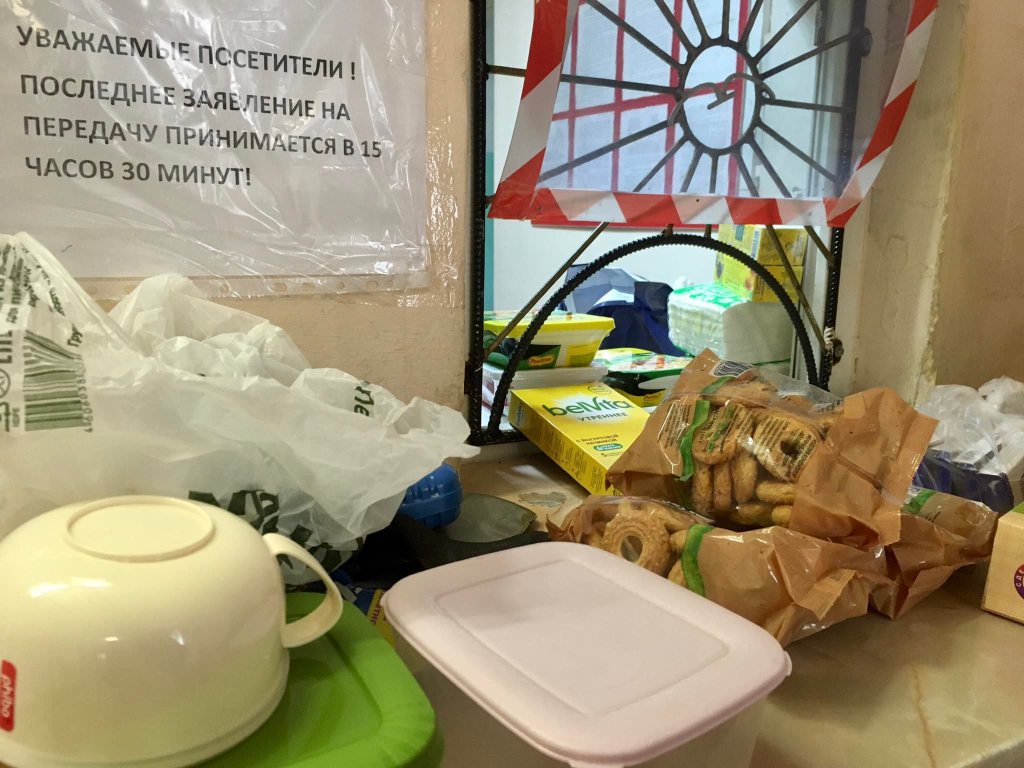
Jenya Kulakova’s photo of the care package that she and Boris Romanov’s mother Margarita delivered to the political prisoner at Pretrial Detention Center No. 6 in Gorelovo, a distant suburb of Petersburg.
Today, Boris Romanov’s mother Margarita and I went to Pretrial Detention Center No. 6 to deliver a care package to him. Borya will finally get delicious food and basic necessities. (It is very difficult to get into the prison with care packages because of the always crowded electronic queue.)
Lawyer Luiza Magomedova is also waiting for a meeting with Borya in the pretrial detention center today. The pre-registration for lawyers [to see clients] is all booked up for the next two weeks, so in the morning she queues without any guarantee that she will get in to see him.
Gorelovo is far away, and all the way there I listened to Boris’s mother’s stories about him. How he was twice elected chairman of his housing co-op, and had tried to whip the building into shape, how he had issued paperwork to the janitor and knew all the neighbors. What an impossibly principled, thrifty and honest man he was, intolerant towards even the hint of corruption in its smallest everyday manifestations. How he would not compromise and take good-paying jobs if they were pro-government. What an attentive son and caring father he was. What an educated man he was — a good simultaneous translator from German, a graduate of the European University’s history program. (Besides electronic devices, Boris’s German-language books were seized by police during the search of his mother’s flat.) How, after studying for one and a half years in Germany, he had come back home “to build a new Russia.”
But now Russia is whipping Borya into shape instead. This Russia does not need smart, honest, principled people.
Yesterday, I received my first letter from Borya, and it contained two requests to help his cellmates. When I told this to his mother, she laughed, saying that it was just like her son: he had already found a way to be helpful to someone in prison.
Source: Jenya Kulakova, Facebook, 18 May 2022. Translated by the Russian Reader
Boris Romanov with his lawyer, Luiza Magamedova. Photo: Konstantin Lenkov for Zaks.ru
Activist Boris Romanov has been remanded in custody on charges of spreading “fake news” about the Russian army (punishable under Article 207.3 Part 2 of the Criminal Code). He is the fifth person in Petersburg remanded in custody for the duration of the investigation on these charges. Romanov is accused of making harsh statements about the “special operation” during a meeting of the Svetlanovskoye municipal district council. He faces up to ten years of imprisonment. Zaks.ru has examined this new case of “fake news” about the Armed Forces.
This time round, Petersburg oppositionist Boris Romanov, who has long been known among the city’s activists, is suspected of disseminating false information. In September 2021, as part of the Yabloko party regional group, he was nominated to run for the St. Petersburg Legislative Assembly’s fifth district. In the municipal elections of 2019, he tried to run for a seat on the Svetlanovskoye municipal district council, but was refused registration. But the lack of a deputy’s mandate did not prevent him from regularly attending the council’s meetings and broadcasting them on a VKontakte community page.
There are now over 1,800 subscribers to this page. Romanov did not have good relations with the local deputies. For example, he alleged that the wife of one of them sprayed pepper spray in his face. In addition to problems in the Svetlanovskoye neighborhood, Romanov paid great attention to issues of urban development and historical preservation. In particular, he often participated in the grassroots gatherings at the Pulp and Paper Industry Research Institute building [threatened with demolition] in the city’s Vyborg district. Since the beginning of the “special military operation,” he sometimes devoted his speeches to the events in Ukraine, taking a pacifist stance. In mid-March, Romanov was detained at a protest rally near Gostiny Dvor. He was present there as a member of the St. Petersburg Human Rights Council’s monitoring group.
The Ukrainian question at a district council meeting
On May 5, the FSB’s Petersburg regional office launched a criminal investigation into dissemination of deliberately false information about deployment of the Russian Armed Forces (per Article 207.3 Part 2 of the Criminal Code). According to the security forces, a man (his name is not mentioned in the Investigative Committee’s press release) posted a video on the internet containing knowingly false information about the Armed Forces. As Zaks.ru has learned, Romanov’s alleged “criminal activity” was detected in a video recording of a Svetlanovskoye municipal district council meeting. The case file mentions eyewitness testimony. According to Luiza Magomedova, an attorney with the civil rights project Apologia of Protest, the eyewitness in question was Romanov’s neighbor and district chair Yanina Yevstafieva. In conversation with Zaks.ru, Yevstafyeva said that the security forces were interested in the council’s March 29 meeting. The council chair stated that on that day, activist Romanov came to the district offices and allegedly made what she regarded as “anti-Russian” statements.
Yevstafieva alleges that Romanov indulged in rude expressions directed at Russian servicemen. She noted that he also made an invidious comparison involving the symbols of the “special operation.”
According to her, Romanov’s speech caused a negative reaction among council members. Yevstafieva argues that such statements are unacceptable. Romanov’s statements were captured on a video posted on March 29 in the Svetlanovskoye Neighbors group page in VKontakte. After studying the recording, police investigators concluded that the activist’s words could be regarded as purveying deliberately false information about deployment of the Armed Forces, motivated by political hatred or enmity.
The topic of Romanov’s speech was probably related to statements made on March 29 by Russian deputy defense minister Alexander Fomin and Russian peace negotiator Vladimir Medinsky. After the latest round of the negotiations between the two countries [sic], the Russian officials stated that they intended to curtail military operations in the Chernihiv and Kyiv areas.
The fifth arrest in the “fake news” investigation
The police found Romanov in his apartment on the morning of May 10. The activist’s electronic devices were confiscated, as well as various informational materials. The latter, the investigators allege, may be “extremist” in nature. A couple of hours later, the security forces showed up at the apartment of Romanov’s mother, at whose address Romanov is officially registered. Her communications devices was also confiscated.
“They said that I had raised a bad son. That I should have monitored him and brought him up right,” Margarita Romanova, the defendant’s mother, said in conversation with Zaks.ru, quoting what the police had told her.
During the search, she was told that a criminal case had been opened against her son because of a speech he made during a meeting of the Svetlanovskoye municipal district council.
After the preliminary investigation, Romanov was placed in the temporary detention facility on Zakharyevskaya Street, where he spent the night awaiting his bail hearing, which took place on May 11 in Petersburg’s Vyborg District Court. Police investigators asked the court to remand the oppositionist in custody.
Judge Oksana Golovinova read out a statement by the investigators.
“The accused Romanov posted […] knowingly false information that was aimed at destabilizing the political situation in the country and arousing panic among citizens, as well as causing a negative attitude towards Russian federal authorities, thereby demonstrating his indifference to public safety.”
The prosecution argued that Romanov could attempt to destroy evidence, influence witnesses, escape from justice, and continue his alleged “criminal activities.”
Magomedova petitioned the court to impose a restraining order on her client that would ban him from doing certain things. Romanov has an underage daughter who needs her father. He is also his family’s sole breadwinner.
Judge Golovinova took Romanov’s having a child into account, but did not consider this sufficient grounds to order a milder form of pretrial restraint. But the court did not share the prosecution’s position on the likelihood of Romanov’s attempting to hide from the authorities, since his foreign travel passport had already been confiscated. After spending about an hour deliberating in her chambers, the judge remanded the activist in custody in Pretrial Detention Center No. 1 [sic] for the duration of the investigation. He will remain there at least until July 5. The activist denies any wrongdoing.
Romanov is the fifth person arrested in Petersburg on charges of spreading “fake news” about the Russian army (as punishable under Article 207.3 Part 2 of the Criminal Code). Previously, artist Alexandra [Sasha] Skochilenko, journalist Maria Ponomarenko, Peaceful Resistance member Olga Smirnova, and Victoria Petrova had been arrested. They face from five to ten years in prison. As in the case of Romanov, the criminal charges against them were most often occasioned by social media posts.
Source: Konstantin Lenkov, “From a District Council Meeting to a Pretrial Detention Center: Yet Another ‘Fake News’ about the Army Case,” Zaks.ru, 12 May 2022. Translated by the Russian Reader
The case of Sasha Skochilenko is a striking example of the absurdity of today’s Russia. She faces ten years in prison for her anti-war protest at a supermarket.
Bumaga has discovered that Sasha’s protest was reported to the police by an elderly woman. The security services organized a special operation to capture Skochilenko. Today the young woman is in a pretrial detention center. She will remain there for a month and a half even though she has serious health problems.
Read the story of Sasha Skochilenko, an artist and musician from Petersburg, a former Bumaga staffer, and a person with a conscience.
Sasha Skochilenko. Photo by Andrei Bok for Bumaga
The security services mounted a special operation to capture Sasha Skochilenko. An elderly woman informed on her.
On the evening of March 31, anti-war messages were inserted into the shelf slots for price tags in the Perekrestok supermarket on the second floor of the Skipersky Mall on Vasilievsky Island.
According to two of Bumaga’s sources who are close to the investigation, the protest attracted the attention of a 75-year-old retired female shopper. According to one source, the woman went to the prosecutor’s office “to seek justice.” The second source says that she immediately went to the police.
Bumaga has learned that for over ten days, law enforcement officers, allegedly, interrogated Perekrestok employees and viewed security camera footage to determine who had replaced the price tags with the anti-war messages and where this person had gone after leaving the store.
On Monday morning, April 11, law enforcement officers conducted a special operation. They went to the apartment of the alleged suspect. His home is 900 meters away from Perekrestok. What exactly happened in the apartment is unknown. The man living there turned out to be a friend of 31-year-old Sasha Skochilenko.
That morning Sasha received a message from this friend saying that they were “looking for a body” in his apartment and asking her to come over. When she was already on her way, the friend texted her that “everything was okay.” Skochilenko’s friends believe that the security forces could have texted Sasha from her friend’s phone.
When Skochilenko arrived at the apartment, she was detained. It was around 11 a.m. Bumaga learned about her arrest at about 2 p.m. There was no news from Sasha for more than four hours, and law enforcement officials would not comment on the situation to Bumaga.
Later, Dmitry Gerasimov, Skochilenko’s lawyer, who is affiliated with the Net Freedoms Project, found out that Sasha’s apartment was being searched in her presence. She was then taken for questioning and kept in police custody until 12:30 a.m.
That same evening, Gerasimov told Bumaga that Sasha was the subject of a criminal investigation into disseminating “fake news about the Russian army” over the anti-war stickers with which she had switched the price tags at Perekrestok. According to investigators, the young woman had “publicly disseminated knowingly false information about the Armed Forces of the Russian Federation.”
Skochilenko was charged under the second part of Russian Federal Criminal Code Article 207.3, which means that she faces up to ten years in prison. Investigators argue that she was “motivated by political hatred” when she distributed the flyers.
How the information on the anti-war flyers could be “knowingly false” and how Skochilenko came to be “motivated by political hatred” is not mentioned in the documents provided by the investigation.
The criminal case could have been opened due to a mention of those killed in Mariupol. But the contents of the stickers are unknown.
Sasha had been actively speaking out against the war in Ukraine since its very beginning. Along with the same friend whose apartment law enforcement officers raided, she had performed at intimate “Peace Jams” and also produced pacifist postcards. For this reason, the young woman’s acquaintances thought that she could have been charged with violating the recently popular article in the administrative offenses code for “discrediting” the Russian army. But that was not what happened.
Gerasimov tried to explain to Bumaga the rationale behind the investigation.
“[An administrative charge was not filed in Skochilenko’s case], because in those price tags [for which administrative proceedings had initiated] there were only statements against the war itself, while in Sasha’s case there was information about the alleged actions of the Russian Armed Forces,” he said.
At the same time, the part of the case file that the lawyer has reviewed does not mention the specific flyers for which Sasha was charged.
The Net Freedoms Project wrote that her case file contains price tags with information about the shelling of the theater in Mariupol and the deaths of civilians. Gerasimov told Bumaga that he could neither confirm nor deny this information, since “Sasha does not remember now what the price tags were and what was written on them.”
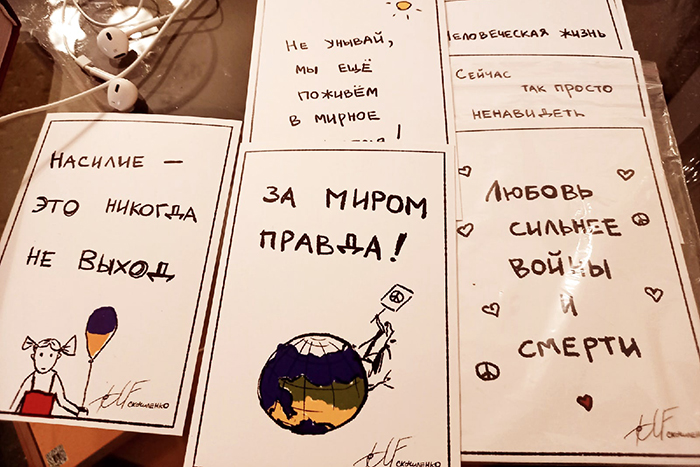
Earlier, Sasha had drawn anti-war stickers with such messages as “Don’t be discouraged, we’ll live in peacetime one day!” and “Human life has no price.”
“There are still so many people who do not know (do not remember?) what a miracle human life is, how beautiful and precious it is, and that violence is not the solution to problems,” Sasha said in explanation of her stance.
A sampling of Sasha Skochilenko’s handmade anti-war stickers. Photo courtesy of Bumaga
Currently, Sasha’s defense is based on her admission that she did plant anti-war flyers with information about Russia’s use of military force in Ukraine and its consequences in the store. But the young woman does not think that the information in the flyers was “false,” as the criminal code article that she was charged with stipulates, her lawyer said to Bumaga.
The judge sent Sasha Skochilenko to a pretrial detention center. She has celiac disease (gluten intolerance).
Sasha Skochilenko spent the night of April 12 in a temporary detention facility. As she later said in court, she managed to get some sleep there, but the guards did not give her water and did not bring her the food that friends had collected for her. Ultimately, the first hearing in Sasha’s case was postponed to the next day, and the young woman spent another twenty-four hours in the temporary detention facility.
Sasha’s bail hearing began at the Vasileostrovsky District Court at 9 a.m. on April 13. More than forty people had gathered at the court (where a Bumaga correspondent was present), including friends, journalists from both independent and pro-regime publications, activists, and human rights defenders.
Skochilenko was brought into court in handcuffs and placed in a cage. The young woman looked exhausted, and she asked for something to drink. There was no water in the courtroom, however, so the visitors looked for a water bottle among themselves. Despite her subdued spirits, Sasha thanked everyone who came.
“I did not anticipate so much support, that so many people would come [to the hearing],” Skochilenko said to Bumaga before the hearing began. “Everyone here tells me that you are doing something bad if you call for peace, but people’s support for me shows this is not the case. That is the most important thing.”
The judge in Sasha’s case was Elena Vladimirovna Leonova. Appointed to the Vasileostrovsky District Court by President Boris Yeltsin in 1998, she has held this post for over twenty years.
The media has mostly mentioned Judge Leonova in a positive light, and she was given high marks from the Petersburg qualification board of judges in the past. In particular, Leonova has often declined requests by prosecutors to jail activists and protestors, unlike her colleagues. There are also some ambiguous cases and decisions in her case history, however.
In the case of Sasha Skochilenko, the judge sided with the prosecution. Leonova began the trial by forbidding the taking of photographs in court. She then granted the prosecutor’s request to close the proceedings to the public because, allegedly, the state’s case was based on the interview records of witnesses. When members of the public were still present, the defense lawyer only managed to request the judge to release Skochilenko on bail, or prohibit her from certain actions, or at most, place her under house arrest.
The hearing, which took place behind closed doors, lasted almost five hours. When she delivered her ruling, Judge Leonova permitted several journalists, including the correspondent from Bumaga, to enter the courtroom. She began as follows: “It has been established that Skochilenko, acting deliberately, placed fragments of paper containing deliberately false information [about the actions of the Armed Forces of the Russian Federation] in the premises of a trading hall.”
The judge read out the verdict quickly, not distinguishing between the arguments of investigators and her own words. “Misleading citizens about the actions carried out by the armed forces of the Russian Federation creates tension in society [and] conducts subversive activities [sic],” she said.
Among the arguments for Sasha’s being remanded in custody, Judge Leonova mentioned that Sasha:
had been accused of committing a serious breach of public safety.
“could exert pressure” (on investigators).
refused to reveal the password to her telephone.
“might destroy evidence” if she were at large.
“has a sister in France.”
“has friends in Ukraine.”
“has the ability to hinder the collection of evidence and hide in Ukraine.”
Is registered to reside in Petersburg but resides with a female acquaintance in a rented apartment, and the female friend does not have documents proving the residence’s lawfulness for serving as a place of house arrest, and the landlady might change her mind.
The judge emphasized that Skochilenko had “visited acquaintances in Ukraine.” In fact, a friend of hers told Bumaga, Sasha had gone to Ukraine in 2020 for work at a children’s camp, where she taught animation to the children.
Sasha Skachilenko being led out of the courtroom. Photo by Andrei Bok for Bumaga
Furthermore, Leonova brought up as an argument the fact that Skochilenko had “an administrative arrest for organizing a mass gathering of citizens during the pandemic.” Indeed, Sasha had been detained at an anti-war protest on March 3, her friend told Bumaga. Skochilenko was released after a night in the police station, and a court sentenced her to a fine of ten thousand rubles. Sasha had challenged the decision, but on appeal the court upheld the verdict.
The judge did not consider the fact that the artist had been diagnosed with bipolar affective disorder and celiac disease, a genetic gluten intolerance requiring a strict diet, to be a valid reason for declining to send Sasha to a pretrial detention center.
Leonova noted separately that Skochilenko had not been diagnosed with serious illnesses and that there was no evidence that she needed emergency medical care. When the defense lawyer provided the court with a doctor’s note about Sasha’s health, the judge stated that the document could not be accepted because it did not mention the source of the information.
Judge Leonova ultimately decided to remand Sasha in custody to Pretrial Detention Center No. 5 until May 31. In response, the people in the courtroom cried and told Sasha that everything would be okay, while people in the hallway shouted, “Shame on you!” to the judge. As people left the courtroom, Skochilenko smiled and waved to her friends.
“The war will end, and I will be amnestied,” Sasha managed to tell a friend before the bailiffs forced him to leave the courtroom.
Sasha is an artist and a musician. She wrote A Book on Depression and filmed protest rallies for Bumaga. Many people support her, but they are pessimistic.
“Sasha is one of my most talented acquaintances,” journalist Arseniy Vesnin, a friend of Skochilenko’s, told Bumaga. “We met around fifteen years ago. We used to play Mind Games—it was this project on Channel 5 where schoolchildren would debate. Sasha was always—or rather she is (we’re almost talking like obituaries now)—very smart, talented, and well-read.”
Sasha was born on September 13, 1990, in Leningrad. At the age of seventeen she enrolled at the Theater Academy to study directing but withdrew during her final year, transferring to St. Petersburg State University’s Faculty of Liberal Arts and Sciences where she studied anthropology and graduated with honors.
From 2013-2015, Sasha made video reports of rallies and protests for Bumaga.
“Sasha is the ‘good person’ from Andrei Platonov’s works,” says Kirill Artemenko, general director of Bumaga. “Platonov’s heroes do good without fully realizing that they are good, without expecting kindness from anyone and without being offended by evil. They are hardworking, patient people. They might look weak, but in reality, they are very strong. Their strength is in their principles and natural, effortless kindness.”
When Sasha fell ill with cyclothymia, a milder form of bipolar affective disorder, she wrote A Book on Depression to support people with similar health problems. The book has been translated into English and Ukrainian. The story of Sasha’s struggle with her illness can be read in this text, published by Bumaga.
Lately, Sasha had been filming and editing lectures for the feminist space Eve’s Ribs and helping to renovate the homes of women who did not want to hire a handyman to do the work, a friend tells Bumaga. She also worked as an administrator at a children’s center on Vasilievsky Island. “She communicates well with children, unlike with the cops,” explains the interviewee.
According to the friend, Skochilenko never had the goal of building a career. It was important to her to do good while also being able to live on the money she earned.
“I don’t have any kind of particular profession. In different interviews they have called me an artist from Petersburg, a cartoonist, and an actress, and many other things,” Sasha, who at that moment was working as a nanny, said in 2020. “I don’t want to have a particular profession. And in fact, I don’t have one.”
Sasha’s passion has always been music, her friends say. Sasha views it as “an instrument of freedom,” said Skochilenko’s friend Alexei Belozerov. “She wants to create a free space with the help of music—without the hierarchies that inevitably arise within a musical collective, without the division between performers and listeners,” says Alexei.
“War is hell.” Sasha Skochilenko’s supporters in the hallway at Vasileoostrovsky District Court in Petersburg. Photo by Andrei Bok for Bumaga
A friend of Sasha who has been involved with her in musical events on many occasions said that the main idea of her music is free improvisation, so that “people who don’t have a musical education but very much want to play won’t be afraid to grab an instrument and play together.” For example, the friend said, Sasha held music jams at psychoneurological resident treatment facilities as a form of art therapy.
Sasha vigorously advocated the idea of freedom even after February 24. “I do not support the war in Ukraine! I went on the streets today to say it out loud!” she wrote from a rally on the first day of the war. “Two years ago, I taught children in Ukraine at a children’s camp to film videos. I remember each of their faces. They are no different from Russian children.”
Sasha decided not to emigrate, despite the risks. “Sasha said that she would not leave, because she has her social capital here, Petersburg is her city, and Russian is her language,” Sasha’s friend Arseny tells Bumaga. “She is not someone who made it her goal to fight the regime. She is a person with a conscience, and as a person with a conscience, she could not help but react to this shameless situation that is now happening in Russia”.
Guarantees for Skochilenko were signed by St. Petersburg Legislative Assembly deputies Boris Vishnevsky and Mikhail Amosov, [Pskov] politician Lev Schlosberg, and municipal deputy Sergei Troshin. The court also received a positive character reference from Bumaga general director Kirill Artemenko. There are hundreds of posts on social networks about her case, which has been dubbed absurd. The case has also been covered by Russia’s remaining independent media. And Bumaga has learned that protests in support of Sasha have been organized in London.
The main source of public indignation is not even that Sasha is being prosecuted for an anti-war position, but, rather, the possible sentence (up to ten years in a penal colony) and the fact that she was sent to a pretrial detention center despite her illness.
“I remind you that no one was punished for threats to ‘cut off heads,’” wrote Vishnevsky. “And there was no response to two attempts to kill my friend Vladimir Kara-Murza. But for anti-war speeches, [people get sent to] a pre-trial detention center, and then to a penal colony for ten years. Feel the difference.”
Many of those who spoke with Bumagaand who advocate for Sasha’s release are pessimistic. For example, Vishnevsky himself told Bumagathat he would be glad to be proved wrong if the outcome of the case were positive after all. Journalist Arseny Vesnin recalls that it was clear to him that Sasha would be sent to a pretrial detention center, although he did not want to believe it.
“We must pray that not only the war ends, but also that something in our country changes. This would be a good outcome. But realistically I don’t see any good outcomes,” Vesnin concludes.
Sasha’s friend, who vigorously advocates for her release, tells Bumaga that he cannot express his opinion about what is happening, including in this case, without breaking the law.
“This is terror,” he says anonymously. “It has been unleashed in the original sense of the word— as ‘fear’ and ‘horror.’ They are maintaining an atmosphere of terror. This is the only way to explain why, for replacing one piece of paper in a store with another, a bunch of people in uniform write up interrogation reports and put them into case files, conduct searches, and arrange an ambush using the person’s friend. In this sense, the possible outcome of this case is the same as that of everything that is happening here. The terror will grow, the terror will intensify. They will be trying to frighten us and to break us more and more.”
Sasha’s case is not an exception. The security forces are persecuting many people who have protested the war by replacing price tags.
As of April 7, four days before Sasha Skochilenko’s arrest, twenty-one criminal cases had been launched nationwide on suspicions of spreading “fake news about the Russian army,” wrote human rights lawyer Pavel Chikov. Almost all of the cases involve publishing “knowingly false information” on the internet—with the exception of five cases, and only one of those cases also involves distributing flyers in a store.
Despite increased pressure, Russians continue to replace price tags with anti-war messages. This “quiet protest” is considered an easy way to convey the truth about what is happening in Ukraine to people living in a different “information bubble.”
Replacing price tags in stores became a popular form of protest after the campaign was announced by Feminist Anti-War Resistance, a movement of Russian feminists that came to life in February 2022 in response to the war. But the movement recognizes that protesting can be dangerous.
A sampling of anti-war “price tags” from Feminist Anti-War Resistance’s Telegram channel. Courtesy of Kholod. This image was not included in the original article, in Russian, on Bumaga.
“The police have increasingly been tracking down people involved in various types of anti-war protest,” a spokeswoman for Feminist Anti-War Resistance told Bumaga. “To date, we know that one of our participants, who put anti-war slogans on price tags, was tracked down through the card she used to pay in the store.”
The movement says that they have not been in contact with Skochilenko—or, perhaps, do not know that they have had contact with her, since they communicate with many members of the movement anonymously. But they expressed their support for the artist: “We believe that Sasha should be released immediately, and the case against her should be closed and all charges dropped.”
“Today, anti-war price tags are one of the most common forms of protest, along with posting stickers and flyers in public places,” the spokeswoman said. “Unfortunately, no forms of anti-war protest are absolutely safe in Russia today. We believe it is important to emphasize this regularly and encourage everyone to pay special attention to safety rules and to take potential risks into account.”
Two days after the hearing, Sasha Skochilenko is still in the temporary detention facility. In the evening, she is supposed to be taken to the pretrial detention center. She delivered a message through her lawyer, saying that she was doing well and was grateful for people’s support.
The wardens at the temporary detention facility promised to provide Sasha with a gluten-free diet and, according to her lawyer, they have kept their promise. A request to meet her dietary needs has also been sent to the pretrial detention center. At the same time, Sasha’s girlfriend has been summoned to the Investigative Committee for questioning.
Source: Bumaga, 15 April 2022. Translated by Christopher Damon, Zhenia Dubrova, Savannah Eller, Emily Hester, Marta Hulievska, Kirill Lanski, Jasmine Li, Milla McCaghren, and Andres Meraz. Thanks to Victoria Somoff for her assistance and the Fabulous AM for her abiding support of this project. ||| TRR
Valery Yakovlev copied out some of the supportive text messages he received after the media wrote about his case. Photo courtesy of Sibir.Realii (RFE/RL)
Valery Yakovlev, a 64-year-old children’s sports coach in the village of Onokhoy, in the Republic of Buryatia, spoke out against the special operation in Ukraine and twice tore down a “Z” sign from the entrance of the village’s sports school. His explanation for why he did this was recorded by the school’s doorkeeper on a dictaphone, and the recording was later handed over to the police. For publicly discrediting the armed forces of the Russian Federation, the court fined the Coach Yakovlev 90 thousand rubles [approx. 1,030 euros].
Valery Yakovlev is a USSR master of sports in classical archery. He has been a winner of individual events and an overall champion at republic-wide archery competitions. Having worked as a coach for twenty-two years, he has trained numerous champions, masters of sports, and candidates for master of sports.
For many years he was a successful businessman: he had his own store in the village. Later, he bought twenty hectares of land and became a successful farmer.
In adulthood, he fulfilled a childhood dream by building a glider and flying it. He is fond of sailing, paints pictures, and studies Spanish. He plays the synthesizer. He has four adult children, as well as grandchildren.
On March 23, a flash mob entitled “Za nashikh” [“For our lads”] was held in Onokhoy. In its wake, a Latin letter Z was pasted on the entrance to the children’s sports school. When Coach Yakovlev saw the sign, he tore it down. But the next day the letter appeared on the door again.
So I tore it off again [says Valery Yakovlev]. On the third day, when I came to practice, the doorkeeper didn’t want to give me the keys to my room. She said she’d been forbidden to give them to me. I think that was their way of provoking me. I snapped. I yelled, “Is this because I tore down the letter?! Did anyone ask you, me, or the children whether we wanted this letter on the door? Who gave you the right to hang it up there on my behalf?! Do you want bombs falling on your heads? Or your children’s heads? Why are you acting like sheep? So, now if I’m against the war, I can’t be given the keys?!” I don’t remember it verbatim anymore, but I said something like that. The whole thing was recorded on a dictaphone and turned over to the police.
I was later summoned to the police station. They kept me there until half past eleven. And the next day they interrogated me for another four hours. Some police boss showed up who started scanning me, checking me out. They asked me what ethnicity I was. The next day, a lieutenant colonel arrived and started scanning me too. It was unpleasant, frankly speaking. I had the feeling that they were digging hard for one specific word, figuring out what my associations were with the Z, so that later they could they tie it in with the army. I felt that they wanted to pin me with this fifteen-year article [i.e., the new article in the Russian criminal code that makes “discrediting” the Russian army punishable by a maximum of fifteen years in prison]. But I argued that there was nothing political about what I did. I just didn’t want the children to get mixed up with that sign. It gives off dangerous vibes.
I told the police that I don’t like the armed forces, I don’t like marching, I don’t like military uniforms. There are people who have this point of view. There is no such sign on the art center. There is no such sign on the comprehensive and music school, there is no such sign on the recreation center or the kindergarten. There’s not even one on the village administration building! But there is a sign like that on the children’s sports school! Why? I run the archery section. I teach kids to shoot. It’s shooting! But I don’t want them to apply their knowledge. What’s not clear about that? I don’t like that letter. And yes, it reminds me of something.
What is the total amount of the fine that the Zaigrayevo District Court imposed on you?
I was tried on three charges at once. The first two were for tearing off the sticker [with the letter Z]. The third was for what I said on tape. On April 5, the Zaigrayevo District Court of Buryatia found me guilty of violating Part 1 of Administrative Offenses Code Article 20.3.3, “Public actions aimed at discrediting the deployment of the Russian Federal Armed Forces.” I was ordered to pay 30 thousand rubles for each of the violations. The total amount of the fine was 90 thousand rubles. I was given two months to pay the fines.
After the verdict was announced, I only said, “But at least I won’t be ashamed in front of the children!”
Could you afford, on your salary, to pay off this amount so quickly?
My salary at the school is 18 thousand rubles a month [approx. 205 euros], and I have a pension of 9 thousand rubles a month as a working pensioner. Of course, it was unpleasant. I thought that I would have to sell my outboard motorboat. Or that I would have to give up my entire salary every month and live for the time being on my pension alone. Since I have a lot of potatoes in the basement, I would have survived.
But my children took pictures of the charge sheet and announced a fundraiser on the internet. Apparently, they circulated it on some messenger services. The donations came to me, along with the messages. I can’t read them without crying, I immediately get a lump in my throat. Some of the messages are brief: “For the fine,” “For the fine to the ghouls,” “For justice,” “Hang in there, bro!” Others are longer: “Accept this donation with my respect and gratitude,” “You are not alone, thank you for your courage and honor,” “All the best to you, normal people are on your side!”, “You are right, thank you,” “Valery, you are a hero of our time,” “Conscience is your main thing,” “Thank you, you are a role model,” “Thank you for peace — no war.”
There was not a single negative comment. People sent messages from different cities around the country. That is the most important thing.
As my children tell me, the comments about the doorkeeper were by no means unsparing in all cases. But I haven’t seen them myself, I’m not on social media.
We ended up raising 200 thousand rubles [approx. 2,300 euros] in two days instead of 90 thousand. I gave the surplus to charity and asked people to stop sending money.
The letter Z taped on the Onokhoy sports school’s front door. Photo courtesy of Sibir.Realii (RFE/RL)
Has the village’s attitude towards you changed?
Some people say “Hello, Valery Anatolyevich” when they meet me, as usual. But others walk by me like they don’t know me. But, apparently, these people were not close to me before. I see surprise in some people’s eyes, like they didn’t know I was that kind of person.
A lot of soldiers from Buryatia have been dying in this war. Is this discussed in your village?
Do you think that people even know this? They don’t know. There is no such information in the public domain. I once went up to a father of two sons of draft age. They are about to be summoned to the military enlistment office. I said to him, “Listen, your sons may be taken away from you, they may be killed. What do you think of that as a father?” He replied, “Well, that means it was fate.” I almost fell over. Another father had a different reaction. He said, “I’d rather go with [my son] and rob a store so that we could go to prison together. He will always be my son, whether he’s a criminal or anything else.” Those are the opinions people have.
I saw on the internet the [internal] passport of a man whose body had been found on the battlefield. He had the same last name as people I knew from a neighboring village. I wanted to call them and ask whether he was their relative. But I couldn’t bring myself to do it. Later, I found out that yes, it was their relative.
I don’t know what to think about this… I can’t talk. Everything inside me hurts! (He cries – Siber.Realii.)
Sometimes you start talking to people, and the person responds by talking at you like the TV. Everything is immediately clear. I ask whether they’ve been watching TV. There’s no one to talk to anymore except old acquaintances. I’m irritated by human stupidity and people’s unwillingness to try and understand anything, their inability to be independent in their judgments.
Where do you get your information from?
I used to listen to Echo of Moscow, but now it’s gone. There are twenty channels on the TV in Onokhoy, but there is nothing to watch. I rarely turn it on. I even have my own personal rating of channels in terms of mendaciousness: Zvezda, TV Centre, and so on. I also have my own ratings for TV presenters. I regard them as frontline soldiers. They do tremendous work, trying to condemn millions of people to death.
I’m not involved in politics, and I don’t trust anyone. First I compare and analyze the information. I use the internet and YouTube. I look for the experts, in both politics and economics. By the way, judging by the forecasts of the latter, we are in for rough times. I have land, several hectares, that I’ve been working for many years. I bought more seeds and potatoes just in case. I have to at least cover my costs as a farmer — diesel fuel, tractor repairs, and dog food.
Can we say that the story with the stickers and the audio recording has come to an end?
Now I am being asked to make a statement in the media saying that I made a mistake, and that the western media blew things out of proportion. They even gave me a sample text written in advance. I don’t know what to do yet. After all, I don’t want to lose my job working with children. I love my job.
Onokhoy, Republic of Buryatia. Photo courtesy of Sibir.Realii (RFE/RL)
Why do you think what has happened to Russia happened?
There should be turnover in the country’s leadership. Eight years and two terms should be the maximum in office, no matter how good a president is. This should be the case in any country to prevent dictatorship and corruption.
Now, after some time has passed, do you not regret that you tore down that letter Z and got into so much trouble for it?
When I saw that sign, I thought for only half a second. Later, I pondered why I did it. I thought for a long time and this is what I discovered: when I was in grades four, five and six, I hated Solzhenitsyn and Sakharov. At the time, I didn’t know why I hated them. [They were] “enemies of the people” and “traitors.” But many years later, after I had read almost all of Solzhenitsyn’s works, when I found out who Sakharov was… My God, how they hammered that stupidity and rubbish into our heads! I don’t want it to happen again. That’s all.
Source: Sibir.Realii (RFE/RL), 18 April 2022.Thanks to Comrade Koganzon for the link. Translated by the Russian Reader. Earlier today, Reuters published a revealing portrait of another brave Russian teacher who resisted his country’s wartime plunge into fascism and also paid the price.