“The Squadron Did Not Notice the Fallen Fighter”

Silly little fly was burning on a candle
Burning the small fry, smoke that is so tender
Little star has fallen into the puddle by the steps
The squadron did not notice the fallen fighter

The dead one did not live, the sick’s not kicked the bucket
The seer was not blind, the sleeper is still tucked in
Merry beating brave hearts (in Morse code would tell)
The squadron did not notice the fallen fighter

No-one was more dear, no-one was more pretty
No-one was more pained, no-one was more happy
There was no beginning and there was no end
The squadron did not notice the fallen fighter

— Eric Boros, “The Squadron,” from Secondhand Guitar, released February 3, 2014 • Music and words: Yegor Letov • Translation by Szarapow

Source: Vialka (Bandcamp). Thanks to Szarapow for the heads-up.


For months, Elvira Kaipova had not heard from her son Rafael, a Russian soldier deployed in Ukraine.

Military officials responded to her repeated questions about his whereabouts by saying he was on active duty and therefore incommunicado. Then, late last November, two days after they again made that assertion, she learned that he had gone missing on Nov. 1 — from a Telegram channel that helps military families.

“We lost your son,” Aleksandr Sokolov, the officer in Rafael’s unit in charge of family liaison, told her when she traveled to its headquarters in western Russia.

“Lost him how?” she says she responded, alarmed and angry, especially when the officer explained that after Rafael had failed to check in by radio, a search had proved impossible. “How do we search for him?” she says the officer told her.

Variations on that grim scenario have been repeated countless times since Russia invaded Ukraine in February 2022. The Russian Ministry of Defense lacks any formal, organized effort to track down legions of missing soldiers, according to bereaved families, private organizations that try to assist them and military analysts. Relatives, stuck in limbo, fend for themselves with scant government information.

The ministry itself declined to comment for this article. Mr. Sokolov, the liaison officer, said in a text message: “You do realize that I can’t comment on anything.”

Even if Russia and Ukraine reach a peace agreement, the hunt for missing soldiers is expected to endure for years, if not decades.

[…]

Source: Neil MacFarquhar and Milena Mazaeva, “Message From the Russian Military: ‘We Lost Your Son,’” New York Times, 3 May 2025


Last year was the deadliest for Russian forces since the start of the full-scale war in Ukraine: at least 45,287 people were killed.

This is almost three times more than in the first year of the invasion and significantly exceeds the losses of 2023, when the longest and deadliest battle of the war was taking place in Bakhmut.

At the start of the war, losses happened in waves during battles for key locations, but 2024 saw a month-on-month increase in the death toll as the front line slowly edged forward, enabling us to estimate that Russia lost at least 27 lives for every square kilometre of Ukrainian territory captured.

The BBC Russian Service, in collaboration with independent media outlet Mediazona and a team of volunteers, has processed open source data from Russian cemeteries, military memorials and obituaries.

So far, we have identified the names of 106,745 Russian soldiers killed during the full-scale invasion of Ukraine.

The true number is clearly much higher. Military experts estimate our number may cover between 45% and 65% of deaths, which would mean 164,223 to 237,211 people [have been killed].

20 February 2024 was the deadliest day for Russian forces that year.

Among the casualties were Aldar Bairov, Igor Babych and Okhunjon Rustamov, who were with the 36th Motorised Rifle Brigade when four Ukrainian long-range HIMARS missiles hit a training ground near the city of Volnovakha in occupied Donetsk.

They had been ordered to line up for a medal ceremony. Sixty-five servicemen were killed, including their commander Col Musaev. Dozens more were wounded.

Bairov, 22 and from Buryatia in eastern Siberia, had studied to be a food sanitation specialist but was drafted for mandatory military service and then signed a contract to become a professional soldier.

In February 2022 he went to fight in Ukraine and was part of the battle for Borodyanka during his brigade’s advance towards Kyiv in March 2022. The town was almost completely destroyed. Ukrainian sources say Russian soldiers were involved in the execution of civilians.
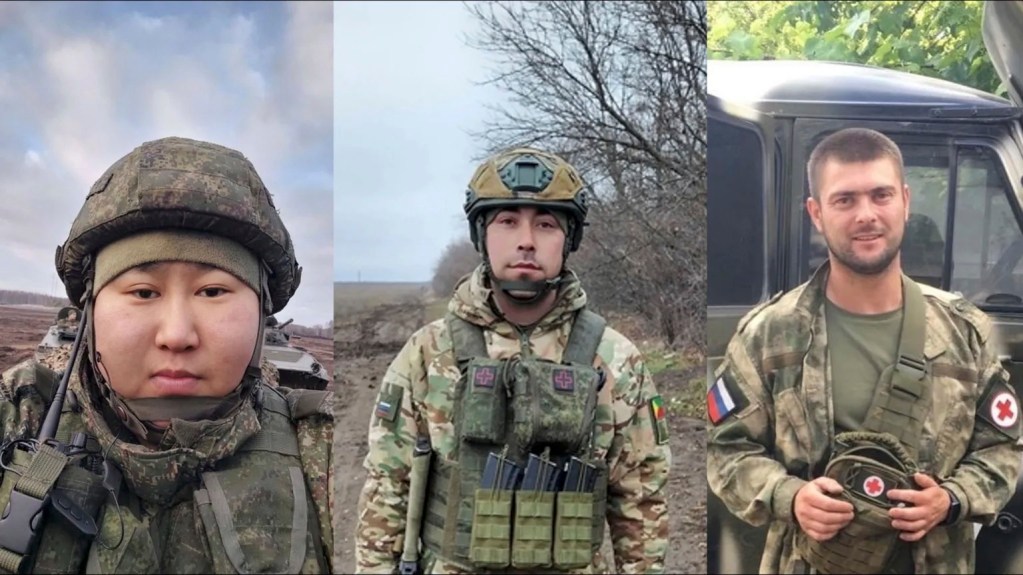
Aldar Bairov (left), Okhunjon Rustamov (C) and Igor Babych were all killed in a strike on 20 February last year

Okhunjon Rustamov, 31 and from Chita in Siberia, had worked as a welder after serving a mandatory term in special forces. He was mobilised during a partial draft in October 2022.

Unlike Rustamov, Igor Babych, 32, had volunteered to go to war. He had worked with adults and children diagnosed with cerebral palsy, helping them with physical therapy until April 2023.

In total, 201 Russian soldiers died on that day, according to our data.

A few hours after the strike on the training ground, then-Russian Defence Minister Sergei Shoigu met Vladimir Putin to bring him news of military success from the front line.

There was no mention of the training ground attack, nor was there any word from the Ministry of Defence in its daily reports.

A relative of Okhunjon Rustamov said she had already buried three close family members over the course of the war. “In December 2022, my husband died. On 10 February 2024, my godfather. And on 20 February my half-brother. From one funeral to the next.”

In our analysis, we prioritised exact dates of death for soldiers. If that wasn’t available, we used the date of the funeral or the date the death was reported.

In the first two years of the war, 2022 and 2023, Russian losses followed a wave-like pattern: heavy fighting with high casualties alternated with periods of relative calm.

In 2023, for example, most casualties occurred between January and March, when Russian forces attempted to capture the cities of Vuhledar and Bakhmut in Donetsk Oblast.

In the first year of the full-scale invasion, according to our calculations, Russia lost at least 17,890 soldiers. This number does not include losses from Russia’s two proxy forces in occupied eastern Ukraine.

In 2023, the number rose to 37,633.

In 2024, there was no period showing a significant fall in casualties. Bloody battles for Avdiivka and Robotyne were followed by intensified assaults towards Pokrovsk and Toretsk.

In August 2024, Russian conscripts were killed when Ukrainian forces stormed over the border into the Kursk region. From August 6 to 13 alone, an estimated 1,226 Russian soldiers died.

However, the heaviest overall losses occurred during a slow Russian advance in the east between September and November 2024, according to leading US military analyst Michael Kofman.

“Tactics emphasised repeated attacks with dispersed assault groups, using small infantry fire teams, which increased overall casualties relative to terrain gained,” he explained.

After almost two years of intense fighting, Russian forces seized the logistical hub of Vuhledar in Donetsk on 1 October 2024.

According to estimates by the American Institute for the Study of War (ISW), from September to November 2024, Russian forces captured 2,356 square kilometres of Ukraine.

Even then, Ukrainian forces at the front did not collapse.

The cost of this advance was at least 11,678 Russian military deaths.

Actual losses figures are likely higher. We have only accounted for soldiers and officers whose names appeared in publicly available obituaries and whose dates of death or funeral fell within this period.

Overall in 2024, according to ISW, Russia captured 4,168 square kilometres of land.

If we assume that our figure of 45,287 confirmed deaths in 2024 is about 40% of the full number, then the total number would be closer to 112,000 fatalities last year.

This means that for each square kilometre captured, 27 Russian soldiers were killed, and this does not include the wounded.

How losses are changing recruitment

Russia has found ways of replenishing its depleted forces.

“Russian recruitment also increased in the second half of 2024 and exceeded Russian casualties, allowing Moscow to generate additional formations,” says Michael Kofman.

One-time payments to soldiers signing new contracts were increased in three Russian regions. Combat salaries for volunteer soldiers are five to seven times higher than the average wage in most regions.

We also class as volunteers those who signed up to avoid criminal prosecution, which was allowed by law in 2024.

Volunteers have become the fastest-growing category of casualties in our calculations, making up a quarter of those we have identified.

In 2023-2024, thousands of volunteers who signed contracts with the Ministry of Defence were sent to the front lines only 10–14 days later. Such minimal training will have dramatically reduced their chances of survival, experts say.

One Russian republic, Bashkortostan, has seen the highest numbers of casualties, with 4,836 confirmed deaths. Most were from rural areas and 38% had gone to fight with no military experience.

The one-time payment for signing a Russian army contract in Ufa is 34 times the region’s average salary of 67,575 rubles (£600).

Calculating deaths from open source data will always be incomplete.

This is because the bodies of a significant number of soldiers killed in the past months may still be on the battlefield and retrieving them presents a risk to serving soldiers.

The true death toll for Russian forces increases significantly if you include those who fought against Ukraine as part of the self-proclaimed Donetsk and Luhansk People’s Republics.

An assessment of obituaries and reports of searches for fighters who have lost contact suggests between 21,000 and 23,500 people may have been killed by September 2024.

That would bring the total number of fatalities to 185,000 to 260,700 military personnel.

CLARIFICATION 5 May 2025: This story has been updated to make it clear that the figure of 27 losses per sq km is based on an estimated number of deaths last year of about 112,000.

Source: Olga Ivshina, “How Russia took record losses in Ukraine in 2024,” BBC News Russian, 4 May 2025. This article was also published on Substack on 6 May 2025.


Yegor Letov, “The Squadron Did Not the Fallen Fighter” (1990)

Source: YouTube

Глупый мотылёк 
Догорал на свечке
Жаркий уголёк
Дымные колечки
Звёздочка упала в лужу у крыльца…
Отряд не заметил потери бойца

Мёртвый не воскрес
Хворый не загнулся
Зрячий не ослеп
Спящий не проснулся
Весело стучали храбрые сердца…
Отряд не заметил потери бойца

Не было родней
Не было красивей
Не было больней
Не было счастливей
Не было начала, не было конца…
Отряд не заметил потери бойца
Source: Grazhdanskaya Oborona Official Website

A Long Happy Life

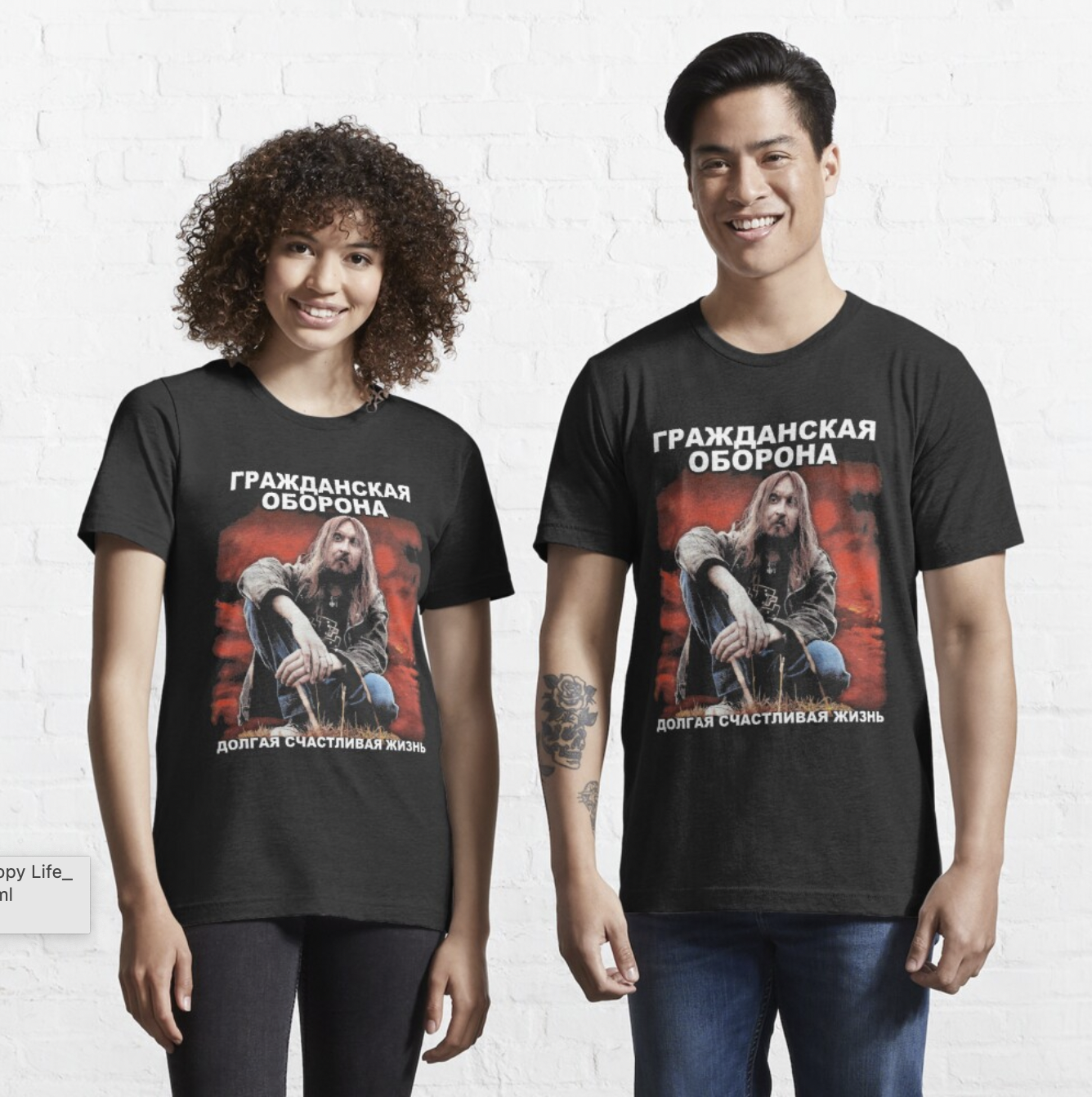
“Grazhdanskaya Oborona (Civil Defense). A Long Happy Life.” Images courtesy of RedBubble

A Long Happy Life
No to commotions and celebrations
No to horizons and celebrations
No to inspirations and celebrations, no, no, no
No fish in the golden polynya
Omnipresence of petty intrigues
Evil twilight of an immortal day
A long and happy life
Such a long and happy life
From now on a long and happy life
For every one of us
For every one of us
For every one of us
For every one of us
Ruthless depths of wrinkles
Mariana trenches of eyes
Martian chronicles of us, us, us
Among the identical walls
In the faraway coffin-like houses
In the impenetrable icy silence
A long and happy life
Such a long and happy life
From now on a long and happy life
For every one of us
For every one of us
For every one of us
For every one of us
No to temptations and celebrations
No to crimes and celebrations
No to exceptions and celebrations, no, no, no
On the seven sharp drafts
Through the swamps, through the deserts and steppes
Through the snow piles, through dirt and through land
A long and happy life
Such a long and happy life
From now on a long and happy life
For every one of us
For every one of us
For every one of us
For every one of us
A long and happy life
Such a long and happy life
From now on a long and happy life
For every one of us
For every one of us
For every one of us
For every one of us
A long and happy life
Such a long and happy life
From now on a long and happy life
For every one of us
For every one of us
For every one of us
For every one of us
A long and happy life
Such a long and happy life
From now on a long and happy life
For every one of us
For every one of us
For every one of us
For every one of us
A long and happy life
Such a long and happy life
From now on a long and happy life
For every one of us
For every one of us
For every one of us
For every one of us

Source: Lyrics Translate


Grazhdanskaya Oborona (Civil Defense), “A Long Happy Life” (2004)


_______________________

Victor looked out the window at the barge passing by, thinking that everything was still ahead of him, and that the most important thing that should happen in every person’s life would happen to him. And he was convinced of this, although each time he lost more than he found.

Source: Gennady Shpalikov, “A Long Happy Life” (screenplay)

NB (23.10.22). The version of the film on YouTube that once occupied this space seems to have disappeared, so for now I recommend watching it here on VK, although you might need a VK account to do so. There is a hideous “colorized” version of the film freely available on YouTube, but I can neither recommend it nor defile what I regard as a masterpiece by sharing it here. I did, however, find this clip of the “twist” scene from the film in the original black and white:

Gennady Shpalikov (director), A Long Happy Life (1966)

Gennady Shpalikov’s first movie as a director, based on his own script, went down in the history of Soviet cinema as an absolutely unique phenomenon. Socialist propaganda seemed to have no power over Shpalikov’s work. Free from cliches, it was like a breath of fresh air in a country that was tightly closed off from the whole world by an iron curtain. A Long Happy Life resembles the films of the French New Wave rather than other Soviet films that were shot at the time. 

Returning from an expedition, a geologist named Victor finds himself in a small provincial town, where he meets a girl named Lena. What is commonly called love at first sight arises between them. Sensing that they are kindred souls, they spend the evening and night together, sharing all the most intimate things: thoughts about life, happiness and love. However, either the morning or their inner fears of this selfsame long happy life cancel out all their plans and dreams.

Source: IVI

Mashed up and (partly) translated by the Russian Reader

Guided Tour of a Torture Chamber

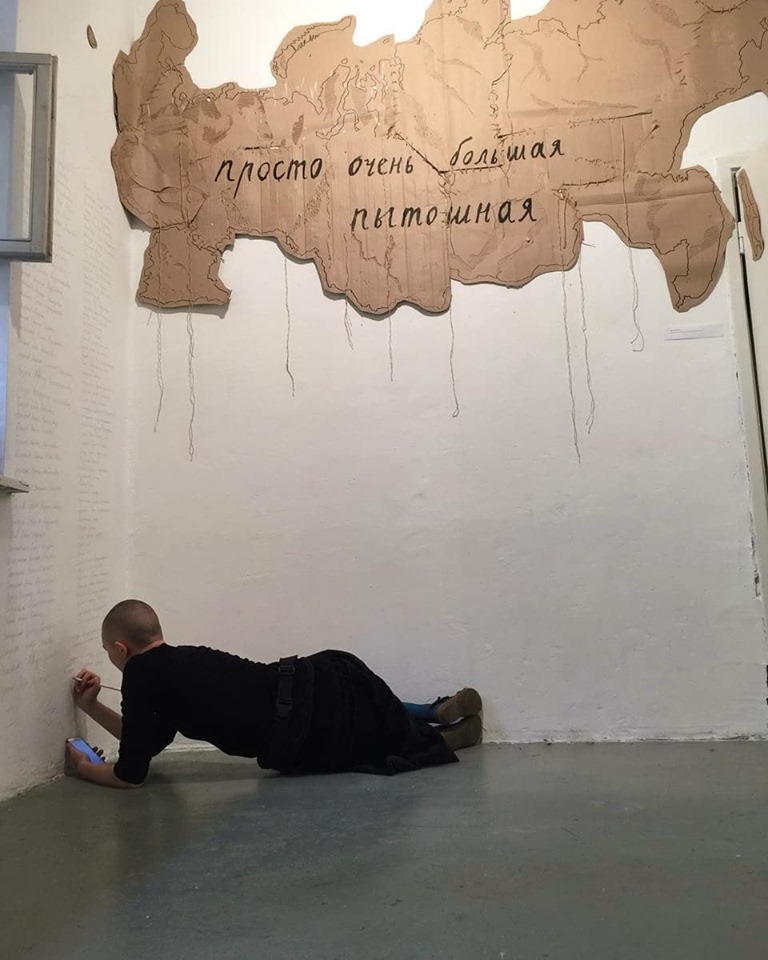
torture-1Darya Apahonchich, just one big torture chamber, 2019. Photo courtesy of Ms. Apahonchich

Darya Apahonchich
Facebook
July 8, 2019

Here’s a little about torture chamber.

My Statement Has Been Recorded Accurately, an art exhibition in solidarity with imprisoned anarchists and antifascists, took place July 5–7, 2019, at Pushkinskaya 10 Art Center in Petersburg.

The show was sad and daring. During the three days it was up, it was visited by both regular cops and the “anti-extremism” police from Center “E” [known in Russia as eshniki or “eeniks”].

Our group {rodina} [“motherland“] did a performance, and there were concerts and discussions as well. I also had a piece in the show, entitled just one big torture chamber.

I really liked how Jenya [Kulakova] talked about it simply and calmly during her guided tours of the show.

“According to the latest surveys by Levada Center, ten percent of Russians have been tortured.”

True, it’s a really simple figure, but when I hear it I want to hear more figures. What percentage of Russians have tortured someone? What percentage of Russians have ordered someone tortured? What percentage of Russians said nothing although they knew someone was being tortured? What percentage of Russians share a home with people who torture other people at work? Do torturers beat their wives, children, and elderly parents?

At first, I wanted to fashion Russia from a single piece of cardboard, but then I realized I had no sense of how I could unify the country except with borders, frontier guards, and barbed wire. I know tons of different Russias. I know academic Russia and literary Russia. I know the Russia of forests and mushrooms. I know the Russia of poor people and factories. I know the elegant Russia of rich people. All of these Russias have one thing in common: the violence of torture and the fear of torture. So, I assembled the map from scraps of cardboard.

torture-2Ms. Apahoncich writing the names of Ukrainian and Crimean political prisoners imprisoned in Russian jails and prisons on the wall below a hand-drawn map of occupied Crimea. Photo courtesy of Ms. Apahonchich

I didn’t know what to do with Crimea. I couldn’t include it since I don’t consider its presence on a map of Russia legal, but I also had no choice but to include it because people are tortured there as well, and the people doing the torturing have Russian passports. So, I drew Crimea on the wall in pencil and wrote a list of Ukrainian political prisoners under it. The list was terrifyingly long.

I spelled the word “torture chamber” as it is pronounced in received Moscow standard [pytoshnaya instead of pytochnaya], although maybe no one speaks that way anymore. I would imagine I don’t need to explain why.

It’s a sad piece. If it were carnival now, I would burn it instead of a straw puppet.

Thanks to Alina for the photographs.

Translated by the Russian Reader. Thanks to Ms. Apahonchich for her permission to translate and publish her post here. Thanks to Nastia Nek for the link to the article on the Levada Center study.

______________________________________________________

[…]

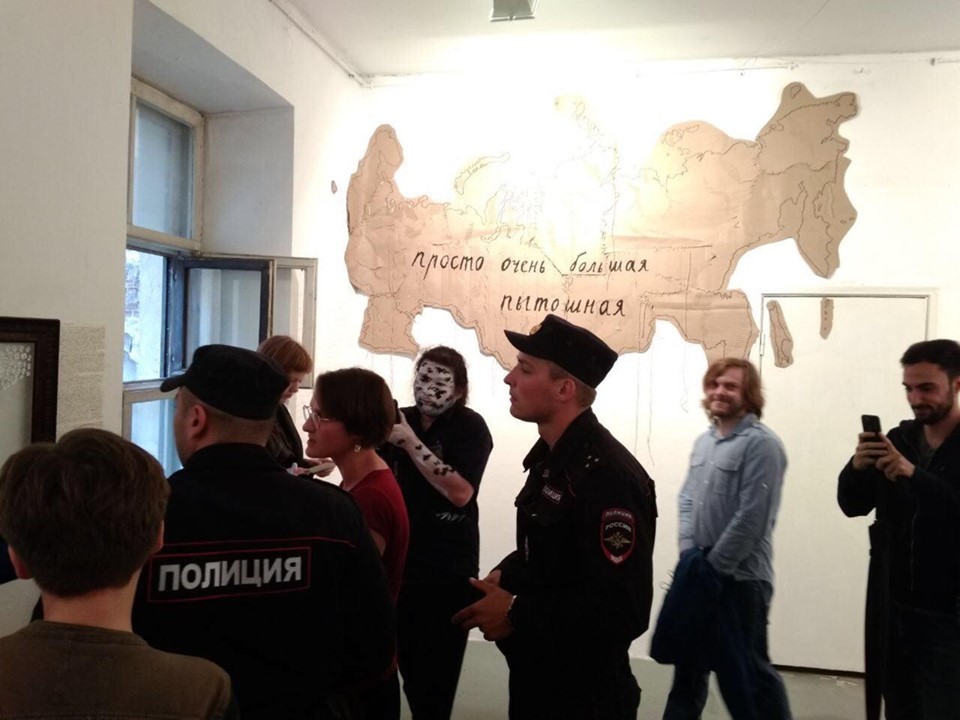
Policemen visited the exhibition at the end of its first day. Witnesses said it was the coolest performance in the show. The soloist was Senior Lieutenant Ruslan Sentemov aka Mister Policeman. According to people who took part in the protest action Immortal Gulag, Sentemov insisted this was how the president obliged them to address him when he was detaining them.

The phrase turned into a meme, and Sentemov became the target of parodies and epigrams. It is rare when people are detained at protest rallies in Petersburg and he is not involved. In 2017, 561 people were detained during a protest against corruption. All of them were charged with disobeying the lawful demands of a police officer, and in all 561 cases, that officer was Lieutenant Sentemov. Petersburg civil rights activist Dinar Idrisov claimed each of the ensuing 561 court case files contained a copy of Sentemov’s police ID and his handwritten, signed testimony.

words-1Ruslan Sentemov (right) and another police officer at My Statement Has Been Recorded Accurately, July 7, 2019, Pushinskaya 10 Art Center, Petersburg. Photo by Elena Murganova. Courtesy of Novaya Gazeta

In interviews with the press and when he is on camera, Sentemov likes to maintain the image of a “good cop.” He was true to this image at Pushkinskaya 10 as well, upsetting activists, who surrounded him and peppered him with questions about why he had come to the exhibition.

“This is Russia’s cultural capital. But you, young lady, have a very nasty habit of interrupting people and horning in on the conversation,” he said to one of them.

Reassuring activists he was in no hurry, Sentemov set about perusing the show. The police officer who was with him photographed each exhibit in turn.

Jenya Kulakova volunteered to give Sentemov a guided tour.

“These are drawings made by Dmitry Pchelintsev in the Penza Remand Prison. He was tortured with electricity. Here is a banner with the slogan ‘The ice under the major’s feet.’ Perhaps you are familiar with the music of Yegor Letov and Civil Defense?”

“Perhaps.”

Yegor Letov and Civil Defense (Grazhdanskaya oborona) performing the song “We Are the Ice under the Major’s Feet” at a concert at the Gorbunov Culture Center in Moscow in November 2004. Courtesy of YouTube

“Here is Viktor Filinkov’s account of being tortured, handwritten by a female artist. This is a postcard made by Yuli Boyarshinov. Did you know that, in prison, defendants are prohibited from using colored pencils and pens?”

“No, I didn’t know that, unfortunately. I will probably have to study up on the topic.”

spinach“We have no money and machine guns, but we do have a herbarium of spinach leaves.” Photo by Jenya Kulakov. Courtesy of Novaya Gazeta

“These are drawings from the trials in the Network case. We have an artist who attends the hearings and draws them. This next piece also draws on the case files.”

“I got it. Let’s speed things up.”

“No, you should read a bit of it. Here’s a passage about how someone was hit on the legs and the back of the head. And this is what the tortures said to Viktor Filinkov as they were torturing him. After that, they gave him a Snickers bar to eat. That was probably humane of them, don’t you think?”

“I’ve already read it.”

After strolling around the room containing works by the [Network defendants], Sentemov admitted what interested him most of all was whether the art had been forensically examined for possible “extremism.”

“Look,” said Ms. Kulakova, “all of this was sent to us from remand prisons. By law, all correspondence going in and going out is vetted by a censor. Do you see this stamp here? Have you ever sent a letter to a remand prison?”

“Unfortunately, I haven’t. Or maybe I should say, fortunately. If you say all of this was vetted by the censor, we will definitely have to verify your claim.”

“You seriously want to verify whether remand prison censors working for the FSB have been doing their jobs?”

“At very least, I’d like to send them an inquiry.”

“Here is an installation entitled just one big torture chamber. You may have heard that Levada Center recently did a survey on torture. One in ten people reported they had experienced torture in their lives.”

jenyaJenya Kulakova (center) gives Lieutenant Sentemov and his colleague a guided tour of My Words Have Been Recorded Correctly, July 7, 2019, Pushkinskaya 10 Art Center, Petersburg. Photo by Elena Murganova. Courtesy of Novaya Gazeta 

“Have you been tortured by chance?” Sentemov suddenly asked Ms. Kulakova, staring unpleasantly at her.

“My friends have been tortured,” she replied.

“I was asking about you.”

“Why would ask me about that?”

“You just talk about it so enthusiastically.”

Sentemov appreciated the interest among exhibition goers aroused by his appearance and laughed smugly.

“I think I’m getting more attention than all these pictures,” he said.

He brushed aside questions about what had brought the police officers to the exhibition and how they had heard about it.

“That’s for me to know and you to find out,” he said.

“We gave you a whole guided tour, but you’re just one big mystery,” said Ms. Kulakova disappointedly, fishing for an answer.

“Thank you for such a comprehensive tour. I am quite pleased with the attentiveness of you and your gadgets. Nevertheless, I must leave this wonderful event. I am very pleased you welcomed us so warmly,” Sentemov said in conclusion, turning towards the exit.

“See you soon,” he said as he left.

Source: Tatyana Likhanova, “A Guided Tour of a Torture Chamber,” Novaya Gazeta, July 8, 2019. Translated by the Russian Reader

Stanislav Dorochenkov: Afterword to the Pamphlet of 1942

Afterword to the Pamphlet of 1942
A film by Stanislav Dorochenkov, 2012
28’46”
Featuring Maxim Egorov, O.A. Belobrova, Lydia Smirnova
Camera: Boris Belay
Editing: Claire Beuneux
Directed by Stanislav Dorochenkov
Re:voir Films Paris

In 2010’s stifling heat in St. Petersburg, the regime and the mafia orchestrate the destruction of the city’s heritage for the sake of the nouveaux riche’s luxury. The attempt to remember helps me. I present a little known text by someone who defended this city, Dmitry Likhachev. Several times, he saved it alone by opposing the collective decisions of the Communist Party, thus rebutting an old Russian saying that I would translate roughly as “One man cannot fight an army.”

One can.

I see the phrase “Death will more likely be afraid of us than we of it,” engraved on one of the three stelae at the Piskaryov Memorial Cemetery, placed over the endless mass graves where the millions who died during the Siege of Leningrad lie.

With my Éclair camera, I walk the city during the White Nights to rediscover the  magnificent light of transparent twilight that transforms Petersburg into “the most fantastic city in the world.” The texts of the Russian chronicles (The Hypatian Chronicle, The Laurentian Chronicle, and The Lay of Igor’s Campaign) appear before me, following a broadcast inspired by Likhachev. I become aware of the ancient words, the most accurate account of the disaster of human forgetfulness.

Source: Dérives.tv

Annotation translated, from the French, by Comrade Koganzon and the Russian Reader