They Are Who They Are

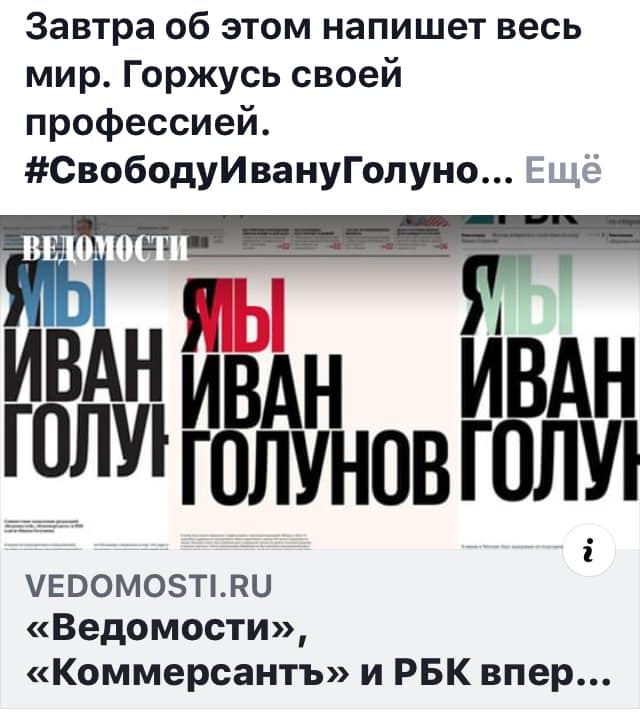
gorzhush“Tomorrow, the whole world will write about this. I am proud of my profession. #FreeIvanGolunov…” Vedomosti.ru: Vedomosti, Kommersant, and RBC will for the first time…” Screenshot of someone’s social media page by Ayder Muzhdabaev. Courtesy of Ayder Muzhdabaev

Ayder Muzhdabaev
Facebook
June 9, 2019

Russia’s “liberal opposition journalists” have been vying to praise each other as they celebrate a feast of “disobedience.” They just stood in the crossfire, that is, in timid solo pickets. And now, risking having their offices torched, three newspapers have produced editions with the same headline in defense of a colleague detained by police on trumped-up charges.

They have never nor would they ever publish a newspaper with the headline “I Am/We Are Crimean Tatars,” a people their country has been murdering and imprisoning on trumped-up charges by the hundreds for the last five years.

They have never nor would they publish a newspaper with the headline “I Am/We Are Ukrainians,” a people their country has been murdering by the thousands and imprisoning by the hundreds on trumped-up charges for the last five years.

It suffices to say they would even find printing the headline “I Am/We Are Oleg Sentsov” terrifying. It would never occur to them because they know how life works in the Reich, where Ukrainians are “fascists,” and Crimean Tatars are “terrorists,” just like Oleg Sentsov. So “I-ing” and “we-ing” is taboo to them.

They are delicately integrated into the Russian Reich. They feel it in their bones. They are one of the regime’s vital props. The hybrid dictatorship badly needs to pretend there is a political struggle in Russia and the country has a free press. They help it in its quest to destroy the western world and attack other countries.

They always only do things that won’t get them in serious trouble. They would never do anything that poses the slightest risk of exposing them as real enemies of the Reich.

We enter this in #TheChroniclesOfTheRussianReich.

Translated by the Russian Reader
i-we

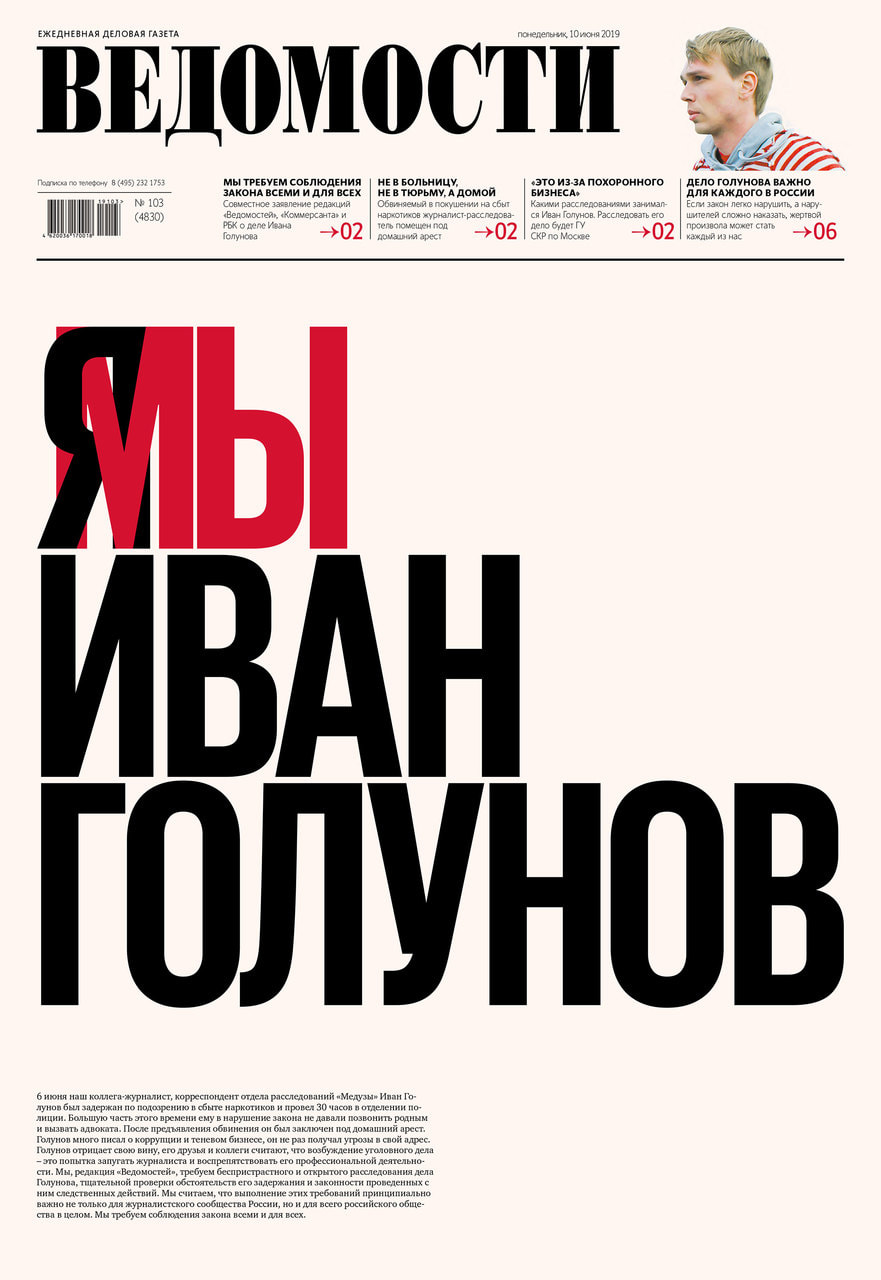
The front page of Vedomosti, June 10, 2019: “I Am/We Are Golunov.” Courtesy of Vedomosti

Joint Communique on the Ivan Golunov Case by the Editors of Vedomosti, Kommersant, and RBC 
We Demand Maximum Transparency from Investigation
Vedomosti
June 9, 2019

Ivan Golunov, an investigative reporter with Meduza, was detained on June 6 on suspicion of attempting to produce and distribute narcotics.

We welcome the fact that the court has ordered house arrest for Golunov rather than remanding him in custody in a pretrial detention facility.

However, we do not find the evidence of Golunov’s guilt, as provided by police investigators, convincing, while the circumstances of his arrest raise serious doubts that laws were not broken in the conduct of the initial investigation.

We cannot rule out the possibility that Golunov’s arrest has something to do with his work as a journalist.

We demand a detailed inquiry into whether the Interior Ministry officers who were complicit in Golunov’s arrest acted legally. We insist that the outcome of this inquiry be provided to the media.

We expect law enforcement to comply strictly with the law. We demand maximum transparency from the investigation. We will closely monitor the investigation’s progress. We encourage relevant public organizations to join us.

We believe implementation is fundamentally important not only to Russa’s journalism community but also to Russian society as a whole. We demand that everyone obey the law and the law be obeyed with regard to everyone.

Translated by the Russian Reader

upside down cake

Pineapple upside-down cake. Stock photo

Nearly the entire leftist and liberal Russian intelligentsia have thrown their ferocious but scattered energies into a campaign to free a well-known journalist on whom the cops planted narcotics. It is obviously a frame-up and rightly makes folks in the world’s largest country indignant.

But it also makes people think they are fighting the good fight when most of the fights they should be fighting or should have been fighting long ago they ignore altogether, like the fight against what their own government and armed forces have been doing in Syria, or the kangaroo court trials against antifascists in Penza and Petersburg (the so-called Network trials), and the alleged (Muslim Central Asian) accomplices of the alleged suicide bomber who, allegedly, blew himself up in the Petersburg subway in April 2017.

I shouldn’t even mention the case of the so-called New Greatness “movement,” an “extremist group” set up, concocted, and encouraged from its miserable start to inglorious finish by the FSB (the newfangled KGB). Its so-called members did nothing but attend a couple of “political” discussions organized by the selfsame FSB.

All these young people have been framed, and many of them have plausibly claimed they were tortured by FSB officers into “confessing.”

That is, whole groups of innocent people (mind you, I am only scratching the surface here, leaving out scores if not hundreds if not thousands of the regime’s other victims at home and abroad) have been railroaded by the mighty Putinist state, but they have not been granted an audience, so to speak, by progressive Russian society because progressive Russian society cannot identify with any of them in any way.

But it can identify with the nice white middle-class reporter from Moscow. And it does want to remind itself of its essential goodness and compassion from time to time, so everyone has jumped on the bandwagon to get the reporter out of jail.

Or, rather, everyone has engaged in a frenzy of virtue signaling that may not actually get him out of jail.

Bully for them, but no one notices that many of these grassroots campaigns are patterned like hysterias and moral panics. They are also identical to other suddenly emergent internet-powered fads, like the recent craze for Game of Thrones or “Facebook flash mobs” that involve, say, posting a picture of yourself from twenty years ago and explaining what you were up to way back then.

It has to be something, anything, except the things that matter a million times more, like the Russia air force’s endless bombing of Syrian children and Syrian hospitals, and the Putin regime’s endless, vicious hunt for “extremists” and “terrorists” like the Jehovah’s Witnesses, the Network “terrorists,” the “New Greatness” extremists, the conspicuously othered (and, thus, forgotten) Petersburg subway “terrorists,” and on and on.

These witch hunts are discussed publicly by virtually no one, and their victims (this is especially the case with the Central Asian “subway bombers”) are mostly left to fend for themselves.

What matters about the reporter is that he is white, innocent, and “one of us.” Apparently, he doesn’t believe in “extremist” nonsense like anti-fascism, anarchism, Islam or Jehovah’s Witness doctrine.

The reaction to the case is a symptom of liberalism that is utterly white and nationalist, meaning it is not liberalism at all.

It is white nationalism with a human face, Great Russian chauvinism turned upside down.

“They cannot do this to one of us.”

But “they” have done to it to thousands of non-white, non-Russian others over the years, including Chechens, antifascists, Syrians, Crimean Tatars, businessmen, Muslims, Jehovah’s Witnesses, Krasnodar’s farmers, truckers, environmentalists, anarchists, LGBTQ+ activists, Central Asian migrant workers, Ukrainians, anti-“reunification” Crimeans, the passengers of MH17, US voters, etc.

Almost no one batted an eye when they were “destroyed” (this is the regime’s pet dehumanizing verb for when it murders or obliterates its enemies), neutralized or otherwise royally fucked over by the Putin regime.

It is all over but the shouting unless the shouting quickly becomes a lot more inclusive. June 9, 2019 || THE RUSSIAN READER
redman.JPGPhoto by the Russian Reader

“This is too much, even for Russia.”
Meduza editor on BBC Radio 4 morning news broadcast, commenting on the arrest of Meduza reporter Ivan Golunov, 9 June 2019

But declaring all Jehovah’s Witnesses “extremists” and organizing a witch hunt against them is not too much, “even for Russia”?

I had it with Meduza after the hamfisted, blatantly misogynist way it handled its recent in-house #MeToo scandal. The scandal revealed the actual shallowness of the website’s liberalism.

Of course, Meduza should defend its reporter from police railroading.

But the fact it has managed to make the story go international in a matter of days and then, using this bully pulpit, suggest there is nothing worse going on in Russia than Golunov’s persecution, also reveals something about the depth of its liberalism or, rather, about what passes for liberalism in Russia.

Unlike liberalism in other countries, Russian liberalism has no time for anybody but the rather narrow segment of Russians it recognizes as full-fledged human beings.

I would guess this amounts to less than one percent of the entire population, but I am probably being too generous. June 9, 2019 || THE RUSSIAN READER

crisisRussia does not have to worry about a crisis of democracy. There is no democracy in Russia nor is the country blessed with an overabundance of small-d democrats. The professional classes, the chattering classes, and much of the underclass, alas, have become accustomed to petitioning and beseeching the vicious criminal gang that currently runs Russia to right all the country’s wrongs and fix all its problems for them instead of jettisoning the criminal gang and governing their country themselves, which would be more practically effective. Photo by the Russian Reader

Free the Network case defendants, the Jehovah’s Witnesses facing charges and the ones already doing jail time, ditto for the Crimean Tatars, Oleg Sentsov and Alexander Kolchenko, the Ukrainian sailors, Yuri Dmitriev, the Petersburg subway bombing defendants, the myriads of Russian businessmen in prison after they were set up by rivals and taken down by the FSB for a good price, the New Greatness kids, and hundreds of other Russian “outlaws” whose names I cannot remember or, worse, have never heard.

Free them first, and the day after you free them, free Ivan Golunov.

While you are at it, stop making war in Eastern Ukraine and stop bombing innocent Syrians. And bring the people responsible for shooting down Flight MH17 and killing everyone on board to justice.

The day after you have done all these things, free Ivan Golunov.

But don’t be such arrogant, self-important pricks as to appear on the world’s most respected radio and TV network and claim the Golunov case is the worst thing that has happened under Putin’s reign.

Anna Politkovskaya was murdered, for God’s sake. And so were Stanislav Markelov and Anastasia Baburova.

I could start another list of reporters, activists, politicians, etc., who were murdered, probably on the orders of the Kremlin or with its blessing, over the last twenty years.

Boris Nemtsov was murdered only a few hundred meters from the Kremlin.

God forbid I should mention “convicted pedophile” Sergei Koltyrin. Even the most hardcore human rights advocates in Russia have abandoned him and made mention of his name taboo, although I am reasonably certain he was set up just like the saint-like Ivan Golunov, only on charges so devastating that his former allies abandoned him and he abandoned himself to the nonexistent mercies of Russia’s nonexistent justice system.

But, definitely, the worse thing that has happened under Putin’s reign is the house arrest of Meduza reporter Ivan Golunov on what are undoubtedly trumped-up drug charges. June 9, 2019 || THE RUSSIAN READER
barney fife

P.S. As I was assembling this collage of reflections inspired by the collective hysteria among the Russian liberal intelligentsia over reporter Ivan Golunov’s dubious arrest, it occurred to me that, perhaps, my own reaction and that of Ayder Muzhdabaev, whose “outburst” leads off this montage, were not sufficiently charitable.

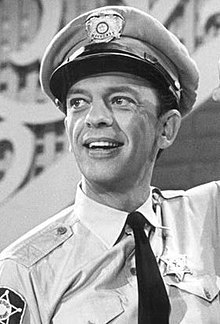
But then I read and translated what the editors of Kommersant, RBC, and Vedomosti published on the front pages of their newspapers today. Their milquetoast appeal to Russian law enforcement—a multi-headed hydra that has spent the last thirty years proving again and again it is one of the most brutal, vicious criminal gangs in the world, an army of thugs who routinely terrorize the people they have sworn to protect, a mob of degenerates who will stop at nothing, including the routine use of torture, to get their man—sounds more like an appeal to US TV sitcom cops Barney Miller and Barney Fife.

Do these hardened (?) newspaper reporters really believe an appeal like this will have a real effect on the investigation of Golunov’s nonexistent crimes?

It is also worth remembering (as Sergey Abashin did on his Facebook page earlier today) that the free press warriors at Kommersant recently fired a reporter for writing negative comments about Valentina Matviyenko, formerly Putin’s satrap in Petersburg, currently chair of the Federation Chamber, which rubber-stamps all the odious, wildly unconstitutional laws sent its way. In protest at the firing, the newspaper’s entire political desk immediately resigned as well.

That, by the way, is real solidarity, although it probably won’t get them their jobs back, quite the opposite.

Meanwhile, RBC has been a shell of its former militant self after its owners fired three top editors three years ago and, again, a whole slew of reporters resigned along with them.

RBC used to have an investigative reporting desk that would be the envy of any newspaper anywhere in the world. Nowadays, it mostly reports the kinds of “news” its oligarch owners and the Kremlin want it to report.

The 2011–2012 fair elections protests were mostly an extended exercise in virtue signaling and “creativity,” not a serious attempt by the grassroots to force the Kremlin to hold fair elections, much less to attempt regime change. Russian society has paid heavily for its frivolousness then.

Why, then, has it not yet figured out what its foe is really like? Why does it appeal for justice and fairness to authorities who have proven beyond a reasonable doubt they are hardened criminals? Finally, why does it imagine that reposting Ivan Golunov’s articles on Facebook is real solidarity? Does it think the regime will fall if, say, a million people repost these articles? Five million?

Photo of Don Knotts as Barney Fife courtesy of Wikipedia

Alexander Verkhovsky: Russia’s Campaign Against “Religious Extremism”

yaltinskoe_delo_hizb_ut_tahrir_1.jpgRussia has used its official ban on the Muslim movement Hizb ut-Tahrir to go after Crimean Tatars in occupied Crimea, such as these six men, charged in the so-called Yalta Case. The fact that the defendants are neither terrorists nor members of Hizb ut-Tahrir has not stopped Russian authorities from prosecuting them for these imaginary crimes. Courtesy of Crimean Tatar Resource Center

Russia’s Campaign Against “Religious Extremism” Has Been Expanding: It Should Be Reined In
Alexander Verkhovsky
Nezavisimaya Gazeta
March 5, 2019

The dramatic events of recent weeks surrounding the Jehovah’s Witnesses, including the harsh prison sentence handed down to Dennis Christensen, and the torture of detained believers in Surgut, make us wonder how unique what has been happening to them has been.

First, we should recall the bare facts. The Russian authorities have banned numerous texts published by the Jehovah’s Witnesses, including their translation of the Bible into Russian. All their local branches have been banned and their property confiscated. More than forty criminal cases are underway, cases in which 120 people, aged 23 to 84, have been charged. Twenty-five of those charged have been remanded in custody. All of them have been charged with going on with the work of a banned “extremist” organization (punishable under Article 282.2 of the Russian Federal Criminal Code), although this amounted only to holding prayer meetings and group discussions

The Russian Supreme Court decided to ban the Jehovah’s Witnesses completely on April 20, 2017. Criminal cases based on the ban were launched a year later, that is, over a hundred suspects were charged in a matter of ten months, and yet not a single case has gone to court yet.

In fact, Christensen was convicted on the basis of an earlier ban of a local Jehovah’s Witness branch. There were eight such bans of local branches. Unlike his co-religionists, convicted earlier under the same ban, Christensen was sentenced to actual prison time. After the so-called Yarovaya package was adopted by the Russian parliament, he had to be sentenced to no less than six years in prison, and this was what happened. It should make us extremely concerned about what will happen to current and future suspects, especially the ones now jailed in remand prisons.

But what has happened to the Jehovah’s Witnesses in Russia is not unique. In exactly the same way, the peaceable followers of the fundamentalist movement Tablighi Jamaat and the peaceable followers of the quite moderate Turkish theologian Said Nursi have been banned in Russia and persecuted under the same law in the Russian Criminal Code.

The pattern was the same. First, the texts published by the groups were banned because, allegedly, they claimed the superiority of their religious doctrines to others and contained hostile descriptions of non-believers. Then, the organizations themselves were banned for the same reasons, including using the banned texts in their worship services. Finally, the Russian authorities prosecuted believers for “going on with the work” of their now-banned organizations. Moreover, the courts usually gave defendants probation sentences at first. Subsequently, however, people convicted on the same charges were sent to prison and the sentences handed down were harsher.

The Muslim activists were also tortured by Russian law enforcement. The current shock over events in Surgut can be put down to the fact that Russian society is in some sense inured to the torture of Muslims suspected of “radicalism.”

The Russian Supreme Court banned all three groups: the Jehovah’s Witnesses, the followers of Said Nusri, and Tablighi Jamaat. For some reason, it paid no mind to the fuzzy definition of “extremism” to which it resorted in all three rulings. It is true that all three religious doctrines claim only their way is the true way and that all other ways are false, and their texts occasionally contain rather harsh descriptions of non-believers. The current Russian legal definition of “extremism” is such that these things can be considered evidence of “extremism,” but you could find more or less the same things in nearly all religious doctrines. Such claims are typical of confessions of faith, and, as such, they are protected by the Russian Constitution.

With regard to criminal cases of incitement to hatred, including religious hatred, in 2011, the Supreme Court ruled that criticism of religious convictions, religious rituals, and religious groups is not a criminal offense. For some reason, however, this ruling has not been applied in civil cases banning religious literature and organizations, although the conflict between the procedure for banning religious “extremism” and Russia’s constitutionally enshrined freedom of conscience is striking. Perhaps unraveling this conflict is a job for the Russian Constitutional Court?

Returning to the Jehovah’s Witnesses, we should again pay attention to the scale of their persecution. The number of accused Jehovah’s Witnesses in terms of one calendar year has been much greater than the numbers of the two Muslim groups mentioned. It is more comparable to the persecution of the radical movement Hizb ut-Tahrir al-Islaami.

Hizb ut-Tahrir was banned in 2003 as a terrorist group, although it has not been implicated in terrorism. The Russian authorities were clearly in a hurry to ban it, so the actual danger it posed or did not pose to the constitution was not even at issue. Members of the movement have been charged under the anti-terrorist laws in the criminal code, and so their prison sentences have been even harsher. But there are similarities with the other religious groups we have been discussing: participating in group gatherings and reading the same texts were offered as evidence of their criminal deeds.

Another serious conflict emerges in this case between the Russian Constitution and the articles in the Russian Criminal Code dealing with “extremist” (Article 282.2) and “terrorist” (Article 205.5) groups. Let us assume for simplicity’s sake that a group has been banned altogether legitimately. When this happens, the group’s formal and informal members are obliged to honor the court’s ban. But they have not changed their views, and they still associate with the same group of people. It is likely they would want to discuss what to do in the circumstances: perhaps, for example, establishing a new group based on slightly different principles. If we are dealing with a dangerous group that has been rightfully outlawed, such discussions and meetings could not help but interest the police and security services, but they are hardly criminal in their own right, for these people have not been deprived of their basic civic rights, including the right to assemble. Besides, not only active members could take part in these meetings but also outsiders, and yet law enforcement does not especially distinguish between the two groups of people in practice.

These problems are more apparent when we speak of religious communities. The Russian Constitution enshrines the right to practice one’s religion both alone and in the company of others. The work of any religious organization mainly consists in praying together and other joint activities, such as confessing and preaching as part of religious services. If a religious association has been banned, its members are in effect barred from exercising their constitutional right. If Russia’s current anti-“extremist” laws are meant to enact such severe restrictions of a fundamental human right, this have never been explicitly stated. So, again, one would like the Russian Constitutional Court to issue a clarification. It is, after all, a matter of tens of thousands of Russian nationals potentially facing criminal charges.

Since there have not been any clarifications, and the current crackdown has only been picking up steam, many have wondered how it happened. There is hardly a single, simple answer to this question. We might say that in their campaign against potentially dangerous movements, the Russian authorities have gone much too far and made a considerable number of mistakes. One of the reasons is that they listened to politically and religiously biased “experts,” and they continue to heed their advice, judging by the way the anti-“extremist” campaign has progressed in the religious realm. Our many years of experience with these cases have shown that counterarguments by religious studies scholars and legal experts rarely reverse the current tendency. They prove useful only when the authorities are willing to listen to them for reasons of their own.

The growing campaign against the Jehovah’s Witnesses has been horrifying, but there is also the chance that this time someone in the elite will finally come to their senses and change their mind. The Jehovah’s Witnesses clearly pose no threat whatsoever to Russian national security. Moreover, it is clearly just as impossible to eradicate their religion in Russia, since it would be wrong to jail or force over 100,000 people to emigrate, especially since Russia’s Jehovah’s Witnesses did not give up their faith in the worst of times.

The problem, however, is whether the officials who make key decisions about large-scale crackdowns could find acceptable means for reconsidering their earlier decisions. If this does happen, it matters, given the constitutional conflicts described above, whether anti-“extremist” policies will be reconsidered, if only in the religious realm.

Alexander Verkhovsky is director of the SOVA Information and Analysis Center. Thanks to Nikolay Mitrokhin for the heads-up. Translated by the Russian Reader

Free Edem Bekirov!

15447318032279451Edem Bekirov.  Photo courtesy of Vector News

Ayder Muzhdabaev
Facebook
December 28, 2018

Watch the footage we shot of Edem Bekirov. Then read what the well-known Kyiv musician Mitya Gerasimov has written.

“I’m sitting in my parents’ kitchen in Kazan. In its news bulletin, Echo of Moscow, a supposedly liberal radio station, reports that a terrorist has been detained on the Crimean border, the member of an armed band. He has been accused of storing and transporting weapons and explosives. His name is not mentioned, but it is clear they are talking about our friend Edem Bekirov, a Crimean Tatar from Novooleksiivka in Kherson Region.

“Edem is an ill, elderly man who has had heart bypass operations and a leg amputated due to diabetes. Before the latest operation, he went to Kyiv to see his mom. On the border, he was abducted by men in masks. For a time, nothing was known about his whereabouts. Then they let him call home from the FSB’s Simferopol office. He had not been given anything to eat or drink for two days or been taken to the bathroom. He was not permitted to take bandages to dress the unhealed wound on his stump or the medicines that keep him alive. He needs to take sixteen pills a day.

“The Russian authorities have been slowly killing Edem in a remand prison for over two weeks. The day before yesterday, the so-called court dismissed the appeal in his case. The radio reports the detained man associated with the terrorist group led by Lenur Islamov. They apparently meant the Crimean Tatar TV channel ATR, where Edem’s daughter works.

“Everyone knows Crimean Tatars do not kill anyone or carry out terrorist attacks. They have a principled stance of nonviolent resistance to the occupiers. The cartridges and twelve kilos of explosives that Edem, one-legged and ill, was supposedly taking somewhere is the same nonsense they made up about the so-called terrorist militant Oleg Sentsov. I remember watching Russian television in early 2014, before the annexation. It was footage of Grushevsky Street in Kyiv: Molotov cocktails, burning tires, snowdrifts. The announcer explained to viewers they were seeing Crimean Tatars rioting in Simferopol.

“There is the pre-New Year’s hustle and bustle on the streets of our cities: lanterns, New Year’s trees, shopping, traffic jams. Like many other Crimean political prisoners, Edem Bekirov will ring in his new year behind bars. We must do everything we can to publicize his plight. We have to shout about it on every street corner. We have to get him out of jail before it’s too late.”

That is the Happy New Year we are having.

Translated by the Russian Reader

Yevgenia Litvinova: “The Buskers Played Pink Floyd’s The Wall”

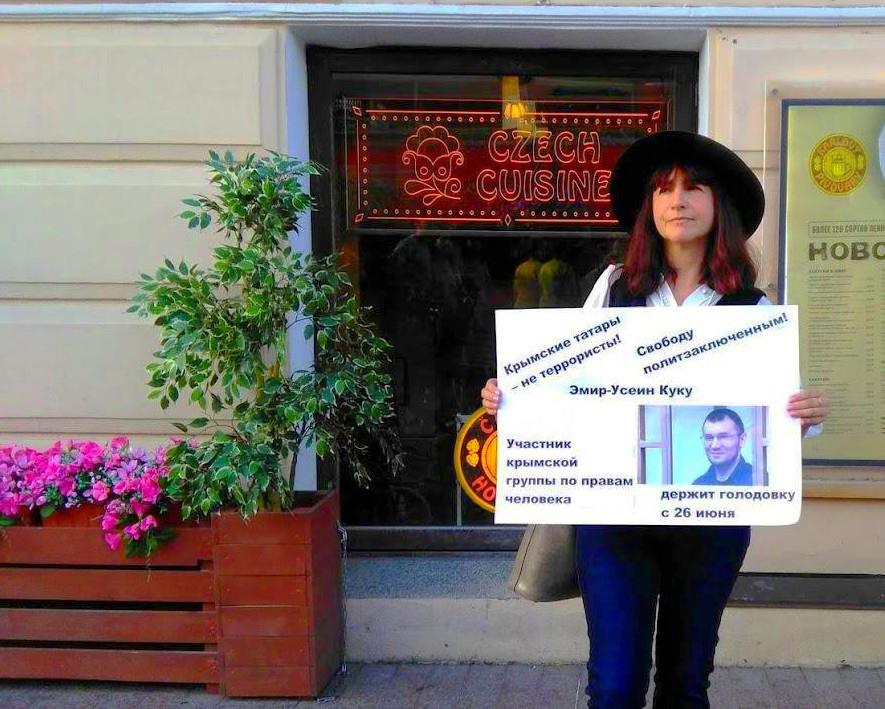
litvinovaYevgenia Litvinova. Her placard reads, “Crimean Tatars are not terrorists! Free political prisoners! Emir Hussein Kuku, a member of the Crimean Human Rights Group, has been on hunger strike since June 26.” Photo courtesy of Ms. Litvinova’s Facebook page
Yevgenia Litvinova
Facebook
July 19, 2018

July 18, 2018

We arrived at Strategy 18 ahead of time yesterday, but we started our pickets half an hour later.

An unauthorized rally against raising the retirement age was planned to take place on Malaya Sadovaya Street. They might have needed help. Paddy wagons were lined up on the Nevsky. It was understood people would be arrested. That was what happened.

Two hundred people attended the protest rally. Fourteen of them were detained, including Father Grigory Mikhnov-Vaytenko, a member of the St. Petersburg Human Rights Council. The detainees were driven from one police precinct to another for three hours. They were released around midnight.

Why do so few people defend their own interests? Are they afraid? Yes. Was the rally poorly advertised? That, too. But there is also an indifference to everything and everyone, including oneself.

Around a year ago, in September 2017, we organized a Peace March. It was also unauthorized, of course. Approximately three hundred people showed up. It was understandable: people are fed up with the antiwar agenda. They want to isolate themselves from other people’s corpses and the crimes of their own government.

Pensions affectly them directly, however. They are the ones whose money is being stolen, lots of money when you add it up. Yet people are again okay with everything.

“Should I bring the rope [to hang me]?”

At seven-thirty, we went back to our own plan, pulling out placards about the persecution of the Crimean Tatars. Natalia Voznesenskaya and I stood together for reasons of safety. There were tons of hired thugs [titushki] out on the Nevsky yesterday. They all claimed to be Crimeans who had just arrived from Crimea. You would have thought Crimea had sent a landing force to the shores of the Neva.

When they walked by us, they would shout the same thing.

“It’s not true! It doesn’t exist! You’re making it all up!”

What doesn’t exist?

My placard featured a picture of Emir Hussein Kuku, who has gone on hunger strike. What was not true? Did Kuku not exist? Did he not go on hunger strike?

There has been good news from Kuku’s wife. He ended his hunger strike today, July 19. However, his hand was forced by the rapid deterioration of his health.

That was today, though. His hunger strike lasted twenty-four days.

I have a young lady friend who is three years old. “No” and “not” are currently the keywords in her vocabulary.

When the first two lines of Samuil Marshak’s famous children’s poem “What a Scatterbrain”—”A scatterbrained man lived / on Basin Street”—are read to Sonya, she comments, “He did not live. He was not a man. He was not scatterbrained. It was not on Basin Street.”

It was exactly like that at our protest yesterday. A woman holding a child’s hand shouted the memorized text at us. She didn’t hesitate to look that way in front of the child. Or she thought the child didn’t understand what mom was saying.

There was also an attack on one of our picketers. Alexander Khmelyov was standing on Anichkov Bridge. One of the hawkers who encourages people to go on boat trips, a huge man in his thirties who could just as well have been tossing heavy sacks for a living, tore Alexander’s placard from his hands and tossed it into the Fontanka River.

We complained to the police. We pointed the attacker out to them.

Their response?

“Go to the precinct and file a complaint.”

The guardians of order didn’t bother to go up and talk to the attacker.

The buskers were playing Pink Floyd’s The Wall.

Translated by the Russian Reader

Emir Hussein Kuku: 23 Days on Hunger Strike

274381Emir Hussein Kuku

Anton Naumlyuk
Facebook
July 19, 2018

Emir Hussein Kuku

Guards did not give Emir Hussein Kuku the baby food his wife Meryem brought and tried to have delivered to her husband,  hoping that, if he did not stop his hunger strike, he would at least ease up a bit. Kuku has been on hunger strike for 23 days. He has demanded the release of all Ukrainian political prisoners in Russia. The guards initially took the care package from his wife, but they quickly returned it, since Kuku refused to quit his hunger strike.

Kuka has written himself about the state of his health.

“On the 22nd day of my hunger strike, my condition leaves much to be desired, to put it mildly. My left kidney (which FSB Special Forces officers beat in 2015) really hurts, as does my heart and something under my left ribs and in the front of my chest; my pancreas, probably. The area around my liver and my right kidney hurt, but they hurt less. I feel the pain if I stand up or sit reading. If I lie down, the pain subsides, but it doesn’t go away entirely. It’s hard to fall asleep. I toss and turn, sleepless, almost until morning. I won’t bother mentioning trifles like dizziness, the weakness I feel when I take five steps in my cell, the constant thirstiness, the vile taste in my mouth, and the smell of acetone.

“On July 16, I was again transported to the hospital for inmates with TB. The doctors have not divulged the outcome of the tests and ECG, but their faces tell me the news is not good. Actually, for several days, the doctors in the remand prison have stopped talking to me about my condition. They have even stopped weighing me. Apparently, this is due to publication of my statement about my health. The big shots with the stars on their epaulettes banned them from playing into the hands of ‘enemies of the state.’ All I found out in the TB hospital was that my ‘official’ weight was 67.8 kilograms, meaning I have lost 11 kilograms. Although, according to my calculations, I should weigh around 66 kilograms, since I weighed 68.5 kilograms on July 12, and I’ve been losing 0.6 kilograms a day.

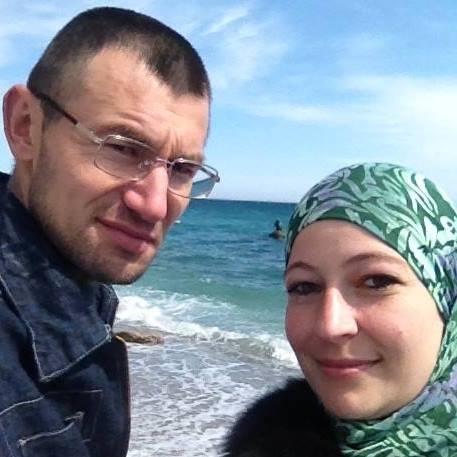
1530198608-9959Emir Hussein and Meryem Kuku

“They have not been giving me any maintenance therapy—no glucose, no vitamins, nothing. Apparently, top-ranking officials do not want a second Sentsov, someone who would be able to drag out a hunger strike for months if he got care in the form of glucose and vitamins. They realized the mistake they made [with Senstov]. They have to break me quickly.

“Earlier, I was warned that if I didn’t give up the hunger strike, they would be forced to hospitalize me in the TB hospital, a place teeming with inmates infected with tuberculosis and HIV. It’s a TB hospital, after all.”

The trial of the so-called Yalta group in the Hizb ut-Tahrir case is currently underway in the North Caucasus Military District Court [in Rostov-on-Don].

Photos courtesy of 112.International and Unian. Translated by the Russian Reader

“He’s Lost Fifteen Kilos on the Hunger Strike”: Oleg Sentsov’s Cousin Visits Filmmaker in Prison

oleg

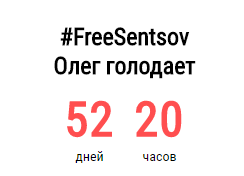
“Oleg has been on hunger strike for 52 days and 20 hours.”

“He Has Lost Fifteen Kilos during the Hunger Strike”: Oleg Sentsov’s Cousin Visits Filmmaker in Prison
Novaya Gazeta
July 5, 2018

Natalya Kaplan, cousin of Ukrainian filmmaker Oleg Sentsov, has visited him at the Polar Bear Penal Colony in Labytnangi, reports Gromadskoe.

“I met with Oleg. We chatted for two hours. It was a short visit. Oleg, who is 190 centimeters tall, now weighs 75 kilos. He has lost 15 kilos during the hunger strike,” said Ms. Kaplan.

According to her, Mr. Sentsov’s health is currently listed as satisfactory. His lab results are not good, but “there is nothing critical.”

“Yesterday, he felt quite sick. Today, he was fine. He came to the meeting on his own. He feels worse in the evenings. He says he now has a much easier time of it. The first three weeks of the hunger strike were the most agonizing period. He has been getting IVs now. He would not survive without them. He has no plans of ending the hunger strike. His outlook is optimistic. He believes what he is doing has a purpose. And he believes he will win,” said the filmmaker’s cousin.

Kaplan added that Sentsov has asked the public not to visit him in prison, but to visit the other political prisoners for whom he has been fighting.

Mr. Sentsov was convicted in Russia on charges of planning terrorist attacks in Crimea. He has been on hunger strike since May 14, demanding the Russian authorities release all Ukrainian political prisoners in their custody except him. Many Russian and international cultural figures and human rights activists have voiced their support for him.

In recent weeks, the Russian and Ukrainian sides have been trying to agree on a prisoner exchange and iron out a schedule of visits to penal colonies. Lyudmila Denisova, the Verkhovna Rada’s human rights ombudsman, has voiced Ukraine’s willingness to implement an exchange of twenty-three prisoners from each side.

Thanks to Dmitry Dinze and Askold Kurov for the heads-up.

___________________________________________________________________

Here is what Novaya Gazeta omitted from the original article as published on the Gromadskoye website.

[…]

Natalya Kaplan told Oleg that Emir Hussein Kuku had joined his hunger strike and about the demonstrations supporting him.

“He is really grateful there have been so many rallies in his support, that people have not given up and keep on fighting. At the same time, however, he is quite disappointed very little attention has been paid to the other political prisoners. He thinks that if he alone were released, it would be a complete failure,” she said.

[…]

“In particular, he asked Ombudsman Denisova, Father Kliment, the independent doctors, and consular officials who have tried to visit him to go visit the other political prisoners, so that no one forgets them,” said Ms. Kaplan.

[…]

According to her, he has television for entertainment, and he has also been writing and editing his old diary entries. He asks that no more books be sent to him. He has lots of books as it is.

It has transpired the former so-called prosecutor of Russia-annexed Crimea, Natalia Poklonskaya, was involved in Mr. Sentsov’s illegal trial in the Russian Federation, during which he was sentenced to twenty years in prison.

On June 29, Mr. Sentsov’s attorney, Dmitry Dinze, reported Mr. Sentsov was in the prison infirmary, but his condition was stable.

Mr. Dinze also reported Russia had received two requests to pardon Mr. Sentsov.

On June 15, Ms. Denisova was not allowed to see Mr. Sentsov. Subsequently, Ms. Denisova was also not allowed to see Ukrainian political prisoner Mykola Karpyuk, imprisoned in the Russian city of Vladimir.

On June 21, the Ukrainian Embassy in Russia demanded Ms. Denisova be granted priority access to the prisons where political prisoners Oleg Sentsov, Stanislav Klykh, Alexander Kolchenko, and Vladimir Balukh have been incarcerated.

On June 21, Ukrainian President Petro Poroshenko again talked on the phone with Russian President Vladimir Putin, urging him to release the Ukrainian political prisoners.

The ambassadors of the G7 countries have expressed deep concern about the circumstances of Mr. Sentsov and the other Ukrainian political prisoners incarcerated in Russia.

On June 14, the European Parliament passed a resolution demanding the immediate release of Mr. Sentsov and the Kremlin’s other Ukrainian political prisoners.

On June 19, President Putin’s press secretary, Dmitry Peskov, said the Kremlin’s position on Mr. Sentsov had not changed after an appeal to release him was made by prominent Russian cultural figures.

Sixty-four Ukrainian political prisoners are currently being held in Russia and annexed Crimea, twenty-seven of them in Russia proper. Fifty-eight of them were either arrested in Crimea or arrested on charges involving Crimea. These numbers do not take into account the currently held in the self-proclaimed Republics of Donetsk and Luhansk.

Translated by the Russian Reader. Image courtesy of Gromadskoye


‘Ere, or, Applied Culanthics

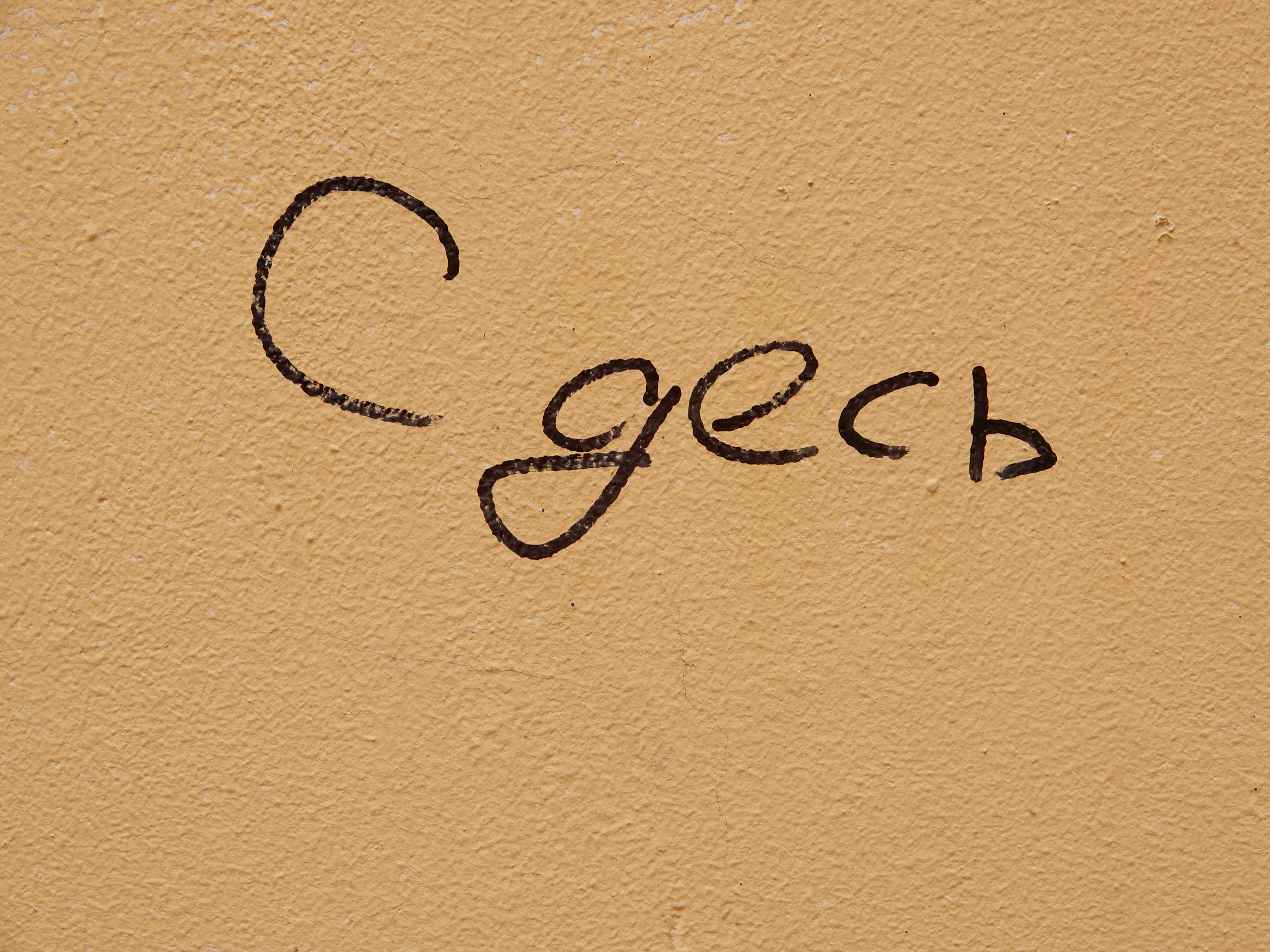
DSCN5744.jpg‘Ere, 2018. Graffiti found in Central Petersburg. Photo by the Russian Reader
This is a soundbite of champagne leftist culanthical research at its worst.

Monstrations are a symptom of a deep crisis of the pro-state nationalist and anti-state liberal discourses that reduce Russia’s complex political reality to two formulaic camps, obliterating space for democratic debate. Could there be an American monstration? One that resists Trump, but also refuses to explain away the phenomenon of Trump by referring to bigots and Russian agents? One that neither demonizes Russia nor justifies the actions of Putin’s regime?

Is Russia’s political reality really all that complex?

Why, if the US is filled with teenagers who can take the stage at a massive rally on the Mall in DC and make inspiring, cogent, coherent speeches, do we need the incoherent, politically feckless, thrift-store surrealism of the Novosibirsk Monstrations?

If we can either impeach Trump, pin him down with a crippling special investigation or, finally, simply fail to renominate or reelect him, why do we need to explain him away or even explain him at all?

What is the difference between Trump and “the phenomenon of Trump”?

If, nevertheless, well-paid, tenured academics force us to explain this “phenomenon,” why can’t we refer to bigots and Russian agents? Are they mere figments of our imagination?

Who does a better job of “demonizing” Russia?

People trying to explain away the phenomenon of Trump?

(By the way, why isn’t it “the Trump phenomenon”? Is “the phenomenon of Trump” more culanthically correct?)

Or are the true demonizers the Putin regime itself, a regime that has been quite demonstrably engaged in setting a new land speed record in sheer gangster nastiness at home and abroad at least since 2014, although we know they started much, much earlier (i.e., when Putin was deputy mayor of Petersburg in the early and mid nineties, and served as Mayor Anatoly Sobchak’s bag man and liaison with dicey “foreign investors” and local gangsters)? // TRR

P.S. The culanthics only go downhill from there.

The banners you see at monstrations state their theme obliquely. In the spring of 2014, when Russia annexed the Crimea, the slogan “Crimea is ours!” dominated pro-government media channels and billboards. The liberal opposition, conversely, stressed that the Crimea was illegally stolen. Meanwhile, monstrations sided with neither of these accounts. On May 1, 2014, the Novosibirsk monstration walked behind the banner “Hell is ours!”, a statement that iconically and ironically challenged the official slogan, but also refused the simplified version of the political events advanced by the liberal opposition. The march united young people with different political opinions, from those who saw the annexation as an isolated unlawful act to those who refused the liberal oppositional story and instead saw the Crimea in connection with other events, including the attempts of the extreme right and ultranationalist movements in Ukraine to hijack the popular Maidan revolution.

Such is the secret of the trendy “third position” in Russian and Russophile “anti-authoritarian leftism”: to side with nobody but other third positionists, to hover high above Moscow, Peterburg, Crimea, Donetsk, Aleppo, Eastern Ghouta or, in this case, the Berkley Hills like angels of history. God forbid the third positionists should ever do something so rash as actually organize a real anti-war movement explicitly and loudly opposed to the Kremlin’s predations in Ukraine, Syria, and elsewhere.

One, it would involve a lot of needless work.

Two, it could get the third positionists, otherwise accustomed to a heavy schedule of jetsetting from academic conference to art residency to speaking engagement, into a lot of hot water. They definitely do not want to go to prison for any reason, unlike those careless antifascists from Penza and Petersburg, about whom the third positionists mostly have nothing to say, unsurprisingly.

(Russian and Russophilic third positionism requires its adepts to refrain from criticizing Russia’s foreign and domestic policy catastrophes and crimes as much as humanly possible. People who, on the contrary, criticize the current Russian regime’s actions loudly and often are labeled “liberals” and “Russophobes,” the worst words imaginable in the third positionist vocabulary.)

Three, it would mean the third positioniks would have to give up their firmly held conviction, which they share with Vladimir Putin, Alexander Dugin, and Vyacheslav Surkov et al., that all the evil in the world originates solely in the United States and that, however ham-fisted and controversial its actions, Russia has only been reacting to the miseries deliberately visited on it by American unilateral imperialism and neoliberalism.

Russophile leftists lap this spiked rhetorical gravy up like hound dogs who have not been fed for a week, so the invitations to appear at conferences and contemporary art hootenannies, and contribute essays to “politicized” art mags and cutting-edge scholarly journals keep pouring in. After all, it is what really matters in life, not Syrian children, blasted to smithereens by Russian bombs, or hapless Crimean Tatars, rotting in Russian prisons because they are too stupid to know what is good for them. // TRR

Salmagundi: A New Low

DSCN4978
An advertisement for hard drugs in downtown Petersburg. Photo by the Russian Reader

“I very often hear from smart and even progressive colleagues, not only so-called conservatives, that we should not exaggerate. The regime, they say, has not cracked down on millions of people, and you can criticize it, albeit on the internet. There are protest rallies from time to time. Intelligent books are published, not burned, and monuments to Stalinism’s victims are erected. The west has many of its own faults, too, and generally speaking, the regime is not all that oppressive.

“What I do not like about this rationale, however, is the constant desire to normalize current Russian reality, turn a blind eye to the crimes and mean tricks that actually do occur, muffle criticism and, ultimately, justify the regime, if only unconsiously. It is somehow especially offensive to hear and read such things when they are said and written by people who have left Russia.”

Source: Sergey Abashin

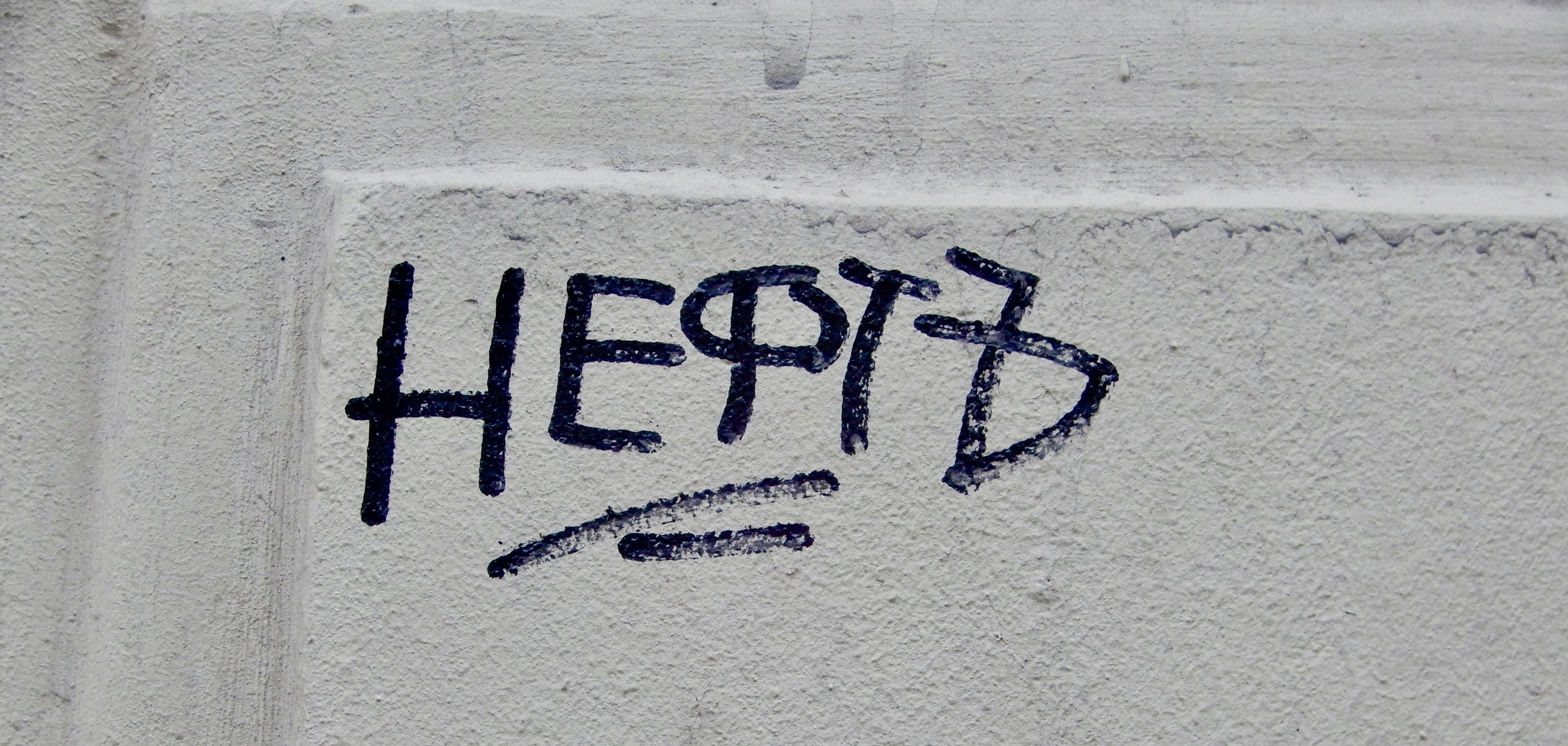
DSCN4964.jpg
“Oil.” Photo by the Russian Reader

“When the Russian Federation occupied Crimea, Russians celebrated. When Donetsk and Lugansk were shelled and captured, they encouraged the vampire and cursed the Ukrainians. When the Russian Federation bombs Syria, our vast country’s deaf inhabitants are out of the loop.

“But why do they got upset when their own children are poisoned? Are the children of the Crimean Tatars, made orphans, and the murdered children of Ukraine and Syria worse than the children of Moscow and Voronezh?

“As long as you agree to kill others, don’t expect happiness. Your actions will catch up with you, sooner or later.

“Some would call it fate, others karma, still others, divine punishment. What’s the difference? Everything in this world is connected.”

Source: Elena Zaharova

DSCN4860Front page of official municipal council district newspaper, Petersburg. Photo by the Russian Reader
“‘My name is Mikhail Safronov. I’m a tenth-grade student and I’m against the decision by the Russian Federal Ministry of Foreign Affairs to close the British Council in Russia.’

“According to Mikhail, closing the British Council would deprive Russians of the opportunity to learn about British culture, study English, and attend lectures, seminars, and other interesting events.

“’I think that political squabbles should not affect educational and cultural activities, for when we look at the historical past, we shall see that culture has always been an important element in any situation,’” believes Mikhail.”

Source: Email message from Change.org

lahiorotat-jaloviinaScreenshot from the video for “Skujaa” by Helsinki hip-hop group SMC Lähiärotat

The really hilarious and sad thing is the number of Russians who are convinced that, because they are “victims” of their own regime, the so-called west (the EU, US, etc.) owes them something, everything.

I don’t mean asylum. Under international law, countries are obliged to provide safe haven to people who flee their own countries “owing to well-founded fear of being persecuted for reasons of race, religion, nationality, membership of a particular social group or political opinion.”

Unfortunately, there have been a good number of Russians who have fled Russia for just these reasons in recent years, and many of them have been granted asylum, as they should have been.

But there have been many more Russians who have simply left the country for a better life somewhere else.

That’s cool, too.

Or it would be cool if more or most Russians extended the same right to live the good life to other peoples. But even as they either live happily in the west or think hard about relocating there, which they regard as an entitlement and a birthright, many of them are horrified that Europe, the US, Canada, Australia, etc., have been “overrun” by Muslims, Mexicans, Africans, Indonesians, etc.

The entitlement to a good life does not extend to these people, even if some of then, namely, Syrians, have been fleeing their homeland because the Russian government has allied itself with the Syrian dictator Bashar Assad to crush all opposition to his tyrannical dynasty and been bombing the last opposition strongholds to smithereens with its superior air force and firepower.

I don’t need to tell you how many refugees, displaced people, and asylum seekers the Assadist massacres in Syria have generated, but Russia itself has taken in only a handful, at most, of these refugees, and caused them a lot of problems in the process.

Meanwhile, wherever they are in the rest of the world, at home or abroad, a good number of Russians would deny refuge and asylum to these same people because, in their mind, they are all potential “Islamic terrorists” or otherwise incompatible with “western civilization,” whatever that is and as if Russia were indubitably a part of it, an imaginary construct.

This same sense of entitlement extends to the mostly jejune “battle with the regime” at home. Of course, there are lots of Russian grassroots activists and opposition politicians who fight the good fight without even once thinking about “the west” and what it can or should do for them in their uneven struggle with the Putinist tyranny.

But there are just as many Russians who take it as a given that “the west” should be ready and willing to provide them with whatever they require when they need it: funding for their endless “projects,” junkets to conferences, research fellowships, lectureships, etc.

You might wonder why a grassroots activists or an opposition politician would need a research fellowship. Most real activists and politicans don’t need them, in fact. But the “struggle” in Russia has generated a rather large academic cottage industry of researchers and “activist researchers,” supposedly engaged in studying the “struggle,” the country’s “social movements,” and so on.

By all means, whenever possible, “the west” should fund this research, too. Russian intellectuals—unlike Syrian intellectuals, Iraqi intellectuals, etc., (do “Islamic terrorists” even have intellectuals?)—are entitled to this support because, in mysterious ways I cannot even fathom at this point, they “share the same values” as “westerners,” whoever they are.

Here’s the kicker. While western leftists and other assorted kooks have imagined “the west” has been doing Satan’s work and trying its darnedest to dismantle the once-mighty socialist utopia, the real story has been that the west actually has been flooding the former Soviet Union and Russia in particular with all manner of aid to civil society, academia, and even governments.

This extends even to the US State Department, rightly condemned as the source of all evil in the known universe. There is probably not a single person in the current Russian government and parliament who has not been the beneficiary, at some time in the surprisingly recent past, of an all-expenses-paid fact-finding junket to the US and/or the EU. A rather large number of Russian law enforcement officers and judges have also been on such trips to the Great Satan, as I know for a fact.

You might argue this kind of aid is ultimately self-serving, and you would be right. It was and has been mostly premised on the crazy notion that Russia was a democracy, and the west just needed to give it a little help and practical advice to get it all the way to the premier league of democracy, so to speak.

In the historiography of the Soviet Union, an important breakthrough was made when a new tribe of then-young historians started doing something that subsequently became known as “revisionist” history. That is, they dared to look at the Soviet Union as something other than a nonstop Stalinist totalitarian nightmare, meaning they tried to examine how ordinary Soviet citizens perceived their society or periodized the country’s history to show how very different the Stalin era was from the Thaw, and so on.

We are in desperate need of a revisionist history of the recent past, meaning the 1990s to the present. I realize no serious historian believes in “histories of the present,” but it’s good to attempt such things anyway, if only to preserve parts of the present or the near past that will not be so obvious to the people who come after us.

What I have in mind most of all is the very successful attempt to hypnotize the whole world into believing what I call the standard narrative about the collapse of the Soviet Union, its aftermath, and the rise of Putinism. Remarkably, the standard narrative is shared by Putinists, anti-Putinists (especially leftist anti-Putinists,) and lazy western academics and journalists alike, that is, by people who would seem otherwise to be at odds in the present when it comes to interpreting Russia’s current morass or, alternately, “resurgence.

I don’t want to rehearse the standard narrative here, partly because at this point it bores me to tears, and partly because I don’t want to give yet another platform to a story that the remarkable US president would call “fake news.”

The upshot is that everyone has forgotten that, during the “savage nineties,” Russian politicians, Russian society, Russian media, and ordinary Russians were not all reflexively anti-American and anti-western. Nor were they necessarily pro-American and pro-western.

Whatever they were, then, and whatever they were doing, it was this that was crucial to what happened in Russia at the time, for good and for ill. Meaning that no amount of American and western aid, advice, and other interventions (including the interventions of capitalist wheeler dealers and carpetbaggers) made a critical difference to the polity or the unbearable chaos, depending on your point of view, that Russians produced collectively at that extraordinarily interesting time

To know that, it helps a great deal to have actually been here to witness it, as I was.

This is not to say that nothing the west and the US did at the time (I’ll leave it you to make up your own lists of those things) had any impact on life in Russia. What I do mean to say is that impact was never so critical as to make inevitable the period that followed, meaning the Putinist period, in which the country’s ruling elite has been engaged, from day one of the post-Yeltsin, in an all-out “cold civil war” (a term coined by a friend of mine) against ever more numerous and ever larger segments of Russian society.

However, throught both periods, western governments, including the US, and western organizations of all kinds have been keen to promote democracy, civil society, academic research, and culture in Russia, and have spent a good deal of time, energy, and money on that mission, premised, mistakenly or not, on the notion that Russia was a society not so different from our own societies.

I realize I am deliberately emphasizing the positive side of this relationship and practically ignoring the darker, negative sides of this effort. I am doing so for two reasons. One, I really do believe the positive has outweighed the negative. Two, I think the real challenge for serious “new revisionist” historians of the recent post-Soviet past would be to not take the standard narrative as a given, because once you do that, I would argue, you are a short slippery slope away from full-blown Putinism, which in Russian hipster leftist discourse usually has been camouflaged by a rather dubious take on post-colonialism, namely, that “the west” has attempted to “colonize” post-Soviet Russia, that would make all the pioneers of post-colonialist theory turn over in their graves, that is, if they are not still alive and happily theorizing among us.

The flipside of this wholesale sellout to the Putinist standard narrative, paradoxically, is the widespread belief that “the west” owes each and every Russian a personal debt either for screwing up their country so badly or, conversely, for not doing enough to make it a full-fledged democracy.

So, having spent millions and billions of dollars and euros, and thousands and hundred of thousands of manhours doing our best to help our wartime ally take what we all thought would be a tiny, natural, easy step in the right direction, we are now universally reviled (and revile ourselves) either for attempting to divert Russia from its unique historical trajectory or not doing enough to divert Russia from its uniquely catastrophic historical trajectory.

Concomitant to this “porridge on the brain” (kasha v golove) is the equally widespread and equally false notion that “we” (as if “the west” were a real thing, a monolith centrally governed by me or the Rockefeller family or my Uncle Duane) have not been paying enough attention to “victimized,” “colonized” or “resurgent” Russia (cross out the words that do not apply) both in terms of journalistic coverage and academic research.

In fact, Russia has had so much attention of all kinds lavished on it in the last thirty years, I would wager that, in terms of character counts, minutes of airtime, column inches, and so forth, it would easily outdo all other parts of the so-called non-western world, China included.

Yet I am constantly encountering people, Russians and “Russophiles” alike, who argue that if “the west” would spend more time (and money) listening to this group of Russian or that group of Russians, it would finally get the “real picture.”

In reality, nearly all those groups of Russians with big messages for the imaginary Big Brother have been furiously shuttling back and forth across the frontier for a long time now, wearing a large furrow in the carpet.

This brings me to my non-intuitive and unforeseen conclusion, which would seem to be at odds with everything I have professed and done over the last nearly thirty years.

What if “we” (although “we” know don’t really exist, but “they” don’t know that, even though “they” don’t really exist, either) just gave up altogether on our nonexistent collective project to befriend Russia or bring it to its knees by begging it fecklessly not to turn into a tinpot kleptocracy.

With all the time, money, and manhours freed up, “we” could engage with other parts of the world or take up other worthy pursuits.

What does this have to do with Russia? Absolutely nothing at all. And that’s my point. I think it would have a tremendously invigorating effect if “we” (who don’t really exist) disengaged from Russia altogether, if only because we need to deal with our own ailing countries or other traumas, joys, and dreams pestering our souls.

And also because solidarity, as I have been harping on for years, is a two-way street.

There was a time, in the nineties, when I thought I could see that two-way street being built. It has long ago turned into a one-way street, however, and whatever “we” do do and whatever “we” do not do, “we” are damned and condemned and reviled and told “we” are not doing enough. That is, “we” are in what Margaret Mead’s less-famous but equally distinguished husband Gregory Bateson called a double bind.

I suggest “we” either just give up and get on with our lives or we take seriously the idea that, for the last two decades, we have been feeding ourselves a load of crap about our relationship with Russia and what has really been going on here, and we have let ourselves be fed a load of crap. TRR

Psychiatry as a Tool of Political Repression in Crimea

Elena Lysenko
A picket for the release of Crimean lawyer Emil Kurbedinov on 31 January 2017 in Simferopol, Ukraine. Photo by Elena Lysenko

Psychiatry as a Tool of Political Repression in Crimea
Madeline Roache
Special to The Russian Reader
April 9, 2017

Lawyers and human rights activists claim the Russian authorities in annexed Crimea have been persecuting human rights activists, most of whom belong to the Muslim Crimean Tatar community. The Crimean Tatars, who make up about 15% of Crimea’s population, have vocally opposed Russia’s occupation of the Ukrainian peninsula since February 2014. As a result, the group has been specially targeted by Russian authorities. Many Crimean Tatars have been forced to leave the region to avoid harassment and arbitrary arrest.

According to a new report, presented on March 23 by Ukrainian advocacy group Crimea SOS, a total of 43 local activists have been abducted since Russian troops occupied Crimea in February 2014—allegedly, by the Russian authorities and their accomplices. Eighteen of those who were abducted are still missing and six have been found dead.

Robert van Voren, a Dutch human rights activist and political scientist, said that, since the annexation, many Crimean Tatar activists who oppose the occupation have been arrested and subjected to abuse and imprisonment in psychiatric institutions.

“Since the annexation of Crimea, Russian authorities have prosecuted and forced into exile virtually all those who oppose the Russian occupation, including key leaders and activists within the Crimean Tatar community”, he said.

Emil Kurbedinov, a prominent Crimean lawyer, told the Guardian that, between December 2016 and March 2017, twelve Crimean activists were forcibly admitted to psychiatric hospitals in Crimea. Four of them remain in hospital, while the rest have either been transferred to prison or discharged.

According to Kurbedinov, Crimean activists are treated in a degrading way and face appalling conditions in psychiatric hospitals.

“Some are placed in isolation and are denied their basic needs, such as access to a toilet. Others are housed with numerous people suffering from severe mental illnesses. The activists are interrogated about their alleged involvement in ‘extremism’ and their views of the government. They are also deprived of the right to speak with their families or meet their lawyers on a one-to-one basis without a guard being present. All of this violates international law,” he said.

All of the Crimean activists were arrested on suspicion of involvement in Hizb ut-Tahrir, which Russia, unlike Ukraine and other countries, has declared a terrorist group. The Kharkiv Human Rights Protection Group (KHPG) asserts there is no evidence to suggest the organisation has anything to do with terrorism, nor is there any proof the men were even involved in the group.

Kurbedinov says their arrest was illegal and a breach of protocol, as it was not sanctioned by a judge but ordered by a police investigator.

According to KHPG, a further 19 Crimean activists are currently in custody, accused of involvement in Hizb ut-Tahrir. Memorial, a Russian human rights organization, has declared all the activists in custody political prisoners. KHPG claims that one of the detainees, Emir Kuku, was most likely arrested due to his work for the Crimean Contact Group on Human Rights, which provides legal assistance and support to members of Muslim groups.

Last year, Kurbedinov defended Ilmi Umerov, a Crimean Tatar activist who openly opposed the Russian occupation. Umerov was sent against his will to a psychiatric hospital in August 2016. Russia’s Federal Security Service (FSB) detained Umerov in May 2016 in the Bakhchysarai District and charged him with separatism. Umerov is also a representative in the Mejlis of the Crimean Tatar People, an elected body that was suspended by Moscow after it annexed Crimea. Human Rights Watch heavily criticized the case, calling it “a shameful attempt to use psychiatry to silence [Umerov] and tarnish his reputation.” Umerov was released twenty days after his confinement.

Kurbedinov argues that these cases have “acutely raised the issue of the vulnerability of ordinary citizens who have no civil rights whatsoever before the legal and judicial monolith.”

Soviet Psychiatry
The practice of punitive psychiatry in the present day is particularly disturbing given its historical use as a tool of rampant political repression the in the later decades of the Soviet era. Psychiatry was used to systematically confine and punish Soviet dissidents. However, under President Vladimir Putin, cases of the alleged political abuse of psychiatry have resurfaced, leading many to believe that the Soviet-era practice has returned.

The involuntary hospitalization of protestor Mikhail Kosenko in Russia in 2012, is just one of many modern-day cases that has been widely held up as an example of the political abuse of psychiatry. Kosenko was convicted on charges of rioting and assaulting a police officer during the Bolotnaya Square anti-Putin protests in Moscow on May 6, 2012. The case sparked international attention from human rights activists, who asserted the charges were fabricated and that Kosenko’s hospitalization was unnecessary.

The abuse of psychiatry in Russian criminal trials is not uncommon, according to Yuri Savenko, psychiatrist and head of the Independent Psychiatric Association (IPA) in Russia.

“Psychiatry is now frequently part of the procedure in criminal trials where there is no concrete evidence: it is more economical in terms of time and effort just to obtain a psychiatric diagnosis,” he says.

This disturbing phenomenon is of particular concern to the Federation Global Initiative on Psychiatry (FGIP), a human rights organization that protects human rights in mental healthcare. FGIP closely monitors the practice and is currently compiling a report about cases of psychiatric abuse in the post-Soviet states, to be published later this month.

Madeline Roache is a London-based freelance journalist focusing on human rights conditions in the former Soviet Union. Her work has been published in The Guardian, The Times of Central Asia, and Euromaidan Press.

Three Years Later: Suicide by Crimea

Suicide by Crimea
Nikolay Klimenyuk
oDR
March 17, 2017

As long as Russia maintains its grip on the Ukrainian peninsula, significant changes for the better at home are impossible.

In the three years that have passed since the annexation of Crimea, a consensus has taken shape in Russia. Everything having to do with the Ukrainian peninsula is Russia’s internal affair, and far from the most important one.

The “accession” of Crimea has even quite succesfully happened in the heads of the regime’s opponents. In November 2016, while arguing on Facebook with Crimean Tatar journalist Ayder Muzhdabaev, Mikhail Khodorkovsky expressed a stance then supported by many publicly prominent liberals, including activists and intellectuals. Russian society, he argued, wants to deal with other problems. The opposition’s biggest task is regime change, but returning Crimea to Ukrainian jurisdiction by democratic means would be impossible because public opinion would be opposed. Crimea is not mentioned at all in Alexei Navalny’s 2018 presidential campaign platform.

Russian media outlets generally considered “liberal” (these media usually eschew the word “opposition”) havealso swallowed the annexation and most of the rhetoric surrounding it without a peep. TV Rain, RBC (even before its top editors were replaced), and the online Meduza, which operates out of Latvia and is not not subject to Russian laws, have all long routinely called and depicted Crimea as part of Russia. The standard explanation—it is required by Russian law, and insubordination is fraught with penalties—sounds like an excuse. The law does not require that questions about Crimea be included in a quiz on knowledge of Russian cities (which was amended after public criticism) or that reporters term the annexation a “reunification” (Meduza edited the latter term to “absorption.”)

At the same time, Russian reporters usually have no problem demonstratively violating Ukrainian laws (which require them to enter the occupied territory through the checkpoint at Perekop) and flying to Crimea from Russia (as Deutsche Welle reporter Yuri Resheto did), because it’s cheaper, faster, and simpler, and because Ukraine’s rules are cumbersome, inconvenient, and nonbinding.

After that, you can write critical reports on human rights violations in Crimea till the cows come home, but it won’t change what matters. The voluntary observance of inconvenient Ukrainian rules is tantamount to acknowledging Ukraine’s sovereignty over Crimea, and hardly anyone in Russia wants to do that.

In fact, the seizure of Crimea has been the cause of many pressing problems in Russia that have been on the Russian opposition’s agenda. It has laid bare peculiarities of Russian society that existed longer before the attack on Ukraine.

For example, not only did the extent of imperialist moods become clear but also Crimea’s place in how Russians see themselves as a society and a nation. The imperial myth, still alive and well in Russia, was concocted during Catherine the Great’s reign. From the moment they were implemented, Peter the Great’s reforms had provoked a mixed response. They smacked of “sycophancy,” and modeling the country on Holland seemed somehow petty.

Catherine, on the contrary, conceived a great European power, rooted in antiquity, Byzantine’s direct heir, the Third Rome, a Europe larger than Europe itself. Her ambitious Southern Project, which involved defeating Turkey, uniting all the Orthodox countries in a single empire, and installing her grandson the Grand Duke Constantine on the throne in Constantinople, was brought low by political reality. The only one of her great fantasies she made come true was seizing the Crimean Khanate, in 1783.

The conquest was extremely atypical of Russia. A troublesome neighbor was not subjugated. Rather, the annexed lands were completely reimagined and rewritten. The rewriting was attended by the first mass expulsion of the Crimean Tatars. They did not fit at all into the pictures of the radiant past that Grigory Potemkin was painting in reality on the annexed lands. Crimea was resettled with Plato and Aristotle’s Orthodox descendants: Pontic Greeks, Great Russians, and Little Russians (i.e., Ukrainians). Naturally, all these particulars have been forgotten long since. What has not been forgotten is Crimea’s central place in the self-consciousness of a “great European nation,” as manifest, for example, in the absurd, endlessly repeated expression, “Crimea has always been Russian.”

The saying perfectly illustrates the peculiarities of historical memory in Russia. Crimea’s current “Russianness” is the outcome of over two hundred years of the uninterrupted genocide and displacement of the “non-Russian popuation,” which culminated during the Second World War. After the two Soviet deportations of 1941 and 1944 (ethnic Germans, Greeks, Bulgarians, Italians, Armenians, Karaites, and Crimean Tatatrs were deported), losses during battles, and the Nazi extermination of Jews and Crimeans, only a third of Crimea’s pre-war inhabitants were left. It was resettled with people from Russia and Ukraine, especially by military officers and veterans of the Party and the secret services.

Naturally, few people in Russia today regard Crimea as a conquered and ravaged country, in which a full-fledged state existed until relatively recently, an indigenous culture was long maintained, and Russians were never the ethnic majority even during the lifetimes of the present elder generation.

Regarding Crimea as a territory, not a society, and treating Crimeans as an annoying inconvenience, was a habit in Catherine’s times and has survived into the present. The formal excuse for the Russian incursion was the “defense of Crimea’s Russophone population,” and yet the “Crimea is ours” attitude of Russians to the peninsula’s residents has been quite skeptical from the get-go. They imagine the main business of Crimeans is leaching off tourists, and the only thing that attracts them about Russia is high wages.

Moreover, this opinion is common across the entire political spectrum. Sergei Parkhomenko, a liberal journalist and public figure, expressed it in a very telling way.

“If first you take five days to explain to the population of Crimea that if they return to Ukraine’s jurisdiction, their wages and pensions will be increased, and they’ll also be permitted to build even more chicken coops for holidaymakers in the coastal zone, and only then you ask them to vote in a referendum, 95% will vote for going back. […]  These people have proved they could not care less what country they belong to. And if there is anyone for whom I now feel not an ounce of sympathy as I read about how they are being fooled, robbed, milked, and put under the rule of gangsters pretending to be officials and bosses, it is the population of Crimea.”

The massive support of Russians for the annexation has much more serious and immediate consequences than a display of deeply rooted chauvinism. Having signed off on “Crimea is ours,” Russians have deemed their own power above the law and sanctioned its use in violating all laws and treaties for the sake of higher interests or “justice.” The Russian authorities had behaved this same way previously, but now they have obtained the relevant mandate from society. Quite naturally, the crackdown following the seizure of Crimea has been chockablock with spectacular acts of lawlessness.

One such act was the demolition of commercial kiosks and pavilions in Moscow, which happened despite legalized property rights and court rulings. There was nothing accidental about the fact the Moscow authorities justified their actions by citing the law adopted for settling real estate disputes in Crimea. And the twenty-year-sentence handed down to Oleg Sentsov set a new ceiling for verdicts in political trials. Before Crimea, activists would get a dvushechka (two years) for especially vigorous protests. After Crimea, the Russian authorities have been sentencing people for reposts on VK and holding solo pickets.

Actually, any regime that tasks itself with establishing the rule of law in Russia will first have to annul this “mandate to lawlessness.” The Russian opposition’s attitude to Crimea shows the rule of law is not among its priorities at all. Bewitched by the figure of Putin, the opposition does not regard regime change as a product of the rule of law. The fact that it cannot offer a realistic scenario for regime change is not a problem in itself. Russia’s currrent regime does not presuppose a peaceful change of power. Systemic change might happen as it did in the Soviet Union, at the behest of the bigwigs and under the impact of external circumstances: the state of the economy, public sentiment, foreign policy factors.

The opposition’s most serious problem is that it doesn’t have a meaningful outline of what would come next.

If we believe the alternative to Putin is neither Navalny, Khodorkovsky nor anyone else, but a democratic state based on the rule of law, there are two obstacles in our way: Crimea and Chechnya. The opposition has no vision of how to establish control over Chechnya and incorporate it into Russia’s legal system, but it is possible in theory, at least. There is no such possibility with Crimea. It is impossible to hope for international recognition of the peninsula as part of Russia, and if we keep regarding it as part of Russia, it will thus remain a legal anomaly. Moreover, no rule rule of law is even formally possible without observance of international law.

When discussing Crimea, the Russian opposition evinces a notion of democracy that differs little from Putin’s, although it is consonant with the rhetoric of Donald Trump and the European populists: that democracy is rule based on majority support and not burdened by the observance of laws, procedures, and international obligations. Khodorkovsky, for example, considers “democratic procedure” not the restoration of law, but the adoption of a decision on Crimea based on the opinion of the majority, which, allegedly, is against giving Crimea back to Ukraine. Navalny has suggested holding a new, “normal” referendum.

Yet what the majority really thinks, whether there is such a thing as public opinion on any issue and how to measure it, obviously means nothing at all either to Khodorkovsky, Navalny or many other members of the opposition. By the same token, since Putin is supported by the majority of the Russian population, there is nothing for the opposition to do at all. All these contradictions can be eliminated only by unconditionally recognizing both the illegality of Crimea’s annexation and the total impossibility of keeping it in the Russian Federation on any grounds.

With Crimea in tow, Russia has no positive alternative to the current regime. And as long as the Russian opposition is concerned only about regime change and avoids discussing Crimea, the only thing it can offer is a Putinist Russia sans Putin. Whoever ends up in his place, however, the changes won’t be too noticeable.

Nikolay Klimenyuk writes about politics and culture in Germany and Russia. He was an editor at Forbes Russia, Bolshoi Gorod, and other periodicals. He has lived in Berlin since 2014 and writes for Frankfurter Allgemeine Zeitung and other German mass media. Translation and photo by the Russian Reader