Something I Learned Today: The Pamirs Are Melting

a Map of the Kyzylsu catchment. The names of the main glaciers are indicated in black. The elevation information is taken from the AW3D Digital Elevation Model (DEM), while the hillshade was derived from high-resolution Pleiades DEMs acquired in 2022 and 2023. Glacier outlines and debris extents are from the RGI 6.0 inventory. Lakes were manually delineated from a Pléiades 2022 ortho-image. The inset maps show the location of the study site in Central Asia with a base map from Esri, along with glaciers shown as blue areas and sub-regions outlines from the RGI 6.0 inventory. b Picture taken by Jason Klimatsas in September 2023 of the on-glacier automatic weather station, located on the debris-covered portion of Kyzylsu Glacier. Maidakul Lake can be seen in the background,as indicated by an arrow. c Pluviometer station photographed by a time-lapse camera in March 2022, with the snow-covered terminus of Kyzylsu Glacier visible in the background. 

Source: Communications Earth & Environment


This week’s episode of the CAPS Unlock podcast opens with a discussion about a show of diplomatic unity in Central Asia. Following Israel’s strike on Qatar, all five governments of the region quickly issued statements of condemnation. Some went as far as calling the strike an act of aggression. We examine why these unusually swift and aligned reactions matter, how they highlight the region’s growing ties with Gulf states, and what they reveal about Central Asia’s selective application of principles such as territorial integrity.

Our interview segment features Achille Jouberton, visiting scientist at the Swiss Federal Institute for Forest, Snow and Landscape Research, and lead author of a major new study on the glaciers of Tajikistan’s Pamirs. Long thought relatively stable compared to the shrinking ice fields of the Himalayas and Tien Shan, the Pamirs are now losing mass at troubling rates. Jouberton explains how declining snowfall since 2018, measured through field stations, pressure sensors, and climate reanalysis, is reshaping water availability in the region. He discusses the role of large-scale climate systems, the combination of less snow and hotter summers, and the downstream implications for agriculture and hydropower.

We close by looking at President Kassym-Jomart Tokayev’s State of the Nation address in Kazakhstan. Among an eclectic mix of themes, including long passages on artificial intelligence, Tokayev floated the possibility of transforming Kazakhstan’s bicameral parliament into a single chamber. Though short on detail, the proposal hints at possible institutional re-engineering ahead of 2029, when Tokayev’s presidential mandate ends. We assess what this might mean for Kazakhstan’s political system and why even seemingly technical reforms can reshape the balance of power.

Links:

Snowfall decrease in recent years undermines glacier health and meltwater resources in the Northwestern Pamirs: https://www.nature.com/articles/s43247-025-02611-8

Tokayev’s state of the union speech: https://www.akorda.kz/ru/poslanie-glavy-gosudarstva-kasym-zhomarta-tokaeva-narodu-kazahstana-kazahstan-v-epohu-iskusstvennogo-intellekta-aktualnye-zadachi-i-ih-resheniya-cherez-cifrovuyu-transformaciyu-885145

Source: Peter Leonard, “The Pamirs melt, Tokayev retools, Central Asia rallies,” Havli, 16 September 2025


For years, the Pamir-Karakoram anomaly stood as a rare outlier in global climate trends: a region where glaciers remained relatively stable despite accelerating global warming. Now, new research from the Institute of Science and Technology Austria (ISTA) confirms that even these “last strongholds” have begun to lose mass at an alarming rate.

Snow Deficit and Rising Heat

Data collected from a climate monitoring station on the Kyzylsu glacier in the northwestern Pamirs, active from 1999 to 2023, reveals a sharp shift. According to an international research team led by Francesca Pelliccotti, the tipping point came in 2018, when a significant decline in snow cover and precipitation irreversibly altered the glaciers’ mass balance.

Once past this “point of no return,” glaciers began rapidly depleting their own reserves to compensate for the lack of new snowfall, a process accelerating their melt.

Since 2018, the region has experienced a persistent snow deficit. Snow depth has fallen by approximately 40 cm, and annual precipitation has declined by 328 mm, about one-third of the historical average. Seasonal snow melts earlier, is less stable in spring, and is no longer sufficient to replenish glacier mass.

July 2022 was the hottest month on record, and during this period, the Kyzylsu glacier recorded unprecedented mass loss, melting at a rate eight times faster than the 1999-2018 average. Scientists identify increasingly hot summers and a lack of precipitation as the primary causes.

Even the intensified ice melt has not made up for reduced snowfall: water inflow into rivers dropped by roughly 189 mm in water equivalent. The contribution of glacial runoff to total river flow rose from 19% to 31%, but this increase was still insufficient to offset the overall decline in water volume.

The situation is most severe at altitudes above 4,000 meters, where solid precipitation has declined sharply. Snow from avalanches, which previously helped sustain the glaciers, has dropped nearly threefold from 0.21 to 0.08 m per year.

Implications for Central Asia

Experts warn that this is not a localized issue. The Pamir and Karakoram glaciers feed the Amu Darya and Syr Darya rivers, lifelines for millions across Central Asia. Diminishing glacial mass threatens freshwater availability, agriculture, hydropower generation, and overall socio-economic stability.

“Due to the lack of accurate forecasts, we cannot yet say definitively whether the Pamir glaciers have passed the point of no return. However, since 2018, the processes have changed dramatically, and the reduction in precipitation has had a critical impact on their stability,” said ISTA researcher Achille Joubert.

Data Gaps and New Monitoring Efforts

Following the collapse of the Soviet Union, glacier monitoring in the region was largely suspended for nearly two decades. Systematic observations resumed only in 2021, when international researchers reinstalled instruments on the Kyzylsu glacier, one of the Vakhsh River’s primary sources.

These new measurements confirmed a drastic drop in precipitation and snow thickness starting in 2018, with consistently unfavorable conditions persisting since.

Compared to the late 1990s, spring and summer snow now melts much faster, and the “cold reserves” that once preserved glacier stability are disappearing rapidly.

The study’s findings were published in Communications Earth & Environment, reinforcing that even the most resilient glaciers in Central Asia are succumbing to climate change.

“The disappearance of glaciers means not only a shortage of water, but also a threat to climate stability,” the researchers warn.

The loss of these natural freshwater reserves could trigger cascading effects from reduced electricity generation to ecosystem degradation.

The end of the Pamir-Karakoram anomaly is not just a regional alarm bell. It signals the urgency of coordinated international climate action. Without it, scientists say, the process may already be beyond reversal.

For Central Asia, this carries profound geopolitical and economic implications. Water stress is already a driver of tension between upstream and downstream states, and shrinking glaciers will exacerbate disputes over allocation and dam construction. Governments are under pressure to accelerate adaptation strategies – modernizing irrigation, investing in alternative energy, and expanding regional cooperation on water-sharing agreements.

Researchers also stress the importance of filling data gaps with sustained monitoring. Long-term, high-resolution observations are critical for forecasting river flow and planning infrastructure. International support, they argue, could help countries like Tajikistan and Kyrgyzstan upgrade their hydrological networks, while linking local data into global climate models.

Ultimately, the fate of the Pamir and Karakoram glaciers will not be decided in the mountains alone. Their survival, or disappearance, depends on global emissions trajectories and the political will to implement serious mitigation measures. What happens here, at the heart of Asia’s water towers, will ripple far downstream into the lives of millions.
Source: Vagit Ismailov, “Pamir Loses Its ‘Ice Shield’: Scientists Confirm End of Glacier Stability Anomaly,” Times of Central Asia, 4 September 2025

Em Uyaya’am (Things I Saw, Read and Watched This Week)

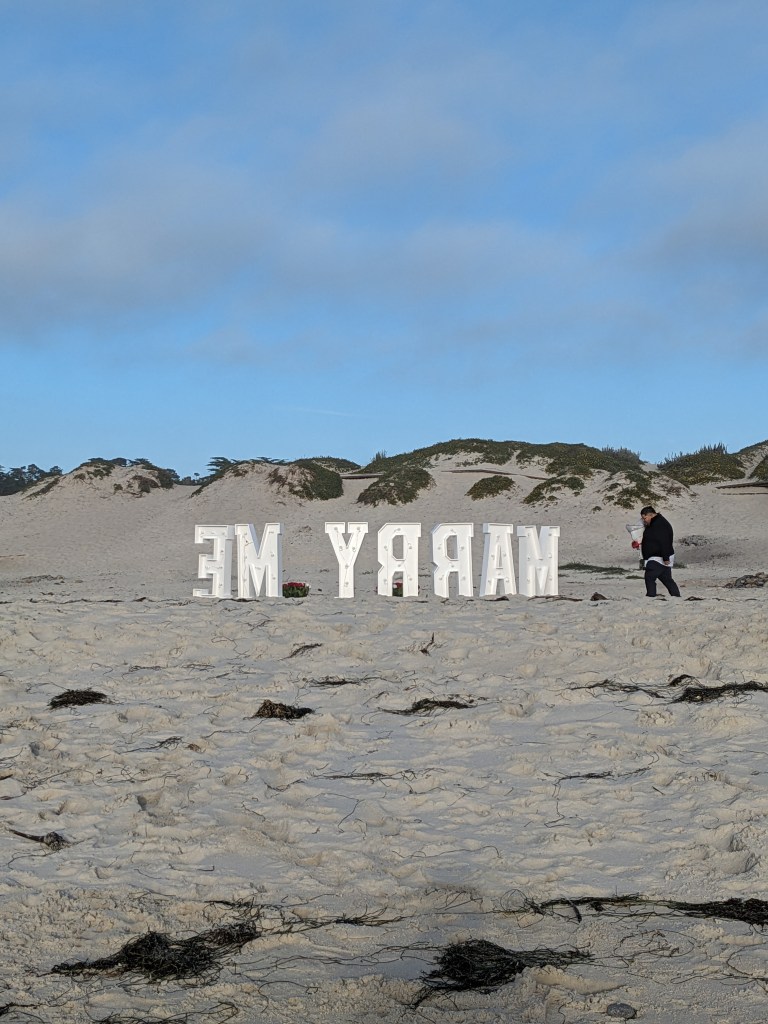
Asilomar State Beach, 21 July 2023. Photo by the Russian Reader

Who is Girkin?

Igor Girkin (Strelkov) is an ethno-fascist FSB officer and the warlord who prepared the ground and then launched the war in Donbas in 2014. He stated that without him, “there wouldn’t be any war”. He is also responsible for ordering the execution of numerous civilians, for which he still face justice. He was sentenced to life imprisonment in absentia by the International Criminal Court on November 17, 2022 as perpetrator of the downing of Malaysian Airlines 17 and the murder of 298 people—a war criminal.

[…]

Source: Monique Camarra, “Igor Girkin arrested in Moscow: the Kremlin is clamping down,” EuroFile, 22 July 2023


“The all-clear hasn’t sounded, the fight continues.”

Source: Sergey Abashin (Facebook), 21 July 2023


Stunning drone footage has revealed details of the Batagaika crater, a one-kilometer-long gash in Russia’s Far East that forms the world’s biggest permafrost crater.

In the video two explorers clamber across uneven terrain at the base of the depression, marked by irregular surfaces and small hummocks, which began to form after the surrounding forest was cleared in the 1960s and the permafrost underground began to melt, causing the land to sink.

“We locals call it ‘the cave-in,'” local resident and crater explorer Erel Struchkov told Reuters as he stood on the crater’s rim. “It developed in the 1970s, first as a ravine. Then by thawing in the heat of sunny days, it started to expand.”

Scientists say Russia is warming at least 2.5 times faster than the rest of the world, melting the long-frozen tundra that covers about 65% of the country’s landmass and releasing greenhouse gases stored in the thawed soil.

[…]

Source: “World’s biggest permafrost crater in Russia’s Far East thaws as planet warms,” Reuters, 21 July 2023


“Let’s remember these people”

After the court hearing [in his criminal case], Oleg Orlov read out a long list of names of people convicted of “disseminating fake news” or “discrediting the army.” He mentioned Alexei Gorinov, Dmitry Ivanov, Samiel Vedel (aka Sergei Klokov), Vladimir Kara-Murza, Ilya Yashin, Maxim Lypkan, and many others.

“I am not imprisoned, and I can say what I deem necessary. I can answer your questions. But how many of my and your kindred spirits are deprived of this opportunity,” Orlov reminded. “I consider it my duty to read out the list. These are only some of the people who have been imprisoned for their anti-war stance.”

After reading out the names, Orlov cited data from OVD Info. “634 people from 78 regions [of Russia] have faced criminal charges for anti-war protests, for words and statements,” the human rights activist said. “And 200 of them have already been incarcerated. Let’s remember these people.”

Orlov stressed that he was fighting not only for his own sake. “Both my lawyer Katerina Tertukhina and my public defender Dmitry Muratov — we are fighting like this and trying to prove the nullity of the charges [against him], the nullity of the [prosecution’s] expert witness analysis, because we are trying to fight for all people.”

Video courtesy of SOTA

Source: memorial.hrc (Instagram), 21 July 2023. Translated by the Russian Reader


Crimean Tatar-led underground movement is already active behind Russian lines and hundreds of young Tatar men are ready to take up arms to liberate the occupied peninsula, a veteran community leader has said.

Mustafa Dzemilev, widely seen as the godfather of the Crimean Tatar rights movement, pointed to operations by the Atesh guerrilla group, comprising Crimean Tatars, Ukrainians and Russians, in Crimea and other occupied Ukrainian regions.

Atesh, which means “fire” in Crimean Tatar, was created in September last year, primarily to carry out acts of sabotage from within the ranks of the Russian army. It claims more than 4,000 Russian soldiers have already enrolled in an online course on how to “survive the war” by wrecking their own equipment.

There is no evidence linking the group to the latest attack on the Kerch Bridge, early on Monday morning, but the group has claimed a string of smaller-scale attacks, blowing up Russian checkpoints, assassinating Russian officers, setting fire to barracks and feeding sensitive information to Ukrainian intelligence. It recently accused Russian sappers of laying mines in the Krymskyi Titan chemical works in Armiansk, northern Crimea. An explosion there could spread an ammonia cloud across the land bridge between the peninsula and mainland Ukraine.

“Atesh is very deep underground,” Dzhemilev, 79, told the Guardian in an interview in Kyiv. “There was not a single arrest among Atesh members, but they are working inside Crimea territory blowing up targets.”

[…]

Source: Julian Borger, “The underground Crimean Tatar group taking up arms against Russia,” Guardian, 17 July 2023


Hello! This is Alexandra Prokopenko with your weekly guide to the Russian economy — brought to you by The Bell. In this newsletter we focus on the Kremlin’s decision to seize the Russian assets of two major foreign companies and what it means for the business climate and the other Western businesses who cannot — or will not — leave Russia. We also look at Friday’s interest rate hike and new Western sanctions on Russia.

Nationalization of Western assets heralds broader property redistribution

Finland’s Fortum and Germany’s Uniper saw their Russian assets seized by the Kremlin earlier this year. This week was the turn of France’s Danone and Denmark’s Carlsberg. It feels like we are witnessing the final chapter in the history of Western business in post-Soviet Russia. If the transfer of Fortum and Uniper’s energy assets to external management was explained as a response to the European Union’s treatment of Russian energy companies, there is no such obvious reason for the behavior toward Carlsberg and Danone and it likely reveals the Kremlin’s real intentions. This is direct nationalization — and opens the door to a new distribution of property in Russia.

[…]

Source: Alexandra Prokopenko, “Kremlin asset seizures the new normal,” The Bell, 21 July 2023


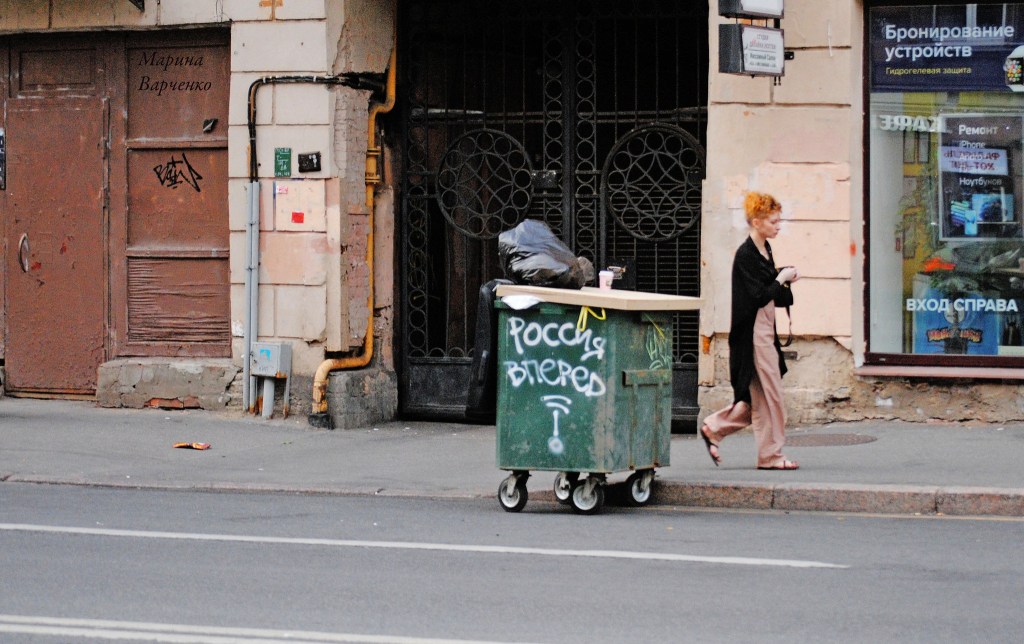
This image has an empty alt attribute; its file name is 360096182_6574069839310211_6569062695868766924_n.jpg

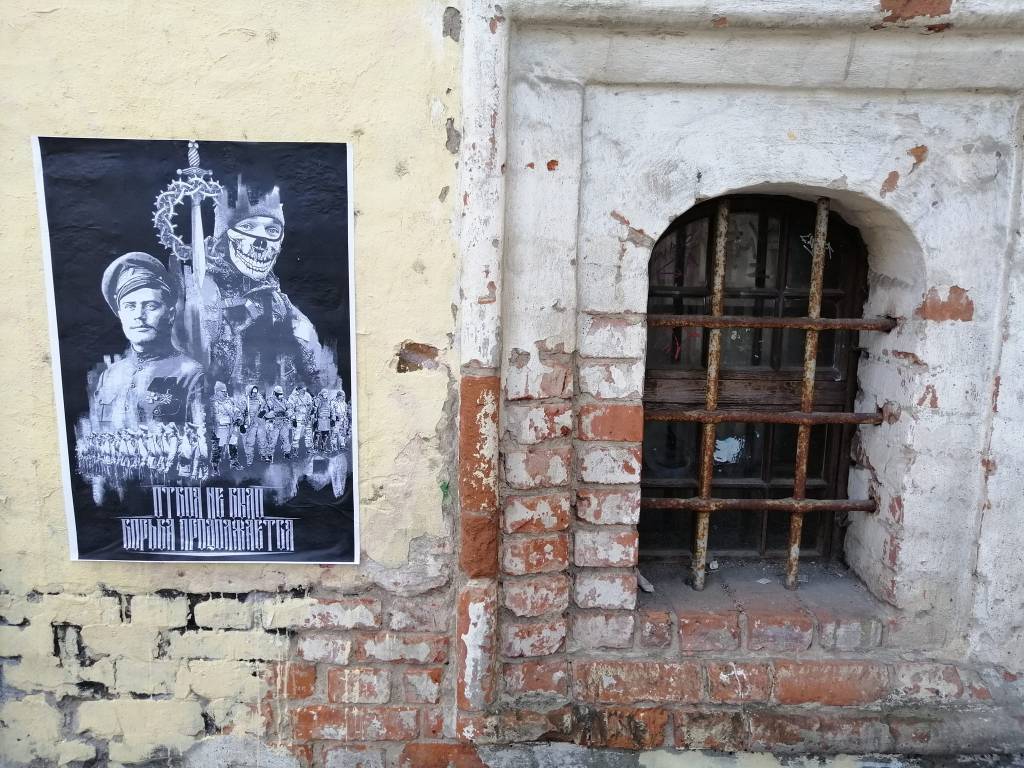
“Russia, forward!”

Source: Marina Varchenko (Facebook), 14 July 2023. She writes: “In our hood) Petersburg, Razyezzhaya Street.


The Arkhangelsk Region has allocated 800 million rubles to the occupied Ukrainian city of Melitopol, which will be used to repair the city, which has suffered from Russia’s invasion. However, the region itself does not have enough money to repair its own housing. Arkhangelsk is considered the capital of the Russian North, but has been informally dubbed the “capital of dilapidated housing.” Many people live in substandard housing: the city is chockablock with barracks and crumbling wooden houses. Watch Valeria Ratnikova’s report on how the region copes with a budget deficit while its money is spent on the war.

00:00 Opening 02:15 Ruins, barracks, and crumbling houses 06:00 Brevennik Island: expensive prices and derelict housing 10:56 Natalia Zubarevich about the lack of money in the region 12:04 The campaign against waste haulage to the region 16:18 The authorities are taking revenge on opposition activists opposed to landfills 31:35 Denunciations and criminal cases for statements about the war 33:22 One of the protesters went to the war 36:15 What residents say about the war 38:26 Getting fired for criticizing the war 39:40 A female student fled to Lithuania — the authorities wanted to jail her for talking about the war 46:25 The region’s environmental problems 49:10 Journalists detained during Putin’s visit 51:11 How the war has affected life in the region

Source: “The ruins of Arkhangelsk: how people whose money was given to occupied city live,” TV Rain (YouTube), 16 July 2023. Annotation translated by the Russian Reader

Money Talks

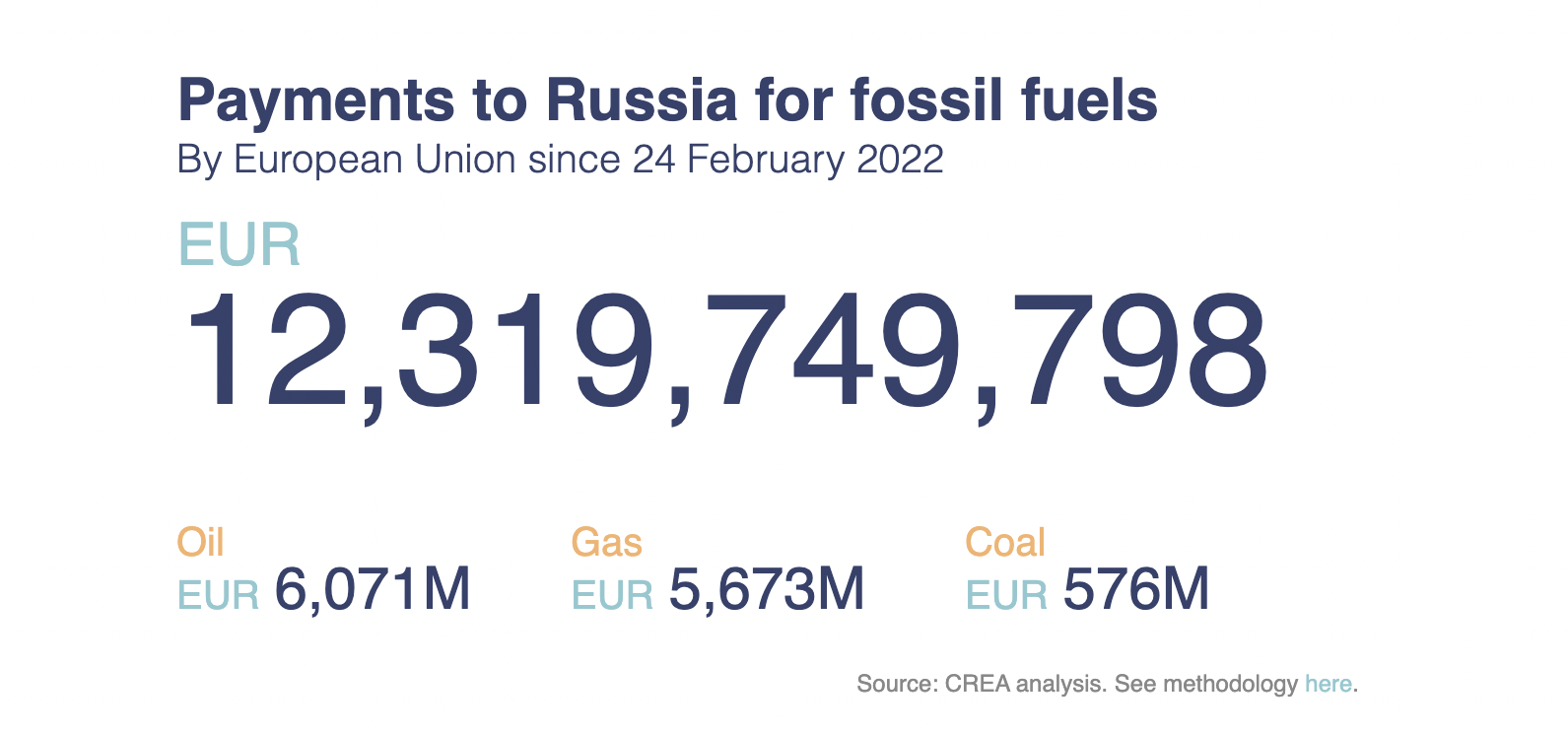
Screenshot of the Russian Fossil Fuels Tracker made at 6:14 a.m. GMT on 15 March 2022


Statement on the Invasion of Ukraine

Members of the Europe Beyond Coal campaign stand in solidarity with the Ukrainian people, and condemn Vladimir Putin’s unconscionable war.

This attack by the Russian leadership is leading to a devastating loss of lives, and a humanitarian and refugee crisis in Ukraine. The Russian government is threatening peace and safety for all Europeans and beyond, and has proven that it fundamentally stands in opposition to everyone who values peace, civil cooperation, and social democratic ideals. Its actions must be firmly, resolutely, and permanently rejected.

The fingerprints of coal, gas, and oil are all over this invasion. We are literally funding the war through our continued burning of fossil fuels imported from Russia. It is therefore the moral duty of European political and business leaders to make every effort to urgently end Russian, and all fossil fuel dependence in our economies. Transitioning our energy systems to be more efficient and based completely on renewable sources is an overriding priority.

With the IPCC’s dire update of climate science coming the same week, there can be no more half measures. This is the moment for brave decisions on energy. We can allow no more citizens to be shelled because of fossil fuels, nor any person to face a dangerous and uncertain future due to inadequate action on climate change.

Renewable power and energy savings promote peace. Sanctions and severing ties to the Kremlin’s fossil-fuel economy, coupled with emergency plans to mobilise extraordinary budgets and policy measures to rapidly insulate, heat, repower, and further interconnect EU member states, as well as neighbouring European countries, will help Ukraine by cutting money flows to Putin’s regime, while building energy security and resiliency for all European citizens – including Ukraine.

Every heat pump, every lowered highway speed limit, every new LED street lamp and insulated house, every solar panel and wind turbine, every bicycle ride replacing a trip with a car, every reduced train fare protects citizens from high energy costs and gas shocks in the near term, while promoting peace for Europe and globally.

Europe is united against Russian government aggression – as are many Russian citizens. The best way for us all to stop empowering warmongers like Putin is to work together to end fossil fuel use completely.

Source: Europe Beyond Coal. Thanks to Activatica for the heads-up. ||| TRR

Solving Problems

Grigorii Golosov
Facebook
October 14, 2021

Yesterday, President Putin, driven mainly by the curiosity of journalists, publicly tried to solve problems. There are a lot of problems, he noted: they are literally “raining down.” He named only two: the decline in incomes among the population and the population’s rapid decline (the “demographic” problem). He promised to solve the first one non-linearly, i.e., not by growing incomes per se, but through economic growth. As you know, the Russian economy grows rarely and slowly, but when it does grow (which has happened over the past ten years), then for some reason this has no effect on the incomes of the population. However, it depends on whom we understand by “the population.” There is definitely a population of several thousand people constantly getting richer, although this population is more often outside of Russia than inside it. Putin did not elucidate his methods for solving the second problem, but he is certain that they will also be nonlinear. There are no other problems in Russia, however. There is no problem with political prisoners: they are all criminals. I would probably doubt that. But I totally agree with Putin that there is no problem with democracy in Russia. If there is no democracy, there is no problem with it. Verily, “if you don’t have an aunt, then you won’t lose her.”

Translated by the Russian Reader

President Vladimir Putin said Wednesday that Russia — one of the world’s biggest producers of oil and gas — is aiming for carbon neutrality by 2060.

“Russia in practice will strive for carbon neutrality of its economy,” he said at an energy forum in Moscow.

“And we set a benchmark for this — no later than 2060.”

Source: AFP/Moscow Times

Russia’s natural population underwent its largest peacetime decline in recorded history over the last 12 months, an analysis of official government statistics has shown.

Russia’s natural population — a figure which counts registered deaths and births, excluding the effects of migration — declined by 997,000 between October 2020 and September 2021, demographer Alexei Raksha calculated.

The stark drop comes as Russia, which has one of the world’s highest Covid-19 death tolls, continues to see record numbers of lives lost to the pandemic. The country has recorded at least 660,000 excess deaths since the start of the pandemic.

Russia’s total population of around 145 million is lower than it was when President Vladimir Putin came to power in 2000 despite Moscow’s annexation of Crimea in 2014 which added 2 million to Russia’s official population statistics.

Source: Moscow Times

Only 12 World Leaders Greet Putin on His 69th Birthday. In another sign of Putin’s isolation, only 12 world leaders sent him greetings on his birthday this year. None at all came from the US or from EU countries (business-gazeta.ru/article/524870).

Source: Window on Eurasia (Paul Goble)

Burning Too

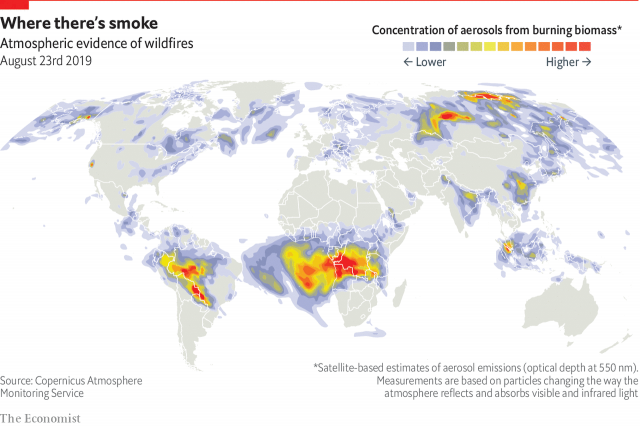
20190824_WOM905.png

Take a long hard look at this map, especially the upper right-hand corner, and then tell me why Brazilian President Jair Bolsonaro deserves a dressing-down from leaders of some of the world’s most powerful countries, while Russian President Vladimir Putin, guilty of the exact same indifference towards the forest wildfires raging over what, as the map suggests, is a much larger area in Siberia and the Russian Far East, has been criticized only by Greenpeace Russia and rank-and-file Russians living in the line of the fires and the enormous smoke clouds generated by them.

What has Putin ever done to deserve this indulgence?

When you have puzzled that one out, try and explain how four [ahn-TEE-fuh] musicians from Washington, DC, wrote the anthem for the summer of 2019 way back in 1989, that is, exactly thirty years ago, when many of today’s hottest climate changers were not even a gleam in their parents’ eyes.

Anytime but now
Anywhere but here
Anyone but me
I’ve got to think about my own life

Anytime but now
Anywhere but here
Anyone but me
I’ve got to think about my own life

We are consumed by society
We are obsessed with variety
We are all filled that anxiety
World would not survive

We gotta put it out, put it out, we gotta put it out
The sky is burning
We gotta put it out, we gotta put it out, put it out
The water’s burning
We gotta put it out, put it out, put it out
The earth is burning

Outrage
But then they say…

Anytime but now
Anywhere but here
Anyone but me
I’ve got to think about my own life

Anytime but now
Anywhere but here
Anyone but me
I’ve got to think about my own life

The world is not our facility
We have a responsibility
To use our abilities
To keep this place alive

We gotta put it out, put it out, put it out
The sky is burning
We gotta put it out, we gotta put it out, put it out
The water’s burning
We gotta put it out, put it out, we gotta put it out
The earth is burning

Right here
Right now
Do it
Do it
Now
Do it
Now
Do it
Now
Do it

Lyrics courtesy of Genius.com

Greenpeace Russia: Siberian Wildfires Are Planetary Disaster

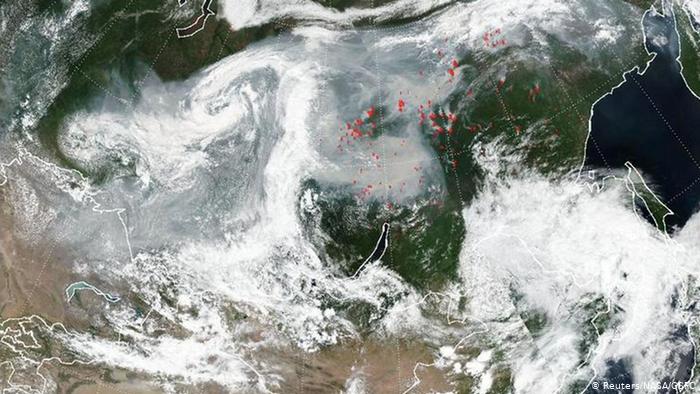
49754589_303A satellite view of the forest fires in Siberia, July 21, 2019. Courtesy of Deutsche Welle
Wildfires in Siberia becoming a planetary-scale disaster
Gismeteo
July 29, 2019

Grigory Kuksin, the head of Greenpeace Russia’s firefighting project, called wildfires in Siberia and the Far East a planetary-scale disaster.

Smoke from fires usually moves east or north, but this time it is moving west. Thus, the smoke has engulfed Siberian cities and has reached the Urals. The smell of burning is reported in the Volga Region and Tatarstan.

The wind that changed its direction is expected to bring the smoke to Kamchatka. It may even reach other continents across the ocean, which means it will become a planetary-scale disaster.

Kuksin believes that the smoke will continue to affect the region for a few more weeks. Heavy rain is needed to extinguish such a large fire, but no precipitation is expected.

The expert believes it necessary to reconsider the area of control and implement special measures to avoid similar situations in the future.

_________________________________________________________

Why There Are So Many Forest Fires in Russia
The scale and aftermath of the disasters are exacerbated by the consumerist mindset of authorities and the lack of resources in a weak economy
Vladimir Ruvinsky
Vedomosti
July 29, 2019

Dense smoke from forest fires has covered cities in Siberia, the Urals, and the Volga region. The fires could have been dealt with at an early stage, but regional authorities avoid fighting fires when they can avoid it due to a lack of money and means.

According to Greenpeace Russia, the fires have encompassed over three million hectares of forest, an area comparable in size to Belgium. The total for the spring and summer of 2019 is eleven million hectares, an area larger than Portugal. During this century, 2003 and 2012 saw worse fire seasons, but Grigory Kuksin of Greenpeace Russia says the records set during those years will probably be beaten this week. Usually, the smoke from the fires drifts towards the sparsely populated east and north. This year, however, the fires have attracted more attention since the smoke has drifted westwards, towards Novosibirsk, Yekaterinburg, Chelyabinsk, and Kazan.

The current fires are largely a consequence of decision-making by Russian authorities. More than 90% are the burning fires are located in so-called monitoring zones, areas where regional authorities may not fight fires if the expenditures on extinguishing exceed the damage they cause. This regulation was adopted in 2015 when Russian federal authorities basically legalized what had been an implicit rule during Soviet times. But the Soviet authorities had, in fact, fought fires in remote areas. Nowadays, regional governors are not officially obliged to fight them. They take advantage of this, especially because they lack money and equipment.

While Russia has lots of woodlands, its economy is too week to fight all forest fires. Kuksin argues that the gigantic monitoring zones could be decreased while increasing prevention measures and using available resources to better effect. Most fires are caused by people: they are mainly sparked when loggers burn residue wood in logging areas.  Such fires could definitely be put out immediately, but local authorities have made a practice of refusing to fight them. They are the major cause of the biggest fires, which have turned into insoluble problems that only the rains can solve.

The way the authorities see things, the anticipated costs of putting out fires in the monitoring zones are always higher than the damage caused by them. The damage caused by forest fires is primarily calculated in terms of the minimum price of timber. This cost can be written off (and if not, there is no damage), i.e., forest fires often cost almost nothing in terms of official damages. However, as Konstantin Kobyakov, an environmentalist at WWF Russia, points outs, Russia loses three times more forest in fires annually (three million hectares) than the forest industry removes (one million hectares), meaning the country already faces a deficit of woodlands that will only keep growing.

Kuksin recalls that gas and oil industry infrastructure, such as pipelines, is located in the monitoring zones, and uncontrolled blazes are approaching hundreds of villages and small towns. Damage assessment does not account for air and water pollution or the real harm caused to people’s health by acrid smoke, which is harder to calculate but does considerably increase mortality. In addition, stable high-pressure systems have formed over the gigantic fire zone in Siberia, triggering abnormally heavy rains along the perimeter. The fires generate a lot of greenhouse gases and soot, which accelerates the melting of arctic ice and climate change, meaning they increase the risk of more fires in the future.

Translated by the Russian Reader

“I Felt Like Going Up to Him and Spitting in His Face”

“I Felt Like Going Up to Him and Spitting in His Face”
Yevgeny Karasyuk
Republic
July 2, 2019

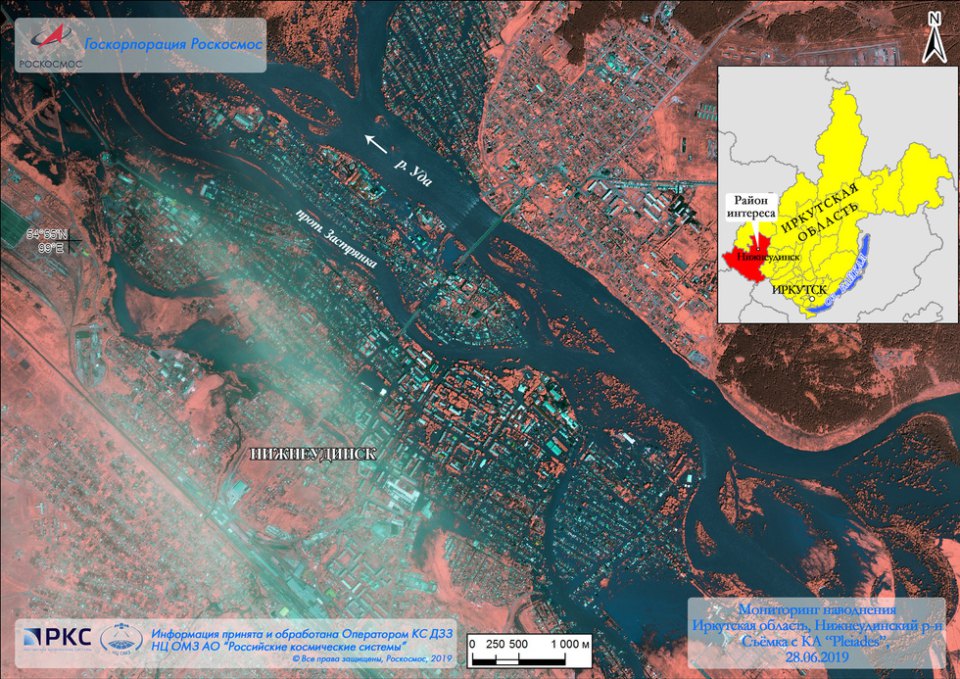
Torrential rains began falling in the western part of the Irkutsk Region early last week. When they were over, there was no doubt the bad weather had caused local rivers to rise, producing a major flood involving human casualties and large-scale damage.

The flood, which affected over ninety towns and destroyed at least a thousand homes, has been declared the most powerful in the region in the one hundred some years since the weather there has been systematically observed and recorded.

The flood put a crimp in President Putin’s schedule, probably even as he was attending the G20 summit in Japan, which wrapped up on Saturday.

He visited the flooded region the same day, but he had no intention of staying there for long. He never left the airport in Bratsk, a city that had also suffered from the flood, but which had not been inundated as disastrously as other cities and towns.

Putin’s visit to Bratsk on his way home to Moscow from Osaka was a logistical opportunity he could not pass up, of course. The Russian regime’s personification has long ago reached the point the populace regards the president as morally responsible for any high-profile disaster anywhere in the country.

Going where disaster has struck is thus a matter of political instinct. The president last showed his trust in it only six months ago in Magnitogorsk. The critics can accuse Putin of arriving at the sites of tragedies after they are over and visiting fake patients with arms demonstratively in slings, but he knows what he is doing.

He still finds the strength to board a plane so that, a few hours later, he can appear, stern-faced, before the cameras and issue orders at emergency meetings of local and federal officials. This is exactly what the president did late at night in Bratsk.

The speed with which Putin arrives at the epicenter of events, like the amount of time he spends there, matches the alacrity with which Russia’s press reports the news.

“Putin instructed the head of the Emergencies Ministry to fly immediately to Kemerovo.”

“Putin was informed about the tragedy in Magnitogorsk immediately.”

“Putin demanded that immediately, as of today, compensation be paid to the victims [i.e., the residents of the affected districts in the Irkutsk Region] and that an action plan for rebuilding housing and doing it as quickly as possible be outlined without delay.”

All the fuss testifies not to the might of the so-called power vertical Putin has fashioned but, on the contrary, to its weakness. It produces nothing remotely resembling independence, flexibility, and responsibility on the part of local authorities, especially when it comes to the safety of ordinary Russians. Putin continues to run our vast country manually, but the outcome of his administration is quite deplorable, as we can see.

irkutsk.jpegA satellite image, provided by Roskosmos, shows the parts of the Irkutsk Region affected by the flooding. Courtesy of Republic

It does not matter a whit where and when the president arrives, and how long he stays there because it happens after the fact. Russian authorities usually do nothing at the most crucial moments. In a country run by the security services [siloviki], a country where there are more experts in security than anywhere else, a country with a whole emergencies ministry, it can easily happen that you would not be warned of impending disaster.

According to the Emergencies Ministry, four out of ten Russians are still not covered by the early warning system. Its absence goes a long way toward explaining the disaster in Krymsk in July 2012 in which entire houses and their sleeping owners were swept away by flood waters in the middle of the night. While Moscow was fiddling around with modernization and digitalization, towns in Krasnodar Territory did not have radio transmitters at their disposal to sound warning signals and inform residents of the approaching flood.

Seven years have passed since the disaster in Krymsk, and what happened there has happened again in Eastern Siberia. Residents of the town of Tulun, in the Irkutsk Region, have claimed they were not warned about the impending flood, and so they did not have time to gather their belongings and flee their homes. Local officials, however, assured Putin everyone had been warned.

“I watched our mayor giving his report to Putin and I felt like going up to him and spitting in his face,” a local woman who could not contain her emotions told journalists.

Officials now say they knew nothing. Irkutsk Region Governor Sergei Levchenko said regional authorities were not informed of the dangerous rise in the levels of water in local rivers, while the Emergencies Ministry has claimed the opposite.

Officials argue nature is capable of catching anyone by surprise, including the Russian state. At Irkutsk State University, scientists said global climate change had caused the flooding. Arctic and subtropical air masses had mixed with humid air from the Pacific Ocean, something quite rare for the region, to produce the atmospheric anomaly that led to the disaster.

In fact, all that is required in such circumstances is that officials pretend they sympathize with the populace in its plight and are ready to help. But the authorities, disinclined by habit from bowing to public pressure, could not make such a sacrifice.

“What do you want me to say? Do you want me to complain? I can complain to you, too,” Alexander Uss, head of Krasnoyarsk Territory, retorted to local residents upset by their governor’s passivity.

Krasnoyarsk Territory was next in the flood’s path after the Irkutsk Region, but the floodwaters have begun to subside.

You can relax. Putin will not be paying you a visit.

Translated by the Russian Reader

Neapolitan Ice Cream in the Cradle of Three Revolutions

neapolitan-1Neapolitan ice cream à la russe. Photo by the Russian Reader

Not that I had been looking very hard these past twenty-four years, but yesterday I found one of my favorite childhood desserts in the frozen foods section of the cornershop on my street: Neapolitan ice cream.

It was called trio plombir in Russian (plombir is just mock-fancy Russian, appropriated from the French, for rich ice cream, ordinarily referred to as morozhenое), but that hardly mattered, because it was Neapolitan ice cream in every way that mattered.

neapolitan-2What could be better on a warm October evening than a large slab of trio plombir? Photo by the Russian Reader
And why am I still eating ice cream in mid October, you ask? Because the high temperature in Petersburg the day before yesterday was nineteen degrees Centigrade.

Please don’t be envious of me, though, faithful readers. From here on out it is all downhill. The forecast high temperature for the next to last three days in October is minus one degree Centigrade. I will probably have forgotten all about Russian Neapolitan ice cream by then. {TRR}


A Certifiable Genius

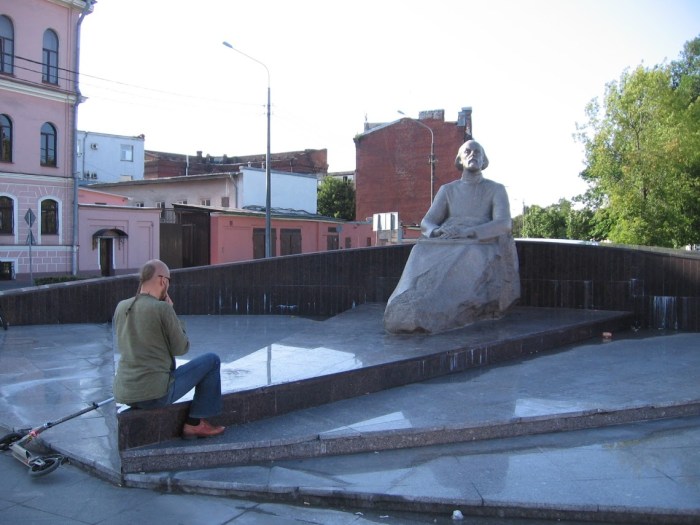
Monument to Konstantin Tsiolkovsky, Petersburg, July 18, 2015

The pioneering Russian rocket scientist Konstantin Tsiolkovsky was, undoubtedly, a certifiable genius.

The amount of carbon dioxide in the atmosphere is quite small (0.03%), which does not facilitate crop yields. Its quantity could be increased 30 times (to one percent) with great benefit to plants and no harm whatsoever to man. The gas is not poisonous, and an abundance of it in the atmosphere would only hinder its secretion from the lungs. One percent would cause almost no hindrance, even if we are talking about human lungs.
—Konstantin Tsiolkovsky, “The Future of the Earth and Mankind” (Kaluga, 1928)

Photo and translation by the Russian Reader

Leave the Capital!

Emergency Situations Ministry Recommends Residents Leave Yekaterinburg, Advises Those Who Stay Not to Leave the Apartment and Gargle
URA.Ru
July 23, 2016

Smog has enveloped Yekaterinburg. Photo: Vladimir Zhabrikov © URA.Ru

The Emergency Situations Ministry (EMERCOM) office for Sverdlovsk Region has made a special appeal to the region’s residents, which it has posted on the agency’s official website.

As our own correspondent reports, the rescue service has warned that adverse weather conditions of the first level of hazardousness have settled over the region until 8 p.m., June 26. During this time, calm weather and high temperatures will facilitate the formation of smog in the air.

Mayors have been advised to closely monitor industrial emissions, and motorists, to abandon the use of private vehicles and switch to public transport. Monitoring of unauthorized waste incineration has been increased.

To date, the rescue service has not recorded levels above the maximum allowable concentration of pollutants in the air. Nevertheless, they have asked the public to take the following precautions.

The public has been advised to leave the city during this time. (The message does not indicate which city. Apparently, Yekaterinburg is meant.) If this is impossible, then people are advised to go outside as little as possible and keep doors and windows closed, and when leaving the house, people should put on a dampened cotton-gauze bandage. After being outside, it is advised to take a shower and change one’s clothes or thoroughly wash up and rinse one’s throat.

As URA.ru has previously reported, a dense smog, due, allegedly, to forest fires in Siberia, has enveloped Yekaterinburg the last several days.

NB. Yekaterinburg, Russia’s fourth largest city, has an estimated population of one and a half million people. TRR

Translated by the Russian Reader. Thanks to Comrade AK for the heads-up. See “Greenpeace Russia: The Far East and Siberia Are Burning,” Russian Reader, May 25, 2016.

_________