Relentless Repression in Russia: Why Londoners Are Demonstrating on January 19

Relentless repression in Russia: why we will demonstrate on Saturday 19 January
People and Nature
14 January 2019

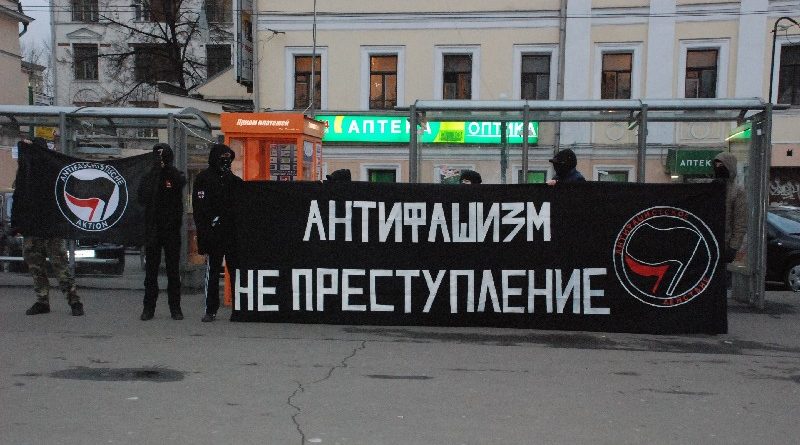
On Saturday, January 19, we will demonstrate in London in solidarity with Russian antifascists. Eleven of them, who have been arrested, tortured, and accused of fabricated “terrorism” charges, are awaiting trial. Many others have faced a relentless campaign of persecution by officers of the Federal Security Service (FSB) and the police, as summarized in the following article.

Please join us on Saturday to support the Russian antifascists and strengthen international solidarity against fascism, xenophobia, and state terror. Please repost and share this article.

Details of our London event here.

2018 summary

By Misha Shubin, 31 December 2018 (Original Russian text here)

I’ve also decided to sum up the year. Not my own year, but rather to remember what happened to anarchists and leftists in Russia in 2018. This post will be long, and many of you know  or heard something about the events I recount here.

But I think it is very important not to forget all this. [Note. Links from the original article to Russian-language sources are included. Links to English translations or relevant articles in English added where available. Translator.]

The Network Case

Eleven anarchists and antifascists have been arrested. They are accused of setting up a terrorist group and planning terrorist attacks. According to the Federal Security Service (FSB), they wanted to organise an armed uprising in Russia.

Almost all the evidence has been gathered on pain of torture. The detainees were beaten up. Some of them were tortured using shocks from a stationary electric dynamo, others with tasers. At least one of the accused, Dmitry Pchelintsev, was hung upside down.

The accused are Yegor Zorin, Ilya Shakursky, Vasily Kuksov, Dmitry Pchelintsev, Arman Sagynbayev, Andrei Chernov, Viktor Filinkov, Igor Shishkin, Yuli Boyarshinov, Mikhail Kulkov, and Maksim Ivankin.

What to read:

“How the FSB is manufacturing a terrorist case against antifascists in Russia”

What else you need to know about this case:

“A witness in the ‘network’ case, Ilya Kapustin, was tortured with a hand-held electric shocker.” Subsequently, he left for Finland, where he has applied for political asylum.

Viktoria Frolova, Ilya Shakursky’s girlfriend, was detained on Russia’s border with Ukraine. (Link in Russian.) Shakursky was threatened that “it would be bad” for his girlfriend if he did not make a confession.

The case of anarchist Yevgeny Karakashev

In early February 2018, anarchist Yevgeny Karakashev was arrested in Crimea [the peninsula annexed by Russia from Ukraine in 2014]. They brought him to the police station with a bag over his head. There were fresh bruises on his temples and his knees. On the basis of

two videos that he had uploaded to various chat forums, he was accused of making public calls for terrorist activity.

What to read:

“A rifle stock to the heart, a fist to the gut: how left-wing activists are persecuted in Crimea”

(And more in Russian.) [And a report of Karakashev’s subsequent court appearance is here.]

What else you need to know about this case:

The main prosecution witness is a former comrade of Karakashev’s.

In the autumn, 16 people from various Russian regions were summoned to the Russian Investigative Committee for interrogations. Many of them have expressed left-wing views. Some of them did not even know Karakashev.

Torture of anarchists in Chelyabinsk

Anarchists in Chelyabinsk staged an event on the night of 14–15 February in solidarity with the Network Case defendants. They displayed a banner outside the FSB headquarters and threw a flare over a fence. The banner read, “The FSB is the chief terrorist.”

Three days later, five people were arrested: Dmitry Semenov, Dmitry Tsibukovsky, Anastasia Safonova, Maksim Anfalov, and their friend Maksim. Tsibukovsky and Anfalov were beaten up and tortured with electric shockers.

Over the summer, the criminal case against theChelyabinsk anarchists was dropped.

What to read:

“The main thing at that moment, in that situation, was to come out alive”

What else you need to know about this case:

In November, a new criminal case was opened against anarchists Tsibukovsky, Safonova, Grigory Potanin, Mikhail Perkov, and Dmitry Dubovoi. This time, they were charged with vandalism during their protest of the government’s pension reform.

The broken window in United Russia’s office and torture of Svyatoslav Rechkalov

On 31 January, persons unknown broke a window at the office of United Russia [the largest party in the Russian parliament, which supports President Putin] and threw a smoke bomb. A criminal investigation into vandalism was launched. Sixteen days later, Yelena Gorban and Aleksei Kobaidze were arrested. After questioning, they were released on their own recognizance.

On 14 March, searches were conducted of the homes of anarchists from the People’s Self-

Defence organisation in connection with the case. Subsequently, Svyatoslav Rechkalov and Andrei were detained; the latter, most likely, was released.

Rechkalov was driven around the city for several hours, blindfolded. Then security services officers beat him and tortured him with electric shocks. They warned that, if he did not make the necessary confession, he would end up a defendant in the Network Case. After being tortured, Rechkalov was released. He emigrated to France.

What to read:

“The horror continues”, and “They put a bag on my head, cuffed my hands behind my back and tortured me with a taser”.

What else you need to know about this case:

In November, Rechkalov started getting threats from the FSB. (Link in Russian.)

Torture of Left Bloc activist Maksim Shulgin

In late April, Left Bloc activist Maksim Shulgin was detained in Tomsk. On the way to his interrogation, security service officers beat him up in their vehicle and held his face against a heater. To protect his face from burns, Shulgin put his arms against the heater

and received first- and second-degree burns. Shulgin was accused of inciting hatred towards the police after posting songs on VK [a Russian social network similar to Facebook].

Shulgin filed a complaint about his having been tortured. In late December, he was again detained. This time, law enforcers tried to choke him to force him to withdraw the accusations he had made against FSB officers.

What to read:

Arrest in April. “Is Maxim Shulgin An Extremist?” and “Tomsk resident tortured for posting songs about police on VK.”

Torture in December. (Link in Russian.)

What else you need to know about this case:

Another nine Left Bloc activists were detained with Shulgin. They were forced to make confessions under threat of torture. (Link in Russian.)

Explosion in Arkhangelsk, interrogation of anarchists and leftist activists, and torture of Vyacheslav Lukichev

On 31 October there was an explosion at the FSB headquarters in Arkhangelsk, set off by Mikhail Zhlobitsky [who died at the scene]. As a result, all over Russia the police detained and brought anarchists, left-wingers, and those who hold alternative political views in for so-called discussions. (Link in Russian.)

In early November, anarchist Vyacheslav Lukichev was arrested in Kaliningrad. He was accused of vindicating the explosion set off by Zhlobitsky. It was later established that after Lukichev’s arrest he was beaten by six people. He was questioned for 36 hours.

What to read:

“Vyacheslav Lukichev: interrogated for 36 hours and beaten”

What else you need to know about this case:

After the explosion, a 14-year old who, allegedly, had contact with Zhlobitsky was detained in Moscow on suspicion of planning bombings. (Link in Russian.)

What else happened this year?

■ In March, the police checked the documents of participants in a football tournament organised by antifascists. (Link in Russian.)

■ In July, police and FSB officers went to the Pryamukhino Readings [an event held annually to discuss the ideas and legacy of Mikhail Bakunin, at his birthplace in Tver Region]. The conference theme was “Revolution and Culture”. The security service officers checked participants’ passports, and then detained Artem Markin, an anarchist from Belarus. He was detained for three days for allegedly using psychotropic substances. See: “A Funny Thing Happened in Pryamukhino”.

■ In August, officers from Centre “E” [Center for Combating Extremism] turned up at the Icebreaker [Ledokol] punk festival. They arrested two people, tried to persuade them to turn informer, and asked about the People’s Self-Defence group. (Link in Russian.)

■ In October, anarchist Ilya Romanov was sentenced to five-and-a-half years on charges of incitement to terrorism. He allegedly published on Facebook a video recording of jihadists and an occult ritual featuring a puppet named Vladimir. All the indications are that the criminal case was a frame-up. See: “Meet Russian anarchist Ilya Romanov. He’s spent nearly twenty years in prison”.

■ In late December, the anarchist Aleksandr Kolchenko [from Crimea, who since 2015 has been serving a ten-year sentence in Russia on trumped-up charges] was transferred, on a formal pretext, to a punitive isolation cell, where he saw in the new year. (Link in Russian.)

Moloko plus siloviki

[Moloko is Russian for “milk”. Siloviki is a widely used term for the heads and officers of Russia’s numerous, overlapping security services, including the FSB, Centre “E”, the Russian National Guard, and the Russian Investigative Committee.]

In mid June, there was a gathering in Krasnodar of members of the collective that publishes the countercultural almanac moloko plus. Sofiko Arifdzhanova and Pavel Nikulin had planned to present the latest issue of the almanac, on the topic of revolution. On the day before the event, the police arrested Sofiko and a volunteer [who helped with printing], Anastasia Kkhukhurenko. The police would not release them and demanded a meeting with Pavel. They then forced Sofiko and Anastasia to sign an undertaking not to organise unauthorised mass gatherings and warned them about the punishments for extremist activity before releasing them

The next day, persons unknown attacked Sofiko and Pavel with pepper spray. A few hours later, at the presentation, the police arrived and confiscated almanac’s print run.

In September, there was another presentation, in Petersburg, and FSB officers turned up. In this case, everything turned out relatively peacefully. They just got up and left.

After another two weeks, there was a presentation here in Nizhny Novgorod. A few minutes after it began, officers from Centre “E” burst in, with armed back-up. Sofiko, Pavel, and I were arrested and taken to the police station. Ninety copies of the almanac were confiscated, along with some gas cylinders [sic]. Pavel was detained for two days on charges of insubordination to a police officer. The issue of moloko plus is now being checked for any indications of extremism. There is a big text about our adventures in Russian here.

I am sure I have forgotten something and so not included it. Generally speaking, that was the sort of year we had.

More on defending Russian political prisoners:

 The Rupression site

 “Convoyed”, on The Russian Reader

Thanks to People and Nature for their generous permission to republish this important article and solidarity appeal here. I have lightly edited the original text to make it hew more closely to this website’s imaginary style guide. {TRR}
Network Case Suspects Go on Hunger Strike

Network Case Suspects Go on Hunger Strike
OVD Info
December 2, 2018

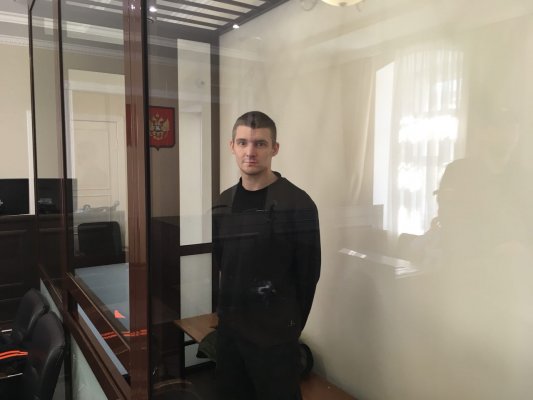
andrei chernovAndrei Chernov in court. Photo courtesy of Mediazona and OVD Info
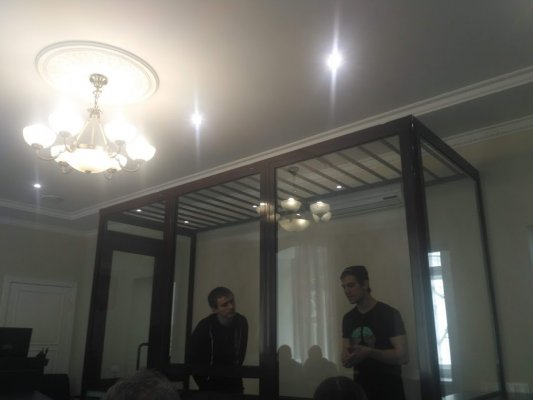
Dmitry Pchelintsev and Andrei Chernov, residents of Penza and suspects in the so-called Network case, have gone on hunger strike, claiming remand prison officials and FSB officers have intimidated them during their review of their criminal case file, something to which they are entitled by Russian law. Several Penza suspects in the case have claimed they have been put in solitary confinement, handcuffed to radiators, and threatened with violance.

Pchelintsev and Chernov went on hunger strike on November 29, as reported by the Parents Network, a support group established by the mothers and fathers of the young men, who have been accused of involvement in a “terrorist community” that, allegedly, was planning an armed uprising during the March 2018 presidential election and 2018 FIFA World Cup, held in Russia this past summer.

It was on November 29 that wardens put Pchelintsev in solitary, demanding he admit to breaking the rules by talking with other inmates during yard time. He responded by going on hunger strike, and Chernov joined him as a token of support and solidarity. On November 30, wardens again tried to bargain with Pchelintsev and threaten him.

The Parents Network notes that the pressure on their sons has increased now that the suspects are officially reviewing the case file.

Lawyer Anatoly Vakhterov told the group that Network case suspect Ilya Shakursky had been been visited by Penza Remand Prison Warden Oleg Iskhanov, who asked him how quickly he was reviewing the file. On November 20, immediately after the incident, Shakursky was reprimanded for greeting other inmates during yard time. The alleged violation was written up, and the same day Shakursky was issued a special uniform for his upcoming stint in solitary confinement. He managed to avoid going there by filing a complaint with Penza Regional Prosecutor Natalya Kantserova.

Earlier, Maxim Ivankin spent five days in solitary. This was proceeded by a visit from Warden Iskhanov, who likewise asked Ivankin how quickly he was reviewing the case file.

As the defense lawyers explained to the Parents Network, the suspects had been reviewing the case file not only at the remand prison but also at the local FSB office. Under Russian law, suspects may review case files for up to eight hours a day. Allegedly, the Network suspects were handcuffed to radiators and stairway railings the entire time. Vasily Kuksov and Arman Sagynbayev were handcuffed to each other. As the Parents Network has noted, the suspects not only experienced physical discomfort but were also unable to examine the case file freely and take notes.

Shakursky and Pchelintsev refused to go through the procedure in such conditions. In turn, they were threatened with violence. According to them, the man who threatened them was a certain A. Pyatachkov, who had been involved in torturing them when they were initially detained in the autumn of 2017.

Mikhail Kulkov said that after handcuffing him to the staircase, FSB officers videotaped him. As they filmed him, they said, “Look at Network terrorists reviewing the case file.”

The suspects requested their lawyers be present during the review. Consequently, the authorities stopped taking them to the FSB office. Currently, all case file materials are brought directly to the remand prison.

kuksov and pchelintsevVasily Kuksov and Dmitry Pchelintsev in court. Photo courtesy of Rupression and OVD Info

“Obviously, all these measures are methods of mental and physical violence,” argues Vakterov. “There are signs that the group of FSB investigators, led by Senior Investigator Valery Tokarev, have been putting pressure on the suspects. Why? To speed up the review process and make it impossible to verify the complaints of torture made by the suspects. They want to intimidate the lads, who are fighting back any way they can under the circumstances.”

These events have spurred the Parents Network to issue a communique, which we publish here in an abridged version.

We, the parents of the suspects in the Penza Case, bear witness to the numerous violations suffered by our children during their review of the case file.

To avoid allowing the time necessary to investigate the claims made by our sons that they were tortured by FSB officers, the group of investigators, led by Valery Tokarev, has done everything possible to speed up the process of reviewing the Network case file. To this end, the investigators have engaged in daily acts of emotional and physical violence against the suspects, to wit:

  1. Our sons have been prevented from reviewing the case file with their lawyers present. When they have attempted to refuse lawfully to review the case file, they have been subjected to physical preventive measures: they have been handcuffed to whatever metal structures came to hand and handcuffed to each other. During the review of the case file, at least one hand of each suspect has been handcuffed. These actions have prevented them from concentrating on reading the file and thoughtfully preparing to defend their rights in court. This testifies to the fact that investigators have doubts about the case, and so they would like to hand it over to the court as quickly as possible. 
  2. FSB field officers who were involved in torturing our sons have been among the people allowed to be present during the investigative case file review. They have been brought to the review to exert pressure on our children. The FSB officers in question have threatened them with physical violence if they refuse to continue with the case file review. The point of their actions is to speed up the review process, intimidate the suspects, and interfere with a potential investigation of the acts of torture they perpetrated. 
  3. Our demands that a lawyer be present during the proceedings and that the act of reviewing the case file not be hindered by handcuffing the hands of the suspects to tables, chairs, radiators, and stairways have led to our children being placed in solitary confinement, where they have once again been visited by FSB officers and investigators, who have tried to speed up the review process by threatening them. 

We speak constantly of incidents of torture. They say there is no smoke without fire. We are unfamiliar with the contents of the criminal investigative case file due to the nondisclosure agreement signed by all the defense lawyers. If our children have violated the law, they will answer to society to the full extent of the law. In the present circumstances, however, they are unable to answer to society. They answer to people who believe that physical violence, beatings, and electric shock torture can be legally used to make other people’s lives conform to the canons and stories that will get them new assignments and promotions.

It is impossible to defend the rights of our sons in the current circumstances. We cannot prove they were tortured. We have exhausted all the legal resources we have in Russia. But we, our sons, the Public Monitoring Commissions, reporters, civil rights activists, and politicians must and will go on fighting for the sake of one big goal: making the Russian legal and justice system more humane.

We call on Russian Federal Human Rights Ombusdman Tatyana Moskalkova, Mikhail Fedotov, chair of the Presidential Council for Civil Society and Human  Rights, and Yevgeny Myslovsky, a member of the council, to visit the Penza Case suspects. You are our last hope for help in combating torture in Russia. This joint task is our primary responsibility to society.

As we face the inevitability of double-digit sentences for our sons, we hope that all of us will have someone whose example will inspire us. It will be not the people who tortured our sons. Then none of this would make any sense at all.

The lawyers of the Penza suspects in the Network case say their clients have reached out to Tatyana Moskalkova and Mikhail Fedotov, asking them to visit and requesting their help in investigating the incidents of torture. Moskalkova and Fedotov have not yet replied to their appeals, although in November a member of the Presidential Council for Civil Society and Human Rights did visit the Petersburg suspects in the Network case.

[…]

Translated by the Russian Reader

***************

What can you do to support the Penza and Petersburg antifascists and anarchists tortured and imprisoned by the FSB?

  • Donate money to the Anarchist Black Cross via PayPal (abc-msk@riseup.net). Make sure to specify your donation is earmarked for “Rupression.”
  • Spread the word about the Network Case aka the Penza-Petersburg “terrorism” case. You can find more information about the case and in-depth articles translated into English on this website (see below), rupression.com, and openDemocracyRussia.
  • Organize solidarity events where you live to raise money and publicize the plight of the tortured Penza and Petersburg antifascists. Go to the website It’s Going Down to find printable posters and flyers you can download. You can also read more about the case there.
  • If you have the time and means to design, produce, and sell solidarity merchandise, please write to rupression@protonmail.com.
  • Write letters and postcards to the prisoners. Letters and postcards must be written in Russian or translated into Russian. You can find the addresses of the prisoners here.
  • Design a solidarity postcard that can be printed and used by others to send messages of support to the prisoners. Send your ideas to rupression@protonmail.com.
  • Write letters of support to the prisoners’ loved ones via rupression@protonmail.com.
  • Translate the articles and information at rupression.com and this website into languages other than Russian and English, and publish your translations on social media and your own websites and blogs.
  • If you know someone famous, ask them to record a solidarity video, write an op-ed piece for a mainstream newspaper or write letters to the prisoners.
  • If you know someone who is a print, internet, TV or radio journalist, encourage them to write an article or broadcast a report about the case. Write to rupression@protonmail.com or the email listed on this website, and we will be happy to arrange interviews and provide additional information.
  • It is extremely important this case break into the mainstream media both in Russia and abroad. Despite their apparent brashness, the FSB and their ilk do not like publicity. The more publicity the case receives, the safer our comrades will be in remand prison from violence at the hands of prison stooges and torture at the hands of the FSB, and the more likely the Russian authorities will be to drop the case altogether or release the defendants for time served if the case ever does go to trial.
  • Why? Because the case is a complete frame-up, based on testimony obtained under torture and mental duress. When the complaints filed by the accused reach the European Court of Human Rights in Strasbourg and are examined by actual judges, the Russian government will again be forced to pay heavy fines for its cruel mockery of justice.

***************

If you have not been following the Penza-Petersburg “terrorism” case and other recent cases involving frame-ups, torture, and violent intimidation by the Russian Federal Security Service (FSB) and other arms of the Russian police state, read and disseminate recent articles the Russian Reader has posted on these subjects.

How the FSB Tortures Detainees: Stories of the Victims

How the FSB Tortures: The St. Petersburg Public Monitoring Commission’s Report and the Stories of the Victims
Team 29
October 25, 2018

Torture victims and activists say violence has become a common practice in the security services. Anyone whosoever can become their victim: Muslims and atheists, anarchists and entrepreneurs, industrial climbers and police officers. The victims are afraid to talk about what happened to them, while family members, physicians, and eyewitnesses are threatened into staying silent. Members of the St. Petersburg Public Commission for Monitoring Conditions in Places of Detention (hereafter, PMC) have written a report on how the FSB tortures detainees and witnesses in FSB offices, remand prisons, vehicles, forests, and garages. We have excerpted the highlights of their report in what follows, as well as publishing a video (above) in which the victims and their relatives tell their own stories.

“Writhing from the Electrical Current, He Lifted the FSB Officer and Himself into the Air”
In December 2017, the FSB’s Saint Petersburg office announced it had prevented a terrorist attack on Our Lady of Kazan Cathedral, in downtown Petersburg. Seven people were detained on suspicion of involvement in planning the attack. Five of them were remanded in custody. What happened to the other two suspects is still not known.

One of the detainees, Aliskhan Esmurziyev, says his torture began in a minivan, in which FSB officers, their faces covered, kicked and tasered him. He was then taken to an FSB office, where he could hear the other detainees screaming. After he was interrogated by an investigator, he was taken to a separate room, where, according to Esmurziyev, he was handcuffed, a sack was pulled over his head, and crocodile clips were attached to his feet. Esmurziyev was electrocuted while an FSB officer sat astride him. His body writhing from the electrical current, Esmurziyev lifted the FSB officer and himself into the air.

Another detainee, Shamil Omargadzhiyev, was beaten in front of his pregnant wife. According to the PMC’s information, FSB officers broke into his home, which they searched while beating and kicking him, knocking out one of his teeth and demanding he confess to planning the terrorist attack. When he was delivered to court, he fainted several times. In the compartment of the paddy wagon in which he had been transported, it had been difficult for him to breath. Six feet five inches tall, Omargadzhiyev had had his hands tied back in a way that made it impossible for him to sit down and thus breathe.

Both detainees are accused of illegal possession of weapons (punishable under Article 222 of the Russian Federal Criminal Code). Esmurziyev filed a complaint with the Russian Investigative Committee about the crimes committed against him, but later rescinded the complaint for “procedural” reasons. Omargadzhiyev’s defense counsel also filed a complaint with the Investigative Committee, but it refused to open a criminal investigation while also not allowing him to see the written judgment that explained the reasons for the refusal.

“If I Didn’t Know the Answer, I Was Electrocuted”
Eleven young men in St. Petersburg and Penza were accused of involvement in a “terrorist community” and arrested. Most of them are antifascists and anarchists. The FSB claims they were members of an underground organization known as the Network, which planned “to incite the popular masses in order to subsequently destabilize the political circumstances” in Russia during the March 2018 presidential election and this summer’s 2018 FIFA Football World Cup, held in Russia. The case is currently under investigation. Most of the suspects have been in remand prisons since October 2017 and January 2018, respectively, and several of them have reported being tortured.

Novosibirsk native Arman Sagynbayev was detained in Petersburg in November 2017. He would later recount that he had been put in a minivan and had a sack pulled over his head. Two wires were attached to his hands, and he was electrocuted while being beaten over the head with something resembling a day planner.

“The torture lasted approximately four hours, but I cannot say for certain, because I had no way of telling the time and I was in a lot of pain,” Sagynbayev recounts.

Petersburg resident Yuli Boyarshinov was jailed in an overcrowded cell at Remand Prison No. 6 in Gorelovo, located just beyond the Petersburg city lines in neighboring Leningrad Region. In the cell, which had 110 cots for 150 prisoners, the “senior” inmates, who cooperated with the wardens, routinely beat up the other prisoners. Boyarshinov was also beaten. He was called to the kitchen, which is not outfitted with CCTV cameras, and quizzed about the circumstances of his arrest. He was beaten in such a way that no traces of the assault were left on his body. He was also threatened with rape.

FSB officers detained Viktor Filinkov at Petersburg’s Pulkovo Airport in January 2018. He was taken to an unknown location, where the FSB officers commenced interrogating, beating, and electrocuting him right in the vehicle.

Subsequently, members of the Petersburg PMC noted numerous wounds on his thigh in the shape of paired, evenly spaced dots, such as a taser would have left behind.

“If I didn’t know the answer,” says Filinkov, “I was electrocuted. If my answer was not what they expected, I was electrocuted. If I thought for too long or took to long to give an answer, I was electrocuted. If I forgot what I had been told, I was electrocuted.”

Filinkov’s defense counsel filed an official request for a criminal investigation, but his request was rejected. In September 2018, he filed a complaint with the European Court of Human Rights in Strasbourg.

Members of the Petersburg PMC visited Igor Shishkin, another suspect in the Network case, on January 27, 2018. Since he was dressed in a long-sleeved shirt and trousers, they noted only the injuries they could see, including

  • a large bruise around his left eye all the way to the bone;
  • blood in the corner of his left eye;
  • an abrasion in the middle of his left cheek;
  • marks from handcuffs on both hands;
  • a split lower lip;
  • a bruise around his right eye;
  • scratches on his left cheek;
  • a burn on the back of his left hand.

Later, similar burns were noted on Shiskin’s back and the back of his thigh.

Ilya Kapustin was not a suspect in the Network case. Nevertheless, he was interrogated as a witness and tasered for four hours in a car before being taken to FSB headquarters, where the interrogation was resumed.

The Malvina Taser
Major Ilya Shchukin, head of the property crimes desk at the Tosno District Police Precinct, and Field Investigator Sergei Laslov are suspected of official misconduct and falsifying evidence. They allegedly replaced Suprastin with amphetamines in a pack of cigarettes confiscated from a detainee. Prior to this, they had allegedly been involved in planting drugs on people to bolster clearance rates.

On April 12, 2017, FSB officers detained Shchukin and two of his colleagues in the town of Kirishi. Shchukin was dragged from his car and immobilized. The hood of his jacket was pulled over his head, and he was taken to a van. In the van, he was asked what he was doing there. When he replied, officers of the FSB’s special weapons and tactics division Grad (“Hail”) told him he was lying and tasered his fingers several times. He was asked more questions and electrocuted several times. Shchukin was tortured for approximately an hour and a half. He was electrocuted in the groin and anus. The Grad officers told Shchukin he would have no more children.

“The door of the van would open from time to time. I would hear a man saying I was talking shit and the Grad officers should keep working me over,” Shchukin recounts.

Shchukin was then taken to another van and forced to kneel with his hands cuffed behind his back for approximately an hour. Only then was Shchukin driven to an FSB office. He refused to plead guilty. During interrogations, Shchukin told his interrogators on several occasions that he had been tortured. His burns were examined by a specialist, but the specialist was, supposedly, unable to establish whether the wounds were typical of a taser, since he did not the taser’s model. Shchukin knew it was a Malvina brand taser, but his appeal for a second forensic examination was rejected.

Sergei Laslov was detained on July 6, 2017, in his police precinct. He was driven in a bus to nearby garages. It was there, Laslov recounts, that an FSB officer demanded he confess to the crime, and a Grad officer tasered him. Laslov refused to confess his guilt, and so he was driven to a forest on the outskirts of Tosno. There, says Laslov, a senior FSB officer ordered he be bent forward head towards the floor, and a Grad officer beat him, delivering taser blows to his crotch and groin.

A short propaganda film about the Petersburg FSB Grad unit, broadcast on Russian television and posted on YouTube in 2014. This video is not part of the Petersburg PMC and Team 29’s report, but it nicely characterizes the extreme militarization of policing under the Putin regime.

Laslov was tortured for over two hours. The first taser went dead, so the Grad officer was given another, larger taser. Ultimately, Laslov agreed to tell how, allegedly, he had committed the crime so they would stop torturing him. He was driven to an FSB office, where he signed a typewritten statement.

Laslov told his defense counsel about the torture. A medical forensics expert noted the injuries from the tasers on Laslov’s body. Laslov filed a criminal complaint. In October 2017, an investigator with the Military Investigative Committee issued a decision refusing to initiate criminal proceedings. A military prosecutor overruled the refusal, but the investigator reissued it.

“I Felt Unbearable Pain”
Igor Salikov is accused of sexual assault. He believes his ex-wife paid the security services to charge him with the crime.

Salikov says that on the early morning of May 7, 2018, police investigators, an FSB officer, and a masked man came to the home he shares with his common-law wife Olga Smirnova in the village of Ogonki, Leningrad Region, for the latest in a series of searches. Later, Salnikov would identify the masked man as the officer with the FSB’s economic security service in Petersburg’s Petrograd District who searched his house in October in connection with a weapons possession investigation.

It was the masked man, Salikov says, who handcuffed him and repeatedly struck Olga Smirnova with a truncheon. She was then driven away by plainclothes FSB officers, while Salikov was interrogated. When the FSB officer did not like his answers, he hit Salikov with a truncheon and tasered him. Salikov’s female housekeeper called the police, but when they arrived, the FSB officer and one of the investigators went outside to talk with them, and they soon left.

After Salikov again refused to incriminate himself, he was pushed in the back and fell face first on the floor. Salikov recalls that the FSB officers took one of the rifles Salikov kept in the house and used it to strike Salikov in the anus.

“The blow was so strong the rifle barrel penetrated me, ripping through my trousers, and nearly nailing me to the floor. I felt unbearable pain.”

An ambulance was summoned. Salikov was first taken to the district hospital, and then to Petersburg, where he was able to get the medical attention he needed. He was diagnosed as having suffered a ruptured bladder, ruptured anus, ruptured colon, and other injuries.

Salikov’s request to have a criminal torture investigation opened was turned down, since it was, allegedly, impossible to establish the involvement of specific officers in the Petrograd District office of the FSB’s St. Petersburg and Leningrad Region Directorate.

The members of the St. Petersburg PMC argue torture has become an integral part of the investigations and inquiries carried out by officers of the FSB’s St. Petersburg and Leningrad Region Directorate. As the PMC members point out, however, local FSB officers enjoy absolute impunity, since neither the Military Investigative Committee nor the military courts do their jobs. The PMC members suggest disbanding the FSB’s St. Petersburg and Leningrad Region Directorate and prosecuting all FSB officers involved in torture without transferring the directorate’s functions to another organization.

Authors: Yana Teplitskaya and Yekaterina Kosarevskaya, Members of the St. Petersburg Public Commission for Monitoring Conditions in Places of Detention 
Legal Consultant: Daryana Gryaznova
Video: Anastasia Andreyeva
Editors: Nikolai Ovchinnikov and Tatyana Torocheshnikova

Translated by the Russian Reader

Shakursky and Pchelintsev Formally Indicted for Organizing “Terrorist Community”

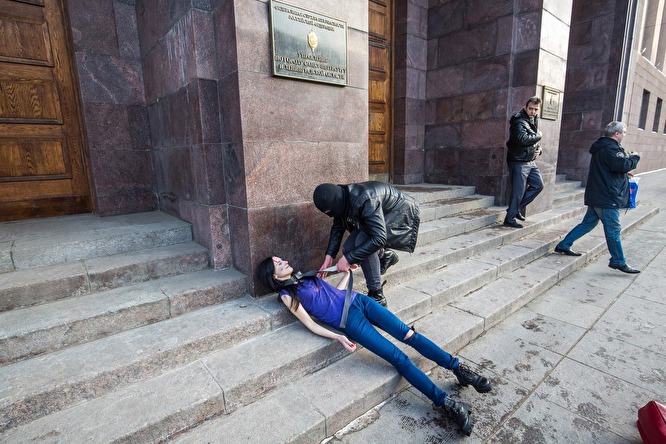
znakcom-1838828-666x444Protest against the Penza-Petersburg “terrorism” case on the steps of FSB headquarters in Petersburg, February 2018. Photograph by David Frenkel. Courtesy of Znak.com

Penza-Petersburg “Terrorism” Case Suspects Shakursky and Pchelintsev Charged with Organizing Terrorist Community
Mediazona
September 10, 2018

Penza-Petersburg “terrorism” case suspects Dmitry Pchelintsev, Ilya Shakursky, and Arman Sagynbayev have been formally indicted. Now Pchelintsev and Shakursky, who earlier were accused of involvement in the alleged “terrorist community” the Network, have been indicted for organizing it, per Article 205.4 Part 1 of the Russian Federal Criminal Code. Mediazona heard the news from the Parents Network, a committee formed by relatives of the young men arrested and accused in the case.

In keeping with previous accusations, Sagynbayev was indicted for involvement in a “terrorist organization,” per Russian Criminal Code Article 205.4 Part 2. During the reading of the indictment, he recanted his previous testimony, saying he had given it under duress. Mediazona has published Sagynbayev’s deposition to his defense attorney, in which he recounts how FSB field agents tortured him after after they detained him in Petersburg.

With the lawyer present, an FSB investigator pressured Sagynbayev for approximately five hours, but the accused man nevertheless failed to confess his guilt. Subsequently, a FSB field agent visited Sagynbayev in the Penza remand prison and threatened to send him “to the north, to Sentsov,” but explained he still could change his testimony.

As our sources in the Parents Network recounted, during the reading of the indictment, the FSB investigator showed Pchelintsev two written conclusions. In the first, it said Pchelintsev had confessed his guilt and was charged with violating Criminal Code Article 205.4 Part 2, which stipulates a penalty of five to ten years in prison. In the second, it said Pchelintsev had not admitted his guilt and was charged with violating Article 205.4 Part 1, punishable by fifteen to twenty years in prison.

None of the indicted men pleaded guilty.

Translated by the Russian Reader

***************

What can you do to support the Penza and Petersburg antifascists and anarchists tortured and imprisoned by the FSB?

  • Donate money to the Anarchist Black Cross via PayPal (abc-msk@riseup.net). Make sure to specify your donation is earmarked for “Rupression.”
  • Spread the word about the Network Case aka the Penza-Petersburg “terrorism” case. You can find more information about the case and in-depth articles translated into English on this website (see below), rupression.com, and openDemocracyRussia.
  • Organize solidarity events where you live to raise money and publicize the plight of the tortured Penza and Petersburg antifascists. Go to the website It’s Going Down to find printable posters and flyers you can download. You can also read more about the case there.
  • If you have the time and means to design, produce, and sell solidarity merchandise, please write to rupression@protonmail.com.
  • Write letters and postcards to the prisoners. Letters and postcards must be written in Russian or translated into Russian. You can find the addresses of the prisoners here.
  • Design a solidarity postcard that can be printed and used by others to send messages of support to the prisoners. Send your ideas to rupression@protonmail.com.
  • Write letters of support to the prisoners’ loved ones via rupression@protonmail.com.
  • Translate the articles and information at rupression.com and this website into languages other than Russian and English, and publish your translations on social media and your own websites and blogs.
  • If you know someone famous, ask them to record a solidarity video, write an op-ed piece for a mainstream newspaper or write letters to the prisoners.
  • If you know someone who is a print, internet, TV or radio journalist, encourage them to write an article or broadcast a report about the case. Write to rupression@protonmail.com or the email listed on this website, and we will be happy to arrange interviews and provide additional information.
  • It is extremely important this case break into the mainstream media both in Russia and abroad. Despite their apparent brashness, the FSB and their ilk do not like publicity. The more publicity the case receives, the safer our comrades will be in remand prison from violence at the hands of prison stooges and torture at the hands of the FSB, and the more likely the Russian authorities will be to drop the case altogether or release the defendants for time served if the case ever does go to trial.
  • Why? Because the case is a complete frame-up, based on testimony obtained under torture and mental duress. When the complaints filed by the accused reach the European Court of Human Rights in Strasbourg and are examined by actual judges, the Russian government will again be forced to pay heavy fines for its cruel mockery of justice.

***************

If you have not been following the Penza-Petersburg “terrorism” case and other recent cases involving frame-ups, torture, and violent intimidation by the Russian Federal Security Service (FSB) and other arms of the Russian police state, read and republish the recent articles the Russian Reader has posted on these subjects.

Arman Sagynbayev: I Was Tortured by the FSB

“Two Wires Came Out of the Box”: Penza-Petersburg “Terrorism” Case Suspect Arman Sagybayev Says FSB Tortured Him with Electrical Shocks in Minivan
Mediazona
September 6, 2018

sagynbayevArman Sagybayev. Photo courtesy of Mr. Sagynbayev and Mediazona
Antifascist and anarchist Arman Sagynbayev, who was arrested and remanded in custody as part of the Penza-Petersburg “terrorism” case, had until recently admitted his guilt. On September 4, he withdrew his confession, explaining that initially he had been tortured into testifying against himself and other young men arrested in the case, and then had been afraid to go against case investigators. His defense counsel has sent a statement to the Russian Federal Investigative Committee. Mediazona has published Sagynbayev’s deposition to his lawyer, in which Sagynbayev recounts how FSB field agents tortured him after detaining him in Petersburg.

In November 2017, officers of the Russian FSB [Federal Security Service] used unlawful investigative methodw (torture) against me. The circumstances were as follows.

On 5 November 2017, at approximately six o’clock in the morning, the doorbell of an apartment at [omitted] in St. Petersburg, where I was located at the time, rang. I opened the door, since when I had asked who was there, I was told the neighborhood beat cop was at the door. As soon as I opened the door, at least four men burst into the apartment. They yelled that they were from the FSB. They pushed a weapon (pistol) into my face before making me face the wall and handcuffing me with my hands behind my back. The men searched the apartment.

When the search was over, I was taken to a burgundy colored minivan parked next to the house whose address I have given. I would be hard pressed to name the vehicle’s make and model. A cloth sack was put over my head when I was in the vehicle. One of the men hit me in the body and head, demanding I tell them where I actually lived in St. Petersburg.

I could see through the fabric of the sack over my head that the man beating me was thickset and had blue eyes. I also made out the tattoo on the backside of his left hand: “For the Airborne Forces.” Later, I heard the other FSB officers call him [omitted].

Unable to withstand the beating, I told them where I actually lived in St. Petersburg: [omitted]. I was taken to the address I gave them, and there the men conducted a search without producing a warrant and without having official witnesses present [as required by Russian law].

When the search was finished, I was again put in the minivan and the sack was put over my head. At some point, I realized we were leaving St. Petersburg, but I had no way of knowing where we were going. I had a sack over my head and was handcuffed during the entire trip.

As we drove, I noticed that the man with the Airborne Forces tattoo, who had assaulted me, pulled a brown box from under his seat. There were two switches of some kind on the sides of the box. I cannot say what they were for. It is possible they controlled the intensity of the electrical current. Two wires came out of the box, which were attached to my thumbs. I was told they would check whether they had a current or not. I then experienced agonizing pain. I realized they were shocking me with electric currents. Meanwhile, the men in the vehicle asked me different questions. For example, I was asked to identify people whom I did not know, and when I said I did not know them, I would be shocked with the electrical current.

The men also hit me hard over the head with an object that resembled a day planner. When they realized I could not identify the people they named, they asked me other questions, for example, how to manufacture explosive devices and what parts were used in those devices. When my answers did not satisfy the men, I was hit over head and shocked with electrical current until I told them what they wanted to hear. They also told me that if I were not cooperative, they could do anything whatsoever to me and my loved ones, and they would get away with it, because I was a terrorist. They told me they could rape (“gang-bang”) my girlfriend [omitted], cut off her hands and my hands, and burn us with a soldering iron.

The torture lasted for around four hours, but I cannot say for sure, since I had no way of keeping track of the time, and I was in a great deal of pain.

When I was delivered to Penza Regional Remand Prison No. 1, there were burns from the electrical shocks on my hands, but no one paid any mind to these injuries, and the doctors did not record them when I was given a medical exam. Since I have been in custody in Penza Regional Remand Prison No. 1, no more illegal actions—beatings, torture, etc.—have been taken against me.

Fearing for the lives of my close relatives, for the life of [omitted], and for my own life, due to my health, which has worsened due to a serious illness, and due to the torture I endured, I testified against [Dmitry] Pchelintsev and myself, saying we had organized the so-called Network,  which was not really true.

Attorney Timur Miftakhutdinov: Did you report the circumstances you have described and the unacceptable investigative methods used on you to the public defender and the case investigator?

Saginbayev: I told attorney O.V. Rakhmanova everything and showed her the injuries from the electrical shocks on my hands. But I flatly refused to file a statement about the incident, since I still feared for the lives and safety of my relatives and the people I love. I thus forbade attorney O.V. Rakhmanova from reporting the incident to anyone and especially from sending complaints to the prosecutor’s office and the Investigative Committee. That was why I wrote to you in February 2018 that I had not been subjected to torture.

Miftakhutdinov: What position do you now intend to pursue with regard to the criminal case?

Saginbayev: My position, which I communicated to the case investigator when I was interrogated, has not changed for now.  I ask you to stick to it.

The deposition was conducted on May 31, 2018. Since then, Arman Sagynbayev has changed his stance. On September 4, 2018, he denounced his confession and decided to file a torture complaint.

The Penza-Petersburg “Terrorism” Case
The criminal case against the so-called Network “terrorist community” was launched by the FSB in October 2017. Over the course of a month, Yegor Zorin, Ilya Shakursky, Vasily Kuksov, Dmitry Pchelintsev, and Andrei Chernov were detained in Penza. Arman Sagynbayev was detained in Petersburg and extradited to Penza. Two Penza residents, Maxim Ivankin and Mikhail Kulkov, left Russia and were put on the wanted list.

In January 2018, Viktor Filinkov and Igor Shiskin were detained in Petersburg as part of the same case. On April 11, 2018, charges were filed against another Petersburger, Yuli Boyarshinov.

Most of the young men charged in the case are antifascists and anarchists, and many of them share a passion for the game airsoft. The FSB claims that all the arrested men belonged to an underground organization known as the Network and, allegedly, had plans to “arose the popular masses to further destabilize the political situation” in Russia and instigating an armed revolt by setting off a series of explosions during the March 2018 Russian presidential election and the 2018 FIFA World Cup. The Network supposedly had cells operating in Moscow, Petersburg, Penza, and Belarus.

The relatives of the accused in Penza have related that when the young men were detained, weapons were planted in their homes and cars, and late they were tortured. Viktor Filinkov, Dmitry Pchelintsev, and Ilya Shakursky have provided detailed accounts of their torture at the hands of the FSB. Ilya Kapustin, who was released as a witness, also spoke of being interrogated by the FSB as they tasered him. Like Filinkov’s wife Alexandra, Kapustin subsequently left for Finland, where he requested political asylum.

Pchelintsev and Shakursky claimed FSB officers tortured them with electrical shocks in the basement of the Penza Remand Prison. Shishkin made no statement about torture, although doctors found that the lower wall of his eye socket had been fractured, and that he had suffered numerous bruises and abrasions. Members of the Petersburg Public Monitoring Commission who visited him in remand prison noted numerous traces on his body of what looked like electrical burns.

The Investigative Committee has refused to open criminal cases in connection with Filinkov and Kapustin’s claims of torture. The lead investigator decided that in Filinkov’s case the taser had been employed legally, while the spots on Kapustin’s body had been caused by flea bites, not electrical burns.

Valery Tokarev heads the team of investigators handling the case in the FSB’s Penza office, while in Petersburg the investigation has been led by Investigator Gennady Belyayev.

The relatives of the accused have formed a support committee known as the Parents Network.

The accused have been charged with violating Russian Federal Criminal Code Article 205.4 Part 2, i..e., involvement in a terrorist community, which carries a punishment of five to ten years in prison.

Translated by the Russian Reader

***************

What can you do to support the Penza and Petersburg antifascists and anarchists tortured and imprisoned by the FSB?

  • Donate money to the Anarchist Black Cross via PayPal (abc-msk@riseup.net). Make sure to specify your donation is earmarked for “Rupression.”
  • Spread the word about the Network Case aka the Penza-Petersburg “terrorism” case. You can find more information about the case and in-depth articles translated into English on this website (see below), rupression.com, and openDemocracyRussia.
  • Organize solidarity events where you live to raise money and publicize the plight of the tortured Penza and Petersburg antifascists. Go to the website It’s Going Down to find printable posters and flyers you can download. You can also read more about the case there.
  • If you have the time and means to design, produce, and sell solidarity merchandise, please write to rupression@protonmail.com.
  • Write letters and postcards to the prisoners. Letters and postcards must be written in Russian or translated into Russian. You can find the addresses of the prisoners here.
  • Design a solidarity postcard that can be printed and used by others to send messages of support to the prisoners. Send your ideas to rupression@protonmail.com.
  • Write letters of support to the prisoners’ loved ones via rupression@protonmail.com.
  • Translate the articles and information at rupression.com and this website into languages other than Russian and English, and publish your translations on social media and your own websites and blogs.
  • If you know someone famous, ask them to record a solidarity video, write an op-ed piece for a mainstream newspaper or write letters to the prisoners.
  • If you know someone who is a print, internet, TV or radio journalist, encourage them to write an article or broadcast a report about the case. Write to rupression@protonmail.com or the email listed on this website, and we will be happy to arrange interviews and provide additional information.
  • It is extremely important this case break into the mainstream media both in Russia and abroad. Despite their apparent brashness, the FSB and their ilk do not like publicity. The more publicity the case receives, the safer our comrades will be in remand prison from violence at the hands of prison stooges and torture at the hands of the FSB, and the more likely the Russian authorities will be to drop the case altogether or release the defendants for time served if the case ever does go to trial.
  • Why? Because the case is a complete frame-up, based on testimony obtained under torture and mental duress. When the complaints filed by the accused reach the European Court of Human Rights in Strasbourg and are examined by actual judges, the Russian government will again be forced to pay heavy fines for its cruel mockery of justice.

***************

If you have not been following the Penza-Petersburg “terrorism” case and other recent cases involving frame-ups, torture, and violent intimidation by the Russian Federal Security Service (FSB) and other arms of the Russian police state, read and republish the recent articles the Russian Reader has posted on these subjects.

Network: Parents versus the FSB

Network: Parents of Anarchists versus the FSB
Alexei Polikhovich and Ksenia Sonnaya
OVD Info
July 30, 2018

Members of the Parents Network. Photo courtesy of OVD Info
Eleven antifascists from Penza and Petersburg have been charged in the case against the alleged “terrorist community” known as the Network. Many people have got used to news of the violence, threats, and electrical shock torture used against the suspects in the case, but the accused themselves and their loved ones will probably never grow inured to such things. The parents of the accused came together in a committee known as the Parents Network. They have been trying to do something to help their loved ons.

The Russian Federal Security Service (FSB) claims the Network is an international organization. Aside from Penza and Petersburg, secret cells were, allegedly, established in Moscow and Belarus. Yet no one has been arrested either in Russia’s capital or abroad. Meanwhile, the Parents Network is definitely an international organization. Aside from Penza, Petersburg, Moscow, and Novosibirsk, the committee has members in Petropavlovsk, the city in Kazakhstan where Viktor Filinkov’s mother lives.

Members of the Parents Network have appeared at two press conferences, in April and May of this year. They have established a chatroom on Telegram where they discuss new developments in the case, exchange opinions, share impressions of hearings and interrogations, and give each other support. In addition, the parents try and force reactions from Russian government oversight and human rights bodies. They write letters to Russia’s human rights ombudsman and the Presidential Human Rights Council, and file complaints with the Investigative Committee and the Russian Bar Association.

OVD Info spoke with members of the Parents Network.

Tatyana Chernova, Andrei Chernov’s mother, shop clerk
All this kicked off in March at the next-to-last custody extension hearing in Penza.

I went to see Ilya Shakursky. I knew reporters and human rights advocates would be there. I just approached the people who had come to the hearing and asked for help. One of those people was Lev Ponomaryov, leader of the movement For Human Rights. He responded and proposed meeting in Moscow.

I didn’t know any human rights activists. I didn’t know where to go or to whom to turn, since I’d never dealt with this. When I’d discuss it with my daughter, she would scold me, telling me we had to wait or we might make things worse.

My husband and I went to see Lev Ponomaryov. We said we didn’t know what to do. We had a lawyer. Our lawyer did his job, while we, the parents, didn’t know how to help. We were told to take a pen and sign up, that the first thing to do was unite with all the other parents. I found their telephones numbers and gradually called all of them.

Andrei Chernov’s family

I couldn’t get hold of Lena Shakurskaya. I sent her an SMS, saying I’m so-and-so’s mom, I want to talk, if you want to talk, write. She called me right back. Everyone was probably waiting for it. We shared a misfortune, and it brought us together. Our first meeting was at Lev Ponomaryov’s office. Lena came to Moscow for the meeting. It was only there she heard the whole truth. Mikhail Grigoryan, Ilya’s former lawyer, had been telling her a different story. The Pchelintsevs met her. They told her what was going on. Lena was made sick by what she found out.

We try to have each other’s backs. The blows are such that it’s hard to take. Yes, I have friends. But I can call Sveta Pchelintseva or Lena Bogatova, say, knowing they’ll know where I’m coming from, because this is part of our personal lives.

Yelena Bogatova, Ilya Shakursky’s mother, shop clerk
We had a lawyer, Mikhail Grigoryan. He warned me against communicating with the relatives of the other lads. He said each of us had to defend their own son. Nothing good would come of fraternizing. I listened to him.

In March, I saw Andrei Chernov’s mom. Again, at Grigoryan’s insistence, I didn’t go up to her or chat with her. Later, I had doubts. I wanted to talk to someone. God was probably reading our minds: it was then Tatyana Chernova sent me an SMS. We got in touch on the phone. I went to Moscow without telling the lawyer. We met with human rights activists. We discussed how to talk about the kids.

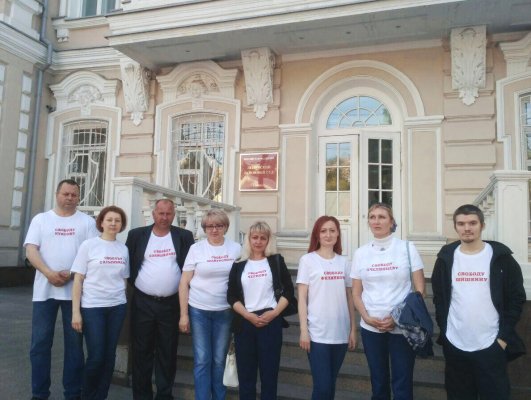
It’s really rough when you’re on your own in these circumstances, but now we are together. You realized you’re not alone and our boys are not alone. What we do is mainly for them. We put on these t-shirts when we go to hearings so they can see we are fighting. We have gone to all the hearings together so they see we’re all together.

At first, I was a “cooperative” mom. I was friendly with the investigator. We would talk. He said unflattering things about the other parents. Grigoryan would ask me to meet with Ilya to “talk sense” into him. The investigator would talk to me, telling me that if I was a good mom, I would get the message through his head, that is, if we had a good relationship, as I had told him. Then I would get to see Ilya for ten minutes.

Yelena Bogatova and Ilya Shakursky

In February, when Ilya signed a statement saying he had not been tortured, his uncle and I persuaded him to sign the paper. We didn’t understand a thing, of course. Grigoryan said Ilya had to sign the paper. He said he was working for us and Ilya shouldn’t be obstinate, but should sign everything he asked him to sign.

Ilya stared at me.

“Mom, what are you doing?” he said. “I’m not guilty of anything.”

“Sign it or things will get worse for you, and I’ll have it worse. I won’t see you again,” I said to him.

I was selfish, drowning in my own grief. I pushed my son into doing it because I felt sorry for myself. The FSB used me. Yes, you can see him, but make him to sign this. Hold his hand.

It’s psychologically easier for me now. I feel strong inside. I have the confidence to keep going and try and rescue the boys from the paws of the FSB. I don’t have any friends per  se anymore. At first, they would call and ask about things, but then they would do it less and less often. I don’t know, maybe they’re afraid of the FSB. They’re afraid of calling me once too much because they know my phone is bugged.

On the other hand, I have a sense of how many friends Ilya has. I communicate with the Parents Committee and Ilya’s friends, who are not afraid of anything. We talk on the phone. They visit Ilya’s grandma and help. They water the garden and go to the store, just like Timur and his friends.

Natalya, Viktor Filinkov’s mom, businesswoman
It was like a bolt out of the blue. Viktor’s wife, Alexandra, wrote to me. I was ready to go see him that very minute, but I was told it would be better for me not to show up in Russia for the time being. I live in Petropavlovsk in northern Kazakhstan, which is not far from Omsk. It’s sixty kilometers to the Russian border.

Then I could not wait any longer. I said I was going to Petersburg, come what may. Everyone was surprised I was allowed to see him. I was the first parent allowed to see their child. But it was so little time. It was so hard to talk to him through the glass.

“Mom, I’ve been tortured,” he said.

I could see he had a scar. He told me to stay strong and be reasonable about what was happening.

Viktor Filinkov

I’d never been interested in politics. Now, though, I’m interested. I’m interested in Russian politics and Kazakhstani politics, and I read all the news straight through. I read about what incidents happened where, who was tortured where, who has been framed, who has been protected. I read everything about what’s happened to antifascists and anarchists everywhere.

I think about why I don’t live in Russia, in Petersburg. I cannot move right now. It’s complicated to do the paperwork, register as an immigrant, and get a temporary resident permit. The thing that causes me the most pain is the thought they could ban me from entering the country.

Nikolai Boyarshinov, Yuli Boyarshinov’s father, artist
It’s a terrible state, which everyone has been through, when you suddenly find out your son has been arrested, and the charges are so absurd. You have no idea at all what to do. It’s a wall against which you beat your head. You quite quickly realize you’re completely powerless.

I joined the Parents Network when it had quite a few members. I was completely crushed then. At first, I imagined it existed for its own sake, to keep from going insane. But then I noticed it got results. By then I had completely recovered from my initial state, so I did things, thought about things, and discussed things. Being involved in the Parents Network was my salvation.

We have a chat page on Telegram. In contrast to the Network, which the FSB concocted, we don’t hide the fact we have a Network. If you think our children organized a criminal Network, then our Network is probably criminal, too.

Our actions get few results, perhaps, but it is this way, bit by bit, that you build up the desire to do something to improve the conditions in which the boys are incarcerated.  Publicity was their salvation, after all. It’s not a matter of getting them released yet. We are still thinking about how to keep them alive.

That was how it happened with my son. I saw him at the first custody extension hearing, a month after his arrest. I saw what he looked liked when he arrived at the courthouse. He looked drab and battered. He had fresh bruises on his head. You could see that it couldn’t go on for long like that. His friends, thirty people or so, came to the next hearing. When he saw everyone, he was happy. A new phase began after that. It was clear that at least they wouldn’t kill him.


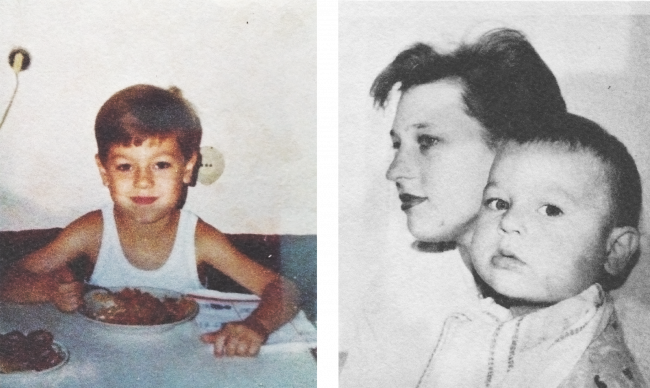
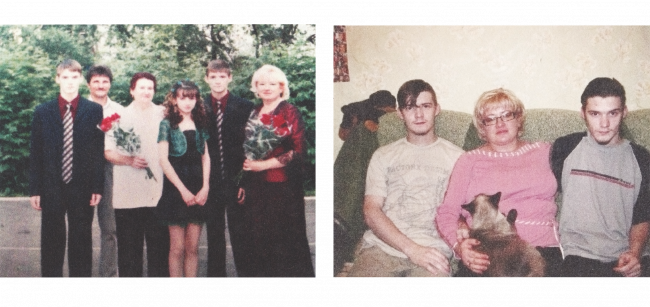
Yuli Boyarshinov in childhood

It was a turning point for me. When everything went public, it saved my son’s life. Yet now I’m afraid the publicity will die down and the boys will again be isolated, and the nightmare will recommence. That’s why I never turn down an interview.

I go out picketing on Fridays. I had doubts when the World Cup was underway. The first day I had the sense I was preventing people from enjoying themselves, but I decided to keep going out. Something unexpected happens each time. A young man came up to me and said he knew nothing about the Network. He walked away, apparently looked in the internet, and came back. I told him about the other boys.

“I don’t share those views,” he said.

“It doesn’t matter now whether you’re leftist or rightist,” I replied. “What matters is that you have views, and that is sufficient grounds to arrest you and charge you with a crime.”

The Parents Network is now like a family. We’ve agreed that when this travesty of justice is over, we will definitely have a reunion with everyone. Everyone has become family. Viktor’s mom lives in Kazakhstan, and his wife had to escape, so when I take care packages to Yuli, I take packages for Viktor, too. I really want to meet all the boys. I’m worried sick about all of them. My wife sometimes reads an article about Dima Pchelintsev or Viktor, and she cries. We feel like they’re our children.

Yelena Strigina, Arman Sagynbayev’s mother, chief accountant 
The first to get together were the people in Penza, the Pchelintsevs and the Chernovs. I joined along the way. The defense lawyers had to sign a nondisclosure agreement, so we had to go public with all our problems.

I live in Novosibirsk. We all stay in touch through a certain banned messenging site. When we were at the hearings in Penza, we made t-shirts emblazoned with the logo “Free [son’s surname].” It might look like a game to outsiders, but we have to stay afloat. It’s important to do something. And to publicize everything that happens.


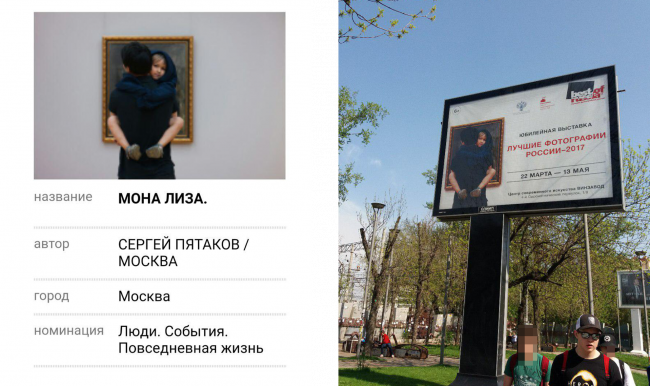
Arman Sagynbayev and his niece. Screenshot from the website of the Best of Russia competition (left); photo of a billboard in Moscow (right)

Arman has a serious chronic illness. There was no point in torturing him. His first testimony was enough to send him down for ten years. He testified against himself more than he did against the others. He was extradited from Petersburg to Penza. Along the way, the men who were transporting him opened the doors when they were in the woods and dragged Arman out. They promised to bury him alive. That was at night. In the morning, he was taken to the investigator for questioning. When people are under that kind of pressure, they would say anything. I would say I’d attempted to invade Kazan and blow up chapels.


Arman Sagynbayev in childhood

I kept the story secret from friends and relatives. But after the film about the case on NTV, everyone called and started looking funny at me. The news even made it to the school that Arman’s little brother attends. Imagine: your brother is a terrorist. It was a good thing honest articles had been published at that point. I would send people links to them. Thanks to those articles, people read a different take on events, and we have been protected from a negative reaction from society.

Svetlana Pchelintsev, Dmitry Pchelintsev’s mother, cardiologist
The Parents Network has empowered us a hundredfold. By joining together, we are no longer each fighting for our own son, we are fighting for all the boys. We love kids we don’t know at all, kids who are complete strangers, as if they were our own kids. Our hearts ache for each of them. I think it’s wonderful. A whole team of parents fighting for all the boys. What can stop parents? Nothing can stop them.

What has happened is terrible. Whether we like or not, we have to go on living while also helping the children. So, when one mom has a moment of weakness, she can telephone another mom, who is feeling the opposite emotions. It’s vital when a person hears that support.


Dmitry Pchelintsev in childhood

Dmitry Pchelintsev, Dmitry Pchelintsev’s father, engineer
We are a committee of parents. What we do is support each other. We live in Moscow, but our son is jailed in Penza. The parents who live in Penza visit our son. Our kids, as it turns out, belong to all of us. We were in Penza and we gave all the children all their care packages at the same time. If we talk with the warden of the remand prison, we speak on behalf of all the kids.

This has helped us and helped our children. We get emotional support. It’s one thing when you sit alone in a closed room and don’t know what’s happening to your child. It’s another thing when all the parents meet and discuss everything. Tiny facts come together into a big picture, and you more or less understand what’s happening.

In my view, publicity is quite effective. This has been borne out by the actions of the case investigator, Tokarev. If it makes Tokarev uncomfortable, if it makes Tokarev angry, it’s a good thing. As he said, “You raised this ruckus in vain. They would have been in prison long ago.” So, what’s bad for him is good for me. I visited the offices of the Investigative Committee in Penza. They couldn’t believe it was possible the FSB would torture people in a remand prison.

Lena, Ilya Shakursky’s mom, said Tokarev always referred to us and the Chernovs as “uncooperative” parents. He complained that, if it weren’t for us, our kids would have been sentenced to two years each in prison and that would have been it. How can a person say such things? You put a man in jail for nothing, and then you sit and clap.

The FSB are Putin’s hellhounds. Putin loosened their leash a little, and they grabbed everyone they could before the presidential election and the World Cup. Now it’s all coming to an end, and he’ll again say, “Heel!” Let’s see where it leads. Perhaps the plug will be pulled, unfortunately.

All photos courtesy of the parents and relatives of the accused and OVD Info. Translated by the Russian Reader.

***************

What can you do to support the Penza and Petersburg antifascists and anarchists tortured and imprisoned by the FSB?

  • Donate money to the Anarchist Black Cross via PayPal (abc-msk@riseup.net). Make sure to specify your donation is earmarked for “Rupression.”
  • Spread the word about the Network Case aka the Penza-Petersburg “terrorism” case. You can find more information about the case and in-depth articles translated into English on this website (see below), rupression.com, and openDemocracyRussia.
  • Organize solidarity events where you live to raise money and publicize the plight of the tortured Penza and Petersburg antifascists. Go to the website It’s Going Down to find printable posters and flyers you can download. You can also read more about the case there.
  • If you have the time and means to design, produce, and sell solidarity merchandise, please write to rupression@protonmail.com.
  • Write letters and postcards to the prisoners. Letters and postcards must be written in Russian or translated into Russian. You can find the addresses of the prisoners here.
  • Design a solidarity postcard that can be printed and used by others to send messages of support to the prisoners. Send your ideas to rupression@protonmail.com.
  • Write letters of support to the prisoners’ loved ones via rupression@protonmail.com.
  • Translate the articles and information at rupression.com and this website into languages other than Russian and English, and publish your translations on social media and your own websites and blogs.
  • If you know someone famous, ask them to record a solidarity video, write an op-ed piece for a mainstream newspaper or write letters to the prisoners.
  • If you know someone who is a print, internet, TV or radio journalist, encourage them to write an article or broadcast a report about the case. Write to rupression@protonmail.com or the email listed on this website, and we will be happy to arrange interviews and provide additional information.
  • It is extremely important this case break into the mainstream media both in Russia and abroad. Despite their apparent brashness, the FSB and their ilk do not like publicity. The more publicity the case receives, the safer our comrades will be in remand prison from violence at the hands of prison stooges and torture at the hands of the FSB, and the more likely the Russian authorities will be to drop the case altogether or release the defendants for time served if the case ever does go to trial.
  • Why? Because the case is a complete frame-up, based on testimony obtained under torture and mental duress. When the complaints filed by the accused reach the European Court of Human Rights in Strasbourg and are examined by actual judges, the Russian government will again be forced to pay heavy fines for its cruel mockery of justice.

***************

If you have not been following the Penza-Petersburg “terrorism” case and other recent cases involving frame-ups, torture, and violent intimidation by the Russian Federal Security Service (FSB) and other arms of the Russian police state, read and republish the recent articles the Russian Reader has posted on these subjects.

Two More Suspects Detained in Network Case

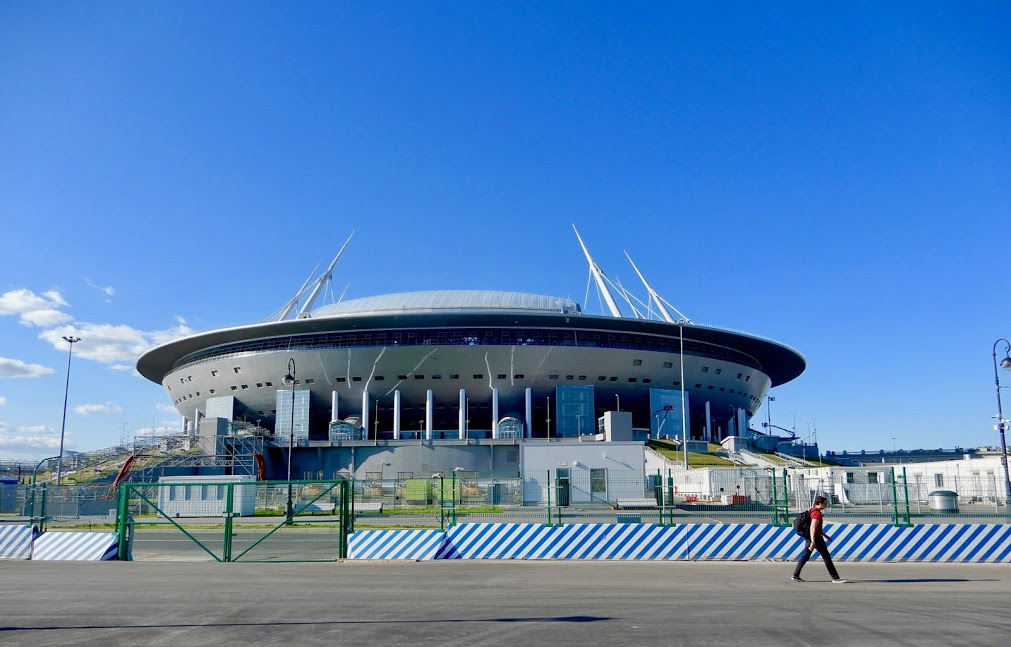
krestovsky stadiumThe members of the wholly mythical terrorist organization the Network have been accused by the FSB of planning to disrupt the March presidential elections and this summer’s World Cup in order to foment rebellion among the hoi polloi. These accusations would be hilarious if they were not served up with heavy helpings of torture, intimidation, and incarceration. Photo of Krestovsky Stadium in Petersburg, a World Cup venue, by the Russian Reader
Two Suspects Detained in Network Case
OVD Info
July 5, 2018

Mikhail Kulkov and Maxim Ivankin, two suspects in the so-called Network Case, have been detained and placed in police custody, OVD Info has learned from Yelena Bogatova, the mother of Ilya Shakursky, another suspect in the case.

The Lenin District Court in Penza has remanded Kulkov and Ivankin in custody until September.

Bogatova had been waiting for a lawyer outside the Penza Remand Prison when Ivankin and Kulkov were brought there. According to her, their parents learned of their arrests on July 4. Their custody hearings took place at 2 p.m. on July 5.

Alexei Kulkov, Mikhail Kulkov’s father, told OVD Info the young men had been detained in Moscow without IDs. Penza’s Lenin District Court has remanded them in custody until September 18. Mr. Kulkov reported that his son and Maxim Kulkin have been charged with organizing a “terrorist community.”  He said he saw the two young men for several minutes in the courthouse as they were escorted down the hallway. He noticed they had black eyes and bruises on their bodies.

Previously, Ivankin and Kulkov were detained in Penza in March 2017 along with antifascist Alexei Poltavets. They were initially charged with drugs possession. According to Poltavets, after they were detained, Russian Federal Security Service (FSB) officers tortured and beat them, demanding they testify against their friends in the antifascist scene. Poltavets later left Russia and had not seen Ivankin and Kulkov since then.

In June 2018, it transpired that Ivankin and Kulkov’s case had been combined with the investigation of the so-called Network, an organization that FSB investigators claim is a terrorist group. Ivankin and Kulkov have been charged with planning to produce or sell drugs in large quantities (Russian Criminal Code Article 228.1 Part 4 Paragraph G and Article 30 Part 3).

In the criminal case files, Ivankin, Kulkov, and Poltavets are identified both by their real names and the pseudonyms Redhead, Ilya, and Boris.

It transpired on July 4 that another suspect in the Network Case, Dmitry Pchelintsev, had been transferred from Penza Remand Prison No. 1, most likely to St. Petersburg.

On May 23, a friend of the accused, Victoria Frolova, was detained at the Russian-Ukrainian border. She was forced to testify against her Penza friends, including Ivankin and Kulkov. In her signed statement, Ivankin and Kulkov are identified as members of the 5.11 (“November Fifth”) cell of the Network. According to FSB investigators, all members of the Network trained with sticks in the woods, practice orienteering and first aid, and learned to set traps.

In the autumn of 2017, five young men were arrested in Penza: Yegor Zorin, Ilya Shakursky, Dmitry Pchelintsev, Vasily Kuksov, and Andrei Chernov. Arman Sagynbayev was detained in St. Petersburg and extradited to Penza. All of them were charged with involvement in a “terrorist” community. The FSB claimed the young young were involved in a terrorist organization known as the Network, whose cells, allegedly, existed in Moscow, Petersburg, Penza, and Belarus. The accused men gave accounts of mental coercion, electrical shock torture, and being hung upside down by FSB officers, as well as their planting weapons in the men’s cars and flats.

Later, several of the suspects renounced their confessions, saying they had been given under torture.

Besides the six suspects jailed in Penza, there are three more young men who have been charged with involvedment in the Network who have been remanded in custody in Petersburg. They are Viktor Filinkov and Igor Shishkin, on whose bodies human rights activists found physical traces of their having been tortured, and Yuli Boyarshinov, originally accused of illegal possession of explosive substances. Later, investigators tried to force him to testifying against the men accused in the Network Case and charged him with the same offenses.

Translated by the Russian Reader

***************

What can you do to support the Penza and Petersburg antifascists and anarchists tortured and imprisoned by the FSB?

  • Donate money to the Anarchist Black Cross via PayPal (abc-msk@riseup.net). Make sure to specify your donation is earmarked for “Rupression.”
  • Spread the word about the Network Case aka the Penza-Petersburg “terrorism” case. You can find more information about the case and in-depth articles translated into English on this website (see below), rupression.com, and openDemocracyRussia.
  • Organize solidarity events where you live to raise money and publicize the plight of the tortured Penza and Petersburg antifascists. Go to the website It’s Going Down to find printable posters and flyers you can download. You can also read more about the case there.
  • If you have the time and means to design, produce, and sell solidarity merchandise, please write to rupression@protonmail.com.
  • Write letters and postcards to the prisoners. Letters and postcards must be written in Russian or translated into Russian. You can find the addresses of the prisoners here.
  • Design a solidarity postcard that can be printed and used by others to send messages of support to the prisoners. Send your ideas to rupression@protonmail.com.
  • Write letters of support to the prisoners’ loved ones via rupression@protonmail.com.
  • Translate the articles and information at rupression.com and this website into languages other than Russian and English, and publish your translations on social media and your own websites and blogs.
  • If you know someone famous, ask them to record a solidarity video, write an op-ed piece for a mainstream newspaper or write letters to the prisoners.
  • If you know someone who is a print, internet, TV or radio journalist, encourage them to write an article or broadcast a report about the case. Write to rupression@protonmail.com or the email listed on this website, and we will be happy to arrange interviews and provide additional information.
  • It is extremely important this case break into the mainstream media both in Russia and abroad. Despite their apparent brashness, the FSB and their ilk do not like publicity. The more publicity the case receives, the safer our comrades will be in remand prison from violence at the hands of prison stooges and torture at the hands of the FSB, and the more likely the Russian authorities will be to drop the case altogether or release the defendants for time served if the case ever does go to trial.
  • Why? Because the case is a complete frame-up, based on testimony obtained under torture and mental duress. When the complaints filed by the accused reach the European Court of Human Rights in Strasbourg and are examined by actual judges, the Russian government will again be forced to pay heavy fines for its cruel mockery of justice.

***************

If you have not been following the Penza-Petersburg “terrorism” case and other recent cases involving frame-ups, torture, and violent intimidation by the Russian Federal Security Service (FSB) and other arms of the Russian police state, read and republish the recent articles the Russian Reader has posted on these subjects.

Families of Penza-Petersburg “Terrorists” Form Committee

Антифашизм-800x445“Antifascism is not a crime.” Photo courtesy of Movement For Human Rights
Relatives of Defendants in Penza-Petersburg “Terrorism” Case Form Parents Network
Mediazona
April 9, 2018

The website of the Movement For Human Rights (MFHR) reports parents of the arrestees in the Penza-Petersburg “terrorism” case have come together to form The Parents Network: A Committee for Relatives of Arrested Anarchists.

The human rights activists report that a meeting of relatives of the young men accused in the case took place in Moscow on April 7. The loved ones of almost all the defendants in the case came to MFHR’s offices, while two relatives participated in the meeting via Skype.

The arrested men’s loved ones talked about the pressure put on their children and husbands, and the illegal actions of law enforcement officials. At the end of the meeting, the relatives decided to form an organization whose goal would be to mutually support each other as well as interact with the authorities and human rights organizations. MHFR’s website list contact information for the committee’s officers.

In October 2017, Russian Federal Security Service (FSB) officers detained four antifascists in Penza: Yegor Zorin, Ilya Shakursky, Vasily Kuksov, and Dmitry Pchelintsev. In early November 2017, Andrei Chernov was detained in Penza, while Arman Sagynbayev was detained in Petersburg. In January 2018, Igor Shishkin and Viktor Filinkov were detained in Petersburg.

All eight men have been accused of involvement in a “terrorist community,” a crime under Article 205.4 Part 2 of the Russian Federal Criminal Code. The FSB claims the antifascists were members of a terrorist organization, code-named The Network, whose members planned to set off bombs during the March 2018 Russian presidential election and the FIFA World Cup, schedule for this summer in Russia, and thus “sway the popular masses to further destabilize the political circumstances in the country” and spark an armed insurrection.

Several of the defendants, including Pchelintsev, Shakursky, and Filinkov, as well as Ilya Kapustin, a witness detained in Petersburg, said FSB officers tortured them to make them to confess. Members of the Petersburg Public Monitoring Commission certified they found signs of beating and traces of taser burns on Filinkov’s and Shiskin’s bodies. It later transpired that Kapustin left Russia, and Pchelintsev withdrew his testimony after he was beaten in the Penza Remand Prison.

Translated by the Russian Reader. Please read my earlier posts on the Penza-Petersburg  case and two other current cases that also seem to be FSB frame-ups. Also check out the first major international press coverage of the case in Newsweek.

Ping, Ping, Ping: The Remand Extension Hearing of the Penza “Terrorists”

Ping, Ping, Ping: A Report from the Remand Extension Hearing of the Defendants in the Penza “Terrorism” Case
Yegor Skovoroda
Mediazona
March 16, 2018


Ilya Shakursky. Photo courtesy of Yegor Skvoroda and Mediazona

Yegor Svokoroda traveled to Penza, where, over the course of three days, the Lenin District Court considered whether to extend the remand in police custody of the antifascists who, according to the FSB, were part of a “terrorist community” known as The Network.

FSB Senior Investigator Valery Tokarev blushes gradually: first the tip of his nose, then his ears, and finally the bald patch that covers half his head. He is arguing with a lawyer, insting on a closed hearing in order to ensure “investigatory privilege.” The lawyer objects.

“The case is at the evidence gathering stage. We have not finalized all the witnesses or the defendants. A number of parties to the crime have not been identified or are on the wanted list,” says Tokarev, his forehead covered with sweat.

This scene was repeated several times in Penza’s Lenin District Court, where, between March 13 and March 15, the arrest in police custody of five antifascists apprehended and charged with involvement in a “terrorist community” was extended. Time after time, Judge Svetlana Shubina closed the hearings to the public and the press.

Ordering that yet another of the accused be remanded in custody to the local remand prison until June 18, Judge Shubina time after time bases her ruling by referring to the particularly complicated nature of the case and the allegation that each of the young men was a member of a “stable, highly secretive criminal group,” and that “firearms and ammunition” were involved. Shubina notes investigators had to finish their numerous forensic examinations and interrogations, and finally indict Sagynbayev, Pchelintsev, Shakursky, Chernov, Zorin, Kuksov, Ivankin, and Kulkov.

Yegor Zorin, a fourth-year student at the Belinsky Pedagogical Institute, was the first person detained in the investigation of the “terrorist community.” The FSB has alleged its members planned, during the March 18 presidential election and this summer’s FIFA World Cup, to “agitate the masses in order to further destabilize the political situation in the country” by setting off bombs; when the H-hour came, they would lead an armed insurrection. Zorin was apprehended on October 17, 2018. There are unconfirmed reports he signed a confession, which was the basis of Criminal Case No. 11707560001000036, concerning organization of and involvement in a terrorist community, per Article 205.4 Parts 1 and 2 of the Russian Federal Criminal Code.

Zorin’s time in the remand prison was not extended. He was jailed there until December 18 and subsequently transferred to house arrest. The press service of the Lenin District Court told Mediazona, however, that after December 18, investigators had not petitioned the court to extend his arrest.


Arman Sagynbayev. Photo courtesy of Yegor Skvoroda and Mediazona

The next to be apprehended were Zorin’s classmate Ilya Shakursky and their common friend Vasily Kuksov during the wee hours of October 19, 2017. On October 27, Dmitry Pchelintsev was detained; he knew Shakursky through the leftist activist scene and because they shared a hobby: airsoft. On November 6, Arman Sagynbayev was detained in Petersburg. He had been to Penza several times for airsoft practice sessions. He was transferred to the Penza Remand Prison. On November 9, Andrei Chernov, another airsoft player and an old friend of Pchelintsev’s was detained.

A passion for airsoft and a sympathy for leftist ideas, anarchism, and antifascism were what all the detainees had in common. The case files contain videos of training sessions in the woods outside Penza, sessions during which the young men used fireworks. The FSB has alleged that the group training sessions were preparation for the insurrection, while the hikes the young men took in the woods constituted “illegal mastery of survival skills in the woods and rendering of first aid.”The airsoft teams in which the antifascists played, Voskhod (“Sunrise”) and 5.11 (“November Fifth”), were cells of a terrorist organization known as The Network (Set’). Aside from Penza, The Network was alleged to have underground cells in Moscow, Petersburg, and Belarus.*

The FSB has alleged the Penzans divided up the roles in their “terrorist community.” Pchelintsev was the leader and ideologue. His deputy, nicknamed Redhead, handled reconnaissance and recruiting, while Sagynbayev, nicknamed Andrei Security, was the engineer and sapper, Shakursky (aka Spike), the tactician, Chernov (aka Twin), the signalman, Zorin (aka Grisha), the sniper, while a certain Boris was also a coordinator and ideologue.

Redhead is Maxim Ivankin, mentioned in the court’s new custody ruling, while in all likelihood the Boris referred to by the security services is M.A. Kulkov. According to our sources, both men have left Russia and are on the wanted list.

The Lenin District Court occupies a three-storey nineteenth-century mansion whose interior has been modernized. The courtroom where the custody extension hearings take place is located in a wing of the building accessible only through doors outfitted with an electronic lock. To gain access to the hallway leading to the courtroom you have to place a card on the lock, which sets off an obnoxious pinging sound. The squeaky alarm goes off constantly. Ping, ping, ping: terrorist community. Ping, ping, ping: investigative privilege. Ping, ping, ping: extend the arrests.

Ping, ping, ping, ping, ping, ping, ping.


Dmitry Pchelintsev and his wife Angelina. Photo courtesy of relatives

A broad-shouldered FSB guard escorts 25-year-old Dmitry Pchelintsev into the room, not taking his eyes off him the entire hearing. Guards just like him also escort the other detainees. Some of them wear balaclavas to conceal their identities, some wear Buff scarves over their faces. Viktor Filinkov, detained in Petersburg, and Pchelintsev himself recounted how they were tortured by men wearing such masks. Pchelintsev recalled how the officers who tortured him later escorted him to the remand prison.

“When I was tortured with electrical shocks, my mouth was full of ‘crushed teeth’ due to the fact I gritted my teeth since the pain was strong, and I tore the frenulum of my tongue. My mouth was full of blood, and at some point one of my torturers stuck my sock in my mouth,” Pchelintsev told his lawyer in order to explain why he had signed a confession.

Soon, after he was beaten again, Pchelintsev recanted his testimony about being tortured. Pchelintsev, who has thick, kinky eyebrows and slightly protruding ears, worked as a target practice instructor after serving in the army. He wears a checkered shirt whose collar he constantly buttons and unbuttons. Cautious at first, he thaws by the end of the hearing, when he manages to chat with his wife Angelina through the glass of the so-called fish tank in which defendants are held during trials and hearings.

Dmitry laughs, talking about books and Alina Orlova songs. He jokes that during the last hearing he was in handcuffs because “Arman was sitting next to me, and they thought I would attack him.”

Alina Orlova sings “I Stroll Around Moscow,” IKRA Club, Moscow, September 29, 2008

“What should I do with your car?” Angelina asks. The FSB claims to have found two grenades under the seat of the old Lada. Pchelintsev said they were planted there.

“Burn it,” says Dmitry, joking once more.

“I’m afraid I’d be arrested.”

“Yeah, you’d also go to jail for terrorism,” Pchelintsev quips. “Actually, I was told we should take it to the junkyard and sell it for scrap.”

Angelina presses her nose against the glass of the fish tank.

Ping, ping, ping, ping, ping, ping, ping.


Vasily Kuksov. Photo courtesy of relatives

29-year-old design engineer Vasily Kuksov appears to be the most confused and indifferent of all the prisoners. His wife Yelena says Vasily was cheerful and life-affirming prior to his arrest. He enjoyed drawing and was into music, performing a year ago at a Vladimir Vysotsky memorial festival at the Penza Philharmonic. Now his case file describes him as an “individual who leads an isolated lifestyle characterized by antisocial behavior.”

Vasily Kuksov performing at the Penza Philharmonic on January 25, 2017

Kuksov has not complained that FSB officers were violent with him, but his friend Ilya Shakursky recalled that, when they were taken to the FSB building in Penza, first he heard Kuksov’s groan and then later saw him, his face badly mangled. Nevertheless, Kuksov avoided testifying by invoking his right not to incriminate himself under Article 51 of the Russian Constitution.

A pistol was confiscated from his car. According to his loved ones, the gun had been planted there.

Kuksov is the only prisoner whom the investigator allows to talk with his mother for a long time during the recess [sic].

As he listens to the judge’s ruling, Kuksov zips and unzips the zipper of his black winter jacket.

Ping, ping, ping, ping, ping, ping, ping.

“They blindfolded me, tied my hands, and stuck a sock in my mouth. Then I thought they wanted to leave my fingerprints on something, but later they attached wires to my big toes. I felt the first surge of current, and I could not hold back the moaning and shaking. They repeated the procedure until I promised to say what they told me to say. After that, I forgot the word ‘no’ and said everything the officers told me to say,” recalled 21-year-old antifascist Ilya Shakursky.

Shakursky was a classmate of the first person arrested in the case, Yegor Zorin. Both of them were studying to be physics teachers.

Shakursky is a thin young man with a shaved head and a deep wrinkle on his forehead. He is a well-known activist in Penza. He used to be involved with Food Not Bombs, and he was himself always organizing everything from lectures to trips to the woods to pick up trash. Before the antifascist rally held annually on January 19, he sent friends a letter in which he wrote, “If I were on the outside, I would definitely attend the memorial event for two great heroes, Nastya Baburova and Stas Markelov.”

Recently, relations between him and Pchelintsev had been strained. The young men had fallen out over Shakursky’s ex-girlfriend Victoria Frolova. They had fought several days before Shakursky’s arrest. The FSB officers who were staking out the alleged terrorist group were surprised to see two members of the “stable” group brawling.

When the judge reads out the ruling, Shakursky, dressed in a gray track suit, lifts his left eyebrow slightly and folds his hands behind his back.

Shakursky’s mother sobs.

Ping, ping, ping, ping, ping, ping, ping.

When questioning 28-year-old Andrei Chernov’s mother after her son was arrested, the investigator wondered aloud whether she knew he had a secret nickname, Twin.

“He’s had the nickname since he was a kid,” Tatyana Chernova says, recalling her outrage. Next to her is Alexei Chernov, Andrei’s twin brother.


Andrei Chernov. Photo courtesy of Yegor Skvoroda and Mediazona

The Chernov brothers studied in the same department at the pedagogical institute as Zorin and Shakursky, but they dropped out before the other young men had enrolled there. Subsequently, Andrei went to work at a factory where he assembled water heaters. He was apprehended on the shop floor.

According to his defense attorney, Stanislav Fomenko, Chernov had not been subjected to violence by the FSB. Tatyana Chernova adds that her son signed a confession after Dmitry Pchelintsev, who had been tortured, spoke with him. Chernov has now recanted his testimony.

Andrei wrote to his mother that after human rights activists spoke out about the plight of the young men and the press published articles about the so-called Penza Case, the guards and wardens at the remand prison often visited his cell to perform spot checks, videotaping everthing he did.

Chernov was finally examined by an ophthalmologist (there were suspicions he had a detached retina). The doctor for some reason prescribed him antibiotics.

Chernov smiles the most of all the defendants. If it were not for the fish tank, it would be impossible to tell him apart from his brother.

“My son is not guilty of anything. Sure, he played airsoft and studied survival skills, but lots of people are into that. I will fight for my son till the end of my days,” says Tatyana Chernova.

Ping, ping, ping, ping, ping, ping, ping.

No one has come to the courtroom [sic] to support 25-year-old Arman Sagynbayev, transferred to Penza from Petersburg,** and yet he is cheerful and talkative.

Arman was born in Novosibirsk, where his mother, stepfather, ex-wife, and their five-year-old daughter still live.

He has spent the last several years in Petersburg, where he was convicted of petty theft (Article 158 Part 1 of the Criminal Code) and sentenced to a fine of 6,000 rubles. When Sagynbayev’s room was searched, the security services allegedly found a bucket of aluminum powder, four kilograms of ammonium nitrate, two alarm clocks, and various radio components.

After his arrest, Sagynbayev fully acknowledged his guilt. He is still cooperating with investigators. He has no objections when Deputy Prosecutor Sergei Oskolkov moved to extend his arrest.

“He has no complaints. He has not claimed he was tortured. He cooperates with the investigators and gets privileges in return for his cooperation. He was now given the chance to speak with his mother. He spoke with her the entire recess [sic]. Arman has a separate cell,” says his lawyer, Rakhmanova [sic].

In the remand prison, her client, who suffers from a serious illness, receives timely medical care, she emphasizes, without specifying what the illness is

At the beginning of the week, Sagynbayev was sent under armed guard to Saratov, where he was examined at the St. Sophia Regional Clinical Psychiatric Hospital. He is the only suspect in the case who has been made to undergo an inpatient forensic examination.

“He said lots of things to our experts about anarchy and social revolution. They said he was deluded and refused to render an opinion, recommending he be hospitalized,” Rakhmanova explains.

According to the attorney, the doctors in Saratov concluded Sagynbayev was mentally competent.

Ping, ping, ping, ping, ping, ping, ping.

* The name of the airsoft team 5.11 had nothing to do with the revolution allegedly scheduled by nationalist Vyacheslav Maltsev for November 5, 2017. According to various sources, the name refers either to a popular brand of tactical clothing and equipment or to the date when seventeen-year-old Penza anarchist Nikolai Pchelintsev was hanged in 1907. Historians Alexander Kolpakidi and Gennady Potapov write that Pchelintsev took the blame for the murder of a gendarme during a shootout, counting on the court’s mercy towards him as a juvenile, but instead was sentenced to death. His burial site in the Abrekov Woods near Penza is marked by a monument to fallen revolutionaries. Mediazona has been unable to ascertain whether Dmitry Pchelintsev is a distant relative of Nikolai Pchelintsev.

** The FSB apprehended antifascists in Petersburrg late January 2018. According to the FSB, the city was home to two cells of The Network, code-named Jordan and Field of Mars. The investigation of the Petersburg case, Case No. 11807400001000004, is supervised by FSB investigator Gennady Belyayev. After they were detained, Igor Shishkin and Viktor Filinkov confessed their guilt. Filinkov soon recanted what he claimed had been rehearsed testimony and gave a detailed account of how FSB officers had tortured him with an electric shocker. Shishkin has said nothing about torture, but doctors recorded bruises, abrasions, and a fracture to the lower wall of his eye socket, while members of the Petersburg Public Monitoring Commission found numerous traces on his body that resembled burns made by electric wires.

Translated by the Russian Reader

If you have not heard about the Penza-Petersburg “terrorism” case and the related crackdown against Russian grassroots and political activists on the eve of the March 18 Russian presidential election, you need to read the following articles and spread the word.


Arrested Penza Antifascists Talk about Torture in Remand Prison

“He Would Check My Pulse by Touching My Neck and Monitor My Condition.” Arrested Penza Antifascists Talk about Electric Shock Torture in Remand Prison Basement
Anna Kozkina and Yegor Skovoroda
Mediazona
February 9, 2018


Dmitry Pchelintsev. Photo courtesy of his relatives and Mediazona

Ilya Shakursky and Dmitry Pchelintsev, arrested in Penza and charged with involvement in a “terrorist community,” have told their attorneys that Russian Federal Security Service (FSB) officers tortured them in the basement of the city’s remand prison. Mediazona has decided to publish the story told by Shakursky’s defense counsel and the transcript of what Pchelintsev relayed to his lawyer.

••••••••••

In October 2017, the FSB  detained four antifascists in Penza: Yegor Zorin, Ilya Shakursky, Vasily Kuksov, and Dmitry Pchelintsev. In early November, they detained Andrei Chernov in Penza, and Arman Sagynbayev, who was in Petersburg at the time. All six young men have been accused of involvement in a “terrorist community” (a criminal offense under Article 205.4 Part 2 of the Russian Federal Criminal Code). According to the FSB, the six had established an organization, known as The Network (Set’). They planned a series of bomb blasts during the presidential election, in March, and the World Cup, in June and July, that would “sway the popular masses in order to subsequently destabilize the political situation [in Russia]” and set off an armed insurrection.

The Network allegedly had cells functioning in Moscow, Petersburg, Penza, and Belarus [an independent country]. On January 23, 2018, antifascist Viktor Filinkov was detained in Petersburg, followed two days later by Igor Shishkin. Friends and family could not find either of them for over a day. A court had remanded both of them in custody as members of the alleged “terrorist community.”

In Penza, relatives of the detained activists told how law enforcement officers had planted weapons in the men’s cars and flats, and subjected them to torture by shocking them with electrical wires and hanging them upside down. According to friends and loved ones, all the detained men had been airsoft enthusiasts.

“All they ever did was learn how to render first aid in field conditions and survive in the woods. Is that illegal?” Angelina Pchelintseva, Dmitry Pchelintsev’s wife, asked OVD Info.

Initially, all the men in custody, except Kuksov, who invoked his right not to incriminate himself, as stipulated by Article 51 of the Russian Constitution, confessed to their alleged crimes.

After he was detained, Viktor Filinkov said that siloviki had tortured him with an electric shocker and forced him to memorize the wording of his testimony in order to repeat it later to investigators. Ilya Kapustin, interrogated as a witness in the case, also spoke of torture. FSB officers had shocked him with an electric shocker and threatened to break his legs and abandon him in the woods.

Igor Shishkin has not said anything about torture. The case file contains a letter written by Shishkin after he was detained. It is addressed to Alexander Rodionov, head of the FSB’s Petersburg Office. In the letter, Shishkin explains he received all his injuries while playing sports. Doctors confirmed Shishkin suffered a fracture to the lower wall of one eye socket, as well as numerous bruises and abrasions. Members of the Public Monitoring Commission on Conditions in Places of Imprisonment who visited Shishkin in a remand prison made note of numerous traces on his body of what looked like burns from electrical wires. Recently, Shishkin sent a petition to the authorities asking to cooperate with the investigation and requesting a pretrial agreement.

A Letter by Igor Shishkin from the Remand Prison
Greetings to friends, relatives, acquaintances, and sympathizers! In my stupidity, I got caught up in a very serious and unpleasant situation. I’ll skip the details. I just want to advise everyone to think a hundred times about what you are doing and how the consequences do not affect just you. I also want to send my sincerest apologies to the people whom my problem has affected. Sorry, guys! […] I really ask everyone not to generate a media buzz. We don’t need that right now.

“He Said, ‘I Couldn’t Take It. I Broke Down.'”
Attorney Anatoly Vahterov, Ilya Shakursky’s defense counsel, has written the following. Mr. Vahterov visited Mr. Shakursky in Penza Remand Prison No. 1 on February 7, 2018.

It follows from my client’s statement that he was one of six people simultaneously detained on suspicion of violating Article 205.4 of the Russian Federal Criminal Code. The article refers literally to “organization of a terrorist community.” During my conversation with my client, I did not have the slightest doubt he had not been involved in these actions.

I said to him, “I know that you signed a confession. How could that be?” 

He wrote a note to me, “I was beaten.”

Later, he gave me a more detailed account of how he had been tortured in the remand prison.

He said the plan was to implicate them in the Maltsev case. He said this. I was surprised. What was the connection? In my view, this case was fabricated on formal grounds. They grabbed one comrade by the name of Zorin. He was the weakest of them and testified against all his friends. Moreover, his testimony is absolutely far-fetched. It was grounds for detaining the other guys on suspicion of having committed the particular crime.

This is where it gets interesting. According to my client, all of them were tortured in the basement of the remand prison. The torture was sophisticated. Officers in masks and camouflage uniforms would enter their cells. They took them to a room in the basement, forced them to strip, attached electrodes to their fingertips, and cranked up a so-called dynamo. 

He just said, “I couldn’t take it. I broke down.”

9df5e576b811a2658cced24c766cda70Ilya Shakursky. Photo from personal archive and courtesy of Mediazona

Torture was also used against Pchelintsev, according to my client. They talk to each other in the remand prison. Sagynbayev has also been tortured. This is savagery, you realize? As if the year now were 1937.

There can be no question of any terrorist activity whatsoever. I would venture to say that during the preliminary investigation and trial we will try and prove it. The guys only played role-playing games. They were into airsoft and running round the woods. Yes, the guys gave each other nicknames. It was just easier for them to address each other that way. None of this is anything other than child’s play. Yes, there were nicknames, yes, there were assigned roles. Why not? We played war when we were kids. We also pretended to be medics, sappers, and snipers. Each had a role to play. There were role-playing games and nothing more.

The had their own group and their own music. They were involved in the antifascist movement and environmentalism. The authorities have been trying to accuse them of espousing anarchism, but the thing is that my client and the other comrades are antifascists. A person who opposes Nazism cannot preach Nazi ideas and chauvinism, engage in any kind of propaganda, and advocate overthrowing the social order.

Ilya Shakursky is a totally sensible, regular guy. I would say he is the salt of the Russian earth. He’s a normal, genuine, good Russian lad, raised in our society’s best traditions. He is not a criminal, that is for sure. But when he speaks, you can see the pain and resentment on his face. It happens. But he is hanging in there and hoping for a good defense. His mother was immediately fired from her job when the first articles about Pchelintsev and so on were published.

In order to be involved in a group, especially a terrorist group, a strict conspiracy, as my client has been accused of, there must be exclusively friendly relations, based on mutual respect, decency, and the knowledge that your comrade will not turn you over to the relevant authorities. But Shakursky and Pchelintsev had a falling-out over a young woman. They had fought with each other, and one even spit in the other’s eye.When there were conflicts like this, what kind of tightly knit team can we speak of?

In order to justify what I regard as groundless detentions, criminal charges, and remands in police custody, the men were accused of committing another crime, possession of weapons and explosives, Article 222 in the Criminal Code. Law enforcement planted two grenades and a pistol under the back seat of Shakursky’s car. If he and his friends were such conspirators, he would not have done something as amateurish as leaving two grenades in his car.  

Ilya Shakursky’s letter to his girlfriend 

Ilya Shakursky’s Letter to His Girlfriend
Today is exactly three months since I’ve been in the remand prison. If I were on the outside I would definitely go to the event commemorating two great heroes, Nastya Baburova and Stas Markelov.

We now find ourselves in circumstances in which we miss these people like never before. They fought injustice and helped people who were in very difficult situations in life. I sincerely hope that with the help of friends, loved ones, and concerned citizens we can get out of this pickle, which is one enormous misunderstanding and injustice.

Goodness will triumph!

January 19, 2018

All my acquaintances and friends should see this text.

“My Mouth Was Full of Blood, and One of the Torturers Stuck My Sock in It”
On February 6, 2018, attorney Oleg Zaitsev visited Dmitry Pchelintsev and interviewed him. Like most of the defense attorneys in the case, the investigator made Zaitsev sign a non-disclosure agreement concerning evidence in the preliminary investigation. Zaitsev notes that, under the circumstances, he has not violated investigatory privileges, but nevertheless he felt obliged to discuss all the violations of rights his client has suffered. What follows is a transcript of his interview with Pchelintsev.

I can say the following. On October 27, 2017, I left the house at around six o’clock in the morning to meet my grandmother. Near the end wall of the building, as I was nearing my car, four men in plain clothes suddenly approached me. I was so surprised I put my hands up in front of me. These men immediately beat me up and threw me on the ground. Their faces were not covered. I could identify them. Later, some of them escorted me from the remand prison to the FSB office. One of them looked to be thirty-five years old. He had light-brown hair, was wearing a gray jacket, and had a stout face and thickset build. They asked me my surname and struck various parts of my body. They reproached me for having putting up my dukes when I was being detained by the FSB. They confiscated the keys to my flat and used them to enter the place when my girlfriend was sleeping and search the place.

On October 28, 2017, after the court had remanded me in custody to the remand prison on Karakozov Street, I was in solidarity confinement cell 5-1. It was around four o’clock in the afternoon when a special forces policeman, the senior shift officer, and a major from the local office of the Russian Federal Penitentiary Service entered my cell. They told me to exit the cell and go to the nearby punishment cell, which I did. Six or seven men immediately entered the cell. Half of them were in MultiCam camouflage uniforms, while the other half were in plain clothes. But all of them wore balaclavas. Despite the headgear concealing their faces, I could identify some of these people by their voices, physique, and clothes. Subsequently, I recognized some of them when I was being transported and escorted.

They told me what to do, and I followed their orders. I stripped to my shorts, sat down on a bench, stretched my arms backwards, and put my head down. At first, I thought this was some examination everyone sent to the remand prison had to undergo, so I voluntarily submitted to it. Then they taped my hands behind me, tied one of my legs to the foot of the bench with more tape, and stuck a wad of gauze in my mouth.

One of the men was wearing white rubber medical gloves. He took out a dynamo and set it on a table. He stripped two wires with a boxcutter and told me to stick out my big toe. Another man checked my pulse by touching my neck. He would subsequently do this more than once: he was monitoring my condition. He was surprised my pulse was normal and I was not agitated. That was because I did not realize at first what was happening.

Then the man in gloves cranked the dynamo. The current flowed to my knees. My calf muscles contracted, and I was seized by paralytic pain. I screamed. My back and head convulsed against the wall. They put a jacket between my naked body and the stone wall. This went on for about ten seconds, but when it was happening, it felt like an eternity to me.

One of them spoke to me.

“I don’t know the word ‘no.’ I don’t remember it. You should forget it. You got me?” he said literally.

“Yes,” I replied.

“That’s the right answer. Attaboy, Dimochka,” he said.

The gauze was stuck in my mouth again, and I was shocked four times, three seconds each time. […] Then I was tossed onto the floor. Since one of my legs was tied to the foot of the bench, when I fell, I seriously banged up my knees, which bled profusely. My shorts were pulled off. I was lying on my stomach. They tried to attach the wires to my genitals. I screamed and asked them to stop brutalizing me.

“You’re the leader,” they repeated.

“Yes, I’m the leader,” I said to make them stop torturing me.

“You planned terrorist attacks.”

“Yes, we planned terrorist attacks,” I would reply.

One of the men who measured my pulse put his balaclava on me so I would not see them. At one point, I lost consciousness for awhile. […] After they left, a Federal Penitentiary Service officer entered the room and told me to get dressed. He took me back to my solitary confinement cell.

The next day, October 20, 2018, I broke the tank on the toilet and used the shards to slash my arms at the wrists and elbows, and my neck in order to stop the torture. There was a lot of blood from the cuts on my clothes and the floor, and I collapsed onto the floor. They probably saw what I did via the CCTV camera installed in the cell. Prison staffers entered my cell and gave me first aid. Then the prison’s psychologist, Vera Vladimirovna, paid me a visit.

As regards the video cameras installed in my cell, as well as in the punishment cell and the corridor, I can say that when FSB officers show up, the cameras either are turned off or the recording is later erased, or something is done with the sensors. The FSB officers completely control the local Federal Penitentiary Service officers.

On November 8, 2017, at around five o’clock in the afternoon, the senior shift officer was getting ready to leave.

“Will everything be alright with me?” I asked him.

“Don’t worry, I’ll be right back,” he replied.

I had connected his departure with the fact that the last time he left, the day before, Saginbayev’s scream was audible on the floor. I realized he was being tortured. Later, our paths crossed, and he apologized for testifying against me.

A lieutenant from the Federal Penitentiary Service then came to my door.

“Am I safe here?” I wrote on a piece of paper that I showed to him.

“Yes,” he replied in big letters.

After that I showed him the enormous bruise on my chest and stomach to let him know I had been tortured. After awhile he opened the cell door, and four men wearing prisoner’s uniforms dashed into the cell. Civilian clothes were visible under these uniforms, all of which were baggy. They were all wearing what looked like Buff masks, black tube scarves.

They beat and kicked me in the stomach, kidneys, and head. I had bruises from their blows, but they hit me like in a gym, so they would leave fewer visible traces. They informed me they were from the “underworld committee”: because of me they had been put on lockdown. They gave me a week to solve my problems with the “pigs.” If I didn’t solve them, they would punk me. One of them filmed the whole thing on a smartphone. The Federal Penitentiary Service officer was outside in the hallway the entire time. The four FSB guys from the “underworld committee” left. Later, I also recognized some of them when I was being escorted and transported.

Then the senior shift officer, a captain, returned.

“How can I believe you when FSB guys just came into my cell and beat me up?” I asked him.

He looked puzzled.

Afterwards, FSB agents have visited me many times in the remand prison. They wear no masks and chat with me in the visiting room. When they talk with me, they exert psychological pressure on me. They threaten, blackmail, and manipulate me. 

During an interrogation, the investigator told me it was he who gave the agents permission to visit me. They took their orders from him and they had their own work.

After I tried to commit suicide by slashing my veins open, I was put under special watch in the remand prison. The cuffs are not removed from my hands even when I am signing interrogation reports.

I want to add that, when I was tortured with electrical shocks, my mouth was full of “crushed teeth” due to the fact I gritted my teeth since the pain was strong, and I tore the frenulum of my tongue. My mouth was full of blood, and at some point one of my torturers stuck my sock in my mouth. 

I was beaten so badly I had open wounds on my head.

••••••••••

According to Republic, which has seen the case file, the FSB has named Pchelintsev the organizer of The Network terrorist group. He met his accomplices at concerts and allegedly founded the organization in 2014. According to the FSB, since 2015, every member of The Network has had his own role. Investigators believe Pchelintsev is The Network’s leader and ideologue. He has a deputy, nicknamed Redhead, who recruits new members.

The case files indicate that, in the summer of 2016, several cells joined The Network. The Penza cell was dubbed 5.11 (November Fifth) or Sunrise; the Moscow cell, MSK (Moscow Standard Time); and the two Petersburg cells, Field of Mars and Jordan. In addition, investigators believe The Network has a branch in Belarus, and that the cells were managed out of Penza. The FSB refers to all the detainees as anarchists.

Translated by the Russian Reader. Thanks to NV and PK for the heads-up