On Chaplygin Street in Moscow. Photo by anatrrra. Used with their permission
EXTERIOR: A neo-classical building in Moscow’s old German quarter. A plaque on the wall reads, “Western District Military Court No 2”. A group of actors and journalists mill around on the lawn.
INTERIOR: A large hall with a grand staircase. Through the frame of a metal detector stands a statue of Lady Justice in her blindfold, holding scales in one hand and a sword in the other.
A commotion. Several portly guards in flak jackets, with a dog on a leash, escort two handcuffed women through the hall. One, about 5ft tall with big eyes and curly hair, is Yevgenia Berkovich, a 39-year-old poet and theatre director. She is dressed in a white shirt and black trouser-suit. The other, slightly taller, wearing jeans, a white T-shirt and large owlish glasses, is Svetlana Petriychuk, a 44-year-old playwright.
The two women are led into a courtroom and placed in a cage of bullet-proof glass. A bailiff lets in the spectators, who sit down on the upholstered, green benches. Berkovich mischievously sticks out her tongue as photographers’ cameras flash and click. Yuri Massin, the judge, looks towards Berkovich.
Massin: Are you ready for the proceedings? Berkovich: Well, it depends on what will happen.
What happened was a show trial that revealed the radicalisation of the Russian state in the past few years. By the time proceedings began on May 20th 2024, Berkovich and Petriychuk had already been in detention for more than a year, having been charged with “propaganda and the justification of terrorism”. In the eyes of the regime, they had committed a crime by writing and staging a play called “Finist, the Bright Falcon”. Part docu-drama, part fable, “Finist” tells the story of the thousands of Russian women who, from 2015, were seduced online by professional recruiters from Islamic State (IS), and travelled to Syria to marry jihadists. Many of these women received lengthy sentences on their return home. The play premiered in 2020 to critical acclaim and was performed across the country.
As with any show trial, this one’s outcome was preordained, and its purpose was to justify the existing system and demarcate the ideological limits of the state. In doing so, it elucidated the ultra-conservative, anti-Western belief system that has expanded across public life since the full-scale invasion of Ukraine in February 2022. Berkovich and Petriychuk were the first artists to be jailed since Soviet times for the content of their work—or, more precisely, the thoughts of their characters. But as theatrical professionals, they managed to turn the trial into their show.
“We love and miss Berlin so much that we decided not to wait until we find ourselves there again . . .” Samotechnaya Square, Moscow, April 2025. Photo: anatrrra (used with their permission)
Despite being hit with unprecedented Western sanctions, the war with Ukraine has been accompanied by a noticeable increase in the well-being of Russians. A new study has revealed the extent of the domestic feel-good factor, with economists at the Bank of Finland Institute for Emerging Economics (BOFIT) finding the level of Russians’ satisfaction with their household and personal circumstances has hit its highest in a decade.
To understand how the restructuring of Russia’s economy during wartime affected Russians, economists Sinikka Parviainen (BOFIT) and William Pyle (Middlebury College, USA) used data from the Russian Longitudinal Monitoring Service (RLMS), which has been conducted by the Higher School of Economics almost every year since the 1990s. This research tracks the economic well-being of Russian households and individuals with a sample size of around 6,000-8,000 households and 17,000-21,000 people.
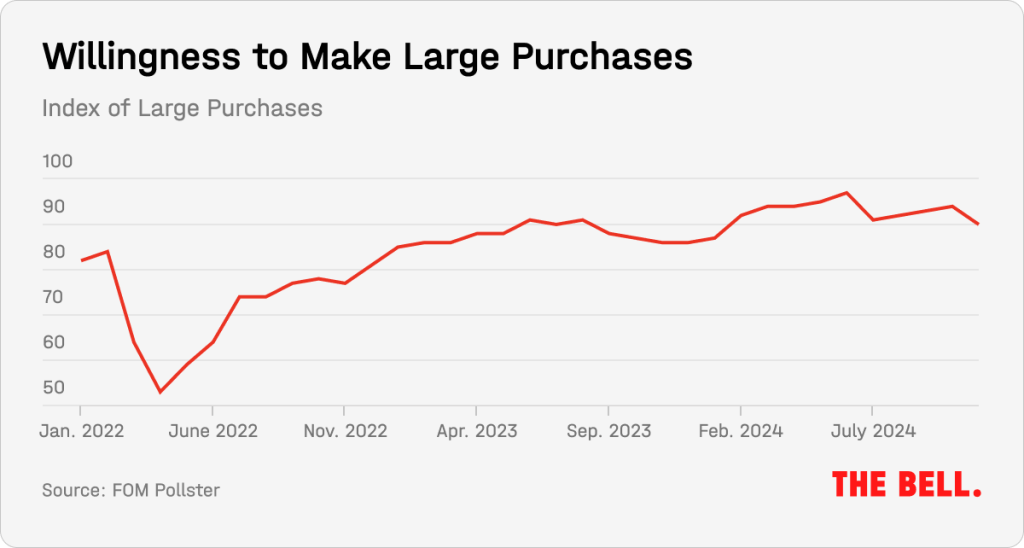
The economists looked at RLMS data from 2013-2023, scrutinising responses to the questions: “how satisfied with life are you right now?” and “how satisfied with your financial circumstances are you right now?”. They also looked at whether households had made large purchases over the past year, how much they spent on cultural events and how long they could maintain their current lifestyle if they lost their main source of income.
They concluded that the first two years of Russia’s invasion — 2022 and 2023 — saw the highest levels of general satisfaction, and specific financial satisfaction had also returned to 2014 levels for the first time. That year is seen as a benchmark before Russia was plunged into an economic crisis following the annexation of Crimea, imposition of Western sanctions and an oil price crash.
Large purchases fell to a minimum in 2022 but demand for non-food goods has since increased faster than inflation and wages, in line with The Bell’s earlier calculations. There was also a sharp rise in the proportion of households spending money on entertainment: in 2023 this reached 2018 levels, the researchers noted. The number of respondents who said they would be able to last more than a few months on their savings reached a 10-year high.
These findings correspond with Russia’s official statistics which also point to improved financial circumstances since the start of the war. In 2023, real incomes in Russia not only returned to 2013 levels after a decade of lost living standards, but surpassed the pre-Crimea level by 5%, the researchers highlighted.
There are no surprises as to the cause — a huge increase in state spending on the invasion and the military-industrial complex that has driven record labor shortages and pushed wages up across the economy. The high salaries offered by the state to people sent to work at the front, as well as those paid to soldiers (from 200,000 rubles a month) have played a big part, and the main winners have been residents of Russia’s poorest regions, which have recorded an unusually sudden increase in bank deposits.
Why the world should care
Putin’s regime is unlikely to face any internal threat as long as Russians’ well-being and overall happiness is on the rise.
KVS, “SouthTown: The Olympic Quarters” (YouTube, 8 June 2021)
Today’s developers pay no less attention to creating comfortable residential environments in their projects than they do to configuring apartments, for example, and sometimes they pay even more attention to this.
In recent years, the concept of beautifying the area around residential buildings has been transformed from elementary landscaping of yards and equipping playgrounds to creating theme parks within residential complexes, divided into different activity zones, as well as designing additional spaces where residents of the neighborhood can gather, get acquainted, relax, play sports, and organize their own or their children’s leisure activities.
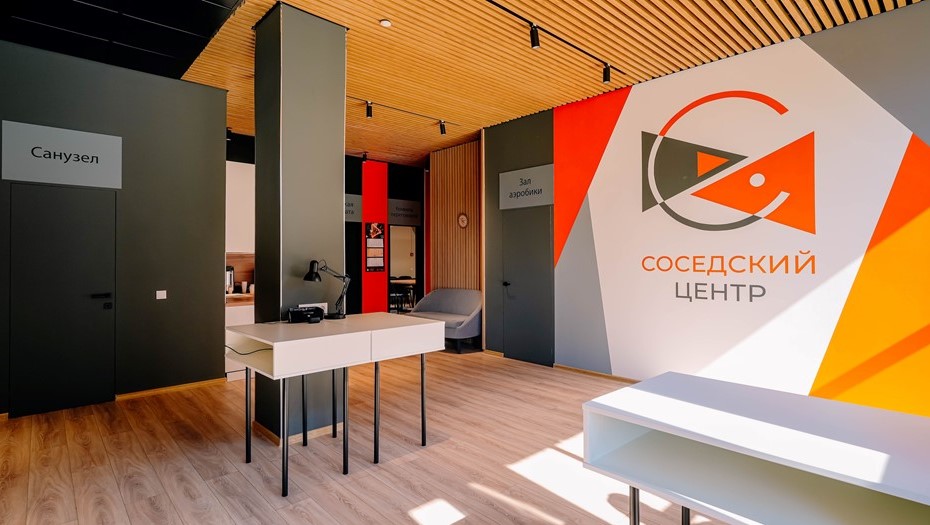
The role of such spaces is most often played by neighborhood centers, and planning these centers has recently become a real trend among developers.
The neighborhood center at the SouthTown development, designed by Anton Rudnik. Photo: KVS Group, via Delovoi Peterburg
The reasons
Residents of apartment buildings have always needed to socialize and spend time together. Back in Soviet times, people would often gather in courtyards to play dominoes, bingo, and table tennis. At some point the tradition was lost, but after the restrictions imposed during the Covid-19 pandemic were lifted, it literally sparkled with new colors.
In their article [sic: no link in the original] on communities, neighborhoods, and neighborliness, researchers from the Higher School of Economics noted that the first contemporary attempts to unite people living near each other into groups were especially noticeable after 2015, when people all over Russia began celebrating Neighbors Day. From a holiday in the classic sense of the word, Neighbors Day has quickly evolved into a multifaceted know-how for working with residents and getting them involved in such community work as spring cleanups and decorating yards for the New Year’s holidays.
With the emergence of urban agglomerations and the integrated development of new estates by developers, the need for communication among the people living there has increased. There is a logical explanation for this. In her time, Birgit Krantz, a Swedish sociologist, architect, and expert on neighborhood relations, argued that the ideal apartment complex contains between fifty to eighty apartments. If a complex has more apartments, it is difficult to manage it and maintain good neighborly relations.
There are many more apartments in new large residential projects, however, even if they are low-rise developments. This is where neighborhood centers come to the rescue. Consequently, they have become an integral part of people’s everyday lives in entire neighborhoods, functioning, per the American sociologist Ray Oldenburg, as “third places” (between home and work or school), as social anchors which facilitate creative interactions among individuals.
A clear demand
Today, the neighborhood centers running in new residential neighborhoods are literally bustling with life, and they are usually open seven days a week from early morning to late evening.
Delovoi Peterburg talked to residents at the KVS Group’s SouthTown development, where such a neighborhood center has been up and running for over six months. The center offers sports classes; clubs for children, including preschool prep; nanny services; rooms for business meetings and negotiations; and movie screenings. A puppet theater also periodically comes to the center on tour, and a planetarium was once even recreated in the space.
According to Anzhelika Alshayeva, director general of the KVS Real Estate Agency, all activities were free of charge for residents during the center’s first three months of operation; the tab was picked up by the developer. Now, the cost of classes is only 200 rubles, and the interest of residents continues to grow. With this in mind, the decision was made to launch the second stage of the neighborhood center — a teen club, which will be equipped with ping-pong and billiards tables, which will undoubtedly appeal to local youngsters.
The teen club at the neighborhood center in the SouthTown development, designed by Anton Rudnik. Photo: KVS Group, via Delovoi Peterburg
An important social role
Most importantly, such neighborhood centers, in addition to creating stable communities of around particular interests and hobbies, offer residents various opportunities for professional and personal growth. As practice shows, neighborhood residents themselves provide professional services, working as nannies, coaches, and teachers. Thus, another important issue for the neighborhood as a whole — job creation — is solved. And the concept of the 15-minute city is implemented in the particular housing complex: without leaving home, a person can comfortably take advantage of the full range of social services and work in the same place.
In this sense, co-working spaces can be an important component of neighborhood centers, serving not only as a pleasant but also as a useful feature for buyers and future residents. In addition, a co-working space can potentially generate revenue, thus covering the costs of its own upkeep.
And it does not necessarily have to be a classic room with computers and a coffee machine. For example, in the aforementioned neighborhood center, in the amphitheater of Olympic Hopes Park, the developer decided to create a beauty co-working space — a space with work areas which can be leased by beauty industry professionals. The project promises to be an important element of the neighborhood’s infrastructure, contributing to the growth of small business and strengthening the local community. This comprehensive approach to neighborhood development and neighborly relations was also recognized by Delovoi Peterburg, which awarded it the newspaper’s award for Residential Environment Project of the Year in Creating Versatile and Comfortable Neighborly Infrastructure.
The beauty co-working space at the neighborhood center in the SouthTown development, designed by Olga Fedotova. Photo: KVS Group, via Delovoi Peterburg
When speaking about the importance of neighborhood centers for residential developments, the experts interviewed by Delovoi Peterburg generally voiced confidence that adding such facilities to residential developments does not make projects much more expensive, but it can increase an an apartment’s per meter cost, as well as make a developer stand out from the competition. The experts recognized that the trend toward neighborliness, according to psychologists, will continue to grow, especially among residents of new neighborhoods.
Kirill Medvedev,* a poet, publisher, and member of the band Arkady Kots, left Russia in 2023 and returned in late 2024. At Republic Weekly’s request, he explains his winding road, what Moscow looks like when one hasn’t seen it from the inside for a long time, and what remainers have to say about leavers.
After a year and a half of living in other countries for personal (but, of course, political) reasons, I have been living in Moscow for several months now. Despite certain risks, I really don’t want to leave, and I am terrified of everything having to do with living in exile. I’m willing to speak in allegories or even to keep silent altogether just to be able to live in my hometown. Although what could be more important than waking up in the morning and smacking the Putin regime in the face without pulling your punches?
Everything in Moscow is still familiar and homely. I am indifferent to Sobyanin’s renovations. Things have improved in some places, while in other places it’s the reverse. Half-abandoned spots have suddenly emerged even in the most expensive neighborhoods, as if the money had suddenly been hoovered out of them. I’m certain that’s literally what happened.
I don’t see any particular feasting amid a plague, but I guess I’m just not hitting the right spots. Moscow has become more desolate and wild on the whole. When the capital is finally moved to Siberia, the Moscow I know and love will look even better. But for now, it is still what it is: a crazy quilt fashioned from Eurasian chaos, absorbing a million shades of the glitz and poverty of the entire country and its neighbors, and tempting us with new revolutions somewhere in its squares and back alleys.
All of Russia can be found in Moscow, and yet, as everyone knows, Moscow is not Russia. Thanks to this fun fact, it is easier for Muscovites than for anyone else to love the entire country, albeit an imaginary and unfathomable country, shaped from different scraps. “I stand as before an eternal riddle, / Before a great and fabulous land,” sang one remarkable Muscovite. I repeat another poet’s line about another city, thinking that love for one’s capital city and one’s country is an enormous, complicated privilege: “May it not be my lot / To die far away from you.”
Online public communication habits have actually changed a lot because of the risks involved. It no longer feels like your event didn’t happen if it wasn’t written up online and if you didn’t post a photo of yourself with a crowd of happy spectators.
There are [now] more personal channels of communication within communities and more word of mouth. Reactions are more reserved in public and more emotional among friends. Pardon my sentimentality, but there is little to compare with physical hugs with friends and family in a city charged with your own and other people’s memories.
Of course, there are a lot of new problems, and I’d rather deal with some variety of internet addiction than the nightmare in which everyone has found themselves. And yet there is the perception that the war has ushered in the degradation of all ways of living in Russia. This is not true. Humans are ultra-creative and crafty creatures. Violent shocks do not neutralize life but propel it into new forms. A caveat: no new ways of living and creating can justify the mass murder of people who will never wake up to life again. But cultural, activist, educational, and other communities who persist and change, albeit semi-clandestinely, albeit at the cost of compromise or risk, increase our chances of transitioning to a different way of living in this country in the future. The more allies we have here at home now, the more likely they are to be in the right place at the right time—that is, if the first flights our friends who have been shoved out of the country plan to take are delayed a bit.
Irony or irritation towards the people who have left [Russia] for one reason or another is evident among almost all those who have stayed, except for those who are definitely planning to leave. One of the frequent complaints is “They left to live in safety, and they did the right thing—they just shouldn’t pass it off as a political act.”
That is true, though with many caveats. Bravo, of course, to the activists who have been helping people who have to leave to get out of the country and to adapt to life abroad. Bravo to the journalists who have moved to relatively safe places and continue to fulfill their professional obligation to their fellow citizens. Regular albeit serious news, reported with respect for themselves and the audience, without unnecessary harshness (“so that you can send it to your grandmother”) is needed desperately: almost everyone talks about it. But pessimism and aggression about life inside the country on the part of fellow citizens who have left the country is completely out of place. It is clearly old-fashioned exile self-therapy and should be practiced in private.
While the demand for alternative information is great (many people in the USSR who were not necessarily anti-Soviet also listened to Voice of America), one can see skepticism or simply a lack of interest in émigré politics. Why is this the case? There seem to be many examples in history when political émigrés came back home, were involved in great transformations, or even spearheaded them. Escaping from prison in Russia, making one’s way abroad, drinking to a successful adventure with comrades in Geneva, discussing future strategies in a relaxed atmosphere, and soon returning home to work underground was a typical trajectory for Russia’s radical democrats in the early twentieth century.
Things have changed since then, although today many also travel back and forth. You can talk at length to those who have stayed in Russia about the hardships of emigration, and they will agree and sympathize with you, especially if you were actually in danger here at home.
For the most part, though, people still see someone else’s moving abroad as their means of upgrading their private existence.
By renouncing your past life, it is as if you automatically renounce your past community. The propaganda, of course, does its best to inflate the resentment, but it’s not just propaganda at work. Emigration is indeed an experience of constant self-denial. Especially today, when Russian emigrants are so evidently prodded (gently and not so gently) to cancel themselves in terms of of their citizenship, background, language, identity, or even flag. Moreover, the reanimated ethical-religious discourse of the Cold War, with its confrontation between good and evil on a global scale, has played a considerable role in this.
The field where dialogue should have taken place between leavers and remainers, as well as between moderate oppositionists and hesitant loyalists, has been overrun by moralizers in proverbial white coats and rabid patriots. They are the dividers and conquerors.
The leavers more often argue in terms of negative freedom—freedom from censorship, political crackdowns, and military mobilization, from having to indirectly finance the war or live among its supporters. The remainers stay because they do not see how they can realize themselves abroad, at least not without the sort of superhuman effort and self-denial that many of them find more frightening than living under the threat of arrest or self-censorship. They often speak of duty—to elderly relatives, students, patients, voters, political prisoners, the graves of relatives, the homeland, etc. And they often hear in response that it is immoral to be involved in the normalized life in today’s Russia. The ethical conflict is evident.
I wander the Pokrovkas and the Ordynkas, thinking about where I can get money to pay the bills and pay off my debts. There are posters calling for men to sign up for the army. Somehow I don’t feel more upstanding than the guys who go off to kill for money. I would definitely not go to do that, but this certainty does not raise my moral self-esteem. I think of an old comrade who perished in the “special military operation.” His debts, low social status, and leftist anti-western ressentiment had blossomed into imperialist obfuscation.
I sit in a cafe, thinking about my plans. The people around me talk about different things, while people in a neighboring country are bombed in our name.
I’m good at displacing unpleasant things. We all are good at it.
Being here, dissolving into this life, it is difficult to feel like a member of an ethics committee. It’s easier to realize that all people are basically the same, that there are no insuperable differences between them. All our actions (whether ordinary, shameful, or magnificent), all the passivity of the masses, all the revolts of nations, are manifestations of the same human principle in different historical circumstances. The way humanness manifests itself in our present circumstances, the way my own humanness manifests itself in them, is the most interesting thing to observe. Okay, we’ve established that.
No, of course, there is a huge difference between opposition to evil, passive non-participation, and complicity in it. Putin’s propagandists have been blurring the distinction between the first, second and third to depoliticize and morally degrade society. We know this, and you can’t fool us. In both the secular and Christian systems, a person always has a choice and a responsibility for it. We should not see the individual as a unwilling victim of want and propaganda. But something else is also true: even if you believe that you have made your own super-correct moral choice once and for all, endlessly judging your neighbor, or believing they are made of some qualitatively different stuff than you, or finding them complicit in collective guilt without trial is also a quite devilish temptation, akin to the temptations proffered today in our country by various spiritual and political leaders.
Political evil is countered not by personal virtue, and even less by moralistic posturing. It is countered by political or civic ethics, but our country has a huge problem with that.
All the debates between the leavers and the remainers, all the debates over the slogans “peace now” vs. “war until the dictatorship’s defeat,” all the debates about whether Navalny should have returned to Russia, revolve around the missing answer to the ethical (aka political) question: for what are we willing to risk our private lives, for what collective ideals?
I certainly don’t have a clear answer. Russia is long past the heroic times of liberalism and socialism, when people believed that civic heroism was not weak-mindedness or recklessness, but a deliberate, mature step toward a better future. Popular willingness to take to the streets against war and dictatorship is impossible without the conviction that we are on the right side of history, that we are in a movement that both overlaps with and transcends our private interests.
The Bolsheviks believed in communism’s inevitable advent on a global scale, and were able to convince many people this would happen, which was why they won. In 1991, Russians believed that by defending the [Russian] White House and confronting the coup plotters’ tanks, they were leading Russia onto the road of progress which all democratic nations were already rolling down. Whether we like it or not, Russia is not ready to follow any well-trodden path. There is no single road anymore: the road is just going to have to be paved anew. (I’m reckoning on this.)
Today we see a faint glimmer of hope in republicanism, with its idea that community spirit is not a consolation prize for people who lack professional fulfillment and personal happiness. It is not reducible to a professional or personal virtue and is not a profession itself.
Anyone willing to stand with others to oppose tyranny and then work every day to prevent it from happening again is capable of demonstrating civic valor. And the brighter, bolder and more constructively a person commits to this work, the more they make use of their professional, creative and other kinds of potential, the greater their authority in the community will be and the more likely they will remain in the community’s memory. This sounds good as a motivation, but if the republican ethic is realizable, then it is realizable in the small and medium-size spaces of campaigns around residential buildings, courtyards, neighborhoods, and (at most) cities, where it is possible to find analogues of the ancient Greek square for people to hold meetings.
A national community is imaginary, no matter how you look at it, and it is based on a rather sketchy common historical plight and collective memory. If we do not want it to be the memory of how “everyone was afraid of us,” it should be the memory of how we survived together and resisted—secretly and explicitly, passively and actively—the extermination of others and self-extermination, of how we built ties, engaged in “culture,” taught children, supported political prisoners, and helped the bombing victims and the homeless.
This is the ground of community, a ground not nourished by moral superiority, by denying oneself and one’s roots, or by essentializing differences. It is nourished by responsibility for the people who stand or have stood next to you in the same squares and the same queues, for the people who walk the same streets, who went to the same schools, who share the same hopes for the future.
If we indeed stand on this ground, then it makes sense for us to challenge and set our hearts on something together.
* Medvedev has been placed on the Russian Justice Ministry’s registry of “foreign agents.”
As Ukrainian drones attacked the surrounding Leningrad Region this past weekend, life went on, seemingly unaltered, at downtown Petersburg’s notorious, glorious Apraksin Market aka Aprashka. Thanks to anatrrra for kind permission to reprint their stunning photo reportage from the market.
anatrrra, from the series “Petersburg in April,” 2023 You can see the entire series on their LiveJournal
I just spent many hours roaming around Kolomna. I love the neighborhood: it soothes my soul, if only for a short time.
I came upon two dudes approximately my age sitting on a bench and drinking beer. From what I heard them saying it was clear as a bell that they had listened to Kinchev, Sukachov, and Butusov in their youth.
“That’s where such old scum comes from. But they used to be regular guys—bright eyes, rock and roll, the whole deal.”
“They drank, shot up, and snorted away their conscience, but money doesn’t smell, supposedly.”
“It stinks like hell nowadays.”
I was going to walk past them, but I turned around.
“Excuse me,” I said, “but I accidentally overheard what you were saying. I think they were like that from the get-go. They just adopted a stage persona in their youth. It was cool then, the niche was open, and you could no longer go to prison for things like that (unlike now). It was a beauty way to go.”
The men looked up at me, exhaled, and shook their heads.
“If that’s so, it’s even worse,” one of them said.
I apologized again, and went on my way. My back already turned, I heard one of them say:
“Check it out. Our people are still roaming these parts…”
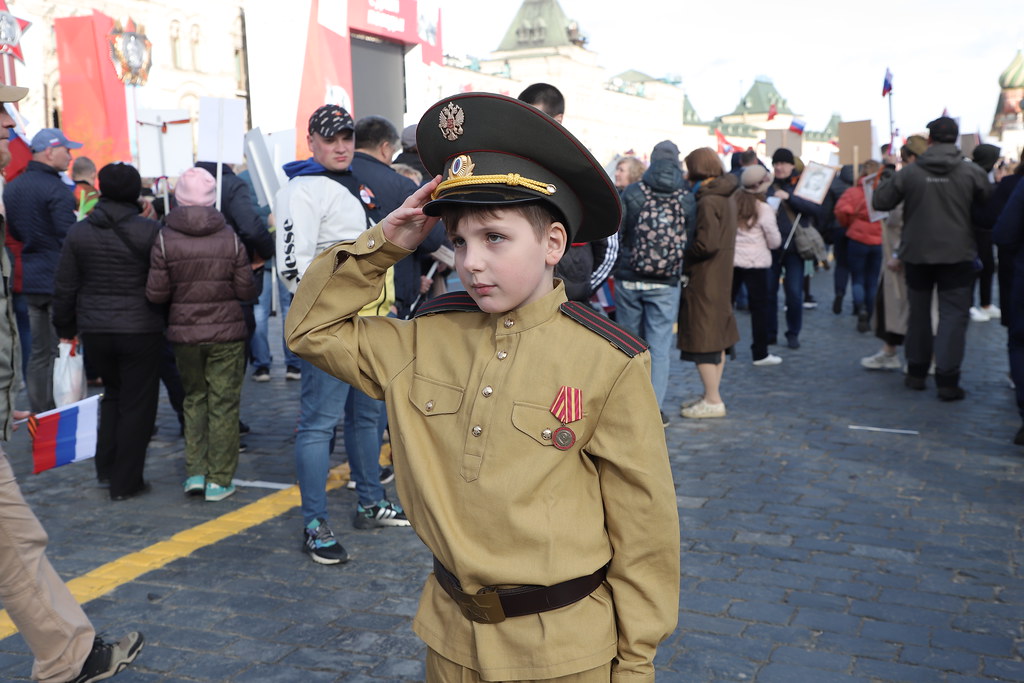
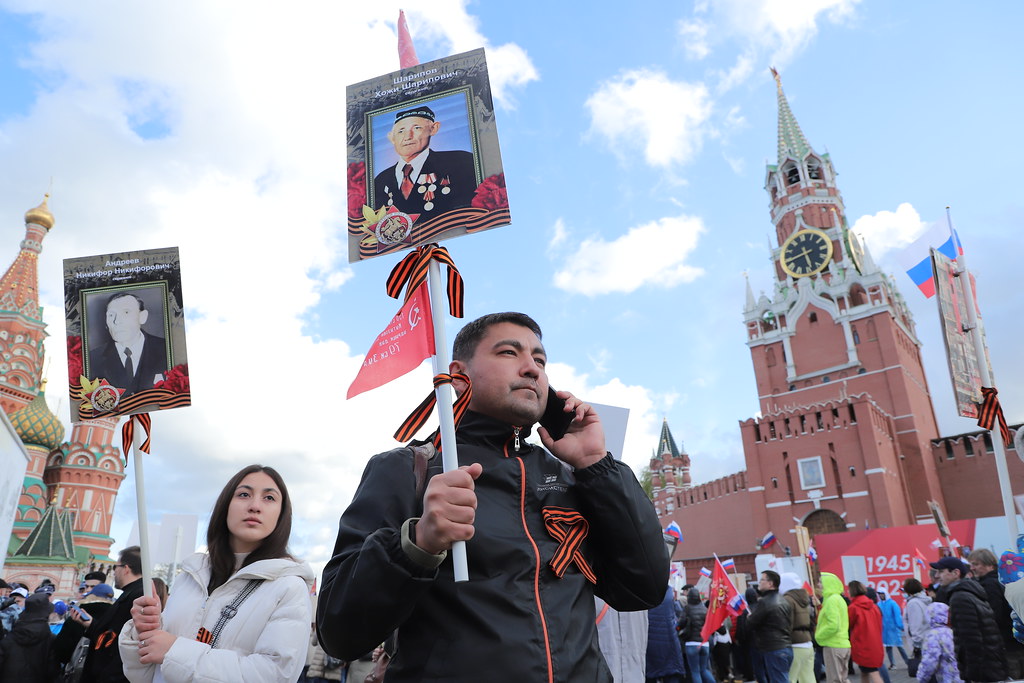
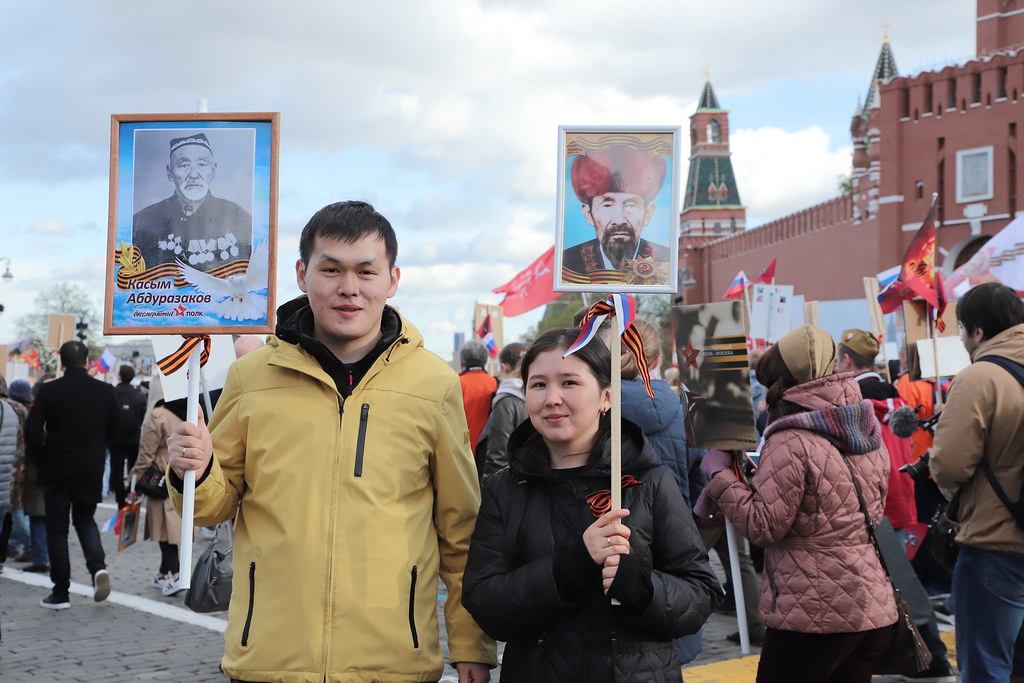
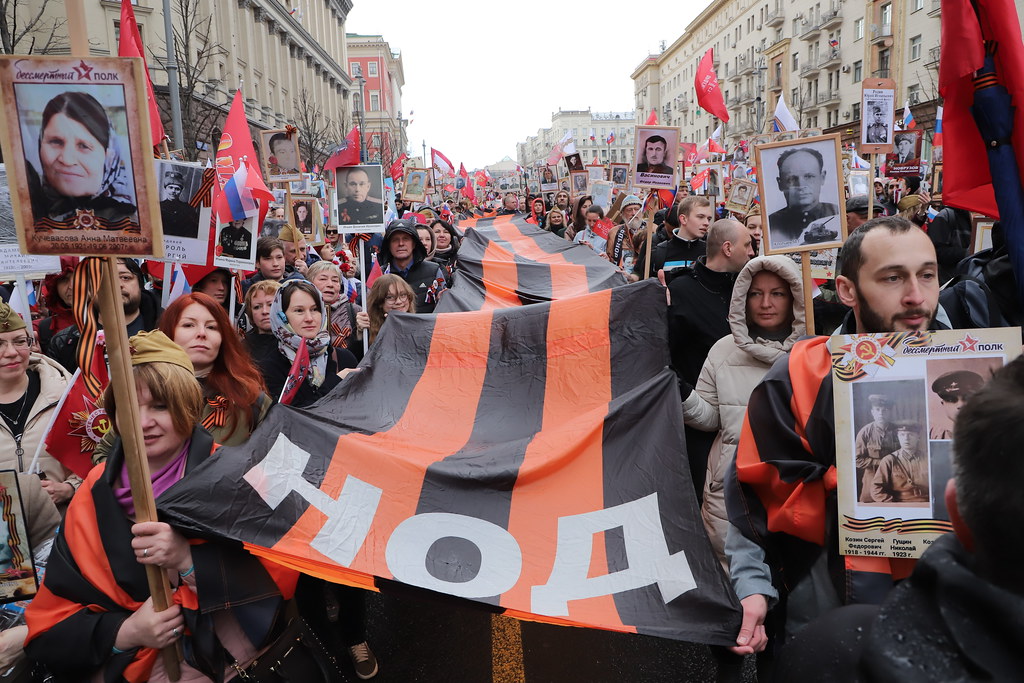
For the first time in my life (I swear!) I went to the Immortal Regiment march today. Let’s just say I was strongly encouraged to do it. I hesitated, I thought it over, but in the end my curiosity won out. I have been shooting almost nothing for more than two months, because I simply lost any sense of how to go on documenting urban life and civic activism in the new reality. What did I see and hear today? I found super polite people of all ages portraying the ideal “Russian world” in its peaceful aspect. “Nobody here wants war,” a man of about forty-five, holding a portrait of his grandfather and a flag emblazoned with an image of Stalin, told me. He is one of those who sees “pros and cons” in everything and everyone, and who, although experiencing some discomfort, still fully trusts the vision of the country’s leadership. Maybe some of the marchers were forced by their employers to go to the rally, but it seemed to me that people had gone there quite willingly. They were given free food and beverages: in exchange for such generosity, one can walk in the rain and sun for a couple of hours. The Uzbek workers seemed to be happy, because on Victory Day they are allowed to join the people of Great Russia, who for the rest of the year carefully monitor and maintain the existing division of society into “homeboys” and “aliens.” When, instead of periodic enthusiastic shouts of “Hur-ra-a-a-a-h!” or “Ru-u-u-u-sia!”, the crowd started chanting “fascism will not pass” behind me, I should have fought the good fight, but instead my instinct of self-preservation kicked in and I stupidly continued to shoot.
Source: anatrrra, LiveJournal, 10 May 2022. Introductory text translated and photos reprinted with the author’s kind permission. Go to the original post to see their completely stunning photo reportage in full. Translated by the Russian Reader
Azat Miftakhov, a mathematics and mechanics graduate student at Moscow State University, has been remanded in custody until March 7, 2019
Golovina District Court Judge Sergei Bazarov has remanded Azat Miftakhov in custody for a month, until March 7, at the request of police investigators. The police suspect Miftakhov of involvement in a January 13, 2018, incident in which a window in the Khovrino office of the United Russia party was broken and a smoke bomb was thrown inside.
The only evidence in the case is the testimony of a secret “witness” who emerged three days ago. Allegedly, the witness was near the United Russia office the night of the incident. He saw six young people. Three of the young people smashed the window and threw a smoke bomb in it, while the other three stood off to the side. The so-called witness supposedly recalled Miftakhov as being among the group who stood and watched, yet he was unable to describe neither what Miftakhov was wearing or his facial features, only his “expressive eyebrows.” The witness, however, did not contact the police for an entire year since, he explained, his phone had gone dead at the time and, subsequently, he had been busy with his own affairs.
Miftakhov was detained by law enforcement officers on the morning of February 1 on suspicion of making explosives, a criminal offense as defined by Article 223 Part 1 of the Russian Federal Criminal Code. He was held for twenty-four hours at the Balashikha police station, where law enforcement officers tortured him, demanding he make a full confession. Only on the evening of February 2 was Miftakhov officially detained and sent to the Balashikha Temporary Detention Facility.
On February 4, however, a court refused to remand him in custody due to a lack of evidence. Over the next three days, police investigators were unable to muster any evidence against Miftakhov, and so, on February 6, he was released from the temporary detention facility without charge.
As Miftakhov was leaving the detention facility, he was detained by men in plain clothes and taken to the Interior Ministry’s headquarters for Moscow’s Northern Administrative Division, where he was told he had been detained in another case, an investigation of alleged disorderly conduct outside the United Russia office in Khovrino on January 13, 2018. An investigation into vandalism (Criminal Code Article 214 Part 1) had been opened in January 2018, but Russian law does not stipulate remanding vandalism suspects in custody during investigations.
In an amazing coincidence, just as Miftakhov was detained a second time, the case was reclassified as an investigation of disorderly conduct, as defined by Criminal Code Article 213 Part 2. People suspected of disorderly conduct can be remanded in custody, and Miftakhov suddenly had become the main suspect in the case. On February 10, the Golovina District Court in Moscow refused to remand Miftakhov in custody, postponing the hearing until February 12.
Miftakhov denies the charges against him. He believes he has been framed because of his anarchist views.
Over a thousand lecturers, professors, researchers, and students from leading Russian and international universities have signed a petition in Miftakhov’s defense, include MIT linguistics professor Noam Chomsky and Viktor Vasilyev, president of the Moscow Mathematics Society. Mikhail Finkelberg, professor at the Higher School of Economics and Skoltech, Boris Kravchenko, president of the Confederation of Labor of Russia (KTR) and member of the Russian Presidential Human Rights Council, and Russian MP Oleg Shein have agreed to stand surety for Miftakhov.
Translation and photo by the Russian Reader. Please read my earlier posts on the Khovrino vandalism case and the Russian police state’s senseless, relentless persecution of Azat Miftakhov.
For several days, Iranians have been openly protesting the corrupt system in their country. They have been protesting not only in the capital Tehran but also in at least fifty other cities. They had been promised more freedom and openness in terms of how the country’s budget is spent, and prices for food have been skyrocketing.
In Russia, the authorities have not promised anyone anything for a long time, and people have been staying at home, looking forward to the upcoming presidential elections.
Translated by the Russian Reader. Thanks to Anatrr Ra for their kind permission to reproduce their remarks on my website. Photo courtesy of correctlydesign.com
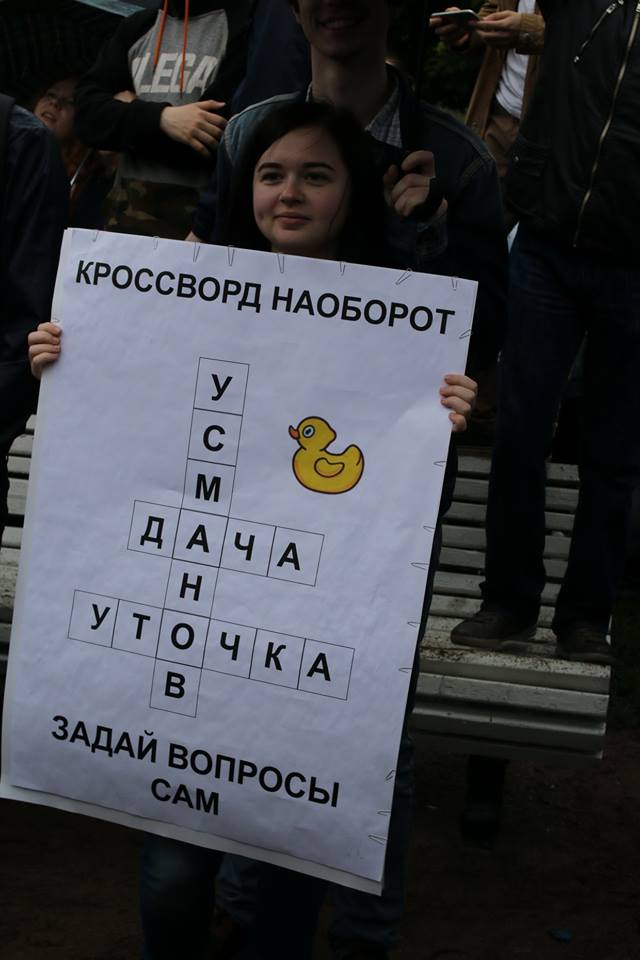
June 12 is a public holiday, Russian Sovereignty Day [sic]. Certain people have been trying to use our national holiday to destabilize the situation in the country. Alexei Navalny has called for Russians to take to the streets of their cities in protest against the current regime.
The administration of Saint Petersburg State University of Film and Television asks you to approach the question of involvement in such events responsibly, not to yield to such calls and other provocative proposals whose objective is inveigle young people in unauthorized mass actions and marches aimed at destabilizing public order, calls and proposals that are transmitted via social networks and other sources of information. We cannot let these people achieve their political ambitions illegally.
Thanks to Comrade VS for the heads-up
“⚡️Gas sprayed on Pushkinskaya Square. Police in gas masks. If you smell gas, wet t-shirts and breathe through them. #12june.”
So, 658 people were detained [in Petersburg]. Minors whose parents were able to come and get them and people with disabilities have been released. Nearly everyone else will spend the night in jail.
There will be court hearings tomorrow. Everyone who can make it should come. The hearings will take place at the Dzerzhinsky District Court [in downtown Petersburg]. The first detainees are scheduled to arrive at the court at 9:30 a.m. Considering the number of detainees, we will probably be there into the night.
Field of Mars, Petersburg, June 12, 2017. Photo courtesy of Alexandra Polukeyeva/Rosbalt
Alexei Gaskarov
I was invited to speak at the rally on Sakharov Avenue. I planned to talk about why it was important to support the anti-corruption campaign despite our political differences. In short, in order to put a stop to reaction, dissenters need to be represented on a massive scale, so the elites would not even think about just trampling them or not noticing them. Everyone has the same goal right now: resurrecting political freedoms. The contradictions among people are secondary. Considering the scale of protests nationwide, things turned out quite well. You can see that people have stopped fearing crackdowns, and that intimidation no longer works. In Moscow, switching the rally to a stroll down Tverskaya was an absolutely apt response to the Kremlin’s behavior. Everyone who wanted to avoid arrest had the chance to do that. There were downsides as well, but given the colossal confrontation, they don’t seem important.
Ilya Budraitskis
Of course, one cannot help but welcome today’s protests on a nationwide scale. We are witnessing the continuing rise of a new protest movement that emerged on March 26. This movement is indivisible from Alexei Navalny’s presidential campaign and owes both its virtues and weaker aspects to that campaign. Despite the fact that Navalny’s campaign could have launched a broad grassroots movement, on the contrary, it has been built like a personalistic, vertical political machine in which decisions made by a narrow group of experts and approved by the leader are mandatory for the rank-and-file. This raises the majority’s political consciousness to the degree necessary at each specific moment of the campaign. The leader’s political strategy, his objectives, and the meaning of decisions are not up for discussion. Navalny must be believed like a charismatic CEO. What matters is that he is personally honest and “he has a plan.” On the eve of the protest rally, authorized for June 12 in Moscow, the rank-and-file found out a new particular in the plan: everyone had to go to an unauthorized protest march, which would predictably end in arrests and criminal charges along the lines of the March 26 protests. The rationale of the organizers is understandable. They have to pull out all the stops to keep the campaign moving at a fever pitch, keep it in the public eye, and use the threat of riots to pressure the Kremlin. Moreover, this radicalization in the media reduces the complicated picture presented by Russian society to a simple confrontation: the thieves in the Kremlin versus the honest leader who has united the nation. This set-up renders all forms of public self-organization and all social movements secondary and insignificant, and their real interest ultimately boils down to making Navalny president. However, even Navalny’s most dedicated supporters should pause to think today, the day after June 12. Would his campaign be weakened if it were opened up to internal criticism, if horizontal discussions of his political program and strategy were made possible, and the political machine, now steered by a few people, turned into a real coalition, where differences did not get in people’s way but helped them agree on common goals?
Anna Ivanova
“Sakharov Avenue is out,” Navalny said in his morning video message.
Navalny’s adviser Leonid Volkov put it more democratically.
“The hypocritical scum who dreamed up the ‘opposition rally on Sakharov’ will fry on a separate frying pan.”
The rally on Sakharov happened anyway. It was mainly attended by opponents of Moscow’s new law on the large-scale renovation of residential buildings: urban activists and residents of the buildings slated for demolition, as well as defrauded investors in residential building projects, foreign currency mortgage holders, and other victims of the construction sector. Many fewer of them came out, however, than on May 14, even considering that some of the outraged Muscovite anti-renovation protesters followed Navalny over to Tverskaya. Protests rise and ebb like the sea, and this time round the excitement was muted. These people—old women, families with children, old men—were not suitable for getting arrested at an unauthorized protest. Although they realize that Moscow’s problems are merely one logical outcome of the Russian political system, they are in no hurry to support Navalny and other inveterate oppositionists, for what is at stake are their housing and property, not supreme civil liberties.
“Day of Russian Cops” on Tverskaya in Moscow, June 12, 2017
Meanwhile, on Tverskaya, young folks realized that A.C.A.B. Around 700 people were detained in Moscow, and the social networks were flooded with even more photographs of derring-do amidst the so-called cosmonauts [riot cops]. The ultimate damage from the protest might be acknowledged only over time, when we know whether there will be new criminal cases, and if there are, what charges are laid against the protesters. But everyone loves looking at riot porn (and being involved in it), although this hobby devastates and dulls the senses as much as watching ordinary porn. This is the danger of protests “for all things good,” of protests focused on a certain political agenda or figure: neither fat nor thin, neither old nor young, neither socialist nor nationalist, but generally sweet and better than the old protest rallies. In this case, protest risks degenerating into a social order in which everything is decided by Sturm und Drang. Not the worse prospect, some would argue, but others would argue it would be a disaster. But whether you like it or not, “Russia has thousands of young people dreaming of revolution,” for the time abstractly encapsulated in the slogan “Dimon must answer for his actions,” and they have been taking to the streets.
Two worlds did not in fact meet in Moscow today. One world is the world of people who are mostly old, people whose property is threatened with eminent domain and who imagine politics as a way of building an urban environment. The second world is the world of bold young people (and their slightly older idols), who are hellbent on regime change. It would not be a bad thing if these worlds met and acted in concert. This is the only way for a democratic politics to emerge from this.
Notes from the field (the Field of Mars). Putting aside emotions:
1. It’s true there were lots of young people. And they are not afraid of anything.
2. There were many young families, who are likewise not afraid for their children.
3. “We’re fed up” is the key phrase.
4. There were slogans about healthcare, infrastructure, and pension. Well, and about corruption, too.
5. The out-of-town students came out because “it is wrong to drive the regions into a pit like this.”
6. There was a sense of support and public acceptance.
7) The people who came out were true patriots genuinely worried about the country’s future.
8) A spirit of freedom . . .
P.S. On the Six O’Clocks News last night, BBC Radio 4’s Moscow correspondent had the temerity to refer to yesterday’s protest march on Tverskaya as “illegal.” Is this the new tariff for keeping one’s press accreditation under Putin’s perpetual reign? TRR
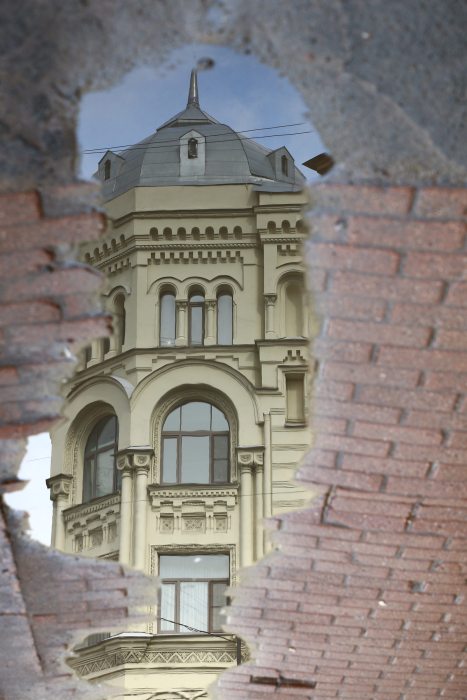
So far it’s been a fairly rough spring in Petersburg, ex-capital of All the Russias. When it hasn’t been snowing, it’s been sleeting or raining, and the sun has mostly been in hiding.
Recently, my friend and comrade anatrrra took advantage of a rare stretch of sunshine to snap these photographs of the world’s most beautiful city and some of its denizens, many of whom were also outside to catch a few rays before (as at the end of anatrrra’s complete album) the snow made its hasty return.
My thanks to anatrrra for permission to reproduce these photographs here. TRR