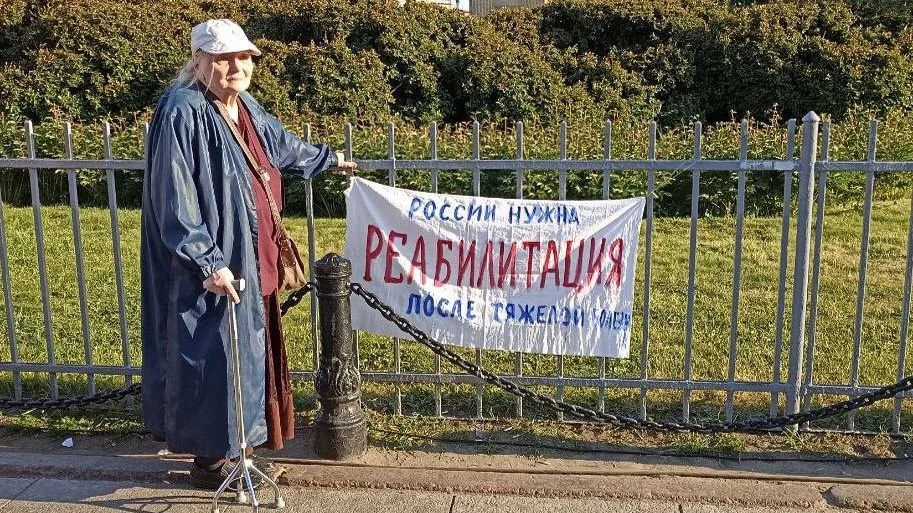
Don’t turn off your TV set. Keep watching the “most exciting World Cup ever.” While you do that, actual Russians and some non-Russians (i.e., Oleg Sentsov) are suffering horribly for the near-absolute power Russia’s Emperor of Ice Cream and his retinue have acquired over the last twenty years.
It was this same power (and the money that comes with it) that made it possible for the Emperor of Ice Cream and his pals to buy off FIFA’s bid committee and win the right to host the 2018 World Cup. They invoked this same power to spend more on preparations for the World Cup than any other host country has ever spent.
But instead of doing what enlightened despots have been known to do on such occasions — declaring amnesties, pardons, and ceasefires during Olympic Games and other such celebrations and great sporting events — the Emperor of Ice Cream’s repressive and imaginative secret services have seemingly notched up their civil war against their own people while you stay glued to your TV set, pretending it is possible to separate sports from politics.
Tell that to Yuri Dmitriev, rearrested and recharged for a crime for which he had recently been acquitted. Tell that to the Penza-Petersburg “terrorists,” all of them tortured by the FSB (KGB) into forcing them to give the testimony the FSB wanted to hear, never mind that it is total nonsense, the sick fantasies of the FSB itself, which sees or, rather, pretends to see a “terrorist” hiding under every rock. Tell that to Oleg Sentsov, a Ukrainian filmmaker and resident of Crimea, sentenced to 20 years in a maximum security correctional facility in Russia’s Far North for the thought crime of opposing Russia’s occupation of Crimea.
It’s frightening how “natural” absolutely neo-Nazi-like racialism has come to seem to so many folks in the Former East. It really beggars the imagination. What went wrong?
And it’s all reproduced and disseminated, whether in private conversation or more impersonal forums like Facebook, with such aplomb and confidence, as if literally no else in the world has thought or could think otherwise. Even broaching, in the most primitive way possible, the idea that races are a “construct” used to dominate some “races” while advantaging others, not something “natural,” will only expose you to instant derision.
What “race” is this bird? Is it white or black? In fact, it’s black, white, and several shades in between. Obviously, this is an absurd conversation, since we superior beings don’t attribute “race” to birds.
But we do attribute it to each other, missing somehow that the whole point, the only point, is power. Natural’s not in it.
One of the keys to successfully translating contemporary Russian avant-garde poetry into English is having absolutely no sense of colloquial English. The translations should sound leaden, awkward, and dull, as if they had been written by a manager in the Flint, Michigan, water department trying to justify his criminal negligence in an impenetrable and evasive letter to the EPA, to wit:
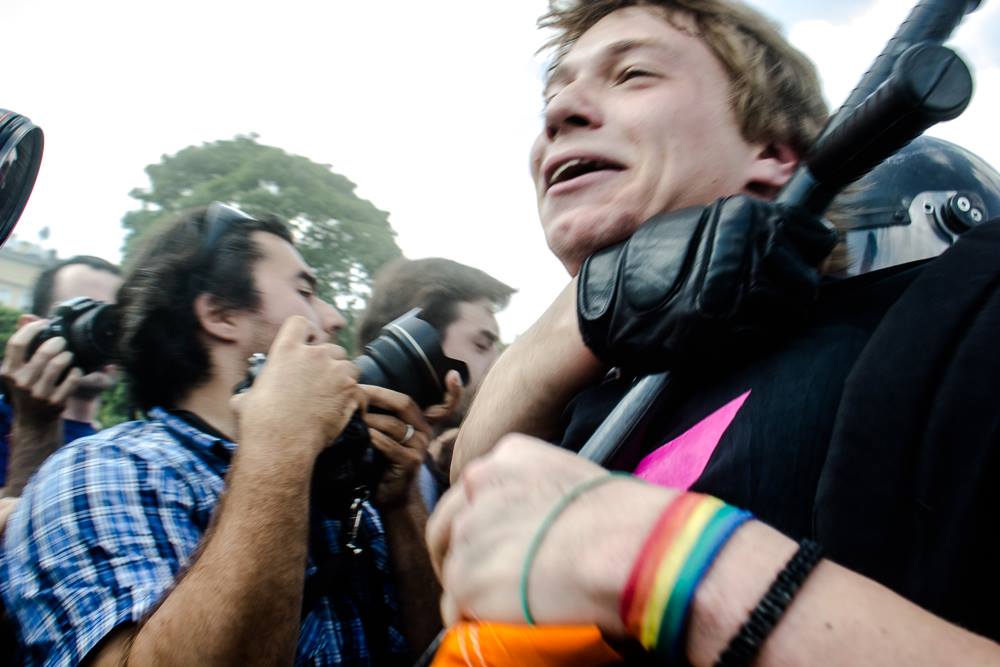
More fascists at today’s LGBT Pride event in Petersburg, as photographed by the intrepid Sergey Chernov. He reports that a few of the fascists brought small children with them so that it would be possible to charge the LGBT activists with violating Petersburg’s fascist-inspired law against “gay propaganda” amongst minors.
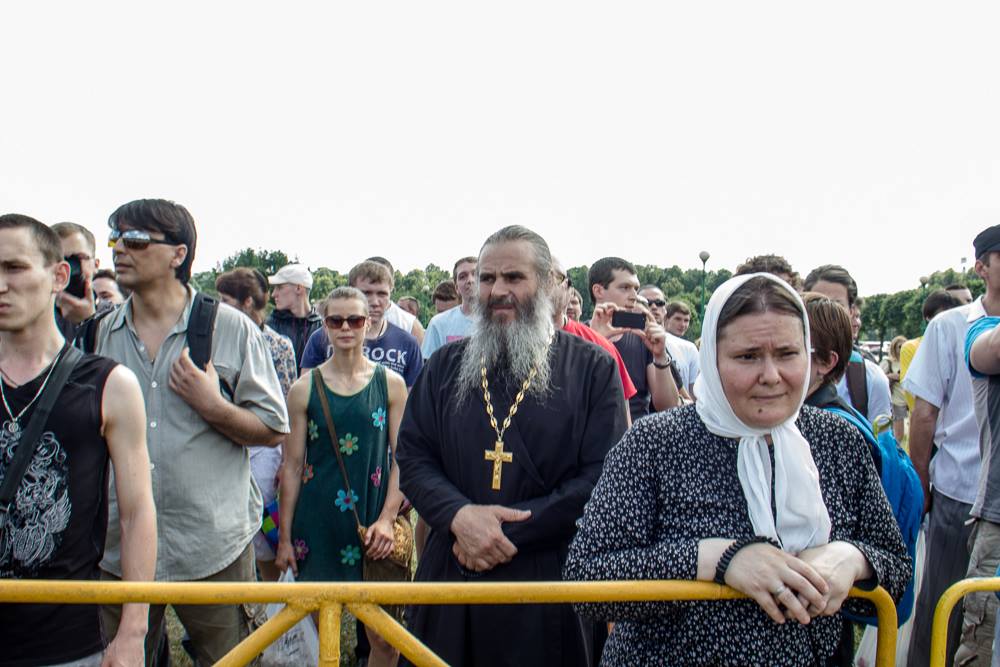
Fascists posing as “Cossacks” at today’s LGBT Pride event in downtown Petersburg, where all the gay activists were arrested by the police, unlike the 200 or 300 fascists, who apparently enjoy near or complete immunity for crimes that would get anyone else arrested. Photo by one of the few faithful friends of freedom left in Petersburg, Sergey Chernov.
Photo by Sergey Chernov: “St. Petersburg LGBT Pride event: fascists.”
So, oDR – openDemocracy’s Ukraine, Russia and wider region team – is at severe risk of closure.
What can I say apart from the fundraising has not been lucky, to put it mildly.
But we’re fighting: a huge last-ditch effort to turn the ship around and keep some of the best journalists, researchers and activists writing for our audience.
To do that, we’ve launched a crowdfunder to help match £50,000 we’ve already raised from private donors. This will buy us time to sort the long-term financing we need.
I’m not sure if folks want to hear about why we’re important, so I’ll be brief:
– Ukrainian journalists writing about Russia’s war
– Belarusian journalists writing about Russia’s war
– And Russian journalists writing about Russia’s war
And that’s aside from our brilliant collaborators in Central and South Caucasus.
So please help us spread the word, and help us keep fighting. There are so many important causes right now, so if you can’t afford – just push this on to people who can.
openDemocracy’s dedicated coverage of Russia and Ukraine is one of our greatest achievements. But now, the team behind that work is under threat of closure.
The two of us helped to found openDemocracy in 2001 to make a space for a global conversation about justice, human rights and democracy and how they are threatened by unaccountable power. Today, at its core is our project on Russia, Ukraine and the wider region.
The project provides an irreplaceable space for voices from the region that do not represent official Ukrainian, Russian, European or American interests.
It gives prominence to Ukrainian journalists reporting Russia’s invasion and its brutalities, alongside threats to economic rights, social welfare and independent journalism
It provides an extremely valuable platform for coverage of Russia from Russian journalists and writers in Russian as well as English
It publishes Ukrainians, Russians and Belarusians who are fighting for democracy alongside one another, creating a framework for analysis and exchange that is unique during the pain of Russia’s war
And because, thanks to openDemocracy, the coverage is translated into Spanish and Portuguese without a paywall, readers across Latin America can learn directly about the experience of what is unfolding
With three million readers annually, and a world-wide reputation, the coverage, grouped together here, is needed more than ever.
It is put together by a small team. Focusing on publishing original, vital, stories on the impact of the Ukraine invasion, whilst keeping everyone secure from the consequences of war as well as Covid, means they have struggled to raise the vital funding essential to survival.
We have to reignite funding fast – very fast. In fact, immediately.
Or the brilliant team – Katia, Tom, Valeria, Polina and Tanya – will be made redundant.
We are doing everything we can to secure, enhance and deepen their work.
Please join us.
We have already secured match-funding of £50,000 from private donors. Now we urgently need your help to unlock this money. Every £10, €10 or $10 you donate will be matched.
£100,000 will give us the time to negotiate with foundations to ensure this project enjoys a long life – long-enough to outlast Putin!
When Israel invaded Lebanon in 2006, John le Carré was furious and headed a funding campaign for openDemocracy:
Let’s support openDemocracy to the hilt. Intelligent, unbought, unspun opinion, uncomfortable but necessary truths and a lot of good horsey argument: heaven knows they are in short enough supply!
We love the ‘horsey’. A master of words, le Carré appreciated that some of our articles are untamed. But that’s because they are unbought and unspun.
Never, ever, has there been a greater need for this than now with respect to Ukraine and Russia. Please help the team publish necessary truths, on-the-ground reporting, much needed level-headed debate, and even good horsey argument, so that the irreplaceable media space they have created survives and grows.
So please, send us £50, €50 or $50 or more if you can; £/€/$25 if that’s possible; or whatever you can. Every donation will be gratefully received.
Thank you,
Anthony Barnett & Susan Richards
Source: openDemocracy. I just made a donation to oDR’s crowdfunder via PayPal, and I would urge you to do the same. ||| TRR
The second explanation that also immediately arises is the persistent sense of victimhood, which is embedded in the language: “we are victims of the West”; “we are victims of the Horde“; “we are victims of the authorities and the regime”; “we are victims of immigrants”; “we are victims of the capitalists”; “we are victims of circumstance”; “we are victims of revolution and war”; “we are victims of the Soviet era”, “we are victims of the 1990s”; and so on and so on. Again, this wide range of culprits who have victimized us enables us to integrate the image of victim into any ideological matrix. But all of these versions of victimhood are united by a sense of resentment, a sense of mediocrity, a sense of lacking something, and these feelings are constantly reproduced and cultivated. This language has no room, of course, for a critique of our own history and culture’s imperialism. We are not to blame: we are victims ourselves, our history is a victim, our culture is a victim. How can our sense of victimhood be squared with the fact that we ourselves have victimized others? The perception of ourselves as victims is one of our privileges, one of our special rights; it is our manifest destiny. However, the criticism of imperialism, the emergence of voices who declare themselves our victims, who want to discern our history and culture’s violence, subjugation, and injustice towards them, undermines this language’s entire foundation and our image of ourselves as victims. It undermines the foundation on which we stand, our privilege of being unique. And this triggers pushback and resistance, of course.
The generation of scholars who started studying the Soviet Union in the late 1980s and early 1990s were also shaped by their firsthand experience of the country. When they travelled as foreign students to Moscow, they found impoverished people. Empty shelves and pervasive poverty made Russians look like victims of the Soviet regime, and financially, Soviet Moscow seemed more like a European periphery than an imperial metropole, which they associated with material affluence.
The wave of decolonisation in Africa, the Middle East, South and Southeast Asia, which started after World War II, was accompanied by rigorous academic discussions and scholarship of colonial legacies and tools of violence.
By contrast, the 1991 dissolution of the Soviet Union did not result in similar scrutiny of the Russian imperial legacy.
For metropolitan Western Europe and the United States, Europe stood for metropolitanism – a place from which the world was colonised, not a place of colonisation. Accepting colonial history within Europe made little sense, so the colonial nature of Russia remained unchallenged.
In Russia itself, the dominant narrative was one of victimhood. Russians learned to see themselves as a special nation that sacrificed its own wellbeing for the sake of non-Russians in the Soviet Union. “Let us stop feeding them” was the slogan Russians used to explain Moscow’s decision to let the colonies go in 1991.
A recent article from the American Political Science Association (APSA) examined how the words used to describe Central Asia sometimes reinforce the region’s image as being part of Russia or the Soviet Union. Amid growing awareness of Central Asia’s colonial history, some argue it is time to move beyond terms such as “post-Soviet,” “near abroad,” or “Russia’s backyard” when referring to Central Asia today. Join host Bruce Pannier for a thought-provoking conversation on decolonizing Central Asian discourse with the co-authors of the APSA article: Botakoz Kassymbekova, a lecturer and assistant professor of modern history at the University of Basel; and Erica Marat, a professor at the National Defense University’s College of International Security Affairs.
Putin’s propaganda builds on seeing Russia as both victimized by the West and entitled to regional dominance over Ukraine, Belarus, Central Asia, and the South Caucasus. Russia’s sense of its lost greatness in 1991 after the demise of the Soviet Union fuels a sense that it is the innocent victim of outside powers. Its shrunken geography and collapsing economy made post-Soviet Russia economically poor compared to the wealth accumulated by Western colonial metropoles. Soviet socialism as a global anti-capitalist force had failed to bring the same level of prosperity. Russian intellectuals became preoccupied with their own imagined marginal position vis-à-vis the West fueling the denial of the true colonial nature of the Soviet regime.
At the same time, Russian political elites expect loyalty from former Russian colonies that includes knowledge of the Russian language and political loyalty, and unity in opposition to Western influence. According to such an imperial view, Russian rule over non-Russian populations is not colonialism but a gift of modernity. It is a deeply altruistic act for the sake of backward people. Rejection of Russian cultural dominance, including building independent foreign policy and contesting the Russian view of Soviet history, is an act of political disloyalty. In Central Asia, for instance, Russian ambassadors routinely condemn states’ prioritization of indigenous languages as attempts to limit the rights of the ethnic Russian population. Such search for independence triggers a sense of victimhood in Russia, as if disagreement with the Russian imperial self-image is an attack on Russian cultural greatness.
Putin coupled Russia’s innocent victim narrative with a historical self-image of a civilizing power against former Soviet republics that sought closer ties with the West. The Russian imperial myth allows identity mobilization around militant patriotism while also helping the state keep the public passive and uncritical. Putin recently spoke about Russia’s imperial identity when announcing the military attack on Ukraine: “It was necessary to immediately stop this nightmare—the genocide against the millions of people living there, who rely only on Russia, hope only on us.” Western leaders’ naming atrocities in Bucha a genocide further deepened the Russian regime’s sense of victimhood. The Russian Defense Ministry stated that the West is collectively attacking Russia. Feeling humiliated by the West, the Russian public was simultaneously supporting Russian aggression in former Soviet territories. Economic hardships can be reframed as a burden unjustly borne by a victim-savior or as an imperial duty of those who humanely seek to liberate the world from evil.
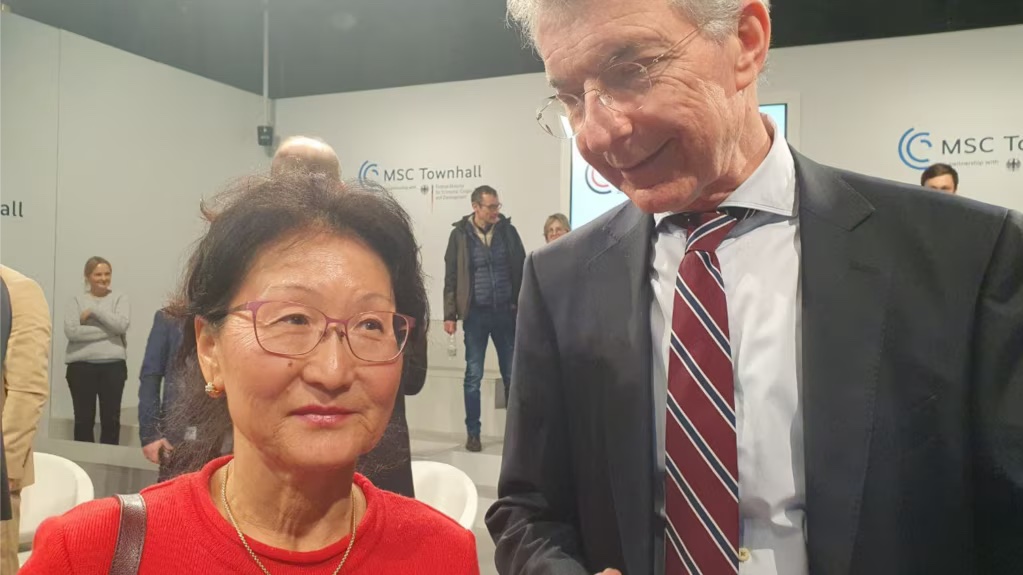
Maria Ochir-Goryaeva and Christoph Heusgen, chairman of the Munich Security Conference, February 2023. Courtesy of RFE/RL
When Russia invaded Ukraine, national movements in Russia’s regions advocating secession from Moscow were given a new impetus. A number of analysts have seriously argued that Russia could break up if there is a turning point in the war and noted the particular role of the Caucasus in this process. Kavkaz.Realii spoke with Maria Ochir-Goryaeva, Doctor of Historical Sciences, corresponding member of the German Archaeological Institute, and Distinguished Scholar of Kalmykia, about Kalmykia’s national movement, the Kremlin’s influence on the republic, and the republic’s current plight.
In 1999, Dr. Ochir-Goryaeva was awarded a competitive fellowship by Germany’s prestigious Alexander von Humboldt Foundation, and continued her research at the Eurasian Department of the German Archaeological Institute. She has published four scholarly monographs, the first of which was published in German. Every year, the archaeologist would return to Kalmykia to carry out archaeological digs in her homeland.
• • • • •
– It is the done thing in Russia to speak negatively about the support that western nonprofits and scholarly foundations provided in the 1990s to Russian academics and the Russian education system. Allegedly, it was through grants and training programs that the west inculcated its values in Russia. Tell us about your experience and what such programs did for Russian scholarship.
– Russian propaganda in general and on this issue in particular cannot be termed anything but xenophobic. In the 1990s, when many state-sector employees, including researchers at the Russian Academy of Sciences, were not paid their salaries for months on end, the grants allocated by western foundations literally saved them. In addition to the material aspect, they demonstrated the importance of researchers and their research. It was only thanks to the support of western and, later, Russian foundations that a number of academics, including me, remained in academia.
As for the “inculcation” of values, this is a distorted understanding of the purpose of such organizations. Each foundation has its own goals and values; if they are scholarly foundations, then their goals are scholarly. I have been living in Berlin for twenty-four years and I know that no one is subjected to “inculcation” here, but is given the opportunity to think and choose independently. Reality shows that people enjoy freedom of speech and the possibility of choice. These things work: everyone is eager to live in democratic countries, rather than in Iran, Afghanistan or Russia, which they leave at the first opportunity.
It is not western foundations that smack of “inculcation,” but Moscow’s imperial approach. Putin and his supporters are unable to adapt to a constantly changing world and are trying to adapt it to their needs by brute force and to make it conform to their outdated stereotypes.
– There is the opinion that this intellectual stagnation is displayed not only by country’s leadership, but also by many rank-and-file Russians, including those who disagree with Putin.
– I agree with this opinion. The wave of migrants from Russia, regardless of ethnicity, is no different from the populace who have stayed behind in Russia. Just as there, a small percentage of them are genuinely active in drawing attention to what is happening in Russia. Even here in Germany, many continue to fear for themselves, concealing their faces and names at protest rallies. The rest are either simply indifferent or they support Putin. Many have relocated in order to maintain their level of well-being and to be able to continue traveling around the world. They are, primarily, residents of Moscow who made good money.
Two things disappoint me about the new immigrants from Russia. The first thing is that few of them follow the news from the front and sincerely worry about Ukrainians. The topic never comes up in their conversations. Feelings of shame and guilt are probably unfamiliar to them. When I say something about bombing or war crimes, they immediately change the subject.
Maria Ochir-Goryaeva (left) at an anti-war protest in Berlin. Courtesy of RFE/RL
The second thing is xenophobia. Walking around Berlin, I have repeatedly heard indignation voiced by Russian speakers over why Germans tolerate the fact that Muslims here go about “in their headscarves.” Or, for example, Russians ask for help finding an apartment, but only in neighborhoods where “blacks,” as they say—meaning Arabs and Turks—do not live. This has shocked me as an Asian woman.
It seems to me that many immigrants do not assimilate the moral values of democracy and tolerance, but simply import Russia with all its stereotypes and ideology here. The problem is that Russians, with rare exceptions, are unable to understand the rationale and value of democracy. Otherwise, neither Putin, nor these decades of trampling on freedoms in Russia, nor the terrible war would have happened.
– At the same time, Putin and his entourage claim that the west has been trying to rewrite and distort history.
– We were all taught in school that in the early Middle Ages there was Kievan Rus’, a state centered around the city of Kyiv, that is, in present-day Ukraine. Then, three or four centuries later, the Grand Duchy of Moscow was formed, incorporating the lands in Moscow’s orbit. This name was the most accurate and reflects the essence of both the territory and its populace. Theoretically, it could be called Muscovite Rus’, but after its conquest of other peoples, it would be more correct to call this entity the Muscovite Empire. This state has its own history and traditions, like any other. The towns of the Golden Ring alone are worth so much! It is not that you mustn’t prize your own identity and your own statehood, but you should not appropriate someone else’s past.
Until a certain point, the Muscovites did not seek to appropriate Kievan Rus’ as part of their own history. This happened later, after Peter the Great declared himself Emperor of All the Russias. It was then that the temptation emerged to occupy not only the lands, but also the past of this foreign state.
Most of modern Russia consists of lands forcibly annexed to the Grand Duchy of Moscow and the Tsardom of Russia: the Volga region, Siberia, the Far East, and the North Caucasus have nothing to do with Kievan Rus’. They are colonies of the Russian empire. So it is the inhabitants of the Kremlin who are engaged in distorting history for the sake of political ambitions and propaganda.
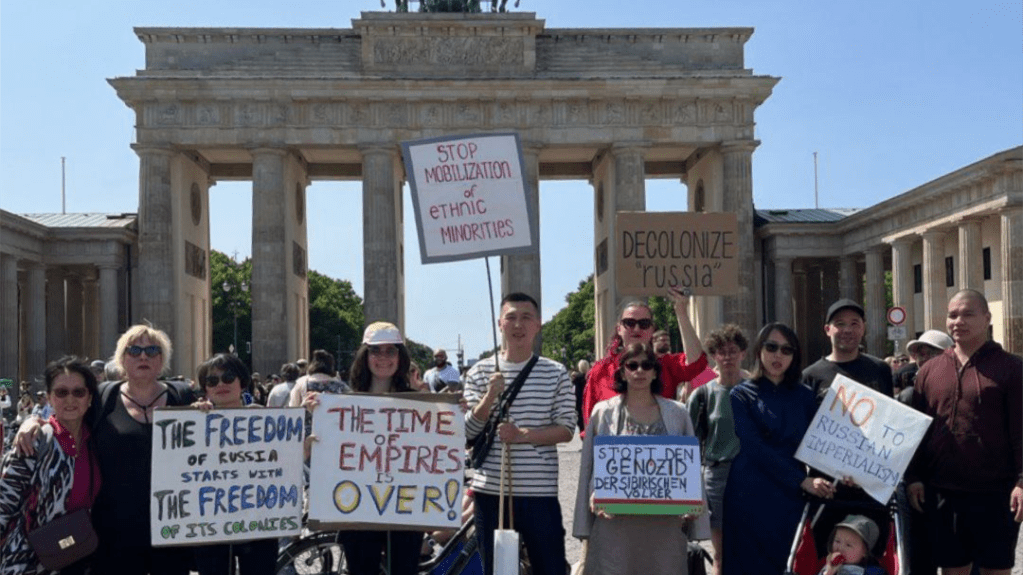
– In 2022, representatives of national movements from different republics condemned the war and stressed that the conflict did not serve the interests of the Russia’s ethnic minorities. There were isolated protests in Kalmykia, but there were no large-scale protests here. Did you expect this reaction?
– Attitudes to the war in Kalmykia, according to my information, are similar to what you would find among an average sampling of opinions Russia-wide. Why should it be otherwise if the empire has been pursuing a policy of Russification and unification for centuries, thus leveling ethnic differences? There are critically minded people in every region, but there are only a few of them. And almost all of them have left the country, especially since 2022.
It is clear that if the Oirats had reached the shores of the Atlantic in the distant past and stayed here, they would probably have been part of a democratic Europe. Since our ancestors founded their Torghut Khanate on the banks of the Ijil-Idel-Edel-Volga River[these are different names for the Volga River—KR], they shared the fate of the rest of the peoples in the Evil Empire.
We could talk for a long time about the pros and cons of the arrival of the Oirats in Europe, the foundation of their khanate, the migration to Dzungaria, the peasant colonization of the khanate’s lands, the Russian Civil War… History, as you know, does not operate in the subjunctive mood. And Kalmyks have to live in those conditions, which means they are inevitably a cross-section of the society in which they find themselves today.
– How realistic are hopes for the independence of Kalmykia now? What are the decisive factors? Are Kalmyks themselves ready for it?
– Independence has ripened for a long time; it is a necessity. There are always leveling processes within large states. So, the regions of Russia, not only the republics, have to become independent, and then function like the European Union. This means that everyone has their own state, their own rules and system of governance, but when it comes to general issues—for example, environmental protection and projects aimed at the future—they would act in concert.
Disintegration into independent states is vital to all the peoples of Russia, including ethnic Russians. After all, the interests and problems of ethnic Russians living in Siberia or the Far East are clearly different from the interests and problems of Muscovites. The capital is robbing all the regions, and so the Kremlin has a huge amount of money with which to wage a large-scale war and seize foreign lands. If the money of the regions stayed in the regions themselves, the country’s leadership would not have such massive resources, and people in Russia’s hinterlands would live much better! All segments of society suffer from this centralized system.
– At the same time, the situation in the republics differs from the situation in the regions and territories.
– The ethnic republics are, constitutionally, members of the Russian Federation. Moscow not only fleeces them, like the other regions, but also pursues a frankly colonial policy toward them. For example, it redraws their borders, grabbing the best lands for itself. The lands of the Buryats were divided into three administrative regions, while two districts were confiscated from Kalmykia to create the Astrakhan Region. Industrial facilities are built everywhere, just not in the republics. Accordingly, the economy there does not grow, professionals emigrate due to lack of work, and the populace is burdened with debt.
The project to construct the Iki-Burul water pipeline from the Levokum reservoir was imposed by Moscow to increase Kalmykia’s dependence on the outside world and force it to pay the Stavropol Territory for water, although it would have been easier for the republic to extend a branch line from the village of Tsagan Aman and pump water for free from the Ijil-Volga. The longest stretch of the Tengiz-Novorossiysk oil pipeline runs through Kalmykia, but the Krasnodar Territory receives the money for the rent. People from the Kalmykian government complained that they could not change the terms of the contract and they traveled back and forth to Moscow, but the officials there were unmoved.
They do not see the economic side, but the policy of the empire also leads to the loss of identity, language, and traditional culture.
– In your opinion, why did the population of the republics, not only Kalmykia, so easily abandon the sovereignty and even independence they had obtained in the early 1990s?
– Easily abandoned: that’s a good way of putting it! But what about the two terrible wars against independent Chechnya? Moscow forcibly and harshly resurrected the imperial approach, severely cracking down on all protests. No one wanted to be deported to Siberia again, so Kalmyks actually had no choice.
What happened to Gorodovikov back in Soviet times in Kalmykia? [Basan Gorodovikov was first secretary of the Kalmyk Regional Committee of the CPSU from 1961 to 1978—KR.] He, an old general, a decorated Hero of the USSR, was escorted from the CPSU Congress hall by KGB men and immediately booted from office because he dared to suggest that the two districts taken from Kalmykia be returned. That is why, in his wake, until 1990, only envoys from were tapped to run the republic. The desire for independence among the concerned part of our people has never faded.
– Kalmykia ranks last among Russia’s regions in almost all socio-economic ratings. This has been going on for many years—it was the same under Kirsan Ilyumzhinov and Alexei Orlov as it has been now under Batu Hasikov. In your opinion, why have none of the heads of the republic been able to achieve a breakthrough in terms of its growth? Could they have done it?
– Because the colonial policy has never stopped, and it is impossible by definition to make a breakthrough in such conditions. A colony is a colony, and its construction industry, infrastructure, and social services will be worse than in the metropole. The only thing that happens in a colony is the siphoning off of resources and professionals, and total Russification is carried out in all areas, from language to the rewriting of history. This is also an imperial policy. Nations are not allowed to study their own past: Moscow imposes on them the interpretation of the past that is beneficial to Moscow.
By the way, the regional elites are also well aware of this. The governors of the regions and the heads of republics are forced to go to Moscow to bow and scrape, begging for the money which they themselves sent there in the form of taxes. So the issue of disintegration has matured not only at the grassroots, in the minds of national movement activists, but also among local elites. The ethnic Russian hinterland must understand that Moscow takes advantage of their political naivety and forces them to live in ignominious poverty. The consequences of the war with Ukraine might just be the match that ignites this inevitable process.
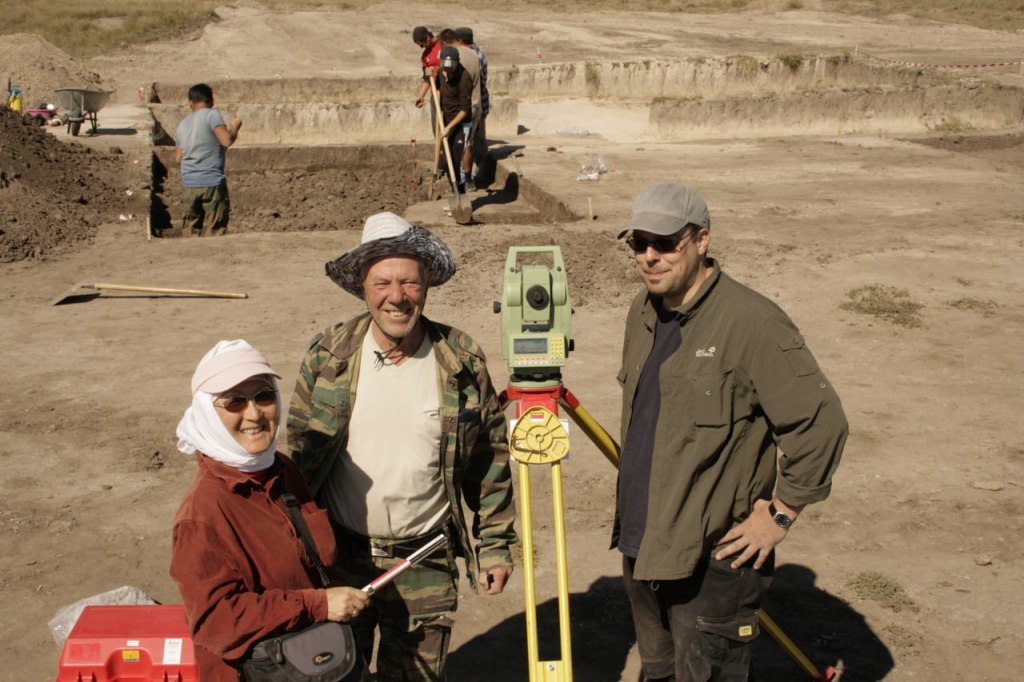
Maria Ochir-Goryaeva (left) at archaeological digs of a Bronze Age settlement with colleagues from the State Archaeology Department of Schleswig-Holstein (Germany), 2012. Courtesy of RFE/RL
– There is the opinion that Russian society massively supports this war. In your opinion, as a person observing from the outside, is this the case?
– Of course, they massively support it: people need to survive somehow, this is their priority. Everything is decided by the state system and what values it promotes. During the Third Reich, the Germans also massively supported the war. But when the system changed, the same people turned democratic. The same change can happen to Russian society, and for this to happen the system has to change. And the people as a whole easily change its opinions and habits.
I will give you an example. I spent eight years on the border of Kalmykia and the Rostov Region digging up two fortresses from the era of the Khazar Khaganate. We lived for months in a small village where the entire population is ethnically Russian. We hired the local men to do the digging. They don’t just swear there, they practically speak in obscenities. I forbade them to swear at the digging site and joke about gender issues, otherwise I would kick them out without paying them their day’s wages. And they worked for me all day for months without swearing!
What is more, nearly everyone in this village was a nationalist, in the sense that they did not like Kalmyks. But since I treated them with respect and paid them for their work every evening, they treated me and the other researchers quite cordially. People everywhere, whether they are Russians or Germans or whatever, are masters of survival. So, I don’t think you have to convince them verbally. When conditions change, ordinary people themselves figure out how it benefits them. You shouldn’t condemn ordinary people. You should cherish them and foster conditions for them to lead decent lives, whatever their ethnicity.
• • • • •
Earlier this month, Kavkaz.Realii published a report on life in Kalmykia and the impact of the war in neighboring Ukraine on it.
In October 2022, the Verkhovna Rada adopted a resolution recognizing Chechnya as a territory temporarily occupied by Russia, and also condemned the “genocide of the Chechen people.” All 287 MPs present voted in favor of the resolution. Oleksiy Goncharenko was one of the authors of the resolution.
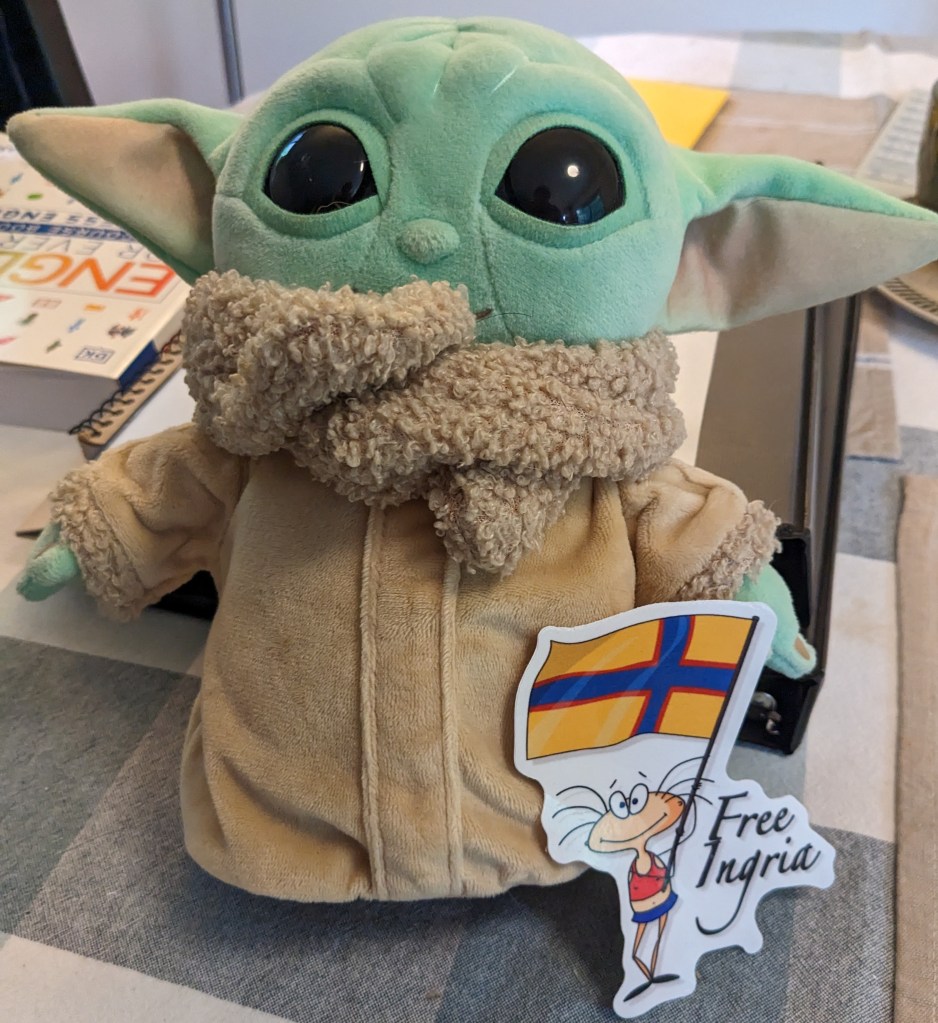
In late October 2022, the Oirat-Kalmyk People’s Congress adopted a declaration entitled “On the State Independence of the Republic of Kalmykia.” This is not the first call for self-determination for the Russian Federation’s ethnic republics since the outbreak of the war in Ukraine. “Free Nations of Russia Forums” have been held in Warsaw, Prague and Gdansk, and representatives of ethnic groups “oppressed by the Kremlin regime” met in Kyiv.
On January 7, supporters of an independent Ingushetia met in Istanbul. The creation of the Ingush Independence Committee was announced at the meeting. The Committee’s goals include consolidating Ingush society around the idea of freedom and independence, preserving cultural and religious identity, creating the basis for building an independent Ingush state, and “preventing another deception of the people and another round of violence against them.”
Russian businessman, owner of the Concord Group of companies, “Putin’s chef” and confidant of the president, founder of a media empire and the Wagner Group, and one of the most famous people in Russia, Yevgeny Prigozhin now faces criminal charges of organizing an armed rebellion.
Prigozhin was born in Leningrad on 1 June 1961. We know that his mother, Violetta, worked at a hospital, his father died early, and his stepfather Samuel Zharkoy raised the future “Kremlin chef.” Zharkoy also encouraged Prigozhin to ski: his stepson graduated from Athletics Boarding School No. 62, where the swimmer Vladimir Salnikov and the gymnast Alexander Dityatin were his classmates. Prigozhin then enrolled at the Leningrad Chemical and Pharmaceutical Institute, but, according to his own account, he did not finish his degree there.
In 1979, the entrepreneur was given a suspended sentence on robbery charges. According to media reports, in 1981 he was sentenced by the Zhdanov District Court to twelve years in prison for a number of crimes at once, but in 1988 he was pardoned, and in 1990 he was released from prison early.
Beginnings
As Prigozhin himself recounted in an interview, his first business, founded in 1990, was selling hot dogs at the Apraksin Dvor market, the first such outlet in the city. “The mustard was mixed in my apartment, in the kitchen. My mother also tallied the proceeds there. I earned $1,000 a month, and that amounted to piles of rubles,” the businessman said.
In the 1990s, Prigozhin managed Kontrast, a chain of private grocery stores. He launched his future restaurant business in 1995 by opening Wine Club, a bar and shop on Vasilyevsky Island. In late 1996, after meeting the Briton Tony Gere, Prigozhin opened the Old Customs House, which is considered one of the first elite restaurants in Petersburg. According to some reports, his partner in this business venture was Mikhail Mirilashvili, a well-known Petersburg entrepreneur who years later cofounded the VKontakte social media network.
Prigozhin later opened three more establishments: Seven Forty, Stroganov Yard, and Russian Kitsch. In 1998, he opened the restaurant New Island on the used passenger ship Moscow-177, purchased for fifty thousand dollars, which became a popular spot in Petersburg. When Prime Minister Sergei Stepashin and IMF managing director Michel Camdessus visited the city in June 1999, New Island was the only decent place to wine and dine the high-ranking guests.
In 2001, Vladimir Putin dined there with Jacques Chirac, and a year later with George Bush. In 2003, according to media reports, the Russian president celebrated his birthday there. Since the businessman personally served dishes to the president, he was dubbed “Putin’s chef” and “the Kremlin’s chef.”
By that time, Prigozhin had already moved into the catering business, founding Concord Catering in 1995. In 2002, he launched the Damn!Donalds chain of fast food restaurants: the businessman came up with the name himself. The chain was shuttered ten years later, however.
As the businessman recounted in an interview about the success of his catering business, by 2005 he owned “the largest catering company in Russia for ten years running.” “We did all the G8s and the summits,” Prigozhin recalled. From information available in open sources, it follows that the businessman actually did organize a number of banquets for high-ranking guests, including meals at the Russian Federal House of Government.
Buoyed by this success, Prigozhin decided to enter the school meals market. “I decided to try my hand at it and chose a couple of schools on Vasilyevsky Island — No. 10 and No. 18. Of course, it wasn’t a business. I began feeding the schoolchildren airtight-packaged box meals. I set up modern compact kitchens right in the schools — everything fit in a six-square-meter space. At the same time, I carefully researched the topic.”
In the 2000s, Prigozhin went into the construction business. In particular, he built Northern Versailles, a gated mansion community, in Petersburg’s Lakhta district. In 2016, a company belonging to the businessman built the Lahta Plaza[apartment and hotel] complex next to St. Petersburg Tricentennial Park.
In 2016, it transpired that a Prigozhin-affiliated company bought the premises of the Shop of Merchants Yeliseyev, which he had occupied on lease since 2010, after making expensive renovations. By 2015, Prigozhin’s companies had become the largest supplier of food to the Defense Ministry.
In 2018, Vladimir Putin said in an interview with western media, “He is not my friend. I know such a person, but he is not on my list of friends.”
Media Empire
In 2013, it was reported that the Internet Research Agency, which was informally dubbed the “troll factory,” was located on Savushkin Street in Petersburg. Hundreds of people worked on the media holding’s websites. Prigozhin’s connection with the growing media empire was denied by Concord’s press service.
2019 saw the emergence of the Patriot Media Group, which included the Federal News Agency (FAN), Economy Today, Politics Today, and Nation News. Yevgeny Prigozhin headed its board of trustees, but the businessman’s financial involvement in the project was denied.
Western sanctions against Prigozhin were imposed for the first time over the involvement of his media outlets in the information campaign [sic] for the US presidential election.
Wagner
The Wagner Group, a private military company, was founded in 2014. Subsequently, Wagner soldiers were involved in fighting in eastern Ukraine and, later, in Syria. In 2017, the company was placed on the US sanctions list. But [Prigozhin]admitted his involvement in founding Wagner only in 2022. Western countries have claimed that Wagner mercenaries have also operated in Libya, the Central African Republic, Sudan, Mozambique, and Mali.
SMO
Since 24 February 2022 and the beginning of the SMO, Prigozhin gained worldwide fame in connection with the Wagner Group’s actions in Ukraine. Wagner’s troops have been heavily involved in the fighting. Mercenaries recruited among convicts have been actively joining the ranks of Wagner PMC. In March, the businessman claimed that over 5,000 ex-convicts had returned to Russia after participating in combat.
The conflict between the Defense Ministry and Prigozhin rapidly deteriorated in 2022, although friction between the two parties had essentially begun several years earlier.
A year later, in February 2023, Prigozhin publicly voiced dissatisfaction with the lack of ammunition during the battles for Bakhmut (Artemovsk). A campaign entitled #GiveWagnerShells gained momentum on the internet.
On May 10, the businessman, amid rumors of a “shell famine,” publicly announced his willingness to transfer Wagner’s positions in Bakhmut to Chechnya’s Akhmat Regiment at the suggestion of Chechen ruler Ramzan Kadyrov. On May 20, the businessman said that Wagner had taken Bakhmut, and once again made highly critical remarks about the Defense Ministry. Five days later, Prigozhin announced that he was withdrawing his units from the city.
In June 2023, the businessman asked Defense Minister Sergei Shoigu to release the Concord Group from its catering contract in the SMO zone after more than sixteen years of successful cooperation with the Russian military’s kitchens.
Moreover, Prigozhin said that an order that members of volunteer detachments must sign contracts with the Defense Ministry did not apply to the Wagner Group.
Then came June 23. Wagner’s founder made new public statements, triggering criminal charges against him. If convicted, Prigozhin faces up to twenty years in prison.
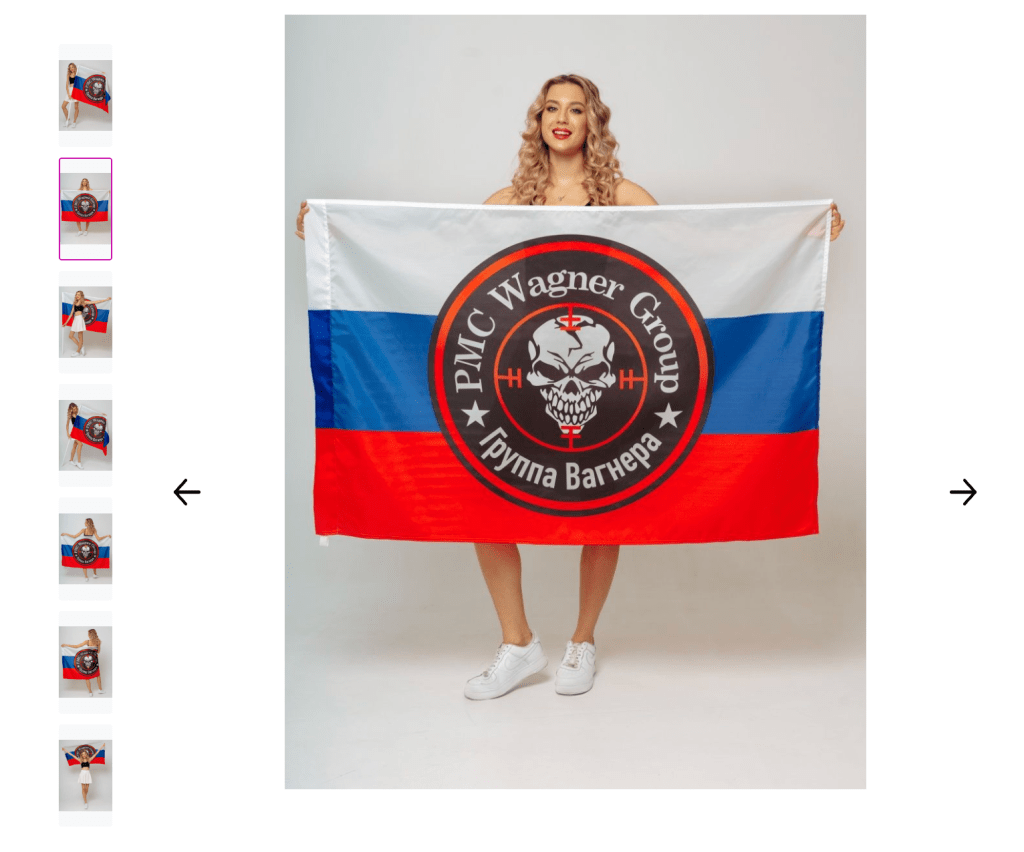
Goods bearing the emblems of the Wagner Group (including chevrons, flags, t-shirts, baseball caps, and sewn-on patches) have been brought back to the “counters” at Wildberries, as our correspondent verified on the evening of June 24.
In the first half of the day, a source at Wildberries told RIA Novosti that the online retailer had bearing removing goods bearing the [private military] company’s emblems and was going to remove them altogether. Later, such goods were hidden by Ozon, where they are still unavailable.
A search for the phrase “Wagner PMC” on the website of popular Russian online retailer Wildberries garnered 8,736 items, including the fetchingly reimagined Russian tricolor flag, below. This search was performed at 11 p.m. Moscow time on 24 June 2023.
Zenit FC midfielder Wendel has decided not to return to Petersburg due to the situation with the Wagner PMC, reportsSport Express, citing the player’s agent Cesare Barbieri.
“This is definitely a very delicate situation. Wendel will stay in Brazil until the situation improves. The club has already been notified of this. Zenit has reacted understandingly to the situation,” the agent said.
In the 2022–2023 season, 25-year-old Wendel has played twenty-five matches for Zenit in the Russian Premier League, scoring eight goals.
“For our series of reports on relations between Finland and Russia, we head to the border area. The two neighbours were strong trading partners until the 2022 invasion of Ukraine led Helsinki to cut off business ties. Russian tourists are no longer welcome and with EU sanctions in place, Finland is on the frontline in checking goods crossing its 1300 km long border with Russia. FRANCE 24’s Julien Sauvaget and Clovis Casali report.” France 24 (YouTube), 14 June 2023.
People in Russia don’t have time to think about world events, explains a Russian young man at the Vaalimaa border crossing. There are plenty of goods in St. Petersburg, despite the sanctions. This kind of me-centric luxury does not exist for Ukrainians.
If I were an autocrat, I would provide these border crossers with a thorough guided tour of the massacres in Mariupol and Bucha. The price would include a night of experiences, i.e., a month-long air raid simulation every night. I could think of a lot of other empathy exercises, though I don’t think they’ll do any good.
This is a comment on the news report, above, by a Finnish friend of mine, living near the Finnish-Russian border, who wishes to remain anonymous. Translated, from the Finnish, by the Russian Reader
“Steak House”: a still from yesterday’s episode of the MCU, supposedly set in Moscow but clearly not filmed there.
Navalny, as a politician, is making a systemic mistake by hoping to turn people against the war in three to four months, because in a fascistic society the tools of democracy (canvassing, persuasion, solidarity campaigns ) just don’t function.
These tools presuppose democracy, and Navalny has not been a candidate standing for elections for a long time, but a political prisoner. And yet behaves as if it’s 2018 and his team will go door to door campaigning against the war.
“Let’s fantasise a little,” writes Navalny, “if every tenth of the 1.5 million who left the country since the beginning of the war […] and [the] 1 million who stayed in Russia but are not afraid, joined the campaign against candidate War, then this army of 400,000 canvassers could reach 12 million citizens per month […] Such a strong canvassing machine would dramatically change the public mood in the country in three or four months.”
To this end, Navalny wants to recruit “100 pioneer volunteer canvassers” ready to act “according to the laws and techniques of good election campaigns [b]y polling everyone, targeting hundreds of different groups, finding an approach to each and every one of them, identifying the waverers and persuading them to change their minds.”
Navalny is going to defeat the manipulators of public opinion on their own field by using a “canvassing machine” and counter-manipulation (finding an approach, targeting, and persuading), as if it were a matter of finding the right tools of influence and the right political strategies.
These are the illusions of a systemic politician who still hopes to win by following the rules for running elections and interacting with his electorate aboveground, in the open. But there is no “electorate,” no “elections,” and no conditions for “canvassing” in Russia right now. The fascist reality is completely different.
It would have been rather strange to call on “brave Germans” to go door to door canvassing against the war and the Fuehrer in 1943. Heroic people (we know their names) tried to do this in Berlin by scattering leaflets, and they were finished off by the Gestapo. They were heroes, of course, but the effectiveness of persuading people with words and leaflets in a fascizoid society is zero.
Only the regime’s defeat by outside forces, when the failure of the state is translated into “pain and suffering” for the so-called common folk, can reformat Zombieland.
History knows no other way to impact the zombified brains of the “common folk.” The task of the opposition in Russia, therefore, is to call for the destruction of the state and defeat in the war as soon as possible. We need to donate money to the Ukrainian Armed Forces and raise funds for the transfer of cutting-edge weapons to Ukraine, because crazy “Russian women” (the wives and mothers of war criminals) will not be persuaded by leaflets and conversations, but by coffins and funerals.
The losses suffered by the occupiers are the only key to peace.
And the dreams of the systemic politician (with all due respect to Navalny’s steadfastness) cannot come true. The mythical “army of canvassers” will simply end up in adjoining jail cells, like the brave picketers who protested on the streets.
In fact, Navalny proposes to his thousands of supporters the model of behavior he followed when he bet on the system’s sticking to rules of the game when he returned to Russia. By that time, however, there were no rules (as the FSB’s Novichok should have convinced him). We all remember what end his faith in the system (the ability to defend oneself in open court and hold large-scale protest rallies, and reliance on the power of aboveground regional organizing hubs) came to.
Playing at systemic politics with fascism ended with a “life” term in prison. Unfortunately, neither Navalny nor Yashin draw the right conclusions. They are free to make their own decisions for themselves, but daydreaming about “canvassers” who will go out and agitate among the common folk in keeping with the “laws of good election campaigns” is tantamount to being divorced from reality.
Unfortunately, it is clear why. The systemic opposition in Russia still clings to the illusion of “persuading” Russian society without defeating the state. But betting on the “internal forces” of the rotten imperial óchlos (which calls itself a society) is another illusion that renders the opposition’s politics toothless.
Alexei Navalny has launched a big political campaign against Putin and the war. Using modern technology we will create a real truth machine that will help us reach out to Russians.
In this video, Leonid Volkov explains how the campaign will be set up and how you can get involved.
[…]
Source: Alexei Navalny (YouTube), 20 June 2023. The video, above, includes English subtitles, which can be turned on by toggling the "CC" button on the bottom of the screen. Even more curiously, the annotation, above, is also in English.
Hi, it’s Navalny.
Today marks the beginning of yet another trial, which will greatly increase my total sentence. However, I don’t want to use this day simply to draw sympathy for myself and other political prisoners. I want to call everyone to action, and use this day to announce our new, very important project. The big propaganda machine. The truth machine. We don’t just intend to make it, we will definitely create it in order to join forces against Putin’s lies and the Kremlin’s hypocrisy. We really need you. Join us.
Why is today the right day for this announcement? Because my trial itself proves the rightness and necessity of such a project. What is the most important thing about this trial? Not lawlessness, not “phone justice”, not the obedience of unscrupulous judges and prosecutors. The main thing is its format: it is a trial inside a prison. Putin doesn’t shy away from jailing the innocent, and he’s not afraid that I might be taken back by rebellious mobs during a court session in Moscow. However, he is afraid of what I have to say. Even if they are obvious words known to all. He is afraid of the word. Not just mine, of course, which is why Kara-Murza and many others were also tried in a closed trial.
Putin is afraid of any word of truth, he hates speeches that turn into Internet memes, he is furious at the “last words” [i.e., the closing statements of defendants at political trials] that get an audience of millions. In essence, the task of strengthening and prolonging Putin’s power is accomplished by shutting up those who dare to speak the truth. This goal is the subject of almost everything that has been done in Russian politics over the last few years. And since the start of the war, the regime has not thought about anything else. People get jailed for their posts, for defamation, for spreading misinformation, there are endless arrests and blockings, everyone gets labelled as “foreign agents” or “undesirable organisations”. Why not let people talk though? When the government fights rallies that it considers dangerous, there is some logic to it, but what exactly is the problem with chatter on the Internet or even over the phone?
It may even seem that this way, discontent goes to waste. Keyboard warriors spend their time leaving likes instead of building barricades. But that’s not really how politics works.
Putin has proven to be a fool in the military sphere, a talentless military leader, but he is no fool when it comes to politics. He knows that the backbone of any political action is an idea and a word. Canvassing and persuasion. This is very evident during elections, especially those that are highly competitive. Whatever the specifics of the state, its political traditions and agenda issues, during elections it still comes down to canvassers going door-to-door, making phone calls, persuading people on social media and messengers. And during every US presidential election, with all their high technology and huge budgets, the candidates themselves volunteer at call centres to encourage their supporters to also come there and call, explain and persuade.
Because in terms of the power of persuasion, nothing has or will ever beat the most basic kind of campaigning – simply talking to people, providing them with examples and arguments.
People like to claim that they are not influenced by election campaigning, that they already know exactly what they want and that they cannot be persuaded. But this is not true. A large part of the electorate makes their choice at the polling station, so a good canvasser can sow doubt, persuade, and change their minds. This has long been proven. And we ourselves have conducted experiments in this field.
So what is there to campaign for when there is no election? There is actually plenty to campaign for, and the stakes are very high. We will campaign against the war. And against Putin. That’s right. We will conduct a long, hard, exhausting, but fundamentally important campaign to turn people against the war.
Against war and everything related to it. Against the deadlock that Putin so madly and stupidly spiralled into on February 24, 2022: deaths, casualties, mobilisation, war crimes, isolation, sanctions, tens of thousands dead and millions leaving the country. Degradation of the economy and decline in living standards, criminals fighting at the frontlines and penniless mobilised soldiers, lots of wounded and killed.
This is a very precise task, and I have no doubt that our work will be successful. Here is the most important table and the main figure from one of our surveys:
Every fifth person has relatives or acquaintances who died in this war. Sadly, these figures will only continue to grow, changing public perceptions. Tens of thousands of wounded and disabled people. Hundreds of thousands of mobilised men who have seen Putin’s war for themselves: the talentless thieving generals, the shortage of everything from socks to shells. They return home, their stories are listened to and retold. This does not at all mean that these people automatically become anti-war activists. But it certainly means that they can become them with our help. We have a good reason to talk to them about important issues, and many will be willing to talk.
We will change many people’s minds and raise doubts in almost all of them. This is a campaign against the candidates War and Putin. And we will do it according to the laws and techniques of good election campaigns. By polling everyone, targeting hundreds of different groups, finding an approach to each and every one of them, identifying the waverers and persuading them to change their minds.
I strongly doubt the huge numbers of “war support” reported by Kremlin sociologists. The main reason is that it is unclear what the term “support for the special military operation” actually means. I ask to be sent everything that Strelkov and Prigozhin write and say, I read it very thoughtfully. Are they pro-war? Of course they are. But despite all their mutual dislike, I can’t find any clearer anti-Putin and anti-Kremlin statements from anyone else. And frankly, some of their statements are already close to anti-war. Have you seen Prigozhin’s interview? As savage as it is, it’s still anti-war. Putin’s cook says expressly the war is already lost. A scenario of victory – in his words, the “optimal” scenario, in which we manage to keep what we have already grabbed – is hardly possible. The elites have stolen everything and their children are abroad. The generals are stupid thieves. Our weapons are bad, there are no shells. This is actually the style that the ACF has always spoken in, but now this comes from the main supporter of the war and one of its main commanders who is speaking.
So whenever a voter repeats all this to us, our task is to ask him ingratiatingly: well then, maybe to hell with this war? Why did we even start it? Yes, many people dislike not war itself, but a lost war, or a meaningless war. OK, any anti-war campaign relies on that too, as was the case with the Vietnam and Iraq wars.
I agitate the cops the best I can over here. Naturally, they say they are pro-war. That’s to be expected: our conversations are recorded on their body cams. It is useless to talk to them about war crimes, Bucha, aggression, and sanctions. They do not care about those suffering. But when I ask: “Where are the shells though? Where has your Putin, who has been in power for 23 years, having a ton of money, wasted all the shells, socks, bulletproof vests and quadcopters?” – they have no answer. “It wasn’t me who asked about the shells first. It was your Prigozhin, whom you were kowtowing to when he came here to recruit prisoners for the war. And if your government is so fucked up that there’s no intelligence, no commanders, no border, no air defence, no shells, no socks – then why the hell did you start this war? To bury a million people in the ground?” They don’t put me on a pedestal after such talk, but they do start thinking and having doubts.
So we are going to find a personal approach to everyone, without using the same language to talk to a programmer from Moscow, a young mother from Orel, and a retired serviceman from Chelyabinsk. This is a campaign against candidate War, and it can only be conducted successfully with the support of an army of tens, and preferably hundreds of thousands, of motivated, diligent, hard-working people who believe in success. People who don’t burn out every five minutes, who don’t faint when their interlocutor tells them to piss off, who don’t get demotivated when facing an average voter and don’t expect them to be logical, intelligent, educated, polite, and quick to change their minds. This is a smart, subtle and difficult long term job, and I encourage those who want to do some real work and make a real contribution, rather than endlessly whining on Facebook and Twitter where we try to re-convince ourselves, to join us.
We already oppose the war, there are already several million of us, we have already learned how to organise and finance our own actions. Let’s fantasise a little: if every tenth of the 1.5 million who left the country since the beginning of the war and mobilisation, 1.5 million who left after 2014 and 1 million who stayed in Russia but are not afraid, joined the campaign against candidate War, then this army of 400,000 canvassers could reach 12 million citizens per month, even if each of them only makes one contact a day, i.e. does not overwork in the slightest. Such a strong canvassing machine would dramatically change the public mood in the country in three or four months.
But let us stop imagining things now. Because this is not likely to happen in practice. People are lazy, they have their own things to do. The most vociferous of them, those who demanded “real action”, will be the first to disappear. The idlers, as always, will find excuses for themselves along the lines of “that’s no real action, I would gladly derail some trains, but this is rubbish”. And they will concentrate on criticism without ever derailing a single train. And so on. These things happen during any election campaign. Nevertheless, we do realise that there are tens of thousands of people who are prepared to devote at least one hour a day to work diligently and persistently for the common good. This is a colossal force. It will not be easy to organise such a canvassing machine – one of the largest in the world. However, all things are difficult before they are easy. I am confident that we can set ourselves the first task of reaching 10 million voters with our campaign against the war and Putin. That will already guarantee a noticeable shift in public opinion. No one can predict what effect this will have on the political situation. But our work will certainly not be in vain.
Let’s move on to specifics. What instruments of persuasion are available to us within Russia? Rallies or pickets – no. Door-to-door visits – no. Calls from one’s own phone if the caller is inside Russia – no. Call centres inside Russia – no. As you can see, the basic arsenal of traditional election campaigns is not available to us. We rationally acknowledge this.
However, there are new opportunities, new technologies. Offshore call centres, decentralised call centres. Messengers – campaigning through them can be amazingly effective, given that every granny already has WhatsApp and Telegram. Campaigning on Kremlin-controlled social networks is also possible if the risks are properly avoided. Thus, a rough description of the campaign machine that we will be building is as follows: it will be a system that will allow you (the canvassers) to join it at any convenient time, from anywhere, and (while preserving your anonymity if you wish) communicate with voters within Russia that fit the required parameters (gender, age, city, occupation, etc.) by voice or text. The system will teach you how to canvass, drawing on previous experience and suggesting a pattern of conversation, facts and phrases. In a way, it’s like creating and training artificial intelligence. We have to create and train a system of collective intelligence, convincing voters to oppose the candidates we hate – War and Putin.
«Woah!», — you might say.
Well, yes, it is an ambitious task. However, it is nothing unrealistic or previously unseen. Marketers, advertisers and political strategists have been doing this for decades. All those cold calls, warm contacts and sales funnels are well known to all. It is just that, more often than not, marketers do not go to prison for such things. Our activities, of course, will be declared illegal and subversive. All the forces of the state apparatus will be rushed to combat it. Very well, we will throw all our energy into the fight against the apparatus of war, corruption and stupidity.
There is a lot of technical work to be done. Nothing like this exists yet. The system must be very flexible and have qualities that would appear to be mutually exclusive. It should be a user-friendly database of contacts, but it must be designed in such a way that would rule out any possibility of it leaking out and causing problems for people. Anyone should be able to get involved quickly, but we need to be able to weed out the provocateurs, the crooks, the stupid, the hotheads and so on as quickly as possible. A large number of one-time accounts will have to be created, but this should not turn into a spam machine. The propaganda machine should be able to adapt instantly to blockages and any opposition, and be as creative as possible. My colleagues and I have been doing or trying to do some elements of such a thing since 2012 – old-timers may remember the Good Truth Machine project, which I announced at one of the rallies back in the day.
However, the scale of this project is such that there has always been a lack of time, knowledge, money and staffing. I think this is one of my biggest political mistakes: I did not make the Good Truth Machine a priority and we did not manage to build it after the 2013 elections, being constantly distracted by other things. And now we simply don’t have a choice. Neither political (what could be more important than stopping a war and a government living a war?) nor organisational (hundreds of thousands of the most active and literate citizens have been forced into emigration). They are ready to do something, but what? We get thousands of messages: “Guys, give us some work, useful work that can be done from abroad or in Russia, but without too much risk.”
So, we start inventing, we start building, we start hiring, we start raising money. We need you very much. First and foremost, we need those who understand the technical, logistical and organisational side of what I have described. We are collecting opinions, expertise and ideas. We will soon organise hackathons in various cities. And, of course, we need the most resilient and the most patient, the most understanding, those who will become the heart and essence of this system. A technical shell is being built, but must be filled with people.
In order to campaign successfully, we need to have conducted thousands of hours of conversations by the time we build and launch a full-fledged machine. We need to listen through them and analyse them, determine micro-targeting parameters, create, try, modify and improve hundreds of scripted conversations for different target groups.
We’re looking for 100 pioneer volunteer canvassers who are ready to tackle this awesome, but challenging, task, especially amidst the inevitable chaos and mess of the first steps.
Email antiwar@navalny.com if you are:
– an IT specialist willing to invest a lot of time into creating technology solutions for our campaign system;
– a marketer, sociologist or political scientist willing to invest a lot of time into creating conversation scripts, engagement funnels, etc.;
– a supporter willing to donate a substantial amount of money to this particular canvassing project;
– a volunteer willing to be in the first hundred people who will invest a lot of time conducting conversations, working out scripts and finding the words and approaches that take voters away from candidate Putin and candidate War.
Write about yourself in sufficient detail, stating where you are from, where you live now and how much time you have for this job. We will get back to you shortly.
This is a long-term project. Putin’s military defeat is inevitable. But no one knows what it will look like or what its consequences will be. Those at the very top of power, the ones who are ready to wage war for the sake of money and strengthening their position, are not going anywhere. They will not pack up and fly off to the moon. Their response to a lost war will be hysteria and preparation for a new war. That is what they will brainwash the citizens with. No one but us can enter this fight for the hearts and minds of our fellow citizens. So, we must enter it and win it.
While thousands of Ukrainians were fleeing their submerged homes after a catastrophic dam explosion last week, high-society Russians gathered for a glitzy restaurant festival in the Black Sea resort of Sochi, just 500 miles away from the devastating flooding.
The event, called Gastreet, saw some 5,000 citizens pay up to $2,000 dollars for the opportunity to listen to some of Russia’s top businessmen, restaurant owners, and influencers over the course of five days. The event also included concerts, lavish nightlife experiences, and gourmet dinners.
If there’s one thing that was made clear at the Sochi resort, it’s that no amount of Western sanctions, Kremlin restrictions, or spillover violence within Russia can stop the country’s rich and famous from living large—despite the raging war in neighboring Ukraine.
Take Ksenia Sobchak, Putin’s rumored goddaughter and one of the VIP Gastreet guests who spoke at the Sochi resort last week. The Russian influencer—who reportedly made over $3 million from her media holding company, Careful Media, last year—has continued to promote products on her Instagram page in the lead-up to the event, even though the app has been banned in Russia.
One of her latest marketing campaigns is for Primepark, a luxury real estate complex in the heart of Moscow.
“Just imagine, valet meets you in the parking lot, bellmen carry your shopping bags to your apartment, housekeepers help with all your routine around the house—I always said that comfort is made by details,” Sobchak wrote under photos of herself in designer outfits, wandering around luxury apartments. (The comment sections are flooded with responses blasting Sobchak with “reminders” of the countless missiles descending on Ukraine.)
“Mikhail Ivanov: ‘A million have left. 139 million stayed,'” Tell Gordeeva (YouTube), 20 June 2023. In Russian, with no English subtitles
Mikhail Ivanov is a star of the Russian book market and the subject of the new episode of Tell Gordeeva. Ten years ago, he reinvented the old Soviet bookstore Subscription Editions and made from St. Petersburg fashionable. Why write, read and sell books in a world where there seems to be no cultural values left anymore? And who needs books when a war is underway? We talk with Ivanov about why he continues to live and work in Russia and on whose behalf he does it.
Contents:
00:00 How Misha visited the store he now owns for the first time 2:48 “Books smell of danger, freedom, and freshness” 4:27 “On my fifth birthday I ran away from home to see the battleship Aurora” 5:47 “She likes it, but she didn’t believe it until the bitter end”: how Misha’s grandmother handed him control of Subscription Editions 7:27 “It was hard for me to concentrate on reading” 9:24 Harry Potter’s graphic art secret 13:46 Subscription Editions’ business model 14:59 “Here you could drink tequila from someone’s navel right at the bar”: what happened to Subscription Editions in the 2000s? 17:02 “Mom and Grandma gave me 2.5 million rubles to buy the store in 2013” 18:12 How to get round all the restrictions 20:57 “I’m Mikhail Ivanov: I work in a bookstore and publish books. I have nothing to do with it” 24:30 “I promised to stay with my employees. I can’t leave” 26:12 “We know who owns what fur coats, buildings and planes, but we were not offered an alternative”: on the opposition 28:03 “I am a citizen of Russia, I pay taxes here. But I don’t associate myself with the Russian Federation” 30:09 “How can you do public opinion polls when they can inform on you?” 32:26 “I’ve been dreaming of going to a Monatik concert for 10 years” 33:22 Top 5 books of 2022 in Russia 34:09 Why do some bookstores hide books by “foreign agents” and do they have to do this by law? 37:26 “The employees of Subscription Editions treated me like my grandmother’s grandson” 40:30 Who Katerina Alexandrovna is and why her favorite books are important to us 42:12 “4,000 people come to our store every day” 43:02 “We had our biggest earnings in March and April 2022” 44:27 “We will close the libraries and smuggle out the books” 48:02 “Where to find a haystack?”: how Subscription Editions’ unique Instagram is created 52:18 What did people do in the bookstore behind a closed grate? Yes, yes! 53:08 “We are a catalogue of the good books published in Russia” 55:05 “We are from Petersburg, and only then from Russia” 1:00:04 Installing a lift in a bookstore for 6 million rubles: what???!!!! 1:02:42 “Our growth strategy doesn’t allow us to stumble”1:04:05 “Do your job and sell books” 1:06:45 “A long strange courtyard that no one knows about”: Mikhail Ivanov gives a tour of Petersburg’s pass-through courtyards 1:08:36 “We show that you can live differently” 1:12:02 St. Petersburg’s Books Quarter 1:15:05 Why is Margarita Simonyan’s book selling so badly? 1:17:24 “I won’t say and do things I don’t believe in” 1:20:01 “How can I lose the meaning of what I am myself?”: on emigration 1:21:09 How Ivanov came up with the postcard “From Petersburg with apathy and indifference” 1:23:55 “There is a separate room with padded walls for bookmen in paradise”
The supposed ‘trial’ has begun in Rostov[-on-Don] (Russia) of 22 Ukrainian prisoners of war, many of whom, though not all, are members of the Azov Battalion who were seized while defending Mariupol against the Russian invaders in 2022. Moscow is using a baseless, and post-dated, ruling claiming the Azov Battalion to be a ‘terrorist organization’ as its excuse for violating international law and trying men and women for defending their own country against an invading enemy. The photos from the first hearing on 14 June suggest that at least the Ukrainian men are being held without enough to eat and probably in conditions which are, in themselves, a breach of the Geneva Conventions.
This legal travesty is to take place at the same Southern District Military Court which has been passing politically motivated sentences against Crimean Tatar and other Ukrainian political prisoners since 2014. That, however, is not the only similarity, since Russia is effectively using identical charges as those used to pass sentences of up to 19 years’ imprisonment against political prisoners from occupied Crimea, most of them Crimean Tatar civic journalists and activists.
The charges against the Ukrainian POWs are, firstly, of involvement in an organization recognized in Russia (and nowhere else) as ‘terrorist, under Article 205.5 of Russia’s criminal code. All of the men and women, however, were taken prisoner before Russia’s Supreme Court declared Azov to be ‘terrorist’ on 2 August 2022, making the charges illegal even according to Russian law. The second charge is more incredible. All are accused of ‘actions aimed at violent seizure of power or violent retention of power and violation of Russia’s constitution’. Even if, as is possible, the Russian Investigative Committee is claiming that the Ukrainians were seeking ‘to overthrow’ Russia’s proxy ‘Donetsk people’s republic’, this could still not begin to justify such a charge since Mariupol was not within this pseudo formation until Russia bombed and destroyed around 90% of Mariupol’s infrastructure in order to gain control of it. Those convicted, and the ‘court’ in question invariably passes only those sentences demanded of it, face sentences of from 15 years to life imprisonment.
It was originally reported that 24 men and women were to go on trial, however on 14 June, it was learned that two POWs — David Kasatkin and Dmytro Lablinsky — had been released in an exchange of prisoners.
Most reports call all of the 22 remaining members of the Azov Battalion, however the Russian newspaper Kommersant has indicated that several were either members of Ukraine’s National Guard or were seized in Mariupol, but had served in the Azov Battalion long before Russia’s full-scale invasion. The eight (perhaps nine) women were, Kommersant asserts, cooks for the Azov Battalion and, purportedly, all signed ‘confessions’. It is possible that those ‘confessions’, making it possible for claims that some ‘admit guilt’, are the reason why Russia has included them in the ‘trial’, as well as their assertion that they were only there because they needed a job, etc.
From the reports available, it would seem that many of those whom Russia has put on ‘trial’ should, in fact, be treated as civilians. Those who were defending Mariupol and the Azovstal Steelworks are prisoners of war who are protected, under the relevant Geneva Convention, from prosecution merely for taking part in hostilities. The only exception is if they are found guilty of war crimes. It is telling that Russia has thus far used its proxy ‘Donetsk and Luhansk people’s republics’ to stage any supposed ‘trials’ on war crimes charges. These illegal entities are not recognized by the international community and one of the many reasons why Freedom House earlier rated the two entities together as almost on a par with North Korea was the total lack of rule of law and mechanisms for a fair trial. There are absolutely no grounds for believing that the men sentenced to terms from 12 to 25 years by these quasi ‘republics’ were guilty of the crimes alleged, or indeed, that the supposed war crimes even took place. Among these ‘sentences’ was the 13-year term of imprisonment against well-known human rights activist and journalist Maksym Butkevych. He is known to have been denied access to a lawyer, and there is evidence that he was not even in Donbas when the ‘war crime’ was alleged to have taken place.
The farcical nature of such ‘court’ stunts was, in fact, seen and condemned by the international community when the so-called ‘Donetsk people’s republic’ ‘sentenced’ two Britons (Shaun Pinner and Aiden Aslin) and Moroccan Brahim Saadoun to death, claiming them to have been ‘mercenaries’ although all were contract soldiers in Ukraine’s Armed Forces and, unequivocally, prisoners of war.
The ’trial’ now underway is presumably for internal consumption as the images of emaciated Ukrainian prisoners of war are shocking, as is the cynical lawlessness of the charges against the Ukrainian men and women.
This story starts — but certainly doesn’t end — in 19th century Maryland, when John Townshend updated his will.
Townshend grew convinced at the end of his life that God would punish him if he did not free the enslaved people he owned and give them all of his property. But Townshend’s relatives challenged his final wishes in court, arguing that his decision had been the result of a delusion.
That 1848 case was the first U.S. appearance of what became known as the “insane delusion rule,” which remains grounds for contesting wills to this day. And Townshend v. Townshend itself has been cited in at least 70 other cases across the country — from New Hampshire to California — over the years, as recently as 2007.
It’s one of thousands of cases involving enslaved people that lawyers and judges continue to cite as good precedent, more than a century after the 13th Amendment abolished slavery in the U.S.
Justin Simard, an assistant professor at Michigan State University’s College of Law, estimates there are about 11,000 such cases out there — and about one million more that use them to back up their arguments.
“I’ve done some analysis just with a sample of cases and concluded that 18% of all published American cases are within two steps of a slave case, so they either cite the slave case or cite a case that cites a slave case,” Simard tells NPR. “The influence is really, really extensive.”
Simard has spent years documenting them, with the help of some two dozen law students.
The result is the Citing Slavery Project, a comprehensive online database (and map) of slave cases and the modern cases that cite them as precedent. They expect to add the last of their nearly 9,000 collected cases to the website this summer.
The project aims to push the legal profession to grapple with its links to slavery, an overdue reckoning that Simard hopes will start with lawyers and judges acknowledging their use of the troubling precedents.
He says 80% of the time judges don’t mention that these cases involve slavery at all, either because they’re unaware or uncomfortable.
“We’re not saying don’t cite them,” he explains. “All I’m asking people to do is just don’t cite them without acknowledgement, without thinking through whether it actually makes sense to cite them, which I think is a pretty reasonable thing to ask.”
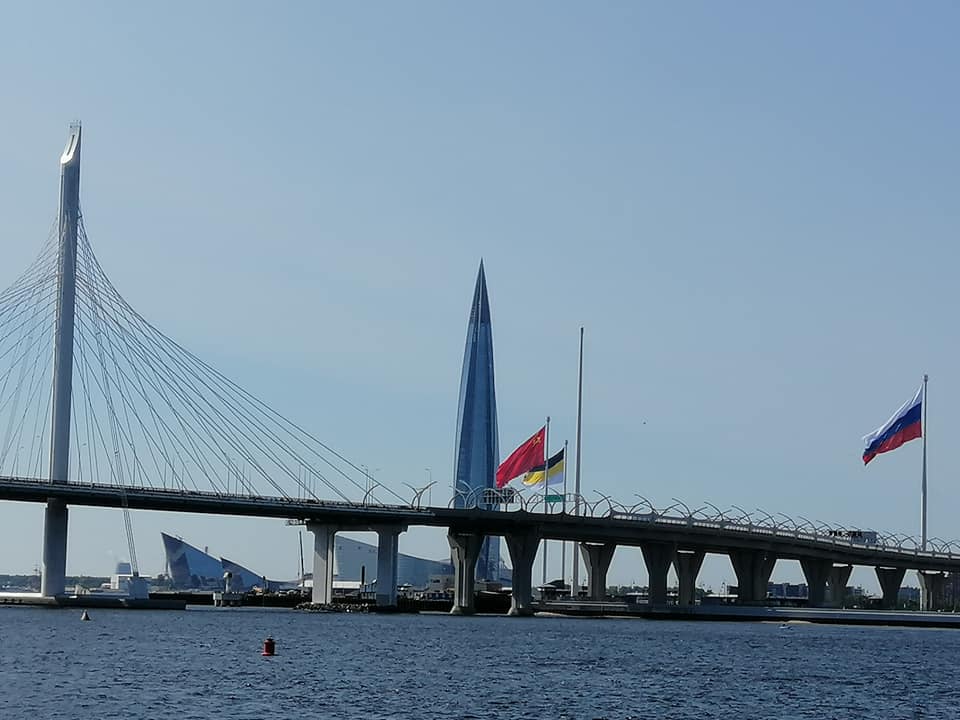
Russian President Vladimir Putin took part in a ceremony to raise the flags of the Russian Federation, the USSR, and the Russian Empire in St. Petersburg Tricentennial Park.
The head of state arrived in the area of the Gulf of Finland near Lakhta Center on the yacht Okhta. He watched the ceremony from the water.
On board the yacht, the head of state was welcomed by Elena Ilyukhina, deputy general director of Gazprom Neft and general director of Gazprom Lakhta LLC.
“St. Petersburg’s aquatic area and maritime facade,” she said, waving her hand at the view. “It’s beautiful. I understand that you have finished this complex,” Putin said, pointing at the 462-meter tower of Lakhta Center. Ilyukhina briefly told the president about the project, and also announced plans to build a 555-meter skyscraper next door.
[…]
“I understand that today’s event is connected with the fact that one stage [of the project] is ending and another beginning,” Putin said. Ilyukhina explained that the flag-raising ceremony, whose guest of honor of was the head of state, commemorated historical dates: the 165th anniversary of the Russian imperial flag, the 100th anniversary of the Soviet flag, and the 330th anniversary of Peter the Great’s tricolor.
Ilyukhina underscored that the choice of banners was not accidental: each flag represented a certain historical stage, marked by feats of heroism, victories and achievements. “The raised banners are a tribute to our history,” she pointed out, saying that Gazprom had erected the three 179.5-meter-high flagpoles to form the world’s first ensemble of flagpoles of such a height built on water. “The trinity symbolizes the continuity of our history,” Ilyukhina emphasized.
“It’s beautiful,” Putin said appreciatively. His interlocutor also noted that as part of the comprehensive improvement of St. Petersburg Tricentennial Park’s shoreline, hydraulic works had been designed to protect the coastline from erosion. A pedestrian bridge would stretch from each of them to the shore. The project’s development and implementation required complex engineering and design solutions and innovative construction techniques.
When the Russian national anthem rang out during the ceremony, Ilyukhina continued her story. The president stopped his interlocutor’s narration with a gesture of his hand, however. He put his finger to his lips, thus asking for silence as the national anthem was played.
After [the anthem was performed], the flag of the Russian Federation, the flag of the Soviet Union, and the flag of the Russian Empire soared into the air. The raised banners are remarkable for their immense size: each width of cloth is slightly larger than half of a football field: sixty by forty meters. Each flag weighs almost half a ton.
St. Petersburg Tricentennial Park is the youngest in the city. It was founded in 1995 to commemorate the three hundredth anniversary of the city’s founding [which did not occur until 2003]. [The then-Petersburg mayor] Anatoly Sobchak and future president Vladimir Putin each planted a tree.
According to Ilyukhina, as part of the project for improving the city’s coastal area, they are now planning to work on the park’s shoreline, including building a water sports base and equipping the beach, sports grounds, and walking paths.
I had visions, I was in them I was looking into the mirror To see a little bit clearer The rottenness and evil in me
Fingertips have memories Mine can’t forget the curves of your body And when I feel a bit naughty I run it up the flagpole and see who salutes (But no one ever does)
I’m not sick but I’m not well And I’m so hot ’cause I’m in Hell
Been around the world and found That only stupid people are breeding The cretins cloning and feeding And I don’t even own a TV
Put me in the hospital for nerves And then they had to commit me You told them all I was crazy They cut off my legs, now I’m an amputee, God damn you
I’m not sick but I’m not well And I’m so hot ’cause I’m in Hell I’m not sick but I’m not well And it’s a sin to live so well
I wanna publish ‘zines And rage against machines I wanna pierce my tongue It doesn’t hurt, it feels fine The trivial sublime I’d like to turn off time And kill my mind You kill my mind, mind
Paranoia, paranoia Everybody’s coming to get me Just say you never met me I’m running underground with the moles, digging holes Hear the voices in my head I swear to God it sounds like they’re snoring But if you’re bored, then you’re boring The agony and the irony, they’re killing me (whoa)
I’m not sick but I’m not well And I’m so hot ’cause I’m in Hell I’m not sick but I’m not well And it’s a sin to live this well (One, two, three, four)
Here is a peek into the mail I have received from readers and “business partners” this month.
Hi Thomas,
We’re writing to remind you that your business, Donation (account ID: XXXXXXX), won’t be able to accept payments after June 20, 2023 as we’ve determined that your it’s in violation of the Stripe Services Agreement. Specifically, we are unable to accept payments for crowdfunding, as mentioned on our Restricted Businesses list.
After June 20, 2023, your account will be closed and you will no longer be able to accept payments on your account.
If you believe that we’ve misunderstood or miscategorized your business and would like us to conduct another review of your account, please complete the form below on your Stripe Dashboard to provide more information about your business.
Once we hear back from you, we will review your information and get in touch again within two business days.
If you have any questions, please contact us.
— The Stripe team
The good news is that you’ll still be able to donate to the (lost?) cause of keeping this blog going via PayPal. The bad news is that you all have donated a total of $228.80 so far this year, which is not enough to cover my overhead expenses (on internet, hosting, and subscriptions), much less to inspire me to spend who knows how many hours every month reading the Russian press and Russian social media and sharing in translation important stories you would otherwise never read and unique viewpoints you would otherwise never hear. And when, often as not, the only “live” feedback to my labors is the kind you see, above, it makes me wonder whether it’s not time for me to bag this blog. ||| TRR
“Russian needs rehabilitation after a serious illness”: Artist Yelena Osipova picketing on Nevsky Prospekt in Petersburg on 12 June 2023. Photo courtesy of mr7.ru
A reader has informed mr7.ru that today on Nevsky Prospekt, near the Kazan Cathedral, Petersburg artist Yelena Osipova stood with a poster for a short time. On Russia Day, she asked for “rehabilitation” for the whole country. She was not detained by police.
Osipova has been staging solo protest pickets in the city center for over twenty years. She has been repeatedly detained by the police, although recently they have more often simply asked her to shut down her pickets and taken her home.
On January 31, an exhibition of the artist’s works opened in the offices of the Yabloko Party on Shpalernaya Street. The next day, however, the police came to the offices and seized the posters and paintings on display. An investigation into them was launched, whose findings were later submitted to the Investigative Committee. The works have not yet been returned to the artist.
This past spring, Osipova became ill and needed hospitalization: she suffered a stroke. The artist returned home only two weeks ago. Today she left the house for the first time since her illness.