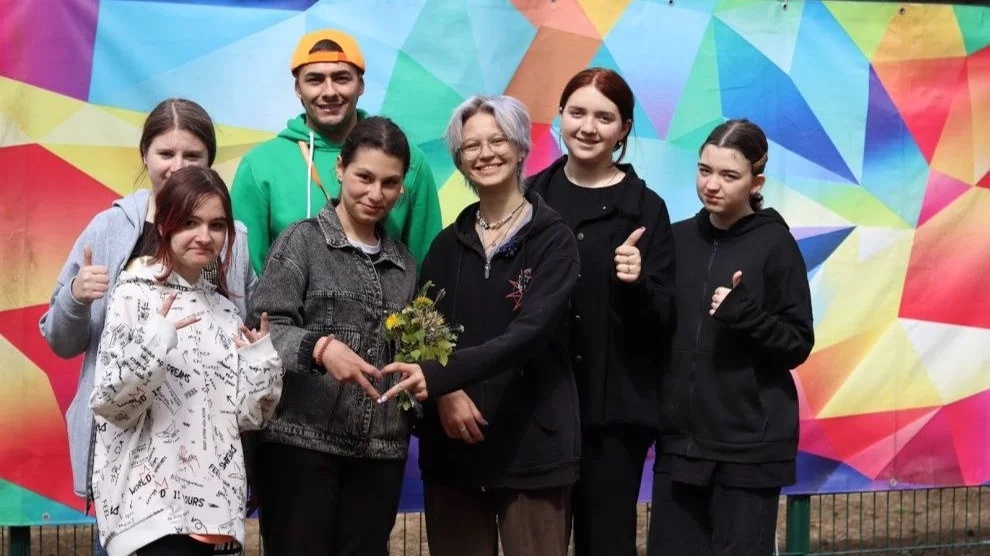
Schoolchildren from Mariupol will be able to learn new professions in Petersburg. The beginning of the third session at Camp Friendly, where 400 children will relax until July 21, was announced on July 15 by Petersburg city hall’s press service.
“We will tell them about the opportunities that our vast country, including Petersburg, has to offer. We will make sure to take care of the health of our young guests and provide treatment if necessary,” said [Petersburg governor] Alexander Beglov.
The camp’s theme is “Childtown: Territory of Masters.” The children will have the opportunity to try their hand at such professions such as blogger, actor, artist, and architect.
On June 1, 2022, St. Petersburg and Mariupol became sister cities. Since then, Petersburg city hall has has been actively involved in restoring the city, which was destroyed during the special military operation.
The State Duma has been drafting a ban on transgender transition in Russia since spring. Despite the fact that experts and doctors opposed it, the MPs have now passed the law in its second reading.
The original bill already prohibited all “medical interventions” for transgender transition and changing gender markers in passports and other documents. But the MPs also proposed new restrictions.
Now, according to the draft law, if one spouse changes their gender marker, their marriage will be annulled. In addition, those who have transitioned to another gender will be banned from serving as guardians and adopting children. Depriving them of parental rights is not on the table yet, but the Russian authorities have taken children from trans people in some cases in the past.
Moreover, MPs would ban not only “medical intervention” in the form of surgery, but also hormone therapy.
Finally, the Duma reworded the law on vital records. Previously, it was possible to amend a passport using a sex-change certificate issued by doctors. Official documents can now be amended if the individual provides a medical report “on the correspondence of [their] sexual characteristics with the characteristics of a particular sex.”
Although the bill has not yet been adopted into law, it is already causing trouble for transgender people. Robert Lebedev, a transgender man, toldBumaga, citing his own acquaintances, that civil registry offices in Moscow had been delaying issuing new documents to transgender people for longer than the month prescribed due to an “order from above.” And yet, the draft law does not even prescribe penalties for doctors or civil servants who violate the ban on assisting a person with transgender transition and gender marker change.
The bill’s co-sponsor, Pyotr Tolstoy, argues that “the western transgender industry is trying to infiltrate our country,” and Russia’s “cultural and family values” must be preserved.
Even before the adoption of the law, transgender people faced endless humiliation and persecution. The new law will give the security forces a free hand and effectively outlaw an entire group of citizens.
On this dark day, when we find ourselves at rock bottom, I want to scream with rage and impotence. While voicing emotions is vital, I’m also trying to find a foothold—in myself, in others, in my own experience….
I have nothing but a profound belief that this night of total obscurantism, injustice, and hatred will end one day, and hopefully sooner rather than later. I am overwhelmed with feelings of love and admiration for the trans activists to whom life has introduced me during my ten-plus years in activism. I didn’t always say these feelings out loud.
We started working hand in hand when I didn’t know a single open trans person in my own circle yet. Gradually, I was surrounded by more and more trans people, who did a lot of cool, useful and, sometimes, fantastic things.
I befriend trans people and even became romantically involved with them. Over the years, trans initiatives and trans people have truly accomplished a great deal. It’s no exaggeration to say that they have become the vanguard of the Russian LGBT+ movement.
I learned about the difficulties they face and about ways to help them. I still appreciate the patience, tact, determination, and dignity with which I was corrected when I made mistakes myself, or when mistakes were made in the communities I moderated.
Things became visible that I, a cisgender person, simply had not noticed before: sniggering and transphobic “jokes” at passport control at the airport, misgendering, violence, rejection at home, discrimination at work, sexual exploitation, increased risk of suicide, etc. Interacting with trans people also helped me to understand the narrowness of the binary gender framework and my own gender nonconformity, despite the fact that I consider myself a man.
Further immersion in the topic, collaborations, and a desire to contribute in this area led to the creation of the project Transformation on trans people in the Russian prison system. At the same time, we tried not to speak for trans people. Instead, we delivered their own stories about their prison experience and commentary by experts, among whom there were also trans people. We plan to continue, realizing that it is a long-term job, although the new law will make this work more complicated, apparently.
Again and again I listen to the song “We Shall Overcome,” the anthem of the movement for the rights of African Americans. In new, difficult circumstances, the importance of mutual support, assistance, unification, and finding non-standard channels increases.
I believe in the power of the LGBT+ community’s solidarity in the face of difficulties. Fear and feeling powerlessness are understandable emotions. But it’s important to move on and fight the consequences [of this law].
The song ends with these words:
We are not afraid,
We are not afraid,
We are not afraid today.
For deep in my heart
I do believe:
We shall overcome someday!
The photo, above, from his personal archive, shows the author during the campaign against transphobic legislation in St. Petersburg, with a view of Trinity Bridge in the background.
The Russian authorities do not talk about the casualties its forces have sustained in the war with Ukraine. The last time the Ministry of Defense reported on them was in September 2022, and even then the official figures diverged considerably from estimates by independent researchers. The Kremlin now says that they trust only the figures from the Defense Ministry. The trouble is that there are no figures from the Defense Ministry.
So how many Russians have been killed since the start of the full-scale war with Ukraine in February 2022?
A new investigation by Mediazona, Meduza, and Dmitry Kobak (who teaches machine learning at the University of Tübingen) provides at least approximate figures.
Journalists at Mediazona and the BBC have been counting losses by monitoring obituaries in local media, posts on social media, and new gravestones in cemeteries. They have compiled a list of names, and while it certainly does not reflect the entire state of affairs, it does give us a rough idea of the number of the casualties sustained by the Russian army and Russian PMCs.
But there is another source of data on deaths in Russia—the registry of inheritance cases, in which notaries register all information about deceased Russians who have left behind an inheritance. Since last year, the number of inheritance cases involving deceased men, especially young men, has increased dramatically. Inheritances cases do not account for everyone killed in the war, but even this increase makes it possible to ascertain the real figures for excess male mortality—that is, the actual number of war dead. The authors of the investigation describe in detail how they have unearthed this data.
The tally takes into account the mortality of men under fifty years of age. There are no women at the front, just as there are almost no servicemen much older than fifty there. The journalists also compared their estimates with obituaries: it turned out that the increase in the number of entries in the register and the number of deaths correlate with each other. Moreover, Rosstat’s information about mortality for 2022 also matches these data. (Rosstat have not yet published any information about mortality rates for 2023.)
So, around 25,000 Russian men under the age of fifty perished in the war in 2022. At the same time, the discrepancy that thus arises with Rosstat’s data on excess mortality is only four percent, which is within the margin of error.
Between 24 February 2022 and 27 May 2023, approximately 47,000 Russian men under the age of fifty were killed in the war.
This figure accounts only for servicemen, mercenaries, and convicts killed. It is impossible to count the number of those killed in the DPR and LPR.
The Russian army has also sustained other casualties, for example, men have been wounded, some of them seriously wounded, which are irretrievable losses.
The number of seriously wounded men has been estimated approximately, and the approximate proportion of them to men who have been killed is one to one-point-seven. This means that, in total, at least 125 thousand Russian servicemen have either been killed or seriously wounded during the full-scale war with Ukraine. This is greater than the losses sustained by the Soviet and Russian armies in all the other wars they have fought, from Korea to Chechnya, since the Second World War.”
The criminal war as such does not outrage them. The war itself completely suits them all. They love this war. They just don’t like that their slave husbands are kept at the front for too long without leave.
Source: KOLOKOL XXI (Telegram), 8 July 2023. Translated by the Russian Reader. Specifically, the women in this video appeal to Vladimir Putin ask that men who are mobilized to fight in Ukraine (as their husbands and sons were, allegedly, in September 2022) should spend no more than six months at the front and should be relieved by “trained reserves as soon as possible”: “Our men need R&R. Send our men back home,” says one of the women. The woman shown holding a baby, at the end of the video, suggests that the mobilized men be relieved by some of the “over four and a half million professionals” serving in the Emergencies Ministry, the Interior Ministry (i.e., the police), and the regular army. Nevertheless, the women unambiguously voice their support for the “special military operation,” while claiming that their own “lives are hell.”
Vladimir Putin visiting a training ground for mobilized soldiers. Source: Russian Defense Ministry via Republic
Russian troops at the front are severely depleted due to the lack of rotation, which in turn is caused by a shortage of reserves, according to the Institute for the Study of War (ISW) in the United States. Meanwhile, the deputy chairman of the Russian Security Council, Dmitry Medvedev, radiates optimism on this score. At a meeting to discuss reinforcing the Russian armed forces with contract soldiers, held the other day, Medvedev claimed that, according to the Defense Ministry, over 185,000 men had enlisted in the Russian army over the past six months, during the period 1 January to 4 July 2023.
Data from various sources suggest that a significant portion of Russia’s current contingent of “contract soldiers” consists not so much of men who for one reason or another (usually financial, less often ideological) actually have volunteered to go to fight in Ukraine, as of men who have been turned into mercenaries under contract in a “voluntary-compulsory” manner.
We have already reported that, judging by Rosstat’s numbers on migration flows in the Russian Federation in 2022, Tajik nationals have been forced to “volunteer” in this fashion. And this includes not only Tajiks who, by an unfortunate coincidence, came to Russia to work in 2022 and now can only come return to Russia via the front line in Ukraine, and from there go home either in a plastic bag or in a wheelchair. Attempts are underway to make “volunteers” of Tajiks who have not left their country and had no plans to leave, but who are forcibly mobilized into the Russian army by the government of their native Tajikistan.
It seems, however, that although the Russian leadership is running out of Tajiks, it intends to keep fighting for a long time. For this reason, it could find no better solution than to forcibly reclassify young men already conscripted in Russia itself as “contract soldiers.” This campaign, apparently, has also enjoyed only fair to middling success. Moreover, so much so that the authorities are now not only forcing mostly previously untouchable young Muscovites to join the army (and in the current circumstances this actually means sending them to the front), but even those residents of the capital who have papers certifying them as unfit for military service on medical grounds.
The Telegram channel of the human rights organization Soldiers’ Mothers of St. Petersburg relates the story of nineteen-year-old Muscovite Andrei B. Armed with medical certificates that should have enabled him to receive a reprieve from the army (in particular, he needs surgery due to a joint disease), Andrei and his lawyers went to the military enlistment office in Moscow’s Izmailovsky District. However, the enlistment officers immediately confiscated Andrei’s [internal] passport, forbade him from using his phone, and kicked his lawyers out into the street. Basically, Andrei was forcibly captured by the Russian National Guard and held by its officers inside the military enlistment office. Summoned by Andrei’s lawyers, the police who arrived at the scene assisted the Guardsmen, rather than the young man, who was being held by force. Andrei became ill when his blood sugar spiked. An ambulance crew summoned by the lawyers were not allowed to attend to the young man.
Consequently, according to the post on Soldiers’ Mothers Telegram channel, “assisted by the Russian National Guard, the young man, who could barely stand on his feet, was escorted to the assembly point, where neither his mother nor his lawyers were admitted. Unfortunately, it proved impossible to secure the young man’s release from the assembly point.”
According to Soldiers’ Mothers, such cases are widespread. On the same day, a dozen more young Muscovites were sent to the assembly point from this same enlistment office alone.
In fact, we are witnessing the next wave of a covert “partial mobilization.”
There are two significant points about this story. The first is that nearly all the forcibly mobilized young men had medical reprieve certificates and went to the military enlistment offices with their lawyers, who, in turn, had been provided to them by human rights organizations. In this regard, the naivety of human rights activists, including the Committees of Soldiers’ Mothers, and commentators of this story on social media, who have been outraged by the “violations of the rights” of young men thus “shanghaied” into the army, cannot help but astonish us.
The second point is that the large-scale dispatch of Muscovites into combat suggests that the regime has fewer and fewer human resources available to it. The quality of these mobilizable reserves is questionable, however.
Bloomberg identifies convicts and Kadyrov’s Chechen fighters as two other additional sources for replenishing the Russian army’s manpower.
Of course, the Russian Defense Ministry can continue to recruit convicts, but the numbers and quality of these soldiers will steadily decrease. This is simply because the numbers of murderers, robbers, and rapists who have already been killed or seriously injured, and whom Prigozhin prioritized over other residents of prisons and penal colonies, since they had the specific relevant “background,” have for obvious reasons greatly decreased. As we recall, Prigozhin himself claimed that 20,000 Wagner fighters, half of whom were ex-convicts, had been killed in the battles for Bakhmut alone.
The number of Chechen soldiers whom Kadyrov is willing to send to the front is also limited, since he has to maintain significant forces in Chechnya itself, both to protect his own clan from possible uprisings, and in case of “unforeseen” circumstances during which the federal center would be greatly weakened and he would finally deem it possible to declare himself an independent sovereign. Whatever the case, Kadyrov has cited two figures: 7,000 of his loyalists already in the combat zone and an additional 2,400 men undergoing training. Slim pickings, as the saying goes.
The quality of these “TikTok warriors” is also questionable. Not because Chechens don’t know how to fight. They do know how to fight, as they proved in both Chechen wars, in 1994–1996 and 1999–2004. But this is not their war.
Sooner or later, a significant percentage of Russian soldiers will reach the same conclusion.
Men in military uniforms robbed a magic store in Belgorod.
Yesterday afternoon, two men in camouflage who had allegedly returned from the war zone entered the store, Promagia, on People’s Boulevard. The shopkeepers claim that the two men introduced themselves as “Wagnerians.” Video footage of the incident shows that one of the men sported a Wagner PMC patch on his rucksack.
Footage of the alleged incident at the Promagia magic store in Belgorod, as posted on Telegram
According to the shopkeepers, at first the military men tried to extort money: allegedly, the previous tenant was in debt to them. When the shopkeepers explained that they were new tenants, the men in uniform did not calm down and stole a pendant on a chain from the counter before snatching another item from a shopkeeper’s hands. When they were told they had to pay for the items, one of the “Wagnerians” replied that he had “given himself a gift.”
Police later arrived at the store to document the theft by the military men. The police told the shopkeepers that information about the same two soldiers had been reported by other shops.
Source: News Flash — Belgorod (Telegram), 9 July 2023. Translated by the Russian Reader. Thanks to News.ru for the tip. It is possible that this incident was cooked up and leaked into the media as part of the regime’s current smear campaign to discredit Yevgeny Prigozhin and the Wagner Group. But given that they are ruthless fascist thugs themselves, it is just as possible that two “Wagnerians” did rob the magic store on People’s Boulevard in downtown Belgorod. Stranger things have happened.
We will talk about what is happening to people who are terribly far from Moscow and St. Petersburg. Who are terribly far from the congresses, conferences and conflicts of opposition leaders. Who are terribly far even from popular YouTube channels and shows. Who are also terribly far even from Telegram.
Why does this matter? It matters because otherwise we won’t understand how the country got to this point and why some Russians volunteer to fight in the war.
In this episode, you’ll learn what worries Russians more than Prigozhin’s rebellion, why the Baltic Sea in Kaliningrad is becoming bloody, in which city it is easiest to encounter wild bears on the streets, and the job you have to land to make a dream salary of 8,000 rubles [approx. 80 euros] a month.
Subscribe to our channel, where we talk about the problems of ordinary people. And if you live beyond the Moscow Ring Road and are facing trouble right now, write to us at:
strashnodaleki@gmail.com
We will definitely tell our viewers about it. Because we do care.
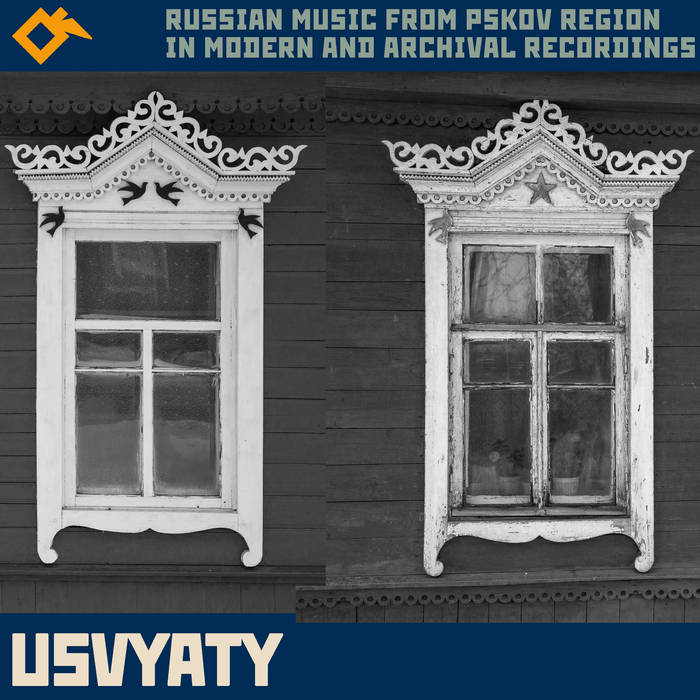
The Usvyaty District of the Pskov Region belongs to the ethnographic area known as Poozerye (Lakeland). There used to be many folk musicians there, the most famous of whom was the singer Olga Sergeeva (1922-2002).
Ekaterina Trusova (maiden name Kozintseva, tracks 1-7) is a garmon (Russian button accordeon) player living in Usvyaty. She was recorded at the Usvyaty House of Culture on December 12, 2021.
The other two musicians featured on this album belong to a previous generation and were recorded by Ekaterina herself in the 1990s on a home cassette tape recorder. The cassettes were digitized by Alexander Yuminov (KAMA Records) in 2022.
Sofya Rubisova (tracks 8-13) is a folk singer from the village of Sterevnevo, Usvyaty District.
Dmitry Kozintsev (tracks 14-17) is Ekaterina’s father, a garmon player from the village of Pysi. Unfortunately, the recordings of him are of poor quality, as the tape in the cassette turned upside down. But we still decided to include them in the album.
Another album from the area, from the village of Tserkovishchi, can be found here.
Branded “foreign agent,” Yaroslavl media outlet announces closure
YARNOVOSTI announced it was suspending its work on July 7. The publication had been running for over ten years. It covered the inhabitants of Yaroslavl, corruption, problems with public amenities, and politics.
In June, the Justice Ministry had declaredYARNOVOSTI a “foreign agent.” None of its employees agreed to work under this label. The editors said that during its entire existence it had not received “a kopeck” of foreign funding.
“Of course, we expected to continue working, but, as Vladimir Putin said, nothing lasts forever. We are still getting to the bottom of what happened on June 2: we have made all possible and even impossible inquiries, and have drawn up the paperwork for the court,” the media outlet’s editorial team wrote.
Source: 7 x 7 (Telegram), 7 July 2023. Translated by the Russian Reader. As of this writing, YARNOVOSTI seems to have shut down its website, but its page on VKontakte is still functioning. In its latest post there, published on 7 July 2023, it informed readers of the decision to suspend its work.
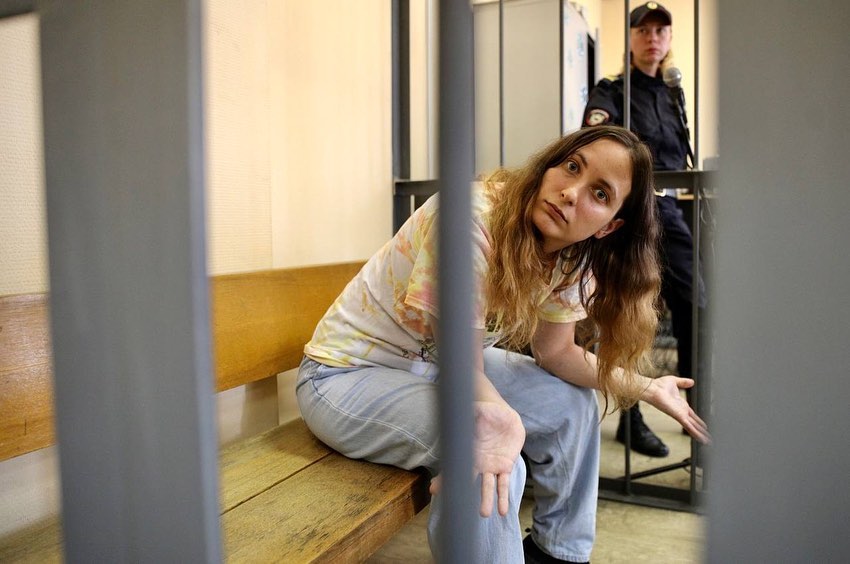
Petersburg anti-war activist and political prisoner Sasha Skochilenko at her trial, 7 July 2023. Photo: Alexandra Astakhova
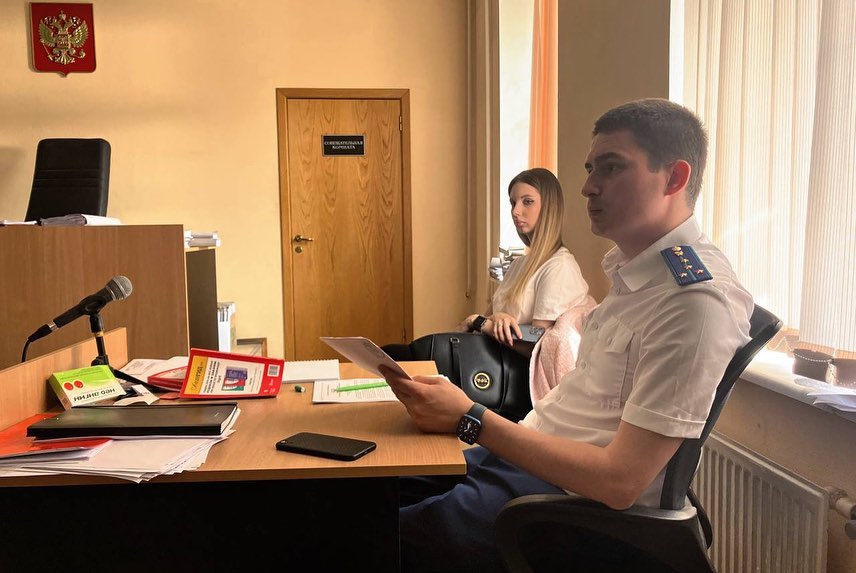
At today’s hearing, the issue of remand was considered. The court could have released Sasha [Skochilenko] to house arrest or restricted her from doing certain things, or left her in pretrial detention for another three months.
This hearing might not have happened if the court had agreed to consider the issue during the remaining time at the previous hearing. But that did not happen, and today Sasha was once again transported from the pretrial detention center, and had to spend another day without food in poorly ventilated rooms. In an effort to ease Sasha’s suffering, the defense petitioned to move the hearings to an air-conditioned courtroom, to permit Sasha to drink water during the hearings, and to turn on the microphones and speakers in the courtroom so that the windows and doors could be opened. Judge Demyasheva ruled all these petitions “extra-procedural” and ignored them.
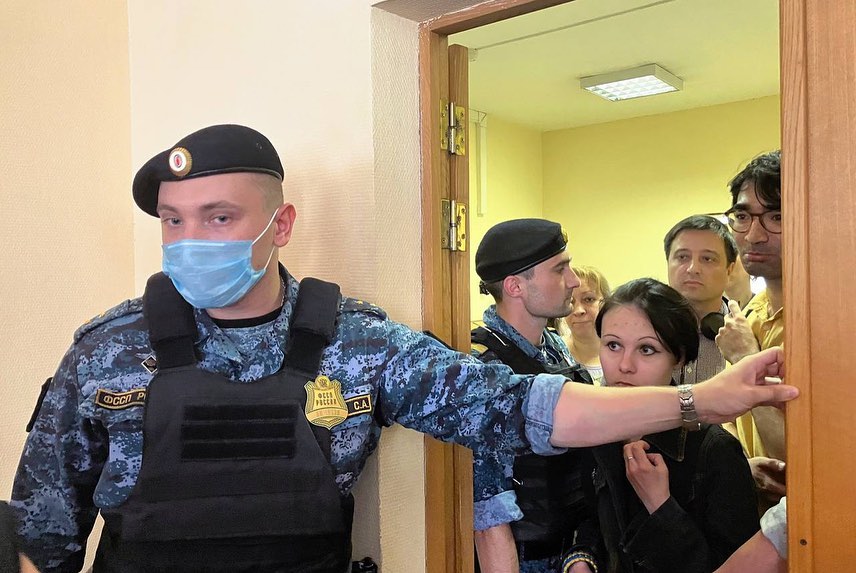
Prosecutor Gladyshev could not produce a single argument in favor of leaving Sasha in pretrial detention. He only repeated the vague arguments, made earlier by police investigators, that Sasha would resume her “criminal behavior” and could leave the country, possibilities which had already been ruled out by the court at previous hearings. Most memorably, the prosecutor declared, bombastically, “Skochilenko committed a grave crime against public safety, undermining the foundations of the Russian state.” (After he said this, the bailiffs had to remove a member of the public who had burst out laughing from the courtroom, and the judge declared a recess.) When Sasha’s lawyer Yana Nevodinnova pointed out to the prosecutor that his arguments were unfounded, Gladyshev was cut to the quick. “Reprimand the lawyer,” he asked the judge, “She insults Russia’s judicial system!”
Despite the numerous arguments about the critical state of Sasha’s health, which the defense had made at the previous hearing, the judge ordered that Sasha remain in pretrial detention until October 10.
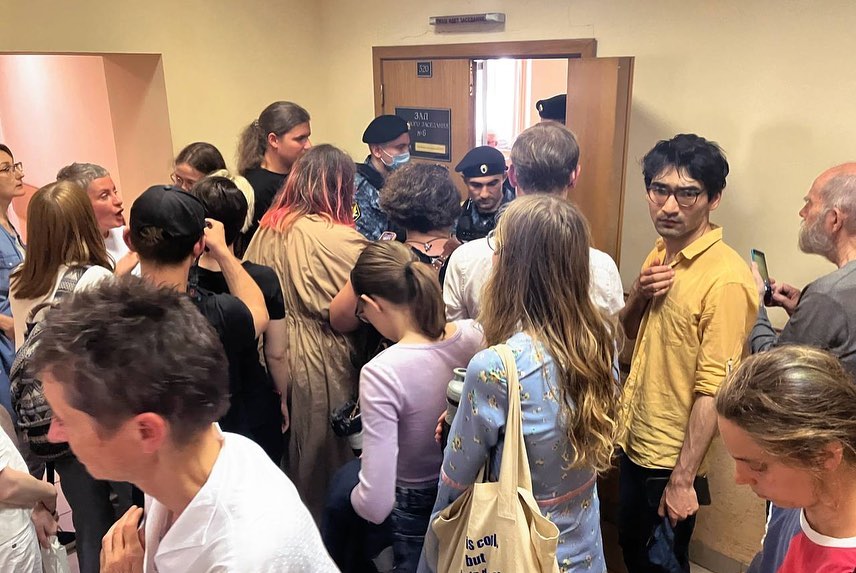
Many thanks to everyone who keeps coming to court! The next hearing—this time on the merits of the case—will take place very soon, on July 18 at the Vasileostrovsky District Court. Please come out and support Sasha!
A roadside fireworks stand in Soledad, California, 28 June 2023. Photo by the Russian Reader
When issuing diplomas, colleges in Ingushetia now require graduates to sign a summons to the army or refuse to accept the conscription notice and face possible administrative and criminal charges, Fortanga was told by a source close to one college.
“To get a diploma, you need to sign a conscription notice. Otherwise, you will not receive a diploma no way no how. Either you accept the conscription notice, or you sign a waiver . That is, accepting the notice means you have to join the army, while turning it down means saying ‘Hello, prison, here I come,'” the source said.
According to the source, the practice was introduced after the director of the college in Nizhnie Achaluki reported, at a meeting involving the head of the republic Mahmud-Ali Kalimatov, that thirty students had been drafted from his institution into the army. Subsequently, military enlistment officers and government officials “jumped on the bandwagon,” the source claims.
Students are being forced to come to colleges in person to get their diplomas, the source added. That is, young men cannot receive them by mail or ask that they be handed over to a family member or a proxy.
When the graduate refuses to sign the conscription notice, a report is immediately drawn up and signed by witnesses. First-time offenders face administrative charges under Article 21.5 of the Administrative Offenses Code (i.e., “Non-fulfillment of military registration duties by citizens”) and a fine of 500 to 3,000 rubles. Repeat offenders face criminal charges under Article 328 of the Russian Federal Criminal Code (i.e., “Evasion of military and alternative civil service”) and a fine of up to 200,000 rubles, forced labor, arrest, or imprisonment for up to two years.
Ingush lawyer Kaloy Akhilgov noted that the legality of such a practice “depends on the procedure for issuing a summons.”
“Educational institutions can only serve conscription notices, not issue them themselves. That is, first the military enlistment office must send the notice to a specific citizen, and after that the organization can hand it to the student,” he explained.
For those who want to avoid receiving a military conscription notice , the lawyer recommended that after completing their bachelor’s or master’s degree, they take postgraduate leave until August 31 and file the relevant paperwork with the military enlistment office. “Then they should not be bothered during the [current] spring conscription drive. And such ‘automatic’ draft notices issued along with diplomas lose their significance,” he added.
Mark, 26 years old: a former engineer turned waiter in Yerevan Before I left Russia I was building a career: I was a senior fire and security systems engineer. Such people are needed everywhere: it’s a fairly good position. I worked in government agencies, so I was served my conscription notice directly at work. However, I had never served in the military: I had a deferment due to health reasons.
That was October seventh: I usually have a hard time remembering dates, but this was like in a movie since it divided my whole life into before and after. At night, I packed all my things and moved to another apartment, then I flew to Turkey and from there to Armenia.
It’s amazing: my grandfather is Armenian, but I had never been to Armenia before then. The authorities have even confirmed that I can get citizenship. But if I get it while I’m still eligible for military service, I will have to serve in the Armenian army for two years. And if you evade military service you can be banned from leaving the country or imprisoned. I went to the local draft board, and they told me straight up: come back in a year to get your citizenship. So that’s what I’ll do.
A short time before the mobilization, I was offered the chance to rent an apartment near Rybatskoye subway station in Petersburg for fifteen thousand rubles a month. I was sitting at the dacha, thinking about how I would rent this apartment, how I would invite friends over to my place—everything was good. But the next day the mobilization was announced, and my parents said to me, “Maybe you should leave?” I thought it over for a long time, and didn’t talk to anyone for several days. Then the conscription notice was delivered. Almost all of my friends supported me [in my decision to leave]. I had this conversation in the smoking room with a colleague, who told me, “I’m not going anywhere, I’ll sue. If push comes to shove, I’ll fight within the system.” In the end, he was drafted.
I had savings, so I didn’t work for six months. I tried to get a job as a technician or engineer in my field, but the old boys network is quite strong in Armenia: it is unlikely that they would hire a person off the street, and one who isn’t Armenian at that. And you need to know Armenian for any serious job. For a while I was depressed that I couldn’t find a job, that I had had everything squared away, but here I was nobody. I was a highly qualified specialist, but now I was unemployed. It was a big blow to my pride. At my old job, they waited another six months for me to return.
At first I went to work as a courier at Yandex Delivery. Maybe it is still possible to do the job on scooters and bicycles, but it is absolutely impossible. I had to walk 40-50 kilometers a day. I came home on the third day, soaked my feet in a basin, and sat there for several hours. There is an inadequate system of fines and impotent support staff that knows nothing. All couriers want to protest, both in Yerevan and in Moscow.
The delivery job was so hard on me that I even wanted to go home. I was in such a depressed state that the part of my brain that is responsible for the comfort zone was activated: “Yes, everything is fine, everything has already quieted down, and I have a home there.” I know several people who have returned [to Russia] after working such jobs. I even called my boss in Petersburg and asked if they’d hired someone to replace me, but they already had.
When you’re getting started in a country, I advise everyone to go to work as waiters. You have to carry plates and interact with people, but we all know how to do that. And you have to memorize the menu. I speak to foreign tourists in English or Russian, and I tell Armenians that I am learning the language, and they are always understanding. I tell them, “Come back in six months, and we’ll chat,” and they’re happy that I’m learning their language. Sometimes even Armenians who don’t know Armenian themselves come in and ask for a Russian menu. I even asked once, “How’s that?”
I think I lucked out: I’m treated well, we have a very friendly atmosphere, the cooks teach me Armenian, and everyone is always supportive and understanding. The money is enough to live on. And they treat me well as a Russian. Today, a client, a friend of the owner, gave me a teach yourself Armenian book in a beautiful paper bag printed with Armenian letters.
Very many young researchers and decent specialists have left Russia. This is sad, of course, but it is natural after such actions on the part of the state. It was pretty hard to swallow the whole thing. You can say it was pride, that, like, you’re going have to work in completely different jobs. I don’t like the buzzword “relocatees”—we are all migrants.
I am learning the language and I can already make myself understood: Armenian is not as difficult as it seems. When I learn the language, I will return to my profession, because it will stand me in good stead wherever I go. Naturally, emigration is not at all what I’d imagined. But this is our new home, and we have to learn to live here. Remarque has a book about emigration, Shadows in Paradise. A lot of people who also moved after wars became very strong personalities: it is an incredible experience. It is so intense that when you look through time into the past, you feel so much more mature, so different as a person, that you regard everything differently. So I’m even grateful to fate for these changes.
A farewell ceremony was held at the Serafimovskoe Cemetery in St. Petersburg for four soldiers of the Neva Battalion who perished during the special military operation, the governor’s press service reported on July 3. The funeral was attended by the city’s head, Alexander Beglov, and the speaker of the St. Petersburg Legislative Assembly, Alexander Belsky.
The deceased men—Mikhail Sokolov, Roman Galinsky, Mikhail Manushkin, and Sergei Isayko—were posthumously awarded the Order of Courage. In his speech, Beglov said that the men had been killed in heavy fighting.
“They are continuers of Russia’s military glory. We are proud of our fellow townsmen. Petersburg shall cherish their memory,” the governor said.
After the start of the special operation, the Smolny’s press service began publishing news about the deaths of Petersburgers in the Donbas, accompanying them with a mention of the condolences expressed by Beglov. Later, the release of such reports was abandoned for a long time. In December, Beglov unveiled a plaque on the facade of School No. 369 in memory of army officer Alexander Zhikharev, who perished in the SMO. In February, the governor and education minister Sergei Kravtsov met with Zhikharev’s relatives, and in March the school was named in his memory.
You can’t show them your vulnerabilities or reveal your desires and fears. (Don’t ask!) This information will be used to intimidate and torture you. (Don’t be afraid!) Or it will be used for bargaining: they will promise to go lighter on you in exchange for your cooperation and will certainly deceive you. (Don’t believe!)
Source: Elena Efros (Facebook), 4 July 2023. Translated by the Russian Reader. Ms. Efros, a well-known human rights activist, is the mother of imprisoned theater director Zhenya Berkovich. Thanks to Ivan Astashin for the heads-up.
People ask how things are going for me on the professional/international front. My answer: nowhere fast. For two reasons.
Firstly, the clusterfuck in which “our village” (c) has become entangled, imposes certain restrictions. By working with foreign galleries and submitting works for international awards, I risk getting branded a “foreign agent.” You can’t explain to the comrade major from the secret services that France is the birthplace of photography, and that the photo fair at the Grand Palais in Paris is the most important event in the world. It’s not even the status of “foreign agent” as such that scares me, but the possible consequences for the people and organizations with whom I work.
Let’s be realistic, though: if they want to brand me a “foreign agent,” they’ll do it all the fucking same, so let’s move on to the second, more important reason.
Publications, exhibitions, and awards abroad put plenty of wind in your sails and boost your self-esteem. I am grateful to destiny for every such encounter on my professional journey. It was an important stage in my work, but I think I’m past it. International recognition is cool, but it still doesn’t compare to being liked and understood at home. Seriously: when people come up to you on the street to shake your hand, it’s worth a lot.
A connoisseur can correctly break down a creator and their work, but in order to fully experience what was happening at the time a photo was shot, you need a personal context. Roughly speaking, to appreciate the beauty of a picture taken in a bedroom district, I would argue that you have to live in a bedroom district. My social media stats show that the majority of my subscribers are Russian nationals in their thirties and forties, that is, people with the same background and cultural code as me. Eight out of ten of these people have nothing to do with photography, and these are probably the most valuable viewers, since I had the honor to introduce them to documentary photography.
When a stranger says that my photos rhyme with their feelings and memories, I experience (how should I put it?) a connection with something greater. This is probably the miracle of art: a moment in life that lasts one thirtieth of a second enables strangers to understand something fundamentally vital about each other. Ultimately, these pictures are mine as much as they also belong to each of the people who caught sight of something personal in them. Maybe not everyone will be able to appreciate my compositional techniques and artistic devices, but fuck them. They are just tools for conveying a message, and the message is the only thing that matters.
The simplest and, simultaneously, the most difficult thing is to understand your time, your place, and your metier. It seems I have succeeded in doing this: my photos get attention, and my books sell so well that every year I have to reprint them. So I just want to keep doing what I’m doing for as long as I can—here.
P.S. By the way, whereas earlier, according to my stats on (extremist) Instagram, Paris was in third place, after Moscow and Petersburg, in terms of numbers of followers, nowadays Chelyabinsk is in third place! This is definitely a sign of success.
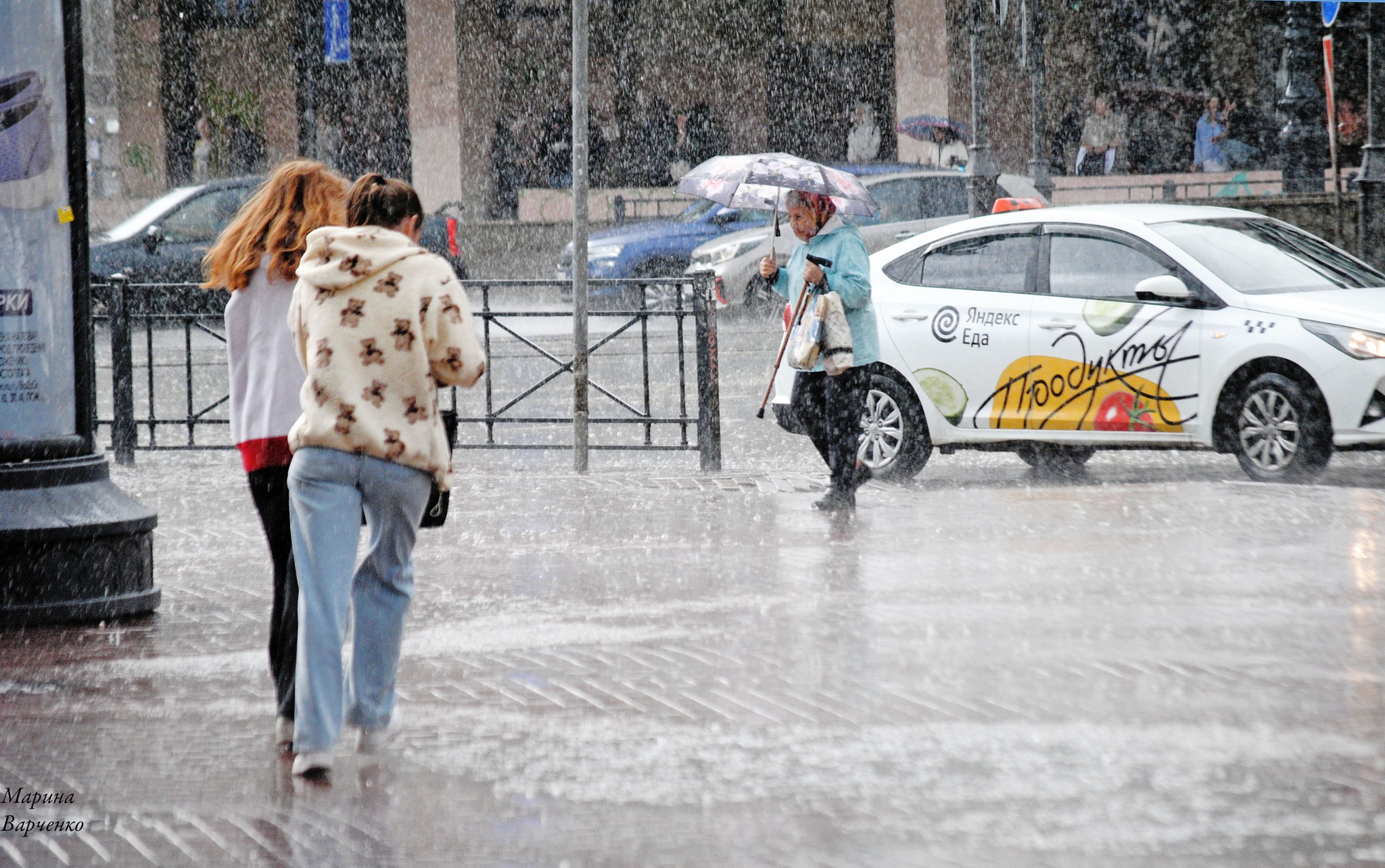
Source: Marina Varchenko (Facebook), 3 July 2023: “A downpour on Ligovka.” Ihave spent so much time on “Ligovka,” i.e., Ligovsky Prospekt, and on the corner pictured here in particular, that I’m nearly sure it’s permanently imprinted on my brain. I’ve probably been in more than one summertime evening downpour on that very same corner. ||| TRR
Lavrov said that Prigozhin’s armed mutiny could not be termed anything more than a “scrape.” Well, yeah… After the rebels seized the headquarters of the Southern Military District, which coordinates the main grouping of Russian federal forces waging war in Ukraine, along with Deputy Defense Minister Yevkurov, seized Rostov-on-Don, a city of one million people, and a military airfield, shot down six combat helicopters and one military aircraft, and were a mere 200 kilometers from Moscow; after all the supreme authorities in Russia shit their pants in unison, instituted a counter-terrorist operation in Moscow and three other regions, and were planning to impose martial law, after this total disgrace, after catching their breath and changing their diapers, they declare the whole thing a “scrape.” Amen to that!
On Tuesday, Russia killed three children and nine adults in Kramatorsk. Everyone has probably heard the remark made by Colonel General Andrey Kartapolov, former Russian military commander and current member of the Russian State Duma: “The strike on Kramatorsk showed pizzazz, I tell you. I tip my hat to whoever planned it. It was just like a song—my old military heart rejoices.”
The general was probably referring to “The Death Aria” from the film The Star and Death of Joaquin Murieta: “You have to have pizzazz in this case, / Your own signature style.”
But my old heart and brain refuse to believe that General Kartapolov and I are members of the same species.
After Putin podcast: “‘When I grow up, everything will change’: What schoolchildren think about Russia and why we should listen to them.” In Russian, without English subtitles
We have talked a lot on this podcast about what lies in store for Russia and how to make this future better. Now we will talk about the future with the people who will be tasked with building it—with teenagers.
We met with these sixteen- and seventeen-year-olds a year and a half ago, in the summer of 2021. Back then, propagandists, op-ed writers, and rank-and-file netizens were vigorously discussing why schoolchildren were attending protest rallies. We decided to ask high school students themselves what they thought about the country in which they had been born and grown up, but in which they had not made any of the crucial choices.
In this episode, you’ll hear the conversation we had with these young people in 2021. They talk about whether they see their future in Russia or in emigration, what annoys them most about Russia, and how they talk about politics with their relatives. And we explain what is special about these teenagers and why we should listen to them.
The next episode features a conversation with the same young people, recorded in early 2023. During the intervening period, they were transformed from schoolchildren into university students, and almost a whole year of the war had passed. We asked them what had changed over the past year and a half about their attitudes towards Russia and whether they still saw a future for themselves in their homeland.
When Russian warlord Yevgeny Prigozhin started a ‘march on Moscow’ with his Wagner forces, the world—and Russia—was shocked. Was this a coup? A rebellion?
Now Prigozhin is supposedly in Belarus and the Kremlin is trying to retake control of the narrative—all while Ukraine’s counter-offensive grinds on. But how should we understand the weekend’s drama? And what is really going on now?
Join our experts to find out how they’re making sense of the rebellion-that-wasn’t.
Hear from:
🔹Elizaveta Fokht: BBC Russian Service reporter who has reported extensively on the Wagner Group
🔹Hanna Liubakova: Journalist and analyst from Belarus and non-resident fellow at the Atlantic Council
Boris Groys: We shouldn’t exaggerate the role of the nation in this case. Any nation is a multitude of people who are busy surviving from day to day, and the struggle to survive usually takes twenty-four hours a day. Look at France in the 1940s: there was Vichy, and there was de Gaulle, and each camp had a small group of political supporters. But the bulk of the populace lived as quietly under de Gaulle as they had lived under the Vichyites. It was the same under the Nazis in Germany. The populace usually accepts the regime that history offers it. Ordinary people want to survive, and loyalty to the authorities is part of their strategy for surviving. It is not, therefore, a matter of ordinary people and their subjectivity or lack of subjecthood. The central problem is how a country’s political class is formed and how it functions. Greece and, later, Rome proposed what was, at the time, a completely new mode of forming cultural and political elites—a competitive mode—unlike the Eastern despotisms, in which there was no competitive model for shaping the political class. Accordingly, there was no integration of successful people into the system of power. Note that when someone succeeds in the West, people immediately get behind them and start writing about them. An athlete, for example, sets a new record in the hundred-meter dash. Immediately, companies line up to use the athlete’s name in their advertising. The athlete is invited to appear on CNN and is profiled by the New York Times. That is, there is an immediate positive reaction to any success. In Russia, on the contrary, success elicits only one reaction: “There is probably someone behind it. They should be exposed and totally shunned.” So, there’s not much point in talking about the common folk in this case. It makes sense, rather, to talk about the principles for forming the political class. The current ruling class in Russia is a monstrous sight. The only thing there that more or less functions there, as I said, is the economy.
Andrei Arkhangelsky: In the 1930s, the defining factor in the Soviet Union was the impetus for “life-building” (zhiznestroenie), for remaking world and self, as you write. Nowadays, however, apathy and indifference prevail in Russian society. And yet, is apathy also a kind of energy, only negative, that blocks positive energy? And the second question: does the current energy of “life-building” in Russia remind you more of the 1970s or of the 1930s? Because denunciations and large-scale crackdowns have again become the norm.
Boris Groys: First of all, the current era has nothing to do with the time of Stalin, which was an era of socialism. It was a time when everything was state-owned, and all individuals were the property of the state. Stalin mobilized the populace in order to complete the country’s industrialization at an accelerated pace. The crackdowns were aimed at achieving specific goals. Now, on the contrary, there is total apathy. First of all, because people have been given private property. Accordingly, they have been given things to care for as individuals. When I read the current Russian press, I am usually struck by the argument, which is voiced there especially often, that private property makes a person a political subject. In reality, the exact opposite is the case. The bourgeoisie is always conservative and always serves the regime. The bourgeoisie has a stake in stability, in ensuring that nothing changes. After all, why is the proletariat a revolutionary force? Because it has nothing to lose except its chains. The Soviet Union was in a similar state as it neared its demise: people had nothing to lose and so they had no interest in maintaining the regime. The regime did not guarantee them anything because they had nothing. And it was these people who made it possible for the regime to fall within two days. The current regime, in my opinion, looks different because many people have something to lose. They have something to take care of and something to protect. And they align themselves emotionally with the conditions that guarantee their preserving of this status quo.
Andrei Arkhangelsky: Your argument sounds rather paradoxical. For many years, the principal reproach to the Putin regime was that Russia had not become bourgeois enough. The country’s bourgeoisie, as Victor Pelevin wrote, had emerged from the tiny cadre of people who served the interests of the oligarchs. Russia formally lived under capitalism, but the authorities had suffocated the emerging spirit of capitalism with all their might. The majority of people had received the bulk of their property—their apartments—for free. They thus did not pay for capitalism. But now you say that it is the bourgeoisie, the burghers, who are the glue of stability in Russia.
Boris Groys: In the West, the bourgeoisie and capitalism also originally arose through nationalizations of feudal and ecclesiastical lands; that is, they were also the outcome of revolutionary processes, not of commercial transactions. So, there is no particular difference in this instance. Private property from which people receive a little income is not necessarily bourgeois. I remember how, in the 1970s, people in the Soviet Union idolized their garden plots, not because they brought these people any benefit, but because they gave them a sense that they were theirs and theirs alone. Here is another example: the most massive protest movement in Putinist Russia was sparked by the unwillingness of people to get vaccinated. Why? Because, under capitalism, my body is my property. It may be sick and ugly, but it is mine. And yet the state wanted to invade people’s bodies with a syringe! It was a vivid manifestation of the Russian people’s commitment to the principle of private property. We can say that nowadays the property in question is quasi-private property, which nevertheless also makes the present system resilient because everyone understands perfectly well that this property is guaranteed not by law but by the current political regime. And that when a new order arises, it could easily come and confiscate what people have. It could demand that people give back the very same apartments you just mentioned. It would show up at their doorsteps and say: you didn’t pay for your apartment, so give it back. Is this possible? Of course, it is possible. So, by no means should such a regime come to power.
The Russian security forces have been increasingly organizing dragnets to sweep up potential army recruits. This is occurring amidst a full-scale war with Ukraine in which the Russian army has suffered heavy losses.
There are more and more accounts of these roundups. Mediazona, for example, details how a 25-year-old Muscovite, employed in the IT business in Moscow City, was lured to a meeting with police officers and military enlistment officers through the classified ads website Avito, on which the young man was selling headphones. He was quickly sent to serve in the Moscow Region, despite being diagnosed with bronchial asthma.
The Movement of Conscientious Objectors recounts how the police simply broke into the apartment of conscripts Yevgeny Komarov and Ivan Dubenko and sent them to the assembly point. Dubenko was first strangled, and then, threatened with rape, forced to sign his military service card, as required for conscription.
Another story relayed by the Movement involves a young man with hypertension and anxiety-depressive disorder who went to the military enlistment office to undergo a medical examination and get a postponement, but instead was sent to the assembly point the very same day. Mahmudjon Nurov, on the contrary, was simply detained at the Izmailovskaya metro station and immediately sent to the military enlistment office. In the Kursk Region, the military commissars took an even simpler approach: they allegedly assembled everyone whom the medical commission had declared unfit for service, confiscated their telephones, and sent them off to serve in the army.
The Russian army needs conscripts: during this draft, which lasts until July 15, the authorities have been charged with drafting 150,000 thousand men, and so the military enlistment officers have teamed up with the police to go out and catch potential recruits. The practice is, in fact, illegal, and the prosecutor’s office has repeatedly confirmed this, but the law has not prevented police officers from going to factories and shops in search of young men allegedly fit for service. Fortunately, so far no one has received electronic draft notices through Gosuslugi [the Russian state services website]: they should begin to be issued during the next conscription campaign.
Here is how you can protect yourself as much as possible in the current circumstances:
• Do not go to the military enlistment office in person. Everything you need to learn from them can be done by mail or by an acquaintance with a power of attorney.
• If you are served a draft summons in person (military enlistment offices retain this right), refuse to take it.
• Don’t sign anything and seek legal assistance. You can file a lawsuit appealing mobilization and conscription orders through the bot “I’m Not Going!” While the court is considering your suit, you cannot be inducted into the army.
• Fill out an application for alternative civilian service in advance. Both those who have been served with draft notices and those who have been mobilized have such an opportunity.
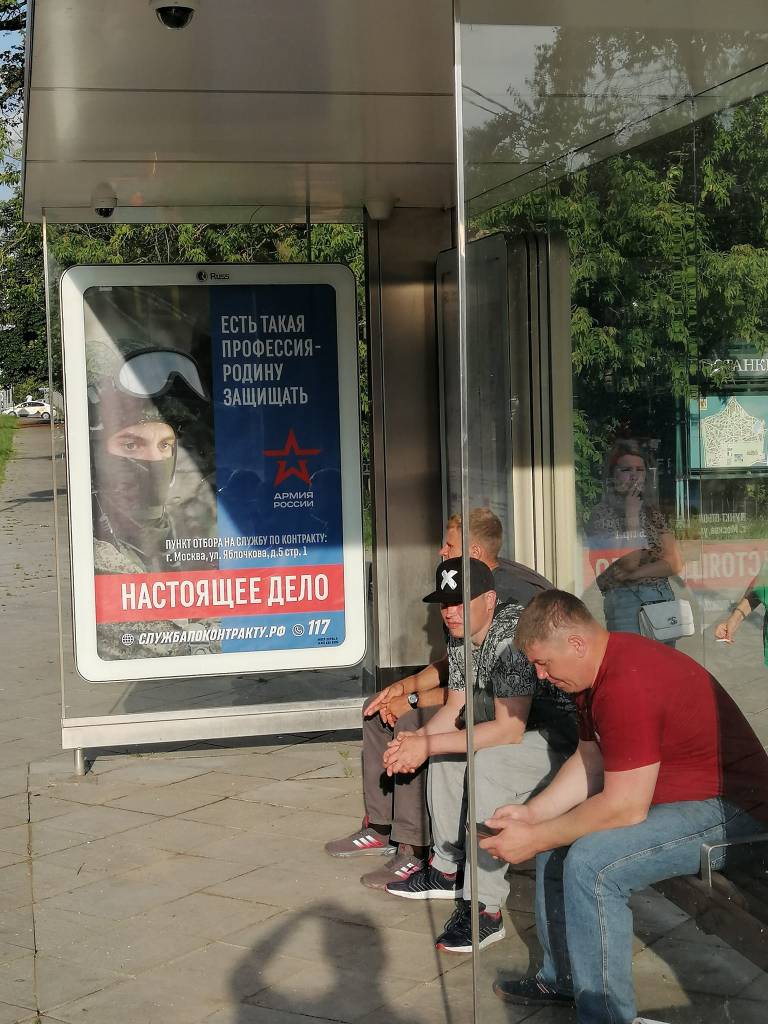
“Defending the Motherland is a profession — a real job.” Frequent TRR contributor Sergey Abashin photographed this Russian army recruiting poster (and several others) in Moscow earlier today.