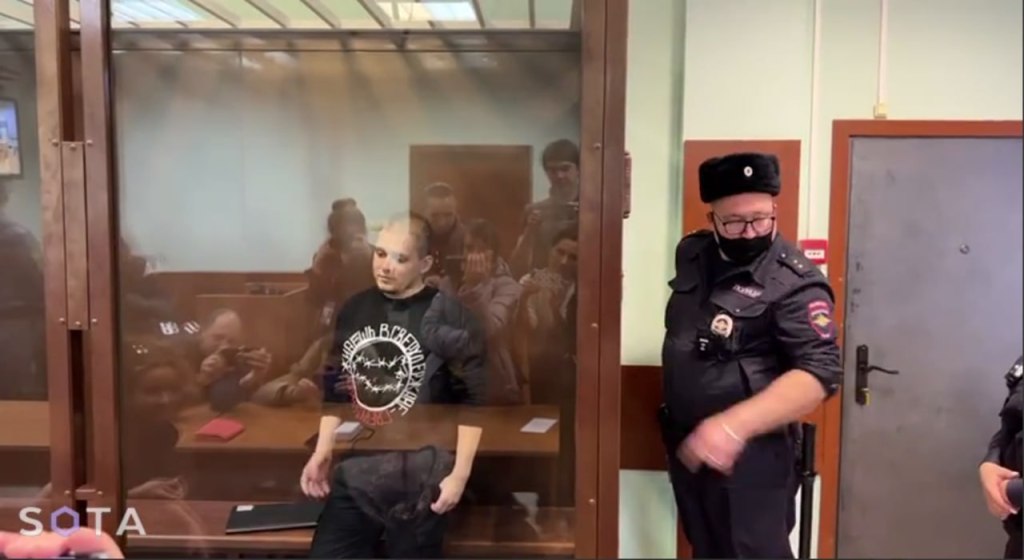
A criminal case against Zhlobitskaya was launched in December. She was released on her own recognizance after being charged with “publicly condoning terrorism,” per Article 205.2.2 of the Criminal Code. The charge was triggered by posts she had made in November and December 2019 on VKontakte. Among them are reposts of poems from the website stihi.ru, as well as two reposts from the group page of the People’s Self-Defense with information about the bomb blast at the FSB.
According to the prosecution’s expert witnesses, Mikhail Zhlobitsky’s actions in the posts in question were deemed “correct, worthy of support and imitation,” and he himself was characterized as a “good guy.”
17-year-old student Mikhail Zhlobitsky detonated a homemade bomb in the lobby of the FSB’s Arkhangelsk directorate on [October 31,] 2018, killing himself and injuring three security forces officers. A few minutes before the blast, a warning about the attack from Zhlobitsky appeared in the chat of the Telegram channel “A Rebel’s Speech.” The message said that his act, in particular, was motivated by the fact that the FSB had been fabricating criminal cases.
Yegor Balazeikin is sixteen years old. In late February, he was detained in Kirovsk, a town in the Leningrad Region: according to police investigators, he wanted to set fire to a military enlistment office, and now he stands accused of “attempted terrorism.” Later, a second criminal case was launched against the schoolboy, also for allegedly attempting to torch a military enlistment office, this time in Petersburg. Our correspondent found out how a teenager who had supported the war in Ukraine a year ago changed his views one hundred eighty degrees and how this has impacted his entire family.
After Yegor was detained, he admitted that he had in fact tossed homemade Molotov cocktails at a military enlistment office, but none of them had started a fire or caused other serious damage. Now the teenager is at risk of going to prison and spending as many years there as the time he has already spent on earth. His family are convinced that the security forces want to ruin the boy’s life. His parents and his lawyer have been forbidden from sharing information about the case with third parties.
Yegor turned sixteen last August. He loves the humanities, especially history and social studies. After finishing school, he wanted to enroll in the law school or economics faculty at [St. Petersburg State U]niversity. His parents had transferred him to School No. 166, one of the leading liberal arts prep schools in St. Petersburg.
“Yegor has always done very well at school. He passed the OGE (the basic state exam taken by pupils after they complete the ninth grade) with flying colors. It was decided to apply to several Petersburg schools at once, and School No. 166 was among them. His parents spent a long time talking it over. They were prepared for the fact that Yegor would have a long commute, since they lived in a single-family dwelling in Otradnoye[forty kilometers east of Petersburg]. Consequently, Yegor’s knowledge so impressed the headmaster at the 166th (who is a historian, by the way) that Yegor was unconditionally accepted into the tenth grade,” says Natalia Krylova, a friend of Yegor’s mother. (Her name has been changed to protect her identity.)
Natalia is close to Yegor’s family. She has know the boy since he was four. She is aware of the details of his life and had tutored him in English. According to her, Yegor’s father, Daniel, was quite supportive of his passion for Russian history.
“He was especially interested in military history and studied all the wars. When Yegor was still a little boy, he got interested in the history of weaponry at his father’s suggestion. I remember his getting books about tanks for New Year’s. He’s just such a dogged young fellow — if he starts doing something, he goes all the way. He knew all the places connected with the Great Patriotic War, he went several times to historical sites near Petersburg, and he often visited military museums,” says Natalia.
Yegor’s interest in military history was also encouraged by his uncle Dmitry, Daniel’s older brother. Dmitry [was] a professional military man with combat experience. He had always been an authority for Yegor when it came to complex historical matters.
When Yegor had just started school, he began having health problems. His mother, Tatiana Balazeikina, took him to the doctors, and they discovered that the boy had a serious disease — autoimmune hepatitis.
“To put it simply, his immune system attacks the liver cells for some reason. Maybe there is some kind of pathogen or virus hidden there, and so the immune system went crazy and began attacking its own tissues in an attempt to get this virus. It is a serious problem, especially if the liver is involved,” says Natalia.
The disease proved to be hereditary: Yegor’s mother also has an autoimmune disease, only it affects a different organ in her body.
“His parents spent so much time with Yegor at all kinds of hospitals trying to understand what was happening to their child that there was practically nothing left in his life except medical tests. He was even classified as a disabled person, a status that was later rescinded,” Natalia recalls. “When he was ten, they had to do something to prevent him from seeing himself as disabled. That’s why they signed him up for kyokushin, a style of Japanese karate.”
Yegor lucked out with his coaches and grew quite fond of this difficult, harsh style of karate. He took part in competitions, often winning, and the Balazeikin home was chockablock with martial arts trophies and medals. After emerging victorious at regional championships, Yegor often judged children’s competitions himself.
But Yegor had to give up his promising sporting career due to his transfer to the new school and having to study for the state exams. His disease eventually went into persistent remission, but he still has to visit a hematologist every three months, have a comprehensive physical once a year, and constantly take life-saving medications.
When Yegor transferred to the new school, his load seriously increased: his classes were harder, and every day he had to spend several hours traveling to the prep school and back. His parents eventually rented him a room directly opposite the school. The family had no extra money for this. Tatiana, who worked as an English teacher, had to go into business as freelance tutor, although there were few lessons to be had, mostly with the children of friends and acquaintances. The family’s main source of income are the wages that Daniel earns as an electrician.
“The child was dying from fatigue, from the huge workload, but his studies were important to him. After arriving home, it would happen that he would fall asleep in the hallway with his coat and shoes still on. Can you imagine how tired he was? Yegor would stay the night at this [rented] room [in the city] when he realized that he could not make it home after school. He would spend all weekends at home. The media has written that his mother left her son to live alone, but this is a lie. He did very well at the new school. Although it was difficult, he got excellent marks. He was looking at several fields to go into. For a long time he dreamed of becoming a diplomat and started studying English in depth, but then he settled on studying history, law, and economics,” says Natalia.
According to Yegor’s new classmates, he is a very kind and intelligent boy. He unfailingly attended all outings, electives, and lectures, and not only always took a clear stance on historical issues, but also knew how to argue his point well.
“Yegor is not terribly talkative, and he didn’t hang out a lot with many people, but he always gave the impression of being a decent, good person. It is a pity that he is in such circumstances now,” a female classmate told our correspondent.
His teachers and the parents of his classmates spoke well of Yegor.
“My son spoke very positively of Yegor. He is a very good boy. It would be a pity to ruin the young fellow’s life,” says one of the parents.
According to Yegor’s relatives, the family had always respected his right to his own opinion and position, and always gave him the opportunity to choose. With the support of his parents, he had grown up to be an individual interested in the history of his country.
When the war in Ukraine began, life in the Balazeikin family changed a great deal. At first there were no disagreements between the parents and the teenager: they all fully supported Vladimir Putin’s decisions.
“I found it strange, but we never quarreled about it, because we are adults who can share their own opinions in the spirit of friendship and grant the other person the right to be different. At first, Yegor was like everyone in his family, like his mom, his dad, his grandmother and, especially, his father’s brother, his uncle, a professional military man. But Uncle Dima was killed almost at the outset of the special military operation. And after his uncle was killed, Yegor’s position began to change,” recalls Natalia Krylova.
It was early April. Dmitry Balazeikin, Yegor’s uncle, volunteered to go to Ukraine as part of an army reserve unit (BARS). He was no longer of military service age, but had a lot of experience. He had served in hot spots, and his relatives called him a “real officer.”
“He didn’t say anything to anyone — he just went off to the front. And he was almost immediately killed near Izyum, where there were terrible battles and heavy losses last March and April,” says Natalia. “He died with dignity, as Tanya told me: he was a platoon commander and was defending his soldiers. But it happened that it was at the beginning of the special military operation, when everything was still unorganized, and he was a volunteer, so his funeral was quite difficult to arrange, including financially. His body had to be claimed and all the paperwork done. Tanya took care of this, since Dima’s mother was completely unable to do it. Besides, she was in Kazakhstan. Dima’s two ex-wives, who have children to care for, couldn’t handle it either.”
It so happened that it was Yegor’s parents who took on most of the chores associated with Dmitry’s funeral, and Yegor watched the whole difficult process unfold.
“It was the first funeral in the family for him. Some time before, his paternal grandfather had died from covid. But Yegor was not involved in any funeral-related events at that time: the covid restrictions were still in effect, and only his father flew to the funeral. The funeral of his uncle, who had been killed, was bound to leave a mark on him,” says Natalia.
“At first, the intensity of his emotions was off the scale. It seems to me that he felt quite conflicted. His uncle had been killed, but you go on the internet and there’s hoople. It’s the same thing on TV. At school, Yegor’s class was studying the First World War, it seems. If it had been me, I really wouldn’t have been able to handle it. It’s a lot of stress at sixteen. I remember when Tanya and I were talking about what was happening in our families, she spoke in great detail about how Yegor was having a rough time processing events, that he was against people getting killed on either side. I thought the right thing to do would be to advise her to take Yegor to a therapist, because it’s a little odd that a child of his age is not interested in girls and friends, but is all tense like a coiled spring. You see, he steered almost all conversations to a single topic, to how Russia was doing wrong. I think everything overlapped so terribly, both this war and his inner emotions,” Natalia says, sighing.
On the evening of February 28, Yegor’s mother received a call from the police informing her of her son’s arrest. According to Russian National Guard officers, it was Yegor who had thrown the Molotov cocktail at the military enlistment office in Kirovsk. The bottle “had broken, but nothing had caught on fire.”
“That day, I received a message from Tanya. It opened with the words, ‘Our family is dead.’ Later, she told me that Yegor had taken his arrest calmly. Perhaps he had anticipated it. He hadn’t tried to break free or run from the police. So far, he has been behaving absolutely calmly, as far as I know. It’s quite strange. I can’t understand it. Apparently, he had thought through all the options, including this one. A person who has decided to carry out a protest like that must be mentally prepared for such an outcome,” Natalia says.
Before she was forbidden to talk about the case, Tatyana Balazeikina managed to tell the media that, immediately after her son’s arrest, she was able to have a short conversation with him, during which he said, “If I hadn’t done what I did, I would probably have hanged myself, because I can’t go around with this weight in my heart, seeing how many people are getting killed.” Yegor was first charged with arson, but later charged with attempted terrorism. According to his mother, during the interrogation, “the investigators very clearly pushed” the teenager to say what they wanted to hear. As was reported on the Telegram channel in support of Yegor, FSB officers threatened that he would be raped in the pretrial detention center and sent to a mental hospital, to which Yegor said, “Do with me what you wish, I will not change my position.”
The 12 March 2023 broadcast of the TV Rain program “Here and Now.” The interview with Tatiana Balazeikina begins at the 48:02 mark.
Yegor is currently in custody at Pretrial Detention Center No. 5. His relatives and other people directly involved in the case have been forced to sign an agreement not to disclose any information about it. His mother was able to deliver to him the medicines and textbooks he needed, along with warm clothes, because it is cold at the detention center. According to Natalia, Yegor has been trying to work out in his spare time and has been thinking a lot about what is happening in the country.
“No one takes into account the age of the offender. There are different circumstances, different life experiences, different motives, and different people. Why can’t he be put under house arrest? He’s just a kid! My only hope and all my prayers are that the criminal code article under which has been charged will be changed. Initially, when he was detained, he was under investigation for violating a completely different article. Now [if he is convicted] he will be imprisoned for ten to fifteen years — at the age of sixteen. This is neither education nor social adaptation. It is a very deep trauma, so many years of isolation. Our state does not value human life as much as it does its own peace of mind,” says Natalia, indignantly.
“Despite their differences over the war, Yegor’s dad has supported his son,” she says. “What has happened has very much brought the family together. Such tragedies either break up families, or, on the contrary, people become even closer to each other. In their case, the second has happened. I think Yegor’s father blames himself for what happened, no less than his mother. Tanya said, ‘Did we bring him up wrong? But how? I really did want him to be a good person…’ I can say that he is in fact a good person. After all, bad deeds don’t always make you a bad person. Everyone can make mistakes. It is a life experience for which you bear responsibility.”
His relatives and human rights activists have launched a Telegram channel in support of Yegor on which they report on his condition. According to Natalia, he really wants people to write him letters.
Petersburg lawyer Leonid Krikun, who is known for having defended a number of activists and public figures, is confident that the court will return a guilty verdict and the length of the sentence it hand downs will depend directly on the defendant’s admission or non-admission of guilt in court.
“With a full confession, the extent of punishment may be smaller. If there is no confession, judges give close to the maximum [sentence] within the scope mandated by the criminal code. The current regime is aware of the populace’s discontent with the mobilization and has been doing everything to stop attempts to prevent it from implementing the mobilization. If criminal cases are launched against disapproving social media posts about mobilization, then for direct actions aimed at disrupting the mobilization, the authorities would have people shot if they could,” Krikun argues. ” The authorities punish assaults on ‘sacred thing’ to the fullest extent of the law, which changes at any time at their discretion.”
Without reliable information about an arsonist’s objectives, the investigating authorities are free to launch criminal proceedings in cases of arson under various articles in the Criminal Code, but after receiving testimony from the suspect, the article under which they are charged may be changed..
Krikun notes that the strictest form of pretrial restriction — detention in a remand prison — is mandated for “undesirables,” and [their lawyers and loved ones] are prohibited from disclosing the investigation’s preliminary findings. The general public thus has no information about the civil rights violations committed by police investigators. Meanwhile, the security forces do not even take into consideration who exactly they are dealing with, even when the suspect is a teenage boy, a young woman, or an elderly lady.
“This is how the authorities intimidate detainees in these cases in order to persuade them to make a full confession of guilt and to repent, and to present them to society not as opposition activists, but as lost sheep who have realized that their own behavior was mistaken,” the lawyer argues.
Source: Yelizaveta Dobrovinskaya, “‘Our Family Is Dead’: The Story of Yegor Balazeikin, Suspected of Torching a Military Enlistment Office,”Sever.Realii (Radio Svoboda), 22 March 2023. Translated by the Russian Reader. If you don’t want the Russian Reader to turn into a chatbot, or for it to be switched off altogether, show your support today by liking, commenting, sharing, or donating. I have to see that there are other human beings out there reacting tangibly to my unpaid labor of love, which is now in the middle of its sixteenth year. I have received only $117 in donations so far in 2023. That’s not enough financial support for me for to keep doing this much longer, considering that last year, for example, my overhead costs alone were $1,620 (for internet, hosting, and subscriptions to online independent Russian media), against only $1,403 in reader donations on the year. ||| TRR
Logging truck driver Ruslan Zinin grabbed a sawed-off shotgun when, in the wake of the “partial” mobilization’s annoucement, a summons arrived for his brother. On September 26, Zinin went to the military enlistment office in Ust-Ilimsk (Irkutsk Region). Military commissar Alexander Yeliseyev was giving a speech as he dispatched dozens of people to the slaughter. His disdainful attitude towards the mobilized men, as well as his remarks that they themselves were to blame, that they had “piled up loans” and “had heaps of children,” outraged Zinin to the depths of his soul. At that moment, someone in the room asked, “Where are we going?” “We’re all going home now!” Zinin shouted back and fired twice at the military commissar.
Consequently, Zinin’s brother was not mobilized (and, perhaps, the mobilization was temporarily suspended in the district), and military commissar Yeliseyev spent a month and a half in the hospital.
Zinin himself was remanded in custody and charged with “encroachment on the life of a law enforcement officer” (per Article 317 of the Russian Federal Criminal Code of the Russian Federation).
The charge was incommensurate with Zinin’s actions [and the circumstances]: the military commissar is not a law enforcement officer and was not performing tasks to protect public order.
However, police investigators went even further and reclassified the charge to “commission of a terrorist act” (per Article 205.2.b of the Criminal Code).
Formally speaking, this is a lesser charge since it does not stipulate life imprisonment, unlike the previous one. However, there cannot be a jury trial for those charged with “terrorism,” judges cannot impose sentences below the statutory minimum, and part of the sentence must be served in a closed prison [as opposed to a penal colony, in which inmates live together in open-plan barracks]. This is not to mention the mass of smaller infringements on the rights of a person convicted as a “terrorist.” Person convicted under this article must be sentenced to between twelve and twenty years in prison.
Currently, we do not know Zinin’s opinion on the matter, nor the specifics of the indictment, because the defense lawyer was forced to sign a non-disclosure agreement. However, the Solidarity Zone team in any case considers the accusation unfounded, regarding it as nothing other than lawlessness on the part of law enforcement agencies and an attempt to intimidate society. One of the main points of the criminal code article on “terrorism” is to terrorize the populace. In this case it is not Zinin’s actions that constitute “terrorism,” but, on the contrary, the actions of the authorities.
As before, you can support Ruslan by sending him a letter or parcel. If your letters are not passed by the censor or you do not receive a reply from Ruslan, let us know and file a complaint. Templates for complaints can be found on our Telegram channel.
Address for letters and parcels:
Zinin Ruslan Alexandrovich (born 1997)
63 ul. Barrikad, SIZO-1
Irkutsk 664019 Russian Federation
You can send letters electronically from anywhere in the world via the FSIN-Pismo service (subject to payment with a Russian-issued bank card) or the free, volunteer-run resource RosUznik (which allows you to remain anonymous).
Solidarity Zone is providing comprehensive assistance to Ruslan Zinin and his family.
Source: Solidarity Zone (Facebook), 9 March 2023. Translated by the Russian Reader. People living outside Russia will find it difficult, if not impossible, to use the Russian Federal Penitentiary Service’s FSIN-Pismo service. It is also probably impossible or nearly impossible to send parcels to Russian detention facilities from abroad. But you can send letters — translated into Russian (if you don’t know a competent translator, you can use a free online translation service such as Google Translate) — to Ruslan Zinin (and many other Russian political prisoners) via RosUznik, as mentioned above. You can also ask me (avvakum@pm.me) for assistance and advice in sending letters.
I have been in police custody since April of last year. I was formally charged in early June, and since then I have been an “accused” man. I see this word in paperwork, I sign statements containing it, and that is how the prison authorities address me. “Accused” has been my new social status for the past nine months.
A criminal change can be a serious burden. I have met people in prison, albeit a few, who are plagued by a sense of guilt for what they have done. In this sense, though, my case is simple. All the accusations against me are ridiculous and absurd, and the article [in the criminal code] under which I am being tried should not exist, basically. I find it easy and pleasant to take a consistent stance and to tell the truth. I have always adhered to this principle both in public life and in personal matters.
The investigation, whilst trying to accuse me of spreading “fakes,” has constructed one giant fake. Literally the entire indictment, from the first word to the last, is at odds with reality. I subscribe to every word I wrote a year ago. All my emotional assessments have retained their force, and all factual claims have been borne out many times. So there can be no question of any sense of guilt on my part in terms of the present case.
Life, though, is much more complicated than a trumped-up criminal case. A year ago, events happened that shocked the world. In a matter of days, the foundations of life, which had seemed to us unshakable, were destroyed. The most terrible pictures stepped off the pages of history textbooks, reviving the nightmares of bygone years and wars whose fury had long ago been stilled. Unable to stop this ongoing tragedy, tens of millions of Russians have come face to face with an oppressive sense of guilt. It is a normal reaction to the monstrously abnormal situation in which all of us find ourselves.
If you feel guilty, it means that you have a conscience. It means that you cannot see the suffering of innocent people without feeling pain in your heart, that you are able to empathize with someone else’s grief. What is more, a sense of guilt for the actions of one’s country is impossible without a sense of belonging. It means that no matter where you are now, you maintain an emotional connection with your homeland, you realize that you are a citizen of Russia and worry about its fate. You — we — are real patriots of Russia in the true sense of the word! We love our country, and so we are especially hurt and ashamed that this inhuman war is waged on its behalf.
It is vital to remember that the guilt that we cannot help but feel is irrational per see. After all, we are not actually to blame for what is happening. The blame is on those who unleashed and wage this war, on those who issue and carry out criminal orders, on those who commit outrages on foreign soil, as well as on those who condone these crimes by cracking down on their own people and generating an atmosphere of fear and intolerance.
On the contrary, we want to live in a free and peaceful country. We want a better future for ourselves and our neighbors. In order for our hopes to come true, we must move away from a passive sense of guilt, focused on the past, and strive to realize our own civic responsibility. We must move away from regrets about what has happened to solving existing problems and making plans for the future. Yes, right now we are unable to stop the war, but this does not mean that we are powerless. I want each of you to think about what you can do personally. The answer “nothing” is not acceptable. First, if you are not on the side of the scoundrels, if you have remained true to yourself, have kept your wits about you, and have not fallen into despair, if you are listening to me now or reading this text, this is much more than nothing. And second, even I can do something and am doing something. I keep talking, communicating the truth about events to people. I have been using this trial as a platform for public anti-war statements. To the best of my ability, I have been helping those who, due to their civic stance, have found themselves on the same side of the bars as me. You have many more opportunities to act today for the sake of our common better tomorrow.
Our problem is the inability to take the initiative and find allies. We are used to following leaders and waiting for instructions. Don’t wait — act! Become volunteers, help refugees, support political prisoners, form horizontal ties. Get to know your neighbors, colleagues and classmates, set common goals and achieve them together. When someone needs your help, don’t ignore them. Make this world a better place for us and for our children.
We like to repeat, like a mantra, the words “Russia will be free!” But Russia is us, and what it will be depends only on us. The war will inevitably end, and then the regime that unleashed it will cease to exist. This is the law of history. We have a lot of work ahead of us, work which we must start now. This work of ours, I am sure, is bound to succeed. Russia will be free — because we will make it so.
Source: Darya Kornilova (Facebook), 1 March 2023. Thanks to Elena Zaharova for the heads-up. Originally published on the website of the movement For Human Rights. Translated by the Russian Reader. The verdict in Mr. Ivanov’s case is scheduled to be announced on March 7. The prosecutor has asked the court to find him guilty as charged and sentence him to nine years in prison. See my translation of Mediazona‘s detailed account of the case and trial against Mr. Ivanov, below.
Russian lawmakers on Thursday voted in favor of a bill that would make it a criminal offense to “discredit” anyone fighting on Russia’s side in the war in Ukraine, not just the Russian military.
The legislation aims to expand current laws criminalizing the discrediting of the Russian Armed Forces to include mercenaries serving in the ranks of Russia’s growing number of private military companies, such as the Wagner Group.
The bill was unexpectedly introduced by State Duma deputies Wednesday in the form of amendments to two largely unrelated bills that were already due to be voted on in the lower chamber of the Russian parliament.
If signed into law, the amendments would introduce sentences of up to seven years in prison for “public acts aimed at discrediting volunteer formations, organizations or individuals” that are aiding the work of the Russian Armed Forces.
The proposed amendments also increase the maximum punishment for violating the existing law against spreading “false” information about the army.
Those found guilty of “spreading fake information” about the army or a volunteer military formation would then face up to five years in prison instead of the three years outlined in the current law.
The new law would also raise the maximum fine from 700,000 rubles ($9,250) to 1.5 million rubles ($19,830).
In cases in which the dissemination of “false information” is deemed to have had “grave consequences,” violators could face up to 15 years in prison, under the new legislation.
The bill must now pass its third reading in the State Duma on March 14 before going to the upper house of parliament for approval and then finally to the president for his signature.
The trial of Dmitry Ivanov, a mathematics student and creator of the Telegram channel “MSU Protesting,” is nearing completion in Moscow’s Timiryazevsky District Court. Ivanov is accused of disseminating “fake news” about the army. (The investigators claim that reports of war crimes, the killing of civilians and the destruction of Ukraine’s civilian infrastructure are “fake news,” as well as Ivanov’s refusal to call the war a “special operation.”) Today, Prosecutor Yulia Pravosud asked the court to sentence Ivanov to nine years in prison. Mediazona examines the grounds for the case against the activist and how investigators have tried to prove his guilt.
Dmitry Ivanov in the “fish tank” at court. Photo: Alexandra Astakhova/Mediazona
“Don’t betray the Motherland, Dima” was the message painted on 16 March 2022 on the door of the Moscow flat in which the Moscow State University student Dmitry Ivanov had lived all twenty-two years of his life. The message was embellished with three huge Z’s. At the time, Ivanov joked: “We have already washed off the door — a simple Soviet acetone helped us make short work of the paint.” The Telegram channel “MSU Protesting,” which he had created and ran, continued to write about the war and anti-war protests inside Russia, until its author was detained on April 28 as he was leaving the university. He has not been released since.
On April 29, the Nikulinsky District Court jailed Ivanov for ten days for “organizing a rally” — this is how the security forces deemed one of the posts in his channel. He served his jail sentence in the Sakharovo Temporary Detention Center for Foreign Nationals outside of Moscow, but on May 9 he was detained as he was leaving the facility and sentenced again under the same article of the Administrative Offenses Code — this time for twenty-five days. The student missed the state exams and was unable to submit his honor’s thesis. After serving the new sentence, he was immediately detained again on June 2, this time on a criminal charges. He was taken from the detention center to the Investigative Committee for questioning.
Ivanov managed to transfer the admin of “MSU Protesting” to his friend Nikita Zaitsev. Ivanov’s friends later created a separate channel in his support, “Prison MSU.”
“From the very beginning of my imprisonment, I have lucked out in terms of symbolic dates. I was tried on Victory Day and on the day the mobilization began, and I was transferred to the pretrial detention center on Russia Day. Another hearing will be held on the anniversary of Navalny’s return to Russia. Back then it seemed that all the masks had been doffed and there was nothing more that could shock us. If only we had known what would happen a year later,” Ivanov wrote in a letter to our correspondent.
What Dmitry Ivanov is accused of
The case against Ivanov was handled by the Investigative Committee’s First Major Case Department. Like most cases investigated under the article on “fakes about the military,” it was launched on the basis of “law enforcement intelligence.” Еhe report on the student was written by Lieutenant Colonel A.L. Kapustin, a field officer in the FSB’s Moscow and Moscow Region directorate.
Kapustin copied several posts from “MSU Protesting,” and Captain K.A. Myagkov, a major case investigator, concluded that they were sufficient to launch a criminal case.
The prosecution argues that the activist, “motivated by political hatred” and “foreseeing the inevitability of socially dangerous consequences in the form of undermining and discrediting the current state authorities,” is alleged to have disseminated the following claims on Telegram between 4 March and 4 April 2022:
— the Russian army attacked the Zaporizhzhia nuclear power plant;
— The Russian armed forces have been destroying cities and civilian infrastructure and killing civilians in Ukraine;
— Russia is waging a real war, not a “special military operation”;
— Russian aviation has suffered significant losses in the war;
— Russian soldiers committed war crimes in the towns of Bucha and Irpen.
Most of the posts that investigators attributed to Ivanov were reposts of allegations made by other people, including politician Alexei Navalny, Ukrainian president Vladimir Zelensky, BBC journalist Ilya Barabanov, blogger Maxim Katz, and the writers on social media news page Lentach.
From a broken phone to a canceled thesis defense: how field officers and MSU officials persecuted an undesirable student
In 2018, Ivanov was a student majoring in computational mathematics and cybernetics. Along with dozens of other students and lecturers, he protested against construction of a World Cup fan zone outside Moscow State University’s main building. The inhabitants of the building complained that the construction work prevented them from working during the day and sleeping at night, and that the crowds of fans would make their lives unbearable.
It was then that Ivanov launched the initially anonymous Telegram channel “MSU Protesting,” in which he described in detail the struggle of students and lecturers against developers. He would go on to write about other protest actions. On 16 December 2018, Ivanov was detained at a rally outside the FSB building in Moscow: the infamous Center “E” officer Alexei Okopny did not like the fact that the student had photographed him.
The very next day, Ivanov’s channel ceased to be anonymous. “Hi, my name is Dima, I’m 19, I study at Moscow State University, and today I became a victim of torture,” the student wrote. He said that after his arrest the security forces had demanded that he give them the password to his phone; when he refused, they beat him and threatened to rape him with a police baton. Having failed to achieve their goal, they simply broke the phone, and access to “MSU Protesting” was lost. Ivanov created a new channel with the same name and recounted his experiences in detail in his inaugural post.
Ivanov thus became one of the well-known activists whom the security forces snatched from the crowd first during protests. On 2 February 2021, he was detained at a rally in support of Alexei Navalny, who had returned to Russia after recovering from poisoning. It was then that, for the first time, the Meshchansky District Court sent the student to the Temporary Detention Center for Foreign Nationals in Sakharovo for thirty days. At this center for migrants facing deportation, where Moscow opposition activists were taken to serve their administrative sentences that winter, a second charge sheet was drawn up against Ivanov because he argued with the guards. Ten more days were added to the thirty days he had got for attending the rally.
Ivanov’s friends estimated that he spent a total of 101 days under administrative arrest.
Ivanov was scheduled to defend his honor’s thesis on 1 June 2022. The student was supposed to be released from the detention center on the second of June. Ivanov’s defense team asked the court to shorten the term of arrest by at least one day and requested a postponement from the examination commission, but to no avail. In July, Ivanov was expelled from Moscow State University for not having passed the state final certification.
“I got out of the subway, saw a building with paddy wagons, and decided to give evidence”: the prosecution’s witnesses
The investigation into the Ivanov case was completed in two months. During this time, several witnesses were questioned at the Investigative Committee. Only one of them, Yuliaslava Korolevich, a school friend of the activist, testified in his defense. The security forces searched the home of Korolevich and her mother, and then brought the young woman in for questioning. She said only that she knows Dmitry “as a person who can listen and help out in difficult times, and who is intelligent, rational and logical by nature.”
The other witnesses in the case did not have their homes searched. All of them unfailingly identified themselves as “patriots” during questioning, and the wording of their testimony against Ivanov overlaps almost verbatim. All of them described the arrested student “negatively as an anti-Russian fascist,” and his posts in the Telegram channel as “not corresponding to the position of the Defense Ministry of the Russian Federation.”
The most verbose among the witnesses was the former dean of the Faculty of Fundamental Physical and Chemical Engineering at Moscow State University Lyudmila Grigorieva, infamous for her confrontation with student activists. In 2021, she was forced to resign after she called the Initiative Group at the university “western liberasts” who “grunt, crawl and shit constantly for scraps.”
During questioning, Grigorieva labeled herself “a patriot and a person who loves her country very much, and also stands for kindness, state power, unity, and public order.” She thus considered it her duty to testify against a student who, in her opinion, is a “fascist” and “belongs to a political sect.”
“Ivanov hates people who do not share his liberal views, and defends all the dregs of society,” she said.
Later, at the trial, Grigorieva voiced the hope that not only Ivanov, but also another opposition mathematician from Moscow State University, associate professor Mikhail Lobanov, would pay for “anti-Russian activities.”
Three more prosecution witnesses are Grigorieva’s former subordinates Alexander Krasilnikov, Daniil Afanasyev, and her former graduate student Kirill Borisevich. In court, none of them (like the ex-dean herself) could explain how they had ended up in the investigator’s office and had decided to testify against Ivanov.
“I was walking from the subway, I had got out of the subway. I saw a building with paddy wagons, and decided to give evidence,” Krasilnikov said uncertainly. Each of the three repeated verbatim Grigorieva’s epithets for the student, and in court they read their testimony from a phone or a piece of paper.
What connects the unemployed man Ivan Lyamin and Kolomna Philharmonic musician Mikhail Zhuravlev with the case of Ivanov is not at all clear. In court, Lyamin explained that he had “accidentally stumbled upon” the Telegram channel “MSU Protesting.” He would sometimes read it. He then told an acquaintance about it, who advised him to contact the Investigative Committee.
Zhuravlev claimed that he had decided to testify so that justice would prevail.
“Because freedom of speech has become too much,” he said.
During questioning, Zhuravlev said that Ivanov “is trying to disorient his readers about the events in Ukraine and impose a sense of guilt for the conduct of the special operation not only on Russian citizens, but on all ethnic Russians. He is also trying to shape public opinion among citizens of the Russian Federation about the need to stop the actions of the Armed Forces of the Russian Federation in Ukraine in order to preserve the power of the nationalists.”
The witness could not repeat such a long statement from memory, so in court the prosecutor had to read out his written testimony .
The evidence and witnesses for the defense
The prosecution argues that, since the posts on the Telegram channel “MSU Protesting” diverged from the official reports of the Defense Ministry, meaning that they were “deliberately false,” this is sufficient proof of Ivanov’s guilt. This conclusion was reached by linguists from the FSB, who testified in court.
Defense counsel Maria Eismont asked psychologist Veronika Konstantinova and linguist Igor Zharkov to prepare an independent expert analysis of the activist’s posts. They concluded that, at the time of their publication, the information in Ivanov’s posts was not “knowingly false” from his point of view. The prosecutor retorted that the experts were only “trying to discredit the actions of the investigation.”
In addition to the expert analysis, the defense presented the testimony of seven people in court. Unlike the prosecution witnesses, all of them were personally acquainted with Ivanov. Andrei Stroganov taught Ivanov computer science at school. Ivanov worked on his honor’s thesis with Alexei Borodin, a senior researcher at the Institute of System Programming. Ivan Shmatin, a fifth-year student at Moscow State University is not only friends with the defendant, but also knows Lyudmila Grigorieva, whom he called “a person hyper-concentrated on people who espouse democratic values.”
All of them described the accused as an honest individual and a talented mathematician. This was said by activists Irina Yakutenko and Konstantin Kotov, with whom Ivanov had been involved in solidarity campaigns for political prisoners — the mathematician Azat Miftakhov and the defendants in the New Greatness Case.
Mathematician and leftist politician Mikhail Lobanov, for whose election campaign to the State Duma Ivanov had worked, was also summoned to court. He talked about defendant’s involvement in the life of the university. According to Lobanov, “Uniquely, Dima was not embittered, even as he was being persecuted for his views.”
Grigory Mikhnov-Voytenko, a bishop of the Apostolic Orthodox Church and a human rights activist, helps Ukrainian refugees who find themselves in Russia. Their accounts fully confirm the veracity of Ivanov’s posts, the clergyman said in court.
A billy club and a dog in court, summonses to the Foreign Ministry and the Defense Ministry
On January 19, Ivanov was beaten by a guard. The reason was that the defendant did not immediately exit the “fish tank” after the court hearing, but stayed to find out from Maria Eismont when she would visit him in the pretrial detention center. It later transpired that the escort guard’s name was Alexei Nikolayevich Zhalnin.
Without giving the defendant a chance to talk to his lawyer, Zhalnin dragged Ivanov into the escort guard room. The next day, Ivanov told Eismont that the escort had taken him downstairs, turned off his body cam, and kicked him in the head and ribs and beaten him with a billy club. Zhalnin tried to put Ivanov’s head into the toilet and threatened that he would “insert a stick in his anus.” The second escort guard “watched” this and “did nothing.” The bruises suffered by the activist were documented at the detention center’s medical unit.
Dmitry Ivanov and Alexei Zhalnin, the escort guard who beat him, allegedly, on 19 January 2023. Photo courtesy of SOTA via “Prison MSU” (Telegram)
The defense has filed complaints about Zhalnin’s actions to numerous authorities, but so far to no avail. At the subsequent hearings, however, Ivanov was escorted by emphatically polite guards, and Judge Daria Pugacheva asked whether he had any complaints about the escort. Meanwhile, bailiffs stopped letting members of the public who could not recall the judge’s surname into the courthouse. Previously it had been enough to name the defendant’s last name at the entrance. A continuously whining service dog appeared in the courtroom.
Coincidentally, all these security measures were introduced when Eismont persuaded the court to call as witnesses Defense Ministry spokesman Igor Konashenkov, Foreign Minister Sergei Lavrov, and Russia’s UN ambassador Vasily Nebenzya.
“Ivanov is charged with a serious crime based on a comparison of his texts with statements made by Nebenzya, Lavrov, and Konashenkov. This means that these people are essentially witnesses for the prosecution, and so he has the right to question them in court,” the lawyer argued.
Eismont had attempted to use this trick before, at the trial of the politician Ilya Yashin, but the court did not even issue summonses to the high-ranking officials then. In the Ivanov case, the summons reached their addressees, but the witnesses ignored them.
What else Ivanov was asked in court
Before oral arguments were made, Ivanov was himself put on the witness stand. While answering the questions posed by Prosecutor Yulia Pravosud, he explained why, as a student, he had written about pension reform, how he had checked his sources of information for reliability, and which media outlets he trusted. The prosecutor then tried to get Ivanov to talk about allegations that the Russian language has been banned in Ukraine.
“Do you know anything about Zelensky’s attitude toward the Russian language?” she asked.
“It’s his native language, basically. He’s completely fluent in it,” Ivanov replied.
“Is the Russian language banned or not banned [in Ukraine]?”
“I had not heard that the Russian language was banned in Ukraine. As far as I know, many regions used it as the primary one. The Mariupol City Hall maintained all its social media and websites in Russian even after 2014.”
“I see, and what about Zelensky’s position? Does he allow [Ukrainians] to communicate [in Russian]?”
“Probably, if he forbade communication in Russian, the mayor of Mariupol would not have spoken publicly in Russian, and would not have maintained online resources in Russian.”
Prosecutor Pravosud then read aloud a post from “MSU Protesting” in which Ivanov admitted that he could face criminal charges for his statements about the Russian army’s actions in Ukraine.
“Why did you, knowing of the criminal liability, still write on your Telegram channel?” she asked Ivanov.
“‘Freedom is the freedom to say that two plus two make four. If that is granted, all else follows.’ That’s a quote from George Orwell,” he said. “Should I explain it to you?”
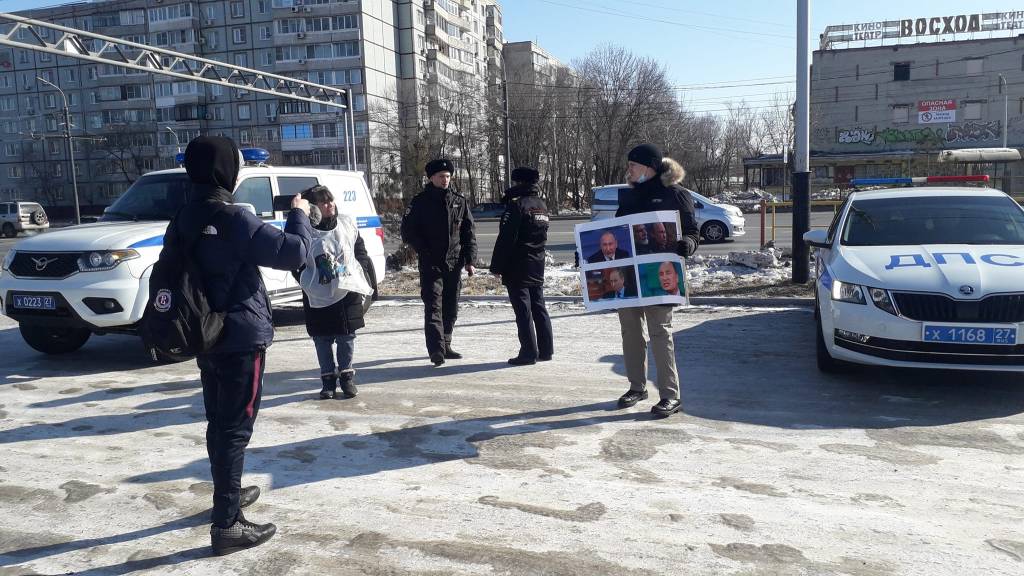
On February 23, Nikolai Zodchii was detained by police in Khabarovsk for appearing in public with these images of Vladimir Putin, which had originally appeared in broadcasts on state-run Channel One. Thanks to the indomitable VB for the snapshot and the heads-up, and for his personal fortitude in dismal circumstances. ||| TRR
When contacted by the media, the Kommunalnik health resort, located in the Omsk Region, refused to comment on reports of the death of a female Russian national during a speed pancake-eating contest.
Earlier, it was reported that a female contestant at a speed pancake-eating competition in the Omsk Region had choked to death. Currently, the exact cause of death is unknown, but the contestant’s death has been confirmed by law enforcement agencies. The 38-year-old female Russian national [rossiyanka] died before the ambulance arrived.
The celebration at which the pancake-eating competition took place was held at the Kommunalnik health resort in the Omsk Region on Saturday, February 25.
A spokesperson for the health resort refused to comment on reports of the death of the female Russian national and the absence of an ambulance team at the competition site.
In December 2022, it was reported that a 61-year-old resident of the Moscow Region had died after choking on a pancake.
Russians had been warned against overeating pancakes during Shrovetide. According to specialist Boris Mendelevich, overeating pancakes cooked with large amounts of oil is harmful to the body. In addition, heavy food can cause complications in the gastrointestinal tract.
Russia must ensure its security and maintain strategic stability.
President Vladimir Putin said this in an interview for the program “Moscow. Kremlin. Putin” on the TV channel Rossiya 1.
Source: Oleg Zubritsky, “Putin talks about the need to preserve the country and its security,” Kartoteka, 26 February 2023. Translated by TRR. Believe it or not, that was the entire article, which earned its author a well-deserved byline. See the last patch in this crazy quilt, below, for more detail about what Putin said.
Riot police officers in St. Petersburg detained 131 teenagers over a mass brawl that occurred in the Galereya shopping center, the media reports.
The publication [sic], citing police sources, indicated that the PMC Redan teenage subculture was involved in the incident.
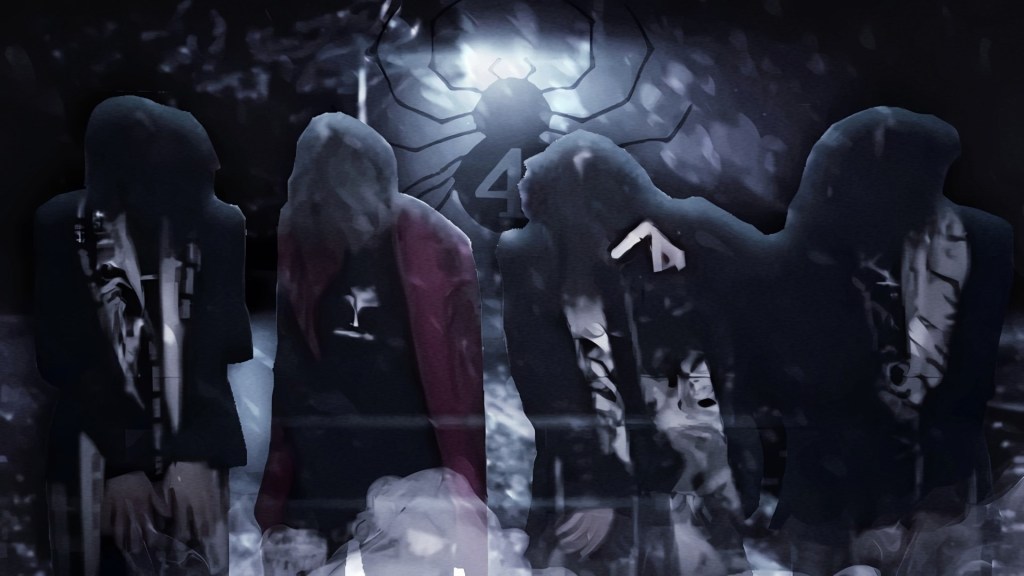
It is reported that other minors attacked a teenager in clothes embossed with a spider, which is the symbol of PMC Redan. One teenager was injured during the brawl.
Riot police arrived at the scene and detained 131 individuals. The Galereya shopping center was closed for entry, and shoppers were released only after police checked them.
Earlier, it was reported that Novosibirsk law enforcement officers had staged a dragnet to detain teenagers devotees of the PMC Redan subculture. The raid took place in the eponymous [sic] Galereya shopping center.
According to the head of the Safe Internet League, PMC Redan (as well as anime in general) is a “depressive-aggressive subculture,” and animeshniks themselves espouse violence and are willing to use it.
Such subcultures emerge, [Ekaterina] Mizulina argues, because teenagers have too much free time, as well as due to the manipulations of irresponsible bloggers and provocateurs who are encouraged by foreign states to engage in them.
In this regard, Mizulina suggests that “it is interesting to package the right meanings for children,” ideologically attack “all these spiders”, and also introduce control over social networks and the media — namely, to prohibit the coverage of “such topics.”
“No one has done more to popularize this local phenomenon than the media and social networks. […] Redan cells are growing like mushrooms after rain from Vladivostok to Kaliningrad,” Mizulina writes.
At the same time, it has been the state-run media that has written most about the activities of the so-called PMC Redan. Before them, information about teenage animeshniks strolling through shopping malls in telltale clothes appeared mainly on local community social media pages.
Source: Alexei Paramonov, “Ekaterina Mizulina urges media ban on PMC Redan,” Kartoteka, 26 February 2023. Translated by TRR. Fontanka.ru published this long, strange tirade-cum-report about the clash between riot police and teenagers at the Galereya shopping center in Petersburg (which is a stone’s throw from our house), on the one hand, and between “redans” and “ofniks,” on the other. If you donate one hundred dollars to this website, I’ll translate and publish that article here, although it left me hardly less befuddled about what happened in my old neighborhood this past weekend than before I’d read it.
The Cheryomushkinsky Court of Moscow placed house arrest on the leader of the Redan youth group
The Cheryomushkinsky Court of Moscow sent one of the leaders of the youth informal group “PMC Redan” under house arrest, reports TASS.
He is accused of attacking a teenager in the metropolitan metro – under part 2 of article 213 of the Russian Criminal Code (Hooliganism with the use of weapons or objects used as weapons), the court noted. The maximum penalty is imprisonment for up to seven years.
According to the agency, initially the investigators demanded that the accused be sent to a pre-trial detention center, but the court did not agree with this. Earlier, the Cheryomushkinsky court sent three more accomplices to the crime under house arrest.
On February 23, a teenager who was a member of the PMC Redan was beaten at the Lubyanka metro station. Teenagers wear long dark hair and spider badges on their clothes. They were inspired by the Genea Redan gang from the Hunter x Hunter manga. The symbol of this group is a spider with the number four. It is specified that young people oppose football fans, natives from the Caucasus and migrants.
Russian President Vladimir Putin has acknowledged the possibility of Russia facing a breakup in the future, with its population to be divided into separate nations, the country’s news agency TASS reported on Feb. 26.
Putin’s interview with Rossiya 1 TV channel marks the first time that the Russian dictator has publicly commented on the potential disintegration of Russia.
According to him, “if the West manages to make the Russian Federation collapse and to assume control of its fragments,” the Russian people may not survive as a nation.
“If we go down this path (of Russia’s collapse — ed.), I think that the fate of many peoples of Russia, and first of all, of course, the Russian people, may change drastically,” Putin said.
“I even doubt that such an ethnic group as the Russian people will survive as it is today, with some Muscovites, Uralian and others remaining instead.”
In addition, the Russian president claimed that “these plans are set out on paper.”
“But it’s all there, it’s all written, it’s all on a piece of paper,” Putin said.
“Well, now that their attempts to reshape the world exclusively for themselves after the collapse of the USSR have led to this situation, well, of course, we’ll have to respond to this.”
“They have one goal of liquidating the former Soviet Union and its main part, the Russian Federation. And later, [after liquidating Russia] they will probably admit us to the so-called family of civilized peoples, but only by parts, each part separately,” he said.
Ukraine’s National Security and Defense Council Secretary Oleksiy Danilov earlier said that the West has not yet made a final decision on what to do with Russia and does not understand how the full-scale war unleashed by Russia against Ukraine should end. However, the world should prepare for the collapse of Russia.
Previously, Ukrainian Defense Minister Oleksii Reznikov said that after the war is over, Russia will disintegrate into separate statelets, while Ukraine will retain its sovereignty and independence.
Valeria Zotova is a new prisoner of Putin’s regime
19-year-old Valeria Zotova was detained in the wee hours of February 17. She is accused of planning to set fire to a warehouse from which supplies are sent to military personnel involved in the war against Ukraine. According to the security forces, the young woman has been charged with committing a “terrorist act” (per Article 205 of the Russian Federal Criminal Code).
You can support Valeria Zotova right now by writing her a letter!
Address for letters:
Zotova Valeria Igorevna (born 2003) 53 ul. Portovaya nab., SIZO-1 Yaroslavl 150001 Russian Federation
(It is possible to send letters via the electronic services FSIN-Pismo and Zonatelecom.)
Source: Solidarity Zone (Facebook), 21 February 2023. Translated by the Russian Reader. Thanks to Sergey Ogurtsov for the heads-up.People living outside Russia will find it difficult or impossible to use the FSIN-Pismo and Zonatelecom services. In many cases, however, you can send letters (which must be written in Russian or translated into Russian) via the free, volunteer-run service RosUznik. As of this writing, however, Ms. Zotova has not appeared on their list of supported addressees. You can also ask me (avvakum@pm.me) for assistance and advice in sending letters to Russian political prisoners.
The Yaroslavl District Court has remanded in custody 19-year-old Valeria Zotova, accused of attempted terrorism (per Article 30.3 and Article 205.1 of the Russian Federal Criminal Code), reports TASS, citing the press service of the Yaroslavl Regional Court.
A day earlier, Zotova’s mother told OVD Info that her daughter had left the house on the evening of February 16, saying that she was going for a walk with friends, but did not return home. At about one o’clock in the morning, security forces came to search the Zotov home. The officers did not identify themselves and did not state the grounds for their investigation.
The young woman was taken to Yaroslavl’s Pretrial Detention Center No. 1. On February 20, a Telegram channel linked to the local security forces posted a video of Zotova’s arrest. The report said that she had been charged with terrorism (per Article 205.1 of the Criminal Code). If convicted on this charge, she could face between ten and fifteen years in prison.
Following the footage of the detention, a “confession” appears on the video: Valeria Zotova says that she transmitted information, coordinates and photos of a building for a monetary reward. According to her, [the people who paid her the money] “wanted to set fire to this building,” in which “parcels for the mobilized are collected and sent to Donbas.”
Svetlana Zotova said that in October of last year she herself had been fined for “discrediting” the army (per Article 20.3.3 of the Administrative Offenses Code) over a “No war” message, graffitied on a local kiosk. During the search, the security forces threatened to make her a suspect in her daughter’s case, claiming that she had been involved in anti-war rallies. The woman stated that she was not involved in anti-war protests, despite her views. Before the invasion of Ukraine, she had picketed in support of politician Alexei Navalny and the Khabarovsk protesters.
Source: 1420 by Daniil Orain (YouTube), “Do you support Putin? 100 Russians,” 28 January 2023. A huge thanks to Tiina Pasanen and Outi Salovaara for the heads-up.
My name is Daniil Orain. I’m a YouTuber from Russia, and I run the channel 1420. In my videos, I try to create a montage of everyday Russians and a transparent representation of what they believe.
Since the start of the conflict in Ukraine, people from all over the world have come to my channel to try and understand how Russians think.
Before I started the channel about 2 years ago, I had some skewed thoughts about the world.
At the time, I was working as a software engineer with a three-hour commute, and my perspectives changed when I began to watch on-the-street interviews with people in faraway cities during those rides. Those videos showed me how people from different places and cultures thought, and they played a big part in my self-education.
I started to wonder: Why isn’t there something like this on YouTube but with people from Russia, like me? That’s when my friend and I created 1420.
People often ask me for the story behind the channel’s name, but there’s no secret meaning. It’s just the name of the school we went to together. Our whole goal with the channel was to go out on the streets of Moscow and ask people questions that interested us — things like, “Do you believe in God?” or, “What do you think about Americans?”
When the conflict in Ukraine began, we suddenly saw a huge increase in viewers.
Our increase came from around the world — not just Europe and America, which had been our main audience. With the increase in viewership, I decided to double down and try to publish videos daily.
To get enough material for a full video, we have to ask a large number of people. Given the nature of our topics at the moment, a lot of people decline to participate.
When shooting the Zelenskyy video, for example, we had 124 people decline to answer. Only 28 people agreed. Even when they do agree, they often hold back from giving their full thoughts.
Making these videos is risky, but we haven’t had any problems so far.
Unlike with TikTok and Instagram, access to YouTube is still normal in Russia. In the videos, I’ve always muted certain words (but kept the subtitles) to avoid censorship.
For example, you’re not allowed to say “war” when referring to the situation in Ukraine. We have to say “secret operation” instead. So if someone does say “war,” we mute that word.
Some people in the comments have accused me of being a Russian propaganda channel, so I’ve had to find new ways to show that I’m not. For example, in one recent video, we blurred the faces and changed the voices of the people in it so that they could be honest without fear of repercussions. Also, we started showing longer continuous clips of the interviews so that the viewers didn’t think we purposely cut them to tell a certain narrative.
I have seen a change in how people view not only our channel since the war started — but also our participants.
Just recently, the comments on my YouTube videos said things like, “Russians are just like us.” But as the situation in Ukraine has progressed, they now tend to be more like: “Russians are brainwashed.”
I’m glad people are watching the videos because I know from my experience how helpful YouTube can be. We’re lucky to be able to learn online.
You’ll notice that in my videos, there’s a pretty clear divide between the answers coming from people who grew up in Soviet times and the younger people. When the older generations were growing up, they got their education only from books or teachers — they didn’t have access to the world like people my age do. The position that I’m in, running this channel, wouldn’t have even existed back then.
Today, you can learn things from websites, videos, and even comments.
Just last week, on one of my own videos, one viewer wrote: “You are not scared, not because you are fearless, but because you just haven’t been scared yet.”
That blew my mind. I know what I’m doing is risky, but maybe I don’t feel worried about it because I’ve never actually been that worried. But at the same time, I’m just the storyteller. A lot of people direct-message me asking for my opinion on various topics, but I don’t answer them.
I see my role as being the person who helps tell people’s stories, and I’ll continue to do so to show how and what Russians feel.
On 11 October 2022, amidst the recently announced military mobilization, Roman Nasryev and his friend Alexei Nuriyev broke a window on the first floor of the municipal administration building in the town of Bakal in the Chelyabinsk Region and threw Molotov cocktails into it. There was a military enlistment office in the building.
Local pro-government media outlets dubbed the young men “the rockers who threw Molotov cocktails at city hall.”
Initially, Nasryev and Nuriyev were charged with “destroying or damaging property” (per Article 167.2 of the Russian Federal Criminal Code). Later, however, after the FSB had homed in on the case, the charge was revised to “committing a terrorist act” (per Article 205.2 of the Criminal Code).
Roman and Alexei were also later accused of “undergoing training in order to carry out terrorist activities” (per Article 205.3 of the Criminal Code).
Law enforcement claimed that the accused “took courses on carrying out terrorist activities via the Internet and by phone.” In response to such a strange and dubious claim, a subscriber to one of the Telegram channels ironically quipped, “Apparently, they did not train well. Distance learning is still not as good as in-person instruction.”
Roman and Alexei face from fifteen to thirty years of imprisonment or life in prison if convicted as charged. To date, these are the most serious charges brought against suspects or defendants in anti-war arson cases.
On October 21, Rosfinmonitoring added Nuriyev and Nasryev to its list of “extremists and terrorists.”
27-year-old Roman Nasryev worked as a driver in the Interior Ministry’s extra-departmental security guard service (now overseen by the Russian National Guard). He and Nuriyev played in the Bakal rock band Room 32. Relatives tell us that he liked to learn to play musical instruments on his own, including guitar, mouth harp, harmonica, dombra, and flute. Roman’s other hobbies were sports, especially running and calisthenics, skiing, writing poetry, cars, and fishing.
Room 32, performing “Hug Me” at the Emergenza Festival four years ago
Both of the accused men hold anti-war views. Politically, Nasryev describes himself as a libertarian. (Earlier, we mistakenly wrote that he held left-wing views.) Roman explains that he did what he did to protest the war in Ukraine and the military mobilization.
Roman is married and has two children, a four-year-old daughter and a son, who was born in November, when Roman was already in remand prison.
On January 27, the young men’s remand in custody was extended for six months, until 4 August 2023. Both prisoners of conscience are currently being held at Pretrial Detention Center No. 1 in Chelyabinsk. Nasryev is being held in solitary confinement.
You can support Roman by sending him a letter or parcel. (There is no limit on the number of parcels inmates at the pretrial detention center can receive). Letters not only cheer up inmates and strengthen their spirits, but also show the security forces that people are paying keen attention to what happens to them, and this can prevent the security forces from engaging in lawlessness and torture.
You can also start a correspondence with Roman — his wide-ranging interests are listed above.
Address for letters and parcels:
Nasryev Roman Raifovich (born 1995)
53 ul. Rossiyskaya, SIZO-1
Chelyabinsk 456006 Russian Federation
(It is also possible to send emails to inmates via the Zonatelecom service.)
Solidarity Zone supports Roman Nasryev.
Source: Solidarity Zone (Facebook), 31 January 2023. Translated by Thomas Campbell. People living outside Russia will not be able to use the Zonatelecom service. It is also impossible or nearly impossible to send parcels to Russian detention facilities from abroad. In many cases, however, you can send letters (which must be written in Russian or translated into Russian) via the free, volunteer-run service RosUznik. As of this writing, Mr. Nasryev has not appeared on their list of supported addressees. You can also ask me (avvakum@pm.me) for assistance and advice in sending letters to Russian political prisoners.
The Sverdlovsk Region is one of the leading Russian regions in terms of the number of casualties among mobilized men. Many of them perished in the Kherson Region, from whose capital Russian army retreated after eight months of occupation. Relatives of the mobilized men said that, despite the fact that the authorities promised not to send untrained soldiers to the front line, their loved ones were killed a week after they were drafted. Some were killed literally within a few days. Despite this, the mothers, wives and children of the mobilized men support the war and thank Putin. Our film explains why.
00:00 Sverdlovsk Region is among the leaders in numbers of mobilized men killed 01:15 “They were quickly dispatched to the Kherson Region” 04:57 A man who had four children was taken away 08:43 How a father went to fight instead of his conscript son 13:10 “We had a funeral, but we didn’t see who we were burying” 14:55 What relatives of dead draftees receive 16:40 The mobilization’s end result
Source: “The Mobilization’s Aftermath: What the War Has Done to Russia,” iStories (YouTube), 14 January 2023 (in Russian, with Russian closed captions).
Alexei Rozhkov responded with Molotov cocktails to the decision by the Russian authorities to launch a full-scale invasion of Ukraine. On March 11, he set fire to a military enlistment office in the suburbs of Yekaterinburg. He was detained the same day and charged with “attempted murder”: allegedly, there had been a watchman in the building at the time. The young man faced up to fifteen years in prison.
Alexei was held in a pretrial detention center for six months. The charges were then unexpectedly reduced to a less serious crime — “property damage” — and the insurgent was released on his own recognizance. After a time, thanks to the support of a human rights organization, Rozhkov left Russia, and we were able to speak to him.
Tell me what you did before February 24. Did you have a job? Any hobbies? Were you interested in politics?
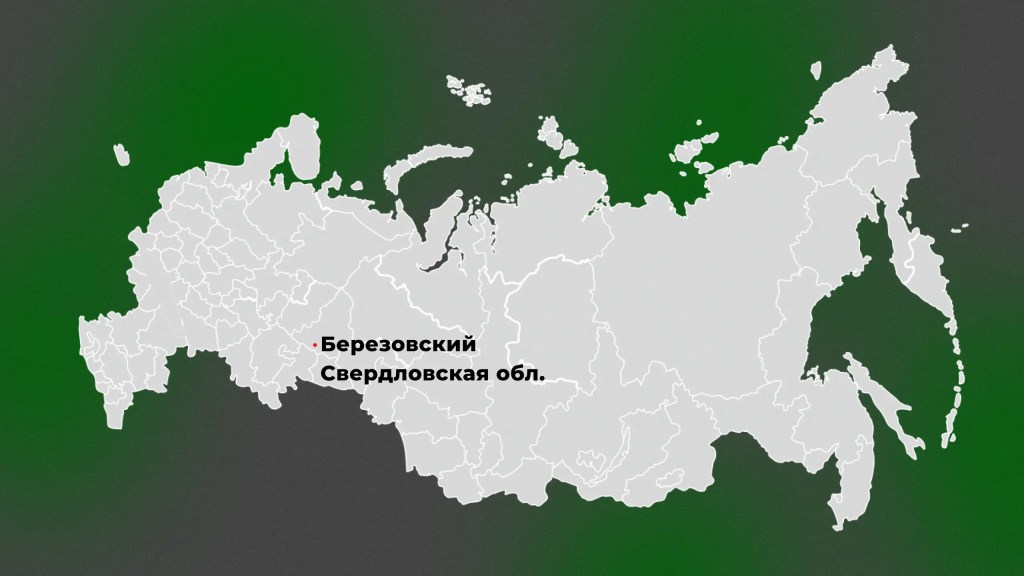
Rozhkov: I lived in the city of Beryozovsky, a suburb of Yekaterinburg with a population of about 100 thousand. Yekaterinburg itself can be reached by bus in twenty or thirty minutes. I worked as a sales consultant at a DNS store.
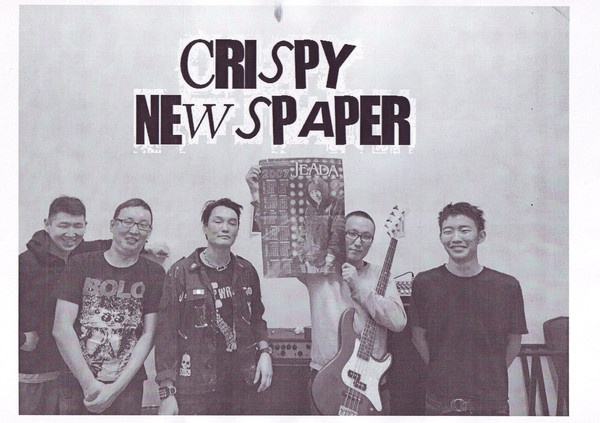
I was fond of music — I’m a guitarist, a bassist. About six years ago, I had a band, Tell Me the Reason. I started recording a solo album [before February 24], which is still not finished due to the war, having to moving around, and being in prison.
I love dynamic, energetic music: it invigorates me, helps me get out of depression, and gets me warmed up and excited.
I have been interested in politics since I was fourteen. [Alexei is now twenty-five.] My views have changed over time. Previously, they were more democratic or something, more legal. Now I can call myself a left-wing anarchist. I have always campaigned to open people’s eyes and make them see what is happening with the country — for example, with the standard of living. I talked to my family and acquaintances, friends and even strangers. I drew leaflets and spray-painted walls. Do you know those big advertising banners? At night, I would climb up and write “Putin is a thief” on them. At the time, he was merely a thief. But now, of course, he is not just a thief but also a murderer. I wrote on such billboards at night so that people would also start asking questions and arrive at the same opinion.
Tell me why you decided to set fire to the military enlistment office. What did you hope to achieve?
Rozhkov: Since February 22, I had been closely following independent media and social media channels. I expected the war to start in the last week of month, because Russian troops were amassed in Belgorod, Belarus, and other border areas. It was obvious that some kind of movement of troops would begin. And it kicked off on February 24. I began to go into a depression. I was constantly flipping channels and reading the news. I was getting worse every day. I just understood that it was impossible to remain indifferent. What is happening now is illegitimate; it is illegal. Any war means death for ordinary folks. A war in the twenty-first century seems somehow alien to me, especially for such ridiculous, made-up reasons. We annexed Crimea in 2014, and I said already back then that it was wrong. Crimea is not ours and will never be ours. I said there would be consequences. And that’s how it turned out.
It is really awful for me to get my head around the fact that people are getting killed — civilians are dying, and those who do not want to fight, but have been drafted, are also getting killed. I wanted to make some kind of appeal for people to start fighting against this war. I wanted to impact the situation, to do something to stop it all or at least weaken [Russian troops]. So, I set fire to the military enlistment office in the city of Beryozovsky. I didn’t try to burn it down. I threw three Molotov cocktails at the glass doors, which broke. I didn’t even expect them to shatter. Actually, I was thinking that I would just set fire to the door, to the entrance. I was unlucky: at that moment, traffic cops were driving past and noticed what I did. [They] put out the fire, and then they followed me. I couldn’t get far. I ran about a kilometer, and I was blinded by the high beam from their vehicle. I tried to get out of there, to run away, but they threatened to shoot me, and I was forced to surrender.
Tell me how you prepared for this. How spontaneous was this protest?
Rozhkov: It happened quite spontaneously. I didn’t even develop an exit plan and was operating in unfamiliar territory. It seemed to me like some kind of self-sacrifice. I perfectly imagined that I would be held [criminally] liable for this, but I had no fear.
After my protest action was carried out, Putin admitted on Channel One that conscript soldiers had been deployed to the military special operation zone, and [said] that they would be withdrawn from there and that those who had sent them would be punished. It was after my arson attempt that he said this. I was the third person in Russia to set fire to a military enlistment office, and this is [an example of how] several people made an impact to save guys like us, guys our same age. [Conscripts] were not killed in the war. None [of them] were killed: they were simply transferred back to Russia, leaving only contract soldiers [in the war zone].
So you think that the arsons of military enlistment offices also influenced this decision by the authorities?
Rozhkov: Yes, I think so. I’m certain of it.
How did you feel while you were in police custody? Was there any pressure from the investigative authorities? What actually happened after you were detained?
Rozhkov: I was detained, handcuffed, searched, thrown into a paddy wagon, and taken to the police station. I was treated pretty badly at the station. The police chief of the city of Beryozovsky threatened me personally that he would piss on me and beat me with a stick — those were literally his words. But there were also decent people [among the police officers] who did not threaten me and talked to me calmly. They supported me so that I would not go into complete shock.
At Pretrial Detention Center No. 1 in Yekaterinburg, I was quarantined at first. They didn’t issue me bed linens, they didn’t give me a pillow or a blanket — they only gave me a pissed-stained mattress. Thank God I didn’t spend much time there. On the fourth day, the head doctor of the psychiatric ward summoned me. Since I have some ailments, she put herself in my shoes and I was transferred to the hospital wing, to the “psycho hut.” Basically, I liked it there. Despite the fact that some people in my cell were wacky, I had almost no conflicts with them. It wasn’t the first time my cellmates had been in prison. I was the only first-timer.
[In the pretrial detention center] they gave me very strong drugs, which made me feel lousy. One of those drugs was risperidone, which is prescribed to schizophrenics. I was given a triple dose. I suffered from restlessness [akathisia], I had panic attacks, I was short of breath and suffered from insomnia. That is, the treatment wasn’t right for me. Nevertheless, I’m glad that I was sent there, and not to gen pop.
I was a “road worker” [the person in a prison cell or block responsible for the “road,” the illegal system of communication among cells] — they respected me and listened to my opinion. Basically, everything was fine while I was in the joint. The prison staff were mostly supportive: you could talk to them a little bit during inspections or when the gruel was served.
During the period of my imprisonment, I was taken for an inpatient mental competency examination to the psychiatric hospital on the Siberian Route [i.e., Sverdlovsk Regional Clinical Psychiatric Hospital]. I stayed there for twenty-one days. There, on the contrary, the prison staff behaved aggressively and tried to provoke many people, including me, into conflict.
Those who succumbed to provocations were tasered and locked up in solitary confinement. The worst, most deranged prison staff, I believe, were in the tenth ward of the psychiatric regional hospital on the Siberian Route.
Did anyone support you while you were in prison, such as relatives, friends, or maybe human rights campaigners?
Rozhkov: When I was in the pretrial detention center, a lawyer from the Anarchist Back Cross came to visit me and offered their help. They also asked whether I wanted to receive letters, [financial?] assistance, care packages, and publicity for my case. I turned down the assistance and publicity, but decided that it would be nice to get letters from concerned folks who help people like us who are in prison. The letters really gave me a boost. My parents and concerned people from Yekaterinburg helped me by bringing me care packages. I won’t name names, but they helped me and are still helping me.
Why did you decide to turn down the assistance from the Anarchist Black Cross?
Rozhkov: Because I gave into the persuasions of my parents and lawyer. They were against my case being [widely] publicized — allegedly, so as to avoid hounding the investigator in my case. They were afraid that he would toughen the punishment if I attracted public attention. So, due to pressure from [my parents and lawyer], I had to turn down this help.
And yet, when you were in the pretrial detention center, as far as I remember, you were facing the rather harsh charge of attempted murder, right?
Rozhkov: Yes, I had been charged with violating Article 105, part two, in combination with Article 30 — “attempted murder, committed with extreme cruelty, from hooligan motives, in a generally dangerous way.” The crime carries a sentence of between eight years to life in prison.
Do you think that someone’s life was actually threatened as a result of what you did?
Rozhkov: I’m absolutely sure that this wasn’t the case. I doubt that there actually was a woman [night watchperson] of some kind in the military enlistment office building. According to the testimony of the policemen who detained me, who helped extinguish the fire, there were no lights turned anywhere on the premises, and they did not see this woman either. So, I doubt that she was there. In addition, in other such cases — I monitored similar cases — no one was charged under the same article of the criminal code as me. There were no guards there.
When you were released on your own recognizance, you didn’t leave the country immediately. What was holding you back?
Rozhkov: I was promised that the charges against me would be light: Article 167 in combination with Article 30, which translates into “attempted destruction of property,” and carries a maximum sentence of five years. But, after looking at the other cases, I realized that sooner or later, Article 205 [“terrorism”] would be rolled out against all of us.
I also wanted to spend as much time as possible with my family, with relatives and friends, so that I could at least somehow restore our relations and thank them. But ultimately I left. I was evacuated from the country.
How did your relatives react to your actions and to your prosecution?
Rozhkov: They said that I had acted stupidly, that it was impossible to go against the system and that I had let everyone else down. They accused me of suffering from a guilt complex. But I believe that I saved people and that my life is a small sacrifice compared to the number of people who survived thanks to what I did. Even if I had been shot when they were detaining me, I would still have achieved more than anyone else.
How are you feeling right now?
Rozhkov: I feel sad and lonely. I am not in my native country. But I have a friend — I am lucky that he ended up here for the same political reasons — and he helps and supports me. I am also supported by evacuation organizations. I feel pretty bad. But now I’ve purchased the medications prescribed by a psychotherapist, and things are getting easier and easier in my head every day. But sometimes a powerful sadness rolls over me, a melancholy due to the fact that I am lonely and had to leave the country.
Berezovsky and Sverdlovsk Region, on a map of the Russian Federation. Image courtesy of DOXA
When we were agreeing to do this interview, you said that after you had left [Russia], you tattooed the anarchy symbol on the back of your hand. Can you tell me about it for the interview?
Rozhkov: The symbol means a lot to me. I am an anarchist myself, a leftist; I espouse this political position. And although a society without powerful authorities and hierarchies seems like a utopia, we could get there. Power should belong to the people, not to a bunch of corrupt bastards who commit terrible crimes. My symbol also means that I share the views of the people who helped me when I was in prison. It says that I am close to these people. And that I, in turn, will also help political prisoners at the first opportunity.
Maybe you would like to convey something to Ukrainians?
Rozhkov: Yes, I would. I want them to know that there are dissenters, people [in Russia] who do not want war with Ukraine or any war at all. I hope that soon no one else will suffer due to this shit that Putin has made happen. Ukrainians are doing a good job of retaking their territory and destroying Russian troops. I think everything will be fine sooner or later. Ukrainians are very strong, motivated people and will defend their territory to the end. I respect them for that. I would have done the same thing in their place.
Ayhal Ammosov standing in front of a funeral bureau holding a placard that reads, “The groom has arrived.” Photo courtesy of Mediazona via Aikhal Ammosov
The Free Yakutia Foundation has published a letter from Ayhal Ammosov, an anti-war activist who disappeared last week. The letter is dated November 22.
Ammosov, who faces criminal charges stemming from his public activism, has not been in touch with friends and family since December 11. They suggest that law enforcement agencies may be involved in his disappearance, Sibir.Realii reports.
In the published letter, the activist writes: “If you are reading this letter, it means that something has happened to me, something really serious. I can’t sit here right now and wonder what could have happened to me in the future, but I think that either I’m missing or I’ve been killed. This was to be expected, because they would not have given me a quiet life, especially in the republic.”
Ammosov goes on to note that he was not going to “stop” in his struggle, and that he has numerous plans.
“They are trying to intimidate us, to shut our mouths. They are trying to break us, but we will not give up, we will endure everything — all these trials, all the persecution, all the tortures and beatings. I believe in myself and in my supporters. I had to do this and I will go all the way to the end,” he writes.
In late August, it was reported that criminal charges had been filed against grassroots activist and leader of the punk band Crispy Newspaper Ayhal Ammosov for publicly discrediting the actions of the Russian army. OVD Info wrote that the charges stemmed from a banner, emblazoned with the slogan “Yakutian punk against war” (in English), which Ammosov attempted to hang on a building in downtown Yakutsk on August 13 — the same day that Russian Prime Minister Mikhail Mishustin arrived in the city. The musician was also sentenced to fifteen days of administrative arrest for his protest.
On December 13, according to friends of the activist, Ammosov did not appear in the Yakutsk City Court for a hearing in his criminal trial on charges of discrediting the army. In addition, according to the Free Yakutia Foundation, persons unknown had recently been following Ammosov.
Musician and artist Ayhal Ammosov, who was known in Yakutsk before the war as the leader of the punk band Crispy Newspaper, began to regularly stage anti-war protests after Ukraine was invaded. For a few months he managed to hide from the police and Center “E” [the Russian Interior Ministry’s “anti-extremism” police] but ultimately his activism ended with a pile of administrative charges of “discrediting” of the Russian army — and one criminal charge for the selfsame “discrediting.” Mediazona recounts here how concert performances gave way, in Ammosov’s life, first to anti-war leaflets and graffiti and a semi-clandestine existence, and then to endless games of “crabs” in jail and the threat of hard time in prison.
Punk rock has always been marked by its anti-war stance, and the Yakutsk punk scene, one of the most distinctive in Russia, was no exception. In early 2018, the band Crispy Newspaper performed at a concert organized by the label Youth of the North. After taking the stage, a young man with a microphone began to do the pogo while two guitarists, a bassist and a drummer churned out aggressively rhythmic music. When the band stopped playing, the young man made a short introductory speech: “Every day is a war, a war with the society that gave birth to us. We are descendants of slaves, sons of the proletariat, children of incomplete families, freaks, outcasts and rebels. And if we are here, then we have something to say, and if I am destined to drop dead today, I would like to say only one thing: if we’re going to die, let’s do it with music!”
The young man was Ayhal Ammosov: the name in his passport is Igor Ivanov, but he plans to make the pseudonym his official name. Four years later, when Russia launched an invasion of Ukraine, this thirty-year-old punk, poet, musician and artist would prove to be one of Yakutia’s most consistent anti-war activists.
Before February 24, he almost never engaged in political activism, except for putting up leaflets criticizing the head of Yakutia, Yegor Borisov and his henchmen, but Ammosov himself recalls those protests as not particularly interesting. His friend Mikhail Pogosov (his name has been changed to protect his identity), who has now left Yakutia, recalls that some time before the invasion they wagered whether there would be a war or not. Ammosov was sure that there would be a war — and won two pizzas.
“People wrote: ‘You can come to my place for the night, then leave in the morning.’ So that’s what I did.”
Ammosov recalls that after the war began, he warned a comrade that he was going to protest, and he replied, “If you can combine it with work, do it.” At the time, Ayhal worked as a barista in a coffee shop.
Crispy Newspaper broke up back in January, so that Ammosov could focus on anti-war activism. His most active period was during the first two months of the war. For example, Ammosov was photographed outside a funeral services bureau holding a placard that read, “The groom has arrived.” (This phrase is uttered by the policeman in Alexei Balabanov’s film Cargo 200 as he dumps the corpse of a soldier who was killed in Afghanistan into a bed to which his fiancee is handcuffed.)
Photo courtesy of Mediazona via Ayhal Ammosov’s Instagram page
On another occasion, the activist, who then appeared on Instagram only in a mask covering his face, posed with a placard that read, Kun kihite komuskes. Ayyy kihite ahynygas.
“It means, ‘The man of light is compassionate, merciful. The man of the sun is a defender, a helper.’ The Ayyy are the supreme gods, the light for the Sakha people,” Ammosov explains. “I wanted to remind my people who they are. They should not attack and kill other people or attack foreign countries. The strong must protect the weak.”
Ammosov soon learned from friends that the security forces were looking for him. For example, the police paid a visit to a former Crispy Newspaper guitarist at his workplace, the House of Musicians. The guitarist later told a friend that he was taken to the police department and even threatened with death: the police demanded that he give them Ayhal’s address, phone number or other leads. The young man did not tell them anything — the artist says that they were not in close touch. Besides, Ammosov had already switched to a semi-clandestine existence by that time: he often changed cell phones and slept at the homes of friends or the coffee shop. Later, he would only work one-day temp jobs, for example, clearing roofs of snow.
At night, the activist continued going out to put up leaflets and draw graffiti. Back in March, Center “E” became concerned (as follows from Ammosov’s criminal case file) about the local artist’s anti-war activism, which he talked about on his publicly accessible Instagram page.
As his friend Mikhail recalls, at that time Ayhal was interested in everyone who opposed the Russian government — for example, he was interested in a video featuring [Chechen independence leader] Dzhokhar Dudayev. Mikhail himself also went out at night several times with his friend to put up leaflets.
According to Ammosov, at that time he did not trust close relatives and friends: he was afraid that the security forces could find him. He would only briefly inform his mother that everything was fine.
“Many people in Yakutsk knew me, so I had support: if anything happened, I could turn to them. But it was dangerous, of course,” recalls Ammosov. “I didn’t know whether they would turn me in or set me up. People wrote: ‘You can come to my place, spend the night, have breakfast, and then go [in the morning].’ So that’s what I did.”
“Ayhal led a kind of anonymous lifestyle. No one knew where he worked or lived. He would only mention the district [where he was at the time],” confirms Mikhail.
This went on for about two months. In late April, Ammosov was finally detained while leaving a grocery store.
“Yakutian punk against war” — a raft of administrative charges and one criminal case
Ammosov was held at a police department for “almost a week.” According to the musician, he was threatened while he was in a cell. The police tried to force him to record an apology on video, and did not give him water.
His friend Mikhail adds: “The police in Yakutsk are not particularly fussy. I have been beaten when I was drunk and beaten when I was sober. It’s true, however, that I like to talk about the rights of policemen. They hate everyone equally, locals and nonresidents alike.”
For leafleting, graffiti, and posting photos of [anti-war] placards on Instagram, Ammosov was charged several times with administrative offenses — minor disorderly conduct (Administrative Offenses Code Article 20.1.1) and “discrediting” the Russian army (Administrative Offenses Code Article 20.3.3.1).
A series of court hearings ensued. On April 27, two administrative cases against Ayhal were tried in the Yakutsk City Court, and threemore were tried a day later. For example, the court ruled that a graffito written on a wall, Suoh buollun serii, constituted “discrediting” the army. It translates as “Let there be no war”, and is a line from a song.
“They used to sing it in schools, everyone knows it,” Ammosov explains, perplexed.
By late May, the trials were over. The punk was found guilty on all the charges, and he was fined a little more than 90 thousand rubles. The summer passed relatively calmly. Ammosov tried to earn money to pay off the fines, but he was unsuccessful, managing to amass only half of the amount needed.
For a period of time, Ammosov, along with other concerned residents of Yakutia, helped build a house for Anatoly Chomchoyev, a local nuclear physicist who in May was shot with a trauma pistol and stabbed by men driving a vehicle marked “Russian National Guard.” The Interior Ministry, reporting on the arrest of two suspects, claimed that the men, who were intoxicated, had tried to drive through private land fenced off with a barrier. Chomchoyev had refused to let them through and was assaulted. The ministry did not mention the suspects’ place of work in its press release.
In August, the artist had the idea for the protest of which he is most proud. Later, when interrogated by a police investigator, Ammosov said that he had borrowed a bicycle from a friend to ride around Yakutsk when he noticed the Nugget swimming pool, in the very center of town. He took down an advertising banner he found on the street, and on August 12 asked his girlfriend to videotape him writing the slogan Yakutian punk against war on the back of the banner.
On August 13, two days before Prime Minister Mikhail Mishustin’s arrival in Yakutsk, the punk climbed onto the roof of the swimming pool building. A friend filmed the protest, standing on the opposite side of Taloye, the small lake on whose shore stands the swimming pool building. After hanging the banner, the musician raised his arm in a clenched fist salute and descended the outdoor fire escape. None of the photos or video of the protest has been preserved: the security forces were already waiting for Ammosov and his girlfriend at the bottom of the fire escape and immediately confiscated their phones.
Ammosov was later charged with the criminal offense of repeat “discrediting” of the Russian army (per Article 280.3.1 of the Criminal Code, which states that criminal charges can be filed if a person already has already been charged administratively once in the past year for the same violation.) Ammosov faces up to three years in prison or a fine of 100 to 300 thousand rubles if convicted.
Police investigators examined not only the protest involving the banner at the pool, but Ammosov’s previous anti-war protests as well. The police forensic experts predictably found signs of “discrediting” the army in fairly innocent statements. For example, analyzing the placard featuring the Yakut proverb “the man of the sun is a defender,” the forensic experts concluded that the statement recognizes that “showing pity for Ukrainians suffering onslaught, attack, and encroachment by the Armed Forces of the Russian Federation, and protecting them from the actions of the latter, is true and correct.”
The experts appointed by the investigators also analyzed Ayhal’s gesture at the pool: his right arm raised with his fist clenched. “The Rotfront salute is a call to unite in the fight against fascism, by which the actions of the Russian authorities are meant as the addressee,” they write.
Discussing the phrases “Long live peace” or “No war”, these experts note: “They were often used in Soviet times, but in a different socio-cultural situation.”
Aikhal Ammosov outside the Yakutsk City Court. Photo courtesy of Mediazona via Aikhal Ammosov
However, the forensic experts based their assessment of Ammosov’s slogans and gestures not only on those statements themselves, but also on the report of the musician’s interrogation. On the day of his arrest, Ammosov told an investigator outright that he believed that Russia had invaded Ukraine, that there was not a “special military operation” going on there, but a real war, and that he had wanted to draw people’s attention to this.
A day later, during another interrogation, Ammosov nevertheless noted that the slogan on the banner implied that he was opposed to war in general, not specifically the war in Ukraine. He now admits that he resorted to this trick hoping that he would not be sent to remand prison and would be able to find a lawyer and brainstorm some options for his defense.
A month in jail with “crabs” and men back from Ukraine
Ammosov says that he spent several days in police stations and was transported from one to another. Formally, the activist had been released on his own recognizance, but he was not actually released — the musician was sent to jail for twenty-four hours several times in a row. On August 17, the court jailed him for fifteen days for minor disorderly conduct, followed by two more jail sentences — on September 2, for seven days, and on September 9, for another fifteen days — both times for failing to pay in a timely manner the fines imposed on him (per Administrative Offenses Code Article 20.25) after he was convicted on administrative charges of “discrediting” the army.
Consequently, Ammosov spent over a month under administrative arrest. After being released, Ayhal shared two main impressions that had nothing to do with the disgusting food and the conditions of detention.
First, he was sentenced to his first fifteen days in jail for, allegedly, pasting a “Banned in Sakha” sticker under the picture of a former Crispy Newspaper guitarist on the honor board at the municipal water and sanitation authority, where the musician is now employed. (“Banned in Sakha” is a paraphrase of the title of the song “Banned in D.C.,” by the hardcore punk band Bad Brains.) The police and the court claimed that this was done on August 14, although Ammosov had by that time already been detained for the protest at the swimming pool. The investigator took advantage of this circumstance: while the artist was serving his jail sentence, the investigator petitioned the court to send Ammosov to the pretrial detention center for violating the terms of his release on his own recognizance. The court sided with the activist, who insisted that he could not have pasted the sticker after his arrest. (The court also sided with the girlfriend, with whom, according to the police, Ammosov had pasted the sticker. Although the police asked the Yakutsk City Court to jail her for fifteen days too, the judge only fined her a thousand rubles.)
Second, two men who had been involved in combat in Ukraine were among the anti-war activist’s cellmates. One was an ethnic Russian with the call sign “Temple,” who had served with the Wagner Group. He said that he had been wounded but had not received compensation. The second was an Evenk whose call sign was “Evenk.” He was a veteran of the first Chechen war and a sniper.
“They didn’t say anything bad to me,” Ammosov recalls. “They said, Well, if you’ve done so much for all this, for your beliefs, you’re sitting here in jail, and you haven’t been broken yet, then you rock, man! You just have to understand that Russia is going to win, we’re going to beat the crap out of everyone. This, they said, is a fact. So the fact that you are doing some kind of anti-war shit… there will be wars anyway.”
Ammosov spent his days reading books and playing “crabs” [mandavoshka] — a prison game in which the players roll dice and move figurines around a map. The dice and figurines are fashioned from bread and toothpaste, while the map is drawn on a piece of paper or carved on a table. Care packages were regularly delivered by friends, so Ammosov had instant noodles, fruit and cigarettes, which he would give to his cellmates.
The musician recalls that when he was detained he was wearing shorts, but when he was released, on the morning of September 24, it was snowing, although the snow soon melted. By this time, mobilization for the war with Ukraine had already been announced in Russia.
“I just wanted to speak out, I wanted to do something”
Yakutsk, about which Ammosov had once proudly said that it was a young people’s city with a diverse music scene, seemed deserted to him: “Only old men, young women and ‘Zeders’ are left.” The musician recalls the raids on shopping malls and mentions that his cousin was mobilized.
“I remember that, in the spring, most musicians stopped communicating with me. They were afraid that the FSB and Center ‘E’ guys would try to catch them too. And then, when the mobilization began, they all left for Kazakhstan and from Kazakhstan they began writing fiercely to me and supporting me, as if they had always supported me. I thought, Well, what the fuck,” the Yakut punk says ironically.
Ayhal is no longer involved in anti-war activism. He got a job as an orderly in a care home where he takes care of the elderly and disabled. Only once, according to him, a prosecutor visited him at work to warn him about the inadmissibility of violating the laws on extremism, before taking him to a separate room and advising him “not to get cocky.” Meanwhile, the activist is preparing for his criminal trial, which was supposed to start on November 23 in the Yakutsk City Court, but has been postponed to December 13. He is not planning to plead guilty, but he hopes that he won’t be sent to a penal colony. And he has no regrets.
“I just wanted to speak out, I wanted to do something,” the musician explains. “Well, at the beginning, when the war started, and when I had the court hearings in the spring, people didn’t understand why I was doing it. There was no mobilization back then. But when the mobilization started, everyone was like, ‘Fuck, he was right, we should have done something earlier.'”
Dude… this is frickin’ amazing… roaring out of Asia’s northernmost punk scene, Yakutsk (Russia), this phenomenal 70’s/80’s inspired punk band Crispy Newspaper have released a brand new album of solid gold material! You HAVE to check out this band…
Further below check out what the band is like live.
Stay in touch at this link with Youth of North who seem to be a collective/label that releases music from the scene from here.
Source: “Yakutsk Punk Band Crispy Newspaper Release PHENOMENAL Album [Russia],”Unite Asia, 17 October 2020. Thanks to Comrade Koganzon for inspiring this entire post by sending me the links to all the articles translated and/or reposted here. This post is dedicated to my little sister K., whose birthday is today. ||| TRR
_________
UPDATE, 9 JANUARY 2022. Various Russian-language media outlets have reported today that Ayhal Ammosov is now safe and sound in Kazakhstan. ||| TRR


 Ruslan Zinin charged with terrorism
 As before, you can support Ruslan by sending him a letter or parcel. If your letters are not passed by the censor or you do not receive a reply from Ruslan, let us know and file a complaint. Templates for complaints can be found on
 Address for letters and parcels:
 You can send letters electronically from anywhere in the world via the