Independence Day

A roadside fireworks stand in Soledad, California, 28 June 2023. Photo by the Russian Reader

When issuing diplomas, colleges in Ingushetia now require graduates to sign a summons to the army or refuse to accept the conscription notice and face possible administrative and criminal charges, Fortanga was told by a source close to one college.

“To get a diploma, you need to sign a conscription notice. Otherwise, you will not receive a diploma no way no how. Either you accept the conscription notice, or you sign a waiver . That is, accepting the notice means you have to join the army, while turning it down means saying ‘Hello, prison, here I come,'” the source said.

According to the source, the practice was introduced after the director of the college in Nizhnie Achaluki reported, at a meeting involving the head of the republic Mahmud-Ali Kalimatov, that thirty students had been drafted from his institution into the army. Subsequently, military enlistment officers and government officials “jumped on the bandwagon,” the source claims.

Students are being forced to come to colleges in person to get their diplomas, the source added. That is, young men cannot receive them by mail or ask that they be handed over to a family member or a proxy.

When the graduate refuses to sign the conscription notice, a report is immediately drawn up and signed by witnesses. First-time offenders face administrative charges under Article 21.5 of the Administrative Offenses Code (i.e., “Non-fulfillment of military registration duties by citizens”) and a fine of 500 to 3,000 rubles. Repeat offenders face criminal charges under Article 328 of the Russian Federal Criminal Code (i.e., “Evasion of military and alternative civil service”) and a fine of up to 200,000 rubles, forced labor, arrest, or imprisonment for up to two years.

Ingush lawyer Kaloy Akhilgov noted that the legality of such a practice “depends on the procedure for issuing a summons.”

“Educational institutions can only serve conscription notices, not issue them themselves. That is, first the military enlistment office must send the notice to a specific citizen, and after that the organization can hand it to the student,” he explained.

For those who want to avoid receiving a military conscription notice , the lawyer recommended that after completing their bachelor’s or master’s degree, they take postgraduate leave until August 31 and file the relevant paperwork with the military enlistment office. “Then they should not be bothered during the [current] spring conscription drive. And such ‘automatic’ draft notices issued along with diplomas lose their significance,” he added.

Source: “Colleges in Ingushetia only issue diplomas with a summons to the army,” Fortanga, 3 July 2023. Translated by the Russian Reader. Thanks to Marina Ken for the heads-up.


[…]

Mark, 26 years old: a former engineer turned waiter in Yerevan
Before I left Russia I was building a career: I was a senior fire and security systems engineer. Such people are needed everywhere: it’s a fairly good position. I worked in government agencies, so I was served my conscription notice directly at work. However, I had never served in the military: I had a deferment due to health reasons.

That was October seventh: I usually have a hard time remembering dates, but this was like in a movie since it divided my whole life into before and after. At night, I packed all my things and moved to another apartment, then I flew to Turkey and from there to Armenia.

It’s amazing: my grandfather is Armenian, but I had never been to Armenia before then. The authorities have even confirmed that I can get citizenship. But if I get it while I’m still eligible for military service, I will have to serve in the Armenian army for two years. And if you evade military service you can be banned from leaving the country or imprisoned. I went to the local draft board, and they told me straight up: come back in a year to get your citizenship. So that’s what I’ll do.

A short time before the mobilization, I was offered the chance to rent an apartment near Rybatskoye subway station in Petersburg for fifteen thousand rubles a month. I was sitting at the dacha, thinking about how I would rent this apartment, how I would invite friends over to my place—everything was good. But the next day the mobilization was announced, and my parents said to me, “Maybe you should leave?” I thought it over for a long time, and didn’t talk to anyone for several days. Then the conscription notice was delivered. Almost all of my friends supported me [in my decision to leave]. I had this conversation in the smoking room with a colleague, who told me, “I’m not going anywhere, I’ll sue. If push comes to shove, I’ll fight within the system.” In the end, he was drafted.

I had savings, so I didn’t work for six months. I tried to get a job as a technician or engineer in my field, but the old boys network is quite strong in Armenia: it is unlikely that they would hire a person off the street, and one who isn’t Armenian at that. And you need to know Armenian for any serious job. For a while I was depressed that I couldn’t find a job, that I had had everything squared away, but here I was nobody. I was a highly qualified specialist, but now I was unemployed. It was a big blow to my pride. At my old job, they waited another six months for me to return.

At first I went to work as a courier at Yandex Delivery. Maybe it is still possible to do the job on scooters and bicycles, but it is absolutely impossible. I had to walk 40-50 kilometers a day. I came home on the third day, soaked my feet in a basin, and sat there for several hours. There is an inadequate system of fines and impotent support staff that knows nothing. All couriers want to protest, both in Yerevan and in Moscow.

The delivery job was so hard on me that I even wanted to go home. I was in such a depressed state that the part of my brain that is responsible for the comfort zone was activated: “Yes, everything is fine, everything has already quieted down, and I have a home there.” I know several people who have returned [to Russia] after working such jobs. I even called my boss in Petersburg and asked if they’d hired someone to replace me, but they already had.

When you’re getting started in a country, I advise everyone to go to work as waiters. You have to carry plates and interact with people, but we all know how to do that. And you have to memorize the menu. I speak to foreign tourists in English or Russian, and I tell Armenians that I am learning the language, and they are always understanding. I tell them, “Come back in six months, and we’ll chat,” and they’re happy that I’m learning their language. Sometimes even Armenians who don’t know Armenian themselves come in and ask for a Russian menu. I even asked once, “How’s that?”

I think I lucked out: I’m treated well, we have a very friendly atmosphere, the cooks teach me Armenian, and everyone is always supportive and understanding. The money is enough to live on. And they treat me well as a Russian. Today, a client, a friend of the owner, gave me a teach yourself Armenian book in a beautiful paper bag printed with Armenian letters.

Very many young researchers and decent specialists have left Russia. This is sad, of course, but it is natural after such actions on the part of the state. It was pretty hard to swallow the whole thing. You can say it was pride, that, like, you’re going have to work in completely different jobs. I don’t like the buzzword “relocatees”—we are all migrants.

I am learning the language and I can already make myself understood: Armenian is not as difficult as it seems. When I learn the language, I will return to my profession, because it will stand me in good stead wherever I go. Naturally, emigration is not at all what I’d imagined. But this is our new home, and we have to learn to live here. Remarque has a book about emigration, Shadows in Paradise. A lot of people who also moved after wars became very strong personalities: it is an incredible experience. It is so intense that when you look through time into the past, you feel so much more mature, so different as a person, that you regard everything differently. So I’m even grateful to fate for these changes.

Source: Masha Koltsova, “‘I recommend everyone become a waiter after moving to a new country’: men who left Russia due to mobilization on changing professions and living a new life,” Current Time (Radio Svoboda), 3 July 2023. Translated by the Russian Reader


A farewell ceremony was held at the Serafimovskoe Cemetery in St. Petersburg for four soldiers of the Neva Battalion who perished during the special military operation, the governor’s press service reported on July 3. The funeral was attended by the city’s head, Alexander Beglov, and the speaker of the St. Petersburg Legislative Assembly, Alexander Belsky.

The deceased men—Mikhail Sokolov, Roman Galinsky, Mikhail Manushkin, and Sergei Isayko—were posthumously awarded the Order of Courage. In his speech, Beglov said that the men had been killed in heavy fighting.

“They are continuers of Russia’s military glory. We are proud of our fellow townsmen. Petersburg shall cherish their memory,” the governor said.

After the start of the special operation, the Smolny’s press service began publishing news about the deaths of Petersburgers in the Donbas, accompanying them with a mention of the condolences expressed by Beglov. Later, the release of such reports was abandoned for a long time. In December, Beglov unveiled a plaque on the facade of School No. 369 in memory of army officer Alexander Zhikharev, who perished in the SMO. In February, the governor and education minister Sergei Kravtsov met with Zhikharev’s relatives, and in March the school was named in his memory.

Source: “Petersburg says goodbye to four volunteers killed in SMO,” ZAKS.ru, 3 July 2023. Translated by the Russian Reader


In the wake of Zhenya and Sveta’s kangaroo court hearing, what I’ve been thinking about for several days is that we forget the golden rule of all convicts—“Don’t believe, don’t be afraid, don’t ask”—and thus hand them the tool for coercing us.

You can’t show them your vulnerabilities or reveal your desires and fears. (Don’t ask!) This information will be used to intimidate and torture you. (Don’t be afraid!) Or it will be used for bargaining: they will promise to go lighter on you in exchange for your cooperation and will certainly deceive you. (Don’t believe!)

Source: Elena Efros (Facebook), 4 July 2023. Translated by the Russian Reader. Ms. Efros, a well-known human rights activist, is the mother of imprisoned theater director Zhenya Berkovich. Thanks to Ivan Astashin for the heads-up.
The Things They Say

Lavrov said that Prigozhin’s armed mutiny could not be termed anything more than a “scrape.” Well, yeah… After the rebels seized the headquarters of the Southern Military District, which coordinates the main grouping of Russian federal forces waging war in Ukraine, along with Deputy Defense Minister Yevkurov, seized Rostov-on-Don, a city of one million people, and a military airfield, shot down six combat helicopters and one military aircraft, and were a mere 200 kilometers from Moscow; after all the supreme authorities in Russia shit their pants in unison, instituted a counter-terrorist operation in Moscow and three other regions, and were planning to impose martial law, after this total disgrace, after catching their breath and changing their diapers, they declare the whole thing a “scrape.” Amen to that!

Source: Alexander Zhelenin (Facebook), 1 July 2023


On Tuesday, Russia killed three children and nine adults in Kramatorsk. Everyone has probably heard the remark made by Colonel General Andrey Kartapolov, former Russian military commander and current member of the Russian State Duma: “The strike on Kramatorsk showed pizzazz, I tell you. I tip my hat to whoever planned it. It was just like a song—my old military heart rejoices.”

The general was probably referring to “The Death Aria” from the film The Star and Death of Joaquin Murieta: “You have to have pizzazz in this case, / Your own signature style.”

But my old heart and brain refuse to believe that General Kartapolov and I are members of the same species.

Source: Vladimir Ananich (Facebook), 30 June 2023


After Putin podcast: “‘When I grow up, everything will change’:
What schoolchildren think about Russia and why we should listen to them.” In Russian, without English subtitles

We have talked a lot on this podcast about what lies in store for Russia and how to make this future better. Now we will talk about the future with the people who will be tasked with building it—with teenagers.

We met with these sixteen- and seventeen-year-olds a year and a half ago, in the summer of 2021. Back then, propagandists, op-ed writers, and rank-and-file netizens were vigorously discussing why schoolchildren were attending protest rallies. We decided to ask high school students themselves what they thought about the country in which they had been born and grown up, but in which they had not made any of the crucial choices.

In this episode, you’ll hear the conversation we had with these young people in 2021. They talk about whether they see their future in Russia or in emigration, what annoys them most about Russia, and how they talk about politics with their relatives. And we explain what is special about these teenagers and why we should listen to them.

The next episode features a conversation with the same young people, recorded in early 2023. During the intervening period, they were transformed from schoolchildren into university students, and almost a whole year of the war had passed. We asked them what had changed over the past year and a half about their attitudes towards Russia and whether they still saw a future for themselves in their homeland.

You can also listen to this podcast at: https://podcast.ru/1622370694

Source: After Putin podcast (Moscow Times Russian Service), “‘When I grow up, everything will change’: What schoolchildren think about Russia and why we should listen to them,” 5 April 2023 (YouTube). Annotation translated by the Russian Reader. Thanks to Marina Vasilieva, the moderator and producer of the podcast, for the heads-up.


When Russian warlord Yevgeny Prigozhin started a ‘march on Moscow’ with his Wagner forces, the world—and Russia—was shocked. Was this a coup? A rebellion?

Now Prigozhin is supposedly in Belarus and the Kremlin is trying to retake control of the narrative—all while Ukraine’s counter-offensive grinds on. But how should we understand the weekend’s drama? And what is really going on now?

Join our experts to find out how they’re making sense of the rebellion-that-wasn’t.

Hear from:

🔹Elizaveta Fokht: BBC Russian Service reporter who has reported extensively on the Wagner Group

🔹Hanna Liubakova: Journalist and analyst from Belarus and non-resident fellow at the Atlantic Council

🔹Jeremy Morris: Professor of Russian & Global Studies at Aarhus University, Denmark. He is the author of Everyday Postsocialism: Working-Class Communities in the Russian Margins

🔹Chair, Thomas Rowley: Lead editor of oDR, openDemocracy’s project on the post-Soviet space

Source: openDemocracy, “Prigozhin, Putin and what is really happening in Russia,” 29 June 2023 (YouTube). Don’t forget to donate money to oDR’s crowdfunding campaign to help them keep doing the great work they’ve been doing.


[…]

Boris Groys: We shouldn’t exaggerate the role of the nation in this case. Any nation is a multitude of people who are busy surviving from day to day, and the struggle to survive usually takes twenty-four hours a day. Look at France in the 1940s: there was Vichy, and there was de Gaulle, and each camp had a small group of political supporters. But the bulk of the populace lived as quietly under de Gaulle as they had lived under the Vichyites. It was the same under the Nazis in Germany. The populace usually accepts the regime that history offers it. Ordinary people want to survive, and loyalty to the authorities is part of their strategy for surviving. It is not, therefore, a matter of ordinary people and their subjectivity or lack of subjecthood. The central problem is how a country’s political class is formed and how it functions. Greece and, later, Rome proposed what was, at the time, a completely new mode of forming cultural and political elites—a competitive mode—unlike the Eastern despotisms, in which there was no competitive model for shaping the political class. Accordingly, there was no integration of successful people into the system of power. Note that when someone succeeds in the West, people immediately get behind them and start writing about them. An athlete, for example, sets a new record in the hundred-meter dash. Immediately, companies line up to use the athlete’s name in their advertising. The athlete is invited to appear on CNN and is profiled by the New York Times. That is, there is an immediate positive reaction to any success. In Russia, on the contrary, success elicits only one reaction: “There is probably someone behind it. They should be exposed and totally shunned.” So, there’s not much point in talking about the common folk in this case. It makes sense, rather, to talk about the principles for forming the political class. The current ruling class in Russia is a monstrous sight. The only thing there that more or less functions there, as I said, is the economy.

Andrei Arkhangelsky: In the 1930s, the defining factor in the Soviet Union was the impetus for “life-building” (zhiznestroenie), for remaking world and self, as you write. Nowadays, however, apathy and indifference prevail in Russian society. And yet, is apathy also a kind of energy, only negative, that blocks positive energy? And the second question: does the current energy of “life-building” in Russia remind you more of the 1970s or of the 1930s? Because denunciations and large-scale crackdowns have again become the norm.

Boris Groys: First of all, the current era has nothing to do with the time of Stalin, which was an era of socialism. It was a time when everything was state-owned, and all individuals were the property of the state. Stalin mobilized the populace in order to complete the country’s industrialization at an accelerated pace. The crackdowns were aimed at achieving specific goals. Now, on the contrary, there is total apathy. First of all, because people have been given private property. Accordingly, they have been given things to care for as individuals. When I read the current Russian press, I am usually struck by the argument, which is voiced there especially often, that private property makes a person a political subject. In reality, the exact opposite is the case. The bourgeoisie is always conservative and always serves the regime. The bourgeoisie has a stake in stability, in ensuring that nothing changes. After all, why is the proletariat a revolutionary force? Because it has nothing to lose except its chains. The Soviet Union was in a similar state as it neared its demise: people had nothing to lose and so they had no interest in maintaining the regime. The regime did not guarantee them anything because they had nothing. And it was these people who made it possible for the regime to fall within two days. The current regime, in my opinion, looks different because many people have something to lose. They have something to take care of and something to protect. And they align themselves emotionally with the conditions that guarantee their preserving of this status quo.

Andrei Arkhangelsky: Your argument sounds rather paradoxical. For many years, the principal reproach to the Putin regime was that Russia had not become bourgeois enough. The country’s bourgeoisie, as Victor Pelevin wrote, had emerged from the tiny cadre of people who served the interests of the oligarchs. Russia formally lived under capitalism, but the authorities had suffocated the emerging spirit of capitalism with all their might. The majority of people had received the bulk of their property—their apartments—for free. They thus did not pay for capitalism. But now you say that it is the bourgeoisie, the burghers, who are the glue of stability in Russia.

Boris Groys: In the West, the bourgeoisie and capitalism also originally arose through nationalizations of feudal and ecclesiastical lands; that is, they were also the outcome of revolutionary processes, not of commercial transactions. So, there is no particular difference in this instance. Private property from which people receive a little income is not necessarily bourgeois. I remember how, in the 1970s, people in the Soviet Union idolized their garden plots, not because they brought these people any benefit, but because they gave them a sense that they were theirs and theirs alone. Here is another example: the most massive protest movement in Putinist Russia was sparked by the unwillingness of people to get vaccinated. Why? Because, under capitalism, my body is my property. It may be sick and ugly, but it is mine. And yet the state wanted to invade people’s bodies with a syringe! It was a vivid manifestation of the Russian people’s commitment to the principle of private property. We can say that nowadays the property in question is quasi-private property, which nevertheless also makes the present system resilient because everyone understands perfectly well that this property is guaranteed not by law but by the current political regime. And that when a new order arises, it could easily come and confiscate what people have. It could demand that people give back the very same apartments you just mentioned. It would show up at their doorsteps and say: you didn’t pay for your apartment, so give it back. Is this possible? Of course, it is possible. So, by no means should such a regime come to power.

[…]

Source: Boris Groys and Andrei Arkhangelsky, “‘Russia Has Put Itself in an Impossible Situation’: A Conversation,” e-flux Notes, 21 June 2023. Translated by Thomas H. Campbell

How Russians Are Forcibly Conscripted


The Russian security forces have been increasingly organizing dragnets to sweep up potential army recruits. This is occurring amidst a full-scale war with Ukraine in which the Russian army has suffered heavy losses.

There are more and more accounts of these roundups. Mediazona, for example, details how a 25-year-old Muscovite, employed in the IT business in Moscow City, was lured to a meeting with police officers and military enlistment officers through the classified ads website Avito, on which the young man was selling headphones. He was quickly sent to serve in the Moscow Region, despite being diagnosed with bronchial asthma.

The Movement of Conscientious Objectors recounts how the police simply broke into the apartment of conscripts Yevgeny Komarov and Ivan Dubenko and sent them to the assembly point. Dubenko was first strangled, and then, threatened with rape, forced to sign his military service card, as required for conscription.

Another story relayed by the Movement involves a young man with hypertension and anxiety-depressive disorder who went to the military enlistment office to undergo a medical examination and get a postponement, but instead was sent to the assembly point the very same day. Mahmudjon Nurov, on the contrary, was simply detained at the Izmailovskaya metro station and immediately sent to the military enlistment office. In the Kursk Region, the military commissars took an even simpler approach: they allegedly assembled everyone whom the medical commission had declared unfit for service, confiscated their telephones, and sent them off to serve in the army.

The Russian army needs conscripts: during this draft, which lasts until July 15, the authorities have been charged with drafting 150,000 thousand men, and so the military enlistment officers have teamed up with the police to go out and catch potential recruits. The practice is, in fact, illegal, and the prosecutor’s office has repeatedly confirmed this, but the law has not prevented police officers from going to factories and shops in search of young men allegedly fit for service. Fortunately, so far no one has received electronic draft notices through Gosuslugi [the Russian state services website]: they should begin to be issued during the next conscription campaign.

Here is how you can protect yourself as much as possible in the current circumstances:

• Do not go to the military enlistment office in person. Everything you need to learn from them can be done by mail or by an acquaintance with a power of attorney.

• If you are served a draft summons in person (military enlistment offices retain this right), refuse to take it.

• Don’t sign anything and seek legal assistance. You can file a lawsuit appealing mobilization and conscription orders through the bot “I’m Not Going!” While the court is considering your suit, you cannot be inducted into the army.

• Fill out an application for alternative civilian service in advance. Both those who have been served with draft notices and those who have been mobilized have such an opportunity.

Source: “How are Russians forcibly enlisted in the army? What should you do if they try to enlist you?” I Don’t Get It newsletter (Mediazona), 29 June 2023. Translated by the Russian Reader


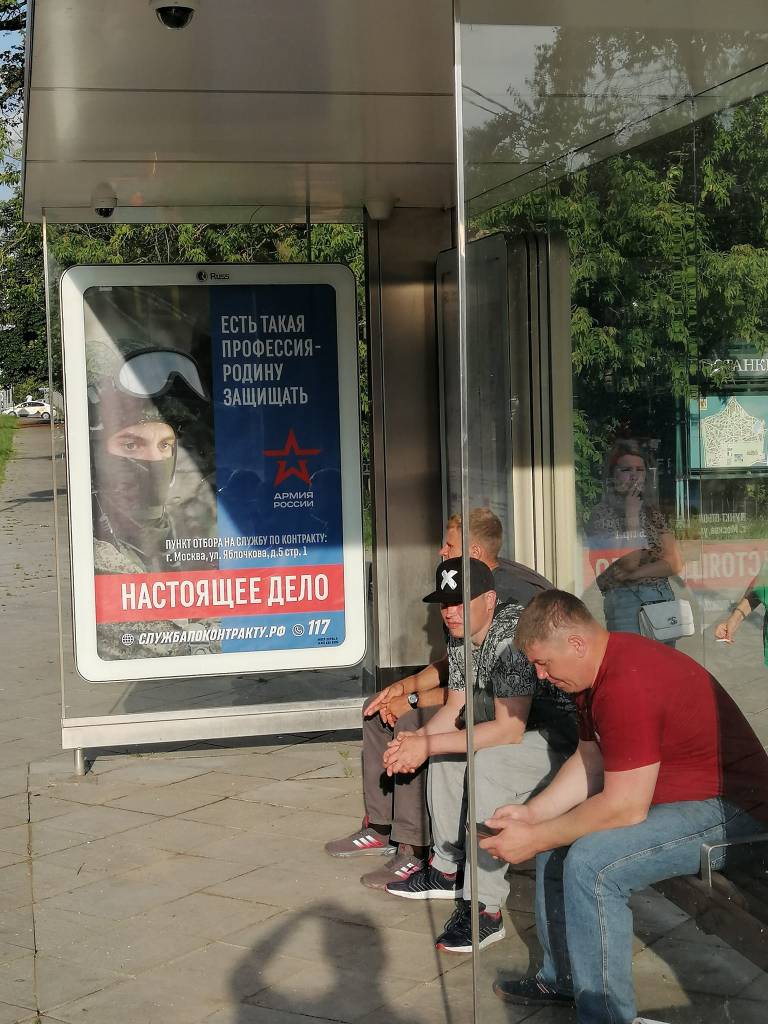
“Defending the Motherland is a profession — a real job.” Frequent TRR contributor Sergey Abashin photographed this Russian army recruiting poster (and several others) in Moscow earlier today.

International Children’s Day (June 1)

Important Stories • “Putin, Lvova-Belova and their crimes: how Ukrainian orphans are registered as Russians” • 31 May 2023

The Russian authorities have been removing children en masse from occupied Ukrainian territories and do not consider it a crime. But the International Criminal Court in the Hague thinks differently, accusing Vladimir Putin and Russian children’s ombudsman Maria Lvova-Belova of war crimes—namely, the illegal deportation of minors from Ukraine.

Orphans and children left without parental care have been sent all over Russia, even to the Far North. Important Stories found out how this system works and how abducted Ukrainian orphans are forcibly turned into Russian nationals.

[…]

Timecode

00:00 Why Putin and Lviv-Belova have been accused of kidnapping Ukrainian children

01:12 How 2,500 new children appeared in Russia’s database of orphans

02:32 The story of Sasha from Donetsk and his two sisters

03:56 The environment in which Ukrainian children are raised in Russia

05:23 “The children categorically refused to go to the Far North, where we live”

07:12 “The parents were killed there. The children told us terrible things”

07:48 Ukrainian orphans are provided with housing, for which Russians spend years on the waiting list

08:39 “There have never been such crimes in the history of humankind”

Source: Important Stories (YouTube), 31 May 2023. Annotation translated by the Russian Reader


SOTA • “Putin is readying young people to rebuild the army” • 31 May 2023

It won’t be possible to wage wars forever, but Putin is trying very hard. Since February 24, 2022, the lives of young people have changed. Starting in kindergarten, children are now taught that serving in the army is the best job in the world, and that the most beautiful thing in life is dying for the good of the Motherland.

[Endlessly repeat the message that] Russia is surrounded by Nazis, the whole world is against it, its soldiers are defenders, and you’re good to go. You’ve raised a whole new generation of soldiers.

This assembly line for producing soldiers has existed for several years. Even before the war, schoolchildren were inspired with imperialism and a desire to go to war. Now, however, everything has reached new levels. Military parades are organized in kindergartens. Schoolchildren are taught to dig trenches, shoot, and render first aid in combat. And university students are trained to serve in the military.

See more about how children are turned into soldiers in our new video.

Source: SOTA (YouTube), 31 May 2023. Annotation translated by the Russian Reader


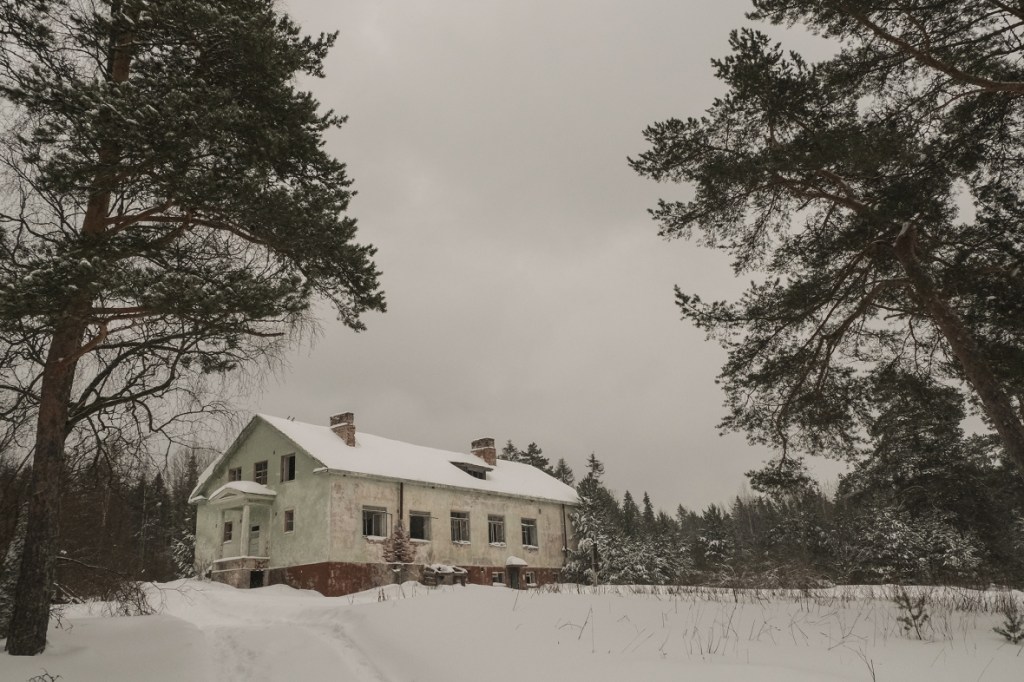
A ruined building of the Burenevo Auxiliary Boarding School for Mentally Retarded Children.
Village of Burnevo, Priozersk District (Leningrad Region), 2021. Photo: Olga Matveeva/Republic

“Hello Irina Alexandrovna! This is your pupil writing to you. I decided to write to you. Please write a letter here so that they let me go on my own, whatever date you need, so that I can study from the beginning of the school year, that is, beginning September 1. Say hello to everyone at the school. When you write the letter, address it to the 11th department… Irina Alexandrovna what was the reason you sent me to the mental hospital again. I told you that I would remain at camp…”

This is an excerpt from a letter written by a pupil to the director of the Burnevo Auxiliary School for Mentally Retarded Children. I found the letter in his personal file.

In 1970, the Priozersk Sanatorium Forest School was reorganized into an auxiliary boarding school for mentally retarded children. According to the school’s fact sheet, “Forty-eight mentally retarded children studied [sic] at the school. Ten of them are disabled. All of the children are from at-risk families. Classes are held in one shift, five days a week. On weekends and holidays, ten to fifteen of them, mostly orphans, stay. There are twelve of them in the school.”

It seems that many of the pupils were not mentally retarded or disabled, but they were neglected. Sergei, a resident of the village of Burnevo, spoke to this fact: “Half of the children there were sick, while half of the healthy ones were from dysfunctional families. I attended this school until 1970, and my mother worked there as a minder.”

The school was closed in 2005 due to poor epidemiological conditions. There was only stove heating in the building, and the water was pumped from the lake. The school consisted of several buildings. In the main building there were four classrooms, a teacher’s room, a curriculum office, and the director’s office. There were sleeping quarters in a wooden building. Carpentry workshops, sewing workshops, a recreation and sports equipment room were located in separate buildings. There was also a medical unit with an isolation ward and a speech therapist’s office. There I found an archive containing the personal files of the school’s graduates.

“His grandmother telephoned. She said that her grandson was very bad, it was hard to deal him, his socks were wet and dirty. He gave a jacket to a girl, but lied to his grandmother that he had dropped it off at the laundry. At the class meeting, it was decided to refer him to the psychiatrist to prescribe treatment.”

“Slava ended up the border zone this summer: he told the border guards that he was flying in a spaceship. I had a frank talk with him. He still wants to go see his mother in Vyborg (she does not live with their family). He didn’t find her, got lost, and ended up in the border zone. Slava, smiling, told how me he deceived a border guard and a policeman. Slava was referred to a psychiatrist, who detected no abnormalities.”

“Oleg systematically wipes the dust from his bed badly. This was discussed at a class meeting. There are no results.”

“If children skip classes, they should be reported to the police without delay.”

These are quotes from pupil observation logs. Along with memos, letters, and assessments, they were kept in the students’ personal files. These records about the children were kept for years—from the first grade to graduation. Perusing them, you begin to imagine these children, how they lived, what they worried about, what they did. Their childhoods are written down in slim notebooks. You watch them grow up and go out into the world, or to a psychoneurological residential treatment facility, or to prison.

For bad behavior, children were referred to a psychiatrist and prescribed treatment. There is no data on how many orphans are placed in psychiatric clinics nowadays. The roots of what is happening in this system to this day must be sought in the past.

This project is based on archival materials and interviews with graduates of the Burnevo Auxiliary School for Mentally Retarded Children whom I managed to find.

[…]

Source: Olga Matveeva, “‘A slight degree of imbecility’: the stories of graduates of an auxiliary boarding school for mentally retarded children,” Republic, 31 May 2023. Translated by the Russian Reader


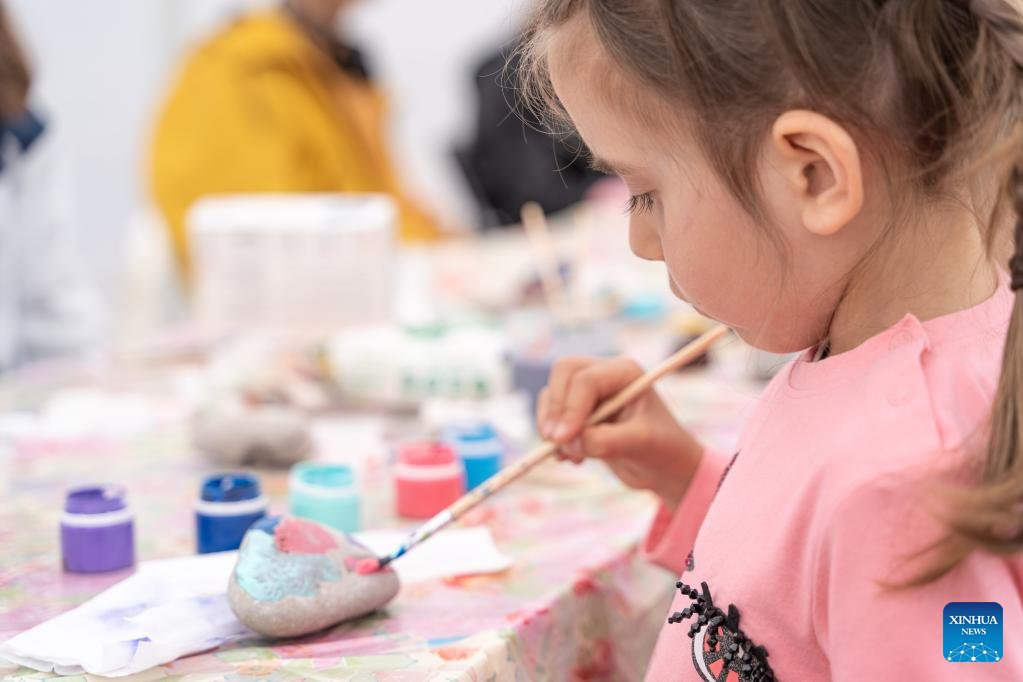
A girl paints a pebble during an event to mark the International Children’s Day in Vladivostok, Russia, June 1, 2023. (Photo by Guo Feizhou/Xinhua)

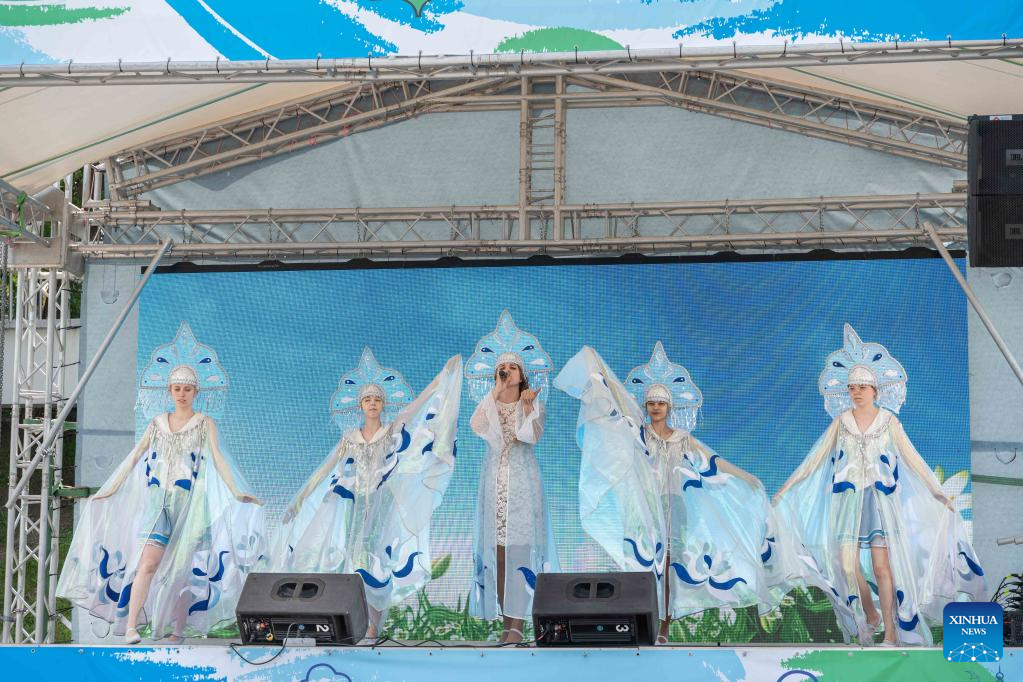
Students from a special education school perform during an event to mark the International Children’s Day in Vladivostok, Russia, June 1, 2023. (Photo by Guo Feizhou/Xinhua)

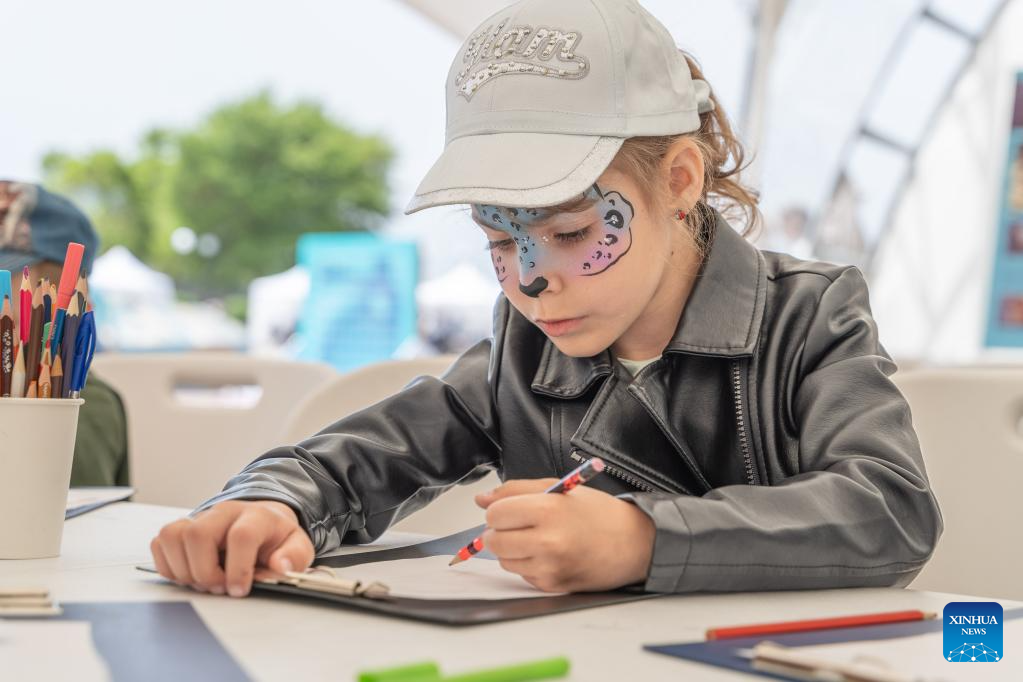
A girl draws during an event to mark the International Children’s Day in Vladivostok, Russia, June 1, 2023. (Photo by Guo Feizhou/Xinhua)

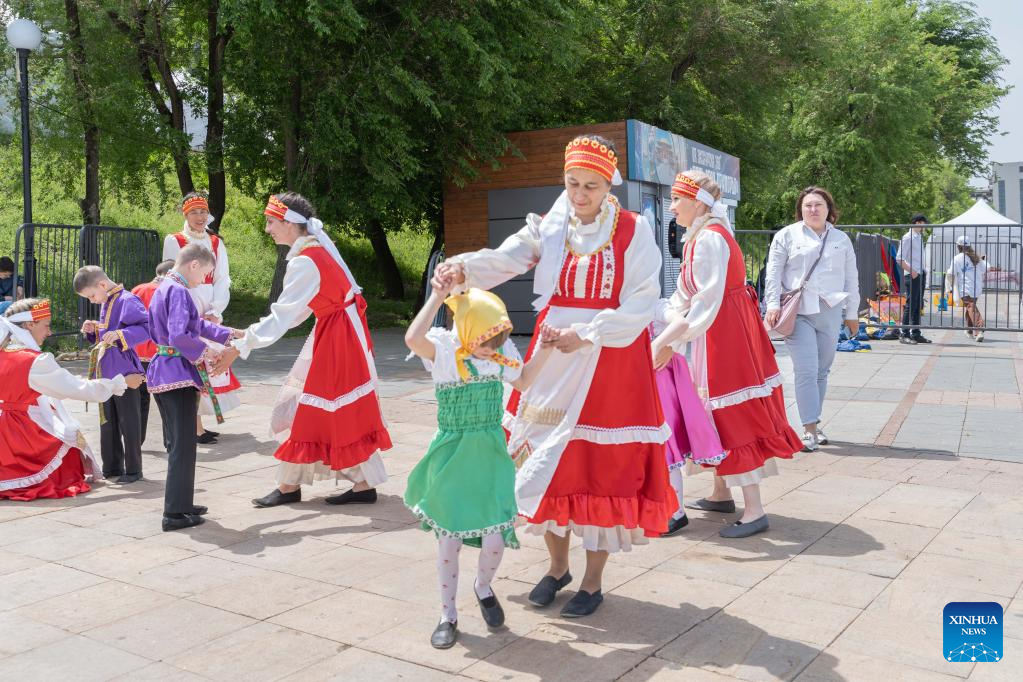
Teachers and students in traditional attire dance during an event to mark the International Children’s Day in Vladivostok, Russia, June 1, 2023. (Photo by Guo Feizhou/Xinhua)

[…]

Source: “Int’l Children’s Day marked around world,” Xinhua, 1 June 2023

Luminary Recordings: Akhtseh Rayondin Maniyar

We’re thrilled to announce our latest album, a result of a collaboration between Ored Recordings and Luminary, an educational center in the village of Khryug, in the Ahtynsky district of Dagestan.

Luminary works with local children, offering them various classes in design, programming, music, and other fascinating topics. Our collaboration with them involved a three-day expedition of young Lezgins through their native Ahtynsky district, recording the songs of bards, local ensembles, and cultural workers.

In addition to the audio release, we’ve also published a printed zine, in which the children describe their experience, and we share our thoughts on the symbolism of such trips.

Ored Recordings is an ethnographic label, whose team travels mainly in the Caucasus, studying and recording local music. While there are many similar projects around the world, they are often led by white Europeans on an “exotic safari” in foreign lands. However, in our case, things are different. Ored Recordings is led by Circassians, who immerse themselves in their own tradition and the culture of their neighbors. In our eyes, there is less exoticism and orientalism, which can be found in the work of the French in Tibet or Americans in Ethiopia.

Nevertheless, we know relatively little about the music and culture of neighboring republics. Even in Dagestan, we may be neighbors, but we are still outsiders. We try to bridge the gap by taking local guides and carefully preparing for trips to other republics. However, the most honest thing we can do is to send the locals on the expedition themselves, without us.

When the Luminary center in Khryug invited us to do something together with their kids, it became evident that they should go on an expedition to their native villages and share their music and personal discoveries with everyone.

Ored Recordings’ role was to provide young ethnographers with tools, without imposing our vision. We didn’t teach young Lezgins what music was worthy of recording and what should be forgotten. Nor did we decide for them what would become a hit or what would be boring.

The result is an album of diverse music, the faces of living bearers of tradition, an engaging story of an ethnographic adventure, and a beautiful zine.

Importantly, the project is not interesting merely because it was done by children. The release and zine by the Luminary kids are not cute; they are serious works that adults could have done worse. And to us, this carries great symbolic value: traditional music does not belong to us — the elders, academics, and art curators. It’s for everyone, especially the new generations.

We hope you enjoy this album and take a moment to appreciate the work of these talented young musicians and ethnographers.

Source: Ored Recordings (Bandcamp)

What Emotions Do You Feel When You Think About Russia?

Students at the Mechnikov Medical University [in Petersburg] have told Bumaga that the dean’s office has asked them to fill out an online test about their attitude to the war in Ukraine, the president, and the future of Russia.

The students said that they were simply asked to take a survey—they were not informed about possible punishments for those who refused to fill out the test.

Before completing the test, students must log in through their VKontakte accounts or with a phone number, for example.

Students are asked to answer the following questions:

  • Do you generally trust the rector of your university?
  • What emotions do you feel when you think about Russia?
  • How much do you agree that things in our country are moving in the right direction?
  • Do you generally trust Russian President Vladimir Putin?
  • Do you think President Vladimir Putin is doing a good job or a poor job as president?
  • Has your attitude towards President Vladimir Putin changed over the past month? If it has changed, has it worsened or improved?
  • Choose the symbol that best fits the concept of “President of Russia.”
  • In your opinion, does Russia face the threat of a military attack?
  • Do you support Russia’s special military operation in Ukraine?
  • Choose the symbol that best fits the concept of “Special Military Operation.”

The survey also asks students to indicate what the country’s leadership should prioritize: strengthening sovereignty, strengthening the state, or developing the economy. The only alternative to these options is “undecided.”

The survey was created by the platform Concerned Individual, which operates in cooperation with the Education Ministry. It is marked as “April University Student Survey.” An employee of the Herzen Russian State Pedagogical University [in Petersburg] also reported to Bumaga that [students there had been asked to complete the survey].

If you have received such a request, tell us about it by writing to our Telegram bot: @PaperPaperNewsBot. It’s anonymous and safe.

Source: “Petersburg students asked to take a survey about their attitude to Putin and the war in Ukraine,” Bumaga, 25 April 2023. Translated by the Russian Reader


A screenshot of the front page of Concerned Individual’s website, featuring an interactive map of Russia’s federal districts. According to Concerned Individual, 82% of people in the Northwest Federal District (in red), which includes St. Petersburg, are “concerned individuals.” Twenty-nine percent of them (according to VTSIOM) have donated money to people or organizations. Fifteen percent have donated items to orphanages, old folks’ homes, and homes for the disabled. Four percent have been involved in charity events such as concert and exhibitions. Six percent of them have worked as volunteers.

Universities in all regions of Russia will join the platform Concerned Individual to become initiators and participants of positive change at their educational institutions and in the higher education system as a whole.

Along with the Russian Science and Higher Education Ministry, the Russian Education Ministry, Tomsk State University, and the All-Russian Center for the Study of Public Opinion (VTsIOM), Concerned Individual is launching a program of regular opinion polling of students, teachers, and administrative staff at Russian universities. We plan to recruit representatives of more than 700 tertiary educational institutions to the platform by the end of 2024.

The project’s aim is to form a permanent feedback mechanism between the university community and state authorities, to identify problems that need solving as well as promising directions for the growth of higher education.

“We believe that such a dialogue is especially necessary today, and our platform is technologically and methodically ready to provide it. Concerned people are the key potential for change in the universities, regions, and country. And opinion polls are a scientifically grounded tool that has proven itself well and reflect a real cross-section of the situation. Therefore, we urge students, teachers, and administrative staff to take part in the project and voice their opinion on the most pressing social issues,” comments Vadim Arakelov, CEO of the company Concerned Citizen.

The first wave of polls will kick off on April 10. Respondents will answer questions about the quality of education, media consumption, socio-psychological well-being, and other topics. In 2023, polls will also be conducted in May, September, October, and November. You can take part in the surveys by clicking on the link posted in your personal university account.

The results of the surveys will be published on Concerned Individual’s Telegram channel and website, and posted in the personal accounts of students and university staff.

Source: “Large-scale program of opinion polling of students and employees of Russian universities launched,” Concerned Individual, 10 April 2023. Translated by the Russian Reader

Yuli Boyarshinov Released from Prison

Yuli Boyarshinov (left, facing camera) and his father, Nikolai (foreground), after Yuli’s release
from the penal colony in Segezha on 21 April 2023. Photo courtesy of RFE/RL

Yuli Boyarshinov, convicted in the Petersburg portion of the so-called Network Case, has been released, our correspondent reports. His parents, wife, and friends were on hand to meet Boyarshinov.

Boyarshinov was released from Penal Colony No. 7 in Segezha, Republic of Karelia, early in the morning of April 21, although his relatives and friends had expected him to be released in the afternoon.

Boyarshinov said that the wardens gave him a ticket for the train to Petersburg, which departs at ten a.m., and released him right on time for that train. “Customer-oriented service,” Boyarshinov said by way of explaining the rush to release him from the penal colony.

The FSB launched a criminal case against the so-called Network “terrorist community” in October 2017. Eleven individuals from Penza, St. Petersburg, and Moscow, most of them anarchists and antifascists, were detained and then remanded in custody. According to FSB investigators, the young people had established a networked community with the aim of committing terrorist attacks and overthrowing the government.

Boyarshinov and Viktor Filinkov were arrested and eventually tried in Petersburg. Filinkov was sentenced to seven years of imprisonment, while Boyarshinov was sentenced to five and a half years in a penal colony. Later, however, his sentence was reduced by three months.

Most of the accused claimed that the evidence was fabricated by the FSB, and repeatedly stated that they had given confessions under torture. The Russian Investigative Committee, however, failed to find any illegalities in the actions of the FSB officers involved the case.

In February 2020, seven defendants in the Network Case were sentenced to terms of imprisonment ranging from six to eighteen years.

Source: “Yuli Boyarshinov, convicted in the Network Case, has been released,” Radio Svoboda, 21 April 2023. Translated by the Russian Reader


Yuli “Yulian” Boyarshinov, one of the Petersburg defendants in the Network Case, has been released from prison, after having spent over five years in custody. Bumaga was there to capture Boyarshinov’s first moments on the outside, where he was reunited with his wife and his parents.

Yuli Boyarshinov (right) with his wife, Yana Sakhipova. Photo by Andrei Bok for Bumaga
Yuli Boyarshinov (far right) with parents and wife, after his release from prison. Photo by Andrei Bok for Bumaga

Boyarshinov was detained in January 2018 and had been in custody from then until his release earlier today. In June 2020, he was sentenced to five and a half years in a penal colony on charges of “involvement in a terrorist community,” but an appeals court later reduced his sentence by three months. The sentence took into account the time Boyarshinov had already spent in jail.

The Network Case is also known as the Penza Case, since most of the defendants were detained in Penza. However, the FSB claim that the “terrorist community” operated cells not only in Penza, but also in Petersburg, Moscow, Omsk, and Belarus. Leftist activists, antifascists, anarchists, and airsoft players were detained as part of the Network Case.

Before his arrest, Boyarshinov had been employed as an industrial climber and was involved in charity work. He recounted that he had been tortured in the pretrial detention center.

Boyarshinov pleaded guilty to the charges, claiming that the Network’s participants had come together for the purpose of self-defense training. And yet Boyarshinov did not make a deal with prosecutors and refused to testify against the other defendants.

Boyarshinov is the second person involved in the Network Case to be released. The first was Igor Shishkin, who was detained at the same time as Boyarshinov. Shishkin was released in July 2021, after which he spoke to the press about having been tortured.

Viktor Filinkov remains the only Petersburg defendant still imprisoned: he was sentenced to seven years in a medium-security penal colony in June 2020. The Penza defendants were sentenced to terms of imprisonment ranging from six to eighteen years.

Source: “Released Network Case defendant Yuli Boyarshinov reunited with wife and parents,” Bumaga, 21 April 2023. Translated by the Russian Reader, whose extensive coverage of the Network Case can be accessed in full here.

“Our Songs Are For Those Who Have Stayed” (The Russian Draft Goes Online)

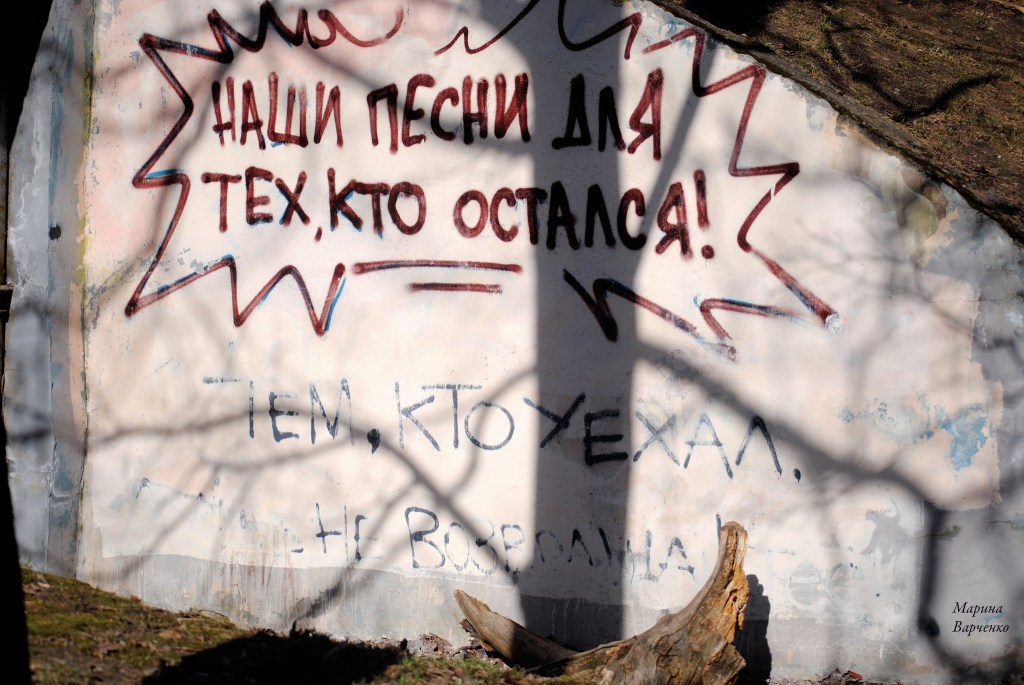
“Our songs are for those who have stayed [in Russia]. To those who have left: don’t come back.”
Photographed by Marina Varchenko on Vasilyevsky Island in Petersburg, 13 April 2023

Today, coming out of the front door of my building, I saw the following tableau. A neighbor from the third floor, who is somewhere between thirty-five and forty, was, on the contrary, coming in the front door. Judging by the bag he was carrying, he had just been grocery shopping. He doffed his baseball cap, clamped it under his arm, and crossed himself three times as he looked at the mailboxes. Then he peered into his own mailbox and let out a sigh of relief. His draft notice had not yet arrived, apparently. To be honest, it took a while for the meaning of his maneuvers to dawn on me. Of course, I pretended that I hadn’t noticed any of it.

Source: Marina Varchenko (Facebook), 13 April 2023. Translated by TRR


On Wednesday, April 12, Samara journalist Sergei Podsytnik posted on the website Change.org a petition calling for the repeal of amendments paving the way for the introduction of electronic military draft notices, as passed the previous day by the State Duma and the Federation Council.

“These amendments violate our rights. A citizen cannot be stripped of their rights without a trial, but now this right has been given to the staff of military enlistment offices,” the petition says. Podsytnik draws attention to the fact that the public services portal Gosuslugi, through which it is planned to serve draft notices to Russians, has a number of vulnerabilities. In addition, not all residents of the country have access to their accounts on the portal, and almost thirty percent of Russians over thirty are not active internet users.

According to the amendments as adopted, if a conscript did not receive a paper summons and did not log into his Gosuslugi account, the summons will still be considered delivered within seven days after it was entered into the register of draft notices. He will then be banned from leaving the country. After twenty days, new bans will come into effect: those who failed to report to a military enlistment office will not be able to work as individual entrepreneurs, manage real estate, drive a car, or take out loans.

“To deprive people of the ability to sell real estate, drive a car, or travel abroad at the request of a person with no specialized legal education is an outrage against our rights and freedoms,” the petition says. At the time this story went to press, the petition had been signed by more than thirty thousand people, and their number was growing rapidly. For the amendments to go into effect, they must be signed by Vladimir Putin and published.

Source: Dmitry Vadchenin, “Tens of thousands sign petition against electronic draft notices,” Deutsche Welle, 12 April 2023. Translated by TRR. As of 11:54 p.m. Moscow time on April 13, the petition had been signed by over 94,453 people.


[…]

The legislative changes mean that once a Russian citizen has received a military summons online, they will be automatically forbidden from leaving the country, and therefore avoiding the call-up.

If they fail to appear at a draft office within 20 days, they will face a range of restrictions, including a ban on using their own vehicle, selling property or receiving a loan. They also face a fine of between 500 and 3,000 rubles (£5 to £29).

The head of Russia’s parliamentary committee on defence claimed that these measures will only come into force during the next conscription campaign.

The new system also anticipates a unified database where personal data about Russian reserve personnel can be collated by a range of government institutions, such as the tax service, law enforcement, the pension fund and medical facilities.

Such a database will make it “practically impossible” for reservists to avoid being called up, anti-conscription lawyer Alexey Tabalov told independent Russian media outlet Verstka, because military registration offices will have more detailed information about an individual’s home and work address.

This changes the advice he has been giving people who want to avoid mobilisation, Tabalov says.

Whereas he previously recommended that people avoid receiving the physical summons document, that “recommendation has lost all meaning” now, he said. “If you don’t want to serve, don’t go to the military registration office, but you’ll still face restrictive measures,” Tabalov said.

[…]

Source: Thomas Rowley, “Russia plans crackdown on men avoiding the draft,” openDemocracy, 11 April 2023


[…]

Andrei Kartopolov, head of the State Duma defense committee, spelled out tough penalties for those who do not respond to electronic summonses, including potential bans on driving, registering a company, working as a self-employed individual, obtaining credit or loans, selling apartments, buying property or securing social benefits. These penalties could apply to the thousands of men who are already outside the country.

The electronic summons will be issued via a government services portal, Gosuslugi, used for all manner of state payments and services including taxes, passports, housing services, social benefits, transport documents, medical appointments, employee insurance and countless other matters.

Under the law, personal data of conscripts including identity documents, personal tax numbers, driver’s license details, phone numbers and other information will be transferred by Gosuslugi to military enlistment offices. Universities, business employers, hospitals and clinics, government ministries, law enforcement agencies, the electoral commission and the tax authority are also required to transmit data to the military.

[…]

Source: Robyn Dixon, “Russia moves to tighten conscription law, pressing more men to fight,” Washington Post, 11 April 2023

World Festival of Youth and Students

Lev Rubinstein, born 1947 in Moscow, as photographed in 2017 by Natalia Senatorova. Courtesy of Wikimedia

There should be at least some news to slightly brighten — like a mosquito-sized flashlight — the gloomy hopelessness of the current media landscape.

So, this morning a news item flashed across my screen that seemed provisionally positive and even slightly heartwarming amidst the already familiar meteor shower of news items, each one more nightmarish and ridiculous than the last.

However, this seemingly welcome news is also shipshape when it comes to absurdity.

Amid the events happening around us this bit of news struck me as quite strange. I immediately wanted to check whether it was a fake (sorry for the non-Russian word).

But it seems to be true, alright.

“In February–March 2024,” I read, “the World Festival of Youth will be held in Russia, per the decree signed by President Vladimir Putin.”

“Within three months, the government,” I read on, “should start prepping for staging the festival, as well as finding sources of funding.”

While I am amazed, to put it mildly, at the incongruity and obvious strangeness of all this, and while I imagine how the eyes of the various “preppers” and “stagers” light up when they read the word “financing,” one of my most vivid memories serves as a powerful backdrop to these spontaneous reflections of mine.

In the summer of 1957, Moscow hosted the World Festival of Youth and Students — a festival of left-wing youth organizations that had been held since 1947.

The Soviet propaganda of those years stressed the “fight for peace” as an alternative to the “aggressive policy of the imperialist West.”

In the phrase “fight for peace,” the emphasis increasingly shifted towards the word “fight.”

Be that as it may, the word “peace” [mir] in those days, in terms of the frequency with which it was used in both official and unofficial speech, knew no rivals. This is especially often and especially vividly remembered in our own time.

Be that as it may, the 1957 Moscow festival, conceived as a propaganda event, was an important and gratifying event in the life of not only the Soviet capital, but also the whole country.

“Moscow Youth Festival” (1957). Silent footage from Pathé News 

I was ten years old—not so big as to understand everything, but not so little as to understand nothing.

That summer, parents were strongly recommended to take their children out of the capital. I don’t remember why I stayed in Moscow, moreover, smack dab in the center of it.

My friend and neighbor Smirnov and I would roam the streets of Moscow during the festival.

My eyes were blinded by the vividness and polychromatism. I remember an overexcited middle-aged dame grabbing the hand of a skinny Indian man. Speaking loudly and syllabically, as often happens when people talk to foreigners, she told him: “I i-dol-ize Indian cinema! Do you understand? I i-dol-ize it! Do you understand me?”

The Indian smiled and nodded his head, which was wrapped in something terribly foreign and incredibly beautiful. Then he shoved some kind of colorful pin into her hand. It is quite possible, however, that he was not from India but from somewhere else.

Smirnov and I were also given pins and postcards by foreigners. We kept them in our collections at home for many more years. Then they disappeared.

In those days it suddenly became obvious that, before the festival, we had been living in a black and white world. A spirit of unthinkable, unimaginable freedom reigned over the capital, which had become prettier and younger and had lapsed into charming frivolity.

“We Became Friends in Moscow” (1957). In Russian

The air was so supercharged with erotic energy that a year after the Moscow festival, babies of all colors of the spectrum showed up in noticeable numbers. Those babies are now all grown up.

But this was not the only trace left behind by the festival. Nor were the toponymic relics in the form of the countless “Festival Streets” and Druzhba (“Friendship”) cinemas. It was then, by the way, that First Meshchanskaya Street (“First Bourgeois Street”) was renamed Prospect Mira (“Avenue of Peace”).

Many artists of the older generation would later admit that the exhibition of modern painting brought to Moscow by the French and shown during the festival turned their ideas about art upside down and provided the first impulse to everything that is now collectively known as contemporary art. However hard the ideological leadership tried to put the “abstractionists” in their place a few years later and in subsequent years, the genie had been let out of the bottle.

After the festival, the stilyagi — the first aesthetic and, so to speak, behavioral dissidents in the Soviet Union — emerged. After the festival, the idea of fashion and fashionableness arose. After the festival, rock and roll appeared in the Soviet Union and spread around the country. After the festival, the youth subculture in our country took on distinctive features, however timid and provincial.

The Stalinist reinforced concrete (not even iron!) curtain was not flung open during the festival. Only a narrow crack opened in it, but the flow of air pouring through this crack was so powerful that it intoxicated an entire generation for many years to come.

“Khrushchev and the Avant-Gardists: from the Manege to the Manege” (1990). Artist Eli Belyutin and his colleagues look back at “30 Years of the Moscow Union of Artists,” held at the Moscow Manege in 1962. The show attracted the notice of the Soviet and foreign press, but it also angered Soviet leader Nikita Khrushchev. In Russian

The festival was yet another lesson about the important fact that freedom is not an absolute concept. That freedom is tangible only in the context of non-freedom. That freedom is just the feeling of freedom and nothing more. And it was this feeling that we experienced then. We were not given freedom. We were only shown it through a crack in a thick curtain.

Smirnov and I didn’t know how to articulate anything of the sort back then. We sensed this freedom in a childlike way, directly. It had appeared to us in a bright and sparkling shape that made even a New Year’s tree seem almost as tedious as a synopsis of the painting Arrived on Vacation.

There was no freedom, but there was the feeling of it then.

This powerful feeling touched even me, a ten-year-old. And for many young people from my older brother’s generation, this event largely shaped their further social and cultural evolution.

People who were twenty years older than me often recalled another brief but bright time when it seemed to many who had returned from the front, who had been able to see another world and other people, to spend time with the soldiers and officers of the allied armies, that “now everything would be different.” They also considered it a great fortune, despite the fact that they were very quickly shown who was the boss in the house, and, most importantly, who had really won that war.

Live coverage of the opening ceremony of the 12th World Festival of Youth and Students, Moscow, 1985. In Russian

History shows that when a totalitarian or authoritarian government, under the influence of certain political (most often external) circumstances, is forced to provide its citizens with a “whiff of freedom,” this is almost always followed by bouts of reaction in different shapes and guises. “You had a little breather and that’s enough!” the government seemingly says to citizens who decided that now things would be different.

Freedom, according to the great poet, comes to us naked. But when she sees that no one welcomes her with flowers and songs, she waits in vain for a while before dejectedly going home.

I cannot even really imagine the upcoming triumph of the spirit, the style and overall thrust of its staging, the number and, most importantly, the quality of its intended participants, and how the keyword of all the previous festivals, the word that begins with a “p,” and which has now become semi-forbidden, will be spun. I lack the imagination.

Source: Lev Rubinstein, “You can’t stifle this song, you can’t kill it: why Putin wants a World Festival of Youth,” Republic, 7 April 2023. Translated by the Russian Reader. The videos inserted in the article, above, were part of the original publication, but the photo of Mr. Rubinstein was not.

Ilya Shakursky’s 27th Birthday

Ilya Shakursky. Photo courtesy of Elena Shakurskaya

Today, April 10, my son Ilya turns 27. This is the sixth birthday he has celebrated behind bars. But every year I wait, believe, and hope that he be released from captivity and be near us. I naively believe in justice and truth. A miracle must happen sometime and Goodness will triumph!

My son, the best in the world, I lovingly congratulate you on your birthday! You are a part of me, and from the bottom of my heart I want to wish you incredibly beautiful days and nights, the most wonderful emotions, and fulfillment of ambitious plans! You deserve everything wonderful; may sincere Faith, pure and devoted Love, and optimistic Hope always remain with you! I wish my son the brightest road today. After all, you are all I have. My mother’s heart very often worries about you. It hurts for every trial you go through. It hurts for everything! Know, son, that you are everything to me. You are my only man, for whom I am not sorry to give my life. You’re my rock.

Ilya’s payphones have been turned off, and at the moment there is no connection with him. Today the weather is as warm and sunny as it was in 1996 [on the day he was born]. May the sun’s rays give hope, faith, kindness, and most importantly freedom to Ilya and to all political prisoners!

Source: Elena Shakurskaya (Facebook), 10 April 2023. Translated by Thomas H. Campbell. In February 2020, Ilya Shakursky was convicted and sentenced to 16 years in prison as part of the notorious Network Case, in which the Russian Federal Security Service (FSB) tortured and framed a dozen anti-fascists in Penza and Petersburg for, allegedly, “organizing a terrorist community.” I have posted extensively on the case and its aftermath over the last five years.