Basurka

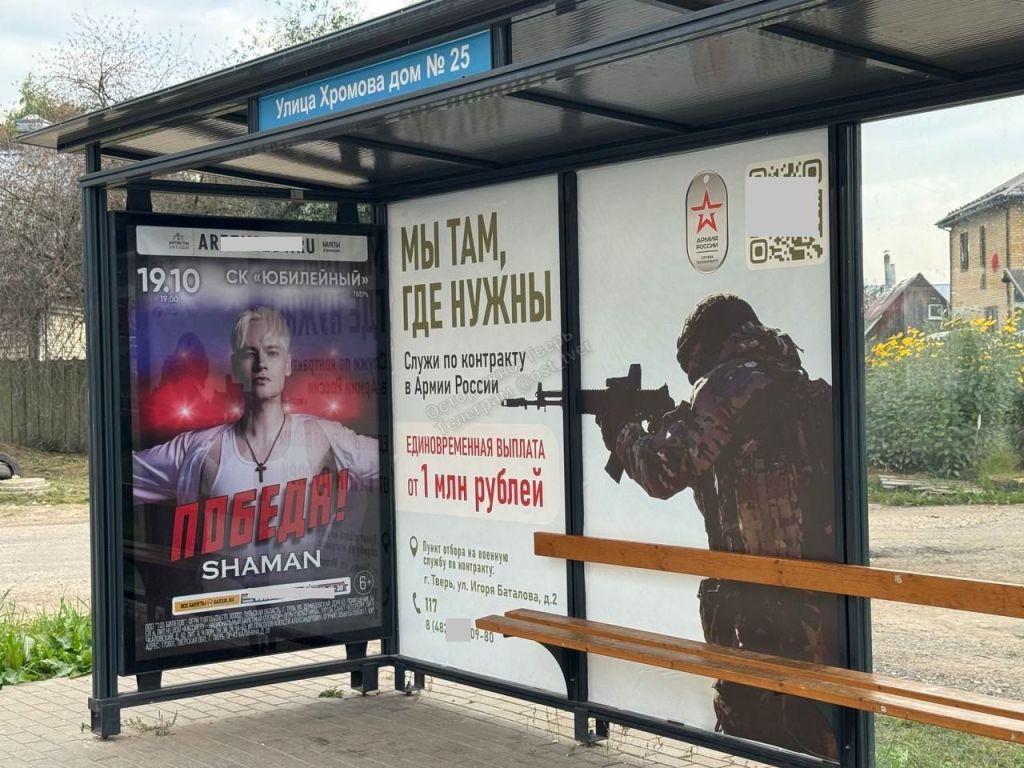
Top: “25 Khromov Street.” Left: “Shaman: Victory!” Right: “We are there where we need to be. Serve as a contract soldier in the Russian Army and get a one-time payment starting at one million rubles.”

Source: Caution, Tver! (Telegram), 1 September 2024. Thanks to Andrey Anissimov for the heads-up. “Basurka” is the faux-Russian nonce word I coined for this distressing post. It was suggested to me by our building’s bilingual garbage bin. ||| TRR


Many acquaintances from Russia condemn me for calling for the bombing of Russian factories and supporting the Ukrainian army’s Kursk offensive. They genuinely don’t get how one could wish defeat on one’s own country. Some have quietly unfriended me, while others continue to read my posts but are perplexed and perhaps even offended by them.

They are often the same people who “love (their) country no matter what.” This is where you all and I part ways. You REFUSE to look at reality—you turn away from it in order to love your country without breaking a sweat, as if love were a chain and you’ve been chained to a radiator since childhood. It works differently for me. I make my own decision about whether I like this scene or not. And, if my country jumps from one bloody shitstorm to another like a maniac running in circles, it’s not worthy of my love and I rescind its right to be my country. People are another matter, especially the unborn. It makes sense to fight for them. But it’s secondary to me what the country they’ll live in will be called and how big it will be. If they’ll have a better chance for a decent and safe life in a small country, then we should choose a decent and safe life for them.

Russia is an anti-human phenomenon. It is a threat to the entire world and to the people within the country. Like any rabid macaque with a grenade, it must be stopped. Look reality in the eye at last. Don’t look away. It’s happening right now, and you, with your unadulterated love, are a part of it.

Image number one. A fourteen-year-old girl dressed in white sneakers and a white tank top, sitting on a bench in the yard of her house on an ordinary summer day. It all looks ordinary, but there is one catch: the girl is dead. A fragment of a cluster bomb, which the Russians dropped on Kharkiv on 30 August, tore off the child’s head. Everything happened instantly; no one had time to hide. The girl’s body remained seated on the bench. Perhaps her last thoughts were of her father, who had gone missing in action in the war with Russia. The family knows he was killed, but they can’t get his body back. The worst part is that he gave his life thinking he was protecting his daughter. Russia got to her, though, and so the family’s story is over. Father and daughter are not alive because they were born near Russia. Other Kharkiv residents who were killed in that senseless attack are also “guilty” in this sense.

Image number two. A girl again, but from another city. She is fifteen years old and has come to Novosibirsk from the Altai to enroll in the Olympic reserve school. She is quite beautiful, gentle, kind, and has great hopes. She doesn’t understand why her fellow students call her a “dirty, slant-eyed pig.” They secretly pour waste into her backpack and mock her appearance in public. After two years of this terror, which was encouraged by coaches and school officials, the formerly cheerful girl will come to realize that this life is not for her. In her seventeenth year, she will kill herself and leave a suicide note on her Telegram channel. She will say in the note that the unbearable racist bullying was her reason for leaving this life.

The school will then post a touching obituary on their Vkontakte page. They won’t specify the cause of death, of course. All comments expressing outrage over the bullying will be assiduously deleted. Only the wishes of “soft clouds” and broken heart emojis will be left untouched.

Incitement to suicide is a criminal offense, actually. But no one will answer for the death of Ksenia Cheponova because it is not the custom in Russia to punish one’s own kind for a crime against outsiders. “You’re not my brother, black-ass louse,” says the immortalized Russian movie hero. These words are much more than a mere insult: this is how millions of people in Russia understand justice. Moral rightness is not based on your deeds, but on whether you are an insider or an outsider. It doesn’t matter what you did. What matters is whether you are stronger than me at the moment.

Ksenia Cheponova

Image number three. Beslan. September first marked the twentieth anniversary of the mass murder of children by Russian security forces in that ill-fated school. For twenty years, the perpetrators have never been held accountable for lying about “350 hostages.” There were 1,100 hostages, as we know. No one has been held accountable for firing from a tank at the building where the children were. Three hundred and thirty-four people were killed during the assault, including one hundred and eighty children. This terrorist attack might not have happened if Russia hadn’t started a war in Chechnya. The hostages might have lived if the security forces had actually tried to save them. But they were killed and twenty years on their sacrifices are still covered in lies and impunity.

All of those people could have lived if it weren’t for their country, sick with messianism and aggression. And the “it’s like this everywhere” ploy doesn’t work. No country in the world has 60 million lives lost in wars, gulags, and famines under its belt.

The time for saying “no war” has passed. It is clear that where there is a “great Russia,” there will be perpetual war. That’s why we should say no to Russia, and yes to independent Ukraine, Ichkeria, Buryat-Mongolia, and all free nations.

Or is the idea of a united Russia dearer than the lives of your children?

Source: Julia Khazagaeva (Facebook), 3 September 2024. Translated by the Russian Reader


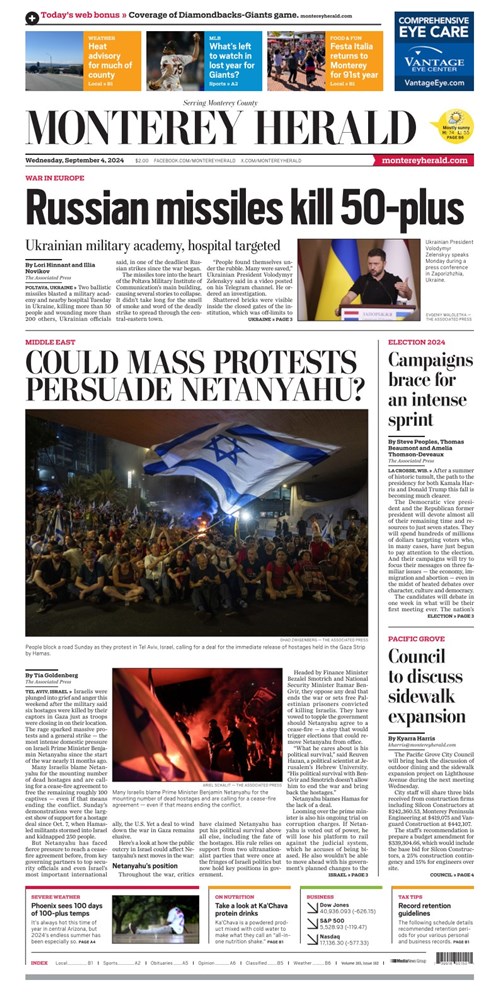
Two ballistic missiles blasted a military academy and nearby hospital Tuesday in Ukraine, killing more than 50 people and wounding more than 200 others, Ukrainian officials said.

The missiles tore into the heart of the Poltava Military Institute of Communication’s main building, causing several stories to collapse. It didn’t take long for the smell of smoke and word of the deadly strike to spread through the central-eastern town.

The strike appeared to be one of the deadliest carried out by Russian forces since the war began more than 900 days ago, with Russia’s Feb. 24, 2022, full-scale invasion.

“People found themselves under the rubble. Many were saved,” Ukrainian President Volodymyr Zelenskyy said in a video posted on his Telegram channel. He ordered an investigation.

Shattered bricks were visible inside the closed gates of the institution, which was off-limits to the media, and small pools of blood could be seen just outside hours later. Field communications trucks were parked along the perimeter. Roads were covered in glass from shattered apartment windows.

“I heard explosions … I was at home at that time. When I left the house, I realized that it was something evil and something bad,” said Yevheniy Zemskyy, who arrived to volunteer his help. “I was worried about the children, the residents of Poltava. That’s why we are here today to help our city in any way we can.”

By Tuesday evening, the death toll stood at 51, according to the general prosecutor’s office.

“My deepest condolences to the families of those killed and injured in the Russian missile attack on Poltava,” Ukraine’s first lady, Olena Zelenska, posted on social media Tuesday. “This is a shocking tragedy for the whole Ukraine.”

Filip Pronin, governor of the region that bears Poltava’s name, announced on Telegram that 219 people were wounded. Up to 18 people may be buried under the rubble, he said.

Ten apartment buildings were damaged, and more than 150 people donated blood, Pronin said.

He called it “a great tragedy” for the region and all of Ukraine, and announced three days of mourning starting Wednesday.

[…]

The academy trains officers in communications and electronics, honing some of the most valued skills in a war where both sides are fighting for control of the electronic battlefield.

“The enemy certainly must answer for all (its) crimes against humanity,” Pronin wrote on Telegram.

The Kremlin offered no immediate comment on the strike. It was not clear whether the dead and wounded were limited to Ukrainian military personnel, such as signal corps cadets, or if they included civilians.

Since it embarked on its full-scale invasion in early 2022, the Russian military has repeatedly used missiles to smash civilian targets, sometimes killing scores of people in a single attack.

Some of the deadliest such assaults included a 2022 airstrike on a theater in Mariupol that killed hundreds of civilians sheltering in the basement and a strike that same year on the train station in Kramatorsk that killed 61. Apartment buildings, markets and shopping centers have also been targeted.

Poltava is about 350 kilometers (200 miles) southeast of Kyiv, on the main highway and rail route between Kyiv and Ukraine’s second-largest city, Kharkiv, which is close to the Russian border.

The attack happened as Ukrainian forces sought to carve out their holdings in Russia’s Kursk border region after a surprise incursion that began Aug. 6 and as the Russian army hacks its way deeper into eastern Ukraine.

The missiles hit shortly after an air-raid alert sounded, when many people were on their way to a bomb shelter, Ukraine’s Defense Ministry said, describing the strike as “barbaric.”

Rescue crews and medics saved 25 people, including 11 who were dug out of the rubble, a Defense Ministry statement said.

The strike came on the day that Russian President Vladimir Putin visited Mongolia. There was no indication that his hosts would heed demands to arrest him on an international warrant for alleged war crimes.

Zelenskyy repeated his appeal for Ukraine’s Western partners to ensure swift delivery of military aid. He has previously chided the U.S. and European countries for being slow to make good on their pledges of help.

He also wants them to ease restrictions on what Ukraine can target on Russian soil with the weapons they provide. Some countries fear that hitting Russia could escalate the war.

“Ukraine needs air defense systems and missiles now, not sitting in storage,” Zelenskyy wrote in English on Telegram.

“Long-range strikes that can protect us from Russian terror are needed now, not later. Every day of delay, unfortunately, means more lost lives,” he said.

Ukraine’s air force said Monday that Russia had launched an overnight barrage of ballistic and cruise missiles and drones at Kyiv as children prepared to return to school. Multiple explosions echoed across the capital early Monday morning as Ukraine’s air defenses shot down many of the weapons, causing damage and fires as the debris fell onto the capital. 

Source: CBS News, 3 September 2024


Ufa’s Kirov District Court has remanded 20-year-old university student Makar Nikolayev in custody to a pretrial detention center for a month on charges of “promoting terrorism.” The court issued its ruling on 30 August, but it was made public only on Monday, 2 September, as reported by the Telegram channels of Baza and Idel.Realities, who cited sources. The court confirmed Nikolayev’s arrest to news website Ufa1.ru.

In 2020, Nikolayev, then a prep school student, designed an information retrieval method for creating a Russian national archive on the history of the Great Patriotic War. The boy wanted to recover information about his great-grandfather and in the process designed an entire system. His project, “Methodology for Creating a Family Archive,” won the Russian national contest “My Country — My Russia,” one of the projects of the Russia Is a Land of Opportunities presidential platform.

Later, Nikolayev went to Germany to study. According to Idel.Realities, Nikolayev had been studying at a university in Frankfurt am Main in recent years. In August 2024, he came home on holiday to Ufa, where he was detained.

According to police investigators, during his time abroad, Nikolayev wrote comments on social networks supporting Ukraine and urging people to join the Russian Volunteer Corps. The stipulated punishment for violating Russian Federal Criminal Code Article 205.2.2 (“Public calls to carry out terrorist activities; public justification of terrorism or promotion of terrorism, committed using mass media or electronic or telecommunication networks”) is five to seven years in prison.

Source: Sergei Kuprikov, “Winner of ‘My Country — My Russia’ contest detained in Ufa,” Deutsche Welle Russian Service, 2 September 2024. Translated by the Russian Reader

Number Eight and Number Forty-Two with a Bullet

Source: “25 Best Russian Literature Blogs and Websites,” FeedSpot, 4 May 2024


Brittney Griner #42 of the Phoenix Mercury during the first half of the WNBA game at the Footprint Center on August 31, 2021 in Phoenix, Arizona. (Photo by Christian Petersen/Getty Images)


Brittney Griner spent nearly 300 days incarcerated in Russia after authorities at the Moscow airport found two nearly empty cartridges of cannabis in her luggage. The WNBA star spoke with Terry Gross about the dehumanizing prison conditions, her release, and return to the court. Griner, who is 6’9″, says she felt like a zoo animal in prison. “The guards would literally come open up the little peep hole, look in, and then I would hear them laughing.” Her new memoir is Coming Home.

Source: “Brittney Griner reflects on ‘Coming Home’ after nearly 300 days in a Russian prison,” Fresh Air (NPR), 7 May 2024

Checkmate

As Australian chess player David Bukata was joining the Russian chess federation last year, three Russian players whose surnames also start with B were quitting it. Screenshot of the 2023 transfers page on FIDE’s website.

In 2023, 104 Russian chess players changed their national affiliations, according to information published on the website of the International Chess Federation, FIDE.

Among the top hundred players in the world chess rankings, Sanan Sjugirov (40th place), Alexey Sarana (41st), Vladimir Fedoseev (45th), Nikita Vitiugov (50th), Alexandr Predke (64th), Kirill Alekseenko (89th) and Alexandra Kosteniuk (11th in the women’s rankings) quit the Russian national chess federation.

In turn, five competitors transferred their affiliation to the Russian chess federation last year: Yuriy Ajrapetjan and Viktor Filonov from Ukraine, David Bukata from Australia, Kanan Geidarli from Azerbaijan, and Nadezhda Iskichekova from Kazakhstan.

In the almost two years since Russia launched its full-scale invasion of Ukraine, 192 Russian chess players have changed their national sporting affiliations.

Source: Radio Svoboda, 3 January 2024. Translated by the Russian Reader
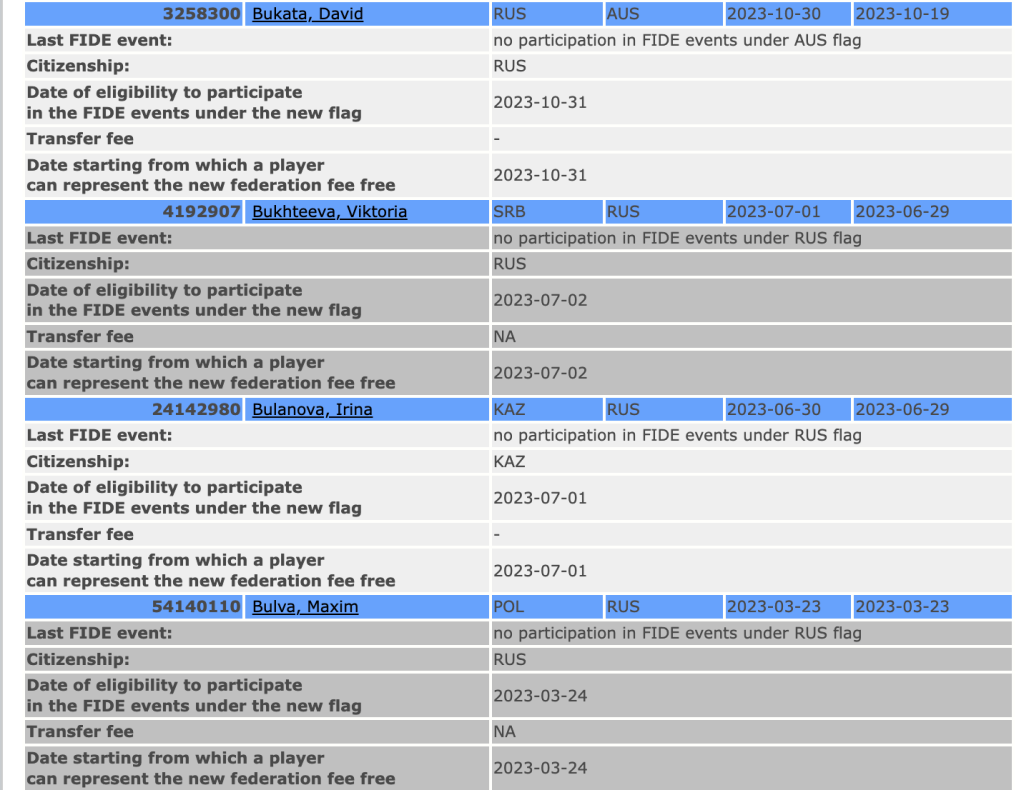

Former Russian deputy prime minister Arkady Dvorkovich is FIDE’s current president.

Arkady Vladimirovich Dvorkovich (Russian: Арка́дий Влади́мирович Дворко́вич; born 26 March 1972) is a Russian politician and economist, currently chairman of the International Chess Federation, FIDE. He was Deputy Prime Minister in Dmitry Medvedev’s Cabinet from 21 May 2012 until 7 May 2018. He was previously an Assistant to the President of the Russian Federation from May 2008 to May 2012. He has the federal state civilian service rank of 1st class Active State Councillor of the Russian Federation.

Dvorkovich was considered to be a close confidant of Dmitry Medvedev and an important figure in Russian politics. He rose to prominence during Medvedev’s presidency but has suffered from the resurgence of Igor Sechin. From 2018 to 2022 he was the Chairman of Skolkovo Foundation. Since 2015, he is also the Chairman of the Board of the Directors in Russian Railways company.

[…]

In March 2022, Dvorkovich condemned Russia’s invasion of Ukraine, saying that “Wars are the worst things one might face in life…including this war. My thoughts are with Ukrainian civilians.” Andrey Turchak, a lawmaker from Putin’s United Russia party, condemned Dvorkovich’s anti-war stance and called for his “immediate dismissal in disgrace,” saying: “This is nothing but the very national betrayal, the behavior of the fifth column, which the president [Putin] spoke about today.” Later Dvorkovich said on the website of the Skolkovo Foundation that he was “sincerely proud of the courage of our (Russian) soldiers” and that Russia had been targeted by “harsh and senseless sanctions.”

In August 2022, he was re-elected for a second term as FIDE president receiving 157 votes as against 16 by his rival Andrey Baryshpolets.

Source: Wikipedia

Pickleball, Octopus, Political Prisoner, Putin, Prigozhin, Pretty Girls


The Hustle, “The Economics of Pickleball and the Sport’s Sound Problems”

MBARI, “Scientists solve mystery of why thousands of octopus migrate to deep-sea thermal springs”

Sergei Okrushko

Solidarity Zone has begun supporting Sergei Okrushko

On July 28, an explosion occurred at the Kuibyshev Oil Refinery in Samara. The same day, 42-year-old Sergei Okrushko, who was born in Ukraine and worked as an electrician at the refinery, was detained at the border with Kazakhstan whilst trying to leave Russia. The FSB charged him with “sabotage” (per Article 281 of the Russian Federal Criminal Code of the Russian Federation “Sabotage”, and a court in Samara remanded him in custody to a pretrial detention center.

Okrushko confessed, and at his bail hearing he said that he held anti-war views and committed the action for political reasons.

It also transpired that Okrushko had earlier tried to enter Ukraine, but he was not admitted because of his Russian passport. During his stay in Moldova, he had repeatedly participated in anti-war protests.

No one was injured during the explosion at the refinery. According to the investigation, more than 30 million rubles in physical damage was caused, however.

The Kuibyshev Oil Refinery is the largest enterprise in the Samara Region, processing about seven million tons of oil per year. The plant specializes in the production of fuel for all types of transport from automobiles to ships.

On August 3, Okrushko refused the services of Solidarity Zone-affiliated lawyer Zakhar Lebedev, whom he had agreed to let defend him two days earlier. While Okrushko was writing the waiver of counsel, the lawyer noticed fresh injuries on Okrushko’s body: “I noticed that his left arm, namely most of his shoulder and forearm, was purple. It was clear that these were hematomas, which hadn’t been there on August 1 when I visited him at the pretrial detention center. When I asked Sergei where he had got such bruises, he said, without hesitating, “When they arrested me.” When I asked why they had not been there when I’d visited him at the pretrial detention center, Sergei hesitantly said that they’d shown up only now.”

We believe that the fresh bruises and his sudden and unmotivated waiver of counsel testify to the fact that Sergei Okrushko was tortured between August 1 and August 3.

Subsequently, the authorities stopped admitting any lawyers into the pretrial detention center, except for the court-appointed lawyer Vyacheslav Pavelkin. Later, it transpired that Okrushko was taken to the FSB several times without a lawyer.

Unfortunately, at this stage we have been unable to provide Sergei with defense counsel. But at the very outset of his ordeal, we sent him a care package and books, placed an order at the online Federal Penitentiary Service store, and transferred money to his personal account at the pretrial detention center. We recently learned that Sergei received all these things, which means that we were able to provide him with at least minimal humanitarian support. In the coming days, we will put together another care package for Sergei and continue to support him as much as possible.

Solidarity Zone’s mission is to support people imprisoned for anti-war direct-action protests and not let them face the system alone. We cannot always provide full-fledged support due to interference from the security forces, but we consider any reduction in the harm caused by the actions of the Russian state to be a decent outcome.

If you want to support us, you can find our details here.

💌📦 Address for letters and parcels:

Okrushko Sergei Aleksandrovich (born 01.03.1981)
22 Sadovyi proyezd, SIZO-1
Samara 443021 Russian Federation

You can also send letters via Zonatelecom.

#politicalprisoners #ukrainians #crackdown #torture #fsb #fsblawlessness #solidarity #nowar #wewriteletters #samara

Source: Solidarity Zone (Facebook), 24 August 2023. Translated by the Russian Reader. People living outside of Russia will find it difficult or impossible to send letters to Russian prisons via Zonatelecom or regular mail. In many cases, however, you can send letters (which must be written in Russian or translated into Russian) via the free, volunteer-run service RosUznik. Mr. Okrushko has not yet appeared on their list of supported addressees, however. You can write to me (avvakum@pm.me) for assistance and advice in sending letters to her and other Russian political prisoners.


Putin


Prigozhin


Recommended for ages 16 and up. This production contains sexually suggestive language, references to suicide, and depictions of drug use, extreme physical violence towards humans and animals, and self harm. This production also contains the use of herbal cigarettes, haze, and a brief flash of light.

Make (Blank) Great Again

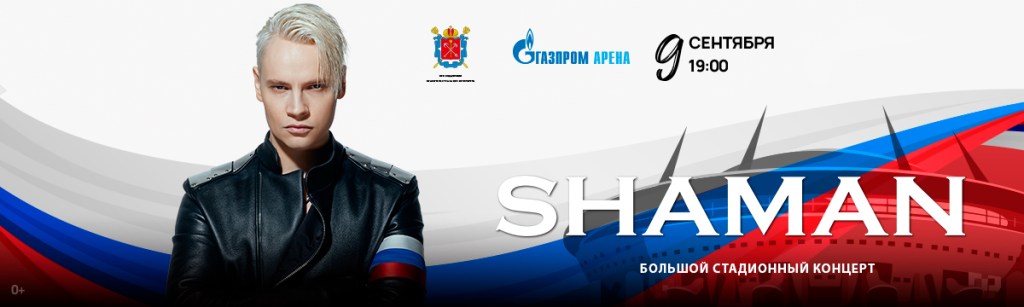
This ad for a “big stadium concert” by the Russian nationalist pop singer Shaman, scheduled for 7 p.m., September 9, at Petersburg’s Gazprom Arena, showed up this morning (for the second or third time in the last mont) in the weekly email newsletter I get from Bileter.ru, a Russian online retail ticket vendor. The aesthetic here is both strikingly fascistic/nationalistic and pointedly un-Russian. I would say it’s almost American in its inspiration, if I didn’t know better. ||| TRR


This showed up in my mailbox today too:

За последние две недели в редакции произошли изменения. У нас теперь новый руководитель редакции, а потому скоро вы ощутите изменения, которые make Inc. great again.

Here’s my translation:

There have been changes to [our] editorial board over the past two weeks. We have a new editorial director now, and so you will soon feel the changes that [will?] make Inc. great again.

These days, all “progressive” Russians are fluent in English, supposedly, and this is often how they signal their “progressive” values to each other: by shouting out their true reactionary colors in Rusglish.

In this case, the progressive reactionaries hale from Inc. Russia, “a magazine for entrepreneurs [that] focuses on small and medium-sized businesses, advanced technologies, and the people behind it all.” Founded in the US in 1979, the Russian edition has been in existence since 2016.

The passage that I quoted and translated, above, led off Inc. Russia‘s weekly email newsletter.

Immediately after Russia’s brutal, unprovoked invasion of Ukraine, the Russian Inc.ers were openly dismayed by the sudden turn of events in their otherwise entrepreneurially progressive country—without, however, ever going so far as to oppose the war explicitly. This dismay and confusion gradually and visibly diminished as the war continued. Now, apparently, Inc. Russia has come full circle: they are determined to show that they and their readers live in nearly the best of all possible entrepreneurial worlds. They’ve definitively stopped paying any mind to their country’s breakneck plunge into fascism, much less to the war itself.

And yet the new realities occasionally puncture Russian Inc.‘s otherwise now-placid surface, as in this news item published on their website earlier today:

English to become optional in the subway

It may become option to duplicate information in subways in English. The Transport Ministry has published a law bill addressing the matter. The Moscow subway stopped duplicating [station] names back in 2021, while Nizhny Novgorod and Kazan do not plan to give up English until instructions are received.

As reported by Kommersant, the Transport Ministry has published a draft law on amendments to the orders regulating the “standard rules” for the use of subways, monorails, funiculars, and suspended cable cars.

Carriers are currently required to duplicate all information on diagrams, signs, inscriptions, and station announcements in English. The Transport Ministry proposes doing away with this obligation, leaving the decision to the regions.

The proposal was prompted by “numerous appeals from citizens and [regional governments], due to the considerable informational burden on passengers and taking into account the socio-political situation.”

Moscow’s Metro, Central Circle, and Monorail stopped announcing stations in English back in 2021, after a drop in the number of tourists due to the pandemic and “passenger complaints about additional information.”

Oleg Yaushev, director of the Nizhny Novgorod Metro, said that none of the city’s residents had complained about the English dubbing in the city’s subway, so the company does not plan to remove it.

“We installed this information system relatively recently and spent a lot of money on it. Why remove it now? Tourists who are native English speakers travel to the city. The language is widely spoken, and we welcome them. Of course, if there is a directive to remove everything and leave it only in Russian, we will comply. But it’s not worth freaking out about it,” he said.

Kazan’s Metroelectrotrans also expressed its willingness to execute the order, “if it is issued.” However, local residents there have also not petitioned the company to cancel the dubbing of station names in English.

Source: Inc. (Russia), 14 August 2023. Translated by the Russian Reader


Russian streaming service Amediateka (thanks to the good offices of sanctions busters HBO) keeps its viewers comfortably ensconced in an alternate reality dominated by the Great Satan’s pop culture:

The second season of the sports series “Winning Time: The Rise of the Lakers Dynasty” recounts the period between 1980 and 1984. It deals with the rivalry with the Boston Celtics, as well as with the personal lives of the players, which prove no less emotional and striking than their play on the court. Jerry Buss wants to get his sons involved in working with the Lakers, Magic Johnson learns to be a good father, and Larry Bird plunges into family squabbles. Won’t this prevent the lads from becoming NBA champions?

Source: Amediateka email newsletter, 14 August 2023. Translated by the Russian Reader


Finally, here is yet another reflection of the Russian petite bourgeoisie’s (and, hence, Russian officialdom’s) peculiar love-hate, cargo-cultish relationship with the “collective west” (i.e., the United States) and the English language.

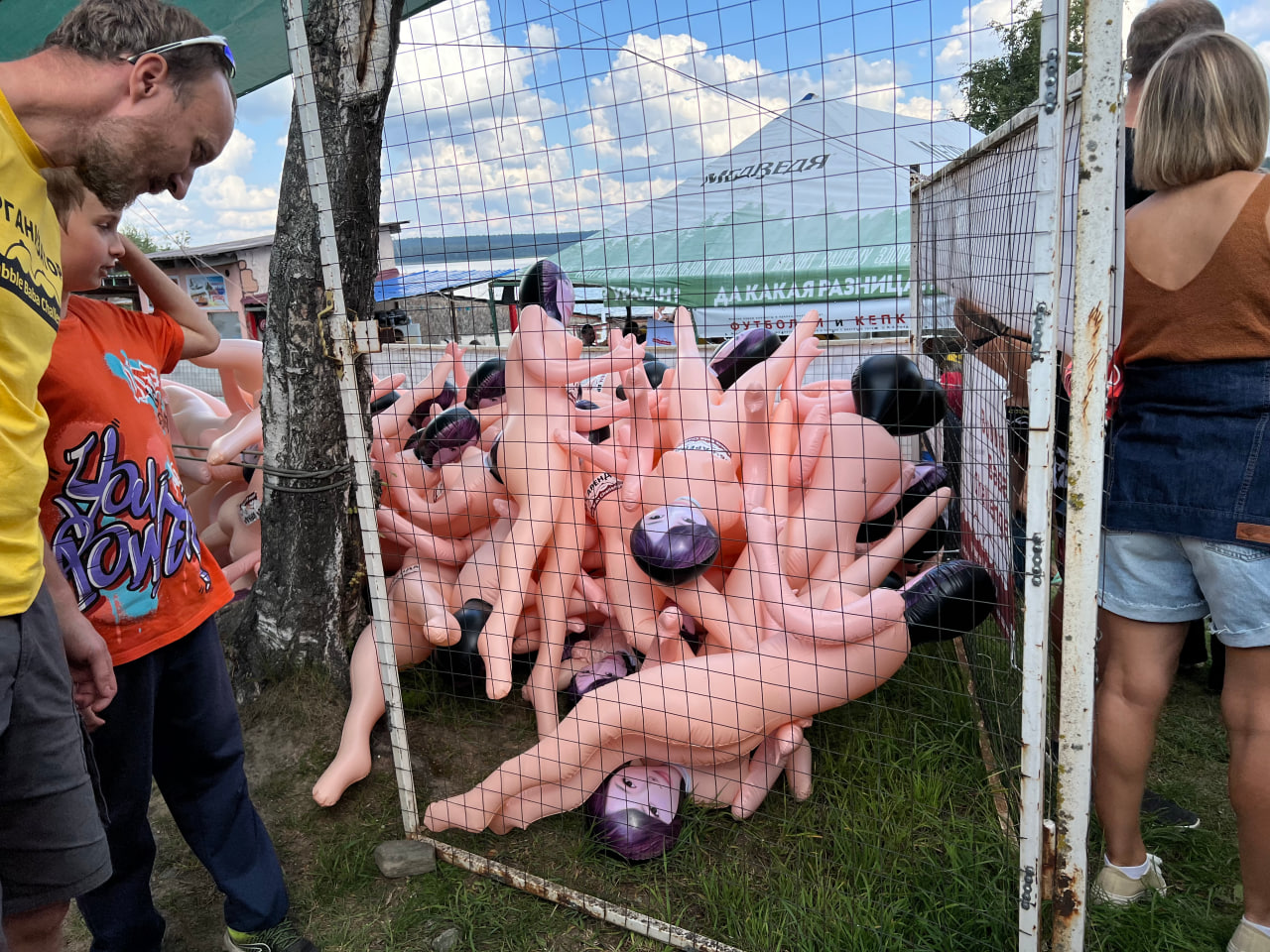
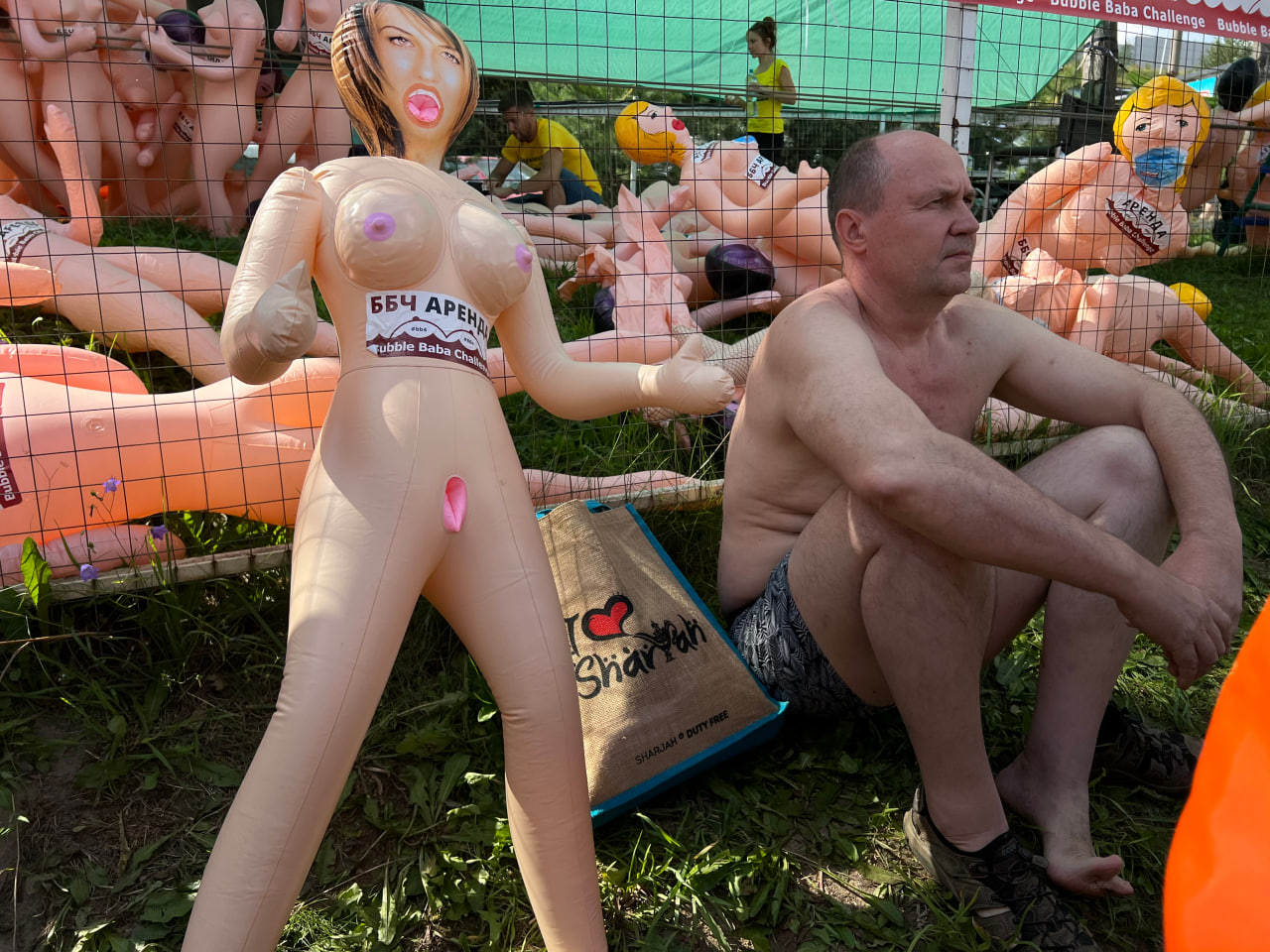
This past weekend, reports Bumaga, local sporting enthusiasts took part in the Bubble Baba Challenge — 2023 [sic, in English], “an event held in the rapids of [the] Vuoksi River whereby contestants race in the water using sex dolls as flotation devices.” The event took place in Kiviniemi, aka Losevo, in the occupied Karelian Isthmus, approximately 60 miles north of Petersburg.

Photos by Pavel Daisi for Bumaga (@paperpaper_ru)

Best Russian Brand

Yevgeny Prigozhin. Photo: Yuri Martyanov/Kommersant

Russian businessman, owner of the Concord Group of companies, “Putin’s chef” and confidant of the president, founder of a media empire and the Wagner Group, and one of the most famous people in Russia, Yevgeny Prigozhin now faces criminal charges of organizing an armed rebellion.

Prigozhin was born in Leningrad on 1 June 1961. We know that his mother, Violetta, worked at a hospital, his father died early, and his stepfather Samuel Zharkoy raised the future “Kremlin chef.” Zharkoy also encouraged Prigozhin to ski: his stepson graduated from Athletics Boarding School No. 62, where the swimmer Vladimir Salnikov and the gymnast Alexander Dityatin were his classmates. Prigozhin then enrolled at the Leningrad Chemical and Pharmaceutical Institute, but, according to his own account, he did not finish his degree there.

In 1979, the entrepreneur was given a suspended sentence on robbery charges. According to media reports, in 1981 he was sentenced by the Zhdanov District Court to twelve years in prison for a number of crimes at once, but in 1988 he was pardoned, and in 1990 he was released from prison early.

Beginnings

As Prigozhin himself recounted in an interview, his first business, founded in 1990, was selling hot dogs at the Apraksin Dvor market, the first such outlet in the city. “The mustard was mixed in my apartment, in the kitchen. My mother also tallied the proceeds there. I earned $1,000 a month, and that amounted to piles of rubles,” the businessman said.

In the 1990s, Prigozhin managed Kontrast, a chain of private grocery stores. He launched his future restaurant business in 1995 by opening Wine Club, a bar and shop on Vasilyevsky Island. In late 1996, after meeting the Briton Tony Gere, Prigozhin opened the Old Customs House, which is considered one of the first elite restaurants in Petersburg. According to some reports, his partner in this business venture was Mikhail Mirilashvili, a well-known Petersburg entrepreneur who years later cofounded the VKontakte social media network.

Prigozhin later opened three more establishments: Seven Forty, Stroganov Yard, and Russian Kitsch. In 1998, he opened the restaurant New Island on the used passenger ship Moscow-177, purchased for fifty thousand dollars, which became a popular spot in Petersburg. When Prime Minister Sergei Stepashin and IMF managing director Michel Camdessus visited the city in June 1999, New Island was the only decent place to wine and dine the high-ranking guests.

In 2001, Vladimir Putin dined there with Jacques Chirac, and a year later with George Bush. In 2003, according to media reports, the Russian president celebrated his birthday there. Since the businessman personally served dishes to the president, he was dubbed “Putin’s chef” and “the Kremlin’s chef.”

By that time, Prigozhin had already moved into the catering business, founding Concord Catering in 1995. In 2002, he launched the Damn!Donalds chain of fast food restaurants: the businessman came up with the name himself. The chain was shuttered ten years later, however.

As the businessman recounted in an interview about the success of his catering business, by 2005 he owned “the largest catering company in Russia for ten years running.” “We did all the G8s and the summits,” Prigozhin recalled. From information available in open sources, it follows that the businessman actually did organize a number of banquets for high-ranking guests, including meals at the Russian Federal House of Government.

Buoyed by this success, Prigozhin decided to enter the school meals market. “I decided to try my hand at it and chose a couple of schools on Vasilyevsky Island — No. 10 and No. 18. Of course, it wasn’t a business. I began feeding the schoolchildren airtight-packaged box meals. I set up modern compact kitchens right in the schools — everything fit in a six-square-meter space. At the same time, I carefully researched the topic.”

In the 2000s, Prigozhin went into the construction business. In particular, he built Northern Versailles, a gated mansion community, in Petersburg’s Lakhta district. In 2016, a company belonging to the businessman built the Lahta Plaza [apartment and hotel] complex next to St. Petersburg Tricentennial Park.

In 2016, it transpired that a Prigozhin-affiliated company bought the premises of the Shop of Merchants Yeliseyev, which he had occupied on lease since 2010, after making expensive renovations. By 2015, Prigozhin’s companies had become the largest supplier of food to the Defense Ministry.

In 2018, Vladimir Putin said in an interview with western media, “He is not my friend. I know such a person, but he is not on my list of friends.”

Media Empire

In 2013, it was reported that the Internet Research Agency, which was informally dubbed the “troll factory,” was located on Savushkin Street in Petersburg. Hundreds of people worked on the media holding’s websites. Prigozhin’s connection with the growing media empire was denied by Concord’s press service.

2019 saw the emergence of the Patriot Media Group, which included the Federal News Agency (FAN), Economy Today, Politics Today, and Nation News. Yevgeny Prigozhin headed its board of trustees, but the businessman’s financial involvement in the project was denied.

Western sanctions against Prigozhin were imposed for the first time over the involvement of his media outlets in the information campaign [sic] for the US presidential election.

Wagner

The Wagner Group, a private military company, was founded in 2014. Subsequently, Wagner soldiers were involved in fighting in eastern Ukraine and, later, in Syria. In 2017, the company was placed on the US sanctions list. But [Prigozhin] admitted his involvement in founding Wagner only in 2022. Western countries have claimed that Wagner mercenaries have also operated in Libya, the Central African Republic, Sudan, Mozambique, and Mali.

SMO

Since 24 February 2022 and the beginning of the SMO, Prigozhin gained worldwide fame in connection with the Wagner Group’s actions in Ukraine. Wagner’s troops have been heavily involved in the fighting. Mercenaries recruited among convicts have been actively joining the ranks of Wagner PMC. In March, the businessman claimed that over 5,000 ex-convicts had returned to Russia after participating in combat.

The conflict between the Defense Ministry and Prigozhin rapidly deteriorated in 2022, although friction between the two parties had essentially begun several years earlier.

A year later, in February 2023, Prigozhin publicly voiced dissatisfaction with the lack of ammunition during the battles for Bakhmut (Artemovsk). A campaign entitled #GiveWagnerShells gained momentum on the internet.

On May 10, the businessman, amid rumors of a “shell famine,” publicly announced his willingness to transfer Wagner’s positions in Bakhmut to Chechnya’s Akhmat Regiment at the suggestion of Chechen ruler Ramzan Kadyrov. On May 20, the businessman said that Wagner had taken Bakhmut, and once again made highly critical remarks about the Defense Ministry. Five days later, Prigozhin announced that he was withdrawing his units from the city.

In June 2023, the businessman asked Defense Minister Sergei Shoigu to release the Concord Group from its catering contract in the SMO zone after more than sixteen years of successful cooperation with the Russian military’s kitchens.

Moreover, Prigozhin said that an order that members of volunteer detachments must sign contracts with the Defense Ministry did not apply to the Wagner Group.

Then came June 23. Wagner’s founder made new public statements, triggering criminal charges against him. If convicted, Prigozhin faces up to twenty years in prison.

Source: Irina Kurbat, “Who is Yevgeny Prigozhin?” Fontanka.ru, 24 June 2023. Translated by the Russian Reader


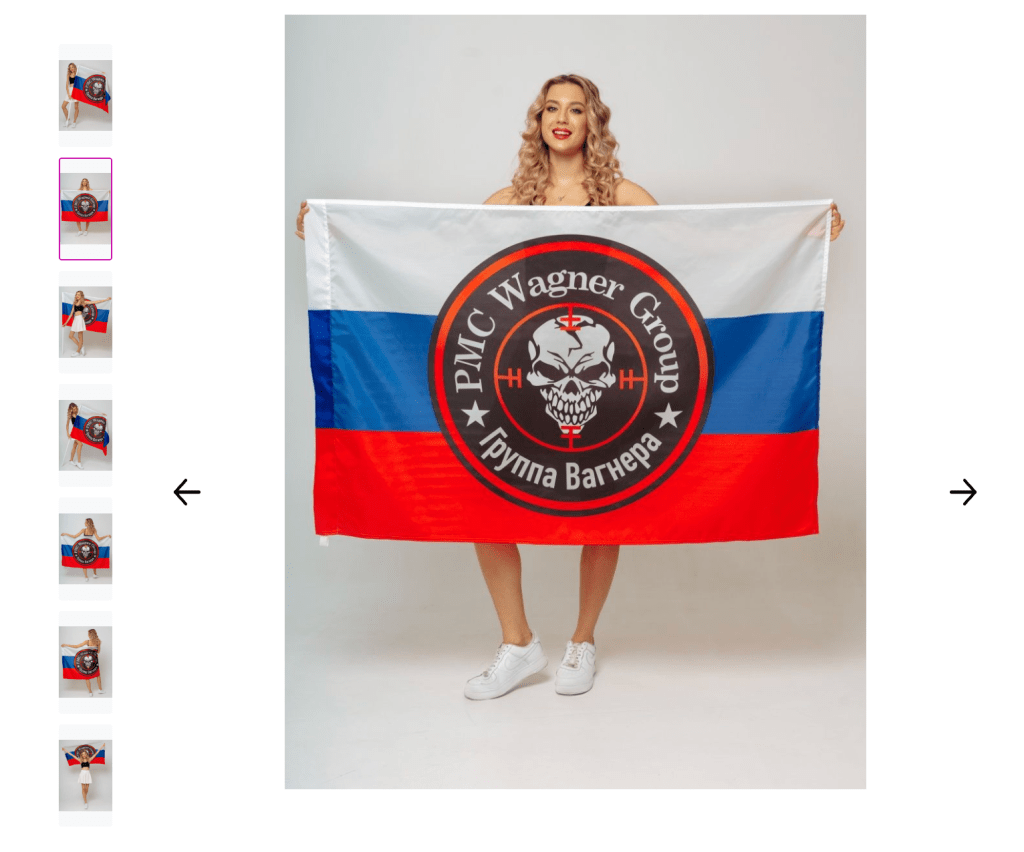
Goods bearing the emblems of the Wagner Group (including chevrons, flags, t-shirts, baseball caps, and sewn-on patches) have been brought back to the “counters” at Wildberries, as our correspondent verified on the evening of June 24.

In the first half of the day, a source at Wildberries told RIA Novosti that the online retailer had bearing removing goods bearing the [private military] company’s emblems and was going to remove them altogether. Later, such goods were hidden by Ozon, where they are still unavailable.

Source: “Wildberries brings back Wagner-branded goods,” Fontanka.ru, 24 June 2024. Translated by the Russian Reader

A search for the phrase “Wagner PMC” on the website of popular Russian online retailer Wildberries garnered 8,736 items, including the fetchingly reimagined Russian tricolor flag, below. This search was performed at 11 p.m. Moscow time on 24 June 2023.

Zenit FC midfielder Wendel has decided not to return to Petersburg due to the situation with the Wagner PMC, reports Sport Express, citing the player’s agent Cesare Barbieri.

“This is definitely a very delicate situation. Wendel will stay in Brazil until the situation improves. The club has already been notified of this. Zenit has reacted understandingly to the situation,” the agent said.

In the 2022–2023 season, 25-year-old Wendel has played twenty-five matches for Zenit in the Russian Premier League, scoring eight goals.

Source: “Zenit football player Wendel afraid to return to Russia,” Fontanka.ru, 24 June 2023. Translated by the Russian Reader

A Little Song about the Physicist Sakharov


A statue of Soviet dissident Andrei Sakharov was unveiled Monday in St. Petersburg, despite criticism from his widow who said today’s Russia has failed her husband.

The 10 1/2-foot bronze statue depicts the Nobel peace laureate, slightly stooped but with his head held high, standing with hands tied behind his back atop a stone pedestal on a square that was named after him in 1996.

The monument by sculptor Levon Lazarev’s was unveiled a few weeks after a city commission in Moscow gave the green light to a stalled plan for another statue of Sakharov in the capital.

Yelena Bonner was opposed to both statues, saying Russia has failed to live up to Sakharov’s ideals of freedom and democracy since the 1991 collapse of the Soviet Union.

“It is out of place to erect a monument to Sakharov in today’s Russia,″ the Interfax news agency quoted Bonner as saying. She said she was not consulted.

“There’s no money to publish his works widely, so that people would finally read them, but they can put up a monument,″ Bonner told Russia’s TVS television by phone from Boston, where she lives.

The unveiling drew about 100 people, among them intellectuals and former dissidents who supported a transition to democracy at the time of the Soviet collapse.

A physicist who helped design the Soviet hydrogen bomb, Sakharov became a staunch promoter of human rights and world peace, and spent seven years in internal exile for speaking out. He won the Nobel Peace Prize in 1975.

Source: “Monument to Sakharov Unveiled in Russia,” Associated Press, 5 May 2003


A Little Song about the Physicist Sakharov

The physicist Sakharov
Was one bad dude.
Oh, how he made us seethe!
Why do we suffer that fool?

It later suddenly transpired
That he was a real good cat.
We felt sorry for the poor man
And guiltily ate our hats.

Now it’s been ascertained
That he was bad news after all.
We’re seething once again.
Why did we suffer that fool?

If again it turns out
That he was, in fact, a good egg,
Ah, we'll regret it again,
And put on guilty mugs.

8 August 2022

Source: German Lukomnikov, “New Poems,” Volga 1 (2023). Thanks to ES for the suggestion. Translated by the Russian Reader

Russian prosecutors on Monday declared as “undesirable” the U.S.-based foundation that preserves the legacy of Nobel Peace Prize winner Andrei Sakharov as Moscow continues to crack down on dissent in the wake of Russia’s invasion of Ukraine.

The activities of the Andrei Sakharov Foundation (ASF) “constitute a threat to the foundation of Russia’s constitutional order and security,” the Prosecutor General’s Office said in a statement.

Under Russian law, individuals believed to have cooperated with an “undesirable” international NGO face steep fines and jail terms.

ASF, based in Springfield, Virginia outside Washington, says its goal is to promote Sakharov’s works to “support peace efforts and anti-war events.”

The organization chaired by mathematician Alexei Semyonov has not yet commented on Russia’s latest designation.

Russian authorities have declared more than 70 organizations — including media outlets focused on exposing fraud and corruption in Russia — “undesirable” between mid-2015 and early 2023.

Sakharov, once feted as a hero of the Soviet defense industry for his role in developing the Soviet nuclear bomb, became one of the U.S.S.R.’s most prominent dissidents from the late 1960s. 

He received the Nobel Peace Prize in 1975 for his work against the nuclear arms race he had helped precipitate, though he was not permitted to leave the Soviet Union to accept the award.

Sakharov became one of the most distinctive personalities of the perestroika era, rising to the status of a national moral authority.

Arrested in 1980 after denouncing the Soviet war in Afghanistan, Sakharov was sent into internal exile in the city of Nizhny Novgorod, then closed to foreigners.

After six years in exile, during which he undertook several hunger strikes, Sakharov was released over a telephone call by reformist Soviet leader Mikhail Gorbachev.

Source: “Russia Labels U.S.-Based Sakharov Foundation ‘Undesirable,’” Moscow Times, 24 January 2023

“Monkey”

Ailama Cesé Montalvo. Photo courtesy of the Lokomotiv Volleyball Club’s press service

Andrei Voronkov, the coach of the volleyball club Lokomotiv Kaliningrad, called a player on the competing team a “monkey” during Lokomotiv’s championship final match against Uralochka-NTMK. His remark has sparked a scandal, with the sports community demanding that the winning club’s skipper at least apologize.

On May 12, during a timeout in the decisive match, Voronkov chastised his players for losing the initiative and getting behind in the score. He turned to blocker Valeria Zaitseva and shouted, “Why are you trying to catch that monkey again?” Viewers of the match’s broadcast thought that the coach had directed his remark at Uralochka’s Cuban striker Ailama Cesé Montalvo, who is an important part of the Sverdlovsk team’s offensive line.

A screenshot of a video of the scandalous conversation between Coach Voronkov and player Valeria Zaitseva, as posted on Uralochka’s VK page. You can listen to Voronkov’s “pep talk” there. He does indeed audibly say what he is accused of saying.

In conversation with E1.ru, Uralochka-NTMK CEO Valentina Ogiyenko stressed that the insult could not be put down to the emotionally charged atmosphere during the Super League’s decisive match. She is sure that public apologies and the volleyball federation’s reaction will help to remedy the situation.

“Emotions are no excuse. Nikolay Vasilyevich Karpol worked [as Uralochka’s coach] for many years, but he never did such a thing, although there were much more serious and emotional matches in his career. Even at the Olympics, I have never heard such a thing from any coach. But we have three coaches in our country who excel at this behavior. […] I think that Andrei Voronkov should make a public apology in the same format as the insult was inflicted. […] He should not call Ailama and whisper ‘Sorry, dear’ in her ear. [His apology] should be broadcast on a national TV channel,” Ogiyenko said.

Uralochka’s press service also stated that the club expects an apology from the Lokomotiv coach. And the disciplinary commission, which monitors unsportsmanlike behavior during the championship, should put the matter to rest, reports Sports.ru.

Sports commentator Dmitry Guberniev has been the most categorical of all. On his Telegram channel, he called Andrei Voronkov a “racist” and a “disgrace,” saying that the Lokomotiv coach should be demonstratively banned from the profession.

The general director of the Kaliningrad team, Alexander Kosyrkov, has not yet evaluated the incident in any way.

“This is the first time I’ve ever heard about it. I was sitting in the stands and didn’t hear the break. I didn’t see that moment at all. I’m not up to reviewing videos and anything else right now. I’m not going to review the match yet. I’m a little bit not up to it now,” he told the newspaper Sport Ekpress.

Uralochka missed winning the heavily fought five-set match only on the tie-break. For the first time in six years, the team took second place in the Russian Volleyball Championship. But the Cuban athlete Ailama Montalvo will leave the team: the Ural climate does not suit her. She will continue her career at another club.

Source: “Opposing coach called Uralochka volleyballer a ‘monkey’, sports community demands punishment,” Vse novosti, 13 May 2022. Translated by the Russian Reader


How a Russian Hacker Ended the White Sands Pupfish

How a Russian Hacker Ended the White Sands Pupfish

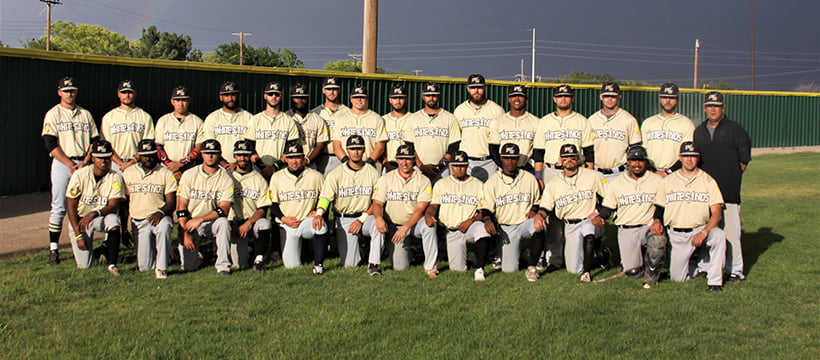
8/23/2021 – Alamogordo Daily News Article – The White Sands Pupfish were known as Pecos League Team number one. On the Pecos League’s digital platform the original team numbers were White Sands #1, Las Cruces #2, Roswell #3, Alpine #4. The Pupfish played in Alamogordo, and Alamogordo was the first city to sign a lease to host a Pecos League Team. Matt McNeile’s efforts were remarkable and the Pupfish were born. Many people ask to this day why are the Pupfish no longer in the Pecos League?

The Pupfish have deep history playing the entire decade from 2011-2019. Despite never qualifying for the Pecos League playoffs after 2011 the Pupfish produced players that would go on to play in the Major Leagues. Chris Smith reached the MLB with the Toronto Blue Jays and Yermin Mercedes reached the MLB with the Chicago White Sox. Mercedes was the most popular player to ever play in the Pecos League with his huge early success with the White Sox.

Things changed for the City of Alamogordo during the 2018. An Alamogordo city employee received an email request to change banking information from someone who appeared to be a Cooperative Education Services (CES) representative. CES is a New Mexico purchasing cooperative. The email appeared to come from a person known to work for CES. The email contained an outdated version of the CES logo. The city accepted the change in banking information and paid all the CES invoices, only to discover that the email was fraudulent. The city paid the invoice in the amount of $250,000. The City believed they would recover the money.

The City was already facing budget cuts and coupled with this loss, things would change for organizations like the Pupfish. Alamogordo never recovered the money, so the City decided to restructure the terms of many of their programs including the Pupfish deal in Alamogordo. In the new deal the Pupfish would be responsible for paying a ballpark lease, making all improvements, maintenance and repairs to the ballparks while the City would keep all revenue from alcohol sales. This deal went into effect in the 2019 season.

Matt Chambers the 2019 Field Manager of the Pupfish stated “This is a real simple deal, The City of Alamogordo makes profit off of the Pupfish Beer Sales, while the Pupfish are liable for all repairs and expenses associated with the team. The Pupfish are left with whatever ticket sales and sponsorships are left. It is very tough to get sponsorship dollars in Alamogordo. I don’t see how this deal will work compared to other Pecos League Cities.”

In 2021 the Mountain Division South of the Pecos League saw the Santa Fe Fuego, Roswell Invaders, Alpine Cowboys and Tucson Saguaros. Without the Pupfish it made things tougher on travel. Moving Santa Fe into the South it broke up traditional rivals Santa Fe and Trinidad.

Source: Pecos League, via Pecos League Facebook page, 24 February 2022. Photo courtesy of White Sands Pupfish Facebook page

The Scarlet Flower

The musical on ice The Scarlet Flower is not only a colorful performance, but also a socially significant project. The show’s mission is to play a significant role in educating the younger generation and fostering a sense of patriotism through a combination of music and sports. “Of course, our musical on ice encourages young people to be more interested in their native literature. The Scarlet Flower and its Western European counterpart Beauty and the Beast have a lot in common and no less important differences. Our task is to make a show that no one else has done in terms of its scope and beauty, and to prove to the whole world that our work is much more colorful, more interesting, deeper, more romantic and brighter,” said Tatiana Navka.

Source: Bileter.ru. Translated by the Russian Reader

From 2014 to 2015, [Tatiana] Navka was the beneficiary of Carina Global Assets Ltd., an offshore company in the British Virgin Islands. In February 2019, questions were raised over Navka and her husband’s wealth following reports about their ownership of multiple properties in the Moscow region. An investigation by The Guardian suggested that Navka may have underreported income, claimed married status for several years after her divorce from Zhulin, and falsely told the IRS that she had sold a house.

In 2016, Navka caused controversy when she and her dancing partner, Andrei Burkovsky, appeared in the Russian version of Dancing on Ice dressed as Holocaust concentration camp prisoners.

In 2021, Tatiana Navka made and published homophobic comments to Spanish gymnast Cristofer Benítez. Through her social networks, she said that rhythmic gymnastics gymnastics was a “feminine sport,” and that she is glad that in her country men are not allowed to participate in rhythmic gymnastics “and hopefully never will.”

Source: Wikipedia