“Give Birth Yourself!”

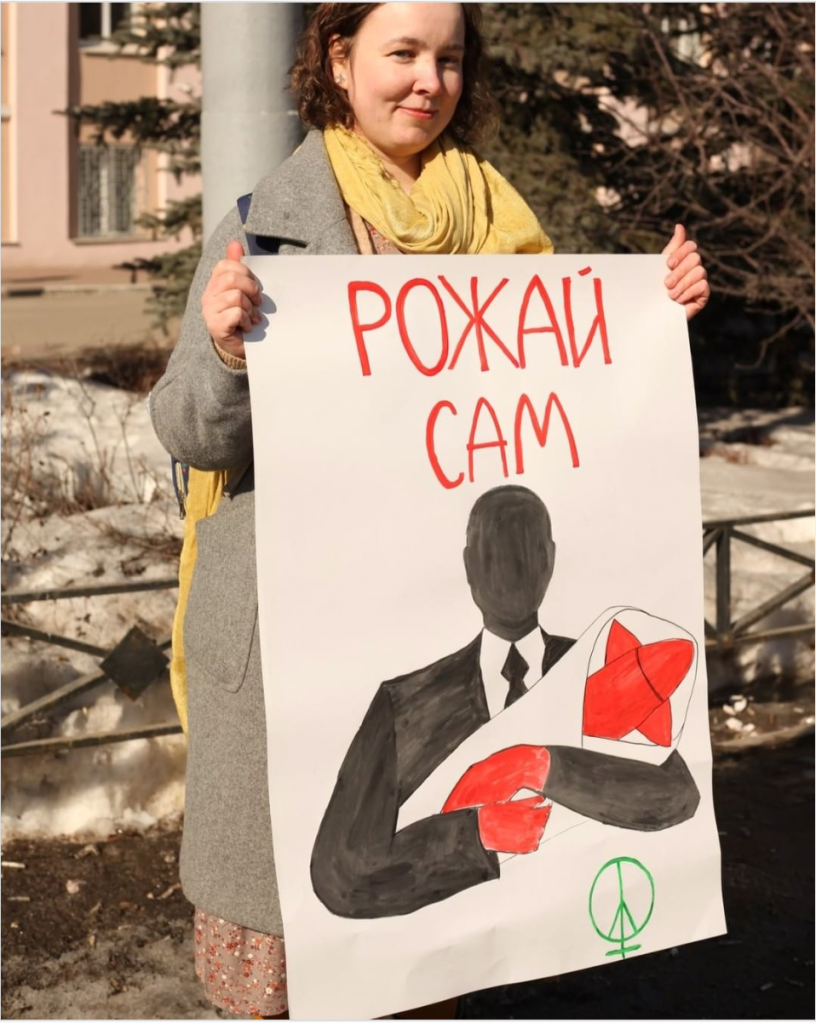
Maria Petrovskaya holding a placard that reads “Give birth yourself” in Nizhny Novgorod. Courtesy of Radio Svoboda’s Instagram page

The crackdown against Russians who oppose the war with Ukraine continues. Two new articles in the administrative offenses code and the criminal code — Articles 20.3.3 and 280.3, i.e., making it a crime to “discredit the Armed Forces” — have been specially adopted to punish those who call the war a war. But they have been enforced by the courts and the security forces in a such a way that grounds can be found in anything — a placard reading “Fascism will not pass,” a placard containing an anti-war quote by Putin’s, leaflets containing the biblical commandment [“Thou shalt not kill”], asterisks instead of letters, the inscription “Two words” [i.e., “No war”] — for detaining and charging someone. Police in Nizhny Novgorod did not like placards that read “Mariupol. We remember, we grieve” and “Give birth yourself!”

A photo of a young woman holding a placard featuring a man in black cradling a bomb and the slogan “Give birth yourself!” gained fame far beyond Nizhny Novgorod in March. The woman in the photo was the school teacher and feminist Maria Petrovskaya. She had not been involved in public protests before. According to her, the war was her turning point.

“There is a certain last straw,” says Petrovskaya. “All my friends were on Bolotnaya Square, and then on Sakharov Avenue. [This is a reference to the “fair elections” protests in Moscow in 2012.] I endorsed their stance and supported them emotionally, and it was around that time that I began to get a little interested in politics. And yet, as long as it was about the pro-Putin clique’s political, territorial (e.g., Crimea), and financial ambitions, I was not so deeply worried about it. But war destroys and takes the lives of people on both sides. When it comes to the suffering of people, I can’t stand on the sidelines.”

The court hearing on the “Give birth yourself!” protest is still to be held, but the police charged Petrovskaya not with violating Article 20.3.3, but with the more familiar Article 20.2.5, i.e., “involvement in an unauthorized protest rally.” Law enforcement officers decided that Ilya Myaskovsky, who photographed Petrovskaya, was a full-fledged participant in the picket, which meant that it was no longer a solo picket, but a “mass” protest.

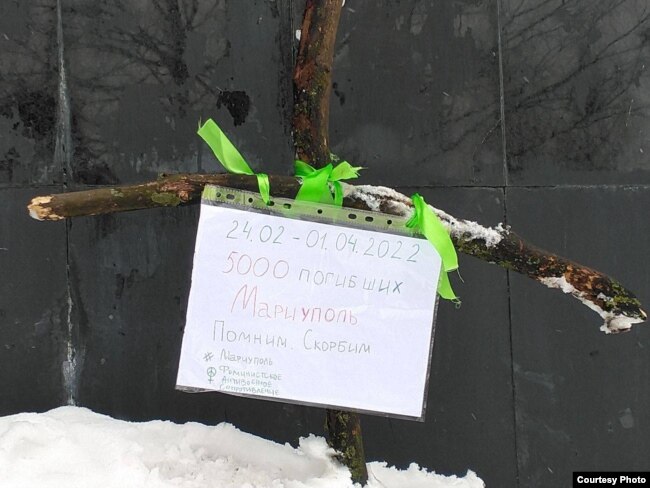
But last week, the Sormovo District Court in Nizhny Novgorod fined Petrovskaya and Myaskovsky for their involvement in another protest, in memory of the victims of Mariupol, under Article 20.3.3. Petrovskaya says that, as in the case of the “Give birth yourself!” protest, it was entirely a feminist protest that Myaskovsky had nothing to do with. He only photographed a homemade cross made of branches on which the message “5,000 killed. Mariupol. We remember, we grieve” had been hung.
Нижний Новгород, плакат в память о жертвах в Мариуполе
Maria Petrovskaya’s placard in memory of the victims of the Russian assault on Mariupol.
Photo courtesy of Radio Svoboda

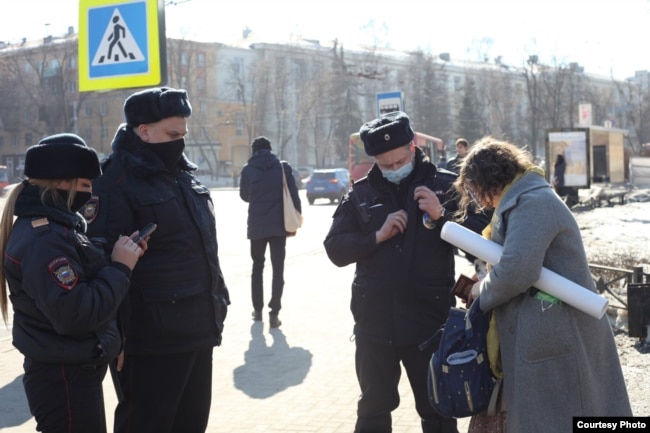
After the police took Petrovskaya to the precinct, Myaskovsky followed her in a jitney.

“For over an hour [Myaskovsky] hovered outside the doors to the police station, waiting for me. In the end, the inspector who was writing me up dragged him into the station as well. ‘To talk,’ as he said. Meaning that Ilya might not have been charged if he hadn’t chivalrously followed me.”

Petrovskaya and Myaskovsky were charged with “discrediting the Armed Forces.” But Sergei Kulikov, a lawyer from the Visor Project who represented them, says that in court even the policeman who wrote out the arrest sheet could not immediately explain how Kulikov’s clients had discredited the Armed Forces.

“‘Can we say exactly who this text targets?’ I asked the police officer [in court]. ‘No,’ he says. ‘Does this text contain a negative appraisal of the authorities?’ I asked him. ‘No,’ he says. Well, okay, I thought, let’s take the bull by the horns. ‘Does this text discredit the Armed Forces in any way?’ I asked him, and he repled, ‘No!” The police officer later realized that he had made a mistake, and asked to testify at the very end [of the hearing]. He said that in the context of everything that was happening, it discredited [the Armed Forces], of course! Who else was it about?” recalls Kulikov.

Both activists were fined: Myaskovsky, 30 thousand rubles [approx. 324 euros], and Petrovskaya, half that amount. The lawyer presented the court with written proof of Petrovskaya’s low salary at the remedial school where she teaches, and the judge decided to show leniency.

People at Petrovskaya’s workplace do not approve of her activism.

“After the “Give birth yourself!” placard went so vividly public, I was horrified to find that almost all my colleagues supported the war and had a positive take on what Putin was doing. They thought I was a disgrace to the school. The head teacher told me that her colleagues had been calling her all weekend, consoling her and asking her how I could have done such a thing. I was given a very long dressing-down, and so was the director, although he is already an elderly man. Everyone told me that I was throwing him and the [regional] education ministry under the bus, although it’s hard to see how I could have done that,” recounts Petrovskaya.
Нижний Новгород, задержание Марии Петровской
Police detaining Maria Petrovskaya in Nizhny Novgorod. Photo courtesy of Radio Svoboda

Kulikov argues that the police’s lack of preparedness helped his client avoid the charge of “discrediting the Armed Forces” in this case.

“They probably had not yet been instructed what to do with this article. They have been instructed now. I know this for sure because there are two cases in which even pro-government picketers have been charged under this article. So, I think our policemen are performance artists, too. They have been given an absurd tool, and they are raising the absurdity to the next level! It’s more like the law enforcement that the Soviet authorities practiced after the Revolution: ‘revolutionary legal awareness’!” says the lawyer.

“If they fined people who held up a blank piece of paper or a placard with three asterisks followed by five asterisks [thus suggesting the Russian phrase Net voine (‘no war’), which consists of a three-letter world and a five-letter word]… Or, for example, I saw an image of three bears and five bears drawn by a female artist, and she was fined, too. Toy bears in memory of dead children: yes, that discredits the army, of course,” says Petrovskaya.

Last week, city hall announced a competitive review of Nizhny Novgorod’s bomb shelters. The purpose of the review is to maintain the shelters “in constant readiness so that they can be used for their intended purpose.”

Source: Alexander Lugov, Radio Svoboda, 11 April 2022. Translated by the Russian Reader

Decolonization

There are fewer than 2,000 Tubalars, a Turkic nation in the Altai, but they have effectively been collectively declared a foreign agent with the banning of their national cultural public organization, the latest abuse of a little-notice people far from the center of Russia.

As Ilya Azar of Novaya gazeta reports, “the Russian authorities, the Church, private business and even scientific and technical progress have consistently deprived the Tubalars of the[ir] accustomed milieu, their health and their national-cultural autonomy.” Labelling them foreign agents is the logical next step (novayagazeta.ru/articles/2022/03/22/inoagent-komarik).

In a 12,000-word article about one of the least known peoples of the Russian Federation, Azar says that Moscow banned the organization which unites almost all Tubalars as a foreign agent because it accepted money from the World Wildlife Fund and from other foreign groups to protect the cedar trees and animals that are the basis of Tubalar life.

But the Russian journalist reports that many Tubalars assume the call for this action came from others in the Altai Republic because in their view no one in Moscow knows enough about or cares what happens to them. Consequently, someone local is to blame, although that person still unknown is relying on Russian laws to gain access to resources the Tubalars control.

One likely consequence of this action by the Russian justice ministry is that the continued presence of the Tubalars on the list of protected numerically small nationalities is at risk. Without the aid they have received as a result of being included on that list, the Tubalars face a bleak future.

Their language is already dying out, their national traditions are under attack, and outsiders, predominantly ethnic Russians are coming in. Thus, for them, being labelled foreign agents is a sign that the passing of a people who have lived in the Altai from time immemorial is rapidly approaching. 

Source: Window on Eurasia (Paul Goble), 30 March 2022


The inimitable Benjaminian magic of social media: a screenshot from this blog’s Twitter feed, 30 March 2022.
Sources: Olena Halushka and Anton Shekhovtsov

Neither Putin’s speech preceding the invasion (where he stated that the very idea of Ukrainian statehood was a fiction), nor the invasion itself are something new or unseen – they are merely the next steps in a long history of the Russian colonial perception of Ukraine and Ukrainian culture as a threat that has to be destroyed.

Regardless of this, there are still numerous voices, especially among the “westerners”, calling for the separation of Russian culture from what they call “Putin’s aggression”. One of the most illustrious examples of such shortsightedness is the open letter by PEN-Deutschland, which explicitly states that “the enemy is Putin, not Pushkin or Tolstoy”, and in regard to the calls for boycotting Russian culture notes that “іf we allow ourselves to be carried away by such reflexes, by generalizations and hostility against Russians, madness has triumphed, reason and humanity have lost”. Thus, not only does this statement infantilize the whole of Russian society and redirect the guilt of warmongering onto a single person, but also, on a larger scale, it seems to completely ignore the fact that precisely Pushkin and precisely Tolstoy – among many others – were vocal promoters of the Russian imperial myth and colonial wars.

The historical lack of understanding of Russian culture as imperial and colonial by nature, and of its bearers as people who belong to a privileged group, along with the firmly engraved perception of Russian culture being more important in comparison with the cultures of neighbouring countries has resulted in the current Western belief that the suffering of Ukrainians, killed by Russian artillery and bombing, are largely equal to the inconveniences of Russian civilians. Through this lens, both Ukrainians and Russians are equally considered to be the victims of Putin’s criminal regime. And thus we see a rise in Western emergency residencies and scholarships for artists and scholars from Ukraine AND Russia. We also see plenty of panel discussions on the ongoing war where Western organizers invite participants both from Ukraine and Russia.

Moreover, the responses to sanctions imposed on Russia and the calls for boycotting its culture more and more frequently come with accusations of discrimination, “russophobia”, and hatred. Thus, a reaction directly caused by military aggression becomes reframed as unprovoked hatred of an ethnic group.

In a new music video by the Russian band Leningrad, today’s position of Russians is compared to the position of Jews in Berlin in 1940. To illustrate this comparison, people in the video wear traditional Russian kosovorotkas with makeshift Stars of David attached to them. Such an interpretation is a blatant insult to the memory of the victims of the Shoah. Moreover, the rhetoric of the band discursively coincides with the manipulative methods of Russian propaganda.

Source: Lia Dostlieva and Andrii Dostliev, “Not all criticism is Russophobic: on decolonial approach to Russian culture,” Blok, 29 March 2022. Thanks to Alevtina Kakhidze for the heads-up.

“People Are to Blame”

Alexander Kynev: “A moment of patriotic joy. I don’t know if there is anything more bogus. Even the Young Pioneer line-ups of my childhood were more natural.”

The video Mr. Kynev has embedded on his Facebook page is entitled “Zapolarye Za Mir” — “The Arctic for Peace.” The activists identify themselves as “residents of the Murmansk Region” (and, indeed, are standing on a hill overlooking Murmansk itself.) In addition to the newfangled Russian “Z” swastika, the hoodies sported by the lead troika of “activists” are also emblazoned with the “We Don’t Abandon Our Own” slogan that featured heavily in Russia’s first invasion of Ukraine in 2014 and has been revived for the new invasion. ||| TRR

__________


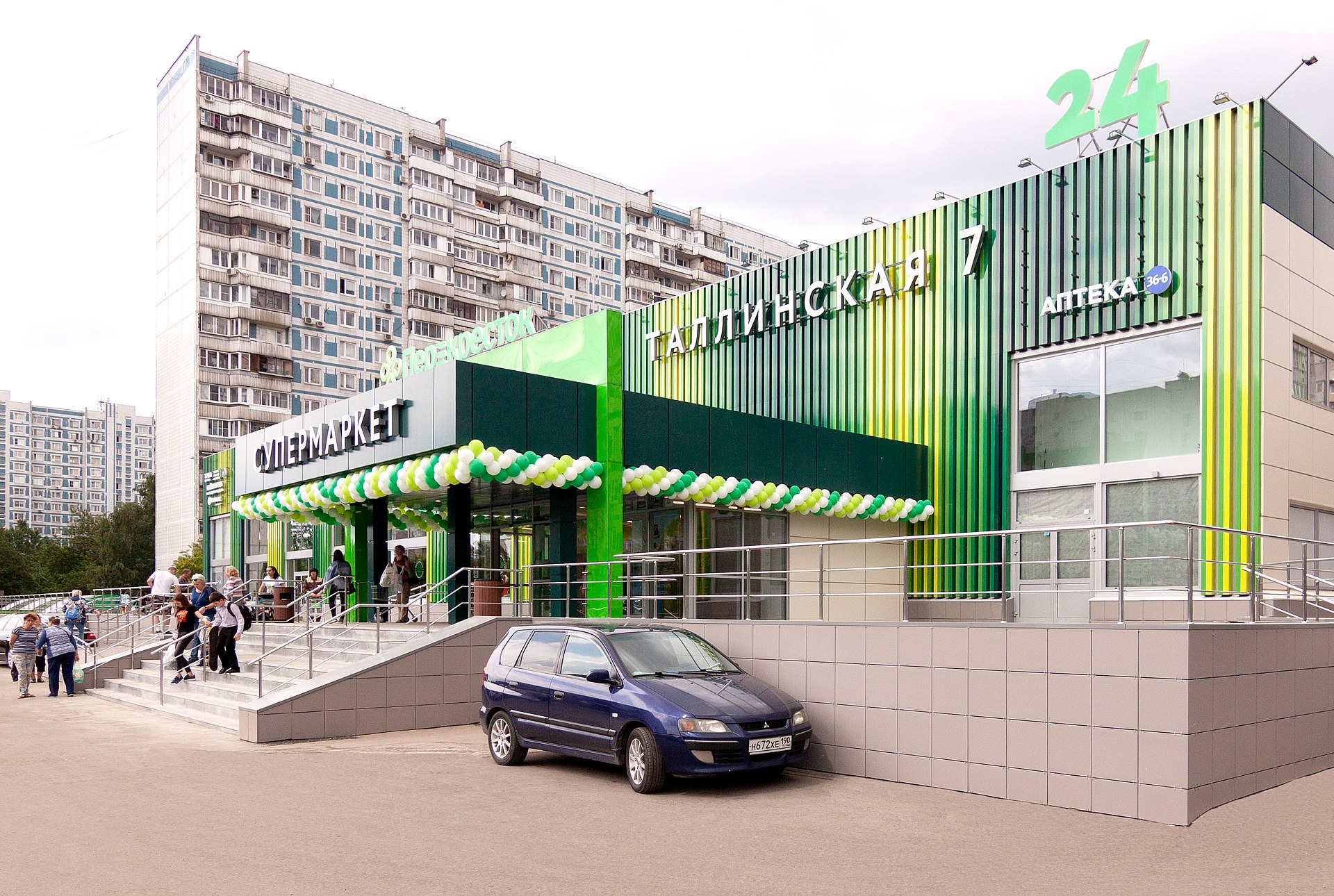
A Perekrestok chain supermarket in Moscow. Photo courtesy of Wikipedia

“People are to blame…”

I stopped by Perekrestok and was blown away. Bananas were 140 rubles a kilo, pre-washed carrots were 100 rubles a kilo.

The hypermarket itself is open until eleven p.m. nowadays, not around the clock.

“Prices have really gone up. Is this all because of the w*r?” I say to the middle-aged woman at the checkout.

“No, it’s not just because they’ve attacked the neighbors. It’s because of the people.”

“The people who unleashed it all? I hope they will be held responsible…”

“No, because of the people, all of us, who allowed this gang to take over Russia. And each of us will bear our share of responsibility for this. And bananas at 140 a kilo are still just icing on the cake… We are to blame for what happened. Everyone who let this happen. Everyone who ‘wasn’t interested in politics.'”

Source: Alexei Sergeyev, Facebook, 15 March 2022. Translated by the Russian Reader
“It’s Terrifying to Be Here Amidst This Hell”

I’m a translator, an academic, and a US citizen. Over the past week I have received many dozens of emails from people all over Russia who are desperate to leave and looking for any way out of Russia and into a stable academic or arts-related position.

The one I’ve translated here (with permission from the author, whose personal information has been removed) is both characteristic and particularly exhaustive, and reveals a lot about the situation in Russia now. Just as the prospect of a “war in Europe” and “World War III” has activated memories of the Second World War, in Russia the new crackdown on free media and civic protest has dredged up a lot of cultural trauma around Stalin-era repressions, particularly among the intelligentsia. Postmodern apocalypse rules, with totalitarian concentration camps and 1984 rubbing shoulders (see also Nadia Plungian’s piece analyzing the 20th-century’s death-grip on the modern-day cultural imagination in Russia).

The specters of the twentieth century are additionally deleterious in the way they constantly bring back and elevate specifically Russian suffering. While this suffering is linked to real, undeniable and still largely unprocessed trauma, it feeds into the self-absorption and political passivity that underpins the state of things in Russia today (I don’t have to point out certain parallels with the US and mainstream American culture). It’s not my place to blame Russian citizens for what their insane government is fomenting in Ukraine; there is just clearly much work to be done to build civic consciousness and a functioning society.

Hello.

Although I was born and have spent my whole life in Russia, I am, ethnically speaking, half Russian and half Ukrainian: my grandparents are from Ukraine, and even quite recently I was thinking about applying for Ukrainian citizenship in order to move to a normal, free country, all the more so since I have roots there, but I took too long to decide and now the war has canceled all of those plans. What’s happening right now in Ukraine puts me literally into a state of shock, and what’s happening in Russia makes my hair stand up on end from horror and the realization that this is not a bad dream or nightmare that one might at least eventually wake up from.

This inhumane and senseless war that Putin is waging against Ukraine, which the Russian governmental media insist on calling a “special operation” (while using the word “war” carries the threat of criminal charges), this is only half of the hell, the other half is happening inside Russia. In downtown [city’s name redacted; it is not a capital city], I witnessed the police arresting he small number of people protesting the war. The police used truncheons to shove a grandma holding a “NO WAR!” sign into a paddy wagon. I can’t get my head around the fact that being pro-peace is a crime now. But there are very few protests, the people capable of thinking, the ones who understand how absurd what’s happening is, they’re spooked and scared of protesting lest they end up crippled or have fabricated criminal charges pinned on them.

But the worst thing is that many people, including my former colleagues from the theater, absolutely support this hell that Putin is creating right now in Ukraine, this totally unprovoked and unjustifiable, senseless and bloody slaughter. A huge majority of people has been zombified by the propaganda on TV and are openly welcoming this war, thoughtlessly reproducing the TV propagandists’ fascist, misanthropic slogans. And it’s impossible to convince them otherwise, they brand any rational argument a “fake” and hate the people who argue with them. Today, near my building, I saw that my neighbors had painted the “Z” symbol on their cars, this new swastika that marks the Russian military equipment going to attack Ukraine. They’re all in favor of the hellishness, the blood and death, the war. It’s so scary.

The most absolute insane and absurd madness is being fomented, madness that has no sense and virtually no grounds. Besides this bloody war, besides the sanctions that the entire civilized world has imposed on Russia, here inside the country right now the most severe censorship is being implemented, the last free media outlets that covered the last alternative points of view are shutting down. This is the end. They have been destroyed simply because they called the war a war. There are new laws being passed that threaten fifteen years in prison for telling the truth, and who knows how long it will take before they bring back the firing squad for any kind of freethinking. The prime minister already voiced his support for [restoring] the death penalty. Every day things get worse and worse, and the end is nowhere in sight.

This is a surreal nightmare! Reality just all of the sudden lost its mind. In the blink of an eye everything turned from a vague sort of dictatorship into a totalitarian concentration camp along the lines of Orwell’s 1984, and this is no exaggeration. Soon nothing will be left here besides crowds of insane, poverty-stricken people, completely turned to morons by fascist propaganda, their last bit of reason lost, roaring bloodthirsty slogans, and they will simply destroy anyone who allows themselves to think differently.

I just don’t know how to go on living in this concentration camp that Putin is building here in Russia. Before the start of the war, one could at least try to live one’s life, to be free, to make a living through one’s art and not engage with the universal vector of militarization and dumbing down, to have some kind of hope and plans for the future, but now that’s over, there is no hope left. Navalny is in prison, the opposition has been totally crushed, and the state media, radio and TV, all without exception just repeat one and the same lies, lies, lies and nothing but lies, while the non-governmental sources of information are either already closed or are being destroyed and persecuted. The state is mercilessly rooting out even the weakest rudiments of free speech and of rational thinking in general. It’s terrifying to be here amidst this hell.

While I was writing this I got the news that PayPal and Payoneer announced that they would not be doing business in Russia anymore, and that means I will literally be left without any source of income for my creative projects, while working as an actor in this country involves propaganda in one way or another, because free creative activity has not been possible here for a long time. I became convinced of this myself when I left a theater whose management literally threatened the acting troupe to get us to vote for the candidate they wanted.

I’d like to just live peacefully, make art, learn new things, create beauty, and work to build a bright and joyful future. But now wanting peace will just get you beaten up and thrown in prison. I don’t know what to do and how to go on living.

Translated and prefaced by the Fabulous AM. Photo by the Russian Reader

Threatened Cranes of Far Eastern Russia

Building on the work of Sergei and Elena Smirenski, Muraviovka Park for Sustainable Land Use was established in 1994 through a collaboration between the International Socio-Ecological Union, the International Crane Foundation, and Pop Group Co., Ltd. A year later this land and adjacent areas were added to the list of wetlands of international importance by the Ramsar Convention. Muraviovka Park boasts over 700 species of vascular plants and over 300 species of birds, including six species of cranes. It is a critically important area for White-naped, Red-crowned and Hooded Cranes, Oriental White Stork, Yellow-breasted Bunting and other avian species on the International Union for Conservation of Nature Red List of Threatened Species. The park’s activities include monitoring numbers of wild cranes, managing a captive breeding program of endangered cranes to release the cranes into the wild. The park works to prevents forest fires, conducts reforestation, organizes annual international summer camps at Muraviovka Park and in other parts of the Amur River Basin, including China, hosts tourists, and organizes festivals. The 16,000 acres on which this park sits is leased to the park through 2058. Sergei and Elena will update us on the park and its inhabitants.

Presented by the Kirtland Bird Club. To register, head HERE.

Thanks to the Monterey Audubon Society for the heads-up. ||| TRR

“We Are Fraternal Peoples!”

Activists in Novosibirsk record message for the international community about Kazakhstan • Arina Yuzhnaya • Siber.Realii (RFE/RL) • January 10, 2022

Novosibirsk residents have recorded a video message to the international community “on behalf of all Russian citizens who oppose the Russian military intervention in Kazakhstan.” They are certain that the peaceful protesters in Kazakhstan “are not terrorists,” our correspondent reports.

Nine people appear in the video, including pianist Timofei Kazantsev, former head of the We Are Against Corruption Foundation Viktor Sorokin, and activists Andrei Kaygorodtsev, Rashid Zamanov and Alexander Abrosov. The appeal has been released in two versions: in Russian with English subtitles, and in English translation.

“The citizens of Kazakhstan who came out to protest poverty and corruption are not terrorists. Their arrests, and even more so their murders, are unacceptable,” they say in the message.

They stress that they consider the Russian military intervention unacceptable, since it could lead to “interethnic hostility and bloodshed.”

“President Tokayev called on the CSTO to defend [Kazakhstan] against an external terrorist threat. We believe that the Kazakhs will perceive Russian soldiers, who make up the bulk of the Collective Security Treaty Organization military contingent, as an external threat,” Kazantsev told us.

He believes that there now exists an “extraordinary situation in which our country is potentially behaving like an aggressor.” Kazantsev considers it wrong when an international organization meddles in the internal affairs of a sovereign state, even at the request of the country’s president. All this, in his opinion, is fraught with consequences.

For this reason, the authors of the video also appeal to the people of Kazakhstan. They explain that the Russian people have no “aggressive ambitions,” but that “no one has asked the opinion of ordinary Russians.”

At the end of the appeal, the authors of the video demand the withdrawal of Russian troops from Kazakhstan.

Translated by the Russian Reader
Happy New Year, Veteran!

Novosibirsk city councilman asks prosecutor to investigate complicity of United Russia reps in veteran’s death
Sibir.Realii (RFE/RL)
January 7, 2022

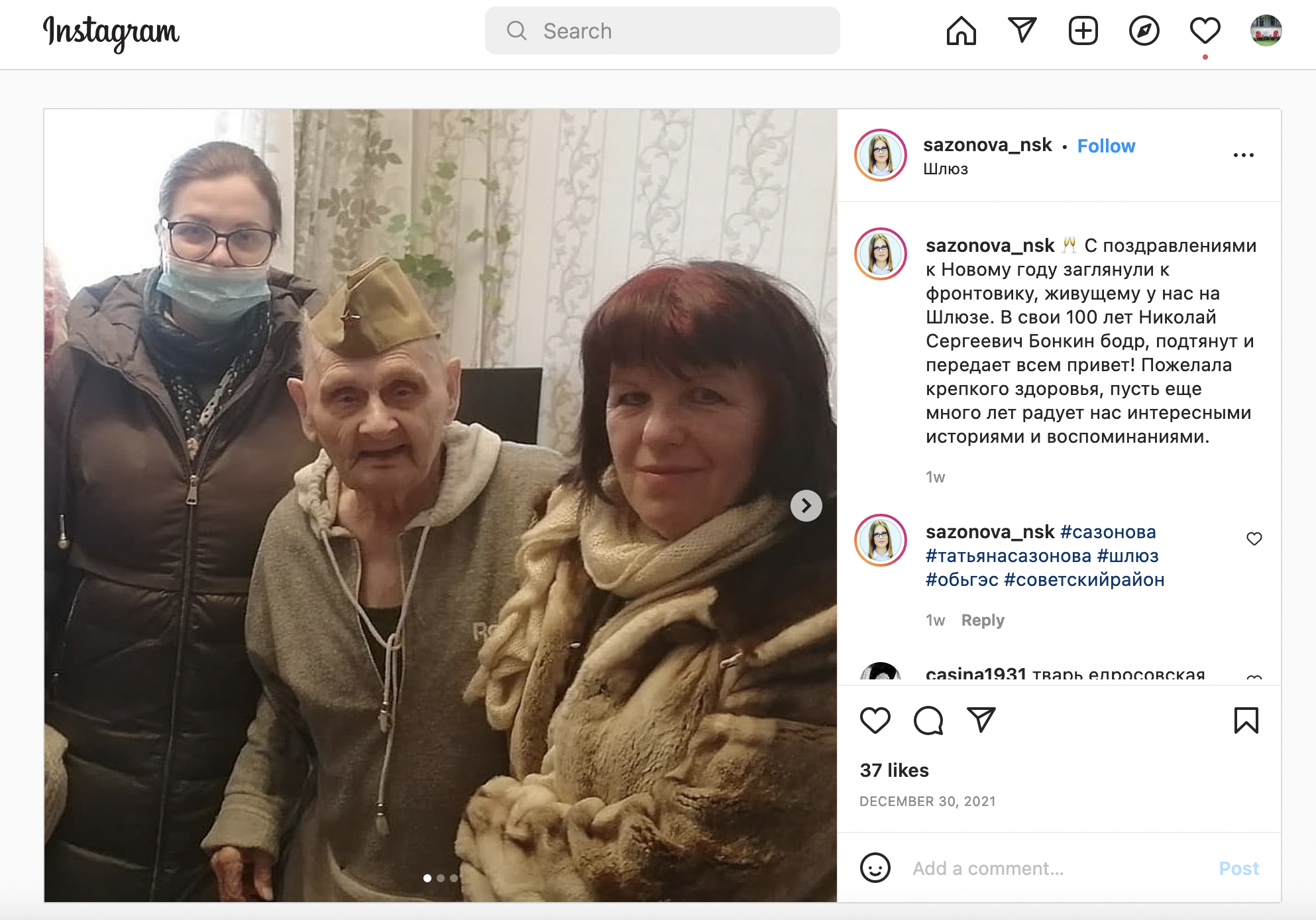
Novosibirsk city councilman Georgy Andreyev has asked the prosecutor’s office to investigate whether the United Russia party was complicit in the death of 100-year-old Second World War veteran Nikolai Bonkin. The veteran died of covid-19 five days after he was visited by United Russian party members, who congratulated him on the New Year. They were without masks and did not observe social distancing. As part of its “Happy New Year, Veteran!” campaign, United Russia congratulated hundreds of veterans in the Novosibirsk region alone.

Andreyev told Sibir.Realii that he was outraged by the carelessness of the United Russia members. Party rep Tatyana Sazonova published a report on their visit to Nikolai Bonkin. The pictures she posted on Instagram show that not all the congratulators were wearing masks. Not only did they not maintain social distancing, but they also hugged the veteran, even pressing their cheeks to his face. Packages with gifts from State Duma member Dmitry Savelyev are also visible in the snapshots.

A screen shot of Tatyana Sazonova’s Instagram post about United Russia’s allegedly fatal visit to WWII veteran Nikolai Bonkin

“A legendary war veteran has passed away: this is a great loss for the city. Five days before [his death], United Russia party ‘envoys’ had come to see him. Nikolai Sergeyevich Bonkin had survived the war, the 1990s, and the Yeltsin-Putin reforms, but he was apparently unable to survive, unfortunately, United Russia’s desire to hype itself,” Andreyev said.

The councilman appealed to the prosecutor’s office in response to this incident. (Sibir.Realii has obtained a copy of the complaint.) In addition, he has discovered that the campaign “Happy New Year, Veteran!” was a nationwide affair, and that United Russia had visited around 400 veterans in the Novosibirsk region alone. In snapshots featuring veterans, published on the party’s website, the party’s elected officials and representatives are not wearing masks and do not maintain social distancing.

Andreyev noted that in late October, when the State Duma was considering a bill to exempt war veterans from utility bills, 297 United Russia MP “simply refused to press the buttons” [and thus vote in favor of the bill]. Among them were four Novosibirsk MPs, Andreyev said.

There are four points in Andreyev’s complaint. He asks the prosecutor’s office to investigate whether United Russia rep Tatyana Sazonova was complicit in Nikolai Bonkin’s death, whether the individuals in the photos were vaccinated against the coronavirus, and whether they are currently symptomatic. The councilman also asked the prosecutor’s office to find out whether there were other Great Patriotic War veterans who died during or after the “Happy New Year, Veteran!” campaign. In addition, the councilman wants the prosecutor’s office to determine whether there were signs of genocide, [as defined by the Criminal Code,] in United Russia’s actions.

“There is a clause in the article [defining genocide in the Criminal Code] about persecuting a group of people for political reasons. I don’t see anything other than political motives in these actions,” Andreyev explained. “It is important for me to understand who initiated the visits to veterans in local communities. Where did United Russia obtain the personal data of veterans and their relatives? What were their grounds for entering the apartments of elderly people? Who are these people [who paid the visits]? Who verified whether they were political reliable?”

The regional prosecutor’s office did not return our telephone call.

Translated by the Russian Reader

Where Will Sergei Usoltsev Find 60,000 Rubles to Pay His Fine for Insulting Putin and Valentina Tereshkova?

Sergei Usoltsev. Photo: Kommersant/Activatica

Activatica.org
Facebook
October 6, 2021

Sergei Usoltsev, a resident of Sverdlovsk Region, was fined 60 thousand rubles [approx. 716 euros] for “insulting the authorities” (punishable under Article 20.1.3 of the Administrative Offenses Code).

The Sverdlovsk Regional Court rejected the defense’s appeal against the decision of the Shalya City Court, which in June ordered Usoltsev to pay 60 thousand rubles for a comment he made on the social network VKontakte. According to the prosecution, the comment insulted the authorities, specifically, Vladimir Putin and Valentina Tereshkova.

Activists have launched a fundraiser for Usoltsev, who lives in the village of Gora, 40 kilometers from the town of Shalya, Sverdlovsk Region. Recently, Usoltsev’s seriously ill wife, whom he was caring for, died.

The Ministry of Social Policy was paying Usoltsev a social pension of 1,380 rubles [approx. 16 euros] a month as a caregiver, but now he no longer has this income either. Usoltsev will soon be sixty years old, but, according to the new laws, he is eligible to retire only in 2024. He has also been unable to get a job: he is near retirement age, and there is not enough work even for young people in his village.

If Usoltsev does not pay the fine within 60 days, either the fine will be doubled or he will be placed under administrative arrest.

Source: ROSshtraf

Translated by the Russian Reader
UPDATE (9 October 2021). ROSshtaf has reported on its Telegram account that it raised the 60,000 rubles to pay Mr. Usoltsev’s fine in a single day!

The Fix Is In: Sevastopol

“@novaya_gazeta !! The ballot box at Polling Station 98 in Sevastopol is being stuffed right now, Novaya Gazeta’s correspondent reported. This can be seen on the video surveillance system. About 20 minutes after the site closed, a man is stuffing ballots, and a woman is helping him. Video: Nadezhda Isayeva, Novaya Gazeta.”
#TheFixIsIn

Band Practice

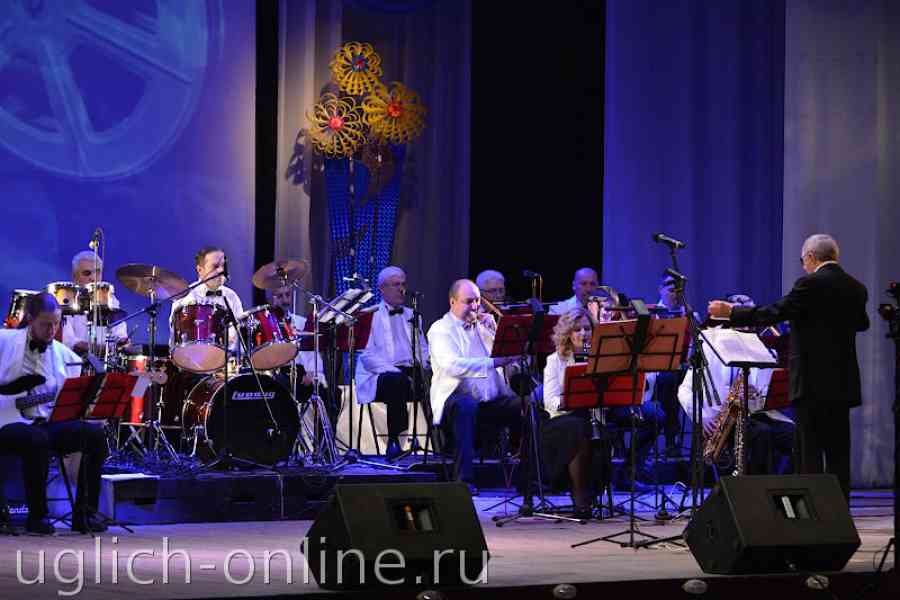
Drivers, workers, and policemen play in the Uglich recreation center’s brass band. The vocalist hosts a children’s program on local television, while the drummer performs as Father Frost at New Year’s celebrations.

Most of the musicians played in the October Club Brass Band as children, and the current ensemble is named the Sysoyev Pop and Brass Band in memory of Alexander Sysoyev, who came to town in 1945, after the war, and organized it. When they grew up, the children went to the army, most often serving in military bands, and if they returned to Uglich, they continued to play. There were two brass bands in the city – at the watch factory and at the engineering works.

In the nineties, the factories shut down and the bands broke up: the musicians were not up to playing music, many of them were just trying to survive. A new band featuring the old musicians was formed in the early noughties thanks to the city’s mayor, Eleonora Sheremetyeva.

The band rehearses in the rec center on Mondays, Wednesdays and Fridays, and sometimes performs in towns for local residents. We hear the stories of the musicians in this documentary film by Yulia Vishnevetskaya, Renato Serrano and Nikita Tatarsky.

“On the corner was the October Club, also called 30 Years of the Komsomol Club. There was a brass band on the second floor, led by Alexander Pavlovich Sysoev. He would recruit us kids. People worked at the watch factory. I ended up in the assembly shop: I assembled watches. The team consisted of forty young women and little old me. It was a great place to work. I worked on the ‘action’: that was one of the jobs.”

“I started leading the band in the late 80s. After a while I went into business and didn’t play for more than ten years, but fate put me back in touch with the band and I returned. I have a transport company. In the mornings, I dispatch cars and buses to places, and sometimes I get behind the wheel myself, and in the evenings I go to practice. Of course, the world of music and the world of transport are completely different things. I don’t usually get distracted when I’m here. You go off into the world of music, and the outside world is somewhere far away: you are only making music… Previously, there were two bands, at the watch factory and at the engineering works. Then, in the early nineties, the factories fell apart. All the musicians came together in a single band: some came from the watch factory, some from the engineering works, someone from somewhere else , someone from the police. Like in Shufutinsky’s song, we have a jazz band, only there is no dentist.”

“I worked in the militia [the previous name for the Russian police] for twenty-five years, and then transferred to the police in 2011 [meaning, when it was renamed]. I might have retired already, but I have a kid to educate, and we pay for his tuition. I do forensic examinations: I’m qualified to analyze fingerprints, trace evidence, and bladed weapons. I hadn’t picked up an instrument for seventeen years. I listened to the band play once, twice, and I thought that I also used to know all this stuff. It was a good thing that the band believed me and let me join. I had to look around on Avito for a horn just like the one I had before. I took the bus to Moscow to buy it… I don’t remember the thefts, but I do remember the murders, of course. There was a cruel murder: a man was hacked with an axe. I can talk about it because the trial has happened. The man didn’t have a head: it was in two pieces. Then a man was strangled. We found the criminal through fingerprints. Bottles were confiscated, and I found handprints and fingerprints on them, which we ran through the computer. The computer doesn’t do things as quickly as in the movies. They’re just fooling people: it’s not comparable. If they showed the way it really worked, no one would watch them. It’s very painstaking work. They brought me several boxes of bottles. I had to process each one of them — lift the prints from them, weed out the witnesses and victims who could have drunk from those bottles. Consequently, we found the people who strangled him in the woods: they had a conflict. Traces are always left behind: trace scents, body oil and sweat, DNA. If there are no fingerprints, there are shoe prints, tire prints, traces left by burglary tools. I have twenty years of experience… People aren’t lined up to replace me. People retire, but there’s no one to replace them. People can’t take it: they’re not machines. I come here and play, so it seems I want to go on living. The negative effects of work build up all the same. When I perform I get goosebumps, honestly. If I have goosebumps, it means we’ve played well.”

Source: Radio Svoboda. Photos of the Sysoyev Pop and Brass Band courtesy of Uglich-Online. Thanks to Comrade Koganzon for the heads-up. Translated by the Russian Reader