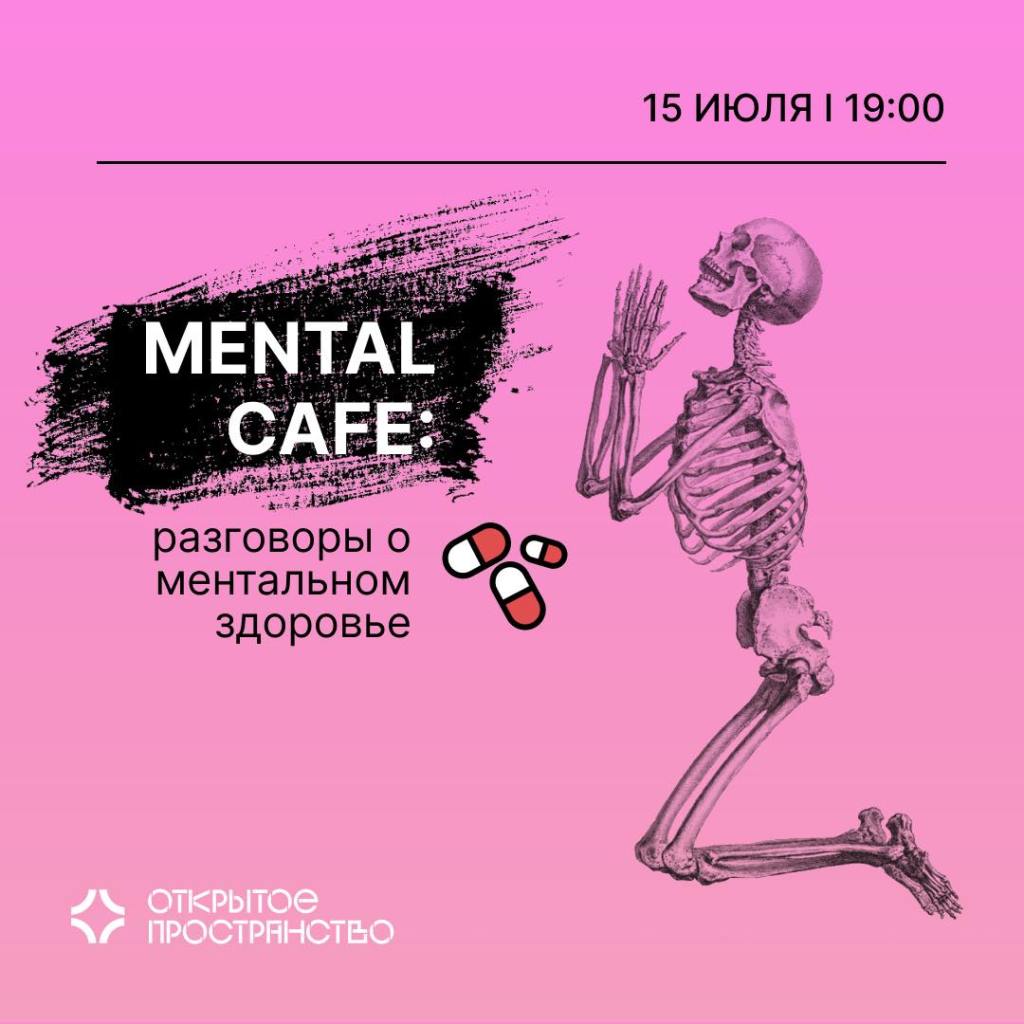
“July 15, 7 p.m. Mental Cafe: conversations about mental health. Open Space”
Mental Cafe is a cafe without food service and a permanent address where people come together to discuss topics related to mental health.
It is not a support group or a grief group. It does not provide psychological assistance. It is just a conversation club where you can share your experiences and ask any questions about mental disorders.
You can even choose not to participate in the conversation, but just listen. Anyone—not just people with mental disorders—can attend.
7 p.m., Saturday, July 15
Open Space in St. Petersburg, 25 Rubinstein Street
The war with Ukraine, which has been going on for more than a year, continues to intensify the psychoticization of Russian society. Russians spent 4.32 billion rubles on antidepressants in the period from January to May 2023, Vedomostireports, citing statistics compiled by the DSM Group.
Sales increased by 2% compared to the same period last year. And yet the early months of the invasion of Ukraine were accompanied by a surge in demand for antidepressants, which increased by 87% year on year. Thus, in 2023, Russians set a new record for purchases of antidepressants, whose volumes nearly doubled compared to pre-war levels.
Players in the psychotropic drugs market confirmed to Vedomosti the further increase in demand for antidepressants, despite the high benchmark set last year. According to Eapteca, the demand for this category of medicines increased by 30% in the period from January to May 2023. According to Kirill Yakobenko, general director of Uteca, sales of such products “have grown in terms of both sheer numbers and turnover.”
The increase in demand for antidepressants may indicate that people have become more prone to mental disorders treated with antidepressants. These include not only depression but also adjustment and anxiety disorders, psychiatrist Viktor Lebedev told The Moscow Times.
He notes that his colleagues in Russia speak of their increased workload. “People come to see them more often and talk during their sessions about the special military operation and how it has affected their lives,” he says, adding that large-scaled emigration has also led to an increase in depression and other mental problems among Russians.
It will be possible to make a genuine assessment of the war’s impact on overall mental health only a few years from now, but we should not expect positive forecasts, psychiatrist Dmitry Kutovoy said pessimistically.
“After Putin, the new regime will face the daunting task of normalizing society’s mental state and we, as professionals, must be ready for this,” he adds.
In 2022, alcohol sales in Petersburg increased by 4.8%, although prior to this they had been declining. The demand was powered by cheap and strong Russian drinks, which have replaced the beverages produced by departed foreign producers. At the same time, the reported incidence of alcohol dependence has been growing in Petersburg.
Bumaga requested data from official departments and analysts. We show how much alcohol is consumed both nationwide and in Petersburg, how many people have been diagnosed with alcoholism, and how alcohol consumption is associated with an increase in homicides.
Russians drinking more, alcohol consumption in Petersburg four times greater than in 2021
According to Rosalkogolregulirovanie (Federal Service for Alcohol Market Regulation), Russians are buying more and more alcohol every year. In 2022, this volume reached its peak: 2.2 billion liters of strong alcohol and beer were purchased. Rosalkogolregulirovanie told Bumaga that this was mainly due to an increase in sales of spirits and wine, while beer was bought in roughly the same quantities as a year earlier.
Alcohol consumption decreased in Petersburg from 2018 to 2020, but the trend was reversed in 2021, while growth in 2022 was four times higher than a year earlier.
Purchases of alcoholic beverages (in millions of liters) in Petersburg, 2017–2022
Strong and cheap alcohol more popular
In 2022, foreign alcohol producers such as Brown-Forman and William Grant & Sons left the Russian market. Because of this, the prices of imported alcohol increased by 10–20% from the beginning of the year, restaurateurs noted. Prices for foreign-made beer increased even more, by an average of 30–50%, Alexander Romanenko, the founder of Bakunin Brewery and several other Petersburg establishments, told Bumaga.
“If we take into account premium brands, then the price increase most likely did not affect their consumption in any way, since elite alcohol is drunk by wealthy people. The consumption of alcohol in the mid-price range has been changing the most. With the price rises of these products, consumers have been looking for cheaper substitutes or switching to other categories of drinks,” said Agvan Mikaelyan, who sits on the board of directors of the audit and consulting network FinExpertiza.
Rosalkogolregulirovanie notes that domestic producers have already more than doubled the volume of alcoholic beverages that were once imported to Russia.
However, new products often prover to be of poorer quality, Mikaelyan told Bumaga. According to him, Russian-made gin, rum, and whiskey are “imitations,” since they have not yet gone through a full production cycle.
Purchases of alcoholic beverages stronger than 9% ABV (in millions of liters) in Petersburg, 2017–2022
In 2022, the level of consumption of beverages with a strength greater than 9% ABV increased by 6% in Petersburg. In the first four months of 2023, Petersburg residents purchased a third of what they had bought during the whole of last year—that is, there has been no slowdown in sales.
According to FinExpertiza, Petersburgers bought 3.2% more strong alcohol (i.e., vodka, cognac, and other distilled beverages), raising their consumption to 6.9 liters per capita. At the same time, in Russia as a whole, purchases of these beverages rose by 7.5%, thus increasing per capita consumptions to 6.8 liters. In 2021, this figure had increased by only 1.2%, while it went up by 3.3% in the pandemic year of 2020.
Purchases of vodka (in millions of liters) in Petersburg, 2017–2022
Mikaelyan added that vodka consumption has been growing, as it remains the cheapest strong drink. In Petersburg, as in all of Russia, 2022 saw a 6% increase in purchases of vodka. Vodka consumption had decreased by about the same percentage in 2021.
Level of alcoholism falling, but more new cases reported in Petersburg every year
Despite the recent rise in alcohol consumption (especially of strong beverages), the number of residents with diagnosed alcohol addiction has been decreasing in Petersburg for the past five years. In 2022, there were a little more than 18,000 people official diagnosed with alcoholism in the city, according to data provided to Bumaga by Petrostat.
Diagnoses of alcoholism in Petersburg, 2018–2022. Total diagnoses are indicated by the figures inside the dark green bars, while first-time diagnoses are indicated by the figures next to the light-green bars.
However, the number of Petersburgers who were diagnosed with alcoholism for the first time increased last year. It exceeded one thousand people for the first time in five years.
The latest data we have on deaths due to alcohol poisoning is for 2021. In that year, according to Rosstat, 9,274 Russians died of alcohol poisoning, 199 of them from Petersburg.
Only incidents of “accidental alcohol poisoning,” which is classified as an external cause of death, are counted in the official statistics, and so these figures do not show how many people died from diseases caused by alcohol consumption. At the same time, Rosstat points out that among those who died from diseases of the circulatory, nervous or digestive systems, as well as from neoplasms, there are also those who suffered from alcoholism.
The more Russians drink, the more murders occur
Every year, between a quarter and a third of the crimes in Russia are committed under the influence of alcohol, according to data from the Judicial Department. In 2022, however, this figure fell by 2.7% compared to the previous year.
The states in which crimes for which people were convicted in 2022 were committed: sober – 74%, alcohol inebriation – 25%, narcotic intoxication – 0.5%, other – 0.2%
The Trauma Center Lawyers Association claim that up to 80% of murders in Russia occur after alcohol is consumed. The lawyers point out that in 2022, for the first time in twenty years, the number of murders and attempted murders increased by 4% in Russia. The lawyers attribute this increase to the growth in sales of alcoholic beverages.
Due to alcohol consumption, there are more murders on holidays than on other days. On New Year’s Eve, for example, the murder rate increases as much as fivefold, criminologist Vladimir Kudryavtsev, an associate researcher at the Institute for the Rule of Law, explained to Bumaga.
“During the holidays, a certain standard scenario is replayed that leads to lethal violence: people sit together in a closed room, consuming alcohol. And most often people kill people they know, people with whom they must share things. The holidays are a ‘petri dish’ that reproduces the environment for conflicts,” he said.
The war in Ukraine, which began on 24 February 2022 at the whim of the President of Russia, destroyed the lives of thousands of people overnight. Almost immediately after the outbreak of hostilities, the government of my country issued decrees that cut off the oxygen to independent journalists, forbidding them to cover events truthfully and without partiality toward Russian politicians. News websites were blocked, freedom of speech ceased to exist. As a freelance photographer, I was forced to leave Russia on 4 March 2022 to avoid the risks associated with my work.
Like other Russians who do not support the war, I departed for points unknown, taking with me only a backpack and hope for change. I left tormented by feelings of guilt and shame, which still haunt me at every step. I have been having nightmares the entire time since I left. The news from the frontline and Ukrainian cities has been even more unbearable, however. I still can’t believe that all these events are real. My current project, based on self-portraits, visualizes my nightmares and explores feelings of shame and guilt. The visual sequence also incorporates drawings from the diary I have kept since my departure from Russia and screenshots of the news from Ukraine. All these layers recreate my personal space, thus enabling the viewer to dive deeply into my state of mind. I hope that this work will show that not all Russians support this terrible war or have been brainwashed by propaganda.
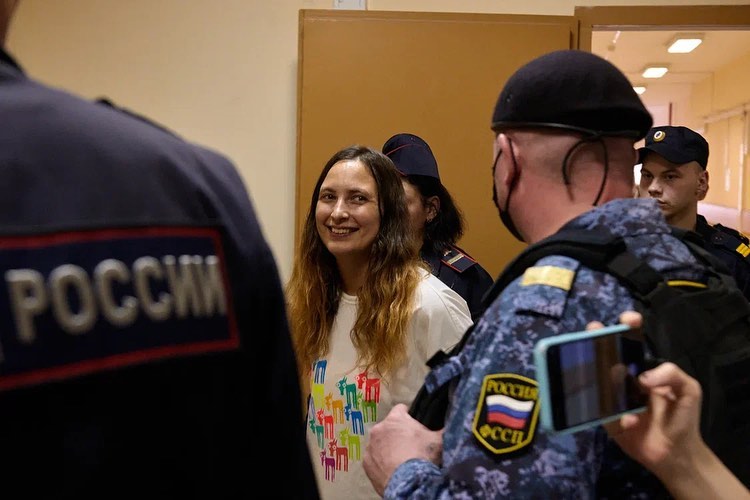
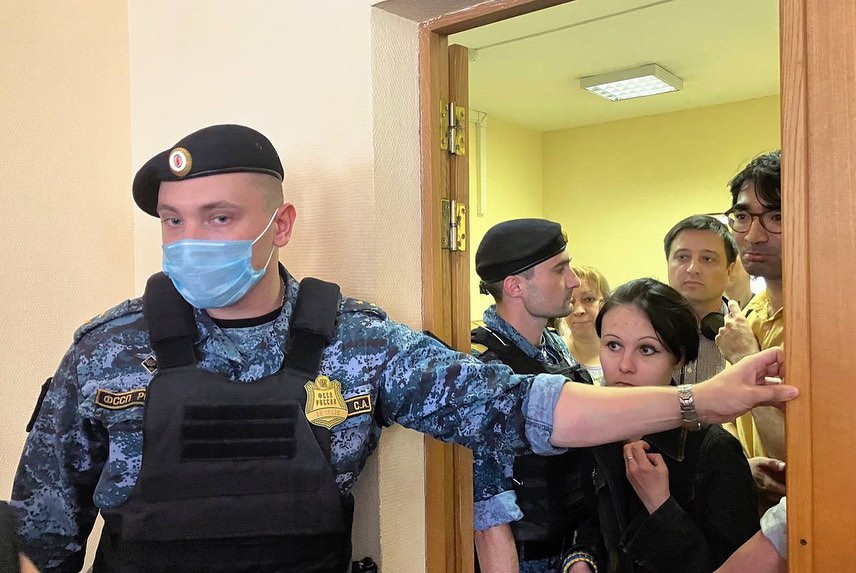
Sasha Skochilenko, facing ten years in prison for anti-war price tags. Vasileoostrovsky District Court, St. Petersburg, 18 July 2023
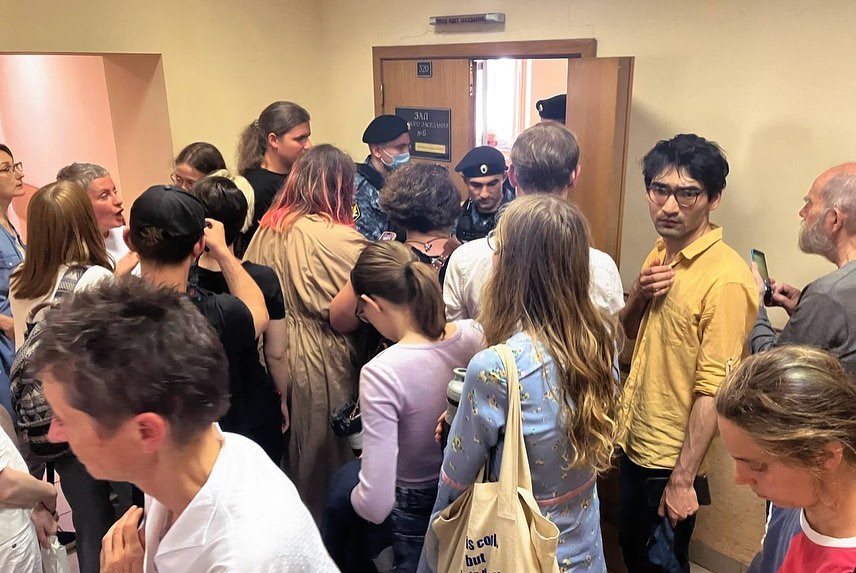
Today’s hearing lasted almost nine hours!
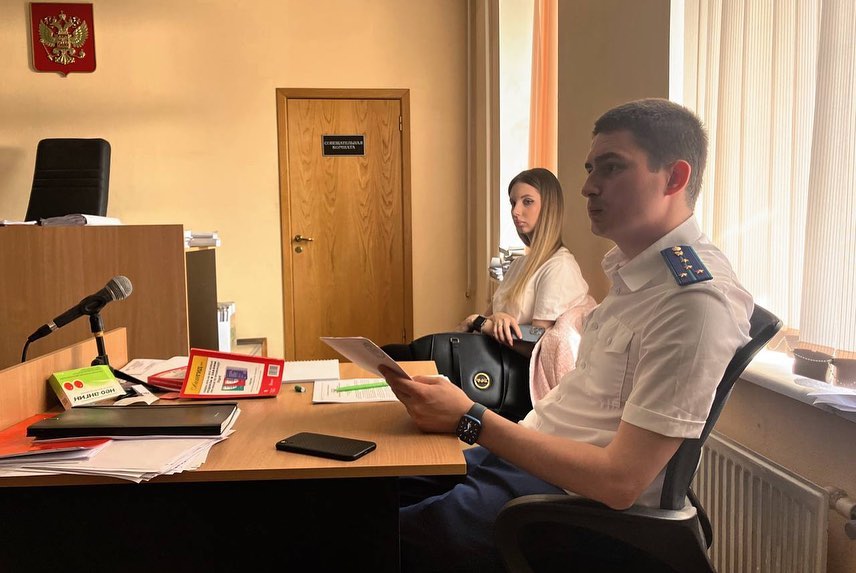
It was finally possible to resume the cross-examination of Olga Safonova, on whose linguistic analysis of the price tags the prosecution’s case is largely based. At the last hearing it transpired that Safonova is actually a political science specialist who is brought in to provide linguistic (!) expertise on “political” issues. Moreover, she has already admitted that she cannot judge whether the information on price tags was “knowingly false,” although she wrote just the opposite in her expert analysis.
The cross-examination of Safonova took up most of the hearing, and it involved the lawyers, the independent expert Svetlana Drugoveyko-Dolzhanskaya, Sasha [Skochilenko]herself, and Prosecutor Gladyshev. (The defense requested that Gladyshev be recused for a number of reasons—including because he distorted the facts about Sasha’s income—but the motion was denied.) Safonova had a visibly hard time answering questions about the content of individual price tags and the linguistic terms she employs, and how she was able to identify motives of “political enmity” in the texts she analyzed. In fact, experts cannot assess an author’s motives, but Safonova refused to confirm this outright. “Just stay that this is not within your competence,” the lawyer Novolodsky asked her. “I won’t,” she replied.
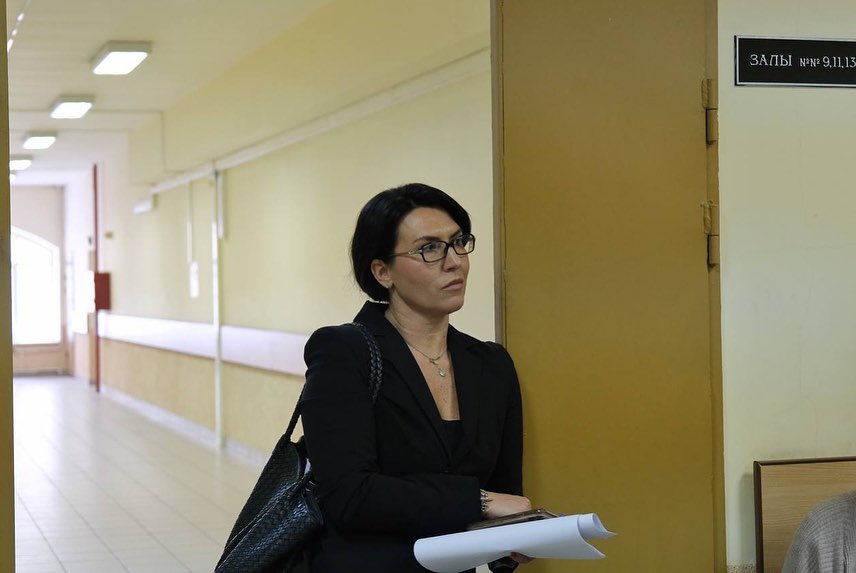
Olga Safonova, expert witness for the prosecution. Vasileoostrovsky District Court, St. Petersburg, 18 July 2023
This was not the only occasion for laughter at today’s hearing. During a discussion of the texts on the price tags, Safonova also claimed that Russia is not a fascist state, since “a fascist state is totalitarian, while Russia is democratic.” She also asked that the defense not “examine every word [said or written] by expert witnesses with a magnifying glass, for crying out loud!” (She said this, I would like to remind you, at a criminal trial that could send Sasha to prison for ten years.)
As always, we want to say a huge thank-you to the journalists who have been covering Sasha’s case, and to everyone who came out to support Sasha! The next hearing will be held on September 14, after the judge’s vacation. Safonova will be summoned to court again. In addition, the court ordered the linguist Grishanina, the co-author of the expert analysis, forcibly delivered to the hearing.
P.S. We will have more to say about today’s hearing, so stay with us!
The St. Petersburg State University Ethics Commission has ruled that a statement made by Alexandra Zaitseva, a first-year student and editor of the student media outlet Studen, was “incompatible with the prestige of a university student.” Another student media outlet, Lupa and Pupa, has publicized the incident.
The Details. Zaitseva was summoned to appear before the commission on July 7. Initially, the hearing was supposed to be held online, but the university subsequently changed the format to in-person and refused to change it back. According to Zaitseva, this was done so that she would be unable to record the hearing.
The Reasons. In June, an anonymous denunciation of Alexandra Zaitseva was posted in St. Petersburg State University’s virtual guestbook. The author of the denunciation did not like Zaitseva’s post on VKontakte about the expulsion of Mikhail Belousov’s students from the university’s history faculty.
“In this publication, she talks about the ‘vile and unjust expulsion,’ in her opinion, ‘of the students implicated in the sensational Belousov affair.’ In addition, she publicly insults other students (‘a bunch of bastards shouting goida on PUNK at night’) while obviously demeaning and voicing disdain for the patriotic citizens of our country,” the denunciation reads.
St. Petersburg State University replied that they had contacted “law enforcement agencies” and called a hearing of their ethics commission.
The Decision. “We consider A.N. Zaitseva’s behavior incompatible with the prestige of a St. Petersburg State University student,” the St. Petersburg State University Ethics Commission ruled.
Zaitseva told Bumaga that she believes she will be expelled. “I guess the outcome is pretty obvious. Although, I can’t say for sure—no order has been issued yet,” the student said.
The ethics commission members did not like the fact that Zaitseva had given a comment to TV Rain. According to them, in this way the young woman “once again displayed her openly negative attitude towards the university of which she is a student.”
Just prior to the hearing, St. Petersburg State University had banned university employees from giving comments and interviews to “foreign agent” media outlets.
The commission ruled that Zaitseva had violated the second and third paragraphs of the University Student’s Code, i.e., “To represent the university in extracurricular settings with dignity” and “To honor teachers, respect colleagues and students, maintain friendly relations both inside and outside the University, [and] contribute to the creation of an environment of mutual understanding and cooperation.”
“Apparently, the authors really don’t fancy the idea that someone might have principles: this is the only explanation why such a large piece of the text is devoted to them, and not to an analysis of my post,” Zaitseva said in reaction to the commission’s decision.
The leadership of St. Petersburg State University (SPBGU) has fired Mikhail Belousov, a professor at the university’s History Institute, for committing an “immoral act” by speaking out against Russia’s invasion of Ukraine. The university posted its decision on its website.
The university’s decision followed an investigation, during which university leadership confirmed that Belousov had circulated materials “discrediting” the Russian army, and “insulting the memory of those killed while fulfilling their military duty.”
“Belousov’s behavior violates the university’s moral traditions and generally accepted ethical norms, his actions are out of keeping with his and the university’s prestigious positions,” the document detailing the university’s decision says.
Petersburg publication Rotundasays the university began investigating Belousov and his students after Russian official and social media channels circulated screenshots of messages, allegedly written by the professor and his students, openly criticizing the war in Ukraine while the university was mourning one of its students, Fyodor Solomonov, who was killed in Ukraine.
Seven students of the previously dismissed associate professor Mikhail Belousov were expelled from the Faculty of History of St. Petersburg State University, Bumagareports, citing sources at the university. They were among the ten people who were previously called to the ethics commission. The remaining three will have “some kind of meeting with the vice-rector for educational work.”
One of the expelled students told the publication that he would challenge the decision of the university.
At the end of May, Z-channels circulated screenshots with messages in which Belousov allegedly condemned the “internal” symbolism and said that “a direct and open approval of rashism is disgusting.” It was alleged that the associate professor wrote all this in the context of discussing the death of St. Petersburg University student Fyodor Solomonov in the war in Ukraine.
On June 3, Belousov was fired, and a group of his students were summoned to the ethics committee, which ruled that they “considered it appropriate to make fun of” Solomonov’s death instead of “showing normal human feelings.” It was also decided that the students’ actions were “incompatible with the status of a student at St. Petersburg State University.”
In October last year, associate professor Denis Skopin was fired from the same university for participating in a rally against mobilization, calling it an “immoral act.”
Schoolchildren from Mariupol will be able to learn new professions in Petersburg. The beginning of the third session at Camp Friendly, where 400 children will relax until July 21, was announced on July 15 by Petersburg city hall’s press service.
“We will tell them about the opportunities that our vast country, including Petersburg, has to offer. We will make sure to take care of the health of our young guests and provide treatment if necessary,” said [Petersburg governor] Alexander Beglov.
The camp’s theme is “Childtown: Territory of Masters.” The children will have the opportunity to try their hand at such professions such as blogger, actor, artist, and architect.
On June 1, 2022, St. Petersburg and Mariupol became sister cities. Since then, Petersburg city hall has has been actively involved in restoring the city, which was destroyed during the special military operation.
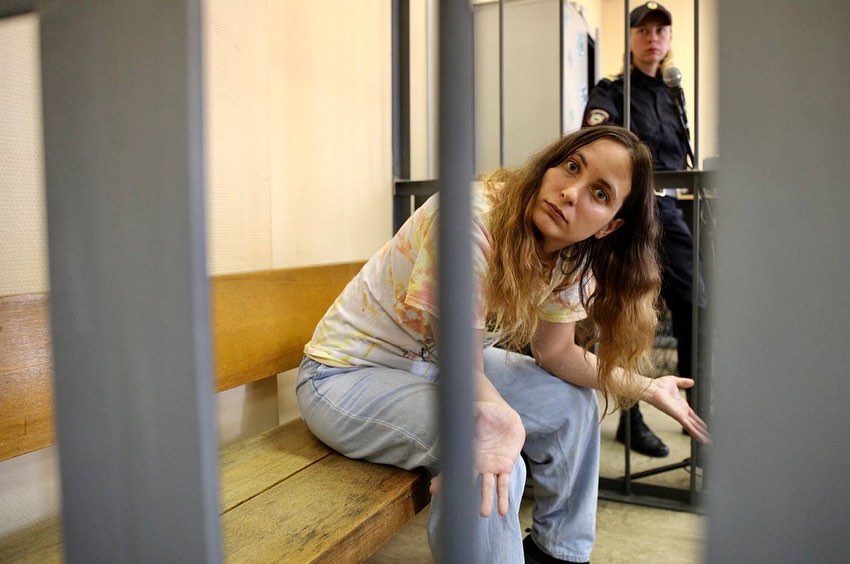
Petersburg anti-war activist and political prisoner Sasha Skochilenko at her trial, 7 July 2023. Photo: Alexandra Astakhova
At today’s hearing, the issue of remand was considered. The court could have released Sasha [Skochilenko] to house arrest or restricted her from doing certain things, or left her in pretrial detention for another three months.
This hearing might not have happened if the court had agreed to consider the issue during the remaining time at the previous hearing. But that did not happen, and today Sasha was once again transported from the pretrial detention center, and had to spend another day without food in poorly ventilated rooms. In an effort to ease Sasha’s suffering, the defense petitioned to move the hearings to an air-conditioned courtroom, to permit Sasha to drink water during the hearings, and to turn on the microphones and speakers in the courtroom so that the windows and doors could be opened. Judge Demyasheva ruled all these petitions “extra-procedural” and ignored them.
Prosecutor Gladyshev could not produce a single argument in favor of leaving Sasha in pretrial detention. He only repeated the vague arguments, made earlier by police investigators, that Sasha would resume her “criminal behavior” and could leave the country, possibilities which had already been ruled out by the court at previous hearings. Most memorably, the prosecutor declared, bombastically, “Skochilenko committed a grave crime against public safety, undermining the foundations of the Russian state.” (After he said this, the bailiffs had to remove a member of the public who had burst out laughing from the courtroom, and the judge declared a recess.) When Sasha’s lawyer Yana Nevodinnova pointed out to the prosecutor that his arguments were unfounded, Gladyshev was cut to the quick. “Reprimand the lawyer,” he asked the judge, “She insults Russia’s judicial system!”
Despite the numerous arguments about the critical state of Sasha’s health, which the defense had made at the previous hearing, the judge ordered that Sasha remain in pretrial detention until October 10.
Many thanks to everyone who keeps coming to court! The next hearing—this time on the merits of the case—will take place very soon, on July 18 at the Vasileostrovsky District Court. Please come out and support Sasha!
A roadside fireworks stand in Soledad, California, 28 June 2023. Photo by the Russian Reader
When issuing diplomas, colleges in Ingushetia now require graduates to sign a summons to the army or refuse to accept the conscription notice and face possible administrative and criminal charges, Fortanga was told by a source close to one college.
“To get a diploma, you need to sign a conscription notice. Otherwise, you will not receive a diploma no way no how. Either you accept the conscription notice, or you sign a waiver . That is, accepting the notice means you have to join the army, while turning it down means saying ‘Hello, prison, here I come,'” the source said.
According to the source, the practice was introduced after the director of the college in Nizhnie Achaluki reported, at a meeting involving the head of the republic Mahmud-Ali Kalimatov, that thirty students had been drafted from his institution into the army. Subsequently, military enlistment officers and government officials “jumped on the bandwagon,” the source claims.
Students are being forced to come to colleges in person to get their diplomas, the source added. That is, young men cannot receive them by mail or ask that they be handed over to a family member or a proxy.
When the graduate refuses to sign the conscription notice, a report is immediately drawn up and signed by witnesses. First-time offenders face administrative charges under Article 21.5 of the Administrative Offenses Code (i.e., “Non-fulfillment of military registration duties by citizens”) and a fine of 500 to 3,000 rubles. Repeat offenders face criminal charges under Article 328 of the Russian Federal Criminal Code (i.e., “Evasion of military and alternative civil service”) and a fine of up to 200,000 rubles, forced labor, arrest, or imprisonment for up to two years.
Ingush lawyer Kaloy Akhilgov noted that the legality of such a practice “depends on the procedure for issuing a summons.”
“Educational institutions can only serve conscription notices, not issue them themselves. That is, first the military enlistment office must send the notice to a specific citizen, and after that the organization can hand it to the student,” he explained.
For those who want to avoid receiving a military conscription notice , the lawyer recommended that after completing their bachelor’s or master’s degree, they take postgraduate leave until August 31 and file the relevant paperwork with the military enlistment office. “Then they should not be bothered during the [current] spring conscription drive. And such ‘automatic’ draft notices issued along with diplomas lose their significance,” he added.
Mark, 26 years old: a former engineer turned waiter in Yerevan Before I left Russia I was building a career: I was a senior fire and security systems engineer. Such people are needed everywhere: it’s a fairly good position. I worked in government agencies, so I was served my conscription notice directly at work. However, I had never served in the military: I had a deferment due to health reasons.
That was October seventh: I usually have a hard time remembering dates, but this was like in a movie since it divided my whole life into before and after. At night, I packed all my things and moved to another apartment, then I flew to Turkey and from there to Armenia.
It’s amazing: my grandfather is Armenian, but I had never been to Armenia before then. The authorities have even confirmed that I can get citizenship. But if I get it while I’m still eligible for military service, I will have to serve in the Armenian army for two years. And if you evade military service you can be banned from leaving the country or imprisoned. I went to the local draft board, and they told me straight up: come back in a year to get your citizenship. So that’s what I’ll do.
A short time before the mobilization, I was offered the chance to rent an apartment near Rybatskoye subway station in Petersburg for fifteen thousand rubles a month. I was sitting at the dacha, thinking about how I would rent this apartment, how I would invite friends over to my place—everything was good. But the next day the mobilization was announced, and my parents said to me, “Maybe you should leave?” I thought it over for a long time, and didn’t talk to anyone for several days. Then the conscription notice was delivered. Almost all of my friends supported me [in my decision to leave]. I had this conversation in the smoking room with a colleague, who told me, “I’m not going anywhere, I’ll sue. If push comes to shove, I’ll fight within the system.” In the end, he was drafted.
I had savings, so I didn’t work for six months. I tried to get a job as a technician or engineer in my field, but the old boys network is quite strong in Armenia: it is unlikely that they would hire a person off the street, and one who isn’t Armenian at that. And you need to know Armenian for any serious job. For a while I was depressed that I couldn’t find a job, that I had had everything squared away, but here I was nobody. I was a highly qualified specialist, but now I was unemployed. It was a big blow to my pride. At my old job, they waited another six months for me to return.
At first I went to work as a courier at Yandex Delivery. Maybe it is still possible to do the job on scooters and bicycles, but it is absolutely impossible. I had to walk 40-50 kilometers a day. I came home on the third day, soaked my feet in a basin, and sat there for several hours. There is an inadequate system of fines and impotent support staff that knows nothing. All couriers want to protest, both in Yerevan and in Moscow.
The delivery job was so hard on me that I even wanted to go home. I was in such a depressed state that the part of my brain that is responsible for the comfort zone was activated: “Yes, everything is fine, everything has already quieted down, and I have a home there.” I know several people who have returned [to Russia] after working such jobs. I even called my boss in Petersburg and asked if they’d hired someone to replace me, but they already had.
When you’re getting started in a country, I advise everyone to go to work as waiters. You have to carry plates and interact with people, but we all know how to do that. And you have to memorize the menu. I speak to foreign tourists in English or Russian, and I tell Armenians that I am learning the language, and they are always understanding. I tell them, “Come back in six months, and we’ll chat,” and they’re happy that I’m learning their language. Sometimes even Armenians who don’t know Armenian themselves come in and ask for a Russian menu. I even asked once, “How’s that?”
I think I lucked out: I’m treated well, we have a very friendly atmosphere, the cooks teach me Armenian, and everyone is always supportive and understanding. The money is enough to live on. And they treat me well as a Russian. Today, a client, a friend of the owner, gave me a teach yourself Armenian book in a beautiful paper bag printed with Armenian letters.
Very many young researchers and decent specialists have left Russia. This is sad, of course, but it is natural after such actions on the part of the state. It was pretty hard to swallow the whole thing. You can say it was pride, that, like, you’re going have to work in completely different jobs. I don’t like the buzzword “relocatees”—we are all migrants.
I am learning the language and I can already make myself understood: Armenian is not as difficult as it seems. When I learn the language, I will return to my profession, because it will stand me in good stead wherever I go. Naturally, emigration is not at all what I’d imagined. But this is our new home, and we have to learn to live here. Remarque has a book about emigration, Shadows in Paradise. A lot of people who also moved after wars became very strong personalities: it is an incredible experience. It is so intense that when you look through time into the past, you feel so much more mature, so different as a person, that you regard everything differently. So I’m even grateful to fate for these changes.
A farewell ceremony was held at the Serafimovskoe Cemetery in St. Petersburg for four soldiers of the Neva Battalion who perished during the special military operation, the governor’s press service reported on July 3. The funeral was attended by the city’s head, Alexander Beglov, and the speaker of the St. Petersburg Legislative Assembly, Alexander Belsky.
The deceased men—Mikhail Sokolov, Roman Galinsky, Mikhail Manushkin, and Sergei Isayko—were posthumously awarded the Order of Courage. In his speech, Beglov said that the men had been killed in heavy fighting.
“They are continuers of Russia’s military glory. We are proud of our fellow townsmen. Petersburg shall cherish their memory,” the governor said.
After the start of the special operation, the Smolny’s press service began publishing news about the deaths of Petersburgers in the Donbas, accompanying them with a mention of the condolences expressed by Beglov. Later, the release of such reports was abandoned for a long time. In December, Beglov unveiled a plaque on the facade of School No. 369 in memory of army officer Alexander Zhikharev, who perished in the SMO. In February, the governor and education minister Sergei Kravtsov met with Zhikharev’s relatives, and in March the school was named in his memory.
You can’t show them your vulnerabilities or reveal your desires and fears. (Don’t ask!) This information will be used to intimidate and torture you. (Don’t be afraid!) Or it will be used for bargaining: they will promise to go lighter on you in exchange for your cooperation and will certainly deceive you. (Don’t believe!)
Source: Elena Efros (Facebook), 4 July 2023. Translated by the Russian Reader. Ms. Efros, a well-known human rights activist, is the mother of imprisoned theater director Zhenya Berkovich. Thanks to Ivan Astashin for the heads-up.
People ask how things are going for me on the professional/international front. My answer: nowhere fast. For two reasons.
Firstly, the clusterfuck in which “our village” (c) has become entangled, imposes certain restrictions. By working with foreign galleries and submitting works for international awards, I risk getting branded a “foreign agent.” You can’t explain to the comrade major from the secret services that France is the birthplace of photography, and that the photo fair at the Grand Palais in Paris is the most important event in the world. It’s not even the status of “foreign agent” as such that scares me, but the possible consequences for the people and organizations with whom I work.
Let’s be realistic, though: if they want to brand me a “foreign agent,” they’ll do it all the fucking same, so let’s move on to the second, more important reason.
Publications, exhibitions, and awards abroad put plenty of wind in your sails and boost your self-esteem. I am grateful to destiny for every such encounter on my professional journey. It was an important stage in my work, but I think I’m past it. International recognition is cool, but it still doesn’t compare to being liked and understood at home. Seriously: when people come up to you on the street to shake your hand, it’s worth a lot.
A connoisseur can correctly break down a creator and their work, but in order to fully experience what was happening at the time a photo was shot, you need a personal context. Roughly speaking, to appreciate the beauty of a picture taken in a bedroom district, I would argue that you have to live in a bedroom district. My social media stats show that the majority of my subscribers are Russian nationals in their thirties and forties, that is, people with the same background and cultural code as me. Eight out of ten of these people have nothing to do with photography, and these are probably the most valuable viewers, since I had the honor to introduce them to documentary photography.
When a stranger says that my photos rhyme with their feelings and memories, I experience (how should I put it?) a connection with something greater. This is probably the miracle of art: a moment in life that lasts one thirtieth of a second enables strangers to understand something fundamentally vital about each other. Ultimately, these pictures are mine as much as they also belong to each of the people who caught sight of something personal in them. Maybe not everyone will be able to appreciate my compositional techniques and artistic devices, but fuck them. They are just tools for conveying a message, and the message is the only thing that matters.
The simplest and, simultaneously, the most difficult thing is to understand your time, your place, and your metier. It seems I have succeeded in doing this: my photos get attention, and my books sell so well that every year I have to reprint them. So I just want to keep doing what I’m doing for as long as I can—here.
P.S. By the way, whereas earlier, according to my stats on (extremist) Instagram, Paris was in third place, after Moscow and Petersburg, in terms of numbers of followers, nowadays Chelyabinsk is in third place! This is definitely a sign of success.
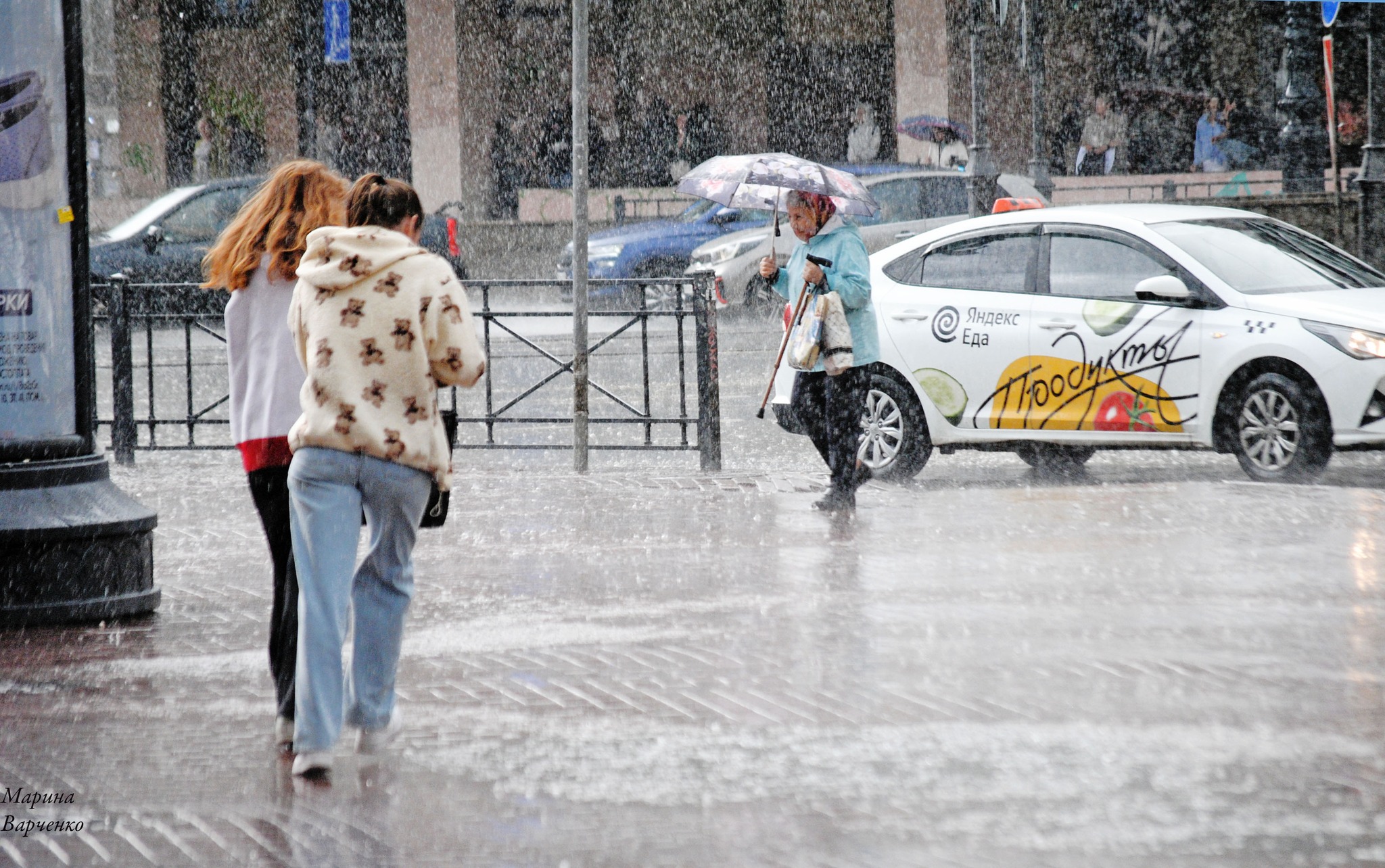
Source: Marina Varchenko (Facebook), 3 July 2023: “A downpour on Ligovka.” Ihave spent so much time on “Ligovka,” i.e., Ligovsky Prospekt, and on the corner pictured here in particular, that I’m nearly sure it’s permanently imprinted on my brain. I’ve probably been in more than one summertime evening downpour on that very same corner. ||| TRR
Don’t turn off your TV set. Keep watching the “most exciting World Cup ever.” While you do that, actual Russians and some non-Russians (i.e., Oleg Sentsov) are suffering horribly for the near-absolute power Russia’s Emperor of Ice Cream and his retinue have acquired over the last twenty years.
It was this same power (and the money that comes with it) that made it possible for the Emperor of Ice Cream and his pals to buy off FIFA’s bid committee and win the right to host the 2018 World Cup. They invoked this same power to spend more on preparations for the World Cup than any other host country has ever spent.
But instead of doing what enlightened despots have been known to do on such occasions — declaring amnesties, pardons, and ceasefires during Olympic Games and other such celebrations and great sporting events — the Emperor of Ice Cream’s repressive and imaginative secret services have seemingly notched up their civil war against their own people while you stay glued to your TV set, pretending it is possible to separate sports from politics.
Tell that to Yuri Dmitriev, rearrested and recharged for a crime for which he had recently been acquitted. Tell that to the Penza-Petersburg “terrorists,” all of them tortured by the FSB (KGB) into forcing them to give the testimony the FSB wanted to hear, never mind that it is total nonsense, the sick fantasies of the FSB itself, which sees or, rather, pretends to see a “terrorist” hiding under every rock. Tell that to Oleg Sentsov, a Ukrainian filmmaker and resident of Crimea, sentenced to 20 years in a maximum security correctional facility in Russia’s Far North for the thought crime of opposing Russia’s occupation of Crimea.
It’s frightening how “natural” absolutely neo-Nazi-like racialism has come to seem to so many folks in the Former East. It really beggars the imagination. What went wrong?
And it’s all reproduced and disseminated, whether in private conversation or more impersonal forums like Facebook, with such aplomb and confidence, as if literally no else in the world has thought or could think otherwise. Even broaching, in the most primitive way possible, the idea that races are a “construct” used to dominate some “races” while advantaging others, not something “natural,” will only expose you to instant derision.
What “race” is this bird? Is it white or black? In fact, it’s black, white, and several shades in between. Obviously, this is an absurd conversation, since we superior beings don’t attribute “race” to birds.
But we do attribute it to each other, missing somehow that the whole point, the only point, is power. Natural’s not in it.
One of the keys to successfully translating contemporary Russian avant-garde poetry into English is having absolutely no sense of colloquial English. The translations should sound leaden, awkward, and dull, as if they had been written by a manager in the Flint, Michigan, water department trying to justify his criminal negligence in an impenetrable and evasive letter to the EPA, to wit:
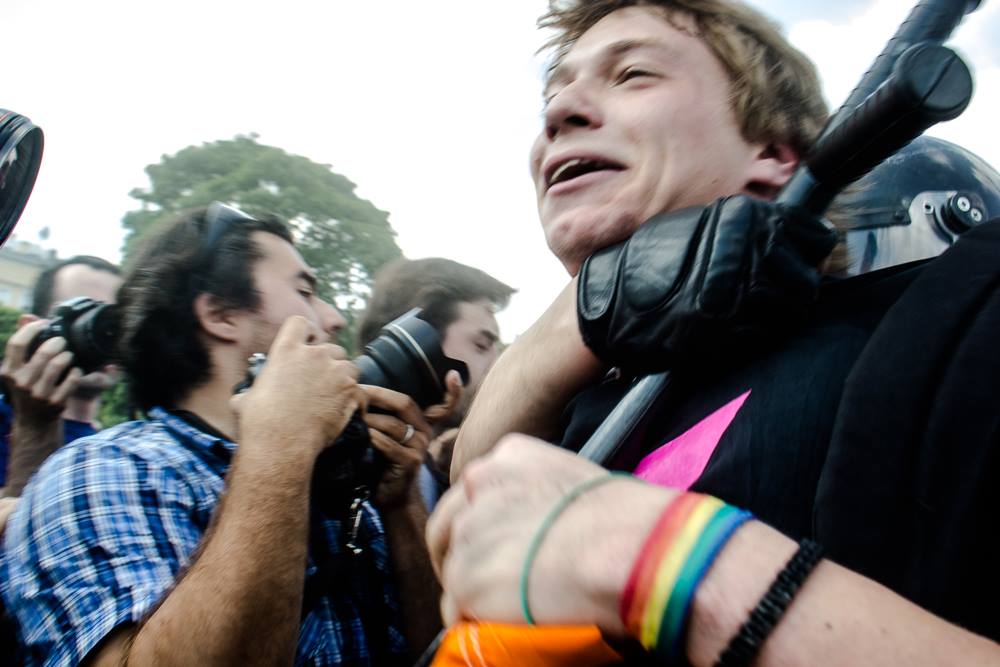
More fascists at today’s LGBT Pride event in Petersburg, as photographed by the intrepid Sergey Chernov. He reports that a few of the fascists brought small children with them so that it would be possible to charge the LGBT activists with violating Petersburg’s fascist-inspired law against “gay propaganda” amongst minors.
Fascists posing as “Cossacks” at today’s LGBT Pride event in downtown Petersburg, where all the gay activists were arrested by the police, unlike the 200 or 300 fascists, who apparently enjoy near or complete immunity for crimes that would get anyone else arrested. Photo by one of the few faithful friends of freedom left in Petersburg, Sergey Chernov.
Photo by Sergey Chernov: “St. Petersburg LGBT Pride event: fascists.”
Russian businessman, owner of the Concord Group of companies, “Putin’s chef” and confidant of the president, founder of a media empire and the Wagner Group, and one of the most famous people in Russia, Yevgeny Prigozhin now faces criminal charges of organizing an armed rebellion.
Prigozhin was born in Leningrad on 1 June 1961. We know that his mother, Violetta, worked at a hospital, his father died early, and his stepfather Samuel Zharkoy raised the future “Kremlin chef.” Zharkoy also encouraged Prigozhin to ski: his stepson graduated from Athletics Boarding School No. 62, where the swimmer Vladimir Salnikov and the gymnast Alexander Dityatin were his classmates. Prigozhin then enrolled at the Leningrad Chemical and Pharmaceutical Institute, but, according to his own account, he did not finish his degree there.
In 1979, the entrepreneur was given a suspended sentence on robbery charges. According to media reports, in 1981 he was sentenced by the Zhdanov District Court to twelve years in prison for a number of crimes at once, but in 1988 he was pardoned, and in 1990 he was released from prison early.
Beginnings
As Prigozhin himself recounted in an interview, his first business, founded in 1990, was selling hot dogs at the Apraksin Dvor market, the first such outlet in the city. “The mustard was mixed in my apartment, in the kitchen. My mother also tallied the proceeds there. I earned $1,000 a month, and that amounted to piles of rubles,” the businessman said.
In the 1990s, Prigozhin managed Kontrast, a chain of private grocery stores. He launched his future restaurant business in 1995 by opening Wine Club, a bar and shop on Vasilyevsky Island. In late 1996, after meeting the Briton Tony Gere, Prigozhin opened the Old Customs House, which is considered one of the first elite restaurants in Petersburg. According to some reports, his partner in this business venture was Mikhail Mirilashvili, a well-known Petersburg entrepreneur who years later cofounded the VKontakte social media network.
Prigozhin later opened three more establishments: Seven Forty, Stroganov Yard, and Russian Kitsch. In 1998, he opened the restaurant New Island on the used passenger ship Moscow-177, purchased for fifty thousand dollars, which became a popular spot in Petersburg. When Prime Minister Sergei Stepashin and IMF managing director Michel Camdessus visited the city in June 1999, New Island was the only decent place to wine and dine the high-ranking guests.
In 2001, Vladimir Putin dined there with Jacques Chirac, and a year later with George Bush. In 2003, according to media reports, the Russian president celebrated his birthday there. Since the businessman personally served dishes to the president, he was dubbed “Putin’s chef” and “the Kremlin’s chef.”
By that time, Prigozhin had already moved into the catering business, founding Concord Catering in 1995. In 2002, he launched the Damn!Donalds chain of fast food restaurants: the businessman came up with the name himself. The chain was shuttered ten years later, however.
As the businessman recounted in an interview about the success of his catering business, by 2005 he owned “the largest catering company in Russia for ten years running.” “We did all the G8s and the summits,” Prigozhin recalled. From information available in open sources, it follows that the businessman actually did organize a number of banquets for high-ranking guests, including meals at the Russian Federal House of Government.
Buoyed by this success, Prigozhin decided to enter the school meals market. “I decided to try my hand at it and chose a couple of schools on Vasilyevsky Island — No. 10 and No. 18. Of course, it wasn’t a business. I began feeding the schoolchildren airtight-packaged box meals. I set up modern compact kitchens right in the schools — everything fit in a six-square-meter space. At the same time, I carefully researched the topic.”
In the 2000s, Prigozhin went into the construction business. In particular, he built Northern Versailles, a gated mansion community, in Petersburg’s Lakhta district. In 2016, a company belonging to the businessman built the Lahta Plaza[apartment and hotel] complex next to St. Petersburg Tricentennial Park.
In 2016, it transpired that a Prigozhin-affiliated company bought the premises of the Shop of Merchants Yeliseyev, which he had occupied on lease since 2010, after making expensive renovations. By 2015, Prigozhin’s companies had become the largest supplier of food to the Defense Ministry.
In 2018, Vladimir Putin said in an interview with western media, “He is not my friend. I know such a person, but he is not on my list of friends.”
Media Empire
In 2013, it was reported that the Internet Research Agency, which was informally dubbed the “troll factory,” was located on Savushkin Street in Petersburg. Hundreds of people worked on the media holding’s websites. Prigozhin’s connection with the growing media empire was denied by Concord’s press service.
2019 saw the emergence of the Patriot Media Group, which included the Federal News Agency (FAN), Economy Today, Politics Today, and Nation News. Yevgeny Prigozhin headed its board of trustees, but the businessman’s financial involvement in the project was denied.
Western sanctions against Prigozhin were imposed for the first time over the involvement of his media outlets in the information campaign [sic] for the US presidential election.
Wagner
The Wagner Group, a private military company, was founded in 2014. Subsequently, Wagner soldiers were involved in fighting in eastern Ukraine and, later, in Syria. In 2017, the company was placed on the US sanctions list. But [Prigozhin]admitted his involvement in founding Wagner only in 2022. Western countries have claimed that Wagner mercenaries have also operated in Libya, the Central African Republic, Sudan, Mozambique, and Mali.
SMO
Since 24 February 2022 and the beginning of the SMO, Prigozhin gained worldwide fame in connection with the Wagner Group’s actions in Ukraine. Wagner’s troops have been heavily involved in the fighting. Mercenaries recruited among convicts have been actively joining the ranks of Wagner PMC. In March, the businessman claimed that over 5,000 ex-convicts had returned to Russia after participating in combat.
The conflict between the Defense Ministry and Prigozhin rapidly deteriorated in 2022, although friction between the two parties had essentially begun several years earlier.
A year later, in February 2023, Prigozhin publicly voiced dissatisfaction with the lack of ammunition during the battles for Bakhmut (Artemovsk). A campaign entitled #GiveWagnerShells gained momentum on the internet.
On May 10, the businessman, amid rumors of a “shell famine,” publicly announced his willingness to transfer Wagner’s positions in Bakhmut to Chechnya’s Akhmat Regiment at the suggestion of Chechen ruler Ramzan Kadyrov. On May 20, the businessman said that Wagner had taken Bakhmut, and once again made highly critical remarks about the Defense Ministry. Five days later, Prigozhin announced that he was withdrawing his units from the city.
In June 2023, the businessman asked Defense Minister Sergei Shoigu to release the Concord Group from its catering contract in the SMO zone after more than sixteen years of successful cooperation with the Russian military’s kitchens.
Moreover, Prigozhin said that an order that members of volunteer detachments must sign contracts with the Defense Ministry did not apply to the Wagner Group.
Then came June 23. Wagner’s founder made new public statements, triggering criminal charges against him. If convicted, Prigozhin faces up to twenty years in prison.
Goods bearing the emblems of the Wagner Group (including chevrons, flags, t-shirts, baseball caps, and sewn-on patches) have been brought back to the “counters” at Wildberries, as our correspondent verified on the evening of June 24.
In the first half of the day, a source at Wildberries told RIA Novosti that the online retailer had bearing removing goods bearing the [private military] company’s emblems and was going to remove them altogether. Later, such goods were hidden by Ozon, where they are still unavailable.
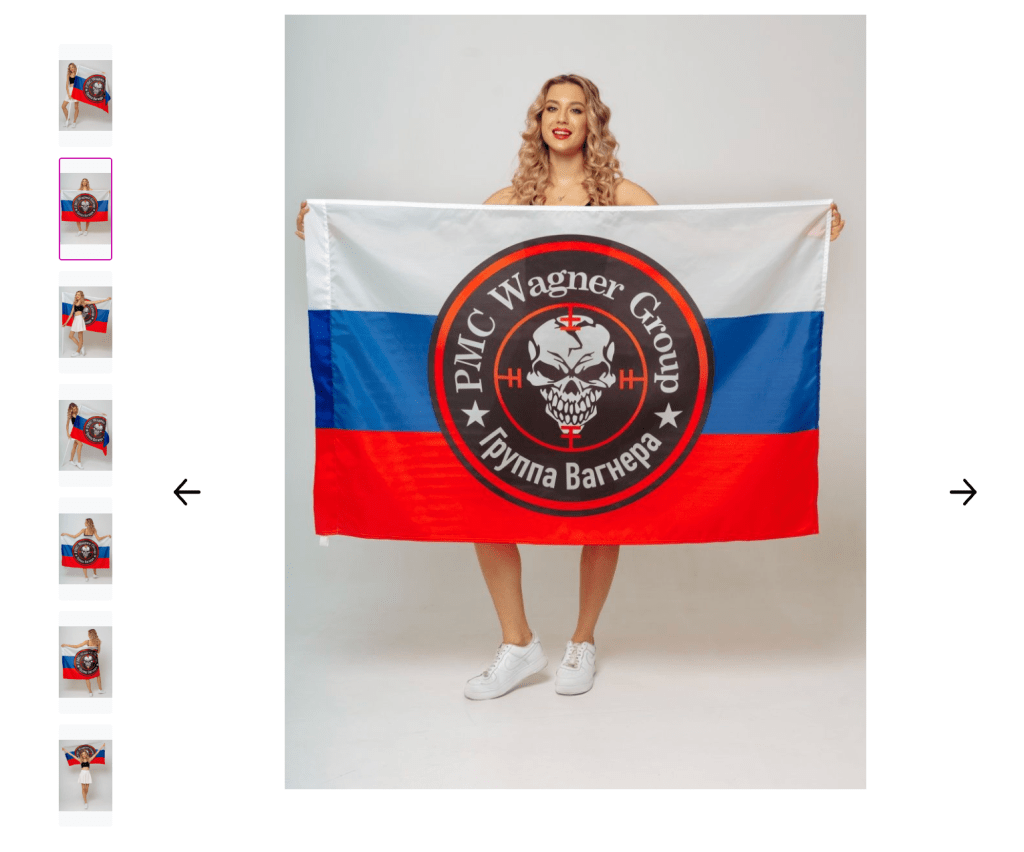
A search for the phrase “Wagner PMC” on the website of popular Russian online retailer Wildberries garnered 8,736 items, including the fetchingly reimagined Russian tricolor flag, below. This search was performed at 11 p.m. Moscow time on 24 June 2023.
Zenit FC midfielder Wendel has decided not to return to Petersburg due to the situation with the Wagner PMC, reportsSport Express, citing the player’s agent Cesare Barbieri.
“This is definitely a very delicate situation. Wendel will stay in Brazil until the situation improves. The club has already been notified of this. Zenit has reacted understandingly to the situation,” the agent said.
In the 2022–2023 season, 25-year-old Wendel has played twenty-five matches for Zenit in the Russian Premier League, scoring eight goals.
“For our series of reports on relations between Finland and Russia, we head to the border area. The two neighbours were strong trading partners until the 2022 invasion of Ukraine led Helsinki to cut off business ties. Russian tourists are no longer welcome and with EU sanctions in place, Finland is on the frontline in checking goods crossing its 1300 km long border with Russia. FRANCE 24’s Julien Sauvaget and Clovis Casali report.” France 24 (YouTube), 14 June 2023.
People in Russia don’t have time to think about world events, explains a Russian young man at the Vaalimaa border crossing. There are plenty of goods in St. Petersburg, despite the sanctions. This kind of me-centric luxury does not exist for Ukrainians.
If I were an autocrat, I would provide these border crossers with a thorough guided tour of the massacres in Mariupol and Bucha. The price would include a night of experiences, i.e., a month-long air raid simulation every night. I could think of a lot of other empathy exercises, though I don’t think they’ll do any good.
This is a comment on the news report, above, by a Finnish friend of mine, living near the Finnish-Russian border, who wishes to remain anonymous. Translated, from the Finnish, by the Russian Reader
“Steak House”: a still from yesterday’s episode of the MCU, supposedly set in Moscow but clearly not filmed there.
Navalny, as a politician, is making a systemic mistake by hoping to turn people against the war in three to four months, because in a fascistic society the tools of democracy (canvassing, persuasion, solidarity campaigns ) just don’t function.
These tools presuppose democracy, and Navalny has not been a candidate standing for elections for a long time, but a political prisoner. And yet behaves as if it’s 2018 and his team will go door to door campaigning against the war.
“Let’s fantasise a little,” writes Navalny, “if every tenth of the 1.5 million who left the country since the beginning of the war […] and [the] 1 million who stayed in Russia but are not afraid, joined the campaign against candidate War, then this army of 400,000 canvassers could reach 12 million citizens per month […] Such a strong canvassing machine would dramatically change the public mood in the country in three or four months.”
To this end, Navalny wants to recruit “100 pioneer volunteer canvassers” ready to act “according to the laws and techniques of good election campaigns [b]y polling everyone, targeting hundreds of different groups, finding an approach to each and every one of them, identifying the waverers and persuading them to change their minds.”
Navalny is going to defeat the manipulators of public opinion on their own field by using a “canvassing machine” and counter-manipulation (finding an approach, targeting, and persuading), as if it were a matter of finding the right tools of influence and the right political strategies.
These are the illusions of a systemic politician who still hopes to win by following the rules for running elections and interacting with his electorate aboveground, in the open. But there is no “electorate,” no “elections,” and no conditions for “canvassing” in Russia right now. The fascist reality is completely different.
It would have been rather strange to call on “brave Germans” to go door to door canvassing against the war and the Fuehrer in 1943. Heroic people (we know their names) tried to do this in Berlin by scattering leaflets, and they were finished off by the Gestapo. They were heroes, of course, but the effectiveness of persuading people with words and leaflets in a fascizoid society is zero.
Only the regime’s defeat by outside forces, when the failure of the state is translated into “pain and suffering” for the so-called common folk, can reformat Zombieland.
History knows no other way to impact the zombified brains of the “common folk.” The task of the opposition in Russia, therefore, is to call for the destruction of the state and defeat in the war as soon as possible. We need to donate money to the Ukrainian Armed Forces and raise funds for the transfer of cutting-edge weapons to Ukraine, because crazy “Russian women” (the wives and mothers of war criminals) will not be persuaded by leaflets and conversations, but by coffins and funerals.
The losses suffered by the occupiers are the only key to peace.
And the dreams of the systemic politician (with all due respect to Navalny’s steadfastness) cannot come true. The mythical “army of canvassers” will simply end up in adjoining jail cells, like the brave picketers who protested on the streets.
In fact, Navalny proposes to his thousands of supporters the model of behavior he followed when he bet on the system’s sticking to rules of the game when he returned to Russia. By that time, however, there were no rules (as the FSB’s Novichok should have convinced him). We all remember what end his faith in the system (the ability to defend oneself in open court and hold large-scale protest rallies, and reliance on the power of aboveground regional organizing hubs) came to.
Playing at systemic politics with fascism ended with a “life” term in prison. Unfortunately, neither Navalny nor Yashin draw the right conclusions. They are free to make their own decisions for themselves, but daydreaming about “canvassers” who will go out and agitate among the common folk in keeping with the “laws of good election campaigns” is tantamount to being divorced from reality.
Unfortunately, it is clear why. The systemic opposition in Russia still clings to the illusion of “persuading” Russian society without defeating the state. But betting on the “internal forces” of the rotten imperial óchlos (which calls itself a society) is another illusion that renders the opposition’s politics toothless.
Alexei Navalny has launched a big political campaign against Putin and the war. Using modern technology we will create a real truth machine that will help us reach out to Russians.
In this video, Leonid Volkov explains how the campaign will be set up and how you can get involved.
[…]
Source: Alexei Navalny (YouTube), 20 June 2023. The video, above, includes English subtitles, which can be turned on by toggling the "CC" button on the bottom of the screen. Even more curiously, the annotation, above, is also in English.
Hi, it’s Navalny.
Today marks the beginning of yet another trial, which will greatly increase my total sentence. However, I don’t want to use this day simply to draw sympathy for myself and other political prisoners. I want to call everyone to action, and use this day to announce our new, very important project. The big propaganda machine. The truth machine. We don’t just intend to make it, we will definitely create it in order to join forces against Putin’s lies and the Kremlin’s hypocrisy. We really need you. Join us.
Why is today the right day for this announcement? Because my trial itself proves the rightness and necessity of such a project. What is the most important thing about this trial? Not lawlessness, not “phone justice”, not the obedience of unscrupulous judges and prosecutors. The main thing is its format: it is a trial inside a prison. Putin doesn’t shy away from jailing the innocent, and he’s not afraid that I might be taken back by rebellious mobs during a court session in Moscow. However, he is afraid of what I have to say. Even if they are obvious words known to all. He is afraid of the word. Not just mine, of course, which is why Kara-Murza and many others were also tried in a closed trial.
Putin is afraid of any word of truth, he hates speeches that turn into Internet memes, he is furious at the “last words” [i.e., the closing statements of defendants at political trials] that get an audience of millions. In essence, the task of strengthening and prolonging Putin’s power is accomplished by shutting up those who dare to speak the truth. This goal is the subject of almost everything that has been done in Russian politics over the last few years. And since the start of the war, the regime has not thought about anything else. People get jailed for their posts, for defamation, for spreading misinformation, there are endless arrests and blockings, everyone gets labelled as “foreign agents” or “undesirable organisations”. Why not let people talk though? When the government fights rallies that it considers dangerous, there is some logic to it, but what exactly is the problem with chatter on the Internet or even over the phone?
It may even seem that this way, discontent goes to waste. Keyboard warriors spend their time leaving likes instead of building barricades. But that’s not really how politics works.
Putin has proven to be a fool in the military sphere, a talentless military leader, but he is no fool when it comes to politics. He knows that the backbone of any political action is an idea and a word. Canvassing and persuasion. This is very evident during elections, especially those that are highly competitive. Whatever the specifics of the state, its political traditions and agenda issues, during elections it still comes down to canvassers going door-to-door, making phone calls, persuading people on social media and messengers. And during every US presidential election, with all their high technology and huge budgets, the candidates themselves volunteer at call centres to encourage their supporters to also come there and call, explain and persuade.
Because in terms of the power of persuasion, nothing has or will ever beat the most basic kind of campaigning – simply talking to people, providing them with examples and arguments.
People like to claim that they are not influenced by election campaigning, that they already know exactly what they want and that they cannot be persuaded. But this is not true. A large part of the electorate makes their choice at the polling station, so a good canvasser can sow doubt, persuade, and change their minds. This has long been proven. And we ourselves have conducted experiments in this field.
So what is there to campaign for when there is no election? There is actually plenty to campaign for, and the stakes are very high. We will campaign against the war. And against Putin. That’s right. We will conduct a long, hard, exhausting, but fundamentally important campaign to turn people against the war.
Against war and everything related to it. Against the deadlock that Putin so madly and stupidly spiralled into on February 24, 2022: deaths, casualties, mobilisation, war crimes, isolation, sanctions, tens of thousands dead and millions leaving the country. Degradation of the economy and decline in living standards, criminals fighting at the frontlines and penniless mobilised soldiers, lots of wounded and killed.
This is a very precise task, and I have no doubt that our work will be successful. Here is the most important table and the main figure from one of our surveys:
Every fifth person has relatives or acquaintances who died in this war. Sadly, these figures will only continue to grow, changing public perceptions. Tens of thousands of wounded and disabled people. Hundreds of thousands of mobilised men who have seen Putin’s war for themselves: the talentless thieving generals, the shortage of everything from socks to shells. They return home, their stories are listened to and retold. This does not at all mean that these people automatically become anti-war activists. But it certainly means that they can become them with our help. We have a good reason to talk to them about important issues, and many will be willing to talk.
We will change many people’s minds and raise doubts in almost all of them. This is a campaign against the candidates War and Putin. And we will do it according to the laws and techniques of good election campaigns. By polling everyone, targeting hundreds of different groups, finding an approach to each and every one of them, identifying the waverers and persuading them to change their minds.
I strongly doubt the huge numbers of “war support” reported by Kremlin sociologists. The main reason is that it is unclear what the term “support for the special military operation” actually means. I ask to be sent everything that Strelkov and Prigozhin write and say, I read it very thoughtfully. Are they pro-war? Of course they are. But despite all their mutual dislike, I can’t find any clearer anti-Putin and anti-Kremlin statements from anyone else. And frankly, some of their statements are already close to anti-war. Have you seen Prigozhin’s interview? As savage as it is, it’s still anti-war. Putin’s cook says expressly the war is already lost. A scenario of victory – in his words, the “optimal” scenario, in which we manage to keep what we have already grabbed – is hardly possible. The elites have stolen everything and their children are abroad. The generals are stupid thieves. Our weapons are bad, there are no shells. This is actually the style that the ACF has always spoken in, but now this comes from the main supporter of the war and one of its main commanders who is speaking.
So whenever a voter repeats all this to us, our task is to ask him ingratiatingly: well then, maybe to hell with this war? Why did we even start it? Yes, many people dislike not war itself, but a lost war, or a meaningless war. OK, any anti-war campaign relies on that too, as was the case with the Vietnam and Iraq wars.
I agitate the cops the best I can over here. Naturally, they say they are pro-war. That’s to be expected: our conversations are recorded on their body cams. It is useless to talk to them about war crimes, Bucha, aggression, and sanctions. They do not care about those suffering. But when I ask: “Where are the shells though? Where has your Putin, who has been in power for 23 years, having a ton of money, wasted all the shells, socks, bulletproof vests and quadcopters?” – they have no answer. “It wasn’t me who asked about the shells first. It was your Prigozhin, whom you were kowtowing to when he came here to recruit prisoners for the war. And if your government is so fucked up that there’s no intelligence, no commanders, no border, no air defence, no shells, no socks – then why the hell did you start this war? To bury a million people in the ground?” They don’t put me on a pedestal after such talk, but they do start thinking and having doubts.
So we are going to find a personal approach to everyone, without using the same language to talk to a programmer from Moscow, a young mother from Orel, and a retired serviceman from Chelyabinsk. This is a campaign against candidate War, and it can only be conducted successfully with the support of an army of tens, and preferably hundreds of thousands, of motivated, diligent, hard-working people who believe in success. People who don’t burn out every five minutes, who don’t faint when their interlocutor tells them to piss off, who don’t get demotivated when facing an average voter and don’t expect them to be logical, intelligent, educated, polite, and quick to change their minds. This is a smart, subtle and difficult long term job, and I encourage those who want to do some real work and make a real contribution, rather than endlessly whining on Facebook and Twitter where we try to re-convince ourselves, to join us.
We already oppose the war, there are already several million of us, we have already learned how to organise and finance our own actions. Let’s fantasise a little: if every tenth of the 1.5 million who left the country since the beginning of the war and mobilisation, 1.5 million who left after 2014 and 1 million who stayed in Russia but are not afraid, joined the campaign against candidate War, then this army of 400,000 canvassers could reach 12 million citizens per month, even if each of them only makes one contact a day, i.e. does not overwork in the slightest. Such a strong canvassing machine would dramatically change the public mood in the country in three or four months.
But let us stop imagining things now. Because this is not likely to happen in practice. People are lazy, they have their own things to do. The most vociferous of them, those who demanded “real action”, will be the first to disappear. The idlers, as always, will find excuses for themselves along the lines of “that’s no real action, I would gladly derail some trains, but this is rubbish”. And they will concentrate on criticism without ever derailing a single train. And so on. These things happen during any election campaign. Nevertheless, we do realise that there are tens of thousands of people who are prepared to devote at least one hour a day to work diligently and persistently for the common good. This is a colossal force. It will not be easy to organise such a canvassing machine – one of the largest in the world. However, all things are difficult before they are easy. I am confident that we can set ourselves the first task of reaching 10 million voters with our campaign against the war and Putin. That will already guarantee a noticeable shift in public opinion. No one can predict what effect this will have on the political situation. But our work will certainly not be in vain.
Let’s move on to specifics. What instruments of persuasion are available to us within Russia? Rallies or pickets – no. Door-to-door visits – no. Calls from one’s own phone if the caller is inside Russia – no. Call centres inside Russia – no. As you can see, the basic arsenal of traditional election campaigns is not available to us. We rationally acknowledge this.
However, there are new opportunities, new technologies. Offshore call centres, decentralised call centres. Messengers – campaigning through them can be amazingly effective, given that every granny already has WhatsApp and Telegram. Campaigning on Kremlin-controlled social networks is also possible if the risks are properly avoided. Thus, a rough description of the campaign machine that we will be building is as follows: it will be a system that will allow you (the canvassers) to join it at any convenient time, from anywhere, and (while preserving your anonymity if you wish) communicate with voters within Russia that fit the required parameters (gender, age, city, occupation, etc.) by voice or text. The system will teach you how to canvass, drawing on previous experience and suggesting a pattern of conversation, facts and phrases. In a way, it’s like creating and training artificial intelligence. We have to create and train a system of collective intelligence, convincing voters to oppose the candidates we hate – War and Putin.
«Woah!», — you might say.
Well, yes, it is an ambitious task. However, it is nothing unrealistic or previously unseen. Marketers, advertisers and political strategists have been doing this for decades. All those cold calls, warm contacts and sales funnels are well known to all. It is just that, more often than not, marketers do not go to prison for such things. Our activities, of course, will be declared illegal and subversive. All the forces of the state apparatus will be rushed to combat it. Very well, we will throw all our energy into the fight against the apparatus of war, corruption and stupidity.
There is a lot of technical work to be done. Nothing like this exists yet. The system must be very flexible and have qualities that would appear to be mutually exclusive. It should be a user-friendly database of contacts, but it must be designed in such a way that would rule out any possibility of it leaking out and causing problems for people. Anyone should be able to get involved quickly, but we need to be able to weed out the provocateurs, the crooks, the stupid, the hotheads and so on as quickly as possible. A large number of one-time accounts will have to be created, but this should not turn into a spam machine. The propaganda machine should be able to adapt instantly to blockages and any opposition, and be as creative as possible. My colleagues and I have been doing or trying to do some elements of such a thing since 2012 – old-timers may remember the Good Truth Machine project, which I announced at one of the rallies back in the day.
However, the scale of this project is such that there has always been a lack of time, knowledge, money and staffing. I think this is one of my biggest political mistakes: I did not make the Good Truth Machine a priority and we did not manage to build it after the 2013 elections, being constantly distracted by other things. And now we simply don’t have a choice. Neither political (what could be more important than stopping a war and a government living a war?) nor organisational (hundreds of thousands of the most active and literate citizens have been forced into emigration). They are ready to do something, but what? We get thousands of messages: “Guys, give us some work, useful work that can be done from abroad or in Russia, but without too much risk.”
So, we start inventing, we start building, we start hiring, we start raising money. We need you very much. First and foremost, we need those who understand the technical, logistical and organisational side of what I have described. We are collecting opinions, expertise and ideas. We will soon organise hackathons in various cities. And, of course, we need the most resilient and the most patient, the most understanding, those who will become the heart and essence of this system. A technical shell is being built, but must be filled with people.
In order to campaign successfully, we need to have conducted thousands of hours of conversations by the time we build and launch a full-fledged machine. We need to listen through them and analyse them, determine micro-targeting parameters, create, try, modify and improve hundreds of scripted conversations for different target groups.
We’re looking for 100 pioneer volunteer canvassers who are ready to tackle this awesome, but challenging, task, especially amidst the inevitable chaos and mess of the first steps.
Email antiwar@navalny.com if you are:
– an IT specialist willing to invest a lot of time into creating technology solutions for our campaign system;
– a marketer, sociologist or political scientist willing to invest a lot of time into creating conversation scripts, engagement funnels, etc.;
– a supporter willing to donate a substantial amount of money to this particular canvassing project;
– a volunteer willing to be in the first hundred people who will invest a lot of time conducting conversations, working out scripts and finding the words and approaches that take voters away from candidate Putin and candidate War.
Write about yourself in sufficient detail, stating where you are from, where you live now and how much time you have for this job. We will get back to you shortly.
This is a long-term project. Putin’s military defeat is inevitable. But no one knows what it will look like or what its consequences will be. Those at the very top of power, the ones who are ready to wage war for the sake of money and strengthening their position, are not going anywhere. They will not pack up and fly off to the moon. Their response to a lost war will be hysteria and preparation for a new war. That is what they will brainwash the citizens with. No one but us can enter this fight for the hearts and minds of our fellow citizens. So, we must enter it and win it.
While thousands of Ukrainians were fleeing their submerged homes after a catastrophic dam explosion last week, high-society Russians gathered for a glitzy restaurant festival in the Black Sea resort of Sochi, just 500 miles away from the devastating flooding.
The event, called Gastreet, saw some 5,000 citizens pay up to $2,000 dollars for the opportunity to listen to some of Russia’s top businessmen, restaurant owners, and influencers over the course of five days. The event also included concerts, lavish nightlife experiences, and gourmet dinners.
If there’s one thing that was made clear at the Sochi resort, it’s that no amount of Western sanctions, Kremlin restrictions, or spillover violence within Russia can stop the country’s rich and famous from living large—despite the raging war in neighboring Ukraine.
Take Ksenia Sobchak, Putin’s rumored goddaughter and one of the VIP Gastreet guests who spoke at the Sochi resort last week. The Russian influencer—who reportedly made over $3 million from her media holding company, Careful Media, last year—has continued to promote products on her Instagram page in the lead-up to the event, even though the app has been banned in Russia.
One of her latest marketing campaigns is for Primepark, a luxury real estate complex in the heart of Moscow.
“Just imagine, valet meets you in the parking lot, bellmen carry your shopping bags to your apartment, housekeepers help with all your routine around the house—I always said that comfort is made by details,” Sobchak wrote under photos of herself in designer outfits, wandering around luxury apartments. (The comment sections are flooded with responses blasting Sobchak with “reminders” of the countless missiles descending on Ukraine.)
“Mikhail Ivanov: ‘A million have left. 139 million stayed,'” Tell Gordeeva (YouTube), 20 June 2023. In Russian, with no English subtitles
Mikhail Ivanov is a star of the Russian book market and the subject of the new episode of Tell Gordeeva. Ten years ago, he reinvented the old Soviet bookstore Subscription Editions and made from St. Petersburg fashionable. Why write, read and sell books in a world where there seems to be no cultural values left anymore? And who needs books when a war is underway? We talk with Ivanov about why he continues to live and work in Russia and on whose behalf he does it.
Contents:
00:00 How Misha visited the store he now owns for the first time 2:48 “Books smell of danger, freedom, and freshness” 4:27 “On my fifth birthday I ran away from home to see the battleship Aurora” 5:47 “She likes it, but she didn’t believe it until the bitter end”: how Misha’s grandmother handed him control of Subscription Editions 7:27 “It was hard for me to concentrate on reading” 9:24 Harry Potter’s graphic art secret 13:46 Subscription Editions’ business model 14:59 “Here you could drink tequila from someone’s navel right at the bar”: what happened to Subscription Editions in the 2000s? 17:02 “Mom and Grandma gave me 2.5 million rubles to buy the store in 2013” 18:12 How to get round all the restrictions 20:57 “I’m Mikhail Ivanov: I work in a bookstore and publish books. I have nothing to do with it” 24:30 “I promised to stay with my employees. I can’t leave” 26:12 “We know who owns what fur coats, buildings and planes, but we were not offered an alternative”: on the opposition 28:03 “I am a citizen of Russia, I pay taxes here. But I don’t associate myself with the Russian Federation” 30:09 “How can you do public opinion polls when they can inform on you?” 32:26 “I’ve been dreaming of going to a Monatik concert for 10 years” 33:22 Top 5 books of 2022 in Russia 34:09 Why do some bookstores hide books by “foreign agents” and do they have to do this by law? 37:26 “The employees of Subscription Editions treated me like my grandmother’s grandson” 40:30 Who Katerina Alexandrovna is and why her favorite books are important to us 42:12 “4,000 people come to our store every day” 43:02 “We had our biggest earnings in March and April 2022” 44:27 “We will close the libraries and smuggle out the books” 48:02 “Where to find a haystack?”: how Subscription Editions’ unique Instagram is created 52:18 What did people do in the bookstore behind a closed grate? Yes, yes! 53:08 “We are a catalogue of the good books published in Russia” 55:05 “We are from Petersburg, and only then from Russia” 1:00:04 Installing a lift in a bookstore for 6 million rubles: what???!!!! 1:02:42 “Our growth strategy doesn’t allow us to stumble”1:04:05 “Do your job and sell books” 1:06:45 “A long strange courtyard that no one knows about”: Mikhail Ivanov gives a tour of Petersburg’s pass-through courtyards 1:08:36 “We show that you can live differently” 1:12:02 St. Petersburg’s Books Quarter 1:15:05 Why is Margarita Simonyan’s book selling so badly? 1:17:24 “I won’t say and do things I don’t believe in” 1:20:01 “How can I lose the meaning of what I am myself?”: on emigration 1:21:09 How Ivanov came up with the postcard “From Petersburg with apathy and indifference” 1:23:55 “There is a separate room with padded walls for bookmen in paradise”

 7 p.m., Saturday, July 15
 Open Space in St. Petersburg, 25 Rubinstein Street