Sergey Abashin writes: “All of Petersburg is covered with ads like this.”
This ad says that on the day you sign a contract to serve in the Russian army you’ll be issued a plot of land (for building your own house) near Petersburg whose market value is around two million rubles. You’ll also (?) get a one-time payment of 500,000 rubles. Your monthly pay in the army (if you serve in the “special military operation zone,” says the fine print) starts at 200,000 rubles.
According to the municipal statistics agency Petrostat (as cited by business daily Delovoi Peterburg), the average monthly wage in the city was 101,155 rubles in August. At current exchange rates, that amounts to around 1,056 USD. ||| TRR
Vocals – Vera Egorova, Double Bass – Anton Krasikov, Guitar – Yuri Yurov, Drums – Ivan Laptev, Saxophone – Anton Seryogin
Description
The lights of the city in evening, the music, the vibe… under a Paris sky!
Stage Magic Agency invites everyone to be inspired by the romantic motifs of France in the light of the crystal chandeliers at the Palma Mansion on October 14. The evening’s programme includes treasures of French pop and chanson as performed by the extravagant Vera Egorova & The Big Buddy Band. We will make a genuine French voyage from Zaz’s contemporary hits to such symbols of the era as Edith Piaf and Yves Montand.
Vera Egorova & The Big Buddy Band are musical hooligans from St. Petersburg and the musical project of singer and actress Vera Egorova. The band has performed more than 500 concerts in Russia and abroad and taken prizes at various international competitions and festivals. Each of their performances is a ton of drive and an endless stream of emotions.
Well, bon voyage! See you at the Palma!
Concert programme: Zaz – Je veux Zaz – Paris sera toujours Paris Zaz – demain c’est toi Edith Piaf – Padam Padam Edith Piaf – La vie En Rose Joe Dassin – Les Champs Elysees Charles Aznavour – Oublie Loulou Paolo Conte – Via con me Yves Montand – Sous le ciel de Paris Patricia Kass – Mon mec a moi Julie London – Fly me to the moon Madeleine Peyroux – J’Ai Deux Amours Osvaldo Farres – Quizas
Duration: 1 hour 15 minutes
Source: Bileter.ru (via the website’s 5 October 2023 email newsletter). The “concert programme” is reproduced here as it appeared in the original.
I could detect almost no actual French in this so-called cover of a French song by the “musical hooligans from St. Petersburg,” making it a perfect illustration of the cargo cult character of “world culture” as imagined and appropriated by xenophobic Putin-era Russians. ||| TRR
Dozens of people, including a 6-year-old child, were killed in a Russian attack that hit a cafe during a wake service in a village in the Kharkiv region of northeastern Ukraine on October 5, according to Ukrainian officials. RFE/RL visited the village a few hours after the deadly attack.
— Why is the issue of colonialism nearly absent from the Russian opposition’s agenda?
— It’s an unpopular topic because it forces us to look for the root of our troubles not only in the Putin regime but in ourselves as well. It forces us to look at our behavior and change it, and that’s an unpleasant process. No one likes admitting they’re wrong. No one likes admitting that their behavior or they themselves are racist. No one likes admitting they’re a xenophobe or colonialist.
— What must we do to rid ourselves of the colonial and imperial mindset?
— First of all, we must understand that Russians have to do this work themselves. Because if someone else from the outside does the work to decolonize Russians, they won’t like it. We don’t have to agree with every position 100%, we can argue on some points.
Changing a mindset is not an instantaneous thing. Unfortunately, we just don’t have time, because if we are going to discuss for another twenty years whether it is possible or not to use slurs in reference to ethnic minorities, nothing can help us anymore. We will turn other people’s lives into hell, and our own, too. But, of course, Russian colonialism won’t let itself be deconstructed without putting up a fight.
— This begs the question about another pattern you described—complaints about Russophobia. Why do you think they are unfounded? And do you consider, for example, banning cars with Russian license plates from entering European countries to be Russophobia?
— Of course, this is a very unpleasant situation. Russian liberals support one of the most important narratives of the Putin regime and of Russian colonialism in general, which boils down to the claim that Russians are victimized. I don’t think that banning Russian cars from entering [the EU] is a manifestation of Russophobia. I think it is a manifestation of the reaction to [Russia’s] full-scale invasion [of Ukraine], which, by the way, is still ongoing. The reaction is going to affect people who themselves have not been involved in the invasion in any way. Moreover, people who are least guilty may suffer from it—for example, activists who have been fighting the Putin regime all their lives.
This will continue, because the citizens of the Russian Federation were unable to oppose what is happening in any way, and in the eyes of the world, most of them fueled this invasion economically, politically, and rhetorically. Precisely because we don’t resist, we have to pay for it somehow. For example, we are in no hurry to separate the criminals from those who have not committed crimes.
Dummy ammo at Petersburg’s Udelny flea market. Photo: Anton Vaganov/Delovoi Peterburg
A Petersburg district court has ordered schools in the city’s Nevsky District to outfit themselves with dummy Kalashnikov assault rifles and copies of military regulations and of the Constitution of the Russian Federation, the consolidated press service of the municipal courts reports.
The Petersburg prosecutor’s office had motioned the Nevsky District Court to oblige schools No. 331, 323 and 339 to purchase the required equipment for their health and safety classrooms. The administrations of these educational institutions were also required to purchase manuals on the basics of shooting, dummies of the Kalashnikov assault rifle and the upgraded Kalashnikov assault rifle, and fifteen copies each of the Constitution, of the law “On Military Duty and Military Service,” and the of presidential decree “On Authorization of the General Military Regulations of the Armed Forces of the Russian Federation.”
“Counsel for the defendants acknowledged the claims made under the lawsuits. They explained that they were ready to equip the classrooms as required,” the municipal courts press service reports.
On September 15, the court ruled in favor of the plaintiffs in all three suits.
A similar ruling was made by Petersburg’s Kuibyshev District Court on 12 February 2023. Then, the court ordered School No. 294 in the the city’s Central District to purchase the gear for its health and safety classroom that it lacked: equipment for studying traffic regulations, first aid tools, and manuals and dummy weapons to be used for basic military training (NVP).
Since September 1, basic military training and labor education have been introduced as subjects in all Russian schools. DP took a look at how the uniform standards changed school education.
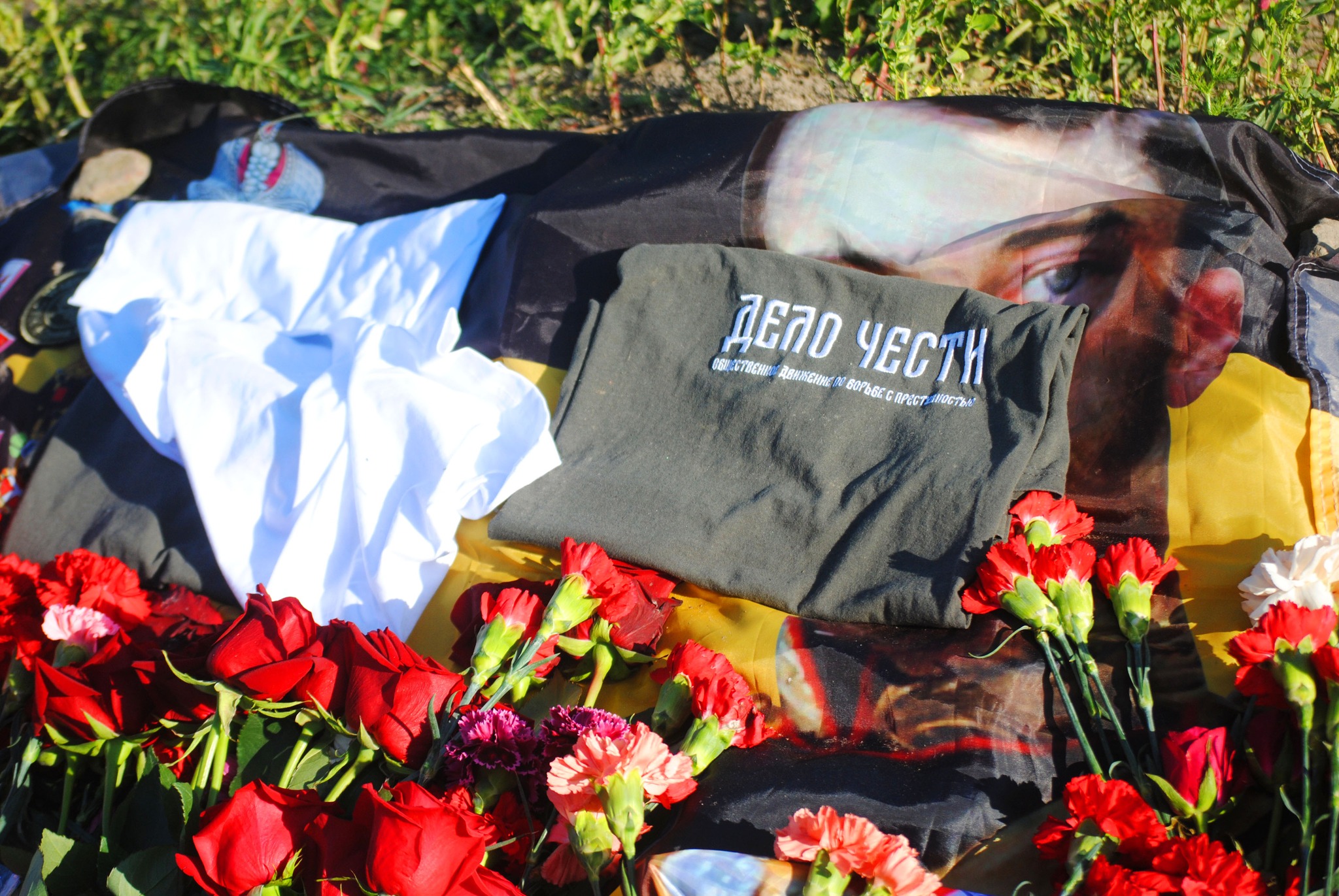
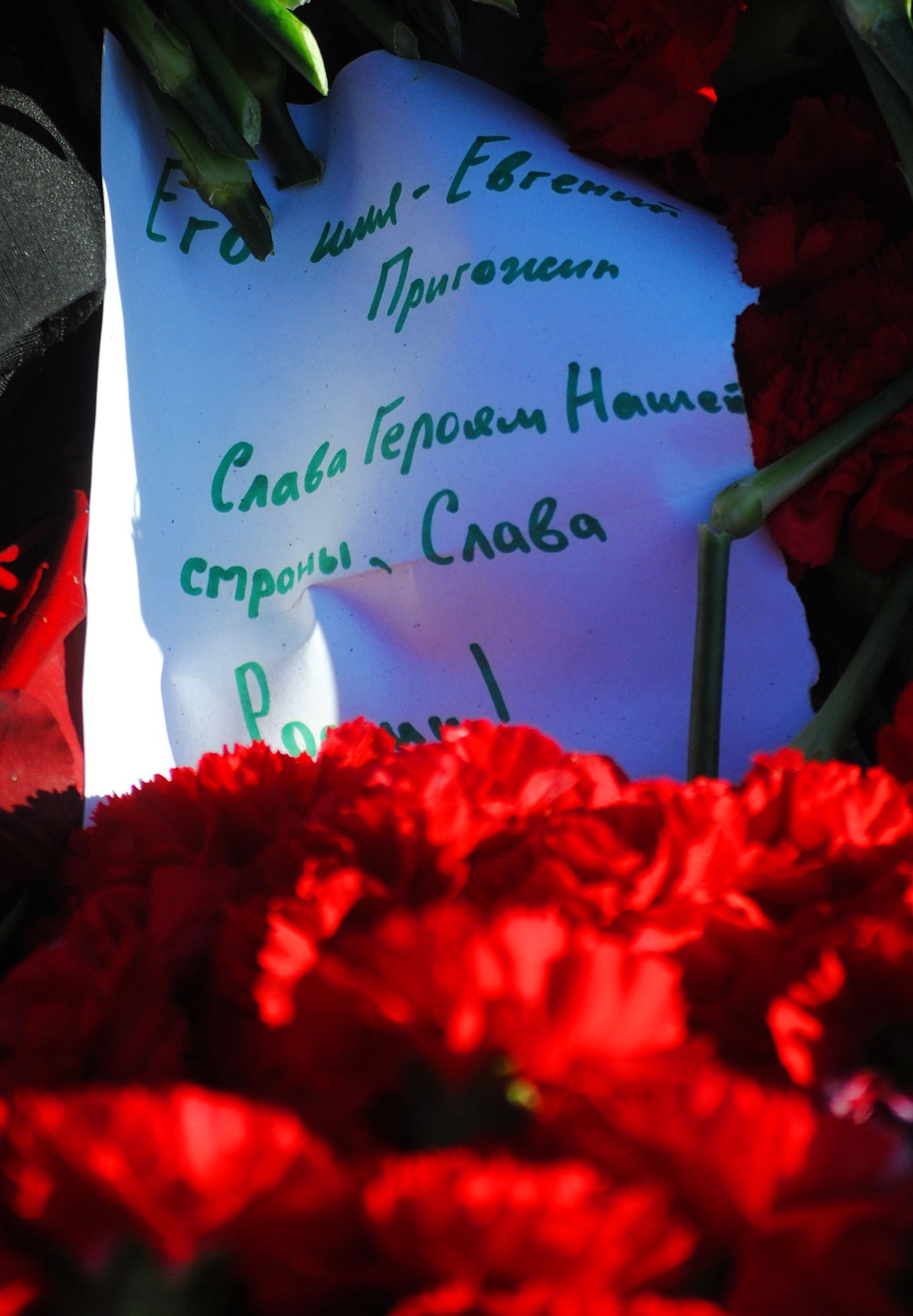
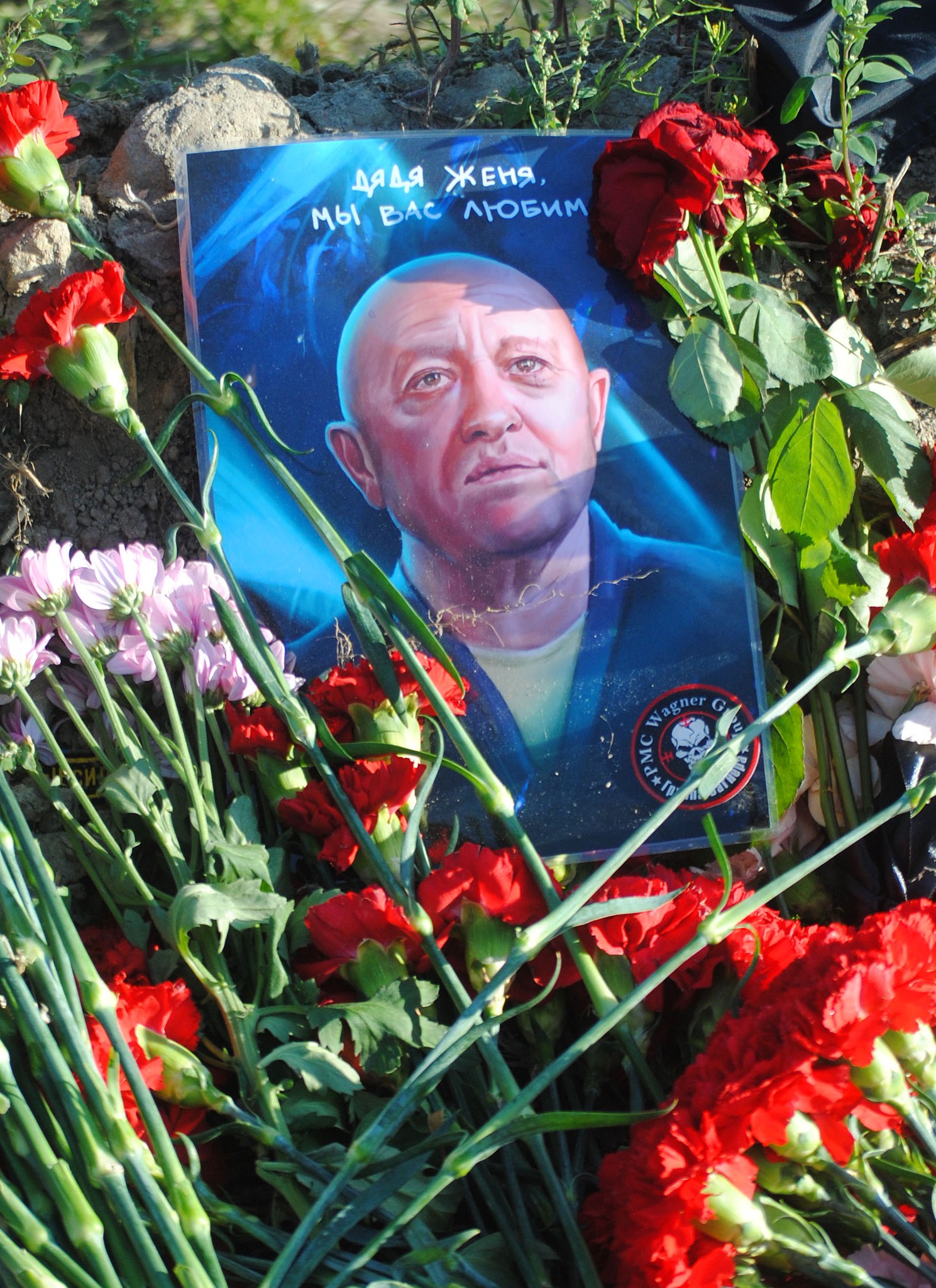
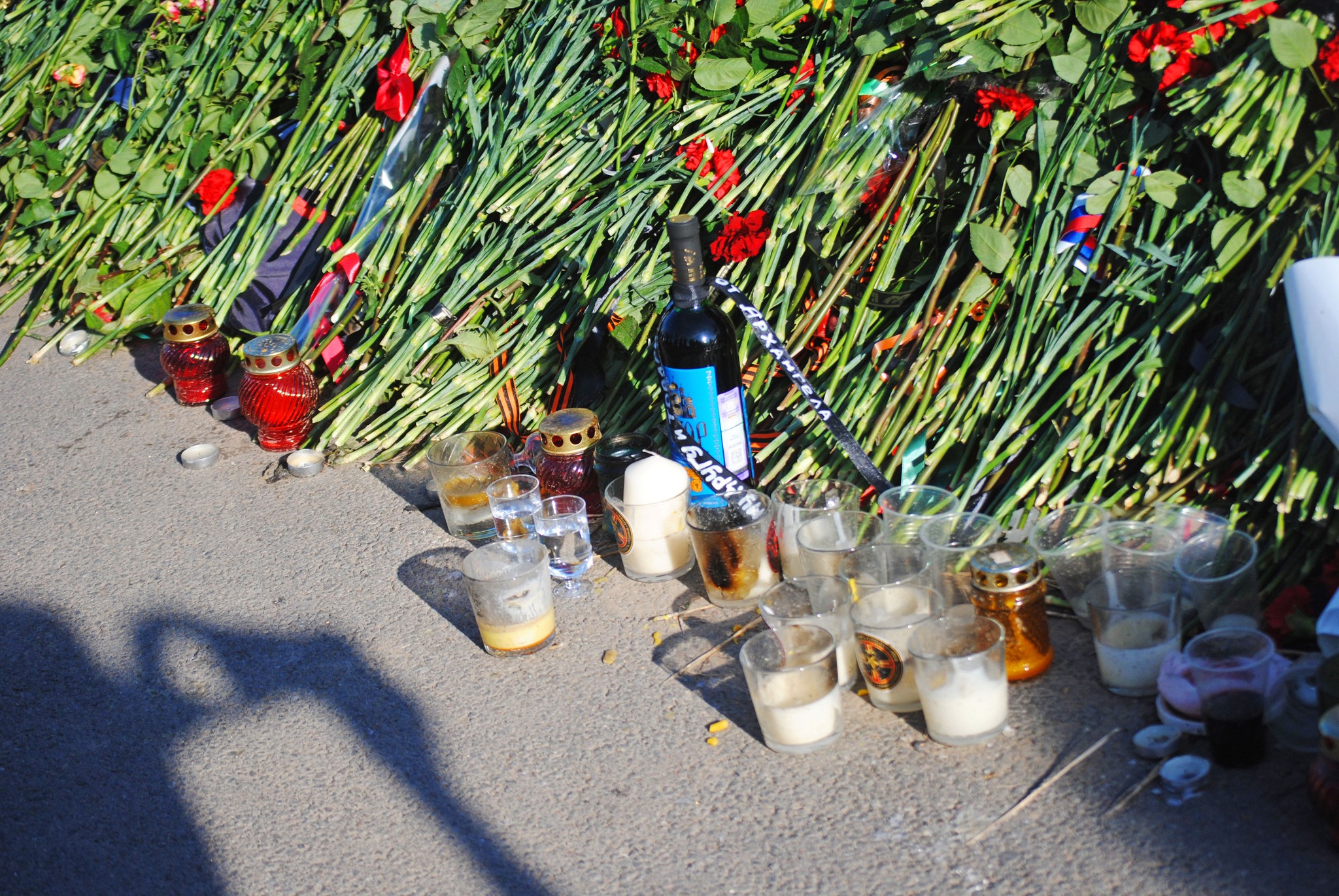
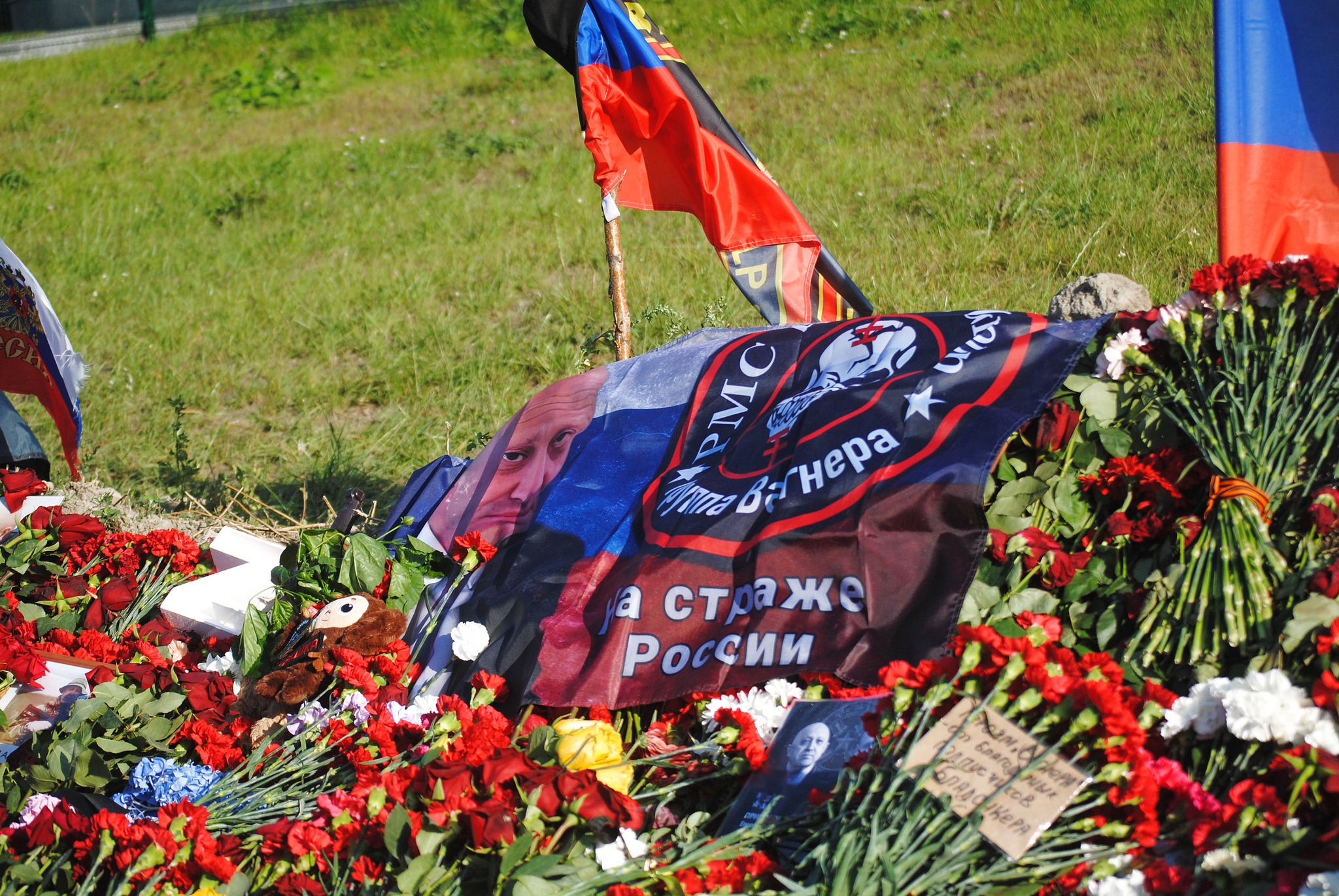
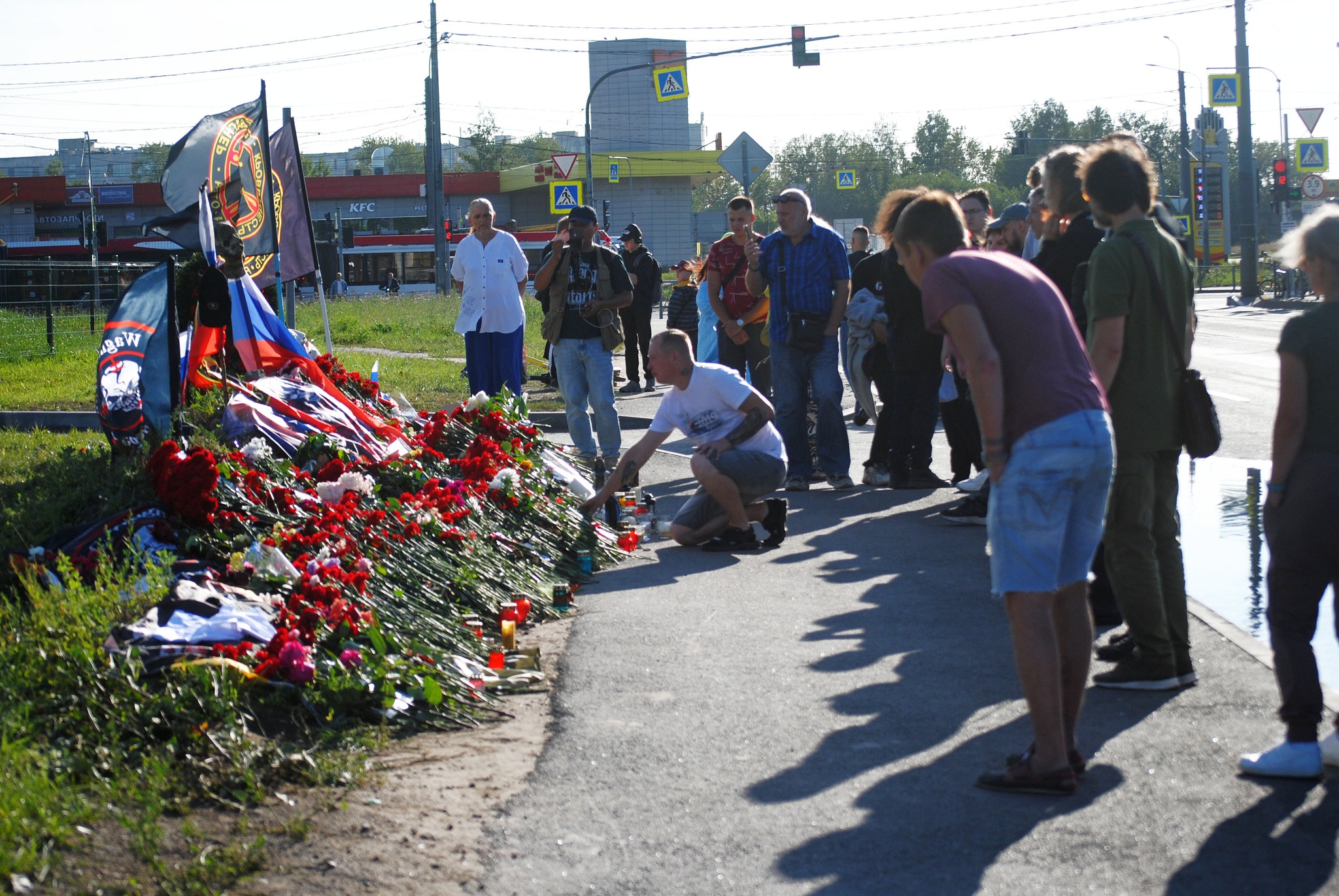
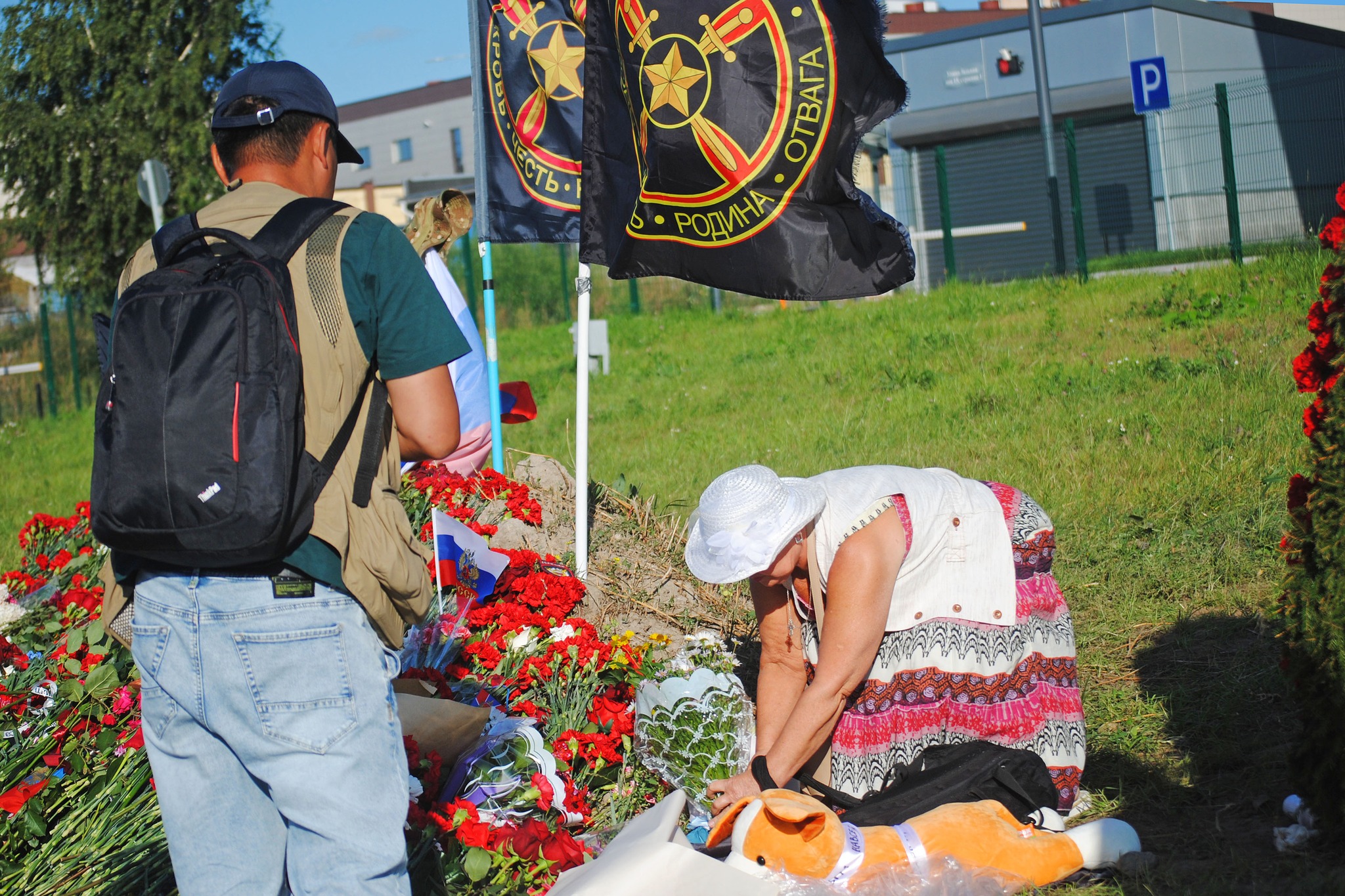
I went to see the spontaneous memorial to Prigozhin on Zolnaya [“Ashes”] Street [near the former (?) Wagner Center office building in St. Petersburg]. I have to say that what I saw impressed me. People kept coming and coming—young dudes and girls, men who were slightly older, and some people even had their kids with them. They brought flowers. They stood and looked for a long while. Some got down on their knees, and this one young dude crossed himself and genuflected. A Chinese guy was videotaping the whole scene and talking in Chinese, but it troubled no one. That’s him sporting a rucksack and filming point-blank the woman in the hat who is putting what looks like a whole bush of roses in a vase.
Hello, dear Moscow Times readers! This is your weekly newsletter, and we’re kicking off with the (near-certain) death of Yevgeny Prigozhin, the man dubbed Vladimir Putin’s “chef.”
However, Prigozhin gained notoriety not for his culinary talents, but for his business ventures. He set up several enterprises that were extremely vital to the Russian authorities. The most well known were the private military company Wagner and the “troll factory” in Olgino, a suburb of Petersburg, which was used as a tool for influencing the information space in the Russian Federation and the world.
Trolls are fantastic creatures, and they vanished of their own accord, you might say, but apparently it was Vladimir Putin who put the kibosh on Wagner. The rowdy band of freewheeling mercenaries, who took their orders from god knows whom, has come to end.
We should recall, of course, that Prigozhin took a long time admitting that Wagner and the Olgino trolls worked for him. He acknowledged this obvious fact only in the midst of the war, and this was the first step toward the mutiny of 23 June and his (near-certain) death on 23 August. The public owner of an effective resource can either use it or give it up. Prigozhin didn’t feel like giving Wagner away—that is, transferring it to the command of the Defense Ministry (and take an oath, as Vladimir Putin has now ordered)—and so the strange mutiny that had such supremely serious political consequences happened, and, later, the Embraer jet plane crashed in the Tver Region. (It was the first time this type of plane had an accident involving fatalities.)
We interviewed people in the know about the moods among Russia’s elites to find out how they were taking the “chef’s” demise. We went further, though, asking several people who kept a close eye on Prigozhin’s rise and (alas, literal) fall to explain the meaning of the story that has unfolded before our eyes.
The first explanation comes from an observer in civil society who claims that the plane crash was caused by underlings going farther than they had been ordered to go. In fact, this observer argues, Putin did not want Prigozhin dead. Without his trolls and without Wagner, which had ceased to operate in the RF and had begun to be transferred to Defense Ministry-controlled outfits in Africa, Prigozhin was no threat to Putin. However, there were people (in the GRU, most likely) who believed that Putin would be pleased if they brought him the mutineer’s head on a plate.
The risks are the same as in the case of the late [Boris] Nemtsov [assassinated near the Kremlin in 2015]. After his untimely death, Prigozhin’s significance as a symbolic figure could increase and thus serve as a consolidating factor. We cannot rule out the possibility that Prigozhin’s memory will lead to the creation of something bigger than what emerged around the man during his lifetime.
The second explanation comes from an observer in the defense sector, who argues that we’re seeing a repeat not of Nemtsov’s murder, but of the death of Polish president Lech Kaczyński in 2010. (The official Polish Tu-154 plane carrying him and other Polish officials crashed while attempting to land in Smolensk, Russia. Many Poles believe that the plane was brought down by a bomb planted onboard by the Russian secret services.)
The hit squad didn’t go too far. On the contrary, [Prigozhin’s plane crash] was a carefully planned operation that was brought off nearly flawlessly. Although we can claim that such things don’t get done without Putin’s consent, there is no way to prove it.
The third explanation comes from a political spin doctor and frequent guest on YouTube channels. He wonders why everyone has decided that the passenger manifest and the presence of his personal effects [at the crash site] is sufficient to prove that Prigozhin was killed. We cannot rule out the possibility that Prigozhin and Putin made a deal and that Yevgeny Viktorovich will be the Kremlin’s secret weapon. I’m joking on this point, of course. But Russian realities are such that a man dies he shakes off all the bad stuff that happened in his life, and people focus on his admirable qualities. Look at Stalin: his bloodthirstiness and lack of principle have been forgotten, and no one remembers the terrible mistakes he made while running the country. He’s a winner, a victor. Stalin and Prigozhin cannot be compared, but nor can we deny that Prigozhin has been the most auspicious commander in the Ukraine war.
The fourth explanation comes from an opinion journalist and writer who asks us to the recall the Russian fairytale about the vixen and the thrush. The vixen terrorizes the thrush by threatening to kill its fledglings. First the vixen asks the thrush to give it something to drink, and then it asks the thrush to feed it, so the thrush helps it to steal food and beer. (The analogy here with the “chef” is obvious.) The sated and drunken predator then orders the thrush to make it laugh, and so the thrush alights on the heads of two peasants, father and son, who cripple (and even kill) each other whilst trying to beat the thrush. (Thus recalling the Olgino trolls and their work on the US elections, for example.) After the vixen has laughed its fill, it says to the thrush, Now scare me! The thrush raises a mutiny against the fox—oh, sorry, it gets hunting dogs to attack the vixen. Depending on which version of the fairytale you find, the vixen either gets killed or escapes the attack, but it is genuinely frightened.
Vladimir Putin wanted to have an alternative both to his own generals and to the supremely dangerous Kadyrovites. He came to count on Prigozhin to carry out sensitive missions both in Africa and the RF, but failed to take into account the man’s ambitions and got carried away. When Putin was faced with Prigozhin as an actual threat, he had to defend himself in earnest.
Russian Media Monitor, “Propagandist blames US, Ukraine and NATO for Prigozhin’s crash,” 24 August 2023 Thanks to Monique Camarra (EuroFile) for the heads-up)
Mykola Honchar lives in a crumbling stone house in what is left of a tiny hamlet of eastern Ukraine. The town was attacked by Russian forces in June of last year, as the Wagner mercenary forces were spearheading a renewed offensive.
Even before the Kremlin set Wagner loose to wreak havoc in Ukraine, the Russian campaign was notable for its brutality. But from the moment Wagner forces entered the war in April 2022, they earned a special reputation for bloodlust from civilians and soldiers alike.
To Mr. Honchar, the death this week of Wagner’s leader, Yevgeny V. Prigozhin, responsible for so much carnage in the war, would be fitting — a violent end to a violent life.
“He has blood on his hands,” said Mr. Honchar, 58. “If there is a god, god will figure out what to do with him.”
Even in a war in which civilians were shot dead in the Kyiv suburb of Bucha, and the town of Mariupol was bombed into oblivion, Wagner and Mr. Prigozhin cultivated an image of brutality.
A video was promoted across Wagner-affiliated social media of the execution of one of Mr. Prigozhin’s own soldiers with a sledgehammer after he was captured and then released by the Ukrainians in a prisoner swap. While in custody, the prisoner had taped an interview saying he did not believe in Russia’s war.
“A dog receives a dog’s death,” Mr. Prigozhin said in the video.
By the time Ukraine regained Mr. Honchar’s village of Bohorodychne, Mr. Honchar was one of only two people left living in the village, once home to around 800 people.
The other person was Nina Honchar, his 92-year-old mother. He had stayed there despite the danger to take care of her. She died earlier this month.
He does not know if Wagner fighters were among the occupiers. “I did not ask for their documents,” he said. But he recalls seeing Russian fighters, who appeared to be on drugs, wandering around town in their underwear, their bodies covered with prison tattoos.
Wagner amplified its force by recruiting prisoners. After Wagner left the battlefield in June of this year, the Russian military continued the use of convicts as part of newly formed “Storm Z” units along the most dangerous front line positions.
To Mr. Honchar, it hardly matters under what banner the soldiers fought. The legacy of Wagner and Russian forces, he said, are one and the same: death, destruction and ruin.
“My brother and his wife were torn apart by shells,” Mr. Honchar said. Before he could bury them, he had to collect their body parts. “There was no skull, his hands were scattered,” he said of his brother.
Once he collected what he could find, he wanted to bury them in the local cemetery but it was under constant attack and too dangerous. He laid their remains in a trench and covered them with dirt.
When his 80-year-old neighbor died, he buried her in the crater of the shell that killed her.
Looming over the village is the Church of the Holy Mother of God, ‘Joy of All Who Sorrow.’ With its sky blue walls visible for miles around and majestic golden domes, it was once a draw for tourists and pilgrims.
Now its walls are blasted apart, one dome has tumbled to the ground and the gold leafing blasted away from another.
I just noticed that the Australian band Died Pretty released their gorgeous first album, Free Dirt, on 8 August 1986, two days before my nineteenth birthday. Sadly, the band’s unforgettable lead singer Ron S. Peno died on 11 August this year, a day after my birthday. Happily, my equally unforgettable friend Jenya Kulakova celebrates her thirty-fifth birthday today. She was not yet around to enjoy Free Dirt when it hit the record stores thirty-seven years ago, but maybe she’ll enjoy it today—along with my translation of a poem written by one of the most famous writers from her adopted hometown. ||| TRR
The cover of Died Pretty’s 1986 debut LP Free Dirt Image courtesy of Jittery White Guy Music
August

Provincial towns, where you’ll never get a straight answer.
What’s it to you? It was yesterday however you cut it.
Outside the elms murmur, nodding to a landscape
Only the train ever sees. Somewhere a bee buzzes.

The knight made a career of crossroads, but these days
Is himself a stoplight. Plus there’s a river in the distance.
And between the mirror into which you gaze
And those who can’t recall you there’s also little difference.

Closed fast in the heat, the shutters are entwined in gossip,
Or merely ivy, to avoid making a blunder.
Bounding through the front door, a sunburnt stripling
Clad in only his swim trunks has come to collect your future.

So twilight’s a long time in descending. Evening’s usually cast
In the shape of a train station square, with a statue, etc.,
Where the glance in which you read “You bastard!”
Is in direct proportion to the crowd that’s not present.
Source: VK. Translated (many moons ago too) by the Russian Reader
[1] We walk in the woods. [2] We go to the store. [3] We trim Mode’s claws. [4] We watch a TV serial. [5] We’re at the sea. [6] And all of this will be! Happy birthday!
Source: Sasha Skochilenko (Facebook), 7 August 2023. Translated by the Russian Reader
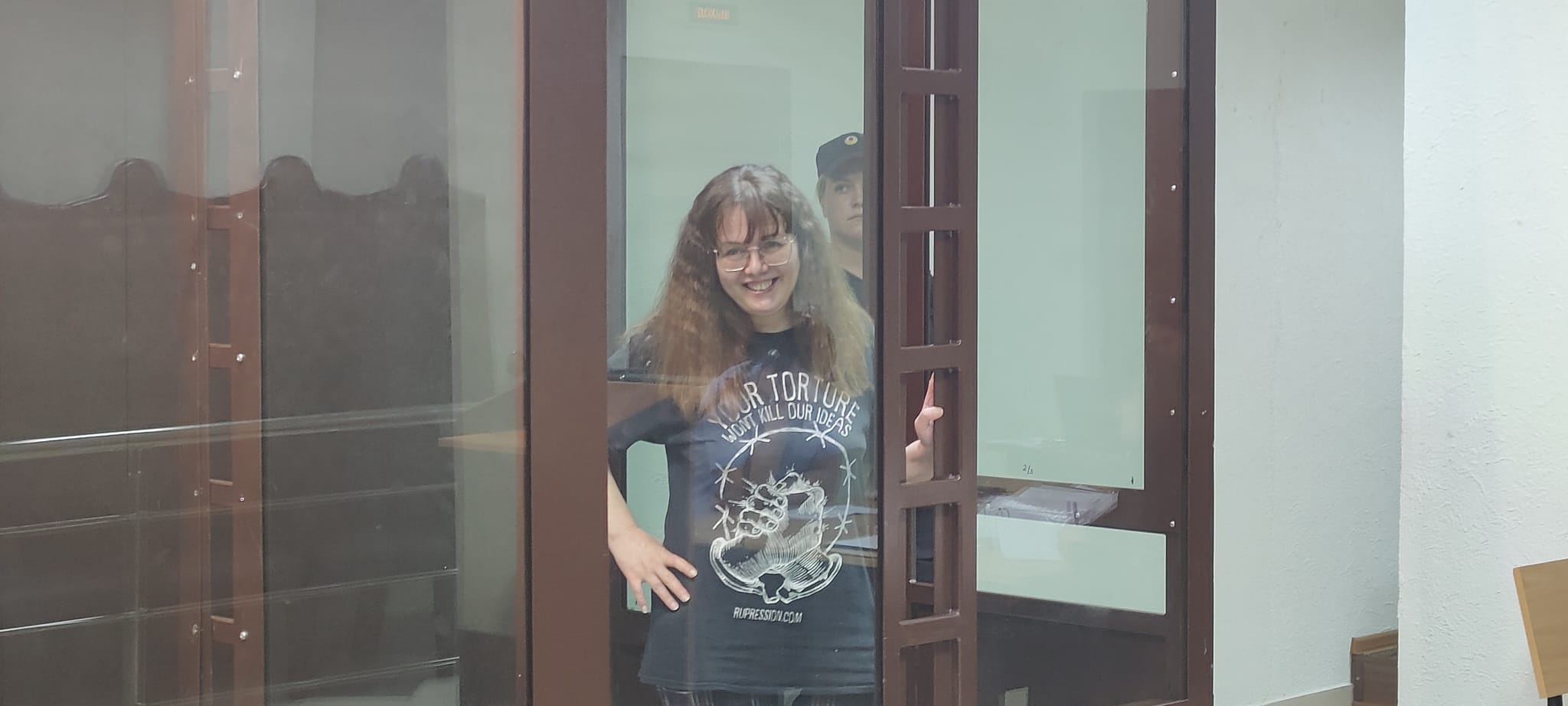
Petersburg artist, antiwar activist and political prisoner Sasha Skochilenko, currently on trial for “disseminating fake news” about the Russian army’s actions in Ukraine and facing 10 years in prison if she’s convicted, congratulated her girlfriend Sonya on her birthday.
This is what the actual Russian antiwar movement looks like. It doesn’t look like Russians swanning around Europe and North America in search of grants and “projects” and relaxation. Accept no substitutes! ||| TRR
Jason Isbell and the 400 Unit, “Middle of the Morning” (2023)
Well, I’ve tried To open up my window and let the light come in I step outside In the middle of the morning and in the evening again
Yes, I’ve tried To be grateful for my devils and call them by their names But I’m tired And by the middle of the morning I need someone to blame
I know you’re scared of me, I can see it in your face I can feel it in the way you move around this place I know you’re scared of me, I can see it in your smile Like an unattended child you can’t quite trust
But I’m tired Of stepping on your shadow and feeling in the way Yes, I’m tired And by the middle of the morning I’m out of shit to say
I ain’t used to this, seeing everybody’s hand I was raised to be a strong and silent southern man I ain’t used to this, a thousand days alone In my bed or in my head or in my phone
Yes, I’m tired Of living in the moment and sleeping through the dream I step outside In the middle of the morning and the roses hear the scream
I know you’re scared of me, so I never get too close I just sit here on the tailgate like a farm hand’s ghost Watch the roses bloom, watch them wilt away and die ‘Til I notice I’ve been crying this whole time
Well, I’ve tried To open up my window and let the light come in I step outside In the middle of the morning and in the evening again
Source: Musixmatch. Thanks to Mark Rogers (Nashville Babylon) for the heads-up.
Russia continues to reap the consequences of its reckless campaign to release dangerous criminals from prisons to dispatch in their illegal war against Ukraine, RFE/RL’s Sever.Realii reported on Aug. 3.
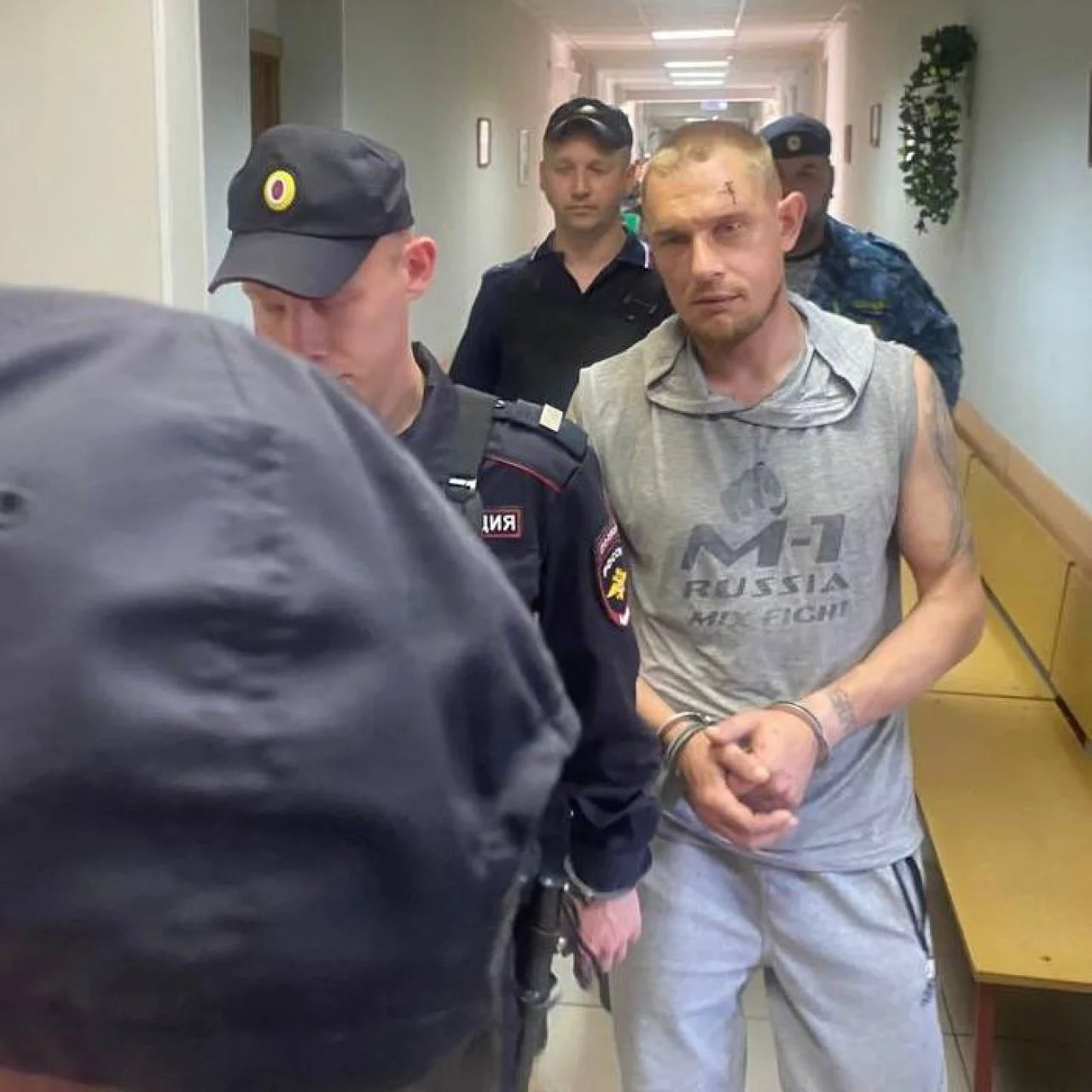
The latest case involves 37-year-old Igor Sofronov, who had previously served a sentence for robbery, attempted murder, and other crimes. Upon returning to his hometown of Dereviannoye in the Republic of Karelia after his involvement in the war, Sofronov spiraled into a series of alcohol-fueled binges.
During one of these drunken episodes, Sofronov, along with his drinking buddy, 38-year-old Maxim Bochkarev, who had also been imprisoned for theft, abduction, robbery, and rape, unleashed a brutal massacre, claiming the lives of six individuals.
“The murders were committed in two houses within 200 meters of each other. In the first house, two men (father and son) were killed, and in the second one, three men and a woman were brutally murdered. Both houses were set on fire after the killings. The suspects were apprehended six hours later,” the report said.
Local residents revealed that Sofronov had served as a mercenary for the Wagner private military company. There is also information suggesting that he fought as part of the “Storm Z” unit, which operates under the Russian Ministry of Defense and recruits prisoners for participation in so-called “meat grinder assaults.”
This tragic incident serves as yet another example of returning Russian aggressors turning their violence on their fellow citizens.
There was a time I thought I knew About life and what to do And now it’s plain I know nothing at all I should have known better
But I took it all on blind faith And now the bad guys have all run away
Lonely won’t leave me alone Tried I tried but you won’t let go It’s a pain that won’t go away Lonely won’t leave me alone
There was a time I had pride I had friends stood by my side And a smile was all I had to give Under a spell under a cloud I fell in with the wrong crowd And so I guess I learned my lesson well
Lonely won’t leave me alone Tried I tried but you won’t let go It’s a pain that won’t go away Lonely won’t leave me alone
Chalkin’ days on the wall Seems this night won’t end at all For me patience leaves Trace your smile on the glass Try to make it all last Till I come home again
Lonely won’t leave me alone Tried I tried but you won’t let go It’s a pain that won’t go away Lonely won’t leave me alone
There was a time I thought I knew About life and what to do
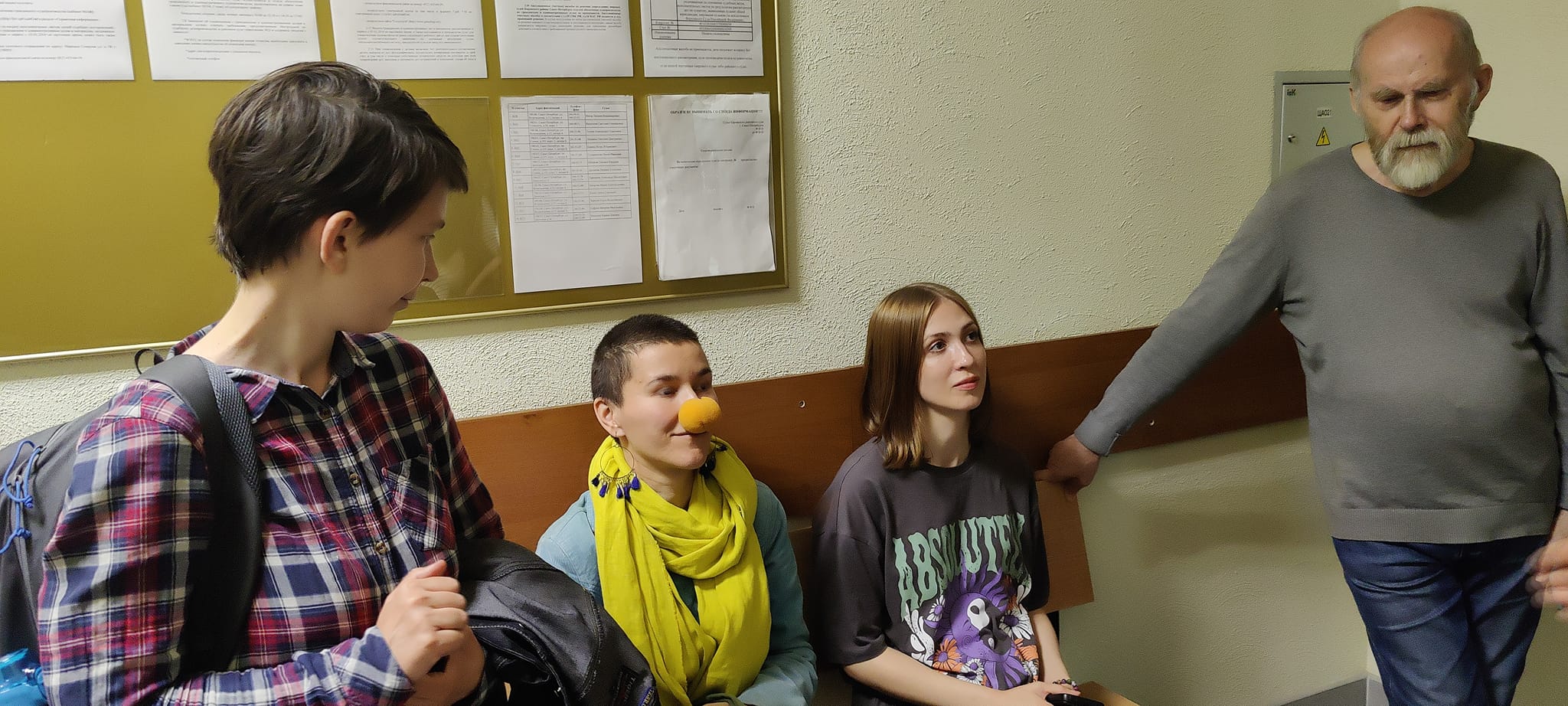
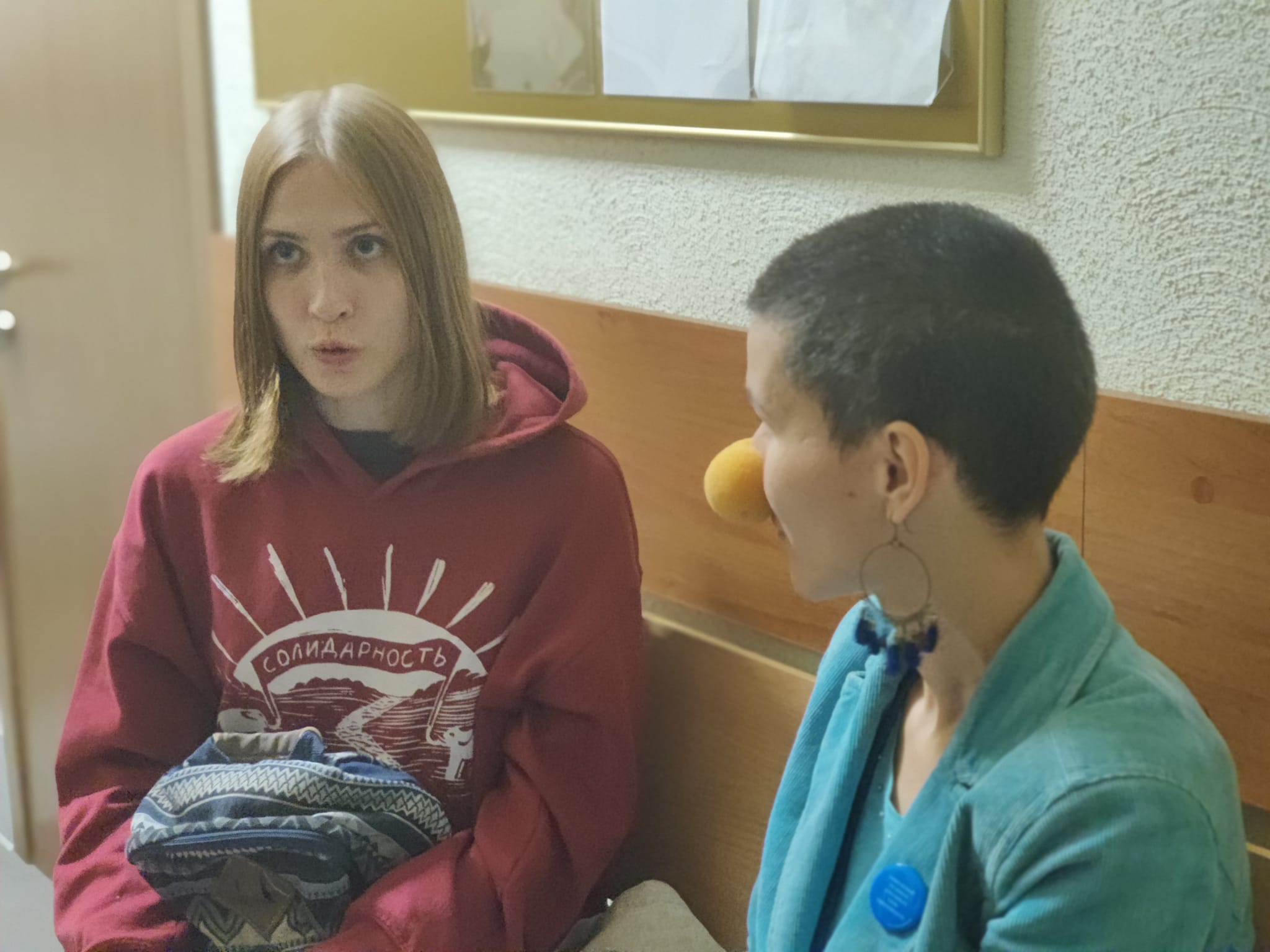
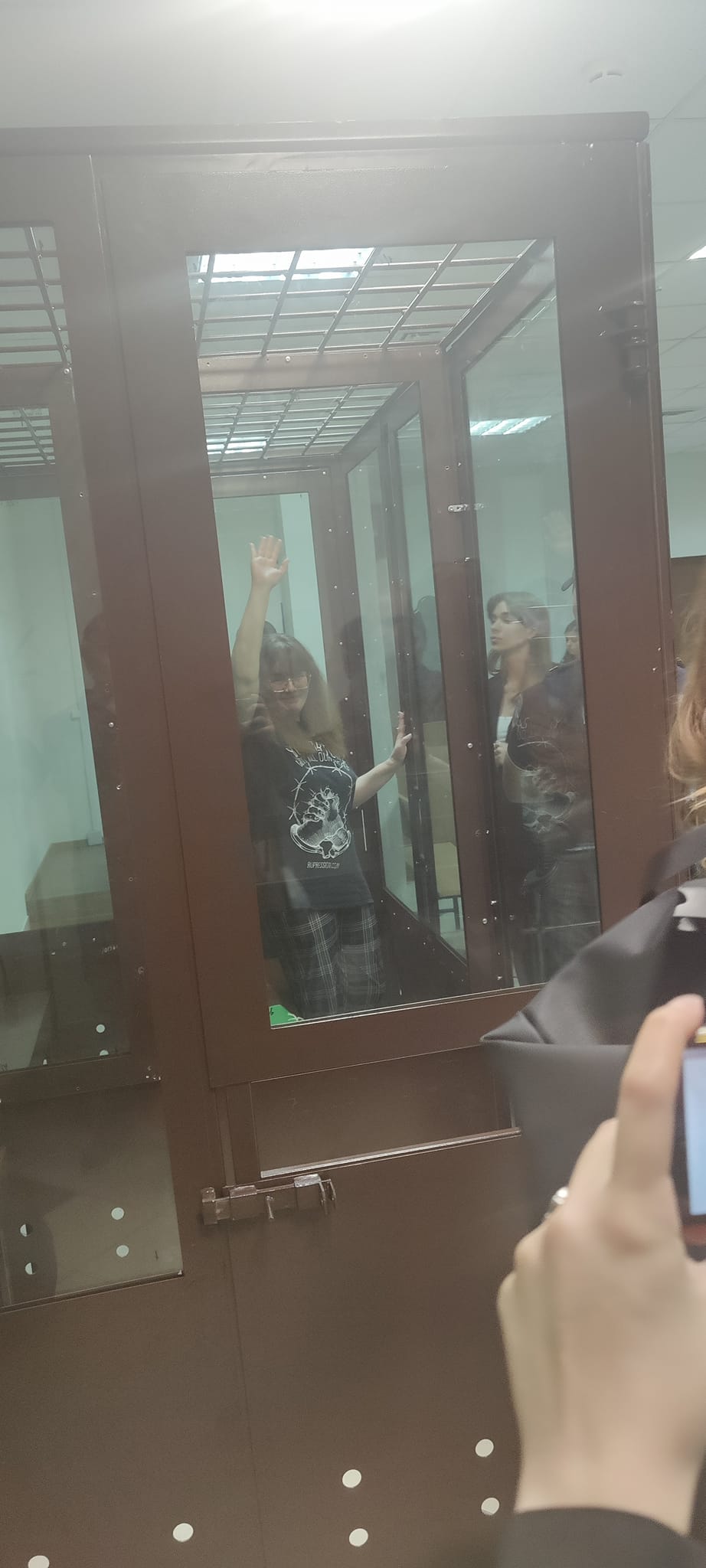
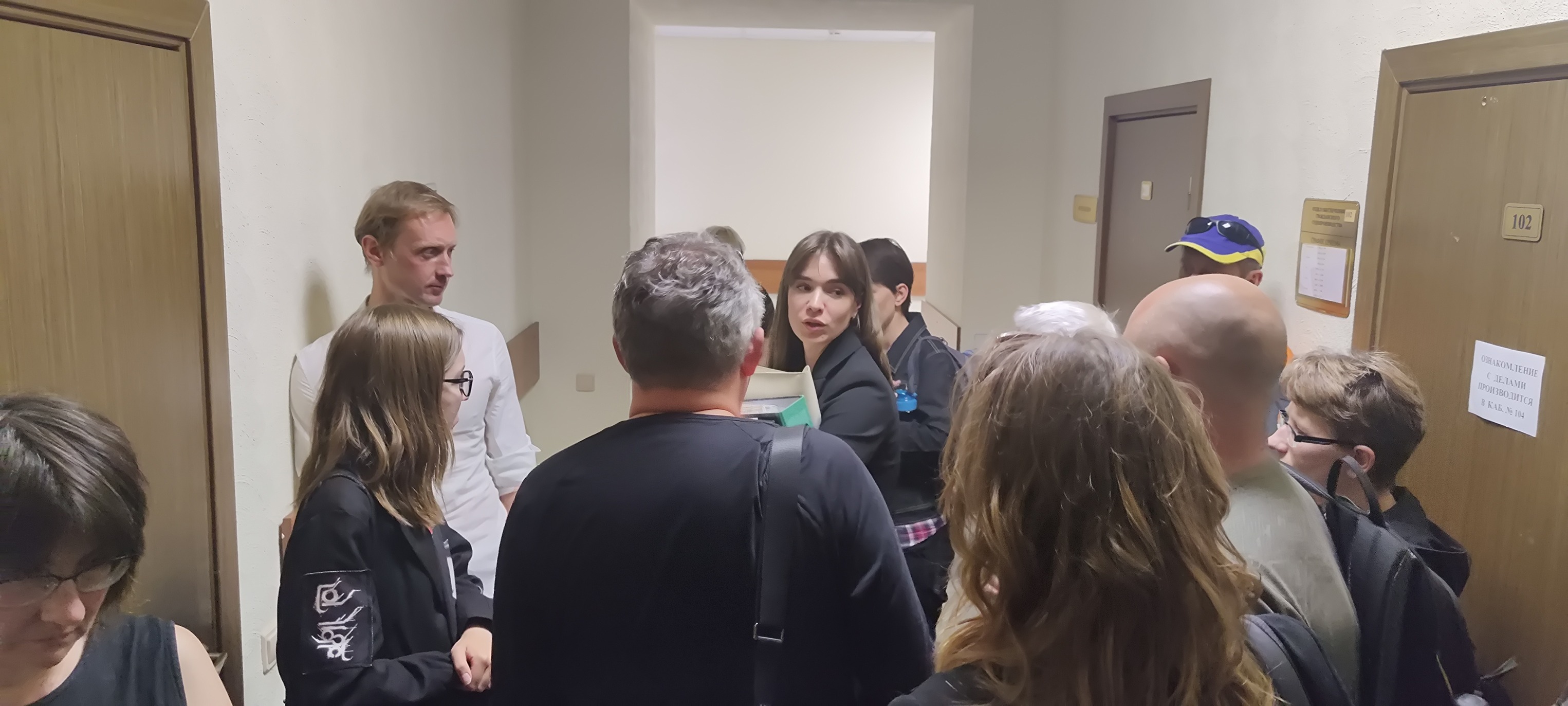
Sonya, the girlfriend of Sasha Skochilenko, came to today’s hearing in the trial of anti-war activist Olga Borisovna Smirnova. Sonya wore a sweatshirt embossed with the word “SOLIDARITY.” It was quite nice to see that there is reciprocity among the support groups of political prisoners.
Sergei Troshin told people about the evening gatherings to write letters to political prisoners that are held at the Yabloko Party’s Petersburg offices.
There were twenty [members of the public] in total, all the seats were taken. The trial was again held in the jury room on the ground floor, into which the guards can bring the accused from the courtyard and thus avoid walking them down the corridor amid shouts of support.
The hearing itself left more questions than answers. The judge has obviously begun to hurry in order to finish the trial as quickly as possible. Does she want to wrap things up before her holiday? The hearing itself thus ended around seven in the evening, despite the lawyer’s request to postpone it. The judge behaved nervously, on the verge of rudeness.
The bulk of the hearing was devoted to cross-examining Lebedev, an officer of Center “E” [the “anti-extremism” police]. He came dressed in camouflage, combat boots, a beret, and dark glasses, and he had a beard (which looked fake).
It was [Lebedev] who located and documented the pieces of evidence on which the accusation is based, and also determined them to be “fakes” by comparing them with the websites of the Defense Ministry and the Foreign Ministry and, for some reason, Maria Zakharova’s Telegram channel, “as that of an official authoritative statesman expressing the position of the Foreign Ministry.” He searched for information by dates: if there was something in a post by Olga that was not found on the websites of the relevant authorities, he deemed it a “fake.” He also prepared a search memo stating that there were no special perpetrators [sic] in [Smirnova’s] apartment, and was present during the search.
The cross-examination lasted three hours. It was clear that [Lebedev] considers Olga a “blatant criminal” who disseminates such things “while our boys are getting killed.”
When asked about information from the website of the Israeli Foreign Ministry about Babi Yar, Lebedev replied, “Fortunately, our country has its own independent policy and does not consider it necessary to take into account and react to statements made by the Jewish Foreign Ministry at the slightest pretext.”
He also believes that the information given by Russian officials and state bodies cannot be questioned and is the absolute truth.
To Olga’s question about why he had chosen precisely these entries from her social media page, he replied, “It would be impossible to document everything from the time of Jesus Christ’s birth.”
When asked why the witnesses who inspected the web pages containing the [offending] posts were recruited so far from his place of work, he replied that it is not so easy to find people who agree to serve as witnesses.
“I am sure that these people sitting behind me would have never agreed to come and document Smirnova’s criminal actions as witnesses,” he said.
After the recess, a disk with telephone connections that suddenly appeared in the case file was examined.
Olga has been holding up well: she smiled a lot and thanked people for their support. The next hearing is scheduled for Monday, August 7, at twelve noon. It was announced that oral arguments would be heard then, although, in my opinion, the defense has not yet finished examining the evidence.
Despite the fact that people in the support group joked a lot, the overall feeling from the trial is quite depressing. It feels as if the judge has already made up her mind, and we are present at a poorly staged theatrical performance. It’s just that the finale is up to ten years in prison…
Source: Alexei Sergeyev (Facebook), 31 July 2023. All photos, above, by Mr. Sergeyev. Translated by the Russian Reader. You can send letters— written in Russian or translated into Russian (if you don’t know a competent translator, you can use an online machine translator such as Google Translate)—to Olga Smirnova and other Russian political prisoners via the free, volunteer-run service RosUznik. You may ask me (avvakum@pm.me) for assistance and advice in sending such letters.
Petersburg is getting ready to welcome groups of visa-free travelers from Iran. It could increase the tourist flow to the city by as much as eight percent.
The Economic Development Ministry reported that Russia has completed the procedure of exchanging lists of tourist organizations with China and Iran for the early launch of bilateral intergovernmental agreements on visa-free group tourist trips. In preparation for this, the St. Petersburg Tourism Development Committee and representatives of the hospitality industry held a series of “Welcome to St. Petersburg!” field presentations in the largest cities of the Islamic Republic of Iran—Tehran, Isfahan, and Shiraz. The events were attended by over 250 professionals from the country’s tourism industry.
“The people of Iran love to travel. The interest of the citizens of this country in Petersburg has been growing noticeably lately. The field events, realized as part of the national project ‘Tourism and the Hospitality Industry,’ provide Petersburg tourism industry professionals with a unique opportunity to establish new contacts with Iranian colleagues and, of course, increase interest in our city,” says Sergei Korneyev, chair of the St. Petersburg Tourism Development Committee Sergey Korneev.
On May 26, St. Petersburg welcomed the first passenger flight from Tehran, operated by Meraj Airlines, and on June 1, a direct flight from Iranian capital to St. Petersburg was made by Russia’s Nordwind Airlines. “Previously, when there were direct flights from Iran only to Moscow, trips were planned to the two cities at once. Now that direct flights have been established, tourists from Iran will be able to go straight to Petersburg and its suburbs,” says Yana Kozhevnikova, a partners and agencies specialist at tour operator Bon Tour.
Next year, Petersburg is planning to send a cultural and business mission to its Iranian sister city of Isfahan. Hossein Nasr, head of the Isfahan Association of Tour Operators, spoke of the need for vigorous development of tourism between the two cities. “Events where new connections can be established are very important to us. Representatives of the relevant companies in our city held constructive talks with their Petersburg colleagues, and this is a good foundation for strengthening relations and mutually increasing the tourist flow in the future,” he said.
Dmitry Tyurin, head of the commercial department at the international transfer ordering service I’way, argues that cooperation in the field of tourism between Iran and Petersburg opens up significant prospects for both sides. “This cooperation will bring many benefits both to the city and to business. An increase in the number of tourists will lead to an increase in the load on infrastructure facilities, thus contributing to the growth of profits and the development of the city’s economy. And the variety of needs and preferences among Iranian tourists will generate new opportunities for entrepreneurs involved in the hotel business, restaurants, souvenir shops, and travel agencies. In addition, the development of cooperation with Iran can contribute to the strengthening of diplomatic and cultural ties between the countries. The influx of Iranian tourists will enable local residents and entrepreneurs to better understand Iranian culture,” he says.
According to political scientist Inna Litvinenko, the willingness of Iranian tour operators to send tourists to Petersburg points to large-scale prospects for developing the tourism sector and related sectors of the city’s economy.
“First of all, it will affect the hotel and restaurant business, airlines, and tourist agencies. The growing interest in visiting Petersburg is explained by the Northern Capital’s rich historical legacy, its geographical location, and the concentration of business flows. Visa-free agreements with Iran will increase the tourist flow by 5–8%, and the word-of-mouth effect on neighboring Islamic states will also kick in, making it possible to achieve a 12–15% increase in tourists by the end of 2024. Another obvious plus will be the influx of investments into actively developing industries—construction, the hotel and restaurant business, and the service sector,” predicts Litvinenko.
I was just flying from Leningrad to Istanbul, and the coach of an Iranian football team was seated next to me. I had this feeling like I was in the movie Cabaret. On the other hand, if I had said to him, ‘Well, how’s it going with the ayatollahs?’ he could have said to me, ‘And how’s it going with Putin?’ He got up in the middle of the flight and handed out our poor northern apples to his players while I drank white wine. We caught each other’s eye and smiled at each other. For the last hour, he studied English on his phone using an Iranian app. The good guys will beat the bad guys.
The Russian state is keen to foster loyal young people. We have already recounted how the authorities have clamped down on liberal universities and brought them to heel, rewritten school history textbooks, and shut down independent educational projects. But this is just the tip of the iceberg.
Today, the website Protocol and the YouTube channel RZVRT claimed that college students in Tatarstan’s Alabuga Special Economic Zone have been made to assemble [Iranian] kamikaze drones. They face expulsion and a fine of 1.5 million rubles if they refuse to do it. Students also have to play paintball, and the losers are forced to dig trenches and are “executed” with paintball guns. Two cases of suicide have already been reported. In addition, the college management tricks female students from African countries into doing the dirtiest menial labor.
“‘Alabuga: producing death with the hands of death.’ The second part of Protocol and RZVRT’s joint investigation of Alabuga. We talk about how students are forced to dig trenches and assemble Iranian Shahed drones, about how students from African countries were lured into applying to the college through Tinder, and about how the leadership of the special economic zone treats students.” Protocol (YouTube), 24 July 2023 (in Russian)
This is not the only such case. The authorities in Russia have recently been inspired by the idea of free child labor, including for the needs of the army fighting in Ukraine.
Thus, on July 20, the State Duma immediately passed in its second and third readings a bill on “community service” for schoolchildren. Children will now have to clean classrooms, plant trees at school, and help in the library on a “voluntary-compulsory” basis. Permission from parents will no longer be required for this. Commenting on the new law, State Duma Speaker Vyacheslav Volodin said that “only through labor can one cultivate an attitude to many issues that [the child] will later need to solve. The child will grow up different. Harmony will come.”
“Community service” goes hand in hand with the militarization of schools. During “basic training” lessons, children will learn how to pilot drones. “Today’s army is not only the Kalashnikov assault rifle, but also advanced unmanned vehicles,” said Federation Council member Artyom Sheinin.
From September 1, military training will be introduced for pupils in grades ten and eleven. Among other things, children will practice military greetings, drilling, handling small arms, combat actions, and first aid during hostilities.
There are also serious changes to the history curriculum. In September, high school students will get new textbooks featuring chapters about the “special military operation.” They will be told that:
Kiev “secretly colluded with NATO.”
Peace in Crimea was preserved by the “polite people”, that is, by the unidentified Russian soldiers who seized the peninsula in March 2014.
Ukraine wanted to get its hands on nuclear weapons.
The war, which was the Kremlin’s only option, has “consolidated society.”
There is a “fake news industry” in the world that allegedly lies about the Russian army’s actions in Ukraine.
Schoolchildren will also be made to read excerpts from Putin’s speeches and look at a map of Russia that includes the occupied territories in Ukraine.
The refusal of State Duma deputies to raise the lower limit of the draft age from 18 to 21 is part and parcel of the same series of initiatives for turning schoolchildren into propagandized soldiers. Deputies claims that there are a lot of young people who want to go to serve right after leaving school. Meanwhile, universities are raising tuition fees, effectively introducing income barriers to higher education.
Children must learn in advance how to shoot, assemble deadly drones, pilot them, and love the Motherland. The Russian state doesn’t seem to need anything else from them.
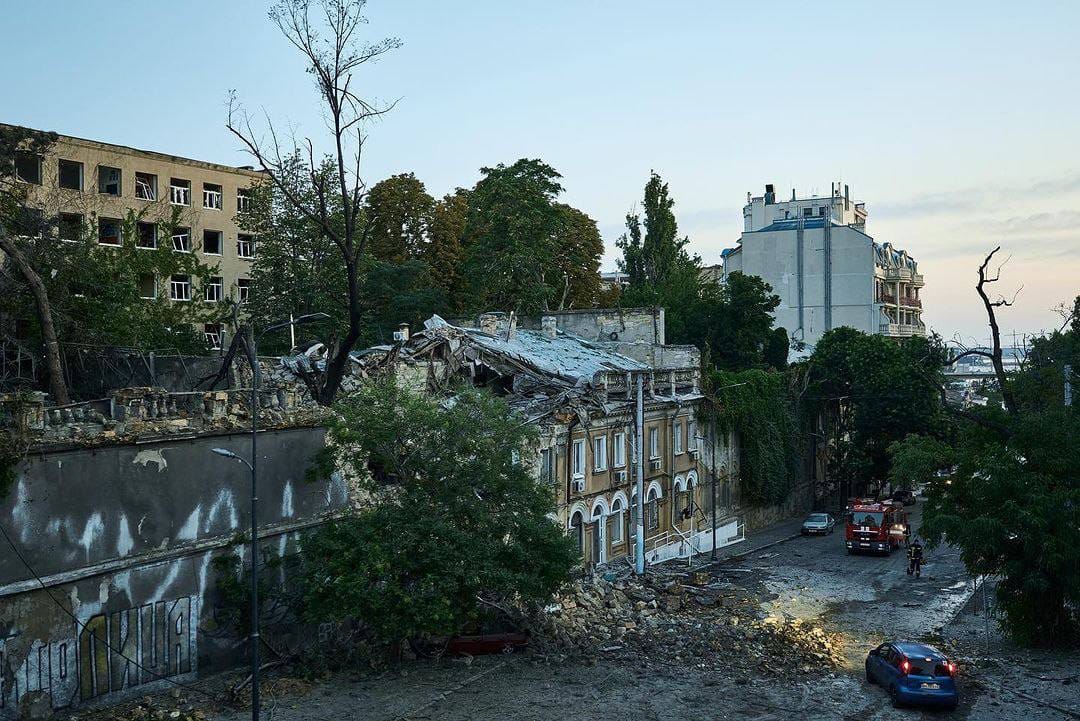
This is Odessa today. It is useless to appeal to the conscience of Russians. They don’t have one. None of them, practically none of them. Accordingly, one can only wish them one thing: may you all go to the devil, bastards! And so it will be, I believe, and fairly.
Punters outside Chronicle Bar Nekrasov Street in Petersburg, 27 June 2021 Photo: vladislavkharchev (Instagram), via Bumaga
Consulting company NF Group analyzed the trends for the openings of cafes, bars and restaurants in downtown Petersburg in the first six moths of 2023. Their analysts came to the conclusion that the city’s principal bar street is Nekrasov Street, the NF Group’s press service informed Bumaga.
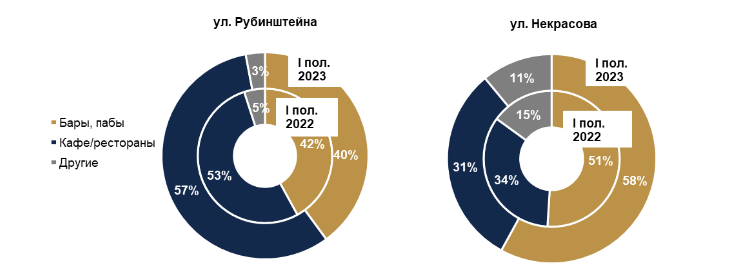
This claim is based on statistics on the distribution among different types of establishments on Nekrasov and Rubinstein streets. By mid-2023, bars and pubs accounted for 58% of all public dining projects on Nekrasov. On Rubinstein Street, this figure was lower: only 40% of all establishments there are bars or pubs.
In the first six months of last year, Rubinstein was also inferior to Nekrasov in terms of the percentage of bars and pubs: 42% on Rubinstein and 51% on Nekrasov, respectively.
Percentages of bars/pubs (goldenrod), cafes/restaurants (navy blue), and other business that opened on Rubinstein (left) and Nekrasov streets in central Petersburg in the first six months of 2022 (inner circles) and 2023 (outer circles). Pie charts courtesy of NF Group
What other conclusions did the analysts draw?
In the first six months of 2023, fifty bars, restaurants, and cafes were opened in Petersburg. This is comparable to the figures that were observed in the city before the coronavirus pandemic.
On Nevsky Prospekt, restaurateurs are increasingly opening affordable establishments, including chain outlets.
Public dining establishments have room to grow on Nekrasov Street: there they occupy 51% of all commercial space. This figure is much higher—78%—on Rubinstein Street.
The Context. Rubinstein was long considered Petersburg’s primary bar street, but the recent Bar Affair and other scandals have spoiled this location’s image. Recently, the security forces have been organizing raids on Nekrasov Street: police visited local bars several times in July alone.