Western free society is seriously sick too. The symptoms pop up here and there, but one of the most disgusting is the massive support for the alleged “people of Palestine”—that is, Hamas—in this whole monstrous story. I really don’t understand HOW it has been possible, after the atrocities of October 7, after the taking of hostages, including children, to pretend that this was a minor trifle? That the ruthless Jews suddenly out of the blue started tormenting the unfortunate residents of the Gaza Strip?
After all, bolstered by this wave of international support, Hamas thinks it has won. This will lead to fresh terrorist attacks, of course.
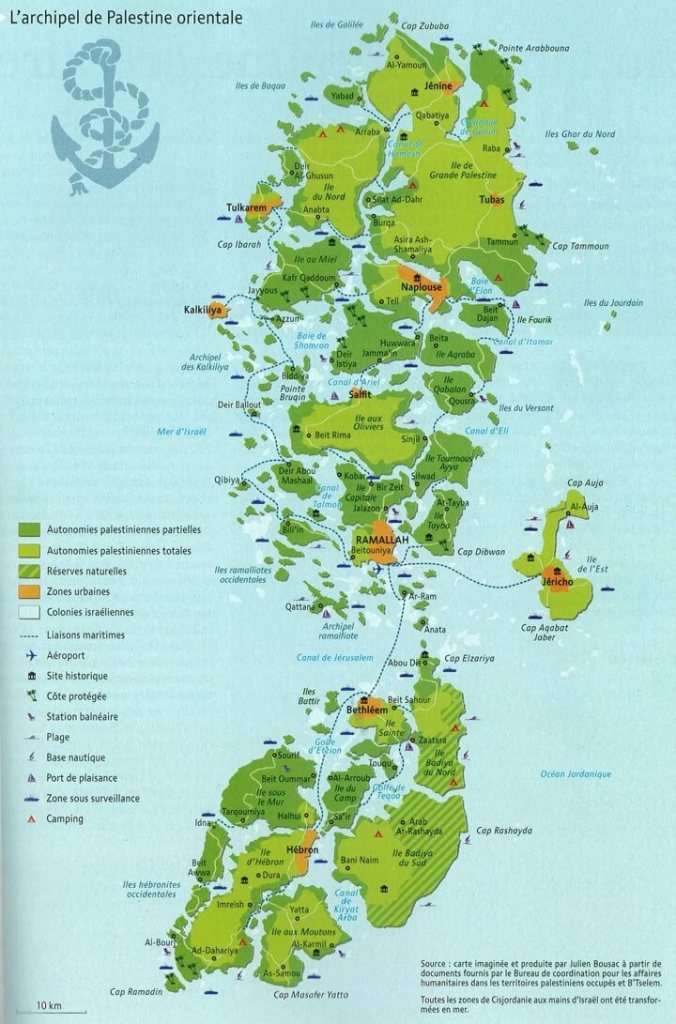
The map above shows what Palestine’s West Bank would look like if all non-Palestinian land suddenly turned into water.
All that would remain would be an archipelago of small islands with the sea of Israel to the west and the Jordanian ocean to the east.
The map is designed to show just how broken up Palestinian land in the West Bank really is. And while originally published in French, it is quite clear in the main point it’s trying to make.
Here are some key points about the map:
Regions of Palestinian Authority:
The map shows areas of partial and total Palestinian autonomy, marked in different shades of green. The darker green areas represent total autonomy, while the lighter green areas represent partial autonomy.
Israeli Settlements:
Areas in blue indicate Israeli settlements.
Urban Zones:
Orange areas represent urban zones.
Protected and Historical Sites:
Natural reserves and protected coasts are marked, along with historical sites.
Geographical Representation:
The map depicts the West Bank as a series of islands, which illustrates the fragmented nature of Palestinian territories due to the division created by Israeli settlements, roads, and checkpoints.
Symbols:
Various symbols denote airports, historical sites, protected coasts, beaches, and camping areas. There are also symbols indicating maritime connections, which, in the context of the map, seem to suggest metaphorical “water” crossings between different areas of Palestinian control.
Geographic Features:
Names of regions and cities such as Ramallah, Nablus, Hebron, Bethlehem, and Jericho are mentioned, providing a sense of the location and distribution of these areas.
The map’s creation by Julien Bousac aims to highlight the challenges faced by Palestinians due to the fragmentation of their territories. The fictional archipelago metaphorically represents how the West Bank is divided and isolated, illustrating the complex political and social landscape of the region.
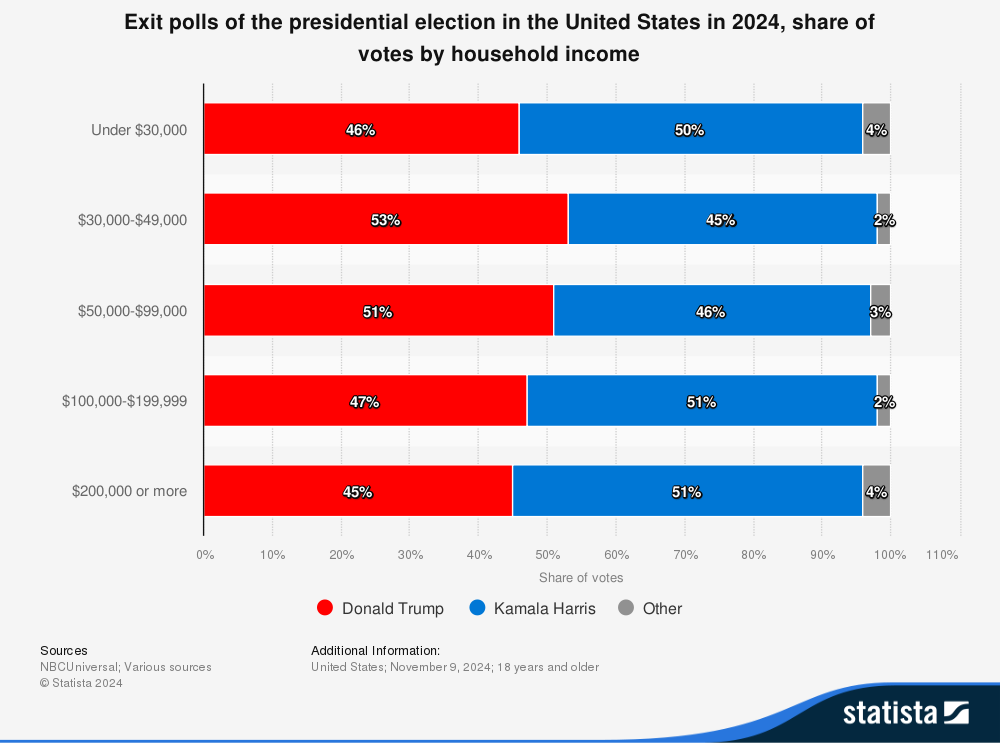
Red America and Blue America have become two different and mutually antagonistic countries sharing the same geographic space. They barely talk to each other, don’t understand one another — and while Blue America happens to be aware that both itself and Red America exist in a larger, infinitely complex world that needs both of them to be one whole for its survival, just as both of them need that larger world for theirs, Red America is not interested in and indeed is hostile to anything and anyone that is not itself and, while generally tending to be poor and perennially gripped by bitterness and resentment, derives its existential satisfaction almost exclusively from making Blue America feel bad — “owning the libs,” as Red America calls it.
A really good series. I don’t know to what degree it straight up deserves а rating of eight, but it has interesting and fairly unique ideas, and the lead actress is pretty and acts well. We’ll see what the next episodes are like, but on the basis of the first one we can say [that the show] has fine potential. If it develops in a good direction, it could turn out to be decent.
Source: Ororo.TV. Translated by the Russian Reader
For years, survivors of Assad and Russia’s chemical attacks in Syria were silenced. Today, we uncovered shocking evidence that many of these witnesses were forcibly taken to Moscow and pressured to lie – part of an extensive cover-up by the Russian state.
Now, with Assad no longer in power, these survivors are free to speak. In this video, they reveal the horrific reality of the chemical attacks – scenes of unimaginable suffering, children foaming at the mouth, and entire families wiped out.
As someone living in Ukraine, I’ve witnessed Russia’s war crimes firsthand – from white phosphorus to targeted civilian attacks. The patterns of brutality are clear, stretching from Syria to Ukraine.
This story exposes the disinformation campaign that echoed globally, amplified by figures like Aaron Maté and platforms like RT. But the truth matters now more than ever.
Watch as the survivors share their experiences and shed light on the true scale of Russia’s actions – crimes that continue to affect lives across multiple continents.
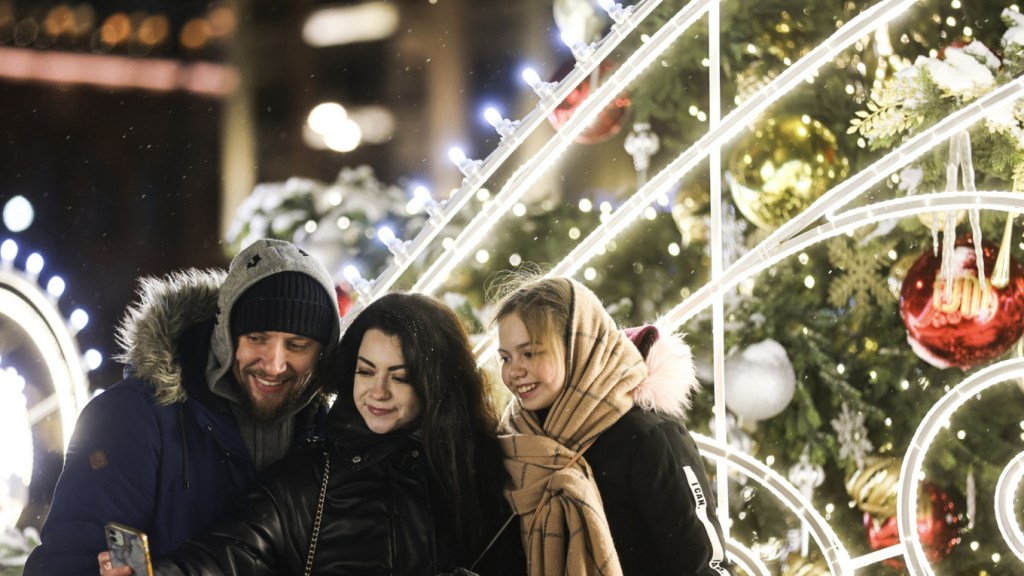
“Muskovites [sic] celebrating the New Year on Teatralnaya Square.” Photo: Yevgeny Messman/TASS (via Moscow Times)
Victimhood can be a tricky thing. Nobody doubts that ordinary Ukrainians are victims of this war. Russia’s political opposition, in exile, prison or dead, are also viewed as victims. But what of the country’s silent majority? What of the millions who stayed in Russia, kept their heads down and focused on living their ordinary lives, rather than the war and the online space it occupied?
Many things have changed in Russia since 2022. But one of the main constants has been the average Russian citizen’s desire for peace and ending the war. The majority have not been militantly opposed to or cheering the war effort on. Instead, they have been focused on living in the present, trying to salvage what remains of normality and longing for its imminent return – what some are calling the silent majority.
They are not happy with the war or satisfied with the current situation and have few ways of expressing that. Many do feel guilt on a certain (very private) level.
One thing hard not to notice in Russia throughout the conflict is how that silent majority has simply hunkered down and carried on. The war is very much in the background now. When I leave my building every morning, the same middle-aged man is defrosting his car, mothers are walking with strollers and children are heading to the local school.
When you eavesdrop on their conversations or stop to say hello, they sound normal – not like indoctrinated quasi-fascists, as some scholars are suggesting. They sound like any other school child whose teacher is just trying to get through the copious material thrown at them by the school director. The mothers just want their children to grow up in safety and comfort. Cheering on an expensive war pushing up the price of baby food is hardly a means of achieving that.
The war may come to an end in 2025. Negotiations are likelier than at any point since early 2022. And make no mistake, a peace agreement is inevitable. When the war ends, however, on whatever terms, Russia and its population of 146 million will still be there. It will not disappear or suddenly go away. The man defrosting his car as I write these words is not likely to have a huge epiphany when it does. His life has hardly changed since 2022. The increased number of women publicly wearing hijabs in our city is not doing so as a passive sign of resistance.
By living here, watching life unfold how it does, the more one cannot help but think something that many in the West will find unpopular. The war is not their fault. Tens of millions of innocent Russians are victims too. Their freedoms have been curtailed, their movements and opportunities restricted. Did they deserve that by virtue of where they were born? A classic liberal would argue not.
Like millions across the world, the average Russian is just trying to feed and raise their families, and get through the month. Many colleagues in academia have questioned from the comforts of the West, their tenured positions and with nothing to lose why many Russians do nothing to oppose the regime. What they neglect when arguing from their moral high ground is that those people I spoke of earlier do have a lot to lose being critical online. They have about as much power to topple the regime and change its course on the war, as the average Westerner does.
There will be blame to go around. Russian officials and the security apparatus, who carried out the decisions to invade Ukraine and suppress its own population, are obvious contenders. On the Ukrainian side, President Volodymyr Zelensky and his generals will have to answer for decisions they made. Kyiv’s Western allies clearly could have done more to support Ukraine, yet did not.
Russia’s silent majority will not want to be blamed and they must not be. They personally did not harm anybody or choose the war. Unlike routine acts of everyday life, the war was not their personal fault or responsibility. Collective guilt is too controversial; thousands protested, millions left and staying silent was, in its own way, an act of defiance by refusing to enter the discourse. Guilt by association is also not a tenable position. Not every Soviet citizen was responsible for the Stalinist Terror. Not every Russian citizen can be responsible for the war, especially not on the basis that they refused to cheer on Ukraine and their own country’s defeat.
Blaming those who are faultless will only cause resentment where there was none to begin with. In the long term, it will not make the world safer or more peaceful. Then comes one of liberal democracy’s sore spots that Ukraine, Georgia and even Moldova will have to reckon with on its European journeys: those people in the silent majority will still have a right to have an opinion – as will the pro-Russian segments of their populations. Dismissing these views or people will not make them, nor those in power, more rational.
If the West were serious, it would try to reach out to Russia’s silent majority, who can be won over. The Russian population at large do not hold the same positions as those in and around the Kremlin currently. Most of the population wants Russia to be an open, peaceful country, especially to the West. Make no mistake, westerners, their companies, money and popular culture will be welcomed back with open arms one day. Moreover, this part of Russian society will want to be welcomed back, too. Not doing so only will push the Kremlin into a closer alliance with the likes of China and North Korea.
Moreover, it is absolutely naive to assume that Russia’s social and economic problems will be fixed automatically by the sudden absence of Putin and the return of democracy. Although it stands a much better chance, we have been here before and there is no guarantee of success. Democracy will need to involve this silent majority beyond Moscow and the big cities – felt on the local level – seen to be actually working and fixing the people’s problems. If not, that silent majority will simply resign themselves, remaining disillusioned and ambivalent.
Gleb Pavlovsky once predicted what the end of the Putin regime would look like: it would collapse in a day and be replaced by something exactly the same. He may be proven right. If he is, that is the fault of those in power, not Russian society.
Pretrial Detention Center No. 2 in Taganrog (Rostov Region) was a place where, until 2022, minors, women, and mothers with children were detained. After the outbreak of full-scale war in Ukraine, Russian security forces cleared the detention center to make room for Ukrainian army soldiers and other prisoners of war, including the defenders of the Azovstal steel plant.
Pretrial Detention Center No. 2 gained a reputation as a gruesome torture camp for Ukrainian detainees. Many POWs in other detention centers are threatened with being sent to Taganrog and so forced not to oppose the prosecution. Few people have come forward to talk about the torture.
The story of Ukrainian Dmytro Lisovets was one of the first indications that the detention center in Taganrog had been turned into a torture camp. Lisovets had tried to flee with his family from occupied Mariupol, but failed to get through a filtration point in the Rostov Region. A former member of Ukrainian volunteer units, Lisovets was sent to the Taganrog detention center without being assigned any procedural status.
Lisovets’s lawyer toldMediazona that the Russian authorities “don’t pull any punches with the Ukrainians in this detention center”: “They burst into the cells in masks and beat everyone indiscriminately.” His client was also beaten and tortured in order to force him to admit that he had been involved in the hostilities. Consequently, Lisovets was sentenced to sixteen years in prison.
Once they were detained at Taganrog pretrial detention center, the Ukrainians were completely cut off from the outside world. According to one of the lawyers defending the prisoners, they were not allowed to talk to their clients in private, only in the presence of a police investigator. Moreover, the detention center staff forced the detainees to sign papers waiving their right to communicate with their defense lawyers.
The detainees were able to talk about the torture only after they had been transferred to other pretrial detention facilities.
“We were thrown from the back of KamAZ trucks—our hands tied and eyes blindfolded—and forced to line up against the wall under a hail of blows, where the beatings continued with hands, feet, batons and electric shockers,” one of the captured Ukrainians told his lawyers.
He also said that “at the offices” (that is, during interrogations) he would be bound with a leather belt, placed on the floor, and have a sandbag placed on his chest to make it harder for him to breathe. He would then be beaten with a rubber truncheon and tortured with a stun gun. “It was during such ‘procedures’ that [the Russians] extracted confessions of ‘war crimes,'” the Ukrainian wrote.
There were also mass beatings, including during rare walks outside in the yard. “At every turn of the walking route, a special forces soldier was stationed and was obliged to hit [the prisoners] with a stick,” said one of the convicts. Some officers were “humane” and did not beat wounded prisoners ands prisoners ofter fifty. “The attitude toward us in captivity depended on who was on duty in the prison. There were wardens who would beat all the prisoners,” saidYuriy Hulchuk, an Ukrainiian marine who spent time in Pretrial Detention Center No. 2.
There was no decent food in the detention center either. One of the defense lawyers of the Ukrainian prisoners, speaking on condition of anonymity, said that once a day the wardens “would feed them cabbage broth and quarters of black or white bread.” Ukrainian military officer Artem Serednyak was detained at the Taganrog detention center from September 2022 to the summer of 2023, during which time he lost twenty-two kilograms.
One of the prisoners calls Pretrial Detention Center No. 2 “hell with all its demons,” where it is scary to return: “Even the definition of ‘concentration camp’ would be too mild for Pretrial Detention Center No. 2,” he said. Human rights activists say that there was also sexualized violence against prisoners at the detention center: for example, prisoners had rubber truncheons shoved up their anus.
It was not only military personnel who were locked up in the detention center. For example, Ukrainian journalist Victoria Roshchyna, who was detained by the Russians in the occupied part of Donetsk Region, was sent to the Taganrog pretrial detention center for a year. She died last year: presumably, she was about to be exchanged for Russian prisoners. She did not have time to provide details about her life in the detention center. It is only known that Roshchyna was held in solitary confinement from May to September 2024.
The Russian authorities have not reacted in any way to the reports of torture. Russian human rights commissioner Tatyana Moskalkova visited the pretrial detention facilities where Ukrainian prisoners are held, but she did not report poor detention conditions either. Human rights activists say that the administrators of the detention centers would get ready for such inspections. “[T]hey prepared for this day: everyone was given new clothes, the grass was painted, the lawns were trimmed, and so on. They even gave them [the Ukrainian prisoners] biscuits, which they were extremely happy about, because the usual diet was very meagre,” [Irina Soboleva], one of the lawyers defending Ukrainian prisoners, says.
In the age of forever war, the use of mercenaries, paramilitary forces, and irregular troops have become increasingly common on the battlefield. But now Russia is resorting to luring unwitting civilians from Yemen and other countries across Asia with little to no military experience to fight alongside its troops in the war in Ukraine.
As reported by Ali Younes, a recruitment network run by a high-ranking Yemeni political and military official with ties to the Houthi government is tricking young Yemeni men desperate for jobs into signing employment contracts for work in Russia, only for them to find once they arrive that they cannot leave and are forced into military training camps and sent to the frontlines.
As the war in Ukraine approaches its fourth year with no end in sight, Russia has turned to recruiting unwitting young men from Yemen and other Arab countries to fight alongside its troops on the front lines. The men are lured under false pretenses, they tell Drop Site News, with promises of lucrative jobs and opportunities for migration, unaware that they are being forcibly recruited as mercenaries to fight in a foreign war despite having little to no military experience.
Two men who fell victim to the scheme told Drop Site they found out they were being sent to fight with the Russian army in the Ukraine war only once they had landed in Russia. Drop Site obtained a copy of an employment contract, corroborating photos and video, and spoke with a human rights organization that has documented the practice.
Mohamad, a Yemeni national who declined to give his last name for security reasons, said he was working in a restaurant in Oman in July when he was approached by Abdul Wali Al Jabri, a high-ranking Yemeni political and military official. Mohamad said they told him about job opportunities in Russia with a good salary and a hefty signing bonus and that he would be working for a civilian company according to his skills. He was eventually convinced to sign up through a company that recruits laborers in Yemen and Oman owned by Al Jabri, who is a general in the Yemeni armed forces of the Houthi government and a member of parliament in Sanaa.
Mohamad said the agreement between the Yemeni recruits and Al Jabri was a monthly salary of $2,500 with a signing bonus of $20,000. A copy of an employment contract written in both Arabic and English obtained by Drop Site lists the Al Jabri General Trading & Investment Co. SPC and Abdul Wali Al Jabri as the company representative. The contract outlines the company’s role in arranging for jobs in Russia “in the military, security, or civil field, based on…qualifications, experience, and capabilities” and says the contract ends after the signee “obtains Russian citizenship.” Mohamad said he was never told that he would be sent to fight for the Russian army in Ukraine and there is no indication in the contract.
Al Jabri has a fee built into the contract, whereby the signee is obliged to pay him $3,000 upon getting employed in Russia. Al-Jabri did not respond to repeated messages of inquiry from Drop Site for this story. However, Al Jabri did respond to questions posed by Tawfik Alhamidi, a Yemeni lawyer and human rights defender based in Geneva, Switzerland who runs the SAM Organization for Rights and Freedoms, and has documented the forced recruitment of poor young Yemeni men into Russia’s war with Ukraine.
Al-Jabri defended the practice to Alhamidi, saying he owns a “travel company” and that people in Yemen have asked him to “arrange for them to travel to Russia and join the army in order to obtain Russian citizenship and earn money to spend on their families back in Yemen.”
He dismissed criticism, adding that “he obtained a Russian approval for the Yemeni men to travel to Russia with good salaries but some political parties in Yemen who are currently fighting Ansar Allah [the Houthis] became worried that they might lose their soldiers to go fight with Russia and therefore created a social media storm over this issue.”
In September, Mohamad traveled to the Russian city of Nizhny [sic] via Dubai. He shared a video of himself with Drop Site on the plane, holding his boarding passes. He and a group of around 20 Yemeni men stayed in Nizhny for 24 hours before being shipped to the city of Rostov, a command base for the Russian army near the frontlines with Ukraine. They also discovered that their salaries were just $300 a month with a meager signing bonus.
Mohamad said that in both Nizhny and Rostov the Yemeni men were met by Russian soldiers. Mohamad said that they were forced to sign another contract, written in Russian, that obliged them to serve in the Russian military. “We were forced to sign contracts in the Russian language that we didn’t understand to serve in the Russian military,” Mohamad said. “We were very afraid.”
He said that in Rostov his group protested to the Russian officers that they didn’t want to fight in the war and demanded to go back to Yemen but they were prevented and ended up being forced to stay in Russia for months where they were forced into military training camps. Mohamed also shared a photo of a Yemeni recruit in full military fatigues and combat gear holding an assault rifle and another of a dog tag written in Cyrillic.
“We were trained by an Arabic-speaking Egyptian Russian military officer who told us that we are in Russia to fight for the Russian army and that we will be deployed to the front lines and not working as civilians,” Mohamad said. He said in the camp he met many men from Iraq, Syria, and Sudan and elsewhere receiving military training. Mohamed was finally able to return to Yemen at the end of October and he spoke to Drop Site from Sanaa.
Another video shared by Mohamed [sic] with Drop Site shows a group of about 10 Yemeni men inside a tent with wooden bunk beds in Nizhny. In the video, one man says, “We came from the sultanate of Oman for civilian work, everyone according their skills,” pointing to each one in turn, he adds, “This man is a metalworker, this man works with hydraulics, this man is an electrician, this man is a driver, this man works with electrical equipment. We are all civilians who work civilian jobs.” He goes on to say they were taken from the airport to Nizhny and they were “terrorized by armed soldiers and forced to sign contracts.” Pointing to a pile of camo backpacks on the floor, he says they were being taken to a training camp. “We are civilians and we know nothing of this,” he says in the video and calls on the Yemeni government to help them. “We are sons of Yemen and we fell into a trap.”
Drop Site also communicated via WhatsApp messages with Jalal, another Yemeni man recruited by the same network who is currently deployed as a soldier fighting for Russia in Ukraine. He told Drop Site he was lured into coming to Russia to escape poverty with the promise of a large salary and signing bonus as well as Russian citizenship. He said he ultimately decided to stay and fight in the war in the hope that he could earn enough money to be able to return to Yemen with savings as well as to possibly obtain Russian citizenship.
Alhamidi characterizes the recruitment practice as exploitative and a human rights violation.
“Dire poverty conditions in Yemen enabled human trafficking and recruitment networks to proliferate and lure young men to go to Russia under false promises of civilian work and high salaries,” Alhamidi told Drop Site, adding that Yemen’s laws contain many loopholes that [allow] Yemeni nationals to join foreign armies as mercenaries without being criminalized. “This has enabled powerful men in Yemen with connections to the Houthi government and Russia to mislead hundreds of young men into traveling to Russia to fight in Ukraine.”
A report by SAM published in November based on interviews with several Yemeni nationals who who were recruited by Al-Jabri and traveled to Russia titled, “With False Promises of Jobs and Attractive Salaries: Recruitment Networks Force Yemeni Youth into the Russia-Ukraine War,” found that: “The forced recruitment of Yemeni youth into the Russian-Ukrainian war through coercive networks constitutes a clear violation of international humanitarian law and human rights and rises to the level of human trafficking… The organization reported that once recruits arrive in Russia, they are subjected to severe abuses, including being forced to fight under harsh and inhumane conditions, being deprived of food and medical care, and suffering injuries or death from indiscriminate shelling on the battlefronts.”
According to Alhamidi, Al Jabri has traveled to Russia numerous times and has obtained visas to Russia for thousands of Yemenis to lure them into traveling there and forcing them into military training camps, though it is unclear how many have actually made the trip.
Similar recruitment networks in other countries have lured unwitting civilians to Russia with promises of work or other opportunities and then forced them to serve in the Russian army. One human trafficking network in India sent dozens of Indian nationals to Russia for combat training before being deployed to the front. Citizens of Nepal and Sri Lanka have also been illegally recruited in similar ways to fight for Russia in Ukraine.
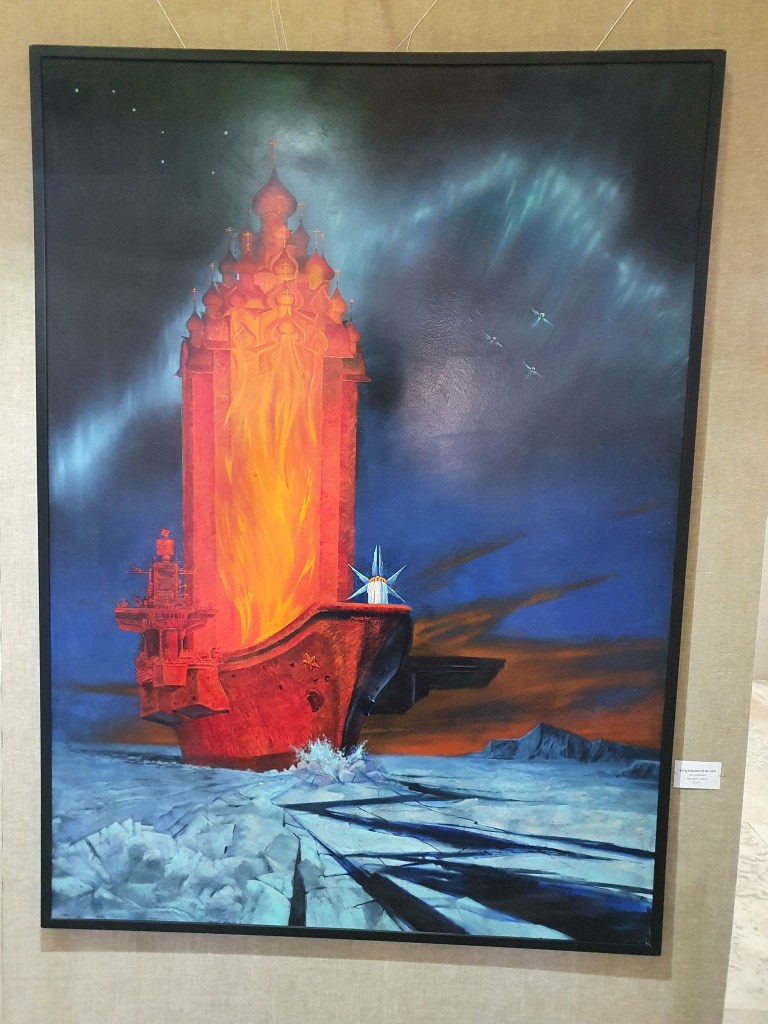
All modern entertainment that “undermines” traditional values should be banned in Russia, conservative philosopher and “Russian World” ideologue Alexander Dugin has said.
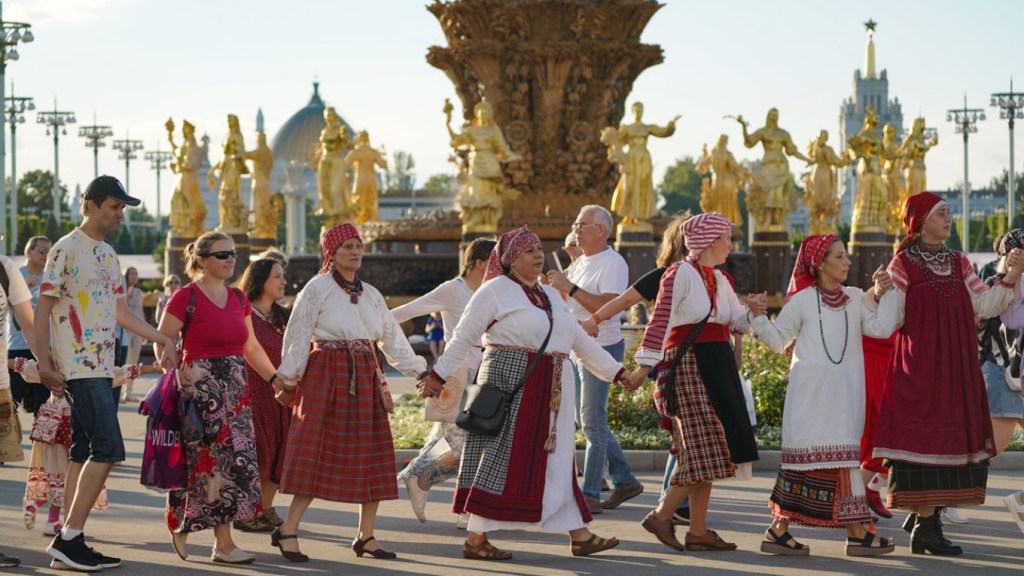
“Only morally healthy entertainment should be allowed — first of all, round dances and traveling around one’s native land, and even better, pilgrimages to holy places. Everything else should be banned,” Dugin wrote on his Telegram channel.
According to Dugin, a healthy nation should have wholesome leisure activities, “and not all of that stuff.” As a negative example of entertainment, he cited KVN, which has become, he claims, “a poisonous matrix of degeneration.”
“The sinister nature of this pernicious phenomenon is now clearly visible. [Ukrainian President Volodymyr] Zelensky, [comedian Maxim] Galkin, and all the rest,” Dugin said.*
Earlier, the philosopher claimed that the West regards Russia as its principal foe because Russian President Vladimir Putin has been reviving traditional values and liberating the country from global influence. This, in his opinion, is what provoked the disgust of Western “progressive elites” with Putin.
Dugin has also argued that Russia has neither a parliament nor democracy, but a de facto monarchy headed by Putin, who can do whatever he wants. The philosopher noted the irrelevance of certain laws in Russia, as well as the people who propose or support them. In his opinion, all of this is “boyars dancing for the time being,” that is, until the sovereign pays attention to the antics of these “selfish and thieving bastards.”
Dugin has argued that Russia itself is the Katechon — the last bulwark against the Antichrist, who today reigns in a West “totally perverted” by LGBT+, postmodernism, relativism, and transhumanism.
The philosopher has dubbed the war in Ukraine “the most important event in history.” In his opinion, it is being waged on behalf of a multipolar world, with many superpowers. Consequently, according to Dugin, Russia will free other countries of the world from Western liberal imperialism, in whose grip they are trapped. And yet, Dugin acknowledged that Russia would lose a great many people in the course of the war.
* Zelensky was captain of the Kryvyi Rih KVN team Kvartal 95 from 1998 to 2003.
Enter Thoughts of Days to Come, dressed to the nines in khaki blouses. They are lugging atom bombs, ICBMs, a launching pad. O, how they reel, dance, and caper: “We are warriors and carousers! Russians and Germans will fall together; for example, at Stalingrad.” And like old widow Matryona, cyclotrons are dumbly howling. In the Ministry of Defense a nest of crows is loudly cawing. Look at the pillow. What do you know! Shiny medals all in a row.
“Where there’s a will, there’s a way.” “A pint of vodka, they say, Soon’ll be a ruble a pop.” “Mom, I really don’t love Pop.”
Enter a certain Orthodox, saying: “These days I’m number one. I’m pining for the sovereign, and in my soul the Firebird flares. Soon Igor will reunite with Yaroslavna and have his fun. Let me make the benediction or else I’ll box you on the ears. Worse than evil eye or herpes is the plague of Western thinking. Sing, accordion, and drown out the saxophone, jazz’s vile offspring.” On the icons they plant a kiss, Sobbing victims of circumcis—
“‘The Arab world is not just beautiful ethnic costumes, exquisite dishes, and other One Thousand and One Nights-type stuff, but also brutal dictatorships, poverty, a high tolerance of violence, and sometimes outright racism and religious fanaticism. According to my observations, however, this second facet is almost always bracketed off by Europeans when describing the countries of the “global South” or is guiltily dished up as a consequence of the traumatic colonial past.’ Essayist Andrei Sapozhnikov (“Department of Culture”) connects the abnormally high support for Hamas’s invasion of Israel in the Western world with this peculiarity.”
Source: Email newsletter from the online Russian magazine Republic, 8 November 2023. Translated by the Russian Reader
The State Duma has been drafting a ban on transgender transition in Russia since spring. Despite the fact that experts and doctors opposed it, the MPs have now passed the law in its second reading.
The original bill already prohibited all “medical interventions” for transgender transition and changing gender markers in passports and other documents. But the MPs also proposed new restrictions.
Now, according to the draft law, if one spouse changes their gender marker, their marriage will be annulled. In addition, those who have transitioned to another gender will be banned from serving as guardians and adopting children. Depriving them of parental rights is not on the table yet, but the Russian authorities have taken children from trans people in some cases in the past.
Moreover, MPs would ban not only “medical intervention” in the form of surgery, but also hormone therapy.
Finally, the Duma reworded the law on vital records. Previously, it was possible to amend a passport using a sex-change certificate issued by doctors. Official documents can now be amended if the individual provides a medical report “on the correspondence of [their] sexual characteristics with the characteristics of a particular sex.”
Although the bill has not yet been adopted into law, it is already causing trouble for transgender people. Robert Lebedev, a transgender man, toldBumaga, citing his own acquaintances, that civil registry offices in Moscow had been delaying issuing new documents to transgender people for longer than the month prescribed due to an “order from above.” And yet, the draft law does not even prescribe penalties for doctors or civil servants who violate the ban on assisting a person with transgender transition and gender marker change.
The bill’s co-sponsor, Pyotr Tolstoy, argues that “the western transgender industry is trying to infiltrate our country,” and Russia’s “cultural and family values” must be preserved.
Even before the adoption of the law, transgender people faced endless humiliation and persecution. The new law will give the security forces a free hand and effectively outlaw an entire group of citizens.
On this dark day, when we find ourselves at rock bottom, I want to scream with rage and impotence. While voicing emotions is vital, I’m also trying to find a foothold—in myself, in others, in my own experience….
I have nothing but a profound belief that this night of total obscurantism, injustice, and hatred will end one day, and hopefully sooner rather than later. I am overwhelmed with feelings of love and admiration for the trans activists to whom life has introduced me during my ten-plus years in activism. I didn’t always say these feelings out loud.
We started working hand in hand when I didn’t know a single open trans person in my own circle yet. Gradually, I was surrounded by more and more trans people, who did a lot of cool, useful and, sometimes, fantastic things.
I befriend trans people and even became romantically involved with them. Over the years, trans initiatives and trans people have truly accomplished a great deal. It’s no exaggeration to say that they have become the vanguard of the Russian LGBT+ movement.
I learned about the difficulties they face and about ways to help them. I still appreciate the patience, tact, determination, and dignity with which I was corrected when I made mistakes myself, or when mistakes were made in the communities I moderated.
Things became visible that I, a cisgender person, simply had not noticed before: sniggering and transphobic “jokes” at passport control at the airport, misgendering, violence, rejection at home, discrimination at work, sexual exploitation, increased risk of suicide, etc. Interacting with trans people also helped me to understand the narrowness of the binary gender framework and my own gender nonconformity, despite the fact that I consider myself a man.
Further immersion in the topic, collaborations, and a desire to contribute in this area led to the creation of the project Transformation on trans people in the Russian prison system. At the same time, we tried not to speak for trans people. Instead, we delivered their own stories about their prison experience and commentary by experts, among whom there were also trans people. We plan to continue, realizing that it is a long-term job, although the new law will make this work more complicated, apparently.
Again and again I listen to the song “We Shall Overcome,” the anthem of the movement for the rights of African Americans. In new, difficult circumstances, the importance of mutual support, assistance, unification, and finding non-standard channels increases.
I believe in the power of the LGBT+ community’s solidarity in the face of difficulties. Fear and feeling powerlessness are understandable emotions. But it’s important to move on and fight the consequences [of this law].
The song ends with these words:
We are not afraid,
We are not afraid,
We are not afraid today.
For deep in my heart
I do believe:
We shall overcome someday!
The photo, above, from his personal archive, shows the author during the campaign against transphobic legislation in St. Petersburg, with a view of Trinity Bridge in the background.
A court in Moscow has remanded the theater director Zhenya Berkovich to custody in a pretrial detention center and almost inevitably will render the same decision about the playwright Svetlana Petriichuk (whose pretrial restrictions hearing is still underway). This is the first criminal case in Russia against the authors of a work over its content. Both are accused of “condoning terrorism” in the play Finist the Brave Falcon, which recounts how Islamists recruited Russian women as wives. Last year, the production was awarded the state-sponsored Golden Mask theater prize in two nominations.
Before the court hearing, it transpired that the case was based on a forensic examination conducted by Roman Silantyev, head of Moscow State Linguistic University’s Destructology Laboratory, and his colleagues.
“Destructology” is a science invented by Silantyev himself. He claims that the new discipline “comprehensively examines extremist and terrorist organizations; psychotic cults and non-religious sects; totalitarian sects and the magical services sector; suicidal games and hobbies; deadly youth subcultures (Columbine, AUE, etc.) and medical dissidence.”
There are many experts in Russia whose findings are used by the security forces to imprison people for what they say and write. Often such experts are ignorant, their conclusions are unscientific, and their public statements are frankly obscurantist.
But Roman Silantyev stands out even in this crowd.
A former employee of the Moscow Patriarchate’s Department of External Ecclesiastical Relations (the church’s equivalent of the Ministry of Foreign Affairs), at the outset of his expert career, Silantyev presented himself as a specialist in Islam. In 2005, the publication of his book “The Modern History of the Russian Islamic Community” triggered a scandal: Russia’s Council of Muftis wrote that the author’s stance was at odds “with the most elementary norms of universal ethics and morality.”
To understand the outrage of the muftis, we should take a look at Silantyev’s statements. For example, he said that in order to fight the Wahhabis, “physical force—destruction and gouging—is maximally effective” and dreamed that “law enforcement agencies would finally realize that in this case it is better to cross the line than to come up short.”
Over time, Silantyev felt that he had outgrown his narrow remit as a scholar specializing in Islam and since then he has been commenting on everything. He has opposed Star Wars (callingJediism an “anti-Christian multifunctional propaganda project”), claimed that Ukrainians profess the “religion of Ukrainianism,” and called for a legislative ban on Satanism in Russia, accusing Ukraine of spreading it.
In 2020, Silantyev traveled around Russia giving lectures on “extremism prevention.” He boasts that he has taught classes to officers and staffers at the Federal Security Service (FSB), the Federal Penitentiary Service (FSIN), and the Interior Ministry. And they seem to actually pay heed to him, or at least to successfully use him for their own purposes. It seems that Silantyev has already helped to send dozens (if not hundreds) of people to prison, including Muslims and Jehovah’s Witnesses.
And now he has helped send artists to jail. In their expert report, Silantyev and his fellow destructologists write that Berkovich and Petriichuk’s play contains “traces of the ISIS ideology, as well as the subculture of Russian Muslim neophytes.” In addition, the experts detected the “ideology of radical feminism” in the play.
“The ideology of radical feminism, based on the idea of women’s immanent humiliation, is far from harmless. Destructological science has recorded cases in which adoption of this ideology led to the deliberate planning and execution of a terrorist act,” the self-styled experts teach us. And the court, by sending artists to jail, seems to share this opinion.
One day, I hope, someone will explain to me why “progressive” Russians find the English words speak, speaker, speech, etc., so sexy and exciting that they have to incorporate them needlessly into Russian every chance they get.
Do they know that, in English, these words are less evocative than three-day-old bread, duller than dishwater?
In this case, hilariously (and awkwardly, too: “speak” appears after chas, generating an awkward phrase that translates as “hour of speak” or “speak hour,” although it’s supposed to be a play on the idiomatic phrase chas pik, meaning “rush hour”), the word “speak” adorns Sergei Medvedev’s reflections on the “imperialist mindset.”
Indeed.
Thanks to TP for this gem of Rusglish.
Below, you can watch the actual interview (in Russian, not Rusglish — well, almost), which, if for no other reason, is interesting because it was posted almost three months before Russia invaded Ukraine. ||| TRR
Historian and writer Sergei Medvedev is the program’s guest.
In an interview with Nikita Rudakov, he explained:
Why the idea of Russia’s “civilizational superiority” is so popular
Why propaganda encourages the ideological complexes of Russians
How the elite of the 2000s is trying to turn back history.
00:00 Chas Speak: Sergei Medvedev 01:40 The imperialist mindset and the idea of Russia’s greatness 06:10 Is there no place for nationalism in the imperialist mindset? 08:05 “Russia colonized itself” 14:03 The superiority of big ideas: why didn’t the USA become an empire? 21:02 The ideological complexes of Russians 25:41 “We rise from our knees via military achievements and parades on Red Square” 26:50 “Lukashenko does with us what he will”: Russia and Belarus 30:56 “Russia wants to live in the myth of 1945” 34:40 “We were unable to create a nation state”
So much for the idea of not giving a platform to out-and-out fascists like Alexander Dugin, whose “academic” credentials are borne out by serious-sounding nonsense like the following, as found in Last War of the World-Island and translated by John Bryant:
In all the principal parameters, the Russian Federation is the geopolitical heir to the preceding historical, political, and social forms that took shape around the territory of the Russian plain: Kievan Rus, the Golden Horde, the Muscovite Czardom, the Russian Empire, and the Soviet Union. This continuity is not only territorial, but also historical, social, spiritual, political, and ethnic. From ancient times, the Russian government began to form in the Heartland, gradually expanding, until it occupied the entire Heartland and the zones adjoining it. The spatial expansion of Russian control over Eurasian territories was accompanied by a parallel sociological process: the strengthening in Russian society of “land-based” social arrangements, characteristic of a civilization of the continental type. The fundamental features of this civilization are:
• conservatism; • holism; • collective anthropology (the narod is more important than the individual);
• sacrifice; • an idealistic orientation; • the values of faithfulness, asceticism, honor, and loyalty.
Sociology, following Sombart, calls this a “heroic civilization.” According to the sociologist Pitirim Sorokin, it is the ideal sociocultural system. This sociological trait was expressed in various political forms, which had a common denominator: the constant reproduction of civilizational constants and basic values, historically expressed in different ways. The political system of Kievan Rus differs qualitatively from the politics of the Horde, and that, in turn, from the Muscovite Czardom. After Peter I, the political system sharply changed again, and the October Revolution of 1917 also led to the emergence of a radically new type of statehood. After the collapse of the USSR there arose on the territory of the Heartland another government, again differing from the previous ones: today’s Russian Federation.
But throughout Russian political history, all these political forms, which have qualitative differences and are founded on different and sometimes directly contradictory ideological principles, had a set of common traits. Everywhere, we see the political expression of the social arrangements characteristic of a society of the continental, “land-based,” heroic type. These sociological peculiarities emerged in politics through the phenomenon that the philosopher-Eurasianists of the 1920s called “ideocracy.” The ideational model in the sociocultural sphere, as a general trait of Russian society throughout its history, was expressed in politics as ideocracy, which also had different ideological forms, but preserved a vertical, hierarchical, “messianic” structure of government.
“Russian angel carrier, Artillery Museum, Saint Petersburg.” Source: Pavel Pryanikov, Facebook, 6 November 2022
Alexander Kharichev, head of the Presidential Department for Supporting the Work of the State Council, and three other experts have published a scholarly article entitled “Perception of basic values, factors, and structures of Russia’s socio-historical development, as based on research and testing.” As part of the study, seventy people from the student bodies of Moscow State University and the Higher School of Economics and the teaching staff of a conference in Sevastopol [sic] were interviewed. Among the metaphors of the future they proposed was the burnt second volume of Dead Souls; among the concepts of the modern state, “the Motherland with a laser sword”; among the concepts of the future, “Russia as the world’s ‘guardian of good” and “Pasty” [sic: “Pirozhok”]. The authors concluded that the dominant value for the Russian family is the people of Russia, which itself is a “family of families.”
Mr. Kharichev’s co-authors were Andrei Shutov, dean of the faculty of political science at Moscow State University; Andrei Polosin, doctor of political science and head of Rosatom’s regional interaction department; and Ekaterina Sokolova, deputy executive director for strategy and forecasting at the Expert Institute for Social Research. The article was published in October in the Journal of Political Studies.
The study was conducted by means of group discussions from March to May. The seventy participants answered questions about what Russian statehood is, what would happen to the country in ten years, what our future is, and a number of others.
Based on the discussions, the researchers formed a five-level “pentabasis”: person—family—society—state—country. Dominant values were formed for each level. For the country, [this dominant value] is patriotism; for the state, it is trust in the institutions of power; for the family, it is the people of Russia; for society, it is harmony; for the person, it is creativity. “The thesis was voiced that European society is individualistic, whereas our main value is family + family with friends, which leads to the emergence of the thesis ‘family as a level.’ The dominant value: the people of the Russian Federation as a family of families. Stimulating the birth rate and the concept of a ‘big family,’ the article says [just as incoherently in the original as in this translation].
Metaphors of Russia’s future. “The state as a novel” (written collectively by citizens, it has alternative endings); “the Russian future as the second part of Dead Souls, burned by Gogol,” “the state as the Firebird.”
Concepts of the modern state. “[The] Motherland with a laser sword” (a source of pride for the Russian spirit and a guide to the future), “the friendly service state.”
Messianic concepts of the future state. “Russia as a ‘prophet country’ (opposed to the Grand Inquisitor), “Russia as the world guardian, the ‘guardian of good.'”
Idealistic concepts of the future state. “Wondrous City” ([i.e., promoting] inclusivity, coexistence, acceptance of others as equals; “in no case to be confused with the term ‘tolerance'”), “Pasty” (harmoniously combines different things).
Mechanistic concepts of the future state. “Kaleidoscope” (a multifaceted future), “a medium-sized magnet state” (generates a field for a particular community).
The study participants concluded that the person in the “Russia of the Future” is “proud of his country, influential and highly employable, financially secure, [and] free within certain community rules.” According to the authors of the article, the ideas of self-realization in the Russian Federation are very different from those common in the Western world.
“In the Russian case, self-realization or mission means that an individual contributes to the country’s development. Capitalizing [on one’s] mission is an optional stage,” the authors write.
“Bosom buddies aren’t born overnight,” declares the label of North Coast Brewing’s Russian imperial stout, Old Rasputin. I don’t know whether that sentiment is true, but the beer is excellent. Scan of the carton by the Russian Reader
Fans of anti-thalassocrat and accomplished obscurantist Alexander Dugin will appreciate this portrait of the man by journalist Andrey Loshak, which I translated the other day for e-flux Notes. Here’s a sneak preview:
I remember accidentally attending a lecture by Dugin on “angelic entities” in the late nineties. It was an absolutely unbearable exercise in transcendental sophistry, dealing mainly with the image of Lucifer (the Fallen Angel) and featuring extensive quotations from Aleister Crowley. There were about twenty people of indeterminate age and gender in the auditorium. I thought at the time that perhaps they, too, were fallen angelic entities who had come to listen to a lecture about themselves. In the mid-noughties, I ran into Dugin at a Current 93 gig at the Ikra Club. He dearly loved English apocalyptic folk music for its commitment to Nazi Satanism.