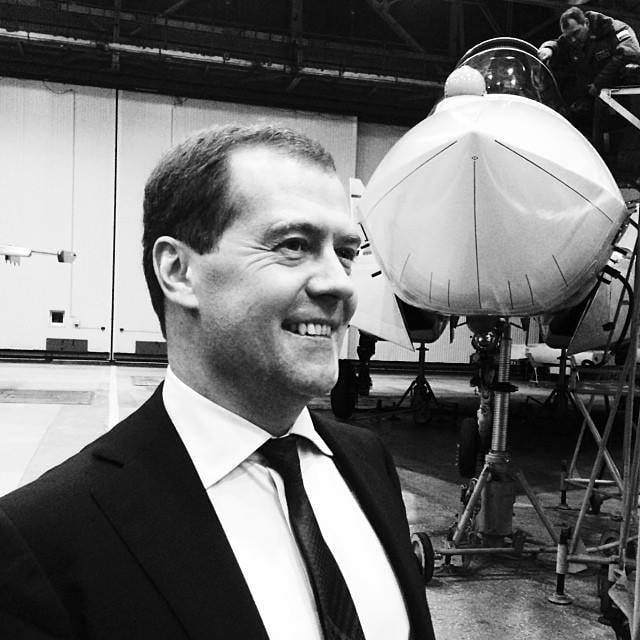
What are we fighting for? Russia is a huge, rich country. We don’t need foreign territories; we have plenty of everything. But there is our land, which is sacred to us, on which our ancestors lived and on which our people live today. And which we will not surrender to anyone. We are defending our people. We are fighting for all of our own people, for our land, for our thousand-year history.
Who is fighting against us? We are fighting against those who hate us, who ban our language, our values, and even our faith, who spread hatred towards the history of our Fatherland.
A part of the dying world is against us today. It consists of a bunch of crazy Nazi drug addicts, the common people they have drugged and intimidated, and a large pack of barking dogs from the western kennel. They are joined by motley pack of grunting piggies and narrow-minded philistines from the disintegrated western empire with saliva running down their chins due to degeneration. They have no faith and ideals, except for the harmful vices they have contrived and the standards of doublethink they impose, which deny the morality bestowed on normal people. Therefore, by rising up against them, we have gained sacred power.
Where are our former friends? We have been abandoned by some frightened partners — and I could not give a flying crap about them. That means they were not our friends, but just random fellow travelers, clingers, and hangers-on.
Cowardly traitors and greedy defectors have bugged out for the back of beyond — may their bones rot in a foreign land. They are not among us, but we have become stronger and purer.
Why were we silent for a long time? We were weak and devastated by hard times. And now we have shaken off the sticky sleep and dreary gloom of the last decades, into which the death of the former Fatherland had plunged us. Other countries have been waiting for our awakening, countries raped by the lords of darkness, slaveholders and oppressors who dream of their monstrous colonial past and long to preserve their power over the world. Many countries have long disbelieved their nonsense but are still afraid of them. Soon they will wake up once and for all. And when the rotten world order collapses, it will bury all its arrogant priests, bloodthirsty adepts, mocking henchmen, and tongue-tied mankurts under the multi-ton pile of its own debris.
What is our weapon? There are various weapons. We have the capacity to dispatch all our enemies to a fiery hell, but that is not our mission. We listen to the Creator’s words in our hearts and obey them. These words give us a sacred purpose. The goal is to stop the supreme ruler of hell, no matter what name he uses – Satan, Lucifer, or Iblis. For his goal is destruction. Our goal is life.
His weapon is an elaborate lie.
But our weapon is the Truth.
That is why our cause is just.
That is why the victory will be ours!
Happy Holidays!
Source: Dmitry Medvedev, Telegram, 4 November 2022. Mr. Medvedev, the former Russian president, has 910,612 subscribers on Telegram. For reactions to his National Unity Day post, see Asya Rudina, “‘Iblis crept up unnoticed’: Bloggers on Dmitry Medvedev’s creative work,” Radio Svoboda, 7 November 2022 (in Russian). Translated by Your Answer Needs Demented Examples Xavier, with a little assistance from the Russian Reader. For an alternative vision of Russian patriotism, also prompted by the November 4 National Unity Day holiday, see Kirill Medvedev (no relation), “‘If There Is No People, There Is No Left Either’: Progressive History and Patriotism from Below,”Posle, 2 November 2022. I can endorse neither of these visions, alas. ||| TRR
Regarding the Convocation of a Congress of People’s Deputies of the Russian Federation in Poland
From open sources, we have learned about an undertaking to convene a Congress of People’s Deputies in the town of Jabłonna, Poland (November 4–7, 2022). The delegates to the Congress are parliamentary deputies of different years and different levels who were elected in internationally recognized elections. Rejection of the war between Russia and Ukraine that began in 2014 and a willingness to change the socio-political system established in the Russian Federation are their common platform. The event’s organizers have announced that they will adopt a “Declaration on the Constitutional Principles of a Free Russia after the Putin regime’s overthrow,” a “list of priority decisions by the post-Putin Russian government,” etc.
In the light of this news:
We cannot but note the fact that [free and fair] elections in the Russian Federation disappeared long before 2014. Ethno-national political parties were banned thirteen years before Ukrainian region of Crimea was annexed. Thus, despite the fact that the Russian Federation, according to its own constitution, is a federation, and most of the ethno-national republics within the Russian Federation are nation-states with their own constitutions, parliaments, and governments, we have been deprived of the opportunity to represent and defend our interests in representative bodies for decades.
We acknowledge that the Russian Federation as a state has gone too far both in its ethno-national policy (extolling the Russian nation as chosen and endowing it with a special status in the Russian Federal Constitution) and in its foreign policy, thus completely destroying the legal space of the federation. The Russian Federation currently has no clear and legitimate borders, nor does it have legitimate representative bodies, since there are “deputies” and “senators” seated in the Federal Assembly who were, allegedly, delegated by illegally annexed foreign territories.
In light of the above considerations, we, representatives of the ethno-national and regionalist movements united in the Free Nations League, declare the following:
1. We do not recognize any political forces and hubs that would justify maintaining the Russian Federation in its current form. We have no need of arbitrators from Moscow, neither from the authorities nor from the opposition. We are open to dialogue and contact only with those who publicly support the right of enslaved peoples to establish independent States.
2. The Russian Federation cannot be re-established by cutting off what was seized by force and holding new elections. It is not elections that are at issue, but the very nature of Russian statehood: it is imperialist and exudes aggression towards its neighbors. This means that we, representatives of ethno-national republics and regions, have the right to shape our own destiny. If there is a discussion of independence for certain lands, let the people themselves hold this discussion, let them decide which confederations or unions to join, free from the intervention of federal forces, be they the government or the opposition. Any attempts at “peacekeeping,” attempts to teach us how to exercise our right to self-determination, will be rejected by us, and if they are intrusive, they will be met with a forceful response.
3. The process of forming a new Russian state should be voluntary and undertaken exclusively by those federal subjects whose legislative bodies vote to join a new federation. All federal parties currently represented among the federal authorities should be banned since they profess a misanthropic ideology that has produced thousands of victims and millions of refugees. The legislative bodies of the former federal subjects must be re-elected democratically, by open and secret ballot, with the involvement of ethno-national and regional political parties. There can be no automatic entry into the “renewed” Russia, no joining it “by inheritance.”
This appeal has been signed by representatives of the following national movements:
Bashkir
Ruslan Gabbasov, head of the Bashkir National Political Center (BNPC)
Ilshat Kinzyabayev, member of the BNPC
Buryat
Radjana Dugar-DePonte, representative of the Erhatan Buryat Democratic Movement in the USA
Cossack
Vyacheslav Demin, elder of the Cossack National Liberation Movement
Source: Free Nations League, Facebook, 31 October 2022. Thanks to Sergey Ogurtsov for the heads-up. Translated by the Russian Reader
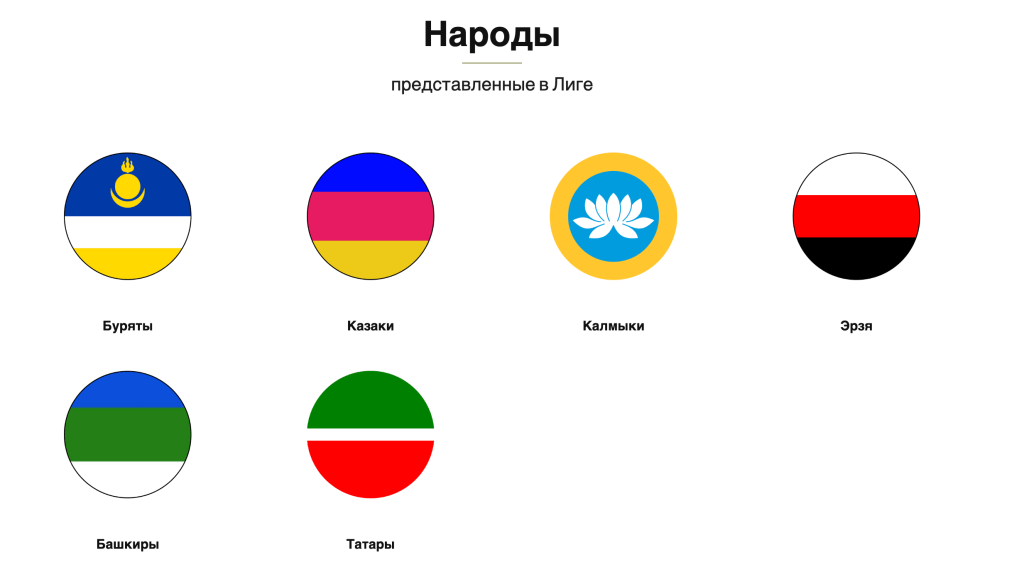
“Nations represented in the League: Buryats, Cossacks, Kalmyks, Erzya, Bashkirs, Tatars”
The FNL’s Principles
1
The Russian Federation is an empire that keeps its colonies in servitude by force. It is impossible to liberate them by holding a referendum, just as a referendum on the observance of human rights is impossible under conditions of state terror.
2
The peoples of the Russian Federation should be able to exercise their right to self-determination. Further federations or confederations can be established only a voluntary basis, not by diktat of the former federal center.
3
We declare the principle of the presumption of identity and agency [sub’ektnost’]. Accordingly, with the collapse of the current political regime in the Russian Federation, the regions have no need to appeal to anything to endow themselves with sovereignty. By definition, all regions acquire complete sovereignty and full independence from Moscow, and only then, as free territories, do they decide their future: whether they want to maintain independence, unite with other regions and republics, or create a confederation of states.
4
All subjects of the Russian Federation have the right to independently determine their future.
Source: “About Us,” Free Nations League. Translated by the Russian Reader
Minus one:Yan Sidorov, a former political prisoner in the Rostov Case, has volunteered for the war.
Sidorov served four years in prison in the Rostov Case, in which the court decided that two posters and thirty leaflets were evidence of “attempted organization of mass disturbances.” The Memorial Human Rights Center recognized him as a political prisoner.
Yan was released from prison a year ago, and he had planned to work in human rights protection. There were no vacancies in human rights organizations, however, and so he had to get a job as a food delivery courier.
Yan socialized with many leftist and liberal activists, but he also maintained relations with the red-brown National Bolsheviks.
Apparently, the latter were nicer to him. Several mutual friends have informed me that Yan Sidorov has joined the ranks of Eduard Limonov’s Other Russia and gone to the front.
I still don’t get how the National Bolsheviks degenerated from a flamboyant opposition party into the vanguard of the Kremlin regime. The late Limonov was always an imperialist, however.
But how — how?! — former political prisoners become defenders of Putin’s dictatorship, no one seems to understand. As one of my cellmates used to say, “Everyone has gone off their fucking gourd!”
Well, before he starts shooting, it’s not too late for him to change his mind. Maybe he will shake himself free of this delusion after all.
Russian human rights activist Yan Sidorov is facing the prospect of three years under harsh probation conditions, when he is released next week from the penal colony where he has spent the last two years, Amnesty International said today.
Yan Sidorov is a prisoner of conscience, whose attempts to hold a peaceful protest in 2017 resulted in an imprisonment at a Dimitrovgrad penal colony after he had spent two years in pre-trial detention. He is set to be released on 3 November, but on 29 October Dimitrovgrad City Court will hear a request by the authorities to impose a severely restrictive probation period.
“Russian authorities are sending a clear signal to all young activists that participation in peaceful protests can come at huge personal cost. Yan Sidorov has already served four years in prison; he may now have to spend three more under strict police surveillance, forbidden to go out after 10 pm and banned from travelling outside the Krasnodar region,” said Natalia Zviagina, Amnesty International’s Moscow Office Director.
“The Russian penitentiary authorities must immediately withdraw their request to impose additional arbitrary restrictions on Yan Sidorov and release him unconditionally. Yan Sidorov has done nothing but exercise his rights to freedom of expression and peaceful assembly, and this outrageous campaign of punishment must end.”
Background
Two weeks ahead of Yan Sidorov’s release from penal colony IK-10 in Dimitrovgrad (Central Russia), the penitentiary administration requested that the court impose a three-year probation period on him. Conditions include obligatory biweekly registration at the local police station and a curfew between 10 pm and 6 am; Sidorov would also be banned from leaving his native Krasnodar region, and banned from attending or participating in any mass events. The Dimitrovgrad City Court will hear this case on 29 October. On 15 October, the penal colony authorities accused Yan Sidorov of violation of the prison regime regulations – allegedly for not attending morning workout – and placed him in a punishment cell for seven days.
In October 2019, Yan Sidorov and his friend Vladislav Mordasov, who spent almost two years in pre-trial detention, were found guilty of “attempted organization of mass disturbances”, and each sentenced to more than six years imprisonment for organizing a peaceful protest in November 2017. The protest was in support of dozens of people in Rostov-on-Don (Southern Russia) who had lost their homes in mass fires. Their sentences were subsequently reduced to four years on cassation. Vladislav Mordasov serving his sentence in IK-9 penal colony in Shakhty (Rostov-on-Don region) is due to be released on 3 November as well.
Since Masha Gessen quite literally believes that the Russian “liberal” intelligentsia is God’s gift to humankind, she writes the following nationalist nonsense with a completely straight face:
In the seven and a half months since Russia launched its full-scale invasion, hundreds of thousands of Russians have left their country. Many of them are journalists, writers, poets, or artists, and they, along with some who are still in Russia, have been producing essays, poems, Facebook posts, and podcasts trying to grapple with the condition of being citizens of a country waging a genocidal colonial war. Some of their Ukrainian counterparts have scoffed at their soul-searching. Ukrainians, indeed, have bigger and more immediate problems. But they also have certainty—they know who they are in the world, while for Russians nothing is as it once seemed to be.
[…]
The last time people were writing in Russian so urgently was in the late nineteen-eighties. Soviet citizens back then had been confronted with their past—the Stalinist terror. That moment gave Russia, among other things, Memorial, the human-rights organization that, along with Ukrainian and Belarusian activists, won the Nobel Peace Prize last week. Now Russian citizens are being confronted with their present. The writers in exile have physically fled their country (as has much of Memorial’s leadership) and are trying to write their way to a new Russia. Their imagination extends far beyond the Russian constitution to a world that’s radically different, and better than not only Putin’s revanchist Russian World but the world we currently inhabit.
“Yoga for your health.” Central Petersburg, 6 July 2017. Photo by the Russian Reader
The queue for the ferry. There are Russian tourists behind me. (If you thought there were none of them [in Europe anymore], think again.) The boat arrives, but there’s not room enough for everyone and the guard closes the barrier just in front of us. Everyone stands there meekly, except my compatriots. As soon as the guard turns around, they dive under the barrier and run onto the crowded ship. They look like Moscow hipsters.
When did these people decide that everything is permitted them and that there are no prohibitions and rules? I missed this moment because the Soviet Untermenschen among whom I grew up considered themselves worse than everyone and were afraid of making a peep. Who instilled this hubris in them? How did they get it into their heads that they could go to war with the whole world and win?
(A spare boat was brought in five minutes later, of course, and it took us all away without any fuss or crush.)
Source: Dmitry Volchek, Facebook, 15 October 2022. Translated by the Russian Reader
I’m writing once more about the Donbas and our true goals in carrying out the SMO. Everyone should know this, given that there are still many Russians wondering what it was all for. This category of people should know that the events in Donbas did not arise in a vacuum.
We are fighting not only for the liberation of peaceful people from years of Nazi tyranny. We are fighting for the future of our country, Russia — for our traditions and identity, for spiritual and moral values, for religion and the triumph of justice.
If we have been saying for many, many years that NATO’s force should not threaten us and prance at Russia’s borders, it only meant that we would not sit still and watch them place the sword of Damocles over us.
If we kept saying for a long time, patiently, discreetly, but intelligibly, that they shouldn’t torture and exterminate the Russian-speaking population of Donbas, it simply meant that they should be treated equally, respectfully, without prejudice.
Further, if we said that the Crimea is ours, [and] that this is the choice of Crimeans themselves, then it was not worth regularly and monotonously repeating that you would invade this area at the first opportunity.
Finally, if we persistently repeated that you could cherish and lust after your faceless LGBT masses as much as you wanted, but don’t impose it on us, it just meant that we wouldn’t allow it at home. We do not understand or accept it. But even in this case, sanctions were imposed on Russia — just for rejecting LGBT values.
Listen to the combat general, Hero of Russia, and commander of the Akhmad special forces battalion Apti Alaudinov. He uses accessible, simple words, and speaks reasonably and intelligibly. Everything he says is very clear and precise!
Source: Kadyrov_95 (Ramzan Kadyrov), Telegram, 10 September 2022. Translated by the Russian Reader
The apparent collapse of the Russian forces has caused shock waves in Moscow. The leader of the Chechen republic, Ramzan Kadyrov, who sent his own fighters to Ukraine, said if there are not immediate changes in Russia’s conduct of the invasion, “he would have to contact the leadership of the country to explain to them the real situation on the ground.”
Communist Party leader Gennady Zyuganov, speaking in the State Duma on Tuesday, September 13, dubbed the “special operation in Ukraine” a war and called for a nationwide mobilization in Russia.
“How does a special military operation differ from a war? You can stop a military operation at any time. You cannot stop a war: it ends either with victory or defeat. I’m suggesting to you that there is a war going on, and we have no right to lose it. We must not panic now. We need a full mobilization of the country; we need completely different laws,” the online publication Sota quotes Zyuganov as saying.
Gennady Zyuganov, chair of the Central Committee of the Communist Party of Russian Federation (KPRF): “Today, Russia’s fate depends on victory in Donbas. We need a total mobilization of the country. We need completely different laws.” Source: Sota
Earlier, Communist Party MP Mikhail Matveyev suggested that governors and MPs volunteer for the front. For his part, Mikhail Degtyarev, the governor of Khabarovsk Territory, said a few days ago that he would like to go to Ukraine as a volunteer, but he could not, because he had no right to resign his post. Residents of the region launched a petition proposing to “help the governor realize his dream to go to fight in Donbas.” It has been signed by several tens of thousands of people.
Later, the press service of the Communist Party commented on the party leader’s statement. Zyuganov had spoken primarily about mobilizing Russia’s economy, political system and resources in the face of the impending threat, said Communist Party press secretary Alexander Yushchenko. He claimed that [Zyugannov’s statement] had nothing to do with the military. “Some groups are engaged in outright provocations, like the people who have spread this news. I would would say that such people should generally be executed,” Yushchenko said.
A view of Nevsky Prospect, Petersburg’s main thoroughfare, with the Russian National Library (the so-called Publichka), Gostiny Dvor shopping center, the tower of the former City Duma building, the cupola of Kazan Cathedral, and the cupola of St. Isaac’s Cathedral visible on the left in ascending. This picture-perfect cityscape was used by the Facebook page I Love St. Petersburg to illustrate the bizarre, banal, pseudo-historical sentiment that I’ve translated, below. Petersburg was built on the land of the Ingrian people and the captured Swedish fortress of Nyenskans. Or rather, that’s a no less valid way of putting it.
St. Petersburg is the only European capital that has not been captured by the enemy in any period of history.
Source: I Love St. Petersburg (@spb.love.you), Facebook, 13 August 2022. Translated by the Russian Reader
(Upper left, in Russian) “Kiev is the mother of Russian cities.” (Lower right, in Ukrainian) “If I had known, I would have had an abortion.”
Source: Petya Pyatochkin, Facebook, 12 August 2022. Thanks to Volodya Y. for the heads-up. Translated by the Russian Reader
The tables covered in beer Showbiz whines, minute detail (2) Hand on the shoulder in Leicester Square (3) It’s vaudeville pub back room dusty pictures of White frocked girls and music teachers The beds too clean Water’s poisonous for the system (4)
And you know in your brain Leave the capitol! (5) Exit this Roman Shell! (6) Then you know you must leave the capitol
Straight home, straight home, straight home One room, one room (7)
“An Alt-future map where Russia is divided. Could be Post-WW3 or after collapse due to economic sanctions etc.” Source: Reddit
Re: the “volunteer battalions.” Many people, including me, have spoken out quite harshly here [on Facebook] about the irresponsible fools who have posted map[s] of a “collapsed Russia” on the web. The centripetal forces in the country will be more powerful than the centrifugal ones for a long time to come, and if Russia collapses, those daydreamers will definitely not be involved. Nevertheless, work on its collapse is in full swing in Russia itself, and the country’s authorities are leading the effort. Understand me correctly: I am sure that Putin and his friends do not want disintegration, because Russia has become and will forever remain their only available feeding trough. However, heedlessness, as always, trumps vested interest. As in the case of covid, what the center does not cope with, it sloughs off on the regions. But if this was relatively harmless when it came to covid, it is not so harmless when it comes to the “volunteer battalions” being formed on a regional basis. When the “volunteers” return — and some of them will return, inevitably — a small but cohesive and extremely angry force with combat experience and, most likely, access to weapons, will emerge in each region. Precisely due to its local identity, it will become a convenient tool for factions seeking local power. During a social and political crisis, this desire can be realized, but not without a local armed force. And such a force will be there for the taking. The infamous Girkin proved in practice in Sloviansk that even a small group like this can easily take power in a medium-sized city if it encounters no resistance. It will be both easy and pleasant for local security forces to negotiate with “veterans” if such agreements are sanctioned by the “elites” in the towns and villages, but especially in the ethnic republics. A scenario in which Russia will break up into 80+ independent countries cannot be precluded. These countries, however, will not be benevolent democracies in the European orbit, but gangster autocracies. And Russia is being pushed in this direction not by its real or imaginary enemies, but by its own authorities.
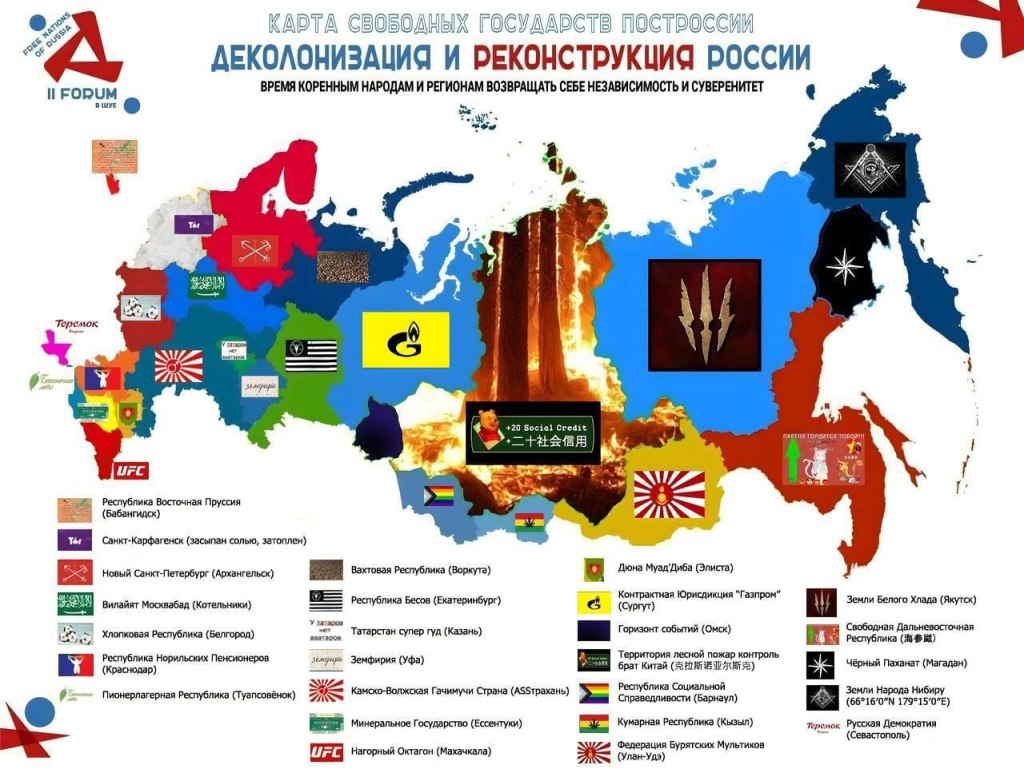
“A Map of the Free States of Post-Russia. Decolonizing and Restructuring Russia. It’s Time for Indigenous Peoples and Regions to Take Back Their Independence and Sovereignty.” Source: We Survived Mariupol, 25 July 2022, Telegram
Chechen head Ramzan Kadyrov meeting on 11 August 2022 with his military commanders. The meeting is conducted in Chechen with occasional infusions of isolated Russian words and phrases.
Western intelligence services have never really disguised their plans for our country. Their dream is Russia’s complete collapse and, in fact, the enslavement of its peoples. Our country has always been and remains the West’s number one target. The fact of the matter is that the Russian Federation’s multi-ethnic peoples have never accepted an alien ideology and have historically maintained their identity, mindset, and age-old principles.
And if at one time entire foreign institutions tried to achieve this goal by unleashing two wars in the Chechen Republic, later there were attempts to achieve it via South Ossetia and even Syria. Nothing came of them.
Now the West has played the Ukraine card. But here, too, all their efforts are doomed to utter failure. And I am very glad that the new tactical actions used by our combatants during the special military operation in the Donbass are bringing great success. I had no doubts about this initially. Today it is already obvious that the results have exceeded all expectations.
On Thursday, I met with the commanders and fighters of our detachments involved in the SMO. We once again had a warm conversation in an informal setting, discussing the successes we have achieved. We also discussed in detail the issue of improving the material resources for units from the Chechen Republic, of additionally supplying and equipping our fighters with modern weapons, equipment, and gear.
The most important thing is that [our] warriors are in great fighting spirit. The lads are clearly aware that they are fighting for the sake of all straight-thinking humanity and for the triumph of law, order, and justice. That is why, even after returning home, almost all SMO combatants are eager to go back. They have only one desire — to go all the way alongside their comrades. This is true patriotism, which means that victory will be ours! Absolutely! There is simply no other option.
Source: Ramzan Kadyrov, Telegram, 11 August 2022. Translated by the Russian Reader
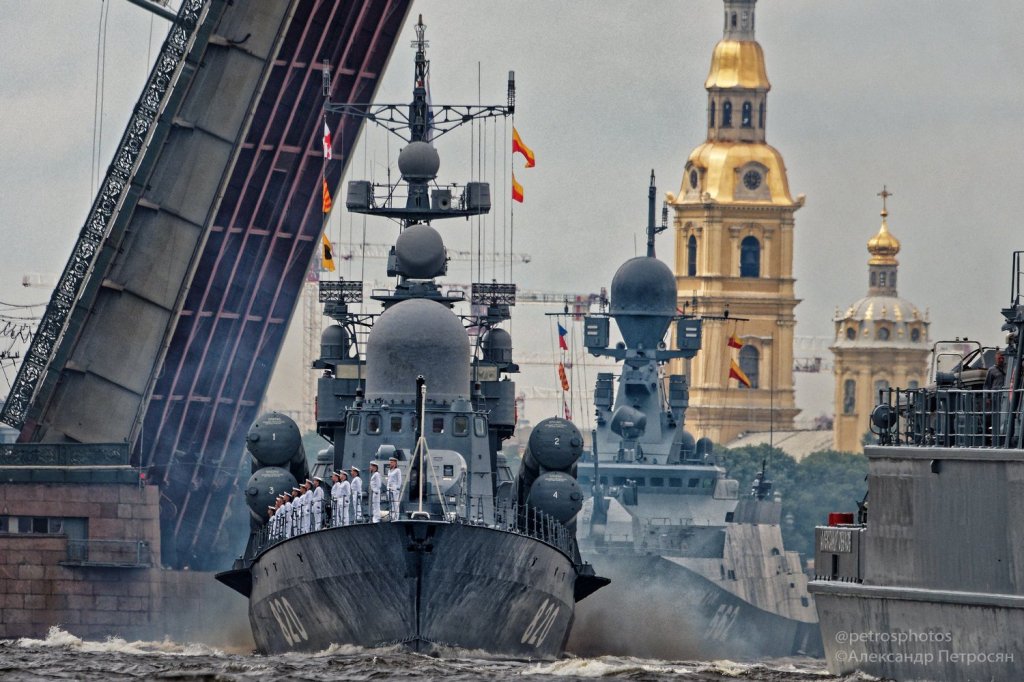
Russian naval vessels on parade on the Neva River in downtown Petersburg, July 2022. Photo: Alexander Petrosyan
I dreamt that all wars had ended and a united humankind was amicably celebrating good’s victory over human nature’s age-old curse.
Since my dream took place in Petersburg, the warships had been turned in recreational vessels, equipped with swimming pools, gyms, spas, dance halls, hotels, bars, restaurants, etc.
The towering masts were outfitted with convenient spots for those wishing to photograph the city’s river embankments from above. The deck was dotted with deck chairs, and the holds, instead of rockets and shells, housed barrels containing every variety of alcohol from around the globe!
I remember strolling around one of these ships, shooting a reportage about the triumphantly heavenly lives of its inhabitants, but I was not able to finish the dream. As always in the morning, the cat’s meowing and the children waking up on time woke me up. Otherwise, I would have been late for my next photo shoot.
I never would have thought that I would speak out in defense of the Soviet Union. But now I am forced to do it.
I grew up in a small village in the middle of Russia. The adults in my life did not read samizdat and tamizdat, nor did they oppose the system — they just lived their lives. But from their conversations, loose talk, and slips of tongue, I was able to draw conclusions. I realized that I didn’t have to unconditionally believe the agitprop posters and the folks on the TV. Life was more complicated and, apparently, worse than the picture that the big bosses were trying to foist on us.
And yet there were certain things I took for granted. I knew that my country had clear, intelligible notions of good and evil, of how everything should work, and I considered them correct. Socialism had to emerged victorious. We didn’t seem to be doing everything right, but we knew what we were supposed to being doing.
To a large extent, of course, this belief was also based on a complete ignorance of how people actually lived outside the socialist bloc. There were simply no people in our midst who had seen it and could tell us about it. In our village, perhaps the only person who had visited this capitalist hell was my grandfather. He was in Vienna when the war ended. But he died before I was born, and besides, as my elders told me, he was a taciturn person and did not like to reminisce about his life.
I knew — just like Leonid Brezhnev, the guy on TV, who had fought in a real war — that it was wrong to even hint at using nuclear weapons. Nuclear war was terrible and the end of everything.
I also knew that we would never attack anyone. The Soviet Union had a militarist bent, and a sense of the coming war’s inevitability filtered into my childish mind. But there was only one possible scenario: the enemy would come to us, maybe even occupy our country, but then we would throw them out, win the war, and clean up the motherland. There was no other way. We wouldn’t attack first.
The Soviet Union, by the way, was bashful about its wars. It concealed its involvement in conflicts abroad. Only the Afghan War broke through the curtain of lies. I don’t know whether it was because of the magnitude, or because the giant was on its last legs and had even forgotten how to tell a fib.
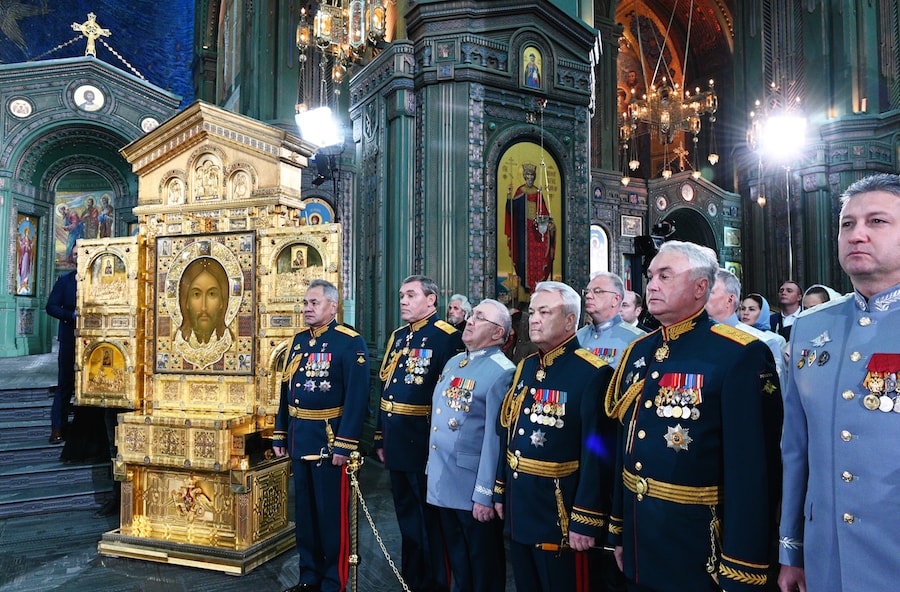
Russian Defense Minister Sergei Shoigu (far left) and Russian military officers at the consecration of the Main Cathedral of the Russian Armed Forces, 14 June 2020. Photo courtesy of Spektr
Modern Russia is not shy. Go to the Main Cathedral of the Russian Armed Forces in Patriot Park. It is worthwhile and instructive. There are mosaics depicting Russian soldiers and heroes — the heroes of the Battle of Kulikovo, the Patriotic War of 1812, the Great Patriotic War … and a huge panel depicting the heroes of the wars that the Soviet Union waged after the Second World War. The figures in the foreground are easily identifiable as “Afghans,” but the picture’s authors quite clearly hint that it’s not just about veterans of the war in Afghanistan.
Soviet ideology was putrid and phony, but there was also a real humanism in it that filtered through the rot and falsity.
Modern Russia doesn’t even have this going for it.
[…]
Source: Ivan Davydov, “An apology for the Union: which USSR Vladimir Putin is resurrecting,” Republic, 21 July 2022. Translated by the Russian Reader
A powerful body and lusty good looks were Ben Franklin’s ticket to a better life. Born a slave, he was raised to be a stud and then purchased as a bodyguard by the influential liberal Creole, Etienne LeGrand.
LeGrand trusts Ben with his life, educates him, and defends his word against that of Claudette Latham, wife of Dr. Latham, who accuses Ben of rape. Ben clears himself—but not without realizing his physical appearance attracts whites as well as blacks: Claudette had wanted Ben to seduce her.
When the Civil War begins, Ben is further confused by the new concepts of freedom stirred by the election of Lincoln. Why not stay forever with LeGrand in the magnificent New Orleans town house and sprawling plantation? Why not stay close to the startling beauty of the octoroon Odette, whom he loves?
But Odette leaves him to live with an infamous slave dealer. War begins, and Ben is granted his freedom. Rising to the rank of Union Colonel, he finds himself fighting for identity against those who have given him what little identity he has. At the moment when life and freedom become precious, he must face the reality of losing both.
Source: Inside dust jacket blurb on an autographed hardcover copy of John Hicks, The Long Whip(1969), discovered in a Little Free Library in Pacific Grove, California, 30 June 2022
July 1, 2022
Dear Thomas:
Happy Independence Day Weekend!
This weekend while you’re celebrating, I hope you take a moment to think about all the people throughout history who have worked so hard to make America the greatest country in the world. From the Founding Fathers to those who have defended our freedoms in combat, to the farmers who feed our country every day, and so many more. I am thankful for you each and every day.
As always, my office is open and ready to serve constituents of Minnesota’s Seventh Congressional District! Please do not hesitate to get in touch if there is anything I can do to help. Have a safe and happy Fourth of July and God bless America. Sincerely,
Michelle Fischbach Member of Congress
Please do not reply to this email, the mailbox is not monitored. To comment further please click here.
Source: Email newsletter from US Congresswoman Michelle Fischbach (R — Minnesota), 1 July 2022; duplicated here.
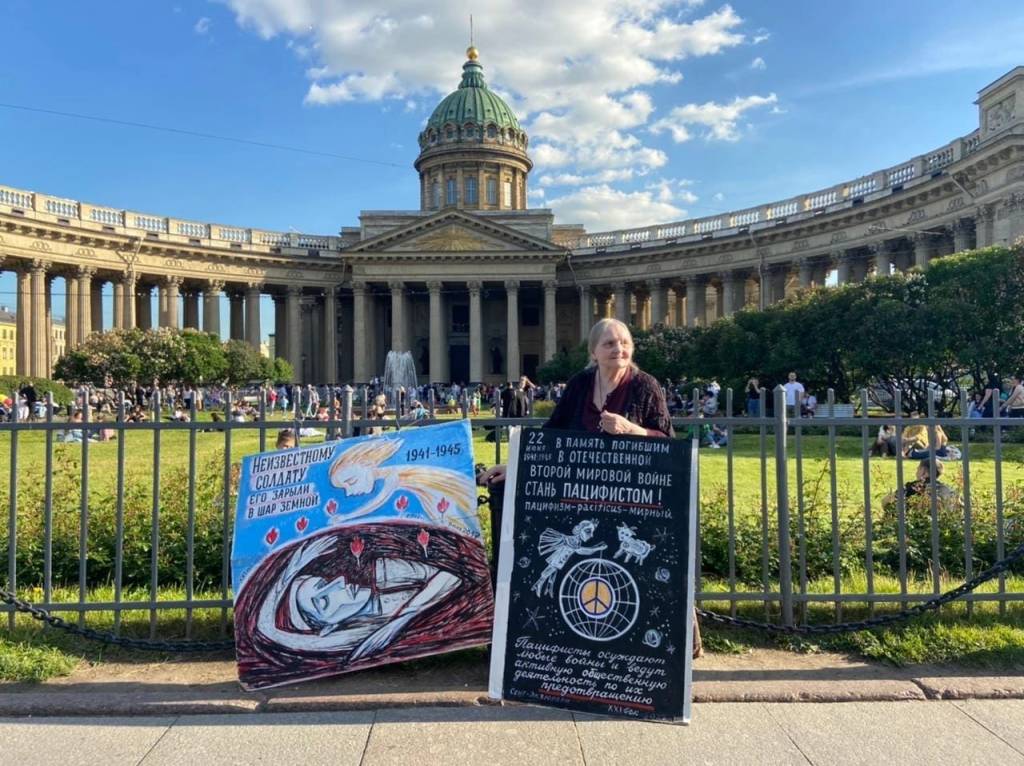
On 22 June 1941, Nazi Germany invaded the Soviet Union. On 22 June 2022, artist Yelena Osipova held a solo anti-war picket on Nevsky Prospect in Petersburg. On 22 June 2022, Rossiiskaya Gazeta, the official Russian government newspaper, published a lengthy interview with Mikhail Piotrovsky, the longtime director of Petersburg’s Hermitage Museum,, in which he justified Russia’s invasion of Ukraine as part of his country’s greater historical and cultural “mission.” Ms. Osipova and Mr. Piotrovsky were born a mere eleven months apart, in November 1945 and December 1944, respectively. If Ms. Osipova’s bravery doesn’t bring honor on her hometown, it’s not for her want of trying. Despite having much greater resources at his disposal and a bigger bully pulpit, Mr. Piotrovsky has definitely brought shame on his city. As long it is run by people like him, Russia’s great “cultural capital” has no future. In any case, Ms. Osipova’s barely audible message makes a jarring juxtaposition with Mr. Piotrovsky’s arrogant, “learned” apology for Russian fascism. ||| TRR
Yelena Osipova, photographed in front of Our Lady of Kazan Cathedral on Nevsky Prospekt in downtown Petersburg on 22 June 2022. Photo courtesy of Irina Bogdanovskaya, as posted on the public Facebook page Yelena Andreyeevna Osipova. Artist. Citizen. Thanks to Maria Mila for the heads-up. The placard on the left reads, “To the unknown soldier, 1941–1945. He was buried in the earth.” The placard on the right reads, “22 June 1941–1945. In memory of the Patriotic/Second World War. Become a pacifist! Pacifism – pacificus – peaceable. Pacifists condemn all wars and campaign vigorously and publicly to prevent them.” On 22 June 1941, Nazi Germany launched Operation Barbarossa, a massive invasion of the Soviet Union. Ms. Osipova was born on 11 November 1945, that is, six months after the end of the Great Patriotic War.
Mikhail Piotrovsky. Photo: RIA Novosti via Rossiiskaya Gazeta
[…]
[Elena Yakovleva]: We have all been shocked by the fighting not only on the fronts of the special operation, but also on the cultural front, by all the attempts to cancel Tchaikovsky and Rachmaninoff concerts, and the Russian language. What is behind “cancel culture”? Having ourselves escaped from the dictates of ideology, are we now witnessing its return in the West?
Mikhail Piotrovsky: The attack on us in the realm of culture is, of course, a semblance of what we had in Soviet times, when all connections were cut off by command, at a moment’s notice, at the snap of someone’s fingers. I have the sense that the Soviet Union, with its ideological dictates, has spread to the West. I did not expect that I would read in liberal Western newspapers such things as “The Hermitage is an imperial museum that preaches imperial ideology. It should not be allowed anywhere! The Hermitage’s [planned branch] in Barcelona should not be opened under any circumstances!”
I have been inundated with ultimatums. How dare you not speak out against the special operation in Ukraine?! Go out and protest immediately! Why are there no protests in your country?
But in this case we should understand that we have been subjected to such a powerful attack in the field of culture because culture is an area in which we are absolutely competitive.
We have the initiative here. We are trendsetters.
Are we an exporting country?
Mikhail Piotrovsky: Yes, and our cultural exports are more important than imports.
Our recent exhibitions abroad are a powerful cultural offensive, a kind of “special operation,” if you wish. Which many people don’t like, but we are advancing. No one can be allowed to thwart our offensive.
In response to calls to cancel Tchaikovsky, smart people in Russia have been saying, “We won’t cancel anything. On the contrary, we will continue to love the Europe that we learned about while studying at universities.” Is the asymmetry fundamentally important in this case?
Mikhail Piotrovsky: Of course. Given our cultural advantage, we don’t have to loudly announce that we are reneging on one cultural agreement or another in response to their bans. They can do it unilaterally. There is definitely no need for bilateralism — precisely because we are winning.
I think that under no circumstances should we succumb (and we shall not succumb) to the seductions of “cancel culture.” I believe we are immune to it because we have already been “canceled” six ways to Sunday. First, the entire culture of Tsarist Russia was canceled, and then Soviet culture was canceled. Monuments were demolished dozens of times. But we also know something else: monuments come back, everything is restored. The knowledge that memory and culture come back is in our blood. That is why we are not eager to overdo it when it comes to “cancelations.” Besides, you can’t cancel Tchaikovsky, except, perhaps, performances of Tchaikovsky by Russian orchestras. But this is just unfair competition.
Why is the West so passionate about “cancel culture”? And about the dictates of “public opinion”?
Mikhail Piotrovsky: I would not exaggerate the difference between the dictates of Soviet ideology and “public opinion.” Public opinion is bound up with governments or regulated by them.
As for “cancel culture” in the West, it is part of a large wave that was born amidst BLM, and linked to the culture of guilt and repentance for guilt. It suddenly surged: they began pulling down monuments and not standing for the American flag. They think that Voltaire is bad, and this guy, and that other guy. It’s a little ridiculous. How much can you repent for the terrors of colonialism, which in fact was so entirely categorical? Or for the unfortunate slave trade, which after all began not in Europe, but in Africa?
They seemingly had already begun to sense that this road leads nowhere, but then Russia turned up by chance. So let’s “cancel” Russia, they said. Although the glee with which they have rushed to condemn us, to tear us up and expel us, again speaks to the fact that we are strong in culture.
When the Bizot group boycotts Russian museums, it’s just ridiculous. I was one of the people who founded the group, and I know that we actually created it to help museums do cultural exchanges unencumbered by politics. But now it’s apparently been ideologized on the Soviet model. If this Soviet-style infection has gone so far, let them be sick alone. We don’t need to be sick too. We have historical immunity against this. I think we will spread it to others.
[…]
Since it hasn’t succumbed to the hype of cancellations, has the Hermitage keep its exhibitions abroad going?
Mikhail Piotrovsky: Not only the Hermitage. When the special operation in Ukraine began, exhibitions by Russian museums were everywhere. We have a Morozov [Collection] exhibition in Paris and exhibitions in Italy. Our most controversial exhibition, a Fabergé show, was in London. The Russian Museum had an exhibition in Spain.
This was our “special operation,” if you like, a great cultural offensive.
As soon as all the ideological sirens were turned on due to the special operation in Ukraine, we initially announced that we were pulling everything out immediately. But then we thought it over and said that we had been given guarantees. The organizers were quick to confirm them. We organized the Morozov exhibition in Paris in cooperation with the Louis Vuitton Foundation, and suddenly realized that this global commercial company was a much better partner in today’s “Soviet” Europe than government entities were. Having no freedom of maneuver, they were “ordered” to break off relations with us, while the business people who made promises to us did EVERYTHING to fulfill them. It was a matter of honor for them: they promised us that [they would send] everything back on time.
But then people in Russia started yelling, “Why did you take our treasures there? They’re worth so much money!” And all hell broke loss on the other side: “Since they’re worth ‘that much’ money, let’s impound them!” People with tormented mercantilist mindsets could not really understand the essence of the matter, so very provocative things were shouted on both sides. I must say that the provocation by the press was the main complication in this whole special operation. Yesterday, I was sent a copy of the FT featuring a discussion by journalists in their art (!) department on the topic of whether Russian paintings should have been impounded. It was due to such journalistic caterwauling that pieces from our museums were detained at the Finnish border. It was the weekend, and Finnish customs officers had read their fill of newspaper articles about how everything should be confiscated from the Russians. Although before and after that, ten of our truck caravans passed through their border post.
From our side, it was the bloggers shouted more. The journalists have been schooled by you.
Mikhail Piotrovsky: Only there are few real journalists left and just a couple of newspapers. Everyone is like a blogger now. And bloggers don’t understand that this is a cultural offensive, that the Shchukin and Morozov exhibition in Paris is like the Russian flag flying over the Bois de Boulogne. Do you know how everyone appreciated it in Italy? They said, “If the Hermitage can leave its paintings with us at a time like this, it means that they know what they are doing over there in Russia.”
It is also very important that the protagonists of our exhibitions were [Sergei] Shchukin and [Ivan] Morozov, Russian businessmen from the Old Believers community who largely defined the evolution of European culture. Matisse was once asked if he would have painted Dance had it not been for Shchukin. “And for whom would I have painted it?” Matisse said. Shchukin suggested things, commissioned things, was capricious, and great works were born. I was recently awarded the Demidov Prize, and it was an occasion to recall how Nikolai Demidov and the great French jeweler Pierre Thomire created this Russian style of malachite with bronze. They had such fights! Thomire said they should do things one way, Demidov said no, it must be done another way. But consequently, there is the Malachite Canopy in the Hermitage.
Does a producer [sic] have the right to interfere in an artist’s plans like that?
Mikhail Piotrovsky: He absolutely has the right. Yes, sometimes such interventions can be bad. But sometimes they can be good. In the case of Shchukin and Morozov, it was a good thing. They were the RIGHT customers.
Let’s not forget that it was the Old Believers who revealed to us the beauty of the old Russian icons. They were the first to clean them and preserve them. And Shchukin brought Russian icons to Matisse, in particular, to reverse the influence of Persian miniatures on him.
At the Morozov exhibition, we presented Russian paintings collected by him and showed art through the collector’s eye. Morozov collected Manet and [Valentin] Serov, and I would hear people say when they were leaving the exhibition, “You look [at their paintings] and you realize that Serov is no worse than Manet.”
The Fabergé exhibition made a very big splash. That is another Russian phenomenon that influenced the West.
So, we in fact did undertake a big cultural offensive. And we came out of it, having done everything we had planned to do.
[…]
Europe has long been a cultural model for us. The “RG” had a conversation with the writer Eugene Vodolazkin about attitudes to Europe. With reference to Dostoevsky, we talked about the fact it is almost dearer to us than to the Europeans.
Mikhail Piotrovsky: We recently held a round table at the Council of the History of World Culture at the Academy of Sciences, which we were going to call “Is Russia Europe?” but instead called “Is Russia Europe? Is Europe the EU?” The general sense of our debate was this: we are Europe, as much a part of it as France or Germany, and maybe more than the United States. If Europe were not us, Gogol would not have written Dead Souls while living in Italy. We recently held another round table on visual art, at which we recalled that Dostoevsky wrote about the Sistine Madonna.
This is our long-standing choice: we are inseparable from European culture and from Europe itself. The special military operation in Ukraine does not change anything. There have been plenty of disagreements and wars within Europe, from the Thirty Years’ War to the First World War. We are Europe and at some moments more Europe than many of its classic [sic] countries. And certainly more than the EU, which is now turning into the Soviet Union.
Of course, we also have an Asian aspect. But Peter the Great already knew how to balance all this wonderfully. We at the Hermitage understand this like no one else, because our main theme is world culture in the Russian context. I constantly talk about our right to be Europe, because in the south of Russia we have a Classical heritage — Chersonesus, Kerch, Taman. And whoever has a Classical heritage is Europe. In Norway, for example, there is no Classical heritage; there were neither Greek colonies nor Roman legions.
Therefore, it is all ours. We must dispose of it as our own, and not think that we are opposing Europe. Do we have different values? But they all have different values. Do we have special Orthodox values? But there are Orthodox values in Europe as well. In many ways they are consonant with Catholic values and not consonant with various secular ones. As an absolutely full-fledged and equal part of Europe, we will never be isolated. It’s just our sense of self. And the Hermitage is a symbol of this self-awareness. I keep repeating that the Hermitage is an encyclopedia of world culture written in Russian. The Hermitage’s Rembrandts, which have been in Russia for three hundred years, are Russian Rembrandts. The Russian Shakespeare is impossible without [Grigori] Kozintsev and [Innokenty] Smoktunovsky. Other doors — to Asia — are always open. But this does not cancel our presence in Europe.
Since people who value Russian culture have not yet gained the upper hand in Europe, must we now form a European model for ourselves?
Mikhail Piotrovsky: We must form this model now. And we are forming it.
Although there seem to be no Shchukins and Morozovs in Russia nowadays.
Mikhail Piotrovsky: Shchukin and Morozov shaped tastes. But now we are shaping, for example, international law. For many years, we have been carefully fashioning guarantees for the return of our paintings by changing international laws and creating immunity from impoundment. All this was first elaborated for Soviet exhibitions, and later, already in my own time, we constantly worked on developing it. The descendants of Shchukin and Morozov tried to sue us, so I urgently got the pictures out of Rome by plane. But every year we have strengthened our legal safeguards. We said, “Do you want our exhibitions? Then give us real guarantees. Spell it out in the contract: the exhibition will be returned on time even in case of lawsuits.” Europe accepted all these terms. The Americans didn’t, so we haven’t had any exchanges with the Americans for ten years. Although people who wanted to host exhibitions from Russia introduced a new law in the United States that enabled the government to give us guarantees and immunity. But it was too late; now it’s not enough. But with Europe, all the guarantees worked. In particular, when paintings from our Italian exhibitions were detained at the Finnish border, our diplomats and Italian businessmen helped us. They immediately sent all the paperwork to the Finnish government: “We gave guarantees, how can you not trust them?!”
At the last moment — even amidst the sanctions — our Western partners introduced a clause stating that prohibited luxury items do not include items that are in exhibitions of Russian museums abroad. It was even stipulated that Russian transport companies have the right to transport exhibitions throughout the EU. We didn’t take the risk — we transported [the exhibitions] in foreign vehicles — but this point was specially inserted. So, we not only look at Europe as a model, but also try and shape the international rules ourselves. This is quite important, especially now, when there are disputes about every [piece of art] in the world over who it actually belongs to.
[…]
Has the attitude towards the Hermitage changed among its Western fans?
Mikhail Piotrovsky: We’ve been getting stabbed in the back a lot lately. Outside the country, the Khodorkovskys of the world have been slinging mud at us, while here at home, as always, certain people have been calling for draconian audits. On the other hand, we have gotten a better sense of who our friends are and who are our enemies. The “society of friends of the Hermitage” have proved their mettle. In Israel, for example, they comported themselves brilliantly. They immediately spoke out. “How can we be friends of the Hermitage, using this honorary title, and then suddenly severe ties [with the museum]?”
We can see everything now. We see that there are people who break off their relationship [with us], but it makes them suffer and cry. But there are also those who happily took advantage of this opportunity. Apparently, they were friends solely due to the political conjuncture. Now we have a good “blacklist” of journalists and politicians This is very important. The world is not uniform.
Has your “blacklist” gotten a lot longer?
Mikhail Piotrovsky: It changed a lot. But besides those who have been writing maliciously about us, unexpected friends have appeared — for example, those French and Italian businessmen I mentioned.
What should we be doing in the field of culture?
Mikhail Piotrovsky: I think we have to do everything in such a way that we are seen, but we don’t have to travel anywhere at all to do this. After becoming director of the Hermitage, I announced a moratorium on exhibitions inside Russia because it was dangerous to transport things then: there were thieves everywhere, there was no money, no real insurance, either. So we didn’t send exhibitions around Russia for ten years. But now we are announcing a moratorium on exhibitions abroad.
I urge everyone now to look back at the experience of the Siege of Leningrad — at the know-how for saving things in an organized manner that was acquired then, at the understanding that when guns speak, the muses should not be silent. On the contrary, they should speak loudly. The experience of the Siege also taught us to address the world beyond the encirclement. During the Great Patriotic War, the Nizami and Nava’i exhibitions and evenings at the Hermitage were examples of this appeal. They showed the whole Soviet Union and the whole world that we remembered the great poets even in the midst of famine and war. Therefore, we are now, as part of the “Great Hermitage” program, going to be doing everything to make the whole world see us and, roughly speaking, envy us.
Now, for example, we are opening an exhibition of works by one of the most famous Danish artists, [Vigilius] Eriksen. He painted Catherine the Great and her court, and for the tricentennial of his birth he earned an exhibition at the Hermitage. We requested pieces from Denmark for the exhibition, but they were not given to us. Well, we have more of Eriksen’s works than they have in Denmark. So, an excellent exhibition is now opening in the Nicholas Hall featuring huge portraits of Catherine and the Orlov Brothers, accompanied by the amazing stories of how they were created, how they were repainted and the medals on the uniforms were altered. The exhibition is on the internet, including a lecture in English. We are broadcasting a message to Denmark: look, a small but very important piece of European culture is the great portrait painter Eriksen in the Hermitage.
[…]
What do you say to those who demand that you repent for Russian policy?
Mikhail Piotrovsky: Our country has now shifted into another time. The first period of the Scythian War is over. We retreated and retreated, now we are not retreating. A pivot has been made. And it is already clear that it’s the final one. Everything began in 2014 in Crimea. Crimea created a situation in which there was no other way, in which we had to pivot.
Our country is making great, comprehensive transformations. And we, respectively, are part of them and with her. Working calmly and normally is our stance.
The Hermitage has done exhibitions about war many times. What can you say about how it’s perceived? For example, a totally pacifist reaction is not something I find congenial. Apparently, I’m a militarist.
Mikhail Piotrovsky: We are all militarists and imperialists. (laughs)
First and most important, it is my country, and I must stand with it. I sometimes repeat the jingoistic formula: this is my country, such as it is. There are situations when it is absolutely clear that a person must stand with his country. In the West they understand that these are all substantive things — that we stand with our country. When a very serious issue is being resolved, there are no options.
I am currently reading Alexei Varlamov’s wonderful book about [Vasily] Rozanov, and [there is a section in it] about 1914 and his hyper-patriotic sentiments. This patriotism at the beginning of the 1914 war is [a phenomenon] known to everyone, but it has not been explained very well. We are somehow dismissive of it, but it was a quite important thing in fact. We, people of culture, must now understand our involvement in everything that is happening. A person involved in history, first of all, must do well what it is that he does [as a vocation], in keeping with the principle that when guns speak, the muses should also speak. And in keeping with the realization that culture, which for us stands above politics and everything else, will later ask us to account for what we did for it. As we were asked after the war, after the Siege: what did you do — on your own?
For me, the attitude to war is established by the great Pushkin in A Journey to Arzrum. Where is he rushing the entire book? To see the demoted Decembrists and then go into battle?
Mikhail Piotrovsky: Arzrum was also the only foreign land Pushkin visited. It expanded the world for him. There is nothing wrong with the fact that a person wants to have the most complete set of sensations. This is especially true when he wants to embody his deep feelings in something, to see and do something new. If he has grounds for it, he throws himself into it. It is an element of self-esteem. I always say that Russian patriotism is a sense of one’s own historical dignity. An individual understands that he must go to war, while another person understands that he must do something else, but which is no less important. Behind this is a sense of one’s own historical dignity, the desire to live up to one’s history and the mission of one’s country. It sounds quite dramatic, but we understand our country’s historical mission. This feeling that our country is changing world history, and that you are involved in it, is crucial now.
Nor are things so simple when it comes to attitudes towards armed hostilities. On the one hand, war is blood and murder, but on the other, it is a means for people, for a nation, to assert themselves. Everyone wants to assert themselves, and in their stances on the war, they undoubtedly assert themselves. We have all been brought up in the imperial tradition, and an empire unites many peoples. It unites people by finding things that are common and important to everyone. It’s very tempting, but it’s one of the good temptations, let’s say. Although we don’t have to succumb to it, ultimately, and we must be able to regulate it within ourselves. Nor should we forget the principle that a person should do what he must do, come what may. For museums, “doing what we must” means preserving and promoting culture. And keeping in mind all the time what is beyond the besieged territory. And speaking not only to people inside it, but also “outside” it.
Source: Elena Yakovleva, “Mikhail Piotrovsky explains why you have to stand with your country when it makes a historical pivot and choice,”Rossiiskaya Gazeta, 22 June 2022 (No. 33/8781). Translated by the Russian Reader, who omitted only the brief introduction and section headings, as printed in the original text. Mr. Piotrovsky, the longtime director of the State Hermitage Museum in Petersburg, located a short walk down the Nevsky from where Ms. Osipova held her anti-war picket on Wednesday, was born on 9 December 1944, that is, five months before the end of the Great Patriotic War.

 We cannot but note the fact that [free and fair] elections in the Russian Federation disappeared long before 2014. Ethno-national political parties were banned thirteen years before Ukrainian region of Crimea was annexed. Thus, despite the fact that the Russian Federation, according to its own constitution, is a federation, and most of the ethno-national republics within the Russian Federation are nation-states with their own constitutions, parliaments, and governments, we have been deprived of the opportunity to represent and defend our interests in representative bodies for decades.