Farida Kurbangaleyeva: My Personal Denazification

The Russian government and pro-Kremlin media say that the aim of Russia’s current war against its neighboring country is the “denazification” of Ukraine. But Farida Kurbangaleyeva argues that Russia’s government has in fact performed “denazification” earlier as well—on the “non-Russian” peoples living in the Russian Federation.

Farida Kurbangeleyeva

Chukcha tatarskaia—“you Tatar Chukchi”—an unknown woman wrote to me via Facebook. To put it mildly, she had not liked my post about the aftermath of the Russian occupation in Bucha and decided to deliver me the knockout punch with an irrefutable argument. For her, this argument was my ethnicity, and this is understandable: there is nothing more shameful for a member of the “state-forming people” than being a Chukchi, or a Tatar, or a Ukrainian yokel. That is, there is nothing more shameful than not being Russian.

This incident made me think of the “denazification” that Putin has used to justify his military invasion of Ukraine. In spite of his plan, from the start of the full-scale war many people started talking about how about Russia itself needed to be denazified—and I completely agree with this. But this is not the end of the story.

What Putin is calling “denazification” is not a struggle against Nazism, but the desire to destroy national identity, to eliminate the Ukrainians as a people. This is why in the occupied territories, as the Ukrainian authorities report, Ukrainian-language books have been removed from libraries and burned, and the study of Ukrainian has been canceled in schools. Where there is no language, there is no culture, no identity, no people. Meanwhile, in Russia, other peoples have been similarly “denazified” already. With more or less bloodshed, but in any case, quite successfully.

My personal denazification began shortly after my third birthday—when I first went to nursery school. At that age I spoke fluently in my native Tatar. One of my relatives loves to recall me energetically explaining the pictures to her from my book about the surrounding world: Менә бу әшәке гөмбә, ә менә бусы — әйбәте. (Mena bu ashake gumba, a mena buse—aibate: “This is an inedible mushroom, and this one is good.”)

I have to admit that it would be hard for me to repeat the stunt now. The nursery-school teachers had been given strict instructions: Soviet children should only have one language—Russian. Everything else was the devil’s work, forget it.

The denazification worked—by the first grade I still understood Tatar, but already had a hard time speaking it. That’s how I am now: I can understand everything being said to me, but I switch to Russian to reply. Why waste time fumbling for the right words?

For many people, Tatar language was a much-despised subject at school. And it’s not surprising: you knew that there was absolutely no reason to study it. People rarely spoke it at home, and in some places not at all, and it was unlikely to come in handy in the future either. Some of my Tatar classmates didn’t even go to Tatar language classes, preferring to take local history classes with the Russian kids instead. That is, they practically didn’t know their native language at all.

This was the late Soviet period, when the myth of the “friendship of peoples” and equality was still actively promoted. “Look at what a good student Farida is,” my teacher Anna Viktorovna would say to my classmate Roma. “Even though she’s a Tatar girl.”

I suppose that my mother had also encountered the same sort of approving motherly intonation at her first job at a nursery school (when she was just out of school and hadn’t yet entered Kazan University as a physics student). One of the other teachers—a woman from a Russian village—would tenderly refer to my mother as “my little chaplashka.”[The chaplashka is a typical Tatar skullcap, but it can be used as a condescending term for Turkic peoples.] At around the same time you could regularly hear people on the Kazan trams saying, “Hey you there! Quit talking in your language!”

But I digress. These are my memoirs, not my mother’s.

I can say that nearly all of my urban Tatar agemates—people who were kids in the 1980s—are a linguistically handicapped generation. Speaking Tatar was awkward and embarrassing. The primary native speakers at this time were people from the villages. Of course, there was also the urban Tatar intelligentsia, but it was so thin and fragile that one almost never heard Tatar spoken in the cities. Except maybe in the national theater.

Because of this, when the republic declared its “sovereignty” in the 1990s and Tatar became a required subject, the majority of the people who came to teach it in schools and universities were  villagers. Many of them spoke Russian with a strong accent, lacked a certain confidence and even dressed more poorly than their colleagues in physics, algebra, or English. People treated them correspondingly, referring to them condescendingly as “Soviet farm workers” [kolkhozniki].  

It’s hard to imagine anyone yelling at their schoolkid for getting a D in Tatar. What’s more, some parents openly admitted to encouraging their kids not to study it. No one was worried about the final grade report—by the time graduation rolled around, they would get all As and Bs. Who would want to ruin someone’s life over a pointless subject? The same situation held in the technical schools and universities.

The time came for us to become parents ourselves. What could we say to our kids in the “mother tongue”? At best a few primitive phrases. The grandparents would try to make up for lost time, but “lost” is the key word here.

I’ve observed the following scenario several times. At the playground, a group of mothers gangs up on the mother of a “late-speaking” child. “It’s all because you speak two languages at home. That’s not right, you have to pick,” they say. Some of these “instructors” themselves send their kiddos to “early development schools” where the kids are taught English as early as possible—either from the moment the child starts turning over, or maybe when it can lift its head. After all, everyone knows that the earlier you start learning a second language, the better.

Meanwhile, the Russians in Tatarstan are very tolerant Russians. They’re long since used to Tatar names and holidays, and mixed marriages. They know the words isanmesez [исәнмесез] (hello), rakhmat [рәхмәт] (thank you), and sometimes even say Alla birsa [Алла бирсә] (God willing) as a joke. When I left for Moscow, I realized that in other regions the problem isn’t just that Russians don’t want to learn the languages of ethnic minorities. Russia is both a multi-ethnic and a xenophobic country.

My experience working as an anchor on TV channel Rossiya was pretty revealing. It was 2007. Alexandra Buratayeva and Lilya Gildeyeva [who are ethnic Kalmyks and Tatars, respectively] had already made their names on national television, but the negative wow-effect was nevertheless plain to see. Online, I would periodically run into requests like “get rid of that churka” [a racial slur mostly used for people from the Caucasus and Central Asia] or questions like “What, you couldn’t find a Russian woman? Where are the Katyas, Mashas, Natashas?”

My colleagues mostly treated me with decency and goodwill. Well, if you don’t count the entertaining questions like whether I’d been on the Hajj or eaten horsemeat. Or the kinds of questions every member of an ethnic minority gets, like:

“What is your Russian name?”

“This is my only name.”

Rage, negotiation, unwilling acceptance.

I know of many cases when a Fidail has become a Fedya [Ted], a Gulnur., a Gulya, and a Kamil, a Kolya [Nick]. Even closer to home, my grandmother, Khadicha Fazleyevna, lived for fifty years in a communal apartment where she was known as “Auntie Katya.” My friend, an Avar named Maryan, told me that when she was studying at the Russian State University for the Humanities in Moscow, she usually told people her name was Marianna. She thought that people would be nicer to her that way. One girl from her circle of university friends would periodically say to her, “Gosh, you’re so normal—just like us.”

I remember that once a Sberbank employee, holding my Russian Federation-issued passport and reading out my full name, asked me what my citizenship was. That the principal of the school my daughter went to wasn’t sure that her intellectual capacity was the same as her Muscovite agemates: “Southern children (!) achieve physical maturity more quickly, but sometimes lag intellectually.” A midwife in a Moscow birth center asked me whether newborns are swaddled in my country.

One time my wallet was stolen in a mall. The first word uttered by the policeman who came to investigate was “Darkies?” [churbany]. I was stunned, because in my understanding no defender of public order has the right to utter this word. I replied, “It was two women of Slavic appearance,” which obviously stunned the policeman in turn.

My second cousin Azamat was unable to rent an apartment in Moscow. As soon as they heard his name over the phone, Muscovites would ask, “What are you, an Uzbek?” and hang up. He didn’t have time to tell them about his excellent job or steady salary at Sberbank. He was able to rent only through people he knew.

To expand my examples beyond my personal life, I called all my non-Russian friends. I didn’t have to make any effort to seek anyone out or ask insistently for comments. These are all stories of just “one degree of separation.”

Ibragim, a Kumyk born in Grozny (Chechnya): “Once I submitted my papers for a foreign-travel passport and couldn’t get it for eight months. I was told repeatedly that it wasn’t ready yet. In the end I just sat down in the office of the passport officer and declared I wouldn’t leave until I got my passport. The man clearly hadn’t expected such audacity. He thought for a while and then took my passport out of his desk.”

Artur, a Chechen born in Grozny: “We fled Chechnya during the First Chechen War. I went to a bunch of different schools. When I was in the fifth grade, we lived in Cherkessk. One time in class, people started talking about Chechens, and the teacher said, looking right at me, ‘You’re basically all terrorists, you need to be isolated.’ When I started at university, I couldn’t get a job. I didn’t become a waiter at a cafe, a salesman at a store, or someone handing out advertisement flyers [like other university students]. A few years ago, I was barred from entering a Moscow nightclub on New Year’s Eve. The security guy looked at my passport and refused to let me in. When I asked him to explain why, he said, ‘No comment.’”

Alexandra, a Buryat from St. Petersburg: “I never wanted to go down into the subway, where people always gave us dirty looks. One time I was riding with my whole family and heard someone say, ‘They’re breeding up a storm.’ Another time I was walking toward the escalator and a stranger started to shoulder me out of the line. I kept going, so then he shoved me aside roughly and said, ‘You should always let Russians ahead of you! Got it?’”

Alexandra was one of the organizers of the initiative Buryats Against the War in Ukraine. She asked Russia-based subscribers to talk about examples of xenophobia they’d encountered living in Russia. She’s been getting messages for over a month now. Reading them, Alexandra nearly stopped sleeping. One time she wrote me at three in the morning to say she (and many of her respondents) needed a therapist.

But getting back to my Tatars and my denazification. A few years ago, Tatar language was once again made optional as a school subject in Tatarstan. It was happily dropped not only by Russians, whose pressure had largely caused the law to be passed, but also by many Tatars. Why bother? Everyone knows that there’s absolutely no point: almost no one speaks Tatar anywhere, and there’s unlikely to be any need for it in the future. At least at this point in history, speaking Tatar at home isn’t forbidden. The idea was just that: “Speak it at home” and even “How terrible that they used to forbid that.”

Thanks a lot, but “speaking at home” is also a road to nowhere. It also means the loss of language, just dragged out a bit. I can confirm this through the example of some Russians I know who have lived in the Czech Republic for many years.

Here’s a mother who delights in her fifteen-year-old daughter: “You wouldn’t believe it! She wrote a card to her grandma yesterday without making a single mistake!” That is, the girl speaks Russian very well (because they speak it at home), but the grammar is a real problem for her. This girl’s children will speak Russian a bit worse and barely be able to write. The grandchildren will speak in broken Russian and tell their friends that their grandma was Russian. Cool, right?

Without systematic lessons and academic programs, textbooks and teaching aids, courses and constant practice, a language cannot be preserved. All the more so if it’s optional. Imagine if people studied Russian in schools as an elective. Or chemistry, or algebra. Would many students want to take these subjects? Losing a language when it’s “study it if you want to” is just a matter of two or three generations.

No one among my Russian friends who were born and raised in Tatarstan knows Tatar or is planning to learn it. As an illustration, I offer a few sample conversations with my girlfriends. Both are cultured, educated women and highly empathetic. They would never call me a “Tatar Chukchi.”

Dialogue No. 1 (which took place prior to the reversal of the Tatar language requirement in schools):

“Tatar’s on the schedule every day, I’m so sick of it! Katya (her daughter, whose name has been changed) gets so exhausted by it. I wish they’d get rid of it already!”

“And what will you do if they get rid of it?”

“I want them to bring in English, and Italian would be good too. I’d love for her [Katya] to go to university in Italy.”

“But it’s not like all the kids are going to go do that. Many of them will spend their whole lives in Tatarstan.”

“So? What do they need Tatar for?”

“To talk with their friends, for instance. Listen, wouldn’t you like to know Tatar, so you could speak it with me? I speak Russian with you, after all.”

“You got to be kidding! Isn’t that an awfully big sacrifice to make—studying Tatar just so I can talk with you?”

Dialogue No. 2, quoted as a monologue (it was delivered after Tatar was made non-obligatory):

“Thank God, they got rid of Tatar. When I think back on my school days I just shudder (she utters in Tatar the phrase ‘My homeland is the Republic of Tatarstan,’ purposefully mispronouncing the words). They should just make them take local history instead. At work I have a ton of Russian colleagues who used to live in Kazakhstan. They have a hard time getting Russian citizenship here. They have to take a Russian-language exam if you can believe it. But in Kazakhstan they’re really mistreated—they’re forced to learn Kazakh. I even thought lucky my grandparents came here to build the KAMAZ [auto factory] instead of Baikonur [a cosmodrome built in Soviet Kazakhstan]. Otherwise, I’d be suffering—having to learn Kazakh or trying to get Russian citizenship.”

Just a minute! My grandparents didn’t go anywhere to build factories. And my other grandparents didn’t either. They spent their whole lives living on this land. And before that, for centuries, their grandparents lived on the same land. They spoke, read, and wrote in Tatar. Until the moment when someone decided to administer and regulate this process—to denazify the Tatars, you might say.

Yes, Putin started using the term, but he didn’t start the process, of course. The policy of stan “foreigners” was pursued under the Russian Empire as well and hit a high point during Soviet times. Over the past one hundred years, the Tatars have had their alphabet changed twice. Before the Bolshevik coup and for a little while afterwards, Tatars wrote and read in Arabic. This writing system was left alone even when the gate of Lyadsky Garden in downtown Kazan sported a sign saying, “No musicians or Tatars allowed.”

In the late 1920s, Tatar was switched to yañalif—an alphabet based on the Latin one, and then in 1939 to Cyrillic—by the way, easily the most inconvenient option for Tatar phonetics. Consequently, Tatars were cut off from an enormous store of literature, poetry, philosophical and religious works written using the Arabic script. And, by extension, from their own history and culture.

My father, who was born in 1940, spent his childhood and youth in the Old Tatar district—a low-lying part of Kazan where Tatars historically lived. Now this neighborhood has been transformed into a colorful tourist trap with a gaudy ethnic flair. But we have to remember that before 1917 Tatars didn’t have a choice: they did not have the right to live in the prestigious upper part of the city.

According to my papa, when he was growing up in the neighborhood, not a single Russian lived there who didn’t know Tatar. And around mid-century there were quite a few Russians living there. His childhood friends Polina and Katya would switch to Tatar every time they wanted to keep secrets from their mother, who didn’t know Tatar. This means that places spared the denazification process saw wonderful results—a genuine, not sham, friendship of peoples. With true equality, mutual respect, and the preservation of ethnic identity.

Nowadays this tale sounds fantastical, and I can’t find an answer to my question: why did those Russians not mind speaking Tatar, and where did those Russians go? I also have a feeling of guilt for not putting enough effort into developing and preserving the language in my own family. I think I should have hired a tutor. I think I should have bought a self-instruction manual. I think I should speak with my elderly parents more often. At least now, at least a little. And even in a sloppy way, I should still try to speak Tatar with my kids.

So, there is a grain of truth in what the unknown woman on Facebook said. In some sense I really am a “Tatar Chukchi”—an incomprehensible hybrid, a person without kith or kin and without a language, trying to seize hold of her roots before they wither away.

And what will happen later, when Ukraine prevails in the war with Russia, securing both a moral and a physical victory? What will happen when the Ukrainians liberate the occupied territories, when they bring Ukrainian back into the schools, when they publish wonderful new books written in Ukrainian? And when Russia (I really want to believe this) will truly and finally be free? What will happen, not with the Ukrainians, of course, but with us—the denazified Russian-dwelling chebureks? I hope I’m wrong about this, but I think I know what will happen.

I recently stumbled across an openly xenophobic comment on Facebook. The thread was discussing the sanctions that the US government was afraid to implement against Alina Kabaeva. One of the contributors wrote, “What do they expect from her? She’s a typical Tatar woman: husband, kids, family. It doesn’t take a lot of brains to do that.” This comment was liked by someone with whom I share a few dozen friends, someone who’d posted lots of fiery statements against the war in Ukraine.

When I expressed astonishment in response, the Facebook-friend posted a bunch of smile emojis and wrote, “Sorry.” But when I noted that I didn’t find it funny at all, his tone changed abruptly. He wrote repeatedly that he was “speaking with me as an equal” and advised me to “not be stuffy and blow things out of proportion.”

Thus, we non-Russians will go down with this warship. We’ll go where the free Ukrainians—who speak their native language at home, and at school, and at work, and wherever they want—sent it.

We’ll head for the bottom along with our country’s liberal civil society, which will genuinely rejoice over Ukraine’s victory, and then set about building “the beautiful Russia of the future.” But a few things in this new Russia will stay the same. No one there will force anyone to study non-native or pointless languages. After all, this is a violation of rights and freedoms and is basically non-democratic. There will be fewer and fewer people trying to study them on their own. Those who wish to can speak them at home or take elective classes. And not blow anything out of proportion. Those who attempt to get uppity about it will be declared ethnic nationalists and Russophobes.

You’re hearing this from me, the “Tatar Chukchi.”

Source: Farida Kurbangaleyeva, “My Personal Denazification,” Holod, 28 May 2022. Translated by the Fabulous AM. Photo (above) courtesy of Wikipedia. Farida Kurbangaleyeva (Фәридә Корбангалиева/Färidä Qorbanğälieva) worked as a presenter of the program “Vesti” (“The News”) on the Rossiya channel until 2014 and, later, as a presenter on the channel Current Time. Now an independent journalist, she lives in Prague.

May the Good Lord Take a Liking to You and Blow You Up Real Soon

This is “social democracy,” Russian fascist style, as exemplified by A Just Russia — For Truth party leader Sergei Mironov, as translated by a mindless unpaid robot:

The leader of the Fair Russia — For Truth party, Sergei Mironov, proposed to take away the property of Russians who decided to emigrate from Russia.

He noted that this can be done within the framework of the presidential decree of March 1, 2022 “On additional temporary economic measures to ensure the financial stability of the Russian Federation.” According to it, Russian citizens who “have left or live in unfriendly countries cannot dispose of their real estate on the territory of Russia.”

At the same time, Mironov proposed not to be limited only to “unfriendly” states and to apply a measure in the event of a person leaving for any country.

“The essence of their act does not change from this. I think it makes sense to extend the restrictions to all travelers, regardless of where exactly they have pricked up their skis.“

The head of the party added that he considers the current flight of “our homegrown rich people” abroad to be a cleansing of society. In his opinion, only “obvious traitors” or “owners of criminally obtained fortunes” can leave Russia.

“Although one easily combines with the other. So I see only a positive aspect in the fact that these gentlemen are ridding us of their presence. The air will be cleaner,” he concluded.

Russian “social democrat” Sergei Mironov. Photo courtesy of the Moskva Agency and the Moscow Times

Here are the “social democratic” fascist robot’s remarks in the original Russian:

Лидер партии «Справедливая Россия — За правду» Сергей Миронов предложил отбирать собственность россиян, решивших эмигрировать из России.

Он отметил, что это можно делать в рамках указа президента от 1 марта 2022 года «О дополнительных временных мерах экономического характера по обеспечению финансовой стабильности РФ». Согласно нему, российские граждане, которые «уехали или живут в недружественных странах, не могут распоряжаться своей недвижимостью на территории России».

При этом Миронов предложил не ограничиваться только «недружественными» государствами и применять меру в случае отъезда человека в любую страну.

“Суть их поступка от этого не меняется. Полагаю, есть смысл распространить ограничения на всех выезжанцев в независимости от того, куда именно они навострили лыжи.”

Руководитель партии добавил, что считает очищением общества нынешнее бегство «наших доморощенных богатеев» за границу. По его мнению, из России могут уехать лишь «очевидные предатели» или «обладатели состояний, полученных криминальным путем».

«Хотя одно легко сочетается с другим. Так что в том, что эти господа избавляют нас от своего присутствия, я вижу только положительной момент. Воздух будет чище», — заключил он.

Source: Moscow Times, 16 June 2022


John Candy and Joe Flaherty have a finer grasp of Russian social revolutionary traditions than Sergei Mironov does. If Mr. Mironov’s (thoroughly counterrevolutionary and reactionary) compatriots weren’t so similar unmindful of their own history, Mr. Mironov might have thought twice before making the transformation from a mild nuisance to an enthusiastic Putinist henchman.

Broken Glass Cake

At the request of the Comintern, a smaller counter-exhibition entitled The Truth on the Colonies, organized by the Communist Party and the CGTU, attracted very few visitors (5000 in 8 months). The first section was dedicated to abuses committed during the colonial conquests, and quoted Albert Londres and André Gide’s criticisms of forced labour in the colonies while the second one made a comparison of Soviet “nationalities policy” to “imperialist colonialism.”

Source: “Paris Colonial Exposition,” Wikipedia


Broken Glass Cake

Ingredients:
▫ sour cream 400 g
▫ condensed milk 300 g
▫gelatin 25 g + water 150 ml

For the jello:
▫ different flavors of gelatin
▫ hot water

DIRECTIONS:
1️⃣ Prepare the jello per the directions on the packet. Pour into a dish, add hot water, mix until cool and leave in the refrigerator for ~ 3 hours. You can already pull the condensed milk and sour cream from the icebox so they will be at room temperature.
2️⃣ When the jello has set up, cut it into cubes right in the dish.
3️⃣ Dissolve 25 g of gelatin in 150 ml of water.
4️⃣ Mix the sour cream, condensed milk and gelatin.
And then just assemble the parts as in the video. Dispatch it to the refrigerator for about 4 hours. I put a layer of cookies on the bottom, but you don’t have to add them if you don’t want to. Yes, it’s quick to prepare, but you will definitely like it :)

Translated by the Russian Reader


It is likely that in the autumn, or already in the summer, there will be tension in the country over a significant downturn in the incomes of people employed in production, in particular, due to layoffs (in some places, massive layoffs). There is the potential for protests here. [The authorities] won’t be able to contain them, as [they did] in the nineties. I think, however, that it will be difficult to translate this potential into political change. Apart from the fact that it has been organizationally routed, the liberal and democratic opposition has an agenda that is far removed from the problems of this social stratum. The left is mainly interested in theoretical discussions and, frankly speaking, they are not merely absent as a political factor in Russia, but represent something like a negative quantity. There is no Russian [Lech] Wałęsa even visible on the horizon. But might it not happen that, if and when he appears, he will turn out to be a nationalist, blaming the authorities not for what they did, but for what they failed to do?

Source: Grigorii Golosov, Facebook, 28 April 2022. Translated by the Russian Reader


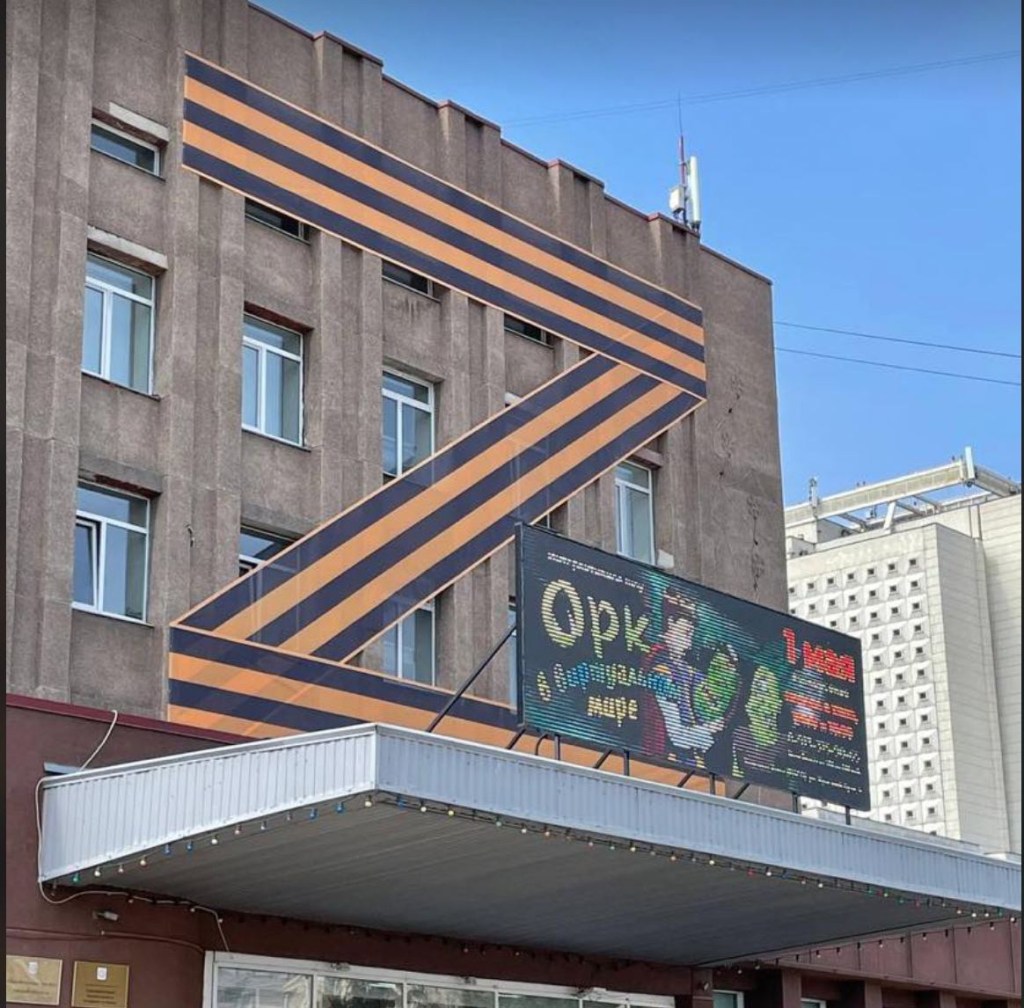
A huge St. George ribbon in the shape of the letter Z has been hung on the building housing the Omsk Public Chamber.

It serves as the backdrop for an announcement of the show “An Orc in the Virtual World.”

Source: Kholod, Facebook, 28 April 2022. Translated by the Russian Reader


Russia and the people who live in Russia are becoming more reactionary not by the day, but by the hour. The problem is that almost no one notices this. Every day Putin and his gang remain in power sends Russian society backwards another year in terms of how people think about politics, justice, religion, ethnicity, culture, industrial relations, war and peace, and the rest of the world.

At this rate, if and when the Putin regime does disappear from view, nearly everyone who lives in Russia will have to be reprogrammed to deal more or less ably with the world the rest of us inhabit.

This is not an endorsement of our world’s virtues. But you simply cannot imagine the depths and breadth of the black political reaction that has engulfed Russia until you have lived there a long time (preferably, starting well before the reaction ensued) and thus have the eyes to see and the ears to hear a country that it is well on its way to utterly rejecting progress in all its forms.

This is especially true of the so-called intelligentsia, even those of its members who imagine themselves to be liberals, leftists, scholars, artists or professionals.

Try explaining to them one little thing — for example, why the Putin regime’s crazed, full-fledged persecution of Russia’s Jehovah’s Witnesses, now involving hard prison time, torture, and early morning raids on the homes of these extraordinarily peaceable “extremists” — is a symptom of a fascist or proto-fascist state.

They won’t understand what you’re saying. At best, your discussion will end with them making a joke about the whole thing, as if being waterboarded for the “crime” of being a Jehovah’s Witness were a laughing matter.

That this Russian fascism has started to spill out into other parts of the world, and most educated Russians continue to have nothing to say about it, is alarming. ||| 28 April 2019, TRR

Going Fascist: Eight Years Ago Today

“Rolls at cost. Cucumber roll: 31 [rubles]. California: 99. Philadelphia: 147. Hookah: 58. Unfiltered beer: 88. White Russian: 132. You are charged for time [spent in the bar]: 180 rubles per hour. The bar’s entire menu is priced at cost. Stremyannaya 3 | selfcost.com.” Central Petersburg, 23 April 2018. One USD was worth approximately 62 rubles on that day. Photo by the Russian Reader


From the chronicles of the fascization of the world’s largest country, straight from a “suggested post” on Facebook:

“По шкале «Экономика» все суперэтносы распределяются на трех уровнях: High (американский суперэтнос), Middle (российский суперэтнос) и Low (китайский, латиноамериканский арабский суперэтносы). Давайте обсудим, почему именно так, а не по-другому.”

“On the scale of ‘Economics’ [sic], all superethnicities are divided into three levels: High [sic; in English in the original] (the American superethnicity), Middle (the Russian superethnicity), and Low (the Chinese, Latin-American, and Arab superethnicities). Let’s discuss why it is this way, and not otherwise.”

If you think this is some kind of quirky, meaningless nonsense, think again. Huge segments of Russian media, “culture,” “public discourse,” and “scholarship” have consisted of such proto-fascist, sub-Gumilevian drivel for years on end. It’s a wonder everyone is not completely loony, but of course that isn’t the point (and they aren’t, thank God). The point has always been to make this radical far-rightism the “background noise” and “common sense” that prevents people from escaping the Putinist cage, mentally at least, and enables them to swallow any number of “necessary measures.” ||| 23 April 2014, TRR

Love and Vodka

I was seven years old when a distant relative, the brother of my great-aunt’s husband, showed up at our dacha. He was stuck there for the whole summer. We called him Uncle Misha. He was decidedly unlike my parents and their acquaintances. Having him around caused me grief at the time, but now I am grateful to fate, because in the person of Uncle Misha, Russia (from whose sight my relatives had erratically shielded me) came into my life.

Like Russia, Uncle Misha was extremely stupid. The first thing he did was dig up a huge boulder sticking out of the ground in the garden, and spend a whole month chiseling an inscription on it. The inscription was long: “On April 22, 1870, Vladimir Ilyich Lenin, the leader of the world proletariat, was born.” Uncle Misha painted each embossed letter white.

Besides, he liked to drink, and that addiction laid waste to his dreams. The fact was that Uncle Misha wanted a bicycle most of all and saved up for one for a long time. When he had purchased a bike, Uncle Misha went to Solnechnoye to celebrate the occasion. He fell asleep at a beer stall, and the bike was immediately filched.

Like Russia, however, Uncle Misha had amazing skills. I remember how he picked a basketful of pine cones, took out our decorative, Nicholas I-era samovar, filled it with the cones, soldered the leaky spigot, stoked the pipe almost with his boot, and brewed some extremely tasteless tea.

Then he disappeared, and a couple of years later he died of cancer. It was all a long time ago, and I would have forgotten Uncle Misha, but now he has suddenly risen from the grave. I constantly see and hear (mostly at a safe distance, thank God) the people who surrounded me as a child. There are the old women crushing each other whilst queueing for sugar, officious Auntie Motyas with serious hairdos, exact replicas of my teachers and head teachers, the peasants wearing baggy-kneed trousers, the gopniks with herring eyes — they are the grandsons and granddaughters of the Soviet people who so spoiled my childhood. They have been cloned whole, already dressed and sporting mohair hats and berets from the get-go.

I spent a whole month this past winter in Petersburg and saw them at every turn. While I was it, I went to a Chris Marker retrospective that friends of mine put on. There were about twenty people in the large auditorium, and I knew almost all of them personally — five organizers, five foreigners, and ten university students.

After getting any eyeful of this, I was persuaded that it was impossible to improve this country. It keeps churning out people on the same old conveyor belt, but no cataclysm is capable of stopping it. And right now I’m even more convinced that this is the case.

Source: Dmitry Volchek, Facebook, 10 April 2022. Photo and translation by the Russian Reader


If a Russian loves Russia, he’s a patriot. If a Ukrainian loves Ukraine, he’s a “Bandera nationalist.”

If a Russian says “khokol,” he’s merely joking. If a Ukrainian says “moskal,” he’s a “Russophobe.”

If pro-Russian slogans are bandied about in Russia, it’s normal. If pro-Ukrainian slogans are bandied about in Ukraine, it’s “Nazism.”

If the Russian president talks to the American president, he’s forging better relations between their two countries. If the Ukrainian president talks to the American president, they’re “hatching a plot” against Russia.

If a Russian national speaks Russian, it is par for the course. If a Ukrainian speaks Ukrainian, he is “persecuting” Russophones.

Source: Rodica Rusu Gramma, Facebook, 8 April 2022. Thanks to Andreas Umland for the link. Translated by the Russian Reader


When you see footage from protest rallies in the Russian Federation, all that ring-around-the rosy, or watch broadcasts made by the Russian emigration in Tbilisi, you immediately recall one of Jünger’s journal entries in Strahlungen. Although, admittedly, some Russians, a few, have already caught sight of the abyss out of the corner of their eyes.

PARIS, 14 JUNE 1942
Went to Bagatelle in the afternoon. There Charmille told me that students had recently been arrested for wearing yellow stars with different mottoes, such as “idealist,” and then walking along the Champs-Ėlysées as a demonstration.

Such individuals do not yet realize that the time for discussion is past. They also attribute a sense of humor to their adversary. In so doing, they are like children who wave flags while swimming in shark-infested waters: they draw attention to themselves.

[Ernst Jünger, A German Officer in Occupied Paris: The War Journals, 1941–1945, trans. Thomas S. Hansen and Abby J. Hansen (Columbia University Press, 2019)]

Source: Mitya Raevsky, Facebook, 15 April 2022. Translated by the Russian Reader 

We have to admit that our generation of Russian anti-authoritarian leftists drew the short straw when it comes to the people [narod]. I want to emphasize, though, that they are not the way they are “genetically.” They have been raised to be this way. Yes, there was a seed of imperial mindedness, but without soil and fertilizers, that godawful hogweed would not have grown.

The “cultural code” of the people, that is, this selfsame soil, has been shaped by three subprograms:

– Brutal capitalism and maximum competition multiplied by the cult of success, causing universal brutalization and an inability to communicate.

– The survival tactic that follows from the first subprogram: identifying with the powerful aka blaming the victim. If you want to foster a nation of stern warriors, you foster a nation of toadies. Hence our servility and respect for ranks.

– A regime based on a twenty-year-long counter-terrorism operation.

Are these remarks a balm to anyone? Of course not. I don’t believe that this regime is capable of changing anything from the inside. It will be destroyed from the outside, and lessons will be learned, I hope.

Source: George Losev, Facebook, 15 April 2022. Translated by the Russian Reader


“I need love and vodka,” says one young woman to another. Everyone is so joyful.

T-shirts sporting the Z symbol are sold in the pedestrian underpass near Gostiny Dvor. Near the the exit from Gribanal [Griboyedov Canal subway station], a woman sells willow branches [for Palm Sunday, which is this Sunday in the Russian Orthodox calendar], the Soviet flag flying above her. A jeep adorned with a huge [Russian] tricolor cruises near Kazan Cathedral. A car branded with the letter Z is parked in Bankovsky Lane.

I don’t know whether I will ever be able to love this city again. Or at least not feel sick. I walk around it looking for niches, corners, secret places where I can hide, pretend to be a shadow cast by the caryatids, so that I won’t be found, pried out, and forced to be part of universal vileness.

Source: Comrade JG, Facebook, 16 April 2022. Translated by the Russian Reader with the kind permission of the author, who wishes to remain anonymous.

Standers

“Immortal Regiment standers: A3-size + holder, from 550 rubles.” The window of an art supply store in central Petersburg, 14 April 2017. Photo by the Russian Reader

It’s amazing how touchy Russians are about their language. If you have a slight accent or make a grammatical mistake now and then, you are automatically stripped of the right to discuss anything with them at all.

In any case, if you have any of these “speech defects,” Russians never fail to point them out to you. It’s not that they are grammar nazis. No, they’re flesh-and-blood nationalists.

By the way, these are the same Russians who have been ripping their precious language to shreds the last several years by filling it to the brim with unassimilated anglicisms and other garbage, and by utterly abandoning the fine traditions of painstaking translating, editing and scholarship that once existed in this country.

Russia, I’m afraid, is headed straight down the tubes to full-blown fascism. Every other country in the world should make contingency plans for that eventuality. ||| TRR, 14 April 2018

ZV

A view of the Minusinsk Drama Theater. Photo courtesy of Trip Advisor

Ksenia Larina, formerly a presenter (and one of the best in the world!) on the now-shuttered radio station Echo of Moscow, has shared this gem of Russian fascism in the “heartland”:

Today it’s the Minusinsk Drama Theater. Lead by head director Alexei Pesegov, the theater’s actors declare that they are Russians [“russkie,” that is, ethnic Russians], no matter what blood flows in their veins, and sing a heartfelt Russian song. When they get to the words “a familiar voice is heard across the river and nightingales sing all night,” they hold up pieces of paper marked with the letters ZV. Watch it, it’s not long 👿.

Minusinsk is a town of 70,000 people in Krasnoyarsk Krai (Siberia):

The town was also a place of political exile. George Kennan wrote in his very influential book Siberia and the Exile System (NY 1891) of the town and the museum being an intellectual haven for those tsarist political activists and revolutionaries who had been exiled from European Russia in the 1880s. Vladimir Lenin used to visit Minusinsk on numerous occasions when he was in exile in the nearby village of Shushenskoye between 1897 and 1900. In November 1918, during the Russian Civil War, Minusinsk peasants started a short-lived rebellion against the White Army because of extortion and high taxes. However, poor equipment and supplies led to eventual defeat in the December, and the rebels were subjected to execution, exile, prison or fines.

Decolonization

There are fewer than 2,000 Tubalars, a Turkic nation in the Altai, but they have effectively been collectively declared a foreign agent with the banning of their national cultural public organization, the latest abuse of a little-notice people far from the center of Russia.

As Ilya Azar of Novaya gazeta reports, “the Russian authorities, the Church, private business and even scientific and technical progress have consistently deprived the Tubalars of the[ir] accustomed milieu, their health and their national-cultural autonomy.” Labelling them foreign agents is the logical next step (novayagazeta.ru/articles/2022/03/22/inoagent-komarik).

In a 12,000-word article about one of the least known peoples of the Russian Federation, Azar says that Moscow banned the organization which unites almost all Tubalars as a foreign agent because it accepted money from the World Wildlife Fund and from other foreign groups to protect the cedar trees and animals that are the basis of Tubalar life.

But the Russian journalist reports that many Tubalars assume the call for this action came from others in the Altai Republic because in their view no one in Moscow knows enough about or cares what happens to them. Consequently, someone local is to blame, although that person still unknown is relying on Russian laws to gain access to resources the Tubalars control.

One likely consequence of this action by the Russian justice ministry is that the continued presence of the Tubalars on the list of protected numerically small nationalities is at risk. Without the aid they have received as a result of being included on that list, the Tubalars face a bleak future.

Their language is already dying out, their national traditions are under attack, and outsiders, predominantly ethnic Russians are coming in. Thus, for them, being labelled foreign agents is a sign that the passing of a people who have lived in the Altai from time immemorial is rapidly approaching. 

Source: Window on Eurasia (Paul Goble), 30 March 2022


The inimitable Benjaminian magic of social media: a screenshot from this blog’s Twitter feed, 30 March 2022.
Sources: Olena Halushka and Anton Shekhovtsov

Neither Putin’s speech preceding the invasion (where he stated that the very idea of Ukrainian statehood was a fiction), nor the invasion itself are something new or unseen – they are merely the next steps in a long history of the Russian colonial perception of Ukraine and Ukrainian culture as a threat that has to be destroyed.

Regardless of this, there are still numerous voices, especially among the “westerners”, calling for the separation of Russian culture from what they call “Putin’s aggression”. One of the most illustrious examples of such shortsightedness is the open letter by PEN-Deutschland, which explicitly states that “the enemy is Putin, not Pushkin or Tolstoy”, and in regard to the calls for boycotting Russian culture notes that “іf we allow ourselves to be carried away by such reflexes, by generalizations and hostility against Russians, madness has triumphed, reason and humanity have lost”. Thus, not only does this statement infantilize the whole of Russian society and redirect the guilt of warmongering onto a single person, but also, on a larger scale, it seems to completely ignore the fact that precisely Pushkin and precisely Tolstoy – among many others – were vocal promoters of the Russian imperial myth and colonial wars.

The historical lack of understanding of Russian culture as imperial and colonial by nature, and of its bearers as people who belong to a privileged group, along with the firmly engraved perception of Russian culture being more important in comparison with the cultures of neighbouring countries has resulted in the current Western belief that the suffering of Ukrainians, killed by Russian artillery and bombing, are largely equal to the inconveniences of Russian civilians. Through this lens, both Ukrainians and Russians are equally considered to be the victims of Putin’s criminal regime. And thus we see a rise in Western emergency residencies and scholarships for artists and scholars from Ukraine AND Russia. We also see plenty of panel discussions on the ongoing war where Western organizers invite participants both from Ukraine and Russia.

Moreover, the responses to sanctions imposed on Russia and the calls for boycotting its culture more and more frequently come with accusations of discrimination, “russophobia”, and hatred. Thus, a reaction directly caused by military aggression becomes reframed as unprovoked hatred of an ethnic group.

In a new music video by the Russian band Leningrad, today’s position of Russians is compared to the position of Jews in Berlin in 1940. To illustrate this comparison, people in the video wear traditional Russian kosovorotkas with makeshift Stars of David attached to them. Such an interpretation is a blatant insult to the memory of the victims of the Shoah. Moreover, the rhetoric of the band discursively coincides with the manipulative methods of Russian propaganda.

Source: Lia Dostlieva and Andrii Dostliev, “Not all criticism is Russophobic: on decolonial approach to Russian culture,” Blok, 29 March 2022. Thanks to Alevtina Kakhidze for the heads-up.

Vox Pop

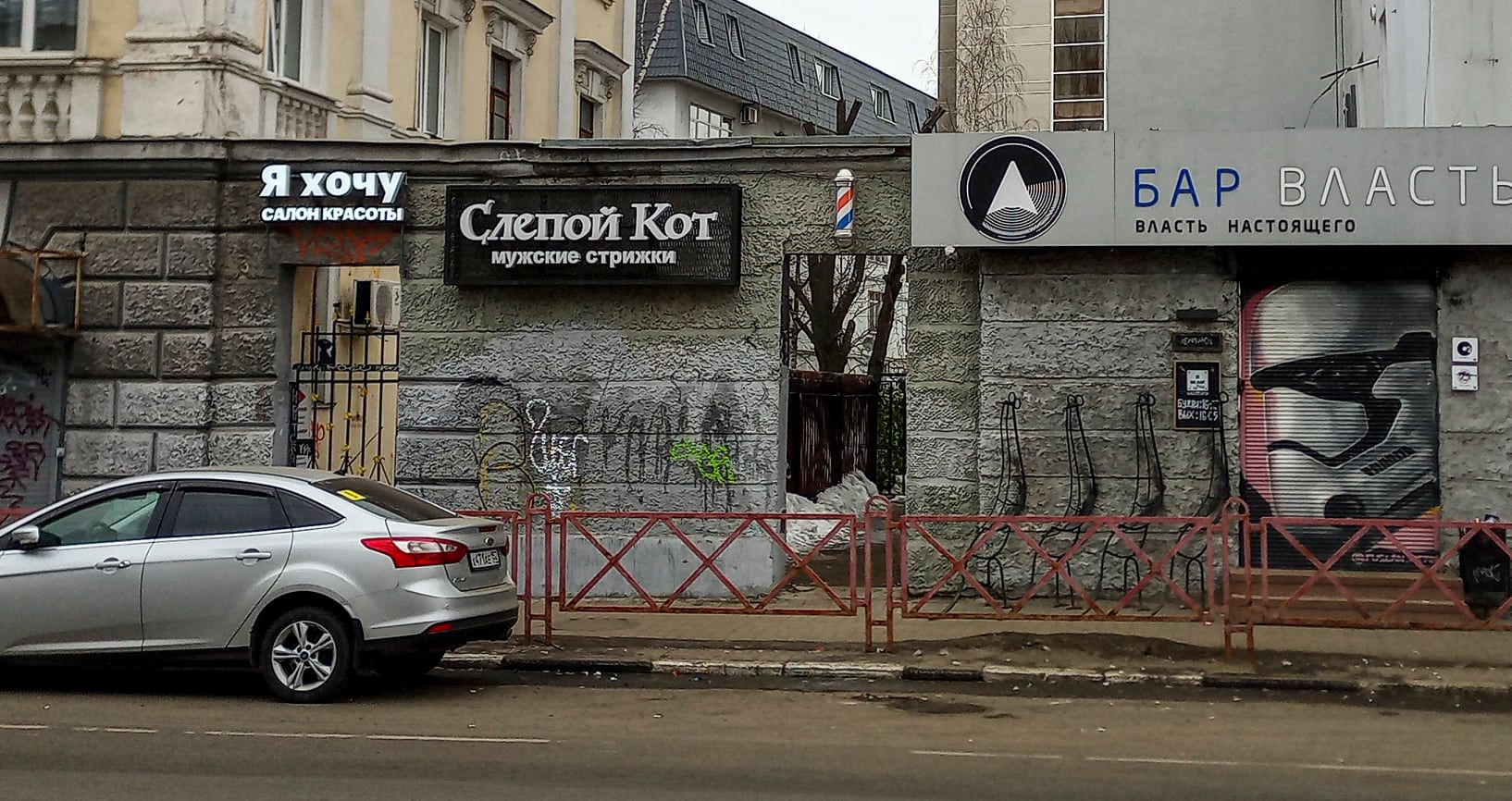
Vadim F. Lurie, Yaroslavl, 13 March 2022. From left to right, the shop signs read, “I Want It Beauty Salon,” “Blind Tomcat Men’s Haircuts,” and “Power Bar: The Power of the Present.” Reprinted with the photographer’s kind permission

The biggest surprise for me (and my biggest miscalculation) has been the number of people supporting Putin.

I had expected something else after two years of idiotic measures against the pandemic (measures that caused the deaths of more than a million people), after the [economic] crisis and the pension reforms.

This support cannot be explained solely in terms of propaganda. The regime’s propaganda is eclectic: it doesn’t supply people with a holistic worldview or logical arguments. It supplies them with mind-numbing slogans. The Russian Federation still has a fairly educated population, with a relatively broad outlook inherited from the Soviet education system. Over the years, I have learned from my own experience as an activist how difficult it is to convince such people using slogans alone.

In all the conversations [about the war] that I have had with people, it was they who initiated the conversations, vigorously advanced their positions, and went on the attack. This is completely atypical. Usually, it’s the other way around.

In all cases, the conversations boiled down to “we don’t know the whole picture” and “there must be good reasons,” segueing to “we don’t decide anything” and “it’s all completely pointless anyway.” A friend said that mothers refusing to look for their sons killed in combat have been saying, “There is no point, [the authorities] won’t give us anything.” A colleague at work ended our conversation [about the war] by saying, “Over in Khabarovsk they protested in defense of [Sergei] Furgal for three months and what of it? It’s completely useless.”

Now I have the feeling that people are very alarmed. They expect the worst and manifest the “social instinct” typical of post-Soviet society — siding with the strongman and rallying round “our guys” whoever they are.

That is, it is not propaganda that encourages them to support [the war], but “instinct.” Propaganda, on the other hand, only satisfies the demand for an explanation after the fact, the need for an indulgence and an analgesic.

Probably we should have expected something like this because the Russian Federation has been living in “counter-terrorist operation” mode for twenty years with berserk cops and crazed lawmakers. Nevertheless, I expected something different.

I don’t see any positive prospects yet. To do something, you need an organization, resources, intelligence, bases of support, media, and experience in underground work, finally. None of this exists. We are now in circumstances resembling those faced by the White Rose — only the authorities are not killing us yet, they can only send us to prison for ten years. And we don’t have the slightest preparation for working in such conditions.

The worse the situation in the country, the more people will consolidate. No introspection or arguments will break through the barrier generated by fear, guilt, and the imperial complex. Partisans [guerrillas] must have the support of the populace, but we don’t have it. One-off heroic actions would simply send crowds armed with pitchforks and torches to the houses where the heroes’ relatives live.

On the other hand, there are admirable examples of protesters mobilizing. They have also been consolidating and learning self-organization and mutual support. (Their leaders have all been jailed.) Theirs is not a left-wing mobilization, nor is likely to become one.

The left had a mobilization two years ago and we wasted it on another round of party-building projects.

These reflections were posted friends-only on social media by an experienced and extraordinarily thoughtful Russian grassroots activist whose day job as a tradesperson brings them into contact with Russians from all walks of life on a daily basis. They have kindly permitted me to translate their remarks and publish them here. Translated by the Russian Reader

“It’s Terrifying to Be Here Amidst This Hell”

I’m a translator, an academic, and a US citizen. Over the past week I have received many dozens of emails from people all over Russia who are desperate to leave and looking for any way out of Russia and into a stable academic or arts-related position.

The one I’ve translated here (with permission from the author, whose personal information has been removed) is both characteristic and particularly exhaustive, and reveals a lot about the situation in Russia now. Just as the prospect of a “war in Europe” and “World War III” has activated memories of the Second World War, in Russia the new crackdown on free media and civic protest has dredged up a lot of cultural trauma around Stalin-era repressions, particularly among the intelligentsia. Postmodern apocalypse rules, with totalitarian concentration camps and 1984 rubbing shoulders (see also Nadia Plungian’s piece analyzing the 20th-century’s death-grip on the modern-day cultural imagination in Russia).

The specters of the twentieth century are additionally deleterious in the way they constantly bring back and elevate specifically Russian suffering. While this suffering is linked to real, undeniable and still largely unprocessed trauma, it feeds into the self-absorption and political passivity that underpins the state of things in Russia today (I don’t have to point out certain parallels with the US and mainstream American culture). It’s not my place to blame Russian citizens for what their insane government is fomenting in Ukraine; there is just clearly much work to be done to build civic consciousness and a functioning society.

Hello.

Although I was born and have spent my whole life in Russia, I am, ethnically speaking, half Russian and half Ukrainian: my grandparents are from Ukraine, and even quite recently I was thinking about applying for Ukrainian citizenship in order to move to a normal, free country, all the more so since I have roots there, but I took too long to decide and now the war has canceled all of those plans. What’s happening right now in Ukraine puts me literally into a state of shock, and what’s happening in Russia makes my hair stand up on end from horror and the realization that this is not a bad dream or nightmare that one might at least eventually wake up from.

This inhumane and senseless war that Putin is waging against Ukraine, which the Russian governmental media insist on calling a “special operation” (while using the word “war” carries the threat of criminal charges), this is only half of the hell, the other half is happening inside Russia. In downtown [city’s name redacted; it is not a capital city], I witnessed the police arresting he small number of people protesting the war. The police used truncheons to shove a grandma holding a “NO WAR!” sign into a paddy wagon. I can’t get my head around the fact that being pro-peace is a crime now. But there are very few protests, the people capable of thinking, the ones who understand how absurd what’s happening is, they’re spooked and scared of protesting lest they end up crippled or have fabricated criminal charges pinned on them.

But the worst thing is that many people, including my former colleagues from the theater, absolutely support this hell that Putin is creating right now in Ukraine, this totally unprovoked and unjustifiable, senseless and bloody slaughter. A huge majority of people has been zombified by the propaganda on TV and are openly welcoming this war, thoughtlessly reproducing the TV propagandists’ fascist, misanthropic slogans. And it’s impossible to convince them otherwise, they brand any rational argument a “fake” and hate the people who argue with them. Today, near my building, I saw that my neighbors had painted the “Z” symbol on their cars, this new swastika that marks the Russian military equipment going to attack Ukraine. They’re all in favor of the hellishness, the blood and death, the war. It’s so scary.

The most absolute insane and absurd madness is being fomented, madness that has no sense and virtually no grounds. Besides this bloody war, besides the sanctions that the entire civilized world has imposed on Russia, here inside the country right now the most severe censorship is being implemented, the last free media outlets that covered the last alternative points of view are shutting down. This is the end. They have been destroyed simply because they called the war a war. There are new laws being passed that threaten fifteen years in prison for telling the truth, and who knows how long it will take before they bring back the firing squad for any kind of freethinking. The prime minister already voiced his support for [restoring] the death penalty. Every day things get worse and worse, and the end is nowhere in sight.

This is a surreal nightmare! Reality just all of the sudden lost its mind. In the blink of an eye everything turned from a vague sort of dictatorship into a totalitarian concentration camp along the lines of Orwell’s 1984, and this is no exaggeration. Soon nothing will be left here besides crowds of insane, poverty-stricken people, completely turned to morons by fascist propaganda, their last bit of reason lost, roaring bloodthirsty slogans, and they will simply destroy anyone who allows themselves to think differently.

I just don’t know how to go on living in this concentration camp that Putin is building here in Russia. Before the start of the war, one could at least try to live one’s life, to be free, to make a living through one’s art and not engage with the universal vector of militarization and dumbing down, to have some kind of hope and plans for the future, but now that’s over, there is no hope left. Navalny is in prison, the opposition has been totally crushed, and the state media, radio and TV, all without exception just repeat one and the same lies, lies, lies and nothing but lies, while the non-governmental sources of information are either already closed or are being destroyed and persecuted. The state is mercilessly rooting out even the weakest rudiments of free speech and of rational thinking in general. It’s terrifying to be here amidst this hell.

While I was writing this I got the news that PayPal and Payoneer announced that they would not be doing business in Russia anymore, and that means I will literally be left without any source of income for my creative projects, while working as an actor in this country involves propaganda in one way or another, because free creative activity has not been possible here for a long time. I became convinced of this myself when I left a theater whose management literally threatened the acting troupe to get us to vote for the candidate they wanted.

I’d like to just live peacefully, make art, learn new things, create beauty, and work to build a bright and joyful future. But now wanting peace will just get you beaten up and thrown in prison. I don’t know what to do and how to go on living.

Translated and prefaced by the Fabulous AM. Photo by the Russian Reader