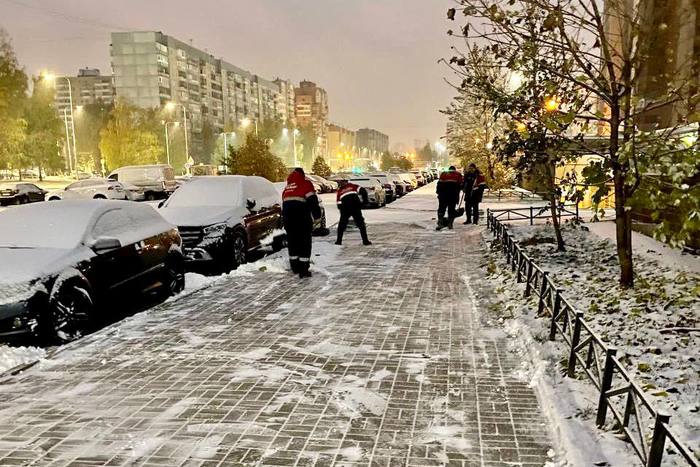
Central Asian migrant workers cleaning snow from the pavement somewhere in Petersburg.
Janitors are the hardest-to-find workers in Petersburg
Since the beginning of 2024, an average of 0.8 applications have been submitted for every janitor job vacancy, the press service of the employment website hh.ru has told Bumaga.
In the first nine months of this year, employers increased the wages offered to janitors by eighteen percent — up to 45,000 rubles a month [approx. 430 euros].
Shop cashier and auto mechanic are the most unpopular occupations among job seekers. During the year, the salary offered to workers applying for these jobs has increased by twenty-five percent and twenty percent, respectively.
According to analysts at hh.ru, “the country’s negative demographic processes” are the main reason for the shortage of employees. “They are long term and quite amenable to forecasting, so, unfortunately, positive trends are not to be expected here,” they argue.
Petersburg has long been short on janitors. In 2023, Yevgeny Razumishkin, deputy governor of St. Petersburg, said that the city had not yet been able to recruit the necessary number of these workers.
The city has tried to recruit janitors and machine operators by increasing their salaries up to 49,500 rubles and 76,800 rubles on average citywide. Last year, the Housing Committee also told Bumaga that it had improved working conditions by installing changing rooms, showers, relaxation rooms and even mini-saunas in janitorial offices.
The Housing Committee told Bumaga that the understaffing is partly caused by the social stigma of the janitorial profession in Russian society. Alla Bredets, the head of Housing and Utilities Control, a regional public monitoring center, argued that the situation with staffing in the housing and construction industry was affected by the outflow of migrants.
Despite an acute labor shortage, the Russian authorities are trying to curtail the numbers of workers arriving from Central Asia. The crackdown intensified after the Crocus City Hall terrorist attack in March, which was reportedly carried out by Tajik nationals. But the appeal of Russia’s job market was already diminished prior to these restrictions. Now, Central Asian migrants are looking for job opportunities in other countries, including in Europe.
Historically, Russia has been the main destination for Central Asian migrant workers. Even after the full-scale invasion of Ukraine—and the recruitment of foreign migrants into the armed forces—Central Asians continued to go to Russia. The Crocus City Hall attack was a watershed moment. In its aftermath, labor migrants faced constant document checks, workplace raids, firings, flight delays, and hours-long lines at the border with Kazakhstan. If they were detained by law enforcement officials, they could be subjected to torture, or given a choice between conscription and deportation.
Even diplomats have been caught in the crossfire. In April, police officers burst into the Moscow apartment of an aide to Kyrgyzstan’s ambassador, ostensibly to establish who was living in the property. His wife and children were home at the time.
Afraid of antagonizing Moscow, Central Asian governments usually ignore such excesses. This time, the infractions have been so serious that officials have been forced into action, with both Dushanbe and Bishkek sending notes of protest. Tajik President Emomali Rahmon spoke up for his compatriots in a May meeting with his Russian counterpart, Vladimir Putin, urging him to fight terrorism, not Tajiks.
There has been no change in approach, however, and that has caused an outflow of migrant workers from Russia. Since April, the number of job seekers from Tajikistan in St. Petersburg has fallen 60 percent, while the number of job seekers from Uzbekistan dropped 40 percent. St. Petersburg is second only to Moscow in terms of its appeal to migrants.
More than a dozen Russian regions have tightened labor restrictions. As a consequence, the Krasnodar region, a leading producer of wheat, corn, sunflowers, and rice in Russia, is experiencing a shortage of agricultural workers. In the Ural Mountains, the same is true for factories, including those producing military equipment. In Yakutia in Russia’s far north, migrants have been banned from driving taxis and other transportation jobs. In Dagestan, there are not enough workers to dispose of the region’s waste.
As a rule, the impetus for imposing restrictions on migrants comes from regional officials. They claim migrants have taken jobs from Russian citizens and depressed wages. In fact, the reverse is true: the economy faces such an acute shortage of workers that wages are rising rapidly. The war on migrants goes on, however, having clearly been accepted by the authorities as an expression of patriotism.
Should the pressure continue, Russia’s labor shortage will only worsen. According to the Russian Academy of Sciences’ Institute of Economics, the country lacks about 4.8 million workers, with deficits particularly affecting industry, agriculture, trade, construction, and utilities: sectors that are generally staffed largely by migrants.
The crackdown is particularly baffling given that migration has gone some way to offset Russia’s demographic problems. At present, Russia’s mortality rate is nearly twice its birth rate, making migration key to maintaining population levels.
Over the past two years, the annual number of migrants entering Russia has remained stable at about 3 million. Most, however, are seasonal workers who do not stay long. Net migration was nearly 500,000 in 2021—the year before the start of the full-scale war in Ukraine—but it fell to 62,000 in 2022 as a result of Western sanctions hitting wages, and the recruitment of migrants into the Russian armed forces.
It might seem an inopportune time for Russia to be alienating Central Asian nations. After all, their governments did not break with the Kremlin after the full-scale invasion of Ukraine. But it seems Moscow believes Central Asian migrants have no alternative to the Russian job market. In any case, Russia has a history of using anti-migrant campaigns as a political tool. In 2006, Georgian migrants were targeted in raids after a group of Russian spies was arrested in Tbilisi. And in 2011, Tajik migrants were detained after Russian airmen were arrested in Dushanbe on suspicion of smuggling.
The Kremlin has even used threats to punish migrants as a way to squeeze concessions from Central Asian governments on issues from language policy to economic integration. Central Asian leaders may care little about the welfare of their compatriots in Russia, but they do worry about the consequences that a fall in remittances would have for their economies.
Remittances account for up to 40 percent of Tajikistan’s GDP, and more than 20 percent of Uzbekistan and Kyrgyzstan’s. With more and more Central Asians leaving Russia as a result of the pandemic, the invasion, and now the crackdown on migrants, less money is being sent home. In 2023, remittances to Uzbekistan, Kyrgyzstan, and Tajikistan fell by 42 percent, 12 percent, and 8 percent, respectively.
As a result, Central Asian governments are looking to help their citizens find work elsewhere, with officials facilitating labor migration to other countries and negotiating to reduce entry barriers to foreign job markets. Officials are even assisting laborers with visa applications. All of this is an attempt to soften the blow from the decline in remittances from Russia.
The number of those who have gone to work instead in Turkey, South Korea, and the Gulf states is already in the hundreds of thousands. Europe is also increasingly a destination for Central Asian laborers. In 2022, there were up to 6,000 Uzbek and Kyrgyz nationals working in the UK. In 2024, as a result of Brexit and the Ukraine war, London raised the caps on visas for Uzbek, Kyrgyz, and Tajik migrants to 10,000, 8,000, and 1,000, respectively.
There is also demand for Central Asian labor in the European Union: particularly in Eastern Europe, where many people have left to work in wealthier Western Europe. In Slovakia, 75 percent of companies report a shortage of workers. Little surprise, then, that the Volkswagen plant in Bratislava employed over 1,500 Uzbeks in 2023. Those workers made an average of 1,400 euros a month: far more than they could earn in Russia. Central Asian labor flows to Poland, Czechia, Lithuania, and Bulgaria are also on the rise.
For now, however, Russia remains the leading destination for Central Asian laborers, and no Asian or European job market will displace it anytime soon. Bureaucratic hurdles, language barriers, and cultural differences all act as obstacles in this respect.
Even so, just a few years ago it would have been impossible to imagine hundreds of thousands of Central Asians seeking work in Asia, or tens of thousands going to Europe. Russia is unmistakably losing its allure for Central Asian migrants: yet another unexpected consequence of the war in Ukraine.
Memorial for actor Joachim Gottschalk. When his Jewish wife Meta and son Michael were to be deported, the whole family decided to commit suicide on November 6, 1941. The bronze figure, which was created by Theo Balden in 1967, resembles the actor. It was initially located in a park but had to be moved due to the building of the local Sparkasse in the 1990s. Its new place is a memorial wall in the Joachim-Gottschalk-Straße 35.
The Impact of the Gold Rush on Native Americans of California
This inquiry lesson provides primary sources, maps, images, and background history to offer teachers and students insight into a little-known but vitally important aspect of one of the most iconic events in American history—the California gold rush. Students will analyze sources to answer the question: Do American actions against California Native Americans during the gold rush meet the United Nations definition of genocide?
The attitude of César Chávez and the UFW towards the undocumented changed over time and can be divided into three periods: 1962 to 1975; 1975 to 1993; and 1993 to the present. A look at these changes reveals much about Chávez, the union, and the times. Frank Bardacke is the author of Trampling Out the Vintage: César Chávez and the Two Souls of the UFW.
Whenever an infant heads to nursery, it can feel like an enormous step. Things are changing for everyone. There are all sorts of feelings flying around – relief, sadness, doubt, fear. But what’s going on behind the doors of nurseries and childcare settings in England? India speaks to Joeli Brearley from Pregnant Then Screwed about the current childcare crisis, child development psychotherapist Graham Music about how childcare impacts children, as well as economist Emily Oster on our choices around childcare. India then meets artists Conway and Young who have found a way to make the invisible labour of childcare pay.
Presented by: India Rakusen. Producer: Georgia Arundell. Series producer: Ellie Sans. Executive producer: Suzy Grant. Commissioning Editor: Rhian Roberts. Original music composed and performed by The Big Moon. Mix and Mastering by Charlie Brandon-King.
Childbirth is deadlier in the United States than in any other high-income nation, according to a study released Tuesday by the Commonwealth Fund that underscores the persistence of maternal mortality.
More than 80 percent of pregnancy-related deaths in the United States are preventable, but factors including a shortage of maternity care providers, limited access to after-birth home visits and lack of guaranteed paid parental leave have increased the risk of maternal mortality, especially for Black people, researchers have found.
In 2022, about 22 maternal deaths happened for every 100,000 live births in the United States. For Black people, that number rose sharply to 49.5 deaths per 100,000, according to the report from the Commonwealth Fund, which conducts independent research on health-care issues. Two out of three maternal deaths occur up to 42 days after birth, highlighting the importance of postpartum care, which only some state Medicaid programs and private health insurers cover.
The study compared 14 high-income countries. It used data from the Organization for Economic Co-operation and Development — known as the OECD — which tracks health system metrics across 38 high-income countries, and from the Centers for Disease Control and Prevention Maternal Mortality Review Committees in 36 states.
Although OECD data is widely regarded as the gold standard for international comparisons, the authors note that discrepancies in how countries gather health data may affect the findings.
“We can’t just think of reproductive health at the time of pregnancy because a lot happens after the baby is born. If we’re not supporting women during this crucial time period, we’re never going to solve this problem,” said Munira Z. Gunja, the study’s lead author and a senior researcher at the Commonwealth Fund.
Ten of the countries listed in the report had a death rate of fewer than 10 per 100,000 live births; in 2022, Norway’s maternal death rate was zero.
Laurie C. Zephyrin, senior vice president for advancing health equity at the Commonwealth Fund, said these numbers paint a stark picture of health care in the United States. She called for more focus on community-led investments, including birth centers and health-care teams working with patients in the weeks before and after delivery. She also said health systems should have incentives and accountability involving equitable quality of care, particularly for communities of color.
With 65 percent of maternal deaths occurring after birth, many health experts emphasize the need for not only more prenatal care but an increase in comprehensive postpartum care.
“We want this to be the cultural norm. We want this to be federal policy. We want there to be a big change because we know that we can completely minimize the rate of maternal deaths in this country,” Gunja said.
Health disparities are not unique to the United States. In Australia, Aboriginal people are twice as likely to die of maternal complications compared with other people giving birth, according to the report. Still, experts are hopeful that policy changes and awareness will help bridge the divide and decrease the overall maternal mortality rate in the United States.
The report highlighted the importance of access to midwives, whose work has been described as an important factor in countries with the lowest maternal mortality rates, the report found. Teams involving midwivescould deliver 80 percent of essential maternal care and potentially prevent 41 percent of maternal deaths, 39 percent of neonatal deaths and 26 percent of stillbirths, the report said.
Some studies have found that teams led by midwives offer care comparable, or superior, to care provided by obstetrician-gynecologists. In the United States, Canada and South Korea, OB-GYNs outnumber midwives, but in most other high-income nations, midwives are more prevalent.
The United States and Canada face a shortage of midwives and OB/GYNs. Almost 7 million people in the United States live in areas without hospitals or birth centers offering obstetric care or any obstetric providers. The shortage is expected to worsen.
“We are setting ourselves up for an absolute reproductive health provider shortage, and contributing to that is this interference into the patient-provider relationship and the restrictions that are being placed on us,” said Tamika C. Auguste, a D.C. OB/GYN and chair of the American College of Obstetricians and Gynecologists Foundation Board who was not involved with the study.
The United States is the only high-income nation without a federally mandated paid parental leave policy and universal health care. Only 13 states and D.C. have paid family and medical leave laws; these policies have been shown to improve health outcomes for pregnant people.
“We are in a dire time in our country, where we’re seeing firsthand the impact of these policy changes at the state level and how they are impacting people’s lives,” Zephyrin said.
In recent years, abortion restrictions have sparked debates and legal battles. State legislatures have been enacting increasingly stringent laws aimed at limiting access to abortion services, such as mandatory waiting periods, ultrasound requirements and bans on certain procedures.
The current wave of abortion restrictions has significantly affected broader health-care services, particularly obstetric care. States that have imposed abortion restrictions often face closure of clinics offering a variety of health-care services, such as cancer screenings, contraceptive services and general reproductive health care. As a result, people in these states encounter greater challenges that exacerbate existing health disparities.
“Women’s health-care providers are being driven out of areas due to the restrictions on practicing full-scope reproductive health care,” Auguste said. “This creates areas where there are no health women’s providers for women.”
The factors that led into the creation of their newest album aligns perfectly with the discussions this podcast is about. Just blocks away from the 3rd Police Precinct that burned down during the protests, Twin Cities country-folk band The Gated Community saw many of their recordings lost due a power outage. But being in the center of burning buildings, gunshots, and neighborly concern, Sumanth Gopinath was compelled to write about it. The result: songs about that tumultuous era that culminated in a new album filled with important issues and topics, which fit perfectly with their existing songs and socially conscious perspective as a band. Sitting around one table, I got to hear about the evolution of a band without egos, which is part of what makes The Gated Community so special.
In his new book, Barons: Money, Power, and the Corruption of America’s Food Industry (Island Press, 2024), Austin Frerick identifies contemporary “barons” in seven different corporations—such as Cargill, Inc., the Driscoll’s and the conglomerate JAB Holding Company—who have taken over food systems and re-shaped communities. Frerick writes in the introduction, “I refer to these people as ‘barons’ to hearken back to Gilded Age robber barons such as John D. Rockefeller and J. P. Morgan because I believe that we are living in a parallel moment when a few titans have the power to shape industries.”
A fellow at theThurman Arnold Project at Yale University and former Treasury Department official, Frerick has been among the leading experts and researchers in competition policy and antitrust examining food industry consolidation. As co-chair of the Biden campaign’s Agriculture Antitrust Policy Committee, he helped advise several of the leading Democratic presidential candidates on agricultural policy leading up to the 2020 election.
Frerick’s interest in the barons of today’s food-industry is also personal. As a seventh-generation Iowan, Frerick’s interest in antitrust policy began as an undergraduate at Grinnell College where he researched corporate power in Iowa’s slaughterhouse communities.
Barn Raiser spoke with Frerick about how agricultural consolidation has changed the landscape of rural America, and how to bring rural people out from their local Walmart and back onto “Main Street.”
What is it like writing about your home?
It started off as angry and it changed into profound sadness. I think that’s because the origin of the book is in Iowa. “The Hog Barons” chapter is what started this whole thing. This book came about because I published that article in Vox on the hog barons at Iowa Select Farms in Iowa, and I got a book deal from that. I noticed that I changed the tone from when I wrote it as a magazine article and made it into a book chapter. It now reads to me as profoundly sad, like it all kind of fell apart in Iowa. It’s grappling with the Iowa I grew up in and what it’s become, from the anger that’s everywhere to just how industrial the landscape has become.
You wrote that “as farms consolidate, more and more of the wealth leaves rural communities and flows to the Cargills of the world.” You also describe how your hog barons live in a gated community in Des Moines — far from the pollution and working conditions they are creating. A few weeks after your book came out, Jeff and Deb Hansen of Iowa Select Farms, the hog barons you highlight in chapter one, published an op-ed in the Des Moines Register, where they called themselves “stewards of [their] land and communities.” What was your reaction to that op-ed?
They employ their own spokesperson, like someone’s job is to do this for a living, and I just thought it was so poorly written. It reinforced in my head that no one’s ever the villain in their own story. And they’re just delusional. They’re living in a delusional world. They’re just not living in the same world we’re living, and I think the op-ed reflected that. To call themselves stewards of the land with a straight face, it’s just like, no one in Iowa thinks that. That’s an accepted reality at this point.
You hosted a book event in Iowa Falls, where the hog barons are from. What was the reception to your book like there?
Honestly that one shocked me the most. I was actually nervous for that event. I really haven’t been nervous at all during this whole book process. That was the one time I was a little worried for my safety. I turned that tracking thing on my phone so my husband could follow me. It’s a little scary, it’s like you’re going into the heart of the beast. At every book event someone asked me am I worried about my safety, which was, you know, an unnerving question to get all the time. But I had a completely different reaction when I got there. I was shocked. Not only at the turnout—I mean, like 45-50 people—but that there was not one dissenting voice. It was among the most incredible after-talk experiences I’ve had because it felt like a third or half of the room came up and talked to me afterwards, because they all know Jeff and Deb, the hog barons.
They all told me a different story of how Iowa Select Farms bamboozled the community from promises they made and didn’t keep for Des Moines and the intimidation tactics they used to build their empire. Iowa Falls is a beautiful town. It was the epitome of the American Dream for a lot of people and then Jeff and Deb just come in and kind of destroy things to their own personal benefit, and then they hightail it out of there. That’s one thing I kept hearing from people, how they did all this stuff, and then they just left.
In the conclusion of your book, you discuss how “a sense of a distinct regional and local identity” disappears when local businesses disappear. “Unlike the barons, the owners of local businesses live in the communities they serve and are stakeholders in their success. Losing them means losing the glue that binds communities together.” What would need to change for the “Main Street” in rural communities to be revitalized?
This culture of efficiency we live in has stripped us of our community. It views everything as an Excel sheet. There are no coffee beans native to Iowa, you can get coffee anywhere. So much of what you’re buying into is interaction with another human, a sense of being. People bought coffee from my mom because of the human connection and Excel can’t capture that. I was really determined to make that point. Because I saw my mom, who used to work for her own coffee store, and later worked at a corporate Starbucks in Target.
These communities thrive when middle class family farms are around. The biggest way to do that is by putting animals back on the land. These confinements have just destroyed rural communities in every way possible. We also need old fashioned trust busting and antitrust enforcement.
Could you explain how CAFOs are connected to Main Street? How are confinements impacting Main Street?
Denise O’Brien in southwest Iowa really drove home this point to me. She’s a longtime activist, and she talked about how much her street has changed in her lifetime. First of all, one human being can only watch so many cows on pasture—you can’t do robotics for that. Family farms pay local taxes, send their kids to local schools and spend their money locally in town. When that consolidates to one person who owns a big metal shed stuffed full of animals, and the owner of the asset lives in an urban rich community, and then has a low wage worker pop by and take care of things, that’s a very different occupation. It’s the difference between watching a cow on pasture to hauling out dead pig bodies, which is what a lot of that work entails. There’s a whole undercurrent of trauma a lot of these low wage workers experience from basically being surrounded by this incredibly cruel production model that is full of death and destruction.
You write that to change the current system and to “build a more balanced food system” we need to “challenge power directly.” How are you hoping your book will mobilize others to build a more just food system?
That’s my nice Iowa way of rejecting the whole change the food system with your fork mentality that’s been the theory of change the last few decades. To me, it just bifurcated the food system between those that go to the New Pioneer Co-op in Iowa City and those go to Walmart. No one’s ever going to get you a seat at the table. So you have to fight for it.
Mariameno Kapa-Kingi, Te Pāti Māori Member of Parliament for Te Tai Tokerau, raised eyebrows recently when she claimed in parliament that the government of had a “mission to exterminate Māori.”
Kapa-Kingi was speaking on a proposed change to the processes under which children forcibly removed from their parents by the child welfare agency Oranga Tamariki are placed in foster care.
“The theory of the Minister is that Oranga Tamariki’s governing principles should be colour-blind, which is just another word for white supremacy, because to say we are all one people is really to say we should all be white people,” she explained.
Mariameno Kapa-Kingi, Te Pāti Māori Member of Parliament for Te Tai Tokerau. Photo: Tania Whyte
Prime Minister Christopher Luxon described the speech as ‘completely out of line’ and ‘unhelpful.’ Opposition leader Chris Hipkins agreed that it was unhelpful, adding “It’s certainly not language that I agree with.”
Te Pāti Māori co-leaders backed up their MP, however. Rawiri Waititi called it a brilliant speech. “This is how we feel and we will not be told how to feel,” Waititi said. “Many of the policy changes that this Government absolutely makes us feel like there [are] huge extermination processes and policies [aimed at] the very existence of tangata whenua in this country, so it was absolutely the right wording.”
When the facts don’t stack up, you can always appeal to feelings.
Co-leader Debbie Ngarewa-Packer concurred. She could hardly do otherwise, since she herself had used similar language in respect of another of the government’s reforms. Her own response last November to the incoming government’s move to roll back some recent restrictions on sales of cigarettes was equally immoderate: “There is absolute deliberate intention of this government, as I said, to create systemic genocide,” she said on that occasion.
Te Pāti Māori Co-leaders Rawiri Waititi and Debbie Ngarewa-Packer
The question, however, is not how Rawiri Waititi or anyone else feels about anything, but whether the claim is true. And as everyone who has not completely lost their head knows, such claims are preposterous. Genocide is not just cultural assimilation, but the physical extermination of a people. It is inconceivable without mass violence and ethnic killings.
The closest thing to ethnic violence against Māori on such a scale in New Zealand history was during the land wars of the 19th century. And even that was not a war of genocide, but a war of dispossession. As soon as the colonial authorities had their hands securely on the land, the fate of the dispossessed Māori became a matter of relative indifference to them.
A repeal of anti-smoking legislation, or of child welfare legislation – irrespective of one’s attitude to that repeal – does not constitute mass violence. To use such terms to describe what is happening in New Zealand today only debases the language and renders the terms themselves meaningless. And in doing so, it disorients anyone who takes the term for good coin, concealing the true nature of the problem, and disarming anyone who seeks to address it.
What drives Te Pāti Māori to resort to such histrionics and attention-seeking language?
The answer to that question lies in what Te Pāti Māori is. It is an electoral formation and nothing more. It has no existence outside of Parliament and its associated vote-gathering machinery. It is a parliamentary voice without a movement, like a head without a body, and is therefore powerless, despite its presence in parliament, to affect the course of politics in any significant way.
This powerlessness was exposed in the immediate aftermath of last year’s election, when, buoyed by its electoral gains and alarmed by the new government’s right-leaning course, it called for a National Day of Action to coincide with the opening of the new Parliament in early December. The declared kaupapa was to demonstrate the “beginning of a unified Aotearoa approach to the government’s assault on Tangata Whenua and Te Tiriti o Waitangi”. Their hype included the prediction that “The movement that we’re seeing from Māori will make the foreshore and seabed hīkoi look like something extremely small.” This was a reference to the protest of twenty years ago, in which 15,000 Māori and others converged on Parliament, and which triggered the Labour Party’s Māori MPs to quit to form Te Pāti Māori.
Nothing remotely comparable to this occurred in the December 2023 Day of Action, despite generous support of the action by the liberal news media, which publicised the assembly points in advance. A few hundred marched in Wellington, and groups of a few dozen rallied in various other towns and cities. In the largest working class concentration, Auckland, a handful of car drivers attempted to disrupt traffic on the motorways, with little effect. It was a rather stark revelation of the narrowness of support for Te Pāti Māori, especially among workers.
When its fighting talk in parliament produces zero effect, the party therefore has few options except to open their mouth wider, shout louder, and use more extreme language in order to win the ear of the ruling class. Not just ‘racism’, but ‘white supremacy’ becomes the order of the day. Not just ‘discrimination’ but ‘extermination’. Not just ‘extermination’, but ‘systemic genocide.’
Don’t be fooled by the truculent posturing and coarseness of tone: these appeals are directed to the rulers, asking “please, listen to us!” They hope to frighten the ruling layers into adjusting their course.
(On his side, Winston Peters of New Zealand First, the counterpart of Te Pāti Māori on the right wing of capitalist politics, uses equally hyperbolic language in his denunciations of Te Pāti Māori, accusing them of “cultural Marxism” and of wanting “anarchy – headed by their Māori elitist cronies turning this country into something akin to apartheid.” Believe me, Winston, nothing could be more alien to Marxism than the politics of feelings!)
But neither the government nor the broader ruling class will listen to Te Pāti Māori. They defend above all else the dictatorship of profit, and the rate of profit has now fallen to the point where it is incompatible with some of the most basic social rights and needs, such as affordable housing, equitable access to health care, basic infrastructure like water and roads, and more. Their ability to grant even small concessions is strictly limited: on the contrary, their present focus is to restore their profits by making even deeper inroads against our wages and social rights.
And among the things capitalist society today is incapable of delivering is the protection of children from violence. The child welfare ministry Oranga Tamariki has been in a permanent state of turmoil for many years, over the question of uplifting children from their parents. It is no closer to resolving this than it was five years ago, when a shockingNewsroom documentary by reporter Melanie Reid exposed the brutality of child ‘uplifts’.
On the one hand, Oranga Tamariki is rightly excoriated for the tearing apart of Māori families in circumstances where it is not justified, such as the case documented in the 2019 documentary, causing long-term trauma. On the other hand, it gets criticised – again with full justification, at least in some cases – for failing to protect the lives of children, who suffer violent deaths at the hands of their family members at a high rate in New Zealand.
Coming under fire from both these opposite directions, the institution lurches from one policy to the opposite, according to the nature of the most recent scandal. At the time of the 2019 documentary, Oranga Tamariki was uplifting hundreds of babies each year, in response to criticism for failing to prevent the violent deaths of babies at the hands of family members. About 70% of these uplifted infants were Māori. (Māori make up about 20% of the population). Oranga Tamariki was under pressure to act pre-emptively in many of these cases, before there was any clear evidence of danger to the child – and therefore these decisions were inevitably based on rumour, prejudice, and racial profiling of Māori as ‘bad parents’. In many cases, the decision to uplift was taken in secret, without any prior discussion with the family concerned.
An intense public outcry followed the documentary. Protests outside Parliament demanded an end to the unjustified snatching of babies, especially Māori babies, from their parents’ arms. The protests denounced the lasting trauma inflicted on the affected Māori families, and the damage to the social fabric caused by the high rate of children being taken into state care. A petition called Hands off Our Tamariki (children) gained 17,377 signatures.
Protest at Parliament demands “Hands off Tamariki forever” Photo: Lynn Grieveson
These protests prompted a switch to the opposite policy. Following multiple inquiries into the functioning of Oranga Tamariki, an amendment to the governing principles of Oranga Tamariki was introduced in 2019, called Section 7AA, which bound the institution to uphold the principles of the Treaty of Waitangi in matters concerning Māori children. In practice this meant placing uplifted babies with members of their own whānau, or with their wider iwi, wherever possible. Labour Party Minister for Children Kelvin Davis proclaimed “This report will end uplifts as we have known them. While there will always be a need for some children to be taken into care, this should only happen after all avenues with community and whanau have been exhausted.” The rate of uplifts fell steadily, from 963 uplifts in 2018 to 251 in 2022.
This was a small but significant gain for the whole working class. It pushed back state interference in Māori families and strengthened the bonds of solidarity within our class.
The death of another young child at the hands of his family has halted that momentum, and now the pendulum is poised to swing all the way back again. Wellington toddler Ruthless-Empire Wall was beaten to death by family members unknown, just shy of his second birthday, in October 2023 – after the boy’s uncle had alerted Oranga Tamariki to the dangerous environment he was living in, and requested them to place the boy in his care.
Now the government, at the behest of its Act Party component, seeks to restore the policy of wholesale uplifts. Act campaigned on the issue in last year’s election, and repeal of Section 7AA was part of the coalition agreement between the three parties that formed the new government in November 2023. The campaign is headed by Act’s Karen Chhour, the incoming Minister for Children and for the Prevention of Family and Sexual Violence. Chhour, who is Māori herself and was raised in state care, presented her own petition to repeal Section 7AA, which received more than 13,400 signatures.
Chhour claims that Section 7AA has led to Māori children being removed from safe and loving homes because their caregivers weren’t of Māori descent. “I consider that section 7AA allows the treatment of children and young people as an identity group first, and a person second, it creates a divisive system that has had a negative impact on caregivers. This repeal will make sure that Oranga Tamariki is entirely child-centric and is making decisions that ensure a child’s wellbeing and best interest. Over successive years, Oranga Tamariki has failed our most vulnerable children, and in part that has been because of Section7AA,” she said.
Karen Chhour Photo: Doug Mountain
Chhour presents no evidence to back these assertions, a point noted by the Waitangi Tribunal which entered the debate. If children are actually being torn from existing foster homes where they have already bonded with their caregivers, simply because their caregivers were not of Māori descent, that could be a matter of legitimate concern. But it is incumbent on Chhour to prove that this is in fact happening. Since she does not do so – beyond claiming to have seen it herself – this appears to be a spurious claim.
Nor does she make any attempt to explain why or how adherence to the Treaty of Waitangi should lead to Oranga Tamariki making decisions that are not in the child’s best interest. Her unsupported assertion hints at an unspoken racist explanation: that Māori parents and foster parents are less than competent caregivers. This is a debate with high stakes.
Thus, the issue Mariameno Kapa-Kingi was attempting to address is a real one, and the repeal of Section 7AA should be opposed. It is the ability to recognise a real problem, combined with the inability to do anything about it, that generates the flailing of arms in Parliament, and the politics of middle class hysteria in general.
Even if the repeal of 7AA is defeated, the social scourge of violence against children can only be expected to worsen in the short term. It is a consequence of, among other things, the divided, weakened state of the working class, which is increasingly being torn apart by the ordinary workings of the capitalist economy, exacerbated by the actions of its government and state.
Such violence against children is connected with massively increased economic and other pressures on families: the inflation eroding our wages, the growing insecurity of employment, the cuts to social services like health care, including mental health care, the breakdown of attendance at school, and above all, the housing shortage, which hurls ever-wider layers of workers down into the horrors of drug-riddled and gang-infested ‘emergency housing.’
Violence against children is closely connected with the scourge of violence against women, in which New Zealand ranks so shamefully high in the world. It is worth noting that Te Pāti Māori, along with the Labour, National and Green parties, supported legislation that undermined women’s single-sex spaces, including women’s refuges from domestic violence, by requiring them to open their doors to males. They took an active part in the attack which shut down a women’s rally in Auckland in March 2023 by force and violence. This fact alone should nullify their claim to speak in defence of children.
As long as these social conditions continue, there will continue to be situations in which children have to be removed from their parents’ care in the interests of their own safety. But such removals can also provide an opening for hostile class interests to drive in a wedge that tears apart working class families. This has been done disproportionately, though not exclusively, against Māori, who make up a substantial component of the working class. It is the built-in tendency of intervention by the capitalist state and its agencies like Oranga Tamariki.
It falls to a revived movement of the whole working class to oversee such situations and to ensure that the ties between children and their whānau are maintained as far as possible during their removal, and that they are returned to their parents’ custody as quickly as possible. Strengthening solidarity within the working class, along with raising the social status of women, is the road to ending the violence against children in a more permanent way.
This is not a new problem for the working class worldwide. Farrell Dobbs, a leader of the historic Teamsters Union strikes which organised truck drivers in the US Midwest in the 1930s, once described how these strikes took on the character of the mass social movement. The Teamsters Union Local 574 ‘flying squads’, which had been organised to shut down strike-breaking trucking operations across the city, expanded their operations to intervene when the union got news of unemployed workers being evicted from their homes for non-payment of rent. The arrival of the union flying squad quickly ended the attempts by landlords and their deputy sheriffs to evict the worker.
Farrell Dobbs, (with images from the 1934 strikes behind him)
“In a few instances, the union even adopted children,” Dobbs said.
He explained that at the time it was common for bourgeois charities to identify working-class families that in their view were unable to adequately provide for their children, and the charities would then arrange to have the children adopted out, against the wishes of their parents. The union organisation stepped in to prevent this happening, finding foster parents from among the union ranks to care for the children temporarily, so that they could be returned to their parents at the earliest opportunity. (The talks where Dobbs tells the story of the Minneapolis strikes are available on YouTube, and are very inspiring to listen to in full. Dobbs describes the adoption of children in the third talk, beginning about the 24th minute.)
Children demonstrate in support of their unionist parents
At this point there is little outward sign of such a revived fighting labour movement in New Zealand, so this political course is far from obvious to see.
What is abundantly clear, however, is that Te Pāti Māori, and all those like them who pursue the opposite course – of appealing to the capitalist rulers and relying on their parliamentary apparatus and state institutions – quickly find themselves in a blind alley.
Errollyn Wallen’s memoir Becoming a Composer is a look into the mind of the composer as well as the life of one. Born in Belize but now based in the far-flung north of Scotland, where she sometimes inhabits a lighthouse, she works at a brisk pace, composing prolifically for orchestra, chamber ensemble, choir, and over twenty operas. Her major public commissions have included music for The Last Night of the Proms, the Paralympic Opening Ceremony, and the Queen’s Diamond Jubilee, and she joins us from her home in the Orkney Islands to talk about Becoming a Composer, and becoming a composer.
Music heard in the show:
Title: Horseplay i. Dark and mysterious Artist: The Continuum Ensemble/Philip Headlam Composer: Errollyn Wallen Album: The Girl In My Alphabet Label: Avie AV0006
Title: Dervish Artist: Matthew Sharp (cello), Dominic Harlan (piano) Composer: Errollyn Wallen Album: The Girl In My Alphabet Label: Avie AV0006
In his state of the nation speech, President Vladimir Putin announced the launch of the national project “Time of Heroes” for veterans and current participants of the special operation by Russian troops in Ukraine.
Photo: Pixabay courtesy of Rabota.ru
Servicemen with university degrees, managerial experience, and no criminal records can apply to the personnel program. The head of state called such people the country’s “true elite” and argued that they should “lead regions, enterprises, and the largest public projects.”
The program will kick off on March 1. Veterans will be trained per the standards of the School of Governors and the Leaders of Russia competition, and ministers and heads of enterprises will act as their mentors.
Currently, all participants of the special military operation also enjoy priority hiring, and their employers also receive benefits.
Crimean Solidarity journalist and activists arrested, their families terrorized, in new Russian offensive against Crimean Tatars (Kharkiv Human Rights Protection Group, March 6th)
Ominous denials a month after Crimean Tatar father abducted by Russian FSB (Kharkiv Human Rights Protection Group, March 6th)
Reshat Ametov and 10 years of Russia’s systematic torture, abductions and killings of civilians for supporting Ukraine (Kharkiv Human Rights Protection Group, March 4th)
Russia passes huge conveyor belt sentences against Ukrainians tortured for propaganda videos (Kharkiv Human Rights Protection Group, March 4th)
All’s fair in art and war: Russia’s plunder of Ukrainian museums (The Insider, February 29th)
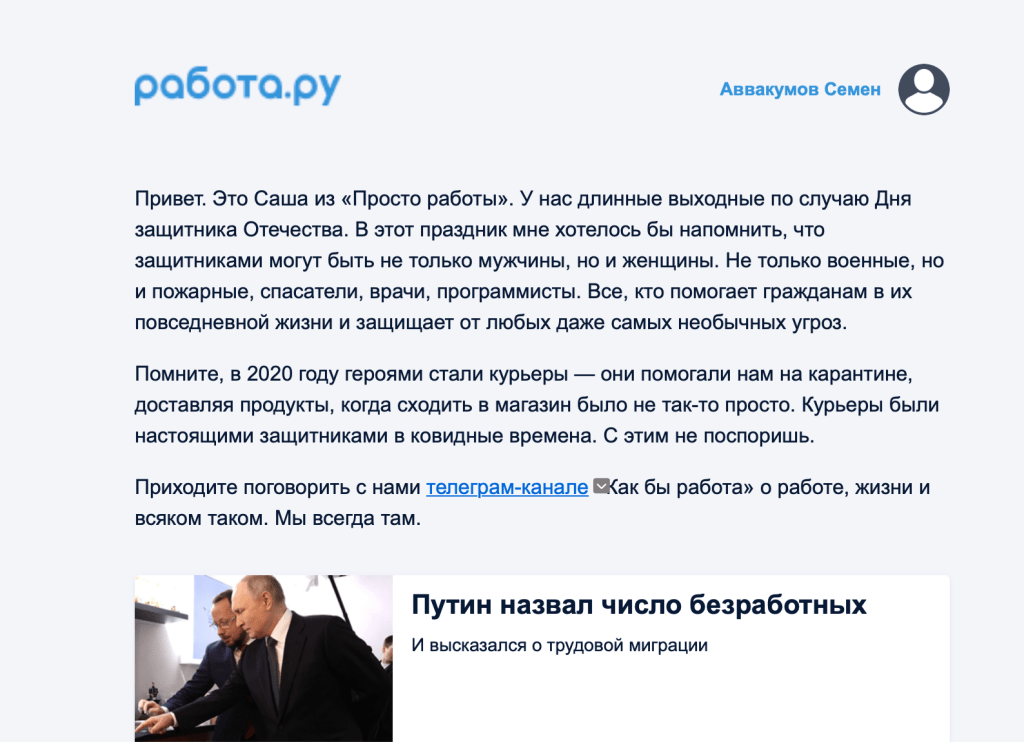
Hi! This is Sasha from Just Work. We ‘re looking forward to the long Defenders of the Fatherland Day weekend. On this holiday, I would like to remind you that not only men, but also women can be defenders. Not only soldiers, but also firefighters, rescuers, doctors, and programmers — all those who help people in their daily lives and protect them from any even the most unusual threats.
Remember, delivery people were the heroes in 2020. They helped us during the quarantine, delivering food when going to the shop was not so easy. Delivery people were the real defenders during covid. You can’t argue with that.
Come talk to us on Telegram channel Workish about work, life and stuff. We’re always there.
“Putin identified the number of unemployed — And spoke about labour migration”
Source: Just Work (Rabota.ru) newsletter, 23 February 2024. Translated by the Russian Reader
Pacific Grove, California, 10 June 2023. Photo by the Russian Reader
Jose Martinez has lived and worked in the United States since he was 14 years old. Now 67, he drives around the Yakima Valley in Washington state checking on fellow workers.
“When it’s hot, do you have a place to protect yourself from the sun and heat?” he calls out to some workers on the side of an apple orchard on a sunny June morning.
Martinez worked in agriculture across the fields of California and, most recently, Washington state. Irrigation, grapes, apples, mushrooms, dairies and now cherries. He’s done a little bit of everything.
“I love the fields because you’re in the open air,” he told NPR in his native Spanish, sitting on the lawn outside his home in Sunnyside, Wash. “It’s beautiful. I am proud to do it, to be a farmworker. Why not?”
When people think of farmworkers, often they think of migrant workers and labor organizers like Cesar Chavez and Dolores Huerta. Now, they may add another name to those creating major changes in the farming workplace: Jose Martinez.
Over the past decade, Martinez has been central to two flagship lawsuits creating policy changes in the state — making Washington one of the leaders in providing overtime to farmworkers and settling acivil rights case in favor of workers. And recently, he has taken his fight to Washington, D.C., where he has pushed for an expansion of legal status and protections for farmworkers.
Federally, farmworkers are largely excluded from many federal workplace safety regulations. They don’t have a right to overtime pay or to unionize, and children as young as 12 can legally work in the fields. As a result, some states, like Washington, have extended additional rights and regulations.
The Nottingham Starbucks voted to join Starbucks Workers United in June 2022 — and Ms. Torregoza and her colleagues stepped into a world of trouble.
The corporate dirty war that ensued — in Nottingham and at newly unionized Starbucks cafes across the country — draws a sobering picture of employee rights casually crushed and labor laws too weak to help. Starbucks continues to fight and appeal the many labor complaints pending against it and maintains that the company has done nothing wrong.
But these professions of innocence are countered by piles of testimony from workers and National Labor Relations Board findings suggesting that Starbucks has indeed illegally repressed employees’ rights. The company has so far racked up a staggering number of complaints from the agency. In 100 cases, many of which consolidate a number of incidents, regional N.L.R.B. offices have decided there is sufficient evidence to pursue litigation against Starbucks. That includes a nationwide complaint, consolidating 32 charges across 28 states, alleging that Starbucks failed or refused to bargain with union representatives from 163 cafes.
Starbucks lacks the glamour of Hollywood and the indispensability of UPS, but as strikes and union drives erupt across the economy, the coffee workers’ struggle illuminates the stark and sometimes insurmountable challenges confronted by ordinary American workers who try to exercise their right to organize.
That Starbucks is carrying on this campaign in plain sight may be the most damning aspect: Union busting is illegal, but consequences are inconsequential. The Starbucks case demonstrates that a large corporation can effectively bust a union with time, by dithering over details and exhausting legal appeals. According to national labor laws, an employer “must bargain in good faith.” But that is a squishy and essentially unenforceable rule. Starbucks may yet succeed in smothering one of the most energized labor movements of our time.
The striking miners were 10,000 strong on the first day of September 1921 as they charged up the slope of Blair Mountain, propelled by a radical faith in the American dream. According to an Associated Press reporter who crouched behind a log and watched through field glasses, each time they pressed forward, a “veritable wall” of machine gun fire drove them back. As the barrage echoed through the hollows, reminding some of the action they had just seen in the forests of France, the advancing miners soon heard a different sound: deeper, earthshaking explosions. From biplanes above, tear gas, explosive powder and metal bolts rained down. “My God,” screamed one miner fighting his way up Crooked Creek Gap. “They’re bombing us!”
“They” were Sheriff Don Chafin and his deputies, who terrorized the citizens of Logan County, W.Va., by the authority of the coal companies. The miners vastly outnumbered their opponents, but Chafin had the superior position and weapons. “ACTUAL WAR IS RAGING IN LOGAN,” one local paper declared the day before.
The miners were fighting for the right to unionize, and to end the reviled “mine guard system,” a private force of armed guards who brutally enforced the company’s control in the coal fields. Unless the mine guard system was removed, John L. Lewis, president of the United Mine Workers of America, had warned, “the dove of peace” would “never make permanent abode in this stricken territory.”
On Sept. 4, federal troops arrived at Blair Mountain. The miners cheered, thinking Uncle Sam had come to liberate them from King Coal. Uncle Sam had no such plans. In 1921, about three million Americans were unemployed, and Washington was concerned that the industrial war raging in southern West Virginia could spread to other states. The troops told miners to stand down, and they did. “We wouldn’t revolt against the national government,” one of them said.
The miners were roundly defeated, but their struggle was not in vain: Years later, as part of the New Deal, the rights they were fighting for — including the right to collectively bargain — were written into law. Black, white and immigrant, the “Red Neck Army” (so named for the red bandannas they wore) had mounted the largest working-class uprising in U.S. history and the largest armed insurrection since the Civil War.
Today, Blair Mountain is just that: a mountain. While many battlefields are the object of exhaustive study and veneration — places and times when power wobbled and blood was shed — Blair Mountain is still largely unexplored. No statue or roadside attraction commemorates it; no tour buses roll up and disgorge visitors. Despite a burst of recent interest, for most West Virginians, the story of Blair Mountain barely even exists.
We will talk about what is happening to people who are terribly far from Moscow and St. Petersburg. Who are terribly far from the congresses, conferences and conflicts of opposition leaders. Who are terribly far even from popular YouTube channels and shows. Who are also terribly far even from Telegram.
Why does this matter? It matters because otherwise we won’t understand how the country got to this point and why some Russians volunteer to fight in the war.
In this episode, you’ll learn what worries Russians more than Prigozhin’s rebellion, why the Baltic Sea in Kaliningrad is becoming bloody, in which city it is easiest to encounter wild bears on the streets, and the job you have to land to make a dream salary of 8,000 rubles [approx. 80 euros] a month.
Subscribe to our channel, where we talk about the problems of ordinary people. And if you live beyond the Moscow Ring Road and are facing trouble right now, write to us at:
strashnodaleki@gmail.com
We will definitely tell our viewers about it. Because we do care.
The Usvyaty District of the Pskov Region belongs to the ethnographic area known as Poozerye (Lakeland). There used to be many folk musicians there, the most famous of whom was the singer Olga Sergeeva (1922-2002).
Ekaterina Trusova (maiden name Kozintseva, tracks 1-7) is a garmon (Russian button accordeon) player living in Usvyaty. She was recorded at the Usvyaty House of Culture on December 12, 2021.
The other two musicians featured on this album belong to a previous generation and were recorded by Ekaterina herself in the 1990s on a home cassette tape recorder. The cassettes were digitized by Alexander Yuminov (KAMA Records) in 2022.
Sofya Rubisova (tracks 8-13) is a folk singer from the village of Sterevnevo, Usvyaty District.
Dmitry Kozintsev (tracks 14-17) is Ekaterina’s father, a garmon player from the village of Pysi. Unfortunately, the recordings of him are of poor quality, as the tape in the cassette turned upside down. But we still decided to include them in the album.
Another album from the area, from the village of Tserkovishchi, can be found here.
Branded “foreign agent,” Yaroslavl media outlet announces closure
YARNOVOSTI announced it was suspending its work on July 7. The publication had been running for over ten years. It covered the inhabitants of Yaroslavl, corruption, problems with public amenities, and politics.
In June, the Justice Ministry had declaredYARNOVOSTI a “foreign agent.” None of its employees agreed to work under this label. The editors said that during its entire existence it had not received “a kopeck” of foreign funding.
“Of course, we expected to continue working, but, as Vladimir Putin said, nothing lasts forever. We are still getting to the bottom of what happened on June 2: we have made all possible and even impossible inquiries, and have drawn up the paperwork for the court,” the media outlet’s editorial team wrote.
Source: 7 x 7 (Telegram), 7 July 2023. Translated by the Russian Reader. As of this writing, YARNOVOSTI seems to have shut down its website, but its page on VKontakte is still functioning. In its latest post there, published on 7 July 2023, it informed readers of the decision to suspend its work.
The Synod of the Russian Orthodox Church has approved a chanted prayer for jobseekers for use in regular worship services.
Russian Orthodox Patriarch Kirill. Photo: iStock via Rabota.ru
The prayer mentions work that will be of benefit and yield worthy fruits, as well as help [the supplicant] to observe the church commandments, RIA Novosti reports. We have previously written about [which saints] to pray to in such instances, but now there is a single standard [for how to pray to them].
Now we humbly pray to Thee: grant Thy servant (insert name) to do good and all that is useful for Thy glory and for the good of Thy house, and make the fruit worthy of his labors, so that, having prospered in Thy commandments and in Thy love, he will sing and thank Thee, and Thine Eternal Father, and Thy Most Holy and Good and Life-Giving Spirit, now and forever. Amen.
At a pinch he could do the same in French, but French specialists were two a penny, and, in any case, Russian was his thing. He loved the Cyrillic alphabet, the byzantine grammar, the soporific, sensuous sound of the Russian language. And once, he had loved a Russian woman.
[…]
“Let’s get some sleep,” said Hyde. “Tomorrow… sorry, make that today, you need to be on top form. The briefing book is right here.” Hyde tapped the file on the table. “Are you up to speed on the current jargon? Post-truth and alternative facts and all of that? What’s fake news in Russian?”
“Feykoviye novosti,” Clive said without missing a beat. “But the purists are up in arms. Feykoviye is not a Russian word. It’s an anglicization. They think it should be lozhniye novosti. Lying news.”
[…]
Then he focused on the job in hand. The mental preparation was always the same, a limbering up of the mind, a rigorous testing of himself. He went through various linguistic exercises, tossing English words and phrases into the air like tennis balls, then hitting them across the net in Russian. It was natural, effortless; he felt completely at ease in either language.
[…]
“Clive was member of our Russian book club on the fourteenth floor of the UN,” Marina said, looking at Hyde.
“I was,” said Clive, looking straight at Marina and taking in every detail of a face he had done his best to forget for over a decade. He had also forgotten the particular musicality of her English, which gave her away as a foreigner. Now and then her “o” was slightly too long and her “r” was a little too hard, and sooner or later she would forget an article,* just as she had a moment ago. Her English was almost perfect. But not quite. It was all part of her infinite charm.
[…]
“Alexei had this thing about grammar. Said I had to speak clean Russian. Clean… That was his pet word. ‘Use the instrumental and not the fucking accusative.’”
[…]
After making love, they would lie in bed and smoke and talk about their favourite writers. They showed off to each other, Marina reciting Pushkin, Clive quoting Shakespeare, and then vice versa, switching effortlessly from English to Russian and back again. They chucked proverbs and abstruse words at each other until they dissolved in laughter.
* But check out the abuse and misuse of articles on display here, of all places:
HARRIET CRAWLEY, “THE TRANSLATOR”. IN CONVERSATION WITH SIR RODRIC BRAITHWAITE
Tuesday, 2 May 2023, 7:00 pm —8:30 pm
5a Bloomsbury Square, London, WC1A 2TA, United Kingdom
Join us to hear Harriet Crawley discuss her latest novel, a love story and political thriller, with the former British ambassador to Russia, Sir Rodric Braithwaite. The Times has included The Translator in its list of “the best new thrillers”, and the reviews praise author’s descriptions of the everyday life in Moscow, her ability to create suspense, and the political relevance of the plot at the time when the Russian state has once again become a major geopolitical threat.
[…]
The Translator tells a story of two interpreters, one British and one Russian, who embark on a quest to protect vital communication infrastructure connecting the UK and the US from sabotage by Russian special operations forces.
Source: Pushkin House. The emphasis is mine. ||| TRR
While this is a bit closer to the often harsh reality:
Kill the Translator: A Song of Inadequacy


He’s the mad dog of letters, the scrivener of sin.

He stays up nights with dictionaries and gin.

He studies Icelandic with a six-fingered Finn.

            He’s the translator.


He trampled your iambs, desecrated your prose.

He mangled your message and stepped on your toes.

His syntax is suspect, his Swahili a pose.

            Maim the translator.


Your essay’s in tatters, your short story in ruins.

He rendered 'tomato' as 'the mating of loons'.

And tomorrow he’ll english your poem out of tune.

            Harm the translator.


It matters quite little whether he’s stout, thin, or black,

Venetian, Guatemalan, or from Hackensack:

Send him Derrida by mail, and an ounce of crack.

            Suicide the translator.


Stop the presses in Cape Town and summon the cops.

Make a pass at his mother, toss a spear at his pop.

And dare he protest, quote him Lacan till he drops.

            Crush the translator.


Rip his Oxford to shreds, set his grammars on fire.

Break all his pencils, call Nabokov a liar.

Instead of advances, blow him curses by wire.

            Unhinge the translator.


He’s a cheat and a fraud and the foe of good sense.

Promise him the heavens, but repay him in pence.

'Traduttore traditore,' they say, and hence:

            Kill the translator.
Source: The Russian Reader, St. Petersburg, October 1996. The poem was inspired by an incident (one of dozens) in my early career when I was paid a pittance to translate the catalogue for a show of contemporary Russian art in Finland. A few months later, I got a notice from the Finnish tax authority which made it plain that, officially at least, I had been paid several times that amount by the host museum, but the Russian curators had pocketed the difference, thinking I would be none the wiser.
If you don’t want this website and its free, unique, eye-opening content to be maimed, harmed, crushed, suicided, killed, or unhinged, show your support today by liking, commenting, sharing, or donating (via Stripe or PayPal — you’ll find the forms and links in the sidebar). It’s vital for me to know that there are actual people out there who value my unpaid labor of love, which is now in the midst of its sixteenth year. I’ve received only $137 in donations so far this year, alas. That’s not enough financial support for me for to keep doing this much longer, considering that last year, for example, my overhead costs alone were $1,620 (for internet, hosting, and online subscriptions), against only $1,403 in donations for the entire year. ||| TRR
Russian workers called toxicity the worst quality among bosses, according to Gazeta.Ru, citing the results of surveys carried out by the Team Awards for creating strong teams.
“Zloy boss” (“Angry boss”). Photo courtesy of iStock and Rabota.ru
The greatest number of Russians surveyed (40%) believe that toxicity [toksichnost’] is the worst trait in a boss. Incompetence (35.1%) and inefficiency (24.3%) took second and third places, respectively. The list of negative qualities also includes aggressiveness (23.8%) and bias (19.8%).
Only 10% of respondents consider an authoritarian boss to be exemplary.
The respondents also spoke about what qualities an ideal leader should have. Motivating employees was in first place (41.2%), while preventing burnout was in second place (27.6%). Respondents also identified encouraging professional development (18.8%) and resolving conflicts (17.1%) as important qualities in a good leader.
We recently wrote that Elon Musk had staged another wave of cuts on Twitter. He laid off 200 employees — that is, about 10% of the workforce. Esther Crawford, the head of the Twitter Blue subscription, who was considered one of the new Twitter owner’s most loyal supporters, was among the employees made redundant.
Russians consider toxicity to be the worst quality in a boss according to a survey done by Team Awards, a prize awarded in the field of strong team building. Gazeta.Ru reviewed the results of the survey.
The top qualities that, according to respondents, are at odds with image of an ideal manager were toxicity (40%), incompetence (35.1%) and inefficiency (24.3%). In addition, the rating also included aggressiveness (23.8%) and bias (19.8%).
The respondents also saw the boss’s role on a team differently. The majority (41.2%) believe that a leader should motivate their subordinates, thereby increasing labor productivity. The next answer on the list is preventing employees from burning out (27.6%). Another 18.8% want the boss to be engaged in their professional development, while 17.1% believe that the leader should be able to resolve conflicts on the team.
Interestingly, only 10% consider a boss who subscribes to authoritarianism exemplary.
Earlier, we reported that every third Russian avoids networking [netvorking] because of uncertainty about their own competence.
Istanbul, December 2022. Photo courtesy of Republic
[…]
500 vacancies for military registration specialists were advertised from late September to last December last year, according to HeadHunter. Previously, this specialization was considered a rather rare and generally not very sought-after profile in the personnel departments of Russian organizations (private and public). For comparison: only 145 such vacancies were advertised in the whole of 2021. The military mobilization has changed the situation: since September — that is, in just three months — the number of such offers on the labor market has increased by about two and a half times (Superjob’s data also show the same thing). The reasons? One of them (apparently, the main one) is an increase in fines for lapses in paperwork: to avoid them, employers are willing to pay applicants for the popular vacancy 70-80 thousand rubles a month. And this is despite the fact that there is a shortage of a number of other specialists on the labor market (and, presumably, they are no less valuable than SMO-era personnel officers). The number of vacancies on Avito Jobs alone, according to a recent company study, increased by 69% in 2022. Most likely, the trend will continue, serving as a natural continuation of the outflow of people and, ultimately, personnel.
50% — the percentage of last year’s sales of existing housing in the Russian Federation made through a notarized power of attorney. This record figure for the entire observable history of the market, as calculated by investment company Flip, who were commissioned by Kommersant, clearly indicates that the sales trend was primarily shaped by property owners who had emigrated. The high volume of such transactions seems to be an anomalous phenomenon. In 2021, a power of attorney was the basis for sale in no more than 20% of deals. In 2020, this figure was 15%. It was 8% in 2019, and 5% in 2018. You ain’t seen nothing yet, though: the ongoing controversy over whether to confiscate the property of openly anti-war Russians who have left the country must be making an additional contribution to the process of selling apartments and houses, which was gaining momentum as it was.
$81.69 billion — the total amount of deposits by Russian nationals in foreign banks as of the end of November of last year, according to the latest data from the Russian Central Bank. (4.989 trillion rubles were recalculated at the exchange rate in effect on that date.) Over the past eleven months, the amount has more than doubled — and this is even if we rely entirely on the statistics of the Central Bank, which may not have a complete picture of what is happening. (Russian laws oblige citizens to report when they open accounts in foreign banks and move funds in them, but we cannot be absolutely sure that everyone strictly obeys them.) While one part of these funds remains in these bank accounts, the other goes to the purchase of real estate that, for the most part, is also located outside the Russian Federation.
16,300 houses and apartments in Turkey were purchased by Russian nationals in 2022, according to data published by the Turkish Statistical Institute (TurkStat), as studied by RBC. This is not just three times more than in 2021 (when Russian nationals purchased 5,400 housing units in the Turkish Republic), but also more than the total volume of such transactions over the past six years (16,200). It is not surprising that last year, for the first time, Russians took first place among foreigners in buying housing in Turkey, producing almost a quarter of the corresponding demand with their money. Earlier, we wrote that our compatriots purchased two thousand houses and apartments in Turkey in October 2022 alone, overtaking all other foreign home buyers in that country, as reported by TurkStat.
At first glance, the advantages of investing in Turkey are not entire obvious. Inflation in the country, according to TurkStat, exceeded 84% in November, once again breaking records previously established in the autumn of 1998. The Inflation Analysis Group, an independent Turkish entity, estimated that inflation had reached a whopping 170.7% . In addition, prices for real estate, which have rising robustly, can at any moment just as vigorously drop, taking into account, in particular, the rather murky prospects for “Erdonomics,” depending on the results of the upcoming presidential and parliamentary elections. According to Endeksa, in September, the average price for one square meter of housing in Turkey was about 12 thousand Turkish lira (approx. $644), while the average price per housing unit was just over 1.5 million Turkish lira (approx. $83,700). The term of return on investment in housing is estimated at nineteen years, although in the summer this figure was recalculated to seventeen years.
The intense interest on the part of Russian nationals in buying real estate in Turkey is primarily related to the prospect of obtaining Turkish citizenship, Anna Larina, head of the foreign real estate department at NF Group, explained to Republic. (In turn, having a Turkish passport makes it possible to obtain an American E-2 visa, which speeds up the process of immigrating to the United States.) In this sense, it is logical that Russians have become leaders in terms of the number of residence permits issued in Turkey — 153,000, of which, however, as the Turkish Ministry of Migration clarified, 132,000 are short-term tourist residence permits, which are valid for two years.
Turkey is one of the few countries (but not the only country) that is still open to Russian nationals and their private capital. Thus, as 2022 came to a close, Russian citizens took first place among non-residents in buying real estate in Dubai, Bloomberg recently reported, citing figures provided by the brokerage firm Betterhomes.
Withdrawing funds and setting up a new life abroad eloquently testify to the sentiments prevailing among the Russian urban middle class, primarily. Not all people who sell Russian real estate and buy foreign real estate are necessarily irreconcilable opponents of the regime. And yet, it is clear that the vast majority of these people do not want to live and raise children in Putin’s version of the future, which is practically incompatible with modern civilization. In its own way, it is symptomatic that Russians who support the government and dutifully follow it into its deadly adventures are also dissatisfied with what is happening. If it were possible, they would rather return to the past, to a point in time thirty, forty, or fifty years ago.
63% — the percentage of Russians, according to a December poll conducted by the Public Opinion Foundation (FOM), who regret the collapse of the USSR — that is, more than three decades after the event known in Kremlin mythology as “the greatest geopolitical catastrophe of the twentieth century.” Strictly speaking, the current longing for Soviet times cannot be considered a record: after the August 1998 ruble default, there were noticeably more Russians nostalgic for the Soviet Union — 85%. Nevertheless, an important indicator of public attitudes (as recorded, we should underscore, by a quasi-state polling service) is on the rise again, having increased by twelve percentage points since 2011.
It is clear that this sentiment is primarily voiced by the 46–60 age group (88% of whom are “nostalgic”) and to some extent, people aged 31–45 years (79% of whom are “nostalgic”), assuming that a considerable portion of these people associate the late USSR with their happy childhoods and wild youths. However, according to the poll, even today’s Russian youth, that is, people aged 18–30, mostly (64%) consider the Soviet era “generally a good time.” Of course, their judgments are based on the stories of older generations, and most importantly, on the inevitable comparison with what is happening with the largest post-Soviet country right now.