This bulletin is put together by labour movement activists in solidarity with Ukrainian resistance. More information at https://ukraine-solidarity.org/. We are also on Twitter. Our aim is to circulate information in English that to the best of our knowledge is reliable. If you have something you think we should include, please send it to 2022ukrainesolidarity@gmail.com.
To receive the bulletin regularly, send your email to 2022ukrainesolidarity@gmail.com. To stop it, please reply with the word “STOP” in the subject field.
A Yandex Eats courier schlepping the service’s instantly recognizable backpack
The trade union Courier called for Yandex food delivery workers to strike from December 20 to December 25.
The workers claim that their situation has deteriorated considerably since Yandex took over Delivery Club and subsequently monopolized the industry. The union said that couriers are constantly discriminated against through a rigid system of fines and a lack of legal guarantees.
Supporters of the strike demand a return to the practice of drawing up regular employment contracts between management and couriers instead of independent contractor and self-employment contracts. They also insist on reinstating the order fee in the amount of 110 rubles, revising the system of fines, and reducing the delivery range for foot couriers to three kilometers.
In addition, they have demanded the release of the head of the trade union, Kirill Ukraintsev, who was arrested in April for violating the law on protest rallies.
The first stage of the strike is planned for Moscow and St. Petersburg; in the capital, about 600 couriers may not go to work. The trade union has called for Yandex Taxi drivers to join the action, as well as blocking the cash desks of restaurants.
Citing the Yandex Eats press service, Kommersantwrites that the company is unaware of any dissatisfaction with working conditions. At the same time, the press service emphasizes that the average salary of couriers increased by 30% over the past year.
Late last year, Yandex couriers protested in Kemerovo. In April 2022, dissatisfaction among delivery workers was caused by a 20% reduction in wages, prompting talk of a possible strike. Denying the problems voiced, Yandex has constantly reported about bonuses for its couriers, including life and health insurance and improved working conditions.
During the company’s weekly open video call (these events are dubbed “hurals”) on the morning of Friday, December 23, a Yandex executive informed staffers that its security service had tracked down an employee who had been in contact with editors at The Village for an article about how censorship works at Yandex News. The employee would be fired, he said. Thus, it had taken the company a mere seventeen hours to trace one of our sources. Yandex does not make public comments.
Yesterday, The Village published a major investigation by journalist Andrei Serafimov detailing how, after the start of the war, a group of developers at Yandex made it their mission prove the existence of censorship at Yandex News, the service that, for over a decade, has provided millions of Russians with their “picture of the day.” The service handpicked the “top stories” from the media that would be shown on Yandex’s main page.
Journalists had previously surmised that only news from handpicked, government-approved media outlets made it on the Yandex main page: even the former head of Yandex News had said that there was a “whitelist” of such outlets. Our investigation has shown, for the first time, what these whitelists (both Moscow and national) look like. In conversation with former and current Yandex employees who have been researching the way Yandex News is coded, we found out which news outlets have a chance to be featured in the “picture of the day,” as well as how the “trusted” algorithm works. Presumably, it marks “pre-approved” media that are never “penalized for headlines.” These fifteen outlets contribute the vast majority of the top national news stories featured on Yandex News.
We recommend that you read the full investigation and share it on social media, as well as purchase a subscription —this is the only way we can publish more such stories. The Village receives no grants and does not collaborate with any national government.
This bulletin is put together by labour movement activists in solidarity with Ukrainian resistance. More information at https://ukraine-solidarity.org/. We are also on Twitter. Our aim is to circulate information in English that to the best of our knowledge is reliable. If you have something you think we should include, please send it to 2022ukrainesolidarity@gmail.com.
To receive the bulletin regularly, send your email to 2022ukrainesolidarity@gmail.com. To stop it, please reply with the word “STOP” in the subject field.
Eleven years ago, on December 16, 2011, the bloodiest page in the history of independent Kazakhstan was written. A months-long strike by oil workers in Zhanaozen ended when police shot the unarmed strikers in the city’s central square. For another three days, the police and the army terrorized the local population.
In this documentary film, Just Journalism has reconstructed the chronology of those tragic days. Oil workers who survived the massacres, relatives of the victims, local residents, eyewitnesses, and people who were directly involved in the events in Zhanaozen in December 2011 talk about the fear and hatred that have settled on this city in western Kazakhstan since then.
The film features unique footage and eyewitness testimony.
Just Journalism is a nonprofit project by the journalists Lukpan Akhmedyarov and Raul Uporov. They strive to answer not only the questions who, what, where, and when, but above all the questions, Why is this happening? What does it mean?
Just Journalism is a nonprofit project. There are no advertisements, promotions, or product placements in our videos, which you can watch for free. If you want to support us you can do so by donating money over the phone on +7 775 570 59 20 or to Kaspi Gold card number 4400 4301 0175 8271.
In Kazakh and Russian. Translation from the Russian and English subtitles by Thomas H. Campbell
Russian President Vladimir Putin, speaking at a session of the Valdai Discussion Club, acknowledged a decline in the real incomes of our compatriots.
He noted that the issue was being resolved in cooperation with the trade unions, RIA Novosti reports.
This dialogue continues. We see that people’s nominal incomes are growing, but real incomes have become slightly lower. Bearing in mind the state of the Russian economy, we can solve these problems and should do so in accordance with the existing plans of the Russian government.
Vladimir Putin, President of the Russian Federation
The head of state also said that it was necessary to fight for wage increases. At the same time, he addressed his appeal to both Russians and “ordinary citizens” of the United States and Europe.
Since the start of the special operation by Russian troops in Ukraine, people have experienced a loss of income and savings. Putin also noted earlier that many Russians were at risk of layoffs.
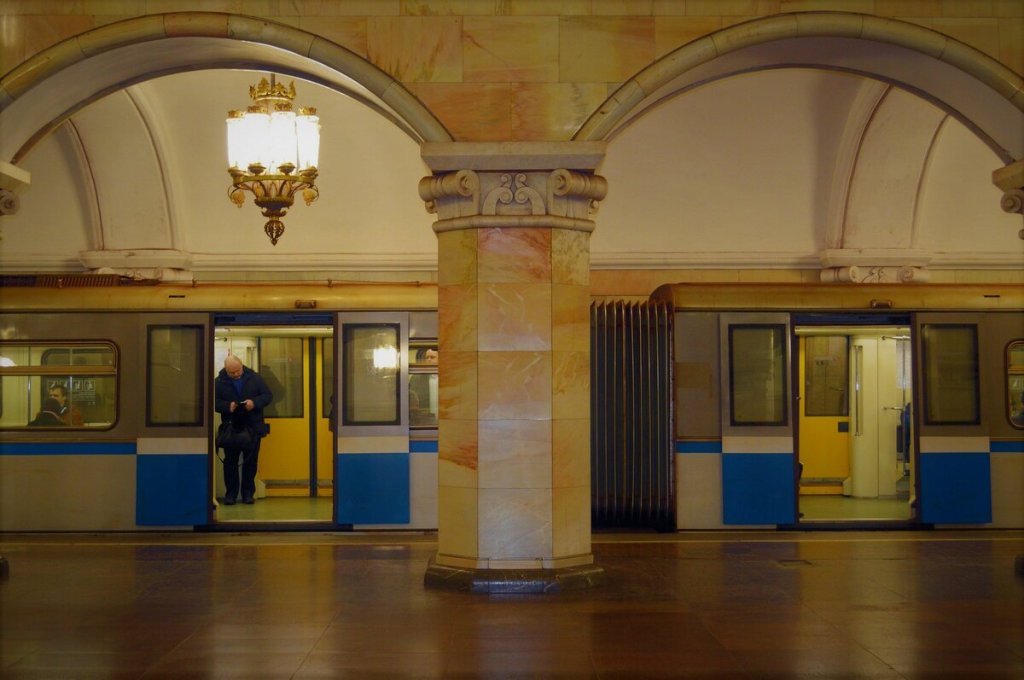
“There are more than 485 air fresheners in operation: they were installed in the air ducts of the climate control system. They spread the fragrance around the car every ten minutes. The fragrance is called ‘Moscow Metro,'” explain the metro’s press service , stressing that all the aromas were safe, hypoallergenic, and complied with regulations.
In 2019, during a vote on the project’s implementation, ninety percent of passengers surveyed said they would prefer an air-freshened carriage to a regular one. Muscovites especially wanted the smell of cherry blossoms in the subway.
What attracts people [to the shot bar Fedya, the Wildfowl!]? The irony and the simplicity, but at the same time the pleasant crowd. Here you can meet people who, the day before, dined on sets [sic] of scallops and dill sauce at designer restaurants, but they are glad to eat belyash and kvass at Fedya’s. Every other table orders kebabs (from 325 rubles) and drinks tinctures and macerations. Security guards monitor everything: if you swear loudly, they will politely ask you to leave.
Volodymyr Sakada, Yevhen Zhukov, and Volodymyr Maladyka have been sentenced to six years in prison by a Russian occupation in Sevastopol for being Jehovah’s Witnesses. Photo: Lutfiye Zudiyeva, Graty. Courtesy of Kharkiv Human Rights Protection Group
This bulletin is put together by labour movement activists in solidarity with Ukrainian resistance. More information at https://ukraine-solidarity.org/. We are also on Twitter. Our aim is to circulate information in English that to the best of our knowledge is reliable. If you have something you think we should include, please send it to 2022ukrainesolidarity@gmail.com.
To receive the bulletin regularly, send your email to 2022ukrainesolidarity@gmail.com. To stop it, please reply with the word “STOP” in the subject field.
A group of labour movement activists has launched a unique service to English language readers: up to date information about Ukraine, based primarily on independent Ukrainian voices from the front line and first-hand testimony from Russian-held territory.
The Ukraine Information Group produces a weekly Bulletin, highlighting material translated by Ukrainian civil society organisations who wish to get their message about, particularly about the areas occupied by Russia.
To receive the Bulletin by e-mail, let us know at 2022ukrainesolidarity[at]gmail.com. The Bulletin is also put out on Twitter and stored online here.
The Group aims, working in the labour movement and civil society organisations, to strengthen solidarity with the Ukrainian people resisting Russian military aggression.
Its aims state: “Conscious of the ‘propaganda war’ waged on all sides, we aim to make accessible reporting and analysis by voices independent of the state.” The Group focuses on the Russian-occupied areas because (1) the situation there throws light on Russia’s imperialist war aims and methods of rule, and (2) there are limited sources of reliable information from those areas.”
The Group started in March, with calls by elected local government representatives to support their counterparts in Ukraine who were being intimidated with kidnappings and other violence in areas occupied by the Russian army. Appeals were organised in the UK and in Switzerland.
In July 2022 the Group held two online discussions with Ukrainian civil society activists about the situation in the Russian-occupied areas, attended by supporters from across Europe. Links to recordings are here.
The Ukraine Information Group is hostile, as a matter of principle, to Russia’s imperialist assault on Ukraine. But, on the other hand, it does not automatically give unconditional or unquestioning support to the Kyiv government. The UIG stands in the tradition of socialist internationalism and seeks to work in particular with like-minded progressive organisations throughout Europe.
Convenor Simon Pirani, honorary professor at the University of Durham, said: “With the Russian announcement of annexations we have gone past another dangerous turning point. To do anything here in the UK to support Ukrainian resistance, reliable information and informed analysis is a prerequisite.”
Supporter John Palmer, former Political Director of the European Policy Centre and Europe editor at the Guardian, said: “We are committed to supporting Ukraine’s demands on the United Kingdom and the European Union for greater and continuing military, economic and social support, but we will judge NATO’s military support specifically on whether it is designed to strengthen Ukraine’s struggle against the occupiers rather than pursuing a wider NATO/Russia geo-political military confrontation which could risk the use of nuclear weapons.”
Supporter Mike Phipps, who writes for the Labour Hub website, said: “We’re not in competition with other organisations that are doing excellent work in solidarity with the people of Ukraine. Our aim is to play a specific role – bringing to a wider audience news and analysis from Ukrainian sources that can help people in the UK understand the dynamics of the situation.”
To get in touch with the Group, e-mail 2022ukrainesolidarity[at]gmail.com. Follow on Twitter @UkraineIG
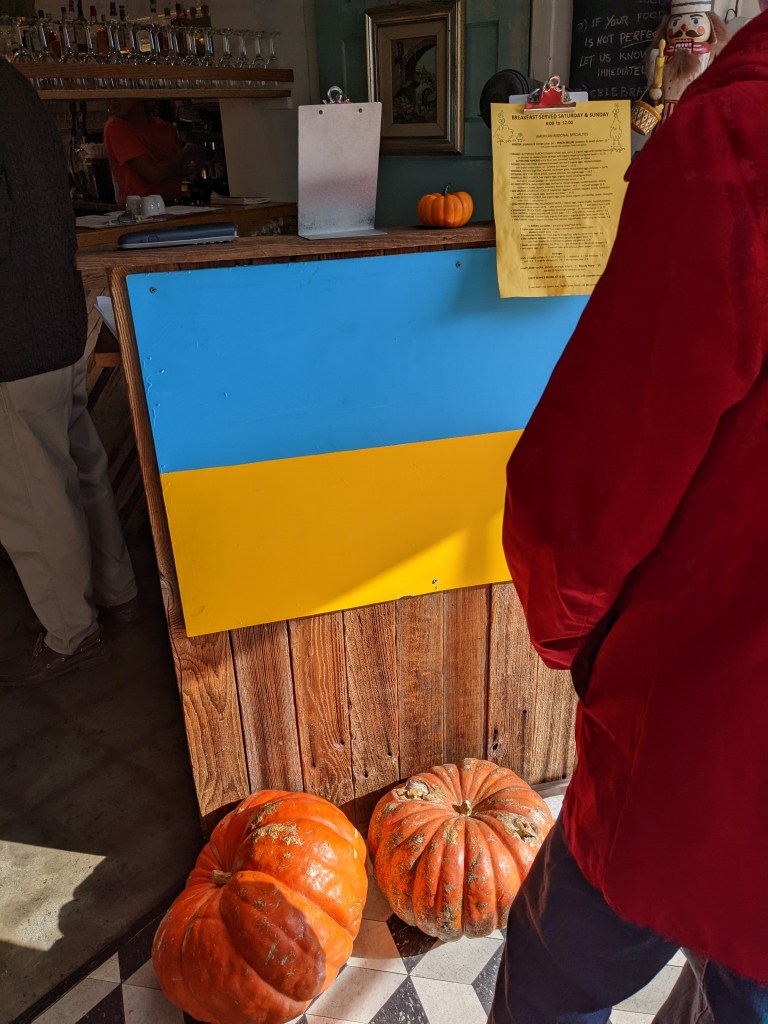
Pacific Grove, California, 17 June 2022. Photo by the Russian Reader
This bulletin is put together by labour movement activists in solidarity with Ukrainian resistance. More information at https://ukraine-solidarity.org/. We are also on Twitter. Our aim is to circulate information in English that to the best of our knowledge is reliable. If you have something you think we should include, please send it to 2022ukrainesolidarity@gmail.com.
To receive the bulletin regularly, send your email to 2022ukrainesolidarity@gmail.com. To stop it, please reply with the word “STOP” in the subject field.
Almost a fifth of households in Moscow and St. Petersburg, even those with average incomes, regularly resort to the services of female domestic workers. Most often they need help around the house, as well as looking after the elderly and children. In most cases, Russians from the region where the employers reside are hired to do this work. A study by researchers at HSE and RANEPA shows that hired female household labor, which is considered a non-essential form of employment, is a vital part of urban economies.
Photo: Yevgeny Pavlenko/Kommersant
Almost one fifth of households in Moscow and St. Petersburg, having mainly an average income, employ female labor. This is the conclusion reached by Yulia Florinskaya, Nikita Mkrtchyan and Marina Kartseva (researchers at the Higher School of Economics and RANEPA) in the article “Women as hired workers in the households of Moscow and St. Petersburg,” published in the scholarly journal Woman in Russian Society (No. 2, 2022).
The first attempt in Russia to define the scale of wage labor in households in Russia’s megalopolises, the research study was based on a survey of residents of those cities who over the past three years have employed other people to do work usually performed by family members. Three thousand eight hundred people took part in the survey; their phone numbers were selected using systematic stratified random sampling. The results of the survey are unusual: although Russians generally believe that housekeepers, domestic help, and hired staff in a household involves a high family income and migrant labor and is a rare thing, it is, in reality, a fairly common practice among middle-income households in Moscow and St. Petersburg, and it is residents of the two capitals who are mainly hired to do such work.
First of all, hiring third parties to perform work in the household is a widespread practice in Russia’s two largest cities.
According to the survey results, female workers were employed by seventeen percent of households. Formally, men are employed by households much more. In fact, respondents were asking about paid employment in the household, including for such types of work as renovations and repairs, where men predominated. (Twenty-eight percent of the households surveyed had hired male hands.) Among “household chores,” “female” specializations were also discovered that would ordinarily not be thought of as “domestic help” — tutoring, primarily. In any case, seventeen percent of Moscow and Petersburg families employed female labor in households, a figure that dropped to around seven to eight percent when tutoring and repairs were factored out. Even with this proviso, however, the phenomenon goes beyond “elite consumption for the wealthy few.”
This also shows that, according to the survey data, most of the households (61%) who employed female workers estimated their incomes as average. When answering the standard question about their income (used, among others, by Rosstat in its questionnaires), they indicated that they had enough money for food, clothing, and household appliances. Twenty-three percent of respondents rated their incomes as high (in particular, as sufficient to buy a car or more) while sixteen percent rated them as low, since they were only enough to buy food. Thus, hired domestic workers are the preserve of the middle class rather than the income elite.
The prevalence of foreign nationals or, at least, migrant workers from other regions of Russia, among domestic workers has also been greatly exaggerated. According to the survey, almost two thirds (64%) of households that purchase women’s services [sic] in the household give jobs to women permanently residing in Moscow or St. Petersburg, where they themselves live.
Only in fourteen percent of households in the two cities was the employed woman a Russian national from another region, and in sixteen percent, a foreign national. (No breakdown by nationality is given.)
However, this fact is well known within the households and is clearly discussed by them. Only six percent of respondents who had dealings with female domestic workers were not aware whether she was a Muscovite [sic], a nonresident, or a foreign national.
Of course, households most often hired residents of their own region as tutors. Among domestic migrants this type of employment was two and a half times less common, while it was practically nonexistent among foreign women. At the same time, foreign women were twice as likely to be hired to do housework as Russian women, both local and migrant. However, domestic workers in the strict sense of the term — that is, those doing “housework” (cleaning, laundry, cooking, caring, and looking after children)— are still Muscovites and Petersburgers in most cases; residents of Krasnoyarsk and Samarkand [that is, domestic and foreign migrant workers, respectively] are in the minority. The authors of the study suggest that children are a “sensitive” area for households, and local women have in this instance an advantage over migrants: households are less likely to “trust” the latter. (The authors of the study avoid reaching an alternative conclusion: that this choice is a consequence of the phobias experienced by a significant part of the middle class towards migrants — phobias that are commonly denied in the middle-class milieu, as least in Moscow.)
Residents of other regions and countries are preferred only as caregivers, and the share of this type of employment among foreign women is three times higher than among women from the same region as their employers.
Florinskaya, Mkrtchyan and Kartseva describe a rather vital social phenomenon: migrant caregivers ask for their work, which is in demand among all strata of society, significantly less pay than do Russian nationals, and for most relatively poor households there is no alternative to hiring them, as they simply cannot afford a nurse from Moscow. But to carry out repair work, local women and migrants were hired with approximately the same frequency: the wallpaper pasted by a Ukrainian woman cannot be distinguished from the wallpaper pasted by a Petersburg woman, even by a specialist.
Finally, wage labor in households is extremely informal. Most often households hired female employees using recommendations from their acquaintances or relatives (63%), and more than two thirds of the households draw up written contracts when hiring female employees. The xenophobia of Muscovites has been exaggerated: female foreign workers lived in the household in a third of cases. (By contrast, 2.4% of households provided housing to residents of their own region, and 18.8% to migrants from within Russian Federation.)
The cautious attitude of Russians to hiring female employees to work in their households is, rather, a late Soviet legacy. After the tradition of employing “servants,” which was relatively common in large Soviet cities among the middle class, disappeared in the late 1940s and early 1950s, the term sounded somewhat insulting from the 1960s until today, and was replaced by euphemisms like “a woman who comes over.” The restoration of the practice is expected, and yet, as the study shows, this phenomenon (if only by virtue of its magnitude) is a vital albeit understated part of the modern urban economy of Russia’s megalopolises.
Up to two-thirds of Russians do not have any savings. Two-thirds of Russians can only afford food and clothes while buying durable consumer goods for them is extremely difficult. Russia is a very poor country, and now, on top of that, we have sanctions that will destroy the lives of ordinary people even further.
Season after season, minimalism remains trendy. If we also consider the current popularity of 80s and 90s styles, it comes as no surprise that miniskirts are in fashion again. Moreover, they’re fashionable everywhere: they can and should be worn to parties with friends, exhibitions, and work. When you wear them to work, you just have to follow a few simple rules.
Busting myths
There are many myths surrounding the miniskirt. Many people still believe, for example, that discos are the only place you can wear a miniskirt. Yes, partying hard in a plush or stretch skirt to songs by Kombinaciya is super authentic, but today’s cotton, denim and leather miniskirts suit almost any situation.
It’s also worth dismissing the old saw that miniskirts can only be worn by slender, long-legged beauties. No matter how long a skirt is, what matters is that it fits your figure. If you’re having doubts, take a closer look at A-line-silhouette skirts. They can be worn with matching tight tights to visually elongate the lower part of your body.
The best combos: shirts and blouses
Shirts and blouses are staples in a female office worker’s wardrobe. Combined with a miniskirt, they will look winning if you choose accented models — blouses with bows or ruffles, shirts with puffy sleeves or turndown collars. Classic stiletto shoes, mules with shot-glass heels, heavy boots, or sneakers will complete the look.
Oversize jackets
Looking like a hand-me-down, an oversize jacket will balance out a short skirt and create a confident image for work. You can tone down this cute pairing with a loose-fitting t-shirt or top—or a tight turtleneck when the weather turns cold. As usual, what item you choose depends on whether it passes muster with your company’s official and implicit dress codes.
Cropped jackets
One of the season’s most daring combinations is a miniskirt and cropped jacket. Ideally, you should find this combo readymade, since combining two separate items into an harmonious outfit is no easy task. Universal advice: a cropped jacket should have a loose fit and a large shoulder line.
Sweaters, jumpers, cardigans, sweatshirts Summer is not the only season for wearing a short skirt. In autumn and winter, you should wear a mini with chunky-knit sweaters, jumpers, cardigans, and sweatshirts. You can either tuck in the front of your top, or wear it untucked. In the second case, if you choose a pleated plaid skirt and combine it with a shirt and a cardigan, you’ll get the look of an American high school student.
T-shirts
If your work dress code is not particularly strict or casual Friday is coming up, grab a short denim skirt and a loose-fitting t-shirt from your wardrobe. Monochrome or minimalist graphic print t-shirts are suitable for the office. The sleeves can be long and, thus, easily rolled up at any moment—convertible items have been trending for more than a year. The skirt itself can be either the usual blue denim color, or black, or white. City sneakers or loafers provide the final notes in this outfit.
Source: Maria Gureyeva, “How to wear short skirts to work: a mini for every day,” Rabota.ru, 11 July 2022. Photos courtesy of iStock and Rabota.ru. Translated by the Russian Reader
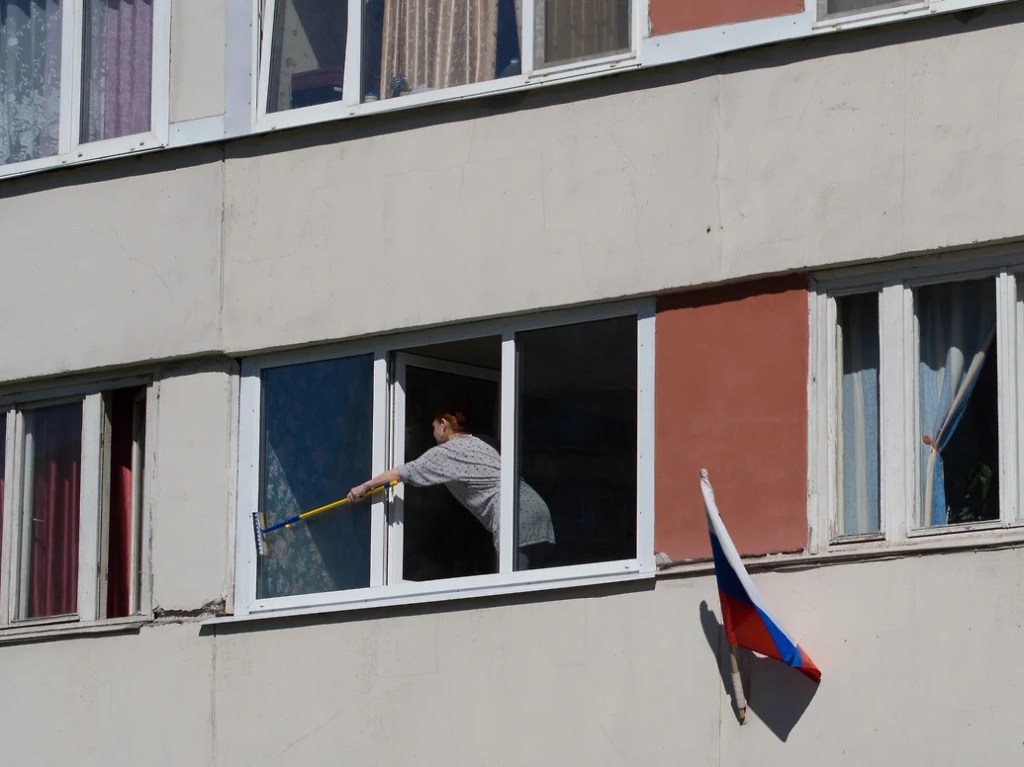
Somewhere in central Petersburg, 8 July 2017. Photo by the Russian Reader
A few words of explanation.
I’m still reeling from the fact that, as a much savvier IT friend from Petersburg has patiently explained to me, this website was just switched off in Russia by WordPress (Automattic), acting on orders from Rozkomnadzor, the Russian federal communications watchdog.
It makes me wonder whether I should switch to producing more “Russia-friendly” content, as exemplified by the breezy little item above the fold. It also makes me wonder whether I shouldn’t switch to a hosting platform that is more friendly to content that is critical of the current Russian tyranny.
In any case, I’ve realized that WordPress doesn’t always practice what it preaches.
Access to the Internet is subject to restrictions in many countries. These range from the ‘Great Firewall of China’, to default content filtering systems in place in the UK. As a result, WordPress.com blogs can sometimes be inaccessible in these places. As far as we are concerned, that’s BS.
If any of you know about an affordable and rigorously pro-free speech hosting platform where I could move this blog, please write to me at avvakum (at) pm.me.
How else can you help me keeping this slightly waterlogged boat from sinking altogether?
First, you can hare my posts with friends and colleagues and on your social media accounts. The only way I know for sure that this is worth doing is when I see consistently large readership numbers.
Second, please send me your (positive or constructive) feedback in the comments below each post or at avvakum (at) pm.me.
Finally, you can donate money—via PayPal or Ko-Fi—to support the continuing production of this website.
What do I need the money for? First, I have to pay for this website’s hosting and for the internet, which now runs me around a thousand dollars a year. Second, I would love to be able to pay a small fee to my occasional guest translators and certain contributors. Finally, I’d like to pay myself for the long hours I put into this endeavor.
What would be a fair amount? Consider the fact that, so far this year, The Russian Reader has had over 155,000 views. If I were to get a mere ten cents for each view, that would come to 15,500 dollars. The money would be especially welcome now that, since February, my income from my “real” job as a freelance translator and editor has dwindled to practically nothing, as most of my steady clients were more or less progressive Russian art and academic institutions that have gone into international hibernation due to the war. In any case, I would share this (for now, imaginary) “minimum wage” with guest translators and contributors, as well as using it to pay for more supportive and reliable hosting.
Speaking of jobs and work, I was made party to the strange (and depressingly reactionary) item, translated above, because, around a year ago, the website Rabota.ru (“Work.ru.,” an affiliate of the state-owned Sberbank) decided that I was a forty-six-year-old geologist named Semyon Avvakumov. The real Comrade Avvakumov used my personal email address, apparently and unaccountably, to start an account and file job applications through Rabota.ru, not realizing that the address was already taken. So, I now get Rabota.ru’s job listings and newsletters several times a week—as well as, much more occasionally, rejection letters from Comrade Avvakumov’s potential employers. The articles on Rabota.ru shed a revealing, if not always flattering, light on all things work-related in Russia, so I’m glad to have acquired this double. ||| TRR, 12 July 2022
What is life like for us under fascism? It’s fine. I eat, sleep, work, play computer games and football, and get laid.
Repairs have begun on the roofs of the Soviet high-rise buildings on my work beat. The contractor drags powerful electric roofing kettles onto the roof, hacks away the old tar, melts it down, and immediately pours it back onto the roof. The kettles are powerful—advanced technology that works quickly and efficiently.
The kettles are also five years old. They are left right on the roofs over the winter, and so they are rotted and burned out. The molten tar splashes onto the cables, and everything in the vicinity burns and smokes. It is no exaggeration to say that you can smell the stench two blocks away. It is unlikely that there is anything healthy in the fumes generated by the molten tar. It is Uzbeks who work on the roofs: their bosses persist in calling them jigits. They work without safeguards or personal protective equipment. On the first day, they asked their bosses for water. Their bosses told them to get it themselves—”otherwise, next time they’ll be asking for broads in bikinis.”
Yesterday the cops nabbed them. The cops told them, “Your registration isn’t in our database. So, you either spend a couple days in jail until we figure it out, or you each cough up 5,000 rubles now.” [At the current—official—exchange rate, 5,000 rubles is approximately 88 euros.]
Do you think there is a database somewhere that says that you are just a human being?
Their electrician is from Bashkiria, a skinny kid in glasses with a typical whistling accent. He graduated from an architectural college back home, came to Petersburg, and worked on a low-voltage network for a couple of months, but now has been hired as an electrician servicing the three-phase fifty-kilowatt kettles. On the first day, he regarded the whole setup with mortal dismay. In his bag he has a set of screwdrivers and a crimper for patch cords. Now he dives into the overheated equipment, changes the burnt-out heating elements, and splices the burnt, beaten cables. Then he unsuccessfully tries for hours to wash off the oil stench.
“Who will pay for your disability?” I ask him.
“They can’t pay us overtime.”
He put up with this as long as he could before breaking down and going on a drinking binge. He squandered all his money, arriving back at work with a black eye and his left cheek puffed up like a pillow. His glasses were still intact, however. He asked me to lend him money for beer.
“How much do they pay you?” I ask.
“They promise mountains of gold.”
“Could you be more specific?”
“It’s daily work. 2,500 rubles a day.”
The word he was looking for in Russia was “daywork” [podënnaia], not “daily work” [podnevnaia]. There is such a thing as “daywork” and “dayworkers.” Who make sixteen dollars a day if you calculate their pay in terms of the actual exchange rate.
How much does the Russian lad Vitya, who made the remark about the “broads in bikinis,” make? How much does their supervisor, a handsome, businesslike, quick-thinking middle-aged man with shifty eyes, make?
What will they buy for themselves by pinching the money budgeted for roof repairs? A car? A tiled path for their dacha? When they walk on this path, will they think about the people whose health has been permanently scarred by tar on hot roofs? I doubt it.
Fascist brutality springs from this everyday, workaday brutality. Indifference to people as individuals grows from this virtually legalized slavery.
Source: George Losev, Facebook, 28 June 2022. Mr. Losev works as an on-duty electrician for the housing authority in Petersburg. He points out that the roofing tar kettles he describes are nothing like the one in the video I inserted, above. They are much larger and electric-powered. This is not to mention that “Alfredo the kettle man” (in the video) is wearing protective equipment, unlike the Uzbek workers in Mr. Losev’s story. Translated by the Russian Reader
I was asked to show how to make a “syllable tram.”
I scanned the roadway (see the links, below). The drawings were quite hastily done, right before class. (
The strip should be glued with adhesive tape on the reverse side. (Leave a millimeter between the sections so that it is easier to fold and store.) The tram, which is approximately 290 mm wide (nearly the same width as an A4 sheet of paper) and 85 mm high, is fitted onto the strip. One window in the tram is cut out, and a transparent sleeve is pasted on the other, into which a consonant is inserted.
The strip needs to be fastened with something. (I fastened it to the table with tape.)
The tram travels from right to left. When it reaches a marked stop, a vowel appears in the cut-out window. When you make the tram, test it and draw the letters on the strip so that they appear in the exact same place as the empty spot.
Source: Natalia Vvedenskaya, Facebook, 28 June 2022. Ms. Vvedenskaya teaches Russian to immigrant children at the St. Petersburg Jewish Community Center. Most of these children are originally from Central Asia, like the workers in Mr. Losev’s story. The first image, above, is a screenshot of a short video that Ms. Vvedenskaya included in her original post, showing her pupils playing with her “syllable tram.” Translated by the Russian Reader