This presentation introduces a book project on the first decades of Russian colonization in Eastern Siberia, present-day Yakutia. Rather than framing colonization solely as a process of conquest and political alliance-building, the project foregrounds intimate and gendered entanglements between Russian newcomers and Indigenous communities. Russian fur traders, trappers, and military servitors typically arrived in the region without families and encountered Yakut, Tungus, Yukaghir, and Even populations. The resulting gender imbalance among settlers quickly made the trade in Indigenous women a profitable enterprise. At the same time, commercial transactions sometimes culminated in Orthodox marriages, blurring the boundaries between coercion, commerce, and social integration. By examining these practices, the study explores how racial, cultural, and religious boundaries were negotiated in everyday interactions between Russian colonizers and Indigenous societies in seventeenth-century Eastern Siberia.
There were three ways to acquire women in Eastern Siberia. The first was as the outcome of military expeditions, sometimes referred to as ‘pogroms’ in the documents. When Russian troops attacked local settlements or nomadic camps and emerged victorious, they would seize women, children, and cattle as spoils of war. Enslavement of women during times of conflict had deep roots in Siberian history. Historical documents provide numerous accounts of inter-ethnic military clashes that resulted in the plundering of the defeated, particularly involving the capture of women, children, and cattle.
A petition from 1642 for the baptism of a Yakut woman named Katok includes Katok’s explanation of why she desired to convert to Orthodoxy where she shares her life story. She recounts that she could not recall her father’s name as she was taken by Russians during a ‘pogrom’ when she was only a child. She further explained that she had previously lived ‘among Russians,’ but that she now has nothing to eat or drink and was starving to death. In short, Katok was forcibly captured from her community as a child, likely being one of those taken as trophies from the defeated local community.
Another form of enslavement in Siberia involved trafficking, where local people would sell their relatives to Russians. Sometimes the locals would sell their women to combat poverty. Gurvich mentioned that the Yukaghirs of Yana River sold their maidens and children to Russians because of hunger in 1659. However, the women sold to Russians were not always orphans or from poor families. There are documented cases where individuals of higher social status willingly sold their daughters. For instance, local prince Orgui sold his daughter Mychak to a Russian serviceman for a cow.
Russians did not necessarily purchase or capture local women in battle; sometimes they acquired them without any effort or payment. One such case is preserved in historical documents. It tells the story of Ladchka, a Yakut woman who was abandoned by her husband and left with no means of support. She sought refuge in the Russian camp and resided there for two years before eventually being brought to Yakutsk with her child in 1643. During her interrogation, Ladchka revealed that she had been a slave (‘yasyr’) of the fur trader Oderka Martemyanov. She had a child with him and expressed her desire to be baptised. It appears that Martemyanov acquired this woman without any cost, lived with her for a period, and then seemingly cast her aside.
An exhibit at the Cooper Molera Adobe museum in Monterey, California. Photo: The Russian Reader
Cooper Molera Adobe is now pursuing the interpretation of Ohlone/Esselen/Costonoan Native Indian slaves at our historic site. This includes evaluating our history, beyond gaining simple historical information and respectfully work with descendants to then forge a richer, more diverse narrative and legacy.
Three pillars of multi-disciplinary research, relationship building, and interpretation as major benchmarks will guide our methodology as we move forward with this project. Cooper Molera Adobe has partnered with Woodlawn Pope Leighey and Shadows on the Teche as a working group in a large network of sites the National Trust has to move toward this collective goal.
Failing to tell the truth about race and slavery results in widely-held fears of engaging with people who look, speak, act or think differently than oneself. It is lived out in anger and despair in feeling marginalized, erased, and invisible due to demographics or identity.
Follow us on Instagram, Facebook, and our website to see more of our updates in the future for this project.
On April 27, 1863, nearly five months after President Abraham Lincoln issued the Emancipation Proclamation, California abolished its system of forced apprenticeship for American Indians. Under the apprenticeship provisions of the state’s Act for the Government and Protection of Indians, several thousand California Indians, mostly children, had suffered kidnapping, sale and involuntary servitude for over a decade.
Newly elected California Republicans, eager to bring California in line with the national march toward emancipation, agitated for two years in the early 1860s to repeal Indian apprenticeship. And yet those Republicans’ limited vision of Indian freedom — one in which Indians would be free to reap the fruits of their labor, but not free from the duty to labor altogether — made for an incomplete Indian Emancipation Proclamation. Although California was distant from the battlefields of the Civil War, the state endured its own struggle over freedom that paralleled that of the North and the South.
The Republican campaign to abolish Indian servitude ran up against nearly a century of coerced Indian labor in California. Under Spanish and Mexican rule, thousands of California Indians worked on missions and ranches, bound to their employment through a combination of economic necessity, captivity, physical compulsion and debt.
With the United States’ conquest of California in 1847, the discovery of gold in 1848 and the formation of a state government in 1849, new American lawmakers expanded and formalized Indian servitude to meet growing demands for labor. The 1850 Act for the Government and Protection of Indians authorized whites to hold Indian children as wards until they reached adulthood. Indian adults convicted of vagrancy or other crimes could be forced to work for whites who paid their bail.
Skyrocketing demand for farmworkers and domestic servants, combined with violence between Indians and invading whites in the northwestern part of the state, left Democrats in war-torn counties clamoring for the expansion of the 1850 Indian act. A “general system of peonage or apprenticeship” was the only way to quell Indian wars, one Democrat argued. A stint of involuntary labor would civilize Indians, establish them in “permanent and comfortable homes,” and provide white settlers with “profitable and convenient servants.” In 1860, Democrats proposed new amendments to the Act for the Government and Protection of Indians that allowed whites to bind Indian children as apprentices until they reached their mid-20s. Indian adults accused of being vagrants without steady employment, or taken as captives of war, could be apprenticed for 10-year terms. The amendments passed with little debate.
As the nation hurtled toward a war over slavery, Californians watched as their own state became a battleground over the future of human bondage. Apprenticeship laws aimed at “civilizing” the state’s Indians encouraged a robust and horrific slave trade in the northwestern counties. Frontier whites eagerly paid from $50 to $100 for Indian children to apprentice. Groups of kidnappers, dubbed “baby hunters” in the California press, supplied this market by attacking isolated Indian villages and snatching up children in the chaos of battle. Some assailants murdered Indian parents who refused to give up their children.
Once deposited in white homes, captive apprentices often suffered abuse and neglect. The death of Rosa, a 10-year-old apprentice from either the Yuki or Pomo tribes, provides a grim case in point. Just two weeks before the repeal of Indian apprenticeship, the Mendocino County coroner found the dead girl “nearly naked, lying in a box out of doors” next to the home of her mistress, a Mrs. Bassett of Ukiah. Neighbors testified that the child was sick and restless and that Basset shut her out of the house in the middle of a raging snowstorm. Huge bruises on Rosa’s abdomen suggested that Bassett had mercilessly beaten the ill child before tossing her out into the blizzard. Mendocino officials never brought charges in the case.
The horrors of kidnapping and apprenticeship filled the state’s newspapers just as antislavery California Republicans swept into power in 1861–2. Republicans assailed the apprentice system and blamed Democrats for the “abominable system of Indian apprenticeship, which has been used as a means of introducing actual slavery into our free State.” George Hanson, an Illinois Republican whose close relationship with Abraham Lincoln earned him an appointment as Northern California’s superintendent of Indian affairs, vowed to eliminate the state’s “unholy traffic in human blood and souls.” He tracked down and prosecuted kidnappers in the northwestern counties (with mixed success) and petitioned the State Legislature to abolish the apprenticeship system.
In 1862, Republican legislators proposed two new measures to overturn the 1860 apprenticeship amendments. Democrats blocked these bills and insisted that apprenticeship “embodied one of the most important measures” for Indians’ “improvement and civilization.” Indian servitude lived on.
By the time the legislature met again in the spring of 1863, however, all signs pointed to the destruction of the apprenticeship system. Republicans won firm majorities in both houses of the State Legislature, and in January California became the first state to endorse Lincoln’s Emancipation Proclamation. Republicans again proposed to repeal the apprenticeship amendments, and this time they achieved their goal with no debate or dissent. Involuntary labor for American Indians died quietly.
Or did it? Republicans had eliminated all the 1860 amendments authorizing the forced apprenticeship of American Indians. But they had left intact sections of the original 1850 act that mandated the forcible binding out of Indian convicts and vagrants. Moreover, repeal only prevented future apprenticeships; Republican legislation did not liberate Indians already legally apprenticed. After repeal, as many as 6,000 Indian children remained servants in white homes.
The incomplete nature of Indian emancipation in California reflected Republicans’ own ambivalence toward Indian freedom. Most Republicans opposed the kidnapping and enslavement of Indians. They believed that Indians, like former African-American slaves, should be entitled to reap the economic rewards of their own work. On the other hand, they asserted that the key to “civilizing” Indians was to force them to participate in the California labor market. They could not be free to support themselves through traditional mobile hunting and gathering practices that removed their labor from white supervision and tied up valuable natural resources. Such a lifestyle was, in Republicans’ minds, little more than idle vagrancy. Just as their Republican colleagues on the East Coast argued that ex-slaves should be schooled to labor by being bound to plantation wage work through long-term contracts, California Republicans began to advocate compulsory labor as the only way to cure Indian vagrancy.
The Republican vision for Indian freedom quickly took shape after the Civil War. Republican appointees who oversaw California’s Indian reservations compelled all able-bodied Indians to work on the reservation farms. Those who refused, or who pursued native food-gathering practices, forfeited the meager federal rations allotted to reservation Indians. By 1867, one Republican agent declared that “the hoe and the broadaxe will sooner civilize and Christianize than the spelling book and the Bible.” He advocated forcing Indians to work until they had been “humanized by systematic labor.” These policies persisted long after the war. At Round Valley Reservation, one critic observed in 1874 that “compulsion is used to keep the Indians and to drive them to work.” Indian workers received no payment for “labor and no opportunity to accumulate individual property.”
The ambiguous postwar liberty of California Indians reveals that the Civil War was a transcontinental conflict that reached west to the Pacific. The freedoms won in wartime, and the unfulfilled promises of emancipation, encompassed not only black and white, free and slave, but also American Indian peoples who suffered from distinctly Western systems of unfree labor. The Civil War and Reconstruction are best understood as truly national struggles over the meaning and limits of freedom, north, south and west.
Confusion about how sex trafficking works and who qualifies as a victim has compounded the problem. The government’s 2019 indictment charged Epstein with trafficking minors between 2002 and 2005, the period covered by his earlier Florida plea deal. The adult women Epstein entrapped after his 2008 conviction weren’t included in the indictment.
In 2019, prosecutors brought charges using the minimum number of victims needed to apprehend Epstein in order to keep the case secret and avoid him fleeing, according to people familiar with the investigation.
Prosecutors continued interviewing victims after his July 2019 arrest and had planned to expand the indictment, including potentially to adult women, had Epstein not died the following month, according to these people and a 2019 Justice Department memo released in the files.
For sex-trafficking cases involving adults, prosecutors must prove the victim was compelled into sexual exploitation through force, fraud or coercion. Fraud typically involves false promises of employment or a better life; coercion can be psychological and take the form of threats of deportation, blackmail or debt bondage, lawyers said.
Federal prosecutors have successfully prosecuted cases of adult sex trafficking. In 2019, the Nxivm group founder Keith Raniere was convicted for his exploitation of adult women and sentenced to 120 years in prison.
Most recently, the Alexander brothers were convicted in a case in which adult women testified that they had been lured to exclusiveparties and trips, then drugged and assaulted. Lawyers for the Alexander brothers said they planned to appeal.
Pyramid scheme
After his 2008 plea deal, Epstein shifted his focus to adult women who looked like teenagers—many of them fashion models from Europe and Russia. He dangled fake jobs linked to his famous connections, promising work at places like Victoria’s Secret. He rarely delivered.
Once inside his orbit, the women said they were coerced into performing massages that escalated into sexual demands. Several have said he required at least one such encounter a day, and when no other women were available, he turned to his “assistants.”
Contemporary listeners of Kino’s hit album Blood Type (1988) would have had no trouble identifying the war alluded to in the title track: the Soviet-Afghan War was still ongoing. The war was one of the causes of the Soviet Union’s sudden collapse in 1991. Unless it is stopped in short order, the Trump regime’s just-as-needless war against U.S. cities will lead to the collapse of the United States. ||||| TRR
The Soviet–Afghan War took place in Afghanistan from December 1979 to February 1989. Marking the beginning of the 47-year-long Afghan conflict, it saw the Soviet Union and the Afghan military fight against the rebelling Afghan mujahideen, aided by Pakistan. While they were backed by various countries and organizations, the majority of the mujahideen’s support came from Pakistan, the United States (as part of Operation Cyclone), the United Kingdom, China, Iran, and the Arab states of the Persian Gulf, in addition to a large influx of foreign fighters known as the Afghan Arabs. American and British involvement on the side of the mujahideen escalated the Cold War, ending a short period of relaxed Soviet Union–United States relations.
Combat took place throughout the 1980s, mostly in the Afghan countryside, as most of the country’s cities remained under Soviet control. The conflict resulted in the deaths of one to three million Afghans, while millions more fled from the country as refugees; most externally displaced Afghans sought refuge in Pakistan and in Iran. Between 6.5 and 11.5% of Afghanistan’s population of 13.5 million people (per the 1979 census) is estimated to have been killed over the course of the Soviet–Afghan War. The decade-long confrontation between the mujahideen and the Soviet and Afghan militaries inflicted grave destruction throughout Afghanistan, and has been cited by scholars as a significant factor contributing to the dissolution of the Soviet Union in 1991; it is for this reason that the conflict is sometimes referred to as “the Soviet Union’s Vietnam”.
Source: Wikipedia. The emphasis, in the last paragraph, is mine. ||||| TRR
[…]
The pretext for this war, of course, has always been a bogus premise. Yet federal agents treat it with the dogma of settled fact. But I keep wondering: How does the average CBP or ICE agent convince themselves of this? Even now, I can’t help shake the absurdity of anyone—Trump, Gregory Bovino, whomever—hoping to convince a thinking person, even themselves, to believe that places like Minneapolis have ever required an armed occupation. It’s against this genuine perplexity that I keep coming back to how these officers look and what mirrors might reflect back to them when they dress up for war.
“Anybody who’s had a fun evening on Halloween can understand what happens when somebody fully dresses up in paramilitary gear with flash-bang grenades hanging off of them,” said Peter Kraska, a justice studies professor at Eastern Kentucky University. “They’re going to walk out in public and say to themselves, ‘I am different from all these people.’ They become the enforcer. And when they look out and see the other, they see an enemy. The [paramilitary gear] gets them to react differently and think differently than they normally would.”
The role of military-style uniforms in helping the Trump administration create a theater of war where none exists cannot be overstated. It marks a stark evolution from the early days of Trump’s mass deportation plans, when plainclothed agents looked a lot like your best friend’s worst boyfriend—the guy who moved to rural Pennsylvania and discovered the basement levels of gun culture. Now, agents march into town in the costume of a foreign invasion.
Consider the camouflage now ubiquitous across the cities ICE occupies. At first, the pattern’s technical science might seem like a natural extension of the Trump administration’s increasingly illegal efforts to shield the identities of the men carrying out its vision of cruelty. But the theory breaks down when you look at the urban landscapes where ICE hunts down immigrants. Simply put, wearing camo in places like Lake Street or Hyde Park defies its central aim. If camo’s built-in purpose is to avoid detection, ICE’s embrace of it is the opposite: They want maximum visibility. They want to show they are soldiers. And they want to do so to make it seem reasonable, if only to themselves, to act like an invading army.
When I reached out to the Department of Homeland Security about the use of military gear among ICE agents, spokesperson Tricia McLaughlin responded with her own question: “Why do ICE agents wear tactical gear when they are facing rampant assaults and vehicular attacks? Is that the question you’re asking?” No, not really. But the snark with which McLaughlin replied was enough to grasp that questioning why DHS employs camo when lush woodlands do not exist in the cities its agents invade was irrelevant. They are dressing for the war they want.
What other way was there to interpret the coat of the former envoy of terror, Bovino? The commentariat spent much time deliberating its lineage, whether or not Bovino’s hulking olive garb was in fact true Nazi wear. (It turns out it was not.) But in roaming around Minneapolis in the fashions of Hugo Boss circa 1933, Bovino, who reportedly travels with his own film crew, succeeded in pushing the optics of war where it does not exist.
“What you’re seeing is the functionality of gear for legitimate, militarized purposes versus a type of postmodern, performative imagery,” Kraska said. “It makes them feel a particular way, to tap into those warrior fantasies and masculine drive of, ‘I’m a real man, I’m a real badass.’”
Federal agents stand outside the Whipple Federal Building in Saint Paul, Minnesota, on 8 January 2026. Photo: Octavio Jones/AFP/Getty/Mother Jones
The same holds for the men under Bovino. These are federal agents who wear hats intended for jungle warfare—again, in Minneapolis, where no such jungle exists—as well as blood-type patches, despite little evidence that they would ever be needed. After all, they are in Minneapolis, an American city with American hospitals, where doctors provide blood transfusions without the help of uniform instructions, the way a soldier on a remote battlefield might actually need. Furthermore, ICE’s own data strongly undercuts the notion that the job of an ICE officer is even uniquely dangerous work. In the absence of peril, federal agents turn to costume to legitimize their presence.
I want to try and describe what it is like in Minnesota right now for my friends in other states. As a reminder, Alyse and I live in the suburbs — Apple Valley — not Minneapolis. This federal invasion and occupation is occurring all across the state, not just in Minneapolis.
ICE is not looking for specific people. They don’t have a sheet of paper with specific names, specific addresses, that they are arriving in communities to get. They drive around looking for kidnappings of opportunity.
So they will sit and idle in their car, waiting for a Black, brown or Asian person who is walking into the gas station, taking out their trash, walking their dog, or working at their job and then swarm and grab them.
ICE drives around *incredibly recklessly* and uses license plate readers to find people with mostly-Hispanic sounding last names, pulls them over, and kidnaps them. Again, these aren’t specific people ICE has been tasked with finding. Most of the people who are kidnapped are U.S. citizens, lawful permanent residents, or have legal status of some sort (work permit, a social security number, or are a refugee or asylee) (picture 1). These are documented immigrants or citizens who have broken no laws — including not having broken laws entering the country. These are people just going about their daily life who get stopped and snatched because they’re Black, brown or Asian.
Just going about OUR daily life, we see abandoned cars in the middle of highways, on neighborhood streets, in front of doctors offices. Sometimes the doors are still open and the car is still running. We could be in line to get Burger King and watch ICE snatch a teenager on his way into work (picture 2). We could be taking out the trash, walking kids to the bus stop, going for a walk outside, and there will all of a sudden be a swarm of anonymous, masked, violent men ripping a family from their home or out of the booth at a restaurant. Picture 3 is a neighborhood, one mile from my house, at 8:30AM this past Wednesday. It was school bus pick up time and also trash day in that neighborhood. This is just in the middle of the neighborhood.
This can happen any where at any time. There is no place we can go and be assured we won’t see someone be violently taken. Target. The grocery store. A restaurant. Driving Hattie to swim lessons. Driving to church. Going to the doctor (picture 4). Multiple times a day, we get texts from co-workers, neighbors, friends, family members about a person they know (or are related to, or work with, or are their kids’ friends parents) who was taken.
ICE sets up checkpoints in neighborhoods and make everyone leaving or entering show their papers (note: very few people can prove their citizenship at a moments notice. A majority of Minnesotans don’t have passports. Citizens don’t just carry their birth certificate around). They go door-to-door in apartment buildings and neighborhoods, just hoping a Black, brown or Asian person will open their door (because they have no judicial warrant to take a specific person(s), just kidnapping whoever accidentally opens their door).
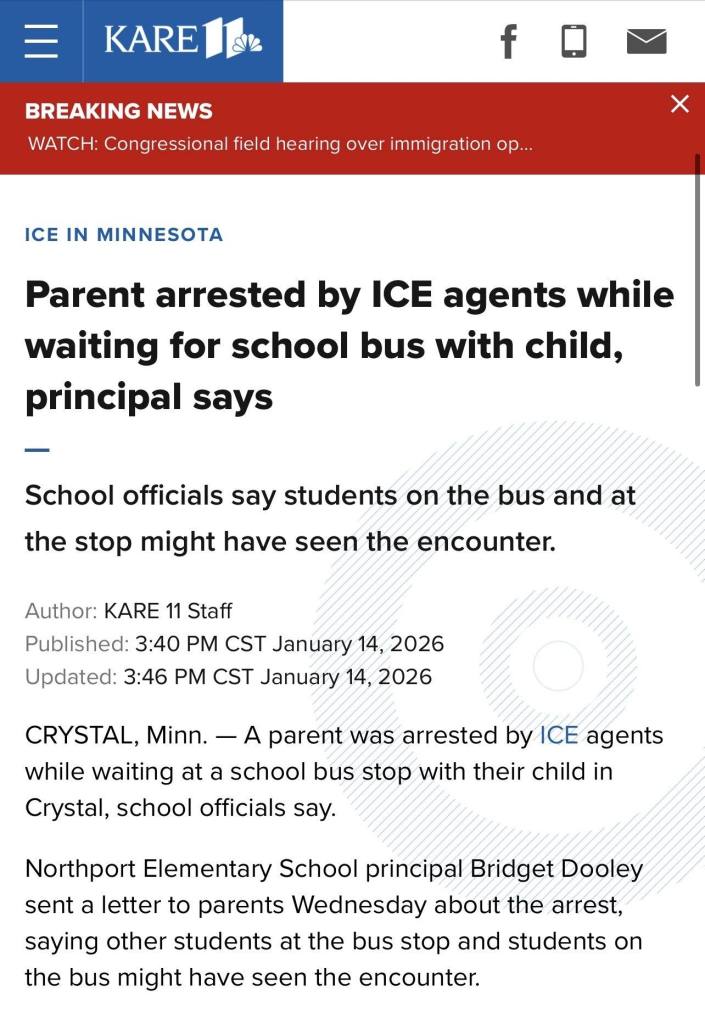
Schools have had to close. ICE has shown up to schools and just pepper sprayed kids and parents (picture 5). Districts are calling families and advising that their kids switch to online school. ICE circles and targets Spanish-immersion programs, forcing moms and dads to sit watch over their kids’ school to keep their kids and teachers safe (picture 6). Kids come home from school to empty houses, their parents having been stolen sometime during the day. When parents are kidnapped in front of others, they will yell out their full names and the name of their kids’ school(s) so someone can call the school and alert the administration, hoping their kids can be put with a safe adult instead of coming home to no one. There are people who signed delegation of parental authority (DOPA) forms — agreeing to take a neighbor or friend’s kids in the event of an emergency — who now have multiple children from multiple families.
ICE is ubiquitous. They are everywhere. We see them 3, 5, 7 times a day just going through our normal routine. There are more federal agents in Minnesota than there are local law enforcement from the ten largest metro police departments COMBINED (picture 7).
This is going to come to other states and I want people to be prepared, because I cannot overstate how many people have (had to) come together to respond.
Regular Minnesotans — people who have never once gone to a protest, called their elective representatives, participated in an economic strike, people who rarely even vote — have been activated. Grandparents carry whistles in their cars in case they come across ICE while living their lives and need to warn the surrounding area. Parents of kids in K-12 organize to ensure there’s parents at bus stops and the area around schools, because ICE stakes out bus stops and school properties — taking parents who are waiting at the bus stop or in the carpool line (picture . We’ve set up massive food donation and delivery infrastructure. We organize rides to school and work. People are literally taking in families.
SO many kids aren’t going to school right now (picture 9). So many businesses are closed or have lost their customer base entirely. So many families are facing eviction because they can’t go to work and won’t be able to pay their rent.
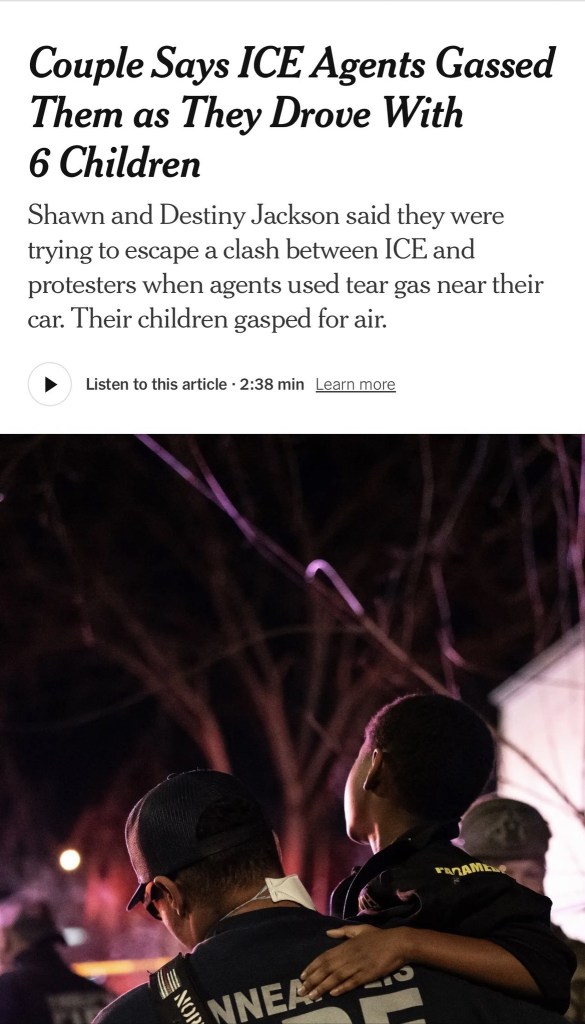
Minnesotans are being collectively punished and traumatized. 6 month old babies have been teargassed because their parents are just driving in their own neighborhood (picture 10). We are coming together in the most beautiful ways — I don’t want to understate that. But I want everyone outside of Minnesota to understand: we are under a federal invasion and occupation of armed, masked, paramilitary that roam our streets, brutalizing, harassing and murdering with impunity.
There may be people who might think that when this comes to your state, being white or being a U.S. citizen or living in a suburb or rural area or living in a neighborhood with few or no immigrant neighbors means you won’t see or experience this kind of daily assault of an invasion and occupation. I want to dispel that idea.
There are things I’m forgetting, certainly, but I wanted to try and paint the picture because this isn’t ending in Minnesota. We are the test case before expanding to other states in the country.
Help us now to stop this before it spreads. Organize in your communities now.
On January 7 U.S. Immigration and Customs Enforcement (ICE) agent Jonathan Ross shot and killed Renee Good, a thirty-seven-year-old woman who had been observing ICE raids from her car in her Minneapolis neighborhood. In videos of the incident, we can see Ross firing through Good’s windshield and open window as she begins to drive away. The horrific footage of the killing felt like a stark symbol of today’s authoritarian moment—but at the same time, I knew that anyone involved in the struggle against police violence would find it tragically familiar.
To put Good’s killing in context, I spoke with historian and Boston Review contributing editor Robin D. G. Kelley, whose forthcoming book, Making a Killing: Capitalism, Cops, and the War on Black Life, covers the history of county, state, and municipal police violence—as well as the activism against it. In an email exchange, we discussed the pitfalls of the “perfect-victim narrative,” policing’s terror tactics, why agents don’t need more training, and where we go from here.
Deborah Chasman: Good’s killing shocked Americans. But much about it reflects violence that’s very familiar to you. Can you put the murder in the context of your research?
Robin D. G. Kelley: Despite having spent more than thirty years studying and writing about police violence, I am still shocked by every death—even when the outcome is predictable. But the killing of Good shocked even the most seasoned organizers. She was a white woman and a mother—two things you’re not supposed to be when armed agents of the state put you in a body bag. (That she was queer and a poet, not so much.)
Of course, the very idea that certain people, by virtue of their characteristics, don’t deserve to be brutalized, caged, or killed by police is the problem. Mariame Kaba warns against “perfect-victim narratives,” which reinforce what Ruth Wilson Gilmore calls “the problem of innocence.” Centering someone’s innocence clouds the case for abolition, which seeks to create a world where no one is caged or gunned down even if they broke the law. No matter who she was, what she looked like, her marital or citizenship status, or what she might have done in the past or even in the moment, Good had the absolute right not to be shot for driving away.
What doesn’t surprise me is why and how Jonathan Ross shot her and the federal government’s efforts to cover up what happened. Researching Making a Killing, I found too many incidents to count where police fatally shot people for attempting to drive away. These were not high-speed chases, by the way—sometimes it was just a car lurching forward or an engine revving up that prompted a shooting. They all have one thing in common: police justify the shootings as acts of self-defense. The alleged “suspect,” the story goes, intended to ram the officer, who opened fire because he feared for his life. After these shootings, cops rarely argue they were simply trying to stop a fleeing suspect, because it opens them up to two objections: that firing at a driver puts others in harm’s way, and that they could have taken down the license plate and pursued the person later. Fearing for one’s life is always used to absolve cops from having to explain why they didn’t act differently.
This is why, in videos of the moments before the shooting, we can hear Good’s wife Rebecca saying, “We don’t change our plates every morning, just so you know. It will be the same plate when you come talk to us later.” And this is also why, for many years and in different cities, movements fighting police misconduct demanded that officers be banned from using lethal force against fleeing suspects who do not pose an imminent threat, whether on foot or in a car.
I’m also not shocked by the utter refusal of the federal government to investigate or consider bringing charges against Ross. I’ve lived through and documented so many cases of officers whose egregious acts of violence led to no indictments and no investigations; so many cases of police and even prosecutors destroying incriminating evidence. The question is, why are so many people surprised and indignant about the feds’ unqualified defense of Ross? Maybe because we’ve fallen into the trap of distinguishing ICE and CBP (bad) from local police (good). Maybe it’s a residual effect of the January 6 insurrection, in which some police officers had been victims of right-wing mobs (which themselves included a disproportionate number of cops and soldiers). In any case, the narrative has taken hold that ICE agents are rogue cops or cops on steroids, trained to terrorize or simply untrained. Strangest of all in this story is the liberal pipe dream that local police will stand up against ICE and CBP, when police have collaborated with ICE and been deployed to protect agents from protesters, even in so-called sanctuary cities.
I’m not sure if it’s amnesia or just wishful thinking, but it seems like the well-documented terror tactics of municipal, county, and state police have just disappeared from people’s memory. Chicago and Los Angeles, where resistance to ICE has been extraordinary and well-organized, have histories of police violence that rival anything ICE agents are doing. Indeed, it is precisely the long experience of organizing against this violence that prepared activists in these cities to resist ICE.
Chicago, which takes up a very long chapter in my book, is known for police torture, the maintenance of secret “black sites,” assassinations and executions, and prosecutors who have consistently protected police even to the point of hiding evidence. This is the city where the second Black police superintendent, LeRoy Martin, bragged in 1987, “When you talk about gangs, I’ve got the toughest gang in town: the Chicago Police Department.” And it is the same city that has been a model of resistance to police repression for more than half a century, culminating in the collective struggles for justice for Rekia Boyd, Laquan McDonald, and victims of torture that brought down the ruling regime of Rahm Emanuel.
This is not to diminish ICE and CBP’s violent tactics. These outright abductions are terrifying, though again, not without precedent. Police have abducted Black men standing on a street corner or a stoop and tossed them into unmarked vans just for looking suspicious, and there are numerous cases of young Black women abducted off the streets and sexually assaulted by police. But there is a fundamental difference between these abductions and ICE’s: the former were intended to be secret, the latter publicized. ICE and CBP agents are either filming these acts of terror themselves (Ross had one hand on his gun and the other holding his cell phone to film!), or they are arriving with a film crew. The point is to create fear, to terrorize people into submission, to create a state of emergency.
Finally, let’s try not to make these attacks about Trump or even Stephen Miller. Both ICE and CBP have histories of violence dating back to well before 2016. My colleague Kelly Lytle Hernandez has written on the history of the Border Patrol, which has been terrorizing people since 1924.
DC: Republicans and right-wing pundits have been relentless in blaming Good for her murder, or calling her a domestic terrorist and warning that any activism will put you in harm’s way. Clearly there’s a legal element to blaming Good—it’s meant to exonerate the agent. But how do those narratives function politically?
RK: Anyone organizing against state power will be a target, whether their protest abides by the law or involves civil disobedience. Either way, nothing justifies the harm, which is what these narratives attempt to do. Just last night, after ICE shot another person in Minnesota and protesters were in the streets battling federal agents, there was a lot of talk—including from Governor Tim Walz and Minneapolis Mayor Jacob Frey—about the need for peaceful protest: code for candlelight vigils and silent prayer. Militant civil disobedience, aggressively confronting a phalanx of masked agents in riot gear, or blocking traffic is nonviolent, but these tactics are not considered by the political class to count as “peaceful protest.” And by now, it should be clear that peaceful protest, whatever form it takes, will not get ICE or CBP out of your city; it will not stop the terror or the abductions.
And yet, when we return to Good’s death, we must remember that she actually wasn’t protesting. She was a legal observer doing her job, and when told to leave she was complying. Unsurprisingly, J. D. Vance and all the right-wingers who blame Good for her death are simply lying. Calling her a domestic terrorist—it’s the oldest trick in the book. The subtext to which we ought to pay attention is how her gender and sexuality constituted the real threat to Ross, his fellow agents, Vance, Stephen Miller, and MAGA. One must imagine what it meant to Ross for a smiling queer woman to tell him, “I’m not mad at you.” After shooting her three times, Ross or an agent near him mutters, “Fucking bitch!” That says it all.
Nearly every victim of an ICE or CBP shooting is blamed for being either a fugitive or domestic terrorist. When ICE agents fatally shot Silverio Villegas-González, a thirty-eight-year-old immigrant from Mexico, as he tried to drive away from what amounted to an ambush in Chicago, DHS released a brazenly false statement claiming that he “refused to follow law enforcement officers’ commands” and used his car as a weapon, hitting and dragging one of the officers. And so the same old story goes: “Fearing for his own life and broader public safety, the officer fired his weapon.” We know now that no officer was hit or dragged, and the one officer allegedly hurt suffered minor cuts from breaking Villegas-González’s window.
Likewise, when CBP agents shot Marimar Martinez, a thirty-year-old schoolteacher and U.S. citizen—also in Chicago—they labeled her a domestic terrorist and charged her with ramming a federal law enforcement officer. We know now that the agent, Charles Exum, rammed her vehicle, jumped out with his gun drawn, and said “Do something bitch” before shooting her five times. The DHS lies were so egregious (and Exum didn’t help their case by bragging about it in text messages) that the prosecution had no choice but to drop all the charges.
DC: In the wake of Good’s murder, many have called for better training for ICE officers—a response that activist Kelly Hayes, among others, has forcefully rejected. I know you agree. Can you explain why?
RK: Jonathan Ross wasn’t one of those cats recruited with a $50,000 bonus and handed a gun. Besides being a veteran of the Iraq war, he had spent a decade as a member of the special response team of ICE’s enforcement and removal operation. He got more training than most of the other masked goons running the streets of the Twin Cities. The argument for more and better training was thoroughly discredited after George Floyd’s murder in 2020. As it turned out, Derek Chauvin had lots of training: he had taken the crisis intervention training, use-of-force training, de-escalation vs. restraint training, and even training in implicit bias, which became mandatory for Minneapolis police officers beginning in 2018. The result? Chauvin racked up seventeen misconduct complaints over nineteen years on the force. And after 2018, cases of police brutality and excessive force complaints increased across the city.
But if training hasn’t worked, why does it continue? Why is it always trotted out, alongside new technologies, as the solution? Because training and technologies (body cams, Tasers, so-called less-than-lethal weapons, predictive policing software) are a boondoggle for corporate interests. Training costs money, which increases police budgets, which are paid for through taxes and bonds—a hidden source of revenue for financial institutions that administer the bonds. The money for training flows to private companies, usually run by former police chiefs and so-called criminal justice experts—not community organizations that have been fighting for accountability. Sometimes the investment in new technologies and training comes from corporate-funded private police foundations, whose donations enable departments to purchase equipment, such as surveillance technology, guns, ballistic helmets, cameras, and drones, and assist officers with bonuses or legal fees, with no oversight or public input. But corporations like Amazon and Google get a great return on their investment since law enforcement agencies adopt technologies of surveillance, data mining and management, etc., coming from these companies.
To understand what “training” produces, let’s focus on one company: 21st Century Policing Solutions, LLC (21CP), which grew directly out of an Obama-era task force formed in late 2014 after the killing of Michael Brown. 21CP is made up of law enforcement officials, lawyers, and academics, and it’s paid by municipalities and university public safety forces to train police in a host of areas: gaining community trust, racial equity, changing use-of-force policies, communication, transparency, strategic management, and community policing. Usually, this work entails producing reports that ultimately just repeat boilerplate recommendations. Oklahoma City paid 21CP $193,000 for a report many Black residents found to be useless—nothing changed. Aurora, Colorado, paid 21CP $340,000 to “investigate” the police missteps that resulted in the death of Elijah McClain, a young Black man who had been injected with ketamine under police custody and died. 21CP produced a 161-page report that primarily described the operations of the Aurora Police Department, compared it with other departments in similar-sized cities, repeated what we all know about the death of McClain, and offered obvious and fairly innocuous recommendations: prohibiting chokeholds, retaliatory violence, using force on people who are handcuffed—in other words, prohibiting behavior that is already prohibited. And worse, these reports often suggest recruiting and training more officers. I want to suggest that when we talk about training and technology, we need to follow the money. And in the case of CBP and ICE, the last thing we should be doing is proposing reforms that give them more money.
As the coercive arm of the state, the police—including CBP and ICE—are the primary instruments of state violence within the borders of the United States. They function as an occupying force in America’s impoverished ghettos, barrios, reservations, on the Southwest border, and in any territory with high concentrations of subjugated communities. For people who reside in these communities, keeping us safe is not the objective. Instead, the modern police force—whether local, state, or federal—wages domestic war. Whether we call it a war on crime, a war on militants, or a war on drugs, law enforcement at every level has turned many Black working-class neighborhoods in particular into killing fields and open-air prisons, stripping vulnerable residents of equal protection, habeas corpus, freedom of movement, and even protection from torture. The attack on non-white immigrants is just another front in a war the police have waged since their inception.
And despite the handwringing and outrage over the Trump administration’s flagrant violation of the Posse Comitatus Act of 1878 limiting the use of the military in domestic matters, the police have long functioned as an army against dissident social movements. The police are the first line of defense against strikes and left-wing protests, while often serving as a cordon to protect Klansman, Nazis, and the alt-right.
DC: What are the chances that Ross will be held accountable? How does this end?
RK: Simply put, Ross will not be held accountable, nor will anyone else responsible for the death or injury of victims of ICE or CBP attacks. As I document in my book, we can’t get accountability from the “regular” police, whatever that means: after decades, we haven’t been able to achieve something as basic as an honest civilian review board with subpoena powers and the ability to hire and fire officers! Since Trump’s second term, things have gotten even worse. Guided by the Heritage Foundation’s Project 2025, the Trump administration rescinded Biden-era police and criminal justice reforms; shuttered the National Law Enforcement Accountability Database (NLEAD) created in 2023 to allow prospective employers to access the records of federal law enforcement officers in order to check their backgrounds for misconduct; halted all open federal investigations into law enforcement, notably in Jackson, Mississippi, and New York City; ended federal consent decrees mandating reforms of Louisville and Minneapolis police departments; made the extraordinary offer of free private-sector legal services for officers accused of misconduct.
It is not enough to abolish ICE. We need to abolish the police and cages and build other institutions and relationships that can bring us genuine safety. Abolition is less an act of demolition than a construction project. It is creative creation, the boundless, boundary-less struggle to make our collective lives better, what Ruth Wilson Gilmore calls “life in rehearsal.”
Ironically, the federal government’s escalation of violence and its spillover into other communities have actually forced people to find their own strategies to keep each other safe, through communication, patrols, whistles, trainings in nonviolent resistance, and old-fashioned organizing. It’s not just about keeping ICE out, but making sure that the medical and child care needs of neighbors are being met, that people who can’t leave their homes out of fear are fed, and that some homes can become designated safe houses.
I’m reminded of a 2009 statement issued by the abolitionist organization Critical Resistance. Instead of police, the statement asks,
What if we got together with members of our communities and created systems of support for each other?. . . . Relying on and deploying policing denies our ability to do this, to create real safety in our communities.
We’re seeing this in action now in the mobilizations against ICE. The question is whether it can be sustained and turned into something that can replace our dependence on armed agents of the state to solve human problems.
Independent and nonprofit, Boston Review relies on reader funding. To support work like this, please donate here. Robin D. G. Kelley is Distinguished Professor and Gary B. Nash Endowed Chair of U.S. History at UCLA and a contributing editor at Boston Review. His many books include Freedom Dreams: The Black Radical Imagination. Deborah Chasman is publisher and coeditor of Boston Review. Her writing has also appeared in New York magazine and the Chronicle of Higher Education.
A longstanding San Francisco wine competition accidentally accepted Russian wines, which are illegal to import to the U.S., leading to an outcry from the Bay Area’s pro-Ukrainian community.
The San Francisco International Wine Competition apologized for the mistake and removed the Russian wines before judging took place in early December, president Amanda Blue said, adding that the competition “takes full responsibility for the oversight.”
Since March 2022, the U.S. has banned Russian alcohol along with other products such as caviar, seafood and diamonds as part of its sanctions against the country for its invasion of Ukraine. But 15 Russian wineries went to apparently great lengths to smuggle their wines in for the San Francisco International Wine Competition.
The San Francisco International Wine Competition is run by a group called the Tasting Alliance, which was founded in 1980 and organizes a range of alcohol contests, including the San Francisco World Spirits Competition and the Asia World Spirits Competition. Alcohol makers submit their products to the competition, which convenes a group of expert judges to evaluate them blind and issue awards. (It has no affiliation with the San Francisco Chronicle Wine Competition, sponsored by this newspaper.)
Although awards from competitions like these tend not to be as influential as scores from wine critics, many wineries heavily feature their accolades — especially if they’ve won double gold, the San Francisco International Wine Competition’s highest honor — in their marketing materials.
“They were openly bragging about doing this,” said Dmytro Kushneruk, Ukraine’s consul general in San Francisco. His team learned about the smuggling operation from private Telegram channels that the consulate monitors. An article in the Russian publication Kommersant further explained the elaborate scheme that Pavel Mayorov, an executive with the Association of Winegrowers and Winemakers of Russia, deployed to sneak the wines into the U.S. He said that entering Russian wineries in international competitions was a priority for his organization in 2026, and that Russian customers like seeing international recognition for their country’s wines.
Pavel told Kommersant that he considered bringing the wine across the Mexican border using a “coyote,” and also weighed using a camper van to cross the Canadian border. Ultimately he used a passport that he possesses from another country (he did not say which one) to transport the wine as personal luggage, flying with the wine-stuffed suitcases through Tblisi and Doha before reaching San Francisco.
He told customs officers that the wines were “a collection assembled at the request of Californian winemakers,” according to Kommersant.
In total, 95 bottles of Russian wine from 15 wineries were submitted to the competition, Blue confirmed. The competition received roughly 2,000 entries.
Although the error was corrected, “we think it’s important for the public to know,” Kushneruk said. He noted the strong support that the Bay Area has shown for Ukraine throughout the war. Ukraine’s own wine industry has suffered significantly during the Russian invasion, he said: Some vineyards have been contaminated with the remnants of explosive materials, and bottles have burned, including at a large wine storage facility near Kiev that he said Russian soldiers destroyed.
Some Bay Area residents were outraged when they learned of the Russian submissions. Russia “has destroyed so much of Ukraine, displaced so many Ukrainians and also destroyed Ukrainian vineyards and wineries,” said Andy Starr, who, with his wife Deb Alter-Starr, runs Napa Valley to Ukraine, a nonprofit that raises funds for aid to Ukraine and its refugees.
“For them to potentially get awards at the same time as they’re destroying other wine regions, that doesn’t sit with me,” Starr continued. “That shouldn’t sit with anyone.”
Kushneruk’s office got in touch with the competition’s organizers once it learned about the submissions. He also contacted Rep. Mike Thompson, D-Napa, whose staff reached out directly to the competition to ensure that the Russian wines would not be included in the judging.
“Sanctions are a critical tool in holding Russia accountable for its brutal war against Ukraine,” Thompson wrote in an email to the Chronicle. “I was proud to join the California wine community to raise these concerns and I commend this decision ensuring that our industry does not provide a stage for Russian businesses while Ukrainians are under attack.”
After “consulting with legal counsel and executive leadership,” Blue said in a statement, the competition “concluded that these wineries are not eligible to participate due to U.S. sanctions imposed following Russia’s invasion of Ukraine.” The entries were not judged, and the wineries’ entry fees would be refunded, she said.
To Kushneruk’s knowledge, no Ukrainian wineries submitted bottles to the San Francisco International Wine Competition. “But next year we’ll definitely make sure our wine will be sent here,” he said. “Our idea is not only to make sure that the sanctions work, but that Ukrainian wine also has a chance to be evaluated by such a great competition as the San Francisco International Wine Competition.”
Source: Internet Archive. Thanks to Comrade Koganzon for the heads-up.
As a social activity, ice skating became the thing in the mid-19th century, popularized by Empress Eugene of France. For young women of her era, it became a way to present their slim ankles and effortless grace of their body in movement, not to mention an opportunity to fall into their partners’ arms without causing much scandal. In other words, ice skating provided freedom and romance, as documented in Tolstoy’s Anna Karenina – in which Levin sees Kitty Scherbatsky, whirling like a fairy and promptly falls in love. But Saint Petersburg has nothing on Monterey. Skating by the Bay’s seasonal ice skating rink is open daily until Jan. 4 for you to practice your body balance or maybe even start a little romance-on-ice.
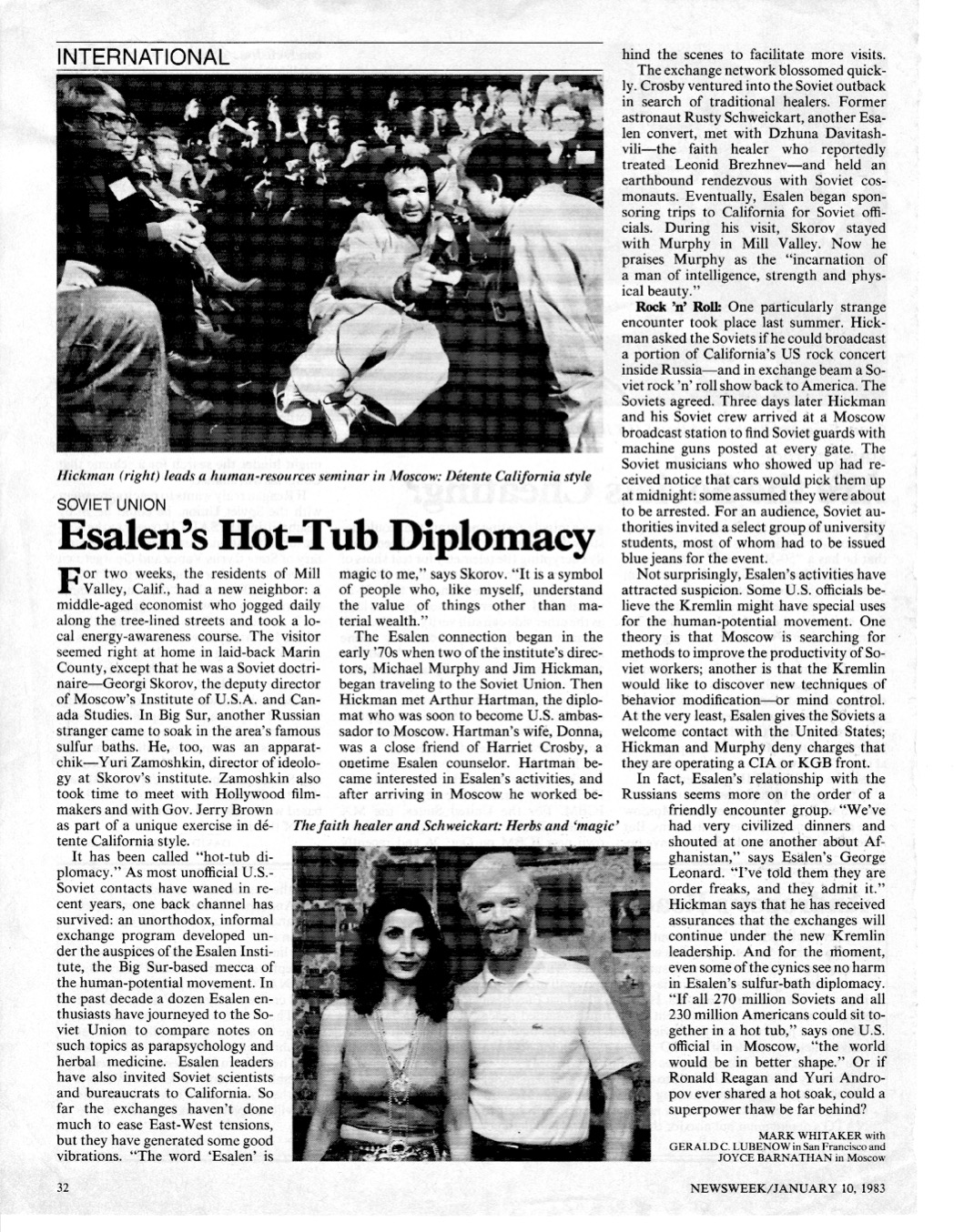
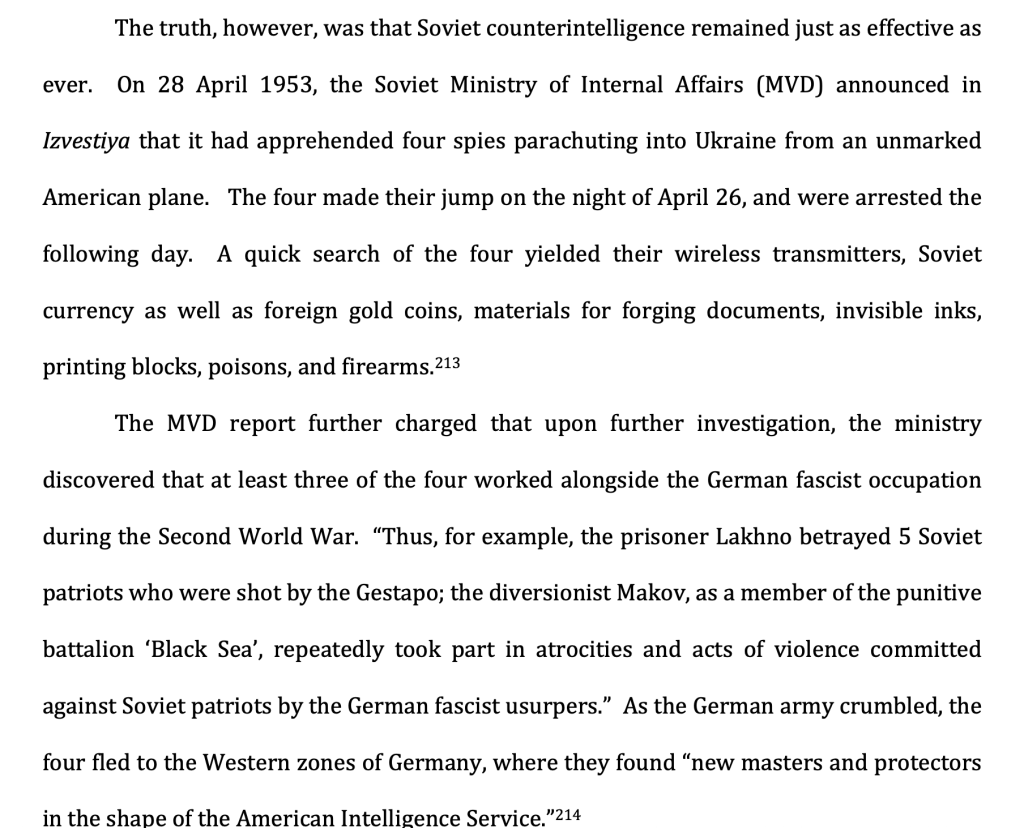
Immediately after Stalin’s death, an American airplane dropped a group of young anti-communists into Maykop. Among them was Alexander Makov, a member of the NTS (National Alliance of Russian Solidarists).
They were soon arrested, and four of them, including Makov, were shot.
Thirty-five years later, in Paris, I made the acquaintance of Makov’s daughter, Natalya. Natalya Makova’s husband was Boris Miller, an NTS leader. Although they had been born in Europe and had never lived in the USSR, they thought only of the Russia which they had lost.
They threw me a luxurious lunch à la russe, featuring vodka, pickled herring, and borscht. After the second shot of vodka, Miller cut to the chase: “When will we be summoned to rule Russia?” He was confident that the Congress of People’s Deputies would hand over power to the NTS.
I decided that this was an endearing eccentricity on the part of people who knew absolutely nothing about the Soviet Union’s monstrosities and whose image of Russia was based on the novels of Lidia Charskaya. But they were quite serious and their efforts ended in a nightmare. Miller and Makova abandoned their comfortable life in Paris and moved to Yeltsin’s Russia, where all manners of horrors and humiliations awaited them. They were roundly windled, and Makova spent the rest of her savings on homeless girls, whom she decided to save in the Christian fashion. The girls paid her back with utter ingratitude, of course. Boris died in 1997, while Natalya died in poverty six years later. She had dreamed of obtaining an exoneration for her father, whom she considered a hero, but her application was categorically denied.
Yesterday, Makov’s interrogation records were declassified and partly published by the FSB—by way of showing that nothing has changed since 1953, either there or here, and nothing ever will change.
If I wanted to write a documentary novel about Russia, I would choose this story (but I don’t want to write such a novel).
The methods used by foreign intelligence services to undermine our country have not changed significantly over the years. In particular, enemy intelligence services have always been eager to employ traitors to the Motherland.
Materials declassified
The Central Archive of the Russian Federal Security Service (FSB) has declassified materials from the case files on a reconnaissance team dropped by the Americans into the USSR in 1953.
Much was written about the American saboteurs after their arrest, and their names were at the time mentioned in almost all books about US intelligence operations against the USSR.
In the early 1990s, relatives of the team’s members attempted to obtain a decision from the Russian Prosecutor General’s Office regarding their exoneration, emphasizing that the group’s members did not work for American intelligence but rather “fought against Stalinism.” Nevertheless, even at the height of post-Soviet anti-communism, exoneration was denied.
So who did the Soviet secret services arrest in April 1953, less than two months after the death of the “leader of the peoples”?
“Alec,” “Pete,” “John,” and “Dick”
On the night of April 26, 1953, an aircraft of unknown origin violated Soviet airspace. The pilots managed to safely leave Soviet airspace after completing their mission—dropping a reconnaissance team.
The first two saboteurs were detained a few hours later—they introduced themselves as Vasilchenko and Matkovsky, code names “Alec” and “Pete.” They also revealed that “John” and “Dick” had parachuted with them.
The second pair of saboteurs did not get very far either: they were detained on the same day.
The group was equipped with weapons, ampoules of poison, four radio sets, radio beacons, and other equipment for sabotage and reconnaissance activities. The group also had gold with them, which was to serves as the financial basis for acquiring legal identities and carrying out their planned activities.
The Judas from Lysychansk
All four members of the group were former Soviet citizens who had collaborated with the Germans during the Great Patriotic War.
Vasilchenko, also known as “Alec,” was actually Alexander Lakhno, a native of Lysychansk. In 1941, he completed a course at an intelligence school in the Rostov Region and was sent to his hometown for underground work. But before he could really begin his activities, Lakhno was arrested by the Germans and told them everything he knew. In particular, he betrayed five Soviet intelligence officers whom he had known at the intelligence school.
The Germans liked Lakhno’s zeal and took him into their service. In 1943, as part of a Sonderkommando, he hunted down [Soviet] partisans in the Dnipropetrovsk Region, and then left with the Germans, who assigned him to the “Russian Security Corps”—an organization, established by White émigrés, which fought against the Yugoslav Partisans.
The radio operator from Kherson
Alexander Makov, a native of Kherson, voluntarily joined the German forces after his city was occupied. Initially, he mainly performed administrative tasks for them. During the Nazi retreat, attitudes toward collaborators changed, however and he was sent to one of the punitive units to fight Yugoslav Partisans in the Balkans. Makov applied himself zealously, for which he was transferred to the ROA [Russian Liberation Army]. There, the young man from Kherson was sent to reconnaissance school, and by the time the Nazis were defeated, Makov had completed courses as a reconnaissance radio operator.
The defectors
Before the war, Sergei Gorbunov had been sentenced to a year and a half in prison for theft, but as a minor, he was sent to a labor colony near Kharkov. Gorbunov was finally released at the war’s outset, but he did not want to fight for the Soviet Motherland—either because he was nursing a grudge against. it or because he thought that the Germans had already won. Be that as it may, he went to work for the occupiers and then retreated with them.
Dmitry Remiga, a native of the Stalin Region, expressed his desire to voluntarily go to work in Germany with his father after the occupation of his native land by Hitler’s forces.
All four ended up in the zone occupied by the Western Allies after the Nazis left. None of them wanted to return to the USSR, and they all sought ways to legalize their status in Europe.
From a trident-touting outfit to an American intelligence school
A career path was suggested by agitators from the National Alliance of Russian Solidarists (NTS). Incidentally, the NTS has a truly curious logo: the selfsame trident, so dear to Bandera’s followers, on top of the Russian tricolor.
The NTS explained that the West would soon declare war on the USSR, the Soviet regime would not survive, and those who proved themselves successful in the fight against the communists would live happily in the “Russia of the future.”
The four underwent training at an NTS propaganda school and then special training at the American intelligence school in Bad Wiessee.
As we have already mentioned, however, the preparation did no good—the team was quickly identified and captured.
The saboteurs explained that their mission included obtaining legal identities in Kiev and Odessa and further work with the American recon center. For more reliable legalization, any means were permitted: for example, they could murder a real Soviet citizen and take his papers.
A “reference” from the CIA: the attempt to exonerate the saboteurs
On May 22, 1953, th USSR Supreme Court’s Military Collegium found Lakhno, Makov, Gorbunov, and Remiga guilty of planning sabotage and terrorist acts and sentenced them to the supreme punishment—execution by firing squad.
The wording used to seek their exoneration was a curious sight. In 1993, Vera Lvova, a Petersburg reporter for the Express Chronicle, claimed, “Ultimately, the authorities will be forced to admit that people who gave their lives for Russia’s freedom and American spies-slash-saboteurs are not one and the same.”
In other words, if you graduated from an American intelligence school, parachuted from an American plane and were loaded with weapons and all kinds of intelligence equipment, and had a mission from the US intelligence services, you were simply fighting for Russia’s freedom.
But that’s not all. Exoneration campaigners cited the testimony of CIA veteran William Sloane Coffin, who said with a straight face, “Yes, I trained them, but we never asked them to spy.”
The apotheosis of this nonsense was a statement from the NTS that the saboteurs had been “dispatched to the USSR on behalf of the NTS to conduct patriotic propaganda against Stalin’s dictatorship.”
Credit must be given to the Prosecutor General’s Office, who endured this session of collective madness and refused to exonerate those whom the Americans had used to achieve their goals.
More than forty years ago an item [in] the Soviet newspaper Literaturnaya Gazeta described me as “the minder of George Miller and a senior CIA manager.” The item caused considerable mirth among friends, while my wife pointed out that my salary as director of a modestly funded London-based think-tank seemed scarcely commensurate with my alleged role as a master spy. Moreover, far from minding George Miller (also known as George Miller-Kurakin), who worked for me at the Institute for European Defence and Strategic Studies as its research officer, I seldom knew where he was, or what he was doing.
Except for the fact that his suits came from Oxfam, George — bearded and with the social ease of a Russian aristocrat — could have stepped out of a novel by Tolstoy. He was born in Chile in 1955. His father Boris, an engineer, had migrated from Serbia where his own father, a White Russian émigré, had been murdered in front of the family. So began a pattern of events in which politics shaped the lives and hopes of three generations of the Miller family.
In Santiago, Boris Miller had met and married Kira Kurakin, a member of a distinguished family in Tsarist St Petersburg that had produced ambassadors and senior public servants over more than a century. In 1959, Boris and his young family moved to Frankfurt where he joined the counter-revolutionary National Alliance of Russian Solidarists (NTS), subsequently moving to London as the organisation’s UK representative. He was somewhat handicapped in his new role by his limited grasp of English. But his son, who knew no English on his arrival in London aged seven, went to a local grammar school, quickly becoming bilingual and speaking the language of his adopted country without a trace of accent by the time he had finished history degrees at Queen Mary College and Essex University. Whereupon he promptly followed in his father’s career as counter revolutionary.
George died from a heart attack in 2009, aged 54, having paid a heavy personal price for his vocation. But fond memories of him recently flooded back as the world marked the anniversary of the failed attempt by communist hardliners to take over the Soviet government in August 1991, an event which was followed in quick succession by the collapse of the Soviet government and the banning of the Communist Party of the Soviet Union (CPSU) in November of that year — outcomes which George and his father had devoted their lives to help bring about.
In his twenties, George had relied for his income on his day job as my researcher, but he was an increasingly influential NTS member. Founded in the 1930s, the organisation operated underground in Russia but more or less openly in the rest of the world through a network of Russian exiles. Unlike many Western analysts, its members never doubted that the Soviet system would collapse, its spokesmen laying stress on the fact that communism went against the grain of human nature and was therefore doomed. Its declared aim was that of hastening the momentous day when Soviet communism would be replaced by a form of liberal democracy.
In describing their aims and tactics, George and his NTS colleagues were apt to compare the Soviet Union to an elephant being repeatedly bitten by a mosquito. At first the creature would be oblivious, but after a thousand stings, it would roll over without warning with its feet in the air, and die. The bites inflicted on the Soviet beast by NTS were numerous and unceasing.
Like the British Foreign Office, most British Sovietologists as well as politicians tended not take the NTS very seriously. Harold Wilson said that that the “u” in its title was silent. But the KGB took it sufficiently seriously to make assassination and kidnap attempts on its members and to arrest and imprison its members and contacts inside Russia. Soviet diplomacy was largely successful in pressing the Western governments not to do business with it, even persuading the West German government to close down the organisation’s Russian language radio station in Frankfurt. However, NTS members took evident comfort from General Secretary Andropov’s description of NTS as “public enemy number one.”
Recently, prominent members of the Conservative party and others in senior positions in business and British public life, now middle aged, have described how as young party activists they were recruited by George to take part in a clandestine NTS operation to carry banned literature into the Soviet Union. In this role Miller was assisted by radicals — mainly passionate Thatcherites — within the Federation of Conservative Students (FCS) who relished the high excitement and sense of purpose which their clandestine activities afforded.
Among those recruited by George were the current schools minister, Nick Gibb, his brother Sir Robbie Gibb (Theresa May’s communications director during her premiership), and Peter Young (founder of the aid contractor, Adam Smith International). Another prominent FCS member, Russell Walters, now an executive with Philip Morris, echoed the sentiments of his fellow subversives when he commented, “it was the noblest act I have ever performed. I remain very proud of what we did.”
Posing as tourists, the couriers took in medical supplies, money and office equipment as well as books, all strapped to their bodies under baggy clothes. They brought out uncensored accounts of the harsh realities of Soviet life, the imprisonment of dissidents and the evidence of economic failure as well as literary works which for political reasons their authors could not publish in Russia.
In all, George recruited around 60 couriers, a handful of whom were arrested and briefly held by the Russian authorities. On those occasions their arrest was effectively used by him to attract headlines in the international media in order [to] drive home the totalitarian nature of the Soviet system and the violation of the Helsinki Final Act of 1975 which pledged the signatories to respect fundamental freedoms.
The couriers’ task took nerve as well as idealism but the risk they took was less great than that taken by their contacts. Simon Clark, another of George’s couriers, said recently, “we could leave the Soviet Union on the next plane. Our contacts couldn’t. The risks they took every day were enormous and potentially life changing. My principle contact was arrested a year or two after my visit. He received a three year prison sentence. I don’t know what happened to him after that.”
The materials brought out were used by NTS to brief Western newspapers, the Russian service of the BBC, Radio Liberty and any parliamentarian who was prepared to listen. Sharing seemingly little of his FCS friends’ ideological zeal — he had joined the young Liberals rather than the Conservative Party for what I suspect were tactical reasons — George, personable, humorous and pragmatic, provided an increasingly trusted source of information. This was stored in the NTS’s British office, the semi-detached home of George’s parents in Baring Road, Lee, an unfashionable part of south east London.
George used his growing influence in London to arrange for a weekly summary of extracts from Russian opposition publications to be published in The Times. He also persuaded large numbers of friends and contacts to send pamphlets through the post to individual Russians identified from Soviet phone books.
Shortly after the Russian invasion of Afghanistan in 1979, George travelled there to gather first hand evidence of the use of poison gas against the Afghan fighters. Forging links with National Islamic Front of Afghanistan, he subsequently drew up detailed analysis of the role of the different elements of the gas attacks. With others, he is believed to have persuaded the Foreign Secretary, Lord Carrington, to provide anti-aircraft weapons to the Afghan resistance.
Some three years after his first visit to Afghanistan, George asked my permission to leave immediately for a few days’ holiday, a request which seemed quite out of character. Eight weeks later, he returned smiling with a Boots folder containing what he described as his holiday photos. These turned out to be pictures of him in company of members of the mujahidin over whom he towered as he waved a Kalashnikov.
I later discovered that George — who had been accompanied by other NTS members including the novelist and historian, Vladimir Rybakov — arranged for two captured Russian soldiers to be allowed to be released and given safe passage to the West, an act which may well have saved their lives. George also provided me with a compelling account of how US military aid was falling into the hands of anti-Western factions. This, as he pointed out, necessarily had the effect of strengthening them in in relation to relatively pro-Western rival groups.
I arranged for him to meet a well-connected American friend who was as impressed and alarmed as I had been by George’s detailed and authoritative account. As subsequent events have demonstrated, it was advice that should have been heeded, but my contact later reported, “it’s no go. The US State Department regards the enemies of America’s enemy as its friend. It lacks the imagination to grasp that this particular enemy of our enemy might also be America’s enemy.”
George’s range of anti-Soviet activities was more extensive than most of his friends realised at the time and demonstrated imagination as well as George’s ability to inspire trust from those with whom he worked. Julian Lewis, the chairman of the Parliament’s Intelligence and Security Committee with whom Miller worked to counter the activities of the Campaign for Nuclear Disarmament (CND), described him “as compassionate and courageous. He was mystical, spiritual, selfless and humane, a hero of our times.”
When a tiny Moscow-based “Group for Establishing Trust” was cited by members of CND as evidence that a peace movement could be built inside the Soviet bloc, George sent FCS members to Moscow to distribute anti-nuclear leaflets on the Moscow underground. One was arrested and kicked out causing just the kind of publicity that was needed to demonstrate the stupidity of the CND position. He subsequently arranged for one of the group’s advisers, Oleg Popov, to visit London where he was enthusiastically welcomed by CND as well as by George. But the latter evidently made a bigger impression on Popov than the CND leaders. At a press conference, Popov thanked the disarmers for their support but declared, “unilateral disarmament is no answer. It is nonsense and potentially dangerous.”
Other activities included the creation of the Association for Free Russia and the editorship of Soviet Labour Review, a detailed and authoritative bimonthly journal of labour relations in the USSR.
In 1986, Miller successfully sabotaged what was intended as a major Soviet propaganda coup to weaken support for Western nuclear deterrence. The occasion was the Copenhagen “Peace Congress” staged by the Soviet controlled World Peace Congress. His wrecking strategy had been worked out in cooperation with the Coalition for Peace Through Security, an anti-CND outfit run by two future Tory MPs, Julian Lewis and Edward Leigh. As the event opened, George and two others could be seen on the platform unfurling a giant banner on the platform which read “This is the KGB’s Peace Congress.” Photos of the trio being manhandled off the stage dominated the following morning’s Danish press. And when on the final day of the event dozens of activists who had been mysteriously provided with delegate credentials mounted a vociferous campaign against Soviet occupation of Afghanistan the resulting mayhem received worldwide media coverage.
George was in London at the time of the Communist hardliners’ botched August coup of 1991. But his father — sensing that dramatic change might be imminent — had flown to Moscow and made contact with those loyal to Boris Yeltsin, standing besides Yelstin as he faced down the Russian tanks outside the Russian parliament. Yeltsin subsequently passed a special decree making him a Russian citizen.
George arrived in Russia for the first time shortly afterwards, kissing Russian soil on his arrival, keenly anticipating a process of democratic reform and the privatisation of the Russian economy in which he hoped to play a significant role. His wife, Lilia, and two children were to follow him from England.
But subsequent events did not evolve as he would have wished. In January 1991, a meeting of the NTS council, of which George and his father, Boris, were members, was split on whether or not its representatives should join the new Yeltsin government. George argued powerfully that the historic opportunity should not be missed to help shape Russia’s democratic future. An opposing faction, which included his father, argued that the offer was a trap set by its old KGB enemies and that it would be better to wait for a more propitious moment to enter government; perhaps both proposals contained an element of wish-fulfilment. Boris’s faction won by a single vote, resulting in a lasting rift between father and son, and George’s immediate resignation from the NTS.
Boris died penniless in a Moscow hospital following a heart attack in 1997. He had spent his last years as the Russian head of an international human rights body, appearing regularly on Russian television to denounce various human rights violations.
Although he had little practical knowledge of privatisation and of business, George went on to work to in the Economics Ministry under Anatoly Chubais, the privatisation minister. But he grew rapidly disillusioned by the emergence of crony capitalism. Several of the reforms he sought did not materialise and he grew increasingly aware that a new class of oligarchs, many with KGB backgrounds were exclusively concerned with personal enrichment.
George complained to friends that Russia now resembled America’s Wild West. But as the historian, Norman Stone, pointed out, the difference was that in America’s Wild West there was a judge, a sheriff and a preacher. I had often teased George by suggesting that he might not like living in the Russia that would emerge if he and his friends succeeded in destroying the Soviet system: the sad truth is that he did not.
Keenly aware that he had neglected his family’s material interests and his own health by the single-minded pursuit of political aims, he now sought consultancy work advising Western companies on business opportunities. But by this time his wife had returned to Britain and what funds he had saved went on a divorce.
I last saw George about 18 months before his death after he rang to suggest a meeting. George remained cheerful and showed no sign of bitterness. He declared his intention to remain in England where his children were being educated and asked me whether I would run a new think-tank for which he would find funds. Its purpose, he explained would [be] to analyse threats to liberal democracy, including those posed by the country which he had struggled to free from communism, as well that posed by China. The money would come from backers of various environmental projects in which he had become enthusiastically involved, including one with plans develop the means to turn pig dung into energy. Companies were set up in his name, but little progress was made and there was no income stream. As we parted, I pondered on whether the project had come to fill the place of an earlier vision that had died.
Like me, the couriers recruited by George Miller remember him with fondness and respect. The Soviet elephant did indeed roll over and die. The proximate reason for the Soviet collapse may have been Western policies vigorously promoted by Reagan and Thatcher which in turn prompted the Soviet leadership to attempt to modernise, unleashing forces which it was powerless to control. But George, along with a relatively small number of anti-communist activists and scholars shaped the environment which made those Western policies possible. Although he had been given ample reason to reflect on the need to think carefully about what he wished for, I don’t think he regretted any of his counter-revolutionary activities.
The grave of NTS founding chairman Duke Serge von Leuchtenberg de Beauharnais (aka Sergei Nikolaevich Leuchtenbergsky) at El Encinal Cemetery in Monterey, California. Photo courtesy of Comrade Koganzon
Duke Sergei Nikolaevich Leuchtenbergsky (1896, St. Petersburg–June 27, 1966, California) was a Russian politician, translator, founder and first leader of the National Alliance of Russian Solidarists (NTS), and great-great-grandson of Russian Emperor Nicholas I.
He was born in 1896. In the Civil War, he served under his father, Major General N.N. Leuchtenbergsky, during the formation of the Southern Army and the Don Army. In exile, he graduated from the noncommissioned officer school of the Russian All-Military Union (ROVS). From 1930 to 1933, he headed the National Alliance of Russian Solidarists (NTS).
During World War II, he served as a translator in the German 9th Army, then headed the propaganda department and was a translator for the Rzhev Commandant’s Office and the headquarters of the German VI Corps.
In 1925, he married Anna Alexandrovna Naumova (born 1900), and they had four children. A year after his divorce (1938), he married Kira Nikolaevna Volkova (born 1915), but their marriage was annulled in 1942. In 1945, he married Olga Sergeevna Wickberg (born 1926), who bore him two children.
He died on June 27, 1966, and is buried at El Encinal Cemetery in Monterey, California.
Source: Wikipedia (Russian). Translated by Bad Robot with the Russian Reader
Source: Ozon email advertising circular, 14 November 2025
An American World War II cemetery in the Netherlands removed displays focused on Black American soldiers, sparking outrage and compelling Dutch politicians to appeal to U.S. officials this week to restore the information.
The two displays were added to the Netherlands American Cemetery’s visitor center in September 2024 after some historians and relatives of service members criticized the site for not mentioning the unique experiences of Black troops. One plaque featured the story of George H. Pruitt, a Black soldier in the 43rd Signal Construction Battalion, who died trying to save a comrade. The other highlighted how Black American service members were “fighting on two fronts” — for freedom overseas and for their civil rights at home.
The displays’ removal, American and Dutch critics of the move say, signifies an erasure of Black Americans’ contributions in the war and their work to liberate the Netherlands from the Nazis. It also represents an overstep in the Trump administration’s campaign to curb what it deems diversity, equity and inclusion efforts, the critics said.
It’s unclear exactly when the plaques were removed.
The American Battle Monuments Commission, a U.S. government agency that oversees the cemetery, did not respond to requests for comment from The Washington Post. The commission told Dutch news outlets that one panel is “off display, though not out of rotation,” and a second panel was retired. The commission did not elaborate on either decision.
Janice Wiggins, the widow of Jefferson Wiggins, a Black WWII soldier who was quoted in one of the displays, said she had “a gut-wrenching feeling” when she learned the panels had been removed.
“Not only reading about, but actually experiencing, how history and those who shaped it can be so easily and casually erased,” she said. “It was very personal.”
“The removal of the displays is disrespectful to the Black American soldiers who served and to the legacies their families cherish,” Wiggins added.
More than 8,000 U.S. troops who fought in World War II are buried at the Netherlands American Cemetery, a solemn site in the village of Margraten in the southern part of the country. Just over 170 of these service members are Black Americans, a slice of the more than 1 million Black Americans who fought during World War II in segregated forces.
The cemetery is special to the local community, according to the American Battle Monument Commission’s website. Residents have adopted the grave sites, bringing flowers to the cemetery for decades.
The 6,450-square-foot visitor center, where the displays about Black service members were, tells the stories of the thousands of Americans commemorated at the cemetery.
One of the removed plaques described the “horrors of war” that Black service members faced while serving primarily in labor and support positions. In fall 1944, the U.S. Army’s 960th Quartermaster Service Company, a mostly Black unit, arrived in Margraten “to dig graves at the newly created cemetery,” the display read, according to a photo provided to The Post.
Jefferson Wiggins, a first lieutenant, recounted seeing service members under his command crying as they dug the graves.
“They were just completely traumatized,” the display said.
Now there is no textual information provided about Black troops at the cemetery, said Kees Ribbens, a senior researcher at the NIOD Institute for War, Holocaust and Genocide Studies in Amsterdam. Although it’s unclear why the displays were removed, Ribbens said it’s notable that it happened during the Trump administration’s crackdown on diversity efforts.
President Donald Trump signed executive orders on his first day in office banning government diversity, equity and inclusion efforts. The impact has been widespread: Arlington National Cemetery scrubbed information from its website about prominent Black, Hispanic and female service members and topics such as the Civil War. Exhibits related to slavery were removed at multiple national parks. The White House accused the Smithsonian of promoting “race-centered ideology.”
“Given the emphasis the current administration puts on DEI, it doesn’t make it that difficult to start wondering if the disappearance of Black history [at the cemetery] has to do with the current winds blowing in D.C.,” Ribbens said.
In the Netherlands, the public has been baffled that anyone would see a reason to remove the panels, Ribbens said.
Dutch politicians have demanded that the displays be reinstated, appealing to the American Battle Monuments Commission and the U.S. ambassador to the Netherlands.
Alain Krijnen, the mayor of Eijsden-Margraten, where the cemetery is, sent a letter Monday to the commission: “We greatly value the story of the Black Liberators in relation to the past, present and future. In that context, we would greatly appreciate it if the story of the Black Liberators — like the 172 Black Liberators buried in Margraten — could be given permanent attention in the visitor center, and therefore reconsider the removal of the displays.”
The office of the governor of Limburg, the Dutch province containing the cemetery, said it also has “serious concerns.”
“The displayed panels depicted a history we must never forget, and from which we can learn a great deal — especially now, as global divisions are being increasingly magnified,” Bas Alberson, a spokesman for the governor’s office, said in a statement to The Post.
The mayor’s office and the Limburg governor’s office said they had not heard from American officials as of Wednesday.
Janice Wiggins, the 77-year-old widow of Jefferson Wiggins, said she learned the displays had been removed after her friends visited the cemetery in October and noticed the absence. The removal chips away at some of her life’s work, she said.
“Along with [former] US Ambassador to the Netherlands Shefali Razdan Duggal and Dutch author Mieke Kirkels, I lobbied for the inclusion of Black American soldiers in the exhibits at the Netherlands American Cemetery Visitors Center. The original exhibits included only White soldiers,” Wiggins, who lives in New Fairfield, Connecticut, wrote in an email.
Those who have family buried at the cemetery also feel the loss.
Julius Morris is a Black WWII soldier who is buried there. His nephew, Raphael Morris, who lives in St. Louis, felt resigned when he heard the news.
“Business as usual by this administration,” said Morris, 73. “Color me concerned, disappointed, but not surprised.”
“I’m terrified at the moral apathy, the death of the heart, which is happening in my country. These people have deluded themselves for so long, they really don’t think I’m human. I base this on their conduct, not on what they say. And this means that they have become, in themselves, moral monsters.” –James Baldwin
LET’S GET THIS OUT OF THE WAY: When it comes to the recent deaths of immigrants being held in detention, it would be wrong to describe the situation as wholly unprecedented. Detainees died under Bush, Obama, and Biden. But detainee deaths have accelerated during President Donald Trump’s second term, with 17 already since his inauguration. During the Biden administration, there were 26 deaths in 48 months—roughly one death every two months. During Trump’s term, that rate has nearly quadrupled. And ICE, now one of the best-funded operations of the federal government, is planning to double detention space before the end of the year.
“It’s absolutely horrific,” Rep. Pramila Jayapal (D-Wash.), the ranking member of the immigration subcommittee, told me before jumping into the numbers above. In July, ICE was awarded $45 billion to expand its operations—its budget is now significantly larger than that of the federal prison system. And now, Jayapal points out, a little-known LLC has been awarded a $1.2 billion contract to build a facility in Texas despite never having previously won a federal contract for more than $16 million. Meanwhile, another $2.25 million contract was given to a Republican donor who received a presidential pardon from Bill Clinton in 2000 after having pleaded guilty to mail fraud.
“Contracts are being distributed to Trump’s buddies and people with no experience running detention centers, many of these contracts are no-bid,” Rep. Jayapal said. “They’re incarcerating people and allowing them to die, not providing medical facilities. There are no standards. It’s horrific.”
Most ICE and border patrol agents will continue working during the government shutdown; their status as “essential” will shield them from the layoffs OMB director Russell Vought has requested in lieu of furloughs from most agencies and departments. But the nature of immigration officers’ “essential” work has significantly changed over the past eight months to become something far more brutal than procedural; in some cases, it has come to appear simply heartless. We have entered a period in which it is becoming important to ask: What happens when our leaders and the people who work for them see immigrants not as human beings but as scum? And what happens when that way of thinking about people starts also to be applied to others, like journalists and political opponents?
In love, Cancer? The Russian-American Company’s logo (RAK) on signage at Fort Ross State Historic Park in Sonoma County, California. Photo by the Russian Reader
Is it true that not only Alaska, but other huge territories of the American continent were Russian? Yes, its stretched all the way down to Northern California. And Fort Ross, Russian fortress and settlement of the early 19-th century, which still located 90 miles north of San Francisco, on the banks of Russian river at that time marked the southern border of the Russian Empire. At the peak of its power Russia suddenly abandoned its colonies. Why? What happened? In our days, an international TV crew arrived at Fort Ross National [sic] Historic Park to make a documentary. Dmitry-Russian reporter already famous in his country, Margo, long legged sound engineer, very pretty, and very independent American girl in her twenties, and videographer Jeff, the guy from Brighton Beach, Brooklyn, same age as Margo-meet in New York and soon became friends. As a result of the mysterious anomaly, Dmitry was thrown into the past. Into the Fort Ross of 1820s, where he saw a thriving international community of the colonists: Russians, Aleuts, Native Americans, Spaniards. Ripening field of rye, peach orchards, vineyards, flocks of sheep and herds of cattle. In the bay, merchant’s ships at anchor, waiting for the goods to be loaded-paradise and nothing else. To his surprise, he found out that his ability to travel in Time happened because of the strange malfunctioning of his iPhone. How great it would be to take a few real historical shoots from the past! However, soon he will realize that what they have in their hands is much more serious than just an opportunity to make an unprecedented documentary footage. Why not try to change the Future itself? But in favor of what country, Russia or America? It’s not an easy question to answer. Dmitry, taken aback by this unknown to him chapter of Russian history, sees the new opportunities for Mother Russia. Margo, as an American, is very disturbed. She, who has an Indian blood in her veins, knows pretty well what awaits her people. On the other hand, she fascinated by the peaceful coexistence of Russians and local Kashaya tribe. As for Jeff, he is just torn apart between his pledge to his new homeland, his Russian origin, his new friend and his new love for Margo. Not being able to resolve all these issues at once, friends decided to disguise themselves as Franciscan friars and Margo as an Indian girl, and go for the brief exploration into the Past. And return to modern time, as quickly as possible. But Fate had other plans for them. This description may be from another edition of this product.
Native American reaction to the establishment of Ross appears to have been favorable in the initial years of occupation. In 1811, Kuskov arranged for the construction of the settlement adjacent to the Kashaya village of Mettini. Apparently, the Russians purchased rights to the Ross vicinity from a local chief, Pana-cuc-cux, for three blankets, three pairs of trousers, two axes, three hoes, and some beads, although K[i]rill Khlebnikov noted that the Pomo village at Ross was called Mad-shui-nui, and that the chief who ceded it to the Russians was named Chu-chu-san. […] In 1817, Lieutenant Captain Leontii Hagemeister visited Ross in order to extend and formalize the agreement with the Pomo. A number of prominent Pomo and Coast Miwok headmen, including the chiefs Chu chu-san and Vale-lie-lie, met with Hagemeister and agreed to the Russian’s request for a formal agreement. The arrangement that resulted from this effort represents one of the few official treaties ever made by a Euro-American power with a California Indian tribe. In 1825, Governor Muravyov visited Ross and met with Mannel, a local Pomo chief, in order to reconfirm the Russian treaty. The Russians also arranged an agreement with the Bodega Miwok in order to develop Port Rumyantsev on Bodega Bay. Rights to Bodega Bay were purchased from the Bodega chief, Iollo, for an Italian-style cape, a coat, trousers, shirts, arms, three hatchets, five hoes, three files, sugar, and beads.
Source: E. Breck Parkman, “Fort and Settlement: Interpreting the Past at Fort Ross State Historic Park,” California History, 75.4 (Winter 1996/1997), p. 359
Source: Kan, S. (1991). The Khlebnikov Archive: Unpublished Journal (1800-1837) and Travel Notes (1820, 1822, and 1824). Edited, with introduction and notes, by Leonid Shur. American Indian Culture and Research Journal, 15.4. http://dx.doi.org/10.17953
As Mission Santa Cruz developed following its establishment in 1791, the coastal terrace lands to the north as far as Point Año Nuevo became the mission’s main livestock grazing lands. Rancho Arroyo del Matadero (“Stream of the Slaughtering Ground Ranch”) was one of four mission cattle ranches strung along the coast. In 1839, the former ranch lands were granted to the three Castro sisters: María Candida, Jacinta, and María de los Angeles Castro. The three were daughters of José Joaquín Castro (1768–1838), deceased grantee of Rancho San Andrés. Candida Castro married José Antonio Bolcoff in 1822.
José Antonio Bolcoff (1794–1866) was born Osip Volkov in Petropavlovsk-Kamchatsky, Siberia. Working for a Russian fur trading company, Bolcoff deserted a Russian ship at Monterey in 1815. After arriving in California he quickly assimilated into the Spanish culture, using the Spanish name José Antonio Bolcoff. Bolcoff acted as an interpreter for Governor Pablo Vicente de Solá. In 1822, Bolcoff settled in Branciforte and was alcalde in 1833. In 1833, Bolcoff was granted Rancho San Agustin, which he sold to Joseph Ladd Majors (1806–1868) in 1839. Majors married Bolcoff’s sister-in-law, María de los Angeles Castro (1818–1903). Jacinta Castro lived with the Bolcoff family before joining the convent at Monterey. In 1839, Bolcoff replaced Francisco Soto as administrator of Mission Santa Cruz.
Bolcoff’s name is not mentioned in the original grant, but he took control of Rancho Refugio in 1841. Bolcoff transferred the title to Rancho Refugio to his two sons, Francisco Bolcoff and Juan Bolcoff.
With the cession of California to the United States following the Mexican-American War, the 1848 Treaty of Guadalupe Hidalgo provided that the land grants would be honored. As required by the Land Act of 1851, a claim for Rancho Refugio was filed with the Public Land Commission in 1852, and the grant was patented to Francisco and Juan Bolcoff in 1860. A claim by Joseph Ladd Majors and his wife, María de los Angeles Castro, for one-third of Rancho Refugio filed with the Land Commission in 1852 was rejected.
Here we must name the people on the Ilmena who were captured along with Elliot and who were mentioned in the journal: Fyodor Sokolov, Dmitry Shushkov, Pyotr Druzhinin, “the American-Bostonian Lisa Cole,” Osip Volkov, and Afanasy Klimovsky. Klimovsky was obviously the future famous explorer of Alaska. As for Osip (aka Joseph and José) Volkov, he was a well-known figure in California, where he found his second home and lived a long life (he died in 1866). The Russian administration ultimately took a lenient view of Volkov’s sojourn in California, where he could be useful to the RAK. Governor Yanovsky, using Volkov’s case as a pretext for Khlebnikov’s visit to Monterey in 1820, enabled Volkov to be issued a “residence permit.” The report in the journal refutes the widespread misconception that Volkov jumped a Russian ship.
Elliot reports that “Afanasy and Osip” lived in Lieutenant Gomez’s house. The order in which Antipater Baranov lists the captured prisoners may indicate their ethno-social status: first come the Russians, then the American, and then Klimovsky and Volkov, both Creoles. The fact that Volkov was a “Creole” who also had a poor command of Russian (“little knowledge of the Russian language”) is reported by L[eonty] Hagemeister, who spoke with him directly during a visit to San Francisco in 1817.
As the sun rises on 21 May, marking the Day of Remembrance for the Circassian Genocide, we invite you to listen beyond the silence that often surrounds the wounds of colonialism. In the following article, Bulat Khalilov, co-founder of Ored Recordings – a label dedicated to traditional and post-traditional music from the North Caucasus – reflects on a paradox within Circassian music today: how a culture with rich vocal traditions has, in a sense, sidelined its most distinctive feature, the polyphonic vocal technique of zhiu?
In conjunction with today’s commemorations, Ored Recordings is releasing a compilation, Shopsh: Circassian Vocal Tradition of Zhiu, which highlights the vocal tradition of zhiu as both a form of remembrance and a possibility.
21 May is the Day of Remembrance for Circassians – or, more directly, the Day of the Circassian Genocide.
In 1864, the Russian Empire marked this day as the official end of the Russo-Caucasian War, which had begun over a century earlier in 1763. What Russia celebrated as victory, most Circassians – and many other peoples of the North Caucasus – remember as loss: a brutal war for independence that ended in exile, devastation and what many now call genocide.
That view isn’t fringe. It’s shared by most Circassian historians and civil society voices. To date, only Georgia and Ukraine have officially recognised this as genocide. But across the Circassian diaspora – from Türkiye and Syria to Jordan, the EU and the US – 21 May is marked with acts of remembrance. And yes, those memories echo back home, too – in Adygea, Kabardino-Balkaria and Karachay-Cherkessia.
However, most Circassians in the North Caucasus are suspicious of these gestures, considering them to be opportunistic and insincere. Their refusal to embrace recognition from other states usually stems from a desire to avoid becoming a pawn in a larger geopolitical game.
Officially, the Russian state doesn’t like to talk about any of this. The war itself is treated as taboo, its memory reframed as a tool of Western propaganda or a threat to national unity. And yet, every year, people still gather. From moderates to patriots, from Nalchik to Cherkessk to Maykop, Circassians take to the streets – sometimes quietly, sometimes defiantly.
At Ored Recordings, we return to this trauma again and again – not to dwell, but to listen. To ask how this wound still shapes the way we live, create and imagine. Every year on 21 May, we release a concept album. One year, it’s heroic songs from the war. Another, it’s diaspora voices from Türkiye. Or wartime songs of the 20th century. Each time, we try to trace how our people processed a colonial wound through music, or indeed failed to do so.
This year, we chose to focus on traditional vocal techniques in Circassian music. At first glance, this may seem unrelated. But in truth, every serious conversation about the state of Circassian culture circles back – if not to 1864 itself, then certainly to the long shadow it cast.
This release is a compilation of mostly unpublished recordings. Think of it as a teaser – a warm-up – for future albums. In those upcoming releases, we’ll dive deeper into each performer’s story and the recording context.
This essay – and this release – emerged from a simple question: what’s really going on in Circassian music today?
A big part of the tradition is group singing. Usually it’s men (sometimes women, sometimes mixed groups), gathering to sing. The lead voice carries the main melody, while the others hold a choral drone or a call-and-response. This choral technique is called zhiu or yezhiu.
Like in many cultures, group singing wasn’t just about music – it was a way to be together, to make a space for cultural and social connection.
Most Circassians today learned about this from the elders. From people who sang at weddings and late-night gatherings. Or from those who, as kids, would secretly listen to adults sing into the night. But our main source are still the archives – dusty tapes recorded by Soviet folklorists. Interestingly, the folklorists’ archives have ended up becoming tradition-bearers in their own right.
Academic work on Circassian vocal music – papers, dissertations, theoretical frameworks – has had almost no impact on today’s performers. Music theory and actual practice in Adyghe communities have mostly run on parallel tracks, rarely intersecting.
But the sound itself – those dusty Soviet-era recordings collected by ethnomusicologists – found a way through. Once digitised, they slipped into public circulation (sometimes semi-legally) and became a strange kind of bridge: not from scholar to scholar, but from singer to singer, across generations.
Those old recordings remind us that the song and its lyrics are guardians of language, poetic style and cultural memory. And yezhiu? That’s the secret ingredient. The thing that gives it punch. Soviet musicologists put it nicely: yezhiu helps the song “reach the hearts of the people”.
There’s even a sharp old proverb: “Ежьур уэрэдым и щIопщ” – yezhiu is the whip for the song. It keeps the rhythm. Holds the structure together. Gives the song its shape.
And yet – despite this deep knowledge and respect for vocal technique – modern Circassian music mostly revolves around instruments. Not voices.
So we asked ourselves: how did a whole new wave of Circassian music appear – something unthinkable even ten years ago – and why does almost all of it seem to avoid yezhiu, the central tool of our tradition?

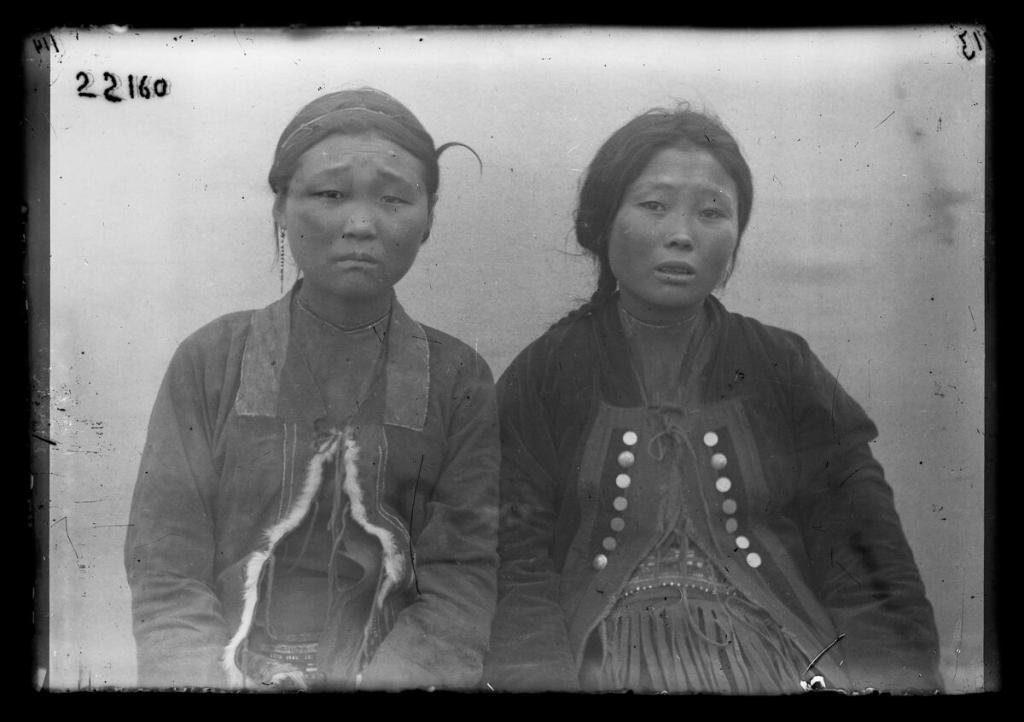





 . We’ve set up massive food donation and delivery infrastructure. We organize rides to school and work. People are literally taking in families.