On Friday, May ninth, Treptow Park was perhaps the most heavily guarded place in Berlin. Hundreds of police officers kept the peace at Germany’s most famous memorial to Soviet soldiers on the day Russia marked the eightieth anniversary of the end of the Second World War in Europe, known as the Great Patriotic War in the Soviet tradition. Because Russia has employed symbols of that earlier war in its current war against Ukraine, visitors were banned from displaying or wearing Soviet and Russian flags, military uniforms, and St George’s ribbons at the Berlin memorial this year. An exception was made for veterans and diplomats.
Soviet May ninth traditions and German pacifists
At about half past ten in the morning, a wreath was laid at the monument to the Soviet soldier by Russia’s ambassador to Germany, Sergei Nechayev. The day before, when Germany remembered the Wehrmacht’s surrender and the end of the war, Nechayev and the Belarusian ambassador were not invited to the memorial event at the Bundestag. In his speech, German President Frank-Walter Steinmeier thanked the Allies for liberating his country and recalled the Red Army’s sacrifices, but harshly criticized Russian attempts to justify the war in Ukraine in terms of the fight against the Nazis in the Second World War.
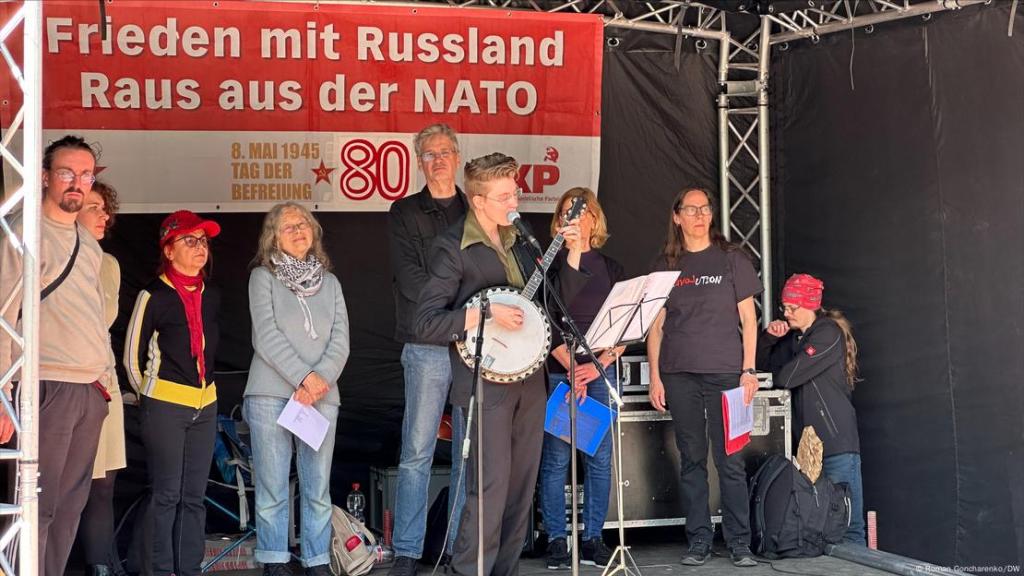
The flood of people in Treptow Park seemed endless: hundreds were there at any one time, and thousands came and went over the course of the day. Many brought scarlet carnations, while some bore wreaths. Russian and German were heard. Most of the visitors were elderly—immigrants from the former USSR living in Germany and Germans. There were also many leftist and ultra-leftist German political activists brandishing placards opposing NATO and calling for “peace with Russia.”
German ultra-leftists rally for “peace with Russia” and Germany’s exit from NATO, 9 May 2025. Photo: Roman Goncharenko/Deutsche Welle
Against this backdrop, the scene resembled a mixture of a traditional Russian May ninth celebration and a political protest by German pacifists, many of whom had clearly lived most of their lives in the GDR.
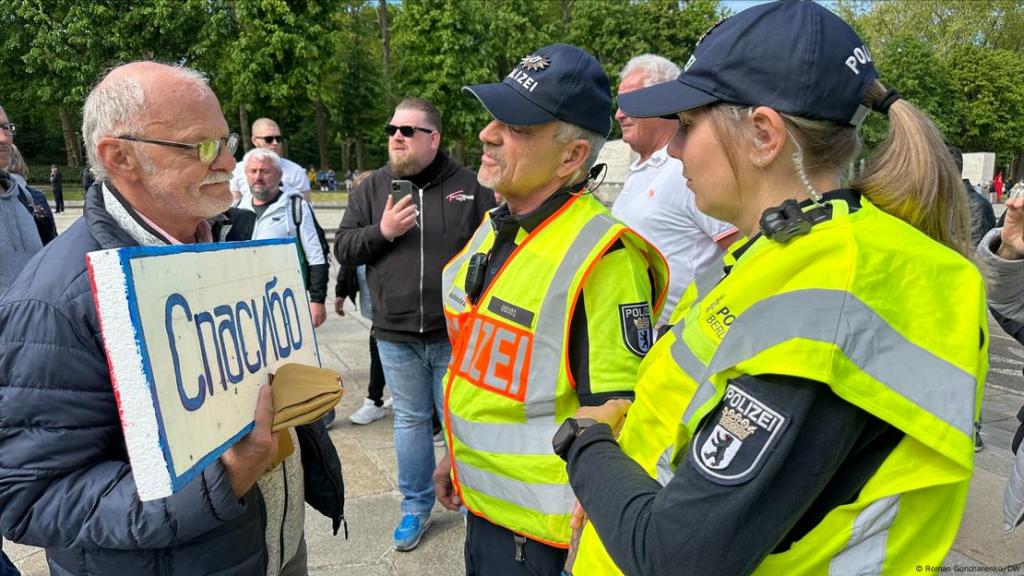
“I was a policeman in the GDR,” said a man in his sixties who held a placard that read “Thank you” in Russian. The policemen asked him to doff his Soviet cap, which sported a red star and a St. George’s ribbon.
“All people want peace, so the politicians should don their own military uniforms and crawl into the trenches,’ the man said.
Soviet wartime songs sounded from loudspeakers and were played live. One man, aged forty-five, climbed atop a mound to get a better view, but a policeman asked him to get off the lawn, explaining, “This is a grave.” The man cursed in Russian but climbed off the mound.
Another man played played “Arise, Great Country” on his clarinet. When he began quietly playing the melody of the Soviet and Russian national anthem, the police literally took him aside, after which he returned to the group of people who had gathered. They were outraged at the restrictions that had been adopted. From time to time, someone chanted “Russia, Russia!” and many other people would join in.
An ex-East German police office (holding a sign that says “Thanks!” in Russian): “All people want peace.” Photo: Roman Goncharenko/Deutsche Welle
Bikers in Treptow Park
Your correspondent saw men and a woman in leather jackets who looked like bikers from the Russian motorcycle gang Night Wolves. They were in small groups and were escorted by a large number of police officers. They posed for pictures in front of the wreaths and left. They could have been someone from a local “support group.” The Berlin press had written that only a small group of bikers made the trip to Berlin to visit the Soviet memorials this year. No incidents had been reported as this article went to press.
Treptow Park, 9 May 2025. The crimson and gold banners at the back of the crowd are inscribed with the names of the various “fronts” in the Red Army’s campaign against the Wehrmacht. Photo: Roman Goncharenko/Deutsche Welle
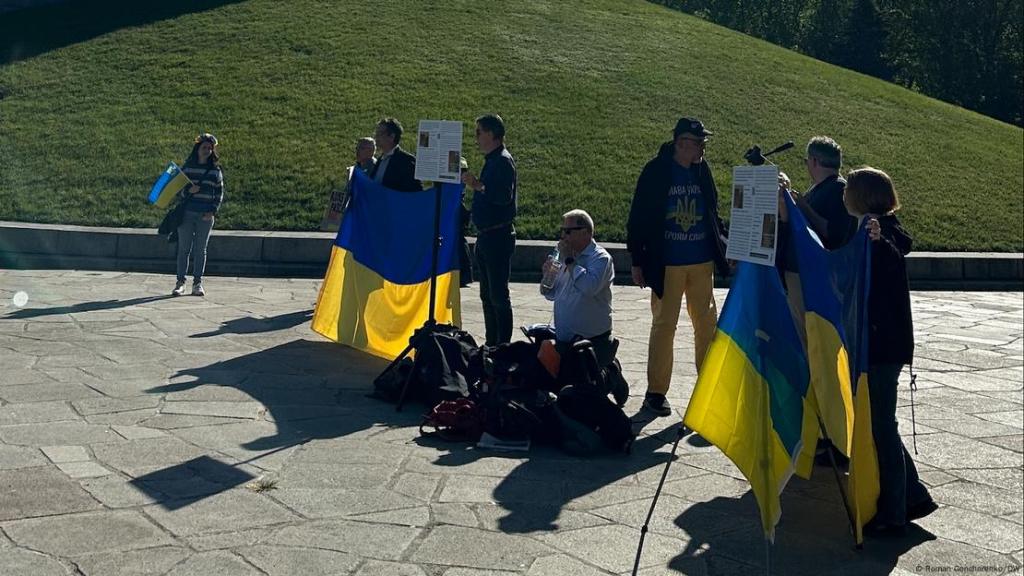
For the first half of the day, at least, things seemed relatively calm. Your correspondent had the impression that most people had come to Treptow Park not for political reasons, but to commemorate the war. And yet the atmosphere was tense. To the right and left of the monument to the Soviet warrior stood a dozen and a half activists holding placards and the flags of Ukraine and NATO.
Activists with placards and Ukrainian flags at the monument to Soviet soldiers in Treptow Park, 9 May 2025. Photo: Roman Goncharenko/Deutsche Welle
They said they wanted to draw attention to the Ukrainian Red Army soldiers who had perished in the Second World War, as well as to Russia’s war against Ukraine.
“I am here to prevent this event from being turned into a Russian propaganda stunt,” said a woman, aged thirty-five. According to her, insults had been hurled at her and the pro-Ukrainian activists.
“Some people regard our presence here as a provocation,” said the woman. “We are not here to change anyone’s mind, but to make Ukraine visible.”
One of their posters read: “Russia has usurped the memory of May eighth and ninth. But it was not Russia who liberated us from the yoke of National Socialism eighty years ago in Berlin. It was the Red Army, in whose ranks many Ukrainians served.”
The poster tells the story of Ukrainian soldier Fyodor Karpenko, who left his name on the walls of the destroyed Reichstag building in May 1945.
Since the Maidan uprising and Russia’s illegal annexation of Crimea in 2014, Kremlin propaganda has consistently portrayed Ukrainian leaders as Nazis or fascists. Russia also accused the Ukrainian authorities of “genocide” of the population of Donbass. On 24 February 2022, while announcing the full-scale invasion, the “denazification” of Ukraine was presented as the primary goal of the war, which is itself portrayed merely as a continuation of the Great Patriotic War: a conflict embedded in a cyclical conception of time in which Russia, eternally under threat from a Western enemy, fights for its very survival — on Ukrainian soil.
On the ground, there is no evidence to support Moscow’s accusations: nobody has ever documented a “genocide” against ethnic Russians or Russian speakers, whether in Ukraine or elsewhere. As for the Ukrainian far-right, its political influence remains minimal: in the 2019 parliamentary elections, the main ultra-nationalist parties, running together on a joint list, received just over 2% of the vote, well below the threshold required to enter Parliament. In short, the image of a “Nazi regime” in Kyiv is based on a glaring mismatch between rhetoric and reality.
So why do the Russian authorities repeatedly invoke references to the Second World War — or, in Russian parlance, the “Great Patriotic War” — when speaking about Ukraine? Understanding this memory dynamic is essential to grasp the power of a rhetoric that, despite lacking any factual basis, continues to shape the official Russian worldview.
The Soviet and Russian insistence on using the term “Great Patriotic War” to refer exclusively to the period from 1941 to 1945 erases the twenty-one months that preceded Nazi Germany’s invasion of the USSR. Between the Molotov–Ribbentrop Pact of August 23, 1939, and Operation Barbarossa on June 22, 1941, Moscow and Berlin were de facto allies: they engaged in extensive economic cooperation, diplomatic coordination, jointly invaded and partitioned Poland in September 1939, and the Soviet Union proceeded to annex the Baltic countries and wage war against Finland. By reducing the war to the period 1941–1945, the USSR and Russia could deny any responsibility in the outbreak of the Second World War and present itself solely as the victim of Nazi aggression and the primary liberator of Europe.
The Great Patriotic War — and especially the victory in 1945 — became the founding event of Soviet history and the cornerstone of collective memory. Yet this memory, often portrayed as monolithic and universally shared, is anything but uniform. A Ukrainian from the west, who endured two successive occupations between 1939 and 1944, remembers a war very different from that of an eastern Ukrainian, whose experience was shaped primarily by Nazi destruction. The memory of a Russian bears little resemblance to that of a Crimean Tatar, who was deported along with his entire community and denied the right of return for decades. As for Soviet Jews, whose families and communities were annihilated in the Holocaust, they were long forced to remain silent — official narratives left no room for the specificity of their suffering.
The collective experience of the war and the official discourse surrounding it deeply reshaped the Soviet population’s understanding of “fascism” and “antifascism.” Rather than referring to a specific political doctrine of the inter-war period, the term “fascism” had become a catch-all label for the ultimate enemy. Trotsky or the British Conservatives could just as easily be branded as “fascists,” as well as domestic and international opponents after 1945 — including even the Chinese Communists. The word “Nazi” itself was rarely used. In everyday life, calling someone a “fascist” served more as the gravest possible insult rather than as a statement of ideological substance.
Under Vladimir Putin, the cult of the Great Patriotic War has been revived. Following the pro-democracy protests of 2011 and Putin’s bid for a third presidential term in 2012, the regime instituted a deliberate policy of historical narrative construction, aimed at grounding its legitimacy in a vision of the nation as under siege. The glorification of the 1945 victory also allowed the regime to purge collective memory of its specifically socialist elements: by retaining only the narrative of national triumph, the Soviet period could be seamlessly integrated into a continuous national history without any revolutionary rupture. At the same time, the rehabilitation of Joseph Stalin as a legitimate victor served to validate autocracy. The mass repressions and genocidal policies that claimed millions of lives were reframed as a tragic but necessary step: they had made the USSR a global superpower, capable of defending civilization against the “brown plague.”
The Kremlin has multiplied its legal instruments to enforce this narrative. Since 2020, the Russian Constitution mandates “respect for the memory of the defenders of the Fatherland” and prohibits “diminishing the importance of the heroism” of the Soviet people. In April 2021, Putin signed a law increasing penalties for “insults” or “false claims” about the Second World War and its veterans. In December 2019, Putin himself gathered some leaders of post-Soviet states around a pile of archival documents that he said proved historical truths long ignored in the West — selectively quoting them to justify, in retrospect, the USSR’s annexation of Poland and the Baltic states. In this way, Putin has weaponized history, which has become inseparable from national interest. To challenge his interpretation is tantamount to treason.
Every year on May 9, Russians march in the Immortal Regiment carrying portraits of relatives who fought between 1941 and 1945. Increasingly, the faces of those who fought — or died — in the war against Ukraine are added to these ranks, as though both wars were part of a single, endless struggle. Past and present warfare are merged, and the victory of 1945 becomes the lens through which all events — past, present, and future — are interpreted in a continuous historical timeline. This symbolic fusion also explains the surreal images of Russian occupation forces who, in recent weeks, have placed propaganda banners in destroyed Ukrainian cities. An uninhabitable Bakhmut was transformed into a stage for celebrating the 80th anniversary of Russia’s victory in the “Great Patriotic War.”
The cult of victory is not only a central element of the Putinist imaginary — it functions as an operating system for both domestic governance and external aggression, with all of Russia’s actions on the international stage framed as part of an eternal war against fascism. A telling example of this is the installation of a giant screen on the Estonian border, broadcasting Victory Day celebrations in a loop — an attempt to remind Estonians, as well as Latvians and Lithuanians, that the Soviet victory represents an unassailable moral superiority. In the Russian collective imagination, the word “fascism” has lost all connection with a specific political ideology and now refers only to an abstract, absolute threat: the desire to destroy Russia. It has become synonymous with “enemy” or “Russophobe,” always denoting the Other, never a historically defined movement. This separation between word and meaning allows the regime to simultaneously glorify the antifascist victory and openly promote xenophobic, homophobic, or ultraconservative rhetoric, without any perceived contradiction.
The word “denazification,” used by Vladimir Putin on February 24, 2022, to justify the invasion, initially puzzled many Russians, most of whom were unfamiliar with the term in this context. Shortly afterwards, the state news agency RIA Novosti published an article by Timofey Sergeytsev — “What Russia Should Do with Ukraine”— aimed at clarifying its meaning: “denazification” was described as a “total cleansing,” targeting not only alleged Nazi leaders but also “the popular masses who are passive Nazis,” deemed guilty of having supported the “Nazi government.” According to Sergeytsev, modern Ukraine is able to hide its Nazism behind aspirations for “independence” and “European development.” To destroy this Nazism, he argues, is to “de-Europeanise” Ukraine. In this logic, denazification becomes synonymous with eliminating all Western influence from Ukraine and dismantling the country’s existence as a nation-state and a distinct society. Incubated on official state platforms, this narrative reveals the true scope of “denazification”: a large-scale project aimed at erasing any trace of Ukrainian singularity, a blueprint for the genocide.
The article recently published on the official website of the Russian Foreign Intelligence Service (SVR), entitled “Eurofascism, Today as 80 Years Ago, Is a Common Enemy of Moscow and Washington,” strikingly illustrates the expansion of the “denazification” discourse far beyond Ukraine. The accompanying image depicts a grotesque hybrid monster: its body is shaped like a black swastika with the EU’s circle of stars in the centre, while its head is a caricature of Ursula von der Leyen. The creature, with its blood-stained claws outstretched, is caught between two bayonets — one American, the other Russian/Soviet. This grotesque image is not merely a provocation: it reflects a narrative deeply entrenched in Russian state propaganda, where “Eurofascism” becomes an operational concept encompassing all European societies.
“Eurofascism, Today as 80 Years Ago, Is a Common Enemy of Moscow and Washington.” Screenshot courtesy of Meduza
The 2022 tipping point revealed these discourses for what they truly are: the ideological foundation of a large-scale invasion, long prepared within the informational sphere. Today, part of European society — particularly elements of the pacifist left — is falling into the same trap: underestimating or ignoring the ongoing propaganda dynamic. But the machine is already in motion. The language of fascism is being broadened daily to include new designated enemies, and the ideological war is shifting: it is no longer stopping at Ukraine — it is now targeting all of Europe. In the face of this brutal reconfiguration of the official Russian narrative, complacency or passivity have themselves become forms of strategic blindness.
Russia’s consolidated military registration registry website, Reestrpovestok.rf, is fully operational. On Friday, 9 May 2025, the human rights project Get Lost, which helps Russians avoid conscription into the army, reported that the notifications that it was operating in test mode had disappeared from the website, and the online resource appeared to have been fully launched.
Upon arrival on the website, users can log in to their personal accounts, check summonses, and obtain copies of records. Earlier, the website indicated that it was functioning in beta mode only in three regions—Sakhalin, Ryazan, and the Republic of Mari El. This notification has now disappeared.
“So far no one who has received a summons through this site or faced automatic restrictions has contacted us,” the human rights activists added. The registry’s launch has not been officially announced.
Recipients of summonses to face restrictions if they fail to report to military recruitment center
The law establishing a consolidated registry of persons subject to conscription and introducing electronic summonses was signed by Russian President Vladimir Putin in April 2023. The text of the document, in particular, states that conscripts who do not report to a military enlistment office within twenty days of receiving a summons may be prohibited from registering as an individual entrepreneur, registering vehicles and real estate, driving a vehicle, and getting a bank loan. In addition, they will not be able to leave Russia until they report to a military enlistment office.
A screenshot of the military enlistment summons website, outlining the penalties imposed on Russians who fail to respond.
The full-fledged launch of the electronic summonses registry was planned for last autumn, but was subsequently postponed.
The registry contains data on all Russian nationals who are already registered and are subject to military registration, as well as those who are not yet registered but are obliged to do so. Lawyers stress that the law and the decree apply to the delivery of any summonses, both for compulsory service and to clarify military registration status, and as part of the wartime mobilization, which Putin has not yet signed a decree to end.
This data will be collected from military enlistment offices. The decree digitizing their databases was signed by Putin back in November 2022. As Defense Ministry officials told the Federation Council, various databases are used for this purpose, including those of the Interior Ministry, the Federal Tax Service, civil registries, and pension funds.
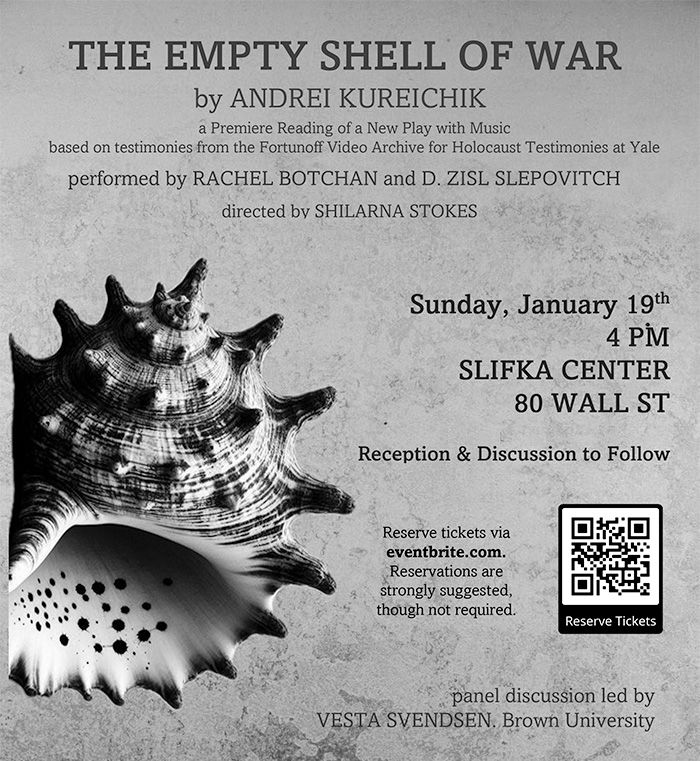
The Fortunoff Video Archive for Holocaust Testimonies, and Yale’s Program in Theater, Dance, and Performance Studies, invites you to the premiere reading of Andrei Kureichik’s new play The Empty Shell of War.
The play, featuring performance by Rachel Botchan and D. Zisl Slepovitch, is directed by Shilarna Stokes.
When: January 19, 2025 Time: 4:00 PM Location: Slifka Center, Yale University
The Empty Shell of War offers a gripping exploration of war’s psychological scars. This monodrama follows the journey of a young Jewish girl from a Belarusian shtetl, surviving unimaginable horrors during World War II. Grounded in authentic testimonies from Belarusian survivors of the Holocaust archived at the Fortunoff Video Archive, the play reveals stories of courage, compassion, and survival. The play is a response to the policy of Holocaust denial pursued by Lukashenko’s dictatorial regime in Belarus. This will be the world premiere of the play.
About the Playwright
Andrei Kureichik is a renowned Belarusian playwright, director, and publicist living in exile. Author of over 30 plays performed globally, his works include the groundbreaking Insulted.Belarus, a centerpiece of the global theater solidarity movement. His plays have been translated into 39 languages and honored with awards like the 2023 Best Foreign Play of the Season in Los Angeles and the European Parliament’s Sakharov Prize for Freedom of Speech. A Yale World Fellow, Fortunoff Fellow and Lecturer, Kureichik also teaches “Art and Resistance” at Yale University.
CREATIVE TEAM
D. ZISL SLEPOVITCH (composer, woodwinds, sound design) is a native of Minsk, Belarus, a New Yorker since 2008. He is a Jewish music scholar (Ph.D., Belarusian State Academy of Music), composer, a multi-instrumentalist klezmer, classical, and improvisational musician (woodwinds, keyboards, vocals); a music and Yiddish educator. Slepovitch is a founding member of the critically acclaimed groups Litvakus and Zisl Slepovitch Ensemble, a regular contributor to the National Yiddish Theatre Folksbiene, a Musician-in-Residence at Yale University’s Fortunoff Video Archive for Holocaust Testimonies, a pianist and music coordinator at Stephen Wise Free Synagogue in New York. Slepovitch’s credits include “Defiance” movie, “Eternal Echoes” album (Sony Classical), “Rejoice” with Itzhak Perlman and Cantor Yitzchak Meir Helfgot (PBS), and “Fiddler on the Roof in Yiddish” (off-Broadway).
SHILARNA STOKES is a Senior Lecturer and Associate Research Scholar in the program of Theater, Dance, and Performance Studies at Yale. She has directed over thirty plays and musicals in theaters throughout the United States, and has received numerous awards, residencies, and fellowships for her directing work. Her current book project, “Playing the Crowd: Mass Pageantry in Europe and the United States,” examines large-scale political pageants performed in England, the US, Russia, France, and Germany. She is a graduate of Yale (BA in Theater Studies and Comparative Literature), Columbia University School of the Arts (MFA in Directing), and the Columbia Graduate School of Arts and Sciences (PhD in Theatre).
RACHEL BOTCHAN is an award-winning performer with extensive Off-Broadway and regional theater experience and a variety of stage, TV and film credits, She is known for her dynamic range and transformative portrayals. She is an award-winning audio book narrator with many titles for Recorded Books and Audible. She is a graduate of NYU Tisch School of the Arts where she received the Seidman Award for excellence in Drama.
PANEL DISCUSSION
Following the performance, a Q&A and Panel Discussion exploring the play’s themes and historical context will be led by scholar of Holocaust and Genocide Studies, Vesta Svendsen (Brown University).
VESTA SVENDSEN is a PhD student in History at Brown under Dr. Omer Bartov, studying the role of trauma in Belarus ’post-Soviet national identity formation. She originates from Brest, Belarus and was raised between Belarus and New Orleans. Vesta holds a BA from Tulane University in Russian Studies and an MA from Yeshiva University in Holocaust and Genocide Studies. In 2023, Vesta was a Summer Graduate Student Research Fellow at the US Holocaust Memorial Museum, studying western Belarus. Throughout her MA studies, Vesta engaged in part-time psychoanalytic training to broaden her understanding of transgenerational trauma. As an interviewer for the USC Shoah Visual History Archive, she gathers testimony from Russian-speaking Holocaust survivors and is currently translating a Russian-language Holocaust memoir. Vesta is a member of the Coordination Council of the Belarusian democratic forces. She possesses language skills in Russian, Belarusian, Ukrainian, French, Polish, and Yiddish.
A Chechen refugee in front of her destroyed apartment building in downtown Grozny, February 17, 1995. Photo: Reuters (via Julia Khazagaeva)
On the thirtieth anniversary of the storming of Grozny, the liberal Russian media reminded the Russophone audience that there had been such a war—the Chechen War. When I see this title, I don’t even open the movie, I flip through it. A couple of excerpts are basically enough for me to be convinced that these people have still understood nothing after three decades. Even over the three years of the recent, utterly treacherous imperial war in Ukraine, the obvious facts about what Chechnya means to Russia have not became obvious to them.
Almost any decent Russian would point out to you, of course, that bombing towns chockablock with civilians was a bad thing to do and foul play. Carrying out mop-ups in villages and burying the victims in mass graves was also outrageous. But then the exclamation “but!” is sure to follow. They will tell you about Chechen bandits, forged letters of credit, and the intransigent Dudayev. Yes, it was wrong to destroy a third of Chechnya’s population, this notional Russian would lament, but the Chechens were bad eggs themselves and were asking for it.
If you ever do open a Russian [documentary] film reconstructing the events in Chechnya thirty years ago, you will find that it is about the enlisted lads who on New Year’s Eve 1994 were thrown into the epicenter of hell. Not properly trained to shoot or drive a tank, alone against hordes of heavily armed rebels, they were unfortunate sons of the Motherland: may their memory live forever. This artistic device is deployed, for example, by the Maxim Katz-affiliated project Minute by Minute. The [YouTube] channels Current Time and Popular Politics have also recalled this selfsame “Chechen War.”
Minute by Minute, “The New Year’s Eve Storming of Grozny: A Minute by Minute Reconstruction” (December 31, 2024)
Semantically, the construction “Chechen War” operates the same way as the coinage “captive of the Caucasus.” It conceals the aggressor, suggesting we look at the object of the aggression as the aggression’s cause. In this logical trap, Chechnya seems to have gone up in flames by itself. It was its inhabitants who shelled and bombed themselves silly. It was not Russia that invaded the Caucasus, it was the Caucasus which for some reason held Russia’s soldiers in captivity. It is not without reason that when people say “he was killed in Chechnya,” it is the place where he was killed that appears to be the malefactor. The listener is not prompted to wonder what this soldier was doing under arms in a foreign land. It is as if Chechnya had shown up in Samara and killed an innocent tanker.
When we think, write and say “Chechen War,” we automatically interpret it from the point of view of the colonizer and the aggressor. We accept the interpretation imposed by Moscow, which insists that Chechnya is part of Russia, not a sovereign country it attacked. If Russia is not mentioned in the nomenclaturee of this historical event, Chechnya is automatically read as an undeniable part of the empire, and the conflict itself sounds akin to the November Uprising or the Tambov Rebellion.
In fact, it was the Russo-Chechen War which began on December 11, 1994. The war deserves to be identified as such both in terms of the nature of the hostilities and the status of the warring parties, because by the time the Chechen Republic of Ichkeria was invaded by Russian troops, it had been three years since it had legally, by popular vote and a declaration of independence, withdrawn from the USSR on an equal footing with the RSFSR. The Chechens had NOT been part of the newly minted Russian Federation for a single day.
The independent journalist Vadym Zaydman has written about this better and more clearly than anyone else. There is no need to paraphrase him when I can instead quote what he has written:
“At the time of the USSR’s death/colllapse, Chechnya was no longer legally related either to the defunct Soviet empire or to the RSFSR. By that time the Chechen-Ingush ASSR had existed as a Union Republic for over a year. Thus, by definition it could not be a part of the Russian Federation, as proclaimed on December 25, 1991. When the Russian Federation was born, Chechnya was initially not a part of it.
“Russia itself did not regard Chechnya as part of Russia during this period. On March 31, 1992, the Federation Treaty was incorporated into the Russian Constitution. It changed the status of autonomous republics to sovereign republics within the Russian Federation. The treaty was signed by representatives of twenty federal subjects of the Russian Federation. Neither the Chechen-Ingush Republic nor Chechnya was involved in the treaty.
“It was only in the wake of the notorious events of October 1993, when Yeltsin was adopting a new Russian constitution, that he unilaterally incorporated Chechnya into the Russian Federation. In fact, Yeltsin committed a fraud like the one committed by the Russian authorities when, after the Soviet Union’s collapse, they declared Russia a member of the UN Security Council as the USSR’s legal successor, although Russia was not even a rank-and-file member of the UN. Ukraine and Belarus were members of the UN, but Russia aka the Russian Soviet Federative Socialist Republic was not! Having incorporated Chechnya, a year later Russia started to establish ‘constitutional order’ in Chechnya as its own fiefdom! Clever, isn’t it?!”
End quote.
The term “Chechen War” is thus as illegitimate as the use of the term “Ukrainian War” is unacceptable. Ukrainians would not allow the latter, and the entire civilized world would not agree to it. For everyone, the current war is the Russo-Ukrainian War. But the same thing should happen in our minds when describing the war in Chechnya. It is the Russo-Chechen War.
Many Russians would understandably prefer it go down in history in a more modest way—ideally, not as a war at all, but as a “special military operation,” or a “counter-terrorist operation,” for it is the security forces, not the simple folk, who are responsible for such operations. “SMO” and “CTO” sound mundane and localized, like a police “amber alert,” nor are they freighted with collective guilt and responsibility. Most vitally, if correlated with these Putinist terms, western sanctions come to be regarded as an exorbitant and unwarranted punishment, since they make “ordinary people suffer.”
Why do you think various Putinist and anti-Putinist institutions have spent the last three years relentlessly measuring public opinion on whether Russians want war? Yes, it’s simple: because of the sanctions—and Russia’s slightly tarnished image in the eyes of the international community. But if the West is shown the relevant polls quite often and reminded that “public opinion polls don’t work in a totalitarian society,” this mantra will work like a charm the thousandth time. It will then be much easier for Brussels officials to explain to themselves and their electorate why they are lifting restrictions: because they oppress an already “downtrodden” civil society, which in no way wanted war, but which was forced by Putin to want it.
Meanwhile, to answer the question of how much the Russian populace shares its leadership’s imperial mindset, it is enough to take the case of the Russo-Chechen War. From the sociological viewpoint, it is a scientifically pristine experiment. In 1994 (as in 1999, when the second phase of the war began) there was no totalitarianism in Russia. There were no western sanctions, and there were no Russian émigréscriticizing the regime from abroad. U.S. President Bill Clinton expressed “concern” when he learned that civilians were being killed in Chechnya. France supported the establishment of constitutional order on Russia’s own territory. They all thought that the new Russian Czar Yeltsin was better than any Communist, even if he fought like one.
Enjoying the full favor of the international community, Russia razed Grozny to the ground along with the remnants of its civilian population on New Year’s Eve 1994. This did not cause any outcry in Russian society. The first protest rally in Moscow took place on January 10, 1995: organized by Yegor Gaidar, it was a partisan affair and sparsely attended. Noticeable civil protests against the war in Chechnya would not begin until 2001—that is, five years later. [My comrade Antti Rautiainen, who was very much in the thick of things in those years (he was a co-organizer of the first antiwar street protest in Moscow, in November 1999), has pointed out to me (in a comment to Ms. Khazagaeva’s original post in Russian) that the biggest protest in Moscow against the Second Chechen War took place in January 2000, not in 2001 — TRR.] However, even then, according to Radio Svoboda, which interviewed passersby, “Muscovites were in no hurry to join the protesters: everyone was rushing about their business.”
Protests during the first phase of the Russo-Chechen War were isolated and (one might say) personal in nature. From the very first days of the invasion, the Soviet dissident, Russian human rights activist and Russian human rights commissioner Sergei Kovalev traveled to Grozny. He tried to stop the bombing of the city. In March 1995, he was removed from the post of human rights commissioner for supporting the “wrong” side. TV news presenter Svetlana Sorokina took liberties on air: after a commercial break she emotionally remarked that “no laundry detergent can wash clean the conscience of the Russian generals.” Independent Chechnya and its legally elected presidents Dzhokhar Dudayev and Aslan Maskhadov were subsequently supported by Valeria Novodvorskaya. Boris Nemtsov tried to stop the war by circulating a petition [which was allegedly signed by a million Russians—TRR]. But there was no grassroots public outrage in Russia, apart from the campaign led by the mothers of the conscripts, neither in the first phase of the war, much less in the second.
This was how sociologist Yuri Levada described attitudes to the war in Chechnya in 2001: “Sentiments against the war are strong in [Russia], but unfortunately we cannot overestimate their significance. The fact is that many people think that more decisive actions, with greater loss of life, perhaps could have led to success. Disavowing the war does not exclude, for example, approving such savage measures as ‘mop-ups,’ which are now quite difficult for the authorities in Chechnya and Russia to cope with. So, an unwillingness to continue the war is an expression of fatigue, not an expression of conscious, directed protest.”
Sociologist Lev Gudkov described Russians who supported Chechnya’s return to the bosom of the empire as follows: “They are younger and better educated Russians who argue that the Chechens must be crushed at any cost and this problem must be solved by force, that no negotiations with Maskhadov are possible, that he represents no one, and that there is only one solution—the total, crushing defeat [of the Chechens]. On the contrary, those who argue that it is necessary to seek a peaceful resolution however possible, including entering into negotiations with Maskhadov, are people of an older age, somewhat wiser and more experienced, and in this sense more tolerant, inclined to recognize Chechnya’s independence as long as the war is brought an end.”
So when Russian liberals, society’s cream of the crop, write and talk about the “Chechen War,” you now know their attitude toward the empire and its conquests. Were it not for the unprecedented western sanctions for invading the European country of Ukraine, you would be surprised to learn what Russians really think about the war. As a gentleman who left Russia twenty years ago once told me in a private conversation: “I still feel sorry for our guys. After all, the Ukrainians have killed more Russians in this war than the Russians have killed Ukrainians.”
“Yevgeny Zhumabekov, 96 kilograms” is how he introduces himself. Yevgeny is the person who came up with the idea of replacing Last Address plaques that had been torn down with homemade copies and who did this work incognito for almost a year. Now he can identify himself.
Bumaga has detailed the struggle that erupted over the plaques in December 2023. They began to disappear en masse, but copies subsequently appeared in place of the ones that had been torn down. These copies were also removed, after which a plaque appeared on the 14th Line on Vasilyevsky Island bearing the following message: “Plaques [memorializing] people who had been politically repressed in this place were repressed eight times.”
Here you can read Yevgeny’s own account of how the [Stalinist] crackdowns touched his family, what shaped his views, how his wife and children got involved in the fight for historical justice, why the Zhumabekovs had to leave the country, and who continues to install the plaques in their wake.
How the repressions touched Yevgeny’s family
I was born in the Sverdlovsk Region, in the town of Kushva, which has gradually been turning into a village. It’s a depressing place. Two of the industrial enterprises that supported the town have shut down. People have been leaving, while the old people are dying off.
It so happened that my history teacher at school was a good friend of my grandfather’s. He would come to my grandfather’s house, and they would drink hard alcohol together, play chess, and talk a lot. I often visited my grandmother and grandfather and heard these conversations. That’s how I learned that my grandfather came from a family of a person who had been politically repressed.
His parents had come from the Perm Region. My great-grandmother and great-grandfather were completely ordinary peasants. It was forbidden in their house to drink alcohol, [and because they were teetotalers] they harvested large crops. In 1931 or 1932, they were dekulakized and exiled far beyond the Arctic Circle, while their children were sent to orphanages. After a while great-grandmother and great-grandfather managed to escape, but great-grandmother had fallen ill in exile and died soon after returning home, while great-grandfather had to hide out in remote villages all the rest of his life.
I know that my grandfather also had a hard time as a member of a politically repressed family, but he never told me about it, although I tried to find out. It was such a profound trauma for him that he could discuss it only when he got drunk with his sole friend.
How the FSB visited Yevgeny’s workplace
In 2006, I moved to St. Petersburg, where I worked for a time in the car business. I held various positions: sales manager, head of the customer engagement department, manager of a car showroom. Then, before the war, I transferred to a construction company, where I sold real estate.
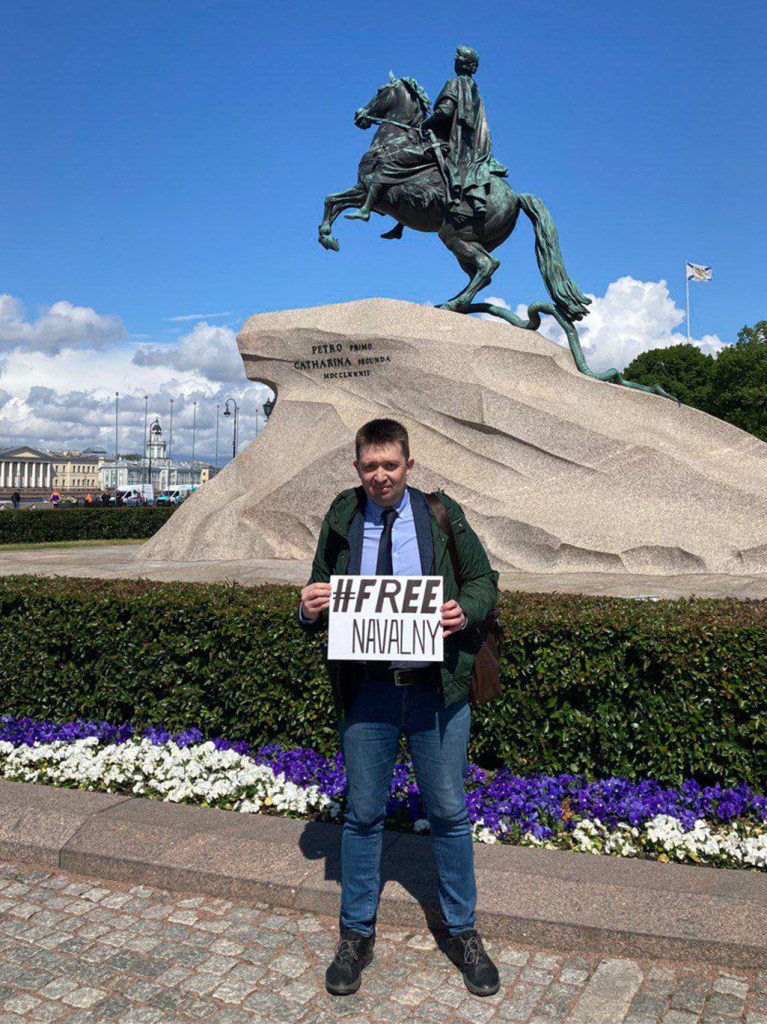
In 2021, I went to a rally in support of Alexei Navalny after he had returned from Germany. Then there was the protest action with flashlights and others. Not only did I attend these events but I also talked about them with my colleagues at work. I was just sharing my pain, not encouraging them to do anything.
Racist text messages invoking slavery raised alarm across the country this week after they were sent to Black men, women and students, including middle schoolers, prompting inquiries by the FBI and other agencies.
The messages, sent anonymously, were reported in several states, including New York, Alabama, California, Ohio, Pennsylvania and Tennessee. They generally used a similar tone but varied in wording.
Some instructed the recipient to show up at an address at a particular time “with your belongings,” while others didn’t include a location. Some of them mentioned the incoming presidential administration.
It wasn’t yet clear who was behind the messages and there was no comprehensive list of where they were sent, but high school and college students were among the recipients.
The FBI said it was in touch with the Justice Department on the messages, and the Federal Communications Commission said it was investigating the texts “alongside federal and state law enforcement.” The Ohio Attorney General’s office also said it was looking into the matter.
Tasha Dunham of Lodi, California, said her 16-year-old daughter showed her one of the messages Wednesday evening before her basketball practice.
The text not only used her daughter’s name, but it directed her to report to a “plantation” in North Carolina, where Dunham said they’ve never lived. When they looked up the address, it was the location of a museum.
“It was very disturbing,” Dunham said. “Everybody’s just trying to figure out what does this all mean for me? So, I definitely had a lot of fear and concern.”
Her daughter initially thought it was a prank, but emotions are high following Tuesday’s presidential election. Dunham and her family thought it could be more nefarious and reported it to local law enforcement.
“I wasn’t in slavery. My mother wasn’t in slavery. But we’re a couple of generations away. So, when you think about how brutal and awful slavery was for our people, it’s awful and concerning,” Dunham said.
About six middle school students in Montgomery County, Pennsylvania, received the messages too, said Megan Shafer, acting superintendent of the Lower Merion School District.
“The racist nature of these text messages is extremely disturbing, made even more so by the fact that children have been targeted,” she wrote in a letter to parents.
Students at some major universities, including Clemson in South Carolina and the University of Alabama, said they received the messages. The Clemson Police Department said in a statement that it been notified of the “deplorable racially motivated text and email messages” and encouraged anyone who received one to report it.
University of Alabama freshman Alyse McCall told sister station WVTMM that she was in class when she got the text, and it brought her to tears.
“I can say, ‘Oh, it’s a spoof message, oh, it’s a spam message,’ but that’s truly scary,” McCall said. “These messages are going out to thousands of young African-American students who fought just as hard to get into college as everybody else did and make opportunities for themselves to thrive, and getting those messages and then walking around or not even going to class because you’re scared to walk on your own campus. It’s not fair.”
Fisk University, a historically Black university in Nashville, Tennessee, issued a statement calling the messages that targeted some of its students “deeply unsettling.” It urged calm and assured students that the texts likely were from bots or malicious actors with “no real intentions or credibility.”
Nick Ludlum, a senior vice president for the wireless industry trade group CTIA, said “wireless providers are aware of these threatening spam messages and are aggressively working to block them and the numbers that they are coming from.”
David Brody, director of the Digital Justice Initiative at The Lawyers’ Committee for Civil Rights Under Law, said that they aren’t sure who is behind the messages but estimated they had been sent to more than 10 states, including most Southern states, Maryland, Oklahoma and even the District of Columbia. The district’s Metropolitan Police force said in a statement that its intelligence unit was investigating the origins of the message.
Brody said a number of civil rights laws can be applied to hate-related incidents. The leaders of several other civil rights organizations condemned the messages, including Margaret Huang, president and CEO of the Southern Poverty Law Center, who said, “Hate speech has no place in the South or our nation.”
“The threat — and the mention of slavery in 2024 — is not only deeply disturbing, but perpetuates a legacy of evil that dates back to before the Jim Crow era, and now seeks to prevent Black Americans from enjoying the same freedom to pursue life, liberty, and happiness,” said NAACP President and CEO Derrick Johnson. “These actions are not normal. And we refuse to let them be normalized.”
Aside from occasionally noting that Russian serfs and American slaves were emancipated within less than two years of each other, historians — especially American historians — have made little effort to compare the development, treatment and status of the two servile labor groups. It apparently has been concluded a priori that there was no solid basis for such a comparison. American slaves were, after all, a race apart — Africans who had been uprooted from their homeland and brought to the New World in chains where they were systematically exploited and degraded in a peculiarly vicious form of involuntary servitude. Conversely, Russian serfdom has been generally accepted as an anachronistic legacy of medieval Europe that had finally run its course by the mid nineteenth century.
Thus the assumption that there was no common ground for a useful comparison of the two labor systems has meant the absence of any such comparative study. What follows is a preliminary and brief attempt to take the first steps toward filling that historical void.
Monterey, California, 4 November 2024. Photo: The Russian Reader
I’m worried about the left’s demonization of America’s origins and the future of Western civilization, as many conservatives feel that the basic tenets of society as we’ve known it are under attack.
Carolina Performing Arts, “Omar the Opera: Behind the Scenes”
Rhiannon Giddens’ opera Omar was presented at Carolina Performing Arts in February 2023. In this video, take a deep dive into the opera’s creation and hear from cast members about their experiences. To learn more, visit: https://southernfuturescpa.org/projects/omar/Omar was co-commissioned and co-produced by Spoleto Festival USA and Carolina Performing Arts at the University of North Carolina at Chapel Hill. Additional co-commissioners include LA Opera, Boston Lyric Opera, San Francisco Opera, and Lyric Opera of Chicago.
“Video has come out from Bucks County, Pennsylvania showing a ballot counter destroying ballots for Donald Trump and keeping Kamala Harris’s ballots for counting,” an account called “Dan from Ohio” wrote in the comment section of the far-right website Gateway Pundit. “Why hasn’t this man been arrested?”
But Dan is not from Ohio, and the video he mentioned is fake. He is in fact one of hundreds of inauthentic accounts posting in the unmoderated spaces of right-wing news site comment sections as part of a Russian disinformation campaign. These accounts were discovered by researchers at media watchdog NewsGuard, who shared their findings with WIRED.
“NewsGuard identified 194 users that all target the same articles, push the same pro-Russian talking points and disinformation narratives, while masquerading as disgruntled Western citizens,” the report states. The researchers found these fake accounts posting comments in four pro-Trump US publications: the Gateway Pundit, the New York Post, Breitbart, and Fox News. They were also posting similar comments in the Daily Mail, a UK tabloid, and French website Le Figaro.
“FOX News Digital’s comment sections are monitored continuously in real time by the outside company OpenWeb which services multiple media organizations,” a spokesperson for the company tells WIRED. “Comments made by fake personas and professional trolls are removed as soon as issues are brought to our attention by both OpenWeb and the additional internal oversight mechanisms we have in place.”
Breitbart replied to WIRED’s request for comment in Russian: “Пожалуйста, скажите Newsguard, чтобы они пошли на хуй.” In English, this means “please tell Newsguard to go fuck themselves.”
The Gateway Pundit and the New York Post did not respond to a request for comment from WIRED.
“The actors behind this campaign appear to be exploiting a particularly vulnerable part of the media landscape,” McKenzie Sadeghi, the AI and foreign influence editor at NewsGuard, tells WIRED. “Comment sections designed to foster reader engagement lack robust security measures, allowing bad actors to post freely, change identities, and create the illusion of genuine grassroots campaigns rather than orchestrated propaganda.”
The disinformation narratives being pushed by these accounts are linked to Storm-1516, according to Newsguard. Storm-1516 is a Russian disinformation campaign with a history of posting fake videos to push Kremlin talking points to the West that was also connected to the release of deepfake video falsely claiming to show a whistlelbower making allegations of sexual assault against vice presidential candidate and Minnesota governor Tim Walz. (WIRED first reported that the Walz video was part of a campaign by Storm-1516. A day later, the US government confirmed WIRED’s reporting.)
Links to the video were posted by multiple accounts with names like “Disobedient Truth” and “Private Patriot” in the comment section of outlets like Breitbart and the Gateway Pundit.
“More bad news for the Dems: Breaking: Tim Walz’s former student, Matthew Metro, drops a shocking allegation- claims Walz s*xually assaulted him in 1997 while Walz was his teacher at Mankato West High School,” the comments read.
The links posted in the comments came hours before the video was shared on social media platforms like X, where it racked up millions of views.
“Replying in threads is a tactic that can have an impact with very little investment,” Darren Linvill, codirector at Clemson University’s Media Forensics Hub, tells WIRED. “By inserting disinformation into an unrelated conversation it might be seen, even if the account being used has no followers and was just created yesterday. It also doesn’t matter if the account you are using is caught and shut down because you haven’t lost an investment, you can just create another account five minutes later.”
The fake comments, Newsguard found, are also then used in reports from Russian state-backed media outlets to bolster claims about how Western audiences are responding to a particular incident.
After the Trump assassination attempt in July, Tsargrad TV published an article titled “Biden’s Trace in Trump’s Assassination Attempt. Americans Agree with the Kremlin’s Version: ‘Russians Are Right.’” The article outlined how Americans believe that the Biden administration played a part in the shooting, citing “comments to articles in Western media” as evidence.
NewsGuard’s researchers identified 104 articles in Russian state media that cited comments from Western news outlets as evidence to back up their claims between January and August of this year.
“This tactic allows bad actors to reduce the risk of detection and embed propaganda in a subtle, seemingly organic way, blending it into the casual commentary of supposed everyday Western readers,” Sadeghi said. “The repetition of the same claim across multiple formats and contexts can create a sense of familiarity that may lend the narratives an appearance of credibility.”
The network of accounts has also been used to seed other narratives, including one earlier this month where dozens of comments in the New York Post and Breitbart claimed, without evidence, that Ukrainian president Volodmyr Zelensky had used Western military aid to purchase a car that once belonged to Adolf Hitler.
That claim has been spread by the network of inauthentic websites controlled by former Florida cop John Dougan, who now lives in Moscow and runs a network of pro-Kremlin websites. Dougan’s network of websites have previously shared disinformation narratives from Storm-1516.
This very disturbing story about Russian grassroots lucre in wartime was published on the front page of yesterday’s print edition of the New York Times. I’m quoting it in full here for the benefit of non-subscribers.
On the other hand, as perhaps only I am in a position to know, there is something disturbing about how certain of the sources for this story boldly claim eyewitness-like knowledge of events in the Russians provinces which they couldn’t possibly have witnessed, while also cashing in on the chaos unleashed by Russia’s vicious war against Ukraine, only from the opposite side of the world.
I’m also troubled that PS Lab, which was founded long before the war, is portrayed here as an outgrowth and brainchild of those selfsame academic entrepreneurs at George Washington University. ||| TRR
Expensive new cars and motorcycles crowd the streets. Apartment prices have more than doubled. And once-strapped residents are suddenly seen wearing fur coats and carrying ostentatiously overflowing grocery bags.
That is how one resident of a small, long-impoverished industrial city in Siberia describes her hometown these days. The explanation for the burst in prosperity lies in the isolated cemetery, with rows of Russian flags marking the new graves of soldiers killed in Ukraine, and also downtown, where a billboard lists the scores of local men who went to fight.
“I was stunned by how many,” said the resident, the wife of a middle-aged firefighter who enlisted last summer without telling her beforehand. “Money from the war has clearly affected our city.”
The Kremlin has been showering cash on men who enlist. It wants to avoid an unpopular draft, while also addressing the lack of men with sufficient patriotic zeal to join up. There are large signing bonuses, fat monthly salaries and what Russians call “coffin money,” a substantial payment to the families of the tens of thousands of soldiers killed in battle.
The money is changing the face of countless Russian backwaters like the Siberian city. “The allure of extremely high salaries and other benefits has been a major factor in attracting voluntary recruits, especially from relatively poor regions,” said a report issued this year by the Bank of Finland’s Institute for Emerging Economies.
By improving the standard of living among Russia’s poor, the payments have spurred support for President Vladimir V. Putin and the war, researchers noted, while also changing the perception of fighters from patriots to “soldiers of fortune.”
The names and hometowns of the people living inside Russia who agreed to discuss these war payments are not being published to avoid possible legal problems for speaking publicly about the conflict.
Russia has stopped publishing various economic statistics, leaving only a patchwork of indicators about the effects of the war payments. Some studies have documented the influx, however.
For example, the Bank of Finland researchers found that the number of bank accounts in Russia’s poorer areas surged over the past year. Nationwide data was too uneven to establish a concrete correlation with signing bonuses and enlistment data, the study said, but general estimates of casualties by region coincided with the areas experiencing high growth in bank depositors.
Also, in recent months, recruitment posters across Russia changed noticeably, replacing patriotic themes with financial offers. State TV and advertisements on social media carried the same messages.
“Pride of Russia,” some ads used to say, naming the soldier pictured, or “Homeland Begins with Family,” showing a soldier silhouetted with a mother and child. There were comparisons to heroic feats during The Great Patriotic War, as World War II is known in Russia.
Now, a ruble sign dominates the posters, which display the large sums on offer for signing a military contract. Payments vary by region.
“The people who wanted to join out of patriotic sentiment have mostly already been recruited and died or were wounded,” said Oleg Jouravlev, one of the founders of PS Lab, a group of mainly sociologists organized under the Russia Program at George Washington University to study attitudes toward the war. “There are not many like that left in Russia.”
On July 31, Mr. Putin issued a decree more than doubling the contract signing bonus from the federal government to 400,000 rubles, or more than $4,000, from 195,000 rubles. At least 47 regional governments followed suit after he encouraged them to match the reward, according to a survey by the independent media outlet iStories, with the average signing bonus nationwide quadrupling in the past eight months.
U.S. officials estimate that Russia is recruiting 25,000 to 30,000 new soldiers a month, roughly equal to the number of dead and wounded. As soon as local governments see interest lagging, they jack up the financial incentives, experts say.
This past month, the frontline Belgorod region broke all records with a signing bonus amounting to more than $30,000, well above the previous leader, Moscow, at about $20,000. The lowest bonuses are around $500.
The larger sums constitute a small fortune in many of the less developed towns and villages of Russia — where the average salary is a few hundred dollars per month — especially when combined with a frontline fighter’s monthly salary starting at 210,000 rubles, or about $2,100.
A study of the payments for Re: Russia, an online platform for political and economic analysis, found that the signing bonus equals roughly the average annual per capita income in Russia, and the monthly salary is three times the average wage. Rural wages are significantly lower than those in big cities.
“The money is a social elevator for those who went to war,” said Ayan, a resident of Buryatia, a Siberian region with a considerable proportion of people living below the poverty line and high levels of personal debt.
Coffin money payments amount to almost $150,000 per family, enough to buy an apartment in all but the most expensive Russian cities. While an apartment is often the main goal, recipients say they buy all kinds of things, including new teeth, breast implants and vacations.
The war payments are especially attractive to impoverished, middle-aged men who see them as their last chance to escape a lifetime of debt, said Ivan Grek, the director of the Russian Program at George Washington University. Beyond that, people getting the money are eating in restaurants, and buying cars, electronics, clothes and property.
Government statistics from early 2024 show a 74 percent growth in ordinary Russians across the country purchasing cars compared with the same time period last year, Mr. Grek noted, while those paying off consumer debts jumped to 21 percent, up from about 9 percent before the war.
“There is the spirit of a party out there,” he said, even if the source of the money limits the euphoria. His program recently sent three researchers to live for a month in small Russian communities to gauge perceptions of the war. “Now they have a car, they can drink and eat, it is a whole new life for them,” he said.
Artem, a soldier who fled Russia, estimated that 60 percent of the men in his unit signed up because they had unpaid loans. “Almost all of them had problems with alcohol and debt,” he said.
Some experts question whether the spiraling payouts are sustainable and expect that the draw, like patriotism, will eventually fade. Overall, war payments to Russian soldiers — whether for signing, injury or death — will amount to at least 7.5 percent of federal spending for the year, according to Re: Russia.
The sister of a dead officer from Makhachkala said that while he was alive he kept telling her that the death payment would take care of her, their mother and his daughter: “‘Buy an apartment,’ he said, and I told him, ‘You are a moron! Don’t even say such things.’”
Despite the shattering grief after his death, the sister said, the money makes it feel as if her brother is watching over them posthumously. “He did everything he wanted for us,” she said.
The money often has a trickledown effect. A resident of North Ossetia said that a couple of years ago his local plumber had applied to emigrate due to the lack of work. But recently, he said, the plumber told him, “I’ve never had so much work in my life,” with war widows buying new apartments or refurbishing old ones.
The firefighter from Siberia, aged 46, had gone heavily into debt over failed foreign exchange trades, according to his son. After losing several fingers in an industrial accident, he had burned through a $25,000 settlement and a considerable chunk of his disability pension. The father sold the family car to raise money, but ultimately the man filed for bankruptcy before enlisting.
A few days after the first interview for this article, the firefighter’s wife, who had not heard from him in a month, received a military report saying that he had been shot in the chest and killed on July 30, just four days after he deployed in Ukraine. Two younger soldiers trying to rescue him also died, but no bodies have been recovered.
“You are signing your death warrant,” his son said of his father’s decision to enlist. “It was a foolish decision to abandon my mother and my sister and cause everyone so much pain. Money is irrelevant in this situation.”
Reporters without Borders demand Russia ends torment of Crimean Tatar journalist sentenced to 14 years for defending human rights (Kharkiv Human Rights Protection Group, 1 November)
Fundraiser for scary drones (Solidarity Collectives, 30 October)
Upcoming events:
Thursday, 7 November, 19.00. On Zoom. Emergency Forum on the US presidential election with Tanya Vyhovsky (Vermont State Senator), Bohdan Ferens (SD Platform Ukraine) and Alex Sobel MP. Ukraine Solidarity Campaign.Information and registration here.
Monday, 18 November, 18.00. “Political prisoners in Russia and the Occupied Territories of Ukraine”. Panel discussion with speakers from Memorial, Kharkhiv Human Rights Protection Group and others. Queen Mary University, London, Centre for Eurasian, Russian and East European Studies. This is a hybrid event with in-person and on-line attendance. Register on eventbrite here
This bulletin is put together by labour movement activists in solidarity with Ukrainian resistance. To receive it by email each Monday, email us at 2022ukrainesolidarity@gmail.com. To stop the bulletin, reply with the word “STOP” in the subject field. More information at https://ukraine-solidarity.org/. We are also on X, Facebook and Substack, and the bulletin is stored online here.
John Oliver’s compelling but soberly made case for voting for Kamala Harris was pointed out to me by my fellow exile from fascist Russia, Mark Teeter. ||| TRR
Expo of war materiel captured in SMO opens in Petersburg on National Unity Day; visitors handed volunteer army service recruiting brochures
Visitors to the Russia Is My History Park were shown equipment from the Kharkiv and Sumy fronts, including an American Abrams tank and a Bradley IFV. The city hall media outlet Petersburg Diary reports that the exhibition was organized at the behest of Governor Alexander Beglov.
Beglov himself attended the opening. In his speech, Beglov said that, in the SMO [special military operation], the enemy’s vehicles “burn just like they burned during the Great Patriotic War.”
“Only three of the twenty-two ‘death machines’ [on display] are Ukrainian-made. All the rest were made in America, Canada, Europe and even by our neighbors in Finland, who basically have always lived at our expense,” Fontanka quotes the head of the city as saying.
Fontanka reports that there were so many visitors in the park that it was difficult to get close to the [captured] equipment. Those who came to the expo were handed propaganda booklets about volunteering for the army. Volunteers who are sent to the SMO zone are now promised 2.1 million rubles [approx. 19,500 euros] in a lump sum and 210 thousand rubles [approx. 1,950 euros] monthly.
Researchers at INION RAN analyzed depictions of Russia in the history textbooks of CIS and Middle Eastern countries. They found that these textbooks in post-Soviet countries mostly portray Russia as a colonial power.
Most of these textbooks portray Russia as a colonial state which has oppressed the peoples in the annexed territories and damaged their culture, Razil Guzayerov, one of the co-authors of the study and a junior researcher in INION’s Middle and Post-Soviet East Department, told RBC. He noted, however, that often much less attention is paid to Russia’s contribution to the growth of these countries.
According to the authors of the study, “the promotion of false and distorted events in history textbooks shapes a negative attitude towards Russia, and in the future may become the basis for the growth of xenophobia and Russophobia.”
What RAN researchers read about Russia in CIS textbooks
“Colonial politics” in Kazakhstan
According to INION’s analysis, the authors of Kazakh textbooks for eighth graders view the Russian Empire as a country which sought to use Kazakhstan as a platform for its military and economic interests. They note that the Russian Empire’s policy of “military and colonial expansion” was the key element of its relations with the hinterlands. It aimed at establishing control over the new territories, exploiting their resources, and managing their populations.
In a textbook for colleges and universities, the authors criticize the policies of the Soviet regime. They pay special attention to the famine of 1921 in Kazakhstan, brought on by crop failure and drought. The authors note that the prodrazverstka, which by late 1920 had extended to all agricultural products, was regarded by the local population as robbery, leading to growing discontent. The famine, the textbook authors point out, seriously impacted the population of Kazakhstan, triggering mass hunger riots and deaths. According to their data, the population of the region decreased by more than two million people compared to 1914.
In a history textbook for tenth graders, the Russian Empire’s policy towards Kazakhstan is described by the author [sic] with terms like “territorial expansion,” “protectorate,” and “colonial politics.” The textbook characterizes the policy of the Russian Empire in Kazakhstan as “aggressive and ineffective,” citing as an example Prime Minister Pyotr Stolypin’s resettlement policy, which, according to the authors [sic], led to social conflicts and popular uprisings.
“Invasion” of Azerbaijan with the aid of ”traitorous forces”
The establishment of Soviet power in Azerbaijan is referenced in that country’s textbooks as a “military invasion,” which was carried out with the support of “traitorous forces.” Uprisings against the Soviet regime and its “exploitative policy” are described in detail. The authors emphasize that the Azerbaijan SSR was established not by the Azerbaijani people but by Soviet Russia, and that the entire Soviet system was “aimed at satisfying Russia’s interests and ensuring its hegemony.”
“History textbooks for general education institutions in Azerbaijan imagine Russia as a colonial empire. The entire history of Russia is covered as the seizure and occupation of lands with subsequent exploitation of the local population. It is important to note that such anti-colonial discourse is especially exacerbated in new textbooks,” the authors of the collection [sic] write. “The current period of relations between Russia and Azerbaijan is presented in more neutral tones, although Moscow is occasionally accused of supporting Armenia and creating the Karabakh issue.”
Russia is identified in textbooks as the cause of the Karabakh conflict and other negative events in the nineteenth and twentieth centuries. Thus, the ninth-grade textbook The Hstory of Victory describes the coming to power of the “pro-Armenian” General Secretary Mikhail Gorbachev, under whom “the separatists ratcheted up their activities.” The authors of the textbook explain the success of “Armenian separatists” in terms of Moscow’s active support.
The INION researchers also note that the authors of some textbooks seek to introduce a divide between the central and local authorities in the Soviet Union. Thus, in these textbooks, life in the Azerbaijan SSR runs its normal course: while the local government carries out industrialization and raises the standard of living, the central government creates misfortunes for the republic.
The authors of the study detect a tendency towards a strengthening anti-colonial discourse around the Russian Empire and the Soviet Union, a negativization [sic] of the entire historical period which “will eventually cause Azerbaijani youth to reject our countries’ common past.”
“Identity damage” and despotism in Uzbekistan
In a basic history textbook for students at the Academy of the Uzbekistan Interior Ministry, the authors describe the annexation of Central Asia as a violent conquest. They also “refute the opinion of historians that the policies of Tsarist Russia in colonized Turkestan had progressive consequences.” The authors challenge arguments about the construction of railroads, telegraphs, and industrial enterprises in Central Asia.
The textbook argues that any imperialist state “attempts to justify its wars of conquest by various propaganda myths, such as that it brings progress and civilization to the conquered peoples and liberates them from despotism, and they voluntarily join the metropole.” The Russian Empire in this context appears to be just such an “imperialist” state.
The textbook offers a harshly negative characterization of the period when Central Asia was part of the Russian Empire and the Soviet Union. With a few exceptions, such as education, the textbook’s main thrust is that Russia damaged both Uzbekistan’s national identity and its economic prospects.
Eradicating the Basmachi and transiting to a settled way of life in textbooks in Kyrgyzstan and Tajikistan
According to INION’s analysis, textbooks in Kyrgyzstan and Tajikistan describe Russia’s influence more positively. Textbooks in Kyrgyzstan thus indicate that relations between Russia and Kyrgyz tribes evolved in different ways at different times — from moderately hostile attitudes to petitions by the Kyrgyz to join the Russian Empire. The authors positively assess Kyrgyzstan’s accession to the USSR, which enabled the Kyrgyz to grow their economy, education system, and industry, and marked the final transition to a settled way of life.
The Soviet period is generally not regarded and, most importantly, not depicted in a negative way by [the country’s] scholars, the researchers point out.
Tajik history textbooks positively assess the actions of Soviet Russia during the civil war in the country [sic]. They point out that Soviet troops were the main force protecting the local populace. The textbooks also note Russia’s contribution to the growth of science in Tajikistan.
In general, Tajik historians assess positively the rise of the Communists to power in Russia, which subsequently led to the attainment of independent statehood by the Tajik nation. And yet, Russia during the Tsarist period is assessed negatively as an imperialist power. Soviet policy is evaluated positively for “eradicating the Basmachi,” and for contributing to Tajikistan’s agriculture, industrialization, culture, and education. Although “individual problematic points” are also noted, they are described as inevitable parts of a complex historical process.
What RAN researchers read about Russia in Israeli and Iranian textbooks
Israeli textbooks describe the Russian Empire and the Soviet Union as anti-Semitic states, while many positive aspects of bilateral relations between Israel and the USSR, especially during the Jewish state’s emergence, are ignored, according to INION.
Russian policy in Iran is often associated with interference in the country’s internal affairs and support for regimes favorable to the empire. Iranian historians present Russia as an aggressor implementing a policy of “expansion” into territories formerly belonging to Persia. The authors also draw attention to the consequences of the Russo-Persian Wars for the mindset of the Iranian people. They see these wars as emblematic of colonial domination and loss of sovereignty.
A textbook for eleventh graders ambiguously assesses the founding of the Tudeh Party of Iran, whose purpose, according to the authors, was anti-government agitation and the forcible secession of Southern Azerbaijan and the country’s northern regions. The textbook notes that the party, which was supported by the Soviet Union, was a factor of destabilization in Iranian society, causing tension and threatening civil war.
Moscow’s provision of arms, military specialists and technical support to the Iraqi army, including Soviet military equipment and missiles, is seen as a factor that complicated the Iran-Iraq conflict and caused great harm to Iran.
According to Murad Sadygzade, president of the Center for Middle East Studies and guest lecturer at the Higher School of Economics, such descriptions of events in history textbooks are not distortions of events, but their interpretation from the position of the losing countries.
“In fact, there were three bordering empires — the Russian, Persian and Ottoman empires — which divided territories between them. Textbooks in these countries describe the events from their own point of view. Of course, they may present Russia as a conqueror. But we can say that this is their position as the losing party. This does not mean that these countries have a drastically negative attitude toward Russia and its people,” Sadygzade says.
Sadygzade argues that Russophobia in the countries of the post-Soviet space and the Middle East is not promoted through [the writing and teaching of] history. Rather, “there are only some figures who try to present it in such a way so as to drive a wedge between countries.”
Diplomatic disputes over textbooks
In August, the Russian Foreign Ministry criticized an Armenian history textbook for the eighth grade, saying that it “depicted events in the South Caucasus during the late eighteenth and early nineteenth centuries in a distorted manner.”
The Foreign Ministry detected an attempt to revise the outcome of the Russo-Persian War of 1826-1828. “The Treaty of Turkmenchay is labeled as nothing other than the ‘annexation’ of Eastern Armenia. Such a framing is capable of causing consternation for any historian,” the ministry said. It noted that the treaty, which ended the Russo-Persian War of 1826–1828, has so far been regarded as having “colossal significance for the future restoration of Armenian statehood.” Moscow viewed this interpretation as “another shameless attempt” to rewrite the common history “in the best traditions of Western propaganda and political engineering.”
As a result, the authors promised to make changes to this chapter of their textbook.
On September 26, Konstantin Zatulin, first deputy head of the State Duma Committee on CIS Affairs, Eurasian Integration and Relations with Compatriots Abroad, voiced concern about the way Russian history was portrayed in foreign textbooks. “I am certainly concerned, as we all are, about the interpretations that are permitted everywhere and anywhere outside of Russia, when it is depicted in a different way than we would like in the national versions of the history of the newly independent states,” he said during a discussion of a draft law on an agreement that would establish an international educational center for gifted children in Tajikistan. According to Zatulin, the Education Ministry and the Foreign Ministry were obliged to respond to all “unfriendly phenomena” in neighboring countries.
RBC sent a request to the Foreign Ministry and Rossotrudnichestvo to provide their own assessments of INION’s finding.
Crimea’s Tatars: “They drive us from our homes, just as they did to our grandparents 80 years ago”
By Katya Aleksander, who interviewed activists supporting more than 100 Crimean Tatar political prisoners. First published in Russian by Important Stories (Vazhnye Istorii)on 18 May, the 80th anniversary of the deportation of the Crimean Tatars.
On 18 May 1944, eighty years ago, the Soviet government accused an entire people of “collaboration with the Nazis” and “betraying the fatherland” – and deported the Tatars from the Crimean peninsula. It took the Crimean Tatars more than forty years of constant struggle to return to Crimea. But in 2014 the peninsula was annexed by Russia. The war began, and, with it, repression by the new authorities on a massive scale.
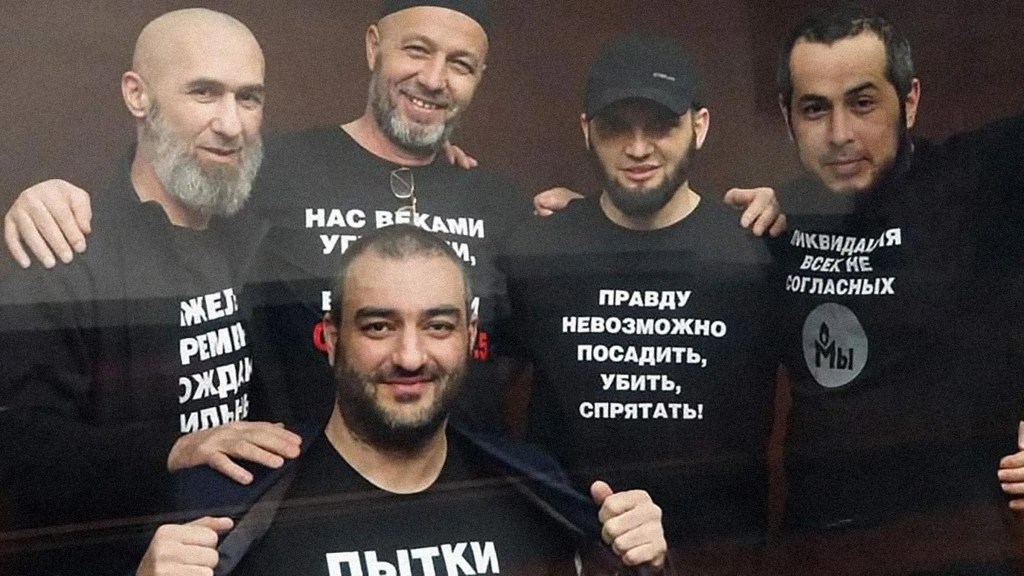
Political prisoners Tofik Abdulgaziev, Vladlen Abdelkadyrov, Izzet Abdullaev, Medzhit Abdurakhmanov and Bilial Adilov, among those falsely accused of “terrorism” and “preparation to seize state power” in 2019, and sentenced to 12-14 years’ imprisonment. Abdullaev’s T-shirt says, “the truth can not be imprisoned, killed or hidden”. Photo by Crimea Solidarity
On the anniversary of that tragedy, which Ukraine demands be categorised as genocide, Important Stories spoke with Crimean Tatars who continue the struggle to live freely in their historic homeland.
Every Crimean Tatar family has its stories of deportation. They all start in the same way. On 18 May 1944, at five o’clock in the morning, soldiers burst in to the house and gave people 5-10 minutes to collect their belongings and go to the nearest train station. No explanations. At dawn, everyone was forced into cattle wagons and taken away.
It was all over by 4:00 pm on 20 May: one of the fastest deportations in world history. All the deportees’ property passed to the Soviet state.
“Many people thought they were being taken away to be shot. The Soviet Union was an atheist regime, and many Crimean Tatars were of Islamic faith”, said Azime (her name has been changed), the wife of a present-day Crimean Tatar political prisoner. Her family were deported to Uzbekistan.
“They put everyone in cattle wagons, with no windows and locked doors. There was no sanitation. No water, no food. People died from hunger, thirst and dysentery. The soldiers just threw their bodies out at the train stations. Some people were able to hide their relatives’ bodies: those families hoped that they would soon arrive somewhere and be able to bury their loved ones like human beings.”
The transport took 2-3 weeks. About 80 per cent were taken to Uzbekistan, and the rest were sent to special places of exile in other parts of the Soviet Union.
“Part of my family was deported to Uzbekistan, part perished in those cattle wagons, and my grandfather was taken to the Urals”, said Ismail (his name has been changed), who today acts as a defence lawyer for Crimean Tatars. “Grandad said that, while he and his mother tried to find accommodation, they could not go to work for two days. And so [for breaking the labour laws] his mother was sent to prison for five years.”
Soviet propaganda prepared local people to receive the deportees. Uzbeks were advised to keep well away from the newcomers, who were “cyclops” and “cannibals”. In exile, Crimean Tatars faced hunger, dangerously unsanitary conditions and an absence of health services. Between 18 May 1944 and January 1946, about 200,000 Crimean Tatars lost their lives, according to estimates by the National movement.
The struggle to return home
People could not return to Crimea. Until 1956 the Crimean Tatars had the status of “special settlers” with limited civil rights. They had to report regularly to police commandant’s offices. They were permitted to move to a different region only by invitation from close relatives. Attempts to leave without permission were punished by up to ten years’ imprisonment.
Although their language was banned, the Crimean Tatars preserved their culture and traditions. Parents told children what their home looked like, and how to get there, so that they could find their way to it when they returned.
“Everyone lived with thoughts of going back”, Ismail said, telling his family’s story. “My uncle somehow found a way to travel to Crimea. My grandmother asked him to bring a bottle of water from home: she wanted to drink Crimean water. When my uncle got back from his trip, he realised that he had forgotten about the water. He took a bottle, filled it from the tap, and took it to Grandma [telling her it was from Crimea]. She cried. For her, that bottle was almost sacred. She kept it, and never drank a drop.”
In the 1960s, the Crimean Tatars began independently to collect information about the victims of the deportation. They demanded that the Soviet authorities revoke the slander that they were traitors, and allow them to return home. That is how the Crimean Tatar national movement was born.
On 5 September 1967, after many attempts to secure justice, came a decree of the Presidium of the Supreme Soviet of the Union of Soviet Socialist Republics (USSR), which revoked all accusations against the Crimean Tatars and allowed them to live in any part of the country. But to return to Crimea, they had to secure a residence permit, and find work. [Residence permits, linked to employment, were used to discipline labour in the Soviet Union.]
By the end of September 1967, about 2000 Crimean Tatars had already returned to the peninsula. But the majority of them could neither get a residence permit, nor any chance of work, from Crimea’s new inhabitants. Many were deported again, and brought to court for breaches of the internal passport regulations.
Azime’s family was one of the first that returned to Crimea and found a way to stay there. “My grandfather, an activist of the national movement, left behind all that he had worked for in Uzbekistan, took his four children, and went home. We are not even talking about returning to his own village, where his grandparents were buried – only returning to somewhere on the peninsula where the family would be allowed to stay. They found a place in Dzhankoi district, where several other [Crimean Tatar] families also moved in. The street was named International Street, because we, the non-Russians, lived there.”
Azime was born at the end of the 1980s, already back in Crimea. Among people of her age, that is very unusual, she said. “I know literally two other people [of her age] who were born back there [on the peninsula].”
[In the 1970s and 80s] the Crimean Tatars had to build their homes all over again. The homes from which their families had been deported now belonged to other people. The work they could find was always the hardest. The attitude of the new local population was hostile: they continued to accuse them of treachery.
“Our grandparents were often dismissed from work”, Azime remembers. “They were constantly searching for new jobs, in order not to be deported again. My mum went to school in Crimea: when the family returned, she was eleven years old. She was admitted to university only on the fourth or fifth attempt. The dean of Simferopol medical school told her father outright that he would not accept Crimean Tatar students, not for any amount of money.
“My mum was the only Crimean Tatar woman in her university. [When her fellow students and teachers learned that she was a Crimean Tatar], she was told to her face that she had no business being there. Many teachers simply marked her work down. Our people felt everywhere that Crimean Tatars were strangers in their own land.”
The Crimean Tatar national movement had already taken shape, and its activists fought for the right to live in Crimea and for the freedom of those imprisoned for breaches of the internal passport regulations. They monitored attacks on human rights, and took part in hunger strikes and other forms of protest. In 1978 the activist Musa Mamut burned himself to death as an act of protest: this became one of the symbols of Crimean Tatar resistance.
But even twenty years after the decree of 5 September 1967, the situation had hardly changed. “The mechanisms to obstruct the Crimean Tatars’ return had been so finely tuned by the Crimean authorities, that I never heard of a single instance of a new Crimean Tatar family buying a house”, the Crimean Tatar activist Bekir Umerov wrote in his memoirs. His family was also prevented from returning to Crimea: in the 1980s they moved to the Krasnodar region [of southern Russia], to be nearer to home.
After the beginning of perestroika [the reform of the Soviet system started under Mikhail Gorbachev, from 1986] in the spring of 1987, the Crimean Tatars gathered in Tashkent [in Uzbekistan] for their first All-Union Assembly. They agreed on a document that called on Mikhail Gorbachev, then the general secretary [of the Communist Party of the Soviet Union] to meet a delegation. This call went unanswered, and so on 18 May, the anniversary of the Crimean Tatars’ deportation, the activist Bekir Umerov announced a hunger strike in protest.
This met with a powerful response, and not only among Crimean Tatars. The scientist and human rights defender Andrei Sakharov mentioned the action in his call to Gorbachev to resolve the problem of Crimean Tatars being able to return home. Umerov ended his protest a month later, when the Second All-Union Assembly of Crimean Tatars elected him to a delegation that travelled to Moscow. But the Kremlin refused to meet the Crimean Tatars, as it had done before.
The activists then began protests at the Lenin mausoleum [on Red Square], at the building of the CPSU Central Committee, at the Kremlin. Each day the number of participants grew. One of the biggest rallies was held on Red Square in the middle of July 1987. The Crimean Tatars staged a peaceful sit-down protest, and the police held back from using force. A week later, on 26 July, more than 1000 Crimean Tatars took part. This time the police blocked the way to Red Square and so the demonstrators went along Vasilevsky Spusk, sat on the ground, raised their placards and shouted: “Crimea! Our homeland!” The action went on for 26 hours.
Many of the participants were arrested and deported from Moscow to the places where they lived. No official documents sanctioning a return to Crimea were issued by the authorities – but there were fewer obstructions.
The Crimean Tatar protests continued through the whole perestroika period.
Occupation of the peninsula
Many families could return to their homeland only after the collapse of the USSR. The move was difficult, even without the authorities interfering. “For more than 20 years, the Crimean Tatars had been finding their feet in the places to which they were deported. They had settled down. And now they had to leave everything again, return home empty-handed, and again start to get on their feet”, Azime explained.
“After all that had happened to our people [as a result of deportation], we stuck closer together and helped each other. My parents told me about how someone had got land in Crimea, gathered 30-40 families and built a house on it together. And then they built another. We are not just a people, we are one big family”, Ismail, the human rights defender, said.
“In general the Crimean Tatars are Muslims. This means a sense of collectivism, which means brotherhood, giving moral support to each other, good neighbourliness. These are traditions going back to the [Crimean] khanate [of the 15th-18th centuries]. The Prophet says, ‘if you laid down to sleep well-fed, and your neighbour was hungry, you will not sense the scent of paradise’. And it makes no difference whether your neighbour is Muslim or not.”
The Crimean Tatars were only able to live a relatively quiet life in their historical homeland for a little more than twenty years.
“It turned out that my generation was the only one, in the past century, who could spend their early years at home, living in peace”, Azime said. “I just recently said to my children that I could not now myself imagine how carefree those years were. We just lived, and did not think that things could be different.”
That life changed at the beginning of 2014. “I was then pregnant with my third child”, Azime recalled. “I was already preparing for the birth when I heard on the news that the Russian [armed forces] were coming. I knew that for decades Russia had imprisoned Muslims simply for professing their faith. I can not tell you how terrified I was, for my child, for my husband, for all of us. Then tanks appeared on the streets, and men in uniform, and the occupation began.”
Some Crimean Tatars decided to move to Ukrainian-controlled territory. Azime and her husband also discussed that, but decided to stay. “We both agreed that here is our home, our land, for which our parents had fought. Why should we leave? It was they who came to us, no-one asked the Russians to come here. We decided that we would not allow Russia to drive us from our homes a second time.”
Most of the Crimean Tatars were against the occupation, and boycotted the “referendum” [of March 2014, on joining the Russian Federation]. Consequently, after the annexation, the Russian authorities took repressive measures: Crimean Tatars were arrested, kidnapped, and accusations under the laws on terrorism were fabricated en masse. People were accused of membership of [the transnational Muslim organisation] Hizb ut-Tahrir, which is banned in Russia. As proof, “secret witnesses” were produced, together with the fact that the accused professed the Islamic faith.
“We did not know what to do”, Ismail remembers. “We did not know the new legal code, or what to do when three brothers by faith were falsely accused of terrorism. From the start, the new ‘authorities’ were determined to show that they would liquidate anyone who opposed Russia. They only wanted people loyal to them in Crimea.”
Ismail himself suffered intimidation and harassment. In 2015 an officer of the Federal Security Service (FSB) planted drugs on him [and he was arrested]. When being questioned, he was asked about Crimean Tatar affairs. They tried to convince him to work for the security services. Thanks to the prominent Crimean Tatar lawyer Emil Kuberdinov, the case did not go any further than the prosecutor’s office.
“At that time the Russians were still trying to work out the extent to which their hands were tied in Crimea”, Ismail said. “But I already understood what was on its way. Crimean Tatar lawyers came on the scene, not only helping people who were arrested, but also support political prisoners’ families, explaining how to send parcels to prison, what to do on prison visits and so on.”
In 2016, Crimean Tatar activists, together with lawyers, formed the Crimea Solidarity organisation.
In 2017, about one hundred Crimean Tatars across peninsula simultaneously staged one-person pickets against Russian repression. About 60 people were served with administrative summonses, for breaching the regulations on picketing (Article 20.2 Part 5 of the code on administrative offences [similar to civil law]). The hearings were all arranged on the same day, in different districts. As well as Crimea Solidarity’s lawyers, the interests of the accused were represented by civil society activists. One of these was Ismail. “People began to offer support to Crimea Solidarity. I did so myself. We had no legal education, but the lawyers helped us to prepare. So the Crimean Tatars continue to help each other.”
Repression under occupation
Criminal cases under terrorism laws have become the main instrument of repression against Crimean Tatars. Military courts deal with these cases in closed hearings that even close relatives can not attend. The sentences under these laws are 10-20 years’ imprisonment.
The Russian security forces have conducted searches at mosques, arrested clerics, cases have been put together alleging failure to inform on “terrorist groups”. Family members of political prisoners have also been subject to surveillance and harassment.
Every arrest and raid becomes a matter for the whole community. People gather at any time of day or night, often bringing children along, to support families who have been singled out for searches. Azime, along with her elder sons, has often gone to support her neighbours. She tells her children not to fear people in uniform, that those people’s fear is even greater.
Azime also prepared the family for the fact that they might be raided at home. Her husband Rinat (his name has been changed) is an activist in the national movement, has written a great deal about the repression of the Crimean Tatars, and has spoken out openly against repression and against the occupation. He had been arrested on administrative charges several times, and the family understood that sooner or later he could face criminal charges. Some time ago Azime started to sleep wearing her clothes and a hijab [expecting a raid].
The security forces came for Rinat at 6:00 in the morning, but he was not at home.
“Before sunrise every day we read prayers. My mother asked me in Tatar (in the family we use our native language) how she would be able to perform ablutions. I told her not to be afraid and to stay calm. The armed men told us that we could not speak in Tatar. That was offensive to me, as a woman and as a mother. They insulted our faith: they said that instead of ‘beating the floor’ five times a day, which should behave like normal people.”
Protesters and Russian armed forces in Crimea, 2014. Photo by Krym.Realii/RFE-RL
During the raid, Azime’s three children were much calmer than she had expected them to be. “I tried to stay confident and not to fear these men and their automatic weapons, hoping that that would also help the children to stay calm. Only my daughter was crying, at the start when she first saw the guns, she is the youngest.
“When I woke up, the room was dark, but I could see floodlights being shone from the street directly into our windows. The shadows were dancing around the courtyard. I understood that it had started. Then wild knocking at the door”, Azime recalled. “I asked my mum to dress and open the door. A big crowd of armed men in masks ran in, shouting. They turned the shelves upside down, everything from outer clothes to underwear. They paid closest attention to the books.
“My sons are still in primary school, I don’t think they understood exactly what was going on. For them it was like something out of a fairy tale, where we needed to defy evil. They did not sit in the corner like mice, but walked between these people with the automatic rifles, as though everything was OK. The men did not touch them. Just once, they tried to find out [from the children] the password for my phone, which I refused to unblock. I did not want them to see photographs of me unveiled.”
It only became clear later how stressful the children had found the raid. “For years afterward, my elder son started to fear the whole world that surrounds him. He thought that the FSB was everywhere, he saw all people as a threat. When we went into town, he would stick close by me and say, ‘I am afraid that they are going to take me away’. For a year or two, my daughter developed a nervous tic. She works with a psychotherapist, but still fears me falling asleep before her, fears being alone.
“At least the children didn’t see how their father was set upon and thrown to the ground with an automatic pointed at his temple. That’s a rare thing for a Crimean Tatar family nowadays. I have talked with the children many times, I saw to them that the Almighty is with us, and that his wisdom also oversees what is happening with their dad”, Azime said.
Wives of Crimean Tatar political prisoners
Azime’s husband was beaten, and arrested, when he travelled to Rostov to deliver parcels to other Crimean Tatar political prisoners being held there. While Rinat’s case was in court, Azime could at least see him at the hearings. But when the sentence was announced, neither Rinat’s wife nor other Crimean Tatars were admitted to court. Rinat was sentenced to nearly 20 years in a maximum security facility, under two Articles of the criminal code: “organisation of the activity of a terrorist group” and “preparation for a violent seizure of power”.
Azime said: “My husband is big, kindly man, like a bear in a cartoon. He went out to work, went to court hearings [of other arrestees], publicised the repression of our people, and always found time for our family. I lived like a princess. And now all that has finished. A new life has begun: I have to survive, and to try to understand what comes next.
“At night I cry into the pillow, so that the children can not hear. I have to learn to do things in the household that were previously done by my husband: what documents have to go where, how to pay for the electricity, how to read the meters. I have had to give up studying and my teaching work. Before all this, I had more time for the children: now I often have to leave them to look after each other.”
Azime’s health has suffered as a result of all that has happened, and she has had two operations. She is supported not only by her family but by the community. “There was a knock at the door, and a woman I don’t know was standing there, offering me eggs and cheese. She said: ‘That’s for you, my dear. You don’t know me, but your husband gave court support to my son.’ Around here there are already many women with the same, bitter experience. I turn to them for advice, about where to buy things for prison parcels, where to send documents for this and that. I am walking along a well-trodden road.”
It is now five years since Rinat’s conviction. In that time, Azime has not been able to meet her husband once. Her only contact with him is through letters, that are passed on by his lawyer. In prison, Rinat has continued to write about the repression against the Crimean Tatars. Azime receives his articles, retypes them electronically, publishes them and sends them out. “My husband constantly writes to me, thanking the Almighty for the fact that his wife is here. He says, ‘when my book comes out, that will be your doing – you are my censor, editor, proof-reader and publisher!’
“Like the wives of other Crimean Tatars, I have chosen to continue the fight taken up by my husband. Up until 2022, we used to travel, to explain what is happening to our people. We were in Kyiv, Kherson and Mariupol. We continue to campaign now, but we can not travel anywhere. Our husbands have been deprived of free speech. Who, if not us, will speak about their cases and convey their arguments? They, also, became activists not by choice. And now we stand in their place.
“In our letters to our husbands, we sound very strong, like stone, their bastion. I always write to my husband, ‘this is your challenge from the Almighty. If you meet it, you will earn yourself a place in paradise’. It’s at night-time that I cry in my pillow. I feel sorry for my husband, and it is hard for me too. I have to be both mother and father to my children; I have to support my husband; and be an activist. But you cry, and you keep going – and that’s how I earn a place in paradise too.”
The all-out war
With the Russian army’s all-out invasion of Ukraine in Feburary 2022], many Crimean Tatars were again forced to leave their homes. The biggest exodus took place when military mobilisation was announced. According to the Mejlis of the Crimean Tatar people [the national representative council, now based outside Crimea], since September 2022 between six and eight thousand Crimean Tatars have left the peninsula. Azime said that Crimean Tatar families that have sons of conscription age try to leave Crimea. “Everyone fears that their sons will be taken by force to the war.”
Ismail said: “Many people have left because they do not want to fight on Russia’s side – although the mobilisation turned out to be more a moral pressure than a physical one. Of those who have been sent to the front from Crimea, only about 5 per cent are Tatars. I reckon that, of those who did go to the front in autumn of 2022, 60-70 per cent have already returned.”
Those who have moved to territory controlled by Ukraine can not return to Crimea, due to the risk of repressive action. In 2023 the Crimean Tatar Leniye Umerova tried to get to Crimea to see her father, who was very ill. She travelled from Ukraine via Georgia. She was arrested at the border on suspicion of spying. Umerova has already spent a year behind bars in Russia. The case will be heard in secret and she is threatened with 20 years’ imprisonment.
Since 2022, repression against Crimean Tatars has been stepped up. The Russian authorities have conducted at least 71 searches, and there have been at least 110 convictions – more than in the preceding eight years. In the autumn of 2022 a second pre-trial detention centre (SIZO) was opened in Crimea: Crimean Tatars, and Ukrainians kidnapped in the occupied territories, are sent there. Since the all-out war began, there have been a much greater number of cases, compared to the previous eight years, related to the “voluntary Noman Chelebidzhikhan battalion of Crimean Tatars”, that has been fighting on the Ukrainian side since 2014.
There was also a wave of repressive measures against Crimean Tatars when parts of Kherson and Zaporizhzhya regions were occupied: about 100 people have been arrested there. Some cases have been initiated by informers who write on the Krymsky SMERSH telegram channel that was set up in 2022.
“Informing has become a big thing in Crimea”, Ismail says. “Someone says something at the market, and that’s it, you get a knock on the door. The regional authorities have acquired an extra repressive tool against the peninsula’s citizens: the Article [in the code on administrative offences] on discrediting the army. There have been many administrative cases as a result, some for people writing comments on social media.”
Azime said: “Today, deportation of Crimean Tatar people takes a hybrid form. Now it’s not in cattle wagons: people are taken away in prison transport vans. From many families they have taken all the menfolk: for example they will take the husband, son and father. I have a neighbour who is 75, they have taken both her sons. Every time I see her she says, ‘my dream is just to be able to hug them once more in this life’.”
Azime has decided to stay on the peninsula, as long as possible. “In our lives we have seen hundreds, perhaps thousands, of families that have been broken up, which fought for so long to be able to return home. I have decided for myself that I will never leave our homeland. We understand that the repression will intensify, that whatever has to happen, will happen.
“What’s the point of cowering like a mouse, of living in fear? If they succeed in shutting our mouths, that would be a betrayal of our people who have suffered so much. We must not stay silent. As long as our husbands are imprisoned, and as long as they continue to try to destroy the Crimean Tatar people, we won’t stop fighting.”
Ismail, too, has no intention of leaving the peninsula. He continues to support Crimean Tatars in court. “I have decided for myself to take this position. I see how the families of my close friends are punished and repressed, how people are imprisoned. As a Crimean Tatar and a Muslim, how should I react? Do I sit here and say, ‘it’s nothing to do with me’ – or give some help. For me, this is a test from God.
“The best example to me in this situation is the Prophet Muhammad. Yasir’s family was taken to the desert and tortured by infidels for their religion. What did the Prophet do? He did not sit at home saying a prayer; he did not stand to one side. He went there, where Yasir’s family was under attack, and gave his support. That shows how we, today, faced with this repressive machine, need to react.
“It does not depend on us, whether they imprison a person or not. But it depends on us what we do, what support we give. Can we help the defence in court? Then we’ll go to court. Can we help the family? Then we will visit their home, bring things that they need, and money, and help with the children.
“For the Crimean Tatars it is very important to preserve our spirit of unity. We have faced many trials. When a person is left to face a problem on their own, that is very hard to bear. If someone just sits down for coffee with that person, and says, ‘you are not alone, we will help you, we are right alongside you’, this helps to deal with tragedy.
“I was recently in touch with the mother, and aunt, of a Crimean Tatar who was sentenced to ten years, in a case related to the ‘voluntary Noman Chelebidzhikhan battalion of Crimean Tatars’. They kept telling me how people had come to visit them, to help and support them, how they felt the support of our people. Without this, they said, they would have been broken.
“Russia is trying to give the appearance that everything is fine in Crimea, and now they don’t lay a finger on anybody. That is a lie. We can show the world that we have already had ten years of this. We understand, of course, that the repressive machine pays little heed to laws, let alone to moral and humanitarian values. If an instruction comes down to lock someone up, they do it, no matter what defence is presented in court.
“But we continue to go to court, to record videos showing how Crimean Tatars face harassment and intimidation. We continue to fight. We don’t keep quiet or swallow all this silently. We will take a stand and say, ‘we are not guilty’. I think that if we had not done this, if we had sat quiet, then Crimea would already have been turned into another Chechnya.”
The links in the article are from the original Russian version, to sources in Ukrainian and Russian. Web sites in English include the Mejlis of the Crimean Tatar people; Crimea Platform, recently launched by the Ukrainian government; the Crimea Human Rights Group; and Crimea SOS. Reports on human rights abuses have been published this year and last by the UN and the Council of Europe. A history of the Crimean Tatars, ‘A Seditious and Sinister Tribe’: the Crimean Tatars and their Khanate, by Donald Rayfield, has just been published, and reviewed. There are more than 100 political prisoners listed (Russian only) on the Crimea Solidarity web site currently detained.
Source: People and Nature, 16 August 2024. Thanks to Simon Pirani for translating this important overview of the Crimean Tatars’ struggle and for permitting me to reprint his translation here.
If you have been to Chronicles Bar[in downtown St. Petersburg], you have definitely seen the photos discussed in this film. In today’s session of “Screening the Real,” we are watching Leningrad 4, a documentary about Sergei Podgorkov and other champions of Leningrad’s unofficial photography scene during perestroika. Yuri Mikhailin spoke to the filmmaker, Dmitry Fetisov, about dramatic structure, time as a form and rhythm, and Soviet-era beer stalls.
“Leningrad 4,” Dmitry Fetisov, 2023 (in Russian with no subtitles)
My path to documentary filmmaking was a tortuous one. At school, I was interested in writing texts, and at the age of seventeen I decided to apply to the St. Petersburg State University of Film and Television (KiT) to study drama, but at the interview I was advised to go into documentary directing. At the time, Victor Kossakovsky was accepting students, but I didn’t go to study with him, I went to Tver (I’m from the Tver Region) and studied three years at the College of Culture, specializing in directing and theatrical acting. Then I went to study in Konstantin Lopushansky’s feature filmmaking program at KiT. I studied for a year, but them I decided to try my hand at documentary filmmaking again, although I didn’t really understand what it was.
I transferred to Vladislav Borisovich Vinogradov’s course, and I more or less made a go of it there. I guess I had found my master. It was the first time I saw examples of poetic documentary films with characters and dramatic structures that intrigued me. I also really liked Vladislav Borisovich’s work (I Return Your Portrait, A New Year at the End of the Century). I think that I have inherited to some extent his format, in which the films are based on interviews with the characters, and the themes have something to do with Leningrad culture.
Still from “Leningrad 4,” Dmitry Fetisov, 2023
My interest in photography stemmed from moving to St. Petersburg. I liked the texture of its central districts, the most banal things—palaces and , the difference between the Petrograd Side and Vasilievsky Island. And I was very interested in the movies made at Lenfilm Studios—Ilya Averbakh, the so-called Leningrad school, the perestroika-era pictures. This texture intrigued me. I came across the photographs of Boris Smelov, Leonid Bogdanov, and Boris Kudryakov. I became a big fan of theirs, and started looking for lesser-known photographers.
You could say that Leningrad 4 was born in 2011, when I went to a photo exhibition at the legendary Borey Gallery on Liteiny for the first time and saw Sergei Podgorkov’s work. I thought that I should make a movie about this man. I was very impressed by Ludmila Tabolina’s show at the Akhmatova Museum, as well as the exhibition on the Zerkalo photo club, from which many photographers had emerged.
Still from “Leningrad 4,” Dmitry Fetisov, 2023
In 2021, I decided to make a short film about Sergei Podgorkov. At the time, I had no idea that it would turn out to be a forty-minute movie. I wrote to Sergei on VKontakte, and he invited me to his place in Borovichi. If I were making the film now, I would probably add a video chronicle of the trip. Podgorkov showed us around the town, including the old railway station, and after filming we drank some good Novgorod moonshine with him to celebrate our acquaintance.
Many of the shots were made with Soviet gear—a Helios 40 telephoto lens. I bought it in a thrift store, and I successfully fitted this 1965-made lens to a Sony mirrorless camera. The Helios 40 handsomely blurs the edges and thus emphasizes the subject in the frame. It is my favorite lens.
After filming Podgorkov, I realized that the topic could be pursued further. I had always been interested in the Leningrad Rock Club, and so I decided to film Andrei “Willie” Usov, who was the staff photographer for the band Aquarium and did all the covers of their records, and was friends with Mike Naumenko.
Andrei “Willie” Usov, holding his iconic image of Boris Grebenshchikov and Mike Naumenko. Still from “Leningrad 4,” Dmitry Fetisov, 2023
The third character was the pictorialist Ludmila Tabolina. I appreciate this movement in photography. The next character was Alexander Kitaev. I liked the Kitaev’s powerful countenance, that of a bohemian. Petersburg photographer, and I decided that I would film him even before I got acquainted with his images myself.
Another character is Valery Valran. He is not a photographer, but a well-known artist in Petersburg, a popularizer of photography, a curator of photo exhibitions, and the first to turn [photos by Leningrad’s underground photographers] into a photo album: the book Leningrad Photo Underground appears at the beginning of the film. I decided to include it in the film to tell about this photography movement a little from the outside.
And finally, there was Sergei Korolyov. I filmed him, but during editing I realized that, unfortunately, a short subject about him did not fit into the film. I edited it separately and posted it on my “Blog Stall” which I dreamed up when blogging was the cool thing and where I publish stories related to cinema. This episode is called “The Photographer Korolyov”.
“The Photographer Koroylov,” Blog Stall, episode 26
How did I realize that these characters were enough? When I filmed them, I had an idea for the next film I might make: about photographers who are no longer alive, like Bogdanov and Kudryakov. And I decided that the filming was over.
The film took a long time to edit, almost a year. I realized that each photographer has a certain leitmotif. Sergei Podgorkov has a story connected with beer stalls (although he does not emphasize it himself), Andrei Usov has rock, Ludmila Tabolina has the white nights, and Kitaev has [Petersburg’s] Kolomna neighborhood.
Still from “Leningrad 4,” Dmitry Fetisov, 2023
To separate the interviews and photos, I decided to use a film footage frame. Some of my colleagues think that this is visual bad form, but for me it seems logical: conversations with photographers are the present day, while their photos are the past, and the footage works as a transition between them.
Sometimes I wanted to connect the times. The chapter “Conversations at Beer Stalls” features music by contemporary jazz-noir artist Bebopovsky and the Orkestry Podyezdov. I had enjoyed him for a long time. I met the artist, and the opportunity to use his music in the film presented itself.
While I was editing, I did a photo shoot on black and white film for an acquaintance. I was supposed to make shots like in the scene in Godard’s movie Le petit soldat in which the main character takes a picture of a young woman. For this photo shoot, my friend bought a Leningrad 4 light meter on Avito. I realized that I would call the film that, because the main character is late Soviet Leningrad, and there are four photographers in it. Then I decided that I would divide the movie into four parts. Besides, perhaps these photographers possibly also used the Leningrad 4, as it was one of the most popular exposure meters of its time.
It was later that Sonia Minovskaya, my co-director and assistant on the movie, noticed that in some mythologies the nuumber four is the number of decay, death, and demised. And indeed, in each chapter something fades away or dies. In the first one, the Leningrad white nights are buried, while in the second, Mike Naumenko and a whole erа exits the stage. Then we see the end of the Summer Garden in its historical guise, and in the final chapter, where the rallies in the squares are shown, we see a country disintegrating. I didn’t think about this symbolism when I was making the film. I did it intuitively.
Photographer Alexander Kitaev. Still from “Leningrad 4,” Dmitry Fetisov, 2023
I understand that the editing is finished when a special, unique time emerges in a film. Time is a rhythmic form to me. A movie is ready to go when it suits me rhythmically. My films are calm, lyrical, and meditative. I probably like the documentaries of Wim Wenders for a reason.
Leningrad 4 was screened at the Arctic Open Festival in Arkhangelsk, where it got a super-warm reception; at the Salt of the Earth Festival in Samara; and in the online program at Artdocfest.
At one of the premiere screenings at the Rosphoto Museum, Sergei Podgorkov, with his usual irony, criticized the film for being too sentimental about an era that, in his opinion, is not worth the nostalgia. I did not put nostalgia in the movie, especially nostalgia for the Soviet Union, which I do not have. Andrei Usov noted that the films uses images from a time when the city was more interesting texturally for photographers. Nowadays, Petersburg is quite touristy, shiny and bright. He also admitted that the film left him with a heavy feeling. He and Naumenko had a great, strong friendship, and he still takes his departure quite personally.
Still from “Leningrad 4,” Dmitry Fetisov, 2023. Photo by Sergei Podgorkov
Another character in the movie, Svetlana, attended the screening at the bar WÖD. In the final scene, we see a photo of her standing on the roof of a building opposite the Mariinsky Palace during the attempted coup in August 1991 and looking into the lens—as if that era were upon us today. This is a famous photo by Sergei Podgorkov. Recently, Sergei found Svetlana through the internet and invited her to the screening. And now, thirty-three years later, she saw herself on the screen and recounted how the picture was taken. Podgorkov had run out of film, but Svetlana was also an amateur photographer, so she lent him her own camera, and he photographed her.
Recently, I went to Chronicles Bar on Nekrasov Street and saw Podgorkov’s photos there. It was amazing. It is a young people’s bar, and yet the walls are adorned with photos of Soviet-era beer stalls, so it is as if two eras were connected through Podgorkov’s photographs.
Memorial for actor Joachim Gottschalk. When his Jewish wife Meta and son Michael were to be deported, the whole family decided to commit suicide on November 6, 1941. The bronze figure, which was created by Theo Balden in 1967, resembles the actor. It was initially located in a park but had to be moved due to the building of the local Sparkasse in the 1990s. Its new place is a memorial wall in the Joachim-Gottschalk-Straße 35.
The Impact of the Gold Rush on Native Americans of California
This inquiry lesson provides primary sources, maps, images, and background history to offer teachers and students insight into a little-known but vitally important aspect of one of the most iconic events in American history—the California gold rush. Students will analyze sources to answer the question: Do American actions against California Native Americans during the gold rush meet the United Nations definition of genocide?
The attitude of César Chávez and the UFW towards the undocumented changed over time and can be divided into three periods: 1962 to 1975; 1975 to 1993; and 1993 to the present. A look at these changes reveals much about Chávez, the union, and the times. Frank Bardacke is the author of Trampling Out the Vintage: César Chávez and the Two Souls of the UFW.
Whenever an infant heads to nursery, it can feel like an enormous step. Things are changing for everyone. There are all sorts of feelings flying around – relief, sadness, doubt, fear. But what’s going on behind the doors of nurseries and childcare settings in England? India speaks to Joeli Brearley from Pregnant Then Screwed about the current childcare crisis, child development psychotherapist Graham Music about how childcare impacts children, as well as economist Emily Oster on our choices around childcare. India then meets artists Conway and Young who have found a way to make the invisible labour of childcare pay.
Presented by: India Rakusen. Producer: Georgia Arundell. Series producer: Ellie Sans. Executive producer: Suzy Grant. Commissioning Editor: Rhian Roberts. Original music composed and performed by The Big Moon. Mix and Mastering by Charlie Brandon-King.
Childbirth is deadlier in the United States than in any other high-income nation, according to a study released Tuesday by the Commonwealth Fund that underscores the persistence of maternal mortality.
More than 80 percent of pregnancy-related deaths in the United States are preventable, but factors including a shortage of maternity care providers, limited access to after-birth home visits and lack of guaranteed paid parental leave have increased the risk of maternal mortality, especially for Black people, researchers have found.
In 2022, about 22 maternal deaths happened for every 100,000 live births in the United States. For Black people, that number rose sharply to 49.5 deaths per 100,000, according to the report from the Commonwealth Fund, which conducts independent research on health-care issues. Two out of three maternal deaths occur up to 42 days after birth, highlighting the importance of postpartum care, which only some state Medicaid programs and private health insurers cover.
The study compared 14 high-income countries. It used data from the Organization for Economic Co-operation and Development — known as the OECD — which tracks health system metrics across 38 high-income countries, and from the Centers for Disease Control and Prevention Maternal Mortality Review Committees in 36 states.
Although OECD data is widely regarded as the gold standard for international comparisons, the authors note that discrepancies in how countries gather health data may affect the findings.
“We can’t just think of reproductive health at the time of pregnancy because a lot happens after the baby is born. If we’re not supporting women during this crucial time period, we’re never going to solve this problem,” said Munira Z. Gunja, the study’s lead author and a senior researcher at the Commonwealth Fund.
Ten of the countries listed in the report had a death rate of fewer than 10 per 100,000 live births; in 2022, Norway’s maternal death rate was zero.
Laurie C. Zephyrin, senior vice president for advancing health equity at the Commonwealth Fund, said these numbers paint a stark picture of health care in the United States. She called for more focus on community-led investments, including birth centers and health-care teams working with patients in the weeks before and after delivery. She also said health systems should have incentives and accountability involving equitable quality of care, particularly for communities of color.
With 65 percent of maternal deaths occurring after birth, many health experts emphasize the need for not only more prenatal care but an increase in comprehensive postpartum care.
“We want this to be the cultural norm. We want this to be federal policy. We want there to be a big change because we know that we can completely minimize the rate of maternal deaths in this country,” Gunja said.
Health disparities are not unique to the United States. In Australia, Aboriginal people are twice as likely to die of maternal complications compared with other people giving birth, according to the report. Still, experts are hopeful that policy changes and awareness will help bridge the divide and decrease the overall maternal mortality rate in the United States.
The report highlighted the importance of access to midwives, whose work has been described as an important factor in countries with the lowest maternal mortality rates, the report found. Teams involving midwivescould deliver 80 percent of essential maternal care and potentially prevent 41 percent of maternal deaths, 39 percent of neonatal deaths and 26 percent of stillbirths, the report said.
Some studies have found that teams led by midwives offer care comparable, or superior, to care provided by obstetrician-gynecologists. In the United States, Canada and South Korea, OB-GYNs outnumber midwives, but in most other high-income nations, midwives are more prevalent.
The United States and Canada face a shortage of midwives and OB/GYNs. Almost 7 million people in the United States live in areas without hospitals or birth centers offering obstetric care or any obstetric providers. The shortage is expected to worsen.
“We are setting ourselves up for an absolute reproductive health provider shortage, and contributing to that is this interference into the patient-provider relationship and the restrictions that are being placed on us,” said Tamika C. Auguste, a D.C. OB/GYN and chair of the American College of Obstetricians and Gynecologists Foundation Board who was not involved with the study.
The United States is the only high-income nation without a federally mandated paid parental leave policy and universal health care. Only 13 states and D.C. have paid family and medical leave laws; these policies have been shown to improve health outcomes for pregnant people.
“We are in a dire time in our country, where we’re seeing firsthand the impact of these policy changes at the state level and how they are impacting people’s lives,” Zephyrin said.
In recent years, abortion restrictions have sparked debates and legal battles. State legislatures have been enacting increasingly stringent laws aimed at limiting access to abortion services, such as mandatory waiting periods, ultrasound requirements and bans on certain procedures.
The current wave of abortion restrictions has significantly affected broader health-care services, particularly obstetric care. States that have imposed abortion restrictions often face closure of clinics offering a variety of health-care services, such as cancer screenings, contraceptive services and general reproductive health care. As a result, people in these states encounter greater challenges that exacerbate existing health disparities.
“Women’s health-care providers are being driven out of areas due to the restrictions on practicing full-scope reproductive health care,” Auguste said. “This creates areas where there are no health women’s providers for women.”
The factors that led into the creation of their newest album aligns perfectly with the discussions this podcast is about. Just blocks away from the 3rd Police Precinct that burned down during the protests, Twin Cities country-folk band The Gated Community saw many of their recordings lost due a power outage. But being in the center of burning buildings, gunshots, and neighborly concern, Sumanth Gopinath was compelled to write about it. The result: songs about that tumultuous era that culminated in a new album filled with important issues and topics, which fit perfectly with their existing songs and socially conscious perspective as a band. Sitting around one table, I got to hear about the evolution of a band without egos, which is part of what makes The Gated Community so special.
In his new book, Barons: Money, Power, and the Corruption of America’s Food Industry (Island Press, 2024), Austin Frerick identifies contemporary “barons” in seven different corporations—such as Cargill, Inc., the Driscoll’s and the conglomerate JAB Holding Company—who have taken over food systems and re-shaped communities. Frerick writes in the introduction, “I refer to these people as ‘barons’ to hearken back to Gilded Age robber barons such as John D. Rockefeller and J. P. Morgan because I believe that we are living in a parallel moment when a few titans have the power to shape industries.”
A fellow at theThurman Arnold Project at Yale University and former Treasury Department official, Frerick has been among the leading experts and researchers in competition policy and antitrust examining food industry consolidation. As co-chair of the Biden campaign’s Agriculture Antitrust Policy Committee, he helped advise several of the leading Democratic presidential candidates on agricultural policy leading up to the 2020 election.
Frerick’s interest in the barons of today’s food-industry is also personal. As a seventh-generation Iowan, Frerick’s interest in antitrust policy began as an undergraduate at Grinnell College where he researched corporate power in Iowa’s slaughterhouse communities.
Barn Raiser spoke with Frerick about how agricultural consolidation has changed the landscape of rural America, and how to bring rural people out from their local Walmart and back onto “Main Street.”
What is it like writing about your home?
It started off as angry and it changed into profound sadness. I think that’s because the origin of the book is in Iowa. “The Hog Barons” chapter is what started this whole thing. This book came about because I published that article in Vox on the hog barons at Iowa Select Farms in Iowa, and I got a book deal from that. I noticed that I changed the tone from when I wrote it as a magazine article and made it into a book chapter. It now reads to me as profoundly sad, like it all kind of fell apart in Iowa. It’s grappling with the Iowa I grew up in and what it’s become, from the anger that’s everywhere to just how industrial the landscape has become.
You wrote that “as farms consolidate, more and more of the wealth leaves rural communities and flows to the Cargills of the world.” You also describe how your hog barons live in a gated community in Des Moines — far from the pollution and working conditions they are creating. A few weeks after your book came out, Jeff and Deb Hansen of Iowa Select Farms, the hog barons you highlight in chapter one, published an op-ed in the Des Moines Register, where they called themselves “stewards of [their] land and communities.” What was your reaction to that op-ed?
They employ their own spokesperson, like someone’s job is to do this for a living, and I just thought it was so poorly written. It reinforced in my head that no one’s ever the villain in their own story. And they’re just delusional. They’re living in a delusional world. They’re just not living in the same world we’re living, and I think the op-ed reflected that. To call themselves stewards of the land with a straight face, it’s just like, no one in Iowa thinks that. That’s an accepted reality at this point.
You hosted a book event in Iowa Falls, where the hog barons are from. What was the reception to your book like there?
Honestly that one shocked me the most. I was actually nervous for that event. I really haven’t been nervous at all during this whole book process. That was the one time I was a little worried for my safety. I turned that tracking thing on my phone so my husband could follow me. It’s a little scary, it’s like you’re going into the heart of the beast. At every book event someone asked me am I worried about my safety, which was, you know, an unnerving question to get all the time. But I had a completely different reaction when I got there. I was shocked. Not only at the turnout—I mean, like 45-50 people—but that there was not one dissenting voice. It was among the most incredible after-talk experiences I’ve had because it felt like a third or half of the room came up and talked to me afterwards, because they all know Jeff and Deb, the hog barons.
They all told me a different story of how Iowa Select Farms bamboozled the community from promises they made and didn’t keep for Des Moines and the intimidation tactics they used to build their empire. Iowa Falls is a beautiful town. It was the epitome of the American Dream for a lot of people and then Jeff and Deb just come in and kind of destroy things to their own personal benefit, and then they hightail it out of there. That’s one thing I kept hearing from people, how they did all this stuff, and then they just left.
In the conclusion of your book, you discuss how “a sense of a distinct regional and local identity” disappears when local businesses disappear. “Unlike the barons, the owners of local businesses live in the communities they serve and are stakeholders in their success. Losing them means losing the glue that binds communities together.” What would need to change for the “Main Street” in rural communities to be revitalized?
This culture of efficiency we live in has stripped us of our community. It views everything as an Excel sheet. There are no coffee beans native to Iowa, you can get coffee anywhere. So much of what you’re buying into is interaction with another human, a sense of being. People bought coffee from my mom because of the human connection and Excel can’t capture that. I was really determined to make that point. Because I saw my mom, who used to work for her own coffee store, and later worked at a corporate Starbucks in Target.
These communities thrive when middle class family farms are around. The biggest way to do that is by putting animals back on the land. These confinements have just destroyed rural communities in every way possible. We also need old fashioned trust busting and antitrust enforcement.
Could you explain how CAFOs are connected to Main Street? How are confinements impacting Main Street?
Denise O’Brien in southwest Iowa really drove home this point to me. She’s a longtime activist, and she talked about how much her street has changed in her lifetime. First of all, one human being can only watch so many cows on pasture—you can’t do robotics for that. Family farms pay local taxes, send their kids to local schools and spend their money locally in town. When that consolidates to one person who owns a big metal shed stuffed full of animals, and the owner of the asset lives in an urban rich community, and then has a low wage worker pop by and take care of things, that’s a very different occupation. It’s the difference between watching a cow on pasture to hauling out dead pig bodies, which is what a lot of that work entails. There’s a whole undercurrent of trauma a lot of these low wage workers experience from basically being surrounded by this incredibly cruel production model that is full of death and destruction.
You write that to change the current system and to “build a more balanced food system” we need to “challenge power directly.” How are you hoping your book will mobilize others to build a more just food system?
That’s my nice Iowa way of rejecting the whole change the food system with your fork mentality that’s been the theory of change the last few decades. To me, it just bifurcated the food system between those that go to the New Pioneer Co-op in Iowa City and those go to Walmart. No one’s ever going to get you a seat at the table. So you have to fight for it.
Mariameno Kapa-Kingi, Te Pāti Māori Member of Parliament for Te Tai Tokerau, raised eyebrows recently when she claimed in parliament that the government of had a “mission to exterminate Māori.”
Kapa-Kingi was speaking on a proposed change to the processes under which children forcibly removed from their parents by the child welfare agency Oranga Tamariki are placed in foster care.
“The theory of the Minister is that Oranga Tamariki’s governing principles should be colour-blind, which is just another word for white supremacy, because to say we are all one people is really to say we should all be white people,” she explained.
Mariameno Kapa-Kingi, Te Pāti Māori Member of Parliament for Te Tai Tokerau. Photo: Tania Whyte
Prime Minister Christopher Luxon described the speech as ‘completely out of line’ and ‘unhelpful.’ Opposition leader Chris Hipkins agreed that it was unhelpful, adding “It’s certainly not language that I agree with.”
Te Pāti Māori co-leaders backed up their MP, however. Rawiri Waititi called it a brilliant speech. “This is how we feel and we will not be told how to feel,” Waititi said. “Many of the policy changes that this Government absolutely makes us feel like there [are] huge extermination processes and policies [aimed at] the very existence of tangata whenua in this country, so it was absolutely the right wording.”
When the facts don’t stack up, you can always appeal to feelings.
Co-leader Debbie Ngarewa-Packer concurred. She could hardly do otherwise, since she herself had used similar language in respect of another of the government’s reforms. Her own response last November to the incoming government’s move to roll back some recent restrictions on sales of cigarettes was equally immoderate: “There is absolute deliberate intention of this government, as I said, to create systemic genocide,” she said on that occasion.
Te Pāti Māori Co-leaders Rawiri Waititi and Debbie Ngarewa-Packer
The question, however, is not how Rawiri Waititi or anyone else feels about anything, but whether the claim is true. And as everyone who has not completely lost their head knows, such claims are preposterous. Genocide is not just cultural assimilation, but the physical extermination of a people. It is inconceivable without mass violence and ethnic killings.
The closest thing to ethnic violence against Māori on such a scale in New Zealand history was during the land wars of the 19th century. And even that was not a war of genocide, but a war of dispossession. As soon as the colonial authorities had their hands securely on the land, the fate of the dispossessed Māori became a matter of relative indifference to them.
A repeal of anti-smoking legislation, or of child welfare legislation – irrespective of one’s attitude to that repeal – does not constitute mass violence. To use such terms to describe what is happening in New Zealand today only debases the language and renders the terms themselves meaningless. And in doing so, it disorients anyone who takes the term for good coin, concealing the true nature of the problem, and disarming anyone who seeks to address it.
What drives Te Pāti Māori to resort to such histrionics and attention-seeking language?
The answer to that question lies in what Te Pāti Māori is. It is an electoral formation and nothing more. It has no existence outside of Parliament and its associated vote-gathering machinery. It is a parliamentary voice without a movement, like a head without a body, and is therefore powerless, despite its presence in parliament, to affect the course of politics in any significant way.
This powerlessness was exposed in the immediate aftermath of last year’s election, when, buoyed by its electoral gains and alarmed by the new government’s right-leaning course, it called for a National Day of Action to coincide with the opening of the new Parliament in early December. The declared kaupapa was to demonstrate the “beginning of a unified Aotearoa approach to the government’s assault on Tangata Whenua and Te Tiriti o Waitangi”. Their hype included the prediction that “The movement that we’re seeing from Māori will make the foreshore and seabed hīkoi look like something extremely small.” This was a reference to the protest of twenty years ago, in which 15,000 Māori and others converged on Parliament, and which triggered the Labour Party’s Māori MPs to quit to form Te Pāti Māori.
Nothing remotely comparable to this occurred in the December 2023 Day of Action, despite generous support of the action by the liberal news media, which publicised the assembly points in advance. A few hundred marched in Wellington, and groups of a few dozen rallied in various other towns and cities. In the largest working class concentration, Auckland, a handful of car drivers attempted to disrupt traffic on the motorways, with little effect. It was a rather stark revelation of the narrowness of support for Te Pāti Māori, especially among workers.
When its fighting talk in parliament produces zero effect, the party therefore has few options except to open their mouth wider, shout louder, and use more extreme language in order to win the ear of the ruling class. Not just ‘racism’, but ‘white supremacy’ becomes the order of the day. Not just ‘discrimination’ but ‘extermination’. Not just ‘extermination’, but ‘systemic genocide.’
Don’t be fooled by the truculent posturing and coarseness of tone: these appeals are directed to the rulers, asking “please, listen to us!” They hope to frighten the ruling layers into adjusting their course.
(On his side, Winston Peters of New Zealand First, the counterpart of Te Pāti Māori on the right wing of capitalist politics, uses equally hyperbolic language in his denunciations of Te Pāti Māori, accusing them of “cultural Marxism” and of wanting “anarchy – headed by their Māori elitist cronies turning this country into something akin to apartheid.” Believe me, Winston, nothing could be more alien to Marxism than the politics of feelings!)
But neither the government nor the broader ruling class will listen to Te Pāti Māori. They defend above all else the dictatorship of profit, and the rate of profit has now fallen to the point where it is incompatible with some of the most basic social rights and needs, such as affordable housing, equitable access to health care, basic infrastructure like water and roads, and more. Their ability to grant even small concessions is strictly limited: on the contrary, their present focus is to restore their profits by making even deeper inroads against our wages and social rights.
And among the things capitalist society today is incapable of delivering is the protection of children from violence. The child welfare ministry Oranga Tamariki has been in a permanent state of turmoil for many years, over the question of uplifting children from their parents. It is no closer to resolving this than it was five years ago, when a shockingNewsroom documentary by reporter Melanie Reid exposed the brutality of child ‘uplifts’.
On the one hand, Oranga Tamariki is rightly excoriated for the tearing apart of Māori families in circumstances where it is not justified, such as the case documented in the 2019 documentary, causing long-term trauma. On the other hand, it gets criticised – again with full justification, at least in some cases – for failing to protect the lives of children, who suffer violent deaths at the hands of their family members at a high rate in New Zealand.
Coming under fire from both these opposite directions, the institution lurches from one policy to the opposite, according to the nature of the most recent scandal. At the time of the 2019 documentary, Oranga Tamariki was uplifting hundreds of babies each year, in response to criticism for failing to prevent the violent deaths of babies at the hands of family members. About 70% of these uplifted infants were Māori. (Māori make up about 20% of the population). Oranga Tamariki was under pressure to act pre-emptively in many of these cases, before there was any clear evidence of danger to the child – and therefore these decisions were inevitably based on rumour, prejudice, and racial profiling of Māori as ‘bad parents’. In many cases, the decision to uplift was taken in secret, without any prior discussion with the family concerned.
An intense public outcry followed the documentary. Protests outside Parliament demanded an end to the unjustified snatching of babies, especially Māori babies, from their parents’ arms. The protests denounced the lasting trauma inflicted on the affected Māori families, and the damage to the social fabric caused by the high rate of children being taken into state care. A petition called Hands off Our Tamariki (children) gained 17,377 signatures.
Protest at Parliament demands “Hands off Tamariki forever” Photo: Lynn Grieveson
These protests prompted a switch to the opposite policy. Following multiple inquiries into the functioning of Oranga Tamariki, an amendment to the governing principles of Oranga Tamariki was introduced in 2019, called Section 7AA, which bound the institution to uphold the principles of the Treaty of Waitangi in matters concerning Māori children. In practice this meant placing uplifted babies with members of their own whānau, or with their wider iwi, wherever possible. Labour Party Minister for Children Kelvin Davis proclaimed “This report will end uplifts as we have known them. While there will always be a need for some children to be taken into care, this should only happen after all avenues with community and whanau have been exhausted.” The rate of uplifts fell steadily, from 963 uplifts in 2018 to 251 in 2022.
This was a small but significant gain for the whole working class. It pushed back state interference in Māori families and strengthened the bonds of solidarity within our class.
The death of another young child at the hands of his family has halted that momentum, and now the pendulum is poised to swing all the way back again. Wellington toddler Ruthless-Empire Wall was beaten to death by family members unknown, just shy of his second birthday, in October 2023 – after the boy’s uncle had alerted Oranga Tamariki to the dangerous environment he was living in, and requested them to place the boy in his care.
Now the government, at the behest of its Act Party component, seeks to restore the policy of wholesale uplifts. Act campaigned on the issue in last year’s election, and repeal of Section 7AA was part of the coalition agreement between the three parties that formed the new government in November 2023. The campaign is headed by Act’s Karen Chhour, the incoming Minister for Children and for the Prevention of Family and Sexual Violence. Chhour, who is Māori herself and was raised in state care, presented her own petition to repeal Section 7AA, which received more than 13,400 signatures.
Chhour claims that Section 7AA has led to Māori children being removed from safe and loving homes because their caregivers weren’t of Māori descent. “I consider that section 7AA allows the treatment of children and young people as an identity group first, and a person second, it creates a divisive system that has had a negative impact on caregivers. This repeal will make sure that Oranga Tamariki is entirely child-centric and is making decisions that ensure a child’s wellbeing and best interest. Over successive years, Oranga Tamariki has failed our most vulnerable children, and in part that has been because of Section7AA,” she said.
Karen Chhour Photo: Doug Mountain
Chhour presents no evidence to back these assertions, a point noted by the Waitangi Tribunal which entered the debate. If children are actually being torn from existing foster homes where they have already bonded with their caregivers, simply because their caregivers were not of Māori descent, that could be a matter of legitimate concern. But it is incumbent on Chhour to prove that this is in fact happening. Since she does not do so – beyond claiming to have seen it herself – this appears to be a spurious claim.
Nor does she make any attempt to explain why or how adherence to the Treaty of Waitangi should lead to Oranga Tamariki making decisions that are not in the child’s best interest. Her unsupported assertion hints at an unspoken racist explanation: that Māori parents and foster parents are less than competent caregivers. This is a debate with high stakes.
Thus, the issue Mariameno Kapa-Kingi was attempting to address is a real one, and the repeal of Section 7AA should be opposed. It is the ability to recognise a real problem, combined with the inability to do anything about it, that generates the flailing of arms in Parliament, and the politics of middle class hysteria in general.
Even if the repeal of 7AA is defeated, the social scourge of violence against children can only be expected to worsen in the short term. It is a consequence of, among other things, the divided, weakened state of the working class, which is increasingly being torn apart by the ordinary workings of the capitalist economy, exacerbated by the actions of its government and state.
Such violence against children is connected with massively increased economic and other pressures on families: the inflation eroding our wages, the growing insecurity of employment, the cuts to social services like health care, including mental health care, the breakdown of attendance at school, and above all, the housing shortage, which hurls ever-wider layers of workers down into the horrors of drug-riddled and gang-infested ‘emergency housing.’
Violence against children is closely connected with the scourge of violence against women, in which New Zealand ranks so shamefully high in the world. It is worth noting that Te Pāti Māori, along with the Labour, National and Green parties, supported legislation that undermined women’s single-sex spaces, including women’s refuges from domestic violence, by requiring them to open their doors to males. They took an active part in the attack which shut down a women’s rally in Auckland in March 2023 by force and violence. This fact alone should nullify their claim to speak in defence of children.
As long as these social conditions continue, there will continue to be situations in which children have to be removed from their parents’ care in the interests of their own safety. But such removals can also provide an opening for hostile class interests to drive in a wedge that tears apart working class families. This has been done disproportionately, though not exclusively, against Māori, who make up a substantial component of the working class. It is the built-in tendency of intervention by the capitalist state and its agencies like Oranga Tamariki.
It falls to a revived movement of the whole working class to oversee such situations and to ensure that the ties between children and their whānau are maintained as far as possible during their removal, and that they are returned to their parents’ custody as quickly as possible. Strengthening solidarity within the working class, along with raising the social status of women, is the road to ending the violence against children in a more permanent way.
This is not a new problem for the working class worldwide. Farrell Dobbs, a leader of the historic Teamsters Union strikes which organised truck drivers in the US Midwest in the 1930s, once described how these strikes took on the character of the mass social movement. The Teamsters Union Local 574 ‘flying squads’, which had been organised to shut down strike-breaking trucking operations across the city, expanded their operations to intervene when the union got news of unemployed workers being evicted from their homes for non-payment of rent. The arrival of the union flying squad quickly ended the attempts by landlords and their deputy sheriffs to evict the worker.
Farrell Dobbs, (with images from the 1934 strikes behind him)
“In a few instances, the union even adopted children,” Dobbs said.
He explained that at the time it was common for bourgeois charities to identify working-class families that in their view were unable to adequately provide for their children, and the charities would then arrange to have the children adopted out, against the wishes of their parents. The union organisation stepped in to prevent this happening, finding foster parents from among the union ranks to care for the children temporarily, so that they could be returned to their parents at the earliest opportunity. (The talks where Dobbs tells the story of the Minneapolis strikes are available on YouTube, and are very inspiring to listen to in full. Dobbs describes the adoption of children in the third talk, beginning about the 24th minute.)
Children demonstrate in support of their unionist parents
At this point there is little outward sign of such a revived fighting labour movement in New Zealand, so this political course is far from obvious to see.
What is abundantly clear, however, is that Te Pāti Māori, and all those like them who pursue the opposite course – of appealing to the capitalist rulers and relying on their parliamentary apparatus and state institutions – quickly find themselves in a blind alley.
Errollyn Wallen’s memoir Becoming a Composer is a look into the mind of the composer as well as the life of one. Born in Belize but now based in the far-flung north of Scotland, where she sometimes inhabits a lighthouse, she works at a brisk pace, composing prolifically for orchestra, chamber ensemble, choir, and over twenty operas. Her major public commissions have included music for The Last Night of the Proms, the Paralympic Opening Ceremony, and the Queen’s Diamond Jubilee, and she joins us from her home in the Orkney Islands to talk about Becoming a Composer, and becoming a composer.
Music heard in the show:
Title: Horseplay i. Dark and mysterious Artist: The Continuum Ensemble/Philip Headlam Composer: Errollyn Wallen Album: The Girl In My Alphabet Label: Avie AV0006
Title: Dervish Artist: Matthew Sharp (cello), Dominic Harlan (piano) Composer: Errollyn Wallen Album: The Girl In My Alphabet Label: Avie AV0006