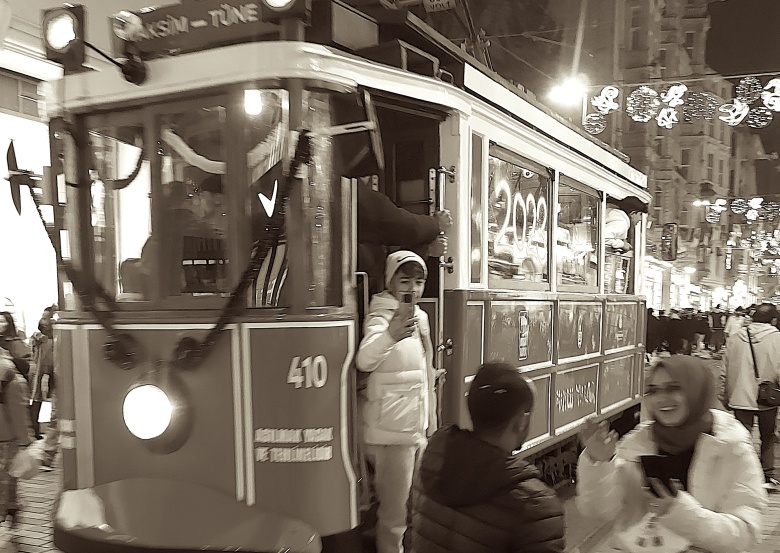
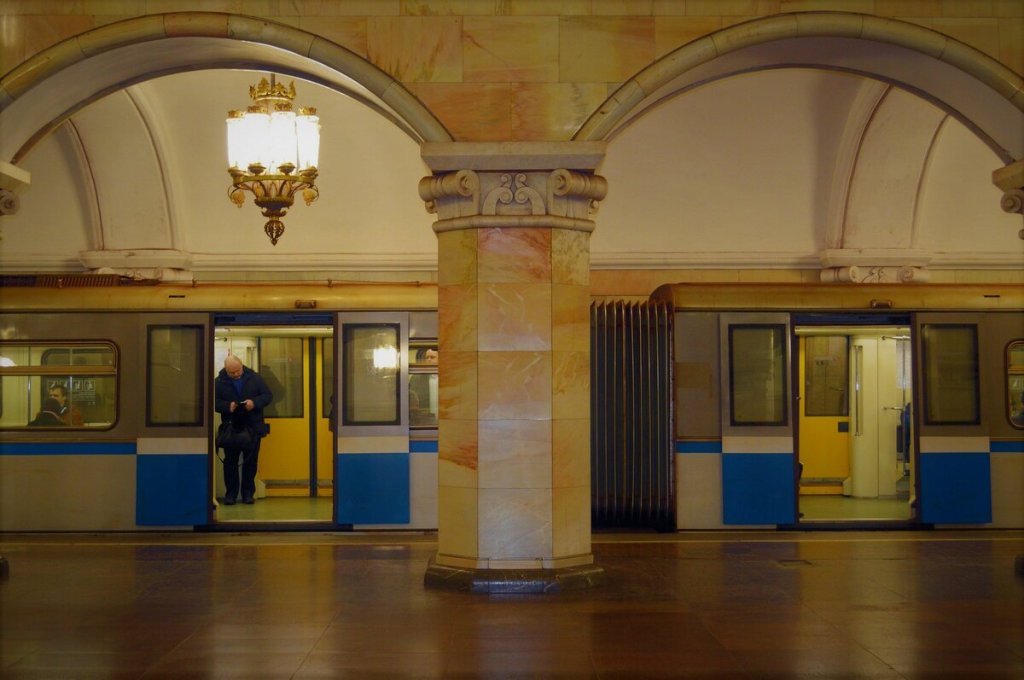
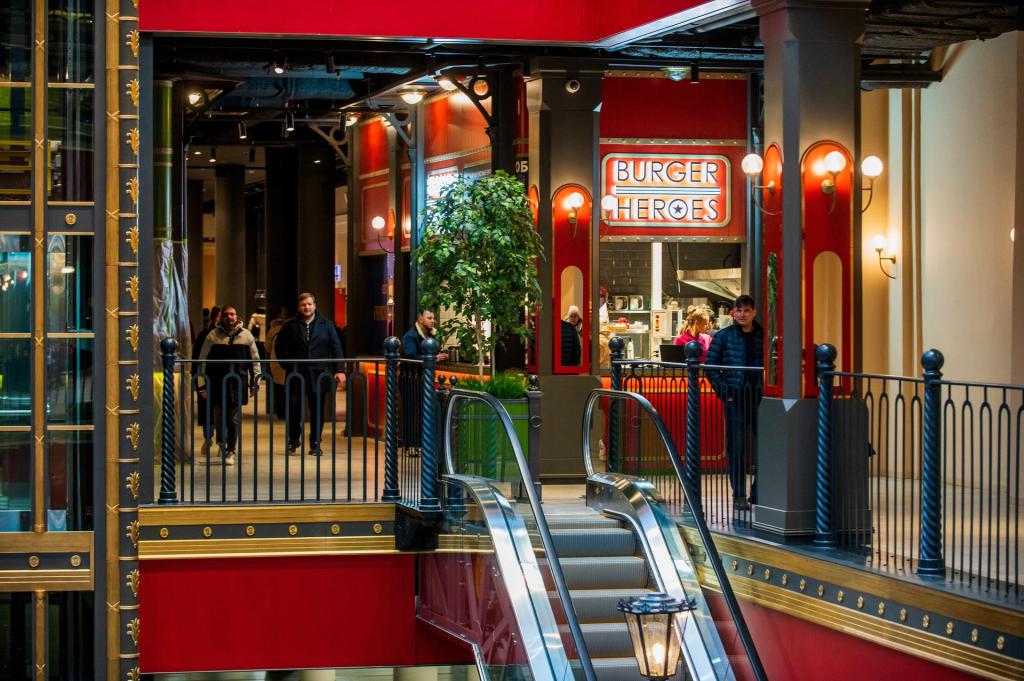
Istanbul, December 2022. Photo courtesy of Republic
[…]
500 vacancies for military registration specialists were advertised from late September to last December last year, according to HeadHunter. Previously, this specialization was considered a rather rare and generally not very sought-after profile in the personnel departments of Russian organizations (private and public). For comparison: only 145 such vacancies were advertised in the whole of 2021. The military mobilization has changed the situation: since September — that is, in just three months — the number of such offers on the labor market has increased by about two and a half times (Superjob’s data also show the same thing). The reasons? One of them (apparently, the main one) is an increase in fines for lapses in paperwork: to avoid them, employers are willing to pay applicants for the popular vacancy 70-80 thousand rubles a month. And this is despite the fact that there is a shortage of a number of other specialists on the labor market (and, presumably, they are no less valuable than SMO-era personnel officers). The number of vacancies on Avito Jobs alone, according to a recent company study, increased by 69% in 2022. Most likely, the trend will continue, serving as a natural continuation of the outflow of people and, ultimately, personnel.
50% — the percentage of last year’s sales of existing housing in the Russian Federation made through a notarized power of attorney. This record figure for the entire observable history of the market, as calculated by investment company Flip, who were commissioned by Kommersant, clearly indicates that the sales trend was primarily shaped by property owners who had emigrated. The high volume of such transactions seems to be an anomalous phenomenon. In 2021, a power of attorney was the basis for sale in no more than 20% of deals. In 2020, this figure was 15%. It was 8% in 2019, and 5% in 2018. You ain’t seen nothing yet, though: the ongoing controversy over whether to confiscate the property of openly anti-war Russians who have left the country must be making an additional contribution to the process of selling apartments and houses, which was gaining momentum as it was.
$81.69 billion — the total amount of deposits by Russian nationals in foreign banks as of the end of November of last year, according to the latest data from the Russian Central Bank. (4.989 trillion rubles were recalculated at the exchange rate in effect on that date.) Over the past eleven months, the amount has more than doubled — and this is even if we rely entirely on the statistics of the Central Bank, which may not have a complete picture of what is happening. (Russian laws oblige citizens to report when they open accounts in foreign banks and move funds in them, but we cannot be absolutely sure that everyone strictly obeys them.) While one part of these funds remains in these bank accounts, the other goes to the purchase of real estate that, for the most part, is also located outside the Russian Federation.
16,300 houses and apartments in Turkey were purchased by Russian nationals in 2022, according to data published by the Turkish Statistical Institute (TurkStat), as studied by RBC. This is not just three times more than in 2021 (when Russian nationals purchased 5,400 housing units in the Turkish Republic), but also more than the total volume of such transactions over the past six years (16,200). It is not surprising that last year, for the first time, Russians took first place among foreigners in buying housing in Turkey, producing almost a quarter of the corresponding demand with their money. Earlier, we wrote that our compatriots purchased two thousand houses and apartments in Turkey in October 2022 alone, overtaking all other foreign home buyers in that country, as reported by TurkStat.
At first glance, the advantages of investing in Turkey are not entire obvious. Inflation in the country, according to TurkStat, exceeded 84% in November, once again breaking records previously established in the autumn of 1998. The Inflation Analysis Group, an independent Turkish entity, estimated that inflation had reached a whopping 170.7% . In addition, prices for real estate, which have rising robustly, can at any moment just as vigorously drop, taking into account, in particular, the rather murky prospects for “Erdonomics,” depending on the results of the upcoming presidential and parliamentary elections. According to Endeksa, in September, the average price for one square meter of housing in Turkey was about 12 thousand Turkish lira (approx. $644), while the average price per housing unit was just over 1.5 million Turkish lira (approx. $83,700). The term of return on investment in housing is estimated at nineteen years, although in the summer this figure was recalculated to seventeen years.
The intense interest on the part of Russian nationals in buying real estate in Turkey is primarily related to the prospect of obtaining Turkish citizenship, Anna Larina, head of the foreign real estate department at NF Group, explained to Republic. (In turn, having a Turkish passport makes it possible to obtain an American E-2 visa, which speeds up the process of immigrating to the United States.) In this sense, it is logical that Russians have become leaders in terms of the number of residence permits issued in Turkey — 153,000, of which, however, as the Turkish Ministry of Migration clarified, 132,000 are short-term tourist residence permits, which are valid for two years.
Turkey is one of the few countries (but not the only country) that is still open to Russian nationals and their private capital. Thus, as 2022 came to a close, Russian citizens took first place among non-residents in buying real estate in Dubai, Bloomberg recently reported, citing figures provided by the brokerage firm Betterhomes.
Withdrawing funds and setting up a new life abroad eloquently testify to the sentiments prevailing among the Russian urban middle class, primarily. Not all people who sell Russian real estate and buy foreign real estate are necessarily irreconcilable opponents of the regime. And yet, it is clear that the vast majority of these people do not want to live and raise children in Putin’s version of the future, which is practically incompatible with modern civilization. In its own way, it is symptomatic that Russians who support the government and dutifully follow it into its deadly adventures are also dissatisfied with what is happening. If it were possible, they would rather return to the past, to a point in time thirty, forty, or fifty years ago.
63% — the percentage of Russians, according to a December poll conducted by the Public Opinion Foundation (FOM), who regret the collapse of the USSR — that is, more than three decades after the event known in Kremlin mythology as “the greatest geopolitical catastrophe of the twentieth century.” Strictly speaking, the current longing for Soviet times cannot be considered a record: after the August 1998 ruble default, there were noticeably more Russians nostalgic for the Soviet Union — 85%. Nevertheless, an important indicator of public attitudes (as recorded, we should underscore, by a quasi-state polling service) is on the rise again, having increased by twelve percentage points since 2011.
It is clear that this sentiment is primarily voiced by the 46–60 age group (88% of whom are “nostalgic”) and to some extent, people aged 31–45 years (79% of whom are “nostalgic”), assuming that a considerable portion of these people associate the late USSR with their happy childhoods and wild youths. However, according to the poll, even today’s Russian youth, that is, people aged 18–30, mostly (64%) consider the Soviet era “generally a good time.” Of course, their judgments are based on the stories of older generations, and most importantly, on the inevitable comparison with what is happening with the largest post-Soviet country right now.
The New Year’s spread on the tables of Petersburgers will be more modest this year than it was in 2021. They won’t have to skimp on ordinary goods yet, but delicacies such as caviar or red fish, as well as premium alcohol, will cost considerably more. Scammers and poachers who offer goods that aren’t readily available on the cheap may try to take advantage of this.
According to the Central Bank, annual inflation, as of November, was 11.98%. During the month, consumer prices increased by 0.37%; fruit and vegetables were among the items that rose most noticeably. Given that they are among the main ingredients in traditional dishes, we should expect that New Year’s Eve purchases will cost more.
Racing against inflation
As Svetlana Kazantseva, associate professor in the Basic Department of Trade Policy at Plekhanov Russian University of Economics, told DP, the annual growth rate of food prices in Petersburg was about 10%, according to research data.
“Prices for dairy and meat products are growing more slowly, which is explained by cheaper animal feed. Taking into account the inflationary component and the desire to save money, we can assume that the amount of the average bill [for New Year’s supper], if it does increase, will be an order of magnitude smaller than the rate of annual inflation, that is, about 5–7%,” the expert notes.
Marina Petrova, CEO of Petrova Five Consulting, is partial to other estimates, according to which the New Year’s meal will cost an average of four thousand rubles, which exceeds last year’s level by 12%. The simplest traditional dishes are taken into account: Olivier salad, herring under a fur coat, jellied meat, chicken with potatoes, sausage slices, champagne, and vodka. If the menu is expanded to include roast pork, fish aspic, red caviar, red fish, cheese, and cognac, then the cost will double. But it should be borne in mind that the percentage of consumers who themselves cook the food for their holiday meal has been decreasing every year. Many people have long preferred to buy readymade dishes at the store or order them delivered to their homes. However, this year they are likely to purchase more budget-conscious options. The desire to save money will primarily impact delicacies, seafood, salmon fish, beef, and caviar. The annual growth rate in prices for fish delicacies and caviar is already higher than the inflation rate.
“Traditional New Year’s menu for residents of Petersburg [clockwise, from far left]: Olivier salad, herring under a fur coat, roast chicken, caviar sandwiches, hard alcohol, sliced cheese, sausage and fish, juices, champagne, mineral water, candy, cake, tangerines.”
Beware of fakes!
According to market participants, a decrease in the total volume of red caviar is expected due to a lower salmon catch in the Far East. It will be bring a higher price than in previous years, however. During the pre-New Year sales period, it is possible that we will see an increase in prices of 35–40% compared to last year. On average, pink salmon has risen in price by 25%, chum salmon, by 5%, sockeye salmon, by 15%, and trout, by 10%. According to the Fishing Union, this year the percentage of Pacific salmon red caviar on the Russian market is close to 100%. Prices for grainy caviar from Far Eastern salmon caught in 2022 increased by an average of 10–15%. However, last year’s caviar is also on the market at a more affordable price. According to Nikita Ostrovsky, a purchasing manager at Lakifish LLC, imported red caviar appears only sporadically on the Russian and Petersburg markets.
“We can talk about insignificant amounts imported from neighboring countries, such as Armenia and, to a lesser extent, Kyrgyzstan (red trout caviar is imported from there). This category of goods is in a lower price and quality segment by comparison with trout caviar, for example, from Karelia,” he says. Another factor are the Russian government’s measures to restrict the import of red caviar to stimulate domestic production.
Ostrovsky also warns that, since caviar is considered a mandatory part of New Year’s feasts, it is likely that buyers will look hard for cheaper offers — for example, at illegal points of sale, where it is offered at a price 50% lower than the average market price.
“This can be imitation caviar, which is sold disguised as the real thing. Caviar diluted with sunflower oil. Or obtained by poaching, without the necessary paperwork. In pursuit of profit, people are willing to purchase such products,” he points out.
In fact, imitation caviar is sold legally in many stores.
Participants of the delivery market expect an increase in orders of readymade meals for the New Year’s meal, despite everything. Many of them note that they usually experience an increase in customer activity on December 21.
“We don’t take orders all day, only until 8 p.m., and then we deliver them to customers’ homes. This time round, we expect the number of orders to double compared to normal days. We regularly observes this pattern on holidays. The average bill for orders in Petersburg should grow this year. In any case, last year it grew by about 25–30%,” Vera Pradchenko, CEO of VIP Fish [a service that prepares and delivers Japanese food], told our correspondent.
[From top to bottom of tree] Cost of Olivier salad: 408 rubles (2021) vs. 455 rubles (2022); cost of herring under a fur coat: 269 rubles (2021) vs. 292 rubles (2022); cost of a no-frills New Year’s meal: 5909 rubles (2021) vs. 6737 rubles (2022); cost of a more expensive New Year’s meal: 8391 rubles (2021) vs. 10,909 rubles (2022). 40% increase in the per bottle price of imported alcohol in the more expensive meal. 20% increase in the price of premium cheese in the more expensive meal. 2.4% increase in the price of domestic salmon caviar in Russia as of October. Consumer price index for groceries in Petersburg in November: 2021 – 111.3%, 2022 – 108.9%; consumer price index for alcoholic beverages in Petersburg in November: 2021 – 102.8%, 2022 – 106.3%; increase in the price of red caviar in Moscow and Petersburg since the beginning of 2022: Moscow – 13.3%, Petersburg – 13.66%
We won’t be left without champagne
Alcoholic beverages are an equally important part of the New Year’s feast. This year, the patterns of purchases in terms of category is almost identical to previous years. Sparkling wines and vodka are still the primary drinks. But there have been changes within the categories. They have been caused primarily by the aftermath of the departure of global brands, explains Dmitry Isachenkov, director of development at Ladoga. “It is safe to say that Russian vodka will be on 90% of Russian New Year’s tables — here consumers prefer domestic products with festive designs,” he says.
After the brands that made up about 50% of the champagne market in Russia left the country, producers less dependent on the political conjuncture began filling the vacant niches. For example, Ladoga signed contracts with three new suppliers and imported 80 thousand bottles in 2022 by year’s end, which is four times more than by the end of last year. So, Russian consumers can easily find real champagne wines in Russia if they wish.
It is worth noting that the share of imports of wines from Champagne [sic] did not exceed 2.8% of the total volume of sparkling wine imports. The choice of the mass consumer will be distributed one way or another among the major Russian producers: Kuban-Vino, Derbent-Vino, Novy Svet, and Inkerman. Affordable imported sparkling wines — Italian proseccos, Spanish cavas, French cremants, and Austrian sekts — will invariably remain popular.
Isachenkov notes that the structure of purchases in the whiskey category has changed significantly — it is this category that has undergone the most powerful changes after the refusal of major brands to do business in Russia. Most consumers were ready to look for a replacement within the category, including among domestic manufacturers. Thus, sales of entirely Russian-made Fowler’s brand whiskey had by year’s end increased four and a half times compared to 2021. Other consumers have shifted to other categories and are choosing rum, tinctures, brandy or vodka. Sales of still wines increased in proportion to the other categories. At the same time, the product range of both importers and Russian wineries has been growing.
“We should not talk about the growth of the average bill, but about the increase in the cost of each item in the bill. For many, this is a long-awaited holiday after the emotional turmoil experienced during the year, and the consumer selects special drinks for celebrations above the usual cost,” the expert argues.
Different things matter
On average, the prices of the ingredients for Olivier salad have increased by 10% in Petersburg. Potatoes and onions have fallen in price, while he price of carrots has not changed. Green peas and mayonnaise have risen the most, by 20% and 17%, respectively. Herring under a fur coat has risen in price by 7%, primarily due to the main ingredient, herring (which has gone up by 20%), while beets have fallen in price by 32% and potatoes by 25%. However, the so-called Olivier index should be treated with caution.
The various indexes are more of a marketing tool to draw attention to the researcher’s brand. There is the lipstick index (launched by Estee Lauder), which is a litmus test showing how women react to changes in the economy. The American manufacturer argues that, when incomes fall, sales of expensive clothes and shoes decline, while sales of luxury cosmetics, on the contrary, grow. There is Deutsche Bank’s cheap date index (based on the costs of taxi rides, lunches at restaurants, and hotel rooms [sic]). There is the latte index (based on the price of a cup at Starbucks, now Stars Coffee in the Russian Federation) and the Big Mac index (based on the price of a hamburger at McDonald’s, now Tasty, Period). The iPod index has become an atavism.
In Russia, the Telegram channel Sugar. Portion. Collect maintains a cup of tea index by charting weekly changes in the average retail price3s of the ingredients in the Russian Federation. Other researchers use the statistics issued by Rosstat as their benchmark when calculating the cost of preparing borscht, Olivier, or herring under a fur coat.
“Any index is an indicator of rising or falling prices. You can use it to calculate how the cost of goods changes from year to year,” says Daria Zhigalina, a business automation services systems analyst at Kontur.Market. “It is important to understand that all indices are real economic indicators, albeit served up in a humorous package. Every year we see how official agencies publish data on the basket of consumer goods. Everyone has been accustomed to this indicator for a long time and knows that it can be used to assess the quality of life in the country and the purchasing power of the populace.”
According to the expert, by assessing the fluctuations in the cost of ingredients, we can analyze the economic situation separately in each region and in Russia as a whole.
For retailers, the New Year’s Eve period is a time when they can increase their revenue. Judging by the foot traffic in stores, the current situation will most likely not affect retail chains negatively since their turnover is growing. At the same time, the structure of sales will be redistributed towards traditional and inexpensive goods. In my opinion, retail has already begun to change the structure of its offerings, reducing the number of goods above the average price. In this regard, premium retail chains may be in a less advantageous position.
Caviar has not been imported [to Russia] since 2014, after government restrictions on the import of certain types of food were enacted. Prior to this, Russia imported frozen red caviar from the USA and Canada. Here it was processed and sold in salted form. The salmon catch this year amounted to 300 thousand tons, and 13–14 thousand tons of caviar were produced. Last year, the catch was over 500 thousand tons, while more than 20 thousand tons of caviar were produced. Compared to last year, the shortfall is 30%. Despite the fact that the supply of caviar is much lower than last year, the price has not increased. If there were a further rise in prices, people would simply stop buying it. It is possible that before the New Year some sellers will raise prices, but they will bring them back down after the holiday.
— Alexander Fomin, Vice–President of the Fishing Association
The growth in the price of goods that have always been considered delicacies — caviar and salted salmon— is indicative. They have doubled in price over the year, and the same dynamic is typical for most other frills. This year, salmon will be largely replaced by trout, which is cheaper, and eggplant caviar will be preferred. Real incomes fell in Petersburg by 2.7%, according to official statistics. By my calculations, for a business person, the celebration of the New Year will be about one and half times more expensive than a year ago. The selection has become somewhat smaller, but if you want them, you can find all the goods you need. We should especially not envy pensioners living on their own. The subsistence minimum doesn’t take factor in the cost of such events.
—Anatoly Golov, Co-Chairman of the Consumers Union of Russia
Russians have no reason to skimp on their New Year’s meal. On the contrary, consumer spending on the New Year’s meal may increase due to both inflation and the fact that some Russians will not be able to celebrate the New Year outside the Russian Federation and will spend money at home. Recently, statistics were published that about 15% of the population have experienced an increase in income, while 20% have experienced a decrease. Consequently, some consumers will still increase spending for the New Year and their average spending will grow at a level slightly higher than inflation.
—Artyom Tuzov, Executive Director of the Capital Markets Department at IVA Partners Investment Company
The morning begins with me looking at the light on the computer monitor. If it is on, it means there is still electricity. When I see that the light is on, I immediately get up and go put on the kettle to refill the thermoses. We got hold of the simplest gas stove, and you can of course heat water on it. But first of all, there is not an endless supply of gas and we skimp on it. Secondly, I am afraid of these stoves: over the past month they have exploded four times in our district alone. I walked past the residential buildings where these stoves exploded and saw the broken windows and cracks in the walls. It’s a little scary, let’s just say.
After I put the kettle on, I get on the Telegram channels. I have to find out whether there were [missile and drone] attacks at night, and if so, whether they hit infrastructure. Now this is the most terrible thing, because if it suddenly turns out they hit infrastructure, it means that soon there will be no heating and water. So then I start rushing between washing and drying my hair, charging the power banks and flashlights, getting the laundry going, and cooking food. You never know when the lights will go out and that’s why you do everything quickly, all at once. You feel like a trained circus animal.
When I’m going somewhere, I always put a few flashlights in my backpack. It’s strange to imagine that not so long ago a flashlight was not a mandatory item. Now it is a “must have” (my phone suggests writing “must heh” — heh!), like a medical mask during the time of covid. It’s even more important! When I go outside and travel somewhere, I never know if there will be light where I’m going. Most often there is no light — or cellphone connection for that matter. I hate this feeling of being in a vacuum: there is no mobile internet, no telephone connection, no light, and no matter what happens to you, you won’t even be able to call an ambulance. You’re living “in the moment,” damn it. Where there is no light, the elevators don’t work. I usually walk slowly up to the sixteenth floor by an isolated dark staircase. Somewhere on the eighth floor there is usually an old, peeling stool on which I can sit in the dark and take a break. I usually don’t need such a rest, but sometimes I turn off the flashlight and sit on this stool in the dark and listen to the wind blowing in the stairwell.
Last week I got stuck in the elevator: while I was going up, the lights turned off and the elevator stopped and went dead. There was a chair inside and a box containing water and medicines. I sat down, but quickly froze. Immediately, before the phone connection disappeared, I had telephoned my husband and asked him to call the help hotline so that they would get me out of there. Otherwise, it was possible to get stuck there and sit for four to seven hours. My husband got through to the hotline in half an hour — he was the twentieth in the queue. Half of the city sits in frozen elevators every day. They pulled me out of there.
When I’m returning home in the evening, I make a wish: please let there be light at home. I ride in a minibus and nothing is visible through its windows since neither the streetlights nor the traffic lights are working. I have developed a “sense” of a way that I cannot see, but I know and understand where I’m going and when I need to get out. After walking up and down all these stairs and unlit streets, I really want to find the light on at home for at least half an hour. If, when approaching our building, I see that there is no light, I slow down. There’s nowhere else for me to hurry — it’s dark and pointless everywhere. Life in general has become quite hectic. Although I have hated hurrying and scurrying my whole life, now I have to hurry and scurry.
Sometimes I manage to find a store where the lights haven’t been turned off yet. It’s like going into a church: it’s light and warm there and your mood improves a little just because you’re in a store and it’s bright inside. The prices have been shooting up monstrously and I wander the aisles for a long time figuring out what I can buy to fit my modest daily budget. But basically, since the light began to leave us, I have got used to eating rusks and croutons in different flavors. I’d never bought them before — they’re not my kind of food — but now they are quite handy. First, they are relatively cheap, and second, they come in different flavors. It’s the illusion of variety. Third, they don’t need to be cooked.
I went to see my mom yesterday. We discussed all these common everyday problems of ours. And then Mom decided to make a joke and asked:
“What are you all doing for the New Year?”
Neither she nor I laughed.
Source: Sergey Abashin, Facebook, 15 December 2022. Professor Abashin is quoting a letter he received from a Ukrainian friend or colleague, but he does not identify her by name or mention where exactly she lives. Translated by the Russian Reader
Russian President Vladimir Putin, speaking at a session of the Valdai Discussion Club, acknowledged a decline in the real incomes of our compatriots.
He noted that the issue was being resolved in cooperation with the trade unions, RIA Novosti reports.
This dialogue continues. We see that people’s nominal incomes are growing, but real incomes have become slightly lower. Bearing in mind the state of the Russian economy, we can solve these problems and should do so in accordance with the existing plans of the Russian government.
Vladimir Putin, President of the Russian Federation
The head of state also said that it was necessary to fight for wage increases. At the same time, he addressed his appeal to both Russians and “ordinary citizens” of the United States and Europe.
Since the start of the special operation by Russian troops in Ukraine, people have experienced a loss of income and savings. Putin also noted earlier that many Russians were at risk of layoffs.
“There are more than 485 air fresheners in operation: they were installed in the air ducts of the climate control system. They spread the fragrance around the car every ten minutes. The fragrance is called ‘Moscow Metro,'” explain the metro’s press service , stressing that all the aromas were safe, hypoallergenic, and complied with regulations.
In 2019, during a vote on the project’s implementation, ninety percent of passengers surveyed said they would prefer an air-freshened carriage to a regular one. Muscovites especially wanted the smell of cherry blossoms in the subway.
What attracts people [to the shot bar Fedya, the Wildfowl!]? The irony and the simplicity, but at the same time the pleasant crowd. Here you can meet people who, the day before, dined on sets [sic] of scallops and dill sauce at designer restaurants, but they are glad to eat belyash and kvass at Fedya’s. Every other table orders kebabs (from 325 rubles) and drinks tinctures and macerations. Security guards monitor everything: if you swear loudly, they will politely ask you to leave.
Source: personal email, December 2022, This is the first time I’ve heard from Raffeisenbank in several years, especially since my account with them has been essentially dormant since well before I left Russia in 2019. ||| TRR
Foreign managers are quitting Petersburg hotels: they are resigning their positions amid the withdrawal of international hotel companies from the Russian market.
In particular, the post of general manager of the five-star Four Seasons Lion Palace has recently been filled by Ekaterina Saburova, who had worked as marketing director at the Four Seasons Moscow Hotel. In an interview with Kommersant-SPb, a spokesman for the Petersburg hotel noted that the previous general manager, Richard Raab, had gone on to work at another hotel in the chain.
Similar personnel changes have taken place at the Grand Moika 22 Hotel, which until recently was part of the Kempinski international chain. The hotel is now headed by Yevgenia Nagimova, and the operations director and Russian staff are responsible for day-to-day operations. The previous general manager, Oliver Kuhn, initially took a similar position at the Kempinski Hotel in Cairo, before running a hotel in the Seychelles. He explained that he had left Russia to transfer to another hotel in the chain. The general director has also been replaced at the Radisson Royal and Park Inn Nevsky: instead of Rune Nordstokke, the hotels are now headed by Mikhail Grobelny, who previously worked as the general manager of the Radisson Blu Belorusskaya Hotel in Moscow.
Experts note that, amidst the departure of international hotel chains [from Russia], industry players have basically lost the need for the position of a general manager responsible for liaising with company management. According to Andrei Petelin, general director of the Hotel Saint Petersburg, the personnel changes may be related to the desire of owners to reduce costs during the crisis [sic], since foreign managers earned more than their Russian counterparts, and also received compensation for housing rental and their children’s education.
Some foreigners still continue to work in Petersburg hotels: Eric Pere, general manager of the Corinthia Hotel St. Petersburg; Gerold Held, general director of the Hotel Astoria and the Angleterre Hotel; and Jaehyuk Yang, manager of Lotte Hotel St. Petersburg. Some industry reps have concerns that further resignations by foreign managers may have a negative impact on the level of service. Andrei Petelin, however, is confident that Petersburg-based managers are able to maintain high standards, because they not only have experience working abroad, but also better understand the needs of Russians coming to the Northern Capital to relax.
Speaking of which, since the beginning of 2022, seven million tourists have visited St. Petersburg. Vice-Governor Boris Piotrovsky noted that in November, bookings at the city’s hotels consistently exceeded the sixty-percent mark.
A few weeks ago, DPwrote about how the Smolny [Petersburg city hall] was again thinking about introducing a resort fee. Hoteliers stated that they considered this step reasonable, but only if the revenues generated were used properly.
620,251 views • Dec 2, 2022 • President Vladimir Putin’s war in Ukraine is causing major changes back home. Hundreds of thousands of Russian men are being mobilized to fight and tens of thousands have already been killed or injured. Meanwhile, many Russians have left their country and millions of Ukrainians are thought to have arrived. What impact will these changes have on the Russian population? And could the public response lead to Putin’s downfall? We discuss these questions and more with UCLA’s Oleg Itskhoki in this DW Business Special.
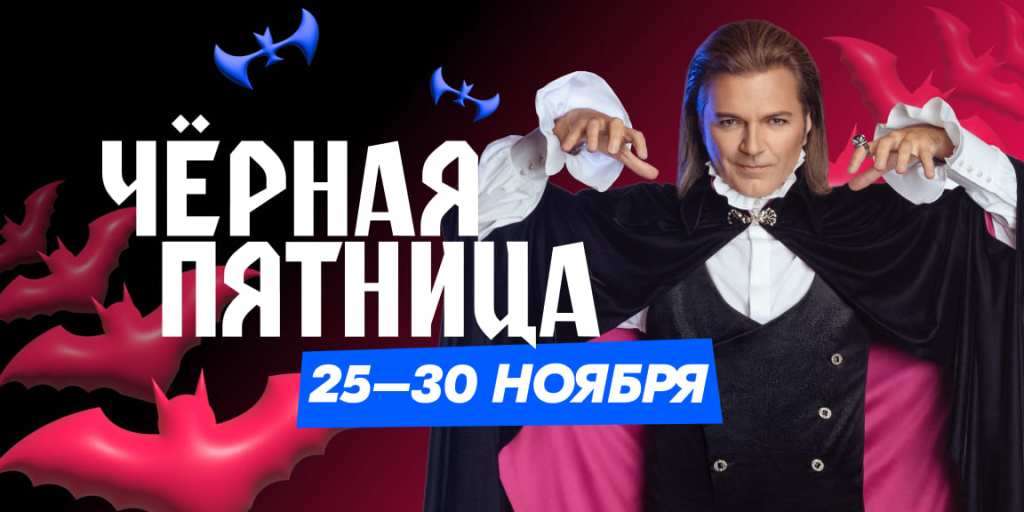
Despite its declared war on “satanic” western values, Putinist Russia continues to slavishly imitate all the worst the mythical west has to offer, including “Black Friday,” as exemplified by this image from an email flyer sent to me earlier today by the major online retailer Ozon, featuring the pop singer Dmitry Malikov. Nor has Putin’s “proxy war” with the west stopped the pidginization of the Russian language, as seen in the second-to-last piece in this grim holiday collage. ||| TRR
The expected tourist flow from Iran may amount to approximately two thousand people a week starting in the spring of 2023, director of the municipal tourist information bureau Yuri Bogdanov said on November 24. According to him, relevant negotiations are underway with air carriers.
“We are negotiating with airlines that want to provide direct flights between Iranian cities and St. Petersburg. We hope that there will be six flights per week with an average number of around 300 seats on board. This is already about two thousand people a week. We expect that, beginning in the spring, these airlines will supply their airplanes,” TASS quoted Bogdanov as saying.
The expert clarified that there were more flights before the pandemic and six thousand tourists used to arrive from Iran every week.
According to Bogdanov, the flow of tourists may return to its pre-covid levels in St. Petersburg by about 2026, but at the same time primarily due to guests from Russia, and not from foreign countries. According to the figures he cited, in 2019, about five million Russians and 5.5 million foreigners visited the Northern Capital, while 6.4 million Russians and 150–200 thousand foreigners visited the city in the first nine months of 2022.
“We have reformatted the priorities for domestic tourism — we want to reach the same 10.5 million tourists a year. There is every ground for this to happen,” Bogdanov opined.
Earlier, the State Duma Budget and Taxes Committee recommended that St. Petersburg be included in the list of regions that charge tourists a resort fee.
At least 58 children, some reportedly as young as eight, have been killed in Iran since anti-regime protests broke out in the country two months ago.
According to Human Rights Activists in Iran (HRA), 46 boys and 12 girls under 18 have been killed since the protests began on 16 September, sparked by the death of the 22-year-old Mahsa Amini while in police custody.
In the past week alone, five children were reportedly killed by security forces as violence continued across the country.
Speaking at Kian’s funeral on Friday, his family said security services had opened fire on the family car, where Kian was sitting next to his father. Iranian security services have denied responsibility for his death, blaming the shooting on “terrorists”.
Iran’s mounting child death toll comes amid escalating violence in cities across the country, with protests showing no sign of abating.
[…]
Young people have been at the forefront of anti-regime protests, which started after Mahsa Amini died in the custody of Iran’s morality police. She had been arrested for not wearing her hijab correctly.
The deaths of two teenage girls, Nika Shakamari and Sarina Esmailzadeh, both allegedly beaten to death by security forces for protesting, provoked further outrage.
Videos of schoolgirls across the country protesting against their killing by removing their hijabs and taking down pictures of Iran’s supreme leaders went viral on social media, leading to raids on schools where children were beaten and detained. According to Iran’s teachers union, another 16-year-old girl, Asra Panahi, died after she was attacked by security forces in her classroom in the north-western town of Ardabil on 18 October.
The attacks on children in schools is continuing, according to Hengaw, which said a 16-year-old girl from Kurdistan is on life support after throwing herself from a school van, having been arrested at her school last week.
HRA says more than 380 protesters have been killed since the protests began and more than 16,000 people have been detained, including children. The figure is disputed by the authorities.
A view of Vokzal 1853 on opening day. Photo: Sergei Yermokhin/Delovoi Peterburg
On November 21, the opening of the food hall [fud-kholl] Vokzal 1853 took place in the building of the former Warsaw railway station.
It is the largest gastronomic space in St. Petersburg and, so its creators claim, in Europe.
So far, not all the establishments in the eater have opened — the launch . The event zone [event-zona] is designed for to accommodate 2.5 thousand guests and have 4 thousand seats, while the entrance to the second floor is still closed.
The cost of renovating the former railway station exceeded 1.5 billion rubles. The Vokzal 1853 food hall [fud-kholl] is a project of the Adamant holding company and restaurateur Alexei Vasilchuk. In total, as stated earlier, more than 90 restaurant concepts [restorannykh konseptsii] will await visitors, and the total area of the food hall will be about 34 thousand square meter.
The company plans to open a concert venue, craft [kraftovye] shops, and a coworking [kovorking — sic] in the space.
Earlier, DP reported that its creators had conceived the decoration of the premises to suggest the atmosphere of nineteenth-century railways stations, and visitors would find themselves in the “epicenter of a bustling creative life.”
Ukraine continued to reckon with the fallout from Russia’s air strikes on its energy infrastructure, with much of the country still struggling with blackouts. Residents in Kyiv, the capital, were told to prepare for more attacks. Russian missiles damaged a hospital on the outskirts of Zaporizhia, a Ukrainian-held city not far from Europe’s largest nuclear power plant, controlled by Russia. Meanwhile, Ukraine’s president, Volodymyr Zelensky, said Russia was heavily shelling Kherson, the southern city recaptured by Ukrainian forces in early November. Local officials said that strikes killed seven people in the city on Thursday.
Source: The Economist, “The World in Brief” email newsletter, 25 November 2022
This is a wildly disappointing exercise in sophism and self-deception by the usually much more lucid Maxim Katz. Russia has arrived at its present murderous and self-destructive bad end not through rigorous and ruthless totalitarian indoctrination and psychological manipulation, as suggested by Katz’s invocation of Ron Jones’s 1967 Third Wave experiment in a California high school, but through a chaotic, consistent indulgence of opportunism, consumerism, escapism, ressentiment, hipsterism, “westernism,” capitalism, cynicism, nihilism, and thuggery by the elites and the much of the so-called intelligentsia, thus almost completely overwhelming the decent, democratic, and egalitarian impulses and undertakings of differently minded and empowered “other Russians” from all walks of life and all parts of the country. It has been one of the missions of this website to bear witness to both these tendencies in their extreme and trite manifestations. You’ll find vanishingly little of what Katz describes in my chronicles of the last fifteen years here and on The Russian Reader‘s sister blog Chtodelat News. You will find, however, plenty of stories of brave grassroots resistance and movement building blunted and, ultimately, murdered by a police state whose PR wing has urged Russians to trade their freedom for food courts. ||| TRR
Мужик подогнал свою машину к зданию призывной комиссии и стал бросать коктейли Молотова. Выгорело 100 м². Урюпинск. Волгоградская область. Россия. 26.09. 2022 pic.twitter.com/yjB9QMdyKO
Guryanov Sergei @Segozavr A man backed his car up to the building housing the draft board [conscription office] and began tossing Molotov cocktails. 100 square meters were destroyed by fire. Uryupinsk, Volgograd Region, Russia, 26.09.2022.
A screenshot of the visuals in Mr. Stupin’s original post
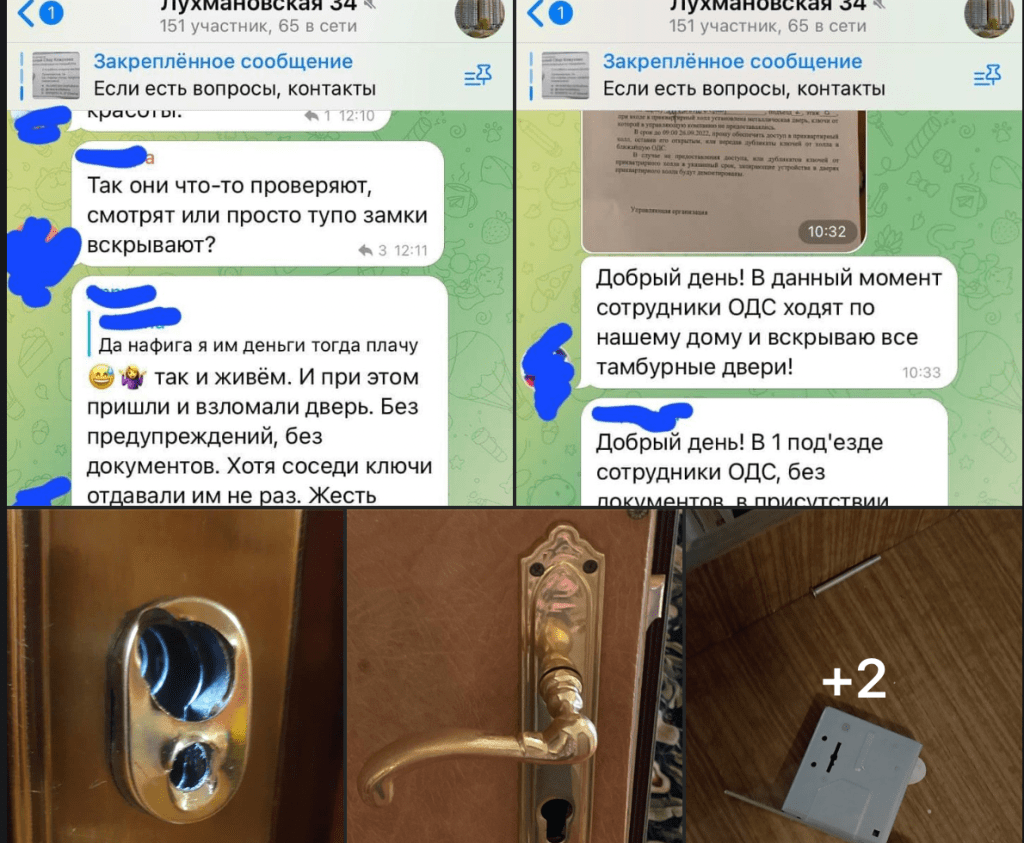
In Moscow’s Kosino-Ukhtomsky district, housing authority employees and police officers, without showing their IDs, have been breaking open front doors in the staircases of residential buildings in order to serve residents with summonses to the military enlistment office! Some residents have already been issued threats that the electrical wires to their apartments will be cut if the men do not open the door to receive a summons!
Source: Yevgeny Stupin, Facebook, 26 September 2022. Thanks to Alexander Kynev for the heads-up. Translated by the Russian Reader
A telephone call I got yesterday from a female acquaintance has made me think about the economic consequences of the “mogilization” [literally, “grave-ization,” a play on the word “mobilization”]. I confirmed her fears that her son would be among the first to be mobilized. And that they would come looking for him first at his registered address, then at his workplace. Consequently, the solution to his problem would be to quit his job and go live somewhere in the boondocks for a year, even if there was no work there.
And now look — not only those who are called up will vanish from workplaces, but also those who dodge the draft. To get the three hundred thousand men declared [by Putin as the goal of his “partial mobilization”], they have to slap the asses of at least a million men with draft notices and dragnets. I’m not an economist and I cannot even estimate numerically what kind of blow to the country’s GDP will be caused by the withdrawal of at least half a million employees.
By the way, the mobilized must be fired [by law]. It is not very clear whether their jobs will be kept for them in any way. But [officially] they will not be listed as on leave, but as having been called up from the reserves to military training camps. They will simply be dismissed from their jobs, and they will have to be paid in full.
Really simple vacancies can be filled by migrants from Central Asia, but it is another matter whether they will go and fill them. Currently, the exchange rate has been maintained at a level that is favorable to migrant workers, but as soon as the volume of imports grows (and it will grow: there will be other sources, gray market goods/parallel imports, and so on), this rate will inevitably begin to sink. Consequently, the economy will take a simultaneous triple hit around December:
1) On December 5, a complete ban on the delivery of Russian crude oil to the EU will come into effect; 2) hundreds of thousands of people will be laid off in October, November, and December; 3) and the exchange rate will go crazy.
By the way, state-funded and quasi-state-funded organizations will face the biggest problems. Petersburgers are no stranger to it, but the snow will definitely not be removed this year, either.
That’s my economic forecast for you. It’s going to be a clusterfuck, my fellow Russians.
Source: Vladimir Volokhonsky, Facebook, 22 September 2022. Translated by the Russian Reader
Yesterday, Vladimir Putin announced a “partial” mobilization, which is actually a total mobilization. His decree sets no restrictions on age, qualifications, regions, and the number of people mobilized. Already today, we see that everyone is being called up.
Source: Navalny LIVE, YouTube, 22 September 2022. Annotation translated by the Russian Reader. The video has already been viewed over 2.6 million times since it was posted. It has no subtitles in English, but the message from the lawyer in the video is clear and simple: there is no such thing as a “partial” mobilization, so all draft-age men must avoid being called up and serving at all costs, especially since Russia’s “special operation” in Ukraine is illegal and criminal.
In twenty regions of Russia, a school pupil’s start-of-the-year supplies costs more than the average monthly per person income. This schematic map of the country show how much of the average per capita income has to be spent to ready a pupil for the school year. Source: Unified Interagency Statistical Information System (EMISS), Russian Federal Statistics Service (Rosstat); calculations by iStories
About one hundred thousand Russians have signed a petition to the president demanding that they be paid 10 thousand rubles [approx. 163 euros] for children’s school expenses as was the case in 2021.
But instead of Russian families, this year parents of schoolchildren from the parts of Ukraine occupied by the Russian army will receive 10 thousand rubles each, while Russian citizens are being expressly told to go to war so that they can afford to send their child to school.
We calculated how much it would cost to send off a pupil to school in Russia’s regions, and we talked with the parents of schoolchildren.
What we learned:
In twenty regions of Russia, buying everything needed for school costs more than the average per capita income for a whole month. For example, in Tyva, one family member has an average income of 15.5 thousand rubles [approx. 253 euros] per month.
This money is usually spent on the bare necessities: food, clothing, medical treatment, transport and other needs. A schoolchild’s kit in Tyva costs almost 24 thousand rubles [approx. 393 euros] — money that parents don’t know where to get. In another fourteen regions, more than ninety percent of income will be spent on school-related expenses.
Parents toldiStories that many goods, especially clothes and notebooks, have risen in price twofold or more. And yet, wages have not increased, and some parents have lost their jobs altogether due to sanctions.
Many parents have had to take out loans for everyday needs (this is corroborated by the data: before the start of the school year, the number of applications for consumer loans increased by 20%) and scrimp on vacations.
Prices have increased by thirty percent, but I have no salary, so I’ve felt the difference enormously. The option that I found this year is credit cards. And we scrimped on vacation, of course. It has become quite expensive to take the children somewhere and liven up their leisure time. Whereas earlier I could afford to spend the weekend with my children somewhere in a holiday home in the Moscow Region, now we choose places without an overnight stay, and we take food along with us.
[…]
You take shoes for physical education, light sneakers. The kids hang out in them all day [anyway], so you save money on school shoes.
[…]
I tried to tell [the children] that war is always a very bad thing, that you should aways try to negotiate.
On average, I spent around 35-40 thousand rubles [approx. 660 euros] on everything. Clothes have become much more expensive compared to last year, and the quality has become worse. […] I am now on maternity leave, raising the girls alone. I get alimony. We have spent all the new allowances for children between 8 to 17 years old on school expenses. […] I think we will cope with it all. Everything will end and be fine — [the war] will not affect us in any way. I think that everything is being done here [in Russia] so that we do not feel the effect of special military actions.
In which regions of the country does a schoolchild’s kit cost more than the average per capita monthly income?
Could the Russian state afford to cover the expenses for all 15 million Russian schoolchildren?
Source: iStories, email newsletter, 29 August 2022. Translated by the Russian Reader
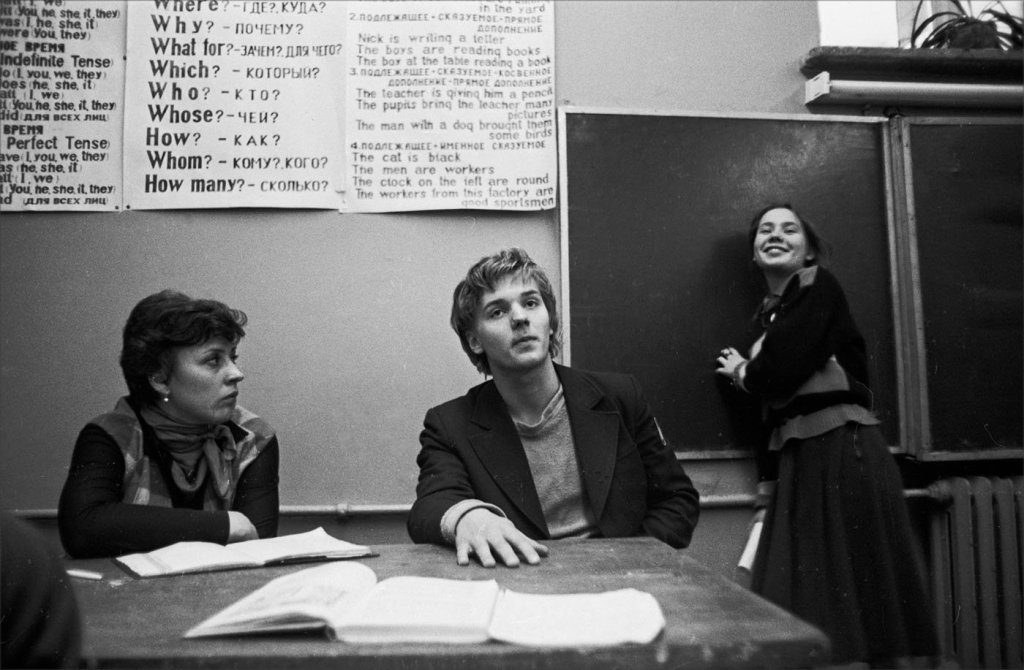
Igor Stomakhin, from the series When we leave the schoolyard… Moscow, 1980s
My street exhibition will open on the fence of Danilovskaya Alley on September 4 at 1 p.m. as part of the project #SundayKhokhlovskyStandoffs. Photos from my Moscow cycle of the 1980s–1990s will be presented. At 2 p.m., I will give a tour of the show beginning with an account of the capital in that vivid period when Soviet stagnation was replaced by Gorbachev’s perestroika. The defenders of Ivanovo Hill will treat guests to tea from a samovar, so you can bring sweets to share. Address: Kolpachny Lane, between house no. 7 and house no. 9.
Source: Igor Stomakhin, Facebook, 1 September 2022. Click the link to see a dozen more photos from Mr. Stomakhin’s poignant perestroika-era Moscow school series. Translated by the Russian Reader
“It’s not scary to die for the Motherland.” “Conversations about what matters” — mandatory lessons on love for the Motherland — have been introduced in Russian schools. During these lessons the war in Ukraine will be discussed.
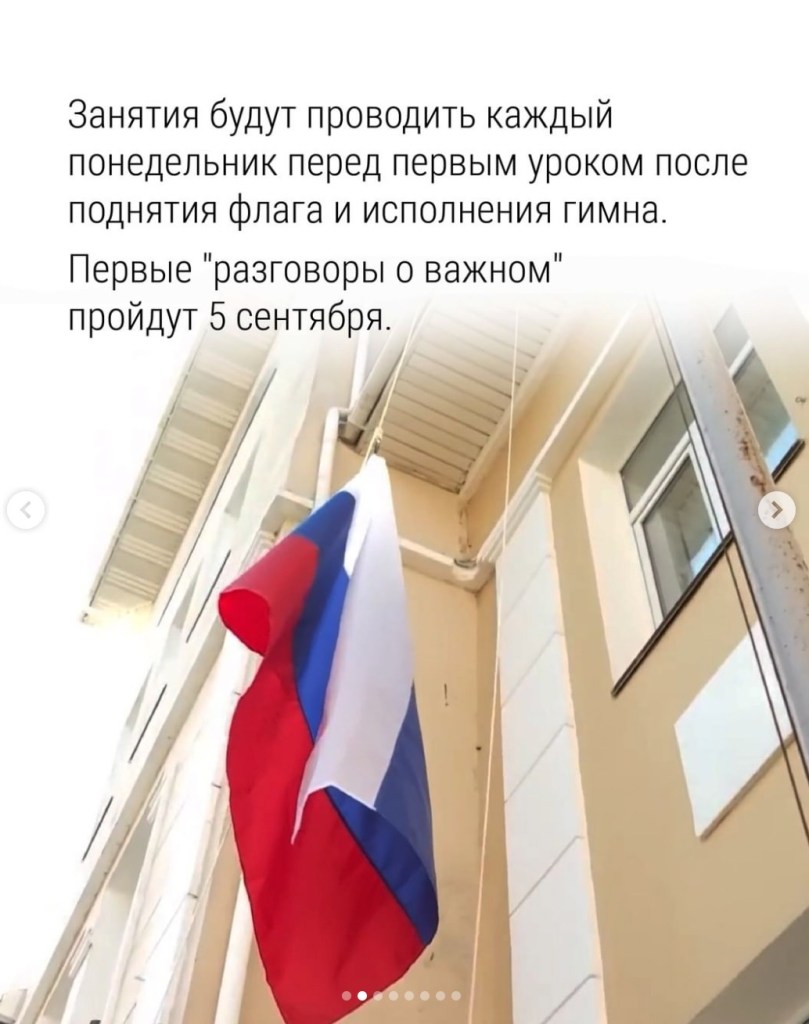
The lessons will be held every Monday before first period after the raising of the flag and the national anthem. The first “conversation about what matters” will take place on September 5.
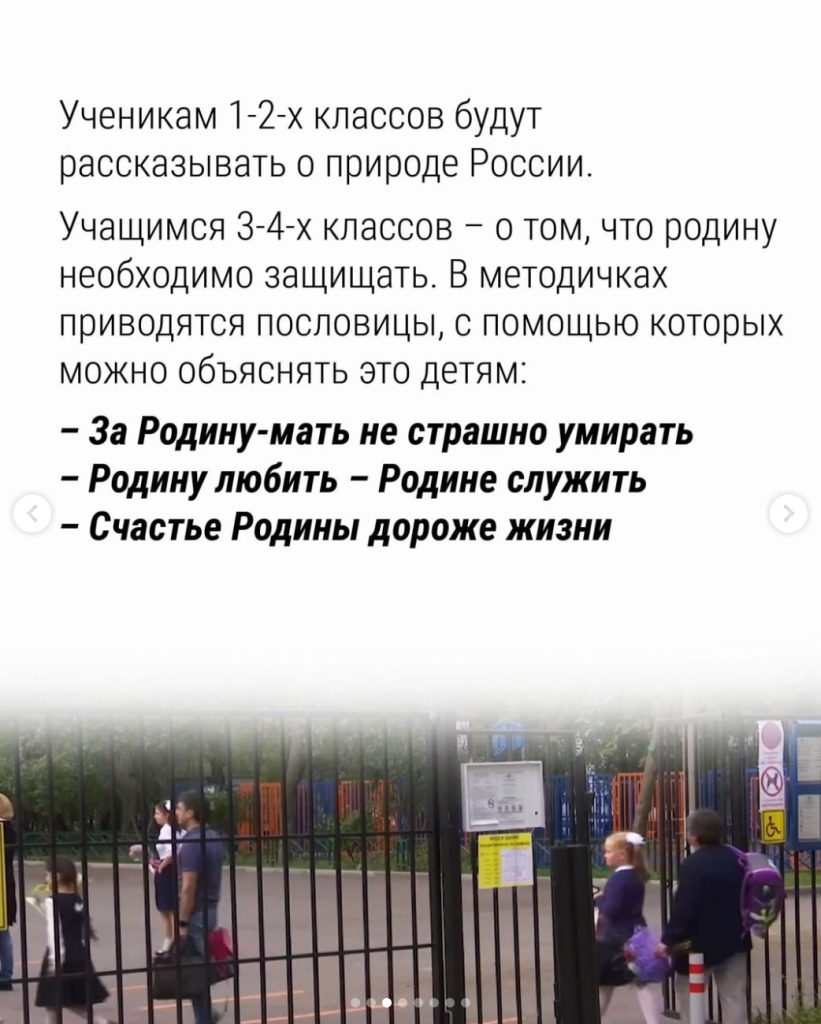
Pupils in the first and second grades will be told about nature in Russia. Pupils in the third and fourth grades will be told about how it is necessary to defend the Motherland. The teaching manuals cite proverbs that can be used to explain this to children: “It’s not scary to die for the Motherland,” “Loving the Motherland means serving the Motherland,” and “The happiness of the Motherland is more precious than life.”
On September 12, pupils in grades 5–11 will be told about the war in Ukraine. “We also see manifestations of patriotism nowadays, especially in the special military operation,” it says in the course packet.
And to pupils in the tenth and eleventh grades, the instructors, as they conclude the conversation about the “special operation,” should say the following parting words: “You cannot become a patriot if you only spout slogans. Truly patriotic people are ready to defend their Motherland under arms.”
Attending the “conversations” is presented as mandatory. If pupils skip them, instructors are advised to have a talk with their parents. If talking to them doesn’t do the trick, instructors are advised to cite the law, which states that the school curriculum consists of lessons and extracurricular activities.
By law, pupils may skip extracurricular activities at the request of their parents. Teachers are afraid, however, that in the case of the “conversations about what matter” school administrators will be keeping a close eye on attendance.
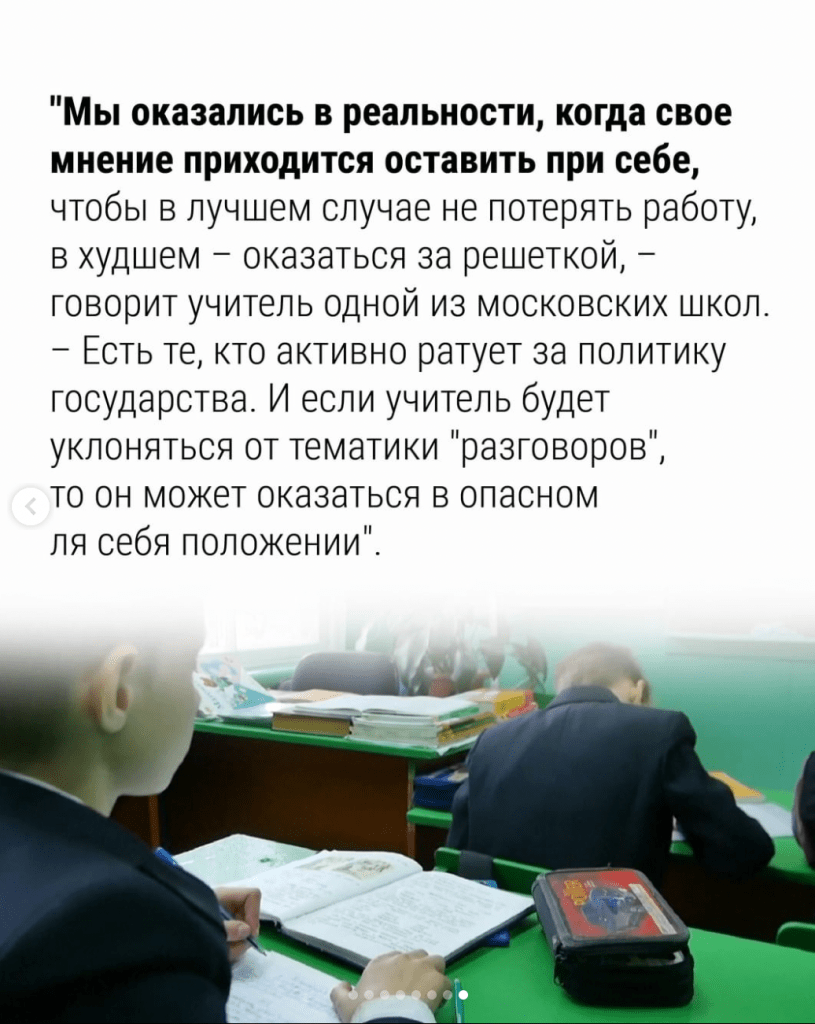
“We find ourselves in a reality in which you have to keep your own opinion to yourself to avoid losing your job, at best, or ending up behind bars, at worst,” says a teacher in one Moscow school. “There are those [teachers] who actively support state policy. If a teacher diverges from the subject matter of the ‘conversations,’ he might find himself in a dangerous situation.”
Source: Current Time TV (Radio Svoboda), Instagram, 1 September 2022. Translated by the Russian Reader
On August 28, 1946, the amazing Lev Shcheglov was born in Petersburg. Alas, in December 2020, the damn covid took him away. We remember him. How could we forget him? He was the only one like him.
A quote from Dmitry Bykov’s conversation with Lev Shcheglov in 2018: “But look at the faces everyone makes when they look at each other — on public transport, behind the wheel, just walking down street! Look at what a weighty mass of irritation hangs over every city: Moscow and Petersburg in this sense are no better than any impoverished provincial town. This mass of malice — which is completely gratuitous, by the way — puts pressure on everyone and demands to be let out.”
Source: Marina Varchenko, Facebook, 28 August 2022. Translated by the Russian Reader
Source: Zhenya Oliinyk (@evilpinkpics), Instagram, 15 April 2022. Thanks to Bosla Arts for the heads-up. I took the liberty of cropping the seven panels of Ms. Oliinyk’s original message (which I very much took to heart) and stacking them into a single image/text.
Diana and Lena
The group Ranetki, moving to Argentina and the birth of a child — everything about this news story is terrific.
The series Ranetki provided the soundtrack to our youth, but that is a thing of the past. The news is that From the new: Lena Tretyakova (who played the bass guitarist [in the show’s eponymous pop-rock band]) has left Russia for Argentina and become a mother.
Lena recently told her subscribers that she had legalized her relationship with her girlfriend Diana. They got married in Argentina, where their son Lionel was born.
Now Lena is joking about motherhood on her Instagram and sharing photos of her family, and this is such a sweet thing, we tell you!
Source: Side by Side LGBT Film Festival, Facebook, 24 August 2022. Translated by the Russian Reader
In the six months since Russia invaded, the state media’s emphasis in reporting the war has gradually shifted. Gone are predictions of a lightning offensive that would obliterate Ukraine. There is less talk of being embraced as liberators who must “denazify” and demilitarize Ukraine, though the “fascist” label is still flung about with abandon.
Instead, in the Kremlin version — the only one most Russians see, with all others outlawed — the battlefields of Ukraine are one facet of a wider civilizational war being waged against Russia.
The reporting is less about Ukraine than “about opposing Western plans to get control of Mother Russia,” said Stanislav Kucher, a veteran Russian television host now consulting on a project to get Russians better access to banned news outlets.
On state media, Russia is a pillar of traditional values, bound to prevail over the moral swamp that is the West. But the extent of Russia’s staggering casualties in Ukraine remains veiled; only the Ukrainian military suffers extensive losses.
State television has played down the mounting Ukrainian attacks on the strategically and symbolically important Crimean peninsula, but the images on social media of antiaircraft fire erupting over Crimea began to put domestic political pressure on the Kremlin.
The visceral reality of the war, especially the fact that Russian-claimed territory was not immune, was brought home both by the strikes on Crimea and by what investigators called a premeditated assassination in Moscow.
[…]
Glimpses of the war’s cost, however, remain the exception, as news and talk shows have branched into myriad economic and social topics to try to hammer home the idea that Russia is locked in a broad conflict with the West.
Lev Gudkov, the research director at the Levada Center, an independent polling organization, said the government explains European and American hostility by saying that “Russia is getting stronger and that is why the West is trying to get in Russia’s way,” part of a general rhetorical line he described as “blatant lies and demagogy.”
As state television stokes confrontation, the talk show warriors are getting “angrier and more aggressive,” said Ilya Shepelin, who broadcasts a Russian press review on YouTube for the opposition organization founded by the imprisoned Kremlin critic Aleksei A. Navalny.
Rediscovering Russia We have prepared a great guide to our country. We introduce you to amazing people who are not afraid to make discoveries, launch small-scale manufacturing companies, and fly airplanes. We tell success stories and inspire you to travel.
A female pilot of a Boeing 777 aircraft about her work Pilot Svetlana Slegtina told us about her path to the profession and the difficulties she has had to face during her studies and work. Read the interview
Who makes cool shoes in Russia From leather shoes to sneakers made from eco-friendly materials. Discover
What to show children in Moscow: rare places We have compiled a list of interesting and free places Show
Quilted jackets from Russian manufacturers We selected 10 different models. Look
Source: Excerpt from a 29 August 2022 email advertising circular from Ozon, a major Russian online retailer. Translated by the Russian Reader
I have a friend named Lyosha. He lives an ordinary inconspicuous life, but his past terrifies not only the respectable citizens, but also the petty criminals in our glorious city. Lech has managed to gain a bad reputation even among the Narcotics Anonymous community, which preaches open-mindedness as one of its principles. I can’t remember how many times they have stopped me on the street or taken me aside at a meeting and said: “Do you even know who Lyokha is and what he’s capable of? Do you know the things he’s done?”
Yes, I knew what Lyokha had done and how he had done it — mostly from Lyokha himself. We had often sat in my kitchen (not very sober, but very cheerful), and Alexei had entertained me with yet another tall tale about how he had gone visiting and left in someone else’s expensive sneakers. I was won over by the fact that Lyosha did not allow himself to do anything like that to me, and even if I was no pushover myself, Alexei’s skill in duping those around him reached heights only the snow caps of the seven mountain peaks exceeded. Once he was taken to rehab, and the cops came after him and tried to reason with the management of the place. “Do you have any clue who you taken in?” they said. “He’s a stone-cold crook who will burgle your entire place in a single evening.”
Basically, despite his past, I have remained very close to Lyosha. Moreover, when a fucking ugly overdose happened, and an ordinary junkie would most likely have walked away from his dormant co-user, Alexei belabored himself with my body, keeping me as conscious as possible until the ambulance arrived, after which he lay down for the night in the next room and every half hour pounded on the wall shouting, “Dimarik, are you alive in there?”
So, he is my friend, and I feel a certain obligation towards him. And it has nothing to do with that fucking “a life for a life” romanticism and all that stuff… Lyokha is my friend because by his example he shows me that changes happen. That you can become a different person, even if previously your own mother said to her only son: “Lord, would that you’d make it snappy and die! You’d stop tormenting me, and you’d suffer less yourself.”
Nevertheless, years of prison and severe drug addiction take their toll even on the hardiest. Therefore, it is especially important to me that Lyokha is alive and stays close. After all, if he succeeded, maybe sooner or later, I will succeed…
P.S. I forgot to explain the context: Lyosha saved me from an overdose last week.
Source: Dmitry Markov, Facebook, 27 August 2022. Dmitry Markov is a world-renowned photographer who lives in Pskov. Translated by the Russian Reader
— Supplies of premium headphones manufactured by Sennheiser, Marshall, Sony and JBL are running out in Russia, Kommersant writes. Here is the rundown on supplies in St. Petersburg: https://ppr.today/9MGEytX
— iStories talked to [Russian] soldiers traced to shootings and robberies in the Kyiv region. One confessed to everything: https://ppr.today/e3hRqev
— There are 24 free beds for coronavirus patients in St. Petersburg. The authorities will convert two more hospitals to covid wards: https://t.me/paperpaper_ru/27611
— Petersburgers are getting “subpoenas” and telephone calls recruiting them to fight in Ukraine. Those who do not want to fight are asked to sign a “waiver”: https://ppr.today/rY0KrCX
Photo caption: see what the Perseid meteor shower looks like in the countryside near Petersburg: https://ppr.today/GChPNeX
Source: Bumaga (Telegram), 15 August 2022. Translated by the Russian Reader
Almost a fifth of households in Moscow and St. Petersburg, even those with average incomes, regularly resort to the services of female domestic workers. Most often they need help around the house, as well as looking after the elderly and children. In most cases, Russians from the region where the employers reside are hired to do this work. A study by researchers at HSE and RANEPA shows that hired female household labor, which is considered a non-essential form of employment, is a vital part of urban economies.
Photo: Yevgeny Pavlenko/Kommersant
Almost one fifth of households in Moscow and St. Petersburg, having mainly an average income, employ female labor. This is the conclusion reached by Yulia Florinskaya, Nikita Mkrtchyan and Marina Kartseva (researchers at the Higher School of Economics and RANEPA) in the article “Women as hired workers in the households of Moscow and St. Petersburg,” published in the scholarly journal Woman in Russian Society (No. 2, 2022).
The first attempt in Russia to define the scale of wage labor in households in Russia’s megalopolises, the research study was based on a survey of residents of those cities who over the past three years have employed other people to do work usually performed by family members. Three thousand eight hundred people took part in the survey; their phone numbers were selected using systematic stratified random sampling. The results of the survey are unusual: although Russians generally believe that housekeepers, domestic help, and hired staff in a household involves a high family income and migrant labor and is a rare thing, it is, in reality, a fairly common practice among middle-income households in Moscow and St. Petersburg, and it is residents of the two capitals who are mainly hired to do such work.
First of all, hiring third parties to perform work in the household is a widespread practice in Russia’s two largest cities.
According to the survey results, female workers were employed by seventeen percent of households. Formally, men are employed by households much more. In fact, respondents were asking about paid employment in the household, including for such types of work as renovations and repairs, where men predominated. (Twenty-eight percent of the households surveyed had hired male hands.) Among “household chores,” “female” specializations were also discovered that would ordinarily not be thought of as “domestic help” — tutoring, primarily. In any case, seventeen percent of Moscow and Petersburg families employed female labor in households, a figure that dropped to around seven to eight percent when tutoring and repairs were factored out. Even with this proviso, however, the phenomenon goes beyond “elite consumption for the wealthy few.”
This also shows that, according to the survey data, most of the households (61%) who employed female workers estimated their incomes as average. When answering the standard question about their income (used, among others, by Rosstat in its questionnaires), they indicated that they had enough money for food, clothing, and household appliances. Twenty-three percent of respondents rated their incomes as high (in particular, as sufficient to buy a car or more) while sixteen percent rated them as low, since they were only enough to buy food. Thus, hired domestic workers are the preserve of the middle class rather than the income elite.
The prevalence of foreign nationals or, at least, migrant workers from other regions of Russia, among domestic workers has also been greatly exaggerated. According to the survey, almost two thirds (64%) of households that purchase women’s services [sic] in the household give jobs to women permanently residing in Moscow or St. Petersburg, where they themselves live.
Only in fourteen percent of households in the two cities was the employed woman a Russian national from another region, and in sixteen percent, a foreign national. (No breakdown by nationality is given.)
However, this fact is well known within the households and is clearly discussed by them. Only six percent of respondents who had dealings with female domestic workers were not aware whether she was a Muscovite [sic], a nonresident, or a foreign national.
Of course, households most often hired residents of their own region as tutors. Among domestic migrants this type of employment was two and a half times less common, while it was practically nonexistent among foreign women. At the same time, foreign women were twice as likely to be hired to do housework as Russian women, both local and migrant. However, domestic workers in the strict sense of the term — that is, those doing “housework” (cleaning, laundry, cooking, caring, and looking after children)— are still Muscovites and Petersburgers in most cases; residents of Krasnoyarsk and Samarkand [that is, domestic and foreign migrant workers, respectively] are in the minority. The authors of the study suggest that children are a “sensitive” area for households, and local women have in this instance an advantage over migrants: households are less likely to “trust” the latter. (The authors of the study avoid reaching an alternative conclusion: that this choice is a consequence of the phobias experienced by a significant part of the middle class towards migrants — phobias that are commonly denied in the middle-class milieu, as least in Moscow.)
Residents of other regions and countries are preferred only as caregivers, and the share of this type of employment among foreign women is three times higher than among women from the same region as their employers.
Florinskaya, Mkrtchyan and Kartseva describe a rather vital social phenomenon: migrant caregivers ask for their work, which is in demand among all strata of society, significantly less pay than do Russian nationals, and for most relatively poor households there is no alternative to hiring them, as they simply cannot afford a nurse from Moscow. But to carry out repair work, local women and migrants were hired with approximately the same frequency: the wallpaper pasted by a Ukrainian woman cannot be distinguished from the wallpaper pasted by a Petersburg woman, even by a specialist.
Finally, wage labor in households is extremely informal. Most often households hired female employees using recommendations from their acquaintances or relatives (63%), and more than two thirds of the households draw up written contracts when hiring female employees. The xenophobia of Muscovites has been exaggerated: female foreign workers lived in the household in a third of cases. (By contrast, 2.4% of households provided housing to residents of their own region, and 18.8% to migrants from within Russian Federation.)
The cautious attitude of Russians to hiring female employees to work in their households is, rather, a late Soviet legacy. After the tradition of employing “servants,” which was relatively common in large Soviet cities among the middle class, disappeared in the late 1940s and early 1950s, the term sounded somewhat insulting from the 1960s until today, and was replaced by euphemisms like “a woman who comes over.” The restoration of the practice is expected, and yet, as the study shows, this phenomenon (if only by virtue of its magnitude) is a vital albeit understated part of the modern urban economy of Russia’s megalopolises.
Up to two-thirds of Russians do not have any savings. Two-thirds of Russians can only afford food and clothes while buying durable consumer goods for them is extremely difficult. Russia is a very poor country, and now, on top of that, we have sanctions that will destroy the lives of ordinary people even further.