Vyacheslav Luthor: A “Wallflower” Sentenced to Ten Years in Prison for “High Treason”

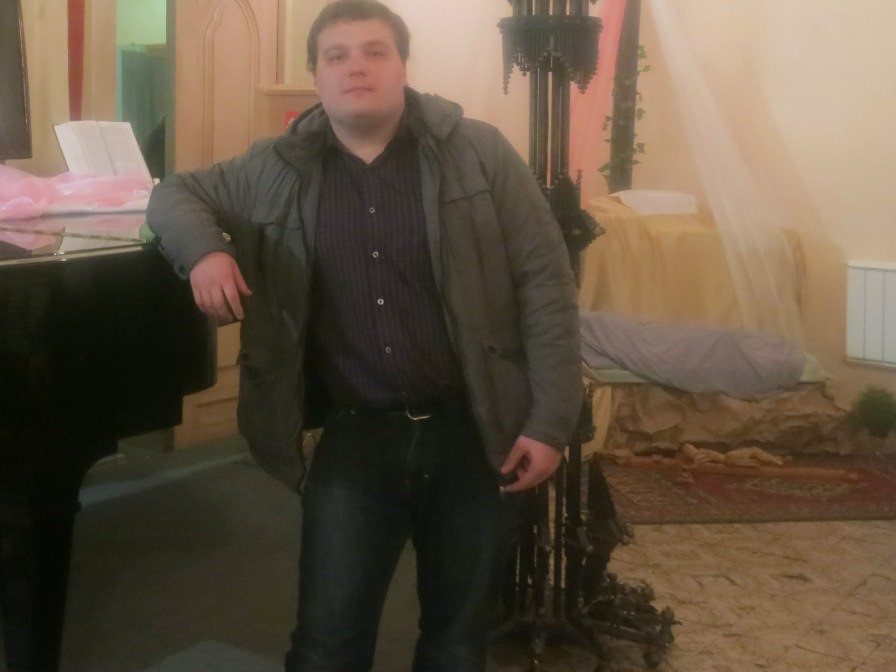
Vyacheslav Luthor, as seen in his online CV at Careerist.ru

The Second Western District Military Court in Moscow sentenced Vyacheslav Luthor, a bank clerk from St. Petersburg, to ten years in prison after finding him guilty of charges of high treason, secret collaboration with the representative of a foreign power, and involvement in a terrorist organisation, over his alleged attempt to join the [pro-Ukrainian] Free Russia Legion. Despite the fact that the courts usually hear such cases in closed chambers, our correspondent was able to attend one of the hearings. Thus, it transpired that last summer Luthor had been contacted by a recruiter who promised him a new job, a high salary, and assistance moving abroad.

Born and raised in Krasnoyarsk, Vyacheslav Luthor is thirty-three years old. According to his CV, he graduated from the local affiliate of the Moscow State University of Economics, Statistics and Informatics (MESI) in 2014, before working as an accountant in the local state statistics bureau and as a manager in real estate and trading companies. After moving to Petersburg, he took a job at Bank Saint Petersburg, which is also listed as Luthor’s place of work on his hidden VKontakte page.

The case against the bank clerk came to light last summer. On 29 July 2023, Mediazona found a record of his arrest on the website of Moscow’s Lefortovo District Court. At that time the charges of high treason and involvement in a terrorist organisation were listed there. Apparently, the charges were updated during the investigation, and so the Second Western District Military Court was asked to try Luthor on three charges: attempted high treason, confidential cooperation with the representative of a foreign power, and involvement in a terrorist organisation.

Previously, “high treason,” as defined by Article 275 of the Russian Criminal Code, was rarely charged, but after the outbreak of the full-scale war, involvement in combat on the Ukrainian side (or an attempts to go there to fight) and donations to the Armed Forces of Ukraine were equated with “high treason.” Also, a new article on “confidential collaboration” with foreigners—Article 275.1—was inserted into the Criminal Code.

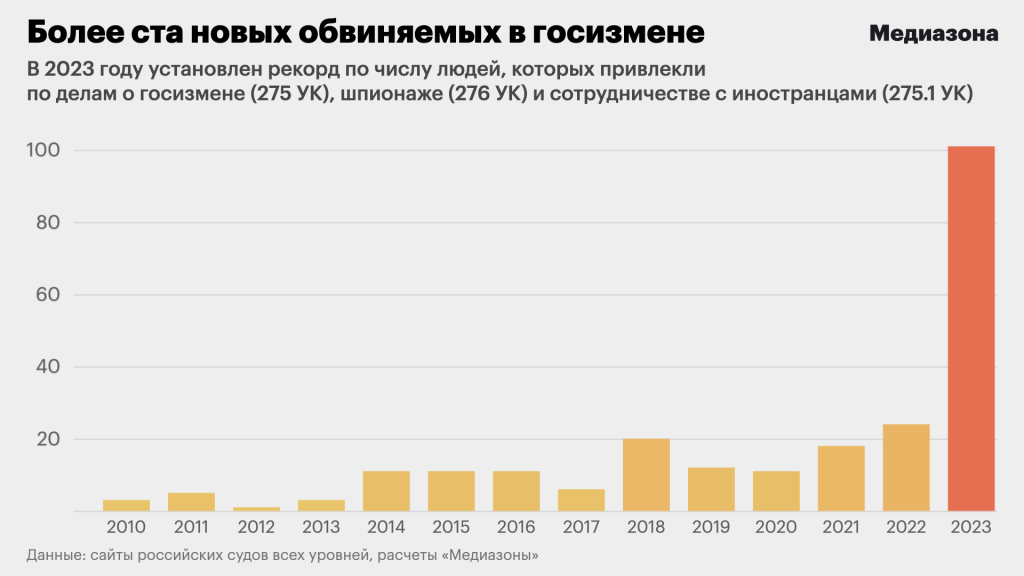
2023 was a banner year in Russia for charges of “high treason,” according to Mediazona.

Last year, as Mediazona has discovered, at least 107 people were accused of high treason (Article 275), espionage (Article 276), or collaboration with foreign powers or organisations (Article 275.1). Many such cases are classified, so the actual number of people charged with these crimes may be higher.

The human rights project Department One wrote that sixty-three high treason cases and seven cases of collaborating with foreigneers were submitted to lower trial courts. Verdicts have already been handed down in thirty-seven cases. All of them were guilty verdicts.

Unlike the high treason cases of previous years, which were mainly transferred to Moscow, courts in the regions began hearing these cases in 2023, human rights activists note. According to our calculations, more than seventy percent of such cases are now being heard outside Moscow, in the places where the crimes were allegedly committed, but the arrests and indictments are usually made in the capital.

This is what happened to Vyacheslav Luthor. Before he was placed in a pretrial detention centre, he had been jailed twice on administrative charges: on 11 July 2023, for minor disorderly conduct (Luthor was accused of “using foul language, shouting loudly, and waving his hands” at the airport) and on 14 July 2023, for disobeying police officers (Lutor was jailed for fifteen days for allegedly refusing to show his passport to law enforcers). He was to be released from the special detention centre on the day he was sent to the pretrial detention centre on the criminal charges.

“He asked me to keep my fingers crossed for him”: the testimony of coworkers

The Second Western District Military Court began hearing the case against Vyacheslav Luthor on 5 February. The state’s case was made by prosecutors Igor Potapov and Dmitry Nadysyev.

Trials on charges of treason are held in closed chambers and members of the public are not allowed to attend them, but our correspondent was able to get inside the courtroom at the only open hearing. That day, the court questioned the prosecution witnesses’s from Petersburg via video conference, and it was from these interrogations of Luthor’s former colleagues that it transpired that the bank clerk was accused of having ties with the Free Russia Legion and attempting to leave the country to fight on the Ukrainian side. Luthor himself has denied his guilt.

Luthor’s boss described her attitude to her former employee as “neutral.” She said that last summer Luthor had asked for time off from 10 July to 19 July in order to fly to his hometown of Krasnoyarsk to deal with “family problems.” According to the investigation, Luthor had probably planned to leave Russia on these dates.

Responding to a question from Prosecutor Nadysyev, the defendant’s former supervisor said that she had never spoken to Luthor about politics or the war in Ukraine.

“Tell me, did Luthor ever come to work dressed in military-style clothing?” the prosecutor asked.

The supervisor replied that he came to the bank in regular clothes — a shirt and trousers. When asked by defence lawyer Yulia Kuznetsova whether Luthor had talked about the Free Russia Legion and his desire to leave to fight in Ukraine, she also answered in the negative.

“I didn’t know what this organisation was doing and didn’t pay much attention to it,” the witness said.

“Did Vyacheslav Alexandrovich inform you that he was going to be involved in combat?” the defence counsel clarified.

“No,” the witness replied, and then she added that the word “legion” made her suspicious, as it could be associated with military action.

A female colleague of the defendant said that Luthor had asked her to come with him, but she had turned him down. The woman noted that she had advised him to refrain from the trip, although she did not completely believe that he would dare to go, as she regarded Luthor as a “wallflower.” The prosecutors then petitioned the court to have the testimony given by the same witness during the investigation read aloud due to “significant discrepancies.” The defence counsel objected. Luthor himself, a large man with short hair and dressed in a warm jacket, supported all of his defence lawyer’s motions and answered the court’s questions briefly.

The court granted the prosecutors’ testimony. In her [original] testimony to investigators, the witness had described her correspondence with Luthor in more detail. In it, he said that he had been contacted by a representative of the Free Russia Legion, who had offered him a high salary, and explained his offer to her to go with him by the fact that the recruiter needed two people. In addition, Luthor had specified to her that he would be working in the “frontline zone.” Then he asked if she had acquaintances at the Almaz-Antey military plant [he probably had in mind the company’s Obukhov Plant in St. Petersburg], and afterwards advised her to stay away from it. Luthor himself confirmed in court that he had written this to the witness.

Another colleague of Luthor’s who was questioned in court could not remember what exactly he wrote to her, apart from the fact that he had been invited to work for the Free Russia Legion. Consequently, her [original] testimony during the investigation was also read out in court. When questioned, she had said that in late June 2023, Luthor wrote to her that while he was on sick leave, he had been contacted by “a certain organisation” that offered him a job in Poland. He later clarified that his contact in the “legion” told him that he needed to leave Russia, where a “civil war was about to kick off.” He explained that he was being “actively recruited” and had been asked to “go work in reconnaissance.”

On 5 July, he asked her to “keep [her] fingers crossed for him so that he comes back safe and sound.” The witness said that she “disliked” Luthor. She did not take what he said seriously, thinking he was making things up. Luthor once again confirmed that he had sent the messages.

Human rights activists from Department One have written that people accused of high treason are often “provoked” by Russian law enforcers themselves.

“FSB officers and field agents find those who are subscribed to the Legion’s social media channels (not only the real ones, but also fake ones), and [ask them to] send them messages via bot or fill out a questionnaire to join.”

The provocateurs then introduce themselves as members of the Free Russia Legion, the Russian Volunteer Corps, or the SBU [Security Service of Ukraine], and ask the victim to do something: to take pictures of a military recruitment centre or an FSB building, to paste up [anti-war] leaflets, to set fire to a military recruitment centre or buy equipment, and then to fly to Turkey via a particular airport.

“The FSB denies they are involved in these provocations,” wrote Department One. “The[ir] official position in the courts is that it was allegedly done by the Ukrainian special services.”

The human rights activists also noted that the provocateurs sometimes write even to random people who have not voiced their opinions about the war on social networks. They “initiate friendly chats, introduce themselves as people who work on behalf of Ukraine, and ask [their correspondents] to do something.”

“He was constantly being provoked”: the mother’s testimony

“I’m alarmed — I haven’t seen my son for eight months,” was the first thing the defendant’s mother said when the judge asked how she was feeling.

Luthor’s mother, an energetic red-haired woman, had flown to Moscow from Krasnoyarsk to testify in the first hearing. In court, despite the fact that she had a hard time hearing the questions posed to her, she described Luthor’s childhood and their home life in detail. Even the prosecutor’s provocative question about her attitude to the “special operation” did not trip her up. Clearly understanding where Prosecutor Potapov was going, she said that she and her son considered what had occurred inevitable, but both of them were in favour of a peaceful end to the conflict between the two countries.

“What is your relationship with your son like?” the judge asked.

“It’s very good,” the woman assured him.

According to Luthor’s mother, her son has “a total aversion to violence, so there were problems with that at school.”

“He was constantly being provoked, and he asked his father to help him with it, but [he] has a father who believed that he had to defend himself,” the witness said.

According to his mother, Luthor did not serve in the army due to illnesses, and was not interested in military affairs or martial arts.

“We tried to send him to wrestling as a child, but after two classes he was kicked out for skipping. He just can’t hit [another] human being,” she said.

“My son never wanted to fight, he was afraid of it. He dreamed of travelling around the country and the world, even buying a trailer and driving it,” the witness said.

She said her son has hypertension, “a high degree of vascular and cardiac complications,” a stomach ulcer, and occasional panic attacks. Both she and Luthor’s father had medical conditions “galore”: [the father] had his knee joint replaced with an implant and was scheduled to have the other one replaced soon, but due to his small pension he still had to work despite his aching knees.

“He’s very nice,” the witness continued her account of her son. “He and I are close, and in terms of our views as well. He and I are not of this century: we are very trusting. He couldn’t pass a single beggar by.”

She added that Luthor had been afraid of [the military] mobilisation, although “there were no grounds [for this fear],” and he was not against leaving [Russia] if he had the opportunity.

She said that around the beginning of July he had stopped answering her calls, although they usually contacted each other every day. The mother went to the police and was told that Luthor had been detained for using foul language at the airport, although, according to her, Luthor did not swear as a matter of principle.

The witness said that her son liked his job at the bank and was very fond of Petersburg, where he had gone on her advice. She said that she did not know about his plans to travel abroad and that she was even going to visit him in August.

The prosecutor’s questions made it clear that at some point Luthor had asked his parents to help him pay off a debt.

“Tell me, what was the story when fraudsters allegedly stole money from your son’s [bank] card and you had to sell your property to cover the debts?” asked the prosecutor.

“‘Property’ is too strong a word, but we had to [sell] part of it. It was at MTS Bank,” Luthor’s mother replied. “We sold the garage and just part of that sum—”

“Well, what was the amount? Was it large?” asked the judge, interrupting her.

“Approximately two hundred [thousand rubles],” she replied.

“And did you discourage your son from filing a law suit or going to law enforcement [to tell them] a fraud had been committed?” the judge asked.

“Well, yes, I said it was useless,” she replied.

After the judge sighed heavily, the witness repeated that they were very gullible and she herself had fallen victim to fraudsters.

“Did you contact law enforcement?”

“Yes. They managed to recover part [of the money].”

“You see,” added the prosecutor.

“The rest is being earned back by my husband,” the witness said in conclusion. She was dismissed from the stand, and the journalists were asked to leave the courtroom.

Luthor’s trial took only five hearings, four of which were held in closed chambers. On 28 February, the prosecution asked the court to sentence Luthor to fifteen years in a high-security penal colony. The very same day, the court handed down the sentence: ten years of imprisonment, of which Luthor will spend the first two years in a closed prison, serving out the remaining eight years in a high-security penal colony.

Source: Anna Pavlova, “10 years for correspondence: how attempting to join the Ukrainian armed forces is prosecuted as high treason—the case of a bank clerk from St. Petersburg,” Mediazona, 28 February 2024. Translated by the Russian Reader
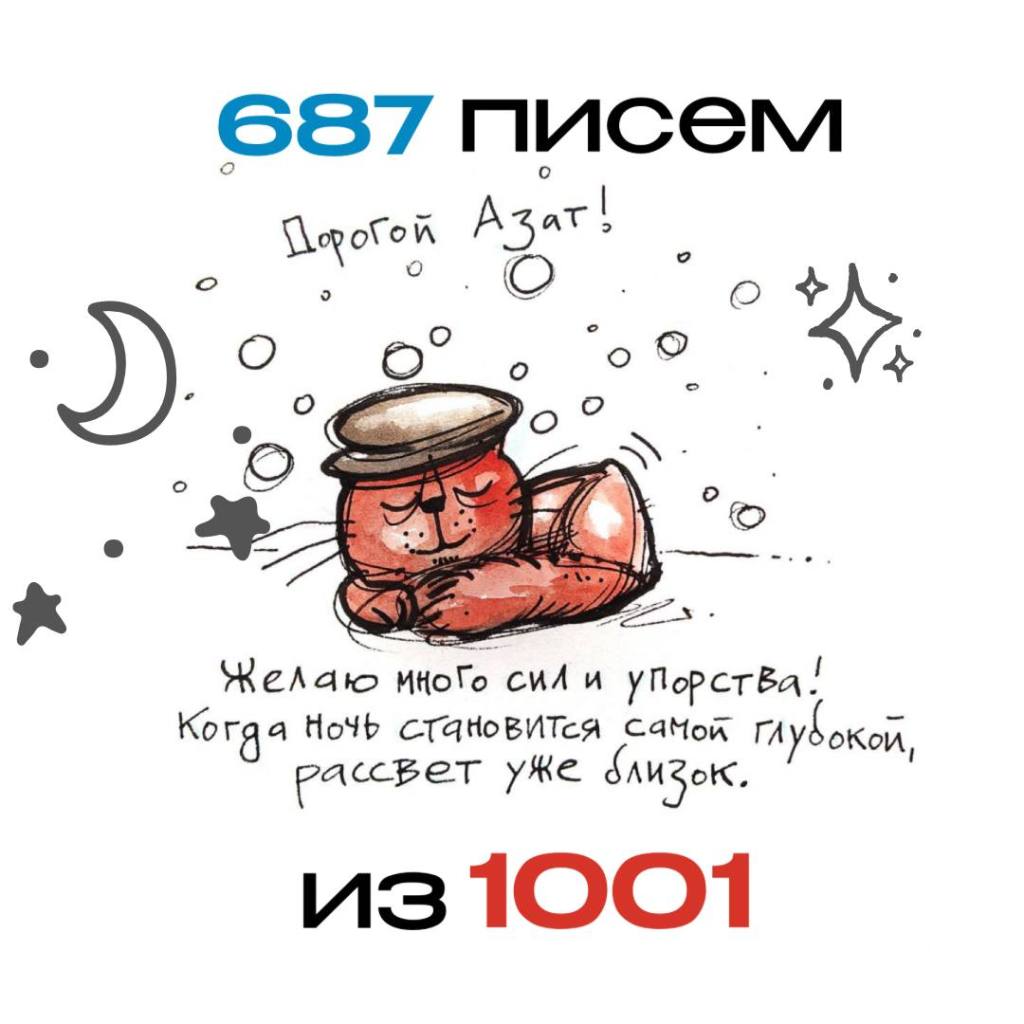
1001 Letters for Azat Miftakhov

687 letters out of 1,001. “I wish [you] much strength and determination. It’s always darkest before the dawn.”

💌The Azat Miftakhov letter writing campaign continues!

🔥 Since the last appeal to write to Azat, the Solidarité FreeAzat Association has received 687 letters out of its goal of 1,001 letters!

✈️ We received letters from a huge number of countries. Azat is supported by people in France, Russia, Belgium, Nicaragua, Mexico, Germany, Lithuania, the UK, Switzerland, Italy, Poland, Canada, Finland, Australia, Brazil, Côte d’Ivoire, Mali, Georgia, South Korea, Armenia, New Zealand….

Fifty countries in all!

🫠Today we learned that the military court’s first hearing in Azat’s case has been scheduled for February 12 in Yekaterinburg. We have even less time than we thought. There is one week left to get all the letters.

🫶 We urge everyone who hasn’t written yet to write a letter to Azat Miftakhov before February 12, to show solidarity with and verbal support for a person who has been imprisoned for no particular reason.

😳You can write to the Association’s e-mail—libertepourazat@gmail.com—or use the Google form.

😳We would like to remind you that Solidarité FreeAzat Association is going to send the letters via Zonatelecom, an electronic service for dispatching letters to Russian inmates, and therefore we need your full support.

😳You can make a donation to offset the cost of sending the letters.

🤮 If you have a Russian bank card, send money to:

Mastercard 5469 3800 5929 3380 (Sberbank)
Elena Gorban

🤮 If you want to donate using a non-Russian bank card you can use this payment service:

https://www.helloasso.com/associations/solidarite-freeazat/formulaires/3

Please note that the service will charge a commission on the payment, and you need to manually lower the amount of the commission to 0 euros.

Write letters to those who need them so much now!

❣️*The postcard [above] was drawn by Hans, an artist from Germany.

Source: FreeAzat! (Telegram), 5 February 2024. Translated by the Russian Reader. Thanks to Posle for the heads-up. Please note that the Google letter-writing form, linked to above, is in Russian not least because the correspondence received by Russian inmates must be in Russian in order to pass censorship. If you need help negotiating this, don’t hesitate to write to me at avvakum@protonmail.com.


Azat Miftakhov

We’re launching a fundraiser to pay for mathematician Azat Miftakhov’s lawyer

Azat Miftakhov is a political prisoner, anarchist and mathematician convicted in 2019 on charges of disorderly conduct for allegedly breaking a window at a United Russia party office. In 2023, Azat was detained when he was released from prson and charged with “condoning terrorism.” According to police investigators, Miftakhov “deliberately in the presence of two convicts publicly condoned terrorism” while serving his sentence for disorderly conduct in Penal Colony No. 17.

According to the testimony of the other inmates, while watching the evening news on TV in May 2023, Miftakhov said that he would “avenge” a friend who had been killed while fighting for the Ukrainian army. The principal testimony in Azat’s new case was given by a identity-protected witness. He claimed that Miftakhov had condoned the actions of Mikhail Zhlobitsky, who carried out a suicide bombing at the Arkhangelsk offices of the Federal Security Service (FSB).

We are now raising 500,000 rubles [approx. 5,100 euros] to pay the lawyer defending Miftakhov against the new charges of violating Article 205.2.2 of the Russian Federal Criminal Code.

You can click the link, below, to support the fundraiser using a non-Russian bank card [via Stripe].

I want to help!

You can send a transfer in Russian rubles to Tinkoff card 5536 9140 9963 7302, tied to phone number +7 (991) 938-0181, Roman Vyacheslavovich P. (Mark the reason for payment as “mathematics.”)

Source: Memorial Political Prisoners Support, 9 Februrary 2024. Translated by the Russian Reader. Thanks to Posle for the heads-up.

Bohdan Ziza: “A Cry from the Heart”

Bohdan Ziza, a Ukrainian artist, poet and activist, is serving a 15-year sentence for “terrorism” after pouring blue and yellow paint – the colours of the Ukrainian flag – on to a municipal administration building in Evpatoria, Crimea, his home town. He made and circulated a video of the action – on 16 May 2022, shortly after the all-out Russian invasion of Ukraine – and for that was also charged with “incitement to terrorism”.

Bohdan Ziza. From his instagram channel

This is Bohdan’s speech from the dock, before being sentenced by a Russian military court on 5 June last year.

Do I regret what I have done?

I am sorry that I over-reached, and that my action resulted in charges under the Article [of the Russian criminal code] on terrorism. I am sorry that my grandmother is now without the care and support that she needs. Apart from me, she has nobody. And I am sorry that I can not now help others who are close to me, who need that help now.

As for the rest: I acted according to my conscience.

And also, according to my conscience, I do not deny or disavow what I did. I behaved stupidly, and could have expressed my opinion in some other way. But did I deserve, for what I did, to be deprived of my freedom for ten years or more?

I would like to appeal to the court: do not follow the regime’s script, do not participate in these awful repressions. But obviously that would have no effect. The judges and other similar political actors are just doing what they are told.

For these reasons, I will continue to protest, even in prison. And I am well aware of the sentence I may receive, and how it may affect my health and even my life.

But am I worthy of the life that I live? Is each one of us worthy of a carefree life, when we stay silent at a time when, every day, innocent people’s lives are being taken?

This was the worst night of my life. I never experienced anything like it. I thought we would die. There were three Kinzhal rockets, and loads of Kalibrs. They fell very close, they were right above our building. The building shook – several explosions, one after the other. For the first time in the war there was a white glow, the sky was white from the explosions. It was as though we were in a trench, not in our own home. At one moment I thought that it was all flying towards us. There was the very clear sound of a rocket, and then a very powerful explosion. But we have been lucky, again, and we are still alive.

That was a message from my sister, in Kyiv, who had to live through another night of bombardment of the city by the Russian armed forces.

When she went out in the morning, she learned that one of the rockets had hit the next-door building.

For many people, this war that is going on now is happening over there somewhere, far away.

One of the staff at the pre-trial detention centre said to me: “Bloody hell, I am sick of this war. Whenever you turn on the TV, it’s more of the same.” I answered that the war is not over and so you can not get away from it. And then he said: “Yeah, yeah, I know. It’s just that everything is getting more expensive. The cost of running a car now!”

And that’s the problem, here in Russia. For you, this war is an inconvenience, an irritation. You try to wait it out, living your usual life, trying to avoid bad news, and in that way simply not valuing simple things, not valuing the fact that you can wake up in a warm bed, in a warm flat, and say to someone who is dear to you, “good morning”. At a time when in the country next door, millions of people are losing their homes, losing their loved ones, when whole cities are being destroyed. Every day. That’s the everyday reality for Ukrainian citizens now.

In theory, Russian people’s failure to act could be explained, if only what is happening was not being done by Russian hands. The hands of those who bear arms, and those who don’t do anything to stop them. Every day that an ordinary Russian person carries on, reasoning that this is all politics and doesn’t concern him, and living his normal life, he adds money to the Russian Federation budget and in that way sponsors this criminal war.

Of course there are those who do not support what is happening, who take action, who are not silent participants: journalists, various activists – those who refuse to keep quiet.

My action was a cry from the heart, from my conscience, to those who were and are afraid – just as I was afraid – but who also did not want, and do not want, this war. Each of us separately are small, unnoticed people – but people whose loud actions can be heard. Yes, it is frightening. Yes, you can end up behind bars – where I, for sure, did not plan to be. Even for these words I could face a new criminal case. But it is better to be in prison with a clear conscience, than to be a wretched, dumb beast on the outside.

I am also an ordinary citizen of my country – Ukraine – who is not used to keeping quiet when confronted with lawlessness. I am not alone here today in this “goldfish bowl” [slang for the glass cage in which the accused appears in Russian courts]. There are more than 200 people with me: Ukrainian political prisoners, serving time in Russian prisons on fabricated charges. Many of them are Crimean Tatars, who are once again faced with repression by Russia. I am myself half Crimean Tatar, and angry at our people’s suffering.

Many Ukrainians are serving time in Russian prisons simply because they are Ukrainians, and were somewhere that the Russian state thought they should not be. In Russian prisons people are beaten up for speaking in Ukrainian. Or not even for speaking it, but simply for understanding it. Bastards among the guards at pre-trial detention centres or other places where people are imprisoned address prisoners in Ukrainian, to see if they get a reaction, to see if they provoke an answer or a response. If a person reacts, they beat him up.

Those who so passionately seek “Nazis” in Ukraine have not opened their eyes to the Nazism that has emerged in Russia, with its ephemeral “Russian world”, with which armed forces have come to us, to try to extirpate Ukrainian identity.

People in prison suffer in the most terrible conditions. Many of them are elderly. More than 40 people [in the pre-trial detention centre] have critical health problems, and can not access the medical treatment that they need. People die in prison. They are not criminals. Deport them from the country! Why do you keep them here?

I am no kind of terrorist. It sounds ridiculous to even say that. I am a person with morals and principles, who would rather give his own life than take the life of another person. But I am not ready to give my life to the Federal Penal Enforcement Service of the Russian Federation.

I declare a hunger strike, and demand that I be stripped of my Russian citizenship. I demand that all Ukrainian political prisoners be freed. If anything happens to me in prison, I want the world to know that it happened only because I am a Ukrainian, who took a stand against the war in his country.

And if this is my last word, let it be my last word in the Russian language. The last thing I will say publicly in Russian in this country, as long as this regime lasts. The reddish regime.

[Ziza then switched from Russian to Ukrainian, and recited this poem. Explanation of names mentioned below.]

I am not Red, I am Crimson!

I am not playing to the gallery!

These are not rhymes, they are wounds!

And I am not Melnik, I am Bandera!

The weather: it’s snowing in my summer,

From Symonenko’s motherland

I go to the end, like Teliha!

And I believe in wings, like Kostenko!

Note. The Ukrainian for “crimson” (“bahrianyi”), was also the pseudonym of Ivan Lozoviaha, a dissident writer and political exile from 1932 to his death in 1963. Andriy Melnik and Stepan Bandera were leaders of Ukrainian nationalist partisan military formations in the 1940s. Vasyl Symonenko was a Ukrainian poet, active in dissident circles until his death in 1963. Olena Teliha was a feminist poet, member of a nationalist underground cell in Nazi-occupied Kyiv, killed by the Nazis in 1942. Lina Kostenko is a Soviet-era dissident who has continued working as a poet and writer in post-Soviet Ukraine.

This is translated from the Russian text on the Graty news site, with reference to the Crimea Human Rights Group report. Thanks to M for help with translation.

What happened next. After Bohdan Ziza made this speech to the Southern District Military Court in Rostov, Russia, on 5 June 2023, he was sentenced by the judge, Roman Plisko, to 15 years in a high-security penal colony. Shortly after that, Ziza wrote to Zmina, the Ukrainian human rights organisation. He ended his hunger strike and then wrote to Uznik on-line, which coordinates correspondence with anti-war prisoners in Russia, to thank them and the many supporters who had written to him.

On 27 September 2023 Bohdan Ziza’s appeal against his sentence was rejected by Maksym Panin at the military court of appeal in Vlasikha, near Moscow.

Bohdan, who marked his 29th birthday on 23 November, was moved to Vladimir prison. On 5 December, the Kharkiv Human Rights Protection Group reported that he had been visited by his lawyer and is in good spirits. He is sharing a cell with Appaz Kurtamet, another Crimean Tatar political prisoner, and was serving time in a punishment cell after stating that he is not a criminal and refusing to wear prison clothing.

What we can do. Advice to non-Russian speakers who wish to write to Bohdan and Appaz is included in this article on the Kharkiv Human Rights Protection Group site. The group also appeals to other countries’ diplomats to help Ukrainian citizens in Russian prisons (although this does not include Bohdan, since he was compelled, as a teenager, to take Russian citizenship after Crimea was annexed by Russia in 2014).

More information. Solidarity Zone (see facebook, telegram and twitter) supports anti-war activists jailed in Russia. The Kharkiv Human Rights Protection Group, Crimea SOS and Zmina are among the Ukrainian human rights organisation that publicise the fate of more than 180 Crimean political prisoners in Russian jails. SP, 17 January 2024.  

□ Bohdan Ziza’s own art and poetry is on instagram and youtube.

Source: “Crimean political prisoner Bohdan Ziza: ‘My anti-war action was a cry from the heart’,” People and Nature, 17 January 2024. Thanks to my friend and comrade Simon Pirani for his outstanding work here and elsewhere, and for his kind encouragement to repost this important document of Ukrainian resistance to Russian fascism.

The Way Home: Wives of the Mobilized

The wife of a Russian soldier killed in action recorded a video message.

I would like to tell this story, if possible, from the very beginning. My name is Maria Ishkova, and I’m from St. Petersburg. I’m an absolutely genuine, living person. I’m no agent engaged in PSYOP.

All in all, my husband had been mobilized and deployed in the field with the Russian federal armed forces since September 2022, with periodic withdrawals [from the front] for rest and relaxation. But he had only one [home] leave during that whole time.

But none of that matters because yesterday—or rather, today—I learned that my husband passed away yesterday.

And that’s not all. The big thing I want to tell all the people who are fighting for the men they love—for their love, for their heart, for their life, for their fate—is that you’re out of time. You’re completely out of time because any day may be the fateful one.

I also want to say that I’ve now arrived in those selfsame new territories. I’ve come for my husband to Berdiansk, in the Zaporizzhia Region. And you know, I want to tell you that the people here have no need of [the war], no one has any need for it.

The people we love are simply getting killed for nothing. They’re of no worth to anyone.

I want to say that today—precisely today because I found out about it—my mind has split in two. One part of my mind, the lower part, it understands this grief, it grieves, it feels like weeping—all that stuff.

The second part of my mind, which has split off, it looks at all this a little bit from above and tries to understand how the world order could let such things happen.

And you know, I think that we ourselves are probably to blame for everything. I think that we let it happen by taking the minimal civic stance that we did—when each of us says, I don’t get involved in politics, it doesn’t interest me, it doesn’t worry me.

Each of us lived in this little world—where nothing mattered, where politics was decided by itself, where things happened of their own accord.

Now we find ourselves in a situation in which, basically, the chickens have home to roost because of our world view, because of our outlook on life. We were indifferent to these things, and now these things have devoured us.

The BBC and Mediazona have been able to ascertain the names of at least 40,000 Russians killed in Ukraine.

“Bring back my husband. I’m fucking tired of this shit.”

All over Russia, the wives and relatives of mobilized soldiers have been organizing protests to demand that their loved ones be returned home.

Source: Current Time TV (Instagram), 2 January 2024. Translated by the Russian Reader

I’m standing next to the Russian Defense Ministry. I’m doing a solo picket in the hope that we, the wives and mothers of mobilized men, will be heard. [I hope that] our pain will be heard, that our request to bring our husbands [and] our boys back home will be heard.

They are tired. They’ve been deployed in the special military operation zone for a year and four months with no rotation.

Personally, my husband has been sent on the attack. He has a master’s in applied physics. He works in IT. He has a child who is one and a half years old. When he was [mobilized], the child was three months old. But now he’s on the attack. People like him shouldn’t be sent on the attack.

Generally, all the mobilized men should be brought home: they need to rest. We demand that the period of mobilization of no more than a year be restored.

That’s why I’m here today, and I expect to be heard.

And what else do you plan to do if you’re not heard?

We’ll keep on going. We’ll continue to fight for our boys because we don’t really have a choice. Each time there are more and more of us. More and more wives, mothers, and sisters are beginning to understand that their inaction could get their husbands or brothers killed.

You don’t have as much time as you think you do. Every days could be the decisive one, the last one.

How long are you going to stand here?

I’m probably going to stand here until I’m finally frozen. Because the weather outside is frightful, to be honest. But I also know that my husband is facing even worse conditions, and the fact that I’m standing here in the cold for an hour or two cannot be compared with the fact that for a year and four months he has faced simply inhumane conditions without being relieved, and now, to make matters worse, he’s on the attack.

I’m not afraid to talk about it. I’m not afraid to fight because the worst thing that could happen has already happened.

Source: SOTA (Twitter), 6 January 2024. Translated by the Russian Reader

Nevertheless, if we disregard volunteers, prisoners and mercenaries, we can say with a high degree of certainty that by the beginning of 2024 the Russian armed forces will not have recovered the number of contract-based personnel that they had on the eve of February 2022. This is indirectly evidenced by other figures cited by the Kremlin: approx. 244,000 military personnel are officially at war today, while 650,000 people have gained combat experience since February last year, 458,000 of whom have already received certificates confirming their status as combat veterans. This, of course, includes both regular servicemen and mobilised personnel from various combat units, as well as those serving in the navy and combat support units, ground staff of military airfields, etc., servicemen of the Rosgvardia and Federal Security Service (FSB), mercenaries and volunteers, military personnel from the Donetsk and Luhansk People’s Republics, as well as police officers. And apparently, these 650,000 veterans include all: the living, the dead, the missing, the captives and the disabled.

And given the Russian servicemen’s numerous complaints about the lack of rotation, it is not clear—even taking all the losses into account—where the claimed 490,000 new contract soldiers could have dissolved, alongside the unclear number of ‘old’ contract soldiers and the remaining mobilised troops. Simply put, the figures on paper have ultimately diverged from the actual number of people in Russian troops.


Female activists calling for the return of mobilized Russians from Russia’s war against Ukraine held a series of solo pickets in Moscow. The actions took place near the presidential administration offices and the Defense Ministry, according to a post on the Telegram channel of the movement The Way Home (Путь домой) on Saturday, January 6.

None of the picketers were detained. According to a female activist who picketed outside the offices of the presidential administration, a Federal Protective Service called the police, but the latter, after arriving at the site, confirmed that solo pickets were a legal form of protest.

At the same time, SOTA notes that about fifteen wives of mobilized Russians laid flowers at the Tomb of the Unknown Soldier near the Kremlin. According to SOTA, five relatives of mobilized men laid flowers at the Eternal Flame in St. Petersburg, demanding the return of their loved ones from the front.

Calling for the return of mobilized men home

Wives of mobilized Russians have been increasingly active in recent months in demanding the return home of men who have been at the front for over a year. They have been holding flash mobs, going to protest rallies, and sending official letters to the authorities, demanding that the tour of combat duty for mobilized men limited to one year, that all wounded men be discharged, and that the list of illnesses for which they cannot be drafted be expanded.

The leaders of many regions have refused to allow relatives to hold protest rallies, citing the threat of COVID-19. The Kremlin has practically not commented on their demands.

At the end of 2023, the Russian Defense Ministry turned down a request by Boris Vishnevsky, a member of the St. Petersburg Legislative Assembly, to limit the tour of duty of mobilized Russians to one year. Their tour of duty will end as soon as the country’s President Vladimir Putin signs a decree ending the mobilization, the ministry explained. At the same time, presidential spokesman Dmitry Peskov said on 1 November 2022 that Putin’s decree was not required to end the mobilization.

Source: Pavel Mylnikov, “Wives of the mobilized hold solo pickets in Moscow,” Deutsche Welle Russian Service, 7 January 2024. Translated by the Russian Reader


“The Way Home: Wives of the Mobilized.” In Russian, with Russian subtitles.
Maria Ishkova (above) and the young female solo picketer featured in the second part of this post both make appearances in this film.

Russia mobilized 318,000 men for its war against Ukraine, according to Vladimir Putin. The so-called partial mobilization was announced in September 2022, six months after the start of Russia’s invasion of Ukraine. Many mobilized men and their relatives believed that the mobilization would be for a relatively short period of time, up to six months, although no official announcement was made.

Almost a year later, in August 2023, The Way Home movement emerged in Russia, uniting relatives of mobilized soldiers. Several female activists who had met in one of the numerous online groups for the wives and mothers of Russian soldiers decided to move from talk to action and created a chat room to coordinate their efforts. Initially, most of the chat room participants were loyal to the government and avoided politics. Over time, they realized that the mobilized soldiers were not going to be brought home, the local authorities were making empty promises, and the topic was taboo to the federal press, and so the activists turned to public protests to make themselves heard. They have refrained from criticizing the government’s decisions and the war itself, focusing on the sole goal of bringing the mobilized men back home.

On 7 November 2023, a group of women armed with placards attended a Communist Party rally on Manezhnaya Square in downtown Moscow. On December 7, the movement published a collective manifesto demanding demobilization. The Way Home became the talk of the town, and the community began growing rapidly while also coming under increasingly harsh attacks. Opponents of the war ridicule those who did not dodge the draft and obediently reported to military recruitment centers. Supporters of the war have declared the female activists “Navalny supporters. Television propagandist Vladimir Solovyov said that The Way Home was created by foreign special services for subversive activities. The community’s rallies are banned under the pretext of preventing the spread of covid, its female members and their husbands are visited by law enforcers, and The Way Home’s Telegram channel has been labeled “Fake.” (Pro-government blogger Ilya Remeslo said this was done after he filed a complaint.) Despite the pressure, the community continues to function.

Vladimir Sevrinovsky’s film Wives of the Mobilized tells the story of an activist in The Way Home who wished to remain anonymous.

Source: Signs of Life—Documentary Films by Radio Svoboda (YouTube), 5 January 2024. Annotation translated by the Russian Reader

Checkmate

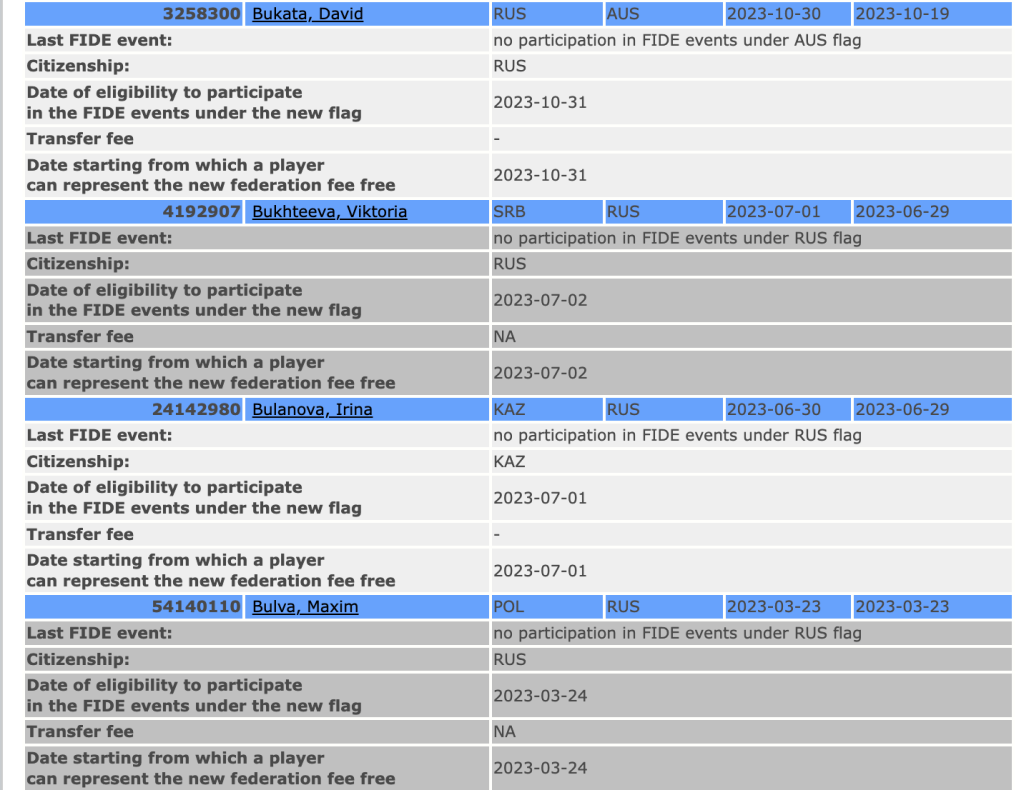
As Australian chess player David Bukata was joining the Russian chess federation last year, three Russian players whose surnames also start with B were quitting it. Screenshot of the 2023 transfers page on FIDE’s website.

In 2023, 104 Russian chess players changed their national affiliations, according to information published on the website of the International Chess Federation, FIDE.

Among the top hundred players in the world chess rankings, Sanan Sjugirov (40th place), Alexey Sarana (41st), Vladimir Fedoseev (45th), Nikita Vitiugov (50th), Alexandr Predke (64th), Kirill Alekseenko (89th) and Alexandra Kosteniuk (11th in the women’s rankings) quit the Russian national chess federation.

In turn, five competitors transferred their affiliation to the Russian chess federation last year: Yuriy Ajrapetjan and Viktor Filonov from Ukraine, David Bukata from Australia, Kanan Geidarli from Azerbaijan, and Nadezhda Iskichekova from Kazakhstan.

In the almost two years since Russia launched its full-scale invasion of Ukraine, 192 Russian chess players have changed their national sporting affiliations.

Source: Radio Svoboda, 3 January 2024. Translated by the Russian Reader


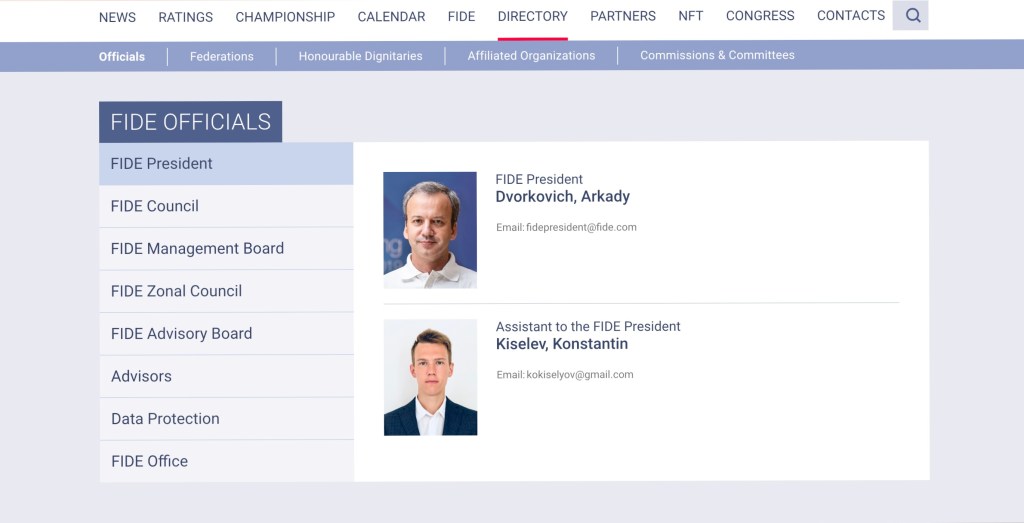
Former Russian deputy prime minister Arkady Dvorkovich is FIDE’s current president.

Arkady Vladimirovich Dvorkovich (Russian: Арка́дий Влади́мирович Дворко́вич; born 26 March 1972) is a Russian politician and economist, currently chairman of the International Chess Federation, FIDE. He was Deputy Prime Minister in Dmitry Medvedev’s Cabinet from 21 May 2012 until 7 May 2018. He was previously an Assistant to the President of the Russian Federation from May 2008 to May 2012. He has the federal state civilian service rank of 1st class Active State Councillor of the Russian Federation.

Dvorkovich was considered to be a close confidant of Dmitry Medvedev and an important figure in Russian politics. He rose to prominence during Medvedev’s presidency but has suffered from the resurgence of Igor Sechin. From 2018 to 2022 he was the Chairman of Skolkovo Foundation. Since 2015, he is also the Chairman of the Board of the Directors in Russian Railways company.

[…]

In March 2022, Dvorkovich condemned Russia’s invasion of Ukraine, saying that “Wars are the worst things one might face in life…including this war. My thoughts are with Ukrainian civilians.” Andrey Turchak, a lawmaker from Putin’s United Russia party, condemned Dvorkovich’s anti-war stance and called for his “immediate dismissal in disgrace,” saying: “This is nothing but the very national betrayal, the behavior of the fifth column, which the president [Putin] spoke about today.” Later Dvorkovich said on the website of the Skolkovo Foundation that he was “sincerely proud of the courage of our (Russian) soldiers” and that Russia had been targeted by “harsh and senseless sanctions.”

In August 2022, he was re-elected for a second term as FIDE president receiving 157 votes as against 16 by his rival Andrey Baryshpolets.

Source: Wikipedia

I Apologize

Once upon a time, apologizing on camera was a Chechen and Belarusian practice. Since the outbreak of full-scale war, the Russian authorities have also adopted this method of putting pressure on dissenters, especially in music and pop culture. Here are some examples from the last year.

Underdog and La Virgen bars

To whom: the police.

For what: for holding a charity event to aid Ukrainians.

Quote: “We apologize, including to all law enforcement officers who had to be involved in these events because of us and waste their time.”

Did it help: Yes, the security forces have left the bars alone.

Rapper Scally Milano

To whom: Yekaterina Mizulina, head of the Safe Internet League.

For what: for mentioning drugs in his songs.

Quote: “We have to be role models, but ones with the right values. I urge all performers to be responsible. The moment has come to change everything for the better, and I want to have an impact on this.”

Did it help: Yes, Mizulina gave the rapper another chance: he had his a picture taken with her and deleted some of his songs from streaming services. The security forces stopped disrupting his concerts.

Rapper Loqiemean

To whom: to everyone.

For what: for protest songs.

Quote: “I spent time in prison. More precisely, I spent five days under arrest in a pretrial detention center. On this occasion, I have to shore up my opinion about the complaints about the pots.* I was wrong: I should not wish harm to my army, because the army is inseparable from the people. And I am an inseparable part of this people.”

Did it help: yes, apparently. Roman Khudyakov (which is the rapper’s real name) has stopped making public appearances, however.

*[In a video recorded on 23 March 2022, Loqiemean is shown baking meat in clay pots and saying that he would like those who bombed an apartment building in Odessa to be cooked in clay pots. On 1 May , Yekaterina Mizulina posted this video on her Telegram channel, captioning it as follows: “But we definitely do not need such concerts in Russia. Let him perform at home in his kitchen.”]

Singer Charlotte

To whom: the police.

For what: for anti-war statements and burning his passport.

Quote: “I was mistakenly obsessed with false information [voice-over: “Why were you brought here?”] I had a misfire in understanding what was happening.”

Did it help: no. Charlotte has been charged on four criminal counts, including “disseminating fake news about the Russian army” and “discrediting the Russian army.” He’s now under arrest in a pretrial detention center.


Charlotte, “Posh or Not” (2019):
“When I see a person, I look into their eyes
It doesn’t matter what you look like
It’s important what you’re talking about
When I don’t see a person, I look up at the sky
It doesn’t matter what I look like
It’s important what I’m talking about”

Blogger Nastya Ivleeva, singer Philip Kirkorov, rapper Vacìo, and others

To whom: everyone.

For what: for an “almost naked” party, at which the guests were dressed scantily; Vacìo even came wearing only a sock over his penis.

Quotes:

Vacìo: “I want to say that I don’t support LGBT people in any way and didn’t want to make any propaganda about it. I condemn LGBT supporters. I apologize for offending the feelings of other people and for being involved in such a terrible video at such a difficult time for our country.”

Philipp Kirkorov: “I went through the wrong door. Yes, I knew about the event, had received an invitation, promised to come and came, but I didn’t know about the nature of the events that would take place behind that door. And so I left.”

Ksenia Sobchak: “I can tell you for sure for myself, my friends, I definitely did not want to offend anyone. If someone is offended by my appearance, I apologize for it.”

Did it help: We don’t know yet. It seems that the backlash against Ivleeva and her guests is still underway.

Source: WTF (Mediazona) email newsletter, 28 December 2023. Translated by the Russian Reader

Hüsker Dü, “I Apologize” (1985)

MOSCOW, Dec 28 (Reuters) – A rapper who attended a celebrity party with only a sock to hide his modesty has been jailed for 15 days, sponsors of some of Russia’s best known entertainers have torn up their contracts, and President Vladimir Putin is reported to be unamused.

An “almost naked” party at a Moscow nightclub held at a time when Russia is engaged in a war with Ukraine and the authorities are pushing an increasingly conservative social agenda, has provoked an unusually swift and powerful backlash.

A video clip of Putin’s spokesperson listening to an explanation from one of the stars who attended has been circulating online. Baza, a news outlet known for its security services contacts, has reported that troops fighting in Ukraine were among the first to complain after seeing the footage and that photographs of the event reached an unimpressed Putin.

Dmitry Peskov, Putin’s spokesperson, on Wednesday asked reporters to forgive him for not publicly commenting on the burgeoning scandal, saying: “Let you and I be the only ones in the country who aren’t discussing this topic.”

Maria Zakharova, a spokesperson for the Russian Foreign Ministry, said that the event had “stained” those who took part, but that they now had a chance to work on themselves, according to the Ura.ru news outlet.

The fierce backlash from the authorities, pro-Kremlin lawmakers and bloggers, state media, and Orthodox Church groups has been dominating the headlines for days, displacing stories about rising egg prices and allowing people to let off steam by railing against the show-business elite instead.

The party, in Moscow’s Mutabor nightclub, was organised by blogger Anastasia (Nastya) Ivleeva and attended by well-known singers in their underwear or wearing skimpy costumes who have been staples on state TV entertainment programmes for years.

DOUBLE APOLOGY

Ivleeva, who has since become one of Russia’s most recognised names, is seen in one clip showing off an emerald-studded chain around her backside worth 23 million roubles ($251,000) at a time when some Russians are struggling to get by.

She has since issued two public apology videos for the event which spanned Dec. 20–21.

In the second tearful apology, released on Wednesday, Ivleeva said she regretted her actions and deserved everything she got but hoped she could be given “a second chance.”

Nastya Ivleeva’s second social media apology for the “almost naked” party, posted on Wednesday

Her name has since disappeared as one of the public faces of major Russian mobile phone operator MTS, the tax authorities have opened an investigation that carries a potential five-year jail term, and a Moscow court has accepted a lawsuit from a group of individuals demanding she pay out 1 billion roubles ($10.9 million) for “moral suffering.”

If successful, they want the money to go to a state fund that supports Ukraine war veterans.

“To hold such events at a time when our guys are dying in the (Ukrainian) special military operation and many children are losing their fathers is cynical,” said Yekaterina Mizulina, director of Russia’s League for a Safe Internet, a body founded with the authorities’ support.

“Our soldiers on the front line are definitely not fighting for this.”

Many of the party’s famous participants have recorded apologies, including journalist Ksenia Sobchak whose late father Anatoly was once Putin’s friend and boss.

SOCIAL CONSERVATISM

The scandal comes at a time when Putin, who is expected to comfortably win another six-year term at a March election, has doubled down on social conservatism, urging families to have eight or more children, and after Russia’s Supreme Court ruled that LGBT activists should be designated as “extremists.”

Nikolai Vasilyev, a rapper known as Vacio who attended wearing only a sock to cover his penis, was jailed by a Moscow court for 15 days and fined 200,000 roubles ($2,182) for propaganda of “non-traditional sexual relations.”

Other more famous names have had concerts and lucrative state TV airtime cancelled, contracts with sponsors revoked, and, in at least one case, are reportedly being cut out of a new film.

The scandal has angered those who support Russia’s war in Ukraine.

Standing outside the Bolshoi Theatre on Thursday, Nadezhda, one Moscow resident, told Reuters she was outraged and thought those who took part should be punished and not shown on TV anymore.

“If you’re partying at least don’t film it,” she said. “At such a difficult time (for Russia), they should at least be ashamed. Aren’t they ashamed before those who are fighting for us?”

Alexander, another Muscovite, said those who attended had not broken any law and were free to do as they pleased at what was a private event.

But one woman who said her nephew had lost both legs in combat wrote in a post to the League for a Safe Internet that the stars should pay for prosthetic legs for her relative and others to make amends.

“That would be a better apology,” the unidentified woman wrote.

($1 = 91.6205 roubles)

Source: Andrew Osborn, “Russian stars’ semi-naked party sparks wartime backlash,” Reuters, 28 December 2023


In her first social media post about the scandalous party, released five days ago, Nastya Ivleeva wasn’t apologetic or teary-eyed at all. ||| TRR


The situation around the “naked party in Moscow,” in the course of which the Russian patriotic crowd has canceled many quite pro-regime figures, quite tellingly illustrates the degradation of Russian society. Previously, there were two realities: the reality of official propaganda, and a parallel reality in which there was “contemporary art,” “kinky parties,” and Knife magazine.” In exchange for symbolic loyalty to the regime, one could gain comparative individual freedom.

Now that time has come to an end. There will be no individual freedom even for the chosen ones. The only freedom that remains for Russians is the freedom to vote for Putin and the freedom to apologize to Kadyrov.

There is something incredibly funny about the fact that Russian culture, after all its sobbing about imaginary [culture] “cancellation” [on the part of the west], has finally joyfully taken the plunge and canceled itself.

Source: Aleksandr Wolodarskij (Facebook), 28 December 2023. Translated by the Russian Reader
Letters from Two Americans

Today President Zelens’kyi is in Washington to ask Congress for support.

It is right to stand by Ukraine in this war.  It is a situation of unusual moral simplicity.

Ukraine was attacked in violation of international law, and is defending itself.

Russian occupiers in Ukraine commit war crimes, which cease only when territory is liberated.

Russian propagandists say the goal [is] the elimination of the Ukrainian nation as such. 

And America has done well by supporting Ukraine.  It is a situation of unusual strategic gain.

Ukrainians are fulfilling the entire NATO mission by themselves, absorbing and halting a full-scale Russian attack.

Ukrainians are deterring a Chinese offensive in the Pacific by demonstrating how difficult such an operation would be.

Ukrainians are defending the notion of an international order with rules, making war elsewhere less likely.

And there is an important way that doing right and doing well come together.

Ukraine was attacked as a democracy, and is defending itself as a democracy.  It is historically unusual for a dictatorship to try to destroy a democracy by force. 

That Putin’s Russia is trying to do so reminds us that we are [at] a historical turning point.  On one side of the scale are Russia’s ruthlessness and resources.  On the other side are Ukrainians’ sacrifice and our support.  Their sacrifice will be enough, if our assistance will be enough.

Historians will look back at these two years of war and marvel at how much the Ukrainians did for their allies.  I expect they will describe this turning point for what it was, including in its moral dimension.  

What I can’t predict is which way matters will turn, since that depends upon us, and what we do in the next few days.  We have an unusual chance to do well by doing right.  Will we take it?

Source: Timothy Snyder, “Doing well by doing right: American support for Ukraine,” Thinking about…, 12 December 2023


As is sometimes the case in American politics, a bill that many people are likely not paying a great deal of attention to is likely to have enormous impact on the nation’s future. 

That $110.5 billion national security supplemental package was designed to provide additional funding for Ukraine in its war to fight off Russia’s invasion; security assistance to Israel, primarily for missile defense systems; humanitarian assistance to citizens in Gaza and the West Bank, Ukraine, and elsewhere; funding to replenish U.S. weapon stockpiles; assistance to regional partners in the Indo-Pacific; investments in efforts to stop illegal fentanyl from coming into the U.S. and to dismantle international drug cartels; and investment in U.S. Customs and Border Protection to enhance border security and speed up migrant processing. 

President Joe Biden asked for the supplemental funding in late October. Such a package is broadly popular among lawmakers of both parties who like that Ukraine is holding back Russian expansion that would threaten countries that make up the North Atlantic Treaty Organization (NATO). If Russia attacks a NATO country, all NATO members, including the U.S., are required to respond. 

Since supplying Ukraine with weapons to maintain its fight essentially means sending Ukraine outdated weapons while paying U.S. workers to build new ones, creating jobs largely in Republican-dominated states, and since Ukraine is weakening Russia for about 5% of the U.S. defense budget, it would seem to be a program both parties would want to maintain. Today, even Trump’s former Secretary of State Mike Pompeo said: “If Ukraine loses, the cost to America will be far greater than the aid we have given Ukraine. The least costly way to move forward is to provide Ukraine with the weapons needed to win and end the war.”

But now that former president Trump has made immigration a leading part of his campaign and a Trump loyalist, Mike Johnson (R-LA), is House speaker, Republican extremists are demanding their own immigration policies be added to the package. 

Those demands amount to a so-called poison pill for the measure. The House Republicans’ own immigration bill significantly narrows the right to apply for asylum in the U.S.—which is a right recognized in both domestic and international law—and prevents the federal government from permitting blanket asylum in emergency cases, such as for Afghan and Ukrainian refugees. It ends the asylum program that permits people to enter the U.S. with a sponsor, a program that has reduced illegal entry by up to 95%. 

It requires the government to build Trump’s wall and allows the seizure of private land to do it. 

When the House passed its immigration measure in May 2023, the administration responded that it “strongly supports productive efforts to reform the Nation’s immigration system” but opposed this measure, “which makes elements of our immigration system worse.”

And yet House Republicans are so determined to force the country to accept their extreme anti-immigration policies, they are willing to kill the aid to Ukraine that even their own lawmakers want, leaving that country undersupplied as it goes into the winter. 

When he brought the supplemental bill up last week, Senate majority leader Chuck Schumer (D-NY) promised the Republicans that he would let them make whatever immigration amendments they wanted to the bill to be voted on, if only they would let the bill get to the floor. But all Senate Republicans refused, essentially threatening to use the filibuster to keep the measure from the floor until it includes the House Republicans’ demands.

This unwillingness to fund a crucial partner in its fight against Russia has resurrected concerns that the Trump-supporting MAGA Republicans are working not for the United States but for Russian president Vladimir Putin, who badly needs the U.S. to abandon Ukraine in order to help him win his war. 

Media outlets in Moscow reinforced this sense when they celebrated the Senate vote, gloating that Ukraine is now in “agony” and that it was “difficult to imagine a bigger humiliation.” One analyst said: “The downfall of Ukraine means the downfall of Biden! Two birds with one stone!” Another: “Well done, Republicans! They’re standing firm! That’s good for us.”

Today, allies of Hungary’s far-right prime minister Viktor Orbán were in Washington, D.C., where they are participating in an effort to derail further military support for Ukraine (an effort that in itself suggests Putin is concerned about how the war is going). Flora Garamvolgyi and David Smith of The Guardian explained that the right-wing Heritage Foundation think tank, which leads Project 2025—the far-right blueprint for a MAGA administration—and which strongly opposes aid to Ukraine, is hosting a two-day event about the war and about “transatlantic culture wars.”

This conference appears explicitly to tie the themes of the far right to an attack on Ukraine aid. Orbán has dismantled democracy in his own country, charging that the equality before the law established in democracies weakens a nation both by allowing immigration and by accepting that women, people of color, and LGBTQ+ people should have the same rights as heterosexual white men, principles that he maintains undermine Christianity. In Hungary, Orbán has cracked down on immigration, LGBTQ+ rights, and women’s rights while gathering power into his own hands. 

In the U.S. the Conservative Political Action Conference (CPAC) and its allies—including former Fox News Channel personality Tucker Carlson and Arizona representative Paul Gosar—openly admire Orbán’s Hungary as a model for the U.S. Indeed, some of the anti-LGBTQ+ laws Florida governor Ron DeSantis has pushed through the Florida legislature appear to have been patterned directly on Hungarian laws.

Orbán—a close ally of Russia’s president Vladimir Putin, who embraces the same “illiberal democracy” or “Christian democracy” Orbán does—is currently working to stop the European Union from funding Ukraine. Now Orbán’s allies are openly urging their right-wing counterparts in the U.S. to join him in backing Putin. A diplomatic source close to the Hungarian embassy told Garamvolgyi and Smith: “Orbán is confident that the Ukraine aid will not pass in Congress. That is why he is trying to block assistance from the EU as well.”

Former U.S. ambassador to Russia Michael McFaul today noted that even the delay in funding has hurt the U.S. “Delaying a vote on aid to Ukraine, Israel, and Taiwan will do great damage to America’s reputation as a reliable global leader in a very dangerous world. Delay is a gift to Putin, Xi, and the mullahs in Iran,” he wrote. “The stakes are very high.” 

Republican determination to push their own immigration plan seems in part to be an attempt to come up with an issue to compete with abortion as the central concern of the 2024 election. As soon as he took office, Biden asked for funding to increase border security and process asylum seekers, and he has repeatedly said he wants to modernize the immigration system. To pass the national security supplemental appropriation, he has emphasized that he is willing to compromise on immigration, but the Republicans are insisting instead on a policy that echoes Trump’s extreme policies.

Immigration, on which Orbán rose to power, has the potential to outweigh abortion, which is hurting Republicans quite badly.

We’ll see. The story out of Texas, where 31-year-old Kate Cox has been unable to get an abortion despite the fact that the fetus she is carrying has a fatal condition and the pregnancy is endangering her health and her ability to carry another child in the future, illuminates just how dangerous the Republicans’ abortion bans are. Under Texas’s abortion ban, doctors would not perform an abortion, so Cox went to a state court for permission to obtain one. 

The state court ruled in Cox’s favor, but Texas attorney general Ken Paxton immediately  threatened any doctor who performed the abortion, and appealed to the Texas Supreme Court to block the lower court’s order, saying that allowing Cox to obtain an abortion would irreparably harm the people of Texas. All nine of the justices on the state supreme court are Republicans. 

Late Friday night the Texas Supreme Court blocked the lower court’s order, pending review, and today, Cox’s lawyers said she had left the state to obtain urgently needed health care. This evening the Texas Supreme Court ruled against Cox, saying she was not entitled to a medical exception from the state’s abortion ban. 

The image of a woman forced by the state to carry a fetus with a fatal condition at the risk of her own health and future fertility until finally she has to flee her state for medical care is one that will not be erased easily.

Meanwhile, Russian opposition leader Alexei Navalny has disappeared. His lawyer says he was told Navalny was “no longer listed” in the files of the prison where he was being held, and Navalny’s associates have not been able to contact him for six days. 

Source: Heather Cox Richardson, Letters from an American, 11 December 2023

Alexander Skobov: Molotov-Ribbentropp Pact 3.0

Molotov-Ribbentropp Pact 3.0
Alexander Skobov
Kasparov.ru
December 18, 2021

Major props to Sergei Parkhomenko for bothering to read the preamble to the Kremlin’s proposed treaty with the United States. As he quite rightly pointed out, no one reads the preamble, because the preamble is usually just high-minded blah-blah-blah. You have to look at the specific points and clauses in the main text.

In this case, it’s the other way around. All the points about the non-deployment of missiles are the blah-blah-blah, the bow on the behemoth, the pretty packaging. It is the preamble that contains the  point of the whole undertaking. It expresses the essence of the “brave new world” for which the Chief Salamander in the Kremlin is waging his war on humanity. And it is no Yalta 2.0 at all. It is completely different.

Yalta has been unfairly slandered by modern journalists. There is not a word in any official document issued by the Yalta and Potsdam Conferences about carving up the world into spheres of influence. All the official communiques are strictly in the spirit of Woodrow Wilson’s global liberal project.

Yalta did have a “false bottom,” of course. Behind the scenes, the leading powers did actually try to negotiate spheres of influence. And the Allies did recognize that the new regimes of Eastern Europe should be “friendly” towards the USSR. But no one said that they had to be totalitarian.

Apparently, the Allies imagined the future of Eastern Europe as something on the order of post-war Finland, a country that was quite “friendly” to the USSR, but retained a liberal-democratic political system. Were they naive? Or did they cynically and hypocritically pretend to believe Stalin? In any case, in 1947 they had every reason to conclude that Stalin had hoodwinked them. That is when the Cold War began. Over its entire duration, the west declared support for the struggle for freedom by all peoples who found themselves under totalitarian rule. This support remained firm during periods of extreme tension, and during periods of “detente.”

Today, the Chief Salamander demands that the United States “refrain[] from supporting organizations, groups or individuals calling for an unconstitutional change of power, as well as from undertaking any actions aimed at changing the political or social system” of the Russian Federation and its allies. In the second supplementary protocol to the Molotov-Ribbentrop Pact (the German-Soviet Boundary and Friendship Treaty, signed September 28, 1939) there was an amazingly cynical point. The parties pledged to jointly combat “Polish agitation” in the territories under their control—that is, to assist each other in fighting the Polish Resistance.

The treaty partners then adopted a number of measures against political emigration as “gestures of goodwill.” Hitler was not particularly zealous in this respect, by the way. He limited himself to a rather formal ban on the activities of the White emigre organization NTS — although the Gestapo did not particularly bother preventing the members of this organization from gathering “for a cup of tea.” Stalin went much further. He handed over to Hitler more than 200 German communists who were fleeing the Nazi regime in the USSR. He set a good example of genuine partnership.

The Hitlerite in the Kremlin dreams of a world in which the United States forces its European allies to stop the activities of political emigres from the Russian Federation and its satellites, to ban their conferences and “agitation,” and of course, to extradite them to Moscow at the first request. Putin demands that the United States become a Third Reich. Putin seeks to turn the whole world into a collection of Third Reichs.

* * *

And here’s another thing. The diplomatic gangster Ryabkov has just said that Moscow would negotiate a treaty about NATO solely with the United States. Georgy Kunadze (a former deputy foreign minister), who has always been very restrained in his statements, has called the Kremlin’s demands nonsense.

A question naturally arises. Does Putin’s gang hope to make the Americans knuckle under? Or is it just trolling them, as Alexei Venediktov has argued? If it is trolling them, then why? Why is it itching so insistently for a fight — for the flat refusal that Biden’s team is trying hard to avoid and therefore stupidly stalling for time?

I have my own guess. Apparently, the Kremlin has decided to curtail ties with the countries of the Free World — not only economic ties, but also all others, including informational ties. That is, it has charted a course that involves implementing all manner of Fortress Russia-type projects and transforming Russia into North Korea. So far, the comparisons with North Korea have seemed like an exaggeration. But they don’t seem so farfetched anymore.

The changes to the whole current lifestyle [in Russia] would be profound and painful. Of course, a rather weighty reason is needed for such drastic changes, so the Kremlin is looking for such an excuse. Perhaps its scenario also includes a “little” war in Ukraine. Meaning that the Kremlin imagines it would be a brief war — that it would not lead to a global military clash with NATO, but would force the western countries to cut economic ties with Russia. When that happened we could say that they were the first to destroy all ties —and we could shut down the internet.

The west is trying to avoid this option in every possible way because it is also afraid — not so much of a major war, as of being forced to finally split up the common international space. I will try to write in the near future about why it values this increasingly illusory “common space” so much.

Photo and translation by the Russian Reader

Russian Diplomation

Dmitry Gudkov
Facebook
April 14, 2021

You, of course, have already seen this photo, which can even now be inserted into a history textbook to illustrate Russia’s foreign policy at the beginning of the twenty-first century.

The military attache of the Russian Federation in Latvia, Ruslan Ushakov, flipped off neighbors who complained about him for having a feast during the plague, that is, a party during the covid pandemic. Everything about the photo is lovely, including the fact that the attache hid from the police, but then ran back out into the yard. And the fact that he was rude from behind a fence, confident that no one could get at him here, and even that he favored the spiritless western fuck-you over the traditional Russian kukish (“fig”).

No director could have produced a better metaphor for the Russian authorities. When it comes to their thoughts, their families, and their wallets, they live in the West. They are terribly afraid of retribution, so the Magnitsky Law cuts them like a knife. They are rude to everyone around them when they know that they will not be able to get to them. Because in front of them, instead of a fence, we stand, unwitting or voluntary hostages.

And one more thing. Would you make indecent gestures to your neighbors, and so enthusiastically? I wouldn’t. Would you steal bicycles in a city? Deal drugs? What other exploits have Russian diplomats been up to recently?

Russian diplomats are the face of our country,  and so this is how our country looks to the world. And in this case you cannot even say that there is no need to blame the mirror. I see myself in the mirror, not Ushakov and his fuck-yous. And you, too, are unlikely to recognize yourself in it. This is scum from the bottom of the pond that has floated to the surface. And while some people catch their fish in this muddy water, we are suffocating.

No, this is not what I was taught at the Diplomatic Academy of the Russian Foreign Ministry in the early noughties.

_______________

Tensions between Russia and Ukraine have been growing for weeks following the breakdown of a ceasefire in the Donbas region of eastern Ukraine, which Russia invaded in 2014, and a massing of Russian forces nearby. Yesterday Sergei Shoigu, Russia’s defence minister, admitted that Russia had built up two armies and three airborne units on its western borders for “combat-training exercises”. Russian amphibious vessels have also moved from the Caspian to the Black Sea. Ukraine claims that there are 40,000 Russian troops on its eastern border and 40,000 more in Crimea. Tod Wolters, the commander of America’s European Command, said the build-up “mirrors the size and scope and scale” of that which preceded Russia’s previous invasion. But war might not be Russia’s ultimate goal. It may just be to intimidate Volodymyr Zelensky, Ukraine’s president, into offering concessions over Donbas—such as greater autonomy for pro-Russian separatists—and to test just how far America and Europe will go in supporting Ukraine.
-The Economist Espresso, 14 April 2021

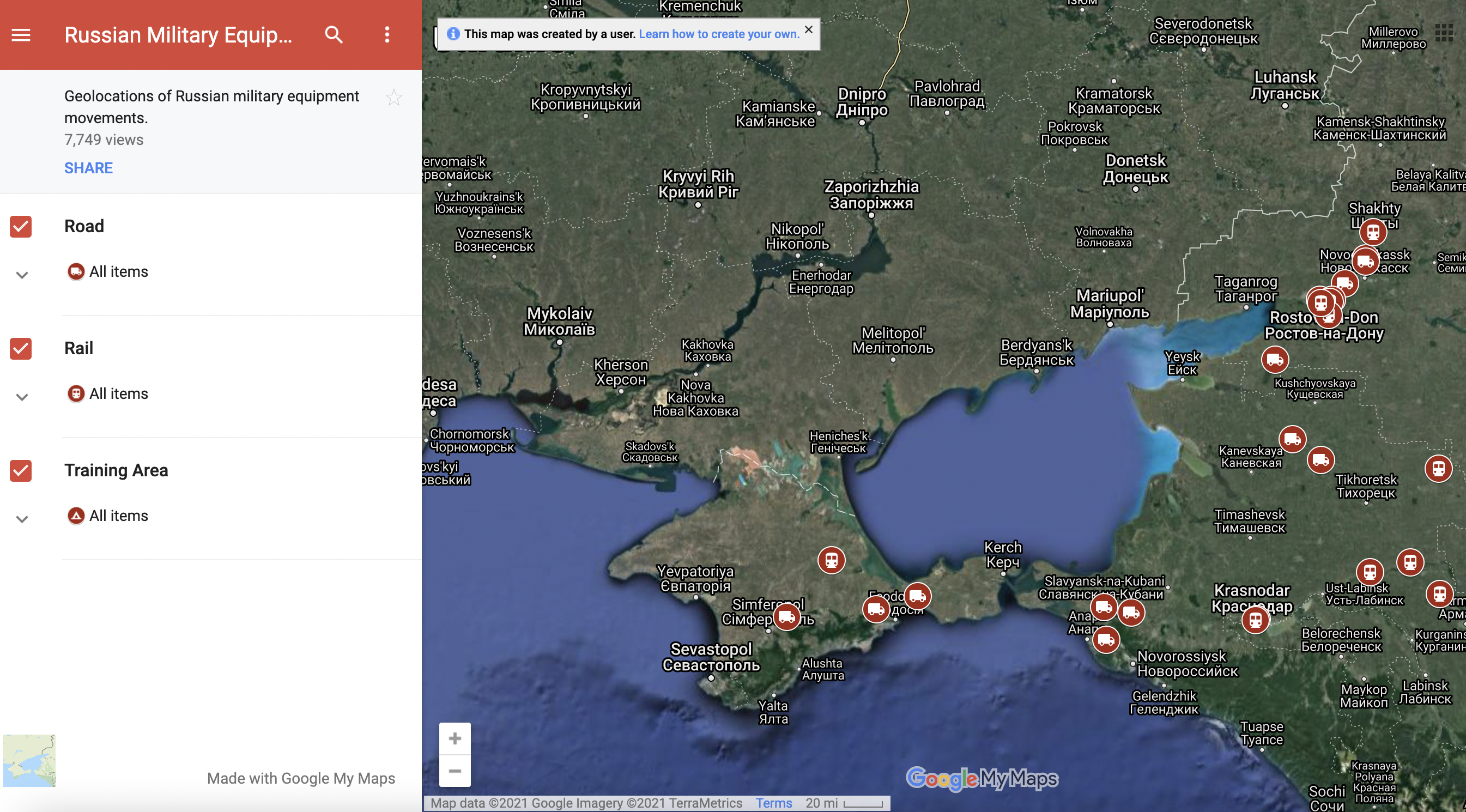
Geolocations of Russian military equipment movements on the borders of Ukraine: an interactive map

Russia has deployed a field hospital on the border with Ukraine – German media (photos, videos)
Fokus
April 14, 2021

Russian military camp south of Voronezh Photo: Tagesschau

To the south of Voronezh, the Russian military has built an entire tent city, equipped with a field kitchen and guarded by military police

The Russian army has deployed a huge field military camp near the Ukrainian border, south of Voronezh, which includes a field hospital, as reported by the German news program Tagesschau.

“The entire field is filled with military equipment. You can’t walk there, let alone drive. With their chains and wheels, they plowed up the whole field,” a local resident told the program.

Israel Defense Forces officer and military analyst Yigal Levin noted in a column for Fokus that the deployment of field hospitals is a grave sign of preparations for full-scale military operations.

According to Tagesschau, eyewitnesses told them that the military has built a whole town out of tents. Flags are flying everywhere, smoke is coming from smoke vents, military trucks with water tanks are constantly passing by, and a field kitchen is up and running.

The field camp is patrolled by military police.

All evidence suggests, Tagesschau notes, that the Russian servicemen have settled in this area for the long haul and are not going to leave quickly.

Russian Defense Minister Sergei Shoigu said on Tuesday, April 13, that all “verification activities” currently taking place near the borders of Ukraine and involving the participation of Russian servicemen, were scheduled to be completed “within two weeks.”

Also, an interactive map tracing the movements of Russian troops toward the borders of Ukraine has appeared on the internet. It records all instances of the transfer of Russian army equipment, weapons and personnel to the borders of Ukraine and to occupied Crimea.

Iskander operational-tactical missile system units from the Western Military District have been delivered to Voronezh, ostensibly to participate in a parade.

In turn, at a meeting with the French Ambassador to Ukraine, Ukrainian Defense Minister Andriy Taran said that Russia is capable of preparing the “Georgia 2008” scenario.

Thanks to Yigal Levin for the heads-up. Translated by the Russian Reader
Lugansk Miners Occupy Pit to Protest Wage Arrears and Closures

lugansk-1From Saturday’s motorcade: “Employers, corporations and chain stores: we will not allow you to insult people”

Lugansk miners occupy pit and defy security forces
People and Nature
June 9, 2020

Mineworkers are staging an underground occupation in defiance of the authorities in the Lugansk separatist “republic” in eastern Ukraine, who have responded with a campaign of intimidation and arrests.

There were 123 mineworkers underground at the Komsomolskaya pit, in the mining town of Antratsit, for the third day running on Sunday (7 June), the News.ru site reported yesterday. One who had fallen ill was brought to the surface.

The protesters are demanding that their wages for March and April be paid in full. A similar underground protest on 21 April resulted in some money being handed over by Vostok Ugol, a new company set up in the “republic” and charged with closing pits and cutting the labour force.

lugansk-3

An earlier protest, in Zorinsk in the Lugansk “republic”, on 4 May, against the closure of the local pit. Photo from Dialog.ua

The Lugansk and Donetsk “people’s republics” were set up by separatist military forces, supported by the Russian government, who clashed with the Ukrainian army in the military conflict of 2014.

The militarised regimes have clamped down on labour and social movement activists, and made independent journalism impossible in the “republics”—meaning that protest has been rare, and news of it does not travel easily. But this week mineworkers and their supporters have taken action nonetheless.

On Sunday the Lugansk “republic” police blockaded the Komsomolskaya mine and stopped food and drink being passed in to the occupiers. Galina Dmitrieva, a local trade union activist, received a a message saying that state security ministry (MGB) officials were on their way to the mine.

After that, mobile phone reception was blocked and the popular Vkontakte social media (similar to Facebook) was blocked. News.ru published text exchanges with local residents who said that the internet could only be accessed with Virtual Private Network (encrypted anti-spying) technology.

Transport in Antratsit was shut down, and on Sunday evening the authorities announced that this was because a medical quarantine was in place.

Aleksandr Vaskovsky, co-chairman of the Independent Union of Mineworkers of Donbass, said in a statement to News.ru:

A quarantine was announced in Antratsit on the evening of 7 June and the whole town closed down. The intention was to deprive the striking miners of subsistence. A curfew was declared and a military force assembled. This force was assembled at Rovenki, and they completely surrounded the Frunze pit, where miners had also tried to strike. […]

In Antratsit on 7 June, from the evening, they started arresting people who had given informational and organisational support to the miners, and organised the strike movement at other pits. They sought out activists at other pits and in other towns. There were arrests in Krasnodon, Rovenki, Krasnyi Luch and Belorechensk. State security ministry officials just came and, without any documents, were taking people with all their computers and mobile phones to an unknown destination.

We were able to find out where some of these arrestees were, in the MGB’s buildings. During the course of the day they had been tortured, with the aim of identifying other activists. At 8:00 another seven people were kidnapped, including two women, one of whom is pregnant.

Vaskovsky told News.ru that workers at Belorechenskaya mine tried to stage an occupation on Monday, but were prevented from going underground by managers.

Since the separatist “republic” was established in 2014, out of 32 pits, 10 have been closed. The mines now employ 44,800 people, less than half of the workforce before the military conflict began.

The Eastern Human Rights Group said on its Facebook page yesterday (8 June) that MGB officials had been in the Dubovsky quarter of Antratsit, where the Komsomolskaya pit is, since Friday, “questioning workers about the instigators of the protest”. Two miners had been arrested and sent for questioning to Antratsit; their whereabouts were unknown. The union president at the mine, Georgii Chernetsov, had been questioned but not detained. The statement continued:

Now a road block has been set up in Dubovsky, and MGB officers have gone to the families of the protesting mineworkers, to put pressure on the protesters through their families. Mobile phone signals have been cut off throughout Antratsit district, although WhatsApp and Viber are working.

This activity by the security forces of the Lugansk “republic” is directed at intimidating workers and suppressing the protest movement in the occupied part of Lugansk district.

Pavel Lisyansky of the Eastern Human Rights Group, based nearby in Lisichansk, in territory controlled by the Ukrainian government, wrote in a Facebook post:

The Russian Federation’s occupying administration in [the Lugansk “republic”] is disturbed by the systematic protests by the labour collectives at the mining enterprises, which are related to the restructuring of the industry, in other words the threat of mass closures.

In the course of these protests new leaders of public opinion have emerged, who have the support of the local population and do not fear the repressive actions by the occupying administration’s special forces.

For the last month, the mood of protest has grown stronger in Perevalsky, Antratsit and Lutuginsk districts in the occupied part of Lugansk region. The leaders of the worker protests have the support and solidarity of other labour collectives in the coal mining enterprises.

It is for this reason that the Russian Federation’s occupation administration has decided to take measures to counter the protests.

On the Ukrainian side of the front line, the Eastern Human Rights Group on Saturday staged a motorcade “to draw attention to the problem of the breaches of labour and social-economic rights of workers during the pandemic and quarantine measures”.

lugansk-2The Eastern Human Rights Group’s motorcade

The group said: “We are concerned about the situation in which the state labour inspection does nothing; about the pressure and bribery practiced by criminal groups against trade union leaders, to try to influence workers and employers (there has been a case at Toretsk that we will report on); the unlawful dismissal of workers; and so on.”

Thanks to People and Nature for permission to republish this article here.