Russian Bus Plunges into River, Killing Passengers

Security camera footage shows a bus in St. Petersburg, Russia, veering across the road and off a bridge into the Moika River. At least three people were killed, with several others in serious condition in hospital.

Source: NBC News, 10 May 2024. Thanks to Marina Varchenko for the heads-up.


“Multipolarity Forum”

While the international far right was busy meeting in Washington, D.C., for the CPAC 2024 conference in late February, on the other side of the world, a grab bag of “anti-Western” groups, including a handful of far-right leaders from Europe, North America, and South America, gathered in the Lomonosov innovation cluster in Moscow for two conferences held in parallel. One was the Multipolarity Forum (Форум многополярности) and the other, the Second Congress of the International Russophile Movement (Второй конгресс Международного движения русофилов, МДР). 

The two meetings, which centered on support for Russia’s invasion of Ukraine, attacking the LGBTQ+ community, opposition to “Western hegemony,” and opposition to the “russophobia” of the West, brought together an odd assortment of leaders. There were representatives from the Global South, National Bolsheviks, acolytes of far right Russian ideologue Alexander Dugin, European neo-fascists, revolutionary leftists, and leaders of various religious denominations. All in all, the gathering included more than 300 representatives from 130 countries.

While Moscow has hosted large conferences attended by significant far-right groups in the past, these two events mark a shift towards official institutional support as high-ranking government officials officially sanctioned the gathering. Present were two members of Putin’s cabinet, Maria Zakharova, the director of the information and press department of the Russian Ministry of Foreign Affairs, and Sergey Lavrov, the Russian foreign minister, who presented opening remarks from Putin. 

Other foreign state officials were invited to the congress as well. They included Darko Mladić, the son of General Ratko Mladić, convicted war criminal for genocide and former general of the Republika Srpska (RS), Zhang Weiwei, an ideologue for the Chinese Communist Party (CCP), Syrian diploma and current ambassador to Russia Bashar Al Jaafari, former Prime Minister of the Slovak Republic Jan Czarnogursky, and South African MP for the African National Congress (ANC) and grandson of Nelson Mandela, Zwelivelile “Mandla” Mandela. Pierre de Gaulle, the grandson of former French President Charles de Gaulle, who has expressed pro-Russian sympathies throughout the war, noted his grandfather’s alleged support for relations with Russia.

“Russophobia,” the “racism” of the West, and the “canceling of Russia” were common themes at the event. Tsargrad TV founder Konstantin Malofeev claimed that the current wave of alleged xenophobia and racism against Russians was comparable to what happened in Nazi Germany. Going further, he underlined that, “we understand that this is the hatred of the globalist elite, not the people.” However, at times, some speakers revealed that the “russophobia” they were referring to was not simply a perceived xenophobia towards Russians, but the West’s insistence that LGBTQ+ people simply not be discriminated against. In fact, one of the three thematic sections for the International Russophile Movement Congress included a section on “traditional values.” In his speech, Alexander Dugin mentioned the following: 

“The West has racistly and imperialistically identified itself with humanity. There was a time when Britain claimed all seas and oceans as its own. Western civilisation declared all of humanity its property — primarily its consciousness. This led to the formation of a unipolar world. In this world, there are only Western values. Only one political system — liberal democracy. Only one economic model — neoliberal capitalism. Only one culture — postmodernism. Only one conception of genders and family — LGBT. Only one version of development — technological perfection up to post-humanism and the complete displacement of humanity by AI and cyborgs.”

Dugin, the leader of the International Eurasian Movement (Международная евразийская движения, MED), and theorist of “Eurasianism,” and the neo-fascist “Fourth Political Theory” which aims to unite far right and far left groups around the world to destabilize Western democracies, was a key speaker at the event. He received widespread attention from conference attendees and Russian propaganda outlets RT, Sputnik, and Tsargrad. Other followers of the “Fourth Political theory” present at the conference included Raphael Machado, leader of the far right Brazilian group Nova Resistência (New Resistance), which the U.S. State Department recently classified as a source of “Pro-Kremlin Disinformation” in Brazil. According to Machado, the conferences, which were first organized in 2023, are the brainchild of he and Dugin, with support from the Thinkers Forum in China and the International Movement of Russophiles. Following the 2023 conferences, Machado was named the Latin American coordinator for the event. During Machado’s trip to Moscow, he met with many of the speakers, including Maria Zakharova, the President of the Eurasian Youth Union (Евразийский союз молодежи) chapter in Russia, Pavel Kiselev, and Leonid Savin, the longtime editor of Dugin’s website Geopolitika.ru.

Another individual with whom Machado had contact while on his trip was a member of the ultranationalist Two-Headed Eagle movement (Всероссийский съезд общества “Двуглавый Орел”), led by Malofeev, and which Machado claims has a formal partnership with Nova Resistência and is currently fighting in Ukraine. The Two-Headed Eagle movement was created by Malofeev in 2017 with the objective of supporting Putin, ridding the country of secularism and returning the Orthodox monarchy to the country, as well as the demolition of Lenin’s mausoleum.

Malofeev, the director of Russian Christian nationalist and conspiracist media platform Tsargrad (Царьград), and wealthy financier of anti-LGBTQ+ causes around the world, who has paid millions of dollars to separatists in the Donbass region of Ukraine, was another star speaker. During his speech, he made the following comments directed at the LGBTQ+ community: 

“I think everyone in this room is well aware that the World Health Organization was created with Rockefeller money, and now its main sponsor is the Bill Gates Foundation. Therefore, transnational corporations and international organizations have long merged and serve the interests of the globalist elite. WHO recently adopted the International Classification of Diseases No. 11 (ICD-11), which excluded perversion from mental disorders and pedophilia ceased to be a disease, but became just a disorder. This is not the imposition of new social norms, but rather it is the abandonment of God and the embodiment of Satanism.”

Formally, the Russian Ministry of Foreign Affairs and the head of the International Movement of Russophiles (MDR) Nikolai Malinov, a former Bulgarian politician who was once accused of spying for Russia and sanctioned by the United States, organized the events. In practice, however, it is understood that Malofeev was the primary financier of the congresses.

Italian far right leader Roberto Fiore, acting as a representative on behalf of his neo-fascist political party Forza Nuova (New Force, FN) and the EU parliamentary far-right coalition Alliance for Peace and Freedom (APF), made up of the Die Heimat (DH)Parti Nationaliste Français (PNF)Democracia Nacional (DN) and other far-right parties, was also an invited attendee of the conferences. Fiore presented a proposal for “a Russian intervention of 50 billion euros to regenerate the agriculture of our territory and consequently its social fabric, eroded by years of capitalism and policies distant from the earth.” This would apparently “allow Italy to gradually move away from the diabolical Western world that is leading our country to the abyss.”

Another attendee was Belgian Kris Roman, a Russian propagandist with ties to both Russian intelligence, and various groups on the international far right. Roman, who considers himself a “reformed racist,” has a history steeped in Nazism and white supremacist politics, which later led him to make connections with the Russian far right in the early 2000s and build bridges with Russians over the years through his organization Euro-Rus. During the event, Roman met with Maria Zakharova. Other far-right attendees included Zmago Jelinčič Plemeniti, the leader of the far right, anti-LGBTQ+, anti-Roma party Slovenska Nacionalna Stranka (Slovenian National Party, SNS), Mitsuhiro Kimura, the leader of the Japanese ultranationalist and anti-American group Issuikai (一水会), and Kemi Seba, a French-Beninese, pro-Russian activist against French colonialism in Africa with a history of holding strongly antisemitic beliefs.

A number of pro-Russian journalists, who frequently speak on air on Russian propaganda channels such as RT and Sputnik, were present for the event. Brazilian journalist for the Asia Times Pepe Escobar, who commonly appears on Russian media channels, was invited to speak alongside Maria Zakharova. Another attendee was conspiracist and Syrian dictator Bashar Assad propagandist Maram Susli, AKA “Syrian Girl,” known for her television appearances on Russia Today (Россия Сегодня, RT) and the American conspiracy outfit Infowars, who has ties to white nationalist identitarian groups in Austria and the US. Other influencers present at the conferences were Peruvian war correspondent and Russian propagandist Carlos Mamani, American MMA fighter and RT host Jeff Monson, and Russian-American television host for Channel One Russia (Первый канал) Dimitri K. Simes. A representative from the far right conspiracist website Counterspin New Zealand was present to cover the event.

A cohort of representatives from religious movements were invited to the conference, including the Archbishop Savva of Zelenograd, the Catholic Cardinal ViganòSheikh Iman Hussein, and Archpriest Tkachev. The Duginist outlet Geopolitika’s summary of the event described their speeches as follows: 

“In the speeches of Cardinal Viganò and Archpriest Tkachev, a verdict was made on the hegemony of Western elites, a condemnation of their diabolical roots and the closed club of Satan worshipers. They openly criticized the hatred of traditional biblical man, dotting the i’s and calling a spade a spade.”

The Portuguese commentator Alexandre Guerreiro, was also present to give a speech on multipolarity. Guerreiro was previously named in a report by Portuguese news outlet Sábado to be a part of the “far-right network spreading Russian propaganda in Portugal,” and has appeared several times on the podcast of Nova Resistência. From Poland, Tomasz Jankowski, previously the general secretary of the pro-Russian Zmiana political party (Change), and the magazine Myśl Polska, made an appearance. CIA veteran Larry Johnson was another popular guest who claimed in his speech that the United States had become a country like the Soviet Union that “restricted free speech, jailed political opponents, and had elderly leaders.”

Finally, testifying to the Red-Brown alliance (between far left, far right, and nationalist groups) that the Russian government has done so much to help foster in recent years, members of the traditional radical left also sent representatives to the conferences. Chief amongst them was Jesus Salazar Velásquez, the Venezuelan ambassador to Russia who voiced his support for “Russia and the country’s fight for a just world without the hegemony of the ‘collective West.’” From the U.S., the pro-Russian communist Haz Al-Din, and the German communist Liane Kilinc, president of the “Peace Bridge – War Victims Aid,” met with other pro-Russian influencers outside of the event. Two attendees coming from Latin America, Elier Ramírez Cañedo, the Deputy director of the Fidel Castro Ruz Center, and the Argentinian sociologist Atilio Boron, were in attendance. Jackson Hinkle the “MAGA Communist” from the United States, was another attendee who met with many of the speakers including Alexander DuginMaria ZakharovaSergey Lavrov, and Kris Roman.

Source: “Russia Hosts Large Far Right Conference Attacking LGBTQ+ Rights, ‘Russophobes,’ and ‘Globalists,'” Global Project Against Hate and Extremism, 5 March 2024


Crimean pensioner Maria Zamyrailo-Levytska has been jailed for five days and fined 35 thousand roubles over ‘liked’ posts on the social network Odnoklassniki, including one containing the Ukrainian trident.  The 64-year-old is one of a huge number of Ukrainian men and women who have been ‘denounced’ by so-called ‘Crimean SMERSH’ vigilantes working closely with the Russian occupation enforcement bodies to hunt down those expressing pro-Ukrainian views or opposition to Russia’s war of aggression against Ukraine. 

Judging by the material shown on the Crimean SMERSH Telegram channel, Zamyrailo-Levytska may well have only ‘liked’ the posts of others, with this on Odnoklassniki meaning that the posts appear on her page also.  All of the posts which Crimean SMERSH and the Russian occupation regime found ‘incriminating’ demonstrate support for Ukraine, as well as gratitude and deep respect for Ukraine’s defenders.

The occupation enforcement bodies came up with two charges.  She was accused of ‘discrediting’ the Russian armed forces, under Article 20.3.3 of Russia’s code of administrative offences.  This was one of four charges hastily added to Russian legislation following the full-scale invasion of Ukraine and it is standardly used in occupied Crimea to prosecute for Ukrainian patriotic songs, the Ukrainian flag or for expressing opposition to the war.  She was, however, also charged under Article 20.3 § 1 because of the Ukrainian Trident on posts.  Although the ‘court press service’ typically reported this as being a conviction for “publicly demonstrating Nazi symbols”, it went on to explain that it was, in fact, because it was considered to be a symbol of the Organization of Ukrainian Nationalists, one of many Ukrainian organizations banned in Russia and in parts of Ukraine while they remain under Russian occupation.   There were, seemingly, two separate ‘hearings’ on 7 May 2024, with both under ‘judge’ Georgy Davidovich Tsertsvadze from the occupation ‘Kirovske district court’.  It is likely that she received the five-day term of imprisonment over the Trident, and the 35-thousand rouble fine over posts claimed to ‘discredit’ the invading country’s armed forces. 

‘Crimean SMERSH’ do not appear to have extracted one of their standard videoed ‘confessions’ which are normally shot in occupation ‘police’ offices.  It is clear from the part of the ‘court’ hearing that Crimean SMERSH, or the latter’s most notorious collaborator Aleksandr Talipov, posted, that Zamyrailo-Levytska was clearly terrorized, and can be seen ‘admitting guilt’ and promising not to do it again. 

The original SMERSH was active in the Soviet Union during World War II and immediately afterwards.  While supposedly created to hunt down those working for the Nazis, it is most notorious for having targeted opponents of the communist regime. The term SMERSH was, apparently, coined by Joseph Stalin as an abbreviation for ‘death to spies’.  As in Stalin’s USSR, the victims of the modern day ‘Crimean SMERSH’ are those who oppose the current occupation regime.  Russia originally used ‘videoed confessions’ as part of its terror in Chechnya, however the Russian human rights monitors OVD.info reported in June 2023 that two thirds of these alleged ‘confessions’ now come from occupied Crimea. 

If, in occupied Crimea, Talipov & Co. carry out their denunciations and use torture or terror to extract ‘confessions’ in obvious, yet not officially stated collaboration with the occupation authorities, that may well be about to change.

In December 2023, Russian Duma deputy Andrei Gurulev, a lieutenant general on the Duma defence committee, announced the creation of SMERSH in occupied parts of Ukraine.  The aim of SMERSH, he claimed, was “to fight saboteurs and spies” and he called for SMERSH to be revived throughout Russia.  While the security service is working all out, he wrote, they could miss something, and claimed that there are internal enemies acting against Russia’s interests “with the help of Western security services”.  Although both Russian-installed Crimean leader Sergei Aksyonov and Yan Gagin from the Russian proxy ‘Donetsk people’s republic’ were cited as having called for such units, this was seemingly the first time that a Russian official said that SMERSH was already functioning in occupied parts of Donetsk, Luhansk, Kherson and Zaporizhzhia oblasts.

Source: Halya Coynash, “64-year-old pensioner jailed in Russian-occupied Crimea for social media posts of a Ukrainian Trident and thanking Ukraine’s defenders,” Human Rights in Ukraine, 10 May 2024


The Russian capture of Avdiivka and its military’s slow subsequent advance this spring has come at the cost of thousands of deaths of its own servicemen, to say nothing of Ukrainian losses. Since the summer of 2022, Russian commanders have repeatedly sent their soldiers on suicidal assaults, essentially using them as cannon fodder. Deprived of proper support, sapped of motivation, denied medical aid, and left with no route of retreat that does not involve the high risk of being shot by their own side, Russian soldiers are dying in droves for every kilometer of uninhabitable territory “liberated” by Kremlin forces.

Survivors of these “meat grinder” assaults supplied The Insider with harrowing accounts. They took cover behind the corpses of their former comrades during shelling. They were tasked with collecting the shredded remains of blown apart bodies. They were trapped in trenches for days with no food, water, ammunition, or hope of evacuation.

[…]

Source: Victoria Ponomareva, “‘Shreds of bodies hung from the branches’: Confessions of ‘meat grinder’ assault veterans,” The Insider, 8 May 2024

Simon Pirani: No Path to Peace in Ukraine Through This Fantasy World

The Russian army’s meagre successes in Ukraine – such as taking the ruined town of Avdiivka, at horrendous human cost – have produced a new round of western politicians’ statements and commentators’ articles about possible peace negotiations.

Hopes are not high, because the Kremlin shows no appetite for such talks. Its actions, such as nightly bombing of civilians and civilian infrastructure, speak louder than political and diplomatic words on all sides.

The desire and hope for peace is widely shared, and I share it too. How can it be achieved?

Among “left” writers, the “campists” and one-sided “anti-imperialists”, who deny Ukraine’s right to resist Russian aggression, say that peace talks could start now … if only the western powers did not stand in the way. (By “campism”, I mean the view that the world is divided simplistically between a western imperialist camp dominated by the US, and another camp comprising China, Russia and other countries, in which some progressive potential resides.)

Mariupol, after the siege. Photo: ADifferentMan / Creative Commons

The “campist” case is made by literally ignoring what is actually going on in Ukraine, and Russia, and focusing – often exclusively – on the political and diplomatic shenanigans in western countries.

In this blog post I will look at seven recent articles by “campist” writers. All of them call for peace talks; and all claim that the main obstacle is the western powers.  

I will cover (1) the selection of subject matter by these authors; (2) what little they actually say about peace negotiations; and (3) why the claim that the western powers sabotaged peace talks in April 2022 is less convincing than they believe it to be.

The seven articles are: “Europe sleepwalks through its own dilemmas” by Vijay Prashad (Counterpunch, Brave New EuropeCountercurrents and elsewhere); “Exit of Victoria Nuland creates opportunity for peace in Ukraine” by Medea Benjamin and Nicolas Davies (Common Dreams, Morning StarConsortium News and elsewhere); “Ukraine: Pope pipes up for peace” by Andrew Murray (Stop the War coalition); “Where are the righteous Ukraine partisans now?” by Branko Marcetic (Brave New Europe); “Diplomacy is the art of compromise: that’s what’s needed for peace in Ukraine” by Alexander Hill (Stop the War coalition); “US repeatedly blocked Ukraine peace deals; is it rethinking its strategy yet?” by John Wojcik and C.J. Atkins (People’s World); and “The Grinding War in Ukraine Could have ended a long time ago” by Branko Marcetic (Jacobin).

Selection of subject matter 

None of the seven articles says one word about Russia’s political system, its politicians’ nationalist rhetoric or its war economy, which are among the central causes of the war. Not a word. Only one of the articles (Alexander Hill’s) attempts to assess Russian war aims; one more (Andrew Murray’s) makes glancing reference to these.  

Only one of the articles (Hill’s, again) touches on what Ukrainian people are thinking or doing. None of the other six articles says a word about this, despite Ukrainian popular resistance being, by any measure, a key factor in the war.

Only one of the articles (Hill’s, again) says much about what has happened on the battlefieldOne more (Branko Marcetic in Jacobin) has one paragraph on Ukrainian battlefield losses, but no mention of Russian losses. Two more (Murray’s, and Wojcik and Atkins’s) have very brief references to this.

While saying almost nothing about what is going on in Ukraine, or Russia, all seven articles discuss statements by western politicians, diplomats and/or military leaders. At length.

Five of the articles (by Medea Benjamin and Nicolas Davies, by Hill, by Wojcik and Atkins, and two by Marcetic) focus on a peace deal that was supposedly on the table in April 2022, and claim that western politicians, who twisted president Zelensky’s arm, wrecked it (see last section). On the other hand, only two of the articles (Hill and Murray) make any suggestion about what peace talks might look like (see next section).

Dear readers, I can hear you say: but you have just picked seven articles at random. No. It’s a fair sample. I searched the largest-circulation English language “left” web sites; these were the most visible articles by don’t-support-Ukrainian-resistance writers.  

The key point is that none of these writers mention how the Kremlin works. No reference to Vladimir Putin’s attitude to the world, or whether it has changed. No assessment of the deranged nationalist, even genocidal, rants about Ukraine by him, his close colleagues and high-profile Russian TV personalities. No mention of whether Russia can be considered an imperialist power or not. Not a word about the way that its invasion of Ukraine not only breached international agreements and laws, but also offends the principle of nations’ right to self-determination that socialists have held dear since the 19th century.

It is telling, too, that these “campist” writers have no interest in what Ukrainian people say or do. Nor Russian people. They don’t pretend to look at the interaction of social, political and economic forces. They are concerned largely – some of them, exclusively – with the western elite. They see themselves as its opposite and its nemesis. Russian or Ukrainian soldiers, Russian anti-war protesters, Ukrainian trade unionists on the front line, Ukrainian refugees – these are bit part players in a drama played out in Washington, London and Berlin.

The result is a fantasy world that bears only indirect relation to reality.

When I say “campists”, I mean a very narrow group among “left” writers, who embrace a fake “anti-imperialism”, historically descended from 20th century Stalinism.

They do not speak for the labour movement more broadly, or for the millions of people in western countries who think of themselves as “left wing”, or who vote for Social Democratic parties. These are powerful forces for change. But the “campist” influence is dangerous and divisive.

Of course many journalists in the mainstream press also focus exclusively on this elite world of diplomats and politicians. But they usually see themselves as part of it. The “campists” sees themselves in opposition – but only to the western powers, the US above all. For them, the American empire is the only empire worth fighting.

Whether Russia might have traits of empire, whether China might seek to construct some sort of empire, whether bloodthirsty dictators like Bashar al-Assad are tied to imperial interests – all this is excluded from the conversation. Real struggles that confront the American empire, such as the Palestinians’, are welcomed; those that face other enemies, such as Ukrainians resisting Putin, or Syrians and Palestinians resisting Assad, are shunned.

What could peace negotiations look like

Andrew Murray writes:

Moving from ceasefire to a permanent peace will of course be challenging. Russia will need to accept a sovereign and independent Ukrainian state, and Ukraine will have to accept remaining outside NATO and self-determination for minorities within its borders.

The Stop the War coalition, in which Murray is a leading voice, sets out its policies in the form of calls for UK government action. So it’s fair to assume that this, too, is a call for the UK government to take a particular stance – in this case, the most pro-Russian stance possible. Going through the points in turn:

1. “Russia will need to accept a sovereign and independent Ukrainian state” is meaningless. It did so, in the Belovezha accords that dissolved the Soviet Union (1991), and the Budapest memorandum under which Ukraine gave up its nuclear weapons (1994). Since 2014 Russia has been pounding Ukraine militarily, in breach of those agreements. Any attempts to stop the fighting in Ukraine diplomatically would have to start by recognising that reality – which is why a peace treaty, as opposed to a ceasefire or simply “freezing” the conflict, is extremely unlikely.

2. “Ukraine will have to accept remaining outside NATO” is essentially a demand for NATO to allow Russia to decide which states join (why no objection to Finland and Sweden?!). The UK government may indeed be cynical enough to take such a position, but why should the labour movement encourage it to do so? What sort of solidarity is that with the Ukrainian population – which before 2014 was in its vast majority opposed to NATO membership, but has largely come to see it as the only security arrangement that can prevent their country being invaded again and again?  

President Zelensky in Bucha, April 2022

3. “Self-determination for minorities within its [Ukraine’s] borders.” This is a distortion of the principle of the right of nations to self-determination, historically embraced by socialists. Self-determination includes the right to secession. (It is relevant that Russia killed tens of thousands of people in Chechnya in the early 2000s, to help ensure that this right would not be exercised.)

From 2014, the extreme right in Russia called for the establishment of a new state, “Novorossiya”, in south-eastern Ukraine, effectively a demand for “self-determination” of Russian people there – but the Kremlin refused to support this. Moscow was aware that the vast majority of Russian-speaking Ukrainians neither wanted “self-determination” nor regarded themselves as Russian. The exception was Crimea, where a referendum on annexation by Russia (a strange type of “self-determination”) was held under military occupation.

Long before 2014, there had been support in eastern Ukraine for greater autonomy within the Ukrainian state, and distrust of Ukrainian nationalist politicians in Kyiv. The Kremlin did its best to whip up divisions among Ukrainians on this basis. It engaged in a long campaign of disinformation, claiming to support the rights of Russian speakers in Ukraine. (I wrote about this e.g. here.) But on a diplomatic level, until 2022, the Kremlin pretended that the Russian army was not present in Ukraine, although it was, and left the status of the Luhansk and Donetsk “republics” vague. All this changed in 2022, when the Kremlin recognised the “republics” and invaded Ukraine.

In 2022, people in Donetsk, Luhansk, Kherson and Zaporizhzhyia voted – sometimes literally looking down the barrel of a soldier’s gun, and always under the shadow of the biggest military operation in mainland Europe since world war two – on accession to the Russian federation. This is the Kremlin’s version of “self-determination for minorities within Ukraine’s borders”. The Stop the War coalition has been conspicuous in its failure to denounce this violent abomination.

Why, then, demand that the UK government raise the issue of “self-determination for minorities” in peace talks? Andrew Murray can not believe there is the least chance of them doing so. The point is to preserve the fantasy world in which “campism” lives, in which Russian imperialism, Russian assaults on democratic rights and the Kremlin’s distortion of democratic principles for its political ends do not exist.

Alexander Hill writes:

The key outcome [of peace talks] will be the separation of the Russian-dominated Donbass and Crimea from the remainder of Ukraine – something that will hopefully be the cornerstone of a lasting peace in the region.

Although Hill clearly favours a ceasefire, and the Stop the War coalition opposed the Russian invasion in 2022, that is not what is under discussion here. Hill is envisaging the outcome of peace negotiations. Why endorse the imperial power’s demands in this way? Where is the evidence that, if these demands are met, “lasting peace” will ensue? How is this in the labour movement’s interests or the interests of international solidarity?

What happened in April 2022

The idea that peace talks have been blocked solely by the western powers – rather than by Russia’s war strategy – has been repeated over and over again by the “campists” over the past two years. They claim, in particular, that a deal was on the table in Istanbul in April 2022, that Ukraine was ready to sign, but that Boris Johnson, then UK premier, visited Kyiv and persuaded president Zelensky not to do so.

This version of events was demolished by Volodymyr Artiukh and Taras Fedirko in October 2022. They showed that the single source for the claim, a report in Ukrainska Pravda, had been misinterpreted, and that a mass of evidence suggested that the talks failed due to Ukrainian and Russian political factors, and the dynamics of military operations. Commentators who focus on “a magic turning point when everything could have gone otherwise” ignore that “in Russia’s repertoire, diplomacy has consistently been subordinated to the use of force”, they wrote. I urge readers to read this thoughtful, rounded argument.

Recently, accounts of the Istanbul talks have surfaced from people who were involved: the former Israeli prime minister Naftali Bennett, and the Ukrainian politicians Davyd Arakhamia and Oleksiy Arestovich. The “campists” have cherry-picked lines from these sources to revive their narrative.

Branko Marcetic of Jacobin claimed that an interview given in July last year by Bennett, who had been in touch with the Russian and Ukrainian governments, was a “bombshell”. Bennett said that in April 2022 there had been “a good chance of reaching a ceasefire”, and when asked “had they [who?] not curbed it”, “he replied with a nod”.

While it is unclear what that nod meant, and who “they” referred to, Bennett’s statement that the April deal was killed off by the revelation of the Russian army’s massacre of civilians at Bucha, outside Kyiv, is unequivocal. In Marcetic’s own words:

“Once that [Bucha] happened, I [Bennett] said, ‘It’s over,’” he recounts. Bennett pointed to the potential for such an atrocity to emerge and derail the political prospects for peace in Ukraine as proof of the importance of making haste on negotiations at the time. The Pravda report likewise pointed to Johnson’s visit as only one “obstacle” to peace, with the discovery of the Bucha killings the other.

Marcetic, writing in early August last year, chose not to look more widely at the circumstances in which Bennett gave his interview. Shortly beforehand, in June, the leaders of Comoros, Senegal, South Africa and other African nations had met with both Zelensky and Putin to propose peace talks. Putin had told them that one of their proposed starting-points for talks – accepting Ukraine’s internationally recognised borders – was unacceptable. (During this meeting, Putin held up what he claimed was the draft of the April agreement, although this has not been published before or since.)

A proper account of the failure of peace initiatives would mention not only the western powers, who of course influence decision-making in Kyiv (in recent months increasingly to constrain the war effort), but also Russia’s real intentions. Marcetic ignores that.

In November last year, Wojcik and Atkins sculpted another piece of evidence that Boris Johnson, and the western powers, were the obstacle to peace, from an interview with Davyd Arakhamia, one of the leaders of Zelensky’s Servant of the People party. They quoted Arakhamia reflecting on the Istanbul talks as follows:

“[The Russians] were ready to end the war if we accepted neutrality like Finland once did. And we were ready to make a commitment that we would not join NATO. When we returned from Istanbul, [then-British Prime Minister] Boris Johnson came to Kiev and said: ‘Do not sign anything with them at all; just go to war,’” Arakhamia said.

Now let’s look at what Arakhamia actually said, as reported by the Russian opposition web site, Meduza. Wojcik and Atkins have cut out a key passage, after the words “would not join NATO”. I have put it back, in bold type.

“They actually hoped until nearly the last moment that they could press us into signing this agreement, adopting neutrality. That was their biggest priority. They were willing to end the war if we took on neutrality, like Finland once did, and gave assurances that we wouldn’t join NATO. That was essentially the main point. Everything else was cosmetic and political embellishments about ‘denazification’, the Russian-speaking population, blah blah blah,” Arakhamia said.

When asked why Ukraine didn’t agree to Russia’s terms, Arakhamia was resolute:

First of all, to agree to this point, we would have to change the [Ukrainian] Constitution. Our path to NATO is written into the Constitution. Second of all, we did not and still do not trust the Russians to keep their word. This would only have been possible if we had security guarantees. We couldn’t sign something, walk away, everyone would breathe a sigh of relief, and then [Russia] would invade, only more prepared this time — because the first time they invaded, they were actually unprepared for us to resist so much. So we could only work [with them] if we were 100 percent confident that this wouldn’t happen a second time. And we don’t have that confidence.

Moreover, when we returned from Istanbul, Boris Johnson came to Kyiv and said that we wouldn’t sign anything with them at all, and that we should just fight.

Oh dear! The really important part – that Ukraine needed guarantees that Russia would not once again break its word and invade – went missing!!

This reminds me of Soviet censors who, when a Communist party leader fell out of favour, would cut the unhappy has-been out of official photos. Snip snip snip.

Arakhamia’s statement, in full, suggests that, with Russia’s brutal invasion at its height, the Ukrainian side needed a more substantial security guarantee than Putin’s piece of paper.  

Of course, what Arakhamia said should be treated with scepticism, as should all statements from all politicians. But it shouldn’t have vital parts surgically removed, to make it say the opposite. All the more care is needed, given the efforts by Russian state propagandists to distort Arakhamia’s meaning.

In March this year, Benjamin and Davies cited a third source – Oleksiy Arestovich, Zelensky’s former spokesman – in support of the claim that Putin’s Istanbul deal had been negotiated and “already had the champagne corks popping in Kyiv”. Again a politician, and one whose words need to be treated with special care. Readers should read his interview themselves.

But to pretend that Arestovich’s account shows that the western powers wrecked the peace talks is deceitful. Asked if Johnson twisted Zelensky’s arm, Arestovich says:

I don’t know exactly if that is true or false. He came to Kiev but nobody knows what they spoke about except, I think, Zelensky and Boris Johnson himself. I think it was the second of April, and I was in Bucha the next day. The president got in [to Bucha] one day later. […]

Arestovich here underlined his point that: “The president was shocked about Bucha. All of us were shocked about Bucha. […] Zelensky completely changed face when he came into Bucha and saw what happened.”

My conclusion is not that news of the Bucha massacre alone changed Zelensky’s mind. My best guess is that Bucha, combined with the other brutal Russian offensive operations in progress – especially the attack on Mariupol – focused the minds of Zelensky and others on the issue of security guarantees outside of NATO. And they could not see clearly what these were.

Despite the importance attached to Bucha by Bennett, Arakhamia and Arestovich, none of the “campists” mention it – except for that one dismissive reference by Marcetic (see above). They live in a fantasy world where Russian imperialism is absent, and its crimes of no consequence.

And that is not really a problem about Ukraine, but about the deep political malaise of a section of the western “left”. There is no path to real international solidarity and effective anti-imperialism through this fantasy world. And no path to peace either. SP, 8 April 2024.

Download this article, and a linked one, as a PDF

□ A linked article: Palestine, Ukraine and the crisis of empires 

Source: Simon Pirani, “No path to peace in Ukraine through this fantasy world,” People and Nature, 8 April 2024. Reprinted here with the author’s kind permission.

Adios, America!

“Adios, America! Now it’s only this way (tacos). End of story.”

This ultra-patriotic gem was just beamed to me by my fellow Petersburg psychogeographer V., who found it forlornly pasted up in the former “party zone” on Dumskaya and Lomonosov streets in downtown Petersburg, a quarter which was thoroughly purged last year by the local powers that be for no good reason.

A quick scan of the QR code leads to the now-equally shuttered website El-Chapo.rf. According to the restaurant review site Restoclub, El Chapo is “closed indefinitely.” But what it must have been back in its heyday, during the first year of Russia’s glorious war against fascist Ukraine and its Western puppet masters!

Dance bar with Mexican cuisine on Lomonosov Street. El Chapo serves Mexican cuisine: quesadillas with oyster mushrooms, burritos with shredded beef and shrimp in coconut. To try the spicy chimichanga tortillas with meat, you have to sign a special contract. Here they mix cocktails based on tequila, rum and house-made tinctures. At the bar you can have your photo taken with local star Frida the Pig. El Chapo hosts DJ sets and parties, and plays Mexican rap, funk, and sometimes disco.

The once lively (and, in the early 2000s, avowedly ethnically and internationally tolerant) Dumskaya bar district is indeed now a ghost town, as witnessed by another snapshot which V. sent to me. ||| TRR


After breathing a sigh of relief, this was the first question that popped in my head:

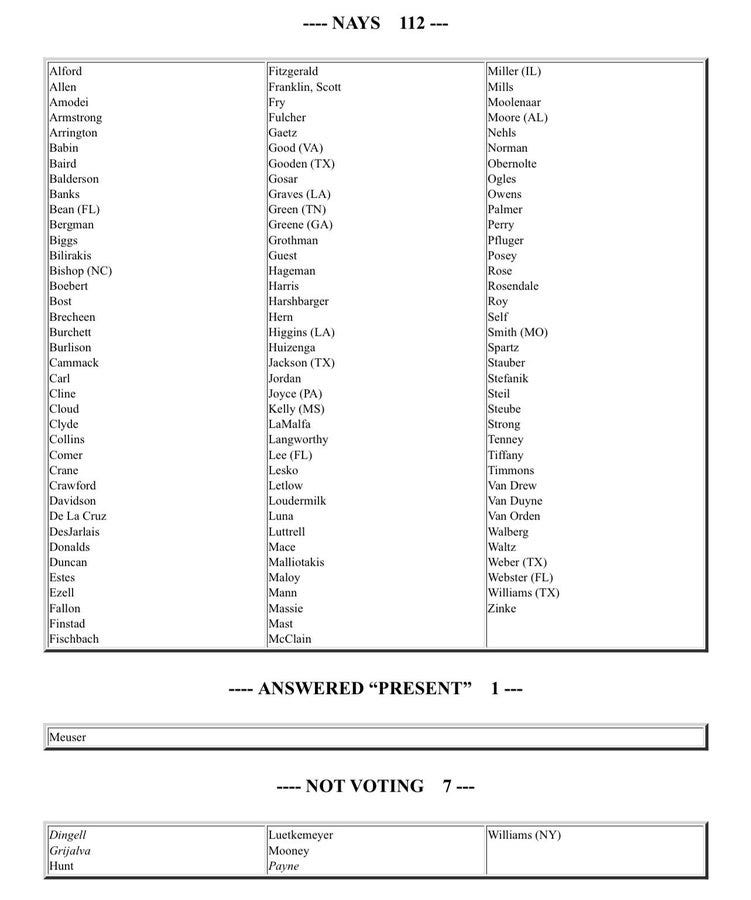
Who are the 112 U.S. representatives who thought it was a great idea to unilaterally disarm Ukraine, an ally that is fighting for its survival against a U.S. adversary?

The list was published almost immediately.

Image

My reflection is not about these particular people in particular, but the fact that in Washington, and in capitals across Europe, a hefty number of our democratically elected representatives are brazenly siding with Russia, a totalitarian state which has the aim of not only weakening our democracies but bringing defeat to our entire system and the international rules based system. They are siding with the destruction of a sovereign state, Ukraine, and the occupation of its territory and citizens.

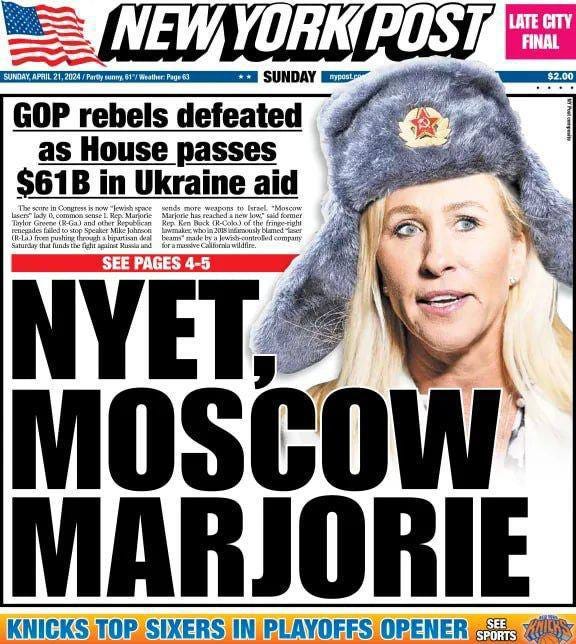
Marjorie Taylor Greene is in the company of Matteo Salvini (head of the League), Giuseppe Conte (former Italian PM), and so many other European politicians who may be motivated to side with Russia for a variety of reasons. It speaks to the penetration of Russian capture in some cases, or industrial and commercial interests influencing our political base. Since Russia has no ideology at the present time, I’m assuming they agree with the neo-realist worldview which would see large states eat up smaller ones by force simply because they can, throwing out the entire concept of state sovereignty.

If they have been captured and are working for a foreign adversary, there is no indication that any of them (at least in Italy) are under investigation. The only way we can rid our system of elected representatives working openly in the interests of an adversary to the detriment of our national interests is to vote them out. In Italy, that isn’t possible because even if a head of a party loses an election, he/she can still remain in their place and continue working in the interests of Russia: see Salvini and Conte.

This is why I am overjoyed that the House has belatedly passed the aid to Ukraine bill, but unspeakably frustrated with our inability to rid ourselves of people who are ready to throw our security, and Ukraine, under the bus.

Dmitri Medvedev meltdown: He’s hoping for a civil war in the U.S.

No one doubted that American lawmakers would approve “aid” to a gang of neo-Nazis. It was a vote by the joyous bastards of the state:

a) in favour of continuing the civil war of the divided people of our formerly united country;

b) for maximising the number of victims of this war.

We will win, of course, despite the 61 billion bloody dollars that will mostly go down the throats of their insatiable military-industrial complex. Strength and Truth are behind us.

But in view of this Russophobic decision, I cannot but wish with all sincerity that the United States would plunge into a new civil war as soon as possible. Which, I hope, will be cardinally different from war of the North and the South in XIX century and will be conducted with application of planes, tanks, artillery, MLRS, all kinds of missiles and other weapons. And which will finally lead to the ignominious collapse of the vile evil empire of the XXI century – the United States of America

Source: Monique Camarra, Eurofile, 21 April 2024


Russian President Dmitry Medvedev became the first Russian to get the brand new iPhone 4, which are to go on sale on Thursday.

The Russian leader received the smarthphone [sic] as a present from Apple CEO Steve Jobs during his visit to the company’s headquarters in Cupertino, California.

At 9.3 mm the iPhone 4 is 25 percent thinner than its predecessors and the thinnest smartphone on the market. The gizmo also boasts a state of the art battery, with seven hours of talk time and 300 hours of standby.

According to the Russian mobile operator Beeline, the brand new device may appear on the Russian market no earlier than September.

During his visit to the Silicon Valley the Russian leader also visited the U.S. office of the Russian search engine Yandex.

The Yandex Labs center, based in Paolo Alto, California, is involved in scientific projects concerning mainly the optimization of online search technologies and other advanced research activities.

The president was accompanied by Yandex CEO Arkady Volozh and the chief technology officer of the Silicon Valley-based Yandex Labs, Arkady Borkovsky.

Source: “Medvedev becomes first iPhone 4 owner in Russia,” Sputnik, 23 June 2010

The Putin Party

Randy Newman, “Putin” (2016)

[…]

Dark Matter contained a re-recorded version of his Emmy award-winning song ‘It’s a Jungle Out There’, which was used as the theme song for the television series Monk. The album tells countless humorous tales. However, one of its most memorable cuts is the track ‘Putin’, which sees Newman sarcastically attack the Russian president. 

The song pokes fun at Putin’s efforts to appear macho, with Newman singing, “And when he takes his shirt off/ He drives the ladies crazy/ When he takes his shirt off/ Makes me wanna be a lady.” A chorus of ‘Putin Girls’ chime in to sing, “Putin if you put it/ Will you put it next to me?”

To accompany the scathing lyrics, Newman uses chaotic instrumentation that sounds like the perfect theme for a cartoon villain. The musician explained that he wrote the song when “all those pictures were appearing of him with his shirt off, and I couldn’t understand why. What did he want?”

He continued: “I think it was just personal vanity of some kind, like he wanted to be Tom Cruise. It wasn’t enough to be the richest and most powerful. He wanted to be the most handsome and a superhero, throwing young people around and wrestling.” 

Newman claims that he originally wrote a much harsher version but had to tone down the insults. In 2018, the song won the singer his seventh Grammy, this time for the relatively obscure category of Best Arrangement, Instrumentals and Vocals.

Source: Aimee Ferrier, “Remembering Randy Newman’s satirical warning about Vladimir Putin,” Far Out, 14 October 2022


“RUSSIAN PROPAGANDA HAS MADE ITS WAY into the United States, unfortunately, and it’s infected a good chunk of my party’s base.” That acknowledgement from Michael McCaul, Republican chairman of the House Foreign Affairs Committee, was echoed a few days later by Michael Turner, the chairman of the Intelligence Committee. “It is absolutely true, we see, directly coming from Russia, attempts to mask communications that are anti-Ukraine and pro-Russia messages, some of which we even hear being uttered on the House floor.” Among the falsehoods that GOP members of Congress are repeating is the notion that the Ukraine war is actually a battle between NATO and Russia. “Of course it is not,” Turner told CNN. “To the extent that this propaganda takes hold, it makes it more difficult for us to really see this as an authoritarian versus democracy battle.”

What makes it even more difficult to see reality plainly is the presence in the GOP of dunderheads like Sen. Tommy Tuberville, who gushed to an Alabama radio show that “Putin is on top of his game,” while scorning U.S. media accounts of Russian behavior. “The propaganda media machine over here, they sell anything they possibly can to go after Russia.” Tuberville may be the dimmest Putin booster on the Hill, but he is hardly lonely.

It has been two months since the Senate passed, in a 70–29 vote (including 22 Republican yes votes), a $95 billion foreign aid bill that included $60 billion for Ukraine. The Republican-controlled House, by contrast, has been paralyzed. Stories leak out that Speaker Mike Johnson, apparently influenced by high-level briefings he’s received since capturing the gavel, has changed his posture and wants to approve the aid. But Johnson leads, or is at least is the titular congressional chief, of a party that contains a passionate “Putin wing,” and so he dithers. This week, Volodomyr Zelensky has warned that Ukraine will lose the war if the aid is not approved. Yet Johnson is heading not to Kyiv but to Mar-a-Lago.

Pause on that for a moment. The Republican party is now poised to let a brave, democratic ally be defeated by the power that the last GOP presidential nominee save one called “without question, our number one greatest geopolitical foe.” One member of Congress has sworn to introduce a resolution to vacate the speaker’s chair if Johnson puts aid for Ukraine on the floor. And the entertainment wing of conservatism—most egregiously Tucker Carlson—has gone into full truckling mode toward the ex-KGB colonel in the Kremlin.

It’s worth exploring how the Republican party, the party of “Mr. Gorbachev, tear down this wall,” became the party that now credulously traffics in blatant Russian disinformation while it flirts with betraying an important ally—along with all of its principles.

To some degree, people’s foreign policy inclinations are reflections of their domestic views. During the later years of the Cold War, large numbers of liberals and Democrats were more sympathetic to leftist regimes like Cuba (see Bernie Sanders) and Nicaragua (see Michael Harrington) than were conservatives and Republicans. I wrote a book about liberal softness toward left-wing authoritarianism and, though I haven’t yet read it, I gather that Jacob Heilbrunn’s new book does some similar spelunking about conservatives’ tolerance for right-wing dictators. Certainly some conservatives were more inclined than any liberal to go easy on South Africa because it was perceived to be a Cold War ally. On the other hand, Republican administrations did push allies to clean up their act on corruption, democratic elections, and other matters where they could (as for example in El Salvador).

Trump’s particular preferences and ego needs play a starring role in the GOP’s devolution. Cast your minds back to 2016 and the revelation that the Russians had hacked the Democratic National Committee. To rebut this damaging development, Fox News conjurers got busy inventing a tale about CrowdStrike, the company that documented the hack, alleging that the servers had been mysteriously moved to Ukraine so that the FBI could not examine them. In his infamous phone call with Zelensky, Trump fished out this debunked nugget and asked Ukraine’s president, who was then already fighting Russia in the Donbas, to do him a favor before he released the weapons Congress had approved:

I would like you to find out what happened with this whole situation with Ukraine, they say CrowdStrike. . . . I guess you have one of your wealthy people. . . . The server, they say, Ukraine has it. I would like to have the attorney general call you or your people and I would like you to get to the bottom of it.

This was bonkers. As the Mueller report made clear, the FBI did get all the data regarding the DNC hack. There was never a shred of evidence that the servers were moved to Ukraine, and in any case physical control of the servers was unnecessary. But what was Zelensky supposed to say? He promised to look into it just as a courtier to a mad king will say, “Yes, your majesty, we will look into why your slippers are turning into marshmallows when the sun goes down.”

As Fiona Hill told me, Tom Bossert, Trump’s first homeland security advisor, tried “a million times” to disabuse Trump of this Ukraine myth, as did CIA Director Gina Haspel, Cybersecurity and Infrastructure Security Agency Director Chris Krebs, and many others, to no avail. It was, Hill notes, “a too-convenient fiction.”

Because Trump regarded any implication that he had received assistance from Russia as impugning his victory, he latched onto the idea (perhaps whispered by Putin himself in one of their many private conversations) that, yes, there had indeed been foreign interference in the election, but it was Ukraine boosting Hillary Clinton, not Russia aiding Trump. Now, it’s true that Ukraine’s friends reached out to Clinton, but why wouldn’t they? Trump’s campaign manager was Paul Manafort, a paid agent of Viktor Yanukovych, the ousted pro-Putin Ukrainian leader.

Trump nurtured his misplaced grudge for years. Recall that when Putin launched the full-scale invasion of Ukraine in 2022, Trump’s initial response was that it was a “genius” move.

I went in yesterday and there was a television screen, and I said, “This is genius.” Putin declares a big portion of the Ukraine—of Ukraine—Putin declares it as independent. Oh, that’s wonderful. He used the word “independent” and “we’re gonna go out and we’re gonna go in and we’re gonna help keep peace.” You gotta say that’s pretty savvy.

A non-sociopath would say it was raw aggression of the worst kind. A normal Republican of the pre-Trump mold would have been outraged at the attempted rape of a peaceful, democratic neighbor.

Most Republican officeholders are not sociopaths, but they take their marching orders from one and have adjusted their consciences accordingly. The talking point J.D. Vance and his ilk favor is that they cannot be concerned about Ukraine’s border when our southern border is also being invaded. Of course it’s absurd to compare immigrants looking for work or safety to tanks, bombs, and missiles, but that’s what passes for Republican reasoning these days. In any case, it was revealed to be hollow when Biden and the Democrats offered an extremely strict border bill to sweeten aid for Ukraine, and the GOP turned it down flat.

Russia’s fingerprints are all over the Republicans’ failed attempt to impeach (in all senses of the word) Joe Biden. Their star witness, Alexander Smirnov—who alleged that Hunter and Joe Biden had been paid $5 million in bribes by Burisma—was indicted in February for making false statements. High-ranking Russians appear to be his sources.

Whether the subject is Ukraine, Biden’s so-called corruption, or NATO, Putin seems to have pulled off the most successful foreign influence operation in American history. If Trump were being blackmailed by Putin it’s hard to imagine how he would behave any differently. And though it started with Trump, it has not ended there. Putin now wields more power over the GOP than anyone other than Trump. GOP propagandists indulge fictions that even many Russians can see through: Ukraine is governed by Nazis; Russia is a religious, Christian nation; Russia is fighting “wokeness.”

Republicans are not so much isolationist as pro-authoritarian. They’ve made Hungary’s Viktor Orbán a pinup and they mouth Russian disinformation without shame. Putin must be pinching himself.

Source: Mona Charen, “The GOP is the Party of Putin,” The Bulwark, 11 April 2024. Thanks to Mark Teeter for the heads-up.


Putin recommends reviving ‘Come On, Girls!’ contest, following Uralvagonzavod’s example

Following his visit to the Sverdlovsk and Chelyabinsk regions, President Vladimir Putin instructed regional heads to explore the initiative.

This isn’t the winner of the Come On, Girls! contest in Nizhny Tagil, but a stock image that Rabota.ru figured was good enough.

The list of the head of state’s mandates includes holding corporate Come On, Girls! contests, as is already being done at Uralvagonzavod in Nizhny Tagil, where Putin met with the event’s winner.

Top officials have until November to submit a report detailing how they have implemented the mandate.

Come On, Girls! was a televised Soviet competition that aired from 1970 to 1987. Members of particular professions competed both for the title of best specialist and in creative contests.

During the same visit to Uralvagonzavod, it was suggested to Putin that excursions by schoolchildren to industrial enterprises be made mandatory. For the time being, authorities are drafting labor education lessons for pupils modeled on the Soviet system.

Source: Andrei Gorelikov, “Putin recommends reviving ‘Come On, Girls!’ contest,” Rabota.ru, 9 April 2024. Translated by the Russian Reader

A Shaman’s Tale

The trailer to A Shaman’s Tale (Beata Bashkirova & Mikhail Bashkirov, 2024). Thanks to Pavel Sulyandziga for the heads-up

A Shaman’s Tale

A modern-day shaman sets out across Siberia to Moscow on a protest march and is gradually joined by others. How will the Russian authorities react?

Alexander Gabyshev, a shaman from Yakutia in the Russian Far East, has a revelation: God has chosen him to be a crusader, whose role is to exorcise a demon – Vladimir Vladimirovich Putin – from the Kremlin. He’s willing to sacrifice his life to fulfil this task, which will lead to a new and bright future for Russia. Alexander’s walking pilgrimage captures the attention of many people as well as the police. He discusses his ambitious plan with passers-by in remote parts of Siberia and with lorry drivers travelling on the endless roads. His 8,000 km journey offers a mosaic of current pro- and anti-Putin opinions, and highlights the social instability in both the eastern and the western parts of Russia.

Source: One World


Alexander Gabyshev

Five years ago, in the spring of 2019, Alexander Gabyshev, who calls himself a warrior shaman, set out on foot from Yakutsk to Moscow. When he arrived in the Russian capital, he wanted to perform a ritual to exorcise Vladimir Putin from the Kremlin. Along the way he was joined by kindred spirits, and he held numerous protest rallies.

The shaman’s trek was cut short: Gabyshev was detained on the border of Buryatia and the Irkutsk Region and charged with “calling for extremism.” In October 2021, a court ordered him to undergo compulsory treatment at a special psychiatric hospital.

The Memorial Human Rights Centre placed Gabyshev on its list of political prisoners, and Amnesty International recognized him as a prisoner of conscience. Despite an international campaign in his defense, the shaman remains in a psychiatric hospital.

The documentary film A Shaman’s Tale details Alexander Gabyshev’s plight. It was made by documentary filmmaker Beata Bashkirova (née Bubenets) and her husband, playwright Mikhail Bashkirov, who live in France. Bashkirova joined Alexander Gabyshev on his trek, while Mikhail Bashkirov wrote a play about the shaman. Performances of the play at Moscow’s Theatre.doc were disrupted by Putinists. This was not Bashkirova’s first clash with ultra-patriots: in 2017, screenings of her documentary film Flight of the Bullet, about the soldiers of the Ukrainian Aidar Battalion, fighting in Donbas, were disrupted in the same way.

This conversation with Beata Bashkirova for the Radio Svoboda programme “Cultural Diary” was recorded after the film’s premiere at the One World International Film Festival in Prague.

Beata, how did you meet the shaman Gabyshev?

I first heard about the shaman in March 2019, when he had just set off on his journey. At that time he was not yet known throughout Russia, but he was beginning to gain popularity in Yakutia and in the Amur Region. He initially gained popularity thanks to truckers: they shot videos [of him] and posted them on their own network, then on YouTube. When I went to Yakutia in the spring to look for an idea for a film, my friends sent me videos of the shaman, recommending him as my future protagonist. But I decided to film him only in June. That was when Vlad Ketkovich, an independent documentary film producer, contacted me. He had made many political films and not only offered to be my producer, but also contributed his own money to my project. We dreamed of making a road movie about the shaman, of filming for two years on the roads of Russia. It was a beautiful idea, which unfortunately didn’t come to pass, because it ended up being film about the political crackdown. In recent years, nearly all films from Russia are about that.

Did you become friends with the shaman?

Yes, we developed a very good relationship. When we were filming in Yakutsk, we were probably among the people closest to him.

He didn’t mind you filming?

He welcomed us filming: he wanted more people and different people to talk about him, to spread his ideas. He was accompanied by a lot of bloggers, and journalists were heavily filming him. Although in the beginning he didn’t let us in so easily. The distrust was not on his part, but on the part of his entourage. They were wary of us, but later everything was fine.

Gabyshev and his squad marching toward Moscow

The shaman is certainly a charming man. But you can’t say that about some of the people in his entourage, judging by your film. Colourful personalities, I guess, always attract strange people, to put it mildly.

Yes, he had a very motley entourage, and he realised it himself. He gave everyone who joined him fabulous nicknames. He called his first two companions Raven and Angel. One was a good, happy man of the new world (the shaman divided the world into the new world and the old world), while other was a man of the old world, a dark character; he had been in prison before, he was this maverick. Raven had many conflicts with other members of the squad. The shaman told me often that yes, there are very different people walking with me, but this is Russia, you have to accept them as they are. Yes, they are different, everyone has their own peculiarities, not all of them are the nicest people in the world, but at the same time they are not the most terrible evil, which they all oppose.

In the film, Gabyshev tries to explain to a Japanese journalist how he became a shaman. Why did he decide to go to Moscow and exorcise the demon Putin?

The poster for the film “A Shaman’s Tale”

He studied at university and served in the army: he had an ordinary life. Then he got married, but his wife was quite ill and died, and that was a huge blow to him. For some time he went to live in the woods: he lived there for several years. Naturally, he knew who Putin was, but he was not interested in politics. As he says, at some point he heard the voice of God telling him that Putin was a demon and you should go and exorcise him from the Kremlin. It was a very clear thought, a realisation that this was his mission. It didn’t come to him in 2019, when he set out, but much earlier. He started preparing years before his trek, but he prepared in secret; he didn’t tell anyone that he had this mission. He practised martial arts — not to fight, but for the spiritual benefits.

And for quite a long time he travelled unhindered, and the authorities didn’t immediately realise what was happening?

Yes, in fact, not many people took it seriously at first: everyone thought it was a joke. But then people started joining him. A few months later, when we were walking with him, there were thirty people with him, and new people were joining every day. His squad grew quite quickly. Two theories as to why he was stopped. The first is that after a few months there would have been hundreds of people walking with him, and that would have been a political threat. But the second theory is that the authorities were afraid of his mystical power. The closer he got to Moscow, the worse things went for Putin, the more protests kicked off. The protests in Belarus began around the same time. Putin was allegedly having health problems — again this is a matter of rumor. So, perhaps, the shaman has now been exiled to the farthest point from Moscow, not even to Yakutsk, but even farther away. That is, as he got closer to Moscow, the Russian authorities lost their grip on things.

Yes, they say there is a lot of superstition in the Kremlin. And in your film, the lawyer Pryanishnikov also explains that the authorities were afraid of the shaman’s mystical power.

That the authorities are superstitious is, of course, a hypothesis — Putin doesn’t perform rituals for us, and there are a lot of myths around this. It is known that one of his closest associates, Shoigu, is a Tuvan and he practices shamanism. So it is quite possible. My Yakutian acquaintances often said that an acquaintance of their acquaintance performed rituals for Putin himself. But, of course, this is all very secret and impossible to prove. I would not claim that Putin performs shamanistic rituals.

Did you have the feeling that Gabyshev actually has supernatural powers?

The first time was in 2020. When the year 2020 came, the shaman kept saying: guys, new times have come, everything will be different now, this year the worldview of all people on the planet will change. And in 2020 there was a pandemic, and mankind did indeed transit into another reality. His words proved prophetic.

Filmmaker Beata Bashkirova

People who met Rasputin spoke of his incredible magnetism. They say the same thing about many prophets and magicians. Did you feel something similar when you conversed with Gabyshev?

He is very kind and very open, and there were people in his entourage who believed in his mystical power. I am a rather skeptical person in this sense, but still I noticed a good energy emanating from him.

Did people in his entourage regard him as a prophet, as a saint?

Yes, of course, there were people in his entourage who believed primarily in his mystical power. The Moscow crowd, the opposition-minded liberal intelligentsia, basically sympathised with him, but regarded him ironically. If we’re not talking about Moscow, but about the rest of Russia, I had impression that people believed in his mystical power.

When you presented the film in Prague, you compared Gabyshev with Navalny. This is a quite unusual comparison: in Moscow, few people would agree that these people are cut from the same cloth. Why do you think it is possible to put their names in the same sentence?

At the time, it had been forty days since Navalny’s death. Navalny in his last years seemed like a loner who was fighting the system. Our protagonist is also a loner who fights the system. In this way, I think, they are similar.

Were you present at the moment when his journey to Moscow was finally thwarted?

That was 19 September, and I was not with him on that day. Eyewitnesses say it happened at night, and very quickly. For the first few days nobody knew where he was; there were various rumours. Then it transpired that he was in Yakutsk. We met almost immediately, and he was in pretty good spirits despite what had happened.

Why did they decide to permanently isolate him?

He was going to set out again in the spring. Members of his squad had come to see him. I don’t know whether that’s why they decided to shut him down permanently.

Maybe it was the New York Times article, the attention from the West?

Maybe, but that was in September. The first time he was detained, in the spring of 2020, he was taken away from his home, but then he was released. They finally decided to close him down in early 2021.

The Shaman in the Theatre.doc production of A Shaman’s Tale

In the film, you show excerpts from a performance about the shaman at Theatre.doc. Did your husband direct this production based on his own play?

Yes, my husband wrote the play, and he and I staged it together. It was an experimental work. We decided to make a puppet show, a fairy tale, because the shaman conceived his own story as a fairy tale: he gave fairy tale names to all the folks who accompanied him, and he gave Putin a fairy tale name. That was the reason for our fairy-tale production, which did not last long, because on opening day pro-Kremlin provocateurs came and tried to disrupt it. Every time [the play was performed], they put obstacles in the way: they would come in a big group, stage a performance in front of the theatre, call the police, and start shouting from the auditorium during the performance. The owner of the premises where Theatre.doc was located became afraid that he would face consequences nd broke his lease with the theatre. It became apparent that we wouldn’t be able to perform the play.

Beata, when did you leave Russia?

We left in late March 2022.

And it was only in France that you decided to edit the film?

The film had been in post-production while we were still in Russia. The shaman predicted that he had to reach Putin in 2021, because otherwise there would be a catastrophe not only for Russia but for the whole world. Principal filming wrapped in early 2020, but we realised we had to wait. We were editing the film and discussing it with the producers. The producers suggested releasing the film in 2020, when it became clear that the shaman would not be allowed to go [to Moscow], but we understood that the story was not finished: the drama had already been defined by the shaman himself, and we would have to wait until 2022. The events that followed affected how I saw the story; I started to look at it differently, if we’re talking about the mystical aspects. The shaman had been right: he was talking about war. He was saying that there would be a physical war, not a spiritual war, if he wasn’t allowed to reach Moscow. It’s amazing that somehow he knew all the dates.

Did he have a premonition there would be a war in 2022?

He spoke about the fact that mankind, Russia had two ways to evolve. The first way was the good way, the happy way. If he were allowed to reach the Kremlin, Putin would simply resign peacefully, the regime in Russia would change, and then people would move to a new level. If they didn’t let him [reach the Kremlin], a dark path would ensue, the path of warriors, and that meant war. He didn’t say that there would be a war between Russia and Ukraine. He said that there would be a war and only by military means would it be possible to overthrow Putin.

He’s been transferred from one hospital to another several times. What is happening to him now?

He is in a psycho-neurological clinic in the Maritime Territory (Primorsky Krai). Since this system has several levels, the lawyer is trying to ensure he is transferred to Yakutsk, where he can be released through the court. A legal fight is now underway that is aimed at achieving his release step by step.

At first they held him in a high-security facility and tried to “treat” him with haloperidol?

At the very beginning, in Yakutsk, he was given harsh drugs that did have a negative effect on him. Things in the Maritime Territory are now easier: they give him medication, but it’s not so heavy.

You wrote that he knew about the film’s premiere in Prague and conveyed his greetings to the audience. Are you able to correspond with him?

Yes, we communicate through intermediaries; the lawyer Pryanishnikov has the most access to him. His friends talk to him on the telephone from time to time: he is able to call once a week.

What’s his condition? Haloperidol and other serious drugs can be very harmful to a person’s health.

Fortunately, they are not injecting him with these drugs now. He always tries to be in a cheerful mood. You can write him a letter or send him a card. He is very much encouraged by the thought that people remember him. He is, of course, happy that the film has come out because it is a continuation of the message he preached. His emotional state is also very much affected by whether his mission can be completed.

For several years he had many supporters who were will to march with him to Moscow. Did this circle disperse or has the core group remained intact?

We can say that the core has been preserved. For example, Viktor Yegorov (aka Father Frost), who makes videos (you can watch them on YouTube), is constantly in touch with him. Other Yakutian friends of his also continue to support him. There were those who walked with him, and those he met on the road, but there was also the rest of Russia, which did not walk with him, but followed him via YouTube. People still even ask me about him, and so I feel like there are a lot of people who remember him and support him.


“Father Frost from the Shaman’s Squad Appeals to Vladimir Putin,” 25 September 2019 (in Russian; no subtitles)

Did you ever suspect that he might be mentally unwell?

No, never. He’s a fairly well-educated man, he has a broad outlook, and he is quite self-deprecating. I’m not a psychiatrist, but I haven’t detected any mental abnormalities in him. I much more often encounter people on the streets who are crazier looking than he is.

It is quite difficult to make films on Russian topics nowadays: Russian directors are viewed with suspicion in Europe because they are seen as representatives of an aggressor state. Was it complicated for you to make this film?

Yes, it was indeed difficult to make the film because of the tendency towards boycotting. I think that this boycott helps Russian propaganda first of all, because the voices of independent, opposition filmmakers are not heard, but the voices of the propagandists, who cannot be influenced by this boycott, are heard. Consequently, propaganda wins out in the information sphere. The boycott of Russian culture works in favour of Russian propaganda, it seems to me.

Will Russian viewers be able to see your film?

We’re in the festivals stage of screening now. The film will later be shown on Current Time, but it’s hard to say when yet. Current Time broadcasts to a Russophone audience, and so one will be able to watch the film on the internet in Russia.

Source: Dmitry Volchek, “He wanted to exorcise the demon from the Kremlin: a film about the Siberian shaman,” Radio Svoboda, 15 April 2024. Translated by the Russian Reader. All images in the article above courtesy of Radio Svoboda

Volunteers

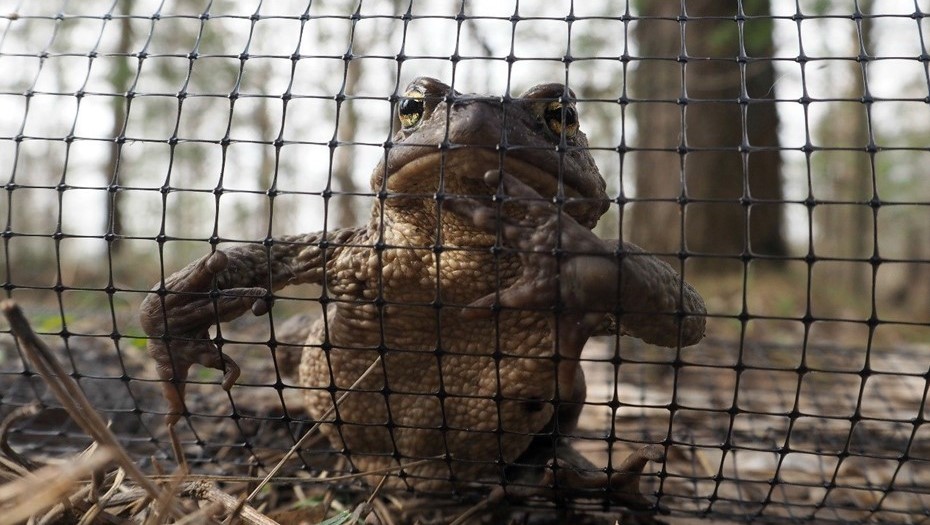
The St. Petersburg Natural Resources Management Committee has stopped signing up volunteers willing to carry gray toads across the road at the Sestroretsk Wetlands Wildlife Preserve. The committee was able to recruit the number of volunteers it needed in a single day.

The committee itself reported the end of the volunteer enrollment, thanking all those who had responded to the call to help the amphibians.

“Registration has been temporarily suspended, as enough volunteers have been recruited for the coming weeks,” the committee stated in its message.

Delovoi Peterburg learned that officials received an unprecedented number of calls and appeals during the day. Six hundred volunteers signed up to save the gray toads.

The largest population of gray toads in St. Petersburg and the Leningrad Region lives in the Sestroretsk Wetlands. Annually in early spring, they migrate en masse to the eastern shore of the Sestroretsk Reservoir to lay their eggs before returning to the forest [sic]. They cross the highway during their migration and can be hit by passing cars.

The Sestroretsk Wetlands Wildlife Reserve announced on April 8 that it was recruiting volunteers to ferry the amphibians over the road. Volunteers are allowed to carry amphibians across the highway after special training. Passersby who have not been trained are asked not to touch the toads, as improper actions can traumatize the amphibians and even cause their death.

Specialists consider toads to be particularly useful amphibians. According to scientists, toads consume about three times more pests than do frogs.

Source: “Smolny’s call to save toads in Sestroretsk causes stir among Petersburgers,” Delovoi Peterburg, 8 April 2024. Translated by the Russian Reader. Photo, above, courtesy of Delovoi Peterburg via vk.com/infoeco_spb.


Alexander Demidenko

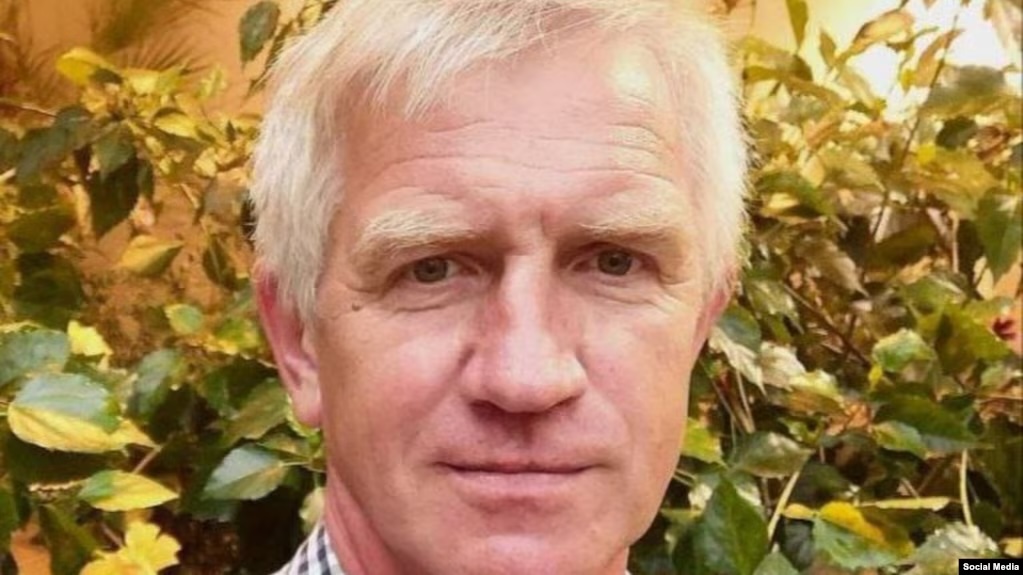
Russian volunteer Alexander Demidenko, who helped Ukrainian refugees [cross the border with Russia], has died in a pretrial detention center in the Belgorod Region, report Vot Tak and iStories, citing sources. It is claimed that Demidenko died on April 5, but news of his death was made public only today, after his lawyer had informed the deceased man’s wife and son.

The cause of death has not been reported, and there have been no official comments from the authorities yet.

Alexander Demidenko had been in custody since mid-October [2023] on charges of illegal arms trafficking. According to iStories, the authorities were planning to transfer Demidenko to St. Petersburg, where he was to have been charged with more serious crimes.

Since the beginning of Russia’s full-scale invasion of Ukraine, the 61-year-old Demidenko had attended anti-war pickets and helped Ukrainian refugees return to their homeland, driving them to the border and hosting them at his home. As many as 900 people who needed a place to sleep stayed in his home, as the border checkpoint was often closed due to shelling, Mediazona writes.

Demidenko disappeared at the Kolotilovka border checkpoint in the Belgorod Region on 17 October [2023]. According to volunteers, he had driven an elderly woman to the checkpoint, but in the parking lot he was stopped by two members of the the territorial defense forces. Subsequently, communication with Demidenko was lost.

Three days later, police officers brought Demidenko home and conducted a search, during which they allegedly found a grenade and detonator fuses from the 1940s. There were numerous bruises on Demidenko’s body.

On 20 October, Alexander Demidenko was jailed for ten days on administrative charges of drinking alcoholic beverages. He was released on 31 October, but the next day he was detained again and jailed for thirty days. During the second administrative arrest, he was arraigned on charges of illegal weapons trafficking and remanded in custody in the pretrial detention center.

In November, it was reported that Demidenko had also been charged with high treason. His lawyer, however, denied these reports. The volunteer’s stay at the pretrial detention center was extended several times on the original weapons charges.

Source: “Volunteer Demidenko, who helped Ukrainians, dies in pretrial detention center,” Radio Svoboda, 8 April 2024. Translated by the Russian Reader. Photo of Mr. Demidenko, above, courtesy of Radio Svoboda, via social media.

Traitor(s)

Traitor by Dennis Potter. Source: Internet Archive

Traitor

First broadcast in 1981, this Hidden Treasure play by Dennis Potter stars Denholm Elliott as Harris and Ian Ogilvy as James. It has not been heard for over 40 years.

In a dingy flat in Moscow, he sits alone — a traitor to his family, his friends, his colleagues. Then the international press descend upon him and he gives his first interview — an interview which brings forth terrible, haunting memories.

Adapted for radio and directed by Derek Hoddinott
A BBC World Service Drama production

With thanks to Keith Wickham, Dr Steve Arnold, Ruby Churchill, Louisa Britton, Alison Hindell, Matthew Dodd, Claire Coss, Carl Davies, Helen Toland, Richard Culver, Andrew Jupp, James Peak, BBC Archives and the Radio Circle.

Remastering by Essential Radio.

Source: BBC


On Sunday, Representative Michael R. Turner (R-OH), chair of the House Intelligence Committee, said it is “absolutely true” that Republican members of Congress are parroting Russian propaganda. “We see directly coming from Russia attempts to mask communications that are anti-Ukraine and pro-Russia messages, some of which we even hear being uttered on the House floor,” he said on CNN’s State of the Union.

Turner was being questioned about an interview in which Representative Michael McCaul (R-TX), chair of the House Foreign Affairs Committee, told Russia specialist Julia Ioffe that “Russian propaganda has made its way into the United States, unfortunately, and it’s infected a good chunk of my party’s base.” McCaul blamed right-wing media. When asked which Republicans he was talking about, McCaul answered that it is “obvious.” 

Catherine Belton and Joseph Menn reviewed more than 100 internal Kremlin documents from 2022 and 2023 obtained by a European intelligence service and reported in the Washington Post today that the Russian government is running “an ongoing campaign that seeks to influence congressional and other political debates to stoke anti-Ukraine sentiment.” Kremlin-backed trolls write fake “news articles, social media posts and comments that promote American isolationism, stir fear over the United States’ border security and attempt to amplify U.S. economic and racial tensions” while claiming that “Biden’s policies are leading the U.S. toward collapse.”

Aaron Blake pointed out in the Washington Post that Republicans are increasingly warning that Russian propaganda has fouled their party. Blake notes that Russia specialist Fiona Hill publicly told Republicans during the 2019 impeachment inquiry into Trump that they were repeating “politically driven falsehoods that so clearly advance Russian interests,” but Republicans angrily objected. 

Now Senators Mitt Romney (R-UT), Thom Tillis (R-NC), and John Cornyn (R-TX) and a top aide to Senator Todd Young (R-IN), as well as former South Carolina governor Nikki Haley and even Trump’s vice president Mike Pence, have warned about the party’s ties to Russia. Former Representative Liz Cheney (R-WY) has said the Republican Party now has “a Putin wing.” 

Trump has hinted that he has a plan to end Russia’s war in Ukraine in 24 hours. Yesterday, Isaac Arnsdorf, Josh Dawsey, and Michael Birnbaum reported in the Washington Post on the details of that plan: he would accept Russian annexation of Ukraine’s Crimea and the Donbas region. He refuses to say how he would negotiate with Ukraine president Volodymyr Zelensky, who has been adamant that Ukraine will not give up its territory to an invader, or Russia president Vladmir Putin, who has claimed all of Ukraine, but after meeting with Trump last month, Hungarian prime minister Viktor Orbán said Trump told him he would accomplish “peace” by cutting off funds to Ukraine.

Trump’s team said Orbán’s comment was false, but it is worth noting that this plan echoes the one acknowledged by Trump’s 2016 campaign director Paul Manafort as the goal of Russian aid to Trump’s campaign.

Fiona Hill told the Washington Post reporters that Trump’s team “is thinking…that this is just a Ukraine-Russia thing…rather than one about the whole future of European security and the world order.”

Trump’s MAGA loyalists in the House of Representatives have held up funding for Ukraine for six months. Although a national security supplemental bill that would fund Ukraine has passed the Senate and would pass the House if it were brought to the floor, House speaker Mike Johnson (R-LA) refuses to bring it to the floor. The House returns to work tomorrow after a two-week recess but is so backed up on work that Johnson is not expected to bring up the Ukraine measure this week.  

Clint Watts, the head of Microsoft’s Threat Analysis Center, told the Washington Post’s Belton and Menn: “The impact of the Russian program over the last decade…is seen in the U.S. congressional debate over Ukraine aid…. They have had an impact in a strategic aggregate way.”

[…]

Source: Heather Cox Richardson, Letters from an American, 8 April 2024 

2 Russia Problem

Boris Akunin

I think that most of us have not yet understood that the world of Russia has once again, like a century ago, split in two, like an iceberg, and its two halves, the bigger and the smaller, are rapidly drifting apart. It’s just that the split happened less dramatically, without the crowding onto the last steamship, without the “we departed from Crimea amidst smoke and fire” [lines from a poem by White émigré Nikolai Turoverov]. The split has been dragged out in time, and the crack wasn’t so wide at the beginning. Some people are still hopping from one iceberg to the other. 

“Endless War”

And yet—that’s it. There are two Russias again. Many people—in both halves—cannot or are afraid to recognize this. It’s time to stop hopping, otherwise you’ll leap to one side and won’t be able to hop back again. 

Hopes for the swift fall of the rotten regime (also just like one hundred years ago) have been disappointed. It’s plenty rotten but rot, as everyone knows, spreads.

Last time it took seventy years to root it out. This time it probably won’t take as much time; time moves more quickly in the twenty-first century, but you still have to unpack the suitcases and settle in for a long wait. 

“Anticipation of White Nights”

What will happen with the ‘little’ Russia, scattered across different countries, is pretty clear. [Russians] who are younger or more active or more professionally cosmopolitan will assimilate with varying degrees of success. [Russians] who are older and professionally tied to the language and culture will sadly sing “while the light has not gone out, while the candle burns” [a line from a famous Mashina vremeni song] and will support that little flame as long as they have the life and strength for it. This work of theirs is not pointless or in vain, because in ‘big’ Russia there are still a great many people for whom that light will be precious and necessary.

In the mother country—goddamn déjà-vu—things will soon be utterly unbearable. In the longstanding two-hundred-year struggle between the Asiatic state and European culture the Horde has triumphed once again, now zealously working to asiatize the culture. (There is nothing malign about Asia and its culture, which of all people I, a specialist in Asian studies, should know; I am talking about political Asia, in which the state is everything and the individual is nothing.)   

The culture of the mother country will be censored, hollowed out, thrust onto all fours and taught to wag its tail. We’ve seen it, we remember. Later, of course, a counterculture will take shape, [yielding] virtuosos of Aesopian language and furtive rude gestures. We remember that too: we had plenty of it. The emigres will coo condescendingly over any vivid manifestations of censored culture—like Nabokov did over Okudzhava. Those in Russia will secretly pass around tamizdat editions. And publish in the West using pseudonyms.  

How dreadful and boring this all is, ladies and gentlemen. Russia’s national anthem: “We sowed and sowed the grain, we will stomp and stomp the grain” [lines from a Russian folk song].

And the number-one national poem: “Everyone chooses for themselves.”

It’s time to choose again: shield and armor, walking stick and patches, a religion, a road, to serve the devil, a measure of final reckoning—and so on down the list.

For some the price will be their profession, for others poverty or emigration. The most noble will give up their freedom. And even their lives. The higher quality the person, the greater the cost. 

And it is all worth it. This is what I’ve been thinking and why I wrote this text, not at all because I wanted to drive you into even greater despondency. 

More so than all of us together, each of us individually is facing a big test. We can’t flunk.

“To the Barricades”

Sergey Abashin

Stop referring to “Asia” and “the Horde.” Why insult millions of people in the world and in Russia itself? You are not helping the “little” Russia” in any way.

“Religion is the opium of the people!”

Ivan Babitski

I see that Akunin has again written something about Asia (where “the state is everything and the individual is nothing”) defeating European values in one particular country.

The point is that Russian intellectuals are, historically, not so fond of anything as repeating German vulgarities. And “Asian” metaphors are the favorites of Germans, and there is no degree of blatant idiocy at which they would stop.

For example, Adenauer explicitly claimed that the “Asian steppes” begin east of the Elbe. (He considered Prussia to be Asian, and so Bismarck’s triumph was an Asian conquest of Germany. Adenauer added the steppe by association.)

No matter how many decades have passed, the pre-war German spirit cannot be taken out of the Russian pamphleteer, and the fear of appearing ridiculous is as alien to them as it was to their mentors.

Pavel Sulyandziga

Quite correct thoughts in general, but there is one big catch.

How does Akunin (Chkhartishvili) differ from those Sieg Heiling in Russia when he starts using “Asia” in such a context, in such a comparison, even with a caveat? Maybe someone will say that I am wrong to try and compare him with the Sieg Heilers. Let me put it another way, then. How does a very good writer differ from those who are called white supremacists in the west?

I recently listened to a very interesting lecture on racism. The lecturer made a rather loose, but interesting ranking, singling out the racism of Soviet people as a separate species.

For some reason, some Europeans, when speaking about Asianness, “forget” about the Inquisition, concentration camps, and many other terrible events in history. Or are these also manifestations of Asianness?

We should also not forget that the current world order is also largely a product of European civilization with all its pros and cons.

One last thing, about why I decided to react in this way to Akunin’s statement, which are quite congenial to my own thoughts. It seems to me that a respected public figure should always think about the consequences of their words and deeds.

[…]

Source: Asya Rudina, “‘The world has split in two:’ the Runet discusses Akunin’s post about the two Russias,” Radio Svoboda, 1 April 2024. Translated by the Fabulous AM and the Russian Reader. The reactions, above, to Akunin’s outburst were not typical. Most of the best-selling author’s fans echoed his sentiments. The photos, above, by our friends V and M, were taken today at an exhibition currently on view in the former swimming pool and catacombs in the so-called Petrikirche on Nevsky Prospekt in downtown Petersburg. They suggest, I think, that the reality on the ground in “big Russia” (and “little Russia” as well) is slightly more complicated than Akunin would have us believe. ||| TRR

April Fools’ Day

And more news:

Source: Moscow Times Russian Service daily newsletter, 1 April 2024. Translated by the Russian Reader. Unfortunately, none of these headlines is a joke.


State Duma (Russia’s lower chamber of parliament) Maria Butina has proposed an option that would allow the Russian authorities to implement the previously voiced threat to execute those involved in the Crocus City Hall terrorist attack.  Agenstvo news agency says she has proposed to extradite the Crocus City Hall terror attack suspects to Belarus, which maintains the death penalty.    

“Unfortunately, the tragedy has become common to us, because citizens of Belarus also died there.  I am quite knowledgeable about your legislation, including the death penalty, which is maintained [in Belarus].  In this case, it is the murder of two or more persons, therefore you have exactly the same right to try these people as the Russian Federation,” MP Butina was quoted as saying.

“I think that discussions are already underway among the competent authorities.  If they count on the fact that, since Russia has imposed moratorium on the death penalty they will be able to escape this type of punishment, then let’s wait and see, because negotiations are underway,” Butina was cited as saying in an interview with Belarus 1 TV Channel.    

Pervy Otdel (First Department) lawyer Yevgeny Smirnov told Agenstvo that “indeed, the Russian legislation allows, on the basis of an international agreement, to extradite people who committed a crime in the territory of Russia to another country.”  

According to him, “if a request arises from Belarus, the agreement with it will have priority over Russian norms.”

“However, in the case of at least one accused — Alisher Kasimov, who rented out the apartment to other defendants – it is impossible, because he has Russian citizenship,” Smirnov noted.  

Belarus still maintains the death penalty. 

Capital punishment is a legal penalty in Belarus. At least one execution was carried out in the country in 2022.  Also known as an Exceptional Measure of Punishment it has been a part of the country’s legal system since gaining independence from the Soviet Union on August 25, 1991.  The current national constitution prescribes this punishment for “grave crimes.”  Later laws have clarified the specific crimes for which capital punishment can be used.  The death penalty can be imposed for crimes that occur against the state or against individuals.  As of 2021, Belarus is the only country in Europe that continues to carry out the death penalty.   

Maria Butina (born November 10, 1988) is a Russian politician, political activist, journalist, and former entrepreneur who was convicted in 2018 of acting as an unregistered foreign agent of Russia within the United States.[

While residing in Washington, D.C., Butina was arrested by the FBI in July 2018 and charged with acting as an agent of the Russian Federation “without prior notification to the Attorney General.”  In December 2018, she pleaded guilty to felony charges of conspiracy to act as an unregistered foreign agent of Russia.  In April 2019, a federal judge sentenced her to 18 months in prison.  She served around five months at Tallahassee Federal Correctional Institution.  Her 9-month pretrial prison term was counted towards her sentence.  She was released and deported back to Russia in October 2019.  She publicly denied being a Russian spy.  In 2021, she was elected to the State Duma as a member of United Russia.  

Source: “Russian MP proposes to extradite Crocus City hall terror attack suspects to Belarus,” Asia-Plus, 1 April 2024

The War on Terror

This is not the first time the editors of our local newspaper have “platformed” the lies of the mendacious and violent fascist butcher Vladimir Putin.

1. US warns that Russia will invade Ukraine. General disbelief, daily Russian mockery. (December 3 2021-February 24 2022)

2.  Russia invades Ukraine, kills tens of thousands of people, kidnaps tens of thousands of children, commits other ongoing war crimes (February 24 2022-present)

3.  Russia blames US for Russia’s invasion of Ukraine (March 2022-present)

4. US warns of terror attack in Moscow. Putin denies any risk and mocks the United States. (March 7 and March 19 2024).

5.  Terror attack near Moscow, ISIS takes responsibility, Russia meanwhile kills Ukrainian citizens with drones and missiles as it has for more than two years. (today, March 22 2024)

6.  Russia’s security apparatus, focused on bringing carnage to Ukraine, has failed in Moscow.  Russia’s leaders, focused on demonizing the US, did not protect Russians. What next? Where to direct the blame?

7.  It would not be very surprising if the Kremlin blames Ukraine and the United States for terror in Moscow and uses the Moscow attack to justify continuing and future atrocities in Ukraine.

Source: Timothy Snyder, “Moscow Terror: A Chronology That Might Predict,” Thinking about…, 22 March 2024


This past Friday, 22 March, a horrifying terrorist attack took place in Crocus City Hall in the outskirts of Moscow.  Islamic State plausibly claimed responsibility.

Earlier that day, Russian authorities had designated international LGBT organizations as “terrorist.” Also earlier that day, Russia had carried out massive terror attacks on Ukrainian cities. Those actions reveal the enemies Putin has chosen. As the attack on Crocus City Hall demonstrated, his choices have nothing to do with actual threats facing Russians.

Russia and the Islamic State have long been engaged in conflict.  Russia has been bombing Syria since 2015.  Russia and the Islamic State compete for territory and resources in Africa.  Islamic State attacked the Russian embassy in Kabul.  This is the relevant context for the attack outside Moscow. The horror at Crocus City Hall obviously has nothing to do with gays or Ukrainians or any other of Putin’s enemies of choice.

Putin had publicly dismissed the real threat. The United States had warned Russia of a coming attack by Islamic State.  The United States operates under a “duty to warn,” which means that summaries of intelligence about coming terrorist attacks are passed on, even to states considered hostile, including (to take recent examples) Iran and Russia.  Putin chose to mock the United States in public three days before the attack. 

People reasonably ask how a terror attack could succeed in Russia, which is a police state.  Regimes like Russia’s devote their energy to defining and combating fake threats.  When a real threat emerges, the fake threats must be emphasized.  Predictably (and as predicted), Putin sought to blame Ukraine for Crocus City Hall.

What if Russians realize that Putin’s designations of threats are self-serving and dangerous?  What if they understand that there are real threats to Russians ignored by Putin?  He has devoted the security apparatus to the project [of] destroying the Ukrainian nation and state.  What if Putin’s obsession with Ukraine has only made life worse for Russians, including by opening [t]he way to actors who are in fact threats to Russian life, such as Islamic State? 

These are the questions Putin must head off. It is not easy, however, to blame Ukraine for Islamic State terrorism.  Putin’s first media appearance, nearly a day after the attack, was far from convincing.  The specifics he offered were nonsensical.  He claimed that the suspects in the terrorist act were heading for an open “window” on the Russian-Ukrainian border.

The term “window” is KGB jargon for a spot where the border has been cleared for a covert crossing.  That the leader of the Russian Federation uses this term in a public address is a reminder of his own career inside the KGB.  Yet Putin had obviously not thought this claim through, since a “window” must involve a clear space on both sides of the border.  For escaping terrorists, it would be the Russian side that opened the window.  By speaking of a “window” Putin indicated that the terrorists had Russian confederates preparing their exit, which he presumably did not mean.  It seems that Putin was hastily making things up.

Setting aside the “window” business, though, the whole idea that escaping terrorists would head for Ukraine is daft.  Russia has 20,000 miles of border.  The Russian-Ukrainian part of it is covered with Russian soldiers and security forces. On the Ukrainian side it is heavily mined.  It is a site of active combat.  It is the last place an escaping terrorist would choose. 

And there is no evidence that this is what happened.  Russia claims that it has apprehended suspects in Bryansk, and claimed that this means that they were headed for Ukraine.  (Western media have unfortunately repeated this part of the claim.)  Regardless of whether anything about these claims is true, Bryansk would suggest flight in the direction of Belarus.  Indeed, the first version of the story involved Belarus, before someone had a “better” idea.

In moments of stress, Russian propaganda tries out various ways to spin the story in the direction preferred by the Kremlin.  The reputed suspects are being tortured, presumably with the goal of “finding” some connection to Ukraine.  The Kremlin has instructed Russian media to emphasize any possible Ukrainian elements in the story.  Russian television propaganda published a fake video implicating a Ukrainian official.  The idea is to release a junk into the media, including the international media, and to see if anything works. 

Amidst the flotsam and jetsam are those who spread Russian propaganda abroad, who try out versions more extreme than Putin’s.  Putin does not directly deny that Islamic State was the perpetrator — he simply wants to direct attention towards Ukraine.  But actors outside Russia can simply claim that Ukraine was at fault.  Such actors push the discussion further than the Kremlin, and thereby allow Russia to test what might work abroad.

As a result, we have a bizarre discussion that leads to a harmful place.  Islamic State claims responsibility for Crocus City Hall.  The Islamic State publishes dreadful video footage.  Russia cannot directly deny this but seeks help anyway in somehow pushing Ukraine into the picture.  Those providing that help open a “debate” by denying that Islamic State was involved and making far more direct claims about Ukraine than the Kremlin does.  (This brazen lying leads others to share [a] Islamic State perpetration video (don’t share it; don’t watch it).  So the senseless “debate” helps Islamic State, since the reason it publishes perpetration videos is to recruit future killers.)

Meanwhile, Russia’s senseless war of aggression against Ukraine continues.  In its occupied zones, Russia continues to kidnap Ukrainian children for assimilation and continues to torture Ukrainians and place them in concentration camps.  It continues to send glider bombs, drones, cruise missiles and rockets at Ukrainian towns and cities. 

On the same day as the attack at Crocus City Hall, Russia carried out its single largest attack to date on the Ukrainian energy grid, leaving more than a million people without power.  Among other things it fired eight cruise missiles at the largest Ukrainian dam. Russia attacked the city of Zaporizhzhia (the consequences are in the four photos) and other cities throughout Ukraine.

On Friday Russia fired, in all, eighty-eight missiles and sixty-three explosive drones into Ukraine. And that represents just a single day (if an unusually bad one) of a Russian war of terror in Ukraine that has gone on for more than two years.

Putin is responsible for his mistakes inside Russia. And he is at fault for the war in Ukraine.  He is trying to turn two wrongs into a right: into his own right to define reality however he likes, which means his right to kill whomever he chooses. 

Source: Timothy Snyder, “Moscow Terror (2): The Claim and the Blame,” Thinking about…, 24 March 2024


It is obvious that the terrorist attack at Crocus City Hall on the evening of 22 March 2024, during which 133 people were killed, according to the official count, has clear goals and objectives. A week before Putin’s “election” I wrote that, after receiving a “mandate from the people,” Putin would unleash a mass terror campaign. But for this, of course, he needs a decent and obvious excuse. The exemplary terrorist attack in broad daylight in politically unreliable Moscow is intended to convince society that “decisive action” is what it needs now.

Why would Putin do that? It’s simple logic. Come hell or high water he has to win the war he has unleashed. This is obvious, for it is a matter of self-preservation. If Putin does not win, he is a weakling, a lowlife, and at the same time the person to blame for hundreds of thousands of deaths not only of Ukrainians, but also of Russians. It is clear that he will not last long in this state. Not to mention such a trifle as his sick, wounded ego, repeatedly insulted by Ukraine. But victory would wipe everything out, because victors are not judged, Putin is convinced, taking his cue from his idol Catherine the Great.

So, Putin has to have victory at any cost. But two things have long prevented him from achieving it: 1) his numerous domestic enemies, and 2) a lack of “manpower” in the ranks of the army.

Putin intends to solve problem number one by means of a mass terror campaign against malcontents, especially since he has long been urged to do so by a well-rehearsed chorus of heralds, from Dmitry Medvedev and General Gurulyov to a host of other, lower-ranking epigones of contemporary Russian fascism. Guessing the mood of their Führer, they demand that, at very least, he restore the death penalty; at most, that he carry out “total executions of the terrorists and crackdowns against their families” (per the latest quotable quote from Medvedev).

We can only guess at this point whether Putin’s forthcoming terror will exceed Stalin’s body count or whether the current ruler in the Kremlin will limit himself to “merely” increasing the number of prison sentences meted out to dissidents by a factor of two and carrying out demonstrative executions of dozens or hundreds of his fellow citizens. But there is no doubt that a serious expansion of such tactics is on his agenda.

Putin will solve problem number two through a mass mobilization. This is nothing new either. Piling hundreds of thousands of soldiers into the enemy’s trenches is a time-honored tactic practiced by both the Russian and Soviet military, and, as Putin has seen, it has worked well in the “meat assaults” on Avdiivka, Bakhmut, Severodonetsk, and many other small Ukrainian towns. But these towns are nothing compared to the million-strong cities of Kharkiv, Dnipro, Zaporizhzhia, and Odesa, not to mention the three-million-strong Kyiv. So there must be massively more cannon fodder. The second problem is directly related to the first.

Combined with large-scale crackdowns, the mobilization is sure to proceed more vigorously this time round.

As a bonus for the Kremlin, this terrorist attack diverts public attention (at least for a while) from such things as Russia’s largest-ever strike on Ukraine, involving a hundred and fifty missiles and drones, which happened just a day before the events at Crocus City Hall.

I’d now like to talk about other explanations of this terrorist attack. Looking through the news related to it, I honestly could not help but marvel at the comments of certain respected colleagues, opposition Russian analysts, who easily took the bait about IS, Islamist terrorists, and the other nonsense that the FSB obligingly leaked to the public in the first hours after the attack through the Russian media and Telegram channels.

To clarify, certain people of “non-Slavic ethnicity” were chosen to directly perpetrate this heinous crime. There are hundreds of thousands of Tajik, Uzbek, and Kyrgyz migrant workers in Russia, EVERY ONE of whom is literally turned inside out by the Russian Interior Ministry upon arriving in Russia, including with regard to their attitudes to radical Islam and similar things. The Russian secret services thus have the broadest selection of perpetrators available for such a terrorist attack.

Let us ask ourselves an elementary question: how could Islamist radicals purchase not only assault rifles and pistols but also the flamethrower with which the terrorists torched the unfortunate audience members at Crocus City Hall without the knowledge and support of Russian “law enforcement”? Is such a thing possible in today’s Russia, and in Moscow to boot? If someone thinks that it is possible, I would simply remind them that when members of Eduard Limonov’s National Bolshevik Party tried to buy weapons somewhere in the Altai Territory back in the 2000s, their plan was instantly exposed. The idea of Tajiks buying assault rifles and flamethrowers in today’s militarized Russia, which is chockablock with surveillance cameras and special services, is a bad joke.

Let me also remind you that the initial semi-official Russian explanation was that the terrorist attack at Crocus City Hall was revenge on Russia for its actions in Syria and Chechnya. Seriously? So, it matters not a whit that the Russian army and its air force have not conducted any active operations in Syria for two years now? If you have not been paying attention during this time, let me just remind you that the Kremlin is certainly not concerned with Syria right now. For the last two years all Russian armed forces, including those operating from military bases in Syria and in Armenia, have been deployed in destroying Ukraine. There have been no large-scale military operations in Chechnya for almost twenty years.

However, as it turned out, all this argumentation was completely superfluous, because my gullible colleagues were made to eat their lunch by Putin himself and his favorite propagandist, Margarita Simonyan. As a shadow of her “boss” (as she herself dubs Putin), Simonyan naturally cannot afford to indulge in improvisations not vetted by him, and especially at such a crucial moment. On her Telegram channel, she bluntly pointed out who, in her (and therefore her boss’s) opinion, had organized and perpetrated the terrorist attack: “It wasn’t IS. It was the Khokhols.”

The “boss” himself, who was supposed to address the nation in the early hours after the terrorist attack, unexpectedly postponed his address by twenty-four hours. The delay appears to have been caused by technical blunders. Obviously, organizing the details of a terrorist attack is not Putin’s pay grade. It is clear that in such cases the relevant special services are simply given the go-ahead from the top brass. They are told to do their job. The operation was entrusted, of course, to professional hatchet men. As usual, they made a miserable mess of it. You need a large-scale terrorist attack? The Russian security services always have two or three dozen Tajiks on hand for this purpose, who can be hastily given their marching orders, paid, and… And that’s basically it. The Tajik passport found in a car allegedly belonging to the terrorists is, of course, a masterpiece. It is clear that no terrorist, as he sets off to carry out an attack, ever forgets to take his passport with him. It was meant as a helpful hint to law enforcers, and also so decent folk would know whom to hate. It is strange that the business card of the already half-forgotten Dmytro Yarosh was not found in the car as well.

But the point is that this special operation were certainly not meant to spoil relations with the Islamic world. Russia’s allies—Iran, Hezbollah, Hamas—might take offense.

In addition to the domestic agenda we mentioned above, the terrorist attack was meant to firmly link the globally condemned villains of IS with Ukraine in world public opinion.

This was why Putin’s speech on the terrorist attack was postponed for almost twenty-four hours. The dictator’s dodgy mind was deciding how to clean up the mess made by his numbskulls and tie up the loose ends. That is, to tie IS (or any other Islamists) to Ukraine. And he probably thinks he has figured out how to do it. As he put it, [the terrorists were trying to escape through] “a window prepared for them on the Ukrainian side of the border.”

All these tricks of Putin’s are painfully obvious to people capable of thinking, but he doesn’t care about that. Moreover, having sensed a change in the mood of his American “partners” (remember the reports that the U.S. has been pressuring Ukraine to stop hitting Russian oil refineries, and the fact that for almost two months no American aid has arrived in Ukraine and it is not known whether it will arrive in the future), Putin makes a high-pitched appeal to all countries to unite against this inhuman evil—that is, against Ukraine + Daesh.

Another very important point from Putin’s speech, indicating that he is paving the way for a mass terror campaign at home, is that he called the shooting of civilians at Crocus City Hall nothing more or less than “a blow to Russia, to our people.” He, his propagandists, and the Russian media have already established the link between Islamist terrorists and Ukraine. The next logical step is to claim that those Russians who support Ukraine are direct and immediate supporters of the terrorists who struck “a blow to Russia, to our people”—that is, that they are enemies of the people.

To be honest, all of this is as monstrous as it is predictable. I will repeat what I have said many times before: as long as Putin is alive and in power, things will get even worse and even scarier.

Source: Alexander Zhelenin, “The terrorist attack at Crocus City: who benefits from it and what will happen next,” Republic, 23 March 2024. Translated by the Russian Reader