I’ll Show You the Life of the Mind

Academic freedom in the Putinist dictatorship is the freedom to criticize the enemy:

MARCH 17, 2020 | The media center at the Alexandrinsky Theater’s New Stage (Fontanka Embankment, 49A, St. Petersburg) will host the first event in a series of conversations between the outstanding scholars of our time, on the occasion of the European University in St. Petersburg’s 25th birthday. A conversation between historical sociologist and NYU Abu Dhabi professor Georgi Derlugian and Russian international affairs journalist, political scientist, and editor-in-chief of the magazine Russia in Global Politics Fyodor Lukyanov will open the series of encounter. The topic of their discussion is “TRUMP AND HIS DOCTRINE: HOW THE US PRESIDENT TREATS THE WORLD ORDER WITH SHOCK THERAPY.”

The freedom to imagine that a dictatorship is actually a hipster’s paradise:

MARCH 14, 2023 | The Open Living Room at the Lermontov Library (Liteiny Prospect., 17–19) will host a lecture by Yevgenia Kuziner, a graduate student at the HSE Center for Youth Studies, “POINT OF ATTRACTION: HOW, BY WHOM AND FOR WHOM ARE CREATIVE SPACES CREATED IN THE CITY?” | Starts at 6:30 p.m. | Registration required | Detailed information at https://otkrytaya-gostinaya.timepad.ru/event/2331631/

And the freedom to pretend that real sociology is possible in dictatorships:

APRIL 13, 2023 is the deadline to apply to the 19th Russian-Chinese Sociological Conference, “CONTEMPORARY CITIES AND SOCIAL GOVERNANCE IN RUSSIA AND CHINA,” which will take place April 21–22, 2023. The conference will be held in an online format and hosted by St. Petersburg State University, Russia. The languages of the conference are Russian, Chinese and English. Detailed information at https://soc.spbu.ru/images/nauka/inffo-letter_21-22.04.2023_3.pdf

Source: Excerpts from the emailed newsletter of the Center for Independent Sociological Research (CISR) in St. Petersburg, recently revamped as “The MILIEU” [sic], March 2020 and March 2023. Translated by the Russian Reader


The Forty-First is a completely original production.

It is chockablock with irony and actorly improvisation.

There will be loads of laughter, convulsive choking back of tears, fond embraces, and love gushing down the throat during this play. As it wafts into the theater’s low flies, the powerful actorly energy is instantly transmitted to the audience.

This is a restoration of Vlad Furman’s legendary production The Forty-First, based on the novel [sic] of the same name by Boris Lavrenyov.

The love story of the Red Army sniper Maria Basova (aka Maryutka), picking off “enemies” one by one (the thirty-first, the thirty-second… the forty-first!), and the White Army officer Govorukha-Otrok (who was to be her forty-first victim, but survives) is known to audiences from Grigory Chukhrai’s eponymous film version, starring Izolda Izvitskaya and Oleg Strizhenov.

Vlad Furman staged The Forty-First at the Mironov Theater in 2000. It was one of the best theatrical productions in Petersburg, and its director and performers were nominated for Petersburg’s highest theatrical honor, the Golden Spotlight.

Boris Lavrenyov’s story is incredibly timely today.

Love is severely tested by the Civil War and differences in political views.

A new generation of actors takes to the stage in this new production of The Forty-First.

Twenty years later, the production features very young artists who have been working with Vlad Furman for several years in stagings of The Merchant of Venice and Medea. The older generation of artists at the Andrei Mironov Theater joins them in this production.

Source: Bileter.ru. Still from the play The Forty-First courtesy of the Andrei Mironov Theater (St. Petersburg). Translated by the Russian Reader


In March 1942, Pierre Matisse, an art dealer and son of the artist Henri Matisse, opened the show Artists in Exile at his gallery in New York’s Fuller Building. It featured one work each by fourteen artists who had fled the rising tide of fascism and totalitarianism in Europe. Max Ernst, Marc Chagall, Fernand Léger, André Breton , Piet Mondrian, Jacques Lipschitz, Ossip Zadkine, and the other men (not a single woman was shown at exhibition) came from different countries and strata of society and represented different modernist trends in art: Dadaism, Surrealism, Cubism, and De Stijl. Since the late 1930s, these trends had been vilified and condemned, and in many cases their works had been destroyed by the Nazis as so-called degenerate art.

Many of these artists were aided by art dealers and patrons such as Pierre Matisse, and collectors such as Peggy Guggenheim. Museums also played a vital role in helping artists and their immediate families. The first director of the Museum of Modern Art Alfred Barr and his wife, the art historian Margaret Scolari Barr, worked with the Emergency Rescue Committee (ERC). The artistic community, founded as it was on humanist principles and nonviolence, generally did what it should have done: it sought to render mutual aid and fight evil.

[These two opening paragraphs seem to have been plagiarized, in translation, from this article, originally published on the website of the WWII National Museum in New Orleans, to which I have already linked above — TRR.]

Eighty-one years later, the director of the seemingly progressive Multimedia Art Museum, Olga Sviblova, appeared at the Knowledge Society Awards in the Kremlin — along with Yana Churikova, Fyodor Bondarchuk, and Polina Gagarina. Immediately after the war started, a year ago, the Garage Museum issued a high-profile essentially anti-war statement and halted all exhibitions. It could have served as an example and an impetus for other institutions to stop the widespread normalization of the war, but this has not happened. A year later, we find that museum’s statement has itself disappeared* from all official sources.

*UPD: We were mistaken. The announcement on the suspension of exhibitions remains on the museum’s website, but doesn’t appear on the main page anymore. The museum also currently shows archive-based artists projects.

Alas, we can safely say that the art community in Russia passively supports the war, living it up in the public space at venues somehow associated with contemporary art. Why is this happening? Shouldn’t the artistic community be grounded in humanist principles and nonviolence? How did it happen that (with rare exceptions) the Russian art scene, which survives mainly on government money but aspires to be part of the global community, has been silent in the midst of war? Juliet Sarkisyan, an art critic who blogs at the Telegram channel Juliet has a gun, answers these questions.


Since the war’s outbreak members of the culture community have been leaving Russia because they do not agree with the state’s current repressive and imperialist policies. They do not see any prospects here at home: they do not want to merge with the masses and have anything to do with the official agenda. They generally leave for the opportunity to speak freely and make art. But some do not see the point in producing the latter at all (at least while the war is going on), since this can free up resources and time for helping Ukrainians, as well as showing solidarity through their silence.

A narrow stratum of the artistic community underwent a reorientation — instead of the usual artistic practices, they have preferred to engage in activism, and art criticism became homogeneous. Some continue to do it anonymously in Russia, while others have been forced to leave the Russian Federation for this reason (and many others). In any case, for reasons of security, I cannot give anyone’s surnames and first names as examples. The other part of the artistic community — apparently, the prevailing one — continues to engage in the production of art, come hell or high water, within Russia’s current system. Putin recently issued a decree on the “Fundamentals of State Cultural Policy,” which is designed to reaffirm traditional values and introduce censorship for cultural events. I would like to take the liberty to criticize cultural workers (opposed to the war) who blindly continue their artistic endeavor inside Russia, while also taking into account all the difficulties and, as it were, the impossibility of choice they face. But first we need to figure out who cultural figures are and what their mission is.

What exactly is this “artistic community” face to face with this war? Are they intellectuals or an intelligentsia? In the modern use of the terms “intelligentsia” and “intellectuals,” there are two markedly pronounced trends. The first is typified by the synonymous use of terms, implying, in fact, the merging of the concepts. The second trend involves preserving and consistently distinguishing both the terminology and the concepts themselves.

Michel Foucault identifies intellectuals “in the political, not the sociological sense of the word, in other words the person who utilizes his knowledge, his competence and his relation to truth in the field of political struggles.” [This passage is not in quotation marks in the original article, although it is a direct quotation.] In the first part of the book Intellectuals and Power [a three-volume 2002 Russian-language compendium of his articles and interviews] Foucault writes: “What we call today ‘the intellectual’ […] was, I think, an offspring of the jurist, or at any rate of the man who invoked the universality of a just law, if necessary against the legal professions themselves (Voltaire, in France, is the prototype of such intellectuals). […] [T]he intellectual has a three-fold specificity: that of his class position (whether as petty-bourgeois in the service of capitalism or ‘organic’ intellectual of the proletariat); that of his conditions of life and work, linked to his condition as an intellectual (his field of research, his place in a laboratory, the political and economic demands to which he submits or against which he rebels, in the university, the hospital, etc.); lastly, the specificity of the politics of truth in our societies” [Michel Foucault, Power/Knowledge: Selected Interviews and Other Writings, 1972–1977, ed. Colin Gordon (1980), pp. 128–132].

Antonio Gramsci also spoke about the organic intellectuals mentioned by Foucault. The Italian [sic] believed that there was not one, but many different types of intellectuals. Intellectual activity does not necessarily imply devotion to the ideas of socialism. Most intellectuals, Gramsci noted, were reluctant to change or saw themselves not as conservatives or liberators, but rather as technical thinkers. Gramsci offers a convenient series of distinctions among organic intellectuals, traditional intellectuals, and intellectuals of the new type.

Organic intellectuals form a completely different type of social stratum. Their activity consists “in active participation in practical life, as constructor, organiser, ‘permanent persuader’ and not just a simple orator” (Gramsci, 1971: 10) [sic: Antonio Gramsci, Selections from the Prison Notebooks, ed. and trans. Quentin Hoare and Geoffrey Nowell Smith (1971), p. 10]. “Organic intellectuals” [quotation marks — sic] not only have special knowledge, but also become legislators of meanings: they have a special understanding of what is happening and are actively involved in politics.
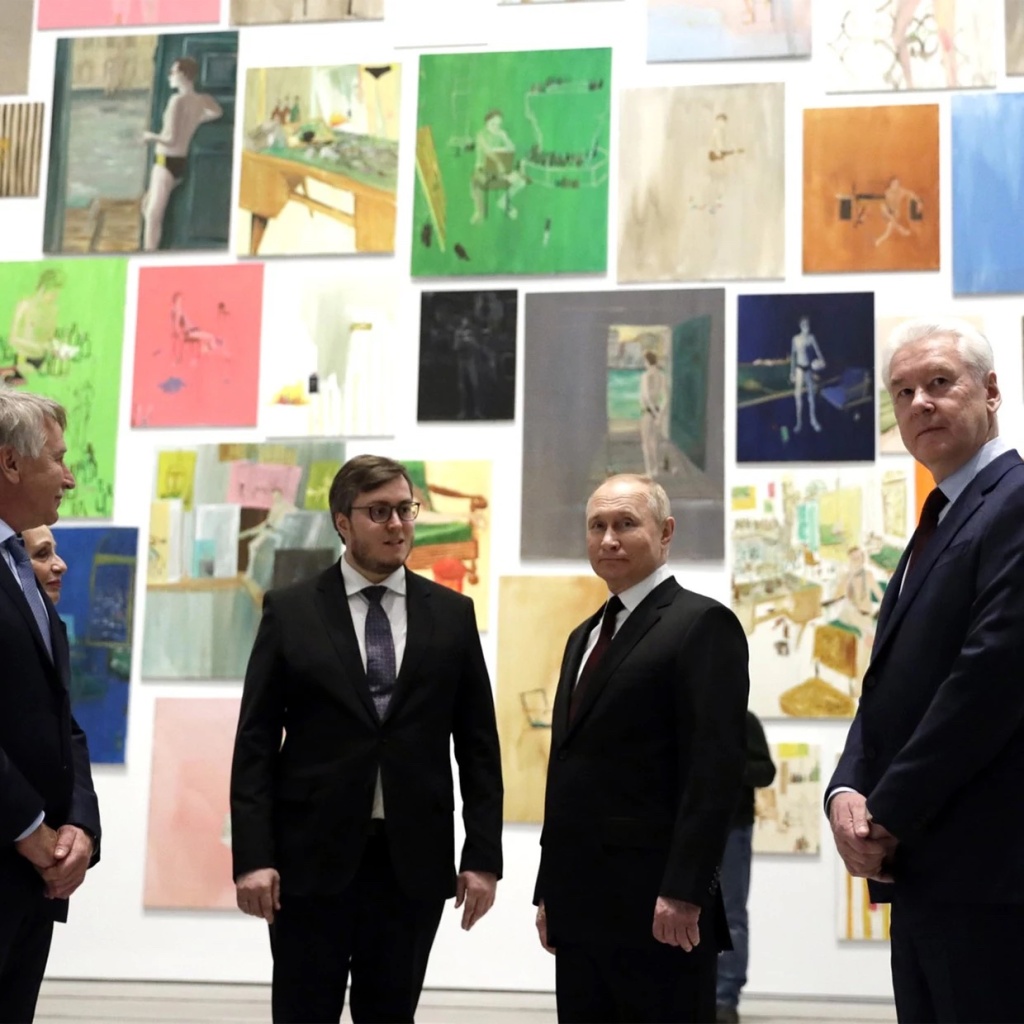
(Left to right) Russian businessman Leonid Mikhelson, founder and funder of the arts organization the V-A-C Foundation; V-A-C publishing programs director Grigory Cheredov [full disclosure: Mr. Cheredov has commissioned me many times in the past several years to translate texts for V-A-C, which I happily did because he and his colleagues were easily among the most decent and professional of my Russian art world clients, at least until the war broke out and they failed to pay me for the last two jobs I had done for them before the war — TRR]; Russian president Vladimir Putin; and Moscow mayor Sergei Sobyanin, at the V-A-C Foundation’s newly opened art and culture space, GES-2 House of Culture, December 1, 2021

No matter how intellectuals are defined — as bearers of culture or as critically thinking people — it is obvious that in the twentieth century there were significant changes in the organization and nature of intellectual life. The most widespread meaning of the word “intellectual” is even narrower and includes a political dimension. Real intellectuals are those who go beyond their immediate area of expertise to intervene in public policy issues, usually in a spirit of disagreement with the authorities. This concept was first popularized by the archetypal intellectual Jean-Paul Sartre.

And Jürgen Habermas, a major theorist of the Frankfurt School of social philosophy, who has paid serious attention to the theory and practice of politics, was convinced by his own experience of the effectiveness of such an approach to political life. He has argued that “philosophers, along with writers, historians and other experts, should act in the public sphere as intellectuals and least of all as interpreters and elucidators of any one doctrine.” [This is a quotation from an 1989 interview of Habermas by Yuri Senokosov, as published, in Russian translation, in Jürgen Habermas, Democracy, Reason, Morality: Moscow Lectures and Interviews (Moscow: Academia: 1995), pp. 109–110. Judging by the peculiarly specific way it is introduced here by Ms. Sarkisyan, the wording was discovered by her in Elena Iosifovna Kukushkina, “The Intelligentsia in the Political Life of Society,” Vestnik Moskovskogo Universiteta, Series 12: Political Science, 4 (2012): 21, where the passage in question is incorrectly indicated as being on page `113 of the book — TRR.] In 1953, he took on Martin Heidegger in the wake of the latter’s newly discovered Nazi sympathies in a review of Heidegger’s book Introduction to Metaphysics. In the late fifties and early eighties, Habermas was involved in pan-European anti-nuclear movements, and in the sixties he was one of the leading theorists of the student movement in Germany, although in 1967 he actually broke with the radical core of this movement when he warned about the possibility of “leftist fascism.” In 1977 he protested against the restriction of civil liberties posed by domestic anti-terrorist legislation, and in 1985–1987 he was involved in the so-called historians’ debate on the nature and extent of Germany’s guilt in the war, condemning what he considered historical revisionism of Germany’s Nazi past. He also warned about the dangers of German nationalism in connection with the unification of Germany in 1989–1990.

Intellectuals from different countries — the scientists, writers, artists and humanists of the twentieth century — amassed a wealth of experience in solving problems on a global scale. In the period between the two world wars, they led anti-fascist movements and fought to prevent interethnic conflicts and liberate countries from colonial dependence. By initiating and being actively involved in these campaigns, the world cultural elite demonstrated the intelligentsia’s truly inexhaustible possibilities of the intelligentsia as a force capable of having a tangible impact on political processes at different levels. [This paragraph has been copied almost verbatim from page 22 of Elena Kukushkina’s scholarly article, as cited above — TRR.]

The cultural and artistic community — whether it consists of intellectuals or not — has the weight, influence, and social capital to make the fight against the current regime effective. As for their responsibility, they are capable of exposing the lies of governments and analyzing their actions in terms of causes, motives, and often hidden intentions. Privilege confers opportunity, and opportunity imposes responsibility. For me, the urgent question today is what responsibility should Russian society, in particular the intelligentsia (of which the artistic community is a part), bear when it comes to horrors of the full-scale war in Ukraine. And of course, this question (about the responsibility borne by people of the aggressor nation for the war it has launched) is not new at all.

The philosopher Noam Chomsky, for example, criticized the American government and the Vietnam War in the book [sic] The Responsibility of Intellectuals. Privilege, he argues, entails the responsibility to tell the truth and expose lies. But our intellectual culture supports this ideal only nominally. Yes, it is forbidden in Russia to publicly voice an opinion that differs from the government’s rhetoric. Otherwise, one risks criminal prosecution, which can even lead to imprisonment. What other options are left if a basic human need — freedom of speech — is taken away from us? Are there niches in which we can preserve our humanity while also avoiding tentacles of the state? It seems that during a war it is difficult to engage in aesthetics. It takes us down the path to escapism and the opportunity to close our eyes to everything that is happening around you us. In peacetime, there are trends that establish a certain regime for artists.

But since the beginning of the war, Russian public cultural activity has not undergone any structural changes or even hints of them. New galleries and cultural centers have been opening (e.g., the Zotov Center, Nakovalnya Gallery, and Seréne Gallery), and the old ones continue to operate as if nothing has happened.

Only a few such venues have curtailed their public programs (and not all of them due to political convictions): Typography Contemporary Art Center, Kerka Gallery, the space It’s Not Herе, the Sphere Foundation (the former Smirnov and Sorokin Foundation), Fragment Gallery, and the Garage Museum. Where does normalization come from? The government has been sparing no efort to hide the war crimes that it commits every day, not only with the help of propaganda, but also through attempts to preserve the normal life that existed before the war. Tomorrow will be the same as today. This illusion of normality also occurs in everyday life. The cultural realm has also played a considerable role in generating it. All the existing cultural institutions and people involved to one degree or another in the production of public life are this totalitarian regime’s witting or unwitting opportunists.

Russian curator Olga Sviblova at the Knowledge Society’s awards ceremony at the Kremlin, December 13, 2022.
The society has adopted a suggestively Roman (i.e., not Cyrillic) and thus pro-war “Z” as its logo, as seen behind Sviblova.

The Russian intelligentsia, as represented by the artistic community (if it can be called that at all), is against the war in Ukraine. But even if it verbally opposes war crimes and imperialism, it supports the existing state of things in its actions, thus contradicting itself. Collaboration with institutions (especially those directly dependent on the Russian federal culture ministry, whose head in an interview called for killing Ukrainians) and the absence of discussion about rethinking the cultural field within the country suggest that the cultural community refuses to react at all to the events taking place this minute in Ukraine. It refuses to accept any responsibility for what is happening.

Fairs, exhibitions, public educational outreach, and the production of uncritical art only perpetuate the status quo and play along with the official agenda. To understand what I am talking about, look at the list of exhibitors at the Cosmoscow Art Fair in September 2022. The fair, to which Putin’s spokesman Dmitry Peskov was invited, imposed strict censorship on its participants.

This familiar pre-war environment is exactly what the government wants to see. We have seemingly begun to forget that we live in a totalitarian state, and everything we produce on its territory is part of it and monitored thanks to the presence of a single comprehensive ideology. What kind of art production can we talk about when there is strict censorship of all legal channels of information? Censorship is usually exercised in the name of so-called national security interests or as part of larger-scale campaigns to protect morality. (In our case, this is the policy to preserve and strengthen “traditional Russian spiritual and moral values.”)

Regimes try to monopolize artistic production either by co-opting artists to the point that they become mouthpieces and servants of the state, or by restricting the access of independent artists to places for displaying and implementing artistic expression. What kind of independent public art can we talk about? The usual strategies of artistic activity no longer work. It’s time to admit it.

We have begun to forget that no uncritical culture is possible at a time when the mass killings of civilians, violence, and torture are taking place daily, and the integrity of a sovereign neighboring state is being destroyed. What kind of art production in the Russian Federation is there to talk about when you are a member of the aggressor nation? Even if you adhere to an anti-war stance, how can art in state-controlled institutional venues be perceived from the outside as anything other than serving this regime?

Russian culture should be held accountable for the war in Ukraine. But people often downplay the importance of culture in political and public life, regarding it as a separate part of the personal realm rather than as a fusion of the forms of social interaction. We need to recognize that the current regime did not suddenly emerge on February 24, 2022. It had to be built up and supported for many years to officially establish itself once and for all and launch a full-scale war in Ukraine. All these years we ignored this build-up, living in a world of illusions. Unfortunately, this illusion is still maintained. In many ways, it is created by part of the cultural and artistic communities.
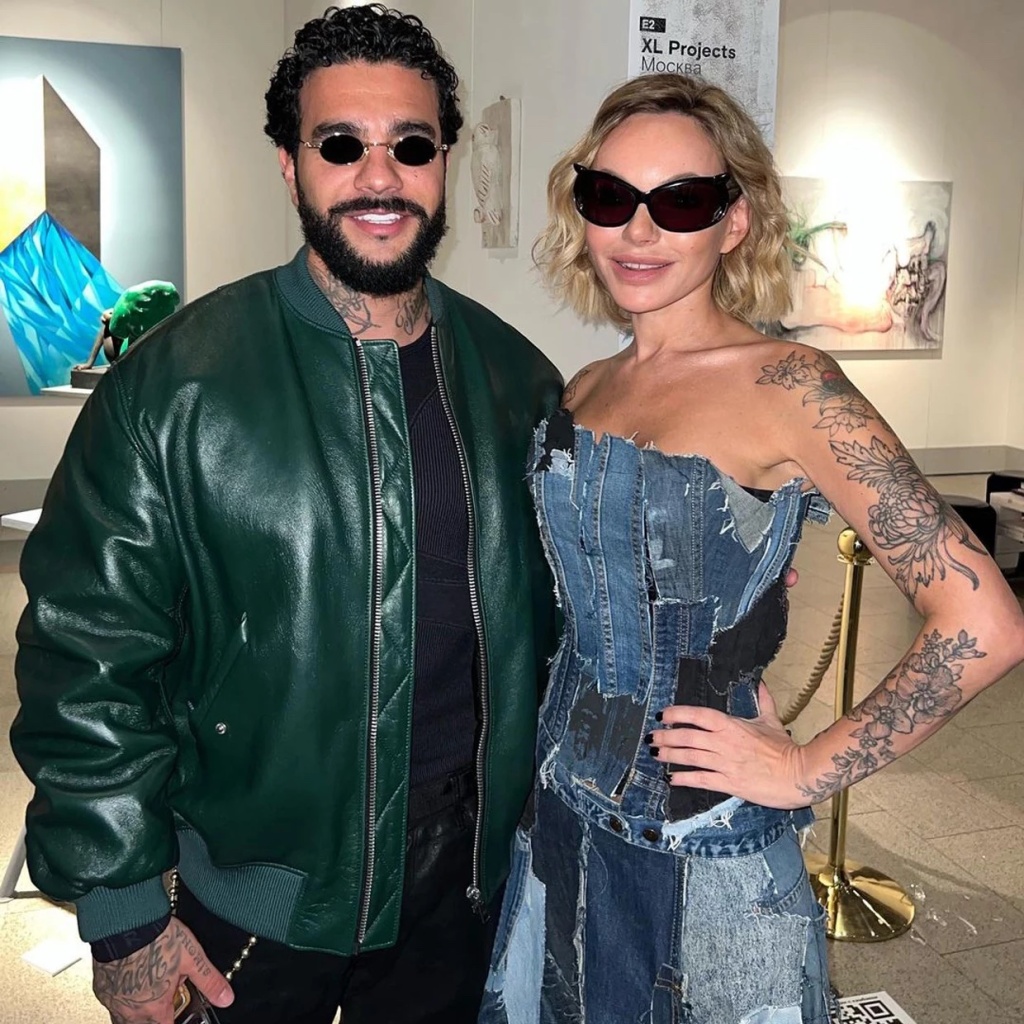
Russian rapper Timati and fashion designer Masha Tsigal at Cosmoscow Art Fair, September 2022

Many people who have remained in Russia might not agree with me. How can artists earn money without resorting to public utterance and without cooperating with institutions? How can galleries stop working? After all, this is their source of income (although it often does not bring in money, but vice versa). How can we just come to a standstill and not produce anything?

But does everyone really continue to work because of economic dependence, and not out of social necessity — that is, because they belong to a scene where there is a fear of losing the context that gives a person meaning? It boils down either to staying, accepting the state of things, and leading your normal life (as far as it is possible to do that at all now) or giving up on it and leaving. Of course, this dichotomy is not the only one: there are many other ways of living this war. None of us, including me, has answers to these questions. The question, rather, is whether we are aware of what kind of force and political dimension our position can have and what responsibility we should have to Ukraine. Time will pass and the question will arise: how did the Russian intellectual community behave during the war? Silence is also an answer, however.

Source: Juliet Sarkisyan, “Why has the Russian art scene been silent about the war?” The Village, 7 March 2023. Translated by the Russian Reader


The ruins of the Arch of Triumph (also called the Monumental Arch) in Palymra, 2010. Photo courtesy of Wikipedia

In April, the project for restoring the Arch of Triumph, the most famous structure of the Syrian city of Palmyra, should be ready and presented to the public, according to our sources involved with restoring the ancient city.

The Petersburg organizations involved in the project have been doing their design work remotely. They considered it safer because, according to the restorers, not all the terrorists in Syria have been “pacified” yet.

The restoration is coordinated by the Institute of the History of Material Culture (IIMC RAS), which signed an agreement on the restoring the arch with the Syrian Department of Antiquities in March of last year. The details of the agreement are unknown. In November of last year, the archaeological excavations were completed. The project also involves the State Hermitage Museum and the architectural firms of Maxim Atayants and Studio 44. Atayants, as a connoisseur of antiquity, is more responsible for the “theoretical” part, that is, for the choice of approach. Five specialists from Studio 44, including Nikita Yavein, the head of the firm, are involved, and they are working on technical issues. According to sources, other firms are also involved — for example, the restoration company Agio.

The Arch of Triumph itself was built during the reign of Roman Emperor Septimius Severus (193–211 CE) and, apparently, glorifies his victories. It underwent restoration involving reinforced concrete elements in the 1930s. The arch was partially destroyed in 2015, during the Syrian civil war. The central span and one of the pylons collapsed.

More alive than Buddha

Until recently, it had not been decided exactly how to restore the arch — to its state at the time when terrorists attempted to blow it up (which means reproducing the version produced by the restorers in the 1930s), or in some other way. The Venice Charter on the Conservation and Restoration of Monuments and Sites stipulates that monuments should be preserved in the form in which they have come down to our time. According to established practice, reconstruction by means of anastylosis, as the most sparing method, is permitted for ancient ruins. In this approach, the surviving stones are put back in place. But experts do not want to limit themselves only to anastylosis in the case of Palmyra.

First, it would look uninteresting: the edifice would not make the proper impression, and it is probably not worth the effort. Second, much of the stone in the lower part of the arch has been lost or compromised and would still have to be reinforced or recreated. According to the IIMC RAS, about 40% of the structure remains standing. Another 30% of the stone blocks are not in their place, but they can be used in the restoration. The remaining sections are partly or completely destroyed. That is, there is slightly less genuine material than is usually required for a restoration (i.e., 80-90% of authentic stone). UNESCO has long refused to restore the statues of Buddha blown up by the Taliban in Afghanistan (they have not yet been restored) precisely on the grounds that a significant part of the stone was lost.

Archaeological diplomacy

Meanwhile, the project for the arch must also be vetted by UNESCO since Palmyra is a World Heritage Site. Moreover, not everything is cut and dried when it comes to UNESCO, as shown, for example, by the rather critical report issued by its monitoring mission that visited Russia in 2019.

Two arguments have been drawn up to justify the design decisions to high-level international institutions. First, that the recreation would be reversible. That is, sometime in the future the arch could be disassembled again if so desired and the new inclusions (such as the “crowns” on the stone blocks) removed, and it would look more or less as it looked before it was blown up. The second argument is that the arch is a symbol of both Palmyra and all of Syria. And in the case of symbols, recreation seems to be permitted.

The issue turns out to be largely legal. Perhaps that is why Alexei Mikhailov, the deputy chair of the city’s Landmarks Use and Preservation Committee (KGIOP), known, in particular, for his work designed historical preservation zones in central Petersburg, has been appointed to the team of restorers. In a comment to the TV channel Saint Petersburg, Mikhailov drew an analogy with Notre Dame Cathedral. Located in Paris, like UNESCO’s headquarters, the cathedral is currently undergoing reconstruction after a fire in 2019.

“We are now drawing the parallel that the arch of Palmyra is as much of a symbol as Notre Dame is for Paris. And it is a reconstruction that is underway there. This is very important and must be conveyed to our international colleagues. It will determine which form of restoration will be employed,” Mikhailov said.

Our sources say that negotiations were held with Petersburg restorers about restoring other sites in Palmyra and Syria. Apparently, they intensified after the devastating earthquake that hit Syria about a month ago. (According to the Syrian Arab News Agency (SANA), aftershocks from that quake continue to occur.) Last week, Vedomosti reported, citing a diplomatic source, that Syrian President Bashar al-Assad is scheduled to visit Russia. As one of that newspaper’s sources suggests, he may ask for Moscow’s help in recovery work.

Scholars without borders

Petersburg experts agree that it is necessary to maintain world heritage. They disagree only about whether such aid is a burden or not.

“I don’t think it’s a lot of money compared to other government spending,” Alexander Kitsula, vice president of the St. Petersburg Union of Architects, told DP. At the same time, he noted that, with all due respect to the history of Petersburg, the antiquities of Palmyra “are incomparably more important than the excavations at Okhta Point.”

In turn, Igor Pasechnik, head of Spetsrestavratsiya Scientific Research and Design Institute, LLC, the possibilities for financing are not unlimited.

“It is wrong to let world culture be lost in any case, and if our country has reserves that can be sent there, it is probably the right thing to do. But, of course, our country also has huge holes in this area,” he believes. The expert emphasizes that Russia’s antiquities are no less in need of attention than foreign ones.

“My personal opinion is that we still have tons of work to do here at home. And this is far from a first-degree problem for the Russian Federation in general. But if someone has decided that it has to be done, then it has to be done,” Pasechnik added.

Alexei Kovalyov, a researcher at the Institute of Archaeology of the Russian Academy of Sciences, sees no problems in the fact that our scholars are also at work in Palmyra.

“St. Petersburg has been one of the world’s major centers for archaeology. Our expeditions are working in the South Caucasus and Central Asia, and our expedition in Iraq has just been resumed. Such projects are part of our international policy: they are usually funded per intergovernmental agreements. In the case of Palmyra, this means the Syrian side,” Kovalev explained. He also added that there are many specialists in ancient monuments working in Petersburg who know the peculiarities of the architecture of the period to which Palmyra belongs.

Source: Vadim Kuzmitsky, “Project for restoring Arch of Triumph in Palymra to be presented in April,” Delovoi Peterburg, 13 March 2023. Translated by the Russian Reader

The Yandex Xmas Blues

A Yandex Eats courier schlepping the service’s instantly recognizable backpack

The trade union Courier called for Yandex food delivery workers to strike from December 20 to December 25.

The workers claim that their situation has deteriorated considerably since Yandex took over Delivery Club and subsequently monopolized the industry. The union said that couriers are constantly discriminated against through a rigid system of fines and a lack of legal guarantees.

Supporters of the strike demand a return to the practice of drawing up regular employment contracts between management and couriers instead of independent contractor and self-employment contracts. They also insist on reinstating the order fee in the amount of 110 rubles, revising the system of fines, and reducing the delivery range for foot couriers to three kilometers.

In addition, they have demanded the release of the head of the trade union, Kirill Ukraintsev, who was arrested in April for violating the law on protest rallies.

The first stage of the strike is planned for Moscow and St. Petersburg; in the capital, about 600 couriers may not go to work. The trade union has called for Yandex Taxi drivers to join the action, as well as blocking the cash desks of restaurants.

Citing the Yandex Eats press service, Kommersant writes that the company is unaware of any dissatisfaction with working conditions. At the same time, the press service emphasizes that the average salary of couriers increased by 30% over the past year.

Late last year, Yandex couriers protested in Kemerovo. In April 2022, dissatisfaction among delivery workers was caused by a 20% reduction in wages, prompting talk of a possible strike. Denying the problems voiced, Yandex has constantly reported about bonuses for its couriers, including life and health insurance and improved working conditions.

Source: Andrei Gorelikov, “Yandex couriers go on strike — so far, for five days in Moscow and Petersburg,” Rabota.ru, 21 December 2022. Photo courtesy of Rabota.ru via iStock. Translated by TRR


During the company’s weekly open video call (these events are dubbed “hurals”) on the morning of Friday, December 23, a Yandex executive informed staffers that its security service had tracked down an employee who had been in contact with editors at The Village for an article about how censorship works at Yandex News. The employee would be fired, he said. Thus, it had taken the company a mere seventeen hours to trace one of our sources. Yandex does not make public comments.

Yesterday, The Village published a major investigation by journalist Andrei Serafimov detailing how, after the start of the war, a group of developers at Yandex made it their mission prove the existence of censorship at Yandex News, the service that, for over a decade, has provided millions of Russians with their “picture of the day.” The service handpicked the “top stories” from the media that would be shown on Yandex’s main page.

Journalists had previously surmised that only news from handpicked, government-approved media outlets made it on the Yandex main page: even the former head of Yandex News had said that there was a “whitelist” of such outlets. Our investigation has shown, for the first time, what these whitelists (both Moscow and national) look like. In conversation with former and current Yandex employees who have been researching the way Yandex News is coded, we found out which news outlets have a chance to be featured in the “picture of the day,” as well as how the “trusted” algorithm works. Presumably, it marks “pre-approved” media that are never “penalized for headlines.” These fifteen outlets contribute the vast majority of the top national news stories featured on Yandex News.

In addition, our sources told us what happened inside the company after the start of the war, after the publication of an investigation by Meduza in the spring, and what the first “hural” looked like in early December after Alexei Kudrin was appointed head of the “Russian” Yandex.

We recommend that you read the full investigation and share it on social media, as well as purchase a subscription —this is the only way we can publish more such stories. The Village receives no grants and does not collaborate with any national government.

Source: “Yandex fired employee who revealed how censorship is practiced at Yandex.News because he had been talking to The Village,” The Village, 23 December 2022. Translated by TRR

Fascism with a Human Face

Russian President Vladimir Putin, speaking at a session of the Valdai Discussion Club, acknowledged a decline in the real incomes of our compatriots.

He noted that the issue was being resolved in cooperation with the trade unions, RIA Novosti reports.

This dialogue continues. We see that people’s nominal incomes are growing, but real incomes have become slightly lower. Bearing in mind the state of the Russian economy, we can solve these problems and should do so in accordance with the existing plans of the Russian government.

Vladimir Putin, President of the Russian Federation

The head of state also said that it was necessary to fight for wage increases. At the same time, he addressed his appeal to both Russians and “ordinary citizens” of the United States and Europe.

Since the start of the special operation by Russian troops in Ukraine, people have experienced a loss of income and savings. Putin also noted earlier that many Russians were at risk of layoffs.

Source: Andrei Gorelikov, “Putin urged both Russians and citizens of western countries to fight for higher salaries,” Rabota.ru, 28 October 2022. Translated by the Russian Reader


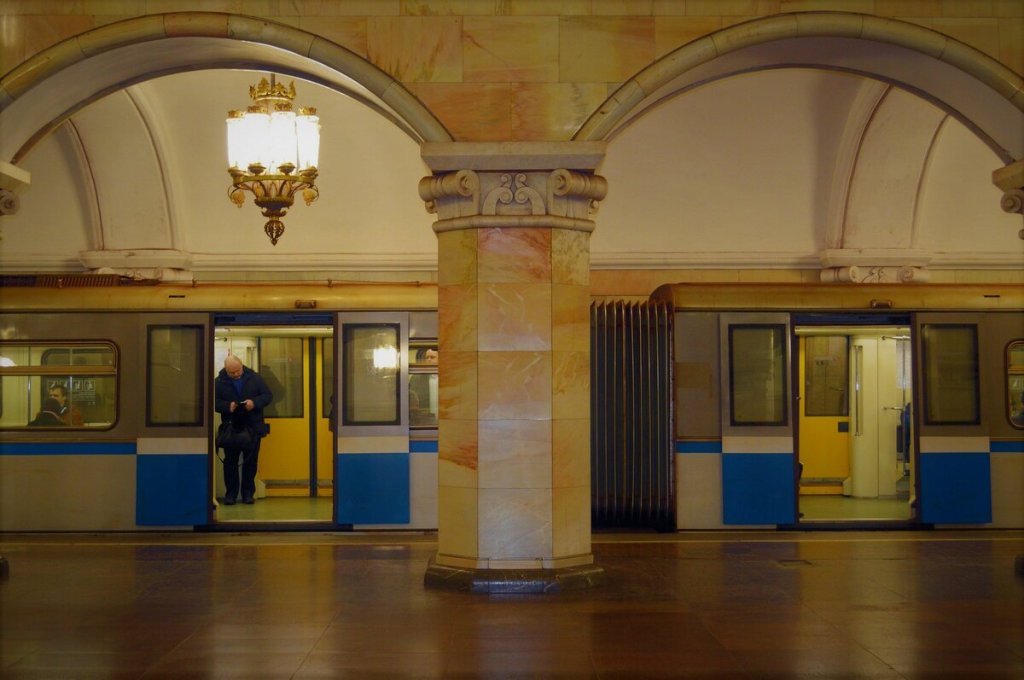
“There are more than 485 air fresheners in operation: they were installed in the air ducts of the climate control system. They spread the fragrance around the car every ten minutes. The fragrance is called ‘Moscow Metro,'” explain the metro’s press service , stressing that all the aromas were safe, hypoallergenic, and complied with regulations.

In 2019, during a vote on the project’s implementation, ninety percent of passengers surveyed said they would prefer an air-freshened carriage to a regular one. Muscovites especially wanted the smell of cherry blossoms in the subway.

Source: “Air fresheneres installed on the Filyovskaya metro line,” Russkii pioner, 3 November 2022. Photo courtesy of Russkii pioner. Translated by the Russian Reader


What attracts people [to the shot bar Fedya, the Wildfowl!]? The irony and the simplicity, but at the same time the pleasant crowd. Here you can meet people who, the day before, dined on sets [sic] of scallops and dill sauce at designer restaurants, but they are glad to eat belyash and kvass at Fedya’s. Every other table orders kebabs (from 325 rubles) and drinks tinctures and macerations. Security guards monitor everything: if you swear loudly, they will politely ask you to leave.

Source: “From brilliant shot bars to giant food halls: 12 Petersburg openings in 2022 — Vitya Bar, Noise Cabaret, Moskovsky Market, and the inclusive Outside Entrance,” The Village, 5 December 2022. Photo courtesy of The Village. Translated by the Russian Reader

The “Fedya, the wildfowl!” scene from the beloved Soviet comic crime caper The Diamond Arm (1969), starring Andrei Mironov and Yuri Nikulin

Lena and Katya, Authors of “Summer in a Young Pioneer’s Tie”

Lena Malisova and Katya Silvanova

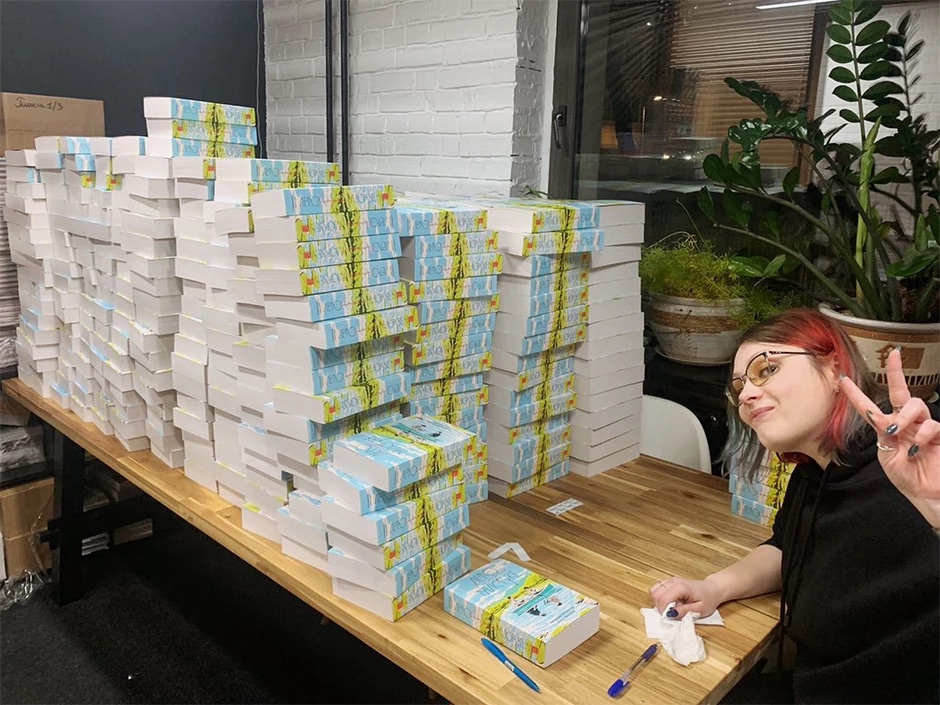
More than 200 thousand copies have been sold — an absolute bestseller. Its authors, Katerina Silvanova and Elena Malisova, did not expect the novel to take off. In 2021, one of the readers of A Summer in a Young Pioneer’s Tie made a TikTok based on the book that went viral. “We had a wild number of views — it was surreal,” recalls Katya. A month after its publication, homophobes drew attention to the book: threats to imprison, rape, kill, burn, and drown the authors along with their novel rained down on social networks. By the end of this summer, the scandal around LVPG [as the novel is known to fans] had ballooned to calls to remove the book from stores, while politicians in the regions went so far as to burn copies of the book. Russia has now adopted the most scandalous law of recent years — a complete ban on LGBT propaganda [see below]. A Summer in a Young Pioneer’s Tie has again been cited by officials as the [negative] “gold standard”: this is what has been target by the state’s hatred.

Who are Katerina Silvanova and Elena Malisova? Where are they from? How did they become writers? How did they manage to write the year’s biggest book? Special to The Village, journalist Anya Kuznetsova traced their real-life stories from childhood to the present day.


In brief: what is the book itself about?

The plot centers around the relationship between two young men — Young Pioneer Yura and camp counselor Volodya. They meet at the Ukrainian summer camp Swallow in 1986, forming a friendship that eventually blossoms into a teenage romance. It is difficult for the characters to accept their homosexuality. Volodya suffers from internal homophobia and worries that he is “seducing” the Young Pioneer, while Yura does not understand what his lover feels and tries to conceal his affection.

The authors of the novel raise topics that are sticky in post-Soviet society: the stigmatization of LGBT people, the inability to openly build relationships, and the need to constantly ensure that they are not disclosed. This is clearly seen in the episode when one of the Young Pioneers, Masha, tries to report Yura and Volodya’s relationship to the authorities, which may threaten the counselor with expulsion from university.

Another feature of this text is a style typical of fan fiction. Using a simple, accessible language, Elena and Katerina have created a text unique in Russophone literature. Yes, the topic of same-sex love has been raised before — for example, by the poets Mikhail Kuzmin and Sofia Parnok — and critics have detected homoerotic motifs even in the fiction of Gogol and Tolstoy. But the authors of LVPG have been, perhaps, the first to succeed in producing a genuinely popular Russian-language text directly describing a romantic relationship between men — so much so that it has been banned.

A year later, in the midst of the hype around LVPG, Popcorn Books published a sequel to the novel, What the Swallow Won’t Say (aka OCHML). The events in the new novel unfold twenty years after Yura and Volodya parted: they never managed to meet again after their time at summer camp.

The characters are now adults, living their own lives. Volodya runs his father’s construction company and is in an abusive relationship with a married man, while Yura has moved to Germany and writes music. They accidentally meet again and try to build a relationship, but it’s not so simple. Yura suffers from writer’s block and alcoholism, while Volodya suffers from self-harm and controlling behavior.

Although OCHML continues the plot line started in LVPG, the book is anything but an easy read: the authors delve deeper into the stigmatization of the LGBT community, while simultaneously exploring addiction, abuse, violence, and conversion therapy. You can read more about the second part in Bolshoi Gorod.


Lena Malisova

Part 1. Lena Malisova’s story: Childhood at a sawmill, abuse, and the death of her father

Kirov in the 1990s is where the future writer grew up. Lena’s parents owned a sawmill in the village of Suzum (Kirov Region) and took their daughter with them, says Malisova.

“The sawmill was in the forest, and I often walked through this forest at night. A stunning starry sky, snakes hiding in the grass. It seemed to me them that I only had to go outside and I would definitely encounter a goblin or a little mermaid.”

At first, Lena’s parents read to her, but later she read to herself. She read the tales of Hoffmann, the Brothers Grimm, and Andersen, Gerhart Hauptmann‘s novels Atlantis and The Whirlwind of Vocation and, later, Goethe’s The Sufferings of Young Werther.

As a teenager, Lena became interested in heavy music, and wore torn jeans and a bandana. Goths, metal heads and bikers emerged in Kirov. Lena listened to black metal, Lacrimosa, and Korol i Shut, and started hanging out with the “informals” who met at the Kalinka store to play guitar and discuss music. It was there that she met Vlad, her future boyfriend.

“He seemed nice and gallant to me, and paid me a lot of attention. He said he couldn’t live without me, and at the time I took those words seriously. Together we listened to music and watched music videos, and he copied magazine pages for me. At the time I believed that I was difficult to fall in love with, and his attentions won me over,” the writer says.

Over time, Vlad’s attitude towards Lena changed. According to her, the young man didn’t like her friends, calling them whores and asking her to stop hanging out with them. Vlad was jealous of Lena and tried to get her to develop complexes, calling her fat, and if she hung out with other guys, he said that she was a whore. It was then that Vlad hit her for the first time.

“When something bad happened to him, he projected his emotions onto me. For example, I wouldn’t ask how his day had been, or I’d talk to another guy, and he would light up, thinking I didn’t love him or was cheating on him. It was the whole circle of abuse: the outburst, the beating, the promise to improve, and the reconciliation, and after a while everything would repeat again. I understood I was in a bad relationship, but I couldn’t explain why. I thought that if I broke up with him, no one would want me. It was painful without him, but it was worse with him. I hid the bruises and deceived my loved ones,” Lena recalls.

Hanging out with peers helped Lena to get out of the relationship. A club was started at her school in which the kids involved organized celebrations and came up with contests. Hanging out with other teenagers, Lena realized that there was a life without humiliation and aggression, that there was friendship, support, and mutual assistance. Vlad noticed that she was moving away, and there were more quarrels and violence. When it had reached a critical point, they broke up.

“I am convinced that my desire to write texts about LGBT people is connected with the abusive relationships in my youth. I understand that victims of violence and LGBT people living in a homophobic environment are oppressed. They are in a terrible situation, they can’t do anything: they can’t help themselves and no one can help them. When I think about it, I remember my personal experience. And I want to support them emotionally, to say that they are not alone, here is my hand of support. I believe that literature can change the world,” the writer explains.

After leaving abusive relationships and going to high school, Lena met her future husband Ilya. They were also connected by music — Ilya played the guitar. When Lena turned eighteen, the couple decided to get married. The wedding was scheduled for December 2006. But a month before that, a tragedy occurred in the young woman’s family: her dad died in a fire at the sawmill.

“That night, during the fire, Dad was at the sawmill, and we did not completely believe that he had been there. A body was found in the morning. I couldn’t believe for a long time that my father was dead. He often went on business trips, so I thought that he had just gone away this time as well. We buried Dad in a closed coffin,” Lena recalls.

She says that she still could not acknowledge his death. When her father-in-law died, she cried for several days. This was her way of mourning her father.

Katya Silvanova

Part 2. Katya Silvanova’s story: Childhood in Kharkiv and acceptance of her bisexuality

Katya is four years younger than Lena. She spent her childhood in Ukraine, in her hometown of Kharkiv. Currently, the Kharkiv region is being shelled by the Russian military. The lights are constantly turned off in the city for several hours at a time, and the metro comes to a standstill.

Remembering her Kharkiv childhood in the late 90s and early 2000s, Katya says that she was outside in the courtyard a lot. She hung out a lot with the neighborhood kids and constantly rescued animals.

“There was a cat Frosya on our street who suddenly began giving birth. My friend and I stole milk from the house, delivered the kittens, and got them on their feet. Then we picked up a dog that someone had thrown out of the car. We raised money and took it to the vet. And I often went to visit my grandmother in Kryvyi Rih, where I played with the chickens and goats.”

Katya was closest to her mother.

“She read a lot and watched auteur cinema. I always wanted to be with her and her friends. My relationship with my father didn’t work out — he drank and cheated on my mother,” says Katya.

Katya also became interested in reading thanks to her mother — she bought the girl Jules Verne’s In Search of the Castaways. It was followed by Tom Sawyer and, later, Harry Potter, Tanya Grotter, Night Watch, and fantasy novels. It was then that the future writer began inventing worlds, generating ideas from what she viewed and read, and developing characters.

Some readers have criticized LVPG for being written by two heterosexual women. It’s not like that: Katya is bisexual. She thought about her sexuality for the first time in the tenth grade.

“A new girl transferred to our school, and we became friends because we were interested in anime and read manga and fan fiction. I can’t say for sure why yaoi and yuri manga didn’t cause me any surprise. At the age of fifteen, I just accepted as a fact that this exists, that these people exist, and they are no different from us. And then my friend kissed me. That’s how I realized I was bisexual.”

It was not easy for Katya to accept her orientation.

“When people in my group of friends found out that I liked girls, they looked at me strange. When I tried to talk to my parents about LGBT people — not specifically about myself, but in general — their reaction was abrupt and negative.”

The reaction of those around her triggered internal homophobia: Katya began to think something was wrong with her.

Literary representations of her experience helped Katya to cope.

“There are now a lot of LGBT books, films and TV series. But back then I found representations in the yaoi and yuri fan fiction based on Naruto, the comedy manga series Gravitation, and the old anime series of Ai no Kusabi.”

Writing LVPG helped Katya reconcile her parents with her sexuality.

“I told my mom that I like women this year. It took me a long time to work up to it. She was influenced by LVPG — when she was reading the novel, she asked me to explain everything, and I worked on destroying her stereotypes for several years. But in the end, when I told her about myself, she wasn’t surprised. She boldly accepted everything.”

“I now relate to the LGBT community positively and even sympathetically. But it wasn’t always like that. My attitude and acceptance of this topic was completely shaped by Katya. When she was writing the book and I was reading it, we talked a lot, arguing and discussing things. It wasn’t easy to read at first: I was constantly tripped up by the idea that we were talking about two guys. But her talent won me over, and I read the second part of the book excitedly,” says Katya’s mother.

Katya’s maternal grandmother also read LVPG and easily accepted the book’s homoerotic relationships.

“So the lads love each other? Then let them love each other. What’s the big deal? It’s basically a wonderful book,” she argues.

When Katya turned twenty-two, the Euromaidan happened. Due to a fall in the value of the dollar, the trading business owned her by mother was threatened, and the family did not have enough money to buy new pants to replace torn ones. At the time, the future writer had been dating a guy from Nizhny Novgorod and decided to go and stay with him. She recalls the move as fraught with anxiety.

“People were condescending when they found out that I was from Ukraine. But it wasn’t sympathy — they considered me a refugee. It was not an equal relationship, in fact: they put themselves above me, saying that I was poor and unhappy, that I had come to seek shelter in Russia, because allegedly Ukraine was bombing us. Of course, not everyone was like that, but I often encountered a dismissively sympathetic attitude.”

Part 3. Ficbook: Meeting and Working on “Summer in a Young Pioneer’s Tie”

The young women met in 2016 thanks to Ficbook — a website where non-professional authors post their fan fiction, that is, new works based on famous works or characters that are not in any way approved by the authors of the originals. Both Katya and Lena found their way to Ficbook by reading LGBT literature: Katya was looking for representations of same-sex relationships, while Lena wanted to learn more about the lives of LGBT people.

“I was then working at a company where I made friends with a gay guy who was HIV positive. I was shocked and worried and wanted to find out how to help him. I was looking for information, for diaries of people with HIV, and eventually came across Ficbook,” says Lena.

Over time, the young women found the website’s “Originals” section, where authors publish works based not on existing works, but involving completely fictional worlds. Katya and Lena began posting their texts, and having stumbled upon each other’s work, they met on Skype call, during which the authors discussed their works.

“Katya won me over. We were in an environment in which everyone would try to offend and criticize each other. Katya is not like that, that’s why I liked her. I was reading her texts and knew her as an author even before I met her, and in her works I had seen a lot of similarities with my own — she focuses on the same details as me. We rang each other up to read our texts to each other,” Lena recalls.

“It was the first time I felt synergy,” Katya adds. “Lena is very smart. All you need to know about her is that we once sat down to watch a three-hour film about Alexander the Great, but the viewing dragged on for almost five hours. Lena was constantly pausing the video and saying things like, ‘That is the phalanx of Alexander the Great: I will now draw a diagram to show how it works.'”

Katya and Lena’s first meeting, Moscow, 2016

The idea to write something about a Young Pioneer camp came from Lena, who was working a lot at the time and wanted to read a summer novel in her spare time. She asked Katya to write such a work, but in the end they decided to work on it together. They telephoned each other, outlined a plan, and divvied up the responsibilities. Most of the text was written when Katya traveled to Moscow to visit Lena. When the book was finished, the young women decided to publish a small edition for themselves and friends: they chipped in and printed four hundred copies.

The writers began getting. messages, suggesting that they send their manuscript to Popcorn Books.

“Our thought then was, Come on, this is a real publishing house that publishes books by André Aciman and other famous foreign authors. Where do we fit in? Plus, we believed that no one would publish a Russian LGBT book. But when Popcorn Books started soliciting works from Russian-speaking authors, Lena said, ‘Yes, let’s give it a try. They will turn us down in any case, but they promise feedback — let’s treat this as experience,'” recalls Katya.

In response to the submission, the young women received a letter that read: “Hello, we really liked your book, and we want to publish it.”

“I sat stupefied for ten minutes, thinking that I had read it wrong,” Katya says. “I sent it to Lena, and then the screaming started. We couldn’t believe it. Lena said, ‘Do you mean to say that my book will be sold in a bookstore?'”

Part 4. “Of course, I didn’t read the Young Pioneer camp faggotry”: How homophobes have reacted to the book

Reactions to the book have varied. In addition to letters of support, the young women have received a lot of hate mail. They have been criticized by film director Nikita Mikhalkov, writer Zakhar Prilepin, journalist and writer Mikhail Shakhnazarov, and Vostok Battalion blogger Vladlen Tatarsky, among many others. Some of the posts were threatening and offensive. Prilepin said he wanted to burn down Popcorn Books, while Tatarsky called the writers “two broads” who look “as if they had come to a casting of Battle of the Psychics without masking their witchy essence much.”

The Village contacted Tatarsky.

“Of course, I didn’t read the Young Pioneer camp faggotry. There is nothing edifying about hyping the topic of homosexual relations. That’s all. If the book even discusses the pedophile movement neutrally, it clearly puts the topic on the [public] agenda,” he says.

We were unable to contact Prilepin, who hung up the phone when we called him.

Shakhnazarov also refused to be interviewed by The Village.

“I familiarized myself with your publication and with your questions,” he wrote. “Do you understand what’s the matter? Your readers are unlikely to understand and accept my answers, and therefore an interview is pointless. One thing I can say for sure. Summer… is not even a literary composition. It’s neither pulp fiction nor literature. And if it has no artistic value, there is nothing for us to talk about.”

The first edition of LVPG

The critics were later joined by the authorities, who proposed a law that would completely ban LGBT literature.

“We were monitoring every hour what appeared in the news. We watched this chimera grow. First there was Prilepin, then the Sevastopol [State Duma] deputy who proposed the law. The trigger was not the book, but the sudden realization by people in power that such literature was being read, that it was popular. They can’t get their heads around it. While I have a strong sense of guilt and blame myself for everything in the world, I don’t blame myself for this law. It is not us who should be blamed, but the people who passed it,” Katya argues.

Tatarsky, who supported the law’s passage, when asked about the connection between the law bill and the novel, argued that everything was complicated.

“Everything in Russia is contradictory,” he said. “We have a law on LGBT propaganda, but they take a gay man [Anton Krasovsky] and make him director of RT, showing that you can be successful while being gay. Everything happens inconsistently in Russia.”

“LVPG has become a litmus test,” Lena replies. “It has highlighted the fact that the authorities were wrong in how they thought about LGBT. For a long time it was hammered into everyone’s heads that the entire Russian society was solidly against LGBT people. But our book has shown that this is not the case, that there are many more humanists and sympathizers than they thought.”

Part 5. War: A grandmother in Kharkiv and leaving Russia

On February 24, Katya woke up to a message from a close friend in Kharkiv: “He [Putin] started bombing.”

“I got onto the news and found out the whole story. I went to call my mom,” Katya says.

“In the morning, I opened my eyes and immediately closed them with the thought, No, I don’t want to wake up, because there is war. I think all Ukrainians felt about the same,” Katya’s mother recalls. “My family and all my friends were in Kharkiv, which was bombed daily. I experienced every attack together with them. Also, my Katya was in the country that had attacked us. Daily Skype conversations with her helped me to stay afloat and not go crazy.”

On the evening of February 24, Katya got more terrible news: her paternal grandmother had died during the bombing.

“When Kharkiv was bombed, my grandmother was scared. She didn’t know what to do. She ran out of the house, thinking about whether to go down to the basement or not. She had a heart attack,” Katya says.

The body was not retrieved for two days — the police, who handle such things, refused to go outside while bombing was underway.

On the second day of the war, Katya traveled to Lena’s house. Together they doomscrolled and watched YouTube. The young women say that mutual support helped them survive this period.

“Lena knows how to take care of others,” says Katya. “She doesn’t ask you how things are going when things are bad. She says, ‘If you want, come over. We’ll pretend that everything is fine and distract ourselves. If you don’t want to pretend everything is fine, we’ll look at the news bulletins from the front and have a beer.’ [To cheer me up] she can write one more time that [Putin] will kick the bucket soon.”

Katya says that since the beginning of the war she had been thinking a lot about leaving for Ukraine.

“Every day I was calling my mother and a friend who wrote to me hysterically from a basement. It was impossible: I would call my mom, and there was a window opening behind her. I kept thinking: what if a rocket hits her now?”

In the summer, in the wake of the hate campaign against LVPG, Katya decided to leave Russia. She has been in Ukraine for more than two months.

“When you can’t help your family and friends, and they write and tell you what’s going on, it’s much worse for you. Maybe I’m in more physical danger now, but mentally I’m much better,” she says.

“I did not pass through hot spots, but I did go through checkpoints. There were military men on the bus with me — whether they were police or AFU, I don’t know. The bus was going to Zaporizhzhia, the closest point to the front. This was the most vivid testament to the fact that the country was at war,” Katya says, adding, “Another vivid impression has been the people. I’m used to the fact that in bureaucratic organizations, in stores, and on the street [in Russia], you’re afraid to say too much, because people might suddenly turn out to be vatniks. Everything is different in Ukraine: I go to the store, and everyone smiles and is helpful. When I was getting my papers sorted, I said that I was from Russia and I thought they would rip me to shreds there and then. But ultimately, they explained everything decently. They told me not to worry and calmed my mother.”

Katya Silvanova is still in Kharkiv.

“When the war began,” she says, “we received many messages from Ukrainians, for whom this text was an outlet in a terrible time. I got a letter from girl from Mariupol who read LVPG during the bombing. We write for the sake of such reactions.”

Source: Anya Kuznetsova, “Who are Lena and Katya, the authors of ‘Summer in a Young Pioneer’s Tie’? Kharkiv, coming out, a sawmill, and haters,” The Village, 1 December 2022. All photos, above, were provided to The Village by Ms. Silvanova and Ms. Malisova. Translated by the Russian Reader

Russian President Vladimir Putin signed a law expanding the existing ban on the prohibition of “LGBT propaganda” to children to include the entire population on Monday.

People of all ages are now banned from accessing certain content under the new legislation. From now on, LGBT relationships and “lifestyles” cannot be displayed or mentioned, according to activists.

The display of LGBT relationships is also banned from advertising campaigns, films, video games, books and media publications. Outlets that break the new law could be fined or shut down by the government.

Organizations could be fined up to 4 million rubles for spreading information about “non-traditional sexual relations” among minors or exhibiting information that “can make minors want to change their gender.”

Under the new law, foreigners who break the law would be expelled from the country.

As part of the Kremlin’s conservative agenda, Russia banned “propaganda of non-traditional sexual relations” toward minors in 2013. A fine or 15 days in prison may be imposed for such “propaganda,” under current laws.

In Russia, homosexuality was a crime until 1993, and until 1999 it was regarded as a mental illness.

Source: “Putin Signs Expanded Law Banning ‘Gay Propaganda,'” Moscow Times, 5 December 2022

Dmitry Skurikhin’s Anti-War Protest Store

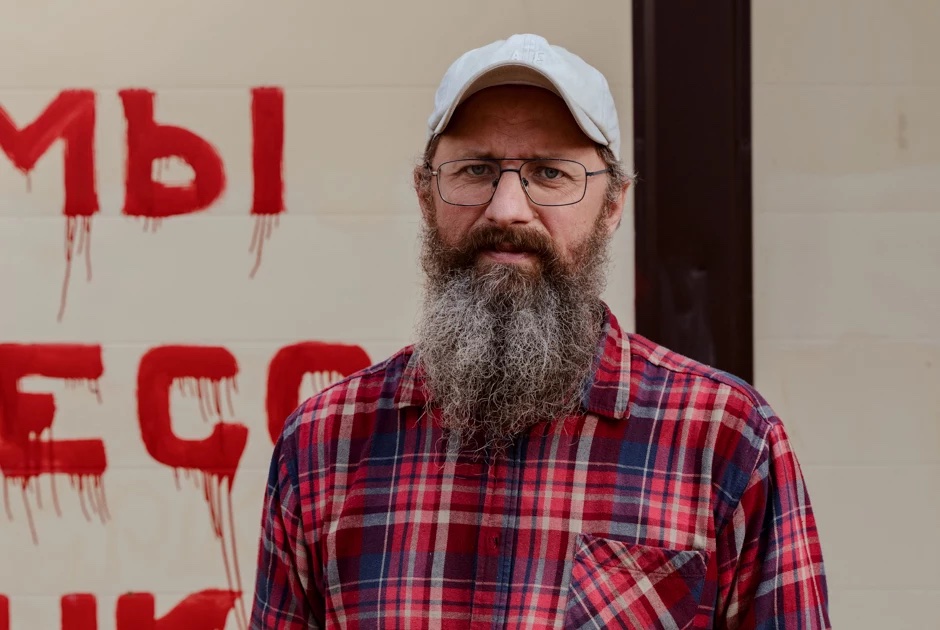
Dmitry Skurikhin

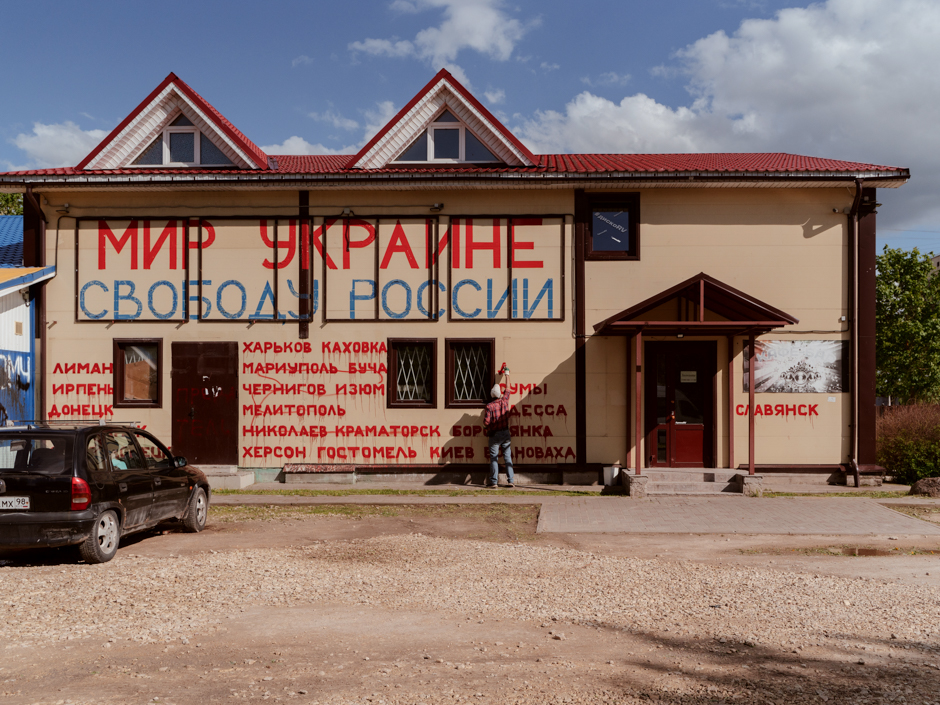
On Yandex Maps, almost all the roofs of houses in Russko-Vysotskoye, a settlement near St. Petersburg, are gray, but one sports the colors of the Russian flag. This is Iren, a shopping center owned by local businessman Dmitry Skurikhin. He had the tricolor painted on the roof ten years ago. But this year he ordered a nine by two meter yellow banner from a friendly printing house and on May 7 installed it on the blue section of the roof.

“I defiantly sided with Ukraine. And everything is fine — the villagers say hello to me, no one tells me to buzz off. I regard this as unequivocal support,” says Skurikhin.

He has turned the front of his store into a political statement and, despite numerous fines, he has no plans to stay silent or leave the country. Dmitry Skurikhin told The Village why he doesn’t worry when people scrawl the word “traitor” on the walls of his store, how he drives a vehicle with a “No war!” sticker (while his former best friend drives a car marked with a Z), and what tricks the activist has for communicating with rural policemen.

The front of Dmitry Skurikhin’s store: “Peace to Ukraine! Freedom for Russia!” is painted on it, along with the names of Ukrainian cities and towns attacked by the Russian army.
Russian businessman and anti-war activist Dmitry Skurikhin

How the protest store works
Dmitry Skurikhin is forty-seven years old. He was born in Russko-Vysotskoye and graduated from school there. He studied electrical engineering at the Voenmekh (Military Mechanical Institute) in Petersburg, and is an officer in the reserves. He went into business in 1996. In 2009, he went into politics when he was elected to a five-year term as a municipal councillor in Russko-Vysotskoye.

Dmitry has five daughters. The eldest recently married, while the youngest are still in school. “Four years ago, there was this incident. I came to the school and saw a portrait of Putin on a stand in a classroom. I demanded that the teacher take down this poster. They took it down!”

The businessman has two stores in total. The first is in the neighboring village of Yagelevo, and it has no political murals. The second one is in his native settlement. This is the Iren shopping center, named after the river in the Perm Region, where Dmitry’s parents came from. On Iren’s ground floor are Wildberries, Ozon and SDEK delivery points, a flower shop, a shoe repair shop, and a small gym; on the second floor, there is a tailor’s, a manicurist’s, a hairdresser’s, and a game room. Behind the facade of the building inscribed with the slogan “Peace to Ukraine! Freedom for Russia!” is a 256 square meter banquet hall. “Weddings, wakes, and rural discos-cum-fistfights are held there,” says Dmitry. According to him, there have been an especially large number of wakes recently.

How the war has impacted Russko-Vysotskoye
“Words are my weapons. I am trying to convince my fellow villagers that freedom, democracy, human rights, local self-government, and separation of powers are the road to prosperity,” the businessman says.

“We basically have nothing to say about Dmitry Skurikhin’s activism. It is, rather, reflected only in his posts on the internet, not in the life of the settlement,” the moderators of the Russko-Vysotskoye group on the VKontakte social network wrote in reply to a query from The Village.

The first mention of the settlement dates back to the sixteenth century, but there are no historical buildings left except for the ruins of the Church of St. Nicholas the Wonderworker. The population of Russko-Vysotskoye is about five thousand. Many worked at a poultry plant, the main local employer (in terms of volume, it was among the top five agricultural enterprises in the Leningrad Region). But in the second month of the “special operation,” the factory management announced its closure, citing plans to build housing on the site. Then Leningrad Region Governor Drozdenko reversed the closure, and in June, after two months of downtime, the poultry plant is scheduled to resume production.

“Our store survives due to the fact that we sell on credit. We’ve got debtors up to our eyeballs. These are people who are three days away from retirement, but have no money. They come to buy bread and potatoes. We sell them in irregular batches. For example, there are people in the village who cannot buy a dozen eggs and buy four eggs instead. This is telling,” Skurikhin replies when asked about the war’s impact on Russko-Vysotskoye’s economy.

How the activist is fined for posters
The inscription “Peace to Ukraine! Freedom for Russia!” appeared on Skurikhin’s store in 2014, after the annexation of Crimea. This was followed by many (about two hundred) political posters. Skurikhin orders them from the same company that made him the yellow stripe for the roof, whose name he won’t disclose. “You can say that I am a small-town activist who voices his stance on any occasion. Some event happens — for example, [Russian opposition politician Boris] Nemtsov was killed [on 27 February 2015 in Moscow] — and I put up a poster.” The businessman fastens the posters with screws at a height of six meters on the same wall as the inscriptions.

The posters hang for an average of two to three hours. Then the local council sends an employee with a ladder and a screwdriver, and the police arrive from the 114th precinct in Annino, fifteen minutes from Russko-Vysotskoye. The posters are taken down. “The police officers in rural areas are smart, intelligent, decent, normal people. Not like in the city. They’re almost all on my side. It’s another matter that they have their orders and their oath,” Skurikhin argues.

Then Dmitry is fined. At first, the fines for “violating landscaping rules” were 300 rubles, but then they went up to three thousand rubles. (“As the secretary of the administrative commission told me, ‘They increased it especially for you, because no one else in the region is being punished under this article.'”) The last fine was issued under the new law on “discrediting the army.”

How they’re trying to prosecute Dmitry for “discrediting the army”
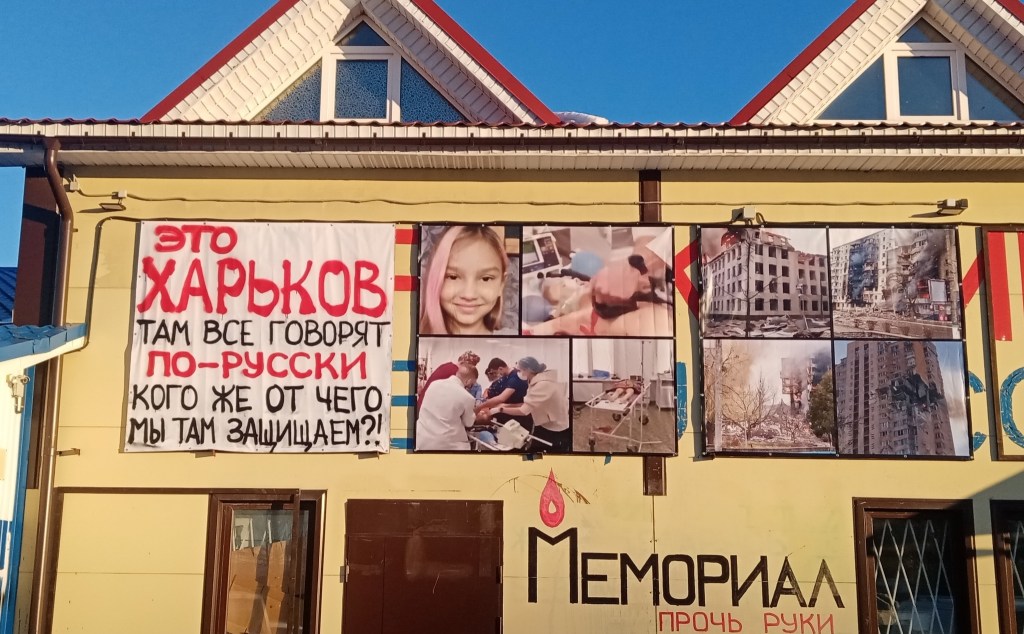
On March 5, the State Duma passed a law according to which people can be fined for “discrediting the army.” On March 6, Skurikhin hung a poster on his shopping center depicting residential buildings bombed in Kharkiv and a Ukrainian girl who had been killed. On Facebook he wrote, “Perhaps this is my last publication. Just in case, goodbye, my friends.”

“This is Kharkiv. Everyone speaks Russian there. Who are we defending there and from what?”
Photo courtesy of Dmitry Skurikhin’s Facebook page.
This image was not part of the original article on The Village, although there was a link to it.

The farewell was premature — Dmitry was only fined 45 thousand rubles [approx. 750 euros]. (He has challenged the fine in court.) And not so much for the poster itself, as for the story he told about it on Telegram, which follows from the charge sheet for the administrative offense: “68 views were made [of the post]; the channel has 23 subscribers.”

Later, another charge was filed against the activist under the same article in the administrative offenses code (there has been no court hearing yet) for reposting one of the blogger Rustem Adagamov’s posts. Skurikhin says that now he has a “standing invitation” on WhatsApp to come in and face a third set of charges, and shows us his correspondence with the policeman involved. The summons is preceded by the New Year’s greeting car that the law enforcement officer sent to the businessman six months ago.

Earlier, Dmitry says, the local beat cops themselves came to deliver the summonses, but they got tired of it. “Rural police,” he says, “have a lot of cases to deal with, and here they’re being sent to deal with nonsense. They said the hell with it.”

How the activist was called a traitor
While we are talking, a local passes by and asks Dmitry how things are going.

“I’m alive and well and at large,” the activist replies.

Dmitry Skurikhin, as one of the few public anti-war activists who have not left Russia, is regularly visited by journalists. Recently, three foreign media outlets were doing stories about him at once: the BBC, Belsat, and Stern. Reporters like to ask the opinion of passerby about Skurikhin’s “protest wall.” “He’s an idiot,” one of the respondents told Steve Rosenberg of the BBC. Another noted that Dmitry “has the right to express his opinion.”

Skurikhin is grateful to journalists. “If it weren’t for their attention, activists would be” — he rubs an imaginary powder in his palms — “and everything here right down to the lawn would be demolished,” he says.

At the end of March, the activist painted the names of Ukrainian cities that had been attacked on the front of the store. Then he regularly supplemented the red list. When we were there, he painted in two more names: Dnipro and Sloviansk.

But on the night of April 15, three unidentified people scrawled the word “traitor” on the Iren shopping center and deposited a pile of manure outside the entrance.

“They thought they would present me in an unfavorable light to my fellow villagers. It turned out the opposite. A woman passes by: ‘Dima, don’t touch the manure, I’ll take it myself, I need it for the garden.’ Or I go out with a bucket of yellow paint to paint over the graffiti, and an old-timer stops me. ‘Are you going to paint over the [names of the] cities?’ he asks. ‘No, just the word “traitor,”‘ I say. ‘Ah, paint over “traitor,” but don’t touch the cities,'” the activist recounts.

As this article was going to press, the walls of the shopping center were again vandalized. An unknown man on a bicycle wrote the words “traitor,” “freak,” and “moron” next to the names of the cities.

How the businessman interacts with his opponents
“A person can come up to me on the street and yell that I’m an asshole. Be my guest,” the activist says. He has many opponents in the settlement.

As for the Z symbol in Russko-Vysotskoye, according to Skurikhin, there is one on the car of the deputy head of the local administration.

“We were in school together for eleven years. We were very friendly. I wrote to him: ‘Lyosha, what did you put such a thing up for?’ He replied: ‘Dima, you have reached a new low.'”

His friendship with his classmate, according to Skurikhin, was long ago undone by political differences.

“It’s his people who take down my posters,” the activist explains, adding about his former friend, “He’s a good guy, but he’s an UnRus [a member of the ruling United Russia party].”

The official told us in a telephone conversation that he really was in the same class in school as Dmitry Skurikhin, but they were never friends. He did not comment on the activist’s work, saying only, “Our positions are diametrically opposed. You could say that we are ardent opponents.”

The businessman himself pastes a “No war!” sticker on his car.

“The response has been only positive. No, sometimes I see a sour expression on someone’s face. But people who do react [give me a thumbs-up] — attaboy!”

How Skurikhin decided not to shave his beard
“I’m afraid. What then? I can’t stop campaigning,” the activist says in answer to our question whether he is afraid of facing criminal charges for spreading “fake news” about the army, like artist and musician Sasha Skochilenko, “ordinary person” Vika Petrova, Skurikhin’s ally the activist Olga Smirnova, and many others.

He has no plans to leave Russia. But he does not condemn emigrants — on the contrary.

“Good, decent anti-Putin people are leaving. And there is a plus in this. Perhaps the whole world will judge Russia by them. ‘Look, not all Russians are idiots!” But I’ll go on here. If they put me in jail, I’ll sit in jail.”

At the end of the interview, Dmitry asks us to ask him a question about his beard and immediately tells us that on 23 January 2021, he shaved and went to downtown Petersburg for a rally in support of Alexei Navalny. There he was detained and jailed for twenty days. During those three weeks, Skurikhin grew out his beard and made a bet with a cellmate that he would not shave while Putin was in power.

“My cellmate told me, ‘Dima, you’re going to be playing Santa Claus without makeup.’ We’ll see. For some reason it seems to me that I will be shaving my beard off soon.”

Source: “‘A man can come up to me on the street and yell that I’m an asshole’: How a businessman turned his store into a political statement,” The Village, 14 June 2022. Thanks to JG for the story. All images courtesy of The Village, except where noted. Translated by the Russian Reader

“It’s our soldiers, our [Russian] troops, fighting there. Not Martians, but our people. And we are responsible for them. These people exist on taxes, including my taxes. I pay roughly 1,200,000 rubles [$19,500] a year in taxes. Our authorities buy weapons with this money and dispatch our fellow citizens to murder Ukrainian children.”

On the front of his village store, Dmitry Skurikhin paints the names of Ukrainian cities that have been bombarded.

“My heart simply aches when I see what is happening there. I simply cannot stand it. I paint the [name of the] city and I feel better. What if I could do something more? But it’s society that has to do something. I’m campaigning for our society to understand and accept this viewpoint — that we cannot be doing this, that we urgently have to stop it. At first I thought that half [the Russian people] supported the ‘special operation,’ but now it is fewer. It has begun to sink in that this is madness.”

Dmitry Skurikhin has opposed the actions of the Russian authorities since 2014. 

“The Putin regime should simply be eliminated. They are occupiers — they have occupied our country, do you understand? And they treat our country like occupiers, meanwhile fooling our people with their propaganda.”

Businessman Dmitry Skurikhin regularly hangs up posters featuring anti-war slogans on his store.

“The police just come up and take them down. I’ve been charged twice with the newfangled crime of ‘discrediting’ [the Russian army]. From their point of view I’m discrediting our Russian army simply by showing my fellow villagers what is happening in Ukraine.”

Fines for discrediting the Armed Forces of the Russian Federation can lead to up to five years of imprisonment. 

“People see this and it stays in their heads. Now it is just sitting there, but later it will become an itch and then turn into something unbearable. Putinism is a cancerous tumor, a disease of our society. We have to vomit it up somehow. Russia is now on the side of evil, on the side of Putinism. Putinism is an evil, definitely, for unleashing such a hell in Ukraine. Consequently, Ukraine has the motivation — they are fighting for their lives, for their families, for their homes, for their land. What are we doing there? Putin has forced our society to fight against a neighboring society, instead of doing business and exchanging knowledge and services to our mutual benefit. We could live together wonderfully, but now they are our enemies for hundreds of years to come.”

Despite the fines, Dmitry continues his campaign in the village. 

“Not a day goes by when I don’t think about my security. But this is more important. It’s important to campaign, to convince people to come over to this point of view. And I won’t spare any expense or effort on it. Well, what could happen? If they imprison me, I’ll go to prison.”

Source: Current Time TV, Instagram, 21 August 2022. Subtitles translated by the Russian Reader

“An Ordinary Person”: The Story of Jailed Petersburg Anti-War Protester Victoria Petrova

Victoria “Vika” Petrova. Photo courtesy of Ms. Petrova and The Village

“I demand an immediate cessation of all hostilities and an international investigation of all crimes committed. […] I call on all Russians to fight for their rights and against the dictatorship, and do everything to stop this monstrous [war],” a young woman named Victoria Petrova says confidently and clearly on the screen in courtroom 36 at the St. Petersburg City Court. The members of the public attending the hearing — they are thirty-three of them — applaud.

A month ago, Petrova was an “ordinary person,” a manager in a small family-owned company. Now she is a defendant in a criminal case, charged with disseminating “fake news about the army,” and has been remanded in custody in the so-called Arsenalka, the women’s pretrial detention center on Arsenalnaya Street in Petersburg. The case against her was launched after she posted an anti-war message on the Russian social media network VKontakte. If convicted, she could face up to ten years in prison. In the following article, The Village explains how, thanks to Petrova’s lawyer, the case of this unknown “ordinary person” has resonated with the public, why Petrova’s mother is not allowed to visit her, and what the prisoner herself has to say.

The Case

On the sixth of May, at seven in the morning, Center “E” and SOBR officers came to Petrova’s rented apartment on Butlerov Street with a search warrant. They seized phones, laptops, and seven placards on the spot. The next day, the Kalinin District Court remanded Petrova in custody in Pretrial Detention Center No. 5 for a month and twenty-five days.

“The investigator said that, if he had his way, he would have released Vika on his own recognizance. But he was instructed to petition the court to place her under arrest,” Anastasia Pilipenko, Petrova’s lawyer, told The Village.

A case was opened against Petrova under the new criminal article on “public dissemination of deliberately false information about the deployment of the Armed Forces of the Russian Federation.” According to the new law, any information on the so-called special operation in Ukraine that does not come from official Russian sources can be deemed “fake.” In Petrova’s case, the grounds for the criminal charges were a post on VKontakte, dated 23 March 2022, and the nine videos that she attached to it, featuring journalists Dmitry Gordon and Alexander Nevzorov, and grassroots activist and blogger Maxim Katz.


Who else has been arrested in Petersburg on criminal charges of spreading “fake news” about the Russian army?

Sasha Skochilenko
artist, musician

Olga Smirnova
activist

Maria Ponomarenko
journalist (she has been transferred to Barnaul)

Boris Romanov
activist

Total number of similar criminal cases in Russia: 53 (as of May 24)


Nearly 32,000 Victoria Petrovas are registered on VKontakte, and more than 1,800 of them live in Petersburg. The Victoria Petrova in question is depicted on her VKontakte pages as a woman wearing a light beanie, glasses, and makeup in the colors of the Ukrainian flag. She has 247 friends and eighty-nine followers.

Her post dated March 23 was deleted by VKontakte at the request of Roskomnadzor two days after it was published. But she made other anti-war posts, in which, among other things, Petrova recounts how she was jailed for ten days for taking part in a protest at Gostiny Dvor. In total, since the start of the “special operation,” she was detained twice on administrative charges.

When Center “E” [Center for Extremism Prevention] and SOBR [Special Rapid Deployment Force] came for Petrova on May 6, she thought at first that she would be charged once more under the Administrative Offenses Code. Realizing that now it was a matter for the Criminal Code, Petrova wrote her mother a detailed note explaining what to do with her apartment and her cat, and what things to send to the pretrial detention center, said Petrova’s attorney Pilipenko.

Pilipenko is now the only link between Petrova and the world: no one is allowed to see the prisoner except the lawyer.

The Lawyer

Pilipenko’s mother has her birthday on February 24. On the evening of the 24th this year, she and her daughter were going to drink tea and eat cake. But [the war] started early that morning.

“People who are also opposed to [the war] are taking to the streets. The police are putting them in paddy wagons. They face fines and arrests. Cake is canceled — I have work to do […] I am spending the night at a police station,” the lawyer wrote in her Telegram channel. She spent a month and a half working this way.

Pilipenko is thirty-five years old. She graduated from the Northwestern Branch of the Russian State University of Justice. For a year she worked as a clerk in the Leningrad Regional Court. “It was like going into the army,” she says. Usually clerks eventually become judges, but Pilipenko first became a lecturer, then a barrister. “I would never have become a judge, I would not have been able to make decisions that changed people’s lives,” she says.

Pilipenko specializes in criminal law. This is the toughest branch of the legal profession: the percentage of acquittals in Russia is negligible — 0.24%.

“But it happens that you can get a case dropped at the investigation stage. Or get the charges reduced to less serious ones. By today’s standards, that is tantamount to success for a defense lawyer,” says Pilipenko.

Pilipenko was not acquainted with Petrova until May 6, when the woman’s apartment was searched. The lawyer was asked to take the case by the Net Freedoms Project. The case is being handled by the Russian Investigative Committee’s central office.

“This means that there is no one investigator, that the entire investigative department is working on the case,” Pilipenko explains.

It was the lawyer who drew public attention to Petrova’s case by writing the following on May 11 on social media:

“Vika is an ordinary young woman. […] She has an ordinary life, goes to an ordinary gym, and has an ordinary cat. She has an ordinary job in an unremarkable company. […] Perhaps the only unusual thing about Vika’s case so far is just her ordinariness. She’s just like us. She’s not an activist, not a journalist, and not the voice of a generation.”

Victoria “Vika” Petrova. Photo courtesy of Ms. Petrova and The Village

Vika

Victoria Petrova is twenty-eight years old. She was born in Petersburg, where she graduated from St. Petersburg State University’s Higher School of Management.

“Vika had a long braid, was very serious, gave the impression of an intelligent person, and got good grades. Intuitively, I feel that Vika is childish in a good sense, unspoiled,” Sofia, a classmate of Victoria Petrova’s, told The Village.

Another friend from school, Daria, in a comment to Mediazona, described Vika as a “born A student,” a “battler in life,” and a person who “was the most organized of all.”

“And her heart always aches over any injustice,” Daria said.

Pilipenko says that Petrova is “a very calm and organized person.”

“I was amazed by this at [the May 7 bail] hearing. People behave differently when they are arrested for the first time. Vika behaved with great dignity,” Pilipenko says.

Before her arrest, Petrova lived alone with her cat Marusya. The animal is now living with the heroine’s mother, while Maruysa’s owner is now at Pretrial Detention Center No. 5.

The Arsenalka. Photo courtesy of Russian Behind Bars Prison Consultant

Arsenalka

Pretrial Detention Center No. 5 is located on Arsenalnaya Street, which is a deserted place dotted with small manufacturing facilities and the premises of the shuttered Krasnyi Vyborzhets plant, which was going to be redeveloped as a housing estate. A banner sporting the prison’s name and an image of the Bronze Horseman is stretched above the entrance to the Arsenalka. From the street side, the complex consists of a typical rhombus-shaped concrete fence, reinforced with mesh and barbed wire. A tower sheathed in corrugated iron juts out above it. On the right, behind an old brick wall, there is a a building in the shape of a cross — a psychiatric hospital “for persons who have committed socially dangerous acts in a state of insanity.” The old Crosses Prison itself, a remand prison for men, is about a kilometer away. Five years ago, all the prisoners were transferred from there to a new facility in Kolpino. The women remained in the pre-revolutionary red-brick Arsenalka complex.

Businesswoman Natalia Verkhova has described life at Pretrial Detention Center No. 5.

“The meter-thick walls and the thick iron doors outfitted with peepholes and bolts. The mattresses a couple of centimeters thick. The prison-baked loaves of bread, often burnt. The broken toilets. The concrete floors in basements where the ladies wait for many hours to be shipped out [to interrogations, court hearings, and other prisons]. The queues at the care packages office and for visiting inmates. The duffel bags chockablock with romance novels in the corridors.”

Former inmate Elizaveta Ivanchikova describes the largest cell in the Arsenalka (for eighteen inmates), to which Petrova, like all newcomers, was first assigned.

“There were nine bunk beds in [the cell]. There were bedside tables next to the beds. In the middle of the cell there was a large iron table with wooden benches. All of this was bolted to the floor. There was also a refrigerator, a TV, a sink next to the toilet, and the toilet itself, behind an ordinary door, without a lock.”

Pilipenko says that Channel One is constantly turned on in this cell and there are many unspoken rules for maintaining cleanliness.

“For example, you can only comb your hair in one place, because if eighteen ladies do it in different places, the hair would be everywhere,” says Pilipenko.

A head inmate keeps order, and at first Vika did not get on well with her. The head inmate did not like that the new girl did not know how to behave in the detention center.

“For example, when the guards come to toss the cell, you need to stand up and lock your hands behind your back,” says Pilipenko.

The conflicts were quickly settled, however, and Petrova was subsequently transferred to another cell.

This, according to Pilipenko, was preceded by an incident in the second part of May, during which plaster fell directly on the imprisoned women.

“Vika said that the girls were sitting and drinking tea when part of the ceiling collapsed on the table. Vika was not injured, but one inmate suffered bruises,” Pilipenko says.

The Telegram channel Free Sasha Skochilenko! reported that the plaster collapsed due to severe leaks: “The residents of the cell gathered the pieces of the ceiling, the largest of which weighed about three kilograms. The pieces were wrapped in sheets and the floor was swept.”

Petrova is currently in a cell for six inmates. During their last visit, when Pilipenko asked her how she was doing, Petrova replied, “You know, okay.” Petrova was surprised by her own answer.

“The letters she receives play a big role. Without them, she would not have any way to keep herself busy. This is the biggest problem in remand prison,” says Pilipenko.

The Letters

Petrova has received hundreds of letters, mostly from strangers, including from other countries. Petrova has told Pilipenko that she received a letter from a person who works in management at VKontakte. “He is upset that the social network played a role in my criminal case,” she told her.

“Vika definitely replies to all the letters. Except for those whose senders marked them with Z-symbols,” Pilipenko promises.

Petrova can correspond with other “ordinary people,” but it seems she cannot correspond with journalists. The Village sent her questions through her lawyer, but the sheet of paper with the answers was confiscated from Petrova right in her cell. Our correspondent then wrote to Petrova through the Russian Federal Penitentiary Service’s online FSIN-Pismo system. All three attempts that the The Village made to communicate with Petrova were not approved by the censor, and the negative responses came within a few hours, although the standard processing time is three days. Then, on the advice of Petrova’s lawyer, our correspondent sent all the same questions via FSIN-Pismo, but did not indicate that they were from the media. On the day this article went to press they were delivered to Petrova, but there has been no response from her yet. According to our information, other journalists have also failed to make contact with Petrova.

Petrova’s mother is also not allowed to see her daughter. According to the lawyer, one of the investigators said that “permission to meet with Mom will depend on the results of Vika’s interrogation as the accused party.” The investigators want Petrova to admit wrongdoing.

The Hearing

Victoria’s mother Marina Petrova lives in a three-room flat on Lunacharsky Avenue. Pilipenko filed an appeal against the order to remand her client in custody, hoping that “on grounds of reasonableness, legality, and humaneness” Petrova would be transferred to house arrest at her mother’s residence.

On the eighth of June, a hearing on the matter was held in the City Court. During the hearing, Pilipenko stated that her client was “actually being persecuted for voicing her opinion about the special military operation.” She also said that Petrova does not have a international travel passport and presents no flight risk, that there are no victims or witnesses in the case [whom the defendant theoretically thus might attempt to pressure or intimidate if she were at liberty], and that she had been charged with a nonviolent offense.

The defendant participated in the court hearing via video link from the Arsenalka. In her seven-minute closing statement, she explained what, in her opinion, had been happening for the last three and a half months in Ukraine.

Among other things, she said, “As a result of eight years of brainwashing by propaganda, Russians for the most part did not understand that [a war] had begun. Meanwhile, the completely immoral Z movement, ‘zedification,’ has been spreading across the country that once defeated Nazism. […] I do not feel any ideological, political, religious or other enmity towards the state authorities and the Armed Forces of the Russian Federation as institutions. In my anti-war posts, I said that people who gave and carried out criminal orders and committed war crimes should be punished for it.”

Judge Tatiana Yaltsevich denied the defense’s appeal. Petrova will remain in jail at least until the end of June.

On the evening of June 8, subscribers to the Telegram channel Free Vika Petrova! were warned that reposting her speech in court “could lead to criminal prosecution” — probably also under the article on “fake news” about the army.

The next day, Petrova commented on her speech to her lawyer.

“She says that since she has already become a political prisoner, she cannot help but use the court hearings as a means to talk about what is happening. She has not remained silent before, and she has even less desire to be silent now that many people will hear what she has to say,” reports Pilipenko.

Source: “‘An ordinary person’: the story of Vika Petrova, who wrote a post on VKontakte and has been charged with spreading ‘fake news,’ but refuses to give up,” The Village, 9 June 2022. Thanks to JG for the story and the heads-up. Translated by Thomas H. Campbell. Ms. Petrova’s support group has a Telegram channel and is circulating an online petition demanding her release.

Ten Fun Figures about the Ex-Capital of All the Russias

Ten Telling Statistics about the Petersburg Economy
Mikhail Karelov
November 3, 2015
The Village

1–2%
According to city hall’s forecasts, the city’s gross regional product will grow this much by the end of 2016.

Facade of Galeriya shopping center, downtown Petrograd

50,600,000,000 rubles [approx. 71 million euros]
Petersburg’s budget deficit in 2016.

"Crushing food in a city that survived a siege is shameful!" "I don't get it?"
“Crushing food in a city that survived a siege is shameful!” “What do you mean?”

8.9%
Decrease in Petersburg’s industrial production index year to date.

"Water level on November 7, 1824."
“Water level on November 7, 1824.”

19.3%
Decrease in production at Petersburg’s automotive production cluster year to date.

Greenlandia New Estate in Devyatkino
Facade of building in Greenlandia residential complex, Devyatkino, Lenoblast

13.8%
According to forecasts, Petersburg’s inflation rate as of January.

Advertisement in top-floor window at Kirov Palace of Culture, Vasilyevsky Island

9.3%
Decrease in the average monthly wage in Petersburg year to date. 

Cat in a courtyard off Suvorov Prospect, Central Petrograd
Photogenic cat in courtyard off Suvorov Prospect, downtown Petrograd

42,656 rubles [approx. 600 euros]
Current monthly average wage in Petersburg.

"Simbirtseva, Apt. 29. Pay your debt, rat!"
“Simbirtseva, Apt. 29. Pay your debt, rat!”

28,700,000,000 rubles [approx. 40 million euros]
Amount banks lent to Petersburg residents in the third quarter of 2015.

Statue of Lenin, Detskoye Selo State Farm
Monument to Vladimir Lenin, Detskoye Selo State Farm, Pushkin

6.5%
Increase in the amount of utilities tariffs in Petersburg, according to the “index of changes in the average amounts to be paid by citizens for municipal services in various parts of the Russian Federation in 2016.”

"Building for sale"
“Building for sale”

11%
Increase in electricity costs for individual consumers in Petersburg in 2016.

Adapted and translated by the Russian Reader. Photos by the Russian Reader
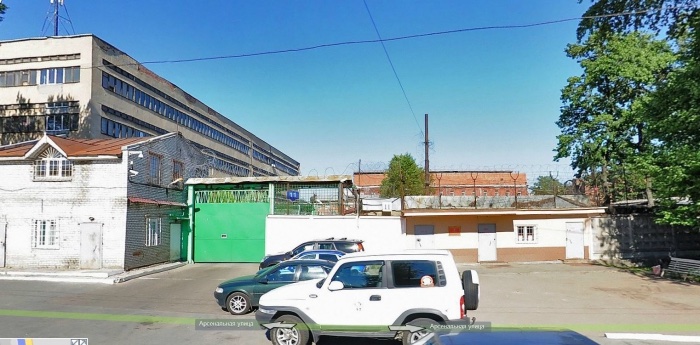
“We Are Going to Die of Hunger in October”

“We Are Going to Die of Hunger in October”: A Fruits and Vegetables Vendor on What Is Happening at Moscow’s Markets
Sasha Shevelyova and Asya Yemelyanova
August 12, 2015
The Village

A year ago, Russia imposed a ban on the import of produce in response to economic sanctions by the US, EU, Canada, Australia, and Norway. Meat and dairy products, fish, fruits, and vegetables from these countries were embargoed. As conceived by legislators, it was simultaneously supposed to deprive western producers of a significant market, and also to give an additional opportunity for domestic producers to develop.

The Village decided to find out whether the fruits and vegetables now sold in Moscow’s markets are really grown in Russia, and what market vendors think about the anti-sanctions and the destruction of contraband food. Unfortunately, the majority of vendors we asked for commentary refused to speak to the press, so we are publishing the monologue of a female vendor who asked not to be named.

still-life-peaches-1916.jpg!LargePyotr Konchalovsky, Peaches (1916)

I have been selling fruits and vegetables for seven years running. I sold baked goods before, and a girlfriend of mine who sold vegetables said to me, “You work sixteen hours a day. Why do you need that? Come work with us!” I worked in a pedestrian underpass, and the hours there were seven in the morning to eleven at night. Now they are eight in the morning to eight at night. The work here is also hard. Everything has to be sorted by hand and dragged around.

Our market has its own laboratory, and we submit produce for testing every three days. It is not cheap, a test costs from 300 to 800 rubles [approx. 4 to 11 euros, as of this writing], and we pay for it ourselves. If the tests come back negative, the produce itself and what was lying next to it are discarded.

On the Fad for Domestic Products
There is now a fad for everything domestic. There were good strawberries from Poland or Greece, but no one was buying them. But if you say they are Russian, they get bought up. But where in the heck does our produce come from? On the other hand, I have to make sales and make my wage, and so I have begun saying they are from Krasnodar or Crimea, and people buy them. They come back, saying, “Oh, they were so delicious!” and buy them again. You get asked, “Whose peaches are these?” and you say, “They’re Crimean.” But can you imagine how they would get here from Crimea? There is no way you could ship them here. They would spoil and get crushed. It is impossible to ship them.

No one knows where fruits and vegetables are imported from today. “Turkey” is printed on all the crates, but such large quantities do not grow in Turkey.

It works like this. You go to the warehouse, and a semi-trailer truck with, say, Belarusian plates is parked there. Crates from “forbidden” countries are removed from the truck and poured into others crates with no coding. Ultimately, they write, “Grown in Russia.” I really like it when they say it was grown in the Moscow Region. Are you serious? The entire Moscow Region is built up with the dachas of oligarchs, who is going to grow produce there, and where? Take Moscow’s near suburbs. Go there and see how much is being grown. You won’t find much of anything. Either you will find what gets sold in really expensive shops or what gets grown for reference, for show.

The onions, potatoes, carrots, and beets are mostly from China. We try and buy high-quality produce, and we press the wholesalers to tell us where things are from, but no one knows. You watch as cherries are poured into other boxes, and peaches are put into different crates.

The tomatoes are transferred to Russian boxes, and vendors say they are from Krasnodar, but I know I am eating a Ukrainian tomato. But I don’t know how it got here.

The tomatoes, say, have been grown in Ukraine. They were shipped to Belarus, transferred to a truck with Moscow plates, and driven further down the road.

We do not sell Polish apples. They were banned back in March. But then unmarked boxes started showing up, and no one would be able to prove they are Polish. Of course it is illegal. It is even worse in the grocery stores. They ship produce illegally directly from Belarus. Moscow has eaten Ukrainian produce its whole life, and then it suddenly became bad.

On the Destruction of Peaches
My personal opinion is that we are going to die of hunger in October, because, two weeks ago, I bought these tomatoes wholesale for 45 rubles [approx. 60 euro cents]. I am not lying. Now we bought the same tomatoes wholesale for 110 rubles [approx. 1.5 euros]. Previously, it would cost 10,000 dollars for a truck to clear customs. The truck would drive up, ten grand would be placed on the custom officers’ desk, and the truck would head on down the road. But we, the consumers, ate normally.

Now it is twenty-five grand just to clear customs. And the drivers said they have been quoted a price of 50,000 dollars just to fly through customs. But then they will be bringing fresh, high-quality, beautiful produce. Meaning, how much are they going to be selling it for? At sky-high prices, so the poor will just disappear. If they continue to let through trucks from “banned” countries, we will survive. If not, it is not clear what will happen.

We have children in the Kursk Region who have seen peaches only in pictures. How many truckloads of peaches have been destroyed now? Would it not have been simpler to distribute them to orphanages? Everything is buried in taxes. As they say, “Russia has allocated so much money.” Do you know the right way to say it? “We have the taxpayers’ money, which we can dispose of in this way.” Because this is our money, after all. It is we who are paying for everything.

On the Market
We pay vendors a wage for their services. For the tax inspectorate, we write 10,000 rubles a month [approx. 138 euros], the minimum wage, but she [sic] gets 1,500 rubles a day [approx. 20 euros]. She works for us on the books, but many people want to work off the books. No one here has believed in pensions for a long time. They are grateful for this wage, because no one can give them more. We are all people and treat each other like people. Holidays and weekends are granted on request. No one tries to kill anyone for anything; everything is negotiable. 1,500 rubles is the stable daily wage, but there are also bonuses and gifts for the New Year.

The ethnic dynasties are still relevant at the market. Everything has been divvied up long ago, things settled down way back in the 1990s. They have their pens there, but they are all in the other hall. (The market has two halls—Editor’s note.) They sort things out among themselves. And they sell their produce for twice as much, of course. The second hall is not our competition. Potatoes cost 80 rubles a kilo there [approx. 1.10 euros], while in our hall they cost 40 rubles. The customers there are loaded. The oligarchs send their drivers and housekeepers there, and they immediately pack them up with everything. That is how they live. We are focused on the middle class; we have a different audience. Now a food fair is opening here as well. We will have zero receipts.

Sometimes, the police organize raids. Half of them need to do these checks for show, half of them, for the money. But raids are unproductive at this market. Everyone has residence permits and vendor cards: market management monitors all that. In the past, it was more frightening at the open markets.

On Price Hikes
What will happen next is unclear; the prices are crazy. It would better for us to close the stall than to listen to what people are going to be saying to us. The prices are such that people simply don’t have the money to buy these things. Either you want it and you will buy it at an exorbitant price (provided you have the money) or there will be no way for you to buy it. But I always think about the elderly and children. How will they manage? A mother who has just given birth doesn’t go back to work. She has to stay home with the child for two or three years. Her husband, working alone, will not be able to manage to pay for all this. So what are they going to do? Steal? People are still surviving in Moscow, but it is terrible to think what is happening in the hinterlands, just scary.

A crate gets more expensive by an average of 100 rubles a day [approx. 1.40 euros], and there are five to six kilos of produce in a crate. For the time being, we are keeping our prices stable, more or less. But what will happen come winter? There are products like pumpkin, zucchini, broccoli, and cauliflower that a child needs to eat up to the age of one. But young families are poor, only the husband works. Prices are not falling, but the child still has to be fed. I pity them the most. And I feel sorry for the elderly, who have monthly pensions of 15,000 rubles [approx. 207 euros] and spend 13,000 rubles [approx. 180 euros] at the pharmacy.

This is how we do it. If people say they are buying produce to make compote, we give them the smaller, less expensive fruit. If they say they are making jam, we give them average-size fruit. If they are saying taking it to their daughter or someone in hospital, we give them more expensive fruit, but really good fruit. We do reorders every day, most fruits do not stay fresh longer than that. We sort everything by hand daily.

Translated by The Russian Reader. Image courtesy of WikiArt. Thanks to Comrade Nastya for the heads-up.

Happy Russia Day!

At three-thirty this afternoon I was awoken from a well-deserved nap by an incoming SMS on my cellphone, which read:

Уважаемый Клиент, поздравляем Вас с Днём России – праздником свободы, мира, равноправия и справедливости! Искренне желаем Вам и Вашим близким душевного тепла, достатка, счастливой, долгой и благополучной жизни! С праздником, Ваш “Билайн”

I.e.,

Dear Customer, we congratulate you on Russia Day, a holiday of freedom, peace, equality, and justice! We sincerely wish you and your family warmth, prosperity, and a long, happy, safe life! Congratulations, Your Beeline

Aside from irritating the drowsy me to no end, the SMS inadvertently reminded me of an article I had read earlier in the day on the topic of equality in Russia.

One in six Russians lives below the poverty line
June 11, 2015
ru.euronews.com

The numbers of Russians whose income is below the subsistence level increased by 3.1 million people in the first quarter of this year, up to 22.9 million. These figures have been published by Rosstat. The poverty rate rose to 15.9%, meaning that every sixth Russian falls into this category.

From January to March, the average subsistence level reached 9,662 rubles [approx. 155 euros] per person per month (a year ago it was 7,688 rubles). But inflation has also surged, which has been an especially painful blow to the poor.

The embargo on food imports from Europe and the United States, [introduced] in August 2014, fueled an inflation of food prices, and the 200% drop in the ruble’s value at year’s end drove up the prices of imported goods. As a result, by the end of the first quarter, the annual inflation rate in Russia had reached a thirteen-year maximum, 16.9%, according to Rosstat. By May, the figure had dropped slightly to 15.8%.

The statistics agency blames the increase in poverty on inflation. Average per capita monthly income, now at 25,210 rubles [approx. 400 euros per month], seems to have increased compared with the first quarter of 2015 by 11%, but fell by a quarter compared with the fourth quarter of last year.

Do you wonder how many Russians 15.9% is? The hipsters at The Village told their readers the answer yesterday evening as the latter were gearing up for the long holiday weekend: 22,900,000.

But how many people live in Russia?

According to the handy Political and Physical Map of Russia, published by AST Publishers in February 2015, which I recently picked up at my local French-owned hypermarket, the Russian Federation’s population stands at a healthy 146,100,000, now, apparently, that is, that the Republic of Crimea’s nearly two million former wayfarers have returned to home port.

map 1

map 3map 5

But there are a handful of malcontents who bristle at this new method of fighting poverty by annexing the territory and populations of other countries. One of them is  a stalwart of the Petersburg protest scene, Igor “Stepanych” Andreyev, who showed up to a “prayer for deliverance of the Fatherland from the oppression of lawless men in power” this afternoon, at the city’s Solovetsky Stone, sporting a provocative but veritable downer of a placard.

stepanych-2

Russia immediately went mad after [the annexation of] Crimea (Yuly Kim). On June 12, 1990, Russia’s day of independence from the USSR was proclaimed! June 12, 2015, is the anniversary of Russia’s destructive isolation from the West.

Source: Facebook (Vadim F. Lurie)

Fortunately, the Russian authorities are not as down in the mouth as the sour old multiple arrestee Stepanych. For example, Maria Shcherbakova, the seemingly perpetual head of the city’s Central District, had these uplifting holiday congratulatory printouts pasted on every front door in our neighborhood the other day.

shcherbakov kongrats

Dear Central District Residents!

The Administration of Saint Petersburg’s Central District warmly congratulates you on the national holiday, Russia Day.

This holiday is dear to everyone who loves their Fatherland and takes pride in the glorious pages of its history and its extremely rich spiritual and cultural legacy. Based on the centuries-old traditions of Russian statehood, the huge creative potential of our multi-ethnic people, and unshakeable democratic values, we will make Russia a strong and successful country.

On Russia Day, I would like to wish all of us to be happy, to live in peace and tranquillity, and to thereby multiply the riches of our Motherland!

M.D. Shcherbakova
Chief Executive, Central District of Saint Petersburg

Earlier today, President Putin expressed similarly upbeat patriotic sentiments while handing out state prizes for achievements in science, technology, literature, and the arts:

“These ideals of patriotism are so deep and strong that no one has ever been able and will ever be able to recode Russia, to convert it to fit their formats. We cannot be separated, torn, and isolated from our native roots and origins.”

Who would want to “recode” and “reformat” Russia anyway? Grumpy old Stepanych? The nearly twenty-three million Russians now living on less than 155 euros a month?

Of course not, you sillies. It is that wicked, black-as-tar, uppity Negro from across the seas, Barack Obama, as the hipster baristas in the coffee hut on the corner of Liteiny Prospekt and ulitsa Belinskogo have pointed out in their own droll way.

obama's blood

We continue our trek around Petersburg’s fashionable spots:

“What is Obama’s Blood?”

“A quadruple espresso.”

“And why did you call it that?”

“That’s just what we came up with.”

Source: Facebook (Alexander Nazarov)

At 147 rubles a cup, Obama’s Blood is the most expensive item on the menu, as a friend has pointed out to me, but when you convert it to euros (€2.36) or dollars ($2.66), it is practically a steal.

And it will get in you in the mood for a fun albeit nerve-wracking Russia Day.

* * * * * *

Russia Day (Russian: День России, Den’ Rossii) is the national holiday of the Russian Federation, celebrated on June 12. It has been celebrated every year since 1992. The First Congress of People’s Deputies of the Russian Federation adopted the Declaration of State Sovereignty of the Russian Soviet Federative Socialist Republic on June 12, 1990.