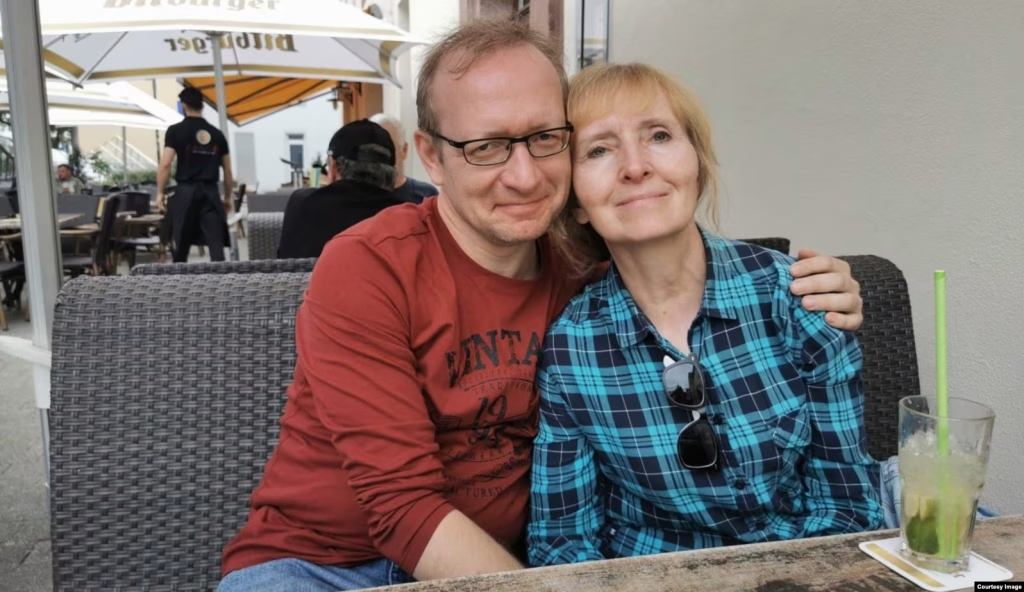
Daria Egereva, a decolonial activist and spokeswoman for the Selkup, an indigenous ethnic minority in Siberia, has been accused of “involvement in a terrorist organization” as part of a major criminal case against ten individuals and “other persons,” according to an appellate ruling by the Moscow City Court that has been uneartherd by Mediazona.
Egereva was detained and remanded in custody in December 2025. Decolonial activists then reported that she had been accused of involvement with the Aboriginal Forum [aka Aborigen Forum], an association of experts on the indigenous peoples and ethnic minorities of the Russian North. The organization was banned twice in Russia in 2024.
According to the appellate ruling, Egereva faces eight criminal charges: disseminating “fake news” about the Russian army; calling for separatism; participating in an “extremist” organization; inciting hatred or enmity; condoning Nazism; creating and participating in a terrorist community and a terrorist organization; and desecrating the Russian flag or coat of arms.
One of the well-known individuals implicated in the case is Petersburg journalist Maxim Kuzakhmetov. He was arrested in absentia and placed on the wanted list.
What specifically prompted the criminal case against Daria Egereva is unclear. The Moscow City Court’s ruling states that the activist’s defense team denies the charges.
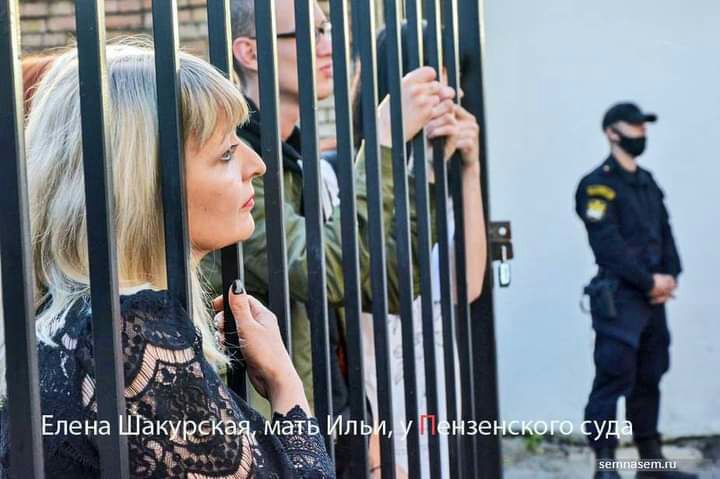
Today, March 12, Moscow’s Basmanny Court held another hearing on Daria Egereva’s pretrial detention. The court extended her pretrial detention for three months, as requested by government investigators. The hearing was held in public and was attended by diplomats from several embassies, her husband, and her children. She is facing 20 years in jail on terrorism charges.
“Being held in a Russian prison is a tremendous ordeal for anyone. I spent five days in this nightmare in 2021. For me, it’s like five years of my life. Daria has already been held for 86 days, and her sentence was extended by 92 days. This is terrible, unlawful, a violation of rights. Demand Daria Egereva’s release!” – Andrei Danilov, Saami Indigenous representative.
“Last time, Daria Egereva’s detention was extended by a month; now it’s been extended to three. Despite appeals from Indigenous representatives from various countries, Daria remains in custody. It’s heartbreaking to see how the solidarity of people around the world in this situation is simply ignored.” – Aivana Enmynkau, Nuvuqaghmiit Indigenous representative.
On December 17, 2025, a large-scale, coordinated wave of repressive actions against Indigenous Peoples and their human rights defenders occurred in Russia. On that day, Darya Egereva, an ethnic Selkup, was arrested in Moscow. She is a co-chair of the International Indigenous Peoples Forum on Climate Change (IIPFCC) and a long-standing participant in the international Indigenous rights movement. Daria’s colleagues and the international civil society connect her detention to climate change activism.
The website and the petition supporting Daria Egereva were launched as a part of the International Solidarity Campaign calling to #FreeDariaEgereva, where you can send a letter to Daria or find other ways to support her.
The International Committee of Indigenous Peoples of Russia (ICIPR) strongly condemns the new wave of repression against Indigenous human rights defenders in the Russian Federation, including their prosecution on fabricated charges of “extremism” and “terrorism” brought by the Russian authorities.
ICIPR considers these actions to constitute a deliberate misuse of anti-extremism and counter-terrorism legislation aimed at suppressing peaceful human rights work. We further regard them as a serious violation of the international obligations of the Russian Federation as a Member State of the United Nations, including its obligations under the UN Charter, the International Covenant on Civil and Political Rights, and the United Nations Declaration on the Rights of Indigenous Peoples — in particular the prohibition of reprisals for cooperation with United Nations mechanisms.
On 17 December 2025, Ms. Daria Egereva was arrested in Moscow. She is an Indigenous Selkup human rights defender, Co-Chair of the International Indigenous Peoples’ Forum on Climate Change (IIPFCC), and a member of the United Nations Indigenous Peoples’ Coordinating Body (UN ICB). She has been charged with participation in the activities of a so-called “terrorist organization,” an offence carrying a potential sentence of 10 to 20 years of imprisonment.
These charges are based on her alleged association with the Indigenous human rights defenders’ network Aborigen Forum, as well as on her many years of human rights work with the Centre for Support of Indigenous Peoples of the North (CSIPN). Notably, CSIPN was explicitly identified in UN Human Rights Council resolution 60/21 of 7 October 2025 among organizations subjected to forced closure and persecution by the Russian Federation.
The Aborigen Forum network, of which CSIPN was a member, was designated an “extremist organization” by the Russian authorities in July 2024, despite the fact that its members have never engaged in any acts of violence that could meet the definition of terrorism. At all times, the activities of the network and its members were peaceful, lawful, and focused on human rights advocacy, carried out exclusively through non-violent means and aimed at the protection of the rights of Indigenous Peoples, including through engagement with United Nations mechanisms.
Following its designation, the network decided to immediately dissolve and cease its activities; nevertheless, in December 2024 the Russian authorities included Aborigen Forum in the list of terrorist organizations.
On the same day, 17 December 2025, another human rights defender was arrested in Moscow under the same terrorism-related charges.
At the same time, beginning on 17 December 2025, the Federal Security Service of the Russian Federation (FSB) launched a series of coordinated searches and interrogations targeting Indigenous activists and human rights defenders across the country, including in the Altai Republic, Tomsk, Murmansk and Kemerovo Oblasts, Altai Krai, Taimyr and Krasnoyarsk Krai, the Republic of Sakha (Yakutia), and the city of Saint Petersburg. These operations targeted members of Indigenous communities, including Selkups, Tubalars, Chulyms, Shors, Kumandins, Dolgan, Yukaghirs, Evenks, Sámi, and Nganasans.
On the same day, a separate search was conducted in Murmansk Oblast at the home of Ms. Valentina Sovkina, a member of the Sámi Indigenous People and of the United Nations Permanent Forum on Indigenous Issues (UNPFII).
According to currently available information, at least 17 Indigenous leaders in different regions of the Russian Federation have been searched and interrogated by FSB. All their electronic devices have been confiscated.
ICIPR views these developments as politically motivated persecution and as a continuation of the systematic criminalization of peaceful Indigenous human rights work, including cooperation with international human rights mechanisms and participation in the work of the United Nations.
Call for International Solidarity
In light of this sharp escalation of repression against Indigenous Peoples, ICIPR hereby announces the launch of an international solidarity action by Indigenous Peoples and allies worldwide in support of Indigenous Peoples in Russia who are being targeted by state repression, including Indigenous human rights defenders.
We call upon Indigenous Peoples’ organizations and movements worldwide, UN bodies and mechanisms, including Special Procedures, States, academic institutions, and human rights organizations and civil society actors to speak out against these reprisals, to demand the immediate cessation of politically motivated prosecutions, and to uphold the fundamental principle that engagement with the United Nations must never be criminalized.
Solidarity is not optional — it is a shared moral responsibility.
We urge all partners to mobilize in solidarity. Further details on modalities and next steps will be shared shortly.
Svetlana Savelyeva. Photo courtesy of Mediazona via Sever.Realii and the Savelyeva family
A translator from the Irkutsk Region wanted to visit her boyfriend in Ukraine. She was detained, tortured, and sentenced to fifteen years in prison.
A court in Kursk has found Svetlana Savelyeva guilty of attempted treason and conspiring to cross the border illegally.
Savelyeva was detained in October 2024 in the Kursk Region and then held under administrative arrest until mid-December on the pretext that she had disobeyed the police’s orders. In December, she was remanded in custody to a pretrial detention center on criminal charges.
According to the FSB investigators, Savelyeva had undergone “military training” in Kazakhstan, after which she planned to join the Ukrainian army during its partial occupation of the Kursk Region.
The translator herself said that she wanted to travel to Ukraine to reunite with her boyfriend, a Ukrainian army soldier named Alexander.
“We tried many ways to get her here to where I was. When Ukrainian troops entered the Kursk Region, Sveta was in Armenia, if I’m not mistaken. And then suddenly she says, Here I am, I’ll try to get into the area controlled by Ukraine. The biggest mistake was that I did, after all, let her go to Kursk,” the Ukrainian soldier told reporters.
FSB officers tortured Savelyeva to obtain a confession: they kept her naked in a cold room, beat and choked her, subjected her to electric shocks, and threatened her with murder and sexual violence.
In addition to Savelyeva, criminal charges were filed against driver Igor Sandulyak, who agreed to drive her to the front line. The regional court fined him 150,000 rubles [approx. 1,600 euros].
Source: Mediazona (Facebook), 2 April 2026. Translated by Thomas Campbell, who asks our fellow translators, wherever they are, to share this post in solidarity with Ms. Savelyeva.
Polina Yevtushenko with daughter Alisa in court, August 2024
Polina Yevtushenko had deleted the social media posts for which she was tried prior to criminal charges being brought against her, she did not commit high treason, and her so-called crimes were victimless. And yet, she has been in a pretrial detention center for almost three years, and the prosecution asked the court to sentence her to eighteen years in prison. According to her lawyers, this would have been the longest sentence ever handed down to a woman in post-Soviet Russian history for a nonviolent crime that was not even committed. Today, the Central District Military Court found Yevtushenko guilty as charged and sentenced her to fourteen years in prison.
“This case is totally fabricated and unfounded. It’s completely unfounded, and the recordings that do exist and were submitted to the court speak to Polina’s innocence. In them, she repeatedly tries to dissuade her acquaintance Komarov from joining the Free Russia Legion. He made her acquaintance specifically so that this vile criminal case would be brought against her. This is a provocation,” say Polina’s acquaintances who attended the trials. (We are not naming them for their own safety.) “Polina is a courageous person. She’s a fine woman and never loses heart. It’s simply monstrous that she has been given such a long sentence for no reason.”
“I thought they were taking me to be killed”
Polina Yevtushenko, who is from the city of Togliatti, in the Samara Region, is twenty-seven. In July 2023, she was arrested for allegedly “inciting a Samara [city] resident to commit treason by defecting to the enemy, namely by joining the armed group the Free Russia Legion in order to take part in hostilities against the Armed Forces of the Russian Federation on Ukrainian soil” (per Article 30.1 and Article 275 of the Criminal Code of the Russian Federation: “preparation of terrorism”).
On that day, she took her daughter Alisa to kindergarten, and when she left, more than a dozen plainclothes security forces officers were waiting for her.
“They put cable ties on my hands and threw me into the car as if I were a sack of potatoes. Then these men got into the car and placed their feet on me. They didn’t explain anything. I thought that they were gangsters and that they were taking me to be killed. I screamed and called for help,” Yevtushenko later recounted.
After Yevtushenko was arrested, she was charged with five more crimes: publicly calling for terrorism on the internet (a violation per Article 205.2.2 of the Russian Federal Criminal Code), publicly calling for extremism, also on the internet (Article 280.2), disseminating knowingly false information about the deployment of the Russian Armed Forces, motivated by political hatred (Article 207.3.2.e), and condoning Nazism (Article 354.1.4). According to the FSB’s Samara office, she persuaded an acquaintance to go and fight in the Free Russia Legion, carried out “propaganda work,” and “posted instructions for Russian military personnel on how to surrender.”
Seven dates and “high treason”
Polina Yevtushenko
In this photo, Yevtushenko is a slender young woman with blue hair like Malvina’s, wearing a t-shirt and pink jeans. She raised her young daughter alone and painted pictures, which she posted on her Instagram and VKontakte accounts. She also publicized her anti-war views on these social media accounts, republishing a petition demanding Putin’s resignation over the war he unleashed in Ukraine, posts from the Free Russia Legion (at the time, it had not yet been deemed a “terrorist organization” by the Russian Supreme Court and was not yet banned), and instructions on how to surrender in order to survive the war. She was always quite sociable and interested in all kinds of people, easily meeting new people and making friends, according to her acquaintances.
Nikolai Komarov wrote to Yevtushenko on VKontakte. He said she was very pretty and drew beautifully, and that he really wanted to meet her and date her. What is more, her page said that she used to work at a Yota store, and he had a question he couldn’t figure out himself, so maybe she could help? He lived in Samara, she lived in Togliatti, an hour away by bus, but that was not a problem—he would come to Togliatti.
“They had a total of seven dates,” says a [male] friend of Yevtushenko’s. “He always told her how much he liked her. He invited her out to eat. They went for bike rides, went bowling, and sang karaoke together. He asked her about her pictures and her daughter. That is, he made it patently clear that he was interested in her as a woman and that he was courting her.”
It later transpired that the only dates with Yevtushenko which Komarov didn’t record on a dictaphone were the first two.
“He would constantly tell her that he was afraid of getting drafted and wanted to leave Russia, and asked her to advise him where to go, what to do, and how to make a living,” Polina’s friend continues.” She would reply that if he was so afraid, he should go to China or Kazakhstan, open a Wildberries or Ozon outlet there, and not worry. But he kept bringing up the subject again and again, asking her about the Free Russia Legion, whose posts she shared on social media. Polina told him that they were fighting Putin and that was why she supported them, that she had Ukrainian blood and opposed the war. At the trial, recordings were played of Polina telling Komarov many times that he should not go there and get involved, of her trying to talk him out of it. But Komarov kept at her: ‘I want to join the Legion, let’s choose a “street name” for me.’ (That was his term for ‘call sign.’) She communicated with him in a friendly manner and did not want to get closer because the conversations were always the same.”
Yevtushenko was later asked why she had not immediately pegged Komarov as a provocateur. She replied that she had believed “the FSB would not employ such dimwits.”
In court, Komarov testified that he had independently recorded Yevtushenko’s conversations on a dictaphone, but then became frightened by what she was saying and decided to hand the recordings over to the FSB because he thought she could get him into trouble. The recordings show signs of editing, with conversations cut short, Yevtushenko said in court. During the investigation and the trial, her defense demanded access to the complete recordings, but they allegedly do not exist. Komarov claimed that he had long since sold both the dictaphone and the laptop from which he transferred the recordings to discs for the FSB at a flea market. The court took him at his word.
Center “E” operative, FSB agent, or just a criminal on the hook?
In 2009, Nikolai Komarov was sentenced to two years’ probation for stealing a Sony Ericsson mobile phone, Kholod has discovered. While his probation was still in force, Komarov was caught again and charged with seventeen counts of theft of cable and internet equipment. In May 2011, he was convicted and sent to prison for two years and one month, but in April 2012, he was released on parole, after only eleven months in prison.
“He can actually be sweet, handsome, and charming. He knows how to get under your skin, and girls usually like him. He’s a bit of a con artist,” says a friend of Komarov’s.
You would thus never suspect that Komarov had had run-ins with the law. On the contrary, he maintained a Twitter account on which he demanded that the Samara municipal authorities fill in a pothole and finally resolve the issue of an open manhole cover, and he came across as a caring person and even a grassroots activist. This was before the war in Ukraine, however.
In 2017, Komarov showed up at the Navalny organization’s field office in Samara and introduced himself as a lawyer.
“He was a very active member [sic] of the field office. He wanted to be friends with everyone. He would invite people to barbecues, suggest that we drink vodka, hang out at the office all the time, and willingly do whatever needed doing—if we needed to buy water, he would go buy it without question. He took part in our campaigns and protest rallies,” says Marina Yevdokimova, who was a staffer at Navalny’s Samara field office at the time. In 2021, after the organization’s field offices were shut down across the country, she fled Russia.
In 2019, during the COVID pandemic, Yevdokimova was the field office’s social media manager.
“We had just reached the peak of the outbreak, which we wrote about in a post on Telegram. We also wrote that doctors had no PPE. An administrative case was brought against me. The police were staked out near my home. They would knock on my door, but I wouldn’t open it, so then they would go to my neighbors and question them,” Yevdokimova continues. “There was a court hearing in May, and Kolya Komarov was a witness for the prosecution, to my surprise. He hadn’t been at the Navalny field office for a long time. He was upset with us because we hadn’t gone along with his strange proposals. He had then become friends with the Communists and NOD (National Liberation Movement) members, posted photos of himself with them, and participated in their rallies.”
Denis Shepelsky (left), NOD’s “chief of staff” in Samara, and Nikolai Komarov. Source: Komarov’s VK page
At Yevdokimova’s trial, Komarov testified that he had seen her walking through the market in Microdistrict 15 and had allegedly heard her discussing on the phone that she would post this particular message on Telegram.
“I heard about her criminal intentions and could not fail to report them to law enforcement,” he told the court.
“Strangely enough, I was acquitted,” says Yevdokimova. “The lawyer asked [Komarov] simple questions that [he] couldn’t answer properly: ‘Where do you live? How did you end up in the market at that time?’ This was during the pandemic and no one could move freely around town. Besides, many people had access to our Telegram channel, so it was impossible to prove that I was the one who had posted it.”
Yegor Alasheyev, another former staffer at Navalny’s Samara field office, also emigrated from Russia.
“In March 2017, we held a rally called ‘Dimon Will Be Held to Account,’ at which twenty-three of our supporters were detained,” Alasheyev recalls. “We appealed all the fines [imposed on them as punishment] and they were later overturned. Komarov was also detained, but he turned down our assistance, saying that he was a lawyer himself and ‘knew what he was doing.’ It later transpired that he had pleaded guilty and been sentenced to pay a fine. At first, he kept quiet about the situation, then he telephoned our office and asked us to pay the fine. (At that point, he had already stopped hanging out with us.) I told him that we needed to talk to the lawyers and come up with a plan. But he refused to talk to them, and two weeks later, a video was released on TV featuring a ‘disenchanted Navalny volunteer.’ Soon after, he started attending NOD rallies. We looked into Komarov and learned that he had been convicted of stealing cable, but we had suspected that he was here for a reason even prior to that. He always hung around the office and listened carefully to what we were saying. But we didn’t pay much attention to it—he had seemed harmless. We understood of course that someone would inevitably be planted in our midst and that we were being watched.”
In 2022, Protocol Samara discovered that Alexander Melikhov, whom Komarov had befriended, had been planted in the local Navalny field office. Melikhov was a lieutenant colonel in the police, and his surname and passport had been changed for the sake of this operation. Yevtushenko’s acquaintances do not rule out the possibility that both men infiltrated the organization at the same time.
During Yevtushenko’s trial, it transpired that another criminal case had been opened against Komarov. He had been charged with thirty-seven crimes under Article 173.1.2.b of the Russian Criminal Code (“illegal creation of legal entities or provision of documents”). He was sentenced to 330 hours of compulsory community service.
“It seems that he has long been firmly ‘on the hook’ of Center ‘E’ (the Russian Interior Ministry’s office for combating ‘extremism’ and ‘dissidents’—Sever.Realii) and the FSB, but they cover for him. He created thirty-seven fake companies and only got community service,” says a lawyer working in Russia.
A new method of recruiting?
In July, it will have been three years since Yevtushenko was jailed in a pretrial detention center. In June 2025, she was found guilty of “violating” the center’s rules for passing store-bought cookies to a neighboring cell. In July of the same year, she was sent to solitary confinement for ten days because she had described her court hearings in her letters. All this time, she has only been able to see her daughter through glass; the judge has allowed them one-hour visits. Yevtushenko’s parents have been raising Alisa.
“Visits take place through glass over a telephone and last one hour. During this hour, I talk alternately with my mother and with Alisa. During the last visit, I brought a sketchbook with me in which I draw pictures for Alice. She really liked it,” wrote Yevtushenko from the detention center. “Before that, I showed Alice some old photos of us from the time before my arrest, but she started crying, so I decided not to do that again… Of course, conversations through glass can hardly be called visits, but we are grateful for what we have. I really miss hugs. I want to hug and kiss Alisa, but I can’t.”
“Polina gets plenty of letters at the detention center. Many people support her because they understand the injustice of what has been happening to her. She doesn’t get discouraged, she rejoices in every little thing, and she has been learning English by mail,” says a friend of Yevtushenko’s who has attended all the court hearings in her case. “How do we usually imagine sting operations carried out by the special services? They involve persuasion, bribery, blackmail—the classics of the genre. But a new method has supposedly emerged in Polina’s case, which we learned of when FSB expert Tatyana Naumova was cross-examined at the trial. According to her, in a new manual developed by FSB criminologists, which has not been made available to the public, a new method of recruitment is [defined]: it is deemed ‘propaganda’ and ‘recruitment’ when someone praises something—for example, when someone claims that the Free Russia Legion has good equipment. Polina’s defense asked to review this secret manual, but the judge turned down their request. The defense lawyer then asked the judge to examine them himself and confirm that everything was indeed written that way there. But the judge refused to do so. Naumova also said that Komarov was ‘a person conducting covert operations.’ In other words, she effectively admitted in court that the special services had organized a sting. From the point of view of the European Court of Human Rights (ECHR), this is a gross violation of the right to a fair trial (per Article 6 of the European Convention on Human Rights). Evidence obtained in this way is considered inadmissible by the ECHR. And Russia, until it ceased to be a party to the Convention due to the war it unleashed in Ukraine, had been repeatedly punished for this” (e.g., in Vanyan v. Russia, 2005, and Lagutin and Others v. Russia, 2014—Sever.Realii).
An excerpt from Polina Yevtushenko’s closing statement at trial
“Your Honor, you have known me for almost two years. I am confident that during these two years you have been persuaded that I pose no danger to the community and that I can be released.
“For two years, I have only been able to see my daughter through glass and cannot even hug her. I did not see her at all during the first year [in police custody]. Last year, Alisa started first grade, and this year, on March first, she will turn eight years old. She needs her mother’s love, care, and help, and I need even more to be with her, to see her grow up, to raise her, to take care of her. I need to make sure she becomes a decent person—well-mannered, smart, well-read, and fond of our Motherland.
“Your Honor, I ask you to release me so that I can raise my daughter. Be a conduit of happiness for two loving hearts—those of a mother and her child. I have never committed treason. I love my Motherland, Russia, and would never do anything to harm her. If I have made any mistakes or committed violations, then being in prison for almost three years is more than enough punishment for me.
“I have come to grips with everything [I have done] and promise you that from now on I will behave in such a way that you shall never be ashamed of me. I ask you to make a just decision and release me to be with my daughter.”
According to a study by the human rights project First Department, between February 2022 and mid-December 2024, 792 people in Russia were charged with treason (per Article 275 of the Russian Federal Criminal Code), espionage (Article 276), and secret cooperation with a foreign state (Article 275.1). In 2024, 359 people were found guilty and sentenced to actual prison terms on these charges, and four more were sentenced to compulsory psychiatric treatment. Of these 359 people, 224 were found guilty under Article 275, 38 under Article 275.1, and 101 under Article 276. A total of 536 people have been convicted of violating these criminal code articles since the start of the war; Russian courts have not handed down a single acquittal. According to First Department, a significant number of these cases were based on sting operations carried out by FSB officers or persons associated with them.
Why do we write letters? In the words of Maria Ponomarenko, sentenced to six years in prison for anti-war posts:
I’ve already explained it multiple times that the letters are highly valuable to all of us who are unjustly imprisoned. But I’m ready to repeat it again and again, even 1000 times!
Your letters inspire us, give us strength and confidence that there will be a dawn and the changes are inevitable.
Your letters serve as a support — solid ground beneath our feet.
Your letters are uplifting and help distract us from the unpleasant realities of the Russian penitentiary system.
Write letters to political prisoners! Write, even in the absence of feedback!
The letters are also very important because they demonstrate to the authorities and other inmates that the political prisoner has support outside the prison and is not alone. That we have not been abandoned and have not been forgotten!
Political prisoners find themselves in physical, social and informational isolation. Thanks to the letters, prisoners feel supported and that they are not alone. In pre-trial detention centres, prisons and colonies, it is not often possible to find like-minded people, but letters give prisoners a chance to be heard and a much-needed connection with one another.
In addition, in prison a person quickly ceases to understand what is happening on the outside, so letters are also a way to stay informed about external events: they can be about big news or something less significant, but important for the political prisoner himself (for example, about changes in countries or what is happening in his work\interest spheres, and so on).
Finally, when prisoners receive regular letters, it is an indicator to prison and colony staff that the world outside is paying attention to them, so the risks of pressure are reduced.
This is safe
It is legal and safe to send letters to political prisoners. It is important to remember that all letters go through a censor, but if you follow certain rules you will be safe.
However, there is a list of topics to avoid.
– Do not write about war and combat, such letters will almost certainly not pass the censor.
– Do not write about the details of their criminal case: this may be a painful topic for discussion, but on the other hand, such correspondence may harm them legally.
– Do not write anything about LGBTQ+ people, as based on the history of cases this may harm the political prisoner in the eyes of homophobic prisoners and prison staff.
– Do not write direct insults to the authorities and their representatives or calls to overthrow the government.
– Avoid any topics related to what law enforcement agencies may consider extremism and terrorism.
– In addition, do not use obscure abbreviations, ciphers, foreign words – anything that the censor may not understand or find suspicious. Finally, do not use foul language in your letters.
Where to start
First, you need to decide who you want to write to. You can write to political prisoners whose stories you already know from the news, but it is important that not only media figures receive letters: there are many lesser-known prisoners who need support just as much. You can find their names and stories on our website (general list and religious list of political prisoners), and you can also find addresses where you can write to them. A great reason to start a correspondence would be, for example, a birthday greeting.
What to write about in the first letter
Introduce yourself and tell about your experiences, so that the political prisoner understands who he is communicating with. If you do not want to use your real name, you can sign with a pseudonym – the main thing is that your addressee can later recognize you among other interlocutors.
In an interview with Novaya Gazeta, Elena Efros – founder of the letter-writing project “Tales for Political Prisoners” says: “It’s just the way to write it, a standard text like: Hi, I learned about your case from the media or the Internet, do you want to correspond with me, if yes, what topics are interesting to you. And don’t worry – if you don’t get a reply, just write to someone else.”
How to send letters
The fastest way would be to send one online. Our colleagues from ‘Memorial France’ have launched a service for sending letters to political prisoners in Russia and Belarus.
The website itself is still only available in French, but you can write to political prisoners in different languages: French, English, Belarusian, Russian, and any other are also accepted for translation.
Choose any political prisoner from the lists of Mémorial or Viasna.
Write a letter and paste it into the online form
Our colleagues will translate the text and send it to the addressee
When and if the inmate responds, they will send you their letter
The service has more detailed instructions for each step, as well as recommendations on what to talk about and what to avoid in letters.
You can also use one of the following services available in English:
Letters Across Borders is an OVD-Info project to collect letters to Russian political prisoners in English (or other languages) and translate them for free. You can support the project with a donation.
PrisonMail (payment with international bank cards)
ZT – payment by Russian card only, but the service works in more colonies;
RosUznik – a volunteer project that sends letters in Russian for free or for a donation (you can write from abroad if you translate your letter yourself).
You can also send a paper letter and put something that will please the prisoner: photos, printed pictures, extracts from a magazine, herbarium and so on. You can put unsigned postcards so that the prisoner can send them to their loved ones. Please note that the weight of the letter mustn’t exceed 99 grams and letters in languages other than Russian are highly unlikely to reach the recipient.
Write legibly so that your handwriting can be understood by both the addressee and the censor. When sending a letter, put not only the address but also the full name of the institution on the envelope and write the year of birth after the addressee’s name. If you want a reply, put a blank sheet of paper, another envelope and stamps in the envelope with the letter.
To receive a reply letter, a reply form must be paid for. Usually, the censor sends a scan of the letter to the email address you specify, but it is worth bearing in mind that Prisonmail does not cooperate online with all colonies – then the website when you send the letter will say that you can only receive a reply in paper form.
Yuri Dmitriev is a historian and researcher of Stalinist repressions in Karelia, in the North of Russia, and one of the first political prisoners of the new repressive era in Russia. He searched for the sites of mass executions in 1937–1938 and worked to restore the fates of people who were shot during the Great Terror and died in the Gulag camps. He recognised the terrible nature of the new Russian regime sooner than others did, and spoke openly about it. The conviction of Yuri Dmitriev is an example of the Putin regime’s direct inheritance of the spirit and logic of Stalinist terror.
Since December 2016, Dmitriev has been persecuted on false charges.He has been imprisoned for nine years. His sentence is 15 years.He will turn 70 on January 28, 2026.
For the past four years, the historian has been held in a harsh regime penal colony in Mordovia, central Russia. During his time there, he has been placed in solitary confinement nine times. His health is now in critical condition. We want to raise money to give Yuri Dmitriev and his family a gift for his anniversary. These funds will be used to cover his daily expenses in the colony (purchasing food and necessary items), regular visits from his lawyer, and parcels. This is the least we can do to thank Yuri Dmitriev for his work to restore the memory of the victims of Stalin’s terror and for his uncompromising stance towards the crimes of the present.
Iouri Dmitriev est un historien et un chercheur spécialiste des répressions staliniennes en Carélie, dans le nord de la Russie. Il compte parmi les premiers prisonniers politiques de la nouvelle ère répressive instaurée en Russie. Pendant des décennies, il a recherché les lieux d’exécutions massives de 1937–1938 et s’est attaché à rétablir l’identité et le destin des personnes fusillées durant la Grande Terreur ou mortes dans les camps du Goulag. Très tôt, il a compris et dénoncé publiquement la dérive autoritaire du régime russe contemporain.
La condamnation d’Iouri Dmitriev incarne, de manière tragiquement exemplaire, la continuité entre la logique répressive actuelle et l’héritage de la terreur stalinienne.
Depuis décembre 2016, il est la cible de persécutions fondées sur des accusations fabriquées de toutes pièces. Incarcéré depuis neuf ans, il purge aujourd’hui une peine de quinze années de prison. Il aura 70 ans le 28 janvier 2026.
Depuis quatre ans, Iouri Dmitriev est détenu dans une colonie pénitentiaire à régime sévère en Mordovie, dans le centre de la Russie. Durant cette période, il a été placé à neuf reprises à l’isolement. Son état de santé est désormais extrêmement préoccupant.
Nous souhaitons organiser une collecte afin d’offrir à Iouri Dmitriev et à sa famille un présent pour son anniversaire. Les fonds permettront de couvrir ses dépenses quotidiennes dans la colonie pénitentière (achats alimentaires et produits de première nécessité), les visites régulières de son avocat ainsi que l’envoi de colis.
C’est le minimum que nous puissions faire pour exprimer notre gratitude envers Iouri Dmitriev, pour son travail inlassable de restauration de la mémoire des victimes de la terreur stalinienne et pour sa position sans compromis face aux crimes perpétrés aujourd’hui.
Юрий Дмитриев – историк, исследователь сталинских репрессий в Карелии, на Севере России, один из первых политических заключенных новой репрессивной эпохи в России. Он занимался поиском мест массовых убийств 1937–1938 годов, восстановлением судеб людей, расстрелянных в период Большого террора и умерших в лагерях ГУЛАГа. Он раньше других понял страшную природу новой российской власти и открыто говорил о ней. Осуждение Юрия Дмитриева – пример, проявляющий прямое наследование путинским режимом духа и логики сталинского террора.
С декабря 2016 г. Дмитриева преследуют по лживым обвинениям. Он находится в неволе уже 9 лет. Срок заключения по приговору – 15 лет. 28 января 2026 года ему исполнится 70 лет.
Последние четыре года историк находится в колонии строгого режима в Мордовии в Центральной России. За время своего пребывания там он девять раз сидел в штрафном изоляторе. Его здоровье сейчас в критическом состоянии. Мы хотим собрать денег, чтобы сделать подарок к юбилею Юрия Дмитриева ему и его семье. Эти средства будут потрачены на его ежедневные расходы в колонии (покупку еды и необходимых вещей), регулярные визиты адвоката, посылки. Это то немногое, что мы можем сделать в благодарность Юрию Дмитриеву за его работу по восстановлению памяти о жертвах сталинского террора и за его непримиримость по отношению к преступлениям настоящего.
Source: Memorial France (Helloasso). Thanks to Jessica Gorter for the heads-up. It took me a minute or two to fill out the form to donate money to this fundraiser, and I would urge you to donate as well by clicking on any of the five links (above) in this post. To read my years-long coverage of the Dmitriev Case, go here. ||||| TRR
There are political prisoners whose names are not mentioned often and so they have few chances of making it onto prisoner exchange lists.
In a nutshell: political prisoner Lyubov “Lyuba” Lizunova, who is now nineteen years old, was arrested along with her boyfriend Alexander “Sasha” Snezhkov in 2022, when she was sixteen and still in high school (Sasha was nineteen at the time). This is the so-called Case of the Chita Anarchists or the Case of the Transbaikal Leftist Association. Why were they arrested? For writing the graffiti “Death to the regime” on the wall of a co-op garage on the outskirts of Chita, and for moderating Antifa Telegram channels. She was the drummer, and he was the vocalist in a band. They recorded songs and played concerts. . . . Lyuba was originally sentenced to three and a half years behind bars; Sasha, to six years. They are both behind bars now: Sasha is in prison in Krasnokamensk, while Lyuba is in a penal colony in Ulan-Ude.
I have been corresponding with Lyuba. The last letter I got from her arrived yesterday, the twentieth of January.
Now here’s the bottom line.
The very same day, yesterday, a court ruled that the Transbaikal Leftist Association is a “terrorist” organization, and named Lyuba and Sasha as its organizers and leaders. This means that they could be charged with, and found guilty of, violating Russian Federal Criminal Code Article 205.5 [“organizing and participating in the activities of a terrorist organization”].
The penalty for violating this law is fifteen to twenty years in prison. If she is convicted on the new charges, Lyuba Lizunova could be released in the 2040s.
The 2040s!
She will be around thirty-nine years old.
She wrote me a letter earlier, on the sixteenth of January:
“I don’t know what to expect. […] It’s a rather hefty sentence for a social media post and a bit of graffiti, right? I’m slowly shedding my usual calm confidence that I’ll be released on 19.02.2027. Don’t think I’m complaining or being dramatic—it’s just the way it is. The prisoner transport is also not clear. I will go either this month, or in March. The trip to Yaroslavl is long: it will take two months, including stops, just to get there, and the same amount of time for the return trip. I need to stock up somehow. […] Everything is kind of shaky and unreliable. The only things which are strong are ideals, principles, and love.”
I would argue that very young people should be at the top of the prisoner exchange lists, that we should drag children, schoolchildren, and university students out of prisons by any means necessary. These prison sentences are Stalinist [in their severity].
Actually, this is my main point. What follows are personal details.
I will later publish excerpts from Lyuba’s letters if she permits it.
While Lyuba was jailed in the pretrial detention center, she studied for the Unified State Exam and managed to finish eleventh grade. (I don’t know how she managed that.) During the ten months in jail and later, during the long prisoner transport (in a Stolypin wagon and paddy wagon) to the penal colony in Tomsk and then to Chita, she read about one hundred books (all of Solzhenitsyn, Kafka, Schopenhauer, Aristotle, Frankl, and Dante—basically, whatever she could find). She has no time to read that much in the penal colony, although she has recently been reading Anna Seghers: she has only one day off, and that day she is kept busy with “squad” assignments. But she asked me to send her something to read; I’ll try to send something, I’ve never done it before. She is the “detachment artist,” so she designs all the holiday celebrations, posters, and props. She writes poetry for her own amusement and sometimes borrows a guitar from a “local lady.” In the next barracks, someone has a synthesizer.
I am including these details on purpose, as they make it possible to visualize Lyuba’s story: the daily lifestyle, including sewing and cleaning the premises; eating Dosirac instant noodles (Lyuba is a vegetarian and cannot eat the food served in the penal colony, because everything is cooked in a meat broth); and the nitty-gritty of the prisoner transports.
Strikingly, Remembrance Day for the Victims of Political Repression was observed at Lyuba’s penal colony: she drew a poster for the occasion. Actually, our correspondence and acquaintance began that same day: I chose her letter from a long list of letters from other political prisoners to read aloud at our Returning the Names event. It had a particularly poignant ring. I later realized why she takes the Stalinist crackdowns so personally. She wrote to me that her great-grandfather was a bigwig in the Chita KGB. When she was taken to FSB headquarters for interrogations, she was escorted past a stand dedicated to him, featuring a framed portrait, documents, and awards. It sounds like a movie—a sixteen-year-old schoolgirl being led down a corridor past a portrait of her great-grandfather—but it isn’t a movie.
If you have ideas about who can publicize this case, or who can help make the media cover the cases of very young political prisoners, please write to me. And write letters to them, please.
FKU IK-7 UFSIN of Russia in the Republic of Buryatia • Lyubov Vitalyevna Lizunova (born 2006)
Source: Alexandra Selivanova (Facebook), 21 January 2026. Translated by the Russian Reader. Since letters to Russian prisoners are vetted by prison censors, they must be written in Russian or translated into Russian, something that can done more or less decently using an online machine translator. ||||| TRR
A court in Russia’s Transbaikal region has designated the informal youth group known as the Transbaikal Left Association (ZLO) as a terrorist organisation and banned its activities nationwide.
According to the ruling by the Transbaikal Regional Court, the group, which was founded in 2019, operated with its own symbols and maintained pages on social media. The court concluded that elements of terrorist activity were present in its actions, as outlined in a lawsuit brought by prosecutors, Caliber.Az reports via Russian media.
The case named Alexander Snezhkov and Lyubov Lizunova, described by authorities as the group’s unofficial leaders, as defendants. Snezhkov was sentenced to six years in prison, while Lizunova received a sentence of three and a half years. They were convicted on charges including vandalism, incitement to terrorism, and extremism.
Snezhkov rejected the accusations, stating that ZLO functioned primarily as an information platform through which he expressed his personal views. At the same time, he acknowledged that in 2022 he had asked Lizunova to prepare a post that he later published online. He said he subsequently deleted the post after realising that it could be interpreted as justifying terrorist activity, including attacks on military enlistment offices.
I am going to tell you about a political prisoner who seemingly no one has written about yet. I came across information about him quite by accident.
His name is Gordey Nikitin. Thirty-two years old and a native of Ryazan, Gordey worked at an oil refinery before his arrest. According to Gordey, he has been interested in politics and held opposition views since 2014. When the full-scale war [against Ukraine] broke out, Gordey went into shock. He was in this state of shock when he wrote several comments on Telegram.
As Gordey found out when reviewing the files in his criminal case, it was precisely because of these comments that, three years later, FSB officers would come after him, calling him on Telegram and introducing themselves as Ukrainian intelligence.
A few conversations with the “GUR” (actually, with the FSB) sufficed to charge him with and convict him of high treason and sentence him to seventeen (17) years in a maximum security penitentiary facility.
Gordey did not testify at his trial and he refused to make a closing statement to the court. He also did not bother to appeal the verdict, and so he will soon be transferred to a penal colony.
Gordey is currently being held in a remand prison in the town of Ryazhsk, Ryazan Region. He writes that the worst thing about the remand prison is the library: “Mostly third-rate military science fiction.” In the eight months he has spent in the prison, Gordey has only come across six decent books—by Remarque, Dostoevsky, and Chuck Palahniuk.
You can write a letter to Gordey. And if you use a digital service, a New Year’s miracle may occur, and he will receive the letter on January 30. In the worst case, it will arrive after the holidays.
Write to Gordey at the following address:
Russian Federation 391999 Ryazhsk, Ryazan Oblast • ul. Krasnaya, d. 1a, SIZO-2 • Nikitin Gordey Andreyevich (d.o.b. 28.09.1993)
You can also send letters through the online services F-Pismo, Zonatelecom, and PrisonMail.Online (the last should be used by foreign bankcard holders).
Source: Ivan Astashin (Facebook), 26 December 2025. Translated by the Russian Reader. Since letters to Russian prisoners are vetted by prison censors, they must be written in Russian or translated into Russian, something that can done more or less decently using an online machine translator like Google Translate. ||||| TRR
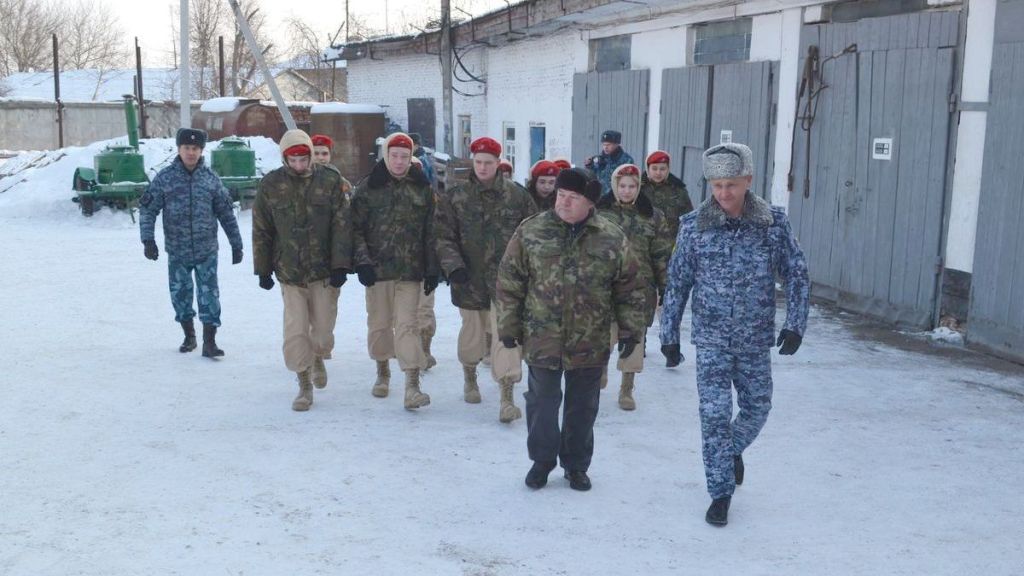
On 22 February [2023], scheduled tactical and drill exercises were held at Ryazhsk Remand Prison No. 2 (Ryazan Region, Russian Federal Penitentiary Service).
Remand prison staff practiced negotiating procedures, organizing combat groups, dealing with the aftermath of mass disobedience, and repelling attacks on the correctional facility.
The exercises were observed by Young Army cadets from Ryazhsk High School No. 3. Remand prison staff showed the kids their weapons and equipment. The boys and girls were able to try on bulletproof vests and hold automatic rifles and pistols. At the end of the tour, the schoolchildren were treated to hot porridge and tea.
“Today, the students got a closer look at the penal system,” said Alexei Ogurtsov, acting chief warden at Remand Prison No. 2. “Our staff demonstrated their professional skills, equipment, and weapons to the students and answered their questions. Perhaps some of them will choose to enlist in our service in the future.”
Mikhail Loshchinin and his mother, Olga. Courtesy of RFE/RL
More and more Russians face trumped-up charges of “high treason.” Anything whatsoever—from commenting on a banned organization’s social media post to wiring a paltry sum of money to a relative or acquaintance in Ukraine—can occasion these charges. Foreign nationals who have retained their Russian citizenship have also faced prosecution. It has become ever more dangerous for them to travel to Russia to visit loved ones.
This past summer, Mikhail Loshchinin, a 48-year-old dual Belgian-Russian national, decided to visit his father, who had suffered a heart attack, and headed to Petersburg.
In recent years, Loshchinin had been living in Germany while working as a database manager in Luxembourg. On 1 July 2025, he crossed the Latvian border on a motorcycle with a German license plate and stopped at the Ubylinka border-crossing station, in the Pytalovo District of Russia’s Pskov Region. He was carrying a Russian federal passport, which he presented to the Russian border guards.
“They staged a provocation at the border”
“Sometime around 2020, before the war, Misha traveled to Russia by motorcycle. He made it there and back just fine. He had good memories [of the trip], and so he decided to repeat his ‘feat,'” says Loshchinin’s mother Olga, who now liveas in Poland. “The goal was to visit his father, who had undergone heart surgeries and had been feeling quite poorly after a heart attack; there was a risk the visit would be their last. [Mikhail] decided to travel with his Russian passport so as not to have bother getting a visa. (As a Russian national, Loshchinin does not need a visa to enter Russia—Sever.Realii.) He’d spent the last twenty-five years in Europe: his mindset had changed, he’d been Europeanized. He’d come to rely on the system’s accountability, on the fact that laws were obeyed.”
According to Olga, the border guards asked to check Mikhail’s telephone, on which they apparently found numerous Ukrainian contacts. Before his trip, Mikhail had not deleted anything from his WhatsApp account, as he did not consider corresponding with friends in Ukraine to be a crime.
“There were no grounds to detain him, so they staged a provocation at the border,” says Olga. “He had been waiting there for a long time for the inspection to end when he asked where he could buy some water. They told him to follow them on his motorcycle to the local store, that they would show him the way. He followed them, but they suddenly made a funny turn and detained him for crossing the border. In other words, they had deliberately lured him there to have a legal reason to detain him.”
Mikhail grew up in a large family: the four Loschinin children were born in the Soviet Union but later moved away. Mikhail had been living in Europe since 1999. His sister became a citizen of Ukraine, and he often visited her. He had many friends and acquaintances in Ukraine. Their contact details were stored in his phone, naturally.
Mikhail had always been apolitical, and his arrest has no connection with his work, says Olga.
“It is, rather, a matter of his being in the wrong place at the wrong time, and the police investigator admitted as much to him. . . . Misha has always had an excellent reputation, and his employers have valued him. He’s also a well-rounded fellow: he’s a biker, plays the guitar, and sings and does the lighting for productions by small Russian-language theaters. He bought the [lighting] equipment with his own money and promotes Russian culture among his western friends and acquaintances any way he can: he hasn’t lost his connections with his roots. . . . He falls in love easily, and has had several marriages, but now he’s a bachelor. He has a daughter from his second marriage.”
After Mikhail set off for Russia, he constantly telephoned with his sister and mother, who now live in Poland, but they lost touch with him on July first. Three days later, he called from someone else’s phone and told them he had been detained.
“At 10:27 a.m. on July fourth, there was a call from an unknown Russian number. It was our Misha. He said that Dmitry, an FSB officer, had given him a phone to make the call, that he was under guard at the Hotel Dubrava in the border town of Pytalovo, that they’d confiscated his papers and the keys to his motorcycle, and that the motorcycle itself was parked outside the hotel,” Olga recalls.
Mikhail told his loved ones that he had been given a choice: either he would be sent to a basement somewhere, where he would sit and wait until they decided what to do with him and his papers, or he could go to a hotel and wait there, at his own expense.
“No one wants to sit in a basement, naturally,” Olga continues. “He had some money, and since the rooms were inexpensive, he chose the hotel. They confiscated his telephone, his passport, and the papers for his motorcycle, and they posted guards without whom he wasn’t allowed to leave his room. They had to get the go-ahead for every trip outside the hotel. They escorted him when he would go out to the store and the post office.”
Mikhail spent nearly a month at the Dubrava Hotel.
“Misha’s money was running out. We were by then terribly anxious and contacted a lawyer, who arrived at the hotel on the evening of August first and was able to see Misha and speak with him. On August second, a group of persons unknown took him to an undisclosed location. Those were the roughest days for us. As later transpired, he had been transported from Pytalovo to Stary Oskol, in Belgorod Region, and the journey had taken several days. Misha later told us that along the way they had passed through Smolensk; he had managed to catch sight of that. It turns out that, in his correspondence for 2022, an ex-girlfriend of Mikhail’s had asked him for financial help. Her profile picture now has a Ukrainian symbol on it, but it wasn’t there in 2022.”
The lawyer traveled to Stary Oskol, Olga recounts, but at the local pretrial detention center he was told that they had “no such person” in custody. The lawyer then filed a formal appeal with the prosecutor’s office, the FSB, and the Investigative Committee, asking them to figure out what had become of Mikhail. On 21 August 2025, Mikhail telephoned Olga himself—from Pretrial Detention Center No. 1 in Pskov. The call was again made from an unknown number.
“Judging by how his voice sounded, he wasn’t himself. He was clearly under duress and kept asking whether it was alright to talk now, meaning that the call was made in someone else’s presence,” says Olga. “He said that he had been accused of ‘high treason’ per Article 275 of the Russian Federal Criminal Code: ‘financing representatives of a foreign state hostile to the Russian Federation.’ We got a call from someone named Denis, who introduced himself as Misha’s attorney. He called us again and warned us not to hire anyone else, claiming our own attorney wouldn’t even be admitted to the remand hearing. We recorded the call but of course we didn’t do what he asked; he had no right to say that to us, and our own attorney did attend the hearing. Since then, Misha has been in custody at the Pskov detention center. He’s under investigation.”
Later, Mikhail said that, in Stary Oskol, he had been placed in a specialized facility for Ukrainian prisoners of war.
“He was tortured and abused, both mentally and physically, there” says Olga. “First of all, they took away his glasses. He has terribly poor eyesight, minus eight, and he practically lost his sight. He could only walk with his head down, bent over. They stripped him naked and beat him. He told his lawyer about all of it. He was completely crushed, and of course this was done deliberately to squash any hope that he might be released and to make him agree to sign whatever papers they put in front of him. They forced him to sign a paper stating that he had been gallivanting freely around Russia until August twenty-first. He told us this recently. But we have a document stating that he was in Stary Oskol, and it is unlikely that he could have traveled freely around Russia without papers or a means of transport and without informing his relatives. There are many inconsistencies in their ‘body of evidence.'”
“I am horrified by what has happened to my son”
On 10 November, Mikhail Loshchinin celebrated his forty-eighth birthday in the Pskov detention center.
“I am horrified by what has happened to my son,” says Mikhail’s mother. “I’ve been doing a lot of soul-searching, since I didn’t expect the authorities to behave as they have behaved. And yet I didn’t have full faith in Russian law enforcement. My grandfather was in prison in 1937. He had been an officer in the White Army. The family was then living in Grozny, and my mom was small. Several former [White] officers lived in the vicinity. They would get together for readings and go on picnics; they were cultured folk. The entire group was arrested. Grandfather was the only one of them to survive because he didn’t sign anything [i.e., a confession]; the rest of them were shot. He never told anyone what price he had paid for this. My mom, still a kid then, brought care packages to him in prison.”
Olga has carefully researched Article 275 of the Russian Federal Criminal Code and argues that it has simply been “misapplied to a completely peaceful, innocent man.”
“We have a really good, tight-knit family. Although [Mikhail’s] dad lives in Petersburg, and we’re divorced, we have a decent relationship, and we’ve even started conversing more often now. And all the kids are tight-knit. Misha was always quite kind; we even wanted him to become a doctor, since kindness is quite valuable in a doctor. But he chose a different path in life. He wanted to be a programmer, and he’s been successful at it,” says Olga.
According to her, many of Mikhail’s friends in Luxembourg, where he had worked in recent years, are now deeply concerned about him.
“He always had a good head on his shoulders, and he became quite well known in Russian diaspora theatrical and cultural circles, and not only in those circles. He even did the sound for the Orthodox Church of Luxembourg,” says Olga. “There are videos on YouTube of him playing ‘Under the Blue Sky’ on the guitar in concert and his boss, a Frenchman, singing it in Russian. It is an ironic twist of fate that a person like can be destroyed so simply. . . . Summer is the time when theaters get ready for the high theatrical season, and right then Misha vanished. A support group has emerged, all of his friends. I honestly had no idea that there were so many of them.”
Mikhail’s friends have been writing petitions requesting his release from police custody, which his relatives have been passing on to his lawyer.
“Although Mikhail lived in Luxembourg, he visited us quite often recently. He has a girlfriend in Slovakia, and when he went to see her, he found ways to come through [Poland] and see us,” says Olga.
According to Loshchinin’s family, Mikhail has begun to suffer from retinal detachment while in custody.
“In 2024, he visited an ophthalmologist, who informed him that surgery was not necessary at the time, but that it would have to be performed immediately if he began seeing flashes in his line of sight. Now he has been seeing those flashes,” Olga explains. “It is hard to get proper medical care in prison, and I’m afraid that he may simply go blind in there. I can’t imagine that my son, who has done nothing nasty in his life, is now being treated as one of the most dangerous criminals, and all because he hadn’t cut off his ties with Russia. If you take someone’s phone and check their messages, every other person could be under suspicion.”
“Thousands of people across the country are being held without charge”
Loshchinin’s defense attorney declined to comment for this article because he is bound by a non-disclosure agreement.
According to our count, at least 148 people in Russia faced criminal charges of treason, espionage, and clandestine collaboration with foreigners in 2023, and at least 88 such cases were brought before the courts. The trend continued in 2024 and 2025. According to statistics on court rulings for the first half of 2025, as published by the Judicial Department of the [Russian] Supreme Court, 115 high treason cases were instigated, which was twice as many as in the first half of 2024. At the same time, according to data from Department One, the Supreme Court has underestimated the number of convictions in such cases by at least threefold.
“Mikhail Loshchinin wired money to a private individual in Ukraine,” explains Smirnov. “According to the security forces, this is a form of high treason, and it has existed for over ten years: providing financial assistance for activities contrary to the security of the Russian Federation. The FSB often takes advantage of this. They might have claimed, for example, that the young woman to whom Mikhail wired money works for the SBU [Security Service of Ukraine] or is involved in the Territorial Defense Forces. Something like that. And that wiring her money was thus a criminal offense.”
The attorney is not surprised that Mikhail was detained in Pytalovo for a month without charges, staying in a hotel at his own expense and under guard.
“There are thousands of people across the country being held without charge. Some are under administrative arrest, while others are in former hotels refitted as [detention] centers, or in actual hotel rooms. Most often, police investigators need the time to get the go-ahead to file criminal charges. Moscow gives the go-ahead for such cases.”
“There is no good outcome in these situations,” Smirnov notes.
“They might sentence him up to thirteen years in prison. The only hope for release is through a prisoner exchange, and that would involve a political decision,” argues Smirnov. “How many people in Russia have been released in the last ten years via prisoner exchanges? A couple dozen, probably. And how many political prisoners are there in the country currently? Ten to fifteen thousand. [Mikhail’s] chances are a bit greater since he’s a Belgian national, of course. There are not so many Belgian nationals [in Russian prisons], and if Belgian politicians get involved in the campaign to secure his release, the chances will grow for sure.”
Olga, Mikhail’s mother, says that Belgian consular officers have tried on several occasions to get permission to visit him in the detention center but were turned down.
“He’s a Russian national, but Russia doesn’t recognize his Belgian citizenship,” says Smirnov. “Most countries don’t recognize dual citizenships: it’s a normal practice. So, Belgian consuls aren’t being allowed to see him. It’s been the usual practice for decades.”
Smirnov argues that people living abroad should not travel to Russia unless absolutely necessary “because it’s a big risk.” If travel is unavoidable, you should prepare in advance by purchasing a separate telephone, planning your itinerary with care, seeking advice from those in the know, and being ready for the fact that the border guards will question you and search all your devices.
Kushnir (2025), a film about the late pianist and antiwar protester Pavel Kushnir (in Russian and English, with subtitles)
Pavel Kushnir was a virtuoso pianist, a writer, and a courageous man whom the world discovered only too late. He died on July 27, 2024, in a Birobidzhan detention center following a dry hunger strike. The formal pretext for his arrest was a series of anti-war videos posted on a YouTube channel that had only 5 subscribers.
This film is an attempt to understand the man who played Rachmaninoff until his fingers bled, who dreamed of flying to Mars, who idolized Kurt Cobain, and who called the war by its true name while living in complete isolation.
We have gathered archival footage, previously unknown recordings of Pavel, fragments of his poignant cut-up novel, and memories from close friends and colleagues, including Clean Bandit soloist Grace Chatto, music expert Mikhail Kazinik, and publisher Dmitry Volchek. This is a story not just about a death in prison, but about an extraordinary life that became an act of art and resistance.
In this video:
Unique footage of Kushnir’s performances and artistic actions.
The story of an unmade avant-garde film and friendships with global stars.
The Birobidzhan Diary: a chronicle of loneliness and the fight against fascism.
Why a brilliant musician went unnoticed by the cultural establishment, but not by the prison system.
Our film about the pianist Pavel Kushnir has dropped. […] Honestly, the film was ready to go in late April, but we spent a long while navigating the legal maze around the music, copyrights, and permissions. That was not even the main reason for the delay, though. I wanted to wait until the media hype had subsided and we could take a look at Pavel’s legacy from a certain historical distance, to talk about him not as a victim (although that viewpoint is legitimate, of course) but as a rebel whose choice was deliberate. Similarly, if you will, there are different takes on Christ: some view him as a needless victim who arouses pity, and the more maudlin that pity, paradoxically, the stronger their hatred for his crucifiers; while others see him as a rebel whose heroism was deliberate.
In my opinion, seeing Pavel as a pure “victim” robs him of agency, turning him into an extra in someone else’s play, in which the crucifiers have all the starring roles.
The film is based on Pavel’s own diaries. In terms of composition, I reprised the structure of his screenplay for the unmade film The Six Weary Ones. Three states of madness—prophetic madness, creative madness, and the madness of protest—figure as the three aspects of his personality. As in Joyce, each of Kushnir’s chapters has its own color and symbol. We have added music to these chapters. The music for the red chapter, “Prophet,” is by Rachmaninoff. Bach supplies the music for the blue chapter, “Creator”: blue stands for the heavens and the cosmos, and fugues are cosmic in nature. The third, black-and-white chapter, dealing with rebellion and Birobidzhan, is set to Scriabin’s Prometheus, a [tone] poem about the first rebel in history. Camus writes, in The Rebel, that rebellion confers agency on us, turning us from beasts into human beings. Again, it’s all in the eye of the beholder: some feel pity for Prometheus, chained and tortured by the eagle, while others see in him the power of the unbroken human spirit. And Scriabin’s idea of transforming all of humanity meshes perfectly with the cosmic utopia begun in the previous chapter. Prometheus: The Poem of Fire is a mystery play; as [Russian poet Konstantin] Balmont put it, it is “a vision of singing, falling moons, of musical stardoms, arabesques, hieroglyphs, and stones sculpted from sound.”
The film is chockablock with musical, literary and philosophical allusions which I won’t burden you with now. But if you’re interested, I’ll set up a cozy stream on my tiny Telegram channel where we’ll discuss the film and unpack its hidden layers, and I’ll answer your questions. You can write in the comments about whether this idea seems viable, and I’ll decide what to do based on your feedback.
Once again I want to thank everyone who did their part and helped commemorate a major artist. Thanks to you, we raised 1,185 euros and 533,954.51 rubles [approx. 5,800 euros], which is not just a large sum but a phenomenally large sum, considering that the major media practically ignored our fundraising campaign. That being said, many friends and former colleagues supported us by reposting [our fundraising appealing], which is eloquent testimony to the fact that a person and his reputation are more vital than any institution, and for this I am endlessly grateful to them.
The money we raised was enough for several full-fledged scouting trips and location shoots. Considering the geographical scope of our shoots, which included traveling to Birobidzhan itself, our grassroots war chest was emptied at some point. It became clear that without outside help we wouldn’t be able to complete the project properly, avoid devolving into a Skype interview format, and pay all the courageous artists, editors, and cameramen who had agreed to shoot a film in Russia at their own peril. I understood that asking folks for money again was not a good plan. So, after consulting with our small team, I accepted an offer from the online platform Votvot. They covered our remaining expenses and, most importantly, agreed to our condition that the film would be freely available. Our promises to our donors have not been broken: this grassroots film is being released in a way that is accessible to the grassroots—on YouTube.
I want to thank my friend and colleague Alexander Urzhanov from the bottom of my heart: he was quite emotionally invested in this film and provided us with his fabulous production resources. I would also like to thank all the folks at Narra: they have asked me not to name them, but you know who you are. Misha, Dasha, Ira, and Nastya, I couldn’t have done it without you and by myself! Particular thanks go to Boris Barabanov and Darina Lukutina from Votvot, without whom this film would scarcely have been possible.
I would like to thank Pavel’s relatives for permitting us to use his voice to read his diaries. Getting ahead of myself, I should say that this is the only digitally generated thing in the film. Everything else was filmed or recorded using analog methods: the diaries, the posters, and the drawings of a certain incomparable artists were all done without synthetics or computer glitz. All you see is life’s pleasant graininess.
I thank Pavel’s friends for sharing their archives and letters, as well as everyone who appears in this film.
I have one final request to you. Watch this film tomorrow. More to the point, share this film. I’m afraid that the film will get lost in the ruthless algorithmic desert without your reposts. May this film find everyone who needs it.
Pavel Kushnir was a classical pianist. But according to Russian authorities, he was also a dangerous dissident. In July 2024, he died on hunger strike in a remote prison in Far East Russia. Who was Pavel Kushnir, and why did he end up in jail? Liza Fokht from BBC Russian has been trying to piece together Pavel Kushnir’s story.
“My friends died at the hands of Russian soldiers. Why can’t I talk about it?”
This question will cost Varvara Volkova 7 years in a Russian penal colony. Here’s her story.
Varvara was a flight attendant, not an impassioned political activist. In a neighbourhood chat, she stated the obvious: Russian forces are killing civilians in Ukraine. The prosecution framed it as “fake news” motivated by hatred toward the armed forces, and the court accepted it.
The mechanism used to go after her relies on a Soviet-style culture of snitching: a Russian tank driver complained about her comments, then a professional informer, who intentionally hunts dissidents, amplified the case and demanded she be jailed.
In fact, there’s a whole network of these informers — they call themselves “SMERSH.” For those who don’t know Russian history, it is a reference to Stalin’s WWII counter-intelligence service. It means “Death to Spies” — a direct revival of the terror methods of the 1930s. They published screenshots of her messages everywhere trying to ruin her life; claimed she called the soldier a “fascist”; said she offered to make tea for Ukrainian soldiers if they reached the Moscow region. For words spoken in anger, the system decided to smash her life to pieces.
There is a grim irony in this tragedy: the regime destroyed Varvara to protect the “honor” of the military and her accuser. But the tank driver who reported her is already dead: he was killed in the war earlier this March.
Observers abroad often underestimate the price of resistance in today’s Russia. It is not just a fine anymore, but years and years of one’s life. Varvara Volkova shows us the true bill — and it is devastating.
I track the consequences of speech in modern-day Russia, make sure to follow for more updates.
Preface by the Editorial Board: Below we publish the translation of an article of our Russian comrades about state repression in their country. The article reports, among others, about the situation of comrade Felix Eliseev. He has been in prison for 2.5 years as part of a 14-year prison term. Felix was sentenced for “treason” as he was accused of making propaganda against Putin’s imperialist war against Ukraine and sending money to Ukraine to buy weapons. While the prison authorities do everything to break him, Felix does not lose his spirit and endures his imprisonment stoically. (See https://www.thecommunists.net/rcit/felix-eliseev-a-revolutionary-communist-in-russian-prison/)
We call readers to support Felix by spreading this information about a communist and anti-fascist serving an unjust sentence!
According to the human rights organization Memorial, there are currently over 1,000 political prisoners in Russia, while other groups estimate the number could be as high as 2,500. This number is three times higher than in 2020, more than twice as high as in 2022, and continues to grow. In 2025, there was a sharp increase in criminal cases under articles on “justification of terrorism,” “sponsoring terrorist activity,” and “treason.” This is not due to increased terrorism, but to the fact that the security forces, having perfected their repression mechanisms, have begun to intensify their crackdown on “sponsorship” cases, such as those of the FBK (Anti-Corruption Foundation, recognized as an extremist organization in Russia) or cases related to money transfers to the Ukrainian army, which occurred back in 2022. The term “terrorism” itself has become so vague that even the average person doesn’t always understand what it actually means.
Among political prisoners are many individuals with progressive leftist views, serving time for anti-war activities or “inaccurate” public statements online. The “Foundation for Support of Left-Wing Political Prisoners” provides support to at least some of these individuals. Among them are: defendants in the “Tyumen Case”; defendants in the “Chita Case”; Anton Orlov, a trade union and leftist activist, coordinator of the independent medical workers’ union “Action” in Bashkortostan; Daria Kozyreva, an activist from St. Petersburg known for her anti-war protests and criticism of the Russian army; Gagik Grigoryan, a young activist imprisoned in 2023 at the age of 17; Azat Miftakhov is a Russian mathematician and anarchist, sentenced in 2021 to six years in prison for allegedly setting fire to the United Russia office in 2018. After serving this sentence, he was arrested again in 2023 on charges of “justifying terrorism” in a private conversation with a prison cellmate and sentenced to four years in prison; defendants in the “Kansk teenagers case”; defendants in the “Network case”; Boris Kagarlitsky is a left-wing publicist known in many parts of the world; Ruslan Ushakov is the author of articles published on opposition Telegram channels, sentenced to eight years in prison for posts in a public chat.
The case of the communist Felix Eliseev
Another political prisoner is Felix Eliseev, a Russian communist, blogger, and administrator of the Telegram channels “She Fell Apart” and “Kolkhoznoye Madness.” He was arrested in December 2022 and charged with justifying terrorism. According to investigators, Eliseev posted two anti-war posts on his Telegram channel, one of which endorsed a Ukrainian Armed Forces helicopter strike on an oil depot in Belgorod. The charges were later upgraded, and Eliseev was charged with “treason”. The court alleges that he transferred funds through a cryptocurrency account to a “curator,” who used the funds to purchase equipment and weapons for Ukrainian Armed Forces soldiers.
Felix, like many other political prisoners convicted of “terrorist and extremist” offenses, is serving his sentence under intense pressure from the prison administration. He is regularly placed in solitary confinement cells, where they do everything they can to break him mentally and physically.
However, political repression in Russia involves more than just horrific criminal cases of “terrorism,” “treason,” and other “betrayals of the nation.” It also includes the persecution of undesirable and dissenting youth who dare publicly speak out against the war and the ruling elite, thereby gathering many other concerned young people around them.
The “Stop Time” case
One example of such government abuse is the “Stop Time” case. The “Stop Time” case concerns the persecution by Russian authorities of members of the St. Petersburg street music group “Stop Time” – Diana Loginova (pseudonym Naoko), Alexander Orlov, and Vladislav Leontyev – for their participation in impromptu concerts, including one near the Ploshchad Vosstaniya metro station, where they performed anti-war songs by artists designated by the authorities as “foreign agents.” On October 16, 2025, Loginova was arrested and sentenced to 13 days of administrative arrest for performing a song by an artist unpopular with the authorities. The other members of the band were also arrested and sentenced to 12-13 days. These events resonated in the media (both pro-government and opposition) and society, becoming a topic of discussion in the context of artistic freedom and the tightening of censorship in modern Russia.
On October 29-30, the musicians received another 12-13 days of arrest, and on November 11, two of them were arrested for another 13 days. On November 23, the musicians were released from arrest. The lead singer and one of the band members left Russia that same day.
In many Russian cities, street bands followed “Stop Time’s” example and performed opposition songs by artists-foreign agents to large audiences in public squares. They also faced pressure from the authorities and harassment from Z-Neanderthals.
Also, recently, spiders in a jar have started eating each other. Criminal cases have been brought against several well-known military Z-bloggers for discrediting the army! More than two years after Strelkov’s imprisonment and Prigozhin’s murder, a new steamroller of repression is purging those loyalists who are too undesirable.
All of the above demonstrates that Russian society has no legal means to publicly express its attitude toward the events unfolding around it. For any word “against,” the sword of Damocles of Russian justice hangs over every citizen. Despite this, concerned Russians, especially young people, are finding ways to rally together and show the world that not all is lost in this country.
Meanwhile, cowardly security officials and government officials tremble at the mere thought that the masses will sooner or later awaken from their slumber and rise to deliver justice to the imperialist oppressors in the Kremlin. In Russia, literal punishments are being introduced for thought crimes. Thus, in September of this year, an administrative law punishing “searching for extremist materials” came into force. This law allows the FSB to view any citizen’s internet search history, and if it contains views of materials deemed extremist or terrorist, the user faces a visit from masked officers and a fine. The first cases under this law have already been filed.
Furthermore, the country is introducing a so-called “white list” for the internet—only those websites approved by Roskomnadzor are permitted to be accessed; others are inaccessible, and VPNs cannot be connected. So far, in the spirit of Russian tradition, this system is poorly functioning and flawed, but the day is not far off when Russian society will find itself locked in a “cheburnet.” (*)
Freedom for political prisoners!
For freedom of speech, conscience, and the internet!
Down with political repression!
Radical democratization of the country, not the fascist regime of a dictator!
All power to the working class and the working masses, not to a handful of oligarchic monopolists!
(*) Cheburnet is a mixture of two words: Чебурашка (Cheburashka) and internet. Cheburashka is a character from Soviet cartoon for children. Despite it is kind and helpful, in modern mass consciousness it is associated with Soviet censorship. So cheburnet basicaly means internet under the censorship of Russian government and intelligence agencies.
My name is Elena Nikolaevna Bogatova, and I am the mother of political prisoner Ilya Alexandrovich Shakursky. I am crying out for help to save my son so that he does not rot away in solitary confinement.
They took my only son away when he was twenty-one years old. He is now twenty-nine. He has been tortured. He has serious health problems that we still cannot solve. He still has eight years to serve, and they could turn him into a disabled person. I cannot help him on my own, so I am asking all caring people to help us.
It is impossible for a mother to know that her child is being destroyed, and that she cannot save him!
Although he committed no crime, he is in prison under the harsh Article 205 [of the Russian Criminal Code; Article 205 proscribes “terrorist acts”], enduring all the hardships of prison life, without ever receiving any encouragement; we cannot even hope for parole. Right now, [the prison authorities] want to turn him into repeat offender so that he cannot have any visits, phone calls, letters, or packages. They want to take everything away from him.
I ask you to write an appeal. I understand that there are many of us now, and everyone is exhausted. But we must stand together for the sake of our loved ones, for the sake of the younger generation, which is currently being destroyed. Hear the cry of a mother who cannot bear the pain for her son and for all those behind bars. If we push with our shoulders, the walls will collapse….
OVD-Info Faces a Critical Situation: We Have Lost All Our Ruble Donations
26.11.2025
Russian payment services have refused to continue working with us, without providing any explanation, and have cut off our ability to accept one-time and recurring donations. This has severed our connection to our main source of support—the 12,000 individuals who regularly transfer money to OVD-Info.
The services’ refusal to cooperate with us is one of the many manifestations of state pressure on human rights organizations and independent media. Some of them even had to close due to the loss of donations in rubles.
This is a severe blow to our work. With these donations we were able to pay for the work of defense lawyers and legal experts, travel to the regions, maintain our free hotline, and help those who are politically persecuted in Russia. Furthermore, regular donations allowed us to plan our long-term work and development.
We do not plan to close or reduce the scope of our work, because repression is not diminishing. Any political activity, expressing a view against the invasion of Ukraine, or criticism of Putin instantly becomes grounds for persecution. We simply cannot abandon Russians to face this brutal, repressive system alone. We are defending over 90 defendants in criminal cases, almost every day we send lawyers to police stations, courts, searches, penal colonies, and pre-trial detention centers. We answer dozens of messages and calls daily—and we want to continue doing this.
However, now everything depends on whether we can find another 12,000 people who will regularly support OVD-Info.
Yulia Lemeshchenko. Photo from the Memorial website
The Second Western Military District court in Moscow last week sentenced Yulia Lemeshchenko to 19 years’ imprisonment for high treason, sabotage, and preparing and training for an act of terrorism.
Yulia, 42, is a Russian citizen, born in Staryi Oskol, in Belgorod region. She lived in Voronezh in southern Russia, until 2014. Then she moved to Kharkiv, Ukraine, with her son and her husband, who had found work there. Later on the couple separated.
Yulia took up powerlifting and in 2021 was named Ukrainian women’s champion.
In 2024 Yulia did military training in Kyiv – firearms, explosives and flying drones – and returned to Russia, via a third country. She sabotaged power transmission infrastructure near St Petersburg, and in Voronezh conducted surveillance on Aleksei Lobodoi, an air force commander responsible for bombing Kharkiv.
Yulia was arrested in January this year. She did not deny the facts outlined in the prosecution case, but told the court that “from a moral standpoint” she considered herself not guilty. This is a translation of her final statement to the court, published by Mediazona.
=
Ukrainian Champion in a Russian Court: Yulia Lemeshchenko’s Final Statement
As you see, I don’t have any sheets of paper and I haven’t especially prepared, but I think I will improvise. I will now probably say a few things that were already said during this hearing, but let this be a sort of summing-up, in a monologue.
So I already spoke here about the fact that, in any war, two sides clash, and each side insists that it is right and that its cause is just. I took one of these sides. I am not a citizen of the country for which I decided to fight, but, all the same, for me, Ukraine is home. I love that country. And I love Kharkiv, with all my heart.
There is a district in Kharkiv called Severnaya Saltovka. About 500,000 people lived there. Half a million. A few people I knew lived there. My hairdresser lived there. After the Russian shelling and bombing, not a single house in that district was left undamaged. Not a single one. And I am not just talking about a few broken windows. I am talking about whole blocks of flats in ruins.
Right next to the block where I lived, there were explosions. In my block, on the ground floor, my neighbour Anya lived with her four-year-old son Nikita. A shell exploded right under their window. Their apartment was completely destroyed. What has happened to Anya and her son I don’t know. I don’t know whether they are still alive.
Friends of mine have died in this war, one relative – my second cousin – and colleagues of mine. War is monstrous. I could not stand aside. When war comes, people who are affected can either try somehow to fight, or they can flee. People flee – I don’t know – maybe because they are cowardly or weak. I don’t consider myself to be a cowardly or weak person. So I decided to fight back – to fight against Russian military aggression.
It is possible that, by saying these things, I am getting myself still deeper into trouble. But my honour, and my conscience, are important to me. I did what I believed to be necessary. I did what I could. To regret, to repent – who knows, maybe I will do that on my deathbed. But for now, what will be, will be. I have nothing further to say.
=
When the court hearing began, Mediazona reported that the judge, Vadim Krasnov, read out evidence that Yulia gave after being arrested in January. After the all-out Russian invasion of Ukraine in 2022, Yulia at first moved to Germany. In 2023 she returned to Ukraine and made contact with the “Free Russia” legion, but did not join.
In 2024, when she did her military training, the instructors – who did not answer questions about which part of the armed forces they served in – said that, by way of payment for her work, she could receive Ukrainian citizenship.
The judge asked if she had done so, to which she replied, with a smile, “not yet”.
During the hearing, Judge Krasnov asked Yulia why she had chosen such a radical method of struggle, rather than, for example, providing medical help to the wounded.
“I can only answer that question with another, rhetorical question”, she replied. “Why did Russia decide to use violent methods to destroy Ukrainian cities? A war had started. Do you understand?”
The judge responded that, by 2022, the war had already been underway for eight years. Yes, but it had become frozen, Lemeshchenko said. After the invasion, she wanted to help Ukraine however she could, and was invited to become a saboteur.
“How far were you prepared to go?” asked the judge. “I did not want to do anything that would take human lives”, Lemeshchenko replied. “They accepted that point. On that we had an agreement.”
The judge said that the sabotage Lemeshchenko carried out near St Petersburg left hospitals without electric light. She replied that the aim had been to paralyse a drone factory, that she was sincerely sorry if anyone in Petersburg had suffered. And that she and her son had many times sat in their apartment, without light, when Kharkiv was being bombed.
Lemeshchenko also told the court that, during interrogation, agents of the federal security service (FSB) had threatened to murder her, and pushed her head against a wall. She had tried to tell them the truth. She said that she did not retract her evidence – and nor would she complain about her treatment, as she did not believe that those responsible would be punished.
□ Here is Yulia’s statement in court, recorded with English interpretation. Yulia is recognised as a political prisoner by Memorial, and her case was reported by the Kharkiv Human Rights Protection Group.
□ The last word in court by Anton Khozhaev, a trainee officer accused of desertion to the Ukrainian side, and more on Russian anti-war protesters


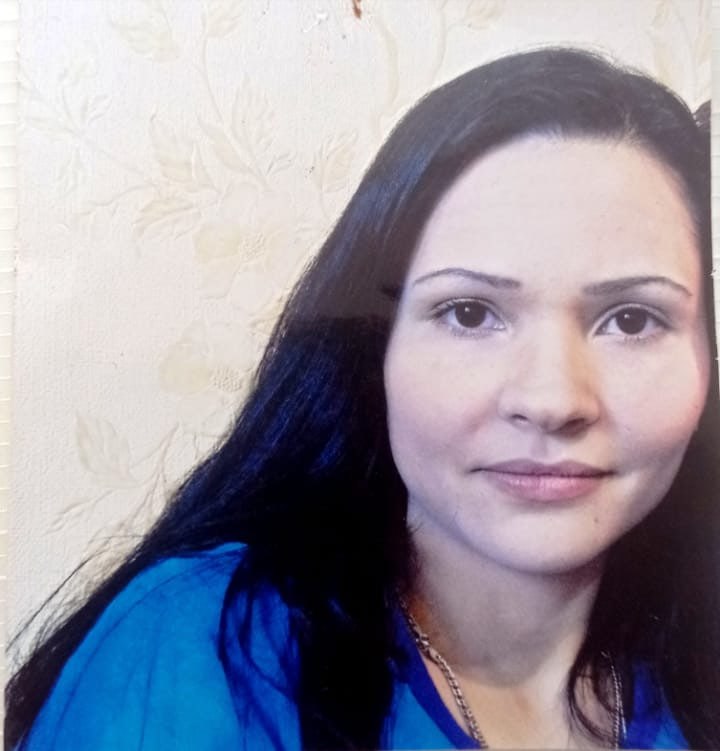
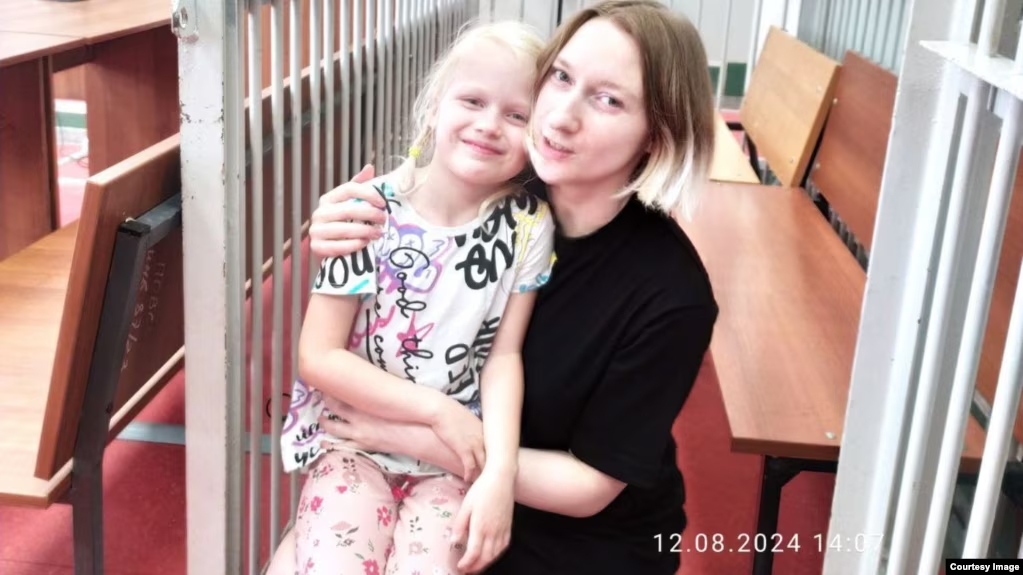

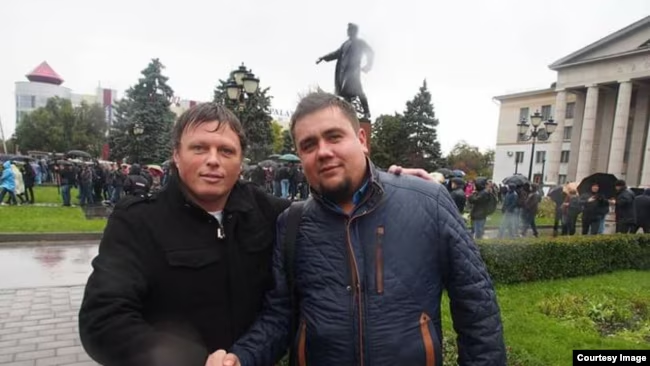
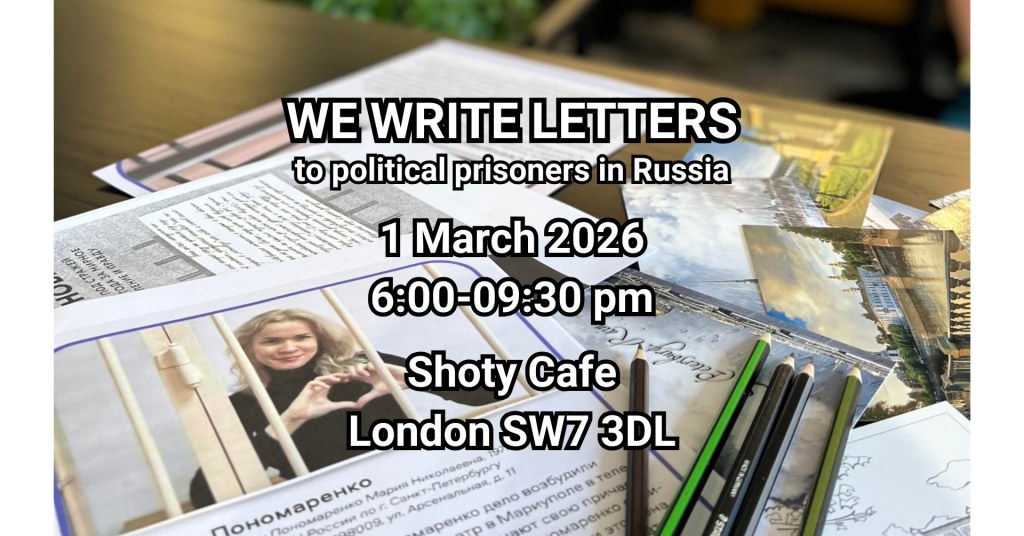


 Write to Gordey at the following address:
 You can also send letters through the online services