Toxicity

School of Rock performs System of a Down’s “Toxicity” (2022)

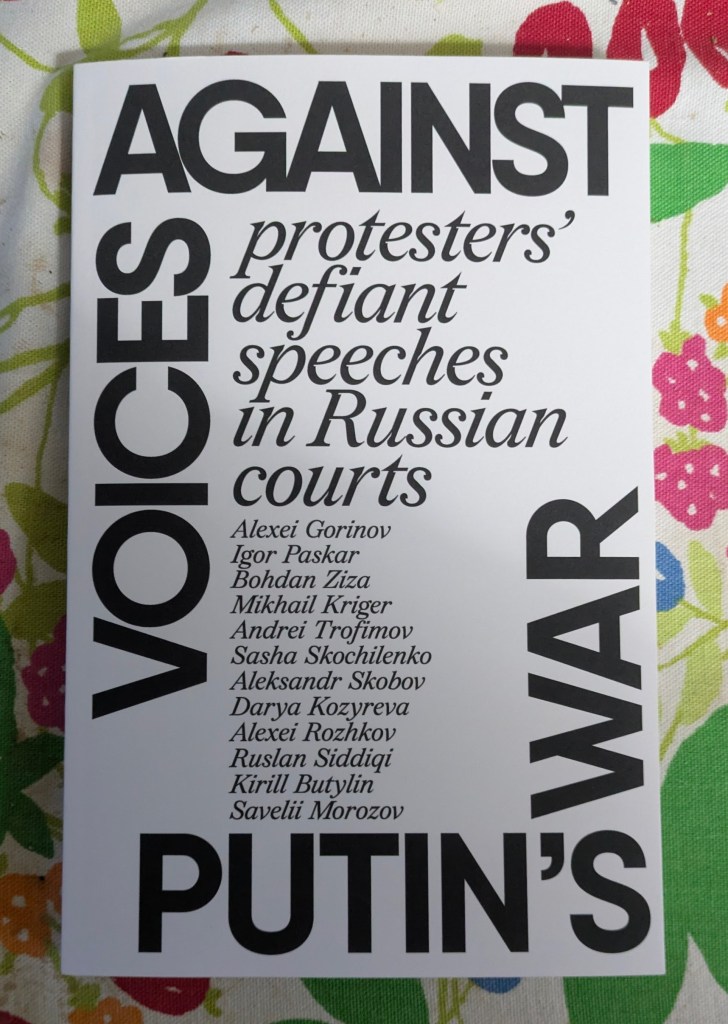
Actors Martin and Janet Sheen, John Cusack and Slovenian philosopher Slavoj Žižek have signed an open letter urging Russian prison officials to end the solitary confinement of jailed activist Mikhail Kriger, who has been on a dry hunger strike for more than a week.

They join Garbage frontwoman Shirley Manson, who earlier this week called on the local prison chief to end Kriger’s isolation.

Kriger, 65, first launched a hunger strike in late September. He started a dry hunger strike — meaning abstention from both food and water — last Friday after a planned visit with his daughter was canceled.

Kriger has accused prison authorities of deliberately trying to isolate him to prevent contact with other inmates. 

The latest signatories of the letter to the head of Correctional Colony No. 5 in Russia’s Oryol region claimed Kriger’s condition “has now become critical,” according to the letter published by the exiled news website Mediazona.

“[Kriger’s] speech has slowed, his gaze is unfocused and he is extremely weak. Dry hunger strikes cause organ failure and quickly lead to shock and death,” the Sheens, Cusack and Žižek wrote.

Kriger was in 2023 sentenced to seven years in prison for “justifying terrorism” and “inciting hatred” over anti-Kremlin social media posts. The activist said during trial that he was being persecuted for his anti-war views and open pro-Ukrainian position.

The Nobel Peace Prize-winning human rights group Memorial designated Kriger a political prisoner.

The anti-Kremlin activist group Pussy Riot raised alarm over Kriger’s hunger strike earlier this week, calling on followers to write letters to him and the prison administration. 

It was not immediately clear whether authorities in the Oryol region prison colony intended to respond to the international appeals.

It was also not clear when Kriger was expected to be moved out of solitary confinement and whether his medical condition was being properly monitored.

Kriger’s support group said the activist was taken to a regional hospital on Wednesday for tests, the results of which have not been shared.

Kriger’s lawyer said he was “cheerful, wrote poems and even offered to hop on one leg to show his strength,” the support group said in an update Thursday.

“Forced feeding will only begin if he loses consciousness or doctors deem his condition critical,” Kriger’s support group wrote on Telegram.

Source: “Hollywood Stars Back Jailed Russian Activist on Hunger Strike,” Moscow Times, 17 October 2025


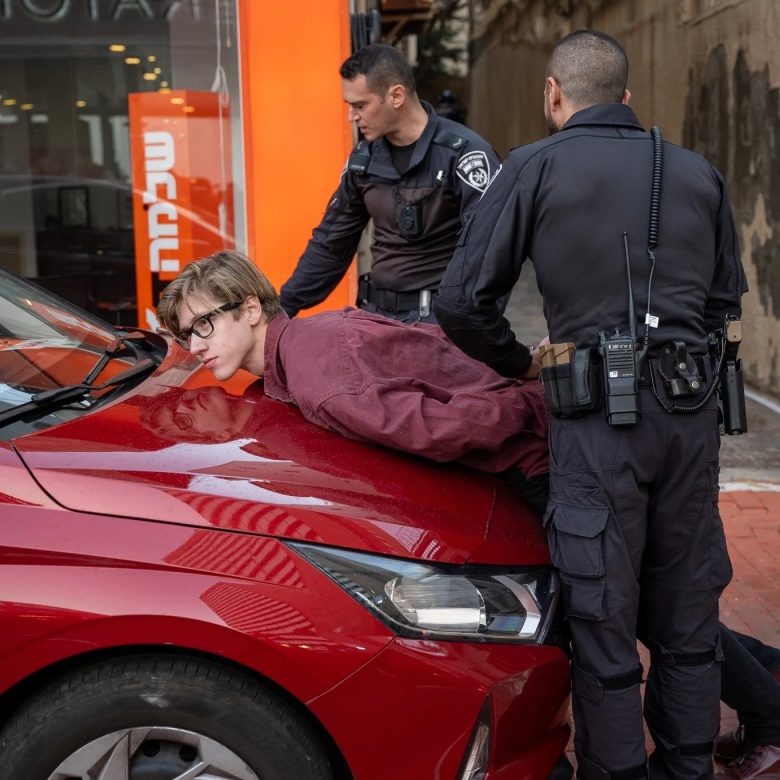
Yegor Shramko holding a placard that reads “No to the war with Ukraine” in Petersburg’s Palace Square

Our correspondent reports that activist Yegor Shramko did an anti-war picket in Palace Square and was detained.

The Petersburg man held a blue-and-yellow placard bearing the slogan “No to the war in Ukraine” and stood this way for around an hour. Shramko told our correspondent that although passersby supported him, the police were summoned by animateurs dressed as Russian emperors and empresses who offer to take photos with them for money on the square.

“I cannot keep silent. A life in which you have to fear everything, keep quiet, and be afraid of every little noise has no value for me,” Shramko explained to Bumaga.

He told RusNews that he had been wanting to stage the protest for four months but only worked up the nerve today.

This past summer, Shramko was jailed for twenty-four hours on charges of “displaying extremist symbols.” The “extremist symbol” in this case was the portrait of Alexei Navalny which Shramko brought to the Solovetsky Stone on the murdered politician’s birthday. At the time, Shramko told Bumaga that Navalny’s own words—”I’m not afraid, and you shouldn’t be afraid either”—had encouraged him to take the plunge and risk arrest by carrying out the proteest.

Source: Bumaga (Facebook), 17 October 2025. Thanks to Hanna Perekhoda for the heads-up.


The activist held a solo picket for about an hour. St. Petersburg residents approached him—some offered words of support, while others began arguing with him. More than 50 minutes after the picket began, security forces in full uniform arrived and detained Yegor.

Source: “Security forces detained activist Yegor Shramko, who was holding a pacifist picket | St. Petersburg,” RusNews (YouTube), 18 October 2025


As you have probably heard, recently, on a Swiss train, a Russian man (with Latvian citizenship) attacked a family. The family was speaking Ukrainian among themselves. He started threatening to kill them and their baby.

It’s easy to dismiss this as just another “fait divers” (which, in a sense, it is), but I think it says something larger. To understand his actions, you have to understand where it comes from.

For centuries, the inhabitants of the Russian state lived in a situation where order depended on fear and extreme forms of violence. This was true in much of the world, but while many countries began to change over the last century (let’s put aside the reasons behind the change), in the Russian/Soviet empire the situation actually became worse. Much worse.

The rules were never something people agreed to follow together (after all, you need to feel a part of a society and thus to share common imaginary to do it, and it is impossible to do it if you live in the empire, however much some contemporary researchers might wish it). It is something they were imposed from above, by the state, or by whoever had power over you at the moment. People learned that laws only mattered when someone strong was watching. So when a person raised in that kind of world finds themselves in a place like Switzerland, where rules work because the majority respects them voluntarily, they see the absence of fear and coercion as a sign that anything goes.

The man in that train was in a setting where no one was looking as capable to physically stop him and he took that as permission to dominate others, those people that he hates for the mere fact of their existence.

This same pattern plays out on a global scale. The Russian state elites see Europe much like that man saw the train: as a place without explicit “real” (military) force. It looks fake, easy to break, like a house of cards, because it relies on trust, and thus, in their view, on NOTHING.

People and societies shaped by fear and domination can’t imagine relationships built on any agreements (that require trust). They assume that if no one is dominating explicitly, it’s an invitation to act.

The man on the train and Putin’s crew are two versions of the same story. Both come from a social setting that sees respect as submission, peace as weakness, agreements as empty shells and absence of explicit force as an invitation to unlimited violence.

Source: Hanna Perekhoda (Facebook), 18 October 2025


Donald Trump told Ukrainian President Volodymyr Zelensky on Friday to make a deal with Russia, pouring cold water on Kyiv’s push for Tomahawk missiles as the U.S. leader pursues a diplomatic solution to the war.

Trump said as recently as last month that he believed Ukraine could take back all its territory — but a day after agreeing to meet Russian President Vladimir Putin for a new summit the American had changed his tune.

After meeting with Zelensky at the White House, Trump said on social media that their talks were “very interesting, and cordial, but I told him, as I likewise strongly suggested to President Putin, that it is time to stop the killing, and make a DEAL!”

Trump also appeared to suggest both sides should accept their current front lines. “They should stop where they are. Let both claim Victory, let History decide!” he said.

Zelensky said after the meeting that Russia was “afraid” of the U.S.-made long-range Tomahawk cruise missiles, but that he was “realistic” about receiving the weapons from Washington.

He told reporters that while he and Trump talked about long-range weapons they “decided that we don’t speak about it because… the United States doesn’t want escalation.”

‘Get the war over’

Zelensky came to Washington after weeks of calls for Tomahawks, hoping to capitalize on Trump’s growing frustration with Putin after a summit in Alaska failed to produce a breakthrough.

But the Ukrainian left empty-handed as Trump eyes a fresh diplomatic breakthrough on the back of last week’s Gaza peace deal.

Trump has appeared far more upbeat about the prospects of a deal since his two-and-a-half hour call with Putin on Thursday, in which they agreed to meet in Budapest.

“Hopefully we’ll be able to get the war over with without thinking about Tomahawks,” Trump told journalists including an AFP reporter as he hosted Zelensky at the White House.

Trump added that he believed Putin “wants to end the war.”

Zelensky, who came to the White House to push for the long-range U.S.-made weapons, said however that he would be ready to swap “thousands” of Ukrainian drones in exchange for Tomahawks.

Zelensky congratulated Trump on his recent Middle East peace deal in Gaza and said he hoped he would do the same for Ukraine. “I hope that President Trump can manage it,” he said.

‘Many questions’

Diplomatic talks on ending Russia’s invasion have stalled since the Alaska summit.

The Kremlin said Friday that “many questions” needed resolving before Putin and Trump could meet, including who would be on each negotiating team.

But it brushed off suggestions Putin would have difficulty flying over European airspace.

Hungary said it would ensure Putin could enter and “hold successful talks” with the United States despite an International Criminal Court arrest warrant against him for alleged war crimes.

Since the start of his second term, Trump’s position on the Ukraine war has shifted dramatically back and forth.

Initially Trump and Putin reached out to each other as the U.S. leader derided Zelensky as a “dictator without elections.”

Tensions came to a head in February, when Trump accused his Ukrainian counterpart of “not having the cards” in a rancorous televised meeting at the Oval Office.

Relations between the two have since warmed as Trump has expressed growing frustration with Putin.

But Trump has kept a channel of dialogue open with Putin, saying that they “get along.”

The U.S. leader has repeatedly changed his position on sanctions and other steps against Moscow following calls with the Russian president.

Putin ordered a full-scale invasion of Ukraine in February 2022, describing it as a “special military operation” to demilitarize the country and prevent the expansion of NATO.

Russia now occupies around a fifth of Ukrainian territory — much of it ravaged by fighting.

On Friday the Russian Defense Ministry announced it had captured three villages in Ukraine’s Dnipropetrovsk and Kharkiv regions.

Source: Danny Kemp (AFP), “Trump Tells Zelensky to ‘Make a Deal’ as Tomahawk Plea Misfires,” Moscow Times, 18 October 2025


All last week, Republican leaders tried to portray the No Kings protests scheduled for Saturday, October 18, as “Hate America” rallies. G. Elliott Morris of Strength in Numbers partnered with Atlanta-based science newsroom The Xylom to estimate that as many as 8.2 million people turned out yesterday to oppose the Trump administration. The mood at the protests was joyful and peaceful, with protesters holding signs that championed American principles of democracy, free speech, equality, and the rule of law. As the Grand Junction, Colorado, Daily Sentinel put it in a front-page headline: “‘This is America’ ‘No Kings’ protests against Trump bring a street party vibe to cities nationwide.”

Then last night, after the protests, the president’s social media account posted an AI-generated video showing Trump in a fighter jet with “KING TRUMP” painted on the side. The president sits in the airplane in front of something round that could be seen as a halo. He is wearing a gold crown; weirdly, the oxygen mask is over his mouth and chin, rather than mouth and nose.

Once in the air, the plane drops excrement on American cities, including what seems to be New York City. The excrement drenches protesters, one of whom is 23-year-old liberal political commentator and influencer Harry Sisson. Journalist Aaron Rupar of Public Notice, who shares media clips that reflect politics, commented: “Trump posts AI video showing him literally dumping sh*t on America.” Historian Larry Glickman noted that media outlets make much of alleged Democratic disdain for ordinary Americans, but have had little to say about the disdain for Americans embodied by Trump’s video.

Several administration videos and images have responded to Americans saying “No Kings” by taking the position “Yes, We Want Kings,” an open embrace of the end of democracy. But they are more than simple trolling. Led by Trump, MAGA Republicans have abandoned the idea of politics, which is the process of engaging in debate and negotiation to attract support and win power. What is left when a system loses the give and take of politics is force.

The idea that leaders must attract voters with reasoned arguments to win power and must concede power when their opponents win has been the central premise of American government since 1800. In that year, after a charged election in which each side accused the other of trying to destroy the country, Federalist John Adams turned the reins of government over to the leader of the opposition, Thomas Jefferson. That peaceful transfer of power not only protected the people, it protected leaders who had lost the support of voters, giving them a way to leave office safely and either retire or regroup to make another run at power.

The peaceful transfer of power symbolized the nation’s political system and became the hallmark of the United States of America. It lasted until January 6, 2021, when sitting president Trump refused to accept the voters’ election of Democrat Joe Biden, the leader of the opposition.

Now back in power, Trump and his loyalists are continuing to undermine the idea of politics, policies, and debate, trying instead to delegitimize the Democratic opposition altogether. Yesterday, during the protests, President Donald Trump, Vice President J.D Vance, and the official White House social media account posted a video of Trump placing a royal crown on his head, draping a royal robe around his shoulders, and unsheathing and brandishing a sword (an image that raises questions about why Trump wanted one of General Dwight D. Eisenhower’s swords so badly that he had the museum director who refused to hand it over fired). In the video, Democratic leaders including former House speaker Nancy Pelosi (D-CA) and what appears to be Senate minority leader Chuck Schumer (D-NY) first kneel and then bow to Trump.

Administration imagery doesn’t simply insult opposition leaders; it undermines the idea of politics by suggesting that Democrats are un-American. Last night the White House continued its racist crusade against Democratic leaders by posted an AI-generated image of Trump and Vance wearing jewel-encrusted crowns positioned above an image of House minority leader Hakeem Jeffries (D-NY) and Senate minority leader Chuck Schumer (D-NY) wearing Mexican sombreros. The caption reads: “We’re built different.”

The administration’s hostility to loyal opposition is translating into direct assaults on our government. House speaker Mike Johnson is refusing to seat a member of the opposition. Voters chose representative-elect Adelita Grijalva (D-AZ) on September 23 to fill a vacant House seat, but Johnson has come up with one reason after another not to seat her. Until she is sworn in, she has no access to government resources and cannot represent her constituents. She also cannot be the 218th signature on a discharge petition that would force a vote on whether to demand the release of the Epstein files, the final signature needed.

Grijalva recorded a video reinforcing the political system, saying: “We need to get to work, get on the floor, and negotiate so we can reopen the government.”

But Republican congressional leaders are refusing even to talk with Democrats to reopen the government, let alone to negotiate with them. They are trying to force Democrats simply to do as they say, despite the fact that 78% of Americans, including 59% of Republicans, support the Democrats’ demand for an extension of the tax credit that lowers the cost of healthcare premiums on the Affordable Care Act markets. Lindsay Wise, Anna Wilde Mathews, and Katy Stech Ferek of the Wall Street Journal reported today that more than three quarters of those who are insured through the ACA markets live in states that voted for Trump.

A video of Trump in a bomber attacking American cities carries an implied threat that the disdain of throwing excrement doesn’t erase. This morning, Trump reinforced that threat when he reminded Fox News Channel host Maria Bartiromo: “Don’t forget I can use the Insurrection Act. Fifty percent of the presidents almost have used that. And that’s unquestioned power. I choose not to, I’d rather do this, but I’m met constantly by fake politicians, politicians that think that, that you know they it’s not like a part of the radical left movement to have safety. These cities have to be safe.”

That “safety” apparently involves detaining U.S. citizens without due process. On Thursday, Nicole Foy of ProPublica reported that more than 170 U.S. citizens have been detained by immigration agents. She reports they “have been dragged, tackled, beaten, tased and shot by immigration agents. They’ve had their necks kneeled on. They’ve been held outside in the rain while in their underwear. At least three citizens were pregnant when agents detained them. One of those women had already had the door of her home blown off while Department of Homeland Security Secretary Kristi Noem watched.”

On Friday, the Trump administration pushed its attempt to use the military in Democratic-led cities, asking the Supreme Court to let it deploy troops in Chicago immediately. Chris Geidner of Law Dork notes that four judges, two appointed by Democrats and two appointed by Republicans, have rejected the administration’s arguments for why they must send in troops. Now the Department of Justice has appealed to the Supreme Court, asking for a decision on the so-called shadow docket, which would provide a fast response, but one without any hearings or explanation.

The administration’s appeal to the Supreme Court warned that there was “pressing risk of violence” in Chicago—a premise the judges rejected—and said preventing Trump from going into the city “improperly impinges on the President’s authority.”

How much difference will the No Kings Day protests, even as big as they were, make in the face of the administration’s attempt to get rid of our democratic political system and replace it with authoritarianism? What good is an inflatable frog against federal agents?

Scholar of social movements Lisa Corrigan noted that large, fun marches full of art and music expand connections and make people more willing to take risks against growing state power. They build larger communities by creating new images that bring together recognizable images from the past in new ways, helping more people see themselves in such an opposition. The community and good feelings those gatherings develop help carry opposition through hard moments. Corrigan notes, too, that yesterday “every single rally (including in the small towns) was bigger than the surrounding police force available. That kind of image event is VERY IMPORTANT if you’re…demonstrating social coherence AGAINST a fascist government and its makeshift gestapo.”

Such rallies “bring together multigenerational groups and the playfulness can help create enthusiasm for big tent politics against the monoculture of fascism,” Corrigan writes. “The frogs (and unicorns and dinosaurs) will be defining ideographs of this period of struggle.”

Source: Heather Cox Richardson, Letters from an American, 19 October 2025


System of a Down, “Toxicity” (2001)

Sunday Reader No. 6: Hell Is Full

On Chaplygin Street in Moscow. Photo by anatrrra. Used with their permission

EXTERIOR: A neo-classical building in Moscow’s old German quarter. A plaque on the wall reads, “Western District Military Court No 2”. A group of actors and journalists mill around on the lawn.

INTERIOR: A large hall with a grand staircase. Through the frame of a metal detector stands a statue of Lady Justice in her blindfold, holding scales in one hand and a sword in the other.

A commotion. Several portly guards in flak jackets, with a dog on a leash, escort two handcuffed women through the hall. One, about 5ft tall with big eyes and curly hair, is Yevgenia Berkovich, a 39-year-old poet and theatre director. She is dressed in a white shirt and black trouser-suit. The other, slightly taller, wearing jeans, a white T-shirt and large owlish glasses, is Svetlana Petriychuk, a 44-year-old playwright.

The two women are led into a courtroom and placed in a cage of bullet-proof glass. A bailiff lets in the spectators, who sit down on the upholstered, green benches. Berkovich mischievously sticks out her tongue as photographers’ cameras flash and click. Yuri Massin, the judge, looks towards Berkovich.

Massin: Are you ready for the proceedings?
Berkovich
: Well, it depends on what will happen.

What happened was a show trial that revealed the radicalisation of the Russian state in the past few years. By the time proceedings began on May 20th 2024, Berkovich and Petriychuk had already been in detention for more than a year, having been charged with “propaganda and the justification of terrorism”. In the eyes of the regime, they had committed a crime by writing and staging a play called “Finist, the Bright Falcon”. Part docu-drama, part fable, “Finist” tells the story of the thousands of Russian women who, from 2015, were seduced online by professional recruiters from Islamic State (IS), and travelled to Syria to marry jihadists. Many of these women received lengthy sentences on their return home. The play premiered in 2020 to critical acclaim and was performed across the country.

As with any show trial, this one’s outcome was preordained, and its purpose was to justify the existing system and demarcate the ideological limits of the state. In doing so, it elucidated the ultra-conservative, anti-Western belief system that has expanded across public life since the full-scale invasion of Ukraine in February 2022. Berkovich and Petriychuk were the first artists to be jailed since Soviet times for the content of their work—or, more precisely, the thoughts of their characters. But as theatrical professionals, they managed to turn the trial into their show.

Continue reading “Sunday Reader No. 6: Hell Is Full”

Andrei Khrzhanovsky: Even Tel Aviv Hipsters Can Commit Genocide

Andrei Khrzhanovsky. Source: social media

Son of the renowned filmmaker Ilya Khrzhanovsky, anthropology graduate and activist Andrei Khrzhanovsky moved to Israel in 2022. He almost immediately adopted a pro-Palestinian stance in the Middle East conflict, dubbing Israel’s actions genocide, and Zionism an ethnically supremacist idea. He says he is fighting for the rights of Palestinians in the West Bank due to his sense of guilt over the war in Ukraine. He spoke with Marina Berdichevskaya about his radical stance and his conflicts with his family.


Andrei Khrzhanovsky, 26, has been living in Israel since 2022. When Russia launched its full-scale invasion of Ukraine, he found himself in Tel Aviv with his entire family, including his famous father, grandfather, and grandmother. When the time came to fly home, there was nowhere to go. On February 24, Ilya Khrzhanovsky had begun circulating a petition, condemning the invasion of Ukraine, among cultural figures. Andrei flew to Georgia and applied there for Israeli citizenship.

Since March 2022, Andrei X, as he likes to be called, has enthusiastically plunged into the weeds of Israeli life and quite quickly chosen a side: he has taken up activism and, so he claims, journalism, on behalf of “the most vulnerable group on Earth at the moment,” the inhabitants of the West Bank. At the same time, Andrei has been doing battle with “the genocide in Gaza” and on this score has found himself at odds with his father, who has repeatedly said that, in the wake of 7 October 2023, he has felt himself to be Israeli first and foremost.

We talked at length and quite emotionally about how the profoundly erudite Khrzhanovsky, who has a degree in anthropology from the University of London, has decided to atone for the collective guilt of generations for world colonialism. Andrei happily juggles concepts and historical facts and is sure that this is the only way to do things: to always stand up for the downtrodden and to never succumb to propaganda. Whether he himself is suspectible to propaganda is an open question. Ah, yes. The opinions expressed here do not necessarily reflect the views of Republic or its editors—nor should they.

“The closer you are to the empire’s center, the greater the blame”

— Let’s begin with where you live. Your Facebook page says you live in Jericho. Is this true?

— Nowadays, I don’t stay anywhere longer than a few days in a row. I rent a flat, but I won’t divulge its location, because I get several death threats a day. I come home once every month and a half for a couple of days and then I hit the road again. Yesterday, I came from Bethlehem.

—  How do people on the West Bank relate to you? Do they understand that you have an Israel passport?

— I’ve never had any problems with this because this is a political conflict, not an ethnic one. I speak with Palestinians deep in Area A (the West Bank is divided into three areas; Area A, which makes up seventeen percent of the West Bank, is wholly controlled by the Palestinian Authority — Republic) whose relatives have been killed, who have done time in prison. Israel fosters the illusion that all Palestinians want to kill all Jews. But this isn’t an ethnic conflict, and not even a religious one at the end of the day.

— In February of last year you said in an interview, “When the war in Ukraine began, I had an enormous sense of guilt that I hadn’t done more [to stop it]. That’s why I’ve thrown myself into all political activism here.” You explained your activism in terms of not wanting to “squander another country.” Where does such a young man come by a sense of personal guilt for what is happening in and with a country? After all, many Russian nationals, especially the remainers, reject the very principle of collective guilt.


Karèn Shainyan, interview with Andrei Khrzhanovsky and Artyom Nikitin (in Russian, with no subtitles)

Today’s episode of Who Am I After This? is very sensitive for me personally. The conversations with its two subjects, leftists and human rights activists, were the hardest and most emotional in the whole project because they both touch on a very painful personal conflict of loyalties for me. This is the only episode where there are two protagonists at once: journalist Andrei Khrzhanovsky and architect Artyom Nikitin. Quite handsome and young, both moved to Israel after the war in Ukraine began, and both travel to the West Bank to support the local Arab [sic] population, even and especially now, when there is a war in [sic] Israel.

Source: Karen Shainyan (YouTube), 2 February 2024


— Before February 2022 we all lived in a magical reality of sorts: there was a dictatorship in Russia, seemingly, but no one was getting killed, as it were; everything was sluggish, we had to tackle corruption and so on. But there was no sense of the disaster that any dictatorship represents. This illusion personally crumbled for me on 24 February 2022. The disaster started then, and then intensified after the genocide in Gaza began. Over the past few years, the feeling has only grown in me that we are all to blame for what is happening; some more, some less. The closer you are to the empire’s center, the greater the blame.

— And when did you personally start counting down that blame?

— If we speak of the entire timeline, there were three moments. The first was 24 February 2022. The second was an article by Yuval Abraham (an Israeli journalist and co-director of the Oscar-winning film No Other LandRepublic), based on conversations with soldiers fighting in Gaza who admitted that they had been tasked with firing on civilian targets. And the third was the morning when I woke up, opened Instagram, and saw the video of a man in Gaza burning alive after an IDF strike on a hospital.

Andrei Khrzhanovsky. Source: social media

— How did you get involved in political activism in Israel?

— I had an approximate, general notion of what was happening here when I turned up here. I grew up in the Russophone media space after all. But when I arrived I realized that I had to figure out what was happening. I started reading books and talking to people. The more I researched, the more horrified I was. Suddenly, I found out about the status of Palestinians in East Jerusalem: their land was annexed, but they weren’t granted [Israeli] citizenship. To get into the Shuafat refugee camp, which the Israelis annexed and surrounded with a wall, Palestinians have to go through a security checkpoint. The sheer number of different methods for constructing a state based on ethnic supremacy is insane.

Continue reading “Andrei Khrzhanovsky: Even Tel Aviv Hipsters Can Commit Genocide”

Turning Her Back on Propaganda: Valeria Zotova

Valeria Zotova

Turning Her Back on Propaganda
What does daily life consist of in a prison camp? It consists of work, of course, work which is dull and exhausting. It consists of sleep, which is fitful, as sometimes there are inspections every two hours. And it consists of spending time with people whom you didn’t choose to spend time with. The wardens make sure to burden convicts so that they have nothing that is theirs alone, so that they have no time to think about anything, so that they are entirely subordinate to the powers that be. The goal of prison camp “re-education” is the same: breaking the will of the prisoners, turning them into obedient robots who obey all the orders of their superiors.

This is especially true for political prisoners—people who think independently and have their own principles. The overarching mission of the wardens is to attain voluntary submission, joyful and proactive submission, from political prisoners. But the wardens rarely succeed in this mission.

They have utterly failed with Valeria Zotova, a political prisoner at Kostroma Penal Colony No. 3. The wardens have insistently offered her a path to redemption, that is, cooperating with the authorities and taking part in “civic life.” Zotova has turned it down.

Recently, the prison camp’s club showed a movie, a Russian propaganda film titled Callsign: Passenger. Here is what Wikipedia says about the movie: “The movie is set in 2015. The movie’s main character is Nikolai Ryabinin, a trendy Moscow writer and carefree party animal. His brother volunteered for the war in Donbass and has gone missing. Nikolai goes looking for his brother and joins a separatist unit, the Aurora Battalion, in which his brother previously served. There, he gets the ironic nickname “Passenger” and under the leadership of the commander (callsign: Trigger) reevaluates his own life and comes to support the separatists.”

It’s an unimaginative piece of propaganda based on Alexander Prokhanov’s novel The Murder of Cities. It’s cheap trash, of course, like the writer himself, but the convicts are obliged to drink this cinematic concoction down to the dregs. All of them are herded into the club. Zotova refuses to go. Ultimately, it’s her right to watch the movie or not. But what do rights matter when it comes to Russian patriotism! Zotova is forcibly escorted into the auditorium. Watch our high art: look what talented filmmakers made it, what actors starred in it! But Lera Zotova turns her back on the screen and looks the other way.

Turning one’s back on propaganda is simple—simple but dangerous. The pressure on Valeria continues unabated. The harassment has been endless. The wardens summoned a friend of Zotova’s and stipulated to either: “Either freedom or Zotova—you choose.” They have been trying to create a vacuum around the political prisoner, depriving her of contact with those who are close to her in any way. The young woman is twenty-one years old, but she has been bullied like a hardened criminal. Because, as prison authorities envision it, she should be like everyone else: obedient, involved in the prison camp’s civic life, acting in plays, fulfilling the production quotas, and not smarting off to her superiors.

Source: Alexander Podrabinek (Facebook), 24 August 2025. Thanks to VA for the heads-up. Translated by the Russian Reader

Yulia Moskovskaya, Terrorist

Twenty-two-year-old Yulia Moskovskaya (née Joban) was detained in Petersburg in mid-June. She is suspected of attempting to carry out a terrorist attack against a drone design company employee. She failed to plant an explosive device [sic], according to the press service of the Petersburg municipal courts.

Moskovskaya was remanded in custody to a pretrial detention center. Investigators say that she “espouses a pro-Ukrainian ideology and is hostile to the current Russian government,” and claim that the young woman tried to “impact decision-making” by means of a terrorist attack. Criminal terrorist cases are opened every month, but usually they do not involve harm to specific people. In 2024, seventy-five people, including ten women, were convicted in Russia for carrying out terrorist attacks.

Bumaga has learned that Moskovskaya is not speaking with her family, and that a female friend of her has become her spokesperson. We chatted with this young woman about how the suspect behaved before her arrest, how she got into debt, and when she moved to Petersburg.

The detainee’s family: “Yulia changed her surname: she didn’t want anything to remind her of her kin”

Yulia and I are quite close friends. Her lawyer informed me of her arrest. I was shocked when he contacted me. At first I thought it was some kind of prank. I still can’t believe it has really happened.

I have known Yulia since 2017. We are from different cities and met online in a fan group for our favorite singer. At first, we were pen pals, but then we took our relationship offline and saw each other in person many times.

Yulia wasn’t in touch with many people, so she must have given the lawyer my contact info. She didn’t have many friends. Yulia didn’t speak with her relatives. She has a mother and a younger brother [who live in Moscow], as well as her grandparents, who live in some other city.

Yulia has always had bad relations with her mother. Her mother had a live-in boyfriend who always treated Yulia badly and beat her. Her mother took the boyfriend’s side and didn’t stand up for her daughter.

Yulia Moskovskaya. Source: social media

Yulia’s father died in 2020, and Yulia didn’t have a close relationship with him either. He drank heavily. He regularly brought his drinking buddies home and would get so drunk that he couldn’t stand up. Yulia often escaped to the neighbors when her father, out of his mind, tried to beat her. When we talked on the phone, I could hear her father getting into a fighting mood; he would be saying something to Yulia, and she would scream and run off. The neighbors would even call the police, but they could calm him down only for a while, and only once did take him to the slammer. Yulia essentially had no one to whom she could turn. In difficult situations, she would call the mental health hotline.

As an adult, Yulia changed her surname [from Joban to Moskovskaya]: according to her, she didn’t want anything to remind her of her kin. She sought treatment from psychologists. In the beginning, she had hope that they would help her, but then she just went to them to get things off her chest.

Debts and the move from Moscow to Petersburg: “Creative work was her only stable hobby”

Three times, Yulia enrolled in different [institutions of higher learning]. But she wouldn’t like something about them and would drop out. For a while, she was studying to be a designer. I don’t remember what her other two majors were.

A few years ago, Yulia moved for the first time from Moscow to Petersburg: she had always liked the city. You could say that she flitted between the two capitals.

Yulia originally had her own place to live. After his death, her father left his children an inheritance. Yulia and her brother sold her father’s flat in Moscow and split the money, so she was able to buy her own place in Petersburg. She lived there for a few months, but got bored and bought a flat in another neighborhood. After a while, she went back [to Moscow], buying a flat in the Moscow Region. Soon afterwards she sold her last home and went back to Petersburg, where she lived in a rented flat.

Yulia often changed jobs. The first place she worked was McDonald’s, before it left Russia. She stayed at that job for several years. After that she worked as a courier, then as a consultant in a store. Almost every month she would change jobs if she wasn’t satisfied with something. She didn’t regard any of her jobs as permanent. She said that she would soon leave [Russia] and that she only needed temporary, part-time work.

Yulia Moskovskaya. Source: social media

I know that Yulia had outstanding loans and that she didn’t have enough money to live on. She said that she had been sued by debt collectors. (In May 2025, a Moscow court ruled in favor of debt collectors trying to recover debts from Moskovskaya under a loan agreement — Bumaga.) She had spent the money on surgery [not covered under free public healthcare], and on braces.

Yeah, she’s not a very steady person. She gets bored with things quickly. Creative work was her only stable hobby. (On social media, Moskovskaya followed a lot of literature and Silver Age poetry groups — Bumaga.) She drew and wrote poems. Recently, she had been making her own jewelry and trying to sell it.

Moskovskaya’s views and her abandoned cat: “Before her arrest, she said she wanted to go to the war”

When the war broke out, Yulia immediately supported Ukraine. She said that she didn’t like the regime in Russia. She had a very firm stance. But I wouldn’t say she was always interested in politics. Before the war, I hadn’t noticed that she followed the news. I was surprised when she suddenly became politicized. Moreover, she has no Ukrainian relatives.

Before her arrest — since last summer — she had been saying that she wanted to go to the war. She mentioned that she had visited military enlistment offices and contacted people who could help her get to Ukraine, but everyone, according to her, had turned her down. I tried to warn her about the consequences: what if she died or something? She replied that she didn’t care, that this was her purpose in life and that such a death would be an act of heroism.

All last month, she kept saying that she would be leaving Petersburg for Ukraine and that some people would help her do this.

When Yulia was detained, I was allowed to speak with her for literally several seconds. The only thing she said was that I should go get her cat, which had been temporarily placed in a shelter.

Yulia Moskovskaya’s cat. Source: social media

I had imagined that Yulia would be hysterical, panicked. According to her lawyer, however, she is surprisingly calm.

Source: “‘She attempted to plant explosives under a car’: friend of 22-year-old Yulia, accused of plotting a terrorist attack, speaks of her loneliness and debt,” Bumaga, 30 June 2025. Translated by the Russian Reader

Cars for Ukraine

Vadim Volkov

The European University at St. Petersburg has purchased and dispatched a UAZ vehicle to the war in Ukraine “for transporting the wounded in the combat zone,” the university’s press service has reported.

It notes that the vehicle was sent to Military Unit No. 11076, which was formed from mobilized residents of St. Petersburg, the Leningrad, Murmansk, and Arkhangelsk regions, and the Komi Republic.

The university’s press service posted a commendation to university rector Vadim Volkov from the unit’s commander, who praised Volkov for his “social activism” and support of the military “as it carries out missions in the special military operation zone in Ukraine, the Donetsk People’s Republic, the Luhansk People’s Republic, the Zaporizhzhia region, and the Kherson region.”

“Military Unit No. 11076 expresses gratitude to the autonomous noncommercial higher education organization ‘European University at St. Petersburg’ in the person of Vadim Viktorovich Volkov for social activism and support rendered to the soldiers of our unit as they carry out missions in the special military operation zone in Ukraine, the Donetsk People’s Republic, the Luhansk People’s Republic, Zaporizhzhia Region, and Kherson Region. Victory will be ours! Military Unit No. 11076’s commander, Colonel V. Zyatchin, May 2025.”

The European University is a private university founded in St. Petersburg in 1994. The university was funded by grants from American and European NGOs. In 2016, the university was stripped of its accreditation for a year after an audit undertaken by the Prosecutor’s Office and Rosobrnadzor [the Russian federal education watchdog], after which such audits became routine.

In 2023, the Russian authorities audited the European University “for extremism,” and the university was also fined over books in its library published by “undesirable” organizations. Rector Volkov reported in an interview with RBC on June 24 that the prosecutor’s office had audited ninety-eight programs at the university and twelve master’s theses, after which the university had amended the programs and made changes to its academic advising process based on the recommendations of the authorities.

In March 2024, the European University fired Ivan Kurilla, an Americanist who taught in its political science and sociology departments. Kurilla opposed the Russian invasion of Ukraine and was among the signatories of an open letter against the war by Russian academics and science journalists.

Source: “European University at St. Petersburg sends vehicle to war, garnering thank-you from Russian military,” Meduza, 10 June 2025. Photo courtesy of European University at St. Petersburg. Translated by the Russian Reader. Thanks to Comrade Koganzon for the heads-up.


Jesper Lindholt

Where are you from? And where are you now? Doing what?

I am from Aarhus, Denmark, and have lived in Kyiv for almost 20 years. I own a software company, Livatek, which works with clients in Northern Europe.

As a foreigner working and living in Ukraine for many years, what is the best and the worst thing about Ukraine?

The worst thing about Ukraine is that nothing is possible. The best about Ukraine is that everything in the end is possible.

How has the war changed your life? Has the war changed you personally?

With the start of the war, my brother Morten and I reactivated a Danish initiative called “Biler til Ukraine” – “Cars for Ukraine”—which had already helped a Ukrainian NGO bring SUVs to the front for medical evacuation during the war in Donbas. Within a week of the full-scale invasion in 2022, we were back in Ukraine with the first three cars.

Since then, we have scaled up tremendously and delivered more than 400 vehicles to the Ukrainian military for logistics and tactical purposes, including 75 buses for personnel transports. These days, we are managing more than one car per day. All in all, as a rough estimate, the value of these cars is somewhere close to $2 million. The money comes from absolutely average, normal Danes and private companies. I am often surprised by people’s generosity. They often donate their car and even drive it with us to Ukraine!

Growing a business has become more difficult with the war. With “Cars for Ukraine,” I have found another outlet for my professional energy to defend Ukraine. It has allowed me to work with some unique people in Denmark and Ukraine. Their strength and dedication inspire me.

What has surprised you most about Ukrainians these past couple of years? Good or bad?

I was not surprised to see the tenacity of the Ukrainians as they resisted Russia’s efforts to eradicate their culture. On the negative side—and here I am probably a bit naïve—I can still be disappointed by corruption. I know it is good news that corruption and the people who commit it are discovered and prosecuted, but I would prefer things to be nipped in the bud instead of cracked down afterward.

What are your plans?

I think I am like most Ukrainians in that “the future” does not exist anymore. We have a war to fight and win—after that, there is a future—and it is bright and open.

How do you see the war ending and Ukraine returning to a normal life?

Forces at play now do not point to a happy-end scenario for Ukraine. The dynamics need to change. Specifically, more political leaders of the West must do “a Macron” — to understand that Ukraine is fighting for every country of the liberal, Western world. (French President Emmanuel Macron underwent a radical change in his view on Russia’s war from dovish to hawkish and insisting on Russia’s defeat.) Because, honestly, for Ukraine to have a normal future, Russia not only needs to be beaten back to within its borders. It needs such an educational wacking that it will give up on its aggressive ways – and never again even consider attacking Ukraine or other states.

Tell us one thing people abroad do not know about Ukraine but they really should.

For too many centuries, Russian culture has defined itself as being unique, and outside rules and measures apply only to other countries. The mere existence of an independent Ukraine is a challenge to that myth. And, when Russia is attacking its neighbor, it is fighting its own demons and inferiority complexes.

You can learn more about the work of “Cars for Ukraine” (in Danish “Biler til Ukraine”) here.

Source: “BLITZ INTERVIEW: Jesper Lindholt, a Danish tech executive bringing hundreds of cars to the Ukrainian army,” Two Grumpy Old Men on Ukraine, 20 May 2024

Andrei Trofimov: “Try Me for Treason”

Convicted Russian anti-war activist Andrei Trofimov. Photo: Mr. Trofimov’s Vkontakte page, via Mediazona

In 2023, Andrey Trofimov, an anti-war activist from Tver, was sentenced to ten years in a maximum security penal colony on several charges [to wit, disseminating “fake news” about the Russian army, calling for “extremism,” and attempting to join the Free Russia Legion]. In his closing statement at trial, he called Vladimir Putin a “dickhead” [khuilo] and “heartily endorsed” Ukraine’s attacks on the Crimean Bridge and the Kremlin. This statement was the grounds for the second criminal case against Trofimov, this time on charges of “condoning terrorism” and “defaming the army.”

Today [6 May 2025], Judge Vadim Krasnov of the Second Western District Military Court lengthened Trofimov’s sentence to thirteen years. Prosecutor Andrei Lopata had petitioned the judge to impose a longer sentence of fifteen years.

Before the verdict in his first trial was read out, Trofimov had petitioned the court to impose the maximum penalty. Now he has suggested that he be charged with the more serious offense of high treason, claiming that he has been involved in the information war on the Ukrainian side.

Below, Mediazona has published a slightly abridged version of Trofimov’s statement during oral arguments at the [second] trial.

* * * * *

Your honor, the factual circumstances of my actions, which the investigation has categorized as crimes, are correctly stated in the indictment and have been fully investigated during the court hearing.

In my statement I would like to dwell on the reasons for these actions, on my goals, to review in detail, charge by charge, my response to the allegations—that is, to explain my motives for not pleading guilty. And, in my conclusion, I would like to petition the court as to what to do with me next.

I was living quietly at the dacha with my cats and was a bother to no one. My life changed drastically on 24 February 2022. The reason for both the first criminal case and the current criminal case [against me] was Russia’s invasion of Ukraine. I will further explain why I regarded this event in this way.

I am in prison for what I have said, after all. I took no action in either the first case or the second. But this has been my way of being involved in the events, because it was physically impossible for me to leave the country, and I had no desire to stay silent in this situation. I mean, it is my life.

Why have I done this? I must respond to your remarks yesterday to the effect that my statements, including in court, could harm my own interests. Your honor, I have no interest in a shorter sentence. I am already imprisoned.

What is the purpose of what I am doing? Writ large, it is a matter of self-preservation. It is just that I understand the instinct of self-preservation not as the preservation of the body per se, of its physical health, because I am not my body alone. I want to preserve my conscience in this difficult situation, my ability to tell black from white, and lies from truth, and, quite importantly, my ability to say out loud what I believe to be true.

This thing of mine did not start in 2022. I have always tried to live this way. It is just that my desire to preserve this ability in such situations—meaning, the ability to tell the truth, to maintain my conscience— is what causes such actions.

What actions have we observed? We have witnessed concrete evidence of crimes with which I have not been charged, evidence of the violation of Article 278 of the Russian Federal Criminal Code—that is, the forcible seizure or the forcible retention of power. I am referring to Vladimir Putin, who has held the highest official post in the Russian Federation for exactly a quarter of a century. During this entire time, the Constitution of the Russian Federation has contained the principle of succession of power, set out in the guise of the two-term rule [for Russian presidents]. We have witnessed a direct violation of this rule—that is, the forcible retention of power.

In what has occurred since 24 February, we see concrete evidence of a violation of Criminal Code Article 353—that is, the planning, preparation, unleashing, and waging of a war of aggression.

What have I done in this situation? Publicly, in the mode of a solo picket (just a protracteed one), I have demonstrated the Russian state’s insanity. Look, the prosecution is asking for fifteen years in total—the sentence given for murder, but even for murder, sentences are often shorter. And yet my deeds harmed no one nor caused any damage.

I am not just talking about the period covered by these criminal cases. I have never laid a finger on anyone, never stolen a penny, in my entire life. Nevertheless, [the prosecutor wants to send me down for] fifteen years. I believe that this is a demonstration of the state’s insanity. The state happily displays this quality using me as an example.

What have I done in response? I have shown fortitude. This is vital, because I hope that what I have been doing is seen by Ukrainians. Look at this: they arrested him. He was convicted and given a dozen years of maximum security. Judge the effect in terms of the second case. Did you do a good job of convincing me [of the error of my ways]? That is, have I stopped doing what I was doing? Has my voice become less audible? No, it has not.

We have witnessed the same thing on the military front. For four years running, the Russian state has been spilling blood in a neighboring country. Ukraine has not surrendered and will not surrender.

Among the things that I have not exactly been charged with, but which have been repeated in the indictments and in the evidence presented at trial is my insulting Vladimir Vladimirovich Putin by using the foul word “dickhead.” What have I done? It is called desacralization.

Because the sacredness of supreme power is one of the foundations of the Golden Horde method of governance. When I publicly, repeatedly, and daily, at the first trial, at the second trial, in the pretrial detention center, perform this trick, I am desacralizing Vladimir Putin. This is important, because this regime will end all the same, and I very much want to hasten its end. I hate this man. And what the prosecution says about the “motive of political hatred” is the sacred truth. I can confirm that.

The audience I am addressing by these actions is not in Russia, because Russian society is dead and it is useless to try and talk to it. Ukraine is my audience.

As for the charges against me, I do not plead guilty to either count of violating Criminal Code Article 205.2. At issue is one and the same text, simply posted on the internet and spoken aloud in the pretrial detention center. Because I do not consider the incidents which I chose to include in my closing statement at trial to be “terrorist acts.” I chose them on purpose.

What is at issue are the two attacks on the Crimean Bridge. The Crimean Bridge is a vital transport artery which supplies the Russian federal armed forces in Crimea. An attack on a military installation is an instance of armed hostilities. The attack was carried out by the armed forces of Ukraine.

Why was it categorized as a “terrorist attack”? I know perfectly well why. This was done in order, first, to use it in Russian propaganda to dehumanize the enemy. In other words, the Russian Federation is at war not with the armed forces of Ukraine, which are stipulated under Ukrainian law and are doing their constitutional duty, but with terrorist gangs of “Banderites” and “Ukronazis.” To support this agenda, decisions are made to launch criminal proceedings on charges of “terrorism” over instances of armed conflict.

As for the second incident I mentioned, the attack on the Kremlin on 3 May 2023, what do we know? The communique from the Investigative Committee, which the prosecutor quoted yesterday, states outright that the attack was carried out against the residence of the President of the Russian Federation, who is the commander-in-chief of the Russian federal armed forces. Moreover, the Ukrainians also hit the building of the Senate, which is in the section of the Kremlin closed to tourists and where one of Putin’s offices is actually located. Excuse me, but this was not a terrorist attack. It was a Ukrainian combat operation, and a failed one at that.

I must say loudly and out loud that I do not condone or support terrorism, and that I have never condoned terrorism, nor do I intend to condone terrorism. I have a categorically negative attitude to the ideology and practice of terrorism.

Let us move on to [the charges under] Article 280.3 of the Criminal Code. This article is brand-new: it was adopted after the start of what we call the “special operation.”

This is a pure example of persecution for telling the truth. Because a situation has arisen where it has been necessary to shut the mouths of the war’s opponents, but it is impossible to charge them with violating, say, my beloved Criminal Code Article 207.3. How can you charge a person with “disseminating fake news” if they simply voice their attitude to current events? This is how Article 280.3 and the notion of “defamation” emerged, which is quite poorly conceptualized legally.

I have been told that my phrase “Ukraine is a victim of aggression on the part of the country of Russia” defames the Russian federal armed forces. What do we have? We have the UN General Assembly’s 2014 resolution saying that Russia “annexed” Ukraine. Those are not my words. This is a General Assembly resolution: there is no veto power there [as there is on the UN Security Council], so it was passed by a decent majority [of member states]. This is the position of international law.

Similarly, we have a March 2022 UN General Assembly resolution, in which the events of February 24 are labeled an “aggression.” And we have a UN General Assembly resolution on Russia’s incorporation of the Ukrainian regions of Donetsk, Luhansk, Zaporizhzhya and Kherson which labels these actions “annexation.”

I should note that the statements of, say, Foreign Ministry spokesperson Masha Zakharova are not a source of international law. Statements by Russian Foreign Minister Lavrov are not a source of international law. UN General Assembly resolutions are, on the contrary, a source of international law, and so my assessments are based on international legal documents.

But my phrase about “Putin’s scumbags” is also part of the “defamation” charge against me, of course. First, from your viewpoint, “Putin’s” cannot be defamatory, because as you see it, Putin is good. As for the second word [in the phrase], yes, this is my personal opinion, and it does not apply solely to Russian servicemen who carry out unlawful orders. Yes, there are also people in the Russian armed forces who do not carry out unlawful orders, but they are not the only ones fighting there.

Excuse me for characterizing in this way people who murder the soldiers of a neighboring country for money. This is my personal judgment, and it is based on [their] actions.

I will summarize this part of my statement. The Russian federal constitution contains Article 29, [which guarantees] the right to free speech, including the right to gather and disseminate information. This is what I have actually been doing. That is, I have not overstepped Article 29 of the Constitution by a single millimeter. But at the same time I certainly have violated these two current articles of the Criminal Code.

How can this be the case? It can be the cacse because the articles under which I have been charged are unconstitutional. If Russia had a real Constitutional Court, these articles would have ceased to exist long ago.

I cannot fail to mention my report to Prosecutor Zhuk, which was not part of the charges against me, but nevertheless we heard witnesses talk about it yesterday. It does not contain the text of [my] closing statement [at the first trial]. It makes no mention of terrorism or any violent acts at all. I did not say a word about the armed forces either.

The point is that this second case is the result of my statement to the prosecutor’s commission. Because the case file contains two resolutions by FSB investigator Lieutenant Colonel Sergey Vyacheslavovich Yerofeev to dismiss the case—that is, by the investigator in my [first] case, with whom I have a very good level of mutual understanding and who understands exactly what I have been doing and what I have been trying to achieve. He tried to dismiss this case twice.

In the final part of my statement, I turn to the correct characterization of my actions. I am involved in the war on the Ukrainian side. It just that this involvement takes place without weapons, because war is such an extraordinarily multidimensional event. Apart from the fighting in the steppes of Donbas, in the Black Sea, and in the skies above Ukraine, it is fiercely fought in the information space by state entities, by Russian bodies. On the Ukrainian side, for example, interesting entities are also involved.

I am an information warrior. In what sense? On 9 October 2022, I wrote and sent an email to Ukrainian President Volodymyr Oleksandrovych Zelensky asking him to grant me Ukrainian citizenship. I am entitled to it because of my ancestry. All my grandparents hailed from Ukraine. Ukrainian law says that I have the right to [Ukrainian] citizenship.

I was able to enter a screenshot from Kasparov.ru into the record and have it examined in court. What does it confirm? The fact that, apart from publishing my closing statement at trial, Kasparov.ru has published me on a regular basis. What does this confirm? That what I am being tried for now was, in fact, just an instance of my work, which I have not ceased.

I will also mention, of course, Novaya Gazeta, whose website also published my letters. And my latest achievement in this wise is that I have been officially designated a political prisoner, because that is what I call myself at the pretrial detention center, and that is how I sign my petitions to this honorable court. But it was still a kind of self-designation as it were.

On 14 April of this year, the Council on Political Prisoners of the Memorial International Human Rights Defense Center published a decision [designating me a political prisoner]. As part of my work, I have used the criminal cases [against me], the first and the second case, as publicity opportunities.

The information war is a real thing. I am involved in it, and I am trying to prove this now. Informationally, I support Ukraine and the armed forces of Ukraine. In fact, I have defected to the enemy side in an armed conflict involving the Russian Federation. This is the essence of the crime defined in Article 275 of the Russian Federal Criminal Code—high treason.

I ask the court to send my criminal case back to the prosecutor, as the factual circumstances indicate that there are grounds for charging me with a more serious crime. Try me for treason: I betrayed your deranged state.

* * * * *

Address for letters:

Trofimov Andrei Nikolayevich (born 1966)
141 ul. Bagzhanova, FKU SIZO-1 UFSIN po Tverskoi oblasti
Tver, Tver Oblast 127081 Russian Federation

You can send letters to Mr. Trofimov and other Russian political prisoners via ZT, F-Pismo, and PrisonMail.online. (The last of these services accepts payments made with non-Russian bank cards.)

Source: “‘Try me for treason: I betrayed your deranged state’: a statement by 58-year-old Andrei Trofimov in a military court,” Mediazona, 6 May 2025. Translated by the Russian Reader

Clubbing

In the wee hours of Sunday, 4 May, Russian security forces raided concerts in St. Petersburg and Yekaterinburg, at which, among other things, they asked attendees about their attitude to the war, local media have reported.

In Yekaterinburg, law enforcement officers interrupted a concert at the club Syndrome. As the musicians were performing, people in uniform came on stage, halted the concert, and asked the concert organizers to turn on the lights, concertgoers told the Telegram channel Svet. Ekaterinburg.

“People were ordered to stand facing the walls and told that there would be a document check. [The police] checked everyone’s documents, tattoos, and elbows, asked about their attitudes to left-wing radical movements and to the SMO (the war in Ukraine—ed.), and they checked the messenger apps on their phones. After the check, people were taken outside and ordered to scram,” said one of the guests.

Another clubgoers told the news website E1.RU that police locked him in a paddy wagon, confiscated his phone, and checked his contents. Police insulted the detainee and refused to explain the reasons for the check. According to eyewitnesses, police and Russian National Guard officers took part in the raid. Those agencies declined to comment on this report.

Regular raids by law enforcers in Russia

In St. Petersburg, law enforcers raided a rave party at the [underground] club Kontrkult. A source close to the police told Ren TV that the reason for the raid was that the event had not been “sanctioned.” According to the news website 78.ru, partygoers had their documents checked and were searched for banned substances. The publication adds that the event’s organizers were detained. This has not been officially confirmed.

Footage of the raid on Kontrkult, as posted on the Telegram channel SHOT

Similar raids on various establishments have happened regularly in Russia in recent months. Law enforcers have carried out several raids on fitness centers, in which people were issued military conscription board summonses. Similar raids have been carried out against migrant workers, who also had their documents checked and summonses handed to them, along with members of the LGBT community, who have been declared “extremists” in Russia.

Source: Daniil Sotnikov, “Law enforcers raid clubs in St. Petersburg and Yekaterinburg,” Deutsche Welle Russian Service, 4 May 2025. Translated by the Russian Reader


Nizhny Tagil anti-war protester Yekaterina Sergeyenko. Photo: Mezhdu Strok, via Svet.Ekaterinburg

💬 Student from Nizhny Tagil fined 120,000₽ in criminal “defaming” case

In Nizhny Tagil, 21-year-old student Yekaterina Sergeyenko has been sentenced for “defaming” [the Russian army]: she was fined 120,000 roubles [approx. 1,280 euros]. According to the news agency Mezhdu Strok (“Between the Lines”), criminal charges were filed over the young woman’s comments in the “Incident Nizhny Tagil” group on the social network VKontakte.

Vechernye Vedomosti reports that at the time she posted the comments, Sergeyenko had a prior administrative conviction for painting sixteen pacifist slogans on buildings in the city. This fact influenced the decision to file criminal rather than administrative charges against her.

Judge Oksana Belkina of the Tagilstroy District Court found Sergeyenko guilty. Although the verdict has not yet entered into legal force, the fine, according to Mezhdu Strok, has already been paid.

Source: Svet.Ekaterinburg (Telegram), 4 May 2025. Translated by the Russian Reader

Olga Menshikh: “A Society Sick with Fear Cannot Be Happy”

Olga Menshikh. Photo: Alexandra Astakhova/Mediazona

A panel of three Moscow City Court judges, chaired by Irina Vasina, upheld the verdict in the criminal case against anesthesia nurse Olga Menshikh on charges of disseminating “fake news” about the Russian army: eight years in prison for two posts on the Russian social media network VKontakte, per Article 207.3.2.e of the Criminal Code. This is the longest sentence on these charges handed down to a woman. The following is an abridged version of Menshikh’s statement at today’s court hearing.

You and I understand everything quite well: we are all adults here. You shall say that this is not a frame-up, that it’s the norm. Nevertheless, we understand that there is a more serious organisation* which has ordered this [verdict], and they do things as they see fit regardless of these frame-ups.

Here, for example, is a quotation from my case file: “Olga Sergeyevna Menshikh causes her fellow citizens to feel anxious, afraid and worried, to feel undefended by the state’. I cause that!? I am an absolute loner with a mum who is eighty-six years old, and I have no other interests in life. What can I say? These words in no way apply to me. I completely deny them and consider them slander.

But these words perfectly describe the well-known organisation, known as the FSB, which I have just outlined for you. […] Back in the day, serious conclusions were not drawn about the architecture of the seventy-year utopia, which murdered millions of its own citizens and citizens of other countries and collapsed during an attempt to repair it, but then suddenly rose up and went at it again. Crush what was not crushed earlier! ‘Crush them!’ is the watchword of the day.

Who should be crushed, I want to ask you, your honours? The peasants, whom you destroyed long ago? The hegemon [i.e., the proletariat], whom you long ago turned into a drunkard? Do you want to crush the intelligentsia? Do you want to crush business? How do you plan to live? What have I been observing in Detention Centre No. 6 right now? I just sat for four hours with the nicest businesswoman. You have been clamping down on businesspeople of all stripes.

I have seen all kinds of people here. Lawyers and doctors serving long sentences, mothers with many children, with three or four children, incarcerated here without verdicts. And just now I came in from the corridor, where a disabled woman in a wheelchair was being sent off to a penal colony. Pensioners and young people are held here on completely trumped-up charges. Do you want to crush them, to trample on their lives so as to make others afraid? Is that what you want to do? You want to crush them so that everyone is afraid because you were ordered to do it? Have them be afraid, have them sit in prison.

Well, this is what I want to tell you calmly. A society sick with fear cannot create, cannot be happy, cannot live, cannot love to the fullest, cannot reproduce. You consider it quite necessary for us to reproduce. But [society] cannot reproduce amid this fear. A wild goose never laid a tame egg. This fig tree will die out, you shall kill it off.

This entire fear machine has only one aim: destroying all of us. So many people, so many civilised people were destroyed, that I cannot list their names. I will only quote a great novel. Having worked in the medical field myself, as someone who took patients quite seriously, I will quote the great novel Doctor Zhivago, about Doctor Yuri Andreyevich Zhivago. By the way, he dies before he reaches the age of forty.

Here is what the great diagnostician Yuri Zhivago says: “Microscopic forms of cardiac hemorrhages have become very frequent in recent years. […] It’s a typical modern disease. I think its causes are of a moral order. The great majority of us are required to live a life of constant, systematic duplicity. Your health is bound to be affected if, day after day, you say the opposite of what you feel, if you grovel before what you dislike and rejoice at what brings you nothing but misfortune.”**

Yuri Andreyevich uttered these words exactly a hundred years ago. And so, concerning this organisation, which we all know quite well: a dead man coming back to life cannot make anyone happy. Even when he was alive, he brought happiness to no one. He turned a lot of folk into dead people, and now he is raising another generation suffering from PTSD, post-traumatic stress disorder, which is quite hard to treat.

What can I say? I am sorry. I feel sorry for you, I feel sorry for me. I feel sorry for the people in this detention centre. I feel sorry for the women, for the children. Dear honourable judges and prosecutors, we are all in the same boat. I rest my case.

* In the first part of her statement, Menshikh talks about how she believes the FSB was behind her criminal case from the beginning — Mediazona.

** Translated by Max Hayward and Manya Harari — TRR.

Source: “‘A society sick with fear cannot be happy’: a statement by nurse Olga Menshikh, sentenced to eight years in prison for two social media posts about the war,” Mediazona, 5 April 2025. Translated by the Russian Reader, who urges you to donate money to Mediazona to support their vital mission as they stand on the brink of financial collapse, and to support my own work here by reposting and sharing these dispatches with friends and comrades.


A court in Moscow on Thursday sentenced a 59-year-old nurse to eight years in prison for social media posts opposing Russia’s invasion of Ukraine.

Olga Menshikh was accused of spreading “fake” information about the military with two VKontakte posts that condemned Russian strikes on Vinnytsia, Ukraine, that killed 28 people in July 2022 and Russian troops’ mass atrocities against civilians in the Kyiv suburb of Bucha.

Menshikh denied her guilt, with Mediazona reporting she had 15 followers and that her account may have been breached.

Moscow’s Dorogimolovsky District Court found Menshikh guilty of spreading “fake news” about the Russian military’s actions abroad and handed her an eight-year sentence in a prison colony.

Menshikh was an anesthetic nurse at the Pirogov National and Medical Surgical Center, where Mediazona said she had treated Russian soldiers wounded in Ukraine.

The outlet said Menshikh had faced several administrative arrests and fines for anti-war social media posts and her support for the late Kremlin critic Alexei Navalny.

Russia has cracked down on anti-war protests, the independent press and social media platforms since launching what it calls its “special military operation” in Ukraine in 2022.

Source: “Moscow Nurse Jailed 8 Years for Anti-War Posts,” Moscow Times, 3 October 2024

Julia Khazagaeva: I Am Just a Mom with Three Kids

The statements about the war made by Muscovite political exiles cause public indignation because what they say is at odds with the horror of the situation. Instead of taking to European podiums and demanding decisive action to defend Ukraine, they ask [European officials] to lift sanctions against Russians and mumble helplessly about “one nation.”

It is obvious that, for the fourth year running, Russia has been waging not just a war against Ukraine on the front lines, but a bloody, boundless campaign of terror. Nearly every day Russian missiles kill [Ukrainian] civilians, including children. Ukrainian soldiers who surrender unarmed are executed on the spot by the Russians, or are even ritually beheaded. But you continue to talk about Russia’s “democratic future,” ignoring the fact that the entire country, including schoolchildren, has been slaving away at destroying the Ukrainians.

I am not a politician, just a microblogger who cares about current events. But even I remember InformNapalm’s OSINT investigation which showed that the Russian fighter planes bombing Ukraine are still equipped with French avionics. Without this unique equipment, Russia’s Su-30SM fighter planes are blind and cannot fly. Russia obtains this equipment through Kazakhstan, thus bypassing sanctions. The report came out a year ago. I don’t know what the situation is like now, but warplanes are still taking off from Russian airfields.

Why couldn’t you have talked about that in the French Senate? Especially since, a week earlier, a Russian missile fired from a fighter plane and packed with shrapnel killed twenty people, including nine children, in Krivyi Rih. The photo of a young [boy] in a coffin, whose face had been riddled by the tiny metal shards, is impossible to forget.

The coffins of 15-year-old Nikita Perekrest and his cousin, 16-year-old Kostiantyn Novik. Nikita’s father serves in the Ukrainian Armed Forces, and his mother took Kostiantyn in after his parents were killed. The two boys were outside in the yard when the Russian army struck Kryvyi Rih. Photo: Evgeniy Maloletka/AP/Scanpix/LETA, via Meduza

I realize that none of Moscow’s so-called opposition activists have the courage of political prisoner [Vladimir] Bukovsky and demand that Ukraine be given missiles to target Lubyanka. But you could launch investigations into the schemes by which Russia circumvents sanctions and obtains not only components for its fighter planes but also foreign chips for its missiles. You could demand that the Bosphorus be closed to Russia’s shadow fleet, which brings Putin the revenue to produce new missiles. Finally, you could show solidarity with Ukraine at least in word [if not in deed] and stop embarrassing yourself by repeating the impersonal and irrelevant slogan “No War.” You could do a lot of things in your safe havens. But instead you just wait for Putin to die and are not even ashamed to say so. Meanwhile, it is not so much the Ukrainians or the decolonizers who are waiting for you to act as it is your own fellow Russian citizens, who have not yet lost their minds and are basically living under occupation in Russia.

///

As for the ridiculous claim that it is easier for non-Russians to go to war and that is why they make up the majority [of soldiers] in the [Russian] army, according to the analytical resource buryatmemorial.org, a total of 2,425 people from Buryatia have been killed in the “special military operation” as of March 2025. And you’ll pardon me, but hardly half of them are ethnic Buryats (as you can see from the photos). This is due to the fact that ethnic Buryats constitute no more than 31% of the republic’s entire population. According to Ukrainian figures, Russian losses have already lost 933,000 men in the war. Even if we multiplied the figures for Buryatia by ten, its war dead would still roughly amount to two and a half percent of the total. I emphasize that the Buryats are an ethnic minority in their own land.

A screenshot of the website buryatmemorial.org, showing the names and faces of Buryatia’s war dead

According to Caucasian Knot, as of March 2025, 233 men from Chechnya, 121 from Ingushetia, 104 from Karachay-Cherkessia, and 112 from Kalmykia have been killed in the special military operation. Again, we can multiply this figure by ten for the sake of statistical rigor, but we still get hundredths of a percent of the total losses.

To put an end to the topic of Vladimir Kara-Murza’s ridiculous misinformation drop, yes, I saw yesterday’s post by the activist Anastasia Shevchenko, from which it follows that she was the mysterious “colleague” who shared with Kara-Murza the “observation” that it may be easier for non-Russians to go to war, while Russians find it psychologically difficult to kill Ukrainians due to their cultural affinity. Anastasia writes that the source of this hypothesis was not even her, but a third party who voiced this conjecture in a private conversation. Do you realize what has happened? This was not a scientific observation; no studies or surveys of Russian POWs were done that would indicate such a trend. This “information” came from the bush telegraph and was repeated by a [Russian] opposition politician in the French Senate, where decisions are made on the basis of the words people utter. And even after the ruckus that this delusional phrase caused among the public, no apology or explanation has been forthcoming from the politician.

Again, I am just a mom with three kids who left Russia to avoid supporting the war. In exile, I wash floors and clean other people’s houses so that I can send at least thirty dollars [a month] to the Ukrainians so they can buy drones. At night I write social media posts and read decolonial literature. I try to do anything I can to stop my former country from murdering innocent people. In my opinion, I have the right to demand that those who call themselves politicians, who have the bully pulpits and the opportunities, do something meaningful to ensure that Russia can no longer wage war.

There is nothing more important right now.

Source: Julia Khazagaeva (Facebook), 14 April 2025. Translated by the Russian Reader