Russia Is Not a Land of Opportunity for Central Asians

Tajikistan has condemned what it called an “ethnic hatred” attack in Russia after a 10-year-old boy from a Tajik family was stabbed to death at a school near Moscow, in a rare public rebuke aimed at a key partner for labor migration and security ties. The killing happened on December 16 in the village of Gorki-2 in the Odintsovo district of the Moscow region, according to Russia’s Investigative Committee, which said a minor attacked people at an educational institution, killing one child and injuring a school security guard.

A video of the attack circulated on Russian social media after the incident. According to reporting by Asia-Plus, footage published by the Telegram channel Mash shows the teenage assailant approaching a group of students while holding a knife and asking them about their nationality. The video then shows a school security guard attempting to intervene before the attacker sprays him with pepper spray and stabs him. The assailant subsequently turns the knife on the children, fatally wounding the 10-year-old boy.

statement released by Tajikistan’s interior ministry said it feared the case could “serve as a pretext for incitement and provocation by certain radical nationalist groups to commit similar crimes.” Tajikistan’s response also drew attention after the foreign ministry said the attack was “motivated by ethnic hatred.” Dushanbe subsequently summoned the Russian ambassador to protest the attack, handing him a missive “demanding that Russia conduct an immediate, objective, and impartial investigation into this tragic incident.”

The condemnation is particularly notable as Tajikistan rarely issues public criticism of Russia, which remains its main destination for migrant labor and a key security partner.

According to Russian media, the attacker, who has admitted their guilt, subscribed to neo-Nazi channels and had sent his classmates a racist manifesto entitled “My Rage,” in which he expressed hostility toward Jews, Muslims, anti-fascists, and liberals, a few days before the incident.

Tajik migrants form one of the largest foreign labor communities in Russia and across Central Asia. Millions of Tajik citizens work abroad each year, most of them in Russia, sending remittances that are a critical source of income for families at home. According to the World Bank, remittances account for roughly half of Tajikistan’s gross domestic product in some years, making labor migration a cornerstone of the country’s economy. Many Tajik migrants work in construction, services, and transport, often in precarious conditions and with limited legal protections. The killing comes as Central Asian migrants in Russia face growing pressure to enlist in the war in Ukraine, with coercion through detention, deportation threats, and promises of legal status having been reported.

The killing has also renewed scrutiny of rising xenophobia in Russia, particularly toward migrants from Central Asia. The Times of Central Asia has previously reported an increase in hate speech, harassment, and violent attacks targeting migrants, especially following major security incidents. Human Rights Watch has warned that Central Asian migrants in Russia face growing discrimination, arbitrary police checks, and racially motivated abuse, trends that have intensified in recent years amid heightened nationalist rhetoric.

Source: Stephen M. Bland, “Tajikistan Condemns Fatal Stabbing of Boy in Russia Citing Ethnic Hatred,” Times of Central Asia, 17 December 2025


It’s curious. I looked through some of the [social media] pages of Russia’s [most prominent] political émigrés—[Ilya] Yashin, [Vladimir] Kara-Murza, [Ekaterina] Schulmann, [Leonid] Volkov, [Elena] Lukyanova, [Dmitry] Bykov, [Marat] Gelman, [Boris] Zimin, [Boris] Akunin—but I couldn’t find a word about the violent death of a Tajik boy in a school near Moscow. They have expressed no sympathy, voiced no criticism of racism and xenophobia. It seemingly should be their direct obligation to speak out on this issue. But for some reason, mum’s the word. I also looked at the Telegram channels of the leading official anthropologists, and there is a mysterious muteness among them too. Surely it is their professional duty not to remain silent on such a matter. They even published a book called Tajiks and themselves speak everywhere of interethnic harmony. But in this case, it’s as if they’ve dummied up.

Source: S.A. (Facebook), 18 December 2025. Translated by the Russian Reader


As FB is reminding, there were times I believed I could protect my non-Slavic looking friends, lovers, relatives, foreign students and migrant workers from the nazis marching in the streets, from the nazis working as policemen, from the general xenophobia and unsensibility by magic tricks of art.

Source: Olga Jitlina (Facebook), 18 December 2025
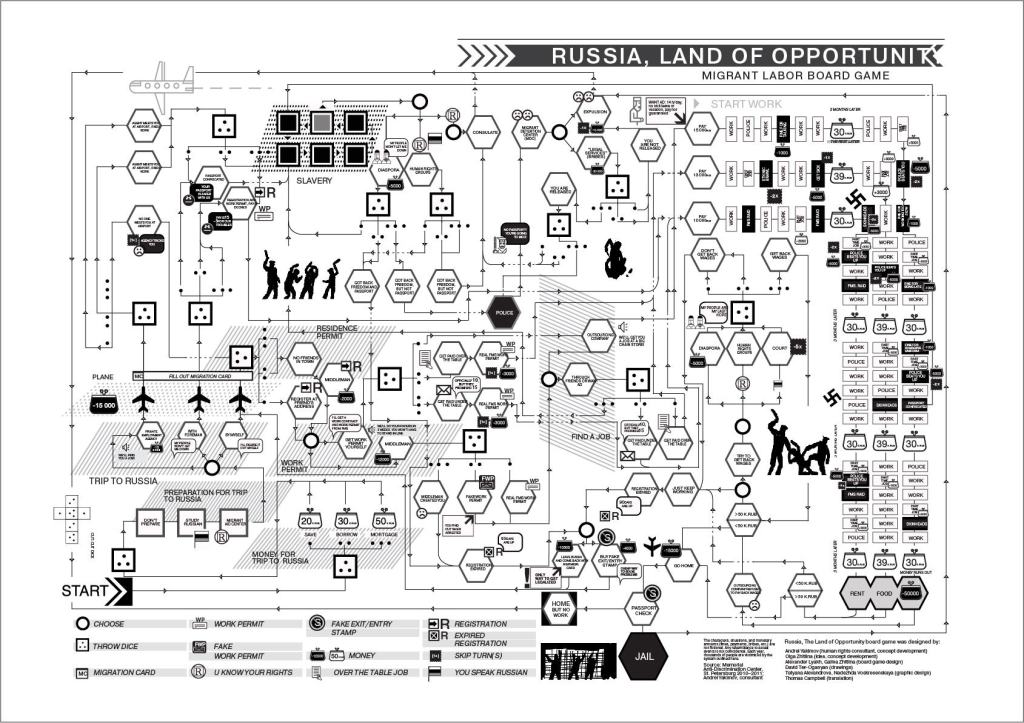

Thomas Campbell just translated our migrant labor board game Russia – The Land of Opportunity!!!

Russia – The Land of Opportunity board game is a means of talking about the possible ways that the destinies of the millions of immigrants who come annually to the Russian Federation from the former Soviet Central Asian republics to earn money play out.

Our goal is to give players the chance to live in the shoes of a foreign worker, to feel all the risks and opportunities, to understand the play between luck and personal responsibility, and thus answer the accusatory questions often addressed to immigrants – for example, “Why do they work illegally? Why do they agree to such conditions?”

On the other hand, only by describing the labyrinth of rules, deceptions, bureaucratic obstacles and traps that constitute immigration in today’s Russia can we get an overall picture of how one can operate within this scheme and what in it needs to be changed. We would like most of all for this game to become a historical document.

Source: Olga Jitlina (Facebook), 17 December 2011


Life for migrant workers is Russia is becoming increasingly difficult after stringent new controls introduced over the past year. These include a registry of “illegal” migrants, restrictions on enrolling migrant children in schools, new police powers to deport people without a court order, and a compulsory app for all new migrants in Moscow and the surrounding region to track their movements.

Working in Russia was already less appealing because of the war in Ukraine and the weakening rouble. Now, with these new restrictions, a growing number of young people from Central Asia are starting to look elsewhere — including to countries in Europe — in search of better opportunities.

Dreaming of Europe in Moscow

Like 89% of young Kyrgyzstanis, 25-year-old Bilal* had always dreamed of working abroad.

Young people in Kyrgyzstan grow up in an environment where leaving the country to find work is common, widespread, economically essential, and socially accepted — and where the domestic economy still cannot offer comparable opportunities.

The average monthly salary in the country is about 42,000 soms (around $480), while in Russia, for example, wages in manufacturing can reach 150,000 rubles (nearly $2,000). Unlike most of his peers, Bilal never planned to work in Russia. “Because many of our people face racism there,” he explains.

Europe was his dream, but without connections getting a job offer from an EU employer seemed nearly impossible. So Bilal turned to “intermediaries” — fellow Kyrgyzstanis who had established ties with European companies that were constantly seeking workers. They advised him to travel to St. Petersburg, where, they said, it would be easier to prepare the paperwork and apply for a visa.

But it was the height of the COVID-19 pandemic. Many Schengen countries had stopped issuing visas and temporarily shuttered their consulates. Bilal didn’t want to return home empty-handed, so he decided to stay in Russia — “not by choice,” as he puts it.

“At first I worked illegally at a ski resort. Mostly we chopped firewood and cleared snow around the cabins. They paid us in cash,” he says.

Two months later, Bilal moved to Moscow and obtained a patent — the work permit that allows citizens of visa-free countries to be legally employed in Russia. He found a job as a courier for Yandex.

Bilal speaks excellent Russian — something he says explains why, unlike many of his friends, he didn’t encounter xenophobia all that often. But conflicts still happened. “You’d run into people who’d say, ‘Migrants, coming here in droves…’ Especially when a customer had put down the wrong address and the delivery got messed up — somehow it was always the migrant’s fault.”

Bilal left Russia two months before the full-scale invasion of Ukraine. “Back then it wasn’t like it is now,” he recalls. “Yes, the police would stop you on the street, but they’d take some money and let you go. Now my friends talk about Amina (a Russian mobile app for monitoring migrants), about police rounding people up, and about being sent to the war.”

He decided to set his sights on Europe instead.

Watched and bullied

In Russia, the path to legal employment for migrant workers runs through a processing centre known as Sakharovo — located about 60 kilometres from Moscow and notorious for its massive queues, where people often wait for hours. The perimeter is guarded by armed security forces, and inside migrants undergo procedures such as blood and urine tests to screen for “socially significant diseases”. Those who manage to obtain their documents can work legally, but that doesn’t protect them from future problems.

Russians often refuse to rent apartments to migrants. Schools and kindergartens decline to accept migrant children, citing “lack of space,” while the adults themselves face workplace “raids” or frequent “document checks” on the street or on public transport. Even Russia’s war in Ukraine has become a tool for pressuring them: many migrants are pushed to join the military in exchange for various “bonuses,” such as fast-tracked citizenship.

After the attack on Crocus City Hall — which authorities say was carried out by four Tajik citizens —the security services launched large-scale raids. Tajikistan’s government, fearing a surge in xenophobic incidents, even advised its citizens not to leave their homes.

Lawmakers soon joined in. Over the past year, they have restricted the ability to obtain residency through marriage, granted the Interior Ministry the power to deport migrants without a court ruling, required migrant children to pass a Russian-language exam before being admitted to school, and created the Registry of Monitored Persons — a database of foreign nationals who supposedly lack legal grounds to stay in Russia. There are already known cases of people being added to the list by mistake, and effectively losing the right to move freely around the country after their bank accounts were frozen, and their driving permits revoked.

Officials have justified all these measures as necessary to fight illegal migration and prevent crime. In July, the Interior Ministry reported a rise in crimes committed by migrants, but migrants still make up only a small fraction of overall crime statistics. A study by the “To Be Exact” project found that adult Russian men are statistically more likely to commit crimes than migrant workers.

On September 1, a new pilot project went into effect: migrants from Uzbekistan, Tajikistan, Kyrgyzstan, Armenia, Kazakhstan, Georgia, Azerbaijan, Moldova, and Ukraine who are living in Moscow or the Moscow region must install a mobile app called “Amina.” Authorities openly acknowledge that the app’s main purpose is to continuously track users’ locations.

The app that doesn’t work

If a phone fails to transmit location data to Amina for more than three working days, the participant is automatically removed from the system. If the migrant cannot fix the issue quickly, they risk being added to the “monitored persons” registry — which can lead to frozen bank accounts, job loss, or even expulsion from university.

Imran, a 27-year-old Tajik citizen, is worried: “Location services on my phone are on, and Amina shows that everything is being transmitted, but several times a day I get notifications saying the app isn’t receiving my location. The app works terribly. And I have no idea what consequences this could have for me.”

Users report constant problems with Amina. Some can’t get past the first screen; others say the app won’t accept their photo; still others receive alerts that their data failed verification. But the most common issues are related to location tracking.

In comments on RuStore (Russia’s internal apps store), representatives of the developer respond that “specialists are constantly working to improve the app’s stability” and advise users to contact technical support. But migrants complain about waiting on the line for hours.

Anton Ignatov, the director of the Sakharovo centre, claims the programme will improve public safety and help “prevent violations by unscrupulous individuals”. He cites situations in which migrants buy a work patent — a permit to work — for a short period and then disappear “into the shadows,” “vanishing somewhere in the industrial zones of Moscow and the region”.

Such cases do happen, and the most obvious reason is money. Since January 1, the monthly payment for a work patent in Moscow and the Moscow region has been 8,900 roubles (about $115). For many migrants working in low-paid jobs — for example, in construction or warehouse work — this is a significant share of their income, pushing some into the informal economy.

Another factor is wage delays in the sectors where migrants from Central Asian countries most often work. Mukhammadjon from Uzbekistan, works on a construction site outside Moscow, hasn’t been paid in two and a half months. A month ago, he stopped paying for his patent — simply because he had no money left. He sees no tools to defend himself.

Employers, meanwhile, benefit from hiring such vulnerable workers: they can avoid paying social contributions, hand out wages in cash, and rely on employees who are willing to work overtime for low pay.

Getting a job is becoming harder

Kudaibergen, 32, from Kyrgyzstan, worked at a warehouse on the outskirts of Moscow — “to support my family”, he says. His employer provided hostel-style housing for migrant warehouse workers.

“OMON came to our building. They treated us like they were arresting dangerous terrorists. They showed up with batons and tasers, as if storming the place. They drove us all outside. We stood by the door with our hands behind our backs for about two hours while they checked everyone’s documents,” he recalls. “Some guys didn’t understand Russian well — it was very hard for them. If they didn’t understand something, they were beaten. […] Thank God, my documents were in order.”

Russian authorities typically insist that such inspections are carried out strictly within the law and that no unlawful actions are taken against migrants. As evidence, the Interior Ministry points out that migrants rarely file complaints with the police afterward.

As the new year approached — 2025 — the checks intensified, Kudaibergen says. Because of all the new rules and the overall treatment of migrants, he realized that working in Russia had become too difficult, so he returned home.

“But I still have to provide for my family,” he adds. “I’m thinking about Europe now. I ask friends and acquaintances how to leave. But I don’t know if it will work out. They say getting a visa is very hard.”

Gulnura, 35, a mother of three, had lived in Russia with her husband for more than ten years. In the spring of 2025, she flew with her children to her native Kyrgyzstan for a short break. Only after arriving did she learn about the new requirement obliging migrant children to pass a Russian-language exam in order to enroll in school. Her children speak Russian fluently, yet even before the rule change they hadn’t been admitted — schools said there were “no available places”.

“We originally planned to return to Moscow. But my friends who are still there complain that they can’t get their kids into school,” Gulnura says. “One friend has been collecting documents since April, but the school won’t accept them. Another managed to get her child to the test, but after the exam they sent a rejection: ‘Your child doesn’t know Russian well enough.’ Her daughter was born and raised in Moscow, speaks Russian fluently, went to kindergarten and prep classes, reads and writes.”

“Requiring language proficiency provides a pretext for an already widespread practice of arbitrarily refusing to admit migrant children to schools across Russia,” says Sainat Sultanaliyeva of Human Rights Watch. “By depriving migrant children of access to education, Russian authorities are effectively taking away the life opportunities schooling provides. Banning them from school undermines long-term social integration, increases the risk of harmful child labour, and heightens the danger of early marriage.”

Gulnura decided not to return to Russia with her children. “My husband is still in Moscow for now. He’ll come when everything is ready here, when he has work. But we — me and the kids — we’ve come back for good. It’s become impossible to live there.”

A chance to get into Europe

Despite numerous accounts of migrants becoming disillusioned with Russia, it’s impossible to say definitively whether labour migration has decreased in recent years: the available statistics are fragmented, and data from different government agencies often contradict one another.

The picture is further complicated by the Interior Ministry’s decision to stop publishing key data, as well as several changes to the methodology of migration accounting, which make year-to-year comparisons unreliable.

In 2024, researchers at the Higher School of Economics concluded that labour migration to Russia had fallen to its lowest level in a decade.

Since then, the number of entries into the country has grown, but the average annual presence of legal labour migrants has remained stable at around 3–3.5 million — noticeably lower than in previous years.

Rossiyskaya Gazeta writes that foreign workers are less willing to come to Russia for two reasons: tougher migration policies and declining incomes. With the rouble’s depreciation, earnings in dollar terms have fallen by roughly a third.

Yet Russia still remains the most popular destination for labour migrants from nearly all Central Asian countries.

In second place for migrants from Uzbekistan, Tajikistan, and Kyrgyzstan is Kazakhstan, where most work in construction, wholesale and retail trade, and various service industries.

Third is Turkey, where Central Asian migrants are employed in manufacturing — especially textiles and clothing — as well as construction, hospitality, and seasonal agriculture.

South Korea recruits migrant labor for factories, agriculture, construction, and the fishing and seafood-processing industries.

But for many — like Bilal, who left Russia behind — the dream is still to secure a job offer in Europe. In the end, he managed to do so through the same intermediaries he had relied on earlier, paying them $2,000, he says. They helped arrange an invitation from a logistics company.

“If you don’t have work experience in Europe, it’s hard at first to get a job with a good trucking company. There are bad employers who take advantage of newcomers not knowing their rights. They might underpay you or force you to work overtime. At the same time, the police keep a very close eye on work-and-rest rules and can fine you, so nobody wants to break the law. By law, if your driving time is up, you have to stop and rest,” Bilal says, recalling his first job at a Slovak company.

After gaining some experience, he moved to another company, where he now earns around €2,500 a month.

According to the International Road Transport Union (IRU), more than half of European transport companies cannot expand their business because of a shortage of qualified drivers. Across the EU, Norway, and the UK, more than 233,000 truck drivers are currently required. The crisis is deepened by the fact that the profession is aging rapidly, and young people are not drawn to it, despite decent pay.

Ukrainian citizens once made up a significant share of long-haul drivers in the EU, but because of the war many had to return home for military service. In addition, some European employers terminated contracts with Russian and Belarusian citizens (or their visas weren’t renewed), forcing them to return home as well.

In Slovakia, where Bilal is officially employed, the shortage reached 12,000 drivers last year. As a result, the country simplified visa procedures for several nations — including Kyrgyzstan, Tajikistan, Kazakhstan, Turkmenistan, and Ukraine — for applicants willing to work in freight transport.

Poland actively issues work permits to citizens of Uzbekistan and Kazakhstan; the Czech Republic attracts workers from Uzbekistan and Kyrgyzstan by fast-tracking work visas; Lithuania also issues visas to those seeking jobs as drivers.

In 2023, the number of first-time work permits issued in the EU to citizens of Kazakhstan, Uzbekistan, Kyrgyzstan, and Tajikistan rose by 30%, 39%, 50%, and 63% respectively compared to the previous year.

But Bilal believes that even with the current labour shortages, getting into Europe from Central Asia is still far from easy. “If you don’t have people here who can recommend you to a company, it’s a difficult process for ordinary working people,” he says.

All the more so because public frustration over migration has been growing across Europe in recent years, pushing some governments to tighten rules for third-country nationals — even in sectors suffering from labour shortages.

Bilal likes living in Europe. He’s satisfied with the good pay and the way people treat him — especially Italians and the French.

He describes his job as demanding. “We spend more time away from home than at home. Years go by, and people hardly see their families,” he says.

Bilal himself doesn’t yet have a wife or children. In a few years, he’ll be eligible to apply for permanent residency in Slovakia, but he hasn’t decided whether he’s ready to spend his whole life driving long-haul trucks across Europe.

*The protagonist’s name has been changed at his request. With contributions from Almira Abidinova and Aisymbat Tokoeva. Read this story in Russian here. English version edited by Jenny Norton.

Source: “Why Central Asian migrant workers are giving up on Russia,” BBC News Russian (Substack), 18 December 2025.

The Danger of a Single Story

Chimamanda Ngozi Adichie, “The Danger of a Single Story” (TED, YouTube, 7 October 2009)

Diversity and Inclusion

Allrecipes is and always has been a community built around love. We are people who love food, love to cook, and love to share recipes and stories. There is no room for hate, racism, or inequality in our community. The 60 million cooks who make up the Allrecipes audience are extraordinarily diverse. We strive to celebrate the home cooks who bring Allrecipes to life, featuring them on the website and in the pages of Allrecipes magazine. 

We are committed to the goal of having contributors, featured cooks, featured recipes, and stories reflect the diversity of the Allrecipes community in our digital properties and in the magazine—and know that we still have much work to do. 

We are working to highlight more of the stories and traditions of our diverse audience. In 2022, we are reviewing and editing content representing 20 percent of our traffic, with the goal of removing any bias in language and instances of cultural appropriation, including language around race, gender, sexual orientation, and glamorized colonialism. 

We are also focused on recruiting more diverse voices and diverse contributors to our staff, our freelance pool, and our Allrecipes Allstars brand ambassador program. And we are working to ensure that our video and voice programming features the same diversity as our audience.  

We are dedicated to working with recipe developers, food writers, editors, food stylists, photographers, videographers, podcasters, illustrators, and models who reflect the strength and diversity of our community.

Source: “About Us,” Allrecipes.com


What can I say to the question, how are we? I was at my Arabic lesson, while Natan, Dan and our nanny Vika were at home. Usually, Natan and I would have been returning from the beach right at this time. Everyone was expecting Iranian missiles, so some of the students were looking at their phones during the lesson. In Hebrew, which we are forbidden to speak in class, there is no word for “terrorist attack”; the word used is פיגוע — “assault,” “infliction of harm.” We hadn’t had time to learn it in Arabic. When the woman sitting next to me uttered it in conjunction with the name of our street, we decided to take a five-minute break to make sure everyone was okay. Dan said they were fine, but that there was the corpse of a very young guy lying outside the house and that he was afraid it was someone from the neighborhood. (We moved in three months ago and haven’t met everyone yet.) Itai, Dan’s son, could not reach him and texted me to lock all the doors urgently, as the chase was still on. So I started calling Dan and Vika again, but couldn’t get through right away. Then the siren went off and we had to go to the bomb shelter in the upscale building next door. Normally, sitting in a bomb shelter in Israel is pretty fun and privileged, but when your child and loved one are sitting in an old building with huge windows on all sides and you don’t really know when it’s going to end, it spoils the fun a bit. When the sirens stopped, I jumped on my bike as quickly as I could and raced home. The whole neighborhood was cordoned off, and no argument that I lived there and that my child was there had any effect. The back entrance from the street parallel to ours came to my rescue. The next corner was also cordoned off, and chockablock with cops and ambulances. While I was fiddling with my bike, a woman said, “That’s the second terrorist,” pointing to a long black rubbish bag in the middle of the block, which several people were lifting and packing into another rubbish bag. I glimpsed it all very quickly, and I was in a hurry to get home, to pack Natan’s things in case we had to go to the bomb shelter on the next block. But then it was sort of over, and the phones started ringing off the hook.

This morning was quiet and so idyllically beautiful, as it almost always is here, that I felt like getting out of bed and just living. The entire street in front of our building and the building next door was still splattered with blood. I ran to find out from the neighbors if everyone was alive. They said they were. They had rescued a few people from the bus stop by dragging them into their yard. (Yes, these are the same neighbors who yell at each other in the evenings in such a way that it looks like a murderous rampage is about to kick off.) The woman from the supermarket opposite said that her nephew and niece and their mom had been on that tram. The three- and six-and-a-half-year-old children saw a head shot through, and blood and brains pouring out of it onto the floor. The boy vomited all night, while the younger girl panics when she sees a tram and screams רכבת שרמוטה (“Fucking tram!”) at it.

The murdered mom with the baby in the sling turned out to be the wife of Dan’s colleague. He visited us a couple of months ago, and we talked about whether AI can assist non-verbal children in communicating. He and his family had recently gone on holiday somewhere in Asia. Dan says that the last time they had met, he was beaming with happiness.

Now there are flowers, candles, notes, and (for some reason) an Israeli flag draped over the bus stop. There are many journalists on hand, but most people refuse to be interviewed.

For the second time in the last year and a half, death had missed us by about a quarter of an hour. I couldn’t say I have any strong feelings about it. I had no time to be scared for myself or even for Natan. It was either that there is so much anxiety in a mother’s everyday life that there are no reserves of fear when it would be warranted, or the realization that for almost a year now the enormous number of murders, deaths from malnutrition and other savage things happening every day has dulled the feeling that the disaster happening on your doorstep is one of a kind.

Apparently, the very young man who was lying outside the building had been one of the shooters. Dan saw them cut his shirt open. I don’t know the proper word for what happened. An act of terror? An act of desperation? An act of stupidity? An act of struggle? Revenge? Madness? An attack? A suicide?

Remembering the acute orphan-like longing when your mom leaves you to sleep at someone’s house and goes away. Fearing that a nine-month-old baby will live his whole life with that feeling — along with tens of thousands of other children.

Source: Olga Jitlina (Facebook), 2 October 2024. Translated by Thomas Campbell. Ms. Jitlina is a friend of mine whose artwork and writings have been featured on this website on several occasions.


Western leaders and politicians are calling for an end to the airstrikes in the Middle East. Do they even want to know and understand what is going on here?

Israel is the only country of freedom and democracy in this part of the planet. It has made serious progress.

Source: Gennady Gudkov (X), 3 October 2024. Translated by the Russian Reader. Gennady Gudkov is a Russian liberal opposition politician and businessman who lives in exile in Bulgaria.

Five Petersburgers on February 24th

There are many women from Ukraine working in Israel, women who were forced to come here to work because of the complete devastation wrought by the war. They are employed in cleaning and in caring for the elderly and children. Nathan’s nanny, Vika, has been here for about five years. She hasn’t seen her own children and mother during this entire time. At first she worked as a cleaner, then, perhaps due to constant contact with toxic cleaning substances, she got sick with blood cancer. She was given medical care at one time, but then she was turned down on an extension of her insurance. Vika’s only chance to survive is a bone marrow transplant operation that costs 285 thousand dollars. As a non-citizen of Israel, she will not receive free medical care here. Vika is only a few years older than me. She has nowhere to go back to go for treatment. (Although, even if she did, they wouldn’t treat it for free either.) This morning I heard another woman, Mila, already middle-aged, weeping and telling her family, “It would be better if I were with you.” I have no emotional strength left for righteous indignation, karma-cleansing public shame, and slogans. I have only a huge desire for Vika to survive and be able to hug her children, and for Mila not to weep in horror for her family.

Source: Olga Jitlina, Facebook, 24 February 2022. Ms. Jitlina lives in Jaffa. Translated by the Russian Reader

_________________


There were very few people [at the protest in downtown Moscow], alas. Thank you to everyone who came, and [I wish] a speedy release to everyone who is in the paddy wagons. But how [only] a thousand people can come to a rally in Moscow against the terrible criminal war unleashed by our country, I do not understand. I don’t blame anyone, I understand that it’s scary, but we cannot manage to do anything, alas. It’s very hard to bear. NO TO THE CRIMINAL WAR WITH UKRAINE!

Source: Alexander Feldberg, Facebook, 24 February 2022. Translated by the Russian Reader

_________________

Today is my birthday. I am 43. I was born in 1979, in Leningrad, in a Jewish family. I grew up very sheltered and very afraid. My grandfather, a survivor of a German POW camp, who managed to escape arrest and prosecution in the USSR, taught me to behave “lower than grass, quieter than water,” showing total submission toward any and all authority figures. At my school, my brother’s teacher tore an earring out of a girl’s ear, tore it “with meat,” right through the earlobe, because of some Soviet prejudice against earrings. That teacher remained a teacher in the school. Two other teachers in two different schools I went to had been known sexual predators who went after boys. One of them was eventually pushed out of teaching, but the other remained. I don’t even mention the daily groping on the bus and subway, on my way to school, that violence seemed so every day that it still feels pointless to speak up about.

At 16, when I had to get my first passport, my family insisted that I try facing the authorities on my own. I tried and got a run-around and received a set of impossible instructions and returned home in tears and full of hatred for all the stone-faced people who refused to help with such an everyday task. (I hadn’t read Kafka by then yet, but when I did, I knew what he was writing about.) The next day, my grandmother came to the passport office with me. She fixed the problem as she always did, by begging and pleading — I’m old and my granddaughter is young and stupid, could you please help us — the skill she had that always horrified me. I refused to imagine how she had come by it. I resisted learning to beg, and I resisted fear, too, but fear was the air I breathed. I left Russia at the earliest opportunity, and in my subsequent visits there, considered: Could I live here now? Could I feel free and unafraid? There were years when I imagined I could.

Today, like so many people I’m watching Russia invade Ukraine, and first and foremost I am afraid. I’m afraid for what might happen to the people of Ukraine, of what Russia might do. But I’m also so proud and so happy to see that so many others, people made differently than me, aren’t afraid, and that so many others are able to put aside their fear to fight. I know many Ukrainians are asking why not more Russians come out on the streets of their cities to protest the war. They are right to ask the question. And, given what’s happening in Ukraine right now, fear is a bad answer. In my experience, however, fear is a very real, all-encompassing and paralyzing feeling. My heart is tightening with it so many thousands of miles away, writing this. And yet again, I see others pushing through their fear and come out on the streets of Russian cities despite the very real threat of arrests. And I see people of Ukraine resisting and the world hopefully waking up and coming together to act against the aggressor. The bully relies on and feeds on our fear. This is also real.

One other thing I’ve noticed. Fear masks itself as so many other things. Anger. Hatred. Cynicism. “This isn’t about me.” “Why rock the boat?” “Why should I get involved?” “I shouldn’t do anything that might hurt my family.” I find my mind going through these motions. My mind isn’t comfortable with fear and tries to bury the feeling inside the ever-longer logical chains. And I, among many of us, who grew up in Russia, am badly trained to unpack these logical threads and to face the fear. It’s ok to be afraid. It’s not ok to attack another country.

Source: Olga Zilberbourg, Facebook, 24 February 2022. Ms. Zilberbourg is the San Francisco-based author of the highly acclaimed Like Water and Other Stories and co-editor of Punctured Lines, a feminist blog about literature from the former Soviet Union.

_________________

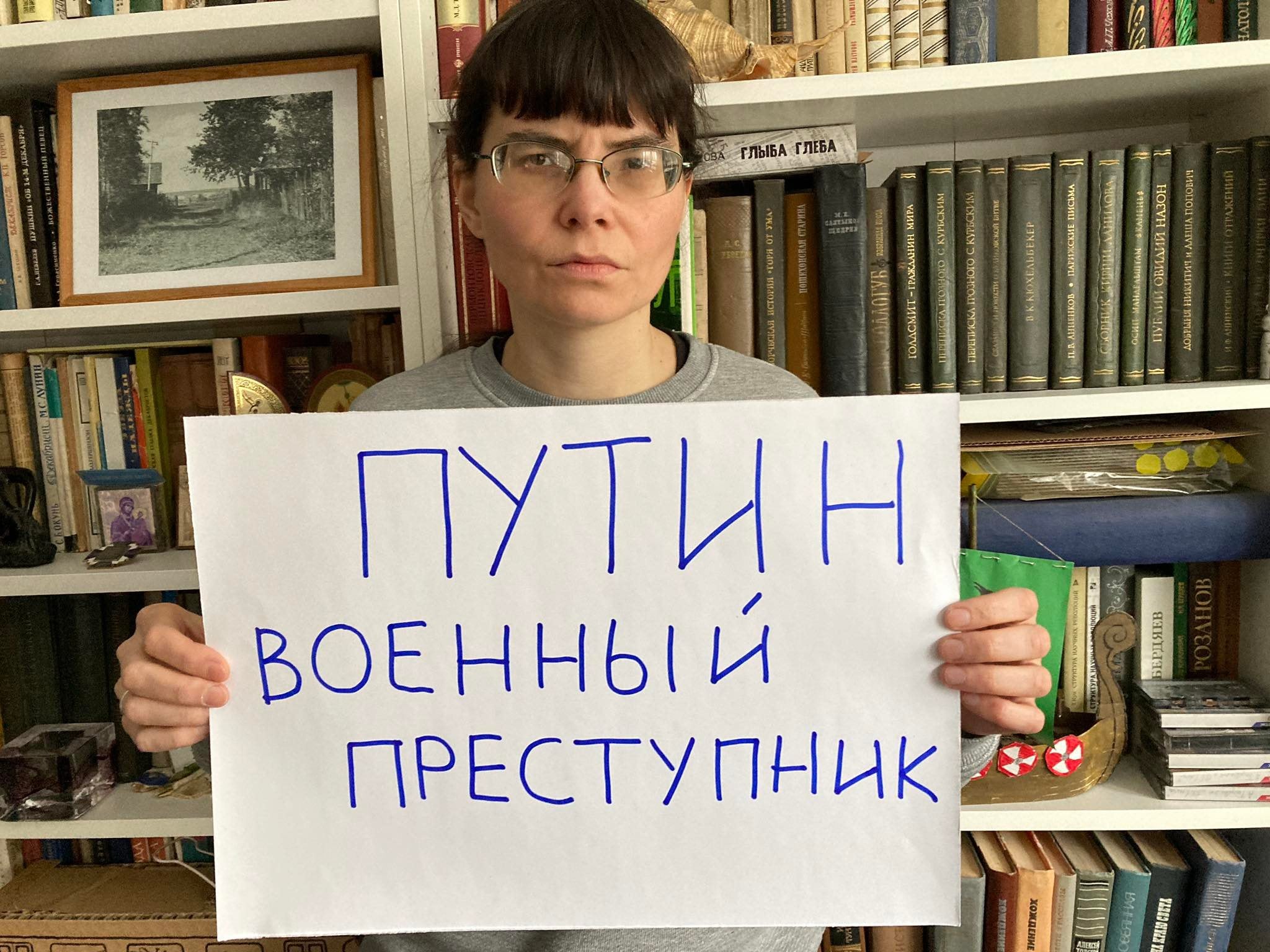
“Putin is a war criminal.”

Source: Natalia Vvedenskaya, Facebook, 24 February 2022. Natalia Vvedenskaya is a Petersburg grassroots activist who, among other things, teaches Russian to immigrant children at the St. Petersburg Jewish Community Center.

_________________


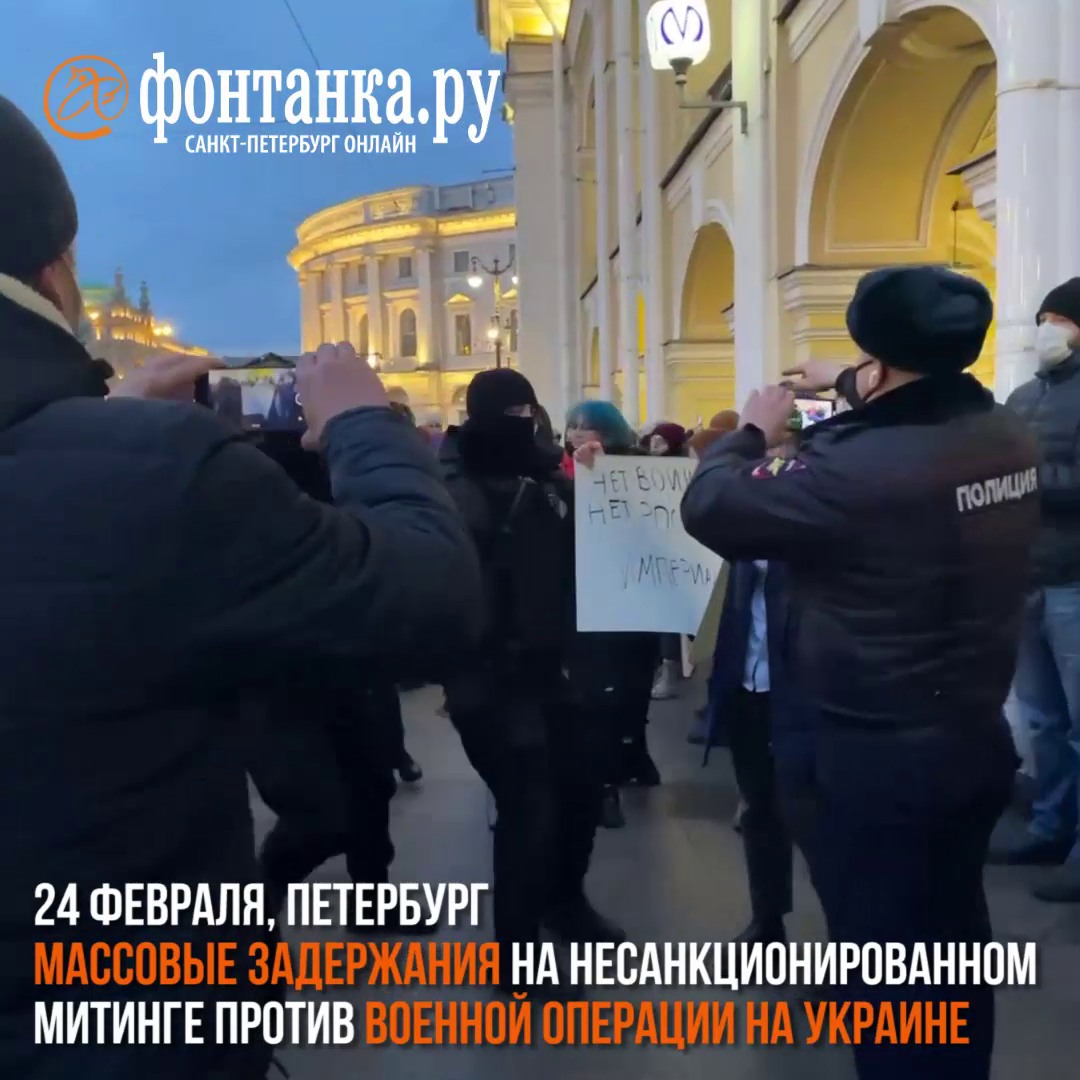
Dear everyone,
[S]hocked as we all are by the nightmare of the news today, whatever you say and whatever your opinions might be on who is to blame and what must be done, please just remember that within Russia there are very different people, with different views — not everyone is supporting the war or the government (in my feed not a single person is, as far as I can see, but that is, sadly, not a universal picture). In my city, St. Petersburg, today over a thousand people came to Nevsky prospect to protest against the war, in spite of the danger. They are in danger because the political regime in Russia is as intolerant to its opponents as it has been over the past decade, maybe more so. Many were detained, which will inevitably mean prosecution — almost certainly fines and possibly arrests, not to mention the following risk of being fired from work. I understand that in other cities, in Ukraine, people are facing a much more immediate danger of being bombed, but believe me, it is also scary to go to a street with a placard “No to war” when you might end up in prison for that. Screenshot is from a video by Fontanka, a local newspaper.

Source: Maria Guleva, Facebook, 24 February 2022. Ms. Guleva studies at Charles University in Prague.

Olga Jitlina: “If you really want to protect us…”

Olga Jitlina
Facebook
May 14, 2021

Friends, if you really want to protect us, put pressure on the governments of your countries to immediately stop the massacre in Gaza, demand an end to the evictions in Sheikh Jerrah (this is necessary, among other things, to stop the bombing by Hamas), and prevent pogroms. When you get right down to it, there are no Jews or Palestinians. There are only people who, for their common survival, need to ensure equality in terms of the right to life, the right not to kill as soon as they’re ordered, the right to freedom of movement and property claims. There is no point in “rooting” for one side or the other. This is not football. We are one: the people who treat my child, change his diapers, love him, and help me in difficult situations, have relatives in Gaza. And they are no less afraid for them than you are for us. Every strike on Gaza is a strike on us.

Share, repost, help!

(In the photo, my son is with his caregiver, Futna, who has been working with disabled children for twenty years. She’s not safe right now.)

Translated by Thomas Campbell

Olga Jitlina: Adar

tereshkina-adar-1Image © Anna Tereshkina, 2018
משנכנס אדר – מרבים בשמחה
When Adar begins, joy multiplies.

I. Equality
Joy multiplies in the month of Adar. Joy arrives in the month of Adar. Why, oh why die in March? Spring is just around the corner. The darkness and cold have almost retreated. The light, like water, comes every day. To get out, clamber out from under myself as from under falling debris and beams, to shed myself like old scales. To fly, race, and run away from this exploding ruin. It is the snow melting. It is me melting. Joy surges. Joy arrives.

A friend told me in passing that joy is multiplied in the month of Adar. (Who multiplies it? Why does she do it? How does she do it?) I had always felt this poignantly, you know. At the beginning of March, on the fault line between winter and early spring, Grandmother died. During a lecture, someone from the dean’s office came to get me. They said the ambulance brigade medics who took her to hospital had been looking for me. When I arrived, she was still conscious but shrieking in pain. She asked for a shot that would make her die more quickly. Her aorta had burst. We managed to talk. I said, “Hang on, Granny. If you want, I’ll give you great-grandsons, Granny.” But she said, “March, damn March.” Her aorta had swollen two years earlier. Then, on the dawn of March 23, the police had rung the doorbell and asked whether there were any men in the house. The bed was empty, and Grandmother had dashed to the door and fallen down in the hallway. I rushed downstairs.

Very slowly and instantly, very slowly and instantly. She lay in an unbuttoned black overcoat over white panties, her t-shirt hitched up, her skinny yellow hand strangely twisted. A dent on a car. She had hit something before crashing to the ground. There was almost no blood, only a small spot near her head, and two teeth knocked out. Mom.

A negative imprint on icy pavement. An instant plunge into the abyss of the Mariana Trench. Why did you dress up as blackbird? Where are you taking me, Mother Death?

The sky’s light light light light fills floods the whole world. The sky is coming, the sky flows in like the ocean’s tide, the sky is huge, immense, and all the houses, cars, the entire dusty city, the people come undone from the earth and float in the sky like tiny flakes of yesterday’s pain, which has negotiated winter’s afflictions. Blinded by the light, consciousness bursts open toward the future, surrenders to the whirlpool of happiness, omnipotent, ready to face life’s trials and challenges.

“If we turn the IV off, she’ll die at once. If we don’t, she will be conscious for several hours or days,” the doctor said.

“Turn it off,” I said. I was eighteen.

When I left the hospital, the sky was shining, and the wind blew all the sails towards the sunset’s golden-pink clouds. I asked them that, before I got home, Grandpa’s Parkinson’s would progress to the point he would not realize he and I were alone.

Tattered thoughts rush past, shreds of memories sweep past. I don’t have the time to write them down, connect them, grab them.

You drew the line. You established the border. You will not let me into your house, your family, your life. During days of universal joy, all I can do is sit glued to the screen in solitude, peering at social network timelines where photos of your warm family festivities light up. I am hungry with envy and sadness, a tramp standing outside Yuletide windows.

I have become your illegal alien. Everyone knows about me, but they try not to notice me. You forbade taking pictures of us together, and in conversation you hide my presence with the singular. I shouldn’t leave the house too much. I should be invisible, inaudible, and inconspicuous. It should be as if I didn’t exist. I shouldn’t exist.

Clouds like ragged threads sweep across the blinding sky.

In March, the city really reveals itself only to the drunk and the desperate, to people standing on death’s windowsill. Only through the inward tears produced by the splinters of an ice floe smashed to smithereens does it flash with a hallucinatory beauty for an instant, and the first person you meet passes through the hell of a bulging heart like a thread through the eye of a needle.

My gaze crashed into you as I measured the distance from the balcony to the pavement. You lay, your head nestled against the belly of another person, lying on their back, the whites of their eyes spinning in oblivion, under my balcony. You were trying to warm yourself in the other person’s warmth or just die together. I was afraid to touch your squashed fingers, dried blood, dusty clothes, and urine-stained clothes. I told you to get up on your own and, holding onto the wall, walk with me to the front door. When we got there, before you could tell me about your eight-year-old daughter Liza and your mother in Orenburg Region, whom you had managed to send five thousand rubles before, and before I could decide whether to invite you into the flat so we could jump together or remember how to call the ambulance and where to find the address of the homeless shelter, we sobbed for a long while on the dirty front stoop, random and nameless.

It takes two or three weeks for someone who ends up on the streets to turn irretrievably into a homeless person, the same amount of time depression becomes clinical.

You are afraid of letting me in, because you know that as soon as I cross the threshold, your home will be inundated with the stench of misery and insanity. You are afraid to defile the peace of your home and loved ones. You are afraid the walls will immediately crack, and the infection of homelessness will spread to everyone. You have marked out your domain.

The pink pill rolls around inside you. It smashes you into the pavement.

Bright pink clouds lashed the eyes and scalded the brain of the body on the bloodless balcony.

The balcony can fit exactly three people. It resembles a tiny boat, a cradle careening between streams of cars and the sky. I suggested we go live there, never going back under the roof. Three wise men in a tub. Bas Jan Ader in the midst of the Atlantic. Baron Munchausen, pulling himself from the water by his own hair to fling himself into the sky’s blinding abyss.

I searched for you up and down the area around Dostoevskaya subway station, in all the attics and cellars, in the unlocked entryways and the warm spaces between the doors into the subway. In your crevice between peeling moldings and the cast-iron curls of stairway railings, all that was left of you was rubbish: a bed fashioned from crumpled newspapers and the booklet with addresses of homeless shelters I got for you the other day. We were going to meet right after the weekend. I was going to bring you clean clothes and wet wipes so you would look decent when you went to get new papers and register with the social services.

When, a few weeks later, I accidentally stumbled upon you trying to bum a cigarette, you were either completely drunk or distant. I handed you a cigarette and tried to figure out where you had been sleeping and when we would go to the homeless shelter. You could not focus and mumbled, “What they call you, sweetie?” I realized I was too late. You had already sailed away. You were already out there, furrowing the waves of the ocean in search of the miraculous. Neither your daughter Liza nor your grandmother would ever see you again. You had left your grandmother and left your grandfather. You had sailed away from me, leaving me alone with my own salvation, you smarted-ass jerk, Slavka.

tereshkina-adar-2Image © Anna Tereshkina, 2018
II. Fraternity
In moments of the most terrible despair, I imagine I have a twin brother. He is just like me, only a little different. He knows everything about me and understands me. He is the only person around whom I can cry, and to whom I am not ashamed to complain. I imagine he comes and comforts me.

We stretch our hands in the sun and laugh with joy. They are exactly the same, only slightly different colors. We have equally thin wrists and large palms with wide, seemingly broken joints and thin fingers. The hands of twins. We are different sexes, but we cannot help but find similarities in our absurd, adolescent-like bodies. Your hair is curly. Mine is straight. But we have an intangibly similar, perpetually disheveled look. My found brother.

“Sister,” said a guy sitting outside a shop and holding a dirty cap turned upside down, “Sister, some change, please.”

The noise of the lagoon gently beat against my eardrums. The sun shined, and almost without splashing the fullness of happiness, I walked by him schlepping full bags.

“I can’t go back. Everything is destroyed. I have burnt all my bridges. If you knew what it cost me to get here, what it cost me to live through this break-up—”

“Calm down. This no place to have a tantrum. Listen to me. You cannot stay. It’s impossible.”

“I laid down my whole life to get here. I scorched the past from my heart. I cut myself off from everyone.”

“It’s impossible. It’s written here in black and white. The decision on your application is negative. Where are you going to live? On the streets?”

“I’ll think of something. I have nowhere to go. I ask you to reconsider the decision.”

“You have gone through all your appeals. There is no room here for all of Africa. It’s an unbearable economic burden on our taxpayers. They cannot feed everyone.”

“I can work.”

“There’s been high unemployment here for many years.”

“I’m not afraid to do any job.”

“Even if that’s so, you’ll never really be accepted here. The culture is different.”

“I’ll learn the language. I’ll come to know your culture. I’ll become a different person.”

“Enough! Stop it! What use is any of this to us in the long run?”

I don’t know how much time has passed since I was dragged from the sea. I don’t remember being brought here. The days, weeks, and months have passed automatically, without feelings and sensations, leaving no memory of themselves, as if the cold tons of water that had squeezed me inside and outside had paralyzed my mind. As if a half-dead body had been pulled out, but what was alive in it and made it want to live had been too late to save.

I just up and went outside one morning. I walked down a street and found myself on the embankment of a wide channel or strait between islands. I felt the sun’s tender caress and smelled the seaweed. The green water picked through the shallow waves and, half asleep, smiled to no one and everyone all at once, and coral houses stood petrified and solemn along its rim. This beauty, these sounds, and the gentle warmth struck me with such force I couldn’t stand it. I fell, tensing my body, hiding my face, and closing my eyes. I suffered convulsions, and tears flooded my head. I remembered everything. Fear, hunger, a series of deaths and partings, no hope of meeting again, loneliness, despair, an endless trek, fear, fear. A mad hunted beast consumed in the depths of itself. Not everything was connected. Here and there, now and then were endlessly, unbearably separated. This could not be happening in one world; this could not be happening to one person. I had died. I was dead.

I tried to open my eyes again. On the other shore, half-turned towards me, a brick-red building with two candle-thin towers and a rounded dome floated, its white marble façade looking back at me. Four light figures—three above the forehead’s triangle and the fourth at the very top of the dome—soared from the building into the sky. Stunned by the building’s unprecedentedly simple shining grandeur, I again hid my face. Il Rendetore, Il Rendetore. Whether I had died or survived, I realized one thing: I was saved.

I don’t mind. They can work on construction sites, in closed facilities. As long they don’t plague us with their presence. I definitely don’t want my children to see them.

Why has it become so difficult? Why do I feel such horror when I imagine it? Is there something wrong with me? Can’t I leave the house like everyone else? Can’t I go where I want, like everyone else? How silly! What nonsense! I will come and say hello to everyone, as if nothing has happened. I’ll be cheerful. I’ll laugh, make jokes, and chat, hopping from topic to topic. I have been repeating this for many days. I smile to myself in the mirror. I turn on the most upbeat music. I walk along, my head lifted, a spring in my step. I’m like everyone. I’m like everyone. My heart beats harder. But here is the door. It’s not even locked: you just need to push it. No! No! It’s easier to plunge into the abyss. An ostrich in a cage, its head bumping against the ceiling. A lion cub’s severed head. Huge pumpkin halves floating in the water.

Meat carcasses. Everywhere there are meat carcasses and flies, flies, flies. If you do not come up to me first, if you are not by my side, everything will instantly fall silent, all gazes will pierce and immobilize me. Someone’s hand will pull on the end of my smiling turban, my cocoon—and I will be confronted by everyone, my face bare and frozen with animal fear.

“Can I ask you something? Do you have a boyfriend?”

“What does that have to do with anything?”

“I just like you.”

“Listen, I’m helping you defending your human rights, and you’re flirting with me?”

“No, no, I’m not flirting. I’m serious. I want to marry you. I sent my parents a photo of you and wrote to them you are a very good girl.”

“You’re serious? Serious is not receiving refugee status and getting sent back to a war zone. Or, at best, you stay here without papers. You’d better think about this seriously.”

“Yes, yes, I know you’re right. It’s very important. You have helped me so much. I thank you from the bottom of my heart. But everyone needs someone to be close to. Everyone needs a future in common with someone else.”

“It is natural for people to guard the borders of their house,” intoned a voice on the radio, and I could not come in to see you. Even if I had gone in, the door would simply have moved farther away and remained locked. Then my feet carried me down the stairs, flight after flight, into the courtyard, into the streets of the city to walk to the point of oblivion, until my senses were numbed, until I had lost the ability to speak, until I was anesthetized by the night’s cold.

When I was told we could have no future, that my face must be deleted from all photographs, and my name must never be said aloud, all mentions of it must be effaced and it must be forgotten, when you repeated it, and everything was on the point of collapse, I decided to save our incredible love, our unlimited intimacy in the past. We set out deep into the past. We retreated farther and farther from life, reeling through generation after generation, descending ever deeper into the branched roots of our family trees. We explored each and every fork and knot, looking for a possible intermingling, for the dead man who would silently proclaim, “I now pronounce you brother and sister.”

I don’t know how long I wandered the streets, squares, back alleys, and filthy, luxurious building lobbies, but once, when I came to my senses, I realized I was in a completely different time and city. It was phantasmagorically beautiful, but quite different from my bitter city, where beauty is spread in a thin layer over a flat space, like butter on a perestroika-era sandwich, the neoclassical columns-cum-commissars dispense an equal dose to each, and only needle-like spires are permitted to pierce the sky’s blue vein. Here, on the contrary, beauty exuded from every crevice, clambered over its own head, shook its stone lace, and doubled in the canals, leaving the eyes with not a centimeter of peace. Incredible churches squeezed between beautiful buildings, tucking in their apses. On one of the tiny squares, two blinding, blocky marble façades suddenly rose over me. I watched them, transfixed. They seemed to grow against the black sky. Then they toppled down on me with all their luxury, all their unbridled splendor, and I cried out in amazement, horror, and resentment, mortally offended for all the dull bedroom communities, the settlements consisting only of Khrushchev-era blocks of flats, plopped down in the middle of swamps, the shanty towns, jury-rigged from planks of old plywood, tarpaper, and filthy quilts, where homeless people and Roma children took shelter, mortally offended that beauty was so unfairly, so unequally dispensed.

I rushed through the intersections of an endless latticework of streets, running into dead ends and stumbling over bridges until, finally, at dawn, the sun glanced between the houses. I came to a wide embankment. In the rays of the rising sun, over the surface of waters forced apart, a clear Palladian silhouette arose, turning slightly to greet the arriving joy. Something dripped, thawing from the inside, painfully easing the winter frostbite. I realized the month of Adar had passed, and I had been able to survive the year. The time and place came into focus. It was April, my mom’s birthday and, maybe, mine, and I was ten years younger than she was when she jumped from the balcony. I stood on the same embankment where, several centuries ago, during the plague, the incurably ill were dragged so that, for the last time before they headed to the cemetery, they would believe in salvation.

Pateh Sabally, a twenty-two-year-old Gambian man, tried to stay afloat in a canal while onlookers shot him on video, peppered him with racist remarks, and laughed. In one video, you can hear the onlookers screaming at him, “Go on, go back home.”

At least three life rings were thrown into the water, but Sabally did not try and reach them, which suggests he committed suicide.

No one jumped into the water to help Sabally, and he drowned.

tereshkina-adar-3Image © Anna Tereshkina, 2018
III. Liberty
Remember, when we embraced for the first time, everything fell into place, everything was as it should have always been. The planets no longer had to orbit the sun. They finally had come home. They had found their safe haven. You wove me a cocoon of tenderness from kisses, words, and touches. It will protect me always and everywhere. And if you are with me when I die, I will die happy.

But only you and also you were blinded by pain at the same moment.

Dost thou remember, do you remember, how on that morning, when we awake together, embracing, and laugh at the joy of feeling each other, the happiest day will dawn? Everyone will share love with everyone else, and there will only be more love. Fear, jealousy, despair, barbed wire, and checkpoint politeness will be left behind. All the homeless, insane, undocumented, illegal and semi-legal, prostitutes, mistresses, and street urchins will stand straight up and solemnly along the sunny streets, and everyone else, giddy, will rush out to them, leaving their homes forever. Smiles will crack immured faces, and the age-old plaster of affliction will spill onto the ground and people’s clothes. The wind will waft the dust away. The buds of joy will burst open with a crash and sprout through every creature. And the joy keeps on coming and coming and coming. We multiply the joy.

Dost thou remember? And thou? Do you remember? Do we remember?

Originally written as a personal letter by Olga Jitlina, although this text never achieved its aim, it was the basis of Fraternité, an audio walk round Venice in October 2017. Curated by Vera Kavaleuskaya and Alina Belishkina, the walk was part of Research Pavilion: Access to Utopia. Illustrations by Anna Tereshkina. Translation by Thomas Campbell. A huge thanks to Ms. Tereshkina and Ms. Jitlina for permission to reprint their work here.

Victoria Lomasko: Socially Engaged Graphic Art in Russia

Victoria Lomasko on Socially Engaged Graphic Art
November 8, 2014
Openrussia.org

To get a more or less undistorted sense of reality in our country and transmit it to other people, you have to become a researcher yourself. Socially engaged artists have joined independent journalists, human rights activists, and sociologists in this field. I will try to briefly describe socially engaged graphic art and how it can help in shaping civil society.

It is easier to start the story by talking about my own experience. I would agree with what artist Kuzma Petrov-Vodkin said on this score: “If your work does not improve you, it is powerless to improve anyone else, and [art] has no other task than improving humanity.” For a long time I was hampered by the art scene’s insularity and especially by my own fear of venturing outside it. In 2008, I began making forays into other social milieux and drawing graphic reportages, illustrated documentary stories. I have produced stories about farm workers, village school teachers, migrants, Orthodox activists, the LGBT community, sex workers, and juvenile prison inmates, among others. I have seen that these other milieux are no less isolated from each other, generating mutual contempt, fear, and hatred.

lomasko-soc-1 From the series Black Portraits, 2010. (Left panel) Stoneworker Sergei, who used to be a militant atheist, is now an Orthodox activist: “The West wants to destroy the bold and beautiful Russian people.” (Right panel) Viktor Mizin, a political science lecturer at MGIMO, was born at the Grauerman maternity hospital in central Moscow: “Russians are shit, but I’m a seventh-generation member of the intelligentsia.”

I drew these two portraits on the same day. I meet the Orthodox activist at a prayer meeting against a proposed new redevelopment plan for Moscow, and the “member of the intelligentsia” in a bar on Bolshaya Nikitskaya. The diptych—an illustration of our extreme anomie and mutual disrespect—сame together on its own.

lomasko-soc-2

Teacher: “Is ‘Moscow’ a person’s name or a place name?” First-grader Sasha: “It’s a street.”

The drawing, above, is from the graphic reportage A Village School, which takes place in a village near Tula. When I expressed my surprise that the children did not know what the capital of Russia was, I was told that Moscow was a big dump inhabited by freaks.

The situation is aggravated by the official media, which produce repulsive, clichéd images of many social groups. I was thus afraid to go a juvenile prison for the first time, expecting to see young degenerates there. In reality, black and white were intertwined, and I found it impossible to judge other people’s actions.


From the project Drawing Lessons in a Juvenile Prison, 2010—2014. (Left panel) Oleg: “There are swastikas encrypted in Raphael’s drawings.” Oleg draws a lot. He has his own views of Renaissance masterpieces. (Right panel)  Oleg is a skinhead. It all started when, aged eight, he witnessed the murder of a friend: teenagers from the Caucasus killed him to get hold of his telephone. At fourteen, Oleg organized a “fight club,” in which he was the youngest member. The fighters “staged flash mobs at Caucasian markets.” Oleg said that in his small provincial town, the population was divided into skinheads, people from the Caucasus, and suckers. He was convicted of a gang killing. He expected to be rewarded for his patriotism, not punished. Oleg had kept up his spirits at the penitentiary: he had been studying foreign languages, philosophy, and economics. He dreams of becoming a politician: “Yanukovych’s priors hadn’t stopped him from becoming president.” In the autumn, he was transferred to an adult prison.

Before meeting sex workers, the image of them I had in my head—of brazen, heavily made-up prostitutes—had also been shaped by the media. But in real life they were tired women in casual clothes. Many were single mothers who had gone into prostitution to feed their children.

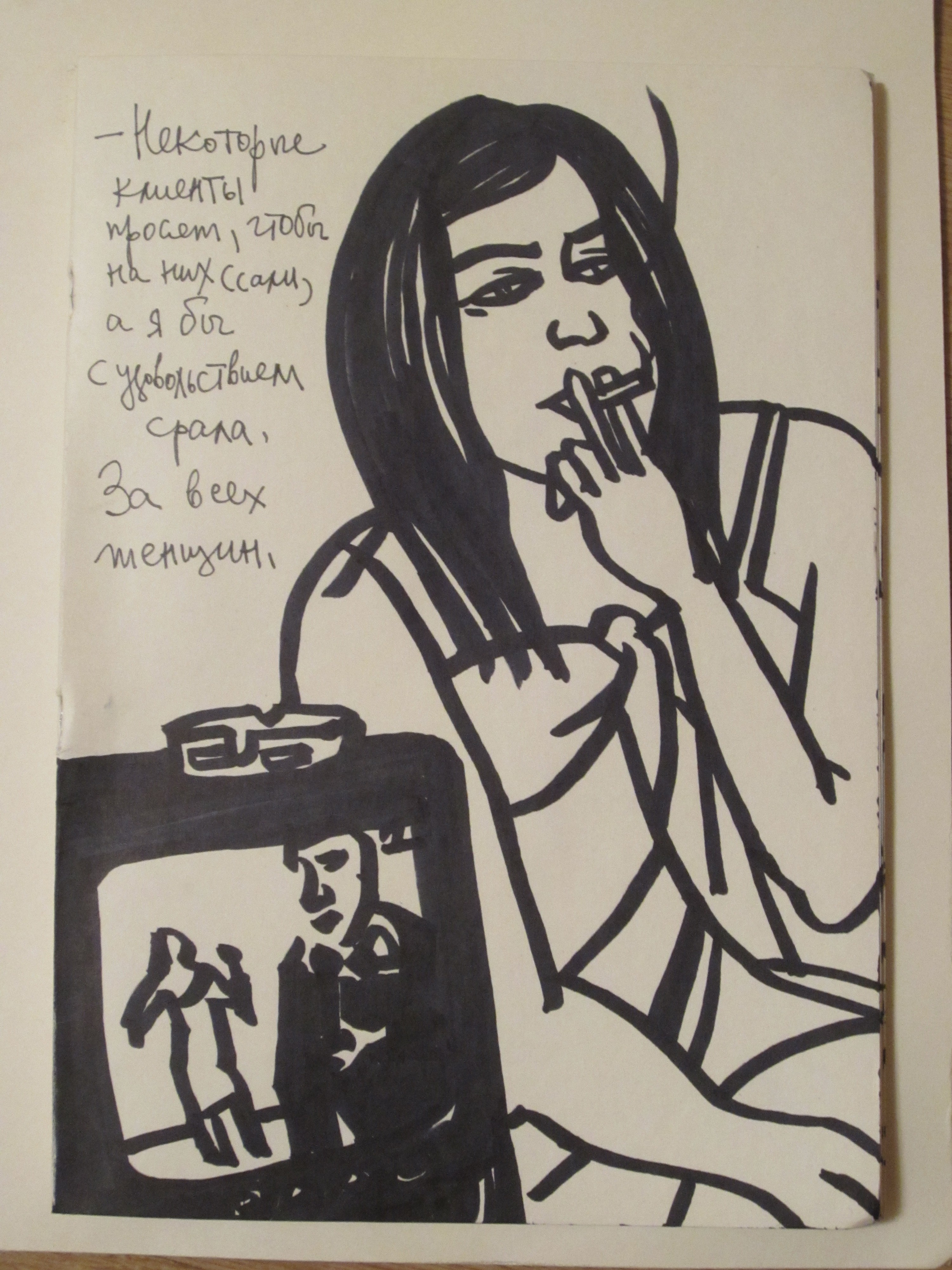
lomasko-girls-6From The “Girls” of Nizhny Novgorod, 2013. “Some clients ask us to piss on them, but I’d be happy to shit on them on behalf of all women.”

When I had just started making graphic reportages, it was considered something marginal in Russia. The situation has changed in recent years: there have been more and more graphic art non-fiction stories on social topics. Here are a few examples.

lomasko-soc-5Tatyana Faskhutdinova, Unknown Stories from the Life of Lyonya Rodin, 2012. (Left panel) People often take me for an extraterrestrial. One winter, the firewood ran out and there was no fuel for the stove. My friend and I decided to rent a flat. The landlady had a fit when she saw me. Lyona: “How much is the flat?” Landlady: “Ahhh! And he talks, too!” (Right panel) In our town, no one has any use for people like me. Disabled people have no way to get around normally. Tram driver: “Hurry up and get on!”

“Lyonya Rodin is my friend. He has been disabled since birth. […] It was not so much the absurd, maddening situations that happen to him now and then, situations caused by people’s indifference and society’s unwillingness and reluctance to accept people with disabilities, that I wanted to recount, but rather his ability to make friends, to dream, to make plans and carry them out, his passion for what he does, his utter lack of bitterness at life, and his inner calm and pride, despite the harshness and even cruelty of his circumstances.”

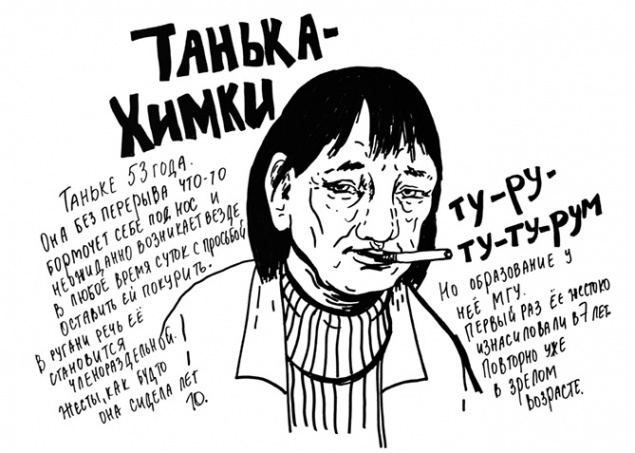
lomasko-soc-6Yana Smetanina, The Inhabitants of Psychiatric Hospital N0. 5 in Khotkovo, 2013. TANKA KHIMKI. Tanka is 53. She endlessly mumbles to herself and unexpectedly pops up everywhere at any time asking for a smoke. When she cusses, you can make out what she’s saying. She gestures like a woman who spent ten years in prison. TOO-ROO-TOO-TOO-ROOM. But she got her education at Moscow State University. She was brutally raped for the first time when she was 7. She was raped again as an adult.

“As a child I was really afraid of ‘crazy’ people. […] When, almost three decades later, I came to meet the inhabitants of Psychiatric Hospital No. 5 in Khotkovo, you can imagine my surprise when I realized that nearly all these women had been rape victims and that was why they had lost either their minds or their strength and their will to live. […]  They had been victims of rape, including incest, early in life, assaults on the street, and beatings by their own husbands.”

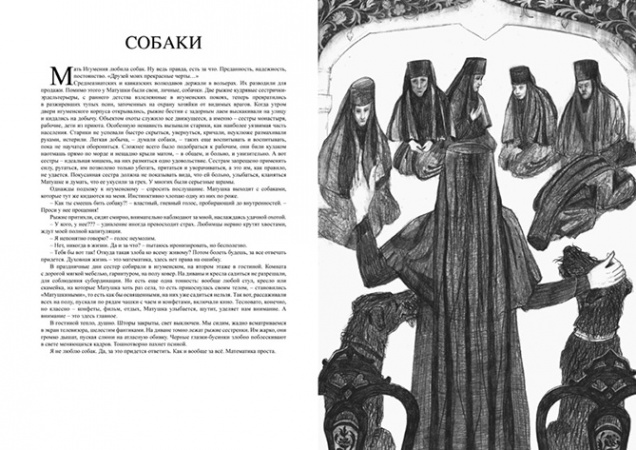
lomasko-soc-7Ilmira Bolotyan (illustrations) and Natasha Milantyeva (texts), A Nun’s Life, 2013

“Natasha Milantyeva, my girlfriend’s cousin, spent over 18 years in a convent. A Russian Orthodox nun, she was forced to leave her convent because life there threatened her health and the people in charge no longer wanted to see her among their ranks. Her unique experience has been the basis of short stories and plays about convent life. Natasha has witnessed events that no journalist could either record or depict.”

These works and many others were shown at Feminist Pencil, a series of exhibitions of socially engaged graphic art curated by Nadia Plungian and me.

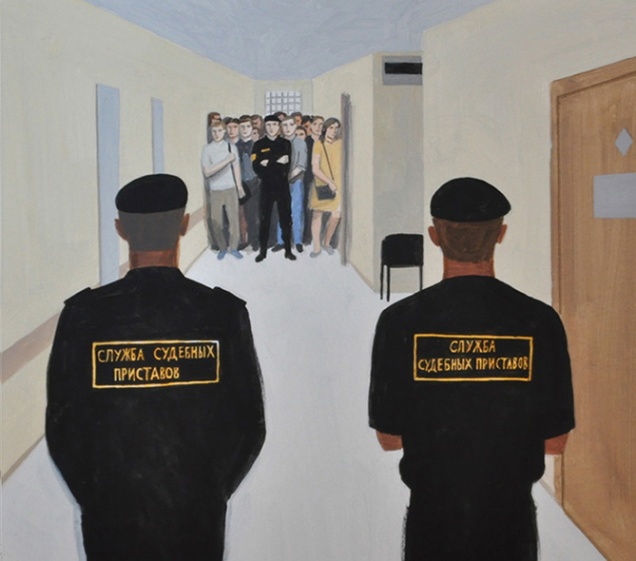
Graphic reportage is especially appropriate in court, since it is forbidden to take pictures and shoot video during hearings. Activist artists in different Russian cities and other parts of the former Soviet Union have taken to sketching court proceedings during political trials.

lomasko-soc-8
Radik Vildanov, Bailiffs Blocking the Corridor (Bolotnaya Square Trial), 2014

Zlata Ponirovskaya and I run the web site Drawing the Court, an archive of drawings from political trials and informative texts about these cases.

There are other grassroots initiatives involving drawing. The Women’s Crisis Center in Petersburg, for example, has begun engaging female artists to document court hearings on cases of domestic and sexual violence against its clients.

In Germany, Belarusian artist Marina Naprushkina sketches court hearings in the cases of asylum seekers from different countries, archiving them on the web site Refugees’ Library. Although her project only partly involves Russia (many of the refugees are from Chechnya and Dagestan), I cannot pass up this happy synthesis of socially engaged drawing and human rights work in my overview.

“I put together notebooks at the hearings, which people then translate into different languages. Having the web site function as an informational platform for refugees themselves is our main objective. The refugees are often not ready for the hearings: they don’t know they go, and what they should expect there. The notebooks are already read in many countries around the world,” says Naprushkina.

Like court sketches, graphic art produced for rallies has to make a clear, emotional statement. Many activist artists have been involved in making placards for opposition rallies and even helping to design the look of whole columns.  For example, at a 2012 rally in support of the Bolotnaya Square defendants, the Left Front’s column marched with portraits of the political prisoners drawn by artist Nikolay Oleynikov. In 2014, Oleynikov also organized an Anti-Fascist Creative Workshop at which he helped activists collectively produce placards for the annual Stanislav Markelov and Anastasia Baburova memorial rally on January 19. Portraits graced most of the placards at the rally.

lomasko-soc-9Anti-Fascist Creative Workshop. Photo by Vasily Petrov

However, portraits of political activists belong more to the realm of political art than to graphic art focused on social issues. It would also be a stretch to include the numerous examples of graphic art that appeared at protest rallies in 2012 and 2013 in this body of work. The main subjects were criticism of Putin and support for Pussy Riot: I don’t remember seeing placards dealing with societal problems there.

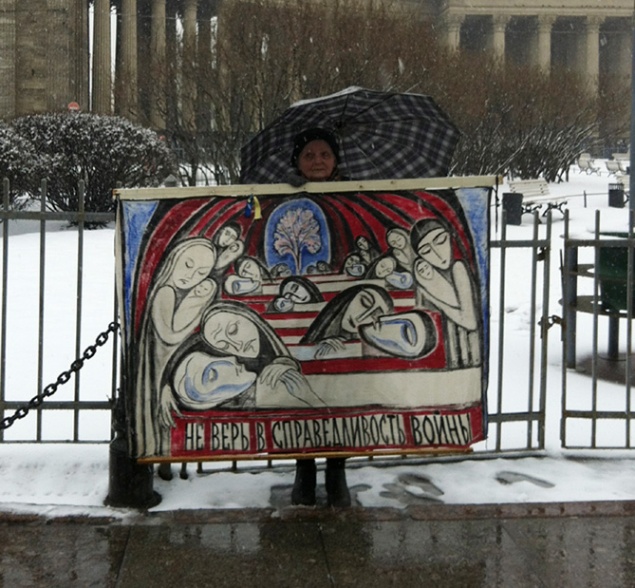
The works of Petersburg artist Yelena Osipova are outstanding in this regard. Even before the upsurge of protests in 2012, Osipova had been attending rallies and solo pickets with large, hand-drawn placards that took on such topics as the demolition of historic buildings, tuberculosis, everyday racism, children involved in the drug trade, and the murders of journalists.

lomasko-soc-10
Yelena Osipova, Don’t Believe in the Justice of War, March 2014. Photo by Asya Khodyreva

Osipova illuminates even the war in Ukraine from a social angle. Such posters of hers as Don’t Go to War, Sonny and Stop the War, Mothers and Wives, and her large-format colored placard Don’t Believe in the Justice of War treat war not as an abstract evil but as the personal tragedy of women who have lost sons and husbands.

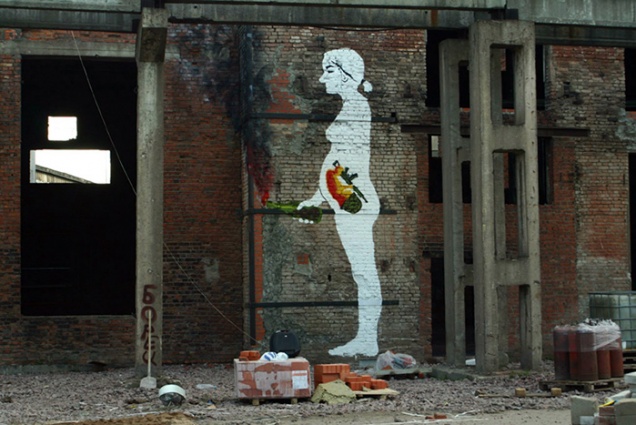
City walls are another good place for socially engaged graphic art. Over the past two years, the Petersburg group Gandhi has become a notable presence in socially engaged street art. Most often, the group makes large stencils in a laconic, poster-like style, for example, its series depicting female migrants or its latest work, a fresco on the fence of the Social Adaptation Center for the Homeless in Moscow.

lomasko-soc-11

Stencils made by the group Gandhi for the Solidarity Art Festival, 2014. Photo by Anton Androsov

Gandhi has made one of the few statements by Russian artists on the war in Ukraine. At the Street Art Museum in Petersburg, they produced a fresco entitled Broads Will Give Birth to New Ones, explaining it as follows: “We see and hear what is happening—a war that has not been formally declared but which is permanently conducted on the external and internal fronts. […] Our subject is a woman holding a Molotov cocktail. Glowing inside her is an infant soldier, doomed to fight for the money and power of strangers. The woman has chosen to rebel, knowing that if she fails, her child will himself, in the future, go after her with a gun.”

lomasko-soc-12Gandhi, Broads Will Give Birth to New Ones, 2014. Photo taken from the group’s Facebook page

Samizdat has always been a means of spreading leftist ideas. Graphic artists have been actively collaborating with such independent publications in Russia.

The newspaper Chto Delat has been published for many years by an eponymous group of leftist artists, philosophers, writers, researchers, and activists. Back issues of the paper are accessible on their web site.  The newspaper is filled with graphic art. These are not illustrations, however, but series of works by artists, linked to the articles by a common theme.

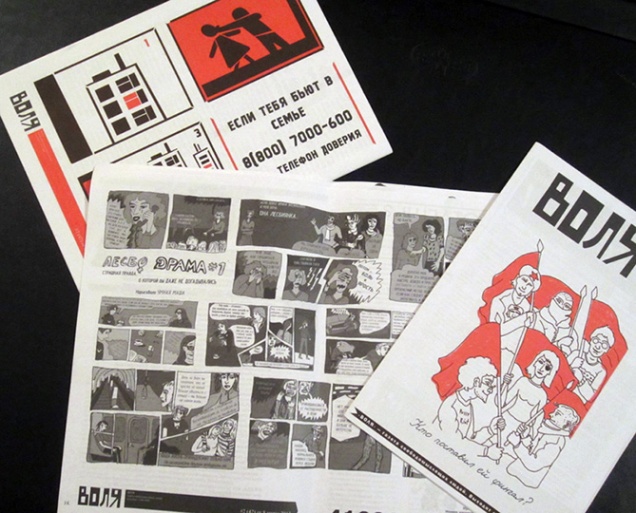
Lots of graphic art is printed in the anarchist newspaper Volya (Liberty).

lomasko-soc-13

Anarchist newspaper Volya

The 2013 International Women’s Day issue of Volya, featuring the works of feminist artists, was especially interesting visually. Such a variety of genres—posters, stencils, comics, graphic reportage, logos, and cover art—cannot be found in the official press.

Feminist zines are gradually emerging in Russia. In 2013, the first issue of Molota ved’m (Malleus Maleficarum) was published.

In the next few days, the first issue of the queer feminist zine Naglaya rvanina (Insolent Gash) will be released.

lomasko-soc-14Spread from queer feminist zine Naglaya rvanina, 2014

I am particularly interested in how socially engaged graphic art can become a part of human rights work and educational projects. Since 2010, I have worked as a volunteer with the Center for Prison Reform, participating in art trips to juvenile prisons. My project Drawing Lessons is part of the Center’s human rights and educational program. The project includes summaries of lessons specifically designed for juvenile prisons, drawings made by the inmates during these lessons, my own sketches in the prisons, and various samizdat (calendars, postcards, and brochures).

lomasko-soc-15

Calendar for the Novy Oskol Prison for Girls, 2012

I have posted most of the material from Drawing Lessons on my blog.

Another example is the Nasreddin Hodja Joke Contest, a project by Petersburg artist Olga Jitlina. Every week for several months, Jitlina organized informal meetings with migrants at teahouses, cafes, and other places.  Over cups of tea, participants analyzed the kinds of ethnic discrimination experienced by migrants in Russia and came up with succinct, witty responses that would put their offenders in their place without inciting them to violence. Artist Anna Tereshkina drew comics for the project about the modern-day Nasreddin and his fictional sister Dilfuza, who find themselves in typical conflicts in Russia. The speech balloons were left either entirely blank or only the lines of the victimizers were filled in. The migrants themselves came up with Nasreddin and Dilfuza’s rejoinders, and the wittiest lines were incorporated into the comics.

lomasko-soc-16

Olga Jitlina meeting with Nasreddin Hodja Joke Contest participants at a Petersburg teahouse, 2014. Photo by Victoria Lomasko

I hope even this fragmentary overview of Russian socially engaged graphic art gives some idea of its variety, especially in comparison with the situation in the 2000s. However, due to the tightening of censorship, the range of topics on which one can speak publicly without fear of incurring fines, criminal penalties or some other form of pressure from the government has begun to shrink rapidly.

Even worse than official censorship is the internal censorship practiced by the organizers of socially engaged projects.  For example, I was asked to leave in the pitiful stories of migrants in a graphic reportage I was doing while removing everything about the perpetrators of their misadventures—Russian police officers, judges, and officials who abuse their power. Such decisions are explained by the fact that castrated socially engaged works are “better than nothing.” As a result, instead of analyzing phenomena in their entirety, they once again leave viewers and readers with distorted images.

Artists reacted to events in political and public life in 2012 and 2013 with a flood of works. Many of them were superficial and lacking in professionalism, but this was made up for by the urgency and timeliness of their topics. Now we will have to react less and reflect more. In principle, any social topic can be used to reveal Russian society’s fundamental evil: our total alienation from each other and disrespect. And for the most radical works there are still the social networks, the streets, and samizdat.